
Thank you to all the subscribers to our Early Access program…we thank you for your continued support.
We are excited to offer this new service to keep you informed and up-to-date on the latest Dinar and currency news.
Iraq Economic News and Points To Ponder Wednesday Afternoon 9-23-26
Parliamentary Finance: The Salaries Of Employees Are Secured And The Budget Deficit Of 2027 May Reach 65 Trillion Dinars
Money and business Economy News — Baghdad A member of the Parliamentary Finance Committee, Ikhlas Al-Dulaimi, said that the committee has prepared its plans and preparations to discuss the draft general budget, pointing out that "the budget for 2027 is expected to reach the House of Representatives on October 15."
Parliamentary Finance: The Salaries Of Employees Are Secured And The Budget Deficit Of 2027 May Reach 65 Trillion Dinars
Money and business Economy News — Baghdad A member of the Parliamentary Finance Committee, Ikhlas Al-Dulaimi, said that the committee has prepared its plans and preparations to discuss the draft general budget, pointing out that "the budget for 2027 is expected to reach the House of Representatives on October 15."
Al-Dulaimi said in a statement to the official newspaper, that "the Finance Committee will have a large role in the study of the budget and the organization of its items and discuss them to reach a vote on them within the House of Representatives," noting that "the expected deficit in the budget may reach about 65 trillion dinars."
She explained that "the committee will discuss within the treatments of the deficit the file of the exchange rate and the procedures that will be proposed by the Ministry of Finance," stressing that "there are treatments with the ministry will be seen by the Finance Committee after the arrival of the draft budget to the House of Representatives."
With regard to public spending, Al-Dulaimi stressed that "the salaries of employees are secure," pointing out that "the volume of oil exports is increasing, reaching about 3 to 4 million barrels per day, in addition to the existence of reserves at the Central Bank can contribute to supporting financial stability." https://www.economy-news.net/content.php?id=74250
The Shift Towards Electronic Collection Of Departments And Industrial And Commercial Sectors
Money and business Economy News _ Baghdad The Electricity and Energy Committee in the House of Representatives revealed the existence of a trend to convert 3 items to the entire electronic collection, and while the national electricity system suffers from the frequency of firefighting due to the lack of imported gas, a similar crisis was exacerbated by the owners of private generators for periods of up to six hours a day under the pretext of scarcity in the (Kaz).
A member of the Parliamentary Electricity Committee, Zahra Luqman Al-Saadi, said in an interview with the official newspaper "Economy News" that within the treatment of the file of "high loads", there is a government trend binding to convert subscribers from industrial and commercial classes and government departments to the entire electronic collection.
The deputy added that the committee is working to exercise the supervisory role on the distribution departments to ensure that all these items are provided with smart devices (POS) and smart meters, as the recovery of the amounts of these items represents the largest resource of the ministry.
In the midst of that, “morning” followed the complaints of citizens in Baghdad and the provinces, which confirmed the repeated extinguishing of the national system, and the same act is practiced daily by some owners of private and government generators alike, for periods of (4-6) hours a day under the pretext of the existence of scarcity of ketosis, while others appealed to impose strict control and inspection of the owners of generators to coincide with the deliberate extinguishing by them with an unprecedented lifting of the price of one amp from 15 thousand dinars to 22 thousand, citing the same argument.
Despite the ongoing interruptions and the apparent discontent among citizens, the Ministry of Electricity has maintained a media silence on the energy crisis, which has renewed with the approach of the winter season. In this context, Al-Sabah newspaper communicated by phone with the ministry, but the official spokesman chose not to respond or media cooperation, ignoring that this file is the biggest concern and permanent inspiration for citizens around the clock. https://www.economy-news.net/content.php?id=74248
Parliamentary Economy Discusses The Amendment Of The Industrial Cities Law
Money and business Economy News - Baghdad The Parliamentary Committee on Economy, Industry and Trade discussed on Tuesday the draft law to amend the Industrial Cities Law, in preparation for the completion of its final version and put it to a vote in the coming period.
A statement by the Information Department of the House of Representatives said that the committee held a meeting under the chairmanship of the President of the age, MP Omar Mohammed Mohammed Karim, in the presence of its members, in addition to the representative of the Union of Industrialists, the President of the Industrial Cities and Free Zones Authority and a number of legal representatives and the beneficiary sectoral bodies.
The statement added that the meeting witnessed hearing the views and suggestions of the members of the committee and representatives of the concerned authorities on the amendment articles, thus contributing to reaching a final legal formula that takes into account the requirements of the industrial sector and the development of the environment of industrial cities.
He pointed out that the committee is working to complete the discussion of observations and proposals in preparation for the submission of the draft law in its final form and vote on it in the coming period https://www.economy-news.net/content.php?id=74217
Responsible Source: Handling Companies Apologize For Serving Iranian Aircraft For Fear Of Sanctions
Money and business Economy News - Baghdad An official source confirmed on Wednesday that the Ministry of Transport and the Civil Aviation Authority do not bear the responsibility of not receiving Iranian aircraft, while noting that the handling companies and ground services apologized for providing their services to Iranian airlines for fear of sanctions.
The source said that "the Ministry of Transport does not bear the responsibility of not receiving Iranian aircraft, as well as the Civil Aviation Authority of the Council of Ministers, which is responsible for granting approvals in accordance with the principle of reciprocity with the Iranian side in the files of travel and aviation and in accordance with the laws governing aviation internationally."
He added that "the issue is related to handling companies and ground services, which are private non-governmental companies contracted with Iranian airlines to provide after-landing and pre-take-off services, including loading and landing bags and organizing the procedures for the departure of passengers to aircraft and other services," noting that "these companies are the ones who apologized to Iranian airlines for providing their services for fear of being subject to sanctions."
He added that "Iraqi airports provide a spatial environment for private companies that provide their services for wages and do not interfere in the nature of the contract of these companies with airlines in any detail." https://www.economy-news.net/content.php?id=74271
Iraq Calls From Doha For Effective Arab Cooperation To Recover Funds And Combat Corruption
Money and business Economy News – Baghdad Iraq participated on Wednesday in the sixth session of the Conference of the States Parties to the Arab Convention against Corruption, which was launched in the Qatari capital Doha, while the head of the Federal Integrity Commission, Mohammed Ali Al-Lami, called for strengthening Arab cooperation in the field of recovering funds and assets and confronting cross-border corruption.
The Federal Integrity Commission said in a statement that "the work of the sixth session of the Conference of the States Parties to the Arab Convention against Corruption was launched in Doha, with the participation of the delegation of the Republic of Iraq headed by the Chairman of the Commission, Mohammed Ali Al-Lami, to confirm Iraq's commitment to implement the agreement, which it acceded to in 2012."
She added that "the head of the Qatar Administrative Control and Transparency Authority, Hamad bin Nasser Al-Misnad, opened the conference, which witnessed the State of Qatar assuming the presidency of the sixth session of the Arab Convention against Corruption from the State of Palestine."
Al-Lami stressed that "corruption is a cross-border international scourge, and confronting it requires concerted efforts and cooperation between countries, such as international cooperation in combating terrorism, epidemics and diseases."
He pointed out that "Iraq continues to implement its national plans in the field of combating corruption, and is moving towards the adoption of the national strategy for integrity and combating corruption until 2030, in order to enhance transparency and the application of governance systems and digital transformation."
He explained that "Iraq's efforts are not limited to the financial, investigative and deterrent aspects, but include taking into account the principles of human rights and launching programs targeting various segments of society, especially young people, to promote a culture of integrity and combat corruption."
He pointed to the issuance of a regulation of the functional conduct of the elections, with the aim of preventing the exploitation of state resources, as well as the launch of honorable charters for integrity with the participation of social actors and opinion leaders.
In the file of the recovery of funds and assets, Al-Lami stressed that "this file occupies an important area of Iraqi national efforts," calling on the countries parties to the agreement to "active cooperation to overcome the difficulties that hinder the speedy implementation of requests for the recovery of funds and assets."
He stressed that "Iraq is determined to continue to fight corruption based on independence, community partnership and Arab and international cooperation."
The Conference witnessed the election of officers and the adoption of the agenda, as well as the discussion of a series of resolutions submitted by the Secretariat-General of the League of Arab States and proposals made by States parties to the Convention.
The Federal Integrity Commission is the official representative of Iraq in the Arab and United Nations Conventions against Corruption and follows up on their obligations, foremost among which is cooperation, exchange of assistance and experiences, and participation in relevant conferences and forums. https://www.economy-news.net/content.php?id=74259
Foreign Minister Discusses With His Iranian Counterpart The Reopening Of The Strait Of Hormuz
Money and business Economy News – Baghdad Foreign Minister Fuad Hossein on Wednesday discussed with his Iranian counterpart Abbas Araqchi the reopening of the Strait of Hormuz.
"I met in New York with the Foreign Minister of the Islamic Republic of Iran, Abbas Araqchi, and we discussed bilateral relations and developments in the region, the ongoing indirect contacts between Tehran and Washington, and efforts to de-escalate and reopen the Strait of Hormuz to navigation," Hussein said in a blog post on the X platform.
Hussein stressed that "dialogue and diplomacy remain the most effective path to contain tension and prevent its expansion, and that the security of the region and freedom of navigation require regional cooperation and responsible dialogue between the parties concerned."
He pointed out that "the meeting discussed the fight against terrorism across borders and the strengthening of economic cooperation, and we agreed to continue consultation to support regional security and stability https://www.economy-news.net/content.php?id=74256
Al-Sharaa: There Is A Project To Link Iraq's Oil Fields To Syrian Ports And Secure Safe Passage For Its Products
Money and business Economy News — Baghdad Syrian President Ahmed al-Sharaa revealed that there is a project to link Iraq's oil fields to Syrian ports and secure a safe passage for its products.
Al-Sharaa said after his meeting with Al-Zaydi and in an open dialogue within the activities of the Atlantic Council: "We have a long border with Iraq, and we seek to establish economic ties between Iraq and Syria, because this will improve relations in the common interest of the two countries."
“We are also trying to secure a safe passage for Iraqi products, especially oil products, through Syria.”
He pointed out that "there is a project to link the oil fields in Iraq with the Syrian seaports, as an alternative through Bab al-Mandab and the Suez Canal, this path has been in place since the fifties of the last century, but it was stopped because of the poor political relations between Syria and Iraq. We are now trying to address the mistakes and problems that have occurred over the past half century.” https://www.economy-news.net/content.php?id=74251
Parliamentary Finance: The Salaries Of Employees Are Secured And The Budget Deficit Of 2027 May Reach 65 Trillion Dinars
Money and business Economy News — Baghdad A member of the Parliamentary Finance Committee, Ikhlas Al-Dulaimi, said that the committee has prepared its plans and preparations to discuss the draft general budget, pointing out that "the budget for 2027 is expected to reach the House of Representatives on October 15."
Al-Dulaimi said in a statement to the official newspaper, that "the Finance Committee will have a large role in the study of the budget and the organization of its items and discuss them to reach a vote on them within the House of Representatives," noting that "the expected deficit in the budget may reach about 65 trillion dinars."
She explained that "the committee will discuss within the treatments of the deficit the file of the exchange rate and the procedures that will be proposed by the Ministry of Finance," stressing that "there are treatments with the ministry will be seen by the Finance Committee after the arrival of the draft budget to the House of Representatives."
With regard to public spending, Al-Dulaimi stressed that "the salaries of employees are secure," pointing out that "the volume of oil exports is increasing, reaching about 3 to 4 million barrels per day, in addition to the existence of reserves at the Central Bank can contribute to supporting financial stability." https://www.economy-news.net/content.php?id=74250
The Shift Towards Electronic Collection Of Departments And Industrial And Commercial Sectors
Money and business Economy News _ Baghdad The Electricity and Energy Committee in the House of Representatives revealed the existence of a trend to convert 3 items to the entire electronic collection, and while the national electricity system suffers from the frequency of firefighting due to the lack of imported gas, a similar crisis was exacerbated by the owners of private generators for periods of up to six hours a day under the pretext of scarcity in the (Kaz).
A member of the Parliamentary Electricity Committee, Zahra Luqman Al-Saadi, said in an interview with the official newspaper "Economy News" that within the treatment of the file of "high loads", there is a government trend binding to convert subscribers from industrial and commercial classes and government departments to the entire electronic collection.
The deputy added that the committee is working to exercise the supervisory role on the distribution departments to ensure that all these items are provided with smart devices (POS) and smart meters, as the recovery of the amounts of these items represents the largest resource of the ministry.
In the midst of that, “morning” followed the complaints of citizens in Baghdad and the provinces, which confirmed the repeated extinguishing of the national system, and the same act is practiced daily by some owners of private and government generators alike, for periods of (4-6) hours a day under the pretext of the existence of scarcity of ketosis, while others appealed to impose strict control and inspection of the owners of generators to coincide with the deliberate extinguishing by them with an unprecedented lifting of the price of one amp from 15 thousand dinars to 22 thousand, citing the same argument.
Despite the ongoing interruptions and the apparent discontent among citizens, the Ministry of Electricity has maintained a media silence on the energy crisis, which has renewed with the approach of the winter season. In this context, Al-Sabah newspaper communicated by phone with the ministry, but the official spokesman chose not to respond or media cooperation, ignoring that this file is the biggest concern and permanent inspiration for citizens around the clock. https://www.economy-news.net/content.php?id=74248
Parliamentary Economy Discusses The Amendment Of The Industrial Cities Law
Money and business Economy News - Baghdad
The Parliamentary Committee on Economy, Industry and Trade discussed on Tuesday the draft law to amend the Industrial Cities Law, in preparation for the completion of its final version and put it to a vote in the coming period.
A statement by the Information Department of the House of Representatives said that the committee held a meeting under the chairmanship of the President of the age, MP Omar Mohammed Mohammed Karim, in the presence of its members, in addition to the representative of the Union of Industrialists, the President of the Industrial Cities and Free Zones Authority and a number of legal representatives and the beneficiary sectoral bodies.
The statement added that the meeting witnessed hearing the views and suggestions of the members of the committee and representatives of the concerned authorities on the amendment articles, thus contributing to reaching a final legal formula that takes into account the requirements of the industrial sector and the development of the environment of industrial cities.
He pointed out that the committee is working to complete the discussion of observations and proposals in preparation for the submission of the draft law in its final form and vote on it in the coming period https://www.economy-news.net/content.php?id=74217
Responsible Source: Handling Companies Apologize For Serving Iranian Aircraft For Fear Of Sanctions
Money and business Economy News - Baghdad An official source confirmed on Wednesday that the Ministry of Transport and the Civil Aviation Authority do not bear the responsibility of not receiving Iranian aircraft, while noting that the handling companies and ground services apologized for providing their services to Iranian airlines for fear of sanctions.
The source said that "the Ministry of Transport does not bear the responsibility of not receiving Iranian aircraft, as well as the Civil Aviation Authority of the Council of Ministers, which is responsible for granting approvals in accordance with the principle of reciprocity with the Iranian side in the files of travel and aviation and in accordance with the laws governing aviation internationally."
He added that "the issue is related to handling companies and ground services, which are private non-governmental companies contracted with Iranian airlines to provide after-landing and pre-take-off services, including loading and landing bags and organizing the procedures for the departure of passengers to aircraft and other services," noting that "these companies are the ones who apologized to Iranian airlines for providing their services for fear of being subject to sanctions."
He added that "Iraqi airports provide a spatial environment for private companies that provide their services for wages and do not interfere in the nature of the contract of these companies with airlines in any detail." https://www.economy-news.net/content.php?id=74271
Iraq Calls From Doha For Effective Arab Cooperation To Recover Funds And Combat Corruption
Money and business Economy News – Baghdad Iraq participated on Wednesday in the sixth session of the Conference of the States Parties to the Arab Convention against Corruption, which was launched in the Qatari capital Doha, while the head of the Federal Integrity Commission, Mohammed Ali Al-Lami, called for strengthening Arab cooperation in the field of recovering funds and assets and confronting cross-border corruption.
The Federal Integrity Commission said in a statement that "the work of the sixth session of the Conference of the States Parties to the Arab Convention against Corruption was launched in Doha, with the participation of the delegation of the Republic of Iraq headed by the Chairman of the Commission, Mohammed Ali Al-Lami, to confirm Iraq's commitment to implement the agreement, which it acceded to in 2012."
She added that "the head of the Qatar Administrative Control and Transparency Authority, Hamad bin Nasser Al-Misnad, opened the conference, which witnessed the State of Qatar assuming the presidency of the sixth session of the Arab Convention against Corruption from the State of Palestine."
Al-Lami stressed that "corruption is a cross-border international scourge, and confronting it requires concerted efforts and cooperation between countries, such as international cooperation in combating terrorism, epidemics and diseases."
He pointed out that "Iraq continues to implement its national plans in the field of combating corruption, and is moving towards the adoption of the national strategy for integrity and combating corruption until 2030, in order to enhance transparency and the application of governance systems and digital transformation."
He explained that "Iraq's efforts are not limited to the financial, investigative and deterrent aspects, but include taking into account the principles of human rights and launching programs targeting various segments of society, especially young people, to promote a culture of integrity and combat corruption."
He pointed to the issuance of a regulation of the functional conduct of the elections, with the aim of preventing the exploitation of state resources, as well as the launch of honorable charters for integrity with the participation of social actors and opinion leaders.
In the file of the recovery of funds and assets, Al-Lami stressed that "this file occupies an important area of Iraqi national efforts," calling on the countries parties to the agreement to "active cooperation to overcome the difficulties that hinder the speedy implementation of requests for the recovery of funds and assets."
He stressed that "Iraq is determined to continue to fight corruption based on independence, community partnership and Arab and international cooperation."
The Conference witnessed the election of officers and the adoption of the agenda, as well as the discussion of a series of resolutions submitted by the Secretariat-General of the League of Arab States and proposals made by States parties to the Convention.
The Federal Integrity Commission is the official representative of Iraq in the Arab and United Nations Conventions against Corruption and follows up on their obligations, foremost among which is cooperation, exchange of assistance and experiences, and participation in relevant conferences and forums. https://www.economy-news.net/content.php?id=74259
Foreign Minister Discusses With His Iranian Counterpart The Reopening Of The Strait Of Hormuz
Money and business Economy News – Baghdad Foreign Minister Fuad Hossein on Wednesday discussed with his Iranian counterpart Abbas Araqchi the reopening of the Strait of Hormuz.
"I met in New York with the Foreign Minister of the Islamic Republic of Iran, Abbas Araqchi, and we discussed bilateral relations and developments in the region, the ongoing indirect contacts between Tehran and Washington, and efforts to de-escalate and reopen the Strait of Hormuz to navigation," Hussein said in a blog post on the X platform.
Hussein stressed that "dialogue and diplomacy remain the most effective path to contain tension and prevent its expansion, and that the security of the region and freedom of navigation require regional cooperation and responsible dialogue between the parties concerned."
He pointed out that "the meeting discussed the fight against terrorism across borders and the strengthening of economic cooperation, and we agreed to continue consultation to support regional security and stability https://www.economy-news.net/content.php?id=74256
Al-Sharaa: There Is A Project To Link Iraq's Oil Fields To Syrian Ports And Secure Safe Passage For Its Products
Money and business Economy News — Baghdad Syrian President Ahmed al-Sharaa revealed that there is a project to link Iraq's oil fields to Syrian ports and secure a safe passage for its products.
Al-Sharaa said after his meeting with Al-Zaydi and in an open dialogue within the activities of the Atlantic Council: "We have a long border with Iraq, and we seek to establish economic ties between Iraq and Syria, because this will improve relations in the common interest of the two countries."
“We are also trying to secure a safe passage for Iraqi products, especially oil products, through Syria.”
He pointed out that "there is a project to link the oil fields in Iraq with the Syrian seaports, as an alternative through Bab al-Mandab and the Suez Canal, this path has been in place since the fifties of the last century, but it was stopped because of the poor political relations between Syria and Iraq. We are now trying to address the mistakes and problems that have occurred over the past half century.” https://www.economy-news.net/content.php?id=74251
3 Savings Moves To Make Post-Fed Rate Hike
3 Savings Moves To Make Post-Fed Rate Hike
By Matt Richardson September 17, 2026 CBS News MoneyWatch: Managing Your Money
With interest rates rising again, savers will want to take certain steps now to take advantage.
Savers on Thursday woke up to a new financial climate marked by the first interest rate hike from the Federal Reserve in more than three years. Now at a range between 3.75% and 4.00%, a new, higher federal funds rate is expected to lead to even higher rates for savers than they've already been accustomed to in recent years. And while that change will look different based on the account type and the bank in question, savers are undoubtedly now entering a more profitable period, especially if the Fed proceeds with another interest rate hike when it meets again in October.
3 Savings Moves To Make Post-Fed Rate Hike
By Matt Richardson September 17, 2026 CBS News MoneyWatch: Managing Your Money
With interest rates rising again, savers will want to take certain steps now to take advantage.
Savers on Thursday woke up to a new financial climate marked by the first interest rate hike from the Federal Reserve in more than three years. Now at a range between 3.75% and 4.00%, a new, higher federal funds rate is expected to lead to even higher rates for savers than they've already been accustomed to in recent years. And while that change will look different based on the account type and the bank in question, savers are undoubtedly now entering a more profitable period, especially if the Fed proceeds with another interest rate hike when it meets again in October.
Taking advantage of new, better interest-earning opportunities will take a bit of a strategic approach from savers, however. While there are always costly mistakes worth avoiding, making the right, proactive moves now could be the difference between earning a standard rate on your money or one that's exponentially higher. And these moves should happen relatively quickly, both to boost your savings as much as possible and to cut losses you may already be enduring with other account types. Below, we'll break down three specific savings moves to make now, post-Fed rate hike.
To position yourself for savings success as quickly as possible, consider making these three moves right now:
Move the money you need to maintain access to into a high-yield savings account
Traditional savings accounts should have been closed already, but if you haven't yet done so, consider acting now. With an average interest rate of just 0.38% currently, you're essentially losing money by not shifting your funds into an alternative account type. Move the money you need to maintain access to, then, into a high-yield savings account instead. These accounts operate the same way a traditional account does, albeit with significantly more interest earnings to be had.
And you won't have to worry about making withdrawals, deposits or paying any fees the way you would with a certificate of deposit (CD) account with a fixed rate. With a variable rate structure, too, they're well-positioned to take advantage of a rising interest rate environment if the Fed continues to hike rates. Consider shopping around for high-yield savings accounts online, then, and move the money you need to keep flexible into the most profitable option you can find right away.
Use CDs, but in a more cautious way than usual
Technically, CDs have slightly higher rates than high-yield savings accounts do. And they're fixed, adding a layer of protection that the variable-rate high-yield account can't offer. Because your money will be locked in the account at that fixed rate level, however, your interest-earning potential will be limited.
This doesn't mean that CD accounts aren't still worth opening (they are), but it does mean that savers should use them in a more cautious way than usual, especially compared to the climate in which interest rates were consistently declining in 2024 and 2025. So open a CD account, but don't deposit more than you can afford to part with, and don't lock it into a term that you can't easily see through to the maturity date.
Explore alternative accounts that can help you take advantage of a higher rate climate
CDs and high-yield savings accounts may be ubiquitous, but they're not the only accounts that will help you take advantage of a higher interest rate climate. A money market account functions as a savings account that you can write checks from and, right now, interest rates on the account are averaging only slightly below those tied to high-yield savings accounts.
So, if you want to earn a high rate while streamlining your banking needs, this could be the right account for you now. High-yield checking accounts, meanwhile, should also be considered as they can allow you to earn a competitive rate on the money you already have sitting idle waiting for the next bill to be paid. Earning some extra interest there, too, won't hurt.
The bottom line
A rising interest rate environment isn't great news for borrowers, but it does have a silver lining for savers who position themselves appropriately now. By moving the money you need access to into a high-yield savings account, closing the traditional account (if you still have one), using CDs in a more cautious way, and exploring alternative account types that you may not have thought about previously, you can do just that. Consider the use, too, of online marketplaces that list all of the relevant account information you'll need in one spot and don't discount the benefits of speaking with banks directly as they can often outline accounts and approaches that may align with your unique financial circumstances.
Edited by Angelica Leicht
TO READ MORE: https://www.cbsnews.com/news/savings-moves-to-make-post-september-2026-fed-rate-hike/
Andy Schectman: Central Banks Are Preparing for What Comes Next
Andy Schectman: Central Banks Are Preparing for What Comes Next
Liberty and Finance: 9-22-2026
Andy Schectman warns that rising interest rates may no longer be hurting gold the way conventional market wisdom suggests, as central banks continue accumulating physical metal and Comex deliveries remain strong.
He says the growing pressure on U.S. Treasuries, rising diesel and oil costs, and limited options for central banks could create a dangerous environment of inflation and financial volatility.
Andy Schectman: Central Banks Are Preparing for What Comes Next
Liberty and Finance: 9-22-2026
Andy Schectman warns that rising interest rates may no longer be hurting gold the way conventional market wisdom suggests, as central banks continue accumulating physical metal and Comex deliveries remain strong.
He says the growing pressure on U.S. Treasuries, rising diesel and oil costs, and limited options for central banks could create a dangerous environment of inflation and financial volatility.
Schectman also argues that BRICS nations are quietly building interoperable payment and monetary infrastructure while increasing gold accumulation and reducing reliance on Treasuries.
He warns that the bond market could face severe consequences if Treasury yields move substantially above 5%, with ripple effects across Wall Street, real estate, banks, insurers and pensions.
Meanwhile, he says physical gold and silver remain attractive relative to other assets, with premiums beginning to rise again as global demand continues.
INTERVIEW TIMELINE:
0:00 Intro
1:30 Rate increases
11:00 BRICS & gold
19:00 Bond market crisis
24:00 Bullion supply chain
Ariel: The Great Revaluation, the Trifecta that Ends Bretton Woods Forever
Ariel: The Great Revaluation, the Trifecta that Ends Bretton Woods Forever
9-23-2026
The Great Revaluation — $600 Silver, $10K Gold, and the Iraq-XRP-XLM Trifecta That Ends Bretton Woods Forever
The $600/$10K Anchor Is Not a Guess — It’s a Solvency
That “$600 silver / $10,000 gold” figure didn’t come from some Telegram hype channel. It came from the balance-sheet math that Treasury can’t say out loud yet. Here’s what nobody on the internet are talking about.
Ariel: The Great Revaluation, the Trifecta that Ends Bretton Woods Forever
9-23-2026
The Great Revaluation — $600 Silver, $10K Gold, and the Iraq-XRP-XLM Trifecta That Ends Bretton Woods Forever
The $600/$10K Anchor Is Not a Guess — It’s a Solvency
That “$600 silver / $10,000 gold” figure didn’t come from some Telegram hype channel. It came from the balance-sheet math that Treasury can’t say out loud yet. Here’s what nobody on the internet are talking about.
The U.S. holds 261.5 million troy ounces of gold on the books at $42.22 per ounce a laughable $11 billion valuation that hasn’t been updated since Nixon torched Bretton Woods I in 1971.
At $10,000 per ounce, that same vault becomes $2.615 trillion in hard collateral overnight, and silver at $600 turns the strategic stockpile into an additional $300+ billion without a single new mining permit.
That’s not a “revaluation.” That’s an emergency solvency injection that re-underwrites the Treasury dollar without printing a single new Federal Reserve note, and it happens the moment the bridge currency framework XRP and XLM is operational enough to absorb the shock without collapsing the legacy bond market.
The SEC’s September 17 Innovation Exemption was the legal signal flare. Ondo and DTCC going live in October is the plumbing. And that $600/$10K number is the pressure reading in the pipe before the valve opens.
The IMF Leaving Bretton Woods Is Not Reform — It’s a Surrender Document Signed in Blockchain Ink
The IMF “announcing they are leaving Bretton Woods for the new digital age” is the most polite way to describe an institutional capitulation that’s been 80 years in the making. Bretton Woods wasn’t just a monetary system. It was a control architecture IMF conditionality, World Bank structural adjustment, dollar hegemony enforced through SWIFT exclusion and Treasury sanctions that let a handful of Western institutions dictate the economic sovereignty of 190 countries.
The IMF walking away from that framework in September 2026, the same month the SEC issued its Innovation Exemption and Iraq declared financial sovereignty, is not a coincidence. It’s a sequenced retreat.
Here’s what they didn’t announce in the press release. The IMF’s new “digital age” framework means member states can now settle cross-border obligations using tokenized assets on public blockchain infrastructure specifically, the XRP Ledger and Stellar Network without routing through the correspondent banking system that the IMF itself used to enforce compliance.
Iraq’s 2027 budget, priced in a revalued dinar, settles against tokenized oil contracts on the same rails. The IMF isn’t “leaving” Bretton Woods. They’re evacuating before the legacy architecture collapses under the weight of a gold-backed, blockchain-settled parallel system they can no longer gatekeep.
The Iraq Revaluation Is Not a Standalone Event — It’s the Trigger for the Commodity-Backed Currency Cascade
Iraq’s IQD revaluation driven by the September 30 sovereignty declaration and the October 15 budget rate announcement is not just about Iraq. Iraq sits on the fifth-largest proven oil reserves on Earth, 145 billion barrels, plus natural gas reserves that are still underexplored because the Deepstate’s “program rate” kept the economy too dysfunctional to develop them.
When the dinar revalues to something approaching its resource-backed reality and when the dIQD is instantly convertible through XRP/XLM to tokenized gold, silver, and U.S. Treasuries Iraq becomes the proof of concept for every other resource-rich nation that’s been trapped in IMF-imposed currency suppression.
Venezuela’s bolivar, Nigeria’s naira, Indonesia’s rupiah every petro-state that’s been told for decades that their currency is “worthless” despite sitting on trillion-dollar resource bases gets a template.
The $600 silver and $10K gold revaluation isn’t just for the U.S. Treasury. It’s the anchor that gives every commodity-backed revaluation a reference price.
Iraq goes first because the CBI’s digital framework is the most advanced, but the cascade is already priced into the Ondo-DTCC tokenization timeline. October isn’t just a month. It’s a detonation sequence.
Read Full Article:
https://www.patreon.com/Prolotario1/posts/great-added-to-x-170301049
Bruce’s Big Call Dinar Intel Tuesday Night 9-22-26
Bruce’s Big Call Dinar Intel Tuesday Night 9-22-26
Transcribed By WiserNow Emailed To Recaps (INTEL ONLY)
Welcome everybody to the big call tonight. It is Tuesday, September 22, and you're listening to the big call. Thanks everybody for tuning in. We had a lot of fun in the pre-call that is not recorded, but those of you who were on the call early caught a little bit of Sue and Bob and my discussion about dancing and that kind of thing. So, yeah, yeah, it was fun. So, welcome everybody. Glad you're here tonight.
All right, let's get into the intel. Enough about apples. Let's get into where we are on the intel right now. Okay. As you guys know, I like to modify our timeline, make sure we're still on track.
Bruce’s Big Call Dinar Intel Tuesday Night 9-22-26
Transcribed By WiserNow Emailed To Recaps (INTEL ONLY)
Welcome everybody to the big call tonight. It is Tuesday, September 22, and you're listening to the big call. Thanks everybody for tuning in. We had a lot of fun in the pre-call that is not recorded, but those of you who were on the call early caught a little bit of Sue and Bob and my discussion about dancing and that kind of thing. So, yeah, yeah, it was fun. So, welcome everybody. Glad you're here tonight.
All right, let's get into the intel. Enough about apples. Let's get into where we are on the intel right now. Okay. As you guys know, I like to modify our timeline, make sure we're still on track.
Okay, what is what is the situation? Where do we stand? How close are we? When is this thing going to happen? All of those questions that we all have.
Well, there were there was a source that was really, really pretty good that was talking about, you know, this week getting notified maybe tomorrow or Thursday, and going, you know, toward the end of the week. We have another source that's very high up, like about as high as you can go, high up. That was saying you're going to try to push this out. I don't like that expression, but that's usually what it says. They're going to try to push this out toward the end of this week.
That could end up being Friday, Saturday. It could be that we get something on Thursday, and I'll back up a minute and tell you why.
We have heard, and we do know that Tier Two, which are whales and VIPs, these are big players, and I think we're big players too.
But these are players that are big in bonds, with boxes, multiple boxes of bonds, that kind of thing. They may not have that much more than we're going to have, to be honest.
However, they're in a different tier. They're in group two, tier two, they have been paid. Now, are they gaining access to those funds yet? We're not sure that they have access to those funds.
We've heard they have, but yet we're not sure that that's true yet. Now, what about tier three? These are the bondholders that would go theoretically before we go.
Tier three are supposed to be paid out tomorrow, Wednesday or Thursday, and we're supposed to either go close to when they go or not too far behind them, and I think it's okay for us to go after them, provided that if they get paid tomorrow, for example, and they have login information where they can go see their account.
See the money that they have, because remember, tier threes already ponyed up all the bonds.
Some of them had currency that was also pre-exchange when their bonds were redeemed, but they were all given the equivalent of a safekeeping receipt, an SKR, and that as such, those SKRs need to be made liquid. They need to be able to go to their accounts and see the funds and have access to those funds before they can spend anything.
Well, so far, even if, and I believe they will be paid this week. Bondholders tier three, being paid Wednesday and or Thursday. When will they get access to their funds?
Now, for quite a long time. We've been told that Tier Three will gain access to their funds and have basically spendability when we get our numbers, our 800 numbers, to set our appointments, which puts us a day, maybe a half a day, behind them.
They might have a slight head start, but the idea of a shotgun start would be for all of us essentially to have access to the funds, to our funds at the same time.
I've heard we have a modified shotgun start, which means we could go one or two days after tier three, they have a slight head start. I'm believing that they're going to get access to their funds when we start setting our appointments through the call centers and finishing up at the redemption centers
That's what I think makes the most sense. We have had some intel, and I think I told you guys some of this maybe on last Thursday that has not come through yet. Okay, for example, EAS EBS. Don't think we've seen that yet. We've heard of a flash or two on the screen, you know, to let us know. That's almost really a test. I think we're going to get those when we start.
I think we'll get EAS EBS and some reference to Nasara and just SARA internationally, but Nasara for us. When we start exchanging, when we go in, we've got an appointment set with the Redemption Center. We've called the 800 numbers. We've set our appointments through the call center. We've been tied into the Redemption Center.
It's been indicated by our zip code, as we put the zip code in theoretically into a into a keypad on our phone when we're on the phone, and then we get transferred to at the redemption center where we talk to a live, breathing human being instead of AI, and we talk to this person, and they finish up setting up our appointment, just telling us, okay, yeah, you've got an appointment for this day, this time.
Don't be more than 10 minutes early. Blah blah blah, and just you know, everything will be hunky dory, and we'll be ready to go.
Now that is how I'm envisioning this going now. Realize this: we've been preparing for quite a long time for this.
We've had a little bit of the intel morph and change a little bit regarding the process, but the process that we've put out on the big call, I think, is you're going to find to be very accurate. Now it might change a little bit from what I've been saying.
Could be a little different here or there. Basically, you know, it's not going to morph that much. It's going to be, you know, you're going to sit down. You're not going to be going from station to station.
You stay, and the people, basically the same people, are going to be with you the whole time. You got three or four, you know, that'll be with you, running your currency through the Delarue machine, counting, verifying. You'll have a rate that you'll talk about.
Talk about anything that you plan to do with all the proceeds from the Zimbabwe bonds that you have, bearer bonds, and they'll talk about projects, and hopefully you'll have something that you can tell them in three to five minutes about your projects.
Get that out there to them, and then you'll move into getting your quantum accounts set up with your quantum access card, which they already have had hundreds of those delivered to the redemption centers for us.
Now they'll they will imprint your name and your information on that quantum card because it's got three chips in it, and each one of the chips has a different function. You know, you'll have your biometric fingerprint. You'll have your maybe not even a username and password yet. I'm not sure.
We've been told about that both ways. You'll have your five-digit PIN code, your email and password, all of that stuff put into that card, so you'll use it.
Now that card is not used to purchase anything with. That card is used only to move funds from your. Quantum account into your primary or secondary bank account. Okay, that's the whole process of it. You want to keep it in a very safe place. I would not keep anything in a safe safety deposit box.
I think I'd keep it in a very secure location at home, a place where you know it'll be, and you can get to it and use it for when you need to move money from quantum account to primary bank account.
That's the only reason you have it, and you're not going to be using it that often, probably, maybe once a quarter, maybe.
The other thing you're going to have is at Wells Fargo Redemption Centers in the United States.
You'll have a a debit/ credit card. It's a regular, normal-sized debit credit card from Wells Fargo that you'll use to buy stuff with. I'm sure you can go back to your banker and get checks, and you can get cash at the bank.
But primarily, we'll be using the credit debit card, just like you do now. But you'll have one with the Wells Fargo Bank, and they will set up a brand new Wells Fargo account as your primary bank account on day one, and you'll have access to funds on day one of your exchange.
Now, what they've been telling us to find out how much how much money you think you'll need for the first ninety let's call it 90 days, which is three months 90 days of your projects and your personal use could be buying a couple houses one house two houses could be buying a car too you know, just the basic stuff that you always wanted to do, and calculate that in.
See how much that that's going to be. About how much are you going to need for your projects for 90 days?
And that's the amount you want to start with, and move that amount from your quantum account into your Wells Fargo primary account.
Now, here's something that we haven't talked much about. I have mentioned to you guys I have LLCs set up for each of my projects.
I've got an umbrella trust, which I set up what five six years ago, and I've got the LLCs that are underneath that umbrella, that trust. But with the onset of common law, I don't know whether those trusts are even going to be valid in the future.
I don't know how long a transition we're going to have to make a transition from the British Admiralty Law, based on the bar British Admiralty rule is the bar that we've been under, and yet we're transitioning out of that into common law under NESARA. So in that case, under NESARA, will that set up a whole under common law?
Will that set up a whole new type of trust for us, a common law trust? What about LLCs, limited liability companies? Is that still the way to go?
You know, it may not be my estate planning attorney, who has been teaching this for 35 years, recommended that I do what I did. We put our heads together and did that five, six years ago. But what about the future with common law? I'm not sure.
If you want to research that, research that and find out whether there are new trusts or other trusts that we'll have to go to that would supersede the trusts that we have already set up.
And really, I mean, these are questions too for the for the for your own estate planning attorney, and maybe also for the premier banker that you hopefully will get a business card with and an appointment with a day or few days after you exchange.
These are questions. Some of these questions we just don't have the answers yet because we're not sure how soon common law will be the law of the land. We know it's supposed to be, but we don't know exactly when. So I'm going to stay with what I've got for right now, I'm going to go with the premise that everything I've got is going to work for right now, and then we'll take it from there.
So, what we're hearing is a plan to do this. Now, remember, next week is the last week in September, and they. I'm not going to say they have a deadline, but we understand they want all this done before or by the 30th. Now we could have it at the end of this week. We could have it literally Friday, Saturday something like that, this week.
It's conceivable if they do push it out and get it out to us, we could get started shortly after Tier Three is paid out tomorrow and Thursday. So we'll have to see. Friday Saturday could be in play.
Sounds like it is. However, if not, next week is also when they plan to have this done. So it might be the kind of thing. Listen, sovereignty of Iraq. You know we know we are going to have sovereignty.
They're already calling Zim holders sovereigns, so sovereignty is important. Iraq is supposed to be sovereign by or before the 30th.
Does that mean that our RV, our exchanges and redemption of Zim, excuse me, is contingent upon Iraq being sovereign or being declared sovereign. I've been told no; it's not dependent on that. So I don't I don't know that we have to wait for that. I don't think so.
We'll see if it if it comes if it if it comes out that we do, and we and we're basing our entire existence on the sovereignty of Iraq. I just don't see it, and I've been told it's not based on that.
So let's see what happens. I hate to say this, guys. We are going through this one day at a time, and we do have the old well. Just wait and see, which I hate that expression.
That's what your parents used to say when you were asking for something, and they said, "Well, maybe we'll just wait and see. You'll just you'll just have to wait and see.
Well, we've been waiting for a while-22 years for me, and 15 years on the big call-and yeah, I know, I know, we're learning patience. That's okay.
It's good for us to learn patience. Don't ask for patience. Don't worry. God will put all kinds of things in your path to to give you patience.
We're not asking for that, but we are getting very close to the end of this ride. I do believe that, and I believe it based on a lot of other information.
All right, President Trump spoke at the United Nations this morning. I heard him.
There was a contingent of a dozen that came from Iraq on Sunday that flew in Sunday that was what two days ago and we know the prime minister I believe his name is Zaidie if I'm pronouncing it right Z A I D I Zaidi prime minister and I don't know whether the president came of Iraq or who the other members in the party were.
I know they were escorted by fighter jets in front and behind, but which is typical that happens. But I know that the prime minister met with President Trump yesterday, and so what did they talk about? What did they talk about?
I caught the president's speech this morning. About 45 minutes of it, I didn't catch everything, but I caught about 40 minutes of it, and it was good. It was good.
I know the president is trying to get things wrapped up. I know that we have no air traffic in and out of Iran for three days. I'm assuming that's already started, but I don't know that for a fact.
And I think we're looking forward to regime change. Let me put it that way. The people may have to rise up. It could be dangerous, but you know we definitely need a new form of government there.
I know the president's looking forward to resolution with Ukraine and Russia, and he said he thought he would have a. They would. There would be a peace plan after the midterm elections. Midterms could very well be back on. We heard they were off. They were going to pause, and then we hearing they're back on.
Let's just wait and see on that one, because yet we just need things to be copacetic when it comes to elections and taking the fraudulent aspect out of our elections and the cheating that has been going on forever needs to go away.
We need free and fair elections here, and we need voter ID so that you know U.S. citizens only can vote on our national and state elections, for that matter.
Okay, so we have a timeline that might incorporate Tier 4B This later this week is how it was said. I'm going to say later this week is probably Thursday, Friday, Saturday, and if not, we default to next week. And we hope that it's this week and not next week, but it could very well go all the way to the end of the month.
So prepare yourself for that possibility. In the meantime, take this time to survey everything that you're planning to do project-wise, and Sue likes you to take a look at your currencies and figure out. You should have a pretty good idea of what you're going to say when you get there.
And it's not like you're on stage or anything. You're just going to be casually talking about you know what it is you intend to do. If you've got Zim and you don't have any project plans - You know they'll suggest that they can help you with that, that they can give you a project that you could participate in.
If I were a Zim holder, I wouldn't go into the Redemption Center without a plan for that money, and I mean a humanitarian plan, an effort to make a difference in humanity, a major difference, not some local. Oh, I plan to give to my local animal shelter. Oh, come on, come on. Let's extend.
Let's expand your take your tent. Let's bring the prayer of Jabez in and expand your tent pegs and open that territory that God's giving you. Open it up. Think big. You realize how much the Zim is worth. How many trillions can turn into quadrillions if you have a lot of it.
You better understand how many zeros are in quadrillion. If that's what you've got, you better know how many zeros follow the number ahead of it.
Remember, 1000s is three, millions is six, billions is nine. Oh, now we're talking real money. Trillions is 12, quadrillions is 15, zeros behind the number 1 / 10, whatever it is.
So, I would definitely make sure you've got some decent projects, because what are you going to do with that kind of money? I mean, you know, it's ridiculous, absolutely nuts.
So, I'm going to say right now, guys, that's about what we have. That is about everything that I've got up to speed. And yes, I'm going to get more tonight after the big call. I always do Tuesday night, sometimes Thursday night.
And we're planning to have a call Thursday, so I hope we have a tighter Timeline for Thursday night. Right now, it's a little open. Later this week, late this week, possibly next week if we don't get it this weekend. We'll see.
But I want to thank everybody for listening. I want to thank GCK and Doug for their technical support throughout the years, and I want to thank Sue for everything she's been doing.
And I love the teachings, and even her segment is really good, very understandable, and the work with the pod, all of that's Very valuable,
Bob. Everything that he's doing for our health and nutrition with Boomers putting eight products on sale for us to take advantage of, and the idea of the satellite team getting the call out all over the globe is a real blessing, and then of course the fact that Big Call Universe listening to the Big Call for some of you 15 years. Yep, some of you are more recent, new to the call, and we're welcoming you as well. But I'm very encouraged by what I'm hearing.
I really think this is going to go through. I just wish it would be this week, and maybe it will be instead of next week. But we should have it. We should have it, and we'll get it when God's perfect time comes through. That's what we have to realize. So thanks everybody for listening tonight. We'll see you Thursday night.
Well, everybody, thank you very much. That's what we'll do for tonight, and we will see you on Thursday night, same time, same station. God bless you.
Bruce’s Big Call Dinar Intel Tuesday Night 9-15-26 REPLAY LINK Intel Begins 1:07:07
Bruce’s Big Call Dinar Intel Thursday Night 9-17-26 REPLAY LINK Intel Begins 1:04:00
Bruce’s Big Call Dinar Intel Tuesday Night 9-15-26 REPLAY LINK Intel Begins 1:22:40
Bruce’s Big Call Dinar Intel Thursday Night 9-10-26 REPLAY LINK Intel Begins 1:04:00
Bruce’s Big Call Dinar Intel Tuesday Night 9-8-26 REPLAY LINK Intel Begins 1:14:00
Bruce’s Big Call Dinar Intel Thursday Night 9-3-26 REPLAY LINK Intel Begins 1:19:19
Bruce’s Big Call Dinar Intel Tuesday Night 9-1-26 REPLAY LINK Intel Begins 1:13:33
Bruce’s Big Call Dinar Intel Thursday Night 8-27-26 REPLAY LINK Intel Begins 1:03:33
https://www.freeconferencecallhd.com/wall/recorded_audio?audioRecordingUrl=https%3A%2F%2Frs0002.freeconferencecall.com%2Fstorage%2FsgetHD%2FHsCgW%2FOGMR
Bruce’s Big Call Dinar Intel Tuesday Night 8-25-26 REPLAY LINK Intel Begins 1:06:20
Bruce’s Big Call Dinar Intel Thursday Night 8-20-26 REPLAY LINK Intel Begins 1:09:20
Bruce’s Big Call Dinar Intel Tuesday Night 8-18-26 REPLAY LINK Intel Begins 1:14:40
https://www.freeconferencecallhd.com/wall/recorded_audio?audioRecordingUrl=https%3A%2F%2Frs0002.freeconferencecall.com%2Fstorage%2FsgetHD%2FHsCgW%2FOGvf
Bruce’s Big Call Dinar Intel Thursday Night 8-13-26 REPLAY LINK Intel Begins 1:04:54
Seeds of Wisdom RV and Economics Updates Wednesday Afternoon 9-23-26
Good Afternoon Dinar Recaps,
U.S. PAYMENT RESET WATCH: FED PROPOSES CONNECTING FEDNOW TO CROSS-BORDER PAYMENTS
The Federal Reserve is proposing a regulatory change that could allow U.S. banks to use FedNow for the domestic portion of cross-border transactions while intermediaries handle the international leg.
Good Afternoon Dinar Recaps,
U.S. PAYMENT RESET WATCH: FED PROPOSES CONNECTING FEDNOW TO CROSS-BORDER PAYMENTS
The Federal Reserve is proposing a regulatory change that could allow U.S. banks to use FedNow for the domestic portion of cross-border transactions while intermediaries handle the international leg.
OVERVIEW
The Federal Reserve has proposed allowing participating FedNow institutions to use intermediaries, including correspondent banks, when sending funds through the FedNow Service.
The proposal could allow a payment to move through FedNow for its U.S. portion while a correspondent bank handles the international portion, creating a bridge between America's instant-payment infrastructure and existing global banking networks.
This is not yet a live international FedNow service or announcement of a new global payment system. It is a proposed regulatory change that could open the door to additional private-sector cross-border payment solutions.
KEY DEVELOPMENTS
1. The Fed is proposing greater flexibility for FedNow
The Federal Reserve's proposal would amend Regulation J, which governs funds transfers through FedNow, to allow participants to use intermediaries other than Federal Reserve Banks when sending funds through the service.
That change matters because FedNow was designed primarily around the domestic U.S. payment system. Allowing intermediaries could give banks more flexibility to connect a FedNow transaction with payment infrastructure outside the United States.
2. Correspondent banks could provide the international link
The Fed specifically identified a correspondent bank as an example of an intermediary that could handle the international portion of a cross-border transaction.
Under the proposed structure, the U.S. portion could use FedNow while the international portion could move through an established correspondent-banking relationship.
This is important because it does not require the Federal Reserve to create an entirely separate global payment network. Instead, it could allow FedNow to connect with existing international payment infrastructure.
3. The proposal could expand private-sector cross-border payment solutions
The Federal Reserve said the additional flexibility could support new private-sector use cases for FedNow.
That could include financial institutions developing faster cross-border payment products that combine America's real-time payment rail with international banking networks.
Payments industry coverage described the proposal as potentially allowing U.S. financial institutions to use intermediaries, including non-U.S. correspondent banks, to complete international transactions while using FedNow domestically.
4. This is an infrastructure change—not a currency reset
The significance of this development is in the payment rails, not in an announced change to the dollar's value.
Nothing in the Federal Reserve proposal announces a dollar revaluation, replacement of the dollar, or a predetermined global financial reset.
Instead, it addresses how money could move between domestic and international financial systems.
5. FedNow becomes part of a larger real-time payments transformation
FedNow launched in 2023 as the Federal Reserve's instant-payment service, allowing participating financial institutions to send and receive payments around the clock.
The proposed intermediary framework would represent another step in the evolution of that infrastructure: moving from a primarily domestic real-time rail toward a structure that could connect with international payment channels.
6. The proposal is why this is a “WATCH”
The Federal Reserve's proposal was published in April 2026 and the formal comment period closed June 9. The proposal itself does not mean that international FedNow transactions are already operating.
That distinction is important.
RESET WATCH means the infrastructure is developing—not that a completed reset has occurred.
WHY IT MATTERS
The global financial system is increasingly being reshaped by changes in payment speed, settlement infrastructure, interoperability and digital connectivity.
The important question is no longer simply how quickly a bank can send a payment domestically. Increasingly, financial institutions are working to connect real-time domestic payment systems with international transactions.
The FedNow proposal is one example of that broader transition.
WHY IT MATTERS TO FOREIGN CURRENCY HOLDERS
For people who hold foreign currencies in anticipation of future changes in the global financial system, this development should be viewed as infrastructure evidence rather than a prediction about currency values.
A faster or more interconnected payment system does not automatically mean that any particular currency will be revalued.
What it does show is that major financial institutions and central banks continue to work on the plumbing through which currencies and financial assets move.
That is consistent with the principle of foundation before revaluation.
IMPLICATIONS FOR THE GLOBAL RESET
Pillar 1 — Payments
FedNow is a U.S. real-time payment rail. Allowing intermediaries could make it easier to connect that domestic infrastructure with international payment activity.
Pillar 2 — Banking
Correspondent banks remain an important part of international finance. The proposal could allow those institutions to serve as a bridge between domestic instant payments and international transactions.
Pillar 3 — Technology
Real-time payment infrastructure is becoming increasingly important as banks and payment companies seek faster settlement and more efficient financial connectivity.
Pillar 4 — Global Financial Infrastructure
The broader trend is toward interconnected payment systems rather than isolated national rails. FedNow's proposed flexibility is one piece of that larger evolution.
THE GLOBAL RESET CONNECTION
FedNow → U.S. Banking → Correspondent Banks → Cross-Border Payments → Faster Settlement → Payment Interoperability → Global Financial Infrastructure
RUMOR SAFETY REMINDER
This development is not an announcement of a global financial reset, dollar revaluation, currency exchange-rate change, or specific reset date.
The Federal Reserve's action is a regulatory proposal concerning how FedNow participants could use intermediaries for the international portion of cross-border transactions.
The significance is the potential evolution of payment infrastructure—not a guaranteed change in currency values.
Hope, not hype. Follow the evidence.
THE BOTTOM LINE
The most important financial changes are not always announcements about currencies—they can begin with the infrastructure that determines how money moves. As FedNow potentially connects U.S. real-time payments with international banking channels, another piece of the global financial system is being redesigned from the ground up.
Seeds of Wisdom Team
Newshounds News™ Exclusive
SOURCES
~~~~~~~~~~
Seeds of Wisdom Team RV Currency Facts Youtube and Rumble
Newshound's News Telegram Room Link
RV Facts with Proof Links Link
RV Updates Proof links - Facts Link
Start Here room with Most Asked Questions Link
Follow the Gold/Silver Rate COMEX
Follow Fast Facts
Seeds of Wisdom Team™ Website
Thank you Dinar Recaps
Stephanie Starr: The Gold and Silver Reset, Follow the Math
Stephanie Starr: The Gold and Silver Reset, Follow the Math
9-23-2026
Hear me out you guys….
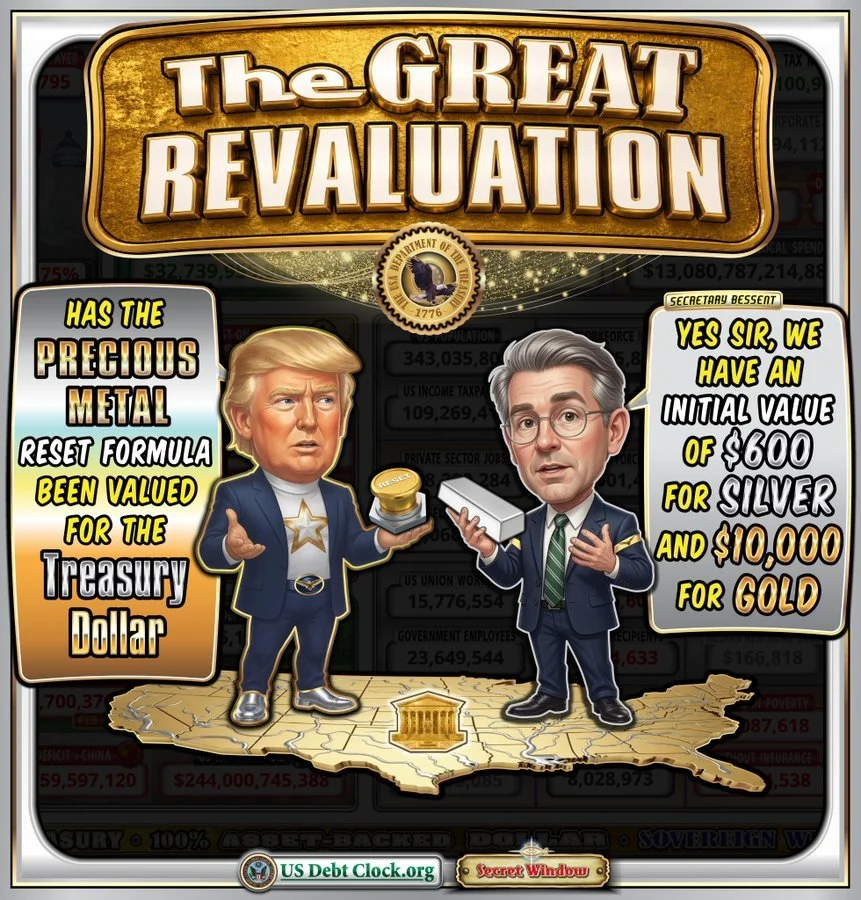
THE $10,000 GOLD / $600 SILVER “RESET” — FOLLOW THE MATH
That new U.S. Debt Clock graphic caught my attention, so I started working backward from the numbers. And this gets interesting FAST.
Stephanie Starr: The Gold and Silver Reset, Follow the Math
9-23-2026
Hear me out you guys….
THE $10,000 GOLD / $600 SILVER “RESET” — FOLLOW THE MATH
That new U.S. Debt Clock graphic caught my attention, so I started working backward from the numbers. And this gets interesting FAST.
The U.S. Treasury holds approximately 261.5 MILLION fine troy ounces of gold. Yet that gold is still officially carried on the government’s books at just $42.22oz.
Now revalue it to the $10,000/oz shown in the graphic:
261.5M oz × $10,000 = $2.615 TRILLION
Here’s the interesting part…
U.S. currency in circulation as of July 2026 was approximately $2.472 TRILLION. Meaning $10,000 gold would value America’s gold reserves at roughly 106% of all physical U.S. currency in circulation. Coincidence? Maybe.
But then look at SILVER.
The graphic shows $600 silver.
$10,000 ÷ $600 = 16.67
That’s roughly a 17:1 gold-to-silver ratio.
Why is that significant? Did you know America’s original Coinage Act of 1792 established a 15:1 silver-to-gold monetary ratio….
Now, important distinction:
This would NOT back the entire U.S. money supply.
Currency: ~$2.47T
Monetary base: ~$5.52T
M2: ~$23.22T
So $10K gold makes the strongest mathematical connection to physical currency in circulation, not every dollar sitting in bank accounts. And here’s another piece people shouldn’t overlook:
Congress has already seen legislation — S.954, the BITCOIN Act of 2025 — that would effectively revalue Treasury gold certificates to the fair market value of gold as part of funding a Strategic Bitcoin Reserve.
That does NOT mean $10,000 gold or $600 silver has been officially adopted. There has been no official Treasury announcement establishing those reset prices. But when you work backward from the numbers in this Debt Clock graphic…
$10,000 gold → ~$2.615T
Physical currency → ~$2.472T
Add in the historical comparison…. Suddenly those numbers don’t look completely random. I’m watching this one VERY closely.
US Debt Clock.org: usdebtclock.org
Coffee with MarkZ, joined by Mr. Cottrell and Zester. 09/23/2026
Coffee with MarkZ, joined by Mr. Cottrell and Zester. 09/23/2026
MarkZ Disclaimer: Please consider everything on this call as my opinion. Be sure to consult a professional for any financial decisions
MZ: We have a packed podcast this morning. The Codeman joins us today instead of Friday and then Zester to unpack the wild swing in crypto.
THE CONTENT IN THIS PODCAST IS FOR GENERAL & EDUCATIONAL PURPOSES ONLY&NOT INTENDED TO PROVIDE ANY PROFESSIONAL, FINANCIAL OR LEGAL ADVICE. PLEASE CONSIDER EVERYTHING DISCUSSED IN MARKZ’S OPINION ONLY
Coffee with MarkZ, joined by Mr. Cottrell and Zester. 09/23/2026
MarkZ Disclaimer: Please consider everything on this call as my opinion. Be sure to consult a professional for any financial decisions
MZ: We have a packed podcast this morning. The Codeman joins us today instead of Friday and then Zester to unpack the wild swing in crypto.
THE CONTENT IN THIS PODCAST IS FOR GENERAL & EDUCATIONAL PURPOSES ONLY&NOT INTENDED TO PROVIDE ANY PROFESSIONAL, FINANCIAL OR LEGAL ADVICE. PLEASE CONSIDER EVERYTHING DISCUSSED IN MARKZ’S OPINION ONLY
https://rumble.com/user/theoriginalmarkz
Kick: https://kick.com/theoriginalmarkz
Markz's linktree https://linktr.ee/theMarkZshow
FOLLOW MARKZ : TWITTER . https://twitter.com/originalmarkz?s=21. TRUTH SOCIAL . https://truthsocial.com/@theoriginalm...
Mod: MarkZ "Back To Basics" Pre-Recorded Call" for Newbies 10-19-2022 ) https://www.youtube.com/watch?v=37oILmAlptM
MARKZ DAILY LINKS: https://theoriginalmarkz.com/home/
THANK YOU FOR JOINING. HAVE A BLESSED DAY. SEE YOU IN THE MORNING FOR COFFEE @ 10:00 AM EST ~ UNLESS BREAKING NEWS HAPPENS! FOR UPDATES ON MARK’S PODCAST GO TO: https://t.me/+b3hYhYlhKM1hYzcx
Reset Intelligence: Washington Puts a Price on Dollar Access.
Emailed to Recaps~ Thank you David
Reset Intelligence: Washington Puts a Price on Dollar Access.
By Reset Intelligence | @EXIT_FIAT
Bessent said the sentence: fuel an Iranian jet, land it, or sell it a ticket, and you are knocked out of the dollar system. At midnight it became the rule.
Riyadh quit China's payment rail. Baghdad rationed its own dollars. Tehran walked into the UN and asked for its accounts back.
Emailed to Recaps~ Thank you David
Reset Intelligence: Washington Puts a Price on Dollar Access.
By Reset Intelligence | @EXIT_FIAT
Bessent said the sentence: fuel an Iranian jet, land it, or sell it a ticket, and you are knocked out of the dollar system. At midnight it became the rule.
Riyadh quit China's payment rail. Baghdad rationed its own dollars. Tehran walked into the UN and asked for its accounts back.
The rule with no enforcer
The US Treasury did not ground Iran's airlines. It told every fueler, ground handler and ticket desk on earth that servicing a sanctioned Iranian carrier after September 23 costs them their dollar clearing. Washington never sends an inspector. Everyone with a dollar account inspects themselves. Iran's own aviation authority cancelled its Baghdad and Muscat flights from midnight before a single aircraft was turned away, and is negotiating to keep one pilgrimage lane into Najaf. Turkey and Georgia grounded the routes. Bessent named three foreign banks cut off for handling Iranian business: Banque Misr's Dubai branch, Turkey's Golden Global, and Russia's VTB.
Everyone paid in the same 72 hours
Saudi Arabia - quit mBridge, the China-built settlement network designed to move oil money without the dollar in the middle, restarted the East-West pipeline to Yanbu with 4 million barrels a day back on a route around Hormuz, and is being asked to co-fund a $10 billion rebuild fund with the US Treasury as senior partner.
July 1974 - the last time Riyadh made a dollar decision this large, Treasury Secretary William Simon closed it in Jeddah and the paperwork stayed secret for 4 decades. Same kingdom, same job.
Iran - Foreign Minister Araghchi sat 3 hours with Witkoff and Kushner and handed over three conditions that all asked for money: lift the blockade, unfreeze the assets, end the hostilities.
Trump - deal or annihilation from the UN podium, "completely isolate Iran financially" to 12 regional leaders, and the deal "right after the election."
Greenland - a permanent US security agreement signed the same day, Denmark's prime minister calling it a deal that lasts forever.
Baghdad rations its own dollars
The Central Bank of Iraq cut official-rate dollar access for travelers from once a month to once every 6 months and capped the cash at $2,000, keeping its reserves for trade and for defending the posted rate. The street closed near 157,000 per $100. Seven Iraqi banks have cleared the first phase of reconnection in currencies other than the dollar, with dollar business to follow after the harder compliance tests. Prime Minister al-Zaidi met ExxonMobil's chief executive after midnight in New York, and carries a request to Trump for more time on militia disarmament, a June 2027 completion agreed with the Coordination Framework before he flew. Washington's position has not moved since July. The 2027 budget, with its exchange-rate assumption line, reaches parliament October 15.
That is the short version. Why Iraq is the one country that has already been sitting Washington's dollar-access test for 2 years, what the extension request really means, and the watch list from here - that is the daily read.
Read the full daily briefing free for 5 days. Sign up here: the daily Iraqi dinar briefing
Want it straight from the horse's mouth? The CBI Rate Alert pings you the moment the Central Bank of Iraq moves the official rate. The number itself, not a rumour about it. It comes with our free resource library and the daily breakdown of what is actually moving in Iraq. Sign up free: The CBI Rate Alert
Got a dinar question? Reset Intelligence runs an on-call research assistant: ask it anything they have published. It answers in seconds and will conduct deep research to find you the answer. Try it: the Iraqi dinar research assistant
Common questions, answered straight: When will the Iraqi dinar revalue? and Is the Iraqi dinar revaluation real?
The design behind all of it is mapped in Head of the Snake, and the free guides live in the Iraqi dinar resource library.
Follow the daily intel free: Telegram · Facebook · Spotify · Odysee
News, Rumors and Opinions Wednesday 9-23-2026
Ariel: The “R” Word, are you Ready for the Other Side of this Game?
9-23-2026
The “R” Word?
Say it isn’t so?
Are you saying it’s not a myth?
Are you saying it’s not guru rumors?
Ariel: The “R” Word, are you Ready for the Other Side of this Game?
9-23-2026
The “R” Word?
Say it isn’t so?
Are you saying it’s not a myth?
Are you saying it’s not guru rumors?
Are you saying it actually has a working mechanic based on real assets?
Are you saying that we are about to see the end result of those calculations?
Are you saying that people who have foreign currency are about to exchange?
Are you saying that a lot of people are about to have egg on their faces?
Ladies & Gentlemen Are You Ready For The Other Side Of This Game?
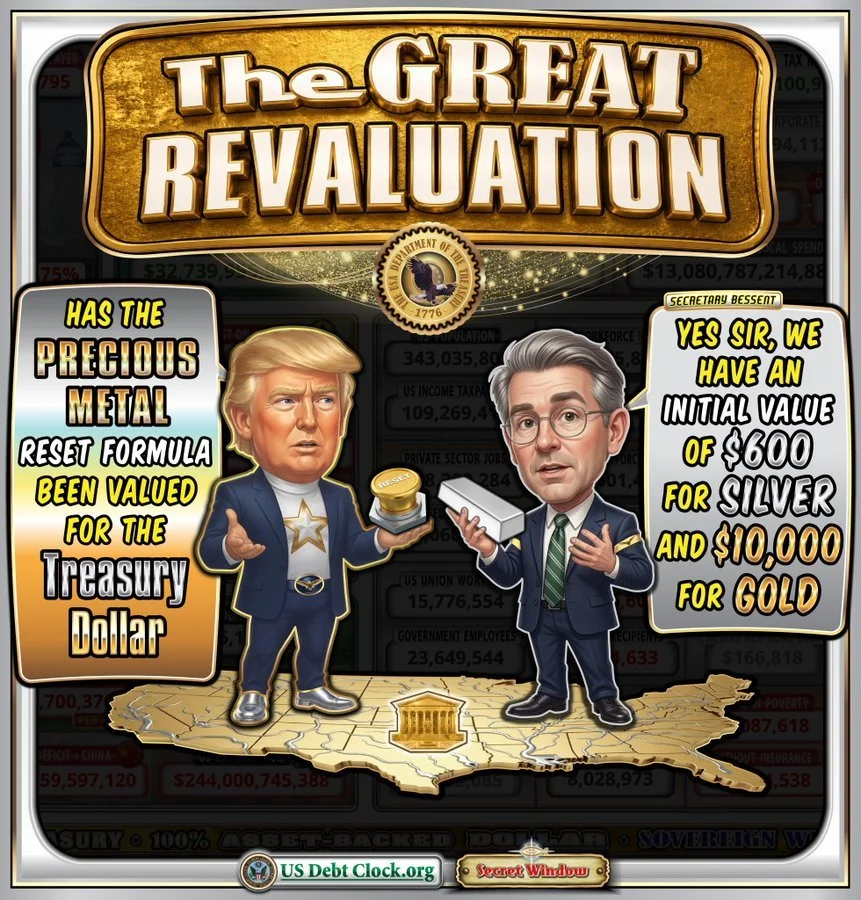
US Debt Clock.org: usdebtclock.org
Please Understand This One Thing
The most significant financial intelligence of the last five years has not originated from government press releases. The Iraqi Dinar revaluation signals didn’t come from a CBI press conference. The Clarity Act’s operational implications weren’t detailed in a White House fact sheet.
The SEC Innovation Exemption on September 17 wasn’t front-paged by the Treasury Department website. Government moves in backchannels. Information surfaces through private networks.
That’s not a bug in the system that’s the system functioning exactly as it’s designed to function when the public-facing institutions are still partially compromised by holdover personnel.
The September 17 SEC Innovation Exemption wasn’t a standalone event. It was a regulatory precondition for what comes next. The exemption created a five-year window during which tokenized assets including gold-backed and silver-backed digital instruments can be issued, traded, and settled without triggering the full registration requirements of the Securities Act of 1933.
The thing is that whoever is running that account is very connected. I have run quite the folder dive on some of those images over the years. And it always checked out over the course of weeks, months, to a years since following that account.
Source(s):
• https://x.com/Prolotario1/status/2102431467460563328
************
Courtesy of Dinar Guru: https://www.dinarguru.com/
Jeff As of October 1st Iraq will have military sovereignty. They'll have political sovereignty. But unless they revalue the currency they're not going to have monetary sovereignty or economic independence...The Finance Minister said last Thursday when US troops are out September 30th, we will have financial sovereignty. He's telling you they're going to have to revalue the currency.
Frank26 They're going through a banking monetary reform for their currency, for their people, for their country because they are about to be sovereign on the 30th.
Militia Man Deleting the zeros is a unit change, the numbers on the notes get smaller. Prices and wages get rewritten to match. That does not by itself make a dinar buy more bread. It doesn't bring any value. A managed rate move is different...That is a Central Bank decision on the value of the dinar against the dollar based on reserves, gold trade and the systems built. The 2023 official rate change showed the board can move. A central bank board can move the rate without waiting on a full note swap...
************
ON SEPTEMBER 30TH, YOU'LL WAKE UP IN A DIFFERENT AMERICA — New Laws Will Change Your Money
Ricardo Morgan: 9-22-2026
On September 30th, you will go to sleep in one America and wake up on October 1st in a different one. Because at midnight, five new laws take effect that will directly change how you buy a car, how you keep your home, how you drive on the highway, and how you vote. And almost no one is talking about what happens if you miss the deadline that expires on September 30th.
If you live in California, Maryland, Connecticut, Alabama, or if you ever drive through or have family in those states, what I am about to tell you will save you money, protect your rights, and prevent a costly mistake in October.
And even if you live nowhere near these states, stay with me until the end because the last change I will cover is federal. It affects every single American with health insurance, social security, or a bank account. And the window to act on it closes on September 30th as well.
Iraq Economic News and Points To Ponder Late Tuesday Evening 9-21-26
Who Is Running The Iraqi Economy? A Series Of Decisions Are Being Made, And The Market Is Paying The Price For The Lack Of Vision.
Last updated: September 22, 2026 In Iraq in recent weeks, questions have been escalating regarding the management of economic and monetary files, with a succession of decisions and measures affecting the banking sector, financial transfers, liquidity, the exchange market, and the movement of funds, at a time when an informed economic source believes that some of these decisions were taken amid the absence of an integrated economic vision or a sufficient explanation of their repercussions on the market.
Who Is Running The Iraqi Economy? A Series Of Decisions Are Being Made, And The Market Is Paying The Price For The Lack Of Vision.
Last updated: September 22, 2026 In Iraq in recent weeks, questions have been escalating regarding the management of economic and monetary files, with a succession of decisions and measures affecting the banking sector, financial transfers, liquidity, the exchange market, and the movement of funds, at a time when an informed economic source believes that some of these decisions were taken amid the absence of an integrated economic vision or a sufficient explanation of their repercussions on the market.
The source told the Independent Press Agency that the problem, according to his assessment, went beyond the issue of disagreement with a particular economic decision, to the nature of managing the economic file itself, and whether the decisions issued by the government and the central bank come within a coherent roadmap, or are separate measures taken under the pressure of developments and crises, and then their results are dealt with later.
He added that “the Iraqi market is now in a state of almost constant anticipation of the next decision,” considering that decisions that affect the movement of the dollar, transfers, cards, banks and liquidity cannot be treated as limited administrative instructions, because they are directly related to the interests of millions of citizens, merchants, companies and depositors.
According to the source, a number of economic measures during the past period were preceded by media talks and leaks, before moving to more serious stages or to implementation, which he considered an indicator that raises questions about the nature of decision-making and the mechanism for announcing it, especially since the markets are very sensitive to news related to the dollar, banks and liquidity.
He said that “when an economic decision is circulated in the market before its details are officially clarified, speculation begins on it before its implementation begins,” noting that merely talking about new restrictions or instructions may prompt traders and citizens to change their financial behavior, whether by increasing demand for the dollar, withdrawing funds, postponing transfers, or raising prices in anticipation of any possible development.
The source believes that one of the main problems lies in the lack of a detailed economic explanation accompanying some decisions, as the measure is often announced while the citizen and the merchant are left with questions about the reason for its issuance, its duration, its ultimate goal, and whether it is a temporary measure or part of a long-term policy.
These criticisms come at a time of significant transformation in the Iraqi banking system. Since 2025, the Central Bank has been implementing a comprehensive program to reform private, commercial, and Islamic banks, as well as branches of foreign banks.
This program requires banks to choose between options such as remaining in the market, merging, or exiting, while adhering to new standards related to governance, compliance, management, and risk.
In February 2026, the Central Bank announced that Iraqi banks had completed the phase of selecting these options, paving the way for an assessment of their compliance with the reform requirements.
The Central Bank presents these steps as part of a broad restructuring process for the banking sector and to enhance its ability to integrate into the global financial system, stressing that the new phase aims to strengthen governance, transparency, compliance and develop the institutional performance of banks.
However, the source believes that the scale of these transformations makes the need for calmer and clearer management even greater, because restructuring an entire banking sector has effects that are not limited to bank boards of directors, but extend to deposits, transfers, credit, trade finance, and the citizen’s confidence in the banking system.
He explained that while any broad regulatory measure may be technically necessary, the method of its implementation, its timing, and the management of its repercussions on liquidity and depositors are no less important than the decision itself.
The developments at Al-Taif Islamic Bank during September highlight the sensitivity of the banking sector. On September 8th, the Central Bank of Iraq affirmed that the rights of the bank's depositors were protected, explaining that placing it under receivership was a precautionary supervisory measure. The bank stated it was working to enhance liquidity, regulate withdrawals, and gradually fulfill obligations, prioritizing salaries deposited with it.
The source says that such cases should prompt economic institutions to treat the element of "trust" as an essential part of financial security, because news related to a bank, liquidity, or deposits can quickly have a psychological impact on other banks, even if they are not facing the same problem.
He added that the banking system does not operate on numbers alone, but also on trust, and that any shake-up in depositors’ confidence could lead to an increase in demand for cash and a move away from bank deposits, which contradicts the state’s stated goal of increasing financial inclusion and reducing reliance on cash.
Regarding liquidity, IMF reports reveal that the issue is more profound than a mere temporary shortage or surplus of cash. In its report on Iraq, the IMF noted persistently high levels of excess liquidity within the banking system, explaining that this limits the ability of monetary policy to effectively influence interest rates and credit, and calling for improved liquidity management and enhanced coordination between fiscal and monetary policy.
Here, according to the source, an important paradox emerges: there may be high liquidity at the level of the financial system as a whole, while parts of the market, some banks, or government entities face various difficulties in providing cash or managing financial flows at specific times.
He says that this difference is not adequately explained to the public, which sometimes leads to the term “liquidity” being used in a simplified way, even though liquidity in the central bank differs from the liquidity of the Ministry of Finance, and the liquidity of banks differs from the amount of cash in circulation in the hands of the public.
The IMF also noted in its assessment that the effectiveness of Iraqi monetary policy remains limited due to the weak transmission of central bank decisions to lending and deposit rates, as well as the heavy reliance on the public sector and the nature of the domestic financial system.
The source believes that this picture reveals that the crisis is not due to a single decision, but rather to an economic structure that requires higher coordination between the government, the Ministry of Finance, the Central Bank, banks, and regulatory bodies.
In another context, the Central Bank affirms that it possesses sufficient foreign reserves to meet legitimate demand for foreign currency, finance foreign trade, settle bank card payments, and process travelers' requests at the official exchange rate. In a statement issued on September 19, 2026, the Central Bank attributed the rise in the dollar's price on the local market to speculation, market expectations, and the exploitation of geopolitical circumstances, while emphasizing the continued financing of trade through established channels.
However, the source says that having high reserves alone does not prevent disruptions in the parallel market if citizens or traders face difficulty accessing dollars at the official rate or if restrictions and procedures related to obtaining them increase.
He adds that the difference between the official price and the parallel market in this case becomes an indicator not necessarily of a shortage of reserves, but rather of a gap between the real demand for currency and the ability of official channels to meet it easily and quickly.
The IMF takes a somewhat similar approach, noting in its assessment that simplifying access to foreign currency, improving customs controls, and encouraging the use of the dinar in some transactions are factors that can help reduce the gap between the official and parallel exchange rates.
The source says that addressing the exchange rate cannot rely solely on security or regulatory measures, because the demand for dollars also stems from the structure of the Iraqi economy, which is largely based on imports, and therefore any restrictions on access to foreign currency could quickly translate into commodity prices.
He added: “If the trader imports in dollars, any increase in the cost of accessing dollars will ultimately be passed on to the consumer.”
In contrast, the Central Bank points to the transfer of foreign trade financing to commercial banks and their relationships with correspondent banks, a step that the IMF considered an important development in modernizing the Iraqi financial system.
The Central Bank also announced in July 2026 that it had reached understandings allowing a number of restricted Iraqi banks to return to foreign correspondent channels in currencies other than the dollar after they met the requirements for compliance, governance and reform.
The source considers these measures to represent a fundamental shift in the Iraqi financial structure, but they require a clear transition period, because transferring the transfer system from one system to another and subjecting banks to stricter standards may lead to temporary pressures on some institutions and customers.
He argues that the problem begins when reforms that are theoretically correct are implemented without providing sufficient alternative pathways for the market during the transition period.
He adds that “reform is not measured by the strength of the decision, but rather by the economy’s ability to withstand the decision.”
This issue is all the more important given Iraq's heavy reliance on oil revenues. In a technical report issued in July 2026, the IMF indicated that the Iraqi economy faces medium-term risks related to volatile oil prices, high debt levels, and regional instability, emphasizing the importance of strengthening coordination between fiscal and monetary policies and implementing financial sector reforms.
The IMF also expects, based on its current data for Iraq, that real GDP will contract by 6.8% during 2026, with an expected inflation rate of around 3%.
The source says these indicators make the margin of error in economic decision-making narrower, because an economy that is heavily dependent on oil and affected by government spending, energy prices and regional tensions needs careful management of shocks.
He believes that the government and the central bank should move from a policy of "managing the problem after it happens" to a policy of anticipating crises before they occur.
He added that what is needed is a clear model that answers, before any decision is issued, a set of basic questions: What will happen to the dollar exchange rate? What will happen to liquidity? What will happen to banks? What will happen to traders? And how will the decision affect the prices of goods and the citizen?
The source believes that these questions are not adequately addressed in the official discourse accompanying the decisions.
The issue of coordination between the government’s fiscal policy and the central bank’s monetary policy also stands out, a point repeatedly emphasized by the IMF, particularly with regard to liquidity management, government spending, deficit financing and price stability.
The source says the central bank can use its monetary tools, but it cannot single-handedly address the imbalances resulting from government spending, weak non-oil revenues, a high payroll, or weak domestic production.
Conversely, the government cannot manage economic policy in isolation from the impact of its decisions on liquidity, the exchange rate, and the central bank's reserves.
Hence, the source believes that the real problem is not the multiplicity of institutions, but rather the extent to which there is an “economic command room” capable of unifying decisions and setting priorities.
Regarding the state-owned banks, the IMF indicated that reforming Rafidain and Rasheed banks remains a key issue, with the need to address non-performing loans, capital shortages, governance, and digital infrastructure.
The source believes that any reform of the private banking sector will not achieve its full results if the state-owned banks, which dominate a large part of financial activity, remain in need of deep restructuring.
He says that the private banking sector today faces compliance, oversight, merger, or exit requirements, while reforming the state banking structure remains a parallel challenge that cannot be ignored.
The source asks: "Is the goal to actually build a competitive banking system, or just to rearrange the names of existing banks?"
In his view, true reform should be reflected in the citizen's ability to easily open an account, transfer funds, obtain credit, use his card locally and internationally, and feel secure when depositing his money.
If restrictions increase, procedures become more complicated, and access to funds decreases, citizens may revert to keeping cash outside the banking system, which is the opposite of what the state is trying to achieve.
The source also warns of the impact of repeated decisions on the private sector, explaining that investors need a predictable environment, and that any continuous change in banking, tax, customs or transfer instructions makes calculating future costs more difficult.
He says that capital “fears uncertainty more than it fears difficult decisions,” because an investor can adapt to strict rules if they are clear and stable, but finds it difficult to operate when the rules change frequently.
He points out that economic reform also requires greater transparency in data dissemination, not just advertising.
The source suggests that major economic decisions should be accompanied by an “economic impact paper” that explains to citizens and markets the reasons for the decision, its objective, the expected timeframe for its implementation, the sectors that will be affected by it, and the results that the government or the central bank will consider as a benchmark for its success.
It also calls for the publication of a subsequent evaluation of each decision to see whether the actual results matched expectations.
He adds: "If the results of the decision are not measured, how can we know that it was successful?"
At the same time, it cannot be ignored that the Central Bank operates within a complex financial environment related to international compliance, anti-money laundering and counter-terrorism financing, and the relationships of Iraqi banks with correspondent banks around the world.
The Central Bank has confirmed that its reforms aim to reintegrate Iraqi banks into the international financial system and develop their ability to carry out cross-border transfers in multiple currencies.
But the source believes that the challenge is not choosing between “reform” and “not reforming,” but rather between organized and well-thought-out reform and reform that may have a high transitional cost if it is not managed properly.
To consider any objection to the implementation mechanism as a rejection of reform as an oversimplification of the problem, because the market and the citizen have the right to know the cost of the reform, its timetable and the expected results from it.
In conclusion, recent developments reveal that Iraq is facing a sensitive economic phase in which the issues of banking reform, liquidity, the dollar, government spending, dependence on oil, and international financial relations are intertwined.
While official institutions assert that the current measures aim to build a more efficient, transparent banking sector capable of integrating into the global financial system, critics argue that the speed of the transformations and the multiplicity of decisions require a higher level of coordination, explanation, and transparency.
The question posed by the source remains: Who has a complete economic vision for Iraq?
Is there a clear plan linking the decisions of the Central Bank with those of the Ministry of Finance, the government, trade, customs, and banks, or does each institution operate within its own sphere of influence, and then the market is later asked to bear the consequences?
The source concludes by saying that Iraq does not need more decisions as much as it needs “one comprehensive economic decision in one direction,” because the economy is not managed by experimentation, and the citizen, the merchant, and the bank should not be a testing ground for policies.
Ultimately, the decision can be amended, and new instructions can be issued, but trust, once damaged, is much more difficult to restore.
The question that will remain for the government and the central bank during the next stage is: Are the decisions driven by a clear economic vision, or are the decisions driven by crises
https://mustaqila.com/من-يدير-الاقتصاد-العراقي؟-قرارات-متلا/
Seeds of Wisdom RV and Economics Updates Wednesday Morning 9-23-26
Good Morning Dinar Recaps,
U.S. PAYMENT RESET WATCH: BANK-ISSUED STABLECOIN GOES LIVE ACROSS MASTERCARD'S $25 BILLION CARD PROGRAM
SoFi Bank and Mastercard have moved bank-issued stablecoin settlement from development into live operation, connecting blockchain-based money movement with an established global card network.
Good Morning Dinar Recaps,
U.S. PAYMENT RESET WATCH: BANK-ISSUED STABLECOIN GOES LIVE ACROSS MASTERCARD'S $25 BILLION CARD PROGRAM
SoFi Bank and Mastercard have moved bank-issued stablecoin settlement from development into live operation, connecting blockchain-based money movement with an established global card network.
OVERVIEW
SoFi Bank and Mastercard have launched live stablecoin settlement across SoFi’s debit and credit card program, with the program expected to process more than $25 billion in annualized volume using SoFiUSD.
SoFiUSD, a U.S. dollar stablecoin issued by the nationally chartered SoFi Bank, is being used behind the scenes to settle transactions on Mastercard’s global payments network while consumers and merchants can continue using the familiar card system.
The development represents a significant step in connecting traditional banking, blockchain settlement, stablecoins and global payments infrastructure, while broader uses such as cross-border payments and additional merchant settlement remain areas for further expansion.
KEY DEVELOPMENTS
1. Stablecoin settlement moves into live production
SoFi and Mastercard announced that stablecoin settlement is now live across SoFi Bank’s debit and credit card program.
The program is expected to process more than $25 billion in annualized volume, meaning this is no longer simply a small-scale blockchain experiment. The companies are moving an existing payments operation onto stablecoin settlement infrastructure.
The settlement token is SoFiUSD, a U.S. dollar stablecoin issued by SoFi Bank, N.A., a nationally chartered bank regulated by the Office of the Comptroller of the Currency.
SoFiUSD is designed to be redeemable 1:1 for U.S. dollars and is supported primarily by cash reserves. SoFi also makes clear that SoFiUSD itself is not a bank deposit, is not FDIC or SIPC insured, is not bank-guaranteed and is not legal tender.
That distinction is important as the financial system develops new forms of digital money.
2. The blockchain operates underneath familiar card payments
Consumers do not need to change the way they use their SoFi cards.
The significance is occurring at the settlement layer.
Rather than requiring consumers or merchants to directly use cryptocurrency, the blockchain-based stablecoin infrastructure operates behind the existing card-payment experience.
SoFi says merchants can receive settlement funds through its banking platform and withdraw them into cash, while the underlying settlement process uses SoFiUSD.
This creates an important bridge:
Traditional Cards → Bank-Issued Stablecoin → Blockchain → Settlement → Bank Account
The technology is being inserted into existing financial infrastructure rather than requiring the entire financial system to be replaced.
3. Mastercard is building stablecoins into its broader settlement infrastructure
The SoFi launch follows Mastercard’s broader move to provide stablecoin settlement options across its global network.
In June, Mastercard announced plans to support regulated stablecoins including USDC, PYUSD, USDG, USDP, RLUSD and SoFiUSD, along with settlement on multiple blockchain networks.
Mastercard said the expanded settlement capabilities are intended to give issuers and acquirers greater flexibility over when and how transactions settle, including intraday, weekend and holiday settlement options.
That has implications for liquidity management because conventional financial settlement often operates according to banking and market schedules.
Blockchain-based settlement can potentially operate continuously.
4. The focus is shifting from crypto payments to financial settlement
One of the most important distinctions in this development is that stablecoins are not necessarily being positioned as replacements for traditional cards.
Instead, they are increasingly being used as settlement infrastructure behind traditional payment systems.
Mastercard's stated strategy is to allow digital assets and traditional payment systems to operate alongside one another. Its March agreement with SoFi specifically described the goal as connecting regulated stablecoins with traditional forms of money and exploring applications such as cross-border remittances and business-to-business transfers.
That suggests an evolving model:
Fiat Money + Stablecoins + Tokenized Assets + Blockchain Rails + Traditional Payment Networks
The financial system does not necessarily have to choose between the old infrastructure and the new infrastructure.
The two can increasingly become interconnected.
5. Cross-border payments could become the next major application
SoFi and Mastercard said they will explore additional uses for SoFiUSD, including cross-border payments, remittances and other money-movement applications.
These applications are particularly important because international payments can involve multiple banks, currencies, intermediaries and settlement schedules.
Stablecoins potentially allow value to move on blockchain networks while remaining denominated in a familiar national currency such as the U.S. dollar.
That creates another important financial-system chain:
Dollar → Stablecoin → Blockchain → Cross-Border Payment → Settlement
The technology does not eliminate the role of the dollar. Instead, it can create new digital rails through which dollar-denominated value moves.
6. The development strengthens the connection between banking and digital assets
SoFiUSD is being issued by a regulated national bank rather than solely by a standalone cryptocurrency company.
That is significant because it demonstrates how commercial banking institutions can become issuers and operators within digital-asset infrastructure.
Mastercard's broader settlement initiative also includes multiple regulated stablecoins and blockchain networks, showing that the emerging system may involve interoperability among banks, payment networks, stablecoin issuers and tokenized financial assets.
The larger transition is therefore not simply:
Banking → Crypto
It is increasingly:
Banking + Digital Assets + Blockchain + Payments
WHY IT MATTERS
The most important part of this development is not that a new cryptocurrency payment option has appeared.
It is that blockchain-based settlement is being placed underneath an established financial network that already processes enormous amounts of payment activity.
That is a very different stage of adoption.
The consumer may not even notice the technological change.
The infrastructure underneath the transaction is what is changing.
This is consistent with a broader financial-system transformation in which traditional money, tokenized assets, stablecoins and blockchain networks increasingly operate together.
WHY IT MATTERS TO FOREIGN CURRENCY HOLDERS
For foreign currency holders following the Global Reset, the important issue is the infrastructure surrounding currencies.
A currency's international usefulness depends partly on how efficiently it can be:
Transferred
Settled
Tokenized
Used for cross-border payments
Connected to financial institutions
Integrated with digital payment networks
The SoFi-Mastercard development does not mean the dollar is being replaced, nor does it announce a currency revaluation.
In fact, this particular development demonstrates something different: the existing U.S. dollar is being connected to new digital settlement infrastructure.
That is important because the future financial system may involve national currencies moving through increasingly digital and programmable rails.
Hope, not hype. Follow the evidence.
IMPLICATIONS FOR THE GLOBAL RESET
Pillar 1: Payments
Stablecoin settlement can provide another way for financial institutions to move and settle dollar-denominated value.
Pillar 2: Technology
Blockchain is moving beyond cryptocurrency trading and into the settlement layer of mainstream financial transactions.
Pillar 3: Banking
A nationally chartered bank issuing a stablecoin demonstrates how regulated banking institutions can participate directly in digital-money infrastructure.
Pillar 4: Currencies
The development shows how the U.S. dollar can be incorporated into new digital payment rails without requiring the currency itself to change.
Pillar 5: Global Settlement
Mastercard's expansion of stablecoin settlement creates potential infrastructure for faster and more flexible movement of money across borders and outside traditional banking schedules.
THE GLOBAL RESET CONNECTION
The developing sequence is:
Bank → Stablecoin → Blockchain → Card Network → Settlement → Liquidity → Cross-Border Payments → Digital Financial Infrastructure
This is why the development belongs on the Global Reset Watch.
The financial system does not necessarily change through one dramatic event.
It can change through thousands of infrastructure decisions that gradually alter how money moves, how assets settle and how financial institutions connect with one another.
The SoFi-Mastercard launch is one documented example of that process moving from concept to live operation.
RUMOR SAFETY REMINDER
This development is not an announcement of a global currency reset, dollar revaluation or replacement of traditional currencies.
The stablecoin settlement system is live for SoFi's card program, but broader applications—including additional merchant, cross-border and remittance uses—remain areas of ongoing development and are subject to regulatory considerations.
Our Reset Watch follows documented changes in financial infrastructure. It does not predict reset dates or guarantee future currency values.
Watch the evidence. Follow the infrastructure. Hope, not hype.
THE BOTTOM LINE
SoFi and Mastercard have moved bank-issued stablecoin settlement into live operation across a card program expected to process more than $25 billion annually, demonstrating how blockchain-based settlement can begin operating inside established financial infrastructure.
The bigger story is not simply that another stablecoin has launched—it is that traditional banking, digital dollars, blockchain networks and global payment systems are beginning to operate as connected pieces of the same financial architecture.
When the rails that move money begin to change, the evolution of the global financial system is already underway beneath the surface.
Seeds of Wisdom Team
Newshounds News™ Exclusive
SOURCES
~~~~~~~~~~
🌱 A Message to Our Currency Holders🌱
If you’ve been holding foreign currency for many years, you were not foolish.
You were not wrong to believe the global financial system would change.
What failed was not your patience — it was the information you were given.
For years, dates, rumors, and personalities replaced facts, structure, and proof. “This week” predictions created cycles of hope and disappointment that were never based on how currencies actually change.
That is not your failure.
Our mission here is different: • No dates • No rates • No hype • No gurus
Instead, we focus on:
• Verifiable developments • Institutional evidence
• Global financial structure • Where countries actually sit in the process
Currency value changes only come after sovereignty, trade, banking, settlement systems, and fiscal coordination are in place. History and institutions confirm this sequence.
You will see silence. You will see denials. That is not delay — that is discipline.
Protect your identity. Organize your documents. Verify everything.
Never hand your discernment to anyone who cannot show proof.
You deserve truth — not timelines.
Seeds of Wisdom Team
Newshounds News
~~~~~~~~~~
Seeds of Wisdom Team RV Currency Facts Youtube and Rumble
Newshound's News Telegram Room Link
RV Facts with Proof Links Link
RV Updates Proof links - Facts Link
Start Here room with Most Asked Questions Link
Follow the Gold/Silver Rate COMEX
Follow Fast Facts
Seeds of Wisdom Team™ Website
Thank you Dinar Recaps
"Chuck The Debt In The Fire" Is Officially A Real Solution
"Chuck The Debt In The Fire" Is Officially A Real Solution
Notes From the Field By James Hickman (Simon Black / Sovereign Man) September 9, 2026
It's so simple, how could no one have thought of this before? The man currently polling in second place to become the next President of France has put forward an ingenious solution to tackling France's national debt, currently standing at around 117% of the country's GDP.
Jean-Luc Mélenchon says, "All we have to do is take the 18% held by the Bank of France and chuck it in the fire."
"Chuck The Debt In The Fire" Is Officially A Real Solution
Notes From the Field By James Hickman (Simon Black / Sovereign Man) September 9, 2026
It's so simple, how could no one have thought of this before? The man currently polling in second place to become the next President of France has put forward an ingenious solution to tackling France's national debt, currently standing at around 117% of the country's GDP.
Jean-Luc Mélenchon says, "All we have to do is take the 18% held by the Bank of France and chuck it in the fire."

This is the guy who has a real shot at running the second-largest economy in the eurozone, and he's telling voters that roughly €636 billion of what their government owes can simply be erased.
And the voters like the sound of it. Of course they do, who doesn’t love getting something for nothing?
Quick economics lesson for the brilliant man who wants to lead France: the Bank of France bought those bonds with euros it created for the purpose… the European Central Bank's own explainer says buying bonds "creates money in the banking system."
Normally those euros come back out of circulation as the debt gets repaid. Mélenchon's plan skips that part: the government ‘throws the debt in the fire’ and doesn’t pay it back. So the central bank eats the loss... meaning that the €636 billion conjured out of nothing stays in the system.
This creates inflation, plain and simple.
Goods and services cannot be created out of nothing. Euros can. So when there’s suddenly more money in the system relative to the same amount of goods and services, the end result is inflation.
The other obvious implications is that France would still owe the rest of its debt... and those lenders will have seen that France is willing to default. I wonder what that would do to French bond yields?
Or maybe they’ll rest easy with Mélenchon’s assurance that “I’m not going after private creditors, not at this step in any case.”
Why do French voters even care about the national debt? Because they’ve been feeling the consequences of idiotic fiscal policy for years.
Interest alone costs the French government more than its entire defense budget. There's no taxing their way out, either: the French are already the second-most-taxed people in the developed world, at about 44% of GDP.
So every fix takes some benefit away from taxpayers. Last year's plan canceled two public holidays, froze pensions, and cut civil-service jobs... and the prime minister who proposed the solutions was thrown out.
The plan before that raised the retirement age from 62 to 64 brought the biggest protests France had seen in decades; that plan has now been suspended to keep the current government alive.
Meanwhile, growth was less than 1% last year, and unemployment is at its highest since 2020.
And here comes Mélenchon with a plan that costs nobody anything: delete a portion of the debt and go back to spending as if everything is OK.
However dumb the solution, at least the French are talking about the problem.
The US government crossed $40 trillion in debt last month. That's roughly 123% of GDP, worse than France.
America gets away with it, for now, because the dollar is still the world's reserve currency. Central banks hold a lot of their strategic financial reserves in US Treasury bonds, so Congress has always had a line of foreigners waiting to lend it money no matter how large the deficit.
But that line of foreigners is now getting shorter. Foreign holdings of Treasuries fell by $72 billion in June alone, China's are at their lowest since 2008, and so far this year foreigners have bought just 7% of the new debt the US government issued.
The reasons aren't a mystery: a dysfunctional government that can’t even pass a budget or eliminate fraud from its spending, while increasingly weaponizing access to the US dollar system.
When the foreign buyers stop showing up, America finds itself with France's problem. Automatic cuts to Social Security are only six years away. Interest on the debt is already larger than the defense budget.
Extreme government spending is already pushing inflation higher... and socialists are everywhere now promising to spend even more.
These people genuinely believe that money is something you can conjure out of thin air with no consequence.
But whether they cancel the debt, or simply continue to ignore it, the consequence ultimately comes back to inflation.
That’s because conjuring money out of thin air, or borrowing from future generations to spend today, doesn't produce one more barrel of oil, one more bushel of wheat, or one more pound of copper. It just produces more euros and dollars.
America has been here before.
Through the 1970s the US government ran deficits for Vietnam AND a historic expansion of welfare spending... then cut the dollar's last link to gold in 1971. They created new money to cover the difference.
Consumer prices doubled over the decade, and the Dow finished 1979 where it started 1970, which after inflation was a loss of about half in real terms.
Meanwhile, gold went from $35 an ounce to $850. And oil went from about $3.40 a barrel to nearly $30. The world’s most important (and scarce) resources not only held their value, but they dominated. And the companies that produced them did far better.
Over roughly the same stretch, Barron's index of gold mining stocks rose more than 1,200% while the S&P 500 managed 43%.
The new money has to go somewhere, and it flows into whatever the government cannot create more of.
Today, a lot of the companies that produce those real assets like metals, energy, food, and the ships that carry them, are still cheap.
We find them for subscribers of our investment research newsletter, Strategic Assets.
Gold and silver moved first, as central banks started diversifying out of the dollar. A small silver producer we featured in April 2025 rose more than 10x in ten months. A gold producer has gone up 5x, yet it's earning money so fast that the stock is cheaper against its earnings today than the day we wrote it up. It pays a dividend, too.
Now the rest is showing life. A zinc producer we featured is up more than 150% in under a year. A tin miner is up more than 230% and trading at all-time highs. Two oil tanker owners we bought when nobody wanted them are up more than 150% and 110%, and one just reported the best quarter in its history.
To your freedom, James Hickman Co-Founder, Schiff Sovereign LLC