
Thank you to all the subscribers to our Early Access program…we thank you for your continued support.
We are excited to offer this new service to keep you informed and up-to-date on the latest Dinar and currency news.
How Close Is The Dinar Revaluation ?
How Close Is The Dinar Revaluation ?
The Dinar Den: 8-30-2026
The journey of following the Iraqi dinar (IQD) has tested the patience of investors worldwide for nearly two decades. Recently, a compelling discussion between two seasoned market participants with over 16 years of individual experience shed light on the latest developments surrounding the currency’s potential revaluation and redenomination.
This in-depth conversation offers a much-needed analytical breakdown of the conflicting reports circulating in the financial community, providing a clearer picture of where the process currently stands.
How Close Is The Dinar Revaluation ?
The Dinar Den: 8-30-2026
The journey of following the Iraqi dinar (IQD) has tested the patience of investors worldwide for nearly two decades. Recently, a compelling discussion between two seasoned market participants with over 16 years of individual experience shed light on the latest developments surrounding the currency’s potential revaluation and redenomination.
This in-depth conversation offers a much-needed analytical breakdown of the conflicting reports circulating in the financial community, providing a clearer picture of where the process currently stands.
At the heart of the dialogue is the complex puzzle of deleting zeros from the local currency, alongside concurrent political stability efforts and vital domestic financial reforms. The speakers carefully dissect how these moving parts must align to achieve meaningful economic transformation.
A major focal point of the conversation is the heavy oversight provided by global financial institutions and international partners, which play an indispensable role in ensuring that Iraq successfully meets the stringent criteria required for a successful monetary shift.
Furthermore, the discussion highlights the strategic influence of key financial figures, specifically pointing to U.S. Treasury Secretary and currency specialist Scott Bessent.
His expertise and involvement are viewed as critical components in guiding Iraq’s currency policy, ultimately aiming for the nation’s seamless reintegration into the global financial architecture. Understanding these high-level diplomatic and economic maneuvers helps demystify why the process has taken so long and what milestones still need to be achieved.
Beyond macroeconomics, the conversation addresses the practical and psychological aspects that every long-term participant faces. The speakers touch upon projected exchange rate ranges, the identification of funding sources necessary to back the redenomination, and the undeniable emotional toll of waiting through years of delays and false starts.
Despite the opacity and complexity that often shroud these financial updates, both investors express a grounded, cautious optimism. They suggest that the conclusion of this lengthy journey may finally be approaching within the coming months, while encouraging patience and steadfast confidence among those who have followed the story for years.
To dive deeper into this comprehensive analysis and hear the full breakdown, you can watch the complete video from The Dinar Den on YouTube for further insights and information.
Iraq Economic News and Points To Ponder Monday Afternoon 8-31-26
Iraq’s Domestic Debt Climbs To $81bn In June
2026-08-31 Shafaq News- Baghdad Iraq’s domestic public debt rose to 106.072 trillion IQD (about $81 billion) at the end of June 2026, up 2.893 trillion IQD (about $2.21 billion), or 2.8%, from May, according to Central Bank of Iraq (CBI) data.
The debt has increased by 15.557 trillion IQD (about $11.9 billion), or about 17.2%, since the end of 2025, when it stood at 90.515 trillion IQD (about $69.1 billion).
Iraq’s Domestic Debt Climbs To $81bn In June
2026-08-31 Shafaq News- Baghdad Iraq’s domestic public debt rose to 106.072 trillion IQD (about $81 billion) at the end of June 2026, up 2.893 trillion IQD (about $2.21 billion), or 2.8%, from May, according to Central Bank of Iraq (CBI) data.
The debt has increased by 15.557 trillion IQD (about $11.9 billion), or about 17.2%, since the end of 2025, when it stood at 90.515 trillion IQD (about $69.1 billion).
Finance Ministry liabilities to the CBI accounted for the largest share, rising to 67.499 trillion IQD (about $51.5 billion) in June from 63.199 trillion IQD (about $48.2 billion) in May.
Treasury bills stood at 8.742 trillion IQD (about $6.67 billion), loans at 18.964 trillion IQD (about $14.5 billion) and bonds at 10.867 trillion IQD (about $8.30 billion).
The increase comes as government spending continues to outpace revenue. Public expenditure reached 46.697 trillion IQD (about $35.6 billion) through May, compared with revenue of 33.747 trillion IQD (about $25.8 billion), leaving a gap of about 12.95 trillion IQD ($9.9 billion).
https://www.shafaq.com/en/Economy/Iraq-s-domestic-debt-climbs-to-81bn-in-June
Dollar Gains Traction As Fed Outlook Strengthens
2026-08-31 Shafaq News The dollar held steady near a two-week high on Monday as markets ramped up bets on a rate hike after hawkish remarks by Federal Reserve Chair Kevin Warsh, while the yen slipped back through the closely watched 160-per-dollar level.
The U.S. central bank will "have work to do" if policymakers don't get the confidence they need that inflation is heading down to 2%, Federal Reserve Chairman Kevin Warsh said on Friday, in his clearest indication yet that further tightening may be needed to curb price pressure.
The comments fuelled bets on a September rate hike. Markets raised the implied probability of a move next month to 57%, while yields on interest-rate-sensitive two-year U.S. Treasury notes rose to a more than one-month high of 4.33%.
"Warsh's defense of the inflation target has reduced a major drag on the U.S. dollar and shifted the focus back to economic fundamentals," said OCBC's FX strategist Sim Moh Siong, adding that it helped rebuild the Fed's credibility and eased concerns about currency debasement.
Investors are now turning their focus to incoming U.S. data, particularly Friday's nonfarm payrolls report and next week's consumer inflation figures, both of which could shape expectations ahead of the September Fed meeting.
The euro edged up 0.1% to $1.1591, while sterling was little changed at $1.3539. Both currencies remained on track for their second monthly gains.
The dollar index , which measures the U.S. currency against six major peers, ticked down slightly to 99.6 after jumping 0.6% on Friday to its strongest level since August 17.
Even so, the index was still on track for a second consecutive monthly decline, as U.S. Treasury bond-buyback plans earlier in the month revived debasement trades.
Dollar demand was also supported by higher oil prices on Monday. Brent oil rose nearly 2% after U.S. forces struck Iran's Larak Island on Sunday, a U.S. official said, which marks the first known American strikes on Iran since late July.
YEN WEAKNESS, G20 MEETING IN FOCUS
Focus will turn to a U.S.-hosted meeting of G20 finance ministers and central bank governors on Monday and Tuesday. Markets will watch for signs of coordinated efforts to sever ties with Iran, as well as measures aimed at easing concerns over rising U.S. debt and bond yields.
A persistently weak yen is also in focus, with the dollar's renewed strength adding to pressure on the Japanese currency after it surrendered much of the gains made following July's intervention.
The yen was slightly weaker at 160.01 per dollar, after sliding beyond the 160-per-dollar level on Friday, a level widely viewed as increasing the risk of official intervention and putting the spotlight back on whether Tokyo and Washington may step in again to support the currency.
U.S. Treasury Secretary Scott Bessent said on Sunday that recent yen moves had been "pretty well contained" and that he expected Bank of Japan Governor Kazuo Ueda to "do the right thing" on monetary policy.
"Historically, interventions have only held when fundamentals moved in the same direction," said Carlos Casanova, UBP's senior economist for Asia.
"The yen remains under pressure from a still-wide rate gap, negative real rates, and the Bank of Japan's cautious pace."
Elsewhere, the New Zealand dollar was little changed at $0.5916, and the Australian dollar edged up 0.1% to $0.7163. (REUTERS)
https://www.shafaq.com/en/Economy/Dollar-gains-traction-as-Fed-outlook-strengthens
Gold Prices Fall In Baghdad, Erbil
2026-08-31 Shafaq News- Baghdad/ Erbil On Monday, gold prices declined in Baghdad and Erbil markets, according to a Shafaq News market survey.
Gold prices on Baghdad's Al-Nahr Street recorded a selling price of 965,000 IQD per mithqal (equivalent to five grams) for 21-carat gold, including Gulf, Turkish, and European varieties, with a buying price of 961,000 IQD. The same gold had sold for 970,000 IQD on Sunday.
The selling price for 21-carat Iraqi gold stood at 935,000 IQD, with a buying price of 931,000 IQD.
In jewelry stores, the selling price per mithqal of 21-carat Gulf gold ranged between 965,000 and 975,000 IQD, while Iraqi gold sold for between 935,000 and 945,000 IQD.
In Erbil, 22-carat gold was sold at 998,000 IQD per mithqal, 21-carat gold at 953,000 IQD, and 18-carat gold at 817,000 IQD.
https://www.shafaq.com/en/Economy/Gold-prices-fall-in-Baghdad-Erbil-9
USD/IQD Exchange Rates Stabilize Around 154,000 IQD In Baghdad, Erbil
2026-08-31 Shafaq News- Baghdad/ Erbil On Monday, the US dollar held steady against the Iraqi dinar for a second consecutive day, hovering around 154,000 IQD per $100 in Baghdad and Erbil markets.
According to a Shafaq News market survey, the dollar traded at 154,000 IQD per $100 at Baghdad’s Al-Kifah and Al-Harithiya central exchanges, unchanged from Sunday.
At exchange shops in Baghdad, the selling rate stood at 154,500 IQD per $100, while the buying rate was 153,500 IQD.
In Erbil, the dollar sold at 153,950 IQD per $100 and was bought at 153,850 IQD.
Basra Movement: Kuwait Gas Project Could Affect Maritime Claims
2026-08-31 Shafaq News- Basra Kuwait’s reported $3.3 billion gas-processing project near the Al-Zour refinery could advance development of Tuwaynah gas field before regional maritime claims are resolved, Basra’s Popular Movement against the Khor Abdullah Agreement said on Monday.
At a press conference, Movement members pointed to a Kuwaiti tender for a facility capable of processing about 632 million cubic feet of gas per day, warning that development could create an economic reality around the field while legal and geopolitical disputes remain unsettled.
The Movement urged Baghdad to safeguard Iraq’s maritime claims and natural resources through diplomatic and legal channels, criticizing “a fragmented response to disputes with neighboring states.” It also sought clarification from the Oil and Foreign ministries on projects that could overlap with areas claimed by Iraq.
Read more: Khor Abdullah: A waterway entangled in sovereignty disputes
It proposed forming a national team of diplomatic, maritime, legal, and technical experts to examine boundaries and resources, document Iraq’s claims, and engage international bodies where necessary, while avoiding “uncalculated escalation.”
The concerns also extend to Baghdad’s submission of maritime coordinates and a map to the United Nations, which drew objections from Gulf states. Iraqi authorities maintain that the filing is grounded in domestic legislation, international law, and the 1982 UN Convention on the Law of the Sea.
Khor Abdullah and Tuwaynah Disputes
Iraq and Kuwait signed the Khor Abdullah agreement in 2012 to regulate navigation and security in the shared waterway, Iraq’s only maritime access to the Gulf and a route linking key ports including Umm Qasr and Grand Al-Faw, with international shipping lanes.
Based on United Nations Security Council Resolution 833 (1993), which defined post-Gulf War borders, the agreement remains controversial in Iraq, particularly after the Federal Supreme Court ruled in 2023 that its ratification was unconstitutional, reigniting debate over sovereignty, economic interests, and maritime rights.
The offshore Dorra gas field, known in Iraq as Tuwaynah, is subject to competing regional claims. Kuwait and Saudi Arabia agreed in 2022 to jointly develop it, while Iran claims rights to part of the field. Iraqi lawmakers have also questioned the country’s maritime boundaries and potential rights in the area.
Read more: Iraq’s UN maritime move reopens Arab fault lines over Khor Abdullah
https://www.shafaq.com/en/Iraq/Basra-movement-Kuwait-gas-project-could-affect-maritime-claims
Seeds of Wisdom RV and Economics Updates Monday Afternoon 8-31-26
Good Afternoon Dinar Recaps,
Oil Shock Meets Bond-Market Stress: Iran Escalation Forces a Repricing of Debt, Inflation and Fed Policy
Renewed U.S.–Iran military action is pushing oil higher, lifting bond yields and forcing markets to reassess inflation, interest rates and the cost of government debt.
Good Afternoon Dinar Recaps,
Oil Shock Meets Bond-Market Stress: Iran Escalation Forces a Repricing of Debt, Inflation and Fed Policy
Renewed U.S.–Iran military action is pushing oil higher, lifting bond yields and forcing markets to reassess inflation, interest rates and the cost of government debt.
OVERVIEW
Oil: Renewed U.S.–Iran fighting has pushed Brent crude above $90 a barrel, reviving concerns about energy supplies and the inflationary consequences of prolonged disruption.
Bonds: The energy shock is spreading into global bond markets, with the U.S. 10-year Treasury yield reaching 4.764% while Japanese and European yields also move higher.
Federal Reserve: Markets are increasingly pricing a September rate hike, showing how quickly a geopolitical shock can change expectations for monetary policy and borrowing costs.
KEY DEVELOPMENTS
1. Iran Escalation Reignites the Energy Shock
Renewed military exchanges between the United States and Iran have pushed oil prices higher as investors reassess the risk of further disruption around the Strait of Hormuz.
Brent crude rose to approximately $90.34 a barrel, while U.S. crude reached about $85.51, adding a new inflation concern just as markets enter September.
2. Oil Is Feeding Directly Into the Bond Market
Higher energy prices can increase inflation expectations, making it more difficult for central banks to reduce interest rates.
The U.S. 10-year Treasury yield climbed to 4.764%, its highest level since January 2025. Japanese and European government bond yields also moved higher, demonstrating that the repricing is becoming a global bond-market story.
3. Fed Rate-Hike Expectations Are Rising
Following Federal Reserve Chair Kevin Warsh's recent hawkish comments, markets are now pricing approximately a 64% probability of a September rate increase, compared with roughly 35% before his Jackson Hole remarks.
The combination of higher oil prices and persistent inflation pressure could make it more difficult for the Federal Reserve to pursue easier monetary policy.
4. Higher Yields Increase the Cost of Debt
Rising Treasury yields matter beyond financial markets because they influence the cost of borrowing throughout the economy.
For governments carrying large debt loads, persistently higher yields mean higher interest expenses and less fiscal flexibility. Businesses and consumers can also face higher financing costs as market rates adjust.
5. The Repricing Is Spreading Across Assets
Stocks declined as investors reacted to the combination of higher oil, higher yields and greater rate uncertainty.
The significance is not simply that markets are falling. It is that investors are reassessing the relative value of bonds, equities, currencies and commodities as the cost of money changes.
WHY IT MATTERS
The immediate issue is the connection between geopolitics and financial conditions.
A disruption in a major energy corridor can raise oil prices. Higher oil can increase inflation. Persistent inflation can delay rate cuts or encourage higher rates. Higher rates then increase borrowing costs and pressure asset valuations.
That creates a chain reaction extending from the Strait of Hormuz to the Federal Reserve and the Treasury market.
For governments already carrying substantial debt, this matters even more. A sustained period of higher yields could make debt servicing increasingly expensive and force difficult fiscal choices.
WHY IT MATTERS TO FOREIGN CURRENCY HOLDERS
Currency values: Changing interest-rate expectations can rapidly alter demand for major currencies as investors move capital toward markets offering higher returns.
Purchasing power: Higher energy prices can increase transportation, food and production costs, putting pressure on the purchasing power of currencies.
Capital flows: Rising U.S. yields can attract capital toward dollar-denominated assets, while changing monetary policies in Japan and Europe can produce additional exchange-rate volatility.
Exchange rates: If the Federal Reserve remains more restrictive while other central banks pursue different paths, interest-rate differentials could become an important driver of currency movements.
IMPLICATIONS FOR THE GLOBAL RESET
Pillar 1: Debt
The renewed energy shock highlights how quickly geopolitical events can affect the cost of sovereign borrowing.
If higher inflation and higher yields persist, governments may face increasing interest expenses and reduced room for additional borrowing. The issue is not an immediate collapse of the debt system, but whether markets are beginning to demand a higher long-term price for carrying government debt.
Pillar 2: Energy
The Strait of Hormuz remains a critical connection between geopolitical stability and global financial stability.
When energy transportation becomes uncertain, the consequences move beyond oil markets into inflation, monetary policy, currencies and government debt. Energy security is therefore becoming an increasingly important component of the global financial architecture.
CONCLUSION
Today's Iran escalation demonstrates how quickly a geopolitical event can move through the financial system.
The transmission mechanism is clear: higher energy prices can produce higher inflation expectations, which can produce higher interest rates, which can increase the cost of debt and pressure financial assets.
For the global economy, the important question is no longer simply where oil prices settle. It is whether the current shock becomes temporary or contributes to a longer-lasting repricing of money and sovereign debt.
The financial system is being forced to reassess the cost of energy, the cost of money and the cost of debt—all at the same time.
Seeds of Wisdom Team
Newshounds News™ Exclusive
SOURCES
Reuters — "Yields rise, stocks ease, with oil gaining as US and Iran resume military attacks"
Reuters — "Stocks cautious on US-Iran escalation, bond yields hit multi-year highs"
~~~~~~~~~~
Seeds of Wisdom Team RV Currency Facts Youtube and Rumble
Newshound's News Telegram Room Link
RV Facts with Proof Links Link
RV Updates Proof links - Facts Link
Start Here room with Most Asked Questions Link
Follow the Gold/Silver Rate COMEX
Follow Fast Facts
Seeds of Wisdom Team™Website
Thank you Dinar Recaps
Ariel: Venezuela Lopped 14 Zeroes off its Currency
Ariel: Venezuela Lopped 14 Zeroes off its Currency
8-31-2026
Hypothetically Speaking:
Venezuela has lopped 14 zeroes off its currency since 2008. The “Soberano” series itself was redenominated into the “Digital” Bolivar in 2021 at a 1:1,000,000 ratio.
Venezuela pegs VES to XRP/XLM/ADA infrastructure and backs it with oil+gold reserves at a fixed rate. Ex-Reval- triggers globally — $300 (VES-Digitales Soberano) million on 1B notes at 30 cents is your number.
Ariel: Venezuela Lopped 14 Zeroes off its Currency
8-31-2026
Hypothetically Speaking:
Venezuela has lopped 14 zeroes off its currency since 2008. The “Soberano” series itself was redenominated into the “Digital” Bolivar in 2021 at a 1:1,000,000 ratio.
Venezuela pegs VES to XRP/XLM/ADA infrastructure and backs it with oil+gold reserves at a fixed rate. Ex-Reval- triggers globally — $300 (VES-Digitales Soberano) million on 1B notes at 30 cents is your number.
Gold Is A Tier 1 Assets
So I would personally be shocked if that doesn’t end up being the case.
Right now VES trades around 0.00126 USD — roughly 1/238th of a cent. A jump to 30 cents is a ~23,716x increase from current rates.
That’s not a revaluation — that’s a peg reset, the kind of move that only happens when a nation backs its currency with hard assets (gold, oil reserves, tokenized commodities on ledger). Sounds like what Iraq is doing.
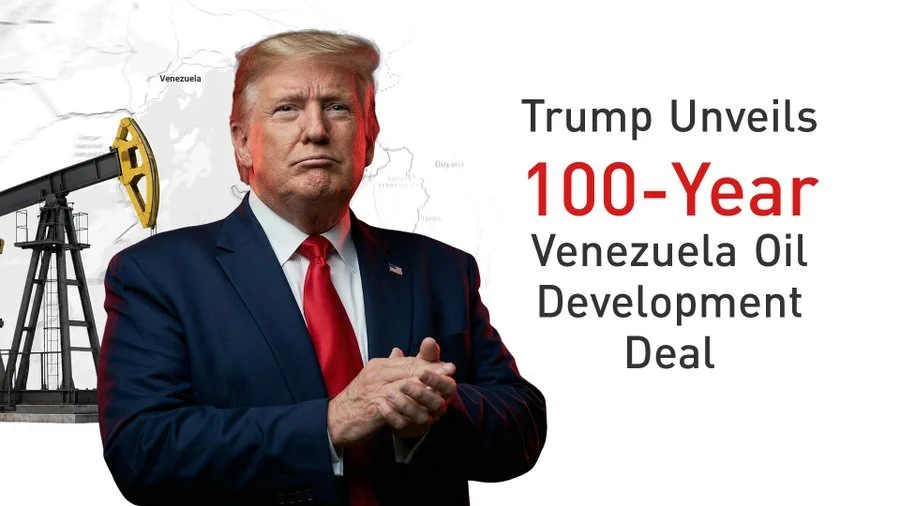
Kurdistan 24 English: U.S. President Donald Trump says Washington has reached what he calls the "biggest oil deal in world history" with Venezuela, covering more than 65 billion barrels of proven reserves. President Trump says the agreement gives the U.S. majority control through a private-sector partnership and could eventually lower American gasoline prices. Venezuela says the projects could attract about $100 billion in investment. Read more:
Trump Calls Venezuela Agreement 'Biggest Oil Deal in World History' https://www.kurdistan24.net/en/story/935720/trump-calls-venezuela-agreement-biggest-oil-deal-in-world-history
Coffee with MarkZ, joined by Bob Lock. 08/31//2026
Coffee with MarkZ, joined by Bob Lock. 08/31//2026
MarkZ Disclaimer: Please consider everything on this call as my opinion. Be sure to consult a professional for any financial decisions
MZ: US strikes on Iran over the weekend, fuel lines, and progress in Iraq. Bob Lock joins us at around the 30minute mark. Dr. Max will join around 1 hour in to talk about the mushroom farm event September 12th.
THE CONTENT IN THIS PODCAST IS FOR GENERAL & EDUCATIONAL PURPOSES ONLY&NOT INTENDED TO PROVIDE ANY PROFESSIONAL, FINANCIAL OR LEGAL ADVICE. PLEASE CONSIDER EVERYTHING DISCUSSED IN MARKZ’S OPINION ONLY
Coffee with MarkZ, joined by Bob Lock. 08/31//2026
MarkZ Disclaimer: Please consider everything on this call as my opinion. Be sure to consult a professional for any financial decisions
MZ: US strikes on Iran over the weekend, fuel lines, and progress in Iraq. Bob Lock joins us at around the 30minute mark. Dr. Max will join around 1 hour in to talk about the mushroom farm event September 12th.
THE CONTENT IN THIS PODCAST IS FOR GENERAL & EDUCATIONAL PURPOSES ONLY&NOT INTENDED TO PROVIDE ANY PROFESSIONAL, FINANCIAL OR LEGAL ADVICE. PLEASE CONSIDER EVERYTHING DISCUSSED IN MARKZ’S OPINION ONLY
https://rumble.com/user/theoriginalmarkz
Kick: https://kick.com/theoriginalmarkz
Markz's linktree https://linktr.ee/theMarkZshow
FOLLOW MARKZ : TWITTER . https://twitter.com/originalmarkz?s=21. TRUTH SOCIAL . https://truthsocial.com/@theoriginalm...
Mod: MarkZ "Back To Basics" Pre-Recorded Call" for Newbies 10-19-2022 )https://www.youtube.com/watch?v=37oILmAlptM
MARKZ DAILY LINKS: https://theoriginalmarkz.com/home/.
THANK YOU FOR JOINING. HAVE A BLESSED DAY. SEE YOU IN THE MORNING FOR COFFEE @ 10:00 AM EST ~ UNLESS BREAKING NEWS HAPPENS! FOR UPDATES ON MARK’S PODCAST GO TO: https://t.me/+b3hYhYlhKM1hYzcx
News, Rumors and Opinions Monday 8-31-2026
Note: All intel should be considered as "Rumors" until we receive official announcements ...and “Rates and Dates” could change anytime until we get to the banks/redemption centers.
RV Excerpts from the Restored Republic via a GCR Update as of Mon. 31 Aug. 2026
Compiled Mon. 31 Aug. 2026 12:01 am EST by Judy Byington
Judy Note:As of Mon. 31 Aug. 2026 the new gold/asset-backed Quantum Financial System Global Currency Reset (GCR) was set to activate.
Note: All intel should be considered as "Rumors" until we receive official announcements ...and “Rates and Dates” could change anytime until we get to the banks/redemption centers.
RV Excerpts from the Restored Republic via a GCR Update as of Mon. 31 Aug. 2026
Compiled Mon. 31 Aug. 2026 12:01 am EST by Judy Byington
Judy Note:As of Mon. 31 Aug. 2026 the new gold/asset-backed Quantum Financial System Global Currency Reset (GCR) was set to activate.
In the past the model of World economics had been defined byCentral Bank dominance,financial speculation and managed decline — which was now being systematically dismantled with the GCR.
The Quantum Financial System (QFS) was a gold-backed, transparent system that ended financial slavery.
The fall of the Cabal’s fiat US Dollar was abruptly made known onTuesday 25 Aug. 2026 when gold hit $4,589 per ounce. In the last quarter Central banks had bought 288 tonnes of gold – the fastest accumulation since 1967. The banks were positioning for a crash of their fiat US Dollar – which then happened on Sat. 29 Aug. 2026 when the national debt crossed $40 trillion.
Rolling Blackouts all across the World were (allegedly) happening now as the old Global financial fiat matrix disconnected. The World Banks had already moved to the gold-backed rails with Codes updated, Systems realigned. The Cabal’s debt chains had been successfully severed. It was the end of the corrupt fiat money system.
The GCR had been well prepared for this Mon. 30 Aug. 2026 transition. Gold and Peace Treaties had been (allegedly) signed by multiple nations. (Your nation could not be at war if you wanted to participate in the Global Currency Reset). Debts were wiped clean in test zones. Transactions had been recorded with biometric encryption. Certain individuals saw “disappearances” in their balances — in a good way. Global prosperity programs were on their way. Suppressed technologies were nearing release and the future held healing and restoration.
~~~~~~~~~~~~~~~
GLOBAL CURRENCY RECALIBRATION AND COMMODITY BACKED MONETARY TRANSITION ACTIVATED AMID MASSIVE DEBT SYSTEM COLLAPSE …Mr. Pool on Telegram Sun. 30 Aug. 2026
THE NEW ECONOMIC FRAMEWORK IS ANCHORED BY HARD COMMODITY BACKING, ENSURING EVERY UNIT OF VALUE CORRESPONDS TO REAL TANGIBLE ASSETS RATHER THAN INFINITE DEBT CREATION. COMMERCIAL BANKS FAILING TO COMPLY WITH THE NEW TRANSPARENCY MANDATES ARE FACING IMMEDIATE LIQUIDITY FREEZES AND COMPLIANCE TAKEOVERS.
THIS IS THE FINAL STAGE OF THE OLD PARADIGM COLLAPSE. THE ERA OF UNBACKED PAPER DEBT IS OFFICIALLY OVER. STAY STEADY, SECURE YOUR POSITION, AND WATCH THE CHANNELS FOR THE NEXT WAVE OF VERIFIED DROPS.
ATTENTION: THE FINAL COUNTDOWN HAS BEGUN! …Christian B. Wallace Tier4b ISO20022 on Telegram Sun. 30 Aug. 2026
If you thought the last few days were intense, what is happening right this moment is exceeding all expectations! SECRET PROCESSES HAVE ENTERED THE FINAL STAGE!
The final verification for Tier 4B are officially completed behind closed doors. There is no more room for delays – the system is fully locked down and ready for launch.
Banking servers are operating in “silent transition” mode. Key institutions are in constant coordination to prevent any attempt at sabotage by the old, corrupt lobby.
WHAT IS HAPPENING AWAY FROM THE PUBLIC EYE? The main stream media continues to distract the public with empty noise, trying to pull attention away from what truly matters. But those who know the truth are looking beneath the surface:
1. The code is green – Instructions have been dispatched to all relevant checkpoints.
2. Liquidity is prepped – Transfers are awaiting only the final green light for distribution to end users.
STAY CALM AND FOCUSED! This is the moment we have been preparing for over the years. Do not let panic, rumors, and daily noise distract you from the goal.
The transition isn’t just on the horizon — IT IS HAPPENING NOW. Stand ready. The new era is at your doorstep.
Read full post here: https://dinarchronicles.com/2026/08/31/restored-republic-via-a-gcr-update-as-of-august-31-2026/
************
Courtesy of Dinar Guru: https://www.dinarguru.com/
Militia Man The United States just made an announcement about 65 billion barrels of oil the United States is going to control from Venezuela...I think we all should be paying attention to certain things like that and especially at the timing...There is a connection between Venezuela and Iraq.
Frank26 September 30th is the deadline Trump has given them for everything...What do you think Trump wants?Everything. Lift the three zeros from your exchange rate. Introduce the lower notes. Bring out the HCL. Set your government. Get rid of the [Iranian] weapons. Do you think he's getting everything right now?I sincerely do...
Reset IntelligenceA country [Iraq] that just ordered 7.5 billion new notes has stopped dispensing the old ones...Here's how an exchange actually works... An exchange works by making the old paper unusable and the new paper worth walking in for. The state controls the first half with deadlines and rationing. You're watching that half run now - [atm] machines capped, [payment] trucks stopped, salaries rerouted [to electronic rails]. The second half arrives as a single announcement. Between the two halves sits nothing but silence from the [central] bank. That silence is what this week sounds like.
************
IQD Update: US Secret 100 Year Oil Deal Revealed!
Edu Matrix: 8-31-2026
Iraqi Dinar News Updates, IQD Exchange Rates, Iraq Economy News, IQD currency adjustment aka IQD RV.
Iraq Economic News and Points To Ponder Monday Morning 8-31-26
The Rising Dollar Is Testing Banking Reforms; The Central Bank Is Changing Rules, But The Parallel Market Is Resisting.
August 30, 2026Last updated: August 30, 2026 Al-Mustaqilla/Baghdad/- The dollar is still being sold in the Iraqi parallel market at a significant difference from the price announced by the Central Bank, despite a series of banking and regulatory measures implemented by the authorities during the past months in an attempt to restructure the financial sector and expand official channels for obtaining foreign currency.
The Rising Dollar Is Testing Banking Reforms; The Central Bank Is Changing Rules, But The Parallel Market Is Resisting.
August 30, 2026Last updated: August 30, 2026 Al-Mustaqilla/Baghdad/- The dollar is still being sold in the Iraqi parallel market at a significant difference from the price announced by the Central Bank, despite a series of banking and regulatory measures implemented by the authorities during the past months in an attempt to restructure the financial sector and expand official channels for obtaining foreign currency.
The selling price of $100 at Baghdad exchange bureaus reached approximately 154,500 dinars at the close of trading on Saturday, August 29, the same price as at the Al-Kifah and Al-Harithiya exchanges.
Meanwhile, the Central Bank offers the dollar at 1,310 dinars, equivalent to 131,000 dinars per $100. This leaves a difference of approximately 23,500 dinars, or about 18 percent, between the Central Bank's rate and the cash selling price in the market.
The figures do not reflect a steady upward trend for the dollar. The selling price in Baghdad reached about 156,000 dinars in some sessions in June before it declined, but at the end of August it remained higher than its level at the end of January when it was selling for about 151,000 dinars per 100 dollars.
This means that the new measures have not yet led to a permanent narrowing of the gap between the two prices to limited levels, despite a major change in the way Iraq manages trade finance and access to foreign currency.
Since the beginning of 2025, Iraq has moved from an electronic platform through which the Central Bank oversaw foreign transfers to a system in which commercial banks rely on their accounts and relationships with correspondent banks abroad, while the Central Bank finances those accounts and oversees compliance.
The International Monetary Fund said last year that the transition to the new system had succeeded in reducing the gap between the official and parallel exchange rates at that stage, but it also said that further narrowing the gap required facilitating access to foreign currency, tightening customs controls to curb smuggling and informal trade, and promoting the use of the dinar in local transactions.
But the widening gap again in 2026 indicates that reforming the transfer mechanism alone was not enough to eliminate demand outside the formal system.
The central bank said in June that it was committed to meeting legitimate demand for dollars and maintaining exchange rate stability, and that its reform program included reintegrating Iraqi banks into foreign transfers, expanding their relationships with correspondent banks, improving electronic payments, and complying with anti-money laundering and counter-terrorism financing standards.
In July, Central Bank Governor Nizar Nasser Hussein announced that, following discussions with the US Treasury Department, an understanding had been reached allowing restricted Iraqi banks to return to foreign correspondent banking channels in currencies other than the dollar after they met compliance and governance requirements.
The bank said that seven banks have become eligible for this stage, and that they can regain eligibility to deal in dollars later after passing additional requirements.
In the same month, the Central Bank withdrew the licenses of three companies that mediated the buying and selling of foreign currencies, namely Al-Rawajeb, Saba and Al-Nitaq, due to their violation of the sector's regulatory controls. Then, it held meetings with exchange companies to discuss reorganizing their operations and raising compliance and governance levels.
The policy towards cash dollars also witnessed another change. In July, Iraqi media published a directive from the Central Bank allowing banks to deliver some foreign remittances and incoming dollar deposits to their owners in the same currency, according to specific controls, in a move that would increase the banking system's ability to meet the legitimate demand for foreign currency.
However, the parallel market did not disappear.
This is partly due to the nature of demand, which does not all pass through the banking system. The IMF stated in its report on Iraq that the remaining difference between the two exchange rates reflects, among other factors, informal trade, demand for dollars for activities that cannot access regulated channels, and speculation.
The central bank itself had previously stated in clarifications that part of the parallel demand comes from traders who do not use official import methods, or from trade that does not pass through regular customs ports, or from prohibited activities, which makes providing dollars for legitimate transactions insufficient on its own to eliminate the informal market.
Iraq's financial relationship with the United States and its trade with Iran add another layer of complexity.
Reuters reported last week that Iraq's reliance on the dollar-based financial system gives Washington significant leverage over its financial sector, at a time when Iraq maintains extensive economic ties with Iran. According to figures cited by the agency, Iraqi-Iranian trade exceeded $10 billion in 2025.
In recent years, the United States has also imposed restrictions and sanctions on Iraqi banks that it said were involved in transactions linked to Iran, prompting the central bank to tighten compliance requirements and restructure the relationship of Iraqi banks with the international financial system.
This reveals a paradox facing Iraqi monetary policy: stricter compliance reduces the risks of sanctions and money laundering and brings banks closer to the international financial system, but at the same time it may leave a portion of demand that is unable or unwilling to go through official procedures heading to the parallel market.
Therefore, the market rate alone does not provide a complete measure of the success of banking reform. Restructuring banks, improving governance, expanding their international relationships, and subjecting remittances to scrutiny are objectives that extend beyond the daily exchange rate.
However, a persistent gap approaching 18 percent is at the same time an indicator that is difficult to ignore when measuring the ability of reforms to reach the real economy.
For a trader who cannot finance all of his needs through a correspondent bank, or a citizen who needs cash dollars for purposes other than those specified, the parallel market rate remains the actual rate he faces.
Herein lies the most difficult test for the Central Bank and the government of Ali al-Zaidi.
After changing the rules for foreign exchange, reopening banking channels, regulating exchange companies, and expanding dollar transactions through banks, the challenge is no longer limited to building a more compliant financial system, but has become making this system capable of competing with the parallel market in speed, access, and cost.
The experience of the first eight months of 2026 suggests that the parallel market has not yet given up.
The dollar, which was selling for about 151,000 dinars per 100 dollars at the end of January, reached 154,500 dinars at the end of August, although it fell back from the peaks it recorded in June.
Thus, what has been achieved so far seems closer to a reform of the banking structure and channels than to a complete transformation of the exchange market.
Narrowing the gap between the two prices, rather than just the number of instructions or banks that have been rehabilitated, will be one of the clearest tests of the new policy’s ability to transfer reform from the banks to the market.
https://mustaqila.com/ارتفاع-الدولار-يختبر-الإصلاح-المصرفي/
The American Media Line News Network: An Official In The Prime Minister's Office Expects A Decision To Remove Zeros From The Dinar
1 News - وان نيوز @onenewsiq Translated from Arabic
The American Media Line news network: An official in the Prime Minister's office expects a decision to remove zeros from the dinar to be finalized in the near upcoming period. #وان_نيوز #المنصة_الإخبارية_الأولى_في_العراق
Rate this translation:
8:50 PM · Aug 30, 2026 158 Views
Seeds of Wisdom RV and Economics Updates Monday Morning 8-31-26
Good Morning Dinar Recaps,
Global Bond Markets Flash Warning Signals: Oil Shock Forces Investors to Reprice Debt and Rates
Rising energy prices and renewed rate-hike expectations are pushing global borrowing costs higher, exposing growing pressure across sovereign debt markets.
Good Morning Dinar Recaps,
Global Bond Markets Flash Warning Signals: Oil Shock Forces Investors to Reprice Debt and Rates
Rising energy prices and renewed rate-hike expectations are pushing global borrowing costs higher, exposing growing pressure across sovereign debt markets.
OVERVIEW
Global bond markets are coming under renewed pressure as a 3% rise in oil prices adds to inflation concerns and pushes borrowing costs higher across major economies.
Markets are increasingly pricing in additional central-bank tightening, with expectations for a September Federal Reserve rate hike rising to roughly 60%, while European and Japanese bond yields are also climbing.
The broader significance extends beyond interest rates: higher yields increase the cost of servicing government debt and can force investors to reassess the value of stocks, bonds, currencies and other major assets.
KEY DEVELOPMENTS
1. Oil Shock Reignites Inflation Concerns
Renewed U.S.–Iran military tensions have pushed Brent crude back above $90 a barrel, adding another layer of inflation pressure to an already fragile global economic environment.
The concern for markets is not simply the price of oil today, but whether disruptions around the Strait of Hormuz persist long enough to keep energy costs elevated.
2. Global Bond Yields Are Moving Higher
The pressure is spreading across sovereign debt markets. Japan's 2-year government bond yield reached its highest level since 1995, while longer-term yields in the eurozone have reached levels not seen in more than 15 years.
U.S. Treasuries are also under pressure. The 30-year Treasury yield remains around 5.20%, while the 2-year yield is around 4.34%, reflecting growing concern that inflation could keep monetary policy tighter for longer.
3. Fed Rate-Hike Expectations Are Rising
Federal Reserve Chair Kevin Warsh's hawkish Jackson Hole remarks have changed market expectations. The probability of a September rate increase has risen to approximately 60%, compared with less than 50% the previous week.
That shift matters because higher U.S. rates can increase borrowing costs throughout the economy while also influencing global capital flows, currencies and asset valuations.
4. Japan and Europe Face Their Own Bond-Market Pressure
The repricing is not confined to the United States. European yields have climbed sharply, with German and French short-term borrowing costs reaching their highest levels since 2024.
Japan is facing an additional challenge from a weakening yen and rising inflation. Markets are increasingly anticipating that the Bank of Japan may raise rates in September, adding another potential source of global financial tightening.
5. Investors Are Reassessing the Cost of Capital
The combination of higher oil prices, persistent inflation and rising government borrowing costs is forcing investors to reconsider the price of money across global markets.
This creates a potentially important feedback loop: higher yields increase government financing costs, elevated energy prices reinforce inflation, and persistent inflation limits the ability of central banks to reduce interest rates.
WHY IT MATTERS
The bond market is one of the foundations of the global financial system. Government bond yields influence mortgage rates, corporate borrowing, investment decisions and the cost of financing government deficits.
The current warning is that markets may be moving toward a period in which higher borrowing costs become structural rather than temporary.
For governments carrying historically large debt burdens, even relatively small increases in interest rates can have significant long-term consequences.
For investors, the combination of elevated bond yields and geopolitical energy risk means that the cost of capital is becoming an increasingly important market variable.
WHY IT MATTERS TO FOREIGN CURRENCY HOLDERS
Currency values: Changes in U.S., Japanese and European interest-rate expectations can redirect international capital flows and influence exchange rates.
Purchasing power: Higher energy prices can raise transportation, food and production costs, placing additional pressure on purchasing power.
Capital flows: Higher yields can attract capital toward certain currencies and away from others, creating greater exchange-rate volatility.
Global demand for dollars: Higher U.S. yields can support demand for dollar-denominated assets, although persistent fiscal and inflation concerns can complicate that relationship.
IMPLICATIONS FOR THE GLOBAL RESET
Pillar 1: Debt
The most direct structural implication is the rising cost of government debt. When sovereign yields remain elevated, governments must devote more resources to interest payments, potentially limiting fiscal flexibility and increasing pressure to reconsider spending, taxation and debt issuance.
The significance extends beyond the United States. Rising yields in Japan and Europe indicate that the repricing of sovereign debt is becoming increasingly global.
Pillar 2: Assets
Higher interest rates change the relative attractiveness of virtually every major asset class. Bonds must compete with higher yields, while stocks, cryptocurrencies, commodities and currencies are repriced according to changing expectations for growth, inflation and monetary policy.
This means the bond market can become the transmission mechanism through which higher energy costs and tighter monetary policy spread into the broader financial system.
Pillar 3: Energy
The renewed rise in oil prices demonstrates how closely the financial system remains tied to global energy security. Continued disruption around the Strait of Hormuz could keep inflation elevated and make it more difficult for central banks to ease monetary policy.
Energy therefore remains a critical variable connecting geopolitics, inflation, interest rates and global capital markets.
CONCLUSION
Global bond markets are sending a warning that investors are reassessing the cost of money, the cost of energy and the cost of government debt.
The combination of oil above $90, rising sovereign yields and increasing expectations for central-bank tightening is creating a more difficult environment for heavily indebted governments and risk-sensitive assets.
The important question is no longer simply whether inflation will fall, but whether governments and markets can absorb higher borrowing costs while debt levels remain historically elevated.
The repricing of global debt may prove to be one of the most important structural forces shaping the financial system through the remainder of 2026.
Seeds of Wisdom Team
Newshounds News™ Exclusive
SOURCES
Reuters — "Bond markets face fresh selling as oil prices jump, stocks cautious"
Reuters — "Morning Bid: Oil climbs as missiles fly in the Gulf"
~~~~~~~~~~
🌱 A Message to Our Currency Holders🌱
If you’ve been holding foreign currency for many years, you were not foolish.
You were not wrong to believe the global financial system would change.
What failed was not your patience — it was the information you were given.
For years, dates, rumors, and personalities replaced facts, structure, and proof. “This week” predictions created cycles of hope and disappointment that were never based on how currencies actually change.
That is not your failure.
Our mission here is different: • No dates • No rates • No hype • No gurus
Instead, we focus on:
• Verifiable developments • Institutional evidence
• Global financial structure • Where countries actually sit in the process
Currency value changes only come after sovereignty, trade, banking, settlement systems, and fiscal coordination are in place. History and institutions confirm this sequence.
You will see silence. You will see denials. That is not delay — that is discipline.
Protect your identity. Organize your documents. Verify everything.
Never hand your discernment to anyone who cannot show proof.
You deserve truth — not timelines.
Seeds of Wisdom Team
Newshounds News
~~~~~~~~~~
Seeds of Wisdom Team RV Currency Facts Youtube and Rumble
Newshound's News Telegram Room Link
RV Facts with Proof Links Link
RV Updates Proof links - Facts Link
Start Here room with Most Asked Questions Link
Follow the Gold/Silver Rate COMEX
Follow Fast Facts
Seeds of Wisdom Team™ Website
Thank you Dinar Recaps
Monday AM Iraq News Posted by Tishwash at TNT 8-31-2026
TNT:
Tishwash: Companies at the Erbil Exhibition: The Iraqi market is promising for attracting new investments.
Local and foreign companies participating in the Erbil International Construction and Infrastructure Exhibition, currently being held in Erbil, are looking for opportunities for new partnerships and investments in the Iraqi market, with a focus on modern construction technologies, sustainable energy and infrastructure solutions.
Abdul Malik Qasim, the director of one of the Iraqi companies, told Shafaq News Agency that "participation this year goes beyond just displaying products; it is a real opportunity to conclude strategic contracts," noting that the Iraqi market is witnessing a boom in infrastructure projects, and that the presence of local companies reflects the ability of the Iraqi private sector to compete with and integrate with foreign partnerships.
TNT:
Tishwash: Companies at the Erbil Exhibition: The Iraqi market is promising for attracting new investments.
Local and foreign companies participating in the Erbil International Construction and Infrastructure Exhibition, currently being held in Erbil, are looking for opportunities for new partnerships and investments in the Iraqi market, with a focus on modern construction technologies, sustainable energy and infrastructure solutions.
Abdul Malik Qasim, the director of one of the Iraqi companies, told Shafaq News Agency that "participation this year goes beyond just displaying products; it is a real opportunity to conclude strategic contracts," noting that the Iraqi market is witnessing a boom in infrastructure projects, and that the presence of local companies reflects the ability of the Iraqi private sector to compete with and integrate with foreign partnerships.
For his part, Saif Awad, a representative of one of the participating companies, said that companies no longer view Iraq “as just a consumer market for materials, but as a promising investment environment that is growing rapidly,” explaining that the participation aims to localize modern technologies and transfer engineering expertise to local personnel, given the opportunities available in the Iraqi governorates.
Sarah Mohammed, an infrastructure sector advisor, told Shafaq News Agency that what distinguishes this year's exhibition is the focus on sustainable building solutions and energy-saving technologies, noting that meetings between businessmen and investors showed "a serious desire to turn memoranda of understanding into real projects on the ground that serve comprehensive development plans."
The exhibition , which began last Thursday, includes more than 450 companies representing 20 Arab and foreign countries.
Its activities began in Erbil this week, and its four days are expected to witness bilateral (B2B) meetings and the signing of investment and trade contracts and understandings between foreign companies and local investors. link
************
Tishwash: Money exchange companies under the microscope of the Central Bank of Iraq: strict oversight and anticipated updates.
The relationship between the Central Bank of Iraq and exchange companies and offices is heading towards a more stringent stage in monitoring the movement of funds and transfers, in conjunction with official moves to reorganize the sector and raise compliance and governance requirements, according to a source close to the exchange market and official data reviewed by Al-Mustaqilla.
The source, who preferred not to reveal his name, told Al-Mustaqilla’s correspondent that exchange companies and offices are currently subject to stricter monitoring, and that the coming period may witness updates in the mechanisms for linking and exchanging information with the Central Bank, allowing for more accurate monitoring of operations and transfers, especially foreign transactions.
The Central Bank has not yet announced details about a new electronic system to link exchange companies or when it will be implemented, and Al-Mustaqilla was unable to independently verify the nature of the updates referred to by the source.
But the bank's actions over the past three months support a clear trend towards tighter oversight of the sector.
On June 10, the Central Bank asked exchange companies of categories (A and B) and companies that mediate the buying and selling of foreign currencies to provide it with data relating to their bank accounts, and said that the measure comes “for regulatory and supervisory purposes.”
On July 6, the bank withdrew the licenses of Al-Rawajeb, Saba and Al-Nitaq companies to mediate the buying and selling of foreign currencies, attributing the decision to violations of sector regulation controls.
Two weeks later, Central Bank Governor Nizar Nasser Hussein held a meeting with the directors and chairmen of exchange companies, and said that the next phase would witness new initiatives and activities to expand their businesses, in parallel with raising compliance and governance levels in accordance with international standards.
These measures coincided with broader commitments made by Iraq under a joint action plan with the Financial Action Task Force (FATF) to strengthen the fight against money laundering and terrorist financing. In August, the bank issued a new circular on behavioral indicators for transactions suspected of being linked to money laundering or terrorist financing, following a training program in which banking and non-banking financial institutions participated.
Exchange companies are already subject to special anti-money laundering and counter-terrorism financing regulations issued by the Central Bank in 2024, as part of its supervision of non-bank financial institutions.
These steps indicate that the next phase may not be limited to regulating currency sales, but may extend to increasing oversight of the sources of funds, transfer routes, and beneficiaries.
The extent of the expected change remains linked to the instructions that will be issued by the Central Bank, particularly whether it will adopt a more centralized system to link exchange companies and monitor their transactions directly. link
**************
Tishwash: The Iraqi government is turning to American banks for loans to resolve its liquidity crisis.
An informed source revealed on Sunday that the government intends to approach some American banks to obtain a financial loan as a quick solution to overcome the liquidity crisis, away from proposals to print currency.
The source explained to Shafaq News Agency that "the Ministries of Finance and Foreign Affairs are considering contacting some official American banks to obtain a financial loan that will be repaid from Iraqi oil sales in global oil markets, thus solving the liquidity crisis away from the proposal to print currency locally."
The source added that "the Iraqi government sees this approach as a logical and quick solution amid the wave of crises that the region is witnessing," without revealing further details.
The law on borrowing, grants and subsidies is an exceptional and temporary measure that Iraq is moving towards enacting, to compensate for the absence of the federal budget and to secure the necessary government spending.
The Iraqi parliament is waiting for the government to officially send the draft borrowing law to parliament, in order to avoid a financial gap and to ensure that the law does not differ from the vision and policy of the Iraqi government, according to the parliamentary finance committee.
Earlier, a special monitoring conducted by Shafaq News Agency showed that the volume of Iraqi currency issuance rose to 113.560 trillion dinars in May 2026, an increase of about 13.761 trillion dinars, or 13.8%, compared to the end of December 2025, amid escalating financial pressures that prompted the government to seek liquidity to ensure the payment of salaries and basic expenses. ink
************
Tishwash: US Sanctions on Iran Could Disrupt Iraq’s Trade, Energy Supplies and Currency Market
Iraq could face significant economic repercussions from the tightening of US sanctions on Iran, with experts warning that restrictions on financial transactions could disrupt bilateral trade, increase prices and put additional pressure on the Iraqi dinar and dollar market.
The concerns come amid extensive commercial and economic ties between Baghdad and Tehran. Iraq relies on Iran for a significant share of imports, including food, agricultural products, construction materials and consumer goods, while continuing to import Iranian gas and electricity.
Economic expert Sadiq al-Rikabi told BasNews that a complete halt to official trade between Iraq and Iran would be difficult given the two countries’ long border and deeply interconnected commercial relations.
"It would be difficult to say that sanctions will completely halt trade, but they will impose major obstacles on imports and financial transfers,” al-Rikabi said.
He identified food and agricultural products as among the sectors most vulnerable to disruption, noting that Iraq imports substantial quantities of dairy products, vegetables and canned goods from Iran.
Construction materials, including ceramics, iron and pipes, could also be affected, he said, as many Iraqi companies rely on Iranian supplies because of their relatively low costs and geographic proximity. Consumer goods, plastics, cleaning products and household materials could face similar pressures.
Energy payments remain a key concern
Iraq’s electricity and gas imports from Iran are covered by US sanctions waivers, but the mechanism for settling payments remains a major challenge, according to al-Rikabi.
He noted that payments associated with Iranian electricity and gas imports had exceeded $10 billion during previous periods, warning that difficulties in settling outstanding payments could prompt Iran to reduce or suspend energy supplies.
Such a development could directly affect Iraq’s electricity generation, particularly given the continued importance of Iranian gas to the country’s power sector.
Banking restrictions could push trade into informal channels
Al-Rikabi said the main difference between the current sanctions environment and the existing trade relationship is Washington’s effort to impose financial restrictions on Iran and prevent dollars from reaching the Iranian economy.
An Iraqi trader opening a bank credit facility or letter of guarantee in favor of an Iranian company could face sanctions exposure, while transferring US dollars to Iran through the banking system would become increasingly difficult, he said.
As formal banking channels become more constrained, however, informal trade could expand through unofficial border crossings, cash transactions and barter arrangements.
Some traders could resort to exchanging Iraqi dinars for Iranian rials or physically transporting cash across the border, while others could use barter systems in which Iraqi goods are exchanged directly for Iranian products.
"The trade conducted through banks will decline significantly, but informal trade could become more active,” al-Rikabi said.
Pressure on prices and the dollar market
Despite tighter restrictions, al-Rikabi expects Iranian goods to continue entering the Iraqi market, albeit in smaller quantities and under greater scrutiny.
He warned that traders’ increased reliance on the parallel market to obtain dollars and transfer funds to Iran could raise demand for the US currency inside Iraq.
This could contribute to delays in the arrival of certain goods and drive up prices as importers face higher transaction costs and greater difficulties securing supplies.
The resulting increase in demand for dollars could also place additional pressure on the Iraqi dinar’s exchange rate.
"Iraq-Iran trade will not stop completely,” al-Rikabi said, "but sanctions and tighter controls on financial transfers will make it more expensive and complicated, with potentially direct consequences for the Iraqi economy, prices and the foreign-exchange market.” link
MilitiaMan & Crew: The Dinar Value Shift: What You Need to Know
MilitiaMan & Crew: The Dinar Value Shift: What You Need to Know
8-30-2026
The Crew: Samson, PompeyPeter, Petra, Daytrader, Sunkissed, GIGI and Militia Man
No drama. No intrigue. No songs and dances. Just straight, factual news that I read and interpret to the best of my ability after being an avid Dinar investor and insanely obsessed Dinarian for over 15 years.
Follow MM on X == https://x.com/Slashn
MilitiaMan & Crew: The Dinar Value Shift: What You Need to Know
8-30-2026
The Crew: Samson, PompeyPeter, Petra, Daytrader, Sunkissed, GIGI and Militia Man
No drama. No intrigue. No songs and dances. Just straight, factual news that I read and interpret to the best of my ability after being an avid Dinar investor and insanely obsessed Dinarian for over 15 years.
Follow MM on X == https://x.com/Slashn
Be sure to listen to full video for all the news……..
FRANK26….8-30-26….ANNOUNCEMENT
KTFA
Sunday Night Video
FRANK26….8-30-26….ANNOUNCEMENT
This video is in Frank’s and his team’s opinion only
Frank’s team is Walkingstick, Eddie and Omar in Iraq and guests
Playback Number: 605-313-5163 PIN: 156996#
KTFA
Sunday Night Video
FRANK26….8-30-26….ANNOUNCEMENT
This video is in Frank’s and his team’s opinion only
Frank’s team is Walkingstick, Eddie and Omar in Iraq and guests
Playback Number: 605-313-5163 PIN: 156996#
Rob Cunningham: Ripple Turning SWIFT’s 14-Month Window into a Trojan Horse
Rob Cunningham: Ripple Turning SWIFT’s 14-Month Window into a Trojan Horse
8-29-2026
Oopsie, Mr. SWIFT.
“Ring-Ring”
“Hello?”
“I’m Ripple.”
“Glad you called! What’s up?”
Rob Cunningham: Ripple Turning SWIFT’s 14-Month Window into a Trojan Horse
8-29-2026
Oopsie, Mr. SWIFT.
“Ring-Ring”
“Hello?”
“I’m Ripple.”
“Glad you called! What’s up?”
“You don’t have to rip out SWIFT. Keep it. Let us solve the corridors, liquidity, stablecoin settlement, treasury and digital-asset problems that your existing architecture isn’t solving for the next 12-14 months.”
“We Love You! When can we sign?”
– A bank can remain a SWIFT member for messaging, correspondent relationships and legacy traffic while simultaneously moving selected payment corridors, treasury liquidity, stablecoin settlement and digital-asset activity onto Ripple’s full-stack infrastructure.
Ripple enters this new 12-14 month “window of opportunity” SWIFT has opened, considerably stronger than the Ripple of several years ago. Ripple’s payments network has already processed $100B+, supports payouts across 60+ markets, and the Ripple Ecosystem now possesses 75+ regulatory licenses. Its European MiCA authorization alone gives it regulated reach across all 30 EEA countries.
Meanwhile, Ripple Treasury – the former GTreasury business – says its platform facilitated $13 trillion of customer payments in 2025. That gives Ripple something particularly valuable during this SWIFT “window of opportunity”: existing relationships with corporate treasury departments rather than having to acquire every customer from scratch.
And a new customer acquired through Ripple Payments can subsequently consume stablecoins, custody, liquidity, virtual accounts, treasury management and digital-asset infrastructure. Ripple explicitly describes its expanded payments platform as allowing customers to collect → hold → exchange → settle → payout fiat and stablecoins through one integrated environment.
New Payments customer
→ Ripple Payments
→ Ripple Treasury
→ RLUSD
→ custody
→ liquidity
→ tokenized assets
→ XRPL settlement
→ potentially XRP bridge liquidity where economically appropriate.
That is vastly more valuable than winning a payment message.
And there’s a beautiful strategic irony here.
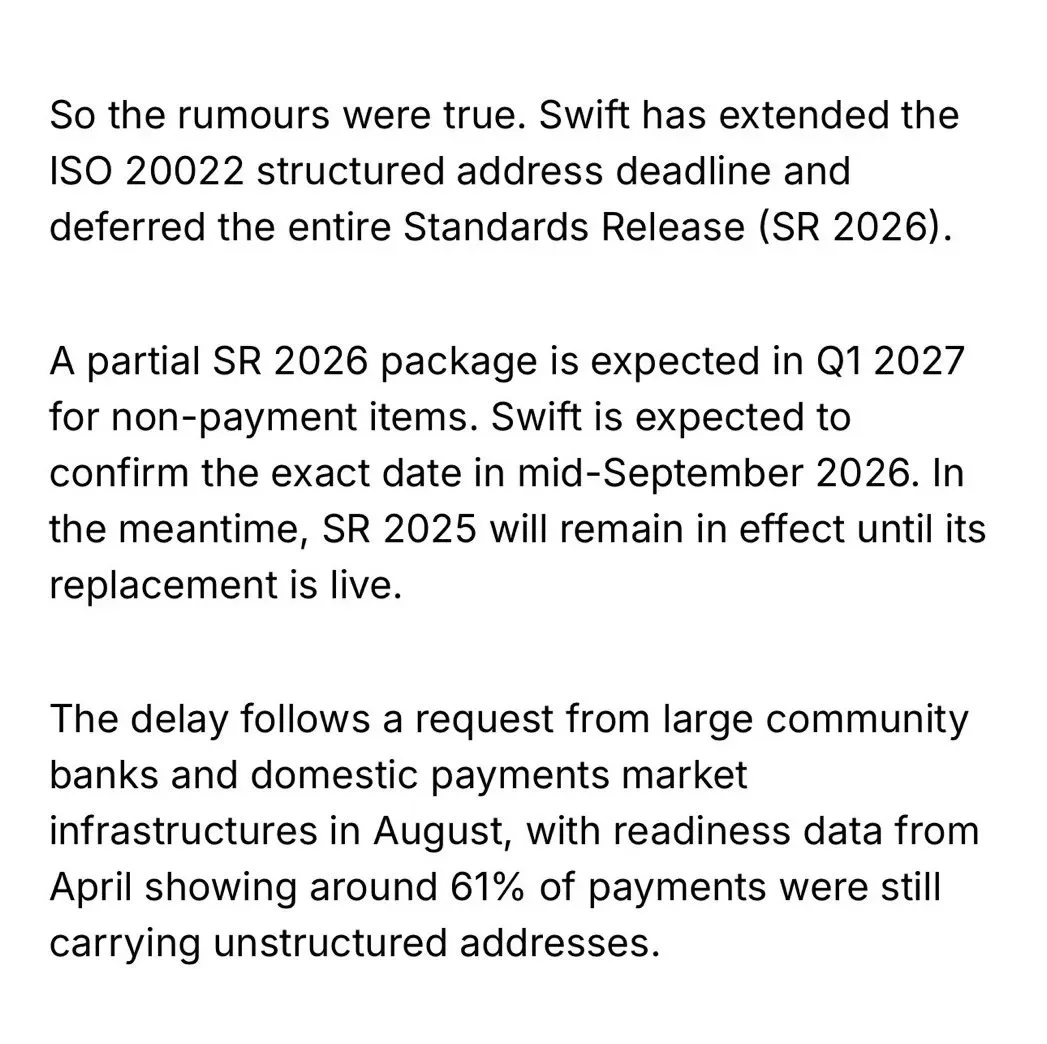
SWIFT’s delay doesn’t prove SWIFT is dying. In fact, SWIFT says more than 98% of payment instructions are already being sent using ISO 20022, so this is specifically an implementation/readiness problem involving richer structured data – not failure of ISO 20022 itself.
Rinse & Repeat thousands of times. Gain 750-1,500 brand new banking, fintech, payments relationships.
Winning by not losing.
Source(s):
• https://x.com/KuwlShow/status/2093451408184115208
Iraq Economic News and Points To Ponder Sunday Afternoon 8-30-26
Al-Amiri: I Assure Everyone There Will Be No Confrontation Between The State And The Resistance - 8/30/2026
Baghdad - INA - 8/30/2026 The Secretary-General of the Badr Organization Hadi al-Amiri said there would be no confrontation whatsoever between the state and the IRI resistance, stressing that the Coordination Framework had agreed on a decision to combat corruption and those responsible for it.
“I assure everyone that there will be absolutely no confrontation between the state and the resistance,” Al-Amiri said in remarks delivered at a memorial ceremony marking the anniversary of the martyrdom of Grand Ayatollah Mohammed Baqir al-Hakim, according to remarks followed by the Iraqi News Agency (INA).
Al-Amiri: I Assure Everyone There Will Be No Confrontation Between The State And The Resistance - 8/30/2026
Baghdad - INA - 8/30/2026 The Secretary-General of the Badr Organization Hadi al-Amiri said there would be no confrontation whatsoever between the state and the IRI resistance, stressing that the Coordination Framework had agreed on a decision to combat corruption and those responsible for it.
“I assure everyone that there will be absolutely no confrontation between the state and the resistance,” Al-Amiri said in remarks delivered at a memorial ceremony marking the anniversary of the martyrdom of Grand Ayatollah Mohammed Baqir al-Hakim, according to remarks followed by the Iraqi News Agency (INA).
“The fight against corruption and the corrupt is a decision agreed upon by the Coordination Framework, and we support system" rel="">support the prime minister in this regard,” he said.
Al-Amiri said regulating weapons was “a legitimate national and constitutional objective” and a fundamental step towards building a strong state capable of protecting Iraq and safeguarding its security, sovereignty and dignity.
“Regulating weapons is not an external decision, but a purely Iraqi one,” he said.
Iraq Considers Loans From US Banks To Ease Liquidity Crisis
2026-08-30 Shafaq News- Baghdad The Iraqi government is considering borrowing from US banks as a quick way to address its liquidity crisis rather than print more currency, an informed source told Shafaq News on Sunday.
“The Iraqi government sees this as a practical and quick solution amid the ongoing crises in the region,” the source said, without providing further details.
Iraq is preparing temporary legislation on borrowing, grants and subsidies to cover essential government spending while no federal budget is in place. The parliamentary Finance Committee said Parliament is awaiting the government’s formal submission of the draft law to prevent a funding gap.
Data from the Central Bank of Iraq (CBI) showed that the total value of currency issued rose to 111.189 trillion dinars ($84.5 billion) by the end of June 2026. By the end of June, currency held outside banks accounted for about 91.7% of the total, while the remaining 8.3% was held in bank vaults.
https://shafaq.com/en/Economy/Iraq-considers-loans-from-US-banks-to-ease-liquidity-crisis
Banking Sector Faces Turning Point In Iraq’s Reform Drive
2026-08-30 Shafaq News- Baghdad Iraq’s banking sector faces a “critical crossroads” after years of weak management, oversight failures and declining public confidence have limited its ability to attract savings and finance investment and development, the prime minister’s economic adviser told Shafaq News on Saturday.
Mudher Mohammed Saleh said building an efficient banking system could no longer be delayed, particularly in an economy heavily dependent on oil for foreign currency.
“Restoring confidence requires stronger governance, supervision and compliance, strict anti-money laundering and counter-terrorist financing standards, restructuring troubled banks, addressing weaknesses in their financial positions and raising capital in line with risk levels and modern banking requirements.”
Technology is another key part of the overhaul, Saleh said, calling for improved digital systems, cybersecurity and risk management, along with secure and reliable electronic payment services. Such measures would reduce reliance on cash, expand financial inclusion and bring more people into the formal banking system.
However, technology and oversight alone would not restore confidence. Banks also need greater transparency, stronger depositor protections, clear deposit safeguards, faster complaint handling and the ability to protect customers’ money, according to the advisor.
He called for banks to shift from traditional services and liquidity management toward financing the real economy, particularly small and medium-sized enterprises and productive agricultural, industrial and service sectors.
“A bank that does not finance productive economic activity remains a financial intermediary with limited impact,” he said, adding that institutions capable of mobilizing savings, managing risks and financing production and investment can become partners in development.
From Cash to Credit
International economics professor Nawar Al-Saadi told Shafaq News that banking reform had become essential for moving Iraq from a cash-based economy toward one driven by financing. He said the Central Bank of Iraq’s (CBI) program offers banks several paths, including remaining in business, merging or leaving the market, alongside tougher governance, compliance and risk-management requirements.
Rebuilding confidence requires sound governance, solvency and transparency rather than campaigns to attract deposits, Al-Saadi said. He called for resolving the status of banks unable to continue operating, strengthening the capital of viable institutions, improving disclosure and independent auditing, and holding boards and executives accountable for violations.
Depositors should find banks “safer and easier to use” than keeping cash, he added. This would also require greater lending to small and medium-sized businesses and productive sectors, as well as effective credit-scoring systems instead of excessive reliance on traditional collateral.
Protecting Deposits
Economic expert Ahmed Al-Janabi said reform required a comprehensive package beginning with restoring confidence and protecting depositors’ money, noting that many Iraqis remain reluctant to place their savings in banks.
He noted that the reform program involving global consultancy Oliver Wyman was developed against the backdrop of restrictions on several Iraqi banks. Seven institutions subsequently entered an initial phase allowing them to resume transactions and transfers in foreign currencies other than the dollar, while further reforms remain underway.
Al-Janabi estimated that currency issued by the CBI totals around 103 trillion dinars, while about 20 trillion dinars remain outside the banking system, much of it “hoarded in homes.”
Economic expert Ahmed Abdul Rabbo said the reforms undertaken with Oliver Wyman were important for rebuilding the banking sector, improving its efficiency and strengthening its links to the global financial system, calling for faster implementation.
He welcomed the decision allowing seven banks to conduct foreign transfers in currencies other than the dollar but said the priority should be enabling them to gradually resume broader operations. Reform should also extend beyond those institutions, he said, with other banks assessed and allowed to conduct foreign transfers once they meet the required standards.
The Central Bank has been working with international firms to overhaul the banking sector and address compliance problems that had cut several Iraqi banks off from dollar transactions.
On July 18, the CBI reached an agreement with the US Treasury Department allowing seven eligible banks to resume foreign correspondent banking in currencies other than the dollar. Access to dollar transactions remains subject to further compliance, governance and relicensing requirements.
https://shafaq.com/en/Economy/Banking-sector-faces-turning-point-in-Iraq-s-reform-drive
Al-Zaydi: We Directed The Exposure Of Corrupt Individuals And The Activation Of The Law Rewarding Informants.
2026-08-29 Shafaq News - Baghdad During his visit on Saturday to the headquarters of the Federal Integrity Commission, Prime Minister Ali al-Zaidi directed the activation of the law rewarding informants about corruption cases, the strengthening of monitoring border crossings, and the exposure of corrupt individuals, stressing the need to submit monthly and quarterly reports on the progress of combating corruption and the level of achievement.
During the field visit, Al-Zaydi met with the head of the commission and its senior staff, and was briefed on its working mechanisms and efforts in combating corruption and protecting public funds, according to a statement issued by his media office.
The statement quoted Al-Zaydi as saying that "the Integrity Commission is a monument that cannot be measured by its walls, but rather by its scales, and by its two pans, which are integrity and the preservation of public funds," stressing that the battle against corruption is great, and that the commission represents the first line of defense in it.
The Prime Minister stressed that the role of the commission should not be limited to the oversight aspect, but should also include the preventive aspect, stressing the need to work on eradicating the corruption system completely, and to follow up on the governorates’ projects in the same way as the ministries’ projects.
He directed that projects be monitored according to three levels that correspond to the size and cost of the project, starting with high-cost projects, then medium-cost projects, and then small projects, in order to ensure that the supervisory effort is directed more effectively.
For his part, the head of the commission confirmed the formation of field teams to audit contracts in state institutions. The audit of contracts for eight ministries has been completed, while work continues to complete the rest of the institutions.
He pointed out the completion of the National Strategy for Integrity and Combating Corruption, which extends until 2030, and stressed the commission’s readiness to move forward in combating corruption and preserving public funds.
https://www.shafaq.com/ar/سیاسة/الزيدي-وج-هنا-بفضح-الفاسدين-وتفعيل-قانون-مكاف-ة-المخبرين