Rob Cunningham: Ripple Turning SWIFT’s 14-Month Window into a Trojan Horse
Rob Cunningham: Ripple Turning SWIFT’s 14-Month Window into a Trojan Horse
8-29-2026
Oopsie, Mr. SWIFT.
“Ring-Ring”
“Hello?”
“I’m Ripple.”
“Glad you called! What’s up?”
“You don’t have to rip out SWIFT. Keep it. Let us solve the corridors, liquidity, stablecoin settlement, treasury and digital-asset problems that your existing architecture isn’t solving for the next 12-14 months.”
“We Love You! When can we sign?”
– A bank can remain a SWIFT member for messaging, correspondent relationships and legacy traffic while simultaneously moving selected payment corridors, treasury liquidity, stablecoin settlement and digital-asset activity onto Ripple’s full-stack infrastructure.
Ripple enters this new 12-14 month “window of opportunity” SWIFT has opened, considerably stronger than the Ripple of several years ago. Ripple’s payments network has already processed $100B+, supports payouts across 60+ markets, and the Ripple Ecosystem now possesses 75+ regulatory licenses. Its European MiCA authorization alone gives it regulated reach across all 30 EEA countries.
Meanwhile, Ripple Treasury – the former GTreasury business – says its platform facilitated $13 trillion of customer payments in 2025. That gives Ripple something particularly valuable during this SWIFT “window of opportunity”: existing relationships with corporate treasury departments rather than having to acquire every customer from scratch.
And a new customer acquired through Ripple Payments can subsequently consume stablecoins, custody, liquidity, virtual accounts, treasury management and digital-asset infrastructure. Ripple explicitly describes its expanded payments platform as allowing customers to collect → hold → exchange → settle → payout fiat and stablecoins through one integrated environment.
New Payments customer
→ Ripple Payments
→ Ripple Treasury
→ RLUSD
→ custody
→ liquidity
→ tokenized assets
→ XRPL settlement
→ potentially XRP bridge liquidity where economically appropriate.
That is vastly more valuable than winning a payment message.
And there’s a beautiful strategic irony here.
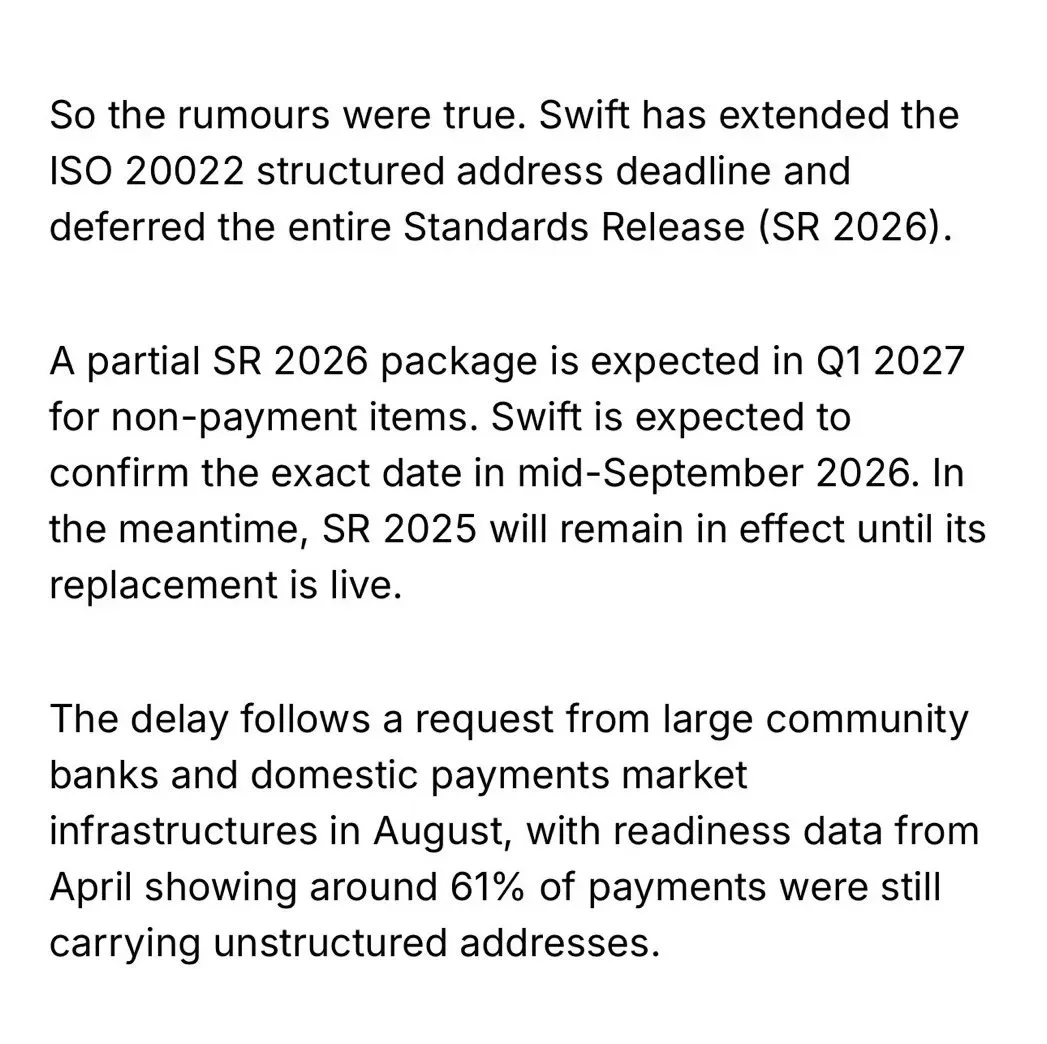
SWIFT’s delay doesn’t prove SWIFT is dying. In fact, SWIFT says more than 98% of payment instructions are already being sent using ISO 20022, so this is specifically an implementation/readiness problem involving richer structured data – not failure of ISO 20022 itself.
Rinse & Repeat thousands of times. Gain 750-1,500 brand new banking, fintech, payments relationships.
Winning by not losing.
Source(s):
• https://x.com/KuwlShow/status/2093451408184115208