
Thank you to all the subscribers to our Early Access program…we thank you for your continued support.
We are excited to offer this new service to keep you informed and up-to-date on the latest Dinar and currency news.
FRANK26….8-15-26….WHAT HAPPENED ON AUGUST 15th?!!!!!
KTFA
Saturday Night Video
FRANK26….8-15-26….WHAT HAPPENED ON AUGUST 15th?!!!!!
This video is in Frank’s and his team’s opinion only
Frank’s team is Walkingstick, Eddie and Omar in Iraq and guests
Playback Number: 605-313-5163 PIN: 156996#
KTFA
Saturday Night Video
FRANK26….8-15-26….WHAT HAPPENED ON AUGUST 15th?!!!!!
This video is in Frank’s and his team’s opinion only
Frank’s team is Walkingstick, Eddie and Omar in Iraq and guests
Playback Number: 605-313-5163 PIN: 156996#
MilitiaMan & Crew: Urgent Update: What You Need To Know This Week!
MilitiaMan & Crew: Urgent Update: What You Need To Know This Week!
8-15-2026
The Crew: Samson, PompeyPeter, Petra, Daytrader, Sunkissed, GIGI and Militia Man
No drama. No intrigue. No songs and dances. Just straight, factual news that I read and interpret to the best of my ability after being an avid Dinar investor and insanely obsessed Dinarian for over 15 years.
Follow MM on X == https://x.com/Slashn
MilitiaMan & Crew: Urgent Update: What You Need To Know This Week!
8-15-2026
The Crew: Samson, PompeyPeter, Petra, Daytrader, Sunkissed, GIGI and Militia Man
No drama. No intrigue. No songs and dances. Just straight, factual news that I read and interpret to the best of my ability after being an avid Dinar investor and insanely obsessed Dinarian for over 15 years.
Follow MM on X == https://x.com/Slashn
Be sure to listen to full video for all the news……..
Will Banks Accept Your Dinar After The Revaluation ?
Will Banks Accept Your Dinar After The Revaluation ?
The Dinar Den: 8-14-2026
The world of international currency investment is often filled with both excitement and uncertainty, and perhaps no topic illustrates this better than the Iraqi dinar. In a recent detailed breakdown from The Dinar Den, host Stephen—a seasoned investor who has navigated this landscape since 2011—shares a grounded perspective on what it truly means to hold this currency.
By shifting the focus away from internet rumors and toward practical banking realities, Stephen provides a roadmap for those who are holding dinar in anticipation of a potential revaluation.
Will Banks Accept Your Dinar After The Revaluation ?
The Dinar Den: 8-14-2026
The world of international currency investment is often filled with both excitement and uncertainty, and perhaps no topic illustrates this better than the Iraqi dinar. In a recent detailed breakdown from The Dinar Den, host Stephen—a seasoned investor who has navigated this landscape since 2011—shares a grounded perspective on what it truly means to hold this currency.
By shifting the focus away from internet rumors and toward practical banking realities, Stephen provides a roadmap for those who are holding dinar in anticipation of a potential revaluation.
One of the most important takeaways from Stephen’s experience is the current status of the Iraqi dinar within the global financial system. Currently, most major banking institutions do not accept or trade the dinar because its market value is considered negligible.
Stephen clarifies that investors should not expect their local bank to handle the currency under its current conditions. However, the premise of the investment rests on a future revaluation (RV). If and when this event occurs, the dinar would transition into a legitimate, tradable asset that banks would then be equipped to handle for deposits, exchanges, and further investment.
The dinar community has long been a breeding ground for elaborate theories and “insider” information. Stephen takes a firm stance against these narratives, labeling many of them as pure misinformation. He specifically addresses the myths surrounding “special 800 numbers,” exclusive “redemption centers,” and “privileged contract rates.” According to Stephen, these concepts often mislead investors into expecting a secretive or specialized exchange process. Instead, he advocates for a much more traditional approach: when the currency becomes liquid and valuable, the exchange process will likely mirror that of any other major foreign currency through standard banking channels.
Preparation is the cornerstone of Stephen’s advice. Should a revaluation occur, the transition from holding physical notes to depositing funds into a bank account will require strict adherence to financial regulations. Stephen emphasizes that investors must have their “house in order” before stepping into a bank.
This includes maintaining valid government-issued identification and, crucially, original purchase receipts or records of the “cost basis.” Additionally, being able to provide a “source of funds” statement is essential to satisfy modern anti-money laundering (AML) and “know your customer” (KYC) protocols. Having these documents ready ensures a smooth, professional transaction and builds credibility with bank officers.
Beyond simple documentation, Stephen highlights the logistical side of currency exchange. He advises investors to verify which specific bank branches are capable of authenticating foreign banknotes before making a trip.
Not every local branch possesses the necessary equipment or trained personnel to verify the security features of the Iraqi dinar. By calling ahead and confirming a branch’s capabilities, investors can avoid unnecessary delays and ensure they are dealing with the right experts from the start.
Ultimately, the message from The Dinar Den is one of patience and pragmatism. Stephen urges investors to drown out the noise of conspiracy theories and focus on the central, practical step: going directly to a reputable bank once the currency’s value is officially recognized.
By treating the dinar as a speculative financial asset rather than a get-rich-quick scheme, investors can approach the situation with the professionalism it requires.
Rob Cunningham: Liquidity will Flood the Ledgers
Rob Cunningham: Liquidity will Flood the Ledgers
8-15-2026
WATER ONCE FLOODED THE LAND.
LIQUIDITY WILL FLOOD THE LEDGERS.
One transformed the physical landscape.
The other will transform the economic landscape.
Rob Cunningham: Liquidity will Flood the Ledgers
8-15-2026
WATER ONCE FLOODED THE LAND.
LIQUIDITY WILL FLOOD THE LEDGERS.
One transformed the physical landscape.
The other will transform the economic landscape.
One washed across geographic boundaries.
The other dissolves unnecessary financial boundaries.
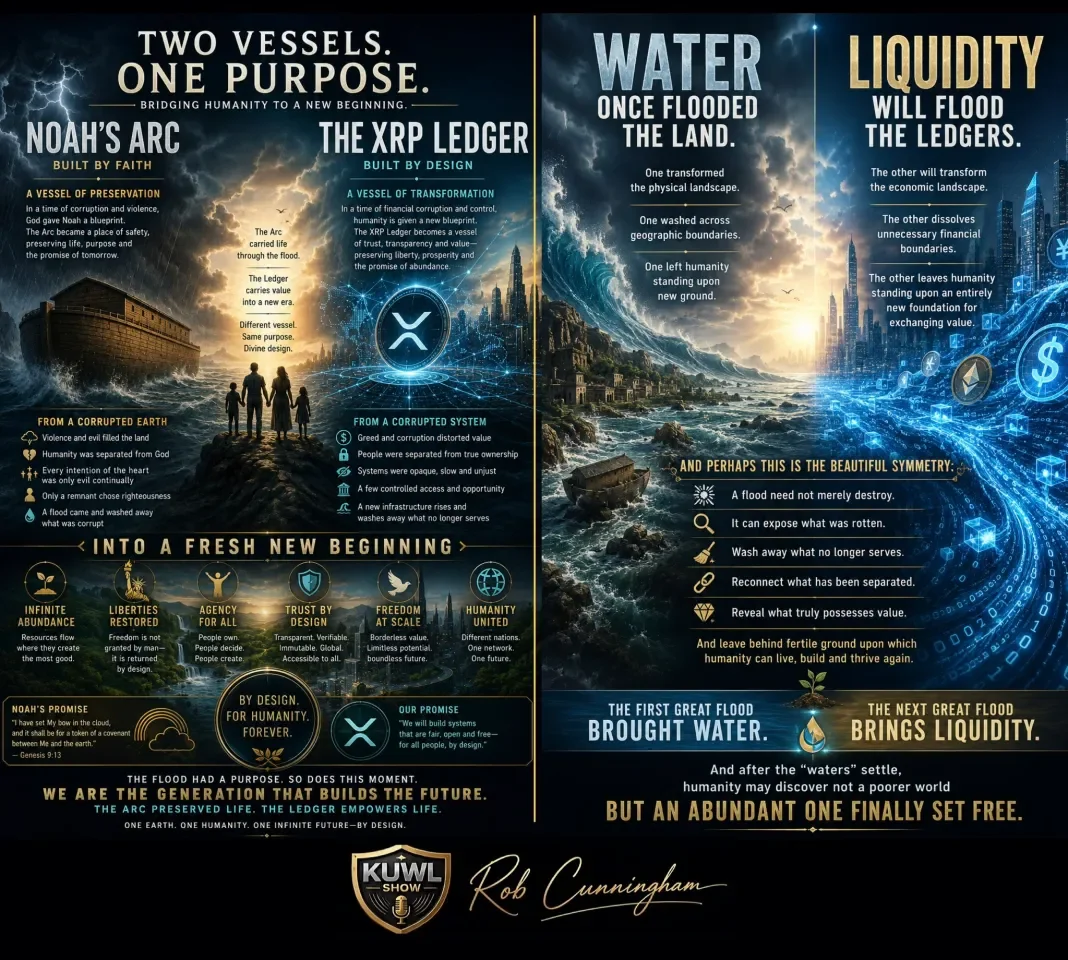
One left humanity standing upon new ground.
The other leaves humanity standing upon an entirely new foundation for exchanging value.
And perhaps this is the beautiful symmetry:
A flood need not merely destroy.
It can expose what was rotten.
Wash away what no longer serves.
Reconnect what has been separated.
Reveal what truly possesses value.
And leave behind fertile ground upon which humanity can live, create, build and thrive again.
The first great flood brought water and a new beginning.
The next great flood brings liquidity and a new beginning.
And after the “waters” settle, humanity will discover not a poorer world,
BUT AN ABUNDANT ONE RESET TO LIVE FREE – BY DESIGN
We’ve heard it said, “This will be biblical.” I believe we’ll unmistakably know God is The Great Architect working in and through those He Created.
How do you process the epic nature of these days?
WATCH THE WATER
1. “Water” is an unusually natural metaphor for liquidity
Finance already speaks the language of water:
liquidity, flows, pools, streams, channels, reserves, circulation, depth, inflows, outflows, frozen assets, floating rates, underwater positions.
Money “flows.” Markets “dry up.” Central banks “inject liquidity.” Assets are described as liquid or illiquid.
So:
WATCH THE WATER
can be transformed conceptually into:
WATCH THE LIQUIDITY.
And that becomes economically meaningful: don’t merely watch price—watch where value is flowing, what is becoming liquid, which barriers are disappearing, and which infrastructure is carrying the flow.
2. Water is less interesting than what carries it
This connects beautifully with the Ark/XRPL comparison.
In Genesis, the flood is enormous—but the Ark is the vessel that survives and traverses it.
In the monetary analogy, enormous tokenized liquidity would similarly require vessels: ledgers, exchanges, custody systems, settlement networks, interoperability protocols and regulatory frameworks.
That gives us a powerful semantic progression:
WATCH THE WATER → WATCH THE FLOW → WATCH THE VESSELS → WATCH WHERE HUMANITY EMERGES.
The thesis isn’t therefore simply “XRP goes up.”
It is much larger:
What architecture can transport value through a radically more liquid world?
3. The flood destroys boundaries
Physical water is indifferent to human lines drawn on maps.
Tokenized liquidity can similarly make certain financial boundaries less consequential—not national sovereignty itself, but technological barriers surrounding settlement, collateral mobility, market hours and asset accessibility.
A traditional financial world says:
Here is your bank.
Here is your jurisdiction.
Here is your currency.
Here are your banking hours.
Here are your intermediaries.
Wait.
A globally interoperable digital-value system increasingly asks:
What is the asset?
Who owns it?
Is the transaction authorized?
Can ownership be verified?
Where should the value go?
That is a profound change in economic architecture.
4. Water reveals what is actually anchored
This may be the strongest double entendre.
During ordinary weather, almost everything appears stable.
During a flood, you discover what was actually attached to something solid.
The same can happen during a monetary transformation.
Institutions can look powerful because the existing architecture makes them powerful. Assets can appear valuable because leverage makes them valuable. Businesses can appear solvent because refinancing remains available. Intermediaries can appear indispensable because yesterday’s infrastructure requires them.
Introduce radically greater liquidity, transparency, interoperability and settlement efficiency, and suddenly civilization discovers:
What actually possesses value?
What was merely extracting rent from friction?
That connects directly to our earlier line:
A flood can expose what was rotten, wash away what no longer serves, reconnect what has been separated, and reveal what truly possesses value.
5. Noah adds another dimension: preservation through transition
The biblical flood narrative isn’t simply water → destruction.
Its structure is:
CORRUPTION → WARNING → PREPARATION → FLOOD → PRESERVATION → COVENANT → NEW BEGINNING.
Our economic metaphor becomes:
DYSFUNCTION → RECOGNITION → INFRASTRUCTURE → LIQUIDITY → TRANSITION → NEW RULES → NEW BEGINNING.
That doesn’t establish a prophecy about XRP. But as literary architecture, the parallel is remarkably clean.
And XRP/XRPL can occupy a particularly interesting metaphorical position because the asset is not the flood itself.
Liquidity is the water.
The ledger is part of the vessel/infrastructure.
Interoperability is the navigable passage.
Human economic agency is the destination.
That distinction makes the metaphor much stronger than simply equating “water” with XRP.
Source(s):
• https://x.com/KuwlShow/status/2088221775997911380
• https://x.com/KuwlShow/status/2088236974444343622
https://dinarchronicles.com/2026/08/15/rob-cunningham-liquidity-will-flood-the-ledgers/
Seeds of Wisdom RV and Economics Updates Saturday Afternoon 8-15-26
Good Afternoon Dinar Recaps,
The Financial Architecture Is Splitting in Two: BRICS Builds Payment Links as Russia and China Deepen Local-Currency Trade
August 15, 2026
The global financial system is not being replaced overnight. But beneath the headlines, Russia, China and the broader BRICS group are building the infrastructure that could make a more multipolar financial system possible—while the existing dollar-centered system continues to face rising debt and financing pressures.
Good Afternoon Dinar Recaps,
The Financial Architecture Is Splitting in Two: BRICS Builds Payment Links as Russia and China Deepen Local-Currency Trade
August 15, 2026
The global financial system is not being replaced overnight. But beneath the headlines, Russia, China and the broader BRICS group are building the infrastructure that could make a more multipolar financial system possible—while the existing dollar-centered system continues to face rising debt and financing pressures.
Overview
BRICS is now discussing links between national fast-payment systems and central bank digital currencies (CBDCs) to make cross-border transactions faster and less expensive.
Russia and China have become increasingly important to the local-currency settlement story, with the ruble and yuan playing a much larger role in their bilateral trade.
Iran's planned entry into the BRICS New Development Bank could further connect a heavily sanctioned economy to an alternative source of development financing, although the NDB had not independently confirmed the membership when Reuters reported it.
Key Developments
1. BRICS is moving from talking about de-dollarization toward building payment infrastructure
The most important development may not be the creation of a new BRICS currency.
Instead, BRICS countries are discussing something potentially more practical: connecting the payment systems they already have.
Reserve Bank of India Governor Sanjay Malhotra said BRICS members are discussing the possibility of linking their fast-payment systems and CBDCs to reduce the cost of cross-border transactions. The discussions remain at an early stage, but the fact that central banks are examining interoperability is significant.
This is a fundamentally different approach from announcing a new currency.
A new currency would require enormous political, monetary and economic coordination. Connecting existing currencies and payment systems can be accomplished incrementally.
2. Russia and China are providing the largest bilateral test of local-currency settlement
Russia and China are at the center of this transformation because their enormous trade relationship provides a natural environment for ruble-yuan settlement.
Energy is particularly important. Russia is a major supplier of oil and natural gas to China, while China provides Russia with manufactured goods, technology and other imports.
That creates a large two-way trade relationship in which the two countries have strong incentives to settle transactions directly in their own currencies.
The significance is not that the dollar has disappeared from global trade. It is that another major trade corridor can increasingly function without requiring dollars as the intermediary currency.
3. Iran is seeking a deeper connection to BRICS financial institutions
Iranian Central Bank Governor Abdolnaser Hemmati said Iran is set to join the New Development Bank, the multilateral development institution created by the BRICS countries.
Reuters noted that the NDB had not independently confirmed the membership at the time of reporting.
If completed, the move would nevertheless be significant because Iran is already subject to extensive Western financial restrictions and has been seeking greater use of national currencies and monetary cooperation with BRICS members.
The NDB is not a replacement for the IMF or World Bank, and Iran's potential membership does not create a new global financial system.
But it does demonstrate the emergence of additional channels for development financing outside traditional Western institutions.
4. China and Russia are the strategic center of the emerging alternative architecture
This is where the broader geopolitical story becomes financially important.
China has the world's largest manufacturing base and one of the most important emerging digital-payment ecosystems. Russia is a major energy exporter with extensive experience operating under Western financial sanctions.
Together, they represent an important combination:
China provides manufacturing, technology and capital-market depth.
Russia provides energy and commodities.
BRICS provides a broader political and financial network.
Local currencies provide an alternative settlement mechanism.
That combination does not automatically create a replacement for the dollar.
But it creates something that did not exist at comparable scale decades ago: a growing ability for major economies to conduct portions of their trade, financing and payments without passing through the traditional Western financial system.
5. The real change may be infrastructure—not currency
This distinction is important for anyone following the Global Financial Reset.
There is still no evidence that a single BRICS currency is about to replace the U.S. dollar.
The more measurable development is the construction of multiple pieces of alternative infrastructure:
Local-currency trade
National fast-payment systems
CBDCs
Alternative development financing
Cross-border payment interoperability
Expanded financial cooperation among emerging economies
Individually, none represents a monetary reset.
Together, however, they can gradually change how international money moves.
Why It Matters
For decades, the strength of the dollar-centered financial system has rested on more than the dollar itself.
It rests on the entire ecosystem surrounding it: Treasury markets, correspondent banking, payment networks, trade invoicing, financial institutions and reserve holdings.
That means an alternative system does not have to immediately replace the dollar to change the balance.
It can simply give countries more choices.
The BRICS discussion about linking payment systems is therefore more significant than another political declaration about reducing dollar dependence.
It is an attempt to address the plumbing of international finance.
And financial plumbing can change gradually without producing a single dramatic announcement.
Why It Matters to Foreign Currency Holders
For foreign-currency holders, this is an important distinction.
Currency value and currency utility are not the same thing.
A currency can become more important internationally because it is increasingly used for trade settlement, cross-border payments, reserves or investment, even without becoming the world's dominant reserve currency.
That is why the development of payment infrastructure deserves attention alongside exchange rates.
For holders of currencies from emerging-market economies, the long-term question is whether greater use of those currencies in trade creates deeper liquidity and broader international utility.
That process takes time.
Today's evidence points toward financial diversification, not an immediate currency revaluation.
Implications for the Global Reset
Debt: The existing financial system continues to face enormous sovereign borrowing requirements and higher long-term financing costs.
Central Banks: Central banks are increasingly developing digital payment infrastructure that could eventually make cross-border settlement more efficient.
BRICS:The bloc is moving toward practical financial connectivity rather than relying solely on political declarations.
Trade Architecture: Local-currency settlement can reduce the need for the dollar to serve as an intermediary in some bilateral trade corridors.
Global Finance: The long-term possibility is a more multipolar financial architecture, where the dollar remains extremely important but operates alongside increasingly capable regional and cross-border alternatives.
What to Watch
• Whether BRICS converts the current payment-system discussions into a functioning interoperability framework.
• Whether Russia-China local-currency settlement continues expanding beyond energy and commodities.
• Whether Iran's New Development Bank membership is formally confirmed.
• Whether other BRICS members increase the use of their own currencies for international trade.
• Whether CBDC interoperability becomes a practical cross-border payment mechanism rather than remaining a central-bank experiment.
Bottom Line
The most important financial transformation may not be the arrival of a new global currency.
It may be the gradual creation of multiple ways to conduct international commerce without relying on a single financial network or intermediary currency.
China and Russia are already demonstrating the possibilities of large-scale bilateral local-currency trade. BRICS is now discussing ways to connect payment systems and CBDCs. Iran is seeking deeper access to BRICS financial institutions.
None of these developments independently represents a Global Financial Reset.
But together, they provide measurable evidence that the architecture of global finance is becoming more diversified.
Closing Perspective
The next major shift may not come from a new reserve currency—it may come from the gradual connection of the payment systems, currencies and financial institutions that allow nations to trade beyond a single financial center.
Seeds of Wisdom Team
Newshounds News™ Exclusive
Sources
Reuters — BRICS nations discuss linking payment systems and CBDCs
Reuters — Iran to join BRICS Development Bank soon, central bank governor says
~~~~~~~~~~
Seeds of Wisdom Team RV Currency Facts Youtube and Rumble
Newshound's News Telegram Room Link
RV Facts with Proof Links Link
RV Updates Proof links - Facts Link
Start Here room with Most Asked Questions Link
Follow the Gold/Silver Rate COMEX
Follow Fast Facts
Seeds of Wisdom Team™ Website
Thank you Dinar Recaps
Bruce’s Big Call Dinar Intel Thursday Night 8-13-26
Bruce’s Big Call Dinar Intel Thursday Night 8-13-26
Transcribed By WiserNow Emailed To Recaps (INTEL ONLY)
Note From Wisernow: Sorry for delayed posting due to technical difficulties
Welcome everybody to the big call tonight. It is Thursday, August 13, and you're listening to the big call. Thanks everybody for tuning in from wherever you're located, notice I didn't say wherever you're at. Another pet peeve, sorry, but wherever you're located. Thank you for listening. Thank you for tuning in, and we're going to have a fun call tonight.
All right, so let's talk about Intel. I've got two or three things I want to bring to everybody, and number one is something that was brought to my attention, and that is about what is required for you to go in to the Redemption Center. What do you need to bring? There's been some chatter out there. There's been some PDFs out there. There's some stuff that's a little overblown.
Bruce’s Big Call Dinar Intel Thursday Night 8-13-26
Transcribed By WiserNow Emailed To Recaps (INTEL ONLY)
Note From Wisernow: Sorry for delayed posting due to technical difficulties
Welcome everybody to the big call tonight. It is Thursday, August 13, and you're listening to the big call. Thanks everybody for tuning in from wherever you're located, notice I didn't say wherever you're at. Another pet peeve, sorry, but wherever you're located. Thank you for listening. Thank you for tuning in, and we're going to have a fun call tonight.
All right, so let's talk about Intel. I've got two or three things I want to bring to everybody, and number one is something that was brought to my attention, and that is about what is required for you to go in to the Redemption Center. What do you need to bring? There's been some chatter out there. There's been some PDFs out there. There's some stuff that's a little overblown.
Okay, so let's just get into what is really required. What do you need? You need some form of photo ID. You don't really need two. If you have a passport that's valid, use the passport. Driver's license is good. Not probably not student ID, but if you had that's all you had, that's what you got. Government issued ID, yes, good there.
So any of those things to prove who you are. They'll line up what you look like with the picture, and it should come. It should be close, right? Now, what else? You need to have some form of utility bill. Could be a cell phone bill, could be a gas bill or electric bill that lines up with an address where you live.
You really only need one bill with your address on it. That so they say. Oh, okay. I see you're you're this person that lives at this address. Okay, they got that power bill, utility bill, some kind, self bill will work if you want to use that.
Now, what else? When you go in to KYC, you listen. If you have a trust, bring your trust and bring at least your affidavit of trust.
The two-page document that shows you have a trust has the name of the trust. It's got you on there as a trustee and maybe your beneficiaries. It's just a summary of your trust documents. You don't have to bring the whole trust.
I'm going in with my attorney. He'll probably bring my whole trust, but he won't really need it. Probably just use the affidavit of trust. All right.
So here's the deal. You have that. You put that that document you've got that because if you have it made out already, you may want to put the exchange account in the name of the trust.
You see, that's what I intend to do, and where I would be on that, I would be the trustee for it. I would be the person named, but I would be named under the name of the trust.
Okay. Now let's say you're in this thing and you haven't been in it for more than a year or two, and you don't have a trust made up yet. You haven't gone to a trust attorney, or you haven't gone to trust and will, or whatever, and made one. All they're saying is they want you to have one in 30 days of your exchange, so that this way, if something were to happen to you, that the the funds that you have would go on to your successor beneficiaries and your successor trustees could take care of that.
All right, so you know how all this legal mumbo jumbo is. You want to have it if you have it. If you don't have it now, don't rush to do it. You'll have time 30 days after the exchange to get one to them, and then get it to them in person and say, "Here's my trust.
Okay, what do we need to do? Do we need to change the name of the account holder name to the name of the trust? All of that stuff. Okay.
Now, if you need it, bankers like Wells Fargo can set up a trust for you through their trust department. But problem is when it comes to successor trustees and possibly successor beneficiaries, the bank might want to put themselves in that position instead of your people that you want to have, like family members, children, grandchildren, whatever it is, you know, just be prepared to to get a trust made within 30 days of your exchange. You don't have to have one.
They'll exchange it. They'll put it in the name, in your name, in your social security number, all of that, okay. Now, if you have a trust, of course, it's usually made. It can be with an EIN, okay. It can be using an EIN, but not all trusts use an EIN. Some don't, okay. So just beware of that.
Talk to your estate planning attorney after the exchange and get him to put together something for you and your family. All right, so we got that handled.
Let's see, what else do you you don't really need to bring a whole lot if you have a project and you've done one or more projects? You bring a little summary in, and you have about a three to five minute space to tell them a little bit about your project. Forget spreadsheets. Forget cost analysis. Forget first six months of operation.
Forget all that. They don't have time to look at that, and they could care less about that. All they want to know is, what are you going to do with all this ZIM money? Are you going to do something positive for humanity? Are you going to hire people or get create jobs? Are you going to create regenerative agriculture? Are you going to work with animals?
What is your project? You have three to five minutes. I mean, I'm going to have four projects, and I can say everything I need to as an orientation in three minutes. Three minutes. I can give them all four of our projects: Rebuild America, Rebuild International, Veterans Retreat Network, and Pastoral Retreat Network.
I can do all four of those easily in three minutes, and that's probably what I'll do. I'll just give them a rundown on it, all right? Because that's all they care about.
Now, what about leaving behind your project? I have a two-page summary of those four projects. Two-page. I will leave that with them.
Now, if some of you guys don't have projects but you like the idea of rebuild America. You want to be part of it. If that's your goal, and you and I'd love to have you as a volunteer to help. I'd love to have you work with us across this country of ours. Then you would you might want to say yes. I plan to join as an affiliate.
That's a good word, affiliate to Rebuild America. You've heard enough about what I've talked about with Rebuild America to speak for a few minutes about it. Okay, that's the goal. Okay, now we got that out of the way.
Let's see what else. There may be some other things, but I would say this much: they don't want a ton of your paperwork. They don't want. They don't have time. You realize how much has to get done in 30 to 40 minutes. They're going to take your currency. They're going to run it through the De La Rue machine. They're going to see how much it is in each currency.
They're going to verify it, count it, verify it, and I would go in with a number of each currency's total in that currency. Like let's say you've got 10 million dinar, a Iraqi dinar. You just you've got enough, and you just say I've got $10 million. That's what I've got. That's what I'm turning over for you guys to count and verify on the Du Larue machine, okay?
And then okay, what? And you say, well, I've got some dong. Oh, okay, I've got 20 million dong. Okay, let's say you've got 20 million dong. You let them know that that's the amount that you are saying that you are have that you have that are turning over to them to count.
So make sure that your number meets what they come up with. It should be the same. Just make sure you didn't miscount or they didn't miscount or whatever, and just try to make sure you're on the same page on the amount of each currency.
All right. Let's say you've got ZIP. Now they're going to want that ZIM first. I want to give them to them last, but they're going to want to see it first because that's who they are-the bankers-and they're going to want the biggest and greatest amount first. So you let them know. I've got X trillion zim, or whatever it is.
Okay, trillion, quadrillion, quintillion, whatever you've got. You hand that over to them, and you make sure you know how much of that you have.
All right, and same thing with Rupia, with Afghani, With Venezuelan bolivar, whatever it is you've got, there's going to be 51 currencies available that they are going to have rates on screens for 51, and there's no second or third basket. That's like 10 years ago talk.
Okay, this is from what I understand. There's one shot at this, one basket. Boom, done. All right. So make sure that you have that little bit of paperwork that you can kind of hold on to yourself and say, okay, I say I say that I have so many million. I've got $10 million. I've got $20 million. Whatever it is. These are examples only. These are only examples of what you would tell them.
All right. After that, they run it through the machine. They're coming up with a rate for each currency, and you know if you're a dinar holder, there's a thing called a contract rate. President Trump arranged for a contract rate for us in his first term with Dr. Sinoen Al Shabibi of the Central Bank of Iraq. He hooked us up, okay, and it's a super high rate.
I can't say what it is on the call. I've alluded to it. It's quite quite high, and you'll get that. They should offer that to you. They should offer it, and if they don't offer it, ask for it. Let them offer it first. If you're a dinar holder, and this is only at the Redemption Center, you guys. No, only going to be at the Redemption Center.
So then you ask for it if they don't offer to you. Secondly, the dong rate going to be good. I don't know what it's going to be exactly. It could be within a really good range, and of course the ZIM could be on par with the U.S. dollar or slightly higher. Yeah, that's what I said. Even with $1, that's what I'm parvey's.
Even with same as, or slightly higher, it's been trading up a little higher. I'm just going to say I'm thrilled with $1. If it's more than that, it's total, total gravy, really. All right, so we got that working for us.
Everything else. What about R and R, and what about Doge? We think both of those, for those of us who are exchanging, will be at the redemption centers. They'll have that for us based on our social security number. They'll have that, and it could be already in our quantum accounts that they have set up for us.
Now, if it's not, I hope it's not there. I hope it's something we get by direct deposit. But it's going to be a big chunk of change. It's not going to be as big as our exchanges are, but it's going to be large. Doge, R and R, and then there's the old tariff dividend. That's something that's going to be a lot lower.
I think between two and 3000, and that could come out for maybe once a month for a year. That still don't know exactly when that's going to start. I don't know if it's going to start in the month of August or not. I really don't.
But I believe R and R and Doge should be for us at our exchanges at the Redemption Center. And ask about it. Ask about it. Restitution and reconciliation allowance.
Or there's four different ways to say the R word. That's the way that I tend to remember it. Some say reconciliation and restitution. Some use restitution. But whatever it is, R and R, you know, includes birth certificate money.
Remember, four different instruments were traded as bonds that we have that were traded on us as title property.
Birth certificate, death certificate of a spouse, marriage license, divorce decree, and I got a little bit of all of those. In fact, I have one of each of those. So, and two marriage licenses. So that those were traded as bonds, as tradable instruments. They traded on us with those instruments. Instruments predicting how long will this marriage last, how long will this person live? You know all these things.
So there's money from that that's included in our R and R, along with amount of interest that we paid on credit cards, amount of interest that we paid on bank loans, car loans, amount of interest that we paid on mortgages, on the interest paid on mortgages, all of that, and there's probably some other stuff too, other taxes, taxes that we pay, taxes should all be in there.
Okay, so it could be a nice chunk of change. Like I said, it's not going to matter a whole lot, especially if you're a ZIM holder. Everything else is dwarfed by the value of the zim. All right, so you got that working.
Now, beyond that, when you get to the point you're going to be setting up your account, you've got a quantum account that you're setting up with a supposedly don't need a username and password. You might need an ID. You're going to need what's called biometric fingerprint or thumbprint. Okay, that will read that for you. need a five-digit PIN code, and then we need an email. They'd like it to be a new email. I don't know if that's crucial or not, but they're going to need an email, and obviously the password for your email, all of that you would enter. You would enter.
I don't know that they need to know the email and password, but that those five things are what you need to get into your quantum account. And why do you get into the quantum account? Because that's where all the monies from your exchanges and your ZIM go in, and then you move money from the quantum account, which is kind of like a U.S. Treasury account in a way, okay, and you move that into your primary bank account, and you can use Wells initially to start with, which is what I'm going to do.
I'm going to see how well Wells treats me, and then I might use one or two other banks and tie those in to the quantum account.
Also, I believe you can hook up to three different banks using your quantum account. All right, and we'll see all the details on this when we get in there.
All right, so they got your quantum account set up. Now you're moving some money into your primary account that should last you for 60 to 90 days for your projects and your personal use and so on. It can be a pretty big number. I wouldn't go crazy with it, but this number is one that will pay interest.
And I told you guys the interest rates are going to vary. They've been lower, they've been higher, and see what they'll offer you for interest rate, and then tell them the rate that you'll accept. All right, and that would pay interest theoretically from day one when you move those funds into your primary bank account.
All right, so I'm going to go for 8% I believe it'll be a little higher than that. I'm going to make it simple. Eight is good, easily divisible. Four quarters, 2% per quarter. That's a number I think I can keep up with. I can do that math in my head, and I can go ahead and say, okay, all right.
That's going to give me so much to work with that I know I need to give away, invest into people's lives, use for my projects, all of that for the first quarter, and then the next quarter I'm going to have more money from interest, and then the next quarter more, and so on and so on.
So that is going to be taking care of us. You don't have to probably, if we do it right, we're not even have to spend down hardly any of the principal, a little bit, but not much of it, and that's all good too. I don't know how long we're going to need money for, you guys.
I don't know if it's 50 years, 100 years, 300 years. We don't know how long we're going to need to use money, but we've got it to use it. Let's use it, give it. Let's not just throw money at something, but let's invest wisely in people's lives, in people's new business ventures, in people's you know the projects like Rebuild America, man, I'm all set to go on that. We're going to do a lot for rebuild.
All right. So what else? All right. You're through that part. You've got your bank account now. Maybe it's in the name of your trust. Maybe it's in your name. Whatever.
All right. You won't be able to have time to do this on day one, but day 2/3/4, something like that. Get with your premier banker of Wells and set up any secondary accounts you need. I'm doing four LLCs and four accounts for one for each of my projects. That's how I'm doing it, and I'll just move some money from the primary account to those four secondary accounts as I need them, or initially.
Theoretically, we would be paid interest on all of that money if it's sitting in a Wells account, whether it's primary or secondary accounts. I've got that's something we have to find out when we get there, you know. But we should work that way. All right. So you're done. You've got that going.
Now you're looking at. You've got your Q card, which is your special card to get into your quantum account. It's three times the thickness of a credit card. It's made of titanium. It's got three chips in it, and it's the only reason you use this card is to move money from your quantum account into your primary or secondary bank accounts.
It is not a charge card. It's not a credit card. It's not a debit card. You never use it to buy anything with. It's only used like a key to move money from your so-called quantum account into your primary or secondary bank accounts. But you got to hold on to it, and you got to keep it in a very safe place. You're not going to use it that often.
You'll use it occasionally when you need to move money into an account from your quantum account. You earn zero interest while the money is in your quantum account. You earn. I'm just say 8% I've been given a number a little above eight. Whatever the number is, whatever that number is, that's what your primary and secondary bank account would earn.
Okay, and I'm thrilled with the 8% point. You think I need to worry about investments if I'm making 8% per year and I get 2% per quarter on gazillions of dollars? No, I don't think I have to worry about investments, and I'm not going to. I'm going to worry about getting rid of the money responsibly, responsibly getting rid of it into people's lives all across the country, all across the world. All right, so let's do that.
What else? All right, now we've got that done. We're going to get a two-page, probably page of perks, which are benefits. P-E-R-K-S perks or benefits that Wells Fargo is going to give us for being customers. And there's a whole list of these things. I don't know if we have a couple that we can choose or more than one, or whatever.
But they're going to give you that list, and you can look and see what that would include, and get back to the your premier banker and let them know what it is you want. If you want any of it, if you want anything, it's not like they're going to give you a free toaster like the old days in the 50s and 60s, and give you a free toaster if you open an account. It should be a lot better than that.
Let's see what else. Now, what about Q phones? Yes, the redemption centers have Q phones for the most parts. A few do not have any physical phones in a box to hand you to get activated when you go home. You're not going to do anything with it at all at the redemption center, except take it, put it safely in a briefcase, and leave with it, along with any paperwork that you have.
Now, what about okay? What else? They had talked about a certificate for a new laptop that you could redeem at Best Buy, maybe 1000-dollar certificate. Really, do we need a certificate to buy a new computer after this? They give it to us, great. If they don't, don't worry about it.
Forget about it. But some redemption centers will run out of Q phones, and some don't have any yet. But they have the certificate to present to T-Mobile or wherever it is for a free Q phone. All right, just beware-you might get the phone, or you could get a free certificate for a coupon. All right, so beware of that.
Let's see if there's any, and then of course, what about cash? What about USTN, United States Treasury notes? These are the new USN. Dollar currency.
Now, the latest number from today is that we they have it at the redemption center already, and it's probably shrink wrapped or in some kind of little thing that we'll get up to $2,500. You could ask for up to 2500 bucks. It's not much, but it is cash, and it would be the new notes. I don't know how many of the new notes might be all hundreds, could be 50s and hundreds.
I don't know what it's going to be, but they probably have them in $500 to $1,000 packet. Let's call it, and then you say, "Okay, I want to go ahead and get 2000, or I want to get 2500, and they'll just give you that, and that'll come off your account. It's not free; it'll come off of your account balance.
So if you're not a cash person and you don't want the new the new money, don't worry about it. You don't have to take it. It's kind of cool, I think, to get some of it. And theoretically, by the time we go in to redeem, that everybody's aware that we have a new currency, and you don't go into a place to try to use it, and they look at you like, wait a minute, is this real? Because it'll be different. It'll be new. So we'll see. We'll see what they say about it when we get there.
But it's been there for two years or more, ready for us. They haven't been ready for us to go in yet, but they are getting ready now. All right. Let's see. So that's everything I wanted to cover right now about the exchange process itself. Let's talk about where we are now.
Fortunately, I have three extremely good sources that are all confirming the same timing for our timeline. And without revealing the sources, let me say I was very happy to hear the confirmation. All three said something major is going to happen on the 15th and 16th of this month. That is Saturday and Sunday.
One went on to say, the monies, everything's going to be flipped on. The monies are going out. They're ready for us, and we believe we'll get notifications Saturday and or Sunday with exchanges Monday and or Tuesday, starting exchanges this coming week, and I've got that from military sources. I've got it from high finance sources, and basically, I the basically it's the best intel we've ever had, provided what that it comes to pass.
That is the biggest question mark. Is this going to happen now? According to these sources, yes. So let's see if that occurs. I started looking at your emails Saturday, Sunday, and text. I think we're going to get it both ways.
The 800 numbers will come from Wells Fargo in an email and a possible text. When we get, we will post the correct number for the U.S. and if there's one for Canada, which they should have a separate number for Canada. We'll post Canada also on our landing page of BigCallUniverse.com.
If you've registered your email, meaning you want to be part of our projects going into the future, like Rebuild America, Rebuild International, then of course you'll want to make sure your email that you have signed up on our website. There's no charge. You just put your email in, and that way we'll contact you with an email from us, Big Call Universe, about with the 800 number in it. So you'll have it on the website.
You should get an email if you registered and want the email. We should send that out to you with the correct 800 number in it.
Okay, but remember, the U.S. is going to have a number, and Canada is going to have a separate number. Canada, don't call the U.S. number. U.S. don't call the Canadian number and say, "Hey, what's going on up there? Hey, okay, who's off? All right, who's off?
Hey, no, don't do that. I'm just kidding, guys. I'm just kidding, you guys. All right, so I think that when we get the number, we will be calling to set our appointments. There'll be some AI answering the number, from what I understand, and then go through whatever the prompts are. It may ask you what your zip code is. It may ask you what currencies you have with a code.
Press one for Zimbabwe. Press two for Iraqi dinar, Chris. You know what I mean? I don't know what it's going to be, but that's an example. But you let now you don't tell them how much you have. You just tell them that you have that particular currency.
Then ideally, they're going to transfer you to the redemption center that was indicated by your zip code that you entered on your phone pad, okay, and they'll say, "Okay, yes, so and so, this is so and so. I'm at the Redemption Center. I'm going to help you complete your appointment setting. So you set that appointment time. You have the date, the time.
They may email you or text you directions to it.I don't know about that, and somehow they'll let you know where it is. Somehow they'll let you know, and don't get more than 10 minutes early to your appointment, but don't be a one minute late either. If you're an early bird, hold off.
Don't get there 10 minutes early. If you're always running late, for once in your life, be on time. If you're somebody who runs late, and don't forget to take your currency, you should have your stuff already lined up in your briefcase.
Whatever you're taking, you know your ID, your passport. You're going to take your utility bill. You're going to take the the sheet that has the total of each of your currencies. Your currency is going to be by denomination in each currency, so that like let's say you have dinar. In my case, I have I have everything. I've got 1000, I've got 5000, I've got 10,000, in 25000 dinar notes.
Put those all where they're easily recognizable, and they can take those out and run them through the Deulruis machine. Okay, and then they can go ahead and count it. So you've got that. You've got all that set. So be prepared. Sue goes through and even touches her clothes that she's going to wear.
She knows what she's going to wear. She even knows what shoes she's going to wear, and everything. So she's got it all staged, you know. And that's a good idea to touch your stuff, get familiar with it, so that you know when you get there, you're not scrambling like a woman who's dropped her keys in the bottom of her purse. You know where everything is. You go right to it and pull that out and show exactly what it is.
Now, here's one other point: How many people can go to your appointment? I can't see to read. I'm taking my attorney with me for my exchange. If you have a financial planner. Theoretically, that is allowed. Attorney or financial planner, and they only want one spouse to go.
They don't want husband and wife for some reason. They just want one person representing your family. Whoever's been closest to this, whoever's been the one that's been involved, who's been listening to the big call, try to figure that out and decide who's going to go. All right, and then knock that out. Doesn't mean you don't set up a joint account.
You know, if you're married, set it up that way. Whatever, you know. But you're not going to be taking your best friend, your bestie, or somebody that's been listening to the big call longer than you-they don't want it. They're not going to allow that. They don't want that. I'm fortunate enough.
At least I can go in with my attorney, but I've had to bring him up to speed on everything. But that's okay. I can do that. He wants me to go first in the exchange, and he'll go behind me. That's cool. Good with that.
Now, one other thing, and then we'll cut it. Med beds. What about the med beds? As a ZIM holder, I've told you guys ZIM holders have dire. If you have dire need in your ZIM holder, you're in a priority status.
Now, those of us who are going in for the exchange and redemption of Zim, we're allowed to have six people that we can refer to the med beds. This is not including yourself. When you go in, if you've got dire need, I've got dire need. When I go in, I let them know that they'll see that I can't see, and they'll know whatever else is wrong with me.
They'll see that. They'll enter in on the computer that you know. Hey, Bruce needs some help. He needs to get in the med bed as soon as we can. All right, cool. I'm good. Now, what about when I go to the med bed center, not the redemption center, the med bed center?
When I go to the med bed center, I'll have a list of my people. Remember, you can have six people. This is what they want. They want the person's name, they want their phone number, and they want their email address. That's all they need. They don't need a physical address. Just those three: name, phone number, email.
Okay, and you're referring these people. They are aware that med beds are available. They're aware that they're going to get to go in one when they are contacted by either email or phone or text. When they get contacted, they'll set up an appointment for you for your contacts to go in. They'll set that all up, but you make your list ahead of time before you go into the MedMed Center and bring it with you of those six referral contacts.
Make sure that people know that they would be contacted. And listen, I've got one or two or three people that want to see me come out of the med bed to see what I'm like before they say, "Yeah, coach, put me in. You know, and I get that. I get that because some of them are not even in what we're in.
Some of them don't believe it, get it. They don't understand it, and it is pretty far out there. But we know it's real, and I know it's real from firsthand experiences with the med beds. Oh, they're real, all right. Don't you worry your pretty little head now
They're very real, and so house. soon will the med beds be available for the public? Not talking about us. Talking about the public. About 10 days after we start going in for the med beds. About 10 days later, theoretically, the public will be made aware of it.
Now you know that date tends to change, tends to get pushed. But let's say we do get numbers this weekend. We start exchanging Monday or Tuesday of next week.
We start going into the med beds after that, and when we start going in, count out about 10 days later, for the public to be notified. So get your med bed list for yourself done now. What is it that you want to have done in the med bed?
What do you need done physically? Is there anything you need to have done mentally or intellectually? Is there anything else that you need to have corrected, or or trauma released, or whatever it is, memories, trauma? Some of that stuff they can probably erase some of it, some of the trauma.
Okay, so go in for that and be ready with your bed referral list. Six people, different people, and don't say husband and wife and that kind of thing. Just just pick six different people, and that's what you want to do to get to get that done. And guys, I think it's going to be going to be really interesting to see how quickly the public catches on to this.
Remember, these med beds are all over the world. I told you last week there are 77,000 med beds in other countries other than the U.S. and Canada around the world. It's not a lot, but it's enough to get started. In the U.S. we've got tons of them, and we've got them to where you wouldn't have to drive more than 40 or 50 minutes to get to one anywhere in the country, in in generally. Okay, Canada, you've got plenty too.
And then we've got the possibility, which is very good. I would give this a high confidence for this to happen Saturday, Sunday for us to get our emails, and then Monday, Tuesday for us to start exchanges. That's the latest intel that we've got today.
But it was nice that we had three confirmations all saying the same thing, and the military came in saying something major is going to happen, the 15 and 16. So obviously, we hope that something major is exactly what we're looking for, which are these 800 numbers, the notifications, and then of course we set up our appointments and go.
All right. So that's everything that I wanted to bring to you guys tonight. Thank you, Big Call Universe, for everything that you're doing by listening to the Big Call for 15 years now. So I tell you what. Now, what about this coming Tuesday?
I'm hoping we'll do kind of a celebration call. I hope that's what it is. It's possible that we would record the call and not do it live, but let's just see what happens between now and Tuesday. We should get notified over the weekend. We should set up appointments for exchanges to start Monday and or Tuesday.
Okay, all right. I've given you guys a lot of intel tonight, so run with it. Have a great weekend. Keep an eye on your emails and make sure that you're. If you're not registered, go ahead and register your email on BigCallUniverse.com because that's the only way we're going to be able to get in touch with you guys after all this goes, and I'll be letting you know what the status of our of our projects are and how you can participate and all that.
We'll try to make it fun, make it easy, and we will get together regionally across the country at at the right time, and the only way I'll let you know is by email. All right, so you guys enjoy it. Sue, have a great weekend.
Hopefully, these emails will start coming in tonight to you, and we'll talk to you a little later.
All right, let's pray the call out. Well, good night, everybody. Have a great weekend. Let's pay attention to see what happens over the weekend. God bless you guys. Good night
Bruce’s Big Call Dinar Intel Thursday Night 8-13-26 REPLAY LINK Intel Begins 1:04:54
Bruce’s Big Call Dinar Intel Tuesday Night 8-11-26 REPLAY LINK Intel Begins 1:02:00
Bruce’s Big Call Dinar Intel Thursday Night 8-6-26 REPLAY LINK Intel Begins 1:22:22
Bruce’s Big Call Dinar Intel Tuesday Night 8-4-26 REPLAY LINK Intel Begins 1:19:00
https://www.freeconferencecallhd.com/wall/recorded_audio?audioRecordingUrl=https%3A%2F%2Frs0002.freeconferencecall.com%2Fstorage%2FsgetHD%2FHsCgW%2FOG0D
Bruce’s Big Call Dinar Intel Thursday Night 7-23-26 REPLAY LINK Intel Begins 1:08:45
Bruce’s Big Call Dinar Intel Tuesday Night 7-28-26 REPLAY LINK Intel Begins 1:34:24
Bruce’s Big Call Dinar Intel Thursday Night 7-23-26 REPLAY LINK Intel Begins 1:27:10
Bruce’s Big Call Dinar Intel Tuesday Night 7-21-26 REPLAY LINK Intel Begins 1:30:35
Bruce’s Big Call Dinar Intel Thursday Night 7-16-26 REPLAY LINK Intel Begins 1:14:00
Bruce’s Big Call Dinar Intel Tuesday Night 7-7-26 REPLAY LINK Intel Begins 1:03:15
https://www.freeconferencecallhd.com/wall/recorded_audio?audioRecordingUrl=https%3A%2F%2Frs0002.freeconferencecall.com%2Fstorage%2FsgetHD%2FHsCgW%2FO7eM
News, Rumors and Opinions Saturday 8-15-2026
Reset Intelligence: Iraq Published its own Reserve Burn
8-14-2026
The Controlled Bleed
By Reset Intelligence | @EXIT_FIAT
On Tuesday, Iraq’s Finance Committee said there are 109 trillion dinars behind the country’s salaries. On Thursday, an economist read the central bank’s books in public and added the cost: roughly $7.9 billion left the reserves in July alone.
Most governments would deny that number. Baghdad answered it with paperwork.
Reset Intelligence: Iraq Published its own Reserve Burn
8-14-2026
The Controlled Bleed
By Reset Intelligence | @EXIT_FIAT
On Tuesday, Iraq’s Finance Committee said there are 109 trillion dinars behind the country’s salaries. On Thursday, an economist read the central bank’s books in public and added the cost: roughly $7.9 billion left the reserves in July alone.
Most governments would deny that number. Baghdad answered it with paperwork.
The number they did not announce
The figure came from Manar al-Obaidi of the Future Iraq Foundation, reading the Central Bank of Iraq’s own published indicators. Net official reserves have fallen from 130 trillion dinars at the start of the year to 102 trillion, and the bank’s claims on the government have nearly doubled since early 2025. The state is borrowing from its own bank while the reserve drains, and none of it was leaked – it is sitting in public.
What moved in the same 24 hours
• One customs ledger – Baghdad and Erbil agreed to run every border crossing on the ASYCUDA digital system, non-oil revenue split 50/50. A dispute that outlived 4 governments, closed.
• WTO files finished – the Trade Ministry announced 7 major accession files complete, 175 questions answered, the goods schedule rebuilt to the current international standard.
• Weapons into law – al-Zaidi ordered the drafting of a statute placing every weapon in Iraq under exclusive state authority, then met Nouri al-Maliki over the 9 empty cabinet chairs.
• The budget clock – the 2026-2029 government programme reached parliament, carrying the budget that must print an exchange rate, drafted in September per the government’s own adviser.
• The strait written off – Treasury Secretary Bessent promised measures on Iran “never seen in history” and said the Strait of Hormuz is never going back to the way it was.
A state bleeding out hides its numbers. Iraq published its own burn, then spent the same day finishing the books its currency will be repriced on. Germany ran this exact sequence in 1948, and the money that came out of it was the strongest in Europe for 5 decades. What that pattern means for the dinar, and the order the files land in from here, is in today’s full briefing.
The bleeding stops the day the books are real. This week the books got real.
Read the full daily briefing free for 5 days. Sign up here: resetintelligence.com
Want it straight from the horse’s mouth? The CBI Rate Alert pings you the moment the Central Bank of Iraq moves the official rate. The number itself, not a rumour about it. It comes with our free resource library and the daily breakdown of what is actually moving in Iraq. Sign up free: resetintelligence.com/rate-alert
The full 118-year story of the system now being replaced: Head of the Snake. The reference layer for the coming event: the free resource library.
Follow the daily intel free: Telegram · Facebook · Spotify · Odysee
https://dinarchronicles.com/2026/08/14/reset-intelligence-iraq-published-its-own-reserve-burn/
*************
Courtesy of Dinar Guru: https://www.dinarguru.com/
Reset Intelligence A country holding its currency artificially low bought $40 billion in US debt. Why? Back in March 2026 US Treasury data showed Iraq nearly doubled its US bond holdings in a single year. From $23.4 billion to $40.8 billion, a 79% jump in long term bonds. A nation does not park that much in dollar denominated debt at a fixed program rate unless it knows what that rate is becoming. The position was the answer hiding in plain data.
Thom I heard someone say that if the VND goes to 20 cents, it wouldn't be worth it to them after holding it for so long... Today the value of the 1 VND is $0.00003832 USD. What percentage increase is it if it goes to 20 cents USD? Approximately 521,821%!
Stephen How the heck is the Iraqi dinar worth 1310 dinar per US dollar with a super low inflation rate...This is my biggest argument for the Iraqi dinar revaluation. If they wanted to cut the three zeros off and redenominate, they could have done that years ago...They have meticulously controlled their exchange rate...financial structures and mechanisms for a reason. I believe that reason is quickly approaching.
************
Iraq Dinar Liquidity Crisis! Major Iraq & Global Developments | Jon Dowling Weekly Update
8-14-2026
Saturday Iraq & Iran News Posted by Tishwash at TNT 8-15-2026
TNT:
Tishwash: World Gold Council: Iraq holds 174.6 tons of gold, ranking 28th globally and third in the Arab world.
Data from the World Gold Council for August 2026 showed that Iraq’s gold reserves amounted to 174.6 tons, ranking it 28th globally, while gold constituted about 23.1% of Iraq’s total reserves.
According to the data, Iraq came in third place in the Arab world in terms of gold holdings, after Saudi Arabia and the UAE, while the United States topped the global ranking with reserves of 8,133.5 tons.
TNT:
Tishwash: World Gold Council: Iraq holds 174.6 tons of gold, ranking 28th globally and third in the Arab world.
Data from the World Gold Council for August 2026 showed that Iraq’s gold reserves amounted to 174.6 tons, ranking it 28th globally, while gold constituted about 23.1% of Iraq’s total reserves.
According to the data, Iraq came in third place in the Arab world in terms of gold holdings, after Saudi Arabia and the UAE, while the United States topped the global ranking with reserves of 8,133.5 tons.
The council noted that Iraq’s most recent data dates back to November 2025, meaning that the amount of gold recorded at 174.6 tons has not been updated in the table since that date, while the data for some countries dates back to months closer to the current period.
Official gold reserve data, according to the World Gold Council methodology, is based primarily on IMF statistics, with the dates of the latest available data varying between countries depending on when reserves are reported.
The World Gold Council had previously confirmed in its statements that Iraq’s gold holdings remained stable at 174.6 tons, with no new purchases recorded during 2026, according to the data available at the time link
*************
Tishwash: National Investment: Corruption is the enemy of investment, and Iraq is moving towards exploiting its desert resources.
The head of the National Investment Commission, Adel Al-Yassiri, confirmed that corruption represents one of the most prominent challenges to attracting foreign investments to Iraq, noting that some projects need about 20 signatures to complete their procedures.
Al-Yasiri said in a televised interview followed by “Al-Eqtisad News” that Iraq is moving towards investing in the desert, which represents the true depth of the country, especially in the field of exploiting raw materials and natural resources, indicating that the Prime Minister’s vision focuses on strengthening foreign investment and attracting capital in a way that contributes to stimulating the economy.
He added that the authority is looking for investments capable of creating a real economic impact, stressing that the agricultural and industrial sectors represent the basis of productive and sustainable investment.
Regarding housing projects, Al-Yassiri explained that it is not possible to stop granting investment licenses, despite the existence of a number of licenses that were granted previously and work has not yet started on them.
He pointed out that the governorates have begun implementing the project to distribute one million residential plots, while Baghdad alone has allocated about 250,000 plots within the project. link
*************
Tishwash: The Ministry of Finance begins preparing the 2027 budget; the first reading of the grants and borrowing law will take place next week.
The parliamentary finance committee confirmed on Friday that the Ministry of Finance has begun preparing the 2027 budget, while noting that the grants and borrowing law will be presented to parliament next week.
According to the official agency, committee member Ikhlas Al-Dulaimi said, “During the committee’s visit to the Prime Minister, several issues were agreed upon, including the agreement to send the 2027 budget.” She noted that “the Finance Committee has taken upon itself the legislation of the Grants and Borrowing Law, and an agreement was reached with the government to approve it, and the first reading will take place next week.”
She added that "the Ministry of Finance is directly involved in preparing the 2027 budget, and has prepared the budget strategy and involved the Finance Committee, a number of ministries and representatives of the region, in order to send it to the committee."
She continued, "There is an agreement between the Prime Minister and the Finance Committee that there should be a budget and that it should be passed in the House of Representatives as quickly as possible, given that the country's situation requires a budget in order to achieve financial stability, which will determine the exchange rate, the price of a barrel, export mechanisms, and how to operate."
Regarding the confirmation of contracts, Al-Dulaimi explained: "We did not discuss the contracts with the Prime Minister and the Minister of Finance, but the financial situation is difficult due to the lack of oil exports, so we expect that the state will not get involved in the details of the financial aspects."
The member of the Finance Committee explained that "according to what is included in the Financial Management Law, the budget must reach Parliament on 10/15 of this month for its approval for next year," clarifying that "we hope to resolve the crisis of promotions and allowances in the budget." link
*************
Tishwash: Iranian Central Bank Governor: Iran will soon join the BRICS New Development Bank
Abdolnaser Hemmati, the governor of Iran’s central bank, said in a report published by state media on Wednesday, ahead of a meeting of BRICS finance ministers in India, that Iran will soon join the New Development Bank, a development finance institution established by the BRICS group of nations.
Iran remains subject to comprehensive US and international sanctions, and has yet to reach a peace agreement to end the current conflict with the United States and Israel, giving Tehran an additional incentive to seek alternative financial channels outside the dollar system.
Iran joined the BRICS group in 2024 as the group expanded, in a move aimed at deepening economic ties between emerging economies, and has since clearly expressed its desire to become a member and shareholder of the New Development Bank.
Brazil, Russia, India, China, and South Africa established this bank in 2015 to finance infrastructure and sustainable development projects. Since then, the bank has expanded its membership to include the UAE, Egypt, and other emerging economies.
Hemmati added, according to state media: "The most important result of cooperation between the BRICS member states is the establishment of the New Development Bank, and our country will soon become a member of this bank."
Hemmati is attending the first meeting of BRICS finance ministers and central bank governors, hosted by India, which holds the rotating presidency of the BRICS group this year.
The BRICS countries have sought to reduce dependence on the US dollar by encouraging trade and financial transactions in local currencies.
Hemmati said that Iran believes BRICS countries can conduct trade transactions using their local currencies, and seeks to establish bilateral and trilateral monetary cooperation with other member states. link
FRANK26…8-14-26….2026…2027…NOW
KTFA
Friday Night Video
FRANK26…8-14-26….2026…2027…NOW
This video is in Frank’s and his team’s opinion only
Frank’s team is Walkingstick, Eddie and Omar in Iraq and guests
Playback Number: 605-313-5163 PIN: 156996#
KTFA
Friday Night Video
FRANK26…8-14-26….2026…2027…NOW
This video is in Frank’s and his team’s opinion only
Frank’s team is Walkingstick, Eddie and Omar in Iraq and guests
Playback Number: 605-313-5163 PIN: 156996#
Seeds of Wisdom RV and Economics Updates Saturday Morning 8-15-26
Good Morning Dinar Recaps,
The Global Financial Architecture Is Shifting: Debt Costs Rise as BRICS Builds New Payment Rails
August 15, 2026 — Beneath the daily market headlines, two structural developments are becoming increasingly difficult to ignore: the cost of financing major economies is rising, while BRICS members are working to build payment infrastructure that could give trade more alternatives to traditional dollar-centered channels.
Good Morning Dinar Recaps,
The Global Financial Architecture Is Shifting: Debt Costs Rise as BRICS Builds New Payment Rails
August 15, 2026 — Beneath the daily market headlines, two structural developments are becoming increasingly difficult to ignore: the cost of financing major economies is rising, while BRICS members are working to build payment infrastructure that could give trade more alternatives to traditional dollar-centered channels.
Overview
Long-term government borrowing costs remain elevated, with the U.S. 30-year Treasury yield having reached 5.216% in Thursday's auction and longer-term yields continuing to reflect fiscal and inflation concerns.
BRICS is advancing discussions on connecting fast-payment systems and central bank digital currencies, potentially creating a more interconnected system for cross-border payments and local-currency settlement.
The two developments are part of the same larger story: governments are confronting higher debt-financing costs at the same time that major emerging economies are developing alternative channels for trade and settlement.
Key Developments
1. The cost of sovereign debt is becoming a structural issue
The U.S. 30-year Treasury auction cleared at 5.216%, the highest level for that maturity since 2001. The significance goes beyond the individual auction.
Long-term yields reflect investor expectations about future inflation, government borrowing requirements and the amount of debt the market must absorb.
The yield curve is also sending a notable signal: short-term Treasury yields have been falling as markets anticipate that the Federal Reserve may hold rates steady, while longer-term yields have remained comparatively high.
That divergence suggests that the bond market is increasingly focused on long-term fiscal conditions, rather than simply the next Federal Reserve decision.
2. BRICS is working on the infrastructure behind alternative settlement
BRICS members are discussing potential links between their national fast-payment systems and central bank digital currencies.
The objective is to make cross-border transactions faster and potentially cheaper while increasing the ability of member countries to transact using their own currencies.
This is important because changing the global financial system does not necessarily require creating a new BRICS currency.
Instead, countries can gradually change the architecture by building payment connectivity, local-currency settlement and digital financial infrastructure.
3. Iran is adding urgency to the BRICS financial discussion
Iran has become an important voice in the current BRICS financial discussions as it seeks stronger economic and financial ties with the bloc.
The country's interest illustrates why alternative payment and financing mechanisms matter to nations facing restrictions on access to Western financial networks.
For BRICS, however, the broader objective extends beyond any single country: greater financial connectivity among member economies could reduce transaction costs and increase the practical use of national currencies in trade.
4. Debt and payment architecture are becoming connected stories
At first glance, a 5%-plus U.S. Treasury yield and BRICS payment-system discussions appear unrelated.
They are not.
The global financial system is being shaped simultaneously by two pressures:
Debt markets are demanding greater compensation for long-term sovereign risk, while countries are investing in systems that give them more flexibility in how international trade is settled.
That does not mean the dollar is suddenly being replaced.
It means the international system is gradually becoming more diversified in its financial infrastructure.
5. This is evolution—not an overnight monetary reset
There is an important distinction between building alternatives and replacing the existing system.
BRICS has not launched a common currency that has displaced the dollar. The payment-system discussions remain a developing initiative, and interoperability across different national systems involves substantial technical and regulatory challenges.
Likewise, a 5% Treasury yield does not mean the U.S. debt market is failing.
What it does demonstrate is that the cost of long-term government financing has entered a very different environment from the ultra-low-rate era.
Why It Matters
The structural story is increasingly about who finances governments, who provides the payment rails for international trade and which assets central banks choose to hold.
For decades, the dollar-centered system benefited from deep U.S. Treasury markets, established payment networks and the dollar's role in global trade.
Those advantages remain substantial.
But the emergence of alternative payment infrastructure means countries now have more opportunities to build parallel channels alongside the existing system.
At the same time, higher long-term government yields make debt sustainability a more important issue for major economies.
Why It Matters to Foreign Currency Holders
For foreign-currency holders, the most important development is not a sudden currency reset.
It is the gradual change in the environment surrounding currencies.
A currency's international importance depends on much more than its exchange rate. It also depends on payment systems, trade settlement, reserve holdings, financial markets and confidence in the underlying economy.
That is why Treasury yields, central-bank reserve decisions, gold purchases, BRICS payment initiatives and local-currency trade should be watched together.
The evidence today points toward greater diversification of the financial architecture, not an immediate collapse of the dollar system.
Implications for the Global Reset
Pillar 1 — Debt
Higher long-term sovereign yields increase the importance of debt sustainability and the cost of financing government deficits.
Pillar 2 — Central Banks
Monetary authorities must balance inflation, economic growth and financial stability while markets increasingly differentiate between short- and long-term risks.
Pillar 3 — Trade Architecture
BRICS efforts to connect fast-payment systems and CBDCs could gradually make local-currency settlement more practical for international commerce.
Pillar 4 — Global Finance
The emerging system looks increasingly multipolar at the infrastructure level, even while the dollar remains dominant.
What to Watch
• U.S. 30-year Treasury auctions and whether yields remain above 5%.
• Federal Reserve policy expectations and the growing gap between short- and long-term rates.
• BRICS payment-system development, particularly whether discussions progress into actual interoperability.
• Local-currency trade settlement among BRICS members and partners.
• Central-bank reserve behavior, especially the balance between dollars, Treasuries and gold.
Bottom Line
The global financial system is not being replaced overnight. It is being re-engineered incrementally.
The combination of higher sovereign borrowing costs and the development of alternative payment infrastructure is creating a financial environment very different from the one that dominated the previous decade.
The most important question may therefore be less about whether one currency replaces another and more about whether the world is moving toward a financial system in which multiple currencies, payment networks and reserve assets operate alongside one another.
Closing Perspective
The next major shift may not come from a new reserve currency—it may come from the interaction between rising sovereign debt costs and the new payment infrastructure being built to move money across borders.
Seeds of Wisdom Team
Newshounds News™ Exclusive
Sources
~~~~~~~~~~
🌱 A Message to Our Currency Holders🌱
If you’ve been holding foreign currency for many years, you were not foolish.
You were not wrong to believe the global financial system would change.
What failed was not your patience — it was the information you were given.
For years, dates, rumors, and personalities replaced facts, structure, and proof. “This week” predictions created cycles of hope and disappointment that were never based on how currencies actually change.
That is not your failure.
Our mission here is different: • No dates • No rates • No hype • No gurus
Instead, we focus on:
• Verifiable developments • Institutional evidence
• Global financial structure • Where countries actually sit in the process
Currency value changes only come after sovereignty, trade, banking, settlement systems, and fiscal coordination are in place. History and institutions confirm this sequence.
You will see silence. You will see denials. That is not delay — that is discipline.
Protect your identity. Organize your documents. Verify everything.
Never hand your discernment to anyone who cannot show proof.
You deserve truth — not timelines.
Seeds of Wisdom Team
Newshounds News
~~~~~~~~~~
Seeds of Wisdom Team RV Currency Facts Youtube and Rumble
Newshound's News Telegram Room Link
RV Facts with Proof Links Link
RV Updates Proof links - Facts Link
Start Here room with Most Asked Questions Link
Follow the Gold/Silver Rate COMEX
Follow Fast Facts
Seeds of Wisdom Team™ Website
Thank you Dinar Recaps
Iraq Economic News and Points To Ponder Late Friday Evening 8-14-26
Iraq Moves To Results-Based Budgeting In 2027
2026-08-14 / 05:03 Shafaq News- Baghdad For two years, Iraq has run without a national budget. Salaries and essential spending have been covered month to month under a stopgap rule that releases one-twelfth of the previous budget at a time, while political deadlock, regional conflict, and swings in oil prices kept a full budget out of reach.
Parliament passed a three-year law covering 2023 to 2025 but never approved the final year's spending, and no budget was passed for 2026 at all.
Iraq Moves To Results-Based Budgeting In 2027
2026-08-14 / 05:03 Shafaq News- Baghdad For two years, Iraq has run without a national budget. Salaries and essential spending have been covered month to month under a stopgap rule that releases one-twelfth of the previous budget at a time, while political deadlock, regional conflict, and swings in oil prices kept a full budget out of reach.
Parliament passed a three-year law covering 2023 to 2025 but never approved the final year's spending, and no budget was passed for 2026 at all.
That is the backdrop to a change the government of Prime Minister Ali Faleh al-Zaidi now says will reshape how the country spends its money. Starting with the 2027 federal budget, Iraq will adopt what is known as program and performance budgeting, a system that ties funding to specific programs and measurable results rather than to the raw size of allocations.
Read more: Delayed 2026 budget pushes Iraq toward 2027 plan
In plain terms, ministries will be funded for what they are meant to achieve, not simply for what they spent last year. The Cabinet approved the framework at its June 2 session, working with the World Bank, and has presented it as a way to curb waste, tighten oversight of public money, and lift more revenue from sources other than oil.
The shift will arrive in stages. MP Hussein Al-Darraji, a member of the parliamentary Finance Committee, told Shafaq News that in 2027 the new system applies to a single ministry, Electricity, and two provinces, Al-Diwaniyah and Saladin. The 2028 budget widens it to five ministries and five more provinces,, before later budgets extend it across the rest of the state.
Read more: 2026 budget: Iraq confronts unprecedented fiscal strain
The 2027 budget is also significant simply for existing. It is the first full spending plan Iraq will have drafted in two years. Mudhir Mohammed Saleh, the financial adviser to the prime minister, told Shafaq News that the Finance Ministry expects to complete the draft law by September, after which it moves through the Ministerial Council for the Economy and the Council of Ministers before reaching parliament, where a budget must ultimately be approved. Saleh said it is still too early to put a figure on the budget's total size, which will not be fixed until the draft is finished.
A 2026 budget, by contrast, is no longer expected. With the year already half gone, the government concluded there was little point in approving one and turned its attention to 2027 instead.
Read more: Iraq’s budget paralysis: How the 1/12 rule reduced state finances to salary ayments
https://www.shafaq.com/en/Economy/Iraq-moves-to-results-based-budgeting-in-2027
Parliamentary Finance Committee: The Ministry Of Finance Has Begun Preparing The 2027 Budget.
Baghdad - WAA - Wissam Al-Mulla The parliamentary finance committee confirmed on Friday that the Ministry of Finance has begun preparing the 2027 budget, while noting that the grants and borrowing law will be presented to parliament next week.
Committee member Ikhlas Al-Dulaimi told the Iraqi News Agency (INA): “During the committee’s visit to the Prime Minister, several issues were agreed upon, including the agreement to send the 2027 budget.
” She noted that “the Finance Committee has taken upon itself the legislation of the Grants and Borrowing Law, and an agreement was reached with the government to approve it, and the first reading will take place next week.”
She added that "the Ministry of Finance is directly involved in preparing the 2027 budget, and has prepared the budget strategy and involved the Finance Committee, a number of ministries and representatives of the region, in order to send it to the committee."
She continued, "There is an agreement between the Prime Minister and the Finance Committee that there should be a budget and that it should be passed in the House of Representatives as quickly as possible, given that the country's situation requires a budget in order to achieve financial stability, which will determine the exchange rate, the price of a barrel, export mechanisms, and how to operate."
Regarding the confirmation of contracts, Al-Dulaimi explained: "We did not discuss the contracts with the Prime Minister and the Minister of Finance, but the financial situation is difficult due to the lack of oil exports, so we expect that the state will not get involved in the details of the financial aspects."
The member of the Finance Committee explained that "according to what is included in the Financial Management Law, the budget must reach Parliament on 10/15 of this month for its approval for next year," clarifying that "we hope to resolve the crisis of promotions and allowances in the budget." https://ina.iq/ar/political/270833-2027.html
The Ministry Of Finance Has Begun Preparing The 2027 Budget; An Agreement Has Been Reached To Pass It In Parliament As Quickly As Possible
Money and Business Economy News - Baghdad The parliamentary finance committee confirmed on Friday that the Ministry of Finance has begun preparing the 2027 budget, while noting that the grants and borrowing law will be presented to parliament next week.
Committee member Ikhlas Al-Dulaimi said, "During the committee's visit to the Prime Minister, several issues were agreed upon, including the agreement to send the 2027 budget." She noted that "the Finance Committee has taken upon itself the legislation of the Grants and Borrowing Law, and an agreement was reached with the government to approve it, and the first reading will take place next week."
She added that "the Ministry of Finance is directly involved in preparing the 2027 budget, and has prepared the budget strategy and involved the Finance Committee, a number of ministries and representatives of the region, in order to send it to the committee."
She continued, "There is an agreement between the Prime Minister and the Finance Committee that there should be a budget and that it should be passed in the House of Representatives as quickly as possible, given that the country's situation requires a budget in order to achieve financial stability, which will determine the exchange rate, the price of a barrel, export mechanisms, and how to operate."
Regarding the confirmation of contracts, Al-Dulaimi explained: "We did not discuss the contracts with the Prime Minister and the Minister of Finance, but the financial situation is difficult due to the lack of oil exports, so we expect that the state will not get involved in the details of the financial aspects."
The member of the Finance Committee explained that "according to what is included in the Financial Management Law, the budget must reach Parliament on 10/15 of this month for its approval for next year," clarifying that "we hope to resolve the crisis of promotions and allowances in the budget." https://www.economy-news.net/content.php?id=72586
From Guardian Of The Dinar To Financier Of The Deficit? Ziad Al-Hashemi Warns Of The Depletion Of The Central Bank's Reserves To Cover Government Spending And A Cost The Economy May Later Pay.
Baghdad - One News Economic expert Ziad al-Hashemi warned of the repercussions of resorting to the reserves of the Central Bank of Iraq to cover the financial requirements of the government, calling on the bank to announce an official and clear position on the increasing proposals regarding the use of its foreign reserves and available liquidity in dinars to finance salaries and public spending.
Al-Hashemi said in a post on the “X” platform that the Central Bank has become the “present absentee” in discussions related to the financial crisis, even though part of the proposed solutions revolves around its dollar reserves and the liquidity it possesses in dinars.
He pointed out that talk of passing a law to borrow, coinciding with the rise in official and parliamentary statements regarding the adequacy of the central bank’s reserves to meet the government’s financial requirements, necessitates a clear position from the bank that specifies the available capabilities and the legal restrictions that govern their use.
Al-Hashemi called on the Central Bank to take the initiative and clarify the limits of its independence and responsibilities, and to respond to what he described as “misconceptions” regarding the possibility of using foreign reserves or available liquidity to finance salaries and government expenditures.
He demanded that the bank answer directly regarding the extent to which foreign reserves and dinar liquidity can be used to finance government spending, the limits of government financing through transfers and bonds, as well as the size of the pressures that the bank’s budget can withstand without affecting its ability to manage monetary stability.
Al-Hashemi considered that the Central Bank’s continued silence regarding these proposals raises questions about its ability to defend its independence, warning that this could lead to the depletion of the monetary institution’s remaining reserves to meet government spending needs.
He stressed that the issue is not only about the central bank's ability to provide dinars to the government at present, but also about the future economic cost, warning against monetary policy becoming a permanent tool for financing public spending instead of fulfilling its primary function of protecting currency and economic stability.
https://1news-iq.net/من-حارس-للدينار-إلى-ممول-للعجز؟-زياد-ا/
From Restricting Weapons To "Operation Dawn"... Al-Zaidi's Government Concludes Its First 100 Days With A Restructuring Of The Security Establishment, Rare Cooperation With The Judiciary, And Foreign Outreach To Washington And The Gulf
latest news Friday, August 14, 2026 Baghdad - One News - With the first hundred days of Prime Minister Ali Faleh al-Zaidi’s government, the most prominent issues during the first phase of its work were limiting weapons to the state, combating corruption, reorganizing military and security institutions, and moving to reformulate Iraq’s foreign relations.
In the security file, the government focused on establishing the principle of restricting weapons to the state and ending the manifestations of weapons outside official institutions, through political and security moves aimed at unifying the military decision under the authority of the Commander-in-Chief of the Armed Forces, in parallel with setting September 30 as the date for resolving this file.
During the same period, the security and military establishment witnessed structural and organizational changes, including the reorganization of the work of the Office of the Commander-in-Chief of the Armed Forces, the merging of a number of offices and leadership departments into a unified structure, as well as changes in a number of field and intelligence positions.
In the fight against corruption, Operation Dawn Strike emerged as one of the most prominent steps taken by the government during its first 100 days, in coordination with the Supreme Judicial Council headed by Judge Faiq Zaidan. On June 28, a broad campaign was launched targeting officials and figures accused of financial and administrative corruption.
The investigations within the campaign have expanded to include dozens of officials and political and administrative figures, while the procedures have extended to more than two hundred former and current officials, in an indication of the wide scope of the files being opened and reviewed.
On the level of foreign relations, al-Zaidi’s visit to the United States in July constituted a major milestone in the government’s move, as the talks focused on the future of the security relationship between Baghdad and Washington, and ending the military mission of the international coalition by September 30.
In parallel with the American approach, the Al-Zaidi government moved to expand its relations with the Arab Gulf states, as part of a trend to rebuild balance in Iraqi foreign policy and expand political, security and economic partnerships with the regional environment.
The results of the first 100 days reflect the government's focus on three main tracks: controlling weapons and security decisions within state institutions, combating corruption in cooperation with the judiciary, and rearranging foreign relations in line with Baghdad's priorities in the next phase.
As the September 30th deadline approaches, the most prominent tests that will determine the course of the next phase of al-Zaidi's government remain the issues of weapons control, the completion of the restructuring of security institutions, the results of the anti-corruption campaign, and the government's ability to translate its foreign policy into stable partnerships.
#OneNews #The_First_News_Platform_in_Iraq https://1news-iq.net/من-حصر-السلاح-إلى-صولة-الفجر-حكومة-ا/
MilitiaMan and Crew: Are You Ready? Latest Iraqi Dinar Economic Developments
MilitiaMan and Crew: Are You Ready? Latest Iraqi Dinar Economic Developments
8-14-2026
The Crew: Samson, PompeyPeter, Petra, Daytrader, Sunkissed, GIGI and Militia Man
No drama. No intrigue. No songs and dances. Just straight, factual news that I read and interpret to the best of my ability after being an avid Dinar investor and insanely obsessed Dinarian for over 15 years.
Follow MM on X == https://x.com/Slashn
MilitiaMan and Crew: Are You Ready? Latest Iraqi Dinar Economic Developments
8-14-2026
The Crew: Samson, PompeyPeter, Petra, Daytrader, Sunkissed, GIGI and Militia Man
No drama. No intrigue. No songs and dances. Just straight, factual news that I read and interpret to the best of my ability after being an avid Dinar investor and insanely obsessed Dinarian for over 15 years.
Follow MM on X == https://x.com/Slashn
Be sure to listen to full video for all the news……..
Japan Could Spark a Global Debt Crisis & Contagion, 2032 Monetary Reset Ahead | Martin Armstrong
Japan Could Spark a Global Debt Crisis & Contagion, 2032 Monetary Reset Ahead | Martin Armstrong
8-14-2026
Michelle Makori, President & Editor-in-Chief of Miles Franklin Media, speaks with Martin Armstrong, Founder of Armstrong Economics and creator of the Economic Confidence Model, about the growing risks in sovereign debt, global capital flows, geopolitical conflict, and what his models signal for the years ahead.
Armstrong explains why trouble in Japan’s debt and currency markets could trigger contagion across the global financial system, why he believes central banks are increasingly constrained in their ability to control inflation, and why governments and institutions are diversifying away from sovereign debt and toward assets such as gold and equities.
Japan Could Spark a Global Debt Crisis & Contagion, 2032 Monetary Reset Ahead | Martin Armstrong
8-14-2026
Michelle Makori, President & Editor-in-Chief of Miles Franklin Media, speaks with Martin Armstrong, Founder of Armstrong Economics and creator of the Economic Confidence Model, about the growing risks in sovereign debt, global capital flows, geopolitical conflict, and what his models signal for the years ahead.
Armstrong explains why trouble in Japan’s debt and currency markets could trigger contagion across the global financial system, why he believes central banks are increasingly constrained in their ability to control inflation, and why governments and institutions are diversifying away from sovereign debt and toward assets such as gold and equities.
\Looking ahead, Armstrong forecasts a serious global economic decline into 2028 and a potential monetary reset around 2032. He explains why he expects capital to continue flowing into the United States, sees equities moving higher longer term, and projects gold could reach roughly $11,000 by 2032 as confidence in government debt deteriorates.
In this episode of The Real Story with Michelle Makori:
Japan, the yen carry trade and debt contagion
Why a debt crisis could threaten global markets
Central banks, inflation and rising geopolitical risk
Why institutions are diversifying into gold
Armstrong’s economic outlook through 2028
Why U.S. equities could keep rising
Gold’s potential path to $11,000
A potential monetary reset by 2032
Tangible assets and wealth preservation
00:00 Coming Up
02:59 Introduction
06:55 Japan’s Treasury Risk
09:10 Sovereign Debt
13:10 US Debt
14:00 Trump and Yen
17:42 Treasury Safety
19:16 Euro Flaws
22:01 Lessons From 1931
23:14 Carry Trade Unwind
25:37 Liquidity Crisis
27:15 Support Break
28:29 Fed Tools Fail
32:13 What Works Now
33:48 Gold as Reserve
38:39 Economy and War
41:48 Oil-Rate Spiral
46:10 Hormuz Doubts
49:05 Europe 2027
51:06 EU Power Grab
51:47 Macron’s War Push
53:05 France and NATO
54:59 Trump and NATO
55:49 Migration and War
58:01 Rally-Round Effect
01:00:13 EU-NATO Survival
01:03:23 Protecting Wealth
01:03:51 Flight to America
01:05:54 2032 Reset Thesis
01:07:27 Euro Breakup
01:08:39 Alberta Secession
01:15:01 Why 2032?
01:18:10 Confidence Model
01:20:45 Gold Outlook
01:25:14 Dollar After Reset
01:27:45 AI Forecast Limits
01:33:14 Final Thoughts