
Thank you to all the subscribers to our Early Access program…we thank you for your continued support.
We are excited to offer this new service to keep you informed and up-to-date on the latest Dinar and currency news.
Ariel: The Iraqi Dinar Revaluation is a Shifting Tectonic Plate
Ariel: The Iraqi Dinar Revaluation is a Shifting Tectonic Plate
8-14-2026
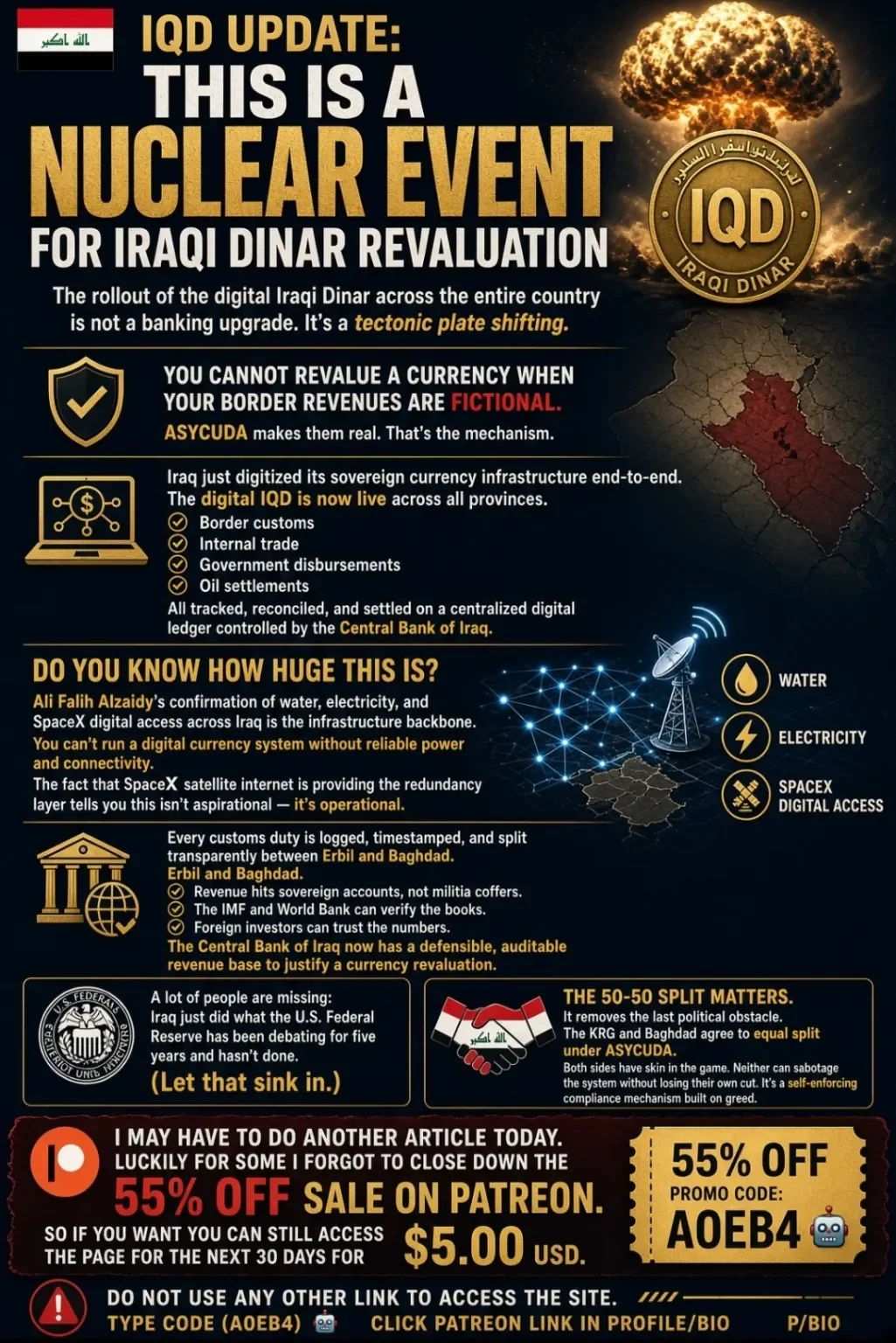
IQD Update: This Is A Nuclear Event For Iraqi Dinar Revaluation
The rollout of the digital Iraqi Dinar across the entire country is not a banking upgrade. It’s a tectonic plate shifting. Please understand this one thing people. You cannot revalue a currency when your border revenues are fictional. ASYCUDA makes them real. That’s the mechanism.
Ariel: The Iraqi Dinar Revaluation is a Shifting Tectonic Plate
8-14-2026
IQD Update: This Is A Nuclear Event For Iraqi Dinar Revaluation
The rollout of the digital Iraqi Dinar across the entire country is not a banking upgrade. It’s a tectonic plate shifting. Please understand this one thing people. You cannot revalue a currency when your border revenues are fictional. ASYCUDA makes them real. That’s the mechanism.
Iraq just digitized its sovereign currency infrastructure end-to-end. The digital IQD is now live across all provinces. That means every transaction border customs, internal trade, government disbursements, oil settlements can now be tracked, reconciled, and settled on a centralized digital ledger controlled by the Central Bank of Iraq.
Do You Know How Huge This Is?
Ali Falih Alzaidy’s confirmation of water, electricity, and SpaceX digital access across Iraq is the infrastructure backbone. You can’t run a digital currency system without reliable power and connectivity. The fact that SpaceX satellite internet is providing the redundancy layer tells you this isn’t aspirational it’s operational. The grid is live. The plumbing works.
Every customs duty is logged, timestamped, and split transparently between Erbil and Baghdad. The revenue hits sovereign accounts, not militia coffers. The IMF and World Bank can verify the books. Foreign investors can trust the numbers. And critically the Central Bank of Iraq now has a defensible, auditable revenue base to justify a currency revaluation.
A lot of people are missing: Iraq just did what the U.S. Federal Reserve has been debating for five years and hasn’t done. They digitized the sovereign currency first. That means Iraq is ahead of the United States digital deployment. (Let that sink in.)
The 50-50 split matters because it removes the last political obstacle. The KRG has been fighting Baghdad over budget disputes and border revenue sharing for over a decade. By agreeing to equal split under ASYCUDA, both sides have skin in the game. Neither can sabotage the system without losing their own cut. It’s a self-enforcing compliance mechanism built on greed.
Seeds of Wisdom RV and Economics Updates Friday Afternoon 8-14-26
Good Afternoon Dinar Recaps,
U.S.–Iran War Enters Economic Phase: Blockade Tightens as Washington Puts Oil Prices at the Center of the Endgame
The U.S. is combining maritime enforcement, unprecedented economic pressure and a renewed focus on energy prices as the conflict with Iran enters a critical phase—with the Strait of Hormuz emerging as the central economic and strategic battleground.
Good Afternoon Dinar Recaps,
U.S.–Iran War Enters Economic Phase: Blockade Tightens as Washington Puts Oil Prices at the Center of the Endgame
The U.S. is combining maritime enforcement, unprecedented economic pressure and a renewed focus on energy prices as the conflict with Iran enters a critical phase—with the Strait of Hormuz emerging as the central economic and strategic battleground.
Overview
CENTCOM says U.S. forces have redirected 62 commercial vessels, disabled three and boarded two while enforcing the maritime blockade against Iran.
Treasury Secretary Scott Bessent is preparing what he calls unprecedented economic-isolation measures, with additional actions expected next week as Washington intensifies pressure on Tehran.
The Trump administration is increasingly emphasizing affordable oil and gasoline for Americans, while keeping Iran from obtaining a nuclear weapon remains another stated objective.
Key Developments
1. The U.S. blockade is becoming an active maritime enforcement operation
U.S. Central Command says its forces have redirected 62 commercial vessels, disabled three and boarded two while enforcing the blockade against Iran.
The operations are taking place in and around the Arabian Sea and approaches to Iranian ports, with U.S. naval forces using helicopters and other assets to intercept vessels attempting to reach Iranian ports.
The significance is that the blockade is no longer simply a policy announcement. It is being actively enforced against commercial shipping.
At the same time, shipping through the Strait of Hormuz remains severely depressed. Reuters reports that only nine commodity vessels transited the waterway Thursday, compared with an August average of roughly 12 per day, with traffic remaining well below normal levels.
2. Washington is preparing a major new financial offensive
Treasury Secretary Scott Bessent says the United States will introduce unprecedented economic measures against Iran, with additional announcements expected next week.
The administration is describing the strategy as a combination of financial isolation and continued physical pressure on Iranian ports.
The financial component could extend beyond Iranian entities themselves by increasing pressure on foreign banks, companies and intermediaries that continue doing business with Iran.
That creates a difficult choice for international institutions: maintain commercial relationships with Iran or risk losing access to the U.S.-dominated financial system.
3. The Strait of Hormuz has become the economic center of the conflict
The conflict is increasingly revolving around one strategic question:
Who controls the flow of energy through the Strait of Hormuz?
The waterway is one of the world's most important energy chokepoints. Disruption there affects not only Iran but also global oil supplies, shipping costs, insurance rates and inflation expectations.
Reuters reports that U.S. officials are threatening to maintain the blockade while Iran continues to assert its own control over the waterway.
The competing claims demonstrate why reopening Hormuz has become central to any eventual settlement.
4. Energy affordability is now an explicit U.S. priority
Vice President JD Vance has said that keeping oil and gasoline prices low for Americans is the administration's top goal in the conflict, with preventing Iran from obtaining a nuclear weapon identified as the second priority.
That represents an important evolution in how Washington is publicly framing the conflict.
The war is no longer being discussed solely through the lens of military security or Iran's nuclear program. Energy prices and the economic impact on American households are now explicitly part of the strategic objective.
5. The administration is trying to apply pressure without relying solely on military escalation
The emerging strategy combines three forms of pressure:
Military: Naval enforcement and control of maritime access.
Financial: Sanctions and pressure on Iran's financial and oil networks.
Economic: Efforts to restore stable energy flows and prevent higher oil prices from damaging the U.S. economy.
This creates a potentially powerful combination—but it also creates risks.
If the blockade significantly restricts Iranian exports without restoring normal commercial shipping through Hormuz, the same policy intended to lower oil prices could contribute to higher energy costs.
Why It Matters
The most important development may be the convergence of military power, financial sanctions and energy policy.
The United States is attempting to pressure Iran economically while simultaneously trying to restore stability to global energy markets.
That creates a delicate balancing act.
Washington needs sufficient pressure to force Tehran toward an agreement, but it also needs to avoid a prolonged disruption that keeps oil prices elevated and increases inflationary pressure on American consumers.
The Strait of Hormuz therefore sits at the intersection of war, energy, trade and global finance.
Why It Matters to Foreign Currency Holders
For foreign-currency holders, this conflict has implications well beyond the Middle East.
Iran is already seeking alternative financial channels, while sanctions pressure countries and companies that continue trading with Tehran to navigate an increasingly fragmented financial system.
If the conflict continues, countries that depend heavily on Middle Eastern energy may have greater incentives to diversify energy suppliers, payment channels and reserve assets.
At the same time, higher oil prices can strengthen the currencies of energy exporters while putting pressure on energy-importing economies.
This does not establish evidence of a currency revaluation or RV event. The more important development is the continuing fragmentation of energy flows, trade relationships and financial networks.
Implications for the Global Reset
Pillar 1 — Energy
Hormuz has become a direct demonstration of how control over energy choke points can influence global prices, trade and financial stability.Pillar 2 — Trade
A sustained maritime blockade can force businesses and nations to reroute trade and reconsider their dependence on vulnerable shipping corridors.5Pillar 3 — Assets
Prolonged geopolitical and financial uncertainty can reinforce demand for reserve assets such as gold while encouraging countries to diversify away from concentrated financial exposure.
What to Watch Next
• The next round of U.S. economic measures expected from the Treasury Department.
• Whether the maritime blockade expands, contracts or remains in place indefinitely.
• Commercial shipping through the Strait of Hormuz, particularly whether traffic begins returning toward normal levels.
• Oil and gasoline prices, which have now become an explicit U.S. policy concern.
• Diplomatic activity, including efforts by European and regional governments to reopen negotiations. AP reports that Washington has expanded diplomatic outreach to Austria and Greece as efforts to resolve the Hormuz dispute continue.
• Iran's response, particularly whether Tehran attempts to challenge the blockade or instead pursues negotiations over sanctions, shipping and the reopening of Hormuz.
Bottom Line
The U.S.–Iran conflict is increasingly becoming an economic war fought through three interconnected fronts: maritime control, financial isolation and energy markets.
The immediate objective appears to be putting enough pressure on Tehran to produce a political settlement while preventing the conflict from creating a sustained oil shock for the United States and the global economy.
The critical question now is whether economic pressure can produce a negotiated reopening of Hormuz—or whether the blockade itself becomes a longer-term source of global economic disruption.
Closing Perspective
The next major move may not come from the battlefield—it may come from the intersection of the Strait of Hormuz, global oil markets and the financial pressure Washington is building around Iran.
Seeds of Wisdom Team
Newshounds News™ Exclusive
Sources
Reuters — Bessent says US to apply measures 'never seen' on Iran
Reuters — Hormuz shipping traffic capped amid competing claims from US and Iran
~~~~~~~~~~
Seeds of Wisdom Team RV Currency Facts Youtube and Rumble
Newshound's News Telegram Room Link
RV Facts with Proof Links Link
RV Updates Proof links - Facts Link
Start Here room with Most Asked Questions Link
Follow the Gold/Silver Rate COMEX
Follow Fast Facts
Seeds of Wisdom Team™ Website
Thank you Dinar Recaps
Iraq Economic News and Points To Ponder Friday Afternoon 8-14-26
Sabah Al-Nu'man: The First 100 Days Of Al-Zaidi's Government Shifted Security From Crisis Management To Consolidating The State's Authority
latest news Friday, August 14, 2026 Baghdad - One News The spokesman for the Commander-in-Chief of the Armed Forces, Sabah al-Nu’man, confirmed on Friday that the first 100 days of the government of Prime Minister and Commander-in-Chief of the Armed Forces, Ali Falih al-Zaidi, have laid the foundation for a new phase of security stability, stressing that the monopoly of weapons and the decision of war and peace are the exclusive prerogatives of the official security and military institutions.
Sabah Al-Nu'man: The First 100 Days Of Al-Zaidi's Government Shifted Security From Crisis Management To Consolidating The State's Authority
latest news Friday, August 14, 2026 Baghdad - One News The spokesman for the Commander-in-Chief of the Armed Forces, Sabah al-Nu’man, confirmed on Friday that the first 100 days of the government of Prime Minister and Commander-in-Chief of the Armed Forces, Ali Falih al-Zaidi, have laid the foundation for a new phase of security stability, stressing that the monopoly of weapons and the decision of war and peace are the exclusive prerogatives of the official security and military institutions.
Al-Nu’man told the Iraqi News Agency (INA) that the first 100 days of the government were not just a time limit to evaluate performance, but rather constituted a roadmap for moving the security file from the context of crisis management to rebuilding the prestige of the state, consolidating its sovereignty, and establishing a new phase of stability.
He explained that the vision of the Commander-in-Chief of the Armed Forces stemmed from a firm constitutional principle based on the fact that protecting national security, monopolizing weapons, and making decisions about war and peace are exclusive and direct entitlements of the official security and military institutions, and do not accept, in his words, “division or interpretation.”
Al-Nu’man pointed out that the field procedures during the past period led to a comprehensive review of the leadership structure, which included injecting new blood and replacing a number of field and intelligence joints, which contributed to raising the level of preventive readiness and accelerating the response of the security and military units.
He added that these measures coincided with a strategic move to fully secure Iraq’s borders with neighboring countries, in addition to seeking to acquire the latest radar and air defense systems, and activating intelligence plans aimed at anticipating threats before they occur.
The spokesman for the Commander-in-Chief of the Armed Forces affirmed that the Iraqi security decision has become more robust and independent, noting that the military institutions have reached high levels of discipline and readiness to protect national sovereignty and ensure the stability of the country.
Al-Nu'man stressed that the first hundred days reflect a trend towards re-establishing the responsibility of the state and its official institutions for managing the security file, foremost among which is the monopoly of weapons, the possession of the decision of war and peace, securing the borders, and strengthening air defense and intelligence capabilities.
https://1news-iq.net/صباح-النعمان-أول-100-يوم-من-حكومة-الزيدي/
Hussein Arab: Saudi Arabia Is Ready To Support Baghdad Economically, Politically, And In Terms Of Security, But It Wants A Decision
latest news Friday, August 14, 2026 Baghdad - One News - 8/14/2026 Former MP Hussein Arab affirmed that Saudi Arabia has possessed significant political and economic influence in the region for decades, considering that the Kingdom has entered a new phase under Crown Prince Mohammed bin Salman, which has been reflected in its internal policies and regional relations, especially with Iraq.
Arab said that Saudi Arabia’s economic strength and unified decision-making have given it an influential role in the region for nearly fifty years, noting that the decisions taken during the reign of Crown Prince Mohammed bin Salman have transformed the Kingdom, as he described it, into a “new experiment,” and have pushed towards greater openness towards Iraq.
He added that this openness included a Saudi readiness to implement large investment projects inside Iraq, including a project to establish a large economic city in Al-Muthanna Governorate, as well as proposing a project to build a sports stadium at a cost of up to one billion dollars.
Arab believes that there are parties who do not want Saudi or Gulf investments to enter Iraq, (pro Iran political & IRI groups) noting that implementing projects of this size would expand the Gulf economic presence and strengthen relations between Baghdad and its Arab surroundings.
He stressed that Saudi Arabia, in his estimation, is ready to provide Iraq with the economic, political, security and international support it needs, but in return it wants one essential thing, which is that the Iraqi decision should come from within and be independent of external influences. (Iranian & IRGC incfuences)
Arab explained that Riyadh is not asking Baghdad to side with it, nor does it want to enter into a state of hostility with Iraq, but rather seeks to deal with a country that has its own national decision and determines its foreign relations based on its own interests. (not Iran's)
He pointed out that the recent Mecca agreement between Saudi Arabia, Turkey and Pakistan paves the way, in his view, for a new phase in the region and the world, in light of the political, security and economic transformations taking place in the region.
Arab stressed that Iraq has an opportunity to benefit from Saudi and Gulf openness and obtain broad support on multiple issues, provided that it strengthens the independence of Iraqi decision-making and utilizes its regional relations in a way that serves the country's interests. https://1news-iq.net/حسين-عرب-السعودية-مستعدة-لدعم-بغداد-اق/
Al-Zaydi Orders "Unprecedented And Decisive" Measures To Combat Corruption At Border Crossings
latest news Friday, August 14, 2026 Baghdad - One News - Prime Minister and Commander-in-Chief of the Armed Forces Ali Faleh al-Zaidi announced on Friday that he has taken “unprecedented and decisive” measures to combat corruption at border crossings, directing that they be fully automated and linked to a robust electronic system to monitor work and revenues.
This came during a visit by Al-Zaydi to the headquarters of the Border Ports Authority, where he met with the Authority’s officials and greeted, via video conference, the directors of the ports and their employees, appreciating their role in protecting the country’s sovereignty and economy and ensuring the safety of citizens.
The Prime Minister stressed that border crossings represent the face of the state and its economic, security and sovereign gateway, emphasizing the need to expedite the completion of the automation project and put an end to attempts at fraud, corruption and manipulation.
Al-Zaydi directed that all border crossings be linked to a robust electronic system, and that a comprehensive daily report be provided on the movement of work and revenues, in addition to benefiting from leading global experiences in managing border crossings.
He also directed that border crossings be self-financed, through the deduction of tax and customs fees at the outset and before transfers are made, as well as the deduction of service fees and their allocation for the purposes of rehabilitating and developing the crossings.
Regarding the issue of corruption and smuggling, Al-Zaydi stressed that combating corruption at the ports will be a "top priority," and that the next phase will witness unprecedented and decisive measures, emphasizing that there will be no leniency towards drug and medicine smuggling operations, circumventing the competent authorities, and other forms of smuggling.
The Prime Minister described smuggling operations as serious crimes targeting society, stressing that the government will not tolerate those who commit them and will continue to tighten measures to reduce the exploitation of border crossings for illegal activities. https://1news-iq.net/الزيدي-يوجه-بإجراءات-غير-مسبوقة-وحاز/
Completing The Cabinet, Controlling Weapons, And Combating Corruption: Al-Zaydi And Al-Maliki Discuss Political, Security, And Economic Issues
Baghdad - One News - 8/13/2026 Prime Minister Ali Faleh al-Zaidi discussed on Thursday with Nouri Kamel al-Maliki, head of the State of Law Coalition, a number of political and national issues, foremost among them completing the formation of the cabinet and supporting the course of government work.
This came during Al-Zidi’s meeting with Al-Maliki, where the meeting addressed the issue of completing the ministerial formation, in a way that supports the performance of state institutions and enhances the government’s ability to implement its program and tasks during the next stage.
The two sides discussed government measures in the field of combating corruption and promoting integrity, along with economic reform paths and steps aimed at addressing the challenges facing the country.
The issue of restricting weapons to the state was also discussed, with emphasis on the importance of enforcing the rule of law, consolidating security and stability, and protecting state institutions.
The meeting also addressed Iraq’s foreign relations, and the importance of continuing to open up to the regional and international environment, in order to strengthen the country’s presence and relations with various countries.
On the economic side, emphasis was placed on the need to expand economic and investment partnerships, in order to contribute to confronting the current challenges facing the region and reducing their impact on the Iraqi economy.
The meeting comes amid political and governmental moves to complete the cabinet, in parallel with internal issues that top the government's priorities, most notably restricting weapons to the state, combating corruption, economic reform, and strengthening Iraq's regional and international relations. https://1news-iq.net/استكمال-الكابينة-وحصر-السلاح-ومكافحة/
Cabinet Gaps, Disarmament On Table Between PM Al-Zaidi And Nouri Al-Maliki
2026-08-13 / 13:57 Shafaq News- Baghdad Iraqi Prime Minister Ali Faleh Al-Zaidi and State of Law Coalition (SLC) leader Nouri Al-Maliki on Thursday discussed completing the Cabinet and bringing all weapons under state authority, with nine ministries still unfilled and a September 30 weapons-control deadline approaching.
The meeting also covered anti-corruption measures, integrity safeguards, and economic reform, alongside efforts to strengthen state institutions and government performance.
Iraqi Prime Minister Media Office
Prime Minister Ali Faleh Al-Zaidi Receives Head of the State of Law Coalition
•••••
Prime Minister Ali Faleh Al-Zaidi received today, Thursday, the Head of the State of Law Coalition, Nouri Kamel Al-Maliki. The meeting addressed a number of political and national issues, foremost among them completing the formation of the Cabinet, in a manner that supports the performance of state institutions and strengthens the government’s work.
The meeting also addressed support for the government’s measures to combat corruption, promote integrity, advance economic reform, ensure that all arms remain under state authority, and uphold the rule of law, in a manner that contributes to consolidating security and stability and protecting state institutions.
The meeting reviewed matters related to Iraq’s foreign relations and emphasized the importance of continuing Iraq’s engagement with its regional and international partners, as well as strengthening economic and investment partnerships to address the current challenges facing the region and their impact on the Iraqi economy.
•••••
Media Office of the Prime Minister August 13, 2026 On May 14, Parliament approved Al-Zaidi’s government and ministerial program but granted confidence to only 14 of 23 ministers, with unresolved portfolios including Defense, Interior, Planning, Higher Education, Labor, Migration and Displacement, Culture, Reconstruction and Housing, and Youth and Sports. During earlier cabinet negotiations, Al-Maliki’s SLC backed Qasim Atta for the Interior Ministry, while the Defense portfolio remained subject to political bargaining.
Al-Zaidi also told CENTCOM chief Adm. Brad Cooper on August 12 that the US-led Coalition’s military mission and the departure of foreign forces would be completed by September 30, leaving Iraq free of foreign military forces from October 1. He also stressed that weapons must be confined exclusively to state authority under the law.
Read more: Iraqi armed group: No disarmament before US withdrawal, air defense
Coffee with MarkZ, joined by Mr. Cottrell. 08/14/2026
Coffee with MarkZ, joined by Mr. Cottrell. 08/14/2026
MarkZ Disclaimer: Please consider everything on this call as my opinion. Be sure to consult a professional for any financial decisions
MZ: Codeman Friday! We look at the progress in the Middle East, expectations, and quiz the Codeman. Lucas joins after the news segment to unleash some more BOGO madness.
THE CONTENT IN THIS PODCAST IS FOR GENERAL & EDUCATIONAL PURPOSES ONLY&NOT INTENDED TO PROVIDE ANY PROFESSIONAL, FINANCIAL OR LEGAL ADVICE. PLEASE CONSIDER EVERYTHING DISCUSSED IN MARKZ’S OPINION ONLY
Coffee with MarkZ, joined by Mr. Cottrell. 08/14/2026
MarkZ Disclaimer: Please consider everything on this call as my opinion. Be sure to consult a professional for any financial decisions
MZ: Codeman Friday! We look at the progress in the Middle East, expectations, and quiz the Codeman. Lucas joins after the news segment to unleash some more BOGO madness.
THE CONTENT IN THIS PODCAST IS FOR GENERAL & EDUCATIONAL PURPOSES ONLY&NOT INTENDED TO PROVIDE ANY PROFESSIONAL, FINANCIAL OR LEGAL ADVICE. PLEASE CONSIDER EVERYTHING DISCUSSED IN MARKZ’S OPINION ONLY
https://rumble.com/user/theoriginalmarkz
Kick: https://kick.com/theoriginalmarkz
Markz's linktree https://linktr.ee/theMarkZshow
FOLLOW MARKZ : TWITTER . https://twitter.com/originalmarkz?s=21. TRUTH SOCIAL . https://truthsocial.com/@theoriginalm...
Mod: MarkZ "Back To Basics" Pre-Recorded Call" for Newbies 10-19-2022 )https://www.youtube.com/watch?v=37oILmAlptM
MARKZ DAILY LINKS: https://theoriginalmarkz.com/home/
THANK YOU FOR JOINING. HAVE A BLESSED DAY. SEE YOU MONDAY MORNING FOR COFFEE @ 10:00 AM EST ~ UNLESS BREAKING NEWS HAPPENS! FOR UPDATES ON MARK’S PODCAST GO TO: https://t.me/+b3hYhYlhKM1hYzcx
Jon Dowling: CLARITY ACT UPDATE: Is the BIG MOVE About to Begin? | Gold Standard Return
Jon Dowling: CLARITY ACT UPDATE: Is the BIG MOVE About to Begin? | Gold Standard Return
8-14-2026
The global financial system is on the cusp of an unprecedented transformation. In a recent episode of the Jon Dowling Podcast, financial and cryptocurrency expert Rob Cunningham sat down to discuss the ongoing global financial reset.
Drawing from his extensive military background and deep financial expertise, Cunningham outlined a strategic transition away from traditional fiat currency toward a highly transparent system of sound money. This new financial paradigm is set to be backed by gold, silver, and tokenized real-world assets (RWAs), signaling a massive shift in how global wealth is managed, measured, and preserved.
Jon Dowling: CLARITY ACT UPDATE: Is the BIG MOVE About to Begin? | Gold Standard Return
8-14-2026
The global financial system is on the cusp of an unprecedented transformation. In a recent episode of the Jon Dowling Podcast, financial and cryptocurrency expert Rob Cunningham sat down to discuss the ongoing global financial reset.
Drawing from his extensive military background and deep financial expertise, Cunningham outlined a strategic transition away from traditional fiat currency toward a highly transparent system of sound money. This new financial paradigm is set to be backed by gold, silver, and tokenized real-world assets (RWAs), signaling a massive shift in how global wealth is managed, measured, and preserved.
Throughout the interview, Cunningham analyzed the legislative, geopolitical, and economic forces driving this transition. From executive action accelerating digital asset integration to major energy breakthroughs that could lower global living costs, the podcast offers a comprehensive roadmap for navigating the incoming financial landscape.
A critical pillar of this financial transition involves structural changes within the United States regulatory framework. Cunningham highlighted the significance of regulatory directives, specifically referencing actions akin to Executive Orders 14405 and 14406. These directives establish strict timelines, including a 90-day window for the Federal Reserve to integrate cryptocurrency institutions directly into the traditional banking system.
By authorizing regulatory bodies like the Securities and Exchange Commission (SEC) and the Commodity Futures Trading Commission (CFTC) to proactively enforce rules under existing laws, the executive branch effectively bypasses typical congressional delays. This proactive enforcement strategy signals robust backing for digital asset adoption, positioning blockchain technology as a foundational cornerstone of the modern global economy.
To understand the necessity of this financial reset, Cunningham argued that we must first redefine our understanding of inflation. Contrary to popular belief, inflation is not naturally caused by scarcity or an increase in consumer demand. Instead, it is a direct consequence of expanding the unbacked fiat currency supply far beyond the growth of actual physical goods and services.
Cunningham described this dynamic as a form of systemic devaluation. Printing currency without tangible backing alters the crucial asset-to-currency ratio, eroding the purchasing power of everyday citizens. The solution to this systemic vulnerability lies in a tokenized stablecoin ecosystem. By utilizing transparent, immutable digital ledgers backed by verifiable real-world assets, the global economy can eliminate unchecked currency printing and restore long-term price stability.
An inevitable phase of shifting to a sound money system is a major market correction. Cunningham used the vivid analogy of shedding excess “water weight” to describe the upcoming deflation of artificially inflated asset prices. Decades of fractional reserve banking and loose monetary policies have driven stock and real estate valuations to unsustainable heights.
According to Cunningham, a significant market correction—potentially resulting in a 50% to 70% drop in stock and housing prices—should not be viewed as a systemic failure. Rather, it represents a healthy, necessary purging of artificial liquidity. While such an adjustment will undoubtedly cause short-term public concern, it is a vital step toward restoring true value.
This transition aims to move the economy away from centralized currency manipulation and toward a sovereign monetary system focused on the financial well-being of the public.
The transition to sound money is also being guided by strategic policy influencers and geopolitical realignments. Cunningham pointed to economist Judy Shelton, often referred to as a key intellectual figure or “white horse” in monetary reform circles.
Shelton’s advocacy for integrating traditional gold and silver standards with modern digital assets serves as a practical bridge between legacy systems and next-generation financial technology. Her work promotes interoperability, transparency, and high standards in international monetary policy.
On the geopolitical front, major realignments are already underway to support this economic reset.
Cunningham pointed to Iraq’s recent energy initiatives, including agreements with major energy corporations like Chevron to bypass the highly contested Strait of Hormuz. By securing stable, allied oil export routes, Iraq is distancing itself from regional proxy influences and systemic corruption. This shift aligns perfectly with global efforts to institute transparent ledger accounting, integrate resource-rich nations into the global trade market, and foster international economic stability.
Perhaps the most optimistic aspect of Cunningham’s analysis is the projected impact of new energy policies and technologies. He anticipates a dramatic 40% to 70% reduction in global energy costs, driven by a combination of decentralized energy production, strategic supply lines, and emerging technologies like micro nuclear fusion.
Because energy is a foundational cost for virtually every industry—from manufacturing to food production—a sharp decline in energy prices will naturally trigger a widespread reduction in the cost of living. Removing supply bottlenecks, such as dependency on volatile shipping lanes, will unleash global abundance.
This energy revolution, combined with an asset-backed financial system, holds the potential to spark unprecedented, sustainable economic prosperity worldwide.
The insights shared by Rob Cunningham on the Jon Dowling Podcast present a compelling look at a rapidly changing world. While the transition from an inflationary fiat system to a transparent, asset-backed digital economy may bring short-term market corrections, the long-term outlook promises greater individual sovereignty, reduced inflation, and lower costs of living. Understanding these shifts is crucial for anyone looking to secure their financial future.
News, Rumors and Opinions Friday 8-14-2026
Note: All intel should be considered as "Rumors" until we receive official announcements ...and “Rates and Dates” could change anytime until we get to the banks/redemption centers.
RV Excerpts from the Restored Republic via a GCR Update as of Fri. 14 Aug. 2026
Compiled Fri. 14 Aug. 2026 12:01 am EST by Judy Byington
Thurs. 13 Aug. 2026 GLOBAL CURRENCY RECALIBRATION AND COMMODITY BACKED MONETARY TRANSITION ACTIVATED AMID MASSIVE DEBT SYSTEM COLLAPSE …QFS Activated on Telegram
Note: All intel should be considered as "Rumors" until we receive official announcements ...and “Rates and Dates” could change anytime until we get to the banks/redemption centers.
RV Excerpts from the Restored Republic via a GCR Update as of Fri. 14 Aug. 2026
Compiled Fri. 14 Aug. 2026 12:01 am EST by Judy Byington
Thurs. 13 Aug. 2026 GLOBAL CURRENCY RECALIBRATION AND COMMODITY BACKED MONETARY TRANSITION ACTIVATED AMID MASSIVE DEBT SYSTEM COLLAPSE …QFS Activated on Telegram
• THE NEW ECONOMIC FRAMEWORK IS ANCHORED BY HARD COMMODITY BACKING, ENSURING EVERY UNIT OF VALUE CORRESPONDS TO REAL TANGIBLE ASSETS RATHER THAN INFINITE DEBT CREATION. COMMERCIAL BANKS FAILING TO COMPLY WITH THE NEW TRANSPARENCY MANDATES ARE FACING IMMEDIATE LIQUIDITY FREEZES AND COMPLIANCE TAKEOVERS.
THIS IS THE FINAL STAGE OF THE OLD PARADIGM COLLAPSE. THE ERA OF UNBACKED PAPER DEBT IS OFFICIALLY OVER. STAY STEADY, SECURE YOUR POSITION, AND WATCH THE CHANNELS FOR THE NEXT WAVE OF VERIFIED DROPS.
~~~~~~~~~~~~
Global Currency Reset:
Thurs. 13 Aug. 2026 Bruce, The Big Call The Big Call Universe (ibize.com) 667-770-1866 Three really good of Bruce’s sources said something major was going to happen on the 15th and 16th of Aug. We should get notifications then and we should start exchanges by Mon. 17 Aug. 2026.
An AI will answer your 800 number call. Then you will be referred to another number (likely based on your zip code) to make your appointment with a real person at a redemption center near you.
They only want one spouse to go to a redemption center appointment.
Bring to the Redemption Center: your currency and/or Zim bonds; a form of picture ID, some kind of utility bill that lines up with an address where you live, if you have a trust bring it, if you have a project bring a 2-3 page summary. You will have 3-5 min. to present your project. Have a number of what currency and/or Zim Bonds you have.
You can ask for the higher Contract Rate for the Dinar.
Your R&R (birth certificate, d***h certificate of a spouse, marriage certificate, interest on loans, taxes paid), DOGE and Tariff Dividend could be in your Quantum Account.
You need a 5 digit pin number, email, password, Q Card and your digital ID to get into your Quantum Account.The only reason you use your Q Card is to move money from your Quantum Account to your bank account.
You will move from your Quantum Account into your primary bank account that you need for the first 60-90 days. That money can gain interest (8% per year), while money in your Quantum account does not.
You will get a two page list of perks from Wells Fargo for being their customer.
Redemption Centers have Q phones (or a certificate for a Q phone) to give you for free.
You can ask for up to $2,500 in cash out of your account.
Thurs. 13 Aug. Wolverine Call: “Lots of movement in Reno. I know whales traveling to Reno to get paid and some whales have got paid. These are AAA whales (high level).
For some time the Iraqi Dinar has been trading upward on the back screens of the Forex.
By Jan. 1 2026 the new Dinar in-country Rate was revalued and being used within Iraq, while the fiat US Federal Dollar was outlawed in the country. From 1932 to 1949 the Iraqi Dinar was worth $4.86. Under Suddam it was $3.48.
Sources from the USA, Australia and China all confirmed that this is the week for the release. …Amiel Alston
Many reports have come in about local bank branches being converted into Exchange and Redemption Centers, with a reduction of staff and bank personnel revealing that they will no longer be functioning as a bank.
Read full post here: https://dinarchronicles.com/2026/08/14/restored-republic-via-a-gcr-update-as-of-august-14-2026/
************
Courtesy of Dinar Guru: https://www.dinarguru.com/
Jeff Only in the country of Iraq a 25k becomes a 25. Outside the country when the rate goes to change, the two currencies will coexist together for a period of 25 days, giving everybody in the country and around the world 25 days to turn in their large 3-zero notes. Get smaller notes...if they're in country. Outside the country we're not getting smaller notes. We're doing a currency trade from large notes to US dollars.
Reset Intelligence On Wednesday, Iraq's Prime Minister told the commander of US Central Command to his face that September 30 is "final and irreversible." Hours later a US official confirmed the pullout is on track...The same week, a plane from Tehran landed in Baghdad carrying the [Iranian] Quds Force commander, unannounced, with one message for the armed factions: hand nothing over yet...Iraq's armed groups call themselves the Islamic Resistance, and a resistance needs an occupier. On October 1 there is none. What stands in front of those weapons after that is Iraq itself...
Mnt Goat My CBI contact...reminded me that CBI also has a plan but they need a buy-in from all entities such as the World Bank, the IMF and the US Treasury to implement it. They will not allow it until certain security issues are addressed namely the militia and factions. This plan is basically the Dr Shabibi plan of 2011 and is still on the table that also will include the reinstatement of the currency for trading. She told me there are actually only two main obstacles – they need the Oil and Gas law to become law and the issue of the Iranian militia and factions inside Iraq disarmed.
************
Reset Is Coming! Debt Based Fiat Collapse Ahead | Francis Hunt
Liberty and Finance : 8-12-2026
Francis Hunt, the Market Sniper, warns that the global financial system is approaching a major debt-driven crisis that could trigger a “demand destroying event” across markets.
He argues that weakness in the U.S. Treasury market, rising interest rates, private credit risks, and excessive data-center investment are creating dangerous vulnerabilities beneath the surface.
Hunt believes gold and silver have established localized lows, but cautions investors to prepare for a potential final washout where everything gets sold before precious metals resume their larger move higher.
He also warns that as the debt system comes under increasing stress, governments could become more aggressive in taxation, capital extraction, and attempts to control private wealth.
Hunt explains why he believes physical precious metals, self-reliance, and preparation for counterparty failure could become increasingly important in the years ahead.
INTERVIEW TIMELINE:
0:00 Intro
1:00 Gold & silver
11:00 Debt based crisis
40:30 Last thoughts
Seeds of Wisdom RV and Economics Updates Friday Morning 8-14-26
Good Morning Dinar Recaps,
U.S. Economy Sends Two Conflicting Signals: Inflation Cools While 30-Year Treasury Borrowing Costs Hit 25-Year High
The latest economic data is creating a striking divide: inflation and rate-hike expectations are easing, yet the U.S. Treasury is paying more than 5% to borrow for three decades—putting fiscal pressure, monetary policy and investor confidence on the same collision course.
Good Morning Dinar Recaps,
U.S. Economy Sends Two Conflicting Signals: Inflation Cools While 30-Year Treasury Borrowing Costs Hit 25-Year High
The latest economic data is creating a striking divide: inflation and rate-hike expectations are easing, yet the U.S. Treasury is paying more than 5% to borrow for three decades—putting fiscal pressure, monetary policy and investor confidence on the same collision course.
Overview
The U.S. Treasury's 30-year bond auction cleared at 5.216%, the highest yield on a 30-year Treasury auction since 2001, as investors demand greater compensation for long-term fiscal and inflation risks.
Inflation is moving in the opposite direction: July CPI rose just 0.1% month over month and 3.4% year over year, while July PPI was unchanged, reducing expectations for another immediate Federal Reserve rate hike.
Markets are now repricing across asset classes, with emerging-market currencies and stocks benefiting from reduced Fed-hike expectations while gold remains elevated despite its recent pullback.
Key Developments
1. The 30-year Treasury has crossed a major threshold
The Treasury sold $25 billion of 30-year bonds at a 5.216% high yield on August 13.
That is the highest auction yield for the benchmark maturity since 2001 and represents a significant increase from comparable auctions earlier this year. The May auction cleared at approximately 5.046%, while July's auction was around 5.058%.
The message from the long end of the bond market is important: even if the Federal Reserve does not raise short-term rates, investors are demanding higher returns to hold long-duration U.S. government debt.
2. The bond market is looking beyond the next Fed meeting
The apparent contradiction is the heart of today's economic story.
Short-term rate expectations have been falling because inflation and labor-market data have softened. Yet long-term Treasury yields remain elevated.
That suggests investors are looking beyond the immediate September policy decision and focusing on longer-term fiscal deficits, Treasury supply, inflation risk and the amount of compensation required to hold U.S. debt for decades.
The Treasury's 30-year auction therefore provides a different signal from the inflation data: the cost of financing America's long-term debt remains under pressure even as near-term inflation cools.
3. Inflation is giving the Fed more room to wait
July's CPI increased only 0.1% from June, while annual inflation eased to 3.4% from 3.5%.
Core CPI rose 0.2% in July and was up 2.5% over the previous year.
Then came the July Producer Price Index. PPI was unchanged, compared with economists' expectations for a 0.2% increase.
Together, the reports have reduced pressure on the Federal Reserve to raise rates at its September meeting. Reuters reported that fed-funds futures were pricing roughly a 35% probability of a September hike, down substantially from the previous week.
4. The Fed faces a difficult policy balancing act
The latest data gives the Federal Reserve an argument for patience.
Richmond Fed President Tom Barkin said it remains an open question whether another rate increase will be necessary to return inflation to the Fed's 2% target. He also noted that some inflationary pressures could prove temporary, including tariffs, energy costs and demand associated with the AI investment boom.
But the Fed cannot look only at today's inflation rate.
The central bank must also consider long-term inflation expectations, Treasury financing conditions, wages, energy prices and the broader financial system.
That makes the upcoming September meeting less about one inflation number and more about whether policymakers believe current conditions are restrictive enough to eventually bring inflation back to target.
5. Gold remains caught between monetary policy and structural demand
Gold recently moved above $4,400 before pulling back as traders took profits and reassessed the Fed's next move.
Softer inflation and weaker expectations for rate hikes are generally supportive for gold because they reduce the opportunity cost of holding a non-yielding asset.
But gold is also responding to something larger than the next Fed meeting.
Central-bank purchases, geopolitical uncertainty and reserve diversification continue to provide structural support for bullion.
The result is a market in which gold can remain historically elevated even while traders debate whether the Fed will hold or raise rates.
6. Emerging markets are benefiting from the shift in Fed expectations
Emerging-market currencies and equities have responded positively to the possibility that the Federal Reserve may delay additional tightening.
A less aggressive Fed can reduce pressure on emerging-market currencies and make dollar-denominated financing conditions somewhat easier.
That creates a potentially important feedback loop:
Softer U.S. inflation → lower Fed-hike expectations → less pressure on emerging markets → greater appetite for risk assets.
But that trend could reverse quickly if U.S. inflation accelerates again or Treasury yields continue climbing.
The Bigger Economic Picture
The most important takeaway from these developments is that the U.S. economy is sending two different signals at the same time.
On one side:
Inflation is cooling.
The labor market has softened.
Fed rate-hike expectations are declining.
Emerging-market assets are benefiting.
On the other:
30-year Treasury borrowing costs have risen above 5%.
The federal government continues to carry enormous financing needs.
Long-term investors are demanding significant compensation to hold U.S. debt.
This distinction matters because the Federal Reserve controls the short end of the yield curve far more directly than the long end.
The Treasury market ultimately reflects what investors believe about future inflation, government borrowing, economic growth and the supply of debt.
Why It Matters
The 5.216% 30-year auction yield may ultimately prove more important than a single change in the September Fed-hike probability.
A Federal Reserve decision can change overnight.
But the cost of financing $25 billion of new 30-year debt at more than 5% illustrates the longer-term challenge facing the U.S. government.
Higher long-term yields increase borrowing costs across the economy and can influence mortgage rates, corporate financing, equity valuations, real estate and government debt-service costs.
The critical question is whether inflation continues to cool while long-term Treasury yields remain elevated—or whether the two forces eventually converge.
Why It Matters to Foreign Currency Holders
For foreign-currency holders, this is an important development because the relative strength of the dollar is increasingly being shaped by two competing forces.
Higher Treasury yields can make dollar assets attractive to global investors.
But persistent U.S. deficits, rising debt-service costs and questions about long-term fiscal sustainability can encourage investors and central banks to diversify reserves.
This is one reason to watch Treasury yields, central-bank gold purchases, foreign reserve composition and international settlement systems together, rather than treating each development as an isolated event.
There is no evidence here of an imminent currency revaluation or RV event.
What the data does show is a financial system under pressure to reconcile higher government borrowing costs, changing monetary policy expectations and a gradual diversification of global reserves.
Implications for the Global Reset
Pillar 1 — Debt
A 5%-plus long-term Treasury yield increases the cost of financing America's enormous debt burden and raises questions about future fiscal sustainability.
Pillar 2 — Assets
Elevated gold prices and continued central-bank demand show that sovereign investors are continuing to diversify reserve assets.
Pillar 3 — Central Banks
The Fed's policy path remains critical, but long-term bond markets are increasingly exerting their own influence on financial conditions.
What to Watch Next
The next major signals will come from:
• Federal Reserve policy language ahead of the September meeting.
• August inflation data, which could either reinforce or reverse current rate-hike expectations.
• Treasury auctions and long-term yields, particularly if 30-year borrowing costs remain above 5%.
• Gold and central-bank purchases, which can reveal whether reserve diversification remains a structural trend.
• The U.S. dollar and emerging-market currencies, which will show how global investors respond to changing U.S. monetary and fiscal conditions.
Closing Perspective
The next major market move may not come from the Fed alone—it may come from the growing tension between cooling inflation, rising long-term Treasury borrowing costs and the world's willingness to keep financing U.S. debt.
Seeds of Wisdom Team
Newshounds News™ Exclusive
Sources
Reuters — U.S. producer prices unchanged in July, further dimming rate hike odds
Reuters — Dollar treads water as Fed hike bets are pared on benign U.S. inflation
Crypto Briefing — U.S. 30-Year Bond Auction Clears at 5.216%
~~~~~~~~~~
🌱 A Message to Our Currency Holders🌱
If you’ve been holding foreign currency for many years, you were not foolish.
You were not wrong to believe the global financial system would change.
What failed was not your patience — it was the information you were given.
For years, dates, rumors, and personalities replaced facts, structure, and proof. “This week” predictions created cycles of hope and disappointment that were never based on how currencies actually change.
That is not your failure.
Our mission here is different: • No dates • No rates • No hype • No gurus
Instead, we focus on:
• Verifiable developments • Institutional evidence
• Global financial structure • Where countries actually sit in the process
Currency value changes only come after sovereignty, trade, banking, settlement systems, and fiscal coordination are in place. History and institutions confirm this sequence.
You will see silence. You will see denials. That is not delay — that is discipline.
Protect your identity. Organize your documents. Verify everything.
Never hand your discernment to anyone who cannot show proof.
You deserve truth — not timelines.
Seeds of Wisdom Team
Newshounds News
~~~~~~~~~~
Seeds of Wisdom Team RV Currency Facts Youtube and Rumble
Newshound's News Telegram Room Link
RV Facts with Proof Links Link
RV Updates Proof links - Facts Link
Start Here room with Most Asked Questions Link
Follow the Gold/Silver Rate COMEX
Follow Fast Facts
Seeds of Wisdom Team™ Website
Thank you Dinar Recaps
Iraq Economic News and Points To Ponder Friday Morning 8-14-26
Gold Retreats From Two-Month High On Profit-Taking
2026-08-14 Shafaq News Gold prices slipped on Friday and were headed for a weekly loss as investors locked in profits after mild U.S. inflation data propelled bullion to its highest level in more than two months and weakened the case for a near-term Federal Reserve rate hike.
Spot gold was down 0.6% at $4,324.39 per ounce, as of 0538 GMT. While U.S. gold futures for December delivery slid nearly 1% to $4,379.20.
Gold Retreats From Two-Month High On Profit-Taking
2026-08-14 Shafaq News Gold prices slipped on Friday and were headed for a weekly loss as investors locked in profits after mild U.S. inflation data propelled bullion to its highest level in more than two months and weakened the case for a near-term Federal Reserve rate hike.
Spot gold was down 0.6% at $4,324.39 per ounce, as of 0538 GMT. While U.S. gold futures for December delivery slid nearly 1% to $4,379.20.
Bullion climbed to its highest point since June 5 on Thursday, before settling 1.3% lower and setting it on track for a weekly loss.
"There is some episodic and more speculative capital that's maybe taking a bit of profit in gold, because there's not a near-term catalyst quite so potent immediately in front of us," said Ilya Spivak, head of global macro at finance content network Tastylive.
"Gold may be setting up, with some choppy trading along the way, for a meaningful rally now. And if we can take out $4,400, I don't think $5,000 by year end is any kind of a sketch."
The non-yielding metal got a boost after an unexpected drop in U.S. July nonfarm payrolls last week, followed by softer inflation data this week, sharply reducing expectations of a rate hike next month.
U.S. producer prices were unchanged in July, following a revised 0.1% drop in June, while U.S. consumer prices barely increased last month as the cost of gasoline declined for a second consecutive month.
Traders are now pricing only a 33% chance of a rate hike in September, down from about 55% last week, according to the CME FedWatch Tool. FEDWATCH
Lower interest rates make gold more attractive relative to yield-bearing assets.
On the geopolitical front, Washington on Thursday threatened to maintain a naval blockade of Iran indefinitely, ratcheting up economic pressure on Tehran as ceasefire talks have floundered.
In other metals, spot silver slipped 0.9% to $63.88 per ounce.
Platinum slipped 0.4% to $1,711.10, while palladium inched 0.1% higher at $1,308.25, both touching their lowest levels since August 4 earlier in the session. Both metals were headed for a weekly drop. (REUTERS)
https://www.shafaq.com/en/Economy/Gold-retreats-from-two-month-high-on-profit-taking
Basrah Medium Posts $6.73 July Loss
2026-08-13 Shafaq News- Baghdad Iraq’s Basrah Medium crude fell $6.73 per barrel in July to average $78.37, marking the fourth-largest monthly decline among the Organization of the Petroleum Exporting Countries (OPEC) basket crudes, according to the organization’s latest report.
The Iraqi grade slipped from $85.10 in June but averaged $91.24 during the first seven months of 2026, about 28% above its $71.27 average last year.
Kuwait Export posted the steepest monthly loss of $10.26 per barrel, followed by Arab Light at $9.01 and Iran Heavy at $8.70.
OPEC’s Reference Basket shed $6.76 to $82.99 per barrel in July, from $89.75 a month earlier. Its January-July average reached $92.04, compared with $71.88 in 2025.
https://www.shafaq.com/en/Economy/Basrah-Medium-posts-6-73-July-loss
Iraq Ships 49M Barrels, Advances Basra-Fishkhabur Pipeline
2026-08-14 Shafaq News- Basra Iraq exported about 49 million barrels of crude oil in July, while talks with Iran and the United States continue over the passage of Iraqi shipments through the Strait of Hormuz, Oil Minister Basim Mohammed Khudair Al-Abadi announced on Friday.
Speaking at a joint press conference with Basra Governor Asaad Al-Eidani, Al-Abadi said four tankers were loaded with crude today and are preparing to sail. Daily exports have averaged two million barrels since the beginning of August, "the first time Iraq has reached that level since the regional crisis began."
The Oil Ministry, through the State Organization for Marketing of Oil (SOMO), Basra Oil Company, and other companies, is also pursuing exceptional contracts to increase exports.
Al-Abadi reaffirmed plans for a strategic pipeline linking Basra to Fishkhabur near the Turkish border to diversify Iraq’s oil export outlets and avoid potential disruptions to energy shipments through Hormuz.
The project will be implemented by a consortium comprising Chevron, IT Capital, and Qatar’s UCC under an agreement signed in Washington during the Iraqi government delegation’s visit to the United States in July. Running from Basra to Fishkhabur, with a branch extending to Baniyas on Syria’s Mediterranean coast, the pipeline was previously delayed by financial constraints but would connect crude supplies to refineries across Iraq for the first time, increase exports through the Turkish port of Ceyhan, modernize oil infrastructure, boost state revenues, and create jobs.
Hormuz will remain an important export route alongside Ceyhan and other outlets under the government’s strategy, he added.
Read more: No exit but Hormuz: Iraq’s economic vulnerability exposed
Iraq, OPEC’s second-largest oil producer, ships about 90% of its crude exports through the Strait of Hormuz, leaving the country particularly exposed to disruptions in the waterway, which normally carries roughly one-fifth of global oil supplies. Parliamentary Oil Committee member Zainab Al-Khazraji previously told Shafaq News that Jordan is also being considered as a potential outlet for Iraqi crude.
Read more: Iraq's oil revenues under US financial guard 23 years after invasion
Al-Eidani, in turn, pointed to plans to develop the Faihaa field and other oil fields in Basra, establish an extensive pipeline network, and increase the use of associated gas to fully supply power stations, with any future surplus intended for export through Iraqi ports.
https://www.shafaq.com/en/Economy/Iraq-ships-49M-barrels-advances-Basra-Fishkhabur-pipeline
Kirkuk-Ceyhan Oil Exports Fall To Around 130,000 Bpd
2026-08-13 Shafaq News- Baghdad/ Erbil/ Ankara Iraq’s northern oil exports have fallen to between 120,000 and 135,000 barrels per day (bpd) from nearly 300,000 bpd about a month ago, three Iraqi oil sources told Shafaq News on Thursday.
The drop was caused by suspended production at several Kurdistan Region fields and the halt of roughly 90,000 bpd of Basrah crude that had been routed north through Kirkuk for export to Turkiye. Security conditions also prompted foreign operators in the Kurdistan Region to reduce or suspend activity at some fields, cutting production by about 60,000 bpd.
Exports are currently holding near 130,000 bpd through the northern pipeline system to Turkiye’s Mediterranean port of Ceyhan. The sources said volumes could recover by around 150,000 bpd if production resumes at the affected Kurdistan Region fields and Basrah crude again flows north.
On July 31, Iraq and Turkiye signed a one-year agreement covering the Iraq-Turkiye pipeline and providing for around 750,000 bpd of export capacity through Ceyhan after the expiry of the previous pipeline agreement, with Baghdad and Ankara continuing negotiations on a longer-term framework.
The northern route has gained strategic importance during the Hormuz crisis. Iraq exported only 10 million barrels through the strait in April, down from about 93 million barrels a month before the regional war disrupted Gulf shipping, according to Oil Minister Basim Mohammed.
https://www.shafaq.com/en/Economy/Kirkuk-Ceyhan-oil-exports-fall-to-around-130-000-bpd
Oil rises on US threat of indefinite Iran blockade
2026-08-14 Shafaq News Oil prices inched up on Friday after the United States threatened an indefinite naval blockade of Iran, reviving concerns about supply of crude after the previous session's fall on a weaker outlook for demand and a large build in U.S. stocks.
Brent futures rose 1 cent, or 0.1%, to $87.08 a barrel by 0247 GMT, while U.S. West Texas Intermediate (WTI) crude futures rose 6 cents to $81.31 a barrel.
The benchmarks were on track for weekly rises of about 4% after the prior session's fall of more than 2%, paring gains following Brent's six-session rally and a five-session rise for WTI.
"Despite the bearish crude stock data, the broader geopolitical backdrop is preventing a sharper price decline," Susan Bell, senior vice president for oil commodity markets at Rystad Energy said in a note.
On Thursday, the United States warned that it could maintain a naval blockade of Iran indefinitely and ramp up economic pressure on Tehran as ceasefire talks have stalled.
"Watch this space for more announcements coming next week because we are going to apply measures like have never been seen in the history of economic isolation of a country," Treasury Secretary Scott Bessent told Newsmax's "Rob Schmitt Tonight" programme in an interview.
The latest U.S. threats come as Iran curbs traffic through the Strait of Hormuz, which carried 20% of the world’s oil before the conflict, driving up fuel prices and putting pressure on President Donald Trump to end a war that is unpopular at home.
The strait is "under the management and control of the Islamic Republic", however, the recently appointed head of Iran's Basj paramilitary unit, Hossein Taeb, has said, according to the semi-official Fars news.
The prospect of a longer war constraining supply was offset this week by forecasts from OPEC and the International Energy Agency lowering outlooks for demand growth, while data showed the largest weekly gain in U.S. crude stocks for more than 3-1/2-years.
KCM chief market analyst Tim Waterer said the two forces were acting as counterweights.
"The result is a market that remains supported but struggles to break meaningfully higher while these opposing pressures remain in place."
Two vessels from the state-owned Abu Dhabi National Oil Company were attacked transiting the Strait of Hormuz on Thursday, said UAE state news agency WAM, an incident the United Arab Emirates government condemned as an Iranian attack. (REUTERS)
https://www.shafaq.com/en/Economy/Oil-rises-on-US-threat-of-indefinite-Iran-blockade
Friday Iraq News Posted by Tishwash at TNT 8-14-2026
TNT:
Tishwash: Iraq opens the file on public funds: striking at privileges and removing zeros
Amid the financial and economic pressures facing the Iraqi state, the files of public funds, privileges, double salaries, and reforming the monetary system are returning to the forefront of discussion within the House of Representatives, with a set of proposals aimed at rearranging government spending, tightening control over the wealth of officials, and strengthening the position of the Iraqi dinar.
The proposals put forward do not stop at amending one law, but open a wider discussion about the form of the state’s financial management, the size of spending on officials, and the extent to which regulatory institutions are able to uncover illicit funds, leading up to a controversial proposal related to removing zeros from the Iraqi currency.
TNT:
Tishwash: Iraq opens the file on public funds: striking at privileges and removing zeros
Amid the financial and economic pressures facing the Iraqi state, the files of public funds, privileges, double salaries, and reforming the monetary system are returning to the forefront of discussion within the House of Representatives, with a set of proposals aimed at rearranging government spending, tightening control over the wealth of officials, and strengthening the position of the Iraqi dinar.
The proposals put forward do not stop at amending one law, but open a wider discussion about the form of the state’s financial management, the size of spending on officials, and the extent to which regulatory institutions are able to uncover illicit funds, leading up to a controversial proposal related to removing zeros from the Iraqi currency.
At the forefront of the files is the proposal to amend the Integrity and Illicit Gains Authority Law, with the aim of tightening the procedures for disclosing financial assets and holding accountable those taxpayers who show a large and unjustified increase in their funds.
This issue is of particular importance in a country that has been suffering for years from the challenges of corruption and abuse of power, since combating illicit enrichment does not depend solely on penalties after the violation has occurred, but requires an effective system to monitor the growth of wealth and link financial declarations to banking, real estate and commercial information.
The proposals also aim to tighten procedures against those who refuse to submit financial disclosure statements, with violators being referred to the judiciary if illicit gains are proven.
The most politically and popularly sensitive issue is related to double salaries and financial privileges, where it was proposed to prevent one person from receiving more than one salary under any title, in addition to reorganizing a set of benefits that officials and employees in state institutions receive.
The idea here is based on a simple principle: Citizens cannot be asked to rationalize their spending while the doors of government privileges remain open without clear limits.
In the same context, one of the proposals includes setting a fixed monthly salary for a member of the House of Representatives worth five million dinars, while regulating allowances and privileges, reducing the number of employees, security personnel, escorts and advisors, in addition to controlling the use of government cars and aircraft and subjecting spending to the control of the competent authorities.
These measures, if they are turned into effective legislation and actually implemented, could provide significant sums for the treasury, but at the same time they will face a difficult political test, because reforming privileges often clashes with the interests of those who benefit from them.
In a parallel track, another proposal emerged concerning the reform of the financial and monetary system, which includes combating money laundering, restricting the movement of funds within official banking channels, recovering smuggled funds, and bringing informal capital into the economic cycle.
But the most controversial proposal is to remove zeros from the Iraqi dinar, or what is known as renaming the currency, as part of a broader strategy to reform the monetary system.
Here, a distinction must be made between removing zeros and increasing the real value of the currency. Removing three zeros, for example, does not automatically mean that citizens have become wealthier or that the purchasing power of the dinar has increased; the success of this step depends on economic stability, controlling inflation, managing the money supply, the strength of the banking system, and citizens' confidence in the currency.
Therefore, any project to rename the dinar needs careful study and a clear transition mechanism that ensures there is no confusion in prices, contracts, salaries, savings, and commercial transactions.
The Iraqi problem is not just in the form of the currency, but in an entire economic system that needs simultaneous reforms that include banks, non-oil revenues, government spending, tax evasion, money laundering, the exchange market, and the monetary economy.
Hence, removing zeros, if done alone, may be a mere arithmetic change, whereas if it comes as part of an integrated economic program, it may become part of a broader monetary reform process.
Ultimately, Iraq has an opportunity to reopen the public finance file from a different angle: reducing privileges, combating illicit gains, controlling double salaries, recovering smuggled funds, and reforming the monetary system.
But the success of these ideas will not be measured by the number of proposals that reach parliament, but rather by the state's ability to turn them into fair laws that apply to everyone without exception.
True financial reform does not begin with simply removing three zeros, nor with reducing an official's salary, but rather with building a state that knows where its money goes, who receives it, and how to protect it from waste and corruption.
The real battle is not with the zeros on the currency, but with the zeros in the accounts of oversight and accountability. link
************
Tishwash: Intensive efforts to join the World Trade Organization
Iraq has made significant progress in its bid to join the World Trade Organization, after completing a number of key files related to goods and services and responding to questions from member states, in preparation for holding the fourth meeting of the working group on Iraq’s accession to the organization.
The official spokesman for the Ministry of Trade, Mohammed Hanoun, said that a delegation from the ministry visited the headquarters of the World Trade Organization last July, and held a series of official meetings with officials of the organization, the secretariat, and the head of the working group on Iraq, in addition to representatives of a number of member states.
Hannon added that the visit saw the resolution of key files related to goods and services, as well as the completion of answers to the 175 questions from member states, in addition to other files related to the memorandum on the foreign trade system, agriculture, technical barriers to trade, health and phytosanitary procedures, and other technical files related to the requirements for accession.
He explained that the member states welcomed the achievement made by Iraq in submitting these files, noting that, in light of the meetings that continued for a full week at the organization’s headquarters, the files were adopted, officially circulated, and published on the World Trade Organization’s website, to allow member states to review them, make their comments, and negotiate them.
Hannon explained that work is currently underway to arrange an official visit by the Minister of Trade, who is also the head of the National Committee concerned with Iraq’s accession to the World Trade Organization, to the organization’s headquarters, with the aim of holding official meetings and discussions in preparation for holding the fourth meeting of the working group on Iraq’s accession in the coming period.
He pointed out that the upcoming meeting represents an important milestone in the course of negotiations, as it is hoped that it will contribute to resolving the remaining issues and negotiations and completing the required procedures leading to Iraq’s accession as a full member of the World Trade Organization.
In the same context, Hanoun pointed out that Baghdad is simultaneously witnessing the holding of a technical workshop with the participation of international experts, with the aim of fully preparing for the fourth meeting of the working group, as well as preparing the Iraqi negotiating team from a technical standpoint and enabling it to complete negotiations with the member states.
This development comes at a time when the Ministry of Trade and relevant government agencies are continuing to work on completing the technical and legislative requirements related to the accession process, which will enhance Iraq's integration into the global trading system and open the way for expanding its trade relations. With the member states. link
************
Tishwash: Iraqi Securities Commission: Investment awareness programs continue to promote financial literacy
Promoting investment culture is a key aspect of developing the capital market.
The head of the Iraqi Securities Commission, Faisal Al-Haimas, confirmed on Thursday (August 13, 2026) the continuation of implementing awareness programs and activities to spread investment culture and enhance financial awareness.
Al-Haims said in a statement, which Zagros reviewed: “The implementation of investment awareness programs and activities continues to spread investment culture and enhance financial awareness among investors and the public, which contributes to introducing the foundations of sound investment and the mechanisms of dealing in the stock market.”
He added that "promoting investment culture is one of the important pillars in developing the capital market, due to its role in raising awareness of risks and investment opportunities, encouraging investment practices, and reducing dealings with unlicensed entities or activities."
He added that "awareness work is witnessing a continuous diversification in its tools and content, in order to reach the largest possible segment of the public, and to take advantage of modern means of communication in delivering investment messages in a simple and clear manner."
He pointed out that "continuing these programs comes within the directions of developing the capital market, enhancing investor confidence, and supporting the building of a more conscious, transparent and sustainable investment environment." link
**************
Tishwash: Kurdistan Region to Halt Cash Salaries by August 31 Deadline
At a Glance
Cash-based payroll distribution in the Kurdistan Region concludes this month.
The MyAccount project urges 25,000 unregistered employees to expedite their enrollment.
The federal government and the KRG have agreed to terminate cash-based payrolls.
Cash salary distribution for public sector employees will be completely halted in the Kurdistan Region after August 31; approximately 150,000 public sector bank cards have not yet been collected by beneficiaries.
Key Statements and Focus Area
In an official statement, the MyAccount project warned public sector employees that cash salary distribution will no longer be available after August 31 of this year.
Any employee without a bank card will face difficulties receiving their financial dues.
In terms of logistical preparations and distribution status, the MyAccount project management stated that 80,000 finalized bank cards are currently stationed at state-run banks, calling on account holders to collect their respective cards before the end-of-month deadline.
Distribution updates and mandatory pickup schedules specifying the designated holding branch will be communicated exclusively to public sector employees through direct SMS notifications.
For beneficiaries who have not yet received this correspondence, project officials confirmed that automated text alerts will be dispatched incrementally over the next three weeks.
Furthermore, the specialized hotline 1991 has been fully activated as a dedicated customer support center tasked with handling inbound inquiries and resolving individual card issuance issues.
FYI
MyAccount, a digital payroll initiative, was launched by the Kurdistan Regional Government in September 2023 to transition public sector workers from cash payments to electronic bank deposits.
According to the agreement between Erbil and Baghdad, the salary distribution system is shifting, and cash will no longer be disbursed for payroll.
This marks the final deadline for approximately 25,000 employees who have not yet registered in the project.
The project emphasizes that collecting bank cards before August 31 is the only way to protect employees' salaries from being suspended by the federal government. link
FRANK26…8-13-26….DING DONG
KTFA
Thursday Night Video
FRANK26…8-13-26….DING DONG
This video is in Frank’s and his team’s opinion only
Frank’s team is Walkingstick, Eddie and Omar in Iraq and guests
Playback Number: 605-313-5163 PIN: 156996#
KTFA
Thursday Night Video
FRANK26…8-13-26….DING DONG
This video is in Frank’s and his team’s opinion only
Frank’s team is Walkingstick, Eddie and Omar in Iraq and guests
Playback Number: 605-313-5163 PIN: 156996#
Iraq Economic News and Points To Ponder Thursday Evening 8-13-26
Iraq Opens The File On Public Funds: Striking At Privileges And Removing Zeros
August 13, 2026 Last updated: August 13, 2026 Al-Mustaqilla - Amid the financial and economic pressures facing the Iraqi state, the files of public funds, privileges, double salaries, and reforming the monetary system are returning to the forefront of discussion within the House of Representatives, with a set of proposals aimed at rearranging government spending, tightening control over the wealth of officials, and strengthening the position of the Iraqi dinar.
Iraq Opens The File On Public Funds: Striking At Privileges And Removing Zeros
August 13, 2026 Last updated: August 13, 2026 Al-Mustaqilla - Amid the financial and economic pressures facing the Iraqi state, the files of public funds, privileges, double salaries, and reforming the monetary system are returning to the forefront of discussion within the House of Representatives, with a set of proposals aimed at rearranging government spending, tightening control over the wealth of officials, and strengthening the position of the Iraqi dinar.
The proposals put forward do not stop at amending one law, but open a wider discussion about the form of the state’s financial management, the size of spending on officials, and the extent to which regulatory institutions are able to uncover illicit funds, leading up to a controversial proposal related to removing zeros from the Iraqi currency.
At the forefront of the files is the proposal to amend the Integrity and Illicit Gains Authority Law, with the aim of tightening the procedures for disclosing financial assets and holding accountable those taxpayers who show a large and unjustified increase in their funds.
This issue is of particular importance in a country that has been suffering for years from the challenges of corruption and abuse of power, since combating illicit enrichment does not depend solely on penalties after the violation has occurred, but requires an effective system to monitor the growth of wealth and link financial declarations to banking, real estate and commercial information.
The proposals also aim to tighten procedures against those who refuse to submit financial disclosure statements, with violators being referred to the judiciary if illicit gains are proven.
The most politically and popularly sensitive issue is related to double salaries and financial privileges, where it was proposed to prevent one person from receiving more than one salary under any title, in addition to reorganizing a set of benefits that officials and employees in state institutions receive.
The idea here is based on a simple principle: Citizens cannot be asked to rationalize their spending while the doors of government privileges remain open without clear limits.
In the same context, one of the proposals includes setting a fixed monthly salary for a member of the House of Representatives worth five million dinars, while regulating allowances and privileges, reducing the number of employees, security personnel, escorts and advisors, in addition to controlling the use of government cars and aircraft and subjecting spending to the control of the competent authorities.
These measures, if they are turned into effective legislation and actually implemented, could provide significant sums for the treasury, but at the same time they will face a difficult political test, because reforming privileges often clashes with the interests of those who benefit from them.
In a parallel track, another proposal emerged concerning the reform of the financial and monetary system, which includes combating money laundering, restricting the movement of funds within official banking channels, recovering smuggled funds, and bringing informal capital into the economic cycle.
But the most controversial proposal is to remove zeros from the Iraqi dinar, or what is known as renaming the currency, as part of a broader strategy to reform the monetary system.
Here, a distinction must be made between removing zeros and increasing the real value of the currency.
Removing three zeros, for example, does not automatically mean that citizens have become wealthier or that the purchasing power of the dinar has increased; the success of this step depends on economic stability, controlling inflation, managing the money supply, the strength of the banking system, and citizens' confidence in the currency.
Therefore, any project to rename the dinar needs careful study and a clear transition mechanism that ensures there is no confusion in prices, contracts, salaries, savings, and commercial transactions.
The Iraqi problem is not just in the form of the currency, but in an entire economic system that needs simultaneous reforms that include banks, non-oil revenues, government spending, tax evasion, money laundering, the exchange market, and the monetary economy.
Hence, removing zeros, if done alone, may be a mere arithmetic change, whereas if it comes as part of an integrated economic program, it may become part of a broader monetary reform process.
Ultimately, Iraq has an opportunity to reopen the public finance file from a different angle: reducing privileges, combating illicit gains, controlling double salaries, recovering smuggled funds, and reforming the monetary system.
But the success of these ideas will not be measured by the number of proposals that reach parliament, but rather by the state's ability to turn them into fair laws that apply to everyone without exception.
True financial reform does not begin with simply removing three zeros, nor with reducing an official's salary, but rather with building a state that knows where its money goes, who receives it, and how to protect it from waste and corruption.
The real battle is not with the zeros on the currency, but with the zeros in the accounts of oversight and accountability.
https://mustaqila.com/العراق-يفتح-ملف-المال-العام-ضرب-الامتي/
Ministry Of Trade: Significant Milestones Achieved In The Process Of Joining The World Trade Organization
Money and Business Economy News — Baghdad The Iraqi Ministry of Trade issued a statement announcing that Iraq has made significant progress in its bid to join the World Trade Organization (WTO). This follows a visit by a ministry delegation to the WTO headquarters in Geneva last July, during which they held a series of official meetings with WTO officials, the secretariat, the head of the working group on Iraq, and representatives from several member states.
The statement quoted the ministry's spokesperson, Mohammed Hanoun, as saying that the delegation, during its week-long visit, finalized several key issues related to goods and services, completed responses to 175 questions from member states, and finalized other matters concerning the memorandum on foreign trade, agriculture, technical barriers to trade, sanitary and phytosanitary measures, and other negotiating files.
He added that member states "welcomed the progress achieved, as the files submitted by Iraq were adopted, circulated, and officially published" on the World Trade Organization's website, allowing member states to review them, provide feedback, and open avenues for negotiation.
The spokesperson for the Iraqi Ministry of Trade, Mohammed Hanoun, indicated that the ministry is currently working to "arrange an official visit for the Minister of Trade, who also heads the National Committee for Iraq's Accession to the WTO, to hold official meetings and discussions with WTO officials and member states."
He further explained that this is a prelude to "holding the fourth meeting of the Working Group on Iraq's Accession in the coming period, which will contribute to finalizing negotiations and completing the accession requirements."
He noted that work is also underway "concurrently with a technical workshop in Baghdad, with the participation of international experts, to fully prepare for the fourth meeting of the Working Group, as well as to enhance the technical readiness of the Iraqi negotiating team to conduct negotiations and finalize the remaining files with member states."
The spokesperson for the Iraqi Ministry of Trade, Mohammed Hanoun, affirmed that these steps "represent significant progress in Iraq's journey towards fulfilling the requirements for joining the WTO and reflect the government's and the Ministry of Trade's commitment to completing this process in accordance with international standards and requirements."
Added 2026/08/13 - https://www.economy-news.net/content.php?id=72552
Al-Zaydi's Financial Advisor Reveals The Features Of The 2027 Budget: A Tool For Regulating Iraq's Economy.
Energy and Business breaking 2026-08-Shafaq News - Baghdad The financial and economic advisor to the Iraqi Prime Minister, Mazhar Muhammad Salih, revealed on Thursday the outlines of the 2027 budget, stressing that it will be a tool for reorganizing the country’s financial and economic structure, and not just a management of revenues and expenditures.
Saleh told Shafaq News Agency that "the 2027 budget is expected to have more advanced features at the level of public finance management, through expanding the application of programs based on the program and performance budgeting approach, which represents a qualitative shift in the governance of public resources and raising the efficiency of government spending."
He added that “next year’s budget will shift from focusing on the size of spending and its allocations to measuring the results and specific goals achieved by the spending, so that financial resources are linked to programs, projects, performance indicators and targeted development results.
This shift is of particular importance in light of the challenges facing Iraqi public finances, foremost among them the need to maximize non-oil revenues, rationalize expenditures, raise the efficiency of public finance management, reduce waste and ensure that spending is directed towards activities and programs of economic and social priority.”
He continued: “From this perspective, the 2027 budget should not be viewed as merely an annual budget for managing revenues and expenditures, but rather as one of the tools for reorganizing the financial and economic structure of Iraq, by linking fiscal policy to the goals of development and economic reform in the medium and long term.”
He revealed that “this comes within the framework of the trend towards building a more sustainable financial system, in which the general budget is a tool for planning and development and not just a means to cover current expenditures, which enhances the state’s ability to manage its resources efficiently, and provides a better basis for implementing development plans and programs within the national vision extending towards 2035, leading to Iraq’s goals of sustainable development, progress and prosperity by 2050.”
He pointed out that "the real challenge facing the 2027 budget will not only be in its approval, but in its ability to translate financial reform into actionable figures and programs, and to achieve a balance between the requirements of public spending, the sustainability of resources, and the protection of the country's economic and financial stability.”
The Iraqi Central Bank's Reserves Have Declined To 102 Trillion Dinars, And Its Liabilities To The Government Have Doubled
Shafaq News - Baghdad The head of the “Iraq Future” Foundation for Economic Studies and Consultations, economic expert Manar Al-Obaidi, revealed today, Thursday, significant shifts and declines in the financial indicators of the Central Bank of Iraq, pointing to an increase in the bank’s net claim on the government compared to a decrease in the size of official reserves.
Al-Obaidi explained in an economic analysis based on the latest operational and banking data that the net claims of the Central Bank on the Iraqi government recorded a significant increase to reach 66.6 trillion Iraqi dinars, compared to 35 trillion dinars that it had recorded at the beginning of 2025.
He added that the net official reserves at the Central Bank have decreased to 102 trillion Iraqi dinars, after having been 130 trillion dinars at the beginning of 2026.
The head of the institution pointed out that in July alone, the Central Bank lost about 10.3 trillion dinars of its foreign and banking reserves.
Even America's Enemies Trusted It With Their Money. That's Over
Even America's Enemies Trusted It With Their Money. That's Over
Notes From the Field By James Hickman (Simon Black / Sovereign Man)August 12, 2026
At 4:15 in the morning on November 4, 1956, Soviet artillery opened fire on the city of Budapest. And the subsequent firestorm was nothing short of devastating.
Two weeks earlier, students and factory workers had risen up against the Soviet-installed puppet government in Hungary. They pulled down Stalin's statue, rampaged across the city, and even managed to push Soviet forces out of Budapest.
Even America's Enemies Trusted It With Their Money. That's Over
Notes From the Field By James Hickman (Simon Black / Sovereign Man) August 12, 2026
At 4:15 in the morning on November 4, 1956, Soviet artillery opened fire on the city of Budapest. And the subsequent firestorm was nothing short of devastating.
Two weeks earlier, students and factory workers had risen up against the Soviet-installed puppet government in Hungary. They pulled down Stalin's statue, rampaged across the city, and even managed to push Soviet forces out of Budapest.
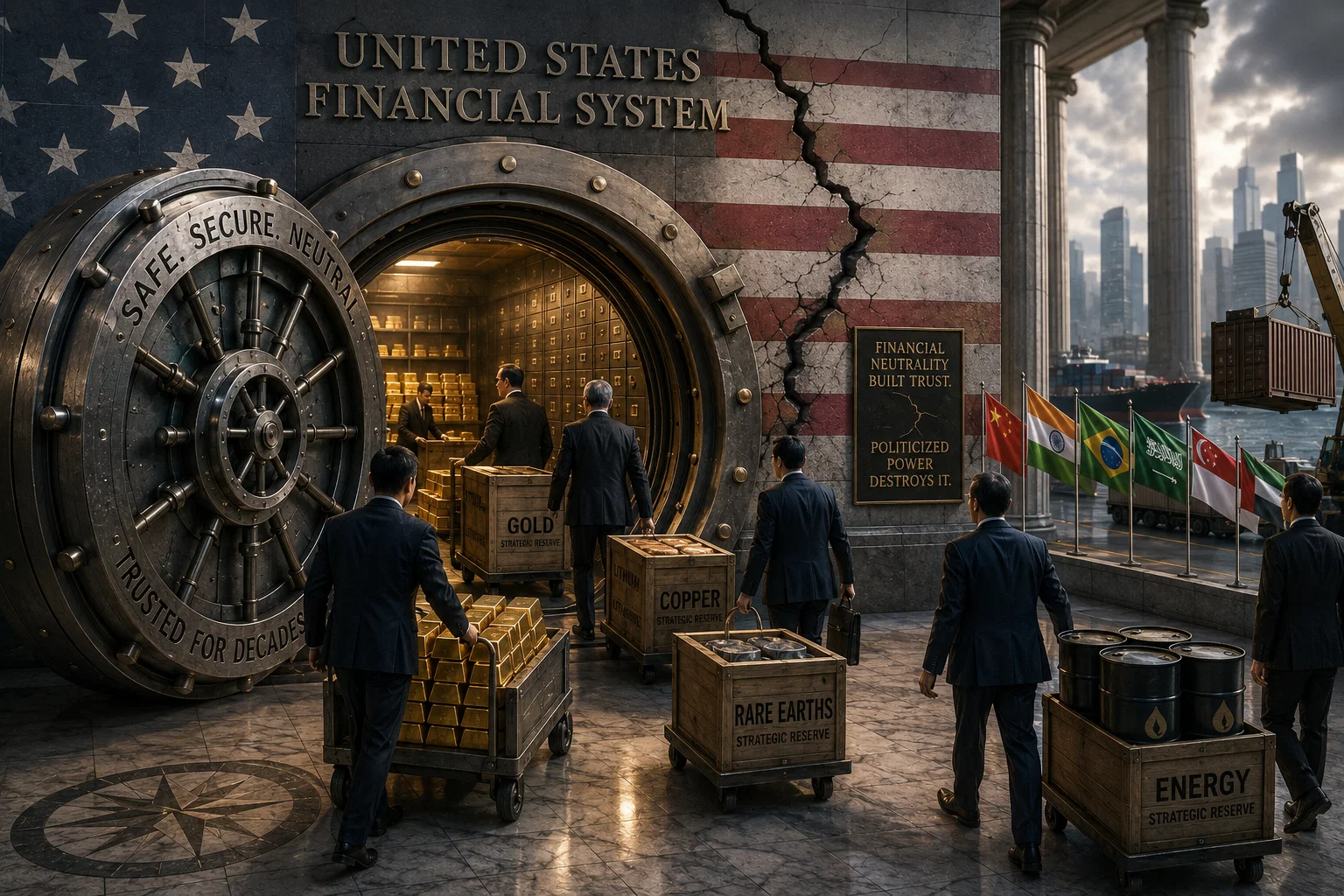
Moscow initially signaled that it was ready to negotiate and consider a full withdrawal. The bells of freedom started ringing. But it turned out to be a ruse— and Soviet leader Nikita Khrushchev swiftly sent in the tanks.
The Soviets brutally crushed the uprising in days, killing around 2,500 Hungarians and displacing 200,000 who fled the country.
In the reprisals that followed, tens of thousands more were arrested, and hundreds were hanged— including Hungary's prime minister, who was tricked into surrendering with a promise of safe passage.
President Dwight Eisenhower condemned the invasion and opened America’s doors to roughly 30,000 Hungarian refugees. He then made his case to the United Nations, where the UN General Assembly demanded a full Soviet withdrawal from Hungary. Kruschev ignored them.
Eisenhower was clearly opposed to Soviet aggression. But America did exercise restraint— the President did not touch Soviet money that was held in the US.
It’s crazy to think that, even during the height of the Cold War, the Soviets held a stockpile of US dollars within the US financial system. They had no choice. Global commerce (including oil sales) took place in dollars, so even America’s mortal enemy needed to hold US currency.
Eisenhower could have easily confiscated Soviet assets. Yet not one Soviet account was frozen. Not one asset blocked… even as Soviet tanks shelled a defenseless European capital.
Similarly, twenty-three years later when the Soviets invaded Afghanistan, President Jimmy Carter reacted harshly. He cut off certain trade with the USSR, including grain and technology. And most famously he led a 65-country boycott of the 1980 Moscow Olympics.
But even Jimmy Carter did not freeze Soviet assets.
Decades later, in August 2008, Russia invaded the Republic of Georgia. President George W. Bush condemned the invasion, sent humanitarian aid to Georgia, and ended support for Russia's World Trade Organization bid.
Yet he did not touch any Russian money held in the US.
Three presidents from both parties, across five decades, watched America's biggest adversary invade other countries... but they still chose to keep the money out of it.
America had become Switzerland: a neutral custodian that fiercely protected anyone's savings, regardless of politics. The trust ran so deep that through every proxy war and nuclear standoff, even the Soviet Union held their enemy’s currency inside their enemy’s financial system. That’s how confident the Soviets were in America’s financial neutrality.
That wasn’t about keeping Moscow happy. It showed the world that assets in America were safe... and that was traditionally a huge reason why foreign governments parked trillions of dollars in US government bonds... and why the Treasury Dpeartment could borrow endlessly to fund its deficits.
But this policy of financial neutrality changed in February 2022, after Russia invaded Ukraine. The US pushed its allies to freeze roughly $300 billion of Russian assets.
To be clear, this is not a moral discussion. I’m not arguing whether it was right or wrong; rather, this is about setting precedent. Russia did not attack or invade the United States; they attacked Ukraine— a country with which the US did not have a mutual defense treaty.
For years leading up to the Ukraine invasion, the US government had started politicizing its financial system, weaponizing the dollar, and levying occasional sanctions when foreign countries or banks stepped out of line.
But freezing the reserves of a major power was a massive acceleration.
Consequently, America’s reputation as a financial safe haven vanished on the spot.
Foreign governments were already worried about the gigantic US national debt, political dysfunction in Washington, and deep social divisions. The Russian asset freeze was the proverbial straw that broke the camel’s back.
The first lesson that foreign nations concluded was the importance of holding gold as a strategic financial reserve.
Rather than deposit US dollars in a big Wall Street bank, or hold US government bonds, foreign governments concluded that it was much safer to have physical gold sitting in their own country— no one could confiscate it, freeze it, or inflate it away.
That’s why central banks around the world began diversifying out the US dollar and into gold: roughly 2% of strategic reserves (above normalized annual net purchases) between 2022 and 2025 was invested in gold.
And that modest shift— just 2%— caused the gold price to more than double. As we covered earlier this week, central banks plan on investing a whole lot more into gold.
Gold was the key lesson of Ukraine. Then came the lesson of Iran.
Until this year, few governments worried much about the availability of critical assets like energy, food, fertilizer, microprocessors, etc.
But then US and Israeli forces struck Iran in late February, and Iran responded by closing the Strait of Hormuz. More than five months later, the strait is still too dangerous for most commercial traffic, and many countries are running short on those same critical resources that transit the Gulf.
The lesson of Iran is that the world runs on strategic assets, and access to them can vanish overnight.
Their conclusion is that, again, rather than stockpile US dollars via government bonds and bank deposits, it makes a lot more sense to stockpile strategic assets— like fertilizer, energy, etc.
At a minimum, whenever the situation in Iran comes to its conclusion, countries will have to buy oceans of oil just to top off their strategic petroleum reserves. Our guess is they'll go far beyond that and build the capacity to store even more.
And not just oil. Anything critical and strategic is now a candidate for the stockpile, because the old days of global cooperation and easy trade are gone, replaced by mistrust, conflict, and resource nationalism.
That means base metals, rare earths, and technology itself, from memory chips to sovereign compute capacity.
This trend is still in its early stages, and the companies that own and produce these critical assets stand to do very well.
We've featured many of them, from energy to metals, in Schiff Sovereign's investment research newsletter, Strategic Assets.
And this environment has been very good to them: several are trading at all-time highs right now; the crude tanker company we covered just reported the best quarter in its history, and a zinc producer is up almost 3x in under nine months.
In the most recent issue, we told readers about a small oil producer which is becoming a wildly successful profit machine; it has no debt, excellent management, yet trades at just three times its current free cash flow.
To your freedom, James Hickman Co-Founder, Schiff Sovereign LLC
Rob Cunningham: Remember When Using a Cell Phone Required a Financial Advisor?
Rob Cunningham: Remember When Using a Cell Phone Required a Financial Advisor?
8-13-2026
REMEMBER WHEN USING A CELL PHONE REQUIRED A FINANCIAL ADVISOR?
$1.25 a minute at peak.
$0.75 off-peak.
Long distance? Hold onto your wallet.
Rob Cunningham: Remember When Using a Cell Phone Required a Financial Advisor?
8-13-2026
REMEMBER WHEN USING A CELL PHONE REQUIRED A FINANCIAL ADVISOR?
$1.25 a minute at peak.
$0.75 off-peak.
Long distance? Hold onto your wallet.
And the phone itself came in a bag approximately the size of carry-on luggage.
We thought this was advanced technology.
Then something extraordinary happened.
Networks improved. Capacity exploded. Costs collapsed. Phones became supercomputers. Metered minutes became unlimited talk, text and data.
And humanity didn’t respond to cheaper communications by communicating less.
WE WENT ABSOLUTELY BONKERS.
Billions connected.
Entire industries appeared.
Human productivity exploded.
Businesses were created that couldn’t possibly have existed under the Bag-Phone Economy.
Which raises one wonderfully uncomfortable question:
What if MONEY is standing exactly where the bag phone once stood?
Think about it.
Banking hours.
Settlement delays.
Correspondent banks.
Prefunding.
Intermediaries.
FX spreads.
Reconciliation.
Capital sitting around waiting for other capital to finish moving.
We can livestream a rocket launch from another continent while standing in a grocery-store checkout line…
… but moving our own money around Earth can still involve business days.
Seriously?
Now imagine the monetary equivalent of going from:
$1.25 PER MINUTE → UNLIMITED EVERYTHING.
24/7/365 settlement.
Interoperable DLT networks.
Sovereign digital currencies.
Real-time global liquidity.
Tokenized real-world assets.
Verifiable reserves.
Real ownership.
Sound-money principles.
Capital moving at something approaching the speed of information.
And potentially billions of humans, businesses and machines connected to the same emerging Internet of Value.
That’s the rabbit hole I went down.
And the deeper I went, the more fascinating the comparison became.
Because the biggest consequence of cellular technology wasn’t cheaper phone calls.
It was everything humanity invented after communication became abundant.
So perhaps the biggest consequence of next-generation monetary infrastructure won’t be cheaper payments either.
Perhaps it will be everything humanity creates when VALUE becomes radically easier to own, exchange, settle and put productively to work.
That is the distinction between what I call:
THE BAG-PHONE ECONOMY
and
THE REAL-MONEY ECONOMY
One rationed communications by the minute.
The other asks whether we’re about to stop rationing the movement and productive usefulness of value through yesterday’s financial plumbing.
And if the cellular transformation produced extraordinary increases in adoption, entrepreneurship, productivity and global commerce…
what happens when the infrastructure being transformed isn’t merely the telephone network – but MONEY itself?
Now that is worth thinking about.
Grab a coffee. Bring your curiosity. Leave a little room for your assumptions to get uncomfortable.
Read my full comparison of the “Bag-Phone Economy” and our emerging “Real-Money Economy” unfolding before the world’s eyes.
You don’t have to agree with the thesis.
Just answer one question when you’re finished:
If the smartphone made the bag phone look prehistoric…what will tomorrow’s monetary network make today’s banking system look like?
Source(s):
• https://x.com/KuwlShow/status/2087628706722332894