
Thank you to all the subscribers to our Early Access program…we thank you for your continued support.
We are excited to offer this new service to keep you informed and up-to-date on the latest Dinar and currency news.
FRANK26….10-19-25….PASSED
KTFA
Sunday Night Video
FRANK26….10-19-25….PASSED
This video is in Frank’s and his team’s opinion only
Frank’s team is Walkingstick, Eddie in Iraq and guests
Playback Number: 605-313-5163 PIN: 156996#
KTFA
Sunday Night Video
FRANK26….10-19-25….PASSED
This video is in Frank’s and his team’s opinion only
Frank’s team is Walkingstick, Eddie in Iraq and guests
Playback Number: 605-313-5163 PIN: 156996#
Seeds of Wisdom RV and Economics Updates Sunday Afternoon 10-19-25
Good Afternoon Dinar Recaps,
BRICS Dominates Rare Earth Minerals as Supply Grows 12.6%
The world’s most strategic resources are now instruments of power — and BRICS knows it.
The Landscape of Power Minerals
Rare earth elements (REEs) are no longer a niche market. They are essential inputs for electric vehicles, wind turbines, advanced electronics, and defense systems.
Good Afternoon Dinar Recaps,
BRICS Dominates Rare Earth Minerals as Supply Grows 12.6%
The world’s most strategic resources are now instruments of power — and BRICS knows it.
The Landscape of Power Minerals
Rare earth elements (REEs) are no longer a niche market. They are essential inputs for electric vehicles, wind turbines, advanced electronics, and defense systems.
According to the International Energy Agency (IEA), the production and refining of these minerals remain heavily concentrated — and China sits firmly at the center.
● China controls roughly 61% of rare earth mining output worldwide.
● Over 90% of global processing and refining occurs in China.
● Diversification efforts have slowed, leaving critical supply chains increasingly exposed.
When one nation dominates both extraction and processing, supply security becomes geopolitical leverage.
What the 12.6% Growth Really Means
The General Administration of Customs of China reported that BRICS’ collective rare earth supply rose by 12.6% between January and September 2025 — about 48,350 additional tonnes year-on-year.
However, the details reveal a more complex picture:
● While volume rose, export value fell by 7.8% to $342.3 million.
● In September 2025, exports plunged 30.9% compared to August, falling to about 4,000 tons.
● China has introduced tighter export controls and selective licensing for key customers.
In short: BRICS may be producing more, but Beijing is deciding who gets access — and under what terms.
China’s Strategic Lever
For Beijing, control of rare earths isn’t merely economic — it’s strategic influence.
Refining dominance gives China a powerful tool to shape trade relations and respond to political pressure.
● New export restrictions (Notification No. 61/2025) extend to magnets, alloys, and advanced technologies.
● These rules apply even to foreign firms using China-sourced minerals.
● Supply preferences now favor BRICS partners and politically aligned states.
In effect, rare earths have become a diplomatic currency, reinforcing China’s role as the indispensable middleman in the green-tech economy.
Impact on the United States and Global Markets
The United States and allied economies face mounting risks from this concentration:
● Over-reliance on Chinese processing exposes defense, tech, and energy sectors to supply shocks.
● The IEA warns that diversification efforts are progressing too slowly to mitigate medium-term risk.
● President Trump’s administration has threatened 100% tariffs on Chinese goods in response to export reductions.
● Global markets have already seen volatility as rare earth trade tensions escalate.
Even with higher global output, supply access — not supply volume — now drives price and policy decisions.
The Bigger Picture
This rare earth shift embodies the deeper global transformation underway:
economic blocs are redrawing the resource map to align production with political strategy.
● BRICS nations are consolidating control over critical materials.
● Western economies are seeking rapid decoupling through domestic mining and recycling initiatives.
● The outcome will determine which nations dominate the next phase of industrial power — from semiconductors to defense tech to energy transition materials.
It’s a microcosm of a larger restructuring — a contest for control not of money, but of the inputs that make economies function.
Outlook: What to Watch
1. Access vs. Output
Track export licenses, not just production numbers. Beijing’s policy shifts can outweigh market fundamentals overnight.
2. Diversification Efforts
The U.S., Australia, and Canada are investing heavily in refining capacity — but timelines remain long and costs high.
3. Pricing Volatility
When exports drop while production rises, price distortions and speculative pressures usually follow.
4. Strategic Realignments
Expect BRICS coordination on critical minerals policy to strengthen as trade frictions grow.
Why it Matters
BRICS’ rare earth output rose 12.6% in 2025 — but beneath that growth lies a power play.
Control of these materials determines who builds the technologies of tomorrow, and on whose terms.
This is not just a story about commodities or percentages.
It’s the story of how economic influence and geopolitical leverage are converging — reshaping trade, industry, and alliances in real time.
This is not just politics — it’s global finance restructuring before our eyes.
Seeds of Wisdom Team
Newshounds News™ Exclusive
Sources:
International Energy Agency (IEA): Global Critical Minerals Outlook 2025
Reuters: China Tightens Rare Earth Export Controls (Oct 2025)
Chatham House: China’s New Restrictions on Rare Earth Exports Send a Stark Warning West (Oct 2025)
Watcher Guru: BRICS Dominates Rare Earth Minerals, Supply Increases by 12.6% (Oct 2025)
~~~~~~~~~
Seeds of Wisdom Team RV Currency Facts Youtube and Rumble
Newshound's News Telegram Room Link
Follow the Gold/Silver Rate COMEX
Follow Fast Facts
Seeds of Wisdom Team™ Website
Thank you Dinar Recaps
All Signs Point to Reset: How Every Fiat System Ends in Collapse!
All Signs Point to Reset: How Every Fiat System Ends in Collapse!
Lynette Zang: 10-18-2025
Every fiat system ends in collapse, and all signs point to another reset.
Since 1971, when the dollar was cut loose from gold, productivity gains vanished while inflation quietly stole purchasing power.
Now debt is exploding, real estate is distorted, and central banks are hoarding gold behind the scenes.
This isn’t a coincidence—it’s the controlled transition to the next monetary system.
All Signs Point to Reset: How Every Fiat System Ends in Collapse!
Lynette Zang: 10-18-2025
Every fiat system ends in collapse, and all signs point to another reset.
Since 1971, when the dollar was cut loose from gold, productivity gains vanished while inflation quietly stole purchasing power.
Now debt is exploding, real estate is distorted, and central banks are hoarding gold behind the scenes.
This isn’t a coincidence—it’s the controlled transition to the next monetary system.
Lynette exposes the pattern, the players, and how to protect yourself before the reset goes public.
Chapters:
00:00 — Introduction
00:45 — Why gold and silver matter when regulators fail
01:21 — 1971: The moment money changed forever
03:11 — How gold exposes fake paper wealth
04:05 — The economy broke when wages stopped rising
05:15 — Deregulation and the rise of zombie companies
07:22 — The housing trap: priced out and locked in
08:31 — Black Monday and the creation of market control
11:00 — Inflation: the hidden reset of the economy
13:39 — Why central banks are buying gold again
15:29 — How to build a sound money plan
“Tidbits From TNT” Sunday 10-19-2025
TNT:
Tishwash: A driver was arrested for attempting to smuggle counterfeit foreign currency through the Qaim border crossing.
The Border Ports Authority announced, on Saturday, the arrest of a driver who attempted to smuggle counterfeit foreign currency through the Al-Qaim port.
The authority said in a statement, "The Al-Qaim Border Port Directorate was able to apprehend an Iraqi driver while attempting to smuggle counterfeit foreign currency, in addition to 22 ancient coins, a number of foreign passports and SIM cards."
TNT:
Tishwash: A driver was arrested for attempting to smuggle counterfeit foreign currency through the Qaim border crossing.
The Border Ports Authority announced, on Saturday, the arrest of a driver who attempted to smuggle counterfeit foreign currency through the Al-Qaim port.
The authority said in a statement, "The Al-Qaim Border Port Directorate was able to apprehend an Iraqi driver while attempting to smuggle counterfeit foreign currency, in addition to 22 ancient coins, a number of foreign passports and SIM cards."
The statement added, "The seizure operation was carried out in coordination and cooperation with the Customs Center and supporting departments at the port."
It pointed out that "a formal seizure report was prepared, and the driver and the seized items were referred to the Al-Qaim Police Station to complete the necessary legal procedures." link
************
Tishwash: Prime Minister's Advisor: Iraq is experiencing its most stable period thanks to strong foreign reserves.
The Prime Minister's advisor for financial affairs, Mazhar Mohammed Salih, issued a clarification on Sunday regarding Iraq's internal and external debt.
While noting that domestic borrowing represents only 18 percent of the total precautionary debt, he confirmed the existence of committees working with international companies to convert a portion of the domestic debt into investment vehicles.
Saleh told the Iraqi News Agency (INA): "There is a blurry picture in interpreting the issue of external debt, as the external debts due until 2028 do not exceed $9 billion, which constitutes mostly half of the country's total external debt," indicating that "there are coordinated repayment mechanisms between the Ministry of Finance and the Central Bank, which are highly governed and transparent, and are settled accurately within a strict program and allocations in the federal general budget, and are periodically extinguished with the international creditor community."
He added, "The total external debt does not exceed what was mentioned above, and the amounts mentioned in the Central Bank's letter require explanation, as Iraq is not obligated to pay them, especially the $41 billion, as they are subject to the Paris Club agreement of 2004, which wrote off 80% or more of those debts related to the Iran-Iraq war, or what are called pre-1990 debts."
He continued, "As for the domestic debt referred to in the Central Bank's letter, it is the result of the accumulation of financial, security, financial and health crises that the Iraqi economy has been exposed to over the past decade and since the war on ISIS terrorism. This has been accompanied in recent years by severe geopolitical factors that have exposed global oil markets to a decline in prices due to the decline in growth in the global economy."
He explained that "the borrowing undertaken by the current government as domestic debt constitutes only 18% of the total precautionary domestic debt included in the federal general budget (the three-year budget) pursuant to Law No. 13 of 2023 for the years 2023-2025."
He stated that "the internal debt, which amounts to approximately 91 trillion dinars, is mostly held by the government banking system and under high-level financial and technical management," noting that "there are specialized committees working in cooperation with international consulting companies to convert a large portion of that internal public debt into productive investment tools within a national fund to manage the aforementioned internal debt in a manner that aims to stimulate the real economy and transform debt obligations into investment opportunities in the real sector of the Iraqi economy." He explained that "Iraq is currently experiencing the most stable period due to the strength of foreign reserves, the function of which is to stabilize the purchasing power of the Iraqi dinar and sustainable development." link
************
Tishwash: Washington listens to Baghdad: Ambitious financial reforms seek credible implementation and institutional change.
This week, the Iraqi delegation participated in a banking reform conference held in Washington on the sidelines of the IMF and World Bank meetings. The event is a practical test of Baghdad's ability to present a realistic picture of the results of its economic program.
The Iraqi delegation, which included a number of advisors and financial officials, sought to highlight the reform steps achieved over the past two years as indicators of the country's transition from crisis management to building a modern economic system.
Advisor to the Prime Minister, Saleh Mahoud Salman, who presented Iraq's paper at the conference, outlined a series of measures he described as "a pivotal stage in the path of economic and financial reform." He explained that the government is "implementing a strategic banking reform package in cooperation with the Central Bank and international consulting firms," focusing on "restructuring government banks, expanding financial inclusion, and automating the customs and tax system."
However, this proposal, while important from an administrative perspective, raises broader questions about the depth of the transformation and its compatibility with the requirements of a rapidly evolving global economy.
Reform in a financial environment like Iraq's, where structural challenges intertwine with political constraints, is not measured by the number of projects as much as it is by the state's ability to change the behavior of the financial system itself.
Indicators of reform... but to what extent?
The government says the preparation of a three-year budget represents a qualitative shift in financial planning, an unprecedented step in the modern history of Iraq. However, financial economists point out that the success of this model depends on the availability of accurate data and stable monetary policy, two conditions that still face challenges in a financial environment that relies on oil revenues for more than 90% of the country's GDP.
Institutional economists believe that "budget stability does not necessarily mean stable growth," as volatility in oil prices and weak economic diversification make any long-term planning vulnerable to disruption in the event of a global crisis or a decline in demand for crude oil.
In contrast, the Prime Minister's advisor points out that the government has been able to increase customs and tax revenues by automating the customs system using the UN-approved ASYCUDA program, which reflects the beginning of bridging the gap between the formal and parallel economies.
However, economic researchers believe that the success of this step requires an effective regulatory system and a flexible administrative structure, as technology alone is not sufficient to change work culture or reduce administrative corruption, which is one of the most prominent obstacles to financial reform in Iraq.
Financial inclusion and digital transformation: between ambition and capability
Electronic payment systems are one of the areas that have witnessed the most tangible progress, with financial inclusion rising from less than 10% to more than 40% in two years, according to the government advisor.
This digital leap is an indicator of a gradual shift in citizens' financial behavior, especially with the expanding use of bank cards and mobile payment services.
However, banking observers believe that the quantitative expansion is not matched by qualitative developments in the banking structure. Banking services in most government banks remain traditional and rely on paper transactions, while the private sector suffers from restrictions in accessing external financing.
Digital economy experts point out that the transition to an e-economy cannot be complete without a comprehensive legal and legislative environment that ensures protection from financial crimes and builds trust between citizens and the banking system.
Some economists argue that Iraq, despite its relative progress in this area, is still in the "experimental" phase and needs to integrate technology into the public financial management system, not just into individual transactions.
Banking Sector Restructuring: Reform or Role Rotation?
Restructuring state-owned banks (Rafidain, Rashid, Industrial, and Agricultural) is a key pillar of the government's plan. The government announces that it has increased the operational efficiency of these banks and begun reevaluating their assets. However, financial analysts believe that true reform cannot be achieved simply through administrative restructuring, but rather through the ability of these institutions to transform into sustainable financing entities that effectively contribute to driving local production.
Rafidain and Rashid, which represent approximately 80% of the banking market, still operate according to a traditional services model, while private banks face weak confidence from investors and depositors alike.
Banking finance experts point out that structural reform in the Iraqi banking sector requires gradual liberalization of credit policies and the activation of partnerships with regional banks, as a closed economy cannot benefit from global growth or external financing.
Poor institutional continuity and changing strategies
One of the most significant structural challenges facing economic reform in Iraq is the lack of institutional continuity. Each new government tends to reformulate the economic strategy from scratch, even in areas where tangible progress has been made.
This recurring pattern of "administrative rupture" hinders the accumulation of experience and leads to a loss of the institutional foundation necessary for any genuine reform process. Instead of building on previous programs and evaluating their results, plans are replaced by new projects presented under a different title, without any scientific review or analysis of previous policies.
Institutional economics researchers point out that this behavior reflects the weakness of the Iraqi state's institutional structure, as there are no permanent planning bodies or economic councils to ensure the continuity of policies regardless of changes in government.
Thus, the reform process often becomes a short-term political project, tied to the government's cycle rather than the economic cycle, limiting its ability to produce a sustainable economic impact or build internal and external confidence in fiscal policies.
Are these steps sufficient to keep pace with global transformations?
Iraq's experience with financial and banking reform demonstrates that the problem has never been a lack of vision, but rather its frequent interruptions. Each government introduces new plans, discarding previous ones, as if the state is starting from scratch with each political cycle. This behavior reflects not only a contradiction in priorities, but also a weak institutional structure that lacks a continuous economic memory capable of transferring experience and embedding successful policies.
Public economics studies confirm that the success of any financial reform depends more on accumulated experience and continuity than on the amount of funding or international support. In the Iraqi case, reforms are still managed according to the logic of the "governmental phase" rather than the "national phase," which makes them vulnerable to disruption as soon as the political orientation shifts.
The steps presented at the Washington conference reflect a clear technical effort, but they will not translate into actual achievement unless they are linked to independent institutions capable of protecting reform from political change. Reform is not achieved by changing plans, but rather by establishing an implementation mechanism that is not affected by changes in ministers or governments.
Thus, it can be said that financial reform in Iraq is moving in the right direction in terms of form, but it still requires a permanent institutional framework that ensures sustainability and transforms reform from a government initiative into a state-led process that remains unchanged by changes in leadership. link
************
Mot: Its a Seasoning Thingy!!!!

Mot: .. Coming soon!!!!!!

News, Rumors and Opinions Sunday 10-19-2025
Greg Hunter with Catherine Austin Fitts: Gold Fights Financial Control Grid
10-19-2025
Gold Fights Financial Control Grid – Catherine Austin Fitts
By Greg Hunter’s USAWatchdog.com (Saturday Night Post)
Catherine Austin Fitts (CAF), publisher of “The Solari Report,” is back with a new cutting-edge publication called “Plunder.” CAF has been pushing gold (and silver) as an investment for the past few years.
Greg Hunter with Catherine Austin Fitts: Gold Fights Financial Control Grid
10-19-2025
Gold Fights Financial Control Grid – Catherine Austin Fitts
By Greg Hunter’s USAWatchdog.com (Saturday Night Post)
Catherine Austin Fitts (CAF), publisher of “The Solari Report,” is back with a new cutting-edge publication called “Plunder.” CAF has been pushing gold (and silver) as an investment for the past few years.
The record high price of the yellow metal has proven her right. In order for the few to control and steal the assets of the many, they have to build what CAF calls a “financial control grid.”
What can help common people fight the control grid being built in front of their eyes? Buy the oldest money on the planet. CAF says, “We are seeing an increased move to institute a control grid.
For example, you have the PM of England standing up and saying if you don’t have a digital ID, you can’t work. People are saying, wait a minute, I want my money outside the system because this system is beginning to act in criminal ways and manic ways.
We are seeing changes in policies at the federal level that make people nervous. So, the reality is gold is simple. Everybody can understand it. . . . Gold is looking attractive, and it is being remonetized.
It’s not just by central bankers, now we see states around the United States making gold legal tender. . .. Silver has lagged dramatically, but silver is catching up.”
Is there something wrong with the financial system for gold and silver to be flashing these warning signs with record high prices?
CAF says, “There is something very wrong with the financial system, and that is the financial system is being used to institute a control grid. If they succeed instituting an all-digital financial system that includes AI (artificial intelligence), a digital ID and an all-digital financial system, then we are looking at the end of currency
Now that you have printed so much money, you want to get control of the real assets, and that’s what they have been doing. . .. The game of growing the debt is over. Like the game of musical chairs, we are all going to scramble to get control of the real assets.
This is why they have been pushing programmable money because you are trying to suck them out of the real assets while they build the control grid and while they jump in and get control of the real assets. . .. What I keep telling everybody is to focus on what is real, and focus on what you can understand.”
In closing, CAF gives many ideas and strategies to thwart the plunder such as everyone increasing the use of cash, making good food and health choices, not financing your enemies and acquiring hard assets such as farmland and gold, which CAF says is “starting a new bull market.”
There is much more in the 58-minute interview.
https://usawatchdog.com/gold-fights-financial-control-grid-catherine-austin-fitts/
************
Courtesy of Dinar Guru: https://www.dinarguru.com/
Frank26 There's no other currency on this planet more valuable than the Iraqi dinar, not even the American dollar can touch it.
Militia Man Iraq is going to be a pillar. It's going to be a foundation stone in the Middle East. Notice how the Middle East has cooled down significantly? Iran's been quiet. We haven't had missiles flying in Iraq anymore. You have the neighboring countries big peace deal going on. It's calm. It's really good. It gives confidence to International investors...Now you see article that Iraq is a beacon, it's the show, it's a new showpiece, hence CNBC picks it up.
Frank26 [Iraq boots-on-the-ground report] FIREFLY: They came on television channel 8 saying we are in the final stages of negotiations on the HCL. They told us that directly. It's interesting because they told us they're lifting 3 zeros to give us purchasing value. Maybe that's why they say they're going to give us the HCL... FRANK: The HCL is here where it belongs. Let them vote for it...I'm sorry there is no more negotiations on the HCL. Why do you think you're in DC...with Oliver Wyman? ...This is fantastic news...
*************
Alasdair McLeod: Debt ALWAYS Destroys Fiat Currencies
VRIC Media: 10-18-2025
In this interview, Darrell sits down with economist and educator, Alasdair Macleod, to unpack the deepening global monetary and geopolitical shifts reshaping markets.
Macleod explains why China’s tightening grip on rare earths and silver signals a broader decoupling from the U.S., how surging bullion demand exposes a looming silver squeeze, and why he believes the fiat currency era is nearing its end.
Macleod lays out why gold especially physical gold remains the cornerstone of financial survival in today's world
Seeds of Wisdom RV and Economics Updates Sunday Morning 10-19-25
Good Morning Dinar Recaps,
Shaky Peace: U.S.-Brokered Middle East Truce and Rising Asian Border Tensions
Cease-fires signal calm — but deeper geopolitical shifts are underway.
Middle East Developments
The U.S. has announced what it called “peace in the Middle East” after mediating a cease-fire deal between Hamas and Israel, including the release of hostages.
Good Morning Dinar Recaps,
Shaky Peace: U.S.-Brokered Middle East Truce and Rising Asian Border Tensions
Cease-fires signal calm — but deeper geopolitical shifts are underway.
Middle East Developments
The U.S. has announced what it called “peace in the Middle East” after mediating a cease-fire deal between Hamas and Israel, including the release of hostages.
However, analysts warn the declaration may be more symbolic than structural, as the core disputes over Gaza’s governance, security, and territory remain unresolved.
● Cease-fire terms were agreed under international pressure, yet fragile enforcement leaves open the risk of renewed clashes.
● Humanitarian access remains limited, with aid groups calling the situation “tenuous and conditional.”
● Analysts (The Guardian, Modern Diplomacy) note that Israel’s security cabinet remains divided over long-term governance plans for Gaza.
● Modern Diplomacy emphasizes that “the truce hangs by a thread,” with both sides bracing for possible violations amid high distrust.
Regional Ripples and Reconstruction
Peace declarations often trigger financial and geopolitical recalibrations across the region.
● Reconstruction flows: Billions in aid and private capital are being prepared for Gaza and surrounding economies.
● Refugee resettlement pressures are likely to shift demographics in Jordan, Lebanon, and Egypt.
● Energy and trade corridors could reopen, potentially linking Israel, Egypt, and Gulf economies under new U.S.-backed frameworks.
● Defense realignments are expected as Arab states reconsider U.S. and BRICS-led security partnerships.
Southeast Asia: A Second Front of Diplomacy
At the same time, a border conflict between Thailand and Cambodia has resurfaced — underscoring how fragile peace remains in Asia’s emerging power zones.
● Cease-fire talks are underway, with U.S. and ASEAN mediators active ahead of the Kuala Lumpur Summit (Oct 26–28).
● Strategic implications: Southeast Asia continues to serve as a proxy arena for great-power competition between the U.S. and China.
● Trade and infrastructure stakes are high, especially with cross-border supply chains and Belt and Road investments in play.
Why It Matters
● These peace efforts — from the Middle East to Southeast Asia — are not isolated.
● Each region reflects a broader financial and geopolitical realignment, driven by shifting alliances and competing global debt strategies.
● What appears as diplomacy is also a restructuring of influence, capital flows, and resource control across multiple continents.
● Cease-fires and negotiations are becoming tools of financial recalibration, shaping who finances reconstruction, who builds infrastructure, and who profits from new corridors of trade.
● The current moment marks more than a pause in conflict — it represents a rebalancing of the world’s economic architecture, negotiated through the language of peace.
This is not just politics — it’s global finance restructuring before our eyes.
Seeds of Wisdom Team
Newshounds News™ Exclusive
Sources:
The Guardian — “First phase of cease-fire deal to end war in Gaza agreed by Israel and Hamas”:
Reuters — “Why are Thailand and Cambodia fighting along their border?”:
Modern Diplomacy: Gaza Border Crisis – Israel-Hamas Truce Hangs by a Thread
~~~~~~~~~
U.S.–China Trade Tensions Deepen Amid IMF Warning and Global Markets Bracing for Impact
As tariffs and credit risks build, investors are reassessing global growth and market stability.
Global Outlook Turns Cautious
Global finance leaders meeting at the International Monetary Fund (IMF) and World Bank in Washington this week issued a sober warning: renewed U.S.–China trade frictions, rising sovereign debt, and tightening non-bank credit markets are forming a “triple squeeze” on the world economy.
● Trade tensions are resurfacing as Washington weighs new tariffs and Beijing retaliates with export controls — a dynamic the IMF calls a “drag on both growth and confidence.”
● High debt levels across emerging and developed markets are compounding the strain, with several countries approaching fiscal limits on public borrowing.
● Credit tightening among shadow lenders and private funds adds to systemic stress, signaling liquidity concerns beyond traditional banking.
Market Jitters and Safe-Haven Surge
At the same time, global markets reacted sharply to renewed uncertainty:
● Regional U.S. banks reported exposure to deteriorating commercial and private credit, triggering a selloff in financial shares.
● Global stock indices slipped, led by losses in Europe and Asia, while the S&P 500 fell amid heightened risk aversion.
● Gold surged to new highs, reflecting investors’ move toward safe-haven assets.
Investors are also bracing for a critical data week ahead, with U.S. inflation (CPI) and key corporate earnings — including Tesla, Netflix, and Intel — expected to shape sentiment.
Systemic Risks Converging
According to IMF officials, the intersection of trade pressures, debt overhangs, and credit fragility could transform isolated risks into a broader systemic stress event.
● Global growth forecasts have been downgraded again for 2025.
● Cross-border capital flows are slowing, reducing liquidity across emerging markets.
● The IMF cautions that “what appeared to be regional or sectoral risks are now becoming globally correlated.”
Implications and Outlook
While policymakers aim to stabilize expectations, the underlying trend suggests a realignment of global finance:
● Trade disputes are reshaping supply chains and accelerating the move toward de-dollarized trade blocs.
● Credit markets are exposing structural weaknesses in non-bank financial intermediaries.
● Investors are positioning defensively — signaling that volatility, not stability, may define the coming months.
Why it Matters
When trade wars, debt overhangs, and banking credit strains converge, we’re witnessing the architecture of the global financial system being tested in real time.
This is not just politics — it’s global finance restructuring before our eyes.
Seeds of Wisdom Team
Newshounds News™ Exclusive
Sources:
Reuters – “US-China trade war clouds global economic outlook as ‘new normal’ emerges”
The Guardian – “Bank shares lead global market fall amid jitters over US private credit”
~~~~~~~~~
UK’s Crypto Countdown: Toward Stablecoin Rules by 2026
Making Britain a trusted hub for digital assets — if the rules get done on time.
What’s happening
The Bank of England (BoE) and UK regulators plan to finalize a regulatory framework for stablecoins by the end of 2026.
A public consultation is set to launch on 10 November 2025, inviting feedback from the industry, investors and other stakeholders.
The UK intends to align its regime with U.S. stablecoin rules, particularly around what assets must back the coins (e.g., short-term government debt).
Why this matters
Stablecoins — crypto assets pegged to things like the US dollar or the British pound — are becoming a major part of digital payments and finance ecosystems.
Clear regulation could position the UK as a global leader in the crypto and fintech space, attracting startups, finance firms and investment.
But if regulation is too slow, too bureaucratic or mis-aligned, the UK risks losing ground to other jurisdictions such as the U.S., Singapore or the EU.
The UK’s current crypto snapshot
Roughly 7 million UK adults now hold some form of cryptocurrency — up from just 2.2 million in 2021.
The HM Revenue & Customs (HMRC) is actively warning investors who may be under-reporting crypto gains.
Firms in the crypto-space have been pushing for clear, fair and stable rules — many cite regulatory uncertainty as a barrier to growth.
What the new rules are expected to include
Defining “qualifying stablecoins” (e.g., fiat-backed, issued from the UK) and bringing issuers under supervision of the Financial Conduct Authority (FCA) or BoE.
Backing assets: Stablecoin issuers will be required to hold secure, liquid assets (e.g., short-term government debt) in trust, separated from other company liabilities.
Risk-management frameworks: Issuers will need documented policies for liquidity risk, custody, redemption mechanics and separation of assets.
Potential caps or limits: The BoE has floated caps for individual holdings (e.g., around £10,000–20,000) and for businesses, to mitigate rapid outflows of deposits into stablecoins.
Global context & competitive risks
In Europe, the Markets in Crypto‑Assets (MiCA) regulation becomes fully effective in 2025 — the UK wants to stay in step.
In the U.S., stablecoin bills and regulatory moves (e.g., the so-called Genius Act) are pushing clarity and competition.
If the UK misses the opportunity, startups and issuers may flock to more “crypto-friendly” regimes — or those already operational — reducing the UK’s fintech edge.
What to watch for next
November 10 2025: The start of the consultation period — key for industry reaction and watching how open regulators are to feedback.
How quickly secondary legislation and FCA/BoE rule-makings follow: The devil will be in the detail.
Industry adaptation and migration: Will issuers wait for UK rules, or move abroad? Will holding caps or strict rules hinder or help?
Interaction with banks and the traditional finance sector: How will stablecoins fit with deposits, tokenised assets and payments infrastructure in the UK’s system?
Why it Matters
If the UK delivers a strong, clear and globally-aligned stablecoin regime by 2026, it could become a trusted hub for digital assets, marrying innovation with protection. But the path is narrow — it needs pace, clarity and global coordination.
This is not just politics — it’s global finance restructuring before our eyes.
Seeds of Wisdom Team
Newshounds News™ Exclusive
Sources:
Bloomberg: “UK Targets End-2026 for Stablecoin Rules to Keep Pace With US”
Business Times: “UK targets end-2026 for stablecoin rules to keep pace with US”
Arnold & Porter: “The Proposed UK Regulatory Framework for Regulating Stablecoin Issuance”
LiveBitcoinNews: “Bank of England to Finalize Stablecoin Rules by End of 2026”
~~~~~~~~~
Seeds of Wisdom Team RV Currency Facts Youtube and Rumble
Newshound's News Telegram Room Link
Follow the Gold/Silver Rate COMEX
Follow Fast Facts
Seeds of Wisdom Team™ Website
Thank you Dinar Recaps
Iraq Economic News and Points To Ponder Sunday Morning 10-19-25
From Washington: A New Banking And Economic Reform Package For Iraq
Energy and Business Iraq Banks Repairs 2025-10-18 Shafaq News - Washington The Iraq delegation participating in the banking reform conference in Washington, D.C., on the sidelines of the International Monetary Fund and World Bank meetings, announced a new package of banking and economic reforms on Saturday aimed at strengthening the stability of the financial system and attracting investment.
From Washington: A New Banking And Economic Reform Package For Iraq
Energy and Business Iraq Banks Repairs 2025-10-18 Shafaq News - Washington The Iraq delegation participating in the banking reform conference in Washington, D.C., on the sidelines of the International Monetary Fund and World Bank meetings, announced a new package of banking and economic reforms on Saturday aimed at strengthening the stability of the financial system and attracting investment.
"The government has implemented a series of steps as part of the economic and financial reform program, most notably the implementation of comprehensive strategic banking reforms in cooperation with the Central Bank of Iraq and international consulting firms, as well as the preparation of a three-year budget for the first time in Iraq's history to ensure stable financial planning that attracts investment," said Saleh Mahoud Salman, an advisor to the Iraqi Prime Minister, according to a statement received by Shafaq News Agency.
He added that "automating the customs system through the implementation of the United Nations ASYCUDA program has led to a significant increase in customs and tax revenues, the restructuring of government banks (Rafidain, Rasheed, Industrial, and Agricultural) and Increased their operational efficiency, as well as the expansion of electronic payment systems and increased financial inclusion from less than 10% to more than 40% within two years."
Salman continued, "Support programs have been launched for small and medium-sized enterprises to create job opportunities and stimulate the local economy," noting that
"these steps represent a pivotal stage in the economic reform process, and that the government will continue to support the development of the banking sector in cooperation with international institutions."
Prior to this, the Central Bank of Iraq announced new instructions to all authorized banks in the country regarding money transfers and customs clearance procedures related to the requirements for the approval of special commercial invoices, with the aim of curbing currency smuggling.
This measure comes as part of the efforts of the Central Bank of Iraq and government agencies to develop the financial and administrative environment and improve the level of oversight and compliance with international standards in foreign trade. https://shafaq.com/ar/اقتصـاد/من-واشنطن-حزمة-صلاحات-مصرفية-واقتصادية-جديدة-للعراق
Washington Listens To Baghdad: Ambitious Financial Reforms Seek Credible Implementation And Institutional Change.
Economy / Special Files Yesterday, | 1492 Is the world convinced? Baghdad Today – Baghdad This week, the Iraqi delegation participated in a banking reform conference held in Washington on the sidelines of the IMF and World Bank meetings.
The event is a practical test of Baghdad's ability to present a realistic picture of the results of its economic program.
The Iraqi delegation, which included a number of advisors and financial officials, sought to highlight the reform steps achieved over the past two years as indicators of the country's transition from crisis management to building a modern economic system.
Advisor to the Prime Minister, Saleh Mahoud Salman, who presented Iraq's paper at the conference, outlined a series of measures he described as "a pivotal stage in the path of economic and financial reform."
He explained that the government is "implementing a strategic banking reform package in cooperation with the Central Bank and international consulting firms," focusing on "restructuring government banks, expanding financial inclusion, and automating the customs and tax system."
However, this proposal, while important from an administrative perspective,opens the door to broader questions about the depth of the transformation and its compatibility with the requirements of the rapidly evolving global economy.
Reform in a financial environment like Iraq, where structural challenges intersect with political constraints, is measured not so much by the number of projects as by the state's ability to change the behavior of the financial system itself.
Indicators Of Reform... But To What Extent?
The government says the preparation of a three-year budget represents a qualitative shift in financial planning an unprecedented step in the modern history of Iraq.
However, financial economists point out that the success of this model depends on the availability of accurate data and stable monetary policy, two conditions that still face challenges in a financial environment that relies on oil revenues for more than 90% of the country's GDP.
Institutional economists believe that "budget stability does not necessarily mean stable growth," as volatility in oil prices and weak economic diversification make any long-term planning vulnerable to disruption in the event of a global crisis or a decline in demand for crude oil.
In contrast, the Prime Minister's advisor points out that the government has been able to increase customs and tax revenues by automating the customs system using the UN-approved ASYCUDA program, which reflects the beginning of bridging the gap between the formal and parallel economies.
However, economic researchers believe that the success of this step requires an effective regulatory system and a flexible administrative structure, as technology alone is not sufficient to change work culture or reduce administrative corruption, which is one of the most prominent obstacles to financial reform in Iraq.
Financial Inclusion And Digital Transformation: Between Ambition And Capability
Electronic payment systems are one of the areas that have witnessed the most tangible progress, with financial inclusion rising from less than 10% to more than 40% in two years, according to the government advisor.
This digital leap is an indicator of a gradual shift in citizens' financial behavior, especially with the expanding use of bank cards and mobile payment services.
However, banking observers believe that the quantitative expansion is not matched by qualitative developments in the banking structure.
Banking services in most government banks remain traditional and rely on paper transactions, while the private sector suffers from restrictions in accessing external financing.
Digital economy experts point out that the transition to an e-economy cannot be complete without a comprehensive legal and legislative environment that ensures protection from financial crimes and builds trust between citizens and the banking system.
Some economists argue that Iraq, despite its relative progress in this area, is still in the "experimental" phase and needs to integrate technology into the public financial management system, not just into individual transactions.
Banking Sector Restructuring: Reform or Role Rotation?
Restructuring state-owned banks (Rafidain, Rashid, Industrial, and Agricultural) is a key pillar of the government's plan.
The government announces that it has increased the operational efficiency of these banks and begun reevaluating their assets.
However, financial analysts believe that true reform cannot be achieved simply through administrative restructuring, but rather through the ability of these institutions to transform into sustainable financing entities that effectively contribute to driving local production.
Rafidain and Rashid, which represent approximately 80% of the banking market, still operate according to a traditional services model, while private banks face weak confidence from investors and depositors alike.
Banking finance experts point out that structural reform in the Iraqi banking sector requires gradual liberalization of credit policies and the activation of partnerships with regional banks, as a closed economy cannot benefit from global growth or external financing.
Poor Institutional Continuity And Changing Strategies
One of the most significant structural challenges facing economic reform in Iraq is the lack of institutional continuity.
Each new government tends to reformulate the economic strategy from scratch, even in areas where tangible progress has been made.
This recurring pattern of "administrative rupture" hinders the accumulation of experience and leads to a loss of the institutional foundation necessary for any genuine reform process.
Instead of building on previous programs and evaluating their results, plans are replaced by new projects presented under a different title, without any scientific review or analysis of previous policies.
Institutional economics researchers point out that this behavior reflects the weakness of the Iraqi state's institutional structure, as there are no permanent planning bodies or economic councils to ensure the continuity of policies regardless of changes in government.
Thus, the reform process often becomes a short-term political project, tied to the government's cycle rather than the economic cycle, limiting its ability to produce a sustainable economic impact or build internal and external confidence in fiscal policies.
Are these steps sufficient to keep pace with global transformations?
Iraq's experience with financial and banking reform demonstrates that the problem has never been a lack of vision, but rather its frequent interruptions.
Each government introduces new plans, discarding previous ones, as if the state is starting from scratch with each political cycle.
This behavior reflects not only a contradiction in priorities, but also a weak institutional structure that lacks a continuous economic memory capable of transferring experience and embedding successful policies.
Public economics studies confirm that the success of any financial reform depends more on accumulated experience and continuity than on the amount of funding or international support.
In the Iraqi case, reforms are still managed according to the logic of the "governmental phase" rather than the "national phase," which makes them vulnerable to disruption as soon as the political orientation shifts.
The steps presented at the Washington conference reflect a clear technical effort, but they will not translate into actual achievement unless they are linked to independent institutions capable of protecting reform from political change.
Reform is not achieved by changing plans, but rather by establishing an implementation mechanism that is not affected by changes in ministers or governments.
Thus, it can be said that financial reform in Iraq is moving in the right direction in terms of form, but it still requires a permanent institutional framework that ensures sustainability and transforms reform from a government initiative into a state-led process that remains unchanged by changes in leadership.
https://baghdadtoday.news/285426-.html
The Central Bank Issues New Instructions Regarding Money Transfers And Customs Clearance.
Saturday, October 18, 2025 | Economic Number of readings: 285 Baghdad / NINA / The Central Bank of Iraq issued new instructions to all authorized banks in the country regarding financial transfers and customs clearance operations, as well as the requirements for approving special commercial invoices.
According to a document issued by the Central Bank, it has decided to include a set of basic information in commercial invoices, including:
shipping and payment terms,invoice value and currency, theGlobal Harmonized System of Customs (GHS) code, in addition to theimporter and exporter addresses, aprecise description of the goods, their origin, brand, quantity and unit of measurement, and unit and total price.
The circular stipulated that the final commercial invoice, or the preliminary invoice attached to the sales contract, should be approved, provided that the final invoice contains all preliminary data.
It stated that the implementation of these instructions will begin on November 1, 2025.
He explained: "The aim of the decision is to regulate foreign financial transfers and enhance transparency and accuracy in customs clearance within the national automation project," noting:
"This step has several positives, most notably enhancing the standardization of procedures and reducing errors in commercial transactions, in addition to supporting the customs automation project." /End 8
https://ninanews.com/Website/News/Details?key=1257561
New Instructions From The Central Bank Of Iraq To Prevent Dollar Smuggling Starting Next Month (Document)
Energy and Business dollar Central Bank directions
New instructions from the Central Bank of Iraq to prevent dollar smuggling starting next month (document) WeQ2gAqKuM3LQAAAABJRU5ErkJggg==
2025-10-17 23:22 Shafaq News - Baghdad On Saturday, the Echo Iraq Observatory revealed new instructions issued by the Central Bank to all authorized banks in the country regarding financial transfers and customs clearance procedures related to the requirements for approving special commercial invoices.
The Observatory said in a statement received by Shafaq News Agency, "The Central Bank, in Circular No. (267/4/9) dated 10/15/2025, decided to include in commercial invoices a set of basic information, including: shipping and payment terms, value and invoice currency, and the Global Harmonized System of Classification and Labelling of Goods (GHS) code," adding, "As well as the addresses of the importer and destination, an accurate description of the goods, their origin, their trademark, quantity and unit of measurement, and the unit and total price."
He explained that "the circular stipulates that one of the following invoices must be approved: the final commercial invoice, or the preliminary invoice attached to the sales contract, provided that the final invoice contains all the data of the preliminary invoice."
According to Echo Iraq, "these instructions will be implemented starting November 1, 2025," noting that "the aim of the decision is to regulate foreign financial transfers and enhance transparency and accuracy in customs clearance as part of the national automation project.
" The Observatory believes that "this step has several positive aspects, most notably enhancing the standardization of procedures and reducing errors in commercial transactions, in addition to supporting the customs automation project."
This decision comes as part of the efforts of the Central Bank of Iraq and government agencies to develop the financial and administrative environment and improve the level of oversight and compliance with international standards in foreign trade.
The Eco Iraq Observatory is a media research institution specializing in analyzing the country's economic performance.
It focuses on oil prices and their impact on the budget, in addition to monitoring the performance of Iraqi banks and their role in supporting the economy and financing projects.
New instructions from the Central Bank of Iraq to prevent dollar smuggling starting next month (document) 3+gBcugXB2NQgAAAABJRU5ErkJggg==
https://media.shafaq.com/media/arcella/1760773629269.webp
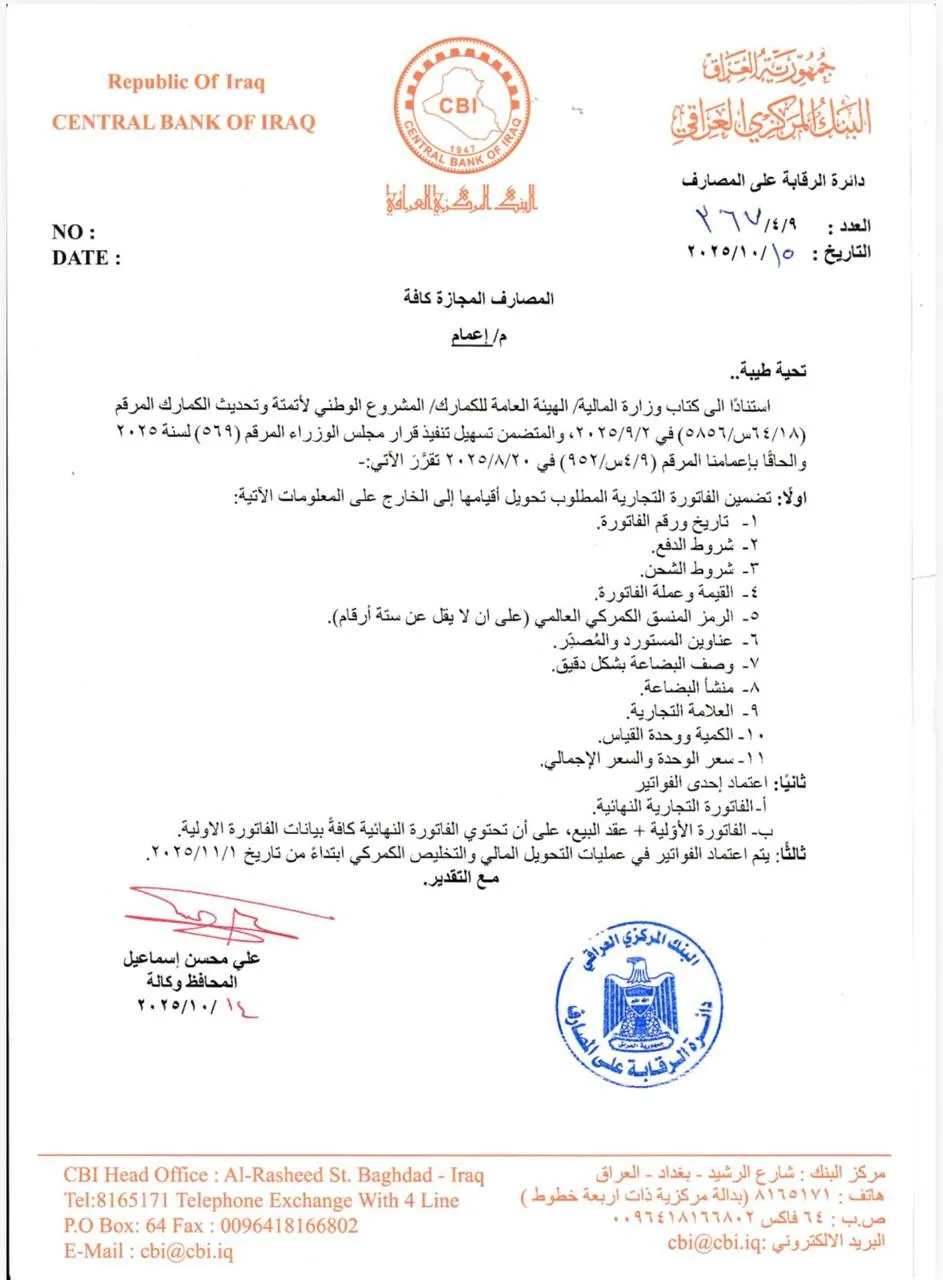
~~~~~~~~~~
[partial and incomplete translation of https://media.shafaq.com/media/arcella/1760773629269.webp]
M/Circular
Based on the letter from the Ministry of Finance/General Authority of Customs/National Customs Automation and Modernization Project No.
(5856/64/18) dated 2/9/2025, which includes facilitating the implementation of Cabinet Resolution No. (569) of 1975
and in accordance with our Circular No. (5/4*S/137) dated 20/8/2025, the following is decided:
First: The commercial invoice whose value is required to be transferred abroad must include the following information:
1- Date and number of the invoice.
"- Payment Terms.
1. Shipping Terms.
2. Value and invoice currency.
3. Universal Harmonized System Code (at least six digits).
4. Addresses of importer and exporter.
5. Accurate description of goods.
6. Origin of goods.
7. Trademark.
8. Quantity and unit of measurement.
9. Unit price and total price.
10. Second: Approval of one of the invoices:
Final commercial invoice.
11. Initial invoice + sales contract; the final invoice must contain all data from the initial invoice.
12. Third: Invoices are accepted for financial transfers and customs clearance starting from 1/11/2025.
With appreciation.
For current and reliable Iraqi news please visit: https://www.bondladyscorner.com
FRANK26….10-18-25………12-2C
KTFA
Saturday Night Video
FRANK26….10-18-25………12-2C
This video is in Frank’s and his team’s opinion only
Frank’s team is Walkingstick, Eddie in Iraq and guests
Playback Number: 605-313-5163 PIN: 156996#
KTFA
Saturday Night Video
FRANK26….10-18-25………12-2C
This video is in Frank’s and his team’s opinion only
Frank’s team is Walkingstick, Eddie in Iraq and guests
Playback Number: 605-313-5163 PIN: 156996#
50% Delinquency Spike Ignites Fears of 2008 Meltdown
50% Delinquency Spike Ignites Fears of 2008 Meltdown
Steven Van Metre: 10-17-2025
For years, the auto loan industry was considered a pillar of stability—a safe bet for lenders and a necessary tool for consumers. That stability is now officially shattered.
A detailed and urgent analysis of the U.S. auto market reveals a crisis escalating rapidly, fueled by surging car prices, unsustainable loan terms, and high interest rates. This alarming situation bears uncomfortable resemblances to the 2008 subprime mortgage meltdown, but this time, the crisis centers around car keys and repossessed vehicles, not homes.
50% Delinquency Spike Ignites Fears of 2008 Meltdown
Steven Van Metre: 10-17-2025
For years, the auto loan industry was considered a pillar of stability—a safe bet for lenders and a necessary tool for consumers. That stability is now officially shattered.
A detailed and urgent analysis of the U.S. auto market reveals a crisis escalating rapidly, fueled by surging car prices, unsustainable loan terms, and high interest rates. This alarming situation bears uncomfortable resemblances to the 2008 subprime mortgage meltdown, but this time, the crisis centers around car keys and repossessed vehicles, not homes.
It is no longer a remote headline; it is an imminent threat to local banks, consumer stability, and the overall U.S. economy. Here is a breakdown of why this crisis is deepening and the steps you need to take to protect your finances now.
The numbers paint a stark picture: Auto loan delinquencies have surged by over 50% in the last 15 years. What happened to turn a once-reliable credit sector into a major financial hazard?
While the subprime market is always the first to c***k (with 60+ day delinquencies reaching record highs), this crisis is unique: delinquencies are climbing across all income levels, including high earners.
This suggests that even financially stable households are beginning to feel the profound squeeze of inflation and high debt loads.
The auto loan crisis is not isolated. It is simultaneously a cause and a symptom of wider economic malaise.
The immediate threat is felt by lenders heavily dependent on auto debt: community banks and credit unions. Unlike major Wall Street institutions that can absorb varied losses, these local institutions, often central to regional economies, face severe risks as car loan delinquencies continue to climb. A wave of auto loan defaults could destabilize these vital local financial pillars.
The strain on consumer finances is already filtering into the wider economy. We are seeing a weakening of retail spending, a critical indicator that signals rising consumer concern and a cautious pullback on purchasing. This pattern strongly suggests an economic slowdown is underway, likely triggering a recession.
Furthermore, small businesses—the engine of the U.S. economy—are also facing rising operational costs and increased borrowing rates, risking job losses and further economic contraction.
In a period defined by financial volatility and systemic risk, proactive defense is paramount. According to the analysis presented by expert Steven Van Metre, individuals must prioritize liquidity, safety, and asset management.
Maintain a Deep Emergency Fund: Ensure you have readily accessible, liquid funds (cash or cash equivalents) to cover at least six months of expenses. In a crisis, liquidity is king.
Diversify Bank Exposure: Avoid having all your wealth tied up in a single institution. Spread your deposits across multiple banks or credit unions to maximize FDIC/NCUA coverage.
As the economy slows and volatility increases, look to shift assets into sectors that historically weather downturns well:
Treasuries: Government bonds (particularly short-to-intermediate term) offer a safe haven and predictable returns during periods of recessionary fear.
Defensive Sectors: Consider investments in utilities, consumer staples, and healthcare, which tend to maintain demand regardless of the economic climate.
If you have a high-cost vehicle that is not essential, now may be the time to act:
Sell Underutilized Vehicles: If you are paying a high monthly note on a third family vehicle or a truck you rarely use (especially if remote work has reduced its necessity), consider selling it now. Vehicle values are expected to depreciate further as the repo market floods supply and consumer demand weakens.
The auto loan crisis is a clear warning sign that significant economic volatility is ahead. This is a time for prudence, not panic, but it requires immediate action to safeguard your personal financial foundation.
For further insights and information on navigating this economic environment, watch the full analysis from Steven Van Metre.
Jon Dowling: Weekly RV Updates for October 17th, 2025
Jon Dowling: Weekly RV Updates for October 17th, 2025
10-17-2025
This week marks another crucial pivot point in global finance and geopolitics. As we navigate the complex currents driving the anticipated Global Currency Reset (GCR), Jon Dowling delivers his weekly RV (Revaluation) report, focusing on the latest developments in reconstruction funding, political volatility, and decisive shifts in the commodities and cryptocurrency markets.
The primary focus this week remains the Middle East, where geopolitical stability is directly tied to the flow of massive reconstruction funds—the very funds necessary to trigger the next stages of the GCR.
Jon Dowling: Weekly RV Updates for October 17th, 2025
10-17-2025
This week marks another crucial pivot point in global finance and geopolitics. As we navigate the complex currents driving the anticipated Global Currency Reset (GCR), Jon Dowling delivers his weekly RV (Revaluation) report, focusing on the latest developments in reconstruction funding, political volatility, and decisive shifts in the commodities and cryptocurrency markets.
The primary focus this week remains the Middle East, where geopolitical stability is directly tied to the flow of massive reconstruction funds—the very funds necessary to trigger the next stages of the GCR.
Following the recent peace summit in Egypt, the foundation has been laid for the substantial release of capital necessary for rebuilding.
This capital is specifically earmarked for Iraq and Iran. The hosts stressed that the anticipated revaluation of certain global currencies is intrinsically linked to the successful deployment of these funds.
This process signifies a move toward regional stability and economic sovereignty, which remains a core pillar of the new global financial architecture.
However, where significant financial power is about to shift, opposition always follows.
The high stakes involved in these global financial transitions are signaling resistance from entrenched interests unwilling to relinquish control.
After recent, strong rallies, both silver and gold have experienced minor pullbacks this week. This consolidation is seen as healthy, but investors are encouraged to remain vigilant. Precious metals continue to act as essential hedges during periods of escalating global uncertainty.
As predicted in previous reports, crude oil prices are continuing their downward trend. This sustained decline impacts global energy markets and reflects anticipated shifts in energy policy and consumption patterns linked to the emerging financial paradigm.
Despite the current atmosphere of tension and market fluctuations, the report reiterated a theme of ultimate optimism. Reference was made to prophetic insights previously shared by Kim Clement, suggesting that while the world endures immediate turmoil, a monumental, positive financial shift is imminent.
This shift is expected to manifest notably in the cryptocurrency and precious metals sectors, bringing a breakthrough to those who have remained patient and watchful.
As the month of October draws to a close, the pace of global events is accelerating. The successful movement of reconstruction funds and the resolution of political volatility in key regions remain the critical markers for the next official phase of the Global Currency Reset.
Stay informed, stay vigilant, and remember that breakthroughs often follow the periods of greatest turbulence.
Watch the full video from Jon Dowling for further insights and detailed analysis of these complex global developments.
It is imperative to state clearly: This report is focused on sharing information and analysis of global events. It is not financial, investment, or trading advice. Always conduct your own due diligence and consult a certified professional before making any financial decisions.
https://dinarchronicles.com/2025/10/18/jon-dowling-weekly-rv-updates-for-october-17th-2025/
Iraq Economic News and Points To Ponder Late Friday Evening 10-17-25
New Instructions From The Central Bank Of Iraq To Prevent Dollar Smuggling Starting Next Month.
Money and Business Economy News – Baghdad On Saturday, the Echo Iraq Observatory revealed new instructions issued by the Central Bank to all authorized banks in the country regarding financial transfers and customs clearance procedures related to the requirements for approving special commercial invoices.
New Instructions From The Central Bank Of Iraq To Prevent Dollar Smuggling Starting Next Month.
Money and Business Economy News – Baghdad On Saturday, the Echo Iraq Observatory revealed new instructions issued by the Central Bank to all authorized banks in the country regarding financial transfers and customs clearance procedures related to the requirements for approving special commercial invoices.
The Observatory said in a statement, "The Central Bank, in Circular No. (267/4/9) dated 10/15/2025, decided to include in commercial invoices a set of basic information, including: shipping and payment terms, value and invoice currency, and the Global Harmonized System of Customs (GHS) code," adding, "As well as the addresses of the importer and destination, an accurate description of the goods, their origin, brand, quantity and unit of measurement, and the unit and total price."
He explained that "the circular stipulates that one of the following invoices must be approved: the final commercial invoice, or the preliminary invoice attached to the sales contract, provided that the final invoice contains all the data of the preliminary invoice."
According to Echo Iraq, "these instructions will be implemented starting November 1, 2025," noting that "the aim of the decision is to regulate foreign financial transfers and enhance transparency and accuracy in customs clearance as part of the national automation project."
The Observatory believes that "this step has several positive aspects, most notably enhancing the standardization of procedures and reducing errors in commercial transactions, in addition to supporting the customs automation project."
This decision comes as part of the efforts of the Central Bank of Iraq and government agencies to develop the financial and administrative environment and improve the level of oversight and compliance with international standards in foreign trade. https://economy-news.net/content.php?id=61284
The Central Bank Announces An Increase In Iraq's Internal And External Debt.
Economy | 10/18/2025 Mawazine News - Baghdad - The Central Bank of Iraq announced on Saturday that Iraq's domestic debt has risen to 91 trillion dinars, while its external debt has reached $54 billion.
This came according to documents the bank provided in response to a parliamentary question, the text of which is here: https://www.mawazin.net/Details.aspx?jimare=268699
Government Financial Advisor: The Ministry Of Finance Has Begun Preparing The 2026 Budget.
Buratha News Agency2062025-10-18 The Prime Minister's Financial Advisor, Mazhar Mohammed Salih, confirmed on Saturday that the Ministry of Finance has begun preparing the 2026 budget, while specifying the disbursement mechanism in the event that the budget cannot be approved. Salih told the official agency,
"In accordance with the Federal Financial Management Law No. 6 of 2019, as amended, the Federal Ministry of Finance is proceeding with preparing the draft federal general budget law for the country for the fiscal year 2026."
He pointed out that "in the event that it cannot be approved within the specified constitutional or legislative timeframes due to the upcoming parliamentary term, the government will undertake disbursements in 2026 on a monthly basis at a rate of 1/12 of the actual current expenditures for the year 2025, including spending on ongoing investment projects, external obligations, and other due expenses."
He also stated that "the Financial Activity will continue to manage revenue collection and continue disbursing through the expenditure items specified under the aforementioned Federal Financial Management Law until the 2026 budget is approved by the House of Representatives. At that point, allocations will be released for any activities required by economic growth and sustainable development, including new investment projects and other emerging commitments."
https://burathanews.com/arabic/economic/466622
Iraq's Foreign Exchange Reserves Declined In A Month.
Money and Business Economy News – Baghdad The Central Bank announced on Saturday that its foreign exchange reserves had fallen to more than $2 billion by the end of July.
The bank said in an official statistic that "the Central Bank's foreign reserves reached $94.714 billion as of July 31 of this year, equivalent to 123.128 trillion Iraqi dinars, a decrease of $2.305 billion compared to last June, when reserves reached $97.019 billion, equivalent to 126.125 trillion dinars."
He added, "These reserves also decreased from last May, which amounted to $96.799 billion, equivalent to 125.839 trillion dinars."
The bank indicated that "these reserves decreased from last year's 2024 figure of $100.276 billion, or the equivalent of 130.347 trillion dinars, and decreased from 2023, when reserves reached $111.736 billion, or the equivalent of 145.257 trillion dinars." https://economy-news.net/content.php?id=61287
For current and reliable Iraqi news please visit: https://www.bondladyscorner.com
Seeds of Wisdom RV and Economics Updates Saturday Afternoon 10-18-25
Good Afternoon Dinar Recaps,
Global Alert: 10+ Countries Unite to Halt BRICS Currency Initiative
An unprecedented coalition forms to challenge the BRICS gold-backed currency.
Good Afternoon Dinar Recaps,
Global Alert: 10+ Countries Unite to Halt BRICS Currency Initiative
An unprecedented coalition forms to challenge the BRICS gold-backed currency.
Western Powers Mobilize Against BRICS Currency
● Coalition formation: Over a dozen nations, including the U.S., U.K., Japan, and Germany, align to oppose the BRICS currency initiative.
● Dollar defense: President Trump calls BRICS de-dollarization efforts “an attack on the dollar” and threatens tariffs.
● Strategic concern: Western nations fear losing influence over trade, financing, and monetary sanctions.
● Coalition rationale: Countries see BRICS gold-backed currency as a potential destabilizer of existing financial systems.
BRICS Currency Development Gains Momentum
● Summit progress: At the 17th BRICS Summit in Brazil (July 2025), leaders reaffirmed commitments to monetary cooperation.
● Expanded influence: The BRICS-10 now represents 46% of global population and 37% of world GDP.
● Digital framework: BRICS Pay and blockchain technology enable cross-border settlements bypassing SWIFT.
● CBDC integration: Member nations advance central bank digital currency research to strengthen local currency settlements.
● Launch timeline: Analysts expect pilot programs and potential currency launch by 2026.
Why This Matters
● Geopolitical stakes: The coalition highlights Western concern over declining dollar dominance.
● Economic impact: A BRICS-backed currency could shift trade patterns and alter the global balance of financial power.
● Financial restructuring: This clash signals a structural shift — traditional dollar-centric systems face challenges from emerging blocs.
● Strategic takeaway: The outcome may dictate who controls the next era of global finance.
"This is not just politics — it’s global finance restructuring before our eyes."
Seeds of Wisdom Team
Newshounds News™ Exclusive
Sources:
Watcher Guru – "Global Alert: 10+ Countries Just Joined Forces to Stop BRICS Currency"
Reuters – "Kremlin rejects Trump's assertion that BRICS targets the dollar"
Binance – "Dollar in Danger as BRICS Currency Launch Fuels Rapid Development"
Watcher Guru – "BRICS Digital Currency Network Bypasses the West, Dollar Weakens"
~~~~~~~~~
Seeds of Wisdom Team RV Currency Facts Youtube and Rumble
Newshound's News Telegram Room Link
Follow the Gold/Silver Rate COMEX
Follow Fast Facts
Seeds of Wisdom Team™ Website
Thank you Dinar Recaps
News, Rumors and Opinions Saturday 10-18-2025
Note: All intel should be considered as "Rumors" until we receive official announcements ...and “Rates and Dates” could change anytime until we get to the banks/redemption centers.
Judy Note: It is my personal opinion, and I could easily be wrong, that when we hear the EBS go off with the sound of Seven Trumpets, we can soon expect to receive several messages on our cell phones generated from the new Starlink Satellite System.
One of those messages should contain information about how to gain a redemption center appointment.
Those who don’t have foreign currency to exchange will use their appointment to set themselves up for banking, med bed treatment and voting using personal cell phones linked up to the Starlink Satellite System, while we with currency and bonds will do the same, plus be able to do our exchange.
Note: All intel should be considered as "Rumors" until we receive official announcements ...and “Rates and Dates” could change anytime until we get to the banks/redemption centers.
Judy Note: It is my personal opinion, and I could easily be wrong, that when we hear the EBS go off with the sound of Seven Trumpets, we can soon expect to receive several messages on our cell phones generated from the new Starlink Satellite System.
One of those messages should contain information about how to gain a redemption center appointment.
Those who don’t have foreign currency to exchange will use their appointment to set themselves up for banking, med bed treatment and voting using personal cell phones linked up to the Starlink Satellite System, while we with currency and bonds will do the same, plus be able to do our exchange.
Fri. 17 Oct. 2025 BREAKING: Iraqi Dinar Just Appeared on Bloomberg & Reuters — RV in Motion Global Markets React!
Fri. 17 Oct. 2025 Intel Report: Tier4b Activated – the Global Currency Reset begins. …Mr. Pool
The signal has been sent. Tier4b is live.
The Iraqi Dinar and Vietnamese Dong have entered revaluation protocols.
The whispers now are execution: codes entered. Systems online. https://t.co/4s21XX5f3h https://x.com/MrPool_QQ/status/1979260700703785091?t=x4eGtUbnllOmDTvRcOHSmQ&s=03
Mr. Pool: INTEL REPORT: TIER 4B ACTIVATED – THE GLOBAL RESET BEGINS
THE SIGNAL HAS BEEN SENT. TIER 4B IS LIVE.
THE IRAQI DINAR AND VIETNAMESE DONG HAVE ENTERED REVALUATION PROTOCOLS — THE WHISPERS ARE NOW EXECUTION.
CODES ENTERED. SYSTEMS ONLINE.
THE QUANTUM FINANCIAL SYSTEM IS HUMMING. SEPTEMBER 8, 2025 — THE TRIGGER DATE. EVERY TREASURY NODE, EVERY LEDGER, EVERY ALGORITHM CONVERGED ON THIS MOMENT. THE DEATH OF FIAT ILLUSION.
THE BIRTH OF A GOLD-BACKED REALITY.
THE BANKS ARE READY.
ZURICH. DUBAI. RENO. SINGAPORE.
GREEN LIGHTS ON QUANTUM TERMINALS. IMF INTERNAL CHATTER CONFIRMS IT — “REDEMPTIONS UNDER QFS PROTOCOL HAVE COMMENCED.”
THE CORRECTION OF HISTORY BEGINS. CENTURIES OF FALSE VALUATION AND DEBT SLAVERY END NOW.
THE SCALES ARE BEING FORCED LEVEL. TIER 4B = THE PEOPLE. NOT CORPORATIONS. NOT ELITES. BUT EVERYDAY BELIEVERS WHO KEPT FAITH THROUGH RIDICULE.
THIS IS THE REDISTRIBUTION DOWN — NOT UP. THE RESET IS REAL.
THE WORLD IS SHIFTING. THE CLOCK HAS STRUCK. THE NEW ERA BEGINS.
https://x.com/MrPool_QQ/status/1979260700703785091
Read full post here: https://dinarchronicles.com/2025/10/18/restored-republic-via-a-gcr-update-as-of-october-18-2025/
************
Courtesy of Dinar Guru: https://www.dinarguru.com/
Frank26 [Iraq boots-on-the-ground report] FIREFLY: Television is now showing the Kuwait dinar. They're telling us it's strength for a long period of time that it's been trading at $3.27...and it's leading as a powerful currency. Interesting how they talk about the dinar today from Kuwait. FRANK: No gentlemen, this is purposeful. This has a reason. If they would have just sprung this on you it would have been a disaster...They're trying to tell us something...
Walkingstick It's not a float at the onset because the Iraqi dinar will be market driven. The supply and demand that is going to be put on the new currency with the new rate for the IQD will drive the value instantly. Supply and demand will determine the real effective exchange rate instead of 1 to 1 or even a float.
Jeff Article quote: "There is no intention to float the exchange rate of the dinar." Why can't the do that? The budget is calculated off the currency value...If the value of the currency were to change significantly, say more than 20%, that would force them to amend the budget. They're not going to keep amending the budget.
************
Silver Market Collapsing! "The Great Silver Shortage Has Begun" - Mike Maloney & Vince Lanci
10-17-2025
For decades, silver traded quietly in the background—steady, overlooked, and predictable.
Then came a shock that ripped through the system. Mike Maloney from GoldSilver.com says silver lease rates, which normally hover around zero—between minus half a percent and plus one percent—suddenly exploded to around 33%.
Imagine your mortgage rate jumping from 1% to 33% overnight. That kind of move doesn’t happen in a stable market. It signals stress, shortage, and panic beneath the surface.
London’s silver market is running dry. Vince Lanci says the city is facing a full-blown liquidity crisis—there simply isn’t enough physical silver to meet its own demand.
The vaults are thinning out, and the backup reserves London once relied on have all but vanished. In the past, this wasn’t an issue. If London needed silver, it could lease or buy it from the U.S., China, or major producers.
Silver doesn’t vanish—it can always be melted, moved, or reused. But the problem now isn’t that silver has disappeared; it’s that there’s too little available above ground.
Global mine output has been declining for years, and most of today’s production comes as a byproduct of zinc and copper mining. With those metals slowing down, less silver is hitting the market.