
Thank you to all the subscribers to our Early Access program…we thank you for your continued support.
We are excited to offer this new service to keep you informed and up-to-date on the latest Dinar and currency news.
Seeds of Wisdom RV and Economics Updates Thursday Afternoon 10-15-26
Good Afternoon Dinar Recaps,
GLOBAL BOND RESET WATCH: GOVERNMENTS TURN TO NON-DOLLAR DEBT AS GLOBAL CAPITAL TIGHTENS
As borrowing needs rise and investors compete for available capital, governments are exploring more ways to raise money in currencies beyond the U.S. dollar—an important shift in global debt markets, but not proof that the dollar is losing its leading reserve-currency role.
Good Afternoon Dinar Recaps,
GLOBAL BOND RESET WATCH: GOVERNMENTS TURN TO NON-DOLLAR DEBT AS GLOBAL CAPITAL TIGHTENS
As borrowing needs rise and investors compete for available capital, governments are exploring more ways to raise money in currencies beyond the U.S. dollar—an important shift in global debt markets, but not proof that the dollar is losing its leading reserve-currency role.
OVERVIEW
Governments are broadening their borrowing options. Public-sector issuers are increasingly looking at bond markets denominated in currencies such as the Chinese renminbi, Australian dollar, Hong Kong dollar and Singapore dollar.
Competition for capital is intensifying. Government borrowing needs are colliding with private-sector demand for investment, including the enormous financing requirements of artificial intelligence infrastructure.
This is diversification, not a dollar collapse. A senior Citi banker told Reuters that the U.S. dollar is expected to remain the dominant global reserve currency for the foreseeable future because of the depth and liquidity of its markets.
KEY DEVELOPMENTS
1. Governments Explore More Non-Dollar Bond Markets
Governments and state-linked entities are looking beyond traditional dollar-denominated borrowing as they seek to finance infrastructure, energy security, defense and development projects.
According to Reuters reporting on October 15, Stephanie von Friedeburg, Citi’s global head of public sector group, said issuers are showing greater interest in local-currency debt markets, including those tied to the renminbi, Australian dollar, Hong Kong dollar and Singapore dollar.
The goal is to expand access to investors, diversify funding sources and potentially improve borrowing costs. Issuing debt in another currency does not necessarily mean abandoning the dollar; an issuer may use a different market because it offers suitable investors, pricing or financing conditions.
2. Global Borrowers Face Stronger Competition for Money
The shift comes as governments and private companies compete for a limited pool of investment capital.
The AI investment boom is one part of that competition. Technology firms are seeking substantial funding for computing infrastructure and data centers, while governments also need to finance public priorities. At the same time, rising government bond yields in major developed economies have increased borrowing pressures.
Reuters reported that benchmark 10-year government bond yields across the world’s ten largest developed economies had risen by an average of 81 basis points during 2026, citing Fitch. A basis point is one-hundredth of a percentage point.
For developing economies already carrying heavy debt-service costs, higher borrowing expenses and competition from larger issuers can make essential investments harder to finance.
3. Asia-Pacific Bond Markets Gain Strategic Importance
Non-dollar borrowing is not just a theoretical possibility. Reuters reported in August that international borrowers had been increasingly active in Asia-Pacific bond markets, including Australian-dollar bonds and Chinese yuan bonds.
The report described rising issuance in several regional markets and examples of international borrowers using them to diversify their investor base or seek financing advantages. However, these markets are not all as large or as liquid as the U.S. dollar market, and their capacity to absorb additional borrowing is not unlimited.
The development points toward a more varied international bond system, where governments and companies may draw on a broader mix of currencies and investor groups. It does not establish that any one alternative currency is ready to replace the dollar globally.
WHY IT MATTERS
The global financial system depends not only on which currencies countries hold, but also on which currencies they use to borrow, invest, trade and repay debt.
When governments raise money in more currencies, they can potentially widen their investor base and reduce dependence on a single funding channel. Over time, this can strengthen regional financial markets and give some countries more choices when financing national priorities.
But diversification brings risks. Borrowing in a foreign currency can expose an issuer to exchange-rate movements, and a market with less liquidity may become more expensive to use during financial stress.
The bigger issue is the pressure building across the global system: governments need money, private investment is competing for it, and the cost of financing major projects is changing. These forces may influence how international capital moves in the years ahead.
WHY IT MATTERS TO FOREIGN CURRENCY HOLDERS
For people holding foreign currencies and following the possibility of a global financial reset, this development is worth watching—but it should be interpreted carefully.
A broader financial system may create new opportunities. More active regional bond markets and diversified funding channels can strengthen the role of additional currencies in international finance.
Currency use is not the same as currency revaluation. A government issuing bonds in its own currency or another non-dollar currency does not automatically increase that currency’s exchange rate.
The dollar remains a major benchmark. The Reuters report explicitly notes that the U.S. dollar is expected to remain the leading reserve currency for the foreseeable future.
The meaningful signal is that governments are adapting their financing strategies as global capital becomes more competitive. Whether any particular currency gains lasting international importance will depend on factors such as economic strength, market liquidity, investor confidence, convertibility and financial policy.
Hope is reasonable; guaranteed exchange-rate gains are not established by this news.
IMPLICATIONS FOR THE GLOBAL RESET
Pillar 1: Debt
Governments are searching for affordable ways to finance growing obligations. Higher borrowing costs make access to multiple debt markets more valuable.
Pillar 2: Trade
International trade and investment are supported by financing networks. A broader range of bond markets may strengthen regional economic connections and financial relationships.
Pillar 3: Assets
Investors are weighing the relative value, risk and liquidity of government bonds issued in different currencies. Their decisions can influence capital flows across borders.
Pillar 4: Technology
The enormous cost of AI infrastructure is competing with government borrowing needs for investment capital. Technology is becoming a significant force shaping global financing decisions.
Pillar 5: Energy
Governments need substantial funding for energy security and infrastructure. Access to additional bond markets may provide more options for financing those priorities.
THE BOTTOM LINE
Governments turning to non-dollar debt is a meaningful development in the structure of global borrowing. It reflects growing competition for capital and a search for more flexible financing options, while the U.S. dollar continues to benefit from its unmatched market depth and liquidity.
Watch the direction of the change, not just the headline: the strongest evidence of a financial-system shift will come from sustained changes in actual borrowing, settlement, reserves and trade—not from speculation alone.
The global financial system evolves when the channels that move money begin to change, one financing decision at a time.
Seeds of Wisdom Team
SOURCES
2. Reuters — “From kangaroos to dim sum, foreign borrowers rush into Asia-Pacific bond markets”
~~~~~~~~~~
RV Facts with Proof - Step 1🌱 Link
RV Intel Highlights - Step 2🔥 Link
Start Here room with over 110 RV Topics Link
Ask Your ❓Questions❓ in the Q & A Room Link
Seeds of Wisdom Team Rooms Directory Link
Follow the Gold/Silver Rate COMEX
Follow Fast Facts
Seeds of Wisdom Team™ Website
Seeds of Wisdom Team™ Rumble
Thank you Dinar Recaps
Reset Intelligence: Iraq Targets One Unified Exchange Rate
Emailed to Recaps~ Thank you David
Reset Intelligence: Iraq Targets One Unified Exchange Rate
10-15-2026
Iraq Targets One Unified Exchange Rate
By Reset Intelligence | @EXIT_FIAT
Iraq’s government says it plans to bring the dollar’s street price in Baghdad down to 1,550 dinars in the near term, backed by the Central Bank’s reserves.
That is 30 dinars above the bank’s public rate of 1,520.
Emailed to Recaps~ Thank you David
Reset Intelligence: Iraq Targets One Unified Exchange Rate
10-15-2026
Iraq Targets One Unified Exchange Rate
By Reset Intelligence | @EXIT_FIAT
Iraq’s government says it plans to bring the dollar’s street price in Baghdad down to 1,550 dinars in the near term, backed by the Central Bank’s reserves.
That is 30 dinars above the bank’s public rate of 1,520.
The target
The government spokesman, Haider al-Aboudi, gave the target on Wednesday and tied the Central Bank to it. He did not say how it will be done. Baghdad’s main exchanges closed Wednesday at 166,400 IQD for $100, against the bank’s 152,000. The street never traded near the old official 1,320; it was above 1,630 the day before the cut on October 7.
What moved this week
• The IMF – US Treasury Secretary Scott Bessent told the IMF it must go further on exchange rates or risk being sidelined, on the same day Iraq’s finance minister and Central Bank governor met IMF directors in Bangkok.
• The cabinet – parliament votes today on the last empty ministries and four deputy prime ministers.
• The budget – today is the legal date for the 2027 budget to reach parliament. Its draft is written at 1,500 to the dollar.
• Food prices – Baghdad reopened imports of potatoes, tomatoes and onions to bring prices down.
• Riyadh – Prime Minister Ali al-Zaidi met Crown Prince Mohammed bin Salman and repeated that Iraq’s territory should not be used to attack the kingdom.
• Hormuz – two ships sank near the strait in 24 hours, the first sinkings since March.
The question
Why 1,550, and why now? And what does one exchange rate mean for the dinar you hold?
That is the short version. Where the number comes from, what the IMF has asked of Iraq since 2017, and what one rate means for the IQD and the RV – that is the daily read.
Read the full daily briefing free for 5 days. Sign up here: the daily Iraqi dinar briefing
Want it straight from the horse’s mouth? The CBI Rate Alert pings you the moment the Central Bank of Iraq moves the official rate. The number itself, not a rumour about it. It comes with our free resource library and the daily breakdown of what is actually moving in Iraq. Sign up free: The CBI Rate Alert
Got a dinar question? Reset Intelligence runs an on-call research assistant: ask it anything they have published. It answers in seconds and will conduct deep research to find you the answer. Try it: the Iraqi dinar research assistant
Common questions, answered straight: When will the Iraqi dinar revalue? and Is the Iraqi dinar revaluation real?
The design behind all of it is mapped in Head of the Snake, and the free guides live in the Iraqi dinar resource library.
Follow the daily intel free: Telegram · Facebook · Spotify · Odysee
Thursday Iraq News Posted by Tishwash at TNT 10-15-2026
TNT:
Tishwash: A conditional "green light"... Has Washington approved al-Zaidi's government?
The completion of the government formation and the entry of figures affiliated with armed factions into the race for portfolios and positions has revived the debate about the future of those forces after the withdrawal of US forces, and the limits of Washington’s influence on Iraqi political decision-making, coinciding with demands to strengthen air defenses and take international action against any violation of the country’s sovereignty.
TNT:
Tishwash: A conditional "green light"... Has Washington approved al-Zaidi's government?
The completion of the government formation and the entry of figures affiliated with armed factions into the race for portfolios and positions has revived the debate about the future of those forces after the withdrawal of US forces, and the limits of Washington’s influence on Iraqi political decision-making, coinciding with demands to strengthen air defenses and take international action against any violation of the country’s sovereignty.
Kato Saadallah, a researcher in American affairs, believes, in a statement followed by (Al-Mada), that the administration of US President Donald Trump is no longer interested in direct intervention in Iraqi political affairs after the withdrawal of its forces, noting the absence of a current memorandum of understanding between the governments of Baghdad and Washington regarding the formation of the government.
The United States and the international coalition forces had announced the end of Operation Inherent Resolve and the completion of the withdrawal of their forces and equipment from Iraq on September 30, 2026.
Saadallah believes that the participation of figures affiliated with armed factions in the new cabinet can be interpreted as a shift from armed action to political activity, considering that forces, including Asaib Ahl al-Haq, have shown a willingness to respond to Prime Minister Ali Faleh al-Zaidi’s call to engage in state institutions.
He added that Washington’s future dealings with Baghdad will not be determined solely by the names and affiliations of ministers, but rather by the actions taken by the government and its ability to build trust-based relationships with the United States, neighboring countries, and the Gulf.
He stressed that the main challenge facing the government is to prove the independence of its decision-making and its sovereignty, and its ability to manage the country’s affairs away from the interference of external parties.
Talk of an "American condition"
In contrast, political analyst Nizar Haidar believes that granting government portfolios and positions to figures affiliated with the factions is part of an attempt to push them to disarm and abandon their previous military approach.
Haider said, in a statement followed by (Al-Mada), that there is an American condition stipulating that representatives of the factions should not assume security ministerial positions, even if they give up weapons, expecting that Al-Zaidi’s government will remain under American monitoring to verify its commitment to the understandings related to limiting weapons.
He claimed that the visit of US presidential envoy Tom Barrack to Baghdad included clarifying Washington’s position and giving a “green light” to the coordination framework and the prime minister to complete the government according to those conditions.
Neither the Iraqi nor the American governments have officially announced the existence of this condition or granted American approval for the completion of the ministerial formation, which keeps Haider's statement within the framework of political analysis that is not officially confirmed.
Haider compared the possible path to what he described as the “Syrian version,” arguing that integrating armed groups into state institutions and granting them political representation could be used as a means to dismantle their formations and change their previous ideology.
He added that the approach, in his estimation, is not only aimed at disarming, but also at redirecting the role of those forces from armed action and confrontation with the United States to political and institutional activity.
Calls to protect sovereignty
For his part, former MP Bassem Al-Gharibawi said, in statements followed by (Al-Mada), that confronting violations of sovereignty does not fall on the government alone, but requires a unified stance from political forces and parties towards any violation of Iraqi airspace or territory.
He called for official action and recourse to the United Nations to file complaints about the violations, and not to be satisfied with political stances and statements of condemnation.
He added that national sovereignty includes protecting airspace and territory and the independence of security and economic decisions, which allows the state to make its decisions away from external pressures.
Al-Gharibawi warned of the weakness of the air defense systems and their inability to provide full protection for Iraqi airspace, considering that the continuation of this deficiency may open the door to foreign military movements.
He stressed the need to combine the development of defense capabilities with diplomatic and legal action, along with unifying the political position to protect Iraq’s security and the independence of its decision.
Questions from Kataib Hezbollah
In a related context, Abu Mujahid al-Assaf, the security official of Kataib Hezbollah, addressed questions to the Prime Minister in a statement received by (Al-Mada) regarding his position on the American siege of Iran, Israeli policies towards the Palestinians and Lebanese, and what he described as repeated American violations of Iraqi sovereignty.
Al-Assaf wondered whether Washington had asked the Iraqi government to join the normalization process with Israel, and what Baghdad’s response would be if this issue were raised.
He also called for setting an annual day for burning American flags, in a stance that reflects the continued anti-Washington rhetoric of some factions, coinciding with political talk about integrating them into the state and ending the presence of weapons outside official institutions.
Between two interpretations, one that sees the withdrawal as having ended the stage of direct American intervention, and the other that believes Washington is still setting conditions on the formation of the government, the real test remains related to Baghdad’s ability to control weapons, protect its airspace, and manage its foreign relations with an independent decision. link
************
Tishwash: The Minister of Finance discusses with the World Bank the financing of strategic projects and support for economic reforms.
Finance Minister Falih Sari met on Thursday with the World Bank Group’s Vice President for the Middle East and North Africa, Ousmane Dione, to discuss financing strategic projects and supporting economic reforms in Iraq.
A ministry statement said that “Finance Minister Falih Sari met in the Thai capital, Bangkok, with the World Bank Group’s Vice President for the Middle East and North Africa, Ousmane Dione, in the presence of the Central Bank Governor, Nizar Nasser Hussein, on the sidelines of the annual meetings of the International Monetary Fund and the World Bank Group.”
He also affirmed that "the World Bank is a key partner in the path of economic and financial reforms," noting that "Iraq looks forward to benefiting from the group's expertise and financial contributions in implementing important projects within the energy, education, transportation and digital transformation sectors, in a way that supports sustainable development and raises the efficiency of services."
Othman Dioun also praised the existing coordination with the Ministry of Finance, noting that the ministry had organized mechanisms for work and communication with the World Bank, and that the group had sensed seriousness in dealing with joint files, stressing that “this paves the way for taking steps to support the economic and financial directions of Iraq during the next stage.” link
************
Tishwash: Wealth Investment Management in Iraq
Iraq possesses vast natural, human, and economic resources that enable it to build a strong and diversified economy. However, the true value of these resources is not realized simply by possessing them; rather, it depends on how they are managed, invested, and transformed into productive projects that create jobs, improve services, and raise citizens' incomes.
Therefore, managing these resources becomes a national responsibility that requires sound planning, legislative stability, and cooperation between the government and the private sector.
The Iraqi government has made significant efforts to improve the investment climate by supporting major projects, developing infrastructure, and expanding economic ties with international countries and companies, while also focusing on transportation, energy, road, and new city projects. These initiatives represent a crucial step toward repositioning Iraq as a promising market and an economic hub capable of connecting the countries of the region.
The management of Iraq's wealth should not be limited to oil alone, despite its importance in financing the general budget. A portion of its revenues should be directed towards developing the agricultural, industrial, tourism, technology, and financial services sectors. Iraq possesses vast agricultural lands, important religious and archaeological sites, diverse mineral resources, and a young, capable workforce eager to learn, innovate, and establish businesses.
Attracting investment requires stable laws and swift, transparent procedures, along with providing guarantees for investors and facilitating company registration, licensing, land acquisition, and access to services. It also necessitates developing the banking system, providing project financing, expanding the use of electronic payments, and enhancing banks' capacity to finance real economic activity rather than relying on limited traditional transactions.
Conversely, the private sector has a responsibility to submit serious projects, adhere to professional standards, develop employee skills, and enter into partnerships that contribute to the transfer of knowledge and technology to Iraq. Iraqi companies can also play a greater role in project implementation, youth employment, supporting local production, and reducing reliance on imports.
Current government efforts offer a genuine opportunity to shift from managing resources to investing them, and from consumer spending to productive development. The success of these efforts requires continuity, measuring results, addressing obstacles, and strengthening trust between the state, investors, and citizens. Iraq does not lack resources; rather, it needs effective management to transform these resources into sustainable value, successful projects, equitable opportunities, and a more diversified and stable economy for future generations. link
*************
Tishwash: After half a century of absence, President Al-Zaidi brings Iraqi shipping back to the seas and opens a new gateway for global trade
The Iraqi government, headed by Ali al-Zaidi, is preparing to reinstate the national shipping line to regional trade routes after an absence of more than half a century. This move signals a trend toward reviving the maritime transport sector and strengthening Iraq's presence in commercial shipping, coinciding with efforts to expand cooperation with Asian and Gulf countries and diversify the routes for goods reaching Iraqi ports. This will contribute to developing the transport system and reducing reliance on foreign companies.
The Ministry of Transport announced that October 15th will witness the launch of the first voyage of the Iraqi Shipping Line from the Jebel Ali port in the UAE to the Umm Qasr port in Basra Governorate. This comes after the cessation of Iraqi cargo ship activity in the region since the mid-1960s, and aims to provide a national option for transporting containers and goods and enhance
Iraq's ability to participate in regional trade.
This return comes within the Ministry of Transport’s plans to activate national carriers and develop their operational capabilities, in parallel with expanding maritime and land transport routes. The General Company for Iraqi Ports had previously announced that it was conducting talks with the Sultanate of Oman to enhance trade links between the two countries, and to facilitate the movement of goods from Omani ports to the port of Umm Qasr, with the possibility of linking these routes to the Grand Faw Port and the Development Road project.
A surge in trade activity
In this context, the spokesman for the General Company for Maritime Transport, Talib Al-Badiri, affirmed that “the ongoing moves to develop maritime transport lines and link Iraqi ports to Asian markets represent an important step to enhance foreign trade, especially in light of the challenges facing international navigation,” noting that “diversifying shipping routes and cooperating with countries that have advanced ports and transport networks would facilitate the arrival of goods to Iraq and reduce the impact of regional unrest on import and export activity.”
Al-Badiri told Iraq Observer that “strengthening trade ties with China, India, Oman, and the UAE opens up broader horizons for Iraqi ports, especially Umm Qasr Port, particularly with the move to revitalize national shipping lines and develop transport capabilities.” He explained that “the importance of these routes is not limited to receiving imported goods, but extends to the possibility of expanding export activity and enhancing Iraq’s role in regional and international trade.”
These moves reinforce the government’s efforts to capitalize on Iraq’s geographical location in building an integrated transport network linking southern ports to regional markets, especially since developing national shipping lines can give Iraqi companies additional options for transporting goods and help revitalize port operations and related logistics services.
The General Company for Iraqi Ports had previously announced the opening of a direct shipping line linking the UAE’s Rashid Port to Umm Qasr Port, and the arrival of the first ship on this route last December, indicating expanding maritime cooperation with the UAE. The anticipated return of the Iraqi shipping line represents a further step in restoring the national carrier to this activity.
The return of the Iraqi maritime line after more than fifty years constitutes a new milestone in the rehabilitation of the national transport system, with the launch of its first voyages expected tomorrow, Thursday.
The success and continuation of this step will enhance Iraq’s presence in the maritime shipping market and give foreign trade broader options in the coming period. link
*************
Tishwash: A Saudi expert says President Al-Zaidi's visit to Saudi Arabia is "key to solutions" and a promising step towards regional stability.
Saudi expert and political analyst Ashiq bin Mohammed bin Saeedan stated that the Iraqi Prime Minister's visit to Riyadh carries promising positive dimensions and represents a significant strategic step towards strengthening regional stability.
In a statement to Iraq Observer, he explained that this visit constitutes a genuine gateway to opening new horizons of robust diplomatic and economic cooperation between Baghdad and Riyadh, thus contributing to establishing strong foundations for bilateral partnership.
In his analysis of the political aspects, Bin Saeedan described the visit as “key to solutions,” explaining that it reflects a shared desire to coordinate efforts and strive earnestly to find peaceful and sustainable solutions to the crises facing the region during this sensitive and complex period.
He indicated that the step lays the foundation for an advanced stage of constructive dialogue aimed at achieving comprehensive regional security and prosperity.
Bin Saeedan also highlighted the humanitarian and political significance of the visit, considering it a genuine show of solidarity with the Kingdom of Saudi Arabia following the recent attacks targeting civilian sites, holy sites, and airports, reaffirming Iraq’s unwavering stance against terrorism. On the security front, he noted that security and political issues topped the agenda, particularly regarding the establishment of intelligence cooperation and direct coordination for information sharing and preventing any future border violations.
In his analysis, he emphasized the importance of the economic file in the bilateral talks, pointing to their focus on stimulating mutual investments in vital sectors including energy, electricity interconnection, and agriculture.
“Bin Saeedan” stressed that creating a safe and successful investment environment is a prerequisite for attracting Saudi and Gulf funds to the Iraqi market, stressing that these factors promise a bright future and strong and fruitful partnerships at all levels. link
Iraq Economic News and Points To Ponder Late Wednesday Evening 10-14-26
The US State Department Told One News: We Support Al-Zaidi's Efforts To Consolidate Iraq's Sovereignty And Strengthen The Partnership With Washington
Exclusive - One News - 10/14/2026 The US State Department announced its support for Iraqi Prime Minister Ali Faleh al-Zaidi’s efforts to consolidate national sovereignty and enable Iraq to exercise its independent decision-making, stressing Washington’s aspiration for a new phase of bilateral relations based on full partnership and the achievement of common interests.
The US State Department Told One News: We Support Al-Zaidi's Efforts To Consolidate Iraq's Sovereignty And Strengthen The Partnership With Washington
Exclusive - One News - 10/14/2026 The US State Department announced its support for Iraqi Prime Minister Ali Faleh al-Zaidi’s efforts to consolidate national sovereignty and enable Iraq to exercise its independent decision-making, stressing Washington’s aspiration for a new phase of bilateral relations based on full partnership and the achievement of common interests.
The US State Department told One News that the United States supports al-Zaidi’s efforts to lead Iraq towards a new path that strengthens the country’s sovereignty and opens up broader prospects for cooperation between Baghdad and Washington in various fields.
She added that the partnership between the two countries aims to support a secure and prosperous Iraq, capable of serving its people and playing a positive role in the region, in line with the mutual interests of both sides.
This stance comes within the framework of Iraqi-American relations, which include political, security and economic files, amid emphasis on the importance of strengthening cooperation in a way that supports Iraq's stability and preserves its national sovereignty. https://1news-iq.net/الخارجية-الأميركية-لـوان-نيوز-ندعم/
Iraqi Trade: Any Merchant Who Manipulates Prices Will Be Imprisoned For Two Years
https://x.com/shafaqnewsarb/status/2110393557035143366
شفق نيوز - shafaq news @shafaqnewsarb
Translated from Arabic Iraqi Trade: Any merchant who manipulates prices will be imprisoned for two years #شفق_نيوز #العراق
https://x.com/shafaqnewsarb/status/2110393557035143366
Iraqi Plan To Reduce The Price Of The Dollar In The Market To 1,550 Dinars
The Iraqi government intends to proceed with a plan aimed at reducing the dollar exchange rate in the parallel market to 1,550 dinars. The official Iraqi News Agency (INA) quoted government spokesman Haider al-Aboudi on Wednesday as saying,
"The government and the Central Bank of Iraq are working according to a well-thought-out plan to bring the dollar exchange rate in the parallel market to 1,550 dinars per dollar in the near term."
Al-Aboudi added, "This path is based on secure and sufficient balances with the Central Bank, which allow for the smooth financing of foreign trade and meeting import needs."
The dollar exchange rate in the parallel market currently exceeds 1,660 dinars, after the Iraqi government officially announced, a week ago, that it would raise the dollar exchange rate in the 2027 federal budget bill to 1,500 dinars.
According to available data, the Central Bank of Iraq's foreign currency reserves amount to approximately $81 billion, in addition to gold reserves exceeding 170 tons.
The Iraqi government had decided to exempt imported food and medicine from customs duties as of October 7, as part of supporting the local market and controlling prices.
In early October, Iraq introduced a new devaluation of its currency, as the Council of Ministers approved a recommendation from the Central Bank to set a new official exchange rate at 1,500 dinars to the dollar, in the second major devaluation in six years.
The Central Bank adopted a gradual pricing structure, with 1,500 dinars used for government purchases from the Ministry of Finance, 1,510 dinars for official sales to commercial banks, and 1,520 dinars for citizens purchasing foreign currency directly from banks.
The move came after severe financial pressure, as the Ministry of Finance informed Parliament that it would not be able to cover the local budget for 2026 without adjusting the price of the dinar.
This is linked to fragile sources of income, as Iraq obtains more than 90% of its budget in dollars from oil exports, almost all of which pass through the Strait of Hormuz.
The 2027 budget, in turn, is facing great pressure, as it is estimated at about 217 trillion dinars, with an expected deficit approaching 50 trillion dinars due to the inflated salary bill and the volatility of oil prices.
However, the decision ignited the parallel market instead of calming it down. After the announcement, prices jumped in Baghdad and Erbil, and exchange shops reported that the dollar exceeded 1,700 dinars.
The central bank attributes the gap between the official and parallel rates to speculation, expectations and regional conditions.
The reduction sparked widespread political controversy, as Parliament suspended its agenda to discuss the decision, and representatives pressured Prime Minister Ali Al-Zaidi to retract it before submitting the 2027 budget.
On the other hand, Central Bank Governor Ali Al-Alaq informed the Finance Committee that the price of 1,500 dinars is the basis on which the budget was built, warning that any legislative decline requires recalculating the entire financial framework.
Critics of the decision warn of its cost to living, as the weakness of the dinar raises the prices of imported food, medicine, cars and building materials, almost everything that Iraq imports, which explains the government's resort to exempting food and medicine from customs duties.
Iraqis recall a previous experience: in January 2023, after the dinar fell to about 1,670 to the dollar amid American restrictions on the flow of the dollar, the then Prime Minister replaced Muhammad Shiaa al-Sudani as governor of the Central Bank, and then his government strengthened the value of the dinar, setting the price of the dollar to the public at 1,320 dinars.
Seeds of Wisdom RV and Economics Updates Thursday Morning 10-15-26
Good Morning Dinar Recaps,
U.S. PUSHES MAJOR WORLD BANK REFORMS: OIL, CRITICAL MINERALS AND GLOBAL ECONOMIC IMBALANCES
Washington is pressing the World Bank and IMF to reshape energy financing, critical-mineral development, and economic oversight, highlighting a growing debate over who sets the priorities for the next phase of global finance.
Good Morning Dinar Recaps,
U.S. PUSHES MAJOR WORLD BANK REFORMS: OIL, CRITICAL MINERALS AND GLOBAL ECONOMIC IMBALANCES
Washington is pressing the World Bank and IMF to reshape energy financing, critical-mineral development, and economic oversight, highlighting a growing debate over who sets the priorities for the next phase of global finance.
OVERVIEW
U.S. Treasury Secretary Scott Bessent is calling for major World Bank reforms, including reconsidering restrictions on financing upstream oil and gas projects and expanding attention to critical minerals.
The United States wants the IMF to strengthen its response to global economic imbalances, including those it attributes to non-market policies and exchange-rate practices, with China a central point of tension.
The global reset connection: The proposals bring energy security, strategic resources, international lending, and trade competition into a wider debate over the future direction of the global financial system.
KEY DEVELOPMENTS
1. Washington Wants World Bank Energy Financing Reconsidered
On October 14, U.S. Treasury Secretary Scott Bessent issued a statement to the steering committees of the World Bank and International Monetary Fund during their annual meetings in Bangkok, Thailand. Reuters reported on the proposals on October 15.
Bessent urged the World Bank Group to formally retire its prohibition on financing upstream oil and gas projects. He argued that countries should have more flexibility to choose energy sources suited to their development needs.
The United States says access to reliable, affordable energy is essential to economic growth, job creation, and poverty reduction. It wants the World Bank to take a more technology-neutral approach instead of excluding particular energy projects before assessing their merits.
The U.S. statement also highlighted an initial American contribution to a new Nuclear Energy Assistance Trust Fund administered by the World Bank, intended to help countries prepare for future nuclear-energy investments.
These proposals represent a push to change the priorities guiding international development finance. They do not mean the World Bank has already adopted every requested change.
2. Critical Minerals Move Higher on the Global Finance Agenda
Bessent called for a greater World Bank role in developing critical-mineral mining, processing, and related infrastructure. His proposals specifically included deep-sea mining, an emerging field with significant environmental, technical, and regulatory questions.
Critical minerals are important inputs for energy systems, electronics, advanced manufacturing, batteries, and other strategic industries. Their supply chains have become a major focus of economic security and competition among major powers.
The U.S. proposal envisions the World Bank supporting infrastructure, project financing, regulatory development, and local processing capacity that could help resource-rich countries capture more economic value.
This is particularly significant for countries that possess mineral resources but lack the financing, infrastructure, or processing capabilities needed to develop them.
However, greater attention to critical minerals does not guarantee new projects, increased production, or immediate economic gains. Financing decisions, environmental safeguards, market demand, and local governance will determine whether proposals become operational investments.
3. The IMF Faces Pressure to Address Global Economic Imbalances
The U.S. statement also calls for the IMF to strengthen its analysis of global imbalances, including the effects of non-market policies, industrial subsidies, and exchange-rate practices.
The criticism is widely understood as directed in part at China, whose export-driven economic model and industrial policies have been a source of tension with Washington.
Global economic imbalances can emerge when countries' savings, investment, trade, and spending patterns diverge substantially. Persistent surpluses in some economies and deficits in others can contribute to trade disputes, capital-flow pressures, and political friction.
Bessent argued that the IMF should use its surveillance role more forcefully to examine these issues and their international spillovers.
This comes as the IMF has separately urged the United States to address rising public debt through fiscal reforms and encouraged China to strengthen domestic consumption rather than relying so heavily on exports.
The competing messages illustrate the challenge facing international institutions: major economies are increasingly debating not only how the system works, but whose policies should change to make it more sustainable.
4. Development Lending and Procurement Could Be Reshaped
The U.S. reform agenda also calls for changes to World Bank procurement rules, with a stated aim of improving competition, quality, and value for money.
Bessent urged the Bank to focus its resources on countries most in need and to accelerate the graduation of wealthier countries from lending eligibility where they meet the relevant criteria. China and Poland were cited in the U.S. statement as examples of countries whose transition away from certain forms of World Bank borrowing should advance.
The United States argues that international development funds should be directed where they can produce the greatest impact.
These proposals raise broader questions about how multilateral institutions allocate scarce resources, balance development goals with financial discipline, and determine which countries should receive concessional or other forms of support.
The eventual outcome will depend on negotiations among the World Bank's shareholders and management. A U.S. proposal is not, by itself, a final institutional decision.
WHY IT MATTERS
The proposals connect several of the forces shaping the global financial system: energy security, strategic-resource supply chains, international development lending, and trade tensions among major economies.
The World Bank and IMF were created to support economic cooperation and stability. Today, they are also being asked to respond to a world in which energy policy, technology, industrial capacity, and geopolitical competition are increasingly intertwined.
If adopted, elements of the U.S. agenda could influence which projects receive financing, how development banks evaluate energy options, and how international institutions assess economic imbalances.
The broader implications include:
Debt and development: Lending priorities affect how countries finance infrastructure and essential services, as well as how much fiscal pressure they face.
Trade: Access to energy and critical minerals can influence manufacturing competitiveness, export capacity, and the resilience of supply chains.
Assets and investment: Public development finance can help attract private capital, but investment depends on credible projects, manageable risks, and stable rules.
Technology: Critical minerals and reliable energy supplies are important to advanced manufacturing and digital infrastructure.
International cooperation: Disagreements over financing priorities and trade policies could reshape how major economies work through multilateral institutions.
The central issue is not simply whether the World Bank funds more oil, gas, nuclear energy, or mineral projects. It is how international financial institutions balance economic growth, poverty reduction, energy access, environmental concerns, and strategic competition.
WHY IT MATTERS TO FOREIGN CURRENCY HOLDERS
For foreign currency holders following developments in the possible evolution of the global monetary system, this story offers a useful look at the institutions and policies that help shape national economic conditions.
Energy access can affect production costs and trade balances. Critical-mineral development can influence export earnings and investment. Changes to development lending can affect infrastructure, government finances, and economic growth. Meanwhile, debates over global imbalances can influence trade relationships and investor confidence.
These factors may affect currency markets over time, but the effects are neither immediate nor uniform. A country that exports energy or minerals does not automatically experience currency appreciation; outcomes also depend on production costs, government policy, external debt, capital flows, and broader market conditions.
This announcement does not confirm a global currency revaluation, a replacement for the U.S. dollar, or a scheduled financial reset.
The practical indicators to watch are whether the World Bank changes its financing rules, whether new energy and mineral projects receive approval, whether the Nuclear Energy Assistance Trust Fund advances, and whether the IMF changes how it assesses global imbalances.
For currency holders, evidence of implementation and measurable economic results is more useful than speculation about a sudden change in currency values.
GLOBAL RESET CONNECTION
Pillar 1: Debt
Development-bank financing influences how countries fund infrastructure and manage their public finances. More suitable financing may support growth, but new borrowing can also increase debt burdens if projects fail to generate sufficient economic returns. The quality and terms of financing matter as much as the amount.
Pillar 2: Trade
Energy supplies and critical minerals are strategic inputs for international commerce. Investment in production and processing could strengthen supply chains and change trade relationships. However, disputes over subsidies, market access, and industrial policy may also intensify competition among major economies.
Pillar 3: Assets
Oil and gas reserves, mineral deposits, energy infrastructure, and processing facilities can represent significant economic assets. Turning those resources into lasting prosperity requires capital, sound governance, environmental oversight, and access to markets. Resource ownership alone does not guarantee national wealth.
Pillar 4: Technology
Critical minerals support batteries, electronics, advanced manufacturing, and digital infrastructure. Countries able to develop reliable supply chains may gain strategic and economic advantages. The challenge is to support innovation while managing environmental and financing risks.
Pillar 5: Energy
The U.S. proposal emphasizes reliable and affordable energy, including oil, natural gas, and nuclear power. This reflects a broader debate over how countries should balance energy security, development needs, climate commitments, and long-term costs. The World Bank's eventual decisions will help determine whether this proposal translates into a lasting shift in development-finance priorities.
THE BOTTOM LINE
The U.S. push for World Bank and IMF reforms is an important development because it seeks to influence how international finance supports energy production, critical-mineral supply chains, and the management of global economic imbalances.
The proposals reflect Washington's priorities, but they are not yet proof that the institutions have accepted every requested change. The next stage will be negotiations, policy decisions, financing approvals, and evidence of implementation.
For foreign currency holders, the story is worth following as part of the wider evolution of global finance—not as a promise of immediate currency revaluations, but as a sign that the rules governing development, resources, and international economic cooperation remain contested.
The future of the global financial system will be shaped not only by who holds money, but by who finances the energy, resources, infrastructure, and economic partnerships that give that money its productive power.
Seeds of Wisdom Team
Newshounds News
SOURCES
2. Reuters — “Bessent calls for World Bank reforms, including upstream oil and gas financing”
~~~~~~~~~~
🌱 A Message to Our Currency Holders🌱
If you’ve been holding foreign currency for many years, you were not foolish.
You were not wrong to believe the global financial system would change.
What failed was not your patience — it was the information you were given.
For years, dates, rumors, and personalities replaced facts, structure, and proof. “This week” predictions created cycles of hope and disappointment that were never based on how currencies actually change.
That is not your failure.
Our mission here is different: • No dates • No rates • No hype • No gurus
Instead, we focus on:
• Verifiable developments • Institutional evidence
• Global financial structure • Where countries actually sit in the process
Currency value changes only come after sovereignty, trade, banking, settlement systems, and fiscal coordination are in place. History and institutions confirm this sequence.
You will see silence. You will see denials. That is not delay — that is discipline.
Protect your identity. Organize your documents. Verify everything.
Never hand your discernment to anyone who cannot show proof.
You deserve truth — not timelines.
Seeds of Wisdom Team
Newshounds News
~~~~~~~~~~
Seeds of Wisdom Team RV Currency Facts Youtube and Rumble
RV Facts with Proof - Step 1 Link
RV Updates Intel Steps - Step 2 🔥 Link
Start Here room with Most Asked Questions Link
Follow the Gold/Silver Rate COMEX
Follow Fast Facts
Seeds of Wisdom Team™ Website
Thank you Dinar Recaps
Dollar Dominance Is Fading. Gold and Silver Are Paying Attention
Dollar Dominance Is Fading. Gold and Silver Are Paying Attention
The U.S. dollar and gold have a well-documented inverse relationship — and right now, with gold at $4,690 and silver at historically unprecedented price levels, that relationship is doing exactly what it’s supposed to do. The dollar is weakening structurally. Precious metals are the direct beneficiary.
Dollar Dominance Is Fading. Gold and Silver Are Paying Attention
The U.S. dollar and gold have a well-documented inverse relationship — and right now, with gold at $4,690 and silver at historically unprecedented price levels, that relationship is doing exactly what it’s supposed to do. The dollar is weakening structurally. Precious metals are the direct beneficiary.
Most investors tracking gold and silver watch inflation, interest rates, and geopolitical headlines. All of those matter. But they all route through the same upstream variable: the dollar. Understanding why is the difference between reacting to price moves and anticipating them.
Key Takeaways
The U.S. dollar’s share of global foreign exchange reserves has fallen from ~71% in 2000 to ~57% today — a structural decline that directly benefits gold and silver.
When the DXY dropped roughly 10–11% in the first half of 2025, gold broke to successive all-time highs and silver gained approximately 147% for the year.
Central banks bought gold at a 70-year high across 2022, 2023, and 2024 — the clearest institutional signal that dollar dominance is in long-term decline.
What Is Dollar Dominance — and How Does It Affect Gold and Silver Prices?
Dollar dominance is the U.S. dollar’s outsized role in the global financial system. Since the Bretton Woods agreement in 1944, the dollar has been the world’s primary reserve currency. Most international trade, debt, and commodity pricing — including gold and silver — is denominated in USD.
When the dollar is strong, it takes fewer dollars to buy an ounce of gold — that suppresses price. When the dollar weakens, the reverse happens. It’s a relationship that has held through every major market cycle for the past half-century.
What’s changed is the dollar’s grip itself. Its share of global foreign exchange reserves has fallen from approximately 71% at the turn of the century to roughly 57% today — its lowest level in decades [IMF Currency Composition of Official Foreign Exchange Reserves (COFER), Q4 2025]. That structural decline is the backdrop against which every gold and silver price move should be read.
How Does Dollar Strength Drive Gold and Silver Prices?
The mechanics are direct. Gold is priced in U.S. dollars globally. When the dollar rises, gold becomes more expensive for foreign buyers — demand falls, price follows. The reverse is equally true, and the data bears it out consistently.
Most gold analysts track the U.S. Dollar Index (DXY), which measures the dollar against a basket of six major currencies. In the first half of 2025, the DXY dropped roughly 10–11% — its steepest first-half decline in over 50 years. Gold surged through its previous all-time high and kept climbing into 2026 [RBC Wealth Management, U.S. Dollar in Transition, 2025].
This isn’t coincidental. Gold doesn’t pay interest, doesn’t carry counterparty risk, and can’t be printed. When the currency it’s priced in loses purchasing power, gold’s real value stays the same — only the number of dollars required to buy it changes. That’s not speculation. That’s arithmetic.
Silver responds to the same dynamic, but more violently. Its smaller market and industrial demand component mean bigger moves in both directions.
Why Is the Dollar the #1 Signal — and Not Just One Factor Among Many?
Precious metals investors track inflation, interest rates, geopolitical instability, central bank policy. But the dollar sits above the rest because nearly every other variable routes through it first.
Take inflation. Rising prices erode the dollar’s purchasing power and push investors toward hard assets. But the specific mechanism runs through real interest rates — Treasury yields minus inflation. When inflation exceeds bond yields, real rates turn negative.
Holding dollars becomes punitive. Gold, which carries no yield but also no debasement risk, becomes comparatively attractive.
Geopolitical stress used to trigger a “flight to safety” into dollars. That reflex has weakened as confidence in U.S. fiscal credibility has declined. Increasingly, instability flows straight into gold — bypassing the dollar. That’s a structural change.
Watch the dollar. Everything else is downstream from it.
What Happens to Silver When Dollar Dominance Fades?
Silver is the leveraged version of the same thesis. When the dollar weakens, silver doesn’t just follow gold — it typically outpaces it.
In 2025, silver gained approximately 147% over the course of the year as dollar dominance came under sustained pressure [Silver Institute, World Silver Survey 2026]. At $87.71, the white metal is trading at levels with no historical precedent outside the 2025–2026 rally.
That price reflects two forces at once: the monetary trade — a weaker dollar, rising inflation expectations, eroding reserve currency confidence — and surging industrial demand from solar panels, EVs, and electronics.
That dual demand base is what separates silver from most assets. The energy transition keeps industrial demand growing, which raises silver’s structural price floor. Dollar weakness then hits a metal with a shrinking supply cushion. Neither driver needs the other to work — but when both are present simultaneously, silver tends to move fast.
Silver’s percentage gains during dollar stress have historically exceeded gold’s. Both metals respond to the same signal — silver just responds harder.
What Are the Long-Term Implications of a Declining Dollar for Gold and Silver?
Iraq Economic News and Points To Ponder Wednesday Evening 10-14-26
Al-Aboudi: A Government Plan To Reach The Dollar Price In The Parallel Market To 1550 Dinars
Money and business Economy News _ Baghdad The spokesman for the Iraqi government, Haider al-Aboudi, on Wednesday, a government plan to reach the price of the dollar in the parallel market to 1550 dinars, while pointing out that the previous transfers to adopt the current exchange rate was secured allocations in light of the previous price.
Al-Aboudi said in an interview with the Iraqi News Agency and his follow-up "Economy News", that "the government and the Central Bank are working according to a deliberate plan to reach the price of the dollar in the parallel market to 1550 dinars to the dollar in the near term."
Al-Aboudi: A Government Plan To Reach The Dollar Price In The Parallel Market To 1550 Dinars
Money and business Economy News _ Baghdad The spokesman for the Iraqi government, Haider al-Aboudi, on Wednesday, a government plan to reach the price of the dollar in the parallel market to 1550 dinars, while pointing out that the previous transfers to adopt the current exchange rate was secured allocations in light of the previous price.
Al-Aboudi said in an interview with the Iraqi News Agency and his follow-up "Economy News", that "the government and the Central Bank are working according to a deliberate plan to reach the price of the dollar in the parallel market to 1550 dinars to the dollar in the near term."
He added that "this path is based on secure and sufficient balances with the Central Bank to allow the financing of foreign trade in a high flow and meet the needs of imports."
Regarding the previous transfers to adopt the current exchange rate, Al-Aboudi stressed that "sufficient financial allocations have been secured to complete them in light of the previous price and meet the obligations associated with them."
He added that "the Council of Ministers in its 23rd session decided to exempt imported food and medicines from customs duties as of October 7, 2026." https://www.economy-news.net/content.php?id=75017
Minister Of Finance: "Iraq Vision 2050" Aims To Reduce Dependence On Oil And Enable The Private Sector
Money and business Economy News _ Baghdad Finance Minister Faleh Sari said on Wednesday that the "Iraq Vision 2050" aims to reduce dependence on oil, empower the private sector, in addition to promoting inclusive and sustainable growth through strengthening institutions.
This came in a speech to the meetings of the International Monetary Fund and the World Bank Group, followed by "Economy News".
The Minister participates in the annual meetings of the International Monetary Fund and the World Bank Group, currently held in Bangkok, Thailand, in the framework of strengthening cooperation with international financial institutions and supporting the path of economic and financial reform in Iraq.
Sari had a series of meetings with officials of the International Monetary Fund, which began with a meeting with the Executive Director of the Fund for Iraq and the region, Mohammed Maait, and the next Executive Director Ali al-Hosani, in the presence of the Governor of the Central Bank of Iraq, Nizar Nasser Hussein, where they discussed the economic and financial situation in Iraq, and exchanged views on the priorities of reform and ways to enhance joint cooperation.
The Minister also met with the Regional Director of the Technical Support Department at the International Monetary Fund, Ali Abbas, to discuss areas of technical cooperation and prospects for benefiting from the Fund’s expertise in the development of financial and economic policies in Iraq.
During his meetings, Sari stressed the importance of partnership with the International Monetary Fund in supporting reform efforts and enhancing their chances of success, expressing confidence that financial reforms can be completed over the next two years.
Speaking about the current economic challenges, the minister pointed to the repercussions of the Strait of Hormuz crisis and its repercussions on the Iraqi economy, pointing out that the government is working to prepare real-time solutions and future solutions to contain its repercussions, stressing that there is a real trend to support the private sector and alleviate the pressures it faces, which enhances its role in the market economy and contributes to expanding investment opportunities. https://www.economy-news.net/content.php?id=75016
IMF Praises Iraqi Government’s Efforts To Adopt Economic And Financial Reforms
Money and business Economy News _ Baghdad Finance Minister Faleh Sari announced on Wednesday the commitment to financial reforms and strengthening the role of the private sector in Iraq, while the International Monetary Fund praised the efforts of the Iraqi government in adopting the path of economic and financial reforms.
The Minister of Finance, Faleh Sari, participated in the annual meetings of the International Monetary Fund and the World Bank Group, currently held in the Thai capital Bangkok, in the framework of strengthening cooperation with international financial institutions and supporting the path of economic and financial reform in Iraq.
He added that "the Minister of Finance held a series of meetings with officials of the International Monetary Fund, began with a meeting with the Executive Director of the Fund for Iraq and the region, Mohammed Maait, and the next Executive Director Ali al-Hosni, in the presence of the Governor of the Central Bank of Iraq, Nizar Nasser Hussein, where they discussed the economic and financial situation in Iraq, and exchanged views on the priorities of reform and ways to enhance joint cooperation."
He added that "the Minister of Finance, Faleh Sari, met with the Regional Director of the Technical Support Department at the International Monetary Fund, Ali Abbas, to discuss areas of technical cooperation and prospects for benefiting from the Fund's expertise in the development of financial and economic policies in Iraq."
During his meetings, the minister stressed the importance of partnership with the International Monetary Fund in supporting reform efforts and enhancing the chances of its success, expressing his confidence that financial reforms can be completed within the next two years.
Speaking about the current economic challenges, he pointed to "the repercussions of the crisis of the Strait of Hormuz and its repercussions on the Iraqi economy," explaining that "the government is working to prepare real-time treatments and future solutions to contain its repercussions."
The Minister of Finance revealed that "there is a real trend to support the private sector and alleviate the pressures facing it, which enhances its role in the market economy, and contributes to expanding investment opportunities."
For their part, IMF officials praised "the efforts of the Iraqi government in adopting the path of economic and financial reforms," stressing "the keenness of the Fund to continue to support Iraq and employ its expertise and potential to enhance these efforts and the success of its course." https://www.economy-news.net/content.php?id=75011
Iraq Oil Revenues Plunge 53% Through July
2026-10-14 09:14 Shafaq News- Baghdad Iraq’s oil revenues fell 53% year-on-year in the first seven months of 2026, contributing to a 45.7% decline in total federal revenue despite higher non-oil collections, Susan Abdullah Mohammed, head of Iraq’s General Authority for Monitoring Federal Revenue Allocations, told Shafaq News on Wednesday.
Citing Finance Ministry accounts, Mohammed said oil revenues dropped from 65 trillion dinars (about $42.76B) to 30.4 trillion dinars ($20B), while total revenue declined from 72 trillion dinars ($47.37B) to 39.1 trillion dinars ($25.72B). Separate Finance Ministry data showed government spending reached 65.424 trillion dinars ($43.04B) through July, leaving a budget deficit of 26.329 trillion dinars ($17.32B).
Non-oil revenues rose 23.5% to approximately 8.7 trillion dinars ($5.72B) from 7.1 trillion dinars ($4.67B), according to Mohammed. Oil’s share of total revenue fell from around 90% to 78%, although she said the increase in non-oil income remained insufficient to offset the losses from crude.
Read more: $45B deficit looms over Iraq’s draft 2027 budget
Mohammed called for stronger revenue collection systems, greater transparency, and tighter oversight of federal resources, describing the expansion of non-oil income as a strategic necessity for fiscal sustainability and reducing dependence on oil.
Iraq’s finances have faced mounting pressure from wartime disruptions to oil exports through the Strait of Hormuz, the main route for its crude shipments. Although Iraqi oil production recovered to 4.4 million barrels per day in September, its highest level this year, renewed shipping attacks in October have threatened that recovery, according to the Financial Times.
In its October 13 World Economic Outlook, the International Monetary Fund (IMF) projected that Iraq’s economy would contract by 16% in 2026 before growing by 19% in 2027. The Fund also forecast a current account deficit of 10.8% of gross domestic product this year.
1 US dollar = 1520 Iraqi dinars https://shafaq.com/en/Economy/Iraq-oil-revenues-plunge-53-through-July
What Backs the US Dollar? Not Gold Not Silver
What Backs the US Dollar? Not Gold Not Silver
What Backs the US Dollar?
So what backs the US dollar, if not gold or silver? The answer has been the same since August 15, 1971: nothing physical. The dollar is a fiat currency — from the Latin fiat, meaning “let it be done.” Its value rests on a government declaration that it is legal tender. Beyond that, it rests on trust.
What Backs the US Dollar? Not Gold Not Silver
What Backs the US Dollar?
So what backs the US dollar, if not gold or silver? The answer has been the same since August 15, 1971: nothing physical. The dollar is a fiat currency — from the Latin fiat, meaning “let it be done.” Its value rests on a government declaration that it is legal tender. Beyond that, it rests on trust.
Key Takeaways
The US dollar has not been backed by gold since August 15, 1971 — the date President Nixon formally ended dollar-to-gold convertibility under the Bretton Woods system.
Since leaving the gold standard, the dollar has lost approximately 87% of its purchasing power [Bureau of Labor Statistics, CPI-U]. As a result, M2 money supply has grown from ~$630 billion in 1971 to over $22 trillion in 2026 [Federal Reserve H.6 Release] — a 35x expansion.
Central banks purchased a net 244 tonnes of gold in Q1 2026 alone [World Gold Council, Gold Demand Trends Q1 2026]. Consequently, the world’s largest reserve managers are reducing dollar exposure — a shift that accelerated after the 2022 freezing of approximately $300 billion in Russian central bank reserves [US Congressional Research Service].
That trust, however, has real and measurable consequences. As of Q3 2025, the dollar accounted for approximately 57% of global foreign exchange reserves [IMF Currency Composition of Official Foreign Exchange Reserves (COFER), Q3 2025]. No other currency comes close. Moreover, the dollar remains the default unit for international trade, oil pricing, and sovereign debt.
However, trust — unlike gold — has no physical limit on its supply. That distinction is at the heart of everything that follows. How the dollar went from redeemable metal to redeemable promise is one of the most consequential financial shifts of the past century.
When Did the Dollar Leave the Gold Standard?
For most of American history, dollars tied directly to precious metals. Under the classical gold standard, anyone could exchange paper dollars for a fixed weight of gold at any bank.
The Bretton Woods system, established at the 1944 conference in Bretton Woods, New Hampshire, extended this logic internationally. Specifically, foreign governments could exchange dollars for gold at $35 per ounce. The dollar was, effectively, as good as gold for international trade.
That ended on August 15, 1971. President Richard Nixon announced that the US would no longer honor foreign requests to convert dollars to gold.
The reason was straightforward: America spent far more than it produced. Financing the Vietnam War and Great Society programs simultaneously had drained the gold reserves. Furthermore, foreign nations — France most prominently — were accelerating their redemptions. As a result, the US simply could not honor the commitments.
Nixon called it a “temporary” measure. Fifty-five years later, however, the gold window has never reopened.
What Did Removing the Gold Standard Actually Do?
Before 1971, the gold standard was a hard ceiling on money creation. The government could not print dollars faster than it could acquire gold to back them. Remove the ceiling, and the supply expands. Indeed, that’s exactly what happened.
M2 money supply grew from approximately $630 billion in 1971 to over $22 trillion in 2026 [Federal Reserve H.6 Money Stock Measures, March 2026] — a 35x increase in just over five decades. For a deeper look at why this pattern repeats across history, see our analysis of why fiat currencies fail.
The purchasing power math is just as stark. According to the Bureau of Labor Statistics’ Consumer Price Index, a 1971 dollar buys roughly 13 to 14 cents worth of goods today [BLS CPI-U, 2026]. For example, a $100 purchase in 1971 costs nearly $800 now.
In addition, gas at 36 cents a gallon now costs over $3.50. Similarly, a median home at $24,000 in 1971 now sells for over $400,000 [US Census Bureau, New Residential Sales].
Those prices didn’t go up. The dollar shrank.
CHART: LINK https://goldsilver.com/industry-news/article/what-backs-the-us-dollar-not-gold-not-silver/
What Gives the Dollar Its Value Now?
Three structural pillars replaced gold as the foundation of dollar demand. However, none of them limits how many dollars can be created. That’s the constraint gold used to provide.
The petrodollar system. From 1974, the US reached agreements with Saudi Arabia and other oil producers to price oil exclusively in dollars.
As a result, every country that imports oil — which is nearly every country — needs dollars to do it. That created sustained global demand for the currency. In recent years, the arrangement has frayed as BRICS nations pursue alternatives, but it remains a significant structural support.
US Treasury debt as a global reserve asset. Foreign governments and central banks hold trillions in US Treasury bonds as their primary reserve asset. It’s self-reinforcing: you need dollars to buy Treasuries, and you hold Treasuries because you need a place to park dollars. The long-term cost of that arrangement is visible in the dollar’s 87% purchasing power decline since 1971.
Network effects and institutional inertia. The dollar runs through global trade contracts, commodity pricing, SWIFT payment infrastructure, and international debt. Consequently, unwinding that takes decades, not quarters. De-dollarization is real — it’s just slow.
Is the Dollar Losing Its Reserve Currency Status?
Yes — but gradually. The dollar’s share of global foreign exchange reserves has fallen from approximately 72% in 2001 to about 57% in Q3 2025 [IMF COFER, Q3 2025]. That’s 15 percentage points over 25 years. In other words, not a collapse — a slow drift.
TO READ MORE: https://goldsilver.com/industry-news/article/what-backs-the-us-dollar-not-gold-not-silver/
Rob Cunningham: What if the Greatest Wealth System in History is Being Created
Rob Cunningham: What if the Greatest Wealth System in History is Being Created
10-14-2026
WHAT IF THE GREATEST WEALTH SYSTEM IN HUMAN HISTORY IS BEING CREATED – RIGHT BEFORE OUR VERY EYES?
What if we’ve spent 15 years arguing about the price of XRP while overlooking the extraordinary possibility of what it was engineered to DO?
What if payments were merely the beginning?
Rob Cunningham: What if the Greatest Wealth System in History is Being Created
10-14-2026
WHAT IF THE GREATEST WEALTH SYSTEM IN HUMAN HISTORY IS BEING CREATED – RIGHT BEFORE OUR VERY EYES?
What if we’ve spent 15 years arguing about the price of XRP while overlooking the extraordinary possibility of what it was engineered to DO?
What if payments were merely the beginning?
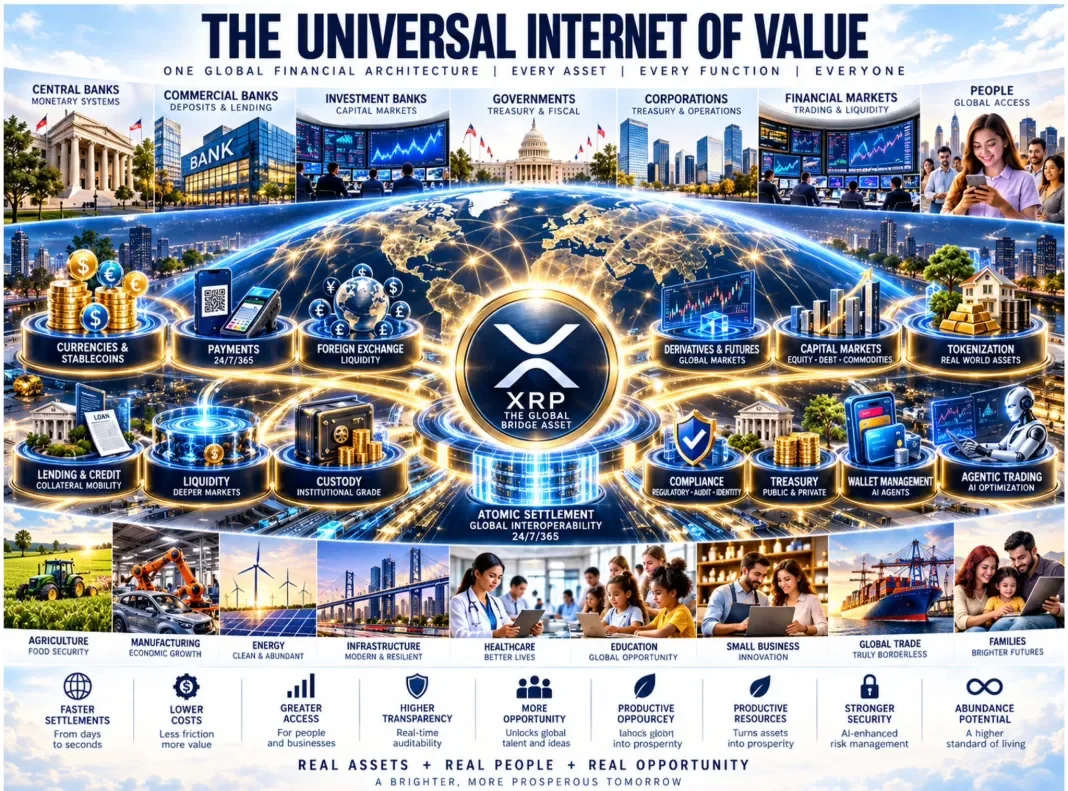
What if banking, currencies, stablecoins, stocks, bonds, commodities, derivatives, collateral, lending, custody, liquidity, tokenization and global settlement were becoming interconnected components of ONE intelligent, 24/7/365 financial architecture?
What if AI could make trillions in previously constrained capital more productive?
What if the world’s greatest problem isn’t a shortage of wealth – but the costly, fragmented, opaque systems controlling access to it?
And what if ONE non-sovereign native bridge asset could become the connective tissue of this extraordinary new Internet of Value Platform?
Now ask yourself the BIG question:
What happens to human prosperity when the world’s REAL assets, REAL people and REAL opportunities become financially connected at the speed of information?
Are we witnessing another financial technology upgrade?
Or the early emergence of an entirely new operating system for human civilization?
I explore this breathtaking possibility through a KUWL Quantum Imagination thought experiment.
It’s about what becomes possible for ALL humanity.
Read/Share My Full Article on SubStack:
[https://robcunningham.substack.com/p/quantum-imagination]
Source(s):
• https://x.com/KuwlShow/status/2110202353647305091
Scott Bessent, Gold & The Iraqi Dinar… Is Something BIG Coming?
Scott Bessent, Gold & The Iraqi Dinar… Is Something BIG Coming?
The Dinar Den: 10-13-2026
The global financial landscape is currently undergoing a period of significant transformation as policymakers and economists reconsider the foundations of modern monetary systems.
Recent discussions, such as those featured on The Dinar Den hosted by Stephen, suggest that we may be approaching a global financial reset.
Scott Bessent, Gold & The Iraqi Dinar… Is Something BIG Coming?
The Dinar Den: 10-13-2026
The global financial landscape is currently undergoing a period of significant transformation as policymakers and economists reconsider the foundations of modern monetary systems.
Recent discussions, such as those featured on The Dinar Den hosted by Stephen, suggest that we may be approaching a global financial reset.
This potential shift is characterized by a move toward incorporating tangible assets into monetary policy to enhance stability and credibility. Rather than a total overhaul of existing systems, these changes represent a strategic evolution intended to address the complexities of a modern, interconnected economy.
A pivotal element in this changing narrative is the recent appointment of Judy Shelton to the advisory circle of U.S. Treasury Secretary Scott Bessent.
Shelton is a well-regarded economist known for her support of gold-linked financial instruments. Her presence within the Treasury’s advisory framework signals a serious exploration of gold as a stabilizing force for the U.S. dollar.
One of her most notable proposals involves the creation of a gold-linked U.S. Treasury bond. Such a move would not necessarily represent a full return to the historical gold standard, but it would integrate hard assets into the modern fiscal framework to provide a hedge against volatility and bolster investor confidence.
This shift toward asset-backed monetary strategies has profound implications for emerging economies, particularly Iraq. As a nation with substantial oil reserves and growing monetary gold holdings, Iraq is uniquely positioned within this evolving global context.
The Iraqi government has been working diligently on internal banking modernization and fiscal reforms. These efforts are designed to align Iraq’s financial sector with international standards, making it more resilient and prepared for a global system that increasingly values sovereign resources and monetary transparency.
The discussion surrounding a potential revaluation of the Iraqi dinar is closely tied to these broader financial movements. While the prospect of a currency adjustment is a topic of great interest, it remains dependent on several critical domestic factors. Iraq’s ability to maintain low inflation, implement effective exchange rate frameworks, and foster public confidence in its banking system are essential prerequisites for any significant monetary change.
The integration of gold and other hard assets into the global consciousness only serves to highlight the importance of Iraq’s own resource-backed economic potential.
While the current developments in the financial world are undoubtedly exciting, they also require a measured and cautious approach. The transition to a system that blends modern financial governance with the stability of gold is a complex process with many variables.
Outcomes are never guaranteed, and the timing of such shifts remains uncertain. For those following these trends, it is vital to monitor policy actions and official announcements from both U.S. and Iraqi authorities to understand the true trajectory of these reforms.
As we look toward a future shaped by these evolving systems, staying informed is the most valuable tool for any observer or investor. The intertwining of sovereign resources, gold-backed initiatives, and modern banking reforms marks a new chapter in global economics.
Bruce’s Big Call Dinar Intel Tuesday Night 10-13-26
Bruce’s Big Call Dinar Intel Tuesday Night 10-13-26
Transcribed By WiserNow Emailed To Recaps (INTEL ONLY)
Welcome, everybody, to the big call tonight. It is Tuesday, October 13, and you're listening to the big call. Thanks for tuning in, everybody. Again, and we appreciate that very much.
All right. Let's dig this. Let's go into the intel segment, and I got a lot of information yesterday, primarily, and some today. And so the biggest thing we're trying to do is confirm what we're hearing from various sources of our sources.
Bruce’s Big Call Dinar Intel Tuesday Night 10-13-26
Transcribed By WiserNow Emailed To Recaps (INTEL ONLY)
Welcome, everybody, to the big call tonight. It is Tuesday, October 13, and you're listening to the big call. Thanks for tuning in, everybody. Again, and we appreciate that very much.
All right. Let's dig this. Let's go into the intel segment, and I got a lot of information yesterday, primarily, and some today. And so the biggest thing we're trying to do is confirm what we're hearing from various sources of our sources.
Okay, so let's start first of all. Let's talk about Iraq first. Now, Iraq was told by President Trump. In fact, Prime Minister, let me get his name right. Zaidi, I believe it is Z A I D I, Zaidi. Prime Minister Zaidi. Met with President Trump last Thursday, and then Prime Minister Zaidi went up to the UN on Friday to New York, but he did meet with our president on Thursday.
Now I'm sure they discussed several things, but I'm sure one of which was okay. You guys redeceive your government. He told them to defeat their government in Iraq Yesterday and today, in other words, Monday or Monday Tuesday.
I don't know if we still have the parliament. I know we have a cabinet. I don't know if they still have a parliament or not. But I know they began seating, and we have heard that they seated yesterday. Now, can I confirm it from Iraq? We're trying. I'm so ready.
Our sources in Iraq have not gotten back to us about that, but we'll see how that goes. I believe they did, and if they didn't get it done yesterday, I believe they probably got it done by today.
Now, this is something President Trump asked him to do. Let's see if they did it.. The other thing we need on every new rate to show up for the Iraqi dinar, and we anticipated being published in the Gazette, their official government newspaper, and they typically print the Gazette because they have an online version too. But the printable version comes out Wednesday and Saturday
I'm thinking they could have that new rate ready to go in tomorrow's gazette, and as I've heard from some of our sources, once we have that new rate, we're into the races.
Okay. Now, what else is going on that's in conjunction with Iraq is we have heard that the International Monetary Fund, which I believe has some new people in it, the IMF has asked and given an okay for Vietnam to revalue the Vietnamese dong.
Hey, now. Why is everything we're waiting for seemingly contingent upon Iraq and Vietnam? The reason is because those two countries were the first to declare their currencies as gold backed.
Now we say asset backed, but in some cases the asset is gold itself. In our case, we have a large percentage of our U.S. N currency gold backed. It could also be backed by oil, by natural gas, by intellectual property, gems, obviously precious metals like gold, silver, platinum, radium, etc. Copper is very much more valuable than it used to be.
The reason that I bring up Vietnam is because those two countries probably need to come out at approximately the same time. Iraq theoretically would come out first, but it might be more of a simultaneous type of them.
Where Iraq and Vietnam both announce a revalued currency. And what about the rest of them too? We've got about how many currencies were we up to? 42 to 51 currencies that are going to revalue upwards for us. I mean, it's a lot.
So there are a lot that have to be on the screen now. Bondholders are something that is supposed to go right barely ahead of us getting our numbers.
When I say go, make sure that they'll have their funds in their account, and then they'll have coordinates where they can log in with the right codes and get into their accounts to see their amount that they have in their balance, and then they'll get an email around the time we either get our numbers or go to exchange. They'll get access to funds.
They want them to not have an unfair advantage over us in 4B and go ahead of us. I think everybody's going to have access to funds at approximately the same time. That was their hope to use what's called in golf a true shotgun start, where everybody lines up all throughout the golf course, holds one to 18, and when the gun goes off, everybody tees off at the same time on their respective hole.
That's what a shotgun start is. So they're used. They've used that term with us before. We've heard the term modified shotgun start, where instead of being identically starting at the same time, one gets a slight advantage to go first before the other.
All right. What about the admirals group out in Reno? Now we understand that there were multiple groups, but the terminology that they are using is different batches of the admiral's group batches, and so these batches are numbered, and people that are in the admiral's group probably already have received some information about it.
But the interesting thing to me is that some of them that I've talked to have heard that they will be asked to come in to Reno for information and one-on-one, possibly one-on-one training About banking, about probably setting up their quantum accounts. I'm sure that'll be part of it.
They want to see some of these people in person again, and to make sure that they have the right frame of mind for humanitarian projects and so on, and they also will bring them up to speed with attorneys to talk about trusts and so on.
And they may be meeting one on one with these people, or it might be in a group setting. I'm not quite sure how they'll do it, and if it is, understand there are three separate factions within the admiral's group that may go at slightly different times.
So if you're in the admiral's group and you have other ZIM or currency that you did not pony up 8 -10, 12 -15, years ago with the admiral, you should use the toll-free number that Wells gives us in an email, or that I put out with Bob's help on the website to call and set your appointment to for the Redemption Center,
Even if you have ponyed up currency to the Admiral's group already. I would say it would be wise to use the 800 number to set your appointment for your other currency exempt.
And one reason I say that is because that way you'll have your quantum account already set up, so that when you're called to go in to get the benefit of the group in in Reno, then you already have your quantum card.
You've already got your basic account set up. Everything's rolling, and this is just to finish up whatever you put in with the admiral years and years ago. A lot of people did.
So let's see where else we can go from there, guys. I have been over the process of this a lot, many times. I don't think you guys need a whole lot there. I just think it's really coming down to the point where this could go. This could go at any time now. This could go any day now.
Maybe it's not Thursday. Maybe it's the weekend. But whenever it is, we're very, very close. I don't know of anything else. I'm going to say other than Iraq putting a raid out on the forex and in their gazettes.
I think when we get those two things, and I'm sure Iraq. I'm sure that Vietnam will do similar things with their currency because if they have in fact been cleared by the IMF to do this, then they'll be right there with them, with Iraq, and I'm sure the rest of the countries that we hold their currency will do similar things.
There's a lot going on elsewise in the world, and I'm going to say this: we are three weeks away from the so-called midterm election day, which is Tuesday, November 3.
Now, I've been told from several sources we're going to have a pause in the midterms. I cannot absolutely say unequivocally that that is the case. They may have those elections. I would like everybody to think really hard about what is going to happen after those midterms, the Republicans need our vote. Wherever state you're in, I don't care where it is.
President Trump was doing a rally at the time of the big call. He started speaking at 7:25 p.m. Central Time tonight, an hour after he was theoretically going to be there and speak.
But you know how these rallies go; they have other people that bring in, and then they bring the president on, and that's what they did. And I caught a little bit of it at that time, but I think that was a really good rally that he did, probably in Alaska,
Everything that we're going to do to rebuild America and rebuild the countries internationally that need help-that is all going to be beneficial for our country, and I can't wait to get started with it, and we will. So, is there anything else? Is there anything else I forgot? I don't think so.
I think that's really about everything that I can think of right now. But what about Thursday? Two days away. Will we have numbers? Quite possibly, we will. Will we will we be exchanging? I hope so. But I'm going to say it this way:
We're going to have a call. Maybe it'll be a celebration call. But we will have a call Thursday night at the regular time. And so tune in. Let's see what happens between now and then.
And we do. We will put our 800 number if we're allowed to, which I believe we will be, on the landing page of the website, bigcalluniverse.com, and then of course we will send out an email to everybody that registered that wants the email with the 800 number, okay, we'll send that out as soon as we can, as soon as we get the number and can verify it that it's the real McCoy.
All right, so be prepared for that. I would say do what Sue said to do and get be thinking at least 15 minutes a day, and be doing some things for your projects. Be prepared for this. You know, I've been in this 21 years, invested 21 years, big call 15 years, and it's gonna.
I don't think it's gonna hit me like a ton of bricks, but I think even I will be a little bit surprised when we see this, and I'm looking forward to it, and have been for years and years, and we're about to see it.
We're about to receive it, so I'm going to leave that leave it with you in that regard, and let's go ahead and thank Sue for doing a wonderful job with the teaching and commentary, and her segment, and the pod, and everything handling prayer and praise time with us. Thank you, Bob, for handling the music, leading into the call, and your segment on nutrition and everything that we can do, and I want to thank everybody who's kind of behind the scenes, and everybody in Big Hall Universe, thank you for all of you out there, all over the world.
We had a number about a month ago, or maybe a little more, that we were reaching 22 and a half million people in God knows how many countries, quite a few. So we're going to just continue to be here for you and give you the information as I get it, unadulterated, not changed, just giving you what I'm hearing.
And let's go ahead and believe for this happening this week. So that's what we're going to pray. And I thank everybody for listening.
Well, everybody have a great night. We'll look forward to talking to you Thursday night. Let's keep an eye on emails and see if they come in. Okay. God bless you guys. Take care, and we'll see you Thursday.
Bruce’s Big Call Dinar Intel Tuesday Night 10-13-26 REPLAY LINK Intel Begins 1:17:00
Bruce’s Big Call Dinar Intel Thursday Night 10-8-26 REPLAY LINK Intel Begins 1:04:44
Bruce’s Big Call Dinar Intel Tuesday Night 10-6-26 REPLAY LINK Intel Begins 1:31:31
Bruce’s Big Call Dinar Intel Thursday Night 10-1-26 REPLAY LINK Intel Begins 1:09:19
Bruce’s Big Call Dinar Intel Tuesday Night 9-29-26 REPLAY LINK Intel Begins 59:00
Bruce’s Big Call Dinar Intel Thursday Night 9-24-26 REPLAY LINK Intel Begins 1:09:09
Bruce’s Big Call Dinar Intel Tuesday Night 9-22-26 REPLAY LINK Intel Begins 1:07:07
Bruce’s Big Call Dinar Intel Thursday Night 9-17-26 REPLAY LINK Intel Begins 1:04:00
Bruce’s Big Call Dinar Intel Tuesday Night 9-15-26 REPLAY LINK Intel Begins 1:22:40
Bruce’s Big Call Dinar Intel Thursday Night 9-10-26 REPLAY LINK Intel Begins 1:04:00
Wed. Iraq News Posted by Tishwash at TNT 10-14-2026
TNT:
Tishwash: The Association of Private Banks reveals three pillars for banking reform.
The Association of Private Banks revealed on Monday three pillars of banking reform, noting that the banking reform plan is reviewed every six months.
The association’s executive director, Ali Tariq, told the Iraqi News Agency (INA): “The Central Bank has launched a central reform plan for 2025-2027, and this plan concerns private banks, which must implement it on several axes, including governance, the work plan, financial indicators, in addition to compliance and combating money laundering.”
TNT:
Tishwash: The Association of Private Banks reveals three pillars for banking reform.
The Association of Private Banks revealed on Monday three pillars of banking reform, noting that the banking reform plan is reviewed every six months.
The association’s executive director, Ali Tariq, told the Iraqi News Agency (INA): “The Central Bank has launched a central reform plan for 2025-2027, and this plan concerns private banks, which must implement it on several axes, including governance, the work plan, financial indicators, in addition to compliance and combating money laundering.”
He added that "the banks are working on this plan and reviewing it every six months, with the aim of all banks implementing it," indicating that "there are paths to reform, whether reform individually, mergers, or outside the market."
He added that "the banking reform plan is a large plan with many requirements that private banks must fulfill within the set timeframe." link
*************
Tishwash: Al-Fariji: Raising the value of the dollar against the dinar does not represent financial reform.
Crisis expert Ali al-Fariji criticized the government's move to raise the value of the dollar against the dinar, pointing out that this decision does not constitute financial reform in itself.
Al-Fariji told Al-Maalouma, "Raising the exchange rate may provide quick liquidity, but it does not represent financial reform in itself. True reform lies in building a diversified revenue system, recovering funds and assets, reducing waste, and shifting the economy away from dependence on oil and the dollar's revaluation towards a financial management that measures results and creates real and sustainable revenues."
He added, "The 19.2 trillion dinars expected from the dollar's revaluation should be viewed as an approximate total book revenue, not a net gain for the treasury, because part of its impact may rebound on the state itself in the form of increased spending and import costs."
He explained that "maximizing revenues requires recovering Iraqi funds and assets, and establishing a specialized institutional framework to track and recover funds and assets proven to have been illegally transferred after 2003. This also necessitates reassessing files related to the funds and assets of the former Iraqi state. What is needed here is not political rhetoric, but a unified database of assets, verification of their ownership, tracing of their financial flows, and activating legal and international mechanisms to recover or freeze them through laws and agreements. link
************
Tishwash: The IMF commends the Iraqi government's efforts in adopting a path of economic and financial reforms.
Finance Minister Faleh Sari announced on Wednesday a commitment to financial reforms and strengthening the role of the private sector in Iraq, while the International Monetary Fund praised the Iraqi government's efforts in adopting a path of economic and financial reforms.
A statement from the Ministry, received by the Iraqi News Agency (INA), stated that "the Minister of Finance, Faleh Sari, participated in the annual meetings of the International Monetary Fund and the World Bank Group, currently being held in the Thai capital, Bangkok, as part of strengthening cooperation with international financial institutions and supporting the path of economic and financial reform in Iraq."
He added that "the Minister of Finance held a series of meetings with officials of the International Monetary Fund, beginning with a meeting with the Fund's Executive Director for Iraq and the region, Mohamed Maait, and the incoming Executive Director, Ali Al-Hosni, in the presence of the Governor of the Central Bank of Iraq, Nizar Nasser Hussein, where the economic and financial conditions in Iraq were discussed, and views were exchanged on reform priorities and ways to enhance joint cooperation."
He added that "Finance Minister Faleh Sari met with the Regional Director of the Technical Assistance Department at the International Monetary Fund, Ali Abbas, to discuss areas of technical cooperation and prospects for benefiting from the Fund's expertise in developing financial and economic policies in Iraq."
During his meetings, the minister stressed "the importance of the partnership with the International Monetary Fund in supporting reform efforts and enhancing their chances of success, expressing his confidence in the possibility of completing financial reforms within the next two years."
Speaking about the current economic challenges, he pointed to the "repercussions of the Strait of Hormuz crisis and its impact on the Iraqi economy," explaining that "the government is working on preparing immediate remedies and future solutions to contain its repercussions."
The Minister of Finance revealed "a genuine trend to support the private sector and alleviate the pressures it faces, thereby strengthening its role in the market economy and contributing to expanding investment opportunities."
For their part, IMF officials praised the Iraqi government's efforts in adopting a path of economic and financial reforms, stressing the Fund's commitment to continuing to support Iraq and employing its expertise and capabilities to enhance these efforts and ensure their success. link
************
Tishwash: Masrour Barzani and the US Consul discuss expanding investments in Kurdistan
On Tuesday, Kurdistan Regional Government Prime Minister Masrour Barzani emphasized strengthening the bonds of friendship and strategic partnership between the region and the United States, enhancing trade exchange, and expanding the prospects for American companies' investments in Kurdistan.
This came according to a statement from the Presidency of the Regional Government, received by Shafaq News Agency, during Barzani’s reception of the US Consul General to the region, Gwendolyn Wendy Green, this afternoon, in a meeting that witnessed discussions on developments in the general situation in the Kurdistan Region, Iraq and the region.
The statement noted that the two sides agreed on the importance of maintaining the security and stability of the Kurdistan Region, and stressed the need to activate the Kurdistan Parliament as a fundamental step to proceed with forming the new cabinet of the regional government.
He explained that the two sides discussed the course of relations between the Kurdistan Region and the federal government, where the importance of resolving contentious issues was emphasized based on the constitution, while stressing the need to respect the constitutional entity of the region, preserve its financial entitlements, and allocate its share of the federal general budget on fair grounds. link
************
Tishwash: Fuad Hussein in Rome: Official meetings and discussions on relations with the Vatican
Foreign Minister Fuad Hussein began an official visit to Rome in preparation for the opening of the new building of the Iraqi embassy. The visit includes official meetings with Vatican officials to discuss issues of common interest and strengthen relations between the two sides.
The ministry said in a statement that “Foreign Minister Fuad Hussein arrived in the Italian capital, Rome, at the start of an official visit to the Vatican City State, during which he will inaugurate the new building of the Embassy of the Republic of Iraq to the Holy See.”
The statement added, “During the visit, the minister will hold a number of official meetings with officials in the Holy See to discuss issues of common interest and ways to strengthen relations between the Republic of Iraq and the Holy See.” link
************
Tishwash: The Minister of Trade discusses prospects for joint cooperation with Chinese companies.
Minister of Trade Mustafa Nizar Al-Ani met today with a delegation of Chinese companies specializing in investment, banking and trade to discuss prospects for joint cooperation and review the opportunities available to develop economic and investment partnerships between the two sides.
A statement from the ministry, which was reviewed by (Shafaqna Iraq), stated that “the meeting witnessed the Chinese delegation presenting a set of visions, proposals and projects related to investment , developing the work environment and strengthening the partnership, which contributes to opening new horizons for cooperation and exchange of experiences, and benefiting from the capabilities available to both sides in supporting economic and commercial activity.”
The Minister of Trade pointed out that “the meeting emphasized the importance of strengthening communication with international investment companies and institutions, and creating appropriate opportunities to establish effective partnerships that contribute to supporting economic development and developing the commercial and banking sectors, in line with the Iraqi government’s directions to attract investments and enhance economic cooperation with various countries of the world.” link
BOND MARKET CRISIS: Is the U.S. Secretly Preparing for a Gold Reset? | Andy Schectman
BOND MARKET CRISIS: Is the U.S. Secretly Preparing for a Gold Reset? | Andy Schectman
Liberty and Finance: 10-13-2026
America added more than $2.3 trillion in debt in a single fiscal year, while annual interest payments have climbed to $1.1 trillion.
Andy Schectman warns that rising Treasury yields could trigger a chain reaction across stocks, banks, pensions, and real estate.
BOND MARKET CRISIS: Is the U.S. Secretly Preparing for a Gold Reset? | Andy Schectman
Liberty and Finance: 10-13-2026
America added more than $2.3 trillion in debt in a single fiscal year, while annual interest payments have climbed to $1.1 trillion.
Andy Schectman warns that rising Treasury yields could trigger a chain reaction across stocks, banks, pensions, and real estate.
Meanwhile, central banks and major institutions continue accumulating gold as questions mount about the future of the dollar.
Schectman raises the possibility that the Treasury could be accumulating gold and silver indirectly, while Judy Shelton’s appointment adds fresh intrigue to the prospect of monetary reform.
Could the bond market crisis force Washington to consider a radical change to the monetary system?
Schectman suggests that her influence could signal a potential shift toward more traditional monetary principles, possibly involving a return to assets that provide a more stable foundation for the currency.
Given Shelton’s history of advocating for sound money and her interest in the role of gold within the financial system, her presence in high-level discussions may point toward upcoming attempts at stabilizing the dollar amidst ongoing fiscal instability.
This potential for reform highlights the urgency with which policymakers are viewing the current debt crisis.
Ultimately, the insights shared by Andy Schectman emphasize that the current economic climate is one of transition and high stakes. Between the unsustainable path of national debt and the strategic maneuvering of international powers, the importance of hard assets has rarely been more evident.
INTERVIEW TIMELINE:
0:00 Intro
1:51 Bond market crisis
12:02 Who's buying gold?
25:40 Weekly specials
30:00 Secret gold reset?
41:50 Last thoughts