
Thank you to all the subscribers to our Early Access program…we thank you for your continued support.
We are excited to offer this new service to keep you informed and up-to-date on the latest Dinar and currency news.
China’s New Gold System Takes Aim at the Dollar
China’s New Gold System Takes Aim at the Dollar
Taylor Kenny: 10-7-2026
China is buying gold, reducing its reliance on U.S. debt, and expanding systems that could bypass the dollar. If this trend continues, the impact on inflation, retirement savings, and purchasing power could be enormous.
In a recent analysis by ITM Trading, financial experts explore how China’s persistent gold accumulation, massive infrastructure investments, and deliberate moves away from the U.S. dollar point toward preparation for a brand-new global monetary order.
China’s New Gold System Takes Aim at the Dollar
Taylor Kenny: 10-7-2026
China is buying gold, reducing its reliance on U.S. debt, and expanding systems that could bypass the dollar. If this trend continues, the impact on inflation, retirement savings, and purchasing power could be enormous.
In a recent analysis by ITM Trading, financial experts explore how China’s persistent gold accumulation, massive infrastructure investments, and deliberate moves away from the U.S. dollar point toward preparation for a brand-new global monetary order.
Rather than relying on traditional fiat currency systems, this emerging paradigm appears to be centered squarely on physical gold. Understanding these macroeconomic changes is essential for anyone looking to comprehend the future of international trade and secure their long-term financial wellbeing.
To fully grasp the significance of current events, it helps to look back at how historical shifts in monetary power typically occur. Major transitions are often driven by profound geopolitical and economic evolutions, much like the post-World War II Bretton Woods agreement.
During that pivotal era, the U.S. dollar emerged as the undisputed world reserve currency, originally backed by a fixed standard of gold. Today, however, the financial heavyweights of the East are charting a very different course. Instead of upholding the traditional Western-led framework, China is actively amassing massive reserves of physical precious metals, establishing a prominent gold exchange in Shanghai, and encouraging international trade partners to settle transactions in local currencies and gold rather than the greenback.
This multi-layered strategy involves creating a robust, physical gold-backed monetary ecosystem, complete with strategic settlement vaults located in key regions such as Saudi Arabia. Such developments directly challenge the long-standing dominance of the petrodollar and pose a serious question regarding the future reserve status of the U.S. dollar.
As more sovereign nations seek to diversify their financial reserves and move away from absolute dollar dependence, underlying risks related to U.S. national debt and domestic inflation begin to compound. Over time, these pressures could potentially degrade the purchasing power of dollar-denominated assets, making traditional savings methods increasingly vulnerable to macroeconomic instability.
Financial analysts consistently warn that as global trade dynamics evolve, the U.S. may resort to increased monetary expansion to manage its fiscal obligations, thereby exacerbating inflationary pressures. In light of these unfolding trends, holding tangible assets like physical gold is frequently highlighted as a vital safeguard against currency debasement and systemic financial volatility.
Diversifying a portfolio with precious metals allows individuals to protect their purchasing power independently of any single government’s monetary policy or banking infrastructure.
Ultimately, the transition from a purely dollar-centered global economy to a more diversified, gold-influenced financial system is expected to be gradual yet fundamentally inevitable. This monumental shift carries serious implications for international currency values, geopolitical alliances, and individual wealth preservation strategies.
CHAPTERS:
00:00 China Is Preparing for a Post-Dollar World
01:26 How Bretton Woods Made the Dollar King
03:45 Shanghai Challenges the Western Gold Market
05:10 China’s Gold Settlement Strategy for Global Trade
06:37 How Gold Could Bypass the Dollar
07:07 The Inflation Risk Facing the U.S.
08:04 Why Central Banks Want Physical Gold
10:02 What Dollar Devaluation Could Mean for Retirement
Seeds of Wisdom RV and Economics Updates Wednesday Afternoon 10-7-26
Good Afternoon Dinar Recaps,
GLOBAL DEBT RESET WATCH: IMF WARNS OF ENERGY AND DEBT SHOCK AS FED SIGNALS MORE RATE HIKES
The IMF is warning that energy costs and record public debt are threatening global growth just as new Fed minutes point toward another U.S. rate increase this year.
Good Afternoon Dinar Recaps,
GLOBAL DEBT RESET WATCH: IMF WARNS OF ENERGY AND DEBT SHOCK AS FED SIGNALS MORE RATE HIKES
The IMF is warning that energy costs and record public debt are threatening global growth just as new Fed minutes point toward another U.S. rate increase this year.
OVERVIEW
IMF Managing Director Kristalina Georgieva warned that high energy prices, record public debt and risks from the AI investment boom are threatening global growth.
New Federal Reserve minutes show that most officials expect another rate hike this year as inflation remains above the Fed’s 2% target.
Rising oil prices and government borrowing costs are creating a difficult combination: slower growth, persistent inflation and more expensive debt.
KEY DEVELOPMENTS
1. IMF Warns the Energy Shock Could Last
IMF Managing Director Kristalina Georgieva warned Wednesday that the global economy is being squeezed by a combination of high energy prices, elevated inflation and record public debt.
Brent crude remains around $100 per barrel, while disruptions to energy and LNG shipping are keeping pressure on fuel and transportation costs.
Georgieva warned that even if the conflict in the Gulf ends soon, the effects of higher energy prices could persist. The IMF's previous global growth outlook assumed that the Strait of Hormuz would gradually return toward normal conditions, making continued disruption a significant risk to that forecast.
2. Fed Minutes Signal Another Rate Hike
The afternoon release of the Federal Reserve's September meeting minutes added a new layer to the story.
The Fed raised its benchmark interest rate by 25 basis points in September, its first increase in three years. The minutes show that officials generally believed inflation remained too high and that a higher policy rate could be necessary to bring inflation back toward the central bank's 2% target.
Most officials' projections pointed toward another rate increase before the end of the year, although policymakers remain divided over how quickly additional tightening should occur.
This means the world's largest economy may be moving toward higher borrowing costs at the same time that energy prices are pushing inflation higher.
3. Record Debt Makes Higher Rates More Dangerous
The IMF says global public debt is at its highest level since World War II and is projected to exceed 100% of global GDP before 2030.
That creates a difficult environment for governments.
Higher interest rates may be necessary to contain inflation, but higher rates also increase the cost of servicing existing government debt. At the same time, higher energy costs can weaken economic growth and increase inflation.
The IMF is therefore calling for credible medium-term fiscal plans, particularly among heavily indebted advanced economies.
WHY IT MATTERS
Today's developments show how several major financial pressures are beginning to reinforce one another.
Energy prices are pushing inflation higher. Inflation is keeping interest rates higher. Higher rates increase debt-service costs. And high debt can make slower economic growth even more difficult to manage.
That combination is one of the biggest challenges facing the international financial system.
The IMF's warning is particularly important because it comes ahead of next week's IMF and World Bank meetings, where finance ministers and central bankers from 191 member countries will discuss global economic and financial stability.
WHY IT MATTERS TO FOREIGN CURRENCY HOLDERS
For foreign currency holders watching the Global Financial Reset, today's developments are a reminder that currency values are closely connected to the larger financial system.
Countries facing higher debt costs, expensive energy imports and weaker growth may need to adjust monetary, fiscal and trade policies.
That does not mean an overnight currency revaluation is guaranteed or that a specific reset date is approaching.
It does mean the financial pressures that could eventually encourage changes in international payment systems, reserves, trade relationships and currency strategies are becoming increasingly visible.
IMPLICATIONS FOR THE GLOBAL RESET
Pillar 1: Debt
Record public debt combined with higher interest rates increases the cost of maintaining existing obligations. Governments may face growing pressure to reform spending, taxation and debt-management policies.
Pillar 2: Energy
Oil around $100 per barrel creates inflationary pressure throughout the global economy. Energy-importing nations face additional pressure on trade balances and currencies.
Pillar 3: Currencies
When interest rates remain high and global investors shift capital toward higher-yielding assets, emerging-market currencies can come under pressure.
At the same time, countries may have greater incentives to diversify reserves, strengthen domestic financial markets and develop alternative settlement arrangements.
Pillar 4: Technology
The IMF also highlighted the enormous scale of the AI investment boom. AI could increase productivity and global growth, but a sharp reversal in investment or excessive valuations could create another source of financial instability.
THE BOTTOM LINE
The most important development this afternoon is that the IMF's warning about energy and debt now intersects with the Federal Reserve's signal that higher interest rates may be needed again this year.
The combination of expensive energy, rising debt-service costs, persistent inflation and tighter monetary policy creates a difficult environment for governments and central banks around the world.
For those following the Global Financial Reset, this is the kind of structural pressure worth watching—not because it guarantees an overnight reset, but because it can force countries to rethink how money, debt, trade and reserves function.
The global financial system evolves when mounting pressure makes the old ways of managing money and debt increasingly difficult to sustain.
Seeds of Wisdom Team
Newshounds News
SOURCES
Reuters — “IMF chief warns energy shock, growing debt and AI risks threaten global growth”
~~~~~~~~~~
Seeds of Wisdom Team RV Currency Facts Youtube and Rumble
Newshound's News Telegram Room Link
RV Facts with Proof Links Link
RV Updates Proof links - Facts Link
Start Here room with Most Asked Questions Link
Follow the Gold/Silver Rate COMEX
Follow Fast Facts
Seeds of Wisdom Team™ Website
Thank you Dinar Recaps
Reset Intelligence: Devalue, Delete, Revalue
Emailed to Recaps~ Thank you David
By Reset Intelligence | @EXIT_FIAT
For about a week one theory has circulated in the dinar community: Iraq lowers the IQD first, deletes the zeros, and only then raises the rate.
This morning the first step happened. Iraq's Council of Ministers approved a new rate and the Central Bank adopted it: 1,500 IQD to the dollar buying from the Finance Ministry, 1,510 selling to the banks and 1,520 selling to the public.
Emailed to Recaps~ Thank you David
By Reset Intelligence | @EXIT_FIAT
For about a week one theory has circulated in the dinar community: Iraq lowers the IQD first, deletes the zeros, and only then raises the rate.
This morning the first step happened. Iraq's Council of Ministers approved a new rate and the Central Bank adopted it: 1,500 IQD to the dollar buying from the Finance Ministry, 1,510 selling to the banks and 1,520 selling to the public.
One statement
Safaa al-Jabiri sits on parliament's economy committee. Late on Monday he said: "There is a proposal from the finance minister to adjust the official exchange rate to 150,000 dinars for every $100, but there is no final decision so far." By the next day it was a decision. In the same statement he said that changing Iraq's currency, and possibly deleting the zeros, is under serious discussion inside the Prime Minister's office and the Central Bank.
Everything else that moved
The budget - after parliament's Finance Committee met Finance Minister Faleh al-Sari, the draft's figures came out: 217 trillion IQD in spending, a 50 trillion deficit, oil at $58 a barrel and 1,500 IQD to the dollar. A committee member said the rate "is subject to change." The cabinet approved it the same day.
The oil line - an Iraqi oil expert called the budget's 4 million barrels a day of exports "impossible" while the Strait of Hormuz is shut.
The law - the Central Bank's governor said in September that new banknotes fall under the bank's own authority, while deleting zeros needs a law passed by parliament.
The street - the dollar closed Tuesday above 163,000 IQD per $100 in Baghdad, before the decision. The bank's price to the banks moves from 131,000 to 151,000.
The weapons - Prime Minister Ali al-Zaidi told tribal sheikhs that 5 armed factions have agreed to hand over their weapons and 3 already have.
Tehran - Trump said "nobody knows" who is running Iran. A tanker was hit in the Strait of Hormuz and Oman evacuated 10 of its crew.
The question
Is the step down the first move of a bigger plan, or only a finance ministry short of cash? Nothing in the decision mentions the zeros or a higher rate to follow.
That is the short version. Why a government would lower its currency before changing it, what would have to follow, and how to tell the two stories apart - that is the daily read.
Read the full daily briefing free for 5 days. Sign up here: the daily Iraqi dinar briefing
Want it straight from the horse's mouth? The CBI Rate Alert pings you the moment the Central Bank of Iraq moves the official rate. The number itself, not a rumour about it. It comes with our free resource library and the daily breakdown of what is actually moving in Iraq. Sign up free: The CBI Rate Alert
Got a dinar question? Reset Intelligence runs an on-call research assistant: ask it anything they have published. It answers in seconds and will conduct deep research to find you the answer. Try it: the Iraqi dinar research assistant
Common questions, answered straight: When will the Iraqi dinar revalue? and Is the Iraqi dinar revaluation real?
The design behind all of it is mapped in Head of the Snake, and the free guides live in the Iraqi dinar resource library.
Follow the daily intel free: Telegram · Facebook · Spotify · Odysee
Iraq Economic News and Points To Ponder Wednesday Morning 10-7-26
Iraq’s 2027 Budget Draft Sets 217T Dinar Spending
2026-10-06 / 05:08 Shafaq News- Baghdad Iraq’s draft 2027 federal budget totals 217 trillion dinars ($164.9B), with a projected deficit of 50 trillion dinars ($38B), parliamentary Finance Committee member Abbas Hayal told Shafaq News on Tuesday.
Hayal said the figures were discussed during the committee’s meeting with Finance Minister Faleh Al-Sari on the draft budget, which sets oil at $58 per barrel, assumes exports of four million barrels per day, and sets the exchange rate at 1,500 dinars per US dollar.
Iraq’s 2027 Budget Draft Sets 217T Dinar Spending
2026-10-06 / 05:08 Shafaq News- Baghdad Iraq’s draft 2027 federal budget totals 217 trillion dinars ($164.9B), with a projected deficit of 50 trillion dinars ($38B), parliamentary Finance Committee member Abbas Hayal told Shafaq News on Tuesday.
Hayal said the figures were discussed during the committee’s meeting with Finance Minister Faleh Al-Sari on the draft budget, which sets oil at $58 per barrel, assumes exports of four million barrels per day, and sets the exchange rate at 1,500 dinars per US dollar.
The proposal also provides for moving contract and daily-wage workers onto permanent payrolls and creating 100,000 contract positions, half of them allocated to ministries and security institutions.
The 100,000 contract positions are expected to be distributed among Iraq’s provinces according to population, with many earmarked for graduates from earlier cohorts who have remained without public-sector employment.
In a statement, the Finance Committee said the meeting also addressed the distribution of spending between line-item and program- and performance-based budgeting, alongside efforts to diversify state revenues, reduce reliance on oil and contain the deficit.
The meeting followed criticism from the Finance Committee that the Finance Ministry had prepared and advanced the draft without sufficient consultation with parliament.
In September, Iraq’s Ministerial Council for the Economy approved the draft 2027 federal budget and referred it to the Council of Ministers. Under Iraq’s Finance Administration Law, the draft is due to be submitted to parliament by October 15.
Iraq had adopted a three-year budget covering 2023–2025 under former Prime Minister Mohammed Shia Al-Sudani, but parliament did not approve the 2025 spending schedules before the fiscal year ended, and no federal budget law was passed for 2026.
Read more: $45B deficit looms over Iraq’s draft 2027 budget
https://www.shafaq.com/en/Economy/Iraq-s-2027-budget-draft-sets-217T-dinar-spending
"Is The Government Paying For The Deficit From The Citizen's Pocket?"... Ziad Al-Hashemi: Devaluing The Dinar Postpones Reform And Does Not Address Inflation And Waste
Baghdad - One News - 10/06/2026 Economic expert Ziad Al-Hashemi warned of the repercussions of resorting to changing the exchange rate of the dinar as one of the options for dealing with the financial pressures reflected in the 2027 draft budget, considering that reducing the value of the currency, if adopted, would burden citizens with part of the cost of the financial imbalances instead of addressing their root causes.
Al-Hashemi said in a post published on his account on the “X” platform that the details of the proposed budget and the accompanying talk about the exchange rate indicate, according to his reading, that the government is facing an “uncomfortable” financial situation, given the continued high levels of spending and waste compared to fluctuating revenues.
He added that relying on oil revenues and continuing to borrow is no longer sufficient to cover the large and increasing public spending, considering that resorting to changing the exchange rate, if approved, would be an option to “buy time” and delay financial reform, which requires stricter measures to address the structure of spending and waste.
Al-Hashemi believed that reducing the value of the dinar was the easiest option compared to financial reform measures, but it shifts part of the cost of the crisis to the public, instead of addressing the causes of the imbalance in public finance management.
Regarding the employment file, he pointed out that the talk about providing 150,000 new jobs within the proposed budget, if true, means adding new burdens to the payroll and increasing what he described as the “job overabundance” in state institutions.
He considered that expanding employment could be acceptable if actual employees replaced “ghost employees” after auditing this file, which, according to his vision, would allow for reducing waste and corruption and providing real job opportunities without an unjustified increase in the cost of salaries.
Al-Hashemi criticized what he described as the continued mistakes of previous budgets and governments, including inflated current spending, continued waste, weak investment spending, and the absence of maximizing the "product" of non-oil revenues, along with "limited implementation of the 'program and performance plan' ".
He concluded that addressing the financial pressures requires reform that goes beyond changing the exchange rate or continuing to borrow, towards restructuring spending, reducing waste, and boosting non-oil revenues, instead of burdening citizens with part of the cost of the financial imbalance. https://1news-iq.net/هل-تدفع-الحكومة-ثمن-العجز-من-جيب-الموا/
Economic Warning Regarding Mps' Statements: They Will Increase Market And Dollar Instability In Iraq
Shafaq News - Baghdad Economic expert Abdul Rahman Al-Mashhadani predicted on Tuesday that the exchange rate of the dollar in the parallel market may exceed the 160,000 dinar mark per 100 dollars, given the continued high demand for foreign currency and conflicting statements regarding monetary policy and the exchange rate.
Al-Mashhadani explained in an interview with Shafaq News Agency that it is not surprising that the dollar exceeded the 160,000 mark, at a time when a member of the Finance Committee is stating that the exchange rate is fixed at 150,000 dinars, while another member is talking about changing the currency, and another about removing zeros, which are files that are not within the jurisdiction of the members of parliament.
He added that continuing such statements does not serve market stability, but rather increases uncertainty among citizens and those dealing in dollars, noting that the market is quickly affected by any talk related to the exchange rate or currency.
Al-Mashhadani continued, saying that the demand for the dollar remains high, especially from travelers and traders who do not want to import through the ASYCUDA system, which keeps the demand for foreign currency in place and puts additional pressure on the exchange rate in the parallel market.
MP: Restoring Autonomy Opens The Door To Demands For Compensation From Washington
Information/Special...MP Ahmed al-Moussawi affirmed on Tuesday that Iraq's full restoration of its economic, security, and political autonomy will pave the way for demanding reparations from the United States for the war, occupation, and the resulting damage inflicted on the country.
Speaking to Al-Maalouma, al-Moussawi stated, “Iraq’s restoration of its economic, security, and political autonomy will allow it to raise the issue of demanding reparations from the United States for the aggression against and occupation of Iraq,” clarifying that “this issue is contingent upon possessing an independent national decision.”
He added that "the war waged by Washington against Iraq resulted in the death and injury of thousands of Iraqis, in addition to the damage inflicted on infrastructure, the destruction of numerous state institutions and facilities, and the theft of a number of Iraqi properties and assets."
Al-Moussawi indicated that "making an official decision to demand reparations from Washington will not be easy," noting that "the matter requires a national decision and political courage from all political forces."
He pointed out that "the differing positions of the political forces, whether Sunni, Kurdish, or Christian, compared to the positions of the Shiite blocs regarding this issue may hinder progress in demanding compensation," stressing that "resolving it requires broad national consensus and a clear sovereign decision." (End of quote 25)
Seeds of Wisdom RV and Economics Updates Wednesday Morning 10-7-26
Good Morning Dinar Recaps,
INDIA RESET WATCH: RBI HIKES RATES AS RUPEE NEARS RECORD LOW
India’s central bank has begun tightening policy again, but the rupee’s continued weakness shows how powerful global energy, capital-flow and dollar pressures have become.
Good Morning Dinar Recaps,
INDIA RESET WATCH: RBI HIKES RATES AS RUPEE NEARS RECORD LOW
India’s central bank has begun tightening policy again, but the rupee’s continued weakness shows how powerful global energy, capital-flow and dollar pressures have become.
OVERVIEW
The Reserve Bank of India raised its benchmark repo rate 25 basis points to 5.5%, the first increase in nearly four years.
The rupee nevertheless fell near its record low, reaching 96.8450 per U.S. dollar before closing around 96.78.
The move highlights a larger global financial challenge: higher interest rates alone may not be enough to protect currencies when energy costs, capital flows and global bond yields are working in the opposite direction.
KEY DEVELOPMENTS
1. RBI Raises Rates for the First Time Since 2023
The Reserve Bank of India (RBI) unanimously raised its policy repo rate by 25 basis points to 5.5%, marking its first rate increase in nearly four years.
The central bank also changed its policy stance from “neutral” to “calibrated tightening,” signaling that additional increases remain possible if inflation pressures continue.
India’s consumer inflation rose to 4.82% in August, above the RBI’s 4% medium-term target for a third consecutive month. At the same time, the economy remains strong, with April-June GDP growth reaching 7.8%.
The combination gives the RBI more room to tighten policy while attempting to contain inflation.
2. The Rupee Falls Despite the Rate Hike
The surprising part of the announcement came from the currency market.
Rather than strengthening significantly after the rate increase, the rupee fell to 96.8450 per dollar, only a fraction away from its record low of 96.96 reached in May.
The currency ultimately closed about 0.4% lower at 96.7750, demonstrating that investors were looking beyond the RBI’s decision and focusing on broader pressures affecting the currency.
Those pressures include foreign portfolio outflows, elevated oil prices, rising global bond yields and a stronger U.S. dollar.
3. India Is Facing a Global Currency Problem, Not Just a Domestic One
The RBI’s decision illustrates an important distinction in today's financial system: a central bank can raise interest rates and still struggle to support its currency.
India is heavily dependent on imported energy, making higher oil prices particularly important. When energy costs rise, India must spend more on imports, putting additional pressure on its external accounts and currency.
At the same time, higher U.S. Treasury yields can make dollar-denominated assets more attractive to international investors, encouraging capital to move away from emerging markets.
The result is a difficult policy balancing act—India must fight inflation without placing excessive pressure on economic growth while also trying to stabilize its currency.
WHY IT MATTERS
India is one of the world's major emerging economies, and its currency pressures provide a window into the larger stresses developing across global finance.
The rupee's weakness shows that currency values are increasingly being influenced by forces that cross national borders—energy prices, international capital flows, interest-rate differentials, geopolitical risk and global bond markets.
This is important for the emerging global financial system because countries are becoming increasingly sensitive to financial conditions created outside their own borders.
WHY IT MATTERS TO FOREIGN CURRENCY HOLDERS
For foreign currency holders following the Global Financial Reset, India's experience offers an important lesson: currency stability is built on economic fundamentals, trade strength, monetary policy and international confidence—not simply on a central-bank announcement.
A weaker rupee does not mean a currency revaluation is imminent, nor does it prove that a global reset is occurring on a particular timetable.
What it does demonstrate is that countries are actively adjusting monetary policy and financial strategies as the existing international system comes under pressure from inflation, energy costs, debt and shifting capital flows.
That is the kind of structural change worth watching.
IMPLICATIONS FOR THE GLOBAL RESET
Pillar 1: Debt
Higher interest rates increase borrowing costs for households, businesses and governments. If more countries move toward tighter monetary policy, the cost of servicing existing debt can become an increasingly important issue.
Pillar 2: Trade
India's dependence on imported energy demonstrates how closely currency values are tied to global trade. A sustained increase in oil prices can weaken the currencies of major energy importers while strengthening the importance of energy-producing nations.
Pillar 3: Currency
The rupee's decline despite a rate hike demonstrates that currency strength depends on more than interest rates. Capital flows, trade balances, energy costs and confidence in the broader economy all play a role.
Pillar 4: Global Financial Architecture
As emerging economies manage greater currency and capital-flow pressures, they have stronger incentives to diversify trade relationships, strengthen domestic financial systems and develop alternative payment and settlement arrangements.
That does not mean the existing dollar-based system disappears overnight. It means the international financial architecture continues to evolve.
THE BOTTOM LINE
India's rate hike is significant because it shows the RBI responding to renewed inflation and currency pressure after years of monetary easing.
But the rupee's immediate decline toward a record low is even more revealing. It demonstrates that one country's monetary policy cannot completely shield its currency from global energy prices, capital movements, bond yields and dollar strength.
For those watching the Global Financial Reset, the important development is not a promise of an overnight currency transformation. It is the continuing restructuring of the economic conditions that determine how currencies function and how nations manage their place in global finance.
The global financial system is not being rebuilt in one dramatic moment—it is evolving through the pressure points where currencies, trade, debt and monetary policy meet.
Seeds of Wisdom Team
Newshounds News
SOURCES
Reuters — “Rupee nears record low despite RBI hike, governor says markets can be irrational”
Financial Times — “India raises interest rates for first time in 3 years”
~~~~~~~~~~
🌱 A Message to Our Currency Holders🌱
If you’ve been holding foreign currency for many years, you were not foolish.
You were not wrong to believe the global financial system would change.
What failed was not your patience — it was the information you were given.
For years, dates, rumors, and personalities replaced facts, structure, and proof. “This week” predictions created cycles of hope and disappointment that were never based on how currencies actually change.
That is not your failure.
Our mission here is different: • No dates • No rates • No hype • No gurus
Instead, we focus on:
• Verifiable developments • Institutional evidence
• Global financial structure • Where countries actually sit in the process
Currency value changes only come after sovereignty, trade, banking, settlement systems, and fiscal coordination are in place. History and institutions confirm this sequence.
You will see silence. You will see denials. That is not delay — that is discipline.
Protect your identity. Organize your documents. Verify everything.
Never hand your discernment to anyone who cannot show proof.
You deserve truth — not timelines.
Seeds of Wisdom Team
Newshounds News
~~~~~~~~~~
Seeds of Wisdom Team RV Currency Facts Youtube and Rumble
Newshound's News Telegram Room Link
RV Facts with Proof Links Link
RV Updates Proof links - Facts Link
Start Here room with Most Asked Questions Link
Follow the Gold/Silver Rate COMEX
Follow Fast Facts
Seeds of Wisdom Team™ Website
Thank you Dinar Recaps
How Wars And Geopolitical Conflicts Can Affect Stock Market Performance
How Wars And Geopolitical Conflicts Can Affect Stock Market Performance: What History Shows And How Investors Can Prepare For Volatility
Sep 29, 2026 Sergei Klebnikov Editorial Staff, J.P. Morgan Wealth Management
Geopolitical conflicts can drive short-term market volatility, but history shows the initial sell-off is often more about uncertainty than a lasting change in long-term returns.
The biggest risk to watch is whether the conflict disrupts critical supply chains in ways that spill into inflation, financial conditions, corporate earnings and broader economic growth – energy is one common channel, but not the only one.
How Wars And Geopolitical Conflicts Can Affect Stock Market Performance: What History Shows And How Investors Can Prepare For Volatility
Sep 29, 2026 Sergei Klebnikov Editorial Staff, J.P. Morgan Wealth Management
Geopolitical conflicts can drive short-term market volatility, but history shows the initial sell-off is often more about uncertainty than a lasting change in long-term returns.
The biggest risk to watch is whether the conflict disrupts critical supply chains in ways that spill into inflation, financial conditions, corporate earnings and broader economic growth – energy is one common channel, but not the only one.
What investors can do: Anchor decisions to your plan (time horizon and cash needs), stay diversified, rebalance with discipline and avoid headline-driven moves like panic selling.
When war dominates the headlines, it’s easy to assume stocks should fall in a straight line. But history suggests the first sell-off is often driven more by uncertainty than by a permanent shift in long-term returns – meaning markets can reprice risk quickly, sometimes before the story is fully clear.
In reality, market declines tied to geopolitics are often driven less by headlines themselves and more by what the event could mean for the economy: whether critical supply chains are disrupted, how that pressure feeds into inflation, and what it implies for interest rates, corporate earnings and overall growth.
When supply disruptions raise costs, the impact can show up not only in company margins but also in household purchasing power and consumption, which ultimately matters for earnings.
Every conflict is different, outcomes are uncertain and markets can remain volatile as events unfold. A useful way to frame geopolitical risk is as a set of potential supply and demand shocks – for example, disruptions to energy, shipping lanes, industrial inputs or technology chokepoints – and then to ask how those shocks transmit through inflation, financial conditions, earnings and growth.
History can be a useful anchor for decision-making – not for making predictions – and may help investors distinguish short-term noise from longer-term fundamentals.
Below, we’ll cover how markets have tended to react to wars and major geopolitical events; what usually drives sustained moves beyond the initial shock; and practical steps long-term investors can take to prepare for geopolitical risk without overreacting.
How wars can move the stock market (and why reactions may vary)
War and other geopolitical shocks tend to move markets through two forces: a sudden surge in uncertainty and the economic ripple effects that follow. That’s why the initial reaction can be sharp even if the longer-term impact ends up being more muted – or simply different – than the headlines imply.
In the initial shock phase, markets may respond to the unknowns. When outcomes are unclear, investors may quickly reassess the range of possible economic paths and reprice risk.
Volatility may jump and equities may sell off. In credit markets, that repricing can show up as investors demanding more compensation to hold riskier or more directly impacted debt. That can push credit spreads wider and effectively tighten financial conditions.
As more information emerges, markets often shift into a second phase: repricing based on what the conflict may mean for the economy and policy. Reactions can diverge depending on whether the situation threatens critical supply chains (energy is one example), disrupts production inputs, alters trade routes, or meaningfully affects major economies. Policy responses can also be pivotal, from sanctions and export controls to changes in fiscal spending.
Ultimately, sustained market moves are often driven less by the event itself than by whether it changes the macro path via inflation, interest rates, corporate earnings and economic growth.
Investors may want to focus on whether geopolitical developments are transmitting through the economy and markets – especially through critical supply chains and production, economic activity and demand, inflation expectations, financial conditions, and corporate profitability.
What history shows: Wars often trigger volatility more than lasting declines
History suggests geopolitical events like wars often cause short-lived volatility, and – barring a major economic disruption – the market impact tends to fade over time. In many cases, that looks like an initial, uncertainty-driven drawdown followed by stabilization or recovery as outcomes narrow and attention returns to fundamentals like earnings, inflation and policy.
Recent episodes suggest markets have been recovering from geopolitical flare-ups more quickly: After a nearly 10% drop in the S&P 500 at the outset of the Iran conflict earlier this year, the benchmark index recovered to pre-conflict levels in just 11 trading sessions. But the more durable takeaway for portfolios is that because the shock phase is dominated by uncertainty and shifting probabilities, market leadership can rotate as the situation evolves – reinforcing why portfolios are typically better built for a range of outcomes.
One reason geopolitical-related sell-offs may prove so short-lived is that markets are forward-looking. Prices adjust quickly to reflect new probabilities – sometimes within days – so once the “shock” is incorporated, further headlines may have less impact unless they change the economic outlook in a material way.
GP Q: Same Week, Three Separate Stories
GP Q: Same Week, Three Separate Stories
10-6-2026
Same week, three separate stories.
An overview: Easy to mash them into a “reset.” They are not one.
Seoul, 3 October. XRP Asia launched at the Grand Hyatt during Korea Blockchain Week.
GP Q: Same Week, Three Separate Stories
10-6-2026
Same week, three separate stories.
An overview: Easy to mash them into a “reset.” They are not one.
Seoul, 3 October. XRP Asia launched at the Grand Hyatt during Korea Blockchain Week.
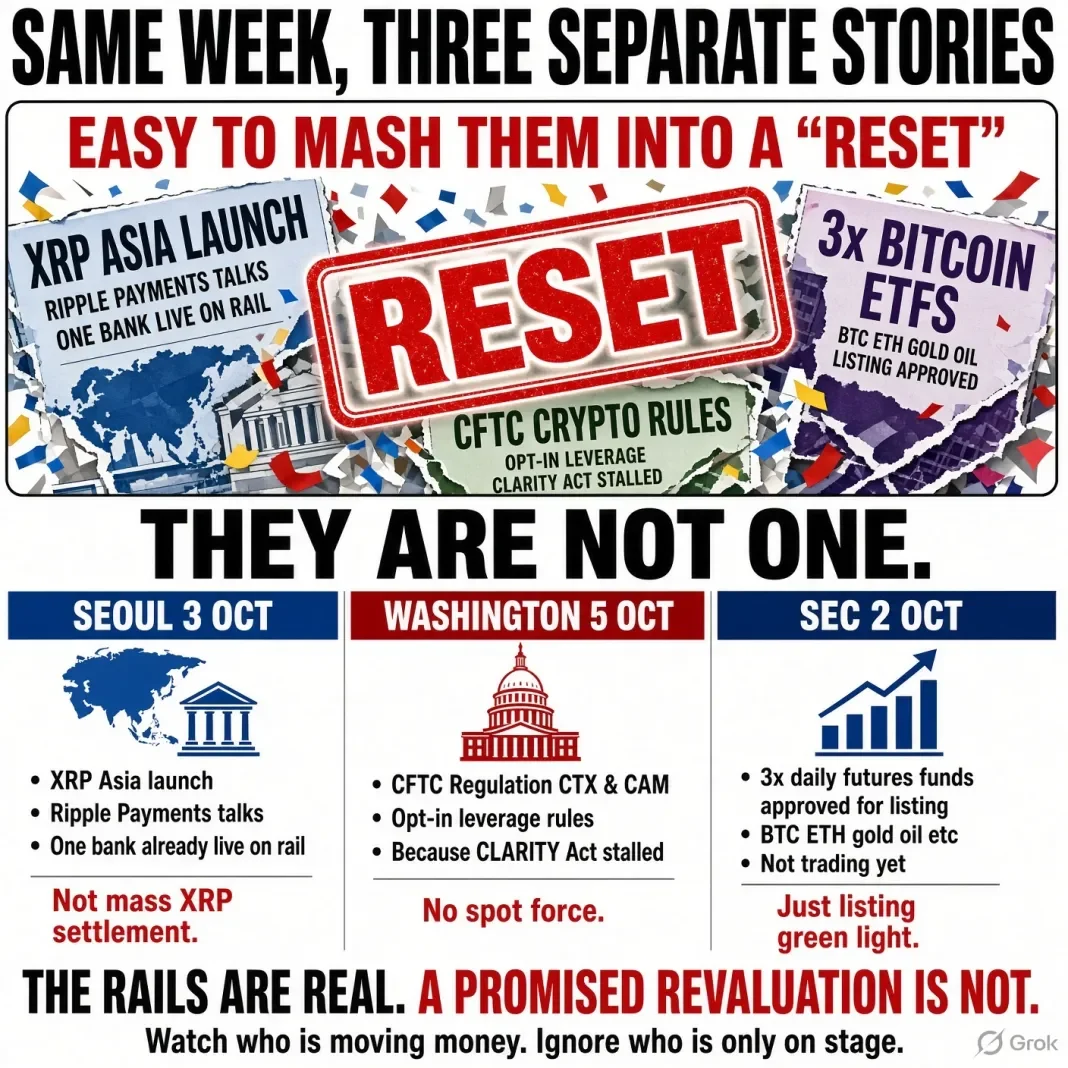
XRP Seoul, hosted by XRPL Korea with Ripple as title sponsor, pulled more than 5,000 people.
The new body is backed by Ripple and the XRP Ledger Foundation, based in Singapore, and run by Sabrina Tachdjian, who used to handle fintech and payments at the Hedera Foundation.
The brief is practical: developer education, hackathons, startup grants, and backing the existing Korea and Japan communities while building others across Asia-Pacific. Woori, KakaoBank, K Bank, Kyobo Securities, Meritz and Jeonbuk were in the room on cross-border payments and tokenized deposits. Jeonbuk already uses Ripple Payments for corporate remittances, REPLACING multi-day SWIFT windows.
That is a live rail. It is not the same as the panel signing up to settle in XRP, and neither Woori nor KakaoBank announced they had joined XRP Asia or deployed the ledger.
Washington moved because Congress didn’t.
The CLARITY Act stalled in the Senate last month, so on 5 October CFTC Chair Mike Selig put Regulation CTX and Regulation CAM out at Fordham Law.
CTX covers crypto transactions done with margin, leverage or financing. CAM is a new venue category for exchanges that want to offer that to retail under one federal setup instead of a stack of state money-transmitter licenses.
Reuters noted proof-of-reserves and anti-manipulation requirements.
No fixed leverage cap, but a leveraged product would still need CFTC staff clearance.
Selig was plain about the hole: the agency cannot force ordinary spot trading onto its platforms.
That part of CLARITY needed a law. This is an opt-in lane, written because the bill failed, and he said they would keep going with or without Congress.
The products are narrower than the headlines.
On 2 October the SEC approved Cboe BZX rule SR-CboeBZX-2026-065, Release 34-106577, so Volatility Shares can list six 3x daily funds:
Bitcoin, Ether, gold, silver, crude oil and natural gas.
Cboe filed on 10 August.
No public comments.
US crypto funds had been stuck at 2x — Volatility Shares already runs BITX and ETHU — after staff pushed back in December 2025 on anything above that, and waved off 5x filings in March.
These new ones target three times the daily move of first- and second-month futures, with cash as collateral, not coins in a vault.
Tickers floated for the crypto pair include BITH and ETHK.
They are not trading.
The registration statement still has to go effective, and the order sets no date.
Bloomberg’s Eric Balchunas called the listing a win for the issuer and a trading tool, not an investment.
Payments talks in Asia, with one bank already off SWIFT.
Rules written because the Senate bill died.
Triple-leverage futures funds one filing away from a US listing. That’s the week.
No switch flipped.
The rails are real.
A promised revaluation is not.
Watch who is moving money. Ignore who is only on stage.
Source(s):
• https://x.com/argosaki/status/2107332804086534559
https://dinarchronicles.com/2026/10/06/gp-q-same-week-three-separate-stories/
Iraq Economic News and Points To Ponder Tuesday Evening 10-6-26
Iraq Considers Raising Official Dollar Rate To 1,500 IQD And Dropping Currency Zeros
Iraq Jawad Al-Samarraie October 6, 2026 Baghdad (IraqiNews.com) – Safaa Al-Jabri, member of parliament for the Al-Sadiqoun bloc and member of the Parliamentary Economic Committee, revealed that the federal government is reviewing a proposal to adjust Iraq’s official exchange rate from 1,310 dinars to 1,500 dinars per U.S. dollar, while advancing high-level deliberations to redenominate the national currency and potentially remove zeros.
Iraq Considers Raising Official Dollar Rate To 1,500 IQD And Dropping Currency Zeros
Iraq Jawad Al-Samarraie October 6, 2026 Baghdad (IraqiNews.com) – Safaa Al-Jabri, member of parliament for the Al-Sadiqoun bloc and member of the Parliamentary Economic Committee, revealed that the federal government is reviewing a proposal to adjust Iraq’s official exchange rate from 1,310 dinars to 1,500 dinars per U.S. dollar, while advancing high-level deliberations to redenominate the national currency and potentially remove zeros.
Speaking in a televised interview, Al-Jabri projected that sovereign state revenues for the 2027 federal budget will surpass $110 billion, declaring that Iraq has successfully weathered the acute economic fallout triggered by past disruptions at the Strait of Hormuz and Basra export halts.
According to Al-Jabri, fiscal parameters for the upcoming national budget are being restructured on the back of rising non-oil customs and tax receipts, an unprecedented $8 billion to $10 billion generated from domestic petroleum sales, and projected crude oil export earnings exceeding $85 billion.
He noted that Iraqi crude sales currently benchmark around $80 to $82 per barrel, generating approximately $5 billion in monthly export revenues, providing budgetary headroom as trade bottlenecks and logistics gradually normalize.
Regarding currency and fiscal policy, Al-Jabri highlighted key government plans:
Official Exchange Rate Revision: Leaked preliminary drafts of the federal budget proposal—which carries a planned deficit between 25 and 30 trillion dinars—contain a formal submission from the Minister of Finance proposing to adjust the official statutory exchange rate to 150,000 dinars per $100 (1,500 IQD per USD). Al-Jabri noted that no binding cabinet decision has been finalized to date.
Currency Redenomination: Serious technical discussions are underway between the Prime Minister’s Office and the Central Bank of Iraq regarding currency redesign and the removal of three zeros. The measure is currently stalled only by legal jurisdictional reviews to identify the specific governing authority legally empowered to greenlight and execute the structural transition.
Critique of Past Budget Frameworks: Al-Jabri criticized previous administrations for populist fiscal practices, claiming that state budgets were prepared through rote copy-paste mechanisms for nearly twenty years under former Finance Minister Taif Sami, who had risen through the ministry ranks from director general of budget to minister.
Public Liabilities & Contract Terminations: The lawmaker highlighted structural financial arrears inherited by the treasury, including outstanding wheat procurement payouts owed to local farmers, unpaid rationing supply dues claimed by Al-Owais Company across 2025 and 2026, and 33 billion dinars in overdue liabilities tied to road and bridge construction. In response, Prime Minister Ali Faleh Al-Zaidi has canceled legacy public work contracts where execution progress remained below 20 percent.
The potential devaluation of the official dinar to 1,500 IQD per dollar represents an effort to narrow the spread with the parallel currency market—which recently traded above 160,000 dinars per $100—while curbing the planned fiscal deficit for the 2027 fiscal cycle. https://www.iraqinews.com/iraq/iraq-considers-raising-official-dollar-rate-1500-iqd-currency-zeros-2026/
Why Iraq's Dinar Keeps Sliding Despite Fresh US Cash
2026-10-06 Shafaq News- Baghdad (Updated at 16:58) The US dollar has climbed above 1,630 Iraqi dinars on Iraq's parallel market, about 21% above the official retail rate of 1,320, even as new shipments of US cash arrive to ease liquidity. Bankers and economists told Shafaq News the extra dollars alone are unlikely to close the gap while speculation, policy confusion and demand outside the banking system persist.
Iraq runs two exchange rates: an official one, at which the Central Bank of Iraq (CBI) sells dollars through banks for trade, travel and other approved needs, and a parallel street rate set by supply and demand. Traders on the parallel market quote prices per $100, and the rate passed 160,000 dinars on Monday.
Demand for dollars far exceeds supply, according to economist Ali Daadoush. He pointed to speculation and uncertainty, delays in official bank transfers, and rising demand to pay for imports from Iran. Much of the cash circulating on the parallel market, he said, starts as dollars sold at the official rate to Iraqis for travel, study and medical treatment, which are then resold locally, pushing the rate higher and making it more volatile.
Demand is also coming from travelers and from traders who prefer not to import through ASYCUDA, the electronic customs system Iraq uses to track imports, said economist Abdul Rahman al-Mashhadani, keeping steady pressure on the parallel rate.
New shipments can improve liquidity, but their effect on the parallel market depends on how quickly the dollars reach people with legitimate needs, said Nabil al-Abadi, managing director of the Union Bank of Iraq. “Narrowing the gap requires a stronger banking sector and easier access to foreign currency through official channels, so that fewer people turn to the street.”
The CBI's foreign reserves fell to $80.6 billion at the end of July 2026 from $97.4 billion at the end of 2025, a drop of about $16.8 billion, or 17.2%, in seven months, according to central bank data.
On September 19, the CBI said its reserves remained sufficient to finance foreign trade, settle bank-card payments and supply cash dollars to travelers at the official rate. It blamed the parallel market rise on speculation, market expectations and the exploitation of regional tensions.
Al-Mashhadani said that conflicting statements from members of parliament are adding to the uncertainty. “One member of parliament's finance committee has said the rate is fixed at 1,500 dinars per dollar, another has spoken of changing the currency, and a third of removing zeros from it,” he said, adding that none of these matters falls within lawmakers' powers, and with the market reacting quickly to any such talk, it was no surprise to see the dollar break 1,600.
In the Kurdistan Region, Jabar Goran, spokesman for Al-Sulaymaniyah's currency exchange market, likewise said decisions on the rate rest solely with the CBI. He warned of a backlash if the government set the rate at 1,500 dinars per dollar in the federal budget, though he did not expect it to do so. "The reaction of citizens and the market would be very negative," he told a press conference.
Expectations have become a force of their own. Fears of a stronger dollar push traders and individuals to buy in anticipation of further gains, adding to demand and widening the gap. Additional cash may ease pressure in the short term, bankers and economists say, but it is unlikely to hold the rate.
Read more: Experts: Iraq dollar gap reflects limited dollar access
https://www.shafaq.com/en/Economy/Why-Iraq-s-dinar-keeps-sliding-despite-fresh-US-cash
The Dollar Exchange Rate Set At 150,000 Dinars Per 100 Dollars For The 2027 Budget "Is Subject To Change."
Channel8 English @Channel8English Following the conclusion of the meeting between the Iraqi Finance Committee and the Minister of Finance, lawmaker and committee member Rebwar Karim told reporters that the dollar exchange rate set at 150,000 Dinars per 100 Dollars for the 2027 budget "is subject to change." https://x.com/Channel8English/status/2107414834333811063
Economic Warning Regarding Mps' Statements: They Will Increase Market And Dollar Instability In Iraq
Shafaq News - Baghdad Economic expert Abdul Rahman Al-Mashhadani predicted on Tuesday that the exchange rate of the dollar in the parallel market may exceed the 160,000 dinar mark per 100 dollars, given the continued high demand for foreign currency and conflicting statements regarding monetary policy and the exchange rate.
Al-Mashhadani explained in an interview with Shafaq News Agency that it is not surprising that the dollar exceeded the 160,000 mark, at a time when a member of the Finance Committee is stating that the exchange rate is fixed at 150,000 dinars, while another member is talking about changing the currency, and another about removing zeros, which are files that are not within the jurisdiction of the members of parliament.
He added that continuing such statements does not serve market stability, but rather increases uncertainty among citizens and those dealing in dollars, noting that the market is quickly affected by any talk related to the exchange rate or currency.
Al-Mashhadani continued, saying that the demand for the dollar remains high, especially from travelers and traders who do not want to import through the ASYCUDA system, which keeps the demand for foreign currency in place and puts additional pressure on the exchange rate in the parallel market.
Leaks Are Confusing The Market... Al-Khafaji Warns Against The Chaos Of Talk About Changing The Exchange Rate: Where Is The Dollar Headed?
October 6, 2026Last updated: October 6, 2026 The Independent/- The escalating controversy over the possibility of changing the dollar exchange rate has reopened one of the most sensitive economic files in Iraq, amid warnings that continued leaks and unofficial statements could push markets into further turmoil, even before any governmental or monetary decision is issued on the matter.
MP Mohammed Al-Khafaji warned of the repercussions of the repeated talk about changing the dollar exchange rate, stressing that presenting figures and predictions in the media and social media platforms, without an official decision, directly affects the movement of the market and impacts the expectations of traders, citizens and those dealing in foreign currency.
Al-Khafaji said in a post that the file of determining the exchange rate falls primarily within the powers of the Central Bank of Iraq and its Board of Directors, according to the Central Bank Law No. 56 of 2004, as amended.
He pointed out that Article 16 of the law grants the Central Bank’s Board of Directors the authority to formulate the policies necessary to achieve the objectives of monetary policy, including exchange rate policy, while Article 4 defines the bank’s responsibility for formulating and implementing monetary policy and managing foreign exchange policy in Iraq.
He explained that the Central Bank’s legal authority does not mean that a decision as significant as changing the exchange rate is taken in isolation from the government, given its broad impact on the general budget, prices, citizens’ purchasing power, and commercial activity.
According to Al-Khafaji, previous experiences have shown that there is coordination between the Central Bank and the government when making major decisions related to the exchange rate, while the financial impact of the decision is also linked to the general budget accounts, which need to be approved by the Cabinet and then legislated by the House of Representatives.
This controversy comes amid growing talk about the 2027 budget, and the circulation of different figures regarding the potential exchange rate that the government may rely on in calculating revenues and expenditures, without a final and official decision being announced yet.
Observers believe that the sensitivity of the issue lies in the fact that merely talking about reducing the value of the dinar or adjusting the official price could lead to an increase in demand for the dollar in the parallel market, especially if traders believe that an imminent change will occur in monetary policy, which may lead to speculation and a preemptive increase in prices.
Al-Khafaji criticized what he described as “the chaos of leaks, statements, and media scoops,” questioning the usefulness of circulating information related to the exchange rate before a clear official position is issued by the competent authorities.
The concerns are even more pronounced given that the price of the dollar in Iraq is linked to the prices of imported goods and the costs of trade and transportation, making any disruption in the parallel market likely to spread quickly to the prices of a large number of products and services.
Given the numerous statements and assessments regarding the future of the exchange rate, attention remains focused on the Central Bank and the government as the two entities capable of ending the uncertainty by announcing an official and clear position on monetary policy and the exchange rate in the next stage.
Al-Khafaji concluded his post with a striking question: “What is the dollar exchange rate now?”—a reference to the direct impact that leaks and political and media controversy can have on the market. The main question facing citizens and traders remains: Where is the dollar headed if talk of changing the exchange rate continues without an official decision
What A High-Trust Society Looks Like Up Close
What A High-Trust Society Looks Like Up Close
Notes From the Field (Schiff/Sovereign Man) October 6, 2026
[Editor’s note: This letter was written by Schiff Sovereign’s CEO, Viktorija, who is originally from Lithuania but splits her time between Mexico and Panama.]
The first thing I noticed at Seoul’s Iuncheon airport was the luggage. People had just left their suitcases sitting there— against pillars, next to benches, by the exits— and wandered off to the bathroom or to grab a coffee. Nobody looked back.
Forget about thieves for a minute; just try leaving an unattended bag in a US airport, and watch the place go into lockdown while the bomb squad swarms in.
A few days later I was in a small local café when the woman next to me stood up, left her phone face-up on the table, and walked off. She was gone for several minutes. When she came back, she picked up her phone like it was nothing.
What A High-Trust Society Looks Like Up Close
Notes From the Field (Schiff/Sovereign Man) October 6, 2026
[Editor’s note: This letter was written by Schiff Sovereign’s CEO, Viktorija, who is originally from Lithuania but splits her time between Mexico and Panama.]
The first thing I noticed at Seoul’s Iuncheon airport was the luggage. People had just left their suitcases sitting there— against pillars, next to benches, by the exits— and wandered off to the bathroom or to grab a coffee. Nobody looked back.
Forget about thieves for a minute; just try leaving an unattended bag in a US airport, and watch the place go into lockdown while the bomb squad swarms in.
A few days later I was in a small local café when the woman next to me stood up, left her phone face-up on the table, and walked off. She was gone for several minutes. When she came back, she picked up her phone like it was nothing.

South Korea is a high-trust society. When you’re on the ground, you feel it before you can explain it. People here just assume that everyone else is going to follow the rules, and they’re almost always right.
It’s not just the obvious stuff, like Korea’s ultra-low murder rate. It’s little things too.
Last year, for example, passengers on Seoul’s metro left around $300,000 on the trains— lost wallets, money that fell out of people’s pockets, etc. About three-quarters of that cash was returned to the rightful owners. Crazy.
The Seoul subway, by the way, is the best I’ve ever been on— and I’ve been to more than 100 countries. It’s spotless, the trains show up when the sign says they will, and a ride costs a little over a dollar.
I’ve been to Seoul before, but this time I was blown away by how much had changed. The whole city feels like living in the future.
At one café, my espresso was made by a robot. At my hotel, room service arrived on a robot that drove itself down the hallway, stopped at my door, and handed over the tray.
And nobody else seemed to find any of this remarkable.
The factories are even farther along. South Korea has more robots per factory worker than ANY country in the world— about four times as many as the US.
Korea needs them. It has the same problem as America and nearly every other rich country, only worse: people aren’t having enough kids. Korea’s birth rate is one of the lowest in the world, and its working-age population is already shrinking.
But instead of waiting around for the worker shortage to solve itself, the Koreans are building machines to do the work.
I think about economic growth a lot; it’s a big part of my job at Schiff Sovereign. And South Korea’s is remarkable, if you know the backstory.
In 1960, South Korea was poorer than Ghana. Today it’s about fifteen times richer.
And the Koreans haven’t let up. South Korea puts more than 5% of its ENTIRE economy into research and development every year; only Israel spends more.
Most of that money comes from private companies. But the government keeps raising the bar too: this year’s research budget is the biggest in the country’s history.
It’s not just robotics— it’s everything from semiconductors to medical research.
In fact medical treatment is a booming industry; about two million foreigners came to Korea for medical treatment last year, which is a record. Most of them, admittedly, came for skin treatments and cosmetic work.
But Korea is also world class in regenerative medicine— stem cell treatments that repair damaged tissue, anti-aging therapies, etc. This is serious medicine, not spa tourism.
Korean regulators approved a stem cell treatment for worn-out knee cartilage back in 2012… and more than 35,000 patients have received it since.
Since last year, Korean law has also allowed patients with severe or rare diseases to receive new cell-based treatments that haven’t finished the full approval process.
It’s amazing what can happen when a country allows science and medicine to advance instead of stifling them.
To me, it all sounds a lot like America in the 1950s.
America back then was an exciting, high-functioning, high-trust society. People had a strong work ethic and shared values, and they made intelligent decisions for the future.
When America had just become the world’s dominant superpower, the Eisenhower administration built the federal highway system, and Congress paid for it with a tax on gasoline instead of borrowing the money.
Around that time, roughly 75% of Americans said they trusted the federal government to do the right thing. Today it’s less than 20%.
Frankly I think that if you’re thinking about cutting-edge medical care, Korea ought to be be on your radar.
But ultimately, Seoul is a reflection of what a high-trust society with shared values looks like… and of what a country can become when it does rational, sensible things to focus on a better future.
Viktorija CEO, Schiff Sovereign LLC
P.S. Finding places that work is a big part of what we do. Schiff Sovereign’s flagship research service, Plan B Confidential, covers second residencies and citizenships, foreign banking, and legal tax strategies, with boots-on-the-ground reports from all over the world.
Rob Cunningham: The FIMA Engine and America’s $40 Trillion Elephant
Rob Cunningham: The FIMA Engine and America’s $40 Trillion Elephant
10-6-2026
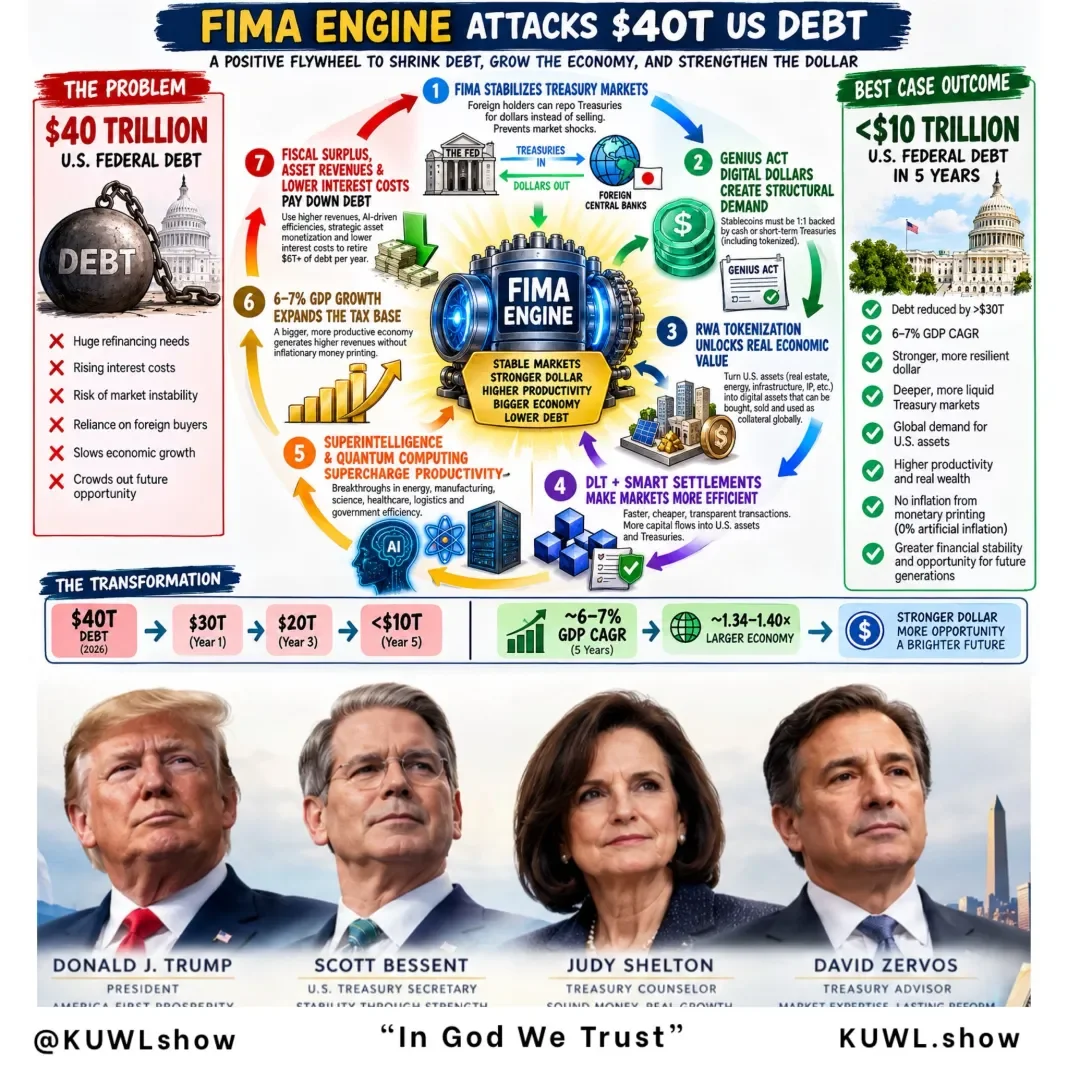
THE FIMA ENGINE & AMERICA’s $40 TRILLION ELEPHANT
America owes roughly $40 trillion.
Most folks hear that and figure there are only three choices:
Raise taxes. Print money. Go broke.
But let’s hold our horses.
Rob Cunningham: The FIMA Engine and America’s $40 Trillion Elephant
10-6-2026
THE FIMA ENGINE & AMERICA’s $40 TRILLION ELEPHANT
America owes roughly $40 trillion.
Most folks hear that and figure there are only three choices:
Raise taxes. Print money. Go broke.
But let’s hold our horses.
Maybe there’s another way to think about it.
Imagine America owns a ranch worth a fortune, has extraordinary resources and the greatest new technology arriving at the front gate – yet keeps worrying about the mortgage without asking how to make the ranch vastly more productive.
OUR FIRST CLUE: FIMA
If Japan suddenly needs dollars, it doesn’t necessarily have to dump its U.S. Treasuries.
It can temporarily pledge Treasuries → receive dollars.
Treasuries stay put.
Liquidity moves.
Potential market shock is reduced.
Well now…
If changing the mechanics can help prevent one financial chain reaction, what else could better mechanics accomplish?
ENTER THE $40T QUESTION
What if America stopped treating its debt like one gigantic bill due Tuesday morning?
Instead:
Stabilize it.
Refinance intelligently over time.
Make Treasury collateral more useful.
Grow the economy underneath it.
Create real surpluses.
Then retire the debt.
Now add some horsepower.
Super Intelligence attacks waste and boosts productivity.
Quantum computing accelerates discovery and optimization.
DLT (Distributed Ledger Technology) makes ownership and transactions faster, clearer and more inspectable.
RWA tokenization puts productive assets onto modern digital rails.
GENIUS-style stablecoins require 1:1 reserves, creating additional demand for real collateral such as short-term Treasuries.
Notice what’s NOT happening:
We’re not pretending printing money creates wealth.
We’re creating more actual productivity, goods, services, knowledge and economic value.
There’s a HUGE difference.
NOW A BIG GROWTH THESIS
Imagine America achieves 6 – 7% annual GDP growth for five years.
That’s roughly a 34 – 40% larger economy.
More production.
More businesses.
More investment.
More employment.
More tariffs.
More revenue.
Meanwhile SI exposes & eliminates massive government fraud & waste, productive assets generate revenue, financing costs decline wherever possible and genuine fiscal surpluses emerge.
And then:
We DON’T spend all the surplus.
WE RETIRE THE DEBT.
Now Our Flywheel Starts Turning:
Stable Treasury markets:
→ stronger confidence
→ digital-dollar collateral demand
→ tokenized capital formation
→ more efficient markets
→ SI + quantum productivity
→ higher GDP
→ greater revenues
→ fiscal surpluses
→ debt retirement
→ lower interest expense
→ BIGGER surpluses
→ MORE debt retirement.
Round and round she goes.
Now, with my best Detective Columbo voice;
“There’s just one thing bothering me…
…To move from $40T to under $10T in five years, America would need to extinguish more than Trillion.
That’s more than $6T per year.
Could you tell me how?”
Growth?
Surpluses?
Asset revenues?
Government savings?
Interest savings?
New productive wealth?
Because tokenizing a $1B asset doesn’t magically create another $1B of wealth.
And refinancing debt isn’t retiring debt.
Real debt reduction requires real value.
That’s the beauty of this thesis.
Not:
PRINT our way out
INFLATE our way out
DEFAULT our way out
But:
GROW our way out
INNOVATE our way out
PRODUCE our way out
SAVE our way out
PAY our way out
No financial hocus-pocus.
Just better technology, better plumbing, higher productivity, sound collateral, fiscal discipline – and one absolutely enormous American economic boom.
$40T → < $10T in 5 years?
This is an optimistic thesis – not a hard prediction.
But asking HOW a FIMA ENGINE would have to work is a mighty worthwhile question.
Because sometimes the scariest bomb in the room isn’t defused by running from it.
We figure out which wire actually matters. And then take action.
Source(s):
• https://x.com/KuwlShow/status/2107127195764187546
MilitiaMan & Crew: Iraq's Economic Story: What's Actually Happening Right Now?
MilitiaMan & Crew: Iraq's Economic Story: What's Actually Happening Right Now?
10-6-2026
The Crew: Samson, PompeyPeter, Petra, Daytrader, Sunkissed, GIGI and Militia Man
No drama. No intrigue. No songs and dances. Just straight, factual news that I read and interpret to the best of my ability after being an avid Dinar investor and insanely obsessed Dinarian for over 15 years.
Follow MM on X == https://x.com/Slashn
MilitiaMan & Crew: Iraq's Economic Story: What's Actually Happening Right Now?
10-6-2026
The Crew: Samson, PompeyPeter, Petra, Daytrader, Sunkissed, GIGI and Militia Man
No drama. No intrigue. No songs and dances. Just straight, factual news that I read and interpret to the best of my ability after being an avid Dinar investor and insanely obsessed Dinarian for over 15 years.
Follow MM on X == https://x.com/Slashn
Be sure to listen to full video for all the news……..
Iraq Economic News And Points To Ponder Tuesday Afternoon 10-6-26
U.S. Sends Strong Warning To Financial Institutions Dealing With Iran
Money and business Economy News - Follow-up The U.S. Treasury Department has warned foreign financial institutions that they will face sanctions without prior notice if they continue to engage with Iran or its financial sector.
According to a notice issued by the Office of Foreign Assets Control (OFAC) of the Treasury Department on Monday, October 5, 2026, financial institutions that deal with sanctioned Iranian entities may be targeted at any time, and must cease these activities and relations immediately.
U.S. Sends Strong Warning To Financial Institutions Dealing With Iran
Money and business Economy News - Follow-up The U.S. Treasury Department has warned foreign financial institutions that they will face sanctions without prior notice if they continue to engage with Iran or its financial sector.
According to a notice issued by the Office of Foreign Assets Control (OFAC) of the Treasury Department on Monday, October 5, 2026, financial institutions that deal with sanctioned Iranian entities may be targeted at any time, and must cease these activities and relations immediately.
The notice indicates that this step comes within the framework of the economic process announced by US Treasury Secretary Scott Bissent (August 24, 2026). In this process, the Treasury Department expanded the scope of sanctions risk under Executive Order (13902) to include individuals and entities that support the digital asset, technology, gold, aviation, and shipping sectors in Iran.
During the past period, the United States has imposed sanctions on several banks in this regard, including:
On August 28, he imposed sanctions on Banque Misr in the UAE, which was an important point for Iran’s access to the US dollar.
On September 4, he imposed sanctions on the branches of the Turkish-based Golden Global Bank for facilitating the transfer of tens of millions of dollars to the Revolutionary Guards’ Quds Force.
On September 14, he imposed sanctions on VTB for his involvement in activities to circumvent sanctions imposed on Iranian banks.
The Treasury Department has warned that institutions that facilitate Iran’s access to the global financial system (including the provision of services to Iranian banks or their affiliates in third countries) will face tough sanctions. It could also face civil and criminal sanctions if its dealings lead to sanctions violations by U.S. institutions or individuals.
The prohibition of opening or maintaining bank accounts in the United States is one of the most severe measures that may be imposed on it.
In recent weeks, the United States has warned other countries to cut trade ties with Tehran, otherwise it risks being deprived of the dollar-based financial system https://www.economy-news.net/content.php?id=74695
More Than $ 51 Billion Volume Of Trade Exchange Between China And Iraq During 2025
Money and business Economy News – Baghdad The Chinese ambassador to Iraq, Chiangpuh, said on Tuesday that the volume of trade exchange between Iraq and China exceeded 51 billion dollars during the past year, pointing to the development of relations between the two countries and the strengthening of cooperation in various fields.
"Sino-Iraqi relations are witnessing in-depth and continuous developments and have achieved practical cooperation between the two countries," he said, noting that "Iraq is an important partner for China in building the Belt and Road, which has achieved fruitful results."
He added that "large Chinese companies are involved in the construction and development of several sectors in Iraq, including oil, electricity, infrastructure and other fields," pointing out that "the volume of trade exchange between the two countries exceeded during the past year 51 billion dollars."
He explained that "cooperation between the two countries is based on mutual interests and is witnessing continuous developments," expressing his hope that "cooperation will continue and expand to other areas, thus contributing to building a comprehensive relationship between the two countries."
"Cooperation will continue in new areas in the future," the Chinese ambassador said, adding that "the two sides enjoy strong economic integration, which provides a guarantee for a promising future and enormous potential for cooperation between the two countries." https://www.economy-news.net/content.php?id=74709
Industry Follows Up On The Latest Developments Of Iron And Steel Factories In Basra
Money and business Economy News – Baghdad The Technical Undersecretary of the Ministry of Industry and Minerals, Eng. Juma Diwan Al-Bahadli, held a meeting that included the general managers of the investment and technical departments at the ministry's headquarters, the General Iron and Steel Company, and Ibn Majid General Company to follow up the reality of iron and steel factories in the province of Basra.
The meeting discussed extensive discussions on the current situation of the factories of the General Company for Iron and Steel, and the latest developments in the measures taken on them, and discussed the most prominent existing problems and ways to address and overcome them in order to contribute to the activation of work and production in these factories.
The meeting stressed the importance of continuing follow-up and enhancing joint coordination between the relevant authorities to address the problems and resolve the outstanding files in accordance with the frameworks, laws and instructions in force, in order to support the ministry's directions in the development of the iron and steel sector and enhance its role in supporting the national industry https://www.economy-news.net/content.php?id=74702
Iraq Third In The Arab World And 28 Globally With Cash Reserves Of $ 85 Billion
Money and business Economy News – Baghdad Iraq ranked 28th in the world among the countries with the largest foreign exchange reserves out of 30 countries listed in the table, with a total of about $ 85 billion, according to a classification published by the Canadian site "Vigoal Capital East" based on the latest data of the International Monetary Fund.
According to the classification, Iraq came after France, which ranked 27th with reserves of $ 86 billion, and Romania ranked 29th with $ 78.2 billion, while Turkey came in 30th and last place with $ 76.6 billion.
China topped the list with reserves of $3.41 trillion, followed by Japan with $1.259 trillion, Switzerland with $932.3 billion, Taiwan with $602.5 billion and India with $543 billion.
In the Arab world, Saudi Arabia ranked sixth in the world with reserves of 458.6 billion dollars, and the UAE ranked 12th with 251.4 billion dollars, while Iraq ranked third in the Arab world among the 30 largest countries.
The classification, based on the International Monetary Fund’s International Monetary Fund (IMF) database data, noted that foreign exchange reserves are an essential tool to cope with economic shocks, support currency stability, financing imports and servicing foreign debt.
The rating excludes gold from foreign exchange reserves and is based on the latest reporting periods available between mid-2025 and the second quarter of 2026 https://www.economy-news.net/content.php?id=74701
The Supreme Commission for Governorates discusses the obstacles of the Basra-Shalamjah railway project and ways to accelerate its implementation
Money and business Economy News – Baghdad The Supreme Commission for Coordination between the provinces, on Tuesday, discussed the challenges of the Basra-Shalamjah railway project.
The authority said in a statement received by "Economy News" that it "held a consultative meeting under the chairmanship of the General Coordinator for Provincial Affairs Ahmed Abdul Zahra Al-Fatlawi, in the presence of the Governor of Basra As'ad Al-Eidani, and representatives of the ministries of transport and finance, to discuss the project of establishing the Basra-Shalamjah railway."
She added that "during the meeting, they discussed the reality of the project, and discussed the most prominent financial and technical conflicts and obstacles facing the stages of its implementation, in addition to reviewing the procedures required to address the challenges and accelerate the pace of work on the project."
She added that "the meeting stressed the importance of coordination and integration between the concerned government agencies, which contributes to overcoming obstacles to the implementation of the project and achieve its objectives in supporting the transport sector and strengthening the railway link between Iraq and neighboring countries."
Seeds of Wisdom RV and Economics Updates Tuesday Afternoon 10-6-26
Good Afternoon Dinar Recaps,
GLOBAL TRADE RESET WATCH: BATTLE FOR BAB AL-MANDEB STRAIT THREATENS WORLD SHIPPING AND ENERGY SECURITY
Saudi-backed Yemeni forces are fighting to regain territory near a critical Red Sea shipping corridor as Houthi retaliation raises new risks for global trade and energy markets.
Good Afternoon Dinar Recaps,
GLOBAL TRADE RESET WATCH: BATTLE FOR BAB AL-MANDEB STRAIT THREATENS WORLD SHIPPING AND ENERGY SECURITY
Saudi-backed Yemeni forces are fighting to regain territory near a critical Red Sea shipping corridor as Houthi retaliation raises new risks for global trade and energy markets.
OVERVIEW
Military advances: Saudi-backed Yemeni government forces report recapturing several key areas near the Bab al-Mandeb Strait from Iran-backed Houthi rebels.
Shipping risks rise: Renewed fighting threatens a strategic maritime corridor linking the Red Sea and Gulf of Aden, through which a significant share of international trade travels.
Energy security under pressure: Houthi missile and drone attacks against Saudi targets add to uncertainty surrounding oil supplies, shipping costs and regional stability.
KEY DEVELOPMENTS
1. Saudi-Backed Forces Retake Key Areas Near the Strait
On October 5, Saudi-backed Yemeni government forces launched a major offensive against Houthi rebels who had recently captured territory along Yemen's western coast.
Yemeni officials told the Associated Press that government-aligned forces retook the towns of Dhubab, Bab and Hadeid, near the strategically important Bab al-Mandeb Strait. The campaign has received Saudi military support, including air cover, intelligence sharing and operational planning.
The Houthis had made earlier advances along the coast, including capturing the port city of Mokha and nearby islands. Those gains strengthened their position near the narrow maritime passage.
The latest counteroffensive represents a significant change in the immediate military situation. However, recapturing towns near the strait is not the same as establishing uncontested control over the entire waterway. Fighting continued on October 6 as government forces sought to consolidate their gains.
2. Houthi Retaliation Raises Regional Security Concerns
The Houthis have responded to the Saudi-backed campaign with claims of missile and drone attacks against Saudi oil facilities, airports and military installations.
These claims come amid escalating regional tensions involving Iran, the United States and Gulf countries. Saudi Arabia's renewed involvement in Yemen also raises the risk that the conflict could expand beyond the immediate battle for coastal territory.
Reuters reported on October 6 that fighting continued near Bab al-Mandeb as government forces pushed to consolidate their positions. Reuters also verified video footage showing government fighters driving armored vehicles over opposing fighters, prompting Houthi accusations of war crimes.
The footage underscores the severity of the fighting and the potential for further escalation. The immediate concern is whether military operations will stabilize the area or create additional threats to commercial shipping and nearby energy infrastructure.
3. A Critical Chokepoint for Global Commerce
Bab al-Mandeb connects the Red Sea with the Gulf of Aden and provides access to the Suez Canal route between Europe and Asia.
The passage is important for container ships, oil shipments and other commercial traffic. When vessels cannot safely use this corridor, shipping companies may divert around the Cape of Good Hope, adding time, fuel consumption, insurance costs and transportation expenses.
The disruption risk is especially significant because shipping through the Strait of Hormuz has also faced severe pressure during the wider regional conflict.
If both routes remain unstable, the consequences could extend beyond the Middle East. Longer journeys and higher freight costs can affect manufacturers, retailers, energy buyers and consumers worldwide.
WHY IT MATTERS
The battle around Bab al-Mandeb demonstrates how a conflict concentrated in one region can affect the broader global economy.
Shipping security is also financial security. When a major maritime corridor becomes dangerous, insurance premiums and freight rates can rise, delivery schedules become less reliable, and businesses may pass additional costs on to customers.
Energy markets are particularly sensitive to threats involving strategic waterways. If oil shipments face delays or disruptions, prices can rise as traders account for the possibility of tighter supply. Higher energy costs can then contribute to inflation and complicate central-bank decisions.
The actual economic impact will depend on whether the latest military gains lead to safer passage or whether further attacks and territorial reversals prolong the disruption.
WHY IT MATTERS TO FOREIGN CURRENCY HOLDERS
For foreign currency holders following the Global Financial Reset, this development highlights the connection between geopolitical stability and currency strength.
A prolonged shipping crisis can increase import costs, weaken trade balances for energy-importing countries, add inflationary pressure and influence expectations for interest rates. Investors may also move funds toward assets they consider safer during periods of uncertainty.
However, currency movements are not automatic. The effects differ by country and depend on energy dependence, trade exposure, monetary policy and investor confidence.
The key lesson is that currency values depend partly on the real-world systems that support economic activity: secure shipping routes, dependable energy supplies and functioning international trade networks.
This is a meaningful global financial development, but it is not proof of an imminent currency revaluation or a coordinated monetary reset.
IMPLICATIONS FOR THE GLOBAL RESET
Pillar 1: Trade
The security of Bab al-Mandeb influences the movement of goods between Asia, Europe and other major markets. Continued disruption could encourage companies to diversify routes, suppliers and logistics arrangements, gradually reshaping international trade.
Pillar 2: Energy
Oil shipments depend on safe passage through strategic maritime corridors. Additional threats to shipping or Saudi energy infrastructure could increase price volatility and place pressure on countries that rely heavily on imported fuel.
Pillar 3: Debt
Higher fuel and transportation costs can feed inflation. If inflation persists, central banks may have less room to reduce interest rates, potentially keeping borrowing costs elevated for governments, businesses and households.
Pillar 4: Financial stability
The crisis illustrates how geopolitical events can influence commodity markets, insurance costs, investment decisions and exchange rates. A more resilient global financial system must account for physical vulnerabilities in the trade and energy networks on which it depends.
THE BOTTOM LINE
Saudi-backed forces have made reported gains near Bab al-Mandeb, but the battle for lasting control and secure maritime passage remains unresolved.
The next indicators to watch are whether government forces can hold the territory they have retaken, whether Houthi attacks continue, and whether commercial shipping can move through the Red Sea corridor with greater confidence.
The evolution of the global financial system will depend not only on new currencies and digital payment networks, but also on protecting the shipping routes and energy lifelines that keep the world economy moving.
Seeds of Wisdom Team
Newshounds News
SOURCES
~~~~~~~~~~
Seeds of Wisdom Team RV Currency Facts Youtube and Rumble
Newshound's News Telegram Room Link
RV Facts with Proof Links Link
RV Updates Proof links - Facts Link
Start Here room with Most Asked Questions Link
Follow the Gold/Silver Rate COMEX
Follow Fast Facts
Seeds of Wisdom Team™ Website
Thank you Dinar Recaps