
Thank you to all the subscribers to our Early Access program…we thank you for your continued support.
We are excited to offer this new service to keep you informed and up-to-date on the latest Dinar and currency news.
Gold’s Investment Case Has Fundamentally Changed, And Rising Yields Are No Longer A Dealbreaker
Gold’s Investment Case Has Fundamentally Changed, And Rising Yields Are No Longer A Dealbreaker - FTSE Russell’s De
By Neils Christensen (Kitco News) - Rising bond yields are creating a significant headwind for gold, but investors should be careful about applying the precious metal’s traditional relationship with interest rates too rigidly, as structural changes in global demand continue to support elevated prices, according to FTSE Russell.
Gold’s Investment Case Has Fundamentally Changed, And Rising Yields Are No Longer A Dealbreaker - FTSE Russell’s De
By Neils Christensen (Kitco News) - Rising bond yields are creating a significant headwind for gold, but investors should be careful about applying the precious metal’s traditional relationship with interest rates too rigidly, as structural changes in global demand continue to support elevated prices, according to FTSE Russell.
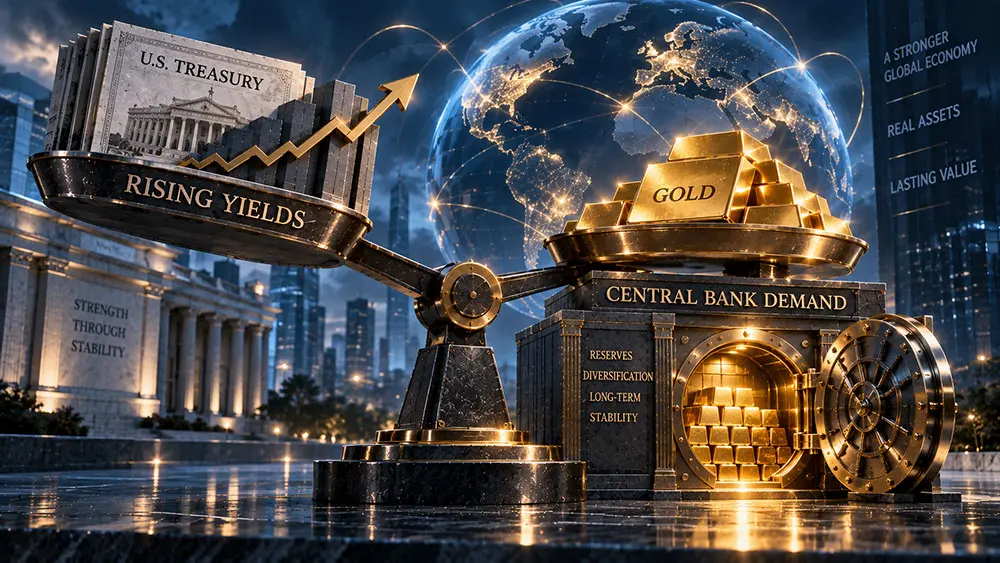
In an interview with Kitco News, Indrani De, Head of Global Investment Research at FTSE Russell, said both nominal and real yields are moving higher, which traditionally increases the opportunity cost of holding a non-yielding asset like gold. However, she said the gold market has undergone a fundamental shift as central banks have become increasingly important buyers.
De explained the growing influence of central-bank demand is a significant reason why gold has become somewhat less sensitive to rising real yields. She noted that central banks were net sellers of gold from 2000 until the Global Financial Crisis, before becoming net buyers. More recently, the pace of purchases has accelerated substantially.
“ The extent to which central banks are buying gold today, in the last two, three years, is more than twice the level of what it was between 2010 and 2021,” she said.
She added that this demand matters because official-sector buyers generally aren't making allocation decisions based on the opportunity cost created by higher bond yields.
“We now have a huge chunk of demand for gold coming in from sources that are not sensitive to yields,” she said. “That is one very big reason why you see much more of a decoupling between the rising yields and gold prices.”
That shift is also showing up in global reserve allocations. De said that at current valuations, central banks collectively hold more gold than U.S. Treasuries. At the same time, she noted that the U.S. dollar's share of global foreign-exchange reserves has been on a structural downtrend, falling from just above 70% around the turn of the century to between 55% and 57% today.
However, De pushed back against the idea that this trend means central banks are simply losing faith in the U.S. dollar.(Kitco Global Index shows how much of today's gold move is the dollar versus the gold market itself.)
She said the dollar's dominant role remains largely unquestioned because there is no viable alternative of comparable scale. Instead, she characterized the trend as a gradual diversification of reserves amid a changing geopolitical and economic landscape.
De also expects official-sector gold demand to remain an important feature of the market. Although purchases could retreat from the exceptionally high levels of recent years, she said demand is geographically broad, including central banks across Asia and Latin America, while heightened geopolitical uncertainty is unlikely to disappear anytime soon.
At the same time, central banks are no longer the only important source of demand. De said investment demand through retail investors and gold-backed exchange-traded products has also increased, giving the market a broader base of buyers.
Gold, she added, continues to function as an inflation and geopolitical-risk hedge and offers another potential advantage as concerns surrounding currency debasement grow.
“Gold has the stability to it also,” she said. “Gold has many strengths which counter the headwinds from rising yields.”
While higher yields remain a risk for gold, De said investors also need to understand why yields are rising. Fiscal concerns across developed economies are one factor, with De describing the current environment as one of growing “fiscal dominance,” where fiscal policy increasingly overpowers monetary policy.
But not all of the rise in yields is necessarily negative for gold.
De said the global economy is moving away from the post-financial-crisis era of abundant cheap capital. Capital is becoming scarcer because there are increasingly productive uses for it, including artificial intelligence, infrastructure investment, reshoring and the global green energy transition.
She said this repricing of capital can ultimately support stronger productivity, while higher borrowing costs also put pressure on less productive “zombie companies.”
“There are a lot of good reasons why yields are increasing, and we need to be cognizant of that too,” she said.
That changing investment landscape is also creating opportunities beyond gold.
De said strength in currencies tied to major commodity-producing economies — including the Norwegian krone and Australian dollar, as well as the Brazilian real and Mexican peso — is another indication that commodities have an increasingly important role in global markets.
Copper is particularly well positioned within those structural trends. Traditionally viewed as a barometer of global economic activity because of its widespread industrial use, the metal is now benefiting from additional demand tied to AI infrastructure and the energy transition.
“We are in a world where commodities have a big role to play, because it's not just gold,” De said. “You have copper.”
The energy transition could provide another long-term source of commodity demand. De said the disruption in global energy markets has reinforced the connection between energy security and economic security. She noted that refined petroleum products have experienced even greater price pressures than crude oil, highlighting the risks of relying heavily on individual energy sources and vulnerable supply chains.
She said growth in electric vehicles and batteries globally suggests the green transition has actually accelerated this year, rather than stalled.
“The more diversified you are in your energy security, the better off you are,” she said, adding that the transition has “picked up pace this year.”
Ultimately, De said the investment environment is becoming less about choosing between traditional “risk-on” and “risk-off” positions and more about building portfolios capable of participating in growth while protecting against increasingly complex risks.
She noted that capital flows during the past three to six months show investors pursuing something of a barbell strategy: maintaining exposure to U.S. and global equities and the AI growth story while simultaneously buying high-quality, short- and intermediate-duration investment-grade fixed income for capital preservation and liquidity.
“We are certainly in a world where diversification is having more than its normal share of benefits,” De said. “Diversification is really paying off at this particular point in time.”
See live precious metals prices for gold, silver, platinum and palladium — in USD, CAD and 12 more currencies.
Why Is the U.S. Dollar the World's Dominant Reserve Currency?
Why Is the U.S. Dollar the World's Dominant Reserve Currency?
September 01, 2026 By Scott A. Wolla
What do you think of when you hear “U.S. dollar”? Is it the cash in your wallet, the balance in your bank account, or the price of a gallon of gas? In these and other examples, the dollar performs the basic functions of money. This is true in the U.S. and in countries around the world, whose governments, central banks, businesses, and investors use dollars to buy, sell, borrow, and lend. The dollar is integral to the financial “plumbing” of the global economy and is the world’s dominant reserve currency.
Why Is the U.S. Dollar the World's Dominant Reserve Currency?
September 01, 2026 By Scott A. Wolla
What do you think of when you hear “U.S. dollar”? Is it the cash in your wallet, the balance in your bank account, or the price of a gallon of gas? In these and other examples, the dollar performs the basic functions of money. This is true in the U.S. and in countries around the world, whose governments, central banks, businesses, and investors use dollars to buy, sell, borrow, and lend. The dollar is integral to the financial “plumbing” of the global economy and is the world’s dominant reserve currency.
What Is a Reserve Currency?
A reserve currency is a widely accepted currency that governments and central banks hold as part of their official foreign exchange reserves. These reserves ensure that a country has reliable access to foreign currency to make international payments, manage its exchange rate, and respond to financial stress.
For example, when a country, business, or individual wants to buy goods, services, or financial assets in an international transaction, the buyer must obtain the seller’s currency through the foreign exchange market. This is where currencies are bought and sold and where exchange rates are determined.
Businesses and individuals normally rely on banks and financial markets to get the foreign currency they need for international transactions. But in a financial crisis, foreign currency can become difficult for a business to obtain. This is when a country’s central bank can step in to sell dollar assets from its foreign exchange reserves.
Countries do not hold most of their dollars as stacks of paper currency. Instead, they hold dollar-denominated financial assets, especially U.S. Treasury securities, which are debt issued by the U.S. government.
When investors buy Treasury securities, they are in effect lending money to the U.S. government in exchange for repayment with interest. When investors sell or redeem Treasury securities, they get dollars in exchange, which they may use to make other dollar-denominated transactions.
These assets are considered both safe and liquid: Investors generally trust the U.S. government to repay its debts, and Treasury securities can be quickly and easily converted into cash. So, central banks are able to hold dollars in a form that preserves value and that can be accessed quickly in a financial crisis. In this way, the dollar’s roles as a reserve currency and as an international currency come together, but each role reflects a different function of money. Consider the following:
As a store of value, the dollar is held through assets such as Treasury securities, which are stable, trusted, and easily converted into cash.
As a medium of exchange, the dollar is widely accepted in international trade and finance, allowing businesses to use it to pay for imports, to settle contracts, and to conduct financial transactions across borders.
As a unit of account, the dollar is quoted in many global prices and financial contracts, giving buyers and sellers a common way to measure value.
The Bank for International Settlements reports that as of April 2025, the dollar was involved in about 89 percent of all foreign exchange trades, making clear its stability and widespread use.
Why Is the Dollar So Widely Used and Held?
Several features of the U.S. economy and its financial system help explain why governments, central banks, and investors around the world choose to hold and use dollar‑denominated assets.
First, the U.S. remains one of the world’s largest economies, accounting for about 26 percent of global GDP in 2024 (measured in current U.S. dollars). This helps make the dollar central to international trade and finance and encourages other countries to hold dollar‑denominated assets as reserves.
Second, U.S. financial markets, especially the market for U.S. Treasury securities, are large, deep, and liquid. U.S. financial markets give foreign central banks and investors access to a wide supply of dollar‑denominated assets that can be bought or sold quickly and with relative certainty, which makes the dollar easier to use and more attractive to hold.
Third, the U.S. benefits from long-standing legal, political, and financial institutions that investors generally trust. Confidence that contracts will be enforced, that markets will function, and that the U.S. government will repay its debts increases the appeal of holding dollar assets.
These factors help explain why the dollar dominates global reserve holdings.
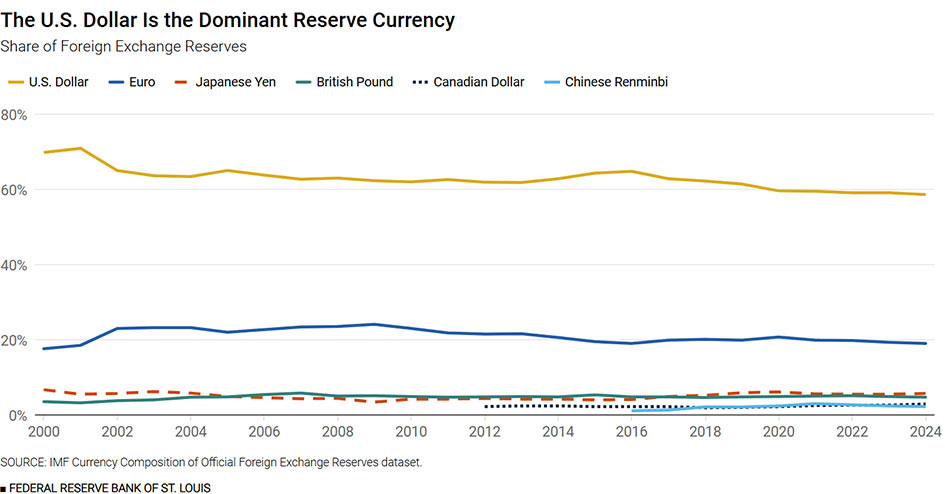
At the end of 2025, about 57 percent of the world’s foreign exchange reserves were held in dollar‑denominated assets, compared with about 20 percent for the euro. Other currencies, such as the Japanese yen, British pound, Canadian dollar, and Chinese renminbi, are also reserve currencies, but none comes close to the dollar’s share, as shown in the figure below.
The Benefits for the U.S.
There are meaningful advantages for the U.S. in having the dollar serve as the world’s dominant reserve currency. The most important benefit is the additional global demand for dollar‑denominated assets, especially U.S. Treasury securities.
When many investors and foreign central banks want to hold Treasury securities, the U.S. government does not need to offer as high an interest rate to attract buyers, and this helps lower the government’s borrowing costs.
The dollar’s role as in international currency also supports U.S. businesses. Because the dollar is widely used in global trade and finance, U.S. firms can often borrow, invest, and write contracts in their own currency.
Doing so reduces the exchange‑rate risks they would face if they had to convert dollars into foreign currencies more frequently. This stability makes it easier for U.S. companies to participate in international markets, influencing borrowing costs, business decisions, and the broader U.S. economy.
The Tradeoffs of a Stronger Dollar
While the dollar’s global role brings important benefits, there are tradeoffs: Increased global demand for dollar‑denominated assets can make the dollar stronger than it otherwise would be, and this affects Americans in different ways, creating both winners and losers.
For consumers and businesses that import goods or services, a strong dollar is a clear advantage. When the dollar rises in value, foreign‑made products become cheaper, reducing costs for households and for firms that rely on imported goods.
For exporters, however, a strong dollar makes U.S.‑produced goods more expensive for foreign buyers and can make U.S. firms less competitive in global markets. Domestic companies that compete directly with imported goods may also face pressure if cheaper imports gain a larger share of the market.
These contrasting outcomes are an inherent part of how exchange rates work: When a currency strengthens, it becomes easier to purchase goods from other countries but harder to sell goods to them. The dollar’s role as the world’s dominant reserve currency reinforces this pattern because global demand for dollar assets tends to keep the dollar stronger than it otherwise would be.
Could the Dollar Lose Its Role?
Some countries have taken steps to reduce their reliance on the U.S. dollar, a trend often described as de‑dollarization. Their motivations vary. Some want to limit exchange‑rate risk, while others aim to avoid potential exposure to U.S. sanctions or promote greater use of their own currencies in trade and finance. Even so, replacing the dollar is challenging because the main alternatives face significant limitations.
The euro is the second‑most widely held reserve currency, but it lacks a single, unified Treasury market (PDF) comparable to the large and liquid market for U.S. Treasury securities. China’s renminbi has expanded its international presence in recent years.
Yet continued exchange rate management and capital controls limit how freely funds can move into and out of the country, creating obstacles to becoming a global reserve currency.
The dollar’s role is not fixed. Its share of global reserves can rise or fall over time depending on economic conditions, policy decisions, and investor confidence. Still, displacing the dollar entirely would be difficult.
Few currencies combine the same scale, safety, liquidity, and trusted institutions that make the dollar so widely used and held.
Conclusion
The dollar’s position as the world’s dominant reserve currency provides the U.S. with important advantages, but it also brings tradeoffs. Its global role helps lower government borrowing costs and reduces financial frictions for U.S. businesses, but it also contributes to a stronger dollar that creates challenges for exporters and domestic firms.
The dollar serves the basic functions of money in its roles as a reserve currency and an international currency, as it is both stable and widely accepted by sellers, lenders, and investors around the world.
And when you hear “U.S. dollar,” you now have a better understanding of its integral role in the global economy and why it dominates global reserve holdings.
"It Will Be A Weekend Event" | Bill Holter
"It Will Be A Weekend Event" | Bill Holter
Liberty and Finance: 9-21-2026
Bill Holter warns that today’s debt and derivatives-driven financial system could be approaching a breaking point.
He argues that rising interest rates are exposing vulnerabilities across Treasury markets, sovereign debt, and the global financial system.
Holter points to more than $2 quadrillion in derivatives as a potential source of extreme leverage and systemic risk.
"It Will Be A Weekend Event" | Bill Holter
Liberty and Finance: 9-21-2026
Bill Holter warns that today’s debt and derivatives-driven financial system could be approaching a breaking point.
He argues that rising interest rates are exposing vulnerabilities across Treasury markets, sovereign debt, and the global financial system.
Holter points to more than $2 quadrillion in derivatives as a potential source of extreme leverage and systemic risk.
He also discusses BRICS, gold-backed currencies, Saudi Arabia, Japan, and what he sees as a major shift away from U.S. Treasuries.
Finally, Holter predicts a potential weekend financial shock that could trigger a sweeping monetary reset.
INTERVIEW TIMELINE:
0:00 Intro
1:00 Debt crisis
25:00 Preparedness
29:00 Bill Holter's info
Why Gold Prices Could Keep Rising Despite High US Yields And Interest Rates
Why Gold Prices Could Keep Rising Despite High US Yields And Interest Rates
Updated Sep 21, 2026, 05:56 PM
Gold prices are expected to rise through 2027 despite high US interest rates and bond yields, driven by central bank purchases and concerns over US government debt.
Central banks, especially China, have increased gold buying significantly, with global purchases nearly doubling pre-2022 levels, supporting gold as a safe asset against financial crises.
Why Gold Prices Could Keep Rising Despite High US Yields And Interest Rates
Updated Sep 21, 2026, 05:56 PM
Gold prices are expected to rise through 2027 despite high US interest rates and bond yields, driven by central bank purchases and concerns over US government debt.
Central banks, especially China, have increased gold buying significantly, with global purchases nearly doubling pre-2022 levels, supporting gold as a safe asset against financial crises.
Geopolitical tensions and cautious investor sentiment help maintain gold's resilience, with forecasts predicting prices up to US$5,400 an ounce by late 2027.
SINGAPORE – Gold prices are expected to rise further into 2027 despite high interest rates and volatile bond yields, as central bank purchases and concerns over US government debt continue to support demand for the precious metal.
Gold has had a mixed year, surging to a record high of US$5,594.82 an ounce on Jan 29 before retreating sharply to around US$3,942 in June. It has since regained some ground despite volatility in the bond market and a recent US interest rate hike, and was trading at around US$4,360 on Sept 21.
Higher interest rates and bond yields typically weigh on gold prices, as they increase the opportunity cost of holding the precious metal, which does not pay interest. Still, analysts expect gold prices to continue rising into 2027, with forecasts reaching as high as US$5,400 an ounce in the third quarter of 2027.
Zavier Wong, market analyst at etoro, said the reason behind the rise in US Treasury yields matters for gold.
If yields rise because the US economy is strong, gold typically comes under pressure as investors can earn higher returns elsewhere, while a stronger US dollar also makes the precious metal more expensive for buyers using other currencies.
But the recent rise in longer-term yields has instead been driven partly by concerns over the amount of debt being issued by the US government to fund its deficit.
US public debt crossed US$40 trillion (S$51 trillion) in August, while the yield on the 30-year US Treasury bond climbed as high as 5.4 per cent in September.
Wong noted that while higher yields make interest-paying assets more attractive relative to gold, concerns over US government finances are at the same time encouraging investors to turn to gold as an alternative.
“Debt-driven yields only provide the opportunity cost, because the same fiscal doubt pushing yields up is also pushing money into gold as the alternative,” said Wong. “The two effects mostly cancel out... That is the kind of rise we are seeing now, and it explains why gold has held up.”
Wong added that central banks are also buying gold to protect against financial crises and currency risks, and that the US Federal Reserve’s 25-basis-point rate increase on Sept 16 is unlikely to be enough to reverse those purchases.
Central banks globally bought 289 tonnes of gold in the second quarter of 2026, with purchases expected to reach between 700 tonnes and 900 tonnes for the full year, nearly double the annual average before 2022.
The People’s Bank of China alone bought more than 20 tonnes of gold in August, its largest monthly purchase since 2023 and its 22nd consecutive month of gold purchases.
Investor demand has also remained strong, with global investors adding US$18 billion to gold exchange-traded funds in August, according to data from the World Gold Council.
Wong said the next key indicator for prices will be central bank purchases in the third quarter of 2026. “If that number comes in weaker, it means the central bank bid that’s been holding gold prices up is starting to fade,” he said.
Christopher Irwin, head of foreign exchange and precious metals trading for Asia at Julius Baer, said much of the US Fed’s expected tightening had already been priced in before its latest decision.
As a result, the latest rate increase generated little additional selling pressure.
Irwin said that the longer-term case for gold remains intact, supported by concerns over monetary credibility and investors’ willingness to increase their exposure when prices fall.
“Gold’s bull market began in late 2023 under a more restrictive US policy regime, underscoring that the metal’s trajectory is being shaped by forces well beyond interest rates,” he said.
Heidi Sum, global head of product specialists for liquid real assets at German asset management firm DWS, said gold’s near-term direction will depend on the Fed’s next move. “A one-and-done signal could ease the pressure from higher inflation-adjusted yields and support a recovery, while further rate increases would likely keep gold volatile,” she said, adding that DWS forecasts gold at US$5,000 an ounce by September 2027.
Jeremy Tan, chief executive of Tiger Fund Management, said gold prices continue to be supported by geopolitical risks, particularly escalating tensions in the Middle East.
“We expect gold prices to remain highly resilient between US$4,300 and US$4,400 an ounce,” Tan said, adding that safe-haven demand for gold should help offset any price pressure from elevated short-term interest rates and inflation.
Heng Koon How, head of markets strategy at UOB, noted that gold prices briefly fell below US$4,300 an ounce after the Fed raised rates on Sept 16, before recovering towards US$4,400.
This rebound was an “encouraging sign” that gold was consolidating as investors adjusted to the higher interest rate environment.
UOB forecasts gold at US$4,500 an ounce in the fourth quarter of 2026 and expects prices will continue climbing to reach US$5,400 an ounce in the third quarter of 2027.
Timothy Goh is a business correspondent at The Straits Times. He covers commodities and currencies, with occasional forays into listed companies.
Seeds of Wisdom RV and Economics Updates Tuesday Afternoon 9-22-26
Good Afternoon Dinar Recaps,
INDIA LIQUIDITY RESET WATCH: RBI DRAINS BANKING SYSTEM CASH AS BOND SALES AND FX SWAPS RESHAPE THE RUPEE
India’s central bank is rapidly absorbing excess banking liquidity as bond sales, foreign-exchange swaps and rupee management begin reshaping conditions across the country’s financial system.
Good Afternoon Dinar Recaps,
INDIA LIQUIDITY RESET WATCH: RBI DRAINS BANKING SYSTEM CASH AS BOND SALES AND FX SWAPS RESHAPE THE RUPEE
India’s central bank is rapidly absorbing excess banking liquidity as bond sales, foreign-exchange swaps and rupee management begin reshaping conditions across the country’s financial system.
OVERVIEW
The Reserve Bank of India (RBI) has reduced India’s banking-system liquidity surplus by 55%, from a record ₹11.16 trillion about two weeks ago to ₹4.92 trillion, using bond sales, foreign-exchange swaps and other liquidity-management measures.
The RBI sold ₹750 billion of government bonds over the past week and planned another ₹250 billion sale, while traders estimated that the central bank had conducted approximately $1 billion per day in FX swaps over 10 sessions.
The move matters beyond India because liquidity management connects banking cash, government bonds, interest rates, foreign exchange and the rupee—five areas that directly influence how capital moves through the global financial system.
KEY DEVELOPMENTS
1. RBI rapidly reduces excess banking liquidity
India’s banking system became unusually liquid after lenders raised approximately $133 billion through a special RBI-backed diaspora deposit scheme.
That influx generated a substantial amount of rupee liquidity inside the banking system.
The surplus subsequently reached a record ₹11.16 trillion. By Monday, it had fallen to ₹4.92 trillion—a reduction of approximately 55% in roughly two weeks.
The RBI’s objective is not simply to remove money from the banking system.
It is also attempting to keep short-term market interest rates aligned with its monetary-policy framework and prevent excessive liquidity from adding to inflationary pressure.
2. Bond sales are becoming a major liquidity-management tool
The RBI sold ₹750 billion of government securities during the past week and planned another ₹250 billion sale.
When a central bank sells government bonds, buyers pay for those securities, effectively pulling rupees out of the financial system.
This makes open-market bond sales an important tool for managing the amount of cash available to banks.
RBI Governor Sanjay Malhotra had already indicated earlier in September that open-market operations and FX swaps were among the tools available to manage excess liquidity.
The significance is broader than the individual transactions.
Bond sales affect liquidity. Liquidity affects money-market rates. Rates affect bonds and credit. Those changes can then influence currency markets.
3. FX swaps are connecting liquidity management with the rupee
Foreign-exchange swaps are another tool being used to manage the surplus.
Reuters reported that traders estimated the RBI had conducted FX swaps of approximately $1 billion per day over the preceding 10 sessions.
The mechanics matter.
A sell/buy FX swap can allow the RBI to receive rupees while providing dollars in the initial transaction, thereby withdrawing rupee liquidity from the banking system.
The RBI had previously indicated that FX swaps could be used alongside open-market operations to manage liquidity.
This creates an important connection between two markets that are often viewed separately:
Foreign Exchange ↔ Banking Liquidity
4. The rupee is part of the larger liquidity equation
The RBI’s liquidity operations are taking place while the rupee faces pressure from global conditions, including elevated oil prices and changing expectations for interest rates.
India is particularly sensitive to oil prices because it imports substantial amounts of crude oil. Higher energy costs can increase the country’s import bill and contribute to inflationary pressure.
Reuters reported earlier in September that the rupee had weakened as oil prices rose and expectations for higher U.S. interest rates pressured Asian currencies. The RBI was also reported to have used dollar sales to contain some of the rupee’s losses.
This illustrates why currency movements cannot be viewed in isolation.
Oil → Inflation → Interest Rates → Bonds → Liquidity → Capital Flows → Rupee
5. The banking system is moving toward tighter liquidity conditions
The RBI’s actions have already changed money-market conditions.
Reuters reported that the liquidity surplus had fallen substantially, while banks also parked ₹3.4 trillion with the RBI through reverse repos.
The reduction in excess cash is important because extremely high liquidity can push short-term market rates below the central bank’s policy rate.
Reducing the surplus gives the RBI greater control over the transmission of monetary policy.
That makes this more than a temporary cash-management exercise.
It is part of the central bank’s effort to bring actual financial conditions closer to its intended monetary-policy stance.
6. Rate-hike expectations are adding another layer
The liquidity drain is also occurring as financial markets consider whether the RBI could eventually raise interest rates.
Reuters reported that some economists and major foreign banks were expecting an October rate increase, although those are market expectations and forecasts—not decisions already made by the RBI.
The distinction is important.
The RBI has been actively managing liquidity.
Whether it ultimately changes its policy rate depends on the economic data and the central bank’s assessment of growth, inflation and financial conditions.
WHY IT MATTERS
India is demonstrating how modern central banks can manage several financial markets simultaneously.
The RBI is using:
Government bond sales
Foreign-exchange swaps
Reverse repos
Foreign-exchange intervention
Reserve and liquidity-management tools
These mechanisms influence the amount of money available to banks, the price of government debt, short-term interest rates and the behavior of the currency.
That makes India an important example of how monetary infrastructure connects directly to currency markets.
The story is not simply about the rupee.
It is about the system behind the rupee.
WHY IT MATTERS TO FOREIGN CURRENCY HOLDERS
For foreign currency holders, the important lesson is that currency values are influenced by much more than a single exchange-rate announcement.
The rupee is being affected by a combination of:
Liquidity → Interest Rates → Bond Yields → Oil Prices → Capital Flows → Foreign Exchange Policy
That does not mean the RBI is preparing a currency revaluation.
It means the central bank is actively adjusting the financial conditions surrounding the rupee.
For those following the Global Reset, these are the kinds of developments worth watching because they show how central banks are responding to changing conditions through actual financial mechanisms—not predictions or rumors.
Hope, not hype. Follow the evidence.
IMPLICATIONS FOR THE GLOBAL RESET
Pillar 1: Liquidity
Central banks are actively managing the quantity and distribution of money within their banking systems.
Pillar 2: Bonds
RBI government-bond sales demonstrate how sovereign debt markets can be used as a direct monetary-policy and liquidity-management tool.
Pillar 3: Currencies
FX swaps and foreign-exchange intervention connect domestic liquidity management directly to the rupee and international currency markets.
Pillar 4: Interest Rates
As excess liquidity declines, short-term market rates can move closer to the central bank’s policy rate, strengthening monetary-policy transmission.
Pillar 5: Capital Flows
Changes in liquidity, yields, exchange rates and monetary policy can influence where domestic and international capital is allocated.
THE GLOBAL RESET CONNECTION
India’s current sequence can be viewed through the broader financial-system chain:
Diaspora Deposits → Rupee Liquidity → RBI Bond Sales → FX Swaps → Interest Rates → Bond Yields → Capital Flows → Rupee
This is precisely the type of interconnected financial development that belongs on a Global Reset Watch.
There is no single switch that transforms the global financial system.
Instead, central banks, governments and financial institutions continually adjust the mechanisms through which money, credit, bonds and currencies interact.
RUMOR SAFETY REMINDER
The RBI’s liquidity operations are not an announcement of a rupee revaluation, currency reset or specific date for a change in currency values.
The rate-hike expectations mentioned above are market forecasts and should not be confused with an announced RBI decision.
This article is intended to document and explain financial-system developments—not to encourage anyone to make life-changing financial decisions based on a predicted currency event.
Watch the evidence. Follow the infrastructure. Hope, not hype.
THE BOTTOM LINE
India’s RBI is actively reshaping domestic financial conditions by draining excess liquidity through bond sales, FX swaps and other tools while the rupee responds to changing global pressures.
The bigger story is not simply where the rupee goes next—it is how liquidity, bonds, interest rates, foreign exchange and capital flows are becoming increasingly interconnected.
When central banks change the mechanisms through which money moves, they are not just managing today’s markets—they are helping shape the financial system of tomorrow.
Seeds of Wisdom Team
Newshounds News™ Exclusive
SOURCES
~~~~~~~~~~
Seeds of Wisdom Team RV Currency Facts Youtube and Rumble
Newshound's News Telegram Room Link
RV Facts with Proof Links Link
RV Updates Proof links - Facts Link
Start Here room with Most Asked Questions Link
Follow the Gold/Silver Rate COMEX
Follow Fast Facts
Seeds of Wisdom Team™ Website
Thank you Dinar Recaps
Reset Intelligence: The Summit.
Emailed to Recaps: Thank you David
Reset Intelligence: The Summit.
By Reset Intelligence | @EXIT_FIAT
Everyone who can end this war landed in one city inside the same 48 hours.
Iran's president needed his enemy's visas to get there. Iraq turned the Iranian planes away at dawn.
Emailed to Recaps: Thank you David
Reset Intelligence: The Summit.
By Reset Intelligence | @EXIT_FIAT
Everyone who can end this war landed in one city inside the same 48 hours.
Iran's president needed his enemy's visas to get there. Iraq turned the Iranian planes away at dawn.
One city holds the endgame
The 81st UN General Assembly opened its high-level week with Trump on the podium and close to 130 heads of state inside a welded-shut security perimeter. The same day, Trump seats every GCC head of state plus Iraq and Jordan, with Egypt likely, to plan what follows the war. Tehran's 7 conditions are on that table. And Iran's president flies in on visas Washington granted mid-war, his delegation confined to a 6-block radius around the UN building. A combatant that believes its position is strong does not apply to its enemy for travel papers.
The airspace closes while they talk
September 23 - the US Treasury's worldwide deadline on Iranian aviation: any airport, fueler or ticket platform that services an Iranian airline gets knocked out of the dollar system.
Iraq - first live test, banning the sanctioned carriers from Tuesday at dawn while Iran Air says it flies to Najaf anyway.
Turkey - already answered, suspending every Iran route until March 2027.
Thursday - Xi meets Trump after 8 hours of preparatory talks at JPMorgan's Manhattan headquarters.
Oil - WTI slid a 4th straight day toward $96, draining the war premium toward the peacetime price already written into Iraq's 2027 draft budget.
Baghdad's quiet counter
CBI Governor Nizar Nasser Hussein put the authority map in writing: new banknote denominations are the bank's decision alone, deleting the three zeros needs a bill through parliament, and a note below 250 dinars is intended. The bank's own news wire showed citizens a neighbor's finished small-note series. The street rate eased to 158,000 to 158,500 per $100 after the bank defended its number by name. And the budget that must carry the dinar's value in law reaches parliament October 15.
That is the short version. What it means for the dinar, the sequence behind it, and the watch list dated by the hour - that is the daily read.
Read the full daily briefing free for 5 days. Sign up here: the daily Iraqi dinar briefing
Want it straight from the horse's mouth? The CBI Rate Alert pings you the moment the Central Bank of Iraq moves the official rate. The number itself, not a rumour about it. It comes with our free resource library and the daily breakdown of what is actually moving in Iraq. Sign up free: The CBI Rate Alert
Got a dinar question? Reset Intelligence runs an on-call research assistant: ask it anything they have published. It answers in seconds and will conduct deep research to find you the answer. Try it: the Iraqi dinar research assistant
Common questions, answered straight: When will the Iraqi dinar revalue? and Is the Iraqi dinar revaluation real?
The design behind all of it is mapped in Head of the Snake, and the free guides live in the Iraqi dinar resource library.
Follow the daily intel free: Telegram · Facebook · Spotify · Odysee
MilitiaMan & Crew: IQD News & Market Analysis: What You Need to Know Now
MilitiaMan & Crew: IQD News & Market Analysis: What You Need to Know Now
9-22-2026
The Crew: Samson, PompeyPeter, Petra, Daytrader, Sunkissed, GIGI and Militia Man
No drama. No intrigue. No songs and dances. Just straight, factual news that I read and interpret to the best of my ability after being an avid Dinar investor and insanely obsessed Dinarian for over 15 years.
Follow MM on X == https://x.com/Slashn
MilitiaMan & Crew: IQD News & Market Analysis: What You Need to Know Now
9-22-2026
The Crew: Samson, PompeyPeter, Petra, Daytrader, Sunkissed, GIGI and Militia Man
No drama. No intrigue. No songs and dances. Just straight, factual news that I read and interpret to the best of my ability after being an avid Dinar investor and insanely obsessed Dinarian for over 15 years.
Follow MM on X == https://x.com/Slashn
Be sure to listen to full video for all the news……..
Iraq Economic News and Points To Ponder Tuesday Morning 9-21-26
Government Spokesman: Iraq Is Keen To Develop Its Partnership With Washington
Money and business Economy News – Baghdad Government spokesman Haider al-Aboudi said on Tuesday that Prime Minister Ali al-Zaidi will present Iraq's vision on the security of the region and its economy to the United Nations, pointing to the keenness of Iraq and the United States to develop the partnership between the two countries and raise it to a distinctive strategic level.
Government Spokesman: Iraq Is Keen To Develop Its Partnership With Washington
Money and business Economy News – Baghdad Government spokesman Haider al-Aboudi said on Tuesday that Prime Minister Ali al-Zaidi will present Iraq's vision on the security of the region and its economy to the United Nations, pointing to the keenness of Iraq and the United States to develop the partnership between the two countries and raise it to a distinctive strategic level.
Al-Aboudi said in a press statement that "the delegation of the Republic of Iraq headed by Prime Minister Ali Faleh Al-Zaidi arrived in New York, and began the work of his visit in preparation for participation in the opening and work of the eighty-first session of the United Nations General Assembly."
He added that "the delegation began its work by meeting with the US Secretary of State, where the two sides discussed the level of joint cooperation between the two countries and ways to develop the partnership," noting that "the US Secretary of State stressed Washington's keenness to sustain the relationship with Baghdad and raise it to a distinctive strategic level."
He pointed out that "the Prime Minister stressed the importance of bridging this relationship through economic and investment partnerships, and attracting American companies to develop the oil industry, in addition to the implementation of a number of important projects."
Al-Aboudi pointed out that "the talks also dealt with the developments of the region and its repercussions and the impact of events on their economies," stressing that "Iraq is keen to find sustainable diplomatic solutions that contribute to securing the supply of energy and crude oil supply chains to global markets."
He explained that "Iraq is one of the most important countries feeding the world market with crude oil, and that the government aspires, according to its vision and program, to raise Iraq's daily production of crude oil to 10 million barrels by 2030."
He added that "the schedule of the visit also included the reception of the Lebanese Prime Minister at the residence of the Prime Minister, as well as the meeting of the Secretary-General of the League of Arab States," noting that "the Iraqi delegation headed by the Prime Minister will go tomorrow to the headquarters of the General Assembly of the United Nations to participate in the launch of the work of the eighty-first session, as well as meetings with the Secretary-General of the United Nations and a number of heads of government and leaders of state and international officials."
He stressed that "Iraq will participate in the work of the General Assembly with its vision and mission to the world, especially with regard to the developments of the region and its security and economic conditions."
Al-Aboudi explained that "the visit also comes within the framework of completing what was achieved during the visit of the Prime Minister to Washington in mid-July, which witnessed the establishment of a new identity for the relationship between the two countries, especially with the approach of Iraq to the date of September 30, set for the end of the presence of the international coalition forces."
"Iraq is moving to the relationship with the United States from the security side to sustainable economic relations," he said.
https://www.economy-news.net/content.php?id=74204
Parliamentary economy discusses the amendment of the Industrial Cities Law
Money and business Economy News – Baghdad The Parliamentary Committee on Economy, Industry and Trade discussed on Tuesday the draft law to amend the Industrial Cities Law, in preparation for the completion of its final version and put it to a vote in the coming period.
A statement by the Information Department of the House of Representatives said that the committee held a meeting under the chairmanship of the President of the age, MP Omar Mohammed Mohammed Karim, in the presence of its members, in addition to the representative of the Union of Industrialists, the President of the Industrial Cities and Free Zones Authority and a number of legal representatives and the beneficiary sectoral bodies.
The statement added that the meeting witnessed hearing the views and suggestions of the members of the committee and representatives of the concerned authorities on the amendment articles, thus contributing to reaching a final legal formula that takes into account the requirements of the industrial sector and the development of the environment of industrial cities.
He pointed out that the committee is working to complete the discussion of observations and proposals in preparation for the submission of the draft law in its final form and vote on it in the coming period.
https://www.economy-news.net/content.php?id=74217
Parliamentary investment discusses the repercussions of the withdrawal of Hanwa from the Basmaya project and demands the protection of the rights of citizens
Money and business Economy News – Baghdad The Parliamentary Investment and Development Committee discussed on Tuesday the repercussions of the announcement of the Korean company Hanwa withdrawal from the Basmaya residential project and the completion of its work, amid demands to develop urgent solutions to ensure the continuation of the project and protect the rights of citizens.
The committee stated that it hosted, under the chairmanship of the President of the age, MP Nahida Al-Daini, and in the presence of the majority of its members, representatives of the National Investment Commission and the relevant authorities, along with representatives of the Korean Hanwa Company implementing the project.
The meeting discussed the reasons for the decision to withdraw and its repercussions, especially with regard to financial dues and contractual obligations between the parties, and the mechanisms of continued work in the city of Basmaya, as well as the fate of the remaining housing units, services and infrastructure associated with the project.
The participants also discussed the repercussions of the possible withdrawal on the contracted citizens and the residents of the city, and the need to ensure the continuation of basic services and that the rights of citizens are not affected by financial or contractual differences between the concerned authorities and the executing company.
The committee stressed that the Basmaya project represents an important residential and national file, and that the concerned authorities must reach urgent and deliberate solutions that preserve the rights of the state, the citizen and the company, and prevent the suspension of the project or disruption of services.
She stressed the need to provide clear answers on the reasons for the contractual relationship reaching this stage, the size of mutual obligations and entitlements, and the government steps taken to address the crisis, as well as the determination of the legal and administrative responsibilities of each party.
At the end of the hosting, the committee confirmed its continuation in following up the file of the city of Basmaya and exercising its supervisory role, in order to address the problems, ensure the completion of the project and protect the rights of citizens https://www.economy-news.net/content.php?id=74216
Oura: From A Small Project In Finland To A $15.6 Billion Offering
Money and business Economy News - Follow-up Oura began the promotional round of its U.S. IPO, targeting a fully diluted valuation of $15.62 billion, a move that represents an important test for investor appetite for consumer technology companies after a faint start to the IPO season in the fall.
The move came at a time when financial markets have been cautious in recent weeks, due to the uncertainty surrounding the artificial intelligence boom, rising bond yields, and changing expectations of U.S. interest rates.
The company, along with a number of its existing shareholders, has sought to raise up to $2.2 billion by selling 50 million shares within a price range of $40 to $44 per share.
Samuel Kerr, head of global equity capital markets, said Aura’s offering was the “first real test” of U.S. investor appetite after a slowdown in IPO activity in September and recent market volatility, adding that the success of the offering could encourage other companies to proceed with their listings, while poor performance could raise concerns about investor sentiment.
U.S. pharmaceutical company Eli Lilly has expressed interest in buying up to $100 million worth of shares in the offering, while investment firm Dragoneer has expressed a desire to buy shares worth up to $300 million.
Bet on the market for wearable health devices
Smart rings have benefited from growing demand for personal health monitoring tools, as they represent a smaller alternative to smartwatches and fitness trackers, while providing continuous monitoring of health indicators and longer battery life.
Oura contributed to the deployment of this category of devices through its smart ring, which is able to track indicators including heart health, physical activity and sleep patterns.
The offering documents revealed that the company sold 3.6 million rings during the 12 months ending June 30, while its revenues during the nine months ending on the same date jumped by 74% year-on-year to $1.21 billion.
The company expects to end its fiscal year 2026 by 5.7 million paid members, representing a growth of 96% compared to the previous year.
Cat Liu, vice president of IPOX, said: “One of the most important elements of Aura’s power is the ease of use of its products and modern design, bringing it closer to the daily lifestyle compared to some wearable devices that mainly target professional athletes.
She added that the targeted assessment reflects investors’ bet on the company’s continued strong growth and increased contribution of higher-profit recurrent revenues.
Finland to Wall Street
Oura was founded in Finland more than a decade ago and has been valued at about $11 billion during a special funding round last year.
Goldman Sachs, Morgan Stanley and JPMorgan took over the offering, while the company is expected to set the final price of the IPO and start trading its shares on the Nasdaq next week under the symbol OURA
Seeds of Wisdom RV and Economics Updates Tuesday Morning 9-22-26
Good Morning Dinar Recaps,
EU STABLECOIN RESET WATCH: ECB CHALLENGES BANK-DEPOSIT RULE AS EUROPE REWORKS DIGITAL MONEY SAFEGUARDS
Europe is reconsidering how stablecoin reserves should be structured as the ECB seeks to balance digital-payment innovation, banking stability and control over the future of money.
Good Morning Dinar Recaps,
EU STABLECOIN RESET WATCH: ECB CHALLENGES BANK-DEPOSIT RULE AS EUROPE REWORKS DIGITAL MONEY SAFEGUARDS
Europe is reconsidering how stablecoin reserves should be structured as the ECB seeks to balance digital-payment innovation, banking stability and control over the future of money.
OVERVIEW
The European Central Bank and the EU’s national central banks are challenging a key stablecoin requirement under Europe’s Markets in Crypto-Assets Regulation, or MiCA, arguing that forcing major stablecoin issuers to keep 60% of reserves as bank deposits could create new risks for commercial banks.
Instead, European central banks are recommending that stablecoin reserves include a minimum percentage of assets that mature within one to five working days, shifting the focus from simply where reserves are held to how quickly they can be converted into liquidity.
The debate goes beyond cryptocurrency regulation. It raises a much larger question about what forms of digital money, bank deposits, government securities and central bank money will support Europe’s financial system as tokenized finance expands.
KEY DEVELOPMENTS
1. ECB challenges the 60% bank-deposit requirement
Under the current MiCA framework, significant stablecoin issuers can be required to hold 60% of their reserve assets as bank deposits. The ECB and the other national central banks of the European System of Central Banks now argue that this structure could expose commercial banks to changes in the stablecoin market and create less-stable sources of bank funding.
The central banks are therefore recommending a different approach: rather than requiring such a large share of reserves to remain specifically in bank deposits, MiCA could require a minimum percentage of reserves to be held in assets maturing within one to five working days.
That is an important distinction.
The issue is not whether stablecoins should have liquid reserves. It is what form those reserves should take and where the resulting financial risks should reside.
2. Stablecoins are becoming part of the broader financial infrastructure
Stablecoins are privately issued digital tokens designed to maintain a stable value relative to a fiat currency. Their potential uses include payments, settlement and cross-border transactions.
The ECB has warned that as stablecoins grow, they could affect financial stability, monetary-policy transmission and the international monetary order. ECB Executive Board member Isabel Schnabel has noted that stablecoins can shift activity away from traditional bank deposits and potentially change how banks obtain funding.
The ECB also points out that stablecoins can influence government bond markets because issuers may hold short-term government securities as reserve assets.
That means the stablecoin question is no longer confined to the cryptocurrency sector.
It reaches into banks, government debt, liquidity markets, payments and monetary policy.
3. Europe is confronting the question of what backs digital money
The reserve debate comes at a particularly significant moment for Europe.
Only one day earlier, the ECB launched Pontes, a new Eurosystem service designed to allow wholesale tokenized assets to settle in central bank money. That development creates a new connection between blockchain-based financial markets and the traditional central-bank monetary system.
The stablecoin debate addresses a related but different question: What should privately issued digital money be backed by, and how should that backing interact with the banking system?
Together, these developments show Europe working on multiple pieces of the digital-finance infrastructure at the same time.
4. The banking system could be affected by where stablecoin reserves ultimately reside
If stablecoins become widely used for payments and settlement, their reserve structures could influence commercial-bank deposits and funding.
The ECB has previously explained that moving money from traditional bank deposits into stablecoins could contribute to bank disintermediation. At the same time, stablecoin reserves invested in government securities could increase demand for short-term sovereign debt.
The result is that the choice of reserve assets can influence several markets simultaneously.
Stablecoins → Bank Deposits → Government Securities → Liquidity → Credit → Monetary Policy
That interconnectedness helps explain why European central banks are examining the rules before stablecoins become substantially larger within the financial system.
5. Enforcement is becoming another part of the challenge
The European System of Central Banks also warned that regulators face “material challenges” enforcing the bloc’s crypto regulations because non-compliant crypto companies can continue serving EU customers.
That introduces another layer to the transition.
Rules governing digital money are only effective if issuers and service providers operating in the European market can actually be brought under those rules.
For Europe, the challenge is therefore not simply designing the framework. It is also making the framework function across a rapidly changing digital marketplace.
WHY IT MATTERS
The stablecoin debate shows that the emerging financial system is being built through rules, reserve structures, settlement systems and payment infrastructure as much as through new currencies.
The ECB is not announcing a currency revaluation or a replacement for the euro.
Instead, European policymakers are determining how privately issued digital money should interact with commercial banks and the central bank.
That is foundational work.
The important question is increasingly not simply “What will digital money look like?”
It is “What financial infrastructure will support it?”
WHY IT MATTERS TO FOREIGN CURRENCY HOLDERS
For foreign currency holders watching the Global Reset, this development is important because currencies do not operate independently of the financial systems surrounding them.
A currency's future international role can be influenced by:
How easily it can be transferred across borders
What payment systems support it
Whether digital versions of the currency gain adoption
Whether financial assets can be tokenized and settled efficiently
How central bank money connects to digital markets
How much confidence investors have in the institutions backing the system
Europe is now working on several of these pieces simultaneously.
That does not mean a revaluation of the euro or any other currency is imminent. It means the infrastructure surrounding money is changing—and infrastructure is what ultimately determines how financial systems function.
Hope, not hype. Follow the evidence.
IMPLICATIONS FOR THE GLOBAL RESET
Pillar 1: Technology
Stablecoins and tokenized assets are moving financial activity onto blockchain and distributed-ledger infrastructure.
Pillar 2: Payments
Stablecoins are designed to make digital payments and cross-border settlement faster and more programmable, potentially changing how money moves internationally.
Pillar 3: Assets
The assets backing stablecoins matter because reserve structures can connect digital money to bank deposits, government securities and other financial markets.
Pillar 4: Currencies
If digital forms of major currencies become more widely used in payments and settlement, the technology supporting those currencies could influence their future international reach.
Pillar 5: Monetary Sovereignty
The ECB's concern reflects a broader issue: central banks want digital financial innovation to develop without losing control over monetary policy, financial stability and the role of central bank money.
THE GLOBAL RESET CONNECTION
The sequence is becoming increasingly clear:
Stablecoins → Bank Deposits → Reserve Assets → Government Securities → Payments → Central Bank Money → Digital Finance → Global Financial Infrastructure
This is why stablecoin regulation belongs in the larger Global Reset discussion.
The story is not about a sudden overnight change in currency values.
It is about the gradual redesign of the systems through which money is issued, backed, transferred, settled and ultimately trusted.
RUMOR SAFETY REMINDER
This development is not an announcement of a global currency reset, a euro revaluation, or a specific date for changes in foreign-currency values.
It is a documented regulatory debate over how stablecoin reserves should be structured and how digital money should interact with Europe's banking and monetary system.
The evidence points to financial infrastructure changing first—not a guaranteed currency event.
THE BOTTOM LINE
Europe is deciding how stablecoins should connect digital finance with banks, government securities and central bank money, making reserve design an increasingly important part of the future monetary system.
The bigger story is not simply the rise of stablecoins—it is that the architecture underneath money is being rebuilt, one digital rail, reserve rule and settlement system at a time.
Seeds of Wisdom Team
Newshounds News™ Exclusive
SOURCES
Reuters — "ECB, EU central banks oppose stablecoin bank deposit rule"
European Central Bank — "From money market funds to stablecoins: lessons for central banks"
~~~~~~~~~~
🌱 A Message to Our Currency Holders🌱
If you’ve been holding foreign currency for many years, you were not foolish.
You were not wrong to believe the global financial system would change.
What failed was not your patience — it was the information you were given.
For years, dates, rumors, and personalities replaced facts, structure, and proof. “This week” predictions created cycles of hope and disappointment that were never based on how currencies actually change.
That is not your failure.
Our mission here is different: • No dates • No rates • No hype • No gurus
Instead, we focus on:
• Verifiable developments • Institutional evidence
• Global financial structure • Where countries actually sit in the process
Currency value changes only come after sovereignty, trade, banking, settlement systems, and fiscal coordination are in place. History and institutions confirm this sequence.
You will see silence. You will see denials. That is not delay — that is discipline.
Protect your identity. Organize your documents. Verify everything.
Never hand your discernment to anyone who cannot show proof.
You deserve truth — not timelines.
Seeds of Wisdom Team
Newshounds News
~~~~~~~~~~
Seeds of Wisdom Team RV Currency Facts Youtube and Rumble
Newshound's News Telegram Room Link
RV Facts with Proof Links Link
RV Updates Proof links - Facts Link
Start Here room with Most Asked Questions Link
Follow the Gold/Silver Rate COMEX
Follow Fast Facts
Seeds of Wisdom Team™ Website
Thank you Dinar Recaps
Tuesday Iraq News Posted by Tishwash at TNT 9-22-2026
TNT:
Tishwash: The parliamentary finance committee is finalizing the closing accounts in preparation for approving the 2027 budget.
The Parliamentary Finance Committee announced on Monday (September 21, 2026) the completion of procedures for discussing the final accounts of previous fiscal years, in preparation for approving them before voting on the Federal General Budget Law for 2027.
The Media Department of the House of Representatives stated in a statement received by "Baghdad Today" that the Finance Committee, headed by MP Uday Awad and with the attendance of its members, held a meeting today, September 21, 2026, to discuss the final accounts report for previous fiscal years.
TNT:
Tishwash: The parliamentary finance committee is finalizing the closing accounts in preparation for approving the 2027 budget.
The Parliamentary Finance Committee announced on Monday (September 21, 2026) the completion of procedures for discussing the final accounts of previous fiscal years, in preparation for approving them before voting on the Federal General Budget Law for 2027.
The Media Department of the House of Representatives stated in a statement received by "Baghdad Today" that the Finance Committee, headed by MP Uday Awad and with the attendance of its members, held a meeting today, September 21, 2026, to discuss the final accounts report for previous fiscal years.
She added that the committee has completed the procedures related to the final accounts, in preparation for their approval, which will contribute to fulfilling the legislative and financial requirements necessary for approving the federal general budget for 2027.
The committee stressed the importance of completing the study of the final accounts and reviewing the related financial data, which will enhance the accuracy of the procedures and pave the way for the approval of the general budget for next year. link
************
US Treasury Secretary: In two days, all Iranian airlines worldwide will cease operations.
US Treasury Secretary Scott Bisent announced on Monday that Iranian airlines would cease operations worldwide in two days.
The minister said in press statements: We discussed the issue of Iran with China, and they are very involved.
He added: I cannot say how long the conflict will last.
Yesterday, an Iraqi security source reported that the Iranian side informed the Iraqi authorities of the possibility of not receiving flights coming from all countries, starting next Tuesday, with the possibility of extending the decision for several days.
The source explained to Shafaq News Agency that this report has not yet been accompanied by any official notification to the Iraqi aviation authorities regarding the suspension of flights. link
************
Tishwash: Al-Zaidi will inform Trump of a plan to disarm the factions that extends until the middle of next year.
An Iraqi official revealed on Monday (September 21, 2026) a government plan to disarm the factions that extends until the middle of next year.
Al Jazeera quoted the official’s statements, which were followed by Network 964 , that “the Iraqi government has a plan to disarm the factions that extends until the middle of next year.”
He added: “It is likely that Iraqi Prime Minister Ali al-Zaidi will inform US President Donald Trump of this plan during their meeting in New York.” link
**********
Al-Zaidi's nights in New York began... the government plane arrived
Prime Minister Ali al-Zaidi arrived in New York City on Monday (September 21, 2026) to participate in the 81st session of the United Nations General Assembly.
A brief statement from the media office, a copy of which was received by Network 964 , stated :
Prime Minister Ali Faleh al-Zaidi arrives in New York to participate in the 81st session of the United Nations General Assembly.
************
Tishwash: Rubio meets Iraq’s PM as remaining US troops prepare exit
The meeting in New York comes less than two weeks before remaining US troops are set to leave Iraq.
NEW YORK — Days before the last US troops are due to withdraw from Iraq, US Secretary of State Marco Rubio on Monday met with the country’s prime minister as Baghdad faces mounting pressure from Washington to rein in Iran-backed militias.
Rubio’s meeting with Iraqi businessman-turned-politician Ali al-Zaidi on the sidelines of the UN General Assembly in New York comes ahead of the scheduled Sept. 30 departure of the hundreds of remaining US troops stationed in Iraq to help counter the Islamic State.
The American withdrawal coincides with an Iraqi government deadline for armed groups to hand over their weapons to the state-run Popular Mobilization Forces, an umbrella network of Shiite militias formed to fight ISIS and formally incorporated into Iraq’s security forces a decade ago.
In an interview with the New York Times published Monday, Zaidi outlined a new, extended deadline for the militias to disarm. Beginning on Sept. 30, Iraq's armed groups would be required to observe a 90-day halt in attacks. They would then begin handing over their weapons, with the process ending by June 30, 2027, Zaidi said.
US special presidential envoy for Iraq, Tom Barrack, told Al-Monitor as he was leaving the Rubio-Zaidi meeting that there is agreement that by the end of June “only the state is the keeper of the military force.”
The Iraqi government’s call to disarm, however, has been met with fierce resistance by the militias, even as the departure of US troops removes the justification many have used to retain their weapons.
Several of the most powerful factions, including Kata’ib Hizbollah, refuse to voluntarily surrender their weapons. Others have said they are prepared to do so but appear to be waiting for political concessions in return, said Victoria Taylor, director of the Iraq Initiative and Syria Project at the Atlantic Council.
Taylor pointed to Asaib Ahl al-Haq as an example, saying the group is waiting to see whether the United States will accept the appointment of Laith al-Khazali — the brother of its secretary-general, Qais al-Khazali — as a deputy prime minister in Iraq’s government.
“Ultimately, these groups want to see a political pathway that would allow them to be removed from designation lists and become full participants in Iraq’s political process,” Taylor said.
The disarmament push comes as the war between Iran and the United States continues into its seventh month, with Tehran maintaining a chokehold over the Strait of Hormuz and Yemen’s Houthis escalating their fight against Saudi Arabia.
Since the war began on Feb. 28, Iran-backed groups have carried out hundreds of attacks targeting US-linked sites in Iraq, including its embassy in Baghdad. They also struck outside of Iraq’s borders, including a September drone attack on Saudi Arabia’s East-West pipeline that the Iraqi government confirmed was launched from its territory.
The International Crisis Group's senior analyst for Iraq, Lahib Higel, said a genuine disarmament process involving these groups would likely take years.
“A fundamental condition for that to work will be that these groups that are ideologically and operationally aligned with Iran will not be at war with the US while that's supposed to happen,” Higel said.
Washington and Tehran have vied for influence in Iraq since the US-led invasion toppled longtime dictator Saddam Hussein in 2003. Days after meeting US President Donald Trump in Washington for his first foreign trip as prime minister, Zaidi met Iranian President Masoud Pezeshkian in Tehran.
Zaidi, who took office in May, emerged as a compromise candidate acceptable to both Washington and Tehran after the Iran-aligned Coordination Framework initially tapped Prime Minister Nouri al-Maliki to succeed outgoing premier Mohammed Shia al-Sudani. The coalition didn’t advance his nomination after Trump threatened to cut US aid in January, concerned that a pro-Iran government would take root should Maliki stage a political comeback.
Zaidi was previously chairman of the board at Al-Janoob Islamic Bank, one of several financial institutions that Iraq’s central bank barred in 2024 from making US dollar transactions as part of an effort to crack down on money laundering and illicit use of American currency. link**
Iraq Economic News and Points To Ponder Monday Evening 9-21-26
Oil Plunges Below $102 On De-Escalation Hopes
2026-09-21 Shafaq News Oil prices slid to their lowest in more than a week on Monday on hopes diplomacy in the Iran war will get a chance this week amid a UN meet and as investors eyed a partial recovery in shipments from Saudi Arabia despite ongoing attacks by Yemen's Houthis. Brent crude futures and US West Texas Intermediate crude touched their lowest since September 10 earlier on Monday, with Brent at $101.71 a barrel by 0213 GMT, down $2.16, or 2.08%, after settling 0.91% lower on Friday.
Oil Plunges Below $102 On De-Escalation Hopes
2026-09-21 Shafaq News Oil prices slid to their lowest in more than a week on Monday on hopes diplomacy in the Iran war will get a chance this week amid a UN meet and as investors eyed a partial recovery in shipments from Saudi Arabia despite ongoing attacks by Yemen's Houthis. Brent crude futures and US West Texas Intermediate crude touched their lowest since September 10 earlier on Monday, with Brent at $101.71 a barrel by 0213 GMT, down $2.16, or 2.08%, after settling 0.91% lower on Friday.
US West Texas Intermediate crude lost $2.15, or 2.14%, to $98.15 a barrel following a 1.58% drop in the previous session.
"It seems that a degree of risk premium is being removed from oil prices on hopes that a diplomatic path to de-escalate the US-Iran war may arrive this week," Tim Waterer, chief market analyst at KCM Trade, said.
"Whether that hope proves to be warranted or not is another question. Time will tell."
The WTI broke a key psychological support at $100 a barrel while some investors may have rolled over their positions in the October contract a day ahead of expiry to November, a Singapore-based broker said.
Iran and the US exchanged new threats on Sunday amid the stalemate, although President Donald Trump said he would be open to meeting Iranian President Masoud Pezeshkian, who is expected to be in New York this week for the United Nations General Assembly.
Iran has conveyed its conditions to mediators for re-engaging in negotiations aimed at ending the war with the US, Al Jazeera cited Iran's security chief, Mohsen Rezaei, as saying in an interview on Saturday.
However, tensions in the Middle East remained elevated as Yemen's Iran-backed Houthis said they attacked "sensitive" sites in the Saudi capital of Riyadh on Saturday with missiles and drones, as well as an Aramco facility in the Red Sea city of Yanbu, a key oil export hub.
China has asked Iran to help rein in the Houthis after an appeal to Beijing by Saudi Arabia following the attacks, according to three Iranian sources familiar with the matter.
The attacks by the Houthis on Saudi Aramco's East-West pipeline have prompted the state energy firm to increase exports through the Strait of Hormuz this month and next after halting some shipments via Yanbu.
That enabled exports from the OPEC kingpin to recover to over 4 million barrels per day (bpd) so far in September after slumping to 2.4 million bpd in August, the lowest since at least 2013, according to provisional data from analytics firm Kpler.
"Middle East oil flows remain surprisingly strong despite the disruption to Saudi Arabia's East-West pipeline," JPMorgan analysts said in a September 18 note, adding that the total oil flows averaged 17.1 million bpd in the past 10 days, just 6.1 million bpd below the 2025 average.
"The most notable pivot has come from Saudi Arabia," the analysts said, as satellite data indicated Saudi oil moving through the Strait of Hormuz averaged 2.9 million bpd over the past six days, up from just 700,000 bpd in August. (Reuters)
https://www.shafaq.com/en/Economy/Oil-plunges-below-102-on-de-escalation-hopes
Iraq Bank Deposits Fall 3.7% In July
2026-09-21 Shafaq News- Baghdad Total deposits at Iraqi banks fell 3.7% in July to 100.982 trillion dinars ($77.2B), down 3.897 trillion dinars ($2.98B) from 104.879 trillion ($80.2B) at the end of June, according to Central Bank of Iraq (CBI) indicators.
At the end of July, central government deposits stood at 30.531 trillion dinars ($23.3B), while public institution deposits totaled 22.769 trillion ($17.4B) and private-sector deposits reached 47.682 trillion ($36.46B).
Cash credit also declined slightly to 71.432 trillion dinars ($54.56B) at the end of July from 71.504 trillion dinars ($54.62B) at the end of June, a decrease of 72 billion dinars ($55M).
Of the July total, 22.045 trillion dinars ($16.84B) in credit went to the federal government, 2.379 trillion dinars ($1.82B) to public institutions, and 47.008 trillion dinars ($35.91B) to the private sector. https://www.shafaq.com/en/Economy/Iraq-bank-deposits-fall-3-7-in-July
Dollar Drops In Baghdad And Erbil
2026-09-21 Shafaq News- Baghdad/ Erbil The US dollar closed Monday's trading lower in Iraq, hovering around 157,500 dinars per 100 dollars.
According to a Shafaq News market survey, the dollar traded in Baghdad's Al-Kifah and Al-Harithiya exchanges at 157,750 dinars per 100 dollars, down from the morning session's 157,900 dinars.
In the Iraqi capital, exchange shops sold the dollar at 158,250 dinars and bought it at 157,250 dinars, while in Erbil, selling prices stood at 157,450 dinars and buying prices at 157,400 dinars.
https://www.shafaq.com/en/Economy/Dollar-drops-in-Baghdad-and-Erbil-7
ISX Weekly Trading Tops $4.5M
2026-09-21 Shafaq News- Baghdad The Iraq Stock Exchange (ISX) recorded trading worth more than 6 billion Iraqi dinars (about $4.58 million) last week, down 66% from the previous week.
According to market data, 30.010 billion shares were traded, a decline of 45.77% from the previous week, with total trading value reaching 6.093 billion dinars across 3,844 transactions.
The ISX60 index closed at 969 points, down 0.99% from the previous session.
Shares in 65 companies were traded during the week, while 29 companies recorded no activity because buy and sell orders did not match. Trading in nine other companies remained suspended because they had not submitted required disclosures.
Non-Iraqi investors purchased 4 million shares worth 11 million dinars in 20 transactions. They also sold 1 million shares worth 4 million dinars in four transactions.
The Iraq Stock Exchange holds five trading sessions a week, from Sunday to Thursday, and lists 103 Iraqi joint-stock companies operating across the banking, telecommunications, industrial, agricultural, insurance, financial investment, tourism, hotel, and services sectors. https://www.shafaq.com/en/Economy/ISX-weekly-trading-tops-4-5M
IMF, World Bank Revise Debt Risk Assessments
2026-09-21 Shafaq News- Washington The International Monetary Fund (IMF) and World Bank are revising their debt assessment framework for low-income countries following its first review since 2017, with the updated system expected to take effect in the second half of 2027, the IMF said on Monday.
According to the IMF, debt risks have become more complex since the previous review, with debt levels rising in many low-income countries and governments increasingly borrowing from domestic and foreign sources on commercial terms.
The changes will sharpen the distinction between countries facing debt stress and those whose debt is considered unsustainable. They will also refine how debt-carrying capacity is measured and expand the thresholds and tools used to identify risks.
Greater attention will also be given to domestic debt and long-term pressures, including development needs and climate adaptation. The IMF said the changes should help governments assess how much fiscal space they have for investment while managing debt vulnerabilities.
Other measures include stronger stress tests and tools to assess the accuracy of economic forecasts. The framework will encourage countries to improve the coverage, transparency and reliability of public debt data.
IMF Executive Directors broadly supported the changes but called for clear guidance, communication and training before implementation. Most directors also backed temporarily withholding the probability thresholds and country-specific mechanical signals generated by a new model for assessing unsustainable public debt while the IMF gains experience with the methodology.
The review kept the harmonized discount rate used under the LIC-DSF and the IMF's Debt Limits Policy unchanged at 5%.
Introduced in 2005, the framework guides IMF and World Bank assessments of debt risks in low-income countries and informs lending, fiscal policy and public debt management. It underwent previous reviews in 2006, 2009, 2012 and 2017.
https://www.shafaq.com/en/Economy/IMF-World-Bank-revise-debt-risk-assessments
Iraqi Parliament Urges Review Of Fuel Price Hike
2026-09-21 Shafaq News- Baghdad Iraq's parliament voted on Monday on a set of recommendations to address the country's fuel crisis, including a review of recent increases in oil derivative prices, alongside votes on three other laws.
Lawmakers called for reconsidering Council of Ministers Decision No. 429 of 2026, which raised prices on oil derivatives, and for studying its economic and social impact, given its direct and indirect effects on transportation, production, and service costs.
They also urged the government to draft an urgent plan to prevent supply bottlenecks and recurring fuel shortages, ensure steady distribution across provinces, and submit a detailed report to parliament covering production, imports, consumption, costs, strategic reserves, and quantities supplied to each province.
They further called for a clear timeline to achieve sustainable self-sufficiency in oil derivatives and reduce reliance on imports, along with tighter oversight of the fuel distribution system, from storage facilities to filling stations, and legal accountability for manipulation or smuggling.
Under the measures, the parliamentary Oil and Gas Committee will oversee implementation and submit periodic reports to the parliament speaker on steps taken and completion rates. Lawmakers also called for a review of senior appointments within the Oil Ministry based on specialization, and for resuming supplies of subsidized oil derivatives to farmers.
The package additionally addressed fuel shortages in the Kurdistan Region of Iraq (KRI), calling for a review of white oil quantities supplied to the region and the urgent allocation of additional amounts with the onset of winter. Lawmakers also called for discussing the economic model for crude oil sales with the Oil, Gas, and Natural Resources Committee, and directed the Oil Ministry to review hydrogenation contracts and remove underperforming companies from them. https://www.shafaq.com/en/Iraq/Iraqi-parliament-urges-review-of-fuel-price-hike
What A Fed Rate Hike Could Mean For Gold And Silver Prices
What A Fed Rate Hike Could Mean For Gold And Silver Prices
MoneyWatch: Managing Your Money
By Angelica Leicht September 14, 2026 / 1:07 PM EDT / CBS News
Gold and silver investors have had to contend with some sharp price moves so far in 2026. Gold, for example, surpassed $5,500 per ounce early this year, but has since retreated significantly from that record high, with the price of gold sitting closer to $4,275 per ounce as of mid-September.
What A Fed Rate Hike Could Mean For Gold And Silver Prices
MoneyWatch: Managing Your Money
By Angelica Leicht September 14, 2026 / 1:07 PM EDT / CBS News
Gold and silver investors have had to contend with some sharp price moves so far in 2026. Gold, for example, surpassed $5,500 per ounce early this year, but has since retreated significantly from that record high, with the price of gold sitting closer to $4,275 per ounce as of mid-September.
Silver, on the other hand, has also experienced sizable price swings as investors have responded to shifting expectations for inflation, interest rates and the economy.
And those price movements could become even more pronounced in the days ahead. The Federal Reserve meets September 15 and 16, and persistent inflation has increased the possibility of another rate hike.
That prospect matters for precious metals investors because changes in interest rates can quickly alter where investors put their money and how much they're willing to pay for assets such as gold and silver.
Still, the outcome isn't as simple as higher rates automatically leading to lower precious metals prices. Gold and silver are being pulled by several competing forces right now, and the Fed's decision is only one of them.
So, if the central bank does raise rates this week, what could it actually mean for gold and silver prices — both immediately and in the months that follow? That's what we'll examine below.
What a Fed rate hike could mean for gold and silver prices
If the Fed raises rates at its September meeting, gold and silver prices could face some short-term pressure, as higher interest rates tend to make other interest-bearing options, such as bonds and savings products, more attractive. Gold and silver assets don't pay interest, though, so some investors may be less willing to hold them when they can earn higher returns elsewhere.
A rate hike could also boost the U.S. dollar, which can create another challenge for precious metal prices. Gold and silver are priced in dollars, so when the dollar strengthens, the precious metals become more expensive for buyers using other currencies. That can reduce demand for gold and silver and put additional downward pressure on prices.
Still, a rate hike doesn't guarantee that gold and silver prices will fall. Investors often adjust their portfolios before the Fed actually makes a move, so some of the impact of the potential September rate hike could already be reflected in today's prices.
So, if the Fed raises rates as expected, the bigger price reaction may hinge on what policymakers say about whether more hikes are likely in the coming months.
Other factors could keep gold prices elevated — even if rates rise. For example, if inflation remains high or concerns about the economy or geopolitical conflicts increase, investors may continue buying gold as a way to diversify their portfolios and protect against uncertainty. Strong demand from central banks and other large buyers could provide additional support.
Silver could react somewhat differently. Like gold, it can be affected by interest rates, the dollar and investor demand. But silver is also used heavily in manufacturing and technologies such as solar panels and electronics.
That means its price is tied, in part, to the strength of the global economy and industrial demand. If higher rates slow economic activity, weaker industrial demand could put additional pressure on silver.
So, a Fed hike would likely be a headwind for both precious metals, but it wouldn't be the only factor determining where prices go next. The Fed's outlook for future rates, along with inflation, the dollar, economic conditions and demand for precious metals, could ultimately have a bigger impact than the upcoming rate decision alone.
What should gold and silver investors watch after the Fed meeting?
TO READ MORE: https://www.cbsnews.com/news/what-fed-rate-hike-means-for-gold-silver-prices-september-2026/?intcid=CNI-00-10aaa3a
Rob Cunningham: Why the New DLT Monetary System Could Soar Soon
Rob Cunningham: Why the New DLT Monetary System Could Soar Soon
9-21-2026
WHY THE NEW DLT (Distributed Ledger Technology)MONETARY SYSTEM COULD SOAR – SOON!
My KUWL Optics: We could be approaching the moment when years of preparation become visible adoption.
Consider the potential convergence:
• Regulatory clarity unlocks institutional commitment.
Rob Cunningham: Why the New DLT Monetary System Could Soar Soon
9-21-2026
WHY THE NEW DLT (Distributed Ledger Technology)MONETARY SYSTEM COULD SOAR – SOON!
My KUWL Optics: We could be approaching the moment when years of preparation become visible adoption.
Consider the potential convergence:
• Regulatory clarity unlocks institutional commitment.
• SEC + CFTC resolve gives innovators confidence to build.
• Accelerating ETF inflows bring fresh demand.
• DTCC tokenization connects established markets with new infrastructure.
• A potential $100 trillion stock-tokenization opportunity creates enormous incentive to modernize.
• Improving sentiment and market strength could amplify the momentum.

The economic attraction is straightforward:
Faster settlement. Less friction. More productive collateral. Verifiable ownership. Capital working around the clock.
When these catalysts converge, institutions gain compelling reasons to deploy – and markets gain compelling reasons to anticipate what comes next.
Clear rules → Capital commitment → Real deployment → Demonstrated utility → Expanding adoption.
The strongest upside belongs to infrastructure – and assets – whose actual use creates sustained demand.
Could that momentum outweigh an unfavorable Fed headline? In this scenario, absolutely.
Markets can reprice the opportunity well before adoption reaches maturity.
My bullish read: the distance between “interesting technology” and “essential financial infrastructure” could close faster than the majority expect.
No guarantees. No promises. No solicitation.
Just sharing my KUWL Optics – and why the road ahead looks exceptionally bright – to me.
Source(s):
• https://x.com/KuwlShow/status/2101750482217959802