
Thank you to all the subscribers to our Early Access program…we thank you for your continued support.
We are excited to offer this new service to keep you informed and up-to-date on the latest Dinar and currency news.
Seeds of Wisdom RV and Economics Updates Friday Afternoon 9-18-26
Good Afternoon Dinar Recaps,
EU BANKING RESET: EUROPE PUSHES FOR DEEPER CAPITAL MARKETS AND STRONGER CROSS-BORDER BANKING
EUROPEAN OFFICIALS ARE CALLING FOR A MORE INTEGRATED BANKING AND CAPITAL-MARKET SYSTEM, WITH GREATER CROSS-BORDER SCALE AND INVESTMENT CAPACITY TO HELP EUROPE COMPETE IN AN INCREASINGLY COMPETITIVE GLOBAL FINANCIAL SYSTEM
Good Afternoon Dinar Recaps,
EU BANKING RESET: EUROPE PUSHES FOR DEEPER CAPITAL MARKETS AND STRONGER CROSS-BORDER BANKING
EUROPEAN OFFICIALS ARE CALLING FOR A MORE INTEGRATED BANKING AND CAPITAL-MARKET SYSTEM, WITH GREATER CROSS-BORDER SCALE AND INVESTMENT CAPACITY TO HELP EUROPE COMPETE IN AN INCREASINGLY COMPETITIVE GLOBAL FINANCIAL SYSTEM
.OVERVIEW
EUROPE WANTS A MORE INTEGRATED FINANCIAL SYSTEM: European finance ministers and central-bank officials are discussing ways to remove barriers to cross-border banking, reduce fragmentation and create deeper capital markets across the European Union.
BANKING SCALE IS BECOMING MORE IMPORTANT: ECB Vice-President Boris Vujčić said European banks compare well with U.S. banks in areas such as liquidity, capitalization and profitability, but lag in trading and post-trading activities where greater scale can matter.
EUROPE WANTS TO MOBILIZE ITS SAVINGS: Eurogroup President Kyriakos Pierrakakis said Europe has substantial savings but needs a financial system capable of directing those funds more effectively toward companies, innovation and investment across Europe.
KEY DEVELOPMENTS
1. Europe is pushing to remove barriers between national banking systems
European banking remains divided along national lines.
Senior European officials meeting in Dublin on September 18 called for fewer barriers to cross-border banking and less political interference in bank mergers.
The goal is to allow banks to operate at greater scale across European borders rather than functioning primarily within individual national markets.
Reuters reported that ECB Vice-President Boris Vujčić said European banks need to operate on a much larger scale within a deeper capital market if they are to compete directly with large U.S. banks in trading and post-trading activities.
This represents a structural change rather than a short-term market move.
2. Europe is trying to build a deeper capital market
Banks are only one part of the financial system.
European officials are also pushing for deeper capital markets that can connect European savings with businesses and investment opportunities throughout the region.
Eurogroup President Kyriakos Pierrakakis said Europe has the savings needed to finance investment but has not yet built a financial system capable of mobilizing those savings effectively at the European scale.
The broader objective is the Savings and Investments Union, designed to connect European savings more efficiently with European investment and create deeper, more integrated financial markets.
That matters because deeper capital markets can provide companies with alternatives to traditional bank lending and can make it easier for investment capital to move across borders.
3. Cross-border banking could change how European capital moves
Europe's financial system has historically been divided by national regulations, banking structures and market practices.
Greater integration could make it easier for banks to allocate capital across borders and could increase the ability of European financial institutions to support businesses throughout the region.
Officials are specifically discussing the removal of barriers that make cross-border banking and mergers more difficult.
The issue has become particularly visible through disagreements surrounding major European bank mergers, demonstrating how national interests can complicate the creation of a more integrated European banking system.
The proposed direction is therefore not simply about creating larger banks. It is about creating a financial market in which capital can move more efficiently across the European Union.
4. Technology is becoming part of the financial-competitiveness equation
The transformation is also technological.
Eurogroup President Pierrakakis said the largest U.S. banks invest more than two-and-a-half times as much in information technology relative to their assets as European peers.
He connected greater banking scale with the ability to invest in technology, digital payments, cybersecurity and artificial intelligence.
This means the European banking discussion is expanding beyond traditional lending and deposits.
The emerging financial infrastructure increasingly includes:
Digital payments
Artificial intelligence
Cybersecurity
Trading and post-trading systems
Cross-border capital flows
Integrated banking platforms
Financial infrastructure is becoming a competitive asset in its own right.
5. Europe is building financial infrastructure alongside its euro strategy
This development is especially important when viewed alongside Europe's broader effort to strengthen the international role of the euro.
Yesterday's EURO BOND SHIFT story focused on expanding the role of EU-issued bonds and increasing the depth and visibility of euro-denominated assets.
Today's banking development addresses another part of the same financial foundation:
Banks + Capital Markets + Investment + Payments + Bonds
These pieces work together.
A currency's international role is influenced not only by its exchange rate, but also by the size, liquidity, accessibility and sophistication of the financial markets supporting it.
That does not mean the euro is replacing the U.S. dollar.
It means Europe is continuing to build the financial infrastructure that could support a larger international role for the euro over time.
WHY IT MATTERS
The global financial system is increasingly being shaped by financial infrastructure.
Europe is now discussing how to make its banking sector larger, more integrated and better able to move capital across borders.
That matters because the ability to mobilize savings and direct investment can influence economic growth, financial-market depth and the international attractiveness of a currency.
The important point is that these changes happen gradually.
Financial systems can be redesigned long before the effects become visible in currency markets.
The infrastructure comes first.
WHY IT MATTERS TO FOREIGN CURRENCY HOLDERS
Readers hold foreign currency with the hopes that it will increase in value when the Global Reset occurs.
Developments like this are important because they show that changes in the international monetary system can involve much more than exchange rates.
Europe is working on the underlying structures that allow money, credit, investments, payments and financial assets to move across borders.
For currency holders, the lesson is to watch the financial foundation, not just headlines about currency values.
Hope — not hype.
There is no currency revaluation announcement or guaranteed reset date in this development.
IMPLICATIONS FOR THE GLOBAL RESET
Pillar 1 — Financial Infrastructure
A modern financial system depends on more than currencies.
It requires banks, capital markets, payment systems, settlement infrastructure and investment channels capable of moving capital efficiently.
Europe's effort to integrate these systems represents another example of financial infrastructure evolving beneath the surface.
Pillar 2 — Assets and Capital Markets
Deeper European capital markets could increase the availability and accessibility of euro-denominated financial assets.
Combined with Europe's efforts to strengthen EU bond markets, this could gradually expand the pool of assets available to international investors.
Pillar 3 — Technology and Payments
Digital payments, artificial intelligence, cybersecurity and modern trading systems are becoming increasingly important components of financial competitiveness.
Europe's banking strategy recognizes that technological capability is now part of the infrastructure supporting modern currencies and financial markets.
RUMOR SAFETY REMINDER
This development is not an announcement of a new European currency, a euro revaluation, a replacement for the U.S. dollar or a specific Global Reset date.
The evidence points to something more fundamental:
Europe is working to strengthen the financial infrastructure supporting its banks, capital markets and currency.
That is a process—not an overnight event.
FOLLOW THE INFRASTRUCTURE. FOLLOW THE EVIDENCE. DON'T FOLLOW THE HYPE.
THE BOTTOM LINE
Europe is moving toward a more integrated financial system in which banks can operate across borders more easily and capital can move more efficiently throughout the region.
The objective is larger than banking.
It involves capital markets, investment, technology, payments and the ability to mobilize European savings at continental scale.
When viewed alongside Europe's efforts to strengthen its bond markets and the international role of the euro, this becomes another piece of the broader financial-system evolution.
The global financial architecture is being built one piece at a time.
Seeds of Wisdom Team
Newshounds News™ Exclusive
SOURCES
~~~~~~~~~~
Seeds of Wisdom Team RV Currency Facts Youtube and Rumble
Newshound's News Telegram Room Link
RV Facts with Proof Links Link
RV Updates Proof links - Facts Link
Start Here room with Most Asked Questions Link
Follow the Gold/Silver Rate COMEX
Follow Fast Facts
Seeds of Wisdom Team™ Website
Thank you Dinar Recaps
Clarity Act Fallout, CBDC Ban & Iraq RV — How Close Are We? | Rob Cunningham
Clarity Act Fallout, CBDC Ban & Iraq RV — How Close Are We? | Rob Cunningham
Jon Dowling and Chris Real World: 9-17-2026
In a recent episode of the Jon Dowling podcast, host Jon Dowling sat down with Rob Cunningham, a retired Air Force captain and prominent crypto financial analyst, to unpack these complex dynamics.
The wide-ranging discussion centered on the legislative inertia in Washington, particularly the recent failure of the U.S. Clarity Act to pass, and what this means for the future of digital assets, international monetary sovereignty, and the legacy global banking system.
Clarity Act Fallout, CBDC Ban & Iraq RV — How Close Are We? | Rob Cunningham
Jon Dowling and Chris Real World: 9-17-2026
In a recent episode of the Jon Dowling podcast, host Jon Dowling sat down with Rob Cunningham, a retired Air Force captain and prominent crypto financial analyst, to unpack these complex dynamics.
The wide-ranging discussion centered on the legislative inertia in Washington, particularly the recent failure of the U.S. Clarity Act to pass, and what this means for the future of digital assets, international monetary sovereignty, and the legacy global banking system.
Rather than viewing the stalled legislation as a defeat for the digital asset space, Cunningham offers a surprisingly optimistic counter-narrative. He suggests that the legislative delay might actually prevent a hasty, poorly drafted regulatory framework from taking root.
By examining the roles of key regulatory bodies, the distinct legal positioning of assets like XRP, and the broader macroeconomic shifts toward asset-backed transparency, this discussion provides a crucial roadmap for understanding where the global economy is headed next.
The legislative journey of the U.S. Clarity Act was highly anticipated by digital asset advocates who hoped it would finally provide a clear, statutory definition for cryptocurrencies and stablecoins. However, the failure of the vote has left a significant void in congressional oversight.
Cunningham explains that when Congress fails to act, they effectively cede their legislative authority to administrative agencies. In this current vacuum, agencies such as the Securities and Exchange Commission (SEC) and the Commodity Futures Trading Commission (CFTC) are stepping forward to build their own regulatory frameworks through enforcement actions and administrative rulemaking.
While some market participants fear this regulatory fragmentation, Cunningham highlights how this shift forces a deeper, more analytical approach from administrative agencies. Rather than relying on rigid, outdated laws, these agencies are being compelled to study the actual utility and technological architecture of various tokens.
This transition period allows for a more organic development of rules that reflect the operational realities of blockchain technology, rather than shoehorning novel digital assets into legacy financial categories designed nearly a century ago.
One of the most compelling segments of the podcast discusses the unique legal and functional status of XRP. Amidst a sea of regulatory uncertainty, XRP stands out due to its distinct legal recognition as a non-security federal commodity.
According to Cunningham, this legal clarity positions XRP uniquely within the emerging global financial architecture. As various countries and private entities launch their own stablecoins and digital currencies, the financial system will become increasingly fragmented, creating an urgent need for secure, neutral, and highly liquid bridge assets.
XRP is uniquely engineered to serve this exact purpose, functioning as an interoperability token that can seamlessly bridge different fiat currencies, stablecoins, and central bank digital currencies (CBDCs) in real-time. Because it does not carry the legal baggage of being classified as an unregistered security, institutional players can utilize it with a level of confidence that is currently unavailable to many other major digital assets.
This operational utility makes it a foundational component of the modernized, high-speed payment corridors being built worldwide.
The conversation also broadens to address the shifting tides of international finance and geopolitical security, particularly in regions like the Middle East. Cunningham connects the modernization of financial infrastructure to the stabilization of volatile regions, specifically referencing ongoing economic reforms in Iraq.
Historically, traditional, centralized banking structures have been vulnerable to exploitation, often funding destabilizing activities and perpetuating economic inequality. By introducing transparent, decentralized ledger technologies, international bodies can help dismantle these legacy networks that thrive on financial opacity.
Furthermore, the rise of CBDCs and sovereign digital assets represents a major evolution in how nations protect their monetary sovereignty. As countries realize the strategic vulnerability of relying solely on Western-dominated payment systems, there is a growing push toward alternative financial frameworks.
This transition is not merely about replacing paper money with digital equivalents; it is about rewriting the rules of international trade to ensure that no single entity can weaponize the global financial pipes against sovereign nations.
At the core of Cunningham’s financial philosophy is the concept of honest weights and measures. For decades, modern central banking has relied on inflationary policies that continuously dilute the purchasing power of citizens.
Cunningham argues that the global financial system is moving toward a grand correction—one that rejects paper-based inflation mamipulation in favor of tangible, underlying asset backing. This modernization represents a return to sound money principles, secured by the immutable transparency of blockchain ledger technology.
In this future paradigm, financial systems will prioritize transparency, auditability, and real-world value. Digital assets and stablecoins backed by physical commodities, real estate, or verified reserves will likely outcompete purely speculative assets. This shift will force legacy banking institutions to adapt or risk obsolescence, as consumers and institutional investors alike demand financial instruments that preserve wealth rather than erode it through engineered inflation.
Ultimately, the podcast concludes that the failure of the Clarity Act vote may be a blessing in disguise. A rushed piece of legislation, heavily influenced by entrenched legacy banking interests, could have stifled the very innovation that makes the digital asset space so promising.
By delaying a permanent federal framework, the market has been granted the time to mature, allowing trusted public and private sector innovators to establish robust, battle-tested solutions in real-time.
As the SEC, CFTC, and international regulatory bodies continue to refine their approaches, a smarter, more sophisticated regulatory landscape is beginning to emerge. This environment will favor utility, compliance, and genuine technological advancement over speculative hype. For investors, policymakers, and builders, the current transition period is a unique opportunity to participate in the rebuilding of global finance from the ground up—unshackled from the limitations of the legacy banking cartel.
Reset Intelligence: A Sovereign IQD
Emailed to Recaps~ Thank you David
Reset Intelligence: A Sovereign IQD.
By Reset Intelligence | @EXIT_FIAT
Everyone has read September 30 as the day the troops leave Iraq. On Thursday, Iraq's Ministry of Finance read it differently.
The ministry posted on its own account: "Sovereignty in money... that the financial decision be Iraqi." Dated September 30.
Emailed to Recaps~ Thank you David
Reset Intelligence: A Sovereign IQD.
By Reset Intelligence | @EXIT_FIAT
Everyone has read September 30 as the day the troops leave Iraq. On Thursday, Iraq's Ministry of Finance read it differently.
The ministry posted on its own account: "Sovereignty in money... that the financial decision be Iraqi." Dated September 30.
The ministry said it in writing
Finance ministries do not deal in slogans. For 23 years the biggest financial decision in Iraq has not been Iraq's to make: the official rate of 131,000 dinars per $100 is an administrative number, the oil revenue sits at the Federal Reserve Bank of New York, and the physical dollars arrive as shipments Washington can hold, which it proved in April by blocking a delivery worth roughly $500 million. The ministry that writes the budget just tied the withdrawal date to taking that authority back, and the government spokesman said the same thing in the formal register: September 30 is "an important sovereign milestone."
What moved with it, all inside the same week
The street - the dollar hit 159,500 dinars per $100 in Baghdad, shops at 160,000, a fresh record, while the government denied the same rumor twice in a week: that Washington stops the dollar shipments in October.
New notes - the Iraqi press reports the state is discussing replacing the entire banknote series, with deleting the zeros explicitly ruled out for now and new denominations below 250 dinars on the table.
The counterparties - a senior World Bank delegation sat with the finance minister in Baghdad, and Europe's development bank opened a trade finance line of up to $25 million for the Bank of Baghdad to expand its correspondent banking. 13 days before the ministry's date.
The rails - the CLARITY Act failed in the Senate 49 to 50, and 2 days later the SEC issued a 5-year exemption for trading tokenized stocks, while the DTCC's tokenization service launches in October with Ripple among more than 50 institutions.
The war file - Trump says he has a big decision coming on Iran, annihilate or not, and tied it to Tuesday's meeting with all six Gulf leaders in New York. The UN's Iran sanctions panel goes dark September 27.
And the Central Bank of Iraq ran its auctions flat at 5.25 percent all week and gave the sovereignty declaration no comment at all.
A country declares sovereignty over its territory with a ceremony. Sovereignty in money is declared with a number, and the only question history will ask is who saw it coming.
That is the short version. What it means for the dinar, why the bank's silence is the tell, and what to watch between now and October 15 is in the daily Iraqi dinar briefing, free every day.
Read the full daily briefing free for 5 days. Sign up here: the daily Iraqi dinar briefing
Want it straight from the horse's mouth? The CBI Rate Alert pings you the moment the Central Bank of Iraq moves the official rate. The number itself, not a rumour about it. It comes with our free resource library and the daily breakdown of what is actually moving in Iraq.
Got a dinar question? Reset Intelligence runs an on-call research assistant: ask the Iraqi dinar research assistant anything they have published. It answers in seconds and will conduct deep research to find you the answer.
Common questions, answered straight: When will the Iraqi dinar revalue? and Is the Iraqi dinar revaluation real?
The design behind all of it is mapped in Head of the Snake, and the Iraqi dinar resource library is free.
Follow the daily intel free: Telegram · Facebook · Spotify · Odysee
Seeds of Wisdom RV and Economics Updates Friday Morning 9-18-26
Good Morning Dinar Recaps,
GLOBAL BOND RESET: RISING RATES AND $100 OIL PUT GOVERNMENT DEBT UNDER NEW PRESSURE
RISING ENERGY COSTS AND A NEW WAVE OF CENTRAL-BANK TIGHTENING ARE PUSHING GOVERNMENT BOND MARKETS INTO A MORE DIFFICULT ENVIRONMENT, RAISING QUESTIONS ABOUT DEBT COSTS, INFLATION AND THE FUTURE STRUCTURE OF GLOBAL FINANCE.
Good Morning Dinar Recaps,
GLOBAL BOND RESET: RISING RATES AND $100 OIL PUT GOVERNMENT DEBT UNDER NEW PRESSURE
RISING ENERGY COSTS AND A NEW WAVE OF CENTRAL-BANK TIGHTENING ARE PUSHING GOVERNMENT BOND MARKETS INTO A MORE DIFFICULT ENVIRONMENT, RAISING QUESTIONS ABOUT DEBT COSTS, INFLATION AND THE FUTURE STRUCTURE OF GLOBAL FINANCE.
OVERVIEW
GLOBAL INTEREST RATES ARE MOVING HIGHER AGAIN: Major central banks are responding to persistent inflation pressures, with the Bank of Japan raising its policy rate to 1.25% and the Federal Reserve having raised rates earlier this week.
OIL ABOVE $100 IS COMPLICATING THE INFLATION PICTURE: The ongoing Middle East conflict has kept oil prices elevated, increasing the risk that energy costs will keep inflation higher and force central banks to maintain tighter monetary policy for longer.
GOVERNMENT BOND MARKETS ARE FEELING THE PRESSURE: The U.S. 10-year Treasury yield briefly moved above 5% this week, while bond yields in Europe and Britain also reached multi-year highs. Higher yields mean higher borrowing costs for governments already carrying substantial debt loads.
KEY DEVELOPMENTS
1. Central banks are moving back toward tighter monetary policy
The global interest-rate environment has changed significantly this week.
The Bank of Japan raised its policy rate to 1.25%, the highest level in 31 years. The Federal Reserve also raised rates this week, while the European Central Bank has maintained a firm stance toward inflation.
The result is a broader shift toward tighter monetary conditions at a time when governments around the world are already dealing with elevated debt levels.
This matters because government bond yields form an important part of the financial system's pricing structure. When benchmark yields rise, the cost of borrowing can increase across government, corporate and consumer markets.
2. The $100 oil threshold is adding another layer of pressure
Oil prices remaining above $100 per barrel are creating a difficult policy problem.
Higher energy prices can push inflation higher even when central banks are trying to slow demand. That creates the possibility of a prolonged period in which policymakers have less room to reduce interest rates.
Reuters reported that the Middle East conflict, now approaching seven months, has continued to disrupt the energy outlook and keep inflation concerns elevated.
The important connection is:
ENERGY COSTS → INFLATION → INTEREST RATES → BOND YIELDS → GOVERNMENT BORROWING COSTS
That chain can affect the financial system well beyond the oil market itself.
3. U.S. Treasury yields have crossed an important threshold
The U.S. 10-year Treasury yield briefly moved above 5% during this week's bond selloff before easing back to approximately 4.93%.
The move is significant because the 10-year Treasury is one of the world's most important benchmark interest rates. Changes in its yield influence pricing throughout global financial markets.
Higher Treasury yields can make borrowing more expensive, alter investment flows and increase the cost of servicing newly issued government debt.
This does not mean that a financial crisis or monetary-system collapse is occurring. It does mean that markets are having to adjust to a higher-cost environment after years in which exceptionally low rates and large-scale central-bank asset purchases played a major role.
4. Britain is changing how it manages its massive government-bond portfolio
The United Kingdom provides another important example of how the architecture of central-bank balance sheets is changing.
The Bank of England has set out a multi-year plan to reduce its holdings of government bonds used for monetary-policy purposes to zero through annual sales of £20 billion alongside maturing bonds.
However, the Bank is taking a more selective approach to its remaining portfolio.
Approximately £120 billion of the longest-dated gilts will remain in the Bank's Asset Purchase Facility and be held to maturity to indirectly back current and future banknote issuance. Another £146 billion of gilts maturing between 2035 and 2049 is being considered for a potential sales arrangement involving the U.K. Treasury and Debt Management Office.
The Bank says its overall portfolio stood at approximately £488 billion as of September 16.
This is important because quantitative tightening is not simply about selling bonds. It is part of a broader transition in how central banks manage their balance sheets, government debt markets and monetary-policy tools.
5. The global financial system is entering a different bond-market environment
For years, investors became accustomed to very low interest rates, extensive quantitative easing and major central-bank purchases of government bonds.
That environment is changing.
Central banks are now confronting a combination of:
Higher government debt levels
Higher energy prices
Persistent inflation risks
Higher interest rates
Larger government financing requirements
Greater sensitivity in bond markets
The result is a financial system in which the cost and availability of government financing matter more than they did during the ultra-low-rate era.
The Bank of England's decision illustrates that central banks are not simply returning to the old system. They are actively redesigning how their balance sheets interact with government bond markets and monetary policy.
***
WHY IT MATTERS
Government debt is one of the foundational building blocks of the modern financial system.
When yields rise, governments must generally pay more to finance newly issued debt. At the same time, higher yields can change the relative attractiveness of bonds, equities, currencies and other assets.
That creates a feedback mechanism that can reach across borders.
The combination of higher rates + elevated energy costs + large government debt burdens therefore deserves attention even if markets remain orderly.
The bigger story is not simply that bond yields are rising. It is that governments and central banks are being forced to operate within a financial environment very different from the one created by years of ultra-low interest rates and quantitative easing.
The foundation of global finance is being repriced.
WHY IT MATTERS TO FOREIGN CURRENCY HOLDERS
Readers hold foreign currency with the hopes that it will increase in value when the Global Reset occurs.
But developments like these are important because they show how monetary systems can change through interest rates, debt markets, reserve assets, currencies, energy markets and central-bank policy rather than through a single overnight announcement.
A higher-rate environment can change currency flows because investors continually compare yields and risks between countries.
At the same time, rising government borrowing costs can place greater pressure on policymakers to rethink debt management, monetary policy and the composition of financial reserves.
That is why the evidence matters.
Hope — not hype.
There is no confirmed currency revaluation announcement or guaranteed reset date contained in these developments.
IMPLICATIONS FOR THE GLOBAL RESET
Pillar 1 — Debt
Rising bond yields increase the importance of government debt sustainability.
The higher the cost of refinancing existing debt and issuing new debt, the more significant interest expenses become within national budgets.
The current environment provides another example of why the global debt structure is one of the most important foundations to watch.
Pillar 2 — Assets and Reserve Currencies
Government bonds remain major reserve assets held by financial institutions and central banks around the world.
Changes in yields, liquidity and the treatment of government debt can therefore influence how investors allocate capital among currencies and sovereign assets.
A changing bond market can contribute to changes in the international monetary system without requiring the dollar or any other major currency to suddenly disappear.
Pillar 3 — Energy
Oil remains one of the most important links between geopolitics and global finance.
If energy prices remain elevated, inflation can remain higher, central banks can maintain tighter policies and bond markets can remain under pressure.
Energy therefore becomes part of the financial-system story rather than simply a commodity-market story.
RUMOR SAFETY REMINDER
This development is not an announcement of a global currency revaluation, an RV date, a dollar collapse or an overnight Global Reset.
The evidence shows something more fundamental:
Central banks are adjusting to a world of higher rates, elevated energy prices and enormous government debt burdens.
Those changes can gradually reshape the financial system.
Follow the infrastructure. Follow the evidence. Don't follow the hype.
THE BOTTOM LINE
The global bond market is becoming an increasingly important pressure point.
With oil still around or above the $100 level, central banks tightening or maintaining restrictive policies, and major government bond yields reaching multi-year highs, the cost of money is becoming a much larger part of the global financial equation.
The Bank of England's restructuring of its government-bond portfolio adds another piece to the picture: central banks are not simply changing interest rates. They are also changing how their balance sheets interact with government debt and the broader financial system.
This is what makes the current period important for those following the evolution of the global financial system.
The foundation is changing before any possible revaluation.
Seeds of Wisdom Team
Newshounds News™ Exclusive
SOURCES
Reuters — "Stocks and bonds dip as central banks jack up rates to tame inflation"
Bank of England — "Asset Purchase Facility: Gilt Sales – Market Notice 17 September 2026"
~~~~~~~~~~
🌱 A Message to Our Currency Holders🌱
If you’ve been holding foreign currency for many years, you were not foolish.
You were not wrong to believe the global financial system would change.
What failed was not your patience — it was the information you were given.
For years, dates, rumors, and personalities replaced facts, structure, and proof. “This week” predictions created cycles of hope and disappointment that were never based on how currencies actually change.
That is not your failure.
Our mission here is different: • No dates • No rates • No hype • No gurus
Instead, we focus on:
• Verifiable developments • Institutional evidence
• Global financial structure • Where countries actually sit in the process
Currency value changes only come after sovereignty, trade, banking, settlement systems, and fiscal coordination are in place. History and institutions confirm this sequence.
You will see silence. You will see denials. That is not delay — that is discipline.
Protect your identity. Organize your documents. Verify everything.
Never hand your discernment to anyone who cannot show proof.
You deserve truth — not timelines.
Seeds of Wisdom Team
Newshounds News
~~~~~~~~~~
Seeds of Wisdom Team RV Currency Facts Youtube and Rumble
Newshound's News Telegram Room Link
RV Facts with Proof Links Link
RV Updates Proof links - Facts Link
Start Here room with Most Asked Questions Link
Follow the Gold/Silver Rate COMEX
Follow Fast Facts
Seeds of Wisdom Team™ Website
Thank you Dinar Recaps
Iraq Economic News and Points To Ponder Late Thursday Evening 9-17-26
Slemani Summit: Iraq’s President Urges Economic Diversification
2026-09-17 / 02:40 Shafaq News- Al-Sulaymaniyah Iraqi President Nizar Amedi on Thursday called for economic diversification, greater investment and stronger action against corruption, saying Iraq must improve its investment climate to attract capital and support sustainable growth.
Slemani Summit: Iraq’s President Urges Economic Diversification
2026-09-17 / 02:40 Shafaq News- Al-Sulaymaniyah Iraqi President Nizar Amedi on Thursday called for economic diversification, greater investment and stronger action against corruption, saying Iraq must improve its investment climate to attract capital and support sustainable growth.
Speaking at the 2026 Slemani Summit, Amedi said coordination among government institutions, civil society, partners and independent organizations was essential to developing and implementing financial, banking and economic policies.
He said regional instability made cooperation particularly important to limit its impact on Iraq’s economy and citizens.
Amedi backed a larger role for the private sector in strategic projects, infrastructure, services and job creation, while stressing the need for transparency, competition and protection of public funds and the rights of both the state and investors.
He said successful partnerships should combine the state’s role with the private sector’s capacity for investment and innovation, helping diversify economic activity and attract capital, expertise and technology.
Read more: Iraqi experts divided on reviving the oil-reliant economy
Political and security stability, he added, cannot be sustained without long-term economic and social stability.
Amedi also called for a long-term national strategy based on stronger state institutions, the rule of law, better management of resources, economic diversification, investment and digital transformation.
He said Iraq should gradually move toward a more productive and diversified economy through financial and economic reform, infrastructure development, private-sector growth and investment in young people and technology.
The president also called for continued action against corruption across the financial, economic and public-service sectors, while supporting the judiciary, integrity bodies, security agencies and other state institutions involved in anti-corruption efforts.
Read more: Iraq’s Dawn Crackdown spreads through state institutions
https://www.shafaq.com/en/Iraq/Slemani-Summit-Iraq-s-President-urges-economic-diversification
New Iraqi Ambassador Outlines Priorities For US Ties
2026-09-17 / 04:16 Shafaq News- Baghdad/ Washington Iraq’s new ambassador to the United States, Krikor Der-Hagopian, has presented his credentials to US President Donald Trump at the White House, the Iraqi Foreign Ministry said on Wednesday.
Der-Hagopian said he was honored to take up the post, adding that his priorities include following up on the outcomes of Prime Minister Ali Al-Zaidi’s visit to the United States and helping open a new chapter in Iraq-US relations.
His mission will also focus on deepening strategic ties and expanding political, economic, investment and security cooperation, with the ministry saying the efforts are intended to advance mutual interests and strengthen Iraq’s regional role.
Ambassador Kirkor Der Hakoobian presents his credentials to the President of the United States
On Tuesday, September 15, 2026, Ambassador Kirkor Der Hakoobian presented his credentials to the President of the United States, Donald Trump, as a permanent ambassador and special envoy to the Republic of Iraq at the United States, during an official ceremony at the White House.
The Ambassador conveyed the Iraqi government's greetings, confirming its pride in appointing him as an ambassador to the United States, and that his priorities will focus on following up on the outcomes of the visit of the Prime Minister to the United States, working to build a new era in Iraqi-American relations, deepening strategic, economic, and security cooperation, and expanding political, economic, and investment and security cooperation, which will enhance Iraq's regional role and serve the common interests of the two countries and peoples.
For more information on the ministry's news, please visit the official pages and accounts of the Iraqi Ministry of Foreign Affairs:
Website of the Ministry: https://mofa.gov.iq
Ministry page on Facebook: https://www.facebook.com/MOFA.IQ
Official account on the "X" platform (formerly Twitter): https://x.com/iraqimofa
Official Instagram account: https://www.instagram.com/iraqmofa
Al-Zaidi visited Washington in July, where Iraq and the United States reached a series of agreements and memorandums covering economic, investment, energy and security cooperation.
Read more: Al-Zaidi's Washington visit links US oil investment to disarmament deadline
Der-Hagopian succeeds Nazar Al-Khirullah, who had served as Iraq’s ambassador in Washington since June 2023.
https://www.shafaq.com/en/Iraq/New-Iraqi-ambassador-outlines-priorities-for-US-ties
US Federal Reserve Raises Interest Rates By 25 Basis Points To Tackle Inflation
Iraqi News Agency Thursday, 9/17/2026 INA - Follow-up The US Federal Reserve on Wednesday decided to raise interest rates by 25 basis points, marking its first increase since July 2023, in a move aimed at curbing persistent inflationary pressures in the US economy.
Under the decision, the US central bank raised the target range for its benchmark interest rate to 3.75%-4.00%. The decision was unanimous at the conclusion of a two-day meeting of the Federal Open Market Committee.
The Federal Reserve said the move was aimed at supporting a faster return of inflation to its 2% target, while new economic projections showed that price pressures would persist, with inflation as measured by the personal consumption expenditures index expected to reach 3.7% this year and not return to the 2% level before 2029.
Projections by monetary policymakers showed that 16 of the 18 officials expect at least one further 25-basis-point increase before the end of this year, while estimates indicate that the interest rate range will reach 4.00%-4.25% by the end of 2026.
The rate increase comes as inflation remains above the central bank's target, alongside higher energy prices and strength in several US economic indicators, while markets had widely expected a quarter-point rate increase.
Following the decision, US stock indexes posted modest gains, while the dollar index rose about 0.3% and the yield on 10-year US Treasury bonds fell by about 4 basis points.
Amended PMF Law To Reach Iraqi Parliament Soon
2026-09-17 / 09:48 Shafaq News- Baghdad Iraq’s amended Popular Mobilization Forces (PMF) law is expected to reach parliament soon for consideration, a member of the Parliamentary Security and Defense Committee told Shafaq News on Thursday.
Committee member Iskandar Witwit said the lawmakers were awaiting the bill so it could be placed on parliament’s agenda.
“During the committee’s meeting with Prime Minister Ali al-Zaidi last month, we asked him to send the PMF law to parliament for review, first reading and a vote. He promised to do so soon,” Witwit revealed, adding that the committee had revised the law in its entirety, resulting in a bill structured along the lines of the Defense Ministry because the PMF is considered a fully integrated security institution.
Asked whether the post of PMF chairman would be made equivalent to that of a deputy minister or minister, Witwit said the issue was not addressed in the bill.
Meanwhile, an informed source told Shafaq News that political agreement had been reached to give the PMF chairman a status equivalent to that of a minister without portfolio, while keeping the official name of the PMF unchanged. “Changing the chairman’s status would require political consensus.”
Earlier, informed sources said two draft laws covering the PMF’s structure and service and retirement were expected to be referred to parliament after several disputed provisions that had faced what the sources described as a US “veto” were removed.
According to the sources, the two bills would be submitted to parliament in their final form, paving the way for the formal legislative process. https://www.shafaq.com/en/Iraq/Amended-PMF-law-to-reach-Iraqi-parliament-soon
Iraq Trucks Southern Crude North In Bid To Raise Exports Via Turkey
By Aref Mohammed and Ahmed Rasheed September 16, 20261
Summary
Trial began on September 13, lasting two days
About 38,000 barrels moved in 209 trucks
Iraqi exports from the south disrupted by Iran war
BASRA, Iraq, Sept 16 - Iraq has launched a pilot operation to transport crude oil by road from its southern oilfields to a Kirkuk storage facility in an effort to boost supplies to the northern export system and potentially increase shipments through Turkey's Ceyhan port.
The initiative forms part of broader Iraqi efforts to increase flows through the northern export route after the U.S.-Israeli war on Iran disrupted Iraq's shipments through the Strait of Hormuz, its main export route.
Iraq's oil ministry has contracted local company KAR Group to transport the crude using its fleet of tanker trucks, an oil ministry spokesperson said. The arrangement was confirmed in a statement issued by state-run Basra Oil Company (BOC).
The trial operation began on September 13 and ran for two days, during which a little more than 6 million litres of crude, equivalent to about 38,000 barrels, were moved by 209 tanker trucks, each with capacity of 30,000 litres, BOC said.
"The contract with KAR Group is based on total volumes delivered by tanker truck," said Iraqi oil ministry spokesperson Saleem al-Rikabi, adding that daily transported volumes depend on the number of tankers deployed, loading capacity, road conditions, security clearances and other logistical factors.
KAR Group did not respond immediately to a request for comment.
Current flows from northern Iraq to Turkey's Ceyhan port are estimated at about 200,000 barrels per day (bpd), oil ministry figures show, down from around 250,000 bpd before the Iran war.
The project faces logistical challenges, including limited truck availability and constrained loading infrastructure at southern oilfields, BOC sources said.
The initial volumes remain too small to materially increase northern exports without a significant expansion of transport and loading capacity.
Reporting by Aref Mohammed in Basra and Ahmed Rasheed in Baghdad Additional reporting by Muayad Hameed Editing by Alex Lawler and David Goodman
The Next Financial Crisis Is Coming... And This One Has No Bailout
The Next Financial Crisis Is Coming... And This One Has No Bailout
Peter Schiff: 9-18-2026
Following the Federal Reserve's unanimous 12-0 vote to raise its policy rate 25 basis points, Fox Business host Liz Claman brings together BNY Investments chief economist Vincent Reinhart and Euro Pacific Asset Management's Peter Schiff to break down new Fed Chair Kevin Warsh's first rate decision.
Schiff argues the hike is too small and too late to contain inflation, noting the Fed was backed into a corner after months of hawkish signaling and that a single 25 basis point move will not derail rising prices.
The Next Financial Crisis Is Coming... And This One Has No Bailout
Peter Schiff: 9-18-2026
Following the Federal Reserve's unanimous 12-0 vote to raise its policy rate 25 basis points, Fox Business host Liz Claman brings together BNY Investments chief economist Vincent Reinhart and Euro Pacific Asset Management's Peter Schiff to break down new Fed Chair Kevin Warsh's first rate decision.
Schiff argues the hike is too small and too late to contain inflation, noting the Fed was backed into a corner after months of hawkish signaling and that a single 25 basis point move will not derail rising prices.
He points to the 40-year bond bull market that ended in 2020 and argues rates are still historically low relative to $40 trillion in federal debt, meaning the bond bear market has years left to run.
Schiff also warns the housing market is now a bigger bubble than 2008, that 30-year mortgage rates above 7% will keep climbing, and that the next financial crisis could take the form of a sovereign debt and currency crisis rather than a bank bailout.
JP Morgan's move to raise its prime rate to 7% and an roughly 850-point Dow decline underscore the market's reaction to the Fed's decision.
Chapters:
00:00 Guests Join After Fed Move
00:33 Unanimous Vote No Leaks
01:41 Schiff Too Little Too Late
03:14 Warsh Inflation Message
04:03 Prime Rate Hits Consumers
05:18 Housing Bubble And Bond Bear
06:56 Market Wrap And Thanks
Ariel: We have a Triple Header for Today
Ariel: We have a Triple Header for Today
9-18-2026
The News Just Keeps Compounding
The Central Bank of Iraq publicly stated two weeks ago that the “next step will be joining the international financial market” — meaning full forex integration. That statement was not aspirational. That was a declaration of operational readiness. CBI does not broadcast next steps unless the infrastructure is already in place.
Today, Iraq’s Minister of Finance met with the World Bank to discuss “financial reform and enhancement of the efficiency of financial institutions” amid international commitments to support Iraq.
Ariel: We have a Triple Header for Today
9-18-2026
The News Just Keeps Compounding
The Central Bank of Iraq publicly stated two weeks ago that the “next step will be joining the international financial market” — meaning full forex integration. That statement was not aspirational. That was a declaration of operational readiness. CBI does not broadcast next steps unless the infrastructure is already in place.
Today, Iraq’s Minister of Finance met with the World Bank to discuss “financial reform and enhancement of the efficiency of financial institutions” amid international commitments to support Iraq.
“ENHANCE THE EFFICIENCY OF FINANCIAL INSTITUTIONS” DECODED
This phrase is diplomatic cover for upgrading Iraq’s banking sector credit rating to international standards. Right now, Iraqi banks operate on a program rate an artificially suppressed exchange rate set post-2003 under Coalition Provisional Authority Order 43.
Foreign banks don’t trust Iraqi financial institutions because those institutions sit at the bottom of international credit assessment tables. Their correspondent banking relationships are limited. Their clearing capabilities are restricted. SWIFT access exists but is heavily monitored and constrained.
You All Have Every Right To Be Excited Right Now
“Enhancing efficiency” means raising the credit profile of Iraqi banks so that international financial institutions JP Morgan, HSBC, Deutsche Bank, Standard Chartered will engage them as legitimate counterparties. That requires the following.
• Demonstrable reserves backing the currency
• Transparent monetary policy mechanisms
• Anti-money-laundering compliance frameworks that meet FATF standards
• Gold or hard-asset reserves that anchor the dinar’s value independent of oil revenue fluctuations
Iraq cannot join forex at 1,310 IQD per USD. That rate is a program rate a placeholder. No international financial market accepts a currency at an administratively set value that does not reflect underlying economic reality. The rate must move to reflect Iraq’s gold reserves, diversified economic output, and fiscal capacity.
The CBI’s statement two weeks ago about “joining the international financial market” is confirmation that the rate adjustment is the gating event. You do not announce forex entry while maintaining a program rate. The rate change precedes or coincides with international market entry.
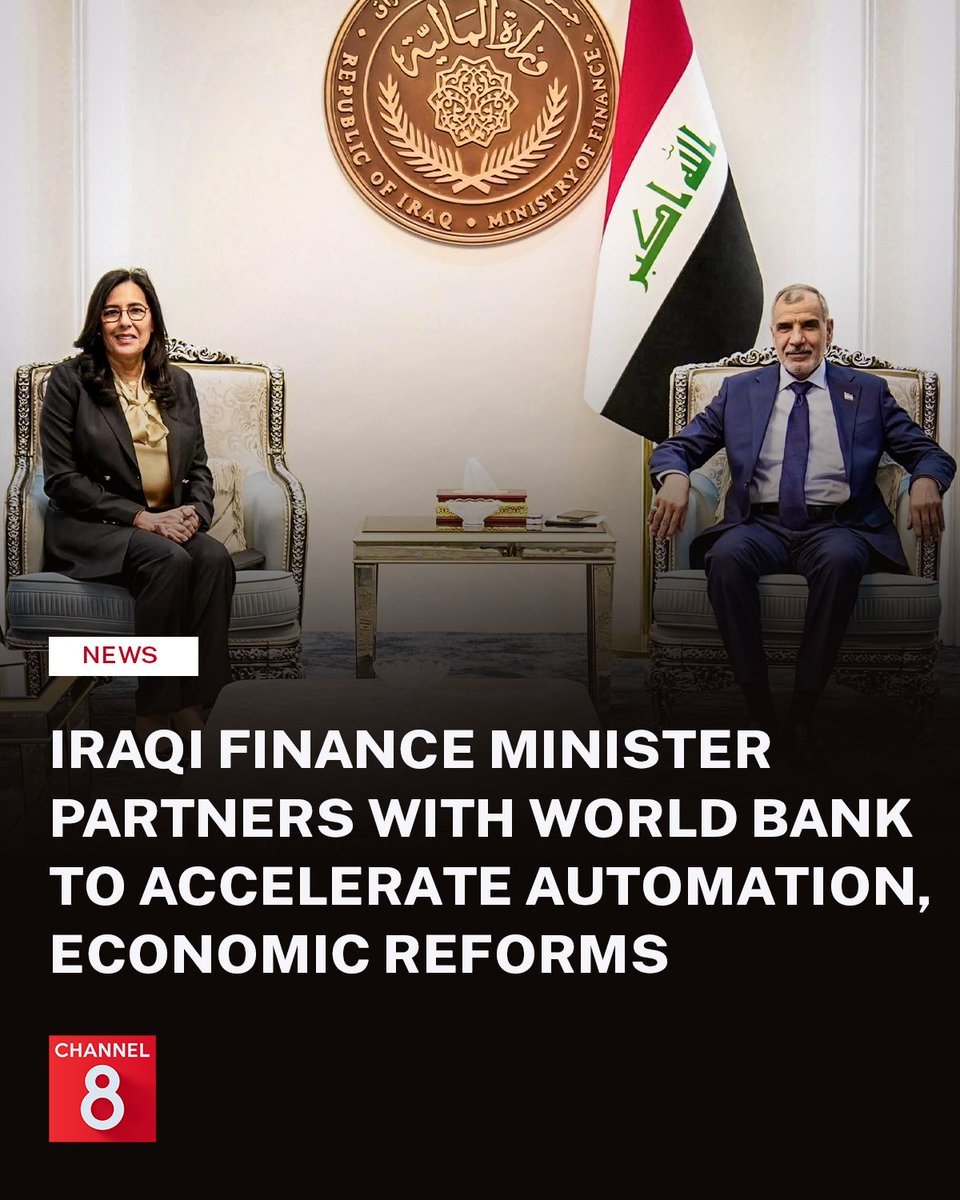
Channel 8 English: Iraqi Finance Minister Faleh al-Sari met with a senior World Bank delegation led by Middle East Division Director Dahlia Khalifa and Country Manager for Iraq Emmanuel Salinas in Baghdad, stressing that “cooperation with the bank encompasses several vital sectors linked to financial and economic reform.”
Read more: https://channel8.com/english/news/65876
Iraq Economic News and Points To Ponder Thursday Evening 9-17-26
Urgent | In Response To The Rising Dollar Exchange Rate, The Central Bank Of Iraq Reassures The Local Market: Starting Sunday, Several Measures Will Be Implemented To Meet Foreign Currency Needs
Baghdad/Iraq Observer An informed source stated on Thursday that the Central Bank of Iraq will begin, starting next Sunday, to expand the scope of import financing and increase the support provided to banks, in line with actual commercial needs.
Urgent | In Response To The Rising Dollar Exchange Rate, The Central Bank Of Iraq Reassures The Local Market: Starting Sunday, Several Measures Will Be Implemented To Meet Foreign Currency Needs
Baghdad/Iraq Observer An informed source stated on Thursday that the Central Bank of Iraq will begin, starting next Sunday, to expand the scope of import financing and increase the support provided to banks, in line with actual commercial needs.
The source said the move aims to facilitate financing for necessary imports and accommodate a wider range of commercial goods, noting that the central bank continues to monitor market developments and take the necessary measures to ensure the smooth flow of foreign trade financing and meet the legitimate demand for foreign currency.
https://observeriraq.net/عاجل-في-مواجهة-ارتفاع-سعر-صرف-الدولار/
Economic Researcher: An Iraqi Employee Needs A "Quarter Of A Century" Of Savings To Buy A Small House On The Outskirts Of Cities
September 17, 2026Last updated: September 17, 2026 Al-Mustaqilla/-Baghdad - Ali Karim Idhaib, a researcher in economic and financial affairs at the “Tigris Lights for Strategic Planning” organization, confirmed that the housing crisis and the high real estate prices in Iraq have become a structural obstacle to the ability of a large segment of employees and the middle class to own a home, in light of the gap between income levels and the cost of housing.
Idheeb explained that reading government salary levels reveals a clear disparity between job categories, as the total salary depends on the nominal salary plus a number of allowances, including marriage, certificate, risk, and ministry allowances.
He pointed out that newly appointed employees in the lower and middle grades have total salaries ranging between 450,000 and 700,000 dinars per month.
Based on an estimated calculation assuming that an employee can save about 300,000 dinars per month from a salary of 450,000 dinars, his total savings over 25 years will reach about 90 million dinars, provided that he continues to save at the same rate throughout this period.
As for those with experience and intermediate grades, especially grades six to four, their total salaries range between 800,000 and 1.3 million dinars per month.
If an employee manages to save about 500,000 dinars per month from a salary of 800,000 dinars, then the total amount he can save over 25 years will reach about 150 million dinars.
Idheeb explained that these calculations are not additional salaries or guaranteed amounts, but rather a theoretical estimate of the employee’s ability to save after assuming that part of his monthly income is deducted, with the remainder of the salary left to cover living expenses and family obligations.
He pointed out that the highest segment, which includes special grades, advanced cadres and employees in ministries with high allowances, such as oil, foreign affairs and electricity, has total salaries exceeding 1.8 million dinars per month and may reach 3 million dinars or more depending on the grade and allowances.
For example, if an employee whose salary is about 1.8 million dinars per month manages to save about one million dinars per month, then his theoretical savings over 25 years will reach about 300 million dinars.
According to the researcher, this comparison reveals that the difference in income level directly impacts the theoretical ability to build long-term savings. However, all segments face a common challenge: the largest portion of the salary goes towards daily expenses and family obligations, making actual real estate savings less than these estimates.
Idheeb stressed that a quarter of a century of saving is not an indication that an employee can actually accumulate these amounts, but rather a time frame used to show the size of the problem, especially when the ability to save is compared to the cost of buying a house or a piece of land on the outskirts of cities.
He added that a young employee who starts with a limited salary faces a difficult economic equation; he is required to secure housing, living expenses, transportation, and family needs, while at the same time building up savings sufficient to buy a property whose value increases over time.
He pointed out that the problem is not related to the level of salaries alone, but rather to the relationship between wage growth on the one hand, and the rise in prices of land, housing units and building materials on the other hand, as well as the limited options for long-term real estate financing.
Idheeb stressed that addressing the housing crisis requires an integrated package of policies, including providing serviced land, increasing the supply of housing units, developing new cities, expanding long-term mortgage financing, and directing housing projects towards low- and middle-income earners.
He stressed that the continued gap between income and housing costs could turn homeownership into a goal postponed for decades for large segments of employees, which necessitates dealing with the housing issue as an economic and social issue, and not just a real estate issue. https://mustaqila.com/باحث-اقتصادي-الموظف-العراقي-يحتاج-ربع/
Basrah Crudes Dip 7% As Global Oil Slips
2026-09-17 03:14 Shafaq News- Basrah Iraq’s Basrah Heavy and Medium crude prices fell sharply on Thursday, tracking declines in global oil benchmarks.
Basrah Heavy dropped $8, or 7.80%, to $94.57 per barrel, while Basrah Medium fell by the same amount, or 7.56%, to $97.87.
In global markets, Brent crude slipped to $105.52 per barrel, down 31 cents, or 0.29%, while US West Texas Intermediate (WTI) fell 35 cents, or 0.34%, to $102.08.
By contrast, the OPEC Reference Basket rose $1.52, or 1.23%, to $124.63 per barrel.
https://www.shafaq.com/en/Economy/Basrah-crudes-dip-7-as-global-oil-slips
Gold Bounces Back From Near Six-Week Lows
2026-09-17 02:20 Shafaq News Gold prices rose on Thursday as investors digested the U.S. Federal Reserve's interest rate hike and its signal that further policy tightening may follow, while an earlier rally in oil prices lost momentum.
Spot gold was up 0.8% at $4,295.26 per ounce, as of 0443 GMT, after hitting a near six-week low on Wednesday.
U.S. gold futures for December delivery were down 1.2% to $4,333.90.
Oil prices eased, extending losses on reports of Saudi Arabia offering extra crude cargoes through Oman.
"Oil prices remain a key factor to watch. If oil prices continue to decline, that could support gold prices moving higher, at least from a medium-term perspective. Until that materializes, I expect gold to remain range-bound," said Kelvin Wong, senior market analyst at OANDA.
The current uptick in gold is also largely driven by technical factors, with the Fed's hawkish message already largely priced into the market, he added.
Although gold is considered an inflation hedge, higher rates reduce its appeal by boosting the attractiveness of interest-bearing assets.
The Fed raised interest rates on Wednesday and flagged more hikes in the coming months, with new U.S. central bank chief Kevin Warsh joining a unanimous decision that effectively acknowledges the Trump administration's inability so far to control inflation that policymakers worry could worsen.
Updated quarterly economic projections showed 16 of 18 policymakers anticipate at least one more quarter-percentage-point hike by the end of this year, with only two of them seeing rates remaining stable from here.
The Bank of England looks set to keep rates on hold on Thursday but investors are watching for any hint that higher energy prices could force it to follow the Fed's example.
On the geopolitical front, U.S. President Donald Trump said he hoped an end to the war against Iran was near, as the conflict, in its seventh month, escalated with Saudi aircraft pounding Yemen and Houthi fighters launching drones and missiles at Saudi cities.
Spot silver rose 1.2% at $63.73, platinum firmed 1.7% to $1,783.56 and palladium climbed 2.2% to $1,296.70. (Reuters)
https://www.shafaq.com/en/Economy/Gold-bounces-back-from-near-six-week-lows
In The Presence Of The Central Bank Governor, The Ministry Of Finance Finalizes The Mechanism For Pre-Payment Of Customs Duties.
Baghdad / Iraq Observer The Ministry of Finance announced today, Thursday, the completion of the executive mechanism for implementing Cabinet Resolution No. (413) of 2026, regarding the prepayment of customs duties.
Finance Minister Faleh Sari chaired a meeting dedicated to finalizing the implementation mechanism, in the presence of the Governor of the Central Bank of Iraq, Nizar Nasser Hussein, the Director General of the General Authority of Customs, a number of officials, and a representative of the United Nations Conference on Trade and Development
The meeting discussed the procedures and technical, financial and organizational requirements necessary to implement the decision, as well as the mechanisms for linking and integrating the relevant parties.
The ministry confirmed that the mechanism was completed in accordance with the ASYCUDA system and approved electronic payment systems, noting that its application aims to enhance the governance of customs work, ensure the accuracy of collecting state dues and maximize non-oil revenues.
She explained that the measure comes within the Ministry’s directions to automate customs procedures and reduce evasion and manipulation, in addition to speeding up the completion of transactions and simplifying procedures
https://observeriraq.net/بحضور-محافظ-البنك-المركزي-المالية-تنج/
Seeds of Wisdom RV and Economics Updates Thursday Afternoon 9-17-26
Good Afternoon Dinar Recaps,
EURO BOND SHIFT: EUROPE MOVES TO STRENGTHEN ITS RESERVE-CURRENCY ROLE AS GLOBAL FINANCE REALIGNS
EUROPE IS SEEKING GREATER INTERNATIONAL RECOGNITION FOR EU BONDS, A MOVE THAT COULD DEEPEN EURO CAPITAL MARKETS AND SUPPORT A LARGER ROLE FOR THE EURO IN GLOBAL FINANCE.
Good Afternoon Dinar Recaps,
EURO BOND SHIFT: EUROPE MOVES TO STRENGTHEN ITS RESERVE-CURRENCY ROLE AS GLOBAL FINANCE REALIGNS
EUROPE IS SEEKING GREATER INTERNATIONAL RECOGNITION FOR EU BONDS, A MOVE THAT COULD DEEPEN EURO CAPITAL MARKETS AND SUPPORT A LARGER ROLE FOR THE EURO IN GLOBAL FINANCE.
OVERVIEW
The European Commission said today it will push for EU-issued bonds to be included in major international bond indexes, with the goal of increasing the euro's use in global transactions and strengthening its role as a reserve currency.
EU bonds have not generally been treated as sovereign bonds by markets and therefore have not been included in sovereign bond indexes. Changing that treatment could increase demand, liquidity and international investor access to EU debt.
The move comes as Europe continues building a larger pool of common euro-denominated debt while the global financial system undergoes broader changes involving reserves, capital flows, borrowing costs and financial-market infrastructure.
KEY DEVELOPMENTS
1. EUROPE TARGETS THE GLOBAL BOND-INDEX SYSTEM
The European Commission is moving to address an important piece of financial-market infrastructure: how EU bonds are classified and represented in international investment indexes.
EU Economic Commissioner Valdis Dombrovskis said the Commission will engage with index providers and the financial industry to support the inclusion of EU bonds in sovereign bond indexes.
The issue is significant because major bond indexes influence how large institutional investors allocate and benchmark capital. Broader index inclusion could increase the visibility and potential demand for EU debt.
Dombrovskis said the current treatment of EU bonds negatively affects their demand and their usability as a liquid and safe asset for investors.
2. THE EU HAS BUILT A SIGNIFICANT BOND MARKET
The European Union already raises money in international capital markets through euro-denominated bonds.
According to Reuters, approximately €800 billion of EU bonds are currently outstanding, making the EU bond market the second-largest triple-A-rated debt market in Europe and the third-largest globally.
That is still much smaller than the approximately $32 trillion U.S. Treasury market, while Germany has roughly €2.5 trillion of triple-A-rated debt outstanding.
The European Commission says EU borrowing currently supports programs including NextGenerationEU, financial assistance to Ukraine and other neighboring countries, and the SAFE defense-investment program.
More EU bonds are expected in the future, including borrowing associated with the next EU long-term budget. That means the market could continue expanding over time.
3. EU BONDS ARE ALREADY USED IN IMPORTANT FINANCIAL OPERATIONS
The proposed change in index treatment is not occurring in isolation.
Dombrovskis noted that EU bonds can already be used as collateral in ways equivalent to sovereign bonds with clearing houses and in European Central Bank refinancing operations.
The European Commission also describes itself as empowered by the EU Treaties to borrow from international capital markets on behalf of the European Union. All EU-Bond issuances executed by the Commission are denominated in euros.
This creates an important distinction: the market is being asked to reconsider the classification and index treatment of an existing and expanding asset class, rather than Europe creating a completely new bond market from scratch.
4. THE EURO'S RESERVE-CURRENCY ROLE IS PART OF THE STRATEGY
The European Commission explicitly connected broader EU-bond index inclusion with increasing the use of the euro in global transactions and as a reserve currency.
A reserve currency requires more than a large economy. International investors also need deep and liquid financial markets, reliable payment infrastructure and a substantial supply of high-quality assets that can be held and traded internationally.
That makes the development of the EU bond market important to the broader international role of the euro.
If EU bonds become more widely recognized and incorporated into major investment benchmarks, they could become more accessible to global institutional investors. Over time, that could strengthen the financial infrastructure supporting the euro.
5. THIS IS ABOUT FINANCIAL INFRASTRUCTURE — NOT REPLACING THE DOLLAR
The development should not be interpreted as an announcement that the euro is replacing the U.S. dollar.
The dollar remains the dominant international currency, while the euro is already one of the world's major reserve and transaction currencies.
What Europe is pursuing is greater international use and deeper financial-market infrastructure for the euro.
That distinction matters.
Global monetary change does not necessarily happen because one currency suddenly replaces another. It can also occur through greater diversification of reserves, bonds, payments, trade settlement and investment assets.
The European initiative is therefore better understood as an effort to strengthen the euro's financial foundation and increase the range of internationally usable euro-denominated assets.
WHY IT MATTERS
The important development here is not simply whether the euro rises or falls against the dollar.
It is the effort to strengthen the financial infrastructure behind the euro.
If EU bonds gain wider international index recognition, European debt could become more visible to global institutional investors. A larger and more liquid bond market could, over time, support greater international use of the euro.
The move also illustrates how changes in the global financial system can begin with seemingly technical decisions involving bond indexes, asset classification, collateral rules and capital-market infrastructure.
The foundation often changes before the headlines do.
WHY IT MATTERS TO FOREIGN CURRENCY HOLDERS
Readers hold foreign currency with the hopes that it will increase in value when the Global Reset occurs.
Developments such as this are worth watching because currency strength is connected to much more than an exchange-rate quotation. Debt markets, trade settlement, reserve holdings, capital flows and financial infrastructure all influence how important a currency becomes internationally.
The expansion of euro-denominated assets could therefore be relevant to the long-term international role of the euro.
However, today's announcement does not establish a future revaluation of the euro or any other currency.
Hope is understandable. Evidence is essential.
There are no guaranteed dates, overnight currency-reset announcements or automatic RV conclusions contained in this development.
IMPLICATIONS FOR THE GLOBAL RESET
Pillar 1: Debt and Bond Markets
The EU's effort highlights the growing importance of high-quality, internationally accessible debt markets.
The EU already has approximately €800 billion in outstanding bonds, and additional issuance is expected in coming years.
If EU bonds become more deeply integrated into global investment indexes, European debt could become a larger component of international asset allocation.
That matters because the future financial system will be shaped not only by currencies themselves, but also by the assets investors can hold, benchmark and trade in those currencies.
Pillar 2: Assets and Reserve Currencies
The euro's international role could become stronger if Europe continues expanding the depth, liquidity and accessibility of euro-denominated financial assets.
This does not require the dollar to disappear.
Instead, it could contribute to a financial system in which the dollar, euro and other major currencies occupy different but overlapping roles in global reserves, trade and investment.
The broader issue is the gradual development of multiple financial centers and pools of internationally accessible assets.
RUMOR SAFETY REMINDER
Today's EU bond announcement is NOT an announcement that the euro will replace the U.S. dollar.
It is also NOT a currency revaluation announcement, an RV announcement or a Global Reset date.
The documented development is that European officials want EU bonds included more broadly in international bond indexes to support greater demand, liquidity and international use of the euro.
Follow the infrastructure. Follow the evidence. Don't follow the hype.
THE BOTTOM LINE
Europe is taking another step toward strengthening the financial foundation behind the euro by seeking broader international recognition for EU bonds.
The immediate change may appear technical — bond indexes and market classification — but the longer-term objective is broader: deeper capital markets, greater international use of the euro and a stronger position for European debt within the global financial system.
The significance is also visible in the numbers. With approximately €800 billion of EU bonds already outstanding, and additional issuance expected, Europe is building a larger pool of common euro-denominated assets that can potentially serve international investors.
For those watching the Global Reset, this is a reminder that major financial changes can develop quietly through bonds, indexes, settlement systems and market infrastructure long before they appear as dramatic currency headlines.
The global financial order may not be changing through one currency replacing another — it may be changing through the expansion of financial systems competing and operating alongside one another.
Seeds of Wisdom Team
Newshounds News™ Exclusive
SOURCES
Reuters — "EU exec to push for EU bonds to be included in indexes to boost euro role"
European Commission — "The EU as a borrower – investor relations"
~~~~~~~~~~
Seeds of Wisdom Team RV Currency Facts Youtube and Rumble
Newshound's News Telegram Room Link
RV Facts with Proof Links Link
RV Updates Proof links - Facts Link
Start Here room with Most Asked Questions Link
Follow the Gold/Silver Rate COMEX
Follow Fast Facts
Seeds of Wisdom Team™ Website
Thank you Dinar Recaps
They Called Refining a Dying Business. Diesel Just Hit $6.
They Called Refining a Dying Business. Diesel Just Hit $6.
Notes From the Field By James Hickman 9Simon Black / Sovereign Man) September 16, 2026
On Sunday afternoon, the power went out at ExxonMobil's refinery in Channahon, Illinois, a southwest suburb of Chicago. Oil refineries run at tremendous heat and pressure, so whenever the power goes out, all that heat and pressure has to go somewhere. It’s basic physics. Hence why the plant burned it off through the flare stacks, with black smoke visible for miles.
They Called Refining a Dying Business. Diesel Just Hit $6.
Notes From the Field By James Hickman (Simon Black / Sovereign Man) September 16, 2026
On Sunday afternoon, the power went out at ExxonMobil's refinery in Channahon, Illinois, a southwest suburb of Chicago. Oil refineries run at tremendous heat and pressure, so whenever the power goes out, all that heat and pressure has to go somewhere. It’s basic physics. Hence why the plant burned it off through the flare stacks, with black smoke visible for miles.
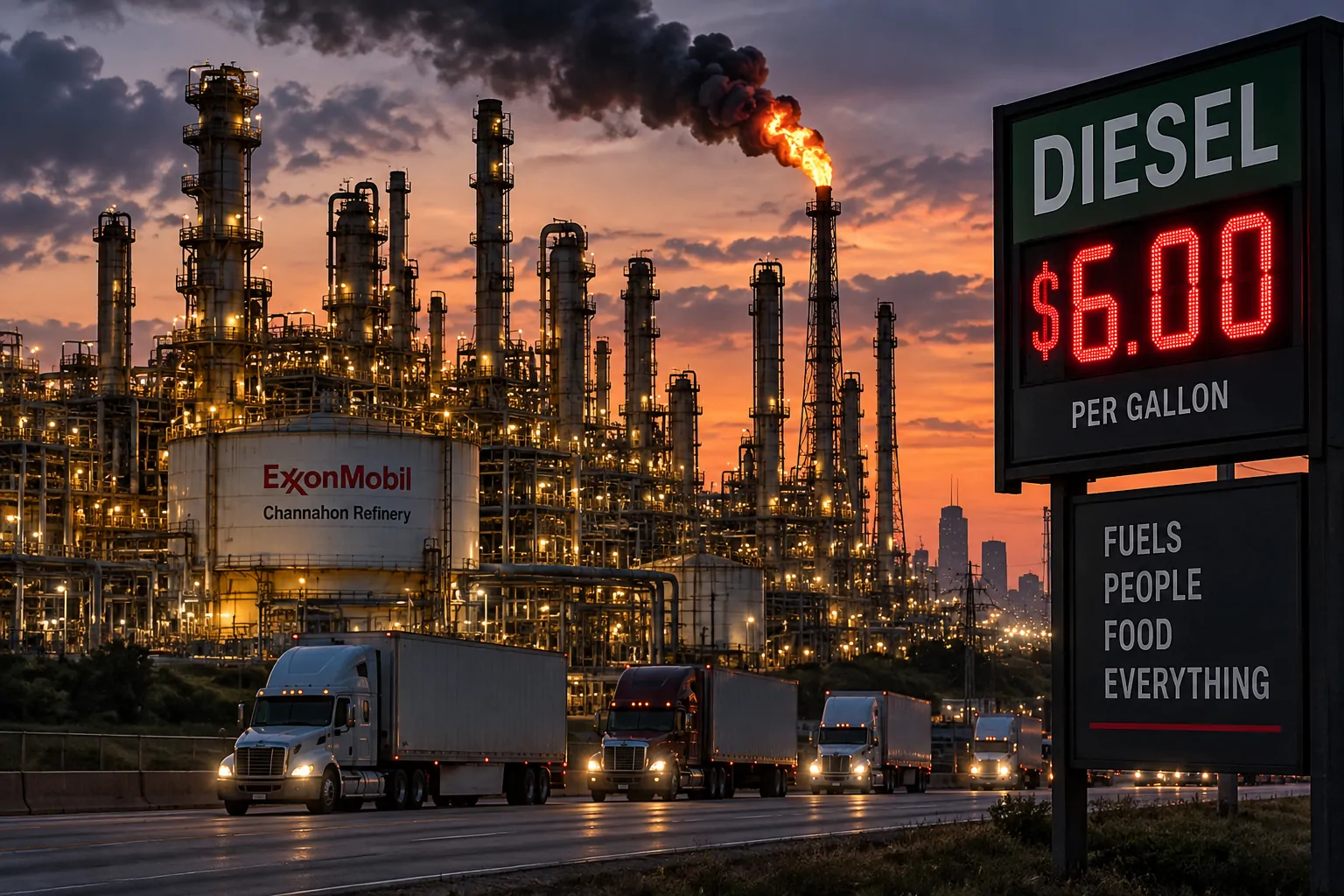
The power came back around 7 p.m., but the plant stayed down, and as of Monday ExxonMobil still hadn't said when it would restart, likely up to a week.
Bear in mind this is a plant that processes about 275,000 barrels of crude a day— close to 10% of the region's fuel supply.
But that’s not what caused the highest diesel prices ever.
Even before this refinery was taken out of commission, the national average price of diesel went above $6 a gallon last week for the first time ever. Filling up a long-haul semi truck now costs more than $1,000.
It's important to note that a barrel of crude oil is almost useless until somebody turns it into something. A refinery cooks the crude and breaks it apart into gasoline, diesel, jet fuel, heating oil, the raw material for plastics, etc.
Everyone knows about the squeeze on oil due to the war with Iran. But the shortage of REFINERIES is another issue.
Sure, the wars have taken a toll on refineries and other fuel plants. Iran bombed Bahrain's only refinery, shut ever since. It also wrecked half of Shell's Pearl GTL in Qatar, the world's largest plant for turning natural gas into diesel, jet fuel and lubricants. Ukrainian drones, meanwhile, have cut Russia's refining by roughly a third.
And the rest of the world's refineries can’t pick up the slack.
US refineries are already running at almost 98% of capacity. There's no spare refining capacity, and that’s because governments have treated refining as the enemy of humanity for the past decade.
For example, ten years ago Britain had six refineries. Then the UK government announced a ban on new gasoline and diesel cars and piled punitive taxes specifically on refineries, and today Britain is down to four.
I guess the “Just Stop Oil” fanatics are happy now. They actually declared victory last year and hung up their hi-vis (oil-based) vests, and quit (oil-based) gluing themselves to things, because "no new oil" had become official government policy in the UK.
California, meanwhile, imposed a new penalty tax on refinery margins, and then passed climate change regulations for refineries that are virtually impossible to achieve.
Unsurprisingly, in the past year, California lost two refineries: Phillips 66's in Los Angeles and Valero's in Benicia near San Francisco. That’s 17% of California's refining capacity.
Then Newsom panicked and changed his tune, realizing that California fuel prices would surge. He suddenly promised to "work closely with refiners." He directed his own energy commission to pause the punitive refinery tax for five years. He even pushed legislators to consider paying hundreds of millions of dollars to Valero to keep their plant open.
Too little, too late. The refiners left, or idled their plants. You can only bite the hand that feeds so many times before they take action.
But of course, everyone will pay for Newsom’s idiocy, because diesel moves everything. So much of American imports arrive at California ports (like the Port of Long Beach), and trucks haul it across the country from there. Trains do the rest.
And nearly every big truck and freight train runs on diesel, which is now a lot more expensive in California. So the cost of Newsom’s lunacy is paid by every consumer.
Harvest is starting across the Midwest right now, and everything from tractors to grain dryers burns fuel. Phosphate (another critical fertilizer ingredient) is mined and hauled with diesel.
So the farmer pays $6 a gallon, the trucker pays $6 a gallon… and consumers reimburse these costs in the form of higher prices.
And let’s not forget, winter is coming.
Heating oil is diesel by another name (it comes out of the same refinery), and about 5 million American homes heat with it, more than 80% of them in the Northeast. One Gulf oil executive warned last week of "a very difficult winter coming in Northwest Europe. This is only the beginning."
Bottom line, the power outage at Channahon is a problem. But it’s a small problem compared to the larger war on refineries.
With the spare refineries gone, even the slightest issue at remaining refineries now shows up in the price of diesel, food and everything else that moves on a truck.
Unexpected disruptions from war and power outages are one thing.
But governments deliberately villainizing refiners and chasing them out of town, for the crime of creating the energy the world desperately relies on, is another.
Their green policies and ESG mandates also helped drive a decade of underinvestment in the physical things civilization runs on: ships, mines, oil fields, smelters... and refineries.
Now the world is in the midst of a destructive war. When there is no spare capacity, every disruption has to be resolved by price, and the companies that own the scarce, strategic assets collect the difference.
And owning a piece of those companies yourself is the best way to protect yourself from higher prices and inflation.
To your freedom, James Hickman Co-Founder, Schiff Sovereign LLC
P.S.
That's the whole point of Schiff Sovereign's investment research newsletter, Strategic Assets: profitable, low-debt companies that own or move real things, bought while they're still cheap.
Two oil tanker owners we featured when nobody wanted them are up more than 180% and 130%— one of them runs the ships that haul diesel— and our palm oil grower is up nearly 140%.
Ariel: Iraq’s Currency Reform, IQD Sovereign Rate Activation
Ariel: Iraq’s Currency Reform, IQD Sovereign Rate Activation
9-17-2026
Settlement & Sovereignty: Iraq’s Currency Reform (Where We’re At)
Trump Strategic Delay Architecture & IQD Sovereign Rate Activation — The Three-Week
Trump’s delay architecture operates on a principle that the opposition hasn’t fully decoded: an administrative rule creates permanent regulatory structure without legislative vulnerability. A bill can be stalled, amended, gutted, or buried in committee by a single strategically placed senator.
Ariel: Iraq’s Currency Reform, IQD Sovereign Rate Activation
9-17-2026
Settlement & Sovereignty: Iraq’s Currency Reform (Where We’re At)
Trump Strategic Delay Architecture & IQD Sovereign Rate Activation — The Three-Week
Trump’s delay architecture operates on a principle that the opposition hasn’t fully decoded: an administrative rule creates permanent regulatory structure without legislative vulnerability. A bill can be stalled, amended, gutted, or buried in committee by a single strategically placed senator.
An administrative rule, once published in the Federal Register, carries the force of law and can only be overturned by congressional review which requires a joint resolution that faces the same partisan gridlock the Deepstate relies on to block everything else.
The SEC’s Friday rules validate the tokenized IQD instrument for official settlement, creating a permissioned regulatory framework that the $28 Ripple ledger price already operates within.
The Clarity Act was the public-facing vehicle, but the administrative bypass is the actual delivery mechanism and it’s immune to the stall tactics that killed the legislative path.
Now lets talk about this. The $28 Ripple ledger price is not random, speculative, or disconnected from the sovereign rate it’s a pre-positioned forward contract rate that institutional counterparties are already settling volume at in a parallel tokenized market. Limited supply mechanics in the tokenized IQD instrument create artificial scarcity that holds the $28 level as a functional floor.
Institutional counterparties sovereign wealth funds, regional banks, and clearing houses positioned forward contracts at $28 because the CBI’s internal models projected the post-RV sovereign rate at $3.22 per unit, and the derivative multiplication factor through the Ripple settlement layer produces a $28 equivalent when accounting for the redenomination ratio and the tokenized supply constraints.
The $28 isn’t a speculative pair price. It’s the institutional settlement rate that mirrors the sovereign rate through a different financial instrument and it’s already clearing volume. Will we get that rate? Well we will not know until we get past the “Crypto Structure Rules” launch.
The transition from speculative ledger pair to sovereign public rate requires one mechanism. Regulatory validation of the tokenized instrument for official settlement. When the SEC’s administrative rules drop Friday, they validate the Ripple-based tokenized IQD as an officially recognized settlement instrument.
Banks need a liquid, regulated, permissioned instrument to execute currency exchanges at scale and the $28 level is already liquid, already clearing institutional volume, and already embedded in forward contracts that institutional counterparties can’t unwind without massive exposure.
The sovereign $3.22 rate handles the physical currency layer what a single dinar note is worth.
The $28 Ripple rate handles the institutional settlement layer what banks could actually use to clear large-volume exchanges between counterparties.
The CBI’s permissioned ledger running through Trade Bank of Iraq, Rafidain, and Rasheed ensures the digital and physical IQD maintain 1:1 parity, but the institutional settlement layer operates on the tokenized instrument that already prices at $28.
Read Full Article:
https://www.patreon.com/Prolotario1/posts/settlement-iraqs-169753776
Iraq Economic News and Points To Ponder Thursday Afternoon 9-17-26
Finance Minister To World Bank Delegation: We Are Proceeding With The Implementation Of Automation Projects And Transforming Them Into Practical Steps To Develop Financial Management And Enhance Oversight And Transparency
Baghdad - One News - 9/17/2026 Finance Minister Faleh Sari discussed with a delegation from the World Bank the files of financial and banking reform and the development of financial management tools, in addition to the automation projects that the ministry is working to implement.
Finance Minister To World Bank Delegation: We Are Proceeding With The Implementation Of Automation Projects And Transforming Them Into Practical Steps To Develop Financial Management And Enhance Oversight And Transparency
Baghdad - One News - 9/17/2026 Finance Minister Faleh Sari discussed with a delegation from the World Bank the files of financial and banking reform and the development of financial management tools, in addition to the automation projects that the ministry is working to implement.
The Ministry of Finance stated in a statement that Sari received a delegation from the World Bank headed by the Regional Director for the Middle East, Dalia Khalifa, and the Director of the Bank’s mission in Iraq, Emmanuel Salinas. During the meeting, they discussed ways of cooperation in developing financial systems and projects related to financial and economic reform.
Sari affirmed that the Ministry of Finance is proceeding with the implementation of automation projects and moving them to practical steps, which will contribute to developing work procedures and raising the efficiency of resource and data management, in addition to enhancing oversight and transparency in financial institutions.
The Minister of Finance pointed to the importance of the World Bank’s role in supporting automation projects and benefiting from its technical expertise in developing financial systems, indicating that cooperation between the two sides includes a number of vital sectors related to financial and economic reform.
For their part, representatives of the World Bank appreciated the measures taken by the Ministry of Finance to develop the financial and banking sectors, stressing the Bank’s commitment to continuing cooperation with the Ministry to ensure the success of joint projects in Iraq.
The World Bank delegation noted a growing interest from major international companies in the Iraqi market, coinciding with efforts to develop the financial and banking sector and strengthen economic reform initiatives.
https://1news-iq.net/وزير-المالية-لوفد-البنك-الدولي-ماضون-ف/
Kurdistan Region President: It is Time to End Disputes and Consolidate Coexistence
Iraqi News Agency Thursday, Erbil - INA - 9/17/2026 Kurdistan Region President Nechirvan Barzani affirmed on Thursday that the region's strength lies in being part of a strong Iraq, stressing that the time has come to resolve disputes and consolidate coexistence across the country.
In a speech delivered at the Sulaymaniyah Economic Summit, attended by the Iraqi News Agency (INA) correspondent, Barzani stated, "Political disputes must not hinder trade and investment; rather, a clear constitutional framework regarding financial, customs, and tax issues must be established with the federal government."
"We seek an Iraq that never becomes a tool for the imposition of force, numerical dominance, or self-assertion for control, but rather a haven that protects everyone," he added.
"We want a state that embraces Kurds, Arabs, Turkmens, Christians, Yazidis, and all Iraqi citizens, a state where everyone feels secure in their rights, independent of the whims of governments or equations of power and majorities; instead, their rights must be safeguarded and protected by state institutions and the law," he stated.
"Issues concerning the budget, salaries, oil and gas, and powers must be resolved constitutionally, in a manner that upholds the rights of both the Kurdistan Region and Iraq, while preserving the rights of all Iraqi citizens," he continued.
"The goal is not for Erbil to follow Baghdad, nor for Baghdad to follow Erbil; rather, the goal is for us to follow a constitutional Iraq," he added
"Our strength lies in a strong federal Iraq and in the Kurdistan Region existing within the framework of a strong Iraq," he confirmed.
"The time has come to end disputes and resolve them; the clear path to doing so lies in the constitution, dialogue, and peaceful coexistence within this country," Barzani concluded.
Trump Demands Sub-1% Rates Following Fed Hike
2026-09-17 / 05:04 Shafaq News- Washington US President Donald Trump urged the Federal Reserve on Thursday to cut interest rates, stepping up pressure on the central bank after it raised its benchmark rate by 25 basis points.
“Interest Rates in the United States should be 1%, or less, because we are the Best Credit in the World — BY FAR,” he wrote on Truth Social, adding that the economy was “booming” as new investment flowed into the country.
Donald J. Trump TRUTH @realDonaldTrump
Interest Rates in the United States should be 1%, or less, because we are the Best Credit in the World — BY FAR. Our Country is BOOMING with new Investment! If we stopped Trading with every country that we have a Deficit with, which is most of them, we would make, at least, 1.5 Trillion Dollars a year. The word “Deficit” is nothing more than a fancy word for LOSS. We are “carrying” almost every country in the World, and that cannot go on any longer.
LOWER THE INTEREST RATES FOR THE UNITED STATES OF AMERICA, AND FAST! President DONALD J. TRUMP
Trump argued that cutting trade with countries where the United States runs deficits would generate substantial revenue, claiming that the United States is “carrying” nearly every country and “that cannot go on any longer.”
Trump also attacked the Federal Reserve’s rate decision, calling the central bank “hostile” and accusing it of acting for political reasons to make his administration’s economic record look worse.
The Federal Open Market Committee voted unanimously to raise the federal funds rate by 25 basis points to a range of 3.75% to 4%, ending five consecutive meetings in which the rate had remained unchanged.
The decision sent the dollar to a seven-week high, while higher Treasury yields reflected expectations that the Fed could keep raising rates. The dollar index, which tracks the US currency against a basket of major currencies, also climbed to 100.33, its highest level since July 31.
Fed Chair Kevin Warsh attributed the move to inflation, saying it was “too high and has been for too long,” and called it a “sober” and “responsible decision.”
Despite opposing the increase, Trump praised Warsh, saying he still had confidence in the man he picked earlier this year to take over the Fed from Jerome Powell, a figure the president has frequently criticized for not delivering the sharp rate cuts Trump has repeatedly demanded.
https://www.shafaq.com/en/World/Trump-demands-sub-1-rates-following-Fed-hike
Slemani Summit: Iraq’s President Urges Economic Diversification
2026-09-17 Shafaq News- Al-Sulaymaniyah Iraqi President Nizar Amedi on Thursday called for economic diversification, greater investment and stronger action against corruption, saying Iraq must improve its investment climate to attract capital and support sustainable growth.
Speaking at the 2026 Slemani Summit, Amedi said coordination among government institutions, civil society, partners and independent organizations was essential to developing and implementing financial, banking and economic policies.
He said regional instability made cooperation particularly important to limit its impact on Iraq’s economy and citizens.
Amedi backed a larger role for the private sector in strategic projects, infrastructure, services and job creation, while stressing the need for transparency, competition and protection of public funds and the rights of both the state and investors.
He said successful partnerships should combine the state’s role with the private sector’s capacity for investment and innovation, helping diversify economic activity and attract capital, expertise and technology.
Read more: Iraqi experts divided on reviving the oil-reliant economy
Political and security stability, he added, cannot be sustained without long-term economic and social stability.
Amedi also called for a long-term national strategy based on stronger state institutions, the rule of law, better management of resources, economic diversification, investment and digital transformation.
He said Iraq should gradually move toward a more productive and diversified economy through financial and economic reform, infrastructure development, private-sector growth and investment in young people and technology.
The president also called for continued action against corruption across the financial, economic and public-service sectors, while supporting the judiciary, integrity bodies, security agencies and other state institutions involved in anti-corruption efforts.
Read more: Iraq’s Dawn Crackdown spreads through state institutions
https://www.shafaq.com/en/Iraq/Slemani-Summit-Iraq-s-President-urges-economic-diversification
Are Central Banks Moving Out of Dollar Assets?
Are Central Banks Moving Out of Dollar Assets?
Linda S. Goldberg, Oliver Hannaoui, and Sneha Parthasarathy
The dollar’s share of global official foreign exchange reserves fell from 64 percent in 2015 to 56 percent in 2025. This downward trajectory is sometimes read as evidence that the dollar’s role in international financial markets is eroding.
However, aggregate statistics obscure the composition of changes occurring at the country level. In this post, we show that the aggregate decline is not a systematic global shift away from dollar assets. Rather, the aggregate decline reflects the actions of a handful of large reserve holders, changing either their currency preferences or the size of their reserve portfolio.
Are Central Banks Moving Out of Dollar Assets?
Linda S. Goldberg, Oliver Hannaoui, and Sneha Parthasarathy
The dollar’s share of global official foreign exchange reserves fell from 64 percent in 2015 to 56 percent in 2025. This downward trajectory is sometimes read as evidence that the dollar’s role in international financial markets is eroding.
However, aggregate statistics obscure the composition of changes occurring at the country level. In this post, we show that the aggregate decline is not a systematic global shift away from dollar assets. Rather, the aggregate decline reflects the actions of a handful of large reserve holders, changing either their currency preferences or the size of their reserve portfolio.
From the perspective of the cross section of countries holding dollar assets, the dollar’s status in official portfolios is largely intact.
Understanding the Aggregate Dollar Shares of Reserves
When economists calculate the dollar share of worldwide official foreign exchange reserves, countries with larger reserve holdings naturally exert disproportionate influence on the final number.
As Goldberg and Hannaoui (2026) show, this seemingly straightforward calculation can mask two fundamentally different phenomena. Countries can actively reallocate their existing portfolios away from dollar assets and toward other currencies, which we term the “preferences channel.”
Alternatively, countries can accumulate or decumulate new foreign exchange reserves at dollar shares different from the global average, which we call the “reserve change channel.”
When a country with below-average dollar holdings expands its reserves, it mechanically pulls down the global aggregate, even without reducing its own allocation to dollars.
From this lens, we can interpret the evolution observed in the chart below, showing the currency composition of global foreign exchange reserves as reported by the International Monetary Fund (IMF).
Shares of Dollars and Big Four Currencies in Global Foreign Exchange Reserves Have Declined
Chart: https://libertystreeteconomics.newyorkfed.org/2026/09/are-central-banks-moving-out-of-dollar-assets/
Two distinct periods, selected for availability of data on individual country composition of foreign exchange reserves, illustrate what drives the aggregates. From 2015 to 2019, the dollar share fell by 3 percentage points.
From 2019 to 2023, the decline moderated to 2 percentage points. The central question is whether these aggregate movements reflect a large set of countries systematically reallocating away from the dollar, or whether they stem from the actions of a few large reserve holders making choices specific to their own circumstances.
Consider the most basic indicator: are countries moving dollar shares of reserves in the same direction? If the aggregate decline reflected a broad-based global shift away from the dollar, most countries would reduce their dollar allocations over these periods.
Instead, examining directional changes in dollar share across countries during both four-year windows, we find that roughly equal numbers of countries increased and decreased their dollar holdings. This balance suggests no dominant cross-sectional shift away from dollars.
Instead, examining directional changes in dollar share across countries during both four-year windows, we find that roughly equal numbers of countries increased and decreased their dollar holdings, as illustrated in the chart below.
There Are Similar Counts of Countries with Increased and Decreased Dollar Shares Over 4-Year Windows
CHART: https://libertystreeteconomics.newyorkfed.org/2026/09/are-central-banks-moving-out-of-dollar-assets/
If Countries Are Not All Moving Away from the Dollar, What Explains the Aggregate Decline?
During the 2015-19 period, we examine the reserve portfolios of seventy-nine countries, of which seventy-six have complete data for the beginning and end of the period.
TO READ MORE: https://libertystreeteconomics.newyorkfed.org/2026/09/are-central-banks-moving-out-of-dollar-assets/