
Thank you to all the subscribers to our Early Access program…we thank you for your continued support.
We are excited to offer this new service to keep you informed and up-to-date on the latest Dinar and currency news.
Seeds of Wisdom RV and Economics Updates Thursday Morning 9-3-26
Good Morning Dinar Recaps,
GLOBAL BOND SHOCK SPREADS TO DEVELOPING NATIONS: IMF WARNS HIGHER YIELDS COULD REVERSE DEBT PROGRESS
Rising borrowing costs in advanced economies are beginning to threaten debt sustainability in developing countries, creating another pressure point in an already heavily indebted global financial system.
Good Morning Dinar Recaps,
GLOBAL BOND SHOCK SPREADS TO DEVELOPING NATIONS: IMF WARNS HIGHER YIELDS COULD REVERSE DEBT PROGRESS
Rising borrowing costs in advanced economies are beginning to threaten debt sustainability in developing countries, creating another pressure point in an already heavily indebted global financial system.
OVERVIEW
IMF Warning: IMF Managing Director Kristalina Georgieva says rising bond yields and debt levels in advanced economies could reverse progress developing countries have made in reducing debt vulnerabilities.
Global Transmission: Higher yields in major economies can lift borrowing costs around the world, increasing refinancing and debt-service costs for emerging and low-income nations.
Systemic Pressure: With global public debt approaching 100% of GDP, the combination of elevated yields, inflation, energy costs and competition for capital is creating a broader challenge for the global debt system.
KEY DEVELOPMENTS
1. IMF Warns Higher Yields Could Undo Debt Progress
Speaking at the G20 finance leaders meeting in Asheville, IMF Managing Director Kristalina Georgieva warned that rising bond yields in advanced economies could threaten the progress developing and low-income countries have made in improving their debt positions.
Many emerging economies have spent years working to restore fiscal credibility and reduce borrowing spreads.
The concern is that higher global yields could erase some of those gains even when individual countries maintain responsible fiscal policies.
2. Advanced-Economy Bond Yields Are Transmitting Globally
When yields rise in major markets such as the United States, Japan and Europe, they can influence borrowing costs throughout the global financial system.
Investors compare returns and risk across countries. As safer developed-market bonds offer higher yields, emerging-market borrowers may have to offer higher interest rates to remain competitive for international capital.
That creates a potentially powerful transmission mechanism:
Higher advanced-economy yields → higher global borrowing costs → rising emerging-market debt service → reduced fiscal flexibility.
3. Global Public Debt Is Near a Historic Threshold
The IMF says global public debt is now approaching 100% of GDP, exceeding its post-World War II highs and expected to rise further.
The IMF describes a recurring pattern in which major economic shocks produce large increases in government debt, but the debt often does not decline substantially after the crisis passes.
That leaves governments entering the next shock with less fiscal space and greater sensitivity to interest rates.
4. Energy and AI Investment Are Adding to Capital Competition
The current pressure is not being driven by interest rates alone.
The IMF says the continuing energy shock, including the largely closed Strait of Hormuz, is contributing to inflation pressures. At the same time, the surge in AI investment is creating additional demand for capital and energy.
These forces are occurring while governments are already competing for financing.
The result is a financial environment in which debt, inflation, energy and capital availability are increasingly interconnected.
5. Debt Restructuring Is Becoming More Important
The IMF says progress has been made through the G20 Common Framework for countries facing unsustainable debt.
Senegal is now becoming an important test case after the IMF reached a staff-level agreement for a $2.2 billion three-year loan package, conditional on Senegal seeking Common Framework debt treatment.
The IMF sees a successful restructuring process as potentially important for other countries facing debt distress.
WHY IT MATTERS
This development expands the global bond story beyond the United States, Japan and Europe.
The important issue is the transmission of higher borrowing costs from major financial centers into countries with less capacity to absorb them.
A country may successfully reduce its debt vulnerabilities, only to face renewed pressure when global interest rates rise and refinancing becomes more expensive.
That means the global financial system is becoming increasingly sensitive to sovereign borrowing costs, capital flows and interest-rate differentials.
The bigger the world's debt burden becomes, the more important those variables become.
WHY IT MATTERS TO FOREIGN CURRENCY HOLDERS
Currency Stability: Higher global borrowing costs can place pressure on currencies of countries with large external financing needs.
Capital Flows: Higher yields in advanced economies can attract capital away from emerging markets.
Exchange Rates: Changes in interest-rate differentials can produce significant movements between major and emerging-market currencies.
Purchasing Power: Higher debt-service and energy costs can increase economic pressure and affect the purchasing power of currencies.
Global Risk: Currency holders should watch whether rising sovereign yields remain concentrated in major economies or increasingly spread into emerging markets.
IMPLICATIONS FOR THE GLOBAL RESET
Pillar 1: Debt
The IMF warning highlights a central structural issue: the world is becoming more sensitive to the cost of servicing debt.
When global yields rise, countries with large refinancing requirements can quickly face higher interest expenses. That can reduce spending capacity and make debt restructuring more likely for vulnerable economies.
Pillar 2: Trade
Debt sustainability is closely connected to global trade and external balances.
Countries dependent on exports, foreign investment or external financing can be particularly vulnerable when global capital becomes more expensive or trade conditions deteriorate.
The IMF also warned that widening global imbalances can contribute to trade tensions, cross-border spillovers and economic fragmentation.
CONCLUSION
The IMF's warning marks an important shift in the global bond story. Rising yields are no longer simply a problem for investors and heavily indebted advanced economies—they can become a transmission mechanism for financial stress into developing nations.
The combination of elevated global debt, higher refinancing costs, energy pressures and competition for capital creates a much narrower margin for error.
For countries that have worked to stabilize their finances, a prolonged period of higher global yields could threaten some of those gains.
The emerging global financial question is not simply who has the most debt—it is which countries can continue servicing that debt when the global cost of capital remains high.
Seeds of Wisdom Team
Newshounds News™ Exclusive
SOURCES
~~~~~~~~~~
🌱 A Message to Our Currency Holders🌱
If you’ve been holding foreign currency for many years, you were not foolish.
You were not wrong to believe the global financial system would change.
What failed was not your patience — it was the information you were given.
For years, dates, rumors, and personalities replaced facts, structure, and proof. “This week” predictions created cycles of hope and disappointment that were never based on how currencies actually change.
That is not your failure.
Our mission here is different: • No dates • No rates • No hype • No gurus
Instead, we focus on:
• Verifiable developments • Institutional evidence
• Global financial structure • Where countries actually sit in the process
Currency value changes only come after sovereignty, trade, banking, settlement systems, and fiscal coordination are in place. History and institutions confirm this sequence.
You will see silence. You will see denials. That is not delay — that is discipline.
Protect your identity. Organize your documents. Verify everything.
Never hand your discernment to anyone who cannot show proof.
You deserve truth — not timelines.
Seeds of Wisdom Team
Newshounds News
~~~~~~~~~~
Seeds of Wisdom Team RV Currency Facts Youtube and Rumble
Newshound's News Telegram Room Link
RV Facts with Proof Links Link
RV Updates Proof links - Facts Link
Start Here room with Most Asked Questions Link
Follow the Gold/Silver Rate COMEX
Follow Fast Facts
Seeds of Wisdom Team™ Website
Thank you Dinar Recaps
The Money Supply is Exploding, is this the Beginning of Hyperinflation?
The Money Supply is Exploding, is this the Beginning of Hyperinflation?
George Gammon: 9-2-2026
The global financial landscape is constantly shifting, but few indicators capture the attention of economists and everyday investors quite like the M2 money supply.
In a recent, highly detailed analysis, financial educator George Gammon dives into the startling projection of the M2 money supply reaching an unprecedented record of $23.22 trillion by 2026.
The Money Supply is Exploding, is this the Beginning of Hyperinflation?
George Gammon: 9-2-2026
The global financial landscape is constantly shifting, but few indicators capture the attention of economists and everyday investors quite like the M2 money supply.
In a recent, highly detailed analysis, financial educator George Gammon dives into the startling projection of the M2 money supply reaching an unprecedented record of $23.22 trillion by 2026.
This staggering figure has sparked widespread conversation across the financial community, raising urgent questions about the stability of the US dollar and inviting comparisons to countries that have experienced severe currency devaluation, such as Argentina and Turkey.
To understand whether these fears are justified, it is essential to unpack the mechanics of money creation and look past the sensational headlines.
To make sense of this massive fiscal expansion, the analysis utilizes a structured three-step framework that begins with a comprehensive historical review of money printing. Throughout financial history, the methods by which central banks and commercial banking systems expand the money supply have evolved significantly.
By looking back at previous periods of monetary expansion, we can see that the modern financial system relies on a complex web of fractional reserve banking, quantitative easing, and government stimulative measures. This historical backdrop is crucial because it reminds us that while the current numbers are larger than ever, the underlying mechanisms of currency creation have been utilized by policymakers for decades to manage economic downturns.
The second step of the analysis shifts focus from raw dollar amounts to a percentage growth analysis, which places the current expansion into a much-needed long-term context. Looking at a raw figure like twenty-three trillion dollars can easily cause panic, but analyzing the rate of growth relative to the size of the overall economy provides a much clearer picture.
Historically, sudden spikes in the percentage of money growth have indeed preceded periods of consumer price increases. However, by comparing the velocity of this growth to historical anomalies, such as the monetary response to the global financial crisis of 2008 or the pandemic-era policies of 2020, investors can better discern whether the current trajectory is a temporary anomaly or a systemic shift toward permanent devaluation.
This leads to the third and perhaps most critical step of the breakdown, which is a nuanced interpretation of what this massive monetary expansion actually means for the broader economy and individual portfolios.
One of the most important takeaways from this analysis is that a growing money supply does not automatically guarantee catastrophic inflation or hyperinflation.
For a currency to lose its purchasing power rapidly, the growth of the M2 money supply must significantly outpace nominal Gross Domestic Product. If economic productivity, technological advancements, and the demand for dollars remain robust, the economy can often absorb a larger volume of currency without triggering the runaway pricing spirals witnessed in struggling foreign economies.
Understanding the relationship between monetary supply and nominal GDP is vital for anyone trying to navigate the current financial environment. When a country like Argentina experiences hyperinflation, it is usually the result of a collapsing productive economy paired with unlimited money printing to fund government deficits.
In contrast, if a country’s economic output and global demand for its currency remain strong, the inflationary pressures are often more moderate and manageable. This distinction is key for investors who want to avoid making emotional, panic-driven decisions based solely on the rising balance sheet of the central bank.
Looking forward, navigating this late-stage credit cycle requires a highly strategic and sober investment approach. The market is currently operating under unique dynamics, heavily influenced by the rapid integration of artificial intelligence and technological innovation.
While traditional credit cycles suggest we may be entering a period of tighter lending and potential economic friction, the efficiency gains from the AI revolution are acting as a powerful deflationary force that could offset some of the inflationary pressures caused by the expanded money supply. Successful wealth preservation in this environment involves balancing hard assets that protect against purchasing power loss with forward-looking equities that benefit from these technological tailwinds.
Ultimately, keeping a level head and staying informed is the best defense against economic uncertainty. Rather than reacting to sensationalized fears of immediate monetary collapse, investors should focus on macroeconomic indicators, nominal GDP trends, and corporate productivity.
Iraq Is Moving Closer To A Major Dinar Change
Iraq Is Moving Closer To A Major Dinar Change
The Dinar Den: 9-2-2026
The latest conversation on The Dinar Den between host Stephen and longtime analyst Guy Vantresa offers a deep dive into the forces shaping the long‑awaited revaluation of the Iraqi dinar.
Their discussion weaves together decades of investor experience, the evolving political landscape in Iraq, and the broader shifts occurring within the global financial system.
Iraq Is Moving Closer To A Major Dinar Change
The Dinar Den: 9-2-2026
The latest conversation on The Dinar Den between host Stephen and longtime analyst Guy Vantresa offers a deep dive into the forces shaping the long‑awaited revaluation of the Iraqi dinar.
Their discussion weaves together decades of investor experience, the evolving political landscape in Iraq, and the broader shifts occurring within the global financial system. By examining the key milestones, the strategic moves of the United States Treasury, and the ripple effects on other exotic currencies, the interview provides a balanced picture of optimism tempered by geopolitical realities.
Investors who have held the Iraqi dinar for many years often describe their journey as a mixture of patience, frustration, and hope. Stephen acknowledges the collective sighs that have accompanied years of stagnation, yet he also highlights a palpable sense of anticipation among the community. Guy reinforces this sentiment by pointing to a convergence of political and economic triggers that may finally push Iraq’s currency toward a significant upward move.
Two milestones stand out as especially pivotal. The first is the expiration of the United States‑Iraq Status of Forces Agreement, which marks the end of the permanent US military presence on Iraqi soil.
This transition is not merely symbolic; it signifies a step toward greater national sovereignty and could unlock fiscal flexibility for the Iraqi government. The second milestone is the recent formation of a stable Iraqi cabinet, a development that promises more coherent policy implementation and a clearer path for reforms that have long been promised but rarely realized.
Beyond Iraq’s borders, Stephen and Guy contextualize the dinar’s future within a worldwide financial architecture dominated by sovereign debt.
They explain how the United States Treasury, often described in the interview as a driving force behind the “deep state” financial network, exerts considerable influence over global monetary flows. This dominance, historically reinforced by the petro‑dollar system, is now being questioned as nations explore alternatives that could dilute the dollar’s primacy.
The duo notes that the revaluation of the Iraqi dinar may not occur in isolation.
It could be part of a coordinated series of adjustments affecting a basket of exotic currencies, including Vietnam’s dong and Venezuela’s bolivar. According to their analysis, these currencies share a common thread: each is entangled in a broader effort to restructure monetary relationships and reduce reliance on the traditional dollar‑centric system.
One of the more striking revelations in the conversation is the United States Treasury’s emerging strategy to transition away from pure petro‑dollar reliance toward a hybrid model that incorporates stablecoins backed by gold and US Treasury securities.
Guy describes this move as an attempt to preserve the dollar’s global dominance while adapting to the digital age’s demand for more secure, transparent, and resilient assets.
If successful, this initiative could create a “new world order” in which the dollar remains the benchmark, but its underlying support structure broadens to include tangible reserves such as gold.
For the Iraqi dinar, this shift could serve as both a catalyst and a safety net. A revaluation may become more feasible if the global community embraces a multi‑reserve currency framework that validates the dinar’s intrinsic value beyond mere fiat perception.
Stephen and Guy also devote considerable attention to Iraq’s internal reforms, particularly the sweeping anti‑corruption measures unveiled by the current government. The administration’s commitment to tighter monitoring of money flows, rigorous audits of political bank accounts, and the enforcement of transparent procurement processes signals a genuine effort to clean up the nation’s fiscal environment.
These reforms are crucial because they lay the groundwork for a credible currency redenomination. By demonstrating fiscal responsibility and curbing illicit financial activity, Iraq can attract greater confidence from both domestic investors and international partners. The discussion emphasizes that a credible revaluation must be underpinned by a solid institutional framework; otherwise, any price surge could be short‑lived and potentially destabilizing.
For investors looking to navigate this evolving landscape, Stephen and Guy outline several practical steps. First, maintaining proper proof of purchase documentation is essential. Original receipts, bank statements, or notarized affidavits serve as credible evidence of ownership, which could become increasingly important if regulatory bodies tighten reporting requirements.
Second, the tax implications of a future dinar revaluation deserve careful attention. While many jurisdictions have yet to issue explicit guidance on the treatment of gains from exotic currencies, investors should prepare for potential capital gains reporting. Consulting a tax professional with experience in foreign currency assets is advisable to avoid unexpected liabilities.
Finally, the hosts caution against the proliferation of misinformation that frequently circulates within the dinar community. Rumors about imminent “price spikes” or “secret government announcements” often lack verifiable sources. The recommended approach is to rely on reputable news outlets, official statements from the Iraqi Central Bank, and analyses from seasoned experts like Guy Vantresa.
No discussion of Iraq’s monetary future would be complete without acknowledging the impact of ongoing regional tensions. The conversation touches on how kinetic strikes against Iran, as well as broader security concerns in the Middle East, could introduce volatility into Iraq’s reform agenda.
While a stable security environment would undoubtedly accelerate economic progress, the hosts stress that uncertainty is an inherent part of the current geopolitical climate.
Nevertheless, both Stephen and Guy express confidence that Iraq’s leadership is aware of these challenges and is taking proactive steps to mitigate them. Initiatives such as diversified trade partnerships, increased oil export routes, and diplomatic engagement with neighboring states aim to buffer the nation from external shocks.
In sum, the dialogue on The Dinar Den balances technical financial analysis with a nuanced reading of geopolitical dynamics. The hosts suggest that, while the revaluation of the Iraqi dinar is not guaranteed, a confluence of political stability, anti‑corrupn reforms, and shifts in the global monetary hierarchy is creating a more conducive environment for such an event.
Investors who have weathered years of market inertia may find renewed hope in the signal that Iraq’s financial sovereignty is moving toward a more robust and transparent footing. If the country successfully executes its reform agenda and aligns with emerging global monetary trends, the dinar could become a focal point of a broader realignment that reshapes how exotic currencies are valued worldwide.
Iraq Economic News and Points To Ponder Wednesday Afternoon 9-2-26
Iraq's Salary, Welfare Spending Reaches $34B In H1
2026-09-02 Shafaq News- Baghdad Iraq spent about 44.627 trillion dinars ($34.1B) on public-sector salaries and social welfare in the first half of 2026, equivalent to nearly 82% of total federal spending during the period, Finance Ministry data showed.
Employee compensation reached 30.769 trillion dinars ($23.5B), while social welfare spending totaled 13.858 trillion dinars ($10.6B), for a monthly average of about 7.438 trillion dinars ($5.68B).
Iraq's Salary, Welfare Spending Reaches $34B In H1
2026-09-02 Shafaq News- Baghdad Iraq spent about 44.627 trillion dinars ($34.1B) on public-sector salaries and social welfare in the first half of 2026, equivalent to nearly 82% of total federal spending during the period, Finance Ministry data showed.
Employee compensation reached 30.769 trillion dinars ($23.5B), while social welfare spending totaled 13.858 trillion dinars ($10.6B), for a monthly average of about 7.438 trillion dinars ($5.68B).
The combined bill exceeded Iraq’s total first-half revenue of 35.946 trillion dinars ($27.4B) by about 8.681 trillion dinars ($6.63B). Overall federal spending reached 54.673 trillion dinars ($41.7B), while oil generated about 79% of state revenue.
The International Monetary Fund said in a 2026 technical report that Iraq remained vulnerable to oil-price fluctuations and called for fiscal adjustments, including reducing the public wage bill and increasing non-oil revenue.
Read more: No exit but Hormuz: Iraq's economic vulnerability exposed
https://www.shafaq.com/en/Economy/Baghdad-salary-welfare-spending-reaches-34B-in-H1
Technical Outage Halts Electronic Payments Across Iraq
2026-09-02 Shafaq News- Baghdad A sudden technical failure in Iraq’s electronic payment system halted cash withdrawals for employees, retirees and social welfare beneficiaries across the country on Wednesday, a government source told Shafaq News.
Technical teams are working to identify the fault and restore service, though the source provided no timeline for operations to resume.
The outage caused crowds at payment outlets after customers were unable to withdraw funds. No government agency or electronic payment company had issued a statement explaining the cause or expected duration of the disruption at the time of publication
https://www.shafaq.com/en/Economy/Technical-outage-halts-electronic-payments-across-Iraq
Oil Prices Reach $95 After US-Iran Military Strikes
2026-09-02 Shafaq News Oil prices rose in early trade on Wednesday, extending the previous session's surge, as concerns over supply disruption intensified after the U.S. and Iran exchanged strikes overnight, dimming hopes for a quick easing of tensions in the Middle East.
Brent crude futures rose 75 cents, or 0.8%, to $95.40 a barrel by 0345 GMT, while U.S. West Texas Intermediate crude futures climbed 44 cents, or 0.5%, to $90.66.
Both contracts soared more than $4 on Tuesday, marking Brent's largest gain since July 24 and WTI's largest since July 23.
The U.S. said it had launched a series of airstrikes against targets in Iran overnight, prompting a response from Tehran, in the most serious escalation of the conflict between the two countries in weeks.
The Islamic Revolutionary Guard Corps said the U.S. attacks would further restrict traffic through the Strait of Hormuz, a critical waterway that carried about one-fifth of the global oil consumed before the conflict and which Iran has effectively closed to commercial shipping.
"Developments in recent days brought risks to regional oil supplies back into focus...We’ve seen oil flow through the Strait of Hormuz despite the stalemate between the US and Iran, but rising tensions clearly put crossings at risk," said ING analysts in a client note.
The IRGC also said it had targeted a U.S. military base in Jordan with ballistic missiles that it claimed had killed a large number of U.S. forces, while Iranian state media reported a large-scale drone attack on a U.S. base in Bahrain in response to the American strikes.
Jordan's military said its air defences intercepted 10 of 13 ballistic missiles that entered its airspace, while two U.S. officials said no American casualties had been reported so far from the attacks. Separately, Kuwait said its armed forces were responding to hostile drone activity.
The latest exchange followed a weekend flare-up in hostilities, the first since July, and came after attacks on two tankers departing the Strait of Hormuz on Monday, causing further disruptions to oil supplies and forcing traders to seek alternative crude shipments.
"The oil market is no longer pricing just the risk of war; it is increasingly pricing the cost of an unresolved war," said Priyanka Sachdeva, Phillip Nova's head of market insights.
"Until there is clear evidence that negotiations can produce a lasting resolution and that normal oil flows through the Strait are returning, the risk premium in crude is likely to remain elevated."
Meanwhile, in the U.S., the world's largest oil producer, crude inventories fell by 2.6 million barrels in the week ended August 28, while distillate stocks, which include diesel and heating oil, declined by 265,000 barrels, market sources said, citing data from the American Petroleum Institute. (REUTERS)
https://www.shafaq.com/en/Economy/Oil-prices-reach-95-after-US-Iran-military-strikes
Basrah Crudes Slip Amid Benchmark Gains
2026-09-02 Shafaq News- Basrah Iraq’s Basrah crude prices posted modest losses on Wednesday, even as global oil prices moved higher, according to oil price data reviewed by Shafaq News.
Basrah Heavy crude fell 9 cents, or 0.11%, to $80.34 a barrel, while Basrah Medium crude also slipped 9 cents to $83.64 a barrel from the previous session.
Brent futures rose 75 cents, or 0.8%, to $95.40 a barrel. US West Texas Intermediate crude gained 44 cents, or 0.5%, to $90.66.
Among regional crude benchmarks, the UAE’s Murban crude rose $7.70 to $106.15 a barrel, an increase of 7.82%. Oman crude on the Dubai Energy Exchange climbed $3.88, or 4.29%, to $94.31 a barrel.
The OPEC basket also rose $2.39, or 2.67%, to $91.98 a barrel, while Kuwait’s export crude price increased $2.21, or 2.53%, to $89.65 a barrel. https://www.shafaq.com/en/Economy/Basrah-crudes-slip-amid-benchmark-gains-5
Iraqi Oil Exports Jump 73% In August
2026-09-02 Shafaq News- Baghdad Iraq’s oil exports rose about 73% in August to around 2.34 million barrels per day (bpd), up from roughly 1.35 million bpd in July, as steep discounts and alternative shipping arrangements helped restore flows disrupted by the Strait of Hormuz crisis.
Preliminary estimates from Vortexa and Kpler put August volumes at 2.3 million bpd and 2.17 million bpd, respectively, Reuters reported, still well below February’s pre-war levels of around 3.7 million bpd and 3.362 million bpd.
Read more: SCOOP: Iraq in talks with US-Iran over Hormuz oil shipments
Iraq remains particularly exposed to disruptions in Hormuz, with around 95% of its oil normally leaving through southern Gulf terminals and sales generating roughly 90% of federal revenue. The State Oil Marketing Organization (SOMO) offered August-loading Basra crude at discounts of $25 to $30 per barrel, attracting renewed interest from Chinese and Indian refiners and major trading firms. Economist Nabil Al-Marsoumi linked the rebound to lower prices and the use of smaller tankers to carry cargoes beyond Hormuz for resale.
SOMO has further facilitated ship-to-ship transfers off Oman, enabling buyers to receive Iraqi oil without sending their own vessels through the strait.
Chinese demand has extended into September, with refiners purchasing at least 16 million barrels of Basra crude for delivery this month. The buying represents a sharp reversal from July, when customs data showed China’s imports from Iraq collapsing 98% amid shipping disruptions.
Read more: Exclusive: SOMO seeks safe Hormuz passage for Iraqi oil exports
https://www.shafaq.com/en/Economy/Iraqi-oil-exports-jump-73-in-August
Dollar Rises In Baghdad And Erbil Markets
2026-09-02 Shafaq News- Baghdad/ Erbil The US dollar opened Wednesday's trading higher in Iraq, hovering around 154,500 dinars per 100 dollars.
According to a Shafaq News market survey, the dollar traded in Baghdad's Al-Kifah and Al-Harithiya exchanges at 154,500 dinars per 100 dollars, up from the previous session's 154,250 dinars.
In the Iraqi capital, exchange shops sold the dollar at 155,000 dinars and bought it at 154,000 dinars, while in Erbil, selling prices stood at 154,450 dinars and buying prices at 154,400 dinars.
https://www.shafaq.com/en/Economy/Dollar-rises-in-Baghdad-and-Erbil-markets-1
Gold Prices Fall In Baghdad And Erbil
2026-09-02 Shafaq News- Baghdad/ Erbil Gold prices hovered around 950,000 IQD per mithqal in Baghdad and Erbil markets on Wednesday, according to a Shafaq News market survey.
On Baghdad's Al-Nahr Street, 21-carat gold, including Gulf, Turkish, and European varieties, sold for 945,000 IQD per mithqal (equivalent to five grams), with a buying price of 941,000 IQD, down from 960,000 IQD on Tuesday.
The selling price for 21-carat Iraqi gold stood at 915,000 IQD per mithqal, with a buying price of 911,000 IQD.
At jewelry stores, 21-carat Gulf gold sold for between 945,000 and 955,000 IQD per mithqal, while Iraqi gold ranged from 915,000 to 925,000 IQD.
In Erbil, 22-carat gold sold for 978,000 IQD per mithqal, 21-carat gold reached 933,000 IQD, and 18-carat gold stood at 800,000 IQD. https://www.shafaq.com/en/Economy/Gold-prices-fall-in-Baghdad-and-Erbil-6-1
Baghdad And Ankara Push Road-And-Rail Border Connection
2026-09-02 Shafaq News- Baghdad/ Ankara Iraq and Turkiye are moving to implement a new road-and-rail border crossing at Fishkhabur-Ovakoy and connect it to Iraq’s Development Road project, Border Ports Authority chief Lt. Gen. Omar Al-Waeli said on Wednesday.
Al-Waeli, who led an Iraqi delegation to Ankara, noted that talks focused on implementing the July 28 transport memorandum using routes, maps, and locations already identified by joint technical committees. The agreement, signed by the Iraqi and Turkish transport ministries, covers railway and road transport through the planned crossing and related infrastructure to expand cross-border capacity.
Read more: No exit but Hormuz: Iraq's economic vulnerability exposed
The delegation, which included the heads of Iraq’s road transport and railway authorities, also joined Turkish and Syrian officials for trilateral talks on increasing trade and transit traffic, facilitating the movement of goods and passengers, and improving coordination between border agencies.
The Fishkhabur-Ovakoy link is intended to connect with the Development Road, a planned 1,200-kilometer rail and highway corridor from Grand Al-Faw Port in southern Iraq to Turkiye and onward toward European markets.
Read more: Iraq’s Development Road: Geopolitics, rentierism, and broader connectivity
https://www.shafaq.com/en/Economy/Baghdad-and-Ankara-push-road-and-rail-border-connection
Government Regulations Now Add $132,000 to the Average New Home
Government Regulations Now Add $132,000 to the Average New Home
Notes From the Field By James Hockman (Simon Black / Sovereign Man) September 2, 2026
Somewhere in America there's a local ordinance that tells you which way your garage has to face. Another one dictates what your fence can be made of, and a third sets how many square feet of window your house needs. A few spell out the dimensions of particular features down to a quarter of an inch.
The National Association of Home Builders, the trade group for the companies that build American homes, has been adding up what rules like these cost since 2011.
Government Regulations Now Add $132,000 to the Average New Home
Notes From the Field By James Hockman (Simon Black / Sovereign Man) September 2, 2026
Somewhere in America there's a local ordinance that tells you which way your garage has to face. Another one dictates what your fence can be made of, and a third sets how many square feet of window your house needs. A few spell out the dimensions of particular features down to a quarter of an inch.
The National Association of Home Builders, the trade group for the companies that build American homes, has been adding up what rules like these cost since 2011.
Its reasoning is simple: the country is short about 1.2 million homes, and rising regulatory costs are one of the things keeping builders from closing that gap. So anyone writing new rules ought to know what the existing ones already cost.
Government regulation now adds about $132,000 to the price of a new home.
That's just over a quarter of the roughly $500,000 the average new house sold for in January.
Builders said that ten years of changes to the building code added about $40,000 to the cost of a house. That’s the cost to buy the extra materials and labor each new edition of the code demands… whether or not the buyer wanted them.
Some of those rules are reasonable— hurricane-rated windows on a house within a mile of the shore, or shock-proof breakers on the circuits that run the stove and the dryer.
But those same code changes also decided that a hot-water pipe can't run more than 100 feet, that the outlet on a kitchen island has to pop up out of the countertop, and that an ordinary draft-vented furnace needs its own sealed, insulated room with an outside air vent.
None of those is a matter of life or death; even the furnace is an energy-efficiency rule, and the homeowner doesn't get to decide whether the upfront cost is worth the long term savings.
Codes get adopted locally, but the model codes that cities and counties copy are drafted with help from the Energy Department, FEMA, and the EPA.
The study notes, almost in passing, that "DOE also has a budget to persuade state and local governments to adopt more stringent codes."
In other words, a federal agency spends tax money persuading your county to make your house more expensive.
Just the energy part of the code adds between $9,600 and $21,400 to a home built to the 2021 version, and NAHB estimates it can take the buyer up to 90 years to recoup that money in lower utility bills. So maybe your grandkids will thank you, assuming the house is still standing.
This cost was made a federal requirement— a condition of every FHA and USDA loan on a new house— until a judge ruled in March that it violated the government's own affordable-housing law. But it still stands as the building code in roughly a dozen states.
Then come the fees. Permits, inspections, impact charges, and utility hookups add about $20,000 per house after the builder buys the lot.
Like any medieval lord, the local government also takes its tribute in land. More than 85% of developers have to hand part of their parcel to the town for a park or keep it as open space, at a cost of about $13,600 per home. Of course that cost is passed on to the buyer.
Regulation also costs time, and the study only quantifies about half that cost. More than 90% of developers report delays averaging about seven months, and more than a year passes between the zoning application and the first day of work on the site.
The study puts the delay itself at about $4,000 a house. It doesn't count the opportunity cost, or how delaying new housing supply raises the costs of everything else on the market.
And it's quickly getting worse. Five years ago the same study put the total regulatory cost per home at about $94,000. It's up more than 40% since then— and it has doubled since 2011.
Disposable income in the US rose 18% over the same five years. So the cost of obeying the rules is growing twice as fast as anyone's ability to pay it.
Notice that these costs have nothing to do with greedy builders or Wall Street landlords.
Many builders have been cutting prices every month for well over a year, and new homes still aren't selling. They're sitting unsold— in a country that's short 1.2 million homes— because a builder can only cut so far before he's selling at a loss.
Ironically, on top of the federal government pushing a rule that violated its own affordable-housing law, NAHB suspects some of the rules have less to do with safety or efficiency and more to do with "aesthetics, or possibly even, in some cases, a desire to price less affluent residents out of particular neighborhoods."
Yet the same city councils that pass them will tell you affordable housing is their top priority.
And home building is just the one industry that bothered to add up the cost of insane government regulation.
The same thing happens anywhere the government writes the rule book.
Want to build a power line, a pipeline, or a mine? The White House's own environmental council found that the average federal environmental review takes four and a half years before anyone breaks ground.
The National Association of Manufacturers puts the cost of complying with federal rules at about $3 trillion a year, roughly 11% of GDP.
All of this strangling regulation is a big part of why the economy can't grow faster, and right now the US needs growth badly.
The national debt just crossed $40 trillion, and Congress refuses to cut a cent, even when the spending is obvious fraud.
That leaves two ways out. Either the economy grows faster than the debt, which means the country builds more, makes more, and starts more businesses than it does now… or the government prints the difference.
Without a regulation-destroying bonanza, it's obvious which one happens. If the government can't rein in the rules, it can't rein in the debt. And if it can't rein in the debt, it can't rein in inflation, because printing the money is the only option left.
To your freedom, James Hickman Co-Founder, Schiff Sovereign LLC
Rob Cunningham: Ripple Getting Two Valuable Gifts from Fedwire and SWIFT
Rob Cunningham: Ripple Getting Two Valuable Gifts from Fedwire and SWIFT
9-2-2026
What if Fedwire and SWIFT just gave Ripple two extraordinarily valuable early Christmas gifts?
What if those gifts were not contracts, endorsements or regulatory favors…
…but time?
Rob Cunningham: Ripple Getting Two Valuable Gifts from Fedwire and SWIFT
9-2-2026
What if Fedwire and SWIFT just gave Ripple two extraordinarily valuable early Christmas gifts?
What if those gifts were not contracts, endorsements or regulatory favors…
…but time?
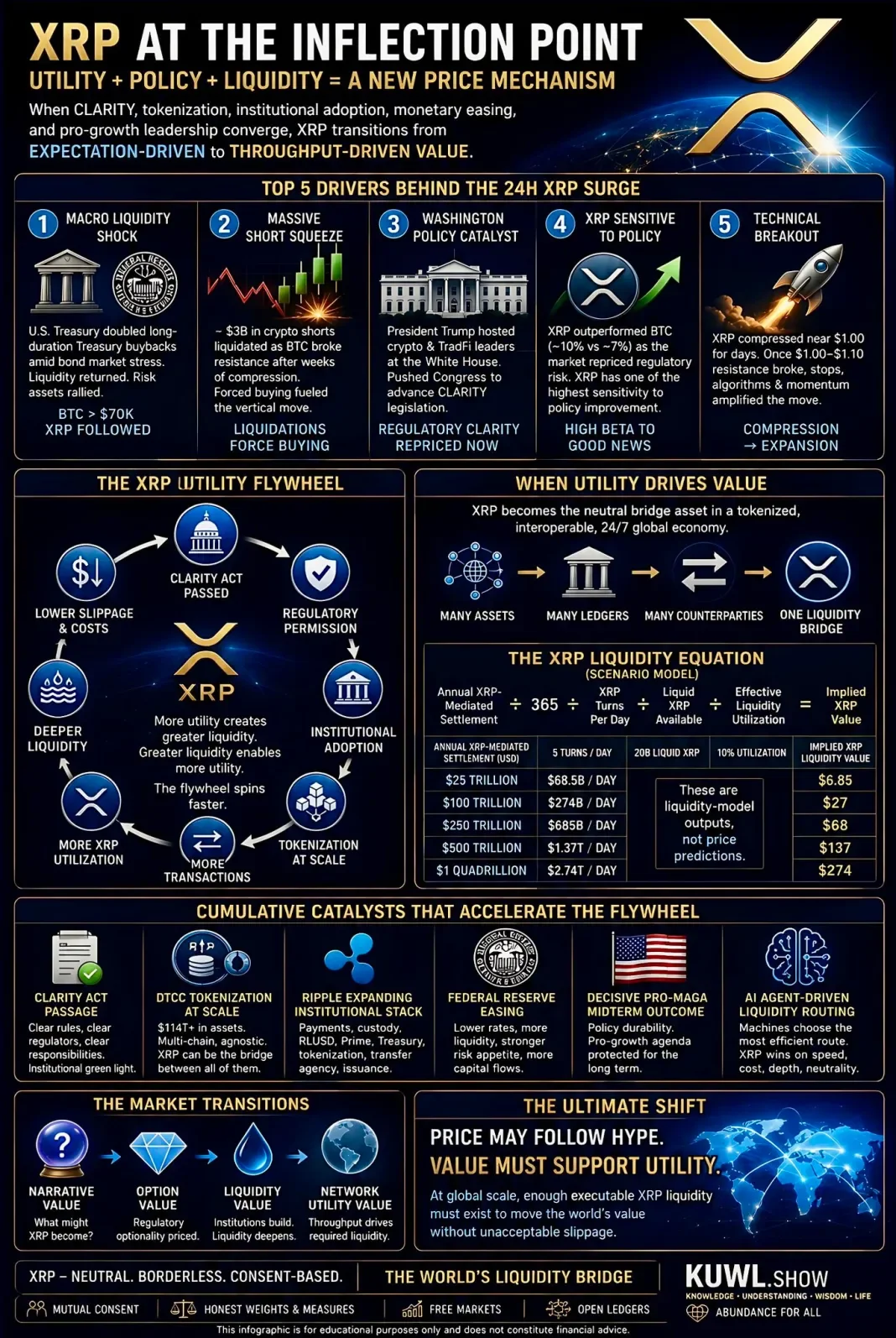
What is one additional year worth to the only ISO 20022-aligned enterprise global payments company purpose-built since 2012 to solve the very interoperability, liquidity, currency-exchange and real-time settlement problems legacy systems are still struggling to overcome?
How many institutions can Ripple integrate in twelve months?
How many payment corridors can it activate?
How much RLUSD liquidity can it establish?
How deeply can XRPL, ILP and XRP become embedded before November 2027 arrives?
And once institutions experience faster settlement, reduced prefunding and interoperable, 24/7 movement of value…
Why would they go backward?
Fedwire and SWIFT may believe they postponed releases.
Did they actually extend Ripple’s architectural head start?
Examine the super-special Christmas gifts they just placed beneath Ripple’s tree in my latest Substack: robcunningham.substack.com/p/the-ripple-wave-swells
Source(s):
• https://x.com/KuwlShow/status/2094817478442668161
More Wed. Iraq News Posted by Tishwash at TNT 9-2-2026
TNT:
Tishwash: Contractors in the liberated areas are demanding payment of their dues and warning of project stoppages.
The Iraqi Contractors Union called on the Prime Minister, Parliament, and Minister of Finance on Tuesday to intervene urgently to disburse the outstanding financial dues owed to companies and contractors contracted with the Reconstruction Fund for Liberated Areas, noting that the delay of some of these dues for more than two years has caused financial damage to contractors and threatened their ability to continue implementing projects.
TNT:
Tishwash: Contractors in the liberated areas are demanding payment of their dues and warning of project stoppages.
The Iraqi Contractors Union called on the Prime Minister, Parliament, and Minister of Finance on Tuesday to intervene urgently to disburse the outstanding financial dues owed to companies and contractors contracted with the Reconstruction Fund for Liberated Areas, noting that the delay of some of these dues for more than two years has caused financial damage to contractors and threatened their ability to continue implementing projects.
This came during a conference held in Anbar province, attended by a correspondent from Shafaq News Agency, with the participation of a number of contractors from the liberated provinces to raise their concerns and demand their rights and outstanding financial dues from the Reconstruction Fund for Liberated Areas.
The head of the Iraqi and Arab Contractors Union, Ali Fakher Sanafi, confirmed in a statement during the conference that the Reconstruction Fund for Liberated Areas has played a role in supporting the stability of the liberated governorates over the past years by implementing projects, rebuilding infrastructure, and supporting the people of these governorates who were subjected to damage and destruction as a result of military operations against groups of evil and terrorism.
He pointed out that contractors who contributed to the reconstruction of their cities and bore the burdens of implementation, financing and financial obligations cannot be left to face this crisis without real solutions.
According to Sanafi, the contractors called on the government, the House of Representatives, and the Ministry of Finance to intervene urgently and disburse the dues of companies and contractors contracted with the Reconstruction Fund for Liberated Areas, just like the rest of the contracting parties, and to do justice to this segment that had a fundamental role in the reconstruction of those areas.
In an exclusive interview with Shafaq News Agency, Snafi said that the issue of entitlements is "complex and cannot be resolved so easily."
He added that the state is suffering from a financial crisis and a deficit in paying employee salaries, which is repeated at the beginning of each month, considering that the private sector treats him as if he were "second class".
Snafi said the country is facing a "real crisis" after the war and the closure of the Strait of Hormuz, noting that Iraq is known for its dependence on oil.
He explained that the Prime Minister granted contractors 600 billion Iraqi dinars, of which amounts ranging between 300 and 350 billion dinars were distributed, while some ministries have not yet received their share of the amount.
He explained that the agreement stipulates allocating at least one trillion Iraqi dinars per month during the current phase, with the possibility of increasing the amount, stressing that the contractors "are optimistic," but the first 600 billion has not yet been completed.
Snafi stressed that the crisis is not limited to the fund for the reconstruction of liberated areas, but is a "general crisis in all regions of Iraq".
He pointed out that there is communication between the Contractors Union and the sub-unions, warning that stopping projects leads to their demise and harms the citizen, the government and the contractor, expressing that the union does not wish to reach this stage.
Snafi said that contractors "are the children of the state," and that the relationship with it is similar, as he described it, to "father and son," adding that disagreements may occur between the two sides, but they do not mean hatred.
He added that the contractors "did their part," and reached a point where they wanted "only a portion of what they had provided" returned to them.
He pointed out that all projects throughout Iraq have reached completion rates of no less than 30 percent, considering this an achievement for the Iraqi contractor, but he indicated that there is no specific percentage for the stalled projects, although their number is large, and that many projects are now threatened with being stopped due to the financial deficit. link
************
Tishwash: Maliki's coalition withdraws its appeal to the Federal Court regarding the ministers of interior and education, leaving the decision to parliament.
On Tuesday, Jassim Mohammed Jaafar, a leader in the State of Law Coalition, revealed that his coalition had withdrawn its appeal to the Federal Court regarding doubts about the vote counting process for candidates for the Ministries of Interior and Defense.
Jaafar told Al-Maalomah News Agency that "it was agreed to refer the authority to re-nominate Qasim Atta and Amer Al-Khazai to the House of Representatives, to decide through a voting process on the option of re-nomination or not."
He added that "if an absolute majority is not obtained to re-nominate the previous candidates, the names of the reserve candidates will be put forward immediately," while ruling out "the completion of the cabinet in next Monday's session, due to the lack of clarity regarding the candidates of the political blocs and the continuation of unresolved disputes."
It is worth noting that the statement issued after yesterday's coordination meeting set Monday as the date for finalizing the government formation and voting on the nominated ministers.link
************
Tishwash: Parliamentary Security Committee: We seriously doubt the withdrawal of the international coalition from Iraq.
On Wednesday, Jawad al-Saadi, a member of the Parliamentary Security and Defense Committee, called on the government to include the Parliament in the committees tasked with monitoring the withdrawal of international coalition forces from Iraq, expressing doubts about the seriousness of the withdrawal's implementation.
Al-Saadi told the Information Agency, "The government is required to include Parliament in the committees concerned with the withdrawal of international coalition forces to ensure clear monitoring of the procedures," indicating that "there are doubts about the seriousness of the withdrawal and the extent of commitment to its implementation."
He added, "The continued presence of international coalition forces in Iraq is not in the country's interest, especially since Iraq possesses security forces capable of maintaining security and defending its territory," stressing the need for the withdrawal process to be clear and specific, in a way that preserves Iraq's sovereignty and its security decisions.
Al-Saadi affirmed that "Parliament is concerned with monitoring this issue, and its inclusion in the withdrawal committees contributes to strengthening oversight and ensuring the implementation of what is agreed upon." link
************
Tishwash: Shahid: Political disagreements over the creation of deputy prime minister positions
Member of Parliament, Ahmed Shaheed, confirmed on Tuesday that the issue of appointing deputies to the Prime Minister has not yet been resolved, suggesting that political forces will begin discussions on this issue after the vote to complete Al-Zidi’s cabinet.
Shahid told Al-Maalomah News Agency, "There is a political trend emerging towards appointing deputies for Prime Minister Ali Falih al-Zaidi, but the idea is still under discussion and has not yet taken an official stance."
He added that "this proposal faces mixed acceptance within political circles, as some reject this approach based on financial and administrative considerations, because it will constitute an additional financial burden on the budget and an extra routine link in the structure of state administration."
It is worth noting that the statement issued after yesterday's coordination meeting set Monday as the date for finalizing the cabinet formation and voting on the nominated ministers. link
Seeds of Wisdom RV and Economics Updates Wednesday Afternoon 9-2-26
Good Afternoon Dinar Recaps,
JAPAN'S RISING YIELDS BEGIN REVERSING GLOBAL CAPITAL FLOWS
Higher Japanese bond yields are making domestic assets more attractive and beginning to challenge a decades-old flow of Japanese capital into overseas markets.
Good Afternoon Dinar Recaps,
JAPAN'S RISING YIELDS BEGIN REVERSING GLOBAL CAPITAL FLOWS
Higher Japanese bond yields are making domestic assets more attractive and beginning to challenge a decades-old flow of Japanese capital into overseas markets.
OVERVIEW
Capital is shifting: Japanese investors have sold a net ¥3 trillion ($18.7 billion) of foreign bonds in 2026, as higher domestic yields improve the appeal of Japanese fixed-income assets.
Japan's role is changing: Japan has historically been a major buyer of U.S. Treasuries and other foreign sovereign debt. A reduction in that demand could affect global bond markets.
Global repricing: Higher Japanese yields are occurring as borrowing costs are already rising elsewhere, increasing competition for global investment capital.
KEY DEVELOPMENTS
1. Higher Japanese Yields Are Changing the Investment Equation
Japan's 10-year government bond yield has moved above 3% for the first time since 1996.
After decades of exceptionally low domestic interest rates, Japanese investors now have a stronger incentive to consider keeping more capital at home.
The change is important because Japan's low-yield environment historically encouraged investors to seek higher returns in U.S., European and other overseas bond markets.
2. Japanese Investors Are Already Pulling Back From Foreign Bonds
Japanese investors have sold a net ¥3 trillion of foreign bonds so far in 2026, according to data cited by Reuters.
This does not represent a sudden liquidation of Japan's enormous overseas holdings. Instead, the more important development is a gradual reduction in new demand for foreign debt.
That distinction matters because Japan does not need to sell its existing holdings aggressively to affect global markets. Simply becoming a less active buyer can reduce an important source of incremental demand.
3. Pension Funds Are Showing Greater Interest in Domestic Bonds
A J.P. Morgan Asset Management survey of 82 Japanese corporate pension funds found that the net share planning to increase domestic bond holdings was the highest since the survey began in 2008.
Higher Japanese yields combined with elevated currency-hedging costs are making overseas bonds less attractive relative to domestic alternatives.
This suggests the change may involve more than short-term trading. Institutional investors are reassessing where their long-term capital should be allocated.
4. The U.S. Treasury Market Could Feel the Difference
Japan has historically been one of the world's largest holders of U.S. Treasury securities and an important source of international bond demand.
If Japanese investors increasingly prefer domestic bonds, the United States and other major borrowers may need to attract capital from other investors by offering higher yields or greater compensation for risk.
That does not mean Japan is abandoning U.S. Treasuries. The more immediate issue is that Japan may gradually stop being the marginal buyer of foreign bonds.
5. A Global Competition for Capital Is Emerging
Japan's changing investment behavior is occurring at the same time that governments and corporations worldwide are seeking large amounts of financing.
Higher government borrowing, increased corporate debt issuance, defense spending and investment in areas such as artificial intelligence are all competing for available capital.
As Japan becomes more attractive to its own investors, the world's major borrowers may have to compete more aggressively for the remaining pool of global savings.
WHY IT MATTERS
For decades, Japan's extremely low interest rates helped create an environment in which capital flowed outward into higher-yielding foreign markets.
That relationship is now changing.
The significance is not that Japan will suddenly bring all of its overseas money home. The more measurable change is that higher Japanese yields are reducing the incentive for some investors to send additional money abroad.
That creates a potential ripple effect across Treasuries, European bonds, currencies and other global assets.
The broader financial system is moving toward a world in which governments are increasingly competing with one another for a finite supply of investment capital.
WHY IT MATTERS TO FOREIGN CURRENCY HOLDERS
Japanese Yen: Higher domestic yields can strengthen the investment case for the yen, although exchange-rate movements also depend on Bank of Japan policy and global risk conditions.
Capital Flows: If Japanese investors reduce overseas purchases, money can move differently between yen, dollars, euros and other currencies.
Global Bonds: Reduced Japanese demand could place additional upward pressure on yields in foreign bond markets.
Purchasing Power: Changes in interest rates, currencies and energy costs can influence the purchasing power of currencies around the world.
Investment Risk: Currency holders should watch whether Japan's changing capital allocation becomes a sustained trend rather than a temporary market adjustment.
IMPLICATIONS FOR THE GLOBAL RESET
Pillar 1: Assets
Japan's changing investment behavior demonstrates how higher interest rates can alter global asset allocation.
If domestic Japanese bonds become sufficiently attractive, investors may gradually reduce exposure to foreign bonds and other overseas assets. That can change demand, valuations and yields across international markets.
Pillar 2: Debt
The global debt system depends on governments being able to attract enough capital to finance their borrowing.
If one of the world's largest pools of savings becomes less willing to purchase foreign debt, other governments may have to offer higher yields to attract replacement capital.
That could increase borrowing costs and place additional pressure on already heavily indebted economies.
CONCLUSION
Japan's rising bond yields are beginning to produce an effect that extends beyond the Japanese financial system: they are changing the relative attractiveness of domestic versus foreign assets.
The evidence so far points to a gradual shift rather than a sudden repatriation of Japan's overseas wealth. But even a gradual reduction in Japanese demand can matter because Japan has been one of the world's most important sources of international bond investment.
As major governments compete for capital while borrowing needs remain elevated, Japan's changing behavior could become an increasingly important part of the global financial equation.
The critical question is no longer simply how high Japanese yields can rise—it is how much global capital remains available when Japan no longer needs to look overseas for returns.
Seeds of Wisdom Team
Newshounds News™ Exclusive
SOURCES
Reuters — “How Japan's bond rout is turning the tide of global capital” — September 2, 2026
Vanguard — “Japan's higher rates raise stakes for global markets” — September 1, 2026
~~~~~~~~~~
Seeds of Wisdom Team RV Currency Facts Youtube and Rumble
Newshound's News Telegram Room Link
RV Facts with Proof Links Link
RV Updates Proof links - Facts Link
Start Here room with Most Asked Questions Link
Follow the Gold/Silver Rate COMEX
Follow Fast Facts
Seeds of Wisdom Team™Website
Thank you Dinar Recaps
Iraq Economic News and Points To Ponder Wednesday Morning 9-2-26
Between External Borrowing And Removing Zeros... The Government Faces Difficult Choices To Address The Financial Crisis
31 Aug 13:51 Information/Report... As pressure mounts on Iraq's public finances, a range of options for addressing the liquidity crisis are resurfacing. These include resorting to external borrowing and restructuring the local currency.
Parliamentary sources confirm that the project to remove zeros from the currency has not yet entered the implementation phase, while economists discuss the possibility of securing a substantial external loan to provide liquidity and bolster reserves.
Between External Borrowing And Removing Zeros... The Government Faces Difficult Choices To Address The Financial Crisis
31 Aug 13:51 Information/Report... As pressure mounts on Iraq's public finances, a range of options for addressing the liquidity crisis are resurfacing. These include resorting to external borrowing and restructuring the local currency.
Parliamentary sources confirm that the project to remove zeros from the currency has not yet entered the implementation phase, while economists discuss the possibility of securing a substantial external loan to provide liquidity and bolster reserves.
This comes amidst ongoing challenges related to public spending and the heavy reliance on oil revenues, meaning any decline in oil prices or revenues quickly impacts the state's ability to finance its expenditures and obligations.
External borrowing: The fastest solution?
Economic expert Abdul Rahman Al-Mashhadani believes that the government's move towards external borrowing from international banks represents one of the quickest available solutions to address the liquidity shortage and overcome current financial pressures.
Al-Mashhadani told Al-Maalouma that external loans offer Iraq grace periods of several years before repayments of installments and interest begin. This provides the government with time to secure repayment resources without creating immediate pressure on public spending.
He also believes that resorting to borrowing can contribute to replenishing the central bank's reserves, especially given the depletion of some of them due to market financing requirements and government spending.
Al-Mashhadani suggests that Iraq could request a loan of up to $20 billion, arguing that the current debt level, compared to the size of the economy and oil revenues, gives the country room to maneuver in international borrowing markets.
But does borrowing address the root of the problem?
While borrowing may provide a quick fix for the liquidity problem, resorting to it does not represent a final solution to the structural imbalances in the Iraqi economy, as loans remain financial obligations that the state will need to repay in the future.
This means that the success of borrowing in alleviating the crisis depends on how the funds are used and whether they are directed towards supporting financial stability, financing productive projects, and reducing imbalances, rather than being used to cover recurring expenses without addressing the sources of the deficit.
Furthermore, continued reliance on oil as the primary source of revenue leaves Iraqi finances vulnerable to the fluctuations of global markets, making fiscal reform and diversification of income sources essential alongside any temporary financing solutions.
Removing zeros... an old project resurfaces
. The project to remove zeros from the Iraqi dinar has resurfaced following reports about the possibility of issuing a new currency in early 2027.
However, MP Murtadha Afwin confirmed to Al-Maalomah that the project has not yet moved to the implementation phase, stressing that removing zeros does not in itself represent a solution to the economic crises plaguing Iraq.
This stance highlights the need to distinguish between restructuring currency denominations and raising the real value of the currency. Removing zeros, if implemented, primarily aims to simplify monetary transactions and reduce the volume of circulating currency.
It does not automatically increase the purchasing power of the dinar or address inflation and the budget deficit.
The project to remove zeros has been under discussion in Iraq for years, and the Central Bank has previously addressed it as part of plans to restructure the currency and facilitate monetary transactions.
Official positions vary, and an important point emerges here: discussing the removal of zeros or external borrowing does not necessarily imply a final government decision on these matters. The Iraqi government has recently confirmed that there are no official plans to change the currency or remove three zeros, and it has denied any intention to borrow externally.
It described the financial situation as a temporary liquidity crisis, not a structural financial crisis.
Conversely, political and economic statements continue to raise the issues of borrowing and removing zeros within the public debate on how to address financial pressures, reflecting the extent of the debate surrounding the options the state might adopt in the coming period.
The liquidity crisis requires broader solutions.
Between the option of external borrowing and the project to remove zeros from the currency, a genuine solution to the financial crisis seems linked to reforms that go beyond monetary measures alone. These reforms include controlling public spending, boosting non-oil revenues, revitalizing the private sector, reviewing government expenditures, and addressing areas of waste and corruption. End/25m
Living Costs Squeeze Savings For Iraqi Households
2026-09-01 Shafaq News- Baghdad For many salaried Iraqis and retirees, a month's pay is largely spent the moment it arrives, leaving little room for savings or investment as rent, utilities, food and transportation take a growing share of household income.
Abu Ahmed, a Baghdad resident, said his salary is "gone as soon as I receive it," with rent, bills, food and transportation taking priority before any money can be set aside. What remains, he said, is too little to save in any meaningful way.
The timing of salary payments adds to the strain. Hassan Hadi, another Baghdad resident, said household expenses continue regardless of whether salaries arrive on schedule, with school fees, clothing, private generators, food and transportation consuming much of his income.
What The Essentials Cost
The pressure is reflected in the cost of basic goods and services. Regular gasoline is priced nationally at 450 dinars per liter, about $0.35, under decisions issued by the Council of Ministers.
Many Baghdad households also rely on neighborhood generators during outages in the national grid. The Baghdad Provincial Council sets monthly generator rates; in June 2026, it priced an ampere at 12,000 dinars ($9) for round-the-clock service, 8,000 dinars ($6) for night-only supply and 6,000 dinars ($4.60) in privatized areas linked to the national grid.
Against those costs, Iraq's statutory minimum wage has remained at 350,000 dinars a month, about $269, since a 2017 cabinet decision. That is about 30% below the roughly 500,000 dinars ($385) that labor unions cite as an estimated monthly poverty line.
Education can add substantially to household expenses. Annual fees at Iraq's private colleges range from about 1.2 million to 8 million dinars ($920 to $6,150), rising above 10 million dinars ($7,690) for some medical and dental programs, according to government figures.
A Low Rate Of Saving
Mudhhir Mohammed Salih, financial adviser to the prime minister, told Shafaq News that Iraq's gross national savings average 12% to 15% of GDP, with the rate fluctuating according to oil prices, income, consumption and investment.
Using a measure focused on individuals rather than national savings, economist Hilal al-Taan said about 9.7% of Iraqis saved money in 2024, well below the global average. He attributed the low rate to limited incomes, high spending on food and housing, weak confidence in banks and rising living costs.
Inflation And The Shrinking Dinar
Najm Abdul-Tarish, an academic at the University of Dhi Qar, said much of a household's income goes toward housing, education and healthcare, while inflation erodes the dinar's purchasing power. In practical terms, the money in a worker's pocket buys less even when its face value remains unchanged.
"Higher inflation can therefore erode savings while raising household expenses, putting additional pressure on both saving and investment," Abdul-Tarish told Shafaq News.
Exchange-rate pressures add another dimension. While the Central Bank of Iraq sets the official rate at 1,300 dinars to the dollar, the currency has traded weaker on the parallel market. In May 2026, $100 sold for about 153,750 dinars in Baghdad, equivalent to roughly 1,538 dinars to the dollar, according to exchange-shop data.
Cash Outside The Banks
Salih said a large amount of cash circulates outside Iraq's banking system, although he cautioned that money held outside banks should not be treated entirely as savings because much of it is used for everyday purchases, trade and other transactions.
Moving a larger share through banks could strengthen their capacity to finance economic activity, he said.
"A larger share of savings moving through banks would strengthen their ability to mobilize domestic resources for lending and investment," Salih said, pointing to the need for better banking services, greater public confidence in financial institutions and wider use of electronic payments.
Central Bank figures illustrate the challenge. Total deposits at operating banks fell from 133.50 trillion dinars ($102.7 billion) in 2023 to 122.88 trillion dinars ($94.5 billion) in 2024. Over the same period, bank credit increased from 95.66 trillion dinars ($73.6 billion) to 102.24 trillion dinars ($78.6 billion), increasing the importance of attracting deposits to support lending.
Economist Dhergham Mohammed Ali linked weak savings to the limited use of banks, calling for wider adoption of electronic payments and more point-of-sale terminals and cash facilities across retail businesses and transportation.
By the CBI's latest reading, currency in circulation totaled 111.189 trillion dinars ($85.5 billion), of which 101.966 trillion dinars ($78.4 billion) circulated outside the banking system — about 91.7% of the total.
That does not mean the money represents untapped household savings; much of it finances everyday transactions. But the scale highlights the challenge facing Iraq's banking sector: drawing more economic activity into formal financial channels while many households have increasingly little income left to save.
https://www.shafaq.com/en/Economy/Living-costs-squeeze-savings-for-Iraqi-households
Seeds of Wisdom RV and Economics Updates Wednesday Morning 9-2-26
Good Morning Dinar Recaps,
U.S. DEBT TOPS $40 TRILLION: RISING TREASURY YIELDS EXPOSE A NEW FISCAL PRESSURE POINT
America's debt has crossed $40 trillion as rising long-term Treasury yields increase the cost of government borrowing and force markets to reassess the country's fiscal flexibility.
Good Morning Dinar Recaps,
U.S. DEBT TOPS $40 TRILLION: RISING TREASURY YIELDS EXPOSE A NEW FISCAL PRESSURE POINT
America's debt has crossed $40 trillion as rising long-term Treasury yields increase the cost of government borrowing and force markets to reassess the country's fiscal flexibility.
OVERVIEW
U.S. Debt: Total U.S. government debt has surpassed $40 trillion, underscoring the scale of America's long-term fiscal challenge.
Treasury Yields: Long-dated Treasury yields have climbed to their highest levels since 2007, increasing the cost of financing and refinancing federal debt.
Financial System: The combination of massive debt, heavy Treasury issuance and higher required yields is creating a new pressure point for the dollar-centered global financial system.
KEY DEVELOPMENTS
1. U.S. Debt Has Crossed the $40 Trillion Threshold
The United States has now moved beyond $40 trillion in total federal debt, a milestone that highlights how rapidly the government's borrowing burden has expanded.
The significance is not simply the size of the number. The larger issue is the relationship between the amount of debt outstanding and the cost of financing that debt.
As more debt must be refinanced, changes in interest rates can have an increasingly significant effect on federal interest expenses.
2. Long-Term Treasury Yields Are Reaching New Highs
Long-dated Treasury yields have risen to their highest levels since 2007, reflecting investor concerns about inflation, government borrowing requirements and the future path of interest rates.
The 10-year Treasury yield has moved above 4.8%, approaching levels not seen since the early 2020s.
Higher yields mean investors are demanding greater compensation to hold longer-term government debt.
******************************
3. Treasury Supply Is Adding to the Pressure
The Treasury market is facing a combination of large borrowing needs and changing demand.
The federal government must continue issuing debt to finance deficits and refinance maturing obligations. At the same time, investors are reassessing how much compensation they require to hold long-duration government bonds.
Reuters reports that intertwined supply-and-demand pressures could keep long-term Treasury yields elevated rather than allowing them to quickly return to previous lows.
4. Higher Yields Increase the Cost of America's Debt
The impact of higher yields does not occur all at once because much of the existing federal debt was issued at earlier interest rates.
However, as Treasury securities mature and are refinanced, new borrowing increasingly reflects today's higher market rates.
That creates a potentially difficult feedback mechanism:
Higher yields → higher refinancing costs → larger interest expenses → greater fiscal pressure → increased borrowing needs.
The longer elevated yields persist, the more important this cycle becomes.
5. Treasury Stress Has Global Consequences
U.S. Treasuries are not simply another bond market. They serve as a benchmark for global borrowing costs and a core reserve asset for the international financial system.
When Treasury yields rise, borrowing costs can also increase for corporations, households and governments around the world.
The current move is occurring alongside elevated borrowing costs in Japan, the United Kingdom and Europe, suggesting that the issue is becoming part of a broader reassessment of sovereign debt and the global cost of capital.
WHY IT MATTERS
The $40 trillion debt milestone becomes more significant when viewed alongside rising interest rates and higher Treasury yields.
For years, the U.S. financial system benefited from relatively low borrowing costs. That environment allowed enormous amounts of government debt to be financed at comparatively inexpensive rates.
That equation is changing.
If long-term yields remain elevated, the United States could face increasing interest costs and less fiscal flexibility, particularly as large amounts of existing debt mature and require refinancing.
The broader concern is that the world's largest economy is entering a period in which the cost of capital itself is becoming a financial constraint.
WHY IT MATTERS TO FOREIGN CURRENCY HOLDERS
Dollar: Higher Treasury yields can support demand for dollar-denominated assets although the longer-term fiscal implications create competing pressures.
Capital Flows: Global investors must continually compare U.S. Treasury returns with opportunities in Japan, Europe and other markets.
Exchange Rates: Changes in interest-rate expectations can produce significant movements in the dollar and other major currencies.
Purchasing Power: Higher government borrowing costs can contribute to broader financial and economic pressures that ultimately affect the purchasing power of currencies.
Global Debt: Because Treasury yields influence borrowing costs worldwide, sustained U.S. yield increases can affect currencies and financial markets far beyond the United States.
IMPLICATIONS FOR THE GLOBAL RESET
Pillar 1: Debt
The $40 trillion milestone demonstrates the growing importance of sovereign debt sustainability.
The critical issue is not simply how much debt exists, but how much it costs to maintain and refinance. If interest rates remain structurally higher, governments may have less room to respond to future economic or financial shocks.
Pillar 2: Assets
Treasury securities sit at the foundation of global asset pricing.
When Treasury yields rise, investors can demand higher returns from stocks, corporate bonds, real estate and other risk assets. Capital may also shift between countries as investors reassess relative yields and risk.
This makes the Treasury market a key transmission point for a broader global repricing of financial assets.
CONCLUSION
The United States crossing $40 trillion in debt is significant on its own, but the more important development is occurring at the same time: the market is demanding higher yields to finance America's long-term borrowing.
That creates a new fiscal pressure point. The longer Treasury yields remain elevated, the more the cost of refinancing America's enormous debt stock becomes part of the government's financial equation.
And because Treasuries serve as a benchmark for the global financial system, the consequences extend beyond Washington.
The emerging question is no longer simply how much debt the United States can issue—it is how much the global financial system will require the United States to pay to keep financing it.
Seeds of Wisdom Team
Newshounds News™ Exclusive
SOURCES
~~~~~~~~~~
🌱 A Message to Our Currency Holders🌱
If you’ve been holding foreign currency for many years, you were not foolish.
You were not wrong to believe the global financial system would change.
What failed was not your patience — it was the information you were given.
For years, dates, rumors, and personalities replaced facts, structure, and proof. “This week” predictions created cycles of hope and disappointment that were never based on how currencies actually change.
That is not your failure.
Our mission here is different: • No dates • No rates • No hype • No gurus
Instead, we focus on:
• Verifiable developments • Institutional evidence
• Global financial structure • Where countries actually sit in the process
Currency value changes only come after sovereignty, trade, banking, settlement systems, and fiscal coordination are in place. History and institutions confirm this sequence.
You will see silence. You will see denials. That is not delay — that is discipline.
Protect your identity. Organize your documents. Verify everything.
Never hand your discernment to anyone who cannot show proof.
You deserve truth — not timelines.
Seeds of Wisdom Team
Newshounds News
~~~~~~~~~~
Seeds of Wisdom Team RV Currency Facts Youtube and Rumble
Newshound's News Telegram Room Link
RV Facts with Proof Links Link
RV Updates Proof links - Facts Link
Start Here room with Most Asked Questions Link
Follow the Gold/Silver Rate COMEX
Follow Fast Facts
Seeds of Wisdom Team™ Website
Thank you Dinar Recaps
Iraq Economic News and Points To Ponder Tuesday Evening 9-1-26
The Rising Dollar Is Testing Banking Reforms; The Central Bank Is Changing Rules, But The Parallel Market Is Resisting.
Last updated: August 30, 2026 Al-Mustaqilla/Baghdad/- The dollar is still being sold in the Iraqi parallel market at a significant difference from the price announced by the Central Bank, despite a series of banking and regulatory measures implemented by the authorities during the past months in an attempt to restructure the financial sector and expand official channels for obtaining foreign currency.
The selling price of $100 at Baghdad exchange bureaus reached approximately 154,500 dinars at the close of trading on Saturday, August 29, the same price as at the Al-Kifah and Al-Harithiya exchanges.
The Rising Dollar Is Testing Banking Reforms; The Central Bank Is Changing Rules, But The Parallel Market Is Resisting.
Last updated: August 30, 2026 Al-Mustaqilla/Baghdad/- The dollar is still being sold in the Iraqi parallel market at a significant difference from the price announced by the Central Bank, despite a series of banking and regulatory measures implemented by the authorities during the past months in an attempt to restructure the financial sector and expand official channels for obtaining foreign currency.
The selling price of $100 at Baghdad exchange bureaus reached approximately 154,500 dinars at the close of trading on Saturday, August 29, the same price as at the Al-Kifah and Al-Harithiya exchanges.
Meanwhile, the Central Bank offers the dollar at 1,310 dinars, equivalent to 131,000 dinars per $100. This leaves a difference of approximately 23,500 dinars, or about 18 percent, between the Central Bank's rate and the cash selling price in the market.
The figures do not reflect a steady upward trend for the dollar. The selling price in Baghdad reached about 156,000 dinars in some sessions in June before it declined, but at the end of August it remained higher than its level at the end of January when it was selling for about 151,000 dinars per 100 dollars.
This means that the new measures have not yet led to a permanent narrowing of the gap between the two prices to limited levels, despite a major change in the way Iraq manages trade finance and access to foreign currency.
Since the beginning of 2025, Iraq has moved from an electronic platform through which the Central Bank oversaw foreign transfers to a system in which commercial banks rely on their accounts and relationships with correspondent banks abroad, while the Central Bank finances those accounts and oversees compliance.
The International Monetary Fund said last year that the transition to the new system had succeeded in reducing the gap between the official and parallel exchange rates at that stage, but it also said that further narrowing the gap required facilitating access to foreign currency, tightening customs controls to curb smuggling and informal trade, and promoting the use of the dinar in local transactions.
But the widening gap again in 2026 indicates that reforming the transfer mechanism alone was not enough to eliminate demand outside the formal system.
The central bank said in June that it was committed to meeting legitimate demand for dollars and maintaining exchange rate stability, and that its reform program included reintegrating Iraqi banks into foreign transfers, expanding their relationships with correspondent banks, improving electronic payments, and complying with anti-money laundering and counter-terrorism financing standards.
In July, Central Bank Governor Nizar Nasser Hussein announced that, following discussions with the US Treasury Department, an understanding had been reached allowing restricted Iraqi banks to return to foreign correspondent banking channels in currencies other than the dollar after they met compliance and governance requirements.
The bank said that seven banks have become eligible for this stage, and that they can regain eligibility to deal in dollars later after passing additional requirements.
In the same month, the Central Bank withdrew the licenses of three companies that mediated the buying and selling of foreign currencies, namely Al-Rawajeb, Saba and Al-Nitaq, due to their violation of the sector's regulatory controls. Then, it held meetings with exchange companies to discuss reorganizing their operations and raising compliance and governance levels.
The policy towards cash dollars also witnessed another change. In July, Iraqi media published a directive from the Central Bank allowing banks to deliver some foreign remittances and incoming dollar deposits to their owners in the same currency, according to specific controls, in a move that would increase the banking system's ability to meet the legitimate demand for foreign currency.
However, the parallel market did not disappear.
This is partly due to the nature of demand, which does not all pass through the banking system. The IMF stated in its report on Iraq that the remaining difference between the two exchange rates reflects, among other factors, informal trade, demand for dollars for activities that cannot access regulated channels, and speculation.
The central bank itself had previously stated in clarifications that part of the parallel demand comes from traders who do not use official import methods, or from trade that does not pass through regular customs ports, or from prohibited activities, which makes providing dollars for legitimate transactions insufficient on its own to eliminate the informal market.
Iraq's financial relationship with the United States and its trade with Iran add another layer of complexity.
Reuters reported last week that Iraq's reliance on the dollar-based financial system gives Washington significant leverage over its financial sector, at a time when Iraq maintains extensive economic ties with Iran. According to figures cited by the agency, Iraqi-Iranian trade exceeded $10 billion in 2025.
In recent years, the United States has also imposed restrictions and sanctions on Iraqi banks that it said were involved in transactions linked to Iran, prompting the central bank to tighten compliance requirements and restructure the relationship of Iraqi banks with the international financial system.
This reveals a paradox facing Iraqi monetary policy: stricter compliance reduces the risks of sanctions and money laundering and brings banks closer to the international financial system, but at the same time it may leave a portion of demand that is unable or unwilling to go through official procedures heading to the parallel market.
Therefore, the market rate alone does not provide a complete measure of the success of banking reform. Restructuring banks, improving governance, expanding their international relationships, and subjecting remittances to scrutiny are objectives that extend beyond the daily exchange rate.
However, a persistent gap approaching 18 percent is at the same time an indicator that is difficult to ignore when measuring the ability of reforms to reach the real economy.
For a trader who cannot finance all of his needs through a correspondent bank, or a citizen who needs cash dollars for purposes other than those specified, the parallel market rate remains the actual rate he faces.
Herein lies the most difficult test for the Central Bank and the government of Ali al-Zaidi.
After changing the rules for foreign exchange, reopening banking channels, regulating exchange companies, and expanding dollar transactions through banks, the challenge is no longer limited to building a more compliant financial system, but has become making this system capable of competing with the parallel market in speed, access, and cost.
The experience of the first eight months of 2026 suggests that the parallel market has not yet given up.
The dollar, which was selling for about 151,000 dinars per 100 dollars at the end of January, reached 154,500 dinars at the end of August, although it fell back from the peaks it recorded in June.
Thus, what has been achieved so far seems closer to a reform of the banking structure and channels than to a complete transformation of the exchange market.
Narrowing the gap between the two prices, rather than just the number of instructions or banks that have been rehabilitated, will be one of the clearest tests of the new policy’s ability to transfer reform from the banks to the market.
https://mustaqila.com/ارتفاع-الدولار-يختبر-الإصلاح-المصرفي/
USD/IQD Flat In Baghdad, Rises In Erbil
2026-09-01 Shafaq News- Baghdad/ Erbil The US dollar closed Tuesday’s trading steady in Baghdad but higher in Erbil, with exchange rates hovering above 154,100 dinars per 100 dollars.
According to a Shafaq News market survey, the dollar traded in Baghdad's Al-Kifah and Al-Harithiya exchanges at 154,250 dinars per 100 dollars, unchanged from the morning session.
In the Iraqi capital, exchange shops sold the dollar at 154,750 dinars per 100 dollars and bought it at 153,750 dinars, while in Erbil, selling prices stood at 154,200 dinars and buying prices at 154,150 dinars.
https://www.shafaq.com/en/Economy/USD-IQD-flat-in-Baghdad-rises-in-Erbil
Your Mortgage Is Now Competing With Google and the Pentagon
Your Mortgage Is Now Competing With Google and the Pentagon
Notes From the Field by James Hickman (Simon Black / Sovereign Man) September 1, 2026
Hardly a week goes by without another data center announcement, and the projects have gotten so big that they're now measured in gigawatts.
A gigawatt is a billion watts of electricity. Running around the clock, one gigawatt is enough to supply about 800,000 average American homes— and a single large data center is now built at that scale.
The data center that Meta is building near El Paso is designed for a full gigawatt and comes online in 2028.
Your Mortgage Is Now Competing With Google and the Pentagon
Notes From the Field by James Hickman (Simon Black / Sovereign Man) September 1, 2026
Hardly a week goes by without another data center announcement, and the projects have gotten so big that they're now measured in gigawatts.
A gigawatt is a billion watts of electricity. Running around the clock, one gigawatt is enough to supply about 800,000 average American homes— and a single large data center is now built at that scale.
The data center that Meta is building near El Paso is designed for a full gigawatt and comes online in 2028.
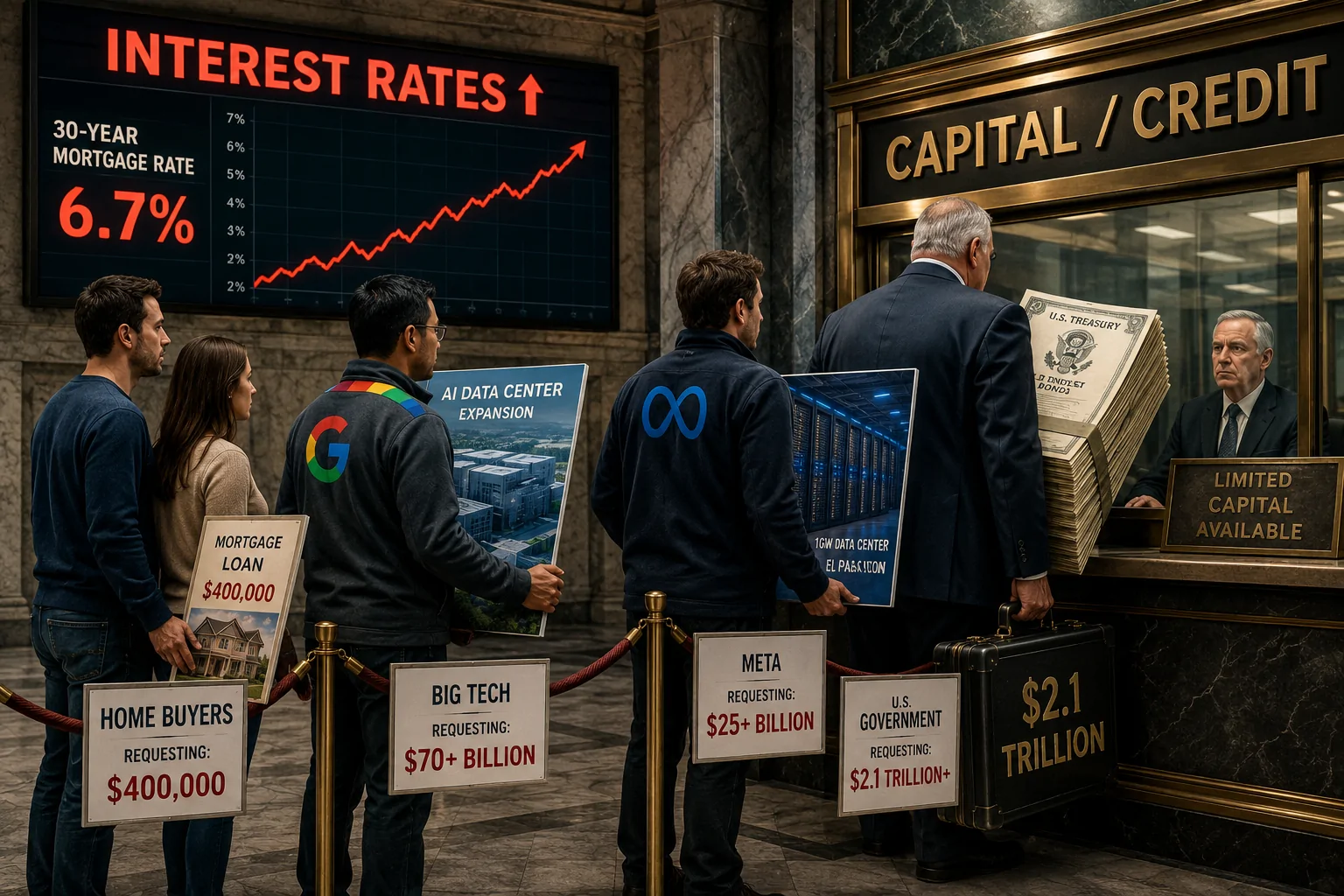
Plus Meta just announced plans to grow its campus in Louisiana to 5GW. And OpenAI's Stargate program, spread across sites in several states, is planned for 10GW.
These projects are also spectacularly expensive, and even the richest companies on earth have stopped paying for them out of pocket.
Earlier this month Google borrowed $25 billion from the bond market. It was the company's third major bond sale this year, which brings its 2026 borrowing to more than $70 billion.
Google needs the money because its capital expenditures budget this year is about $200 billion, and in Q2 they spent more cash than they brought in for the first time in more than two decades.
Meta is doing the same thing. In late July, a BlackRock-led group raised $12.5 billion of debt for that El Paso site, where Meta will be the sole tenant for twenty years.
The group had to pay about 7.5% to get the deal done, one of the highest yields on any blue-chip data center bond to date. That comes on top of the $25 billion in bonds that Meta sold in May, and another $30 billion borrowed for the Louisiana campus.
And that's just two borrowers. The total borrowings right now related to AI and data centers is truly staggering.
But it’s not just tech spending that’s driving the bond market. Let’s not forget about the US federal government, which is on track for a $2.1 trillion deficit this fiscal year.
That's just the NEW amount of debt they have to borrow this year just to keep the lights on and pay all the Somalis.
The White House is asking Congress for a $1.5 trillion Pentagon budget next year, more than 40% above this year's and the largest defense request (as a percentage of GDP) since World War II.
So between tech spending and the federal deficit, that’s already several trillion dollars in capital that needs to be borrowed from the bond market... THIS YEAR.
************************
Here’s the problem: America’s “net private savings”, i.e. the sum of ALL undistributed corporate profits, plus total household net income, is only about $2.2 trillion.
In short, the federal government already requires nearly ALL of the net private savings from literally every household and every company across America... just to make ends meet.
Meanwhile the biggest foreign lenders are backing away.
Japan, the UK, and China— the three largest foreign lenders to the US government— all cut their Treasury holdings in June. China now has their lowest Treasury holdings since 2008, down more than 13% from last year.
In short, foreigners are not coming to the rescue. So there is very little capital left over to lend for data centers and AI expansion.
And that says nothing about the tens of millions of other borrowers— small businesses, home buyers, etc. who need to borrow money.
This is why interest rates are rising— it’s simple supply and demand: demand for capital is at an all-time high. Yet supply of capital (at the moment) is fixed. And when the supply/demand fundamentals of capital get out of whack, interest rates rise.
Families who need to buy a home now are standing in the same line as Google, Meta, and the Treasury Department, competing for the same money.
That’s why the average 30-year mortgage rate is 6.7%, and will likely go MUCH higher from here...
... unless the Fed starts printing money again.
Technically the Fed doesn’t physically ‘print’ anything, it’s all electronic. And they don’t call it ‘money printing’, because that would be too embarrassing. They refer to it as ‘quantitative easing’. But it has the same effect— increasing the supply of capital to meet the demand, thus causing interest rates to fall.
Mortgage rates fall. Treasury yields fall. Everyone is able to borrow for less.
Which sounds great... except that conjuring money out of thin air invariably triggers more inflation. So if you can borrow more cheaply but have to pay more for everything, are you really any better off?
It’s obvious the White House wants the Fed to cut rates... which means firing up a fresh round of Quantitative Easing. And Congress certainly won’t mind being able to borrow more.
Pretty much all politicians, regardless of party affiliation, want lower interest rates. Given the choice between high mortgage rates and higher inflation, politicians will pick higher inflation every time.
And that's exactly why it makes sense to have a Plan B.
To your freedom, James Hickman Co-Founder, Schiff Sovereign LLC
Putting US Treasury on Trial for Theft and Treason? | Rick Rule
Putting US Treasury on Trial for Theft and Treason? | Rick Rule
Liberty and Finance: 8-31-2026
Rick Rule puts the U.S. financial system on trial. In this unconventional and provocative interview,
Rick Rule takes the stand as an “expert witness” in a mock trial examining some of the most controversial questions facing American savers: Is the financial system quietly eroding purchasing power, penalizing savers, and transferring wealth through inflation and taxation?
Putting US Treasury on Trial for Theft and Treason? | Rick Rule
Liberty and Finance: 8-31-2026
Rick Rule puts the U.S. financial system on trial. In this unconventional and provocative interview,
Rick Rule takes the stand as an “expert witness” in a mock trial examining some of the most controversial questions facing American savers: Is the financial system quietly eroding purchasing power, penalizing savers, and transferring wealth through inflation and taxation?
With decades of experience analyzing banks, corporations, financial institutions, and investment portfolios, Rule brings an unusual perspective to the case:
EXPERT WITNESS — QUALIFICATIONS
• Credit analyst who has reviewed roughly 5,000 financial statements of banks and corporations
• In-depth analysis of 16 major U.S. brokerage and financial-services clearinghouses
• Banking risk expert and co-founder of EverBank and Battle Bank
• Investment analyst who says he has reviewed nearly 100,000 investor portfolios, including those of individuals, foundations, and funds
THE CHARGES — IN THIS MOCK TRIAL
• Conspiracy to defraud through misleading or inadequate inflation statistics
• Theft through monetary expansion and the erosion of savers’ purchasing power, including holders of paper cash, dollar-denominated bank and brokerage deposits, and U.S. Treasuries
• Seizing property without just compensation through the taxation of nominal capital gains, including homes, land, gold, and silver
• The constitutional controversy surrounding the fiat dollar versus gold and silver
• Weakening America’s financial position and potentially aiding foreign adversaries through unsustainable fiscal and monetary policies
Rule challenges viewers to look beyond official statistics and examine what is actually happening to their purchasing power.
He explains why he believes inflation can be significantly higher than the numbers many Americans rely on, why capital-gains taxes can capture illusory gains created by currency depreciation, and why he believes savers themselves must take greater responsibility for protecting their wealth.
The discussion also covers gold vs. silver, the risks of the banking system, what happens to gold during a liquidity crisis, and why Rule believes America's greatest financial threats may ultimately come from within.
This is a mock trial—but the questions are very real.
INTERVIEW TIMELINE:
0:00 Intro
1:05 US Treasury on trial
17:55 Inflation statistics
29:30 Dilution of currency supply
50:08 Financial future of the US
52:00 Viewers questions
58:00 Rick Rule's resources