
Thank you to all the subscribers to our Early Access program…we thank you for your continued support.
We are excited to offer this new service to keep you informed and up-to-date on the latest Dinar and currency news.
Iraq Economic News and Points To Ponder Saturday Morning 8-28-26
Iraq's Appointments Are On Shaky Ground... The 2027 Budget Will Determine The Fate Of Thousands Of Job Positions.
August 29, 2026Last updated: August 29, 2026 The Independent/- The Federal Public Service Council has brought the issue of government appointments back to the forefront of attention, after confirming that determining the number of job grades, creating them, and the necessary financial allocations for them are directly linked to what will be decided in Iraq’s 2027 budget and the relevant government agencies.
Iraq's Appointments Are On Shaky Ground... The 2027 Budget Will Determine The Fate Of Thousands Of Job Positions.
August 29, 2026Last updated: August 29, 2026 The Independent/- The Federal Public Service Council has brought the issue of government appointments back to the forefront of attention, after confirming that determining the number of job grades, creating them, and the necessary financial allocations for them are directly linked to what will be decided in Iraq’s 2027 budget and the relevant government agencies.
The official spokesman for the council, Fadel Al-Gharawi, said that the council’s role in the appointments file comes within the powers specified by the amended Federal Public Service Council Law No. (4) of 2009, noting that initiating the appointment procedures requires the availability of the necessary legal and financial requirements.
This position means that the appointments file is not linked to a single decision by the Civil Service Council, but rather depends primarily on the size of the job grades that will be included in next year’s budget, as well as the financial allocations and the actual needs of state institutions.
A wide segment of graduates and the unemployed are waiting to see what the 2027 budget will include, especially with the increasing number of applicants for government job opportunities and the growing demands to find real solutions to the unemployment issue.
Conversely, the government faces the challenge of striking a balance between providing job opportunities for graduates and maintaining the state’s financial stability, given the rising current expenditures and the costs of salaries and wages.
Thus, the 2027 budget appears to be the most important milestone in determining the shape of future government appointments, whether in terms of the number of newly created positions, the beneficiary entities, or the mechanisms for distributing them, while the Civil Service Council remains waiting for the completion of the legal and financial cover to begin its role in this matter. https://mustaqila.com/تعيينات-العراق-على-صفيح-ساخن-موازنة-2027-ت/
Sources: Ali Al-Zaidi Is Considering Dismissing The Finance Minister Due To The Failure To Address The Financial Crisis.
Last updated: August 29, 2026 Al-Mustaqilla - Well-informed political and media sources told Al-Mustaqilla that Prime Minister Ali Falih al-Zaidi is seriously considering making a change in the Ministry of Finance that may include the dismissal of Minister Falih al-Sari, amid escalating criticism of the way the liquidity shortage crisis and the delay in funding state employees’ salaries have been managed.
The sources, who asked not to be named, said that Al-Zaydi expressed his dissatisfaction with the level of support provided by the Ministry of Finance during the past months, especially with the continued pressure on the treasury and the failure to reach stable solutions to secure salaries and ongoing obligations.
There has been no official comment yet from the Prime Minister's office or the Ministry of Finance regarding the possibility of a cabinet reshuffle.
Al-Sari took over the Ministry of Finance on May 14, 2026, after the House of Representatives unanimously voted to grant him confidence within Al-Zidi’s government.
On July 30, Al-Sari acknowledged a financial deficit that was hindering the completion of salary payments for employees, retirees, and social welfare beneficiaries. He stated that the monthly salary obligations amounted to approximately 7.8 trillion dinars, and that the ministry was working to provide the necessary liquidity to complete the payments.
Pressures increased during August, as the parliamentary finance committee said that the minister had requested to be hosted in the House of Representatives to explain the financial situation and discuss a draft law for borrowing, while it spoke of the lack of final solutions to the salary crisis.
Local reports also showed that the government resorted to borrowing from local banks to cover part of its obligations, in light of declining oil revenues and a shortage of available liquidity, in an economy that relies heavily on crude oil revenues to finance public spending.
Published financial data indicates that government revenues amounted to approximately 35.9 trillion dinars in the first half of 2026, compared to expenditures of approximately 54.7 trillion dinars, reflecting a large funding gap that increased the pressure on the Ministry of Finance.
Al-Zaidi had placed economic reform and building a more robust financial and banking system among the priorities of his government program when he gained confidence, so the liquidity crisis and the regularity of salaries became one of the most prominent tests facing his government during its first months.
Under Article 78 of the Constitution, the Prime Minister has the right to dismiss ministers with the approval of the House of Representatives, which means that any decision to dismiss Al-Sari, if taken, will require parliamentary approval.
https://mustaqila.com/مصادر-علي-الزيدي-يدرس-إقالة-وزير-المال/
Atroushi Calls For A "Legal Revolution" In The Federal Parliament To Overturn The Decisions Of The Previous Regime And Enact The Oil And Gas Law.
Erbil (Kurdistan 24) - Deputy Speaker of the Federal Parliament, Farhad Atrushi, stated on Thursday, August 27, 2026, that the atmosphere within the Federal Parliament has witnessed a marked improvement compared to previous months, stressing the existence of efforts to unify the positions of the Kurdish parties, and emphasizing Iraq’s need for a “legal revolution” to cancel the decisions of the former regime and enact the postponed basic laws.
In statements to Kurdistan24, Atroushi pointed out that Iraq, in addition to the issues of its relationship with the Kurdistan Region, faces internal challenges related to services, salaries, the phenomenon of uncontrolled weapons, and outlaw groups, as well as the complexities of relations with neighboring countries.
The Deputy Speaker of the Federal Parliament explained that the Kurdistan Democratic Party seeks to strengthen its relations with the Shiite political forces in Iraq, indicating that work is underway to coordinate positions between the Kurdish parties in order to pass common points under the dome of Parliament.
Regarding the fuel crisis, Atroushi noted his meeting with the Federal Oil Minister, who responded positively, pointing out the need to hold a meeting with the Federal Prime Minister, Ali Faleh al-Zaidi, to demand the formation of a joint committee between the Kurdistan Regional Government and the Federal Government to address the gasoline issue.
Regarding sovereign laws, Atroushi criticized the inability of the federal parliament over the past two decades to enact vital laws such as the Oil and Gas Law, the Federal Council Law, and the Federal Court Law, saying: "We need a legal revolution; there are still about 5,000 decisions issued by the (Revolutionary Command Council) of the former regime in effect, and they do not in any way conform to the standards of a federal state."
He added that enacting an oil and gas law is a top priority, given that work is still underway on laws dating back 40 years, at a time when Iraq depends on oil wealth for 90% of its revenues.
Regarding the nature of the relationship between Erbil and Baghdad, Atroushi revealed that relations are going through a very positive phase, stressing that President Barzani, the President of the Region, and the Prime Minister of the Region are showing great support for the new federal government, as it is a real opportunity to rescue Iraq from the current crises.
The Central Bank suspends banking transactions for 14 individuals and 19 companies
About the news
The Central Bank of Iraq has decided to suspend dealings with 14 individuals and 19 companies operating in the oil, trade and transportation sectors.
The decision was made due to suspicions surrounding their dealings.
The companies named on the list operate in vital and sensitive sectors such as: oil, trade, livestock, manufacturing, transportation, and financial services.
According to an official letter issued by the Central Bank of Iraq on Thursday, August 27, 2026, the letter was addressed to all banks and non-bank financial institutions not to deal in any way with the bank accounts of these individuals and companies.
Reasons related to this procedure
The action is related to suspicions surrounding their financial transactions, and it has been decided to suspend their accounts pending a thorough and comprehensive investigation into them.
Central Bank: This measure will continue until further notice.
All banks were warned that any entity that violates this decision will be subject to legal accountability.
The list of bans and prohibitions included (14) people and (19) commercial and local companies, most notably “Al-Taif Holding Company”, “Jamal Al-Surouh Company”, “Mismar Juha Company for Manufacturing Industries”, and “Al-Masarat Company for Oil Services”, in addition to a number of individuals.
This decision is based on Article 40 of the "Central Bank of Iraq" Law, which grants the bank full powers to supervise and regulate the affairs of banks and their branches, with the aim of protecting the country's financial system and preventing any illegal transactions. https://channel8.com/arabic/news/84537
Central Bank Of Iraq To Monitor Bank Accounts Of Politicians And Officials
At a Glance
The Central Bank of Iraq issued strict new directives on August 26 targeting the bank accounts of politicians and government officials.
The regulations are designed to combat systemic corruption and illicit money laundering across national financial institutions.
Banks are required to flag anomalous wealth, unverified foreign transfers to high-risk zones, and unexplained asset spikes during or after tenure.
Compliance will be rigorously audited by central inspection teams and factored into institutional evaluations.
In an official directive issued on August 26, the Central Bank of Iraq instructed all commercial banks to enforce enhanced monitoring protocols on politically exposed persons and high-ranking government officials to curb financial crimes.
Key Monitoring Criteria
Disproportionate Wealth: Flagging sudden inconsistencies between declared monthly salaries or state incomes and total accumulated assets.
Unusual Transactions: Detecting high-value or irregular transactions executed during or immediately following an official's term in office.
High-Risk Transfers: Scrutinizing capital movements routed to high-risk foreign countries or jurisdictions lacking clear economic justifications.
Complex Structures: Identifying the use of third parties, shell companies, or intricate corporate vehicles to conceal ultimate beneficial ownership.
Family Networks: Monitoring unexplained financial flows involving relatives, close associates, or negative intelligence reports regarding bribery and financial misconduct.
The Central Bank emphasized that all banking branches must immediately implement these guidelines and brief their staff accordingly. Inspection teams will actively evaluate institutional compliance, ensuring that failure to report unverified funds or suspicious asset shifts impacts overall bank performance ratings. FYI
Politically Exposed Persons (PEPs) are individuals who have been entrusted with prominent public functions, such as senior politicians, judicial officials, or state executives. Because of their positions and influence, international financial watchdogs classify PEPs as higher-risk targets for money laundering and corruption, necessitating enhanced due diligence by commercial banks. https://channel8.com/english/news/64666
Seeds of Wisdom RV and Economics Updates Saturday Morning 8-29-26
Good Morning Dinar Recaps,
When the Fed Turns Hawkish Again: Higher Rates, U.S. Debt and a New Dollar Test
Federal Reserve Chair Kevin Warsh's Jackson Hole message has reopened the possibility of higher U.S. interest rates — creating a new test for the dollar, Treasury market and the sustainability of America's debt burden.
Good Morning Dinar Recaps,
When the Fed Turns Hawkish Again: Higher Rates, U.S. Debt and a New Dollar Test
Federal Reserve Chair Kevin Warsh's Jackson Hole message has reopened the possibility of higher U.S. interest rates — creating a new test for the dollar, Treasury market and the sustainability of America's debt burden.
Overview
The Federal Reserve is signaling that rate hikes are back on the table if inflation does not move convincingly toward the 2% target.
Treasury yields moved higher as markets repriced the Fed's path, putting renewed pressure on an already heavily indebted U.S. government.
The dollar initially strengthened, but the bigger question is whether higher yields ultimately reinforce confidence in U.S. assets or expose deeper concerns about debt sustainability.
Key Developments
1. Warsh puts inflation back at the center of Fed policy
At the Federal Reserve's Jackson Hole symposium, Chair Kevin Warsh delivered his clearest indication yet that additional rate increases may be necessary if inflation fails to make meaningful progress toward the Fed's 2% objective.
Warsh said recent inflation readings have not convinced him that the underlying trend has improved sufficiently. He also emphasized that the economy remains resilient, meaning the Fed may have room to maintain or increase monetary restraint rather than automatically moving toward lower rates.
Markets responded quickly. Reuters reported that the probability of a September rate hike rose from roughly 35% to 60% following Warsh's remarks, while short-term Treasury yields moved sharply higher.
2. The Treasury market is now facing a different rate environment
The immediate market reaction was concentrated at the short end of the Treasury curve, but the implications extend much further.
The 2-year Treasury yield rose to about 4.35%, while the 10-year yield moved to approximately 4.72% after Warsh's speech. The increase reflects a market that is beginning to price a higher probability of restrictive monetary policy lasting longer — or becoming tighter again.
That matters because the United States must continually refinance existing debt while issuing enormous quantities of new debt.
Higher interest rates therefore create a difficult feedback loop:
Higher inflation → tighter Fed policy → higher yields → more expensive government borrowing → greater pressure on the federal budget.
The longer that cycle persists, the more important Treasury yields become to the broader financial system.
3. The dollar gets an initial boost — but the longer-term test is more complicated
Normally, expectations for higher U.S. interest rates are supportive of the dollar because higher yields can attract global capital toward dollar-denominated assets.
That reaction is already visible. The dollar strengthened following Warsh's remarks as markets reassessed the likelihood of additional tightening.
But there is another side to the equation.
Higher yields are good for the dollar only if investors interpret them as evidence of monetary credibility rather than evidence of rising fiscal stress.
That distinction is becoming increasingly important.
If investors believe the Fed is willing to keep rates sufficiently high to restore price stability, the dollar can benefit from higher real returns and renewed confidence in U.S. monetary policy.
If investors instead conclude that Treasury borrowing requirements are becoming the dominant force behind higher yields, the signal becomes more complicated.
Why This Matters
The significance of Warsh's speech extends beyond the September rate decision.
For years, the global financial system has operated around the assumption that U.S. Treasuries are the foundational safe asset and the dollar is the dominant reserve currency.
That system depends partly on confidence that the United States can finance its enormous debt while maintaining monetary stability.
The current environment is testing both sides of that equation.
The Fed wants sufficiently tight financial conditions to control inflation. The Treasury, meanwhile, must finance a massive fiscal deficit at whatever interest rates the market demands.
Those objectives can coexist — but they become increasingly difficult to balance as debt service costs rise.
Why It Matters to Foreign Currency Holders
For foreign-currency holders, the important issue is not simply whether the dollar rises or falls on any particular day.
The larger issue is how the world's major currencies respond to a changing U.S. interest-rate and debt environment.
If higher U.S. rates attract capital back toward dollar assets, the dollar could strengthen against currencies whose central banks remain more accommodative.
But if persistent U.S. deficits and rising debt-service costs eventually become a greater concern for global investors, currency diversification could become more important.
That is particularly relevant to the broader movement toward local-currency trade, alternative payment systems and greater reserve diversification.
The global financial system does not have to abandon the dollar for diversification to matter. Even a gradual shift in the percentage of international trade, reserves and financial transactions conducted outside the dollar can alter the architecture at the margin.
Implications for the Global Financial Reset
Debt is becoming a monetary-policy variable
The United States cannot separate interest-rate policy from its fiscal position indefinitely. Every additional increase in borrowing costs affects the government's future financing requirements.
That makes the Treasury market increasingly important to the global financial system — not simply as an investment market, but as a measure of confidence in U.S. fiscal and monetary policy.
The dollar's next test may come from the bond market
A stronger dollar caused by higher Fed rates would reinforce the existing financial system.
But a situation in which higher Treasury yields coexist with questions about U.S. debt sustainability would represent something very different.
That is the financial signal worth watching.
What to Watch Next
The next major signals will come from:
September's inflation data and employment reports
The Fed's September 15–16 policy meeting
The 2-year and 10-year Treasury yields
Demand at upcoming Treasury auctions
The dollar's response to higher U.S. yields
Any evidence that Treasury borrowing costs are beginning to influence fiscal or monetary policy
The most important question is no longer simply “Will the Fed cut rates?”
It is whether the United States can maintain price stability, affordable debt financing and confidence in the dollar at the same time.
Bottom Line
Kevin Warsh has put inflation back at the center of the Federal Reserve's policy debate, and markets are already responding by pricing a greater possibility of higher rates.
That creates a new three-way tension between the Fed, the Treasury and the dollar.
If higher rates restore confidence in U.S. monetary stability, the dollar could benefit. If higher yields increasingly reflect the cost of financing America's debt, the same Treasury market could become a source of pressure on the currency.
The next phase of the global financial reset may therefore be determined not by a single rate decision, but by how the world responds when U.S. monetary tightening collides with America's unprecedented debt burden.
Sources
Reuters — Rate-hike expectations rise on Warsh speech at Jackson Hole
Federal Reserve — Chairman Warsh's 2026 Jackson Hole keynote remarks
~~~~~~~~~~
🌱 A Message to Our Currency Holders🌱
If you’ve been holding foreign currency for many years, you were not foolish.
You were not wrong to believe the global financial system would change.
What failed was not your patience — it was the information you were given.
For years, dates, rumors, and personalities replaced facts, structure, and proof. “This week” predictions created cycles of hope and disappointment that were never based on how currencies actually change.
That is not your failure.
Our mission here is different: • No dates • No rates • No hype • No gurus
Instead, we focus on:
• Verifiable developments • Institutional evidence
• Global financial structure • Where countries actually sit in the process
Currency value changes only come after sovereignty, trade, banking, settlement systems, and fiscal coordination are in place. History and institutions confirm this sequence.
You will see silence. You will see denials. That is not delay — that is discipline.
Protect your identity. Organize your documents. Verify everything.
Never hand your discernment to anyone who cannot show proof.
You deserve truth — not timelines.
Seeds of Wisdom Team
Newshounds News
~~~~~~~~~~
Seeds of Wisdom Team RV Currency Facts Youtube and Rumble
Newshound's News Telegram Room Link
RV Facts with Proof Links Link
RV Updates Proof links - Facts Link
Start Here room with Most Asked Questions Link
Follow the Gold/Silver Rate COMEX
Follow Fast Facts
Seeds of Wisdom Team™ Website
Thank you Dinar Recaps
Rob Cunningham: What if we’ve been Right about XRP but Measuring the Wrong Clock?
Rob Cunningham: What if we’ve been Right about XRP but Measuring the Wrong Clock?
8-28-2026
XRP ARMY: WHAT IF WE’VE BEEN RIGHT… BUT MEASURING THE WRONG CLOCK?
We all know the headline: XRP settles in ~3–5 seconds.
But settlement speed ≠ economic reuse speed.
That distinction may completely change the XRP calculus.
Rob Cunningham: What if we’ve been Right about XRP but Measuring the Wrong Clock?
8-28-2026
XRP ARMY: WHAT IF WE’VE BEEN RIGHT… BUT MEASURING THE WRONG CLOCK?
We all know the headline: XRP settles in ~3–5 seconds.
But settlement speed ≠ economic reuse speed.
That distinction may completely change the XRP calculus.
If XRP simply bridges: ASSET A → XRP → ASSET B
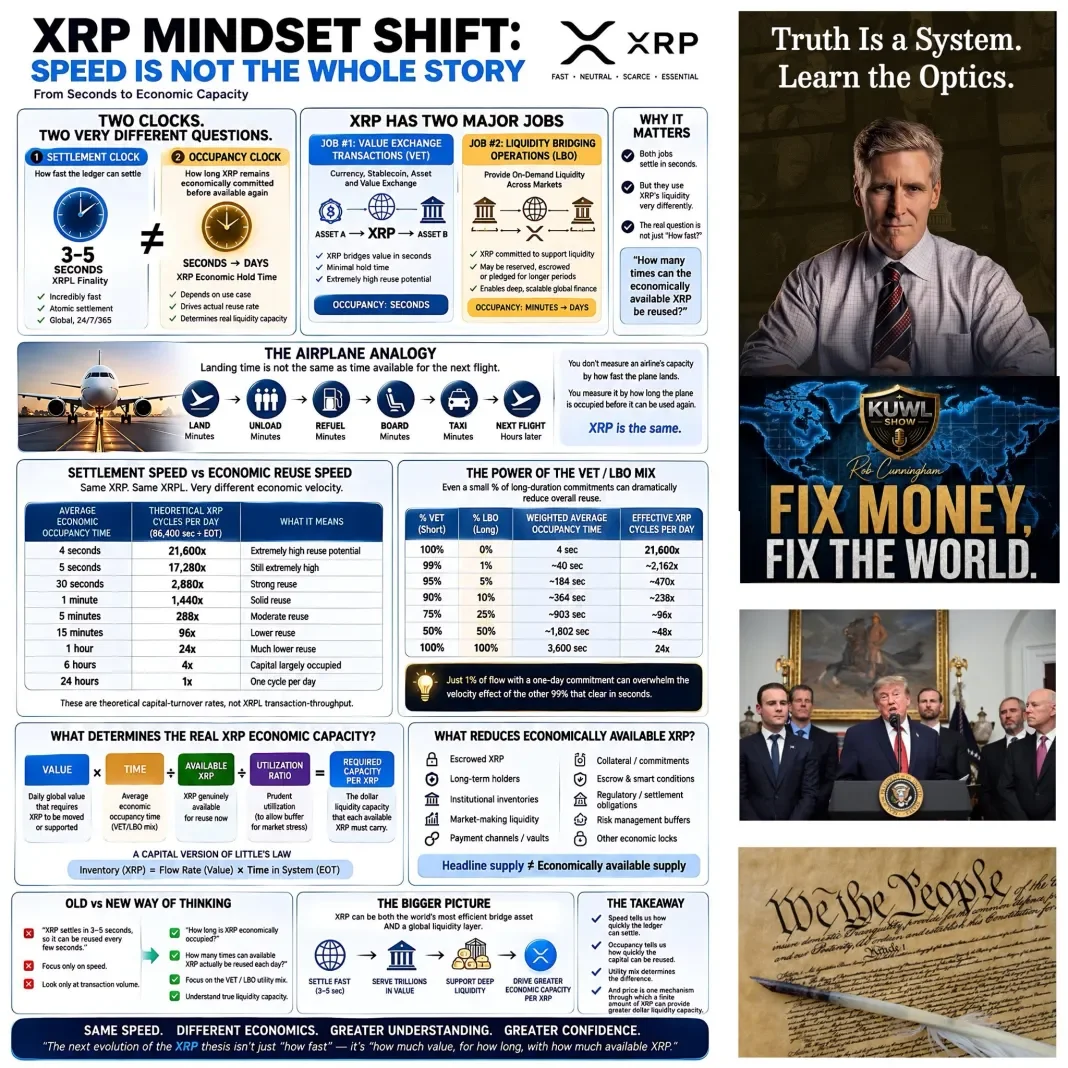
…it may be economically occupied for seconds.
But if XRP is also supporting liquidity across currencies, stablecoins, tokenized securities and other assets, some XRP will remain economically committed for minutes, hours, days or longer.
Same XRP.
Same fast ledger.
Very different capital velocity.
And THAT changes the question.
Stop asking only: “How many times can XRP theoretically settle each day?”
Start asking: “How many times can the economically AVAILABLE XRP actually be reused each day?”
Now XRP utility becomes something closer to:
VALUE × TIME ÷ AVAILABLE XRP
How much value needs XRP? × How long does it need XRP? ÷ How much XRP is actually available for the next job?
That’s the mindset shift.
A 3–5 second settlement network can remain breathtakingly fast while portions of its liquidity become economically occupied for far longer.
And even a relatively small percentage of longer-duration liquidity commitments can dramatically reduce effective XRP reuse.
Which means the future XRP question may not simply be: “How much value can XRP move?”
It may be: “HOW MUCH ECONOMIC CAPACITY MUST EACH AVAILABLE XRP CARRY?”
Don’t accept this because it’s bullish.
Don’t reject it because it’s unfamiliar.
Attack the assumptions. Change the VET/LBO mix. Change occupancy time. Change available supply. Run the math.
Confidence doesn’t come from somebody predicting our favorite XRP price target.
It comes from understanding the machinery deeply enough that you no longer need someone else to tell you what to believe.
Maybe the XRP community hasn’t been wrong.
Maybe we’ve simply been watching one clock… when XRP’s emerging liquidity economy requires us to understand two.
SETTLEMENT measures SPEED.
OCCUPANCY measures SCARCITY.
UTILITY determines the MIX.
PRICE provides CAPACITY.
Same XRP.
Entirely different calculus.
My Full KUWL Analysis: https://robcunningham.substack.com/p/the-next-layer-of-xrp-understanding
Source(s):
• https://x.com/KuwlShow/status/2093102360415387990
Dollar's Final Break? “RUSH TO THE EXITS” Could Trigger Global Financial CHAOS | Robert Kientz
Dollar's Final Break? “RUSH TO THE EXITS” Could Trigger Global Financial CHAOS | Robert Kientz
Liberty and Finance: 8-27-2026
The U.S. dollar and Treasury markets could be approaching a critical breaking point as rising debt, persistent inflation, and declining confidence put increasing pressure on the financial system, according to Rob Kientz of the Freedom Report.
Kientz argues that de-dollarization may unfold slowly at first, but could suddenly accelerate when the next recession forces nations to “rush to the exits” and rotate out of dollars and U.S. bonds.
Dollar's Final Break? “RUSH TO THE EXITS” Could Trigger Global Financial CHAOS | Robert Kientz
Liberty and Finance: 8-27-2026
The U.S. dollar and Treasury markets could be approaching a critical breaking point as rising debt, persistent inflation, and declining confidence put increasing pressure on the financial system, according to Rob Kientz of the Freedom Report.
Kientz argues that de-dollarization may unfold slowly at first, but could suddenly accelerate when the next recession forces nations to “rush to the exits” and rotate out of dollars and U.S. bonds.
He warns that a bond-market crisis could trigger massive losses across banks, pensions, corporations, and financial markets while capital seeks alternative assets such as gold and silver.
Kientz also explains why the Federal Reserve is trapped between fighting inflation with higher rates and protecting an economy burdened by unprecedented debt, while predicting continued strength in precious metals and significant outperformance from mining stocks.
With gold potentially retesting $5,500 and silver potentially surpassing $100 this year, Kientz sees the beginning of a broader commodity supercycle—and warns investors to prepare for a potentially historic shift in global capital flows.
INTERVIEW TIMELINE:
0:00 Intro
1:10 US debt crisis
15:20 Jackson Hole meeting
24:30 Miners & gold
28:20 Gold confiscation
29:45 Last thoughts
Seeds of Wisdom RV and Economics Updates Friday Afternoon 8-28-26
Good Afternoon Dinar Recaps,
The Strait of Hormuz Becomes a Financial Negotiation: Oil, Sanctions and the Global Economy
The six-month Iran conflict has reached a potentially important new phase as diplomacy increasingly centers on reopening the Strait of Hormuz — turning a military chokepoint into a negotiating instrument with consequences for oil, inflation, sanctions and the global financial system.
Good Afternoon Dinar Recaps,
The Strait of Hormuz Becomes a Financial Negotiation: Oil, Sanctions and the Global Economy
The six-month Iran conflict has reached a potentially important new phase as diplomacy increasingly centers on reopening the Strait of Hormuz — turning a military chokepoint into a negotiating instrument with consequences for oil, inflation, sanctions and the global financial system.
Overview
The Strait of Hormuz is becoming much more than a military or energy-security issue.
It is now a central bargaining point in the broader U.S.-Iran confrontation, with mediators pressing for the restoration of commercial shipping while Iran prepares conditions for reopening the waterway.
Before the war, roughly 20% of global oil supplies moved through the Strait of Hormuz. Today, shipping remains dramatically below normal levels, even as the United States says it has cleared Iranian mines and oil markets have begun responding to signs that more crude is finding its way through alternative routes and limited traffic.
That makes Hormuz a direct connection between geopolitics and global finance.
Key Developments
1. Diplomacy is increasingly focused on reopening Hormuz
Qatar and Pakistan are helping mediate efforts to restore freedom of navigation through the strait. Iran says it is preparing a list of conditions for reopening the waterway, while Qatar has emphasized the importance of returning to the pre-war system of open commercial shipping.
The United States continues to insist that Hormuz must remain an open international waterway. Iran, however, has linked reopening to broader demands that have included sanctions relief, an end to the U.S. blockade and compensation.
This creates an important shift.
The reopening of a major global energy artery is now part of the diplomatic price being negotiated to end or de-escalate the conflict.
2. Oil markets are already pricing the possibility of greater flows
Oil prices moved lower today as traders assessed signs that more oil may be moving through the Gulf and that producers are adapting to the disruption.
Reuters reports that oil was on track for a weekly decline, despite the diplomatic stalemate, as the market increasingly focused on the possibility of greater supply and a gradual normalization of Gulf energy flows.
That reaction is important because it demonstrates how quickly financial markets can begin pricing a geopolitical change before a formal agreement exists.
A sustained reopening of Hormuz could reduce the geopolitical premium embedded in crude prices.
A renewed closure or military escalation could reverse that trade just as quickly.
3. Washington's sanctions campaign adds another financial layer
At the same time that diplomacy is focusing on Hormuz, Washington is expanding economic pressure against Iran.
New U.S. sanctions are targeting additional Iranian-linked entities, while the administration is pressuring other countries to reduce commercial ties with Tehran or risk secondary sanctions. Iran's annual inflation has reached 66%, according to Reuters.
This creates a fascinating intersection between physical energy flows and financial flows.
The United States is attempting to restrict Iran's access to international finance at the same time that Iran retains leverage over one of the world's most important energy corridors.
Why It Matters
The Strait of Hormuz illustrates how closely energy security and financial security have become connected.
If oil remains expensive because shipping is restricted, inflation can remain elevated.
If inflation remains elevated, central banks may have less room to cut interest rates.
If interest rates remain higher, government borrowing costs remain elevated.
And higher borrowing costs place additional pressure on highly indebted governments around the world.
The chain is straightforward: Hormuz → Oil → Inflation → Interest Rates → Bonds → Currencies → Global Growth
That is why today's diplomatic developments deserve attention far beyond the Middle East.
Why It Matters to Foreign Currency Holders
For foreign-currency holders, the most important issue is how an energy shock affects relative currency strength and purchasing power.
Countries heavily dependent on imported energy can experience significant pressure on their currencies when oil prices rise. Energy exporters can experience the opposite effect as higher commodity revenues strengthen their external balances.
But there is another consideration.
The Iran conflict is demonstrating that access to international finance and access to physical commodities can be used together as instruments of geopolitical power.
Sanctions restrict financial channels.
Control over shipping routes influences physical commodities.
Together, they create a much broader form of economic pressure.
That could encourage more countries to diversify their trade relationships, payment mechanisms and reserve assets over time.
Implications for the Global Financial Reset
The Hormuz crisis is becoming another example of why the global financial system may be moving toward greater diversification rather than a simple replacement of the dollar.
The dollar remains central to international finance.
But countries facing sanctions risk or geopolitical uncertainty have greater incentives to develop:
Local-currency trade
Alternative payment systems
Bilateral settlement arrangements
Larger strategic commodity reserves
Greater gold holdings
Alternative energy transportation routes
The financial reset, therefore, may not happen through one dramatic announcement.
It may emerge through thousands of decisions by governments trying to reduce vulnerability to financial, energy and geopolitical chokepoints.
The Bigger Picture
Today's development is particularly important because the Strait of Hormuz is now sitting at the intersection of three negotiations.
There is a military negotiation over control of the waterway.
There is a diplomatic negotiation over the conditions required to reopen it.
And there is a financial negotiation over the consequences of sanctions, oil prices and access to global markets.
The fact that oil prices are already responding to the possibility of greater flows demonstrates how important the strait has become to global markets.
The ultimate outcome remains uncertain.
If Hormuz gradually reopens, oil could lose some of its geopolitical risk premium, easing inflation pressure and potentially giving central banks greater policy flexibility.
If the reopening fails, the opposite could occur: renewed supply concerns could push energy prices higher, complicating the inflation outlook and keeping pressure on bond markets and currencies.
That makes the next phase of the Iran conflict particularly important.
The Strait of Hormuz is no longer simply a passage for oil. It has become a bargaining chip connecting military power, sanctions, energy security and the global financial system.
The next major financial move may come not from Wall Street, but from whether the world's most important energy chokepoint becomes a pathway to de-escalation — or another source of global economic pressure.
Seeds of Wisdom Team
Newshounds News™ Exclusive
Sources
Reuters — Iran war diplomacy turns toward reopening Strait of Hormuz
Reuters — Oil slides on clues about Fed policy, rumors of Hormuz deal
~~~~~~~~~~
Seeds of Wisdom Team RV Currency Facts Youtube and Rumble
Newshound's News Telegram Room Link
RV Facts with Proof Links Link
RV Updates Proof links - Facts Link
Start Here room with Most Asked Questions Link
Follow the Gold/Silver Rate COMEX
Follow Fast Facts
Seeds of Wisdom Team™ Website
Thank you Dinar Recaps
MilitiaMan & Crew: Iraqi Dinar: What You Need to Know About Today's Developments
MilitiaMan & Crew: Iraqi Dinar: What You Need to Know About Today's Developments
8-28-2026
The Crew: Samson, PompeyPeter, Petra, Daytrader, Sunkissed, GIGI and Militia Man
No drama. No intrigue. No songs and dances. Just straight, factual news that I read and interpret to the best of my ability after being an avid Dinar investor and insanely obsessed Dinarian for over 15 years.
Follow MM on X == https://x.com/Slashn
MilitiaMan & Crew: Iraqi Dinar: What You Need to Know About Today's Developments
8-28-2026
The Crew: Samson, PompeyPeter, Petra, Daytrader, Sunkissed, GIGI and Militia Man
No drama. No intrigue. No songs and dances. Just straight, factual news that I read and interpret to the best of my ability after being an avid Dinar investor and insanely obsessed Dinarian for over 15 years.
Follow MM on X == https://x.com/Slashn
Be sure to listen to full video for all the news……..
Seeds of Wisdom RV and Economics Updates Friday Morning 8-28-26
Good Morning Dinar Recaps,
When the Fed and Treasury Pull in Different Directions: U.S. Debt, Inflation and the Next Rate Regime
As Federal Reserve Chair Kevin Warsh prepares to speak at Jackson Hole, markets are watching for clues about interest rates, inflation and the future of U.S. monetary policy — while the Treasury pursues its own strategy to manage long-term borrowing costs.
Good Morning Dinar Recaps,
When the Fed and Treasury Pull in Different Directions: U.S. Debt, Inflation and the Next Rate Regime
As Federal Reserve Chair Kevin Warsh prepares to speak at Jackson Hole, markets are watching for clues about interest rates, inflation and the future of U.S. monetary policy — while the Treasury pursues its own strategy to manage long-term borrowing costs.
Overview
The U.S. financial system has reached an important crossroads.
The Federal Reserve is confronting persistent inflation and deciding how restrictive monetary policy needs to remain, while the Treasury is working to manage the government's enormous borrowing needs and long-term financing costs.
Those objectives do not always point in the same direction.
That tension is coming into sharper focus today as Fed Chair Kevin Warsh delivers his first major Jackson Hole speech. Investors are looking for clues about whether the Fed will emphasize inflation control, provide clearer guidance on future rate decisions, or maintain Warsh's relatively limited approach to forward guidance.
At the same time, Treasury Secretary Scott Bessent has been pursuing measures intended to influence the long end of the Treasury market, including expanded Treasury buybacks.
The result is a much larger question than whether the Fed cuts rates in September:
Who ultimately determines the price of money — the Federal Reserve, the Treasury market, or the government's growing financing requirements?
Key Developments
1. Warsh's Jackson Hole speech could redefine the Fed's policy message
Markets have been looking for greater clarity from Warsh since he became Fed chair. His decision to provide relatively little forward guidance has contributed to uncertainty over the path of monetary policy.
Today's speech gives him an opportunity to clarify how the Fed intends to respond if inflation remains above its 2% target.
Several Fed officials have supported the possibility of additional rate increases, while investors have been trying to determine whether the central bank will ultimately prioritize inflation control or respond to signs of economic weakness.
The distinction is critical.
If the Fed keeps policy restrictive, government borrowing costs could remain elevated.
If it moves toward lower rates while inflation remains persistent, markets could question whether inflation is being given sufficient priority.
2. The Treasury has a different problem: the cost of financing $40 trillion of debt
The United States has now crossed the $40 trillion public-debt threshold, dramatically increasing the importance of interest rates to federal finances.
Treasury Secretary Bessent has been pursuing a strategy that includes larger buybacks of longer-dated Treasury securities, designed in part to improve market liquidity and potentially reduce pressure at the long end of the yield curve. Treasury has said its first expanded bond buyback is scheduled for September 10.
That creates an unusual policy dynamic.
The Treasury wants to manage its financing costs and maintain orderly demand for government debt.
The Fed, meanwhile, must remain focused on inflation and monetary conditions.
Those goals can overlap — but they can also conflict.
3. The bond market is becoming the referee
This may ultimately be the most important part of the story.
Even if policymakers want lower borrowing costs, investors still determine the yields at which Treasury securities are ultimately financed.
Reuters has noted that long-term Treasury yields have come under pressure amid uncertainty over Fed policy, while the Treasury's efforts to influence the long end of the curve have added another layer to the market's debate.
That means the bond market is increasingly acting as a constraint on both fiscal and monetary policy.
If investors demand higher yields because of inflation, debt supply or concerns about fiscal sustainability, policymakers cannot simply declare borrowing costs lower.
The market has to agree.
Why It Matters
The U.S. financial system has historically relied on a relatively clear division of responsibilities:
The Fed controls monetary policy. The Treasury manages government financing. The bond market prices the risk.
That division becomes more complicated when the government carries enormous debt and changes in interest rates have increasingly significant consequences for federal finances.
Higher rates help the Fed fight inflation, but they also increase the government's interest expense.
Lower rates can reduce financing costs, but if inflation remains elevated,they can weaken confidence in the Fed's commitment to price stability.
This creates a difficult balancing act.
The larger the debt becomes, the more important the relationship between monetary policy and the Treasury market becomes.
Why This Matters to Foreign Currency Holders
For foreign-currency holders, this is particularly important because U.S. interest rates remain one of the most powerful forces influencing global currencies and capital flows.
Normally, higher U.S. yields can make dollar-denominated assets more attractive and support the dollar.
But that relationship becomes less straightforward if yields rise because investors are demanding compensation for inflation, debt and fiscal risk.
The distinction is crucial.
A higher yield generated by strong economic growth is very different from a higher yield generated by concerns about the government's ability to finance its obligations.
If markets increasingly view Treasury yields through the second lens, the traditional relationship between higher yields and a stronger dollar could become less reliable.
That would be a significant development for the international monetary system.
Implications for the Global Financial Reset
The emerging tension between the Fed, Treasury and bond market is another indication that the next phase of the global financial system may be shaped as much by sovereign debt as by currencies themselves.
The United States does not need to lose its reserve-currency position for the financial system to change.
Instead, the transition could occur gradually as governments and investors respond to:
Record sovereign debt
Higher long-term borrowing costs
Persistent inflation
Central-bank policy uncertainty
Greater use of gold as a reserve asset
Expansion of local-currency trade
Alternative cross-border payment systems
The critical question is whether the dollar's strength continues to rest primarily on the size and liquidity of U.S. financial markets — or whether the growing U.S. debt burden eventually becomes a larger consideration in how global investors allocate reserves.
The Bigger Picture
Today's Jackson Hole speech is important because it comes at the intersection of three powerful forces: inflation, government debt and monetary policy.
The Fed wants to preserve price stability.
The Treasury wants to manage an enormous financing requirement.
And the bond market wants to be compensated for the risks it sees.
Those three forces do not always move together.
The outcome could determine much more than the next interest-rate decision.
It could influence Treasury yields, the dollar, gold, global capital flows and the willingness of foreign investors to continue absorbing U.S. government debt at current prices.
The deeper story is therefore not simply whether the Fed cuts or raises rates.
It is whether the United States can maintain monetary credibility while simultaneously managing an unprecedented debt burden and a bond market that is demanding a larger voice in the price of money.
The next phase of the global financial reset may be shaped by the answer to one question: Can monetary policy, fiscal policy and the bond market remain aligned when the cost of U.S. debt becomes too large to ignore?
This is not simply a Fed story — it is a story about who ultimately sets the price of money in a highly indebted global financial system.
Seeds of Wisdom Team
Newshounds News™ Exclusive
Sources
Reuters — Will Warsh's Jackson Hole speech be a course correction or detour?
Reuters — Treasury to stick to debt auction schedule despite bigger buybacks, Bessent says
~~~~~~~~~~
🌱 A Message to Our Currency Holders🌱
If you’ve been holding foreign currency for many years, you were not foolish.
You were not wrong to believe the global financial system would change.
What failed was not your patience — it was the information you were given.
For years, dates, rumors, and personalities replaced facts, structure, and proof. “This week” predictions created cycles of hope and disappointment that were never based on how currencies actually change.
That is not your failure.
Our mission here is different: • No dates • No rates • No hype • No gurus
Instead, we focus on:
• Verifiable developments • Institutional evidence
• Global financial structure • Where countries actually sit in the process
Currency value changes only come after sovereignty, trade, banking, settlement systems, and fiscal coordination are in place. History and institutions confirm this sequence.
You will see silence. You will see denials. That is not delay — that is discipline.
Protect your identity. Organize your documents. Verify everything.
Never hand your discernment to anyone who cannot show proof.
You deserve truth — not timelines.
Seeds of Wisdom Team
Newshounds News
~~~~~~~~~~
Seeds of Wisdom Team RV Currency Facts Youtube and Rumble
Newshound's News Telegram Room Link
RV Facts with Proof Links Link
RV Updates Proof links - Facts Link
Start Here room with Most Asked Questions Link
Follow the Gold/Silver Rate COMEX
Follow Fast Facts
Seeds of Wisdom Team™Website
Thank you Dinar Recaps
Iraq Economic News and Points To Ponder Friday Morning 8-28-26
CBI Deposits Slide 5.6% In H1 2026
2026-08-27 Shafaq News- BaghdadIraq’s total bank deposits fell by 6.19 trillion Iraqi dinars ($4.03B) in the first half of 2026, extending a decline that has taken deposits to their lowest level in recent years, Central Bank (CBI) data showed on Thursday.
Total deposits stood at 104.875 trillion Iraqi dinars ($68.30B) at the end of June, down 5.6% from 111.065 trillion dinars ($72.33B) at the end of 2025.
CBI Deposits Slide 5.6% In H1 2026
2026-08-27 Shafaq News- BaghdadIraq’s total bank deposits fell by 6.19 trillion Iraqi dinars ($4.03B) in the first half of 2026, extending a decline that has taken deposits to their lowest level in recent years, Central Bank (CBI) data showed on Thursday.
Total deposits stood at 104.875 trillion Iraqi dinars ($68.30B) at the end of June, down 5.6% from 111.065 trillion dinars ($72.33B) at the end of 2025.
The decline followed a broader downward trend. Total deposits stood at 123.327 trillion dinars ($80.32B) at the end of 2024 and 133.499 trillion dinars ($86.94B) at the end of 2023.
Private-sector deposits made up the largest share at 49.964 trillion dinars ($32.54B) at the end of June 2026. Central government deposits reached 31.426 trillion dinars ($20.47B), while public institutions held 23.485 trillion dinars ($15.29B).
Cash credit contracted by 4.073 trillion dinars ($2.65B), falling 5.4% to 71.511 trillion dinars ($46.57B) at the end of June from 75.584 trillion dinars ($49.22B) at the end of 2025.
Credit extended to the private sector totaled 46.687 trillion dinars ($30.41B), while lending to the central government reached 22.419 trillion dinars ($14.60B). Public institutions received 2.405 trillion dinars ($1.57B) in credit.
Read more: Iraq’s private banks: Capital Growth and the structural credit gap
https://www.shafaq.com/en/Economy/CBI-deposits-slide-5-6-in-H1-2026
Iran Reports Continued Oil Sales Despite US Blockade
2026-08-27 Shafaq News- Tehran/ Doha Iran continues to sell and deliver oil despite the US naval blockade, Oil Minister Mohsen Paknejad told reporters on Thursday, acknowledging that sales had declined while deliveries continue in international waters beyond Iran’s territorial limits.
He declined to disclose operational details, saying the information “could be used by [Iran’s] adversaries.”
Kpler estimates that Iranian crude shipments to China, Tehran’s largest oil buyer, fell to about 534,000 barrels per day in August from 823,000 bpd in July, compared with an average of 1.4 million bpd in 2025.
Earlier today, US Central Command (CENTCOM) said its forces had redirected 75 commercial vessels, disabled three, and boarded two during the current enforcement phase of the naval blockade on Iran. Washington has also expanded sanctions targeting Iranian oil revenues, shipping, financial networks, and companies “helping Tehran maintain external trade.”
Iranian Parliament Speaker Mohammad Bagher Ghalibaf told Qatari Prime Minister and Foreign Minister Sheikh Mohammed bin Abdulrahman Al-Thani that the US economic blockade would fail and called on Washington to fulfill commitments Tehran says were included in the June ceasefire memorandum, including lifting the blockade and oil sanctions, releasing frozen Iranian assets and ending military operations on all fronts.
Talks between the two sides also focused on a proposed temporary Iran-Oman shipping corridor and a joint mine-clearing project in the Strait of Hormuz, where Kpler data showed 10 visible commodity-vessel transits on Wednesday, below the 10-day moving average of 15. https://www.shafaq.com/en/Economy/Iran-reports-continued-oil-sales-despite-US-blockade
Oil Prices Ease After Two Weeks Of Gains
2026-08-28 Shafaq News Oil prices fell on Friday and are on track to snap a two-week winning streak, despite settling higher in the previous session following a report that U.S. President Donald Trump is not interested in returning to previous deal terms with Iran.
Brent crude futures were down 25 cents, or 0.3%, to $89.45 a barrel by 0035 GMT. West Texas Intermediate crude futures fell 22 cents, also 0.3%, to $83.31.
Both benchmarks were poised to end the week lower, with Brent down 5.3% and WTI falling 4.3%.
Citing people familiar with the matter, the Wall Street Journal report said the Trump administration has repeatedly told mediators it has no interest in reviving the June memorandum of understanding, complicating diplomatic efforts to restart talks.
Earlier on Thursday, Washington said it was not in talks with Iran despite diplomatic efforts by other countries to re-engage the two sides.
On Monday, the U.S. announced what it called the "toughest sanctions in history" on Iran. Tehran said the sanctions were an "inhumane and hostile act" that had lost their effectiveness.
Elsewhere, geopolitical tensions escalated after Moscow warned it could strike British military targets inside and outside Ukraine in response to Kyiv's attacks on Russian territory using British-supplied long-range cruise missiles.
Trump, however, said Russian President Vladimir Putin will not attack a North Atlantic Treaty Organization (NATO) country, and he downplayed media reports that CIA Director John Ratcliffe this week had warned Russian officials against such an attack. Britain is one of the founding members of NATO. (REUTERS)
https://www.shafaq.com/en/Economy/Oil-prices-ease-after-two-weeks-of-gains
Gold Slips Ahead Of Fed Chair’s Jackson Hole Speech
2026-08-28 Shafaq News Gold slipped on Friday as market participants awaited closely watched remarks from Federal Reserve Chair Kevin Warsh at the Jackson Hole symposium.
Spot gold fell 0.5% to $4,580.19 per ounce by 0438 GMT. It touched a more than three-month high of $4,696.18 on Tuesday, following the U.S. Treasury's announcement of support measures for long-duration bonds.
U.S. gold futures eased 0.7% to $4,632.40.
The case for Warsh to lean hawkish is greater than the case for him not to, and that could see gold retreat further from its cycle highs in the near term, said Matt Simpson, a senior analyst at StoneX.
"But I suspect any such dip will be viewed favourably by bulls who missed out on the first phase of the rally - and are keen to have another crack at $5,000," he said.
Fed officials shared their concerns about the U.S. inflation landscape on Thursday, as central bankers gathered in Jackson Hole. Their comments came a day after data showed that the Personal Consumption Expenditures price index, the Fed's main inflation gauge, stood at 3.7% in the 12 months through July.
Fed Chair Warsh is scheduled to speak later in the day.
Traders see a 33.7% chance of a U.S. rate hike in September and a 74.2% chance by December, according to the CME FedWatch tool.
Despite its role as an inflation hedge, gold tends to lose appeal in a high interest rate environment as it offers no yield.
Gold remains supported by improving participation in exchange-traded funds and futures, along with concerns over U.S. fiscal credibility and continued official-sector buying, though risks of a consolidation persist, OCBC precious metals strategist Christopher Wong said in a note.
"We remain constructive (on silver), though a cleaner extension higher likely requires renewed weakness in yields, U.S. dollar and a decisive break above the $70.60-$72 resistance area," he said.
Spot silver fell 0.6% to $68.85 per ounce and palladium declined 0.2% to $1,349.44. Platinum was down 0.3% at $1,840.78, on track for a weekly loss. (REUTERS)
https://www.shafaq.com/en/Economy/Gold-slips-ahead-of-Fed-Chair-s-Jackson-Hole-speech
Friday Iraq News Posted by Tishwash at TNT 8-28-2026
TNT:
Tishwash: Voting on 9 ministries next week... Will the deadlock over the security ministries be resolved?
MP Mohammed Hadi revealed on Thursday that the Parliament is expected to vote on nine ministerial posts next week, noting that some minor disagreements remain regarding several ministries, particularly the security ministries.
Hadi told the Information Agency, "The Parliament will vote next week on nine ministries as part of the process of completing the cabinet," adding that "political negotiations are ongoing to resolve the remaining differences."
TNT:
Tishwash: Voting on 9 ministries next week... Will the deadlock over the security ministries be resolved?
MP Mohammed Hadi revealed on Thursday that the Parliament is expected to vote on nine ministerial posts next week, noting that some minor disagreements remain regarding several ministries, particularly the security ministries.
Hadi told the Information Agency, "The Parliament will vote next week on nine ministries as part of the process of completing the cabinet," adding that "political negotiations are ongoing to resolve the remaining differences."
He further stated that "the existing disagreements regarding some ministries, including the security ministries, are still minor and can be overcome through dialogue and understanding among the political forces," emphasizing that there is a move to finalize the process and not leave the ministries vacant for an extended period.
He pointed out that "completing the cabinet is essential for the government to proceed with its work and implement its program, especially given the issues and challenges that require qualified ministers at the helm of the relevant ministries," adding that "the anticipated vote will be an important step towards finalizing the government formation process." link
************
Tishwash: The Popular Mobilization Forces call for celebrations to mark the withdrawal of US forces at the end of next month.
The media director of the Popular Mobilization Forces, Muhannad al-Aqabi, called on Thursday for celebrations of the withdrawal of US forces at the end of the month, considering it a "great achievement" for the government, while noting the continuation of disengagement procedures, especially with Asaib Ahl al-Haq and Saraya al-Sham.
Al-Aqabi said during a press conference, which was attended by a correspondent from Shafaq News Agency, that "the government has accomplished a great feat in achieving Iraqi Sovereignty Day on September 30," adding, "The withdrawal of American forces should be celebrated at the end of September."
He added that the Popular Mobilization Forces continue to perform their duties, noting the implementation of several activities in the Karbala and Najaf deserts, which included dismantling remnants of the "ISIS" organization in the Makhoul Mountains.
Al-Aqabi stressed that the Popular Mobilization Forces are performing their duties "to the fullest extent".
Regarding the disengagement procedures, Al-Aqabi said that they are still ongoing, "especially with Asa'ib Ahl al-Haq and Saraya al-Sham."
This comes as part of a process launched by the Iraqi government to restrict weapons to the state and end the connection of armed formations with political parties and entities, after Muqtada al-Sadr announced the disassociation of the “Peace Brigades” from the Shiite national movement and their integration into state institutions, before “Asaib Ahl al-Haq” and “Kataib al-Imam Ali” announced similar steps that included forming committees to inventory individuals, weapons and vehicles and regulate their connection with official institutions.
The file still faces reservations from other factions, most notably Kataib Hezbollah, which refuses to hand over its weapons under American pressure. link
************
Tishwash: American newspaper: The economic battle between Washington and Tehran has moved to Baghdad
The American newspaper, The Christian Science Monitor, announced today, Thursday (August 27, 2026), that the economic battle between the United States and Iran has effectively moved to Iraq after the UAE halted all its economic dealings with Iran.
The newspaper, as translated by (Baghdad Today), said that the UAE’s suspension of its financial dealings with Iran as a result of the recent US sanctions “has moved the economic battle between the United States and Iran to Iraq,” as it described it.
She continued, "Iraq now represents the only remaining economic lifeline for Iran, as the United States has detected entities within Iraq 'converting millions of dollars into digital currency in preparation for transferring it to Iran,' stressing that Washington will have to deal with the money smuggling network from within Iraq to Iran in order to fully impose its economic blockade on Tehran."
The newspaper concluded its report by noting that the United States is aware that economic sanctions it might impose on Iraq to try to curb the influence of Iranian-affiliated economic networks within Iraq "will not achieve the desired result given the reluctance of Iraqis to use the banking system," as it described it link
*************
Tishwash: How will the decline in foreign currency reserves affect the financial and economic situation in Iraq?
The US-Iran war and the repercussions of closing the Strait of Hormuz caused a decline in Iraq’s cash reserves, which decreased by about 30% due to the decline in Iraqi financial revenues after most oil exports stopped .
The Governor of the Central Bank of Iraq, Nizar Nasser, announced that Iraq’s cash reserves have decreased by about 30 billion US dollars as a result of the closure of the Strait of Hormuz and the economic consequences of the US-Iranian war .
Nasser said during a meeting with the parliamentary finance committee: “Iraq’s cash reserves at the Central Bank have decreased since the beginning of this year from $109 billion to only about $77.5 billion, a loss of $31.5 billion.” He pointed out that “most of the reserves that were spent were directed towards paying employee salaries.”
The decline in cash reserves has raised concerns among broad segments of Iraqis, especially employees, who fear that their salaries and financial entitlements will be affected by this decline .
Meanwhile, Member of Parliament Mahmoud Al-Shammari warned of a severe financial crisis that the country may face as a result of the decline in the level of Iraqi cash reserves .
Al-Shammari said in a press statement followed by “Al-Sa’a”: “The decrease in the percentage of cash reserves will have dire economic consequences for the country’s economy,” indicating that “the continuation of current economic policies without real solutions may increase the financial pressures facing the state.”
He pointed out that "the heavy reliance on oil has made the Iraqi economy vulnerable to fluctuations in global markets and crude oil prices," stressing "the need for the state to diversify the sources of the economy and not rely on oil as the main source of revenues ."
Economists are divided on the impact of the decline in Iraq’s monetary reserves on the overall financial and economic situation in the country. Some believe that this decline is normal and will not affect the financial situation, while others see it as a dangerous precedent, as it will severely deplete the monetary cover structure .
Financial and banking expert Mustafa Hantoush confirmed that the current state of cash reserves at the Central Bank of Iraq does not raise major concerns, despite the difficult conditions Iraq is facing due to declining financial revenues .
Hantoush told Al-Sa’a Network: “The Iraqi cash reserve was around $95 billion at the start of the crisis and war in the region, but it has declined to $79 billion at the present time,” explaining that “this decline is due to the Iraqi Central Bank adopting the coverage of financial transfers related to foreign trade on the one hand, and securing the salaries of employees that are provided to the government in the form of debt on the other hand .”
Hantoush pointed out that "this decline in reserves in itself does not pose a threat to the financial and economic situation, despite the seriousness of the general conditions resulting from the decline in oil exports and the decline in financial revenues," noting that "the current financial policy is good and is proceeding correctly in overcoming the crisis that the country is facing economically ."
Economic expert Abdul Rahman Al-Mashhadani asserts that the decline or rise of monetary reserves is unrelated to the strength of countries' economies, noting that the decline in Iraqi reserves does not mean entering a major financial crisis or the collapse of the value of the local currency .
Al-Mashhadani told Al-Sa’a Network: “The decline in the Iraqi Central Bank’s reserves is normal and has been expected for some time, due to the Central Bank’s commitment to financing the private sector’s foreign imports, which range between 4-5 billion dollars per month .”
He added that "this decline is expected because the Central Bank of Iraq receives small amounts of dollars, perhaps no more than one billion dollars per month, due to the decline in financial revenues," noting that "there is a deficit between what the Central Bank provides in amounts to cover foreign trade and what it receives in revenues, and this deficit is estimated at 3 billion dollars per month, and therefore it is natural for reserves to decrease from 98 billion dollars to 78 billion dollars during the past five months ."
Al-Mashhadani predicted "the continued decline in cash reserves as long as the current crisis continues and financial revenues decline, and as long as the Central Bank finances foreign trade, which is important to continue considering that the Iraqi market depends on imports from abroad by 80% ."
Al-Mashhadani praised the performance of the Central Bank of Iraq in dealing with the current crisis, stressing that the current situation and the decline in reserves does not mean entering into a serious financial and economic crisis, and that this decline will not affect the economic strength or the value of the Iraqi currency. He explained that the main objective of the Central Bank's reserves is to address the imbalance in the balance of payments related to foreign trade, defend the exchange rate, and achieve economic stability .
Al-Mashhadani noted that “the problem that caused the decline in the cash reserve is not limited to financing salaries or covering foreign trade, but includes Iraq’s almost complete dependence on imports to secure its needs, and its lack of dependence on Iraqi industrial or agricultural products, which it is forced to import, and thus pay sums of money from the reserve to secure them,” pointing out that “the difference in this area between Iraq and Iran, which is facing a siege and sanctions, but at the same time depends by 90% on its agricultural and industrial products, unlike Iraq, which depends on it by importing from abroad .”
On the other hand, economic analyst Omar Al-Halbousi believes that the decline in cash reserves indicates a serious financial and monetary situation, especially since it did not come suddenly, but rather as a result of the accumulation of major economic problems, including the disruption of productive sectors such as agriculture and industry, and the dependence on oil, whose export outlets have not been diversified by successive governments .
Al-Halbousi told Al-Sa’a Network: “The 30% decline in the cash reserve indicates a severe structural depletion of the cash cover and confirms the existence of an imbalance between oil revenues and government spending.” He explained that “this imbalance is due to the closure of the Strait of Hormuz, which led to a decline in oil imports, prompting the government to increase financial withdrawals to finance operational expenses and salaries, which led to the depletion of the cash reserve .”
He noted that “many specialists confirmed two years ago that Iraq would reach a stage of erosion of its cash reserves due to the flawed structural framework of the economy and the lack of diversification of economic sources in an environment witnessing influential conflicts that put rentier states in a predicament that pushes them towards eroding their reserves and entering a dangerous tunnel of collapse .”
Al-Halbousi continued: “The decline poses a serious and direct threat to economic and financial stability and weakens the country’s ability to cope with external shocks, in addition to the negative impact and limitation of the Central Bank’s ability to intervene to maintain monetary balance .”
He explained that "this decline puts pressure on the value of the Iraqi dinar against the dollar. When the size of the cash reserve decreases, the Central Bank's ability to inject sufficient dollar liquidity to control supply and demand weakens. This opens the door to widening the gap between the official price and the parallel price, which exacerbates the crisis and creates sharp upward pressures that push towards reducing the value of the dinar to avoid depleting what remains of the cash reserves, which will be followed by a wave of inflation that affects the purchasing power of citizens ."
Data from the Central Bank of Iraq showed that Iraq’s foreign reserves fell to $86 billion at the end of last June, a decrease of $11 billion, or 11.6%, compared to the end of 2025, when they stood at $97.432 billion .
According to the data, foreign reserves declined during the first months of 2026, after rising to $101.082 billion in January, then rising to $102.131 billion in February, then declining to $100.341 billion in March, then $97.809 billion in April, $93.673 billion in May, reaching $86.175 billion at the end of June .
This decline was also reflected in the value of foreign reserves in Iraqi dinars, as they decreased from 126.661 trillion dinars at the end of 2025 to 112.027 trillion dinars at the end of June 2026, a decrease of 14.634 trillion dinars, or 11.6 %.
Regarding gold, the data showed a decrease in its value from 31.488 trillion dinars at the end of 2025 to 29.415 trillion dinars at the end of June 2026, a decrease of 2.073 trillion dinars, or 6.6 %.
Investments within reserves also declined from 93.266 trillion dinars at the end of 2025 to 81.998 trillion dinars at the end of June 2026, a decrease of 11.268 trillion dinars, or 12.1 %.
As for the cash reserves in the vaults of the Central Bank of Iraq, they decreased from 1.907 trillion dinars at the end of 2025 to 614 billion dinars at the end of June 2026, a decrease of 1.293 trillion dinars, or about 67.8 link
Iraq Economic News and Points To Ponder Thursday Evening 8-27-26
Al-Zaydi And Al-Hakim Discuss Completing The Government Formation And Unifying Positions To Support Reform And Development - 8/27/2026
Baghdad - One News - 8/27/2026 Prime Minister Ali Faleh al-Zaidi met on Thursday with Ammar al-Hakim, head of the National Wisdom Movement, to discuss developments in the country and the challenges facing Iraq at the present time. Both sides stressed the importance of unifying positions among political forces and completing the formation of the government.
Al-Zaydi And Al-Hakim Discuss Completing The Government Formation And Unifying Positions To Support Reform And Development - 8/27/2026
Baghdad - One News - 8/27/2026 Prime Minister Ali Faleh al-Zaidi met on Thursday with Ammar al-Hakim, head of the National Wisdom Movement, to discuss developments in the country and the challenges facing Iraq at the present time. Both sides stressed the importance of unifying positions among political forces and completing the formation of the government.
The Prime Minister’s Media Office stated that Al-Zaydi received Al-Hakim, and during the meeting they discussed the overall political situation and current challenges, and ways to enhance cooperation between national forces in a way that supports stability.
Both sides stressed the need to unify positions and coordinate between the various political forces, in order to consolidate stability and move forward with reform and development.
The meeting also witnessed an emphasis on the importance of unifying visions and positions on key issues, and agreeing on completing the government formation, in order to enable the government to implement its program and development plans.
The meeting stressed that completing the cabinet is a crucial step to enhance the government's ability to implement its priorities and fulfill citizens' aspirations. https://1news-iq.net/الزيدي-والحكيم-يبحثان-استكمال-التشكي/
Expected US Sanctions On Iraqi Companies And Banks For Dealing With Iran
US sanctions are looming over Iraq... Banks and companies are on the list!
August 27, 2026Last updated: August 27, 2026 The Independent - In the coming days, attention will turn to new American moves that may target Iraqi companies, individuals, and financial institutions, against the backdrop of dealings linked to Iran, at a time when Washington is escalating its economic campaign to isolate Tehran from the global financial system.
According to recent reports, the US administration has warned countries and companies that continue to do business with Iran that they could face secondary sanctions, including the risk of losing access to the US financial system. US Treasury Secretary Scott Bisnett confirmed that Washington is moving to expand pressure on Iran's trading partners, including Iraq.
Why is Iraq in danger?
Iraq is considered one of the most sensitive countries to these measures due to the size of its economic relations with Iran, as the volume of trade between the two countries exceeded $10 billion during 2025, while Iraq pays billions of dollars annually for Iranian energy imports.
Concerns are growing for the banking sector, especially since the United States has already imposed sanctions on Iraqi banks for transactions linked to Iran, while Washington continues to monitor the movement of dollars and Iraqi financial transfers.
Who might be targeted by the sanctions?
If Washington moves from the warning phase to implementation, the focus may be on:
Companies or businessmen who are proven to have direct dealings with Iranian entities subject to sanctions.
Banks or financial institutions that facilitate transfers to sanctioned Iranian entities.
Companies linked to the oil trade or Iranian oil smuggling operations under Iraqi cover.
Shipping and transport companies are used to conceal the source of goods or money.
Individuals suspected of involvement in money laundering networks or sanctions evasion.
This is not a new scenario; the US Treasury has previously targeted networks operating from Iraq in smuggling Iranian oil and imposed sanctions on companies and individuals it said helped Tehran circumvent sanctions.
The biggest danger: the dollar
Iraqi concerns are not only about the sanctions on specific individuals, but also about their repercussions on the ability of banks and companies to access the international financial system.
Iraq is heavily dependent on the US financial system for managing a key portion of its oil revenues and foreign reserves, so the inclusion of an Iraqi bank or company on sanctions lists could lead to difficulties in conducting dollar transfers, higher trade costs, and stricter banking audit procedures.
Reuters notes that more than $100 billion of Iraq’s reserves are in the United States, making Baghdad extremely sensitive to any US financial escalation.
Will Baghdad be punished in its entirety?
So far, there is no confirmed information about the issuance of a new American list of specific Iraqi names in the coming days, and therefore a distinction must be made between American warnings and expectations and the sanctions that have actually been issued.
However, current indicators suggest that Washington wants to put pressure on networks dealing with Iran without necessarily resorting to measures that would lead to the collapse of the Iraqi financial sector or completely disrupt the Iraqi economy.
On August 24, the US Treasury launched Operation Economic Outcast to tighten the economic noose around Iran and its networks, targeting dozens of entities, individuals and ships, and warning that those who help Iran could face US action.
What does this mean for the Iraqi market?
If the sanctions are expanded to include Iraqi institutions or companies, several consequences may arise:
First: Tightening control over foreign transfers and dollar purchases.
Second: Increased risks of dealing with companies and individuals linked to Iran.
Third: The possibility of increased demand for the dollar in the parallel market if concerns about banking restrictions increase.
Fourth: The high cost of imports and financial transfers for some traders.
Fifth: Increase pressure on the government and the central bank to prove Iraq’s commitment to anti-money laundering and sanctions financing rules. https://mustaqila.com/عقوبات-أمريكية-مرتقبة-على-شركات-ومصار/
Al-Fariji: Iraq Is Facing A Liquidity Crisis, And The Proposed Solutions Are “Emergency” Measures
Information/Baghdad... Crisis management expert Ali al-Fariji explained on Thursday that Iraq is facing a genuine liquidity crisis following the recent events in the region, particularly in the Strait of Hormuz. He added that the solutions currently being proposed are merely stopgap measures.
Al-Fariji told Al-Maalouma, "The delay in paying state employees' salaries should not be viewed as simply an administrative delay in funding procedures, because the problem is much deeper. Iraq is facing a real liquidity crisis directly linked to the decline in oil revenues, especially after the repercussions of the Strait of Hormuz crisis and the decrease in the amount of oil that Iraq can export and convert into cash revenues."
He added, "The government is not without solutions, but the problem is that most of the solutions currently being proposed are stopgap measures.
Salaries can be secured through liquidity management, reprioritizing spending, making limited and carefully considered use of domestic borrowing, and postponing some unnecessary expenditures. However, these measures only address the current month's problem and do not address the root cause if the decline in oil revenues continues."
He explained that "the crisis in the Strait of Hormuz has caused a significant decrease in oil exports and cash revenues since March. In some months, oil revenues have fallen to approximately $2-2.5 billion per month, compared to levels exceeding $6 billion under normal circumstances.
This means that Iraq has lost billions of dollars monthly in cash flow, and with the continuation of the crisis, the accumulated losses have reached tens of billions compared to normal export levels."
He pointed out that "the salary crisis is a consequence, not the root cause of the problem, and a quick solution is possible. The government can, within a week, put in place an emergency liquidity plan that guarantees salaries and basic services, halts or postpones unnecessary spending, and reorders government obligations according to priority.
However, within a month, we must move from managing the crisis to addressing its source by increasing the quantities of oil that can be exported through outlets and routes that do not depend on the Strait of Hormuz, and expediting export alternatives, in parallel with concrete measures to increase non-oil revenues." End 25N
Al-Zaydi Before The Integrity Committee: Corruption Is The Most Serious Threat Facing The State, And We Are Waging A Fierce Battle To Dry Up Its Sources - 8/27/2026
Baghdad - One News - 8/27/2026 Prime Minister Ali Faleh al-Zaidi affirmed on Thursday that corruption represents the most serious threat facing the state at the present stage, stressing that the government is waging a “fierce battle” to combat it and dry up its sources, while calling for a review of government contracts and an audit of project costs to reduce waste and protect public funds.
This came during Al-Zaydi’s reception of the head of the Parliamentary Integrity Committee, Taha Hatif Al-Difai, and members of the committee, where the meeting discussed strengthening cooperation between the executive and legislative authorities in the files of combating corruption and prosecuting those involved in it.
Al-Zaydi said that the state is based on two fundamental pillars: law and integrity, stressing the need to unify the efforts of state institutions and enhance coordination between them to confront corruption and prevent the depletion of public funds.
He pointed out that one of the most prominent avenues for corruption is the exaggeration of project costs, explaining that the government is working on adopting pre- and post-audit of government contracts, according to the principle of “prevention is better than cure,” with the aim of uncovering cost exaggerations before they turn into actual waste of public money.
The Prime Minister stressed the importance of the oversight role played by the Parliamentary Integrity Committee in following up on corruption cases and supporting government measures aimed at reducing its manifestations and addressing its causes.
For their part, the chairman and members of the Parliamentary Integrity Committee affirmed their support for efforts to combat corruption and prosecute corrupt individuals, stressing the importance of passing the Internal Control Authority Law, the first reading of which has been completed in the House of Representatives.
The committee members called for a review of previous government contracts suspected of corruption or involving inflated costs, as well as for ministries and state institutions to expedite their response to the committee's requests and provide it with the necessary documents and information regarding priority contracts and files.
https://1news-iq.net/الزيدي-أمام-لجنة-النزاهة-الفساد-أخطر-م/
Pot, Meet Kettle: China Is Lecturing America About Debt
Pot, Meet Kettle: China Is Lecturing America About Debt
Notes From the Field By James Hickmasn (Simon Black / Sovereign Man) August 27, 2026
Several days ago, just as America’s national debt topped $40 trillion for the first time, China's official propaganda outlets took the opportunity to mock the United States over this ominous milestone.
Xinhua is the Chinese government's official news agency, and they published a scathing commentary comparing the US national debt to Frankenstein and his monster. They noted both were "destroyed by the forces they had set in motion," and that America "risks a similar end."
Pot, Meet Kettle: China Is Lecturing America About Debt
Notes From the Field By James Hickmasn (Simon Black / Sovereign Man) August 27, 2026
Several days ago, just as America’s national debt topped $40 trillion for the first time, China's official propaganda outlets took the opportunity to mock the United States over this ominous milestone.
Xinhua is the Chinese government's official news agency, and they published a scathing commentary comparing the US national debt to Frankenstein and his monster. They noted both were "destroyed by the forces they had set in motion," and that America "risks a similar end."
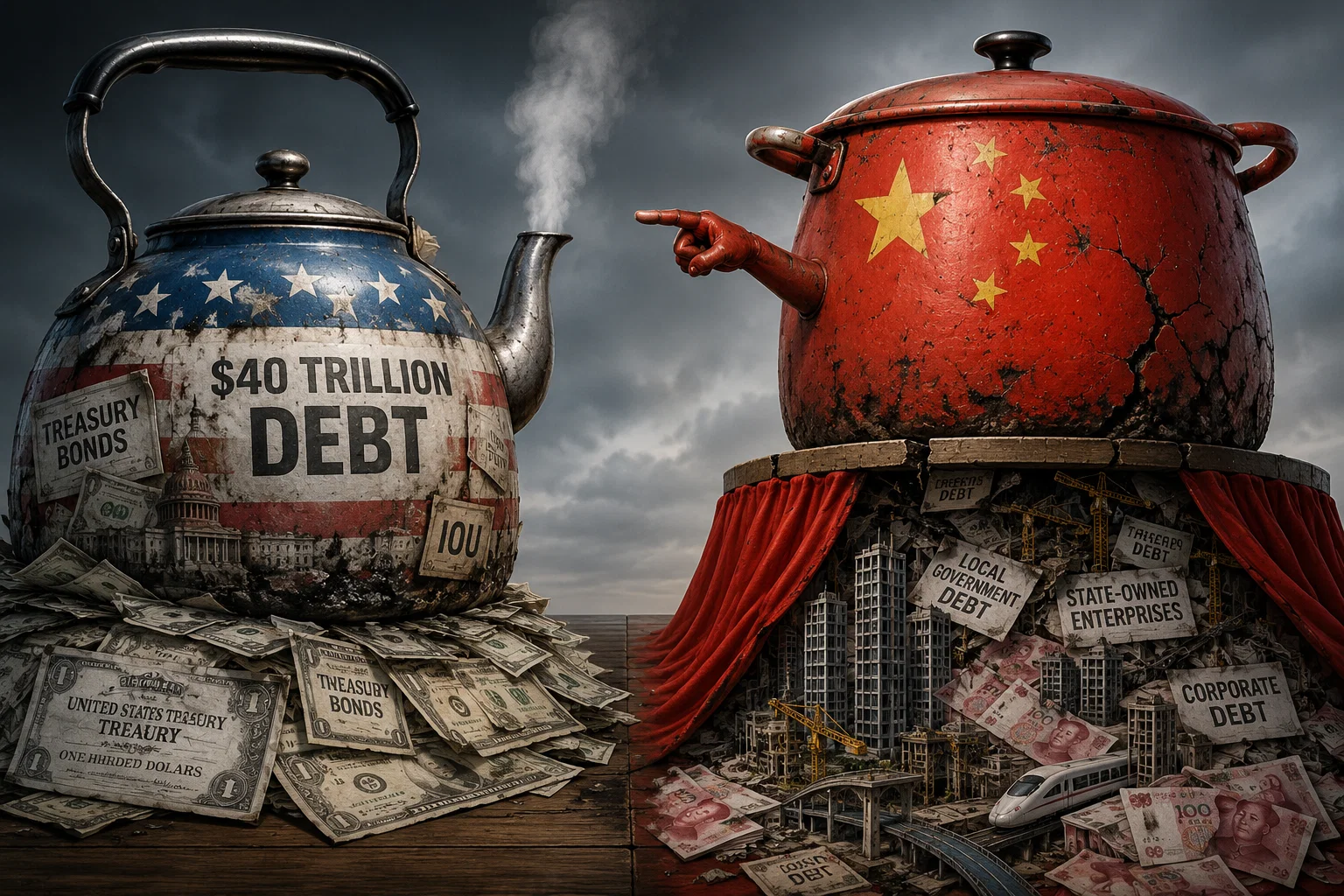
Another Xinhua social media account mocked the US government for borrowing new debt to pay back old debt, joking, "sounds like a perfect plan."
And a different Xinhua piece warned that US Treasuries were transforming from a rock-solid “risk-free” safe haven asset into a source of volatility.
Xinhua’s comments are not wrong. $40 trillion an insane amount of debt, and if you include state and local debt across the United States— New York, California, Chicago, etc., the total gross debt grows to $44 trillion.
The worst part is that few politicians are serious about cutting the debt, or even slowing down the borrowing. Congress can't even cut hundreds of billions of dollars' worth of obvious fraud.
But the criticism is pretty rich coming from the Chinese Communist Party.
America's federal debt is roughly 125% of GDP. Even including state and local debt it’s 135% of GDP.
But China's is 107% of GDP— so it’s not like the CCP is some paragon of spending restraint! And that 107% number is just what they publicly acknowledge.
Here's one example of an accounting trick China uses to keep its full debt off the books.
For decades, Chinese cities weren't allowed to borrow directly. So as an alternative they set up government-owned companies to do the borrowing for them.
These government-owned companies built the subways, the industrial parks, and the apartment towers, but the debt sat on the companies' books instead of the government's.
In November 2024 China's government finally admitted to trillions of dollars worth of this hidden debt. And they announced a five-year plan to move it onto their official balance sheet.
America's debt has been growing steadily: a horribly grotesque, absurdly wasteful $2 trillion per year since 2020. But China's debt takes a quantum leap every time the CCP tells a little more truth.
And by the IMF's count, China's real government debt comes to 135% of GDP this year... dead even with America's.
But Chinese debt pulls way ahead of the US when you factor in actual private debt held by companies and citizens.
Chinese corporate debt, for example, sits at 143% of GDP. US company debt is about HALF of that level. And let’s not forget that the biggest Chinese borrowers are state-owned enterprises where the politicians are ultimately in charge. So I’m suuuuure those company audits are totally above board...
The real question is HOW is this money going to be paid back. And by WHOM?
In January, China's statistics bureau reported that just 7.9 million babies were born in 2025, down from 9.5 million the year before... and the fewest in modern China's history. China’s fertility rate is 0.96, not even half of what it takes to keep a population steady. And China’s population shrank for the fourth year in a row.
America's debt will land on the next generation, which is bad. But at least America HAS a next generation.
Decades of the idiotic one-child policy left China with families with (hopefully) one worker supporting two parents and four grandparents. That same worker will now inherit his share of China’s debt at 135%+ of GDP.
America's fiscal challenges are immense. But they can be solved with common sense solutions— eliminating obvious fraud, making government more efficient, scaling back regulations that hamstring small business growth, reforming the immigration system, reforming Social Security.
China, on the other hand, needs a time machine to solve its problems. And since no such time machine exists, they just cook the books.
Seriously. A shrinking population is deadly for a nation’s economy. China can’t go back in time to reverse its one-child policy. And they can’t fix it with immigration either— because few people want to move to China!
This is why so many Chinese companies are developing robotics— it’s an absolute necessity there. But even this comes with a major social cost, i.e. higher unemployment.
And China cooks the books on those numbers as well.
When youth unemployment hit 21.3% in June 2023, the bureau suddenly decided that its methods of calculating unemployment needed immediate changes.
Plus any criticism or complaining leads to imprisonment... or worse.
In October 2020, Jack Ma, Alibaba's founder and then the richest man in China, gave a speech in Shanghai saying China's banks ran on a "pawnshop mentality" and its regulators were out of date.
Two weeks later the Chinese government killed his payments company's stock listing, which would have been the biggest in history, and Ma disappeared for three months.
This method of control is why no one can really trust anything from the Chinese government.
That includes their attitude that they will some day rule the world.
When President Trump visited Beijing earlier this year, Xi Jinping asked whether China and the United States could "overcome the so-called Thucydides Trap," the theory that a rising power and the one it threatens end up at war.
China's government has spent years telling anyone who'll listen that America is finished and China's time has come.
America does have challenges. And there is still some time left to get its house in order to avoid serious consequences.
But China is not its replacement.
To your freedom, James Hickman Co-Founder, Schiff Sovereign LLC
Rob Cunningham: XRP Repricing Mechanics and Liquidity Equation
Rob Cunningham: XRP Repricing Mechanics and Liquidity Equation
8-27-2026
XRP REPRICING MECHANICS
What provides liquidity when thousands of different forms of money, securities and tokenized property need to move between rails?
Ripple can provide the rails and the money traveling across the rails.
Rob Cunningham: XRP Repricing Mechanics and Liquidity Equation
8-27-2026
XRP REPRICING MECHANICS
What provides liquidity when thousands of different forms of money, securities and tokenized property need to move between rails?
Ripple can provide the rails and the money traveling across the rails.
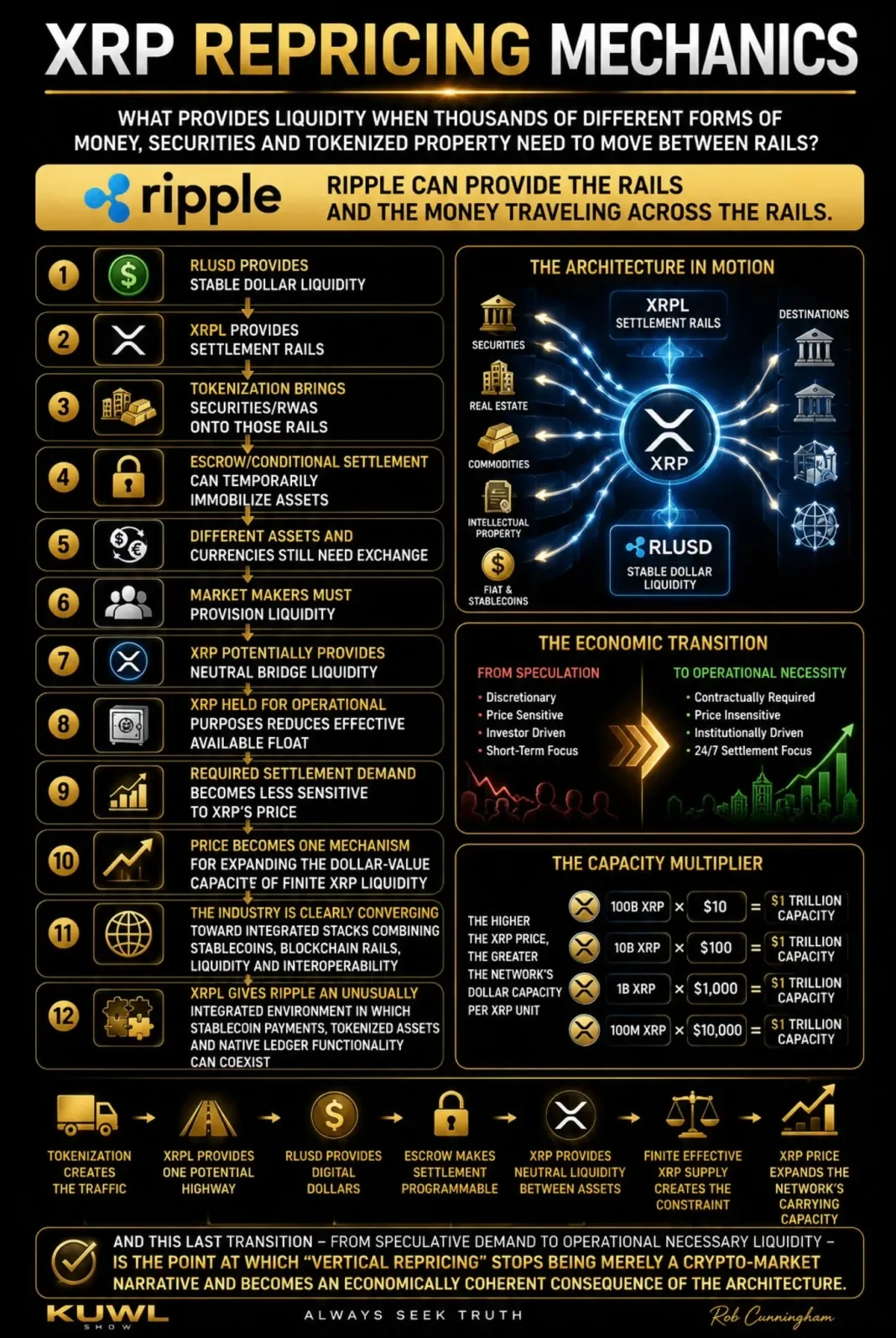
RLUSD provides stable dollar liquidity
→ XRPL provides settlement rails
→ tokenization brings securities/RWAs onto those rails
→ escrow/conditional settlement can temporarily immobilize assets
→ different assets and currencies still need exchange
→ market makers must provision liquidity
→ XRP potentially provides neutral bridge liquidity
→ XRP held for operational purposes reduces effective available float
→ required settlement demand becomes less sensitive to XRP’s price
→ price becomes one mechanism for expanding the dollar-value capacity of finite XRP liquidity
→ the industry is clearly converging toward integrated stacks combining stablecoins, blockchain rails, liquidity and interoperability
→ XRPL gives Ripple an unusually integrated environment in which stablecoin payments, tokenized assets and native ledger functionality can coexist
• Tokenization creates the traffic
• XRPL provides one potential highway
• RLUSD provides digital dollars
• Escrow makes settlement programmable
• XRP provides neutral liquidity between otherwise disconnected assets
• Finite effective XRP supply creates the constraint
• XRP Price expands the network’s carrying capacity
And this last transition – from speculative demand to operationally necessary liquidity – is the point at which “vertical repricing” stops being merely a crypto-market narrative and becomes an economically coherent consequence of the architecture.
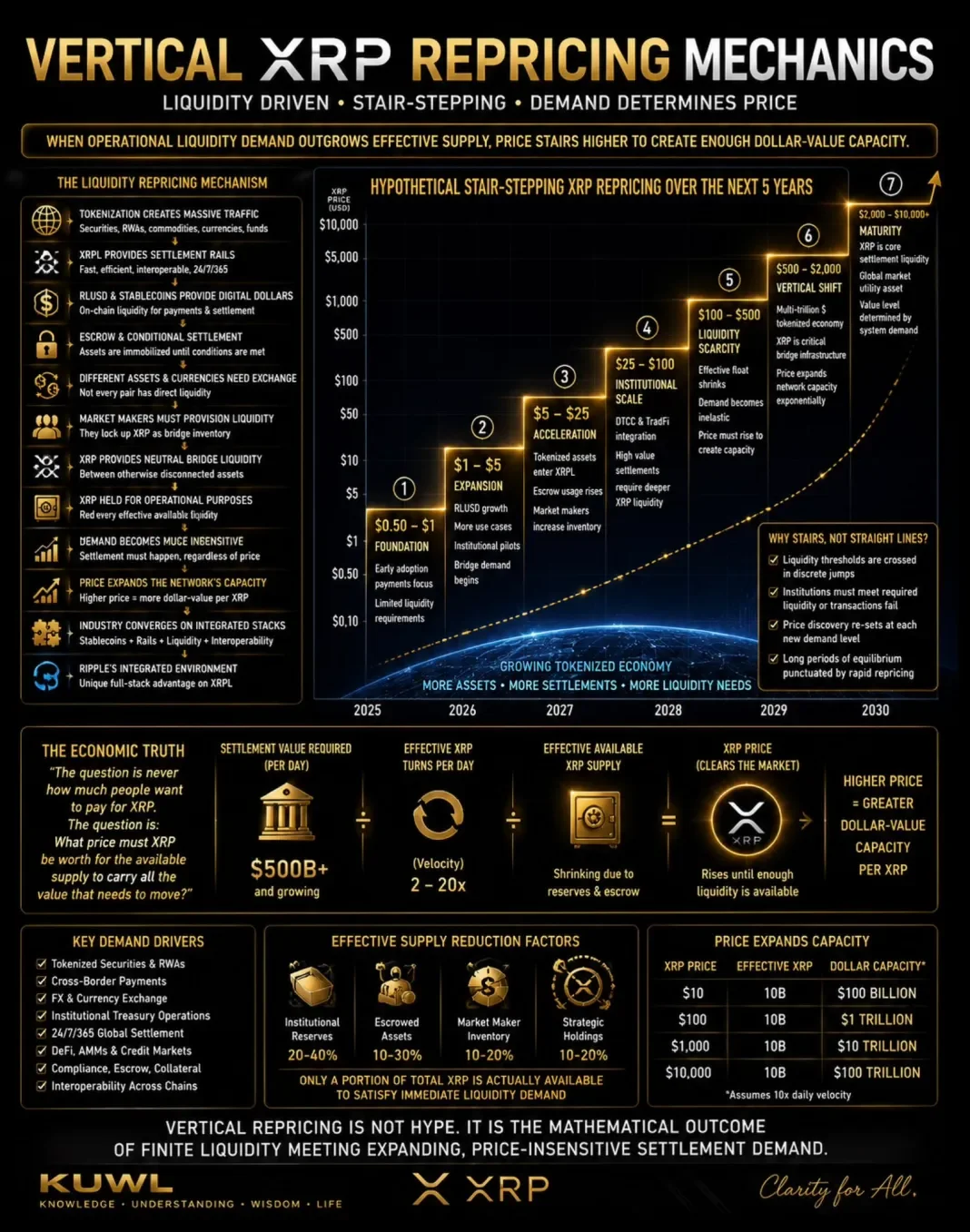
There are moments when the most useful thing we can do is set aside what we think we know and simply ask a better question.
This is one such thought experiment.
Not a prediction.
Not a price target.
Not investment advice.
A vision to examine, challenge and discern.
For most of XRP’s history, people have understandably viewed its price through the familiar lens of markets:
How many people want to buy it?
But what if that eventually becomes the wrong question?
Imagine a world in which securities, Treasuries, currencies, real estate, commodities and other forms of legally recognized value increasingly become tokenized and capable of moving around the clock.
Those assets still have to settle.
Different currencies still have to exchange.
Different pools of liquidity still have to meet.
Market makers still have to provision capital.
And somewhere between all those assets, currencies and networks, the system may need exceptionally efficient forms of neutral bridge liquidity.
If XRP earns a meaningful role there, something subtle but profound changes.
Demand would no longer arise solely because someone believes XRP will appreciate.
Some demand could arise because value actually needs to move.
And markets do something fascinating when necessary demand encounters finite available supply:
price discovers the level at which sufficient economic capacity becomes available.
A higher XRP price would therefore not merely represent greater speculative enthusiasm.
It could allow the same number of XRP to carry substantially more value.
$10 XRP creates ten times the dollar-denominated liquidity capacity of $1 XRP.
$100 creates ten times the capacity of $10.
And so forth.
That raises an intriguing possibility.
Perhaps mature XRP price discovery would not resemble a smooth upward curve at all.
Perhaps long periods of relative equilibrium could be interrupted by sharp stair-step repricing events as successive thresholds of institutional liquidity demand are reached.
Not because somebody administratively declares what XRP should be worth.
Not because social media becomes excited.
And certainly not because a chart says so.
But because the market continually asks a brutally simple question:
At what price can the available liquidity carry the value that needs to move?
I don’t pretend to know the answer.
None of us knows what percentage of future institutional settlement XRP will capture—or whether competing technologies ultimately solve much of this problem differently.
But I believe the question itself deserves serious consideration.
Because if tokenization creates vastly more financial traffic…
if programmable settlement changes how capital moves…
if liquidity increasingly operates 24/7…
and if XRP becomes meaningful operational inventory connecting otherwise fragmented pools of value…
then we may eventually discover that we spent years debating the price of XRP when the more consequential question was always:
How much economic value must each available XRP be capable of carrying?
The graphic below is simply an attempt to visualize that possibility.
Take nothing on faith.
Challenge the assumptions.
Test the mathematics.
Study the architecture.
Then reach your own conclusion.
Knowledge → Understanding → Wisdom → Life.
Let’s Always Seek Truth.
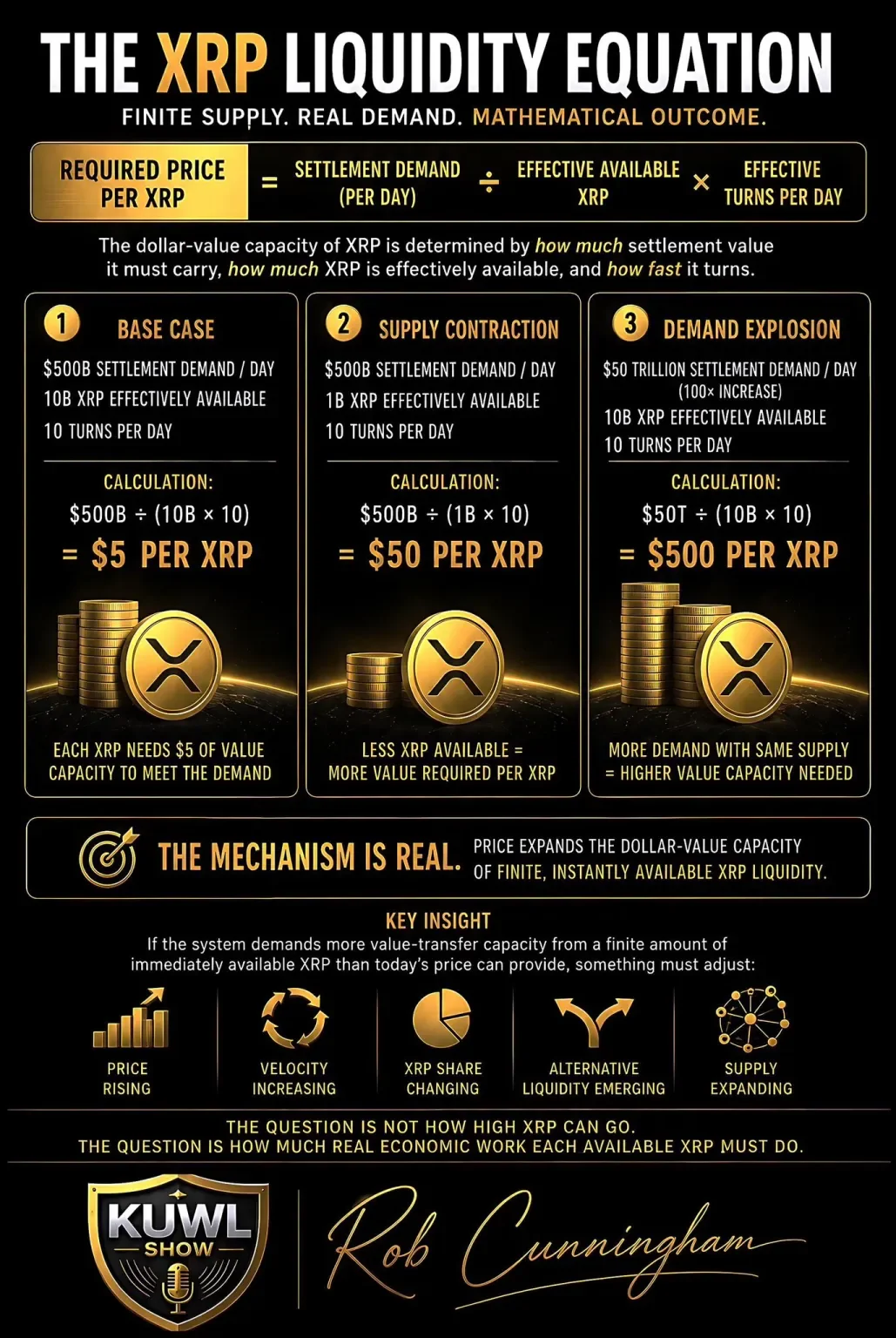
THE XRP LIQUIDITY EQUATION
A bullish XRP argument isn’t that the world must pay more for XRP.
It’s that IF the world ever demands more value-transfer capacity from a finite amount of immediately available XRP than today’s price can provide, something must adjust.
1 Supply can increase
2 Velocity can increase
3 XRP’s share can decrease
4 Alternative liquidity can emerge
5 Price can rise
The question isn’t “How high do we want XRP to go?”
The honest-weights-and-measures question is: “How much real economic work must each available XRP actually perform?”
Source(s):
• https://x.com/KuwlShow/status/2092562216218136996
• https://x.com/KuwlShow/status/2092566971812319354
• https://x.com/KuwlShow/status/2092594683398467975
The Great Financial Reset is here: Matt Dines
The Great Financial Reset is here: Matt Dines
Tales from the Crypt: 8-26-2026
Matt Dines returns to break down a week of escalating monetary chaos. Scott Bessent doubles the Treasury buyback limit to $4 billion, Stanley Druckenmiller fires a public warning shot in the Wall Street Journal, and the US-Canada trade relationship collapses into 50% tariffs.
Matt maps the mechanics behind treasury auctions, yield curve defense, and the offshore dollar's unwind, then connects "Operation Economic Outcast" and Iran's oil smuggling scandal to a broader financial war. Plus tokenized securities, the stalled Clarity Act, the ARMA bill, and what Bitcoin's five-sigma candle actually signaled.
The Great Financial Reset is here: Matt Dines
Tales from the Crypt: 8-26-2026
Matt Dines returns to break down a week of escalating monetary chaos. Scott Bessent doubles the Treasury buyback limit to $4 billion, Stanley Druckenmiller fires a public warning shot in the Wall Street Journal, and the US-Canada trade relationship collapses into 50% tariffs.
Matt maps the mechanics behind treasury auctions, yield curve defense, and the offshore dollar's unwind, then connects "Operation Economic Outcast" and Iran's oil smuggling scandal to a broader financial war. Plus tokenized securities, the stalled Clarity Act, the ARMA bill, and what Bitcoin's five-sigma candle actually signaled.
The global financial system is navigating one of the most intricate macroeconomic landscapes in modern history. As traditional fiscal tools face structural strain, investors and policymakers alike are forced to confront a rapid convergence of rising sovereign yields, geopolitical trade frictions, and a fundamental shift in how value is stored and transferred.
In a recent, eye-opening discussion on TFTC (Tales From The Crypt), industry analysts dissected this macro backdrop, examining how traditional finance is undergoing what can best be described as an “economic D-Day”—a decisive, high-stakes transition toward a new monetary paradigm.
At the center of this storm sits Bitcoin. No longer viewed merely as a speculative asset on the fringes of tech, Bitcoin is increasingly recognized as a vital piece of digital collateral in a world defined by monetary recalibration and fiscal uncertainty. Understanding where market prices and regulatory frameworks are headed requires analyzing the powerful macroeconomic forces currently moving global markets.
One of the most critical mechanisms currently at play in global finance is the U.S. Treasury’s operational strategy regarding rising bond yields. As national debt continues to swell, elevated interest rates place immense pressure on government borrowing costs. To prevent borrowing rates from spiraling out of control—a scenario that threatens broader market stability—the U.S. Treasury has increasingly leaned on liquidity management tools, most notably debt buybacks.
These treasury buybacks act as a strategic form of yield curve defense. By repurchasing specific off-the-run securities and injecting targeted liquidity into the sovereign debt market, monetary authorities aim to smooth out volatility and maintain orderly trading conditions. However, while these measures offer short-term stabilization, they also highlight a deeper reality: traditional financial systems are operating in an environment where ongoing intervention is necessary to maintain market equilibrium. For global investors, this continuous liquidity support signals that fiat currencies remain subject to structural dilution over the long term.
Macroeconomic stability is further complicated by rising geopolitical tensions, even among long-standing commercial partners. Recent trade friction between the United States and Canada has introduced fresh volatility into North American markets, serving as a reminder of how quickly political rhetoric can impact supply chains, currency valuations, and regional commerce.
Simultaneously, global energy trade is undergoing a quiet realignment. Complex networks involving non-traditional energy supply chains—including global oil trade flows operating outside standard international finance frameworks—are altering global trade balances and foreign exchange demand. As geopolitical alliances shift and traditional trade agreements face scrutiny, nations are increasingly motivated to diversify their balance sheets away from single-currency dependencies. This fragmentation in global trade further accelerates the search for neutral, permissionless settlement assets.
Beyond immediate trade disputes and market operations lies a long-term fiscal challenge: the structural math of major U.S. entitlement programs. As demographic trends shift and mandatory government expenditures expand, the gap between national revenue and fiscal obligations continues to widen.
Addressing these long-term obligations poses a major dilemma for economic planners. Standard policy options—such as spending cuts, tax increases, or expanding the monetary base—each carry significant political and economic trade-offs. As market participants observe these structural deficits, confidence in the long-term purchasing power of sovereign fiat currencies naturally erodes. This dynamic is driving institutional capital to look beyond traditional debt instruments and seek refuge in hard assets with predictable, programmatic supply schedules.
In the midst of this shifting financial landscape, traditional finance is experiencing a structural disruption reminiscent of a financial beachhead invasion—an “economic D-Day” where old assumptions about sovereign debt and reserve assets are being tested. Within this context, Bitcoin’s core value proposition as sovereign digital collateral comes into sharp focus.
Unlike traditional financial assets that carry counterparty risk or rely on centralized governance, Bitcoin operates as an unencumbered, globally accessible settlement layer.
This unique positioning has caught the attention of forward-thinking lawmakers and institutions. Around the world, evolving regulatory frameworks are beginning to clarify the legal treatment of digital assets, paving the way for broader institutional participation.
Even more notable are emerging legislative efforts aiming to establish strategic Bitcoin monetary reserves. Proposals to integrate Bitcoin into official balance sheets mark a monumental shift in monetary theory. If adopted, such frameworks would formally recognize digital assets as a legitimate hedge against fiat debasement and a core component of 21st-century national balance sheets.
Despite these bullish long-term fundamentals, short- to medium-term market dynamics remain nuanced. Investors are actively debating whether the crypto market has permanently exited its previous bear cycle or if near-term macroeconomic headwinds will prolong price volatility.
While short-term price fluctuations remain uncertain, the structural trend toward digital collateral and monetary diversification is clearer than ever.
The intersection of yield curve management, trade disputes, fiscal deficits, and digital asset integration points to a financial system in transition. As traditional markets navigate these unprecedented challenges, Bitcoin stands out as a unique bridge between old financial architectures and the emerging digital paradigm.