
Thank you to all the subscribers to our Early Access program…we thank you for your continued support.
We are excited to offer this new service to keep you informed and up-to-date on the latest Dinar and currency news.
Congress Built This Mess They’ve Made Sure They Don’t Live In It
Congress Built This Mess. They’ve Made Sure They Don’t Live In It.
Notes From the Field By James Hickman (Simon Black / Sovereign Man) August 25, 2026
King Hammurabi of Babylon had a simple rule for home builders: if the house you built collapsed and killed its owner, you were put to death.
That was law #229, carved in stone almost 4,000 years ago. And some version of this rule has existed for most of human history. Even to this day, it’s a tradition among architects to spend the night under a bridge they designed to prove that it’s safe.
Congress Built This Mess. They’ve Made Sure They Don’t Live In It.
Notes From the Field By James Hickman (Simon Black / Sovereign Man) August 25, 2026
King Hammurabi of Babylon had a simple rule for home builders: if the house you built collapsed and killed its owner, you were put to death.
That was law #229, carved in stone almost 4,000 years ago. And some version of this rule has existed for most of human history. Even to this day, it’s a tradition among architects to spend the night under a bridge they designed to prove that it’s safe.
Bottom line, people who built things were often expected to eat their own cooking and suffer the successes and consequences of their work.
The United States Congress has spent decades perfecting the opposite arrangement.
Start with the salary. Members of Congress earn $174,000 a year, more than double what the median American household makes. Yet Congress would like you to know how painful that is.
Senator Tommy Tuberville calls the job a "sacrifice." Representative Pramila Jayapal complains that "most of us get paid less than our chiefs [of staff] at this point."
Current and former members are suing the government, demanding retroactive cost-of-living raises, with claims as high as $420,000 apiece.
Bear in mind, again, that Congressmen already make $174,000 per year. Yet the House of Representatives averages just 150 days in session per year. And last year's legislative calendar scheduled just 137 days.
Most Americans work at least 250 days a year. So, adjusting for actual days worked, Congressmen are actually earning nearly $300,000 based on a normal work year. So the pay gap between everyday Americans and their Congressional representatives is even greater than at first glance.
And just how do they fill their 150ish work days? The Democratic Congressional Campaign Committee once handed its incoming freshmen a model schedule:
Four hours of the day went to fundraising calls. Another hour to something called "strategic outreach", i.e. being aligned with the party bosses. The actual job of representing constituents gets, maybe, 3-4 hours per day.
By the party's own math, half of a congressman's day goes to keeping the job rather than doing it.
This is insane. A welder doesn't get to spend half of his day persuading people to let him keep his job; rather, if he doesn’t want to get fired, he simply has to do a good job. Pretty simple.
But members of Congress can't run on their records, because their record is the insane world that we all live in.
So they spend their days telling lies to donors in order to raise enough money to tell more lies in TV commercials and email blasts. Anywhere else, this cascade of lies would be considered criminal fraud. In politics it’s just campaigning.
And in a few weeks, those campaign pitches will even receive a special pass around Gmail's inbox filter: starting September 8, 2026, Google will let verified political committees bypass it entirely, just in time for the midterms. Your inbox has rules; their fundraising has an exemption.
But the exemptions don’t stop there.
Thanks to Congress, Americans are required by law to have some overpriced health insurance plan. But politicians have a special plan, with taxpayers footing the vast majority of the premium... plus coverage for life once a member qualifies for retirement after serving just FIVE years in Congress.
So the same people who built the most unaffordable healthcare system in the world exempted themselves from ever feeling the pain.
Pensions repeat the pattern: members elected before 2013 earn a pension that accrues nearly twice as fast as a regular federal worker's, collectible as early as 50. They let Social Security drift toward insolvency for you. For themselves, they built a backup.
Then there's the stock trading. A corporate executive who trades on confidential information goes to prison. Congress never bothered to apply those rules to itself until the 2012 STOCK Act.
That might explain how former House Speaker Nancy Pelosi went from a roughly $3 million net worth when she entered Congress in 1987 to an estimated $280 million today. It’s all apparently due to her husband's extreme investment prowess.
But she's far from the only one. Must all be a wild coincidence.
Even after the 2012 STOCK Act which required politicians to disclose their stock trades, nothing changed. Seventy-eight members broke that law in a single term— yet in the fourteen years since the STOCK Act, not a single one has been prosecuted for insider trading.
Even Speaker Mike Johnson says, "Look, at least let them, like, engage in some stock trading, so that they can continue to, you know, take care of their family."
Imagine the private-sector version: if JP Morgan announced a new campus in Texas and its CEO, Jamie Dimon, bought up the surrounding land to sell to his own company, he'd be indicted before the concrete cured.
Congress runs that trade every day, on information you'll never see, and calls it “taking care of their family”.
Then you’ve got their housing perks.
Representatives can bill taxpayers for their living costs in Washington DC— up to $276 a night for lodging, plus a $92 meal allowance.
What’s interesting is that this is a recent adjustment going back to just 2023. Congressmen were ‘suffering’ the worst inflation in four decades. Rather than acknowledge that they themselves were instrumental in creating that inflation, they cooked up a bailout for themselves so that they wouldn’t have to pay sky-high prices.
In short, you pay higher living costs. Congressmen bill you for theirs.
Congressmen also routinely get sweetheart deals from banks and mortgage brokers; during the 2008 financial crisis, for example, America’s largest housing lender at the time ran a VIP program that waived fees and cut prices on home loans for politicians and key staffers.
Everyone else pays the going rate— 6% to 7% today. Politicians get special terms, and I’m sure there are no strings attached.
An organization that never feels its own failures has no reason to fix them. The debt, the inflation, and the fraud keep compounding no matter who wins.
Hammurabi figured out the fix 4,000 years ago: make the builder liable for his own construction. Congress has spent decades making sure the roof always comes down on somebody else.
To your freedom, James Hickman Co-Founder, Schiff Sovereign LLC
Iraq Economic News and Points To Ponder Tuesday Afternoon 8-25-26
Iraq Considers Currency Change and Dinar Redenomination as Parliament Seeks to Delay Draft Law
25-08-2026 Peregraf — Iraq is considering a major currency reform that would involve replacing existing banknotes and potentially removing zeros from the Iraqi dinar, but the Parliamentary Finance Committee has asked the government to postpone legislation on the proposal until its economic, legal and financial implications are studied in greater detail.
Iraq Considers Currency Change and Dinar Redenomination as Parliament Seeks to Delay Draft Law
25-08-2026 Peregraf — Iraq is considering a major currency reform that would involve replacing existing banknotes and potentially removing zeros from the Iraqi dinar, but the Parliamentary Finance Committee has asked the government to postpone legislation on the proposal until its economic, legal and financial implications are studied in greater detail.
The Finance Committee hosted the Governor of the Central Bank of Iraq on August 23 to discuss the proposed currency change and the removal of zeros. Following the meeting, the committee sent a formal letter to Prime Minister Ali Faleh Al-Zaidi's office recommending that a vote on the draft law be postponed pending direct discussions between Parliament, the Council of Ministers, the Central Bank, the Ministry of Finance and the Ministry of Planning.
The committee distinguished between replacing the existing banknotes and actually removing zeros from the dinar's denominations. According to its letter, changing the currency without deleting zeros falls within the Central Bank's legal authority under Article 36 of the Central Bank Law No. 56 of 2004.
However, removing zeros would require legislation because it would affect a wide range of existing legal and financial obligations. The committee said the process would require amendments to civil, commercial and criminal legislation containing amounts denominated in dinars, as well as contracts involving investment projects, debts, government fees, fines and other financial obligations.
The committee also said the legislation would need to protect the rights and obligations of creditors and debtors, establish a clear timetable and mechanisms for the transition, and address possible amendments to Iraq's Anti-Money Laundering and Counter-Terrorism Financing Law and the Integrity Commission Law.
$250 Million Printing Plan
MP Dilan Ghafour, a member of the Finance Committee, told Peregraf that removing zeros would require the printing of new currency at an estimated cost of $250 million.
Ghafour said four countries — Germany, France, Australia and the United Kingdom — had been selected for the printing process.
She said Iraq's current money supply stands at 113 trillion dinars, and estimated that between 8 trillion and 10 trillion dinars had been lost during wars or stolen. She said only about 6% of the remaining currency is held by the government, while the vast majority is in public circulation.
Ghafour said the proposed exchange would provide an opportunity to bring more cash into the formal financial system. She said people holding large amounts of cash could be required to explain the source of their wealth when exchanging old notes.
She also said the Finance Committee had raised concerns over the possibility that rising real estate and gold prices could provide safe havens for illicit funds or facilitate money laundering. According to Ghafour, relevant oversight bodies and the Ministry of Planning would be responsible for monitoring those developments.
MP Ahmed Haji Rashid, another Finance Committee member, said the government is preparing to change the currency and that the samples, designs and dimensions of the new notes are ready.
Rashid said the proposed plan involves printing 7.5 billion banknotes across all denominations, also at an estimated cost of $250 million, with Germany, France, Australia and Britain designated for the printing process.
He stressed that the proposed currency would retain the same price and value, meaning the planned change would not in itself constitute a devaluation or increase in the dinar's real value.
Rashid said the reform is intended to withdraw large amounts of cash currently outside the banking system, combat the circulation of cash linked to corruption, strengthen protection against counterfeiting and encourage citizens to move savings from homes into banks.
He said the current banknotes have been in circulation since 2005, and argued that replacing them would address security concerns and reduce counterfeiting risks.
Rashid also said the reform could help activate what he described as "idle capital" held outside the banking system because of limited public confidence in banks. Under the proposed process, exchanging old notes through banks could encourage greater deposits and increase the use of formal financial services.
He estimated that the overall currency replacement process could take three to seven years.
Finance Committee Calls for Caution
Despite the preparations described by the MPs, the Finance Committee has not endorsed immediate passage of the legislation.
In its August 24 letter, signed by Finance Committee Chairman Uday Awad Kadhim, the committee formally recommended postponing the vote until the government and relevant institutions conduct a comprehensive assessment of the proposed currency change and removal of zeros.
The committee said the process could have implications extending beyond monetary policy, including contracts, taxation, debts, criminal penalties, anti-corruption measures and the rights of citizens and businesses.
The proposed reform therefore remains subject to further government and parliamentary review, with the Finance Committee seeking a coordinated assessment before legislation on removing zeros from the Iraqi dinar proceeds. https://peregraf.com/en/report/12333
Seeds of Wisdom RV and Economics Updates Tuesday Afternoon 8-25-26
Good Afternoon Dinar Recaps,
BRICS Builds the Plumbing for a More Multipolar Financial System
The most consequential part of the BRICS financial story may not be a new currency. It may be the payment infrastructure being built underneath global trade.
Good Afternoon Dinar Recaps,
BRICS Builds the Plumbing for a More Multipolar Financial System
The most consequential part of the BRICS financial story may not be a new currency. It may be the payment infrastructure being built underneath global trade.
Overview
BRICS countries are exploring ways to connect their fast-payment systems and central bank digital currencies (CBDCs) to make cross-border transactions faster and less expensive.
India is pushing for greater use of the rupee in international settlements,while BRICS members examine ways to make local-currency payments more practical.
The development does not mean a BRICS currency is replacing the dollar. Instead, it represents something potentially more important over time: the construction of additional payment channels that could reduce dependence on traditional dollar-centered settlement.
Key Developments
1. BRICS is focusing on payment infrastructure—not just a new currency
Reserve Bank of India Governor Sanjay Malhotra said BRICS members are discussing potential linkages between their national fast-payment systems and CBDCs. The objective is to make international payments faster, cheaper and more efficient.
That is significant because much of the global financial-reset discussion has focused on whether BRICS will eventually create a common currency.
But a common currency is not necessary to change the architecture of international payments.
Connecting existing payment systems could allow countries to continue using their own currencies while making cross-border settlement more efficient.
That is a much more practical—and potentially more achievable—path.
2. India wants the rupee to play a larger role
India is already using the rupee for settlements with some trading partners, although Governor Malhotra acknowledged that the volumes remain relatively small and need to expand.
This is an important distinction.
The objective is not necessarily to replace the dollar overnight.
Instead, countries can gradually increase the percentage of trade settled in their own currencies, reducing the number of transactions that require conversion into dollars before reaching their final destination.
Over time, that can change the composition of global currency demand.
3. Fast-payment systems could become the foundation of a new settlement network
India's UPI provides an important example of what BRICS members are examining.
Rather than building an entirely new global financial system from scratch, countries could potentially connect systems they already operate.
That approach could include:
National payment rails → cross-border interoperability → local-currency settlement → CBDC connectivity
The BRICS discussions are still at an early stage, and there is no fully operational BRICS-wide payment network resulting from these talks yet. Reuters reports that members are still discussing possible linkages and approaches.
That caveat is important.
This is infrastructure under development—not a completed replacement for SWIFT or the dollar.
Why It Matters
The global financial system is built on more than currencies.
It also depends on the rails that move money.
For decades, international commerce has relied heavily on correspondent banks, dollar clearing and established messaging and settlement infrastructure.
If emerging economies develop efficient alternatives, the effect could be gradual but significant.
→A Brazilian company could increasingly trade with an Indian company using local currencies.
→An Indian company could settle with a Russian supplier in rupees or rubles.
→A Chinese company could increasingly conduct trade without every transaction passing through the same dollar-centered pathway.
None of those transactions individually threatens the dollar.
But millions of transactions operating through alternative channels could gradually change the structure of global trade settlement.
Why It Matters to Foreign Currency Holders
For foreign-currency holders, this is one of the developments worth watching closely because it moves the discussion beyond speculation about a sudden currency revaluation.
The more important question is: Which currencies are actually being used for international trade
If BRICS countries succeed in expanding local-currency settlement, currencies such as the rupee, yuan, ruble and real could gain greater transactional importance even without becoming reserve currencies on the scale of the dollar.
That could eventually create greater demand for currencies that previously had limited international circulation.
However, greater use does not automatically mean a dramatic increase in currency value. The economic fundamentals of each currency still matter.
Implications for the Global Financial Reset
The reset may be about infrastructure before currency
The most important development may not be the creation of a BRICS currency.
It may be the creation of multiple settlement pathways.
That changes the financial system at its foundation.
The emerging model looks less like: Dollar → everything
and increasingly like: Dollar + Yuan + Rupee + other local currencies + interoperable payment systems
That is the beginning of a more multipolar settlement environment.
BRICS is building optionality
This is perhaps the most important word in the story: optionality.
BRICS does not need to eliminate the dollar to reduce dependence upon it.
It simply needs to give businesses and governments more choices.
The ability to settle directly in local currencies reduces exposure to dollar shortages, currency-conversion costs and, for some countries, the risks associated with sanctions and dependence on Western financial infrastructure.
The dollar's role could change gradually rather than collapse suddenly
The dollar remains deeply embedded in global trade, finance, reserves and capital markets.
Nothing in the current BRICS discussions changes that overnight.
But financial systems can change through incremental diversification.
If alternative payment rails become faster and cheaper, economic incentives—not political declarations—could gradually encourage greater use.
That is ultimately more important than headlines announcing the "end of the dollar."
************************
What to Watch Next
The critical indicators will be whether BRICS moves from discussion toward actual technical interoperability between national payment systems.
Watch for:
Formal agreements connecting fast-payment systems
Greater use of local currencies in BRICS trade
Expansion of India's rupee settlement arrangements
Progress on CBDC interoperability
Changes in correspondent-banking relationships
Evidence that businesses—not just governments—are adopting alternative settlement channels
The upcoming BRICS discussions will be particularly important because India is hosting the 2026 summit, putting payment infrastructure and financial cooperation directly into the group's agenda.
Bottom Line
The global financial system does not have to experience a dramatic "currency replacement" to undergo a reset.
It can change one payment rail at a time.
BRICS' exploration of interconnected payment systems, CBDCs and expanded local-currency settlement represents an important structural development because it addresses how money actually moves across borders.
The dollar remains dominant. But the architecture surrounding it is becoming more diversified.
The emerging global financial reset may therefore be less about replacing the dollar—and more about building a world where countries no longer have to rely on a single financial pathway to conduct global trade.
Seeds of Wisdom Team
Newshounds News™ Exclusive
Sources
Reuters — BRICS nations discuss linking payment systems and CBDCs
Moneycontrol — RBI Governor Sanjay Malhotra says BRICS eyeing faster cross-border payments
~~~~~~~~~~
Seeds of Wisdom Team RV Currency Facts Youtube and Rumble
Newshound's News Telegram Room Link
RV Facts with Proof Links Link
RV Updates Proof links - Facts Link
Start Here room with Most Asked Questions Link
Follow the Gold/Silver Rate COMEX
Follow Fast Facts
Seeds of Wisdom Team™ Website
Thank you Dinar Recaps
Reset Day Is Coming — Here’s What Happens to Your Money, Debt & Home
Reset Day Is Coming — Here’s What Happens to Your Money, Debt & Home (How to Prep)
Daneila Cambone and Taylor Kenny: 8-24-2026
In today’s interview, Daniela Cambone speaks with ITM Trading’s Taylor Kenney about what “Reset Day” could mean for your savings, debt, and home and how to prepare before the rules change.
History often provides clear indicators when monetary systems come under structural strain. During the conversation, Taylor Kenney highlights firsthand accounts and real-world examples of past currency crises, such as the economic devaluations experienced in Mexico.
Reset Day Is Coming — Here’s What Happens to Your Money, Debt & Home (How to Prep)
Daniela Cambone and Taylor Kenny: 8-24-2026
In today’s interview, Daniela Cambone speaks with ITM Trading’s Taylor Kenney about what “Reset Day” could mean for your savings, debt, and home and how to prepare before the rules change.
History often provides clear indicators when monetary systems come under structural strain. During the conversation, Taylor Kenney highlights firsthand accounts and real-world examples of past currency crises, such as the economic devaluations experienced in Mexico.
These historical events demonstrate a remarkably consistent pattern: central banks overprint currency, public confidence in paper money steadily erodes, purchasing power declines through accelerating inflation, and the system eventually undergoes an official devaluation or revaluation.
When a currency is officially devalued, the nominal figures in a bank account may remain the same, but their actual purchasing power drops precipitously. Savers who keep their entire reserve in fiat currency bear the brunt of these adjustments, making it essential to recognize that monetary shifts are rarely sudden anomalies—they are typically the predictable result of prolonged fiscal expansion.
Spotting an impending monetary transition requires paying attention to macro-level indicators. Kenney and Cambone emphasize several critical warning signs currently visible in global markets, most notably shifts within the bond market and the escalating costs associated with servicing public debt.
As government debt burdens rise, interest payments consume an increasingly large portion of annual budgets. This dynamic restricts the flexibility of monetary policy and frequently leads central banks to rely on further currency creation to manage obligations. For everyday observers, watching the bond market and national debt interest yields key clues about the health of the broader financial architecture.
A major misconception surrounding the concept of a monetary reset is the idea of widespread debt forgiveness. Some assume that a systemic overhaul will automatically wipe out mortgages, personal loans, or credit obligations. However, economic history suggests otherwise: financial institutions historically ensure that debt contracts are preserved or adjusted in ways that safeguard creditors rather than borrowers.
Similarly, while real estate remains a tangible and valuable asset class, its market value and liquidity can fluctuate dramatically during periods of monetary stress. High interest rates and tightening credit conditions can constrain real estate transactions even while underlying costs rise. Relying solely on real estate or paper assets during a currency transition can leave individuals exposed to unexpected liquidity challenges.
One of the most encouraging takeaways from the discussion is that wealth preservation is not reserved exclusively for institutional investors or the ultra-wealthy. Precious metals like physical gold and silver remain accessible, time-tested stores of value for people across all financial backgrounds.
Unlike fiat currency, physical precious metals cannot be printed by executive decree or degraded by inflationary policy. They carry no counterparty risk and have maintained their purchasing power across centuries of economic shifts, currency reconfigurations, and market cycles. Allocating a portion of one’s portfolio toward tangible, sound assets serves as a practical hedge against the uncertainty of paper-based financial systems.
While discussing a global monetary reset highlights real economic vulnerabilities, the overarching message from Daniela Cambone and Taylor Kenney is one of hope and empowerment. Increased public awareness, continuous education, and proactive financial planning give individuals the tools needed to weather significant economic transitions successfully.
00:00 Taylor's Take on Monetary Reset
02:38 What Is a Monetary Reset?
03:56 How Urgent Is the Reset?
05:24 The Biggest Concern for Everyday Savers
07:30 Could an Uprising Happen?
12:08 How to Use Gold and Silver
14:11 Understanding Gold Price Fluctuations
Iraq Economic News and Points To Ponder Late Monday Evening 8-24-26
Iraq Finance Committee Recommends Postponing Dinar Redenomination Vote
Daban Mohammed At a Glance
The Iraqi Finance Committee officially advises delaying the vote on removing zeros from the dinar.
Replacing banknotes without deleting zeros remains under the independent authority of the Central Bank.
Redenomination requires brand-new laws to amend civil, commercial, and penal codes across Iraq.
Iraq Finance Committee Recommends Postponing Dinar Redenomination Vote
Daban Mohammed At a Glance
The Iraqi Finance Committee officially advises delaying the vote on removing zeros from the dinar.
Replacing banknotes without deleting zeros remains under the independent authority of the Central Bank.
Redenomination requires brand-new laws to amend civil, commercial, and penal codes across Iraq.
According to an official legal memorandum obtained by Channel8 from lawmaker Dilan Ghafoor, the Parliamentary Finance Committee has formally recommended postponing the vote on the dinar redenomination draft law.
Key Statement and Focus Area
The memorandum notes that "the process of only changing the Iraqi currency, without removing the zeros, falls strictly within the scope, duties, and responsibilities of the Central Bank of Iraq."
The proposed delay in the redenomination draft law aims to identify the most significant challenges and obstacles in implementing any changes that may occur to the currency.
The memorandum, written by Committee Chairman Uday Awad Kadhim, was dispatched to the Office of the Council of Ministers following an emergency Sunday meeting between Finance Committee members and Central Bank officials, during which they discussed strengthening monetary policy, financing the budget deficit, and implementing reforms to resolve the ongoing financial crisis.
Kadhim clarified that the Central Bank of Iraq will proceed with replacing banknotes without removing zeros during the coming period, a mandate granted under Article 36 of the amended Law No. 56 of 2004.
The memorandum stresses that changing the currency with the removal of zeros from the value of the Iraqi currency requires the enactment of a law drafted by the Prime Minister's office and sent to the Council of Representatives for legislation.
The document highlights that executing a currency redenomination necessitates comprehensive legal amendments to civil, commercial, and penal codes, along with revisions to active investment contract valuations.
Furthermore, the legislative process requires updating anti-money laundering and institutional integrity laws while clearly defining implementation timelines.
These statutory adjustments are mandatory to safely preserve the rights and financial obligations of both public and private sector creditors.
"Accordingly and based on the above, the Finance Committee recommends postponing the vote on the draft law (changing the currency and removing zeros) until extensive discussions are held among the following entities (Finance Committee, Council of Ministers, Central Bank of Iraq, Ministry of Finance, Ministry of Planning), to identify the most significant challenges and obstacles in implementing any changes that may occur to the currency," the document concluded.
FYI
The long-shelved currency redenomination debate abruptly returned to the forefront of Iraqi politics due to unexpected public announcements and a deepening domestic budget squeeze.
Yesterday, the Iraqi Parliamentary Finance Committee hosted Central Bank officials on Sunday to evaluate monetary frameworks, optimize deficit-financing strategies, and address pressing issues like public sector payroll delays and inflation metrics.
lawmaker Rebwar Karim told Channel8 today “the decision to remove the zeros from the dinar has its own procedures.”
He said although the government plans to delete zeros from the dinar, the initiative remains pending without an official decision due to incomplete legislative steps.
However, Government spokesperson Haider al-Aboudi clarified that an official decision to delete zeros from the dinar has not been finalized, adding that the Finance Committee estimated a three-to-seven-year transition for the redenomination process, which will keep the currency's actual value unchanged. https://channel8.com/english/news/64393
Iraq To Slash Three Zeros From Currency, Introduce New Notes
Aug. 24, 2026 • It also aims to curb the use of cash outside the system, which may be used for criminal activities and corruption, he explained.
ERBIL, Kurdistan Region of Iraq – Iraq is set to remove three zeros from its currency in a bid to rebrand the dinar and support digitizing transactions to combat cash outside the system used for crime and corruption, a lawmaker said Monday.
Jamal Kocher, a Kurdish member of the Iraqi parliament's finance committee, told The New Region that Prime Minister Ali al-Zaidi “has requested removing zeros from the bills. If this happens, it means that 1,000 dinars will become one dinar, 25,000 dinars will be 25 dinars.”
Earlier in August, Communications Minister Mustafa Sanad confirmed that the decision to remove the zeros and change the currency had been made.
The Central Bank of Iraq, however, has yet to formally announce a timetable for the process.
Iraq added zeros to the dinar when it was heavily sanctioned toward the end of the rule of former dictator Saddam Hussein, Kochar noted, explaining that adding zeros to a currency is an indication that it is degrading.
Asked about Iraq’s rationale for the overhaul, the lawmaker said that some neighbouring countries have taken legitimate Iraqi bills and sent back copied versions, and that smaller amounts, like cents, are needed in the market.
It also aims to curb the use of cash outside the system, which may be used for criminal activities and corruption, he explained.
“Any crime that is committed in the world, whether it is murder, organized crime, money laundering, or trading opium and hashish and those things, is all committed through money that does not go through the banking system,” said Kochar.
“Guarantees may be put in place for those using digital transactions so the currency stays under the government’s control while transparency emerges,” he stressed.
According to the lawmaker, the change will not affect people’s daily lives or purchasing power. Prices will remain fixed while the zeros are removed and smaller amounts are introduced. People may exchange the older version for the new one.
Previously, only France and Germany printed Iraqi dinars, but now the government has also approached the United Kingdom and Australia in a bid to speed up the process.
https://thenewregion.com/posts/6317 The New Region @thenewregion
Iraq is set to remove three zeros from its currency in a bid to rebrand the dinar and support digitizing transactions to combat cash outside the system used for crime and corruption, a lawmaker said Monday
https://x.com/thenewregion/status/2091854678388605203
Iraq Revives Plans To Remove Zeros From Dinar
Shanya Salar
At a Glance
The Finance Committee discusses currency reform
The Central Bank has prepared new designs
Reform would not change purchasing power
The process could take up to seven years
Iraq has renewed discussions over a long-planned currency reform that would remove zeros from the dinar, with the Central Bank and Parliament examining the requirements for implementing the proposal.
Key Statements and Focus Area
No change in value: The Finance Committee considers the removal of zeros an accounting and monetary reform rather than a change in the actual value of the currency. Under the proposal, removing zeros would simplify the figures used in commercial transactions, government budgets, and banking operations without changing the purchasing power of the dinar. The measure is also intended to reduce calculation and accounting errors associated with the large denominations currently used in Iraq.
Banking system: One of the main objectives is to bring an estimated 8 to 10 trillion dinars currently outside the formal banking system back into circulation through banks. The information provided indicates that a large proportion of Iraq’s cash is held outside banks, creating challenges for liquidity management and efforts to track monetary flows. The proposed currency change is therefore also being viewed as part of a wider effort to strengthen the banking system and improve control over cash circulation.
The parliamentary Finance Committee has held discussions with the Central Bank of Iraq over the proposal to remove zeros from the Iraqi dinar and introduce redesigned banknotes. The proposal remains under discussion and has not received final political approval.
According to information obtained by Channel8, the Central Bank has completed preparations for the proposed currency, including the designs and specifications of the new banknotes. The Central Bank said preparations for the currency reform have been underway since 2012.
Final samples of the proposed banknotes have reportedly been prepared, covering all denominations. The plan would involve printing approximately 7.5 billion individual banknotes, with estimated costs of around 250 billion dinars. Germany, France, Australia, and the United Kingdom have reportedly been selected to handle production of the new currency.
The currency reform cannot proceed without a legal framework. The government would need to submit a special draft law to Parliament before the Central Bank could formally implement the currency change. If approved, the replacement process would be carried out gradually rather than through an immediate withdrawal of existing banknotes.
The full process is expected to take between three and seven years. Despite the Central Bank’s preparations, there has been no final decision to implement the currency reform. The project remains dependent on political approval and the passage of the required legislation.
FYI
Iraq has previously considered removing zeros from the dinar as part of efforts to modernize its monetary and banking system. Similar currency redenomination projects in other countries have generally involved exchanging old notes for new denominations while maintaining equivalent real values, meaning that removing zeros by itself does not create additional purchasing power.
The Central Bank’s earlier plans were linked to broader reforms aimed at reducing the amount of cash circulating outside banks and encouraging greater use of formal financial institutions. The success of such a reform would depend not only on replacing banknotes but also on public confidence, banking infrastructure, and monetary stability.
Seeds of Wisdom RV and Economics Updates Tuesday Morning 8-25-26
Good Morning Dinar Recaps,
When the Treasury Is No Longer Just a Safe Haven: The Bond Market Reprices U.S. Debt Risk
The U.S. Treasury market remains the world’s most important safe-haven market—but rising long-term yields, record federal debt and growing reliance on Treasury intervention are forcing investors to reconsider how they price U.S. fiscal risk.
Good Morning Dinar Recaps,
When the Treasury Is No Longer Just a Safe Haven: The Bond Market Reprices U.S. Debt Risk
The U.S. Treasury market remains the world’s most important safe-haven market—but rising long-term yields, record federal debt and growing reliance on Treasury intervention are forcing investors to reconsider how they price U.S. fiscal risk.
Overview
The U.S. bond market is sending a different signal: Treasuries remain broadly viewed as safe assets, but investors are demanding higher yields to hold longer-term U.S. debt.
Federal debt has surpassed $40 trillion, while the federal deficit remains near 6% of GDP—far above the roughly 3% level generally associated with a more sustainable fiscal position.
The Treasury's expanded bond-buyback program is attempting to ease pressure on long-term yields, but the underlying issue—rising debt and interest costs—remains unresolved.
Key Developments
1. The bond market is beginning to question the old assumptions
U.S. Treasuries have traditionally occupied a unique position in global finance: they are considered among the world's safest and most liquid assets and serve as a benchmark for borrowing costs around the world.
That status has not disappeared. Reuters notes that the United States has not suffered another credit downgrade, inflation expectations have not surged dramatically, and investors still largely regard Treasury securities as safe. But the market is demanding higher compensation to hold longer-duration U.S. debt, creating a potentially important change in how America's fiscal position is being priced.
2. $40 trillion in debt changes the mathematics
U.S. government debt has now crossed the $40 trillion threshold, while publicly held debt is approximately equal to the size of the U.S. economy.
Reuters reports that interest costs have risen to roughly 3% of GDP, about twice their previous level. At the same time, federal deficits remain unusually large, creating a situation in which the government must continuously refinance existing obligations while issuing additional debt.
The significance is cumulative.
Higher yields mean new borrowing becomes more expensive, but they also gradually increase the cost of refinancing older debt as securities mature.
That creates a feedback loop:
More debt → more interest expense → greater borrowing needs → more Treasury issuance → greater pressure on yields.
3. Treasury intervention is becoming part of the story
The Treasury recently doubled its long-term bond buybacks to at least $4 billion per operation after long-term yields reached their highest levels since 2007. The move initially helped the bond market, but the relief proved temporary as concerns over inflation and expanding government debt returned.
That creates an important distinction.
Buying bonds can influence market liquidity and the supply of particular securities. It cannot, by itself, solve a structural fiscal deficit.
This is why today's debate is becoming larger than the question of where the 10-year or 30-year yield settles.
The deeper question is whether fiscal policy can ultimately provide the credibility needed to keep long-term borrowing costs contained.
Why It Matters
The Treasury market sits underneath much of the global financial system.
U.S. Treasury yields influence mortgages, corporate borrowing, equity valuations, government financing costs and the pricing of financial assets worldwide. When the world's benchmark risk-free rate remains elevated, virtually every other asset must adjust.
The problem becomes more consequential if long-term yields remain high even when investors expect the Federal Reserve to ease monetary policy.
That would suggest that the pressure is coming increasingly from fiscal and supply considerations rather than simply from Fed policy.
And that is a very different financial environment.
Why It Matters to Foreign Currency Holders
For foreign-currency holders, the most important development isn't simply whether the dollar rises or falls on a particular day.
It is whether the global financial system begins to differentiate between the dollar as a currency and Treasury securities as the principal instrument supporting that currency's international role.
The dollar can remain the world's dominant reserve currency while investors simultaneously demand greater compensation for holding long-term U.S. government debt.
That distinction matters.
If Treasury yields remain structurally elevated, global investors may increasingly diversify across shorter-duration dollar assets, gold, other sovereign bonds and alternative currencies.
That does not mean a collapse of the dollar or an overnight replacement of the U.S. financial system.
It means the pricing of the system is changing at the margins.
Implications for the Global Financial Reset
The Treasury market may be becoming an early warning system for fiscal restructuring.
The United States still possesses enormous financial advantages, including the world's largest economy, the dollar's reserve-currency status and the deepest government bond market.
But those advantages do not eliminate the cost of borrowing.
If investors increasingly require higher yields to absorb U.S. debt, the price of maintaining the existing financial architecture rises.
The next phase may involve repricing rather than collapse.
A global financial reset does not necessarily arrive through one dramatic event.
It can occur through a series of smaller changes:
higher sovereign yields → higher debt-service costs → changing capital flows → currency diversification → greater demand for alternative reserve assets.
Today's bond-market developments fit that broader pattern.
What to Watch Next
The critical signals are now long-term Treasury yields, Treasury auctions, federal borrowing requirements and the market's reaction to additional Treasury buybacks.
Investors will also be watching the Federal Reserve closely for clues about inflation and future monetary policy, particularly as the Jackson Hole gathering approaches.
The most important question may be whether lower short-term rates can eventually bring down long-term yields—or whether the bond market itself is beginning to impose a higher price on U.S. fiscal risk.
Bottom Line
The United States has not lost its safe-haven status, and today's market does not establish that Treasury securities are suddenly unsafe.
But something more subtle may be happening.
The bond market is increasingly forcing investors to distinguish between "safe" and "cheap."
Treasuries can remain safe while becoming more expensive for the U.S. government to issue.
That distinction could become one of the defining financial stories of the next phase of the global monetary system.
The global financial reset may not begin with the dollar losing its reserve status—it may begin when the cost of maintaining the dollar-centered debt system becomes impossible for markets to ignore.
Seeds of Wisdom Team
Newshounds News™ Exclusive
Sources
Reuters — Why the bond market may be resetting expectations about the US
Reuters — US Treasury buyback strategy falls short as debt worries persist
~~~~~~~~~~
🌱 A Message to Our Currency Holders🌱
If you’ve been holding foreign currency for many years, you were not foolish.
You were not wrong to believe the global financial system would change.
What failed was not your patience — it was the information you were given.
For years, dates, rumors, and personalities replaced facts, structure, and proof. “This week” predictions created cycles of hope and disappointment that were never based on how currencies actually change.
That is not your failure.
Our mission here is different: • No dates • No rates • No hype • No gurus
Instead, we focus on:
• Verifiable developments • Institutional evidence
• Global financial structure • Where countries actually sit in the process
Currency value changes only come after sovereignty, trade, banking, settlement systems, and fiscal coordination are in place. History and institutions confirm this sequence.
You will see silence. You will see denials. That is not delay — that is discipline.
Protect your identity. Organize your documents. Verify everything.
Never hand your discernment to anyone who cannot show proof.
You deserve truth — not timelines.
Seeds of Wisdom Team
Newshounds News
~~~~~~~~~~
Seeds of Wisdom Team RV Currency Facts Youtube and Rumble
Newshound's News Telegram Room Link
RV Facts with Proof Links Link
RV Updates Proof links - Facts Link
Start Here room with Most Asked Questions Link
Follow the Gold/Silver Rate COMEX
Follow Fast Facts
Seeds of Wisdom Team™ Website
Thank you Dinar Recaps
Tuesday Iraq News Posted by Tishwash at TNT 8-25-2026
TNT:
Tishwash: The parliamentary legal committee submits 40 draft laws to the parliament's presidency.
The parliamentary legal committee confirmed on Monday that it had submitted about 40 draft laws to the Speaker of Parliament, while clarifying the constitutional and procedural differences between draft laws and proposals.
Committee member Thaer Al-Kaabi told the official agency, as reported by 964 Network , that “the committee has completed submitting approximately 40 draft laws to the Council Presidency to proceed with their legislation,” indicating that a number of them have been read, most notably the Lawyers Law and the Notaries Public Law, as well as the reading of the Minors Care Law, which are qualitative and important legislations targeting a wide segment of the Iraqi people.”
TNT:
Tishwash: The parliamentary legal committee submits 40 draft laws to the parliament's presidency.
The parliamentary legal committee confirmed on Monday that it had submitted about 40 draft laws to the Speaker of Parliament, while clarifying the constitutional and procedural differences between draft laws and proposals.
Committee member Thaer Al-Kaabi told the official agency, as reported by 964 Network , that “the committee has completed submitting approximately 40 draft laws to the Council Presidency to proceed with their legislation,” indicating that a number of them have been read, most notably the Lawyers Law and the Notaries Public Law, as well as the reading of the Minors Care Law, which are qualitative and important legislations targeting a wide segment of the Iraqi people.”
Al-Kaabi explained that “the draft law” is submitted exclusively by the government, represented by the Council of Ministers, and is linked to the executive vision, and its texts are restricted by the allocations and schedules of the federal budget,” noting in contrast that “the proposed law” is submitted from within the House of Representatives or from the Presidency of the Republic, in accordance with the legislative frameworks. link
************
Tishwash: Exclusive to Kurdistan 24: US pressure on Baghdad to expedite the removal of zeros from the dinar to curb money laundering
Informed sources told Kurdistan24 today that the United States is exerting increasing pressure on the Iraqi government to expedite the implementation of the "removal of zeros from the Iraqi dinar" project, with the aim of crippling the movement of funds smuggled abroad and recovering cash liquidity hoarded through illegal means.
According to exclusive information obtained by Kurdistan 24, the approval of this project will strip the old currency denominations of their legal tender value and stop their circulation as official currency, which will force the holders and smugglers of those funds to bring them in and deposit them exclusively through official banking channels inside Iraq to exchange them for the new denominations, which will ensure the reintegration of smuggled capitals into the national financial system.
A crucial tool for uncovering corruption and sources of funds
The sources explained that this step constitutes a trap and strict control over money laundering and corruption networks, as the exchange of large sums of cash in banks will be subject to thorough investigations into the "sources of funds" (Where did you get this from?), which directly contributes to exposing and holding accountable the figures who seized public money and stored it in cash or in bank accounts outside the borders of Iraq. link
************
Tishwash: Three Zeros, One Currency: The Risks and Rewards of Iraq’s Dinar Reform
The issue of removing three zeros from the Iraqi dinar has intensified, prompting large numbers of people to purchase US dollars and sell their dinars. Experts warn that this trend could push the dollar exchange rate higher against the Iraqi dinar in the coming days. They also stress that the proposed currency reform could have both positive and negative consequences.
Removing Three Zeros Could Recover Eight Trillion Missing Dinars
The issue of reforming Iraq’s currency by removing three zeros from the dinar has recently become a major topic of discussion in economic, political and media circles. The issue gained further attention after Iraq’s Minister of Communications indicated that a decision had been taken to modify the currency, with the stated aim of recovering eight trillion dinars in missing state funds.
While removing zeros is technically an accounting and monetary reform measure, questions remain over the timing and underlying objectives of the proposal, particularly given Iraq’s current economic and political circumstances.
Potential Impact of Removing Three Zeros
From an economic perspective, removing three zeros could simplify everyday financial transactions, reduce the costs associated with printing and transporting banknotes, and help the Central Bank of Iraq reorganise the country’s monetary system.
However, Prof. Dr Ayub Anwar Smaqayi, a university professor and head of the Erbil Branch of the Kurdistan Economists Association, argues that the current discussion is largely a “tactic” aimed at recovering funds that have been hoarded or kept outside the banking system.
He notes that widespread corruption and the accumulation of cash outside official channels have contributed to liquidity shortages, with the government facing serious difficulties in meeting salary payments for several months. Given these circumstances, he warns that altering the currency while the economy remains unstable could create additional problems.
How Would the Process Work?
The proposed removal of three zeros would first have to be approved by the Iraqi Council of Ministers. If endorsed, the proposal would then be referred to the Iraqi parliament’s Finance Committee for a first reading before being submitted to the parliamentary presidency. It would subsequently proceed to a second reading and a final vote by MPs.
Srwa Mohammed, a member of the Iraqi parliament representing the Patriotic Union of Kurdistan (PUK) bloc, says Iraq is facing a difficult economic situation and that the government is exploring various measures to increase revenues and combat corruption.
She explains that the Ministry of Finance, in coordination with the relevant authorities, would need to submit a draft law to parliament for approval. She adds that one potential benefit of the reform would be strengthening the Iraqi currency and exposing individuals who have concealed large sums of money, as they would be required to disclose the source of their funds when exchanging the old currency for the new one.
Risks and Challenges
Experts warn that, despite its potential benefits, implementing such a reform during a period of economic and political instability could create significant risks, including:
• Dollar reserves: The Central Bank would need adequate foreign currency reserves to maintain exchange-rate stability against the US dollar following the introduction of the new currency.
• Unfavourable conditions: Iraq’s ongoing financial and political challenges could prevent the reform from achieving its intended objectives and could instead contribute to further economic instability.
Removing three zeros from the Iraqi dinar could offer several technical and economic advantages, but carrying out such a reform under Iraq’s current circumstances would require comprehensive studies, careful planning and a stable financial environment.
Without sufficient preparation and research, the reform could deepen existing economic difficulties and fail to deliver its anticipated benefits.
The debate comes as reports about the possible removal of the three zeros have prompted many people to buy US dollars and sell their dinars. Experts warn that increased demand for the dollar could push its value higher against the Iraqi dinar, placing further pressure on the national currency. link
************
Iraq Finance Committee Recommends Postponing Dinar Redenomination Vote
At a Glance
The Iraqi Finance Committee officially advises delaying the vote on removing zeros from the dinar.
Replacing banknotes without deleting zeros remains under the independent authority of the Central Bank.
Redenomination requires brand-new laws to amend civil, commercial, and penal codes across Iraq.
According to an official legal memorandum obtained by Channel8 from lawmaker Dilan Ghafoor, the Parliamentary Finance Committee has formally recommended postponing the vote on the dinar redenomination draft law.
Key Statement and Focus Area
The memorandum notes that "the process of only changing the Iraqi currency, without removing the zeros, falls strictly within the scope, duties, and responsibilities of the Central Bank of Iraq."
The proposed delay in the redenomination draft law aims to identify the most significant challenges and obstacles in implementing any changes that may occur to the currency.
The memorandum, written by Committee Chairman Uday Awad Kadhim, was dispatched to the Office of the Council of Ministers following an emergency Sunday meeting between Finance Committee members and Central Bank officials, during which they discussed strengthening monetary policy, financing the budget deficit, and implementing reforms to resolve the ongoing financial crisis.
Kadhim clarified that the Central Bank of Iraq will proceed with replacing banknotes without removing zeros during the coming period, a mandate granted under Article 36 of the amended Law No. 56 of 2004.
The memorandum stresses that changing the currency with the removal of zeros from the value of the Iraqi currency requires the enactment of a law drafted by the Prime Minister's office and sent to the Council of Representatives for legislation.
The document highlights that executing a currency redenomination necessitates comprehensive legal amendments to civil, commercial, and penal codes, along with revisions to active investment contract valuations.
Furthermore, the legislative process requires updating anti-money laundering and institutional integrity laws while clearly defining implementation timelines.
These statutory adjustments are mandatory to safely preserve the rights and financial obligations of both public and private sector creditors.
"Accordingly and based on the above, the Finance Committee recommends postponing the vote on the draft law (changing the currency and removing zeros) until extensive discussions are held among the following entities (Finance Committee, Council of Ministers, Central Bank of Iraq, Ministry of Finance, Ministry of Planning), to identify the most significant challenges and obstacles in implementing any changes that may occur to the currency," the document concluded.
FYI
The long-shelved currency redenomination debate abruptly returned to the forefront of Iraqi politics due to unexpected public announcements and a deepening domestic budget squeeze.
Yesterday, the Iraqi Parliamentary Finance Committee hosted Central Bank officials on Sunday to evaluate monetary frameworks, optimize deficit-financing strategies, and address pressing issues like public sector payroll delays and inflation metrics.
lawmaker Rebwar Karim told Channel8 today “the decision to remove the zeros from the dinar has its own procedures.”
He said although the government plans to delete zeros from the dinar, the initiative remains pending without an official decision due to incomplete legislative steps. link
However, Government spokesperson Haider al-Aboudi clarified that an official decision to delete zeros from the dinar has not been finalized, adding that the Finance Committee estimated a three-to-seven-year transition for the redenomination process, which will keep the currency's actual value unchanged.
************
Tishwash: The parliamentary finance committee hosts the director general of "SOMO" to discuss oil exports and securing petroleum products.
The Parliamentary Finance Committee hosted, on Monday, the Director General of the State Oil Marketing Company (SOMO), Ali Nizar, to discuss mechanisms for exporting crude oil and finding alternative outlets, as well as securing the needs of the local market for oil derivatives.
The committee stated that "the meeting was held under the chairmanship of MP Uday Awad and in the presence of a number of committee members, and discussed ways to export crude oil in light of the conditions witnessed in the region."
She added that "the meeting discussed mechanisms for exporting oil through available outlets, and the procedures adopted by SOMO to find alternative routes and outlets that ensure the continuity of oil exports."
According to the statement, the Director General of SOMO provided an explanation regarding the quantities of oil exported during the months of July and August through various Iraqi outlets, in addition to the crude oil selling prices in global markets.
He also reviewed the most prominent obstacles facing the oil export sector and the efforts made to deal with them, as well as the procedures for securing the needs of the local market for gasoline and gas oil throughout Iraq. link
**************
Tishwash: PepsiCo is heading to Iraq to expand its production in the Middle East.
The British website "Food Navigator" stated that Iraq's role as a regional manufacturing hub for "PepsiCo" is increasing, as despite the ongoing turmoil in the Middle East, the company is doubling down on expanding its regional production.
The British website specializing in food affairs explained in a report translated by Shafaq News Agency that despite the dominance of war news in Iran throughout 2026, with no end to the conflict in sight, life and business continue as normal in other parts of the region.
The website cited Iraq as an example in its report, describing it as a long-standing center of conflict-related news throughout the first decade of the 21st century, and that despite its proximity to the center of the war in Iran, the country is emerging as a potential new manufacturing hub, attracting attention even from major brands like PepsiCo.
The report highlighted Iraq’s clear advantages, such as its geography, large youth population, and high access to locally produced food components, according to the FAO, including many staple crops, as well as dates, fruits, tomatoes, potatoes, and animal protein.
The report quoted the company's CEO for the Middle East, North Africa and Pakistan, Ahmed Al-Sheikh, as saying during the recent US-Iraq Business Summit, "As one of the historical agricultural centers in the region, we want to support Iraq's agricultural and industrial capabilities to become a center for food exports."
The sheikh continued, according to the report, that there is an opportunity "to explore the possibility of developing the food manufacturing sector in Iraq and strengthening the agricultural sector in the country, with the start of strong food manufacturing," adding, "We hope to create opportunities that benefit farmers and local industry while supporting products proudly made in Iraq."
According to the British report, this is not the company’s only project in Iraq this year, as the company also signed a memorandum of understanding with Baghdad Soft Drinks Company (BSDC) with the aim of boosting local production capacity to exceed 250 million products annually.
The report noted that PepsiCo relies on a partnership that has existed since 1984. The report quoted a company statement saying that "this memorandum of understanding reflects PepsiCo's confidence in Iraq's industrial future and supports local employment and manufacturing."
The report quoted Mohammed Shalabiya, CEO of Middle East and Africa Beverages, as saying that the company considers Iraq a key player in beverage manufacturing in the region, explaining that the shared ambition includes exploring potential opportunities related to expanding manufacturing capacity and enhancing Iraq's role as a leading beverage production hub in the Middle East.
However, the report highlighted several challenges facing Iraq with regard to manufacturing, including cold storage facilities, stable electricity supplies, as well as transportation logistics and timing. link
Iraq Economic News and Points To Ponder Monday Evening 8-24-26
Basra Oil Service Firms Threaten To Halt Work Over Currency Losses
2026-08-24 Shafaq News- Basra Private companies working in Basra's oil sector threatened on Monday to suspend operations and lay off more workers, protesting that payments on their dollar-denominated contracts are being settled in Iraqi dinars at the official exchange rate.
Basra Oil Service Firms Threaten To Halt Work Over Currency Losses
2026-08-24 Shafaq News- Basra Private companies working in Basra's oil sector threatened on Monday to suspend operations and lay off more workers, protesting that payments on their dollar-denominated contracts are being settled in Iraqi dinars at the official exchange rate.
During a demonstration they organized in the southern province, Aziz al-Khalidi, a representative of the companies, told Shafaq News that the firms carry out work for Iraq's licensing rounds, the contracts under which international companies develop the country's oil fields, under agreements signed in dollars.
Their payments are transferred in foreign currency to the state-owned Trade Bank of Iraq and to private banks, he said, but are received in dinars at the official rate of 131,000 dinars per 100 dollars.
The companies are then forced to buy dollars on the open market to meet their obligations, where 100 dollars costs around 155,000 dinars, Al-Khalidi said. “We lose more than 20 percent. The loss is roughly equivalent to the profit margin contractors typically expect in the sector.”
Al-Khalidi said the central bank had earlier granted the companies two exemptions worth 70 million dollars each, for a total of 140 million dollars, but the arrangement ran for one or two months before it was canceled.
The firms later received an allocation of 30 million dollars to cover their domestic and international transfers and obligations, he said, though disbursement stopped before the central bank's new management allowed it to continue for one month only.
Most of the companies have cut their workforces on oil-sector projects by as much as 80 percent because they cannot absorb the currency losses, al-Khalidi said. He warned that work on the licensing rounds could stop and more workers could be laid off unless a mechanism is put in place to guarantee the firms are paid in dollars.
Read more: New pricing rules trigger Iraqi oil demonstrations
https://www.shafaq.com/en/Economy/Basra-oil-service-firms-threaten-to-halt-work-over-currency-losses
Foreign Reserves Drop 11.6% In H1 2026
2026-08-24 Shafaq News- Baghdad Iraq’s foreign reserves fell by $11.257 billion, or 11.6%, in the first half of 2026, reaching $86.175 billion at the end of June from $97.432 billion at the end of 2025, the Central Bank of Iraq (CBI) said on Monday.
The reserves initially rose to $101.082 billion in January and $102.131 billion in February before declining to $100.341 billion in March, $97.809 billion in April, $93.673 billion in May, and $86.175 billion in June.
Over the first half of the year, investments within the reserves fell 12.1%, from 93.266 trillion dinars ($71.195 billion) at the end of 2025 to 81.998 trillion dinars ($62.594 billion) in June. Cash held in the CBI’s vaults dropped 67.8% over the same period, from 1.907 trillion dinars ($1.456 billion) to 614 billion dinars ($468.7 million).
On a monthly basis, investments declined by 6.116 trillion dinars ($4.669 billion) in June, while gold holdings fell by about 3.88 trillion dinars ($2.962 billion). Cash, however, rose from 366 billion dinars ($279.4 million) in May to 614 billion dinars ($468.7 million) in June.
https://www.shafaq.com/en/Economy/Foreign-reserves-drop-11-6-in-H1-2026
North Gas Responds To Concerns Over Iraq Oil Reforms
2026-08-24 Shafaq News- Kirkuk Measures affecting Iraq’s oil sector should take into account operational requirements and their impact on production, and they are part of a time-limited trial that will be evaluated once it ends, North Gas Company said on Monday.
The company said the Oil Ministry had assured that workers’ rights and entitlements, as well as funding for maintenance and production, would not be affected. “The ministry considers these needs a priority for maintaining the efficiency of facilities and keeping production running.”
The statement followed reports of government plans to introduce reforms in the oil sector, including changes to some administrative and financial arrangements.
https://www.shafaq.com/en/Economy/North-Gas-responds-to-concerns-over-Iraq-oil-reforms
Iraqis Buy 691 Properties In Turkiye In Seven Months
2026-08-24 Shafaq News- Ankara Iraqis purchased 691 properties in Turkiye during the first seven months of 2026, including 663 homes and 28 commercial properties, while overall foreign home sales fell 7.3%, Turkish Statistical Institute (TURKSTAT) data showed.
Iraqi home purchases climbed 47% in July to 144 from 98 in June, placing Iraq fourth among foreign buyers, behind Russia with 394 purchases, Iran with 189, and Ukraine with 145. Commercial purchases also rose to eight from four.
Across January through July, Iraqi buyers purchased 663 homes, nearly unchanged from 665 in the same period of 2025. Monthly purchases stood at 106 in January, 74 in February, 80 in March, 66 in April, 95 in May, 98 in June, and 144 in July.
Foreign nationals bought 11,203 homes in Turkiye during the seven-month period, down 7.3% year on year, although July sales rose 1.9% to 2,120.
https://www.shafaq.com/en/Economy/Iraqis-buy-691-properties-in-Turkiye-in-seven-months
The Whole World Is Stockpiling Like It's 1939
The Whole World Is Stockpiling Like It's 1939
Notes From the Field By James Hickman (Simon Black / Sovereign Man) August 24, 2026
On June 7, 1939, US President Franklin Roosevelt signed a new law authorizing $100 million (a lot of money back then) to buy rubber, tin, tungsten, etc., and put it all in storage.
The United States was still at peace at the time. World War II had not yet broken out, and global trade was still relatively seamless.
The Whole World Is Stockpiling Like It's 1939
Notes From the Field By James Hickman (Simon Black / Sovereign Man) August 24, 2026
On June 7, 1939, US President Franklin Roosevelt signed a new law authorizing $100 million (a lot of money back then) to buy rubber, tin, tungsten, etc., and put it all in storage.
The United States was still at peace at the time. World War II had not yet broken out, and global trade was still relatively seamless.
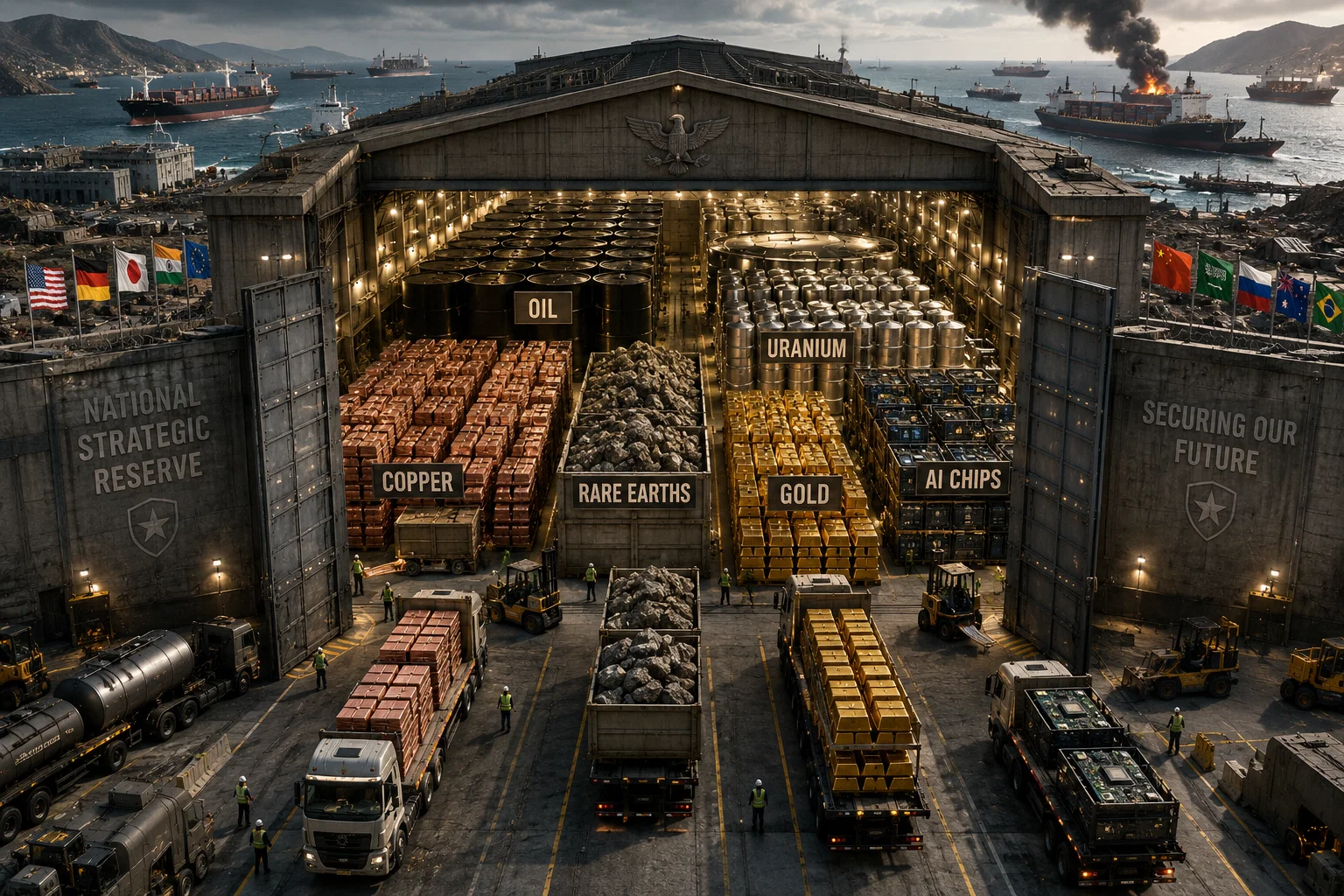
But anyone reading a newspaper could see what was coming. Hitler had annexed Austria the year before and swallowed the rest of Czechoslovakia that March. Japan had been at war in China for two years.
Every commodity on Roosevelt’s list had one thing in common: America produced next to none of it. Nearly all of the rubber used by US companies, for example, came from British Malaya and the Dutch East Indies. A lot of tin came from Malaya as well.
Congress and Roosevelt were being appropriately cautious. And within a short time they had stockpiled hundreds of thousands of tons of these strategic assets.
Then came the War. Then Pearl Harbor. And then full-blown economic chaos.
By March 1942, for example, Japanese troops had overrun Malaya and the Dutch East Indies... meaning that about 90% of America's rubber supply vanished overnight. Fortunately, their foresight to build stockpiles cushioned the blow.
This critical lesson in self-sufficiency is easily forgotten. As long as global peace and cooperation feel permanent, governments never think about resource scarcity. They assume they will always be able to trade for what they need... so why waste money stockpiling?
But global peace and cooperation can quickly turn to conflict and tension, and that is the environment we are in today.
The last major global conflict was World War II. Before it was over, 730 delegates from 44 nations literally sat down at a conference and hammered out a new framework for economic cooperation that made the US dollar the world’s undisputed reserve currency.
As a result, every country on earth has parked its savings in US government bonds for the past eight decades.
It hasn’t always been easy. The US formally ended the convertibility between the dollar and gold in the 1970s, and there was some thought to creating a new financial system. But the dollar managed to survive as king.
The dollar’s status has also been at risk throughout this century, between the skyrocketing US national debt and heavy-handed legislation (like FATCA) that the US government forced on the rest of the world.
But, still, the dollar survived. And foreign countries kept buying dollars and Treasury bonds.
But everyone has a breaking point, including foreign countries.
The US government’s response to freeze Russian assets in 2022 was the start. Then came last year’s so-called “Liberation Day”, when decades of trade policy were upended, overnight. Then came the Iran war. And now a $40 trillion national debt with no end in sight.
This has all been enough for foreign governments and central banks to finally reverse course; at first they slowed their purchases of US Treasury bonds. Now they’re actually selling... and diversifying away from the dollar.
The immediate beneficiary has been gold. And we’ve written about this— gold is the most logical asset for central bank diversification because it is already a traditional reserve asset... plus the gold market is very large and liquid.
We believe this trend will continue; gold prices will rise as a result, and quality mining companies should prosper.
But there’s a second element to this diversification story.
After Iran closed the Strait of Hormuz— which carried a fifth of the world's oil and a host of other critical resources— every government on the planet re-learned the same lesson of World War II: trade and cooperation can vanish in an instant.
And now the entire globe feels a sense of urgency to prepare for the next conflict.
Will China invade Taiwan? Will the US and China go to war? Will Russia and NATO come to blows? Nobody knows, and no government wants to be caught flat-footed, unable to import the critical resources that their economies need to function.
In Roosevelt’s era it was things like rubber and tin.
Today, these critical resources (what we refer to as ‘real assets’) start with energy— oil, natural gas, even coal... plus uranium for some countries.
Now, not every commodity is a real asset. Sugar is a commodity... but the world would be just fine without it. No government is going to stockpile orange juice, lumber, or wool. Or even rubber anymore.
But cut off a country's oil supply and it reverts to the Dark Ages.
That’s why countries are now stockpiling the strategic assets that are the vital inputs to their economies: copper, rare earths, and even the IP and hardware that power AI.
China is the clearest example. In 2025 alone it added more than a million barrels a day to an oil stockpile and now holds roughly 1.4 billion barrels— the world's largest reserve.
When Hormuz closed and the US and 31 other countries released 400 million barrels from their emergency reserves, China barely touched its pile and by July was adding to it again.
Its nuclear-fuel imports hit a record last year too, far beyond what its reactors burn; the excess went into stockpiles. And this summer Beijing put a new $9 billion state company in charge of buying mines around the world.
Saudi Arabia, on the other hand, produces plenty of oil, so they don’t need to stockpile it. But they are building nearly two gigawatts of data centers at home rather than risk being cut off from computing power.
A government that sells a Treasury still has to put the money somewhere, and the sensible places are the assets that the US government cannot freeze... and that no central bank can print. That is why the long-term direction of gold is still up.
But it’s also why energy, industrial metals, productive technology, and other vital resources— plus the companies which produce them— have a bright future.
This is the thesis behind Schiff Sovereign's investment research newsletter, Strategic Assets. A world that no longer trusts the US government moves into gold, and a world that can no longer count on trade cooperation secures its own stockpiles.
We provide research on companies that mine, pump, and build what governments are stockpiling.
Subscribers who acted on our research locked in more than 10x on a small silver producer and more than 6x on a gold and silver producer, both in under a year.
A tin producer featured last summer is up more than 3x, a zinc producer more than 2.5x, and a tanker company about 2.5x. Across the companies we have closed out, winners and losers together, the average return is 172%.
To your freedom, James Hickman Co-Founder, Schiff Sovereign LLC
Iraq Economic News and Points To Ponder Monday Afternoon 8-24-26
Oil Drops Ahead Of Tougher US Iran Sanctions
2026-08-24 Shafaq News Oil prices slipped more than $1 a barrel on Monday as investors took profits ahead of an expected announcement from Washington about imposing more sanctions on Iran that may further disrupt supplies from the Middle East.
Brent crude futures fell $1.23, or 1.3%, to $93.16 by 0329 GMT, while U.S. West Texas Intermediate crude was at $85.7 a barrel, down $1.36, or 1.6%.
Oil Drops Ahead Of Tougher US Iran Sanctions
2026-08-24 Shafaq News Oil prices slipped more than $1 a barrel on Monday as investors took profits ahead of an expected announcement from Washington about imposing more sanctions on Iran that may further disrupt supplies from the Middle East.
Brent crude futures fell $1.23, or 1.3%, to $93.16 by 0329 GMT, while U.S. West Texas Intermediate crude was at $85.7 a barrel, down $1.36, or 1.6%.
Both contracts posted their second weekly gains last week, up more than 5%, as peace talks between the U.S. and Iran hit a stalemate, capping oil shipments through the Strait of Hormuz where a fifth of the world's supply used to transit.
U.S. Treasury Secretary Scott Bessent, set to hold a press conference at 2 p.m. EDT (1800 GMT) on Monday, has threatened to impose "the toughest sanctions in history" on Iran. President Donald Trump has also threatened to impose sanctions on Iran's trading partners.
"It is unclear whether U.S. policy to economically isolate Iran will prove effective," Vivek Dhar, a commodities analyst at Commonwealth Bank of Australia, wrote in a note.
"But if the U.S. measures do work as intended, Iran's ability to respond via increased violence becomes a growing risk for energy markets to consider."
Iran has condemned U.S. plans to announce new sanctions even as President Masoud Pezeshkian called for a diplomatic solution.
"The more pragmatic members of the Iranian leadership would prefer to de-escalate but the hardliners would probably prefer to fight to the bitter end," IG markets analyst Tony Sycamore said.
"I think by the end of this week we will have a good idea which side of the Iranian leadership has the upper hand."
Offers of Iranian crude to Chinese buyers have declined and prices have jumped as the U.S. blockade has cut Tehran's shipments, according to trade sources.
However, Iran has granted permission for a number of Iraqi oil tankers to pass through the Strait following repeated requests from Baghdad, Iran’s state news agency IRNA reported on Saturday.
Some analysts are expecting the recovery in supplies from the Middle East to take even longer than expected as the U.S.-Iran conflict persists.
"Crude (supply) is tightening. Recent weeks have seen one of the sharpest declines in oil-on-water, whilst onshore inventories are declining as well, including in China," said Morgan Stanley analysts in a note.
"A reduction in supply is driving this, most notably from the Middle East where several data sources put aggregate exports back at March/April levels," they said, slowing their assumption for a recovery in Middle East supplies. (REUTERS)
https://www.shafaq.com/en/Economy/Oil-drops-ahead-of-tougher-US-Iran-sanctions
Strait Of Hormuz Transit Dips 90%
2026-08-24 Shafaq News- Hormuz Shipping through the Strait of Hormuz has fallen by nearly 90% from levels seen before the US-Iran war, sharply disrupting traffic through one of the world’s most important energy routes.
Thirteen vessels crossed the maritime gateway on Saturday and four on Sunday, compared with 16 on Friday, according to data from shipping intelligence firm Kpler.
Figures from the United Kingdom Maritime Trade Operations (UKMTO) showed that 89 vessels exited the Strait and 103 entered during the week ending Aug. 21.
The slowdown has also affected vessels linked to Iraq. An empty very large crude carrier bound for Iraq entered the Gulf on Friday, while separate shipping data showed a tanker entering the Red Sea on Saturday carrying Iraqi crude from Basra.
The disruption has sharply reduced Iraq’s southern crude exports. Shipments averaged about 1.4 million barrels per day (bpd) in July, up from roughly 500,000 bpd in June and 100,000 bpd in May, but remained well below pre-disruption Basrah exports of more than 3.3 million bpd.
With shipments still constrained, Baghdad is pursuing alternative export routes through Turkiye, Syria and Jordan to reduce its dependence on Hormuz. A proposed pipeline to Syria’s Baniyas port could take about four years to build and cost at least $15 billion.
Read more: No exit but Hormuz: Iraq's economic vulnerability exposed
https://www.shafaq.com/en/Economy/Strait-of-Hormuz-transit-dips-90
Gold Hits Three-Month High On Weaker Dollar
2026-08-24 Shafaq News Gold prices hit their highest level in more than three months on Monday as a subdued dollar lent support, while focus shifted to key U.S. inflation data and a speech later this week by Federal Reserve Chair Kevin Warsh.
Spot gold was up 0.8% at $4,641.27 per ounce, as of 0427 GMT, after hitting its highest level since May 15 earlier in the session. Prices gained more than 5% last week.
U.S. gold futures edged 0.4% higher to $4,697.70.
A wavering dollar teetered near multi-month lows in a market unsettled by the U.S. Treasury's promise to buy back more long bonds. A weaker U.S. dollar makes greenback-priced bullion more affordable for holders of other currencies.
Gold is looking sprightly to start the week and has stepped back into bid mode and is taking its cues primarily from the softer dollar and focusing on what higher yields may be signaling about underlying economic strains and policy uncertainty, said Tim Waterer, chief market analyst at KCM Trade.
The July Personal Consumption Expenditures (PCE) price index data and Fed Chair Warsh's speech at the Jackson Hole symposium this week will be watched for fresh clues on the U.S. interest rate outlook.
"Traders will be listening closely for any shift in tone on the policy path and how it sits with recent bond-market developments. A balanced or cautious tone that leaves room for flexibility would likely keep the door open for gold to extend its gains," Waterer said.
On the geopolitical front, the U.S. threatened Iran with what it called "the greatest financial offensive ever marshalled" as it prepared to roll out economic sanctions that target Iran's trade partners. Oil prices slipped more than $1 a barrel as investors took profits ahead of the expected announcement.
Among other metals, spot silver steadied at $68.98 per ounce. Platinum rose 0.1% to $1,878.88, while palladium was flat at $1,350.00. (REUTERS)
https://www.shafaq.com/en/Economy/Gold-hits-three-month-high-on-weaker-dollar
Iraq Overhauls Import Fees With Advance Customs Payments
2026-08-24 Shafaq News- Baghdad Iraqi importers will have to pay estimated customs duties and tax deposits before transferring money abroad for imported goods from Oct. 1, under a new mechanism that traders warn could increase upfront costs and put additional pressure on businesses.
The Cabinet approved the advance-payment system on Aug. 18. Under the decision, importers will deposit funds intended for foreign transfers with licensed banks, but the money will not be sent abroad until they pay estimated customs duties and tax deposits through the ASYCUDA system, a computerized customs management platform, and approved electronic payment channels.
The estimated amount will be calculated from preliminary import data, including commercial invoices, shipping documents, customs classification, the type and origin of the goods and their declared value.
New Tariff System
Iraq’s General Commission of Customs announced in late December 2025 that the new tariff would take effect on Jan. 1, including a 15% customs duty on vehicles and the removal of a previous exemption for hybrid cars.
Read more: Iraq’s updated customs tariffs, legal dispute, and market impact
The Commission subsequently said Cabinet Resolution No. 957 of 2025 ended the flat-fee system for containers, with goods instead assessed according to their classification under Customs Tariff Law No. 22 of 2010.
Customs officials have said tariff rates vary by product, starting at 5%, while ASYCUDA calculates duties using criteria such as weight or quantity depending on the type of goods.
Traders Question Upfront Payments
Baghdad Chamber of Commerce spokesperson Rashid al-Saadi told Shafaq News that businesspeople and importers raised concerns over the advance-payment mechanism at a meeting convened last Wednesday by the Trade Ministry’s Private Sector Development Department.
Tax deposits amount to 3%, while customs duties vary by classification and can reach 30%, 35% or, in some cases, 40%, according to al-Saadi.
He said the Chamber does not oppose paying legally required taxes and customs duties but objects to the additional burden created when importers must make payments before receiving their goods.
Read more: How Iraq’s customs overhaul is reshaping trade
“The equation is unbalanced,” al-Saadi said, arguing that businesses and citizens pay taxes and duties without receiving a corresponding level of public services.
The Federation of Iraqi Chambers of Commerce plans to raise its concerns with government bodies. Al-Saadi said the business community and the Private Sector Development Department agreed to prepare recommendations for submission to the Customs Commission and the Cabinet Secretariat.
Protecting Domestic Production
Parliament’s Finance Committee supports full implementation of the customs tariff, committee member Jamal Kocher told Shafaq News, arguing that the policy is not solely about raising revenue but also protecting domestic production.
Under the previous system, Kocher said, containers could incur similar charges regardless of what they carried. The new approach instead calculates duties according to the classification and value of goods or the applicable unit of measurement.
Products covered by measures intended to protect Iraqi producers may face substantially higher tariffs than other imports, he added.
The changes form part of a broader customs automation program. By June, the Customs Commission said 25 customs centers had been automated and that work was underway on a single-window system involving 15 ministries and government bodies.
The Commission has also reported progress in talks with the Kurdistan Region to unify customs procedures and bring the Region’s border crossings under ASYCUDA.
What It Could Mean For Car Prices
Economist Ahmed Eid said the impact of the 15% vehicle tariff should be distinguished from the eventual increase consumers may see in showroom prices.
“A 15% tariff does not necessarily mean that the price of a car will rise by 15%,” Eid told Shafaq News, noting that final prices also depend on the customs valuation, transportation and import costs and dealers’ margins.
Claims that vehicle prices could rise by as much as 30% require greater official clarity about how charges are calculated, he said. The impact could also vary among US, Gulf and other imported vehicles depending on their value, type and customs classification.
Higher import costs could eventually affect vehicles already on the Iraqi market by increasing their replacement cost, Eid said.
While the tariff could help Iraq increase non-oil revenue, he added, it could also raise the cost of vehicle ownership, making clear and transparent implementation important to prevent unjustified price increases.
https://www.shafaq.com/en/Economy/Iraq-s-new-customs-system-puts-import-fees-upfront
Dollar Rises Against Dinar In Baghdad And Erbil
2026-08-24 Shafaq News- Baghdad/ Erbil The US dollar rose against the Iraqi dinar on Monday, hovering around 154,000 dinars per $100 in Baghdad and Erbil, the capital of the Kurdistan Region.
At the Al-Kifah and Al-Harithiya exchanges in Baghdad, the dollar traded at 154,300 dinars per $100, up from 154,100 dinars a day earlier, according to a Shafaq News market survey.
In Baghdad's local exchange shops, the selling price reached 154,750 dinars per $100, while the buying price stood at 153,750 dinars.
Rates climbed in Erbil as well, where the dollar sold at 154,050 dinars per $100 and was bought at 153,950 dinars.
https://www.shafaq.com/en/Economy/Dollar-rises-against-dinar-in-Baghdad-and-Erbil-3
Seeds of Wisdom RV and Economics Updates Monday Afternoon 8-24-26
Good Afternoon Dinar Recaps,
The Iran Sanctions Test: Oil, the Dollar and the Global Financial System Enter Another Phase
Washington is escalating financial pressure on Iran just as the rial reaches another record low, putting oil flows, dollar-based sanctions and alternative international trade channels under renewed pressure.
Good Afternoon Dinar Recaps,
The Iran Sanctions Test: Oil, the Dollar and the Global Financial System Enter Another Phase
Washington is escalating financial pressure on Iran just as the rial reaches another record low, putting oil flows, dollar-based sanctions and alternative international trade channels under renewed pressure.
Overview
The Iranian rial fell to a record low of about 2.02 million to the U.S. dollar, as Washington prepared a new round of sanctions targeting Iran's economy.
The Trump administration is moving toward broader economic pressure on Iran, with secondary sanctions threatening countries that continue doing business with Tehran. Reuters reported that Treasury Secretary Scott Bessent was preparing an "economic D-Day" as oil prices moved lower.
The confrontation is increasingly becoming a test of how far the United States can use the dollar and access to global finance as instruments of geopolitical power without creating additional pressure on the global energy and financial system.
Key Developments
1. Iran's currency has reached another critical threshold
The Iranian rial fell to approximately 2.02 million per U.S. dollar in open-market trading Monday, while Iran's official central-bank rate remained around 1.5 million per dollar.
The currency was already under significant pressure before the current war, but nearly six months of conflict, sanctions and the U.S. naval blockade have accelerated the deterioration.
The consequences are increasingly visible inside Iran.
According to the Associated Press, rice prices have risen roughly 60% since the war began, while beef prices have increased more than 150%. The IMF is forecasting an economic contraction of more than 5%.
The currency collapse therefore isn't simply a foreign-exchange story.
It is becoming a measure of the economic cost of geopolitical isolation.
2. Washington is preparing to widen the financial pressure
The Trump administration has signaled that the next stage will go beyond traditional sanctions against Iranian entities.
Washington has threatened secondary sanctions against countries and businesses that continue conducting business with Iran.
That is significant because secondary sanctions extend the reach of U.S. financial policy beyond America's borders.
Foreign banks, energy companies, shipping firms and trading organizations can effectively face a choice:
Maintain commercial relationships with Iran—or risk losing access to the U.S.-dominated financial system.
This is one of the most powerful tools available to Washington.
It is also one of the tools most relevant to the global financial-reset discussion.
3. Oil makes the confrontation much larger than Iran
The most important financial connection is energy.
The Strait of Hormuz remains at the center of the confrontation. Before the war, approximately one-fifth of the world's traded oil passed through the waterway, according to the AP report. Iran's attacks and threats against shipping have dramatically reduced traffic.
That creates a difficult equation for Washington.
The United States wants to weaken Iran economically while simultaneously preventing the conflict from producing an energy shock large enough to damage the global economy.
Reuters reported Monday that oil prices were falling as Bessent prepared to announce the administration's new Iran measures, while markets continued watching the potential impact on global energy supplies.
That is an important market signal.
The sanctions strategy is now being judged not only by its impact on Tehran, but by its impact on oil prices and the broader global economy.
4. The dollar is being used as geopolitical infrastructure
This is where the story becomes especially important for the global financial reset.
The United States does not need to physically control every transaction involving Iran to exert financial pressure.
It can use the enormous global importance of the U.S. dollar, American banks and access to U.S. financial markets as leverage.
That system has provided Washington with extraordinary influence over international commerce.
But there is another side.
The more frequently the dollar-based financial system is used as a geopolitical weapon, the stronger the incentive becomes for some countries to develop alternative payment arrangements, currencies and trade channels.
That does not mean the dollar is being replaced.
It means other countries have an incentive to reduce their exposure to a system they cannot fully control.
5. Iran's currency collapse illustrates both sides of the system
Iran provides an unusually clear example of the power of dollar dominance.
As sanctions restrict access to international finance and foreign currency, the rial loses purchasing power.
Iranians are responding by seeking dollars as a store of value. The AP reported that people in Tehran were purchasing U.S. dollars with savings as the rial continued to fall.
That is an important contradiction:
The dollar can simultaneously be the instrument imposing financial pressure on Iran and the asset Iranians seek when their own currency loses credibility.
That demonstrates how deeply embedded the dollar remains in the global financial system.
But it also highlights why countries seeking greater monetary independence are interested in alternatives.
6. The next test is whether sanctions change trade behavior
The biggest question may not be what happens to the rial.
It is what other countries do next.
Iran still has important trading relationships, particularly with countries that have maintained commercial ties despite U.S. sanctions.
If secondary sanctions force more banks, shipping companies and energy firms to withdraw from Iranian trade, the immediate effect could be a further contraction of Iran's access to international markets.
But if major trading nations respond by developing alternative settlement mechanisms, the longer-term consequences could extend beyond Iran.
That is where this becomes a global financial story.
Why This Matters
The Iran confrontation is becoming a real-world test of the power of financial sanctions, dollar dominance and energy control.
Washington is demonstrating how powerful the dollar-based financial system remains.
At the same time, every expansion of sanctions creates another incentive for affected countries to ask:
How dependent should our trade be on a financial system controlled by another country?
That question is at the heart of monetary diversification.
Why It Matters to Foreign Currency Holders
For foreign-currency holders, Iran is an important case study because it demonstrates how quickly geopolitical events can become currency events.
A country's currency can be affected by:
Access to international banking
Foreign-exchange reserves
Oil and commodity revenues
Sanctions
Trade relationships
Political stability
Confidence in the government
Access to alternative settlement systems
The Iranian rial's collapse is an extreme example and should not be interpreted as a model for other currencies.
But it demonstrates the fundamental principle:
Currency value is ultimately tied to confidence, trade, liquidity and access to the financial system.
Implications for the Global Financial Reset
Financial sanctions are becoming a strategic weapon.
The United States continues to demonstrate the extraordinary reach created by dollar dominance and access to U.S. financial markets.
Energy and monetary policy are increasingly connected.
The Strait of Hormuz means that a geopolitical confrontation with Iran can rapidly become a global oil-market problem.
Secondary sanctions could accelerate financial diversification.
If foreign companies increasingly need to choose between doing business with sanctioned countries and maintaining access to U.S. markets, some governments may have greater incentive to develop alternative settlement channels.
The dollar remains dominant—but its geopolitical use has consequences.
The current system gives Washington enormous leverage. At the same time, repeated use of that leverage can encourage other countries to seek ways to reduce their exposure.
The potential reset is more likely to be gradual than sudden.
The emerging financial architecture is unlikely to involve the dollar suddenly disappearing. A more realistic possibility is a gradual expansion of regional currencies, alternative payment systems and commodity-linked settlement alongside the existing dollar system.
What to Watch
The final details of the new U.S. sanctions package.
Whether Washington actually imposes secondary sanctions on major Iranian trading partners.
China's response, given its importance as a buyer of Iranian oil.
Developments surrounding the Strait of Hormuz and global oil shipments.
Whether Iran attempts to expand non-dollar settlement arrangements.
Whether other countries increase use of alternative payment systems to avoid exposure to U.S. sanctions.
Whether the rial stabilizes or continues toward further record lows.
Whether oil prices remain contained despite the continuing disruption.
Bottom Line
The Iran sanctions escalation is about much more than punishing Tehran.
It is becoming a test of the intersection between oil, currencies and the dollar-based financial system.
Iran's rial has fallen to approximately2.02 million per dollar, while Washington is preparing broader sanctions and threatening consequences for countries that continue doing business with Tehran.
At the same time, the Strait of Hormuz remains a critical vulnerability for the global energy system, while markets are watching whether additional sanctions create another disruption to oil supplies.
For the United States, the challenge is balancing two objectives:
Use the dollar's financial power to pressure Iran—without creating an energy shock that damages the global economy.
For the rest of the world, another question is emerging:
How much dependence on the dollar-based financial system is strategically acceptable when access to that system can become a geopolitical tool?
That is why the Iran conflict belongs in the global financial-reset conversation.
The next major move may not come from a central bank—it may come from the intersection of sanctions, oil flows and the world's dependence on the dollar-based financial system.
Sources
~~~~~~~~~~
Seeds of Wisdom Team RV Currency Facts Youtube and Rumble
Newshound's News Telegram Room Link
RV Facts with Proof Links Link
RV Updates Proof links - Facts Link
Start Here room with Most Asked Questions Link
Follow the Gold/Silver Rate COMEX
Follow Fast Facts
Seeds of Wisdom Team™Website
Thank you Dinar Recaps
Monday Iraq News Posted by Tishwash at TNT 8-24-2026
TNT:
Tishwash: Al-Halbousi affirms Parliament's readiness to support financial inclusion
Speaker of Parliament Hebat al-Halbousi and First Deputy Speaker Adnan Faihan al-Dulaimi discussed, in two separate meetings, with the Governor of the Central Bank, Nizar Nasser Hussein, ways to enhance financial and monetary stability and develop the performance of the banking sector in the country.
A statement issued by the media office of the Speaker of Parliament indicated that Speaker Halbousi received the Governor of the Central Bank and his accompanying delegation to discuss monetary policy and prospects for developing the financial system.
TNT:
Tishwash: Al-Halbousi affirms Parliament's readiness to support financial inclusion
Speaker of Parliament Hebat al-Halbousi and First Deputy Speaker Adnan Faihan al-Dulaimi discussed, in two separate meetings, with the Governor of the Central Bank, Nizar Nasser Hussein, ways to enhance financial and monetary stability and develop the performance of the banking sector in the country.
A statement issued by the media office of the Speaker of Parliament indicated that Speaker Halbousi received the Governor of the Central Bank and his accompanying delegation to discuss monetary policy and prospects for developing the financial system.
The Speaker affirmed his support for the Central Bank's vision for modernizing legislation related to banking operations, expressing Parliament's readiness to support the necessary legislative amendments to accelerate digital transformation and expand financial inclusion, thereby reducing cash transactions and enhancing transparency, as well as combating money laundering and corruption.
In a separate meeting, attended by the Chairman of the Parliamentary Finance Committee, Uday Awad, the First Deputy Speaker of Parliament, Adnan Faihan al-Dulaimi, received the Governor of the Central Bank to discuss economic matters and address current challenges.
Faihan stressed the importance of adopting a balanced monetary policy based on a proactive vision capable of dealing with risks away from immediate solutions, in a way that preserves the strength of the national currency and supports confidence in the banking sector, stressing the Council’s keenness to provide the necessary legislative and regulatory cover to protect the national interest and market stability. link
************
Tishwash: The Federal Ministry of Finance invites a delegation from Kurdistan to Baghdad to discuss the region's share of the budget.
Member of Parliament’s Finance Committee, Ikhlas al-Dulaimi, announced on Sunday that the Federal Ministry of Finance had sent an official request to the Kurdistan Regional Government to send a delegation to Baghdad to discuss the region’s share in the 2027 general budget law.
Al-Dulaimi, a member of the Democratic Party bloc, said, "The region's share in the budget law has become 14% according to the latest statistics from the Ministry of Planning, and we seek to have a real study of the region's situation in the budget law."
She added that "the region has not received investment budgets or operational budgets throughout the previous years, but only salaries, and there were many problems with it."
She continued: "The Kurdistan Region is seeking to receive its full rights, just like the other provinces," stressing that "the region has handed over all oil and non-oil revenues to the federal government." link
************
Tishwash: With the participation of 250 trainees, the Central Bank discusses the outcomes of the national and mutual evaluation.
Baghdad - Media Office, August 23, 2026
The National and Mutual Assessment Team for Money Laundering and Terrorist Financing Risks at the Central Bank of Iraq organized a specialized training workshop entitled “Outputs of the National and Mutual Assessment,” based on the outputs of the action plan recommended by the Financial Action Task Force (FATF).
The workshop was attended by more than 250 trainees, including a number of employees from banking and non-banking financial institutions, with the aim of enhancing their practical capabilities in the procedures recommended by the Financial Action Task Force (FATF) and the application of preventive measures regarding the most influential predicate offenses in the Iraqi economy, and identifying, assessing and managing the risks associated with money laundering, terrorist financing and the financing of arms proliferation.
The training program included an explanation and discussion of a number of key topics, including the results of the national risk assessment, in addition to the outputs of the action plan and the recommended procedures, exploring ways to improve the number and quality of reports, examining mechanisms for implementing enhanced due diligence towards persons exposed to risks by virtue of their position, as well as managing the risks of terrorist financing and the associated risk indicators.
The program included the use of practical cases and applied questions to enable participants to employ theoretical concepts in the work environment, and to enhance their ability to analyze risks and take appropriate action according to the level of risk.
This program stems from efforts to raise the efficiency of relevant authorities and enhance their ability to meet imposed obligations, based on the provisions of the Anti-Money Laundering and Counter-Terrorism Financing Law No. (39) of 2015, and in line with international standards and the recommendations of the Financial Action Task Force (FATF), and in a way that contributes to enhancing the effectiveness of the anti-money laundering and counter-terrorism financing system and creating a unified understanding in Iraq. link
*************
Tishwash: To maintain the strength of the currency, Fayhan calls on the central bank to refrain from knee-jerk reactions.
The First Deputy Speaker of the House of Representatives, Adnan Faihan, stressed today, Sunday (August 23, 2026), the need to deal with economic risks and challenges, away from immediate solutions and reactions, in a way that enhances market stability and maintains the strength of the national currency, indicating the parliament’s keenness to support policies and procedures aimed at enhancing financial stability.
The media office of the First Deputy Speaker of Parliament said in a statement received by 964 Network that “the First Deputy Speaker of the House of Representatives, Adnan Faihan, received today, Sunday, in his office, the Governor of the Central Bank of Iraq, Nizar Nasser, in the presence of the Chairman of the Parliamentary Finance Committee, Uday Awad, to discuss a number of economic and monetary files, and to discuss ways to enhance financial and monetary stability, in order to contribute to supporting the national economy and facing current challenges.”
According to the statement, Faihan stressed “the importance of adopting a balanced and effective monetary policy based on a proactive vision capable of anticipating changes and dealing with economic risks and challenges, away from immediate solutions and reactions, in a way that enhances market stability, maintains the strength of the national currency, and supports confidence in the banking sector.”
Faihan expressed “the Council’s keenness to support policies and procedures aimed at enhancing financial stability, and providing the necessary legislative and regulatory cover to address economic challenges in accordance with a clear vision and in line with the requirements of the national interest.” link
*************
Tishwash: Iraq Finance Committee and CBI Discuss Crisis Resolution Strategies
At a Glance
Iraqi Parliamentary committee hosted CBI officials over the financial crisis.
Discussions focused on optimizing deficit-financing strategies and engineering proactive economic crisis solutions.
Agenda items included addressing public sector payroll delays, inflation metrics, and foreign exchange reserves.
The Iraqi Parliamentary Finance Committee hosted Central Bank officials on Sunday to discuss strengthening monetary policy, financing the budget deficit, and implementing reforms to resolve the financial crisis.
Key Statement and Focus Area
Lawmaker Uday Awad Kadhim stressed “the importance of establishing advanced mechanisms to strengthen monetary policy, support financial and monetary stability, and work on maximizing revenues to help boost the country's financial economy.”
The CBI Governor provided a detailed explanation regarding the bank’s direction in monetary policy for the upcoming fiscal years.
Uday Awad Kadhim chaired a meeting of the Finance Committee, during which the Governor of the Central Bank of Iraq, Nizar Nasser Hussein, the Deputy Governor, Shaimaa Abbas, and the senior staff were in attendance.
The high-level session focused on evaluating monetary frameworks, optimizing deficit-financing strategies, and engineering proactive fiscal solutions to navigate the ongoing economic crisis.
The committee reviewed inflation metrics, foreign exchange reserves, and the underlying factors causing public sector payroll delays.
The lawmakers evaluated the Central Bank’s revenue-generation strategy, foreign currency auction data, local exchange rates, and subsidized dollar distribution channels for travelers.
Additionally, the committee examined mechanisms for financing the budget deficit, including the possibility of lending to the government or discounting treasury bills to finance the deficit, along with its impact on the monetary system and the national economy.
The committee also examined deficit-financing options like government lending and treasury bill discounting to assess their impact on the national economy.
During the meeting, the CBI Governor detailed the bank’s monetary policy direction for upcoming fiscal years, outlining “mechanisms to maintain monetary stability, manage liquidity, and enhance the role of the policy interest rate, explaining the impact of monetary policy on economic activity and the importance of a gradual transition to support the real economy.”
Discussions examined banking sector development and structural economic reforms to bolster financial stability.
The panel further analyzed the Central Bank’s 2025 fiscal records to verify reserve sustainability and strengthen economic resilience.
FYI
Iraq is experiencing a severe fiscal crisis, shifting from a budget surplus to a 21.24 trillion IQD deficit in the first half of 2026.
This shortfall stems from regional disruptions in the Strait of Hormuz, which have bottlenecked southern crude oil exports. Consequently, falling revenues have caused lengthy public sector salary delays and widespread market stagnation.
While some officials are pushing for emergency measures like printing money, experts warn this could destabilize the country's current inflation rate.
Earlier, Lawmaker Dilan Ghafoor told Channel8 that the Iraqi Council of Representatives will conduct the reading of the Borrowing and Grants Bill of 2026, which defines the borrowing authorities of the Prime Minister and the Minister of Finance.
The Iraqi government is also reportedly seeking to pass a bill to delete zeros from the currency, aiming to restore liquidity to banks and activate the electronic system for financial transactions in the country. link
Iraq Economic News and Points To Ponder Monday Morning 8-24-26
Iraqi Hopes For Removing Zeros From The Dinar To Combat Corruption
Baghdad Ahmed Eid The proposal to remove zeros from the Iraqi dinar has brought back to the forefront a wide debate about the reality of the project, the possibility of its implementation, and the results that it can achieve, especially with its connection to returning hoarded funds to the banking system and revealing some of the funds resulting from corruption, in addition to questions about its impact on inflation, the value of the dinar, and purchasing power.
Iraqi Hopes For Removing Zeros From The Dinar To Combat Corruption
Baghdad Ahmed Eid The proposal to remove zeros from the Iraqi dinar has brought back to the forefront a wide debate about the reality of the project, the possibility of its implementation, and the results that it can achieve, especially with its connection to returning hoarded funds to the banking system and revealing some of the funds resulting from corruption, in addition to questions about its impact on inflation, the value of the dinar, and purchasing power.
The debate gains even greater importance with the sheer volume of currency in circulation in Iraq, as the value of the currency issued by the Central Bank exceeds 101 trillion dinars (about 77 billion US dollars), of which more than 94 trillion are in circulation among the public, compared to about 7.3 trillion dinars held by banks.
The debate centers on the extent to which removing zeros and replacing the currency will encourage those with large sums to pass their money through banking channels and subject it to verification of its sources, which may help in uncovering corruption funds, versus questions about the economic feasibility of the project, its cost and risks, and whether it is actually able to address inflation and enhance the value of the dinar.
Days after Communications Minister Mustafa Sanad declared that the decision to remove zeros and change the currency had been finalized, linking it to the release of hoarded funds and the handling of approximately eight trillion dinars he claimed were looted, the government denied the existence of any official decision in this regard. Ministry spokesperson Haider al-Aboudi stated that the Cabinet had not made a decision to remove zeros, nor had the Central Bank made a similar decision, emphasizing that the matter requires legislation from Parliament.
To date, the Central Bank has not announced an implementation plan or a timeline for initiating the process, leaving the project still under discussion and not yet a binding decision.
In this context, Ahmed Rashid, a member of the Finance Committee in the House of Representatives, said that the project to remove zeros, if it proceeds, should be seen as part of a broader path to reform the financial and banking system, to contribute to returning some of the funds hoarded outside banks to official channels, especially if the currency replacement process is accompanied by clear banking and regulatory controls.
Rashid added, in an interview with Al-Araby Al-Jadeed, that replacing large amounts of cash will require huge sums to pass through banks and authorized entities, which could provide an opportunity to verify the sources of large sums in accordance with the laws in force to combat money laundering and corruption, and help regulatory bodies to monitor transactions and funds whose sources are suspected.
He stressed that removing zeros does not automatically mean recovering looted funds without legal procedures and investigations, noting that a project of this size needs a suitable economic environment and an in-depth study involving the Ministry of Finance, the Central Bank, the Financial Control Bureau and the Parliamentary Finance Committee, before it is formulated into a draft law and presented to the House of Representatives.
Rashid explained that the project is still under discussion and has not yet reached Parliament in a legislative form, indicating that removing zeros should not be presented as a standalone solution to economic problems or a means to increase purchasing power, as its results remain linked to the accompanying fiscal and monetary policies.
For his part, banking expert Abdul Rahman Al-Sheikhli believes that removing three zeros from the dinar is technically possible, but its success depends on the availability of a stable economic and monetary environment, foremost among which is the stability of the exchange rate and reducing the gap between the official and parallel rates. He stressed that removing zeros does not in itself mean an increase in the real value of the dinar or an increase in the purchasing power of the citizen.
Al-Sheikhli explained to Al-Araby Al-Jadeed that changing the currency does not change the size of the wealth or real income, as the prices of goods, salaries, deposits and debts will change in parallel.
Therefore, betting on removing zeros to raise the value of the dinar may give an unrealistic impression of the results of the process, in addition to the financial cost resulting from printing the new denominations, withdrawing the old currency and updating banking and accounting systems.
He stressed that removing zeros does not represent a cure for inflation, because controlling rising prices is linked to managing liquidity, public spending, monetary policy, and levels of production and imports.
Therefore, the success of the experiment requires addressing these factors before implementing the process, and not relying on removing zeros to address them.
Al-Sheikhli warned that choosing an inappropriate time could disrupt pricing, contracts, and bank accounts, and increase demand for the dollar out of anxiety or speculation.
He pointed out that the true feasibility of the project should be measured by what it achieves in facilitating transactions and reducing the cost of handling and managing a huge amount of cash, and not by the number of zeros that disappear from banknotes.
For his part, economist Ziad Al-Hashemi believes that removing zeros, if coupled with currency replacement within a sound monetary plan, could give the central bank greater ability to control the money supply and bring back some of the money circulating outside official channels into the banking system, thus reducing the scope of illicit money movement within the economy.
Al-Hashemi explained to Al-Araby Al-Jadeed that the success of this mechanism depends on the state’s ability to prevent those who have acquired funds from corruption from converting them during the transitional period into other assets, such as real estate, dollars, or gold.
He pointed out that subjecting large purchase and transfer operations to scrutiny of the sources of funds can narrow the avenues for recycling that liquidity, but it does not eliminate it entirely.
Al-Hashemi pointed out that the success of the operation in curbing illicit funds is not related to the removal of zeros in itself, but rather to the design of the exchange period and the restrictions imposed on the movement of funds during it, warning that announcing early, ill-considered procedures may give owners of illicit liquidity an opportunity to convert it into dollars, gold, or real estate before the exchange begins. August 22, 2026 | Last updated: 03:03 (Jerusalem time)
https://www.alaraby.co.uk/economy/تعويل-عراقي-على-حذف-أصفار-الدينار-لملاحقة-الفساد
Al-Shiqr: Eliminating Zeros From The Currency Is A Worthless Step Unless The Iraqi Dinar Is Pegged To The Dollar
Iraq Al-Hadath Satellite Channel @iraqlhadath
Translated from Arabic
Al-Shiqr: Eliminating zeros from the currency is a worthless step unless the Iraqi dinar is pegged to the dollar.
#Iraq_Events_For_Every_Event #Wherever_You_Are_We_Are ,
Follow us via frequency H10891 / 27500
https://x.com/iraqlhadath/status/2091259646019330355
Video Translation below:
4m
Greetings to you and to our dear colleagues, and greetings to brother Mustafa Sanad as well.
Yes.
He explained a matter—strictly speaking, it falls outside the scope of the Communications sector, but in Iraq, he is a member of the Council of Ministers, so he has the right to discuss any topic.
Yes.
So, I don't believe he spoke outside the scope of his duties.
Right.
However, what he revealed is that there is indeed a committee carefully studying the concept of—what is called—"dropping the zeros"; I actually dislike that term.
Dividing by 1,000.
25,000 becomes 25 dinars.
Right.
So, 1,000 dinars becomes 1 dinar.
A dinar.
And 500 dinars becomes, say, 500 fils, and so on.
Yes.
I think it’s a good idea. For the record—as the Secretary-General of the Najah Center—where is the camera here?
It’s clear, Doctor.
We first raised this issue back in 2018. The key point we proposed was issuing a new Iraqi dinar backed by gold, or pegging the dinar to a basket of foreign currencies.
That was the key point.
The dollar and the pound...
The dollar, the pound, and the euro—exactly. That was the main point: what is the benefit if 1,000 dinars simply becomes 1 dinar, yet the market value of the dinar remains the same?
We want to strengthen the economy.
Strengthening the economy depends on...
All economists know this: pegging the local currency's exchange rate to the dollar.
Right.
So, I did something that might have an impact.
Before that, Doctor—who would allow Iraq to just go ahead and drop the zeros?
Dropping three zeros to leave just one dinar?
What is the benefit?
If you haven't coordinated with the US Federal Reserve or the US Treasury, what is the benefit? There’s no real benefit.
I mean, what’s the point of getting 25?
If you set it at 25 dinars, and tomorrow it hits 60, then there’s no difference at all.
Well, the point is that once you peg the dinar’s rate, you’ll see the difference relative to the US dollar.
I can actually give you a copy of this—here you go, if you’re interested.
I.
It shows three neighboring Arab countries.
Right, let’s move on to the policy aspect.
Sure.
So, the red line represents the Jordanian currency.
This covers the period from 1975 to 2005—that’s 50 years.
It’s clear.
Regarding that red line: they had currency issues—fluctuations—but in 1990, they decided to peg it to the dollar.
Throughout that entire period, it was a straight line—no changes whatsoever.
From 1990 to the present—exactly.
The Jordanian dinar itself.
What is the blue line? The UAE?
The year 1980.
They pegged the currency; it became a straight line—no fluctuations.
From 1980 to the present; and Saudi Arabia did the same, up until around 1990.
They pegged it, and it became a straight line.
This is the goal of the Central Bank of Iraq.
Iraq: we’ll cross that bridge when we come to it.
My dear...