
Thank you to all the subscribers to our Early Access program…we thank you for your continued support.
We are excited to offer this new service to keep you informed and up-to-date on the latest Dinar and currency news.
The US Economy and How It Works
The US Economy and How It Works
By Kimberly Amadeo Updated on September 17, 2020
Have you ever said to yourself, "How exactly does the U.S. economy work?" During a recession, you might think, "Not too well!"
Learn the causes of recession by understanding gross domestic product and the laws of supply and demand. Know how the federal government uses fiscal and trade policy. Realize how the Federal Reserve fights inflation while spurring growth with monetary policy. See how financial markets on Wall Street influence Main Street and your neighborhood.
The US Economy and How It Works
By Kimberly Amadeo Updated on September 17, 2020
Have you ever said to yourself, "How exactly does the U.S. economy work?" During a recession, you might think, "Not too well!"
Learn the causes of recession by understanding gross domestic product and the laws of supply and demand. Know how the federal government uses fiscal and trade policy. Realize how the Federal Reserve fights inflation while spurring growth with monetary policy. See how financial markets on Wall Street influence Main Street and your neighborhood.
GDP
Everything the U.S. economy produces is measured by GDP. When the GDP growth rate turns negative, the economy enters a recession.
That has happened throughout the history of U.S. recessions. When the economy contracts for years, it's called a depression. Learn the difference between recession and depression.
The most important part of the economy is consumer spending. The other three components are business expenditures, government spending, and net exports.1
The U.S. economy is no longer the world's largest. China has outpaced current U.S. GDP statistics. The U.S. is the world’s second-largest economy, while India and Japan follow in third and fourth place.2
Supply and Demand
Supply and demand are the forces that drive the U.S. economy. Supply includes labor, represented by employment, and natural resources, such as oil, land, and water. Oil prices drive 70% of the cost of gas.3
Demand, or personal consumption, drives almost 70% of the economy.4 A lot of this occurs during the holiday shopping season, which starts on Black Friday.
The recession increased unemployment. Many people became discouraged over ever finding a job and dropped out of the labor force. As a result, 38.1 million, or one-third of Americans are poor or near poor.5 That's one reason the U.S. economy has slowed. Income inequality wasn't caused by the recession. It began worsening through the 2000s.
Inflation and Deflation
Inflation occurs when demand is greater than supply and prices go up. Your income and the rate at which it keeps up with rising prices determine how much inflation impacts your life.
Inflation is difficult to stamp out. Once it occurs, people begin to expect ever higher prices. They will buy now before prices go up more in the future. That increases demand even more. Another cause of inflation is an increase in the money supply.
The U.S. government measures the current inflation rate with the Consumer Price Index, but it sometimes gives misleading information. The commodities market determines oil, gas, and food prices.6 They can skyrocket and plummet within months. The Federal Reserve uses the core inflation rate instead. That excludes energy and food costs.7
If inflation occurs in assets, such as housing or stocks, it's called an asset bubble.
The opposite is deflation; it occurs when prices fall. That also happens to assets, such as housing prices and stock portfolios. That creates stock crashes and economic crises. Deflation is worse than inflation for an economy.
Fiscal Policy
Fiscal policy is the $4 trillion federal budget.8 All the revenue ultimately comes from taxes on your income, so it is important for you to know how it is spent. Fiscal policy can stimulate, guide, or depress the economy, but only business can create economic growth.
The president starts the budgetary process each year, but only Congress has the government spending authority. For example, President Obama's economic stimulus package was his idea, but Congress approved it.
Spending outpaces revenue, creating a budget deficit. Each year, it is added to the national debt.
One large contributor to the deficit and debt is the Bush tax rebates. They follow the theory of supply-side economics. It says that lower taxes will eventually spur the economy enough to replace the loss in taxes. That hasn't happened. But tax rebates are very popular because people hate paying them. Many have proposed a flat tax or a fair tax.
Monetary Policy
Monetary policy is controlled by the Federal Reserve. That banking system is guided by the Federal Reserve Chair Jerome Powell.9 The Federal Reserve tools include the fed funds rate, the money supply, and the use of credit. These tools control how interest rates affect the economy. Compare the current fed funds rate to historical fed funds rates to know whether the Fed is using an expansionary or a contractionary monetary policy.
The primary objective of monetary policy is to control inflation. Its secondary objective is to stimulate the economy. It is also charged with the smooth functioning of the banking system. For this reason, the Fed chair is often called the most powerful person on the planet.
In 2009, Ben Bernanke was named Time's Man of the Year.10 As a Fed chair, he took aggressive steps to address the 2007 banking meltdown and the 2008 financial crisis. Yet, many critics argue that the United States should return to the gold standard.
Trade Policy
Trade policy affects the cost of imports and exports by regulating trade agreements with other countries.
Trade agreements, like the North American Free Trade Agreement, seek to reduce trade costs and increase each country's GDP. The World Trade Organization attempted an ambitious worldwide trade agreement in the Doha round of trade talks. That didn't work since the European Union and the United States didn't want to end agricultural subsidies.11
Instead, the United States pursued bilateral and regional trade agreements. These include the Trans-Pacific Partnership and the Transatlantic Trade and Investment Partnership. If they were approved, they would be the largest trade agreements in the world.
Exchange rates affect trade by changing the value of the U.S. dollar. The dollar is the world's global currency. Most international trade contracts are done in dollars. When the dollar is strong, it allows the prices of oil and other commodities to fall. That can create deflation.
Financial Markets
An implosion in the financial markets threw the economy into the worst recession since the Great Depression. How did this happen? It began with derivatives that were supposed to insure against defaults on sub-prime mortgages. Demand for the derivatives was so strong, it almost forced insurers like the American International Group to default.12 That threw Wall Street into a panic which spread throughout the world. Unregulated derivatives created the credit crisis of 2008.13
The building blocks are stocks and stock investing. They are riskier than bonds. The safest are Treasury bonds. The riskiest are junk bonds. You can invest in either with mutual funds.
Many wealthy investors let hedge funds do the investing for them. Others seek higher returns by trading in risky commodities, futures contracts, and credit default swaps. This made many argue for more regulations on Wall Street.
TO READ MORE: https://www.thebalancemoney.com/how-does-the-u-s-economy-work-4056835
Fiat Currency Endgame Is Here — John Rubino’s Biggest Warning Yet
Fiat Currency Endgame Is Here — John Rubino’s Biggest Warning Yet
Triangle Investor: 7-7-2026
Financial author John Rubino warns that the world may be entering the final stages of the current financial system as rising debt, currency instability, and central bank actions reshape the global economy.
We discuss why governments are accumulating gold, whether a new gold-backed financial system could emerge, and how investors should prepare for potential currency crises, inflation, recession, and market volatility.
Fiat Currency Endgame Is Here — John Rubino’s Biggest Warning Yet
Triangle Investor: 7-7-2026
Financial author John Rubino warns that the world may be entering the final stages of the current financial system as rising debt, currency instability, and central bank actions reshape the global economy.
We discuss why governments are accumulating gold, whether a new gold-backed financial system could emerge, and how investors should prepare for potential currency crises, inflation, recession, and market volatility.
Rubino shares his outlook on gold, silver, copper, uranium, real estate, the AI bubble, and the future of fiat currencies, explaining where he sees the biggest risks and opportunities in the years ahead. Is a major financial reset coming?
Are central banks preparing behind the scenes? Find out in this deep dive into the future of money, commodities, and global markets.
Chapters
0:00 Intro
01:10 - What Happens First During a Major Currency Crisis?
02:55 - The Moment Governments Lose Control of Money
04:25 - Gold’s Recent Correction: Is the Bull Market Over?
05:35 - Why Gold & Silver Could Still Move Much Higher
06:50 - Have Gold and Interest Rates Changed Forever?
08:25 - Why Rising Rates Could Actually Help Gold
09:15 - Central Banks Are Buying Gold Again — Here’s Why
10:20 - Are Governments Preparing a New Gold-Backed System?
12:55 - Could Central Banks Sell Their Gold During a Crisis?
14:30 - Why a Market Crash Could Create a Huge Buying Opportunity
16:15 - The Road Toward $15,000 Gold and $200 Silver
17:05 - Are We Heading Into Recession or Stagflation?
19:00 - The AI Bubble Compared to the Dot-Com Crash
21:20 - Could AI Trigger the Next Financial Crisis?
23:05 - Why Investors Should Prepare for Market Volatility
24:40 - Real Estate Bubble: Are Prices Finally Peaking?
27:20 - Why Owning the Right Assets Matters
29:05 - The Biggest Opportunities in Commodities
30:00 - Gold, Silver, Copper & Uranium: John’s Top Picks
Iraq Economic News and Points To Ponder Monday Afternoon 7-13-26
Iraq Is At The Top Of Jordanian Export Importers With 323 Million Dinars
Money and business Economy News – Baghdad Iraq topped the list of countries importing from Jordan, in terms of the value of exports issued through the certificates of origin issued by the Amman Chamber of Commerce during the first half of this year, recording imports amounting to about 323 million Jordanian dinars.
According to statistical data of the Amman Chamber of Commerce, the value of certificates of origin issued by the Chamber for the export of goods and goods to Arab and foreign countries during the first six months of 2026 amounted to about 768 million Jordanian dinars, an increase of 25.2 percent compared to the same period in 2025, which recorded 613 million Jordanian dinars.
Iraq Is At The Top Of Jordanian Export Importers With 323 Million Dinars
Money and business Economy News – Baghdad Iraq topped the list of countries importing from Jordan, in terms of the value of exports issued through the certificates of origin issued by the Amman Chamber of Commerce during the first half of this year, recording imports amounting to about 323 million Jordanian dinars.
According to statistical data of the Amman Chamber of Commerce, the value of certificates of origin issued by the Chamber for the export of goods and goods to Arab and foreign countries during the first six months of 2026 amounted to about 768 million Jordanian dinars, an increase of 25.2 percent compared to the same period in 2025, which recorded 613 million Jordanian dinars.
It is noteworthy that every 100 dollars, equal to approximately 70 Jordanian dinars.
The data showed that Iraq came at the forefront of the largest importing countries by value, with a value of about 323 million Jordanian dinars through 1343 certificates of origin, ahead of Switzerland, which reached the value of Jordan's exports to 92 million dinars, then the UAE with 57 million dinars, Saudi Arabia with 43 million dinars, and Egypt with 40 million dinars.
The number of certificates of origin issued during the first half of this year reached 20,548 certificates, compared to 18,354 certificates during the same period last year, an increase of 12 percent.
The Jordanian and foreign exports re-exported through certificates of origin included foreign products worth 361 million dinars, in addition to agricultural exports worth 103 million dinars, industrial exports of 99 million dinars, and an Arab origin of about 79 million dinars https://www.economy-news.net/content.php?id=71258
Continued Works Of The Double Line Of The Baghdad-Karbala Railway
Money and business Economy News – Baghdad The Director General of the General Company for Iraqi Railways, Makki Jaber, confirmed the continuation of the work of the project of the double line Baghdad - Karbala clip Youssefia Mahmoudia, who will enter the service during the next 40th visit
The general manager said that the line will contribute to increasing the number of daily flights and reducing the time of each of them, as well as contributing to the absorption of larger numbers during million visits
Jaber explained that the operation of the dual line allows simultaneous movement of trains in both directions without the need to stop to make way for the passage of the corresponding trains, which is reflected in the flow of operation and commitment to flight schedules https://www.economy-news.net/content.php?id=71265
Parliament Is Preparing To Introduce The Law Of "First Housing" To Provide Housing For Every Iraqi Family
Money and business Economy News — Baghdad The House of Representatives is preparing to put forward a proposal for a law called "first housing", which aims to oblige the federal government and local governments to provide first housing for each Iraqi family.
The head of the Finance Committee, Uday al-Tamimi, said in a statement to the official newspaper that "the committee is working on the preparation of the proposal of the law (first housing), which aims to oblige the federal government and local governments to provide first housing for each Iraqi family," noting that "the proposal will be presented soon to public opinion to see its details and objectives."
In the file of anti-corruption, Tamimi stressed that "the House of Representatives continues to activate its supervisory role through interrogations and parliamentary questions and hosting officials," adding that "the next stage will witness the opening of new files related to corruption cases, foremost of which is the port file," stressing "the need to deal with it transparently and inform the public of the results of investigations, as well as review other files belonging to previous governments, as one of the priorities of supervisory work during the next phase. "
He pointed out that "the campaign to combat corruption enjoys broad popular support," pointing out that "the Constitution guarantees the rights of any accused until proven guilty in accordance with due process, but this does not conflict with the further prosecution of corruption files and accountability of negligent according to the law."
Al-Tamimi stressed that "the House of Representatives will continue to perform its supervisory duty in order to enhance the protection of public money and consolidate the principles of transparency and accountability." https://www.economy-news.net/content.php?id=71302
Zaidi leaves Baghdad for Washington
Money and business Economy News _ Baghdad Prime Minister Ali Faleh al-Zaidi left Baghdad at dawn on Monday for the United States on an official visit to a large government and economic delegation.
The dialogues and meetings that will be held during Zaidi’s visit to Washington will be based on the strategic framework agreement between Iraq and the United States, and will focus on enhancing cooperation in a number of issues, most notably energy, economy, investment, development and education.
It will also include the meetings of the Iraqi Prime Minister with members of the US Congress, in addition to his participation in a Gulf conference in the US capital to discuss the repercussions of the Iranian war. https://www.economy-news.net/content.php?id=71297
Al-Zaidi: Washington's Visit Aims To Consolidate Iraq As A Reliable Economic Partner
Money and business Economy News – Baghdad Prime Minister Ali al-Zaidi said on Monday that his visit to Washington aims to consolidate the status of Iraq as a reliable economic partner.
Al-Zaidi said in a blog post on the (X) platform: "Today we are heading to Washington, at the head of a government and economic delegation, determined to translate the strength of Iraqi-American relations into real economic and investment partnerships, which open wider horizons for cooperation in energy, technology, infrastructure, the digital economy, and financing partnerships."
He added: "Our goal is clear, which is to attract investments, transfer expertise, diversify the economy, and create job opportunities, in a way that enhances the development process, and consolidates Iraq's position as a reliable partner and an active element in the stability and prosperity of the region https://www.economy-news.net/content.php?id=71309
Finance Of Kurdistan: Depositing The Financing Of June Salaries And Starting Distribution After The Completion Of Procedures
Money and business Economy News – Baghdad The Ministry of Finance and Economy in the Kurdistan Regional Government announced on Monday the deposit of the financing of June salaries in its bank account, stressing that the distribution of salaries will begin after the completion of financial procedures and receipt of the amount from the Central Bank of Iraq.
The ministry said in a statement that the amount of 841 billion and 161 million dinars was deposited in the bank account of the Ministry of Finance and Economy with the branch of Erbil of the Central Bank of Iraq, to finance the salaries of employees and salary earners in the Kurdistan region.
She added that, as of last month, the Federal Ministry of Finance deducted 120 billion dinars from the total funding, as the share of the federal treasury of non-oil revenues of the region for the month of June.
The ministry explained that the Federal Ministry of Finance also did not send the amount of 3 billion and 326 million and 931 thousand dinars from the financing of the salaries of June, indicating that this amount represents the benefits of the salaries of the previous months for civilian and military retirees.
The ministry confirmed that after completing the procedures and receiving the amount in cash from the Erbil branch of the Central Bank of Iraq, the list of salaries will be published, and the distribution of June salaries will begin as soon as possible
https://www.economy-news.net/content.php?id=71323
Iraq 8th Arab in Foreign Investments for 2025
Money and business Economy News – Baghdad A ranking issued by the United Nations Conference on Trade and Development (UNCTAD) showed that Iraq ranked eighth in the Arab world in terms of FDI inflows during 2025.
According to the United Nations Conference on Trade and Development (UNCTAD) - The World Investment Report 2026, Iraq ranked eighth in the Arab world among the largest Arab countries receiving foreign direct investment during 2025, after recording investment flows of 0.4 billion dollars.
The UAE topped the Arab list with foreign direct investment of $ 63 billion, followed by Kuwait with $ 36 billion, followed by Saudi Arabia with $ 27 billion, while Qatar came in fourth place with $3.3 billion.
The rest of the list included Morocco with investments of $ 0.8 billion, Egypt $ 0.7 billion, Bahrain $ 0.6 billion, Iraq $ 0.4 billion, Lebanon $ 0.3 billion, and finally Oman with $ 0.2 billion https://www.economy-news.net/content.php?id=71312
Seeds of Wisdom RV and Economics Updates Monday Afternoon 7-13-2
Good Afternoon Dinar Recaps,
BRICS Pushes Ahead With Alternative Trade Systems as Global Financial Competition Intensifies
BRICS nations are accelerating efforts to expand trade using local currencies and alternative payment systems while the United States signals additional trade measures, highlighting the growing competition over the future structure of the global financial system.
Good Afternoon Dinar Recaps,
BRICS Pushes Ahead With Alternative Trade Systems as Global Financial Competition Intensifies
BRICS nations are accelerating efforts to expand trade using local currencies and alternative payment systems while the United States signals additional trade measures, highlighting the growing competition over the future structure of the global financial system.
Overview
BRICS leaders continue expanding cooperation on cross-border trade and payment infrastructure designed to reduce dependence on traditional dollar-based settlement systems.
The United States is responding with renewed trade pressure, signaling that countries adopting policies viewed as harmful to U.S. interests could face additional tariffs.
Although the U.S. dollar remains the world's dominant reserve currency, competition over global trade architecture continues to intensify.
Key Developments
1. BRICS Expands Financial Cooperation
BRICS continues to strengthen cooperation on local currency settlement, cross-border payment systems, and financial infrastructure. Rather than creating a single common currency, member nations are focusing on improving payment networks that allow more trade to be settled without relying exclusively on the U.S. dollar.
2. Payment Infrastructure Remains the Primary Focus
The group's emphasis remains on modernizing international payment rails, improving settlement efficiency, and expanding financial connectivity among member nations. These initiatives are viewed as long-term projects rather than immediate replacements for the existing global financial system.
3. U.S. Signals Additional Trade Pressure
The Trump administration indicated it is prepared to continue using tariffs and trade negotiations as part of its broader economic strategy. Proposed measures are intended to encourage trading partners to maintain open trade relationships with the United States while discouraging policies viewed as undermining American economic interests.
4. Dollar Dominance Faces Gradual Competition
Despite increased discussion surrounding de-dollarization, analysts continue to note that the U.S. dollar remains the world's leading reserve and international trade currency. However, the expansion of alternative payment systems could gradually diversify how global commerce is settled over time.
5. Financial Architecture Continues to Evolve
The growing use of digital payment technology, regional settlement systems, and local currency trade reflects an ongoing modernization of global finance. Rather than a sudden shift, most economists view these developments as part of a gradual evolution toward a more multipolar financial system.
Why It Matters
The future of global finance is increasingly centered on payment infrastructure rather than a single reserve currency. As countries build new settlement systems and diversify trade relationships, the international financial system continues evolving alongside geopolitical competition.
Why It Matters to Foreign Currency Holders
Foreign currency investors should pay close attention to changes in global payment systems, trade settlement, and reserve diversification. While these changes are occurring gradually, they could influence long-term currency demand, international capital flows, and central bank reserve management.
Implications for the Global Reset
Pillar 2 – Trade
Expanding local currency settlement and alternative payment networks could gradually reshape international trade by providing additional options outside traditional dollar-based settlement.
Pillar 3 – Assets
As nations diversify financial relationships, central banks may continue adjusting reserve portfolios, balancing the U.S. dollar with gold and other reserve assets.
Pillar 4 – Technology
Modern digital payment infrastructure and cross-border settlement systems are becoming increasingly important as countries seek faster, more efficient international financial transactions.
This is not simply about BRICS or the U.S. dollar—it reflects the continuing transformation of global trade, payment infrastructure, and financial architecture as nations seek greater flexibility in how they conduct international commerce.
Seeds of Wisdom Team
Newshounds News™ Exclusive
Sources
Reuters – BRICS alternatives to dollar no longer a 'fantasy,' economist O'Neill says
Reuters – Trump says U.S. nears trade deals as tariff deadline delayed
~~~~~~~~~~
Seeds of Wisdom Team RV Currency Facts Youtube and Rumble
Newshound's News Telegram Room Link
RV Facts with Proof Links Link
RV Updates Proof links - Facts Link
Start Here room with Most Asked Questions Link
Follow the Gold/Silver Rate COMEX
Follow Fast Facts
Seeds of Wisdom Team™ Website
Thank you Dinar Recaps
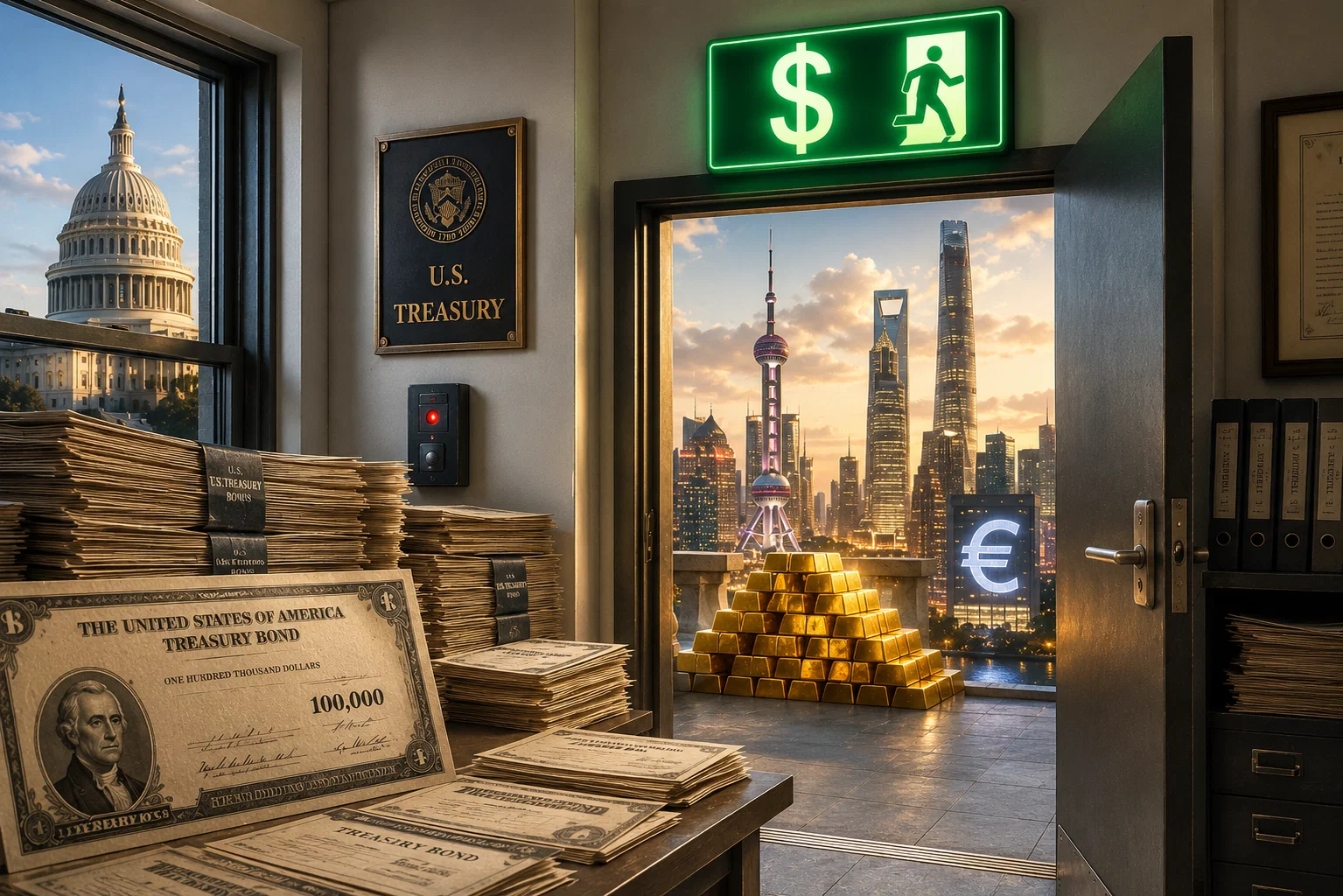
The Latest Flashing Exit Sign for the US Dollar
The Latest Flashing Exit Sign for the US Dollar
Notes From the Field By James Hickman (Simon Black / Sovereign Man) July 13, 2026
Washington has a comforting story about Social Security: yes, the trust fund is running out of money, but not until 2032. That leaves six more years to form the commissions, schedule the hearings, and study a problem that has been obvious for decades.
But last week, a man who used to run the numbers for Social Security itself explained why even a measly six years is optimistic.
The Latest Flashing Exit Sign for the US Dollar
Notes From the Field By James Hickman (Simon Black / Sovereign Man) July 13, 2026
Washington has a comforting story about Social Security: yes, the trust fund is running out of money, but not until 2032. That leaves six more years to form the commissions, schedule the hearings, and study a problem that has been obvious for decades.
But last week, a man who used to run the numbers for Social Security itself explained why even a measly six years is optimistic.
Jason Fichtner is the former chief economist of the Social Security Administration, which means he spent years inside the building watching the program's finances deteriorate.
According to the latest annual report from Social Security's own trustees, the program's main trust fund will be empty by late 2032. From that moment, incoming payroll taxes cover only 78% of scheduled benefits, which means an automatic 22% cut for every retiree in America.
But Fichtner recently told CNBC that the real deadline has nothing to do with 2032, because the bond market will move first.
He said that well before 2032, “the bond market looks and says, ’Well, you guys have 12 months to get your act in order; you’re going to be looking for another $600-plus billion a year,” which is why, “Fiscal strain could come earlier than trust fund depletion.”
Cutting grandma's check by 22% overnight is the closest thing to guaranteed electoral suicide that exists in American politics. So they'll do what they always do and borrow the difference. Fichtner and economist Veronique de Rugy calculate that filling the gap means roughly $600 billion in new borrowing in the first year, growing to about $700 billion a year by 2036.
And that money doesn't appear out of thin air. The Treasury borrows from the same pool of savings that everyone else uses, the pool that funds mortgages, car loans, and business investment. When the world's largest borrower suddenly demands another $600 billion a year from that pool, the price of money goes up for everybody.
Markets are forward-looking. An investor buying a 10-year Treasury today is holding paper that matures years after the trust fund runs dry, so the question of whether Congress will fix Social Security is already priced into that bond, every single day. Investors won't wait politely until the checks shrink in 2032. They will reprice the moment congressional inaction looks locked in, a year or more ahead of the deadline, exactly as Fichtner describes.
And inaction is the base case. Nine months into fiscal year 2026, the federal deficit has already reached $1.4 trillion according to the Congressional Budget Office, running ahead of last year's pace. This is happening with no major crisis draining the coffers, with the economy growing and unemployment low.
Meanwhile, the lenders who would have to fund all this new borrowing are backing away.
The dollar has fallen roughly 8% from its early 2025 peak. In March alone, foreign holdings of US Treasuries fell by about $240 billion, with Japan selling nearly $48 billion and China unloading another $41 billion. China's holdings now sit at their lowest level since 2008. The single largest pools of foreign capital on the planet are quietly reducing their exposure to the very asset Washington needs them to buy more of.
Worse, they are actively looking for the exits.
And on July 9, the European Parliament voted 416 to 169 to push the digital euro into final negotiations, and the stated goal is to reduce Europe's dependence on non-EU payment providers like Visa and Mastercard, which currently handle 61% of card payments in the eurozone.
That is a bureaucratic way to say: Europe no longer wants its money to be forced to move through American companies.
Consider how deep the dollar's dominance runs today: when France-based Airbus sells a jet to Air France, the price tag is in US dollars. A French company selling to a French airline, and the invoice is still written in Washington's currency.
That is the system Europe's political class just voted, by a two-to-one margin, to start engineering its way out of. Every step in that direction shrinks the pool of foreigners who need dollars, and fewer people who need dollars means fewer natural buyers for US government debt.
The real deadline for the fallout from Social Security’s 2032 depletion is whenever the bond market decides Congress won't act. And every lender heading for the exit moves that date closer, because a thinner pool of buyers means the repricing, when it comes, will be sharper.
Higher interest rates arriving years ahead of schedule would hit an economy that runs entirely on cheap debt. The government's interest bill, corporate borrowing, mortgages, the whole structure assumes money stays affordable. And the foreign lenders who could soften that blow by absorbing the new supply are already leaving.
Congress, in other words, is planning around a deadline that exists only on paper.
The bond market keeps its own calendar. And nobody in Washington seems to have asked what happens if the market's calendar runs faster than theirs.
To your freedom, James Hickman Co-Founder, Schiff Sovereign LLC
MilitiaMan & Crew- IRAQ DINAR UPDATE-Pre-Washington Momentum Builds – Confidence Message to DC - REER - End Goal
MilitiaMan & Crew- IRAQ DINAR UPDATE-Pre-Washington Momentum Builds – Confidence Message to DC - REER - End Goal
7-13-2026
The Crew: Samson, PompeyPeter, Petra, Daytrader, Sunkissed, GIGI and Militia Man
No drama. No intrigue. No songs and dances. Just straight, factual news that I read and interpret to the best of my ability after being an avid Dinar investor and insanely obsessed Dinarian for over 15 years.
Follow MM on X == https://x.com/Slashn
MilitiaMan & Crew- IRAQ DINAR UPDATE-Pre-Washington Momentum Builds – Confidence Message to DC - REER - End Goal
7-13-2026
The Crew: Samson, PompeyPeter, Petra, Daytrader, Sunkissed, GIGI and Militia Man
No drama. No intrigue. No songs and dances. Just straight, factual news that I read and interpret to the best of my ability after being an avid Dinar investor and insanely obsessed Dinarian for over 15 years.
Follow MM on X == https://x.com/Slashn
Be sure to listen to full video for all the news……..
Iraq Economic News and Points To Ponder Monday Morning 7-13-26
Fresh US-Iran Strikes Drive Oil Prices Higher
2026-07-13 01:16 Shafaq News Oil prices surged over 4% on Monday as energy shipments via the Strait of Hormuz remained under threat, with the U.S. and Iran announcing renewed military strikes.
Brent crude futures climbed $3.10, or 4.08%, to $79.11 by 0325 GMT, while U.S. West Texas Intermediate crude rose $2.95, or 4.11%, to $74.36 a barrel.
Fresh US-Iran Strikes Drive Oil Prices Higher
2026-07-13 01:16 Shafaq News Oil prices surged over 4% on Monday as energy shipments via the Strait of Hormuz remained under threat, with the U.S. and Iran announcing renewed military strikes.
Brent crude futures climbed $3.10, or 4.08%, to $79.11 by 0325 GMT, while U.S. West Texas Intermediate crude rose $2.95, or 4.11%, to $74.36 a barrel.
U.S. forces completed another wave of strikes against Iran on Sunday, hitting dozens of targets at multiple locations with precision munitions, the Central Command said. Iran's Revolutionary Guards said on Monday they attacked U.S. military bases in Kuwait and Bahrain.
U.S. President Donald Trump said on Sunday that the Strait of Hormuz is open to commercial traffic, although Iran declared earlier that it closed the strait after a vessel traveled on an unapproved route and was struck.
Some 20% of the world's oil and liquefied natural gas transited the strait before the war began at the end of February.
Six vessels transited the strait on Sunday, ship-tracking data from Kpler showed, the lowest number in five weeks.
The escalating attacks cast further doubt on the future of an interim U.S.-Iranian agreement signed last month that aimed to reopen the strait and end the war after a further 60 days of negotiations.
Following the agreement, global oil supply rose by 4.1 million barrels per day in June, but remained 9.4 million bpd below pre-war levels, the International Energy Agency said in its monthly report on Friday.
"Hopes of a relatively quick resolution to the recent skirmishes may be in doubt after tension escalated over the weekend," ANZ analysts said in a note.
IG market analyst Tony Sycamore said the relatively tame rise in oil prices suggested the market was taking the view that the current flare-up represented an escalation within a fragile truce and fell well short of a complete collapse of the ceasefire.
"How accurate that view is remains to be seen," he said in a note.
(REUTERS) https://www.shafaq.com/en/Economy/Fresh-US-Iran-strikes-drive-oil-prices-higher
Gold Drops Over 1% On Oil Surge
2026-07-13 03:05 Shafaq News Gold prices slid more than 1% on Monday as fears of a closure of the Strait of Hormuz drove oil prices sharply higher, reviving expectations of elevated interest rates to combat inflationary pressures from escalating hostilities in the Middle East.
Spot gold dropped 1.5% to $4,060.36 per ounce by 0541 GMT. U.S. gold futures for August delivery were down 1.1% at $4,068.30.
U.S. and Iranian forces have exchanged heavy missile and drone assaults, with Tehran targeting U.S. facilities in states across the Gulf on Sunday and saying it had again closed the vital Strait of Hormuz.
Oil prices jumped about 4%, the dollar and U.S. Treasury yields climbed, and share markets slipped in Asia.
"Any breakout of violence in the Gulf is accompanied by pressure on gold," said Nicholas Frappell, global head of institutional markets at ABC Refinery.
"The question is, if the Strait of Hormuz remains effectively or partially closed, does that lead to a deflationary effect, further down the road, that might actually be supportive for gold if you have demand destruction leading to lower economic activity," Frappell added.
Kevin Warsh's first semiannual testimony before Congress as Federal Reserve chair, along with a slate of key U.S. economic data, including June CPI, PPI and retail sales, will be closely watched this week for fresh clues on the economy, inflation and the monetary policy outlook.
Remarks from Fed policymakers, including Vice Chair Michelle Bowman and Governor Christopher Waller, later in the day are also in focus as they could provide insights on how inflationary pressures are affecting the central bank's stance on interest rate hikes.
Traders are currently pricing in a 72% chance of a U.S. Fed interest rate hike in September, up from about 63% last week, according to the CME FedWatch Tool. FEDWATCH/
COMEX gold speculators trimmed their net long positions by 1,964 contracts to 114,854 in the week to July 7, data released on Friday showed, following three consecutive weeks of increases.
Elsewhere, spot silver declined 2.6% to $58.29 per ounce, platinum shed 1.6% to $1,601.92, and palladium fell 2% to $1,251.42.
(REUTERS) https://www.shafaq.com/en/Economy/Gold-drops-over-1-on-oil-surge
Dollar Edges Higher In Baghdad, Erbil
2026-07-13 03:47 Shafaq News- Baghdad/ Erbil The US dollar opened Monday’s trading higher in Iraq, hovering around 154,000 dinars per 100 dollars.
According to Shafaq News market survey, the dollar traded in Baghdad's Al-Kifah and Al-Harithiya exchanges at 153,600 dinars per 100 dollars, up from the previous session’s 153,300 dinars.
In the Iraqi capital, exchange shops sold the dollar at 154,000 dinars and bought it at 153,000 dinars, while in Erbil, selling prices stood at 153,350 dinars and buying prices at 153,250 dinars.
https://www.shafaq.com/en/Economy/Dollar-edges-higher-in-Baghdad-Erbil
Oil Dominates Iraq's Exports To US At $6.5 Billion In 2025
2026-07-13 04:15 Shafaq News- Baghdad Mineral fuels and oil products accounted for nearly all of Iraq's exports to the United States in 2025, with total Iraqi exports to the US market reaching $6.5 billion, according to Trading Economics data based on US Census Bureau figures.
Crude oil alone was valued at $4.79 billion, while petroleum oils and oils obtained from bituminous minerals contributed an additional $1.65 billion, bringing total energy exports to $6.45 billion, or 99% of all Iraqi exports to the US market. No single non-energy category exceeded $37 million.
Iraq's exports to the US have followed a consistent downward trend in recent years, from $10 billion in 2022 to $8.9 billion in 2023, $7.7 billion in 2024, and $6.5 billion in 2025.
Read more: Iraq's oil revenues under US financial guard 23 years after invasion
https://www.shafaq.com/en/Economy/Oil-dominates-Iraq-s-exports-to-US-at-6-5-billion-in-2025
Gold Prices Fall In Baghdad And Erbil
2026-07-13 05:05 Shafaq News- Baghdad/ Erbil On Monday, gold prices dropped in Baghdad and Erbil, hovering around 875,000 IQD per mithqal, according to Shafaq News market survey.
Gold prices on Baghdad's Al-Nahr Street recorded a selling price of 876,000 IQD per mithqal (equivalent to five grams) for 21-carat gold, including Gulf, Turkish, and European varieties, with a buying price of 872,000 IQD. The same gold had sold for 880,000 IQD on Sunday.
The selling price for 21-carat Iraqi gold stood at 846,000 IQD, with a buying price of 842,000 IQD.
In jewelry stores, 21-carat Gulf gold ranged between 875,000 and 885,000 IQD per mithqal, while Iraqi gold sold for between 845,000 and 855,000 IQD.
In Erbil, 22-carat gold was sold at 924,000 IQD per mithqal, 21-carat gold at 882,000 IQD, and 18-carat gold at 756,000 IQD.
https://www.shafaq.com/en/Economy/Gold-prices-fall-in-Baghdad-and-Erbil-2-5
ISX Reports $16M In Weekly Trading
2026-07-13 07:17 Shafaq News- Baghdad The Iraq Stock Exchange (ISX) recorded nearly 21 billion Iraqi dinars in trading volume last week —roughly $16 million.
According to the recorded data, more than 7.5 billion shares were traded during the week across five trading sessions.
The ISX60 index closed at 1,016.21 points, reflecting a 1% increase from the previous session.
Throughout the week, the exchange executed 4,303 sale and purchase contracts involving 63 listed companies. Shares of 32 companies were not traded because buy and sell orders did not match, while trading in eight companies remained suspended for failing to submit the required disclosures.
Non-Iraqi investors purchased 349,000 shares worth 567 million Iraqi dinars (about $431,000) through 185 transactions, while selling nearly 1 billion shares valued at 2 billion Iraqi dinars (about $1.52M) in 428 transactions.
https://www.shafaq.com/en/Economy/ISX-reports-16M-in-weekly-trading
Seeds of Wisdom RV and Economics Updates Monday Morning 7-13-26
Good Morning Dinar Recaps,
Crypto Markets Watch Inflation, Fed Testimony, and CLARITY Act as Pivotal Week Begins
This week could prove decisive for digital assets as investors monitor new inflation data, Federal Reserve testimony, and progress on the CLARITY Act. Together, these developments may influence interest rate expectations, crypto regulation, and overall market sentiment.
Good Morning Dinar Recaps,
Crypto Markets Watch Inflation, Fed Testimony, and CLARITY Act as Pivotal Week Begins
This week could prove decisive for digital assets as investors monitor new inflation data, Federal Reserve testimony, and progress on the CLARITY Act. Together, these developments may influence interest rate expectations, crypto regulation, and overall market sentiment.
Overview
June CPI and PPI inflation reports are expected to provide fresh insight into whether inflation continues to moderate.
Federal Reserve Chair Kevin Warsh is scheduled to testify before Congress, with markets watching closely for clues about future monetary policy.
The CLARITY Act remains in focus as lawmakers continue negotiations on legislation that could establish a comprehensive regulatory framework for digital assets.
Key Developments
1. Inflation Data Could Influence the Next Fed Decision
Investors are closely watching this week's Consumer Price Index (CPI) and Producer Price Index (PPI) reports. Economists expect inflation to continue moderating compared with previous readings, which could strengthen expectations that the Federal Reserve may eventually have room to ease monetary policy if inflation continues moving toward its target. Softer inflation has historically been supportive of Bitcoin and other digital assets.
2. Fed Chair Kevin Warsh Heads to Capitol Hill
Federal Reserve Chair Kevin Warsh will deliver the Fed's semiannual monetary policy report before Congress. Lawmakers are expected to question him about inflation, interest rates, economic growth, and the outlook for monetary policy. Investors will analyze every comment for indications of whether the Fed is becoming more dovish or intends to keep interest rates higher for longer.
3. CLARITY Act Negotiations Continue
Negotiations continue on the CLARITY Act, one of the most significant pieces of U.S. digital asset legislation under consideration. Senate committees are working to reconcile different versions of the bill while key provisions remain under discussion. The legislation is designed to provide greater regulatory clarity for cryptocurrencies, digital asset exchanges, and blockchain developers.
4. House Hearing Focuses on Digital Asset Innovation
The House Financial Services Committee is scheduled to hold a hearing titled "Building the Future of Finance: How the CLARITY Act Unlocks Innovation." The hearing is expected to examine how clearer regulations could encourage innovation while strengthening consumer protections and maintaining U.S. leadership in digital finance.
5. Markets Prepare for Increased Volatility
The combination of inflation reports, Federal Reserve testimony, and legislative developments could create increased volatility across cryptocurrency and broader financial markets. Investors remain focused on how monetary policy and regulatory certainty will shape capital flows into digital assets during the second half of the year.
Why It Matters
This week's events combine three of the largest forces influencing financial markets—monetary policy, inflation, and digital asset regulation. Together, they will help determine whether investor confidence continues to improve and whether cryptocurrencies benefit from a more supportive economic and regulatory environment.
Why It Matters to Foreign Currency Holders
Interest rate policy and regulatory developments often influence global capital flows and currency markets. A more predictable regulatory framework for digital assets, combined with easing inflation, could encourage broader institutional participation while affecting demand for both traditional and digital financial assets.
Implications for the Global Reset
Pillar 1 – Debt
Federal Reserve policy continues to influence borrowing costs, government debt servicing, inflation, and global liquidity, making inflation data one of the most closely watched economic indicators.
Pillar 4 – Technology
The CLARITY Act represents an important step toward establishing clear regulatory rules for blockchain technology and digital assets, supporting innovation while integrating digital finance into the broader financial system.
This is not simply about cryptocurrency prices—it reflects the ongoing convergence of monetary policy, financial regulation, and digital innovation as the global financial system continues to evolve.
Seeds of Wisdom Team
Newshounds News™ Exclusive
Sources
~~~~~~~~~~
🌱 A Message to Our Currency Holders🌱
If you’ve been holding foreign currency for many years, you were not foolish.
You were not wrong to believe the global financial system would change.
What failed was not your patience — it was the information you were given.
For years, dates, rumors, and personalities replaced facts, structure, and proof. “This week” predictions created cycles of hope and disappointment that were never based on how currencies actually change.
That is not your failure.
Our mission here is different: • No dates • No rates • No hype • No gurus
Instead, we focus on:
• Verifiable developments • Institutional evidence
• Global financial structure • Where countries actually sit in the process
Currency value changes only come after sovereignty, trade, banking, settlement systems, and fiscal coordination are in place. History and institutions confirm this sequence.
You will see silence. You will see denials. That is not delay — that is discipline.
Protect your identity. Organize your documents. Verify everything.
Never hand your discernment to anyone who cannot show proof.
You deserve truth — not timelines.
Seeds of Wisdom Team
Newshounds News
~~~~~~~~~~
Seeds of Wisdom Team RV Currency Facts Youtube and Rumble
Newshound's News Telegram Room Link
RV Facts with Proof Links Link
RV Updates Proof links - Facts Link
Start Here room with Most Asked Questions Link
Follow the Gold/Silver Rate COMEX
Follow Fast Facts
Seeds of Wisdom Team™ Website
Thank you Dinar Recaps
What Is Trade Policy?
What Is Trade Policy?
By Ann Logue Published on January 25, 2022
Key Takeaways
Trade policy is a government’s stance on international trade, or a combination of laws and practices that affects imports and exports.
Trade policies can include regulations, tariffs, and quotas.
Some nations want to encourage more trade and pursue open trade policies with certain other nations, while others want to restrict trade and set policies that protect local industries from competition.
Trade policies can have a number of benefits, including economic growth or lower costs of goods.
What Is Trade Policy?
By Ann Logue Published on January 25, 2022
Key Takeaways
Trade policy is a government’s stance on international trade, or a combination of laws and practices that affects imports and exports.
Trade policies can include regulations, tariffs, and quotas.
Some nations want to encourage more trade and pursue open trade policies with certain other nations, while others want to restrict trade and set policies that protect local industries from competition.
Trade policies can have a number of benefits, including economic growth or lower costs of goods.
Definition and Example of Trade Policy
Trade policy refers to a nation’s formal set of practices, laws, regulations, and agreements that govern international trade practices, or imports and exports to foreign countries. Trade policies aim to strengthen the domestic economy. For example, U.S. trade policy aims to strengthen the competitiveness of U.S. industries.12
Alternate Names: commercial policy, international trade policy
Some trade policies are codified into law; others are part of the practices that a nation’s bureaucrats and diplomats follow. They are intended to reflect a national philosophy about international trade.
Trade policies can be aimed at a number of issues related to importing and exporting, such as foreign retaliation, jobs, or tariffs; or they may focus on protecting intellectual property, setting standards that promote collaboration and reduce trade barriers, or establishing trade agreements and trade laws.
For example, in the U.S., the Export Trading Company Act (ETCA) enables U.S. firms to work together to reduce export costs, increase exporting efficiency, and better compete in the global market, among other initiatives. It provides antitrust protection and other benefits to U.S. firms that collaborate on exporting activities. As a result, these firms get the advantage of, for example, reduced shipping costs, better negotiating power, and the ability to fill larger export orders.3
Other trade policies may emphasize finding export markets for goods produced in the country, encouraging travel and tourism from other countries, or limiting and heavily taxing imports to protect local producers.
How a Trade Policy Works
Trade policy is established when a government sets standards and laws regarding international trade.
In some cases, a nation will pursue a more aggressive protectionist policy designed to favor its domestic industries over international competitors. Protectionism policies can include setting quotas on the number of imported goods allowed in a country, imposing tariffs on imported goods, and offering subsidies for domestic producers.
On the other hand, a nation may want to increase international investment and pursue a free trade policy (sometimes called an “open trade policy”) that reduces the barriers to doing business. Many countries establish trade policies between the two extremes, adjusting them as the global economy and domestic political pressures change.4
The U.S. government’s International Trade Administration (ITA) provides information on the trade policies of nations around the world, including specific information for different industries.
Examples of Trade Agreements
A trade agreement occurs when two or more countries agree to the terms of trade, which can include the amount of tariffs and quotas, among other terms. Here are some examples of foreign trade agreements:
The U.S.-Mexico-Canada Agreement (USMCA): The USMCA, which replaced the North American Free Trade Agreement (NAFTA) in 2020, aims to eliminate trade barriers between the U.S., Mexico, and Canada while including some restrictions on importing and exporting.5
The Dominican Republic-Central America Free Trade Agreement (CAFTA-DR): The CAFTA-DR is a trade agreement between the U.S. and Central America countries El Salvador, Costa Rica, Honduras, and Guatemala, as well as the Dominican Republic. It aims to promote stronger investment ties and stability.6
Benefits of Trade
Trade expansion can provide a number of economic benefits for a nation. It can fuel economic growth, improve the job market, lower the costs of goods, and raise living standards. Trade expansion results in a wider variety of product options available for consumers and businesses.7
Trade policies that reduce tariffs, quotas, and other barriers on imports generally lead to lower prices and more options for consumers. However, manufacturers that sell goods to domestic customers often prefer a more import restrictive policy.
https://www.thebalancemoney.com/what-is-trade-policy-5217002
Get Out Of Fiat Currency: The Monetary Reset Warning
Get Out Of Fiat Currency: The Monetary Reset Warning
Liberty and Finance: 7-11-2026
In a recent deep-dive discussion hosted by Liberty and Finance, renowned economists Dr. Michael Rectenwald and Dr. Mark Thornton shared a sobering analysis of the current trajectory of global monetary policy.
The conversation centered on the emergence of Central Bank Digital Currencies (CBDCs) and what they describe as an accelerating shift toward a more supervised economic environment.
Get Out Of Fiat Currency: The Monetary Reset Warning
Liberty and Finance: 7-11-2026
In a recent deep-dive discussion hosted by Liberty and Finance, renowned economists Dr. Michael Rectenwald and Dr. Mark Thornton shared a sobering analysis of the current trajectory of global monetary policy.
The conversation centered on the emergence of Central Bank Digital Currencies (CBDCs) and what they describe as an accelerating shift toward a more supervised economic environment.
As the world grapples with inflation, technological upheaval, and geopolitical shifts, these experts suggest that the very nature of currency is being redesigned with profound implications for personal privacy and financial autonomy.
At the heart of the discussion is the push for CBDCs, which are often marketed by governments and international institutions as a necessary step toward “financial inclusion.”
The argument is that digital currencies will bring the unbanked—billions of people globally—into the formal financial system. However, Dr. Rectenwald and Dr. Thornton view this through a more critical lens.
They argue that CBDCs represent a transition from traditional money to “programmable money,” a tool that could allow central authorities to monitor, restrict, or influence individual spending habits in real-time.
Unlike physical cash, which offers a degree of anonymity and peer-to-peer freedom, a CBDC is a liability of the central bank. This means every transaction leaves a digital footprint accessible to the state. The experts warn that this infrastructure creates a supervised system where economic participation could, in theory, be tethered to compliance or specific policy goals, effectively ending the era of private financial transactions.
The discussion expertly connects the dots between monetary policy and broader global trends. Currently, the “economic reset” is being fueled by extensive money printing, which the guests argue is being funneled into two primary sectors: military ventures and the build-out of artificial intelligence (AI) infrastructure.
The rapid expansion of the money supply to fund these initiatives is a primary driver of ongoing inflationary pressures. By devaluing the currency through expansion, the purchasing power of the average citizen is eroded.
Furthermore, the experts point out that the push for AI is not merely about productivity; it is about building the surveillance and data processing networks necessary to manage a digitalized, centralized economy. In this context, inflation serves as a silent tax that finances the very systems designed to increase oversight of the public.
While there has been legislative pushback in various regions—notably in the United States—to delay the implementation of CBDCs, Rectenwald and Thornton suggest that the momentum has not stalled. Many policy frameworks point toward 2030 as a pivotal year for this digital transition. Despite current delays, the underlying infrastructure is being steadily assembled.
The guests characterize this period as a “looming threat” to traditional economic structures. They argue that the transition to a digital-only system is a core component of a broader economic reset. This reset aims to consolidate power within central institutions, making the financial system more “efficient” from a top-down perspective, but significantly less free for the individual.
The insights provided by Dr. Michael Rectenwald and Dr. Mark Thornton serve as a clarion call for those concerned about the intersection of technology and state power. As we move closer to a potential digital currency era, the choice between convenience and liberty becomes increasingly stark.
For those looking to preserve their economic independence, staying informed and diversifying away from centralized digital systems appears more critical than ever.
Seeds of Wisdom RV and Economics Updates Sunday Afternoon 7-12-26
Good Afternoon Dinar Recaps,
U.S.-Iran Ceasefire Falters as Military Pressure Mounts and Diplomacy Continues Behind the Scenes
Renewed military strikes, escalating tensions in the Strait of Hormuz, and continued diplomatic contacts have created a complex situation in which the U.S. and Iran are simultaneously exchanging attacks while keeping channels of communication open through regional mediators.
Overview
Good Afternoon Dinar Recaps,
U.S.-Iran Ceasefire Falters as Military Pressure Mounts and Diplomacy Continues Behind the Scenes
Renewed military strikes, escalating tensions in the Strait of Hormuz, and continued diplomatic contacts have created a complex situation in which the U.S. and Iran are simultaneously exchanging attacks while keeping channels of communication open through regional mediators.
Overview
The U.S.-Iran ceasefire has largely broken down on the battlefield, with both sides accusing each other of violating the interim agreement.
Despite renewed military operations, the United States and Iran have agreed to continue indirect talks, focusing on maritime security and the future of the Strait of Hormuz.
The outcome remains critical for global energy markets, international shipping, and regional stability, making the conflict one of the world's most closely watched geopolitical flashpoints.
Key Developments
1. Ceasefire Weakens as Military Operations Resume
The temporary ceasefire that followed the U.S.-Iran Memorandum of Understanding (MOU) has come under severe strain after renewed missile, drone, and military strikes. While neither side has formally withdrawn from diplomacy, recent attacks demonstrate that the security situation remains highly unstable.
2. Talks Continue Despite Escalating Conflict
Although fighting has resumed, diplomacy has not completely collapsed. President Trump confirmed that Iran requested continued negotiations and that the United States agreed to remain engaged. Current discussions are centered primarily on restoring safe navigation through the Strait of Hormuz and preventing a broader regional war.
3. Strait of Hormuz Remains the Central Issue
The strategic waterway continues to dominate negotiations. The United States is demanding unrestricted international navigation, while Iran insists it should retain authority over maritime security in the region. Stability in Hormuz remains essential because a significant share of the world's oil and liquefied natural gas exports transit through the narrow passage.
4. The MOU Has Not Been Abandoned
The Memorandum of Understanding established a framework for reducing hostilities and launching broader negotiations covering maritime security, sanctions, and Iran's nuclear program. Although military events have slowed implementation, the agreement itself continues to serve as the diplomatic foundation for ongoing indirect talks.
5. Long-Term Issues Remain Unresolved
Beyond the immediate fighting, negotiators continue to face difficult issues including Iran's nuclear program, sanctions relief, regional security, and freedom of navigation. These longstanding disputes make a permanent settlement significantly more difficult than achieving a temporary ceasefire.
Why It Matters
The current situation illustrates that diplomacy and military operations are occurring simultaneously. While renewed strikes have weakened confidence in the ceasefire, continued negotiations indicate that neither side has completely abandoned the possibility of a negotiated settlement. Markets, governments, and energy producers remain focused on whether diplomacy can eventually restore lasting stability.
Why It Matters to Foreign Currency Holders
Geopolitical instability often influences currencies, commodity prices, and investor confidence. Any prolonged disruption in the Strait of Hormuz could affect inflation, central bank policy, global trade flows, and international financial markets—all of which can influence foreign exchange values.
Implications for the Global Reset
Pillar 2 – Trade
Continued uncertainty in the Strait of Hormuz highlights the importance of protecting one of the world's most vital trade corridors. Any disruption to shipping affects global commerce, transportation costs, and supply chains.
Pillar 5 – Energy
The Strait of Hormuz remains one of the world's most important energy chokepoints. Stability in the region directly influences global oil and natural gas supplies, energy prices, and inflation expectations.
This is not simply about another military confrontation—it reflects the continuing struggle to balance regional security, global energy supplies, and diplomatic efforts that could shape international trade and financial stability for years to come.
Seeds of Wisdom TeamNewshounds News™ Exclusive
Sources
Reuters – US seeks free Hormuz access from Iran as talks focus on strait
Reuters – Iran has asked to continue talks and the US agreed, Trump says
~~~~~~~~~~
Seeds of Wisdom Team RV Currency Facts Youtube and Rumble
Newshound's News Telegram Room Link
RV Facts with Proof Links Link
RV Updates Proof links - Facts Link
Start Here room with Most Asked Questions Link
Follow the Gold/Silver Rate COMEX
Follow Fast Facts
Seeds of Wisdom Team™Website
Thank you Dinar Recaps
Sunday Iraq News Posted by Tishwash at TNT 7-12-2026
TNT:
Tishwash: Al-Zaidi Heads to U.S. to Transition Ties into Long-Term Economic Partnership
Government spokesperson Haider al-Aboudi announced that Iraqi Prime Minister Ali Faeh al-Zaidi will lead a high-level delegation to the United States on Monday to sign key memorandums of understanding in the oil and gas sectors.
Al-Zaidi will be accompanied by several cabinet ministers, the Central Bank Governor, and private investors from the energy and banking sectors.
TNT:
Tishwash: Al-Zaidi Heads to U.S. to Transition Ties into Long-Term Economic Partnership
Government spokesperson Haider al-Aboudi announced that Iraqi Prime Minister Ali Faeh al-Zaidi will lead a high-level delegation to the United States on Monday to sign key memorandums of understanding in the oil and gas sectors.
Al-Zaidi will be accompanied by several cabinet ministers, the Central Bank Governor, and private investors from the energy and banking sectors.
Channel8 earlier reported that the delegation will discuss key security, economic, and banking issues with U.S. officials, with a central focus on drawing American investments into Iraq's oil, electricity, and natural gas sectors.
Al-Zaidi previously stated that his trip to Washington is "not just a routine protocol visit" and that Iraq "prioritizes American companies" as it actively pivots from military to economic ties.
Al-Aboudi: Al-Zaidi's US Visit to Prioritize Balanced Ties
Al-Aboudi told a press conference on Sunday that the visit aims to build balanced foreign relations based on mutual interests, noting that al-Zaidi will hold crucial meetings with President Trump and financial institutions to turn these dialogues into real progress.
He stressed that the visit aims to strengthen ties with Washington, with discussions focusing primarily on developing economic and investment relations.
Al-Aboudi highlighted that the visit aims to boost Iraq's regional presence by prioritizing talks with the U.S. on economic cooperation, development, and investment in the energy, trade, and technology sectors.
Economic Partnership and Focus on Energy and Framework Integrity
The spokesperson noted that unlike previous visits, "its primary theme is the economy," emphasizing that all new agreements will remain fully based on the existing Strategic Framework Agreement.
He emphasized that upcoming Iraq-U.S. energy agreements will bring in specialized American firms to boost oil and gas production and build alternative export routes to avoid the Strait of Hormuz crisis.
Haider al-Aboudi further emphasized that the bilateral dynamic will transition from "crisis management to a long-term economic partnership." link
************
Tishwash: Al-Zaidi heads to Washington carrying files on the economy and weapons in a pivotal visit to the White House
All eyes are on the upcoming visit of Iraqi Prime Minister Ali al-Zaidi to the White House next week, in one of the most significant milestones in Iraqi-American relations in recent years .
This visit comes amid increasing pressure on Baghdad to address the issue of armed factions, coinciding with the Iraqi government's efforts to expand economic and investment cooperation with the United States .
A report by Middle East Eye stated that “US President Donald Trump views Iraq from the perspective of economic and investment opportunities, while al-Zaidi seeks to capitalize on this trend to strengthen relations with Washington and gain the support of the US administration, which gives him more room to implement his government program, and at the forefront of his priorities is restricting weapons to the state and reorganizing Iraq’s regional relations .”
According to the report, "During his visit, Al-Zaidi will carry a package of economic agreements, including expanding the initial agreement with Chevron to develop one of the oil fields in Basra Governorate, in addition to increasing the investments of another American company in the Akaz gas field in Anbar Governorate ."
He added: "The visit's agenda also includes the signing of an agreement to rehabilitate the Kirkuk-Banias pipeline, which connects Iraq to the Syrian coast, in a project that Washington sees as part of its plan to ensure the continued flow of energy supplies and reduce the impact of any disruptions in the Strait of Hormuz ."
He noted that "the US envoy to Syria and Iraq, Tom Barrack, is working to prepare initial understandings before al-Zaidi arrives in Washington, as part of a strategy aimed at expanding the presence of American companies and reducing Iranian economic influence within Iraq ."
The report noted that "the resumption by the United States of transferring Iraqi oil revenues deposited with the Federal Reserve in New York, days before the visit, has political dimensions that go beyond the financial aspect, and reflects Washington's desire to open a new chapter of cooperation with Baghdad ."
He explained that "in contrast, the issue of armed factions will occupy a key position in the White House talks, as the US administration seeks to obtain clear Iraqi commitments regarding ending the influence of armed groups linked to Iran, and stopping attacks targeting US interests and the Gulf states ."
Al-Zaydi had given those factions until September 30 to hand over their weapons to the state, coinciding with the end of the international coalition’s mission in Iraq, but some of the main factions, including Kataib Hezbollah and Harakat al-Nujaba, still refuse to give up their weapons .
The report also addressed the anti-corruption campaign launched by the Iraqi government, considering that it "strengthened al-Zaidi's position before the American administration, after it included prominent figures and officials, including those close to the previous government and figures associated with the Popular Mobilization Forces ."
The report concluded that "the success of the visit will not be measured by the number of economic agreements that will be signed, but rather by the ability of the Iraqi Prime Minister to convince Washington that his government is capable of implementing real reforms and making progress in the issue of restricting weapons to the state, while at the same time maintaining balance in Iraq's regional relations link
*************
Tishwash: Parliamentary Finance Committee reveals details of the 2027 budget
The head of the parliamentary finance committee, Uday Awad ,
revealed on Saturday the most prominent aspects of the 2027 budget proposal, explaining that it will adopt a program and performance budget in a number of government institutions and agencies.
Awad told Al-Maalomah News Agency, "The 2027 budget will be a program and performance budget, while the remaining sections will be structured according to the program and performance guidelines." He explained that "this approach comes within the framework of developing budget preparation mechanisms and enhancing the efficiency of government spending."
He added that "the application of the program and performance budget will include the Ministry of Electricity, in addition to the governorates of Salah al-Din and Diwaniyah, as the first phase of the project," emphasizing that "adopting this method contributes to raising the level of oversight of spending and achieving better results in the implementation of projects and services." link
************
Tishwash: Economists: Iraq's international acceptance has broadened following Operation Dawn.
Iraq is betting that its ongoing anti-corruption campaign will be a starting point for restoring international confidence, as experts believe that establishing the rule of law and holding corrupt individuals accountable sends a positive message to financial institutions and investors, and may be reflected in improved economic indicators and governance.
Turning point
The academic, Dr. Kazem Eidan, described the current moves as a “real turning point” if the state continues to fight corruption without exceptions or selectivity, indicating that the international community does not build its confidence on statements, but on results, the rule of law, and the independence of the judiciary.
Eidan explained in an interview with Al-Sabah that holding corrupt individuals accountable under the law has enhanced Iraq’s image and will contribute to bringing it closer to political and economic stability, and will open the door to international investments and partnerships, stressing that true success will only be achieved when the citizen, before the world, feels that the law is applied to everyone without discrimination or exceptions.
The spokesman added that if the government succeeds in turning these measures into a permanent and continuous approach, Iraq may regain the international standing it deserves after many years of challenges. He considered the recent measures, including opening corruption files, as a message that the state is ready to take serious and bolder steps, which is being followed with great interest by countries and international financial institutions.
Eidan pointed out that this trend improves the investment environment, explaining that investors view combating corruption as an indicator of the stability of the business environment and a decrease in the risks of bribery and illegal interventions, which is reflected in an increase in foreign investments.
International ranking improved
Eidan promised that strengthening economic and financial relations would be a gateway to the success of reforms and economic and financial stability, which would facilitate cooperation with international institutions and increase opportunities to obtain financing and investments on better terms, as well as raise Iraq’s international ranking and achieve sustainable improvement in governance and transparency indicators, thus improving the country’s international image, provided that these reforms continue and show their results.
Economic stability
On the same note, financial and economic researcher Imad Al-Muhammadawi considered combating corruption to be the gateway to economic stability in Iraq, explaining that corruption is an economic burden before it is a moral one.
Al-Muhammadi told Al-Sabah that corruption in Iraq is not measured by numbers alone, but by the burdens it places on the investment environment. He pointed out that when contracts and licenses are granted outside the framework of competence through incompetent intermediaries, they create a burden and a state of uncertainty, the price of which is paid by both the investor and the citizen.
Al-Muhammadi added that most specialized reports indicate that the cost of doing business in Iraq is higher than in other countries due to bribery and favoritism, stressing that this makes the investment environment an attractive arena for uncalculated risks.
Recovering stolen funds
The researcher pointed out that the international community views the stability of Iraq from a different angle than security, but rather through the state's ability to enforce the law equally, by recovering the looted funds from those who steal public money. This is a message of great impact to international companies that seek to enter the Iraqi market, as the former feel their way to the market by predicting the state's judicial decisions and thus whether or not to enter the market.
Al-Muhammadi promised that recovering the funds would be an opportunity to introduce the world to the image of the new Iraq, whose name has been associated for many years and in international reports with a decline in governance indicators. He stressed the need to work on changing and reformulating that stereotypical image by issuing judgments against all corrupt individuals without exception and recovering those funds, in order to alleviate the crisis of international confidence and change the country’s reputation.
He believed that continuing to work by increasing reform initiatives and finding a new building block that deserves international confidence in the file of opening investments, not just opening internal corruption files, but through international relations in a stage in which Iraq is regaining its regional role and diversifying its incomes, which were limited to selling oil and the files that accompany it.
Account for depositing stolen goods
It is worth noting that the government spokesman, Haider al-Aboudi, said earlier that the “Dawn Charge” anti-corruption campaign is ongoing, revealing an account into which the funds will be deposited.
Al-Aboudi said that the fight against corruption is ongoing and is based on a procedural methodology in which the federal authorities cooperate and integrate, adding that the government continues to implement its constitutional obligations in protecting public funds and enabling state institutions to perform their duties in enforcing the law.
He explained that the anti-corruption narrative is unlike its predecessors, noting that the Prime Minister, Ali al-Zaidi, directed the Ministry of Finance to create an account to deposit the recovered funds. link
************
Tishwash: Iraqi oil is attracting Chinese refineries as demand for Iranian crude declines and floating storage rises.
Iraq has benefited from the shift of independent refineries in China towards purchasing crude oil not subject to sanctions, after they resorted in recent weeks to increasing their purchases of crude oil from Iraq, the UAE and Qatar, at a time when Iranian oil sales have slowed and the volume of floating stockpiles at sea has increased with the return of US sanctions.
Traders said that independent Chinese refineries in Shandong province purchased between 16 and 20.5 million barrels of Iraqi, Emirati, and Qatari crude oil, marking the largest purchase of non-sanctioned Middle Eastern oil since the start of the conflict. Shenghong Petrochemical also bought approximately 12 million barrels of Iraqi, Saudi, and Abu Dhabi crude.
Reuters added, based on data from Kpler, Vortexa and UANI, that increased supplies from Iraq and the Gulf states contributed to displacing demand for Iranian crude, especially after the resumption of exports through the Strait of Hormuz, as competing crudes were sold at discounts ranging between $5 and $8 per barrel compared to Brent crude, while discounts for Iranian oil remained at only $2 to $3, making it less attractive to buyers.
Conversely, the volume of Iranian oil stranded at sea increased after exports surged during the temporary truce, but sales slowed as buyers held back. Kpler data showed that approximately 34.5 million barrels of Iranian crude oil transited the Strait of Hormuz between June 14 and July 10, while Vortexa estimated loadings of around 30 million barrels between June 15 and July 6.
Kpler data also indicated that China’s imports of Iranian oil so far in July have reached about 556,000 barrels per day, the lowest level since January 2023, while traders expect Iranian sales to rebound next week if discounts on August and September shipments increase. link
MilitiaMan & Crew- IRAQ DINAR UPDATE-Iraq-"Selling the Country" – Come in Investors, We Are Open!
MilitiaMan & Crew- IRAQ DINAR UPDATE-Iraq-"Selling the Country" – Come in Investors, We Are Open!
7-11-2026
The Crew: Samson, PompeyPeter, Petra, Daytrader, Sunkissed, GIGI and Militia Man
No drama. No intrigue. No songs and dances. Just straight, factual news that I read and interpret to the best of my ability after being an avid Dinar investor and insanely obsessed Dinarian for over 15 years.
Follow MM on X == https://x.com/Slashn
MilitiaMan & Crew- IRAQ DINAR UPDATE-Iraq-"Selling the Country" – Come in Investors, We Are Open!
7-11-2026
The Crew: Samson, PompeyPeter, Petra, Daytrader, Sunkissed, GIGI and Militia Man
No drama. No intrigue. No songs and dances. Just straight, factual news that I read and interpret to the best of my ability after being an avid Dinar investor and insanely obsessed Dinarian for over 15 years.
Follow MM on X == https://x.com/Slashn
Be sure to listen to full video for all the news……..
https://www.youtube.com/watch?v=pmavCLON5JY