
Thank you to all the subscribers to our Early Access program…we thank you for your continued support.
We are excited to offer this new service to keep you informed and up-to-date on the latest Dinar and currency news.
Congress Passed 133 Broadband Programs. Its Big Idea Is A 134th
Congress Passed 133 Broadband Programs. Its Big Idea Is A 134th
Notes from the Field By James Hickman (Simon Black / Sovereign Man) June 15, 2026
There are things that a free market will never do, and it’s usually for very good reasons. Running fiber-optic cable down a twelve-mile dirt road costs a fortune, and the handful of households scattered along that road will never pay enough in monthly bills to justify the cost of laying the cable.
That’s why private companies don't bother laying fiber in rural areas: the math doesn't work.
Congress Passed 133 Broadband Programs. Its Big Idea Is A 134th
Notes from the Field By James Hickman (Simon Black / Sovereign Man) June 15, 2026
There are things that a free market will never do, and it’s usually for very good reasons. Running fiber-optic cable down a twelve-mile dirt road costs a fortune, and the handful of households scattered along that road will never pay enough in monthly bills to justify the cost of laying the cable.
That’s why private companies don't bother laying fiber in rural areas: the math doesn't work.
But living out in the country is a choice— one that plenty of people gladly make. Some people value the space, the quiet, and the empty horizon far more than same-day Amazon delivery or 1 gigabit Internet.
And most people typically know about these trade-offs before they move out to the country. Urban and suburban conveniences are just that— conveniences. They are not inalienable “rights”. No one is entitled to fast internet.
Yet Congress has decided at least 133 times that fast Internet, is, in fact, a right. And one that they have decided to provide with your money.
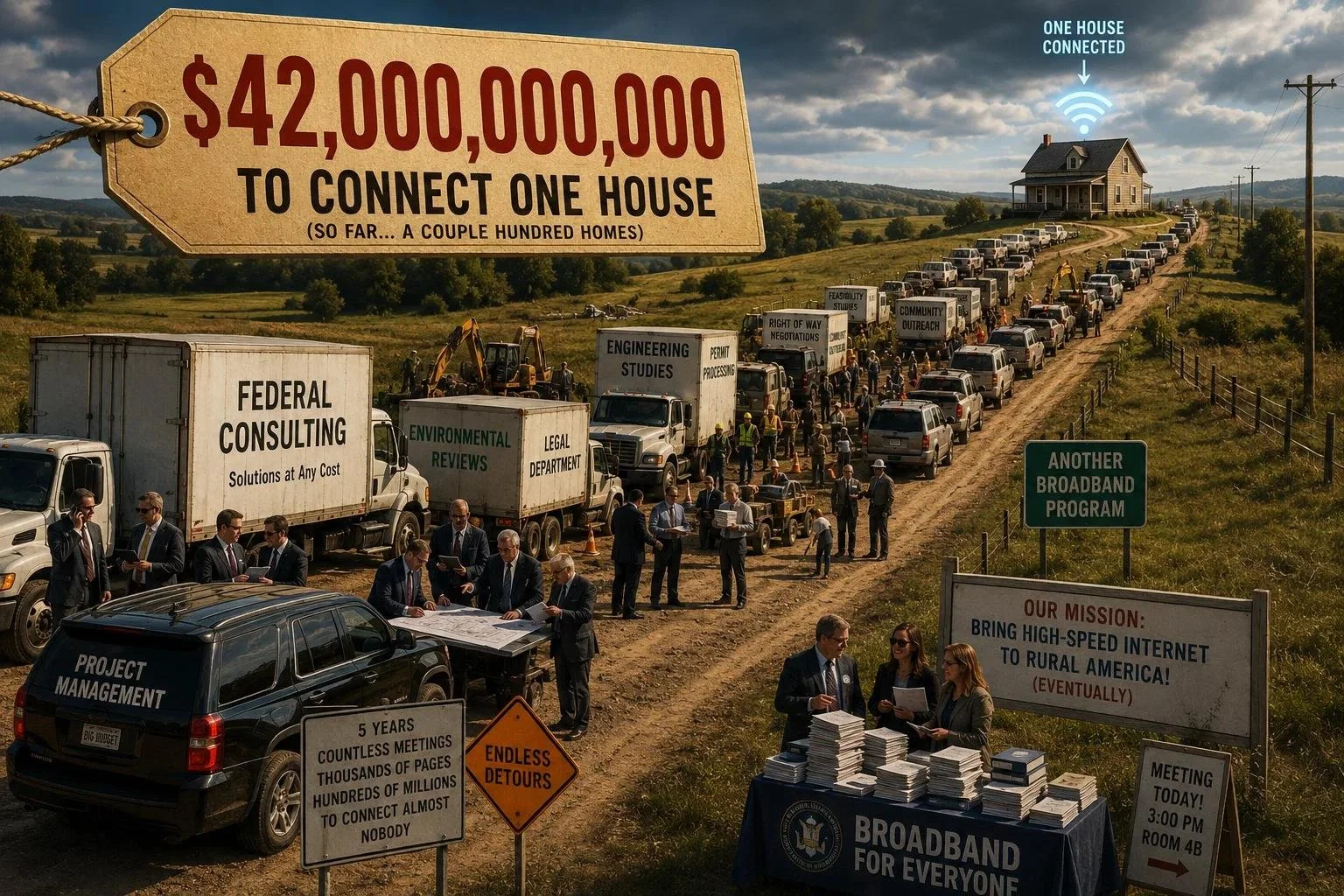
Its biggest program is the Broadband Equity, Access, and Deployment program, known as BEAD. It was created in 2021 as part of Joe Biden’s staggering infrastructure bill, and over $42 billion was allocated to wire up rural America.
Five years later it has connected almost nobody. The first BEAD-funded household in the entire country came online only this spring— a single home near Ogallala, Nebraska, hooked up in May 2026. About a hundred more followed in rural Louisiana. That was the triumphant achievement of five years and ridiculous money spent: a couple hundred connected homes.
BEAD is far from alone. In 2023, the Government Accountability Office— Congress's own watchdog— set out to count the federal government's broadband programs and found more than 133 of them, scattered across 15 separate agencies.
These programs are largely similar yet have no coordinated plan to prevent overlap, or wiring the same stretch of dirt twice.
The GAO told them to sort it out. When it checked back in 2025, most of the work hadn't been touched.
So what do you do about 133 overlapping programs and a flagship that spent billions to connect a couple hundred homes?
If you’re the United States Congress, you add a 134th broadband program!
On June 3, the House Rules Committee advanced next year's Agriculture spending bill with fresh loans and grants for the US Department of Agriculture's ReConnect program— the 134th rural broadband fund, stacked on the $42 billion one that barely works and the 133 others nobody can keep track of.
A private company that spends so much money to connect a couple hundred homes would be bankrupt, and its executives likely facing criminal charges. A federal agency that does it gets a sequel.
What makes it worse is that the problem was already solved by the free market.
Anyone at the end of a dirt road can order a Starlink dish online and have high-speed internet running within about a week— no federal fiber, no years-long wait, no act of Congress.
For that $42 billion price tag, the US taxpayer could have bought a Starlink dish for every one of the top-end estimate of 12 million unserved households in America AND prepaid their internet service for the next five years.
So where did that money go?
It is egregious. The government borrows $2 trillion a year to do this sort of garbage, and acts like a single dollar cut from the budget would throw single mothers out on the streets. They literally wail that “people will die”.
And half the country thinks the answer is to collect more in taxes!
Keep in mind, this $42 billion is part of the legitimate spending — not the $600 billion a year the Treasury Secretary estimates is lost to outright fraud, the $186 billion in improper payments the government admits to, or the hundreds of billions in legal graft on top.
All that borrowing and waste gets paid for one way or another— a weaker dollar, higher taxes, more inflation.
You can’t change any of that. But just like those people without internet on a dead-end road, you do have a choice.
That choice is a Plan B.
The tools to route around Congress already exist.
Owning real assets— gold, silver, energy, productive technology, and the well-managed businesses that produce them— protects your purchasing power when the government reaches for the printing press.
Moving some savings into stronger jurisdictions, establishing a second residency, and taking every legal step to cut your tax bill all mean that no single government's incompetence has total claim over your life.
None of it requires predicting the next crisis. It benefits you, and gives you options, no matter what happens next.
To your freedom, James Hickman Co-Founder, Schiff Sovereign LLC
Congress passed 133 broadband programs. Its Big Idea Is a 134th. | Schiff Sovereign
Monday Iraq News Posted by Tishwash at TNT 6-15-2026
TNT:
Tishwash: Ambassador Tom Barrack arrives in Baghdad to convey President Trump's support for the Iraqi government.
US envoy and ambassador, Tom Barrack, announced his arrival in the Iraqi capital, Baghdad, on an official visit, with the aim of strengthening joint cooperation and discussing prospects for partnership between the two countries.
Barak explained, in a post published on his official X platform account, that he began his visit by meeting with the staff of the US Embassy in Baghdad, headed by Chargé d'Affaires Joshua Harris.
TNT:
Tishwash: Ambassador Tom Barrack arrives in Baghdad to convey President Trump's support for the Iraqi government.
US envoy and ambassador, Tom Barrack, announced his arrival in the Iraqi capital, Baghdad, on an official visit, with the aim of strengthening joint cooperation and discussing prospects for partnership between the two countries.
Barak explained, in a post published on his official X platform account, that he began his visit by meeting with the staff of the US Embassy in Baghdad, headed by Chargé d'Affaires Joshua Harris.
The US envoy indicated that he would meet today with Prime Minister (al-Zaidi) to convey a message of support from President Donald Trump for the Iraqi government, in addition to discussing the bilateral partnership and exploring new directions for building strong and mutually beneficial relations between the United States and Iraq. link
************
Tishwash: The President of the Kurdistan Region welcomes the US-Iran agreement and affirms: Tom Barrack's visit will address important issues.
Kurdistan Region President Nechirvan Barzani announced on Monday, June 15, 2026, in a special statement to Kurdistan24 correspondent Hoshmand Sadiq, the region’s full support for the agreement reached between the United States of America and the Islamic Republic of Iran.
The United States and Iran reached a comprehensive agreement early Monday morning, June 15, 2026, to end tensions. The agreement includes a ceasefire in Lebanon and the reopening of the strategic Strait of Hormuz, and is scheduled to be officially signed in Switzerland next Friday, June 19.
Nechirvan Barzani expressed his hope that this agreement would be implemented quickly so that peace and stability could return to the region, stressing that the main goal is to avoid wars and establish peace, thus paving the way for greater stability for the people.
Tom Barrack, the US President’s Special Envoy to Iraq and Syria, is scheduled to visit Baghdad and Erbil on Tuesday, June 16, 2026.
Regarding this visit, the President of the Kurdistan Region explained that this is the first time that Tom Barrack has officially visited the region in his capacity as an envoy of the US President, stressing that issues related to the Kurdistan Region and Iraq in general will be discussed in order to strengthen joint coordination between all parties.
Regarding the internal situation in the Kurdistan Region, Nechirvan Barzani indicated that President Masoud Barzani’s initiative came at the right time, stressing the continuation of communication and work with all political parties. link
************
Tishwash: Uncertainty surrounds Washington: How will al-Zaidi's visit reshape Iraqi-American relations?
Professor of Political Science Dr. Khalifa Al-Tamimi revealed on Sunday (June 14, 2026) that any future visit by Iraqi Prime Minister Ali Al-Zaidi to the White House will focus on four main and direct issues with the American administration, foremost among them the financial file and the future of energy.
Al-Tamimi told Baghdad Today that the Prime Minister's upcoming visit to the United States will put four key issues on the table for discussion, most notably the financial situation and exploring mechanisms for developing investment, particularly in the oil and gas sectors. He added that the talks will also include the security aspect, in accordance with the terms of the Strategic Framework Agreement.
He added that "among the main issues is outlining the nature of the relationship between Baghdad and Washington for the next stage, especially since the United States has extensive vital interests in Iraq, at a time when the country is going through a sensitive and complex phase that requires the government to define its strategy in a way that preserves the supreme national interests and regulates the form of partnership with the American side."
Al-Tamimi pointed out that "the visit will consciously address how to support Baghdad in light of the financial crisis that has begun to take on critical dimensions, especially with the continuation of the Strait of Hormuz crisis, which has complicated the marketing of about 90% of Iraqi oil exports, which constitute the main nerve of the general budget."
The political expert pointed out that "the current US administration differs in its orientations from previous administrations, and the features of its policies towards Baghdad are still not entirely clear," suggesting that "this visit will provide decisive and important answers regarding how Washington will deal with the Iraqi file in all its complexities."
Al-Tamimi concluded by saying: “The Prime Minister’s visit to the United States may constitute a turning point in the course of the Iraqi financial crisis, through discussing the possibility of obtaining emergency exemptions related to energy or exports, and redrawing Iraq’s financial policies in a way that positively impacts internal economic stability.”
It is worth noting that Iraq and the United States share deep-rooted political, security, and economic ties based on the Strategic Framework Agreement signed in 2008, which governs cooperation between the two countries.
These moves come at a time when Baghdad faces mounting financial challenges due to the volatility of the global energy market and the logistical pressures associated with oil exports, amidst concerted government efforts to attract foreign investment and expand international partnerships to diversify national income sources. link
************
Tishwash: Parliamentary warnings about the economic exhaustion of the Iraqi street... Are lean years looming on the horizon?
MP Duha Laibi, from the Coordination Framework, sounded the alarm regarding the deteriorating living and service conditions in the country, stressing that the Iraqi street has become “completely exhausted” from the burden of the recent economic measures and reforms that have negatively affected its daily strength and future livelihood, at a time when large segments of citizens lack the most basic necessities of life and essential services.
Laibi told Al-Maalomah that “the ongoing waves of demonstrations and protests in various governorates are nothing but a natural reflection of the deep-rooted unemployment crisis,” explaining that “thousands of graduates continue to flock to the streets to demand their legitimate rights to appointment and job opportunities, coinciding with a state of overwhelming public discontent fueled by the continuation of corruption files and the waste of public money without decisive solutions.”
She added that “the successive wars and conflicts in the region have cast a heavy shadow on the joints of the national economy and levels of national income, leading to a direct erosion of the purchasing power of citizens and exacerbating the harshness of living conditions.”
Laibi revealed “an anticipated parliamentary movement that includes proposals and legislative actions aimed at curbing inflation and ensuring the stability of the Iraqi dinar exchange rate to protect the purchasing power of the citizen,” while stressing the need for the government to adopt flexible economic policies that take into account the human and livelihood dimension, and avoid burdening vulnerable classes with additional burdens that they cannot bear.”
The MP explained that “despite the House of Representatives being in its current legislative recess, this temporary stagnation will not disrupt oversight mechanisms,” emphasizing that “the relevant parliamentary committees and MPs concerned with oversight are closely and continuously monitoring all new government decisions and measures, especially those related to the pressing economic situation and exchange rate policies, to ensure that the situation does not deteriorate further.” link
************
Tishwash: The Investment Authority details the procedures for "Mall of Iraq" and responds to the statements of its owner.
On Sunday, the National Investment Commission issued a statement clarifying the legal procedures related to the "Iraq Mall" project, in response to what was circulated in the media and statements by the project's owner, Hassan Nasser, regarding exemption requests and power outages.
Hassan Nasser, the owner of "Iraq Mall," announced during a press conference that the mall is threatened with closure within 48 hours due to power outages, and financial losses estimated at about one and a half billion per month.
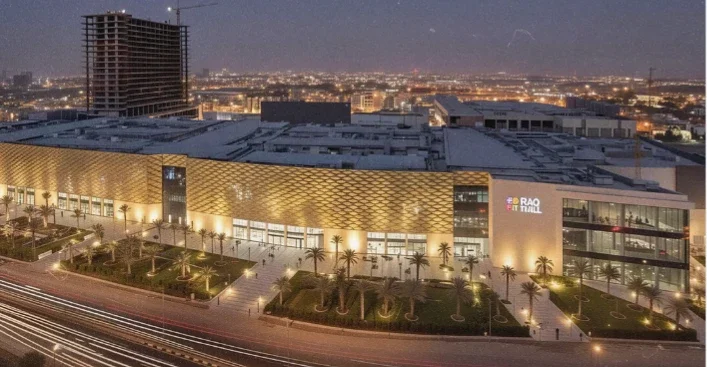
Nasser also said that the mall is facing major operational difficulties as a result of fluctuating electricity supply, which may lead to its complete closure during the aforementioned period.
The statement issued by the commission, and received by Shafaq News Agency, said that the first official communication from “Jewel of Baghdad for Investment and Real Estate Development” company, the owner and implementer of the project, was dated 5/24/2026, and was received from the Baghdad Investment Commission to the National Investment Commission, in which it requested that the mobile power station for the project with a capacity of 132.33 MVA be included in the customs exemptions.
She added that the Authority contacted the Ministry of Electricity on 2/6/2026 after the request was studied by the technical department to obtain the necessary approvals from the relevant sectoral authorities. The Ministry of Industry and Minerals was also contacted on 1/6/2026 via the electronic platform to determine the possibility of manufacturing the station locally or not, in accordance with the law protecting local products.
The authority explained that the investor submitted a pledge on 6/8/2026 to pay the customs duties if the station could be manufactured locally by the Ministry of Industry, noting that the General Authority of Customs was contacted to include the station in the exemptions in order to speed up the procedures.
She explained that the General Authority of Customs responded on 6/10/2026 with a rejection due to the lack of a legal basis, while emphasizing the need for the approval of the Ministry of Industry and Minerals as an effective legal basis. The approval of the Ministry of Industry was received on 6/14/2026 stating that it is not possible to manufacture these stations locally, which gives the Authority the legal powers to follow up on the procedures for bringing in the electrical station.
The statement added that the Authority, while welcoming criticism and media follow-up, expresses its regret for the issuance of statements that included personal characterization and targeting of some of its employees, stressing that its staff perform their duties in accordance with applicable laws and instructions.
The commission affirmed that its doors are open to receive complaints and objections through official channels, calling on investors to adhere to the approved legal procedures, and stressing its continued support for investment projects that contribute to the development of the Iraqi economy. link
MilitiaMan & CREW IRAQ DINAR UPDATE-"The Final Phase Is Accelerating: Iraq’s Convergences Are Tightening Fast"
MilitiaMan & CREW IRAQ DINAR UPDATE-"The Final Phase Is Accelerating: Iraq’s Convergences Are Tightening Fast"
6-14-2026
The Crew: Samson, PompeyPeter, Petra, Daytrader, Sunkissed, GIGI and Militia Man
No drama. No intrigue. No songs and dances. Just straight, factual news that I read and interpret to the best of my ability after being an avid Dinar investor and insanely obsessed Dinarian for over 15 years.
Follow MM on X == https://x.com/Slashn
MilitiaMan & CREW IRAQ DINAR UPDATE-"The Final Phase Is Accelerating: Iraq’s Convergences Are Tightening Fast"
6-14-2026
The Crew: Samson, PompeyPeter, Petra, Daytrader, Sunkissed, GIGI and Militia Man
No drama. No intrigue. No songs and dances. Just straight, factual news that I read and interpret to the best of my ability after being an avid Dinar investor and insanely obsessed Dinarian for over 15 years.
Follow MM on X == https://x.com/Slashn
Be sure to listen to full video for all the news……..
Iraq Economic News and Points To Ponder Late Sunday Evening 6-14-26
Iraq Economic News and Points To Ponder Late Sunday Evening 6-14-26
Economic Observatory: Financial Revenues For Iraqi Railways Are Unprofitable
Money and Business Economy News – Baghdad The Echo Iraq Observatory announced on Sunday that the financial revenues of Iraq Railways are not profitable, while pointing to a legal problem in delivering a train to the governorates of the Kurdistan Region.
The observatory stated in a statement that the railway network in Iraq currently has two main lines for night transport, linking Baghdad to Basra and back, passing through a number of governorates, indicating that the capacity of each trip reaches about 360 seats, including tourist seats and others designated for sleeping.
Iraq Economic News and Points To Ponder Late Sunday Evening 6-14-26
Economic Observatory: Financial Revenues For Iraqi Railways Are Unprofitable
Money and Business Economy News – Baghdad The Echo Iraq Observatory announced on Sunday that the financial revenues of Iraq Railways are not profitable, while pointing to a legal problem in delivering a train to the governorates of the Kurdistan Region.
The observatory stated in a statement that the railway network in Iraq currently has two main lines for night transport, linking Baghdad to Basra and back, passing through a number of governorates, indicating that the capacity of each trip reaches about 360 seats, including tourist seats and others designated for sleeping.
He explained that "the operation of these lines is done within a service-oriented framework aimed at covering operational expenses only, without generating direct revenues for the state," adding that revenues are generated when transporting goods such as oil and its derivatives, grains, and commercial goods.
He pointed out that "there are other lines within the country, but they are not operating regularly, including the Baghdad-Karbala line, which is used seasonally during religious visits, in addition to the Baghdad-Ramadi and Baghdad-Samarra lines, which do not operate daily."
He explained that "the Baghdad-Mosul line is still not operational due to the security situation that the country has witnessed in recent years, in addition to other lines such as Baghdad-Kirkuk."
The Eco Iraq Observatory called on the government to "develop the railway sector and expand the network linking the provinces and neighboring countries," adding that "rehabilitating the inefficient lines will enhance transportation, support the national economy, and boost non-oil revenues."
Regarding linking Baghdad with the Kurdistan Region governorates such as Erbil and Sulaymaniyah, the Observatory explained that there is a legal obstacle related to the ownership of the railway routes, as the laws stipulate that the lands through which the lines pass must be under the management of the General Company for Railways exclusively, which is facing objection from the region. https://www.economy-news.net/content.php?id=70225
Financial Times: Easing Sanctions On Iran Depends On Progress In Nuclear Negotiations
Arabic and international Economy News - Follow-up The Financial Times reported that easing sanctions on Iran, including releasing frozen assets abroad, will depend on the progress of negotiations on Iran's nuclear program.
The newspaper quoted sources familiar with the negotiations as saying that any easing of sanctions on Iran, including the release of its frozen assets abroad, would be gradual and contingent on progress in the nuclear negotiations, which would begin after the signing of the memorandum of understanding.
The sources added that the United States would grant Iran permission to sell oil during the 60-day extension of the ceasefire regime.
The Iranian news agency Mehr had previously reported, based on a draft memorandum of understanding, that the United States had pledged to release $24 billion of Iranian assets held abroad, with half of this amount to be returned to Iran before the memorandum of understanding between the two countries was signed.
US President Donald Trump and Iranian Deputy Foreign Minister Kazem Gharibabadi had earlier confirmed the completion of the memorandum of understanding, which is scheduled to be signed in Switzerland on June 19.
Iranian television officially announced early Monday that a peace agreement had been reached with the United States, indicating that Washington had been forced to accept ending the war.
Earlier, US President Donald Trump announced that the United States and Iran had reached a peace agreement, writing in a post on the Truth Social platform: "The agreement with the Islamic Republic of Iran has been finalized... Congratulations to all!"
The Pakistani Prime Minister also thanked the United States and Iran for their commitment to finding a diplomatic solution to the conflict, and thanked the leadership of the State of Qatar for its support in reaching an agreement between Washington and Tehran, and Saudi Arabia and Turkey for their contributions to reaching an agreement between Washington and Tehran.
https://www.economy-news.net/content.php?id=70267
Trump Threatens Macron: Either Cancel The Tech Tax Or Face 100% Tariffs
Arabic and international Economy News - Follow-up In a new escalation between Washington and Paris, US President Donald Trump threatened to impose 100% tariffs on all types of French wine and champagne.
In an interview with the New York Post, Trump said he had asked French President Emmanuel Macron to scrap the 3% tax on technology companies, warning that France could face devastating tariffs in the US market if it did not comply.
Trump explained, "I asked him (Macron) not to impose tariffs on American companies, and if they do, I will have no choice but to impose a 100% tariff on all Champagne and all wines produced in France."
The US president added that what Macron simply needs is to "cancel the sales tax, and then he will not be under this pressure."
US President Donald Trump is scheduled to arrive in Evian-les-Bains, France on Monday for the G7 summit meetings at a time when world leaders are increasingly wary of the United States.
Many experts have also pointed out that a large number of G7 leaders were directly affected by Trump’s erratic moves on the world stage, which caused turmoil in the Middle East, trade, and diplomacy.
https://www.economy-news.net/content.php?id=70268
The European Stoxx 600 Index Hits A Record High After The US-Iran Agreement.
Stock Exchange Economy News - Follow-up The pan-European STOXX 600 index opened at a record high on Monday, with most sectors rising after the United States and Iran reached a preliminary agreement to reopen the Strait of Hormuz and end the more than three-month-long conflict in the Middle East.
Global risk appetite improved, and Brent crude fell 4% after US and Iranian officials announced they had reached a framework agreement that is scheduled to be signed on Friday.
The pan-European STOXX 600 index rose 1.2% to 640.94 points by 07:11 GMT, surpassing its previous record high set on February 27. With Monday's gains, the benchmark index has recovered all of its conflict-related losses, according to Reuters.
Most sectors posted gains, led by automakers whose shares rose 3.5%, while shares of energy-sensitive airlines such as Lufthansa and Air France jumped more than 5% each. The travel and leisure sector also hit a new high.
European stocks have generally under performed compared to their US and Asian counterparts since March, mainly due to Europe's reliance on the Strait of Hormuz for oil supplies.
Concerns about inflation caused by rising energy prices prompted the European Central Bank to raise interest rates by 25 basis points last week.
Traders expect the European Central Bank to raise interest rates by another 25 basis points before the end of this year, according to data from the London Stock Exchange Group.
Shares of Schneider Electric, which specializes in artificial intelligence equipment, rose 3.3% after it entered into a strategic partnership with Taiwan's Foxconn to develop and expand its next-generation AI data center infrastructure. In contrast, energy stocks fell 2.7%, affected by the decline in crude oil prices. https://www.economy-news.net/content.php?id=70262
Jefferies International: A Federal Reserve interest rate hike is currently unlikely.
banks Economy News - Follow-up Jefferies International's chief economist, Alia Mbayed, said that recent declines in oil prices have led investors to reduce their expectations regarding an interest rate hike by the US Federal Reserve before the end of this year, noting that any potential move may be postponed until the beginning of next year.
Mbayed added that the scenario of the Federal Reserve raising interest rates in the near term seems unlikely at the moment.
Seeds of Wisdom RV and Economics Updates Monday Morning 6-15-26
Good Morning Dinar Recaps,
After the U.S.-Iran Breakthrough, the Focus Shifts to High-Stakes Nuclear Negotiations
The United States and Iran have reached a preliminary framework agreement to end months of conflict, but the most difficult phase—negotiating the future of Iran's nuclear program and sanctions relief—is only beginning.
Good Morning Dinar Recaps,
After the U.S.-Iran Breakthrough, the Focus Shifts to High-Stakes Nuclear Negotiations
The United States and Iran have reached a preliminary framework agreement to end months of conflict, but the most difficult phase—negotiating the future of Iran's nuclear program and sanctions relief—is only beginning.
Overview
The United States and Iran have announced a framework agreement designed to end hostilities and reopen the Strait of Hormuz, easing immediate concerns over global energy security.
Financial markets responded positively, with oil prices falling and investor confidence improving as fears of prolonged conflict subsided.
The next stage of negotiations will focus on Iran's nuclear program, sanctions relief, and long-term regional security, issues that remain unresolved.
Key Developments
1. Framework Agreement Marks Diplomatic Breakthrough
After months of conflict, Washington and Tehran have agreed to a preliminary framework intended to halt military operations and begin a broader diplomatic process. While not a final peace treaty, the agreement represents the most significant diplomatic progress since the conflict began.
2. Strait of Hormuz Reopens to Global Shipping
One of the agreement's most important provisions is the planned reopening of the Strait of Hormuz, one of the world's most critical oil transit routes. The announcement immediately reduced concerns over energy supply disruptions and helped lower global oil prices.
3. Nuclear Negotiations Become the Next Challenge
The agreement postpones the most difficult issue—the future of Iran's nuclear program—to a proposed 60-day negotiation period. Major differences remain over uranium enrichment, inspections, sanctions relief, and long-term security guarantees.
4. Lebanon Included in Regional De-escalation
The framework reportedly extends beyond U.S.-Iran relations by including commitments aimed at reducing violence in Lebanon, recognizing that regional stability requires addressing multiple conflict fronts rather than a single bilateral dispute.
5. Markets Shift Focus Toward Economic Recovery
Investors welcomed the prospect of improved energy flows and reduced geopolitical risk. Lower oil prices, easing inflation concerns, and greater stability in global shipping routes have improved market sentiment, although uncertainty surrounding the next phase of negotiations remains.
Why It Matters
The agreement has implications far beyond the Middle East. Restoring energy flows through the Strait of Hormuz could help reduce inflationary pressures, stabilize global supply chains, and ease one of the largest geopolitical risks facing the world economy.
However, lasting stability depends on the success of the upcoming nuclear negotiations, where the most politically sensitive issues remain unresolved.
Why It Matters to Foreign Currency Holders
Those following the Global Currency Reset (GCR) and international monetary developments should closely monitor the next phase of negotiations.
Reduced geopolitical risk could influence oil prices, inflation, interest-rate policy, central bank decisions, currency valuations, and cross-border trade flows. Any long-term agreement could also accelerate discussions surrounding international financial reform and alternative settlement mechanisms.
Implications for the Global Reset
Pillar 1: Energy
Reopening the Strait of Hormuz strengthens global energy security and reduces risks to one of the world's most important oil transportation corridors.
Pillar 2: Trade
Safer shipping routes improve international commerce, strengthen supply chains, and reduce transportation costs across global markets.
Pillar 3: Assets
Lower geopolitical uncertainty may stabilize financial markets while encouraging investment and reserve diversification.
Pillar 4: Technology
Future negotiations may include enhanced monitoring, verification technologies, and international compliance systems supporting nuclear oversight.
Pillar 5: Global Financial System
Reduced geopolitical tensions could improve global financial stability while supporting broader discussions on international payments, reserve management, and long-term economic restructuring.
This is not just diplomacy—it is global financial restructuring before our eyes.
Seeds of Wisdom Team
Newshounds News
Sources
Reuters — "U.S. and Iran Advance Framework Agreement as Nuclear Talks Continue"
Modern Diplomacy — "After the US-Iran Breakthrough, the Real Battle Shifts to Nuclear Talks"
~~~~~~~~~~
🌱 A Message to Our Currency Holders🌱
If you’ve been holding foreign currency for many years, you were not foolish.
You were not wrong to believe the global financial system would change.
What failed was not your patience — it was the information you were given.
For years, dates, rumors, and personalities replaced facts, structure, and proof. “This week” predictions created cycles of hope and disappointment that were never based on how currencies actually change.
That is not your failure.
Our mission here is different: • No dates • No rates • No hype • No gurus
Instead, we focus on:
• Verifiable developments • Institutional evidence
• Global financial structure • Where countries actually sit in the process
Currency value changes only come after sovereignty, trade, banking, settlement systems, and fiscal coordination are in place. History and institutions confirm this sequence.
You will see silence. You will see denials. That is not delay — that is discipline.
Protect your identity. Organize your documents. Verify everything.
Never hand your discernment to anyone who cannot show proof.
You deserve truth — not timelines.
Seeds of Wisdom Team
Newshounds News
~~~~~~~~~~
Seeds of Wisdom Team RV Currency Facts Youtube and Rumble
Newshound's News Telegram Room Link
RV Facts with Proof Links Link
RV Updates Proof links - Facts Link
Follow the Gold/Silver Rate COMEX
Follow Fast Facts
Seeds of Wisdom Team™ Website
Thank you Dinar Recaps
What Happens If the U.S. Economy Crashes?
What Happens If the U.S. Economy Crashes?
By Kimberly Amadeo Updated on August 28, 2024
Although the initial outbreak of COVID-19 in March 2020 sent a shockwave through the markets and economy, another recent near-collapse of the U.S. economy happened on September 16, 2008. This is the day the Reserve Primary Fund “broke the buck"—the value of the fund’s holdings dropped below $1 per share.1
Panicked investors withdrew billions from money market accounts where businesses keep cash to fund day-to-day operations.2 If withdrawals had gone on for even a week, and if the Fed and the U.S. government had not stepped in to shore up the financial sector, the entire economy would likely have ground to a halt. Trucks would have stopped rolling, grocery stores would have run out of food, and businesses would have been forced to shut down.
What Happens If the U.S. Economy Crashes?
By Kimberly Amadeo Updated on August 28, 2024
Although the initial outbreak of COVID-19 in March 2020 sent a shockwave through the markets and economy, another recent near-collapse of the U.S. economy happened on September 16, 2008. This is the day the Reserve Primary Fund “broke the buck"—the value of the fund’s holdings dropped below $1 per share.1
Panicked investors withdrew billions from money market accounts where businesses keep cash to fund day-to-day operations.2 If withdrawals had gone on for even a week, and if the Fed and the U.S. government had not stepped in to shore up the financial sector, the entire economy would likely have ground to a halt. Trucks would have stopped rolling, grocery stores would have run out of food, and businesses would have been forced to shut down.
Will the U.S. Economy Collapse?
A U.S. economic collapse is unlikely. When necessary, the government can act quickly to avoid a total collapse.
For example, the Federal Reserve can use its contractionary monetary tools to tame hyperinflation, or it can work with the Treasury to provide liquidity, as during the 2008 financial crisis and COVID-19 pandemic. The Federal Deposit Insurance Corporation insures banks, so there is little chance of a banking collapse similar to that in the 1930s.
The president can release Strategic Oil Reserves to offset an oil embargo. Homeland Security can address a cyber threat. The U.S. military can respond to a terrorist attack, transportation stoppage, or rioting and civic unrest. In other words, the federal government has many tools and resources to prevent an economic collapse.
What Would Happen If the U.S. Economy Were to Collapse?
If the U.S. economy were to collapse, you would likely lose access to credit. Banks would close. Demand would outstrip the supply of food, gas, and other necessities. If the collapse affected local governments and utilities, then water and electricity might no longer be available.
A U.S. economic collapse would create global panic. Demand for the dollar and U.S. Treasurys would plummet. Interest rates would skyrocket. Investors would rush to other currencies, such as the yuan, euro, or even gold. It would create not just inflation, but hyperinflation, as the dollar would lose value to other currencies.
If you want to understand what life would look like during an economic collapse, think back to the Great Depression. The stock market crashed on Black Thursday. By the following Tuesday, it was down 25%. Many investors lost their life savings that weekend.
By 1932, one out of four Americans was unemployed.3
Wages for those who still had jobs fell precipitously—manufacturing wages dropped 32% from 1929 to 1932.4 U.S. gross domestic product was cut nearly in half. Thousands of farmers and other unemployed workers moved to California and elsewhere in search of work. Two-and-a-half million people left the Midwestern Dust Bowl states.5 The Dow Jones Industrial Average didn't rebound to its pre-crash level until 1954.6
Collapse Versus Crisis
An economic crisis is not the same as an economic collapse. As painful as it was, the 2008 financial crisis was not a collapse. Millions of people lost jobs and homes, but basic services were still provided.
Other past financial crises seemed like a collapse at the time, but are barely remembered now.
1970s Stagflation
The OPEC oil embargo and President Richard Nixon’s abolishment of the gold standard triggered double-digit inflation. The government responded to this economic downturn by freezing wages and labor rates to curb inflation.7 The result was a high unemployment rate. Businesses, hampered by low prices, could not afford to keep workers at unprofitable wage rates.8
1981 Recession
In 1981, the Fed raised interest rates in a bid to end double-digit inflation.9 That created the worst recession since the Great Depression. President Ronald Reagan cut taxes and increased government spending to end it.10
1989 Savings and Loan Crisis
One thousand banks closed after improper real estate investments turned sour. Charles Keating and other Savings & Loan bankers had misused bank depositor’s funds. The consequent recession triggered an unemployment rate as high as 7.5%.11 The government was forced to bail out some banks to the tune of $124 billion.12
Post-9/11 Recession
The terrorist attacks on September 11, 2001, sowed nationwide apprehension and prolonged the 2001 recession—and unemployment of greater than 10%—through 2003.13 The United States’ response, the War on Terror, has cost the nation $6.4 trillion and counting.14
2008 Financial Crisis
The early warning signs of the 2008 Financial Crisis were rapidly falling housing prices and increasing mortgage defaults in 2006.15 Left untended, the resulting subprime mortgage crisis, which panicked investors and led to massive bank withdrawals, spread like wildfire across the financial community.16 The U.S. government had no choice but to bail out “too big to fail” banks and insurance companies, like Bear Stearns and AIG, or face both national and global financial catastrophes.17
March 2020: COVID-19 Pandemic
It is too soon to tally up the total costs of the COVID-19 pandemic—the crisis is still ongoing, although with far less intensity than in the early days.
How much economic cost should we expect? One estimate, from IMF Managing Director Kristalina Georgieva, proposed the global economy will lose $28 trillion in economic output from 2020 to 2025.18 As the U.S. economy seeks to recover from the challenges brought about by the pandemic, including heightened inflation, supply-chain disruptions, and labor market turmoil, government action will be a vital tool in moving forward.
https://www.thebalancemoney.com/u-s-economy-collapse-what-will-happen-how-to-prepare-3305690
China Just Beat the US at Its Own Game | Vince Lanci
China Just Beat the US at Its Own Game | Vince Lanci
TFTC: 6-14-2026
In the modern financial world, we often spend our time debating the strength of currencies—the dollar, the euro, or the yen. However, a deeper shift is occurring beneath the surface of the global economy. According to Vince, author of As Good as Gold: The Return to Real Money, the real story isn’t just about the currency we spend, but the collateral that backs it.
In a recent discussion on TFTC, Vince explores how the foundation of global finance is moving away from a US Treasury-centric model toward a more diversified framework involving gold, Bitcoin, and other hard assets.
China Just Beat the US at Its Own Game | Vince Lanci
TFTC: 6-14-2026
In the modern financial world, we often spend our time debating the strength of currencies—the dollar, the euro, or the yen. However, a deeper shift is occurring beneath the surface of the global economy. According to Vince, author of As Good as Gold: The Return to Real Money, the real story isn’t just about the currency we spend, but the collateral that backs it.
In a recent discussion on TFTC, Vince explores how the foundation of global finance is moving away from a US Treasury-centric model toward a more diversified framework involving gold, Bitcoin, and other hard assets.
To understand the global monetary system, one must distinguish between currency and collateral. While currency acts as the medium for daily transactions, collateral is the “trust” that allows the entire financial architecture to function.
For decades, US Treasury securities were the undisputed gold standard of collateral. However, as geopolitical landscapes shift and economic pressures mount, the world is beginning to look for alternatives.
Historically, gold held all three properties of money: a store of value, a medium of exchange, and a unit of account. After the breakdown of the Bretton Woods system in 1971, these roles were split; the US dollar became the primary unit of account and medium of exchange, while gold was relegated to a store of value.
Today, we are seeing a reversal of this trend. Gold is once again overtaking Treasuries as a preferred reserve asset for many central banks, signaling a return to tangible backing in an era of uncertainty.
This transition is particularly evident in the actions of the BRICS nations and China. These regions are actively establishing global gold vaults and developing parallel collateral markets. By leveraging gold reserves, these nations can secure financing for infrastructure and development projects without relying solely on the US Treasury repo markets.
Even the European Central Bank (ECB) has noted this transformation. While traditional institutions express concerns over the rise of private digital currencies and stablecoin dollars—which could threaten centralized monetary control—they are also forced to navigate a world where the US dollar is no longer the only game in town. This strategic effort by various nations aims to create a “multi-polar” economy, reducing dependence on any single national instrument.
As the global economy “swaps its engine while the car is still moving,” technology is playing a pivotal role.
The transition to a new system is being handled methodically to avoid financial chaos, utilizing innovations like digital currencies and evolving policy structures.
Bitcoin, specifically, is emerging as a unique piece of this puzzle. Unlike centralized digital assets or government-issued stablecoins, Bitcoin’s decentralized nature offers an alternative monetary system that operates outside of traditional control.
While governments may attempt to regulate these assets to maintain oversight, the existence of a decentralized option provides a failsafe or “exit ramp” during times of economic crisis or authoritarian overreach.
The shift in our monetary foundation is happening against a backdrop of significant socio-political and economic challenges.
From the pressures of inflation and energy constraints to the disruptive potential of AI and robotics, the sustainability of current economic models is being tested. Success in this new era will likely require a delicate balance of technological innovation and fiscal responsibility.
As Vince concludes, while money often gets the spotlight in public discourse, collateral does the foundational work. We are entering a period where trust is being redefined, and the assets we choose to back our systems will determine the stability of our economic future.
0:00 – Intro
0:37 - Collateral versus currency
3:52 - Gold to treasury transition
6:10 - ECB gold reserve overtakes
7:01 - Digital euro and stablecoins
18:08 - Repo markets and plumbing
20:26 - Gold vault network development
23:36 - Bitcoin strategic reserve act
28:36 - Impact of collateral shift
42:13 - AI race and policy
47:31 - Current gold market outlook
53:26 - Inflation and Fed response
56:26 - 1970s inflation parallels
1:03:09 - Book summary and takeaways
Iraqi Dinar News: CBI Denies Money Printing Accusations
Iraqi Dinar News: CBI Denies Money Printing Accusations
Edu Matrix: 6-13-2026
Iraq is currently navigating a complex period of transition, marked by significant shifts in its financial policies and geopolitical strategies.
A recent video from Sandy Ingram at Edu Matrix dives deep into these developments, shedding light on how the Central Bank of Iraq (CBI) and the current administration are working to stabilize the nation’s economy amidst global and regional pressures.
Iraqi Dinar News: CBI Denies Money Printing Accusations
Edu Matrix: 6-13-2026
Iraq is currently navigating a complex period of transition, marked by significant shifts in its financial policies and geopolitical strategies.
A recent video from Sandy Ingram at Edu Matrix dives deep into these developments, shedding light on how the Central Bank of Iraq (CBI) and the current administration are working to stabilize the nation’s economy amidst global and regional pressures.
From currency management to the diversification of oil export routes, the video provides a comprehensive overview of the challenges and opportunities facing the Iraqi dinar and the nation’s broader fiscal health.
One of the most pressing topics addressed is the stability of the Iraqi dinar. Recently, the Central Bank of Iraq has faced arguments regarding the printing of new currency to cover government expenditures.
The CBI has firmly denied these claims, asserting that its recent actions are standard treasury operations aimed at liquidity management rather than reckless money creation. According to Law No. 56 of 2004, the bank is prohibited from such practices, a point the CBI emphasizes to maintain investor confidence.
This denial is vital as Baghdad manages high spending pressures while attempting to curb fears of inflation and currency devaluation among its citizens and international observers.
In a move toward long-term sustainability, the Iraqi Prime Minister has pledged $10 billion to a new Development Fund. This initiative is designed to nurture the private sector and reduce the country’s heavy reliance on oil revenue—a strategy consistently recommended by the International Monetary Fund (IMF).
While the pledge represents a significant step toward economic diversification, the video notes that the actual impact remains to be seen. Iraq must still contend with significant bureaucratic hurdles and the inherent risks of managing such a large-scale fund in a complex political environment.
The landscape of Iraq’s oil industry is also undergoing a strategic overhaul. Due to regional tensions and the blockade of the Strait of Hormuz, Iraq has seen its monthly oil revenue drop from upwards of $10 billion to approximately $1 billion.
To counter this, Baghdad is exploring alternative export routes. This includes a notable reconciliation with the Kurdistan Regional Government (KRG) to utilize pipelines through Turkey to the Mediterranean, as well as strengthening cooperation with Jordan for pipeline access. This pragmatic shift highlights a unified effort between Baghdad and Erbil to ensure that Iraq’s primary resource can reach global markets despite regional chokepoints.
Furthermore, the video highlights a shift in Iraq’s political leadership. The current Prime Minister represents a new generation of leadership; having built significant business influence in the post-2003 era, he brings a pragmatic, results-oriented approach to the office.
This transition comes at a time when geopolitical influences, particularly from the United States, are encouraging Iraq to take a more decisive stance in regional affairs. By balancing sensitive domestic relationships with international diplomatic pressures, the current administration is attempting to carve out a more stable path for the nation.
In summary, Iraq is engaged in a delicate balancing act. The government is working to maintain currency stability and rejuvenate a war-torn economy through private sector investment while simultaneously rerouting its oil exports to bypass regional volatility.
These developments indicate a transformative, albeit challenging, era for the country. For a deeper dive into these economic insights, you can watch the full video from Edu Matrix on YouTube to stay informed on the evolving situation in Iraq.
https://www.youtube.com/watch?v=zwENeC1aHG8
https://dinarchronicles.com/2026/06/14/edu-matrix-iraqi-dinar-news-cbi-denies-money-printing/
Seeds of Wisdom RV and Economics Updates Sunday Afternoon 6-14-26
Good Afternoon Dinar Recaps,
Xi's North Korea Visit Signals Shifting Power Balance as Kim Eyes Future Trump Talks
Chinese President Xi Jinping's first visit to North Korea in seven years highlights Beijing's effort to strengthen regional alliances while Washington remains focused on the Middle East, potentially reshaping strategic dynamics across Asia.
Good Afternoon Dinar Recaps,
Xi's North Korea Visit Signals Shifting Power Balance as Kim Eyes Future Trump Talks
Chinese President Xi Jinping's first visit to North Korea in seven years highlights Beijing's effort to strengthen regional alliances while Washington remains focused on the Middle East, potentially reshaping strategic dynamics across Asia.
Overview
President Xi Jinping and Kim Jong-un announced a new phase of strategic cooperation following Xi's historic two-day visit to Pyongyang.
The visit comes as the United States remains heavily engaged in the Iran conflict, providing China an opportunity to reinforce its influence in Northeast Asia.
Analysts believe North Korea hopes to leverage China's support to eventually reopen direct negotiations with President Donald Trump after the Iran conflict subsides.
Key Developments
1. Xi Strengthens China–North Korea Alliance
President Xi Jinping's first visit to North Korea since 2019 resulted in expanded agreements covering trade, agriculture, science, technology, transportation, and border cooperation. Both leaders emphasized strengthening strategic communication while opposing what they described as regional hegemony.
2. China Moves While Washington Focuses on the Middle East
With U.S. attention centered on the Iran conflict, Beijing appears to be using the opportunity to solidify its influence across Northeast Asia. The visit reinforces China's long-term strategy of securing regional partnerships while expanding its geopolitical leverage.
3. Energy Security Drives Beijing's Strategy
China imports a meaningful share of its oil from Iran, making stability in the Middle East critical to its economy. Strengthening ties with North Korea provides Beijing with additional strategic depth as uncertainty surrounding the Strait of Hormuz continues.
4. Kim Signals Interest in Future U.S. Negotiations
Reports suggest North Korea is using Xi's visit as diplomatic cover to position itself for future negotiations with the Trump administration. Pyongyang appears interested in seeking economic concessions while maintaining recognition of its nuclear capabilities.
5. Regional Competition Continues to Intensify
The summit reflects the growing competition between major global powers as China, Russia, the United States, and regional allies continue reshaping economic, military, and diplomatic relationships throughout Eurasia and the Indo-Pacific.
Why It Matters
This summit demonstrates that global geopolitical competition extends far beyond the Middle East. As the United States focuses on Iran, China is strengthening strategic partnerships closer to home, reinforcing its influence over one of Asia's most sensitive security regions.
The visit also underscores how energy security, diplomacy, and great-power competition are becoming increasingly interconnected in today's emerging multipolar world.
Why It Matters to Foreign Currency Holders
Those following the Global Currency Reset (GCR) and broader financial restructuring should monitor developments across both Asia and the Middle East.
As major powers strengthen regional alliances and diversify economic relationships, discussions surrounding alternative trade corridors, local currency settlements, energy security, and cross-border payment systems continue to gain momentum. These developments may influence the future architecture of global finance.
Implications for the Global Reset
Pillar 1: Trade
China continues expanding regional economic partnerships that could gradually reduce dependence on traditional Western-centered trade networks.
Pillar 2: Energy
Protecting energy supplies and reducing vulnerability to disruptions around the Strait of Hormuz remains a central strategic objective for Beijing.
Pillar 3: Assets
Long-term geopolitical uncertainty encourages nations to diversify reserves and strengthen domestic economic resilience.
Pillar 4: Technology
Expanded cooperation in science and technology highlights the growing importance of technological independence within competing economic blocs.
Pillar 5: Global Financial System
Strengthening regional alliances supports the ongoing development of alternative financial infrastructure, payment systems, and multipolar economic cooperation outside traditional Western institutions.
This is not just geopolitics—it is global financial restructuring before our eyes.
Seeds of Wisdom Team
Newshounds News™ Exclusive
Sources
Modern Diplomacy — "Xi's North Korea Visit Fuels Kim's Push for Trump Talks After Iran War"
Reuters — "Xi Visits North Korea as China Strengthens Regional Ties Amid Global Tensions"
~~~~~~~~~~
Seeds of Wisdom Team RV Currency Facts Youtube and Rumble
Newshound's News Telegram Room Link
RV Facts with Proof Links Link
RV Updates Proof links - Facts Link
Follow the Gold/Silver Rate COMEX
Follow Fast Facts
Seeds of Wisdom Team™ Website
Thank you Dinar Recaps
Recession vs. Depression: How To Tell the Difference
Recession vs. Depression: How To Tell the Difference
What makes a depression so much worse than a recession?
By Kimberly Amadeo Updated on December 22, 2022
A recession is a widespread economic decline that typically lasts between two and 18 months.1 A depression is a more severe downturn that lasts for years. The most famous depression in U.S. history was the Great Depression. It lasted a decade.
According to the National Bureau of Economic Analysis, the Great Depression was a combination of two recessions. The first lasted for 43 months, from August 1929 to March 1933. The next lasted 13 months, from May 1937 to June 1938. The severe downturn lasted for about 10 years combined. There have been 34 recessions since 1854. Recessions have lasted for approximately 10 months on average since 1945.2
Recession vs. Depression: How To Tell the Difference
What makes a depression so much worse than a recession?
By Kimberly Amadeo Updated on December 22, 2022
A recession is a widespread economic decline that typically lasts between two and 18 months.1 A depression is a more severe downturn that lasts for years. The most famous depression in U.S. history was the Great Depression. It lasted a decade.
According to the National Bureau of Economic Analysis, the Great Depression was a combination of two recessions. The first lasted for 43 months, from August 1929 to March 1933. The next lasted 13 months, from May 1937 to June 1938. The severe downturn lasted for about 10 years combined. There have been 34 recessions since 1854. Recessions have lasted for approximately 10 months on average since 1945.2
Key Takeaways
There have been 34 recessions in the U.S. since 1854, but only one depression.
Recessions last for months, while a depression can last for years.
A recession is often the result of consumers losing confidence in the economy due to some major event, such as the coronavirus pandemic.
Signs of a Recession
There are five indicators that economists can use to determine whether or not the economy is in a recession.3
Negative real Gross Domestic Product (GDP) for two or more quarters can indicate a recession.
A decline in consumer's real income can indicate a recession, since consumer purchasing power will also decline.
The strength of the manufacturing sector, and whether there is a trade surplus or deficit, helps economists determine whether the economy is self-sufficient.
Inflation-adjusted retail and wholesale sales of products and goods can show economists whether there is a recession.
A high unemployment rate, which would be about six percent or higher, indicates that the economy has already entered a recession.
Recession vs. Depression
Gross domestic product (GDP) contracts for at least a few months in a recession.4 GDP growth will slow for several quarters before it turns negative in a typical recession.
There's also a drop in four other critical economic indicators: income, employment, manufacturing, and retail sales. These reports come out each month, while the GDP is released quarterly, so they can signal a recession before the GDP turns negative.
A depression is longer and more destructive than a recession. The economic contraction from a depression lasts for years, not quarters. GDP was negative for six out of the 10 years during the Great Depression. It shrank by a record of 12.9% in 1932, unemployment reached nearly 25% in 1933, and prices dropped for four years in a row in the 1930s.567
The devastation of a depression is so great that the effects of the Great Depression lasted for decades after it ended. The stock market didn't recover until 1954.8
Depression
A depression lasts for years
A depression has only occurred once in the U.S. since 1854
A depression's effects on the economy can last for decades
Recession
A recession lasts for months
There have been 34 recessions in the U.S. since 1854
A recession is signaled by a drop in employment, retail sales, manufacturing, and income
Causes of a Recession
Causes of a recession include:
Loss of confidence in investment and the economy
High interest rates
A stock market crash
Falling housing prices and sales
Manufacturing orders slow down
Deregulation
Poor management
Wage-price controls
Post-war slowdowns
Credit crunches
Asset bubbles burst
Deflation
Consumers will stop buying and businesses will lay off workers when there's no confidence in the future. These situations create a downward spiral of unemployment, loan defaults, and bankruptcies.
A shock often triggers this type of panic reaction, such as a stock market crash, wage-price controls, the collapse of an asset bubble, or an unanticipated reaction to government action, such as deregulation or an increase in interest rates.910 It's business behavior at other times, such as poor management or credit crunches.11 It was a pandemic in 2020.
More To Read Here: https://www.thebalancemoney.com/recession-vs-depression-definition-causes-and-stats-3306048
Sunday Iraq News Posted by Tishwash at TNT 6-14-2026
TNT:
Tishwash: Standard & Poor's affirms Iraq's sovereign rating and removes it from negative watch.
Standard & Poor's Global Ratings affirmed Iraq's sovereign rating at "B-/B" and removed the long-term rating from its negative watch list.
The agency gave a negative outlook, citing the risks of conflict in the Middle East over the next six to twelve months, including continued disruptions to export trade routes through the Strait of Hormuz and the potential for damage to infrastructure.
Iraq’s economy remains heavily dependent on the oil sector, which means it is suffering greatly from the decline in crude exports through the strategic waterway, according to Reuters.
TNT:
Tishwash: Standard & Poor's affirms Iraq's sovereign rating and removes it from negative watch.
Standard & Poor's Global Ratings affirmed Iraq's sovereign rating at "B-/B" and removed the long-term rating from its negative watch list.
The agency gave a negative outlook, citing the risks of conflict in the Middle East over the next six to twelve months, including continued disruptions to export trade routes through the Strait of Hormuz and the potential for damage to infrastructure.
Iraq’s economy remains heavily dependent on the oil sector, which means it is suffering greatly from the decline in crude exports through the strategic waterway, according to Reuters.
The agency predicted that oil production would average 2.9 million barrels per day for the entire year in 2026, down about 28% from the pre-war average of 4 million barrels per day recorded in 2025, attributing its forecast to current production levels and the fragile recovery expected in the second half.
The agency said that given that oil flows constitute more than 90% of budget revenues and merchandise exports, Iraq’s financial situation and balance of payments are likely to remain under pressure this year, forecasting a 15% contraction in real GDP this year.
Higher average oil prices during 2026 would provide some support for fiscal and external revenues, assuming oil exports gradually recover in the second half, which Standard & Poor's said remains its baseline scenario.
The agency had placed Iraq’s long-term sovereign rating of “B-” on negative watch in March, citing the risk of a downgrade following a sharp drop in oil production linked to escalating conflict in the region. link
*************
Tishwash: The Development Fund: Will Al-Zaidi succeed in creating a new financing arm for Iraq?
Al-Mada/Mohammed Al-Obeidi:
The government's move to establish a "Development Fund" in Iraq is sparking widespread debate in economic and financial circles, given the country's financial crisis and the general budget's heavy reliance on oil revenues. While the government sees the project as an opportunity to attract investments and stimulate economic growth, experts are raising questions about its launch timing, funding mechanisms, and its ability to achieve its objectives under current financial pressures.
This move coincides with political and economic initiatives led by Prime Minister Ali Faleh Al-Zubaidi, who is seeking to garner domestic and international support for the fund as an investment platform aimed at financing infrastructure projects, creating jobs, and diversifying sources of economic growth away from traditional dependence on oil.
Government officials have spoken of international contributions and guarantees that could reach between $100 and $150 billion, in addition to hopes of attracting further investments and partnerships in the coming phase.
Regarding the Washington visit , financial and banking researcher Haider Al-Sheikh told Al-Mada that "the Development Fund is an investment fund based on contributions from foreign and Arab companies, and the government has set a minimum capital of $100 billion."
He added that “the Prime Minister’s upcoming visit to the United States could contribute to enhancing the project’s chances of success, particularly through meetings with representatives of American and foreign companies and inviting them to invest in Iraq.” He explained that “the entry of American companies could pave the way for more Arab and foreign companies to participate in investment projects through the Development Fund.”
Sheikh clarified that “the project is inherently investment-oriented, and the government’s role is to create a suitable environment for investors and enable them to implement projects, thereby contributing to stimulating the economy and expanding the investment base.” He pointed out that “the Fund is not primarily focused on direct operational spending, but rather aims to attract capital to productive and developmental projects.”
The idea of establishing a sovereign wealth fund or a development fund is not new to Iraq. In recent years, successive governments have proposed similar initiatives and ideas aimed at investing oil wealth, diversifying income sources, and promoting long-term investments.
However, most of these projects remained within the realm of official pronouncements and declarations, failing to materialize into effective institutions on the ground. This was due to challenges related to financial crises, mismanagement, fluctuating oil prices, high operating costs, and political and administrative disputes. Regarding the timing dilemma, economist Dirgham Muhammad believes that "the establishment of development funds or sovereign wealth funds is usually linked to the existence of financial surpluses after covering the needs of the general budget."
He added to Al-Mada that "the situation might be different if the funds are in the form of grants rather than loans," explaining that "grants allocated to sovereign wealth funds are conditional on directing them towards investment and developing investment portfolios with guaranteed returns, and not using them to finance operating expenses."
Experts point out that the success of any development fund of this size hinges on the nature of its funding sources, legal guarantees, governance, and management mechanisms, as well as the state's ability to provide a stable investment environment that attracts and retains capital. This comes at a time when Iraq faces challenges related to the budget deficit, fluctuating oil prices, and the need for structural reforms in economic management.
These proposals are made as the government has announced that the development fund will be an investment vehicle independent of the general budget, relying on international contributions and guarantees aimed at achieving economic stability through investment. This will be done in conjunction with efforts to reform financial management and adopt a program-based budget in coordination with international bodies and local institutions. link
************
Tishwash: A strategic move: ExxonMobil opens the door to massive investments in Iraqi oil.
Baghdad/Al-Masalla Translation: ExxonMobil executives met with the new Iraqi Oil Minister, Basim Khudair.
The American giant had signed a preliminary agreement last year to develop the Majnoon field, which has a production capacity of 450,000 barrels per day, in addition to exploring the development of infrastructure for Iraq’s oil exports.
Since taking office last month, Khodair has called on American companies to resume trade talks that had begun under the previous government.
According to informed sources, the meeting took place in Baghdad on June 7, where the two sides discussed ways to expedite the implementation of the preliminary, non-binding agreement signed in October 2025 with the Basra Oil Company and the Iraqi State Oil Marketing Organization (SOMO). The agreement focuses on developing the giant Majnoon oil field, which holds estimated reserves of approximately 38 billion barrels, with the potential for a significant increase in production in subsequent phases.
The Majnoon oil field, one of the world's largest, is located in Basra Governorate in southern Iraq. The partnership aims to utilize cutting-edge technologies to improve recovery rates and reduce associated gas flaring, as well as upgrade export infrastructure including ports, pipelines, and storage facilities, and potentially explore joint marketing opportunities in Asian markets.
These talks come as part of a wave of major American companies returning to Iraq, such as Chevron, which is holding exclusive talks for the West Qurna 2 field, as part of the government's efforts to modernize the oil sector and offer more attractive investment terms.
The importance of strengthening cooperation for the Iraqi economy
Strengthening the partnership with ExxonMobil represents a vital strategic step for the Iraqi economy, which relies on oil for over 90% of its budget revenues. Iraq aims to increase its oil production to 6 million barrels per day by 2029, compared to approximately 4 million barrels currently, and the development of fields like Majnoon, through investments of billions of dollars, will contribute to achieving this goal.
This cooperation also helps modernize export infrastructure, reducing operational losses, increasing export capacity, and opening new markets. It brings advanced American technical expertise to improve production efficiency, develop associated gas for power generation, and reduce environmental emissions, thus supporting long-term economic diversification.
For its part, ExxonMobil sees Iraq as an opportunity to access large, inexpensive oil reserves, thus bolstering its global portfolio. Analysts emphasize that such agreements have both political and economic dimensions, as they strengthen Iraq's geopolitical balance and attract Western investments that contribute to stability and economic growth.
Negotiations are ongoing to transform the initial agreements into binding contracts, with a focus on ensuring mutually beneficial returns amidst security and administrative challenges. This cooperation is seen as part of a broader strategy to rebuild Iraq's energy sector and strengthen its position in the global market. link
************
Tishwash: Program budgeting in Iraq: Financial reform or a restructuring of the public spending system?
Iraq's move towards program budgeting reveals an attempt to rebuild the philosophy of public finance management by linking spending to results and objectives instead of the traditional distribution of allocations.
This trend comes at a time when the region is facing accelerating economic and regional challenges that require governments to adopt more flexible policies in managing resources, as Baghdad affirms that it continues to work on protecting financial stability and ensuring the financing of basic obligations, in parallel with preparing visions for future budgets that are compatible with local and international changes.
Finance Minister Faleh Sari announced during his talks with the US Chargé d'Affaires in Baghdad a government plan to prepare a program budget and gradually move away from the traditional system, which would raise the efficiency of spending and link allocations to performance and results, within the framework of a reform vision that enjoys the support of international institutions and seeks to develop the state’s financial management.
careful study
In this context, MP Hussein Al-Khafaji, a member of the Parliamentary Finance Committee, revealed that “the Finance Committee will discuss with the relevant executive authorities the various indicators and data related to the financial situation, in order to ensure that decisions are made based on accurate information and a comprehensive vision.”
He then explained that “there are important files related to strategic projects, contracts and government commitments that need careful study in order to maintain the continuity of work and serve the public interest.”
He added that “the upcoming meetings will provide a clearer picture of the financial path during the next stage, especially in light of the current economic conditions, which will help to formulate a realistic vision regarding the budget and government spending.”
Measuring results and achieving goals instead of simply distributing financial allocations
Observers believe that adopting a program budget represents a qualitative shift in public finance management, as it focuses on measuring results and achieving goals instead of merely distributing financial allocations. This contributes to raising the efficiency of government institutions, reducing waste, improving spending priorities, and enhancing transparency in the implementation of development projects and plans.
Experts also point out that the continued coordination between the government, the parliamentary finance committee and the central bank reflects the existence of an institutional path for managing the financial file, especially in light of the keenness to secure basic expenditures and protect economic stability, in parallel with reviewing spending priorities and developing financial planning tools to keep pace with current changes.
While technical discussions on the upcoming budget continue, the government appears to be moving forward with adopting structural reforms aimed at modernizing financial management, improving the efficiency of resource use, and creating a more sustainable environment for public spending, in order to ensure the continued implementation of vital projects, support basic services, and enhance confidence in the national economy during the next phase. link
**************
Tishwash: How is the economy being managed? Iraq is without a budget for the fourth time since 2003.
Iraq is entering an unprecedented financial phase, with increasing indications that the federal budget for 2026 will not be approved, at a time when the country is facing double pressures represented by the decline in oil revenues and the continuation of regional turmoil that has affected the movement of oil exports, which puts the government before the challenge of managing the economy through temporary spending rules for the fourth time since 2003.
Iraq is almost entirely dependent on oil revenues, which constitute more than 90% of public revenues, while public finances are facing increasing pressure after the failure to approve spending and revenue schedules, amid fears of the repercussions of this on investment projects, infrastructure, job opportunities and economic growth.
temporary spending
In this context, the financial advisor to the Prime Minister, Mazhar Muhammad Saleh, says that the financial policy during the year 2026 is still managed in accordance with the provisions of the Federal Financial Management Law No. 6 of 2019, especially Article 13, which allows spending at a rate of (1/12) per month of the expenses of the previous year in the event of a delay in approving the budget.
Saleh explained to Shafaq News Agency that this mechanism "enabled the continuity of public spending, especially salaries, wages, pensions and social welfare, in addition to financing basic investment expenditures and ongoing projects according to completion rates and available liquidity."
But Saleh acknowledges that public finances are facing increasing pressure as a result of geopolitical developments and fluctuations in global energy markets, which has impacted oil revenues as the main source of funding for the public treasury.
He indicates that the government is currently moving towards preparing the 2027 budget within a reform framework that focuses on the efficiency of public spending, rationalizing operational expenses, protecting social programs, and giving priority to economically viable projects, as well as diversifying revenues and promoting digital transformation and administrative reform.
This comes after about 16 months of no budget schedules being approved, at a time when the three-year budget for the years 2023, 2024 and 2025 represented the last integrated financial framework for government spending before it effectively ended at the end of 2025.
Suspended projects and postponed development
For his part, economist Diaa Al-Mohsen believes that the greatest impact of the absence of a budget will fall on investment spending, because the budget is not just a financial document, but a tool for managing the state’s economic and investment activity.
Al-Muhsin tells Shafaq News Agency that the absence of a budget practically means difficulty in launching new development projects or expanding infrastructure projects, including roads, bridges, schools, hospitals, electricity and water networks, as well as delays in government contracts.
He adds that ministries and governorates will gradually lose the ability to plan in the medium and long term, while the contribution of government spending to stimulating economic activity will decline, which will directly affect the contracting, industry, transport and services sectors.
These concerns coincide with previous parliamentary data that spoke of more than 4,500 stalled projects across Iraq, some of which have been halted for years, at a time when experts believe that the absence of a budget will add new projects to the long list of stalled projects.
Recruitment under pressure
The impact of the lack of a budget is not limited to investment projects, but extends to the government employment file, which represents one of the most prominent outlets for absorbing graduates in Iraq.
Al-Muhsin confirms that appointment opportunities will be very limited, with exceptions likely to be restricted to specific sectors such as health, education, and security services, warning that this will lead to increased social pressures in light of rising unemployment rates among young people.
For his part, economic researcher Ahmed Eid says that spending according to the (1/12) rule ensures the continuation of salaries and basic services, but it does not provide the necessary flexibility to launch new projects or expand investment spending.
Eid adds to Shafaq News Agency that the absence of a budget imposes a state of financial uncertainty and limits the government’s ability to implement its economic plans efficiently. It also negatively affects companies contracted with the state and local and foreign investors due to the lack of a clear vision for future projects.
Accumulating risks
Experts believe that the absence of a budget presents a financial paradox. On the one hand, it leads to a decline in investment spending, which may reduce the financial deficit in the short term, but on the other hand, it weakens economic growth and leads to a decline in non-oil revenues related to economic activity.
Al-Muhsin explains that the deficit may improve numerically as a result of lower capital expenditures, but the economy will pay the price later through a decrease in productive capacity, a decline in job opportunities, and the continued dominance of operating spending at the expense of productive investment.
This comes at a time when public finances are facing additional challenges related to declining oil exports and regional market turmoil, which increases the likelihood of resorting to domestic borrowing to finance essential expenditures.
difficult economic situation
Financial expert Mahmoud Dagher believes that the absence of a 2026 budget is different from previous cases witnessed by Iraq, explaining that the House of Representatives did not approve the spending and revenue schedules during 2025, which is an issue he describes as having great technical and legal importance when applying the (1/12) rule.
Dagher told Shafaq News Agency that the country is currently going through "the most difficult economic situation," adding that talking about appointments or expanding spending seems difficult at the present stage, because the priority is focused on securing salaries and some governing expenses by financing the deficit through the Central Bank.
He emphasizes that the main challenge is no longer achieving rapid economic growth, but rather reaching the highest levels of efficiency in spending and controlling expenditures to protect foreign reserves, which represent the primary line of defense for the stability of the Iraqi dinar and the financing of imports.
Public debt and borrowing
Concerns are growing about the impact of the absence of a budget on public debt levels, especially with continued pressure on oil revenues.
In this regard, Ahmed Eid says that the government may be forced to expand its domestic financing tools through levies, taxes and borrowing from local banks, warning that this path raises financial risks in the medium term if it is not accompanied by real reforms to control spending and enhance non-oil revenues.
These concerns are consistent with previous warnings issued by economic experts regarding the widening gap between revenues and expenditures, in light of the rise in domestic debt during the past months and the government's reliance on exceptional financing tools to cover its basic obligations.
Managing the economy without a budget
In theory, experts say the government can manage the country through temporary spending rules, but with limited efficiency.
Al-Muhsin asserts that these rules allow for the payment of salaries, the continuation of public services, and the financing of some ongoing projects, but they do not provide an effective framework for managing economic development, because investment decisions become restricted and economic planning loses its clarity, while investors and governorates face an increasing state of uncertainty.
He summarizes the matter by saying: "The state can be managed, but development is difficult to manage."
In contrast, economist Safwan Qusay calls for finding alternative sources of funding for investment projects outside the framework of the traditional budget.
Qusay tells Shafaq News Agency that continuing to spend according to the (1/12) rule is practically limited to operational expenses, which requires finding special mechanisms to finance investment projects through borrowing laws or partnerships with the private sector and investors.
It is proposed to expand the role of investment portfolios and investment bodies by offering infrastructure and service projects to investors in exchange for investment opportunities in the commercial, tourism and real estate sectors, in order to ensure the continuity of project funding and prevent its interruption. link
Iraq Economic News and Points To Ponder Late Saturday Evening 6-13-26
The Events Of The Region Determine The Economic Paths Of Iraq. A Financial Crisis, A Rise In Prices And A Change In The Value Of The Dinar
12 Jun Information/Report... The events of the region directly affect the economic situation of Iraq, which is at the heart of the hurricane witnessed by the countries of the so-called Middle East, after the war invented by America and its Zionist entity against the Islamic Republic and the repercussions of this on the Strait of Hormuz, are all factors that may lead governments, especially in Iraq, to take decisions that mitigate the extent of the damage, but make the people pay the tax, by reducing the value of salaries in case of going towards devaluing the dinar, and following the policy of austerity and raising the amounts of fees in various sectors, which will harm the citizen.
The Events Of The Region Determine The Economic Paths Of Iraq. A Financial Crisis, A Rise In Prices And A Change In The Value Of The Dinar
12 Jun Information/Report... The events of the region directly affect the economic situation of Iraq, which is at the heart of the hurricane witnessed by the countries of the so-called Middle East, after the war invented by America and its Zionist entity against the Islamic Republic and the repercussions of this on the Strait of Hormuz, are all factors that may lead governments, especially in Iraq, to take decisions that mitigate the extent of the damage, but make the people pay the tax, by reducing the value of salaries in case of going towards devaluing the dinar, and following the policy of austerity and raising the amounts of fees in various sectors, which will harm the citizen.
“Everyone, whether in Iraq, its government and the rest of the world, is monitoring the developments of the current scene in the region, and awaits the outcome of the indirect negotiations between the American and Iranian sides,” says Imran Karkoush, a member of the State of Law Coalition.
He added that "the Iraqi economy has been affected by the developments in the region and military escalation, as Iraq is awaiting the results of negotiations between Washington and Tehran in order to restore the situation to what it was before in the Strait of Hormuz."
He pointed out that "Iraq was directly affected by the ongoing war in the region, as the government is waiting for the end of this file and closing it and work to strengthen relations within the region and build strong economic ties through the railway and commercial link between the countries of the region, Iraq and the world, as Iraq is currently in the heart of the storm and is directly affected by current events."
For his part, the economist Zia Al-Mohsen explained to /Al-Malma/, that "the government of Mustafa Al-Kazimi was the first to take the step of raising the exchange rate of the dollar against the Iraqi dinar under the pretext of providing financial liquidity and addressing the pressures on public revenues as a result of the repercussions of the Corona pandemic, and therefore any new economic measures must comply with the requirements of the local market and take into account the living conditions of citizens."
He added that "raising the exchange rate will lead to a decrease in the purchasing power of the citizen and weaken the real value of employees' salaries, in addition to causing a rise in the prices of goods and food, which reflects negatively on the standard of living of the Iraqi family."
Al-Mohsen pointed out that "addressing financial crises should not depend on burdening the citizen with additional burdens, but rather through the activation of productive economic sectors, foremost of which are the agricultural, industrial and manufacturing sectors, which contributes to diversifying sources of income and reducing dependence on oil revenues."
He pointed out that "the government may resort to other measures beyond raising the exchange rate, including reducing or canceling some forms of subsidies provided for fuel or food and medicine in order to increase public revenues," stressing that "such steps will be directly reflected on the citizen because they target his daily spending and living capacity."
On a related level, the political researcher Qassem Al-Tamimi said in his interview with /Al-Malama/, that "Iraq has internal debts of up to 90 billion dollars and foreign affairs of the limits of 30 billion dollars obtained by Iraq through borrowing due to the decline in cash flow inside."
He added that "there is a difficulty that the government will face in the process of controlling the dollar currency in local markets, especially since this currency is directly linked to the US Federal Bank, as Iraq depends on oil sales that reach the said bank before being sent to Baghdad."
He added that "Iraq suffers from many problems caused by the current situation in the region after the significant decline in oil sales, and this clearly affected securing liquidity, and therefore the Zaidi government faces a great challenge with regard to the financial and economic situation." https://almaalomah.me/news/135399/report/احداث-المنطقة-تحدد-المسارات-الاقتصادية-للعراق-ازمة-مالية-وار
Al-Karawi: There is currently no government intention to raise the exchange rate, and he warned of its repercussions on the markets.
Today The Information/Baghdad... Member of the Parliamentary Finance Committee, MP Mudhar al-Karawi, confirmed on Saturday that there is no current government intention to raise the exchange rate in the markets.
Al-Karawi told Al-Maalouma that "there is much speculation about government efforts to raise the dollar exchange rate in the coming period in an attempt to reduce the financial gap, especially given the country's critical financial situation."
He explained that "the past three months have witnessed a significant decline in oil export rates, which has had severe repercussions on the general budget."
He added that "to this moment, no official discussion has taken place regarding the possibility of raising the dollar exchange rate to reduce the financial gap," noting that "any decision in this direction will have direct repercussions on the markets in terms of price increases, and the poor and those with limited incomes will be the most affected."
Al-Karawi indicated that “there is no current direction in this regard,” stressing that “there are other alternatives to boost treasury revenues, foremost among them activating non-oil revenues and combating corruption, which is a crucial factor in reducing the waste of enormous sums of money within state institutions.”
https://almaalomah.me/news/135537/economy/الكروي:-لا-توجه-حكومي-حاليا-لرفع-سعر-الصرف-وتحذير-من-ارتدادا
Billions evaporate monthly... How is Iraq coping with the shock of declining oil exports?
Today Information / Report... Recent regional developments and the accompanying turmoil in global energy markets have brought the issue of Iraq's dependence on oil back to the forefront of economic debate, amid warnings of potential financial repercussions on the general budget and the state's ability to meet its obligations.
Meanwhile, experts assert that current cash reserves still provide a safety net, preventing the crisis from escalating into a full-blown financial collapse.
Iraq relies almost entirely on oil revenues to finance its public expenditures, with oil revenues constituting more than 90 percent of budget resources. This means that any decline in exports or global prices directly impacts the country's financial and economic situation.
In this context, economist Faleh al-Zubaidi warned of the serious consequences of declining oil exports, emphasizing that financial losses range between $250 and $300 million daily, while monthly losses reach approximately $7 billion, in addition to a monthly budget deficit approaching $5 billion due to the drop in oil revenues.
These figures reveal the magnitude of the challenge facing the Iraqi government. A prolonged decline in oil revenues could place increasing pressure on public spending, particularly given the rising costs of salaries, social welfare, and public services, all of which rely heavily on oil revenues.
Al-Zubaidi also pointed to a drop in oil exports of approximately 3 million barrels per day and a decrease in production from 4.3 million barrels per day to about 1.4 million barrels per day, allocated for domestic consumption and refining. This means Iraq has lost between 85 and 89 percent of its usual oil exports, a development described by observers as one of the most serious challenges facing the Iraqi economy in years.
For his part, MP Basim al-Gharabi warned of the repercussions of regional and international tensions on the national economy, emphasizing that the general budget's reliance on oil has made Iraq more vulnerable to external shocks and global economic fluctuations.
Al-Gharabi believes that the failure of successive governments to diversify national revenue sources has contributed to keeping the Iraqi economy hostage to international variables and energy markets.
These concerns are reinforced by reports indicating a decline in Iraqi oil exports of between 2.5 and 3 million barrels per day compared to normal levels, raising questions about the state's ability to maintain current spending levels if the crisis persists.
In contrast, financial expert and former Central Bank board member Ahmed Barhi offers a more optimistic view, asserting that Iraq possesses foreign currency reserves that enable it to weather the current crisis without resorting to external borrowing in the near term. He points out that these reserves provide a significant financial buffer that helps the government address the temporary challenges resulting from the decline in oil revenues.
However, economists believe that while these foreign currency reserves are important, they do not represent a permanent solution to the problem.
Rather, they serve as a means to absorb temporary shocks, while the fundamental solution remains linked to restructuring the Iraqi economy and diversifying income sources by supporting the industrial, agricultural, and investment sectors and developing non-oil revenues.
The current crisis reaffirms that the Iraqi economy continues to face a structural challenge: its over-reliance on oil.
This makes any regional tension or disruption in global energy markets a rapid and direct threat to financial and economic stability.
Amid warnings of a widening fiscal deficit and assurances regarding the strength of foreign currency reserves, the future of the Iraqi economy remains contingent on policymakers' ability to leverage this crisis as an opportunity to transition towards a more diversified economy, less dependent on the volatility of the global oil market. End / 25
Al-Zaydi's Advisor: No Return To Rentier Budgets, New Plans To Diversify Income Sources - Urgent
Baghdad Today – Baghdad On Saturday (June 13, 2026), the Prime Minister’s Advisor for Financial Affairs, Mazhar Muhammad Salih, expressed his optimism about a plan developed by Prime Minister Ali al-Zidi to diversify the country’s sources of income, indicating that al-Zidi confirmed that there is no going back to the rentier budget that depends on selling oil.
Saleh told Baghdad Today, “It is shameful that we still import some oil derivatives to this day, in addition to our reliance on selling crude oil, at a time when, if a barrel of crude oil were to be put into manufacturing and conversion processes into petroleum products, its value could rise to nearly seven times its price.”
He added that "the price of a single barrel, after being converted into petroleum products, could exceed $400, which would boost the financial revenues of the Iraqi state's general budget."
Saleh pointed out that "the Prime Minister, as a son of the economic sector, will proceed with activating the various economic aspects in the country, and the economic mindset will change, as President Al-Zidi has a youthful vision, and will proceed with plans capable of reviving the economy of the Iraqi citizen, which is the least that the citizen deserves."
The Iraqi economy relies mainly on oil revenues, which constitute the largest share of the general budget resources, while Iraq continues to import part of its needs for oil derivatives despite having large oil reserves.
Over the past years, successive governments have put forward plans to develop the refining and petrochemical industries with the aim of increasing the added value of crude oil and reducing dependence on imports.
https://baghdadtoday.news/301318-.html
Iraq Is Moving Towards Balancing Programs With US Support And In Coordination With The World Bank.
Money and Business Economy News – Baghdad Finance Minister Faleh Sari discussed on Wednesday with the US Chargé d'Affaires to Iraq, Joshua Harris, prospects for economic cooperation between Baghdad and Washington and ways to strengthen the partnership with US financial institutions, while both sides affirmed their support for the path of economic and financial reforms.
The Ministry of Finance said in a statement received by "Al-Eqtisad News" that the minister stressed that the government has given the economic file high priority within its program, noting that the next stage will witness reforms aimed at addressing economic and financial challenges in a radical way, and in cooperation with international partners.
The minister revealed a government trend towards preparing a program budget and gradually moving away from the traditional budget system, with the aim of raising the efficiency of spending and linking financial allocations to goals and results, in line with the requirements of financial and administrative reform.
For his part, the US Chargé d'Affaires affirmed his country's support for the Iraqi government and its readiness to enhance economic and financial cooperation, in a way that contributes to supporting stability and achieving sustainable economic growth in Iraq.
This trend coincides with what the government spokesman, Haider al-Aboudi, announced, that the Council of Ministers approved a directive to proceed with drafting a "program budget" in coordination with the World Bank and the Parliamentary Finance Committee, within the framework of economic reform.
العراق يتجه لموازنة برامج بدعم أميركي وبالتنسيق مع البنك الدولي
Seeds of Wisdom RV and Economics Updates Sunday Morning 6-14-26
Good Morning Dinar Recaps,
US-Iran Peace Framework Nears as Trump Targets Agreement, Strait of Hormuz Reopening
Diplomatic negotiations between the United States and Iran appear to be entering their final phase, with a framework agreement reportedly close despite continued disagreements over timing.
Good Morning Dinar Recaps,
US-Iran Peace Framework Nears as Trump Targets Agreement, Strait of Hormuz Reopening
Diplomatic negotiations between the United States and Iran appear to be entering their final phase, with a framework agreement reportedly close despite continued disagreements over timing.
Overview
The United States and Iran are reportedly close to a framework agreement that could end months of military conflict and reopen the strategically vital Strait of Hormuz.
President Donald Trump and Pakistani officials expect an agreement soon, while Iranian officials say additional political and technical reviews are still underway.
The proposed framework would launch broader nuclear negotiations, potentially easing sanctions and reducing geopolitical pressure on global energy markets.
Key Developments
1. Framework Agreement Appears Close
U.S. officials, supported by Pakistani mediators, say negotiators have largely agreed on a framework intended to end months of fighting between the United States and Iran. President Trump stated that the agreement was expected to be signed quickly, while Pakistan confirmed preparations for an electronic signing followed by technical negotiations.
Iran, however, has emphasized that no final approval has yet been granted, stating that legal, political, and technical reviews remain ongoing before any formal agreement is signed.
2. Strait of Hormuz Could Reopen
One of the most significant elements of the proposed framework is the reopening of the Strait of Hormuz, through which roughly one-fifth of the world's seaborne oil passes.
If implemented, reopening the waterway would likely reduce pressure on global energy markets, improve shipping flows, and ease concerns over supply disruptions that have fueled oil price volatility during the conflict.
3. Nuclear Negotiations Would Follow
Rather than immediately resolving Iran's nuclear program, the framework reportedly establishes a 60-day negotiation period focused on nuclear issues.
Topics expected to be addressed include Iran's enriched uranium stockpile, future inspection mechanisms, sanctions relief, and broader security arrangements between the two nations.
Why It Matters
This agreement could represent one of the most important geopolitical developments of the year. Beyond ending active military conflict, it has the potential to stabilize global energy markets, reduce inflationary pressures linked to higher oil prices, and lower geopolitical risk premiums affecting currencies, commodities, and financial markets.
While significant obstacles remain, even a preliminary agreement could improve investor confidence and reduce uncertainty surrounding Middle East trade routes.
Why It Matters to Foreign Currency Holders
For those watching the Global Currency Reset (GCR) and international monetary developments, this story deserves close attention.
Lower geopolitical risk could stabilize oil prices, influence inflation expectations, and affect future interest-rate decisions by major central banks. A reopening of the Strait of Hormuz would also strengthen global trade flows, supporting broader discussions surrounding international payment systems, reserve diversification, and financial restructuring.
Implications for the Global Reset
Pillar 1: Energy
Restoring normal shipping through the Strait of Hormuz would improve global energy security and reduce supply-chain disruptions.
Pillar 1: Trade & Finance
Reduced geopolitical tensions could encourage greater international investment, stabilize foreign exchange markets, and support ongoing reforms in cross-border payment systems.
This is not just geopolitics—it is global financial restructuring before our eyes.
Seeds of Wisdom Team
Newshounds News™ Exclusive
Sources
Reuters — "US, Iran Inch Closer to Deal, Trump Says Sunday but Timing Remains Unclear"
Modern Diplomacy — "US-Iran Deal Nears as Trump Eyes Sunday Agreement"
~~~~~~~~~~
🌱 A Message to Our Currency Holders🌱
If you’ve been holding foreign currency for many years, you were not foolish.
You were not wrong to believe the global financial system would change.
What failed was not your patience — it was the information you were given.
For years, dates, rumors, and personalities replaced facts, structure, and proof. “This week” predictions created cycles of hope and disappointment that were never based on how currencies actually change.
That is not your failure.
Our mission here is different: • No dates • No rates • No hype • No gurus
Instead, we focus on:
• Verifiable developments • Institutional evidence
• Global financial structure • Where countries actually sit in the process
Currency value changes only come after sovereignty, trade, banking, settlement systems, and fiscal coordination are in place. History and institutions confirm this sequence.
You will see silence. You will see denials. That is not delay — that is discipline.
Protect your identity. Organize your documents. Verify everything.
Never hand your discernment to anyone who cannot show proof.
You deserve truth — not timelines.
Seeds of Wisdom Team
Newshounds News
~~~~~~~~~~
Seeds of Wisdom Team RV Currency Facts Youtube and Rumble
Newshound's News Telegram Room Link
RV Facts with Proof Links Link
RV Updates Proof links - Facts Link
Follow the Gold/Silver Rate COMEX
Follow Fast Facts
Seeds of Wisdom Team™ Website
Thank you Dinar Recaps