
Thank you to all the subscribers to our Early Access program…we thank you for your continued support.
We are excited to offer this new service to keep you informed and up-to-date on the latest Dinar and currency news.
Seeds of Wisdom RV and Economics Updates Thursday Evening 6-11-26
Good Evening Dinar Recaps,
U.S. and Iran Move Closer to Deal as Negotiators Finalize Key Details
A potential agreement between Washington and Tehran could ease regional tensions, reopen critical trade routes, and reshape energy and financial markets worldwide.
Good Evening Dinar Recaps,
U.S. and Iran Move Closer to Deal as Negotiators Finalize Key Details
A potential agreement between Washington and Tehran could ease regional tensions, reopen critical trade routes, and reshape energy and financial markets worldwide.
Overview
The United States and Iran appear to be closer than at any point in recent months to reaching a formal agreement aimed at reducing hostilities and stabilizing the Middle East. Reports indicate that negotiators have reached a broad political understanding, with discussions now focused on technical details involving sanctions relief, frozen Iranian assets, and security arrangements.
While President Donald Trump has suggested a deal could be signed soon, Iranian officials caution that no final agreement has been approved and several issues remain unresolved.
If completed, the agreement could become one of the most significant geopolitical developments of 2026, with implications for energy markets, trade routes, inflation, and the global financial system.
Key Developments
1. Negotiators Reportedly Reach Political Understanding
Sources familiar with the talks indicate that the United States and Iran have reached a broad political framework for an interim agreement.
Negotiators are now working through technical details involving sanctions, financial assets, and implementation timelines.
2. Frozen Iranian Funds Remain a Major Issue
One of the most important remaining obstacles involves the release of Iranian funds held abroad.
Iran is reportedly seeking immediate access to billions of dollars in frozen oil revenues, while U.S. officials favor a phased release tied to humanitarian and economic conditions.
3. Strait of Hormuz Could Reopen Fully
The proposed framework reportedly includes measures designed to improve shipping access through the Strait of Hormuz.
The waterway is one of the world's most important energy corridors, carrying a significant share of global oil and natural gas shipments.
4. Energy Markets Respond Positively
Oil prices declined after reports emerged that diplomatic progress was being made and planned military actions were postponed.
Markets interpreted the developments as reducing the immediate risk of a broader regional conflict that could disrupt global energy supplies.
5. Nuclear Issues Remain Unresolved
Although negotiators have reportedly made progress on ceasefire and economic issues, Iran's nuclear program remains a central point of disagreement.
Further negotiations are expected if a preliminary agreement is finalized.
Why It Matters
A successful agreement could reduce tensions in one of the world's most strategically important regions while helping stabilize energy markets that have faced months of uncertainty.
The talks also demonstrate how geopolitical conflicts increasingly intersect with economic issues such as sanctions, trade routes, inflation, and financial stability.
Why It Matters to Foreign Currency Holders
• Reduced energy market volatility could ease inflation pressures globally.
• Lower geopolitical risk often influences currency valuations and capital flows.
• Reopening trade routes may improve international commerce and shipping activity.
• Sanctions relief could alter regional trade patterns and financial relationships.
Implications for the Global Reset
Pillar 1: Energy Security and Global Trade
The Strait of Hormuz remains a critical artery for global commerce. Any agreement that improves shipping security could have far-reaching effects on inflation, supply chains, and economic growth.
Pillar 2: Financial Realignment Through Diplomacy
Potential sanctions relief and the release of frozen assets highlight how financial tools have become central components of modern geopolitical negotiations.
Pillar 3: Multipolar Negotiations Continue Expanding
The agreement reflects the growing role of regional and international diplomacy in shaping economic outcomes, energy markets, and global financial stability.
Closing Insight
While significant obstacles remain, the latest developments suggest both Washington and Tehran recognize the economic costs of prolonged conflict. The outcome of these negotiations could influence energy prices, inflation trends, and geopolitical stability well beyond the Middle East.
This is not just a diplomatic negotiation—it is a potential turning point for energy security, international finance, and the evolving global economic order.
Seeds of Wisdom Team
Newshounds News™ Exclusive
Sources
Reuters — "US, Iran Haggle Over Frozen Funds as They Inch Toward Interim Deal"
Reuters — "Iran Says No Final Decision Made on Possible US Agreement"
~~~~~~~~~~
Seeds of Wisdom Team RV Currency Facts Youtube and Rumble
Newshound's News Telegram Room Link
RV Facts with Proof Links Link
RV Updates Proof links - Facts Link
Follow the Gold/Silver Rate COMEX
Follow Fast Facts
Seeds of Wisdom Team™ Website
Thank you Dinar Recaps
Trump Will RESET The US Dollar
Trump Will RESET The US Dollar
Finance Bureau: 6-10-2026
A radical blueprint to reset the US dollar was written in 2024. Then its author took the keys to Trump’s economic playbook.
This video reveals how tariffs, bond restructuring, and a trillion-dollar gold revaluation could drag the dollar lower without warning, directly impacting your savings and prices.
See the specific timeline insiders are watching, the subtle toolkit already in use, and why July 2026 could change global markets.
Trump Will RESET The US Dollar
Finance Bureau: 6-10-2026
A radical blueprint to reset the US dollar was written in 2024. Then its author took the keys to Trump’s economic playbook.
This video reveals how tariffs, bond restructuring, and a trillion-dollar gold revaluation could drag the dollar lower without warning, directly impacting your savings and prices.
See the specific timeline insiders are watching, the subtle toolkit already in use, and why July 2026 could change global markets.
You’ll never read another 'dollar collapse' headline the same way. Watch now for the details that affect your wallet.
TIMESTAMPS ~
0:00 – Why the White House Wants to Weaken the US Dollar
2:20 – Meet the Architect Behind the Radical Dollar Reset
4:37 – Treasury vs. Fed: The Stealth Plan to Devalue Your Savings
6:35 – The Trillion Dollar Secret: Revaluing US Gold Holdings
8:51 – Central Banks Ditching US Treasuries for Gold
11:01 – July 4, 2026: A Gold-Backed Bond Countdown?
13:10 – Managing the Reset: Why a Strong Dollar is the Perfect Cover
15:04 – Protecting Your Purchasing Power as the Rules are Rewritten
Seeds of Wisdom RV and Economics Updates Thursday Afternoon 6-11-26
Good Afternoon Dinar Recaps,
Trump Pushes $350 Billion Defense Package as SAVE America Act Gains Momentum
The Trump administration is urging Congress to quickly approve a proposed $350 billion reconciliation package that combines major defense spending with the SAVE America Act, setting up a significant debate over national security, federal spending, and election policy.
Good Afternoon Dinar Recaps,
Trump Pushes $350 Billion Defense Package as SAVE America Act Gains Momentum
The Trump administration is urging Congress to quickly approve a proposed $350 billion reconciliation package that combines major defense spending with the SAVE America Act, setting up a significant debate over national security, federal spending, and election policy.
Overview
President Donald Trump has called on congressional Republicans to immediately advance a proposed $350 billion reconciliation package that includes both expanded defense funding and the SAVE America Act.
According to Trump, the legislation is designed to strengthen national security, modernize military capabilities, and secure America's future. Because reconciliation legislation can pass the Senate with a simple majority vote, the proposal could potentially avoid some of the procedural hurdles that often slow major legislation.
The package arrives as geopolitical tensions remain elevated worldwide and as policymakers continue debating the balance between national security investments and long-term fiscal responsibility.
Key Developments
1. Trump Calls for Immediate Passage
President Trump publicly urged Republicans to move the legislation forward without delay, describing the package as critical for national security and future generations. He specifically called for the inclusion of the SAVE America Act within the broader defense spending measure.
2. Defense Spending Receives Major Boost
The proposal includes approximately $350 billion in Pentagon funding, aimed at strengthening military readiness, defense modernization, and strategic capabilities amid growing international competition.
3. SAVE America Act Added to Package
The SAVE America Act has become one of the most closely watched components of the proposal. Supporters argue it strengthens election integrity and national security, while critics contend it could face significant legal and political challenges.
4. Reconciliation Strategy Could Accelerate Passage
Because the package is being structured through the reconciliation process, supporters believe it may require only a simple Senate majority rather than the traditional 60-vote threshold.
5. Fiscal Debate Intensifies
The size of the proposed spending package is likely to fuel ongoing discussions regarding federal deficits, government borrowing, and America's long-term fiscal outlook.
Why It Matters
The proposal highlights the growing connection between national security spending, economic policy, and federal debt management.
Large-scale government spending packages can influence Treasury issuance, interest rates, inflation expectations, and investor confidence. At the same time, increased defense expenditures reflect a broader global trend as nations invest heavily in military preparedness and strategic competition.
Why It Matters to Foreign Currency Holders
Foreign currency holders closely monitor major U.S. spending initiatives because they can affect the strength of the dollar, government borrowing needs, and global capital flows.
As federal debt continues to rise, some nations may accelerate efforts to diversify reserves, increase gold holdings, and expand alternative payment systems outside traditional dollar-based networks. While the U.S. dollar remains the world's primary reserve currency, fiscal sustainability remains an important long-term consideration for global investors.
Implications for the Global Reset
Pillar 1: Government Spending Continues to Expand
Major powers are increasingly using fiscal policy to fund defense, infrastructure, technology, and strategic industries, accelerating changes within the global economic system.
Pillar 2: Debt Sustainability Remains a Key Issue
Growing government expenditures continue to raise questions about sovereign debt levels, monetary policy, and future financial restructuring.
Pillar 3: Geopolitical Competition Is Driving Economic Change
National security priorities are becoming increasingly intertwined with fiscal policy, trade strategy, technology investment, and financial system development.
This is not just politics — it’s global finance restructuring before our eyes.
Seeds of Wisdom Team
Newshounds News™ Exclusive
Sources
The Guardian — "Republicans Split on Following Trump's Demands for Restrictive Voting Bill"
The Daily Beast — "Trump Urges Republicans to Pass $350 Billion Reconciliation Bill"
~~~~~~~~~~
Seeds of Wisdom Team RV Currency Facts Youtube and Rumble
Newshound's News Telegram Room Link
RV Facts with Proof Links Link
RV Updates Proof links - Facts Link
Follow the Gold/Silver Rate COMEX
Follow Fast Facts
Seeds of Wisdom Team™ Website
Thank you Dinar Recaps
Social Security Is Officially Six Years Away From Running Out Of Money
Social Security Is Officially Six Years Away From Running Out Of Money
Notes From the Field By James Hickman (Simon Black / Sovereign Man June 11, 2026
Every spring, the US government performs one of its rare acts of radical honesty: the Social Security Board of Trustees publishes an annual report stating, in plain language, exactly when the program will run out of money.
It arrives without a press conference and with barely any news coverage — just a few hundred pages of actuarial tables quietly uploaded to a government website.
Social Security Is Officially Six Years Away From Running Out Of Money
Notes From the Field By James Hickman (Simon Black / Sovereign Man June 11, 2026
Every spring, the US government performs one of its rare acts of radical honesty: the Social Security Board of Trustees publishes an annual report stating, in plain language, exactly when the program will run out of money.
It arrives without a press conference and with barely any news coverage — just a few hundred pages of actuarial tables quietly uploaded to a government website.
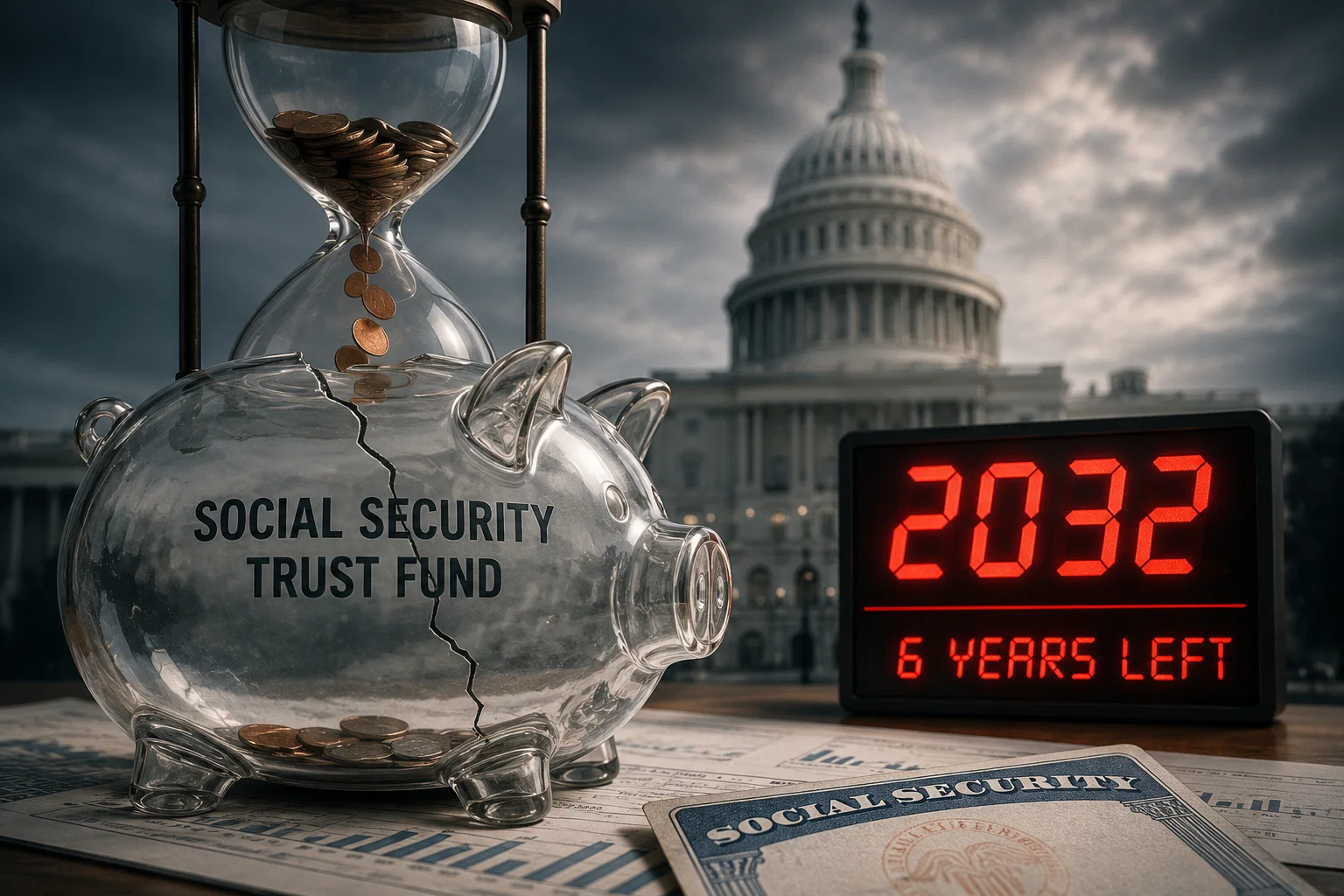
The 2026 edition came out on Tuesday; it is the 86th annual report. And its headline finding is that Social Security's main retirement trust fund — formally Old-Age and Survivors Insurance, or OASI — is now projected to run out of money in 2032. That's one year earlier than last year's projection.
In other words, the fund that pays benefits to America's retirees is six years away from running dry.
Last year the program collected $1.449 trillion, mostly from payroll taxes, and spent $1.609 trillion.
That $160 billion shortfall was covered by draining the trust fund, whose reserves fell from $2.72 trillion to $2.56 trillion over the course of the year. The program's costs have exceeded its non-interest income every single year since 2010.
And when it runs dry in six years, they estimate that payroll taxes will cover 78% of scheduled benefits. So the tens of millions of retirees who depend on the program would face an automatic 22% benefit cut on day one.
And it deteriorates from there.
Here's the part that really boggles the mind: the solutions are already published. The report itself spells them out — raise the payroll tax from 12.40% to 16.65%, or cut everyone's benefits by 25.2%, or cut benefits 30.3% for future retirees only. Social Security's own actuaries even maintain an entire catalog of scored reform options, with the financial impact of each one calculated for Congress's convenience.
The Trustees practically beg lawmakers to act "sooner rather than later," because every year of delay makes the eventual fix more painful.
And yet there is no serious legislation pending, no emergency commission, not even a hearing on the calendar. The date just keeps creeping closer.
What actually happens when the fund hits zero? It affects far more than retirees.
Option A is that Congress does nothing and retirees absorb a 22% cut on day one. That would be political suicide, which makes it an unlikely outcome.
Option B is that the government borrows the difference — hundreds of billions of dollars per year, on top of roughly $2 trillion annual deficits and a national debt north of $50 trillion by then.
And they'd be borrowing at a time when foreign central banks have already been reducing their Treasury purchases. Coaxing the market into absorbing that much new debt means paying higher yields, and higher Treasury yields ripple into everything: mortgage rates, auto loans, business credit.
Option C is that the Federal Reserve steps in and effectively prints the money. We all saw how that works during the pandemic, when the Fed created roughly $5 trillion out of thin air and the result was 9% inflation.
Then there's the option that may be the most realistic of all: Congress waits until the fund is nearly dead and then rams through a major payroll tax increase. The report prices out procrastination, too — deferring action pushes the required payroll tax to 17.30%, nearly five percentage points above today's rate, carved out of every paycheck in America. And the longer they wait, the bigger that bite gets.
And it doesn’t really matter how young you are, or if you’re not depending on Social Security for retirement.
If retirees take the cut, that 22% reduction in purchasing power for 70 million Americans ripples through the economy.
Or if interest rates increase to coax more borrowing, everyone pays higher interest rates.
Or if the Fed prints, everyone pays through inflation.
Most likely it will be some combination of all three.
Which is exactly why it makes sense to have a Plan B — not a bunker in the woods, just rational steps to ensure your retirement doesn't depend on the US Congress finding its courage.
That can mean maximizing tax-advantaged retirement structures, so that you're building your own income stream instead of relying on a government IOU.
It can mean establishing legal residency in a country where the cost of living is a fraction of what it is in the US, and where even a reduced benefit check funds a comfortable retirement.
And because the most likely "solutions" all point toward higher rates and higher inflation, it means owning real assets — gold, productive businesses, energy — that hold their value when the government reaches for the printing press.
None of this requires predicting exactly which option Washington chooses, because a sensible Plan B works under all of them.
The point is to put it in place now, calmly and on your own terms — so that when 2032 arrives, you're not scrambling in a crisis like Congress.
To your freedom, James Hickman Co-Founder, Schiff Sovereign LLC
Complete Currency Collapse,’ Hyperinflation in 3 Years? Alasdair Macleod & Michelle Makori
Complete Currency Collapse,’ Hyperinflation in 3 Years? Alasdair Macleod & Michelle Makori
Miles Franklin Media: 6-10-2026
Michelle Makori, President & Editor-in-Chief of Miles Franklin Media, sits down with economist, monetary historian, and precious metals expert Alasdair Macleod to discuss what he believes could be the biggest threats facing the global financial system.
Macleod explains why he believes the world is approaching a critical turning point for fiat currencies, how years of debt accumulation and monetary expansion have weakened confidence in the global monetary system, and why the next few years could bring significant economic and social disruption.
Complete Currency Collapse,’ Hyperinflation in 3 Years? Alasdair Macleod & Michelle Makori
Miles Franklin Media: 6-10-2026
Michelle Makori, President & Editor-in-Chief of Miles Franklin Media, sits down with economist, monetary historian, and precious metals expert Alasdair Macleod to discuss what he believes could be the biggest threats facing the global financial system.
Macleod explains why he believes the world is approaching a critical turning point for fiat currencies, how years of debt accumulation and monetary expansion have weakened confidence in the global monetary system, and why the next few years could bring significant economic and social disruption.
The conversation also explores the implications of a potential Fort Knox audit, why China and Russia may be in a stronger position than many investors realize, the outlook for gold and silver, central bank gold accumulation, and the future of the U.S. dollar as the world’s reserve currency.
Alasdair warns that if confidence in government finances and fiat currencies continues to deteriorate, the consequences could extend far beyond financial markets, impacting living standards, food security, and geopolitical stability.
In this episode of The Real Story with Michelle MakorI:
Fort Knox audit implications
Gold reserves and transparency
China and Russia’s gold strategy
The future of the U.S. dollar
Global debt and monetary instability
Currency debasement
Hyperinflation risks
Central bank gold buying
Silver supply dynamics
The outlook for gold and silver
What the next decade could look like
WATCH PART 1 OF THE INTERVIEW HERE: https://www.youtube.com/watch?v=kEtKhzEFdwA&t=1s
Iraq Economic News and Points To Ponder Thursday Morning 6-11-26
Iraq Tops The List Of Importers Of Amman's Industrial Exports During The Last 5 Months
Money and Business Economy News – Baghdad Iraq topped the list of Arab and foreign countries that received the most exports from the Amman Chamber of Industry during the first five months of this year, after the value of Jordanian exports to it increased by 6 percent to reach 404 million dinars, compared to 381 million dinars for the same period in 2025.
Iraq Tops The List Of Importers Of Amman's Industrial Exports During The Last 5 Months
Money and Business Economy News – Baghdad Iraq topped the list of Arab and foreign countries that received the most exports from the Amman Chamber of Industry during the first five months of this year, after the value of Jordanian exports to it increased by 6 percent to reach 404 million dinars, compared to 381 million dinars for the same period in 2025.
Data issued by the Amman Chamber of Industry showed that its total exports during the first five months of 2026 increased by 5.1 percent to reach 2.996 billion dinars, compared to 2.849 billion dinars during the same period last year, indicating the continued ability of Jordanian industry to adapt to regional challenges and expand its export markets.
According to the statistical report, Iraq was the top destination for Amman's industrial exports, ahead of India, whose exports remained stable at 394 million dinars, and the United States, whose exports declined by 28.5 percent to 362 million dinars, while exports to Saudi Arabia decreased by 3 percent to 342 million dinars.
Jordanian exports to Syria also recorded growth of 52.2 percent to reach 173 million dinars, and to Palestine by 29.5 percent to reach about 89 million dinars.
In terms of geographical distribution, Arab countries accounted for the largest share of Amman's industrial exports, with a value of 1.515 billion dinars, followed by non-Arab Asian countries with about 671 million dinars, and then North American countries with a value of 387 million dinars. https://www.economy-news.net/content.php?id=70117
Egypt Pays Off All Its Debts To Oil Companies For The First Time Since 2011
Money and Business The Egyptian government announced that it has paid all outstanding dues to foreign oil companies, which peaked at more than $6 billion in the 2011-2012 fiscal year.
Resolving the issue of outstanding payments, which has been one of the most significant challenges facing the sector in recent years, opens a new phase for increasing production and attracting investments, according to Egyptian Petroleum Minister Karim Badawi.
The decision is expected to encourage oil companies operating in the country to enhance development activities and research and exploration work during the coming period, in support of the state’s plan to return to exporting natural gas by 2027, after it became a net importer during the recent period.
Since 2014, the government has implemented a phased plan to reduce these arrears, aiming to restore investor confidence and encourage international oil companies to increase investments and new exploration. Debt has gradually declined over the following years.
There are 57 companies operating in Egypt in the field of research, exploration and production, including 8 of the world’s largest companies, 6 specialized Egyptian companies, and more than 12 international companies operating in the field of petroleum and technological services.
The Egyptian Ministry of Petroleum, in cooperation with foreign partners, is seeking to accelerate the pace of connecting new wells in order to maintain the country’s production levels at 4 billion cubic feet per day, thus limiting the impact of the natural decline in field production, which is estimated at about 100 million cubic feet per month.
At the same time, Cairo aims to raise its domestic gas production to about 6.6 billion cubic feet per day by 2030, representing an increase of nearly 65% over the current rate, in addition to drilling 14 exploratory wells in the Mediterranean Sea during the current year to assess reserves estimated at about 12 trillion cubic feet.
This coincides with an acceleration of exploration and production activities in Egypt by international energy companies, including Chevron, which has begun drilling new wells in the western Mediterranean.
The Egyptian government recently offered incentives to foreign companies, including allowing them to export a portion of their new production to use the proceeds to settle outstanding payments, as well as improving contract prices for newly produced gas.
The minister added that Egypt possesses exceptional assets that make it one of the most important investment destinations in the energy sector in the region, given its distinguished geographical location and advanced infrastructure. He pointed out that the past period witnessed a strong return of investment momentum, as partners resumed implementing drilling, exploration and development programs at an accelerated pace, which has already been reflected in increasing the volume of ongoing petroleum activities and raising investment rates in various concession areas. https://www.economy-news.net/content.php?id=70083
Iraq Begins Exporting Fish To Global Markets
Localities Economy News – Baghdad Agriculture Minister Abdul Rahim Al-Shammari announced on Thursday the launch of fish exports to global markets, for the first time in Iraq.
Al-Shammari said in a statement to "Economy News" that this step represents "an important achievement for the reputation of Iraq and Iraqi fish and products, which are known for their quality."
He pointed out that this step represents "the beginning of achievements and work that the ministry is currently undertaking in order to advance the agricultural sector, sustain the agricultural process, overcome obstacles, achieve appropriate economic feasibility for fish farmers, and support the national economy in the country."
https://www.economy-news.net/content.php?id=70116
Trade: Retail Markets Did Not Adhere To The Set Price Of A Tray Of Eggs Between 6000 And 6500 Dinars.
Localities Economy News – Baghdad The Ministry of Commerce confirmed that retail markets did not adhere to the price set for a tray of eggs between 6,000 and 6,500 dinars.
Riyadh Mahdi Al-Mousawi, Director General of Commercial and Financial Control at the Ministry, stated in a statement to the official newspaper that the field teams affiliated with the department are working to monitor local markets and track the reasons for the rise in prices of some basic materials, with the aim of addressing them and ensuring their stability.
Al-Moussawi explained that monitoring teams tracked table egg prices last month, based on instructions from the Ministerial Council for the Economy. They found that the price of a carton had reached 80,000 dinars, meaning that the price of a single tray ranged between 7,500 and 8,500 dinars.
He added that the official directive stipulates a price between 6,000 and 6,500 dinars only, noting that some wholesale markets complied with the price reduction, while retail markets did not.
He confirmed that the ministry launched the new campaign today in Baghdad and all governorates (except the Kurdistan Region), and it includes wholesale and retail markets and small and large shops, to monitor current prices and take the necessary measures to reduce them, considering any increase to be a clear violation of the instructions.
Al-Moussawi indicated that the ministry's role is to address any monopolies or deliberate price hikes in essential commodities, emphasizing that most prices are under control and there have been no significant increases for consumers.
He stressed that resolving this issue requires the intervention of relevant sectoral bodies and a decisive decision from the Ministerial Council for the Economy to set fixed prices for essential commodities, while monitoring teams continue to track market activity to achieve a balance between protecting domestic products and stabilizing prices for consumers.
https://www.economy-news.net/content.php?id=70114
13 Indian-Flagged Ships Are Stuck In The Strait Of Hormuz
Arabic and international Economy News - Follow-up The Indian Ministry of Ports and Shipping said that 13 Indian-flagged vessels are stuck in the Strait of Hormuz.
The ministry added on Thursday that there are more than 18,000 Indian sailors in the Gulf region.
The Indian Ministry of External Affairs stated that three Indian ships were attacked by the US Navy, adding: "Two of the ships are under sanctions and the third is among the non-compliant ships," according to Reuters.
Ship tracking data released by the London Stock Exchange Group and Kpler showed that three more liquefied natural gas tankers left the Strait of Hormuz with their transponders switched off and are currently heading to destinations in Asia, but the exact timing of their crossing of the waterway is unclear.
This comes as the United States and Iran exchanged airstrikes on Thursday for the second day in a row, with US President Donald Trump vowing to launch more strikes on Iran unless it agrees to a peace deal, and Washington announcing that it had fired on a ship carrying Iranian oil.
The data revealed that the two tankers, Libretha and Rasheeda, belonging to Qatar Energy, were last seen west of the strait on June 1 and April 30 respectively, carrying cargoes loaded at Ras Laffan, and then reappeared in ship tracking data on June 10.
The Libretha, which was loaded on May 22, is heading to Pakistan, while the Rasheeda, which has been carrying a cargo since February 27, is currently approaching Southeast Asia. A third LNG carrier, the Marigold, operated by Abu Dhabi National Oil Company (ADNOC), also appeared in ship tracking data on June 10.
The Marigold was last seen with a heavy cargo on board east of the strait on May 1st before reappearing after loading a cargo from Das Island on May 25th. Data indicates that it is heading to India.
Twelve liquefied natural gas tankers, including the three newest ones, have left the Strait of Hormuz since the war began on February 28. https://www.economy-news.net/content.php?id=70118
Iran: The Strait Of Hormuz Will Remain Closed Until Further Notice.
Arabic and international Economy News - Follow-up Iran’s “Strait of Hormuz Authority” announced the closure of the Strait of Hormuz until further notice.
Iran's Strait of Hormuz Authority urged ships with transit permits to be patient as the strait remains closed until further notice.
Iran's Revolutionary Guard had announced the closure of the strait to shipping traffic on Thursday, while the US Central Command denied that Tehran had closed the strait.
The United States warned ships against dealing with the Iranian entity and placed it on a sanctions list.
Seeds of Wisdom RV and Economics Updates Thursday Morning 6-11-26
Good Morning Dinar Recaps,
EU Targets Russian Banks as Moscow Signals Financial Resilience
Despite a new round of proposed European sanctions, Russia says its banking sector remains profitable and stable, highlighting the growing battle between Western financial pressure and emerging alternative economic systems.
Good Morning Dinar Recaps,
EU Targets Russian Banks as Moscow Signals Financial Resilience
Despite a new round of proposed European sanctions, Russia says its banking sector remains profitable and stable, highlighting the growing battle between Western financial pressure and emerging alternative economic systems.
Overview
The European Union has unveiled another package of proposed sanctions aimed at Russian banks and cryptocurrency-related financial networks as part of its ongoing effort to increase economic pressure on Moscow over the conflict in Ukraine.
The Kremlin responded dismissively to the announcement, arguing that Russia's financial institutions have adapted to years of sanctions and continue to generate substantial profits. Kremlin spokesman Dmitry Peskov stated that Russia's largest banks remain stable and that the country's financial authorities continue to monitor economic conditions closely.
The development underscores the continuing struggle between Western sanctions regimes and Russia's efforts to build alternative financial channels outside the traditional Western-dominated banking system.
Key Developments
1. European Union Expands Financial Pressure
The EU's latest sanctions proposal targets additional Russian banking institutions as well as cryptocurrency networks that European officials believe may help facilitate financial transactions outside traditional sanctions frameworks.
European leaders continue to argue that restricting financial access remains one of the most effective tools available to pressure Moscow economically.
2. Kremlin Rejects Concerns Over Banking Stability
Russian officials dismissed the impact of the proposed sanctions, emphasizing that the country's banking sector has operated under restrictions for several years.
According to Kremlin representatives, major Russian banks remain profitable and continue functioning despite ongoing limitations imposed by Western nations.
3. Russian Economy Shows Signs of Strain
While Moscow projects confidence, economic challenges remain visible.
Russia's approximately $3 trillion economy contracted by 0.3% during the first quarter, marking its first quarterly decline since early 2023. Analysts point to the combined effects of sanctions, elevated interest rates, labor shortages, and significant military-related spending.
4. Alternative Financial Networks Continue Expanding
The continued focus on Russian cryptocurrency networks reflects broader concerns among Western policymakers regarding alternative payment systems emerging outside traditional banking channels.
Russia has increasingly promoted trade settlements using local currencies, alternative payment mechanisms, and partnerships with countries seeking to reduce dependence on Western financial infrastructure.
****************************
Why It Matters
The sanctions debate extends far beyond Russia and Europe.
Global financial systems are undergoing significant transformation as countries increasingly explore alternatives to traditional Western banking networks. Efforts to develop independent payment systems, local-currency trade arrangements, digital assets, and regional financial alliances have accelerated since sanctions against Russia intensified.
The effectiveness of sanctions will likely influence how other nations evaluate the risks of relying heavily on existing global financial infrastructure.
Why It Matters to Foreign Currency Holders
For those following global monetary developments, the continued sanctions battle highlights the growing fragmentation of international finance.
Many countries are exploring ways to reduce exposure to geopolitical risks by diversifying reserves, increasing local currency trade, and participating in alternative payment systems. These developments could gradually reshape portions of the international monetary landscape over the coming decade.
The trend does not necessarily signal the end of the current system but rather the emergence of competing financial frameworks operating alongside traditional institutions.
Implications for the Global Reset
Pillar 1: Financial System Fragmentation
The continued sanctions campaign demonstrates how geopolitical conflicts are accelerating the development of parallel financial networks outside traditional Western banking structures.
As countries seek greater economic sovereignty, alternative payment mechanisms and settlement systems continue to gain attention.
Pillar 2: Expansion of Non-Dollar Trade Channels
Russia and several of its trading partners have increasingly emphasized settlements using national currencies and alternative financial platforms.
While the U.S. dollar remains dominant globally, efforts to diversify international payment channels continue to expand, contributing to the broader evolution of the global financial system.
What Comes Next
The European Union is expected to continue tightening financial restrictions while monitoring enforcement efforts across banking and digital asset sectors.
Russia will likely accelerate efforts to strengthen domestic financial infrastructure and deepen economic relationships with non-Western partners.
The longer this financial standoff continues, the more attention will focus on whether alternative payment systems and regional financial alliances can meaningfully reduce dependence on traditional Western-controlled financial networks.
This is not simply a sanctions story—it is another chapter in the ongoing restructuring of the global financial landscape.
Seeds of Wisdom Team
Newshounds News™ Exclusive
Sources
Modern Diplomacy — "Kremlin Dismisses New EU Sanctions on Russian Banks"
Reuters — "EU Considers New Banking Sanctions as Russia Defends Financial Stability"
~~~~~~~~~~
🌱 A Message to Our Currency Holders🌱
If you’ve been holding foreign currency for many years, you were not foolish.
You were not wrong to believe the global financial system would change.
What failed was not your patience — it was the information you were given.
For years, dates, rumors, and personalities replaced facts, structure, and proof. “This week” predictions created cycles of hope and disappointment that were never based on how currencies actually change.
That is not your failure.
Our mission here is different: • No dates • No rates • No hype • No gurus
Instead, we focus on:
• Verifiable developments • Institutional evidence
• Global financial structure • Where countries actually sit in the process
Currency value changes only come after sovereignty, trade, banking, settlement systems, and fiscal coordination are in place. History and institutions confirm this sequence.
You will see silence. You will see denials. That is not delay — that is discipline.
Protect your identity. Organize your documents. Verify everything.
Never hand your discernment to anyone who cannot show proof.
You deserve truth — not timelines.
Seeds of Wisdom Team
Newshounds News
~~~~~~~~~~
Seeds of Wisdom Team RV Currency Facts Youtube and Rumble
Newshound's News Telegram Room Link
RV Facts with Proof Links Link
RV Updates Proof links - Facts Link
Follow the Gold/Silver Rate COMEX
Follow Fast Facts
Seeds of Wisdom Team™ Website
Thank you Dinar Recaps
Thursday AM Iraq News Posted by Tishwash at TNT 6-11-2026
TNT:
Tishwash: An economist calls on Al-Zaidi to bring specialized ministers to Washington to prevent businessmen from taking "commissions".
Economic expert Hashim al-Haboubi criticized on Wednesday Prime Minister Ali al-Zaidi's intention to take groups of businessmen and investors with him on his upcoming visit to Washington, D.C., describing the move as "unfortunate" and a repetition of previous scenarios.
TNT:
Tishwash: An economist calls on Al-Zaidi to bring specialized ministers to Washington to prevent businessmen from taking "commissions".
Economic expert Hashim al-Haboubi criticized on Wednesday Prime Minister Ali al-Zaidi's intention to take groups of businessmen and investors with him on his upcoming visit to Washington, D.C., describing the move as "unfortunate" and a repetition of previous scenarios.
Al-Haboubi told the Information Agency, "Prime Minister Ali al-Zaidi's announcement of his intention to take businessmen and investors to Washington, similar to what al-Sudani did previously, is not at all in the public interest." He pointed out that "these individuals will not invest in America, but rather seek to act as intermediaries between the government and American companies to obtain commissions."
He added, "Preserving public funds requires taking ministers specializing in the financial and economic sectors, along with a very limited number of advisors. This is the correct approach to ensure that contracts and economic activities are concluded directly between the state and companies without any intermediaries, thus avoiding suspicions of corruption." link
************
Tishwash: Prime Minister's Advisor: Growing International Interest in Iraq's Banking Reform Program
The Prime Minister's Advisor for Banking Affairs, Saleh Mahoud, affirmed on Wednesday that Iraq is making steady progress towards building a more efficient, open, and integrated financial sector within the global economy. He noted the growing international interest in the country's banking reform program.
In a statement received by Al-Eqtisad News, Mahoud said he participated over the past three days in a working visit to London as part of an Iraqi banking delegation that included representatives from the Central Bank of Iraq, the Association of Iraqi Private Banks, and several other banks and electronic payment companies. The visit aimed to strengthen international cooperation and support the financial and banking reform process in Iraq.
He added that the visit, organized in coordination with the British Embassy in Iraq, provided a platform for dialogue between Iraqi and British financial and banking institutions, thereby enhancing economic and financial cooperation between the two countries.
He explained that on the first day, the delegation held meetings with Hogan Lovells, a firm specializing in legal consulting on financial and banking legislation, and also participated in a dialogue with Chatham House. He emphasized the government's full support for the banking reform projects led by the Central Bank of Iraq in cooperation with international consulting firms.
He noted that the meetings held at the British Parliament addressed the development of banking and economic cooperation, encouraging British investment in Iraq, and strengthening partnerships between financial institutions in both countries.
Mahoud explained that the visit reflected the level of international interest in Iraq's banking reform program, emphasizing that Iraq continues to implement plans to develop its financial sector in accordance with international standards and to enhance the investment climate and economic growth. link
************
Tishwash: Faihan and Al-Amiri agree to hold a parliamentary session to complete the government cabinet.
The Iraqi Deputy Speaker of Parliament, Adnan Faihan, and the Secretary-General of the Badr Organization, Hadi al-Amiri, agreed on the necessity of holding a parliamentary session soon to complete the vote on the cabinet of Prime Minister al-Zaidi's government.
A statement from the Deputy Speaker's media office, received by the Information Agency, indicated that "Faihan and al-Amiri emphasized the importance of Parliament's role in keeping pace with current changes and contributing to shaping national policies and priorities for the next phase."
The statement added that "the two sides agreed to expedite a session to complete the cabinet and vote on the remaining ministerial positions, thus ensuring the completion of the government formation and strengthening the performance of constitutional institutions."
It further explained that "both parties stressed that the current challenges necessitate enhanced coordination and consultation among national forces and a unified stance on critical issues, in order to safeguard Iraq's higher interests, bolster its political stability, and preserve its national achievements. They emphasized the importance of supporting the legislative and oversight role of Parliament to contribute to realizing the aspirations of citizens for a strong, stable state capable of confronting challenges." link
************
Tishwash: The Prime Minister receives an invitation from Putin to participate in the eighth meeting of the Gas Exporting Countries Forum in Moscow.
Prime Minister Ali Faleh al-Zaidi received an invitation on Wednesday from Russian President Vladimir Putin to participate in the eighth meeting of the Gas Exporting Countries Forum (GECF) in Moscow.
The Prime Minister's Media Office stated in a press release received by the Iraqi News Agency (INA) that "Prime Minister Ali Faleh al-Zaidi received the Ambassador of the Russian Federation to Iraq, Albrus Kutrashev."
According to the statement, the Ambassador delivered two written congratulatory messages from Russian President Vladimir Putin and Russian Prime Minister Mikhail Mishustin during the meeting. In these messages, they emphasized the importance of bilateral relations, which are based on friendship and mutual respect, and expressed their aspiration to strengthen and develop joint cooperation in a way that serves the interests of both friendly nations and contributes to ensuring regional and international stability and security.
The statement added that "the Prime Minister received an invitation from the Russian President to participate in the eighth meeting of heads of state and government of the Gas Exporting Countries Forum, which will be held in Moscow on October 27." link
************
Tishwash: Al-Marsoumi reveals the conditions set by foreign companies for resuming oil production in Kurdistan.
Economic expert Nabil al-Marsoumi explained on Wednesday that foreign companies operating in the oil sector have set a number of conditions before resuming production and exports in the Kurdistan Region.
Al-Marsoumi stated in a Facebook post that "these conditions include, firstly, the necessity of protecting oil fields and wells from drone and missile attacks to ensure the safety of facilities, workers, and foreign technical staff."
He added that "the second condition is the establishment of a clear and regular mechanism to guarantee the payment of current financial dues upon the resumption of exports, in accordance with the amendments to the federal budget law."
He pointed out that "the third condition pertains to the necessity of settling outstanding debts and previous dues owed by the companies, including those owed to the Norwegian oil company DNO, which previously announced the cessation of production and exports via pipelines in the region due to delayed payments estimated at approximately one billion dollars."
Al-Marsoumi emphasized that "resolving these issues is essential for the normal resumption of oil activity in the region." link
Iraq Economic News and Points To Ponder Wednesday Afternoon 6-10-26
Government Advisor: Exchange Rate Stability Has Boosted Citizens' Purchasing Power
{Economic: Al-Furat News} The financial advisor to the Prime Minister, Mazhar Muhammad Saleh, confirmed on Saturday that the government, headed by Ali Falih al-Zaidi, has taken measures to preserve the purchasing power of the dinar and curb inflation.
Saleh said in a press statement followed by Al-Furat News: “The policy of stabilizing the official exchange rate is based on a fundamental goal, which is to protect the external value of the national currency and maintain the stability of the general price level,” noting that “the stability of the exchange rate has contributed to strengthening confidence in the Iraqi dinar and supporting the purchasing power of citizens.”
Government Advisor: Exchange Rate Stability Has Boosted Citizens' Purchasing Power
{Economic: Al-Furat News} The financial advisor to the Prime Minister, Mazhar Muhammad Saleh, confirmed on Saturday that the government, headed by Ali Falih al-Zaidi, has taken measures to preserve the purchasing power of the dinar and curb inflation.
Saleh said in a press statement followed by Al-Furat News: “The policy of stabilizing the official exchange rate is based on a fundamental goal, which is to protect the external value of the national currency and maintain the stability of the general price level,” noting that “the stability of the exchange rate has contributed to strengthening confidence in the Iraqi dinar and supporting the purchasing power of citizens.”
Saleh added that “the relationship between the stability of the exchange rate and the stability of prices of goods and services in the local market has remained close, given the limited impact of the parallel market on the pricing system and the effectiveness of monetary policy,” explaining that “financing imports through the official banking system and relying on the state’s foreign reserves has contributed to providing imported goods at stable and controlled prices.”
He added that “government policies to maintain stable prices for goods and public services, along with the expansion of modern commercial distribution patterns, particularly cooperative stores and advanced marketing formulas, have strengthened competition and contributed to reducing inflationary pressures and supporting price stability.”
Saleh explained that "among the most prominent factors that put pressure on the value of the national currency are the decline in official reserves, uncontrolled monetary expansion, and excessive reliance on oil revenues, which are currently subject to geopolitical restrictions imposed on the freedom of energy markets, as well as political and regional tensions and their effects on foreign exchange flows and economic confidence."
He stressed that “raising the value of the Iraqi dinar is not achieved through quick administrative decisions, but rather through a long-term reform process based on the stability of monetary and financial policies, diversification of national income sources, and strengthening confidence in the local currency,” noting that “the stability of the dinar remains a direct reflection of the stability of the macroeconomy and its ability to cope with local and international changes, which is what the government is working on through a package of measures to strengthen the value of the Iraqi dinar, including working to strengthen foreign reserves, diversifying the national economy and reducing dependence on oil, achieving stability in the balance of payments, as well as controlling the parallel market, reforming the banking system, expanding the use of electronic payment tools and promoting financial inclusion.” https://alforatnews.iq/news/مستشار-حكومي-استقرار-سعر-الصرف-عزز-القوة-الشرائية-للمواطنين
International Monetary Fund: Iraq Among The Countries Most Vulnerable To Financial Pressures With Rising Debt In 2026
2026-06-06 Shafaq News – Baghdad A report issued by the International Monetary Fund showed that Iraq faces increasing financial pressures during 2026, due to the rising cost of government energy subsidies, increasing public debt, and rising borrowing costs in international markets.
According to the report, which was reviewed by Shafaq News Agency, Iraq is estimated to be among the countries with high levels of energy subsidies, with the cost of subsidies reaching less than 6% of GDP, making the general budget more vulnerable to fluctuations in oil and gas prices, and increasing pressure on public finances if global energy prices continue to rise.
The IMF noted that Iraq is among a group of economies that have seen a significant increase in public debt compared to before the COVID-19 pandemic, as debt levels rose significantly in 2026 compared to 2019, within a regional trend that includes a number of countries with high fiscal deficits.
According to the report, this development coincides with rising sovereign borrowing costs in the region, increasing financing pressures on countries with large financial needs, including Iraq, in a global environment characterized by high interest rates and tighter financing conditions.
The Fund stressed that the continuation of these pressures poses challenges to fiscal policies in Iraq, especially with regard to the need to control spending, redirect subsidies, and enhance fiscal sustainability within medium-term frameworks, while maintaining the ability to finance basic services in light of the fragile regional economic environment.
A Member Of Parliament Warns Of The "Erosion" Of Iraq's Cash Reserves Due To Operational Expenses.
{Economic: Al-Furat News} Kurdish MP Jamal Kojar warned on Tuesday of the "erosion" of Iraq's cash reserves due to the country's monthly operating expenses.
Kujer told Al-Furat News Agency, “The talk about concerns about the erosion of the cash reserve is due to the existence of facts that confirm the country’s need for at least 8 trillion dinars per month to cover operating expenses.”
He added, "The financial resources are less than this amount, so we will definitely need to borrow, whether internally or externally, and these concerns are realistic under the current circumstances."
The Prime Minister’s financial advisor, Mazhar Muhammad Salih, confirmed in a press statement today that “about 40 million Iraqis depend directly or indirectly on government income,” stressing that any external borrowing should be “smart debt” for productive projects, not for consumption.
He added, "Corruption and kickbacks raise the cost of projects in Iraq by up to 45%."
https://alforatnews.iq/news/برلماني-يحذر-من-تآكل-الإحتياطي-النقدي-العراقي-بسبب-النفقات-التشغيلية
PM: Strengthening Coordination And Integration Between Iraq’s Fiscal And Monetary Policies
Iraqi News Agency (INA) Wednesday, 10 June 2026 INA - BAGHDAD 6/10/202 Prime Minister Ali Faleh Al-Zaidi chaired on Wednesday the second meeting of the Financial Stability Council.
The meeting discussed the general framework governing the Council’s work, mechanisms for implementing financial and monetary plans and strategies, and ways to stimulate various economic sectors and enhance their capacity to contribute to economic growth and job creation, according to a statement from the PM Media Office, received by the Iraqi News Agency - INA.
“The Council is important as which will serve as an effective institutional framework for strengthening coordination and integration between Iraq’s fiscal and monetary policies, thereby contributing to economic stability, supporting development efforts, and promoting sustainable economic growth,” said Al-Zaidi.
He noted that “the government is moving forward with the preparation of a comprehensive economic vision for Iraq through 2050, based on diversifying sources of income, promoting investment, and improving the efficiency of resource management.”
The meeting also stressed “the importance of unifying efforts among relevant institutions to ensure financial stability, address economic challenges, and formulate policies that safeguard the national economy and enhance its resilience in the face of domestic and international developments.”
What Is Stagflation?
What Is Stagflation?
By Kimberly Amadeo Updated on July 1, 2021
Key Takeaways
Stagflation is stagnant economic growth plus high inflation and high unemployment.
It is caused by conflicting contractionary and expansionary fiscal policies.
Stagflation got its name during the 1973-1975 recession, when GDP growth was negative for five quarters.
Because of changes in policy and economic conditions, stagflation is unlikely to reoccur today.
What Is Stagflation?
By Kimberly Amadeo Updated on July 1, 2021
Key Takeaways
Stagflation is stagnant economic growth plus high inflation and high unemployment.
It is caused by conflicting contractionary and expansionary fiscal policies.
Stagflation got its name during the 1973-1975 recession, when GDP growth was negative for five quarters.
Because of changes in policy and economic conditions, stagflation is unlikely to reoccur today.
Definitions and Examples of Stagflation
Stagflation is a combination of stagnant economic growth, high unemployment, and high inflation.1 It's an unnatural situation because inflation is not supposed to occur in a weak economy.
In a normal market economy, slow growth prevents inflation. As a result, consumer demand drops enough to keep prices from rising. Stagflation can only occur if government policies disrupt normal market functioning.
If you compare U.S. GDP by year to inflation by year, you'll find stagflation in the United States occurred during the 1970s.
The federal government manipulated its currency to spur economic growth. At the same time, it restricted supply with wage-price controls.2
In 2008, the Zimbabwean government printed so much money it went beyond stagflation and turned into hyperinflation.3
How Does Stagflation Work?
Stagflation occurs when the government or central banks expand the money supply at the same time they constrain supply.4 The most common culprit is when the government prints currency. It can also occur when a central bank's monetary policies create credit. Both increase the money supply and create inflation.
At the same time, other policies slow growth. That happens, for instance, if the government increases taxes. It can also occur when the central bank raises interest rates. Both prevent companies from producing more. When conflicting expansionary and contractionary policies occur, it can slow growth while creating inflation.5 That's stagflation.
Stagflation During the 1970s
Stagflation got its name during the 1973-1975 recession. There were five quarters when gross domestic product was negative.2
GDP GROWTH Q1 Q2 Q3 Q4
1973 10.3% 4.4%- 2.1% 3.8%
1974 -3.4% 1.0% -3.7% -1.5%
1975 -4.8% 2.9% 7.0% 5.5%
Unemployment peaked at 9% in May 1975, two months after the recession ended.6
Inflation tripled in 1973, rising from 3.6% in January to 8.7% in December. It rose to a range of between 10% and 12% from February 1974 through April 1975.7
How did this happen? Many experts blame the 1973 oil embargo. That's when OPEC cut its oil exports to the United States. Prices quadrupled, triggering inflation in oil.8
The 1973 oil embargo alone wasn't enough to cause stagflation. Instead, it was a combination of fiscal and monetary policy that created it.
It started with a mild recession in 1970. GDP was negative for two quarters. Unemployment rose to 6.1%. President Richard Nixon was running for re-election. He wanted to boost growth without triggering inflation.
On August 15, 1971, he announced three fiscal policies. They got him re-elected. They also sowed the seeds for stagflation. A video of Nixon's speech shows the announcement of significant economic policy changes known as the Nixon Shock.9
The Nixon Shock
The Nixon Shock was comprised of three actions that Nixon took.
TO CONTINUE TO READ MORE: https://www.thebalancemoney.com/what-is-stagflation-3305964
Seeds of Wisdom RV and Economics Updates Wednesday Evening 6-10-26
Good Evening Dinar Recaps,
Japan’s Banking Giants Unite to Launch Stablecoin Network, Accelerating the Digital Currency Transformation
Japan’s largest financial institutions are taking a major step toward modernizing global payments, signaling growing momentum behind tokenized finance, stablecoins, and the evolution of the international monetary system.
Good Evening Dinar Recaps,
Japan’s Banking Giants Unite to Launch Stablecoin Network, Accelerating the Digital Currency Transformation
Japan’s largest financial institutions are taking a major step toward modernizing global payments, signaling growing momentum behind tokenized finance, stablecoins, and the evolution of the international monetary system.
Overview
Three of Japan’s largest banking groups — Mitsubishi UFJ Financial Group, Sumitomo Mitsui Financial Group, and Mizuho Financial Group — have announced plans to jointly issue a stablecoin by March 2027.
The initiative is designed primarily for business-to-business and cross-border transactions, with the long-term goal of creating a more efficient and lower-cost payment infrastructure across Asia and beyond. The project builds on Japan’s growing embrace of digital assets and follows increasing global efforts to integrate blockchain technology into mainstream banking systems.
For observers tracking the evolution of the global financial system, this development represents another sign that major financial institutions are moving toward tokenized money, digital settlement networks, and next-generation payment rails.
Key Developments
1. Japan’s Three Largest Banks Join Forces
Japan's three banking giants announced a collaborative effort to issue a trust-based stablecoin backed by a regulated framework.
Rather than competing separately, the institutions are pooling resources to create a shared platform capable of supporting large-scale commercial transactions and cross-border settlements.
The combined financial strength of these institutions gives the project significant credibility and potential adoption across Asia.
2. Stablecoin Will Operate Through a Trust Structure
The digital currency will be issued through a trust arrangement rather than sitting directly on a bank balance sheet.
Under the structure, a designated trust institution will hold reserves while the participating banks act as joint settlors.
This approach is designed to improve transparency, strengthen regulatory compliance, and reduce operational risks.
3. Project Pax and Progmat Form the Foundation
The initiative builds on Project Pax, launched in 2024 to improve international payment efficiency.
The system utilizes Progmat, a blockchain infrastructure developed by MUFG that supports tokenized financial assets and digital settlement capabilities.
Japanese regulators have reportedly overseen portions of the project since late 2025, indicating significant government involvement and support.
4. ¥1 Trillion Stablecoin Target by 2028
Pilot programs connected to the initiative have already discussed issuance targets approaching ¥1 trillion by 2028.
If achieved, this would create one of the largest bank-backed stablecoin ecosystems in Asia and could significantly expand the use of tokenized settlement mechanisms for international trade and finance.
Why It Matters
This announcement reflects a broader trend unfolding across the global financial system.
While central bank digital currencies (CBDCs) continue to face political and regulatory debate, stablecoins are increasingly emerging as a practical bridge between traditional banking and blockchain-based finance.
Major financial institutions around the world are investing heavily in tokenization technologies because they offer:
Faster settlement speeds
Reduced transaction costs
Improved cross-border payment efficiency
Greater transparency and auditability
Enhanced liquidity management
Japan's move is particularly significant because it comes from some of the most conservative and systemically important financial institutions in the world.
Why It Matters to Foreign Currency Holders
For those following developments related to international monetary reform and the evolution of global finance, Japan’s stablecoin initiative demonstrates that large banking systems are actively preparing for a future where digital representations of fiat currencies move alongside traditional money.
The project does not replace the Japanese yen but instead creates new infrastructure that allows the yen to operate more efficiently in a digital environment.
As more countries and institutions adopt tokenized settlement networks, global commerce could become increasingly interconnected through blockchain-based payment systems rather than legacy correspondent banking networks.
Implications for the Global Reset
Pillar 1: Digital Financial Infrastructure Expansion
The launch of a major bank-backed stablecoin network demonstrates that financial institutions continue investing in blockchain-based payment systems as part of the modernization of global finance.
Digital settlement layers are gradually becoming integrated into traditional banking architecture rather than existing outside it.
Pillar 2: Evolution of Cross-Border Payments
International payment efficiency remains a priority for governments and financial institutions.
Projects such as Japan’s stablecoin initiative support a broader trend toward faster and more direct settlement mechanisms that may eventually reduce reliance on older payment channels.
The result is not necessarily the replacement of existing currencies but the creation of a more technologically advanced financial ecosystem.
What Comes Next
Attention now shifts toward regulatory approvals, technical development, and pilot testing ahead of the planned March 2027 launch.
Financial institutions across Asia will closely watch whether the initiative succeeds in reducing settlement costs and increasing transaction efficiency.
If successful, Japan’s model could encourage additional banking consortiums worldwide to develop similar stablecoin frameworks, accelerating the tokenization of global finance.
This is not just fintech innovation — it is another step in the modernization of the global financial architecture.
Seeds of Wisdom Team
Newshounds News™ Exclusive
Sources
Crypto Briefing — "Japan’s Largest Banks Plan to Jointly Issue Stablecoins by March 2027"
Cointelegraph — "Japan’s Ruling Party Pushes Crypto ETFs, Yen-Denominated Stablecoins"
~~~~~~~~~~
Seeds of Wisdom Team RV Currency Facts Youtube and Rumble
Newshound's News Telegram Room Link
RV Facts with Proof Links Link
RV Updates Proof links - Facts Link
Follow the Gold/Silver Rate COMEX
Follow Fast Facts
Seeds of Wisdom Team™ Website
Thank you Dinar Recaps
Seeds of Wisdom RV and Economics Updates Wednesday Afternoon 6-10-26
Good Afternoon Dinar Recaps,
U.S. Inflation Hits Three-Year High as Energy Shock Rekindles Economic Concerns
Rising energy costs linked to Middle East instability are pushing inflation higher, increasing pressure on consumers, policymakers, and the global financial system.
Good Afternoon Dinar Recaps,
U.S. Inflation Hits Three-Year High as Energy Shock Rekindles Economic Concerns
Rising energy costs linked to Middle East instability are pushing inflation higher, increasing pressure on consumers, policymakers, and the global financial system.
Overview
U.S. inflation accelerated sharply in May, reaching its highest level in three years as surging energy prices continued to ripple through the economy. The Consumer Price Index (CPI) rose 4.2% year-over-year, up from 3.8% in April, while monthly inflation increased by 0.5%.
The primary driver behind the increase was energy, which surged 23.5% over the past year amid ongoing tensions in the Middle East and disruptions surrounding critical oil supply routes. The report arrives as investors, central banks, and governments assess the broader economic impact of elevated energy costs and persistent inflationary pressures.
Key Developments
1. Inflation Climbs to Highest Level in Three Years
The latest CPI reading of 4.2% marks the strongest inflation rate since 2023. The increase matched market expectations but reinforces concerns that inflation remains more persistent than policymakers had hoped.
2. Energy Prices Lead the Surge
Energy prices rose 23.5% year-over-year, making them the largest contributor to overall inflation. Gasoline prices increased 7% during May alone and now stand more than 40% higher than a year ago, reflecting ongoing instability in global energy markets.
3. Core Inflation Remains More Moderate
Excluding food and energy, core inflation increased 2.9% annually, suggesting that broader price pressures remain relatively contained. Shelter costs rose 3.4%, while food prices increased 3.1%.
4. Federal Reserve Faces New Policy Challenges
The inflation report may complicate future Federal Reserve decisions regarding interest rates. Persistent inflation could force policymakers to maintain higher rates for longer, potentially slowing economic growth while attempting to control rising prices.
5. Middle East Conflict Continues Influencing Markets
Ongoing tensions involving Iran, the United States, and regional energy infrastructure continue to affect oil markets. Investors remain concerned that further disruptions could keep energy prices elevated and prolong inflationary pressures.
Why It Matters
The return of inflation above 4% highlights the continuing influence of geopolitical events on the global economy. Energy remains one of the most important inputs across nearly every sector, meaning sustained price increases can affect transportation, manufacturing, food production, and household budgets.
Higher inflation also impacts interest rates, borrowing costs, investment decisions, and government fiscal planning. As central banks attempt to balance inflation control with economic growth, markets may experience increased volatility.
Why It Matters to Foreign Currency Holders
Foreign currency holders should monitor inflation trends closely because they directly influence monetary policy and exchange rates.
Key implications include:
• Potential delays in Federal Reserve rate cuts
• Continued strength in the U.S. dollar
• Increased volatility across global currency markets
• Higher borrowing costs for emerging economies
• Greater pressure on nations dependent on imported energy
Implications for the Global Reset
Pillar 1: Energy Remains a Primary Economic Driver
The inflation surge demonstrates that energy security remains central to global economic stability. Nations are increasingly seeking alternative supply chains and energy sources to reduce vulnerability to geopolitical disruptions.
Pillar 2: Higher Inflation Strengthens Monetary Policy Influence
Persistent inflation increases the likelihood that central banks will maintain restrictive monetary policies, affecting debt markets, currencies, and investment flows worldwide.
Pillar 3: Economic Realignment Accelerates
As nations respond to inflation, energy uncertainty, and shifting trade patterns, efforts to diversify reserves, payment systems, and supply chains may continue to gain momentum.
Future Outlook
The coming months will be critical as policymakers evaluate whether elevated inflation is temporary or becoming entrenched. Future movements in energy prices, particularly those tied to Middle East developments, will likely play a major role in determining inflation trends.
Markets will also focus on upcoming Federal Reserve decisions and whether policymakers signal a willingness to maintain higher interest rates for an extended period. Continued inflationary pressures could affect economic growth, consumer spending, and global investment flows throughout the remainder of the year.
When energy prices rise, inflation follows—and the ripple effects can reshape currencies, markets, and the future architecture of global finance.
Seeds of Wisdom Team
Newshounds News™ Exclusive
Sources
Crypto Briefing — "US Inflation Hit Three-Year High in May as Iran War Kept Energy Prices Elevated"
U.S. Bureau of Labor Statistics — "Consumer Price Index Summary"
~~~~~~~~~~
Seeds of Wisdom Team RV Currency Facts Youtube and Rumble
Newshound's News Telegram Room Link
RV Facts with Proof Links Link
RV Updates Proof links - Facts Link
Follow the Gold/Silver Rate COMEX
Follow Fast Facts
Seeds of Wisdom Team™ Website
Thank you Dinar Recaps
Iraq and Indonesia News Posted by Tishwash at TNT 6-10-2026
TNT:
Tishwash: Iraq is moving towards balancing programs with US support and in coordination with the World Bank.
Iraqi Finance Minister Faleh Sari discussed on Wednesday with the US Chargé d'Affaires to Iraq, Joshua Harris, prospects for economic cooperation between Baghdad and Washington and ways to strengthen the partnership with US financial institutions, while both sides affirmed their support for the path of economic and financial reforms.
The Ministry of Finance said in a statement, reported by Shafaq News Agency, that the minister stressed that the government has given the economic file high priority within its program, noting that the next stage will witness reforms aimed at addressing economic and financial challenges in a radical way, and in cooperation with international partners.
TNT:
Tishwash: Iraq is moving towards balancing programs with US support and in coordination with the World Bank.
Iraqi Finance Minister Faleh Sari discussed on Wednesday with the US Chargé d'Affaires to Iraq, Joshua Harris, prospects for economic cooperation between Baghdad and Washington and ways to strengthen the partnership with US financial institutions, while both sides affirmed their support for the path of economic and financial reforms.
The Ministry of Finance said in a statement, reported by Shafaq News Agency, that the minister stressed that the government has given the economic file high priority within its program, noting that the next stage will witness reforms aimed at addressing economic and financial challenges in a radical way, and in cooperation with international partners.
The minister revealed a government trend towards preparing a program budget and gradually moving away from the traditional budget system, with the aim of raising the efficiency of spending and linking financial allocations to goals and results, in line with the requirements of financial and administrative reform.
For his part, the US Chargé d'Affaires affirmed his country's support for the Iraqi government and its readiness to enhance economic and financial cooperation, in a way that contributes to supporting stability and achieving sustainable economic growth in Iraq.
This trend coincides with what the government spokesman, Haider al-Aboudi, announced, that the Council of Ministers approved a directive to proceed with drafting a "program budget" in coordination with the World Bank and the Parliamentary Finance Committee, within the framework of economic reform. link
************
Tishwash: Ministry of Oil: Iraq's share of the OPEC+ production increase is 26,000 barrels per day
The Ministry of Oil revealed the size of the increase allocated to Iraq within the recent OPEC+ decision to raise oil production levels.
Ministry spokesman Salim al-Rikabi said that the OPEC+ group decided to increase production by 188,000 barrels per day, noting that Iraq's share of this increase is 26,000 barrels per day.
Al-Rikabi explained that the new increase will come into effect starting next July, within the framework of the understandings reached by the member states of the oil alliance.
Oil Minister Bassem Mohammed Khudair participated in the OPEC+ meeting held via closed-circuit television, where it was agreed to increase production by 188,000 barrels per day, distributed among seven countries: Iraq, Saudi Arabia, Russia, Kuwait, Kazakhstan, Algeria, and Oman. link
*************
Tishwash: The Iraqi government announces the establishment of a $150 billion development fund and sets a date for the end of the weapons collection campaign.
Iraqi government spokesman Haider al-Aboudi announced on Wednesday that the cabinet has decided to establish a development fund project with international guarantees and contributions amounting to $150 billion to achieve economic stability through investment. He also revealed that the timeframe for implementing the plan to restrict weapons to the state ends by next September, coinciding with the withdrawal schedule of international coalition forces from the country.
Al-Aboudi said during a press conference attended by Shafaq News Agency in Baghdad that the government based its management of its files on a national vision supported by the mandate and confidence of the House of Representatives, stressing its determination to commit to restricting weapons completely to the hands of the state according to the timetables specified in the ministerial program, which ends next September, coinciding with the end of the tasks of the international coalition.
The government spokesman added that the Cabinet, under the direction of the Prime Minister, approved the formulation of a "program budget" in coordination and joint cooperation with the World Bank and the Parliamentary Finance Committee to advance economic reform in the country.
In response to a question from the agency's correspondent, Al-Aboudi explained that the Development Fund represents an investment vehicle completely independent of the state's general budget, and is based on international contributions from Iraq's friends with guarantees ranging from $100 billion to $150 billion, with the aim of promoting sustainable stability.
Al-Aboudi indicated that the Prime Minister’s upcoming visit to the United States will resolve many issues, mainly related to economic aspects, stressing that Iraq adopts balanced and parallel relations with all countries.
Regarding the relationship with the Kurdistan Region, Al-Aboudi stressed that the Prime Minister directed the oil companies operating in the region to work on increasing oil production, with the aim of reaching financial outcomes and radical solutions that are directly related to securing the salaries of the region’s employees and getting out of the current crises. link
************
Tishwash: The coordinating framework announces its support for Al-Zidi's economic vision and affirms: a movement to prepare a national paper and complete the cabinet.
The Coordination Framework held its periodic meeting at the office of the head of the National Wisdom Movement, Mr. Ammar al-Hakim, in the presence of the Prime Minister, Mr. Ali Falih al-Zaidi, to discuss all the political, economic and service files included on the agenda.
A statement issued by the media office of the Coordination Framework, received by the Iraq Observer Agency, stated that the attendees discussed government affairs extensively, with the Prime Minister presenting a comprehensive vision for addressing the emergency economic crisis, reviewing a number of solutions that received the support and endorsement of the Coordination Framework forces, particularly the urgent proposals for addressing the electricity crisis and activating labor and social security laws in support of the private sector and the working class.
The statement added that the assembled forces agreed to prepare a unified paper called the Coordination Framework, which includes the most important national issues to be presented and discussed within the State Administration Coalition to reach an agreement on them, while emphasizing that all political forces stand behind the government in parliament, politically and in the media to ensure the success of its reform program, as well as agreeing on the need to expedite the completion of the cabinet as soon as possible. link
*************
Tishwash: Indonesia surprises markets with an off-season interest rate hike to support the collapsing rupiah
Indonesia unexpectedly raised interest rates outside of its scheduled meetings, a rare move aimed at supporting the rupiah after a series of record declines. The central bank decided on Tuesday to increase the policy rate by 25 basis points to 5.50%, its first such move in eight years.
The bank explained that the decision came after the rupee had fallen at a faster pace than expected since the last meeting in May, when it raised interest rates by 50 basis points, exceeding estimates.
The move comes ahead of next week's Monetary Policy Committee meeting, at a time when the currency is under severe pressure after falling by about 8% since the start of the year and 7% since the outbreak of the war in Iran, making it one of the world's worst-performing currencies. Over the past three weeks, the rupee has recorded its biggest drop since 2020.
The central bank confirmed that raising interest rates represents "an additional measure to enhance exchange rate stability in light of high global volatility resulting from the war in the Middle East," in addition to being a proactive step to keep inflation within the target range during 2026 and 2027.
Temporary market recovery
The decision boosted the Indonesian currency, which closed at 18,050 against the dollar, after hitting a record low of 18,190 the previous day. The Jakarta stock exchange also rose 7.6%, despite having lost more than a third of its value since the beginning of 2026.
A tough battle to support the currency
Authorities are struggling to curb the rupee's decline, despite last month's aggressive interest rate hike and the depletion of nearly $12 billion in foreign exchange reserves this year in an attempt to defend the currency.
The rupee is under pressure from a number of factors that have worried investors, including President Prabowo Subianto’s massive spending plans, an inflated fuel subsidy budget, controversial commodity export policies, and doubts surrounding the central bank’s independence.
Interventions in the foreign exchange market have pushed reserves to their lowest level in nearly two years, after they fell by $1.3 billion in May to $144.9 billion, despite a government issuance of $3.5 billion in dollar and euro-denominated bonds.
Expectations of further tightening
Barclays Bank believes that the Indonesian central bank may continue monetary tightening, with an expected interest rate hike of another 25 basis points next week, and the possibility of resorting to a larger increase of up to 50 basis points.
He pointed to a similar precedent in 2013, when the bank raised interest rates in an emergency move and then lowered them later at the regular meeting, predicting that interest rate cuts would begin if the rupee stabilized.
Reassuring messages from the Central Bank
Bank Governor Pere Wargiu said foreign reserves were "more than sufficient" to support the currency, but declined to confirm a further rate hike soon, calling for waiting for next week's meeting.
He explained that the bank did not want to raise interest rates, but was forced to do so in order to attract investments, enhance the attractiveness of local assets, stabilize the currency, and curb inflation.
The rupee is expected to reach a range between 16,800 and 17,500 against the dollar by 2027, with continued intervention in domestic and foreign markets to support its stability.
Additional tools to attract funds
The central bank is also seeking to attract foreign investment by reducing the cost of hedging contracts by 10% for foreign investors, in addition to raising the returns on short and medium-term debt instruments.
Experts pointed out that bond yields in competing emerging economies such as Mexico, India and the Philippines remain high, increasing competition for capital flows. link