Thank you to all the subscribers to our Early Access program…we thank you for your continued support.
We are excited to offer this new service to keep you informed and up-to-date on the latest Dinar and currency news.
Tuesday AM News From Iraq Posted by Tishwash at TNT 6-9-2026
TNT:
Tishwash: Investing in Iraq: Moves to strengthen partnerships and transform the country into a platform for economic exchange
Three main messages summarized the Iraqi presence at the Geneva Economic Forum: Geography is an asset, crises can be turned into stability, and the private sector needs international protection.
The head of the Federation of Chambers of Commerce, Amer Al-Fahdawi, emphasized to the Swiss and Arab side that Iraq’s current qualifications require an organized international dialogue that paves the way for the flow of capital and the building of smart partnerships that go beyond the traditional frameworks of trade.
TNT:
Tishwash: Investing in Iraq: Moves to strengthen partnerships and transform the country into a platform for economic exchange
Three main messages summarized the Iraqi presence at the Geneva Economic Forum: Geography is an asset, crises can be turned into stability, and the private sector needs international protection.
The head of the Federation of Chambers of Commerce, Amer Al-Fahdawi, emphasized to the Swiss and Arab side that Iraq’s current qualifications require an organized international dialogue that paves the way for the flow of capital and the building of smart partnerships that go beyond the traditional frameworks of trade.
The Federation of Iraqi Chambers of Commerce stated in a statement, which was reviewed by (Shafaqna Iraq), that “within the framework of strengthening international trade relations, the President of the Federation of Iraqi Chambers of Commerce, Amer Al-Fahdawi, participated in the opening of the activities of the Arab-Swiss Business Forum.”
He explained that “this forum is organized by the Arab-Swiss Chamber of Commerce and Industry in cooperation with the Union of Arab Chambers and the League of Arab States Mission in Geneva.”
He added that “the forum’s work focuses on analyzing the impact of geopolitical crises on the business environment and vocational education, as well as exploring the role of the private sector and the creative economy in shaping the jobs of the future in light of the rapid developments in artificial intelligence.”
Iraq's location and resources
Al-Fahdawi stressed, during his participation in the session, according to the statement, that “speaking from an Iraqi perspective has great significance, as Iraq is not an observer of what is happening, but rather is at the heart of geopolitical and economic interactions.”
He explained that “Iraq’s geographical location, its wealth, its Arab depth, and its trade connections with the world make it quickly affected by any disturbances in the region, but at the same time make it capable of being part of the solution and economic stability.”
He pointed out that “the economic reality requires organized work on several fronts, including enhancing the flexibility of the private sector, protecting workers, developing skills, building international partnerships, and working to transform Iraq into a platform for economic communication with the world.”
He pointed out that “the current stage requires a mechanism for dialogue and joint work between Arab and international chambers of commerce to monitor the impact of crises on companies and the labor market, enhance cooperation, and build new economic bridges with international economic institutions in order to strengthen the Iraqi economic situation and increase the flow of investments into the Iraqi market, given the diverse economic assets that Iraq possesses, which require highlighting them through international institutions.” link
************
Tishwash: The head of the Federation of Chambers of Commerce calls for international partnerships to boost investment in Iraq.
The head of the Federation of Iraqi Chambers of Commerce, Amer Al-Fahdawi, called for building international partnerships to boost investment in Iraq.
The Federation stated in a press release that Al-Fahdawi participated in the opening of the Arab-Swiss Business Forum. The statement explained that the forum was organized by the Arab-Swiss Chamber of Commerce and Industry in cooperation with the Union of Arab Chambers and the League of Arab States Mission in Geneva.
It further explained that the forum's activities focused on analyzing the impact of geopolitical crises on the business environment and vocational education, in addition to exploring the role of the private sector and the creative economy in shaping future jobs in light of the rapid developments in artificial intelligence.
According to the statement, Al-Fahdawi emphasized during his participation in the session that speaking from an Iraqi perspective is particularly significant, as Iraq is not merely an observer of events but is at the heart of geopolitical and economic interactions. He pointed out that Iraq's geographical location, its resources, its deep Arab roots, and its trade connections with the world make it highly susceptible to any regional instability, but at the same time enable it to be part of the solution and contribute to economic stability.
He explained, "The economic reality necessitates organized work on several fronts, including strengthening the resilience of the private sector, protecting workers, developing skills, building international partnerships, and working to transform Iraq into a platform for economic engagement with the world."
He pointed out, "The current phase requires a mechanism for dialogue and joint action between Arab and international chambers of commerce to monitor the impact of crises on companies and the labor market, enhance cooperation, and build new economic bridges with international economic institutions. This aims to bolster the Iraqi economy and increase the flow of investments into the Iraqi market, given Iraq's diverse economic potential, which requires highlighting through international institutions." link
************
Tishwash: Al-Zidi's visit to Washington: A government move towards economic openness
Al-Zaidi's visit to Washington represents an important milestone for testing the government's ability to balance economic issues and political pressures, as it seeks to attract investments and reposition Iraq regionally.
The announcement of the visit came during a meeting between Al-Zaidi and businessmen and representatives of the private sector and local banks, where he confirmed that the delegation would include economic figures with the aim of expanding mutual investment opportunities and economic partnerships between the two countries.
The visit is of particular importance as it is al-Zidi's first to Washington since assuming the premiership, and it comes months after an official invitation extended to him by US President Donald Trump following his appointment to form the government, when he spoke of a "new chapter" in relations between the two countries.
The visit also coincides with a period in which Baghdad is undergoing transformations on both the security and political levels, most notably the project to restrict weapons to the state and restructure armed factions, as well as the repercussions of regional tensions and the recent war between Iran and Israel and the economic and security challenges it has left for Iraq.
Messages that go beyond economics
For his part, Iraqi political affairs expert Majashaa Al-Tamimi said that “Al-Zaidi’s visit to Washington, accompanied by businessmen, has political dimensions that go beyond the direct economic aspect, especially since it comes at a stage that is witnessing the redrawing of many balances within the region.”
Al-Tamimi added that “through this visit, the Iraqi government is trying to present itself as a partner capable of building balanced relations with the United States without engaging in the politics of axes, and it also seeks to show that Iraq is open to investments and international partnerships according to the logic of common interests.”
He explained that “bringing businessmen along gives the visit a practical dimension and sends a message to the inside and outside that the government wants to move from traditional political discourse to focusing on the economy, development and job opportunities,” noting that “the visit also shows Baghdad’s desire to strengthen its regional and international position through stable relations with Washington.”
According to economists, the visit comes at an important time for Iraq, as it coincides with ongoing American pressure regarding the issue of armed factions and Iranian influence, as well as Baghdad’s need for economic and investment support to help it overcome the challenges imposed by the recent regional turmoil.
Partnerships and investments
On the economic side, the government affirms that the next phase will witness the launch of a development fund with substantial capital and participation from the central bank, in addition to plans to finance new productive and industrial projects aimed at diversifying the economy and reducing dependence on oil.
The anticipated visit coincided with one of the most difficult financial crises that Iraq has faced in recent years, following the disruption of oil export routes through the Strait of Hormuz and the accompanying disruption to oil revenues, which represent the backbone of the general budget.
Faced with this reality, Baghdad began searching for new funding sources through the World Bank and international lending institutions, in parallel with efforts to attract American and Western investments, in an attempt to mitigate the effects of the crisis and provide additional sources of support for the Iraqi economy.
Iraq is a promising market in energy, industry, housing, and infrastructure.
In this context, economic researcher Sarmad Al-Shammari said that “the visit represents an important opportunity for Iraq to reintroduce itself to American and international investors as a promising market with great opportunities in the energy, industry, housing and infrastructure sectors.”
He added that “the participation of businessmen in the government delegation gives the visit a clear economic character, because the government seeks to transform political relations with Washington into real investment partnerships that will be reflected in the local economy.”
He explained that “Iraq needs billions of dollars in investments in multiple sectors in the coming years, and it also needs the transfer of technology and administrative and industrial expertise, which makes the United States an important partner at this stage.”
He pointed out that “the success of the visit will be measured by the government’s ability to transform meetings and agreements into actual projects that provide job opportunities, support the private sector, and contribute to diversifying sources of income.”
The recent war has had direct repercussions on the investment environment in Iraq, after several foreign companies left or reduced their field presence, particularly in the oil, energy and services sectors. link
************
Tishwash: Kujer warns of a financial catastrophe that could hinder salary payments due to dependence on oil.
MP Jamal Kojar warned on Sunday of a potential financial catastrophe facing Iraq due to financial mismanagement and excessive reliance on oil revenues. He explained that recent regional tensions have had significant economic repercussions for the country.
Kojar told the Information Agency, "Iraq is experiencing a severe financial crisis due to poor financial management and the lack of effective economic plans to address the challenges facing the national economy."
He added, "The recent tensions in the region have significantly impacted energy supplies and global markets, which has directly affected countries whose economies depend on oil revenues."
He pointed out that "the near-total dependence on oil has exacerbated the financial crisis in Iraq and made the economy more vulnerable to external fluctuations and crises," warning that "the continuation of this situation could lead the country to a real financial catastrophe that might prevent the government from fulfilling its financial obligations, primarily paying salaries."
He emphasized that "the current economic repercussions are significant and require swift action to reform financial management, diversify national income sources, and reduce dependence on oil as the sole source of revenue." link
*************
Tishwash: Rixos Baghdad: A complete lifestyle in one destination
In an era where cities are developing destinations that reflect their economic dynamism and keep pace with modern lifestyles, mixed-use projects are becoming increasingly important as a key feature of contemporary development.
These projects are not simply about bringing together different facilities in one location; rather, they are about developing a daily lifestyle that integrates living, working, leisure, and social interaction into a comprehensive experience, akin to a "city within a city."

Today, Baghdad is preparing to host one of the most prominent projects that embody this trend, with the Rixos Baghdad Hotel and Apartments, which offers the first experience of internationally branded residences in Iraq, within a project that includes luxury housing, international hospitality, recreational facilities, and daily services, according to the concept of the "Integrated Lifestyle Ecosystem ".
From a traditional hotel to an integrated hotel complex
Rixos Baghdad, with its comprehensive operating model, transcends the traditional hotel concept based on separate facilities performing specific functions, where luxury is linked to opulence and quality of design, as much as it is linked to a lifestyle based to the same degree on comfort, efficiency of the daily experience, and easy access to various services and facilities within one connected destination.
The project was designed to reduce time, effort, and constant commuting by bringing together the various needs of residents and visitors, allowing easy movement between accommodation, work, restaurants, sports and health facilities, shopping, and entertainment, without having to leave, within an escalating global model in which the quality of experience and ease of access to daily needs have become an essential part of the modern concept of well-being.
To achieve this, the project includes luxury apartments, private villas, and hotel rooms, along with five international restaurants and cafes, a health and fitness club, and sports facilities including padel, tennis, and swimming pools, in addition to a shopping mall that serves as a central hub for activity and services within the project. All these facilities and services function as interconnected parts within a single system, where each element complements the others in perfect harmony.
This system reflects Rixos' globally renowned philosophy of offering a luxury resort lifestyle, where hospitality is integrated with everyday experiences, social activities, and facilities designed for interaction and connection within a cohesive environment. This embodies a service culture focused on quality of experience and attention to detail, while also providing a vibrant atmosphere that fosters social interaction and makes the resort a natural part of the daily lives of residents and visitors.
Thus, the experience at Rixos Baghdad is not limited to simply using the facilities and services, but rather constitutes an integrated lifestyle, in which residents and visitors feel that the place has become a natural extension of the details of their daily lives, and part of the social and professional circle within which their relationships and experiences move, thus enhancing their sense of belonging to it; as if it were the city whose pulse they live every day, and the home to which they always return.
Global operation that supports quality and long-term sustainability
In addition, Rixos Baghdad is based on a global operating system led by Accor, one of the world’s largest hospitality groups, which manages more than 5,600 hotels within a portfolio of more than 850,000 rooms and more than 45 international hotel brands.
The presence of this global operator is a pivotal element in managing the daily experience within the project, by standardizing the standards of operation, services and hospitality according to advanced international standards, thus ensuring the continuity of quality and maintaining the level of experience in the long term.
This model also enhances the sustainability of demand and maintains the long-term value of the project, at a time when internationally branded residential units depend primarily on the strength and operational experience of the operator, as these are among the most important factors that give this type of project its appeal and stability.
The Rixos Baghdad Hotel and Apartments project reflects a broader shift in the nature of projects that are shaping modern cities, keeping pace with rapid changes in lifestyle, and contributing to the formation of economic and social centers of attraction that are more in line with the requirements of contemporary life link
Triple Failure: Bonds, Real Estate, & Currencies | Rafi Farber
Triple Failure: Bonds, Real Estate, & Currencies | Rafi Farber
Liberty and Finance: 6-8-2026
Interview with Rafi Farber presents a high tension view of a global financial system under multiple pressure points.
He argues paper and physical precious metals may appear aligned today but could rapidly diverge if confidence shifts suddenly rather than gradually.
Oil is framed as a potential trigger, where a sharp spike could force asset sales, accelerate inflation, and expose leverage across credit, housing, and equities.
Triple Failure: Bonds, Real Estate, & Currencies | Rafi Farber
Liberty and Finance: 6-8-2026
Interview with Rafi Farber presents a high tension view of a global financial system under multiple pressure points.
He argues paper and physical precious metals may appear aligned today but could rapidly diverge if confidence shifts suddenly rather than gradually.
Oil is framed as a potential trigger, where a sharp spike could force asset sales, accelerate inflation, and expose leverage across credit, housing, and equities.
The discussion emphasizes that rising global debt and interest rate constraints are not isolated national issues but part of a synchronized global monetary structure.
Overall, the interview portrays a tightly wound system where energy, credit, and precious metals function as interconnected fault lines beneath fragile confidence.
INTERVIEW TIMELINE:
0:00 Intro
1:11 Triple Failure: Bonds, Real Estate, and Currencies
10:45 Strait of Hormuz
21:30 Paper vs. Physical Markets
27:47 Demand for 1000 oz silver bars 29:89 Retail demand
34:00 End Game Investor
36:00 Last thoughts
Iraq Economic News and Points To Ponder Monday Evening 6-8-26
Economic Expert: The Priority Is Not The Strength Of The Dinar, But Securing Financial Liquidity.
Baghdad Today – Baghdad On Saturday (June 6, 2026), economist Ziad Al-Hashemi commented on the statements of the Prime Minister’s advisors regarding the government’s measures to stabilize the value of the Iraqi dinar and maintain its purchasing power, considering that the current timing is not appropriate for this economic discourse.
Al-Hashemi said in a post on social media, which was followed by “Baghdad Today”, that “the Iraqi Prime Minister’s office is talking about the government’s work to stabilize (the value of the Iraqi dinar) and maintain its purchasing power,” indicating that “in general this approach is good and required in principle, but now is not the time to talk about the value of the dinar or its purchasing power.”
Economic Expert: The Priority Is Not The Strength Of The Dinar, But Securing Financial Liquidity.
Baghdad Today – Baghdad On Saturday (June 6, 2026), economist Ziad Al-Hashemi commented on the statements of the Prime Minister’s advisors regarding the government’s measures to stabilize the value of the Iraqi dinar and maintain its purchasing power, considering that the current timing is not appropriate for this economic discourse.
Al-Hashemi said in a post on social media, which was followed by “Baghdad Today”, that “the Iraqi Prime Minister’s office is talking about the government’s work to stabilize (the value of the Iraqi dinar) and maintain its purchasing power,” indicating that “in general this approach is good and required in principle, but now is not the time to talk about the value of the dinar or its purchasing power.”
He added that "the critical problem now is not the value or strength of the dinar, but rather the availability of the dinar. The government is clearly suffering from a lack of sufficient dinars to sustain its work and pay salaries on time, as a result of the decline in oil revenues to their lowest level."
He pointed out that "the government was required to speak transparently and to tell the people the extent of the problem, what its emergency plan is to deal with the shortage of dinar liquidity in its treasury, and what its procedures are to provide the liquidity required to feed public finances during this month and the coming months."
The economist explained: “As for talking about the value of the dinar, its purchasing power, and the inflation rate, this can be postponed to the future and after overcoming the current suffocating financial crisis that complicates the work of the Iraqi government and prevents it from performing its financial duties as it should,” stressing that “such statements about the value of the dinar are appropriate for normal conditions and not in an exceptional emergency situation in which the government is suffering from a shortage of dinars.” https://baghdadtoday.news/300815-.html
Saleh's Appearance: The 2027 Budget Enhances Fiscal Sustainability And Supports Economic Reform.
Time: 2026/06/08 {Economic: Al-Furat News} The financial advisor to the Prime Minister, Mazhar Muhammad Saleh, confirmed on Monday that the 2027 budget will enhance financial sustainability and support economic reform, noting that government spending continues in accordance with the Financial Management Law despite the delay in approving the budget.
Saleh said in a press statement: “Iraqi financial policy is still being managed in accordance with the provisions of the amended Federal Financial Management Law No. (6) of 2019, particularly Article (13) thereof, which regulates the mechanisms of public spending in the event of a delay in the approval of the Federal General Budget Law,” noting that “the aforementioned article allowed the continuation of the work of state institutions by granting the Minister of Finance the authority to authorize ministries and entities not affiliated with a ministry to spend at a rate of (1/12) monthly of the total actual current expenditures for the previous fiscal year after excluding non-recurring expenditures, until the approval of the Federal General Budget.”
He added that “this mechanism contributed to ensuring the financing of the state’s basic obligations, foremost among them salaries, wages, pensions, social protection and welfare benefits, as well as the operational expenses necessary to continue providing public services,” explaining that “the same article allowed for the continuation of financing ongoing investment projects based on actual completion rates or completed equipment, provided that cash liquidity and expected allocations are available within the subsequent budget project.”
Saleh explained that “Iraqi public finances faced exceptional challenges during 2026 as a result of geopolitical and regional developments and the accompanying disruptions in global energy markets, supply chains and international trade, which directly affected oil revenues, which represent the main source of public revenues,” stressing that “these changes imposed increasing pressure on the government’s financial position and its ability to finance operational and investment spending, which prompted the government and the Ministry of Finance to move towards preparing the draft federal general budget for 2027 according to a reformist perspective aimed at maintaining financial sustainability and macroeconomic stability.”
He pointed out that "the anticipated budget will focus on enhancing the efficiency of public resource management and rationalizing operational spending, protecting social spending related to the most vulnerable groups, as well as giving priority to investment projects with high economic and developmental feasibility," noting that "among the budget's priorities is also diversifying sources of public revenues and reducing relative dependence on oil revenues, supporting financial and administrative reform programs and government digitalization, in addition to enhancing the national economy's ability to cope with external shocks and achieve financial stability in the medium and long term."
Saleh affirmed that "these trends are consistent with the objectives of the state's financial strategy and public financial management development programs, as well as the pillars of Iraq's 2035 vision, which aims to build a diversified and sustainable economy capable of achieving comprehensive growth and development and enhancing the resilience of public finances in the face of regional and international changes." https://alforatnews.iq/news/مظهر-صالح-موازنة-2027-تعزز-الاستدامة-المالية-وتدعم-الإصلاح-الاقتصادي
The Prime Minister's Advisor Reveals Details Of The 2027 Budget: It Will Be Reform-Oriented.
economy 2026-06-08 Alsumaria News- Economy: The Prime Minister's financial advisor confirmed Mazhar Muhammad Salih On Monday, he stated that the 2027 budget will enhance fiscal sustainability and support economic reform, noting that government spending will continue according to Financial Management Law Despite the delay in approving the budget.
Saleh said in a statement to the official news agency, which was followed by Alsumaria News Iraqi fiscal policy is still being managed according to the provisions of Federal Financial Management Act Law No. (6) of 2019, as amended, and in particular Article (13) thereof, which regulates the mechanisms of public spending in the event of a delay in approval Federal General Budget Law
He pointed out that "the aforementioned article allowed the continuation of the work of state institutions by granting the Minister of Finance the authority to authorize ministries and entities not affiliated with a ministry to spend (1/12) monthly from the total actual current expenditures for the previous fiscal year after excluding non-recurring expenditures, until approval Federal General Budget"
He added that "this mechanism has contributed to ensuring the financing of the state's basic obligations, foremost among them salaries, wages, pensions, social protection and welfare benefits, as well as the operational expenses necessary to continue providing services."public services
He explained that "the same article allowed for the continued funding of ongoing investment projects based on actual completion rates or completed equipment, provided that cash liquidity and anticipated allocations were available within the subsequent budget."
Saleh further clarified that "Iraqi public finances faced exceptional challenges during 2026 as a result of geopolitical and regional developments and the accompanying market turmoil."Global Energy International supply chains and trade have been disrupted, directly impacting oil revenues, which are the primary source of public income.
These changes have placed increasing pressure on the government's financial position and its ability to finance operational and investment spending, prompting the government and the Ministry of Finance to prepare the draft budget.Federal GeneralFor 2027, according to a reformist perspective aimed at maintaining fiscal sustainability and macroeconomic stability.”
He pointed out that “the anticipated budget will focus on enhancing efficiency.”Resource Management
The budget also prioritizes public spending, rationalizing operational expenditures, protecting social spending related to the most vulnerable groups, and prioritizing investment projects with high economic and developmental feasibility.
He noted that other budget priorities include diversifying public revenue sources, reducing relative dependence on oil revenues, supporting financial and administrative reform programs and government digitalization, and enhancing capacity. national economy To confront external shocks and achieve financial stability in the medium and long term."
The Finance Committee Rules Out Approving The 2026 Budget And Confirms: Salary Payments Will Not Be Affected
Money and Business Economy News – Baghdad The parliamentary finance committee explained that approving the 2026 budget is unlikely given the ongoing work to complete the government program and the cabinet, while stressing that the current priority is securing salaries and addressing the economic challenges facing the government.
Finance Committee member, Ribwar Karim, told the official newspaper, as reported by "Economy News," that "this year's budget will most likely not exist, and work will begin on studying the 2027 budget, stressing that securing salaries will not be affected, and that the government has very large capabilities to address the deficit through internal or external borrowing or by using the Central Bank."
Karim added that "everyone agrees on supporting the government's efforts in securing salaries and reaching the next budget, indicating that things will be clearer in the next budget with regard to the effects of the Strait of Hormuz and oil prices and expanding revenues, especially after the application of the Customs Tariff Law and the ASYCUDA system, which will provide greater diversity in sources of income."
Karim explained that the absence of a budget until the middle of the fiscal year is directly related to the government program, especially since the government is still in the process of completing its formation, and the House of Representatives has granted the Prime Minister the necessary confidence and powers.
He stressed that the Finance Committee is ready to support the government in facing the economic challenges, whether the 2026 budget is presented or not, indicating that any move to legislate an alternative law similar to the Food Security Law has not been proposed yet, and the matter is left to the request of the government and the Prime Minister’s vision for the next stage. https://www.economy-news.net/content.php?id=69946
It Was a Win/Win Deal So of Course They Rejected It
It Was a Win/Win Deal So of Course They Rejected It
Notes From the Field By James Hickman (Simon Black / Sovereign Man) June 8, 2026
On November 6, 1906, an American entrepreneur named Augustus E. Staley incorporated his cornstarch manufacturing business in Decatur, Illinois— the first city that Abraham Lincoln came to when he first moved to Illinois at the young age of 21. Staley’s A.E. Staley Manufacturing Company made cornstarch... which is hardly sexy by modern business standards. But over time his company was a huge success and grew it into a major Midwest food processor.
It Was a Win/Win Deal So of Course They Rejected It
Notes From the Field By James Hickman (Simon Black / Sovereign Man) June 8, 2026
On November 6, 1906, an American entrepreneur named Augustus E. Staley incorporated his cornstarch manufacturing business in Decatur, Illinois— the first city that Abraham Lincoln came to when he first moved to Illinois at the young age of 21. Staley’s A.E. Staley Manufacturing Company made cornstarch... which is hardly sexy by modern business standards. But over time his company was a huge success and grew it into a major Midwest food processor.
Like a lot of companies back in that day, Staley ran a "Fellowship Club" for his workers. And in the year 1919, some of the members of that club formed an intramural sports team to play what was then a strange and relatively new game called gridiron football.

The game was starting to become a lot more popular. And both the sport, and the team, took off.
By 1920 the Decatur Staleys had already won a state championship and had become a charter member of the brand new league that would become the National Football League. Shortly after the team, now professional, moved to the city of Chicago and renamed itself to da Bears.
What started off as a little intramural team survived everything the twentieth century threw at it: the Great Depression, World War II, brutal riots, political violence, domestic terrorism, and the gangland chaos of Al Capone's Chicago.
For more than a century, though, the Bears stayed true to the city of Chicago. But everyone has a breaking point, even the Chicago Bears.
Late last week, the Bears' board of directors voted to advance a stadium development project across the border in Hammond, Indiana... signaling what could very well be their permanent departure from Chicago.
For more than fifty years, the Bears have leased Soldier Field from the city of Chicago. Five years ago, they decided to build their own stadium, paying $197 million for a nearby 326-acre parcel.
Da Bears further earmarked $2 billion of private capital to build a stadium on that site.
But the organization is not stupid. They know Illinois is broke. The state's pension system is $143 billion in the hole (the worst in America), and Chicago faces a $1.2 billion annual shortfall.
So before sinking billions into the ground, the team wanted assurances that politicians wouldn't tax the new stadium to death.
They asked for reasonable concessions— the sort of deal that any large business negotiates with cities and states before making major investments.
This is totally normal. Cities routinely grant some property-tax certainty or minor tax breaks, and in exchange they get billions in private investment, jobs, tourism, and a new tax base. Everyone comes out ahead.
This, after all, is the entire basis of capitalism: You win AND I win.
The medieval world was a zero-sum game, where one side got richer only by taking from another; capitalism's radical idea is that the pie itself can grow, so everyone can win if they work together towards a common goal.
Sadly, that remains a foreign concept on the political left.
The tax negotiation required Illinois lawmakers’ approval, and the legislature had five years to get it done. Yet they never did. After this spring’s legislative session ended last week without the Bear’s tax deal getting done, the team finally made the decision to move on.
It’s just a short drive across the border to Indiana. But the business environment is completely different. Indiana runs a budget surplus, sits on $2.5 billion in reserves, and carries a coveted AAA rating.
And it only took Indiana’s legislature a couple of months to pass a variety of incentives— worth up to $1 billion. Illinois is squeezing the team. Indiana is rolling out the red carpet.
It’s not hard to understand why: billions in private construction, thousands of jobs, and lots of new tourism dollars.
Illinois could have had that. But the Left simply does not want to do win/win deals.
Governor JB Pritzker, himself a billionaire heir to the Hyatt Hotel fortune, said he "wasn't willing to give up billions of dollars of taxpayer money in order to give it to a billionaire-owned family, or team."
Think about that. They’d rather lose the team— lose the tax base, lose prosperity, make the city worse off— than make a single concession to the Bears, simply because the owner is a billionaire.
This is what I call Billionaire Derangement Syndrome.
It was the same thing in 2019 when New York progressives (led by Alexandria Ocasio-Cortez) chased Jeff Bezos out of town. Amazon was considering New York City for its “HQ2” location, bringing billions in investment and tens of thousands of highly paid jobs.
But AOC wasn’t having any of that; Bezos, one of the world’s richest men, would have benefited from the deal, so AOC killed it... then took a victory lap to celebrate hollowing out the city’s tax base.
In the end, Bezos and Amazon did just fine. New York City has suffered. The Bears will be just fine. Chicago will suffer.
The Left only knows chaos and destruction. And their endless affliction with Billionaire Derangement Syndrome is one of the great risks to American prosperity.
There was once a time in America when successful people were admired as proof that anyone willing to build something could rise.
Now, across much of the Left, “the rich” are enemies of the state to be taxed into the ground, driven out town, or, as the activists chant, imprisoned or even ‘eaten’.
This derangement drives away the very people and capital that create prosperity and pay for everything that politicians claim to care about.
When the place you live starts treating productive people and their money as enemies to punish, rather than partners to welcome, the rational move is to think about your own Plan B.
To your freedom, James Hickman Co-Founder, Schiff Sovereign
P.S. Our flagship research service, Schiff Sovereign Plan B Confidential, is built for the practical, legal steps to diversify across borders before you ever need them. Inside, we cover second residencies and citizenships, international banking, legal tax reduction, and real-asset strategies — all drawn from boots-on-the-ground intelligence in more than 120 countries. Because the time to give yourself options is while you still have them.
Iraq Economic News and Points To Ponder Monday Afternoon 6-8-26
Iraq’s Central Bank Prints Trillions Of Dinars To Cover State Expenditures
Iraq Amr Salem June 7, 2026 Baghdad (Iraqi News.com) – The Central Bank of Iraq (CBI) issued around 25 trillion dinars to pay governmental expenditures, bringing the total money supply to 125 trillion dinars. According to media reports, the step took place to counter falling oil income caused by regional interruptions in petroleum shipments.
Iraq’s crude oil exports fell by 3.22 million barrels per day in May 2026, a loss of more than 97 percent, owing to continuous disruptions in marine traffic in the Strait of Hormuz caused by the war against Iran. The revenues generated from oil exports plummeted to $1.87 billion in April, a drop of roughly $5 billion from pre-war levels.
Iraq’s Central Bank Prints Trillions Of Dinars To Cover State Expenditures
Iraq Amr Salem June 7, 2026 Baghdad (Iraqi News.com) – The Central Bank of Iraq (CBI) issued around 25 trillion dinars to pay governmental expenditures, bringing the total money supply to 125 trillion dinars. According to media reports, the step took place to counter falling oil income caused by regional interruptions in petroleum shipments.
Iraq’s crude oil exports fell by 3.22 million barrels per day in May 2026, a loss of more than 97 percent, owing to continuous disruptions in marine traffic in the Strait of Hormuz caused by the war against Iran. The revenues generated from oil exports plummeted to $1.87 billion in April, a drop of roughly $5 billion from pre-war levels.
Given Baghdad’s near-total reliance on oil revenues to cover public spending, this dramatic cash outflow threatens to exacerbate the country’s structural fiscal imbalance.
The issuance of more banknotes has caused tremendous economic strain, fueling inflation and diminishing the purchase value of the local currency.
Iraqi Foreign Minister Fuad Hussein has cautioned that the step represents a short-term solution and that extended disruptions in oil shipments might jeopardize public-sector payrolls.
The government issued the 25 trillion dinars to avoid a short-term liquidity crisis, as Iraq’s economy is heavily reliant on oil exports.
The expansion of the money supply at a far quicker rate than economic development feeds inflation and distorts the national currency’s true value.
The CBI sought to stabilize the currency by setting an official exchange rate of 1,300 Iraqi dinars per US dollar for the government budget, but parallel market values remain much higher.
What's Happening In Iraq Wouldn't Happen In A Banana Republic... Al-Hashemi On The Contradiction In Official Statements
2026-06-07 | Baghdad – 964 Economic expert Ziad Al-Hashemi said that the chaos of official statements in Iraq confuses the scene and mixes things up. He referred to the intervention of the Central Bank Governor Ali Al-Alaq in the work of the government and his statement that salaries are secured, then the government’s intervention with the powers of the Central Bank when Foreign Minister Fuad Hussein revealed the printing of dinars to save salaries.
Al-Hashemi describes the contradiction in official statements with the phrase: “What is happening in Iraq, unfortunately, does not even happen in a banana republic.”
Foreign Minister Fuad Hussein revealed the printing of 25 trillion dinars in a statement yesterday, Saturday (June 6, 2026), in which he warned of a major financial crisis that would hit the country if the Strait of Hormuz remained closed.
About two weeks earlier, on May 21, 2026, the Central Bank Governor had confirmed that salaries were secured and that the government would cover the deficit through internal and external borrowing.
Al-Hashemi stated in a Facebook post, which was monitored by 964 Network , that “the chaos of statements in Iraq confuses the scene, mixes things up, and increases the state of uncertainty in a country suffering from an unprecedented exceptional financial situation.”
He continues: “After the Governor of the Central Bank of Iraq intervened weeks ago in the work of the government and made statements about salaries and the government budget deficit, today the new government came and intervened in the duties of the Central Bank and spoke about printing and injecting the dinar, the value of the dinar and controlling inflation.”
He adds: “This chaos of statements between the Central Bank and the government confirms that each authority does not adhere to its limits and does not respect the scope of work and responsibilities of the other authority. This does not even happen in banana republics, but unfortunately it happens in Iraq.”
He explains that “these transgressions in statements also indicate that the Iraqi authorities are facing an unprecedented and significant shock, which has made senior officials not know what to say and get involved in contradictory and undisciplined statements outside their jurisdiction.”
He points out that: “The Central Bank Governor says that salaries are secured by the government, the Foreign Minister confirms that the government is in a financial predicament in which it depends on the Central Bank printing dinars, and the government’s financial advisor talks about controlling inflation and improving the value of the dinar, even though injecting printed dinars will lead to a deterioration in the value of the dinar and raise inflation.”
He concludes his post by saying, “This is how the series of contradictory statements continues without the authorities presenting a unified and clear message to the public, which increases the level of concern that these authorities are unable to deal professionally with this unprecedented crisis, and raises the level of confusion in understanding the reality of the difficult situation that Iraq is going through.” https://964media.com/687616/
Clarification Statement Issued By The Central Bank Of Iraq
In light of what is being discussed regarding the printing of currency and financing public expenditures, the Central Bank of Iraq would like to clarify the following:
First, there is a fundamental and important difference between "discounting treasury bills" and "printing money," both technically and economically. Discounting bills provides temporary liquidity against an existing government debt instrument, which is repaid upon maturity.
This is an internationally recognized financial mechanism practiced by major central banks, with strict adherence to maturity dates.
"Printing money," on the other hand, is the issuance of new money without backing, injected directly into the economy. This leads to direct inflation and erosion of the currency's value. Furthermore, it is not repaid and represents a permanent monetary burden. This practice is strictly prohibited under the Central Bank of Iraq Law No. (56) of 2004.
Therefore, the simplistic description of the current operations as "printing money" does not reflect their true technical and financial nature.
Second: The Central Bank of Iraq affirms that its primary role is to manage monetary policy, maintain monetary and price stability, and ensure the soundness of the financial system, not to serve as a permanent channel for financing public expenditures.
The use of certain monetary and financial tools in exceptional circumstances is carried out in a controlled manner and in accordance with the requirements of the national economy, with utmost care taken to prevent financial pressures from escalating into permanent monetary expansion or inflationary pressures that would negatively impact citizens' purchasing power.
Third: The Central Bank of Iraq emphasizes that the management of cash is carried out in accordance with precise and strict controls within the framework of the law, and that any operations it undertakes are continuously evaluated for their effects to ensure that they do not negatively impact the objectives of the monetary policy set.
Fourth: Current circumstances highlight the importance of adopting long-term fiscal policies aimed at building sufficient financial buffers and safety margins to cope with economic shocks and volatile oil cycles, through diversifying the economy and sources of revenue, and managing public debt with high efficiency to reduce the impact of future crises and maintain overall economic stability.
In response to the economic news being reported by the media, the Central Bank affirms that it is proceeding with its strategy to support the Iraqi dinar and maintain monetary and economic stability.
Therefore, taking parts of the bank's routine procedures in this area and portraying them as dangerous measures is inaccurate. We call for accuracy when addressing these topics, especially those related to the local currency, its management and issuance mechanisms, and maintaining its value.
In this context, we emphasize that the Central Bank has daily procedures regarding currency management, and these procedures are largely consistent with the bank's ultimate goal of maintaining financial and economic stability.
Media Office - Baghdad, June 7, 2026 https://cbi.iq/news/view/3217
Al-Mashhadani: No New Currency Will Be Printed, And Liquidity Is Linked To Dollar Imports.
Time: 2026/06/07 19:23:14 {Economic: Al-Furat News} Economic expert Abdul Rahman Al-Mashhadani said that there is no printing of new currency, explaining that the Central Bank finances the government’s need for dinars within a financial mechanism that depends on the availability of dollars in the treasury.
Al-Mashhadani explained in a statement to Al-Furat News Agency that: “There is a three-way cycle that manages the movement of liquidity in the country, based on the government selling oil in dollars and transferring it to the Central Bank to finance the salaries of employees in Iraqi dinars, while the Central Bank works to sell dollars to traders to cover imports, which leads to the withdrawal of dinars from the market through commercial transactions, while citizens buy goods in dinars within the local market.”
He pointed out that "this cycle is disrupted when dollar flows resulting from oil exports decline or are interrupted, which prompts the central bank to compensate for the liquidity in dinars in exchange for treasury bonds, remittances, and government bonds," stressing that "this does not mean printing a new currency, but rather injecting liquidity within approved financial instruments."
Al-Mashhadani concluded by saying that "liquidity is still available at the Central Bank, and the monetary process is continuing," while warning of "a dangerous indicator represented by the decline in dollar imports, which may affect market stability if it continues."
Foreign Minister Fuad Hussein stated that the government was forced to print 25 trillion dinars to address the current financial crisis and cover employee salaries, warning of a financial catastrophe if the crisis continues.
The Central Bank of Iraq responded today, Sunday, in a statement clarifying the issue of currency printing, stressing that printing currency is prohibited by law and does not reflect the nature of ongoing operations.
The Central Bank confirmed in a statement that there is no new currency printing process, explaining that what is happening is related to discounting treasury bills as a government debt instrument that provides temporary liquidity that is recovered upon maturity, and it is an internationally recognized financial mechanism that central banks apply within their approved frameworks. To view the Central Bank's statement, click here.
https://alforatnews.iq/news/المشهداني-لا-طباعة-لعملة-جديدة-والسيولة-مرتبطة-بواردات-الدولار
Here’s Where U.S. Debt May Become Unsustainable With Interest Payments Triggering A Default Crisis That Even Steep Tax Hikes Can’t Fix
Here’s Where U.S. Debt May Become Unsustainable With Interest Payments Triggering A Default Crisis That Even Steep Tax Hikes Can’t Fix
Jason Ma Sat, June 6, 2026 Soaring U.S. debt and projections that put it at astronomical levels in the coming years have set off increasing panic, though the precise level that sparks a crisis is unknown. But the Penn Wharton Budget Model may have an answer: more than 210% of GDP.
Above that “outer bound” threshold, there’s no feasible tax on labor income that can finance interest payments on U.S. debt at returns acceptable to investors, PWBM warned in a report Thursday.
Here’s Where U.S. Debt May Become Unsustainable With Interest Payments Triggering A Default Crisis That Even Steep Tax Hikes Can’t Fix
Jason Ma Sat, June 6, 2026 Soaring U.S. debt and projections that put it at astronomical levels in the coming years have set off increasing panic, though the precise level that sparks a crisis is unknown. But the Penn Wharton Budget Model may have an answer: more than 210% of GDP.
Above that “outer bound” threshold, there’s no feasible tax on labor income that can finance interest payments on U.S. debt at returns acceptable to investors, PWBM warned in a report Thursday.
According to PWBM, the outer bound of federal debt is the solvency limit, beyond which defaulting on either Treasury debt or pay-as-you-go transfers like Social Security becomes a near certainty on an inflation-adjusted basis.
The debt-to-GDP ratio is about 100% today, and forecasts from the Congressional Budget Office see it hitting 175% by 2056—suggesting 210% is decades away on its current trajectory.
But depending on how much healthcare costs rise and boost Medicare spending, that threshold could come much sooner.
The U.S. has 25 more years in a lower-growth scenario, 22 years with medium growth, and 19 years with higher growth, PWBM estimated. But even that may downplay the risk.
“Under the historical growth rate of healthcare costs, there is a 25% chance of hitting the debt maximum in 14 years,” it added.
Fixing federal finances before it’s too late would require a permanent tax hike of about 15 percentage points on all labor income, the report said, meaning there would no longer be caps that exempt income above a certain level.
Other factors could also affect these calculations, such as higher interest rates, a smaller tax base, and labor-supply responses. Rising debt would inflict economic costs, like weaker wages, slower GDP growth, and less consumption.
Capital also becomes scarcer as debt sucks up money that would otherwise go to more productive investments. Meanwhile, sustained tariffs that reduce the inflow of international capital could shorten U.S. leeway by two to four years, PWBM said.
Two big assumptions are baked into the forecast as well. One is that capital market values are efficiently priced and not in bubble territory. But if they aren’t and there’s a sudden market crash, it would increase the overall debt-to-capital ratio, causing debt holders to demand higher yields that add further to debt interest costs.
https://finance.yahoo.com/economy/policy/articles/may-maximum-level-u-debt-174555851.html
READ MORE HERE: https://budgetmodel.wharton.upenn.edu/p/2026-06-02-when-does-federal-debt-reach-unsustainable-levels/
Some “Iraq News” Posted by Tishwash at TNT 6-8-2026
TNT:
Tishwash: Al-Zaidi: Iraq's doors are open to Japanese companies to invest in various sectors.
Prime Minister Ali al-Zaidi confirmed on Sunday to the Japanese Ambassador to Iraq, Akira Endo, that Iraq's doors are open to Japanese companies to invest in various sectors.
The Prime Minister’s Media Office stated in a statement received by “Al-Eqtisad News” that “Prime Minister Ali Faleh Al-Zaidi received the Japanese Ambassador to Iraq, Akira Endo, who congratulated the Prime Minister on the government gaining the confidence of the House of Representatives, and conveyed the greetings of the Japanese Prime Minister, Sanae Takaichi.”
TNT:
Tishwash: Al-Zaidi: Iraq's doors are open to Japanese companies to invest in various sectors.
Prime Minister Ali al-Zaidi confirmed on Sunday to the Japanese Ambassador to Iraq, Akira Endo, that Iraq's doors are open to Japanese companies to invest in various sectors.
The Prime Minister’s Media Office stated in a statement received by “Al-Eqtisad News” that “Prime Minister Ali Faleh Al-Zaidi received the Japanese Ambassador to Iraq, Akira Endo, who congratulated the Prime Minister on the government gaining the confidence of the House of Representatives, and conveyed the greetings of the Japanese Prime Minister, Sanae Takaichi.”
The Prime Minister affirmed that "Iraq's doors are open to Japanese companies to invest in various sectors, especially in major strategic projects, infrastructure, and economic sectors," stressing that "the government will provide investors with all facilities."
For his part, the Japanese ambassador expressed his gratitude to the Prime Minister, stressing his country's keenness to develop and strengthen bilateral relations, in a way that contributes to achieving the common interests of the two friendly peoples. link
************
Tishwash: Iraq and South Korea are to activate the development route as it represents a promising investment opportunity.
Transport Minister Wahab Al-Hassani called on South Korea on Sunday to join the development road project and participate in implementing its phases through its specialized companies, stressing that the project represents a promising investment opportunity and is witnessing significant progress in completion rates.
The ministry said in a statement that “Minister of Transport Wahab Al-Hassani received the South Korean Ambassador to Baghdad, Lee Joon-il, accompanied by his deputy, Choi Dae-wan, and they discussed prospects for joint cooperation between the two countries in the transport sector and strategic projects.”
Al-Hassani stressed the importance of implementing projects and exchanging experiences, noting that Iraq looks forward to strengthening cooperation with various countries around the world, calling on the Korean government to join the Development Road project alongside Turkey, Qatar and the UAE, and to select companies willing to participate in implementing the strategic project when its investment opportunities are presented.
He explained that the development road project extends 1,200 kilometers from Basra to the Turkish border, and that the designs for its land and rail road have been completed at an advanced stage, while the submerged tunnel is about to be opened, with only 4% of its completion remaining. He indicated that the project will contribute to shortening the time to reach the five berths in the Grand Faw Port.
He noted that the government has allocated funds to address the obstacles facing the project, and extended an official invitation to the Korean ambassador to attend the opening ceremony of the submerged tunnel. link
************
Tishwash: Al-Azm: No date yet for the session to complete the Al-Zidi government
Haider al-Asadi, a member of the Azm Alliance, confirmed on Sunday that no date has yet been set for a parliamentary session to finalize Prime Minister Ali al-Zaidi's cabinet. He called on political forces to overcome their differences and expedite the resolution of outstanding issues.
Al-Asadi told Al-Maalomah News Agency, "The Parliament has not yet set a date for a special session to complete the formation of Prime Minister Ali al-Zaidi's government and fill the remaining ministerial positions."
He added, "The current stage requires all political forces to prioritize the national interest and overcome political differences in order to complete the cabinet and enable the government to fully perform its duties."
He pointed out that "the country faces economic and service-related challenges that necessitate expediting the completion of the government formation and unifying efforts to address the current crises."
He emphasized that "the continuation of political disputes and the delay in filling the vacant ministerial positions does not serve political stability, nor does it help the government implement its programs and address important economic issues." link
************
Tishwash: Al-Zaydi is personally negotiating with the factions for disarmament... Fuad Hussein calls for revealing the plan and gaining the world's trust.
Foreign Minister Fuad Hussein called for the disclosure of a plan to restrict weapons to the state, in order to gain trust both within Iraq and from relevant regional parties. In an interview with journalist Hisham Ali, which was broadcast on 964 Network , Hussein revealed that Prime Minister Ali al-Zubaidi is personally leading the negotiations with the factions regarding the issue of restricting weapons to the state. He confirmed that the Prime Minister's first foreign trip will be to the United States, adding, "We hope this visit will take place at the beginning of next month."
Hussein explained that the biggest problem facing Iraq at the moment is the financial and economic file, noting that “the continued closure of the Strait of Hormuz will put Iraq in great difficulty in paying the salaries of employees during the next month.”
Hussein said, “The factions now have political parties, wings, and members in parliament. Some have participated in the government, and others want to participate. So the question here is: if you are part of the government or want to participate in the government, how can you carry weapons outside the scope of the state?”
He revealed that “Prime Minister Ali al-Zaidi is personally leading the negotiation process with the factions regarding the issue of restricting weapons to the state.”
The Sayyid al-Shuhada Brigades and the Hezbollah Brigades announced their rejection of calls to restrict weapons. The security official of the Hezbollah Brigades, Abu Mujahid al-Assaf, announced in a statement (May 30, 2026) the readiness of the brigades to receive the weapons of the factions that have abandoned armed action and to pay for them, saying: “We are ready to receive some special weapons for which there are no specialists in the state apparatus, such as drones, suicide aircraft, cruise missiles and anti-tank missiles, and we are also ready to pay for them.”
On Wednesday (June 3, 2026), the Al-Nujaba Movement issued a short statement in which it announced its refusal to disarm, and said that its position is clear as stated in a previous post by “Secretary of the Islamic Resistance, Akram Al-Kaabi.”
Hussein explained that “Mr. Muqtada al-Sadr’s announcement of integrating the Peace Brigades into the security forces helped the government, and this was followed by other factions announcing the surrender of their weapons.”
On Wednesday (May 27, 2026), the leader of the Shiite National Movement, Muqtada al-Sadr, announced the separation of the Peace Brigades from the movement and their integration into the state, in a move he described as aiming to end the partisan affiliations of armed formations and to strengthen the principle of restricting weapons to the state.
The Coordination Framework announced its support for the project to restrict weapons to the state and to sever the Popular Mobilization Forces from all political, partisan and social frameworks, in order to ensure continued cooperation between the Iraqi government and the international community and to complete the implementation of ending the mission of the international coalition in Iraq.
Hussein added that “the biggest challenge we are currently facing is the financial and economic situation, and because of the ongoing war in the region, the matter has become very complicated. This war has had three victims: first, humanity; second, the Iraqi economy; and third, foreign relations.”
Hussein said he hopes that “the government will have a plan for how to hand over the weapons, when, what type of weapons should be handed over, and to whom they should be handed over. This plan must be revealed so that the world can trust us.” He added that “the current US administration sees Iraq as part of the broader Iranian sphere of influence, and this is a mistaken view that must be addressed in discussions with the US side.”
Hussein revealed that “Al-Zaidi’s first trip outside Iraq will be to the United States, which was directed by US President Donald Trump, and we hope that this visit will be at the beginning of next month.”
On another note, Hussein said, “What happened in the parliament session, with the failure of the Kurdistan Democratic Party’s candidate for the Ministry of Construction and Housing to pass by the other political forces, is not good. You cannot deal with the Dawa Party, with its history, present, and leaders, in this way. The same applies to the Democratic Party. I say to them: This game is not going to work, and all its strings are in our hands.”
Hussein pointed out that “the continued closure of the Strait of Hormuz will put Iraq in great difficulty in paying employee salaries next month,” noting that “the financial capacity was 100 trillion dinars, and now it has become 125 trillion dinars, as we resorted to printing 25 trillion dinars to confront the financial crisis in the country.”
He added, “We cannot solve our problems by printing money, because this raises the inflation rate, which has already risen,” explaining that “if the war continues until the end of the year, this will be a disaster for us, because there are no revenues.”
The Central Bank of Iraq denied on Sunday (June 7, 2026) the validity of what is being circulated regarding its resorting to printing currency to finance public expenditures, stressing that the financial procedures currently followed are fundamentally different from issuing new money, and fall within internationally approved financial and monetary tools and do not constitute permanent monetary expansion.
Hussein stressed that Iraq needs to open up to the Gulf and Western countries, so that we can find a way to obtain “aid.” link
MilitiaMan & CREW IRAQ DINAR UPDATE-"Momentum is Building: Iraq Convergences Tighten-Real Time"-REER lets Go..
MilitiaMan & CREW IRAQ DINAR UPDATE-"Momentum is Building: Iraq Convergences Tighten-Real Time"-REER lets Go..
6-7-2026
The Crew: Samson, PompeyPeter, Petra, Daytrader, Sunkissed, GIGI and Militia Man
No drama. No intrigue. No songs and dances. Just straight, factual news that I read and interpret to the best of my ability after being an avid Dinar investor and insanely obsessed Dinarian for over 15 years.
Follow MM on X == https://x.com/Slashn
MilitiaMan & CREW IRAQ DINAR UPDATE-"Momentum is Building: Iraq Convergences Tighten-Real Time"-REER lets Go..
6-7-2026
The Crew: Samson, PompeyPeter, Petra, Daytrader, Sunkissed, GIGI and Militia Man
No drama. No intrigue. No songs and dances. Just straight, factual news that I read and interpret to the best of my ability after being an avid Dinar investor and insanely obsessed Dinarian for over 15 years.
Follow MM on X == https://x.com/Slashn
Be sure to listen to full video for all the news……..
Iraq Economic News and Points To Ponder Monday Morning 6-8-26
Government advisor: The 2027 Budget Will Enhance Fiscal Sustainability and Support Economic Reform
Money and Business Economy News – Baghdad The Prime Minister’s financial advisor, Mazhar Muhammad Salih, confirmed on Monday that the 2027 budget will enhance financial sustainability and support economic reform, noting that government spending continues in accordance with the Financial Management Law despite the delay in approving the budget.
Government advisor: The 2027 Budget Will Enhance Fiscal Sustainability and Support Economic Reform
Money and Business Economy News – Baghdad The Prime Minister’s financial advisor, Mazhar Muhammad Salih, confirmed on Monday that the 2027 budget will enhance financial sustainability and support economic reform, noting that government spending continues in accordance with the Financial Management Law despite the delay in approving the budget.
Saleh said that “Iraqi financial policy is still being managed in accordance with the provisions of the amended Federal Financial Management Law No. (6) of 2019, particularly Article (13) thereof, which regulates the mechanisms of public spending in the event of a delay in the approval of the Federal General Budget Law,” noting that “the aforementioned article allowed the continuation of the work of state institutions by granting the Minister of Finance the authority to authorize ministries and entities not affiliated with a ministry to spend at a rate of (1/12) monthly of the total actual current expenditures for the previous fiscal year after excluding non-recurring expenditures, until the approval of the Federal General Budget.”
He added that “this mechanism contributed to ensuring the financing of the state’s basic obligations, foremost among them salaries, wages, pensions, social protection and welfare benefits, as well as the operational expenses necessary to continue providing public services,” explaining that “the same article allowed for the continuation of financing ongoing investment projects based on actual completion rates or completed equipment, provided that cash liquidity and expected allocations are available within the subsequent budget project.”
Saleh explained that “Iraqi public finances faced exceptional challenges during 2026 as a result of geopolitical and regional developments and the accompanying disruptions in global energy markets, supply chains and international trade, which directly affected oil revenues, which represent the main source of public revenues,” stressing that “these changes imposed increasing pressure on the government’s financial position and its ability to finance operational and investment spending, which prompted the government and the Ministry of Finance to move towards preparing the draft federal general budget for 2027 according to a reformist perspective aimed at maintaining financial sustainability and macroeconomic stability.”
He pointed out that "the anticipated budget will focus on enhancing the efficiency of public resource management and rationalizing operational spending, protecting social spending related to the most vulnerable groups, as well as giving priority to investment projects with high economic and developmental feasibility," noting that "among the budget's priorities is also diversifying sources of public revenues and reducing relative dependence on oil revenues, supporting financial and administrative reform programs and government digitalization, in addition to enhancing the national economy's ability to cope with external shocks and achieve financial stability in the medium and long term."
Saleh affirmed that "these trends are consistent with the objectives of the state's financial strategy and public financial management development programs, as well as the pillars of Iraq's 2035 vision, which aims to build a diversified and sustainable economy capable of achieving comprehensive growth and development and enhancing the resilience of public finances in the face of regional and international changes." https://www.economy-news.net/content.php?id=69992
The Dollar Is Near A Two-Month High As Expectations Of A US Interest Rate Hike Grow.
Money and Business Economy News - Follow-up The US dollar held near a two-month high on Monday after a strong US jobs report boosted investors' bets on Fed action.
The US Federal Reserve is expected to raise interest rates this year, while the yen has fallen further into territory that warrants intervention.
Currency movements were largely limited compared to the broader market, as a sharp sell-off hit technology stocks in Asia, and the dollar held onto the strong gains it made following a report showing a better-than-expected increase in non-farm payrolls of 172,000 jobs last month.
The euro fell against the dollar to its lowest level in two months, reaching $1.1507, while the British pound hit a three-week low of $1.33165, according to Reuters.
The Australian dollar and the New Zealand dollar similarly fell to their lowest levels in two months at $0.7016 and $0.5779 respectively.
Jonas Gaultermann, senior market analyst at Capital Economics, said: "The US jobs report paints a picture of an improving US labor market despite the current energy price shock."
US Interest Rate
He added: "This situation makes a tightening of monetary policy by the US Federal Reserve later this year increasingly likely, and we now expect the Federal Open Market Committee to raise interest rates twice by 25 basis points later this year, in response to the energy supply shock and the US labor market's return to acceleration."
Israel said it bombed military targets in western and central Iran on Monday, even after reports that U.S. President Donald Trump had asked Israeli Prime Minister Benjamin Netanyahu to refrain from launching further attacks.
According to the CME Group's FedWatch tool, markets now expect a greater than 70% probability that the Federal Reserve will raise interest rates in December, a sharp increase from a 45% probability a week ago.
Japanese Yen
The rise in the dollar in turn led to a further decline in the yen to 160.33 per dollar, erasing the gains it had made following Tokyo's intervention by injecting 11.7 trillion yen ($73.01 billion) just over a month ago, when it fell to its lowest level since July 2024 at 160.725 per dollar.
Sources told Reuters that the Bank of Japan is expected to raise interest rates this month unless there is a sharp escalation in the Middle East conflict that destabilizes markets, as rising fuel prices resulting from the energy crisis exacerbate price pressures on the economy.
As for cryptocurrencies, Bitcoin rose by more than 1% to $62,610, recovering after falling to its lowest level since October 2024 last week, and the price of Ether also increased by more than 1% to $1,652.23, after falling to its lowest level in 14 months last week. https://www.economy-news.net/content.php?id=69988
Fitch Maintains Its Forecast For The Average Price Of Brent Crude At $87 Per Barrel
Energy Economy News - Follow-up Fitch Ratings predicted that the global oil market would experience a significant supply surplus during the fourth quarter of this year, despite the sharp price increases caused by the closure of the Strait of Hormuz.
The agency stated that the current price shock reflects a temporary logistical disruption in supplies, not a permanent loss of production capacity, and predicted that the strait would reopen by the end of next July after an effective closure that lasted 5 months.
Fitch maintained its forecast for the average price of Brent crude at $87 per barrel in 2026, but expects a sharp decline in prices after shipping resumes and supplies return to the markets.
The agency expects global oil supply to fall by an average of 2.9 million barrels per day this year compared to 2025, but the market could quickly turn into a surplus after the Strait is reopened.
The war between Israel and Iran has resumed, representing a dangerous escalation that puts the declared ceasefire in the region to a difficult test and threatens to undermine hopes of reaching an agreement to end the war in the Middle East and resume the flow of crude oil through the Strait of Hormuz.
The war has largely stopped since the United States and Israel halted their attacks on Iran in early April, but Tehran continues to block most shipping traffic through the Strait of Hormuz.
Amid the resulting supply crisis, the OPEC+ group agreed on Sunday to increase its oil production for the fourth time in four months. https://www.economy-news.net/content.php?id=69994
Dollar Prices Rise Against The Dinar In Baghdad
Stock Exchange Economy News – Baghdad The exchange rate of the US dollar against the Iraqi dinar rose on Monday morning in Baghdad markets.
The dollar exchange rate rose in the Al-Kifah and Al-Harithiya exchanges in Baghdad to reach 154,750 dinars per 100 dollars, while yesterday, Sunday, the rate was 154,000 dinars per 100 dollars.
Selling prices in exchange shops in the local markets of Baghdad have increased, with the selling price reaching 155,250 dinars for 100 dollars, while the buying price reached 154,250 dinars for 100 dollars.
https://www.economy-news.net/content.php?id=69993
The Economic Challenges Facing The New Government From The Perspective Of Economic Fragility (An Analytical Study)
Economy News — Baghdad Samir Al-Nassiri Overcoming economic and financial challenges and transitioning to sustainable reform is a priority in the new government's ministerial program.
A roadmap for reform and recovery has been drawn up according to the points in the third axis of the program, which forms the cornerstone for building effective economic stability and sustainable development, in accordance with Iraq's economic vision as outlined in the National Development Plan for the years (2024-2028) and Iraq Vision 2030, and the government's stated plans extending to 2035.
Iraq is currently passing through a critical, important, and sensitive phase due to the political, security, and economic conditions resulting from the ongoing war in Iraq's geographical region, the global energy crisis, and the global economic recession.
Furthermore, the economic reality, according to official data and preliminary results of the general population census, indicates that Iraq's population has reached 46 million. Unemployment and poverty rates remain high overall, and the debt-to-GDP ratio and budget deficit are rising.
This is further confirmed by the World Bank, the International Monetary Fund, and Iraqi experts, as well as the weakening of our credit rating from a stable outlook to a negative one, according to the latest assessment by Moody's. This necessitates significant solutions and efforts to achieve economic stability and national security.
To implement the outlined plans, we believe that building the foundations of a comprehensive national security strategy, with a focus on the economic aspect, must result in achieving security, stability, economic development, and financial sustainability.
This will contribute to the well-being of society and must be effective and feasible in the current circumstances facing Iraq.
The magnitude of the economic challenges, both internal and external, and the continued volatility of global oil prices, require the concerted efforts of all governmental, political, and popular entities, as well as the private sector, to protect Iraq, maintain fiscal discipline, and sustainably build a strong, diversified, and sustainable economy based on realistic data.
The fundamental economic principles of the national security strategy, within the economic axis, should be as follows:
1- Building a sound, diversified national economy.
2- Ensuring the private sector plays a pivotal role in leading the market.
3- Providing food, medicine, and environmental security for citizens.
This requires identifying the economic challenges inherited by the new government from previous administrations and transitioning from fragility to recovery and achieving economic stability, which is the foundation for security and social stability in Iraq.
The Macroeconomy Faces The Following Economic Challenges:
First - A mono-economy, relying on the general budget for 90% of its revenues,
a deficit in non-oil revenue, and weak activation of productive economic sectors such as agriculture and industry.
Second - Deficits in the balance of payments and the trade balance.
Third - Chronic deficits in public budgets, problems in financing these deficits, and reliance on domestic and foreign borrowing to cover them.
Fourth - Weak and unclear fiscal, trade, agricultural, industrial, and energy policies, and a
failure to activate the real economy, diversify national income sources, and achieve financial sustainability.
Fifth - Weak foreign and domestic investment and the emigration of Iraqi capital abroad.
Sixth – Weak coordination between fiscal and monetary policy, and reliance on borrowing from the central bank and local banks to finance the budget deficit, which puts the national economy at risk.
Seventh – Weaknesses in the banking system regarding the products it offers to the public, a lack of public trust, slow digital transformation, non-performing loans, and weak international banking relations due to shortcomings in compliance with international standards.
Therefore, We Propose The Following:
First – Radical and comprehensive economic, financial, and banking reform through restructuring the Iraqi economy in terms of the methodology and philosophy that governs it institutionally and legislatively, and continuing and supporting the reform plan undertaken by the Central Bank in cooperation with supporting international companies.
Second – Establishing the foundations and pillars of a social market economy and involving the genuine private sector in economic decision-making institutionally and legislatively, in accordance with Articles 25 and 26 of the Constitution.
Third – Reviewing the legislative framework of the laws issued in 2004 and still in force that regulate economic management, as well as some other laws issued before 2003.
Seeds of Wisdom RV and Economics Updates Monday Morning 6-8-26
Good Morning Dinar Recaps,
Iran-Israel Ceasefire Teeters as Missile Strikes Threaten Return to Regional War
The most serious exchange of direct attacks since April's ceasefire is raising fears of renewed conflict, energy disruptions, and deeper instability across the Middle East.
Good Morning Dinar Recaps,
Iran-Israel Ceasefire Teeters as Missile Strikes Threaten Return to Regional War
The most serious exchange of direct attacks since April's ceasefire is raising fears of renewed conflict, energy disruptions, and deeper instability across the Middle East.
Overview
A fragile ceasefire between Israel and Iran is facing its greatest challenge since taking effect in April after both sides exchanged missile and air strikes over the weekend. The renewed violence has raised concerns that months of diplomatic efforts could unravel, potentially reigniting a broader regional conflict with significant economic consequences.
The latest escalation comes as negotiations aimed at extending the ceasefire and reopening critical trade routes, including the Strait of Hormuz, remain ongoing. Global markets are closely watching developments as oil prices react to the growing uncertainty.
Key Developments
1. Iran Launches First Missile Barrage Since April Ceasefire
Iran fired multiple missiles toward Israeli territory, marking the first direct Iranian missile attack since the ceasefire was established in April.
Iranian officials stated the strikes were a response to Israeli military actions in Lebanon, particularly operations targeting Hezbollah positions near Beirut.
2. Israel Responds with Airstrikes Inside Iran
Israel launched retaliatory strikes against military targets in western and central Iran shortly after the missile attacks.
Reports indicate that missile launch sites, military infrastructure, and defense-related facilities were among the targets. Explosions were reported near several Iranian cities.
3. Peace Negotiations Face New Uncertainty
The exchange of fire occurred as U.S.-Iran discussions were reportedly progressing toward a broader agreement aimed at extending the ceasefire and reducing regional tensions.
President Donald Trump stated that both sides were still pursuing a peace arrangement, though the latest attacks have complicated diplomatic efforts.
4. Oil Markets React to Escalation
Energy markets responded immediately to the renewed conflict.
Concerns over the security of the Strait of Hormuz, one of the world's most important energy chokepoints, contributed to higher oil prices as traders assessed potential supply risks.
5. Regional Security Risks Continue to Grow
The conflict is no longer limited to Israel and Iran alone.
Tensions involving Hezbollah in Lebanon, Houthi forces in Yemen, and broader Gulf security concerns continue to increase the risk of a wider regional confrontation that could impact trade routes, energy flows, and global markets.
Why It Matters
The ceasefire had provided a degree of stability after months of conflict that disrupted energy markets and heightened geopolitical risk. Renewed military exchanges now threaten to reverse that progress.
Even limited strikes can significantly impact investor confidence, shipping routes, energy prices, and broader diplomatic efforts throughout the region.
Why It Matters to Foreign Currency Holders
• Rising geopolitical tensions often increase volatility in currency and commodity markets.
• Oil price spikes can fuel inflation and place pressure on national economies.
• Disruptions in global trade routes may affect international financial flows.
• Continued instability could accelerate efforts by nations seeking alternatives to traditional financial systems.
Implications for the Global Reset
Pillar 1: Energy Security Remains Central to Global Finance
The Strait of Hormuz continues to demonstrate how regional conflicts can rapidly affect global energy markets and economic stability.
Pillar 2: Geopolitical Realignment Accelerates
Extended instability may encourage nations to diversify trade partnerships, payment systems, and strategic alliances as they seek greater economic resilience.
Closing Insight
The latest exchange between Israel and Iran highlights how fragile regional peace efforts remain. While diplomatic channels are still open, the renewed military actions underscore the challenges of transforming temporary ceasefires into lasting agreements.
This is not merely a regional conflict—it is a reminder that energy security, geopolitical stability, and global financial confidence remain deeply interconnected.
Seeds of Wisdom Team
Newshounds News™ Exclusive
Sources
Reuters — "Trump Says Israel and Iran Looking to Do an Immediate Ceasefire"
Axios — "Israel Strikes Iran Military Targets After Iranian Missile Attack"
~~~~~~~~~~
🌱 A Message to Our Currency Holders🌱
If you’ve been holding foreign currency for many years, you were not foolish.
You were not wrong to believe the global financial system would change.
What failed was not your patience — it was the information you were given.
For years, dates, rumors, and personalities replaced facts, structure, and proof. “This week” predictions created cycles of hope and disappointment that were never based on how currencies actually change.
That is not your failure.
Our mission here is different: • No dates • No rates • No hype • No gurus
Instead, we focus on:
• Verifiable developments • Institutional evidence
• Global financial structure • Where countries actually sit in the process
Currency value changes only come after sovereignty, trade, banking, settlement systems, and fiscal coordination are in place. History and institutions confirm this sequence.
You will see silence. You will see denials. That is not delay — that is discipline.
Protect your identity. Organize your documents. Verify everything.
Never hand your discernment to anyone who cannot show proof.
You deserve truth — not timelines.
Seeds of Wisdom Team
Newshounds News
~~~~~~~~~~
Seeds of Wisdom Team RV Currency Facts Youtube and Rumble
Newshound's News Telegram Room Link
RV Facts with Proof Links Link
RV Updates Proof links - Facts Link
Follow the Gold/Silver Rate COMEX
Follow Fast Facts
Seeds of Wisdom Team™ Website
Thank you Dinar Recaps
Iraq Economic News and Points To Ponder Sunday Afternoon 6-7-26
The Finance Committee Rules Out Approving The 2026 Budget And Confirms: Salary Payments Will Not Be Affected.
Money and Business Economy News – Baghdad The parliamentary finance committee explained that approving the 2026 budget is unlikely given the ongoing work to complete the government program and the cabinet, while stressing that the current priority is securing salaries and addressing the economic challenges facing the government.
The Finance Committee Rules Out Approving The 2026 Budget And Confirms: Salary Payments Will Not Be Affected.
Money and Business Economy News – Baghdad The parliamentary finance committee explained that approving the 2026 budget is unlikely given the ongoing work to complete the government program and the cabinet, while stressing that the current priority is securing salaries and addressing the economic challenges facing the government.
Finance Committee member, Ribwar Karim, told the official newspaper, as reported by "Economy News," that "this year's budget will most likely not exist, and work will begin on studying the 2027 budget, stressing that securing salaries will not be affected, and that the government has very large capabilities to address the deficit through internal or external borrowing or by using the Central Bank."
Karim added that "everyone agrees on supporting the government's efforts in securing salaries and reaching the next budget, indicating that things will be clearer in the next budget with regard to the effects of the Strait of Hormuz and oil prices and expanding revenues, especially after the application of the Customs Tariff Law and the ASYCUDA system, which will provide greater diversity in sources of income."
Karim explained that the absence of a budget until the middle of the fiscal year is directly related to the government program, especially since the government is still in the process of completing its formation, and the House of Representatives has granted the Prime Minister the necessary confidence and powers. He stressed that the Finance Committee is ready to support the government in facing the economic challenges, whether the 2026 budget is presented or not, indicating that any move to legislate an alternative law similar to the Food Security Law has not been proposed yet, and the matter is left to the request of the government and the Prime Minister’s vision for the next stage. https://www.economy-news.net/content.php?id=69946
CBI Denies Printing Money To Fund Salaries
2026-06-07 Shafaq News- Baghdad The Central Bank of Iraq (CBI) rejected on Sunday claims that it is printing money to cover government salaries, following remarks by Foreign Minister Fuad Hussein about printing 25 trillion Iraqi dinars to address the country's financial crisis.
Discounting treasury bills differs fundamentally from issuing currency, the bank stressed, describing the former as a standard mechanism used by central banks to provide temporary liquidity against government debt that is repaid at maturity. However, issuing money without corresponding assets is prohibited under Iraq’s Central Bank Law No. 56 of 2004 because it can fuel inflation and weaken the national currency.
CBI pointed out that its role is to manage monetary policy and protect the financial system rather than serve as a permanent source of budget financing, adding that any exceptional measures are implemented under strict controls and according to economic requirements.
“The current circumstances highlight the need for long-term fiscal policies aimed at building financial buffers capable of absorbing economic shocks and oil market volatility,” the bank said, calling for greater economic diversification, broader revenue sources, and efficient public debt management to reduce the impact of future crises and preserve overall economic stability. https://www.shafaq.com/en/Economy/CBI-denies-printing-money-to-fund-salaries
A Busy Week For Financial Markets: Markets Await Spacex's IPO And Inflation Data Amid Interest Rate Concerns.
Money and Business Investors began the week amid sharp fluctuations in global markets, following last week's heavy losses that pushed major US indices lower, as investors reassessed expectations of interest rate hikes this year.
The S&P 500 fell 2.6% on Friday, posting a similar weekly loss, while the Dow Jones Industrial Average declined 1.4% on the same day, ending the week down 0.6%. The Nasdaq Composite suffered the biggest losses, plunging 4.2% on Friday and closing the week down 4.7%.
This week, markets are focused on several key economic and financial events, most notably the highly anticipated initial public offering (IPO) of Elon Musk's SpaceX, as well as major corporate earnings reports and crucial US inflation data.
Oracle is scheduled to announce its earnings on Wednesday, followed by Adobe's results on Thursday, while investors await indicators related to the artificial intelligence and cloud computing sectors.
The most significant event is the anticipated initial public offering (IPO) of SpaceX on Friday, one of the largest in market history, with a price tag of $135 per share, potentially valuing the company at around $1.78 trillion. Investors are closely watching the impact of the listing on the Nasdaq indices and the potential for a significant rebalancing of index funds.
Economically, attention is focused on US inflation data, with the Consumer Price Index (CPI) due on Wednesday, followed by the Producer Price Index (PPI) on Thursday. The Federal Reserve continues to monitor inflation as part of its monetary policy decisions.
The week concludes with the release of the University of Michigan's Consumer Sentiment and Inflation Expectations report, offering further insights into the overall mood of American households after the index fell to a historic low last month.
This momentum comes as investors attempt to balance relatively strong economic data with concerns about persistent inflationary pressures and the possibility of tighter monetary policy in the near future.
https://www.economy-news.net/content.php?id=69981
Iraqi Oil Exports To US Resume At 43,000 Bpd
2026-06-07Shafaq News- Baghdad/ Washington US imports of crude oil from Iraq, OPEC's second-largest producer, rose to 43,000 barrels per day (bpd) last week after no imports were recorded a week earlier, according to data from the US Energy Information Administration (EIA).
The increase placed Iraq eighth among the 10 main suppliers of crude oil to the United States during the reporting week.
Canada remained the largest exporter to the US market with 3.677 million bpd, followed by Venezuela at 568,000 bpd, Brazil at 414,000 bpd, Mexico at 323,000 bpd, Ecuador at 300,000 bpd, Saudi Arabia at 283,000 bpd, and Colombia at 167,000 bpd.
Nigeria followed Iraq with 23,000 bpd, while Libya ranked last among the listed suppliers with 8,000 bpd.
https://www.shafaq.com/en/Economy/Iraqi-oil-exports-to-US-resume-at-43-000-bpd
OPEC+ Approves Fourth Straight Production Hike
2026-06-07Shafaq News- Baghdad/ Vienna Iraq and six other members of the OPEC+ alliance agreed on Sunday to increase oil production by a combined 188,000 barrels per day from July 2026, extending a series of monthly output increases aimed at gradually unwinding earlier supply cuts.
The decision, reached during a virtual meeting involving Saudi Arabia, Russia, Iraq, Kuwait, Kazakhstan, Algeria, and Oman, will lift Baghdad’s production target by 26,000 barrels per day to 4.378 million barrels per day, while Riyadh and Moscow will each increase output by 62,000 barrels per day, bringing their respective targets to 10.353 million and 9.824 million barrels per day.
The boost forms part of the gradual rollback of voluntary production cuts first announced in April 2023. According to OPEC+, the seven countries maintained that the production adjustments remain subject to change and could be paused or reversed depending on market developments.
July’s increase marks the fourth monthly hike, and matches the June hike, which was reduced from the 206,000-barrel-per-day increase implemented in April and May following the UAE's departure from OPEC.
https://www.shafaq.com/en/Economy/OPEC-approves-fourth-straight-production-hike
Saudi Arabia, Russia, Iraq, Kuwait, Kazakhstan, Algeria, And Oman Adjust Production And Reaffirm Commitment To Market Stability
The seven OPEC+ countries, which previously announced additional voluntary adjustments in April and November 2023, namely Saudi Arabia, Russia, Iraq, Kuwait, Kazakhstan, Algeria, and Oman met virtually on 7 June 2026, to review global market conditions and outlook.
In their collective commitment to support oil market stability, the seven participating countries decided to implement a production adjustment of 188 thousand barrels per day from the additional voluntary adjustments announced in April 2023. This adjustment will be implemented in July 2026 as detailed in the table below. The additional voluntary adjustments announced in April 2023 may be returned in part or in full subject to evolving market conditions and in a gradual manner.
The countries will continue to closely monitor and assess market conditions, and in their continuous efforts to support market stability, they reaffirmed the importance of adopting a cautious approach and retaining full flexibility to increase, pause or reverse the phase out of the voluntary production adjustments, including reversing the previously implemented voluntary adjustments announced in November 2023.
The seven OPEC+ countries also noted that this measure will provide an opportunity for the participating countries to accelerate their compensation. The seven countries reiterated their collective commitment to achieve full conformity with the Declaration of Cooperation, including the additional voluntary production adjustments that will be monitored by the Joint Ministerial Monitoring Committee (JMMC).
They also confirmed their intention to fully compensate for any overproduced volume since January 2024. The compensation period will be extended until the end of December 2026.
The seven OPEC+ countries will hold monthly meetings to review market conditions, conformity, and compensation. The seven countries will meet on 5 July 2026. https://www.opec.org/pr-detail/1781604-7-june-2026.html
Seeds of Wisdom RV and Economics Updates Sunday Afternoon 6-7-26
Good Afternoon Dinar Recaps,
Russia Pushes Multipolar Economic Vision as Eurasian Bloc Seeks Greater Financial Independence
Growing efforts to expand regional trade, de-dollarization, and economic integration highlight the accelerating shift toward a more multipolar global financial system.
Good Afternoon Dinar Recaps,
Russia Pushes Multipolar Economic Vision as Eurasian Bloc Seeks Greater Financial Independence
Growing efforts to expand regional trade, de-dollarization, and economic integration highlight the accelerating shift toward a more multipolar global financial system.
Overview
As global economic power continues shifting away from a unipolar framework, Russia and its Eurasian partners are intensifying efforts to build alternative financial and trade structures designed to reduce reliance on Western institutions.
Discussions at the 29th St. Petersburg International Economic Forum (SPIEF) focused heavily on the future of the Eurasian Economic Union (EAEU), regional sovereignty, national-currency trade, and the role Eurasia may play in an emerging multipolar economy. The conversations reflect broader global trends toward economic diversification, regional integration, and the development of parallel financial systems.
Key Developments
1. Russia Reaffirms Commitment to a Multipolar Economic Order
Russian President Vladimir Putin stated that a new global economic architecture is emerging that is becoming more diverse and representative of the Global South and East.
The vision centers on reducing dependence on traditional Western-led institutions while creating new frameworks for trade, investment, finance, and regional cooperation.
2. Eurasian Economic Union Continues Expanding Integration Efforts
The EAEU was established to promote economic integration among former Soviet republics through a common market and coordinated economic policies.
Today, the bloc represents approximately 183 million people and more than $2.4 trillion in combined GDP, making it an increasingly significant regional economic organization.
3. De-Dollarization Remains a Strategic Priority
Russia continues to work with partners through BRICS, the Shanghai Cooperation Organization (SCO), and the Greater Eurasian Partnership to increase the use of national currencies in cross-border trade.
Efforts include expanding alternative payment systems, reducing exposure to Western sanctions, and creating financial infrastructure outside the traditional dollar-centered system.
4. New Trade Corridors and Supply Chains Are Emerging
Forum participants highlighted the growing importance of eastward-facing trade routes, regional manufacturing hubs, and localized supply chains.
These developments are helping reshape global logistics networks as countries seek greater economic resilience amid geopolitical uncertainty.
5. Economic Sovereignty Becomes a Central Theme
One of the dominant messages from SPIEF was that sovereignty is increasingly tied to economic self-sufficiency, technological development, and financial independence.
Countries throughout Eurasia are exploring ways to strengthen domestic industries, improve regional connectivity, and reduce vulnerabilities to external economic pressures.
Why It Matters
The discussions at SPIEF underscore how rapidly the global economic landscape is evolving. While globalization continues, many nations are seeking greater autonomy over trade, finance, and strategic industries.
Rather than replacing the existing system overnight, these efforts are gradually creating alternative networks that could operate alongside traditional Western-led institutions.
Why It Matters to Foreign Currency Holders
• More international trade is being settled in local currencies rather than the U.S. dollar.
• Regional economic blocs are building independent payment and settlement systems.
• Alternative financial infrastructure could influence future reserve currency dynamics.
• Growing multipolarity may gradually reshape global capital flows and investment patterns.
Implications for the Global Reset
Pillar 1: Expansion of Alternative Financial Systems
The continued development of regional payment systems, local-currency trade agreements, and independent financial infrastructure reflects a broader movement toward diversification within the global monetary system.
Pillar 2: Rise of Regional Economic Blocs
Organizations such as the EAEU, BRICS, and the SCO are becoming increasingly important as nations seek greater economic sovereignty and reduced dependence on traditional centers of financial power.
Closing Insight
The discussions taking place across Eurasia suggest that the future global economy may be defined less by a single dominant center and more by multiple interconnected economic hubs. While the transition remains gradual, efforts to expand regional trade, strengthen national currencies, and develop alternative financial networks continue to gain momentum.
This is not merely a geopolitical shift—it is a long-term restructuring of how trade, finance, and economic influence may be distributed in the emerging multipolar world.
Seeds of Wisdom Team
Newshounds News™ Exclusive
Sources
Modern Diplomacy — "New Multipolar Economy: Questions for Russia and Eurasia"
St. Petersburg International Economic Forum (SPIEF) — Official Forum Information
~~~~~~~~~~
Seeds of Wisdom Team RV Currency Facts Youtube and Rumble
Newshound's News Telegram Room Link
RV Facts with Proof Links Link
RV Updates Proof links - Facts Link
Follow the Gold/Silver Rate COMEX
Follow Fast Facts
Seeds of Wisdom Team™ Website
Thank you Dinar Recaps
What Gives Money Its Value?
Who decides how much money is worth?
By Kimberly Amadeo Updated on April 21, 2022
The value of money is determined by the demand for it, just like the value of goods and services. You can measure the value of money by what people will exchange for it and by how much of it there is.
Learn how the value of money is determined and who decides it.
What Gives Money Its Value?
Who decides how much money is worth?
By Kimberly Amadeo Updated on April 21, 2022
The value of money is determined by the demand for it, just like the value of goods and services. You can measure the value of money by what people will exchange for it and by how much of it there is.
Learn how the value of money is determined and who decides it.
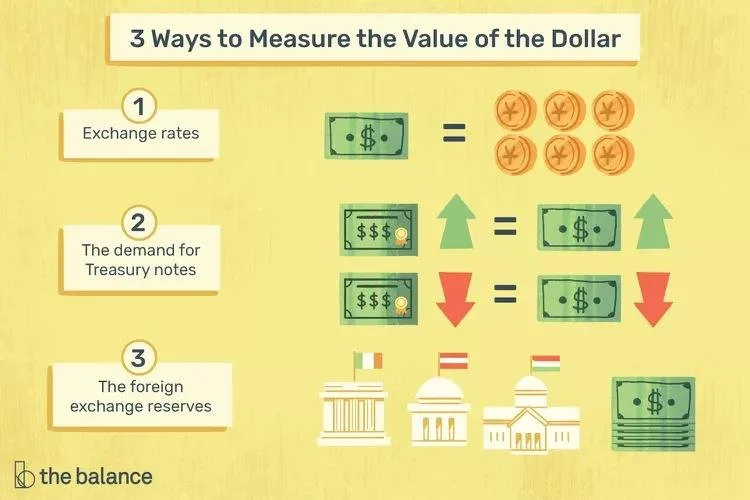
Key Takeaways
You can measure the value of money by how much it will buy in foreign currencies, the demand for Treasury notes, and how much is held in foreign exchange reserves.
When the value of money declines over time and the prices of goods increase, it is called inflation.
When prices fall steadily over time and the value of money increases, it is called deflation, and it can have a harrowing effect on the economy.
It is more valuable to have money today than to have money in the future because of the money's earnings potential; this is the time value of money.
How To Measure the Value of the Dollar
There are three ways to measure the value of the dollar.
Foreign Exchange Rate
The first way to measure the value of the dollar is by how much the dollar will buy in foreign currencies. That's what the foreign exchange (forex) rate measures. Forex traders on the foreign exchange market determine exchange rates. They take into account supply and demand, and then they factor in their expectations for the future. For this reason, the value of money fluctuates throughout the trading day.
Treasury Note Values
The second method to measure the value of the dollar is the value of Treasury notes. They can be converted easily into dollars through the secondary market for Treasurys. When the demand for Treasurys is high, the value of the U.S. dollar rises.1
Foreign Exchange Reserves
The third way is through foreign exchange reserves. That is the amount of dollars held by foreign governments. The more they hold, the lower the supply. That makes U.S. money more valuable. If foreign governments were to sell all their dollar and Treasury holdings, the dollar would collapse. U.S. money would be worth a lot less.
Why the Dollar Changes in Value
No matter how it's measured, the dollar's value declined from 2000 to 2011. That was due to a relatively low federal funds rate, a high federal debt, and a slow-growth economy.
Since 2011, the U.S. dollar has risen in value despite these factors.2 Why? Most of the economies in the world had even slower growth. That made traders want to invest in the dollar as a safe haven. As a result, the dollar strengthened against the euro.3
What Is the Time Value of Money?
Money also has a time value. Money today is worth more than money in the future because today's money can be invested and grown. To calculate the time value of money (TVM), you must consider the present value, the time frame available, and the rate at which it can grow.
Note
The formula for finding the time value of money is FV = PV x [ 1 + (i / n) ] (n x t), where FV is the future value, PV is the present value, i is the interest rate, n is compounding periods per year, and t is the number of years.
Here is an example of finding the time value of money. If you had $100 in present value, a 5% interest rate, and interest that compounds annually, you would be able to calculate the future value of the money after one year.
FV = $100 x [1 + (5% / 1)] (1 x 1) = $105
You would have $105 in future value.
How the Value of Money Affects You
The value of money affects you every day at the gas pump and the grocery store. Demand for gas and food is inelastic.4 Producers know you have to buy gas and food every week. It's not always possible to delay purchases when the price rises.
Producers will pass on any of their extra costs. You will buy it at the higher price for a while until you can change your habits.
Note
When the price of gas or food goes up, you are experiencing the reduced value of money. In March 2022, the food index increased 8.8%—the highest in 40 years.5
When the Value of Money Steadily Declines
Inflation is when the value of money steadily declines over time. Once people expect that prices will rise, they are more likely to buy now, before prices go higher. That increases demand, which tells producers they can safely pass on more costs. They drive prices up more, and inflation becomes a self-fulfilling prophecy.
That's why the Federal Reserve watches inflation like a hawk. It will reduce the money supply or raise interest rates to curb inflation. Core inflation is the price of everything except food and gas prices, which are very volatile. The Consumer Price Index is the most common measure of inflation.6
When the Value of Money Increases
Deflation occurs when the general price level across the economy declines. That sounds like a great thing, but it is worse for the economy than inflation. Why? Think about what happened to the housing market from 2007 to 2011. That was massive deflation.78 Many people could not sell their houses for what they owed on their mortgage. Buyers were afraid that the price would drop right after they purchased it. No one knew when prices would turn back up.
True, the value of money increased. You received more house for the dollar in 2011 than in 2006. But families lost homes. Construction workers lost jobs. Builders went bankrupt. That's what makes deflation so dangerous. It's a fear-driven downward spiral.
How the Value of Money Has Changed Over Time
In 1913, money was worth a lot more. A dollar then could buy what $29.04 could purchase in 2022. The dollar lost value slowly. By 1920, it could buy what $14.38 could in 2022.
During the Great Depression, money gained in value as a result of deflation. A dollar in 1930 could buy what $17.22 could in 2022. By 1950, money had lost some value. A dollar could buy what $11.93 could buy in 2022.
Money has been losing value ever since. In 1970, it could only buy $7.41 in 2022 terms. By 1990, it was only worth $2.20, also in 2022 terms. In 2000, it was worth $1.67 in 2022 terms.9
The Bottom Line
Because of inflation, your dollar today is worth more than it will be in the future. But the day-to-day value of money fluctuates as well because of the volume of demand for it. Dollar demand is measured by the exchange rate value, the value of Treasury notes, and the amount in foreign exchange reserves.
Although rising prices will lessen the purchasing power of money, generalized decreasing prices or deflation can be bad for the economy.10 Yes, deflation will certainly raise the value of money or its purchasing power.
But it's the fear of rapidly plunging prices that will make people hold on to their money, lessen aggregate demand for goods and services, and cause a serious slowdown in economic activity. This makes monitoring and managing inflation and deflation two of the Federal Reserve's most important functions.
TO READ MORE: https://www.thebalancemoney.com/value-of-money-3306108