
Thank you to all the subscribers to our Early Access program…we thank you for your continued support.
We are excited to offer this new service to keep you informed and up-to-date on the latest Dinar and currency news.
Iraq Economic News and Points To Ponder Sunday Afternoon 5-10-26
Usd/Iqd Exchange Rates Rise In Baghdad And Erbil
2026-05-10 Shafaq News- Baghdad/ Erbil The US dollar opened Sunday’s trading higher in Iraq, hovering around 154,000 dinars per 100 dollars.
According to Shafaq News market survey, the dollar traded in Baghdad's Al-Kifah and Al-Harithiya exchanges at 153,500 dinars per 100 dollars, down from the previous session’s 153,150 dinars.
Usd/Iqd Exchange Rates Rise In Baghdad And Erbil
2026-05-10 Shafaq News- Baghdad/ Erbil The US dollar opened Sunday’s trading higher in Iraq, hovering around 154,000 dinars per 100 dollars.
According to Shafaq News market survey, the dollar traded in Baghdad's Al-Kifah and Al-Harithiya exchanges at 153,500 dinars per 100 dollars, down from the previous session’s 153,150 dinars.
In the Iraqi capital, exchange shops sold the dollar at 154,000 dinars and bought it at 153,000 dinars, while in Erbil, selling prices stood at 153,100 dinars and buying prices at 153,100 dinars.
https://www.shafaq.com/en/Economy/USD-IQD-exchange-rates-rise-in-Baghdad-and-Erbil-6
Gold Prices Tick Up In Baghdad And Erbil
2026-05-10 Shafaq News- Baghdad/ Erbil On Sunday, gold prices hovered around 1.02 million IQD per mithqal in Baghdad and Erbil markets, according to a survey by Shafaq News Agency.
Gold prices on Baghdad's Al-Nahr Street recorded a selling price of 1.017 million IQD per mithqal (equivalent to five grams) for 21-carat gold, including Gulf, Turkish, and European varieties, with a buying price of 1.013 million IQD. The same gold had sold for 1.014 million IQD on Saturday.
The selling price for 21-carat Iraqi gold stood at 987,000 IQD, while the buying price reached 983,000 IQD.
In jewelry stores, the selling price per mithqal of 21-carat Gulf gold ranged between 1.020 million and 1.030 million IQD, while Iraqi gold sold for between 990,000 and one million IQD.
In Erbil, 22-carat gold was sold at 1.056 million IQD per mithqal, 21-carat gold at 1.008 million IQD, and 18-carat gold at 864,000 IQD. https://www.shafaq.com/en/Economy/Gold-prices-tick-up-in-Baghdad-and-Erbil-6
Dollar Closes Higher In Baghdad And Erbil
2026-05-10 Shafaq News- Baghdad/ Erbil The US dollar closed higher against the Iraqi dinar in Baghdad and Erbil on Sunday, rising by 450 dinars in Baghdad’s main exchanges during the day’s trading.
According to Shafaq News market survey, exchange rates at Baghdad’s Al-Kifah and Al-Harithiya central stock exchanges settled at 153,950 dinars per $100, compared with 153,500 dinars earlier in the day. Selling prices at local exchange shops in Baghdad reached 154,500 dinars per $100, while buying prices stood at 153,500 dinars.
In Erbil, the dollar also posted gains, with selling prices reaching 153,600 dinars per $100 and buying prices at 153,500 dinars.
https://www.shafaq.com/en/Economy/Dollar-closes-higher-in-Baghdad-and-Erbil-1
ISX Trades $17M+ In April Activity
2026-05-10 Shafaq News- Baghdad The Iraq Stock Exchange (ISX) recorded more than 27.4 billion Iraqi dinars in trading value over April —roughly $17.8 million.
According to market data, more than 48.6 billion shares were traded during the month across 20 regular trading sessions.
The ISX60 index closed the month at 983.02 points, marking a 1.9% increase compared with the previous session.
Throughout the month, the exchange executed around 23,490 sale and purchase contracts across listed companies. During the period, 82 companies out of 118 listed firms recorded actual trading activity.
https://www.shafaq.com/en/Economy/ISX-trades-17M-in-April-activity
EIA: Iraq’s Oil Exports To US Fall Over The Week
2026-05-10 Shafaq News- Baghdad/ Washington Iraq’s crude oil exports to the United States dropped 119,000 barrels per day (bpd) last week, US Energy Information Administration (EIA) data showed on Sunday.
Iraqi shipments averaged 76,000 bpd last week, 61% less than the previous week’s average of 195,000 bpd.
Total US crude imports from nine major suppliers fell 170,000 bpd from 5.066 million bpd the previous week.
Canada remained the top supplier at 3.268 million bpd, followed by Venezuela with 400,000 bpd, Colombia with 348,000 bpd, Saudi Arabia with 332,000 bpd, and Mexico with 327,000 bpd.
Imports also included Ecuador at 165,000 bpd, Nigeria at 93,000 bpd, and Brazil at 27,000 bpd. No oil was imported from Libya this week. https://www.shafaq.com/en/Economy/EIA-Iraq-s-oil-exports-to-US-fall-over-the-week-9
Opinion: Nechirvan Barzani Walks Through Baghdad’s Political Minefield
2026-05-10 Shafaq News By Ali Hussein Feyli Crises in politics are not always resolved through force or shifting balances of power, but often begin when rivals cease viewing one another as enemies to be excluded and instead recognize the possibility of understanding, opening a path that the language of conflict itself could never reach.
In this context, the recent meetings held on May 4 and 5 by Kurdistan Region President Nechirvan Barzani can be seen as an effort to reshape relations between Baghdad and Erbil, reflecting not merely diplomatic engagement but a broader attempt to move from zero-sum confrontation toward practical consensus at a time of mounting financial pressures, rising populism, and shrinking public space in both the Region and the Iraqi capital, with the initiative signaling a search for realistic solutions to long-standing disputes away from the easy rhetoric of escalation.
For years, a conviction prevailed among some political actors that Baghdad responds only to the pressure of power balances. Such a reading is rooted in historical experiences where the logic of force often prevailed over the rule of law, yet major transformations, particularly during critical periods, are frequently shaped in the space between public emotion and political rationality. While the former mobilizes the street, the latter remains more capable of protecting the state and ensuring its continuity.
From this perspective, the Kurdistan Region Presidency’s adoption of a calm institutional discourse appears to represent an attempt to shift from emotional demands toward a realistic management of constitutional rights.
This transformation is not without challenges, particularly in a political environment accustomed to sharp rhetoric, where de-escalation may be perceived as retreat or weakness, even though it may in fact reflect a more pragmatic reading of the balance of power. Such pragmatism is especially urgent for a people like the Kurds, who have spent more than a century caught in cycles of war, identity struggles, and the search for guarantees.
Historical experiences offer important examples in this regard. The path of Nelson Mandela in South Africa demonstrated that preserving stability may require moving beyond the language of revenge in favor of coexistence. In modern Kurdish history, the general amnesty declared after the 1991 uprising against Saddam Hussein’s Baath regime stands out as one of the clearest examples of overcoming political hatred.
The decision taken by the leadership of the Kurdistan Front –a coalition of Kurdish parties established in 1987-1988 in Iraq– led by the late Jalal Talabani and Masoud Barzani, was not merely an administrative measure, but a historic turning point that helped prevent a wide cycle of retaliation and made tolerance the foundation for building a new political entity rather than turning memory into fuel for endless conflict.
Today, Nechirvan Barzani represents, within this equation, a model of measured diplomacy. Rather than appearing through the language of threats and elevated nationalist slogans, he opts for the language of shared interests, constitutional frameworks, and gradual understandings.
Although this model faces considerable obstacles within Kurdistan due to the weight of a bloody history and the growing influence of populism, it is natural that part of Kurdish society may view such diplomatic language as a form of retreat or inadequacy.
Read more: Beyond the Chaos: Nechirvan Barzani is redefining Kurdish diplomacy
Yet amid the rubble of missed opportunities, Nechirvan Barzani remains, in his characteristic manner, focused on conveying an important message to the younger generation: the most difficult test is not always fighting wars, but building peace and preventing collapse.
History rarely lingers on those who hurled the greatest number of insults at their opponents, but rather on those who succeeded in extracting peace from the heart of hostility. What Nechirvan Barzani is doing in Baghdad and regional capitals resembles the work of an architect building in a minefield, preoccupied with preserving a political entity called the Kurdistan Region. Such an undertaking requires a kind of courage unafraid of being accused of weakness.
Despite the rise of extremism and emotional politics, the course of history appears to be moving toward the model championed by Nechirvan Barzani and those who share this approach: a transition from the equation of imposing one’s will toward strategic integration, in a way that could make the Kurdistan Region a more stable entity within Iraq amid an ongoing struggle shaped by questions of existence and identity. Read more: Nechirvan Barzani: A quiet architect of Kurdish statecraft
This article was originally written in Arabic.
Is Gold Becoming System Collateral?
Is Gold Becoming System Collateral?
Swiss America's Gold News Weekly 5-6-26
Gold last traded at $4,688 an ounce. Silver at $77.45 an ounce.
EDITOR'S NOTE: As we have mentioned often lately in this space, there is a deep structural shift occurring in the global financial system. Confidence in fiat currencies - especially the U.S. dollar - is waning, central banks are rapidly accumulating gold as a neutral reserve asset, and de-dollarization is further accelerating.
Is Gold Becoming System Collateral?
Swiss America's Gold News Weekly 5-6-26
Gold last traded at $4,688 an ounce. Silver at $77.45 an ounce.
EDITOR'S NOTE: As we have mentioned often lately in this space, there is a deep structural shift occurring in the global financial system. Confidence in fiat currencies - especially the U.S. dollar - is waning, central banks are rapidly accumulating gold as a neutral reserve asset, and de-dollarization is further accelerating.
At the same time, silver appears to be following gold into a powerful bull cycle, with technical setups indicating a breakout to new all-time highs beyond $121 as part of a longer-term uptrend fueled by tight supply and strong demand.
With gold evolving into "system collateral", the message is clear: the global economy is transitioning toward a more fragmented, less dollar-centric system, where precious metals play a foundational role. https://www.swissamerica.com/
Gold To Hit $8,000 on the Back of De-Dollarization, Says Deutsche Bank
Vinod Dsouza May 2, 2026
Gold prices are hovering around the $4,500 level, and Deutsche Bank predicts the XAU/USD index could breach $8,000 over de-dollarization. The bank wrote in a note to clients that emerging economies are increasingly diversifying their central bank reserves by sidelining the US dollar by procuring gold. This is a cause of concern as the trend is growing and could change the global financial landscape.
Deutsche Bank added that developing countries added over 225 million troy ounces of gold since 2008, highlighting that de-dollarization will push the XAU/USD prices up in the charts. Countries such as China, Russia, India, Poland, and Turkey remain the biggest buyers of gold. This adds a layer of financial safety net to protect their economies from being vulnerable to sanctions.
In addition, Saudi Arabia, Qatar, the United Arab Emirates, Egypt, and Kazakhstan are not too far behind in accumulation. Countries in Eastern Europe and the Middle East are significantly increasing their gold reserves as de-dollarization expands, Deutsche Bank emphasized. The accumulation rose dramatically after the US imposed sanctions on Russia in February 2022 for invading Ukraine. Also Read: UAE Leaving OPEC Hits Oil Prices as Global Supply Strains Grow
Deutsche Bank Predicts Gold Price Above $8,000 Over De-Dollarization
Developing countries are now buying more gold than the Western bloc combined. The rising allocation of the precious metal is making de-dollarization advance at a rapid pace. In the next five years, the allocation would increase further, leading to a strain on the US dollar’s prospects. Even the US economy could be affected if the dollar’s role in the central bank is reduced.
The future of de-dollarization will depend on how high the gold spending would reach, wrote Deutsche Bank. If central banks begin to target 40% of their reserves in gold, then the US dollar would fall on the path of decline. There is growing mistrust of the US dollar lately due to Trump’s previous trade wars and tariffs. Add to that the imposing of sanctions was already a concern for developing nations. https://watcher.guru/news/gold-to-hit-8000-on-the-back-of-de-dollarization
More Iraq News Posted by Tishwash at TNT 5-10-2026
TNT:
Tishwash: The Secretary-General of Parliament: The date for the vote on the cabinet will be set for next Monday or Tuesday.
The Secretary-General of the House of Representatives, Safwan Al-Jarjari, announced that the date for the vote on the cabinet has not yet been decided, indicating that the final decision is pending the presidency of the council, with the likelihood of it being held on Monday or Tuesday of next week.
TNT:
Tishwash: The Secretary-General of Parliament: The date for the vote on the cabinet will be set for next Monday or Tuesday.
The Secretary-General of the House of Representatives, Safwan Al-Jarjari, announced that the date for the vote on the cabinet has not yet been decided, indicating that the final decision is pending the presidency of the council, with the likelihood of it being held on Monday or Tuesday of next week.
Al-Jarjari said in a press statement that: “The House of Representatives has completed all preparations for holding the session to vote on the cabinet,” indicating that “it has been customary in previous government voting sessions to send invitations to political and diplomatic leaders, and things will become clearer tomorrow.”
He added that "tomorrow will see the start of sending invitations to the political leaders, the coordinating framework and the political council," stressing that "we are waiting for the Speaker of Parliament to set a date for the session, whether it will be on Monday or Tuesday." link
************
Tishwash: The cabinet is nearing completion, and parliament is preparing for a vote this week.
Members of the House of Representatives confirmed on Sunday that the new cabinet is almost complete, while they indicated that discussions are continuing regarding some sovereign ministries in preparation for holding a voting session during this week.
Members of the House of Representatives said in a press statement followed by Al-Furat News that approximately 80 percent of the government formation has been completed, with a trend towards passing 50 percent plus one of the ministries, with the remaining ministerial portfolios to be completed at a later time.
They added that discussions are still ongoing regarding a number of sovereign ministries, most notably the Interior, Oil and Foreign Affairs ministries, in addition to dialogues related to restructuring some portfolios and creating a state ministry.
They indicated that the vote on the new government is expected to take place this week, without specifying an official date yet.
They indicated that there are parliamentary observations that will be raised during the discussion of the government program before proceeding with the voting process. link
************
Tishwash: Bin Salman congratulates Al-Zaidi: We look forward to working with you to strengthen relations.
Saudi Crown Prince Mohammed bin Salman sent a congratulatory telegram on Saturday (May 9, 2026) to Ali al-Zaidi on the occasion of his appointment as head of the Iraqi government. In his telegram, bin Salman expressed his wishes for al-Zaidi to succeed in serving Iraq and its people, stressing his aspiration to work together to strengthen bilateral relations between Riyadh and Baghdad and enhance cooperation at various levels.
The Saudi Press Agency reported in a statement followed by Network 964 that “His Royal Highness Prince Mohammed bin Salman bin Abdulaziz Al Saud, Crown Prince and Prime Minister, sent a congratulatory telegram to His Excellency Mr. Ali Faleh Kazem Al-Zaidi on the occasion of his appointment as Prime Minister of the Republic of Iraq.”
She continued, “His Highness the Crown Prince said, ‘On the occasion of your appointment as Prime Minister of the Republic of Iraq, we are pleased to express to Your Excellency our sincere congratulations and best wishes for success and prosperity. We ask God Almighty to grant you success in serving Iraq and its brotherly people. We look forward to working with Your Excellency to strengthen the bonds of brotherly relations between our two countries and peoples, and to enhance them in all fields. We wish Your Excellency continued health and happiness, and the brotherly people of the Republic of Iraq further progress and prosperity.’”
On Saturday (May 2, 2029), Prime Minister-designate Ali al-Zidi received a phone call from Turkish President Recep Tayyip Erdogan, congratulating him on his official appointment to form the new government.
He also received a call from US President Donald Trump on Thursday (April 30, 2026), during which he congratulated him on being officially tasked with forming the new government, and extended an official invitation for him to visit Washington after the government is formed.
On Saturday (May 2, 2026), Al-Zidi received another call from the Emir of Qatar, Tamim bin Hamad Al Thani, congratulating him on his official appointment to form the new government. Al-Zidi also received an invitation from Al Thani to visit Qatar after the formation of the new government. link
************
Tishwash: Bloomberg: Aramco and ADNOC successfully transported oil shipments through the Strait of Hormuz
Bloomberg reported that Saudi Aramco and the UAE's ADNOC were able to smuggle oil shipments through the Strait of Hormuz using methods of concealment .
This comes amid increasing turmoil in the strait since tensions between the United States and Iran erupted in late February, raising risks to maritime traffic link
************
Tishwash: Al-Zidi and Al-Kadhimi discuss the political situation and the formation of the next government.
The Iraqi Prime Minister-designate, Ali Faleh al-Zaidi, met today, Saturday, with former Prime Minister Mustafa al-Kadhimi.
During the meeting, the overall situation in the country was discussed, and a number of issues related to Iraq’s interests were discussed, in addition to emphasizing the importance of coordination and cooperation between political forces in order to form a comprehensive national government capable of facing various challenges, meeting the requirements of the current stage, and enhancing stability and serving the aspirations of citizens throughout the country.
Both sides stressed the need to unify efforts and support the path of national solutions in order to ensure the stability of the political and economic situation in Iraq link
***********
Tishwash: Eco Iraq Observatory: 70% of the government curriculum is copied from the “White Paper”
The Eco Iraq Observatory announced on Friday that more than 70% of the axes of the government’s economic program for the prime minister-designate are based on ideas and contents contained in the “White Paper” for economic reform presented by the previous government in 2020.
The observatory stated in a statement received by “Roj News” that “many paragraphs of the government’s economic program are directly inspired by the contents of the White Paper that was presented during the time of former Prime Minister Mustafa Al-Kadhimi.”
He added that “the similarity is not limited to general titles, but includes similar terms and themes such as (digital transformation, electronic signature, support for the private sector, reform of the banking sector, and smart networks).”
The observatory noted that “the government program did not provide clear mechanisms to address the rentier economy or reduce the bloated public sector, which constitutes an increasing burden on the general budget, nor did it address in detail the tools for addressing the financial deficit or how to confront the shocks associated with fluctuations in oil prices and the decline in exports.” link
Seeds of Wisdom RV and Economics Updates Sunday Morning 5-10-26
Good Morning Dinar Recaps,
Global Energy Shock Deepens as Hormuz Crisis Threatens Financial Stability
Oil volatility, inflation fears, and shipping disruptions are intensifying pressure on the global economic system
Good Morning Dinar Recaps,
Global Energy Shock Deepens as Hormuz Crisis Threatens Financial Stability
Oil volatility, inflation fears, and shipping disruptions are intensifying pressure on the global economic system
Overview (Key Points)
The global economy is facing renewed financial stress as tensions surrounding the Strait of Hormuz continue disrupting energy markets and trade flows.
Oil prices remain highly volatile amid fears that prolonged instability in the Gulf could trigger a broader inflationary and economic shock across global markets.
Investors are increasingly concerned that rising energy costs could delay central bank rate cuts, weaken consumer demand, and slow economic growth worldwide.
The situation highlights how closely the global financial system remains tied to Middle East energy stability, despite years of diversification efforts.
Key Developments
1. Oil Prices Remain Elevated Amid Gulf Instability
Brent crude and U.S. oil prices continue trading at historically elevated levels following disruptions linked to the Iran conflict and shipping concerns in the Gulf.
Analysts warn that even temporary interruptions in the Strait of Hormuz can create major ripple effects throughout the global economy.
2. Inflation Risks Are Re-Emerging
Higher oil prices are increasing fears of another wave of global inflation.
Transportation costs are rising
Manufacturing expenses are climbing
Consumer purchasing power is weakening
This could complicate efforts by central banks to stabilize economies already burdened by debt and slow growth.
3. Investors Shift Toward Safe-Haven Assets
Global uncertainty is driving increased interest in:
Gold
U.S. Treasuries
Defensive assets
Meanwhile, market volatility continues to intensify as traders react to rapidly changing geopolitical developments.
4. Global Trade Routes Face Mounting Pressure
The Gulf region remains one of the world’s most important energy corridors.
Shipping disruptions and higher insurance costs are increasing pressure on global supply chains and trade networks, especially across Asia and Europe.
5. Economic Fragility Is Becoming More Visible
The latest market swings reveal how vulnerable the global economy remains to geopolitical shocks.
Even with strong corporate earnings in some sectors, rising energy costs continue threatening broader financial stability.
Why It Matters
Energy shocks historically trigger wider economic consequences across:
Inflation
Currency markets
Trade systems
Consumer confidence
The current crisis is exposing the interconnected nature of the modern financial system and its dependence on stable energy flows.
Why It Matters to Foreign Currency Holders
Rising oil prices and geopolitical instability can drive:
Currency volatility
Inflationary pressure
Capital movement into safe-haven assets
Countries heavily dependent on imported energy may face increased strain on national currencies and reserves.
Implications for the Global Reset
Pillar 1: Energy Security Is Becoming Financial Security
The ongoing Gulf crisis demonstrates how energy control increasingly influences monetary stability and global economic power.
Pillar 2: Systemic Vulnerabilities Are Accelerating Structural Change
Persistent instability may push nations to:
Diversify trade systems
Reduce dependency on vulnerable shipping routes
Explore alternative financial arrangements outside traditional structures
Conclusion
The current energy crisis is not simply a regional geopolitical issue—it is becoming a global financial stress event.
As oil volatility, inflation fears, and market uncertainty converge, governments and financial institutions are being forced to confront deeper structural vulnerabilities within the global economy.
The world may be entering a period where economic resilience becomes just as important as military or political power.
Seeds of Wisdom Team
Newshounds News™ Exclusive
Sources
Reuters — "Global markets react to Gulf tensions and rising oil prices"
Reuters — "Oil prices surge as Hormuz disruptions threaten supply"
~~~~~~~~~~
🌱 A Message to Our Currency Holders🌱
If you’ve been holding foreign currency for many years, you were not foolish.
You were not wrong to believe the global financial system would change.
What failed was not your patience — it was the information you were given.
For years, dates, rumors, and personalities replaced facts, structure, and proof. “This week” predictions created cycles of hope and disappointment that were never based on how currencies actually change.
That is not your failure.
Our mission here is different: • No dates • No rates • No hype • No gurus
Instead, we focus on:
• Verifiable developments • Institutional evidence
• Global financial structure • Where countries actually sit in the process
Currency value changes only come after sovereignty, trade, banking, settlement systems, and fiscal coordination are in place. History and institutions confirm this sequence.
You will see silence. You will see denials. That is not delay — that is discipline.
Protect your identity. Organize your documents. Verify everything.
Never hand your discernment to anyone who cannot show proof.
You deserve truth — not timelines.
Seeds of Wisdom Team
Newshounds News™
~~~~~~~~~~
Seeds of Wisdom Team RV Currency Facts Youtube and Rumble
Newshound's News Telegram Room Link
RV Facts with Proof Links Link
RV Updates Proof links - Facts Link
Follow the Gold/Silver Rate COMEX
Follow Fast Facts
Seeds of Wisdom Team™ Website
Thank you Dinar Recaps
Iraq Economic News and Points To Ponder Sunday Morning 5-10-26
Kurdistan Finance Ministry Deposits Over 50 Billion Dinars Of April Revenues With Baghdad
Money and Business Economy News – Baghdad The Ministry of Finance and Economy in the Kurdistan Region announced on Sunday that more than 50 billion dinars of non-oil revenues for the month of April have been deposited into the bank account of the Federal Ministry of Finance.
Kurdistan Finance Ministry Deposits Over 50 Billion Dinars Of April Revenues With Baghdad
Money and Business Economy News – Baghdad The Ministry of Finance and Economy in the Kurdistan Region announced on Sunday that more than 50 billion dinars of non-oil revenues for the month of April have been deposited into the bank account of the Federal Ministry of Finance.
The ministry said in a statement seen by “Al-Eqtisad News” that it had deposited an amount of 50 billion, 292 million, and 213 thousand Iraqi dinars into the federal finance account at the Central Bank of Iraq branch in Erbil, as part of the financial procedures followed to settle non-oil revenues between the region and the federal government to finance the monthly salaries of Kurdistan employees. https://www.economy-news.net/content.php?id=68884
Iraq Maintains Its Position In The Global Gold Reserve Ranking During 2026
Money and Business Economy News – Baghdad Data from the World Gold Council revealed that gold constituted about 25% of Iraq’s total foreign reserves during 2026, reflecting the continued role of gold as one of the most important financial hedging tools in the country.
The latest official global gold reserves data for May 2026 showed that Iraq has not recorded any gold purchases since the beginning of 2026, remaining at 174.6 tons.
This figure comes amid a state of relative stability in the global gold market, where central banks continue to rely on gold as a safe asset alongside foreign currencies.
According to data seen by Shafaq News Agency, Iraq maintained its position in the global ranking, coming in at 28th globally and third in the Arab world during the past months of this year.
Globally, the United States topped the list with a reserve of 8,133 tons, followed by Germany with 3,350 tons, then Italy with 2,451 tons, France came in fourth with 2,437 tons, while China came in fifth with a reserve of 2,311 tons.
According to the report, Iraq purchased several quantities of gold during 2025, including one ton in March, 1.6 tons in June, 3.1 tons in July, 2.5 tons in August, and 3.8 tons in October.
It is worth noting that the World Gold Council, based in the United Kingdom, is one of the leading bodies specializing in analyzing global gold market trends and the factors affecting its prices. https://www.economy-news.net/content.php?id=68901
The Repercussions Of The Hormuz Closure: Iraq's Economy Under Pressure: Rising Debt And Eroding Liquidity Threaten Financial Stability.
Reports Economy News – Baghdad The issue of financial stability in Iraq has returned to the forefront once again, with growing fears of a widening fiscal deficit and declining oil revenues, coinciding with rising domestic debt and a decrease in the central bank's foreign reserves, at a time when the government affirms that the monetary situation is still under control and that reserves are capable of protecting the economy from external shocks.
The Ministry of Finance revealed that the total Iraqi domestic debt reached 96 trillion and 629 billion dinars by the end of April 2026, compared to an external debt of $13.039 billion, at a time when data indicates the state’s continued reliance on domestic borrowing to cover operational expenses, particularly salaries, government subsidies, and the energy sector.
According to data from the Public Debt Department, Iraqi governments have borrowed more than 46 trillion dinars domestically since 2023 until last April, of which only about 43% has been repaid, while the largest part of the debt still represents accumulated obligations from previous governments.
Nevertheless, financial authorities maintain that the debt-to-GDP ratio remains within internationally acceptable limits.
In contrast, clear signs of pressure on liquidity and cash reserves emerged, after recording a decline of more than 3 trillion dinars in the central bank’s reserves in just two weeks, according to official data pointed out by economist Nabil Al-Marsoumi, who warned that the gap between oil revenues and government spending has begun to widen in an unprecedented way.
Al-Marsoumi believes that the current crisis is directly related to the repercussions of regional tensions and the disruption of trade and energy in the region, especially after the closure of the Strait of Hormuz and the significant decline in Iraqi oil exports, which led to a decrease in oil revenues to levels that are insufficient to cover salaries and basic operating expenses.
According to his estimates, Iraq needs approximately 7 trillion dinars per month to cover operational spending, while current oil revenues provide only a limited portion of this amount, which puts the government in front of difficult financial choices, most notably expanding domestic borrowing or resorting to monetary tools that may later affect monetary stability and the level of inflation.
Experts also warn that the continued decline in oil revenues will lead to a further depletion of foreign reserves, especially as the central bank continues to finance foreign trade and maintain exchange rate stability, given the limited non-oil revenues and declining commercial activity as a result of regional turmoil.
In contrast, the Prime Minister’s financial and economic advisor, Mazhar Muhammad Salih, downplays the seriousness of the situation, stressing that foreign reserves still represent the first line of defense for the Iraqi economy, and that monetary management has the technical ability to absorb temporary shocks.
In his interview with "Al-Eqtisad News," Saleh points out that foreign reserves still cover about 12 months of imports, a percentage that far exceeds safe international standards.
He stressed that any short-term fluctuation in reserves can be dealt with within the approved monetary policies, and that the central bank still retains effective tools to ensure financial and monetary stability.
Despite official assurances, observers believe the real challenge lies not only in the size of reserves or public debt, but also in the Iraqi economy's continued near-total dependence on oil, at a time when regional energy markets and supply lines are experiencing frequent shocks. Furthermore, delays in gas and energy projects and rising operational spending are placing public finances under pressure that could worsen if the regional crisis persists.
Between the government’s vision, which emphasizes the strength of the monetary situation, and experts’ warnings of a widening deficit and liquidity gap, the Iraqi economy remains facing a difficult test that depends largely on the stability of oil markets and the state’s ability to diversify its resources and reduce its dependence on rentier spending in the face of rapidly changing regional circumstances.https://www.economy-news.net/content.php?id=68902
The Iraqi Stock Market Traded 48 Billion Shares Worth 27 Billion Dinars During The Month.
Stock Exchange Economy News – Baghdad The Iraq Stock Exchange announced on Sunday that more than 48 billion shares worth more than 27 billion dinars were traded during the month of April.
A market report stated that "the market held 20 regular trading sessions during the month, during which shares of 82 out of 118 listed companies were traded."
He added that "the number of executed transactions reached about 23,490 transactions, while the number of shares traded exceeded 48 billion and 605 million shares, with a value of 27 billion and 457 million dinars, distributed across various sectors."
The report noted that "the ISX60 index closed at the end of the month at 983.02 points, recording an increase of 1.9% compared to the previous session's close," indicating that this "reflects a state of anticipation and caution among investors during trading periods."
The Iraq Stock Exchange, which includes diverse sectors such as banking, telecommunications, industry, insurance, investment and services, is witnessing regular trading activity despite the economic challenges.
https://www.economy-news.net/content.php?id=68906
Aramco CEO: The World Lost One Billion Barrels Of Oil In Two Months
energy Economy News - Follow-up Commenting On The Company’s Results Released On Sunday, Saudi Aramco President And CEO Amin Nasser Said The Past Two Months Have Served As A Stark Reminder That Oil And Gas Remain Essential Components Of Global Energy Security.
He Added That The World Has Lost About One Billion Barrels Of Oil In The Past Two Months, Noting That Even With The Resumption Of Energy Flows, It Will Take Time For The System To Return To Normal.
Al-Nasser Explained That Aramco’s Goal Is To Ensure The Continued Flow Of Energy, Stressing That The Company Was Able To Restart Some Of The Affected Facilities In Less Than 24 To 48 Hours, A Process That Could Have Taken Months Without Prior Investment And Emergency Planning.
Al-Nasser Noted That Years Of Underinvestment, Coupled With Recent Supply Disruptions, Have Increased Pressure On Global Stockpiles.
Al-Nasser Also Emphasized That Asia Remains A Top Priority For Saudi Aramco.
Al-Nasser Noted That The Company’s Performance In The First Quarter Reflects Strong Operational Resilience And A Great Ability To Adapt In A Complex Geopolitical Environment.
He Added That The East-West Pipeline, Which Is Now Operating At Its Maximum Capacity Of 7 Million Barrels Of Oil Per Day, Has Proven To Be A Vital Artery To Ensure The Continued Supply Of Oil And Other Products To The Markets, As It Has Helped To Mitigate The Effects Of The Global Energy Shock And Has Contributed To Providing Support To Customers Affected By Shipping Restrictions In The Strait Of Hormuz. https://www.economy-news.net/content.php?id=68887
Seeds of Wisdom RV and Economics Updates Saturday Afternoon 5-9-26
Good Afternoon Dinar Recaps,
Dollar Pressure Intensifies: BRICS Expansion, Energy Fragmentation, and Gold Demand Accelerate Global Financial Realignment
New developments in energy markets, reserve diversification, and alternative payment systems are deepening the shift toward a multipolar financial structure
Rising geopolitical tensions, weakening confidence in traditional reserve systems, and expanding BRICS coordination are increasing pressure on the post-World War II financial order.
Good Afternoon Dinar Recaps,
Dollar Pressure Intensifies: BRICS Expansion, Energy Fragmentation, and Gold Demand Accelerate Global Financial Realignment
New developments in energy markets, reserve diversification, and alternative payment systems are deepening the shift toward a multipolar financial structure
Rising geopolitical tensions, weakening confidence in traditional reserve systems, and expanding BRICS coordination are increasing pressure on the post-World War II financial order.
OVERVIEW (KEY POINTS)
Global financial markets are entering another period of uncertainty as de-dollarization efforts, reserve diversification, and energy fragmentation continue accelerating across major emerging economies.
Today’s developments highlight how countries within BRICS and the broader Global South are increasingly building systems designed to reduce exposure to the US dollar and Western-controlled financial infrastructure.
At the same time, instability in energy markets — particularly around the Strait of Hormuz and Gulf supply chains — is reinforcing the push toward alternative trade arrangements backed by gold, local currencies, and regional settlement systems.
The broader implication is becoming clearer: the world economy is gradually moving away from a single dominant financial center toward a more fragmented and multipolar structure.
KEY DEVELOPMENTS
1. BRICS Payment System Discussions Continue Expanding
Momentum behind non-dollar settlement systems is growing.
India is expected to continue advancing proposals for a cross-border BRICS payment infrastructure
Member nations increasingly favor local currency trade and digital settlement systems
Alternative payment rails could gradually reduce dependence on SWIFT and dollar clearing systems
2. Central Banks Continue Shifting Toward Gold
Reserve diversification remains a major trend.
Central banks are steadily increasing gold accumulation
Nations increasingly view physical gold as protection against sanctions and reserve-access risks
Gold’s role as a neutral reserve asset continues expanding globally
3. Energy Fragmentation Reshapes Global Trade
Energy markets remain under pressure from geopolitical instability.
Gulf shipping disruptions and Hormuz tensions continue affecting trade flows
Oil and LNG markets are becoming increasingly regionalized
Energy-producing nations are exploring settlement mechanisms outside traditional dollar channels
4. Petrodollar System Faces Growing Long-Term Challenges
Several structural trends are weakening the traditional system.
Countries are increasingly questioning long-term dependence on dollar-denominated energy trade
Green energy investment and regional currency agreements are slowly reducing exclusive dollar demand
Reserve diversification is becoming a permanent strategic policy for many governments
5. Financial Stability Risks Continue Expanding
Global institutions are warning about broader systemic vulnerabilities.
IMF officials recently warned about rising cyber and AI-driven financial threats
Debt expansion, inflation pressure, and geopolitical fragmentation continue increasing systemic stress
Markets remain highly sensitive to energy and currency disruptions
WHY IT MATTERS
These developments matter because the global financial system depends heavily on confidence, liquidity, and stable reserve relationships.
As countries diversify reserves and develop alternative settlement systems, the dominance of traditional financial channels may gradually weaken over time.
The shift does not necessarily mean an immediate collapse of the dollar system. However, it does point toward a future where multiple financial blocs compete simultaneously for influence over trade, reserves, and energy settlement.
This transition could produce higher volatility in currencies, commodities, and sovereign debt markets as global capital flows adjust to the changing structure.
WHY IT MATTERS TO FOREIGN CURRENCY HOLDERS
Reserve diversification could weaken long-term dollar demand growth
Gold-backed and commodity-linked assets may gain importance
Currency volatility could increase during geopolitical disruptions
Countries holding large dollar reserves may continue reducing exposure gradually
IMPLICATIONS FOR THE GLOBAL RESET
Pillar 1: Multipolar Trade Infrastructure Expands
Alternative payment systems, regional currency agreements, and gold accumulation are slowly creating parallel financial channels outside traditional Western systems.
Pillar 2: Energy and Finance Become More Interconnected
Control over energy routes, LNG infrastructure, and commodity settlement mechanisms is increasingly influencing monetary policy and reserve strategy worldwide.
CONCLUSION
The financial system is entering a phase where structural shifts are becoming harder to ignore.
Reserve diversification, energy fragmentation, and BRICS-led financial experimentation are no longer isolated developments — they are converging into a broader transformation of global economic power.
While the dollar remains dominant today, the foundation supporting that dominance is being tested by geopolitical competition, alternative payment systems, and changing reserve strategies.
The next phase of the global economy may not be defined by a single financial center, but by competing systems operating side by side.
Seeds of Wisdom Team
Newshounds News™ Exclusive
Sources
~~~~~~~~~~
Seeds of Wisdom Team RV Currency Facts Youtube and Rumble
Newshound's News Telegram Room Link
RV Facts with Proof Links Link
RV Updates Proof links - Facts Link
Follow the Gold/Silver Rate COMEX
Follow Fast Facts
Seeds of Wisdom Team™ Website
Thank you Dinar Recaps
Iraq Economic News and Points To Ponder Saturday Afternoon 5-9-26
Oil Prices Claw Back Losses Following US-Iran Air Strikes
2026-05-09 Shafaq News Brent crude futures jumped as much as 3% on Saturday, a day after the U.S. and Iran traded air strikes, but pared gains as traders hoped for a longer pause in the fighting that has shut shipping in the Strait of Hormuz.
Brent crude futures settled at $101.29 a barrel, up $1.23 or 1.23%, after rising as much as 3% during the session. U.S. West Texas Intermediate (WTI) futures finished at $95.42 a barrel, up 61 cents, or 0.64%.
Both contracts were settled with weekly declines of more than 6%.
Oil Prices Claw Back Losses Following US-Iran Air Strikes
2026-05-09 Shafaq News Brent crude futures jumped as much as 3% on Saturday, a day after the U.S. and Iran traded air strikes, but pared gains as traders hoped for a longer pause in the fighting that has shut shipping in the Strait of Hormuz.
Brent crude futures settled at $101.29 a barrel, up $1.23 or 1.23%, after rising as much as 3% during the session. U.S. West Texas Intermediate (WTI) futures finished at $95.42 a barrel, up 61 cents, or 0.64%.
Both contracts were settled with weekly declines of more than 6%.
"We're treading water here, rightfully so," said John Kilduff, partner with Again Capital. "We're on the cusp of a breakthrough in negotiations or we're on the cusp of a renewal of the fighting. We've been here a lot."
"There is a sense in the market that there is going to be an agreement and we'll get the next phase which would be 30 days to hammer out an agreement (between Iran and the U.S.)," Kilduff said.
Throughout the day, traders felt like they had been swatted back and forth like a tennis ball.
"We're still playing the headline-o-rama game," said Phil Flynn, senior analyst with Price Futures Group. "Ship movement in the Persian Gulf is going about as well as can be expected. We're kind of working around the edges."
U.S. and Iranian forces clashed in the Gulf, and the UAE came under renewed attack as Washington awaited a response from Tehran to its proposal to end the conflict, which began with joint U.S.-Israeli airstrikes across Iran on February 28.
U.S. President Donald Trump later on Thursday told reporters the ceasefire was still in effect and sought to play down the exchange.
However, on Friday, Trump renewed an ultimatum demanding Iran give up its nuclear ambitions.
"How quickly can supply be returned from Gulf states, what will the state of inventories be as we approach peak gasoline season, and what sanctions would look like post-settlement are all worthy of thought. But none can be addressed until there is a long-term solution to hostilities," said PVM Oil Associates analyst John Evans.
"The U.S. administration continues to oversell the prospects of a thaw, and an optimism-biased market buys into it," said Vandana Hari, founder of oil market analysis firm Vanda Insights.
"Curiously, each time, the rebound is gradual and incomplete, making the head fakes at least somewhat effective."
Meanwhile, the U.S. Commodity Futures Trading Commission is investigating oil price trades totalling $7 billion placed shortly ahead of key Iran war-related announcements by Trump, Reuters reported on Thursday.
Most involved short positions, or bets on prices falling, placed on the Intercontinental Exchange (ICE) and Chicago Mercantile Exchange (CME) and were placed shortly before Trump statements announcing attack delays, the ceasefire or other changes to Iran policy that led to a decline in oil markets. (REUTERS)
https://www.shafaq.com/en/Economy/Oil-prices-claw-back-losses-following-US-Iran-air-strikes
Basrah Crude Ends Week Lower
2026-05-09 Shafaq News- Basrah Iraq’s Basrah crude grades posted a weekly loss of more than 10% last week.
Basrah Heavy edged down by $1.35 in the latest trading session to $110.53 per barrel, recording a weekly decline of $11.20, or 10.13%. Basrah Medium also fell by $1.35 to $112.63 per barrel, posting a weekly loss of $11.20, or 9.94%.
Brent crude futures settled $1.23 higher, or 1.23%, at $101.29 a barrel. US West Texas Intermediate (WTI) ended at $95.42 a barrel, up 61 cents, or 0.64%. Both contracts were settled with weekly declines of more than 6%.
https://www.shafaq.com/en/Economy/Basrah-crude-ends-week-lower-8
High Production Costs Stifle Syrian Export Revival In Iraq
2026-05-09 Shafaq News- Damascus/ Baghdad Syrian exporters are facing growing pressure in Iraq’s market, with trade volumes still far below the $2.3 billion in Syrian exports recorded before the 2011 war, as cheaper foreign products continue to expand their presence in the country.
Mohammad Orfali, head of the Investment and Real Estate Development Committee at the Damascus Chamber of Commerce, told Shafaq News on Friday that the decline in exports to Iraq to rising production, shipping, and energy costs inside Syria.
“The Iraqi market remains one of the most important destinations for Syrian products,” he remarked, noting that Syrian goods once accounted for a much larger share of Iraqi imports, particularly in food products, textiles, and pharmaceuticals.
Although the reopening of border crossings between Syria and Iraq has helped revive part of the trade flow, Orfali called for broader economic cooperation and stronger coordination between Damascus and Baghdad through trade delegations, as well as the chambers of commerce, industry, and agriculture.
“The improvement of logistics infrastructure, easing financial transfers, and streamlining customs procedures could further increase trade exchange between the two countries,” he continued, maintaining that Syrian products still enjoy the trust and preference of Iraqi consumers.
To strengthen the competitiveness of Syrian exports, Orfali urged Damascus to remove customs duties on raw materials used in manufacturing, a step he believes could reduce production costs and reinforce the position of Syrian goods in foreign markets, particularly Iraq.
He concluded that Baghdad remains among the most promising destinations for Syrian exports because of its proximity, lower transportation costs compared with distant markets, similar consumer tastes, and the longstanding economic and social ties between the Syrian and Iraqi peoples.
According to Iraq’s Ministry of Finance, trade between Iraq and Syria reached about $5 billion before the 2011 conflict. It then fell sharply during the war years to below $1 billion, as border closures, security disruptions, and the contraction of Syrian industrial output weighed on cross-border commerce. In recent years, however, trade has shown signs of recovery, with estimates for 2024 and 2025 placing the value of bilateral exchanges at around $2 billion.
https://www.shafaq.com/en/Economy/High-production-costs-stifle-Syrian-export-revival-in-Iraq
Hormuz Tensions Cut Iraq Ship Fuel Sales By More Than Half
2026-05-09 Shafaq News- Baghdad Fuel supply operations for ships at Iraqi ports fell sharply in April as uncertainty surrounding navigation through the Strait of Hormuz and the regional war continued to disrupt shipping routes.
In a statement, Vinayak Kharmale, head of operations at Sea Crown Marine Services, noted that Iraq’s marine fuel sales dropped to around 7,000 metric tons in April from 15,000 metric tons in March, marking a decline of roughly 53%.
Kharmale explained that the slowdown was not driven by weak demand, but by difficulties in vessel movement and voyage planning amid continued security concerns in regional waters.
Shipping companies remain cautious about navigation routes after refueling, leading many operators to suspend activities pending greater stability in maritime traffic, he added.
Average prices for 0.5% low-sulfur marine fuel at Basra port also declined in April to $999.28 per metric ton, down $42.03 from the previous month.
The downturn coincided with weaker bunker fuel demand across Middle Eastern ports, particularly Fujairah and Dubai, as slower traffic through Hormuz pushed part of the demand toward ports in Africa, India, and Sri Lanka.
https://www.shafaq.com/en/Economy/Hormuz-tensions-cut-Iraq-ship-fuel-sales-by-more-than-half
Dollar Edges Up In Baghdad, Steady In Erbil
2026-05-09 Shafaq News- Baghdad/ Erbil The US dollar opened Saturday's trading slightly higher in Baghdad and stable in Erbil, hovering around 153,000 dinars per 100 dollars.
According to Shafaq News market survey, the dollar traded in Baghdad's Al-Kifah and Al-Harithiya exchanges at 153,150 dinars per 100 dollars, up from the previous session's 153,000 dinars.
In the Iraqi capital, exchange shops sold the dollar at 153,500 dinars and bought it at 152,500 dinars.
In Erbil, selling prices stood at 152,950 dinars and buying prices at 152,850 dinars.
https://www.shafaq.com/en/Economy/Dollar-edges-up-in-Baghdad-steady-in-Erbil
Gold Prices Slip In Baghdad And Erbil
2026-05-09 Shafaq News- Baghdad/ Erbil Gold prices fell Saturday in Baghdad and Erbil markets, hovering around the million-dinar mark, according to a Shafaq News market survey.
On Baghdad's Al-Nahr Street, wholesale markets recorded a selling price of 1.014 million IQD per mithqal (equivalent to five grams) for 21-carat Gulf, Turkish, and European gold, with a buying price of 1.010 million IQD, down from 1.017 million IQD the previous session.
Iraqi 21-carat gold sold at 984,000 IQD per mithqal, with a buying price of 980,000 IQD.
In jewelry stores, 21-carat Gulf gold ranged between 1.015 million and 1.025 million IQD per mithqal, while Iraqi gold sold between 985,000 and 990,000 IQD.
In Erbil, prices also declined, with 22-carat gold selling at 1.054 million IQD per mithqal, 21-carat at 1.006 million IQD, and 18-carat at 861,000 IQD. https://www.shafaq.com/en/Economy/Gold-prices-slip-in-Baghdad-and-Erbil
More “Iraq News” Posted by Tishwash at TNT 5-9-2026
TNT:
Tishwash: Trump: What happened in Iraq is "very good" and I'm happy with the prime minister-designate.
US President Donald Trump said on Saturday that recent developments in Iraq were “very good,” expressing his satisfaction with the selection of the Iraqi prime minister-designate, in a further sign of Washington’s support for the new Iraqi leadership.
Trump said in a press statement followed by “Iraq Observer”, “What happened in Iraq is very good and I am happy with the prime minister-designate”, adding: “We are supposed to receive a response from Iran tonight.”
TNT:
Tishwash: Trump: What happened in Iraq is "very good" and I'm happy with the prime minister-designate.
US President Donald Trump said on Saturday that recent developments in Iraq were “very good,” expressing his satisfaction with the selection of the Iraqi prime minister-designate, in a further sign of Washington’s support for the new Iraqi leadership.
Trump said in a press statement followed by “Iraq Observer”, “What happened in Iraq is very good and I am happy with the prime minister-designate”, adding: “We are supposed to receive a response from Iran tonight.”
Trump had invited Iraqi Prime Minister-designate al-Zaidi to visit Washington following the formation of the new government, stressing the US administration’s desire to strengthen bilateral relations and security and economic cooperation between the two countries.
The US president also stressed his country's support for the formation of an Iraqi government capable of building a better future for Iraq, free from terrorism. link
************
Tishwash: Hussein Arab: The cabinet approval session will be held on Monday with a government missing two ministers.
MP Hussein Arab confirmed today, Thursday (May 7, 2026), that the session to pass the ministerial cabinet will be held on Monday, with the government being presented with only two ministers missing.
Arab explained in a statement to “Baghdad Today” that “Prime Minister-designate Ali al-Zidi intends to present his cabinet formation next Sunday, along with his government program, in preparation for requesting a vote of confidence from Parliament,” indicating that “the latest date for the vote will be Monday.”
He added that “Al-Zaydi has great freedom in choosing candidates for ministries, as he asked some blocs to submit more than one name for each portfolio so that he could choose one of them, while he asked other blocs that have specific ministries to submit one candidate to be approved, provided that he is from the same bloc.”
He pointed out that "the prime minister-designate may ask the Democratic Party to nominate a specific name for one of the ministries because he believes that this person will succeed in managing it, and the same applies to other ministries."
Arab explained that “Al-Zidi’s cabinet is primarily economic, and aims to improve the service and economic situation in the country,” revealing that “a number of competent ministers in the current government will have their confidence renewed within Al-Zidi’s government, due to his conviction that their performance was outstanding in the past period.”
He added that "the next stage requires greater support for the person in charge in order to achieve success," stressing that "the country is going through a sensitive stage that requires concerted efforts to overcome the challenges."
Political consultations are continuing in Baghdad regarding the formation of the new government headed by Prime Minister-designate Ali al-Zaidi, amid anticipation of the confidence vote session in Parliament, and the accompanying discussions about the distribution of ministerial portfolios and the nature of the expected cabinet, which is expected to have an economic character to address the accumulated challenges in the service and financial files. link
************
Tishwash: The Central Bank continues to strengthen the stability of the dinar and the sustainability of the cash dollar.
The Prime Minister’s financial advisor, Mazhar Muhammad Salih, confirmed on Friday that the stability of the exchange rate is part of the Central Bank’s monetary policy, noting that there are ongoing measures to enhance the stability of the dinar, control liquidity, and ensure the sustainability of cash dollar supplies .
Saleh said, in a statement to the official agency followed by Al-Sa’a Network, that “the exchange rate policy and the monetary system are among the exclusive jurisdictions of the monetary authority, according to the Central Bank of Iraq Law No. (56) of 2004, which granted the Central Bank legal independence in formulating and implementing its monetary policies, while subjecting it to accountability before the House of Representatives based on Article (103) of the Constitution of the Republic of Iraq .”
He added that "the Central Bank of Iraq adopts a fixed official exchange rate policy as a nominal anchor to achieve general price stability in the long term, maintain monetary balance, and reduce inflationary expectations ."
He pointed out that “despite the independence of monetary policy, the management of the exchange rate is not done in isolation from coordination with the executive authority under the constitution, especially coordination with public finance in implementing fiscal policy, as the official rate is, in part, a contractual rate between monetary and fiscal policies .”
He pointed out that “the Central Bank informed the Ministry of Finance, late last year, that the exchange rate adopted for the purposes of preparing the draft federal budget law for 2026 would be around (1300) dinars per dollar, which reflects the continued adherence to the fixed official rate adopted since February 2023 until today, and is an important indicator of stability for the market and its expectations .”
Regarding the parallel exchange market, Saleh explained that “adopting financing foreign trade through official channels and at a fixed exchange rate has contributed to achieving important results in reducing the impact of black market fluctuations on price stability, most notably that the official market contributes to absorbing more than 90% of the real demand for the dollar, reducing demand in the parallel market to marginal limits, enhancing monetary balance, and improving control over liquidity levels by controlling their levels .”
He stressed that “stabilizing the parallel market is not achieved only through increasing the injection of cash dollars for travelers and others, which represents a percentage between 5% and 10% of the total demand for foreign currency, but rather through an integrated package of continuous measures, including effective management of cash liquidity through intervention in the exchange market, controlling and regulating official demand channels for foreign currency, enhancing confidence in institutions and monetary policies, as well as developing the internal commercial and financial infrastructure .”
He pointed out that "the sustainability of supplying cash dollars remains a key factor in stabilizing the parallel market and the noise that accompanies it, in accordance with well-thought-out supply plans that meet the needs of the local market, while adhering to national and international institutional compliance standards related to the use of foreign currency, and combating money laundering and the financing of illegal activities link
************
Tishwash: Financial savings are out of control... warnings of the fragility of the economic system
Economic concerns have been raised regarding the management of the Central Bank's financial reserves, amid assurances that they are not subject to direct use except through borrowing.
Economic and oil expert Duraid Al-Anzi confirmed on Friday that Iraq is going through a major and suffocating crisis as a result of the failure to take measures related to the establishment of a sovereign wealth fund and financial savings.
Al-Anzi said that “Iraq is going through a major and suffocating crisis, as Iraq has not taken measures to establish a sovereign wealth fund and savings.”
He added that “the central bank’s savings are outside of financial and economic control, and can only be accessed through borrowing.”
He pointed out that “oil is essential, as Iraq has produced at least $17 trillion from oil sales over the past years.”
He explained that “the continuation of the current situation of restricting oil exports leads to deterioration,” expressing his fear that “there might be an idea to mortgage Iraqi oil.”
Al-Anzi stressed that “the country’s economic situation is very dangerous and needs to be monitored.” link
Seeds of Wisdom RV and Economics Updates Saturday Morning 5-9-26
Good Afternoon Dinar Recaps,
Global Energy Order Shifts: Gulf Gas Rigidity and OPEC Fractures Reshape Financial Power
Structural constraints in Gulf energy markets and weakening OPEC cohesion are accelerating changes across global trade, currencies, and economic alliances
The global energy system is entering a more rigid and fragmented phase, where supply constraints, geopolitical tensions, and irreversible infrastructure decisions are redefining financial stability.
Good Afternoon Dinar Recaps,
Global Energy Order Shifts: Gulf Gas Rigidity and OPEC Fractures Reshape Financial Power
Structural constraints in Gulf energy markets and weakening OPEC cohesion are accelerating changes across global trade, currencies, and economic alliances
The global energy system is entering a more rigid and fragmented phase, where supply constraints, geopolitical tensions, and irreversible infrastructure decisions are redefining financial stability.
OVERVIEW (KEY POINTS)
Major changes are emerging across global energy markets as the Gulf region faces growing structural constraints in gas production, exports, and internal consumption, while cracks deepen inside OPEC itself.
This shift is happening now because the traditional flexibility once underpinning oil and gas markets is disappearing. Infrastructure limitations, geopolitical tensions, and rising domestic demand are creating a more rigid and less adaptable global energy system.
Key players include Saudi Arabia, the UAE, Iran, Qatar, the United States, and OPEC nations, all navigating a changing environment where energy policy increasingly overlaps with geopolitical and financial strategy.
The broader implication is significant: global energy fragmentation is becoming a major driver of inflation, trade realignment, and monetary instability within the emerging multipolar financial system.
KEY DEVELOPMENTS
1. OPEC’s Internal Balance Faces Growing Pressure
The traditional structure inside OPEC is weakening.
UAE increasingly pursuing independent energy ambitions
Saudi Arabia managing OPEC without its strongest spare-capacity partner
Internal coordination becoming more difficult and fragmented
2. Global Gas Markets Grow More Rigid
Flexibility in LNG supply is shrinking.
U.S. export expansion constrained by pipeline bottlenecks and domestic demand
Qatar facing delays tied to infrastructure repairs and supply-chain strain
3. Gulf States Face Structural Energy Constraints
Domestic pressures are reshaping policy.
Saudi Arabia and Iran consuming most gas production internally
UAE transitioning toward a regional energy hub model
Kuwait remaining structurally dependent on LNG imports
4. Hormuz and Regional Tensions Deepen Market Anxiety
Geopolitical risks remain central.
Strait of Hormuz disruptions continue impacting global energy confidence
Gulf coordination increasingly tied to security and shipping stability
5. Energy Infrastructure Decisions Become Permanent
The system is locking into long-term pathways.
LNG terminals, pipelines, and hydrogen projects creating irreversible commitments
Markets no longer behaving with short-cycle flexibility
WHY IT MATTERS
This development matters because energy markets sit at the center of the global financial system. When supply flexibility disappears, inflation risks become harder to control and more persistent.
The emerging rigidity in gas and oil infrastructure also reduces the ability of markets to absorb shocks quickly, increasing the likelihood of longer-lasting economic disruptions.
For policymakers, the combination of energy fragmentation and geopolitical tension complicates monetary policy, trade planning, and economic forecasting.
At the system level, this signals a transition from a highly globalized energy market toward a more regionalized and strategically controlled framework.
WHY IT MATTERS TO FOREIGN CURRENCY HOLDERS
Energy-importing currencies face greater inflation pressure
Commodity-linked currencies may gain strategic importance
Exchange rate volatility likely to increase during supply disruptions
Gold and energy-backed trade settlements may continue expanding
IMPLICATIONS FOR THE GLOBAL RESET
Pillar 1: Energy Fragmentation Reshapes Global Trade
Regional energy blocs are becoming more important as countries seek secure supply chains and reduced exposure to geopolitical shocks.
Pillar 2: Multipolar Financial Architecture Expands
As energy alliances evolve, nations are increasingly building parallel systems for trade, reserves, and settlement outside traditional Western dominance.
CONCLUSION
The global energy system is no longer operating with the flexibility that defined previous decades.
Instead, infrastructure rigidity, geopolitical competition, and strategic resource control are creating a more constrained and fragmented environment with direct consequences for global finance.
The shift now underway is larger than oil or gas markets alone—it reflects a broader transformation in how economic power is organized and projected worldwide.
When energy systems lose flexibility, the global financial system becomes far more vulnerable to structural change.
Seeds of Wisdom Team
Newshounds News™ Exclusive
Sources
Modern Diplomacy — "Rigid Margins, Rising Pressures: The New Gulf Gas Order"
Why OPEC’s Foundational Conditions No Longer Hold for the UAE
~~~~~~~~~~
🌱 A Message to Our Currency Holders🌱
If you’ve been holding foreign currency for many years, you were not foolish.
You were not wrong to believe the global financial system would change.
What failed was not your patience — it was the information you were given.
For years, dates, rumors, and personalities replaced facts, structure, and proof. “This week” predictions created cycles of hope and disappointment that were never based on how currencies actually change.
That is not your failure.
Our mission here is different: • No dates • No rates • No hype • No gurus
Instead, we focus on:
• Verifiable developments • Institutional evidence
• Global financial structure • Where countries actually sit in the process
Currency value changes only come after sovereignty, trade, banking, settlement systems, and fiscal coordination are in place. History and institutions confirm this sequence.
You will see silence. You will see denials. That is not delay — that is discipline.
Protect your identity. Organize your documents. Verify everything.
Never hand your discernment to anyone who cannot show proof.
You deserve truth — not timelines.
Seeds of Wisdom Team
Newshounds News™
~~~~~~~~~~
Seeds of Wisdom Team RV Currency Facts Youtube and Rumble
Newshound's News Telegram Room Link
RV Facts with Proof Links Link
RV Updates Proof links - Facts Link
Follow the Gold/Silver Rate COMEX
Follow Fast Facts
Seeds of Wisdom Team™ Website
Thank you Dinar Recaps
Iraq Economic News and Points To Ponder Saturday Morning 5-9-26
Iraq Is The Second Largest Importer Of Jordanian Industries, With A Value Of 309 Million Dinars.
Money and Business Economy News – Baghdad Iraq came in second place as the most prominent countries importing Jordanian industrial exports during the first third of 2026.
Data showed that the Chamber’s total exports amounted to approximately 2.476 billion dinars during the period mentioned, achieving a growth rate of 9.2% compared to the same period in 2025.
Iraq Is The Second Largest Importer Of Jordanian Industries, With A Value Of 309 Million Dinars.
Money and Business Economy News – Baghdad Iraq came in second place as the most prominent countries importing Jordanian industrial exports during the first third of 2026.
Data showed that the Chamber’s total exports amounted to approximately 2.476 billion dinars during the period mentioned, achieving a growth rate of 9.2% compared to the same period in 2025.
India came in first place as the largest importer of Jordanian exports with a value of 336 million dinars, while Iraq came in second with a value of 309 million dinars, recording a growth rate of 1.6% compared to last year.
The United States came in third with a value of 288 million dinars, despite a decline of 28%, followed by Saudi Arabia in fourth place with a value of 284 million dinars and a growth rate of 3.8%. https://www.economy-news.net/content.php?id=68851
Significant Progress Has Been Made In The Nasiriyah International Airport Project; The Main Runway Is Now 100% Complete.
Money and Business Economy News – Baghdad The Nasiriyah International Airport project is witnessing remarkable progress in most work sites, with many sections reaching near-final completion rates, within the stages of implementing the airport's infrastructure and services.
The representative of the Resident Engineer’s Department, Engineer Hadi Nayef, told the official agency that “the Nasiriyah Airport project consists of three main sections. The first includes external roads with a length of 25 kilometers, the second includes service buildings for passengers and infrastructure with a number of 26 buildings, while the third section includes the main runway with a length of 3400 meters with the taxiway.”
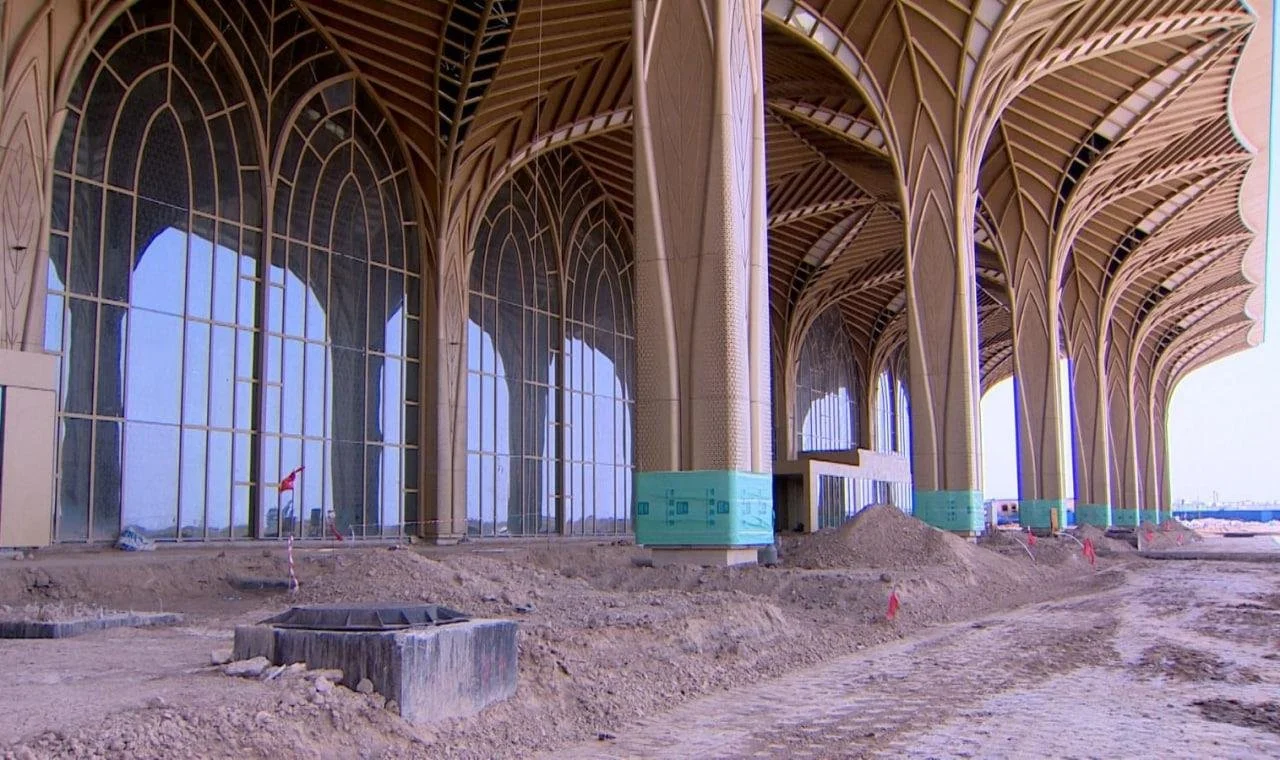
He added that "the main runway has been fully completed at 100% in terms of paving, lighting and inspection works," explaining that "the arrivals building has an area of 22,000 square meters and includes modern systems, including a cooling system and an early fire detection system, in addition to AI-powered cameras capable of detecting fires and forgotten bags and directing the concerned authorities to their locations."
He pointed out that "the infrastructure works have reached a completion rate of 98% and include rain, sewage, lighting and electricity networks," noting that "work is continuing on the implementation of internal roads linking the buildings with a length of up to 5.5 kilometers according to the highest approved technical specifications."
For her part, the representative of the Quality Department, Engineer Malath Malik, explained that "the Quality Department is responsible for preparing daily reports on site inspection work in coordination with the consulting firm, as well as monitoring the materials entering the project."
She emphasized that "the materials used are subject to a series of internationally approved tests in two stages, starting with test reports issued by the manufacturers, and then, after entering Iraq, they are subject to inspections and tests under the supervision of the consulting body before approval for their use on site." https://www.economy-news.net/content.php?id=68843
Iraq Will Export 600,000 Tons Of Dates During 2025
Money and Business Economy News – Baghdad The Ministry of Agriculture confirmed on Friday that date exports exceeded 600,000 tons in 2025. The Undersecretary of the Ministry of Agriculture, Mahdi Suhr Al-Jubouri, said that “the palm and date sector in Iraq is one of the important agricultural sectors economically, due to its competitive advantages in global markets,” noting that “the Zahdi variety is the most abundant in production and has the highest quantities of dates exported abroad, in addition to other varieties of dates, which exceed 600 varieties of dates locally.”
He added that "the Zahdi variety is the first variety for many date processing industries in Iraq, such as the production of date syrup, sweets and date paste, which constitute added economic value," indicating that "the palm and date sector in Iraq has witnessed great interest from the Ministry of Agriculture and other sectoral bodies, especially after the introduction of tissue culture techniques, and also the continuation of ground and aerial control to combat Dubas insects and the red weevil."
Sahar continued, “As a result of this interest and expansion in orchard cultivation using modern irrigation and drip irrigation methods, which resulted in an increase in the number of palm trees to more than 22 million, exports in 2025 rose to 600,000 tons of dates, in addition to the export of more than 100,000 tons of date paste, which together provide hard currency for the country and an internal source for orchard owners.” https://www.economy-news.net/content.php?id=68836
Baghdad Municipality: Al-Hussein Bridge Will Be Completed Within 375 Days And To High Standards.
Money and Business Economy News – Baghdad The Baghdad Municipality announced on Friday the commencement of construction work on the Al-Hussein neighborhood overpass, aimed at addressing traffic congestion. It confirmed that the overpass will be completed within 375 days and to high standards.
Baghdad Municipality spokesman Uday Al-Jundail said that "the executive work for the construction of the Al-Hussein neighborhood overpass has begun as part of the Baghdad Municipality's plans to address traffic congestion and alleviate bottlenecks in vital areas of the capital, including important intersections on the Salah Al-Din Expressway," indicating that "the project will contribute significantly to ending traffic jams and achieving high traffic flow after its completion."
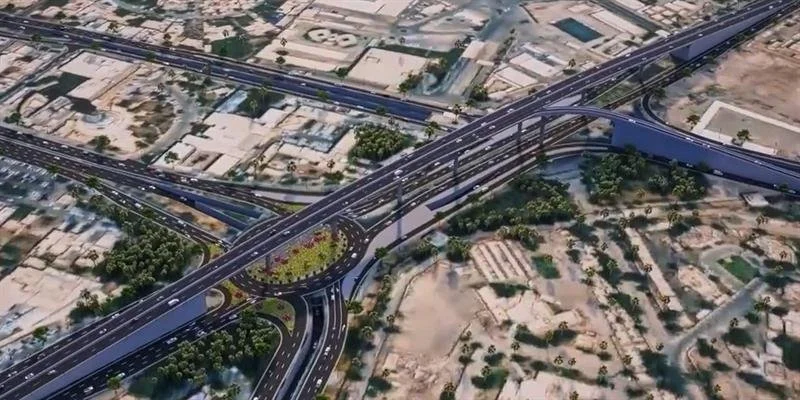
He added that "the project's implementation period is 375 days, with the possibility of completing it before the specified period according to the work rates, the planned program, and sound specifications."
He pointed out that "the implementing company is one of the reputable local companies, and has similar projects in a number of governorates," stressing that "the work is proceeding according to the plans set to complete the project as quickly as required."https://www.economy-news.net/content.php?id=68811
Iraq Under Pressure In The Strait Of Hormuz: Huge Oil Losses And Unprecedented Discounts To Save Exports
Economy News – Baghdad Iraq is facing one of the most serious economic challenges in its modern history since the outbreak of the regional war and the closure of the Strait of Hormuz, the maritime outlet through which the vast majority of its oil exports pass.
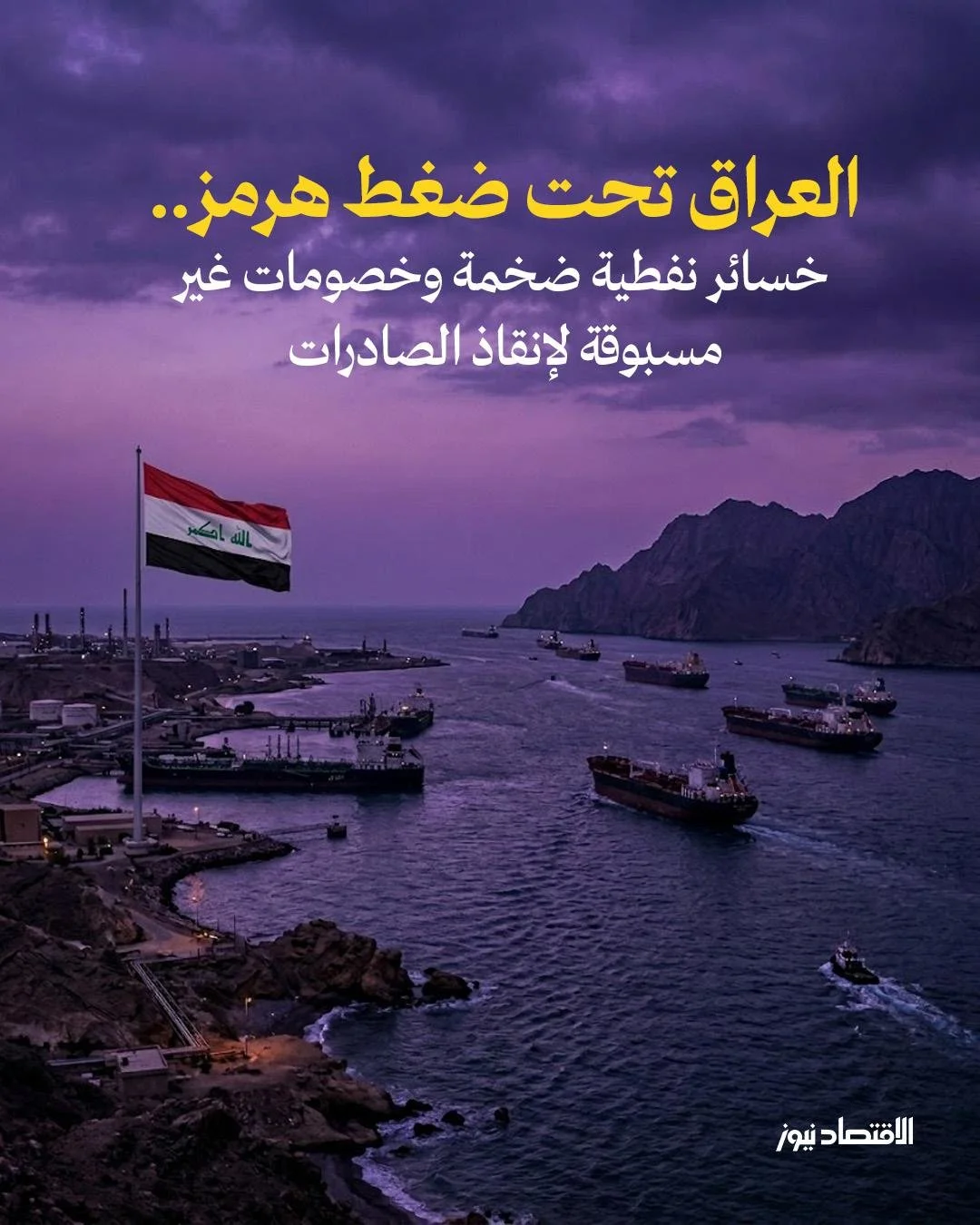
The country, whose economy depends almost entirely on oil revenues, has found itself facing a sharp decline in exports, prompting SOMO (State Oil Marketing Organization) to adopt an exceptional pricing policy that includes significant discounts to attract buyers and encourage the continued flow of Iraqi oil to global markets.
Gulf Exports Collapse
According to data reported by Bloomberg, Iraqi oil sales have fallen by more than 80% in the past two months, as many tankers have been unable to pass through the Strait of Hormuz, which has become a high-risk area due to military escalation.
In a clear indication of the scale of the crisis, only two tankers loaded oil from the port of Basra during April, compared to 12 tankers in March, even though the port has an operational capacity of about 80 tankers per month under normal circumstances.
Iraqi oil exports also fell in March by about 97% compared to the previous month, averaging only 99,000 barrels per day, according to ship tracking data.
Standard Discounts To Attract Buyers
In an attempt to reduce the effects of the crisis, SOMO introduced unprecedented price reductions on Basra Medium crude, reaching $33.40 per barrel during the first ten days of May 2026, before dropping to $26 for the rest of the month, while the discount on Basra Heavy crude reached about $30 per barrel.
The company bases its pricing of Basra Medium crude on the average prices of Dubai and Oman crudes for shipments to Asia, and on Argus high-sulfur crude for shipments to the Americas.
Last April, Iraq raised the official selling price of Basra Medium crude to Asia to a premium of $17.30 above the average price of Oman and Dubai crudes, compared to a premium of only $0.30 in the previous April. It also set a premium of $10.30 above Argus crude for shipments to the Americas.
“The Port Is Up For Sale”: A Mechanism To Overcome Risks
SOMO General Manager Ali Nizar Al-Shatri explained that the company resorted to adopting the “port-off sale” method, meaning that the company’s responsibility ends as soon as the oil is loaded onto the tanker, while the buyer bears the costs of maritime transport, insurance and transit risks.
Al-Shatri confirmed that “SOMO” did not actually change the officially announced price premiums, but the difference in the method of sale and the discounting of transportation and insurance costs is what gives buyers the possibility of obtaining oil at lower prices.
He explained that this method is currently limited to Basra oil due to the risks of sailing in the Strait of Hormuz, while Kirkuk crude maintains its price premium because it is exported via the Turkish port of Ceyhan on the Mediterranean Sea, far from the maritime threats in the Gulf.
Billions Of Dollars In Losses
Energy expert Kovand Sherwani described the repercussions of the crisis as a “huge economic blow,” stressing that Iraq has lost daily exports estimated at about 3.3 million barrels of crude oil, which used to generate revenues of no less than $260 million per day.
Shirwani told Al-Eqtisad News that the total revenue losses during one month may approach $7 billion, with the possibility of the figure rising as a result of the rise in global oil prices following the closure of the Strait of Hormuz.
He explained that the discounts offered by SOMO aim to encourage companies and traders to buy Iraqi oil and bear the risks of transportation, adding that some companies that have good relations with the Iranian side may be able to pass through the oil shipments and make large profits from the price differences.
He pointed out that Iraq faces a structural problem in the absence of a large national fleet of oil tankers, as the majority of exports depended on chartered tankers or direct sales in Iraqi ports.
Limited Alternatives And Narrow Options
Although Iraq continues to export some of its oil via the pipeline to Türkiye, the quantities remain limited compared to the usual export capacity via the Gulf.
Shirwani explained that the Ceyhan port pipeline currently transports only about 250,000 barrels per day, which is equivalent to about 7% of Iraq’s previous total exports.
Observers confirm that Iraq currently lacks genuine strategic alternatives to bypass the Strait of Hormuz, making it one of the countries most affected by any security disturbance in the Gulf.
Discounts Are Not A Global First
For his part, economist Nabil Al-Marsoumi explained that the current price reductions are temporary measures pertaining to May 2026, and aim to maintain a minimum flow of oil exports.
Al-Marsoumi pointed out that the policy of discounts is not new in global energy markets, as Iran, Russia and Venezuela have previously used it to mitigate the impact of sanctions or restrictions that have hindered their oil from reaching global markets.
He added that Iraq was forced to offer discounts of up to $33.4 per barrel on Basra Medium crude to buyers with long-term contracts, especially those using tankers that have to cross the Strait of Hormuz, in order to offset the high transport and insurance risks.
A Crisis That Reveals The Fragility Of The Export Structure
The current crisis reveals the extent of Iraq’s almost complete dependence on a single sea outlet for oil exports, in the absence of an alternative network of pipelines or a national maritime transport fleet.
Experts believe that a prolonged closure of the Strait of Hormuz could put unprecedented pressure on Iraqi finances, especially given the general budget's heavy reliance on oil revenues.
While SOMO is trying to maintain the presence of Iraqi oil in global markets through discounts and trade facilities, the future of exports remains dependent on developments in the security situation in the Gulf, and the extent to which Baghdad can find alternative export outlets that reduce its vulnerability to the Strait of Hormuz.
العراق تحت ضغط هرمز.. خسائر نفطية ضخمة وخصومات غير مسبوقة لإنقاذ الصادرات
New Clarity Act is Trojan Horse for Dollar as Global Reserve Currency
New Clarity Act is Trojan Horse for Dollar as Global Reserve Currency
Heresy Financial: 5-6-2026
On May 1st, a significant legislative development unfolded in the U.S. Congress: the Clarity Act. This bill, focused on regulating stablecoins and cryptocurrencies, initially drew attention for reportedly banning interest payments on stablecoins.
While some might have anticipated a negative market reaction, the reality was quite different, with companies like Circle even seeing stock surges. This suggests the Clarity Act is more than just another piece of crypto regulation—it’s a deeper strategic maneuver with profound implications for the U.S. dollar and global finance.
New Clarity Act is Trojan Horse for Dollar as Global Reserve Currency
Heresy Financial: 5-6-2026
On May 1st, a significant legislative development unfolded in the U.S. Congress: the Clarity Act. This bill, focused on regulating stablecoins and cryptocurrencies, initially drew attention for reportedly banning interest payments on stablecoins.
While some might have anticipated a negative market reaction, the reality was quite different, with companies like Circle even seeing stock surges. This suggests the Clarity Act is more than just another piece of crypto regulation—it’s a deeper strategic maneuver with profound implications for the U.S. dollar and global finance.
To truly understand the Act’s potential, we need to look back at history. The original Bretton Woods agreement, forged after World War II, established the U.S. dollar as the world’s reserve currency, backed by gold. However, by the early 1970s, the U.S. had issued more dollars than its gold reserves, leading to the end of the gold standard in 1971.
To maintain the dollar’s global dominance, the U.S. subsequently partnered with Saudi Arabia in 1974 to create the petrodollar system. This arrangement mandated that oil sales be priced in dollars and encouraged Saudi Arabia to reinvest those dollars into U.S. treasuries, thus ensuring continuous global demand for the dollar.
Fast forward to today, the dollar faces renewed pressures amid significant money supply expansion and inflation. In this new landscape, stablecoins are emerging as a strategic tool.
The Clarity Act’s regulatory framework for stablecoins appears to be shaping them into instruments that, while presented as private entities, could function similarly to central bank digital currencies (CBDCs) under indirect oversight from the Treasury. This approach allows the U.S. government to maintain and potentially extend its influence over global financial flows without the direct public and political resistance that a fully government-issued CBDC might provoke.
The distinction between a traditional digital money system, a CBDC, and regulated stablecoins is crucial. Currently, digital money primarily operates on multiple private ledgers managed by banks, with the Federal Reserve acting as a central clearinghouse.
A CBDC, conversely, would consolidate these into one centralized ledger controlled by the central bank, enabling very precise control over monetary policy. This could involve variable interest rates on holdings, transaction-specific incentives or disincentives, and comprehensive monitoring—features that naturally raise discussions about privacy and economic freedom.
Under the Clarity Act, stablecoins like USDC are anticipated to be allowed to offer “rewards” for activities such as trading or holding duration, differentiating them from traditional interest payments typically offered by banks.
This clever compromise makes stablecoins attractive to users while preserving the banks’ traditional role in passive interest generation. Crucially, increased global adoption of these regulated stablecoins would channel purchasing power into U.S. treasuries. This mechanism could significantly help address the ongoing demand for government debt, especially as yields continue to fluctuate.
Around the world, many nations are exploring or even piloting CBDCs, yet public apprehension remains widespread. In this context, stablecoins regulated under a framework like the Clarity Act offer a more politically palatable alternative. They operate within the existing cryptocurrency ecosystem but under government regulation, creating a powerful mechanism for maintaining dollar hegemony. This allows the U.S. Treasury to subtly yet strategically influence global economic behavior and safeguard the dollar’s prominent position.
In essence, the Clarity Act and the strategic development of regulated stablecoins represent a sophisticated geopolitical and economic strategy. It’s an effort to secure the dollar’s future as the world’s dominant currency in an increasingly digital era.
By combining enhanced regulatory oversight with innovative financial instruments, this approach aims to sustain the dollar’s crucial global role amidst evolving economic realities.
TIMECODES
00:00 The Stablecoin Bill Is a Trojan Horse
00:53 This Is a Bretton Woods 3.0 Moment
01:03 How the Dollar Became the World's Money in 1944
02:09 The Run on the Bank That Ended Gold
02:47 The Petrodollar Deal That Saved the Dollar
04:30 Why 50 Years Later We're Repeating History
04:53 What This New Stablecoin Agreement Actually Does
05:17 The Dollar Is Already Digital. You Just Don't See It.
05:50 How Banks Actually Move Money Between Each Other
06:42 What a Central Bank Digital Currency Really Is
07:01 The Dystopia Hidden in "Fine Tuned" Monetary Policy
08:08 Negative Interest on Money You Hold Too Long
08:32 Rewards and Punishments for What You Buy
10:40 The One Thing You Can't Escape About a CBDC
11:23 Why a CBDC Won't Be Implemented All at Once
11:42 Stablecoins Are CBDCs Without the Backlash
12:48 The Compromise: Rewards Tied to Activity, Not Holdings
13:45 Every Government Wants a CBDC. Citizens Don't.
14:25 Why Stablecoins Get the Power Without the Politics
15:42 The Global Funnel Into U.S. Treasuries
16:31 The Treasury Yield Crisis Hidden Behind All of This
Economic Fury Targets Iraqi Oil Official, Iran-Backed Terrorist Militias in Iraq
KTFA:
Clare: Press Releases
Economic Fury Targets Iraqi Oil Official, Iran-Backed Terrorist Militias in Iraq
May 7, 2026 WASHINGTON—
Today, the U.S. Department of the Treasury’s Office of Foreign Assets Control (OFAC) increased economic pressure on Iran and its proxy militias in Iraq by designating individuals and businesses exploiting Iraq’s oil sector and undermining the country’s security.
KTFA:
Clare: Press Releases
Economic Fury Targets Iraqi Oil Official, Iran-Backed Terrorist Militias in Iraq
May 7, 2026 WASHINGTON—
Today, the U.S. Department of the Treasury’s Office of Foreign Assets Control (OFAC) increased economic pressure on Iran and its proxy militias in Iraq by designating individuals and businesses exploiting Iraq’s oil sector and undermining the country’s security.
This action includes Ali Maarij Al-Bahadly,Iraq’s Deputy Minister of Oil, who abuses his position to facilitate the diversion of oil to be sold for the benefit of the Iranian regime and its proxy militias in Iraq. OFAC is also designating three senior leaders of Iran-aligned terrorist militias Kata’ib Sayyid Al-Shuhada and Asa’ib Ahl Al-Haq.
The United States will continue to hold these groups and other Iran-aligned terrorist militias in Iraq, such as Kata’ib Hizballah, accountable for their attacks against U.S. personnel and civilians, diplomatic facilities, and businesses across Iraq, which the groups conduct without regard for Iraq’s sovereignty or democratic process.
“Like a rogue gang, the Iranian regime is pillaging resources that rightfully belong to the Iraqi people,” said Secretary of the Treasury Scott Bessent. “Treasury will not stand idly by as Iran's military exploits Iraqi oil to fund terrorism against the United States and our partners.”
OFAC is taking today’s actions pursuant to Executive Order (E.O.) 13902, which targets key sectors of Iran’s economy, including Iran’s petroleum sector, and E.O. 13224, as amended, which targets terrorist groups, their supporters, and those who aid acts of terrorism. Asa’ib Ahl Al-Haq was designated as a Specially Designated Global Terrorist (SDGT) pursuant to
E.O. 13224, as amended, and as a Foreign Terrorist Organization (FTO) in 2020. Kata’ib Sayyid Al-Shuhada was designated as an SDGT pursuant to E.O. 13224, as amended, in 2023 and as an FTO in 2025.
ECONOMIC FURY Delivers MAXIMUM PRESSURE ON IRAN
The Treasury Department is maintaining maximum pressure on Iran and targeting the regime’s ability to generate, move, and repatriate funds. Treasury is aggressively advancing Economic Fury and has disrupted billions in projected oil revenue, taken actions that have led to the freezing of nearly half a billion dollars in regime-linked cryptocurrency, and cracked down on Tehran’s shadow banking networks.
Treasury remains ready to take economic action against Iran’s defense industrial base so that Iran cannot reconstitute its production capacity and project power outside its borders. Treasury is also prepared to take action against any foreign company supporting illicit Iranian commerce, including airlines, and, as necessary, may impose secondary sanctions on foreign financial institutions that facilitate Iran’s activities—including those connected to the People’s Republic of China’s independent “teapot” oil refineries.
Any person or vessel facilitating the illicit trade of oil or other commodities, through covert trade or financial channels, risks exposure to U.S. sanctions. Treasury will vigorously target both traditional sanctions evasion schemes and the exploitation of digital assets while continuing to freeze funds stolen from the Iranian people.
Through the blockade, the Trump Administration is directly targeting the regime’s primary revenue stream, and any person or vessel facilitating the illicit flow of oil or other products risks exposure to U.S. sanctions.
CORRUPTION IN IRAQ’S MINISTRY OF OIL
OFAC today designated Iraq’s Deputy Minister of Oil, Ali Maarij Al-Bahadly (Maarij), who has been instrumental in facilitating the diversion of Iraqi oil products to benefit known Iran-affiliated oil smuggler Salim Ahmed Said (Said) as well as Iran-backed terrorist militia Asa’ib Ahl Al-Haq (AAH).
For years, Maarij has used his official positions—first as the head of the Iraqi parliament’s oil and gas committee, and then within the Iraq Ministry of Oil—to enrich Said, AAH, and by extension, Iran.
OFAC designated Said in June 2025 for running a network of companies selling Iranian oil falsely declared as Iraqi oil to avoid sanctions, including designated VS Oil Terminal FZE (VS Oil). Integral to this operation was Said’s ability to obtain favored access to Iraqi oil and procure forged documentation from Iraqi government officials, legitimizing illicit oil. To that end, Said was responsible for bribing complicit officials in the Iraqi government, as well as reportedly installing Maarij in his official position.
Since 2018, Maarij has held multiple positions in Iraq’s Ministry of Oil, including head of the licensing and contracts office, Deputy Minister, and acting Minister of Oil. In his official capacities, Maarij enabled Said to illicitly procure oil products by granting exportation rights to Said’s companies. Maarij authorized trucking several million dollars’ worth of oil per day from the Qayarah oil field to VS Oil in Khor Zubayr for export. VS Oil oversaw the mixing of Iranian oil with Iraqi oil before being shipped to market. Maarij is also responsible for falsifying documentation on the provenance of oil for Said’s network, enabling it to be smuggled to market disguised as purely Iraqi oil.
Ali Maarij Al-Bahadly is being designated pursuant to E.O. 13902 for having materially assisted, sponsored, or provided financial, material, or technological support for, or goods or services to or in support of, Salim Ahmed Said.
IRAQI Militia Exploiting ResourcES
Mustafa Hashim Lazim Al-Behadili (Al-Behadili), also known as Sayyid Awn, is a leader and economic official for AAH. Following the U.S. withdrawal from Iraq in 2011, Al-Behadili played an important role in developing an oil trucking and security unit, allowing AAH to become a dominant actor in the Iraqi metals industry, as well as enabling AAH’s entrance into fuel oil theft, which focused on stolen or subsidized oil.
Working directly with U.S.-designated AAH senior leader Laith Al-Khazali, Al-Behadili controlled oil smuggling financing and oversaw mineral industry activities for AAH. In southern Iraq, Al-Behadili managed oil smuggling operations and AAH projects, using businesses, projects, and government contracts as a front for AAH financial activity.
As part of his activities on behalf of AAH, Al-Behadili was also complicit in dealing directly with Iran and the Islamic Revolutionary Guard Corps-Qods Force (IRGC-QF), a U.S.-designated terrorist organization. In his capacity as AAH Economic Committee member, Al-Behadili was involved in negotiating contracts to ship oil from Iran and coordinating with the IRGC-QF on shipping AAH’s oil.
Mustafa Hashim Lazim Al-Behadili is being designated pursuant to E.O. 13224, as amended, for having materially assisted, sponsored, or provided financial, material, or technological support for, or goods or services to or in support of, Asa’ib Ahl Al-Haq.
Al-Behadili owns or controls four Iraqi companies that operate in the oil sector—Gulf Energy Oil Services Limited, Gulf General Contracting Limited, Iraq International Energy for the Import and Sale for Petroleum Products Limited, and Gulf Energy for General Transport and Marine Services and Real Estate Consultancy LLC—all of which are being designated pursuant to E.O. 13224, as amended, for being owned, controlled, or directed by, or having acted or purported to act for or on behalf of, directly or indirectly, Mustafa Hashim Lazim Al-Behadili.
Iran-BACKED TERRORIST MILITIA OFFICIALS
Kata’ib Sayyid al-Shuhada (KSS) is an Iran-aligned terrorist militia that has planned and executed numerous attacks against U.S. personnel in Iraq and Syria. Ahmed Khudair Maksus Maksus is the former KSS Deputy Secretary General under U.S.-designated Secretary General Hashim Finyan Rahim al-Saraji.
Mohammed Issa Kadhim al-Shuwaili (Al-Shuwaili), operating under the alias Abu Maryam, is a senior KSS official. Since at least 2025, Al-Shuwaili has collaborated directly with Hizballah illicit finance team members, including Ali Qasir, on the purchase and delivery of weapons into Iraq. Al-Shuwaili also arranged the payment of millions of dollars to Hizballah to facilitate the purchase of weapons, and coordinated logistics related to the transfer and delivery of the weapons with Hizballah associates.
Ahmed Khudair Maksus Maksus is being designated pursuant to E.O. 13224, as amended, for being owned, controlled, or directed by, or having acted or purported to act for or on behalf of, directly or indirectly, Kata’ib Sayyid al-Shuhada. Mohammed Issa Kadhim al-Shuwaili is being designated pursuant to E.O. 13224, as amended, for having materially assisted, sponsored, or provided financial, material, or technological support for, or goods or services to or in support of, Ali Qasir, a person whose property and interests in property are blocked pursuant to E.O. 13224, as amended.
SANCTIONS IMPLICATIONS
As a result of today’s action, all property and interests in property of the designated or blocked persons described above that are in the United States or in the possession or control of U.S. persons are blocked and must be reported to OFAC. In addition, any entities that are owned, directly or indirectly, individually or in the aggregate, 50 percent or more by one or more blocked persons are also blocked. Unless authorized by OFAC, or exempt, OFAC’s regulations generally prohibit all transactions by U.S. persons or within (or transiting) the United States that involve any property or interests in property of blocked persons.
Violations of U.S. sanctions may result in the imposition of civil or criminal penalties on U.S. and foreign persons. OFAC may impose civil penalties for sanctions violations on a strict liability basis. OFAC’s Economic Sanctions Enforcement Guidelines provide more information regarding OFAC’s enforcement of U.S. economic sanctions.
In addition, financial institutions and other persons may risk exposure to sanctions for engaging in certain transactions or activities involving designated or otherwise blocked persons.
The prohibitions include the making of any contribution or provision of funds, goods, or services by, to, or for the benefit of any designated or blocked person, or the receipt of any contribution or provision of funds, goods, or services from any such person.
Non-U.S. persons are also prohibited from causing or conspiring to cause U.S. persons to wittingly or unwittingly violate U.S. sanctions, as well as engaging in conduct that evades U.S. sanctions. Individuals located in the U.S. or abroad who provide information about sanctions violations to Treasury’s Financial Crimes Enforcement Network (FinCEN) whistleblower incentive program may be eligible for awards if the information they provide leads to a successful enforcement action that results in monetary penalties exceeding $1,000,000. FinCEN is currently accepting whistleblower tips.
Furthermore, engaging in certain transactions involving the persons designated today may risk the imposition of secondary sanctions on participating foreign financial institutions. OFAC can prohibit or impose strict conditions on opening or maintaining, in the United States, a correspondent account or a payable-through account of a foreign financial institution that knowingly conducts or facilitates any significant transaction on behalf of a person who is designated pursuant to the relevant authority.
The power and integrity of OFAC sanctions derive not only from OFAC’s ability to designate and add persons to the SDN List, but also from its willingness to remove persons from the SDN List consistent with the law. The ultimate goal of sanctions is not to punish, but to bring about a positive change in behavior.
Seeds of Wisdom RV and Economics Updates Friday Afternoon 5-8-26
Good Afternoon Dinar Recaps,
Global Debt Explosion Accelerates: Investors Begin Shifting Away From U.S. Treasuries
Record global borrowing, rising geopolitical instability, and weakening confidence in sovereign debt markets are increasing pressure on the existing financial system.
As debt approaches unsustainable levels and investors diversify reserves away from traditional assets, concerns are growing over the long-term stability of the global monetary order.
Good Afternoon Dinar Recaps,
Global Debt Explosion Accelerates: Investors Begin Shifting Away From U.S. Treasuries
Record global borrowing, rising geopolitical instability, and weakening confidence in sovereign debt markets are increasing pressure on the existing financial system.
As debt approaches unsustainable levels and investors diversify reserves away from traditional assets, concerns are growing over the long-term stability of the global monetary order.
OVERVIEW (KEY POINTS)
Global debt has surged to a record $353 trillion, according to new international financial data released this week. The sharp increase is being driven primarily by the United States and China as governments continue relying heavily on borrowing to sustain growth and manage economic pressures.
At the same time, analysts are observing early signs that international investors are beginning to diversify away from U.S. Treasuries, historically considered the foundation of global financial stability.
The developments come amid growing geopolitical tensions surrounding the Iran conflict, rising energy costs, inflation concerns, and increasing questions about debt sustainability across major economies.
The broader implication is significant: the global financial system is showing signs of structural stress as governments accumulate more debt while investor confidence becomes increasingly fragmented.
KEY DEVELOPMENTS
1. Global Debt Climbs to Historic High
International borrowing accelerated sharply during the first quarter of 2026.
Global debt reached approximately $353 trillion
Debt-to-GDP ratios remain near 305% of global economic output
The Institute of International Finance warned that current borrowing trends are becoming increasingly difficult to sustain long term.
2. Investors Begin Diversifying Away From U.S. Treasuries
Analysts are detecting changes in reserve behavior.
Demand for Japanese and European government bonds is increasing
International appetite for U.S. Treasuries has shown signs of weakening
While there is no immediate crisis in Treasury markets, concerns about America’s long-term debt trajectory continue to grow.
3. Iran Conflict Adds Pressure to Financial Markets
The Middle East conflict is intensifying global instability.
Oil prices remain elevated near or above $100 per barrel
Shipping disruptions in the Strait of Hormuz continue affecting energy markets
Higher energy costs are contributing to inflation fears and slowing economic growth forecasts globally.
4. IMF Warns of More Severe Economic Risks Ahead
The International Monetary Fund has issued increasingly serious warnings.
IMF officials cautioned that prolonged conflict could trigger slower global growth and higher inflation
Severe scenarios include risks of recession-level conditions and sustained commodity shortages
Policymakers are now facing pressure to manage inflation without causing broader economic contraction.
5. Central Banks Continue Strategic Reserve Shifts
Reserve diversification trends are accelerating globally.
Central banks continue increasing exposure to gold and non-dollar assets
Emerging economies are seeking greater financial independence from Western systems
These shifts reflect growing concern about the long-term reliability of debt-heavy reserve structures.
WHY IT MATTERS
The combination of rising debt, geopolitical instability, and weakening confidence in sovereign debt markets creates a dangerous environment for the global economy.
For decades, the financial system relied heavily on the assumption that U.S. Treasury markets represented the safest and most liquid assets in the world. Early signs of diversification away from those markets represent a potentially important structural shift.
At the same time, higher energy costs and persistent inflation are limiting the ability of central banks to stabilize growth without increasing borrowing even further.
The result is a system facing pressure from multiple directions simultaneously: debt expansion, inflation, geopolitical fragmentation, and reserve diversification.
WHY IT MATTERS TO FOREIGN CURRENCY HOLDERS
Currency volatility may increase as reserve flows diversify
Inflation pressures continue eroding purchasing power globally
Higher debt levels may weaken long-term confidence in fiat currencies
Gold and commodity-backed assets are attracting greater institutional interest
IMPLICATIONS FOR THE GLOBAL RESET
Pillar 1: Sovereign Debt Sustainability Crisis
Record borrowing levels are increasing concerns that major economies may eventually face limits to debt-driven growth models.
Pillar 2: Gradual Shift Away From Dollar-Centric Finance
Diversification away from U.S. Treasuries and increased reserve allocation toward alternative assets reflect the slow emergence of a more multipolar financial system.
CONCLUSION
The rapid rise in global debt is no longer being viewed as a temporary post-crisis condition. Instead, it is increasingly becoming a defining feature of the modern financial system.
As borrowing accelerates and geopolitical tensions disrupt trade and energy markets, investors and governments are beginning to reassess long-standing assumptions about reserve safety and economic stability.
Although the U.S. dollar and Treasury markets remain dominant today, the early signs of diversification suggest that confidence in the existing system is no longer absolute.
The global financial reset may not arrive through one dramatic event, but through a steady erosion of trust in the structures that once anchored the world economy.
Seeds of Wisdom Team
Newshounds News™ Exclusive
SOURCES
Reuters — "Global Debt Hits Record of Near $353 Trillion, With Signs of Move Away From U.S."
Reuters — "IMF Chief Georgieva Warns of Much Worse Outcome if Middle East War Drags Into 2027"
~~~~~~~~~~
Seeds of Wisdom Team RV Currency Facts Youtube and Rumble
Newshound's News Telegram Room Link
RV Facts with Proof Links Link
RV Updates Proof links - Facts Link
Follow the Gold/Silver Rate COMEX
Follow Fast Facts
Seeds of Wisdom Team™ Website
Thank you Dinar Recaps