Thank you to all the subscribers to our Early Access program…we thank you for your continued support.
We are excited to offer this new service to keep you informed and up-to-date on the latest Dinar and currency news.
Seeds of Wisdom RV and Economics Updates Sunday Morning 5-3-26
Good Morning Dinar Recaps,
Inflation Surge Returns: Energy Shock and Central Bank Divide Signal Global System Strain
Rising oil prices and persistent inflation are forcing central banks into conflicting strategies, increasing pressure on the global financial system
Good Morning Dinar Recaps,
Inflation Surge Returns: Energy Shock and Central Bank Divide Signal Global System Strain
Rising oil prices and persistent inflation are forcing central banks into conflicting strategies, increasing pressure on the global financial system
OVERVIEW (KEY POINTS)
Global markets are facing a renewed wave of instability as inflation accelerates again, driven largely by surging energy prices tied to ongoing geopolitical conflict.
This is happening now because oil shocks are feeding directly into consumer prices, while central banks struggle to determine whether to tighten policy further or protect slowing economic growth.
Key players include the U.S. Federal Reserve, European Central Bank, and other global institutions now navigating a deepening policy divide amid rising inflation risks.
The broader implication is clear: persistent inflation combined with policy fragmentation is increasing systemic stress and signaling deeper structural shifts in the global financial system.
KEY DEVELOPMENTS
1. Inflation Data Comes in Stronger Than Expected
Price pressures are reaccelerating.
U.S. inflation running near 3.5%, above target
Inflation spreading beyond energy into core sectors
2. Oil Shock Drives Second-Wave Inflation
Energy is feeding broader cost increases.
Rising oil impacting manufacturing, packaging, and transport costs
Secondary price increases expected across consumer goods and services
3. Central Banks Face Growing Policy Divide
Monetary strategy is fragmenting.
Some central banks signaling rate hikes to control inflation
Others hesitating due to growth slowdown risks
4. Stagflation Risks Begin to Emerge
Growth and inflation are moving in opposite directions.
Economies facing slower growth with rising prices
Central banks caught between inflation control and economic stability
5. Global Economies Feel Uneven Impact
Pressure is spreading unevenly across regions.
Emerging economies experiencing higher inflation spikes
Advanced economies showing resilience but rising risk exposure
WHY IT MATTERS
This moment highlights a critical shift: inflation is no longer easing as expected and is becoming structurally embedded again.
Markets are reacting with increased volatility as investors reassess expectations for interest rates, growth, and asset valuations.
For policymakers, the challenge is intensifying—raising rates risks slowing economies further, while holding back allows inflation to persist and spread.
At the system level, this signals a move toward a more fragmented and less predictable global financial environment.
WHY IT MATTERS TO FOREIGN CURRENCY HOLDERS
Purchasing power declines as inflation rises globally
Currency volatility increases due to policy divergence
Stronger dollar pressures weaker currencies
Higher import costs strain local economies
IMPLICATIONS FOR THE GLOBAL RESET
Pillar 1: Inflation Restructures Monetary Policy
Persistent inflation is forcing central banks to abandon synchronized easing and adopt divergent strategies, increasing systemic instability.
Pillar 2: Energy Markets Drive Financial Realignment
Energy shocks are reshaping global pricing systems, trade flows, and economic policy frameworks, accelerating structural change.
CONCLUSION
The return of strong inflation, combined with rising energy costs, marks a critical inflection point for the global financial system.
As central banks diverge and economic pressures build, the system is becoming more sensitive to shocks and less coordinated in response.
This is not a temporary disruption—it reflects a deeper transformation in how global finance responds to inflation, energy, and geopolitical risk.
When inflation returns and policy divides widen, the foundation of the global financial system begins to shift.
Seeds of Wisdom Team
Newshounds News™ Exclusive
Sources
Reuters — "Recent inflation data was ‘bad news,’ Fed’s Goolsbee says"
Business Insider — "Second wave of inflation from Iran war expected to hit consumers"
~~~~~~~~~~
🌱 A Message to Our Currency Holders🌱
If you’ve been holding foreign currency for many years, you were not foolish.
You were not wrong to believe the global financial system would change.
What failed was not your patience — it was the information you were given.
For years, dates, rumors, and personalities replaced facts, structure, and proof. “This week” predictions created cycles of hope and disappointment that were never based on how currencies actually change.
That is not your failure.
Our mission here is different: • No dates • No rates • No hype • No gurus
Instead, we focus on:
• Verifiable developments • Institutional evidence
• Global financial structure • Where countries actually sit in the process
Currency value changes only come after sovereignty, trade, banking, settlement systems, and fiscal coordination are in place. History and institutions confirm this sequence.
You will see silence. You will see denials. That is not delay — that is discipline.
Protect your identity. Organize your documents. Verify everything.
Never hand your discernment to anyone who cannot show proof.
You deserve truth — not timelines.
Seeds of Wisdom Team
Newshounds News
~~~~~~~~~~
Seeds of Wisdom Team RV Currency Facts Youtube and Rumble
Newshound's News Telegram Room Link
RV Facts with Proof Links Link
RV Updates Proof links - Facts Link
Follow the Gold/Silver Rate COMEX
Follow Fast Facts
Seeds of Wisdom Team™ Website
Thank you Dinar Recaps
The Last Time America Hit 100% Debt-to-GDP, A Golden Age Followed
The Last Time America Hit 100% Debt-to-GDP, A Golden Age Followed
Notes From the Field By James Hickman (Simon Black / Sovereign Man) April 30, 2026
In the spring of 1946, hundreds of thousands of American soldiers were coming home from Europe and the Pacific, maimed, bruised, and shell-shocked. The economy they returned to was upside down.
Detroit was making tanks, not automobiles. Factories were making bullets, not baby carriages. Food was rationed. Fuel was scarce. And, overall, life in America had been bleak for the better part of two decades. The Great Depression gave way to a stretch of war that led many Americans to fear that their kids would soon be speaking German and goose-stepping with the Hitler Youth.
The Last Time America Hit 100% Debt-to-GDP, A Golden Age Followed
Notes From the Field By James Hickman (Simon Black / Sovereign Man) April 30, 2026
In the spring of 1946, hundreds of thousands of American soldiers were coming home from Europe and the Pacific, maimed, bruised, and shell-shocked. The economy they returned to was upside down.
Detroit was making tanks, not automobiles. Factories were making bullets, not baby carriages. Food was rationed. Fuel was scarce. And, overall, life in America had been bleak for the better part of two decades. The Great Depression gave way to a stretch of war that led many Americans to fear that their kids would soon be speaking German and goose-stepping with the Hitler Youth.
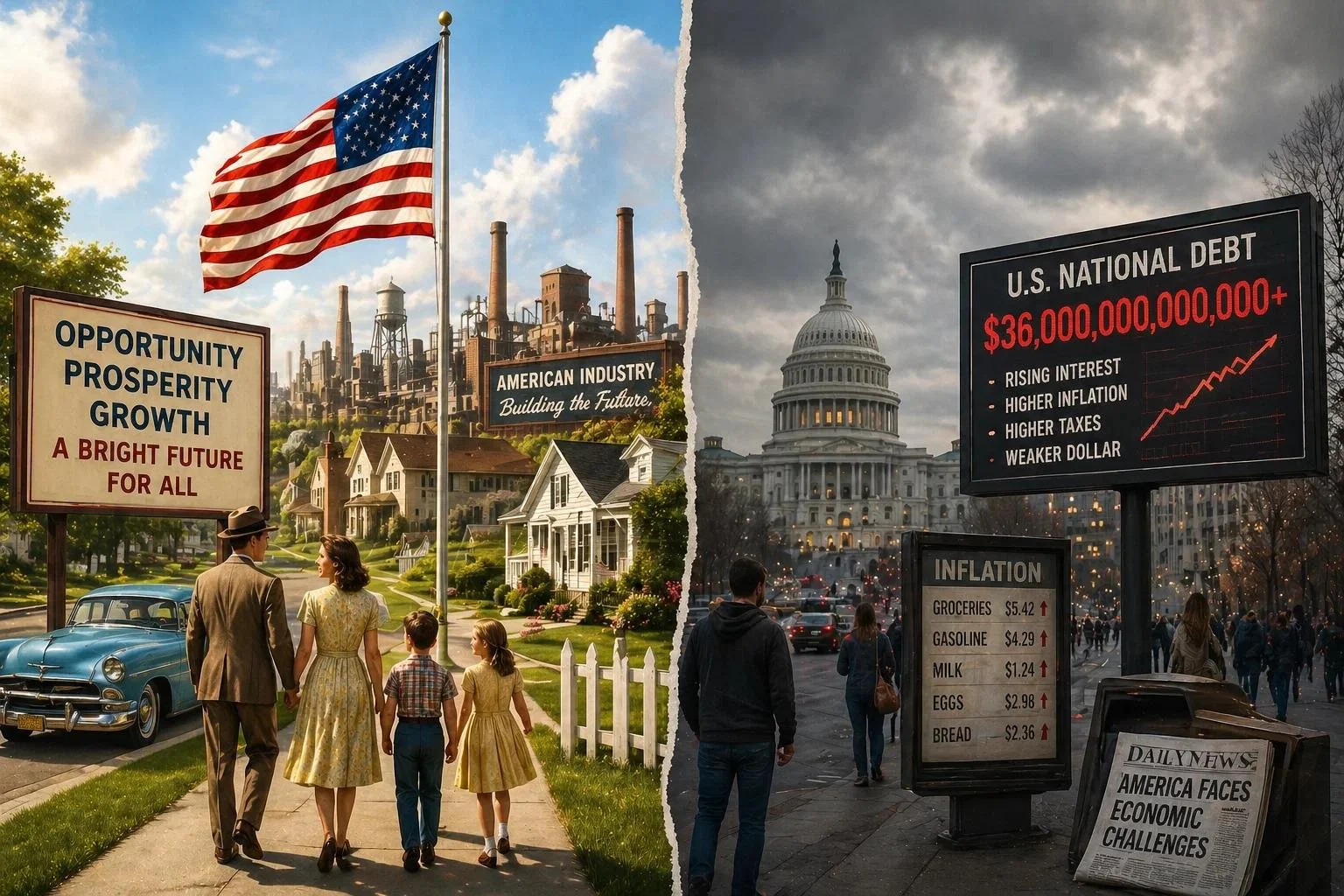
Government finances were equally bleak. Between all of the massive public works programs of the Great Depression and eye-popping costs of World War II, the US national debt topped 100% of GDP by the mid-1940s.
And yet that moment was the beginning of a new Golden Age.
Think about the world at the time: Britain was bankrupt. Germany and Japan had been turned to rubble. And the Soviets had won their part of the war by feeding twenty million bodies into the meat grinder.
America came out the other side with full manufacturing capacity intact, the dollar enthroned as the world's reserve currency, and virtually no economic competition anywhere.
What followed was two decades of suburb-building, highway-laying, automobile-making, and semiconductor-launching prosperity. There were bumps along the way, but on balance the economic trajectory of America was up and to the right.
Consequently, the US national debt started falling. And it’s easy to understand why. By 1946 there was no more war, no more depression.
The United States had just spent four years consuming every available resource to defeat the Nazis. But once the war ended, military spending (and hence the budget deficit) dropped like a rock. Congress started to run budget surpluses and used them to pay down the debt.
Over the next three decades, America’s debt-to-GDP ratio fell from 106% in 1946 to just 23% by the mid-1970s.
This week, fresh data from the Bureau of Economic Analysis confirmed that America's debt-to-GDP ratio has officially crossed 100% once again.
One caveat: this number is based on what the government calls "debt held by the public"; it conveniently leaves out the trillions of dollars that Washington “owes itself”, including Social Security trust fund IOUs, federal pension obligations, and other intragovernmental holdings.
Well, that money has to be repaid too. Pretending otherwise might make the debt appear smaller. But a broader, most honest measure of the debt right now is actually 130% of GDP, well beyond the WWII record.
But fine, we’ll use the government’s official number of 100%, which is just announced this morning.
Yes, America has been here before. 100% is not unprecedented. But there is a major difference.
Back in 1946, the debt was at 100% of GDP because the US had just defeated the Nazis. The debt binge ended when the war ended.
In 2026, the United States is not fighting Hitler. There is no once-in-a-century pandemic. There is no specific crisis that, once over, will allow Congress to bring spending back into line.
Rather, the debt is so high because the debt is so high.
Interest on the federal debt is over $1 trillion per year. That’s a huge chunk of tax revenue. The rest of America’s tax revenue is consumed by mandatory entitlements like Social Security and Medicare.
Literally everything else, including the military, roads, and light bill at the White House, are funded with more debt.
So in other words, the deficit is structural and permanent. It will be there no matter how much Congress cuts... if they were even interested in fiscal reform.
And yet Congress shows no interest in spending cuts. Even when the most rampant and obvious fraud is presented with a bow on it, Congress does nothing.
Even worse— people who actually try to stop the fraud get publicly crucified, arrested, or sued.
In 1946, the political momentum of the United States focused on growth, productivity, and fiscal discipline. In 2026, all of it points the other way.
And the dollar's status as the world's reserve currency— a major advantage that helped pay down the postwar debt— is also slipping.
Foreign central banks have been quietly selling US Treasuries and buying physical gold at the fastest pace in modern history. Since the start of the year, they have unloaded tens of billions of dollars worth of US government bonds, and the interest rate on Treasurys have climbed in response.
That shows how foreign confidence draining out of the dollar in real time.
Now, none of this means the world is ending.
We are not pessimistic people. Humanity's best days are still ahead. The technological advances now arriving in robotics, artificial intelligence, nuclear power, and biotech are not incremental upgrades; they are giant leaps for mankind.
Civilization will improve, productivity will rise, and the economic problems will sort themselves out.
But getting there requires persevering through the next several years of challenges... during which time we expect the average American to see a lower standard of living driven by higher taxes, persistent inflation, and a regulatory burden that gets heavier by the day.
Of the three, inflation looks the most baked in. Foreign governments are abandoning the dollar at a rapid pace, so the Federal Reserve will almost certainly step in to ‘print money’ and bail out the Treasury.
The impact will be more inflation.
This is why we continue to write that real assets are the right place to be. In difficult and conflict-prone times, the basics like food, water, energy, critical industrial metals, and productive technology become the world's most valuable resources. They hold their value regardless of which currency happens to be in fashion, or how high inflation goes.
And the key point is that, right now, many of the best real asset producers— which have huge upside ahead— are trading at absurd discounts. So it’s a great time to consider this strategy.
To your freedom, James Hickman Co-Founder, Schiff Sovereign LLC
Seeds of Wisdom RV and Economics Updates Saturday Afternoon 5-2-26
Good Afternoon Dinar Recaps,
Hormuz Shock Escalates: Oil Spike and Sanctions Threats Push Global System Toward Breaking Point
Severe disruption in the world’s most critical النفط corridor is driving energy prices higher and forcing financial systems into a new phase of instability
Good Afternoon Dinar Recaps,
Hormuz Shock Escalates: Oil Spike and Sanctions Threats Push Global System Toward Breaking Point
Severe disruption in the world’s most critical النفط corridor is driving energy prices higher and forcing financial systems into a new phase of instability
OVERVIEW (KEY POINTS)
Global markets are under mounting stress as the Strait of Hormuz crisis deepens, with both military tension and financial restrictions tightening simultaneously.
This is happening now because oil flows through one of the world’s most critical chokepoints have been severely disrupted, while new U.S. warnings on sanctions are complicating global shipping operations.
Key players include the United States, Iran, OPEC+, global shipping firms, and central banks now reacting to rapidly rising oil prices and supply uncertainty.
The broader implication is clear: energy supply disruption combined with financial enforcement mechanisms is accelerating systemic strain across the global economy.
KEY DEVELOPMENTS
1. Oil Prices Surge to Multi-Year Highs
Energy markets are under extreme pressure.
Crude prices have surged above $120–$125 per barrel amid supply disruptions
Analysts warn of potential fuel shortages and inflation spikes
2. Strait of Hormuz Effectively Disrupted
Critical global supply route is constrained.
Roughly 20% of global oil flows through the strait
Shipping traffic significantly reduced due to conflict and security risks
3. U.S. Threatens Sanctions on Shipping Firms
Financial pressure is escalating.
Companies warned against paying Iranian transit fees
Violations could trigger sanctions enforcement and penalties
4. OPEC+ Faces Supply Constraints Despite Planned Increases
Production policy meets reality.
OPEC+ signaling output increases, but physical supply remains limited
Export constraints preventing meaningful market relief
5. Central Banks Confront New Inflation Shock
The policy environment is tightening again.
Rising oil prices feeding into global inflation expectations
Increasing difficulty balancing growth vs. price stability
WHY IT MATTERS
This situation represents a direct collision between geopolitics and global finance, where physical supply disruption is now amplified by financial restrictions like sanctions.
Markets are reacting with heightened volatility across energy, currencies, and bond yields, reflecting uncertainty about how long disruptions will persist.
For policymakers, rising energy costs are reigniting inflation just as economies were attempting to stabilize, complicating decisions on interest rates and liquidity.
At the system level, this highlights a key vulnerability: global finance depends on stable energy flows—and that stability is now under threat.
WHY IT MATTERS TO FOREIGN CURRENCY HOLDERS
Purchasing power declines as energy-driven inflation rises
Currency volatility increases due to trade imbalances
Oil-importing nations face significant pressure
Dollar strength may persist amid global uncertainty
IMPLICATIONS FOR THE GLOBAL RESET
Pillar 1: Energy Control Reshaping Financial Power
Disruptions in critical energy routes are reinforcing the importance of resource control in global financial influence.
Pillar 2: Financial Enforcement Expands Beyond Markets
Sanctions tied to shipping and trade signal a shift toward financial systems being used as tools of geopolitical enforcement.
CONCLUSION
The escalation in the Strait of Hormuz is not just a regional issue—it is a global financial stress event with far-reaching consequences.
As oil prices surge and shipping becomes more restricted, the effects are cascading across inflation, trade, and monetary policy.
This moment underscores a deeper shift: energy security and financial stability are now inseparable.
When the world’s most critical energy artery is constrained, the global financial system feels it immediately.
Seeds of Wisdom Team
Newshounds News™ Exclusive
Sources
Reuters — "OPEC+ set for output hike despite Hormuz disruption"
New York Post — "US warns shipping firms over Iran toll payments"
~~~~~~~~~~
Seeds of Wisdom Team RV Currency Facts Youtube and Rumble
Newshound's News Telegram Room Link
RV Facts with Proof Links Link
RV Updates Proof links - Facts Link
Follow the Gold/Silver Rate COMEX
Follow Fast Facts
Seeds of Wisdom Team™ Website
Thank you Dinar Recaps
Iraq Economic News and Points To Ponder Saturday Afternoon 5-2-26
Iraq’s Central Bank says dollar flows steady despite oil halt
2026-05-02 Shafaq News- Baghdad US dollar transfers to Baghdad are continuing normally despite the halt in oil export revenues, Central Bank of Iraq (CBI) Governor Ali Al-Allaq said on Saturday, rejecting reports of a stoppage.
Iraq’s Central Bank says dollar flows steady despite oil halt
2026-05-02 Shafaq News- Baghdad US dollar transfers to Baghdad are continuing normally despite the halt in oil export revenues, Central Bank of Iraq (CBI) Governor Ali Al-Allaq said on Saturday, rejecting reports of a stoppage.
Speaking at the Sin Dialogue Forum, Al-Allaq confirmed that public-sector salaries remain secured, noting that the CBI will “continue supporting” the government despite reduced fiscal flexibility following the suspension of Iraq’s main oil export outlet amid the ongoing blockade of the Strait of Hormuz by Iran and the United States.
Transfers now account for about 95% of total dollar sales after the bank shifted operations into regulated channels aligned with anti-money laundering and counter-terrorism financing rules, while annual cash imports were reduced from around $14 billion to roughly $4 billion, limited mainly to travelers. Al-Allaq explained that the central bank cannot lend directly to the government but can use alternative tools, including securities, to manage liquidity and sustain spending.
He added that there are no restrictions on foreign currency transfers or sales, noting that dollars remain available for trade and travel, while the parallel market rate is unofficial and outside the bank’s framework.
The United States has for years transferred cash shipments to Baghdad in amounts ranging between $400 million and $500 million per tranche, tied to Iraq’s oil revenues. Washington suspended these transfers in April, according to US reports at the time, citing an escalation in attacks by Iran-linked armed groups against American interests. However, Iraqi economist Nabil Al-Marsoumi indicated that a new shipment of US dollars has arrived in Baghdad as part of ongoing monthly transfers.
Read more: Iraq’s oil bottleneck: Abundance trapped by dependency
https://shafaq.com/en/Economy/Iraq-s-Central-Bank-says-dollar-flows-steady-despite-oil-halt
Oil prices retreat despite continued Strait of Hormuz blockade
2026-05-02 Shafaq News An Iranian proposal on negotiations with the US sent crude oil futures diving on Saturday, but prices remained on track for weekly gains, with Tehran still blocking the Strait of Hormuz and the U.S. Navy blocking exports of Iranian crude.
Brent crude futures for July settled at $108.17, down $2.23 a barrel, or 2.02%. West Texas Intermediate futures finished at $101.94 a barrel, down $3.13, or 2.98%.
Iran sent its latest proposal for negotiations with the United States to Pakistani mediators on Thursday, state news agency IRNA reported on Friday, a move that could improve prospects for breaking an impasse in efforts to end the Iran war.
Still, the Brent benchmark and WTI were poised for a 2.95% gain over the week. Brent's June contract hit $126.41 a barrel on Thursday, marking the highest level since March 2022, before ending the session down.
"This Iran proposal has given hope to the market that there is an off-ramp for the United States," said Phil Flynn, senior analyst with Price Futures Group.
Oil prices have been on the rise since the U.S. and Israel attacked Iran at the end of February, resulting in the closure of the Strait of Hormuz and the disruption of shipments of about a fifth of the world’s oil and liquefied natural gas supply.
A ceasefire has been in place since April 8. UAE presidential adviser Anwar Gargash said on Friday Tehran could not be trusted over any unilateral arrangements it makes for the Strait of Hormuz, in a sign of deep mistrust on all sides.
By the end of trading on Friday, the oil market appeared to be accepting the uneasy truce in the conflict.
"The market rises and falls on the prospects of an outcome to the conflict," said John Kilduff, partner with Again Capital. "And right now the situation is a stalemate, at least until the market closes."
A senior official of Iran's Revolutionary Guards had threatened on Thursday "long and painful strikes" on U.S. positions if Washington renewed attacks on Iran, pushing oil prices to intraday peaks before retreating. (REUTERS)
https://www.shafaq.com/en/Economy/Oil-prices-retreat-despite-continued-Strait-of-Hormuz-blockade
Basrah Crude Ends Week Higher
2026-05-02 Shafaq News- Basrah Iraq’s Basrah crude grades posted weekly gains of more than 1% last week.
Basrah Heavy edged down by $13.60 in the latest trading session to $121.73 per barrel, while still recording a weekly gain of $1.36, or 1.13%. Basrah Medium also fell by $13.60 to $123.83 per barrel, posting a weekly gain of $1.36, or 1.11%.
Global oil benchmarks rose as investors assessed the impact of the US–Iran war on energy markets amid concerns over possible supply disruptions in the Middle East.
Brent crude futures settled $2.23 lower, or 2.02%, at $108.17 a barrel. US West Texas Intermediate (WTI) ended at $101.94 a barrel, down $3.13, or 2.98%. Despite the daily losses, both Brent and WTI were still set to close the week with gains of about 2.95%. https://www.shafaq.com/en/Economy/Basrah-crude-ends-week-higher
Dollar Drops In Baghdad, Remains Constant In Erbil
2026-05- Shafaq News- Baghdad/ Erbil The US dollar opened Saturday’s trading lower in Iraq, hovering around 153,000 dinars per 100 dollars.
According to a Shafaq News market survey, the dollar traded in Baghdad's Al-Kifah and Al-Harithiya exchanges at 153,100 dinars per 100 dollars, down from the previous session’s 153,900 dinars.
In the Iraqi capital, exchange shops sold the dollar at 153,500 dinars and bought it at 152,500 dinars, while in Erbil, selling prices stood at 153,700 dinars and buying prices at 153,600 dinars.
https://www.shafaq.com/en/Economy/Dollar-drops-in-Baghdad-remains-constant-in-Erbil
US Dollar Shipment Arrives In Baghdad, Dinar Set For Short-Term Gain
2026-05-02 Shafaq News- Baghdad A new shipment of US dollars has arrived in Baghdad as part of ongoing monthly transfers, Iraqi economist Nabil al-Marsoumi indicated on Saturday, linking the flow to the next phase of political developments and government formation.
Al-Marsoumi stated that Iraq receives about $1 billion each month in two cash installments, noting that the latest delivery falls within this continuing financial arrangement. He indicated that the inflow of dollar liquidity is expected to support the Iraqi dinar’s exchange rate in the coming week. The US dollar opened today’s trading lower in Iraq, hovering around 153,000 dinars per 100 dollars. https://www.shafaq.com/en/Economy/US-dollar-shipment-arrives-in-Baghdad-dinar-set-for-short-term-gain
Gold Prices Hold Ground In Baghdad, Dip In Erbil
2026-05-02 Shafaq News- Baghdad/ Erbil Gold prices in Iraq held steady in Baghdad while declining in Erbil on Saturday, with 21-carat gold trading at 996,000 dinars per mithqal in the capital and dropping to 993,000 dinars in the Kurdistan Region.
According to Shafaq News market survey, wholesale markets on al-Nahr Street in Baghdad recorded a selling price of 996,000 dinars per mithqal for 21-carat Gulf, Turkish, and European gold, with a buying price of 992,000 dinars, unchanged from Thursday.
Iraqi 21-carat gold was sold at 966,000 dinars per mithqal and bought at 962,000 dinars.
Retail prices showed Gulf 21-carat gold selling between 995,000 and 1.005 million dinars per mithqal, while Iraqi gold ranged between 965,000 and 975,000 dinars.
In Erbil, prices declined, with 22-carat gold selling at 1.040 million dinars per mithqal, 21-carat at 993,000 dinars, and 18-carat at 851,000 dinars. https://www.shafaq.com/en/Economy/Gold-prices-hold-ground-in-Baghdad-dip-in-Erbil
Hormuz Disruption Raises Egg Prices In Iraq
2026-05-02 Shafaq News- Baghdad Egg prices in Iraq have risen to around 80,000 Iraqi dinars (about $61) per carton following an increase in poultry feed costs linked to the continued closure of the Strait of Hormuz, the Eco Iraq Observatory stated on Saturday.
In a statement, the observatory said prolonged disruption in the strategic waterway had increased the cost of key feed components. Soybean meal, a primary ingredient, rose from 550,000 dinars (about $420) to 700,000 dinars (about $535) per ton.
The price of premix, a blend of vitamins and nutrients used in poultry feed, also climbed from 1.5 million dinars (about $1,145) to 2 million dinars (about $1,530) per ton, according to the statement.
The official price for a carton of table eggs ranges between 60,000 dinars (about $46) and 65,000 dinars (about $50), depending on size. However, the observatory noted that cartons are currently being sold for around 80,000 dinars (about $61) by traders, describing them as speculators violating regulations set by the Ministry of Agriculture.
Eco Iraq urges the government to “authorize egg imports temporarily to reduce production costs and bring prices back to previous levels.”
Meanwhile, Iraq had reached record egg production, with output hitting approximately 7 billion eggs in August 2022. Authorities at the time permitted exports to Gulf countries, as a “policy aimed at strengthening domestic agriculture and boosting local production.”
https://www.shafaq.com/en/Economy/Hormuz-disruption-raises-egg-prices-in-Iraq
More Iraq News Posted by Tishwash at TNT 5-2-2026
TNT:
Tishwash: US Dollar Shipments to Iraq Resume After Temporary Halt, Advisor Says
After a temporary halt, U.S. dollar shipments to Iraq have resume caused by regional tensions and financial restrictions
Dollar shipments from the United States to Iraq have resumed after a temporary halt, with the first transfer arriving in Baghdad, according to an economic advisor to the Iraqi prime minister.
On Friday, Mazhar Mohammed, economic advisor to the Iraqi prime minister, told Kurdistan 24 that the first batch of U.S. dollars had been delivered from New York following the resumption of air traffic and relative stabilization of the regional security situation.
TNT:
Tishwash: US Dollar Shipments to Iraq Resume After Temporary Halt, Advisor Says
After a temporary halt, U.S. dollar shipments to Iraq have resume caused by regional tensions and financial restrictions
Dollar shipments from the United States to Iraq have resumed after a temporary halt, with the first transfer arriving in Baghdad, according to an economic advisor to the Iraqi prime minister.
On Friday, Mazhar Mohammed, economic advisor to the Iraqi prime minister, told Kurdistan 24 that the first batch of U.S. dollars had been delivered from New York following the resumption of air traffic and relative stabilization of the regional security situation.
He said the cash shipment arrived via aircraft, marking the restart of a key financial channel used to supply Iraq’s domestic market with U.S. currency.
According to Mohammed, the physical cash shipments account for only about 5% of total dollar flows into Iraq, while approximately 95% of U.S. dollars are held within the Central Bank of Iraq and used to meet market demand through financial mechanisms.
He added that the United States transfers Iraq’s oil revenues on a monthly basis in two installments, totaling around $1 billion, which are deposited into accounts linked to the Iraqi government.
Iraq maintains two accounts at the U.S. Federal Reserve, known as Iraq1 and Iraq2. The first is used by the Central Bank of Iraq for currency reserves, while the second is designated for oil revenues.
The resumption follows a period in which U.S. dollar shipments to Iraq were temporarily halted, largely due to heightened regional tensions and security risks linked to the ongoing conflict involving Iran, the United States, and Israel.
During that period, disruptions to air travel and logistical concerns delayed physical cash deliveries, contributing to fluctuations in Iraq’s currency market and increased pressure on the Iraqi dinar.
In parallel, Washington had also tightened oversight of dollar transactions flowing into Iraq as part of broader efforts to prevent illicit financial transfers and limit access by Iran-backed networks. These measures included stricter compliance requirements on Iraqi banks and closer monitoring of dollar auctions conducted by the Central Bank of Iraq.
The combination of security concerns and financial controls had effectively slowed the flow of physical dollars into the country, even as electronic transfers and reserves remained available.
The arrival of the first shipment signals a return to more stable financial operations between Washington and Baghdad, as authorities work to normalize currency flows and maintain stability in Iraq’s monetary system. link
************
Tishwash: Al-Zaidi briefed the Framework’s leaders on the details of his contact with US President Donald Trump.
2026-05-01 | 00:19 Baghdad
On Thursday (April 30, 2026), the Coordination Framework held its meeting in the presence of Prime Minister-designate Ali al-Zaidi to discuss the government formation process. Al-Zaidi briefed the Framework’s leaders on the details of his contact with US President Donald Trump. The meeting was also marked by the absence of the Secretary-General of the Sayyid al-Shuhada Brigades, Abu Ala alWalai, for the third time.
The term of the current Prime Minister, Mohammed Shia al-Sudani, ended without a visit to the White House, as did that of his predecessor, Adel Abdul Mahdi. As for the Prime Minister-designate, Ali al-Zidi, he received a direct invitation from the US President to visit Washington even before his government was formed, according to a statement from his media office. Since his designation, many world leaders have been dealing with al-Zidi as the de facto Prime Minister, as in the statement from the Syrian Presidency, which omitted the word “designated” from al-Zidi’s title.
So far, al-Zaidi has garnered a diverse basket of congratulations, both internal and external, ranging from Shiite and Sunni forces and the Kurdistan region to some neighboring countries such as Syria, the UAE, and Jordan.
The term of the current Prime Minister, Mohammed Shia al-Sudani, ended without a visit to the White House, as did that of his predecessor, Adel Abdul Mahdi. As for the Prime Minister-designate, Ali al-Zidi, he received a direct invitation from the US President to visit Washington even before his government was formed, according to a statement from his media office. Since his designation, many world leaders have been dealing with al-Zidi as the de facto Prime Minister, as in the statement from the Syrian Presidency, which omitted the word “designated” from al-Zidi’s title. So far, al-Zaidi has garnered a diverse basket of congratulations, both internal and external, ranging from Shiite and Sunni forces and the Kurdistan region to some neighboring countries such as Syria, the UAE, and Jordan.
A statement issued by the Coordination Framework, a copy of which was , stated that“the Coordination Framework held its received by regular meeting No. 275 today, Thursday, at the office of Hadi al-Amiri, in the presence of Prime Minister Mohammed Shia al-Sudani and Prime Ministerdesignate Ali Falih al-Zaidi. The attendees discussed all political, security, and economic issues and the challenges resulting from the ongoing war in the Middle East and its impact on Iraq.”
He added, “Regarding the government formation file, the attendees reviewed the results of the committees formed for this purpose, which have made clear progress in resolving the national entitlement within its constitutional timeframe.” He pointed out that“the Prime Minister-designate reviewed the steps for forming the government, the details of the ministerial program, and the telephone call he received from the US President.” The coordination framework stressed the importance of building the state on sound foundations that enhance its strength, prestige, and sovereignty.
On Monday evening (April 27, 2026), the Coordination Framework announced the nomination of Ali al-Zidi for the premiership, praising the “historic stances” of the head of the State of Law Coalition, Nouri Kamel al-Maliki, and the head of the Reconstruction and Development Coalition, Mohammed Shia al-Sudani, by relinquishing their candidacy for the premiership and for forming the next government. link
*************
Tishwash: The Central Bank of Iraq is discussing with Azerbaijan the opening of bank branches and the development of electronic payment systems.
The Governor of the Central Bank, Ali Mohsen Al-Alaq, discussed today, Thursday, with the Azerbaijani Ambassador to Baghdad, Eldar Selimov, the development of cooperation, including opening branches of banks in the two countries and activating electronic payment cards.
The Central Bank said in a statement received by “Al-Eqtisad News” that “Al-Alaq received Salimov, and during the meeting, ways to enhance financial and banking cooperation between Iraq and Azerbaijan were discussed, with a focus on developing mechanisms for bilateral financial transfers, especially those related to the banking sector.”
He added that "both sides expressed their desire to expand the scope of banking cooperation, including the possibility of opening bank branches and strengthening financial partnerships, in a way that serves common interests and supports the movement of economic exchange between the two countries. The two sides also discussed the importance of developing the electronic payment card system in a way that contributes to facilitating the movement of travelers and raising the efficiency of financial operations, stressing the smoothness of transactions and their reaching ideal levels."
He added that "Salimov extended an official invitation to the Governor of the Central Bank of Iraq to participate in the Islamic Development Bank meetings scheduled to be held in Baku from June 16 to 19, 2026." link
*************
Tishwash: 47 banks and payment companies in the heart of Baghdad... a broad campaign to break the dependence on cash
2026-05-01
As part of the “Financial Inclusion Week” activities, Dream City Mall in Baghdad was transformed into a meeting place that brought together more than 47 financial institutions, including government and private banks and electronic payment companies.
The initiative, launched by the Association of Private Banks and sponsored by the Central Bank, aims to break the stagnation among citizens in interacting with electronic services and provide banking services and open accounts for free to citizens, in a step to expand the culture of electronic payment and spread financial awareness away from the corridors of official banks.
electronic transactions, facilitating access to loans and transfers via telephone, in addition to encouraging the use of payment cards and POS devices, to reduce reliance on cash and enhance financial transparency
The Association of Banks is holding similar events in the Kurdistan Region, Mosul, Maysan, Nasiriyah and Muthanna
Majed Michel, Director of Relations at the Association of Banks, told that“the campaign began on April 27 and will continue until May 3,” indicating that “the events held in Dream City are witnessing the participation of 47 financial entities, including government, private and Islamic banks, in addition to companies supporting the banking sector.”
He added that“the goal of this participation is to provide free banking services to citizens, promote the use of the electronic system, open bank accounts and spread financial awareness and culture.”
For her part, Yasmine Hamza, director of the Bank of Beirut branch in Baghdad, explained that“the bank’s participation comes in support of the national economy and the banking sector, and in appreciation of the efforts of the Central Bank of Iraq in developing financial services.”
She explained that“during Financial Inclusion Week, the bank offers free services including opening accounts and issuing bank cards, in addition to giving citizens the opportunity to learn about the various services offered by participating banks, such as remittances and electronic services, as part of an initiative supported by the Central Bank.”
In the same context, Mohammed Ali Saad, Assistant Director of the Financial Inclusion Department at Key Card Company, said that“the company is participating in the Arab Financial Inclusion Week by providing informational services about bank cards issued by Al-Rafidain Bank, in addition to electronic payment solutions for merchants.”
He added that“the company provides citizens with services through the “Super Key” application and cards dedicated to employees and retirees, while it provides merchants with electronic payment systems and payment and installment platforms (BOS),” noting “a remarkable development in the adoption of electronic payment by citizens and the protection of their financial data.” link
Seeds of Wisdom RV and Economics Updates Saturday Morning 5-2-26
Good Morning Dinar Recaps,
Global Trade Strain Builds: Shipping Disruptions and Energy Volatility Drive Systemic Risk
Rising transport costs and unstable energy flows are intensifying inflation pressures and exposing cracks in global financial stability
Good Morning Dinar Recaps,
Global Trade Strain Builds: Shipping Disruptions and Energy Volatility Drive Systemic Risk
Rising transport costs and unstable energy flows are intensifying inflation pressures and exposing cracks in global financial stability
OVERVIEW (KEY POINTS)
Global markets are facing renewed pressure as shipping disruptions and energy volatility intensify simultaneously, creating ripple effects across trade, inflation, and financial systems.
This is happening now due to continued instability in key maritime corridors and sustained geopolitical tensions, forcing companies to reroute shipments and absorb higher operating costs.
Key players include global shipping firms, energy producers, central banks, and governments responding to rising costs and slowing trade efficiency.
The broader implication is clear: persistent disruption in trade and energy flows is increasing systemic financial stress and accelerating structural shifts in the global economy.
KEY DEVELOPMENTS
1. Shipping Routes Remain Disrupted
Critical global corridors are under pressure.
Vessels rerouting to avoid high-risk maritime zones
Longer routes increasing delivery times and operational costs
2. Freight Costs Continue to Rise
Transportation expenses are climbing.
Increased fuel use and delays driving higher shipping rates
Businesses facing margin compression and pricing pressure
3. Energy Market Volatility Persists
Oil and fuel prices remain unstable.
Supply concerns linked to geopolitical tensions
Price fluctuations feeding into global inflation trends
4. Supply Chain Delays Spread Across Sectors
Economic impact is broadening.
Manufacturing and retail experiencing delivery bottlenecks
Companies increasing inventories to mitigate disruption risks
5. Inflation Pressures Rebuild Globally
Costs are being passed through the system.
Higher logistics and energy costs impacting consumer prices
Central banks facing renewed inflation management challenges
WHY IT MATTERS
This development underscores how trade and energy systems are deeply interconnected with financial stability, and disruptions in one area quickly cascade into others.
Markets are reacting through volatility in commodities and equities, while policymakers face increasing difficulty balancing inflation control with economic growth.
For global economies, rising costs and inefficiencies are reducing productivity and increasing uncertainty, which can slow investment and expansion.
At the system level, this highlights a growing vulnerability: globalization depends on stable logistics and energy flows, both of which are under strain.
WHY IT MATTERS TO FOREIGN CURRENCY HOLDERS
Purchasing power declines as goods become more expensive
Exchange rate volatility increases due to trade imbalances
Import-heavy economies face added currency pressure
Commodity-linked currencies may see short-term support
IMPLICATIONS FOR THE GLOBAL RESET
Pillar 1: Supply Chain Restructuring
Persistent disruptions are forcing a shift toward regionalization and diversification of supply chains, altering global trade dynamics.
Pillar 2: Cost-Driven Economic Realignment
Rising logistics and energy costs are reshaping pricing structures, inflation trends, and monetary policy responses worldwide.
CONCLUSION
The combination of shipping disruption and energy volatility represents a critical stress point for the global financial system.
As costs rise and delays persist, the effects are spreading across industries, contributing to inflation and economic uncertainty.
This is not a temporary disruption—it signals a broader transition in how global trade and financial systems operate under pressure.
When trade efficiency declines and energy costs rise, the financial system must adjust to a new reality.
Seeds of Wisdom Team
Newshounds News™ Exclusive
Sources
Reuters — "Global shipping disruptions drive up freight costs amid ongoing tensions"
Reuters — "Oil markets remain volatile as geopolitical risks impact supply outlook"
~~~~~~~~~~
🌱 A Message to Our Currency Holders🌱
If you’ve been holding foreign currency for many years, you were not foolish.
You were not wrong to believe the global financial system would change.
What failed was not your patience — it was the information you were given.
For years, dates, rumors, and personalities replaced facts, structure, and proof. “This week” predictions created cycles of hope and disappointment that were never based on how currencies actually change.
That is not your failure.
Our mission here is different: • No dates • No rates • No hype • No gurus
Instead, we focus on:
• Verifiable developments • Institutional evidence
• Global financial structure • Where countries actually sit in the process
Currency value changes only come after sovereignty, trade, banking, settlement systems, and fiscal coordination are in place. History and institutions confirm this sequence.
You will see silence. You will see denials. That is not delay — that is discipline.
Protect your identity. Organize your documents. Verify everything.
Never hand your discernment to anyone who cannot show proof.
You deserve truth — not timelines.
Seeds of Wisdom Team
Newshounds News
~~~~~~~~~~
Seeds of Wisdom Team RV Currency Facts Youtube and Rumble
Newshound's News Telegram Room Link
RV Facts with Proof Links Link
RV Updates Proof links - Facts Link
Follow the Gold/Silver Rate COMEX
Follow Fast Facts
Seeds of Wisdom Team™ Website
Thank you Dinar Recaps
Iraq Economic News And Points To Ponder Saturday Morning 5-2-26
Oil Prices Edge Higher Amid Iran Deadlock
Shafaq News Oil rose on Friday as efforts to resolve the Iran war remained at an impasse, with Tehran still blocking the Strait of Hormuz and the U.S. Navy blocking exports of Iranian crude.
Brent crude futures for July were up $1.04, or 0.94%, to $111.44 per barrel by 0421 GMT, while West Texas Intermediate futures had risen 41 cents, or 0.39%, to $105.48 per barrel.
Both benchmarks have posted gains across four straight months, with Brent's June contract, which expired on Thursday, hitting $126.41 a barrel, the highest since March 2022.
Oil prices have been on the rise since the end of February when the U.S. and Israel attacked Iran, resulting in the closure of the Strait of Hormuz and the disruption of shipments of around one-fifth of the world’s oil and liquefied natural gas supply. Brent gained 50% in March alone.
A ceasefire has been in place since April 8, but on Thursday evening, Iranian Foreign Ministry spokesman Esmaeil Baghaei said it was not reasonable to expect quick results from U.S. talks, according to the official IRNA news agency.
"Expecting to reach a result in a short time, regardless of who the mediator is, in my opinion, is not very realistic," he was quoted as saying.
Earlier in the day, a senior official of Iran's Revolutionary Guards had threatened "long and painful strikes" on U.S. positions if Washington renewed attacks on Iran, pushing oil prices to intraday peaks before retreating.
U.S. President Donald Trump was scheduled to receive a briefing on Thursday on plans for a series of fresh military strikes on Iran to compel it to negotiate an end to the conflict, a U.S. official told Reuters. (REUTERS)
https://www.shafaq.com/en/Economy/Oil-prices-edge-higher-amid-Iran-deadlock
Iraq Launches First Crude Oil Exports Via Rabia Border Crossing To Syria
2026-05-01 Shafaq News- Baghdad Iraq launched its first crude oil export operation through the Rabia border crossing with Syria, Iraq’s Border Ports Commission announced on Friday, dispatching an initial shipment of 70 tanker trucks to regional markets.
In a statement, the Commission head Omar Adnan Al-Waeli said there is a potential for increased volumes of dispatchments in the future, adding that the step marks Rabia as a strategic route for crude oil exports, helping ease pressure on other outlets, diversify marketing channels, and support national revenues.
“Efforts are underway to expand the crossing’s capacity and upgrade infrastructure and logistics services to meet expected demand in the coming period,” he noted, explaining that exporting oil via land routes “provides an alternative channel that reduces risks associated with traditional export pathways.”
The Rabia–Al-Yarubiyah crossing between Iraq and Syria reopened to trade and passenger traffic on April 22 after 13 years of closure driven by security challenges during the fight against ISIS, as well as shifting control and coordination issues along the frontier. Iraqi and Syrian authorities have gradually rehabilitated several crossings, including Al-Waleed and Al-Yarubiyah, to restore trade routes and facilitate the movement of goods and passengers.
Gold Prices Head For Weekly Decline Following Rising Inflation Fears
Shafaq News Gold prices fell in thin trading on Friday, and were set for a weekly decline, pressured by higher oil prices that have stoked inflation fears and lifted expectations that interest rates will stay higher for longer — a headwind for non-yielding assets.
Spot gold was down 0.6% to $4,592.99 per ounce at 0655 GMT, and was on track for a weekly loss of about 2.4%, after dropping to a one-month low on Wednesday. U.S. gold futures for June delivery dipped 0.5% to $4,604.50.
Trading volumes were light as financial markets in top gold consumers China and Indiawere closed for public holidays.
"What we're seeing now is essentially the dominant war trade narrative, once again reasserting itself after a day's correction," said Ilya Spivak, head of global macro at Tastylive, noting that gold is back down, and oil back up.
Geopolitical tensions remained in focus after Iran said on Thursday it would respond with "long and painful strikes" on U.S. positions if Washington renewed attacks, reiterating its claim to the Strait of Hormuz.
Brent crude prices held above $110 a barrel as efforts to resolve the conflict stalled.
U.S. inflation accelerated in March as the war raised gasoline prices, reinforcing expectations that the Federal Reserve could keep interest rates on hold well into next year.
Global brokerages have also gradually pared back earlier expectations of two U.S.rate cuts in 2026, with forecasts now split between modest easing and no cuts, amid persistent inflation risks and cautious policymakers.
The European Central Bank and the Bank of England kept interest rates unchanged on Thursday, following similar decisions earlier in the week by the Fed and the Bank of Japan, though all signalled inflation concerns.
While gold is traditionally seen as a hedge against inflation, elevated interest rates aimed at curbing price pressures tend to weigh on demand for the non-yielding metal.
In other metals, spot silver rose 0.5% to $73.37 per ounce, platinum eased 0.7% to $1,972.32 and palladium inched down 0.1% to $1,523.(REUTERS)
The Yen Pared Its Gains Against The Dollar After Japanese Authorities Intervened In The Markets.
Money and Business Economy News - Follow-up The yen edged down slightly against the dollar on Friday but was still on track for its biggest weekly gain in more than two months after Japanese authorities intervened to lift the currency from its lowest levels in nearly two years.
Investors remained cautious, anticipating further intervention from the Japanese Ministry of Finance, as trading volumes in the markets declined due to the May 1st holiday and Tokyo's three-day weekend holiday next week.
Ken Crompton, head of interest rate strategy at National Australia Bank, said of the Japanese intervention efforts: "The difficulty is that they are fighting
He added: "The weakness of the yen likely has some cause, and it is difficult at the moment to predict how successful the Ministry of Finance will be in consistently countering the trend."
Best weekly performance in two months
The yen fell 0.25% to 156.99 against the dollar, but Thursday's rally puts the Japanese currency on track for a 1.8% gain this week, its biggest since mid-February.
The dollar index, which measures the performance of the US currency against a basket of currencies, showed little change at 98.14. The euro fell 0.03% to $1.1727.
Two sources familiar with the matter told Reuters that officials intervened to buy yen after it hit its lowest level against the dollar since July 2024. The sudden move in the dollar-yen exchange rate occurred during London trading hours and followed earlier comments by Japanese Finance Minister Satsuki Katayama that it was time to take "decisive" action.
In the oil market, prices remained high following Tehran's threat to launch "painful strikes for a long time" on US sites if Washington renews its attacks on Iran, while US President Donald Trump faces a deadline to end the conflict.
The currencies of Japan and other energy-importing countries have been falling since late February when the United States and Israel launched an air attack on Iran, leading to the closure of the vital oil shipping lane, the Strait of Hormuz.
The dollar index fell 1.76% in April after rising in March, confirming that the US economy is relatively less exposed to the consequences of higher oil prices compared to the Eurozone and Japan.
The European Central Bank and the Bank of England kept interest rates unchanged on Thursday, as expected, following similar interest rate decisions by the Federal Reserve (the US central bank) and the Bank of Japan earlier in the week.
Regarding cryptocurrencies, Bitcoin fell 0.17% to $76,330.16, and Ether dropped 0.27% to $2,257.53.
https://www.economy-news.net/content.php?id=68508
International Labor Day In Iraq: A Holiday In Search Of Its Workers
2026-05-01 Shafaq News As much of the world marks May 1 as a tribute to the labor movement, Iraq's roughly 15 million workers face a holiday largely emptied of its meaning. International Labor Organization data shows that 66.6% of total employment in the country is informal –workers operating without contracts, without legal guarantees, and largely outside the reach of the state.
The conditions that produce that figure are visible across construction sites, car washes, and shop floors, where complaints of meager wages, punishing hours, and the near-total absence of legal protection have turned the holiday into something closer to a reminder of what Iraqi labor does not have.
Name Without Content
In Baghdad's industrial zone, Ali Mohammed begins each shift at a car wash at 08:00 a.m. and finishes at 06:00 p.m. —sometimes not before 7 or 8 in the evening. For that day's work, he told Shafaq News, he earns 10,000 Iraqi dinars, or just over six dollars, and the shop owner provides no work allowances and no meals beyond a single lunch, usually a falafel wrap. In winter, when business slows, the daily rate drops to 5,000 dinars. He has tried to find better-paying work with shorter hours, but unemployment has closed those doors.
Ali Saadoun, a bricklayer, dismissed International Labor Day as “just a name without content.” What mattered to him was finishing his work and collecting his daily pay, while the talk of workers' rights from government and trade unions is “a laughable lie repeated at every occasion.” Workers cling to whatever job they can find, however poor the wage and hard the conditions, because the alternative is hunger for their families, and when employers withhold pay, the worker has no real recourse —neither the law nor the unions deliver justice.
Working women face the system at its sharpest. Lama Abdulkarim worked 10:00 a.m. to 10:00 p.m. in a shop without a contract, social security, or any documented rights, and once her employer learned she was pregnant, he dismissed her. With no path to redress, she recalled, all she could do was “congratulate the woman hired to replace me, say goodbye to my colleagues, and walk out quietly.”
Lama's experience reflects a labor market in which women are barely present to begin with. ILO figures put female labor force participation in Iraq at roughly 11.76% against 74% for men, leaving the bulk of Iraqi women excluded from the formal economy entirely.
Rules on Paper
Iraq's own union leadership does not dispute the picture. Speaking to Shafaq News, Ali Al-Jabri, administrative director of the Iraqi Federation of Trade Unions, acknowledged that workers' conditions remain structurally precarious, particularly in the private sector and the informal economy. He cited youth unemployment, the prevalence of work without formal contracts or legal guarantees, sharp pay gaps between the public and private sectors, unsafe workplaces, and chronic delays in disbursing wages.
Al-Jabri's proposed remedies center on enforcement: applying the minimum wage in line with actual living costs, establishing strict oversight to curb exploitation, protecting workers from arbitrary dismissal, guaranteeing safe workplaces, defending the freedom to organize without pressure, and obliging employers to issue formal contracts. “Achieving social justice begins with delivering justice to workers themselves.”
“The situation is very complex,” according to Walid Naama, head of the Iraqi Federation of Trade Unions, who explained that most private-sector workers operate without contracts or safeguards. The majority earn less than 300,000 dinars (around $230) a month —a figure that falls below Iraq's statutory minimum wage of 350,000 IQD, set under Labor Law No. 37 of 2015 and left unchanged since.
Read more: Iraq's workers rise: New union challenges old guard
Baghdad saw these problems, and more, carried into the streets on Friday, when a large march moved from Firdos Square toward Nasr Square. Marchers raised banners calling for the activation of the civil service law, the adoption of a fair salary scale, and the establishment of a social and health insurance system that would protect workers' dignity.
The demands are not new, and neither are the conditions that produced them. For Iraq's labor force, May Day this year arrived less as a celebration than as a measure of how far the rhetoric of workers' rights still sits from the conditions in which most of them work.
Written and edited by Shafaq News staff.
https://www.shafaq.com/en/Report/International-Labor-Day-in-Iraq-A-holiday-in-search-of-its-workers
The Debt Doom Loop Just Hit the Point of No Return
The Debt Doom Loop Just Hit the Point of No Return
Taylor Kenny: 4-30-2026
America is now trapped in a cycle of deficits, borrowing, rising interest costs, and dollar devaluation.
In this episode, Taylor explains why the U.S. debt doom loop may be accelerating faster than most people realize — and why the next crisis could look very different from 2008.
The Debt Doom Loop Just Hit the Point of No Return
Taylor Kenny: 4-30-2026
America is now trapped in a cycle of deficits, borrowing, rising interest costs, and dollar devaluation.
In this episode, Taylor explains why the U.S. debt doom loop may be accelerating faster than most people realize — and why the next crisis could look very different from 2008.
CHAPTERS:
0:00 The Wrong Question About Gold & Silver
0:58 America’s $39 Trillion Debt Problem
2:47 Interest on the Debt Becomes the Trigger
6:36 The Debt Doom Loop Explained
9:44 The $900 Trillion Derivatives Risk
12:11 Gold, Silver, and the Decline of the Dollar
14:08 Why Central Banks Are Buying Gold
Seeds of Wisdom RV and Economics Updates Friday Afternoon 5-1-26
Good Afternoon Dinar Recaps,
Oil Shock and Policy Divide: Rising Energy Prices Collide With Global Rate Uncertainty
Escalating oil prices and diverging central bank signals are increasing pressure on inflation, currencies, and global financial stability
Good Afternoon Dinar Recaps,
Oil Shock and Policy Divide: Rising Energy Prices Collide With Global Rate Uncertainty
Escalating oil prices and diverging central bank signals are increasing pressure on inflation, currencies, and global financial stability
OVERVIEW (KEY POINTS)
Global financial markets are reacting to a renewed surge in oil prices driven by geopolitical tensions, while central banks show increasing hesitation and division on interest rate policy.
This is happening now as conflict-related supply risks push crude prices higher, while policymakers weigh whether further tightening could slow already fragile economic growth.
Key players include the U.S. Federal Reserve, European Central Bank, and energy markets, all navigating a complex environment of inflation persistence and economic uncertainty.
The broader implication is clear: rising energy costs combined with policy uncertainty are amplifying systemic financial stress, a key signal in broader global reset dynamics.
KEY DEVELOPMENTS
1. Oil Prices Climb on Supply Fears
Energy markets remain volatile.
Crude prices rising toward multi-month highs
Ongoing tensions disrupting key shipping and supply routes
2. Central Banks Signal Policy Caution
Rate direction is becoming unclear.
Policymakers weighing inflation control vs. growth risks
Signals suggest slower or delayed rate decisions
3. Inflation Risks Reaccelerate
Energy costs are feeding broader price pressures.
Higher fuel prices impacting transport, manufacturing, and food costs
Inflation proving more persistent than expected
4. Currency Markets React to Divergence
Exchange rates reflect uncertainty.
U.S. dollar remains firm amid global instability
Other currencies facing pressure from inflation and capital flows
5. Growth Outlook Weakens Globally
Economic momentum is slowing.
Businesses facing higher input costs and reduced margins
Global growth forecasts under downward pressure
WHY IT MATTERS
This moment highlights a critical intersection: energy shocks and monetary policy uncertainty are reinforcing each other, increasing overall financial system risk.
Markets are becoming more volatile as investors attempt to price in both persistent inflation and unclear policy direction.
For policymakers, the situation creates a difficult trade-off—tightening policy risks slowing growth, while easing could allow inflation to become entrenched.
At the system level, this reflects a broader shift toward less coordinated global policy responses, increasing fragmentation.
WHY IT MATTERS TO FOREIGN CURRENCY HOLDERS
Purchasing power declines as global inflation rises
Currency volatility increases with policy divergence
Dollar strength impacts global trade pricing
Higher risk exposure in weaker currencies
IMPLICATIONS FOR THE GLOBAL RESET
Pillar 1: Energy-Driven Inflation Restructuring Markets
Sustained energy volatility is forcing structural changes in pricing systems, supply chains, and economic policy frameworks.
Pillar 2: Monetary Policy Fragmentation
Diverging central bank strategies signal a move toward a less synchronized global financial system, increasing instability.
CONCLUSION
The convergence of rising oil prices and uncertain monetary policy marks a significant stress point for the global financial system.
As inflation pressures persist and policy clarity weakens, the ripple effects are spreading across currencies, markets, and economies.
This is not a temporary imbalance—it reflects a deeper transition in how global finance responds to shocks.
When energy volatility meets policy uncertainty, the global financial system enters a period of structural change.
Seeds of Wisdom Team
Newshounds News™ Exclusive
Sources
Reuters — "Oil prices rise as geopolitical tensions threaten supply routes"
Reuters — "Global central banks signal caution as inflation risks persist"
~~~~~~~~~~
Seeds of Wisdom Team RV Currency Facts Youtube and Rumble
Newshound's News Telegram Room Link
RV Facts with Proof Links Link
RV Updates Proof links - Facts Link
Follow the Gold/Silver Rate COMEX
Follow Fast Facts
Seeds of Wisdom Team™ Website
Thank you Dinar Recaps
More Iraq News Posted by Tishwash at TNT 5-1-2026
TNT:
Tishwash: Urgent: Trump invites al-Zaidi to visit Washington after the government is formed
Prime Minister-designate Ali Faleh Al-Zaidi received a phone call today, Thursday, from the US President, during which he congratulated him on his official appointment to form the new government, and extended an official invitation to him to visit Washington after the government is formed.
The Prime Minister's Media Office stated in a statement received by Al-Furat News that "the call included a review of the strategic bilateral relations between Iraq and the United States, and ways to develop and strengthen them in various fields."
TNT:
Tishwash: Urgent: Trump invites al-Zaidi to visit Washington after the government is formed
Prime Minister-designate Ali Faleh Al-Zaidi received a phone call today, Thursday, from the US President, during which he congratulated him on his official appointment to form the new government, and extended an official invitation to him to visit Washington after the government is formed.
The Prime Minister's Media Office stated in a statement received by Al-Furat News that "the call included a review of the strategic bilateral relations between Iraq and the United States, and ways to develop and strengthen them in various fields."
The statement added that "both sides affirmed their joint work and bilateral cooperation in order to consolidate stability in the region." link
**************
Tishwash: Prime Minister-designate Ali al-Zaidi discusses the financial situation and monetary policy with Central Bank Governor Ali al-Alaq
Prime Minister-designate Ali Faleh al-Zaidi and Central Bank Governor Ali Mohsen al-Alaq stressed on Thursday the importance of maintaining economic stability.
A statement from his media office, received by "Al-Eqtisad News," stated that "the Prime Minister-designate met with the Governor of the Central Bank, Ali Mohsen Al-Alaq, to discuss the financial situation in the country and monetary policy in light of the current circumstances and challenges."
He noted that "the meeting emphasized the importance of maintaining economic stability and strengthening the Central Bank's procedures to achieve sustainable development in Iraq." link
**********
Tishwash: Al-Alaq opens the Central Bank's books to Al-Zidi... and Iraq's financial situation
In one day and in two consecutive meetings, Prime Minister-designate Ali Faleh alZaidi clearly outlined his economic priorities. First, Finance Minister Taif Sami came to him to brief him
on the financial situation and the files of revenues and salaries. Then, Central Bank Governor Ali Mohsen al-Alaq came to him to discuss monetary policy and strengthening economic stability, on Thursday (April 30, 202
The Prime Minister’s Media Office stated in a statement received by that“Prime Minister-designate Mr. Ali Faleh Al-Zaidi met today, Thursday, with the Governor of the Central Bank, Mr. Ali Mohsen Al-Alaq.” The meeting witnessed “a discussion of the financial situation in the country and monetary policy in light of the current circumstances and challenges, where the importance of maintaining economic stability and strengthening the Central Bank’s procedures was emphasized, in order to achieve sustainable development in Iraq . link
**************
Tishwash: Taif Sami gives Al-Zaidi a full picture of Iraq's financial reality and salaries
In their first meeting
Prime Minister-designate Ali al-Zidi met today, Thursday (April 30, 2026), with Finance Minister Taif Sami for their first meeting, to discuss the financial situation in Iraq, as well as the issues of financial revenues and salaries.
The media office of Al-Zaidi stated in a statement, which was followed by , that“Prime Minister-designate Ali Falih Al-Zaidi met today, Thursday with Finance Minister Ms. Taif Sami.” According to the statement, the meeting included a review of the financial situation in Iraq, including financial revenues and the salary file, as well as a discussion of the challenges facing the financial situation under the current circumstances, and the importance of continuing to work on maximizing and diversifying financial resources.
According to the statement, the meeting included a review of the financial situation in Iraq, including financial revenues and the salary file, as well as a discussion of the challenges facing the financial situation under the current circumstances, and the importance of continuing to work on maximizing and diversifying financial resources.
**************
Tishwash: MP: This year's budget is a priority for the next government
Member of Parliament, Miqdad al-Khafaji, confirmed on Thursday that the current financial and economic crises necessitate expediting the completion of the general budget, indicating that this file will be at the top of the agenda of the next government as soon as it is formed.
Al-Khafaji stated to Al-Maalomah News Agency that "the exceptional circumstances the country is experiencing and the worsening financial crisis necessitate close coordination between the Council of Ministers and the Parliament to ensure the passage of the budget law for the remainder of this year."
He added that "the incoming government will, immediately after gaining confidence, begin preparing the budget schedules and drafting its articles to align with the scale of the economic challenges," emphasizing the need to resolve the issue to secure salaries and the completion of stalled service projects. link
**************
Tishwash: Launch of the "Merchant Platform" in Iraq: A digital step to support the economy and diversify trade.
The Prime Minister’s economic advisor, Mazhar Muhammad Saleh, confirmed on Thursday that the electronic merchant platform represents a real test of Iraq’s ability to turn economic ambition into reality, while noting that Iraq is witnessing a remarkable expansion in its trade partnerships.
Saleh said in a press statement that "in a step that reflects a serious trend towards modernizing the economic structure, Iraq announced the launch of the electronic (Trader Platform) and the activation of automation procedures, within a strategic path aimed at facilitating trade and enhancing our country's integration into the regional and international economy."
He explained that “(the Merchant Platform) does not merely represent administrative development and high-level governance in transparency, accountability and participation, but rather indicates a qualitative shift in the philosophy of managing the economy, from the traditional pattern based on complexity and bureaucracy, to a more efficient digital model that keeps pace with the requirements of modern market systems that are explicitly stipulated in the constitution.”
He pointed out that “the electronic platform (the merchant platform) is a pivotal tool for empowering the private sector and advancing it institutionally, as it provides an integrated electronic environment for issuing import and export licenses, adopting the (one-stop shop) system for registering companies, in addition to providing banking facilities and loans that support commercial activities, which would reduce time and costs, stimulate investment, open the door to a wider segment of entrepreneurs and improve market climate standards in accordance with the global requirements of the World Trade Organization, the World Bank and other international partners.”
He added, "This step coincides with positive economic indicators, as Iraq continued to record growth in the volume of its foreign trade, which exceeded $65 billion, with a remarkable trade surplus driven by the rise in oil exports in the past few years. This performance also contributed to strengthening Iraq's position among Arab and global economies, reflecting promising potential if it is properly invested."
He pointed out that "the real challenge lies not in the size of the numbers, but rather in their nature, as exports still depend almost entirely on oil, which makes the economy vulnerable to the fluctuations of global markets. This is where the importance of the 'Trader Platform' comes in as a means to support the diversification of the economy, by facilitating non-oil trade and encouraging local production."
On the regional relations front, Saleh affirmed that “Iraq is witnessing a remarkable expansion in its trade partnerships, whether with Arab countries or neighboring countries, indicating the restoration of its role as an active economic center. This trend is reinforced by the (Development Road) project, which is expected to transform the country into a strategic hub for transport and trade, linking the Gulf, Turkey, and Europe.”
He explained that “the relevant official bodies are committed to the success of these projects with precision and to ensuring their actual implementation, providing a stable legal and regulatory environment, in addition to combating bureaucracy and removing obstacles to any real economic reform.”
He pointed out that “digital transformation in the trade sector is not a luxury option, but an inevitable necessity in a world that is rapidly moving towards a digital economy. If this step is properly invested, Iraq has a real opportunity to move from a rentier economy to a diversified economy that is more sustainable and competitive.”
He concluded by saying: “The (Trader Platform) represents a serious test of Iraq’s ability to translate its economic ambitions into tangible reality.
It will either be a gateway to a modern economy, or it will remain just a promising project added to the list of incomplete opportunities.” link
Iraq Economic News And Points To Ponder Friday Morning 5-1-26
Iraq’s Import Trap: A System That Produces Demand, Not Supply
2026-05-01 Shafaq News Every day, above the oil fields of southern Iraq, gas burns off into the sky in towers of orange flame. Iraq flares 1,200 million standard cubic feet of gas per day —enough, if captured, to power the industries the country doesn't have. Instead, Baghdad imports gas from Iran to generate electricity for the factories that cannot run without it.
It pays billions for the fuel it is simultaneously destroying. The ships that arrive at Umm Qasr carrying rice, sugar, and cooking oil are a symptom of the same logic: a country that possesses what it needs, and cannot stop paying others to provide it.
Iraq’s Import Trap: A System That Produces Demand, Not Supply
2026-05-01 Shafaq News Every day, above the oil fields of southern Iraq, gas burns off into the sky in towers of orange flame. Iraq flares 1,200 million standard cubic feet of gas per day —enough, if captured, to power the industries the country doesn't have. Instead, Baghdad imports gas from Iran to generate electricity for the factories that cannot run without it.
It pays billions for the fuel it is simultaneously destroying. The ships that arrive at Umm Qasr carrying rice, sugar, and cooking oil are a symptom of the same logic: a country that possesses what it needs, and cannot stop paying others to provide it.
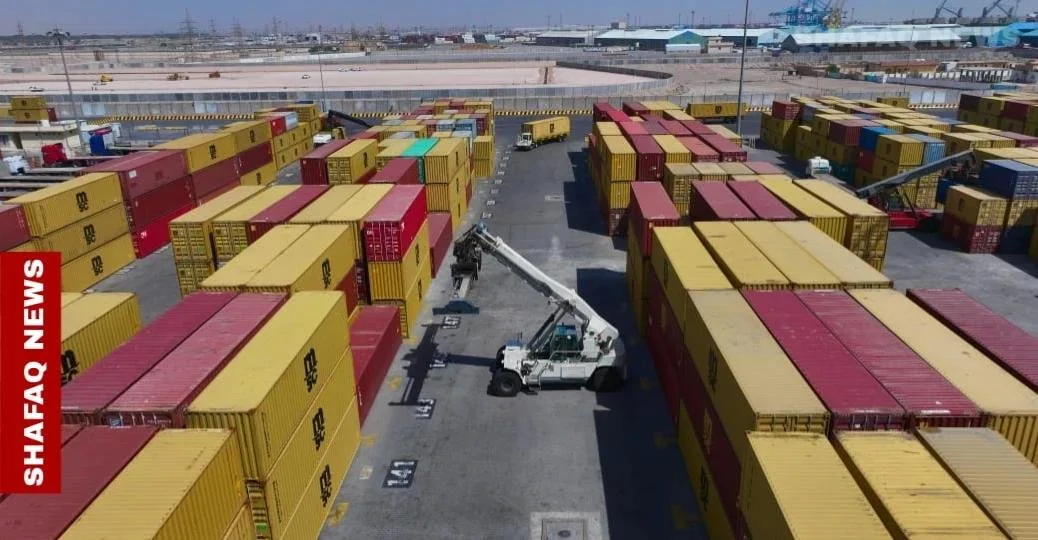
Iraq’s GDP stood at $279.6 billion in 2024, according to the World Bank. In that same year, oil accounted for 89% of the country's foreign exchange earnings, with crude oil accounting for between 92 and 99% of total exports.
The country sits atop one of the largest hydrocarbon reserves on earth. And yet it cannot feed itself, power its factories reliably, or manufacture goods that compete on its own domestic market.
The standard explanation —weak institutions, post-war damage, incomplete reconstruction—describes symptoms while leaving the cause untouched. The more accurate account is this: the political economy that oil built in Iraq actively destroys the conditions under which domestic production could ever compete.
Every boom has deepened the dependency rather than reducing it, not by accident but by design, because the system that distributes oil revenues is also the system that governs, and it has no incentive to change.
$80 Billion in Imports
Iraq's annual import bill exceeds $80–90 billion in goods, according to Iraqi Ministry of Planning estimates. That number is striking because of what it covers. Between 80 and 100% of many basic staples, including wheat, rice, and sugar.
The dependency on agricultural imports has been building since the mid-1960s, accelerating through each successive conflict, and never reversed during the periods of relative stability and high oil prices that should, theoretically, have enabled investment in domestic alternatives.
The USDA's Foreign Agricultural Service documented what this looks like at ground level in its most recent grain reporting on Iraq. In one recent drought year, the planted area for paddy rice fell by 96% compared to the previous season, as the government restricted cultivation areas in the south due to water shortages. Iraq —a country bisected by the Tigris and Euphrates, ancient breadbasket of the Fertile Crescent— cannot reliably grow its own rice.
The gap between what Iraq consumes and what it produces is not a temporary problem awaiting the right infrastructure investment; it is the settled outcome of a structural transformation that oil revenue accelerated and that no government since 2003 has found either the tools or the political will to reverse.
Dutch Disease, Iraqi Edition
Economists have a precise term for what happened: Dutch disease describes the way a resource boom creates overreliance on one sector at the expense of others, operating through two channels: a resource movement effect, where labor migrates from manufacturing to the booming sector, causing direct deindustrialization; and a spending effect, where increased revenues raise demand for non-tradable goods, causing indirect deindustrialization. Iraq exhibits both channels in their most acute form.
Oil extraction accounts for 55% of Iraqi GDP; manufacturing, construction, water, and electricity combined account for 8%. Agriculture accounts for 4%. The tradable, productive sectors of the economy were not gradually outcompeted; they were crowded out by a state that, flushed with petrodollars, found it cheaper and politically easier to employ people directly than to build the conditions for a private economy.
Iraq's labor force numbers around 15 million people, and approximately 42% work in the public sector, an outcome rooted in decades of state-centered economic policy, first institutionalized under the Ba'ath regime and later reinforced during the post-2003 reconstruction period.
The World Bank reported that the average Iraqi public employee generates 17 minutes of effective work per day. More than 10.5 million Iraqi citizens —approximately a quarter of the total population— receive a monthly salary from the state. Salary and pension obligations now exceed $48 billion annually, close to 40% of the federal budget, according to Iraq's Federal Board of Supreme Audit.
Every dinar spent retaining a surplus civil servant is a dinar not spent on the power grid, the roads, or the credit facilities that would allow a private manufacturer to exist, let alone compete.
Factories That Cannot Run
Of all the structural obstacles facing Iraqi producers, none is more concrete or more consequential than electricity, and the way the country manages its own energy.
Iraq is the world's second-largest gas-flaring country after Russia, burning 1,200 million standard cubic feet per day while simultaneously importing gas from Iran at a cost of billions of dollars annually, spending roughly $2.78 billion on Iranian gas in 2021 alone, and twice that the following year, according to the Washington Institute for Near East Policy. The fuel that could power Iraqi industry is instead lit on fire above the fields that produce it, while the state pays a neighbor for the replacement.
The supply gap this creates is severe, even before an acute outage in the summer season, Iraq generates around 24,000 megawatts, considerably less than the estimated 34,000 megawatts needed to meet local demand. The International Energy Agency projects the deficit will persist: even if all planned capacity additions are completed and transmission reforms implemented, Iraq will still face a shortage of approximately 10,000 megawatts over the next five years.
For a manufacturer, unreliable electricity is not an inconvenience; it is a structural cost that no tariff protection can offset. A factory running on backup diesel generators faces energy expenses far above those of competitors in Turkiye, Iran, or China, where power is stable and often subsidized. Iraqi producers are asked to compete internationally with one hand tied behind their back, and then told the problem is that their hand is weak.
The financial structure of the electricity sector ensures the crisis cannot self-correct. Only about 20% of electricity bills are paid in full, driven by weak enforcement and a widespread public expectation that electricity should be a free public service.
More than 50% of generated electricity is lost before billing through theft and inefficiency, and less than 30% of total production contributes to financial revenue, leaving only about 10% of operational expenses covered by collections.
A ministry that recovers a tenth of its operating costs cannot invest in the grid. A grid that cannot be invested in remains unreliable. An industry that cannot rely on the grid cannot grow. The loop is closed, and it has been closed for decades.
Tariff That Is Not a Tariff
Protective tariffs exist on paper for domestic manufacturers. The government operates a Public Distribution System providing subsidized staple foods, purchases grain harvests at above-market prices, and has backed financing for over 1,300 industrial projects. Formally, the architecture of industrial protection is present.
What is also present —and what systematically neutralizes it— is the border. Cartels maintain control around Iraq's key crossing points, employing false trade invoicing whereby importers misrepresent or undervalue products to pay less import duty, while encouraging officials to ignore mandatory inspections.
Analysts estimate that smuggling and illicit trade activities deprive the state of between three and four billion dollars in lost revenue annually. A tariff that is not enforced at the point of entry is not a tariff; it is an announcement.
Transparency International's 2024 Corruption Perceptions Index scored Iraq at 26 out of 100, against a world average of 43. The IMF, in its 2023 Article IV consultation, found that customs procedures required urgent modernization and that anti-smuggling initiatives had not been implemented on a meaningful scale.
It also recorded, without evident surprise, that approximately $2.5 billion was stolen from Iraq's General Commission for Taxes in 2021–22, only a fraction of which has been recovered.
owsThe Public Distribution System, meanwhile, provides genuine short-term relief. Research by the WFP and the IPC found that the PDS sl the transmission of global food price shocks to Iraqi consumers, with local prices adjusting to roughly 68% of an international price increase after five months. But the same research concluded the system strains the public budget while failing to provide long-term protection from global price volatility.
Political Trap
This is the argument that matters most, and the one most economic reporting on Iraq consistently avoids: import dependence is not a policy problem awaiting a technical solution. It is the equilibrium output of a rentier political settlement, and every actor inside that settlement has a rational interest in preserving it.
Rentier dynamics have produced deeply rooted public expectations of state generosity. Any attempt to cut subsidies or restructure the payroll risks provoking popular backlash —as Prime Minister Haider al-Abadi found directly when his 2015–18 reform efforts were met with mass protests. The government distributes oil revenues not primarily to develop the economy, but to maintain social peace.
Public employment is patronage institutionalized. Subsidized imports are a transfer payment that happens to destroy the market for domestic producers. The arrangement works, politically, for as long as oil prices cooperate.
They are not cooperating as the oil price required to balance Iraq's budget rose to around $84 per barrel in 2024, up from $54 in 2020, as spending expanded and non-oil revenues stagnated. With oil trading well below that threshold, Iraq is running a structural fiscal deficit while being politically unable to address its causes. Non-oil GDP was projected to slow to just 1% in 2025 as falling oil prices and financing constraints weighed on government spending and consumer sentiment.
The IMF's 2025 Article IV mission delivered its verdict without diplomatic softening: Iraq's vulnerabilities have increased in recent years due to a large fiscal expansion, and the country is struggling with high unemployment, an excessive state footprint, a weak banking sector, corruption, and an inefficient electricity sector.
It called for customs enforcement, tariff reform, wage bill reduction, labor market liberalization, and governance improvements —presenting these not as optional enhancements but as interlocking necessities. Iraq has received versions of the same prescription, from the same institution, in nearly the same language, for more than a decade.
Read more: Youth in despair, no jobs to share: Iraq’s workforce hanging in the air
Gas Will Keep Burning
Iraq will not resolve its import dependency through targeted subsidies, above-market procurement prices, or financing windows for industrial projects. These are interventions inside a system whose own logic produces the problem they are designed to solve. The dependency will begin to close only when the cost of maintaining the current settlement exceeds the cost of dismantling it, when oil revenue falls far enough, for long enough, that the state can no longer afford to employ a quarter of the population, subsidize electricity it cannot bill for, and look the other way at borders it does not control.
That moment may be approaching as it has approached before —after 2014, after 2020— and passed without transformation. Whether this time is different depends less on any particular minister or reform package than on whether the fiscal pressure now building is severe enough to break the political coalition that has made dependence the rational choice for twenty years.
Until then, the gas will keep burning above the southern fields. The ships will keep arriving at Umm Qasr. And somewhere between the flame and the cargo hold lies the answer to a question Iraq has not yet decided it wants to ask.
Read more: Iraq's gas flaring paradox: a wealth of resources, a nation in need
Written and edited by Shafaq News staff.
https://www.shafaq.com/en/Report/Iraq-s-import-trap-A-system-that-produces-demand-not-supply
MilitiaMan & CREW IRAQ DINAR UPDATE-Clean Progress taking place-Washington - Iraq in line-Reforms-REER-Results
MilitiaMan & CREW IRAQ DINAR UPDATE-Clean Progress taking place-Washington - Iraq in line-Reforms-REER-Results
4-30-2026
The Crew: Samson, PompeyPeter, Petra, Daytrader, Sunkissed, GIGI and Militia Man
No drama. No intrigue. No songs and dances. Just straight, factual news that I read and interpret to the best of my ability after being an avid Dinar investor and insanely obsessed Dinarian for over 15 years.
Follow MM on X == https://x.com/Slashn
MilitiaMan & CREW IRAQ DINAR UPDATE-Clean Progress taking place-Washington - Iraq in line-Reforms-REER-Results
4-30-2026
The Crew: Samson, PompeyPeter, Petra, Daytrader, Sunkissed, GIGI and Militia Man
No drama. No intrigue. No songs and dances. Just straight, factual news that I read and interpret to the best of my ability after being an avid Dinar investor and insanely obsessed Dinarian for over 15 years.
Follow MM on X == https://x.com/Slashn
Be sure to listen to full video for all the news……..
Seeds of Wisdom RV and Economics Updates Late Thursday Evening 4-30-26
Good Evening Dinar Recaps,
Currency Stress Signals Shift: Emerging Market Selloff and Dollar Strength Reshape Global Balance
Sharp currency declines and capital outflows are intensifying pressure on emerging markets, signaling deeper structural shifts in the global financial system
Good Evening Dinar Recaps,
Currency Stress Signals Shift: Emerging Market Selloff and Dollar Strength Reshape Global Balance
Sharp currency declines and capital outflows are intensifying pressure on emerging markets, signaling deeper structural shifts in the global financial system
OVERVIEW (KEY POINTS)
Global currency markets are under pressure as emerging market currencies weaken sharply against a strengthening U.S. dollar, highlighting growing financial stress across multiple regions.
This is happening now due to a combination of rising energy costs, capital flight to safe-haven assets, and tightening global liquidity conditions, all amplified by geopolitical uncertainty.
Key players include central banks in emerging economies, global investors reallocating capital, and the U.S. dollar maintaining dominance amid instability.
The broader implication is clear: currency instability is accelerating capital flow shifts and exposing vulnerabilities in the current global financial structure.
KEY DEVELOPMENTS
1. Emerging Market Currencies Slide Rapidly
Currency weakness is spreading.
Several currencies hitting multi-year or record lows
Selling pressure driven by capital outflows and risk aversion
2. U.S. Dollar Strengthens as Safe Haven
Flight to safety is intensifying.
Investors moving into dollar-denominated assets
Dollar benefiting from global uncertainty and liquidity demand
3. Central Banks Intervene to Stabilize Markets
Authorities attempt to slow declines.
Interventions include currency support measures and liquidity injections
Limited effectiveness as broader market pressures persist
4. Energy Prices Amplify Currency Pressure
Oil costs are impacting trade balances.
Higher energy prices worsening import bills for emerging economies
Increased strain on foreign exchange reserves
5. Capital Flows Shift Toward Developed Markets
Global investment patterns are changing.
Funds moving toward U.S. and developed market assets
Emerging markets facing reduced investment inflows
WHY IT MATTERS
This development highlights how currency markets are a leading indicator of broader financial stress, often signaling deeper systemic issues before they fully emerge.
As currencies weaken, the impact spreads to inflation, debt servicing, and economic stability, particularly in economies reliant on external financing and imports.
For policymakers, defending currencies becomes increasingly difficult when global conditions favor stronger reserve currencies like the dollar.
At the system level, this reflects a growing imbalance: capital concentration in safe havens versus vulnerability in emerging markets.
WHY IT MATTERS TO FOREIGN CURRENCY HOLDERS
Purchasing power declines in weakening currencies
Exchange rate volatility increases across markets
Dollar strength impacts global pricing and trade
Higher risk in holding emerging market currencies
IMPLICATIONS FOR THE GLOBAL RESET
Pillar 1: Capital Flow Realignment
Shifting capital toward safe-haven assets is accelerating a rebalancing of global financial influence, concentrating liquidity in fewer markets.
Pillar 2: Currency System Pressure
Widespread currency instability highlights structural weaknesses that could lead to changes in reserve currency dynamics and trade settlement systems.
CONCLUSION
The current wave of currency pressure is more than short-term volatility—it reflects underlying structural stress within the global financial system.
As capital flows shift and currencies weaken, the risks extend into inflation, debt sustainability, and economic growth.
This moment underscores a critical reality: currency stability is central to financial system confidence, and cracks are beginning to show.
When currencies weaken and capital moves, the foundation of the global financial system begins to shift.
Seeds of Wisdom Team
Newshounds News™ Exclusive
Sources
Reuters — "Emerging market currencies fall as dollar strengthens amid global uncertainty"
Reuters — "Global investors shift capital toward safe-haven assets amid volatility"
~~~~~~~~~~
Seeds of Wisdom Team RV Currency Facts Youtube and Rumble
Newshound's News Telegram Room Link
RV Facts with Proof Links Link
RV Updates Proof links - Facts Link
Follow the Gold/Silver Rate COMEX
Follow Fast Facts
Seeds of Wisdom Team™ Website
Thank you Dinar Recaps