
Thank you to all the subscribers to our Early Access program…we thank you for your continued support.
We are excited to offer this new service to keep you informed and up-to-date on the latest Dinar and currency news.
5 Market Signs of Debt Collapse Within Weeks
5 Market Signs of Debt Collapse Within Weeks
Liberty and Finance: 12-31-2024
As 2024 draws to a close, the economic landscape remains fraught with uncertainty and potential upheaval. In a recent appearance on Liberty and Finance, renowned market analyst Francis Hunt shares his insights on the prevailing economic conditions and offers forecasts for 2025.
His analysis, steeped in a deep understanding of market dynamics, highlights the crucial factors that may trigger a significant economic reset, emphasizing the need for strategic planning among investors.
5 Market Signs of Debt Collapse Within Weeks
Liberty and Finance: 12-31-2024
As 2024 draws to a close, the economic landscape remains fraught with uncertainty and potential upheaval. In a recent appearance on Liberty and Finance, renowned market analyst Francis Hunt shares his insights on the prevailing economic conditions and offers forecasts for 2025.
His analysis, steeped in a deep understanding of market dynamics, highlights the crucial factors that may trigger a significant economic reset, emphasizing the need for strategic planning among investors.
The year 2024 has been marked by persistent challenges across various sectors of the economy. Hunt meticulously examines the debt markets, noting a rising trend of yield curve inversions—a phenomenon that has historically signaled impending recessions.
With interest rates fluctuating and government debts soaring, the implications for both individual investors and larger financial institutions could be profound. Hunt stresses that understanding these dynamics is essential for anyone looking to navigate the current economic waters.
Hunt identifies several critical factors that could catalyze a significant economic reset in the near future.
Among them, he underscores the growing concerns surrounding the global debt burden, particularly in the wake of expansive fiscal policies implemented over the past few years. As nations grapple with escalating debt levels, the sustainability of these financial strategies comes into question. The interconnectedness of global markets means that distress in one region can rapidly ripple through to others, amplifying risks for investors worldwide.
Moreover, the implications of yield curve inversions cannot be overstated. Historically, such inversions have preceded economic downturns, serving as a warning signal for policymakers and market participants alike. Hunt suggests that as the yield curve continues to behave in this manner, a heightened sense of caution should prevail, prompting investors to reassess their portfolios and strategies.
Amid these challenges, Hunt draws attention to the potential for precious metals to act as a safe haven for investors. With economic volatility on the rise, gold and silver have historically served as a hedge against inflation and currency devaluation.
Hunt posits that as uncertainty escalates, the demand for these tangible assets may surge, positioning them as a critical component of a defensive investment strategy.
Adding another layer of complexity to the economic narrative is the political context, particularly with the upcoming inauguration of president-elect Donald J. Trump. Hunt discusses how this political shift may influence economic policies and market sentiment moving into 2025.
Trump’s administration is expected to prioritize certain economic reforms, which could lead to both opportunities and challenges for investors. The ramifications of these policies will likely resonate throughout the markets, making it imperative for investors to stay informed and adaptable.
In light of the potential economic reset, Hunt emphasizes the importance of adopting defensive strategies. He advocates for a diversified portfolio that includes not only precious metals but also other asset classes that may provide stability during turbulent times. Investors are encouraged to consider their risk tolerance, investment horizons, and the economic signals that may dictate market movements in the near future.
Furthermore, Hunt underscores the value of remaining agile and responsive to changing market conditions. The ability to pivot and reassess one’s investment strategy in real-time can be the difference between weathering economic storms and suffering significant losses.
As 2024 comes to a close, Francis Hunt’s insights serve as a critical reminder of the complexities that define the current economic landscape.
With potential triggers for an economic reset on the horizon, and a political shift that could reshape financial policies, investors must remain vigilant and informed. By implementing defensive strategies and staying attuned to market signals, they can navigate the uncertainties of the future, positioning themselves for resilience and opportunity in 2025 and beyond.
Iraq Economic News and Points to Ponder Wednesday AM 1-1-25
The Dinars Entering The Finances Are 20% Less Than The Amount They Need.. Iraqis Start Their New Year With Anxiety About Salaries
Economy 2024-12-31 | 3,743 views Alsumaria News More than 6 days have passed since the supposed date for the release of employee salaries, while fears are mounting with the possibility of the salaries of Iraqi retirees being delayed as well, while the date of their salaries will coincide with holiday tomorrow.
the New Year Iraqi employees often receive their monthly salaries no later than the 25th to 27th of the month, but the current month ended today, and there are still no indications of the possibility of disbursing salaries, as salaries were released in “installments” for some categories, ministries and departments and not others, due to the lack of liquidity.
The Dinars Entering The Finances Are 20% Less Than The Amount They Need.. Iraqis Start Their New Year With Anxiety About Salaries
Economy 2024-12-31 | 3,743 views Alsumaria News More than 6 days have passed since the supposed date for the release of employee salaries, while fears are mounting with the possibility of the salaries of Iraqi retirees being delayed as well, while the date of their salaries will coincide with holiday tomorrow.
the New Year Iraqi employees often receive their monthly salaries no later than the 25th to 27th of the month, but the current month ended today, and there are still no indications of the possibility of disbursing salaries, as salaries were released in “installments” for some categories, ministries and departments and not others, due to the lack of liquidity.
That is, the Ministry of Finance does not have the Iraqi dinar in its coffers.
This matter prompted the Ministry of Finance to issue a “denial” statement,
but the denial appears to be a denial of “the inability to release salaries,” and not a denial of their delay, as the Ministry said in a statement that
“the information circulating through social media claims an apology for disbursing the salaries of state employees for this month.” Due to a lack of liquidity, it is completely incorrect and has nothing to do with reality.” She added:
"We are fully committed to the process of financing employee salaries, as the Accounting Department has financed salary entitlements to ministries, governorates, and unrelated entities for the current month of December according to the schedules specified for each of them, and
it is continuing its efforts to ensure the continuity of disbursing financial dues without any delay or interruption."
It is clear that the Ministry only denied that “it was not possible to disburse salaries this month,” and did not deny the existence of a shortage of liquidity or a delay in disbursing salaries.
The problems of delaying the disbursement of salaries began to appear more than once during the past few months, with the increase in spending requirements compared to the revenues entering the state.
For example, current spending alone alone during the past ten months amounted to more than 91 trillion, excluding investment spending, that is, an average.
More than 9 trillion dinars per month are needed by the Ministry of Finance to ensure current spending such as salaries and other mandatory requirements.
On the other hand, Central Bank data show that the Ministry of Finance last November sold only $4.4 billion, equivalent to 5.8 trillion dinars, to the Central Bank.
As for non-oil revenues, they average 1.4 trillion dinars per month, according to Ministry of Finance data, which means that the total non-oil and oil revenues resulting from the sale of the dollar to the Central Bank amount to 7.2 trillion dinars, while what is required is more than 9 trillion dinars per month.
Accordingly, this means that there is a 20% deficit in the funds required for the obligatory monthly current expenses,
which makes the Ministry of Finance unable to collect all the funds at one time for the purpose of releasing the salaries of all ministries at the same time, as was the case previously, and it proceeded to release them in “installments,” and whenever It gradually became liquid.
Member of the Parliamentary Finance Committee, Jamal Cougar, says that the liquidity shortage crisis will continue in 2025, and
if the price of a barrel of oil falls to $60, we will not be able to secure employee salaries.
Iraq Ends Dollar Auction Platform: Economic Transformation And New Challenges
Jawad Al-Samarraie December 30, 2024 Packs of US dollars and Iraqi dinars. Photo: Pukmedia
Baghdad (IraqiNews.com) – As Iraq steps into 2025, a pivotal change is set to reshape its financial landscape.
The Central Bank of Iraq has announced the termination of its electronic platform for monitoring foreign currency movements and transfers.
While experts have hailed this decision as a “bold step” with significant economic and regulatory implications,
the move also raises concerns about potential challenges that could disrupt the country’s financial stability.
Why End The Dollar Platform?
The electronic platform, established in early 2023, served as a mechanism to monitor foreign currency transactions, ensuring compliance with international standards.
However, the Central Bank of Iraq intends to decentralize currency transfers by allowing local banks to engage directly with correspondent banks abroad.
This shift aims to streamline operations, enhance transparency, and reduce dependency on intermediary systems like the Federal Reserve’s oversight.
According to Kadhim Al-Shammari, a member of Iraq’s Parliamentary Economic Committee,
the platform was a temporary solution to manage the economic chaos and legal loopholes that plagued Iraq’s financial system. Al-Shammari emphasized that
while the Central Bank’s core role is to preserve monetary reserves and stabilize exchange rates, selling dollars should remain the purview of private banks.
However, this transition must be accompanied by stringent regulations to ensure responsible currency distribution.
Potential benefits of ending the platform
Nawar Al-Saadi, an international economic expert, highlights the advantages of this decision:
1. Enhanced transparency: Decentralizing transactions could promote more straightforward and transparent dealings between local and correspondent banks.
2. Cost Reduction: Eliminating the platform’s maintenance expenses could save significant resources for the Central Bank.
3. Direct international compliance: By adhering to global banking standards, Iraq can reduce bureaucratic barriers and foster stronger financial relationships with foreign institutions.
4. Efficient financial operations: Simplified processes can reduce delays in currency transfers, benefiting traders and importers.
The Central Bank’s strategic shift also aligns with its efforts to diversify currency usage, facilitating trade with key partners like China, India, and the UAE using alternative currencies such as the euro, yuan, and rupee.
Challenges And Risks
Despite its merits, the decision to end the platform is fraught with challenges:
1. Increased black market activity: Economic experts warn that the absence of robust mechanisms could push traders towards unregulated markets, driving up exchange rates.
2. Limited bank participation: Only five out of Iraq’s 60-70 banks have the capacity to handle direct international transfers, which may create bottlenecks and operational delays.
3. Inflation risks: A rise in exchange rates could elevate import costs, triggering inflation and reducing purchasing power for Iraqi citizens.
4. Economic uncertainty: Traders reliant on the platform may face disruptions, potentially slowing commercial activity and increasing unemployment in import-dependent sectors.
Adil Al-Alawi, head of the Iraqi Economic Alliance, underscores the importance of implementing rapid regulatory measures and capacity-building initiatives to mitigate these risks.
The lack of effective oversight could exacerbate financial crimes, including money laundering and tax evasion, tarnishing Iraq’s global economic reputation.
Expert Recommendations
To ensure a smooth transition, financial analysts propose the following:
1. Gradual implementation: Phasing out the platform while providing adequate training and resources for local banks to adapt.
2. Enhanced oversight: Establishing strict regulatory frameworks to monitor dollar distribution and curb illicit activities.
3. Market stability measures: Increasing dollar availability through official channels to reduce reliance on parallel markets.
4. Public awareness campaigns: Educating traders and importers about the new system to minimize confusion and resistance.
Central Bank’s Roadmap
In a statement issued in September 2024, the Central Bank reassured stakeholders about its comprehensive plan to transition to the new system.
By the end of 2024, 95% of foreign currency transactions had already shifted from the platform to direct banking channels, with only 5% remaining to be integrated.
The Bank also introduced alternative mechanisms, such as facilitating personal transfers through electronic payment systems and ensuring dollar availability for legitimate purposes at official exchange rates.
Looking Ahead
Iraq’s decision to end the dollar platform marks a significant milestone in its economic reform journey.
While the move promises long-term benefits, its success hinges on meticulous execution, robust oversight, and proactive stakeholder engagement.
By addressing potential challenges and leveraging international banking best practices, Iraq can strengthen its financial resilience and pave the way for sustainable economic growth.
As 2025 unfolds, all eyes will be on Iraq’s financial sector to assess the real impact of this bold initiative.
The outcome will not only shape Iraq’s domestic economy but also influence its standing in the global financial arena. https://www.iraqinews.com/business/iraq-ends-dollar-auction-platform-economic-impact/
Arab Bank Group Gains Approval To Relaunch Operations In Iraq Starting 2024
Business Iraq Jawad Al-Samarraie December 30, 2024
Arab Bank Group Relaunch In Iraq Baghdad (IraqiNews.com) – Arab Bank Group has received final approval from the Iraqi Central Bank on December 24, 2024, to relaunch its banking operations in Iraq.
The bank is set to begin its official activities in the new year, marking a significant development in the Iraqi financial landscape.
This move highlights Arab Bank’s ambition to expand its footprint in the Arab region and strengthen external investments, making Iraq a pivotal market in its broader strategy.
Arab Bank’s History And Legacy
Arab Bank’s approval to operate in Iraq brings back an institution that has a rich legacy in the country.
The bank previously operated four branches in Iraq from 1945 to 1964, serving as a cornerstone for Iraq’s financial development during that time.
Arab Bank was founded in 1930 by Abdul Hameed Shoman in Jerusalem, Palestine, with an initial capital of £15,000 and seven shareholders.
Following the events of 1948, the bank moved its headquarters to Amman, Jordan, where it became a publicly traded company.
During the 1940s and 1950s, Arab Bank expanded rapidly, establishing 43 branches across the Arab world and beyond.
In 1961, the bank achieved another milestone by becoming the first Arab financial institution to establish a presence in Switzerland.
Today, Arab Bank operates over 500 branches worldwide, making it one of the most influential financial institutions in the region.
A Promising Step For Iraq’s Banking Sector
The re-entry of Arab Bank into Iraq signifies the increasing appeal of Iraq’s financial market to international and regional investors.
The bank’s presence is expected to enhance the Iraqi banking sector by introducing modern financial practices and fostering increased economic activity.
This development not only strengthens Iraq’s financial infrastructure but also provides a gateway for other Arab and global institutions to invest in the country.
Looking Ahead
Arab Bank’s return to Iraq marks a promising step forward for the country’s banking and economic development.
As Iraq continues to rebuild and attract foreign investment, Arab Bank’s role will be critical in fostering financial collaboration and regional integration. https://www.iraqinews.com/business/arab-bank-relaunches-iraq-2024/
For current and reliable Iraqi news please visit: https://www.bondladyscorner.com/
Seeds of Wisdom RV and Economic Updates Wednesday Morning 1-1-25
Happy New Year Dinar Recaps,
80% OF JAPANESE BANKS TO ADOPT XRP BY 2025: A GAME-CHANGER FOR FINANCE
Japan’s financial sector is undergoing a transformative shift as nearly 80% of the nation’s banks plan to integrate XRP into their systems by 2025.
This groundbreaking move is expected to redefine cross-border payments and remittances while advancing blockchain technology adoption in mainstream finance.
Happy New Year Dinar Recaps,
80% OF JAPANESE BANKS TO ADOPT XRP BY 2025: A GAME-CHANGER FOR FINANCE
Japan’s financial sector is undergoing a transformative shift as nearly 80% of the nation’s banks plan to integrate XRP into their systems by 2025.
This groundbreaking move is expected to redefine cross-border payments and remittances while advancing blockchain technology adoption in mainstream finance.
Yoshitaka Kitao, CEO of SBI Group, a prominent financial institution in Japan, has voiced strong support for XRP, emphasizing its utility in international remittances. He highlighted RippleNet’s growing adoption and XRP’s role in enhancing transaction efficiency. Unlike Bitcoin, which Kitao describes as lacking inherent value, XRP’s utility-driven demand underscores its long-term potential.
This initiative is particularly significant for Japan, a country with a sizable expatriate and migrant worker population that relies heavily on remittances. XRP’s integration promises to streamline cross-border transactions, offering faster, cheaper, and more reliable financial solutions.
Economic and Institutional Impact of XRP Adoption
Japan’s adoption of XRP could serve as a global model for blockchain-based financial systems. With one of the world’s largest economies leading the charge, other countries may follow suit. Western nations have already begun regulating cryptocurrencies more rigorously, signaling a broader shift toward institutional adoption of blockchain solutions.
The integration of XRP also has the potential to drive financial inclusion. By reducing remittance costs, it can empower individuals in underbanked regions, creating a ripple effect of economic opportunities. Furthermore, as institutional investment in XRP increases, its mainstream acceptance is poised to grow, further legitimizing blockchain-based financial models.
XRP’s Role in Global Financial Transformation
Ripple’s On-Demand Liquidity (ODL) network, which leverages XRP for seamless cross-border payments, continues to expand globally. This network has already positioned XRP as a vital player in the future of finance. If other countries adopt similar models, XRP’s utility and market value could experience significant growth.
While the exact number of Japanese banks implementing XRP by 2025 remains uncertain, the current trajectory indicates a profound transformation in Japan’s banking landscape. As global financial systems evolve, XRP is cementing its role as a cornerstone of blockchain-enabled finance.
Daily Technical Outlook: XRP/USD – December 31, 2024
XRP/USD is trading at $2.03054, up 0.64%, reflecting a cautious recovery amid ongoing bearish sentiment. The pivot point at $2.14005 serves as a critical level. Immediate resistance is seen at $2.17118, with further barriers at $2.35413 and $2.51623. On the downside, immediate support is at $2.01000, with deeper protection at $1.95654 and $1.79139.
Technically, XRP remains under pressure, trading below the 50 EMA at $2.14005, indicating bearish momentum. The RSI at 37.43 hovers in the oversold zone, hinting at potential consolidation before a breakout. A descending triangle pattern dominates the 4-hour chart, suggesting a continuation of the downtrend unless prices break decisively above $2.17118.
While a sustained breakout above $2.17118 could spark bullish momentum, failing to hold above $2.01000 may accelerate declines toward $1.95654. Traders should monitor these levels closely as XRP approaches a decisive inflection point.
@ Newshounds News™
Source: FX Leaders
~~~~~~~~~
FOUR TRENDS THAT SHOW THE FUTURE OF CROSS-BORDER PAYMENTS
The global economy is an intricate web of transactions, and cross-border payments serve as its financial backbone.
For much of its history, that backbone has been creaky, slow and inefficient. But throughout 2024, the cross-border payments sector evolved at a breathtaking pace, driven by technological innovation and changing customer expectations, while simultaneously grounded in regulatory and compliance considerations.
Four central themes emerged throughout PYMNTS’ coverage of the space this year: growing collaboration between FinTechs and financial institutions (FIs); the maturation of blockchain as a key cross-border rail; smarter compliance tools powered by artificial intelligence (AI) and machine learning; and the emergence of real-time payment infrastructure.
Financial Institutions and FinTechs: A New Era of Collaboration
In 2024, we witnessed a convergence and an evolution of FinTech and FI partnerships that worked to reshape the cross-border payments landscape. FIs brought the scale, infrastructure and regulatory expertise, while FinTechs contributed agility, innovation and customer-centric solutions.
“The [cross-border] space is very fragmented, and there’s a lot of opportunity for someone to emerge and dominate that space — or help banks improve the service that they offer,” Andy Elliott, vice president of strategy at EvonSys, told PYMNTS.
The convergence also signals a shift in mindset. Rather than viewing FinTechs as disruptors, FIs now see them as partners essential for navigating an increasingly digital economy. This symbiosis will likely deepen, leading to hybrid models where the lines between traditional banking and FinTech blur further.
Blockchain and Stablecoins: Building the Infrastructure of Tomorrow
Blockchain technology has long held the potential to transform cross-border payments by offering faster, more secure and cost-effective solutions. In 2024, we witnessed the maturation of this technology, with stablecoins — cryptocurrencies pegged to stable assets like fiat currencies — emerging as a viable medium for international transactions. Major players like PayPal and Circle have introduced their own stablecoins to modernize cross-border remittances and B2B transactions alike.
The PYMNTS Intelligence report “Can Blockchain Solve the Cross-Border Payments Puzzle?“ explored how blockchain could revolutionize cross-border payments, assessed its current adoption and examined the future implications for financial institutions and businesses.
Unlike traditional systems burdened by intermediaries, stablecoins offer near-instant settlement and reduced transaction costs. However, challenges remain. Regulatory clarity is uneven across jurisdictions, creating hurdles for widespread adoption. Still, the groundwork laid in 2024 suggests that stablecoins could serve as a gateway for broader blockchain adoption in cross-border payments.
The next phase? Integrating these digital assets seamlessly into existing financial systems to drive mainstream usage.
Smarter Compliance Solutions: Turning Pain Points into Opportunities
Compliance remains one of the biggest challenges in cross-border payments, particularly in a world of tightening regulations and heightened scrutiny.
“Everything’s going more cross-border and getting regulated, so tax compliance regulation is huge for new business models in new markets,” Sovos CEO Kevin Akeroyd told PYMNTS in an interview posted in April.
Faulty cross-border payments cost merchants in the United States at least $3.8 billion in sales last year alone, according to the PYMNTS Intelligence report “Cross-Border Sales and the Challenge of Failed Payments.” Additionally, 70% of U.S. firms experienced higher rates of failed payments in cross-border sales compared to domestic sales.
But 2024 marked a turning point: the rise of smarter compliance solutions powered by AI and machine learning (ML). Advanced tools now enable real-time monitoring of transactions to detect fraud, ensure anti-money laundering (AML) compliance and verify customer identities.
The result? Compliance becomes less of a bottleneck and more of a competitive advantage. As these technologies evolve, they promise to bring greater efficiency and security to cross-border transactions, paving the way for more seamless global commerce.
Instant Payments: A Global Mandate
The demand for real-time transactions has skyrocketed, fueled by the expectations of consumers accustomed to instant gratification in their personal lives. In 2024, cross-border payments worked on catching up, with innovations in instant payment infrastructure taking center stage.
For businesses, instant payments mean improved cash flow, reduced reliance on credit and enhanced supplier relationships. For consumers, they eliminate the frustration of waiting days for funds to clear. As real-time payment networks expand and interconnect, they’re likely to become one of the default mode for cross-border transactions.
Ultimately, as PYMNTS’ Karen Webster noted in an interview posted in October, any focus on cross-border innovation needs to be on solving key frictions: moving money securely and safely, providing transparency throughout the process and optimizing the economics of cross-border transactions.
@ Newshounds News™
Source: Pymnts
~~~~~~~~~
Seeds of Wisdom Team RV Currency Facts Youtube and Rumble
Newshound's Podcast Link
Newshound's News Telegram Room Link
Q & A Classroom Link
Follow the Roadmap
Follow the Timeline
Seeds of Wisdom Team™ Website
Subscribe to Seeds of Wisdom Team™ Newsletter
Thank you Dinar Recaps
“Tidbits From TNT” Wednesday Morning 1-1-2025
TNT:
Tishwash: Al-Hassan congratulates on the New Year: Iraq is able to overcome challenges
The representative of the Secretary-General of the United Nations in Iraq, Mohammed Al Hassan, confirmed in a message on the occasion of the New Year, today, Tuesday, that the Iraqi people have the ability to face challenges.
The Special Representative of the Secretary-General of the United Nations in Iraq congratulates the Iraqi people and government on the New Year:
Al-Hassan said in a tweet on the {X} platform, "I congratulate the Iraqi people and the Iraqi government on the achievements made during the year 2024."
TNT:
Tishwash: Al-Hassan congratulates on the New Year: Iraq is able to overcome challenges
The representative of the Secretary-General of the United Nations in Iraq, Mohammed Al Hassan, confirmed in a message on the occasion of the New Year, today, Tuesday, that the Iraqi people have the ability to face challenges.
The Special Representative of the Secretary-General of the United Nations in Iraq congratulates the Iraqi people and government on the New Year:
Al-Hassan said in a tweet on the {X} platform, "I congratulate the Iraqi people and the Iraqi government on the achievements made during the year 2024."
He added, "In 2024, we witnessed great achievements in development and infrastructure, and this was achieved thanks to the strong and ambitious will of Prime Minister Mohammed Shia al-Sudani's government to improve the lives of Iraqis."
Al-Hassan continued, "We have great confidence in Iraq to draw a better future," calling on the Iraqi government to "continue working sincerely to improve services throughout Iraq.
Iraq is capable of overcoming challenges and regaining its regional and international standing." link
************
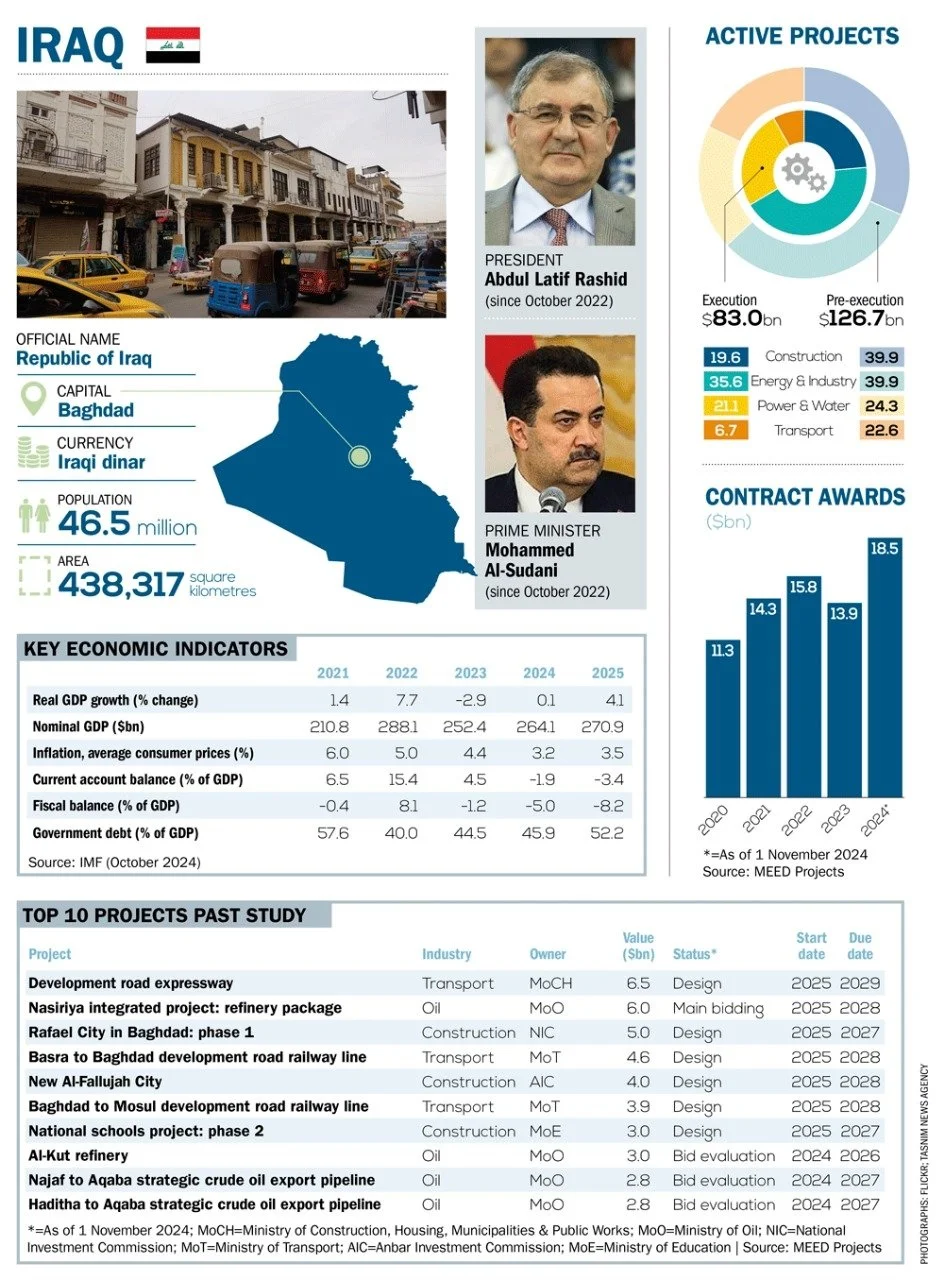
Tishwash: International Report: 2025 will be the largest year for projects inside Iraq
The International Data Bank, one of the international organizations concerned with monitoring the internal affairs of the countries of the world, issued its annual report for the year 2024, accompanied by estimates for the coming year 2025, confirming that the current year witnessed the issuance of the largest number of investment and service contracts inside Iraq.
The bank said, according to its report, which was translated by "Baghdad Today", that "Iraq spent $83 billion during the year 2024 on infrastructure and reconstruction projects, and awarded contracts to implement other projects during the year 2025 worth $126 billion," expecting that "this will lead to a doubling of the growth rate of the national GDP to about 4.1% during the next year."
The bank also explained that the largest projects were the share of the country's main roads for the Ministry of Transport, which are expected to be fully completed in 2029, noting also that oil investment projects and the construction of residential complexes in Baghdad, specifically (the integrated Nasiriyah oil project and the city of Al-Rufail in Baghdad) came in second and third place as the largest government projects for the year 2024.
The information issued by the World Bank also confirmed that the contracts awarded for the coming year were distributed as follows (39.9% allocated to construction, 39.9% allocated to energy and industry, 24.3% allocated to electricity and water service projects, while 22.6% was allocated to road and transportation projects). link
Tishwash: Starting to implement ASYCUDA global system for automating customs operations
The Prime Minister's Media Office announced on Tuesday the start of using modern automation systems to facilitate the entry of goods into border crossings and monitor them centrally, and the agreement to implement the global ASYCUDA system to automate customs operations.
The office said in a statement, seen by "Al-Eqtisad News", that "in implementation of the directives of Prime Minister Mohammed Shia Al-Sudani regarding administrative and financial reform, which is included among the priorities of the government program, a special meeting was held today in the Prime Minister's Office headed by the Prime Minister's Advisor for Border Customs and Ports Affairs, where the procedures related to the governance of border ports and customs systems were discussed."
The statement added that "the meeting witnessed the announcement of the completion of the necessary infrastructure to link all border ports with the latest technologies, and the start of the use of modern automation systems to facilitate the entry of goods into border ports and monitor them centrally. It was also agreed to implement the global ASYCUDA system for automating customs operations, enhanced with electronic payment services starting from January 1, 2025."
He pointed out that "this step will contribute to achieving automation in ministries and institutions, including the e-government project and providing electronic payment services, which contributes to enhancing transparency and accountability, simplifying procedures, facilitating services and reducing bureaucratic obstacles, in addition to establishing good governance and combating corruption." link
**************
Mot: Finally Made sum - Realistic Resolutions

Mot: .. good ole ""Earl"" to the Rescue!!!

Iraq Economic News and Points to Ponder Monday Afternoon 12-30-24
The Collapse Of Monetary Policy In Iraq.. Investment In Banks Is Almost Non-Existent And The Central Bank Is Going Against The Grain
Economy | Today, 12:13 | Baghdad today – Baghdad Financial and economic expert Mustafa Akram Hantoush commented today, Tuesday (December 31, 2024), on the performance of the Central Bank of Iraq for the current year.
The Collapse Of Monetary Policy In Iraq.. Investment In Banks Is Almost Non-Existent And The Central Bank Is Going Against The Grain
Economy | Today, 12:13 | Baghdad today – Baghdad Financial and economic expert Mustafa Akram Hantoush commented today, Tuesday (December 31, 2024), on the performance of the Central Bank of Iraq for the current year.
Hantoush said in an interview with "Baghdad Today",
"The reality of monetary policies in Iraq is heading in the opposite direction to the process of building monetary policies, and there have been problems for years that have led to a clear collapse in Iraqi monetary policies."
He added, "For years, the banking system has been subjected to near annihilation. 32 banks are subject to sanctions, and the rest are banned from receiving the dollar only in specific currencies, and the mechanism is still unclear."
He pointed out that "there are more than 70 Iraqi banks without lending, because the central bank did not establish a clear lending policy of loans, categories, and guarantees."
He continued, “The policy of attracting deposits is more than 80 to 85% of the currency issued by the Central Bank, and it does not appear in the monthly transactions in the monthly banking system, so this currency is supposed to be offered as marketing deposits, so the banking system does not enter into this process,” indicating that “The investment policy of the Iraqi Bank is almost non-existent.”
Hantoush explained that the policy of investment banking operations is not specific in direction, and the remittance policy also has a problem with the cancellation of the platform, “so I see a clear collapse in Iraqi monetary policies.”
Hantoush called on the Central Bank to reform its monetary policy, set new standards for developing the Islamic banking system, and go further to keep pace with the requirements of the current and future economic stage.
https://baghdadtoday.news/264928-انهيار-السياسية-النقدية-في-العراق.-الاستثمار-في-المصارف-شبه-معدوم-والبنك-المركزي-يسير-عكس-التيار.html
The Central Bank Decides To Stop Withdrawals And Deposits (Document)
Sweeteners 2024-12-31 | 11:52 Source: Alsumaria News 5,252 views The Central Bank of Iraq decided, on Tuesday, to stop withdrawals and deposits for a period of four days. According to a document, the bank decided to close its doors on January 2, 2025 and stop conducting banking transactions for customers.
The bank also decided to stop withdrawals and deposits on savings accounts in bank branches for the period from 12/30/2024 to 1/2/2025 for the purpose of completing annual budgets.
Below is the text of the document
https://www.alsumaria.tv/uploadImages/ExtImages/Images1/ExtImage-7471324-690056192.jpg
' https://www.alsumaria.tv/news/localnews/511467/البنك-المركزي-يقرر-إيقاف-عمليات-السحب-والإيداع-وثيقة
Integration Requirements
December 31, 2024
In order to speed up the procedures and complete the merger transactions for the exchange companies of categories (A and B) under establishment and all brokerage companies for buying and selling foreign currencies, please provide us with the attached merger requirements at once ..
For more, click here. https://cbi.iq/static/uploads/up/file-173564321769246.pdf
https://cbi.iq/news/view/2754
~~~~~~~~~~
[approximate and incomplete translation of https://cbi.iq/static/uploads/up/file-173564321769246.pdf
DATE : 2024/12/27
Exchange companies for the two categories (A,B) under all establishment
Mediation companies by selling and selling all foreign currencies
M/ Integration requirements
In order to accelerate procedures and complete the completion of your companies’ integration.
Please provide us with the accompanying integration requirements, so that this directorate can proceed with this directorate.
Integration without delay or delay, as the delay in completing the requirements of integration will lead to the delay in granting you Nbfi.supervision@cbi.iq.
To abide by what was mentioned above. With appreciation
For accompanying/
- Schedule of number (3) with integration requirements.
A schedule with documents to be submitted for the purpose of integration and obtaining the final license
[three page table in Arabic listing required documents, followed by…]
With the presentation that all the aforementioned forms are published on the website of the Central Bank of Iraq On the link below: https://cbi.iq/news/view/1223
For current and reliable Iraqi news please visit: https://www.bondladyscorner.com/
Insiders Dumping Stocks, Preparing For 2025 Reset? - Year-End Panel - Holter, Macleod, Schectman
Insiders Dumping Stocks, Preparing For 2025 Reset? - Year-End Panel - Holter, Macleod, Schectman
Liberty and Finance: 12-30-2024
In this 2024 year end panel discussion featuring Andy Schectman, Alasdair Macleod, and Bill Holter, the tone is starkly cautionary as they analyze the fragile state of global financial markets.
The conversation highlights a rapidly deteriorating situation where the dollar is on a "slippery slope" and market dynamics show, among the insiders, an overwhelming number of sellers compared to buyers.
Schectman, Macleod, and Holter point out that, while gold has made significant gains, investor enthusiasm remains low, with the public continuing to unload assets while institutional investors quietly buy.
Insiders Dumping Stocks, Preparing For 2025 Reset? - Year-End Panel - Holter, Macleod, Schectman
Liberty and Finance: 12-30-2024
In this 2024 year end panel discussion featuring Andy Schectman, Alasdair Macleod, and Bill Holter, the tone is starkly cautionary as they analyze the fragile state of global financial markets.
The conversation highlights a rapidly deteriorating situation where the dollar is on a "slippery slope" and market dynamics show, among the insiders, an overwhelming number of sellers compared to buyers.
Schectman, Macleod, and Holter point out that, while gold has made significant gains, investor enthusiasm remains low, with the public continuing to unload assets while institutional investors quietly buy.
They all agree that the real economy is slowing down, with the ominous possibility of a 2025 downturn resembling the Great Depression of 1929.
The trio also emphasizes the risks facing the banking system, which is attempting to de-risk itself, but is still vulnerable to a larger collapse.
INTERVIEW TIMELINE:
0:00 Intro
2:41 2024 takeaways
8:30 Secret central bank gold buying
15:05 Insider selling
19:00 Global credit bubble
30:45 Retail market update
44:29 2025 look ahead
Iraq News Highlights and Points to Ponder Tuesday AM 12-31-24
Monetary Policy Collapses In Iraq.. Investment In Banks Is Almost Non-Existent And The Central Bank Is Going Against The Tide - Urgent
Economy |Today, Baghdad Today – Baghdad Financial and economic expert Mustafa Akram Hantoush commented, today, Tuesday (December 31, 2024), on the performance of the Central Bank of Iraq for the current year.
Hantoush said in an interview with Baghdad Today, " The reality of monetary policies in Iraq is heading in the opposite direction to the process of building monetary policies, and there have been problems for years that have led to a clear collapse in Iraqi monetary policies."
Monetary Policy Collapses In Iraq.. Investment In Banks Is Almost Non-Existent And The Central Bank Is Going Against The Tide - Urgent
Economy |Today, Baghdad Today – Baghdad Financial and economic expert Mustafa Akram Hantoush commented, today, Tuesday (December 31, 2024), on the performance of the Central Bank of Iraq for the current year.
Hantoush said in an interview with Baghdad Today, " The reality of monetary policies in Iraq is heading in the opposite direction to the process of building monetary policies, and there have been problems for years that have led to a clear collapse in Iraqi monetary policies."
He added, "The banking system has been subject to near-annihilation for years. 32 banks are subject to sanctions, and the rest are banned from the dollar only, in specific currencies, and the mechanism is still unclear."
He pointed out that "there are more than 70 Iraqi banks that do not lend, because the Central Bank has not set a clear lending policy in terms of loans, categories and guarantees."
He added that "the policy of attracting deposits of more than 80 to 85% of the currency issued by the Central Bank, and it does not appear in the monthly transactions in the monthly banking system, so this currency is supposed to be offered as marketing deposits, so the banking system does not enter into this process," indicating that "the Iraqi bank's investment policy is almost non-existent in its investments."
Hantoush explained that the investment banking operations policy is not defined in any direction, and the remittance policy also has a problem with the cancellation of the platform, " therefore I see a clear collapse in Iraqi monetary policies."
Hantoush called on the Central Bank to reform its monetary policy, set new standards to develop the Islamic banking system and go beyond standards that keep pace with the requirements of the current and future economic stage. LINK
Economist: Relying On Oil As A Source Of Revenue Will Have Serious Consequences
Today 10:29 Information/Baghdad... Economic researcher Diaa Abdul Karim found that the primary reliance on oil exports as a main source of revenues and salaries will have serious consequences in the future.
Abdul Karim told Al-Maalouma, "The world's dependence on oil and its derivatives will gradually decline over time, especially with technological advancement and reliance on clean energy methods in many countries, in addition to the start of work on producing electric cars, as manufacturing countries have begun to resort to this option as an alternative to liquid fuel and its harm to the environment."
He added, "The dependence on oil and its derivatives will never stop, but it will decrease significantly over time. Therefore, the countries exporting oil need a strategy to save them from the decline in oil revenues."
He pointed out that "Iraq depends mainly on oil revenues to finance the budget and pay salaries, and this poses a threat to the country, especially with the rise and fall in oil prices, which requires governments to resort to other options to diversify the sources of the economy to avoid the global trend towards moving away from oil." End25 LINK
Customs: Our Revenues Increased By 128% During The Current Year
Faw Port Money and business Economy News – Baghdad The General Authority of Customs revealed, on Monday, that its revenues increased by 128% during the current year compared to last year, while confirming that administrative reforms and the ASYCUDA system contributed to the increase.
Director of the General Authority of Customs, Ahmed Al-Akidi, said in a statement reported by the official news agency, and reviewed by "Al-Eqtisad News", that "the revenues of the General Authority of Customs for the period from 1/1/2024 to 30/11/2024 amounted to one trillion and nine hundred billion dinars, compared to 892 billion dinars in 2023, with an increase rate of 128%."
He added that "administrative reforms, the ASYCUDA system, and simplification and facilitation of customs procedures contributed to increasing revenues."
Al-Akidi explained that "the General Authority of Customs is working according to plans represented in a number of axes, including developing the competencies and skills of employees, in addition to completing the installation of the ASYCUDA system in customs centers that have not been automated," noting that "by the end of 2025, all customs centers will be automated."
He continued that "automation consists of multiple stages, the first stage is done by automating the centers, then linking with government departments within the country is considered the second stage, and the third stage is linking with the customs programs of neighboring countries." added 12/30/2024 https://economy-news.net/content.php?id=51450
Dinars Entering The Ministry Of Finance Are 20% Less Than The Amount It Needs.. Iraqis Start Their New Year With Salary Anxiety
Economy 2024-12-31 | 1,818 views SumerianNews More than 6 days have passed since the supposed date for the release of salariesStaffAs concerns grow over possible delay in pension paymentsIraqisAlso, their salaries will be due tomorrow.vacationNew Year's Eve
Iraqi employees usually receive their monthly salaries no later than the 25th to the 27th of the month, but the current month ended today, and there are still no indications of the possibility of disbursing salaries, as salaries were paid in “installments” for some categories, ministries and departments and not others, due to the lack of liquidity, i.e. the Ministry of Finance does not have the dinar.IraqiIn her closets.
This prompted the Ministry of Finance to issue a “denial” statement, but the denial, as it seems, is a denial of “the inability to release salaries,” not a denial of their delay, as the ministry said in a statement that “the information circulating on social media, which claims to apologize for the disbursement of salaries of employees,The StateThis month due to a lack of liquidity is completely incorrect and has no relation to reality.
She added: “We are fully committed to the process of financing employees’ salaries, as the Accounting Department has financed the salaries due to ministries, governorates and non-affiliated entities for the current month of December according to the schedules specified for each of them, and it is continuing its efforts to ensure the continuity of disbursing financial dues without any delay or interruption.”
It is clear that the ministry only denied “the inability to disburse salaries this month,” and did not deny the existence of a lack of liquidity or a delay in disbursing salaries.
Problems of delayed salary disbursement have begun to appear more than once during the past few months, with spending requirements increasing compared to the revenues entering the state. For example, current spending alone during the past ten months amounted to more than 91 trillion, excluding investment spending, i.e. an average of more than 9 trillion dinars per month that the Ministry of Finance needs to ensure current spending such as salaries and other mandatory requirements.
In contrast, Central Bank data shows that the Ministry of Finance sold the Central Bank only $4.4 billion last November, equivalent to 5.8 trillion dinars.
As for non-oil revenues, they average 1.4 trillion dinars Monthly according to the Ministry of Finance data, which means that the total non-oil and oil revenues resulting from selling the dollar to the Central Bank amount to 7.2 trillion dinars, while the required amount is more than 9 trillion dinars per month.
Accordingly, this means that there is a 20% deficit in the funds required for the mandatory monthly current expenditures, which makes the Ministry of Finance unable to collect all the funds at the same time in order to pay the salaries of all ministries at the same time as was the case previously, and it resorted to paying them in "installments", and whenever it has gradual liquidity.
Member of the Parliamentary Finance Committee Jamal Kojer says that the liquidity shortage crisis will continue in 2025, and if the price of a barrel of oil drops to $60, we will not be able to secure employees' salaries. LINK
With More Than 30 Billion Dollars... A Leap In The Projects Market In Iraq
2024-12-31 00:32 Shafaq News/ The English magazine "Med Projects" revealed that the projects market in Iraq rose to 8.6% in November.
The magazine said in a report it published and reviewed by Shafaq News Agency that Iraq witnessed a significant increase of 8.6 percent or $31.7 billion in the value of its market projects in November, ranking fourth after the UAE, Saudi Arabia and Iran.
She added that the increase in the value of projects in Iraq reflects the view that Baghdad has shifted its focus to rebuilding and modernizing the country's deteriorating infrastructure. LINK
Seeds of Wisdom RV and Economic Updates Tuesday Morning 12-31-24
Good Morning Dinar Recaps,
XRP, HBAR, XLM, AND OTHER UTILITY-BASED NETWORKS SHAPING THE FUTURE OF FINANCE
▪️XRP, Stellar, and Hedera are reshaping global finance and driving utility.
▪️These platforms are now gaining mass attention for their roles in various industries.
The adoption of utility-based protocols like Ripple’s linked XRP, Hedera (HBAR), and Stellar (XLM) is gaining momentum. According to entrepreneur and writer Max Avery, these networks are driving transformation in the global financial system.
Good Morning Dinar Recaps,
XRP, HBAR, XLM, AND OTHER UTILITY-BASED NETWORKS SHAPING THE FUTURE OF FINANCE
▪️XRP, Stellar, and Hedera are reshaping global finance and driving utility.
▪️These platforms are now gaining mass attention for their roles in various industries.
The adoption of utility-based protocols like Ripple’s linked XRP, Hedera (HBAR), and Stellar (XLM) is gaining momentum. According to entrepreneur and writer Max Avery, these networks are driving transformation in the global financial system.
The Role of Utility-Based Networks In Financial Systems
In a series of X posts, Avery highlighted the role of utility-based networks in the financial system. The analyst pointed out the contributions of experts like Hiromi Yamaoka, a former official at the IMF, in pursuit of an effective financial system.
According to Avery, Yamaoka has developed frameworks to promote collaboration between central banks and private firms.
This collaboration combines the technological efficiency of private companies with the trust and control of Central banks. Private companies like Constellation, Hedera, Stellar, and Ripple aim to innovate with programmable solutions. On the other hand, Central banks offer supervision and issue stable assets, such as Central Bank Digital Currencies (CBDCs).
"This is done by a joint effort. Central banks issue stable assets, like CBDCs, and provide oversight. Private entities, like Ripple, Stellar, Hedera, and Constellation, seek to innovate with programmable solutions. This partnership combines banks’ trust and control with private…"
— Max Avery (@realMaxAvery) December 29, 2024
XRP is a vital component of institutional finance as it allows instantaneous and cheaper cross-border payments. Additionally, it eliminates the need for pre-funded accounts and offers instantaneous currency bridging and on-demand liquidity.
Avery described the XRP Ledger (XRPL) as more than a payment system. He highlighted the blockchain’s function in tokenizing assets such as real estate and carbon credits. Moreover, the XRPL has a decentralized exchange for direct asset trading and possesses lightweight smart contracts via Hooks to expand its utility.
Also, XRPL distinguishes itself from other blockchains in terms of energy efficiency. Unlike Bitcoin mining, XRPL utilizes a consensus mechanism that’s faster, greener, and scalable. It demonstrates that innovation in finance is possible without compromising the environment, providing a sustainable way forward.
Like XRP, Stellar’s native token, XLM aims for financial inclusion. The network charges less for small transactions and supports scalable private CBDCs. At the same time, it helps the underbanked and enables global economic access.
Hedera, another popular utility-based network, is also shaping the future of financial systems. Hedera’s native asset, HBAR, enables low-cost, high-speed transactions and supports Decentralized Applications (dApps).
Additionally, HBAR is utilized for staking, which supports network governance and security. It provides an effective and scalable solution for a range of financial services.
Complementary Networks
Intriguingly, these networks are complementary to one another. For instance, while XRP transforms institutional finance, XLM ensures access for all. They address the entire financial spectrum, creating a complete solution for modern financial systems.
Meanwhile, the adoption of utility-based networks is gaining momentum. Specifically, Ripple’s partnerships with banks are growing, as CNF reported. This development highlights Ripple’s growing integration into the global financial system.
As regulation improves, Avery believes adoption will skyrocket.
Avery concluded that the future of utility is unfolding, contrary to some people’s opinions.
“These networks are leading the shift by blending their advanced technology with real-world utility. It’s the present, taking shape in real-time, whether people want to believe it or not,” he noted.
@ Newshounds News™
Source: Crypto News Flash
~~~~~~~~~
BRICS NEWS: 2 COUNTRIES SETTLE $37 BILLION TRADE IN LOCAL CURRENCIES
BRICS member Russia is aggressively pushing the de-dollarization agenda by making developing countries settle trade in local currencies. Russian President Vladimir Putin is convincing emerging economies to ditch the US dollar and push local currencies for cross-border transactions. The move will strengthen their native economies and give their local currencies a boost in the forex markets.
Russia is successfully bypassing US sanctions and keeping its economy afloat by making other countries ditch the US dollar. The development is hurting the US more as emerging economies as seriously considering advancing the de-dollarization initiative.
BRICS: Russia & Belarus Settle Trade Worth $37 Billion in Local Currencies
In 2024 alone, BRICS member Russia has settled trade worth $37 billion with Belarus using local currencies. The trade between the two nations surged 8.4% this year indicating that de-dollarization could soon be the norm. Developing countries are cutting ties with the US dollar and pushing local currencies to become the main source of all transactions.
The next few years could change the way the US operates the global financial order. BRICS is looking to create a paradigm shift with an alternate economy leaving the US behind. Local currencies could soon be accepted by like-minded countries who aim to topple the US dollar from the world’s reserve.
“Growing trade turnover indicators are clear evidence of the efficiency of the Russian-Belorussian integration. Alexander Grigoryevich (Belarus President) already shared his expectations for this year’s numbers. This forecast, I believe, is right on the money. According to our statistics, trade grew by 8.4% from January to September, topping $37 billion. By the end of the year, it will likely approach the figures President Lukashenko projected,” said Russian President Vladimir Putin.
@ Newshounds News™
Source: Watcher Guru
~~~~~~~~~
Seeds of Wisdom Team RV Currency Facts Youtube and Rumble
Newshound's Podcast Link
Newshound's News Telegram Room Link
Q & A Classroom Link
Follow the Roadmap
Follow the Timeline
Seeds of Wisdom Team™ Website
Subscribe to Seeds of Wisdom Team™ Newsletter
Thank you Dinar Recaps
“Tidbits From TNT” Tuesday Morning 12-31-2024
TNT:
Tishwash: 40 trillion dinars is Iraq's internal debt.. Does the government have the "key" to repay it?
Member of the Parliamentary Finance Committee, Jamal Kojer, revealed Iraq’s internal debts, which exceeded 40 trillion dinars.
Kocher told {Euphrates News} that: "Regarding Iraq's internal debts, the numbers speak of more than 40 trillion, and the majority of the debts belong to the government banks, Rafidain, and TBI."
He added, "The government is now able to pay these debts if it opts for withdrawing them from the bank reserve. " Kocher stressed "the need to schedule debt repayment as a result of the banks' role parallel to the government's role in providing job opportunities and supporting the private sector."
TNT:
Tishwash: 40 trillion dinars is Iraq's internal debt.. Does the government have the "key" to repay it?
Member of the Parliamentary Finance Committee, Jamal Kojer, revealed Iraq’s internal debts, which exceeded 40 trillion dinars.
Kocher told {Euphrates News} that: "Regarding Iraq's internal debts, the numbers speak of more than 40 trillion, and the majority of the debts belong to the government banks, Rafidain, and TBI."
He added, "The government is now able to pay these debts if it opts for withdrawing them from the bank reserve. " Kocher stressed "the need to schedule debt repayment as a result of the banks' role parallel to the government's role in providing job opportunities and supporting the private sector."
The financial advisor to the Prime Minister, Mazhar Muhammad Salih, announced that Iraq has exited the risks of external debts, and that (Iraq) is a well-fortified country.
He stressed that the ratio of debts to the gross domestic product does not constitute a burden on the state, as it amounts to (5) percent of the gross domestic product, and is confined within the (government banking) system. link
************
Tishwash: Sudanese advisor reveals government's philosophy for future of national economy
The economic advisor to the Prime Minister, Mazhar Muhammad Salih, revealed the government’s philosophy for the future of the national economy, represented by the idea of establishing a sovereign wealth fund.
Saleh told {Euphrates News} that: "The initiation of the idea of a sovereign wealth fund is essential and is consistent with the renaissance of natural resources and undoubtedly comes in parallel with the development path strategy and its outcomes in generating a leading industrial renaissance in the national economy.
This is Iraq's outline in building the future of its economy for the twenty-first century and in two directions {the export-oriented development model and the other, and the development model directed towards maximizing the input-output tables and replacing imports within the national economy}.
He added, "Therefore, the sovereign wealth fund will adopt a vision that expresses the strength and basis of the interconnections between the outputs of national wealth from natural resources and the inputs of the production function in the national economy, which requires another model in managing sovereign wealth funds directed towards the interior."
Saleh explained that "the sovereign fund will work to accelerate the diversification of the three basic sectors, which are the manufacturing industry, agriculture and services, in an advanced digital age. This is what the government program aspires to in its philosophy for the future of the national economy, which did not neglect the idea of partnership between state activity and market activity in sustainable development." link
************
Tishwash: Al-Sudani starts 2025 with a visit to Iran
An informed source revealed on Monday that Prime Minister Mohammed Shia al-Sudani will begin a visit to Iran at the end of next week, to discuss developments in the region .
The source told Shafaq News Agency that Al-Sudani will discuss several files with Iranian leaders, most notably the recent developments in Syria .
Al-Sudani had made several visits to countries in the region after the fall of Bashar al-Assad's regime, including Jordan and Saudi Arabia, where he discussed security issues with the leaders of these countries. Iraq also participated in the Aqaba Conference held in Jordan, with the participation of several countries, including the United States .
Iranian President Masoud Pezeshkian visited Iraq on September 11, and made a three-day tour that included Baghdad, Erbil, Sulaymaniyah, Najaf, Karbala and Basra .
On May 22, Al-Sudani also visited Tehran to participate in the funeral of Iranian President Ebrahim Raisi, who was killed in a plane crash .
**********
Mot: These Life Changing Decisions - Still Plaguing Me They is!

Mot: ... New Years Eve - As Ya ""Season""

Mot: YEPPERS!!! ~~~~ Staying up for new years eve

MilitiaMan & Crew Iraq Dinar News-Commemorative Coin?-Investment Attractive-Dollar Auction Done by End of Year!
MilitiaMan & Crew Iraq Dinar News-Commemorative Coin?-Investment Attractive-Dollar Auction Done by End of Year!
12-30-2024
The Crew: Samson, PompeyPeter, Petra, Daytrader, Sunkissed, GIGI and Militia Man
Be sure to listen to full video for all the news……..
MilitiaMan & Crew Iraq Dinar News-Commemorative Coin?-Investment Attractive-Dollar Auction Done by End of Year!
12-30-2024
The Crew: Samson, PompeyPeter, Petra, Daytrader, Sunkissed, GIGI and Militia Man
Be sure to listen to full video for all the news……..
Iraq News Highlights and Points to Ponder Monday Evening 12-30-24
Observers: The Central Bank Claims The Success Of Its Monetary Policy Without Any Effect On Reality
Written by: social Baghdad 12-30-2024 The Central Bank claimed the success of its monetary policy in 2024, claiming that the four percent increase in deposits in operating banks is an indicator of the success of the monetary policy.
Observers believe that the Central Bank, which claims the success of its financial policy, must find a new outlet to feed the demand for the dollar without going through the foreign currency auction to eliminate the whales of corruption and preserve the bank’s foreign currency reserves,
Observers: The Central Bank Claims The Success Of Its Monetary Policy Without Any Effect On Reality
Written by: social Baghdad 12-30-2024 The Central Bank claimed the success of its monetary policy in 2024, claiming that the four percent increase in deposits in operating banks is an indicator of the success of the monetary policy.
Observers believe that the Central Bank, which claims the success of its financial policy, must find a new outlet to feed the demand for the dollar without going through the foreign currency auction to eliminate the whales of corruption and preserve the bank’s foreign currency reserves,
stressing that developing the Iraqi stock market increases the absorption of individual savings and hoards and re-injecting them into development and investment projects,
pointing out that the lack of banking awareness and lack of interest in developing the sector contributed to creating a random monetary policy, pointing out that the Central Bank’s claims of the successes it has achieved have no effect on reality. LINK
A “suspicious” scenario that needs answers: Iraq pays two million dollars a day to Turkmenistan for gas Consumed By Iran?
Posted on 2024-12-29 by sotaliraq In late 2023, Iraq signed a memorandum of understanding with Turkmenistan to supply gas to Iraq, and in the middle of this year 2024, Iran and Turkmenistan signed a contract to supply Turkmen gas through a “bilateral barter” method for the benefit of Iraq, before Iraq returned after about 3 months to sign the official agreement with Turkmenistan to supply gas via Iran.
The “bilateral swap” is known as Turkmenistan exporting about 25 million cubic meters per day to the northern Iranian territories, which Iran is unable to deliver gas to, then giving Iraq equal quantities of its gas from nearby territories via pipelines, meaning that Iraq buys Turkmenistan’s gas and pays money to Turkmenistan in the amount of 20 to 25 million cubic meters per day and bypasses the issue of sanctions first, then Iran consumes this gas that Iraq paid money to Turkmenistan, in its northern provinces, in return giving Iraq equal quantities of gas from its fields close to Iraq via pipelines.
However, Iran’s continued cutting off of gas to Iraq under the pretext of maintenance and other reasons, without adhering to the contract signed with Iraq, has opened the door to questions and fears that Iraq has fallen victim to a “fraud.” Iraq is obligated to pay money to Turkmenistan for 25 million cubic meters per day, at a value of $2.5 million per day, or nearly $1 billion annually, but in return, Iraq does not impose conditions on Iran, as it seems, in the contract.
This is what economic researcher Ziad Al-Hashemi says, who pointed out that Iran has not only cut off gas to Iraq, but it is also consuming Turkmen gas, which Iraq pays for, and burning and consuming it in its northern provinces.
A dangerous scenario reveals the extent of the negotiating gap, with Iraq not announcing or disclosing the official terms of the contract with Iran or even Turkmenistan, while Alsumaria had previously prepared a report that raised a number of questions about this contract. (You can read it here)
The Al-Sumaria report at the time, which was published in July 2024, described this agreement as carrying many paradoxes, question marks and inquiries.
The first is that Iraq will buy Turkmen gas for Iran, meaning that it will pay its money to Turkmenistan but will never receive this gas. Rather, this gas will go to northern Iran. In return, Iran will give gas in the same quantities, perhaps to Iraq from its local gas at the same time.
Here, Iraq will pay the price of Iranian gas, but without handing over the money to Iran, but rather handing it over to Turkmenistan, which will bypass the issue of sanctions.
Other questions relate to the price of Turkmen gas. Will Iraq buy Turkmen gas at the same price as Iranian gas, or will it pay more money to Turkmenistan in exchange for the same Iranian gas it previously imported?
The third question is whether Iraq will bear the cost of the pipeline extending from Turkmenistan to Iran, considering that Iran does not need to establish this network and import Turkmen gas, but rather it took this step for the benefit of Iraq only, as it can suffice with its local gas and stop it from Iraq and use it for domestic consumption.
Iraq will buy gas that “will never enter its stations”.. Two benefits and 3 suspicious paradoxes of the Iran-Turkmenistan agreement
The third and serious question at the same time is: Will Iran deal with the gas coming from Turkmenistan, which Iraq pays for, as not being gas for exchange that Iran takes in exchange for giving Iraq part of its gas?
In other words, will Iran consider itself a “transit land” for Turkmen gas to Iraq, and thus take additional transit fees? Although this is not what will happen, as Turkmen gas will never reach Iraq, but will be exchanged, meaning that Iran will take it and give Iraq part of its local gas that it has been supplying to Iraq for years. LINK
Economist: The Decrease In The Actual Value Of The Dinar Will Lead To Inflation
12/28/2024 - Economic expert, Munar Al-Abidi, confirmed that “the value of any currency is determined based on two basic factors: the amount of currency issued, which is the total cash pumped by the central bank, and the size of reserves, which includes foreign currencies, investments, and gold held by the central bank.”
Al-Obaidi said in a tweet seen by (Al-Masry - Today, Saturday), that “at the end of 2023, the amount of currency issued reached 101 trillion dinars, and the value of official reserves reached 145 trillion Iraqi dinars.”
He added, "As for the situation at the end of 2024, the amount of currency issued remained at the same level of 101 trillion Iraqi dinars, and the value of official reserves decreased to 139.7 trillion Iraqi dinars."
He pointed out that "the continued decline in the actual value of the dinar will lead at some point to an increase in inflation as a result of the decline in the strength of the dinar compared to reserves alone. All this while the average price of Iraqi oil was high, so how will things turn out in the event of a decline in oil prices?"
He continued, "The impact on the value of the Iraqi dinar, despite the stability of the issued monetary mass, the decrease in the value of official reserves by 5.3 trillion Iraqi dinars led to a decline in the purchasing power of the dinar, and as a result of this decrease in reserves, the actual value of the Iraqi dinar decreased by 5.3%." https://almasra.iq/113717/
Iraq Economic News and Points to Ponder Monday Afternoon 12-30-24
40 Trillion Dinars Is Iraq's Internal Debt.. Does The Government Have The "Key" To Repay It?
Time: 2024/12/30 17:56:16 Reading: 819 times {Politics: Al Furat News} Member of the Parliamentary Finance Committee, Jamal Kojer, revealed Iraq’s internal debts, which exceeded 40 trillion dinars.
Kocher told {Euphrates News} that: "Regarding Iraq's internal debts, the numbers speak of more than 40 trillion, and the majority of the debts belong to the government banks, Rafidain, and TBI."
40 Trillion Dinars Is Iraq's Internal Debt.. Does The Government Have The "Key" To Repay It?
Time: 2024/12/30 17:56:16 Reading: 819 times {Politics: Al Furat News} Member of the Parliamentary Finance Committee, Jamal Kojer, revealed Iraq’s internal debts, which exceeded 40 trillion dinars.
Kocher told {Euphrates News} that: "Regarding Iraq's internal debts, the numbers speak of more than 40 trillion, and the majority of the debts belong to the government banks, Rafidain, and TBI."
He added, "The government is now able to pay these debts if it opts for withdrawing them from the bank reserve.
" Kocher stressed "the need to schedule debt repayment as a result of the banks' role parallel to the government's role in providing job opportunities and supporting the private sector."
The financial advisor to the Prime Minister, Mazhar Muhammad Salih, announced that Iraq has exited the risks of external debts, and that (Iraq) is a well-fortified country.
He stressed that the ratio of debts to the gross domestic product does not constitute a burden on the state, as it amounts to (5) percent of the gross domestic product, and is confined within the (government banking) system. LINK
Exchange Rates Rise In Baghdad, Stabilize In Erbil With Closure
Economy | 12/30/2024 Mawazine News - The US dollar rose against the Iraqi dinar in Baghdad markets on Monday, while it stabilized in Erbil, the capital of the Kurdistan Region, with the closing of the stock exchange.
The dollar also rose with the closing of the two main stock exchanges in Baghdad, Al-Kifah and Al-Harithiya, to record 151,750 dinars per 100 dollars, while it recorded 151,600 dinars per 100 dollars this morning.
Selling prices rose in exchange shops in local markets in Baghdad, where the selling price reached 152,000 dinars per 100 dollars, while the purchase price reached 151,000 dinars per 100 dollars.
In Erbil, the dollar recorded stability, where the selling price reached 151,700 dinars per 100 dollars, and the purchase price reached 151,600 dinars per 100 dollars. https://www.mawazin.net/Details.aspx?jimare=258060
Iraqi Oil Stabilizes At High Level At The Beginning Of Year-End Trading
Economy | 12/30/2024 Mawazine News - Follow-up of the Iraqi oil record at the beginning of the end of the year's trading, today, Monday, stability at an increase during the opening of the week's trading in global markets.
According to economic data, Basra Heavy crude recorded $70.19 per barrel, while the average recorded $73.29 per barrel, with a change of -0.16, respectively, for February 2025 delivery.
The data also showed an increase in global crude prices, with British Brent crude recording $74.30, while US West Texas Intermediate crude recorded $70.66 per barrel, with a change of +0.13 and +0.05, respectively. https://www.mawazin.net/Details.aspx?jimare=258046
*******************************
Gold Prices Stabilize In Baghdad
Stock Exchange Economy News – Baghdad The prices of foreign and Iraqi gold stabilized in the local markets in the capital, Baghdad, today, Monday.
Gold prices in the wholesale markets on Al-Nahr Street in Baghdad this morning recorded a selling price for one mithqal of 21 karat Gulf, Turkish and European gold of 556 thousand dinars, and a purchase price of 526 thousand dinars.
The selling price of one mithqal of 21-karat Iraqi gold reached 526 thousand dinars, and the purchase price was 522 thousand dinars.
As for gold prices in goldsmiths’ shops, the selling price of a mithqal of 21-karat Gulf gold ranges between 560,000 and 570,000 dinars, while the selling price of a mithqal of Iraqi gold ranges between 530,000 and 540,000 dinars. 82 views 12/30/2024 - https://economy-news.net/content.php?id=51436
Sudanese Advisor Reveals Government's Philosophy For Future Of National Economy
Time: 2024/12/30 Read: 1,131 times {Economic: Al Furat News} The economic advisor to the Prime Minister, Mazhar Muhammad Salih, revealed the government’s philosophy for the future of the national economy, represented by the idea of establishing a sovereign wealth fund.
Saleh told {Euphrates News} that: "The initiation of the idea of a sovereign wealth fund is essential and is consistent with the renaissance of natural resources and undoubtedly comes in parallel with the development path strategy and its outcomes in generating a leading industrial renaissance in the national economy. This is Iraq's outline in building the future of its economy for the twenty-first century and in two directions {the export-oriented development model and the other, and the development model directed towards maximizing the input-output tables and replacing imports within the national economy}.
He added, "Therefore, the sovereign wealth fund will adopt a vision that expresses the strength and basis of the interconnections between the outputs of national wealth from natural resources and the inputs of the production function in the national economy, which requires another model in managing sovereign wealth funds directed towards the interior."
Saleh explained that "the sovereign fund will work to accelerate the diversification of the three basic sectors, which are the manufacturing industry, agriculture and services, in an advanced digital age. This is what the government program aspires to in its philosophy for the future of the national economy, which did not neglect the idea of partnership between state activity and market activity in sustainable development." LINK
Exchange Rates Rise In Baghdad, Stabilize In Erbil With Closure
Economy | 12/30/2024 Mawazine News - The US dollar rose against the Iraqi dinar in Baghdad markets on Monday, while it stabilized in Erbil, the capital of the Kurdistan Region, with the closing of the stock exchange.
The dollar also rose with the closing of the two main stock exchanges in Baghdad, Al-Kifah and Al-Harithiya, to record 151,750 dinars per 100 dollars, while it recorded 151,600 dinars per 100 dollars this morning.
Selling prices rose in exchange shops in local markets in Baghdad, where the selling price reached 152,000 dinars per 100 dollars, while the purchase price reached 151,000 dinars per 100 dollars.
In Erbil, the dollar recorded stability, where the selling price reached 151,700 dinars per 100 dollars, and the purchase price reached 151,600 dinars per 100 dollars. https://www.mawazin.net/Details.aspx?jimare=258060
Iraqi Ports Announces 2024 Achievements: Electronic Automation And Increase Of Revenues To One Trillion Dinars
Economy | Mawazine News - The Iraqi General Company for Ports announced, Today, Monday, the most prominent achievements for the year 2024, which included the introduction of electronic automation and the implementation of reform measures in port work, which contributed to raising port revenues to exceed the barrier of one trillion Iraqi dinars.
The company's general manager, Farhan Al-Fartousi, confirmed during a press conference that "work on the Grand Faw Port project has achieved remarkable progress, as the completion rate of the five projects in the port exceeded 80%. He also pointed to the start of the operating phase through the competition of 11 international companies to operate Container Terminal No. 1."
Al-Fartousi added that the number of ships that entered Umm Qasr Port during the current year exceeded 3,000 ships, while the number of containers exceeded 1.8 million containers, which reflects the development in port performance and the achievement of a qualitative leap in the management of Iraqi ports. https://www.mawazin.net/Details.aspx?jimare=258062
For current and reliable Iraqi news please visit: https://www.bondladyscorner.com/
“Tidbits From TNT” Monday 12-30-2024
TNT:
Tishwash: Economic Advisor: Our country is ranked ninth in the world in natural resources
The economic advisor to the Prime Minister, Mazhar Mohammed Salih, said, “What the economic policy in our country aspires to is thinking outside the box and providing sustainability in the current account surplus of the Iraqi balance of payments.”
He added, “This comes through investment expansion in natural resources, manufacturing them, and preparing them for export, which provides returns that help establish a sovereign wealth fund.”
TNT:
Tishwash: Economic Advisor: Our country is ranked ninth in the world in natural resources
The economic advisor to the Prime Minister, Mazhar Mohammed Salih, said, “What the economic policy in our country aspires to is thinking outside the box and providing sustainability in the current account surplus of the Iraqi balance of payments.”
He added, “This comes through investment expansion in natural resources, manufacturing them, and preparing them for export, which provides returns that help establish a sovereign wealth fund.”
Saleh pointed out in a press statement followed by (Al-Masry - Today, Sunday), that "the most appropriate model is to generate a sovereign wealth fund {directing its investments towards internal opportunities} and according to a different vision; because our country is ninth in the world in terms of the diversity of its natural resources in the earth's interior and first in the world in terms of the concentration of wealth in one square kilometer." link
************
Tishwash: Central Bank records 'significant growth' in Iraq's gold reserves
The Central Bank announced, on Sunday, that it recorded a significant growth in the country's gold reserves, while it considered the inflation rates in Iraq to be the lowest in the region during the months of August and September, of the year 2024, which is about to end.
This came in a statement issued by the bank regarding the positive indicators it achieved for the third quarter of 2024 compared to the same quarter in 2022 and 2023, considering that this reflects the success of the monetary policy adopted by the bank during 2024.
The Central Bank of Iraq confirmed that the total deposits in banks operating in Iraq recorded a growth of (4.2%) in the third quarter of 2024, as their value amounted to (127.6) trillion dinars, compared to their value of (122.4) trillion dinars in the third quarter of 2023. In contrast, the cash credit granted by public banks recorded a growth of (11.6%) in the third quarter of 2024, as its value amounted to (72.7) trillion dinars, compared to its value of (65.1) trillion dinars in the third quarter of 2023.
The bank stated that deposits in private banks operating in Iraq recorded a growth of (14%) in the third quarter of 2024, as their value amounted to (18.7) trillion dinars, compared to their value of (16.4) trillion dinars in the third quarter of 2023. In contrast, cash credit granted by private banks achieved a growth of (15.1%) in the third quarter of 2024, as its value amounted to (12.2) trillion dinars, compared to its value of (10.6) trillion dinars in the third quarter of 2023, noting that these rates reflect the increased confidence of economic units in private banks operating in Iraq.
The statement added that private sector deposits in banks operating in Iraq recorded a growth of (3%) in the third quarter of 2024, as their value amounted to (56.1) trillion dinars, compared to their value of (54.4) trillion dinars in the third quarter of 2023, indicating that cash credit granted to the private sector by banks operating in Iraq achieved a growth of (8.6%) in the third quarter of 2024, as its value amounted to (42.8) trillion dinars, compared to its value of (39.4) trillion dinars in the third quarter of 2023, stressing that this increase reflects the increased confidence of the private sector in banks operating in Iraq.
The bank revealed that the narrow money supply in Iraq recorded a growth of (4.1%) in the third quarter of 2024, as its value reached (158.6) trillion dinars, compared to its value of (152.4) trillion dinars in the third quarter of 2023. In contrast, the broad money supply in Iraq recorded a growth of (3.3%) in the third quarter of 2024, as its value reached (179.8) trillion dinars, compared to its value of (173.9) trillion dinars in the third quarter of 2023.
He added that the gold reserves of the Central Bank of Iraq recorded a significant growth of (57%) in the third quarter of 2024, as their value reached (16.8) trillion dinars, compared to their value of (10.7) trillion dinars in the third quarter of 2023.
The Central Bank noted that the annual inflation rates in Iraq are among the lowest annual inflation rates in the countries of the region for the months of August and September of 2024, as the rest of the percentage is acceptable at (3.7%) and (3.1%) respectively, which reflects price stability and the success of monetary policy in Iraq. link
************
Tishwash: The Central Bank announces the positive indicators achieved in the third quarter of 2024
The Central Bank of Iraq announced, today, Sunday, the positive indicators achieved in the third quarter of 2024.
A statement by the bank, received by the Iraqi News Agency (INA), stated that "the total deposits in banks operating in Iraq recorded a growth of (4.2%) in the third quarter of 2024, as their value amounted to (127.6) trillion dinars, compared to their value of (122.4) trillion dinars in the third quarter of 2023, while cash credit granted by public banks recorded a growth of (11.6%) in the third quarter of 2024, as its value amounted to (72.7) trillion dinars, compared to its value of (65.1) trillion dinars in the third quarter of 2023."
The bank stated that "deposits in private banks operating in Iraq recorded a growth of (14%) in the third quarter of 2024, as their value amounted to (18.7) trillion dinars, compared to their value of (16.4) trillion dinars in the third quarter of 2023, while cash credit granted by private banks achieved a growth of (15.1%) in the third quarter of 2024, as its value amounted to (12.2) trillion dinars, compared to its value of (10.6) trillion dinars in the third quarter of 2023," noting that "these rates reflect the increased confidence of economic units in private banks operating in Iraq."
He added, "Private sector deposits in banks operating in Iraq recorded a growth of (3%) in the third quarter of 2024, as their value amounted to (56.1) trillion dinars, compared to their value of (54.4) trillion dinars in the third quarter of 2023," indicating that "cash credit granted to the private sector by banks operating in Iraq achieved a growth of (8.6%) in the third quarter of 2024, as its value amounted to (42.8) trillion dinars, compared to its value of (39.4) trillion dinars in the third quarter of 2023, stressing that this increase reflects the increased confidence of the private sector in banks operating in Iraq."
The bank revealed, according to the statement, that "the narrow money supply in Iraq recorded a growth of (4.1%) in the third quarter of 2024, as its value reached (158.6) trillion dinars, compared to its value of (152.4) trillion dinars in the third quarter of 2023, while the broad money supply in Iraq recorded a growth of (3.3%) in the third quarter of 2024, as its value reached (179.8) trillion dinars, compared to its value of (173.9) trillion dinars in the third quarter of 2023."
He added, "The gold reserves of the Central Bank of Iraq recorded a significant growth of (57%) in the third quarter of 2024, as their value amounted to (16.8) trillion dinars, compared to their value of (10.7) trillion dinars in the third quarter of 2023," stressing that "the annual inflation rates in Iraq are among the lowest annual inflation rates in the countries of the region for the months of August and September of 2024, as the rate remained acceptable at (3.7%) and (3.1%) respectively, and this reflects price stability and the success of monetary policy in Iraq." link
************
Tishwash: Iranian source to Baghdad Today: Al-Sudani to visit Tehran soon
A responsible source in the Iranian presidential office revealed, today, Sunday (December 29, 2024), an upcoming visit by Iraqi Prime Minister Mohammed Shia al-Sudani to the capital, Tehran.
The source said in an interview with Baghdad Today, "Al-Sudani will visit Tehran, and this visit is likely to be in the first half of January 2025, and we are coordinating with the Iraqi side regarding this visit."
He pointed out that "the visit of Al-Sudani and the accompanying ministerial delegation will focus on the situation in the region, especially in Syria after the fall of President Bashar al-Assad's regime at the hands of extremist groups on December 8."
Al-Sudani's last visit to Tehran was on May 22, to participate in the funeral of the late Iranian President Ebrahim Raisi, who was killed in the crash of his presidential plane in northwestern Iran on the 19th of the same month.
On September 11, Iranian President Masoud Pezeshkian visited Iraq for a three-day visit during which he met with officials in Baghdad. He then went to Erbil, Sulaymaniyah, Najaf, and Karbala, concluding his visit in Basra Governorate in the far south of Iraq. link
************
Mot: Men are so Simple

Mot: and Yet another ""Marital Tip"" frum ole ""Mot""
