
Thank you to all the subscribers to our Early Access program…we thank you for your continued support.
We are excited to offer this new service to keep you informed and up-to-date on the latest Dinar and currency news.
Iraq Economic News and Points To Ponder Monday Evening 9-30-24
Al-Haims Expects Lifting Of "Sanctions" On Iraqi Banks: No Violations Proven
Banks Economy News – Baghdad The Chairman of the Securities Commission, Faisal Al-Haims, confirmed that foreign auditing companies have not proven any violations against the sanctioned Iraqi banks, expecting the US sanctions to be lifted, especially after the Prime Minister’s recent visit to New York.
Al-Haims said, in a televised interview, which was viewed by “Al-Eqtisad News”, that “the Iraqi market needs a banking sector with global compliance standards in order to ‘survive’”, stressing that “the commission aims to increase the number of stock traders by 500%.”
Al-Haims Expects Lifting Of "Sanctions" On Iraqi Banks: No Violations Proven
Banks Economy News – Baghdad The Chairman of the Securities Commission, Faisal Al-Haims, confirmed that foreign auditing companies have not proven any violations against the sanctioned Iraqi banks, expecting the US sanctions to be lifted, especially after the Prime Minister’s recent visit to New York.
Al-Haims said, in a televised interview, which was viewed by “Al-Eqtisad News”, that “the Iraqi market needs a banking sector with global compliance standards in order to ‘survive’”, stressing that “the commission aims to increase the number of stock traders by 500%.”
He continued: "We were recently granted the authority to open new branches of the Iraq Stock Exchange, and we agreed to open two new branches in the governorates of Erbil and Sulaymaniyah. We are open and seek to expand the market's spread base and we will agree to any request to open a new branch if the legal conditions are met."
The Chairman of the Securities Commission confirmed: “We are working on promotional campaigns to introduce the function and benefits of investing in the Iraqi Stock Exchange, and the investment sectors in it as well, although the current efforts need greater momentum, but we seek to develop an effective strategy to increase the number of investors in the Iraqi Stock Exchange to 5 times their current number of more than 40 thousand investors, during the next two years.”
He pointed out that "foreign auditing companies have not proven any violations against the sanctioned Iraqi banks, and this is sufficient to lift the Federal sanctions, and we hope that the Prime Minister's visit to the United States will contribute in this direction."
He explained that "the Iraqi economy depends entirely on oil revenues and imports to meet local needs, which confirms the difficulty of living without an effective banking sector, and therefore there is no choice but to create a real banking movement that applies international compliance standards."
He explained that "there is a credit problem in private banks, as customers prefer government banks, despite the big difference in the quality and volume of services provided at the level of deposits and borrowing. However, the government banking sector takes over more than 70% of customers." 305 views 09/30/2024 - https://economy-news.net/content.php?id=48162
Middle East Tensions Ignite Oil Prices In Global Markets
Energy Economy News – Baghdad Oil prices extended gains on Monday, supported by mounting concerns about potential supply pressures from Middle East producers after increased Israeli attacks on Iranian-backed forces in the region.
Brent crude futures for November delivery rose 51 cents, or 0.71 percent, to $72.49 a barrel by 0330 GMT.
Brent expires on Monday and the most active contract for December delivery rose 50 cents, or 0.7 percent, to $72.04.
U.S. West Texas Intermediate (WTI) crude futures rose 43 cents, or 0.63 percent, to $68.61 a barrel.
Prices were supported on Monday by the prospect of a widening conflict in the Middle East with Iran, a major producer and member of the Organization of the Petroleum Exporting Countries (OPEC), after Israel intensified its attacks on Hezbollah and Iranian-backed Houthi militias.
Later Monday, markets will be looking to hear from Federal Reserve Chairman Jerome Powell for clues on the pace of monetary policy easing. 131 views 09/30/2024 - https://economy-news.net/content.php?id=48150
The Iraqi Market Trades Shares Worth More Than 55 Billion Dinars In A Month
Stock Exchange Economy News – Baghdad The Iraq Stock Exchange organized (21) trading sessions in September 2024 at a rate of five sessions per week. The session was not organized on Sunday, September 15, 2024, due to it coinciding with the birth of the Prophet. The most important indicators achieved are:
1. The number of companies listed in the market is (107) joint stock companies.
A. Of which (103) companies are included in the trading platforms for listed companies.
B. And (4) companies within the OTC platform for unlisted companies
T. A new banking company is still under procedures for the second platform, and (7) companies are under procedures on the OTC platform. In addition to other companies awaiting the necessary approvals for their listing.
2. Trading shares of (77) joint stock companies during the month of September.
3. The total number of shares traded amounted to 547.5 billion shares.
4. The total value of traded shares amounted to 55.3 billion dinars, up by (28%) compared to August.
5. The number of executed contracts reached (18,104) contracts, an increase of (53%) over August.
6. The ISX60 index closed at (929) points in the last session of September 2024.
Up by (8%) from its August closing of (858) points.
7. The ISX15 free float index closed at (1031) points in the last session of September 2024, achieving an increase of (6%) over its August closing of (969) points.
Until 9/30/2024, the market organized (179) trading sessions, and the number of traded shares reached (457,349,800,205) shares, with a value of (480,857,357,354) dinars, through the execution of (127441) contracts.
Second: Market news
The Board of Governors held its fourth session for the year 2024 on 9/5/2024, during which it discussed the monthly report, its indicators, and market indicators, in addition to other topics, and took appropriate decisions regarding them.
Third: Listing of government bonds
The market announced the start of depositing the first issue of “Enjaz” bonds, starting from Sunday 9/29/2024.
The issue size is worth (1.5) trillion dinars and in two categories:
1. Category 500,000 dinars with an annual interest of 6.5% paid every six months for a period of two years.
2. Category 1,000,000 dinars with an annual interest of 8.5% paid every six months for a period of four years.
Fourth: Company News
- (6) joint stock companies held their general assemblies meetings during the month of September 2024, bringing the number of companies that held their general assemblies during the past nine months to (45) joint stock companies.
The market also publishes the statement of the meeting of unlisted companies based on the Companies Law.
- Based on Regulation No. (Cool and the decision of the Securities Commission in its letter No. 13/32 dated 9/2/2024, trading was suspended as of the session of 9/4/2024 on the shares of the companies (National Chemical and Plastic Industries - Kurdistan International Islamic Bank - United Investment Bank) and the suspension continues on Zain Iraq Islamic Bank Company, for not submitting the final financial statements ending on 12/31/2023.
Based on Regulation No. (23) and the decision of the Securities Commission in its letter No. 10/2056 dated 9/23/2024, trading in the shares of the companies (National Chemical and Plastic Industries - United Investment Bank) was transferred to the platform of non-disclosing companies, starting from the session of 9/25/2024.
Based on the decision of the Securities Commission in its letter No. 7/2057 dated 9/23/2024, trading in the shares of Babylon Bank Company was suspended as of the session of 9/25/2024.
Fifth: Market platforms
Trading in the Iraq Stock Exchange is organized through (38) brokerage companies from their headquarters spread across Baghdad using trading platforms - the platforms are classified according to the nature of the listing and the percentages of change in price for each type:
Regular M platform, the price change rate is 15% of the previous closing price.
- The second platform is Second M, and the percentage of change in price is 20% of the previous closing price.
- The third platform - the platform for the least disclosing companies. The percentage of change in price is 5% from the previous closing price.
- The ISX-OTC platform for non-listed companies. The number of companies registered on it after the approval of the Securities Commission is (4) joint-stock companies.
(6) companies are undergoing procedures at the Depository Center and submitting the shareholders’ register, and (2) companies are under audit for the purpose of issuing the required approval.
- G. Bonds Government Bonds Platform
300 views Added 09/30/2024 - https://economy-news.net/content.php?id=48176
Director General Of Ports Announces Completion Of All Sections Of The Five Berths Project Within The Grand Faw Port
Monday 30 September 2024 14:15 | Economic Number of readings: 239 Basra / NINA / The Director General of the General Company for Iraqi Ports, Farhan Al-Fartousi, announced today, Monday, the completion of all sections of the project to build five berths within the project to establish a container terminal for the Grand Faw Port.
Al-Fartousi said: "The company implementing the Grand Faw Port project has completed all sections of the project to build five berths within the project to establish a container terminal in the port."
He explained that "the area of the berths project is (167,000) m2, where the depth excavation of the berths facade was completed and reached a depth of (22.6) m, and it was fully furnished."
He added that "the amount of excavation in the berths facade amounted to (2,600,000) m3, where it was also fully furnished," indicating that "the number of pillars that were fully completed amounted to (1736) tubular pillars, while the weight of the rocks of different sizes used was (1,500,000) tons."
Al-Fartousi continued: "The number of connecting bridges reached (880) bridges, and the number of fully completed fenders reached (117) fenders, while the number of fully completed ship berths was (144) berths," noting that the yard was also completed to connect to the five docks. It is
noteworthy that the project to establish the container terminal for the Grand Faw Port, which is one of the five projects of the project, includes the construction of five giant docks to unload ships with a length of (1750) meters, and the construction of a container yard with a length of (1750) meters. / End
https://ninanews.com/Website/News/Details?key=1158748
For current and reliable Iraqi news please visit: https://www.bondladyscorner.com/
Seeds of Wisdom RV and Economic Updates Monday Evening 9-30-24
Good Evening Dinar Recaps,
BINANCE KAZAKHSTAN OBTAINS FULL DIGITAL ASSET TRADING FACILITY LICENSE
Binance Kazakhstan has obtained a full Digital Asset Trading Facility (DATF) license from the Astana Financial Services Authority (AFSA).
The license authorizes Binance Kazakhstan to operate a digital assets trading facility, act as a broker-dealer, and provide custody services for digital assets.
Kazakhstan has become the first country in Central Asia where a Binance entity has secured a regulatory license, highlighting the nation’s forward-looking approach to financial innovation and Binance’s sustained commitment to operating at the highest standards of trust and security in line with all applicable local regulations.
Good Evening Dinar Recaps,
BINANCE KAZAKHSTAN OBTAINS FULL DIGITAL ASSET TRADING FACILITY LICENSE
Binance Kazakhstan has obtained a full Digital Asset Trading Facility (DATF) license from the Astana Financial Services Authority (AFSA).
The license authorizes Binance Kazakhstan to operate a digital assets trading facility, act as a broker-dealer, and provide custody services for digital assets.
Kazakhstan has become the first country in Central Asia where a Binance entity has secured a regulatory license, highlighting the nation’s forward-looking approach to financial innovation and Binance’s sustained commitment to operating at the highest standards of trust and security in line with all applicable local regulations.
For Binance Kazakhstan, obtaining the full DATF license meant undergoing a rigorous and comprehensive review, including an External Financial Audit, ISO certifications, and multiple internal and external audits to ensure full compliance with all applicable regulatory requirements.
The multi-stage review by the regulator saw Binance Kazakhstan being assessed against the standards set out in a variety of specialized codes and rulebooks: the AIFC Digital Asset Activities, Conduct of Business Rules, AML laws, and other relevant regulations.
The resulting approval underscores the fit of Binance Kazakhstan’s robust systems, controls, and cybersecurity protocols for the task of providing a secure, compliant platform for digital-asset trading.
@ Newshounds News™
Source: Forex News Group
~~~~~~~~~
ROBINHOOD VP QUASHES STABLECOIN LAUNCH RUMORS
Kerbrat told Decrypt in an interview on Sept. 30 that Robinhood has no active plans to explore the development of a stablecoin.
Robinhood Crypto Vice President and General Manager Johann Kerbrat put an end to recent rumors that the fintech giant has plans to launch its own stablecoin.
Kerbrat told Decrypt in an interview on Sept. 30 that Robinhood has no active plans to explore the development of a stablecoin.
Kerbrat said:
“At this point, we don’t have any immediate plan to launch a stablecoin. The rumors are always interesting, but we haven’t really spent time on it.”
His comments come after a recent Bloomberg News report claimed Robinhood and Revolut were looking to launch a stablecoin.
Despite rising interest in stablecoins, Kerbrat emphasized that Robinhood has no imminent plans to enter this space. He added:
“It’s always interesting to see where people think we’re going to go next, but for now, that’s not part of our roadmap.”
Robinhood’s approach to stablecoins has largely been through partnerships, including the listing of Circle’s USD Coin (USDC). Meanwhile, Revolut has expanded its crypto offerings but has not confirmed any specific plans for a stablecoin launch.
@ Newshounds News™
Read more: CryptoSlate
~~~~~~~~~
FULLY FUNCTIONAL RIPPLE STABLECOIN (RLUSD) WILL NOT LAUNCH THIS YEAR: EXPERT
The XRP community is currently abuzz with speculation regarding the imminent release of the Ripple stablecoin, RLUSD. Contrary to widespread rumors, Vet (@Vet_X0), a recognized XRPL dUNL validator and co-founder of the leading NFT marketplace on the XRP Ledger “xrp.cafe,” has clarified that the RLUSD will not be fully functional on the XRPL this year.
Why The Ripple Stablecoin Will Not Be Fully Operational This Year
In a detailed post on X, Vet explains the technical constraints: “Expectation management! RLUSD will either only launch on ETH this year, or they launch also on the XRPL but without the ability to be used in the AMM on the XRP Ledger initially, but with the DEX orderbook. I expect, or rather hope, for the latter.”
Vet further elaborated on the reasons, pointing to the ‘clawback’ feature enabled on RLUSD, which the XRP Ledger currently does not support in its Automated Market Maker (AMM).
“RLUSD is a stablecoin with clawback settings enabled. Tokens with this setting are denied by the XRP Ledger to be used in the AMM. There are amendments in the works to help solving this,” Vet added.
The key amendments cited by Vet include XLS-73 AMM Clawback and XLS-77, which are designed to enhance control over trustlines and restrict the transferability of RLUSD under certain conditions. XLS-73 aims to modify the AMM system to accommodate assets with clawback features, while XLS-77 is intended to allow for a more comprehensive freeze of Trustlines further securing the network against misuse by blacklisted accounts.
“In other words, because the XRPL is decentralized these amendments are impossible to predict when they will come, especially given the fatigue I observed. I love seeing people be excited about things happening on chain via the tracker I made, educating themselves on trustlines and IOUs on the XRPL is exactly where I want attention to go to, as opposed to screenshots of articles, partnerships and secret committee hot air talk,” Vet concluded.
Notably, Ripple Chief Technology Officer (CTO) David “JoelKatz” Schwartz did not dispute Vet’s overall assessment but did provide a clarification on a specific technical point in Vet’s explanation. In a commentary on X, Schwartz noted:
“FWIW, I’m not sure I like the description of XLS-77 as a ‘deeper’ freeze. If anything, it’s less deep. Unless I’m missing something, in any case where XLS-77 makes a difference, an asset that would have been frozen is, instead, not frozen.”
Vet responded to Schwartz’s critique by refining his terminology, acknowledging the complexity of the terms and their implications across the XRPL infrastructure: “Good point…hmmm…in my mind it made sense because the freeze goes beyond the trustline, it includes the payment engine and dex – maybe that’s why ‘deep.'”
Daniel Keller, another well-known figure within the XRP community, sought further clarification if the core statement about the Ripple stablecoin is pure speculation or a fact. Vet confirmed the technical barriers: “Confirmed by the XRP Ledger that it’s not possible. Unconfirmed what way they will go, only ETH or ETH and XRPL but with the AMM restrictions.”
@ Newshounds News™
Source: Bitcoinist
~~~~~~~~~
66th NABE Annual Meeting: Luncheon Address - A View from the Federal Reserve Board
Powell on the Economy Today, "we see the risks to achieving our employment and inflation goals as roughly in balance."
"Our policy rate had been at a two-decade high since the July 2023 meeting. At the time of that meeting, core inflation was above 4 percent, well above our target, and unemployment was 3.5 percent, near a 50-year low. In the 14 months since, inflation has moved down, and unemployment has moved up, in both cases significantly. It was time for a recalibration of our policy stance to reflect progress toward our goals as well as the changed balance of risks."
@ Newshounds News™
Sources: Youtube
Federal Reserve
~~~~~~~~~
KASIKORNBANK LAUNCHES FIRST LICENSED THAI DIGITAL ASSET CUSTODIAN
The new custody service will be just the latest in the bank's new digital asset and AI activities.
Thailand’s Kasikornbank, its second-largest bank by assets, intends to launch orbix Custodian as the country’s first licensed digital asset custodian, Kasikornbank, also known as KBank, announced. orbix Custodian obtained a Digital Asset Custodian license from the Ministry of Finance and will be supervised by the Securities and Exchange Commission (SEC).
The orbix Custodian’s license was granted on Sept. 13 but only announced two weeks later. The business is expected to begin operations in early 2025.
A busy month for digital assets at KBank
The launch of the custody service is the latest in a series of moves Kasikornbank has made in the crypto space. President Pipit Aneaknithi said in a statement:
“This will lay a strong foundation for further development of digital financial infrastructure, promoting Thailand as a digital economy hub and advancing the country's digital industry, in response to government policy to accommodate future changes in the financial sector.”
Kasikornbank owns orbix Custodian through its digital-focused Unita Capital subsidiary. It joins orbix Invest and orbix Technology. The orbix Trade platform is a cryptocurrency exchange that was known as Satang before its acquisition by Unita Capital in October 2023.
orbix Technology offers blockchain infrastructure services. That division was inherited from Satang.
At the beginning of September, orbix Technology launched the Q-Bond project. Q Bonds worth 500 million baht ($15.4 million) were issued on the Quarix blockchain. The bonds have one-year maturity and a fixed interest rate of 2.38%. KBank and state-owned oil and gas company PTT were partners in the issue.
orbix Invest is a digital asset fund manager that launched in July. KBank introduced orbix Reward at the beginning of September as a customer loyalty program for orbix Trade. The customer’s first opportunity to earn an orbix Reward is after completing its Know Your Customer verification.
KBank has its finger in the AI pie too
In addition to its digital asset operations, KBank subsidiary Kasikorn Business Technology Group (KBTC) has joined AI Singapore and Google Research in developing large language models (LLMs) in Southeast Asia in Project SEALD (Southeast Asian Languages in One Network Data). The project was launched in March, and KBTG’s participation was announced on Sept. 24.
The partners are looking to create LLMs in Thai, Indonesian, Tamil, Filipino and Burmese.
@ Newshounds News™
Source: CoinTelegraph
~~~~~~~~~
Japan to potentially lower capital gains tax on crypto in regulatory review
Reclassifying digital assets under the Financial Instruments and Exchange Act could significantly reduce the current 55% tax rate on crypto gains.
Japan’s Financial Services Agency (FSA) is poised to reassess its crypto regulations, potentially reducing taxes on crypto gains and reclassifying digital assets in a bid to foster a more favorable investment environment by 2025, Bloomberg News reported Sept. 25.
The FSA’s upcoming review, which will continue through the winter, will determine whether the existing framework under the Payments Act adequately reflects the evolving role of cryptocurrencies.
Regulatory review
According to the report, the agency may shift the classification of digital assets to fall under the Financial Instruments and Exchange Act. This change could impose stricter investment regulations while also potentially reducing the tax burden on crypto-related profits.
Such a change by the FSA could lead to a significant reduction in the tax rate on crypto gains, which currently reaches as high as 55%. If reclassified as financial instruments, digital assets could be taxed at around 20%, aligning them with stocks and other financial assets.
The local industry has long argued that the high taxation has hindered growth and believes relief in this area will lead to significant growth as it encourages investing.
In addition to tax cuts, the review may also result in the approval of exchange-traded funds (ETFs) containing digital tokens, which would further integrate cryptocurrencies into Japan’s broader financial market.
For years, the FSA has sought to balance promoting innovation in the digital asset space with the need to protect investors. This latest review signals a continued effort to find a middle ground that fosters growth while ensuring regulatory safeguards remain in place.
@ Newshounds News™
Read more: CryptoSlate
~~~~~~~~~
🌍 XRP VS TRADITIONAL BANKING: WHY BANKS ARE EYEING RIPPLE! | Youtube
@ Newshounds News™
Source: Seeds of Wisdom Team RV Currency Facts
~~~~~~~~~
Seeds of Wisdom Team RV Currency Facts Youtube and Rumble
Newshound's Podcast Link
Newshound's News Telegram Room Link
Q & A Classroom Link
Follow the Roadmap
Follow the Timeline
Seeds of Wisdom Team™ Website
Subscribe to Newsletter
Thank you Dinar Recaps
Seeds of Wisdom RV and Economic Updates Monday Afternoon 9-30-24
Good Afternoon Dinar Recaps,
CANADA SETS NEW DEADLINE FOR CRYPTO PLATFORMS TO COMPLY WITH STABLECOIN REGULATIONS
The Canadian Securities Administrators (CSA) have announced an updated regulatory framework for stablecoins, also known as value-referenced crypto assets (VRCAs), with a new compliance deadline set for December 31, 2024.
UPDATED REGULATORY REQUIREMENTS
The updated regulations emphasize transparency and investor protection, requiring stablecoin issuers to maintain appropriate reserves with qualified custodians and to publicly disclose information about their governance, operations, and reserves.
Good Afternoon Dinar Recaps,
CANADA SETS NEW DEADLINE FOR CRYPTO PLATFORMS TO COMPLY WITH STABLECOIN REGULATIONS
The Canadian Securities Administrators (CSA) have announced an updated regulatory framework for stablecoins, also known as value-referenced crypto assets (VRCAs), with a new compliance deadline set for December 31, 2024.
UPDATED REGULATORY REQUIREMENTS
The updated regulations emphasize transparency and investor protection, requiring stablecoin issuers to maintain appropriate reserves with qualified custodians and to publicly disclose information about their governance, operations, and reserves.
These measures aim to enhance the integrity of the Canadian capital markets and ensure the safety of investors engaging with crypto trading platforms.
Recently, Canada has been in the news when its central bank announced a strategic shift away from developing a retail CBDC (Central Bank Digital Currency).
@ Newshounds News™
Source: Bitcoin News
~~~~~~~~~
WIKI FINANCE EXPO DUBAI 2024 WILL BE HELD ON NOV 27TH!
FinTech, Forex, Crypto, Web 3.0, Metaverse, ESG and AI Will Be in Focus.
Taking place on Nov 27, 2024, Wiki Finance Expo Dubai 2024 is one of the largest and most influential FinTech and Web3.0 events in Asia in 2024.
@ Newshounds News™
Read more: Blockchain Reporter
~~~~~~~~~
OHIO SENATOR INTRODUCES BILL TO ALLOW TAXES TO BE PAID IN BITCOIN
In what could be massive for Bitcoin and the crypto market, Ohio senator Niraj Antani has introduced a bill that would legalize BTC as a payment option for state taxes and other fees. Indeed, the legislation would be transformative in how it allows for the usage of cryptocurrencies for payments.
The bill was first introduced Monday and would create a new avenue for state financial obligations for Ohioans. Moreover, it could create increased adoption in the state, driving larger exposure to the leading cryptocurrency and other tokens through the key legislative change.
Ohio Bill Would Allow Bitcoin as Legal Payment for State Taxes and Other Fees
2024 is certainly Bitcoin’s year. In January, the asset had become the first crypto-based ETF in the United States. Just three months later, it surged to a $73,000 all-time high. Now, with October nearing, there are expectations that BTC could challenge that price.
While the asset is looking to surge, Ohio Senator Niraj Antani has recently introduced a bill that would allow both state and local taxes to be paid in Bitcoin and other crypto. Indeed, Antani took to X (formerly Twitter) to announce the new legislation that would change the landscape of Ohio finance.
Antani noted he had “introduced a bill [to] legalize the use of cryptocurrency to pay state and local taxes and fees.” Moreover, he said, “Cryptocurrency is not just the future- it’s the present.” The legislation would come five years after Ohio became the first state to accept crypto for tax payments.
However, a year after it was approved, the Ohio Attorney General ruled the State Board of Depostis had to approve the policy. That move stalled the development, with Antani looking to make amends. His move would put the state at the forefront of digital finance in the United States.
@ Newshounds News™
Source: Watcher Guru
~~~~~~~~~
TAIWAN NOW ALLOWS PROFESSIONAL INVESTORS TO ACCESS BITCOIN ETFS
In a massive development for the country, Taiwan’s Financial Supervisory Commission (FSC) has allowed professional investors to gain access to foreign Bitcoin and other crypto ETFs. Indeed, the commission announced the change Monday, allowing select investors to participate with “foreign virtu asset” exchange-traded funds.
The crypto-based ETF market has surged in the United States this year. After receiving the first Bitcoin ETF approval in January, Ethereum quickly followed suit just a month earlier. Now, Taiwan has looked to expand “product choices,” for the country’s investors through its recent decision.
Taiwan FSC to Allow Crypto ETF Access in Notable Shift
2024 has been massive for Bitcoin, and its recently approved ETFs. Just last week, the ETFs of the leading crypto drew more than $1 billion in net inflows.
That has proven to be its highest since July, and a notable shift from the last several months. It has investors clearly expecting a massive surge to come with October fast approaching.
As the market sentiment is beginning to shift, one country may be prepared to take advantage. Indeed, Taiwan has officially decided to allow professional investors access to foreign Bitcoin and crypto ETFs. The huge move will allow select individuals to have access to the crypto currency investment products.
The report notes that there is a specific criteria to meet for those hoping to invest. “Professional investors include professional institutional investors, high-net-worth investment legal persons, high-asset clients, legal persons or funds that are professional investors, and natural persons that are professional investors,” the FSC clarified.
Additionally, there must be a board-approved suitability assessment for securities firms looking to invest in crypto ETFs. This will coincide with mandatory educational efforts for businesses. Specifically, this will seek to teach more about cryptocurrency, and its inherent risks.
Yet, the decision still adds Taiwan to a list of nations looking to further embrace crypto as a growing, globally important, asset class.
@ Newshounds News™
Source: Watcher Guru
~~~~~~~~~
TRUMP'S WORLD LIBERTY FINANCIAL OPENS KYC VERIFICATION
The project urges crypto's accredited investor class to "'Be DeFiant' and begin the KYC process.
Trump-backed World Liberty Financial has opened up Know Your Customer (KYC) verification on its official website for its upcoming public token sale.
What's the Scoop?
KYC Purpose:
According to the homepage, information about the project is only accessible to those completing the KYC process. In the U.S., only accredited investors will be eligible.
Token Details:
It was confirmed that World Liberty Financial will issue a non-transferable governance token, WLFI. Token distribution includes 63% to the public, 17% for rewards, and 20% for team compensation.
Bankless Take:
While we’re inching closer to World Liberty Financial’s launch, we’re inching closer to the election too. With the majority of crypto seeing WLFI as a net negative to Trump’s chance to win and potentially impeding bipartisan progress for crypto if he doesn’t, the KYC launch does little except heighten anxieties. Regardless, with less-than-desirable tokenomics, it will be interesting to see how much funding WLFI accrues for its non-transferable token sale.
@ Newshounds News™
Source: Bankless
~~~~~~~~~
🌍 Zimbabwe (RV) History | Youtube
@ Newshounds News™
Source: Seeds of Wisdom Team RV Currency Facts
~~~~~~~~~
Seeds of Wisdom Team RV Currency Facts Youtube and Rumble
Newshound's Podcast Link
Newshound's News Telegram Room Link
Q & A Classroom Link
Follow the Roadmap
Follow the Timeline
Seeds of Wisdom Team™ Website
Subscribe to Newsletter
Thank you Dinar Recaps
Economist’s “News and Views” Monday 9-30-2024
Gold Wars: Here’s the Reason a Monetary Reboot Is Inching Closer Reveals Insider
Daniela Cambone: 8-30-2024
“I am worried that we have entered a period of higher and higher inflation and we have all the secular pressures for that,” David Daglio, former CIO of Mellon and strategic advisor for TwinFocus, reveals to Daniela Cambone.
He highlights that we might be approaching a “Bretton Woods moment,” indicating a significant shift in the global economic order reminiscent of the 1944 Bretton Woods Conference.
Gold Wars: Here’s the Reason a Monetary Reboot Is Inching Closer Reveals Insider
Daniela Cambone: 8-30-2024
“I am worried that we have entered a period of higher and higher inflation and we have all the secular pressures for that,” David Daglio, former CIO of Mellon and strategic advisor for TwinFocus, reveals to Daniela Cambone.
He highlights that we might be approaching a “Bretton Woods moment,” indicating a significant shift in the global economic order reminiscent of the 1944 Bretton Woods Conference.
Daglio emphasizes the pivotal moment of seizing $600 billion from Russian citizens during the Ukraine war, which marked the U.S.'s first use of currency as a geopolitical weapon.
This bold action has sent shockwaves through global markets, fundamentally changing how countries view the reliability of the U.S. dollar. In light of these instabilities, David asserts that gold “is the most overlooked straight-up asset I have ever seen.”
Watch the eye-opening conversation to learn about the future of our global economy and the potential impact on your investments!
CHAPTERS:
00:00 Why hasn’t Wall Street embraced gold?
3:00 The Fed’s rate cutting
6:36 Jay Powell’s ego
7:29 Bretton Woods II moment
9:15 Investment strategies
10:11 US debt
12:06 Economic outlook for next 5 years
Now it's oil: China, BRICS and OPEC+ build new trading system, locking out US suppliers and banks
Geo Flux: 9-30-2024
China, the BRICS countries (Brazil, Russia, India, China, and South Africa), and OPEC+ are making moves to challenge the dominance of the US dollar in global oil trade.
The expansion of BRICS to include oil-rich nations like Saudi Arabia and Iran could be a strategic move to challenge the petrodollar system.
China and India are increasingly making deals to buy OPEC+ oil in currencies other than the US dollar, such as the Chinese yuan (petroyuan). Russia is seeking to diversify its energy partners to circumvent Western sanctions, with the BRICS countries now accounting for 90% of Russian energy export payments.
Saudi Arabia, a traditional US ally, has moved closer to China and Russia under Crown Prince Mohammed bin Salman and is considering joining BRICS. The BRICS nations are looking to establish a new reserve currency backed by a basket of their respective currencies, which would allow them to assert their economic independence and compete with the US dollar-dominated international financial system.
This could potentially lead to a decline in demand for the US dollar (de-dollarization) and significantly impact its global dominance.
Iraq Economic News and Points To Ponder Monday AM 9-30-24
What Happens After The Currency Auction Closes At The Central Bank Of Iraq?
September 29, 2024 Baghdad/Iraq Observer The researcher and specialist in the financial and banking aspects, Mustafa Hantoush, commented on the participation of Prime Minister Muhammad Shiaa Al-Sudani in a dialogue session held by the American Chamber of Commerce and Al-Monitor, saying: “
The economic relationship between Iraq and America is a relationship based on Iraq’s dependence on oil, which is an “American equation,” as well as the strategic framework agreement. According to which the Federal Reserve will be the recipient of the Iraqi dollar from oil.”
What Happens After The Currency Auction Closes At The Central Bank Of Iraq?
September 29, 2024 Baghdad/Iraq Observer The researcher and specialist in the financial and banking aspects, Mustafa Hantoush, commented on the participation of Prime Minister Muhammad Shiaa Al-Sudani in a dialogue session held by the American Chamber of Commerce and Al-Monitor, saying: “
The economic relationship between Iraq and America is a relationship based on Iraq’s dependence on oil, which is an “American equation,” as well as the strategic framework agreement. According to which the Federal Reserve will be the recipient of the Iraqi dollar from oil.”
Hantoush told the “Iraq Observer” agency that most of Iraq’s reserves are in the dollar currency in addition to US treasury bonds, and thus the relationship must be stable and be in accordance with clear plans.”
He explained: “Most of Iraq’s reserves are in the dollar currency, in addition to US treasury bonds,” while stressing that the relationship should be stable and be in accordance with clear plans.
Prime Minister Muhammad Shiaa Al-Sudani participated in New York, after midnight last night, in a dialogue session held by the American Chamber of Commerce and Al-Monitor, in the presence of an elite group of investors, businessmen, representatives of American companies, and the Iraqi-American Business Council.
During the session, Al-Sudani pointed to the new reality of Iraq, which is witnessing an economic renaissance and development in all its sectors, and has also made great strides in the field of energy investment and associated gas, which has been wasted for years and inflicts on the country losses estimated at billions of dollars, due to the import of gas and oil derivatives.
Project series
Al-Sudani confirmed that the government has embarked on a series of rapid projects, including the important agreement with Total, which will contribute to increasing oil production and associated gas investment up to (600) million standard cubic feet, in addition to offering the fifth and sixth round annexes, and concluding contracts for oil production and gas investment,
indicating After the year 2028, Iraq will achieve self-sufficiency in gas, in addition to activating oil derivatives projects, including the strategic Karbala refinery, whose production capacity reaches 140 thousand barrels per day, as well as the rehabilitation of the Baiji refinery, which was completely destroyed during the battles to liberate Baiji, and whose production capacity reaches 150. One thousand barrels per day.
The following are the highlights of the Prime Minister’s speech during the dialogue session:
When I assumed my duties as prime minister, the associated gas investment was less than 40 percent, and now the percentage has risen to about 70 percent.
We have ended the import of petroleum derivatives, and we will stop importing gasoline at the beginning of next year, after completing the FCC project in Basra.
Iraqi-American partnership
We are ready to enter into partnership with American companies in the oil industry sector.
Our vision is to transform 40% of the exported oil into downstream industries, which will give us more benefits than selling crude oil.
Our policy is based on diversifying the contracting parties that invest in our oil and gas fields without specific conditions.
The licensing round procedures are clear and transparent, and there is no favoritism or preference for one company over another.
Development cannot be achieved without a solid banking sector that operates in accordance with approved international standards, and
95% of financial transfers in Iraqi trade take place through reliable banks.
The window for selling the currency will be closed at the end of this year, and the money laundering office at the Central Bank is working effectively.
Banking sector reform
The government contracted with Ernst & Young to reform the government banking sector, and we strengthened citizen confidence in banks and expanded financial inclusion.
Today, Iraq is going through a stage of stability and recovery that has been unprecedented since 2003, and it is an opportunity to support the transition from the stage of wars and conflicts to the stage of development and stability. A stable Iraq in a sensitive region is beneficial to the world.
This is what we have seen since October 7, as Iraq maintained balance and calm to a great extent, and
we kept Iraq away from the arena of conflict.
Our security forces have reached an advanced stage of capability and efficiency, and we have begun an armament program to enhance their capabilities, and ISIS today does not represent a threat to our security. We need American small and medium businesses to partner with Iraqi companies.
Leadership initiative
We work to create job opportunities for young people by activating the private sector or supporting their own projects, through several programs, including the “Riyada” initiative.
The size of the projects granted for investment will provide a large number of jobs, and the need for companies operating in Iraq to open training centers to develop the capabilities of young people.
We assured companies operating in the electricity sector of establishing station maintenance centers in order to speed up completion and reduce costs.
The government has a clear direction to support the agricultural sector, and peasants and farmers are in a transition phase to using modern irrigation technologies, which we supported by 30%.
We provided loans to workers in the food industry sector of various types, part of which is covered by sovereign guarantees.
The Central Bank has independence and exercises its powers with full professionalism, and our intention is to establish a new bank that adopts the latest technologies.
We invite all companies working in the field of electronic payment to work in Iraq and we will provide them with all facilities.
We have developed a plan to develop infrastructure, with allocations amounting to $83 billion.
https://observeriraq.net/ماذا-بعد-غلق-مزاد-العملة-في-البنك-المرك/
Why Is The Central Bank Reluctant To Implement The Measures Taken Against Iraqi Private Banks?
Economy 2024-09-27 | 06:24 3,326 views Alsumaria News – Local Including liquidation and guardianship, as the Central Bank of Iraq took a number of decisions against a number of Iraqi private banks for violating banking instructions.
The source said in an interview with Al-Sumaria News, “The Babylon Bank was referred for forced liquidation, and guardianship was imposed on the Al -Arabiya Middle East Islamic Bank and the Iraqi Investment Bank.”
The source indicated, "The period of guardianship over the Northern Bank will be extended until the 31st of next October." The source stated that "these decisions were taken with caution without knowing the reasons." Economists wondered “why the Central Bank was so patient with the decisions issued on these banks,” while some of them believed that “political pressure from higher authorities was exerted on the Central Bank with the aim of being patient in implementing those decisions.”
While they pointed out that “this warns of the presence of corrupt parties standing behind these banks that have achieved failures in their work and violated the applicable laws and rules,” stressing
“the necessity of amending the context of the work of these banks, which if their violations continue, it portends negative indicators on the Iraqi economy, which the government seeks to reform through A package of measures.
https://www.alsumaria.tv/news/economy/501382/لماذا-تريث-البنك-المركزي-في-تنفيذ-الإجراءات-المتخذة-على-مصارف-أهلية-عر
Erbil Branch Concludes A Training Course On The Comprehensive Central Banking System
September 29, 2024 The Central Bank of Iraq, Erbil branch, in cooperation with the Information Technology and Payments Department at the Central Bank of Iraq and the Office of Follow-up and Coordination of the Work of Bank Branches,
concluded the new training program on the comprehensive central banking system (core banking system - T24), in cooperation with Prema Consulting, which supervises the implementation of the central banking system. New (CBS – T24) for branch employees.
The course witnessed the training of employees in the branch on the basics of the system by the company supervising the implementation of the new system within the framework of a plan to prepare and qualify the branch’s staff in order to achieve the best use of the system, which is one of the most important stages of reforming and developing the work of the banking sector in Iraq. Central Bank of Iraq Media office September 29, 2024 https://cbi.iq/news/view/2678
Warnings Of Imminent Economic Danger... And The Alternative Solution Is Taxes!
Special Sumerian 09-29-2024 | 05:12 3,150 views Economic file. The decline in oil prices opens the door to relying on taxes to avoid deficits
As oil prices continue to decline globally, representatives in Committee Finance the Parliamentary reported that there is a tendency to impose taxes resources with the aim of strengthening financial.
This step comes in light of warnings of imminent economic danger if reliance on oil continues as the main source of the budget.
https://www.alsumaria.tv/news/alsumariaspecial/501571/تحذيرات-من-خطر-اقتصادي-وشيك-والحل-البديل-بالضرائب
For current and reliable Iraqi news please visit: https://www.bondladyscorner.com/
Seeds of Wisdom RV and Economic Updates Monday Morning 9-30-24
Good Morning Dinar Recaps,
CHINA-RUSSIA CRYPTO PACT: A NEW THREAT TO US DOMINANCE?
The China-Russia crypto pact is worrying some experts. It could challenge the US’s dominance and bring some new security risks to the cryptocurrency market. Global stability could be at stake as tensions grow around the world.
Navigating Security Risks and Cryptocurrency Market Dynamics and Growing Peril of Chinese-Russian Cooperation
Good Morning Dinar Recaps,
CHINA-RUSSIA CRYPTO PACT: A NEW THREAT TO US DOMINANCE?
The China-Russia crypto pact is worrying some experts. It could challenge the US’s dominance and bring some new security risks to the cryptocurrency market. Global stability could be at stake as tensions grow around the world.
Navigating Security Risks and Cryptocurrency Market Dynamics and Growing Peril of Chinese-Russian Cooperation
Frederick Kempe, CEO of the Atlantic Council, highlighted key issues at the UN General Assembly. He stated:
“Two dark clouds hung over the United Nations General Assembly this week in New York. The first was the growing peril of Chinese-Russian common cause. The second was uncertainty about whether US leadership will rise to the challenge after the November elections.” This reflects the influence of the China-Russia crypto pact as well.
The US has sanctioned over 300 Chinese firms recently, but China’s behavior hasn’t changed. In Russia’s Dagestan region, crypto miners are going underground. Local Prime Minister Abdulmuslimov noted:
“The owners of illegal cryptocurrency mining installations are coming up with new methods of ‘circumventing’ the law – they install mining farms underground,” influenced by the China-Russia crypto pact.
Global Security Implications
Former Secretary of State Condoleezza Rice sees our era as more dangerous than the Cold War. Kempe reported her concerns about “the gathering global threats running up against the perils of what she called ‘the four horsemen of the Apocalypse—populism, nativism, isolationism, and protectionism.'” Such concerns are exacerbated by the China-Russia crypto pact.
Cryptocurrency Regulation in Russia
Russia will enforce new crypto mining laws from November 1, 2024. The finance ministry will keep a list of approved crypto-mining companies. The influence of the China-Russia crypto pact is expected to be a significant factor in these new laws.
US Response and Future Outlook
The US plans to keep pressuring China for supporting Russia. Nicholas Burns, US ambassador to China, stated:
“We’re not going to stand by as China significantly helps Russia strengthen [not only] its armaments potential, but also its defense industrial base.” The crypto pact further complicates this stance.
The China-Russia crypto pact is a big challenge to US dominance. As cryptocurrency markets grow, global politics are changing. This could reshape how money moves around the world.
@ Newshounds News™
Source: Watcher.Guru
~~~~~~~~~
FORMER CHINESE FINANCE MINISTER URGES STUDY OF CRYPTOCURRENCY MARKETS
Former Chinese finance minister Zhu Guangyao calls for closer study of cryptocurrencies, citing global developments and potential economic importance.
▪️Former Chinese finance minister calls for closer study of crypto
▪️Cites Trump’s campaign remarks as reason for Beijing to pay attention
▪️Acknowledges risks but calls crypto crucial to digital economy
▪️Notes SEC approval of Bitcoin and Ethereum ETFs
▪️Contrasts mainland China’s caution with Hong Kong’s crypto embrace
Zhu Guangyao, China’s former minister of finance, has called on Beijing to pay closer attention to the cryptocurrency markets.
Speaking at a summit hosted by Tsinghua University, Zhu emphasized the need for the Chinese government to study recent international changes and policy adjustments in the crypto space.
The former minister’s remarks come in light of comments made by Republican presidential candidate Donald Trump on the U.S. campaign trail.
At the Bitcoin Conference in Nashville this July, Trump stated that the United States must fully embrace the crypto industry, warning that “China will do it” if America doesn’t take the lead.
Zhu highlighted Trump’s comparison of the crypto industry to the steel industry of a century ago, noting the candidate’s prediction that cryptocurrency might one day overtake gold.
This high-profile endorsement of crypto by a major U.S. political figure seems to have caught the attention of Chinese officials.
While acknowledging the potential of cryptocurrencies, Zhu also stressed the importance of recognizing the risks associated with them.
He stated that crypto “has negative impacts, and we must fully recognize its risks and the harm it poses to capital markets.” However, he balanced this caution by describing cryptocurrency as “a crucial aspect of digital economy development.”
The former finance minister also pointed to recent developments in the United States financial sector as a reason for China to reassess its stance on crypto.
Specifically, he mentioned the Securities and Exchange Commission’s (SEC) approval of bitcoin (BTC) and ether (ETH) exchange-traded funds (ETFs), despite initial opposition from the regulatory body.
This call for a closer examination of cryptocurrencies marks a potential shift in thinking among some Chinese officials. Mainland China has maintained a cautious approach to cryptocurrencies, with strict regulations in place.
However, Hong Kong, which operates under a semi-autonomous system of government and market regulations, has taken a more welcoming stance towards the crypto industry.
Hong Kong has recently listed bitcoin and ether ETFs, signaling a more open approach to cryptocurrency investments. Additionally, some members of Hong Kong’s mini-legislature have actively courted crypto businesses to set up operations in the city.
This divergence in approach between mainland China and Hong Kong highlights the complex landscape of cryptocurrency regulation in the region.
Zhu’s comments suggest that some Chinese officials may be reconsidering the country’s stance on cryptocurrencies in light of global developments.
The former finance minister’s call for further study indicates a recognition that the crypto industry is becoming an increasingly important part of the global financial landscape.
Newshounds News™
Source: Blockonomi
~~~~~~~~~
RIPPLE & INDIA, PARTNER UP- $500T MARKET
Zach Humphries Tells us "Massive XRP news as Ripple & India, partner up- $500T Market. The oil industry is changing, and XRP is revolutionizing it." He states in the video that "Ripple is integrating XRP into Oil trading and cross border transactions using Saudi Arabia Banks."
@ Newshounds News™
Source: Twitter X
~~~~~~~~~
DIGITAL FUSION SUMMIT UNITES FAMILY OFFICES AND INSTITUTIONAL INVESTORS TO EXPLORE DIGITAL ASSET OPPORTUNITIES IN DALLAS
Dallas, United States, Texas, September 28th, 2024, Chainwire
Event Highlights Strategies for Integrating Digital Assets into Traditional Finance Portfolios
On September 19th, the Digital Fusion Summit convened at the W Hotel - Victory in Dallas, Texas, bringing together family offices, institutional investors, and high-net-worth individuals for an exclusive event focused on the burgeoning digital asset class.
Hosted on the 33rd Floor Altitude Center, the summit provided a premier platform for education, networking, and strategic discussions at the intersection of traditional finance and digital assets.
Co-hosted by industry leaders Jake Claver and Max Avery of Digital Ascension Group and Syndicately, alongside Jordan M. Hutchinson, President and Managing Partner of Black Ocean Capital & Jest Events, and supported by team members Eric Ascione and Jedidiah Wick, the summit assembled experts to delve into opportunities, challenges, and investment strategies surrounding digital assets.
The event featured a series of panels and discussions addressing critical aspects of the digital asset landscape, including blockchain technology, cryptocurrency adoption, asset tokenization, and fintech innovations.
"What Digital Assets Really Mean for Family Offices: Strategy, Adoption, and Investment Opportunities"—This panel, moderated by Ray Fuentes, explored how family offices can develop effective strategies and assess value propositions in the digital asset space.
Panelists included thought leaders such as Jake Claver, Matthew Snider, Erin Friez, and Rustin Diehl, who shared insights on successful investment cases and adoption strategies within blockchain and cryptocurrency markets.
"Professional Service Providers for Digital Assets: Ensuring Security and Compliance"—Moderated by Rachel Wolfson, this discussion focused on the evolution of custody solutions, best practices for digital asset security, and navigating regulatory considerations in the cryptocurrency sphere.
Panelists Eric Ervin, Joe Medioli, and John Wingate offered valuable perspectives on the role of institutional custody in driving widespread adoption of digital assets.
"Fintech Companies Providing Liquidity to Private Investments: Opportunities and Challenges"—This panel, led by Ray Fuentes, delved into the potential of tokenizing real assets, legal considerations in asset tokenization, and successful case studies.
Industry specialists Lee Mosbacker IV, Connor McLaughlin, Jake Claver, and John Wingate shared their expertise on navigating early-stage investments in digital assets and the tokenization process, highlighting how fintech innovations are reshaping liquidity in private markets.
"Legal Innovations in Blockchain"—Rachel Wolfson moderated this discussion with legal experts Rick Tapia, Rustin Diehl, and Erin Friez to explore the evolving legal frameworks shaping the blockchain and cryptocurrency sectors. The panel examined intellectual property rights, compliance issues, and the impact of regulatory changes on the deployment of blockchain technology and digital assets.
The summit also featured keynote speeches from Joe Medioli of Anchorage Digital and Lee Mosbacker IV of Cyrannus, providing deeper insights into institutional digital asset services and the importance of liquidity in private markets. Their presentations underscored the critical role of secure, compliant, and efficient digital asset solutions in the financial industry's future.
Sponsors Cyrannus, Anchorage Digital, and Securitize for Advisors played a pivotal role in making the summit possible, demonstrating their commitment to advancing the digital asset ecosystem and supporting the integration of blockchain technology into mainstream finance.
The Digital Fusion Summit successfully bridged the gap between traditional finance and the digital asset landscape, offering attendees a comprehensive view of the opportunities and challenges in this rapidly evolving sector.
As digital assets, blockchain, and cryptocurrency continue to gain traction among institutional investors and family offices, events like this are crucial for fostering education, collaboration, and growth within the industry.
The success of this inaugural Digital Fusion Summit sets the stage for future events aimed at uniting traditional finance with the burgeoning world of digital assets. For those interested in attending upcoming events or learning more about opportunities in the digital asset space, the team at Digital Ascension Group welcomes inquiries.
To stay informed about future events and explore how your family office or institution can navigate the world of digital assets, please visit www.digitalfamilyoffice.io.
The team at Digital Ascension Group looks forward to fostering more insightful discussions and valuable networking opportunities in the digital asset sector.
@ Newshounds News™
Source: Investing News
~~~~~~~~~
🌍 Dive Deeper into The Constitution: Fascinating Facts You Need to Know | Youtube
@ Newshounds News™
Source: Seeds of Wisdom Team RV Currency Facts
~~~~~~~~~
Seeds of Wisdom Team RV Currency Facts Youtube and Rumble
Newshound's Podcast Link
Newshound's News Telegram Room Link
Q & A Classroom Link
Follow the Roadmap
Follow the Timeline
Seeds of Wisdom Team™ Website
Subscribe to Newsletter
Thank you Dinar Recaps
“Tidbits From TNT” Monday Morning 9-30-2024
TNT:
Tishwash: Central Bank Governor meets Spanish Ambassador to Iraq
His Excellency the Governor of the Central Bank, Mr. Ali Mohsen Al-Alaq, met with the Spanish Ambassador to Iraq, Mrs. Alicia Ricoperez del Bulgari, to discuss developing relations between the Iraqi and Spanish financial sectors.
The two parties discussed opening channels of communication between the Central Bank of Iraq and the Spanish Bank in a step aimed at enhancing cooperation with the Spanish side in all economic fields, most notably cooperation in the banking sector.
Central Bank of Iraq
Media Office
September 30, 2024 link
TNT:
Tishwash: Central Bank Governor meets Spanish Ambassador to Iraq
His Excellency the Governor of the Central Bank, Mr. Ali Mohsen Al-Alaq, met with the Spanish Ambassador to Iraq, Mrs. Alicia Ricoperez del Bulgari, to discuss developing relations between the Iraqi and Spanish financial sectors.
The two parties discussed opening channels of communication between the Central Bank of Iraq and the Spanish Bank in a step aimed at enhancing cooperation with the Spanish side in all economic fields, most notably cooperation in the banking sector.
Central Bank of Iraq
Media Office
September 30, 2024 link
************
Tishwash: Al-Sudani decides to postpone his official visit to the United Kingdom
Prime Minister Mohammed Shia Al-Sudani decided to postpone his official visit to the United Kingdom scheduled for early October to a later time.
A statement from his office, a copy of which was received by {Euphrates News}, stated: “Prime Minister Mohammed Shia al-Sudani decided to postpone his official visit to the United Kingdom scheduled for early next October, to a later time; as a result of developments in current events on the regional and international arenas.”
He added, "Also, as a result of the developments of current events on the regional and international arenas." link
************
Tishwash: Market Forces Committee recommends holding an Iraqi-Turkish forum in Baghdad
The Market Forces Committee, formed by Prime Minister Mohammed Shia al-Sudani, recommended holding a joint Iraqi-Turkish forum in the capital, Baghdad.
The committee said in a press statement received by Shafak News Agency that the Market Forces Committee held its meeting today, and hosted the financial advisor to the Prime Minister, Mazhar Muhammad Salih.
The committee, which was formed by the Prime Minister by a Diwani order, consists of the Association of Private Banks, the Federation of Chambers of Commerce, the Iraqi-Turkish Business Council, and the Iraqi Contractors Union.
The statement added that the committee recommended developing economic relations with Turkey, by holding a joint Iraqi-Turkish forum under the auspices of the Prime Minister in Baghdad on the sidelines of the visit of the Turkish Minister of Trade to Baghdad scheduled for next November.
The committee focused on working to support the establishment of the international development road, which would contribute to achieving a qualitative leap in international transportation, industry, and private sector contribution, and making Iraq a strategic corridor between the countries of Asia and Europe.
The committee pointed out the importance of solving the problems of the Iraqi and Turkish private sectors, which relate to financial transfers, customs, entry visas, and others, in a way that contributes to developing economic relations, stressing the committee’s openness to all forces of the Iraqi and Turkish market. link
************
Tishwash: An expert reveals the reason for the fragility of the Iraqi market: Countries want imports to remain
Today, Monday (September 30, 2024), economic expert Nasser Al-Kanani revealed the reason for the fragility of the Iraqi local market and its inability to confront any external problems.
Al-Kanani said in an interview with Baghdad Today, "The Iraqi local market is fragile and cannot face any external problems, as it depends only on foreign imports, and does not depend on local national production, and therefore the market is greatly affected by any external problems, and cannot face any of those problems, and therefore the Iraqi government must work seriously to restore local production so that the local market is strong and not affected by any regional or international problems and crises."
He added, "The Iraqi local market is considered one of the most important markets for many countries in the region and the world, to sell their materials in it, and it is not unlikely that there are countries working to keep the Iraqi market fragile and dependent on imports, instead of national production, and for this reason, throughout the past years, we have not seen any control of local products over the market."
Last March, the Central Bank of Iraq announced that “there is no return to the previous price of the dollar, and the price will not be reduced under any circumstances,” stressing that there is no intention to raise the price above 145,000 for every 100 dollars, which is the official Iraqi exchange rate.
The prices of basic foodstuffs doubled after the government devalued the dinar, and prices increased again, before rising again due to the rise in the price of the dollar .
The prices of some food items in Iraq have increased by between 25 and 75 percent, as the price of one kilogram of sugar rose from 1,000 dinars to 1,300 dinars in retail markets, a bottle of cooking oil from 1,500 to 3,000, and grains from 500-750 to 1,000-1,500 dinars link
************
Mot: .. how does ole ""Earl"" do it ....

Mot: .. the logic of the Internet!!!!

Seeds of Wisdom RV and Economic Updates Sunday Afternoon 9-29-24
Good Afternoon Dinar Recaps,
XRP VS. TRADITIONAL BANKING SOLUTIONS: WHY BANKS ARE TAKING NOTICE OF RIPPLE
▪️The role of XRP as a bridge currency in global finance is gaining traction.
▪️Top Analyst uncovers key factors that can drive XRP’s adoption.
XRP, the cryptocurrency associated with Ripple Labs Inc., is often described as a bridge currency that can be integrated with the traditional banking sector. At the moment, there are heightened discussions on why banks should use XRP for payments.
Good Afternoon Dinar Recaps,
XRP VS. TRADITIONAL BANKING SOLUTIONS: WHY BANKS ARE TAKING NOTICE OF RIPPLE
▪️The role of XRP as a bridge currency in global finance is gaining traction.
▪️Top Analyst uncovers key factors that can drive XRP’s adoption.
XRP, the cryptocurrency associated with Ripple Labs Inc., is often described as a bridge currency that can be integrated with the traditional banking sector. At the moment, there are heightened discussions on why banks should use XRP for payments.
Why Banks Are Taking Notice of Ripple
In an X post, crypto investor and analyst CryptoTank highlighted several reasons banks would use XRP instead of other digital tokens or a Central Bank Digital Currency (CBDC).
First, the analyst pointed out that the traditional banking sector is competitive. He noted that smaller banks compete with larger banks like JPMorgan for market share and customers.
Therefore, he claims banks will be uninterested in accepting each other’s digital token or CBDC since doing so will give bigger rivals a competitive advantage. The analyst added that the smaller banks’ agreement could give bigger banks total control of how the tokens will be issued and used.
Essentially, the analyst opined that the bigger banks could eventually exert tough conditions that might put smaller ones out of business.
J.P. Morgan or B of A, or any other competitor. If they agreed to that the the Big bank could set the terms and control how that token is issued, used, etc to the smaller banks. Essentially able to put them out of business if they wanted to. Which of course they do…
— CryptoTank (@Tank2033js) September 24, 2024
CryptoTank’s second point hinges on liquidity. He emphasized how banks are desperate to get liquidity that is easily accessible, cheap, and with low to zero friction. He noted that the SWIFT network, developed as a payment solution for financial institutions, is still far behind in technology. The analyst stated that the network is slow, costly, and has friction, thus limiting its use by traditional banks.
CryptoTank highlighted that the fundamental idea behind the new financial system and the digital age is the seamless transfer of value. He added that the BRICS alliance was created by countries seeking freedom from the traditional banking system. According to the analyst, the United States and the United Kingdom have had authority over sanctions, which often caused financial harm to them.
Documents from the BIS, IMF, and WEF claim a neutral bridge currency is needed to provide a seamless transfer of value globally. This would avoid friction and failed transactions and allow banks to free up Nostro Vostro accounts.
Comparing XRP to XLM as a Solution to Financial Freedom
Many think Stellar’s XLM could be used for seamless value transfer instead of XRP. CryptoTank, however, pointed out that XLM was created for peer-to-peer smaller transactions and banking the unbanked globally and not as a bridge currency.
On the other hand, he noted that XRP is not a utility token. The analyst describes XRP as a token created specifically for transferring huge amounts of value at a low cost, high speed, and without friction.
The analyst highlighted how Ripple uses XRP as a bridge asset to move value for its On-Demand Liquidity (ODL). As noted in an earlier CNF post, wealth advisor Mickle claims demand for XRP among market makers will increase as global ODL transactions expand.
CryptoTank highlights Ripple’s partnership with the BIS, IMF, WEF, and central banks, further strengthening XRP’s case as the appropriate bridge currency.
“Sitting at the head tables with the Global leaders of Finance and Banking. Crafting the rules, regulations, and how the new system will work…It doesn’t take a genius to see where this is going,” CryptoTank emphasized.
@ Newshounds News™
Source: Crypto News Flash
~~~~~~~~~
GOLDMAN SACHS FORECASTS WEAKER DOLLAR AS FED BEGINS INTEREST RATE REVERSAL: REPORT
Banking giant Goldman Sachs is forecasting a weaker US dollar following the interest rate reversal from the Federal Reserve.
In a new note to investors covered by Bloomberg, Goldman strategists say a gradual weakening of the greenback is expected now that lower rates have lessened the dollar’s appeal.
The bank said the Fed’s recent cut of 50 basis points (bps) showed a willingness to respond aggressively to a potential economic downturn, justifying expectations of relative weakness for the dollar against other major currencies including the euro, pound and yen.
Goldman is now predicting upward moves in the euro and the pound against the dollar, predicting $1.15 for EUR/USD, a 2.67% boost, and $1.40 for GBP/USD, a 4.47% rally from current prices.
Says the Goldman strategists,
“This balance should entail a weaker dollar over time, but we still expect that to be a gradual and uneven process. We also still believe the dollar’s high valuation will not be eroded quickly or easily, but the bar has been lowered a bit…
Support for sterling is coming both from its risk beta as well as solid growth momentum and a patient BOE. Markets have priced out US recession risk, benefiting risky assets and pro-cyclical currencies like sterling.”
Goldman’s call for a weaker dollar differs from the forecast from German banking titan Deutsche Bank, who believes that a potential Donald Trump presidency will ultimately boost the dollar relative to other currencies.
“We think pricing for the Fed is too dovish and that the market is underpricing the dollar positive risks around a Trump victory, so we like buying the USD.”
@ Newshounds News™
Source: DailyHodl
~~~~~~~~~
XRP RECOGNIZED BY SWIFT AS A BRIDGE CURRENCY FOR 11,000+ BANKS
▪️XRP was recognised as a bridge currency by SWIFT, an interbank messaging platform that connects over 11,000 banks globally and facilitates $150 trillion in transfers annually.
▪️While the two were initially viewed as rivals, they work even better together, with SWIFT bringing legacy finance connections while XRP provides the tech.
Years ago, XRP was viewed as the ultimate solution that would wipe off traditional cross-border rails, with SWIFT being put on notice. However, crypto has matured since then, and its enthusiasts have recognized that it’s easier to integrate with established players than to fight them, Now, XRP is seen as complementary to SWIFT rather than a whole new solution.
SWIFT has also warmed up to XRP, and in a partnership with blockchain consortium R3 that extends back over five years, the interbank messaging platform mentioned XRP as one of the options for a bridge currency between its participants.
SWIFT is the world’s most popular interbank messaging protocol, connecting over 11,000 global banks, ranging from multinational behemoths like JPMorgan and Bank of China to local union banks. In its most recent published figures, it revealed that it was recording 45 million transfers daily, resulting in $150 trillion worth of value transfers facilitated annually.
As XRP enthusiasts noted on social media, this recognition is important for XRP.
XRP for Global Fund Transfers
Today, sending an email or a chat message is instant and cheap. However, sending a financial message remains cumbersome, very costly and extremely slow. Most banks take three to five working days to deliver the funds, leading to the joke that it’s easier to take a flight and deliver the cash in hand rather than send it via SWIFT.
Since crypto launched, this has been one of the sectors it’s targeted. XRP has been one of the leaders in this revolution owing to its very low fees and fast transactions. While it has seen some traction, including integrating with several banks globally, it has yet to land its key moment.
Despite the integrations, Ripple is still pushing to completely overhaul the system. As we reported, CEO Brad Garlinghouse revealed recently he’s still focused on “trying to let value move the way information moves today.”
However, it doesn’t happen overnight, he noted. Being a payment network that handles people’s money, XRP and the interlinked systems are moving systematically slowly to ensure they are compliant with every financial regulation and avoid the walls caving in on the leaders as they have for former kingpins like Binance founder Changpeng Zhao and FTX founder Sam Bankman-Fried, who prioritised speed over compliance.
@ Newshounds News™
Source: Crypto News Flash
~~~~~~~~~
THE SILVER PRICE NARRATIVE HAS BEGUN...
💰 Silver, dubbed the "money of the people," is projected for 50% gains in 2024, potentially reaching $1 per ounce due to its diverse uses beyond gold.
📈 In the past 11 months, silver has outperformed gold by 61%, with analysts predicting a potential surge to $50 an ounce within 100 days if it breaks above $32.
🗓 2024 has been officially named the "year of the metals" by GSC commodity intelligence, marking the beginning of the "silver narrative" expected to continue into 2025.
💎 The Economic Ninja encourages everyone to own at least 2 ounces of silver, calling it the "investment of the century" due to anticipated truth revelations.
🚀 Predictions suggest silver prices will reach all-time highs in 2025, with some analysts offering even more bullish forecasts for the precious metal's future value.
@ Newshounds News™
Source: The Economic Ninja
~~~~~~~~
XRP NEWS: TOP RIPPLE EXECUTIVES TO ATTEND FEDERAL RESERVE BANK’S 8TH ANNUAL FINTECH CONFERENCE
▪️Ripple’s Brad Garlinghouse and Chris Larsen have been reported to appear at the upcoming annual Fintech conference hosted by the Federal Reserve Bank of Philadelphia.
▪️Before this, Ripple’s flagship event – the Swell conference, would be hosted with several industry key players expected to discuss the future of the crypto industry.
The price of XRP surged 4% daily after reports emerged that Ripple executives Brad Garlinghouse and Chris Larsen would make a groundbreaking appearance at the annual fintech conference.
According to details, the upcoming event would be the eighth edition hosted by the Federal Reserve Bank of Philadelphia from October 22 to October 23. Based on the information available on the host’s website, this year’s conference would feature notable fintech professionals and researchers speaking on various topics, including real-world asset tokenization, banking-as-a-service, tokenized deposits, and the potential role of fintech in shaping the future of finance.
In addition to the Ripple executives, the list of expected speakers at the event includes Coinbase lawyer Paul Grewal, and the head of the Crypto Council for Innovation Sheila Warren.
The Swell Conference by Ripple
From October 15-16, Ripple will also host its annual flagship event, the Swell Conference. According to the blockchain company, this event will be attended by more than 40 countries, over 600 attendees, and more than 50 speakers.
Based on the document we have, some of the featured speakers would include Ripple’s Brad Garlinghouse, superintendent at the New York State Department of Financial Services Adrienne Harris, former chair of the FDIC and founding chair of the Systemic Risk Council Sheila Bair, global head of blockchain and digital assets at BBVA Francisco Maroto, and Chief Security Officer at Coinbase Philip Martin.
According to reports, the conference would discuss several topics to reveal how financial institutions and businesses leverage crypto in blockchain technology.
Court Case Still Hanging
Currently, the entire crypto industry is waiting for the appeal decision by the US Securities and Exchange Commission (SEC) as the October 7 deadline is fast approaching. According to a former SEC lawyer, the Commission would likely appeal the ruling on the programmatic sales of XRP by Judge Analisa Torres as we reported. However, Ripple’s Chief Legal Officer Stuart Alderoty believes that the conflict has ended.
Attorney Jeremy Hogan commented on this and advised the Commission to consider its “mandate of investors’ protection” in its decision-making.
Of course, they think the opinion is wrong – they were on the losing side. What the SEC should be thinking of right now is whether an appeal furthers its mandate of investor protection and capital formation. Why isn’t that top of mind? More evidence the SEC has lost the plot.
@ Newshounds News™
Source: Crypto News Flash
~~~~~~~~~
🌍 7 CONFUSING CRYPTO TERMS (ALMOST) NOBODY UNDERSTANDS | Youtube
@ Newshounds News™
Source: Seeds of Wisdom Team RV Currency Facts
~~~~~~~~~
Seeds of Wisdom Team RV Currency Facts Youtube and Rumble
Newshound's Podcast Link
Newshound's News Telegram Room Link
Q & A Classroom Link
Follow the Roadmap
Follow the Timeline
Seeds of Wisdom Team™ Website
Subscribe to Newsletter
Thank you Dinar Recaps
MilitiaMan: Iraq Dinar Update - Delete Zeros Exchange Rate - Reality is there will be Enhanced Value - Strength
Iraq Dinar Update - Delete Zeros Exchange Rate - Reality is there will be Enhanced Value - Strength
MilitiaMan and Crew: 9-29-2024
The Crew: Samson, PompeyPeter, Petra, Daytrader, Sunkissed, GIGI and Militia Man
Be sure to listen to full video for all the news……..
Iraq Dinar Update - Delete Zeros Exchange Rate - Reality is there will be Enhanced Value - Strength
MilitiaMan and Crew: 9-29-2024
The Crew: Samson, PompeyPeter, Petra, Daytrader, Sunkissed, GIGI and Militia Man
Be sure to listen to full video for all the news……..
Economist’s “News and Views” Sunday 9-29-2024
Major US Banks Start Dumping EVERYTHING!
Atlantis Report: 9-29-2024
The financial situation in the United States is experiencing a significant change as major banks are selling off assets at an unprecedented rate.
This move is caused by the imminent commercial real estate crisis, bad loans, and high interest rates.
This situation is not just a financial maneuver but a response to deep-seated issues affecting the stability of the banking sector.
Major US Banks Start Dumping EVERYTHING!
Atlantis Report: 9-29-2024
The financial situation in the United States is experiencing a significant change as major banks are selling off assets at an unprecedented rate.
This move is caused by the imminent commercial real estate crisis, bad loans, and high interest rates.
This situation is not just a financial maneuver but a response to deep-seated issues affecting the stability of the banking sector.
As banks hurry to get rid of assets, the consequences are widespread, affecting everything from the availability of credit to confidence in the financial system itself.
BRICS 2024 Announces Major Global Changes to US Dollar!
Cyrus Janssen: 9-29-2024
BRICS will hold its annual President's Meeting in Russia and it will specifically target the future of the US Dollar.
This meeting is important as BRICS will officially announce its plan for launching a new trading network that will not use the US dollar but instead use a basket of local currency.
This new trading network could potentially be backed by gold and also use blockchain technology. Let's break down all the updates on BRICS and the future of the US dollar in today's video!
Michael Pento : They Have Destroyed The Middle Class
Lynette Zang: 9-29-2024
Today's video is an interview with an amazing mind, Michael Pento. We discuss the Fed's recent rate drop, consumer confidence, the value of the dollar and so much more!
Seeds of Wisdom RV and Economic Updates Sunday Morning 9-29-24
Good Morning Dinar Recaps,
SEC TAKES STEPS TO APPEAL JUDGE TORRES’ RULING ON XRP
▪️The SEC is preparing to appeal Judge Torres' ruling on XRP.
▪️Experts share mixed views on the outcome of the potential appeal.
▪️XRP's price is trending upward, reflecting increased investor interest.
The U.S. Securities and Exchange Commission (SEC) is moving to appeal Judge Torres’ summary judgment on XRP in the Ripple case. Pro-XRP attorney John Deaton and other legal experts are assessing the likelihood of the SEC’s appeal and its potential ramifications.
Good Morning Dinar Recaps,
SEC TAKES STEPS TO APPEAL JUDGE TORRES’ RULING ON XRP
▪️The SEC is preparing to appeal Judge Torres' ruling on XRP.
▪️Experts share mixed views on the outcome of the potential appeal.
▪️XRP's price is trending upward, reflecting increased investor interest.
The U.S. Securities and Exchange Commission (SEC) is moving to appeal Judge Torres’ summary judgment on XRP in the Ripple case. Pro-XRP attorney John Deaton and other legal experts are assessing the likelihood of the SEC’s appeal and its potential ramifications.
Intent to Appeal by the SEC
Recently, the possibility of the SEC filing an appeal has increased. A former SEC attorney stated to Fox Business journalist Eleanor Terrett that the agency would likely challenge Judge Analisa Torres’ July 2023 ruling.
Legal Critiques and Expert Opinions
John Deaton, working pro bono for 75,000 XRP holders, noted that judges have criticized the SEC’s adherence to the law. He pointed out that under Gary Gensler’s leadership, the SEC might still pursue an appeal, which could waste taxpayer money.
“I don’t believe an appeals court will rule that Judge Torres erred in applying the third criterion. Judge Torres’ decision was based on very specific facts. The SEC did not rely on any expert testimony regarding XRP holders (which was ultimately excluded), but the judge did.”
Deaton added that even if the Second Circuit judges determined that Judge Torres erred in applying the third criterion, the case would return to her, where the SEC would likely lose again, as the district court would conclude that the SEC failed to establish a ‘joint venture.’
The Only Way to Win the Case
Fred Rispoli agreed with Deaton, stating that it would be very challenging for the SEC to alter Torres’ ruling. Rispoli expressed that the SEC’s chances of winning depend on the preferences of three randomly selected judges reviewing the case.
“If the SEC selects three SEC-friendly judges (rare but possible), it could win.”
Rispoli and other attorneys anticipate a last-minute appeal from the SEC. If the SEC does not appeal, it would be a significant victory for Ripple and the XRP community, allowing them to argue that all secondary sales do not constitute an investment contract.
There is a rising trend in XRP’s price, which has seen a 2% increase in the last 24 hours, currently trading at $0.602. The recorded low and high levels are $0.585 and $0.610, respectively. Additionally, trading volume has surged by 21% in the last day, indicating growing investor interest. XRP price analysis suggests a target price of $2.
These developments in the legal process could significantly impact the future of XRP in the cryptocurrency market and the SEC’s regulatory role. Investors and market observers are closely monitoring how court decisions and potential appeals might affect the value of cryptocurrency assets.
@ Newshounds News™
Source: CoinTurk
~~~~~~~~~
CARDANO TURNS 7: A LOOK BACK AT KEY MILESTONES AND THE ROAD AHEAD
On Friday, the Cardano blockchain marked its seventh anniversary, solidifying its position as one of the most recognized protocols in the cryptocurrency market. Currently, Cardano’s native token, ADA, ranks eleventh among cryptocurrencies, boasting a market capitalization of approximately $14 billion.
Input Output Global (IOG), the development company behind Cardano, celebrated this milestone on social media, highlighting significant achievements since its inception by co-founder Charles Hoskinson, who also played a key role in the creation of the Ethereum blockchain.
Cardano’s Architectural Evolution Over Seven Years
In a commemorative video, IOG shared notable statistics reflecting Cardano’s growth and development. The blockchain has facilitated over 95 million transactions, showcasing its usage and adoption through the years.
Additionally, more than 74,000 Plutus scripts have been executed, which are essential for the effective deployment of smart contracts on the platform.
Cardano has also witnessed significant community engagement, with the creation of 1.3 million delegated wallets and the publication of 226 research papers. Furthermore, approximately 1,373 projects have been launched on the blockchain, also showcasing the community usage.
The Catalyst funding program, which has undergone 12 funding rounds, has played a crucial role in advancing the Cardano ecosystem. This initiative has supported over 1,800 funded ideas, fostering upgrades and further developments within the protocol.
However, the last seven years have also seen significant transformations in Cardano’s architecture. The transition from the Shelley era to the Alonzo hard fork marked a pivotal shift.
Moves Toward Decentralized Decision-Making
The Shelley era, which began in 2020, focused on decentralization and enhancing network security through the introduction of the Ouroboros upgrades. These upgrades improved stake pool operations and ADA delegation, encouraging staking rewards for users.
The Alonzo hard fork, implemented in 2021, enabled smart contract functionalities on Cardano, significantly increasing the block size and enhancing script memory unit parameters. This advancement allowed developers to create decentralized applications (dApps) that leverage Cardano’s capabilities.
Further enhancements came with the Vasil and Chang upgrades, the latter being the first hard fork of the Voltaire era, the protocol’s final era. The Vasil upgrade, released in 2022, introduced new features, including Plutus script upgrades to reduce transaction costs and the implementation of diffusion pipelining for faster block propagation.
The recent Chang upgrade is being rolled out in two phases, introducing on-chain governance to the network. The first phase, which implements governance features through CIP-1694, sets the foundation for decentralized voting and governance actions.
The second phase will introduce additional governance functionalities, including delegated representative participation and treasury withdrawals, further empowering the community.
Next Steps In The Voltaire Era
Looking ahead, the second part of the Voltaire era will replace the initial genesis keys, which have been key in managing the network since its inception, with ongoing support from stake pool operators (SPOs) and increased involvement from delegated representatives (DReps) and the Constitutional Committee (CC).
The next steps toward achieving decentralized governance involve ensuring that stake pool nodes meet the required thresholds for operation and that decentralized applications (DApps) are nearing completion.
The final transition to the Voltaire era will occur with the last use of the Genesis keys, which will trigger a hard fork and cement Cardano’s status as a self-sustaining blockchain. However, further announcements of subsequent upgrades and their respective dates remain undisclosed.
@ Newshounds News™
Source: Bitcoinist
~~~~~~~~~
7 CONFUSING CRYPTO TERMS (ALMOST) NOBODY UNDERSTANDS
The crypto world is full of technical terms, some of which are so difficult that almost no one understands them.
Getting to grips with cryptocurrency isn’t easy. Even after you’ve got your head around Bitcoin and Ethereum and the difference between proof-of-work and proof-of-stake, there’s still a whole new world of terminology to learn and understand.
But even among fairly hardened cryptonians, there are still terms that are difficult to understand. Here are the seven terms that almost nobody in blockchain understands as fully or as deeply as they’d like.
Blobs
In the 1958 movie starring Steve McQueen, and its 1988 remake, The Blob is an amoeba-like jello monster that terrorizes the inhabitants of a small town, growing larger and redder as it consumes them.
In crypto, most especially Ethereum, blobs (Binary Large Objects) are substantial chunks of data not required by Ethereum’s electronic virtual machine (EVM). Blob data is held onchain for around 20-90 days and then deleted.
The result is a more cost-effective and scalable blockchain. As part of Ethereum’s Dencum update, blobs are often discussed in parallel to the next term on this list.
Blobs may also refer to chunks of data held on decentralized storage systems such as IPFS or Filecoin. These blobs are encrypted and stored across multiple nodes.
Finally, blobs can also refer to transaction blobs on Monero, which is the binary data of a transaction before it is broadcast to the network. Being that Monero is a privacy chain these blobs are structured in a way to maintain anonymity.
And that’s a whole lot of blobs.
Rollups
Rollups are a way of processing transactions on layer-2 protocols, freeing up valuable space on the base layer. A rollup folds transaction upon transaction on the layer-2 level, sometimes dozens of times over, then rolls them together before sending the data back to layer-1.
There are two main types of rollups, optimistic and zero-knowledge (ZK) proofs.
Optimistic rollups is a fairly clear term. It means the rollup operates on an “optimistic” approach, assuming a transaction is valid unless proven wrong by a validator. They only check the validity of a transaction if there’s a dispute.
ZK rollups prove a transaction without revealing any of the transaction data. Hence, “zero-knowledge.”
ZK-rollups offer instant finality because the cryptographic proof guarantees the data is valid.
In many ways a rollup is to your standard blockchain transaction what a Calzone is to a regular pizza slice. By rolling it over, you can fit more in.
Byzantine Fault Tolerance
It’s one of the classic blockchain terms and a key feature of the technology, but for most people, it’s something they spend absolutely no time thinking about.
The Byzantine Generals problem was a theoretical exercise that describes the difficulty of decentralized parties arriving at a consensus without a trusted centralized entity. Namely, it grappled with the possibility for bad actors to produce false information to produce a poor outcome in a given scenario.
Specifically, generals with no direct communication must attack Byzantium simultaneously to be victorious. If one of the generals retreats, or signals they will attack but then retreats, the battle will be a rout; worse than a coordinated retreat between all generals.
Satoshi Nakamoto solved the Byzantine Generals problem for Bitcoin by using a proof-of-work consensus mechanism. The significant amount of time and effort in creating a block is costly for the creator, thus giving them the incentive to produce accurate information.
A Byzantine fault is an error in a decentralized computing system that would show a different error or result to different actors, as in the Byzantine Generals problem.
Therefore, Byzantine fault tolerance is the resilience of that computing system to producing such a fault.
We hope this wasn't too Byzantine an explanation.
Proto-danksharding
Sharding is a means of partitioning a ledger into smaller pieces called shards.
But proto-danksharding is one of the most opaque terms to enter the lexicon of the crypto world. The term just isn’t particularly instructive. Is proto short for prototype? Is this the same dank of your favorite meme folder? Both may be fairly reasonable assumptions, but both are wrong.
First proposed by Protolambda and Dankrad Feist, the creators who lent their names to the idea, proto-danksharding is a transaction type that accepts the aforementioned blobs. The blob-utilizing solution is designed to overcome Ethereum’s longstanding issues with high gas fees and low transaction throughput.
The blobs are used by layer-2 rollups to bundle transactions and submit them to the Ethereum base layer without overwhelming it.
But if proto-danksharding seems like a confusing and mysterious turn of phrase, you can instead choose to use the far more instructive name for the process; EIP-4844.
On second thoughts, the term proto-danksharding isn’t all that bad.
DVT — Distributed validator technology
Most people in cryptocurrency are already familiar with the validators that approve transactions in proof-of-stake consensus models.
DVT takes that concept and decentralizes the process across multiple validators. As described by Lido, DVT “functions as a system that operates similarly to a multisignature (multisig) setup for running a validator.”
This they call “simple DVT” though what’s simple about it remains a mystery.
Ultimately, DVT utilizes multiple operators instead of depending on a single operator, enhancing resilience and mitigating single points of failure.
Dynamic resharding
Dynamic resharding is not your grandmother’s old shards. Dynamic resharding is a relatively new term that Near Protocol’s marketing team has dubbed “the holy grail of sharding,” but it also creates a new lexicon that isn’t immediately understandable.
Building upon the concept of blockchain shards, resharding occurs when the network adjusts the number of shards depending on the load.
An overloaded shard can become two shards, while two underutilized shards can become one.
Nonce
Nonce is one of those terms most people come across during their early days of cryptocurrency discovery and then completely forget about, like the individual names of a large group of people you’ve just met at a party.
In the Bitcoin blockchain, the nonce is the number used in the block header, which is then cryptographically hashed. It is the number guessed through trial and error to decide which miner produces the next blockchain.
Nonce generation makes the mining process more fair and transparent. It takes lots of computation power and energy to do and in some cases, miners may have to adjust the nonce multiple times before solving a block.
@ Newshounds News™
Source: CoinTelegraph
~~~~~~~~~
China pressed to speed up crypto policy as US takes Bitcoin ETF lead
▪️Former Finance Minister urges China to rethink crypto policy.
▪️China's allowance of Hong Kong ETF investments signals cautious steps toward crypto.
At a 2024 economic forum in Beijing, former Finance Minister Zhu Guangyao urged China to rethink its crypto approach amid accelerating US policies.
He acknowledged the risks but stressed the importance of staying updated on global shifts, stating, “We must fully recognise its risks and the harm it poses to capital markets, but we must study the latest international changes and policy adjustments because it is a crucial aspect of digital economy development.”
Zhu noted that the US has made significant policy changes this year, including the approval of 11 Bitcoin ETFs.
He even quoted former President Donald Trump, who has been advocating for embracing crypto to prevent China from taking the lead in the sector.
Trump’s opponent, Kamala Harris, has also recently adopted a stance on clear-cut and progressive crypto regulations.
This call for a policy shift echoes comments from Tron founder Justin Sun, who urged China to reconsider its stance on crypto following Trump’s endorsement of Bitcoin.
Sun tweeted in July, “China also needs to step up... US policies have warmed. China should make further progress.”
While China maintains a cautious stance, it has taken small steps towards becoming more open to crypto.
Chinese investors can still purchase crypto through Hong Kong-based firms, and in April, three Bitcoin ETFs were launched in Hong Kong.
@ Newshounds News™
Source: DI News
~~~~~~~~~
🌍 Old System Plows to New QFS Drones Planting Good Seeds. | Youtube
@ Newshounds News™
Source: Seeds of Wisdom Team RV Currency Facts
~~~~~~~~~
Seeds of Wisdom Team RV Currency Facts Youtube and Rumble
Newshound's Podcast Link
Newshound's News Telegram Room Link
Q & A Classroom Link
Follow the Roadmap
Follow the Timeline
Seeds of Wisdom Team™ Website
Subscribe to Newsletter
Thank you Dinar Recaps
BRICS Just Launched New Intra-Bank System
BRICS Just Launched New Intra-Bank System
Tech Beat: 9-29-2024
In a move that could reshape the global financial landscape, BRICS—an alliance that includes Brazil, Russia, India, China, and South Africa—has recently unveiled a new intra-bank system aimed at revolutionizing international banking.
This audacious initiative is poised to challenge the long-standing dominance of established Western-led financial institutions, including the U.S. dollar, which has long been regarded as the world’s reserve currency. With this development, the global balance of power in financial services may shift more rapidly than many anticipated.
The BRICS nations have taken a significant step by launching this new intra-bank payment system, designed to facilitate smoother and faster transactions between member countries.
BRICS Just Launched New Intra-Bank System
Tech Beat: 9-29-2024
In a move that could reshape the global financial landscape, BRICS—an alliance that includes Brazil, Russia, India, China, and South Africa—has recently unveiled a new intra-bank system aimed at revolutionizing international banking.
This audacious initiative is poised to challenge the long-standing dominance of established Western-led financial institutions, including the U.S. dollar, which has long been regarded as the world’s reserve currency. With this development, the global balance of power in financial services may shift more rapidly than many anticipated.
The BRICS nations have taken a significant step by launching this new intra-bank payment system, designed to facilitate smoother and faster transactions between member countries. This system aims to reduce dependency on traditional banking routes and circumvent the challenges posed by Western financial institutions, which have often exerted influence over international transactions through regulations and sanctions.
The new system is expected to allow member states to conduct transactions in their local currencies, thereby promoting trade and investment without the need to convert into U.S. dollars. This facilitates direct exchanges and could lead to increased economic cooperation among BRICS nations.
Historically, the U.S. dollar has served as a safe haven and the primary medium for international trade. Various factors shielded the dollar from competition, including the size of the U.S. economy, its political stability, and the extensive network of dollar-denominated assets worldwide. However, BRICS’ initiative could signify the beginning of a gradual erosion of this supremacy.
Imagine a world where countries no longer have to rely on the U.S. dollar for major transactions. The implications for the U.S. economy, especially regarding its trade balance, inflation rates, and global standing, could be profound. If countries increasingly opt for local currencies, it could diminish demand for the dollar, potentially leading to depreciation and economic instability.
The audacious nature of BRICS’ initiative will likely provoke responses from other economic superpowers. The United States and European countries may respond in various ways, ranging from diplomatic maneuvers to adjustments in foreign policy aimed at reasserting the dollar’s status. Economic sanctions, leverage in global financial regulation, or new trade agreements could all be on the table.
Moreover, these established powers might invest more resources into developing alternatives to the system introduced by BRICS. This could involve reinforcing existing frameworks or creating new alliances that emphasize cooperation and dollar transactions.
While the BRICS system might primarily benefit the five founding nations, its implications will extend to developing countries, which often find themselves at the mercy of international financial systems led by Western powers. With new platforms for transactions emerging, these nations potentially could have greater agency in their economic dealings.
Developing countries may leverage this shift, using local currencies in trade, thereby fostering stronger economic ties within their regions, reducing transaction costs, and shielding themselves from fluctuating currencies and economic sanctions.
The unveiling of BRICS’ intra-bank system represents a critical juncture in global finance. As the world becomes increasingly multipolar, the dynamics of banking and currency dominance are set to change dramatically. While the full ramifications of this development remain to be seen, it certainly sends a clear message: the financial landscape is evolving, and the BRICS nations are positioning themselves as formidable players on the global stage.
As we watch this situation unfold, it is crucial for businesses and policy-makers alike to remain agile and informed. The coming years could reveal whether this marks the beginning of the end for the dominance of the U.S. dollar or simply a new chapter in the ongoing saga of international finance. The stakes are high, and the financial world is undoubtedly in for an intriguing ride.
Watch the video below from Tech Beat for more information.
“Tidbits From TNT” Sunday Morning
TNT:
Tishwash: The expected path of the Iraqi economy
Yasser Metwally
The expectations of economists and those interested in economic affairs, including me, are based on the indicators that appear on the ground.
In order to build our expectations about the path of the Iraqi economy, we must read and analyze the indicators to complete the picture of the future of the Iraqi economy.
The broad and long-term package of decisions and measures that the government has taken and is still taking in the context of the path of economic reform attempts are the indicators that we rely on in reading and forecasting the future.
TNT:
Tishwash: The expected path of the Iraqi economy
Yasser Metwally
The expectations of economists and those interested in economic affairs, including me, are based on the indicators that appear on the ground.
In order to build our expectations about the path of the Iraqi economy, we must read and analyze the indicators to complete the picture of the future of the Iraqi economy.
The broad and long-term package of decisions and measures that the government has taken and is still taking in the context of the path of economic reform attempts are the indicators that we rely on in reading and forecasting the future.
The size of the accumulated distortions in the structure of the Iraqi economy requires a huge amount of measures to correct the course, and this is what Al-Sudani’s government has adopted during its short life, and certainly the results need some time for the citizen to see them.
Perhaps this package of decisions and procedures contains many advantages, but it is not without disadvantages, based on the principle that no work can be 100% complete, as it may contain some errors, and this is clearly evident in implementation.
How can we weigh the advantages over the disadvantages? Achieving this principle depends on the quality and volume of follow-up and sustainable monitoring of implementation processes.
In the midst of this amount of measures, which are absolutely required due to our delay in correcting the course of the economy, some mistakes will appear and some will address them without focusing on the positives and the results achieved, and this is a strange culture among some short-sighted people.
According to this perspective, the expected path of the Iraqi economy bodes well and is a relief, if these measures and decisions are implemented well. It is noted that the government is serious about achieving the goals set out in its program.
Perhaps the optimism indicator for our expectations lies in the unity of objectives for most corrective decisions and measures and their interconnectedness.
To give an example of this trend, the decisions to reform the banking sector, in parallel with supporting the Iraqi private sector and involving it in implementing some important projects, while considering correcting the tax policy, draw before you a picture of the encouraging path to achieve development based on the unity and interconnectedness of the sectors concerned with achieving it through a package of decisions and procedures.
If we add to it, in the other corner, the activation of the services sector, especially in attempts to resolve congestion and provide the time required for the speed of work and achievement, then the interconnection between the path of the sectors at a parallel pace establishes a correct and clear path confirmed by the percentage of achievement in the investment budget that is being achieved for the first time in two decades, in which the percentages of achievement of the planned investment projects match the implemented investment projects.
We do not forget that such a great achievement may not be without obstacles and requires sufficient time to achieve the goal of the decisions and procedures.
The most important indicator, in my opinion, is that despite all the attempts to put obstacles in the way of economic development, intentionally or unintentionally, the government is moving forward with its program, leaving all attempts at obstruction in its wake, and this is one of the secrets of success and the key to hope.
As an observer of economic affairs, I sense citizens’ satisfaction and comfort, whether in public meetings and private conversations or in their comments on social media platforms regarding new trends and their sense of the reality and importance of ongoing measures.
We hope for the best, God willing link
************
Tishwsh: Iraq declares 3 days of public mourning
Prime Minister Mohammed Shia al-Sudani directed, on Saturday, to declare a three-day public mourning throughout Iraq.
Al-Sudani's office said in a statement, seen by "Al-Eqtisad News", that "Prime Minister Mohammed Shia Al-Sudani directed the declaration of a general mourning throughout Iraq for three days."
He added that this came "in mourning for the martyrdom of Hezbollah Secretary-General Sayyed Hassan Nasrallah and his companions, in the sinful Zionist aggression."
Today, Saturday, the Lebanese Hezbollah mourned its Secretary-General, Sayyed Hassan Nasrallah, who was martyred in a Zionist aggression on the southern suburb last night, in what was described as the "great martyr." link
************
Tishwash: Supporters of Shiite factions attempt to storm the US embassy in Baghdad
Hundreds of supporters of the Shiite factions gathered, on Saturday, near the gate of the fortified Green Zone from the side of the suspension bridge.
Shafaq News Agency correspondent said that the demonstrators are trying to storm the Green Zone and enter the US embassy, expressing their anger over the assassination of Hezbollah Secretary-General Hassan Nasrallah.
A security source told Shafaq News Agency, "The security forces closed the roads leading to the suspension bridge amidst a heavy deployment of law enforcement forces." link
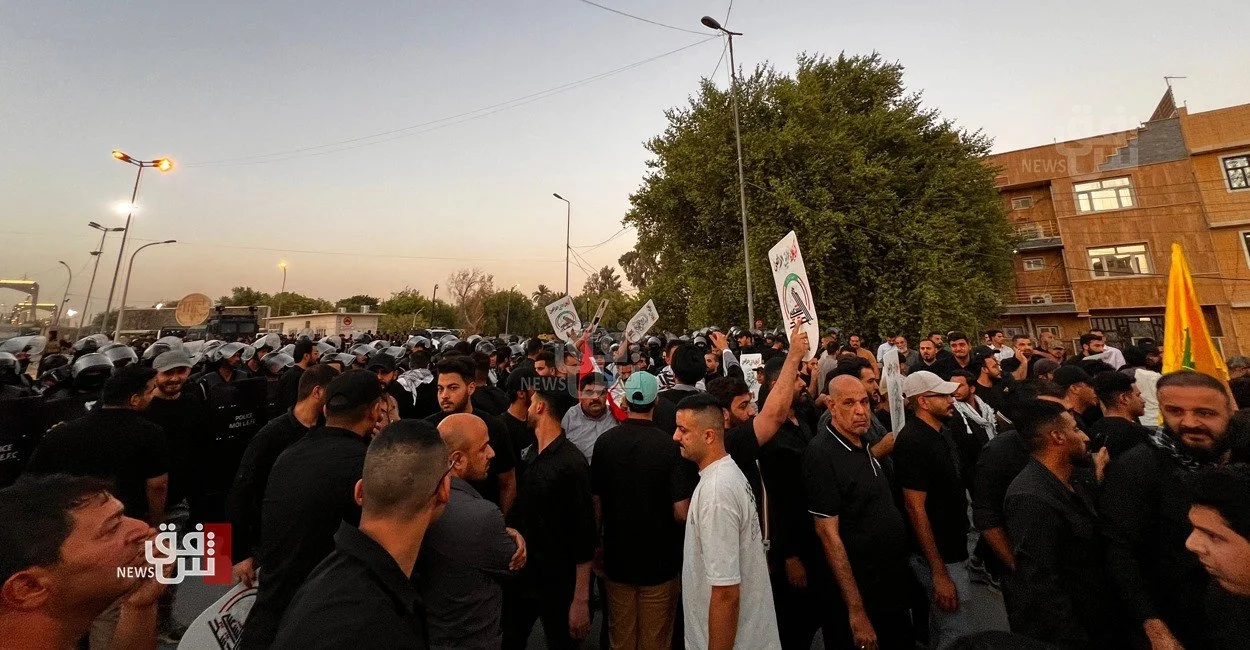
Tishwash: Why does the US still control every penny of Iraqi oil revenues?
Washington has maintained control over Iraq’s oil revenues since its illegal 2003 invasion – a financial and economic subjugation that undermines Iraqi sovereignty and denies it access to its own national treasure.
In July, the Iraqi Central Bank halted all foreign transactions in Chinese Yuan, succumbing to intense pressure from the US Federal Reserve to do so. The shutdown followed a brief period during which Baghdad had allowed merchants to trade in Yuan, an initiative intended to mitigate excessive US restrictions on Iraq’s access to US dollars.
While this Yuan-based trade excluded Iraq’s oil exports, which remained in US dollars, Washington viewed it as a threat to its financial dominance over the Persian Gulf state. But how has the US managed to exert such total control over Iraqi financial policies?
The answer lies in 2003, with mechanisms established following the illegal US-led invasion of Iraq.
A legacy of ‘Operation Iraqi Freedom’
Since the signing of Executive Order 13303 (EO13303) by President George W Bush on 22 May 2003, all revenues from Iraq’s oil sales have been funneled directly into an account at the Federal Reserve Bank of New York.
EO13303, titled “Protection of the Development Fund for Iraq and Other Property in Which Iraq Has an Interest,” has been renewed annually by every US president, including Joe Biden in 2024. This executive order essentially places control over Iraq’s oil revenues under the discretion of the US President, leaving Baghdad with limited control over its resources and earnings.
The roots of Iraq’s financial dependence on the US stretch back to the 1990s. Following Iraq’s invasion of Kuwait in 1990, UN Security Council Resolution 661 imposed severe economic sanctions to isolate Iraq from international trade. These sanctions, exacerbated by former president Saddam Hussein’s refusal to comply with withdrawal demands, crippled the Iraqi economy.
Control over Iraq’s finances
UNSC Resolution 687, passed in 1991 after the Persian Gulf War, extended these sanctions while introducing the controversial “Oil for Food” program. Although it allowed Iraq to sell oil in exchange for humanitarian goods like food and medicine, the sanctions resulted in immense human suffering, with over one million Iraqis, half of them children, dying during this period. Then-US secretary of state Madeleine Albright infamously defended the sanctions in a 1996 interview, stating that the deaths were “worth the price.”
Following the invasion of Iraq, the US occupation of the country became a reality after the collapse of Saddam’s government. Faced with a fait accompli, the UN Security Council had to accept the new status quo.
According to International Humanitarian Law, occupation forces – in this case, the US and UK – become responsible for the well-being of the populations they occupy. So, UNSC Resolution 1483 was issued on 22 May 2003 to establish the US-led Coalition Provisional Authority (CPA) as Iraq’s administrator and create the Development Fund for Iraq (DFI) to manage Iraqi oil revenues.
Note that Resolution 1483 did not mention the US Federal Reserve as the depositary of Iraqi funds, nor did it assign a location for the DFI headquarters or account. In fact, the resolution specifically states directed that the DFI should “be held by the Central Bank of Iraq.” It was the CPA, led by Paul Bremer, that decided unilaterally to house the account at the Federal Reserve Bank of New York.
This decision allowed the US government to maintain tight control over Iraq’s oil revenues. From that point until today, the Iraqi Ministry of Finance has had to submit requests for funds to the US Treasury, which then approves or denies these requests based on its own criteria.
This monthly transfer of US dollars – which are literally flown into Baghdad in pallets of hard cash – determines Iraq and its 40-million-population’s ability to pay for basic needs like salaries, food, and medicine.
Blackmailing Iraq
Whenever Washington feels that Iraq is not compliant with US regional goals, these fund transfers can be delayed or reduced. In January 2020, for instance, after the Iraqi Parliament voted to expel US troops following the assassination of Iranian Quds Force General Qasem Soleimani and Iraqi Popular Mobilization Units (PMU) Deputy Commander Abu Mahdi al-Muhandis, the Trump administration threatened to freeze Iraq’s access to its oil revenues.
Today, Iraq’s financial situation remains dire. Despite having oil revenues piling up in the Federal Reserve Bank of New York – estimated today at around $120 billion – Iraq is burdened with a growing debt that matches this amount.
The country’s inability to control its own funds has prevented long-term reconstruction and development, forcing it to rely on international loans. Ironically, Iraq has also become one of the largest holders of US Treasury bills, with investments totaling $41 billion in 2023.
In addition to its economic challenges, Iraq has been drawn into the escalating regional conflict amid the ongoing Gaza war and the intensification of Israel’s aggression against Lebanon. Iraqi resistance forces have actively participated in military strikes against Israeli targets in solidarity with both Palestinian factions and Hezbollah.
The involvement of Iraq in this conflict is not isolated. Iraqi factions have routinely targeted US military bases in Iraq and Syria – viewed as illegal foreign forces subjugating Iraq’s sovereignty – contributing to a broader escalation that has drawn in actors from across West Asia.
These troops have vowed to continue their campaign against both US and Israeli targets, aligning their actions with the region’s Axis of Resistance.
The UN shutters DFI, but the US refuses to comply
Iraq ceased to be under occupation, at least formally, when it signed the “Strategic Cooperation Framework” agreement with the US in 2008, which says that American forces are present in Iraq only at the request of the Iraqi government.
Attempts by the UN to restore Iraq’s control over its finances have largely failed. In 2010, UNSC Resolution 1956 demanded the closure of the DFI by no later than 30 June 2011 and the transfer of all proceeds to the Iraqi government.
Despite these clear legal directives, the DFI account remains under US control at the Federal Reserve Bank of New York in defiance of the UN Security Council resolution. Worse yet, enduring US dominance over Iraq’s financial resources has deeply exacerbated the corruption and dysfunction plaguing the country.
Ending the work of the UN International Advisory and Monitoring Board of the DFI was one way of obscuring the massive corruption and theft of resources by American and Iraqi actors.
The unprecedented corruption that was spread throughout Iraq and its institutions can be laid at the doorstep of this policy. The gargantuan amounts of hard cash that are flown into the country monthly, the unaccounted-for astronomical sums that disappear from various ministries, and the dollar exchange shops (banks) set up by political groups that thrived alongside the US occupation forces have turned Iraq into one of the most corrupt countries in the world.
Iraq’s dependence on the US for access to its own oil revenues, combined with its growing debt has significant impacts on its sovereignty, while its involvement in the regional war also will have implications on its relations with the US.
While Iraq may no longer be under formal occupation, the mechanisms of financial control established after the 2003 invasion persist. These controls not only limit Iraq’s economic development but also entangle it in broader geopolitical struggles.
Today, both the US Administration of Joe Biden and the Iraqi government led by Mohammad Shia al-Sudani – which has not taken steps to free Iraq’s sovereign funds – can be considered in violation of United Nations Resolution 1956 issued in 2010. link
************
Mot: When Asked - Always Tell the Truth

Mot:.... Tips on Raising the ""Wee Folks"" -- Good Luck – LOL