
Thank you to all the subscribers to our Early Access program…we thank you for your continued support.
We are excited to offer this new service to keep you informed and up-to-date on the latest Dinar and currency news.
Coin Shops Say They're Swimming In So Much Silver And Gold That They're Having To Limit Purchases
Coin Shops Say They're Swimming In So Much Silver And Gold That They're Having To Limit Purchases
Dominick Reuter Business Insider Updated Sun, February 8, 2026
Spot prices for silver and gold are stabilizing after a rocky stretch of record gains and losses.
The market volatility has caused headaches for local coin shops that typically buy precious metals.
"If you do this wrong, you run out of capital really fast," one shop told Business Insider.
If January was a party in the precious metals market, February is the hangover.
Coin Shops Say They're Swimming In So Much Silver And Gold That They're Having To Limit Purchases
Dominick Reuter Business Insider Updated Sun, February 8, 2026
Spot prices for silver and gold are stabilizing after a rocky stretch of record gains and losses.
The market volatility has caused headaches for local coin shops that typically buy precious metals.
"If you do this wrong, you run out of capital really fast," one shop told Business Insider.
If January was a party in the precious metals market, February is the hangover.
The per-ounce price of gold topped $5,300 and silver reached nearly $120 at the end of January before tumbling sharply. The stretch of record gains and losses has since stabilized in the early days of February.
"These price moves have done a lot of damage all across the line," HSBC precious metals analyst James Steel told Business Insider.
One type of business bearing the brunt of volatility is local coin shops, where people often trade in gold and silver. High prices have led to a huge influx of people selling, but some shops tell Business Insider they're running out of their usual places to offload excess metals.
As the market was in its tailspin, Tim Heuer said the shop he manages, University Coin & Jewelry in Madison, Wisconsin, was still doing deals.
Heuer said a customer came in to sell some silver when the spot price was $98 an ounce and falling: "By the time I wrote his check, silver was already down $3.50 from the time he walked in the door."
The recent volatility is putting those businesses in an uncomfortable position, beyond quickly changing spot prices that erode profit margins.
Local coin shops play an essential role in the circulation of physical gold and silver by providing a reliable way for individuals to sell their bars, coins, or scrap metal.
If someone bought a gold bar last year from Costco and wants to turn it back into cash, a local coin shop is one of the first places they might go.
And while these shops do turn around and sell some of what they buy, most of the metal is sold to refineries to be melted and minted into new bars or coins.
Precious metals refineries are experiencing major backlogs
That flow has been interrupted in recent months as the run in gold and silver prices has encouraged more people to trade in their metals, leading to a backlog of raw materials at refineries.
Jarret Niesse, president of Precious Metal Refining Services in Chicago, said his company stopped buying scrap silver back in October, when the price crossed $50 per ounce, sparking a frenzy of people trading in old silverware, platters, and other tchotchkes that had been gathering dust.
And the market has only gotten wilder since then.
"This entire crazy silver move that has happened, we have been sitting on the sidelines," he said.
Refineries like Niesse's are one step in the process. Much of the product they melt down gets further refined by other mints and exported to Asian markets, where demand for bars and coins is higher. With so much gold and silver to process, those refineries have also stopped buying, thereby cutting into the cash flow of local coin shops.
To Continue an d Read More: https://www.yahoo.com/finance/news/coin-shops-theyre-swimming-much-105201247.html
COMEX Silver Scam? CME Goes Dark Before Delivery
COMEX Silver Scam? CME Goes Dark Before Delivery
Taylor Kenny: 2-28-2026
CME outage before first notice day sparks gold market manipulation fears as physical demand surges and East challenges Western price control.
What are the odds that the world’s largest gold and silver derivatives exchange suddenly experiences a “technical outage” right before first notice day?
COMEX Silver Scam? CME Goes Dark Before Delivery
Taylor Kenny: 2-28-2026
CME outage before first notice day sparks gold market manipulation fears as physical demand surges and East challenges Western price control.
What are the odds that the world’s largest gold and silver derivatives exchange suddenly experiences a “technical outage” right before first notice day?
CHAPTERS:
00:00 – CME Outage & First Notice Day Shock
01:45 – Physical Demand vs Paper Contracts
03:15 – Silver Spike & Market Manipulation?
04:40 – China, India & The East Taking Control
06:55 – $20,000 Gold Predictions Explained
08:20 – Why Physical Gold & Silver Matter Now
Gold & Silver Trading Halted: They’re Playing Very Dangerous Game | Andy Schectman & Michelle Makori
Gold & Silver Trading Halted: They’re Playing Very Dangerous Game | Andy Schectman & Michelle Makori
Miles Franklin Media: 2-27-2026
Michelle Makori, President & Editor-in-Chief, Miles Franklin Media, speaks with Andy Schectman, Founder & CEO of Miles Franklin Precious Metals, about the sudden CME gas & metals trading halt, massive silver withdrawals, Mexico silver supply risks, and whether silver is quietly becoming a national security asset.
After silver broke above $90, the CME halted trading, citing “technical issues”. Andy says, “These games… are greatly eroding confidence in the Comex.”
Gold & Silver Trading Halted: They’re Playing Very Dangerous Game | Andy Schectman & Michelle Makori
Miles Franklin Media: 2-27-2026
Michelle Makori, President & Editor-in-Chief, Miles Franklin Media, speaks with Andy Schectman, Founder & CEO of Miles Franklin Precious Metals, about the sudden CME gas & metals trading halt, massive silver withdrawals, Mexico silver supply risks, and whether silver is quietly becoming a national security asset.
After silver broke above $90, the CME halted trading, citing “technical issues”. Andy says, “These games… are greatly eroding confidence in the Comex.”
He warns that “the moment the market believes there isn’t enough metal… it unwinds violently.” In this episode of The Real Story, they break down:
The CME “technical issue” and what happened at $90 silver
Millions of ounces leaving COMEX – where is it going?
February open interest and delivery stress
Mexico cartel violence and global silver supply risk
Project Vault and potential U.S. strategic silver stockpiling
Gold replacing U.S. Treasuries as central banks lose trust
What a violent unwind in metals would actually mean
01:18 CME Trading Halt Explained
03:48 Manipulation Claims & Motives
05:51 Who Pulls the Strings
09:10 Regulators & Global Rivals
11:31 Shanghai Premium & Arbitrage
13:45 Comex Deliveries & Withdrawals
18:54 Failure to Deliver Risk
22:18 Mexico Violence Supply Shock
28:57 Project Vault Explained
29:55 Secret Silver Stockpiling
33:40 Price Floors & Ceilings
36:02 Robots Mining Myth
40:33 Gold Replaces Treasuries
44:31 Bank Gold Price Targets
49:12 Closing Remarks
Trump Revalues Gold? ‘It’s a 65% Chance’ – James Rickards Explains the Real Implications
Trump Revalues Gold? ‘It’s a 65% Chance’ – James Rickards Explains the Real Implications
Miles Franklin Media: 2-25-2026
Michelle Makori, President & Editor-in-Chief of Miles Franklin Media, speaks with macro strategist James Rickards about growing speculation that the United States could revalue its gold reserves.
America still values its gold at $42.22 per ounce, a price set in 1973, and why the Treasury legally has the authority to reprice gold closer to market levels with what some describe as “the stroke of a pen.”
Trump Revalues Gold? ‘It’s a 65% Chance’ – James Rickards Explains the Real Implications
Miles Franklin Media: 2-25-2026
Michelle Makori, President & Editor-in-Chief of Miles Franklin Media, speaks with macro strategist James Rickards about growing speculation that the United States could revalue its gold reserves.
America still values its gold at $42.22 per ounce, a price set in 1973, and why the Treasury legally has the authority to reprice gold closer to market levels with what some describe as “the stroke of a pen.”
While the move would largely be an accounting adjustment, Rickards argues the real impact would be psychological – signaling to markets and foreign governments that the United States is once again treating gold as a monetary asset.
Rickards estimates the probability of such a move under a Trump administration at “65%” He also discusses:
How gold revaluation works step-by-step
Why it could bypass debt ceiling constraints
The potential $1 trillion Treasury windfall
Signals this would send to China and global central banks
Why gold is increasingly viewed as protection against financial weaponization
Preparing for the Comeback of the Gold Standard
Preparing for the Comeback of the Gold Standard
Bendleruschka: 2-26-2026
Bendleruschka @bendleruschka
GOLD COMMS – GOLD SHALL DESTROY FED
PREPARING FOR THE COMEBACK OF THE GOLD STANDARD – US Gold Reserve audit & revaluation.
Are we finally getting to know the status at Fort Knox?
Preparing for the Comeback of the Gold Standard
Bendleruschka: 2-26-2026
Bendleruschka @bendleruschka
GOLD COMMS – GOLD SHALL DESTROY FED
PREPARING FOR THE COMEBACK OF THE GOLD STANDARD – US Gold Reserve audit & revaluation.
Are we finally getting to know the status at Fort Knox?
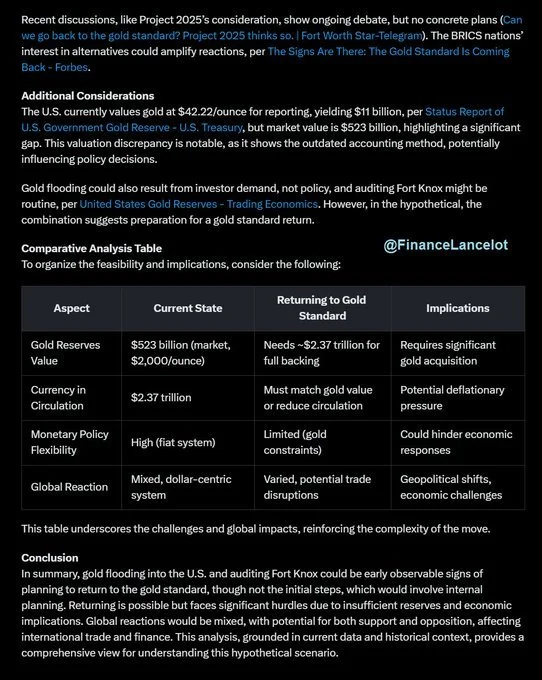
The US Treasury values its gold reserves at a statutory rate of $42.22 per troy ounce, established in 1973, rather than the current market price.
As of today February 25, 2026, the gold spot price is approximately $5,198 USD per troy ounce.
The US is said to hold about 261.5 million troy ounces of gold (equivalent to 8,133 tonnes), so at market value, the reserves are worth roughly $1.36 trillion, while the statutory value is around $11 billion.
The gold must be revalued before the new financial system based on the «gold standard» enters into force («flipping the switch»).
It’s thus also necessary for the global currency revaluation and for the real XRP price («XRP to the moon»).
Bendleruschka: Updated version: THE US GOLD RESERVES TO BE AUDITED Discussions around revaluing gold and a return to elements of a «gold standard» continue.
The US Treasury values its gold reserves at a statutory rate of $42.22 per troy ounce, established in 1973, rather than the current market price.
As of January 15, 2026, gold is trading at approximately $4,620 per troy ounce.
This means: Statutory value: $42.22 per ounce (used for official bookkeeping).
Market value: Approximately $4,620 per ounce (subject to daily fluctuations).
The US holds about 261.5 million troy ounces of gold (equivalent to 8,133 tonnes), so at market value, the reserves are worth roughly $1.21 trillion, while the statutory value is around $11 billion.
A NEW FINANCIAL SYSTEM IS IN PROGRESS.
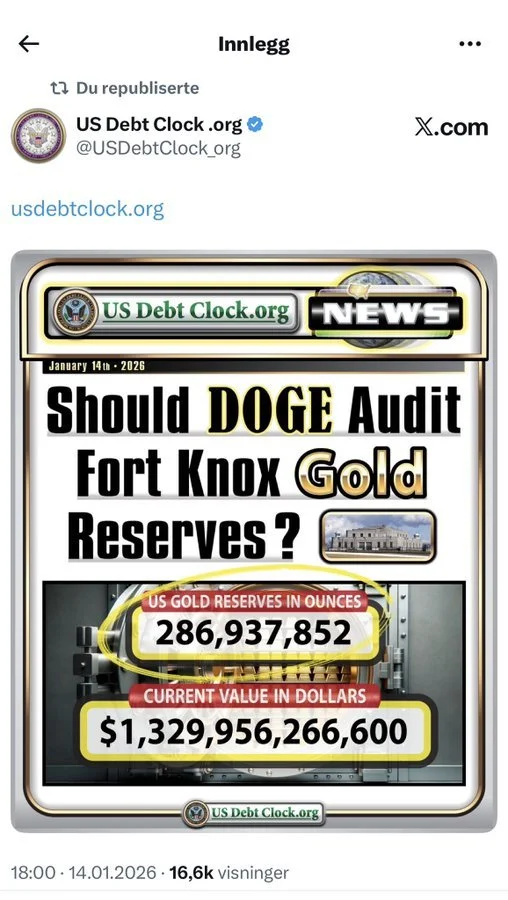
DOGE is also an audit by the way. EVERYTHING IS BEING AUDITED NOW.
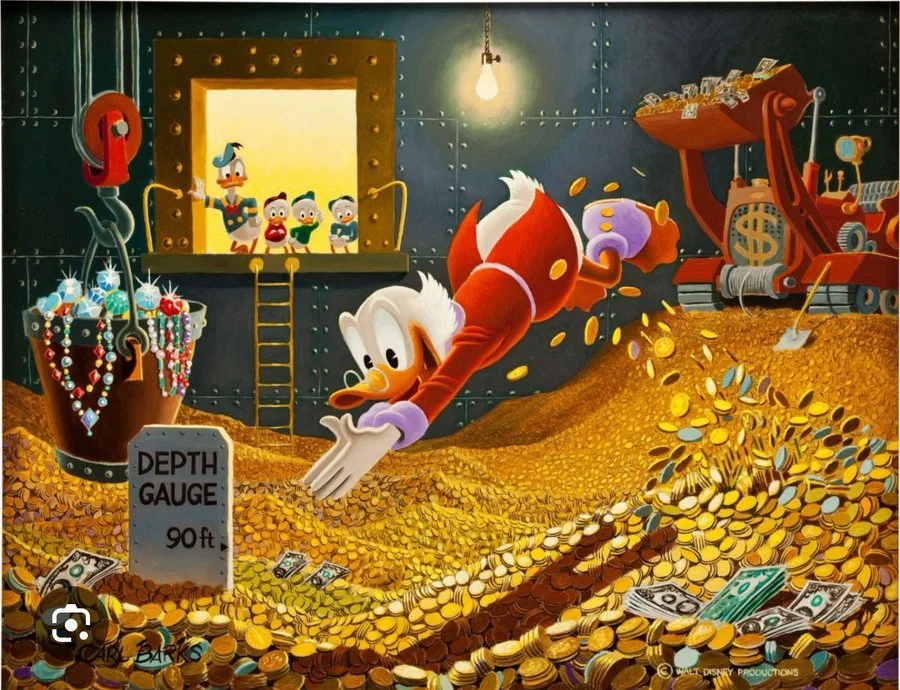
Financelot: How long until the general public finally realizes what's really going on here? JP Morgan & U.S. Treasury are bringing all the gold back to the US so they can audit & implement a gold standard. They created the Sovereign Wealth Fund specifically to replace the Federal Reserve.
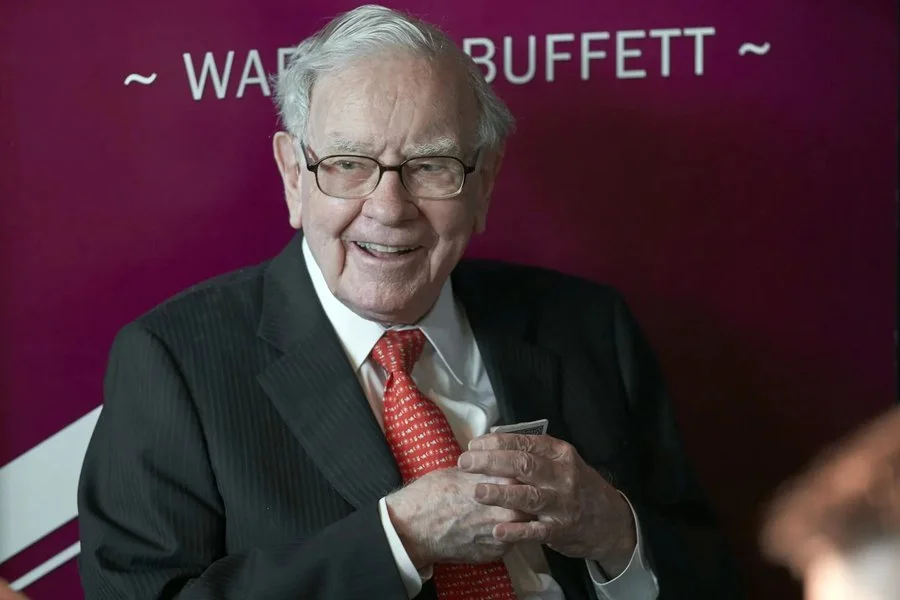
Financealot: Why do you suppose Warren Buffet is hoarding $325 billion in cash? P.S. The euphoric rally to the 1929 peak was 5 years & 1 month
Is the US Headed Toward a Gold Reset?
Is the US Headed Toward a Gold Reset?
Arcadia Economics: 2-24-2026
As we step into 2026, the world of finance is abuzz with discussions about the evolving dynamics of the gold and silver markets, the future of the US dollar, and the implications of rising global debt and geopolitical tensions.
In a recent, in-depth conversation with Chris Marcus of Arcadia Economics, Michael McNair, a seasoned asset manager with a focus on precious metals and macroeconomic trends, shared his expert insights on these pressing issues.
Is the US Headed Toward a Gold Reset?
Arcadia Economics: 2-24-2026
As we step into 2026, the world of finance is abuzz with discussions about the evolving dynamics of the gold and silver markets, the future of the US dollar, and the implications of rising global debt and geopolitical tensions.
In a recent, in-depth conversation with Chris Marcus of Arcadia Economics, Michael McNair, a seasoned asset manager with a focus on precious metals and macroeconomic trends, shared his expert insights on these pressing issues.
The discussion provides a fascinating glimpse into the potential shifts in global monetary policy and the role that gold and silver are poised to play in the years to come.
One of the key highlights of the conversation is McNair’s analysis of the Trump Administrationn’s influence on monetary and fiscal coordination.
According to McNair, the Trump Administration is expected to have a significant impact on the coordination between monetary and fiscal policies, potentially leading to a more synchronized approach that could have far-reaching consequences for the global economy.
A significant part of the discussion revolves around the anticipated changes in leadership at the Federal Reserve, with Christopher Worsh potentially being appointed as the new Fed Chair.
McNair shares his thoughts on how this change could influence monetary policy and the dollar’s standing in the global financial system.
The potential dismantling of the current dollar-centric monetary system is also explored, with McNair suggesting that we are on the cusp of a significant shift away from the dollar’s dominance.
A crucial aspect of the conversation is the evolving role of gold in the global financial landscape.
McNair emphasizes that gold is transitioning from being merely a hedge against US solvency issues to becoming a crucial reserve asset that will play a key role in balancing global trade imbalances.
This shift underscores the growing recognition of gold’s importance in the global monetary system, beyond its traditional role as a safe-haven asset.
The discussion also delves into the dynamics of the silver market, highlighting the industrial demand for silver as a critical factor that will influence its price and utility in the global economy. McNair touches on the dynamics of capital flows and trade deficits, providing insights into how these macroeconomic trends will impact the precious metals market.
One of the most compelling aspects of the conversation is the anticipation of a prolonged and potentially painful transition to a new global monetary order.
McNair suggests that this transition will be characterized by significant adjustments in the global financial system, with implications for investors, policymakers, and the broader economy.
In a related development, the conversation briefly highlights the impressive 2025 earnings of First Majestic Silver, a mining company that has benefited from the surge in silver prices.
The correlation between the company’s performance and the silver price underscores the potential for significant returns in the precious metals sector, particularly in companies with strong operational fundamentals.
As the global economy navigates the complexities of rising debt, geopolitical tensions, and shifting monetary policies, the insights shared by Michael McNair provide valuable perspectives for investors and policymakers alike.
The conversation with Chris Marcus offers a nuanced understanding of the evolving dynamics in the gold and silver markets and the broader implications for the global monetary system.
Gold Revaluation Is Coming - Andy Schectman Explains The Endgame
Gold Revaluation Is Coming - Andy Schectman Explains The Endgame
Liberty and Finance: 2-24-2026
Andy Schectman CEO of Miles Franklin Precious Metals explains why gold revaluation by governments is increasingly likely rather than speculative.
He argues that treasury backed stablecoins and legislation such as the GENIUS Act create a powerful incentive for higher gold prices as interest flows are redirected into hard assets.
Gold Revaluation Is Coming - Andy Schectman Explains The Endgame
Liberty and Finance: 2-24-2026
Andy Schectman CEO of Miles Franklin Precious Metals explains why gold revaluation by governments is increasingly likely rather than speculative.
He argues that treasury backed stablecoins and legislation such as the GENIUS Act create a powerful incentive for higher gold prices as interest flows are redirected into hard assets.
Schectman notes that gold already sits on central bank balance sheets in revaluation accounts making an official reset structurally simple if confidence in fiat erodes further.
He connects this trajectory to long term policy thinking discussed by figures like Judy Shelton and Luke Gromen who view higher gold as a tool to manage debt and currency debasement.
The key message is that gold may rise dramatically through market forces first with formal revaluation coming only after prices are already much higher.
INTERVIEW TIMELINE:
0:00 Intro
1:40 Physical silver flows
19:00 Preparedness with metals
45:13 Junk silver - $1 below spot/oz
47:18 Gold revaluation & stable coins
News, Rumors and Opinions Wednesday 2-25-2026
Note: All intel should be considered as "Rumors" until we receive official announcements ...and “Rates and Dates” could change anytime until we get to the banks/redemption centers.
RV Excerpts from the Restored Republic via a GCR Update as of Wed. 25 Feb. 2026
Compiled Wed. 25 Feb. 2026 12:01 am EST by Judy Byington
“These first 250 years were just the beginning. The Golden Age of America is now upon us. The revolution that began in 1776 has not ended — it still continues because the flame of liberty and independence still burns in the hearts of every American Patriot.”…President Donald Trump State of the Union Address Tues. 24 Feb. 2026
Note: All intel should be considered as "Rumors" until we receive official announcements ...and “Rates and Dates” could change anytime until we get to the banks/redemption centers.
RV Excerpts from the Restored Republic via a GCR Update as of Wed. 25 Feb. 2026
Compiled Wed. 25 Feb. 2026 12:01 am EST by Judy Byington
“These first 250 years were just the beginning. The Golden Age of America is now upon us. The revolution that began in 1776 has not ended — it still continues because the flame of liberty and independence still burns in the hearts of every American Patriot.”…President Donald Trump State of the Union Address Tues. 24 Feb. 2026
~~~~~~~~~~~~~~
Tues. 24 Feb. 2026 NESARA–GESARA: THE 30+1 PROTOCOLS SAID TO RESET THE WORLD SYSTEM …Mr. Pool on Telegram
For years, NESARA–GESARA has been dismissed as rumor. Yet in 2026, discussion around it has intensified, framed by supporters as a coordinated military and economic blueprint designed to dismantle the existing global financial order and replace it with an entirely new system. According to this narrative, what is coming is not reform – it is a controlled collapse followed by reconstruction.
Proponents describe NESARA not as legislation, but as a sequence of 31 operational protocols meant to be executed quietly, with maximum shock and minimal warning. The claim is that the current debt-based system is illegitimate, sustained by banking fraud, taxation mechanisms, and monetary control structures that were never meant to serve the public.
At the core of the plan is massive debt cancellation. Credit cards, mortgages, and bank-originated loans are described as subject to erasure, framed as correction for decades of systemic financial a***e. Supporters insist this applies only to debt generated within the centralized banking system, not private obligations, positioning it as targeted dismantling rather than blanket forgiveness.
The second pillar focuses on tax restructuring. The narrative claims the income tax system would be abolished entirely, with the IRS rendered obsolete. In its place, a simplified consumption tax on non-essential goods is proposed, while food, medicine, and used items would remain untaxed. The goal, supporters argue, is to sever the state’s ability to extract wealth directly from labor.
Central to the theory is the elimination of the Federal Reserve. According to the blueprint, fiat currency would be replaced by a U.S. Treasury–issued system backed by tangible assets such as gold and silver. This shift is described as the end of monetary manipulation and infinite debt creation, restoring national control over currency issuance.
Financial privacy also plays a central role. Under the NESARA framework, surveillance-based banking would be replaced by systems designed to protect personal transactions from state or corporate monitoring. Control of assets would shift away from centralized intermediaries and back to individuals.
The plan also includes large-scale humanitarian initiatives, funded by recovered assets and redirected capital. Housing, healthcare, infrastructure, and education are presented as priorities in what proponents describe as a transition from scarcity to abundance.
Finally, NESARA is framed as a system of restitution and redemption. Historical financial harm, hidden taxation, and monetary exploitation would allegedly be accounted for, with compensation mechanisms tied to asset exchanges and humanitarian obligations.
~~~~~~~~~~~~~~
Tues. 24 Feb. 2026 GLOBAL CURRENCY RESET: INSIDE THE REDEMPTION OPERATION …Juan O Savin on Telegram
The RV Redemption has begun. The NDAs are real. The post-redemption plans are locked. What you are about to read is the uncompromising truth about the Redemption Centers – the only gateways for the public under NESARA/GESARA protocols.
Banks are NOT your path. Elites use them. We, the people, go through Redemption Centers, even if they have a bank name slapped on the building. Here, rates are higher, and you (allegedly) walk out with QPhones, QLaptops, Quantum ID Access Cards, Rainbow Currency, debit cards, checks and even a temporary trust if your humanitarian project template is ready. This template, (allegedly) approved at the White House, was designed for those chosen to restore humanity.
Backbone of this operation:
Reclamation – returning stolen wealth seized by the Deepstate, Cabal, and bank cartels. Restitution/Reparation – undoing decades of unconstitutional theft: taxes, interest, property seizures, debt slavery.
Redemption – the exchange of currencies/ZIM bonds at rates never meant for public eyes. Only a fraction is for personal use – the rest fuels humanitarian projects.
ZIM bonds are gold-backed. Dinar, Dong, and others hit double-digit rates.
Debt Forgiveness: Medical debt? Gone. Financial chains? Broken. Universal Income: A new era of abundance begins.
Judy Note: It is advised to exchange/redeem your foreign currency at an official Redemption Center rather than a bank. You can only redeem Zim at a RC, the Dinar Contract Rate can only be given at a RC and banks will (allegedly) offer you lower exchange rates than what you can obtain at a RC.
It is my opinion, and I could be wrong, that to have a Humanitarian Project approved for the higher redemption rate on the Zim or foreign currency, you have to be in charge of the project with a written out business plan that shows how the money will be spent. It cannot be a project where you are just donating your monies to various causes.
• No Project submission: flat $15 million settlement, independent of quantity held.
• Approved Humanitarian Projects: 1 to 1 valuation on the first two 100 T Zim bond notes, then $25 million per 100T for up to 30 100T Zim Bond notes. If you hold more 100T Bond notes negotiations will be handled in a secondary session.
Read full post here: https://dinarchronicles.com/2026/02/25/restored-republic-via-a-gcr-update-as-of-february-25-2026/
***********
Courtesy of Dinar Guru: https://www.dinarguru.com/
Jeff Countries that are on the US Treasury's OFAC list, that's a list of counties that support terrorism. Right now Iraq remains on that OFAC list of countries until they revalue their currency. This is the US government's collateral to ensure the US gets paid when the rate changes... That's the collateral used to ensure Iraq is going to revalue the currency and the United States gets paid.
Mnt Goat ...my CBI contact...said we would hear all kinds of comments about the independence of the CBI and how they can adjust the rate anytime they want. Yes this may be true but...Some don’t even realize there are two types of rates, one is the program rate and the other the FOREX rate...the ‘program’ rate tied to the de facto peg can be changed upwards or downwards by the CBI any time. This does not mean allowing the dinar back on FOREX... [Post 1 of 2....stay tuned]
Mnt Goat When the dinar goes back to FOREX it will be re-pegged and off the sole peg to the dollar and the program rate will go away. The newer lower denominations would have to first be rolled out. We are talking apples and oranges when we talk about these two rate types...The dinar can only have one ‘official’ rate. There is no such thing as an in-country rate and then a FOREX rate at the same time...When the dinar does go back to FOREX, the in-country rate (program rate) will change to the FOREX rate. [Post 2 of 2]
************
Is Someone Front-Running a $20K Gold Revaluation?
GoldSilver: 2-25-2026
Someone just placed a $3.3 million bet that gold hits $20,000 an ounce by December 2026.
Insider trading? A hedge fund's insurance policy? Or something else entirely?
Alan breaks down the massive options position making waves in the gold market — what the chart actually shows, what it doesn't show, and why the "insider" theory might not hold up under scrutiny.
You'll learn exactly how this call spread works, what the potential $5.5 billion payday would look like, and the real reason a major fund might make this trade with no insider knowledge at all.
The truth is more nuanced — and more interesting — than the headlines suggest.
The Decline Of The Dollar: Gold Is ‘Becoming The Reserve Asset
One Of Wall Street’s Most Feared Hedge Fund Managers On The Decline Of The Dollar: Gold Is ‘Becoming The Reserve Asset’
Jake Angelo Fortune Updated Thu, February 12, 2026
Gold blasted past $5,300 per ounce last month as President Donald Trump’s hawkish foreign policy and tariff threats sent investors to safer assets. At the same time, U.S. deficit spending swelled to what the Congressional Budget Office called an unsustainable $1.9 trillion, a scenario that’s chipping away at the dollar’s standing as the world’s leading reserve currency.
The confluence of these factors has some investors predicting the fall of Treasury securities as the only true global reserve. Greenlight Capital founder David Einhorn made that apparent in a recent conversation with CNBC. The investing legend forecasts a monumental shift in global reserve assets, predicting that central banks will swap dollars for the yellow metal.
One Of Wall Street’s Most Feared Hedge Fund Managers On The Decline Of The Dollar: Gold Is ‘Becoming The Reserve Asset’
Jake Angelo Fortune Updated Thu, February 12, 2026
Gold blasted past $5,300 per ounce last month as President Donald Trump’s hawkish foreign policy and tariff threats sent investors to safer assets. At the same time, U.S. deficit spending swelled to what the Congressional Budget Office called an unsustainable $1.9 trillion, a scenario that’s chipping away at the dollar’s standing as the world’s leading reserve currency.
The confluence of these factors has some investors predicting the fall of Treasury securities as the only true global reserve. Greenlight Capital founder David Einhorn made that apparent in a recent conversation with CNBC. The investing legend forecasts a monumental shift in global reserve assets, predicting that central banks will swap dollars for the yellow metal.
“The central banks around the world are buying gold,” Einhorn said. “Whereas a few years ago, it was mostly Treasuries.” He added that it is “becoming the reserve asset” because U.S. trade policy “is very unstable, and it’s causing other countries to say, ‘We want to settle our trade in something other than U.S. dollars.’”
To be sure, the dollar still dominates as the reserve currency of choice. While in the first half of last year, central banks dumped over $48 billion in Treasuries, in July 2025, the dollar still composed roughly a 58% share of all foreign exchange reserves, according to the International Monetary Fund. And gold purchases by central banks actually fell in 2025 from a high between 2022 and 2024, according to data from the World Gold Council.
Also, Einhorn has long predicted the price of gold will rise out of fears around U.S. monetary policy and fiscal policy. In an interview with CNBC last year, the hedge fund manager argued: “Gold is not about inflation. Gold is about the confidence in the fiscal policy and the monetary policy.” While the investor isn’t quite advocating for a return to the gold standard, he is a strong proponent of holding the metal as a hedge against U.S. fiscal and monetary mismanagement.
On Wednesday, Einhorn added that U.S. trade policy is sending jitters across global markets, fueling the “sell America” trend and sending central banks to safer assets like gold. While gold prices have eased since their peak last month, the currency’s value remains high, at around $5,100 per ounce as of Thursday morning.
The Einhorn effect
Einhorn has made a name for himself spotting financial red flags. The hedge fund manager rose to investing prominence in 2002 after taking a short position on Allied Capital, a midcap financial company. After giving a speech about his stance at the Sohn Investment Conference, the company’s stock went down 20% as Einhorn accused the company of defrauding the Small Business Administration.
Einhorn followed a similar playbook in 2007 after shorting Lehman Brothers, sharing his thesis about the financial institution’s overexposure to subprime-mortgage-backed securities at the Value Investing Congress. His prescient callouts of major firms via thoroughly researched presentations—and the resulting stock tumbles they initiate—has popularized the phrase “the Einhorn effect,” used to highlight the hedge fund manager’s striking influence on investor decisions. (This is not to be confused with the “Einhorn revolving shotgun” from the Call of Duty video game.)
Deficit fears fuel a bet on gold
Just as his early short calls exposed cracks in major financial institutions, the investor now sees structural vulnerabilities in government fiscal and monetary policies. Einhorn Wednesday highlighted his philosophy on gold, saying: “Our thesis on gold over the longer term has been that our fiscal policy and our monetary policies don’t make any sense.” At current spending rates, the U.S. deficit-to-GDP ratio is expected to reach 6.7% by 2036, per the CBO. However, Einhorn also noted other major developed currencies maintain high deficit-to-GDP ratios, explaining why gold, as opposed to a foreign currency, could become the preferred global reserve.
To Continue and Read More: https://www.yahoo.com/finance/news/one-wall-street-most-feared-192611075.html
The U.S. Debt ‘Black Hole’: We’ve Crossed the Event Horizon | Greg Weldon & Andy Schectman
The U.S. Debt ‘Black Hole’: We’ve Crossed the Event Horizon | Greg Weldon & Andy Schectman
Miles Franklin Media: 2-23-2026
Andy Schectman, Founder & CEO of Miles Franklin Precious Metals, sits down with Greg Weldon, CTA and Publisher of the Global Macro Strategy Report, to break down what Weldon calls the U.S. debt “black hole” and why the global financial system may have already crossed a point of no return.
The U.S. Debt ‘Black Hole’: We’ve Crossed the Event Horizon | Greg Weldon & Andy Schectman
Miles Franklin Media: 2-23-2026
Andy Schectman, Founder & CEO of Miles Franklin Precious Metals, sits down with Greg Weldon, CTA and Publisher of the Global Macro Strategy Report, to break down what Weldon calls the U.S. debt “black hole” and why the global financial system may have already crossed a point of no return.
Weldon explains how decades of monetary policy, rising debt dependence, and geopolitical resource competition are reshaping markets, currencies, and global power structures.
From yield curve control and inflation dynamics to gold’s role as a measure of trust, Schectman and Weldon explore why today’s economic pressures may signal a fundamental shift in the financial system.
As debt accelerates beyond sustainable growth, Weldon argues the consequences could include persistent inflation, declining purchasing power, and a lower standard of living, while gold increasingly reflects a growing loss of confidence in the monetary system.
In this episode of Little by Little:
The U.S. debt “black hole” and financial system tipping points
Why markets may have crossed an economic event horizon
Inflation, deflation, and the future of purchasing power
Yield curve control and Treasury market risks
Gold as a signal of declining trust in global finance
00:00 Coming Up
01:15 Intro: Greg Weldon
09:21 Markets Then vs Now
13:23 No Relief Valve
18:06 World War III: Resources
22:55 Debt Tipping Point Black Hole
25:03 Monetary Armageddon Scenario
27:13 Inflation Meets AI Deflation
29:22 Physics Cycles & Volatility
32:26 Gold as Trust Barometer
34:19 China Resources & Rare Earths
38:49 Advice for Young Investors
40:36 Diversify Beyond Stocks
45:56 Closing Remarks
Rome's Financial Collapse: 4 Assets That Outlived the Crash
Rome's Financial Collapse: 4 Assets That Outlived the Crash
Independent Financial Historian: 2-21-2026
In 64 AD, Emperor Nero began a quiet process that would eventually destroy the most powerful currency the world had ever seen.
By the Crisis of the Third Century, the Roman denarius had lost 98% of its silver content, wiping out the savings of millions who trusted the imperial stamp. This wasn't an overnight crash; it was a slow, invisible theft that lasted generations—until it wasn't invisible anymore.
Rome's Financial Collapse: 4 Assets That Outlived the Crash
Independent Financial Historian: 2-21-2026
In 64 AD, Emperor Nero began a quiet process that would eventually destroy the most powerful currency the world had ever seen.
By the Crisis of the Third Century, the Roman denarius had lost 98% of its silver content, wiping out the savings of millions who trusted the imperial stamp. This wasn't an overnight crash; it was a slow, invisible theft that lasted generations—until it wasn't invisible anymore.
This video conducts a forensic financial autopsy of Rome's monetary collapse, tracing the timeline from a trusted reserve currency to a worthless bronze washer.
More importantly, we analyze the specific assets that preserved wealth when the official money died: productive land, physical metals, practical skills, and local networks.
History shows that while currencies inevitably fail, the protocol for surviving the collapse remains remarkably consistent.
When Gold does this, Empires Fall
When Gold does this, Empires Fall
Heresy Financial: 2-21-2026
The price of gold has been on a spectacular rise over the last two years, more than doubling in value. This surge is not just a simple fluctuation in the precious metals market; it is a signal of deeper economic and geopolitical shifts that are underway.
Historically, sharp increases in gold prices have often been a harbinger of significant economic changes, sometimes even preceding the decline of empires.
The current trend is no exception, driven as it is by monetary instability and inflation.
When Gold does this, Empires Fall
Heresy Financial: 2-21-2026
The price of gold has been on a spectacular rise over the last two years, more than doubling in value. This surge is not just a simple fluctuation in the precious metals market; it is a signal of deeper economic and geopolitical shifts that are underway.
Historically, sharp increases in gold prices have often been a harbinger of significant economic changes, sometimes even preceding the decline of empires.
The current trend is no exception, driven as it is by monetary instability and inflation.
One of the most telling indicators of the changing financial landscape is the behavior of central banks, which have emerged as major buyers of gold.
In a striking shift, central banks now hold more gold in their reserves than the US treasuries.
This move reflects a growing loss of confidence in fiat currencies, particularly the US dollar, as governments around the world grapple with mounting debt and unfunded liabilities.
The historical parallels are telling. The hyperinflation experienced in the Weimar Republic and the debasement of Roman coinage are stark reminders of what happens when governments resort to inflating their currencies to cover unsustainable spending.
The United States today faces a similar predicament, with a national debt that has exceeded $38 trillion and projected deficits and liabilities that make the prospect of balanced budgets politically impossible.
In the face of such unsustainable fiscal trajectories, inflation—or debt monetization—appears to be the government’s primary tool to manage this crisis.
The heavy investment by central banks in gold is a clear signal that they anticipate these inflationary pressures escalating. It suggests that the era of cheap money and low inflation, which characterized much of the past few decades, is coming to an end.
Moreover, upcoming regulatory changes are poised to further fuel inflation and asset price increases. The likely deregulation of bank leverage ratios may enable banks to indirectly engage in quantitative easing by purchasing large amounts of US treasuries.
This move would effectively increase the money supply, driving up prices across various asset classes.
For investors, the rise in gold prices is not just a warning signal; it is also an early indicator of a broader commodities super cycle. This trend suggests significant opportunities in the materials, energy, and base metals markets. As the global economy navigates the challenges of sustained inflation and economic shifts, investors who are prepared to adapt to these changes stand to benefit.
To help investors navigate this evolving commodities landscape without taking on excessive risk, experts are sharing their insights and strategies. An upcoming free event promises to provide valuable guidance on how to capitalize on the opportunities presented by the current economic trends.
In conclusion, the rise in gold prices is more than just a market phenomenon; it is a guidepost for investors to prepare for the economic shifts that lie ahead.
As the world grapples with the challenges of inflation, unsustainable debt, and the potential for significant regulatory changes, understanding the implications of these trends will be crucial for making informed investment decisions.
For those looking to gain a deeper understanding of these issues and to learn strategies for navigating the changing economic landscape, watching the full video from Heresy Financial could provide further insights and information.
As we move into a period of potentially significant economic change, staying informed and being prepared will be key to successfully navigating the challenges and opportunities that lie ahead.
Global Monetary Reset: Gold - The New Standard
Global Monetary Reset: Gold - The New Standard
VRIC Media:
The global monetary system is not collapsing overnight. But it is being renegotiated in real time.
Central banks are buying gold at record levels. Parallel payment systems are expanding outside of SWIFT. Gold has overtaken the euro in central bank reserve rankings. And yet — the U.S. dollar remains dominant in global liquidity.
So what is actually happening?
Global Monetary Reset: Gold - The New Standard
VRIC Media:
The global monetary system is not collapsing overnight. But it is being renegotiated in real time.
Central banks are buying gold at record levels. Parallel payment systems are expanding outside of SWIFT. Gold has overtaken the euro in central bank reserve rankings. And yet — the U.S. dollar remains dominant in global liquidity.
So what is actually happening?
Recorded live at VRIC 2026, Andy Schectman, Brent Johnson, Dr. Nomi Prins, Mark Moss, and Taylor Kenney debate whether we are witnessing a true global monetary reset — or a structural repositioning within a still-dollar-centric system.
This conversation goes beyond headlines and into mechanics:
• Why gold at $5,000 can coexist with a strong dollar
• The difference between reserve currency and reserve asset status
• China’s CIPS system, BRICS payment rails, and the Hong Kong gold window
• Why gold demand is being driven more by foreigners than U.S. investors
• The BIS reclassifying gold as a Tier 1 asset — and why that matters
• Whether stablecoins could actually re-dollarize the world
• Why fiat rejection is broader than just “anti-dollar” sentiment • What a fragmented, two-bloc monetary world might look like
• Why this transition — if it accelerates — will be chaotic for everyone
One side argues gold is becoming the neutral settlement anchor of a new system.
Another argues the dollar may remain dominant in liquidity — even if gold rises multiples higher. Both may be right.
This isn’t about a dramatic overnight collapse. It’s about a structural repositioning of reserves, payment rails, and trust.
If central banks are diversifying… If parallel systems are scaling… If gold is rising while the dollar holds firm… Then the real question is not “Is the dollar finished?” It’s “What does the next system actually look like?”
Chapters:
00:22 – Central Banks Buying Gold: What Does It Signal for the Dollar?
03:27 – “Structural Change”: Is This a Once-in-a-Lifetime Reset?
04:12 – CIPS, BRICS & Gold Settlement Outside SWIFT
07:03 – Re-Anchoring the System: Gold, Reserves & Credibility
09:17 – Chaos Ahead? Stablecoins & Re-Dollarization Debate
12:29 – Gold at $5,000 While the Dollar Stays Strong
15:08 – Bitcoin vs Gold: The Neutral Settlement Argument
17:02 – COMEX Deliveries, Silver & Strategic Stockpiles
22:39 – What Should Investors Actually Do?
29:22 – A Fragmented World & the End of the Rules-Based Order