
Thank you to all the subscribers to our Early Access program…we thank you for your continued support.
We are excited to offer this new service to keep you informed and up-to-date on the latest Dinar and currency news.
Iraq Economic News and Points To Ponder Sunday Afternoon 8-11-24
Parliamentary Committee To Nina: A Government Team Is Preparing A New Draft Of The Oil And Gas Bill
Sunday 11 August 2024 | Economic Number of readings: 127 Baghdad / NINA / The Parliamentary Oil, Gas and Natural Resources Committee revealed the fate of the oil and gas bill that has been stalled since successive parliamentary sessions.
The Vice Chairman of the Committee, Nahro Mahmoud Qader, stated in a statement to the National Iraqi News Agency ( NINA ): "The oil and gas bill has not reached the corridors of the House of Representatives yet, and has not been presented for discussion within the Council of Ministers yet."
Parliamentary Committee To Nina: A Government Team Is Preparing A New Draft Of The Oil And Gas Bill
Sunday 11 August 2024 | Economic Number of readings: 127 Baghdad / NINA / The Parliamentary Oil, Gas and Natural Resources Committee revealed the fate of the oil and gas bill that has been stalled since successive parliamentary sessions.
The Vice Chairman of the Committee, Nahro Mahmoud Qader, stated in a statement to the National Iraqi News Agency ( NINA ): "The oil and gas bill has not reached the corridors of the House of Representatives yet, and has not been presented for discussion within the Council of Ministers yet."
He added: "No new draft of the bill has reached the House of Representatives at the present time," indicating that "Prime Minister Mohammed Shia al-Sudani has assigned a" tripartite ministerial team "to prepare a new final draft that will be presented first within the Council of Ministers for approval, and then sent to the House of Representatives later," ruling out at the same time that this law will be legislated during the current legislative session of the House of Representatives. /End5
https://ninanews.com/Website/News/Details?Key=1147107
Gold Prices Stabilize As Dollar Falls In Baghdad
Stock Exchange Economy News – Baghdad The prices of "foreign and Iraqi" gold stabilized in the local markets in the capital, Baghdad, today, Sunday (August 11, 2024).
Gold prices in the wholesale markets on Al-Nahr Street in the capital, Baghdad, this morning recorded a selling price for one mithqal of 21 karat Gulf, Turkish and European gold of 516 thousand dinars, and a purchase price of 512 thousand dinars.
The selling price of one mithqal of 21-karat Iraqi gold reached 486 thousand dinars, and the purchase price was 482 thousand.
As for gold prices in goldsmiths’ shops, the selling price of a mithqal of 21-karat Gulf gold ranges between 520,000 and 530,000 dinars, while the selling price of a mithqal of Iraqi gold ranges between 490,000 and 500,000 dinars.
The exchange rate of the US dollar fell against the Iraqi dinar on Sunday morning in Baghdad markets.
The dollar prices recorded a decrease with the opening of the Al-Kifah and Al-Harithiya stock exchanges, at 149,750 dinars, while yesterday, Saturday, it recorded 150,150 dinars for every 100 dollars. 125 views 2024/08/11 - https://economy-news.net/content.php?id=46151
Oil Announces A Decrease In The Percentage Of Product Imports To More Than 50 Percent
Energy Economy News – Baghdad The Ministry of Oil announced, on Sunday, that the import of petroleum products has decreased by more than 50% during the past two years, while indicating that local production is sufficient to absorb cars, generators, and everything related to power stations.
The media manager of the Oil Products Distribution Company, Rafid Sadiq, said in a statement reported by the official news agency, and seen by "Al-Eqtisad News", that "the oil company can talk about the daily consumption rates of oil derivatives, but the production rates are the tasks of the refining sector, and the Ministry of Oil has multiple sectors, including (refining, gas, extraction and distribution) isolated from each other."
He added, "The current production of gasoline and kerosene is about 30,000,000 liters per day, in addition to the increase in the past two months in kerosene for private generators," noting that "the consumption and import rate two years ago for kerosene and white oil reached 50%, and after the Prime Minister's government came to power, it declined to zero.
As for gasoline, the rate decreased from 50% to 25%, and these rates helped bring the Karbala refinery into service and expand the refineries in Dora, Haditha and Basra, and return the Baiji refinery to work at almost full capacity."
He pointed out that "these factors helped reduce the level of imports from 16 million of gasoline per day to about 7 million, and the numbers were similar for kerosene and white oil, and now there is no import of these two materials," indicating that "local production is sufficient to absorb cars, generators and everything related to power stations, but limited imports of gasoline remained due to the entry of some projects that are counted on in the FCC unit in Basra and the gasoline improvement unit in Dora, according to what is planned to reach zero imports of all petroleum derivatives."
He explained, "There is no specific number for the production, but last year more than 360,000 barrels were added to the refining capacity of the Ministry of Oil." 115 views Added 2024/08/11 - https://economy-news.net/content.php?id=46159
Iraq's Oil Exports To The United States Fell Last Week
Sunday 11 August 2024 11:09 | Economic Number of readings: 187 Baghdad / NINA / The US Energy Information Administration announced today, Sunday, that Iraq's oil exports to the United States decreased during the past week.
The administration said in a table, "The average US imports of crude oil during the past week from 9 major countries amounted to 4.198 million barrels per day, down by 1.356 million barrels per day from the previous week, which amounted to 5.554 million barrels per day."
It added that "Iraq's oil exports to America amounted to 143 thousand barrels per day last week, down by 35 thousand barrels per day from the previous week, which amounted to 178 thousand barrels per day."
The largest oil revenues to America during the past week came from Canada, followed by Saudi Arabia, then Brazil, Ecuador and Mexico, as US imports of crude oil continued from Colombia, Nigeria and Libya. https://ninanews.com/Website/News/Details?key=1146988
Oil Heads For Weekly Gains Amid Rising Mideast Tensions, Improving US Outlook
Saturday 10 August 2024 09:34 | Economic Number Of Readings: 170 Baghdad / NINA / Oil prices fell slightly in early Asian trading on Friday, but are on track to achieve gains of more than 3% this week after US jobs data eased demand concerns, as well as continued concerns about the spread of the conflict in the Middle East.
Brent crude futures fell nine cents, or 0.11%, to $79.07 a barrel by 00:30 GMT, while US West Texas Intermediate (WTI) crude futures fell one cent to $76.09 a barrel.
However, both crudes are on track to record gains of more than 3% on a weekly basis, according to Reuters.
"Crude oil continued to recover from its latest decline as markets focus on escalating geopolitical risks," said Daniel Hynes, an analyst at ANZ.
Libya's National Oil Corporation also provided some support when it declared force majeure at the Sharara oilfield effective Wednesday, stating that the field's production was being gradually reduced due to protests.
Prices rose after data showed the number of Americans filing new claims for unemployment benefits fell more than expected last week, suggesting concerns about a deteriorating labor market were overblown.
The dollar rose after the jobs data. A stronger dollar typically weighs on oil prices because buyers using other currencies have to pay more for dollar-denominated crude. https://ninanews.com/Website/News/Details?key=1146792
Foreign Remittance Sales Rise At Central Bank Of Iraq Auction
Time: 2024/08/11 15:28:13 Reading: 897 times {Economic: Al Furat News} Foreign remittance sales rose in the Central Bank auction on Sunday by 93% over cash sales, reaching more than $257 million.
Today, the Central Bank sold during its auction for buying and selling the US dollar 274 million, 469 thousand, and 407 dollars, covering it at a basic exchange rate of 1310 dinars per dollar for documentary credits and international settlements for electronic cards, and at a rate of 1310 dinars per dollar for foreign transfers, and at a rate of 1305 dinars per dollar in cash.
Most of the dollar sales went to boost balances abroad in the form of transfers and credits, which amounted to $257,110,407, up 95% from cash sales of $17,350,000.
The number of banks that purchased cash dollars was two, while the number of banks that met requests to enhance balances abroad was 16 banks, and the total number of exchange companies participating in the auction was 13 companies. LINK
For current and reliable Iraqi news please visit: https://www.bondladyscorner.com/
Seeds of Wisdom RV and Economic Updates Sunday Morning 8-11-24
Good Morning Dinar Recaps,
What Was the Bretton Woods Agreement and System?
The Bretton Woods agreement was negotiated in July 1944 by delegates from 44 countries at the United Nations Monetary and Financial Conference held in Bretton Woods, New Hampshire.
Federal Reserve History. "Creation of the Bretton Woods System."
Under the Bretton Woods system, gold was the basis for the U.S. dollar, and other currencies were pegged to the U.S. dollar’s value.
The Bretton Woods system effectively came to an end in the early 1970s when President Richard M. Nixon announced that the U.S. would no longer exchange gold for U.S. currency.
Good Morning Dinar Recaps,
What Was the Bretton Woods Agreement and System?
The Bretton Woods agreement was negotiated in July 1944 by delegates from 44 countries at the United Nations Monetary and Financial Conference held in Bretton Woods, New Hampshire.
Federal Reserve History. "Creation of the Bretton Woods System."
Under the Bretton Woods system, gold was the basis for the U.S. dollar, and other currencies were pegged to the U.S. dollar’s value.
The Bretton Woods system effectively came to an end in the early 1970s when President Richard M. Nixon announced that the U.S. would no longer exchange gold for U.S. currency.
Key Takeaways
▪️The Bretton Woods agreement and system created a collective international currency exchange regime that lasted from the mid-1940s to the early 1970s.
▪️The Bretton Woods system required a currency peg to the U.S. dollar which was in turn pegged to the price of gold.
▪️The Bretton Woods system collapsed in the 1970s but had a lasting influence on international currency exchange and trade through the development of the International Monetary Fund and the World Bank.
The Bretton Woods Agreement and System Explained
Approximately 730 delegates representing 44 countries met in Bretton Woods in July 1944 with the principal goals of creating an efficient foreign exchange system, preventing competitive devaluations of currencies, and promoting international economic growth.
The Bretton Woods agreement and system were central to these goals. The agreement also created two important organizations—the International Monetary Fund (IMF) and the World Bank.
While the Bretton Woods system was dissolved in the 1970s, both the IMF and World Bank have remained strong pillars for the exchange of international currencies.
Though the Bretton Woods conference itself took place over just three weeks, the preparations for it had been going on for several years.
The primary designers of the Bretton Woods system were the famous British economist John Maynard Keynes and chief international economist of the U.S. Treasury Department Harry Dexter White.
Keynes’ hope was to establish a powerful global central bank to be called the "Clearing Union" and issue a new international reserve currency called the bancor.
White’s plan envisioned a more modest lending fund and a greater role for the U.S. dollar, rather than the creation of a new currency. In the end, the adopted plan took ideas from both, leaning more toward White’s plan.
It wasn't until 1958 that the Bretton Woods system became fully functional. Once implemented, its provisions called for the U.S. dollar to be pegged to the value of gold. Moreover, all other currencies in the system were then pegged to the U.S. dollar’s value. The exchange rate applied at the time set the price of gold at $35 an ounce.
Benefits of Bretton Woods Currency Pegging
The Bretton Woods system included 44 countries. These countries were brought together to help regulate and promote international trade across borders.
As with the benefits of all currency pegging regimes, currency pegs are expected to provide currency stabilization for the trade of goods and services as well as financing.
All of the countries in the Bretton Woods system agreed to a fixed peg against the U.S. dollar with diversions of only 1% allowed.
Countries were required to monitor and maintain their currency pegs which they achieved primarily by using their currency to buy or sell U.S. dollars as needed.
The Bretton Woods system, therefore, minimized international currency exchange rate volatility which helped international trade relations.
More stability in foreign currency exchange was also a factor in the successful support of loans and grants internationally from the World Bank.
The IMF and World Bank
The Bretton Woods agreement created two institutions, the IMF and the World Bank. Formally introduced in December 1945, both institutions have withstood the test of time, globally serving as important pillars for international capital financing and trade activities.
The purpose of the IMF was to monitor exchange rates and identify nations that needed global monetary support.
The World Bank, initially called the International Bank for Reconstruction and Development, was established to manage funds available for providing assistance to countries that had been physically and financially devastated by World War II.
Today, the IMF has 190 member countries and still continues to support global monetary cooperation.
In tandem, the World Bank helps to promote these efforts through its loans and grants to governments.
The Bretton Woods System Collapse
In 1971, concerned that the U.S. gold supply was no longer adequate to cover the number of dollars in circulation, President Richard M. Nixon devalued the U.S. dollar relative to gold. After a run on gold reserve, he declared a temporary suspension of the dollar’s convertibility into gold.
By 1973 the Bretton Woods system had collapsed. Countries were then free to choose any exchange arrangement for their currency, except pegging its value to the price of gold.
They could, for example, link its value to another country's currency, or a basket of currencies, or simply let it float freely and allow market forces to determine its value relative to other countries' currencies.
The Bretton Woods agreement remains a significant event in world financial history.
The two Bretton Woods institutions it created in the International Monetary Fund and the World Bank played an important part in helping to rebuild Europe in the aftermath of World War II.
Subsequently, both institutions have continued to maintain their founding goals while also transitioning to serve global government interests in the modern-day.
Is the Bretton Woods Agreement Still in Effect?
The Bretton Woods system—which required a currency peg to the U.S. dollar and linked the value of the dollar to gold—is no longer in effect.
In the 1960s, the dollar had struggled within the system set up under the Bretton Woods agreement. In 1971, President Nixon suspended its convertibility into gold. Today, currencies float against each other, rather than keeping at firm pegs.
What Is the Difference Between the Gold Standard and the Bretton Woods System?
The gold standard refers to any monetary system in which the value of currency is linked to gold. Currently, there are no countries that use the gold standard.
Under the Bretton Woods system, the U.S. was originally convertible to gold at a rate of $35 per ounce. By 1971, this convertibility was severed.
What Backs the U.S. Dollar?
Previously, the U.S. dollar was backed by gold. Today, the U.S. dollar isn't backed by anything, other than the U.S. government's own ability to generate revenue.
The Bottom Line
The Bretton Woods agreement established a currency exchange regime system in 1944, following years of negotiations among 44 nations.
This system required a currency peg to the U.S. dollar which was in turn pegged to the price of gold. The Bretton Woods system ultimately would go on to collapse in the 1970s.
The Bretton Woods agreement also established institutions such as the International Monetary Fund and the World Bank, both of which continue to play an important role in the financial world today.
@ Newshounds News™
Source: Investopedia
~~~~~~~~~
Newshound's Daily Breakdown Podcast Link
Newshound's News Telegram Room Link
Q & A Classroom Link
Follow the Roadmap
Follow the Timeline
Seeds of Wisdom Team™ Website
Subscribe to Newsletter
Thank you Dinar Recaps
Seeds of Wisdom RV and Economic Updates Saturday Afternoon 8-10-24
Good Afternoon Dinar Recaps,
DOLLAR SLIPS AGAINST DONG "The U.S. dollar weakened against Vietnamese dong both at banks and unofficial exchange points Friday morning.
Vietcombank sold the greenback at VND25,280, down 0.16% from Thursday."
"The dollar has increased against the dong by 3.52% since the beginning of the year. Globally, the dollar hovered close to a one-week high against major rivals on Friday, after the biggest drop in U.S. jobless claims in close to a year allayed fears of a looming economic downturn, Reuters reported."
Good Afternoon Dinar Recaps,
DOLLAR SLIPS AGAINST DONG
"The U.S. dollar weakened against Vietnamese dong both at banks and unofficial exchange points Friday morning.
Vietcombank sold the greenback at VND25,280, down 0.16% from Thursday."
"The dollar has increased against the dong by 3.52% since the beginning of the year. Globally, the dollar hovered close to a one-week high against major rivals on Friday, after the biggest drop in U.S. jobless claims in close to a year allayed fears of a looming economic downturn, Reuters reported."
"The U.S. currency extended gains against the Japanese yen to a fourth day, buoyed by a spike in Treasury yields following Thursday's firmer-than-expected employment data, which spurred a paring back in bets for Federal Reserve interest rate cuts this year."
@ Newshounds News™
Source: VN Express
~~~~~~~~~
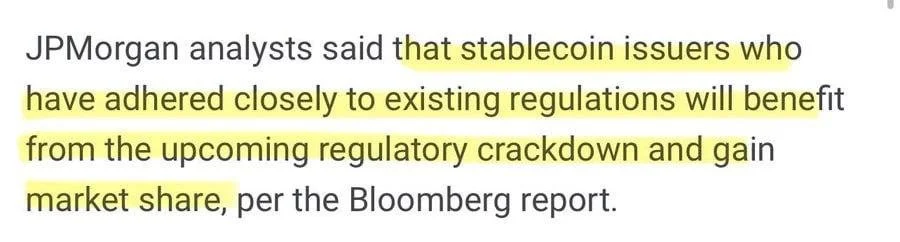
JP Morgan has even said that stablecoin issuers who adhere to regulations will benefit from the upcoming regulatory crackdown AND GAIN MARKETSHARE💯
Looks like JP Morgan knows what’s coming.
@ Newshounds News™
Source: Twitter
~~~~~~~~~
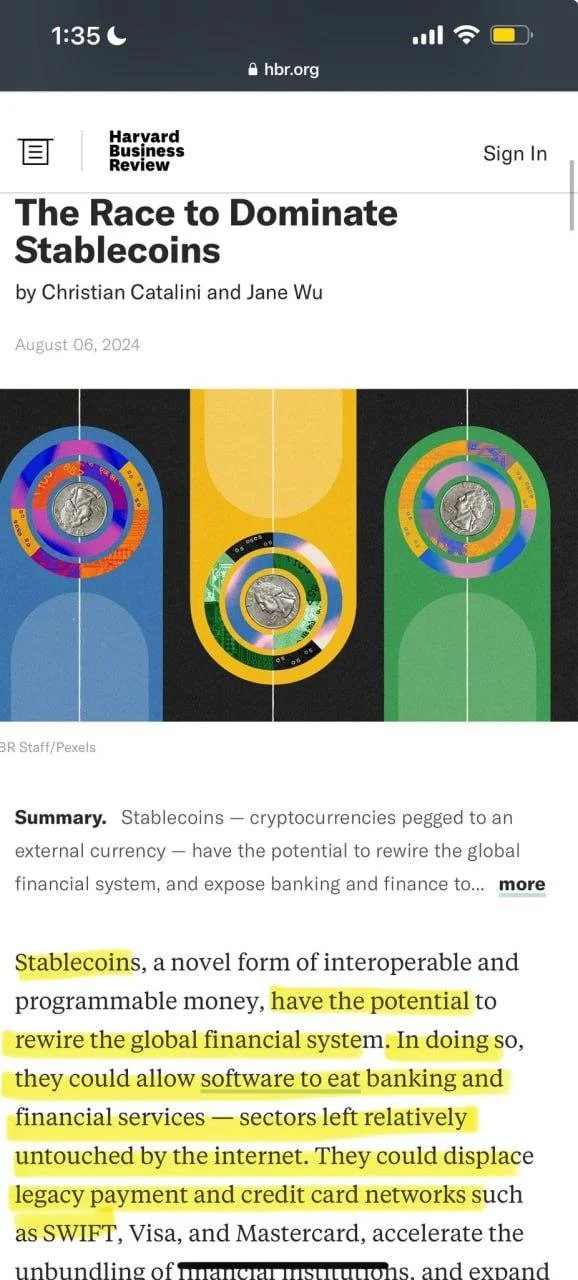
August 2024 Harvard Business Review: The Race to Dominate Stablecoins.
Yes, it is a race.
Companies are fighting to capture the market share that this new form of money is creating in the crypto universe.
“Stablecoins have the potential to REWIRE the global financial system and DISPLACE legacy payment systems like SWIFT.
@ Newshounds News™
Source: Twitter
~~~~~~~~~
"Bringing a trusted stablecoin onto XRPL will drive more adoption and development, contributing to a vibrant ecosystem." QUOTE from Brad Garlinghouse
"The stablecoin market is about $150B today, and is forecasted to exceed $2.8 trillion by 2028. There’s clear demand for stablecoins that deliver trust, stability, and utility.
To meet this growing demand, Ripple will issue a stablecoin, leveraging its decade-plus of experience building real-world financial solutions for institutions around the world."
"This move is also monumental for the XRP Ledger community, driving more use cases, liquidity and opportunities for developers and users.
At launch, the stablecoin will be available on the XRP Ledger (XRPL) and Ethereum (ETH) blockchains, with plans to expand to additional blockchains and decentralized finance (DeFi) protocols and apps over time."
"Issuing our stablecoin on the XRP Ledger and Ethereum will serve as a pivotal entry point to unlock new opportunities for institutional and DeFi use cases across multiple ecosystems," added Monica Long, Ripple President.
"The XRP Ledger’s native capabilities, including a decentralized exchange and automated market maker, were built to utilize XRP as THE BRIDGE ASSET."
LET'S CONSIDER THE QUOTES FOUND IN THIS ARTICLE AS WE CONTEMPLATE THE ROLE RLUSD WILL PLAY ALONG WITH XRP.
IT'S OBVIOUS THAT RIPPLE HAS POSITIONED ITSELF AS A PIONEER IN THE DEFI ARENA.
RLUSD POSSIBLY BECOMING THE STABLECOIN OF CHOICE AFTER LAUNCH AND THE UTLITIY FACTOR THAT XRP PLAYS IN THE DIGITAL ECOSYSTEM, THERE CAN BE LITTLE DOUBT THAT RLUSD WILL ENHANCE THE MARKETABILITY OF XRP, EVEN THOUGH THEY PROVIDE ARE TWO COMPLETELY DIFFERENT PRODUCTS.
XRP WILL LIKELY RISE IN VALUE BASED ON ITS OWN USE AND UTILITY, BUT MAY SEE A BUMP IN VALUE WHEN RLUSD IS LAUNCHED.
@ Newshounds News™
Source: Finance Yahoo
~~~~~~~~~
All About ZiG, Zimbabwe’s Latest Shot at a Stable Currency
"IN the latest effort to devise a credible national currency, Zimbabwe in April replaced its dollar with the ZiG, short for Zimbabwe Gold.
The new unit is backed by bullion and foreign currency reserves held at the central bank. It’s the country’s sixth attempt at establishing its own currency since 2008, when inflation crossed 500 billion percent, according to International Monetary Fund estimates."
"Not only did that render it worthless, it turned the unit into a global punchline: US Treasury secretaries would carry the notes as a reminder of the evils of hyperinflation.
Confident that they’ve finally got it right, Zimbabwe has announced plans to go all-in on the ZiG and make it the southern African nation’s sole legal tender. That’s an audacious goal, given that the dollar still accounts for the bulk of transactions in the country."
What went wrong with the Zimbabwean dollar?
"Brought back to life in 2019 after a decade-long furlough when the country ran solely on foreign currency, the Zimbabwean dollar lost ground against the US dollar every trading day this year.
This had wiped around 80% off its value by the time newly appointed central bank Governor John Mushayavanhu put it out of its misery on April 5."
"The collapse had already forced more than four-fifths of the southern African nation’s economy to transact in US dollars for everything from food to medicine, with some businesses only accepting payment in greenbacks.
Few people have forgotten the experience of 2008 when their savings were wiped out by inflation, so public trust in the local unit had always been low."
"The ZiG started trading on April 8 at an exchange rate of 13.56 to the dollar.
Banks, mobile-money platforms, retailers and other intermediaries reconfigured their systems to take account of the new currency, though the process has been a bumpy one."
Where does the currency’s value come from?
"The central bank said the new currency would be fully backed by $100 million in cash and 2,522 kilograms of gold worth $185 million. New banknotes were released on April 30, and the central bank went on a publicity drive to raise awareness of the new currency. "
"They have also fined traders for refusing to accept payment in ZiG. The authorities say that dollar-denominated transactions have declined to around 70% from 85% when it was introduced."
"In early August, the cabinet said it had adopted a “de-dollarization roadmap” without providing details of when it would take effect, though President Emmerson Mnangagwa has hinted it could happen as early as 2026. Official statistics suggest that the ZiG has helped to rein in surging price pressures since its April launch, though there are only a few months’ worth of data to go on."
@ Newshounds News™
Source: The Zimbabwe Mail
~~~~~~~~~
WHERE IS THE LEGAL CLARITY UNDER THE BIDEN ADMINISTRATION TO THE CRYPTO INDUSTRY TO OPERATE LEGALLY IN THE US?
Crypto Industry execs met with White House officials to discuss crypto policy on August 8. Representatives from Coinbase, Kraken, Ripple and Circle reportedly attended a video call with US policymakers to discuss their approach to crypto regulation.
IMO, THE FOLOWING IS THE MOST IMPORTANT THING DISCUSSED DURING THAT MEETING:
"The crypto executives reportedly pushed the Biden administration for regulatory clarity in the digital asset space, hinting at the removal of Securities and Exchange Commission (SEC) Chair Gary Gensler.
Many in the industry have criticized the SEC under Gensler for bringing enforcement actions against crypto firms that seemingly do not have a clear path to operate legally in the US."
Lawfirm Holland & Knight made the following statement in a report titled, "Blockchain & Cryptocurrency Laws and Regulations 2024":
"In the United States, cryptocurrencies have been the focus of much attention by both federal and state governments.
At the federal level, most of the focus has been at the administrative and agency level, including the Securities and Exchange Commission (the “SEC”), the Commodity Futures Trading Commission (the “CFTC”), the Federal Trade Commission (the “FTC”) and the Department of the Treasury (the “Treasury”), through the Internal Revenue Service (the “IRS”), the Office of the Comptroller of the Currency (the “OCC”) and the Financial Crimes Enforcement Network (“FinCEN”).
While there has been significant engagement by these agencies, little formal rulemaking has occurred. Many federal agencies and policymakers have praised the technology as being an important part of the U.S.’s future infrastructure and have acknowledged the need for the U.S. to maintain a leading role in the development of the technology."
The Seeds of Wisdom Team " Roadmap ", has documented many laws that have been introduced in both the House and the Senate. Some have passed the House or the Senate, but only one was passed by both the House and the Senate. However, that bill was Vetoed by Biden.
The industry executives were correct in saying that they are operating without a clear legal path to do so in the US. The BRICs nations have Russia in the lead providing a framework for cross border payments and stablecoins.
The EU Parliament has passed and implemented the Markets in Crypto-Assets (MiCA) to provide regulatory clarity to crypto businesses in the European Union.
The US is way behind and needs to pass laws to provide not only legal clarity to the crypto Industry in the US, but also security and protection regulations to it's citizens.
@ Newshounds News™
Read more: CoinTelegraph, Roadmap, Global Legal Insights
~~~~~~~~~
Newshound's Daily Breakdown Podcast Link
Newshound's News Telegram Room Link
Q & A Classroom Link
Follow the Roadmap
Follow the Timeline
Seeds of Wisdom Team™ Website
Subscribe to Newsletter
Thank you Dinar Recaps
Seeds of Wisdom RV and Economic Updates Friday Afternoon 8-9-24
Good Afternoon Dinar Recaps,
Trump Jr. to Launch Crypto Platform, to “Take on” Banks
PAY ATTENTION TO THIS ONE. THIS ARTICLE IS ANOTHER CONFIRMATION THE DIRECTION OF THE FINANCE WORLD .
"On August 8, Donald Trump Jr. revealed plans for a new DeFi platform aimed at addressing banking access inequality. During a Q&A session on the subscription-based platform Locals, Trump Jr. clarified that this venture is not a memecoin but a comprehensive crypto platform designed to take on traditional banking systems."
“This isn’t about creating a memecoin,” Trump Jr. stated, emphasizing that his initiative represents a broader and more impactful platform. However, he did caution that it will be some time before the project comes to fruition, withholding specific timelines for now.
Good Afternoon Dinar Recaps,
Trump Jr. to Launch Crypto Platform, to “Take on” Banks
PAY ATTENTION TO THIS ONE. THIS ARTICLE IS ANOTHER CONFIRMATION THE DIRECTION OF THE FINANCE WORLD .
"On August 8, Donald Trump Jr. revealed plans for a new DeFi platform aimed at addressing banking access inequality. During a Q&A session on the subscription-based platform Locals, Trump Jr. clarified that this venture is not a memecoin but a comprehensive crypto platform designed to take on traditional banking systems."
“This isn’t about creating a memecoin,” Trump Jr. stated, emphasizing that his initiative represents a broader and more impactful platform. However, he did caution that it will be some time before the project comes to fruition, withholding specific timelines for now.
"He expressed frustration with the current financial system’s exclusivity and its tendency to limit financing opportunities to select individuals. “Decentralized finance is very appealing to me, especially for those of us who have been debanked,” he said.
"Speculation about the new crypto project surged earlier in the week after Trump Jr. tweeted about DeFi, leading many to believe it might involve a new memecoin. On August 7, he posted on X, “We’re about to shake up the crypto world with something HUGE. Decentralized finance is the future — don’t get left behind.”
"Trump Jr. also warned against fraudulent tokens claiming affiliation with the Trump name, stating, “I love the crypto community’s enthusiasm for Trump, but beware of fake tokens. The only official project will be announced by us directly, and it will be fair for everyone.”
@ Newshounds News™
Source: CryptoTimes
~~~~~~~~~
RIPPLE´S STUART ALDEROTY MENTIONS THE PHRASE "HITTING THE #RESET BUTTON" FOUR TIMES IN HIS INTERVIEW WITH CNBC
CLICK ON THE LINK TO HEAR THE 1 MINUTE INTERVIEW
1) "[...] FINALLY, THIS ADMINISTRATION WILL TURN THE PAGE ON THEIR WAR ON CRYPTO AND HIT THE RESET BUTTON."
2) "[...] AND THIS ADMINISTRATION TRULY IS SERIOUS ABOUT HITTING THE RESET BUTTON ON THEIR WAR ON CRYPTO, THERE SHOULD BE NO APPEAL."
3) "WHAT WE NEED AS A COUNTRY IS TO HIT THE RESET BUTTON [...] AND CREATING CLEAR LAWS."
4) "THE COMBINATION OF OUR LITIGATION OUTCOME, THE COMBINATION OF THE ELECTION SEASON WE´RE IN, WE CAN REALLY SEE A RESET BUTTON HERE"
@ Newshounds News™
Read more: X formerly Twitter
~~~~~~~~~
Speaking of RESET
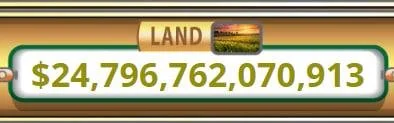
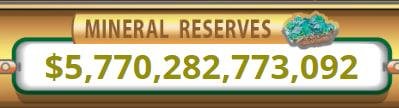
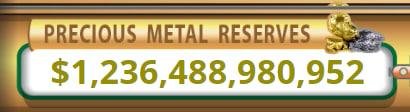
Here is the New US Debt Clock image from yesterday
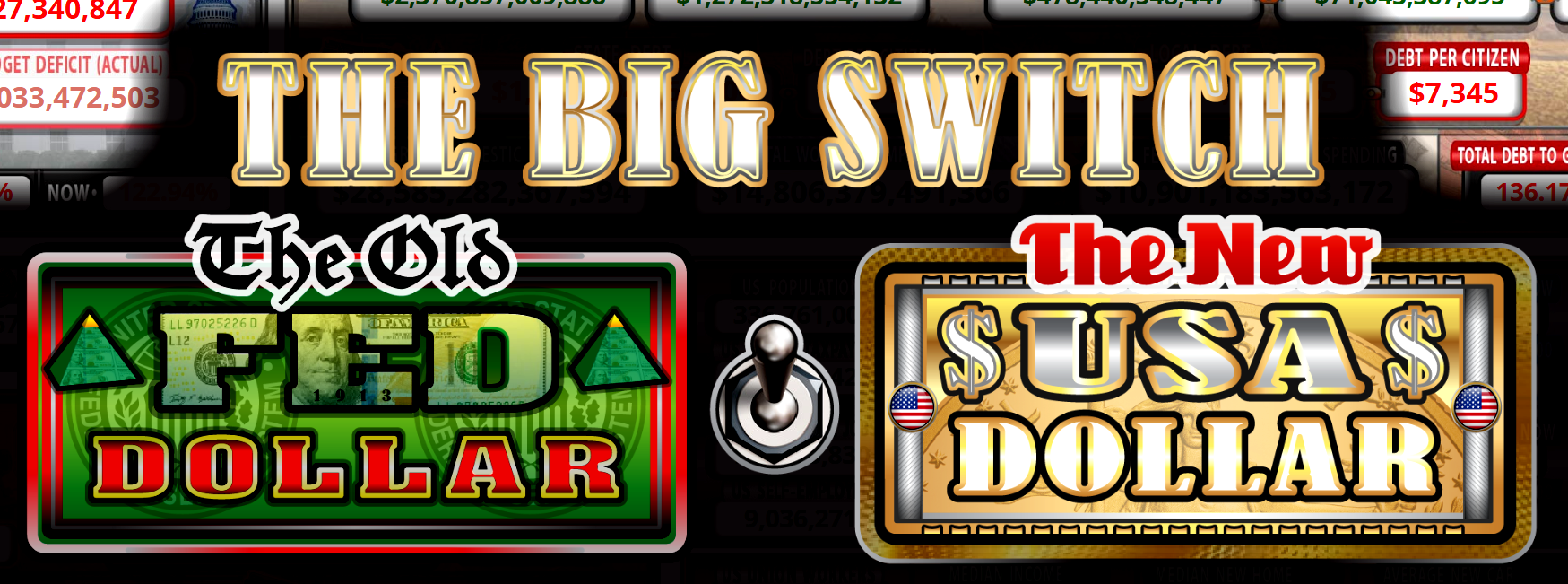
AND NEW BOXES WERE ADDED TO THE DEBT CLOCK YESTERDAY
@ Newshounds News™
Source: US Debt Clock
~~~~~~~~~


RIPPLE RIPPLE RIPPLE
"Testing, testing…RLUSD! We’re excited to share that Ripple USD (RLUSD) is now in private beta on XRP Ledger and Ethereum mainnet. RLUSD has not yet received regulatory approval and therefore is not available for purchase or trading – please be cautious of scammers who claim they have or can distribute Ripple USD"
"RLUSD will be valued 1:1 to the US dollar (USD) and 100% backed by US dollar deposits, short-term US government treasuries, and other cash equivalents. These reserve assets will be audited by a third-party accounting firm, and Ripple will publish monthly attestations."
"This is a significant milestone and a step closer to bringing more high-quality assets to the XRP Ledger, driving new opportunities, liquidity, and institutional use cases for users, developers, and applications."
@ Newshounds News™
Source: X formerly Twitter
~~~~~~~~~
BRICS Strike Back: Russia and India Team Up to Challenge Dollar Dominance
The trend of de-dollarization continues to gain traction despite many analysts saying the threat is overblown as India and Russia have announced a new partnership that will see their respective payment systems – India’s RuPay and Russia’s MIR – integrated to allow for seamless cross-border transactions without the need for U.S. dollars.
The partnership announcement follows the recent visit by India’s Prime Minister Narendra Modi to Moscow, during which the two countries forged new alliances and trade agreements. At the meeting, India confirmed its commitment to open trade with Russia, a key BRICS counterpart, and will facilitate trade using the RuPay and MIR payment systems.
As part of their agreement, Russian President Vladimir Putin and Modi reportedly set a goal to achieve $100 billion in trade turnover between Russia and India by 2030.
As part of their agreement, Russian President Vladimir Putin and Modi reportedly set a goal to achieve $100 billion in trade turnover between Russia and India by 2030.
@ Newshounds News™
Source: InfoBrics
~~~~~~~~~
Newshound's Daily Breakdown Podcast Link
Newshound's News Telegram Room Link
Q & A Classroom Link
Follow the Roadmap
Follow the Timeline
Seeds of Wisdom Team™ Website
Subscribe to Newsletter
Thank you Dinar Recaps
Seeds of Wisdom RV and Economics Updates Thursday Evening 8-8-24
Good evening Dinar Recaps,
Economist Jim Rickards Highlights Gold's Opportunity During Market Meltdowns
"Gold is being profiled as a relevant investment option in economic uncertainty and market instability times. Jim Rickards, a U.S. economist and best-selling author of books like “Currency Wars” and an opinion contributor to several newspapers and publications including The New York Times and The Washington Post, has referred to the investment opportunity that gold presents during acute market setbacks."
"In social media, Rickards reinforced its solid opinion of gold as a hedge against market instability, predicting the price movement of the precious metal during these events.
"Rickards says, "In a stock market meltdown, gold goes down due to selling by weak hands who need cash for margin calls. The strong hands take a beat, wait for a bottom. Then they jump in with both feet because they know it’s way up from there."
"Rickards has been analyzing gold’s position in today’s economy, stating that the metal might be used in case of a global currency meltdown to re-establish the gold standard, with many countries, including the U.S., purchasing gold to support the value of their currency."
Good evening Dinar Recaps,
Economist Jim Rickards Highlights Gold's Opportunity During Market Meltdowns
"Gold is being profiled as a relevant investment option in economic uncertainty and market instability times. Jim Rickards, a U.S. economist and best-selling author of books like “Currency Wars” and an opinion contributor to several newspapers and publications including The New York Times and The Washington Post, has referred to the investment opportunity that gold presents during acute market setbacks."
"In social media, Rickards reinforced its solid opinion of gold as a hedge against market instability, predicting the price movement of the precious metal during these events."
Rickards says, "In a stock market meltdown, gold goes down due to selling by weak hands who need cash for margin calls. The strong hands take a beat, wait for a bottom. Then they jump in with both feet because they know it’s way up from there."
"Rickards has been analyzing gold’s position in today’s economy, stating that the metal might be used in case of a global currency meltdown to re-establish the gold standard, with many countries, including the U.S., purchasing gold to support the value of their currency."
"Nonetheless, while some markets rebounded after Monday’s meltdown, gold continued to trade down, losing the $2,400 mark. Even after slipping down, gold prices are still almost 15% up during 2024, reaching historic high levels just some days ago."
"According to the World Gold Council, demand is expected to maintain the next year supported by central bank gold purchases for portfolio diversification and protection purposes."
@ Newshounds News™
Source: Bitcoin
~~~~~~~~~
BREAKING: Victory for Ripple as XRP Is Not a Security in the US; $125M Fine for the Truth
Ripple’s decisive victory over the SEC has officially ruled XRP a non-security.
Judge Torres reduced the SEC’s demanded fine from $2 billion to $125 million.
Ripple has exciting news following its recent victory over the US Securities and Exchange Commission (SEC). XRP has been officially classified as a non-security, a designation that was highly disputed during Ripple’s litigation against the Commission.
Court Significantly Reduces SEC Penalties for Ripple’s Institutional XRP Sales
In addition, as Ripple CEO Brad Garlinghouse noted in his most recent tweet, the court has reduced the SEC’s penalties for institutional XRP sales that violate federal securities laws.
"The SEC asked for $2B, and the Court reduced their demand by ~94% recognizing that they had overplayed their hand. We respect the Court’s decision and have clarity to continue growing our company.
This is a victory for Ripple, the industry and the rule of law. The SEC’s headwinds against the whole of the XRP community are gone."
Judge Torres of the Southern District of New York levied the penalties after concluding that Ripple’s 1,278 institutional sales transactions breached securities regulations.
Previously, Judge Torres decided in July 2023 that Ripple violated federal securities laws by selling XRP directly to institutional clients. However, automated sales of XRP to retail clients through exchanges did not violate securities regulations.
Recently, the SEC failed to appeal a portion of the order that excused Ripple from securities law violations in programmatic sales.
Furthermore, Judge Torres has forbidden Ripple from future violations of federal securities laws, signaling that any violations will necessitate the issue of a court order. Ripple must file a registration statement if it intends to sell securities in the future.
Interestingly, Ripple’s convincing triumph has generated a surge in demand for XRP. At the time of writing, XRP was up 17.88% over the last 24 hours to $0.6055. Its daily trade volume has risen more than 200% to $5.05 billion. The price of XRP has quickly risen to pass crucial levels, $0.50 and $0.60.
@ Newshounds News™
Source: Crypto News Flash
~~~~~~~~~
Solana ETF Approved by Brazilian SEC
Following its approval by the Brazilian regulator, the ETF is in a pre-operational phase, awaiting approval by Brazilian stock exchange B3.
Brazil's Securities and Exchange Commission (CVM) has approved a spot Solana exchange-traded fund (ETF).
According to local business publication exame, the ETF, created by Brazilian asset manager QR Asset and operated by fund administrator Vortx, is in a pre-operational phase, pending approval by Brazilian stock exchange B3.
The ETF will reference the CME CF Solana Dollar Reference Rate, created by CF Benchmarks and the Chicago Mercantile Exchange (CME).
Speaking to exame, QR Asset manager and chief investment officer Theodoro Fleury described the firm as a "global pioneer in this segment, consolidating Brazil's position as a leading market for regulated investments in crypto assets."
Solana ETFs around the world
With the CVM's approval, Brazil has outpaced the U.S. in the race to bring a spot Solana ETF to market. Following the surprise approval of multiple U.S. spot Ethereum ETFs, firms including VanEck and 21Shares have filed S-1 registration forms with the U.S. Securities and Exchange Commission (SEC) in the hope of securing approval.
In May, British bank Standard Chartered predicted in a research note that Solana and XRP ETFs are on the horizon, "albeit this is likely a 2025 story not a 2024 one."
Last month, VanEck's head of digital assets predicted that approval of a U.S. Solana ETF hinges on the outcome of the U.S. presidential election, dubbing the lack of a regulated futures market for Solana a "Psyop" by SEC chair Gary Gensler.
However, asset manager BlackRock has sat out the race, taking a skeptical position and predicting that "it will be a while before we see anything else" beyond Bitcoin and Ethereum ETFs.
Meanwhile, to the north, investment fund manager 3iQ has filed for a Solana ETF in Canada, aiming to be the first to market in North America. Interestingly, 3iQ has said from the outset that the fund would stake the SOL it buys to back shares. “The Solana Fund offers easy exposure to SOL without technical complexity,” the company wrote at the time. “As part of our investment strategy, the Solana Fund will stake SOL to earn rewards.”
@ Newshounds News™
Source: Decrypt
~~~~~~~~~
BRICS: Russia Officially Legalizes Bitcoin and Crypto Mining
"In another important sign of BRICS development in digital currencies, Russia has officially legalized Bitcoin and crypto mining in the country. Indeed, Moscow’s president, Vladimir Putin signed a law Thursday that legalizes the cryptocurrency process to specified persons."
The legislation will only allow “legal entities and individual entrepreneurs included in a register,” to mine crypto, Russian state media reports. However, it also legalizes mining for any individuals who “do not exceed the energy consumption limits,” proposed by the government.
"The past several months have seen BRICS embrace digital assets in a massive way. The group is reportedly considering the creation of a native currency using blockchain technology. It could be set to use these digital assets as a way to move further from the US dollar. Recent legal actions taken by one of its leading nations certainly support that assertion."
"As BRICS develops its digital currency infrastructure, Russia has officially legalized Bitcoin and crypto mining. The law will reportedly allow cryptocurrencies to be traded on native blockchain platforms. Moreover, it will go into effect in just ten days."
"This isn’t the first pro-crypto law Russia has passed this year. In late July, the country moved to allow crypto payments in international trade. The decision was made to combat Western sanctions."
@ Newshounds News™
Source: Watcher Guru
~~~~~~~~~
Newshound's Daily Breakdown Podcast Link
Newshound's News Telegram Room Link
Q & A Classroom Link
Follow the Roadmap
Follow the Timeline
Seeds of Wisdom Team™ Website
Subscribe to Newsletter
Thank you Dinar Recaps
Seeds of Wisdom RV and Economic Updates Wednesday Evening 8-7-24
Good Evening Dinar Recaps,
India has no plans to regulate crypto sales and purchases
Despite tightening measures against money laundering and terror financing, India has no immediate plans to regulate cryptocurrency transactions.
The Indian government revealed no immediate plans to regulate the sales and purchase of cryptocurrencies as it continues to tighten oversight on crypto-related money laundering and terror financing.
During a parliamentary meeting on Aug. 5, Pankaj Chaudhary, the Minister of State in India’s Ministry of Finance, responded to several questions detailing the nation’s current stance on crypto regulations.
Good Evening Dinar Recaps,
India has no plans to regulate crypto sales and purchases
Despite tightening measures against money laundering and terror financing, India has no immediate plans to regulate cryptocurrency transactions.
The Indian government revealed no immediate plans to regulate the sales and purchase of cryptocurrencies as it continues to tighten oversight on crypto-related money laundering and terror financing.
During a parliamentary meeting on Aug. 5, Pankaj Chaudhary, the Minister of State in India’s Ministry of Finance, responded to several questions detailing the nation’s current stance on crypto regulations.
Chaudhary said that India has not conducted any study or research to understand the adoption level of cryptocurrencies among its citizens. He responded by saying that:
“Crypto assets or Virtual Digital Assets (VDAs) are unregulated in India and the government does not collect data on these assets.”
India will tax crypto, not regulate it
Although India officially implemented a tax system for cryptocurrency transfers and profits on April 1, 2022, the government has no plans to regulate the sale and purchase of cryptocurrencies. Under India’s crypto law, citizens are required to pay a 30% tax on unrealized crypto gains and a 1% tax deducted at source (TDS).
Chaudhary highlighted India’s ongoing efforts toward Anti-Money Laundering (AML) and Countering the Financing of Terrorism (CFT) in crypto. Earlier in January, India banned several offshore crypto exchanges for noncompliance with local regulations, including Binance, KuCoin, Bitget, Huobi, OKX, Gate.io and MEXC.
However, the nation has no plans to regulate crypto purchases and sales. Chaudhary added:
“Currently, there is no proposal to bring legislation for regulating the sales and purchase of virtual digital assets in the country.”
Ongoing efforts to curb illicit crypto activities
He also reminded that India had pushed for a coordinated effort from all G20 nations to curb the illicit use of cryptocurrencies globally during its 2023 presidency.
Binance’s plan to reenter India after paying a $2 million fine for noncompliance was recently met with a roadblock.
On Aug. 6, the Directorate General of Goods and Service Tax Intelligence (DGGI) — an Indian law enforcement agency — demanded 722 crore Indian rupees ($86 million) in unpaid taxes from Binance.
Indian authorities had sent email notices to Binance offices in Seychelles, the Cayman Islands and Switzerland, which the crypto exchange ignored. However, Binance later appointed a local counsel to officially resolve its tax obligations.
@ Newshounds News™
Read: Coin Telegraph
~~~~~~~~~
HOW TO BUY XRP
"XRP is one of the largest cryptocurrencies by market capitalization, starting the year with a value of more than $30 billion. XRP’s origins date back to 2012 when the company now known as Ripple was founded and the XRP Ledger launched."
"Unlike bitcoin (BTC) and ethereum (ETH), the Ripple network and its XRP native cryptocurrency were designed to facilitate financial transfers among banks and other global financial institutions.
The goal of the project was to create a cheaper, faster and more secure alternative to the Society for Worldwide Interbank Financial Telecommunications, or SWIFT, which executes financial transfers."
WHAT IS XRP?
"While investors sometimes refer to the XRP cryptocurrency as Ripple, in fact Ripple is the technology company backing XRP and the XRP ledger blockchain.
The XRP blockchain itself is decentralized and public. The Ripple transaction protocol facilitates XRP network transactions, a set of rules governing RippleNet. RippleNet is a network of payment facilitators and banks worldwide that helps participants send and receive payments seamlessly, reducing transaction bottlenecks."
"Unlike bitcoin, dogecoin (DOGE) and other cryptocurrencies mined using a proof-of-work consensus mechanism, XRP is pre-mined and has a maximum total supply of 100 billion tokens. "
1. Decide if you want to buy XRP.
"XRP has advantages over bitcoin, ethereum and other leading cryptocurrencies, but it may only be right for some investors. "
2. Find a place to buy XRP.
"Once you have decided to buy XRP, you must find a cryptocurrency exchange or investing app that supports XRP trading. Exchanges are online platforms where users trade cryptocurrencies, and XRP is supported on a large number of markets and exchanges. "
Centralized exchanges
"A centralized crypto exchange is similar to a traditional financial institution in which a centralized company acts as an intermediary between transaction participants. Leading centralized crypto exchanges that support XRP trading include Binance, Coinbase, Kraken and Bybit."
Decentralized exchanges
"A decentralized crypto exchange allows users to make direct transactions through blockchain technology to complete trades without needing a centralized intermediary. Leading decentralized crypto exchanges that support XRP trading include PancakeSwap, SimpleSwap and onXRP."
3. Choose a form of payment.
Once you open an account on your preferred exchange, you must decide which payment methods are compatible with your exchange and convenient for you.
Fiat currency
"Many centralized exchanges allow the U.S. dollar or other fiat currencies for payment. Fiat currencies are government-supported currencies that are not backed by physical assets. Examples include the U.S. dollar, Japanese yen and euro."
Cryptocurrency
"Crypto exchanges often allow users to buy and sell one cryptocurrency using other cryptocurrencies. It’s common for crypto traders to buy and sell altcoins like XRP using bitcoin."
Stablecoins
"Stablecoins are cryptocurrencies designed to have stable prices, typically by pegging them to the price of a fiat currency or other commodity. Popular stablecoins include tether (USDT), USDC (USDC) and Dai (DAI), which are all pegged to the U.S. dollar."
4. Store your XRP.
"You will need a digital wallet compatible with XRP to store your crypto. Digital wallets are hardware or software that store a user’s private keys and are used to send and receive crypto. Some cryptocurrency exchanges provide custodial wallets to their customers.
But others require noncustodial wallets that leave the user responsible for securing private keys. Centralized exchanges such as Kraken and Coinbase offer users custodian wallets.
XRP is also supported on noncustodial software wallets such as GateHub, Xumm and Trust Wallet, as well as noncustodial hardware wallets such as Ledger, Keystone and Trezor."
@ Newshounds News™
Read more: USA Today
~~~~~~~~~
De-Dollarization Faltering in Africa Because Citizens Lack Confidence in Their National Currencies
HOW LONG WILL IT TAKE TO DE-DOLLARIZE THE WORLD WHEN WE HAVE REAL-WORLD PROBLEMS SUCH AS THIS ARTICLE PRESENTS STILL EXIST
"Sometime in 2023, during the peak of anti-dollar hype, Kenyan President William Ruto questioned why his country and Djibouti still had to settle trade in U.S. dollars when they had their currencies."
" The U.S. dollar hegemony was never widely seen as a threat, even as a few small countries were highlighting Washington’s apparent use of the currency’s dominance to achieve political goals.
However, when the U.S. took the bold step of using the dollar’s dominance to punish Russia after its invasion of Ukraine, suddenly there seemed to be a consensus among countries that Washington was weaponizing its currency.
For countries fearing they might be the next target, advocating for an alternative to the dollar or de-dollarization became the logical course of action."
"Clearly, the process or task of establishing a currency that eats into the greenback’s dominance is a mammoth one. But why is it difficult to create or launch a currency that can challenge the U.S. dollar? Alternatively, what has enabled the dollar to remain the most preferred reserve currency, even among those bitterly opposed to the U.S.?"
U.S. Dollar as a Store of Value
"Well, a lot may have nothing to do with what the U.S. is doing right but rather with what its opponents are doing. A good example exists in Africa, where persistently high inflation rates have convinced citizens that holding onto a local currency is unwise."
"Injecting money that does not correspond with an economy’s production usually results in one thing: runaway inflation. Unfortunately, this is precisely what many central banks, including those in Africa, have been doing, leading to currency crises and eventual dollarization."
"So, to answer the Kenyan President and those asking a similar question, traders between two African countries demand payment in U.S. dollars because they lack confidence in their own or their counterpart’s national currency.
It does not matter how far away they are from the United States; the two traders prefer this because it has a stable value, at least when compared with their respective national currencies."
"While the Kenyan leader has gone as far as to plead with traders to use local currencies, several African countries have banned the use of foreign currency in domestic transactions. However, this approach has often not translated into the increased local currency use. Instead, it has driven traders underground, harming local economies."
@ Newshounds News™
Read more: Bitcoin
~~~~~~~~~
Judge Fines Ripple $125M, Bans Future Securities Law Violations in Long-Running SEC Case
"A federal judge ordered Ripple to pay $125 million in civil penalties and imposed an injunction against future securities law violations on Wednesday."
"District Judge Analisa Torres, of the Southern District of New York, imposed the fine after finding that 1,278 institutional sale transactions by Ripple violated securities law, leading to the fine.
The $125.035 million fine is well below the $1 billion in disgorgement and prejudgment interest and $900 million in civil penalty the SEC sought."
"The SEC tried unsuccessfully to appeal that portion of the ruling while the case was ongoing."
"The injunction document requires Ripple to file a registration statement if it intends to sell any securities. The SEC is likely to appeal the July 2023 ruling now that the judge has imposed a sentence, after the same judge denied the SEC's motion for an interlocutory appeal last year."
"The SEC and Ripple settled charges tied to CEO Brad Garlinghouse and other executives after that interlocutory appeal was denied.
The price of XRP rose 3 cents, or around 2%, after the judgement was published."
@ Newshounds News™
Read more: CoinDesk
~~~~~~~~~
Fed Data Shows 9.1% of Credit Card Balances Hit Delinquency Status This Year | PYMNTS
@ Newshounds News™
~~~~~~~~~
Newshound's Daily Breakdown Podcast Link
Newshound's News Telegram Room Link
Q & A Classroom Link
Follow the Roadmap
Follow the Timeline
Seeds of Wisdom Team™ Website
Subscribe to Newsletter
Thank you Dinar Recaps
Seeds of Wisdom RV and Economic Updates Tuesday Evening 8-6-24
Good evening Dinar Recaps,
Google Pay, Walmart-backed PhonePe to join India’s CBDC pilot
In April, Reserve Bank of India Governor Shri Shaktikanta Das announced plans to expand its retail central bank digital currency (CBDC) pilot beyond banks. Last month the central bank said payment providers would join the digital rupee pilot this quarter.
Now Reuters reported that five payment providers have applied, citing sources. They are Google Pay, Walmart-backed PhonePe, Cred, Amazon Pay and Mobikwik.
PhonePe is India’s leading payments app, followed by GooglePay. Together they make up 85% of transactions and value for UPI, India’s successful instant payment solution, which processes almost 14 billion transactions monthly.
Not mentioned among the digital rupee applicants is third ranked player PayTM, which has a 6% UPI market share. Cred is fourth, AmazonPay is sixth and Mobikwik is sixteenth, but the UPI figures drop off significantly beyond the big three.
Good Evening Dinar Recaps,
Google Pay, Walmart-backed PhonePe to join India’s CBDC pilot
In April, Reserve Bank of India Governor Shri Shaktikanta Das announced plans to expand its retail central bank digital currency (CBDC) pilot beyond banks. Last month the central bank said payment providers would join the digital rupee pilot this quarter.
Now Reuters reported that five payment providers have applied, citing sources. They are Google Pay, Walmart-backed PhonePe, Cred, Amazon Pay and Mobikwik.
PhonePe is India’s leading payments app, followed by GooglePay. Together they make up 85% of transactions and value for UPI, India’s successful instant payment solution, which processes almost 14 billion transactions monthly.
Not mentioned among the digital rupee applicants is third ranked player PayTM, which has a 6% UPI market share. Cred is fourth, AmazonPay is sixth and Mobikwik is sixteenth, but the UPI figures drop off significantly beyond the big three.
If the CBDC follows UPI, then banks might end up playing second fiddle to the payment apps. Three banks rank in the top ten for UPI apps – Axis, ICICI and Kotak Mahindra – with the largest in the fifth spot. However, the three banks combined have a market share of less than one percent.
The percentages reference the user interface used to initiate payments. UPI is for interbank payments, so the money comes from bank accounts.
A Reuters source also stated that the erupee pilots are likely to stay in the pilot stage for a couple of years, which makes sense.
Advanced CBDC functionality takes time
From the early days, the central bank managed expectations, noting that the CBDC was unlikely to compete with the well-established UPI payment infrastructure.
Without more advanced functionality, there’s no incentive for consumers to switch. And if providers offer cash incentives, the switch could be temporary, as has happened in China with its digital yuan red envelope incentives.
Some of the distinguishing functionalities of India’s CBDC include offline payments and programmable payments, which are still in the early stages. Unlike rolling out the app, both may take a little time to come to fruition.
Plus, both the Ministry of Finance and central bank believe that the CBDC killer app will be cross border payments, especially for remittances. Even more so than the other two features, cross border payments take time to develop through collaboration with other jurisdictions.
@ Newshounds News™
Read more: Ledger Insights
~~~~~~~~~
Euro stablecoin market surges under MiCA
French and Irish fintech companies have partnered to introduce a euro-backed stablecoin. The coin will launch on the Stellar blockchain a month after MiCA stablecoin laws came into force.
The European Union’s Markets in Crypto-Assets Regulation (MiCA) framework is gradually coming into effect in line with its planned implementation timeline. The initial set of regulations, which took effect on July 1, focused on stablecoins and their issuers.
These clear guidelines have both cleaned out the market of players not able to meet regulatory requirements and created a favorable environment for stablecoins pegged to local currency.
One example is a new partnership between the France-based fintech company Next Generation and Ireland-based electronic money institution (EMI) Decta, which announced a plan to reintroduce a euro-pegged stablecoin, EURT, on the Stellar blockchain.
According to the involved parties, the initiative, which launched on Aug. 5, is fully MiCA compliant.
MiCA rebirth
Next Generation has strong ties to the renowned fintech player Tempo France. This company initially launched EURT in 2017 in collaboration with the Stellar Foundation, pioneering one of the first euro-pegged stablecoins.
However, the absence of a regulatory framework then led to the project’s suspension. However, under MiCA, stablecoins are classified as electronic money tokens (EMTs), aligning them with traditional e-money and necessitating that issuers possess an EMI license or be a credit institution.
This regulatory clarity has transformed the euro-backed stablecoin market, making it more predictable and attractive to investors.
Circle became the first global stablecoin issuer to comply with MiCA and chose France as its European headquarters, citing the country’s “forward-looking” stance on digital asset regulation.
The activation of MiCA is expected to drive substantial growth in the euro-backed stablecoin sector. Market predictions forecast a minimum market capitalization of 15 euros by 2025, reaching 70 billion euros by 2026 and potentially surpassing 2 trillion euros by 2028.
@ Newshounds News™
Read more: CoinTelegraph
~~~~~~~~~
UBS says ‘going into Japan now is like catching a falling knife,’ warns stock sell-off will continue
“The only reason why the Japanese market is up so strongly in the last two years is because the Japanese yen has been very, very weak.
Once it reverses, you got to get out right and I think they’re all getting out right now as a result of that,” Tay said.
"The yen, which weakened to a 38-year low of 161.99 against the U.S. dollar in June, reversed course during the run-up to the Bank of Japan’s policy meeting."
"It strengthened sharply after the BOJ raised its benchmark interest rate last week to around 0.25% and decided to trim its purchases of Japanese government bonds."
"Currently, the yen was last trading at 144.82, its lowest level against the greenback since January.
A stronger yen pressurizes Japanese stock markets, which are heavily dominated by trading houses and export-oriented firms by eroding their competitiveness."
"Tay said the yen can indicate whether the Japanese market will do well. As the yen has strengthened, stocks have declined, “there is still a lot more pressure on the Japanese stock market, unfortunately,” he said.
"While Tay acknowledged that some gains made by the market were due to corporate restructuring efforts by the Tokyo Stock Exchange, “the main driver was the Japanese yen.”
"Now, with the U.S. Federal Reserve signaling rate cuts are on the table and the Bank of Japan raising rates, the interest differential between the two central banks will narrow, making a “carry trade” less attractive, potentially setting the stage for the yen to strengthen further."
EVERYONE IS WONDERING WHY DID THE MARKETS CRASH ON 8/5 AND THEN REBOUND.
JAPAN SET THE STAGE WITH A WEAKING NIKKEI. THIS ARTICLE SHEDS LIGHT ON THE CURRENCY SIDE OF THIS EVENT AND HOW THE YEN NEEDS TO STRENGTHEN AGAINST THE DOLLAR
@ Newshounds News™
Read more: CNBC
~~~~~~~~~

Morgan Stanley, one of the most important financial institutions in the world, has stated that CRYPTOCURRENCIES WILL DISRUPT THE GLOBAL FINANCIAL SYSTEM IN 2024.
In a Banking And Financial Law Journal, it is documented that Morgan Stanley has also stated that Ripple is a LEADING PAYMENT ALTERNATIVE TO SWIFT.
And their own research reports, Morgan Stanley notes that XRP is more efficient than BTC and is closer to what traditional banks do today.
@ Newshounds News™
https://x.com/SMQKEDQG/status/1820783189197017134
@ Newshounds News™
Read more:
Newshound's Daily Breakdown Podcast Link
Newshound's News Telegram Room Link
Q & A Classroom Link
Follow the Roadmap
Follow the Timeline
Seeds of Wisdom Team™ Website
Subscribe to Newsletter
Thank you Dinar Recaps
Seeds of Wisdom RV and Economic Updates Tuesday Morning 8-6-24
Good Morning Dinar Recaps,
STELLAR Blockchain Chosen for New EURT Euro-Pegged STABLECOIN Initiative
"Ireland-based electronic money institution (EMI) DECTA is partnering with French fintech company Next Generation to introduce a new Euro-pegged stablecoin, ‘EURT’.
The collaboration aims to create a fully compliant stablecoin that adheres to the Markets in Crypto-Assets (MiCA) regulations and operates on the Stellar blockchain, alongside three additional platforms."
Good Morning Dinar Recaps,
STELLAR Blockchain Chosen for New EURT Euro-Pegged STABLECOIN Initiative
"Ireland-based electronic money institution (EMI) DECTA is partnering with French fintech company Next Generation to introduce a new Euro-pegged stablecoin, ‘EURT’.
The collaboration aims to create a fully compliant stablecoin that adheres to the Markets in Crypto-Assets (MiCA) regulations and operates on the Stellar blockchain, alongside three additional platforms."
"Next Generation, which has close ties with Tempo France, previously launched EURT with the Stellar Foundation as one of the first stablecoins in 2017.
However, the project was suspended due to the lack of a regulatory framework. The implementation of MiCA now provides a structured environment, facilitating the relaunch of this project."
"As of 1 July 2024, the new MiCA regulations permit the issuance of Euro-pegged stablecoins exclusively by credit institutions or EMIs within the EU. With its EMI license from the Central Bank of Ireland, DECTA is well-positioned to be a pioneering issuer under these new regulations."
“The implementation of MiCA has ushered in a new era in the history of modern digital finance in Europe,” said Suren Hayriyan, president of Next Generation. “The demand for Euro stablecoins is extremely high. Companies, entrepreneurs, and private users today lose a lot on forced conversions.
"The firms plan to launch EURT in October, aligning with strategic goals and regulatory milestones. The partners emphasize the SIGNIFICANCE OF REGULATION, indicating that UNREGULATED Euro-denominated stablecoins will no longer have a place in the market"
@ Newshounds News™
Read more: Digital Pound Foundation
~~~~~~~~~
We’re excited to announce that #Hedera has officially joined the @IIF
(Institute of International Finance), joining the likes of @circle @coinbase, and @BlackRock, and other leading institutions to collaboratively foster global financial stability and sustainable economic growth.
@ Newshounds News™
Read more: Twitter, IIF
~~~~~~~~~
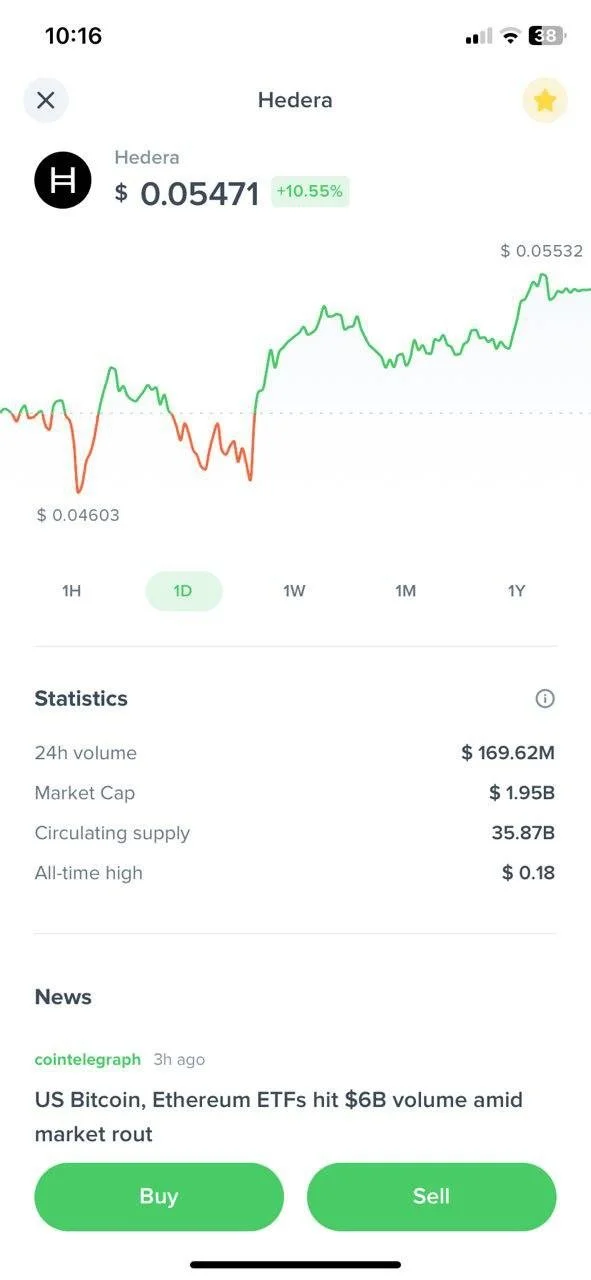
Hedera - HBAR
@ Newshounds News™
~~~~~~~~~
JUST IN: El Salvador bought more #Bitcoin today while everyone else is selling.
@ Newshounds News™
Read more: Bitcoin Magazine
~~~~~~~~~
ARE CBDC'S A FORM OF CRYPTOCURRENCY?
THIS ARTICLE IS VERY COMPREHENSIVE AND WE HIGHLY RECOMMEND CLICKING THE LINK TO THE FULL ARTICLE FOR REVIEW
"Although CBDCs are a form of digital currency, they are not a cryptocurrency. Compared to cryptocurrencies, CBDCs are centralized, meaning they’re issued and regulated by a monetary authority — in this case, a country’s government.
They’re also considered legal tender and hold the same status as any traditional fiat currency issued by a central bank. Finally, by virtue of the fact that CBDCs are based on fiat currency, they’re far less volatile than cryptocurrencies, whose value is determined by market forces and speculative activity."
"While both CBDCs and cryptocurrencies have their advantages and disadvantages, the general consensus is that they are two very different things, with different implications for the economy and society at large."
"The decentralized nature of cryptocurrencies has also accelerated innovation in cross-border payments — for example, RIPPLE, a Real-Time Gross Settlement system, has successfully built a global payment ecosystem with the XRP cryptocurrency at its core."
"The growing popularity of cryptocurrencies has created increased competition for central banks, which have realized that they need to offer instant, electronic payments to stay current and maintain market share."
"There’s been some confusion recently around the relationship between FedNow and CBDCs, with some wondering whether FedNow is a CBDC. To cut right to the chase: No, it is not, and the two are fundamentally different.
CBDCs are not a payment mechanism, but rather a form of currency and a digital means of storing value. FedNow, however, is a payment mechanism — in other words, it’s a means of moving funds from one bank account to another.
"To put things into perspective, the FedNow Service can be likened to a highway system, providing a fast and efficient infrastructure for the movement of payments between financial institutions.
CBDCs enable central banks to compete with private-sector offerings by providing a wider array of services to consumers, including a more stable, secure alternative to cryptocurrencies.
There’s also a cost-saving incentive to CBDCs, as electronic payments are less expensive to process — both for governments and financial institutions — than paper-based payments."
"Looking to the future, FedNow, digital payments, ISO 20022, and CBDCs will be transformational not only for businesses within the financial services industry but for anyone who uses financial services. In the long run, they will coexist with cryptocurrencies, providing consumers and businesses with a wide range of complementary mechanisms for the digital transfer of value."
@ Newshounds News™
Read more: Volantetech
~~~~~~~~~
Newshound's Daily Breakdown Podcast Link
Newshound's News Telegram Room Link
Q & A Classroom Link
Follow the Roadmap
Follow the Timeline
Seeds of Wisdom Team™ Website
Subscribe to Newsletter
Thank you Dinar Recaps
Seeds of Wisdom RV and Economic Updates Monday Evening 8-5-24
Good Evening Dinar Recaps,
Three-Quarters of Banks Face Digital Banking Infrastructure Issues The banking industry is experiencing a seismic shift as agile, digital-native FinTechs capture an ever-growing share of the market.
Burdened by outdated technology, traditional financial institutions face mounting challenges in delivering modern digital services.
The growing dominance of FinTechs — securing nearly half of all new account openings — highlights the urgency for banks to modernize their infrastructure.
Good Evening Dinar Recaps,
Three-Quarters of Banks Face Digital Banking Infrastructure Issues
The banking industry is experiencing a seismic shift as agile, digital-native FinTechs capture an ever-growing share of the market.
Burdened by outdated technology, traditional financial institutions face mounting challenges in delivering modern digital services.
The growing dominance of FinTechs — securing nearly half of all new account openings — highlights the urgency for banks to modernize their infrastructure.
With consumer expectations rapidly evolving toward seamless digital experiences, banks must navigate the high costs and complexities of updating their core systems.
Exploring incremental modernization through application programming interfaces (APIs) may offer a viable path forward, enabling banks to enhance their digital capabilities and remain relevant in an increasingly competitive landscape.
A recent PYMNTS Intelligence Report, “Core Strength: FIs Must Modernize to Meet the FinTech Challenge,” in collaboration with Galileo, highlights the urgent need for traditional financial institutions to overhaul their outdated systems to keep pace with digital-native competitors.
The report reveals that 75% of banks struggle with implementing new digital solutions due to their legacy infrastructure, underscoring the critical nature of modernization efforts.
As FinTechs continue to capture a growing market share, banks face mounting pressure to adopt agile technologies and innovative approaches.
@ Newshounds News™
Read more: PYMNTS
~~~~~~~~~
The crypto market has just witnessed its largest three-day sell-off in 12 months amid weak jobs data in the US and revived fears of a recession.
The crypto market has just clocked its most significant three-day sell-off in almost a year, shedding as much as $510 billion from its total market capitalization since Aug. 2.
The sharp crypto sell-off arrived amid faltering equities performance, with the S&P 500 falling as much as 4.4% in the same time frame.
The market stumble has been led by weak employment data, slowed growth among major tech stocks and revived fears of a recession.
Several major companies, including Microsoft and Intel, posted lower-than-expected second-quarter results, and market leader Nvidia was battered by expectations of impending rate cuts in September, which has seen capital flow back into smaller, lagging companies.

The total crypto market capitalization fell by $314 billion on Aug. 5. Source: TradingView
The last time crypto sold off this sharply over a three-day period was in mid-August of 2023.
BTC and ETH are down 20% and 28%, respectively, in the last seven days.
Layer-1 network Solana’s has been the hardest-hit cryptocurrency among the top 10 largest tokens by market cap, falling 30.6% since July 30.
The Crypto Fear & Greed Index — an indicator that tracks market sentiment toward Bitcoin and crypto — has fallen back into “fear” and currently displays a score of 26 at the time of publication, according to Alternative.me.
@ Newshounds News™
Read more: Coin Telegraph
~~~~~~~~~
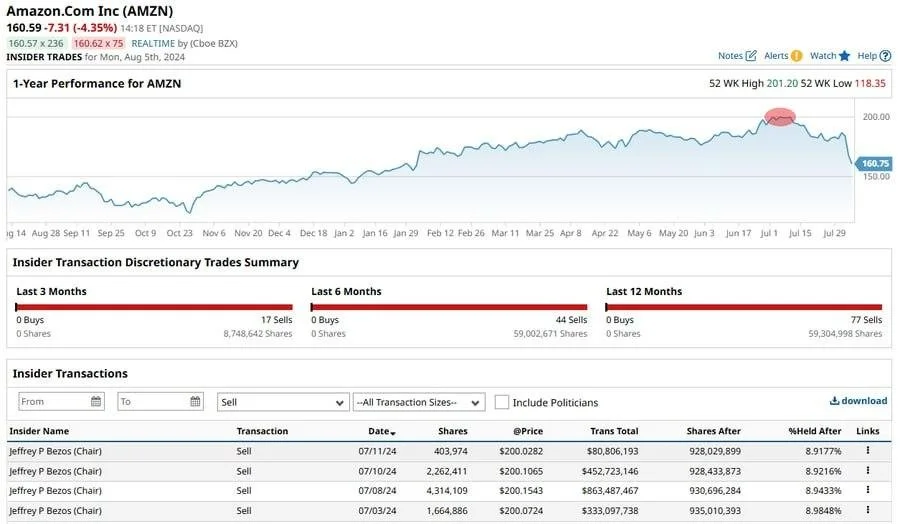
Bezos sold $1.65 billion worth of $AMZN at the exact top - man deserves a round of applause for these trades!
@ Newshounds News™
Read more: Twitter
~~~~~~~~~
Why do I hold $XRP? This video should make it clear.
WATCH THE VIDEO IMBEDDED IN THIS TWEET. WORTH 2 MINUTES.
@ Newshounds News™
Listen Here: Twitter
~~~~~~~~~
Japan's three largest financial companies have lost $85 billion in market value over the past two trading days.
Read that again.
History…
@ Newshounds News™
Read more: Twitter
~~~~~~~~~
Newshound's Daily Breakdown Podcast Link
Newshound's News Telegram Room Link
Q & A Classroom Link
Follow the Roadmap
Follow the Timeline
Seeds of Wisdom Team™ Website
Subscribe to Newsletter
Thank you Dinar Recaps
Seeds of Wisdom RV and Economic Updates Monday Afternoon 8-5-24
Good Afternoon Dinar Recaps,
Blockchain and Nation-State Infrastructure: Why Bother? " Financial titans like JP Morgan, Standard Chartered, HSBC, and Goldman Sachs are diving deep into blockchain, spurred on by the SEC’s approval of spot Bitcoin and Ether ETFs and BlackRock’s tokenization initiatives.
However, participation from legacy organizations brings with it a growing risk of reproducing the same kinds of centralized structures that blockchain set out to dismantle.
Additionally, greater involvement from traditional finance attracts stronger regulatory frameworks and more regimented policy structures from nation-state institutions, which risks stifling innovation and limiting the autonomy of our blockchain networks. So, why bother?"
"Not long ago, these financial giants were the loudest critics of crypto’s credibility and efficacy. For context, in 2017, the CEO of JPMorgan Chase famously declared, “BITCOIN IS A FRAUD”.
Good Afternoon Dinar Recaps,
Blockchain and Nation-State Infrastructure: Why Bother?
" Financial titans like JP Morgan, Standard Chartered, HSBC, and Goldman Sachs are diving deep into blockchain, spurred on by the SEC’s approval of spot Bitcoin and Ether ETFs and BlackRock’s tokenization initiatives.
However, participation from legacy organizations brings with it a growing risk of reproducing the same kinds of centralized structures that blockchain set out to dismantle.
Additionally, greater involvement from traditional finance attracts stronger regulatory frameworks and more regimented policy structures from nation-state institutions, which risks stifling innovation and limiting the autonomy of our blockchain networks. So, why bother?"
"Not long ago, these financial giants were the loudest critics of crypto’s credibility and efficacy. For context, in 2017, the CEO of JPMorgan Chase famously declared, “BITCOIN IS A FRAUD”.
In this era of heavy skepticism, financial governance in the U.S. looked down its nose at this whole ecosystem—if it even dared to look at all.
Yet now, as the two start to realize the potential upside of Wall Street ETFs, we seem incredibly eager to shine a light on their arrival.
We need to ask ourselves if these major private and public players can be trusted with the future of blockchain ecosystems when they have, for years, continued to struggle with the provision of clear and feasible regulatory frameworks."
"It’s still unclear if digital assets are SECURITIES or COMMODITIES, leading to endless lawsuits and regulatory headaches for major exchanges in the US. These opaque rules and guidelines have fostered a mass jurisdictional exodus, as companies look for legal respite to innovate in other places. "
"To circumvent these centralized points of failure, we need to continue building permissionless and trustless systems that can’t be taken down by the state, regulator, or any one owner.
Decentralized, open-source zero-knowledge (zk) bridges may not be a silver bullet, but they offer a more promising and equitable future.
Distributed, anonymous, and autonomous, these bridges can operate with minimum governmental interference and therefore maximum freedom, empowering participants to move assets freely and generate proofs locally and economically."
"This allows for true interoperability, giving protocols sovereign control without the heavy hand of regulatory requirements. It also makes these bridges nation-state-resistant: if a given bridge provider is regulated out of existence or prosecuted, users can continue bridging using the decentralized infrastructure."
"In this vision, protocols would enjoy greater freedom, with no unnecessary requirements, no user flow restrictions, and no extra security vulnerabilities. Crypto would again become a space where no single country, company, or party has an unfair advantage, effectively returning to the decentralized spirit at the heart of blockchain."
"Imagine instead a world where thousands of blockchains communicate seamlessly—a future where fragmented liquidity becomes a cohesive, high-performance ecosystem.
This vision is within reach. We are on the cusp of making blockchain as efficient and interconnected as the internet itself.
Decentralized, horizontal scalability is the only way forward, making crypto truly useful for the wider global community."
@ Newshounds News™
Read more: Bitcoin
~~~~~~~~~
Cambodia’s Bakong DIGITAL CURRENCY helps address DOLLARIZATION
ANOTHER ARTICLE HIGHLIGHTING THE FACT THAT COUNTRIES ARE CONTINUING DOWN THE PATH TO DE-DOLLARIZE AND RETURN TO LOCAL CURRENCIES.
THIS TREND IS HAPPENING ALL AROUND THE WORLD AND SEEMS TO BE A STRATEGIC PLAN TO BRING IN A GLOBAL FINANCIAL SYSTEM.
"Cambodia has been a heavily dollarized country since it returned to civilian rule in the early nineties. Roughly 80% of transactions are in US dollars. Prior to becoming the Governor of the National Bank of Cambodia, Chea Serey spearheaded the launch of the Bakong digital currency payment system in 2020.
A key aim was to encourage a higher proportion of transactions in the local riel rather than dollars. Based on figures for the first half of 2024, that strategy looks like it’s working."
"Bakong has been a huge success. By the end of last year, the central bank said there were ten million wallets out of a 17 million population. While often described as a central bank digital currency (CBDC), Bakong is closer to a tokenized deposit initiative with the Bakong currency backed by balances at commercial banks."
"One of the key tactics to encourage use of the LOCAL CURRENCY is to only support cross border payments using riel. Bakong has existing cross border payment arrangements for Bakong with Thailand, Laos and Vietnam and is expanding its collaborations with China, Japan, India, Korea, Singapore and Malaysia.
Late last year it partnered with Alipay+, the international arm of the dominant Chinese wallet. Additionally, it’s encouraging local retailers to quote prices in riel."
"There’s another reason the strategy is working. With a prudently managed economy, the riel can hold its own in the foreign exchange markets. It has an unofficial peg of 4000 riel to the dollar, which it has managed to more or less hold for the past 20 years.
During the past ten years it has varied by less than 5%. Given the decline in the US dollar in the last few days, the riel has now slightly appreciated against the dollar over the past year. Other currencies in the region such as the Thai Baht, have depreciated a little."
@ Newshounds News™
Read more: Ledger Insights
~~~~~~~~~
USD/JPY Forecast – US Dollar Continues to Drop Against The Yen
The USD/JPY pair fell hard in the early hours on Monday, as the trading world continues to unwind the overall carry trade, and the Fed is looking more and more likely to cut rates later this year. Ultimately, this is a market that I think will continue to see more and more volatility.
@ Newshounds News™
Read more: FX Empire
~~~~~~~~~
IMPORTANT RIPPLE (XRP) UPDATE
“Ripple USD will be fully backed by a segregated reserve of cash and cash equivalents and redeemable 1:1 for US dollars,” the announcement reads.
▪️Ripple plans to launch a stablecoin called Ripple USD (RLUSD) by the end of 2024, available on XRP Ledger and Ethereum. It promises benefits like deep liquidity for certain trading pairs, instant settlements, and programmable finance.
▪️The SEC has criticized RLUSD as an “unregistered crypto asset,” continuing its ongoing legal battle with Ripple since 2020.
More Attention to RLUSD
Ripple made waves earlier this year when it revealed that it would introduce a stablecoin pegged to the American dollar. At the time, CEO Brad Garlinghouse stated that the product would serve as a bridge between traditional finance and the cryptocurrency industry.
Ripple’s team has still not provided an exact date for the stablecoin’s official release. However, they explained it will be available on the XRP Ledger and Ethereum and should go live before the end of 2024. The team also revealed that the stablecoin will be called Ripple USD (ticker RLUSD).
Most recently, the product was added to the company’s official website, meaning its launch could be just around the corner. “
Ripple USD (RLUSD) is being designed to maintain a constant value of one US dollar. Issued on XRP Ledger and Ethereum blockchains, Ripple USD will be fully backed by a segregated reserve of cash and cash equivalents and redeemable 1:1 for US dollars,” the section reads.
Ripple’s team argued that RLUSD would provide certain benefits, such as deep liquidity for selected trading pairs on centralized exchanges, instant settlements, and programmable finance.
The Clash With the SEC
The upcoming stablecoin has already become a subject of controversy, receiving criticism from the US Securities and Exchange Commission (SEC). Several months ago, the regulator labeled it an “unregistered crypto asset.”
This is not the first confrontation between Ripple and the SEC. The agency sued the firm in December 2020, accusing it and some of its executives of illegally raising more than $1.3 billion by selling XRP in an unregistered security offering.
The legal battle passed through multiple developments in the following years, becoming one of the hottest topics in the crypto space. It reached its trial stage in April 2024, meaning a resolution could be announced anytime.
Some industry participants view the SEC as the underdog in the dispute, pointing to Ripple’s three partial court wins secured throughout 2023. XRP’s price reacted positively to each of those, and it will be interesting to see how it performs once the case is officially closed.
@ Newshounds News™
Read more: Crypto Potato
~~~~~~~~~
Crypto Market Crash Aside: 3 Things to Watch This Week
Things couldn’t get much worse for crypto markets following their largest retreat for more than a year. However, this week’s economic calendar in the US is slow which could limit further volatility.
Crypto markets have fallen below $2 trillion total capitalization in a massive double-digit crash, the likes of which have not been seen for at least a year.
Stock markets in Asia are also reeling this Monday morning following a tech stock rout in the United States late last week.
Economic Calendar August 5 to 9
Monday, we will see July’s final S&P services PMI (purchasing managers index), which provides a snapshot of business conditions in the services sector in the United States.
The ISM services report is also due, which will provide economic indicators for service based on surveys of supply management professionals. Changes in ISM and PMI reports often precede changes in the wider economy.
Thursday has initial jobless claims data, which indicate employment and labor markets in the United States and have a wider impact on the economy.
This week’s light economic events calendar will not have much impact on markets as they are already in freefall.
Economists are forecasting more economic doom and gloom. “All in, we have an economic slowdown for sure, with a high probability that a recession is approaching,” reported Forbes over the weekend.
Crypto Markets Bleed $280B
Crypto markets have dumped a further $280 billion over the past 12 hours resulting in a daily slump of around 13%.
This has dropped total market capitalization back to $1.94 trillion, its lowest level since February. Digital asset markets have dumped more than 20% over the past week as sentiment shifts to bearish.
Bitcoin led the declines with a slump to under $50,000 during the Monday morning Asian trading session. The asset has lost 13% over the past 24 hours in its largest and fastest fall for more than a year.
Ethereum fared even worse, tanking a whopping 21% on the day to $2,200, its lowest level since January.
The altcoins are a sea of red this morning, with most dumping double digits as crypto markets wipe out nearly all gains made in 2024 in the space of a couple of days.
@ Newshounds News™
Read more: Crypto Potato
~~~~~~~~~
IRAQ Central Bank Governor comments on DOLLAR EXCHANGE and FOREIGN REMITTANCES
"Ali Al-Alaq, governor of the Central Bank, discussed the value of remittances sent abroad and the value of the dollar."
"Al-Alaq said in a proclamation got uninvolved of his facilitating in the Place of Delegates that “our unfamiliar cash holds are adequate to make balance on the lookout,” demonstrating that “the National Bank offers in excess of 250 million bucks everyday to meet the necessities of unfamiliar exchange.”
He added, “85% of unfamiliar exchanges are as of now occurring between Iraqi banks and reporter banks WITHOUT GOING THROUGH the US Central bank,” making sense of that “the lodging drive is vital to the bank.”
He explained that “the Central Bank is now heading to cover the financing of the construction of 32 thousand housing units” and that “the volume of loans granted within the real estate initiative amounts to 10 trillion dinars.”
@ Newshounds News™
Read more: Dinar Opinions
~~~~~~~~~
Newshound's Daily Breakdown Podcast Link
Newshound's News Telegram Room Link
Q & A Classroom Link
Follow the Roadmap
Follow the Timeline
Seeds of Wisdom Team™ Website
Subscribe to Newsletter
Thank you Dinar Recaps
Seeds of Wisdom RV and Economic Updates Monday AM 8-5-24
Good Morning Dinar Recaps,
Warren Buffett and Berkshire Hathaway now own 4% of all T-Bills issued to the public…
Buffett has ~$277 Billion. The Fed has $195 Billion.
Good Morning Dinar Recaps,
Warren Buffett and Berkshire Hathaway now own 4% of all T-Bills issued to the public…
Buffett has ~$277 Billion.
The Fed has $195 Billion.
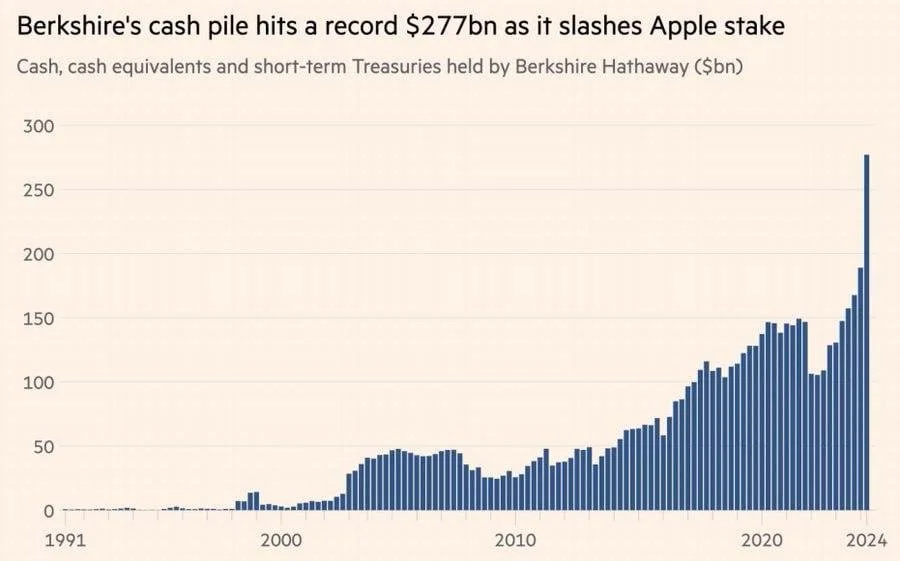
Warren Buffett is now a larger holder of US Treasury Bills than the Federal Reserve.
@ Newshounds News™
Read more: Twitter
~~~~~~~~~
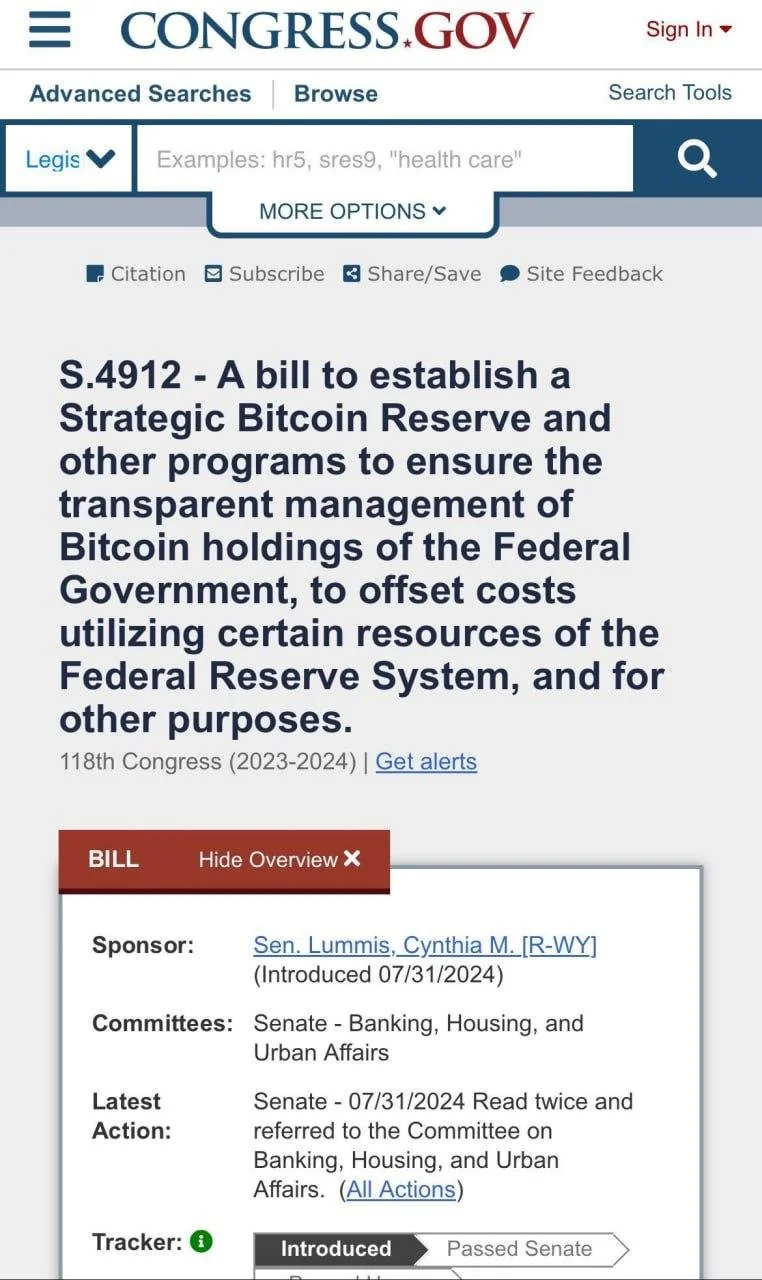
JUST IN: 🇺🇸 The Strategic #Bitcoin Reserve bill has been officially introduced.
@ Newshounds News™
Read more: Bitcoin Magazine, Congress-Gov
~~~~~~~~~

So if it’s subject to REGULATORY APPROVAL and it’s supposed to come out in Q4 this YEAR, then REGULATIONS are COMING OUT before THEN.
@ Newshounds News™
Twitter
THIS IS AN OPINION PIECE BUT WORTH CONSIDERING
~~~~~~~~~
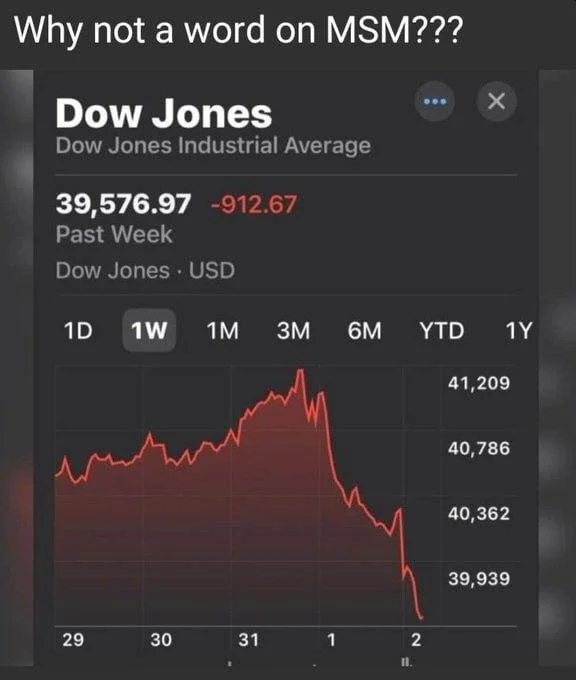
US Stocks tanking. Japanese stocks tanking. Cryptos tanking
@ Newshounds News™
Twitter
Newshound's Daily Breakdown Podcast Link
Newshound's News Telegram Room Link
Q & A Classroom Link
Follow the Roadmap
Follow the Timeline
Seeds of Wisdom Team™ Website
Subscribe to Newsletter
Thank you Dinar Recaps
Seeds of Wisdom RV and Economic Updates Sunday Afternoon 8-4-24
Good Afternoon Dinar Recaps,
Gold (XAU) Forecast: Dollar Weakness and Falling Yields Set Stage for Continued Rally
Key Points: ▪️ Gold surges 2.32% weekly despite Friday pullback, settling at $2442.50 amid geopolitical tensions and Fed rate cut expectations. ▪️ Middle East conflicts, including Hamas leader assassinations, boost safe-haven demand for gold as geopolitical hedge. ▪️ Powell's comments spark surge in trader bets for September rate cut, CME FedWatch tool shows 28.5% chance of 50-basis-point cut. ▪️ Weaker-than-expected U.S. jobs report strengthens case for gold: Only 114,000 jobs added, unemployment rises to 4.3% ▪️ Analysts eye $2,500 year-end target for gold, potentially arriving sooner if current bullish trends persist in the market.
@ Newshounds News™
Read more: FX Empire
~~~~~~~~~
Good Afternoon Dinar Recaps,
Gold (XAU) Forecast: Dollar Weakness and Falling Yields Set Stage for Continued Rally
Key Points:
▪️ Gold surges 2.32% weekly despite Friday pullback, settling at $2442.50 amid geopolitical tensions and Fed rate cut expectations.
▪️ Middle East conflicts, including Hamas leader assassinations, boost safe-haven demand for gold as geopolitical hedge.
▪️ Powell's comments spark surge in trader bets for September rate cut, CME FedWatch tool shows 28.5% chance of 50-basis-point cut.
▪️ Weaker-than-expected U.S. jobs report strengthens case for gold: Only 114,000 jobs added, unemployment rises to 4.3%
▪️ Analysts eye $2,500 year-end target for gold, potentially arriving sooner if current bullish trends persist in the market.
@ Newshounds News™
Read more: FX Empire
~~~~~~~~~
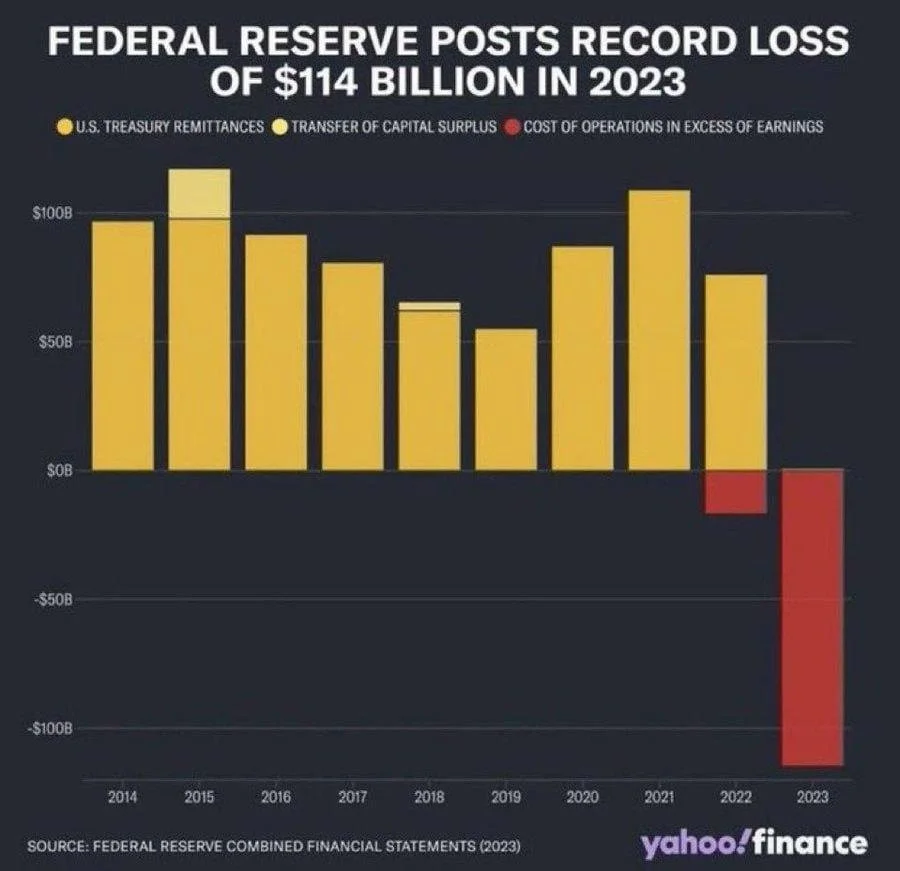
Federal Reserve posted its biggest loss in history last year of $114 Billion
@ Newshounds News™
Read more: Twitter
~~~~~~~~~
Ripple Unveils RLUSD Webpage: Set to Compete with Tether and USDC
▪️RLUSD aims to compete with major stablecoins like Tether and USD Coin.
▪️Ripple’s strategic initiatives enhance the interoperability and utility of RLUSD.
Ripple Labs Inc. has developed a new webpage for its next stablecoin, RLUSD. The release has aroused widespread interest, with blockchain researcher Collin Brown noting that RLUSD intends to compete with big players Tether (USDT) and USD Coin.
This step demonstrates Ripple’s determination to increase its presence in the stablecoin sector, despite the changing regulatory landscape.
RLUSD Stablecoin to Leverage Ripple’s Cross-Border Network and XRP Ledger
The RLUSD stablecoin is expected to improve Ripple’s business operations by leveraging its current cross-border settlement network and the well-known Layer 1 protocol, XRP Ledger.
The stablecoin will be released on both the XRP Ledger and Ethereum, providing access to different ecosystems. This dual issuance adds significant liquidity to important trading pairs on certain centralized exchanges, increasing its utility and adoption.
The publication of the RLUSD webpage has fueled this enthusiasm, despite the fact that the stablecoin’s release date remains unknown.
On the other hand, as we previously reported, Monica Long, Ripple’s President, stressed the company’s focus on the XRPL EVM sidechain in their Q2 report, citing a collaboration with Axelar to improve interoperability. This strategic move is intended to improve the sidechain’s functioning and expand its use cases.
Also, according to a prior CNF report, Ripple has released 500 million XRP from escrow to an unnamed wallet, reportedly to assist liquidity and potential future initiatives.
Beside that, El Salvador is investigating the usage of XRP and Bitcoin for international trade with Russia, demonstrating the growing interest in Ripple’s solutions. This exploration is consistent with Ripple’s objective of improving cross-border transactions and providing more efficient financial services.
Meanwhile, according to CoinMarketCap, the XRP price is currently around $0.5458, down 4.47% over the last 24 hours. This also reflects a bearish position of 9.58% for the last 7 days.
@ Newshounds News™
Read more: Crypto News Flash, XLRP-Sidechains, U Today, TimesTabloid
~~~~~~~~~
Nizhny Novgorod to Host 8th BRICS Industry Ministers’ Meeting
The BRICS Industry Ministers’ Meeting will take place on 16 August 2024 as part of Russia’s BRICS Chairship in 2024. The event will focus on the development of industrial cooperation between BRICS countries.
The programme will include a BRICS–EAEU–UNIDO roundtable devoted to the synergy of developing economies and international organizations in order to accelerate industrial development and improve competitiveness.
Russian Minister of Industry and Trade Anton Alikhanov will also be available to the media.
The meeting will take place at the Nizhny Novgorod Fair. There will be a press centre for media representatives with a broadcast of the main programme events.
@ Newshounds News™
Read more: BRICs-Rissia 2024
~~~~~~~~~
Important Cardano Update Related to the Network’s Security: Details
“The alpha v1 release is just the beginning of the journey,” the team stated.
▪️Input Output launched the alpha v1 release of the partner chains toolkit for Cardano to enhance network security by leveraging stake pool operators (SPOs).
▪️Despite the disclosure, Cardano’s native token ADA remained around $0.38, with no significant price change.
The Alpha V1 Release
Input Output – a technology company responsible for the research and development of the Cardano blockchain – launched the alpha v1 release of the partner chains toolkit.
The move aims to strengthen the network’s security by enabling developers to leverage Cardano’s extensive network of stake pool operators (SPOs).
“By leveraging SPOs, both new and existing networks can quickly increase their number of validators for a more robust and efficient security paradigm,” the announcement reads.
The process includes a toolkit that offers numerous innovations for developers, such as mixed validator committee, consensus model flexibility, SPO participation, opt-out capability, and more.
At the core of the initiative is “a unique committee selection algorithm” that uses Cardano data to create trusted committees. These innovations are responsible for generating a specified percentage of blocks, thereby improving security for new protocols.
The Input Output team added that the alpha v1 release is just the beginning of a long journey aimed at receiving feedback from the community.
“Stay tuned for some exciting new developments over the coming months, along with a detailed roadmap,” the team concluded.
@ Newshounds News™
Read more: CryptoPotato
~~~~~~~~~
Newshound's Daily Breakdown Podcast Link
Newshound's News Telegram Room Link
Q & A Classroom Link
Follow the Roadmap
Follow the Timeline
Seeds of Wisdom Team™ Website
Subscribe to Newsletter
Thank you Dinar Recaps
Seeds of Wisdom RV and Economic Updates Sunday Morning 8-4-24
Good Morning Dinar Recaps,
OpenEden Introduces Tokenized US Treasury Bills onto the XRP Ledger
"Tokenization platform OpenEden has announced that it will bring tokenized US Treasury bills (T-bills), a short-term US government debt obligation backed by the US Department of the Treasury, to the XRP Ledger (XRPL) and its users for the first time."
"The tokenization of T-bills onto the XRPL is a demonstration of how institutional access to decentralized finance (DeFi) is being driven by the tokenization of traditional real-world assets (RWAs).
The assets backing OpenEden’s TBILL tokens are invested in short-dated US T-bills and reverse repurchase agreements collateralized by US Treasuries. Minters are subject to stringent KYC and AML screening to ensure the highest security and regulatory compliance standards."
Good Morning Dinar Recaps,
OpenEden Introduces Tokenized US Treasury Bills onto the XRP Ledger
"Tokenization platform OpenEden has announced that it will bring tokenized US Treasury bills (T-bills), a short-term US government debt obligation backed by the US Department of the Treasury, to the XRP Ledger (XRPL) and its users for the first time."
"The tokenization of T-bills onto the XRPL is a demonstration of how institutional access to decentralized finance (DeFi) is being driven by the tokenization of traditional real-world assets (RWAs).
The assets backing OpenEden’s TBILL tokens are invested in short-dated US T-bills and reverse repurchase agreements collateralized by US Treasuries. Minters are subject to stringent KYC and AML screening to ensure the highest security and regulatory compliance standards."
"Ripple, the leader in enterprise blockchain and crypto solutions, will also allocate USD$10 million into OpenEden’s TBILL tokens. This is part of a larger fund that Ripple will allocate to tokenized T-bills provided by OpenEden and other issuers."
"OpenEden’s tokenized US Treasury bills represent another exciting example of how all types of real-world assets are being tokenized to drive utility and new opportunities," said Markus Infanger, Senior Vice President, RippleX.
"Institutions are increasingly looking at where to tokenize their real-world assets and the arrival of T-bills on the XRPL powered by OpenEden reinforces the decentralized Layer 1 blockchain as one of the leading blockchains for real-world asset tokenization.”
"Bringing tokenized T-bills to the XRP Ledger is the next step in our exciting journey. Purchasers will be able to mint our TBILL tokens via STABLECOINS, including Ripple USD when it launches later this year.”
"Ripple also recently announced its work with Archax, the UK’s first Financial Conduct Authority regulated digital asset exchange, broker and custodian, that plans to bring hundreds of millions of dollars of tokenized real world assets (RWAs) onto the XRPL over the coming year."
@ Newshounds News™
Read more: Ripple
~~~~~~~~~
Earn 4.97%* U.S. Treasury yields on-chain
"The only tokenized U.S. Treasury product with an “A” rating from Moody’s."
Moody’s Credit Rating
OpenEden’s TBILL is the first and only tokenized product to receive an “investment grade” rating by Moody’s.
"Gain exposure to U.S. Treasuries without the constraints of U.S. trading hours. TBILL token holders enjoy 24/7 minting & redemption, thanks to smart contracts. DeFi projects can build on TBILL's ERC-20 tokens."
TBILL tokens are audited, transparent, and verifiable
"Like you, we live by “don’t trust, verify”. Which is why we launched the market’s first proof-of-reserves that combines off-chain and on-chain auditability. Here is how we open the books."
@ Newshounds News™
Read more: Open Eden
~~~~~~~~~
The OpenEden TBILL tokens are ETHEREUM-BASED ERC-20 standards that are TRANSFERABLE between different blockchain wallets.
"Former senior officials at the Gemini crypto exchange announced that OpenEden, a decentralized finance (DeFi) platform, had launched the first smart contract vault to offer access to US Treasury Bills (T-Bills). According to the announcement, OpenEden will enable stablecoins holders to mint Treasury Bills (T-BILL) tokens through the OpenEden T-BILL Vaul. "
"According to OpenEden, the TBILL tokens are Ethereum-based ERC-20 standards that are transferable between different blockchain wallets."
"There is around $130 billion worth of stablecoins sitting on the sidelines and not generating any meaningful yield. As DeFi yields continue to lag further behind traditional financial asset yields, there is a growing demand for institutional-grade DeFi products that offer low-risk, liquid, and transparent returns to stablecoin holders.”
"By tokenizing real-world assets, OpenEden hopes to open up the blockchain industry to a $300 trillion market that is yet to be tapped on a global scale. Moreover, the cryptocurrency market is about $1 trillion despite being in existence for the past 14 years."
@ Newshounds News™
Read more: Coin Speaker
~~~~~~~~~
Newshound's Daily Breakdown Podcast Link
Newshound's News Telegram Room Link
Q & A Classroom Link
Follow the Roadmap
Follow the Timeline
Seeds of Wisdom Team™ Website
Subscribe to Newsletter
Thank you Dinar Recaps