
Thank you to all the subscribers to our Early Access program…we thank you for your continued support.
We are excited to offer this new service to keep you informed and up-to-date on the latest Dinar and currency news.
Seeds of Wisdom RV and Economic Updates Saturday Afternoon 8-3-24
Good Afternoon Dinar Recaps,
WHAT IS THE STRATEGIC BITCOIN RESERVE?
"THE BITCOIN ACT of 2024, introduced by Senator Cynthia Lummis of Wyoming, seeks to firmly establish Bitcoin as a strategic asset in the United States’ financial arsenal. At its core, the Act proposes the creation of a Strategic Bitcoin Reserve (SBR) and a structured Bitcoin Purchase Program, and comprehensive national custody policy."
The Strategic Bitcoin Reserve (SBR) "The establishment of the SBR signifies a paradigm shift in how the United States government manages and custodies Bitcoin at the Federal level. The SBR creates a decentralized network of secure Bitcoin storage facilities across the United States."
Good Afternoon Dinar Recaps,
WHAT IS THE STRATEGIC BITCOIN RESERVE?
"THE BITCOIN ACT of 2024, introduced by Senator Cynthia Lummis of Wyoming, seeks to firmly establish Bitcoin as a strategic asset in the United States’ financial arsenal. At its core, the Act proposes the creation of a Strategic Bitcoin Reserve (SBR) and a structured Bitcoin Purchase Program, and comprehensive national custody policy."
The Strategic Bitcoin Reserve (SBR)
"The establishment of the SBR signifies a paradigm shift in how the United States government manages and custodies Bitcoin at the Federal level. The SBR creates a decentralized network of secure Bitcoin storage facilities across the United States."
Bitcoin Purchase Program
"The Act lays out a plan to acquire up to 1,000,000 Bitcoins over a five-year period, capping purchases at 200,000 Bitcoins annually, and then holding such reserves for twenty years. Furthermore, the Act places limits on the use and sale of the reserve following the holding period.
During the minimum holding period, no Bitcoin held by the Federal government in the SBR may be sold, swapped, auctioned, encumbered, or otherwise disposed of for any purpose other than retiring outstanding Federal debt instruments."
RE-READ THAT LAST STATEMENT- " or otherwise disposed of for any purpose other than retiring outstanding Federal debt instruments."
"It first proposes an amendment to the Federal Reserve Act to reallocate discretionary surplus funds from the Federal Reserve Banks. This reduces the discretionary surplus funds from $6.825 billion to $2.4 billion. The Federal Reserve is then required to remit net earnings to the Treasury, and the Act redirects the first $6 billion towards purchasing Bitcoin."
"Furthermore, the Act also involves an adjustment in the valuation of gold certificates held by the Federal Reserve. Currently, the Federal Reserve holds gold certificates which are marked at $42.22/oz, while the market price of gold is closer to $2,400 today.
Essentially, this forces the Federal Reserve to mark-to-market the gold certificates, then remit the gain on the gold to the Treasury for the purpose of funding the initial acquisition."
COULD THIS BE THE REVALUATION OF GOLD THAT WE HAVE BEEN LOOKING FOR?
REPRICING THE GOLD CERTIFICATES HELD BY THE US TREASURY AT THE NEW PRICE OF $2400/OZ
State Participation
The Act contemplates accepting State-level Bitcoin holdings into the national framework through voluntary participation. This aspect allows individual states to store their Bitcoin holdings within the SBR in segregated accounts.
By offering this option, the Federal government allows (but does not require) States to add Bitcoin to their own treasuries, without having to reinvent and reimplement a robust security plan.
States participating in the program maintain exclusive and segregated title to their Bitcoin, and the right to withdraw or transfer their Bitcoin holdings from the SBR, subject to the terms of their contractual agreement and any applicable Federal regulations, but are not subject to the Federal restrictions otherwise applicable to the SBR.
This flexibility ensures that States can manage their Bitcoin treasuries in accordance with their specific financial strategies and needs.
Implications & Next Steps
"By tapping into existing financial resources and leveraging the economic value of gold, the BITCOIN Act aims to acquire Bitcoin without directly burdening taxpayers or increasing federal debt. This multifaceted approach underscores the innovative financial strategies the Act employs to integrate Bitcoin into the national reserve system, setting the stage for a comprehensive Bitcoin policy throughout all levels of the United States government."
@ Newshounds News™
Read more: Bitcoin Magazine
~~~~~~~~~
Bank of England looks to update RTGS by exploring wholesale CBDC, synchronization
The central bank of the United Kingdom is proposing experimenting with a wholesale central bank digital currency (wCBDC) as it seeks to update its Real-Time Gross Settlement (RTGS) system.
Bank of England (BoE) announced the move in a discussion paper, titled “The Bank of England’s Approach to Innovation in Money and Payments.”
Under this, the BoE promised to undertake a series of experiments within the next six months to examine wCBDC settlement compared to the “synchronization” of non-CBDC central bank money using the existing RTGS system.
RTGS is a fund transfer system that allows for the instantaneous transfer of money and/or securities between banks. In the U.K., the RTGS system is called the Clearing House Automated Payment System (CHAPS). It’s operated by the BoE and used for high-value transactions.
The BoE has been consulting on an update to CHAPS since 2022. In February 2023, in its Roadmap for the Real-Time Gross Settlement Service Beyond 2024, the bank proposed “synchronization” as a possible solution to updating its RTGS system, which suffered a well-publicized crash earlier in July.
“We proposed to create a generic interface into RTGS which would allow a wider range of ledgers to connect to RTGS to synchronize transactions. Synchronization enables ‘atomic settlement’, which means linking the transfer of two assets in a way that one asset moves if and only if the other asset moves,” said the roadmap.
Wholesale CBDCs—digital versions of a country’s currency used by banks and financial institutions for large-scale transactions and settlements—offer another alternative to the current RTGS system, with 19 countries already piloting one.
Both synchronization and wCBDC depend on distributed ledger technology (DLT), a system that records transactions across multiple computers or locations.
In its July 30 discussion paper, the BoE argued that “further work is required to consider the respective roles these innovations might play in the Bank’s future toolkit. To inform this work, the Bank proposes a program of experiments to test the use cases, functionalities and prospective designs of both wCBDC and synchronization, and their relative merits.”
It added that these experiments would ideally assess the relative operational risk and complexity involved in using the two technologies and how different types of financial assets can best be represented on a digital ledger.
“This would help identify important ledger design considerations and inform later workaround interoperability,” said the discussion paper. “The experiments should also allow us to assess the scalability of the different approaches.”
In terms of its ultimate goal, the BoE set out three main outcomes it hopes to achieve from the experiments:
1. Central bank money must keep pace with technological advances in financial markets and must be equipped with the functionality to support central bank money settlement of tokenized wholesale transactions;
2. Innovations in financial markets must be harnessed in a way that supports financial stability and monetary policy objectives. “If tokenization increases the efficiency and speed of post-trade processes, this could release liquidity and reduce settlement risk and cost in wholesale financial markets,” said the BoE;
3. The U.K.’s financial market infrastructure must remain at the forefront of developments in finance, including maintaining an appropriate level of interoperability with new DLT-based infrastructure.
@ Newshounds News™
Read more: Coin Geek
~~~~~~~~~
2,200 letters of support for ‘Bitcoin Strategic Reserve’ bill sent to US senators
Senator Cynthia Lummis introduced the bill on July 31, which would direct the US government to start a reserve Bitcoin fund.
Over 2,200 letters were sent to United States senators in 48 hours urging them to co-sponsor and support Senator Cynthia Lummis’s newly proposed Strategic Bitcoin Reserve bill.
In a post on X, Lummis expressed gratitude for the support given to the Strategic Bitcoin Reserve bill.
Lummis, a prominent advocate for the crypto industry, introduced the Bitcoin Strategic Reserve bill on July 31. The bill aims to establish a national reserve of Bitcoin and position the US as a leader in the adoption and secure management of the world’s first cryptocurrency.
The proposed legislation would direct the US government to create a decentralized network of secure Bitcoin vaults managed by the US Treasury, ensuring strict cyber and physical security measures.
@ Newshounds News™
Read more: Coin Telegraph
~~~~~~~~~
Peru inaugurates first CBDC pilot
Peru’s central bank has launched its first central bank digital currency (CBDC) pilot, selecting local telecom operator Viettel Peru as its partner.
The Central Reserve Bank of Peru announced the partnership recently but didn’t disclose any details about the pilot. Viettel is the local subsidiary of Vietnam’s state-owned multinational telecom operator Viettel Group, which started operating in Peru in 2014.
For Peru, a digital sol is the country’s attempt to digitize payments to enhance efficiency and cut costs. The government is also seeking to boost financial inclusion; according to the latest studies conducted two years ago, only half of Peruvians had access to formal financial accounts.
While this was a significant growth from 2014, when the World Bank revealed that only two in ten Peruvians were banked, it’s still relatively low for a country with a $242 billion gross domestic product (GDP). In stark contrast, 85% of neighboring Chile’s population is banked.
With close to half its population unbanked, Peru is heavily reliant on cash. According to the International Monetary Fund (IMF), high costs and insufficient digital infrastructure remain vital impediments.
IMF believes that a CBDC could eliminate many of the barriers to digital payments. However, the Latin American country would have to make some critical considerations, such as offering the digital solution via USSD, as a large portion of the population doesn’t own a smartphone.
It would also need to dissociate CBDC from the banking system, as the people who need it most don’t have bank accounts. In most countries, the CBDC wallet is linked to a bank account, allowing convenience, as customers can switch between the two easily. This allows the regulators to impose a holding cap—once a customer hits this threshold, the rest is converted to conventional bank deposits.
@ Newshounds News™
Read more: Coin Geek
~~~~~~~~~
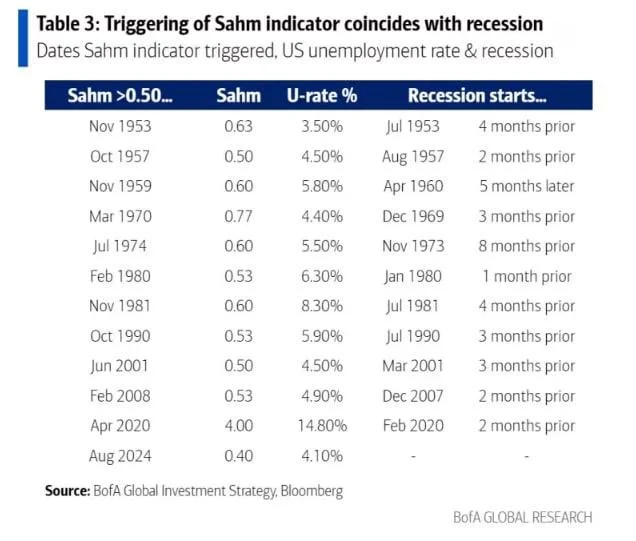
Sahm Recession Rule Trigger Alert 🚨
The Sahm Rule that is designed to signal the start of a recession has officially been triggered. Since 1953, the Sahm Rule has NEVER been wrong!
@ Newshounds News™
Read more: Twitter
~~~~~~~~~
Newshound's Daily Breakdown Podcast Link
Newshound's News Telegram Room Link
Q & A Classroom Link
Follow the Roadmap
Follow the Timeline
Seeds of Wisdom Team™ Website
Subscribe to Newsletter
Thank you Dinar Recaps
Seeds of Wisdom RV and Economic Updates Saturday Morning 8-3-24
Good Morning Dinar Recaps,
US REJECTS VIETNAM'S Request to Lift ‘Non-Market Economy’ Tag
THE QUESTION REMAINS HOW WILL THIS NEWS AFFECT THE VALUE OF THE VIETNAMESE DONG
" The Biden administration rejected Vietnam’s request to be classified officially as a “market economy,” a setback for the country’s efforts to boost exports to its most important market."
"The trade-dependent Southeast Asian economy has pressed the administration to revise the status since the upgrade in diplomatic ties during a visit by President Joe Biden to Vietnam in September last year."
Good Morning Dinar Recaps,
US REJECTS VIETNAM'S Request to Lift ‘Non-Market Economy’ Tag
THE QUESTION REMAINS HOW WILL THIS NEWS AFFECT THE VALUE OF THE VIETNAMESE DONG
" The Biden administration rejected Vietnam’s request to be classified officially as a “market economy,” a setback for the country’s efforts to boost exports to its most important market."
"The trade-dependent Southeast Asian economy has pressed the administration to revise the status since the upgrade in diplomatic ties during a visit by President Joe Biden to Vietnam in September last year."
"The “non-market” economy label mainly works against Vietnam when the US applies anti-dumping complaints. A change would have been a signal of closer ties at a time when the US is seeking to bolster relationships in the region as a counterweight to China. "
"Vietnam, which has signed numerous free trade agreements, is making greater access to the US market a priority. Its total trade — exports and imports — is equivalent to about twice the size of its economy."
@ Newshounds News™
Read more: MSN
~~~~~~~~~
Bitcoin: El Salvador makes CRYPTOCURRENCY LEGAL TENDER
"Congress approved President Nayib Bukele's proposal to embrace the cryptocurrency, with 62 out of 84 possible votes on Tuesday night.
The president said the government had made history, and that the move would make it easier for Salvadoreans living abroad to send money home.
Bitcoin will become legal tender, alongside the US dollar, in 90 days.
The new law means every business must accept Bitcoin as legal tender for goods or services, unless it is unable to provide the technology needed to do the transaction."
""It will bring financial inclusion, investment, tourism, innovation and economic development for our country," President Bukele said in a tweet shortly before the vote.
He has previously said the move will open up financial services to the 70% of Salvadoreans who do not have bank accounts."
NOTE: THIS ARTICLE IS FROM 2021. BITCOIN IS BEING USED AROUND THE WORLD TO BRIDGE THE GAP WHERE LOCAL CURRENCIES ARE SEVERELY DEPRESSED
@ Newshounds News™
Read more: BBC
~~~~~~~~~
Indonesia preps second stage of wholesale CBDC trials
Today Bank Indonesia published its Indonesian Payment System Blueprint (BSPI) 2030. One of the five major initiatives is its central bank digital currency (CBDC) work, THE DIGITAL RUPIAH.
It previously announced three stages of its proof of concept CBDC work. The first is the basic issuance and redemption of a wholesale CBDC (wCBDC) using DLT, which was completed during the first half of 2024. Secondly, it plans to explore the integration of a wCBDC with a digital securities ledger. Thirdly, it will use the wCBDC as a foundation for a retail CBDC.
While today’s paper provides an update, and reiterates the three phases first outlined in 2022, there is a subtle change in emphasis towards the wCBDC. For example, now the third phase following the wCBDC digital securities work will focus on wCBDC for cross border payments.
Notably, Bank Indonesia is an observer on the mBridge cross border CBDC initiative that uses wCBDC. mBridge recently entered the minimum viable product (MVP) phase with its initial participants, including the BIS Innovation Hub and the central banks of China, Hong Kong, Thailand and the UAE. Saudi Arabia recently joined and there are at least 22 observer banks.
@ Newshounds News™
Read more: Ledger Insights
~~~~~~~~~
The Philippines chooses Venom for a groundbreaking national blockchain initiative
Manilla, Philippines, 1 August, Chainwire – Venom Foundation is proud to announce a historic agreement with the government of the Republic of the Philippines to digitize billions of accountable forms using its advanced blockchain technology.
Landmark opportunity and global significance
This initiative represents a pivotal milestone for Venom and the broader crypto industry. In what could end up as the world’s largest blockchain use case, this project underscores Venom’s leadership and innovation in the blockchain space.
By betting on Venom, the Philippine government demonstrates unprecedented trust and confidence in blockchain as a secure, scalable, and efficient solution for national-level operations.
This move is poised to revolutionize the way governments and large institutions handle data, transactions, and record-keeping, setting a new standard for transparency and efficiency.
This breakthrough project not only elevates Venom's standing but also sets the stage for other governments and sovereign nations to adopt the same kind of forward-thinking.
Project scope and impact
The Philippines is making a significant leap forward by launching an ambitious project to use Venom technology to digitize approximately ten billion accountable forms such as but not limited to invoices or receipts, cash tickets, documentary stamps, and special bank receipts, individually identified, accounted for, and afforded appropriate security.
This initiative marks a new phase in the country's digitalization journey and promises to revolutionize financial operations.
The project is expected to significantly enhance transparency, reduce costs, and improve the efficiency and security of financial transactions across the nation. With a population of approximately 115 million, the impact of this digitization effort will be far-reaching, touching every aspect of daily life and commerce in the Philippines.
@ Newshounds News™
Read more: Coin Telegraph
~~~~~~~~~
Russia approves law on legalizing cryptocurrency mining
Requirements for the activities of individuals and legal entities mining digital currency, including participants in mining pools, as well as for individuals organizing their activities, will be established by the Russian Government in coordination with the Bank of Russia
Only Russian legal entities and individual entrepreneurs included in a register will have the right to mine. Individuals who do not exceed the energy consumption limits set by the Russian government will have the right to mine digital currency without being included in the register.
@ Newshounds News™
Read more: TASS
~~~~~~~~~
WHO SETS THE RATES? Common questions about CURRENCY EXCHANGE RATES
"Who's in charge of setting currency exchange rates? If you've ever sent money overseas or checked the rates, this is a question that may have definitely crossed your mind. Who decides what is the value of money, and why do rates fluctuate that much during the day?"
"Every country in the world has its own currency, and each of these currencies is valued differently. When you exchange one currency for another, you're actually buying money, just in a different currency than the one used in your country."
"The exchange rate tells you how much the currency used in your country is worth in foreign currency. The rates CONSTANTLY CHANGE for some countries, whereas others use FIXED exchange rates.
As a rule of thumb, a country's social and economic outlook is the main factor that influences the currency exchange rate."
"Most countries have variable currency exchange rates, which are determined by the foreign exchange market. Because these rates are flexible, they fluctuate every minute, often influenced by market movements, political events, economic forecasts, and more."
"Countries such as the U.S., the United Kingdom, Canada, Japan, and Mexico all use flexible exchange rates. It's important to note that even though government policies can influence currency exchange rates, the government can't actually regulate them. The rates are always determined by Forex traders on the foreign exchange market."
"Several countries use FIXED CURRENCY RATES, and that is because the government dictates when the rates change. This is the case for the Saudi Arabian RIYAL, for example. The fixed rates are pegged to the U.S. dollar, and the central bank in the countries that use this system holds U.S. dollars to keep the rate fixed. "
"The market forces of supply and demand are the main factors that determine currency exchange rates. The level of demand for a currency determines its value in relationship with other currencies. "
@ Newshounds News™
Read more: Xe
~~~~~~~~~
North Carolina lower chamber overturns governor’s veto of CBDC ban
The bill received strong support in the General Assembly. Now, the state Senate will consider overturning the veto.
There is still hope for the bill passed by the North Carolina General Assembly banning the American state from testing or accepting a United States central bank digital currency (CBDC) after the state House of Representatives overturned the governor’s veto. If the state Senate follows suit, the bill will go into force.
The bill passed both chambers of the state legislature in overwhelming bipartisan votes on June 26. The state’s General Assembly is dominated by the Republican party, which has shown strong opposition on the state and national levels to the introduction of a US CBDC. The veto override has already been passed to the Senate Committee on Rules.
More support for the ban than the override
Democratic Governor Roy Cooper vetoed the bill on July 5. Only two Democratic lawmakers voted in favor of overturning the veto, while 40 reversed their stance in the passage of the bill.
@ Newshounds News™
Read more: Coin Telegraph
~~~~~~~~~
US Senator Officially Introduces BITCOIN Act to Establish Strategic BTC Reserve
"U.S. Senator Cynthia Lummis has officially introduced the BITCOIN Act in the Senate, aiming to establish a strategic bitcoin reserve as an additional store of value to strengthen America’s balance sheet. The initiative seeks to position the U.S. as a leader in financial innovation by proposing the purchase of 1 million bitcoins and ensuring robust security measures."
"U.S. Senator Cynthia Lummis (R-WY) announced on Wednesday that she has OFFICIALLY INTRODUCED the Boosting Innovation, Technology, and Competitiveness through Optimized Investment Nationwide (BITCOIN) Act in the U.S. Senate. She unveiled the bill at the recent Bitcoin Conference in Nashville, Tennessee."
"Describing her bill as a “historic proposal to supercharge the U.S. dollar and pay down the national debt by establishing a strategic bitcoin reserve,” Senator Lummis stated:"
"“This is our Louisiana Purchase moment that will help us reach the next financial frontier,” the lawmaker opined.
"Lummis’ BITCOIN Act aims to secure America’s financial future by incorporating bitcoin into the national balance sheet. It proposes the creation of “a decentralized network of secure bitcoin vaults operated by the United States Department of Treasury with statutory requirements ensuring the highest level of physical and cybersecurity for the nation’s bitcoin holdings,” the lawmaker described."
"This legislation will oversee the implementation of “a 1-million-unit bitcoin purchase program over a set period of time to acquire a total stake of approximately 5% of total bitcoin supply, mirroring the size and scope of gold reserves held by the United States,” Lummis noted.
The plan will be funded by reallocating resources within the Federal Reserve System and the Treasury Department, ensuring robust cybersecurity and physical security measures.
The act also upholds the self-custody rights of private bitcoin holders, with Senator Lummis emphasizing that the reserve will not compromise individual financial freedoms."
@ Newshounds News™
Read more: Bitcoin
~~~~~~~~~
Number of Banks in the U.S. – How Many Are There?
"There are currently 4,844 insured commercial banks, according to the Federal Deposit Insurance Corporation (FDIC)."
"The FDIC’s count does not include credit unions. The National Credit Union Administration insures credit unions and tracks them separately. It also doesn’t include fintech apps that aren’t chartered as banks or directly insured by the FDIC. However, fintech apps that accept fiat money deposits (old-fashioned U.S. dollars rather than cryptocurrencies) generally partner with banks that have national charters and FDIC insurance."
"Since the 1980s, the Number of Banks in the U.S. Has Declined"
"The FDIC began counting the number of commercial banks in 1934. That year, 14,146 commercial banks were operating in the United States. That number didn’t change much for the next 50 years. After a low of 13,114 in 1959, the U.S. commercial bank count climbed to an all-time high of 14,469 in 1983.
The following year, the FDIC began tracking the number of savings banks. The inaugural count was 3,550, for a total of 17,810 commercial and savings banks in the United States."
"The U.S. population nearly doubled from 1934 to 1984, so while the number of U.S. banks per capita declined during this period, the industry appeared more or less stable. In other words, new banks formed about as quickly as old ones failed or merged."
"Then, in the mid-1980s, something changed."
"The number of active banks in the U.S. dropped by nearly 6,000 in just 10 years, from 17,754 in 1986 to 11,929 in 1995. This drop coincided with the savings and loan crisis of the late 1980s when thousands of smaller banks went belly-up as real estate prices and mortgage origination activity declined."
"Three factors explain the decline in the number of banks operating in the U.S.: bank failures, bank mergers, and the lack of new banking charters."
@ Newshounds News™
Read more: Money Crashers
~~~~~~~~~
Newshound's Daily Breakdown Podcast Link
Newshound's News Telegram Room Link
Q & A Classroom Link
Follow the Roadmap
Follow the Timeline
Seeds of Wisdom Team™ Website
Subscribe to Newsletter
Thank you Dinar Recaps
Seeds of Wisdom RV and Economic Updates Thursday Afternoon 8-1-24
Good Afternoon Dinar Recaps,
TOKENIZED US TREASURY BILLS ON XRP LEDGER "Tokenization platform OpenEden has announced that it will bring tokenized US Treasury bills (T-bills), a short-term US government debt obligation backed by the US Department of the Treasury, to the XRP Ledger (XRPL) and its users for the first time." "The tokenization of T-bills onto the XRPL is a demonstration of how institutional access to decentralized finance (DeFi) is being driven by the tokenization of traditional real-world assets (RWAs).
The assets backing OpenEden’s TBILL tokens are invested in short-dated US T-bills and reverse repurchase agreements collateralized by US Treasuries. Minters are subject to stringent KYC and AML screening to ensure the highest security and regulatory compliance standards."
Good Afternoon Dinar Recaps,
TOKENIZED US TREASURY BILLS ON XRP LEDGER
"Tokenization platform OpenEden has announced that it will bring tokenized US Treasury bills (T-bills), a short-term US government debt obligation backed by the US Department of the Treasury, to the XRP Ledger (XRPL) and its users for the first time."
"The tokenization of T-bills onto the XRPL is a demonstration of how institutional access to decentralized finance (DeFi) is being driven by the tokenization of traditional real-world assets (RWAs).
The assets backing OpenEden’s TBILL tokens are invested in short-dated US T-bills and reverse repurchase agreements collateralized by US Treasuries. Minters are subject to stringent KYC and AML screening to ensure the highest security and regulatory compliance standards."
"Markus Infanger, Senior Vice President, RippleX. "Institutions are increasingly looking at where to tokenize their real-world assets and the arrival of T-bills on the XRPL powered by OpenEden reinforces the decentralized Layer 1 blockchain as one of the leading blockchains for real-world asset tokenization.”
"“Bringing tokenized T-bills to the XRP Ledger is the next step in our exciting journey. Purchasers will be able to mint our TBILL tokens via STABLECOINS, including Ripple USD (RLUSD) when it launches later this year.”
@ Newshounds News™
Read more: Ripple
~~~~~~~~~
USDC TRADING VOLUME SOARS 48% in July, driven by MiCA
"Circle’s stablecoin trading volume spiked in July thanks to a surge in market inflows and new European (MICA) rules for digital assets.
According to a July 31 report by CCData, the trading volume for USD Coin pairs on centralized exchanges reached $135 billion as of July 25, while its market capitalization rose 5.4% to $33.6 billion."
"With the implementation of the European Union’s Markets in Crypto-Assets (MiCA) regulatory framework, Circle became the first stablecoin issuer to be approved by regulators in the region on July 1."
"According to DefiLlama, USDT retains the largest market share of any stablecoin at nearly 70%. In addition, on July 31, Tether reported record profits of $5.2 billion in the first half of 2024."
"Several crypto exchanges in Europe delisted stablecoins ahead of the implementation of new rules on June 30."
@ Newshounds News™
Read more: Coin Telegraph
~~~~~~~~~
"In a July 2024 CBDC report, it is documented that Russia’s CBDC pilot program has been successful and will extend the number of participants from 34 to 1200 banks/merchants in the second half of 2024."
There’s only 396 operating banks in Russia meaning that the 1200 participants that the CBDC will extend to EVERY BANK IN RUSSIA.
"Therefore, Russia is conveniently passing legislation to allow “international cross border cryptocurrencies” right before they ramp up CBDC usage in 2024"
@ Newshounds News™
Read more: https://x.com/SMQKEDQG/status/1818676859527184787
~~~~~~~~~
Russia's top senator announces progress on BRICS digital payment system
Amid endless sanctions and Russia’s disconnection from SWIFT, the Bank of Russia has developed its own payment system, which many countries have already joined, Valentina Matviyenko noted
MOSCOW, August 1. /TASS/. Plans to create a BRICS digital payment platform are moving steadily forward, Russia’s Federation Council Speaker Valentina Matviyenko told a press conference.
"The creation of the independent financial payment platform BRICS Bridge, a standalone mutual payment system on a firm joint platform, is now being discussed within BRICS. I have spoken both with the Central Bank and the Finance Ministry, things are moving along nicely," she said.
"It is being discussed with colleagues from central banks, finance ministries of all BRICS countries, including new members," Matviyenko said, adding that Russia, as the BRICS chair, is in charge of all this.
"If it works it will be a bombshell globally, in the best sense," the upper chamber head noted. She expressed hope that this issue would be considered at the summit of BRICS heads of states in Kazan in October.
"Perhaps it will be approved then, or at least the discussions will lead to a decision on when and in which format it should be finalized, meaning this is no longer just an idea, it is moving forward in practice," she stressed.
Amid endless sanctions and Russia’s disconnection from SWIFT, the Bank of Russia has developed its own payment system, which many countries have already joined, Matviyenko noted. "This shows that there is a light at the end of every tunnel," she added.
The Federation Council Speaker pointed out that the dollar is becoming weaker globally amid an overflowing US national debt, while the system of mutual settlements in national currencies is expanding.
"I hope that the system that has been created by BRICS, will become a trend, an example that not only BRICS nations, but many other countries as well will join later," she said, adding that the issue is being discussed by the Shanghai Cooperation Organization (SCO) as well.
@ Newshounds News™
Read more: TASS
~~~~~~~~~
MF'S GLOBAL RESERVE ASSET- SDR'S- PAY ATTENTION TO THIS ONE
"Congratulations to members, staff, and leadership on the 80th anniversary of the IMF’s foundation at Bretton Woods, New Hampshire.
The Fund is the crown jewel of the post–World War II international architecture. It was designed by idealists determined to construct a set of institutions to deter aggression among the major powers and prevent resumption of the interwar economic and financial unilateralism."
"The IMF’s principal purpose, according to its Articles of Agreement, is to promote international monetary cooperation by providing “the machinery for consultation and collaboration on international monetary problems.” In the turbulent period following the end of US dollar convertibility to gold in August 1971, members demonstrated that principle and quickly completed the Smithsonian Agreement by December.
The agreement’s new par values for fixing currencies to the US dollar did not hold, though, and within two years, the Bretton Woods exchange rate regime dissolved into a system of managed floating exchange rates."
"The most enticing opportunity is the IMF’s global reserve asset, SPECIAL DRAWING RIGHTS (SDRs)."
"More than 50 years ago, members approved the first amendment to the Articles of Agreement authorizing the IMF to allocate special drawing rights. The negotiations lasted the better part of the 1960s. "
"SDRs are allocated in proportion to IMF members’ quotas. Each member receives an interest-bearing reserve asset and corresponding long-term liability on which it pays the same rate. The SDR’s value is based on a BASKET OF CURRENCIES with weights adjusted periodically by the IMF board.
Its interest rate is a weighted average of the short-term government interest rates for the constituent currencies.An SDR allocation adds to a member’s unconditional liquidity.
Unlike unconditional liquidity derived from borrowing or current account surpluses, the liquidity is costless until the SDRs are transferred to another holder."
"The initial allocation of SDRs annually over a three-year period starting in 1969 proved to be too little too late to save the Bretton Woods exchange rate regime, but nevertheless it was a pathbreaking and historic example of international monetary cooperation.
The second amendment to the articles, in 1978, not only preserved the IMF’s authority to allocate SDRs but also established a two-part obligation for members to collaborate on “better international surveillance of international liquidity” and “making the special drawing right the PRINCIPAL RESERVE ASSET of the international monetary system."
"SDRs are not a magic bullet that alone will solve today’s pressing global economic and financial challenges, but they are one of many instruments that can contribute."
@ Newshounds News™
Read more: IMF
~~~~~~~~~
Newshound's Daily Breakdown Podcast Link
Newshound's News Telegram Room Link
Q & A Classroom Link
Follow the Roadmap
Follow the Timeline
Seeds of Wisdom Team™ Website
Subscribe to Newsletter
Thank you Dinar Recaps
Seeds of Wisdom RV and Economic Updates Wednesday Afternoon 7-31-24
Good Afternoon Dinar Recaps,
RUSSIA LEGALIZES BITCOIN AND CRYPTO TRANSACTIONS FOR GOVERNMENT AND BUSINESSES "In a significant legislative move, Russian lawmakers have passed a bill permitting businesses to use Bitcoin and other cryptocurrencies in international trade, according to a report by Retuers.
This development is part of Russia's strategy to circumvent Western sanctions imposed following the invasion of Ukraine. The new law, expected to take effect in September, aims to address delays in international payments, particularly with key trading partners like China, India, and the UAE."
"Central bank Governor Elvira Nabiullina, a proponent of the law, announced that the first cryptocurrency transactions will occur before the year's end. The central bank will establish an "experimental" infrastructure for these payments, with further details pending."
Good Afternoon Dinar Recaps,
RUSSIA LEGALIZES BITCOIN AND CRYPTO TRANSACTIONS FOR GOVERNMENT AND BUSINESSES
"In a significant legislative move, Russian lawmakers have passed a bill permitting businesses to use Bitcoin and other cryptocurrencies in international trade, according to a report by Retuers.
This development is part of Russia's strategy to circumvent Western sanctions imposed following the invasion of Ukraine. The new law, expected to take effect in September, aims to address delays in international payments, particularly with key trading partners like China, India, and the UAE."
"Central bank Governor Elvira Nabiullina, a proponent of the law, announced that the first cryptocurrency transactions will occur before the year's end. The central bank will establish an "experimental" infrastructure for these payments, with further details pending."
"The legislation also includes regulations on cryptocurrency mining and the circulation of other digital assets but maintains the ban on cryptocurrency payments within Russia. The central bank highlighted that payment delays have caused an 8% drop in Russian imports in the second quarter of 2024.
"Despite efforts to shift to trading partners' currencies and develop an alternative BRICS payment system, many transactions still rely on dollars and euros via the SWIFT system, risking secondary sanctions. Nabiullina emphasized that these sanctions have complicated import payments, extending supply chains and increasing costs."
" Anatoly Aksakov, the head of the Duma lower house of parliament, reportedly told lawmakers, "We are taking a historic decision in the financial sphere" by passing this legislation. "
@ Newshounds News™
Read more: Bitcoin Magazine
~~~~~~~~~
DIGITAL RUSSIAN RUBLE SET FOR MASS DISTRIBUTION JULY 2025
"MOSCOW, July 30. /TASS/. If the digital ruble is successfully tested its mass introduction is possible starting July 2025, Russian Central Bank Governor Elvira Nabiullina said addressing the Federation Council (upper house of the parliament)."
"Now I can say that if everything goes as we plan further on, with pilots implemented successfully, we will be able to shift from tests to massively introducing the digital ruble from July 2025. We target those dates, though it will be a gradual process, a gradual process of using digital rubles," she said.
"Russian President Vladimir Putin said earlier that the platform of digital ruble showed efficiency and reliability as it was tested."
"The Bank of Russia has been implementing a pilot project with real digital rubles since August 15, 2023. At the first stage, active operations are tested, such as opening wallets in digital rubles for banks and clients (individuals and legal entities), transferring digital rubles between clients, and payments at trade and service enterprises."
@ Newshounds News™
Read more: TASS
~~~~~~~~~
Statement of Commissioner Caroline D. Pham in Support of Foreign Boards of Trade Final Rule
July 29, 2024
I support the Foreign Boards of Trade (FBOT) Final Rule because it promotes access to markets for U.S. participants, competition, and liquidity. I would like to thank Maura Dundon, Roger Smith, and Alexandros Stamoulis in the CFTC’s Division of Market Oversight for their work on this rulemaking.
I will reiterate key points from my statement on the FBOT proposed rule. [1] As a CFTC Commissioner, I have made it clear that I believe in good policy that enables growth, progress, and access to markets.[2]
Accordingly, I am pleased to support Commission efforts that take a pragmatic approach to issues that hinder market access and cross-border activity. I continue to believe that this rulemaking exemplifies policy that ensures a level playing field, and I applaud this step in the right direction for market structure.
FBOTs have been a critical piece of the CFTC’s markets for decades and provide access for U.S. market participants to non-U.S. markets in realization of the global economy and international business.[3]
The main substantive amendment in the FBOT Final Rule is to Regulation 48.4, which will now include
1. introducing brokers (IBs)[4] as a permissible intermediary, in addition to
2. futures commission merchants (FCMs),
3. commodity pool operators (CPOs), and
4. commodity trading advisors (CTAs),
to enter orders on behalf of customers or commodity pools via direct access on a registered FBOT.[5]
I believe that the FBOT Final Rule will provide more choice in brokers and broker arrangements for U.S. market participants that trade foreign futures and ensure that appropriate customer protections are in place.
As sponsor of the CFTC’s Global Markets Advisory Committee (GMAC),[6] I have devoted a significant part of my Commissionership to supporting solutions that will enhance the resiliency and efficiency of global markets.[7] The FBOT Final Rule is policy that mitigates market fragmentation and the associated impact on liquidity, and promotes the overall competitiveness of our derivatives markets. I am pleased to support the FBOT Final Rule.
@ Newshounds News™
Read more: CFTC
~~~~~~~~~
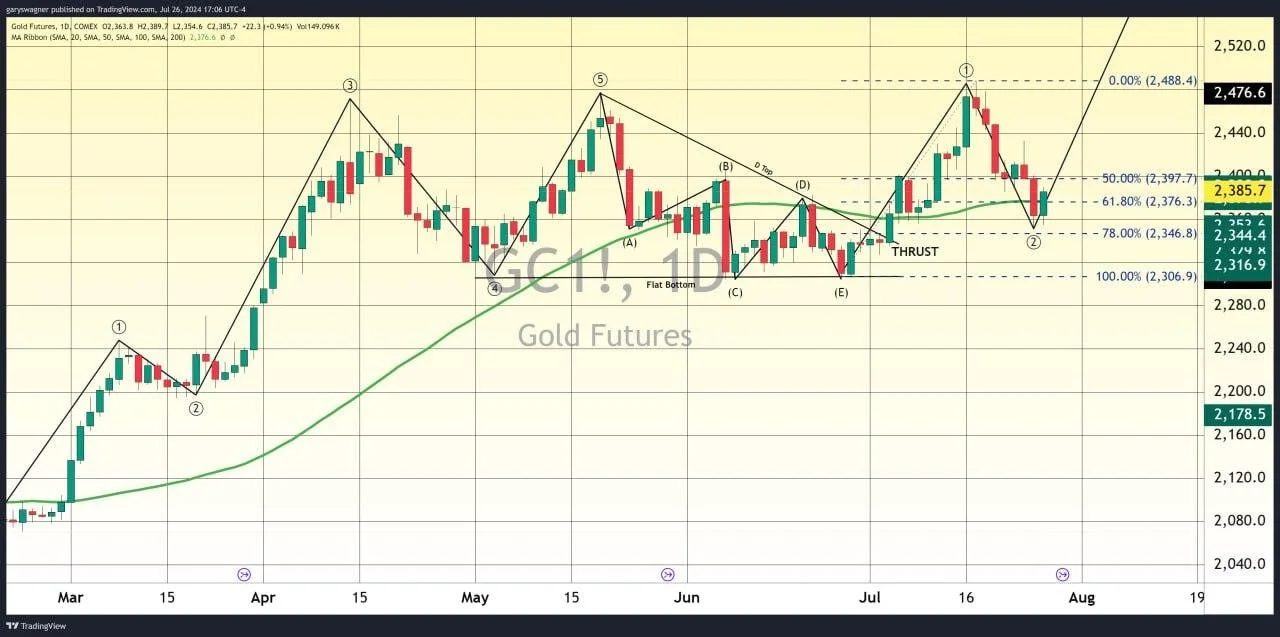
GOLD ON THE MOVE with Fed Rate Cut Speculation
"The latest economic data has sparked renewed optimism in the gold market, with prices climbing over $20 as investors digested signs of cooling inflation and robust economic growth"
"The central bank’s actions in the coming months could have far-reaching implications for gold prices and the broader financial landscape."
@ Newshounds News™
Read more: Dedollarize News
~~~~~~~~~
Bank of England seeks feedback for wholesale CBDC trials
Today the Bank of England published a discussion paper on innovation in money and payments. While it covers payments across the board, it aims to gather feedback for planned wholesale central bank money trials. This will include both a wholesale central bank digital currency (wCBDC) and a synchronization solution enabling DLT transactions to settle using the real-time gross settlement (RTGS) system.
The report states, “We judge that these risks are an order of magnitude greater than the risks posed by retail use cases.”
At a retail level, the UK is now testing tokenized deposits through the Regulated Liability Network initiative. However, the paper warns of the need for progress. “Commercial bank money needs to keep pace with the needs of consumers and so carry functionalities to deliver safe and sustainable innovation in payments,” wrote the authors. “Absent such innovation, central banks may be left as the only game in town insofar as retail payments innovation is concerned.”
Regarding the wholesale CBDC trials,
in conjunction with the BIS Innovation Hub, the Bank already ran Project Meridian, which enabled a digital real estate transaction to settle via connectivity with the RTGS. Currently it’s running Project Meridien FX with the European Central Bank.
The paper outlines a series of planned wholesale tests for both the wCBDC and the synchronization solution. It envisages the latter as being a third system that integrates between the RTGS and various DLTs. It wants to run the tests side-by-side so it can make comparisons between the wCBDC and synchronization risks and complexity.
The tests encompass delivery versus payment (DvP). Other uses cases will involve payment versus payment (PvP). Synchronization is already being trialed as part of Project Meridian FX, but it also wants to explore wCBDC.
Finally, it will test interoperability with global initiatives such as the BIS Project Agorá for cross-border payments in which the Bank is a participant.
@ Newshounds News™
Read more: Ledger Insights
~~~~~~~~~
UAE residents can now trade crypto directly with their bank accounts
The new integration enables the direct conversion of UAE dirhams into Bitcoin and Ether using M2’s spot market.
Crypto exchange M2 announced that it will allow residents in the United Arab Emirates to buy and sell Bitcoin and Ether directly using their bank accounts.
In an announcement shared with Cointelegraph, the digital asset custodian said that the new integration allows UAE residents to directly convert their dirhams into Bitcoin and Ether. Through trading pairs listed on M2’s spot markets, users can trade BTC and ETH for dirhams and vice versa. In addition, users can also deposit and withdraw dirhams.
The M2 team believes that the new integration enables users to “swiftly adapt to market changes,” allowing them to easily convert their local currency into crypto.
Wider accessibility of virtual assets in the UAE
According to M2, the new integration allows the exchange to expand its offerings amid a rapidly evolving landscape. The team also believes the new integration is a milestone for the “wider accessibility of virtual assets in the region.”
Kimmel told Cointelegraph that the new integration could also help everyday investors, especially those who are not “fully entrenched” in the nuances of the trading environment.
UAE is one of the world’s “strictest” in consumer protection. In addition, the executive highlighted that this move is also regulated by the UAE government, which he described as one of the world’s “strictest regulatory frameworks” that prioritizes consumer protection.
@ Newshounds News™
Read more: Coin Telegraph
~~~~~~~~~
HOW MUCH MONEY IS IN CRYPTO?
HAVE YOU EVER CONSIDERED THE MARKET CAP ON THE LARGEST CRYPTOCURRENCIES?
IT MIGHT SURPRISE YOU
1. BITCOIN 1.3 Trillion
2. ETHEREUM 398 Billion
3. TETHER-USDT 114 Billion
4. BNB 86 Billion
5. SOLANA 84 Billion
6. XRP 35 Billion
7. USDC 33 Billion
8. DOGE 18 Billion
9. TON 17 Billion
10. CARDANO ADA 18 Billion
@ Newshounds News™
Read more: Coin Market Cap
~~~~~~~~~
What Is Market Capitalization?
"Market capitalization, or "market cap," represents the total dollar market value of a company's outstanding shares of stock. Investors use this figure to determine a company's size instead of sales or total asset value."
"Market capitalization estimates a company's value by extrapolating what the market thinks it is worth for publicly traded companies and multiplying the share price by the number of available shares. After a company goes public and begins trading on an exchange, its share price is determined by supply and demand. As market prices move, the market cap becomes a real-time estimate of the company's value. "
Market Cap and Digital Currency
Because new digital currency offerings theoretically thin the value of existing coins, tokens, or shares, a different market cap formula can be used to calculate the market cap for all authorized shares or tokens. Analysts use diluted market cap to understand potential changes to a security, token, or coin's price."
@ Newshounds News™
Read more: Investopedia
~~~~~~~~~
Newshound's Daily Breakdown Podcast Link
Newshound's News Telegram Room Link
Q & A Classroom Link
Follow the Roadmap
Follow the Timeline
Seeds of Wisdom Team™ Website
Subscribe to Newsletter
Thank you Dinar Recaps
Seeds of Wisdom RV and Economic Updates Tuesday Afternoon 7-30-24
Good afternoon Dinar Recaps,
USDT= TETHER'S STABLECOIN IS THE BIGGEST CRYPTOCURRENCY BEHIND BITCOIN IN EAST ASIA
"There’s arguably nothing special about Tether in itself, not least because the stablecoin still hasn’t undergone a full audit. However, it has become a lifeline in parts of the world where trading crypto with fiat currencies is either prohibited or very difficult, whereas it remains marginal in markets such as the United States."
"Tether may be viewed with a mixture of suspicion and bemusement in the West, but in East Asia it is the biggest cryptocurrency after Bitcoin."
"According to Chainalysis’ 2020 Geography of Cryptocurrency Report, STABLECOINS account for 33% of all value traded on-chain in East Asia, as opposed to 21% or Western Europe and 17% for North America. And of the STABLECOINS traded in East Asia, 93% of the traded value comes from Tether."
Good Afternoon Dinar Recaps,
USDT= TETHER'S STABLECOIN IS THE BIGGEST CRYPTOCURRENCY BEHIND BITCOIN IN EAST ASIA
"There’s arguably nothing special about Tether in itself, not least because the stablecoin still hasn’t undergone a full audit. However, it has become a lifeline in parts of the world where trading crypto with fiat currencies is either prohibited or very difficult, whereas it remains marginal in markets such as the United States."
"Tether may be viewed with a mixture of suspicion and bemusement in the West, but in East Asia it is the biggest cryptocurrency after Bitcoin."
"According to Chainalysis’ 2020 Geography of Cryptocurrency Report, STABLECOINS account for 33% of all value traded on-chain in East Asia, as opposed to 21% or Western Europe and 17% for North America. And of the STABLECOINS traded in East Asia, 93% of the traded value comes from Tether."
"This is big, and pretty much all of this outflow comes from China. As the table below indicates, Chinese traders exclusively use Tether to trade with Bitcoin, while traders in Japan and South Korea predominantly use their respective national currencies."
@ Newshounds News™
Read more: Crypto Advantage
~~~~~~~~~
UK joins ‘E-Commerce Joint Initiative’ to promote digitalization of customs documents and processes
The agreement, known as the E-Commerce Joint Initiative, was finalized on July 26, 2024, after five years of negotiations involving 90 countries, aiming to eliminate customs duties on digital content
▪️ The agreement eliminates customs duties on digital content, lowering costs for UK businesses
▪️ It mandates the adoption of digital customs systems and e-documents, potentially increasing UK GDP by up to £24.2 billion
▪️ The initiative also introduces legal safeguards against online fraud, enhancing consumer protection.
The UK has joined a groundbreaking global digital trade agreement, the first of its kind negotiated under the World Trade Organization (WTO).
The agreement, known as the E-Commerce Joint Initiative, was finalized on July 26, 2024, after five years of negotiations involving 90 countries.
This initiative aims to modernize international trade by promoting the digitalization of customs documents and processes, and is expected to significantly benefit the UK economy.
Digitalisation of customs documents and processes
The E-Commerce Joint Initiative focuses on creating a more efficient and secure global trade environment.
By committing to the digitalization of customs documents and processes, the agreement seeks to replace outdated paper-based systems.
This transition is expected to save time and reduce costs for businesses by eliminating the need for physical signatures and the physical exchange of documents.
The Organization for Economic Co-operation and Development (OECD) estimates the value of global digital trade at around £4 trillion and growing.
The UK’s involvement in this agreement could see a significant economic boost.
According to the UK government’s analysis, adopting advanced digital trading systems could increase the UK’s GDP by up to £24.2 billion, based on 2023 GDP figures.
The agreement also aims to protect consumers from online fraud and misleading product claims.
By establishing a common set of rules, it helps create a safer environment for digital transactions.
For UK businesses, particularly those in financial services, the adoption of e-documents and e-signatures will simplify international transactions, reducing reliance on paper contracts and manual processes.
@ Newshounds News™
Read more: Trade Finance Global
~~~~~~~~~
WTO Agreement Looks to Pave Way for Paperless Cross-Border Commerce
With the news that five years of trade negotiations under the World Trade Organization (WTO) Joint Statement Initiative on Electronic Commerce reached a milestone Friday (July 26) — with participants agreeing to a two-year extension of a moratorium on taxation of cross-border electronic transmissions — mitigating the fragmentation that businesses face when transacting internationally is top of mind for global enterprises.
The 91 WTO members participating in the discussions account for over 90% of global trade, and the joint statement’s co-conveners, Australia, Japan and Singapore, were able to pass an agreement banning the imposition of “customs duties on electronic transmissions between a person of one Party and a person of another Party.”
Role of Standardization
Crucially, within the text of the WTO agreement, are the hints of a slow-but-sure reimagining of cross-border commerce’s digital transformation — both around international e-invoicing and paperless global trade.
“The Parties recognize that electronic invoicing frameworks can help improve the cost effectiveness, efficiency, accuracy, and reliability of electronic commerce transactions.
As PYMNTS has covered, the move toward e-invoicing is not merely about converting a paper invoice into a digital format; it’s about reimagining the entire business-to-business (B2B) invoicing process to be more streamlined and better integrated into digital business ecosystems.
The workflow transformation promises to reduce errors, lower costs, and speed up B2B payment processes, offering benefits to companies of all sizes.
Already, more than 80 countries have put in place a mandate for e-invoicing or continuous transaction control (CTC) requirements as governments around the world look to prioritize tax reform and real-time reporting.
PYMNTS Intelligence data has found that nearly half (45%) of small and medium-sized businesses (SMBs) cited manual invoice review as a problem when making payments, with 19% saying it was their top issue.
“With a view to creating a paperless border environment for trade in goods, the Parties recognize the importance of eliminating paper forms and documents required for importation, exportation, or transit of goods …
Cross-border payments often involve multiple intermediaries, resulting in high fees and long processing times.
“If you do a $10 transaction today, you’ll probably spend a very significant part of that $10 as fees. And we need to get to a point where that base fee is something that you don’t have to think about, so that you can do low-value transactions at scale — that could change the landscape of cross-border payments,” Ram Sundaram, COO at TerraPay, explained to PYMNTS.
@ Newshounds News™
Read more: PTMNTS
~~~~~~~~~
RICS Summit 2024
Russia will hold the BRICS Summit in Kazan from October 22 to 24, 2024.
During its BRICS presidency this year, Russia has said it will focus on "promoting the entire range of partnership and cooperation within the framework of the association on three key tracks – politics and security, the economy and finance, and cultural and humanitarian ties."
@ Newshounds News™
Read more: Uniting to Combat NTDs
~~~~~~~~~
Newshound's Daily Breakdown Podcast Link
Newshound's News Telegram Room Link
Q & A Classroom Link
Follow the Roadmap
Follow the Timeline
Seeds of Wisdom Team™ Website
Subscribe to Newsletter
Thank you Dinar Recaps
Seeds of Wisdom RV and Economic Updates Tuesday Morning 7-30-24
Good morning Dinar Recaps,
EU and Singapore finalise Digital Trade Agreement
The European Union (EU) and Singapore have successfully concluded negotiations for a landmark Digital Trade Agreement (DTA), an initiative aimed at setting global standards for digital trade and cross-border data flows.
On 25 July 2024, the European Union (EU) and Singapore successfully concluded negotiations for a landmark Digital Trade Agreement (DTA), an initiative aimed at setting global standards for digital trade and cross-border data flows.
This agreement, the first of its kind for the EU, complements the existing 2019 EU-Singapore Free Trade Agreement (EUSFTA) and shows deepening economic relations between the two regions.
Good Morning Dinar Recaps,
EU and Singapore finalise Digital Trade Agreement
The European Union (EU) and Singapore have successfully concluded negotiations for a landmark Digital Trade Agreement (DTA), an initiative aimed at setting global standards for digital trade and cross-border data flows.
On 25 July 2024, the European Union (EU) and Singapore successfully concluded negotiations for a landmark Digital Trade Agreement (DTA), an initiative aimed at setting global standards for digital trade and cross-border data flows.
This agreement, the first of its kind for the EU, complements the existing 2019 EU-Singapore Free Trade Agreement (EUSFTA) and shows deepening economic relations between the two regions.
The DTA is designed to facilitate digitally-enabled trade in goods and services, ensuring that data flows across borders without unjustified barriers.
It provides a framework that guarantees consumer trust, predictability, and legal certainty for businesses, especially small and medium-sized enterprises (SMEs).
This agreement also includes rules on spam and cybersecurity, reinforcing the EU and Singapore’s commitment to a secure digital environment (Trade) (EURAXESS).
European Commission Executive Vice-President Valdis Dombrovskis and Singapore’s Minister-in-charge of Trade Relations Grace Fu announced the conclusion of the negotiations, highlighting the agreement’s importance.
They emphasised that the DTA not only reflects the growing digital economies of the EU and Southeast Asia but also their shared commitment to maintaining open, competitive, and fair digital markets.
The agreement is part of the EU’s broader strategy to update digital trade rules globally, as seen in recent digital trade chapters with the UK, Chile, and New Zealand.
The EU and Singapore will now proceed with their respective domestic procedures to formally sign and conclude the DTA.
The deal is expected to enhance the digital transformation of both economies, fostering innovation and providing new economic opportunities.
It also aligns with the EU’s Indo-Pacific strategy, aiming to strengthen ties with key partners in this region.
In conjunction with the DTA, the second Trade Committee meeting under the EUSFTA took place, co-chaired by Minister Fu and Executive Vice-President Dombrovskis.
They noted the strong trade relations between the EU and Singapore, with annual trade in goods and services surpassing €130 billion in 2022.
The meeting also covered bilateral cooperation in areas like the green economy and discussed recent global economic developments, including issues at the World Trade Organisation (WTO).
The EU-Singapore Digital Partnership, launched in February 2023, laid the groundwork for this agreement.
This partnership included Digital Trade Principles aimed at facilitating the free flow of goods and services while upholding privacy and data protection standards.
The Digital Partnership and the DTA together represent a significant advancement in the EU’s efforts to lead in global digital governance.
The formal signing and implementation of the EU-Singapore Digital Trade Agreement will further strengthen economic ties and provide a model for future digital trade agreements worldwide.
The agreement is expected to be fully operational by mid-2025, providing a boost to digital commerce and innovation in both regions.
@ Newshounds News™
Read more: Trade Finance Global
~~~~~~~~~
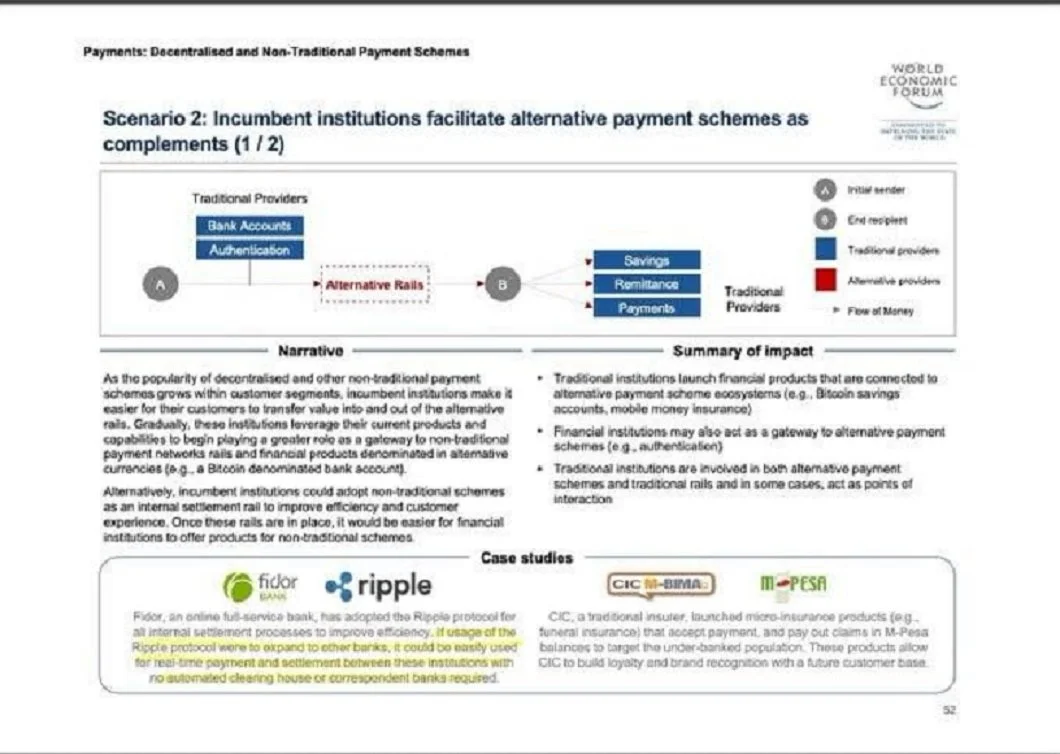
World Economic Forum document on “Decentralized and Non-Traditional Payment Schemes” cites Ripple as an example of an alternative rail for traditional payment systems 🔑
“If usage of the Ripple protocol were to expand to other banks, it could be EASILY used for real-time payment and settlement BETWEEN these institutions with NO automated clearing house or correspondent banks required.”
@ Newshounds News™
Read more: Twitter
~~~~~~~~~
TRUMP'S PLAN IS TO DOLLARIZE THE WORLD THROUGH STABLECOINS
"This past Saturday, former president Donald Trump addressed the Bitcoin 2024 conference in Nashville, Tennessee, expounding upon the crypto and bitcoin policies likely to be implemented as part of a likely future Trump administration.
Speaking in front of a banner emblazoned with the logo of Xapo bank, an institution which hopes to serve as a global bridge between bitcoin, the U.S. dollar and stablecoins, Trump’s speech revealed a policy vision that would integrate those three in order to “extend the dominance of the U.S. dollar to new frontiers all around the world.”
"Talk of a threatened dollar has been circulating for years, with the petrodollar system now having ended and increasingly influential power blocs seeking alternatives to the dollar as a reserve currency. However, Trump – per his recent speech – seems poised to employ bitcoin as a sink for out-of-control U.S. government debt and to unleash the expansion of digital dollar stablecoins, which are already quietly dollarizing numerous countries in the Global South as the consequences of Covid-era fiscal policies continue to decimate the purchasing power of the 99% globally."
"Trump promised, among other things, to “create a framework to enable the safe, responsible expansion of stablecoins […] allowing us to extend the dominance of the U.S. dollar to new frontiers all around the world.” He then asserted that, as a result of his future administration’s embrace of dollar stablecoins, “America will be richer, the world will be better, and there will be billions and billions of people brought into the crypto economy and storing their savings in bitcoin."
@ Newshounds News™
Read more: Bitcoin Magazine
~~~~~~~~~
Newshound's Daily Breakdown Podcast Link
Newshound's News Telegram Room Link
Q & A Classroom Link
Follow the Roadmap
Follow the Timeline
Seeds of Wisdom Team™ Website
Subscribe to Newsletter
Thank you Dinar Recaps
Seeds of Wisdom RV and Economic Updates Monday Afternoon 7-29-24
Good afternoon Dinar Recaps,
Worldwide, People Reject the Central Bank Digital Currency
"Do people want central bank digital currencies, better known as CBDCs? Countries that have experimented with or launched digital versions of their respective currencies have witnessed little fanfare for these endeavors. Put simply, they are not appealing to the general public.
Yet governments are still foisting them onto their populations, perhaps because they might be the greatest surveillance tool known to man."
"At the onset of the coronavirus pandemic, the Bahamas became the first nation in the world to issue a central bank digital currency. Whether it was out of fear that touching physical cash would result in COVID is unclear.
Good afternoon Dinar Recaps,
Worldwide, People Reject the Central Bank Digital Currency
"Do people want central bank digital currencies, better known as CBDCs? Countries that have experimented with or launched digital versions of their respective currencies have witnessed little fanfare for these endeavors. Put simply, they are not appealing to the general public.
Yet governments are still foisting them onto their populations, perhaps because they might be the greatest surveillance tool known to man."
"At the onset of the coronavirus pandemic, the Bahamas became the first nation in the world to issue a central bank digital currency. Whether it was out of fear that touching physical cash would result in COVID is unclear.
But the Caribbean island made history nevertheless by unleashing the Sand Dollar digital currency. It maintains two forms: retail and wholesale. The former allows consumers to utilize the CBDC, while the latter is solely dedicated to financial institutions."
"Now, about four years after the Sand Dollar’s introduction, it accounts for less than 1% of the money in circulation as acceptance and usage by businesses and consumers remain limited.
Additionally, digital wallet values tumbled to $12 million in the first eight months of last year (the latest data), down from $49.8 million in the same period a year ago."
"China became one of the world’s largest economies to introduce a central bank digital currency, known as the digital yuan or e-CNY. It had been years in the making, and because the Asian powerhouse is a hyper-digital location, officials had high expectations and believed their communities would ebulliently embrace the e-CNY. Today, there is very little action in the world of CBDCs."
"INDIA'S CBDC – the digital RUPEE – has experienced a decline in usage. Transaction rates had been solid in the months following its launch, mainly because the country’s banks had disbursed employee benefits in CBDC units. However, more consumers and merchants have shrugged off the authoritarian digital payment “innovation” throughout 2024."
"With growing pushback, central banks have modified their expectations. According to a 2023 Business of International Settlements survey, the number of central banks that are very likely to issue a retail or wholesale CBDC within three to six years has diminished significantly from the 2022 survey."
"The Atlantic Council maintains a CBDC tracker, which shows that 36 countries are in the pilot phase. Thirty are still in the development stage, and 44 are actively researching a central bank digital currency. Seventeen are inactive, while two have been canceled.
What about the United States? The Federal Reserve insists that it is several years away from putting together a CBDC. Republican lawmakers have introduced legislation to put the kibosh on its creation. Former President Donald Trump and independent presidential candidate Robert F. Kennedy, Jr. pledge to ban the formation of a CBDC."
@ Newshounds News™
Read more: Currency Insider
~~~~~~~~~
Indian Expert Says BRICS, SCO May MERGE in Five Years
" BRICS (Brazil, Russia, India, China, South Africa) may merge with the Shanghai Cooperation Organization (SCO) within the next five years, giving birth to a stronger entity with a more meaningful role, Robinder Sachdev, president of the New Delhi-based analytical center, the Imagindia Institute, told TASS."
"Both BRICS and SCO are initially founded by China and Russia. Many big picture goals of both organizations are same. It is necessary for both organizations to have very different roadmap in future. Otherwise, I have said many times that it is now time to consider merging of the SCO and BRICS into a single organization."
""If the BRICS countries work together strongly on some common agenda then BRICS can have an important role. If BRICS becomes a strong organization, then it can play very important role in building the New World Matrix of the 21st century," he stressed.
"BRIC was established in 2006 by Brazil, Russia, India, and China. In 2011, South Africa joined the group, adding the S to the acronym."
"Set up in 2001 in Shanghai, the SCO initially included six countries, namely Russia, Kazakhstan, Kyrgyzstan, China, Tajikistan, and Uzbekistan. India and Pakistan joined in 2017. Iran was admitted to the organization at the SCO virtual summit in early July.
@ Newshounds News™
Read more: TASS
~~~~~~~~~
XRP News Today: Ripple-Led $1.5 Billion Token Flood to Hit Market in August
August is a major month for crypto token unlocks, with nearly $1.5 billion worth of tokens hitting the market.
Ripple leads the pack with a $609 million XRP unlock, followed by Avalanche and Wormhole.
Numerous other projects, including Sui, dYdX, ZetaChain, ImmutableX, Aptos, The Sandbox, Starknet, and Arbitrum.
XRP This morning $0.61 up 0.54%
@ Newshounds News™
Read more: Coinpedia
~~~~~~~~~
Swiss regulator FINMA targets stablecoin issuers in new proposal
As stablecoins continue to gain traction globally, regulatory initiatives such as FINMA’s guidance are likely to influence policies in other jurisdictions.
In a move aimed at bolstering regulatory oversight and mitigating financial risks, the Swiss Financial Market Supervisory Authority (FINMA) has proposed new guidelines for stablecoin issuers. The proposal comes amid growing concerns over the potential impact of stablecoins on regulated institutions and the broader financial ecosystem.
Stablecoins — digital assets linked to the value of traditional currencies or other assets — have experienced increased adoption. However, their rapid growth has also prompted global regulatory concerns due to potential illicit activity and misuse.
In its guidance issued on July 26, FINMA emphasized that stablecoin issuers must be subject to the same Anti-Money Laundering (AML) obligations as traditional financial institutions. This includes verifying the identity of stablecoin holders and establishing the identity of beneficial owners.
In addition to AML compliance, FINMA explained how stablecoin issuers can operate without a banking license if they meet certain conditions. It claims that these conditions ensure depositors are protected, and issuers must have a bank guarantee in case of default.
While FINMA claims its measures boost depositor protection, they do not match the security of a banking license. Still, the regulator is committed to mitigating default guarantee risks and ensuring stablecoin issuers meet robust standards to safeguard customers.
The stablecoin sector has experienced exponential expansion in recent times, reaching an unprecedented market capitalization in 2023. In response, global regulators are hastening to establish guidelines for this rapidly evolving sector.
According to the “PwC Global Crypto Regulation Report 2023,” at least 25 countries, including Switzerland, had implemented stablecoin regulations or legislation by the year’s end.
@ Newshounds News™
Read more: Coin Telegraph
~~~~~~~~~
Malaysia sends application to Russia to join BRICS — PM
Lavrov promised that as the BRICS president Russia will help Malaysia promote its interest to the partnership with the association
TOKYO, July 28. /TASS/. Malaysia has sent an application for BRICS membership to Russia, which is currently holding BRICS presidency, Malaysian Prime Minister Anwar Ibrahim said.
"Malaysia has sent a letter of application to join the (BRICS) organization to Russia as the BRICS chairman, besides expressing openness to participate as a member country or strategic partner," the BERNAMA news agency quoted him as saying.
Earlier on Sunday, Anwar Ibrahim met with visiting Russian Foreign Minister Sergey Lavrov. According to the Malaysian prime minister, the conversation focused on Malaysia’s application to join BRICS, which, in his words, will have a considerable potential for both sides.
Anwar and Lavrov also discussed "the current situation in Palestine, with Malaysia emphasizing the urgent need for a permanent ceasefire and rapid humanitarian aid in Gaza, as well as Palestine’s acceptance as a full member of the United Nations," the agency said. "Regarding Ukraine, Anwar also called for dialogue and discussion as the means to resolve the conflict."
Lavrov promised that as the BRICS president Russia will help Malaysia promote its interest to the partnership with the association.
@ Newshounds News™
Read more: TASS
~~~~~~~~~
Newshound's Daily Breakdown Podcast Link
Newshound's News Telegram Room Link
Q & A Classroom Link
Follow the Roadmap
Follow the Timeline
Seeds of Wisdom Team™ Website
Subscribe to Newsletter
Seeds of Wisdom RV and Economic Updates Monday Morning 7-29-24
Good Morning Dinar Recaps,
Financial Stability Implications of Emerging Market CURRENCY DEVELOPMENTS
"A global soft landing remains the base case, as the July World Economic Outlook update showed. The forecast for economic growth in emerging markets has changed little, with projections edging up to 4.3 percent for both this year and next. Inflation in most major emerging markets is forecast to ease further and reach target ranges, allowing monetary policy to ease in the foreseeable future."
"And yet, emerging market currencies have declined by about 4 percent year-to-date, on net, against the US dollar, even after partially recovering in recent weeks. Latin American currencies have dropped 5 percent, while currencies in Asian emerging markets are lower by 4 percent.
Central and Eastern European and African currencies saw milder depreciations. It’s important to assess whether further declines could have adverse consequences for financial stability."
Good Morning Dinar Recaps,
Financial Stability Implications of Emerging Market CURRENCY DEVELOPMENTS
"A global soft landing remains the base case, as the July World Economic Outlook update showed. The forecast for economic growth in emerging markets has changed little, with projections edging up to 4.3 percent for both this year and next. Inflation in most major emerging markets is forecast to ease further and reach target ranges, allowing monetary policy to ease in the foreseeable future."
"And yet, emerging market currencies have declined by about 4 percent year-to-date, on net, against the US dollar, even after partially recovering in recent weeks. Latin American currencies have dropped 5 percent, while currencies in Asian emerging markets are lower by 4 percent.
Central and Eastern European and African currencies saw milder depreciations. It’s important to assess whether further declines could have adverse consequences for financial stability."
"A key determinant of exchange rates is the difference in interest rates between a given country and the United States—the benchmark in global capital markets.
At the beginning of this year, investors expected the Federal Reserve to cut interest rates significantly, which would widen or at least maintain the interest differentials with emerging markets.
With the US economy proving stronger than previously anticipated and inflation not yet reaching the Fed’s target, expectations for US interest rate cuts dissipated over the course of the year, and the US dollar appreciated. As a result, major emerging markets’ interest rate differentials vis-à-vis the US narrowed. "
CURRENCIES AND FINANCIAL STABILITY
"Orderly depreciation of a currency toward levels broadly in line with economic fundamentals—including interest rate differentials—can be constructive for an economy.
More troubling are cases where there are abrupt selloffs, which can trigger financial instability. Sudden foreign capital outflows can severely affect asset prices and open up funding gaps. Financial institutions could see foreign exchange mismatches intensify and may be unable to rollover foreign currency (particularly US dollar) funding at reasonable costs"
@ Newshounds News™
Read more: IMF
~~~~~~~~~
US home sales fell in June to slowest pace since December amid rising mortgage rates, home prices
LOS ANGELES (AP) — The nation’s housing slump deepened in June as sales of previously occupied homes slowed to their slowest pace since December, hampered by elevated mortgage rates and record-high prices.
Sales of previously occupied U.S. homes fell 5.4% last month from May to a seasonally adjusted annual rate of 3.89 million, the fourth consecutive month of declines, the National Association of Realtors said Tuesday.
Existing home sales were also down 5.4% compared with June of last year. The latest sales came in below the 3.99 million annual pace economists were expecting, according to FactSet.
Despite the pullback in sales, home prices climbed compared with a year earlier for the 12th month in a row. The national median sales price rose 4.1% from a year earlier to $426,900, an all-time high with records going back to 1999.
Home prices rose even as sales slowed and the supply of properties on the market climbed to its highest level since May 2020.
That translates to a 4.1-month supply at the current sales pace. Traditionally, a 4- to 5-month supply is considered a balanced market between buyers and sellers.
While still below pre-pandemic levels, the recent increase in homes for sale suggests that, despite record-high home prices, the housing market may be tipping in favor of homebuyers.
@ Newshounds News™
Read more: AP News
~~~~~~~~~
Ripple Celebrates BRAZILIAN REAL STABLECOIN Integration On XRP LEDGER
"RippleX, the development arm of Ripple, has formally announced the integration of the BRLA Token, a stablecoin pegged to the Brazilian Real (BRL), on the XRP Ledger. This event signifies a crucial advancement for the XRP Ledger and its ecosystem, offering a new layer of stability and efficiency for cross-border and domestic transactions."
"“Designed to facilitate seamless and cost-effective transactions, BRLA Token offers businesses a reliable avenue for both domestic and international payments. The team has been exploring and testing the XRP Ledger extensively for payment processing, with much more excitement on the horizon,” RippleX stated in a blog post."
"BRLA Digital, spearheading this innovation, aims to disrupt the traditional financial sector in Brazil. Their creation, the BRLA Token, is crafted to simplify and economize business transactions, both internationally and within the country."
"RippleX’s enthusiasm about this collaboration is evident. In a statement shared on X (formerly Twitter), they remarked, “BRLA Digital’s commitment to evolving Brazil’s financial scene comes to fruition with the BRLA Token. This venture into stablecoins signifies a pivotal stride towards redefining business transactions in Brazil.”
"By anchoring the BRLA Token’s value to the Brazilian Real and backing it with audited reserves, we ensure a stable and reliable medium for transactions, shielding businesses from the whims of cryptocurrency volatility,” explains Ripple. This stability is crucial for businesses seeking consistency in their financial operations."
@ Newshounds News™
Read more: Bitcoinist
~~~~~~~~~
Judge Torres Considers Final Judgment in RIPPLE vs. SEC CASE
"Judge Analisa Torres is currently focusing on issuing a final ruling regarding penalties and injunctions in the Ripple vs. SEC lawsuit. Both parties can still appeal earlier decisions, adding layers of complexity to the legal proceedings. As the case draws closer to a verdict, the XRP community and legal experts are fervently anticipating a resolution, likely by August."
"The possibility of appeals looms large in this high-profile legal battle. Ripple has claimed several victories, making the SEC’s position appear increasingly tenuous. Legal analysts like Mickle suggest that despite these wins for Ripple, appeals are still on the table. Experts such as Fred Rispoli and James Murphy speculate that Judge Torres might expedite her final ruling, bypassing motions currently before Judge Sarah Netburn, potentially delivering a judgment as early as August."
@ Newshounds News™
Read More: CoinTag
~~~~~~~~~
ISO 20022 - The new language of payments
What is ISO 20022?
ISO 20022 is a flexible standard for financial messages that enables interoperability between financial institutions, market infrastructures and the Banks’ customers. All banks must be ready to support the new language/standard to continue processing payments and customers should also prepare for changes.
The ISO 20022 standard supports the inclusion of richer, better structured transaction data in payments messages, and aims to deliver a better customer experience by enabling less manual intervention, more accurate compliance processes, higher resilience, and improved fraud prevention measures.
Benefits and timeline
What are the benefits of ISO 20022?
ISO 20022 adoption will provide benefits to the entire payments ecosystem i.e. Banks, Market infrastructures and to the Banks customers:
▪️ Rich structured party data and increased field size will provide greater levels of transparency and create efficiencies by reducing delays caused due to unstructured, incomplete, or inconsistent data.
▪️ By adopting dedicated returns and investigation messages and using standardized return codes, the current delays in applying returned funds back to the customers and responding to inquiries from other Banks will be drastically reduced.
▪️ By maintaining dedicated reference fields that remain unaltered in the end to end payment journey and introducing structured remittance data, customer’s reconciliation capabilities will be augmented.
▪️ Greater message harmonisation across the entire payments industry, with a universal message type for all payments will help integrate with many more schemes on a faster basis.
What are the timelines for migrating to ISO 20022 standards in different markets?
ISO 20022 adoption will take place over multiple years. Payment Market infrastructures (PMIs) of all major currencies are either live or in the process of adopting ISO 20022 by November 2025 for cross border payments. SWIFT has published a roadmap to migrate the existing message type 1,2,& 9 series which began in March 2023. Adoption plans are still evolving in each market and further clarity will be provided over time.
Adoption by major Real Time Gross Settlement (RTGS) market infrastructures/currency is currently planned as follows:
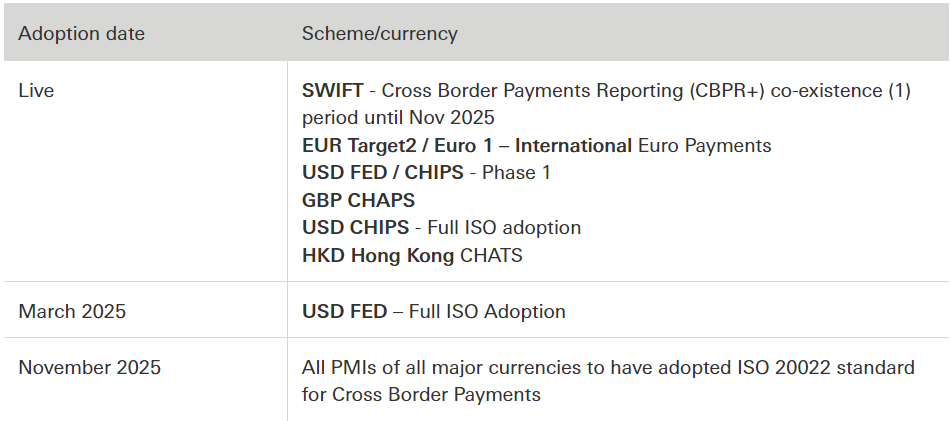
Impact, adoption and strategy
Which SWIFT messages are impacted by the ISO migration?
SWIFT plans to migrate all Customer and Inter-bank payments, as well as related advice and statement messages (the MT1xx, MT2xx and MT9xx series of messages).
What is HSBC’s plan to adopt ISO 20022?
HSBC is actively involved with SWIFT and the different market infrastructures that are migrating towards ISO. HSBC has successfully enabled its global network to receive and forward SWIFT CBPR+ messages in all of its 50+ locations and to exchange ISO messages in the newly migrated domestic markets.
We will align ourselves with the market requirements and delivery timelines set by different market infrastructures and ensure we are well placed to comply with the adoption strategies set forth by the market infrastructure.
What is HSBC’s strategy to align to SWIFT’s adoption of ISO for cross border payments?
HSBC’s adoption strategy will be driven by two different approaches:
--Markets with domestic migration announced
ISO enablement of SWIFT cross-border payments is prioritised with domestic ISO migrations in HSBC markets. This is targeted to enable ISO for both domestic and cross-border payments together for customers to choose to adopt in one go.
--Markets with no domestic migration announced
The approach is to complete SWIFT cross border traffic migration in all countries and be compliant by November 2025. If a market infrastructure announces a domestic scheme migration before 2025, our current migration strategies are flexible enough to adapt accordingly.
What are the common adoption strategies?
The common adoption strategies are:
▪️ ‘Like for like’, where the message format will be replaced from MT to ISO 20022 XML format that has comparable elements and character lengths to the existing SWIFT MT messages.
▪️ ‘Full/enhanced ISO’, where additional and enhanced existing elements are available. In order to ensure consistent usage and inter-operability, guidelines are defined by the industry.
Market practice guidelines
What are the current market practice guidelines being followed by the industry for ISO adoption?
Two guidelines are available for the payment market infrastructures:
▪️ High Value Payments Plus (HVPS+) market practice guidelines followed by certain Market infrastructures
▪️ Cross Border Payments and Reporting plus (CBPR+) guidelines. The CBPR+ group are experts nominated from the SWIFT community tasked with developing usage guidelines for ISO implementation by Banks for SWIFT cross-border payments.
While HVPS+ and CBPR+ are almost fully aligned with a few minor differences, HSBC will provide updates to the possible impacts they may have on our customers in the respective markets.
HOW TO PREPARE FOR ISO 20022
Readiness Handbooks
We have created readiness handbooks to support our customers through the transition to ISO 20022, highlighting the significant changes this will bring across the payments industry, how and why these changes will happen, and the benefits they can bring.
What should banks* be considering?
* Also includes NBFIs sending instruction via SWIFT
As published in SWIFT’s connectivity guidance document it is mandatory that all Banks are required to upgrade their messaging interface to support InterAct (store-and-forward) by 20 March 2023.
Institutions can also define the channel and format preferences for the transactions they receive through SWIFTs Transaction Manager (TM) platform. SWIFTs TM platform will ensure interoperability between users of different data formats and connectivity channels.
Here are some further considerations that banks should be looking at:
Industry Testing: Get ready to participate in industry testing as mandated by market infrastructures and SWIFT. If you use another bank for clearing, please reach out to that bank
Process & Systems: Have processes and systems geared up to fulfil your Sanctions and AML controls based on new party fields in the chain
Archive Data: Ensure that you are able to archive the rich ISO payments data as per your country regulations
Data Availability: Create solutions to make enriched data available to your customers
Structured Data: Start preparing to provide structured Name and address information for your customers(Debtors)
Training: Training and awareness of internal staff on the new language
For banks* sending Payments to:
▪️ Clearing/SWIFT
--Clearing: Be ready to accept and align with the clearing market infrastructure based on their timelines
--your Currency Provider
▪️ Have conversations with your Currency Provider
▪️ Agree the roadmap/migration timelines and expectations on message formats
For banks* receiving Payments from:
▪️ Clearing/SWIFT
--Clearing: Be ready to accept and align with the clearing market infrastructure based on their timelines
--your Currency Provider
If you use non-SWIFT based channels have a discussion with your provider
* Also includes NBFIs sending instruction via SWIFT
What should Corporate customers be preparing for?
We recommend our Corporate customers understand the potential of XML for your business and make the most of the opportunity.
Here are some considerations for Corporate customers:
▪️ Preparing for the future: A few market infrastructures already mandate corporates to provide XML as a standard while communicating to their Banks. With the increased adoption of ISO 20022 as a standard by SWIFT and major market infrastructures worldwide it is possible that more market infrastructures may recommend ISO as a messaging standard for communicating. Considering this in your technology plans will support preparation for these requirements from market infrastructures in the future.
▪️ Structured Data requirements: Market infrastructures and Clearing schemes have introduced new data requirements for party information. These include fields like creditor, ultimate debtor, initiating party, and ultimate creditor that will require corporates to provide to the bank in a structured or hybrid manner. HSBC will soon be providing communications on the required changes.
We strongly recommend you start looking at the data that is provided to HSBC and work closely with your Enterprise Resource Planning (ERP) and Treasury Management System (TMS) providers to start making required updates to comply to the new industry requirements.
▪️ Capitalising on rich standards: ISO offers multiple benefits that will help streamline end to end processing. Early adoption will allow you to capitalise on the information that is supported in remittance information and enhanced end to end references, which will be available through ISO based cash management(camt) statements/advises.
What you can expect from us
HSBC is eager to work with our clients to assist in their migration to ISO 20022. HSBC has been a strong advocate for XML and a key driver in the evolution of the ISO 20022 XML standard. Customers will be able to leverage the experience we have gained from previous implementations.
As market infrastructures finalize specifications, our team of experts will reach out to you and provide the details of changes to our existing offerings, and information on any new value added services that we will be able to offer leveraging the richer data elements that ISO 20022 offers.
Listen to our latest podcast – ISO 20022: The new language of payments
PODCAST
ISO 20022 will enable richer and more detailed data to be included in payment messages, along with a host of other benefits, resulting in a better customer experience. In this episode, Mark Avery, Senior Product Manager, HSBC, and Umut Uysal, Senior Global Product Manager, HSBC, discuss what you need to know about this exciting innovation in banking.
@ Newshounds News™
Read more: CBM HSBC
~~~~~~~~~
Newshound's Daily Breakdown Podcast Link
Newshound's News Telegram Room Link
Q & A Classroom Link
Follow the Roadmap
Follow the Timeline
Seeds of Wisdom Team™ Website
Subscribe to Newsletter
Thank you Dinar Recaps
Seeds of Wisdom RV and Economic Updates Sunday Morning 7-28-24
Good Morning Dinar Recaps,
BRICS PROPOSAL TO LINK ALL MEMBER COUNTRY'S PAYMENT SYSTEMS
"The proposal aims to enhance BRICS countries’ financial sovereignty by establishing a resilient and sanctions-resistant payment infrastructure. Discussions include integrating financial markets, payments in national currencies, and new mechanisms for mutual financial settlements."
"Russian Deputy Foreign Minister Andrey Rudenko revealed in an interview with TASS this week. He noted Tehran’s suggestion to integrate the payment systems of BRICS countries, similar to the integration of Russia’s Mir and Iran’s Shetab electronic banking and automated payment systems."
"Rudenko emphasized that establishing a clearance and payment infrastructure independent and resilient to sanctions would significantly enhance the financial sovereignty of BRICS. However, Iran’s initiative remains under discussion, and it is premature to define any final parameters, the Russian diplomat clarified."
Good Morning Dinar Recaps,
BRICS PROPOSAL TO LINK ALL MEMBER COUNTRY'S PAYMENT SYSTEMS
"The proposal aims to enhance BRICS countries’ financial sovereignty by establishing a resilient and sanctions-resistant payment infrastructure. Discussions include integrating financial markets, payments in national currencies, and new mechanisms for mutual financial settlements."
"Russian Deputy Foreign Minister Andrey Rudenko revealed in an interview with TASS this week. He noted Tehran’s suggestion to integrate the payment systems of BRICS countries, similar to the integration of Russia’s Mir and Iran’s Shetab electronic banking and automated payment systems."
"Rudenko emphasized that establishing a clearance and payment infrastructure independent and resilient to sanctions would significantly enhance the financial sovereignty of BRICS. However, Iran’s initiative remains under discussion, and it is premature to define any final parameters, the Russian diplomat clarified."
"This integration seeks to facilitate trade using national currencies, thereby reducing reliance on the U.S. dollar and countering U.S. sanctions. A monetary contract signed on July 6 allows the use of local currencies in trade, enhancing financial cooperation, economic resilience, and reducing dependence on Western financial systems."
@ Newshounds News™
Read more: Bitcoin News
~~~~~~~~~
Donald Trump 2024 Bitcoin Conference Speech Recap:
• On day one I will fire Gary Gensler and appoint a new SEC chairman.
• Create a US Government strategic national Bitcoin stockpile if elected.
• US Government will keep 100% of Bitcoin it owns
• Bitcoin is going to the moon.
• Never sell your Bitcoin
• Bitcoin will one day probably surpass the market cap of Gold.
• I reaffirm my pledge to commute Ross Ulbricht's sentence.
• There will never be a CBDC while I am President of the United States.
• Bitcoin and crypto will skyrocket like never before if elected president.
• Bitcoin is not threatening the dollar, the current U.S. government is threatening the dollar.
• The United States will be the crypto capital of the planet and the Bitcoin superpower of the world.
• Bitcoin stands for freedom, sovereignty, and independence from government coercion and control.
• I pledge to the Bitcoin community that the day I take oath of Office, Joe Biden and Kamala Harris' anti-crypto crusade will be over.
@ Newshounds News™
Read more: Watcher Guru
~~~~~~~~~
BRICS Poised to Dominate World Bank and IMF
"The World Bank Executive Director for Russia forecasts that BRICS nations will soon dominate the World Bank and the International Monetary Fund (IMF), attributing this shift to inevitable macroeconomic and demographic changes away from Western dominance. He emphasized the importance of working patiently toward this goal and resisting provocations from those upholding the old global system."
"BRICS, an acronym for Brazil, Russia, India, China, and South Africa, represents a coalition of major emerging economies. Earlier this year, the group expanded to include Argentina, Egypt, Ethiopia, Iran, Saudi Arabia, and the United Arab Emirates (UAE), broadening its geopolitical and economic influence."
"The World Bank Executive Director concluded by stressing the importance of Russia’s involvement in this shift. “Russia’s voice is important here, and it would be irrational not to use those possibilities, particularly now as we observe a new world order emerging,” he stated, underscoring the necessity of adapting to the evolving global landscape."
@ Newshounds News™
Read more: Bitcoin News
~~~~~~~~~
United States Senator Roger Marshall has overturned his support for the Digital Asset Anti-Money Laundering Act (DAAMLA) Bill, a legislation introduced by Democratic Party Elizabeth Warren.
"Marshall’s move to back down from the bill indicates the growing concerns about the possible overreach of regulatory actions regarding the emerging crypto market."
"The Digital Asset Anti-Money Laundering Act (DAAMLA) Bill was first introduced in December 2022 by Elizabeth Warren and co-sponsor by Roger Marshall and later reintroduced into the Senate in July 2023 to target unlawful use of crypto assets.
At the time, Warren maintained that large amounts of illegal funds were being laundered by rogue nations, oligarchs, drug lords, and human traffickers through the use of digital currencies such as Bitcoin, prompting her to move toward introducing the bill.
The legislation aimed to incorporate the cryptocurrency sector into the current frameworks for counterterrorism financing and anti-money laundering (AML)."
"Since its introduction, the law has received criticism from major figures and institutions in the industry."
"This positive development comes a few months following the Blockchain Association, a trade group representing the crypto industry in Washington D.C., efforts to debunk the DAAMLA bill. Specifically, the Blockchain Association sent out a letter in February, which marks the second time, to the House Financial Services Committee and Senate Banking Committee expressing serious concerns about the measure."
"About 80 US military, national security, and intelligence officers signed the letter. According to the Association, the law jeopardizes the strategic advantage of the US, threatening tens of thousands of employment while having minimal impact on illegal actors it targets."
@ Newshounds News™
Read more: Bitcoinist
~~~~~~~~~
Newshound's Daily Breakdown Podcast Link
Newshound's News Telegram Room Link
Q & A Classroom Link
Follow the Roadmap
Follow the Timeline
Seeds of Wisdom Team™ Website
Subscribe to Newsletter
Thank you Dinar Recaps
Seeds of Wisdom RV and Economic Updates Saturday Afternoon 7-27-24
Good afternoon Dinar Recaps,
Cardano Launches Node 9.1.0: The Dawn of the Chang Hard Fork Era
▪️ Cardano’s Node 9.1.0 launch is pivotal for the Chang Hard Fork, marking significant progress in on-chain decision-making.
▪️ While ADA’s price hasn’t surged yet, the upgrade holds potential for a future rally similar to the Alonzo Hard Fork.
Following the innovative launch of Cardano Ogmios v6.4.0, we reported last month, Cardano has launched Node 9.1.0, which is crucial for the upcoming Chang Hard Fork upgrade. This node introduces the final version needed to implement on-chain decision-making within the Cardano ecosystem. The Dawn of the Chang Hard Fork Era is equipped with a crucial feature, the Conway genesis file, which differentiates it from the previous Node 9.0.0.
This launch was announced by Intersect on X and confirmed by Cardano founder Charles Hoskinson on his personal X account. The Chang Hard Fork upgrade, initially scheduled for the first half of 2024, is expected to significantly advance Cardano’s infrastructure and capabilities.
Good Afternoon Dinar Recaps,
Cardano Launches Node 9.1.0: The Dawn of the Chang Hard Fork Era
▪️ Cardano’s Node 9.1.0 launch is pivotal for the Chang Hard Fork, marking significant progress in on-chain decision-making.
▪️ While ADA’s price hasn’t surged yet, the upgrade holds potential for a future rally similar to the Alonzo Hard Fork.
Following the innovative launch of Cardano Ogmios v6.4.0, we reported last month, Cardano has launched Node 9.1.0, which is crucial for the upcoming Chang Hard Fork upgrade. This node introduces the final version needed to implement on-chain decision-making within the Cardano ecosystem. The Dawn of the Chang Hard Fork Era is equipped with a crucial feature, the Conway genesis file, which differentiates it from the previous Node 9.0.0.
This launch was announced by Intersect on X and confirmed by Cardano founder Charles Hoskinson on his personal X account. The Chang Hard Fork upgrade, initially scheduled for the first half of 2024, is expected to significantly advance Cardano’s infrastructure and capabilities.
From Intersect on Twitter
Node 9.1.0 is here!
The final version to bring on-chain decision making to Cardano is here. As with all hard-forks, Cardano upgrades when the community is ready.
SPO's ➡️ https://bit.ly/3ycXnVF
However, unlike the previous update, as discussed in the CNF earlier report, which drove ADA price up 10% as 159 projects launched on Cardano, accompanied by 9.62M native tokens and 84.2M transactions, this upgrade is still taking its time to hit the expected surge.
Previous upgrades like the Alonzo Hard Fork in 2021 had a substantial positive impact on ADA’s price, suggesting potential similar outcomes with the Chang Hard Fork.
The upgrade could potentially lead to a price rally, as it is expected to break the upper boundary of the wedge pattern. As of now, according to CoinMarketCap data today, Cardano (ADA) is trading at $0.3966, with a decrease of 2.47% in the past day and 5.75% in the past week. See ADA price chart below.
However, unlike the previous update, as discussed in the CNF earlier report, which drove ADA price up 10% as 159 projects launched on Cardano, accompanied by 9.62M native tokens and 84.2M transactions, this upgrade is still taking its time to hit the expected surge.
Previous upgrades like the Alonzo Hard Fork in 2021 had a substantial positive impact on ADA’s price, suggesting potential similar outcomes with the Chang Hard Fork.
The upgrade could potentially lead to a price rally, as it is expected to break the upper boundary of the wedge pattern. As of now, according to CoinMarketCap data today, Cardano (ADA) is trading at $0.3966, with a decrease of 2.47% in the past day and 5.75% in the past week.
UPDATE: Cardano is trading at $0.4232 today.
@ Newshounds News™
Read more: Crypto News Flash
~~~~~~~~~
Copper will be the investment of the decade? Kitco Live ‘Copper Masters Panel’ on August 22, 2024
(Kitco News) - Copper presents a generational investment opportunity. A looming supply crunch fueled by high demand required for the energy transition is elevating prices to record highs with a positive outlook for investors.
The copper market is expected to enter into deficit in the near-term, which is forecast to increase to 5-8Mtpa by the end of the decade as new demand gathers pace. Eergy transition applications and the power infrastructure required for the electrification of everything, data centers, and emerging markets such as India are all factors vying for dwindling copper supplies.
The positive market outlook has not garnered a corresponding supply response as few development projects are in the pipeline, and miners are risk-averse due to the increasing economic uncertainty, costs, and timescales of project development.
Hosted by Paul Harris, the ‘Kitco Copper Masters Panel’ will hear from industry leaders Robert Friedland, Kathleen Quirk, and Colin Hamilton discussing why copper may be the natural resources investment of the decade.
Join us live on Kitco Mining’s YouTube channel on Thursday, August 22, 2024, at 3PM ET / 12PM PST for the latest copper investment insights from these copper masters.
@ Newshounds News™
Read more: Kitco
~~~~~~~~~
Chinese Firm Boasts of Using Tether Stablecoin to Skirt Russian Sanctions
Chinese-owned import-export firm Qifa specializes in trade between China and Russia, a booming sector. According to Reuters, the company is now using the Tether stablecoin for cross-border payments because of sanctions affecting bank payments.
It’s possible that Qifa spoke to Reuters to boost the price of its IPO on the Moscow Exchange. However, that benefit could prove short lived. Several Russian companies featured in recent press reports have been the subject of sanctions shortly afterwards.
For instance, Reuters reported in April that the Shanghai branch of Russian bank VTB played a key role in facilitating money transfers between Russia and China. In the latest package of sanctions announced on 12 June, OFAC added VTB Shanghai to its sanction list. Within a week this caused problems with money reaching Chinese suppliers.
The reason for using VTB Shanghai is the threat of sanctions on Chinese banks. Hence, any Chinese banks willing to receive payments are smaller ones, and they conduct significant due diligence to ensure that any goods are not dual use for military purposes.
Meanwhile, the use of Tether as a settlement asset may be illegal in both countries. Reuters classed Tether as a Digital Financial Asset. That’s not the case.
Digital Financial Assets
Digital Financial Assets (DFAs) are a specific class of Russian digital assets, including tokenized gold, other commodities and factored invoices.
There’s a short list of firms that operate platforms approved to issue DFA tokens, and most of them have been sanctioned. Not only does Tether not run an approved DFA issuing platform, but stablecoins are not approved DFA assets.
Originally Russian legislation banned the use of DFAs for payment, but it recently passed a new law allowing them to be used for cross-border payments, precisely to skirt sanctions. Less than two weeks later more DFA issuers were sanctioned alongside some Russian cryptocurrency firms.
That means only those comfortable dealing with sanctioned entities would accept them. There are also practical hurdles we have previously explored.
Tether would be classed as a cryptocurrency rather than a DFA.
Russia is working on legislation to support the use of cryptocurrencies for cross-border payments. Even the central bank governor has agreed it’s a practical move, despite her misgivings about crypto. As of today, using Tether may not be legal in Russia, but the Russians would most likely turn a blind eye.
It’s far less clear that’s the case in China where the use of stablecoins such as Tether is not permitted.
@ Newshounds News™
Read More: Ledger Insights
~~~~~~~~~
BLOCKCHAIN and DIGITAL ASSET NEWS from Ledger Insights
▪️ LUXEMBOURG proposes relaxing DLT laws LINK
▪️ BNP Paribas hosts issuance of SLOVENIAs digital bond settled in CBDC LINK
▪️ JP Morgan-backed Ownera partners with Digital Asset’s Canton network LINK
▪️ Franklin Templeton planning digital-asset joint venture with JAPANs SBI LINK
@ Newshounds News™
~~~~~~~~~
Newshound's Daily Breakdown Podcast Link
Newshound's News Telegram Room Link
Q & A Classroom Link
Follow the Roadmap
Follow the Timeline
Seeds of Wisdom Team™ Website
Subscribe to Newsletter
Thank you Dinar Recaps
Seeds of Wisdom RV and Economic Updates Friday Afternoon 7-26-24
Good Afternoon Dinar Recaps,
UK travellers told to SWAP FOREIGN CURRENCY NOW ahead of coming SWITCH
"If you still have the notes from your travels you may find it hard to swap them back next year."
"UK holidaymakers are being advised to exchange any leftover Bulgarian Levs or Romanian Leu ahead of a significant financial shift which was due next year. Both nations are preparing to adopt the Euro, joining the eurozone, which will render their current native currencies obsolete and potentially complicate the process of converting them back into sterling."
"Bulgaria has been growing in popularity as a family holiday destination for UK travellers since 2018, with its beach resorts being named the most affordable in Europe. Hundreds of thousands of Brits now choose Bulgaria for their annual holiday each year."
"A similar situation is expected for the Lev and Leu, sparking concerns among tourists and expats. Mario Van Poppel, founder of Leftover Currency, said: "With Bulgaria and Romania joining the eurozone, British travellers holding onto Levs or Leu need to act promptly. "Once the Euro is adopted, it will become increasingly difficult and costly to convert these currencies back to sterling."
Good Afternoon Dinar Recaps,
UK travellers told to SWAP FOREIGN CURRENCY NOW ahead of coming SWITCH
"If you still have the notes from your travels you may find it hard to swap them back next year."
"UK holidaymakers are being advised to exchange any leftover Bulgarian Levs or Romanian Leu ahead of a significant financial shift which was due next year. Both nations are preparing to adopt the Euro, joining the eurozone, which will render their current native currencies obsolete and potentially complicate the process of converting them back into sterling."
"Bulgaria has been growing in popularity as a family holiday destination for UK travellers since 2018, with its beach resorts being named the most affordable in Europe. Hundreds of thousands of Brits now choose Bulgaria for their annual holiday each year."
"A similar situation is expected for the Lev and Leu, sparking concerns among tourists and expats. Mario Van Poppel, founder of Leftover Currency, said: "With Bulgaria and Romania joining the eurozone, British travellers holding onto Levs or Leu need to act promptly. "Once the Euro is adopted, it will become increasingly difficult and costly to convert these currencies back to sterling."
"He warned: "The window of opportunity is closing fast. If people don't exchange their levs or leu before the transition, they might face significant hurdles. Banks in the UK may no longer accept these currencies, and travellers might find themselves forced to travel back to Bulgaria or Romania just to get their money's worth."
"This is not only inconvenient but can also lead to financial losses."
@ Newshounds News™
Read more: Liverpool Echo
~~~~~~~~~
Israel selects 14 participants for Digital Shekel Challenge
In May the Bank of Israel unveiled the Digital Shekel Challenge, inviting participants to propose novel central bank digital currency (CBDC) applications through the use of application programming interfaces (APIs). It was inspired by a similar BIS and Bank of England initiative, Project Rosalind.
Today it announced the selection of 14 teams. Given the deep technical skill base in Israel, it’s not surprising that around a dozen of the teams are Israeli.
We believe just two teams don’t have direct Israeli links. One is IDEMIA France, known for its offline CBDC functionality. The other is OxPay, although there are several companies that go by that name.
Apart from IDEMIA which has more than $3 billion in revenues, two of the larger participants are Fireblocks and PayPal (Israel). Technically Fireblocks is U.S. based but is Israeli founded. It’s best known for its custody technology and the Fireblocks Network and recently has been using that network to target payments. Fireblocks is also a partner of the Tel Aviv Stock Exchange (TASE) in the development of digital government bonds and digital assets.
The full participant list is:
▪️Bits of Gold
▪️Brinks Israel Ltd. + Committed Digital Ltd
▪️COTI
▪️Credics Technologies LTD
▪️Team Energy, led by Viacheslav Pozharskii
▪️Fireblocks
▪️Idemia France SAS
▪️Kima Finance
▪️Open Finance LTD
▪️0xPay
▪️Paypal Israel LTD
▪️Qedit
▪️Shva
▪️Team Levana, led by Doron Asor
CBDC use cases
Meanwhile, the use cases range from connecting the CBDC to other payment systems to split payments, conditional payments and sub wallets. The participants will also explore implementing various technologies while using the digital shekel for payment.
Trials run for three months start in early August.
@ Newshounds News™
Read more: Ledger Insights
~~~~~~~~~
RIPPLE- SEC UPDATE ON CLOSED-DOOR MEETING JULY 25
1. SEC did not ask Ripple to pay $102.6 million in penalty, attorney Jeremy Hogan says it was a legal argument.
2. SEC vs. Ripple lawsuit awaits final ruling from Judge Analisa Torres.
3. XRP hovers around psychological support level at $0.60, early on July 26.
"Pro-crypto attorney says Securities & Exchange Commission (SEC) and Ripple could settle in a “compromise” and not a win for the two parties. Attorney Bill Morgan, Fred Rispoli and Jeremy Hogan commented on the recent events in the SEC vs. Ripple lawsuit, the closed-doors meeting and the likelihood of a settlement. "
"Pro crypto attorney Jeremy Morgan says that the SEC did not ask Ripple for $102.6 million in its filing. Instead, the regulator noted that even by Ripple’s argument the fine would be $102.6 million, far exceeding the remittance firm’s $10 million offer. "
"Ripple had argued in its filing that a $10 million fine would be apt for the alleged securities law violation.
Attorney Fred Rispoli predicted that the SEC vs. Ripple lawsuit will end by the end of July 2024. In a recent tweet attorney Bill Morgan commented on the closed-doors meeting with the SEC and said that a settlement is most likely with a compromise rather than a win for the parties. "
@ Newshounds News™
Read more: FX Street
~~~~~~~~~
Philippines to launch wholesale CBDC by 2029 latest
Bangko Sentral ng Pilipinas (BSP) is working on Project Agila for wholesale central bank digital currency trials (wCBDC) trials. During a press briefing on the topic, Deputy Governor Mamerto Tangonan said he expected the wCBDC to go live within the term of new BSP Governor Eli Remolona Jr which runs until 2029. FinTech News reported that the launch would be early in the term.
The purpose of the current trials is to help both the central bank and ten participating commercial banks to go up the learning curve.
The Deputy Governor outlined three uses cases. The highest priority requirement is for interbank settlement on weekends and holidays. Another is the settlement of securities. And a third is cross border payments. Notably, the BSP is an observer of the mBridge project involving the BIS and the central banks of China, Hong Kong, Thailand, the UAE and Saudi Arabia.
@ Newshounds News™
Read more: Ledger Insighta
~~~~~~~~~
WHAT IS A NON-MARKET ECONOMY AND WHICH COUNTRIES ARE IN THIS CLASS
Nonmarket Economy Status under U.S. Trade Laws
The Department of Commerce has the authority to designate countries as NMEs for the purpose of U.S. antidumping and countervailing duty (AD/CVD) laws. An NME is a country that Commerce determines “does not operate on market principles of cost or pricing structures, so that sales of merchandise in such country do not reflect the fair value of merchandise.”
In designating a country as an NME, Commerce considers the extent to which :
(1) the country’s currency is convertible;
(2) its wage rates result from free bargaining between labor and management;
(3) joint ventures or other foreign investment are permitted;
(4) the government owns or controls the means of production; and
(5) the government controls the allocation of resources and price and output decisions.
"Commerce may also consider other factors that it considers appropriate. An NME designation remains in effect until revoked by Commerce. There are currently 12 countries, including Vietnam, designated as NMEs. Commerce designated Vietnam as an NME in 2002 during its antidumping investigation into Vietnamese catfish exports."
VIETNAM
"The U.S. Commerce Department said on Wednesday it has delayed a difficult decision on whether to upgrade VIETNAM to market economy status by about a week until early August, citing IT disruptions from the CrowdStrike software bug.
A decision on the upgrade that Hanoi has long sought had been due by Friday. The upgrade is opposed by U.S. steelmakers, Gulf Coast shrimpers and honey farmers, but backed by retailers and some other business groups."
"VIETNAM has long argued it should be freed of the non-market label because of recent economic reforms, and it said that retaining the moniker is bad for increasingly close two-way ties that Washington sees as a counterbalance to China.
Opponents of upgrading VIETNAM - one of 12 economies labeled by Washington as non-market, including China, Russia, North Korea and Azerbaijan - argue that Hanoi's policy commitments have not been matched by concrete actions and it operates as a planned economy governed by the ruling Communist Party."
@ Newshounds News™
Read more: CRS Reports, Reuters
~~~~~~~~~
Silver Falls As Dollar Index Rebounds Amid Key Economic Data Analysis.
Silver prices experienced a significant decline of 4.2%, settling at 81,331 due to the fluctuating dollar index as traders assessed key economic data.
The U.S. economy demonstrated stronger-than-expected growth in the second quarter, with a 2.8% annualized rate increase in GDP, as reported by the Commerce Department's Bureau of Economic Analysis.
Despite substantial rate hikes by the Federal Reserve in 2022 and 2023, the U.S. economy remains robust, buoyed by a resilient labor market even though the unemployment rate has risen to a 2-1/2-year high of 4.1%.
Additionally, the Labor Department reported a larger-than-expected decrease in new applications for unemployment benefits, with a drop of 10,000 to a seasonally adjusted 235,000 for the week ending July 20. This reduction is partly attributed to the fading impact of weather-related distortions and temporary automobile plant closures.
The previous week saw a rise in claims due to disruptions from Hurricane Beryl and retooling closures in the automobile sector. In a surprising move, China's central bank reduced its one-year medium-term lending facility rate by 20 basis points to 2.3%, the most significant cut since April 2020. This unexpected rate cut aims to stimulate economic activity amid global economic uncertainties.
From a technical perspective, the silver market is experiencing fresh selling pressure, with a 6.52% increase in open interest, bringing it to 29,188. Prices have fallen by 3,563 rupees, indicating a bearish trend. Currently, silver is receiving support at 79,830, and if this level is breached, it could test 78,330. On the upside, resistance is anticipated at 83,665, with a potential move above this level leading to a test of 86,000.
Silver Price Today
Open 27.99
High 28.22
Low 27.75
Prev close 27.98
@ Newshounds News™
Read more: Investing
~~~~~~~~~
RKF Jr. says he would include Bitcoin, gold, and platinum in a basket to back Treasury bills
(Kitco News) – The list of politicians calling on the U.S. government to purchase and hold Bitcoin (BTC) as a strategic reserve asset continues to grow, with Presidential candidate Robert F. Kennedy Jr. becoming the latest to advocate for holding the top crypto in the Treasury.
Kennedy spoke during industry day at Bitcoin 2024, the annual Bitcoin conference currently underway in Nashville, Tennesse, where he unveiled a plan that could see the U.S. become the world’s largest BTC holder.
During a conference panel with Roundtable’s Scott Melker and Custodia Bank CEO Caitlin Long, RFK Jr. admonished the Federal Reserve, saying the central bank had the interest of bankers, not the general public, at heart.
“The relationship between Congress and the Fed is both parasitical to our country, and it’s a symbiotic relationship,” he said. “The Fed is not a public institution … The decision-makers are appointed by the banking industry. Its function with these cycles of quantitative easing followed by high interest rates are… strip-mining cash and equity from the American middle class and pumping it upward to this new oligarchy of billionaires.”
"The coup de grâce was the lockdowns during Covid, which shut down all the small business in this country, which is what we should be nurturing, and kept open the Walmarts, and the Amazons, and Facebook, and the oil industry, and the processed food industries, and Big Ag, they all flourished during that period,” he added. “And meanwhile, Main Street just got liquidated.”
To help start the process of leveling the playing field and returning the U.S. to a system of sound money, Kennedy recommended the creation of a basket of hard currencies and other assets that could be used to provide solid backing for the U.S. dollar.
“I would be willing to add Bitcoin to the balance sheet. I’m going to do that. I’m gonna actually do a basket of hard currencies of maybe platinum and gold and other hard currencies and begin issuing at least the class of Treasury bills that are anchored to hard currency,” he said. “Let’s say the first year by 1% and then maybe the next year by 2% to watch how that goes because that will inject discipline into the product and ultimately get up to 100%.”
“I would like to have the federal government begin to buy Bitcoin and over my term of office [and] ultimately have an equivalent amount of Bitcoin that we have gold,” he added. “Because Bitcoin is an honest currency, it’s a currency that’s based upon proof of work.”
The plan, as laid out by RFK Jr., would see the government purchase enough BTC to equal the amount they hold in gold – currently estimated at 8,134 tons worth approximately $615 billion.
According to data provided by Arkham, the Department of Justice currently holds 213,239 Bitcoin that were acquired through various enforcement actions, meaning that to achieve Kennedy’s goal, the Treasury would need to acquire more than 9 million additional BTC at the current market price – equal to 45% of all the BTC that will ever exist.
For perspective, MicroStrategy, the largest corporate holder of Bitcoin, owns 226,331 BTC, and BlackRock, the largest spot Bitcoin ETF manager, controls 334,000 BTC.
Kennedy said the goal of the move is to redefine monetary policy and enhance fiscal discipline within the federal government.
He also appealed to the crypto community’s ideals of personal freedom, property rights, and governmental integrity, saying, “Bitcoin is not only an offramp to this inflationary highway which is the highway to hell, but it also is a way of restoring integrity to our government. It’s a way of restoring personal freedoms, it’s a way the middle class can isolate itself from inflation, which is just a form of government theft.”
As president, he vowed to reform the Fed, block the creation of a central bank digital currency (CBDC), and end “money printing” to fund budget deficits.
@ Newshounds News™
Read more: Kitco
~~~~~~~~~
Newshound's Daily Breakdown Podcast Link
Newshound's News Telegram Room Link
Q & A Classroom Link
Follow the Roadmap
Follow the Timeline
Seeds of Wisdom Team™ Website
Subscribe to Newsletter
Thank you Dinar Recaps
Seeds of Wisdom RV and Economic Updates Thursday Evening 7-25-24
Good evening Dinar Recaps,
XRP ETF Expected as Ripple Partner SBI Enters US ETF Market SBI Holdings plans to enter the US ETF market, sparking speculation of an XRP ETF due to its strong partnership with Ripple and digital asset focus.
Ripple partner SBI Holdings is making headlines as it prepares to enter the ETF market. This move has led to speculation about a potential XRP ETF, given SBI’s strong partnership and association with Ripple, a company that holds the largest share of XRP.
For instance, on July 1, SBI Holdings began minting non-fungible tokens (NFTs) for the upcoming 2025 World Expo in Osaka, Japan. SBI leaders have also consistently endorsed XRP.
Now, a local report reveals that SBI Holdings plans to establish an investment management company with Franklin Templeton, a major US investment firm. This new venture will focus on digital assets, with SBI holding a 51% stake and Franklin Templeton 49%.
Good Evening Dinar Recaps,
XRP ETF Expected as Ripple Partner SBI Enters US ETF Market
SBI Holdings plans to enter the US ETF market, sparking speculation of an XRP ETF due to its strong partnership with Ripple and digital asset focus.
Ripple partner SBI Holdings is making headlines as it prepares to enter the ETF market. This move has led to speculation about a potential XRP ETF, given SBI’s strong partnership and association with Ripple, a company that holds the largest share of XRP.
For instance, on July 1, SBI Holdings began minting non-fungible tokens (NFTs) for the upcoming 2025 World Expo in Osaka, Japan. SBI leaders have also consistently endorsed XRP.
Now, a local report reveals that SBI Holdings plans to establish an investment management company with Franklin Templeton, a major US investment firm. This new venture will focus on digital assets, with SBI holding a 51% stake and Franklin Templeton 49%.
The new company from SBI Holdings and Franklin Templeton, expected to form by the end of the year, will focus on crypto assets, reports suggest. Notably, SBI will hold 51% of the company, while Franklin Templeton will hold 49%.
Launching XRP ETF Makes Sense
In June, Ripple President Monica Long had argued that launching an XRP spot ETF in the US market makes sense.
She highlighted that XRP, consistently among the top 10 cryptocurrencies, meets key criteria for such an investment product. However, Nate Geraci, President of The ETF Store, suggested that the market is not ready for an XRP spot ETF. He noted that an XRP futures ETF must precede a spot ETF, emphasizing the need for a regulated trading history.
Industry Opinions on XRP
Recall Yoshitaka Kitao, Chairman and CEO of SBI Holdings, had shared his optimistic views on XRP’s future, expressing confidence that XRP would benefit significantly if Ripple ultimately wins its ongoing legal battle with the US Securities and Exchange Commission (SEC).
On his hand, Crypto expert The Bearable Bull predicts that XRP will hit new all-time highs this cycle. He asserts there’s “0% chance XRP won’t go to new all-time highs.” According to him, XRP’s price has often depended on Bitcoin’s rise. With the approval of a BTC ETF and new record values, he expects XRP ETFs in 2025.
The Bearable Bull identifies several bullish catalysts for XRP. These include its relisting on all exchanges, the launch of AMMs, the Xahau sidechain, Ripple’s stablecoin, and the Metaco custody solution. He also mentions a potential Ripple IPO, increased political focus on crypto, and expected regulatory clarity. Additionally, Ripple’s legal case is likely to conclude this summer.
@ Newshounds News™
Read more: The Crypto Basic
~~~~~~~~~
Gold price collapses to two-week low amid robust US economic data
—Gold prices fall 5% from July 17 peak of $2,483 to $2,364.
—US Q2 GDP beats expectations, strengthening the US Dollar and impacting gold.
—Market certainty grows for a Fed rate cut in September as Treasury yields decline.
Gold price tumbled to a two-week low on Thursday after the US Bureau of Economic Analysis reported that the economy in the United States (US) fared better than expected in the second quarter of 2024. This weighed on the precious metal, which lost over 1.30%, and XAU/USD trades at $2,364 at the time of writing.
Bullion prices hit their highest level on July 17, at $2,483; since then, they have fallen about 5% toward the current spot price. XAY/USD’s fall is mostly attributed to profit-taking as US Treasury yields also dropped while the Greenback remained firm.
US data revealed that the Gross Domestic Product in Q2 was better than expected, crushing the first-quarter numbers. Meanwhile, the number of Americans filing for unemployment benefits dipped compared to the week ending July 30. Durable Goods Orders contracted more than -6%, though excluding aircraft and transport, they recovered from May’s drop.
Despite all that, the US 10-year Treasury note coupon edged lower by more than four basis points (bps) and ended at 4.245% on Thursday. According to the CME FedWatch Tool data, investors seem 100% certain that the Federal Reserve will slash interest rates a quarter of a percentage point at the September meeting.
Daily digest market movers: Gold price on the backfoot as US GDP advances
—US GDP for Q2 2024 jumped from 1.4% to 2.8% QoQ, exceeding forecasts of 2% on its advance reading.
—US Initial Jobless Claims for the week ending July 20 rose by 235K, less than the estimated 238K and lower than the previous week's 245K.
—US Durable Goods Orders plummeted by -6.6% MoM in June, significantly below the estimated 0.3%. However, Core Durable Goods, which excludes aircraft, expanded by 0.5% MoM, up from -0.1% and above the consensus projection of 0.2%.
—The Fed’s preferred measure of inflation, the Core PCE, is expected to dip from 2.6% to 2.5% year-over-year (YoY).
@ Newshounds News™
Read more: FX Street
~~~~~~~~~
Copper: Demand expectations melt down – TDS
7/25/2024
Prices are more likely to overshoot to the downside, notwithstanding the likely overly pessimistic sentiment surrounding demand, TDS senior commodity strategist Daniel Ghali notes.
Demand sentiment may be nearing a local bottom
Our gauge of demand sentiment embedded within the cross-section of commodities prices is now nearing its lowest levels of the year. These levels are now quantitatively inconsistent with recent history, and considering macro vol has been fairly muted, commodity demand sentiment now appears oversold.
This is a massive shift from just a few short months ago when demand sentiment appeared extremely overbought, contributing to the speculative fervor that catalyzed a momentous rally in Copper prices. Today, we now estimate that 80% of discretionary length in the red metal has already been liquidated, and we now see signs that the top traders in Shanghai are notably covering their shorts.
That being said, CTA trend followers still hold a substantial amount of dry-powder to sell and now have only a narrow margin of safety against selling programs. In fact, our simulations of future prices also suggest that a flat tape can now spark large-scale CTA selling activity over the next week. Overall, this suggests that prices are more likely to overshoot to the downside, notwithstanding the likely overly pessimistic sentiment surrounding demand.
@ Newshounds News™
Read more: FX Street
~~~~~~~~~
Setting Sail for Success: TLIP and IOTA’s Role in Maritime Advancements through the EU-Funded MISSION Project
—The EU-funded MISSION project aims to address the maritime industry’s challenges by leveraging IOTA’s TLIP infrastructure, which uses distributed ledger technology for secure and seamless data sharing.
—The MISSION project also aims to integrate TLIP with AI-driven smart contracts thereby enhancing responsiveness to exchanged data.
Maritime transport, which accounts for nearly 80% of the global trade has been facing major challenges with the fragmented IT infrastructure. So far, this sector has been using disparate IT systems used by different intermediaries within the supply chain involving port community systems and fleet performance management systems.
Although these systems can automate data for real-time data sharing, they usually operate in isolation and separately leading to resource-intensive efforts in order to maintain essential information. However, this inefficiency in real-time communication largely disrupts the maritime supply chain as all actors are not in sync to receive the updated information.
In the absence of a comprehensive system for planning and monitoring port operations and sea traffic, most maritime ports operate the ships on a first-come-first-serve basis instead of working in a well-orchestrated and planned scheme. this leads to greater inefficiencies and delays within the maritime industry.
In order to address all these challenges, the EU-funded MISSION project is working on a new communication and logistics platform to optimize planning, orchestrate port operations, and coordinate port traffic. Thus, to solve all the crucial challenges associated with the maritime industry, project MISSION will leverage IOTA’s TLIP infrastructure.
https:///t.co /61tsZqWABe
🚢🚢🚢🚢🚢🚢🚢🚢🚢🚢🚢
🚢🌍 IOTA plays a pivotal role in the EU-funded MISSION project! Using its distributed ledger technology, IOTA ensures secure and seamless data sharing within the Trade and Logistics Information Pipeline (TLIP). This enhances port operations by decreasing traffic, costs, and...
pic.twitter.com/61tsZqWABe
🚢🚢🚢🚢🚢🚢🚢🚢🚢🚢🚢
Leveraging IOTA’s TLIP Infrastructure
The IOTA TLIP infrastructure uses distributed ledger technology to facilitate seamless integration with existing systems while using APIs and state-of-the-art data standards, per the CNF report. TLIP’s role would be very crucial in the implementation of the MISSION project, thereby ensuring the security and auditability of shared data even within complex environments.
One of the key advantages of TLIP is inherent interoperability which facilitates a seamless integration of the MISSION platform into the European Blockchain Service Infrastructure (EBSI), as updated by Crypto News Flash. This integration will boost the platform’s data-sharing capabilities significantly.
Along with being crucial for just-in-time port call optimization, TLIP will improve the planning and alignment of port operations with better coordination of vessel arrivals and departures. It addresses the challenges posed by ships at sea with limited bandwidth and unstable connections, making it an essential component of the MISSION project. TLIP revolutionizes data sharing, fosters collaboration, and propels port operations into a new era of innovation.
Moving ahead, project MISSION is planning to integrate TLIP with AI-driven smart contracts thereby enhancing responsiveness to exchanged data while including alarms for non-compliance and delays. This integration of TLIP in the MISSION project highlights IOTA’s commitment to improving global supply chains via the industrial adoption of its technology, as reported by CNF.
Amid the broader market sell-off, the IOTA cryptocurrency is currently trading 7.1% down at $0.1575 with a market cap of $529 million and daily trading volumes shooting by 53%.
@ Newshounds News™
Read more: Crypto News Flash
~~~~~~~~~
Charles Hoskinson Envisions Cardano Surpassing Bitcoin: ADA’s Growth Trajectory and Upcoming Chang Hardfork
—Cardano’s founder has unveiled the plans to topple Bitcoin in the near future.
—He believes in giving developers the tools to create usable tools that can add value.
Cardano (ADA) founder Charles Hoskinson is highly optimistic about the blockchain taking up Bitcoin (BTC) position as the leading digital asset. The founder hinted at the disclosure, ADA’s growth movement, and the upcoming Chag Hardfork upgrade in an interview on Altcoin Daily.
Hoskinson Touts Cardano as a Major Bitcoin Contender
The Cardano founder said his interest in crypto stems from the profound effect it has on the economic, and socio-political systems of the world. Hoskinson highlighted that Cardano has lived up to what Satoshi started with the creation of Bitcoin. According to him, the Cardano ecosystem is built on a growth engine that continuously adds people, absorbing the technology of its competitors.
“At some point, you just outgrow, and then you wake up, and it’s a multi-trillion-dollar ecosystem with trillions of dollars of value moving around every single day,” he added.
Hoskinson claims the key to flipping Bitcoin is to enable various teams within the Cardano community with the tooling necessary to get to the next level. He emphasized that Bitcoin has stalled over the years, the only valuable proposition being its size.
“It’s not some new technology, it’s not some new capability, it’s not the fact that it’s super easy to use for something interesting; it’s big and successful,” Hoskinson stated.
He drew historical comparisons between the rise of more flexible and inventive solutions and the demise of companies like Yahoo, Microsoft, MySpace, and BlackBerry. He also cited how Artificial Intelligence (AI) search engines are becoming a huge threat to the usability of Google.
Challenge With Bitcoin Flexibility
Furthermore, Hoskinson claims Bitcoin’s relevance over the last 10 years is due to the simplicity of its model, but like Gold, Bitcoin cannot grow above a certain floor. Cardano, on the other hand, seeks to provide the foundation for international payment networks, credit, and voting systems, offering a higher utility. ☝️
The Cardano founder says the way to remain relevant is to embrace decentralization, preserve the integrity of systems, create the right incentives for users, and embrace new ideas.
Per blockchain, Hoskinson says Ethereum (ETH) is currently suffering from its inflexibility to innovation, with Layer-2s emerging as a major competitor.
“Yeah, I do believe we can do this, this is why we are so focused on the fundamentals because you can’t stop that once it is going fast enough,” stated Hoskinson.
Update on Cardano’s Chang Hardfork Upgrade
Hoskinson also highlighted the relevance of good governance in guaranteeing the long-term viability of blockchain initiatives. His words coincide with anticipation of the Chang Hardfork, which is scheduled for later this year.
He went into further detail on the pros and cons of on-chain governance, highlighting the need for a system that allows for quick decision-making. Hoskinson noted that the Hardfork will be initiated as soon as 70% of stake operators upgrade to the final version of Node 9.0.
Meanwhile, ADA, the native coin of the Cardano blockchain, is currently trading sideways. At press time, ADA declined by 5.6% in the past day to trade at $0.3955, with the market cap pegged at $14 billion. Nonetheless, Cardano’s Total Value Locked (TVL) recently surged by 38%, as noted in our earlier article.
@ Newshounds News™
Read more: Crypto News Flash
~~~~~~~~~
Newshound's Daily Breakdown Podcast Link
Newshound's News Telegram Room Link
Q & A Classroom Link
Follow the Roadmap
Follow the Timeline
Seeds of Wisdom Team™ Website
Subscribe to Newsletter
Thank you Dinar Recaps
Seeds of Wisdom RV and Economic Updates Wednesday Evening 7-24-24
Good Evening Dinar Recaps,
XRP WHALES Go On $84 MILLION Buying Spree To Lock Down 140 Million Tokens
"XRP whales look to have regained their confidence in the XRP token, with recent data showing an accumulation trend among these investors. This is significant as XRP eyes the $1 mark and as these XRP whales could play a role in facilitating such a price rally.
" "Crypto analyst Ali Martinez recently shared data from the on-chain analytics platform Santiment, which shows that XRP whales bought over 140 million XRP ($84 million) this past week."
"This increase in whale accumulation is also a factor that could contribute to such a rally, as these investors could use their market influence to push XRP’s price to new highs. Santiment recently noted that XRP’s impressive rebound is supported by the rising level of coins held by xrp whales and sharks with over 100,000 tokens. According to Santiment, this category of investors now holds over 51 billion XRP tokens, a new all-time high (ATH). "
Good Evening Dinar Recaps,
XRP WHALES Go On $84 MILLION Buying Spree To Lock Down 140 Million Tokens
"XRP whales look to have regained their confidence in the XRP token, with recent data showing an accumulation trend among these investors. This is significant as XRP eyes the $1 mark and as these XRP whales could play a role in facilitating such a price rally. "
"Crypto analyst Ali Martinez recently shared data from the on-chain analytics platform Santiment, which shows that XRP whales bought over 140 million XRP ($84 million) this past week."
"This increase in whale accumulation is also a factor that could contribute to such a rally, as these investors could use their market influence to push XRP’s price to new highs. Santiment recently noted that XRP’s impressive rebound is supported by the rising level of coins held by xrp whales and sharks with over 100,000 tokens. According to Santiment, this category of investors now holds over 51 billion XRP tokens, a new all-time high (ATH). "
"n addition to this significant whale accumulation, network activity on the XRP ledger (XRPL) also paints a bullish picture for XRP. Santiment revealed that the XRPL is witnessing a notable increase in new addresses created and total addresses interacting on the network. Both metrics are at their highest levels since March.
"Specifically, data from Santiment shows that 1,721 new XRP wallets were created on July 18 and that 47,363 individual addresses interacted on the network that day. This is also a bullish signal as it suggests that retail investors are also flocking into the XRP ecosystem in anticipation of higher prices from the crypto token. XRP’s technicals also suggest that a significant price rally is on the horizon. "
@ Newshounds News™
Read more: Bitcoinist
~~~~~~~~~
South African Startup Neonomad to Launch Rand-Backed STABLECOIN
"South African fintech startup Neonomad, a hybrid exchange platform, is set to launch Zarcoin (ZARC), a rand-backed stablecoin. The goal of Zarcoin is to bridge the gap between traditional and crypto finance while enabling seamless local and cross-border transactions."
"According to a report, the STABLECOIN is set to cater to both unbanked and banked South Africans, utilizing Solana Pay for instant and low-cost transactions."
"For his part, Devon Krantz, COO of Neonomad, stated that the STABLECOIN and the firm’s app are intended to facilitate multiple offerings, even in the decentralized finance (defi) space. He added that Neonomad’s platform is specially designed to transition users from traditional banking platforms to the startup’s “secure STABLECOIN ecosystem.”
"Meanwhile, the report revealed that the hybrid exchange platform also plans to launch an educational program to boost cryptocurrency usage among South Africans. Neonomad aims to achieve this by launching a coworking space for crypto enthusiasts in Cape Town sometime during the last quarter of 2024."
@ Newshounds News™
Read more: Bitcoin
~~~~~~~~~

TWO CALLS COMING SOON
1. A call from ISAAC - WHO IS ISSAC - BIO
Isaac has SKRs, buyers, and contact with the Paymasters' Paymaster and Chinese Dragons.
2. A call with BOB LOCK - COMMON LAW - TRUSTS - ZIM
Read more: Isaac
Read more: Bob Lock
Calls are recorded and in the archive room.
When we have the details they will be shared all over. Stay tuned.
Let's cover the questions you might have.
Where are we with the RV in News?
▪️ Join: Newshounds News
▪️ Join: QA RV Classroom
▪️ Listen: Podcast
What about trust, Zim to RV updates?
▪️Join: Bob Lock RV - Trust - New Book
What are the updates on crypto and more?
▪️Join: Start Here
~~~~~~~~~
Newshound's Daily Breakdown Podcast Link
Newshound's News Telegram Room Link
Q & A Classroom Link
Follow the Roadmap
Follow the Timeline
Seeds of Wisdom Team™ Website
Subscribe to Newsletter
Thank you Dinar Recaps