
Thank you to all the subscribers to our Early Access program…we thank you for your continued support.
We are excited to offer this new service to keep you informed and up-to-date on the latest Dinar and currency news.
Seeds of Wisdom RV and Economic Updates Wednesday Afternoon 7-24-24
Good Afternoon Dinar Recaps,
PUTIN WANTS RUSSIA TO EMBRACE THE DIGITAL RUBLE "The digital ruble has proven its viability and it is time to move on to a wider use of the currency, Russian President Vladimir Putin said at a meeting about the economy." "Digital currency works much the same way as national currencies used by central banks of various countries, making transactions more transparent and easier to track.
Russia is not the first country to think about going digital; the leader in this sphere is China, which was among the first nations to widely introduce digital currency with the digital yuan, Natalya Milchakova, lead analyst at Freedom Finance Global, explained to Izvestia. Only a few countries have fully switched over to using digital currencies, mostly countries in the Caribbean, such as the Bahamas and Jamaica."
""Russia wants to be at the cutting edge of modern technologies, including financial services. The DFA (tokens) market is already taking off in the country, including those issued by major industrial enterprises in order to inject money into promising projects," Milchakova explained.
Good Afternoon Dinar Recaps,
PUTIN WANTS RUSSIA TO EMBRACE THE DIGITAL RUBLE
"The digital ruble has proven its viability and it is time to move on to a wider use of the currency, Russian President Vladimir Putin said at a meeting about the economy."
"Digital currency works much the same way as national currencies used by central banks of various countries, making transactions more transparent and easier to track.
Russia is not the first country to think about going digital; the leader in this sphere is China, which was among the first nations to widely introduce digital currency with the digital yuan, Natalya Milchakova, lead analyst at Freedom Finance Global, explained to Izvestia. Only a few countries have fully switched over to using digital currencies, mostly countries in the Caribbean, such as the Bahamas and Jamaica."
""Russia wants to be at the cutting edge of modern technologies, including financial services. The DFA (tokens) market is already taking off in the country, including those issued by major industrial enterprises in order to inject money into promising projects," Milchakova explained.
Putin wants to take this a step further: to move on to a wider large-scale implementation of the digital ruble in the economy, business and finance. This may help the government in terms of controlling the budget, cutting the cost of budget payments and easing trans-border transactions."
"The digital ruble has a chance to become a full-fledged payment instrument for individuals and companies but to make this a reality, the government has a lot of work to do, and it must learn from past mistakes made by other countries when implementing such currencies.
There, people saw certain risks for financial confidentiality or restrictions of financial freedom," the legislator noted in a conversation with Izvestia."
@ Newshounds News™
Read more: TASS
~~~~~~~~~
WHAT IS "JUNK SILVER?"
"United States 90% silver coins were minted to be used as money, were used as money, and could be used as money again. Minted before 1965, they are called junk silver coins because they have no collector or numismatic value. The coins are bought and sold for the value of their silver content."
"When minted, a bag of 90% junk silver coins contained 723 ounces of silver, but because of wear a smelted bag of dimes or quarters will net about 715 ounces. A bag of half-dollars will net a little more, maybe 718-720 ounces because half-dollars did not circulate as much as dimes and quarters, and, therefore, did not suffer as much wear."
"Because a “bag” ($1000 face) contains approximately 715 ounces of silver, it tracks the spot price of silver. If silver goes up ten cents, a bag of US silver coins rises $70 or so; however, when junk silver coins are in short supply their premiums can increase."
"Although many investors buy junk silver coins as bullion investments, other investors buy junk US silver coins for “survival purposes.” These buyers fear the worst for the dollar, that it will be printed until it becomes worthless. If this “worst-case scenario” were to become reality, US silver coins would be used for the purpose they were originally minted: as money."
@ Newshounds News™
Read more: CMI Gold & Silver
~~~~~~~~~
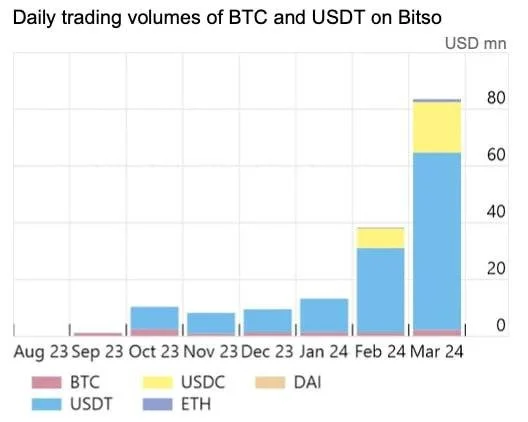
STABLECOIN ACTIVITY IN ARGENTINA
"A graph of Bitso crypto exchange activity in Argentina demonstrates the high level interest in stablecoins. Stablecoins entirely dominate the daily volumes as opposed to other cryptocurrencies. It would be easy to assume that Argentinians are not interested in Bitcoin, but that’s not quite true."
"At first we thought there might be a mistake. However, there are several rationales for both these graphs to be accurate.
Take the scenario of someone who lives in Argentina. When they receive their wages they convert them to dollar stablecoins. Then whenever they want to spend money, they draw down dollars. That would create a lot of stablecoin activity. The same person could still have their savings in Bitcoin. Hence. the daily transactions could be evidence of everyday spending."
@ Newshounds News™
Read more: Ledger Insights
~~~~~~~~~
What’s keeping silver down while gold hold above $2,400?
"(Kitco News) - Gold has been able to maintain a solid uptrend, building a new base with each rally; however, this momentum has not filtered through the entire sector as silver struggles to find its footing."
"While gold is fighting for support at higher lows around $2,400 an ounce, silver is struggling around $29 an ounce. Silver's underperformance compared to the yellow metal has pushed the gold/silver ratio to its highest level in two months, back above 82 points."
"Some analysts have said that gold is benefiting as a safe-haven asset because of rising geopolitical uncertainty, fueled by the U.S. elections in November."
“Silver usually follows the price movements of gold disproportionately. However, this has recently only applied to the downside. The previous upward movement in gold following the US inflation figures was more or less ignored by silver,” said Carsten Fritsch, Commodity Analyst at Commerzbank.
“The relative weakness in silver is likely due to the weakness in base metals. This is because industrial applications are expected to account for almost 60% of silver demand this year.”
"Although silver continues to struggle, many investors are still not ready to give up on the precious metal. In a recent interview with Kitco News, Robert Minter, Director Of Investment Strategy at abrdn, said that he expects silver to eventually outperform gold as the Federal Reserve starts to cut interest rates."
@ Newshounds News™
Read more: Kitco
~~~~~~~~~
SENATOR CYNTHIA LUMMIS RELEASES REPORT ATTACKING BIDEN'S MINING TAX
The pro-crypto senator claimed that Bitcoin mining consumes as much energy as household appliances such as tumble dryers.
On July 23, Senator Cynthia Lummis released a report arguing against the Biden administration’s proposed 30% excise tax on the energy consumed by Bitcoin miners.
The report, titled "Powering Down Progress: Why A Bitcoin Mining Tax Hurts America", put the Bitcoin
BTC mining industry into sharper focus, highlighting the benefits of the critical mining infrastructure to the United States' energy grid.
Lummis cited the Bitcoin Energy and Emissions Sustainability Tracker as evidence that Bitcoin mining is cleaner than is commonly imagined, noting that up to 52.6% of BTC mining might be emissions-free.
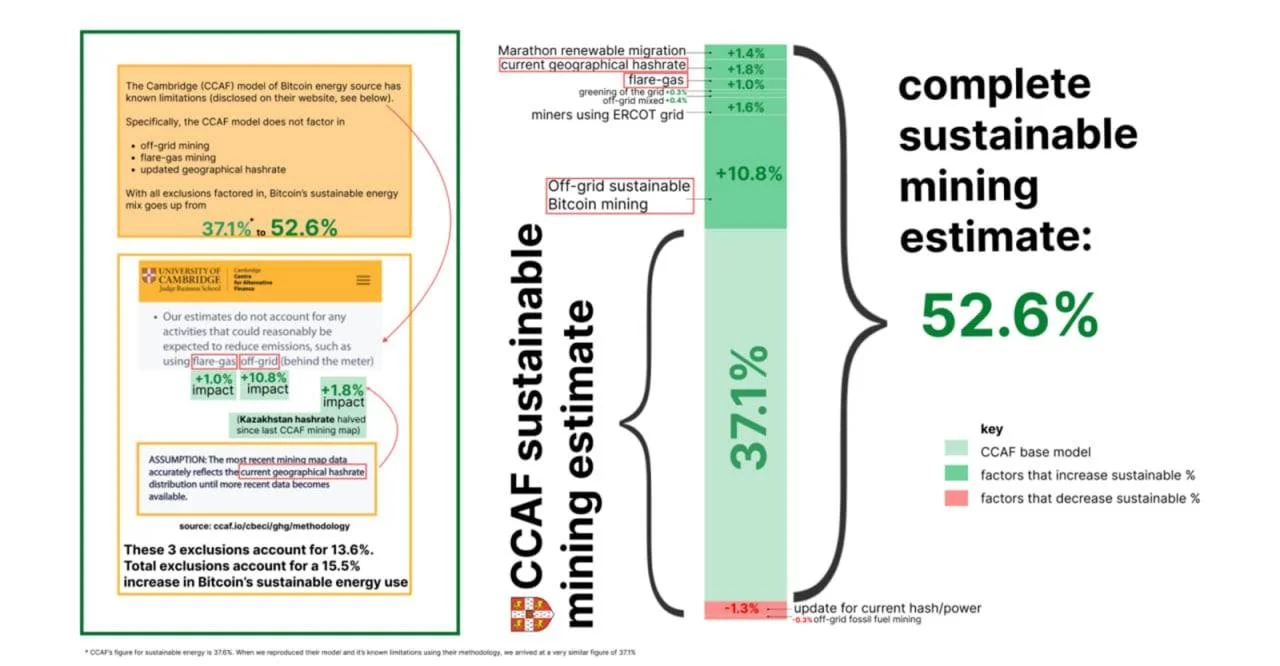
A breakdown of sustainable Bitcoin mining. Source: Batcoinz
The pro-crypto senator then turned her attention to the increasing role of Bitcoin mining facilities in securing the energy grid. Mining facilities represent large, dynamic electrical loads that can be used to balance and redistribute energy to electrical grids during times of need.
Perhaps no other example illustrates this more than the ongoing efforts between the Electrical Reliability Council of Texas (ERCOT) and Bitcoin miners to stabilize electrical grids. The GOP lawmaker explained that in 2022, Bitcoin miners were able to sell 1500 megawatts of energy back to the grid during peak demand. A similar pattern played out in 2024, with Bitcoin mining infrastructure acting as a Controllable Load Resource for Texas’ grid during winter storm Heather.
A 30% tax would hurt the environment that regulators claim to protect
The Wyoming senator explained that levying a 30% excise tax on Bitcoin miners would disincentivize them from seeking sustainable forms of energy and novel energy recycling techniques. Although Lummis gave the example of sequestering methane from trash dumps to mine Bitcoin, similar examples can be seen in El Salvador, where the government mined 474 Bitcoin using volcanic energy.
Another example of the energy efficiencies introduced by Bitcoin mining can be found in the Satakunta region of Finland, where an entire community of 11,000 individuals is warmed by excess heat produced by a Marathon Digital mining facility.
The mining giant also signed an agreement with Kenya’s government earlier this year to further develop the country’s renewable energy sector, a thriving industry already delivering up to 80% of the country’s energy needs.
The Laffer Curve will get the final laugh
Lummis concluded her report by arguing that increasing taxes on Bitcoin miners will lead to the industry leaving the United States, reducing the sought-after tax revenues. This inverse relationship between tax rates and tax revenue is known as the Laffer Curve.
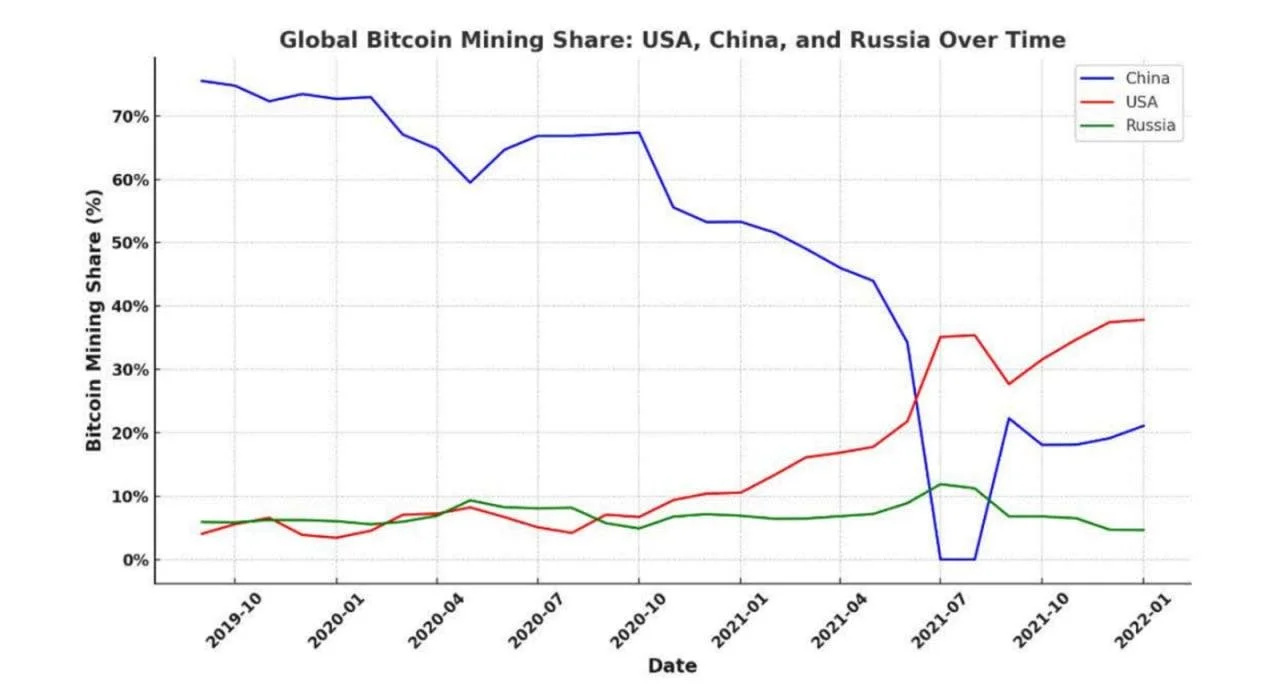
A chart highlighting Bitcoin hashrate dominance between global powers from 2019-2022. Source: Powering Down Progress by Senator Cynthia Lummis
The senator pointed out that this has already happened in China, where the 2021 mining ban drove out the once-thriving mining industry.
Before the ban, Chinese miners controlled a majority of the Bitcoin network’s hashrate.
@ Newshounds News™
Read more: Coin Telegraph
~~~~~~~~~
What are the strongest currencies in the world? (2024)
Ever wondered which is the strongest currency in the world? There are lots of factors which can push a currency up the global rankings, from low inflation to a strong economy, to interest rates or oil and gas exports.
What is currency strength?
According to Nasdaq a strong currency is:
“A currency whose value compared to other currencies is improving, as indicated by a decrease in the direct >exchange rates for the currency”.
Put simply, the definition of a ‘strong currency’ is when a currency is worth more than another country's currency. ‘Currency strength’ refers to how strong or weak a currency is at any given time.
What are the top 10 strongest currencies?
1. Kuwaiti dinar
The Kuwaiti dinar (KWD) is the world’s strongest currency, and this is for a number of reasons. For starters, Kuwait has one of the largest oil reserves in the world.
It’s also a wealthy country, whose government has prioritised the growth of the country’s private sector, the diversification of the economy and responsible budgetary policies. All of these factors have contributed to the stability and resilience of the Kuwaiti dinar.
Today 1 USD = 0.305640 KWD
2. Bahraini dinar
The second most valuable global currency is the Bahraini dinar (BHD). Oil and gas again play a part in the Bahraini dinar’s strength, as a major part of the country’s income derives from exports of gas and oil.
Bahrain has also become a regional financial hub, which has attracted international capital and helped to expand the country’s economy.
Today 1 USD = 0.377000 BHD
3. Omani rial
The Omani rial (OMR) is another of the world’s strongest currencies, again thanks to exports of oil and gas. However, the government in Oman is working on lessening the country’s dependence on oil markets. It has taken steps to support other industries in order to diversify the economy, which should help to sustain the resilience of the rial.
Today 1 USD = 0.385015 OMR
4. Jordanian dinar
The Jordanian dinar (JOD) is high up the list of the world’s strongest currencies for a combination of reasons. It is an oil and gas exporting nation, but is less dependent on this than some of its neighbours.
Other factors contributing to the dinar’s success include the actions of Jordan’s central bank, which has taken a cautious approach to monetary and fiscal policy. It is dedicated to price stability and exchange rate flexibility, as well as keeping ample foreign exchange reserves to protect against external shocks.
Today 1 USD = 0.708500 JOD
5. British pound
Now we come to a familiar currency - the British pound sterling or GBP. The pound is the fifth-strongest world currency in 2024, despite the turbulence of Brexit and uncertainty surrounding ties between the UK and the EU. The UK has also experienced political upheaval, such as the ‘mini budget’ by then-PM Liz Truss which triggered a major drop in the value of the pound.
While the pound may have experienced volatility over the last few years, it remains one of the most popularly traded currencies. Its strength and resilience is partly down to the UK’s reputation as one of the world’s biggest countries by Gross Domestic Product (GDP).
Today 1 USD = 0.773784 GBP
*️⃣NOTE: Since this article was published the British pound has moved to 6th place and the Gibraltar pound has move up to the 5th position.
6. Gibraltar pound
In the sixth spot on our list is the Gibraltar pound (GIP). The driving force behind its stability and strength is its relationship to the British pound (GBP). The GIP is pegged to the GBP, and the two countries maintain a close relationship.
Today 1 USD = 0.773754 GIP
7. Cayman Islands dollar
The Cayman Islands dollar (KYD) derives its strength and stability due to the territory’s status as a leading global financial hub. The islands are home to a wide range of financial institutions, enterprises and investment funds, all attracted by a robust regulatory system, advanced banking infrastructure and advantageous tax policies.
Today 1 USD = 0.820000 KYD
8. Swiss franc
The 8th strongest global currency is the Swiss franc (CHF). The Swiss National Bank (SNB) ensures the stability of the currency with a range of crucial measures. This includes implementing monetary policy, maintaining price stability and supervising banks and the financial sector in Switzerland. All of this bolsters investor confidence in the Swiss franc.
Today 1 USD = 0.884350 CHF
9. Euro
The euro (EUR) is one of the world’s major reserve currencies, whose value is influenced by a large number of variable factors. This is because it is the currency of 20 EU member countries, all with their own economic policies.
However, monetary policy and price stability within the region is overseen by the European Central Bank (ECB). The bank has taken steps to maintain the stability and reliability of the euro, primarily by careful management of inflation.
Today 1 USD = 0.921700 EUR
10. US dollar
Last, we have the US dollar (USD) - the world’s 10th strongest currency. You might be surprised not to see the dollar higher up the list, as it is by far the most traded currency on the planet. Plus, the US economy is the biggest in the world in terms of GDP. The dollar is used to price commodities, and it’s also one of the world’s largest reserve currencies. Major US banks are also global leaders.
However, the strength of a currency is determined by complex factors, including supply and demand in the foreign exchange market.
What is the weakest currency in the world?
The Iranian rial (IRR) is the weakest currency in the world.5
What is the most traded currency in the world?
The US dollar is the world’s most traded currency.²
How is foreign currency priced?
There are two main ways that foreign currency is priced. The first uses a floating rate, which is determined by the open market through global supply and demand. If the currency is in demand, its value usually increases.
The second pricing method is a fixed rate, also known as a pegged rate. This is determined by the government through its central bank, and is set against another major global currency (such as USD or EUR, for example).
What is the most stable global currency?
The Swiss franc (CHF) is generally considered to be the most stable currency in the world in 2024.6
What is the strongest currency pair?
The strongest currency pair is the euro (EUR) and US dollar (USD),7 as it is one of the most commonly traded and both locations have large and strong economies.
How do I know which currency is stronger?
One of the easiest ways to work out which currency is stronger is to compare one currency to another, using exchange rates. A higher exchange rate suggests that a currency is stronger compared to the other.
In what country is GBP worth the most?
To determine where GBP is worth the most, you would typically look at exchange rates against other currencies. But remember that exchange rates fluctuate constantly based on factors such as economic conditions, interest rates and geopolitical events.
This means you’ll need to look at exchange rate data to see which country's currency offers the most favourable exchange rate against the British pound at any given time. When researching, watch out for hidden fees to make sure you’re getting the fairest price. At Wise, we’re transparent and upfront about the cost, we use the mid-market rate, and never hide fees*.
@ Newshounds News™
Read more: Wise
~~~~~~~~~
Newshound's Daily Breakdown Podcast Link
Newshound's News Telegram Room Link
Q & A Classroom Link
Follow the Roadmap
Follow the Timeline
Seeds of Wisdom Team™ Website
Subscribe to Newsletter
Thank you Dinar Recaps
Seeds of Wisdom RV and Economic Updates Tuesday Evening 7-23-24
Good Evening Dinar Recaps,
BRICS IS MAKING PREPARATIONS FOR A US DOLLAR COLLAPSE
"According to a Russian IMF representative, BRICS is ready to offer an alternative to the US Dollar amid the currency’s collapse, and the bloc must prepare for such an instance. The alliance, consisting of Russia; India, China; Brazil; South Africa; and supporting nations, has been working to abandon the US Dollar for some time."
"The BRICS bloc is working to develop a new BRICS currency to replace the US dollar, alongside local currencies between nations. In an interview with RIA Novosti published on Friday, Russian IMF rep Alexey Mozhin noted that the shortcomings of the current financial system are becoming more apparent.
Furthermore, he points out that many publications have started to mention BRICS as a group that will offer a successful alternative to the greenback."
Good Evening Dinar Recaps,
BRICS IS MAKING PREPARATIONS FOR A US DOLLAR COLLAPSE
"According to a Russian IMF representative, BRICS is ready to offer an alternative to the US Dollar amid the currency’s collapse, and the bloc must prepare for such an instance. The alliance, consisting of Russia; India, China; Brazil; South Africa; and supporting nations, has been working to abandon the US Dollar for some time."
"The BRICS bloc is working to develop a new BRICS currency to replace the US dollar, alongside local currencies between nations. In an interview with RIA Novosti published on Friday, Russian IMF rep Alexey Mozhin noted that the shortcomings of the current financial system are becoming more apparent.
Furthermore, he points out that many publications have started to mention BRICS as a group that will offer a successful alternative to the greenback."
“Such a proposal is being discussed,” the director told RIA Novosti. “In the event of the collapse of the dollar and the international monetary system, it will be necessary to turn the said BRICS accounting unit into a real currency, backed by exchange goods.”
BRICS CURRENCY TO SERVE AS SUBSTITUTE IF US DOLLAR COLLAPSES
"The BRICS bloc has turned to blockchain technology for its brand-new payment system, according to reports. Indeed, its efforts have sought to build a competing currency built on digital assets."
"The US Dollar is still a ways away from crashing altogether, however, the path is there for BRICS to do damage. The greenback is still the global reserve, but a mounting US Debt has ensured that it won’t remain a fact forever.
"Furthermore, support around the BRICS bloc has grown over the past few years, with more countries likely to receive invites to join in 2024.
With more support in numbers and finances, BRICS could develop a strong contending currency to fight the US dollar."
@ Newshounds News™
Read more: The Republicans Voice
~~~~~~~~~
GOLD, SILVER: India's TAX CUT to Offer a Bullish Boost for the Metals?
"Today, India slashed its import tax on gold and silver, a move that could further boost demand for both precious metals in the world’s second-biggest gold market and support higher prices globally. The move will cut taxes on gold and silver imports by more than half, lowering duties from 15 percent to 6 percent."
"India will also lower the import tax on platinum to 6.4 percent."
"World Gold Council Indian operations CEO Sachin Jain told Reuters the tax cut is “a massive step in the right direction.”
“It will reduce the incentives for smuggling of gold. It will create a level playing field for honest industry stakeholders.”
"Gold was up about $14 in overseas trading after officials announced the tax cut. Even with the high import taxes, Indian gold demand has been strong. Through the first five months of 2024, gold imports into India increased by 26 percent year-on-year, with 230 tons of gold flowing into the country. This is despite record-high prices."
"Indians have historically had an affinity for gold. Indian households own an estimated 25,000 tons of gold, and that likely understates the amount given the large black market in the country. Gold is deeply interwoven into the country’s marriage ceremonies and cultural rituals. Indians have long valued the yellow metal as a store of wealth, especially in poorer rural regions."
"Gold isn't considered a luxury in India. Even poor Indians buy gold. According to a 2018 ICE 360 survey, one in every two households in India had purchased gold within the last five years. Overall, 87 percent of Indian households own some gold. Even households at the lowest income levels in India hold some of the yellow metal. According to the survey, more than 75 percent of families in the bottom 10 percent of income managed to buy some gold."
@ Newshounds News™
Read more: Investing
~~~~~~~~~
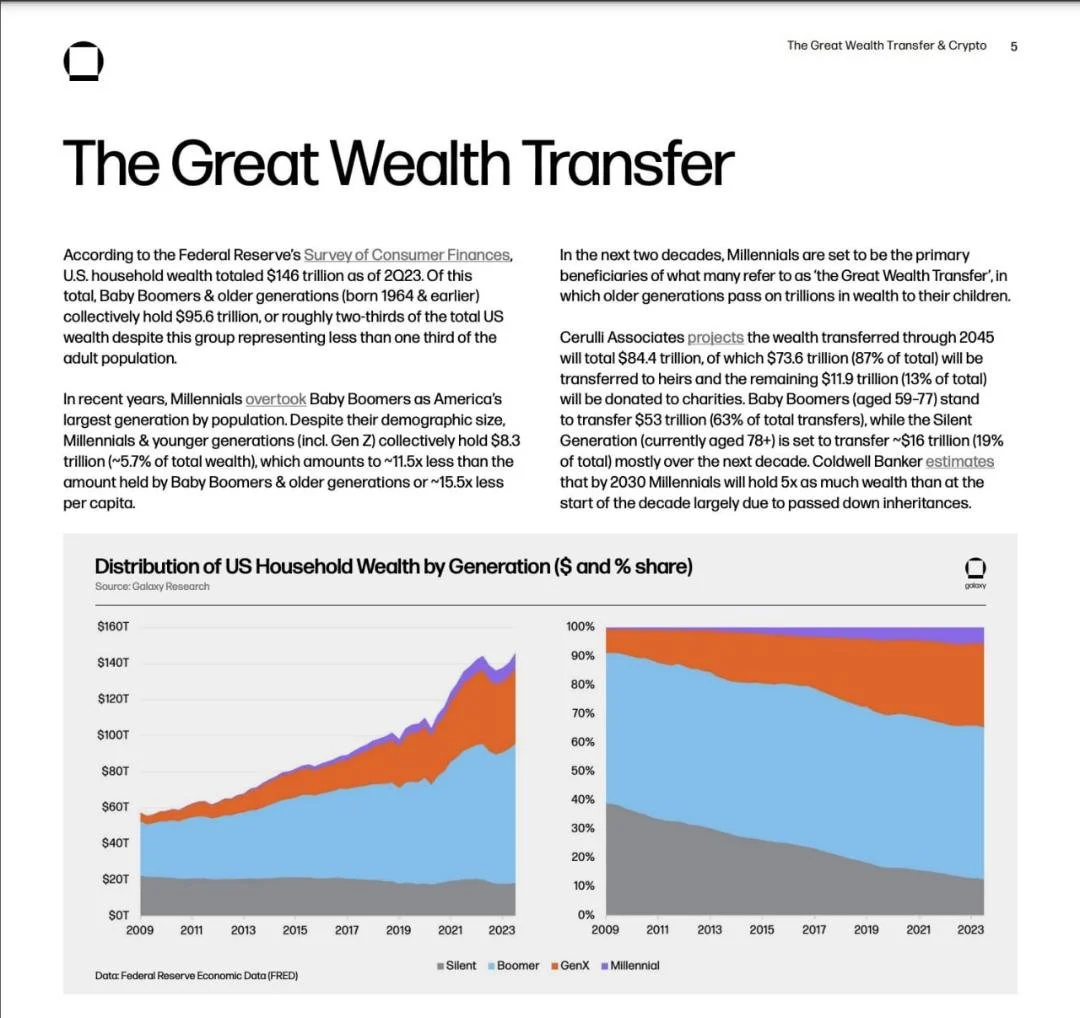
146 TRILLION
@ Newshounds News™
Read more: https://x.com/SMQKEDQG/status/1780670320522747961
~~~~~~~~~
Warren Buffett Dumps $1.5 Billion Worth Bank of America Shares
Ace investor Warren Buffett’s investment arm Berkshire Hathaway has dumped $1.5 billion worth of Bank of America (BAC) shares. The recent regulatory filings show that the billionaire offloaded 33.9 million Bank of America shares. The BAC stocks were sold at an average price of $43.56 per share. After the sale from Berkshire Hathaway, BAC stocks fell to $42.30 with a decline of 1.40%.
The reduction is significant and has come as a surprise to the US stock market. Warren Buffett is known to hold stocks for the long term and not offload them mid-way. However, despite the sell-off, Warren Buffett is still the second-biggest holder of Bank of America stocks. Berkshire Hathaway holds a 10.8% stake in BAC after falling from the top position to the second due to the sell-off
@ Newshounds News™
Read more: Watcher Guru
~~~~~~~~~
IS TRUMP RIGHT TO WORRY THAT CHINA COULD TAKE OVER CRYPTO?
Does China regret banning Bitcoin mining in 2021? Could it opt back in? Can a single nation even control decentralized assets like BTC?
It’s only recently that Donald Trump has paid any attention to crypto. But now he wants to be the “crypto president,” and he’s raising digital assets as a geopolitical issue.
Asked on July 16 why he’s suddenly embracing the crypto community, he told Bloomberg:
“If we don’t do it, China is going to pick it up and China’s going to have it—or somebody else, but most likely China.”
In the interview, Trump explained how the recent experience with his “Mugshot” NFT Collection “opened my eyes” to cryptocurrencies, saying, “80% of the money [from the NFT sale] was paid in crypto. It was incredible.”
“So we have a good foundation [i.e., crypto]. It’s a baby. It’s an infant right now. But I don’t want to be responsible for allowing another country to take over this sphere,” he added.
His remarks raised several interesting questions — and not just whether China, which banned crypto trading and Bitcoin mining in 2021, is even interested in reentering the crypto trading and mining markets.
It touches on the relationship between governments and the crypto/blockchain sector generally.
To what extent can any single sovereign nation control decentralized and diversified digital assets like Bitcoin and Ethereum.
Is it even possible?
Why China?
China was once a major crypto player. The largest crypto exchanges, such as Binance, were located in China, and as much as 75% of Bitcoin mining took place on the Chinese mainland, according to estimates.
But in 2021, China cracked down on crypto trading and mining, and by July of that year, Bitcoin mining had essentially vanished on the mainland.
Recent developments, however, have raised speculation “that the Chinese government may be warming to cryptocurrency and that Hong Kong may be a testing ground for these efforts,” noted Chainalysis in October.
Indeed, in April 2024, the central government approved the launch of several Bitcoin exchange-traded funds (ETFs) in Hong Kong. Some observers think China wants to make Hong Kong a crypto hub — despite a continued trading ban on the mainland.
China’s Bitcoin ban a “strategic blunder”
“Absolutely,” Daniel Lacalle, chief economist of Tressis, told Cointelegraph.
“Beijing’s 2021 mining crackdown was a strategic blunder,” Emiliano Pagnotta, associate professor of finance at Singapore Management University, told Cointelegraph.
China wants to maintain tight control of capital outflows on the mainland, Wang, assistant professor in the economics department at the University of Essex, told Cointelegraph, which is why it banned crypto trading
But Hong Kong, while controlled by China, has a different economy. It has always had open market policies and free capital flow, and crypto might find a natural home in the former British colony. Wang added:
“Hong Kong serves as the hub to allow some capital flow in and out of mainland China, which is important for Hong Kong and also for mainland China.”
“The digital asset ETF market in Hong Kong has indeed seen substantial growth since its launch in April 2024,” Patrick Pan, chairman and CEO of OSL — a crypto-exchange now operating in Hong Kong — told Cointelegraph.
Pan added that mainland China “has maintained a stringent stance against cryptocurrency trading and speculations.”
Pan points out, however, that China has largely accepted the importance of cryptocurrencies’ underlying blockchain technology.
“China’s development and gradual rollout of the digital yuan showcase an interest and capacity to embrace blockchain technologies, which bring long-term benefits to the country’s financial infrastructure through enhanced efficiency and security of its financial systems,” said Pan.
China may be softening its stance on crypto
Chinese government decision-making is opaque, so one may never know if China truly regrets its 2021 crypto ban. But what is clear is that “the country is reassessing its approach, especially as it sees the strategic value in digital assets,” Zennon Kapron, founder and director of consulting firm Kapronasia, told Cointelegraph, adding:
“The softening stance in Hong Kong could be a strategic move to remain competitive in the fintech and digital finance space without fully reversing its mainland policy.”
But is it too late?
“China still has advantages, such as access to cheap hardware and electricity in certain regions,” Kapron allowed. “If the government were to provide incentives or loosen restrictions, it’s conceivable that some level of dominance could be reestablished.”
It wouldn’t be easy, though. “The global mining landscape has become more diversified, making it harder for any single country to dominate,” observed Kapron.
“Bitcoin mining is not like making CPUs, but more similar to producing solar panels, building railways, etc. China has the capacity and even the comparative advantage in this type of mass production.”
Crypto trading may be a different matter, though. China is unlikely to change its trading ban on the mainland unless it first changes its capital markets policy, said Wang.
Pagnotta, by comparison, said China could still be a force within the crypto sector, particularly if it demonstrates more pragmatism and regulatory clarity.
“China now seems more open to the crypto industry and has allowed the launch of Bitcoin and ETH ETFs in Hong Kong,” said Moreno.
“Despite China’s ban on Bitcoin mining, Chinese mining pools still hold nearly 54% market share,” CryptoQuant founder Ki Young Ju posted on July 1. “While not all participants in these pools are Chinese, some mining farms might still be operating covertly in China, with authorities possibly concealing data.”
China’s central government also remains a Bitcoin “whale” as a result of its past activities — holding 190,000 BTC, or about 1% of the Bitcoin currently in existence. This is not a trivial amount.
Could China dominate crypto again?
Wang, for his part, believes that if China really sets its mind to it, it could still “play a super important, if not dominating, role” in the global crypto sector.
Not only does it have natural advantages, but there is a huge demand for using cryptocurrencies to send Chinese assets abroad, Wang added, especially given China’s tight capital market controls.
The biggest cryptocurrency exchange platform in the world in terms of trade volume is still Binance, “which is a company started in China by a Chinese but later moved abroad, and still 20% of Binance’s trade comes from China,” noted Wang.
As per Trump’s remarks, is crypto really emerging as a new theater of competition between the great powers? According to Pagnotta:
“Trump wants votes, and he understands that tens of millions of Americans hold digital assets and see it as an important electoral issue. Drawing a contrast to Biden or China in this regard is politically astute.”
“At a more profound level, Trump does not want a Chinese/BRICS [i.e, Brazil, Russia, India, China, South Africa]-led central bank digital currency [CBDC] to become dominant. Even if he did not suddenly become a genuine Bitcoiner, he surely comprehends enough game theory to realize that Bitcoin is the politically neutral global property rights system in the 21st century,” added Pagnotta
In doing so, the former US president could simply be applying the ancient wisdom that “the enemy of my enemy is my friend.” Still, others believe the suggestion that China may once again try to gain dominance in the global crypto market is just plain wrong. Leading cryptocurrencies like Bitcoin and Ether are too diversified and decentralized now to allow control by any one sovereign state.
“China’s influence in the crypto market may grow, particularly through initiatives like the digital yuan,” said Kapron, “but achieving dominance over decentralized cryptocurrencies is a different challenge altogether.”
Trump’s recent utterances may reflect a strategic concern, continued Kapron, “but the reality is that the decentralized and diversified nature of these digital assets acts as a significant barrier to dominance by any single nation.”
Added economist Lacalle:
“There is no such thing as nationalist crypto. The beauty of the crypto market is that it is completely diversified and decentralized. The concept of government control of crypto makes no sense to anyone that understands independent currencies.”
@ Newshounds News™
Read more: COIN TELEGRAPH
~~~~~~~~~
Newshound's Daily Breakdown Podcast Link
Newshound's News Telegram Room Link
Q & A Classroom Link
Follow the Roadmap
Follow the Timeline
Seeds of Wisdom Team™ Website
Subscribe to Newsletter
Thank you Dinar Recaps
Seeds of Wisdom RV and Economics Updates Monday Afternoon 7-22-24
Good Afternoon Dinar Recaps,
Seven-State Coalition Opposes SEC’s Cryptocurrency Regulation
The Office of the Attorney General of Iowa announced earlier this month that Iowa Attorney General Brenna Bird led a seven-state coalition in filing an amicus brief opposing the U.S. Securities and Exchange Commission’s (SEC) attempt to regulate cryptocurrencies. The amicus brief, supported by Arkansas, Indiana, Kansas, Montana, Nebraska, and Oklahoma, was filed on July 10 to challenge the SEC’s overreach.
“SEC’s power grab may stop states from protecting their citizens from scams, and it hurts the free market,” the announcement details, adding: SEC’s policing of cryptocurrency will stifle innovation and devastate the cryptocurrency industry.
States like Iowa, which have been at the forefront of protecting scam victims and prosecuting scammers, view the SEC’s actions as a significant overreach.
Good Afternoon Dinar Recaps,
Seven-State Coalition Opposes SEC’s Cryptocurrency Regulation
The Office of the Attorney General of Iowa announced earlier this month that Iowa Attorney General Brenna Bird led a seven-state coalition in filing an amicus brief opposing the U.S. Securities and Exchange Commission’s (SEC) attempt to regulate cryptocurrencies. The amicus brief, supported by Arkansas, Indiana, Kansas, Montana, Nebraska, and Oklahoma, was filed on July 10 to challenge the SEC’s overreach.
“SEC’s power grab may stop states from protecting their citizens from scams, and it hurts the free market,” the announcement details, adding:
SEC’s policing of cryptocurrency will stifle innovation and devastate the cryptocurrency industry.
States like Iowa, which have been at the forefront of protecting scam victims and prosecuting scammers, view the SEC’s actions as a significant overreach.
“The Biden SEC is trying to prevent states like Iowa from doing their job to hold robbers to the law and protect families from the dangers of cryptocurrency scams. This power grab will also hurt the free market and allow the SEC to take the regulatory reins over the cryptocurrency industry with no accountability,” the announcement continues.
Noting that the SEC’s “bypassing Congress to give itself new power is illegal, stifles innovation, and will let scammers off the hook,” the Iowa Attorney General’s Office noted, emphasizing:
The Biden SEC is attempting to abuse its power and put itself in charge of regulating cryptocurrency, bypassing state consumer-protection laws.
“Congress never gave the SEC power to regulate cryptocurrency, and there is no accountability to ensure the actions the SEC takes are legitimate and necessary,” the Iowa Attorney General’s Office stressed.
The amicus brief explains that the SEC is violating the Administrative Procedure Act and the Major Questions Doctrine by bypassing Congress. The states argue that typical cryptocurrencies are not investment contracts under the Securities Act of 1934, urging the court to prevent the SEC from exceeding its authority.
@ Newshounds News™
Read more: Bitcoin
~~~~~~~~~
Japan’s Fast And Early Approach To Crypto Regulation Is Paying Off
Japan was a rare exception when it came to regulating crypto. Following the catastrophic collapse of Mt.Gox in 2014 – a Japan-based company – the government moved fast and early to clamp down on what was seen as an excessively risky industry. It introduced strict rules for operators, putting them under the oversight of the country’s financial regulator.
That decision means that ten years on, Web3 in Japan is evolving quite differently compared to the startup culture that’s characterized the sector in other countries. Instead, we’re seeing a more prevalent trend of large corporations levering their way into Web3 via strategic M&A and investment activities.
To date, banking giant Softbank has been one of the
most active players, acquiring a controlling stake in crypto trading platform BITPoint in 2022 and becoming a key investor in a dedicated Web3 venture fund initially set up by Deutsche Bank.
However, the latest news, that Sony is gearing up to launch a rebranded crypto exchange called. S.BLOX, as a result of a 2023 acquisition of local platform Whalefin, has created a froth in the crypto community.
I recently spoke to Mai Fujimoto, co-founder of INTMAX, who was fresh from the Japan Blockchain Week Summit which she hosted in early July. She confirmed that, based on the lineup of this year’s event, the corporate move into Web3 is becoming a trend:
“This [Sony] is just one such example. We just hosted many speakers from large corporations [at Japan Blockchain Week], which stood out on the Web3 conference circuit. I believe this is unique to Japan. In the United States, Coinbase and Base
Chain have significantly contributed to the penetration of Web3 in the country, so we can expect similar synergies to occur in Japan as well.”
@ Newshounds News™
Read more: Forbes
~~~~~~~~~
IOTA’s Product Passport Could Be Used by Tesla, Audi, Porsche, BMW, and VW After Eviden Partnership
—IOTA’s Product Passport with Eviden enhances transparency for Tesla, Audi, Porsche, BMW, and VW, letting consumers track vehicle history and build trust.
—IOTA’s Digital Product Passports optimize production, maintenance, and recycling, improving supply chains for major automotive brands.
When it comes to cutting-edge data solutions while securing privacy to the highest level, IOTA is at the forefront as highlighted in one of our previous coverages.
According to the latest update from IOTA on the newly established partnership, the IOTA Foundation and Eviden, a subsidiary of Atos, are collaborating on the Eviden Digital Passport Solution (EDPS), which is “Powered by IOTA.”
EDPS is one of the first ready-to-use, DLT-based Digital Product Passports (DPPs) on the market and the first at this scale to utilize IOTA technology.
This upgrade provides detailed lifecycle information about products, enhancing transparency, traceability, and sustainability. Dominik Schiener, Co-Founder and Chair of the IOTA Foundation, stated:
This partnership leverages our unique joint benefits and creates a strong combination of capabilities, ready for the market to use. This is a long-term collaboration between Eviden and the IOTA Foundation, and we will work closely together to explore further use cases in domains such as construction materials, textiles, and consumer electronics, amongst others. We expect millions of passports to be registered on the IOTA network by the end of the decade.
IOTA and Eviden Enhancing Transparency and Traceability for Major Automakers
Eviden, with leading positions in computing, security, AI, and digital platforms, provides expertise across various industries in more than 47 countries. Importantly, the collaboration with the IOTA Foundation is expected to significantly impact major automakers, including Tesla, Audi, Porsche, BMW, and Volkswagen.
This partnership will enhance transparency and traceability throughout their supply chains, allowing consumers to track the origin and history of their vehicles, building trust in these brands. At the same time, manufacturers can optimize production processes, streamline maintenance, and improve recycling efforts.
At the time of writing, IOTA is trading at $0.1769, with a decrease of 0.43% and a surge of 7.48% in the past week.
@ Newshounds News™
Read more: Crypto News Flash
~~~~~~~~~
WHAT IS A CURRENCY RE-DENOMINATION?
"Redenomination is the recalibration of a country's currency, typically due to hyperinflation and currency devaluation, whereby an old currency is exchanged for a new one at a fixed rate. "
"While significant inflation is the main reason for a country to redenominate its currency, other reasons include decimalization or joining a currency union. When redenomination occurs, old banknotes and coins are typically taken out of circulation and a new currency is issued. Sometimes, the old currency continues to circulate at a fixed value against the new notes. "
"When redenomination occurs, a new value is established for the new banknotes and coins. For example, in 2006, Zimbabwe redenominated its currency at a rate of 1,000 old Zimbabwe dollars to one new Zimbabwe dollar."
"When hyperinflation is involved, redenomination becomes necessary because it requires too many old notes to facilitate commerce. Small bills essentially become useless if you need a wheel barrel of them to buy a loaf of bread. "
" Probably the most famous redenomination has been the Zimbabwean dollar, which circulated in Z$100 trillion bills—the largest denomination of currency ever issued—thanks to an annual inflation rate of more than 231 million percent.
The Zimbabwe government redenominated its currency several times starting in 2006. In that year, the country's first currency reform was launched in an effort to contain inflation. The Zimbabwean dollar was redenominated at a rate of 1,000 to one."
" In August 2008, the government launched another redenomination. Old notes could be exchanged for new ones at a rate of 10 billion to one. Inflation continued unabated, and new issues of currency with staggering face amounts continued to appear. In January 2009, Z$10 trillion, Z$20 trillion, Z$50 trillion, and Z$100 trillion notes were issued.
In February 2009, the government redenominated a third time. Old currency could be exchanged for new currency at a rate of one trillion to one. By then, most people had quit the Zimbabwe dollar in favor of the U.S. dollar and South African rand."
@ Newshounds News™
Read more: Investopedia
~~~~~~~~~
CFTC Chairman Behnam Urges Congress For Increased Crypto Regulation: We Are 'On The Front Lines' | Youtube
~~~~~~~~~
Newshound's Daily Breakdown Podcast Link
Newshound's News Telegram Room Link
Q & A Classroom Link
Follow the Roadmap
Follow the Timeline
Seeds of Wisdom Team™ Website
Subscribe to Newsletter
Thank you Dinar Recaps
Seeds of Wisdom RV and Economics Updates Sunday Afternoon 7-21-24
Good Afternoon Dinar Recaps,
SOUTH KOREA'S STRICT LAWS ON CRYPTO EXCHANGES COME INTO FORCE
The new regulations issued by South Korea’s watchdog to protect user assets on crypto exchanges went into effect on July 19.
The much-talked-about new regulations from South Korea’s financial security regulator, designed to protect users buying and storing crypto assets with virtual asset service providers (VASPs), came into force on July 19.
Titled the “Virtual Asset User Protection Act,” VASPs must take several steps to ensure the protection of user’s crypto, according to a July 17 statement from South Korea’s Financial Services Commission (FSC).
Good Afternoon Dinar Recaps,
SOUTH KOREA'S STRICT LAWS ON CRYPTO EXCHANGES COME INTO FORCE
The new regulations issued by South Korea’s watchdog to protect user assets on crypto exchanges went into effect on July 19.
The much-talked-about new regulations from South Korea’s financial security regulator, designed to protect users buying and storing crypto assets with virtual asset service providers (VASPs), came into force on July 19.
Titled the “Virtual Asset User Protection Act,” VASPs must take several steps to ensure the protection of user’s crypto, according to a July 17 statement from South Korea’s Financial Services Commission (FSC).
These include:
1. taking out insurance against hacking and malicious attacks against the user’s crypto assets,
2. keeping the customer’s crypto assets separate from the exchange’s assets, and
3. a requirement to keep customer deposits “safely kept in banks.”
VASPs are also required to maintain a certain level of due diligence to prevent money laundering on their platforms and must report any suspicious transactions to the regulator.
“VASPs should maintain a surveillance system for suspicious transactions at all times and immediately report suspicious trading activities to the Financial Supervisory Service (FSS),” it stated.
“After going through investigations by the financial and investigative authorities, those who are found to have engaged in unfair trading activities may be subject to criminal punishment or penalty surcharge,” it added.
Concerns among South Korean crypto exchanges
Crypto exchanges in South Korea have recently voiced concerns that the rules would result in them simultaneously delisting a mass of tokens.
On July 3, Cointelegraph reported that a group of 20 South Korean crypto exchanges will review a total of 1,333 cryptocurrencies over the next six months as part of the new crypto user protection laws, meaning “the possibility of mass delisting occurring all at once is unlikely,” according to the Digital Asset Exchange Alliance (DAXA).
Meanwhile, South Korea’s ruling party, the People’s Power Party, officially proposed delaying the implementation of the country’s tax on crypto trading profits.
On July 12, the party submitted the proposal and noted that current sentiment toward crypto assets was deteriorating. The description stated that rapidly imposing taxes on virtual assets is “not advisable at this time.”
@ Newshounds News™
Read more: Crypto Telegraph
~~~~~~~~~
CDP ISSUES DIGITAL BOND ON POLYGON BLOCKCHAIN USING NEW ITALIAN LAW
Italy’s Cassa Depositi e Prestiti Spa (CDP) issued a €25 million digital bond on the Polygon public blockchain, which was underwritten by Intesa Sanpaolo as the sole investor.
The issuance is part of the European Central Bank’s (ECB’s) wholesale DLT settlement trials.
Hence, the payment was made in central bank money using the Bank of Italy’s TIPS Hash Link solution, which provides connectivity between a DLT and the TARGET2 system for wholesale payments.
CDP is a development bank majority owned by the Ministry of Economy and Finance.
The settlement of a public blockchain bond issuance with central bank money wasn’t the only novel aspect of the digital bond. It is also the first to use Italy’s ‘Fintech decree’ law.
This was Italy’s enactment of the DLT Pilot Regime, but also applies to DLT issuances that are not part of the Pilot Regime (like this one), provided they take some extra steps.
There must be a Digital Register maintained by a Digital Register Manager which is authorized by Consob, Italy’s securities regulator. The Register is a log of the real names and details of the owners of the securities.
“This transaction represents a significant step for CDP in capital market innovation through the pioneering adoption of blockchain technology for bond issues,” said Fabio Massoli, CDP’s Director of Administration, Finance, Control and Sustainability.
“The promotion of a new market ecosystem and the implementation of an innovative, efficient and secure market infrastructure will provide added value to issuers and investors alike, opening up new opportunities for other players, including SMEs.”
Fintech Decree Digital Registers
The Digital Register is similar to Germany’s eWpG law. In both cases they support direct securities issuances and transactions without requiring central securities depositories (CSDs) or bank intermediaries. However, we believe Italy may have gone a step further because it allows issuers to be the Digital Register Manager for their own securities.
That’s the case here – CDP had the role of the Market DLT Operator and also the Consob authorized Digital Register Manager. But we believe this also applies where the issuer/manager is not a bank.
“We are particularly pleased to have been the first in Italy, together with CDP, to carry out an operation that is intended to be the point of reference for future issuers in a totally new legal and regulatory framework,” said Massimo Mocio, Deputy Chief and Head of Global Banking & Markets, IMI CIB Division of Intesa Sanpaolo.
A key goal of the ECB wholesale settlement trials is to test the interoperability between DLT networks and central bank money, both conventional and CBDC. Hence, the transactions involve delivery versus payment in most cases. However, CDP said the settlement for its digital bond was ‘same day’.
Meanwhile, the digital bond has a four month term. It was rated A-2 by S&P, F-2 by Fitch and S-2 by Scope.
@ Newshounds News™
Read more: Ledger Insights
~~~~~~~~~
Silver (XAG) Forecast: Gold Divergence Widens; Is Silver Undervalued or Overextended?
Key Points:
—Silver prices struggle as gold reaches new heights. The widening gold-silver ratio suggests potential undervaluation of the white metal or gold overvaluation.
—Silver's break below the 50-day moving average at $30.19 signals a technical breakdown. Sellers target $28.57, with further decline possible to $27.22-$26.60 zone.
—Weak Chinese manufacturing data raises concerns about silver's industrial demand. This aspect contributes to silver's underperformance compared to gold.
—Fed rate cut expectations drive precious metals. A 98% probability of a September cut may create a buy the rumor, sell the fact scenario for silver and gold.
—Asian physical demand for silver remains sluggish. Customers capitalize on high prices by selling existing holdings rather than making new purchases.
@ Newshounds News™
Read more: FX Empire
~~~~~~~~~
NIGERIA EMBRACES BLOCKCHAIN NATIONAL INFRASTRUCTURE INITIATIVE GAINS MOMENTUM
Government Pushes for Data Security and Privacy
The Nigerian Federal Government’s initiative to develop an indigenous blockchain infrastructure has garnered substantial support from the National Blockchain Policy Implementation Steering Committee. Two weeks prior, the government revealed its plans to establish a homegrown blockchain, emphasizing the importance of data security and privacy in this endeavor.
Endorsement from Key Stakeholders
Chimezie Chuta, Chairman of the Committee, expressed strong approval of the initiative during a discussion with The PUNCH. He regarded the concept of a national blockchain infrastructure as a significant and positive step forward.
Chuta highlighted that other countries, including India, China, the UAE, South Korea, and Singapore, have already established their blockchain infrastructures, suggesting that Africa’s third-largest economy should not lag behind.
Comparative Analysis and Future Prospects
In comparing Nigeria’s blockchain aspirations to those of other nations, Chuta underscored the potential for significant advancements in data security, economic efficiency, and technological innovation. By establishing a national blockchain, Nigeria aims to join the ranks of countries that have successfully integrated this technology into their national frameworks.
Broader Implications for the Nigerian Economy
The push for a national blockchain infrastructure is a move that could bring benefits to the Nigerian economy. The implementation of such technology promises to streamline various sectors, improve transparency, and foster a more secure and efficient data management system. This could potentially attract foreign investment and bolster confidence in Nigeria’s technological capabilities.
Moreover, the development of a national blockchain could provide a platform for various industries to innovate and collaborate more effectively. By supporting smart contracts and offering a scalable and efficient infrastructure, the blockchain could facilitate new business models and drive economic growth.
Addressing Regulatory and Compliance Challenges
A consortium-based blockchain model, as advocated by Chuta, would also address regulatory and compliance challenges more effectively. By involving multiple stakeholders in governance, this model ensures that the blockchain operates within a framework that supports regulatory oversight and compliance, thereby enhancing its credibility and reliability.
Conclusion: A Strategic Move Towards Technological Advancement
The Nigerian government’s initiative to establish a national blockchain infrastructure represents a strategic move towards embracing advanced technology for national development. With strong backing from key stakeholders and the potential for significant economic and technological benefits, this initiative is poised to position Nigeria as a leader in blockchain technology within Africa and beyond.
As the country moves forward with this ambitious project, the focus will be on ensuring that the infrastructure is robust, secure, and capable of meeting the demands of a modern digital economy.
@ Newshounds News™
Read more: Coin Trust
~~~~~~~~~
PHYSICAL CARDS: The Unexpected Frontier in Digital Security
Dr. Adam Lowe, chief product and innovation officer at CompoSecure, hears it all the time from banking executives when the topic is securing payments: “We cannot introduce friction.” But the balancing act is a tough one. Challenge a user too much and they’ll switch to a competitor. Challenge them too little, and the customer’s financial injury may be calamitous.
In this age of digital attacks and global hacks, banks, FinTechs and platforms face a dilemma. One need only look at the size and scope of the AT&T breach to see that hackers have been able to access, co-opt and use all manner of data to power their scams, and perhaps, cobble together synthetic identities. SMS texts are not as secure as they once were, given the fact that imposters can be the ones behind the SMS missive that seeks user confirmation to complete a transaction.
Among the best lines of defense and security, he said, is something that just about everyone has in their possession: a tangible, physical card. And the card, he said, ticks all the boxes of a robust and usable form of identity protection, as the technology has proven simple enough that even his mother feels comfortable using it, and as tap-to-pay has become a feature ingrained in daily financial life.
CompoSecure’s digital security platform, Arculus, streamlines digital authentication processes and secures digital assets, underpinned by the blockchain. CompoSecure, he said as part of the “What’s Next in Payments” halftime report, “essentially invented the metal card,” and now, with the digital Arculus platform, has extended the capabilities of a payment card.
“We’re seeing more customers rolling out our Arculus technology,” he said, “whether it be the wallet technology, and having digital assets alongside a payment card … or whether it’s the authenticate technology, which is for more traditional banks and for FinTechs.”
A Pocket-Sized Cryptography Engine
With enhanced digital security features, he said, the card “essentially becomes a cryptography engine in your pocket.”
The chip that’s embedded in the card, he said, serves as that aforementioned engine. To enhance the digital experience, he said, the company debuted the Arculus Cold Storage Wallet, which is the digital asset hardware wallet, which puts “keys” on the card for any user to store and use those keys for security to support and pay with crypto assets.
In addition, leveraging similar key technology, Arculus Authenticate allows users to tap their cards to authenticate themselves via a passkey that’s stored on those cards. These cards with Arculus Authenticate can also accept payments, so consumers can login, sign and approve payments.
“Instead of being synched to the cloud,” he said, of the data, “where it can be ‘ripped’ out of the cloud by bad actors, your passkeys are safe in your pocket the same way your keys to the front door of your house are safe in your pocket.”
And, he added, “whether it’s signing Visa transactions, or MasterCard, FIDO 2, or whether it’s signing Bitcoin and Ethereum transactions, that cryptography engine is happy … we can serve whatever market segment needs to be served by design, and we can make it all interoperable.”
That interoperability, he said, is a bit like bridging all the railroads back in the 1890s, as a range of different track gauges knit together to make everything work, east to west and vice versa. In this case, the various parties in a transaction using zero trust architecture standards as transactions move along various conduits.
According to the U.S. Department of Commerce, zero trust architecture is the term for “an evolving set of cybersecurity paradigms that move defenses from static, network-based perimeters to focus on users, assets and resources.” It assumes no implicit trust based on physical or network location.
@ Newshounds News™
Read more: PYMNTS
~~~~~~~~~
Newshound's Daily Breakdown Podcast Link
Newshound's News Telegram Room Link
Q & A Classroom Link
Follow the Roadmap
Follow the Timeline
Seeds of Wisdom Team™ Website
Subscribe to Newsletter
Thank you Dinar Recaps
Seeds of Wisdom RV and Economics Updates Saturday Afternoon 7-20-24
Good Afternoon Dinar Recaps,
JORDAN LAUNCHES NATIONAL TECHNOLOGY NETWORK
The Ministry of Digital Economy and Entrepreneurship in Jordan has launched a national blockchain technology network in partnership with Jordanian blockchain company Blockexe. The implementation of blockchain technology in Jordan’s government sector aligns with the Jordanian Digital Transformation Strategy (2021-2025).
Enhancing Trust in Government Services
On July 17, the Jordanian Ministry of Digital Economy and Entrepreneurship announced its partnership with local blockchain company Blockexe to launch a national blockchain technology network called Modee Dlt. This protocol aims to enhance trust and transparency in government services.
The blockchain network has been integrated with the Jordanian government portal, allowing for decentralized and verifiable digital records of all Sanad transactions. According to a report, this implementation aligns with the Middle Eastern nation’s Digital Transformation Strategy (2021-2025), which focuses on strengthening the country’s digital infrastructure.
Good Afternoon Dinar Recaps,
JORDAN LAUNCHES NATIONAL TECHNOLOGY NETWORK
The Ministry of Digital Economy and Entrepreneurship in Jordan has launched a national blockchain technology network in partnership with Jordanian blockchain company Blockexe. The implementation of blockchain technology in Jordan’s government sector aligns with the Jordanian Digital Transformation Strategy (2021-2025).
Enhancing Trust in Government Services
On July 17, the Jordanian Ministry of Digital Economy and Entrepreneurship announced its partnership with local blockchain company Blockexe to launch a national blockchain technology network called Modee Dlt. This protocol aims to enhance trust and transparency in government services.
The blockchain network has been integrated with the Jordanian government portal, allowing for decentralized and verifiable digital records of all Sanad transactions. According to a report, this implementation aligns with the Middle Eastern nation’s Digital Transformation Strategy (2021-2025), which focuses on strengthening the country’s digital infrastructure.
Under Jordan’s ambitious strategy, innovation, as well as private and public sector partnerships, are seen as key enablers; hence, they are encouraged. Investments in critical information technology infrastructure, including broadband expansion and 5G deployment, are similarly viewed as important enablers. When achieved, these and five other enablers help Jordan improve the quality of life for its citizens.
Meanwhile, the Ministry emphasized that utilizing the blockchain network across various government sectors will create a reliable digital environment, supporting the Kingdom’s broader goals of achieving a robust and trustworthy digital economy.
In addition to enhancing trust in government, this initiative aims to streamline the integration of e-government services, making them more transparent, efficient, and competitive both locally and internationally.
@ Newshounds News™
Read More: Bitcoin News
~~~~~~~~~
BANK OF INTERNATIONAL SETTLEMENTS ISSUE NEW RULES FOR XRP
"The BIS, which positions itself as a bank for central banks globally, has introduced new regulations governing banks’ exposure to Group 2 cryptocurrencies. Notably, the BIS had in the past defined what Group 2 crypto assets are in an effort to separate them from other cryptocurrencies."
"Group 2 assets include unbacked crypto assets such as XRP, Bitcoin (BTC), and Ethereum (ETH). The category also contains stablecoins that lack effective stability mechanisms. According to the BIS’ classifications, these assets are riskier due to their volatility."
"In the latest requirements, the BIS has stipulated that a bank’s total exposure to all these Group 2 assets must not exceed 1% of its Tier 1 capital. For the uninitiated, the Tier 1 Capital represents a bank’s core capital."
"This capital is the primary financial buffer that absorbs losses, ensuring the bank’s stability. Per the BIS requirement, if a bank with $1 trillion in Tier 1 Capital seeks to hold XRP and other assets in Group 2, the combined worth of all assets must not be more than $10 billion."
"Crypto regulations have taken focus in recent times as the industry pushes further into the mainstream scene. For instance, the European Union recently enacted the first part of its MiCA regulations, affecting stablecoins.
"Mainstream banks have begun gaining exposure to crypto assets. Recall that last December the Basel Committee disclosed the crypto holdings of 19 banks across different regions. The disclosure confirmed that these banks held $205 million in XRP at the time.
Despite this, XRP has not commanded as much adoption from banks and financial institutions due to the ongoing SEC lawsuit. Anderson, a crypto researcher, argued in February that XRP might not see increased adoption by banks until the U.S. SEC publicly declares it is not a security."
"Per the publication, the BIS’ recent requirements are set to take effect on JANUARY 1, 2026"
@ Newshounds News™
Read more: Crypto News
~~~~~~~~~
THE CENTRAL BANK OF THE UAE (CBUAE) and NATIONAL BANK OF ETHIOPIA (NBE) have signed an agreement to enhance financial and commercial co-operation between the two nations, in a deal worth AED 3 billion.
"Both parties also entered into two Memorandum of Understanding (MoU) to establish a framework for the use of LOCAL CURRENCIES in settling cross-border transactions and for linking their payment and messaging systems.
The agreement allows the CBUAE and the NBE to SWAP LOCAL CURRENCIES with a nominal value of up to AED 3 billion and ETB 46 billion, supporting the financial and commercial cooperation between the UAE and Ethiopia through the provision of LIQUIDITY IN LOCAL CURRENCIES to financial markets, enabling more effective and efficient settlement of cross-border transactions."
"Both parties will cooperate under the second MoU in the areas of PAYMENT PLATFORM SERVICES and ELECTRONIC SWITCHES, by interlinking their instant payment systems, national card switches UAESWITCH and ETHSWITCH, and messaging systems in accordance with the regulatory requirements of each country, in addition to the cooperation in the field of financial technology and CENTRAL BANK DIGITAL CURRENCIES."
"“The bilateral CURRENCY SWAP AGREEMENT and the MoUs signed today reflect the robust economic cooperation between the UAE and Ethiopia, specifically in the areas of trade and investment. SWAPPING THE CURRENCIES of the two countries and utilizing LOCAL CURRENCIES to settle cross-border transactions and enhancing the cooperation in interlinking instant payment systems, electronic switches and messaging systems will enhance economic, trade, and investment prospects. "
"The currency swap arrangement provides an important funding opportunity for Ethiopia and helps diversify the range of currencies at its disposal to facilitate the growing volume of trade and investment transactions expected over the coming years."
@ Newshounds News™
Read more: ARN News Center
~~~~~~~~~
P
~~~~~~~~~
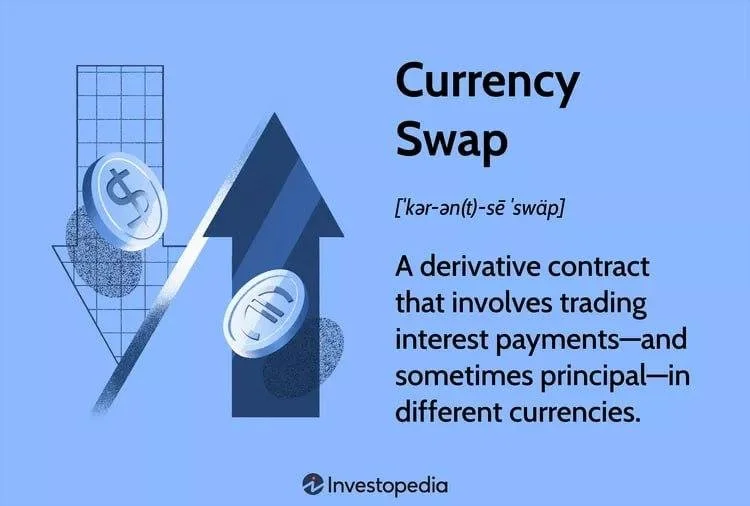
Currency Swaps: Definition, How and Why They're Done
"A currency swap involves the exchange of interest—and sometimes of principal—in one currency for the same in another currency.
Companies doing business abroad often use currency swaps to get more favorable loan rates in the local currency than if they borrowed money from a local bank.
Considered to be a foreign exchange transaction, currency swaps are not required by law to be shown on a company's balance sheet.
Interest rate variations for currency swaps include fixed rate to fixed rate, floating rate to floating rate, or fixed rate to floating rate."
" Currency swaps were originally done to get around exchange controls, governmental limitations on the purchase and/or sale of currencies. Although nations with weak and/or developing economies generally use foreign exchange controls to limit speculation against their currencies, most developed economies have eliminated controls nowadays."
"So swaps are now done most commonly to hedge long-term investments and to change the interest rate exposure of the two parties. Companies doing business abroad often use currency swaps to get more favorable loan rates in the local currency than they could if they borrowed money from a bank in that country."
"Currency swaps are important financial instruments used by banks, investors, and multinational corporations."
"In a currency swap, the parties agree in advance whether or not they will exchange the principal amounts of the two currencies at the beginning of the transaction. The two principal amounts create an implied exchange rate. For example, if a swap involves exchanging €10 million versus $12.5 million, that creates an implied EUR/USD exchange rate of 1.25. At maturity, the same two principal amounts must be exchanged, which creates exchange rate risk as the market may have moved far from 1.25 in the intervening years. "
@ Newshounds News™
Read more: Investopedia
~~~~~~~~~
DIGITAL RUSSIAN RUBLE CBDC
"Putin wants to speed up deployment of Russia’s CBDC.
During a meeting on economic issues earlier this week, Vladimir Putin seemed keen for Russia’s central bank digital currency (CBDC) pilots to accelerate, according to Russian news agency TASS.
“Now we need to take the next step, namely to move to a broader, full-scale implementation of the digital ruble in the economy, in economic activity and in the field of finance,” he said. Digital ruble trials started in August last year after months of delays waiting for supporting legislation.
The first wave of tests involved a dozen banks, with a second wave due to start in September with up to 19 additional banks, including Russia’s largest, Sber."
"“It is important for Russia to ‘seize the moment’, as they say, to create the legal framework and regulation in a timely manner, to develop infrastructure, to create conditions for the circulation of digital assets, both within the country and in relations with foreign partners,” he said."
"Russia already has a digital financial asset (DFA) framework for tokenized assets, including commodities such as gold. The usage of DFA such as tokenized gold for payments is banned. However, the country recently passed legislation supporting their use for cross border payments. Plus, Iran said it was working with Russia on CBDC and tokenized asset payments."
"Likewise, the central bank governor recently said that it was acceptable to use cryptocurrencies for international payments if it helps address sanctions"
"This underlines Putin’s desire to accelerate other modes of payment, particularly new digital technologies such as CBDC and digital assets that sidestep the West."
@ Newshounds News™
Read more: Ledger Insights
https://www.ledgerinsights.com/putin-wants-to-speed-up-deployment-of-russias-cbdc/
~~~~~~~~~
CBDC ADOPTION IS A MATTER OF "WHEN" NOT "IF"
"RESERVE BANK OF INDIA (RBI) released a Central Bank Digital Currency (CBDC) called the Digital Rupee in 2022. The Digital Rupee is supposed to carry the same force as traditional currency. Pati mentioned that the regulator sees CBDC as a product for the future, with 140 countries exploring CBDC at various stages. “At some point of time, we would see that CBDC provides a good, safe and secure alternative to cash, and reduces our dependence on currency. This would also reduce the need for printing, distributing, retrieving back those currency notes and replenishing them,” Pati pointed out."
"RBI’s Chief General Manager for the Fintech Department, Suvendu Pati, said during Assocham’s India International Fintech Festival. “We didn’t want to impinge on fintechs because they are at different stages of development and they require treatment that improves their innovation,” Pati mentioned."
Pati emphasized the utility of CBDCs for cross-border money transfers. He said that cross-border payments have three challenges—
1. High remittance costs
2. Timelines for payments/ time zone restrictions
3. The lack of adequate transparency in tracking money back to the receipt
"“CBDC through its technology and tokenized way of transfers offers to break all these barriers and restrictions,” he mentioned. He added that India has entered into pilot agreements with a few countries and joined multi-lateral projects to this effect.
“This is one area where I would encourage apart from the traditional banks which are a part of the [CBDC] distribution systems, fintechs and NBFCs should also enter this segment because the potential for innovation is immense,” he said, adding that the regulator has started programmability as a part of CBDC to monitor the end use of the currency."
@ Newshounds News™
Read more: Currency Insider
~~~~~~~~~
Newshound's Daily Breakdown Podcast Link
Newshound's News Telegram Room Link
Q & A Classroom Link
Follow the Roadmap
Follow the Timeline
Seeds of Wisdom Team™ Website
Subscribe to Newsletter
Thank you Dinar Recaps
Seeds of Wisdom RV and Economics Updates Friday Afternoon 7-19-24
Good Afternoon Dinar Recaps,
State Street Panning Tokenized Deposits and Stablecoin – Report
Today Bloomberg reported that State Street is exploring participating in various digital currency initiatives. The bank is already an investor in Fnality, the interbank DLT payment solution backed by 20 institutions. Bloomberg cited a source saying it was exploring participating in other DLT payment consortia, as well as tokenized deposits and a stablecoin.
While the mention of tokenized deposits is no surprise, it’s the stablecoin plans that stand out. It’s highly unlikely that U.S. banking regulators would sanction the bank issuing a stablecoin. However, State Street has a significant asset management subsidiary, so that could be a different story.
State Street Global Advisors (SSGA) recently partnered with Galaxy Asset Management to launch crypto-related ETFs. Notably, Galaxy is collaborating on the AllUnity Euro stablecoin with another bank-affiliated asset manager, Deutsche Bank’s DWS.
Good Afternoon Dinar Recaps,
State Street Panning Tokenized Deposits and Stablecoin – Report
Today Bloomberg reported that State Street is exploring participating in various digital currency initiatives. The bank is already an investor in Fnality, the interbank DLT payment solution backed by 20 institutions. Bloomberg cited a source saying it was exploring participating in other DLT payment consortia, as well as tokenized deposits and a stablecoin.
While the mention of tokenized deposits is no surprise, it’s the stablecoin plans that stand out. It’s highly unlikely that U.S. banking regulators would sanction the bank issuing a stablecoin. However, State Street has a significant asset management subsidiary, so that could be a different story.
State Street Global Advisors (SSGA) recently partnered with Galaxy Asset Management to launch crypto-related ETFs. Notably, Galaxy is collaborating on the AllUnity Euro stablecoin with another bank-affiliated asset manager, Deutsche Bank’s DWS.
The need for asset manager stablecoins
The settlement of tokenized assets triggers the need for a stablecoin. It’s likely SSGA may want to tokenize funds. Many of the incumbents that have launched tokenized funds on public blockchain support settlement using stablecoins, including Franklin Templeton.
ETF issuer WisdomTree, which is also a Fnality stockholder, is planning to issue its own stablecoin and recently received a trust license to do so.
If asset managers are willing to offer redemptions using stablecoins, then they ideally have to have a significant stablecoin balance. However, stablecoins don’t pay interest. On the other hand, if the asset manager has its own stablecoin, it will earn the interest on the Treasuries that back the stablecoin.
While BlackRock doesn’t have its own stablecoin, stablecoin issuer Circle has offered to buy back any BlackRock BUIDL tokens – BUIDL is the asset manager’s tokenized money market fund. BlackRock is both an investor in Circle and manages most of its reserves.
Tokenized deposit initiatives
Turning to tokenized deposits, JP Morgan has its JPM Coin and Citi has its Citi Token Services. That’s useful for multinational companies that deal with the same bank in different countries. But the interesting work is happening for payments involving more than one bank.
There are numerous initiatives, but State Street isn’t involved in the high profile ones. For example, in the U.S. there Regulated Settlement Network is starting another round of trials co-ordinated by SIFMA. Participants include JP Morgan, Citi, Wells Fargo, Visa and Mastercard. State Street’s biggest competitor, BNY Mellon, is a project contributor.
Time will tell which projects State Street plans to join.
@ Newshounds News™
Read more: Ledger Insights
~~~~~~~~~
IS THE RUSSIAN RUBLE PEGGED TO GOLD?
Vladimir Putin’s gold strategy explains why sanctions against Russia have failed.
"In early 2022, Russia pegged its currency, the ruble, to gold, and 5,000 rubles will now buy an ounce of pure gold. The plan was to shift the currency away from a pegged value and into the gold standard itself so the ruble would become a credible gold substitute at a fixed rate."
"Since 2013, Russia has been preparing for western sanctions and managed to isolate its economy from transactions requiring American dollars. There are more than 16,000 sanctions imposed against Russia. "
"The U.K., the United States and Canada will not touch Russian gold. But others will. The United Arab Emirates (U.A.E.) imported 96.4 tonnes (US$6.2 billion) of Russian gold in 2022 following the British sanctions. That’s up 15 times from the 2021 imports of only 1.3 tonnes (US$84.5 million)."
"The other big client of Russian gold is Switzerland.
In 2022, Switzerland imported 75 tonnes of Russian gold (US$4.87 billion). In 2023, it imported about US$8.22 billion in gold from the U.A.E., which doesn’t produce its own but buys enormous sums from Russia, and US$3.92 billion from Uzbekistan, Russia’s next-door neighbor. Billions upon billions of dollars of Russian gold is being freely traded at top dollar while avoiding every one of those 16,000 sanctions."
"That’s why global sanctions against Russia haven’t derailed a thing. In order for Putin’s plan for economic resilience through gold to work, however, gold needs to increase in value. His long-term goal is that gold, not the U.S. dollar, will be the global trading currency."
@ Newshounds News™
Read more: The Conversation
~~~~~~~~~
Fact Check: Is The Russian Ruble Already Backed By Gold?
"Russia’s central bank has resumed buying gold at a set fixed price of 5,000 rubles ($52) per gram and analysts say this could be the starting point for a shift to a new gold standard across the world."
"Meanwhile, Russia’s Ministry of Finance also referred to gold as an “ideal alternative” to the U.S. dollar.
“This is potentially a very big deal. This is basically pegging the ruble to gold,” said Joseph Brown of Heresy Financial in a YouTube video. If Russia is at the point of having enough gold to back up the ruble, “then they can price oil in gold and then accept gold or the ruble for payment,” Brown said. “They can literally take this, in just a few steps, and force the whole world into a new gold standard. Like a new Brenton Woods.”
"Russia’s fixed price for gold is reminiscent of what the U.S. did during the “gold standard” years — 1879 to 1914 — when one ounce of gold would represent $21. In the 1930s, the U.S. banned gold ownership and raised the value of the dollar in gold from $20.67 to $35 per ounce."
"In 1971, Richard Nixon put a halt on the U.S. dollar’s convertibility into gold, making it difficult for other countries to redeem dollars for gold. This marked the end of the gold standard."
"By pegging its currency to gold, Russia has effectively ratcheted up the ruble’s value against the dollar. Pegging one gram of gold to 5,000 rubles means one troy ounce of gold (32 grams) would now cost 158,183.78 rubles in Russia. At the current exchange rate, 32 grams of gold would cost roughly $1,600 in Russia instead of the $1,928 it cost outside Russia."
"“Russia’s intention would be for the value of the ruble to be linked directly to the value of gold,” Gainesville Coins precious metals expert Everett Millman told Kitco News. “Setting a fixed price for rubles per gram of gold seems to be the intention. That’s pretty important when it comes to how Russia could seek funding and manage its central bank financing outside of the US dollar system.”
@ Newshounds News™
Read more: Moguldom
~~~~~~~~~
EU, UK regulators launch consultations on digital asset data reporting and wallets
Tech consultation season has kicked off in Europe, with regulators from the United Kingdom and the European Union seeking feedback on digital asset-related issues.
On July 15, the European Banking Authority (EBA), an independent EU Authority in charge of prudential regulation and supervision across the European banking sector, launched a consultation on draft guidelines for digital asset issuer reporting requirements.
The same day, the U.K. Payments Systems Regulator (PSR) and Financial Conduct Authority (FCA) announced they were jointly seeking views on the benefits and risks digital wallets bring to people and businesses.
EBA guidelines on reporting requirements
The EU banking regulator is seeking feedback on draft guidelines aimed at ensuring that “competent authorities” have enough information to supervise the compliance of digital asset issuers with the Markets in Crypto Asset Regulation (MiCAR)—parts of which came into force this June, with the full provisions scheduled to kick in by the end of the year.
The landmark MiCAR provides rules for offering and admission to trading asset-referenced tokens (ARTs), e-money tokens (EMTs), and other types of digital assets, as well as rules for those providing digital asset services in the EU. It sets out a range of regulatory requirements, including authorizations, conduct, and prudential requirements for issuers and mandates for issuers of certain tokens to report “data points” to the authorities.
When MiCAR’s stablecoin rules came into force on June 30, issuers of ARTs—stablecoins that purport to maintain a stable value by referencing another value or right—and EMTs—stablecoins pegged to a fiat currency—had several new obligations, including a requirement to be authorized by the Central Bank, prudential requirements, and conduct and governance requirements around marketing, dealing with conflicts of interest, and disclosure of information.
Regarding this latter obligation, the EBA has decided that the reporting requirements placed on issuers of ARTs and EMTs were “not enough to allow competent authorities and the EBA to discharge their supervisory tasks and the significance assessment tasks under MiCAR.”
Having identified these so-called “data gaps,” the banking regulator is consulting on draft guidelines specifying common templates and instructions for issuers to provide the necessary information to fill the gaps.
In addition, the draft guidelines include common templates and instructions that issuers should use to collect the data they need from the relevant Crypto-Asset Service Providers (CASPs).
The EBA said it would accept comments on the consultation paper up to October 11, 2024.
PSR and FCA call for information on digital wallets
Meanwhile, across the pond, the FCA—the U.K.’s top finance sector watchdog—and the PSR—its independent subsidiary focused on payment systems—are seeking views on the benefits and risks of digital wallets.
Building on the PSR’s previous work on contactless mobile payments and the FCA’s work on big tech activity in financial services, this consultation aims to better understand the impact on consumers and businesses that digital wallets’ increasing popularity creates.
“The use of digital wallets has grown rapidly over the last few years, and it’s likely that more than half of UK adults now use one. With Apple Pay, Google Pay and PayPal being three of the most widely used digital wallets in the UK today” said Monday’s announcement.
The PSR said it was particularly interested in understanding how digital wallets impact consumers’ choice of payment options at checkout.
“Digital wallets are steadily becoming a go-to payment type and while this presents exciting opportunities, there might be risks too,” said David Geale, the PSR’s Managing Director.
“ We look forward to hearing views and evidence from a wide range of stakeholders throughout this process.”
The regulators hope to hear from stakeholders across the payments and wider financial services landscape, including digital wallets, technology providers, and their service users.
The call for information is open until September 13. After that, the regulators said they would analyze all responses received and provide an update by Q1 2025.
FCA Chief Executive Nikhil Rathi stated. “We want to make sure we can maximise the opportunities and benefits for consumers and businesses while protecting against any risks this technology may present.”
@ Newshounds News™
Read more: CoinGeek
~~~~~~~~~
ASSET TOKENIZATION TODAY AND TOMORROW
The estimated worth of asset tokenization today is as much as $3.5 billion. And with projections that it could reach $16 trillion by 2030, the tokenization market represents a massive opportunity. So, what’s holding the technology back from fully realizing its potential? That was the question posed during the London Tokenization Policy Summit held earlier this year hosted by Ripple and the Imperial College Business School’s Centre for Financial Technology.
Tokenization Use Cases: The “Real Deal” of Digitization
With a promise to remove payment gateway intermediaries; improve payment processor efficiencies; ensure data protection, data privacy and transparency; and enable real-time settlement, tokenization is championed as the “real deal” function of blockchain technology. It's potential for significant impact across a broad range of sectors is massive.
Tokenized mortgages, consumer loans and microloans have all helped make private credit and debt the second fastest growing sector, while property purchases and treasury notes also stand to benefit. Additional tokenization use cases include enhanced capital flows for small- and medium-sized enterprises, improved efficiencies in carbon credit trading and better price discovery compared to traditional assets.
But despite tokenization’s potential as a new asset class, challenges to mainstream adoption persist. A lack of well-established Special Purpose Vehicles makes it difficult to tokenize real-world assets. Cross-chain protocols are needed to improve interoperability. Limited liquidity in secondary markets means an elevated risk on investment. And there is a clear need for providers that can simplify tokenization into a single offering to help break down silos between financial ecosystems.
To overcome these hurdles and scale tokenization, there are three key areas of emphasis: 1. collateralization, 2. valuation and 3. passkeys. Ensuring that tokens are backed by sufficient reserves, hold the same value internationally and are protected through secure passkeys and proper key management will help to foster trust and—ultimately—adoption.
A New Financial Framework
Central to the topic of tokenization is the importance of a robust regulatory framework to underpin the tokenized economy. Once in place, this framework would provide the necessary structure, safeguards and confidence needed for sustainable growth and development.
Looking Ahead
One thing is abundantly clear: tokenization is more than just a buzzword, it’s a rapidly growing movement that is poised to reshape the financial landscape.
Banks, traditional finance players and regulators are all key to furthering this adoption of tokenization.
@ Newshounds News™
Read more: Ripple
~~~~~~~~~
Newshound's Daily Breakdown Podcast Link
Newshound's News Telegram Room Link
Q & A Classroom Link
Follow the Roadmap
Follow the Timeline
Seeds of Wisdom Team™ Website
Subscribe to Newsletter
Thank you Dinar Recaps
Seeds of Wisdom RV and Economics Updates Thursday Evening 7-18-24
Good evening Dinar Recaps,
An Update on Vietnam’s Quest for Crypto Regulation
An article by Hudson Reporter dated April 21, 2024 titled: Vietnam’s Path to Crypto Regulation by 2025: A Governmental Necessity, gives an update on Vietnam's quest for Crypto Regulation. The article states that Vietnam plans to develop a legal framework for cryptocurrency regulation by May 2025 to address ownership risks and prevent illegal activities such as money laundering Key Takeaways from the article: 1. Cryptocurrencies are not banned in Vietnam but regulation is urgently needed. 2. The Finance Ministry has been tasked to draft a regulatory framework by May 2025. 3. Measures against misuse, like money laundering, are also being studied. @ Newshounds News™
Good Evening Dinar Recaps,
An Update on Vietnam’s Quest for Crypto Regulation
An article by Hudson Reporter dated April 21, 2024 titled: Vietnam’s Path to Crypto Regulation by 2025: A Governmental Necessity, gives an update on Vietnam's quest for Crypto Regulation.
The article states that Vietnam plans to develop a legal framework for cryptocurrency regulation by May 2025 to address ownership risks and prevent illegal activities such as money laundering
Key Takeaways from the article:
1. Cryptocurrencies are not banned in Vietnam but regulation is urgently needed.
2. The Finance Ministry has been tasked to draft a regulatory framework by May 2025.
3. Measures against misuse, like money laundering, are also being studied.
@ Newshounds News™
To learn more: Hudson Reporter
~~~~~~~~~
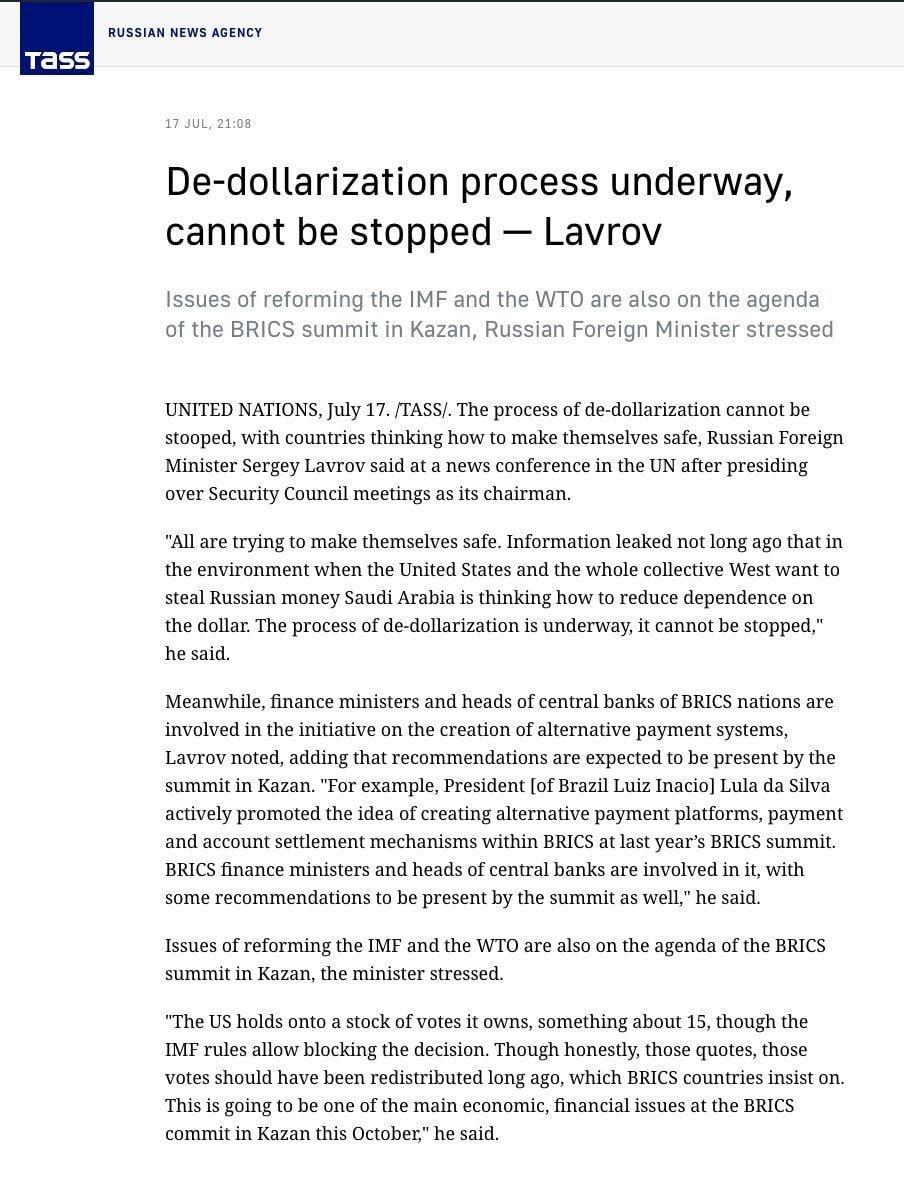
DE-DOLLARIZATION CONTINUES TO BE THE THEME OF BRICS NATIONS
"All are trying to make themselves safe. Information leaked not long ago that in the environment when the United States and the whole collective West want to steal Russian money Saudi Arabia is thinking how to reduce dependence on the dollar. THE PROCESS OF DE-DOLLARIZATION IS UNDERWAY, IT CANNOT BE STOPPED, he said."
Quote from Russian Foreign Minister Sergey Lavrov
@ Newshounds News™
Read more: X
~~~~~~~~~
Crypto Regulations in Vietnam 2024
The post Crypto Regulations in Vietnam 2024 appeared first on Coinpedia Fintech News
Vietnam, a socialist country in Southeast Asia, has a population of 99.46 million and covers 331 thousand square kilometers. It has developed a strong market economy with socialist influences, making it one of the fastest-growing economies in terms of GDP. This economic growth has attracted significant foreign investment.
Vietnamese Government on Cryptocurrencies
Cryptocurrency is not banned in Vietnam, but a legal framework is needed to ensure its proper development and mitigate risks, according to a representative from the Ministry of Justice. Cao Dang Vinh, Deputy Director of the Department of Economic and Civil Legislation, noted on April 12 that there are varying understandings of virtual assets, digital currencies, and cryptocurrencies, with different countries adopting diverse management approaches.
Cryptocurrency is not banned in Vietnam: Ministry Cao Dang Vinh noted global variations in cryptocurrency perspectives and the absence of specific regulations in Vietnam. Vietnam lacks a legal framework for cryptocurrencies, stressing the need for regulation.
Cryptocurrencies carry risks that can lead to appropriation or money laundering. Vietnam currently lacks regulations to manage their development, and cryptocurrency is not considered a legal asset. Vinh emphasized the need for a legal framework to prevent these risks and illegal activities. The Ministry of Finance will provide specific proposals, and the Ministry of Justice will offer detailed opinions accordingly.
In addition to this, the Vietnamese state authorities are working on the possible applications of blockchain technology in the country.
Blockchain for Vietnam’s Cashless Society
The deputy Prime Minister of Vietnam, Vuong Dinh Hue signed out a policy decision in 2017, setting out the government’s plan to reduce the cash transactions in the country to less than 10%. The State Bank of Vietnam also announced the development of $700 million cashless payment network in collaboration with South Korean payment service provider Alliex.
Another bank, Tien Phong Commercial Joint Stock Bank(TPBank) moving one step further in the use of blockchain technology, joined hands with Japan’s SBI Ripple Asia to develop Ripplenet blockchain-based global payment network for processing cross-border transactions.
Launch of the First Money Transfer Service between Japan and Vietnam that Utilize Distributed Ledger Technology (DLT). TPBank is the latest financial institution supported by SBI Ripple Asia to leverage Ripple
Cryptocurrencies law
In Vietnam, cryptocurrencies were not considered legal means of payment but could be bought, held, and traded. The government continued to reevaluate its approach to the crypto space, with the central bank maintaining that cryptocurrencies were not legal tender.
Cryptocurrencies were categorized as assets or goods under the 2015 Civil Code and the Commercial Law of 2005. These laws defined property broadly to include objects, money, valuable papers, property rights, and movable property, including future assets, allowing cryptocurrencies to be traded within the country.
What led to look over the need of Regulations?
The government of Vietnam cites many official reasons for the need for regulations and ban them as a means of payment,
—The crypto industry has no government supervision and therefore prone to illegal activities.
—Cryptocurrencies lack customer protection as they are volatile in nature which leads to price instability, security concerns, and market manipulation.
—Cryptocurrencies are open to illegal activities such as tax evasion, money laundering, terrorist funding and hacking.
The cryptocurrencies might possess the capacity to destabilize existing financial systems which can affect the nation’s economy.
Regulatory RoadMap of Cryptocurrencies
Vietnam has made several efforts to regulate the country’s cryptocurrency space. On 21 August 2017, the Prime Minister, Nguyen Xuan Phuc approved a project to complete the legal framework for managing digital assets and their activities.
On April 11, 2018, a directive was issued to the relevant authorities to manage crypto transactions in order to analyse the negative impact on the nation’s economy. In the directive, Bitcoin and similar cryptocurrencies were banned for using them as a mode of payments for any goods or services. But the users were free to invest in Cryptocurrencies. Those who found guilty would be penalised with a fine up to VND 200 million ($ 9,000).
In February 2019, The Ministry of Justice also filed a report that reviewed the current legislation on crypto-related business in the country. They proposed three different policies that the government could consider and start working on the policy selected by the government. They are:
1. Floating and lax Regulatory approach
2. Straightforward approach
3. Legislation of digital Assets transactions under specific conditions.
Recently on May 11 2020, the Vietnamese Finance Ministry has approved to establish a research group to review, analyse and develop various regulatory policies around crypto-assets. The research group would be comprised of nine members of the group of the following departments,
—General Department of Taxation
—National Institute of Finance
—General Department of Vietnam Customs
—Department of Banking and Financial Institutions of the State Bank of Vietnam
The research group would be led by the Vice-Chairman of State Securities Commission, Pham Hong Son.
Authorities in Vietnam to Establish Crypto Research Group to Evaluate Policy. On May 11, the Ministry of Finance in Vietnam said it will come up with a research group responsible for examining & making policy proposals about crypto and virtual assets
1. Taxation and Mining
2. Taxes on Cryptocurrencies
As you have already aware of the fact that, Bitcoin and other cryptocurrencies are not considered as legal tenders and are banned to use them as a mode of payment, the tax policies are also not framed yet. Cryptocurrency taxation in Vietnam remains uncertain due to the lack of a clear legal framework.
The tax authorities have lost a lawsuit against a local citizen who was been taxed on the Bitcoin earnings. As the cryptocurrencies are not considered as a legal asset under Vietnamese law, the court ruled the authorities that they have no right to tax him.
Mining of Cryptocurrencies
The Cryptocurrencies remain illegal as of now and restricted with the use of payment methods and so the mining. It is also considered illegal The government has also has passed a law which bans the import of bitcoin mining equipment into Vietnam.
However, the Ministry of Industry and trade expressed displeasure towards the ban and also showed concern over the decline in the mining business. The ministry sent a proposal to the Prime Minister of Vietnam, called the Document 5964 / BTC – TCHQ, mentioning that the mining pieces of equipment are not listed in the banned list of import or unsafe list. Hence the import should be allowed which was accepted by the government.
12-04-2024: Vietnam Does Not Ban Cryptocurrency, Confirms Ministry of Justice
A Ministry of Justice representative clarified that while cryptocurrency isn’t banned in Vietnam, there’s a need for a legal framework to guide its development and mitigate risks. Cao Dang Vinh, Deputy Director of the Economic and Civil Legislation Department, noted varying global perspectives on virtual assets, digital currencies, and cryptocurrencies.
Concluding Note
The Vietnamese Government has now acquired a progressive approach towards regulating the cryptocurrencies and initiated various steps. The various other approaches, however, are still vague and lack clarity.
More laws and reforms are required to ascertain the secured flow of cryptocurrency transactions in the country so that no scams or fraud occur risking the investor’s funds. The future of the cryptocurrencies are more secure and reliable in the country when these regulatory frameworks are put in place.
Read more: Binance
~~~~~~~~~
BASEL 3 AND GOLD REGULATIONS
"Basel III is a set of financial reforms developed by the Basel Committee on Banking Supervision. It introduces stricter capital requirements to increase the resilience of banks. The main focus is on improving the quality of capital, particularly Tier 1 capital, which is essential for absorbing losses."
The Significance of Gold in Basel III Regulations
"Gold’s role in Basel III significantly changes how banks handle this asset. With the new Basel III Bank Accords, gold is taking center stage again as an important asset for financial institutions. The most significant change is that Basel III regulations treat gold held in vaults as a zero-risk asset, a status previously reserved for cash. This change elevates gold’s importance in ensuring the stability and liquidity of banks."
Impact on Liquidity and Stable Funding
"Gold significantly impacts banks’ liquidity. Under Basel III’s measures, banks must maintain a specific Liquidity Coverage Ratio (LCR) to ensure they have enough high-quality liquid assets to survive financial stress. Gold can be considered part of these High-Quality Liquid Assets (HQLA)"
"Basel III regulations make gold a more attractive asset for banks by allowing bullion held in vaults or on an allocated basis to be treated as cash with a 0% risk weight. "
"Basel III demands that financial institutions hold a higher proportion of physical gold, rather than trading in derivatives. This change increases financing costs and demands more robust liquidity buffers. Banks must now hold physical assets to meet liquidity requirements, pushing the preference for tangible gold. As a result, this regulation stabilizes the gold market by reducing reliance on paper gold and emphasizing the importance of physical gold holdings. This shift supports higher demand and potentially boosts the price and stability of gold in the long term."
"With Basel III, gold is now considered a High-Quality Liquid Asset (HQLA)"
@ Newshounds News™
Read more: Metals Edge
~~~~~~~~~
BASEL 3 ENDGAME
"Many parts of Basel III are already in place worldwide, including the U.S. However, the final changes, called Basel III Endgame and agreed upon in 2017, have been delayed for years by the COVID-19 pandemic and banks calling for more time to adjust to and lobby against the new regulations."
"12 Deadlines have come and gone, with mid-2025 the latest date for when the rules are supposed to go into effect in the U.S., which means announcing them months earlier to provide regulators, banks, and other stakeholders the time needed to prepare to meet the new standards. Banks would start using the rules on July 1, 2025, with the goal of having them fully in place three years later."
What Affect Would Basel III Have on Small and Medium-Sized Banks?
"While Basel III primarily targets very large, internationally active banks, critics charge that its regulations would also affect small and medium-sized banks. "
When Does Basel III Go Into Effect?
"Since the Basel III Endgame process began, bank requests for more time to digest and comment on the plans, COVID-19, and shifts in the post-pandemic economy have all pushed back the deadlines. As it stands now, the regulations should start taking effect July 1, 2025, followed by a three-year phase-in period to give banks time to transition to the new rules. While previous deadlines have come and gone, the commentary period is over, which offers U.S. federal regulators more room to maneuver in going ahead with implementation."
@ Newshounds News™
Read more: Investopedia
~~~~~~~~~
Chainlink’s tokenization sandbox cuts trials to days instead of months
The sandbox could lead to more financial institutions adopting asset tokenization solutions.
Chainlink is ushering in a new turnkey solution for institutions looking to conduct tokenization trials in the latest development for the tokenization industry.
Chainlink has introduced its new Digital Assets Sandbox (DAS) for financial institutions, which aims to accelerate digital asset innovation.
DAS will enable financial institutions to quickly experiment with new revenue-generating opportunities, like bond tokenization, with improved time-to-market and greater overall efficiency.
According to Angela Walker, the global head of banking and capital markets at Chainlink Labs, the new sandbox was born due to institutional demand for secure digital asset experimentation environments.
@ Newshounds News™
Read more: Coin Telegraph
~~~~~~~~~
Newshound's Daily Breakdown Podcast Link
Newshound's News Telegram Room Link
Q & A Classroom Link
Follow the Roadmap
Follow the Timeline
Seeds of Wisdom Team™ Website
Subscribe to Newsletter
Thank you Dinar Recaps
Seeds of Wisdom RV and Economics Updates Wednesday Afternoon 7-17-24
Good Afternoon Dinar Recaps,
OPEC Plus alliance agreement enhances the balance of the global oil market in the second half of 2024 Russia announced that the global oil market will be balanced in the second half of the year and beyond thanks to the OPEC Plus alliance agreement on production. Russian Deputy Prime Minister Alexander Novak said that the OPEC Plus alliance, which includes the Organization of the Petroleum Exporting Countries (OPEC) and allies including Russia, has been implementing a series of production cuts since late 2022 to support the market. The Alliance agreed on June 2 to extend the previous cut of 2.2 million barrels per day until the end of September and gradually remove it starting in October.
The US Energy Information Administration said last week that global oil demand will exceed production by about 750,000 barrels per day in the second half of 2024 due to the decline in OPEC Plus production.
Good Afternoon Dinar Recaps,
OPEC Plus alliance agreement enhances the balance of the global oil market in the second half of 2024
Russia announced that the global oil market will be balanced in the second half of the year and beyond thanks to the OPEC Plus alliance agreement on production.
Russian Deputy Prime Minister Alexander Novak said that the OPEC Plus alliance, which includes the Organization of the Petroleum Exporting Countries (OPEC) and allies including Russia, has been implementing a series of production cuts since late 2022 to support the market.
The Alliance agreed on June 2 to extend the previous cut of 2.2 million barrels per day until the end of September and gradually remove it starting in October.
The US Energy Information Administration said last week that global oil demand will exceed production by about 750,000 barrels per day in the second half of 2024 due to the decline in OPEC Plus production.
The OPEC report last week also indicated a deficit in oil supplies in the coming months and in 2025.
Novak explained that the global oil market will be balanced thanks to Russia’s moves.
Source: National Iraqi News Agency
@ Newshounds News™
Read more: Iraq News Gazette
~~~~~~~~~
TOKENIZED GOLD- WHAT IS IT?
" Tokenization of gold is one of the recent blockchain use cases quickly gaining popularity among crypto enthusiasts, investors, and businesses. The present-day market cap of tokenized gold has already reached 1.17 billion, which is a firm upward trend reflecting the rising prices of physical gold. "
" But is investing in a gold-backed cryptocurrency as safe as physical gold? What are the benefits of tokenized gold, and what risks are involved?"
"Investment in ETFs is a safer option in terms of pure gold investment. Yet, ETFs are not stocks, bonds, or other securities that you may hold in your bank account and exchange for physical gold. Like any other ETFs, gold-backed ones are only derivatives of the stock exchange instrument that an owner doesn’t actually own. That’s why such investments are also a risky strategy with limited investor control. "
"When it comes to investment in tokenized gold, things are much more transparent and simpler for investors here. The scheme works as follows: "
1. The project acquires a certain amount of physical gold and stores it securely in its deposits.
2. The company issues tokenized gold coins, the cumulative number and value of which equal the amount of gold in its vaults.
3. The coins get into circulation and are used by traders, project users, buyers, and sellers. Their price is stably pegged to the price of gold, and in some cases, the coins may be exchanged for the respective amount of physical gold at any moment the owner claims such a possibility.
"This way, you may perceive digital gold as gold ownership tokens – securities that verify your right to a specific amount of physical gold."
THE ROLE OF BLOCKCHAIN IN GOLD INVESTMENT
"All of the risks and challenges with digital gold security, liquidity, and fungibility have given rise and popularity to the tokenized gold market. Digital gold is equivalent to physical gold stored in a safe location by the coin’s issuer, which frees you from the need to take care of the gold storage solutions."
"At the same time, every coin you own comes with the ownership right for physical gold, giving you direct ownership rights, unlike those of gold ETF investments. These are the reasons why tokenization of precious metals has become so popular in the crypto space. "
"All in all, gold investments open many exciting opportunities for you.."
1. First, you can address inflation by investing in this conservative instrument with fewer risks and limitations.
2. Second, you can take advantage of the rising gold prices similar to traditional gold investments.
3. Third, getting some digital gold to your portfolio is always a great diversification measure that can protect your assets from rapid price turns in the crypto market.
@ Newshounds News™
Read more: 4 IRE Labs
~~~~~~~~~
Study: Digital Wallets to Overtake Debit Cards for In-Store Payments by 2027
Digital wallets have revolutionized the payment space in recent years. They provide an easy, contactless and secure way to make purchases and transfer money through the convenience of smartphones.
The method is the fastest-growing payment option in the United States, which is especially true among younger consumers. Most Americans say they use digital wallets more often than traditional payment methods. Even more intriguingly, consumers who use this payment method tend to spend more than nonusers. According to a new Worldpay report, the payment method will overtake debit cards in transaction value in North America for in-store payments by 2027.
Digital wallets’ popularity and payment values make them a priority tool for businesses to incorporate into their payment suites. However, merchants have some catching up to do to keep pace with this unstoppable trend. Some notable stumbling blocks — including perceptions about security, complexity and legacy technology — are still holding many back.
The “Money Mobility Tracker®” examines the meteoric rise of digital wallets. It also looks at how payment providers can help small merchants overcome concerns about security, complexity and technology to offer this payment method to their customers.
—Convenience Translates to Higher Use — and Spending
—Broadening Merchant Adoption of Digital Wallets
—Consumers Crave Additional Uses and Features in Digital Wallets
@ Newshounds News™
Read more: PYMNTS
~~~~~~~~~
HOW DO YOU INVEST IN TOKENIZED GOLD AND SILVER?
"In recent years, the concept of tokenizing real-world assets (RWAs) has gained significant traction in the world of finance and investment. RWAs refer to the process of representing physical or financial assets on a blockchain through the use of tokens. This innovative approach has opened up new opportunities for investors, particularly in the realm of precious metals."
REMEMBER THIS TERM- (RWA) Real World Assets)
"By incorporating tokenized precious metals into a well-balanced investment portfolio, investors can potentially mitigate risk and protect their wealth from the erosive effects of inflation."
The Process of Investing in Tokenized Precious Metals
"Investing in tokenized precious metals is a straightforward process, but it requires careful consideration and due diligence."
1. The first step in investing in tokenized precious metals is selecting a reputable platform or issuer. It is crucial to choose a provider with a proven track record, strong security measures, and transparent operations.
2. Understanding the custody and storage of the underlying physical assets is another critical factor when investing in tokenized precious metals. Reputable issuers should provide clear information about the location and security of the vaults where the physical precious metals are stored.
3. Once you have selected a reputable platform and evaluated the regulatory compliance, the next step is purchasing and storing the tokenized precious metals. Investors can typically buy tokenized precious metals directly from the issuer or on secondary markets, such as cryptocurrency exchanges.
4. Finally, some tokenized precious metals platforms offer the option to redeem the tokens for physical precious metals. This feature provides investors with the flexibility to convert their digital holdings into tangible assets if desired.
"One of the primary risks associated with tokenized precious metals is regulatory uncertainty and the evolving legal landscape. As highlighted in The Legal Roadmap: Tokenizing Commodities within Regulatory Frameworks, the regulatory environment for tokenized assets varies across jurisdictions, and there is a lack of clear global consensus."
@ Newshounds News™
Read more: Block Apps
~~~~~~~~~
Why is XRP price up today?
XRP has outperformed the broader crypto market, boosted by its underbought RSI and whale interest.
Crypto market rebound boosts XRP higher
On July 17, XRP price jumped by nearly 7% to $0.618, its highest in three months, despite the sell-off fears led by the ongoing Mt. Gox reimbursement. The XRP/USD pair has climbed by around 62.20% when measured from its local low of $0.381 established on July 5.
Interestingly, the crypto market capitalization has vastly underperformed XRP’s rebound, rising by about 24.50% in the same period. In fact, XRP/USD is still down 1.71% year-to-date compared to the crypto market’s 40% returns.
This puts XRP holders in a good position to benefit from such a catch-up rally, particularly with growing interest rate cut chances in September.
"We might be on the verge of witnessing one of the most significant breakouts in crypto history," stated pseudonymous crypto trader Crypto Michael on X. He highlighted a bullish pennant pattern forming on XRP’s price chart over seven years, a rare occurrence where the price consolidates within a triangle pattern following a strong upward movement.
@ Newshounds News™
Read more: Coin Telegraph
~~~~~~~~~
Hong Kong to Prepare Stablecoin Legislation as Public Consultation Ends
Hong Kong authorities plan to introduce a bill into the Legislative Council before year-end.
—Hong Kong's regulators published the conclusions from their consultation on a stablecoin regime.
—The next step is to prepare a bill for the Legislative Council.
Hong Kong's financial regulators said they plan to present a bill on fiat-referenced stablecoins to the Legislative Council later this year.
The Financial Services and the Treasury Bureau (FSTB) and the Hong Kong Monetary Authority (HKMA) published the results of a consultation, and concluded that the stablecoin regime would "primarily focus on representations of value which rest on ledgers that are operated in a decentralised manner" in which "no person has the unilateral authority to control or materially alter its functionality or operation."
The consultation paper for stablecoin guidelines published at the end of last year received 108 submissions from stakeholders. The regulators plan to take suggestions from respondents before finalizing the bill for the legislative process.
The regulators confirmed their initial proposal that any person who issues a stablecoin in Hong Kong must obtain a license. While they say keeping reserve assets with banks licensed in Hong Kong could provide greater user protection, they are open to considering proposals on placing reserve assets in other jurisdictions.
Foreign entities intending to apply for a license will be required to establish a Hong Kong subsidiary and have key management personnel, including a CEO, in the territory.
After considering the responses, the HKMA said it is "inclined to reduce the frequency of public disclosure." It had proposed monthly attestation by an independent auditor, and will continue discussions on the matter.
Hong Kong is trying to keep pace with other major jurisdictions in becoming a leading crypto hub. Europe's MiCA stablecoin regime came into force this month and members of Congress in the U.S. are actively attempting to push forward stablecoin bills.
In March, the HKMA started a regulatory sandbox to give potential stablecoin issuers immunity in testing certain operations. In today's announcement, the HKMA said it is processing the applications for the stablecoin issuer sandbox and will announce more shortly.
@ Newshounds News™
Read more: Coindesk, HKMA, Coindesk Policy
~~~~~~~~~
Newshound's Daily Breakdown Podcast Link
Newshound's News Telegram Room Link
Q & A Classroom Link
Follow the Roadmap
Follow the Timeline
Seeds of Wisdom Team™ Website
Subscribe to Newsletter
Thank you Dinar Recaps
Seeds of Wisdom RV and Economics Updates Tuesday Afternoon 7-16-24
Good afternoon Dinar Recaps,
FIVE CENTRAL BANKS HAVE INTERCONNECTED THEIR INSTANT PAYMENT SYSTEMS "Five central banks have interconnected their instant payment systems, creating a framework for faster and more affordable cross-border payments globally. These include the central banks of India, Malaysia, the Philippines, Singapore, and Thailand." CLICK THE LINK TO WATCH THE SHORT VIDEO- VERY INFORMATIVE
While watching the video remember that Ripple is a member of the BIS cross-border Payments interoperability and Extention (PIE) taskforce. @ Newshounds News™
Good Afternoon Dinar Recaps,
FIVE CENTRAL BANKS HAVE INTERCONNECTED THEIR INSTANT PAYMENT SYSTEMS
"Five central banks have interconnected their instant payment systems, creating a framework for faster and more affordable cross-border payments globally.
These include the central banks of India, Malaysia, the Philippines, Singapore, and Thailand."
CLICK THE LINK TO WATCH THE SHORT VIDEO- VERY INFORMATIVE
While watching the video remember that Ripple is a member of the BIS cross-border Payments interoperability and Extention (PIE) taskforce.
@ Newshounds News™
Read and See more: Twitter
~~~~~~~~~
IRAQ RESUMES NEGOTIATIONS TO JOIN WTO
Baghdad (IraqiNews.com) – The Iraqi Minister of Trade, Atheer Al-Ghurairi, declared on Monday that discussions to join the World Trade Organization (WTO) had resumed after more than a 16-year break.
A statement issued by the Trade Ministry revealed that Iraqi negotiating teams began their preparatory meetings at the WTO’s headquarters in Geneva, Switzerland, in preparation for the third meeting that will discuss Iraq’s accession, the Iraqi News Agency (INA) reported.
During his participation in the 13th Ministerial Conference of the WTO held last February in the UAE capital, Abu Dhabi, Al-Ghurairi affirmed that Iraq fulfilled the conditions necessary to become a member of the WTO following the completion of economic reforms and the enhancement of the investment climate.
The Iraqi Trade Minister indicated that Baghdad finalized issues related to goods and services in accordance with the deadlines set for integration into the international trade system.
The Iraqi government expressed interest in joining the WTO after submitting a request to do so in 2004. Iraq needed to be a member of the multilateral international trade system in order to regain its place as a major player in the global economy.
In addition to debating the future of the global trade movement in light of current challenges, Al-Ghurairi said that the conference sends a strong message to the countries of the world about the value of joining this organization.
The Iraqi official added that Iraq is attempting to expand its commercial and economic connections around the world in order to create new opportunities for collaboration.
@ Newshounds News™
Read more: Iraw News
~~~~~~~~~
Japanese tokenized deposit platform DCJPY starts production testing
DeCurret DCP, the company behind the DCJPY tokenized deposit network, said it has started production testing of the network. It expects to go into production in August. DeCurret runs the Japanese Digital Currency Forum, which has more than a hundred corporate and government participants who are exploring a broad range of applications that use digital currencies for settlement. DeCurret also raised significant funding from several big names, including MUFG, SMBC and SBI Holdings.
However, they are not participants in the first application, which uses on-chain bank deposits to pay for tokenized renewable energy certificates (RECs). The Internet Initiative Japan (IIJ) recently became a member of the Japan Electric Power Exchange (JEPX) to procure RECs on behalf of its data center clients. Now it plans to convert the RECs into digital tokens and settle transactions with tokenized deposits from GMO Aozora Net Bank.
In the future DeCurret DCP wants to expand the application by including electricity retailers, power companies and carbon trading exchanges.
The key benefits of on-chain payment is it eliminates settlement risk because the asset and money exchange simultaneously. Another advantage is automation, with programmability payments enabling a vast range of use cases.
The DCJPY Network consists of two separate blockchains, a Business Zone(s) and a Financial Zone. Only banks are present in the Financial Zone and this is where they tokenize the deposits and the DCJPY transfers actually happen. The transfer of the asset is recorded in the Business Zone. However, so are the instructions to transfer the DCJPY (but not the actual transfer). This requires synchronization between the two blockchain zones. DeCurret DCP uses the Inter-Blockchain Communication Protocol (IBC) from Cosmos.
Meanwhile, a recent DeCurret DCP survey showed a luke warm appetite for digital currencies from enterprises. Out of 100 companies surveyed, 26% aim to use digital currency in one to three years. Just over two thirds of those with plans are members of the Digital Currency Forum.
Japan’s approach to digital currencies
Japan is one of the most advanced economies in terms of legal support for digital currencies. It passed legislation that supports three types of stablecoins. These include two bank related ones – stablecoins backed by bank deposits and third party reserve backed stablecoins where the reserves are managed by trust banks. Hence, in the realm of digital currency, DCJPY faces competition at launch.
@ Newshounds News™
Read more: Ledger Insights
~~~~~~~~~
BRICS: EVERY AFRICAN COUNTRY PREPARING TO JOIN the ALLIANCE
"Former Ethiopian speaker of the house Agegnehu Teshager revealed that all African countries are interested in joining the BRICS alliance. His statement comes at a time when developing countries are looking to sideline the US dollar and use local currencies."
"Developing countries are finding the BRICS de-dollarization agenda lucrative as the initiative can boost their native economies and local currencies. "
"“Africa is a great potential for BRICS, most African countries have an appetite to be a member of the alliance,” he said. The former speaker continued, “Africa’s economy is developing and the continent is interested in the BRICS alliance.”
"Ethiopia is the new entrant in the BRICS alliance and is the second African nation apart from South Africa to be a part of the grouping. The bloc might invite many other countries during the 16th summit and expand the alliance in 2024. However, there is no clear information on which countries might receive the invitation."
NOTE: JUST BECAUSE A COUNTRY EXPRESSES INTEREST IN BECOMING A MEMBER OF BRICS DOESN'T MEAN THEY ARE AUTOMATICALLY A MEMBER. THERE IS A PROCESS TO MEMBERSHIP..
@ Newshounds News™
Read more: Watcher Guru
~~~~~~~~~
Cardano (ADA) Price Surges 40% as $240M TVL and Ethereum ETFs Emerge Bullish Catalysts
Cardano (ADA) has experienced a significant price surge, trading at $0.44, up 40% over the last ten days, fueled by several internal and external factors that are generating renewed investor interest and optimism.
Cardano Price Crosses $0.45 First Time in 10-Days
After having dropped to historic lows on Friday July 5, a positive shift in the US macroeconomic environment has provided a favorable backdrop for ADA’s recent rebound phase. Positive Non-Farm Payroll (NFP) and Consumer Price Index (CPI) data have bolstered investor confidence in the economic outlook, supporting the overall cryptocurrency market.
Furthermore, the anticipation of Ethereum ETFs expected to launch soon has spilled over into the altcoin market, including Cardano, as investors look for promising opportunities beyond Bitcoin and Ethereum.
@ Newshounds News™
Reas more: The Crypto Basic
~~~~~~~~~
Newshound's Daily Breakdown Podcast Link
Newshound's News Telegram Room Link
Q & A Classroom Link
Follow the Roadmap
Follow the Timeline
Seeds of Wisdom Team™ Website
Subscribe to Newsletter
Thank you Dinar Recaps
Seeds of Wisdom RV and Economics Updates Monday Evening 7-15-24
Good Evening Dinar Recaps,
UNITES STATES CONSULTING FIRM SIGNS CONTRACT FOR IRAQ DEVELOPMENT ROAD
"By John Lee. Iraq's Minister of Transport, Razzaq Muhibis Al-Saadawi, announced the signing of a contract with Oliver Wyman, a consultancy firm, to provide advisory services for the Development Road project. Al-Saadawi stated that the consultancy will assist the ministry in marketing the project and overseeing investment opportunities. The contract, signed by Younis Khalid Jawad."
@ Newshounds News™
Good Evening Dinar Recaps,
UNITES STATES CONSULTING FIRM SIGNS CONTRACT FOR IRAQ DEVELOPMENT ROAD
"By John Lee. Iraq's Minister of Transport, Razzaq Muhibis Al-Saadawi, announced the signing of a contract with Oliver Wyman, a consultancy firm, to provide advisory services for the Development Road project. Al-Saadawi stated that the consultancy will assist the ministry in marketing the project and overseeing investment opportunities. The contract, signed by Younis Khalid Jawad."
@ Newshounds News™
Read more: Iraq Business News
~~~~~~~~~
What is IOTA?
IOTA (MIOTA) is one of only 8 ISO 20022 compliant coins.
Iota aims to be the economic layer for the Internet of Things, bringing microtransactions and data storage to a network of connected devices. It uses a distributed ledger technology called the Tangle, which is based on directed acyclic graph technology rather than blockchain.
Iota began as a pivot from an IoT microprocessor venture called Jinn. The Jinn team held a crowds ale in September 2014, promising holders of its native Jinn token a share in the company’s profits.
The team pivoted following concerns around the regulatory soundness of Jinn tokens. In 2015, the project announced Iota, a cryptocurrency network for IoT devices that utilized some of the cryptographic techniques researched and developed at Jinn.
Iota does not have blocks, miners or transaction fees as are featured in most public blockchain networks like Bitcoin or Ethereum. This is to allow the scalability and speed necessary for machine-to-machine microtransactions, which are denominated in its native token, MIOTA. Instead, each transaction validates the previous two transactions, achieving consensus first locally, then globally.
The Iota Foundation, a German nonprofit, is currently building out the Iota ecosystem.
@ Newshounds News™
Read more: CoinTelegraph
~~~~~~~~~
Cardano and XRP Win Fresh Listing
Horizon Protocol, a leading innovator in the DeFi derivatives space, has announced, in a tweet, the much-anticipated listing of XRP, Cardano (ADA), and Chainlink (LINK) on its flagship derivatives platform, Horizon Futures.
This exciting development, approved through Horizon Improvement Proposal 16 (HIP-16), signifies a significant step forward for Horizon Protocol in its mission to enhance user experience and expand access to diversified trading opportunities.
The upcoming launch, scheduled for Thursday this week, will allow users to leverage Horizon Futures’ robust features to trade XRP, ADA, and LINK with competitive advantages. This includes access to low fees, a user-friendly interface, and the ability to leverage positions up to 27.5 times.
Horizon Protocol emphasizes the importance of community involvement and acknowledges the valuable role its users played in the approval of HIP-16. This collaborative approach underscores Horizon’s commitment to fostering a thriving DeFi derivatives ecosystem.
Strategic Listings Bolster DeFi Offerings
Horizon Protocol views the listing of XRP, ADA, and LINK as a strategic move to bolster its existing suite of offerings and cater to a wider range of investors. These cryptocurrencies, all boasting an established market presence and strong communities, represent a valuable addition to the Horizon Futures platform.
Their inclusion aligns perfectly with Horizon’s vision of enriching users’ trading strategies and providing them with the tools they need to navigate the dynamic DeFi landscape.
To ensure a seamless integration process, Horizon Protocol will implement necessary system adjustments to accommodate XRP, ADA, and LINK on Horizon Futures. The team will also closely monitor the performance of these newly listed assets to inform future enhancements and potential additions to the platform.
Building on a Strong Foundation...
@ Newshounds News™
Read more: Times Tabloid
~~~~~~~~~
Newshound's Daily Breakdown Podcast Link
Newshound's News Telegram Room Link
Q & A Classroom Link
Follow the Roadmap
Follow the Timeline
Seeds of Wisdom Team™ Website
Subscribe to Newsletter
Thank you Dinar Recaps
Seeds of Wisdom RV and Economics Updates Monday Afternoon 7-15-24
(Due to some unforeseen new computer glitches this afternoon post was delayed)
Good Afternoon Dinar Recaps,
VND/USD EXCHSNGE RATE AS OF 7/15/24
"Reference exchange rate drops slightly at week’s beginning
The State Bank of Vietnam (SBV) set the daily reference exchange rate at 24,245 VND/USD on July 15, down 3 VND from July 13.
With the current trading band of +/- 5%, the ceiling rate applicable for commercial banks during the day is 25,457 VND/USD and the floor rate 23,033 VND/USD.
At commercial banks, the opening-hour rates also fluctuated slightly. At 8:20 am, Vietcombank listed the rates at 25,237 VND/USD (buying) and 25,457 VND/USD (selling), both down 3 VND from the rates two days ago.
(Due to some unforeseen new computer glitches this afternoon post was delayed)
Good Afternoon Dinar Recaps,
VND/USD EXCHSNGE RATE AS OF 7/15/24
"Reference exchange rate drops slightly at week’s beginning
The State Bank of Vietnam (SBV) set the daily reference exchange rate at 24,245 VND/USD on July 15, down 3 VND from July 13.
With the current trading band of +/- 5%, the ceiling rate applicable for commercial banks during the day is 25,457 VND/USD and the floor rate 23,033 VND/USD.
At commercial banks, the opening-hour rates also fluctuated slightly.
At 8:20 am, Vietcombank listed the rates at 25,237 VND/USD (buying) and 25,457 VND/USD (selling), both down 3 VND from the rates two days ago.
BIDV also cut both rates by 3 VND, listing the buying rate at 25,237 VND/USD and the selling rate at 25,457 VND/USD."
@ Newshounds News™
Read more: Vietnam Net
~~~~~~~~~
News Update: Fedwire ISO 20022 Timeline
News Update: Fedwire ISO 20022 Timeline
In 2022, the Fed announced that the Federal Reserve Banks planned to adopt the ISO 20022 standard for the Fedwire Funds Service in a single-day implementation strategy on March 10, 2025.
ISO 20022 is a globally accepted messaging standardization approach introduced in 2005 by the International Organization for Standardization with the goal of using the same language for all financial communications.
The Fedwire migration marks a significant turning point in the modernization of the American payment system that complies with best practices and international standards.
Here are three key updates you need to know about the upcoming migration schedule/planned timeline.
Compliance Window:
At the end of October 2024, the compliance testing window will officially close. Any financial institution that wants to remain in compliance with ISO20022 needs to complete its testing with the Federal Reserve by that time.
Post-Launch Integration
Compliance testing will resume two weeks following the launch (around late March).
Managing Non-Approvals
Organizations may choose to keep using the current method without paying penalties if they have not achieved compliance by the testing deadline. It's crucial to remember that ongoing use of Fedwire Direct requires compliance with ISO standards if a third-party solution is used for data loading. Therefore, financial institutions might not be able to use the solutions that are already available if these standards are not adopted and will be forced to manually load their wire transactions to the Fedwire Direct portal.
In partnership with the Federal Reserve, Alacriti has been proactive about ISO 20022. Alacriti’s solutions have all APIs built to the ISO 20022 standard, which is imperative for the RTP® network and the FedNow® Service, and also to accommodate the implementation that Fedwire has planned for 2025.
@ Newshounds News™
Read more: Alacriti, ISO 20022 Timeline
~~~~~~~~~
SAB 121 IN THE NEWS AGAIN?
"The crux of the problem is the accounting rule forces assets under custody to be disclosed as both an asset and liability on the balance sheet, contrary to accounting convention.
This expands the size of the balance sheet on which banks have their capital requirements assessed. Hence, providing crypto custody would require banks to set aside large amounts of capital, making it prohibitively expensive."
"The saga has taken up a considerable legislator time. In May both the House (228 v 182) and Senate (60 v 38) voted in favor of a resolution to cancel SAB 121, followed by a Presidential veto. Last year the Government Accountability Office (GAO) ruled that SAB 121 was a rule that should have received Congressional approval. Plus, legislators wrote to bank regulators about SAB 121 multiple times."
"In March 2022 the SEC published SAB 121, apparently without consulting banking regulators. The rule impacts all listed firms, not just banks. However, if the potential impact on banks was immediately obvious to journalists, it’s odd that the SEC didn’t consider it."
"The issue is bigger than cryptocurrency. It’s widely believed that tokenization – of securities, funds and other real world assets – will see the rewiring of the financial system. The Bank of International Settlements, the central bank of central banks, frowns on crypto but is making a big push on tokenization.
In order for tokenization to progress in an institutional framework, it’s essential for assets to be held in custody by banks. The world’s largest custodian banks are American. BNY Mellon, State Street, JP Morgan, Citi and Northern Trust provide custody for $160 trillion in assets."
"While the United States prides itself on its sophisticated markets, institutional work on tokenization is happening elsewhere."
"Several U.S. firms are involved in the Singapore and European work. Resolving the custody issue could see a significant acceleration in activity on home soil."
@ Newshounds News™
Read more: Ledger Insights
~~~~~~~~~
Newshound's Daily Breakdown Podcast Link
Newshound's News Telegram Room Link
Q & A Classroom Link
Follow the Roadmap
Follow the Timeline
Seeds of Wisdom Team™ Website
Subscribe to Newsletter
Thank you Dinar Recaps
Seeds of Wisdom RV and Economics Updates Sunday Afternoon 7-14-24
Good Afternoon Dinar Recaps,
ARE THE LARGEST BANKS IN THE WORLD STARTING TO INVEST IN CRYPTO?
“The largest investment banks in the world are rolling out crypto services and investing in crypto companies. JP Morgan. BNY Mellon. Goldman Sachs. They all foresee global adoption in the IMMEDIATE FUTURE From consumers to financial institutions the world is getting ready to use crypto as money."
@ Newshounds News™
Good Afternoon Dinar Recaps,
ARE THE LARGEST BANKS IN THE WORLD STARTING TO INVEST IN CRYPTO?
"The largest investment banks in the world are rolling out crypto services and investing in crypto companies.
JP Morgan. BNY Mellon. Goldman Sachs. They all foresee global adoption in the IMMEDIATE FUTURE
From consumers to financial institutions the world is getting ready to use crypto as money."
@ Newshounds News™
Source: Twitter
~~~~~~~~
XRP Climbs 10% In Bullish Trade
XRP was trading at $0.4968 by 00:26 (04:26 GMT) on the Investing.com Index on Saturday, up 10.07% on the day. It was the largest one-day percentage gain since March 11.
The move upwards pushed XRP's market cap up to $27.5901B, or 1.29% of the total cryptocurrency market cap. At its highest, XRP's market cap was $83.4407B.
XRP had traded in a range of $0.4738 to $0.4968 in the previous twenty-four hours.
Over the past seven days, XRP has seen a rise in value, as it gained 15.53%. The volume of XRP traded in the twenty-four hours to time of writing was $1.7086B or 3.08% of the total volume of all cryptocurrencies. It has traded in a range of $0.4036 to $0.4968 in the past 7 days.
At its current price, XRP is still down 84.90% from its all-time high of $3.29 set on January 4, 2018.
@ Newshounds News™
Read more: Investing
~~~~~~~~~
Ripple Finds a Spot in a Very Prestigious List: Details
“The digital asset space was buoyed in 2024 by strong price movements in cryptocurrencies,” CNBC and Statista noted.
Ripple was named one of the top 250 fintech companies for 2024 in the “digital assets” category by CNBC and Statista.
The company has received multiple awards, including the PAY360 Award and recognition as a top workplace by Fortune Magazine.
Ripple’s Latest Recognition
The American business news channel – CNBC – and the global industry statistics database – Statista – conducted a mutual study to find out the top 250 fintech companies for 2024. One of the awarded firms in the “digital assets” section is Ripple. It is one of the three entities placed on that list last year, with Coinbase and OpenSea being the others.
CNBC and Statista explained that the “digital assets” category comprises firms that make it “easier to access and use” cryptocurrencies and blockchain-based applications. They also noted the industry’s success in 2024, reminding that Bitcoin (BTC) hit an all-time high price of over $70,000 in March.
The entities revealed that 116 of the top 250 fintech companies are located in the United States (including Ripple, which is headquartered in San Francisco). The United Kingdom follows next with 30 firms, while India is home to 11 entities on the list.
The Previous Awards
This is not the first time Ripple has found a place in such a category. In October last year, it won the payment prize in the UK – the PAY360 Awards. The company topped the ranking for being the leader in digital currencies/assets in financial services.
One of the people acknowledging the achievement was Sendi Young – Managing Director of Ripple’s European operations. “Such an honour to win in this UK’s most prestigious payments awards,” she said at the time.
Prior to that, Fortune Magazine placed Ripple in the 13th position (out of 50) as “the best workplace in technology” for 2023. According to the business magazine, 94% of the firm’s employees consider it “a great place to work.” 98% of the staff said they were warmly welcomed upon starting their journey at the company, while 96% were supportive of the management team.
Last but not least, People Magazine included Ripple in its list of “top 100 companies who care for employees and society.” Other well-known corporations that were part of that club were American Express, NVIDIA, Deloitte, MasterCard, and more.
@ Newshounds News™
Read more: Crypto Potato
~~~~~~~~~
Five Major Reversal Indicators for Crypto Market in July: Goldman Sachs, ETH ETF S-1 filings and More
U.Today - The crypto market is gearing up for a potential turnaround in July, which will be fueled by several crucial factors. Here are five major indicators to watch:
Federal Reserve's potential rate cuts
The Federal Reserve may cut interest rates as early as September, according to recent rumors, and again in December. The markets will gain liquidity from these cuts, according to analysts, and cryptocurrencies might benefit from another positive CPI print.
Progress on Ethereum ETF S-1 filings
The Ethereum ETF issuers received their S-1 forms back from the SEC recently, with a request for small changes. Before being approved, these issuers must respond to the criticisms and resubmit, passing at least one more review round. It is a result of drawing in more institutional investors.
CFTC chair's stance on crypto regulation
According to recent comments made by the CFTC chair, between 70% and 80% of cryptocurrencies are not securities, underscoring the necessity for the CFTC to regulate these assets in accordance with the Commodities Exchange Act. This position may end the protracted discussion about whether cryptocurrencies are better classified as commodities or securities, providing much-needed regulatory clarity and enhancing investor confidence.
Goldman Sachs' tokenization projects
By the end of the year, Goldman Sachs wants to introduce three tokenization initiatives, with an emphasis on U. S. as well as European markets. These initiatives, which are led by tokenization and cryptocurrency enthusiast Mathew McDermott, have the potential to attract major institutional interest and investment into the crypto business.
JPMorgan's optimistic Bitcoin outlook
In a report released today, JPMorgan forecasts a bullish bounce for Bitcoin in August. In spite of recent market downturns, the bank is still bullish about Bitcoin's prospects. The analysis emphasizes that less downward pressure is anticipated as the recent wave of cryptocurrency liquidations fades. To better reflect the current state of the market, JPMorgan has also lowered its estimate of the year-to-date crypto net flow from $12 billion to $8 billion.
@ Newshounds News™
Read more: Investing
~~~~~~~~~
Gold Prices Forecast: Bullish Momentum Builds on Rate Cut Expectations
Key Points:
—Gold surges above $2,400 as Fed rate cut expectations soar. Inflation data fuels rally, with markets now pricing 96% chance of September cut.
—Fed officials turn dovish, boosting gold's appeal. Daly and Goolsbee signal potential rate cuts as disinflation trend resumes. Third weekly gain for gold.
—Global uncertainties support gold's safe-haven status. Central banks continue buying spree. Traders eye potential new record highs amid dovish sentiment.
@ Newshounds News™
Read more: FX Empire
~~~~~~~~~
Newshound's Daily Breakdown Podcast Link
Newshound's News Telegram Room Link
Q & A Classroom Link
Follow the Roadmap
Follow the Timeline
Seeds of Wisdom Team™ Website
Subscribe to Newsletter
Thank you Dinar Recaps
Seeds of Wisdom RV and Economics Updates Saturday Afternoon 7-13-24
Good Afternoon Dinar Recaps,
NIGERIAN MINISTER URGES SEC TO TACKLE CRYPTO REGULATION CHALLENGES
Nigeria’s cryptocurrency regulations are currently being updated.
The Nigerian Minister of Finance and Coordinating Minister of the Economy, Wale Edun, has called on the newly inaugurated Securities and Exchange Commission (SEC) board to address the complexities of cryptocurrency regulation.
According to local media, Edun emphasized the need to ensure stringent oversight, especially in fast-moving and complex areas such as cryptocurrencies, to maintain market integrity in Nigeria’s capital market during the board’s inauguration in Abuja.
Good Afternoon Dinar Recaps,
NIGERIAN MINISTER URGES SEC TO TACKLE CRYPTO REGULATION CHALLENGES
Nigeria’s cryptocurrency regulations are currently being updated.
The Nigerian Minister of Finance and Coordinating Minister of the Economy, Wale Edun, has called on the newly inaugurated Securities and Exchange Commission (SEC) board to address the complexities of cryptocurrency regulation.
According to local media, Edun emphasized the need to ensure stringent oversight, especially in fast-moving and complex areas such as cryptocurrencies, to maintain market integrity in Nigeria’s capital market during the board’s inauguration in Abuja.
Minimal registration requirements
Edun warned that companies might exploit minimal registration requirements to falsely claim they are licensed, undermining market integrity. Highlighting the potential for regulatory arbitrage, he urged the SEC to implement top-notch corporate governance practices, swiftly identify and disclose conflicts and adhere to global best practices.
The minister also encouraged the newly inaugurated SEC board members to adopt innovative strategies to regulate the country’s capital market effectively. He stressed the importance of staying informed and proactive amid rapid developments in artificial intelligence, digital currency and overall digital transitions.
“Unlike basic industries with settled technologies, the financial sector is rapidly evolving with innovations in fintech, AI and crypto. To provide necessary approvals and guidance, the SEC must stay informed and adaptable.”
SEC pledges innovation and growth
In response, the Chairman of the SEC board, Mairiga Katuka, assured the minister that the board would leverage its collective expertise, innovation and passion to drive growth.
@ Newshounds News™
Read more: CoinTelegraph
~~~~~~~~~
RIPPLE's APPEAL TO CENTRAL BANKS: SPEED, SECURITY, AND DIGITAL INNOVATION
—Ripple’s appeal to central banks lies in its promise of speed, security, and digital innovation, challenging traditional banking methods with blockchain technology for instant global transfers.
—Ripple positions itself as a key player in CBDC solutions, offering infrastructure for governments to deploy their digital currencies.
For many decades, the global central banks have maintained unchallenged control of the global economy by following traditional banking methods. However, with blockchain seeing rising adoption, players like Ripple have come to the forefront offering instant settlement solutions for global transfers.
Last year, Ripple unveiled its own CBDC platform that serves as a one-stop solution allowing governments to deploy their CBDCs providing all the necessary infrastructure for deploying and maintaining the currencies.
Central banks are considering Ripple for its speed, security, and modern appeal. Traditional transfer methods, once slow and cumbersome, can now be transformed into swift, secure blockchain transactions. Moreover, Ripple enables transaction settlements in fractions of a second instead of days, with cryptographic security ensuring maximum protection. This innovation has even the most conservative bankers excited about the possibilities Ripple brings to the table.
By adopting Ripple solutions, central banks have the opportunity to transition into new-age technological platforms instead of being perceived as outdated institutions. This could bring a fundamental change in the way we conduct global transactions more efficiently and securely.
The adoption of CBDCs on Ripple’s platform has the potential to revolutionize the financial industry. Central banks now stand at a crossroads, with the opportunity to lead the digital transformation of finance.
@ Newshounds News™
Read more: Currency Insider
~~~~~~~~~
HEDRA HASHGRAPH LEADS BLOCKCHAIN INNOVATION WITH NEW SCALABILITY BREAKTHROUGH
—The Hedera Foundation has launched two pilot Request for Proposals (RFPs) aimed at addressing specific ecosystem needs, inviting global developers to apply for grants.
—The initiative aims to enhance transparency and collaboration, providing up to 10 million HBAR in support, to accelerate the growth and development of the Hedera ecosystem.
On Thursday, July 11, the HBAR Foundation announced its pilot Request for Proposal (RFP) to deliver a more transparent and community-supported element to grant giving. Hedera stated that they are piloting two separate RFPs for building solutions thereby meeting specific ecosystem needs. Besides, this development comes as Hedera has been leading in crypto development activity, per the CNF update.
The Hedera Foundation is launching two pilot RFPs aimed at addressing specific needs within the ecosystem. they have also invited developers from across the globe to apply for these grants, with the selection process incorporating open and public community input.
The goal of this pilot is to gather insights from the initial RFPs to enhance and formalize the foundation’s grant program. This would ultimately accelerate the growth and development of the Hedera ecosystem.
We’re excited to announce the launch of our pilot Request For Proposal (RFP) process to to deliver a more transparent, #Hedera community-supported element to grant giving 🤝 pic.twitter.com/VNnatTK5GY
— HBAR Foundation (@HBAR_foundation) July 11, 2024
Hedera Targets Lending Markets With RFP Pilots
The pilot initiative will include two distinct RFPs designed to meet specific requirements:
Credit Market Development: This grant will follow the structure of a standard THF development grant, with funding allocated based on the completion of well-defined development milestones.
Credit Market Liquidity: This grant will be modeled after a network utilization incentive pool. The incentive pool will be evergreen and may be replenished based on ecosystem needs.
The Foundation is initially committing up to 10 million HBAR in support, available to eligible teams. Given the evergreen nature of the pool, project teams can apply multiple times depending on their liquidity needs. Each proposal must align with specific growth objectives, and applicants are required to outline milestones and goal KPIs. The Hedera Foundation also mentioned some of the benefits of conducting the pilot which include:
Increased Transparency and Clarity: By clearly outlining funding intentions, the Hedera Foundation (THF) can provide more timely updates to the community about key priorities. This approach offers further clarity to teams who may not qualify for a grant, not due to inadequacy but because their proposals might not align with the network’s most pressing needs.
Enhanced Ecosystem Collaboration and Diversification of Ideas: By inviting broader participation, THF aims to foster greater collaboration between itself, applicants, and the community, all working together to find better solutions. Additionally, creating more opportunities for builders to share their visions, ideas, and educational insights directly with the community before launching products or platforms will add significant value throughout the development cycle.
Moreover, the Hedera blockchain has been part of some key projects. As reported by Crypto News Flash, Sweden’s central bank tested its retail banking solutions on the Hedera network. Additionally, consulting giant Deloitte also joined hands with Hedera to build next-generation blockchain solutions, per the CNF update.
@ Newshounds News™
Read more: Crypto News Flash
~~~~~~~~~
DWS MOVES TOWARD FIRST GERMAN-REGULATED EURO STABLECOIN
German asset management company DWS has launched a new company in a step towards creating the first German-regulated cryptocurrency.
Deutsche Bank-owned DWS announced the launch of the company as part of their wider plan to go live with the new euro stablecoin next year, marking a significant step for the European financial sector considering DWS manages assets worth €941 billion.
The cryptocurrency is set to be regulated by Germany’s Federal Financial Supervisory Authority (BaFin) as DWS looks to be the first company being granted a German e-money licence for a stablecoin.
The newly created company, AllUnity, is a collaboration between DWS, Flow Traders, and Galaxy Digital, working together to introduce the new stablecoin.
Stefan Hoops, CEO of DWS, commented that the stablecoin will gain interest from a broad range of clients, including digital asset investors and industrial applications.
“In the short term, we expect demand from investors in digital assets, but by the medium term we expect wider demand, for instance from industrial companies working with ‘internet of things’ continuous payments,” Hoops stated.
@ Newshounds News™
Read more: Currency Insider
~~~~~~~~~
JAPAN'S CURRENCY HAS STEADILY LOST VALUE AGAINST THE USD OVER THE LAST 12 MONTHS
Japan likely conducted a $22 billion intervention yesterday to support its currency.
Japan spent a record $62 billion in May to prop up the yen.
@ Newshounds News™
Read more: Twitter
~~~~~~~~~
Ripple’s Appeal to Central Banks: Speed, Security, and Digital Innovation
"Ripple positions itself as a key player in CBDC solutions, offering infrastructure for governments to deploy their digital currencies.
For many decades, the global central banks have maintained unchallenged control of the global economy by following traditional banking methods. However, with blockchain seeing rising adoption, players like Ripple have come to the forefront offering instant settlement solutions for global transfers."
"Last year, Ripple unveiled its own CBDC platform that serves as a one-stop solution allowing governments to deploy their CBDCs providing all the necessary infrastructure for deploying and maintaining the currencies."
@ Newshounds News™
Read more: Crypto News Flash
~~~~~~~~~
CENTRAL BANKS ARE BUYING GOLD TO PREPARE FOR A NEW GOLD STANDARD
"Record buying of gold by central banks, which are matching their gold reserves relative to GDP with other countries, revived the debate about the possibility of a reboot of the current monetary system based on a new gold standard."
"Global central banks have been buying record amounts of gold since the beginning of 2022. The pace and regularity with which central banks accumulate gold is unprecedented, as they have been mostly sellers of the precious metal throughout history. This extraordinary demand for gold by central banks, the largest in 55 years, is attributed to a desire to diversify their reserves and reduce dependence on the dollar."
"But beyond the intrinsic capacity of physical gold to maintain its value in the face of economic uncertainty, some indicators suggest that this accumulation of gold by central banks is just the prelude to a restart of the international monetary system and a possible return to the gold standard."
"The bad monetary policies that caused the housing bubble and the way fiat currencies have been managed since the 2008 crisis, depreciating the dollar and exporting US domestic problems to the rest of the world, along with economic sanctions on countries not aligned with Western geopolitical and economic interests, have undermined the credibility of the international monetary system. An alternative based on a new, multipolar, more stable and less inflationary gold standard seems closer than ever, and global central banks want to be included."
@ Newshounds News™
Read more: 11onze
~~~~~~~~~
JPMorgan Chase, Wells Fargo Suffer $3,500,000,000 in Losses As US Banks Report Massive Surge in Bad Debt
Two of the largest banks in the US are declaring a loss on a staggering $3.5 billion in debts that customers can’t pay back.
JPMorgan Chase says its net charge-offs, which are delinquent debts that banks do not expect to receive, hit $2.2 billion in the second quarter of the year.
That’s a $200 million increase from the previous quarter and an $800 million increase from Q2 of 2023.
Meanwhile, Wells Fargo says its net charge-offs surged from $764 billion in Q2 of 2023 to $1.3 billion last quarter – a 70% increase.
Although the pace of inflation has reduced, Wells Fargo’s chief financial officer Michael Santomassimo tells the New York Times that many customers are clearly struggling as their credit card balances rise and savings dwindle.
“[Inflation is] still cumulatively having a bit impact. The folks on the lower end of the wealth or income spectrum are struggling more than folks that are on the higher end.”
In addition to its charge-offs, JPMorgan declared an additional $500 million in losses from failing mortgage investments.
US banks have been sounding the alarm on its customers’ growing credit card balances and issues in the commercial real estate industry since last year.
In its new report, Wells Fargo says it earned a Q2 profit of $4.9 billion, although the bank’s shares tumbled 6% on Friday after net interest income fell short of estimates.
JPMorgan Chase reported a quarterly profit of $13.1 billion as its stock hovers near its all-time high.
@ Newshounds News™
Read more: DailyHodl
~~~~~~~~~
Newshound's Daily Breakdown Podcast Link
Newshound's News Telegram Room Link
Q & A Classroom Link
Follow the Roadmap
Follow the Timeline
Seeds of Wisdom Team™ Website
Subscribe to Newsletter
Thank you Dinar Recaps