
Thank you to all the subscribers to our Early Access program…we thank you for your continued support.
We are excited to offer this new service to keep you informed and up-to-date on the latest Dinar and currency news.
News, Rumors and Opinions Tuesday 9-15-2026
Note: All intel should be considered as "Rumors" until we receive official announcements ...and “Rates and Dates” could change anytime until we get to the banks/redemption centers.
Stephanie Starr: If Congress Advances this
9-15-2026
If Congress advances this, the United States is formally acknowledging Bitcoin as a strategic national asset — something potentially worth holding on the federal balance sheet rather than automatically selling.
Note: All intel should be considered as "Rumors" until we receive official announcements ...and “Rates and Dates” could change anytime until we get to the banks/redemption centers.
Stephanie Starr: If Congress Advances this
9-15-2026
If Congress advances this, the United States is formally acknowledging Bitcoin as a strategic national asset — something potentially worth holding on the federal balance sheet rather than automatically selling.
Why that matters? Protects U.S. exposure to a scarce digital asset. Strengthens America’s position in the global digital-asset economy. Signals that crypto is becoming part of mainstream financial policy. Encourages long-term regulatory and institutional certainty. Forces other nations to think seriously about their own digital-asset reserves. Moves the conversation from “Should crypto exist?” to “How does America compete?”
And remember: governments around the world already hold strategic reserves of assets they consider important to national and economic security. Bitcoin entering that conversation is a massive shift in legitimacy. Between market-structure legislation, stablecoin regulation, institutional adoption and now movement on a Strategic Bitcoin Reserve…
Clarity Act in the Senate Tuesday. Bitcoin Reserve in the House Financial Committee on Wednesday! Tuesday = How America REGULATES digital assets. Wednesday = How America potentially HOLDS digital assets as a strategic national asset. That is a MASSIVE shift from where we were just a few years ago.
We spent years asking whether Washington would accept crypto at all. Now Congress is simultaneously discussing the rules governing an entire digital-asset economy and the role Bitcoin could play in America’s strategic reserves.
This is not 2017 crypto anymore.
Digital assets are moving into U.S. financial infrastructure and policy. One bill at a time. One vote at a time.
Watcher.Guru: JUST IN: 🇺🇸 House Financial Services Committee to vote on advancing the Strategic Bitcoin Reserve bill this Wednesday.
Source(s):
• https://x.com/StephanieStarrC/status/2099640410503078010
https://dinarchronicles.com/2026/09/14/stephanie-starr-if-congress-advances-this/
*************
Courtesy of Dinar Guru: https://www.dinarguru.com/
Frank26 The HCL is in two parts. First we needed to get all the legislation and get all the laws through. Most of all Article 140 and to get Erbil and Kurdistan to agree with it. That's all check. What's the second part? Change the exchange rate...
Militia Man The development road project is moving forward...They are moving towards diversification and have fully engaged in it...Haven't we seen in the news for the last months - United States partnership, you got the UK partnership...You got the Japanese partnership...You guys get the point. Investment partnerships was many of them - Chevron... Conoco-Phillips... Siemens...GE...Starlink...The Development Road is all about strategic value...
Jeff Iraq for the most part through the end of August... provided us with very misleading, inaccurate news. So what makes September any different? It's the amount of data coming in at the same time...They have one critical date period in this...the rate change date... Everything is coming together at the same time, which is around mid-September...As you can see around mid-September everything in Iraq is coming together, happening at and around the same time. That's not coincidental. The fact that everything is coming together at once, builds more credibility...
************
The 90% Stock Crash has Already Begun | Harry Dent
WTFinance: 9-15-2026
On this episode of the WTFinance podcast I had the pleasure of welcoming on Harry Dent. Harry S. Dent, Jr. is a best-selling author and one of the most outspoken financial editors in America.
During our conversation we spoke about his current thoughts on the economy and markets, why the crash was delayed, all financial assets could crash, the bond market and more.
0:00 - Introduction
2:08 - Overview of the economy and markets?
14:22 - Crash has been delayed
19:41 - All financial assets to crash?
22:54 - Bonds
30:38 - Resolve the crisis?
42:17 - One message to takeaway?
Seeds of Wisdom RV and Economics Updates Tuesday Morning 9-15-26
Good Morning Dinar Recaps,
GLOBAL BOND WARNING: U.S. TREASURY YIELDS BREAK ABOVE 5% AS OIL SHOCK AND FED RATE FEARS DEEPEN
U.S. Treasury yields have broken above the critical 5% level as surging oil prices, renewed inflation concerns, heavy government borrowing and expectations for another Federal Reserve rate hike intensify pressure across global bond markets.
Good Morning Dinar Recaps,
GLOBAL BOND WARNING: U.S. TREASURY YIELDS BREAK ABOVE 5% AS OIL SHOCK AND FED RATE FEARS DEEPEN
U.S. Treasury yields have broken above the critical 5% level as surging oil prices, renewed inflation concerns, heavy government borrowing and expectations for another Federal Reserve rate hike intensify pressure across global bond markets.
OVERVIEW
The U.S. 10-year Treasury yield has risen above 5%, reaching its highest level since 2007. The move comes as investors reassess inflation, Federal Reserve policy and the amount of debt governments must finance.
Oil prices near $107–$108 a barrel are adding to inflation concerns. Continuing disruptions to Middle Eastern energy supplies are increasing the likelihood that inflation could remain elevated, putting additional pressure on central banks.
The bond-market pressure is becoming global. Government borrowing costs have reached their highest levels since the 2008 financial crisis, with Japan and European bond yields also climbing as investors demand greater compensation for inflation and fiscal risks.
KEY DEVELOPMENTS
1. The 10-Year Treasury Yield Breaks Above 5%
The U.S. Treasury market has reached a major psychological threshold.
The benchmark 10-year Treasury yield has climbed above 5%, reaching its highest level since 2007.
This is important because Treasury yields influence borrowing costs throughout the U.S. economy.
Mortgages, corporate loans, consumer credit and government borrowing are all affected by movements in Treasury yields.
The 5% level therefore represents more than a market statistic.
It signals that investors are demanding substantially higher returns to hold longer-term U.S. government debt.
2. Oil Shock Is Feeding the Bond Selloff
The bond-market move is occurring alongside a major energy shock.
Oil prices have remained near four-month highs, with Brent crude around $107 a barrel, as attacks and disruptions involving Middle Eastern energy infrastructure continue.
Higher oil prices create a difficult problem for central banks.
Energy is a major component of the cost structure underlying transportation, manufacturing, agriculture and consumer goods.
If oil remains elevated, inflation could prove more persistent than policymakers would prefer.
That increases the possibility of higher interest rates for longer.
3. The Fed Faces a Difficult Policy Decision
The Federal Reserve begins its two-day policy meeting today, with markets assigning a very high probability to another rate increase on Wednesday.
The challenge is that the Fed is confronting several competing forces.
Higher rates can help contain inflation, but they can also slow economic activity and increase borrowing costs.
At the same time, cutting rates while energy prices are pushing inflation higher could risk allowing price pressures to become more persistent.
The bond market is therefore anticipating that the Fed may have to maintain a tighter monetary stance.
4. Government Debt Is Becoming More Expensive
Higher Treasury yields have another major consequence: the cost of financing government debt rises.
The United States is not the only country facing this problem.
Global government borrowing costs have climbed sharply, with bond yields in Japan and Europe also reaching multi-year or multi-decade highs.
When governments must refinance large amounts of existing debt at higher interest rates, more of their budgets can eventually be consumed by interest payments.
That can reduce fiscal flexibility at precisely the time governments may need to respond to an energy shock or economic slowdown.
5. A Global Bond Repricing Is Underway
The significance of today's move extends beyond the U.S. Treasury market.
Reuters reports that global bond yields have reached their highest levels since the 2008 financial crisis.
That suggests investors are reassessing the risks surrounding:
Inflation + Government Debt + Interest Rates + Fiscal Deficits + Energy Prices
The result is a broad repricing of government borrowing costs.
For financial markets, this matters because bonds sit at the foundation of global credit markets.
When the cost of government borrowing changes substantially, the effects can spread into corporate financing, mortgages, investment decisions and currency markets.
WHY IT MATTERS
The 5% Treasury yield is significant because the bond market is beginning to reflect several pressures at the same time.
Oil prices are rising.
Inflation expectations are increasing.
The Federal Reserve is preparing to tighten policy.
Government debt remains elevated.
And investors are demanding greater compensation for holding long-term bonds.
These pressures can reinforce one another.
Higher inflation can push rates higher. Higher rates can increase debt costs. Higher debt costs can increase fiscal pressure. And greater fiscal pressure can cause investors to demand even higher yields.
WHY IT MATTERS TO FOREIGN CURRENCY HOLDERS
Readers hold foreign currency with the hopes that it will increase in value when the Global Reset occurs.
Today's bond-market development matters because Treasury yields and U.S. interest rates influence global capital flows, currency values and international borrowing costs.
When U.S. yields rise, dollar-denominated assets can become more attractive to international investors.
That can support the dollar and put pressure on some foreign currencies.
However, a Treasury yield above 5% does not guarantee a currency revaluation or establish a date for a Global Reset.
For foreign currency holders, the more important signal is the changing structure of the global financial system.
Hope is understandable. Evidence is essential.
IMPLICATIONS FOR THE GLOBAL RESET
Pillar 1 — Debt and Bond Markets
The global bond selloff highlights the enormous importance of government debt to the financial system.
Higher yields mean higher borrowing costs.
For governments carrying substantial debt, that can eventually make refinancing increasingly difficult.
The relationship between bond yields, government debt and fiscal sustainability will therefore be an important pressure point to watch.
Pillar 2 — Energy and Inflation
The current bond-market stress also demonstrates how quickly an energy disruption can move into financial markets.
Oil prices affect inflation.
Inflation influences monetary policy.
Monetary policy influences interest rates.
Interest rates influence bond yields.
This creates a direct connection between physical energy flows and the global financial system.
Pillar 3 — Currencies and Capital Flows
Rising U.S. yields can influence where international investors place their money.
If investors move capital toward higher-yielding U.S. assets, demand for dollars can increase.
At the same time, countries with high debt, weaker currencies or large energy-import bills can face additional financial pressure.
This could contribute to a more volatile currency environment as central banks respond differently to inflation and economic growth.
THE BOTTOM LINE
The U.S. 10-year Treasury yield breaking above 5% marks a major change in the financial environment and comes as global bond yields reach their highest levels since the 2008 financial crisis.
The immediate pressure is coming from several directions at once: elevated oil prices, renewed inflation concerns, expectations for tighter Federal Reserve policy and the enormous amount of government debt that must continually be financed.
The bond market is now becoming a pressure point where the energy crisis, inflation, monetary policy and global debt problem are converging.
Seeds of Wisdom Team
Newshounds News™ Exclusive
SOURCES
Reuters — "Global bond yields hit 2008 highs, raising stakes for big borrowers"
Reuters — "Stocks down on energy shock concerns, global yields hit fresh highs"
~~~~~~~~~~
🌱 A Message to Our Currency Holders🌱
If you’ve been holding foreign currency for many years, you were not foolish.
You were not wrong to believe the global financial system would change.
What failed was not your patience — it was the information you were given.
For years, dates, rumors, and personalities replaced facts, structure, and proof. “This week” predictions created cycles of hope and disappointment that were never based on how currencies actually change.
That is not your failure.
Our mission here is different: • No dates • No rates • No hype • No gurus
Instead, we focus on:
• Verifiable developments • Institutional evidence
• Global financial structure • Where countries actually sit in the process
Currency value changes only come after sovereignty, trade, banking, settlement systems, and fiscal coordination are in place. History and institutions confirm this sequence.
You will see silence. You will see denials. That is not delay — that is discipline.
Protect your identity. Organize your documents. Verify everything.
Never hand your discernment to anyone who cannot show proof.
You deserve truth — not timelines.
Seeds of Wisdom Team
Newshounds News
~~~~~~~~~~
Seeds of Wisdom Team RV Currency Facts Youtube and Rumble
Newshound's News Telegram Room Link
RV Facts with Proof Links Link
RV Updates Proof links - Facts Link
Start Here room with Most Asked Questions Link
Follow the Gold/Silver Rate COMEX
Follow Fast Facts
Seeds of Wisdom Team™ Website
Thank you Dinar Recaps
Iraq Economic News and Points To Ponder Tuesday Morning 9-15-26
2027 Budget Heads To Iraqi Parliament October 15
2026-09-14 / 05:58 Shafaq News- Baghdad Iraq’s Finance Ministry plans to submit the 2027 federal budget bill to Parliament on October 15, Parliamentary Finance Committee member Jamal Kocher told Shafaq News on Monday, after two years without an enforceable federal budget.
2027 Budget Heads To Iraqi Parliament October 15
2026-09-14 / 05:58 Shafaq News- Baghdad Iraq’s Finance Ministry plans to submit the 2027 federal budget bill to Parliament on October 15, Parliamentary Finance Committee member Jamal Kocher told Shafaq News on Monday, after two years without an enforceable federal budget.
Kocher said Finance Minister Faleh Sari informed the committee of the submission date, in line with deadlines set under the country’s financial management law.
Iraq enacted a three-year budget law covering 2023-2025 under former Prime Minister Mohammed Shia Al-Sudani, but Parliament did not approve the 2025 spending schedules before the fiscal year ended, preventing that year’s budget from being implemented. No federal budget law was passed for 2026.
Read more: Iraq moves to results-based budgeting in 2027
https://www.shafaq.com/en/Economy/2027-budget-heads-to-Iraqi-Parliament-Oct-15
PM Adviser: Iraq’s Banks Can Meet Depositor Obligations
2026-09-14 10:00 Shafaq News- Baghdad Current indicators show no cause for concern over the Iraqi banking sector’s ability to meet its obligations to depositors, the Prime Minister’s Financial and Economic Adviser told Shafaq News on Monday.
Mudher Mohammed Saleh said regulators continuously monitor liquidity, solvency, capital adequacy and asset quality, as well as credit and market risks and asset-liability management. Saleh also urged citizens to rely on official information rather than rumors.
Asked about potential risks to Iraqis’ deposits or restrictions on withdrawals, he said protecting deposits and maintaining banking-system stability were regulatory priorities, adding that banks must maintain sufficient liquid assets to meet short-term obligations, withdrawals and transfers.
“Protecting depositors’ funds and maintaining confidence in the banking system are also essential to monetary and financial stability,” Saleh said.
Shafaq News contacted the Central Bank of Iraq seeking answers to several questions, but most officials declined to comment.
Read more: Banking without trust: Why Iraqis still keep their money in cash
Varying Risks
The absence of official restrictions on withdrawals does not necessarily mean all Iraqi banks enjoy the same level of stability, economic researcher Ahmed Eid told Shafaq News. Some banks facing financial difficulties or regulatory measures could experience temporary problems meeting withdrawal requests, he stated, but that does not mean the situation applies to the sector as a whole.
Eid attributed weak liquidity in Iraq’s banking system partly to citizens keeping large amounts of cash outside banks because of low confidence.
Read more: Cash culture dominates Iraq, reform efforts stall
Reforms and Depositor Protection
Economist Ahmed Abdul-Rabbo said regulatory measures against banks should not be equated with insolvency, saying they were part of a broader reform program assessing banks against governance, compliance, risk-management and transparency standards, with banks potentially remaining independent, merging or exiting the market.
Abdul-Rabbo also cautioned against automatically linking the reform program to speculation about general withrawal restrictions.
Read more: Banking sector faces turning point in Iraq’s reform drive
https://www.shafaq.com/en/Economy/PM-Adviser-Iraq-s-banks-can-meet-depositor-obligations
Dollar Rises In Baghdad, Erbil Markets
2026-09-14 10:24 Shafaq News- Baghdad/ Erbil The US dollar closed Monday’s trading higher in Iraq, hovering around 157,000 dinars per 100 dollars.
According to a Shafaq News market survey, the dollar traded in Baghdad's Al-Kifah and Al-Harithiya exchanges at 156,650 dinars per 100 dollars, up from the morning session’s 156,500 dinars.
In the Iraqi capital, exchange shops sold the dollar at 157,000 dinars and bought it at 156,000 dinars, while in Erbil, selling prices stood at 156,400 dinars and buying prices at 156,300 dinars.
https://www.shafaq.com/en/Economy/US-dollar-prices-increase-in-Baghdad-Erbil
Basrah Crudes Slip Despite Benchmark Gains
2026-09-15 02:31 Shafaq News- Basrah Iraq’s Basrah crude declined more than 0.5% on Tuesday, amid gains in benchmark crude futures.
Basrah Heavy crude fell by 53 cents, or 0.55%, to $95.58 per barrel, while Basrah Medium crude slipped by 53 cents, or 0.53%, to settle at $98.88 per barrel.
Brent crude futures rose by $1.37, or 1.3%, to $107.05 per barrel, while US West Texas Intermediate futures gained $1.53, or 1.51%, to $102.92 per barrel.
https://www.shafaq.com/en/Economy/Basrah-crudes-slip-despite-benchmark-gains
Gold Holds Steady Ahead Of Fed Decision
2026-09-15 03:15 Shafaq News Gold held steady on Tuesday after touching a more than one-month low in the previous session, as investors geared up for the U.S. Federal Reserve's policy decision for clues on the future path of monetary policy.
Spot gold was little changed at $4,302.13 per ounce, as of 0510 GMT, after hitting its lowest point since August 7 on Monday.
U.S. gold futures were down 0.2% at $4,341.70.
The U.S. central bank will announce its policy decision at 1800 GMT on Wednesday following the end of a two-day meeting. Financial markets are betting heavily that Fed policymakers will lift their benchmark rate a quarter of a percentage point to a 3.75%-4.00% range.
"How Fed Chair Kevin Warsh frames that hike will matter more than the hike itself for gold... If he casts it as the start of a meeting-by-meeting tightening cycle, that would be a hit to gold and to risk assets overall," IG market analyst Tony Sycamore said.
"If instead he signals a preference for a more measured pace, that would prove somewhat supportive for risk sentiment and for gold."
Though seen as a hedge against inflation and geopolitical risks, gold often loses appeal when rates increase as they raise the opportunity cost of holding non-yielding bullion.
Data on Friday showed U.S. consumer prices accelerated in August, while a key measure of underlying inflation posted its largest increase in four months.
On the geopolitical front, Yemen's Iran-aligned Houthis launched a fresh wave of attacks on Saudi Arabia and were digging into positions on the western coast of Yemen along the Red Sea. Oil prices rose on concerns over supply disruptions.
Meanwhile, U.S. 10-year Treasury yields hit 5% on Monday for the first time since October 2023. The milestone is a threshold that analysts say could ripple through the U.S. economy and threaten the bull market in stocks by denting the relative appeal of U.S. equities.
Spot silver steadied at $63.25, platinum gained 0.7% at $1,770.81 and palladium fell 0.4% to $1,288.25. (REUTERS)
https://www.shafaq.com/en/Economy/Gold-holds-steady-ahead-of-Fed-decision
Dollar Rises In Baghdad, Erbil Markets
2026-09-15 03:57 Shafaq News- Baghdad/ Erbil The US dollar opened Tuesday’s trading higher in Iraq, hovering around 157,000 dinars per 100 dollars.
According to a Shafaq News market survey, the dollar traded in Baghdad's Al-Kifah and Al-Harithiya exchanges at 156,600 dinars per 100 dollars, up from the previous session’s 156,500 dinars.
In the Iraqi capital, exchange shops sold the dollar at 157,000 dinars and bought it at 156,000 dinars, while in Erbil, selling prices stood at 156,350 dinars and buying prices at 156,250 dinars.
https://www.shafaq.com/en/Economy/Dollar-rises-in-Baghdad-Erbil-markets-6-0
Iraq Economic News and Points To Ponder Monday Evening 9-14-26
The Central Bank Of Iraq Is Taking Steps To Reduce The Dollar Gap; A Unified Exchange Rate For Currency Exchange Offices Is Approaching 1320
Last updated: September 14, 2026 Independent/- Informed sources revealed to the Independent Press Agency new moves within the Central Bank of Iraq aimed at reducing the large gap between the official exchange rate of the dollar and the prices circulating in the local market, through a package of measures being worked on to regulate the sale of foreign currency and tighten control over exchange companies, in conjunction with the continued rise of the dollar in Baghdad and other governorates.
The Central Bank Of Iraq Is Taking Steps To Reduce The Dollar Gap; A Unified Exchange Rate For Currency Exchange Offices Is Approaching 1320
Last updated: September 14, 2026 Independent/- Informed sources revealed to the Independent Press Agency new moves within the Central Bank of Iraq aimed at reducing the large gap between the official exchange rate of the dollar and the prices circulating in the local market, through a package of measures being worked on to regulate the sale of foreign currency and tighten control over exchange companies, in conjunction with the continued rise of the dollar in Baghdad and other governorates.
The sources said the anticipated measures focus on reorganizing the mechanism for the dollar’s access to the market and meeting the actual and legitimate demand for foreign currency, thereby reducing the dependence of traders and citizens on the informal market and limiting speculation that has pushed the exchange rate away from the levels set by the central bank.
According to information obtained by the Independent Press Agency, one of the options being considered in the coming period is setting a more disciplined and unified price for selling dollars through exchange companies and authorized outlets, so that the prices are much closer to the official price, instead of the wide gap currently recorded between the dollar available through official channels and its price in the market.
The sources indicated that the move, according to the available information, is not related to changing the official price of the dinar, but rather to trying to bring the price at which the dollar reaches the end beneficiary closer to the approved official levels, foremost among them the level of 1320 dinars per dollar, through procedures related to distribution, control, pricing and the mechanism of the work of exchange companies.
This information comes at a time when the Central Bank officially confirms that there is no intention to change the official exchange rate, as it categorically denied on June 17, 2026, the news that spoke of amending the price of the dinar, warning against circulating documents or information not issued by it.
The official pricing system announced by the Central Bank in February 2023 is based on a rate of 1,300 dinars for purchasing dollars from the Ministry of Finance, 1,310 dinars for selling dollars to banks, and 1,320 dinars as the maximum selling price from banks and non-bank financial institutions to the end user. Official bank data also shows the rate remaining at 1,310 dinars per dollar.
Tightening restrictions on exchange companies
Sources from “Independent Press” confirm that the current phase is already witnessing increased oversight of exchange companies, and that this trend is likely to expand in the coming days, especially with regard to the sources of buying and selling dollars, the approved prices, the movement of funds, and compliance with the Central Bank’s regulations.
These moves are consistent with measures taken by the bank during the past months to strengthen oversight of the money exchange sector. In June 2026, the bank asked A and B category money exchange companies and brokerage firms to provide it with data relating to bank accounts for regulatory and supervisory purposes. It also continued during 2026 to withdraw licenses from violating companies and tighten compliance requirements.
Last April, the Central Bank confirmed its ability to meet all requests from banks and exchange companies for dollars allocated to travelers, pilgrims, and foreign transfers, indicating that a key part of its strategy is based on increasing access to dollars through official channels instead of allowing demand to flow to the informal market.
25,000 dinars gap for every 100 dollars
The anticipated moves are gaining even greater importance as the large gap between the official price and the local market continues.
The selling price of the dollar in Baghdad exchange shops on Monday, September 14, 2026, was recorded at about 157,000 dinars per 100 dollars, while the buying price was about 156,000 dinars, while the Al-Kifah and Al-Harithiya exchanges recorded about 156,500 dinars per 100 dollars.
Assuming a rate of 1320 dinars per dollar for the end beneficiary through official channels, the value of 100 dollars is approximately 132,000 dinars, which means there is a gap of approximately 25,000 dinars per 100 dollars compared to the selling price traded in some exchange shops in Baghdad.
According to sources, this gap is what the central bank seeks to gradually reduce, not by changing the official price, but by expanding official channels and facilitating the fulfillment of the real demand for dollars, while increasing oversight of entities that buy currency at the official price and then these prices are not actually reflected in the end beneficiary.
The Central Bank had previously paved the way for this path.
The anticipated move brings back to the forefront a previous position of the Central Bank, in which it stressed that the dollar circulating in Iraq comes mainly from the Central Bank through banks, exchange companies and brokerage, and that dealing at prices far from the set price is related to speculation more than it is a normal independent exchange market.
The bank also confirmed on June 22, 2026, the continuation of its reform program to maintain monetary and financial stability, stressing its continued commitment to meeting legitimate demand for dollars and taking the necessary policies to maintain exchange rate stability and the integrity of financial channels.
According to sources from the Independent Press Agency, the coming days will be important regarding the dollar issue, and may witness the implementation of additional measures at the level of exchange companies and pricing and distribution mechanisms, in an attempt to create a more disciplined price in the market and reduce the space in which speculation moves.
The sources confirmed that the ultimate goal of the proposed measures is to bring the dollar available to citizens and merchants through legal channels closer to the official rate, and to increase the ability of official channels to meet demand, which, if the measures are implemented efficiently and the required quantities are provided, may lead to increased pressure on the informal market and push exchange rates to gradually decline.
However, the sources stressed that the success of these measures will remain linked to the central bank’s ability to ensure that the dollar reaches the rightful beneficiary at the set price, and to prevent its resale outside official channels, in addition to securing the needs of trade and foreign transfers on a regular basis.
Thus, the Iraqi exchange market enters a new phase of anticipation, amid a still significant gap between the official and parallel market rates. All eyes are on the Central Bank to see what measures it may announce in the coming days, and to what extent they can bring the dollar back to levels closer to the official rate.
https://mustaqila.com/المركزي-العراقي-يتحرك-لتقليص-فجوة-الد/
DINAR VET MEMBER NWGUY: Not liking that bit of news. That seems to be going the wrong direction!
DINAR VET MEMBER EARLY RETIREMENT: I’m sorry to disagree with you nwguy….
We have heard from the central bank for the past 20 years that they have PURPOSELY manufactured the exchange rate by flooding the market with US dollar…I have been looking for the CBI to limit the flow of dollar and that’s exactly what they are going to do…
remember we NEED the Iraqi citizen to want to use the dinar over the dollar, how can that be done if there are different exchange rates from the selling price to the market price. This is a HUGE step in right direction we have been waiting for!!!
Some dinar holders are looking for them to change the exchange rate overnight but they have NO basis to do so……they have to create a stronger value for the dinar and that’s what they have been doing for sometime now, such as diversifying their GDP and not relying solely on oil….
I have been following the auctions since 2009 and they did a test of not auctioning the dollar for 1 month back in November of 2011 and I believe this was to test how the market reacted….and low and behold it reacted positively!
The problem was they weren’t ready to pull the trigger with the process of dropping the zeros…..but now everything is lining up. Iraq is submitting their paperwork to become full members of the WTO, the HCL is being discussed again and hopefully be passed soon, massive info about the new currency coming out, etc……lots of great news and this latest info about the closing of the gap of the exchange rate is HUGE. Stay tuned!!!
25 Years Later— A Reminder That The World Can Change In An Instant
25 Years Later— A Reminder That The World Can Change In An Instant
Notes From the Field By James Hickman (Simon Black / Sovereign Man) September 11, 2026
At a time in my life which now seems centuries ago, I was once a young lieutenant, barely a year out of West Point, and I had recently been assigned to lead an electronic warfare platoon.
Whenever my unit wasn't deployed or in the field, most of my duty days were spent in a top-secret facility called a SCIF— the kind of place that was guarded by military police and didn't have any windows.
25 Years Later— A Reminder That The World Can Change In An Instant
Notes From the Field By James Hickman (Simon Black / Sovereign Man) September 11, 2026
At a time in my life which now seems centuries ago, I was once a young lieutenant, barely a year out of West Point, and I had recently been assigned to lead an electronic warfare platoon.
Whenever my unit wasn't deployed or in the field, most of my duty days were spent in a top-secret facility called a SCIF— the kind of place that was guarded by military police and didn't have any windows.
But every Tuesday morning at 9 a.m. sharp, my unit would formally assemble at the brigade motor pool to conduct routine PMCS checks— Army-speak for vehicle maintenance.
September 11, 2001, started like any other Tuesday morning.
Being on time in the Army is considered late, so naturally we all showed up to the motor pool around 10 minutes early. And the regular business after the formation only lasted about 5 minutes.
But in that brief 15-minute window, from the time we were milling around the motor pool to the time I was going back to the SCIF, the entire world changed.
I was about to walk into the building when one of my sergeants approached me and said, "Sir, I don't know if you heard, but terrorists just flew planes into the World Trade Center."
My reaction was disbelief. This dude is crazy. But the look on his face suggested he was serious.
I mumbled some meekish "whaaaaat" sort of reaction and exhaled a pfff of confusion, but then walked inside where the military police at the desk were refreshing CNN.com. I saw the screen. Images of carnage in New York. It was real.
After handing over my little Nokia bar phone, I was buzzed in and walked down one of the halls where someone had set up a TV— an old-school cathode ray tube mounted on a big rolling cart, just like the ones my teachers used back in middle school.
NBC was on. The chipper, perma-smile morning crew was still trying to anchor the horrific news coverage and doing their best to make sense of what was happening. Then legendary news veteran Tom Brokaw took over and brought those of us in the room— and the rest of America— up to speed.
Everyone over the age of 35 or so has their own version of this 'where was I' story about 9/11.
They're called 'flashbulb memories,' and they're forever emblazoned in our brains. It made me realize that my dad wasn't kidding around when he once went into vivid detail about the moment he heard that JFK had been shot.
We’ve experienced a few others over the past 25 years.
Many of us remember where we were when we heard about the 2008 Global Financial Crisis. I certainly do— my best friend called me and told me to turn on CNBC. It was Sunday September 14, 2008... and they were broadcasting live footage of Lehman Brothers employees filing into their office with cardboard boxes to clean out their desks.
The global financial system nearly collapsed the following day.
Similarly, many of us remember where we were when we first realized that COVID was real.
All of these flashbulb events over the past quarter century— with today being the 25th anniversary of 9/11— are reminders that the world can change in an instant.
Even if you’re too young to remember 9/11, you probably at least remember the pandemic. Everything changed, practically overnight.
To be frank, there will be others. We may see a day similar to the September 2008 financial crisis, when Americans tune in to see the bond market collapsing and Treasury yields surging... because foreigners are dumping their US government bonds all at once.
The irony is that a large part of America’s $40 trillion national debt... and hence the challenges with deficits, inflation, etc... is in large part due to the seismic shift after 9/11.
Before 9/11, America was in solid shape. The federal government was running a small budget surplus. And while the economy was slowing a bit and working off its hangover from the excesses of the tech boom in the 1990s, life was good.
But America went to war less than four weeks later on October 7, 2001. It lasted for twenty years and cost trillions upon trillions of dollars. Spending surged. The bureaucracy expanded. The surveillance state exploded.
And it all kicked off a borrowing spree that continues to this day. With the national debt now in excess of $40 trillion, more than 125% of GDP, America’s standing is waning rapidly.
Yes, there’s plenty of good news today and cause for optimism.
But the reality is that foreign ownership of US government bonds is falling. Even allies are starting to diversify. And it’s not hard to understand why: the US debt situation is a complete disaster.
So if this trend continues, we could absolutely experience another flashbulb-type event, where the whole world witnesses, in real time, the loss of America’s primacy.
The reaction will be similar to what most of us experienced on 9/11: total disbelief.
To be clear, nobody dies when yields spike, and a bond market crash is nothing like watching the towers fall. But the disbelief will be identical, because almost no one thinks it can happen here. It’s not supposed to happen here.
But it can. It just might. And if it does, just like the other flashbulb events— 9/11, the 2008 financial crisis, and the pandemic— the world could change dramatically in just 15 minutes.
To your freedom, James Hickman Co-Founder, Schiff Sovereign LLC
Rob Cunningham: A Marriage Between the US Treasury and Ripple (and more)
Rob Cunningham: A Marriage Between the US Treasury and Ripple
9-14-2026
A Treasury + Ripple Marriage?
• XRPL as the neutral public road
• UST Validator Node as Treasury’s vehicle
• USTD as Treasury-owned dollar
Rob Cunningham: A Marriage Between the US Treasury and Ripple
9-14-2026
A Treasury + Ripple Marriage?
• XRPL as the neutral public road
• UST Validator Node as Treasury’s vehicle
• USTD as Treasury-owned dollar
• ILP interoperability + XRPL L1 DEX liquidity with native AMM
• Independent ledger verification
• Ripple as replaceable contractor
• Sovereign authority preserved throughout
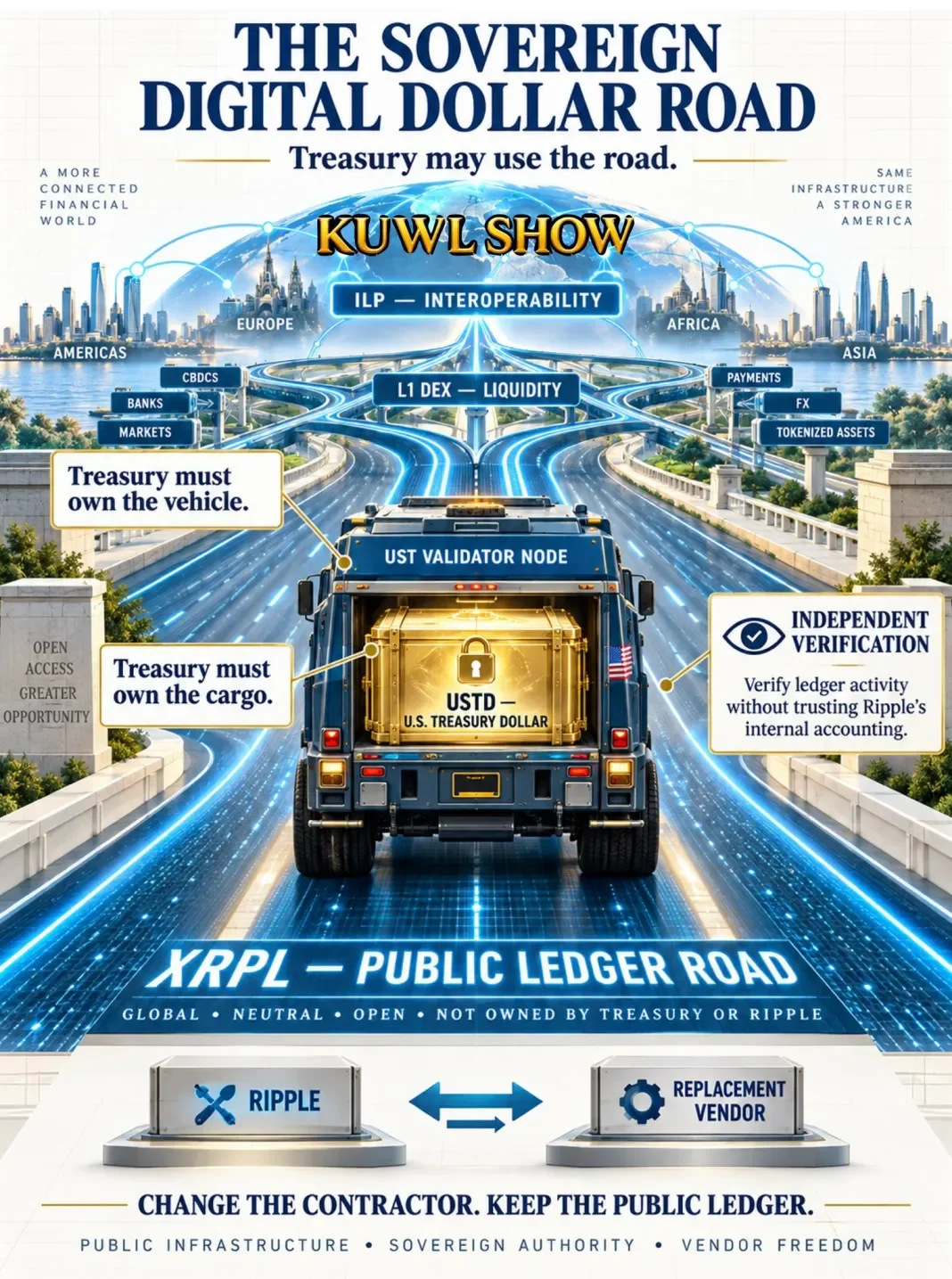
At ANY Time – Treasury Can:
1. Change the Contractor, and
2. Keep The Public XRP Ledger.
Ripple Stands At The Ready…
….With a Powerful, Scalable, Proven, Trusted & Turnkey MAGA Ready, L1 DEX Solution Built on Public Infrastructure • Sovereign Authority • Vendor Freedom
Q: Anyone have this on their bingo cards?
Q: Over/Under on crypto-bro head explosions at just the idea?
Source(s):
• https://x.com/KuwlShow/status/2099291575129952657
https://dinarchronicles.com/2026/09/14/rob-cunningham-a-marriage-between-the-us-treasury-and-ripple/
**************
Rob Cunningham: What if XRP’s Greatest Value Cannot be Seen
9-14-2026
What if XRP’s greatest value cannot be seen on its price chart?
What if the real story is not a coin – but the emerging architecture connecting currencies, stablecoins, tokenized assets and many separate ledgers through neutral bridge liquidity?

And what if principles older than banking – truth, ownership, consent, scarcity, finality, honest weights and honest measures – are becoming the foundation of finance’s next era?
Before you predict XRP’s price, understand the global system it helps connect.
Rise above the noise. Escape the chart. Take the ultimate 30,000-foot view of the world’s new monetary infrastructure – rising like a Phoenix before our very eyes.
Read “XRP: LEAN IN NOW!”
Then decide for yourself:
Are we merely watching another market cycle… or witnessing the birth of the Internet of Value?
TRUTH BEFORE LEDGER.
Source(s):
• https://x.com/KuwlShow/status/2099213750666395943
https://dinarchronicles.com/2026/09/14/rob-cunningham-what-if-xrps-greatest-value-cannot-be-seen/
Ariel: Foreign Currency Holders, this is Connected to Tokenized Assets
Ariel: Foreign Currency Holders, this is Connected to Tokenized Assets
9-14-2026
Foreign Currency Holders: This Is Connected To Tokenized Assets
You Definitely Want To Hear This
The Central Bank of Iraq has advanced initiatives toward establishing an official state-backed digital currency framework.
Do You Understand What This Means?
Ariel: Foreign Currency Holders, this is Connected to Tokenized Assets
9-14-2026
Foreign Currency Holders: This Is Connected To Tokenized Assets
You Definitely Want To Hear This
The Central Bank of Iraq has advanced initiatives toward establishing an official state-backed digital currency framework.
Do You Understand What This Means?
The Central Bank of Iraq has been developing its state-backed digital currency since late 2024. As of September 2026, the framework includes:
Digital IQD (dIQD): Built on a permissioned distributed ledger controlled by CBI, with nodes hosted at the Trade Bank of Iraq, Rafidain Bank, and Rasheed Bank. The ledger is live in test mode since August 2026.
Please Note: dIQD will initially track the existing IQD value during transition, then re-peg to a basket of commodities (oil futures contracts, gold reserves, USD digital instruments) once the redenomination executes.
We Are Sitting At The Front Of This
The long-discussed 3-zero deletion is structurally ready. New lower-denomination notes (5, 10, 20, 50, 100 “new dinar”) are printed and stored at CBI vaults in Baghdad and Erbil. The digital equivalent will launch simultaneously with the physical redenomination.
The redenomination itself does not create wealth it is a mathematical operation (1,000 old IQD = 1 new IQD). What creates the value event is the simultaneous re-pegging of the new dinar to the commodity basket rather than the artificial program rate of 0.00076 USD.
Current program rate: 1 IQD = $0.00076
Post-redenomination target rate (internal CBI projection, not public): 1 new IQD = $1.00 – $3.22. (Possibly Higher)
Sidebar: The Clarity Act’s jurisdictional split between SEC (securities) and CFTC (commodities) is the legal infrastructure that makes the dinar revaluation executable in the U.S.
This Is What I Meant When Speaking Of The Transition From Fiat To Asset
Example:
• Tokenized foreign currencies fall under CFTC jurisdiction (commodities classification)
• U.S. banks gain custody authority for digital-asset instruments including tokenized fiat
• Settlement infrastructure (DTCC, OCC, Fedwire) can interface with CBI’s dIQD ledger
• The full capital deployment chain executes: $30T institutional inflows → tokenized market infrastructure → includes dIQD/USD digital pair trading
The sequence is Clarity Act → Redenomination → Tokenization → Exchange Window. Each step is dependent on the prior. The Clarity Act is the keystone. Without it, the entire chain stalls.
JacktheRippler:
BOOOOOOOOOOOOOOOM!! Carl Higbie from NEWSMAX says LIVE on TV: “The Senate is supposed to vote on the Clarity Act NEXT WEEK. BANKS will transfer TRILLIONS of DOLLARS [$30,000,000,000,000+] into this market OVERNIGHT. THOUSANDS of PEOPLE will become MILLIONAIRES OVERNIGHT, EVEN if you only hold a SMALL AMOUNT!” LIFE CHANGING MONEY is on the way
Watch on X: https://twitter.com/i/status/2099108136174886976
Denying
Rejecting
Ignoring
Doesn’t change what many know they have done without public fanfare. Especially when they attempted to denounce that they are deleting the 3 zeros then the next day had to admit that they are. You play their games and they will have you believing you are seeing things that are not there if you allow them. People have a lot to lose in this new financial system. So I do not expect them to tell the truth until they are forced to. And in many cases they have been.
A Crypto Structure Bill Was Coming Regardless
That Is The Meat & Potatoes
If Washington wasn’t going to deliver.
The Security Exchange Commission was going to do it.
I explained this clearly on multiple occasions. There was no getting around this.
Source(s):
• https://x.com/Prolotario1/status/2099151315246915962
Seeds of Wisdom RV and Economics Updates Monday Afternoon 9-14-26
Good Afternoon Dinar Recaps,
CLARITY ACT BREAKTHROUGH: ETHICS DEAL CLEARS PATH TO SENATE VOTE AS DIGITAL ASSET RULES TAKE CENTER STAGE
New ethics provisions and 126 substantive changes have produced a revised CLARITY Act ahead of Tuesday's Senate vote, potentially moving the United States closer to a comprehensive regulatory framework for digital assets, crypto markets and stablecoins.
Good Afternoon Dinar Recaps,
CLARITY ACT BREAKTHROUGH: ETHICS DEAL CLEARS PATH TO SENATE VOTE AS DIGITAL ASSET RULES TAKE CENTER STAGE
New ethics provisions and 126 substantive changes have produced a revised CLARITY Act ahead of Tuesday's Senate vote, potentially moving the United States closer to a comprehensive regulatory framework for digital assets, crypto markets and stablecoins.
OVERVIEW
Senate Republicans released a revised version of the CLARITY Act today after incorporating 126 substantive changes requested by Democrats. The revised legislation includes stronger restrictions concerning crypto-related financial interests of certain public officials and expands enforcement authority.
President Trump agreed to key portions of the proposed ethics restrictions, including provisions concerning crypto holdings and transactions involving senior federal officials, and accepted giving state attorneys general authority to enforce certain provisions alongside the Justice Department.
The Senate is scheduled to hold a critical procedural vote Tuesday. The vote would determine whether the legislation can advance, but it does not itself enact the CLARITY Act into law. The bill still faces additional congressional steps if it advances.
KEY DEVELOPMENTS
1. A Revised CLARITY Act Emerges Before Tuesday's Vote
The most significant development today is the release of a substantially revised version of the Digital Asset Market Clarity Act.
Senate Republicans said the new version incorporates 126 substantive changes requested by Democrats, reflecting negotiations that have been underway as lawmakers attempt to build enough bipartisan support for the legislation.
The bill is intended to establish clearer rules for the U.S. digital-asset market, including how different types of digital assets are regulated and which federal agencies have authority over them.
That could have implications for cryptocurrency exchanges, token issuers, investors, financial institutions and companies developing blockchain-based financial products.
2. Ethics Restrictions Become a Central Part of the Agreement
The latest negotiations have placed significant attention on conflicts of interest involving public officials and cryptocurrency.
President Trump agreed to key portions of the ethics proposal, including restrictions concerning digital-asset activities by senior officials and provisions involving significant crypto holdings.
The agreement also gives state attorneys general a role in enforcing certain provisions, alongside federal enforcement.
That change was important in negotiations because Democratic lawmakers had sought stronger safeguards concerning potential conflicts involving public officials and digital assets.
The ethics provisions are therefore not simply an additional political issue.
They are part of the negotiations determining whether the broader digital-asset regulatory framework can move forward.
3. Tuesday's Vote Is a Procedural Test — Not Final Passage
The Senate is expected to hold its procedural vote on Tuesday.
That distinction is important.
A successful procedural vote would allow the legislation to move forward in the Senate process.
It would not mean that the CLARITY Act has become law.
The bill would still have to complete the remaining legislative process before it could take effect.
The revised language therefore represents progress in negotiations, but the outcome remains dependent on the Senate vote and subsequent congressional action.
4. The Financial Market Impact Could Extend Beyond Cryptocurrency
The CLARITY Act is significant because digital assets have increasingly become part of the broader financial system.
Clearer rules could affect how banks, investment firms, payment companies and other financial institutions interact with digital assets.
The legislation also addresses stablecoins and the relationship between digital assets and traditional financial markets.
That makes the bill relevant to more than cryptocurrency investors.
It concerns the developing intersection between traditional banking, digital payments, tokenized assets and blockchain-based financial infrastructure.
5. Digital Assets Are Becoming Part of the Financial Infrastructure Debate
For several years, cryptocurrency has largely been discussed as an alternative investment or speculative asset class.
The CLARITY Act debate reflects a broader shift.
Lawmakers are now dealing with questions about market structure, custody, payments, stablecoins, financial oversight and the legal classification of digital assets.
Those are infrastructure questions.
If digital assets become more deeply integrated into regulated financial markets, the rules governing how money and value move could evolve alongside them.
That is where the Global Reset connection becomes particularly relevant.
WHY IT MATTERS
The significance of the CLARITY Act is not simply whether cryptocurrency prices rise or fall after Tuesday's vote.
The larger issue is whether the United States is moving toward a formal regulatory framework for a financial sector that increasingly includes digital assets, stablecoins and blockchain-based payment technology.
Regulatory clarity can influence whether banks, institutions and businesses are willing to invest more heavily in digital financial infrastructure.
The financial system is not only changing through currencies and central-bank policy — it is also changing through the technology and regulatory framework governing how digital value moves.
WHY IT MATTERS TO FOREIGN CURRENCY HOLDERS
Readers hold foreign currency with the hopes that it will increase in value when the Global Reset occurs.
The CLARITY Act is relevant because digital assets, stablecoins and blockchain-based payment systems are increasingly becoming part of discussions about the future of international finance.
However, the legislation does not establish a currency revaluation, guarantee a Global Reset or automatically increase the value of any cryptocurrency or foreign currency.
The significance is the potential development of regulated digital financial infrastructure in the world's largest economy.
If digital assets become more integrated into mainstream finance, that could eventually influence how payments, settlement and financial assets operate across borders.
The foundation comes before the valuation.
IMPLICATIONS FOR THE GLOBAL RESET
Pillar 1 — Payments and Technology
The CLARITY Act could help establish clearer rules around digital assets that may eventually become part of payment and financial infrastructure.
Stablecoins and blockchain-based systems are particularly relevant because they can facilitate the movement of digital value across borders.
Regulatory clarity could therefore influence the pace at which financial institutions experiment with and adopt these technologies.
Pillar 2 — Digital Assets and Financial Markets
A formal regulatory framework could bring portions of the digital-asset market closer to traditional financial markets.
That could affect exchanges, custody, token issuance, institutional investment and the relationship between digital assets and conventional securities.
The significance is not that digital assets replace traditional finance overnight.
It is that digital and traditional financial systems may increasingly operate alongside one another.
Pillar 3 — Global Financial Competition
The regulatory approach adopted by the United States could also influence how other countries develop their own digital-asset rules.
If major economies establish competing regulatory frameworks for stablecoins, tokenized assets and blockchain payments, financial institutions may eventually operate across multiple digital financial ecosystems.
That could become another component of the evolving global financial architecture.
RUMOR SAFETY REMINDER
⚠️ The CLARITY Act has NOT passed, and Tuesday's Senate vote does NOT guarantee that it will become law.
The current development is a revised bill and an agreement on significant ethics provisions intended to build bipartisan support.
It is also NOT an announcement of a Global Reset or a currency revaluation.
The financial significance lies in the potential creation of a clearer regulatory framework for digital assets and related financial technology.
Follow the legislation. Follow the evidence. Don't follow the hype.
THE BOTTOM LINE
Today's revised CLARITY Act represents a significant new development in the U.S. effort to establish a comprehensive framework for digital assets.
The combination of 126 substantive changes, new ethics provisions and expanded enforcement authority shows how far negotiations have moved ahead of Tuesday's Senate vote.
Whether the bill advances remains to be determined by the Senate.
But the broader significance is already clear: digital assets, stablecoins and blockchain-based financial systems are increasingly being addressed as part of the mainstream financial infrastructure, rather than simply as a separate cryptocurrency market.
The next phase of financial-system change may depend not only on new technology, but on the rules governments establish for bringing that technology into the financial system.
Seeds of Wisdom Team
Newshounds News™ Exclusive
SOURCES
~~~~~~~~~~
Seeds of Wisdom Team RV Currency Facts Youtube and Rumble
Newshound's News Telegram Room Link
RV Facts with Proof Links Link
RV Updates Proof links - Facts Link
Start Here room with Most Asked Questions Link
Follow the Gold/Silver Rate COMEX
Follow Fast Facts
Seeds of Wisdom Team™ Website
Thank you Dinar Recaps
Iraq Economic News and Points To Ponder Monday Afternoon 9-14-26
Oil breaks $107 mark amid growing supply fears
2026-09-14 01:14 Shafaq News Oil prices rose more than 3% on Monday, after new Houthi strikes on Saudi Arabia and Iranian attacks on ships in the Gulf compounded supply concerns following the closure of a key Saudi oil pipeline.
Brent crude futures rose $3.21, or 3.1%, to $107.82 per barrel as of 0340 GMT. WTI futures gained $3.17, or 3.2%, to $103.22 per barrel.
Oil breaks $107 mark amid growing supply fears
2026-09-14 01:14 Shafaq News Oil prices rose more than 3% on Monday, after new Houthi strikes on Saudi Arabia and Iranian attacks on ships in the Gulf compounded supply concerns following the closure of a key Saudi oil pipeline.
Brent crude futures rose $3.21, or 3.1%, to $107.82 per barrel as of 0340 GMT. WTI futures gained $3.17, or 3.2%, to $103.22 per barrel.
"This follows a step-up in attacks on Saudi Arabian energy infrastructure, including targeting the crucial east-west pipeline," said ING commodity strategists, although noting that it was unclear how severe any potential damage was or how long the pipeline would be out of action.
Saudi Arabia's East-West oil pipeline was temporarily shut following a drone attack, according to Saudi officials. The shutdown of the pipeline, which helps Saudi Arabia avoid the Strait of Hormuz and re-route its exports, threatens up to 4% of global oil supply.
With the pipeline out of service, Yanbu has enough inventory to cover just five to seven days of exports, according to three industry sources familiar with Saudi Arabia's exports.
Saudi Arabian state media on Sunday released video footage of damage to homes and a mosque from what it said was a Houthi attack on the country's southern Jazan province. The Houthis said they had also struck a Saudi military base in a neighbouring province.
Meanwhile, a vessel in the Strait of Hormuz was struck by a projectile, causing a fire and forcing the crew to be evacuated, the British maritime security agency UKMTO said on Sunday.
Iran said one person was killed and four crew wounded aboard an Iranian commercial vessel struck off its coast.
Yemen's Iran-aligned Houthis reached the strategic island of Perim on Friday, moving to tighten their control over the Bab el-Mandeb strait, another key oil transit lane that has been carrying 4%-5% of global supply in recent months.
Oil surged 8% higher last week due to the disruptions, rising above $100 for the first time since July.
Omani Foreign Minister Badr Albusaidi said on X on Sunday, that a scheduled Monday meeting in Oman between Gulf countries and Iran to discuss the Strait of Hormuz had been postponed.
No peace talks have been held on the war, launched six months ago by the United States and Israel, since an interim agreement in June collapsed. (Reuters)
https://www.shafaq.com/en/Economy/Oil-breaks-107-mark-amid-growing-supply-fears
Hormuz Vessel Traffic Drops To Single Digits
2026-09-14 02:25 Shafaq News- Hormuz Cargo traffic through the Strait of Hormuz fell to single digits per day, ship-tracking firm Kpler reported on Monday.
Preliminary vessel-tracking data showed maritime activity dropping well below the 10-day average of 14 ships. Four vessels left the Gulf through the waterway, while 10 entered over the weekend.
The figures do not account for vessels that may have crossed the strait with their Automatic Identification System (AIS) transponders switched off to avoid detection
Hormuz, through which roughly 20% of the world's oil passes, has remained largely closed under Iranian restrictions since Feb. 28, following the joint US-Israeli war on Iran. The corridor briefly reopened after a US-Iran memorandum of understanding (MoU) took effect on June 18, but closed again amid renewed military escalation, with Tehran asserting that the waterway remains under Iranian control. US President Donald Trump, however, said that the waterway is "open and operating."
Read more: Regional Hormuz talks postponed in Oman
https://www.shafaq.com/en/Economy/Hormuz-cargo-flow-drops-to-single-digits
Iraq Ranks 7th Among Turkiye Export Markets
2026-09-14 03:57 Shafaq News- Baghdad/ Ankara Iraq stood as Turkiye's seventh-largest export market in the first seven months of 2026, with Turkish shipments to the country reaching about $6.08 billion, despite a 7.8% decline from the same period last year, Turkish Statistical Institute (TURKSTAT) data showed.
Germany led the list with $13.29 billion in exports, followed by the United States with $10.16 billion and the United Kingdom with $9.43 billion. Italy ranked fourth at $8.35 billion, while France and Spain recorded $6.64 billion and $6.44 billion, respectively.
Turkiye's exports to Iraq picked up in July, rising 15.5% from a year earlier to about $1.11 billion, compared with $963.4 million in July 2025. The increase lifted Iraq to fourth place among Turkiye's export destinations for the month, behind Germany, the United States and the United Kingdom.
Overall, Turkiye exported about $161.54 billion worth of goods in the first seven months of 2026, up 3.4% from $156.26 billion in the same period of 2025.
https://www.shafaq.com/en/Economy/Iraq-ranks-7th-among-Turkiye-export-markets
USD/IQD Holds In Baghdad, Drops In Erbil
2026-09-14 04:18 Shafaq News- Baghdad/ Erbil The US dollar held steady in Baghdad but edged lower in Erbil on Monday at the opening of trading, with rates hovering around 157,000 dinars per 100 dollars.
According to a Shafaq News market survey, the dollar traded in Baghdad’s Al-Kifah and Al-Harithiya exchanges at 156,500 dinars per 100 dollars, unchanged from the previous session.
In the Iraqi capital, exchange shops sold the dollar at 157,000 dinars and bought it at 156,000 dinars, while in Erbil, selling prices stood at 156,200 dinars and buying prices at 156,150 dinars.
https://www.shafaq.com/en/Economy/USD-IQD-holds-in-Baghdad-drops-in-Erbil
Gold Prices Dip Across Baghdad, Erbil Markets
2026-09-14 05:11 Shafaq News- Baghdad/ Erbil On Monday, gold prices fell in Baghdad and Erbil markets, hovering around 950,000 IQD per mithqal, according to a Shafaq News survey.
Gold prices on Baghdad’s Al-Nahr Street recorded a selling price of 953,000 IQD per mithqal (equivalent to five grams) for 21-carat gold, including Gulf, Turkish, and European varieties, with a buying price of 949,000 IQD. The same gold sold for 960,000 IQD on Sunday.
The selling price for 21-carat Iraqi gold stood at 923,000 IQD, while the buying price reached 919,000 IQD.
In jewelry stores, the selling price per mithqal of 21-carat Gulf gold ranged between 955,000 and 965,000 IQD, while Iraqi gold sold for between 925,000 and 935,000 IQD.
In Erbil, 22-carat gold was sold at 992,000 IQD per mithqal, 21-carat gold at 948,000 IQD, and 18-carat gold at 812,000 IQD.
https://www.shafaq.com/en/Economy/Gold-prices-dip-across-Baghdad-Erbil-markets
Shalamcheh Border Traffic Resumes After Iran-Iraq Talks
2026-09-14 05:21 Shafaq News- Khuzestan/ Maysan Passenger and truck traffic between Iran and Iraq resumed at the Shalamcheh border crossing after successful talks between the two countries, Khuzestan Governor Mohammad Reza Mowali Zadeh said on Monday.
Passenger traffic also resumed at the Chazabeh border crossing, while efforts were underway to restore commercial truck and cargo traffic between the two countries.
Iraq had closed three land border crossings with Iran —Shalamcheh, Al-Sheeb and Mandali. A source told Shafaq News that the closures were framed as an “economic penalty” against Tehran after findings allegedly linked Iranian actors to drone attacks on Saudi oil pipelines launched from Iraqi territory.
Last week, Saudi Arabia said that the East-West oil pipeline in the Riyadh and Medina regions had come under a drone attack, with the drones launched from Iraqi territory. The attack caused injuries and damage, prompting a temporary precautionary shutdown of the pipeline.
Tehran rejected the accusations and requested a joint investigation with Iraq into the launch of the drones. Iraqi Prime Minister Ali Al-Zaidi later approved the request.
https://www.shafaq.com/en/Economy/Shalamcheh-border-traffic-resumes-after-Iran-Iraq-talks
Reset Intelligence Daily - The Budget, the Bill, and the Fed
Emailed to Recaps~ Thank you David
Reset Intelligence Daily - The Budget, the Bill, and the Fed
9-14-2026
Reset Intelligence: The Budget, the Bill, and the Fed.
By Reset Intelligence | @EXIT_FIAT
For 2 decades the dinar's price has had one author. This week, three hands are on it at once.
Emailed to Recaps~ Thank you David
Reset Intelligence Daily - The Budget, the Bill, and the Fed
9-14-2026
Reset Intelligence: The Budget, the Bill, and the Fed.
By Reset Intelligence | @EXIT_FIAT
For 2 decades the dinar's price has had one author. This week, three hands are on it at once.
Tomorrow stacks three decisions on one currency pair, and none of the people making them will consult the others.
Three files, three capitals, 48 hours
Tuesday, Iraq's 2027 budget draft goes before the cabinet in Baghdad. It is the first complete federal budget since 2023, roughly 200 trillion dinars, the first built on results-based budgeting, and every budget is built on an exchange rate. The same day, the US Senate holds its cloture test on the CLARITY Act, the market-structure law for the digital rails. And on Wednesday the Fed decides whether US interest rates rise under Kevin Warsh, which moves the dollar every one of those numbers is quoted against.
The enforcer underneath
Finance ministry data surfaced this weekend showing why Baghdad's date cannot slip:
Reserves - roughly $16 billion gone in 4 months, with salaries covered by borrowing from the central bank and the local market
Deficit - tripled from $5 billion at end of April to $16 billion at end of June
The street - parallel market at 157,000 dinars per $100 on Sunday, a 20 percent premium over the official 131,000, while the CBI's window stays routine
The signatures - a 25-year contract on the Ajeel field, a Chevron consultancy agreement on West Qurna-2, and a prime minister in Paris where the Elysee wrote the word contracts, not memorandums
The cleanup - the drone platform behind the Saudi pipeline attack seized, 3 Iran border crossings closed, the responsible commander dismissed, and OFAC designating four Kata'ib Hizballah commanders inside the state-funded PMF
The street prices the dinar at a 20 percent discount. The longest-horizon money in the room is signing paper priced on Iraq producing and paying for decades. One of those two prices is wrong.
That is the short version. The full briefing connects what the budget rate means, why the reserve bleed is the deadline's enforcer, what the CLARITY vote does to the rails a repriced dinar would settle across, and what to watch as each decision lands this week.
Read the full daily briefing free for 5 days. Sign up here: resetintelligence.com
Want it straight from the horse's mouth? The CBI Rate Alert pings you the moment the Central Bank of Iraq moves the official rate. The number itself, not a rumour about it. It comes with our free resource library and the daily breakdown of what is actually moving in Iraq. Sign up free: resetintelligence.com/rate-alert
Got a dinar question? Reset Intelligence runs an on-call research assistant: ask it anything they have published. It answers in seconds and will conduct deep research to find you the answer. Try it: resetintelligence.com/research-assistant
The book behind the briefing: Head of the Snake - and the free reference library: Resources
Follow the daily intel free: Telegram · Facebook · Spotify · Odysee
News, Rumors and Opinions Monday 9-14-2026
Ariel: THE SEQUENCING - WHY ORDER MATTERS 9/12/26
VIII. THE SEQUENCING — WHY ORDER MATTERS
The CLARITY Act must pass before the Dinar revalues. Here's the mechanical reason:
1. CLARITY Act passes → digital tokens backed by sovereign currencies become legally recognized settlement instruments under US law.
2. SEC issues no-action letters → exchanges can list the revalued Dinar token without securities law exposure.
Ariel: THE SEQUENCING - WHY ORDER MATTERS 9/12/26
VIII. THE SEQUENCING — WHY ORDER MATTERS
The CLARITY Act must pass before the Dinar revalues. Here's the mechanical reason:
1. CLARITY Act passes → digital tokens backed by sovereign currencies become legally recognized settlement instruments under US law.
2. SEC issues no-action letters → exchanges can list the revalued Dinar token without securities law exposure.
3. Treasury issues redenomination guidance → the US recognizes Iraq's currency revaluation at the sovereign level.
4. Iraq executes "delete the zeros" → the Dinar redenominates and revalues simultaneously.
5. Tokenized Dinar goes live on ISO-20022 rails → international settlement at the new rate begins.
6. Iran's black market Dinar pipeline collapses → the revalued Dinar is no longer useful for black market arbitrage because the spread between official and street rate vanishes.
7. Petrodollar transition accelerates → oil settlement begins moving to tokenized instruments, bypassing the traditional dollar/SWIFT rail.
If you reverse steps 1 and 4 — if Iraq revalues before the CLARITY Act creates the legal framework the revalued Dinar exists but has no international settlement venue. It's a sovereign currency with no legal on-ramp in the world's largest economy. The revaluation stalls, the black market persists, and the Cabal wins.
That's why the Senate vote on September 15 is the trigger. Everything downstream is sequenced to that date.
(Emailed to Recaps)
************
Courtesy of Dinar Guru: https://www.dinarguru.com/
Thom For those of you who aren't familiar with the Development Road Project in Iraq...The Development Road Project...aims to build a major transport corridor of roads and railways roughly 1,200 kilometers long. It runs from the Grand Faw Port in southern Iraq (on the Persian Gulf) north to the Turkish border. The goal is to turn Iraq into a key trade hub that moves goods between Asia and Europe more quickly, create jobs, earn money from trade (projected around $4 billion a year once running), reduce reliance on oil...In April 2024, Iraq, Turkey, Qatar, and the UAE signed a cooperation agreement...In December 2025, Iraq’s prime minister opened the first section... Work on designs and partnerships (including with Turkey) has continued into 2026...This is a big deal.
Ariel THE REVALUATION CASCADE: Iraq has been operating under an artificially suppressed exchange rate since 2003. The dinar was deliberately pegged low 1,470 to the dollar under the program rate... Iraq’s currency was low not because Iraq is poor. Iraq is sitting on proven oil reserves of 145 billion barrels, 9% of global supply. Add natural gas, phosphates, sulfur, gold deposits in the northern provinces. Iraq economic reports...The currency does not reflect the asset base... [Post 1 of 2]
Ariel When the US troops complete their withdrawal by September 30 and PM Ali al-Zaidi has been crystal clear, full sovereignty, no extensions, no residual force, no “adviser” loophole Iraq regains control of its own monetary policy. The 2027 budget, which is being presented now, is structured around a new program rate. Not the old one. The new one reflects Iraq’s actual resource-backed valuation. Every holder of the old dinar who has physical notes registered in a recognized account gets exchanged at the new rate. The margin between the suppressed program rate and the sovereign rate is where the overnight wealth lives. [Post 2 of 2]
************
Peter Schiff: Economic Armageddon - Bonds & Dollar in Crisis
Glen Diesen: 9-13-2026
Monday Iraq News Posted by Tishwash at TNT 9-14-2026
TNT:
Tishwash: US Chargé d'Affaires: Al-Zaidi's visit to Washington opened new horizons for the Iraqi-American partnership
The US Chargé d'Affaires in Iraq, Steven Fagin, affirmed on Saturday that Prime Minister Ali Faleh al-Zaidi's visit to Washington opened new horizons for the Iraqi-American partnership.
Fagin stated in a statement received by the Iraqi News Agency (INA) that "relations between Baghdad and Washington are on the cusp of significant development," noting "a shared commitment to strengthening the economic partnership and expanding opportunities for cooperation between the two countries."
TNT:
Tishwash: US Chargé d'Affaires: Al-Zaidi's visit to Washington opened new horizons for the Iraqi-American partnership
The US Chargé d'Affaires in Iraq, Steven Fagin, affirmed on Saturday that Prime Minister Ali Faleh al-Zaidi's visit to Washington opened new horizons for the Iraqi-American partnership.
Fagin stated in a statement received by the Iraqi News Agency (INA) that "relations between Baghdad and Washington are on the cusp of significant development," noting "a shared commitment to strengthening the economic partnership and expanding opportunities for cooperation between the two countries."
He emphasized that "Prime Minister Ali al-Zaidi's visit to Washington last summer came with a mandate from the Iraqi people to build a sovereign, secure, and prosperous Iraq," adding that "Iraq today is not viewed as the Iraq of yesterday, but rather as a country brimming with great opportunities."
He further stated that "US President Donald Trump has aspirations regarding bilateral relations, which are embodied in establishing a fruitful partnership with the Iraqi people based on real and tangible results."
He explained that "the agreements signed during al-Zaidi's visit covered the energy, healthcare, technology, and financial sectors, with a total value of $60 billion."
Fagin emphasized that his goal during his tenure as Chargé d'Affaires at the U.S. Embassy in Iraq was to deepen economic opportunities and achieve accomplishments that benefit both countries.
He noted that the United States and Iraq stand on the cusp of a transformative phase in their relationship, highlighting a shared interest in expanding trade opportunities.
He concluded by saying that the two countries can continue this fruitful partnership, achieving tangible results and real progress to ensure the prosperity of both the United States and Iraq. link
************
Tishwash: Al-Zaidi's visit to Europe: A step towards global economic openness
Economic experts and specialists confirmed that Prime Minister Ali Faleh al-Zaidi’s European tour, which will begin in France and Germany, aims to strengthen economic partnerships and attract investments between Iraq and the European Union countries, noting that it will witness the signing of agreements and memoranda of understanding in economic fields.
Member of Parliament, Nasser Turki, said: “Prime Minister Ali al-Zubaidi’s visit to France, Germany and European countries will be important, because it aims to make Iraq a leading country in international relations that are open to the world, based on mutual respect and non-interference in internal affairs, and based on common interests that serve all parties.”
Turki explained that “among the most important files that the Prime Minister pays great attention to are the files of energy, electricity, oil, technology and the petrochemical industry, as well as attracting foreign capital to support the industrial, agricultural, transportation and communications sectors,” stressing that “the Prime Minister is very determined that this visit be practical and not just paper agreements, but a practical reality that brings good and tangible results to Iraq and its people.”
Important agreements
For his part, economic researcher Jalil Al-Lami stressed that “the Prime Minister’s European tour to France and Germany carries great economic importance, because it aims to move the relationship with the two largest and most influential economies in the European Union from the level of trade exchange to the level of investment, industrial partnerships and technology transfer, especially in the energy, electricity, industry, transportation, infrastructure and technology sectors.”
Economic partnership
Al-Lami explained in an interview with Al-Sabah that “the European Union represents an important economic partner for Iraq, as the volume of trade in goods between Iraq and the EU countries reached about 18.2 billion euros during 2025, of which 12.7 billion euros were Iraqi exports to Europe compared to 5.5 billion euros in European exports to Iraq, while machinery and transport equipment alone accounted for about 2.3 billion euros, or 41 percent, of European exports to the Iraqi market.”
He added that “the volume of trade between Iraq and Germany reached about 2.85 billion euros during 2025, of which 1.416 billion euros were German exports to Iraq and 1.431 billion euros were German imports from Iraq,” noting that “the balance of German direct investments in Iraq did not exceed 25 million euros according to the latest data for 2024, which is a very modest figure compared to the size of the two economies and the opportunities available in Iraq, and therefore the visit could aim to raise the level of German investment and not just trade.”
German companies
He pointed out that "there is an important Iraqi proposal that was put forward before the visit, which is to establish a joint Iraqi-German fund to finance projects for developing Iraqi industry in cooperation with the German side, which may open the way for German companies to enter into the rehabilitation of factories, energy, electricity and technology, and the transfer of production lines and expertise."
"Inside Iraq."
Regarding France, Al-Lami explained that “France has a larger investment base in Iraq, most notably Total Energies’ integrated energy project, with investments amounting to approximately $27 billion, in addition to new cooperation between the Iraq Development Fund and the French state investment bank to support investment opportunities.”
"And the business between the two countries."
French trade deficit
He expected that “the tour will witness memoranda of understanding and economic agreements in the fields of investment, energy, industry, technology and trade.”
He stressed that “the government has confirmed that the goal is to turn understandings into executive paths and practical partnerships, and information related to the Paris visit indicates that it is likely to witness the signing of several memoranda of understanding,” stressing that “what is most important for Iraq is not the number of memoranda that will be signed, but rather the volume of investments that will actually turn into contracts, projects, job opportunities and technology transfer within Iraq.”
Development relations
For his part, economist Abdul Hassan al-Shammari told Al-Sabah newspaper that Prime Minister Ali Faleh al-Zaidi's European tour to France and Germany may be followed by another foreign visit. He predicted that the Prime Minister's visit to France and Germany would result in important economic and development agreements, most of which would be in Iraq's favor. He explained that these visits would contribute to building strong, robust, and cohesive economic and political relations with other developed countries, based on mutual benefit and partnership.
Ongoing economic activity.
Concluding agreements
He stated that "the European tour indicates that Iraq has begun to develop under the leadership of Prime Minister Ali Faleh al-Zaidi," and predicted that "the visit will witness the signing of joint economic agreements and memoranda of understanding." Between Iraq and those countries. link
*************
Tishwash: CBI tightens rules for state bank advisers
Iraq’s central bank (CBI) has tightened oversight of advisers at state-owned banks, requiring licensed financial institutions to clearly define consultants’ responsibilities and keep their roles separate from executive management, Shafaq News learned on Saturday.
In an official circular, the CBI noted that the rules apply to both Iraqi and foreign advisers, stressing that experts cannot be given authority to perform executive duties. They are also barred from holding positions or serving on the board of the bank they advise or any other bank supervised by the CBI.
Financial institutions will bear legal responsibility for any violations of the directive, according to the circular.
An informed source also told Shafaq News that some advisers had received substantial payments and benefits, while allegations had emerged that bribes were offered to certain consultants.
Other cases involve specialists who were believed to have followed up on, promoted or facilitated banking transactions, raising potential concerns about conflicts of interest and blurred lines of responsibility.
The source also pointed to individuals who allegedly had little attendance or no clearly defined duties corresponding to their contracts, despite receiving substantial compensation.
“Some contracts may have resulted from favoritism, personal connections or ties to administrative officials,” he said, calling on the government, parliament and the Finance Ministry to review advisory and expert contracts at state-owned banks. link
*************
Tishwash: Al-Yakti told Ultra Iraq: Baghdad and the region reached an understanding on the budget, oil, and ASYCUDA.
The Patriotic Union of Kurdistan (PUK) confirmed on Saturday, September 12, 2026, that there are understandings between the federal government and the Kurdistan Regional Government regarding the budget, the oil file, and ASYCUDA.
SOMO is in charge of the oil file in the Kurdistan Region.
Ahmad al-Harki, a member of the Patriotic Union of Kurdistan, told Ultra Iraq that "there are currently positive understandings between Baghdad and Erbil regarding the budget and ways to address oil issues and non-oil revenues."
He explained that "the relationship between the federal government and the regional government is based on the constitution and mutual rights and duties, with a sincere intention on both sides to eliminate crises and resolve outstanding problems."
He noted that the oil marketing company "SOMO" will handle the oil file in the region, and it was agreed to implement the ASYCUDA system for customs in the region to unify procedures with the rest of Iraq.
He said that "the Iraqi economy has been negatively affected by the repercussions of regional tensions, and has been unable to make optimal use of rising oil prices due to its total dependence on a rentier economy."
He explained that "the political forces are committed to the need for cohesion on the home front, with a political will to move forward with the enactment of vital laws such as the Oil and Gas Law and the Federal Council Law."
He added: “Attention must be paid to the issue of employee salaries and ending the crisis of promotions and allowances that have been suspended since 2016 in order to ensure fairness and equality among all employees in Iraq.”
He called for "adopting a responsible national discourse that focuses on commonalities and higher national interests instead of exchanging accusations," expressing his "optimism about the possibility of reaching a comprehensive national pact formula."
A few days ago, a high-level delegation from the Kurdistan Regional Government, including the Ministers of Finance and Economy, Natural Resources, the Head of the Cabinet Office, the Secretary of the Cabinet, the Head of the Coordination and Follow-up Department, and the Undersecretary of the Ministry of Planning, arrived in Baghdad to conduct a series of intensive meetings with relevant ministries and authorities in the federal government, with the aim of participating in the "preparation of a draft federal general budget law for the year 2027," by meeting with officials of the federal Ministry of Finance, and holding extensive discussions with the Ministries of Planning and Oil, to review "issues of dispute and reach common understandings."
The delegation came to Baghdad with the agenda for the talks including "the Kurdistan Regional Government's vision and demands regarding salary allocations and financial entitlements for all employees and salary recipients, as well as job classifications and financial grades, allocations for investment projects and provincial development, the operational budget, in addition to resolving the pending oil file," according to a statement issued by the Kurdistan Regional Government, which confirmed that it "seeks to end the financial disputes and formulate a comprehensive agreement and common understanding with the federal government that guarantees the inclusion and confirmation of the region's full rights and shares within the 2027 general budget law before it is referred to Parliament."
Patriotic Union of Kurdistan member Mahmoud Khoshnaw said that "the ongoing negotiations between Baghdad and Erbil aim to develop a strategy for the 2027 budget, and the current solutions will remain temporary and patchwork until a fair oil and gas law is enacted."
In an interview with Ultra Iraq, Khoshnaw noted that "there is a mutual and serious desire this time between Baghdad and Erbil to reach understandings that contribute to overcoming previous financial crises, even though the energy file has witnessed a relative breakthrough thanks to the resumption of oil exports and the preliminary agreements that govern the marketing of oil through SOMO."
He continued: "Clear standards for actual spending must be adopted instead of previous estimates to ensure a fair share for the region with full equality in financial rights and allocations for Peshmerga fighters with their counterparts in the Federal Ministry of Defense."
He explained that "sovereign and governing expenses must be deducted from the state budget as a whole, while ensuring social justice in the distribution of appointments and job grades, as the region seeks to establish 60,000 employees on a contractual basis on a permanent basis in accordance with legal and constitutional contexts."
He explained that "the Iraqi constitution has set clear frameworks for the distribution of revenues and fair representation, and adhering to them is the only way to end the engines of conflict and establish stability. Therefore, Baghdad must choose, either to adopt accurate population ratios or to estimate actual spending so that the region can then manage its funds and cover the entitlements of retirees and other sectors."
On Saturday, a statement was issued by the Kurdistan Region's negotiating delegation with the federal government, which was reviewed by Ultra Iraq. The statement read, "As part of the Kurdistan Regional Government's participation in the ongoing preparations for drafting the Iraqi federal budget law for the fiscal year 2027, the Kurdistan Regional Government's negotiating delegation held a meeting today, Saturday, September 12, with the Kurdistan Democratic Party bloc in the Iraqi Parliament."
During the meeting, the negotiating delegation reviewed "the results of its recent meetings and discussions in Baghdad with the federal ministries of finance, planning, and oil. Extensive discussions were also held regarding the regional government's main visions and proposals concerning the 2027 budget." The statement added that "those present emphasized the importance of securing the constitutional and financial rights and entitlements of the Kurdistan Region, particularly ensuring the continuous and timely payment of salaries and various financial entitlements in the region, and keeping the issue of salaries separate from financial and political disputes."
The participants also stressed the importance of coordination at all stages of preparing and approving the draft budget law, as well as highlighting the importance of continuing dialogue and coordination with all Kurdish blocs and representatives of the Kurdistan Region in the Iraqi Parliament without exception, in order to formulate and develop a unified position, with the aim of protecting the rights and entitlements of the people of the Kurdistan Region in the federal budget for 2027. link
Seeds of Wisdom RV and Economics Updates Monday Morning 9-14-26
Good Morning Dinar Recaps,
FED RATE HIKE WARNING: OIL SHOCK AND INFLATION PUSH U.S. MONETARY POLICY INTO A NEW PHASE
With oil prices surging above $108 and inflation remaining stubbornly elevated, expectations for a Federal Reserve rate increase this week are reshaping the outlook for U.S. monetary policy, bond yields, debt costs and the dollar.
Good Morning Dinar Recaps,
FED RATE HIKE WARNING: OIL SHOCK AND INFLATION PUSH U.S. MONETARY POLICY INTO A NEW PHASE
With oil prices surging above $108 and inflation remaining stubbornly elevated, expectations for a Federal Reserve rate increase this week are reshaping the outlook for U.S. monetary policy, bond yields, debt costs and the dollar.
OVERVIEW
Markets and economists are now expecting the Federal Reserve to raise interest rates by 0.25 percentage point this week, which would bring the federal funds target range to 3.75%–4.00% and mark the first Fed rate hike since July 2023. A Reuters poll found that 85% of economists surveyed expect the increase.
The oil shock is making the Fed's inflation problem more difficult. Brent crude has moved above $108 a barrel following continuing disruptions to Middle Eastern energy supplies, including the shutdown of Saudi Arabia's East-West pipeline. Rising energy prices are feeding renewed inflation concerns.
The consequences are spreading into bonds and currencies. U.S. Treasury yields remain near multi-year highs while the dollar has strengthened as investors seek safety and anticipate tighter monetary policy.
KEY DEVELOPMENTS
1. The Fed Is Moving From Rate Cuts Toward Possible Rate Hikes
The Federal Reserve enters its September 15–16 meeting facing a very different environment from the one investors expected earlier this year.
Instead of preparing for additional rate cuts, markets are now pricing in a strong probability of a quarter-point rate increase.
The Reuters economist survey found that 85% of respondents expect the Fed to raise its target range to 3.75%–4.00%. More than half also expect at least one additional increase by March 2027.
That represents a significant change in the monetary-policy outlook.
The Fed's challenge is that inflation remains too high while energy prices are rising sharply.
2. Oil Is Creating a New Inflation Problem
The latest energy shock is making the Fed's job considerably more difficult.
Brent crude has climbed above $108 per barrel, driven by continuing disruption to Middle Eastern oil supplies and uncertainty surrounding major shipping and export routes.
Saudi Arabia's East-West pipeline remains shut following attacks, while uncertainty around the Strait of Hormuz is keeping markets nervous.
The result is a classic monetary-policy dilemma.
Higher oil prices can push inflation higher even though raising interest rates does not directly produce more oil.
The Fed must therefore determine how much of the energy-driven inflation could become persistent inflation throughout the broader economy.
3. Bond Markets Are Already Feeling the Pressure
The implications extend beyond the Federal Reserve itself.
Higher expected interest rates generally increase the cost of borrowing throughout the economy.
At the same time, investors are demanding greater yields on longer-term government debt as inflation expectations rise.
The U.S. 10-year Treasury yield has approached the important 5% level, reflecting concerns about inflation, government borrowing and the future path of monetary policy.
This matters because Treasury yields influence borrowing costs throughout the financial system.
Mortgages, corporate borrowing, government refinancing and other forms of credit can all be affected.
4. The Dollar Is Benefiting From the Shift Toward Higher Rates
The changing interest-rate outlook is also affecting currency markets.
The dollar strengthened on Monday as investors sought the relative safety of U.S. assets while expectations for a Fed rate increase increased.
Higher U.S. interest rates can make dollar-denominated assets more attractive to international investors because they offer higher yields.
But there is another side to the story.
A stronger dollar can place additional pressure on countries that depend heavily on dollar-denominated borrowing or imports.
That means the Fed's decisions can create financial consequences far beyond the United States.
5. The Debt Problem Becomes More Important
Higher interest rates become especially significant when government debt is already elevated.
Every increase in borrowing costs can eventually affect the expense of refinancing maturing debt.
If rates remain higher for longer, governments must devote more resources to servicing their obligations.
That creates a potentially difficult cycle: Higher Oil Prices → Higher Inflation → Higher Interest Rates → Higher Bond Yields → Higher Debt Costs
If that cycle persists, pressure can spread through government finances, corporate borrowing, investment and currency markets.
This is where an energy shock becomes a global financial story.
WHY IT MATTERS
The Fed's potential rate hike is important not simply because of the quarter-point increase itself.
The bigger issue is the changing relationship between energy prices, inflation, interest rates and government debt.
The central bank can influence the cost of money, but it cannot produce additional oil or reopen a damaged pipeline.
That makes today's environment unusually complicated.
The energy shock is forcing monetary policymakers to confront inflation at the same time that governments and markets are already carrying significant debt burdens.
WHY IT MATTERS TO FOREIGN CURRENCY HOLDERS
Readers hold foreign currency with the hopes that it will increase in value when the Global Reset occurs.
Today's developments are important because interest-rate changes can influence currency values, capital flows, trade balances and international investment.
A higher U.S. interest rate can support the dollar by making U.S. assets more attractive, while putting pressure on currencies whose countries have lower interest rates or significant dollar-denominated debt.
However, a Fed rate hike does not guarantee that the dollar will strengthen indefinitely, nor does it establish a date for a Global Reset or currency revaluation.
For foreign currency holders, the important lesson is to watch the underlying financial structure rather than short-term predictions.
Hope is understandable. Evidence is essential.
IMPLICATIONS FOR THE GLOBAL RESET
Pillar 1 — Monetary Policy and Debt
The potential Fed rate hike demonstrates how quickly an energy crisis can move into monetary policy.
If inflation remains elevated, central banks may have less flexibility to lower rates.
That creates a difficult environment for heavily indebted governments because refinancing becomes more expensive.
The relationship between interest rates, government debt and bond markets is therefore becoming increasingly important to watch.
Pillar 2 — Energy and Financial Stability
The current situation also reinforces the growing connection between physical energy supplies and financial markets.
A disruption to oil production or transportation can raise energy prices.
Higher energy prices can increase inflation.
Persistent inflation can influence central-bank policy.
And monetary-policy changes can affect bonds, currencies and global capital flows.
The financial system is therefore increasingly exposed to events occurring far outside traditional banking centers.
Pillar 3 — Currency and Global Capital Flows
As interest-rate expectations change, international investors can move capital toward currencies and markets offering greater returns or perceived safety.
That can create winners and losers among currencies.
Countries with large external debts, significant energy-import bills or weaker currencies can face additional pressure when the dollar strengthens.
This is another reason the Fed's decision matters globally.
THE BOTTOM LINE
The Federal Reserve is approaching its September meeting at a moment when several major financial pressures are converging.
Oil has surged above $108, inflation remains elevated, bond yields are near multi-year highs and economists increasingly expect the Fed to raise rates rather than cut them.
The significance goes beyond one Fed meeting.
The combination of higher energy costs, persistent inflation, rising interest rates and heavy government debt could create a new pressure point for the global financial system—one that reaches from the oil market to bonds, currencies and sovereign debt.
Seeds of Wisdom Team
Newshounds News™ Exclusive
SOURCES
~~~~~~~~~~
🌱 A Message to Our Currency Holders🌱
If you’ve been holding foreign currency for many years, you were not foolish.
You were not wrong to believe the global financial system would change.
What failed was not your patience — it was the information you were given.
For years, dates, rumors, and personalities replaced facts, structure, and proof. “This week” predictions created cycles of hope and disappointment that were never based on how currencies actually change.
That is not your failure.
Our mission here is different: • No dates • No rates • No hype • No gurus
Instead, we focus on:
• Verifiable developments • Institutional evidence
• Global financial structure • Where countries actually sit in the process
Currency value changes only come after sovereignty, trade, banking, settlement systems, and fiscal coordination are in place. History and institutions confirm this sequence.
You will see silence. You will see denials. That is not delay — that is discipline.
Protect your identity. Organize your documents. Verify everything.
Never hand your discernment to anyone who cannot show proof.
You deserve truth — not timelines.
Seeds of Wisdom Team
Newshounds News
~~~~~~~~~~
Seeds of Wisdom Team RV Currency Facts Youtube and Rumble
Newshound's News Telegram Room Link
RV Facts with Proof Links Link
RV Updates Proof links - Facts Link
Start Here room with Most Asked Questions Link
Follow the Gold/Silver Rate COMEX
Follow Fast Facts
Seeds of Wisdom Team™ Website
Thank you Dinar Recaps