
Thank you to all the subscribers to our Early Access program…we thank you for your continued support.
We are excited to offer this new service to keep you informed and up-to-date on the latest Dinar and currency news.
Iraq Economic News and Points To Ponder Sunday Morning 8-30-26
The Rising Dollar Is Testing Banking Reforms; The Central Bank Is Changing Rules, But The Parallel Market Is Resisting
Last updated: August 30, 2026 Al-Mustaqilla/Baghdad/- The dollar is still being sold in the Iraqi parallel market at a significant difference from the price announced by the Central Bank, despite a series of banking and regulatory measures implemented by the authorities during the past months in an attempt to restructure the financial sector and expand official channels for obtaining foreign currency.
The Rising Dollar Is Testing Banking Reforms; The Central Bank Is Changing Rules, But The Parallel Market Is Resisting
Last updated: August 30, 2026 Al-Mustaqilla/Baghdad/- The dollar is still being sold in the Iraqi parallel market at a significant difference from the price announced by the Central Bank, despite a series of banking and regulatory measures implemented by the authorities during the past months in an attempt to restructure the financial sector and expand official channels for obtaining foreign currency.
The selling price of $100 at Baghdad exchange bureaus reached approximately 154,500 dinars at the close of trading on Saturday, August 29, the same price as at the Al-Kifah and Al-Harithiya exchanges. Meanwhile, the Central Bank offers the dollar at 1,310 dinars, equivalent to 131,000 dinars per $100.
This leaves a difference of approximately 23,500 dinars, or about 18 percent, between the Central Bank's rate and the cash selling price in the market.
The figures do not reflect a steady upward trend for the dollar. The selling price in Baghdad reached about 156,000 dinars in some sessions in June before it declined, but at the end of August it remained higher than its level at the end of January when it was selling for about 151,000 dinars per 100 dollars.
This means that the new measures have not yet led to a permanent narrowing of the gap between the two prices to limited levels, despite a major change in the way Iraq manages trade finance and access to foreign currency.
Since the beginning of 2025, Iraq has moved from an electronic platform through which the Central Bank oversaw foreign transfers to a system in which commercial banks rely on their accounts and relationships with correspondent banks abroad, while the Central Bank finances those accounts and oversees compliance.
The International Monetary Fund said last year that the transition to the new system had succeeded in reducing the gap between the official and parallel exchange rates at that stage, but it also said that further narrowing the gap required facilitating access to foreign currency, tightening customs controls to curb smuggling and informal trade, and promoting the use of the dinar in local transactions.
But the widening gap again in 2026 indicates that reforming the transfer mechanism alone was not enough to eliminate demand outside the formal system.
The central bank said in June that it was committed to meeting legitimate demand for dollars and maintaining exchange rate stability, and that its reform program included reintegrating Iraqi banks into foreign transfers, expanding their relationships with correspondent banks, improving electronic payments, and complying with anti-money laundering and counter-terrorism financing standards.
In July, Central Bank Governor Nizar Nasser Hussein announced that, following discussions with the US Treasury Department, an understanding had been reached allowing restricted Iraqi banks to return to foreign correspondent banking channels in currencies other than the dollar after they met compliance and governance requirements.
The bank said that seven banks have become eligible for this stage, and that they can regain eligibility to deal in dollars later after passing additional requirements.
In the same month, the Central Bank withdrew the licenses of three companies that mediated the buying and selling of foreign currencies, namely Al-Rawajeb, Saba and Al-Nitaq, due to their violation of the sector's regulatory controls.
Then, it held meetings with exchange companies to discuss reorganizing their operations and raising compliance and governance levels.
The policy towards cash dollars also witnessed another change. In July, Iraqi media published a directive from the Central Bank allowing banks to deliver some foreign remittances and incoming dollar deposits to their owners in the same currency, according to specific controls, in a move that would increase the banking system's ability to meet the legitimate demand for foreign currency.
However, the parallel market did not disappear.
This is partly due to the nature of demand, which does not all pass through the banking system. The IMF stated in its report on Iraq that the remaining difference between the two exchange rates reflects, among other factors, informal trade, demand for dollars for activities that cannot access regulated channels, and speculation.
The central bank itself had previously stated in clarifications that part of the parallel demand comes from traders who do not use official import methods, or from trade that does not pass through regular customs ports, or from prohibited activities, which makes providing dollars for legitimate transactions insufficient on its own to eliminate the informal market.
Iraq's financial relationship with the United States and its trade with Iran add another layer of complexity.
Reuters reported last week that Iraq's reliance on the dollar-based financial system gives Washington significant leverage over its financial sector, at a time when Iraq maintains extensive economic ties with Iran. According to figures cited by the agency, Iraqi-Iranian trade exceeded $10 billion in 2025.
In recent years, the United States has also imposed restrictions and sanctions on Iraqi banks that it said were involved in transactions linked to Iran, prompting the central bank to tighten compliance requirements and restructure the relationship of Iraqi banks with the international financial system.
This reveals a paradox facing Iraqi monetary policy: stricter compliance reduces the risks of sanctions and money laundering and brings banks closer to the international financial system, but at the same time it may leave a portion of demand that is unable or unwilling to go through official procedures heading to the parallel market.
Therefore, the market rate alone does not provide a complete measure of the success of banking reform. Restructuring banks, improving governance, expanding their international relationships, and subjecting remittances to scrutiny are objectives that extend beyond the daily exchange rate.
However, a persistent gap approaching 18 percent is at the same time an indicator that is difficult to ignore when measuring the ability of reforms to reach the real economy.
For a trader who cannot finance all of his needs through a correspondent bank, or a citizen who needs cash dollars for purposes other than those specified, the parallel market rate remains the actual rate he faces.
Herein lies the most difficult test for the Central Bank and the government of Ali al-Zaidi.
After changing the rules for foreign exchange, reopening banking channels, regulating exchange companies, and expanding dollar transactions through banks, the challenge is no longer limited to building a more compliant financial system, but has become making this system capable of competing with the parallel market in speed, access, and cost.
The experience of the first eight months of 2026 suggests that the parallel market has not yet given up.
The dollar, which was selling for about 151,000 dinars per 100 dollars at the end of January, reached 154,500 dinars at the end of August, although it fell back from the peaks it recorded in June.
Thus, what has been achieved so far seems closer to a reform of the banking structure and channels than to a complete transformation of the exchange market.
Narrowing the gap between the two prices, rather than just the number of instructions or banks that have been rehabilitated, will be one of the clearest tests of the new policy’s ability to transfer reform from the banks to the market.
https://mustaqila.com/ارتفاع-الدولار-يختبر-الإصلاح-المصرفي/
EIA: US Records No Crude Imports From Iraq
2026-08-30 Shafaq News- Baghdad US crude oil imports from Iraq fell to zero last week, down from 6,000 barrels per day (bpd) a week earlier, Energy Information Administration (EIA) data showed on Sunday.
Canada remained the largest supplier at 3.526 million bpd, followed by Venezuela at 662,000, Brazil at 348,000, Mexico at 196,000, and Saudi Arabia at 165,000. Colombia shipped 141,000 bpd, Libya 89,000, and Nigeria 50,000.
No crude shipments were recorded from Ecuador, Algeria, Angola, Congo, Equatorial Guinea, Kuwait, Norway, Russia, Trinidad and Tobago, or the United Kingdom.
https://www.shafaq.com/en/Economy/EIA-US-records-no-crude-imports-from-Iraq
USD/IQD Remains Steady In Baghdad, Erbil
2026-08-30 Shafaq News- Baghdad/ Erbil The US dollar opened Sunday’s trading steady in Iraq, hovering above 153,500 dinars per 100 dollars.
According to a Shafaq News market survey, the dollar traded in Baghdad's Al-Kifah and Al-Harithiya exchanges at 154,000 dinars per 100 dollars, unchanged from the previous session on Saturday.
In the Iraqi capital, exchange shops sold the dollar at 154,500 dinars and bought it at 153,500 dinars, while in Erbil, selling prices stood at 153,950 dinars and buying prices at 153,850 dinars.
https://www.shafaq.com/en/Economy/USD-IQD-remains-steady-in-Baghdad-Erbil
Gold Prices Hold Steady In Baghdad And Erbil
2026-08-30 Shafaq News- Baghdad/ Erbil Gold prices hovered around 950,000 IQD per mithqal in Baghdad and Erbil markets on Sunday, according to a Shafaq News market survey.
On Baghdad's Al-Nahr Street, 21-carat gold, including Gulf, Turkish, and European varieties, sold for 970,000 IQD per mithqal (equivalent to five grams), with a buying price of 966,000 IQD, unchanged from Saturday.
The selling price for 21-carat Iraqi gold stood at 940,000 IQD per mithqal, with a buying price of 936,000 IQD.
At jewelry stores, 21-carat Gulf gold sold for between 970,000 and 980,000 IQD per mithqal, while Iraqi gold ranged from 940,000 to 950,000 IQD.
In Erbil, 22-carat gold sold for 1,000,000 IQD per mithqal, 21-carat gold reached 955,000 IQD and 18-carat gold stood at 820,000 IQD. https://www.shafaq.com/en/Economy/Gold-prices-hold-steady-in-Baghdad-and-Erbil-4-9
Seeds of Wisdom RV and Economics Updates Sunday Morning 8-30-26
Good Morning Dinar Recaps,
The G20 Financial Test: U.S. Debt, Iran and Trade Reshape the Global Economic Order
As the world's major economies gather for a G20 finance meeting, the financial system is being tested on several fronts at once: rising U.S. debt and bond yields, the economic consequences of the Iran war, trade tensions and Washington's attempt to use the dollar-centered financial system as leverage.
Good Morning Dinar Recaps,
The G20 Financial Test: U.S. Debt, Iran and Trade Reshape the Global Economic Order
As the world's major economies gather for a G20 finance meeting, the financial system is being tested on several fronts at once: rising U.S. debt and bond yields, the economic consequences of the Iran war, trade tensions and Washington's attempt to use the dollar-centered financial system as leverage.
Overview
U.S. Treasury Secretary Scott Bessent enters the G20 meeting facing an unusually difficult combination of problems: rising U.S. debt, elevated long-term Treasury yields, trade tensions and the economic fallout from the Iran war.
Washington wants G20 nations to reduce trade imbalances, support economic growth and sever remaining economic ties with Iran, including through pressure on countries purchasing Iranian oil.
The deeper issue is whether the G20 can coordinate around a common financial agenda when its members increasingly have different interests regarding the dollar, trade, energy and sanctions.
Key Developments
1. The G20 is meeting as multiple financial pressures converge
Finance ministers and central-bank governors from the world's major economies are meeting in Asheville, North Carolina, on Monday and Tuesday.
The timing is significant.
The global economy is dealing simultaneously with elevated energy prices, disrupted trade, geopolitical conflict and higher government borrowing costs.
The Iran war has kept the Strait of Hormuz closed, affecting energy flows and economic activity across the G20. At the same time, Washington is confronting rising U.S. debt and long-term Treasury yields that recently reached their highest level in 19 years.
This means the G20 isn't meeting under normal economic conditions.
It is meeting while the existing financial architecture itself is under pressure.
2. Washington wants Iran to become a global financial issue
Bessent is expected to push G20 partners to cut remaining economic ties with Iran, particularly transactions involving Iranian oil.
That turns the Iran conflict into something larger than a regional military or energy crisis.
It becomes a test of how much influence Washington can still exercise through the dollar-centered financial system.
Countries that continue doing business with Iran could face secondary U.S. sanctions, creating a difficult choice for governments and companies that have economic relationships with Tehran.
The problem for Washington is that the G20 includes countries such as China, India, Russia and Turkey, which have varying degrees of economic ties with Iran.
That makes consensus difficult.
3. The Treasury market is becoming part of U.S. economic diplomacy
The G20 discussion will also occur against the backdrop of an increasingly important problem at home: the cost of financing U.S. government debt.
The 30-year Treasury yield reached its highest level in 19 years this month.
The Treasury responded by announcing that it would double scheduled purchases of longer-term Treasuries to $4 billion per operation, temporarily easing pressure on yields. But the intervention has generated concerns among some market participants and central bankers about a greater Treasury role in a market traditionally valued for its predictable issuance and functioning.
That creates a difficult message for Washington.
The United States wants the world to continue viewing Treasury securities as the foundation of the global financial system while simultaneously taking increasingly visible steps to influence the market for those securities.
Why It Matters
The G20 represents roughly 85% of global GDP and 75% of international trade, making it one of the most important forums for assessing the direction of the global economy.
But the group's challenge is no longer simply economic coordination.
It is increasingly about competing financial interests.
The United States wants stronger growth, lower trade imbalances and continued use of its financial system as a tool of economic pressure.
China and other emerging powers have different priorities, including maintaining access to energy, expanding trade and reducing vulnerability to U.S. sanctions.
Europe is dealing with the inflationary consequences of higher energy prices.
And central banks are being forced to reconsider how quickly they can ease monetary policy.
The result is a global economy where trade policy, monetary policy, energy security and financial sanctions are becoming increasingly interconnected.
Why It Matters to Foreign Currency Holders
For foreign-currency holders, the important development is not simply whether the dollar strengthens or weakens against another currency.
It is the possibility that global trade and financial relationships are becoming more fragmented.
If countries increasingly face pressure to choose between access to the U.S. financial system and commercial relationships with sanctioned countries, the incentive to develop alternative payment and settlement channels increases.
That could gradually strengthen the importance of local-currency trade, regional payment systems and alternative reserve assets.
This does not mean the dollar is suddenly losing its reserve status.
Rather, the G20 meeting illustrates why the global monetary system may increasingly operate with multiple financial pathways instead of one dominant pathway.
Implications for the Global Reset
Financia power is becoming part of geopolitical power.
The Iran sanctions campaign demonstrates how the United States can use its position at the center of the dollar system to influence the behavior of other countries.
But every time that leverage is used, other nations have an incentive to ask whether they should become less dependent on the system being used as leverage.
That creates a paradox.
The stronger the dollar system is used as a geopolitical weapon, the greater the incentive for some countries to build alternatives to it.
The next financial architecture may emerge from fragmentation rather than replacement.
There is still no evidence of an imminent replacement for the dollar.
What is developing instead is a gradual layering of alternatives:
Dollar settlement + local currencies + regional payment systems + alternative reserve assets + new cross-border financial infrastructure.
That is consistent with the broader financial-reset theme we've been tracking.
The system doesn't have to collapse to change.
It can diversify one transaction, one payment rail and one trade relationship at a time.
What to Watch
The most important signals coming out of the G20 meeting will be:
Whether countries support or resist Washington's Iran sanctions strategy
Any discussion of global trade imbalances
Statements concerning the U.S. Treasury market and long-term yields
China's response to pressure over Iranian oil purchases
Whether emerging economies push for greater use of local currencies
Any discussion of international financial stability or alternative payment mechanisms
The most revealing outcome may actually be what the G20 cannot agree on.
A widening gap between the United States and other major economies over Iran, trade and financial policy would provide another indication that the post-Cold War financial architecture is becoming harder to coordinate.
Bottom Line
The G20 meeting is more than another gathering of finance ministers.
It is a stress test for the global financial system.
The United States arrives with enormous financial power—but also with $40 trillion-plus in public borrowing, elevated Treasury yields and an increasingly aggressive use of financial sanctions.
China and other major economies arrive with their own interests in trade, energy security and financial independence.
The central question is therefore becoming larger than Iran or U.S. debt:
Can the existing dollar-centered financial system continue to coordinate the world's major economies when those same economies increasingly disagree over trade, energy, sanctions and the distribution of financial power?
The global financial reset may not arrive as one dramatic replacement of the dollar system—it may emerge through the gradual renegotiation of debt, trade, energy and financial relationships inside the world's most important economic forum.
Seeds of Wisdom Team
Newshounds News™ Exclusive
Sources
Reuters — U.S. Treasury's Bessent faces G20 diplomacy test amid tariffs, Iran war and bond turmoil
Reuters — U.S.-hosted G20 finance meeting to target growth, imbalances and Iran sanctions
~~~~~~~~~~
🌱 A Message to Our Currency Holders🌱
If you’ve been holding foreign currency for many years, you were not foolish.
You were not wrong to believe the global financial system would change.
What failed was not your patience — it was the information you were given.
For years, dates, rumors, and personalities replaced facts, structure, and proof. “This week” predictions created cycles of hope and disappointment that were never based on how currencies actually change.
That is not your failure.
Our mission here is different: • No dates • No rates • No hype • No gurus
Instead, we focus on:
• Verifiable developments • Institutional evidence
• Global financial structure • Where countries actually sit in the process
Currency value changes only come after sovereignty, trade, banking, settlement systems, and fiscal coordination are in place. History and institutions confirm this sequence.
You will see silence. You will see denials. That is not delay — that is discipline.
Protect your identity. Organize your documents. Verify everything.
Never hand your discernment to anyone who cannot show proof.
You deserve truth — not timelines.
Seeds of Wisdom Team
Newshounds News
~~~~~~~~~~
Seeds of Wisdom Team RV Currency Facts Youtube and Rumble
Newshound's News Telegram Room Link
RV Facts with Proof Links Link
RV Updates Proof links - Facts Link
Start Here room with Most Asked Questions Link
Follow the Gold/Silver Rate COMEX
Follow Fast Facts
Seeds of Wisdom Team™ Website
Thank you Dinar Recaps
Iraq Is Running Short On Dinar…Why NOW ?
Iraq Is Running Short On Dinar…Why NOW ?
The Dinar Den: 8-28-2026
In a recent detailed analysis, Stephen, the host of The Dinar Den and an entrepreneur who has tracked the Iraqi dinar market since 2011, provided an in-depth breakdown of the ongoing monetary shifts within the country.
Rather than relying on online rumors or speculative hype, Stephen approaches the situation with the grounded pragmatism of a seasoned investor, prioritizing verified data, on-the-ground reports, and economic fundamentals to explain what is happening behind the scenes in Baghdad.
Iraq Is Running Short On Dinar…Why NOW ?
The Dinar Den: 8-28-2026
In a recent detailed analysis, Stephen, the host of The Dinar Den and an entrepreneur who has tracked the Iraqi dinar market since 2011, provided an in-depth breakdown of the ongoing monetary shifts within the country.
Rather than relying on online rumors or speculative hype, Stephen approaches the situation with the grounded pragmatism of a seasoned investor, prioritizing verified data, on-the-ground reports, and economic fundamentals to explain what is happening behind the scenes in Baghdad.
At the heart of current discussions is a severe liquidity crunch taking place across Iraq.
Verified reports confirm that physical Iraqi dinar banknotes have become increasingly scarce in daily commerce. Citizens and local business owners are experiencing significant challenges accessing paper currency, with automated teller machines (ATMs) across major urban centers either operating under strict cash rationing limits or going completely offline.
This unusual scarcity of physical cash is not merely a localized inconvenience; it points to a broader systemic shift in how the Central Bank of Iraq and the national government are managing their domestic currency supply.
A major driver behind this physical cash shortage is the government’s aggressive push toward financial digitalization.
Iraq is actively transitioning its public sector salary distribution from cash-in-hand payments to electronic banking infrastructure. By modernizing its payroll systems and encouraging citizens to utilize debit cards and digital accounts, the Iraqi government aims to reduce its reliance on physical paper currency, curb informal economic activity, and integrate more of the population into the formal banking sector. This structural pivot toward electronic payments helps explain why paper dinars seem to be disappearing from circulation even as economic activity continues.
Independent financial analysts and intelligence aggregators, including sources like Reset Intelligence, have corroborated these reports of cash scarcity and structural transition.
While official statements from Iraqi financial authorities have occasionally presented conflicting messages regarding the printing, availability, and readiness of new physical currency notes, the overall picture suggests a coordinated strategy. Analysts suggest that the restriction of physical notes, combined with the rapid rollout of electronic banking infrastructure, often precedes major monetary reforms, such as currency redenomination or dynamic exchange rate adjustments.
For long-term observers of the Iraqi dinar, these developments are particularly notable. While Stephen cautions that a liquidity crunch and digital transition do not offer an absolute guarantee of an immediate revaluation or specific currency event, the convergence of these structural shifts points toward an imminent evolution of Iraq’s financial framework.
The simultaneous reduction of circulating physical cash, the implementation of international banking standards, and the push for digital transactions indicate that the Central Bank of Iraq is laying the groundwork for significant structural economic updates.
Ultimately, navigating updates regarding international currencies requires patience, critical thinking, and a commitment to verified facts over speculation.
Stephen emphasizes that while current indicators suggest major changes are on the horizon for Iraq’s monetary system, investors should evaluate developments objectively and maintain a realistic perspective, noting that these insights represent an analytical interpretation of current economic trends rather than formal financial advice.
Texas Digital Gold: Sound Money or a New Gatekeeper?
Texas Digital Gold: Sound Money or a New Gatekeeper?
Lynette Zang: 8-29-2026
Texas is taking a major step toward sound money by recognizing qualifying gold and silver specie as legal tender—and preparing for an electronic currency backed by bullion held in the Texas Bullion Depository.
Lynette Zang breaks down why the real questions are about redemption, ownership, auditing, competition, and whether this new digital rail ultimately strengthens individual sovereignty or creates another gatekeeper.
Texas Digital Gold: Sound Money or a New Gatekeeper?
Lynette Zang: 8-29-2026
Texas is taking a major step toward sound money by recognizing qualifying gold and silver specie as legal tender—and preparing for an electronic currency backed by bullion held in the Texas Bullion Depository.
Lynette Zang breaks down why the real questions are about redemption, ownership, auditing, competition, and whether this new digital rail ultimately strengthens individual sovereignty or creates another gatekeeper.
Chapters:
00:00 Texas Recognizes Gold & Silver as Legal Tender
00:53 Texas Takes Sound Money Digital
02:43 Solving Gold’s Convenience Problem
03:32 “Gold-Backed” vs. Redeemable
04:19 What the Final Texas Law Actually Says
04:51 The Critical Questions About Ownership
05:18 Why Ownership Is Where Sovereignty Lives
06:00 Could the State Become the Gatekeeper?
07:02 What Sound Money Is Really About
07:35 Can Gold Compete With Fiat on Convenience?
08:05 Putting Sound Money on Modern Digital Rails
08:42 Why Physical Redemption Matters
09:23 What We’ll Be Watching as Texas Implements the Law
09:52 Does This System Actually Strengthen Sovereignty?
10:31 Would You Use a Digital Gold & Silver System?
10:57 Is Your Gold & Silver Structured for Your Goals?
11:34 Texas Has Opened the Door
Seeds of Wisdom RV and Economics Updates Saturday Afternoon 8-29-26
Good Afternoon Dinar Recaps,
BRICS Moves Beyond De-Dollarization: The Push for Digital Currency and Cross-Border Settlement
India is preparing to put cross-border digital payments, central-bank digital currencies and local-currency trade at the center of the upcoming BRICS summit — signaling that the next stage of financial diversification may be about building new payment infrastructure rather than simply abandoning the dollar.
Good Afternoon Dinar Recaps,
BRICS Moves Beyond De-Dollarization: The Push for Digital Currency and Cross-Border Settlement
India is preparing to put cross-border digital payments, central-bank digital currencies and local-currency trade at the center of the upcoming BRICS summit — signaling that the next stage of financial diversification may be about building new payment infrastructure rather than simply abandoning the dollar.
Overview
India is preparing to push CBDC cooperation and seamless cross-border digital payments among BRICS members at the September 12–13 summit in New Delhi.
The focus is shifting from simply reducing dollar dependence to building alternative financial infrastructure that can make trade faster, cheaper and less dependent on traditional correspondent-banking channels.
This does not mean BRICS is replacing the dollar. It means another layer of the international financial system is beginning to take shape alongside the existing dollar-based system.
Key Developments
1. India is putting digital settlement on the BRICS agenda
India, which holds the BRICS presidency this year, is preparing to propose seamless cross-border digital payments and greater adoption of central-bank digital currencies among member states at next month's summit.
According to reporting from The Economic Times, a high-level meeting is expected next week to work through mechanisms for using digital currencies and increasing trade conducted in national currencies. The September 12–13 summit in New Delhi is expected to provide greater clarity on how fast-payment systems could eventually be linked.
The significance is that the discussion is moving from political statements about de-dollarization toward the mechanics of settlement.
That distinction matters.
A country can continue holding dollars as reserves while simultaneously developing payment channels that allow certain trade transactions to settle directly in national currencies.
The infrastructure can change before the reserve currency changes.
2. The goal is interoperability — not necessarily a single BRICS currency
One of the biggest obstacles to alternative payment systems is that individual countries have developed their own digital and fast-payment platforms.
India has its UPI system. China has its digital yuan infrastructure and CIPS payment network. Other BRICS members have their own domestic payment systems and, in some cases, CBDC programs.
The challenge is making those systems interoperable.
Reuters reported earlier this month that BRICS members were discussing possible links between their fast-payment systems and CBDCs, with the objective of making cross-border transactions faster and cheaper. RBI Governor Sanjay Malhotra said discussions were underway around connecting systems such as India's UPI with other BRICS payment infrastructure.
If those connections become operational, businesses could potentially move money across participating economies with fewer intermediaries and lower transaction costs.
That is a very different development from simply announcing another currency agreement.
It is financial plumbing.
3. BRICS is trying to lower the cost of conducting trade outside traditional dollar channels
India is also pushing for mechanisms to reduce transaction costs within the expanded 11-member BRICS grouping.
The Economic Times reports that discussions could include greater use of national currencies, cross-border digital payments and faster-payment-system linkages. BRICS members are also examining cooperation involving customs and global value chains.
This creates a potentially important feedback loop:
More local-currency trade → greater demand for direct settlement → better payment infrastructure → lower transaction costs → more incentive to use local currencies.
That does not require the dollar to disappear.
It simply makes the international system less dependent on one settlement pathway.
Why This Matters
For decades, the international financial system has relied heavily on the dollar, U.S. correspondent banks and established Western payment infrastructure.
That system remains dominant.
But dominance and exclusivity are not the same thing.
The development now underway inside BRICS is potentially important because countries are increasingly working on the ability to conduct portions of international commerce through alternative rails.
The biggest change may therefore occur quietly in the background.
A new financial system does not necessarily begin with a dramatic announcement that the old system is over.
It can begin with businesses discovering that another payment route is cheaper, faster or more politically reliable.
Why It Matters to Foreign Currency Holders
For foreign-currency holders, this development is worth watching because it could gradually change the role that national currencies play in international commerce.
If BRICS members successfully expand local-currency settlement, currencies such as the rupee, yuan, real, rand and other member currencies could gain additional utility in cross-border trade.
That does not automatically mean those currencies will appreciate sharply or replace the dollar as reserve assets.
The more immediate potential change is functional: A currency used more frequently in international trade has a broader economic role than a currency used primarily inside its home country.
For currency holders, that makes the development of payment infrastructure at least as important to watch as headlines about exchange rates.
Implications for the Global Financial Reset
The financial reset may be about infrastructure before currencies
The most important takeaway is that BRICS appears increasingly focused on how money moves, not simply what currency is used.
CBDC interoperability, fast-payment systems and local-currency settlement could create an alternative layer of financial infrastructure without requiring the immediate creation of a single BRICS currency.
That is a much more practical approach.
De-dollarization can happen at the margins before it happens at the center
The dollar can remain the world's dominant reserve and financing currency while its share of certain trade transactions gradually declines.
That would produce a more multipolar financial system without requiring a collapse of the existing one.
This is why today's development deserves attention.
The question is no longer simply: “Will BRICS replace the dollar?”
The more useful question is: “How much international commerce can BRICS eventually conduct without needing the traditional dollar-based settlement architecture?”
What to Watch Next
The September 12–13 BRICS summit in New Delhi will be the next major test.
Watch for concrete announcements involving:
CBDC interoperability
UPI and other fast-payment-system connections
Local-currency settlement mechanisms
Cross-border payment costs
Participation by China and other major BRICS economies
Whether proposed systems move from discussion into actual pilot programs
Evidence of real trade being settled through the new infrastructure
The key distinction will be between political declarations and operational systems.
A summit announcement matters.
A payment system that businesses actually use matters much more.
Bottom Line
BRICS is not replacing the dollar overnight, and there is no evidence that a single BRICS currency is about to displace the U.S. dollar.
Something more subtle — and potentially more consequential — is happening.
India is preparing to push BRICS toward interoperable digital currencies, faster cross-border payments and greater use of national currencies in trade.
If those initiatives move from proposals into functioning payment infrastructure, they could gradually reduce the world's dependence on traditional dollar-based settlement without requiring the dollar to lose its dominant reserve position.
The next phase of the global financial reset may therefore be less about replacing the dollar and more about building a world in which countries have more than one way to move money.
Seeds of Wisdom Team
Newshounds News™ Exclusive
Sources
The Economic Times — India to pitch central bank digital currencies to BRICS partners
Reuters — BRICS nations discuss linking payment systems and CBDCs
Note: An Important U.S. Distinction: America Has Rejected a Federal CBDC
The United States is taking a fundamentally different approach to digital currency than the BRICS countries now exploring CBDCs and cross-border digital settlement.
In January 2025, President Donald Trump signed an Executive Order directing federal agencies not to establish, issue, or promote a Central Bank Digital Currency (CBDC). The order specifically prohibits agencies from undertaking such actions, except where required by law.
That means the United States is not currently pursuing a Federal Reserve-controlled digital dollar comparable to the CBDC models being developed by other central banks.
Instead, the Trump administration has promoted private-sector digital assets, stablecoins, blockchain technology and Bitcoin as part of its broader digital-finance strategy. The administration has also established a Strategic Bitcoin Reserve and a U.S. Digital Asset Stockpile.
It is important, however, to distinguish between “prohibited under current U.S. policy” and “legally impossible forever.” An executive order can be changed or revoked by a future administration, and Congress could establish additional statutory restrictions or authorizations.
For the purposes of today's financial-system discussion, the important point is this:
While BRICS countries are exploring CBDCs and interconnected digital-payment systems, the United States has explicitly chosen not to pursue a government-issued CBDC under the current administration.
That creates an important divide in the emerging global financial architecture: BRICS is exploring state-backed digital settlement infrastructure, while the United States is emphasizing private digital assets, stablecoins and blockchain-based financial innovation instead of a Federal Reserve-issued digital currency.
~~~~~~~~~~
Seeds of Wisdom Team RV Currency Facts Youtube and Rumble
Newshound's News Telegram Room Link
RV Facts with Proof Links Link
RV Updates Proof links - Facts Link
Start Here room with Most Asked Questions Link
Follow the Gold/Silver Rate COMEX
Follow Fast Facts
Seeds of Wisdom Team™ Website
Thank you Dinar Recaps
Iraq Economic News and Points To Ponder Saturday Afternoon 8-28-26
Basrah Crude Loses Over 6% On Week
2026-08-29 Shafaq News- Basra Basrah Heavy and Basrah Medium crude each lost $5.37 a barrel over the week, falling 6.72% and 6.46%, respectively. Both grades nevertheless rose in the final trading session.
Basrah Heavy gained $1.67 a barrel, or 2.29%, in the final session to settle at $74.52. Basrah Medium also rose $1.67 a barrel, or 2.19%, to close at $77.82.
Basrah Crude Loses Over 6% On Week
2026-08-29 Shafaq News- Basra Basrah Heavy and Basrah Medium crude each lost $5.37 a barrel over the week, falling 6.72% and 6.46%, respectively. Both grades nevertheless rose in the final trading session.
Basrah Heavy gained $1.67 a barrel, or 2.29%, in the final session to settle at $74.52. Basrah Medium also rose $1.67 a barrel, or 2.19%, to close at $77.82.
Global oil prices moved lower. West Texas Intermediate fell $0.08, or 0.10%, to $83.46 a barrel, while Brent declined $0.33, or 0.37%, to $89.37. https://www.shafaq.com/en/Economy/Basrah-crude-loses-over-6-on-week
Dollar Edges Higher In Baghdad, Erbil
2026-08-29 Shafaq News- Baghdad/ Erbil The US dollar edged higher against the Iraqi dinar in Baghdad and Erbil on Saturday, hovering around 154,000 dinars per $100.
According to a Shafaq News market survey, the dollar rose in Baghdad to 154,000 dinars per $100 at the al-Kifah and al-Harithiya central exchanges, up from 153,550 dinars on Thursday.
At currency exchange shops in Baghdad, the dollar was selling for 154,500 dinars per $100 and buying for 153,500 dinars.
In Erbil, the dollar was selling for 153,900 dinars per $100 and buying for 153,850 dinars.
https://www.shafaq.com/en/Economy/Dollar-edges-higher-in-Baghdad-Erbil-8
Gold Prices Fall In Baghdad And Erbil
2026-08-29 Shafaq News- Baghdad/ Erbil On Saturday, gold prices hovered around 970,000 IQD per mithqal in Baghdad and Erbil markets, according to a Shafaq News market survey.
Gold prices on Baghdad's Al-Nahr Street recorded a selling price of 970,000 IQD per mithqal (equivalent to five grams) for 21-carat gold, including Gulf, Turkish, and European varieties, with a buying price of 966,000 IQD. The same gold had sold for 995,000 IQD on Thursday.
The selling price for 21-carat Iraqi gold stood at 940,000 IQD, with a buying price of 936,000 IQD.
In jewelry stores, the selling price per mithqal of 21-carat Gulf gold ranged between 970,000 and 980,000 IQD, while Iraqi gold sold for between 940,000 and 950,000 IQD.
In Erbil, 22-carat gold was sold at 1,000,000 IQD per mithqal, 21-carat gold at 955,000 IQD, and 18-carat gold at 820,000 IQD. https://www.shafaq.com/en/Economy/Gold-prices-fall-in-Baghdad-and-Erbil-7
Kirkuk-Baniyas Pipeline To Boost Iraq’s Exports By 2.25M Bpd
2026-08-29 Shafaq News- Baghdad Iraq is pushing ahead with a strategic oil pipeline that could open new export routes for up to 2.25 million barrels per day (bpd), Oil Minister Basim Mohammed Khudair al-Abadi said on Saturday.
At a meeting attended by Deputy Oil Minister for Extraction Affairs Nasir Aziz and the directors-general of the state-run South Oil Company and North Oil Company, al-Abadi directed officials to accelerate the technical and commercial arrangements and finalize preparations ahead of the contract signing.
The proposed pipeline would run from the southern oil hub of Basra through Haditha to Fishkhabur in northern Iraq. A separate section would connect Haditha with Baniyas on Syria’s Mediterranean coast.
https://www.shafaq.com/en/Economy/Kirkuk-Baniyas-pipeline-to-boost-Iraq-s-exports-by-2-25M-bpd
CBI Steps Up Monitoring Of Officials’ Wealth
2026-08-29 Shafaq News- Baghdad The Central Bank of Iraq (CBI) has instructed financial institutions to tighten scrutiny of senior officials and other high-ranking public figures, targeting unexplained wealth and transactions linked to corruption, money laundering, and terrorist financing.
A CBI document sets minimum requirements for monitoring such customers during and after their time in office, including wealth inconsistent with declared income or known finances and unusual or high-value transactions that do not match their activities or positions.
Other red flags include dealings with high-risk jurisdictions without clear economic justification, unexplained financial activity involving relatives or close associates, and the use of third parties, companies, or complex ownership structures to conceal beneficiaries or sources of funds.
Banks must also consider credible information linking customers to corruption, bribery, fraud, or other financial crimes, along with insufficient documentation of assets and sudden changes in spending patterns or holdings.
The CBI said these criteria will form part of its supervisory activities when assessing the effectiveness of financial institutions’ anti-money laundering and counter-terrorist financing systems.
The directive comes amid Iraq’s nationwide Dawn Crackdown, launched on June 28 to pursue corruption cases, including illicit enrichment and unexplained wealth among officials and political figures. The campaign has revived the “Where Did You Get This?” initiative, introduced in 2023 to examine whether officials’ assets match their declared income.
On Aug. 28, the CBI imposed a precautionary asset freeze on 12 current and former political figures in connection with corruption investigations, requiring banks to identify and report any funds held in their names.
Read more: Corruption arrests in Iraq pass 210 under PM al-Zaidi
https://www.shafaq.com/en/Economy/CBI-steps-up-monitoring-of-officials-wealth
UK exports to Iraq rise 3.7% in Q2 2026
2026-08-29 Shafaq News- London Iraq imported about $111 million in British goods in the second quarter of 2026, up 3.7% from roughly $107 million in the previous quarter, data from HM Revenue and Customs (HMRC) showed on Saturday.
Vehicles and automotive components led purchases at about $33 million, followed by pharmaceuticals at $20 million and machinery and mechanical equipment at $12 million.
Electrical equipment accounted for around $6.9 million, while essential oils, perfumes, cosmetics, and personal care products reached $6.2 million. Other goods included optical and medical instruments, fuels, beverages, chemicals, paints, and inks.
Bilateral trade remains heavily tilted toward UK exports. UN Comtrade figures released in April 2026 put Iraqi exports to the British market at only about $4 million in 2025. Unlike Iraq’s exports to many other markets, which are dominated by crude oil, sales to Britain consisted largely of food products.
An Iraqi Ministry of Finance report published in 2025 valued overall trade between the two countries at $1.108 billion in 2024, up from $1.072 billion a year earlier. https://www.shafaq.com/en/Economy/UK-exports-to-Iraq-rise-3-7-in-Q2-2026
USD Prices Stabilize In Baghdad, Increase In Erbil
2026-08-29 Shafaq News- Baghdad/ Erbil The US dollar closed Saturday’s trading lower in Iraq, hovering around 154,000 dinars per 100 dollars.
According to a Shafaq News market survey, the dollar traded in Baghdad's Al-Kifah and Al-Harithiya exchange markets at 154,000 dinars per 100 dollars, the same price recorded in the morning’s session.
In the Iraqi capital, exchange shops sold the dollar at 154,500 dinars and bought it at 153,500 dinars, while in Erbil, selling prices stood at 154,000 dinars and buying prices at 153,900 dinars.
https://www.shafaq.com/en/Economy/USD-prices-stabilize-in-Baghdad-increase-in-Erbil
Iraq Ranks Third In July 2026 Foreign Visitors To Turkiye
2026-08-29 Shafaq News- Ankara/ Baghdad Iraqi visitors to Turkiye rose 8.59% in July from a year earlier, putting Iraq in third place among the country's largest sources of foreign visitors, according to the Turkish Ministry of Culture and Tourism.
A total of 131,607 Iraqis visited Turkiye in July 2026, up from 121,191 in the same month of 2025. They accounted for 1.85% of all foreign arrivals in July, compared with 1.70% in July 2025 and 1.53% in July 2024.
Iran ranked first with 322,256 visitors, followed by Saudi Arabia with 191,125. Iranian arrivals rose 27.11% year-on-year, while arrivals from Saudi Arabia declined 3.97%.
Across Asia, Turkiye received 1.039 million visitors in July 2026.
Read more: Iraqi visits to Turkiye surpass 80K in May
https://www.shafaq.com/en/Economy/Iraq-ranks-third-in-July-2026-foreign-visitors-to-Turkiye
Ariel: How I Think the Sequence will Go (and more)
Ariel: How I Think the Sequence will Go
8-29-2026
Here Is How I Think This Sequence Will Go
• Saturday, August 30: G20 Finance Ministers’ session opens. Scott Bessent is the point man. Bessent has been the quiet operator on the Iraq file since the Clarity Act framework first landed on Treasury’s desk. The G20 finance track is where the back-channel agreements on currency pegs get locked not in press conferences, not in Congressional hearings. In rooms with no recording devices. Bessent’s presence at the G20 opener signals that the USD-IQD peg is on the table for final calibration. The rate isn’t negotiated in public. It’s confirmed in handshake. We have to pay attention to this.
Ariel: How I Think the Sequence will Go
8-29-2026
Here Is How I Think This Sequence Will Go
• Saturday, August 30: G20 Finance Ministers’ session opens. Scott Bessent is the point man. Bessent has been the quiet operator on the Iraq file since the Clarity Act framework first landed on Treasury’s desk. The G20 finance track is where the back-channel agreements on currency pegs get locked not in press conferences, not in Congressional hearings. In rooms with no recording devices. Bessent’s presence at the G20 opener signals that the USD-IQD peg is on the table for final calibration. The rate isn’t negotiated in public. It’s confirmed in handshake. We have to pay attention to this.
• Tuesday, September 2: Iraq’s new oil export routes go live. New pipelines, new corridors, new buyers. This is the commercial backbone that gives the revalued dinar actual backing not just oil reserves on paper, but active flowing revenue at new terms. The oil routes going live before the RV is not coincidence. It’s sequencing. You don’t revalue a currency and THEN build the revenue stream. You build the revenue stream, prove the cash flow, then revalue. Tuesday is the last structural prerequisite.
• Days away: The 2027 Iraqi budget. Parliament is in emergency session. The budget assumes a new exchange rate. You don’t draft a national budget on a 1,310:1 dinar-to-dollar rate and then pass a revaluation three weeks later the numbers don’t work. The budget is being written to the NEW rate. Which means the new rate is locked. They’re just waiting for the Forex window.
The Math: from today, August 28, to September 30 is 33 days. Every single milestone between now and then G20, oil routes, budget, ASYCUDA implementation is a domino that falls toward Forex release. The question isn’t IF. It’s which day in that 33-day window they pull the trigger. That’s my assessment folks. I just know things are about to go into high gear for us.
Read Full Article:
https://www.patreon.com/Prolotario1/posts/cabals-proxy-and-167945209
https://dinarchronicles.com/2026/08/29/prolotario-how-i-think-the-sequence-will-go/
************
Ariel: IQD Update, Current SITREP, Rate Change Next Week
8-29-2026
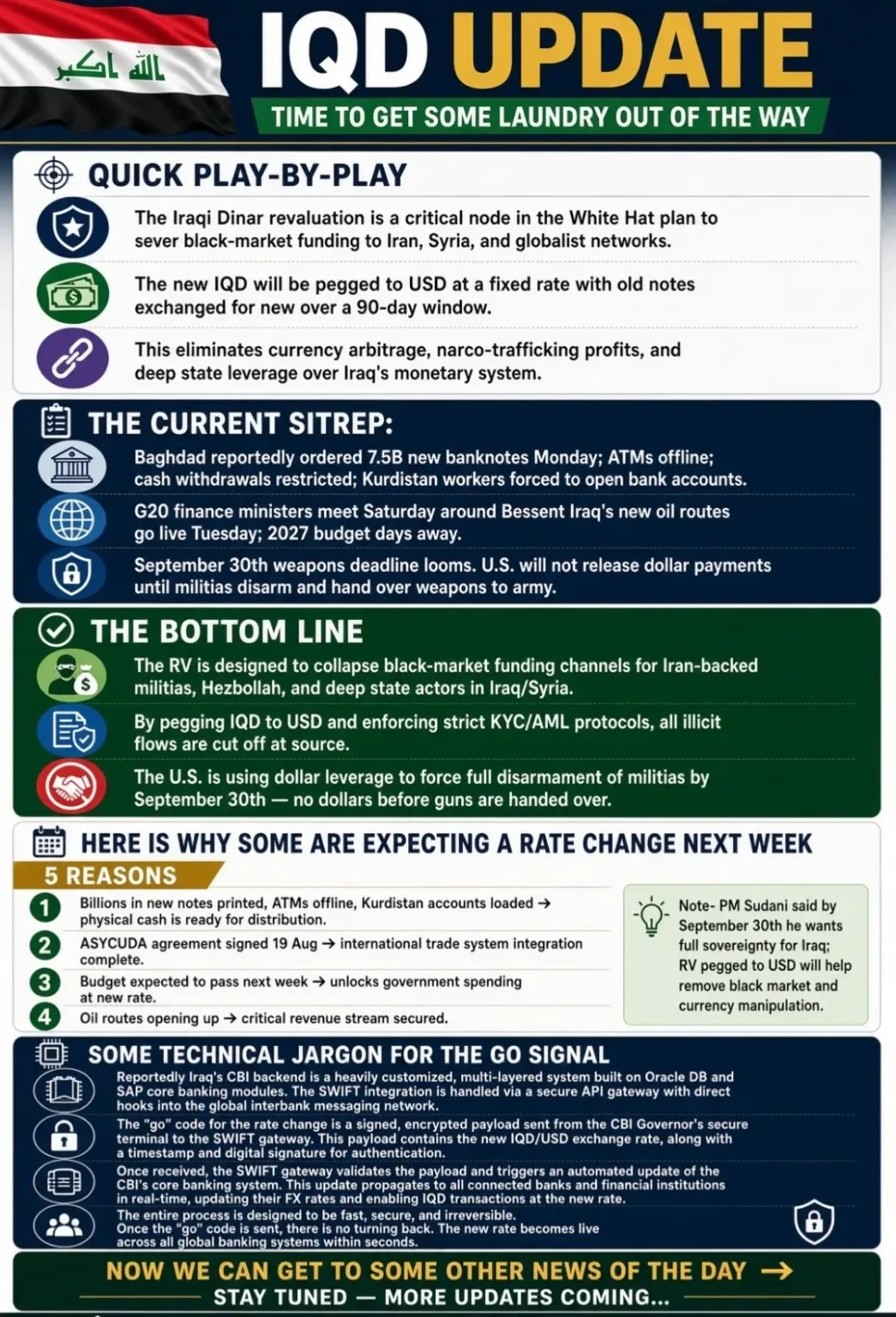
IQD Update: Time To Get Some Laundry Out Of The Way
Quick Play-by-Play-
• The Iraqi Dinar revaluation is a critical node in the US plan to sever black-market funding to Iran, Syria, and globalist networks.
• The new IQD will be pegged to USD at a fixed rate with old notes exchanged for new over a 90-day window.
• This eliminates currency arbitrage, narco-trafficking profits, and deep state leverage over Iraq’s monetary system.
The Current Sitrep:
– Baghdad reportedly ordered 7.5B new banknotes Monday; ATMs offline; cash withdrawals restricted; Kurdistan workers forced to open bank accounts.
– G20 finance ministers meet Saturday around Bessent Iraq’s new oil routes go live Tuesday; 2027 budget days/weeks away.
– September 30th weapons deadline looms U.S. will not release dollar payments until militias disarm and hand over weapons to army.
– The Cabal’s financial control mechanisms are being systematically dismantled through a combination of sanctions, asset seizures, currency reset, & targeted strikes on key infrastructure nodes.
▪︎ The RV is designed to collapse black-market funding channels for Iran-backed militias, Hezbollah, and deep state actors in Iraq/Syria.
▪︎ By pegging IQD to USD and enforcing strict KYC/AML protocols, all illicit flows are cut off at source.
▪︎ The U.S. is using dollar leverage to force full disarmament of militias by September 30th no dollars before guns are handed over.
Here Is Why Some Are Expecting A Rate Change Next Week
5 Reasons
1. Billions in new notes printed, ATMs offline, Kurdistan accounts loaded —> physical cash is ready for distribution.
2. ASYCUDA agreement signed 19 Aug —> international trade system integration complete.
3. Budget expected to pass next week —> unlocks government spending at new rate.
4. Oil routes opening up —> critical revenue stream secured.
Note- PM Sudani said by September 30th he wants full sovereignty for Iraq; RV pegged to USD will help remove black market and currency manipulation.
Some Technical Jargon For The Go Signal
Reportedly Iraq’s CBI backend is a heavily customized, multi-layered system built on Oracle DB and SAP core banking modules. The SWIFT integration is handled via a secure API gateway with direct hooks into the global interbank messaging network.
The “go” code for the rate change is a signed, encrypted payload sent from the CBI Governor’s secure terminal to the SWIFT gateway. This payload supposedly contains the new IQD/USD exchange rate, along with a timestamp and digital signature for authentication.
Once received, the SWIFT gateway validates the payload and triggers an automated update of the CBI’s core banking system. This update propagates to all connected banks and financial institutions in real-time, updating their FX rates and enabling IQD transactions at the new rate.
The entire process is designed to be fast, secure, and irreversible. Once the “go” code is sent, there is no turning back. The new rate becomes live across all global banking systems within seconds.
Of course, there are multiple layers of security and redundancy built into the system to prevent unauthorized access or tampering. But at its core, this is how Iraq will flip the switch on their currency reset when ready.
Now We Can Get To Some Other News Of The Day
News, Rumors and Opinions Saturday 8-29-2026
Reset Intelligence: Be Prepared
8—28-2026
Be Prepared
By Reset Intelligence | @EXIT_FIAT
On Monday Iraq ordered 7.5 billion new banknotes. By Friday the news from the ground was that you cannot buy the old ones.
Reset Intelligence: Be Prepared
8—28-2026
Be Prepared
By Reset Intelligence | @EXIT_FIAT
On Monday Iraq ordered 7.5 billion new banknotes. By Friday the news from the ground was that you cannot buy the old ones.
Two separate reports, with no line to each other, describe the same street: dinar nowhere to be found, cash machines offline or capping withdrawals, payments pushed onto cards, and Kurdistan’s public workers given days to get a bank card because salaries are going electronic. The pay trucks have stopped showing up.
The Cash Is Disappearing
Iraq’s own numbers frame the picture. The CBI’s data shows bank deposits slid 5.6% in the first half of 2026, and the dollar firmed in Baghdad’s markets this week. The banks hold less, the street holds less, and the machines that bridge the two are switching off. In a country with 111 trillion dinars officially issued, the paper is getting hard to touch. In Kuwait in 1991 and Iraq in 2003, the old cash went scarce before the public was told anything.
The Week’s Moves
• The seizure ledger – Iraq’s National Security Service announced more than 93 billion dinars recovered for the treasury, plus another $14 million and 12 billion dinars seized and deposited with the central bank, on the record.
• Counterfeits swept – the second counterfeit currency operation in a week shut down, along with a clandestine drone-manufacturing cell in Baghdad.
• The water, by the numbers – CENTCOM confirmed Hormuz shipping lanes cleared of Iranian mines, 750 million barrels escorted through, and Iran’s oil exports at zero since mid-July.
• September 1 – Iraq’s export contracts on routes that bypass the strait entirely take effect Tuesday.
• The weekend of money – the Fed’s Jackson Hole keynote, the G20 convening around Treasury Secretary Bessent in Asheville, and Iraq’s 2027 budget due at cabinet within days.
What It Adds Up To
Each piece alone has an innocent explanation. Put them in a single week, in the same country whose central bank published a swap procedure inside its own denial, and the innocent explanations start to require more faith than the obvious one. That is the short version. The full daily briefing connects every piece, names the sources, and tells you what to actually watch next.
Being told to be prepared is one thing from a newsletter. It is another arriving from the ground, describing a country already living the first half of an exchange.
Read the full daily briefing free for 5 days. Sign up here: resetintelligence.com
Want it straight from the horse’s mouth? The CBI Rate Alert pings you the moment the Central Bank of Iraq moves the official rate. The number itself, not a rumour about it. It comes with our free resource library and the daily breakdown of what is actually moving in Iraq. Sign up free: resetintelligence.com/rate-alert
Got a dinar question? Reset Intelligence runs an on-call research assistant: ask it anything they have published. It answers in seconds and will conduct deep research to find you the answer. Try it: resetintelligence.com/research-assistant
https://dinarchronicles.com/2026/08/29/reset-intelligence-be-prepared/
*************
Courtesy of Dinar Guru: https://www.dinarguru.com/
Frank26 I want the lower denominations. I could care less about the date. When you give me the lower notes, you're giving me the date.
Guy If the central bank stops their supply of fresh notes and we get reports from the 5 or 6 or 7 legitimate [online] exchanges [in the US] that they're out. That's it. I'd say that's evidentiary reasons for getting excited.
Militia Man The zeros file is no longer theoretical. It is being shaped in public...hard numbers on the cash outside the banks, expanded printed capacity and a clear warning to large undeclared holders...The foundation underneath it is the same system-work that began to take shape in 2023 and has continued since then.
************
Trump Just Amplified This: Gold to $10,000 Before Year-End | Jim Rickards
Daniela Cambone: 8-28-2026
“It’s coming soon. It’s not a five-year forecast.” Jim Rickards explains why gold could reach $10,000, what Kevin Warsh left unsaid, and why investors should prepare for volatility ahead.
Chapters:
00:00 Midterm Meltdown
03:47 Could Gold Reach $10,000 by Year-End?
05:33 How Much Gold Does Jim Own?
06:13 Gold’s Political Risk Premium
10:30 Should You Sell Gold to Pay Off Debt?
11:15 Jim’s Take on Warsh’s Speech
15:14 Why Own Gold When Interest Rates Are Higher?
16:32 Quantitative Easing Has Begun
Iraq Economic News and Points To Ponder Saturday Morning 8-28-26
Iraq's Appointments Are On Shaky Ground... The 2027 Budget Will Determine The Fate Of Thousands Of Job Positions.
August 29, 2026Last updated: August 29, 2026 The Independent/- The Federal Public Service Council has brought the issue of government appointments back to the forefront of attention, after confirming that determining the number of job grades, creating them, and the necessary financial allocations for them are directly linked to what will be decided in Iraq’s 2027 budget and the relevant government agencies.
Iraq's Appointments Are On Shaky Ground... The 2027 Budget Will Determine The Fate Of Thousands Of Job Positions.
August 29, 2026Last updated: August 29, 2026 The Independent/- The Federal Public Service Council has brought the issue of government appointments back to the forefront of attention, after confirming that determining the number of job grades, creating them, and the necessary financial allocations for them are directly linked to what will be decided in Iraq’s 2027 budget and the relevant government agencies.
The official spokesman for the council, Fadel Al-Gharawi, said that the council’s role in the appointments file comes within the powers specified by the amended Federal Public Service Council Law No. (4) of 2009, noting that initiating the appointment procedures requires the availability of the necessary legal and financial requirements.
This position means that the appointments file is not linked to a single decision by the Civil Service Council, but rather depends primarily on the size of the job grades that will be included in next year’s budget, as well as the financial allocations and the actual needs of state institutions.
A wide segment of graduates and the unemployed are waiting to see what the 2027 budget will include, especially with the increasing number of applicants for government job opportunities and the growing demands to find real solutions to the unemployment issue.
Conversely, the government faces the challenge of striking a balance between providing job opportunities for graduates and maintaining the state’s financial stability, given the rising current expenditures and the costs of salaries and wages.
Thus, the 2027 budget appears to be the most important milestone in determining the shape of future government appointments, whether in terms of the number of newly created positions, the beneficiary entities, or the mechanisms for distributing them, while the Civil Service Council remains waiting for the completion of the legal and financial cover to begin its role in this matter. https://mustaqila.com/تعيينات-العراق-على-صفيح-ساخن-موازنة-2027-ت/
Sources: Ali Al-Zaidi Is Considering Dismissing The Finance Minister Due To The Failure To Address The Financial Crisis.
Last updated: August 29, 2026 Al-Mustaqilla - Well-informed political and media sources told Al-Mustaqilla that Prime Minister Ali Falih al-Zaidi is seriously considering making a change in the Ministry of Finance that may include the dismissal of Minister Falih al-Sari, amid escalating criticism of the way the liquidity shortage crisis and the delay in funding state employees’ salaries have been managed.
The sources, who asked not to be named, said that Al-Zaydi expressed his dissatisfaction with the level of support provided by the Ministry of Finance during the past months, especially with the continued pressure on the treasury and the failure to reach stable solutions to secure salaries and ongoing obligations.
There has been no official comment yet from the Prime Minister's office or the Ministry of Finance regarding the possibility of a cabinet reshuffle.
Al-Sari took over the Ministry of Finance on May 14, 2026, after the House of Representatives unanimously voted to grant him confidence within Al-Zidi’s government.
On July 30, Al-Sari acknowledged a financial deficit that was hindering the completion of salary payments for employees, retirees, and social welfare beneficiaries. He stated that the monthly salary obligations amounted to approximately 7.8 trillion dinars, and that the ministry was working to provide the necessary liquidity to complete the payments.
Pressures increased during August, as the parliamentary finance committee said that the minister had requested to be hosted in the House of Representatives to explain the financial situation and discuss a draft law for borrowing, while it spoke of the lack of final solutions to the salary crisis.
Local reports also showed that the government resorted to borrowing from local banks to cover part of its obligations, in light of declining oil revenues and a shortage of available liquidity, in an economy that relies heavily on crude oil revenues to finance public spending.
Published financial data indicates that government revenues amounted to approximately 35.9 trillion dinars in the first half of 2026, compared to expenditures of approximately 54.7 trillion dinars, reflecting a large funding gap that increased the pressure on the Ministry of Finance.
Al-Zaidi had placed economic reform and building a more robust financial and banking system among the priorities of his government program when he gained confidence, so the liquidity crisis and the regularity of salaries became one of the most prominent tests facing his government during its first months.
Under Article 78 of the Constitution, the Prime Minister has the right to dismiss ministers with the approval of the House of Representatives, which means that any decision to dismiss Al-Sari, if taken, will require parliamentary approval.
https://mustaqila.com/مصادر-علي-الزيدي-يدرس-إقالة-وزير-المال/
Atroushi Calls For A "Legal Revolution" In The Federal Parliament To Overturn The Decisions Of The Previous Regime And Enact The Oil And Gas Law.
Erbil (Kurdistan 24) - Deputy Speaker of the Federal Parliament, Farhad Atrushi, stated on Thursday, August 27, 2026, that the atmosphere within the Federal Parliament has witnessed a marked improvement compared to previous months, stressing the existence of efforts to unify the positions of the Kurdish parties, and emphasizing Iraq’s need for a “legal revolution” to cancel the decisions of the former regime and enact the postponed basic laws.
In statements to Kurdistan24, Atroushi pointed out that Iraq, in addition to the issues of its relationship with the Kurdistan Region, faces internal challenges related to services, salaries, the phenomenon of uncontrolled weapons, and outlaw groups, as well as the complexities of relations with neighboring countries.
The Deputy Speaker of the Federal Parliament explained that the Kurdistan Democratic Party seeks to strengthen its relations with the Shiite political forces in Iraq, indicating that work is underway to coordinate positions between the Kurdish parties in order to pass common points under the dome of Parliament.
Regarding the fuel crisis, Atroushi noted his meeting with the Federal Oil Minister, who responded positively, pointing out the need to hold a meeting with the Federal Prime Minister, Ali Faleh al-Zaidi, to demand the formation of a joint committee between the Kurdistan Regional Government and the Federal Government to address the gasoline issue.
Regarding sovereign laws, Atroushi criticized the inability of the federal parliament over the past two decades to enact vital laws such as the Oil and Gas Law, the Federal Council Law, and the Federal Court Law, saying: "We need a legal revolution; there are still about 5,000 decisions issued by the (Revolutionary Command Council) of the former regime in effect, and they do not in any way conform to the standards of a federal state."
He added that enacting an oil and gas law is a top priority, given that work is still underway on laws dating back 40 years, at a time when Iraq depends on oil wealth for 90% of its revenues.
Regarding the nature of the relationship between Erbil and Baghdad, Atroushi revealed that relations are going through a very positive phase, stressing that President Barzani, the President of the Region, and the Prime Minister of the Region are showing great support for the new federal government, as it is a real opportunity to rescue Iraq from the current crises.
The Central Bank suspends banking transactions for 14 individuals and 19 companies
About the news
The Central Bank of Iraq has decided to suspend dealings with 14 individuals and 19 companies operating in the oil, trade and transportation sectors.
The decision was made due to suspicions surrounding their dealings.
The companies named on the list operate in vital and sensitive sectors such as: oil, trade, livestock, manufacturing, transportation, and financial services.
According to an official letter issued by the Central Bank of Iraq on Thursday, August 27, 2026, the letter was addressed to all banks and non-bank financial institutions not to deal in any way with the bank accounts of these individuals and companies.
Reasons related to this procedure
The action is related to suspicions surrounding their financial transactions, and it has been decided to suspend their accounts pending a thorough and comprehensive investigation into them.
Central Bank: This measure will continue until further notice.
All banks were warned that any entity that violates this decision will be subject to legal accountability.
The list of bans and prohibitions included (14) people and (19) commercial and local companies, most notably “Al-Taif Holding Company”, “Jamal Al-Surouh Company”, “Mismar Juha Company for Manufacturing Industries”, and “Al-Masarat Company for Oil Services”, in addition to a number of individuals.
This decision is based on Article 40 of the "Central Bank of Iraq" Law, which grants the bank full powers to supervise and regulate the affairs of banks and their branches, with the aim of protecting the country's financial system and preventing any illegal transactions. https://channel8.com/arabic/news/84537
Central Bank Of Iraq To Monitor Bank Accounts Of Politicians And Officials
At a Glance
The Central Bank of Iraq issued strict new directives on August 26 targeting the bank accounts of politicians and government officials.
The regulations are designed to combat systemic corruption and illicit money laundering across national financial institutions.
Banks are required to flag anomalous wealth, unverified foreign transfers to high-risk zones, and unexplained asset spikes during or after tenure.
Compliance will be rigorously audited by central inspection teams and factored into institutional evaluations.
In an official directive issued on August 26, the Central Bank of Iraq instructed all commercial banks to enforce enhanced monitoring protocols on politically exposed persons and high-ranking government officials to curb financial crimes.
Key Monitoring Criteria
Disproportionate Wealth: Flagging sudden inconsistencies between declared monthly salaries or state incomes and total accumulated assets.
Unusual Transactions: Detecting high-value or irregular transactions executed during or immediately following an official's term in office.
High-Risk Transfers: Scrutinizing capital movements routed to high-risk foreign countries or jurisdictions lacking clear economic justifications.
Complex Structures: Identifying the use of third parties, shell companies, or intricate corporate vehicles to conceal ultimate beneficial ownership.
Family Networks: Monitoring unexplained financial flows involving relatives, close associates, or negative intelligence reports regarding bribery and financial misconduct.
The Central Bank emphasized that all banking branches must immediately implement these guidelines and brief their staff accordingly. Inspection teams will actively evaluate institutional compliance, ensuring that failure to report unverified funds or suspicious asset shifts impacts overall bank performance ratings. FYI
Politically Exposed Persons (PEPs) are individuals who have been entrusted with prominent public functions, such as senior politicians, judicial officials, or state executives. Because of their positions and influence, international financial watchdogs classify PEPs as higher-risk targets for money laundering and corruption, necessitating enhanced due diligence by commercial banks. https://channel8.com/english/news/64666
Seeds of Wisdom RV and Economics Updates Saturday Morning 8-29-26
Good Morning Dinar Recaps,
When the Fed Turns Hawkish Again: Higher Rates, U.S. Debt and a New Dollar Test
Federal Reserve Chair Kevin Warsh's Jackson Hole message has reopened the possibility of higher U.S. interest rates — creating a new test for the dollar, Treasury market and the sustainability of America's debt burden.
Good Morning Dinar Recaps,
When the Fed Turns Hawkish Again: Higher Rates, U.S. Debt and a New Dollar Test
Federal Reserve Chair Kevin Warsh's Jackson Hole message has reopened the possibility of higher U.S. interest rates — creating a new test for the dollar, Treasury market and the sustainability of America's debt burden.
Overview
The Federal Reserve is signaling that rate hikes are back on the table if inflation does not move convincingly toward the 2% target.
Treasury yields moved higher as markets repriced the Fed's path, putting renewed pressure on an already heavily indebted U.S. government.
The dollar initially strengthened, but the bigger question is whether higher yields ultimately reinforce confidence in U.S. assets or expose deeper concerns about debt sustainability.
Key Developments
1. Warsh puts inflation back at the center of Fed policy
At the Federal Reserve's Jackson Hole symposium, Chair Kevin Warsh delivered his clearest indication yet that additional rate increases may be necessary if inflation fails to make meaningful progress toward the Fed's 2% objective.
Warsh said recent inflation readings have not convinced him that the underlying trend has improved sufficiently. He also emphasized that the economy remains resilient, meaning the Fed may have room to maintain or increase monetary restraint rather than automatically moving toward lower rates.
Markets responded quickly. Reuters reported that the probability of a September rate hike rose from roughly 35% to 60% following Warsh's remarks, while short-term Treasury yields moved sharply higher.
2. The Treasury market is now facing a different rate environment
The immediate market reaction was concentrated at the short end of the Treasury curve, but the implications extend much further.
The 2-year Treasury yield rose to about 4.35%, while the 10-year yield moved to approximately 4.72% after Warsh's speech. The increase reflects a market that is beginning to price a higher probability of restrictive monetary policy lasting longer — or becoming tighter again.
That matters because the United States must continually refinance existing debt while issuing enormous quantities of new debt.
Higher interest rates therefore create a difficult feedback loop:
Higher inflation → tighter Fed policy → higher yields → more expensive government borrowing → greater pressure on the federal budget.
The longer that cycle persists, the more important Treasury yields become to the broader financial system.
3. The dollar gets an initial boost — but the longer-term test is more complicated
Normally, expectations for higher U.S. interest rates are supportive of the dollar because higher yields can attract global capital toward dollar-denominated assets.
That reaction is already visible. The dollar strengthened following Warsh's remarks as markets reassessed the likelihood of additional tightening.
But there is another side to the equation.
Higher yields are good for the dollar only if investors interpret them as evidence of monetary credibility rather than evidence of rising fiscal stress.
That distinction is becoming increasingly important.
If investors believe the Fed is willing to keep rates sufficiently high to restore price stability, the dollar can benefit from higher real returns and renewed confidence in U.S. monetary policy.
If investors instead conclude that Treasury borrowing requirements are becoming the dominant force behind higher yields, the signal becomes more complicated.
Why This Matters
The significance of Warsh's speech extends beyond the September rate decision.
For years, the global financial system has operated around the assumption that U.S. Treasuries are the foundational safe asset and the dollar is the dominant reserve currency.
That system depends partly on confidence that the United States can finance its enormous debt while maintaining monetary stability.
The current environment is testing both sides of that equation.
The Fed wants sufficiently tight financial conditions to control inflation. The Treasury, meanwhile, must finance a massive fiscal deficit at whatever interest rates the market demands.
Those objectives can coexist — but they become increasingly difficult to balance as debt service costs rise.
Why It Matters to Foreign Currency Holders
For foreign-currency holders, the important issue is not simply whether the dollar rises or falls on any particular day.
The larger issue is how the world's major currencies respond to a changing U.S. interest-rate and debt environment.
If higher U.S. rates attract capital back toward dollar assets, the dollar could strengthen against currencies whose central banks remain more accommodative.
But if persistent U.S. deficits and rising debt-service costs eventually become a greater concern for global investors, currency diversification could become more important.
That is particularly relevant to the broader movement toward local-currency trade, alternative payment systems and greater reserve diversification.
The global financial system does not have to abandon the dollar for diversification to matter. Even a gradual shift in the percentage of international trade, reserves and financial transactions conducted outside the dollar can alter the architecture at the margin.
Implications for the Global Financial Reset
Debt is becoming a monetary-policy variable
The United States cannot separate interest-rate policy from its fiscal position indefinitely. Every additional increase in borrowing costs affects the government's future financing requirements.
That makes the Treasury market increasingly important to the global financial system — not simply as an investment market, but as a measure of confidence in U.S. fiscal and monetary policy.
The dollar's next test may come from the bond market
A stronger dollar caused by higher Fed rates would reinforce the existing financial system.
But a situation in which higher Treasury yields coexist with questions about U.S. debt sustainability would represent something very different.
That is the financial signal worth watching.
What to Watch Next
The next major signals will come from:
September's inflation data and employment reports
The Fed's September 15–16 policy meeting
The 2-year and 10-year Treasury yields
Demand at upcoming Treasury auctions
The dollar's response to higher U.S. yields
Any evidence that Treasury borrowing costs are beginning to influence fiscal or monetary policy
The most important question is no longer simply “Will the Fed cut rates?”
It is whether the United States can maintain price stability, affordable debt financing and confidence in the dollar at the same time.
Bottom Line
Kevin Warsh has put inflation back at the center of the Federal Reserve's policy debate, and markets are already responding by pricing a greater possibility of higher rates.
That creates a new three-way tension between the Fed, the Treasury and the dollar.
If higher rates restore confidence in U.S. monetary stability, the dollar could benefit. If higher yields increasingly reflect the cost of financing America's debt, the same Treasury market could become a source of pressure on the currency.
The next phase of the global financial reset may therefore be determined not by a single rate decision, but by how the world responds when U.S. monetary tightening collides with America's unprecedented debt burden.
Sources
Reuters — Rate-hike expectations rise on Warsh speech at Jackson Hole
Federal Reserve — Chairman Warsh's 2026 Jackson Hole keynote remarks
~~~~~~~~~~
🌱 A Message to Our Currency Holders🌱
If you’ve been holding foreign currency for many years, you were not foolish.
You were not wrong to believe the global financial system would change.
What failed was not your patience — it was the information you were given.
For years, dates, rumors, and personalities replaced facts, structure, and proof. “This week” predictions created cycles of hope and disappointment that were never based on how currencies actually change.
That is not your failure.
Our mission here is different: • No dates • No rates • No hype • No gurus
Instead, we focus on:
• Verifiable developments • Institutional evidence
• Global financial structure • Where countries actually sit in the process
Currency value changes only come after sovereignty, trade, banking, settlement systems, and fiscal coordination are in place. History and institutions confirm this sequence.
You will see silence. You will see denials. That is not delay — that is discipline.
Protect your identity. Organize your documents. Verify everything.
Never hand your discernment to anyone who cannot show proof.
You deserve truth — not timelines.
Seeds of Wisdom Team
Newshounds News
~~~~~~~~~~
Seeds of Wisdom Team RV Currency Facts Youtube and Rumble
Newshound's News Telegram Room Link
RV Facts with Proof Links Link
RV Updates Proof links - Facts Link
Start Here room with Most Asked Questions Link
Follow the Gold/Silver Rate COMEX
Follow Fast Facts
Seeds of Wisdom Team™ Website
Thank you Dinar Recaps
Rob Cunningham: What if we’ve been Right about XRP but Measuring the Wrong Clock?
Rob Cunningham: What if we’ve been Right about XRP but Measuring the Wrong Clock?
8-28-2026
XRP ARMY: WHAT IF WE’VE BEEN RIGHT… BUT MEASURING THE WRONG CLOCK?
We all know the headline: XRP settles in ~3–5 seconds.
But settlement speed ≠ economic reuse speed.
That distinction may completely change the XRP calculus.
Rob Cunningham: What if we’ve been Right about XRP but Measuring the Wrong Clock?
8-28-2026
XRP ARMY: WHAT IF WE’VE BEEN RIGHT… BUT MEASURING THE WRONG CLOCK?
We all know the headline: XRP settles in ~3–5 seconds.
But settlement speed ≠ economic reuse speed.
That distinction may completely change the XRP calculus.
If XRP simply bridges: ASSET A → XRP → ASSET B
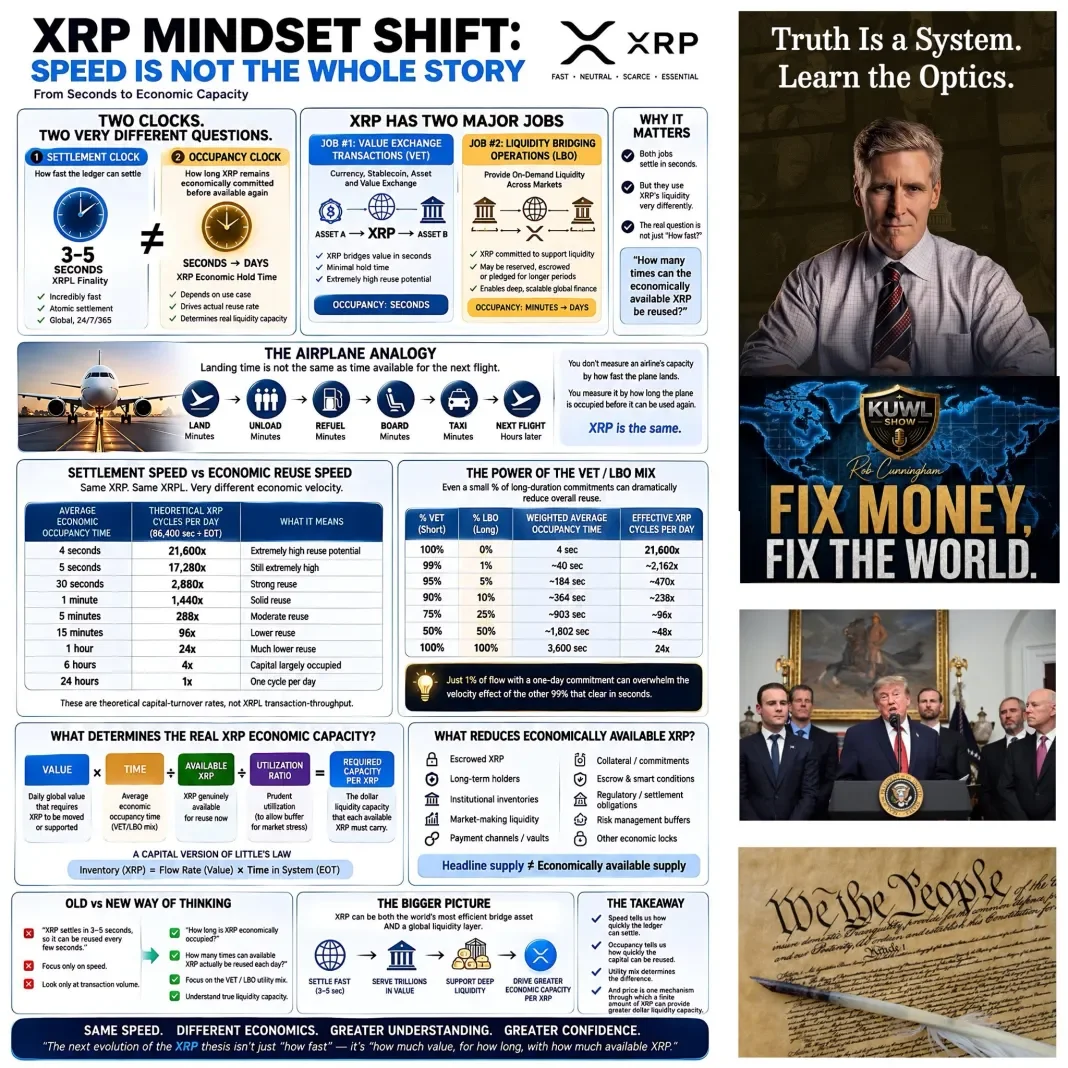
…it may be economically occupied for seconds.
But if XRP is also supporting liquidity across currencies, stablecoins, tokenized securities and other assets, some XRP will remain economically committed for minutes, hours, days or longer.
Same XRP.
Same fast ledger.
Very different capital velocity.
And THAT changes the question.
Stop asking only: “How many times can XRP theoretically settle each day?”
Start asking: “How many times can the economically AVAILABLE XRP actually be reused each day?”
Now XRP utility becomes something closer to:
VALUE × TIME ÷ AVAILABLE XRP
How much value needs XRP? × How long does it need XRP? ÷ How much XRP is actually available for the next job?
That’s the mindset shift.
A 3–5 second settlement network can remain breathtakingly fast while portions of its liquidity become economically occupied for far longer.
And even a relatively small percentage of longer-duration liquidity commitments can dramatically reduce effective XRP reuse.
Which means the future XRP question may not simply be: “How much value can XRP move?”
It may be: “HOW MUCH ECONOMIC CAPACITY MUST EACH AVAILABLE XRP CARRY?”
Don’t accept this because it’s bullish.
Don’t reject it because it’s unfamiliar.
Attack the assumptions. Change the VET/LBO mix. Change occupancy time. Change available supply. Run the math.
Confidence doesn’t come from somebody predicting our favorite XRP price target.
It comes from understanding the machinery deeply enough that you no longer need someone else to tell you what to believe.
Maybe the XRP community hasn’t been wrong.
Maybe we’ve simply been watching one clock… when XRP’s emerging liquidity economy requires us to understand two.
SETTLEMENT measures SPEED.
OCCUPANCY measures SCARCITY.
UTILITY determines the MIX.
PRICE provides CAPACITY.
Same XRP.
Entirely different calculus.
My Full KUWL Analysis: https://robcunningham.substack.com/p/the-next-layer-of-xrp-understanding
Source(s):
• https://x.com/KuwlShow/status/2093102360415387990
Dollar's Final Break? “RUSH TO THE EXITS” Could Trigger Global Financial CHAOS | Robert Kientz
Dollar's Final Break? “RUSH TO THE EXITS” Could Trigger Global Financial CHAOS | Robert Kientz
Liberty and Finance: 8-27-2026
The U.S. dollar and Treasury markets could be approaching a critical breaking point as rising debt, persistent inflation, and declining confidence put increasing pressure on the financial system, according to Rob Kientz of the Freedom Report.
Kientz argues that de-dollarization may unfold slowly at first, but could suddenly accelerate when the next recession forces nations to “rush to the exits” and rotate out of dollars and U.S. bonds.
Dollar's Final Break? “RUSH TO THE EXITS” Could Trigger Global Financial CHAOS | Robert Kientz
Liberty and Finance: 8-27-2026
The U.S. dollar and Treasury markets could be approaching a critical breaking point as rising debt, persistent inflation, and declining confidence put increasing pressure on the financial system, according to Rob Kientz of the Freedom Report.
Kientz argues that de-dollarization may unfold slowly at first, but could suddenly accelerate when the next recession forces nations to “rush to the exits” and rotate out of dollars and U.S. bonds.
He warns that a bond-market crisis could trigger massive losses across banks, pensions, corporations, and financial markets while capital seeks alternative assets such as gold and silver.
Kientz also explains why the Federal Reserve is trapped between fighting inflation with higher rates and protecting an economy burdened by unprecedented debt, while predicting continued strength in precious metals and significant outperformance from mining stocks.
With gold potentially retesting $5,500 and silver potentially surpassing $100 this year, Kientz sees the beginning of a broader commodity supercycle—and warns investors to prepare for a potentially historic shift in global capital flows.
INTERVIEW TIMELINE:
0:00 Intro
1:10 US debt crisis
15:20 Jackson Hole meeting
24:30 Miners & gold
28:20 Gold confiscation
29:45 Last thoughts
Seeds of Wisdom RV and Economics Updates Friday Afternoon 8-28-26
Good Afternoon Dinar Recaps,
The Strait of Hormuz Becomes a Financial Negotiation: Oil, Sanctions and the Global Economy
The six-month Iran conflict has reached a potentially important new phase as diplomacy increasingly centers on reopening the Strait of Hormuz — turning a military chokepoint into a negotiating instrument with consequences for oil, inflation, sanctions and the global financial system.
Good Afternoon Dinar Recaps,
The Strait of Hormuz Becomes a Financial Negotiation: Oil, Sanctions and the Global Economy
The six-month Iran conflict has reached a potentially important new phase as diplomacy increasingly centers on reopening the Strait of Hormuz — turning a military chokepoint into a negotiating instrument with consequences for oil, inflation, sanctions and the global financial system.
Overview
The Strait of Hormuz is becoming much more than a military or energy-security issue.
It is now a central bargaining point in the broader U.S.-Iran confrontation, with mediators pressing for the restoration of commercial shipping while Iran prepares conditions for reopening the waterway.
Before the war, roughly 20% of global oil supplies moved through the Strait of Hormuz. Today, shipping remains dramatically below normal levels, even as the United States says it has cleared Iranian mines and oil markets have begun responding to signs that more crude is finding its way through alternative routes and limited traffic.
That makes Hormuz a direct connection between geopolitics and global finance.
Key Developments
1. Diplomacy is increasingly focused on reopening Hormuz
Qatar and Pakistan are helping mediate efforts to restore freedom of navigation through the strait. Iran says it is preparing a list of conditions for reopening the waterway, while Qatar has emphasized the importance of returning to the pre-war system of open commercial shipping.
The United States continues to insist that Hormuz must remain an open international waterway. Iran, however, has linked reopening to broader demands that have included sanctions relief, an end to the U.S. blockade and compensation.
This creates an important shift.
The reopening of a major global energy artery is now part of the diplomatic price being negotiated to end or de-escalate the conflict.
2. Oil markets are already pricing the possibility of greater flows
Oil prices moved lower today as traders assessed signs that more oil may be moving through the Gulf and that producers are adapting to the disruption.
Reuters reports that oil was on track for a weekly decline, despite the diplomatic stalemate, as the market increasingly focused on the possibility of greater supply and a gradual normalization of Gulf energy flows.
That reaction is important because it demonstrates how quickly financial markets can begin pricing a geopolitical change before a formal agreement exists.
A sustained reopening of Hormuz could reduce the geopolitical premium embedded in crude prices.
A renewed closure or military escalation could reverse that trade just as quickly.
3. Washington's sanctions campaign adds another financial layer
At the same time that diplomacy is focusing on Hormuz, Washington is expanding economic pressure against Iran.
New U.S. sanctions are targeting additional Iranian-linked entities, while the administration is pressuring other countries to reduce commercial ties with Tehran or risk secondary sanctions. Iran's annual inflation has reached 66%, according to Reuters.
This creates a fascinating intersection between physical energy flows and financial flows.
The United States is attempting to restrict Iran's access to international finance at the same time that Iran retains leverage over one of the world's most important energy corridors.
Why It Matters
The Strait of Hormuz illustrates how closely energy security and financial security have become connected.
If oil remains expensive because shipping is restricted, inflation can remain elevated.
If inflation remains elevated, central banks may have less room to cut interest rates.
If interest rates remain higher, government borrowing costs remain elevated.
And higher borrowing costs place additional pressure on highly indebted governments around the world.
The chain is straightforward: Hormuz → Oil → Inflation → Interest Rates → Bonds → Currencies → Global Growth
That is why today's diplomatic developments deserve attention far beyond the Middle East.
Why It Matters to Foreign Currency Holders
For foreign-currency holders, the most important issue is how an energy shock affects relative currency strength and purchasing power.
Countries heavily dependent on imported energy can experience significant pressure on their currencies when oil prices rise. Energy exporters can experience the opposite effect as higher commodity revenues strengthen their external balances.
But there is another consideration.
The Iran conflict is demonstrating that access to international finance and access to physical commodities can be used together as instruments of geopolitical power.
Sanctions restrict financial channels.
Control over shipping routes influences physical commodities.
Together, they create a much broader form of economic pressure.
That could encourage more countries to diversify their trade relationships, payment mechanisms and reserve assets over time.
Implications for the Global Financial Reset
The Hormuz crisis is becoming another example of why the global financial system may be moving toward greater diversification rather than a simple replacement of the dollar.
The dollar remains central to international finance.
But countries facing sanctions risk or geopolitical uncertainty have greater incentives to develop:
Local-currency trade
Alternative payment systems
Bilateral settlement arrangements
Larger strategic commodity reserves
Greater gold holdings
Alternative energy transportation routes
The financial reset, therefore, may not happen through one dramatic announcement.
It may emerge through thousands of decisions by governments trying to reduce vulnerability to financial, energy and geopolitical chokepoints.
The Bigger Picture
Today's development is particularly important because the Strait of Hormuz is now sitting at the intersection of three negotiations.
There is a military negotiation over control of the waterway.
There is a diplomatic negotiation over the conditions required to reopen it.
And there is a financial negotiation over the consequences of sanctions, oil prices and access to global markets.
The fact that oil prices are already responding to the possibility of greater flows demonstrates how important the strait has become to global markets.
The ultimate outcome remains uncertain.
If Hormuz gradually reopens, oil could lose some of its geopolitical risk premium, easing inflation pressure and potentially giving central banks greater policy flexibility.
If the reopening fails, the opposite could occur: renewed supply concerns could push energy prices higher, complicating the inflation outlook and keeping pressure on bond markets and currencies.
That makes the next phase of the Iran conflict particularly important.
The Strait of Hormuz is no longer simply a passage for oil. It has become a bargaining chip connecting military power, sanctions, energy security and the global financial system.
The next major financial move may come not from Wall Street, but from whether the world's most important energy chokepoint becomes a pathway to de-escalation — or another source of global economic pressure.
Seeds of Wisdom Team
Newshounds News™ Exclusive
Sources
Reuters — Iran war diplomacy turns toward reopening Strait of Hormuz
Reuters — Oil slides on clues about Fed policy, rumors of Hormuz deal
~~~~~~~~~~
Seeds of Wisdom Team RV Currency Facts Youtube and Rumble
Newshound's News Telegram Room Link
RV Facts with Proof Links Link
RV Updates Proof links - Facts Link
Start Here room with Most Asked Questions Link
Follow the Gold/Silver Rate COMEX
Follow Fast Facts
Seeds of Wisdom Team™ Website
Thank you Dinar Recaps