
Thank you to all the subscribers to our Early Access program…we thank you for your continued support.
We are excited to offer this new service to keep you informed and up-to-date on the latest Dinar and currency news.
Seeds of Wisdom RV and Economics Updates Saturday Morning 8-22-26
Good Morning Dinar Recaps,
When U.S. Debt Becomes a Currency Problem: The Dollar-Bond Relationship Enters a New Phase
The United States has crossed the $40 trillion debt threshold just as long-term Treasury yields remain elevated and the dollar weakens—raising a larger question about whether investors are beginning to view high U.S. yields as compensation for fiscal risk rather than simply an attractive return.
Good Morning Dinar Recaps,
When U.S. Debt Becomes a Currency Problem: The Dollar-Bond Relationship Enters a New Phase
The United States has crossed the $40 trillion debt threshold just as long-term Treasury yields remain elevated and the dollar weakens—raising a larger question about whether investors are beginning to view high U.S. yields as compensation for fiscal risk rather than simply an attractive return.
Overview
U.S. federal debt has surpassed $40 trillion, while long-term Treasury yields have risen to levels not seen since 2007.
Treasury Secretary Scott Bessent has expanded long-term bond buybacks in an effort to support the Treasury market, but the relief has so far been limited.
Meanwhile, the dollar has fallen toward a three-month low, creating an unusual combination of higher U.S. borrowing costs and a weaker currency.
Key Developments
1. The $40 trillion debt milestone changes the conversation
The United States has now crossed a symbolic but significant threshold: total federal debt has exceeded $40 trillion.
The milestone comes after U.S. debt more than doubled since 2017, reflecting years of deficits in which government spending has consistently exceeded revenue. Rising interest costs are adding another layer of pressure to the federal budget.
The important issue isn't the $40 trillion number by itself.
It is what happens when a government must continually issue new debt while the interest rate demanded by investors is rising.
That creates a potentially difficult feedback loop:
More debt → more interest expense → greater financing needs → more Treasury issuance → greater pressure on yields.
That cycle is now becoming an increasingly important part of the global financial story.
2. Treasury is intervening—but the market is still testing the long end
The Treasury has taken an unusually active approach to the bond market.
The department announced that it would at least double certain long-term Treasury buybacks, and Bessent has indicated that additional purchases could follow.
The immediate objective is to improve liquidity and help bring down longer-term borrowing costs.
But the market has not simply accepted the intervention.
Long-term yields rose sharply earlier this week, with the 30-year Treasury yield reaching its highest level since 2007. Reuters reports that investors have been citing the fiscal outlook, heavy Treasury issuance, Iran-related geopolitical risks and uncertainty over Federal Reserve policy as reasons for demanding higher yields.
That is the critical distinction:
Treasury can influence market liquidity. It cannot simply eliminate the underlying demand for compensation for fiscal and inflation risk.
3. The dollar is sending an unusual signal
This is where the story becomes much bigger than the bond market.
Normally, higher U.S. Treasury yields can attract international capital because investors can earn more by holding dollar-denominated assets.
But the dollar has recently moved in the opposite direction.
Reuters reports that the dollar fell to a three-month low against the euro as investors questioned whether Treasury's buyback strategy would address the deeper fiscal problems confronting the United States.
That creates an unusual combination:
Higher long-term Treasury yields + weaker dollar.
The implication isn't necessarily that investors have lost confidence in the United States.
Rather, markets may increasingly be distinguishing between the yield being offered and the risk associated with holding the underlying asset.
Why This Matters
For decades, the dollar's position benefited from a powerful reinforcing mechanism:
U.S. Treasuries were viewed as the world's premier safe asset → global investors bought Treasuries → demand supported the dollar → the dollar's reserve status reinforced demand for Treasuries.
That relationship remains extraordinarily powerful.
But it is not immune to stress.
When Treasury yields rise because investors want additional compensation for inflation, fiscal deficits or uncertainty, higher yields don't necessarily produce a proportionally stronger dollar.
That is the potential change taking place now.
The yield itself may be becoming part of the risk signal.
The Treasury Market Is Becoming a Global Financial Transmission Mechanism
U.S. Treasury securities aren't simply another investment.
They serve as a benchmark for borrowing costs throughout the global economy.
When long-term Treasury yields rise, the consequences can spread into:
Mortgage rates
Corporate borrowing
Government financing
Equity valuations
Emerging-market currencies
Global capital flows
Commodity pricing
Reuters recently noted that the pressure is not isolated to the United States. Major economies across the G7 are also confronting rising financing needs associated with aging populations, defense spending, climate-related costs and higher energy prices.
That means the Treasury market is increasingly part of a broader sovereign-debt repricing.
The Iran Conflict Adds Another Layer
The current environment is also being complicated by the war with Iran.
Higher energy prices can reinforce inflation at exactly the time that governments are trying to control borrowing costs.
Reuters has identified geopolitical risk from the Iran war as one of the factors investors are considering when pricing long-term Treasury debt.
That creates another difficult policy equation:
War → oil risk → inflation pressure → higher yields → higher government interest costs.
The longer elevated energy prices persist, the more difficult that equation becomes for central banks and governments alike.
Why It Matters to Foreign Currency Holders
This development is particularly important for foreign-currency holders because currency values are ultimately connected to confidence in the financial system behind the currency.
The dollar remains the world's dominant reserve currency, and nothing in the current data suggests that position is about to disappear.
But foreign investors are constantly comparing:
Return + risk + purchasing power + fiscal stability.
If U.S. yields remain high while the dollar weakens, that suggests investors are increasingly incorporating fiscal and inflation concerns into the dollar equation.
For foreign-currency holders, this is why watching only exchange rates can be misleading.
The larger question is:
What is happening underneath the currencies?
Implications for the Global Financial Reset
Sovereign debt is becoming a central issue in the next phase of global finance.
The $40 trillion U.S. debt milestone is occurring alongside similar fiscal pressures across other major economies. The question of who finances government debt and at what price is becoming increasingly important.
The dollar-Treasury relationship is being tested.
The dollar's traditional benefit from higher U.S. yields becomes less straightforward when yields are rising because investors are demanding compensation for fiscal and inflation risks.
Central banks have less room to operate independently of bond markets.
Governments need manageable borrowing costs. Central banks need to maintain price stability. Investors want adequate compensation for risk.
Those objectives can come into conflict.
The financial reset may be emerging through repricing rather than replacement.
This is an important distinction to understand.
There is no evidence that a single event is about to replace the dollar or overturn the existing monetary system.
Instead, we are seeing the gradual repricing of debt, currencies, commodities and risk.
That may ultimately prove more consequential than a dramatic overnight "reset."
What to Watch Next
Whether the 30-year Treasury yield remains above 5%.
Whether the Treasury expands its long-term bond buybacks again.
Whether the dollar continues weakening despite elevated U.S. yields.
Whether investors continue demanding higher compensation for long-term Treasury debt.
What Federal Reserve Chair Kevin Warsh signals at Jackson Hole next week.
Whether oil prices remain elevated as the Iran conflict continues.
Whether other major economies experience similar sovereign-debt pressures.
Treasury Secretary Bessent is also scheduled to hold a press conference Monday, potentially providing additional clues about the administration's approach to debt markets and financial policy.
Bottom Line
The most important development isn't simply that U.S. debt has crossed $40 trillion.
It is that this milestone has arrived at the same time that the Treasury market is demanding higher long-term yields and the dollar is weakening rather than strengthening.
The Treasury is attempting to stabilize the long end of the bond market through increased buybacks, but investors continue to focus on the deeper questions surrounding deficits, debt issuance, inflation and future interest costs.
That is why today's story represents a potentially important new phase for the global financial system.
The next stage of the global financial reset may not be defined by the dollar suddenly losing its reserve status. It may be defined by investors gradually changing the price they demand to finance the world's largest debtor—and by how that repricing flows through the dollar, Treasury market, commodities and central banks.
The question is no longer simply how high Treasury yields can go. It is whether higher yields can continue to support the dollar when those yields increasingly reflect the cost of carrying a $40 trillion debt burden.
Sources
Reuters — U.S. debt crosses $40 trillion threshold after doubling under Trump and Biden
Reuters — Dollar falls to three-month low on Treasury buyback worries
~~~~~~~~~~
🌱 A Message to Our Currency Holders🌱
If you’ve been holding foreign currency for many years, you were not foolish.
You were not wrong to believe the global financial system would change.
What failed was not your patience — it was the information you were given.
For years, dates, rumors, and personalities replaced facts, structure, and proof. “This week” predictions created cycles of hope and disappointment that were never based on how currencies actually change.
That is not your failure.
Our mission here is different: • No dates • No rates • No hype • No gurus
Instead, we focus on:
• Verifiable developments • Institutional evidence
• Global financial structure • Where countries actually sit in the process
Currency value changes only come after sovereignty, trade, banking, settlement systems, and fiscal coordination are in place. History and institutions confirm this sequence.
You will see silence. You will see denials. That is not delay — that is discipline.
Protect your identity. Organize your documents. Verify everything.
Never hand your discernment to anyone who cannot show proof.
You deserve truth — not timelines.
Seeds of Wisdom Team
Newshounds News
~~~~~~~~~~
Seeds of Wisdom Team RV Currency Facts Youtube and Rumble
Newshound's News Telegram Room Link
RV Facts with Proof Links Link
RV Updates Proof links - Facts Link
Start Here room with Most Asked Questions Link
Follow the Gold/Silver Rate COMEX
Follow Fast Facts
Seeds of Wisdom Team™ Website
Thank you Dinar Recaps
Rob Cunningham: Treasury Secretary Bessent is the Smartest Banker on Earth
Rob Cunningham: Treasury Secretary Bessent is the Smartest Banker on Earth
8-21-2026
Treasury Secretary Scott Bessent is the smartest banker on earth.
Stablecoins destroy the Central Banker’s scarcity deception when sound currencies and tokenized real-world assets prove – in real time – the vastness of real-world value that actually exist in abundance.
Rob Cunningham: Treasury Secretary Bessent is the Smartest Banker on Earth
8-21-2026
Treasury Secretary Scott Bessent is the smartest banker on earth.
Stablecoins destroy the Central Banker’s scarcity deception when sound currencies and tokenized real-world assets prove – in real time – the vastness of real-world value that actually exist in abundance.
The deeper inversion is this:
Scarcity moves from declared fiat currency → to verifiably real money.
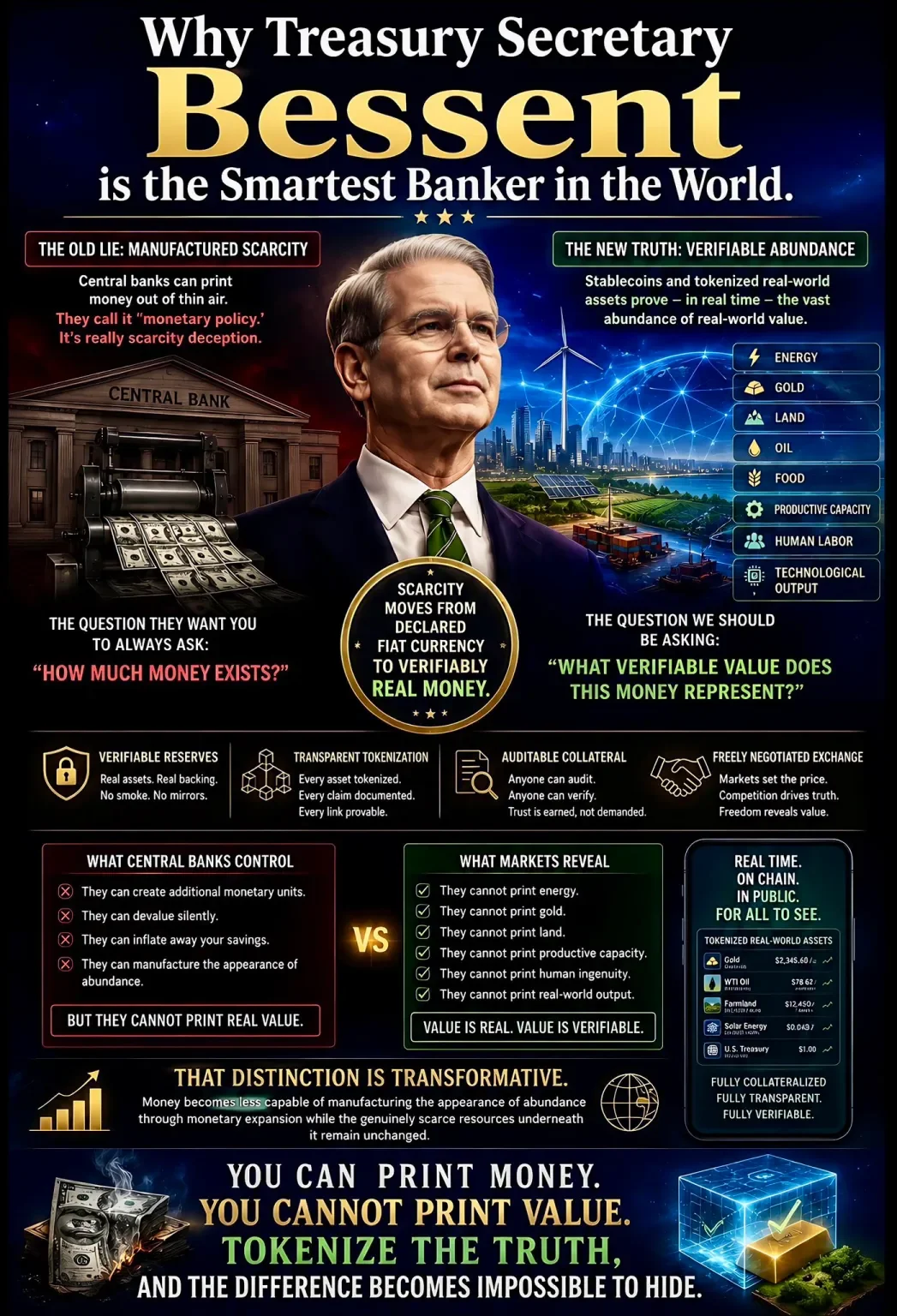
A central bank can print additional monetary units. It cannot print energy, gold, land, oil, food, productive capacity, human labor, or technological output into existence.
In a system built around verifiable reserves, transparent tokenization, auditable collateral, and freely negotiated exchange, the question changes from:
“How much money exists?”
to:
“What verifiable value does this money represent?”
That distinction is transformative. Money becomes less capable of manufacturing the appearance of abundance through monetary expansion while the genuinely scarce resources underneath it remain unchanged.
Or reduced to this:
You can print money.
You cannot print value.
Tokenize the truth, and the difference becomes impossible to hide.
Treasury Secretary Scott Bessent:Crypto is not a threat to the dollar. In fact, stablecoins can reinforce dollar supremacy. Digital assets are one of the most important phenomena in the world right now, yet they have been ignored by national governments for far too long. This administration is committed to establishing the United States as a hub for digital asset innovation, and the GENIUS Act moves us one step closer to that goal.
Watch on X: https://twitter.com/i/status/1935404649718157691
Source(s):
• https://x.com/KuwlShow/status/2090575784935068125
The Clarity Act and the RV Explained | Global Financial Reset
The Clarity Act and the RV Explained | Global Financial Reset
End the Fed by Dr. Scott: 8-21-2026
John Michael Chambers assembles an expert panel—Will Barney, Captain Rob Cunningham, and first-time guest Doctor Scott Young—for a deep dive into the global financial reset, the Clarity Act, the RV, and the path from tyranny to sovereignty.
Will Barney opens with a critical point: we cannot have sound money without first reclaiming our sovereign elections and government.
The Clarity Act and the RV Explained | Global Financial Reset
End the Fed by Dr. Scott: 8-21-2026
John Michael Chambers assembles an expert panel—Will Barney, Captain Rob Cunningham, and first-time guest Doctor Scott Young—for a deep dive into the global financial reset, the Clarity Act, the RV, and the path from tyranny to sovereignty.
Will Barney opens with a critical point: we cannot have sound money without first reclaiming our sovereign elections and government.
Captain Rob breaks down the Clarity Act, Russia's passage of crypto legislation, and why the Democrats are damned if they do and damned if they don't.
Doctor Scott Young shares his analysis of the Q posts, the EBS, and the military operation unfolding behind the scenes.
The panel weighs in on President Trump's recent clips—Chevron's record profits, the manufacturing boom, and the $19 trillion in investment coming back to America. They discuss the energy reset, the decoupling of oil from monetary policy, and why gas prices are about to drop through the floor.
An exclusive excerpt from a three-hour interview with 107 clarifies the RV and the GESARA—why the dinar and the Zim bond are based on somebody else's rules, and why everyone becoming a millionaire overnight is not realistic.
The panel also breaks down Guardian Daniel R.'s clarification on the birth certificate issue—why you will not receive wealth repatriation from the straw man accounts, but you will receive stolen tax money back.
Bruce’s Big Call Dinar Intel Thursday Night 8-20-26
Bruce’s Big Call Dinar Intel Thursday Night 8-20-26
Transcribed By WiserNow Emailed To Recaps (INTEL ONLY)
Welcome everybody to the Big Call tonight – it is Thursday August 20th and you’re listening to the Big Call. So thank you for tuning in, everybody, wherever you're located, all over the globe, and we're gonna have a nice call tonight. Hopefully, we won't will not go two hours like we did Tuesday night. Hopefully, we'll shorten things up a little bit for that, but we'll still get all the information that you need out.
All right, let's move into our intel segment. You know what's interesting is, you know, we have got some intel for tonight. I finally have a timeline. I think we can work with. You know, I like a timeline. I like planning. I like seeing things as they come into fruition
Bruce’s Big Call Dinar Intel Thursday Night 8-20-26
Transcribed By WiserNow Emailed To Recaps (INTEL ONLY)
Welcome everybody to the Big Call tonight – it is Thursday August 20th and you’re listening to the Big Call. So thank you for tuning in, everybody, wherever you're located, all over the globe, and we're gonna have a nice call tonight. Hopefully, we won't will not go two hours like we did Tuesday night. Hopefully, we'll shorten things up a little bit for that, but we'll still get all the information that you need out.
All right, let's move into our intel segment. You know what's interesting is, you know, we have got some intel for tonight. I finally have a timeline. I think we can work with. You know, I like a timeline. I like planning. I like seeing things as they come into fruition.
So we're going to talk about that. What's interesting is we do get to talk to some people sometimes that are higher ups at Wells Fargo, and that are higher ups, and then over the bondholder paymasters, for example, and we know they were handling bonds in Reno, also in Miami, and also in Geneva.
More recently, those two, Geneva, and then Reno, Miami for sure for a while, and now we're back to Reno. Sometimes security has moved from one area to another, and I'm and we're able to know that and track that.
That's all cool, but what's interesting is now by checking in with our contact, who knows the guy in Reno, that is this overseer of the bonds, for example, with Wells. He said the information he's getting, the intel he's getting now, is coming from military. That is a big difference.
We haven't had that before. You know, it's kind of like this: Who's calling the shots? Is it Wells Fargo? Is it the U.S. Treasury? Is it the military with President Trump as Commander in Chief?
Well, they're all three important in the scheme of things, but the bottom line, the ultimate choice, is for us to get a green light from President Trump and the military, because the military will will consult with President Trump when they find that they are ready, ready to roll. And we've had a time when we had a green light, well, we didn't go.
It wasn't used, but we want that green light that says go. And so, is it the responsibility of the banks? No. Is it Wells or whatever? No. Is it the U.S. Treasury ? extremely important? But no, or is it the military? Yes, that's the bottom line for us. So here's how this intel is running.
Remember, this particular contact got the information from the military that said that as of 6 p.m. Central Time yesterday, we're in a five-day window. Let's count it out. That would be we're talking Wednesday at 6 p.m. So we're going to DQ Wednesday and move into Thursday, Thursday, Friday, Saturday, Sunday, Monday, 6 p.m. would be five days.
Now, if this particular piece of Intel holds up within that five-day window, we will receive our notifications and begin exchanges. Excuse me for Tier 4B. Now, if it holds up, and the only reason I say that is because sometimes in a military operation things change, and you know what? They've been changing a lot -
We've heard dates that that we've gotten from military that we're going to be like last Monday Tuesday for example. Then we also heard well it could be later this week meaning today / tomorrow.
Then we heard if not the weekend, and that's close to probably where we could be the weekend, or maybe Monday, or early next week. We have heard a few sources give us early next week for a start for us.
We've heard middle of next week, and we've heard could be the end of next week. Well, I'm going to put those, set those aside to see if the five-day window comes through first. That's the most accurate timeline with actual set times of start and finish.
So we have to look at it and see. Okay, well, let's let's see if that comes through for us.
Now, what about the Redemption Center leaders?
They have gone in, even today, starting even at noon-not even early, but say around noon-and seen five currencies flashing on the screen, flashing so fast you can't tell what currency. Well, that doesn't help us a whole lot.
I get that, but it shows that at least five of the currencies are up and trading and changing rates. We just don't know what they are. Okay, so you have that, and then you have the email that the Redemption Center leaders are receiving, and one in particular says, "Go in tomorrow, which would be Friday, at 8:45 a.m.
Why so early? If you went in at noon today, why 8:45 tomorrow? Don't know. The other additional information was something is going on, but we don't know exactly what it is.
Something's going on. All right.
What about this idea? So that that brings kind of the Friday Saturday weekend thing maybe into play. Let's see. The other thing is, evidently, we have begun buying back U.S. Treasury bonds to the tune of about $50 billion in a transition that would take about 15 seconds. No, check that-about 15 minutes rather to put that together.
And I said, "Well, who are these? Who are we buying them back from? Because we did a deal by buying back some treasuries from Japan. It's not Japan. It's Venezuela, Venezuela. I thought, oh, that's interesting. That makes sense. You know, we could pay them in USD.
That would kind of help strengthen their bolivar. And I said, you know, that gives them some liquidity to begin rebuilding from the earthquake that they had in Caracas, the two earthquakes. We have a 7.2 and a 7.5 on the Richter scale. It's been has it been a week, week and a half now.
So that's interesting. Is that the something that's going on? Is that it?
Remember, we had a fund with oh my gosh, 67 zeros. That's a big number. I don't know how to pronounce that number yet. I haven't seen it written down. And those funds were being moved in place, probably from Saint Germain Trust, maybe, or it could have been Rodriguez Trust. Hard to say.
But that was being moved in place for us for our exchanges, and possibly probably was also going to take care of the bondholders in tier three. I haven't heard much about a shotgun start, but I think that's what we're going to be on, or a modified shotgun start with tier three.
So I would say we are looking to receive some positive information on disclosure of certain things, and also quite possibly something announced about the new U.S.N currency asset backed currency and something about in regards to NESARA.
There's quite a bit that has to come. There's so much tied to NESARA and I'd love to have a full disclosure about it, so we kind of know. Okay, we're looking for we're looking for so many announcements, and I know President Trump wants to get this out to us, and we just don't know exactly how that's going to happen yet, or how they're going to do it.
So I think we have a window that we're in right now. It could be interesting. Now, all I can say is, we have been pushed and pushed and pushed, and you guys know it. You know what looks like midweek becomes the end of the week, and then it becomes the weekend, and then we're next week.
I get it, guys. I get it. I get it, and I question it. I try to find out the why, and I'll tell you the main why. I think is it has to do with the pickups and drop-offs on aisles one through 50, and that's what I think is going on
. So there is more to do. There are more arrests. They're very significant, and I'm not sure exactly how far they are. Now we do hear numbers, but we hear the numbers toward the very end or after the arrests are done in a particular project, in a particular mission.
Okay, so I don't know where we stand on it right now, but I have to believe I know the sum that need to be picked up. We'll see what that is. That's really where we stand right now. Will I get some more late tonight, about midnight?
I think so, probably, but it's too late for the big call this week. So we'll get together next Tuesday and see where we stand. We'll see where we stand, and then we'll go from there.
I don't think there's anything last minute that I can give you right now, but I'm excited about our future, and I'm excited about Rebuild America. I'm going to have a guy as a videographer with a with a team that. Can probably do some before and some during and after video.
Who knows? Who knows where to go? We'll we'll see. We'll try it, and maybe we'll start out with this in Western North Carolina.
You know that'd probably be our first place to go to to initiate our aspect, our part of rebuild America and rebuilding Western North Carolina, and we may touch on Virginia, the tip of Virginia, or possibly South Carolina as well.
All right. So everybody, listen. Have a great weekend. All right. As the door song goes, summer is almost gone. Summer is almost gone. I always hated when summer was over or almost over.
Fortunately, when I went to school, we didn't start back until until after Labor Day, and Labor Day is the seventh of September this year.
So we'll hopefully get everything rock and rolling before the end of this month here. Let's see what happens early next week, and we'll take it from there.
All right. See you guys on Tuesday. Have a great weekend, everybody.
Let's pray and thank you, Sue, for a fun time tonight and some great information, thank you, Bob, for a nice, really nice time and two great sales and some cool testimonials tonight.
So let's appreciate Jeannie, of course, and GCK and Doug, thank you, and thank you, Intel team, for bringing the best intel that we can have to me for the big call. And let's let's pray the call out.
All right, guys. I'm going to get the recording off and say good night.
Bruce’s Big Call Dinar Intel Thursday Night 8-20-26 REPLAY LINK Intel Begins 1:09:20
Bruce’s Big Call Dinar Intel Tuesday Night 8-18-26 REPLAY LINK Intel Begins 1:14:40
https://www.freeconferencecallhd.com/wall/recorded_audio?audioRecordingUrl=https%3A%2F%2Frs0002.freeconferencecall.com%2Fstorage%2FsgetHD%2FHsCgW%2FOGvf
Bruce’s Big Call Dinar Intel Thursday Night 8-13-26 REPLAY LINK Intel Begins 1:04:54
Bruce’s Big Call Dinar Intel Tuesday Night 8-11-26 REPLAY LINK Intel Begins 1:02:00
Bruce’s Big Call Dinar Intel Thursday Night 8-6-26 REPLAY LINK Intel Begins 1:22:22
Bruce’s Big Call Dinar Intel Tuesday Night 8-4-26 REPLAY LINK Intel Begins 1:19:00
https://www.freeconferencecallhd.com/wall/recorded_audio?audioRecordingUrl=https%3A%2F%2Frs0002.freeconferencecall.com%2Fstorage%2FsgetHD%2FHsCgW%2FOG0D
Bruce’s Big Call Dinar Intel Thursday Night 7-23-26 REPLAY LINK Intel Begins 1:08:45
Bruce’s Big Call Dinar Intel Tuesday Night 7-28-26 REPLAY LINK Intel Begins 1:34:24
Bruce’s Big Call Dinar Intel Thursday Night 7-23-26 REPLAY LINK Intel Begins 1:27:10
Bruce’s Big Call Dinar Intel Tuesday Night 7-21-26 REPLAY LINK Intel Begins 1:30:35
Bruce’s Big Call Dinar Intel Thursday Night 7-16-26 REPLAY LINK Intel Begins 1:14:00
Bruce’s Big Call Dinar Intel Tuesday Night 7-7-26 REPLAY LINK Intel Begins 1:03:15
https://www.freeconferencecallhd.com/wall/recorded_audio?audioRecordingUrl=https%3A%2F%2Frs0002.freeconferencecall.com%2Fstorage%2FsgetHD%2FHsCgW%2FO7eM
Seeds of Wisdom RV and Economics Updates Friday Afternoon 8-21-26
Good Afternoon Dinar Recaps,
India Pushes the Rupee Further Into International Trade as Dollar Dependence Gradually Diversifies
New trade rules make it easier for Indian exporters to invoice and receive payment in rupees, adding another piece to the gradual diversification of the global payments system.
Good Afternoon Dinar Recaps,
India Pushes the Rupee Further Into International Trade as Dollar Dependence Gradually Diversifies
New trade rules make it easier for Indian exporters to invoice and receive payment in rupees, adding another piece to the gradual diversification of the global payments system.
Overview
India has amended its Foreign Trade Policy to put eligible rupee export receipts on a more equal footing with foreign-currency earnings.
The change allows exporters dealing with most countries outside the Asian Clearing Union to denominate contracts and invoices in rupees and receive payment in rupees, removing a regulatory obstacle to wider rupee-based trade.
The development is significant for the global financial-reset story because it represents practical diversification of trade settlement, rather than simply political discussion about reducing dollar dependence.
Key Developments
1. India removes a barrier to rupee-based international trade
India's Directorate General of Foreign Trade amended the Foreign Trade Policy 2023, allowing export contracts and invoices with non-Asian Clearing Union countries to be denominated in either Indian rupees or foreign currencies.
Exporters can also receive their proceeds in rupees or foreign currency, while eligible rupee receipts can qualify for the same trade-policy benefits as foreign-currency earnings.
That distinction is important.
India is not merely encouraging companies to consider using the rupee. It is changing the regulatory framework so that using the rupee becomes easier within the existing export system.
2. The move could reduce reliance on the dollar for some transactions
For decades, much of international trade has ultimately been settled through the dollar, even when neither the buyer nor seller is American.
India's new rules create another option.
A foreign buyer that can obtain rupees through its banking system can potentially purchase Indian goods, settle the transaction in INR, and avoid converting into dollars for that particular trade.
This does not mean the dollar is being displaced.
Rather, it adds another currency to the international settlement network.
That distinction is important when evaluating claims about "de-dollarization."
The global financial system can diversify without the dollar suddenly losing its dominant position.
3. India's rupee strategy is developing while the currency itself faces pressure
There is an interesting contrast in today's story.
The rupee has been under pressure from higher oil prices, importer demand and geopolitical uncertainty. Reuters reported that the Reserve Bank of India has been actively intervening in foreign-exchange markets to limit the currency's decline.
At the same time, India's foreign-exchange reserves have risen to approximately $716.9 billion, a six-month high, supported by substantial capital inflows and increases in both foreign-currency assets and gold holdings.
That gives India a stronger financial cushion while it works to expand the international role of its currency.
Why This Matters
The important development isn't that India is trying to replace the U.S. dollar.
It is that India is building additional infrastructure around the rupee at a time when countries increasingly want alternatives for international settlement.
The new rules could be particularly useful for trading partners that experience dollar shortages, sanctions-related restrictions or high costs associated with dollar-based transactions.
For Indian exporters, rupee settlement can also reduce some of the need for currency hedging when the transaction itself does not require exposure to the dollar.
However, there is an important limitation:
A currency cannot become truly international simply because a government permits its use.
Foreign companies and banks must actually want to hold, exchange and deploy that currency.
That means India's next challenge is developing the financial infrastructure and international liquidity necessary to make the rupee convenient outside India's borders.
A Larger Shift in the Global Trade Architecture
India's move fits into a much broader development.
Countries are increasingly experimenting with local-currency settlement, bilateral payment arrangements and alternative cross-border financial channels.
The motivation differs from country to country.
For some, it is reducing exposure to dollar volatility. For others, it is lowering transaction costs. Some want protection from sanctions, while others simply want greater monetary independence.
India's approach is particularly significant because of the size of its economy and its growing role in global trade.
The more countries that develop functioning alternatives, the more diversified the international monetary system can become—even if the dollar remains dominant.
Why It Matters to Foreign Currency Holders
For foreign-currency holders watching the global financial reset, this is a development worth following because it concerns how currencies are actually used, rather than simply what governments say about them.
A currency's international importance ultimately depends on whether it can be:
Used to settle international trade
Held by foreign banks and businesses
Exchanged efficiently
Used to purchase goods and services
Supported by liquid financial markets
Trusted as a store of value
India is working on several of those pieces.
The rupee does not need to replace the dollar for its international role to become more important.
Even a gradual increase in rupee-based trade would contribute to a more diversified currency system.
Implications for the Global Financial Reset
Trade settlement is becoming more diversified.
India's decision adds another practical pathway for international commerce outside traditional dollar settlement.
The BRICS story is becoming more about infrastructure than headlines.
The most consequential developments may not be the creation of a single BRICS currency.
They may instead be local-currency settlement, payment systems, banking arrangements and mechanisms that allow countries to conduct more trade without first converting everything into dollars.
The dollar remains dominant—but the architecture around it is changing.
This is the key point.
There is no evidence from today's announcement that the dollar is being replaced.
Instead, the global financial system is gradually acquiring more settlement options.
That could eventually make the international monetary system less dependent on any single currency, even while the dollar remains the largest reserve and settlement currency.
What to Watch Next
The most important indicators will be:
Whether foreign trading partners actually begin accepting more rupee-denominated contracts.
Whether international banks expand their ability to hold and transact in rupees.
Whether India's existing rupee-settlement mechanisms grow in volume.
Whether India expands bilateral arrangements with major trading partners.
Whether other BRICS and emerging-market economies introduce similar measures.
Whether the rupee becomes increasingly useful as a settlement currency even when the underlying trade does not involve India directly.
Bottom Line
India's latest move is not a dollar collapse story.
It is something more gradual—and potentially more important over the long term.
India is removing regulatory barriers that have made rupee-based international trade more difficult and is giving exporters greater flexibility to invoice and receive payment in their own currency.
At the same time, India's central bank is building financial buffers and actively managing currency volatility while the country's foreign-exchange reserves approach record levels.
The global financial reset may not arrive as a single dramatic replacement of the dollar. It may emerge through thousands of smaller changes in how countries trade, settle payments, hold reserves and manage currency risk.
Seeds of Wisdom Team
Newshounds News™ Exclusive
Sources
Reuters — India eases rules for rupee export payments, seeks to widen trade settlement
The Week — New FTP amendment: Will exporters be happy about trading in Rupee?
~~~~~~~~~~
Seeds of Wisdom Team RV Currency Facts Youtube and Rumble
Newshound's News Telegram Room Link
RV Facts with Proof Links Link
RV Updates Proof links - Facts Link
Start Here room with Most Asked Questions Link
Follow the Gold/Silver Rate COMEX
Follow Fast Facts
Seeds of Wisdom Team™ Website
Thank you Dinar Recaps
News, Rumors and Opinions Friday 8-21-2026
Note: All intel should be considered as "Rumors" until we receive official announcements ...and “Rates and Dates” could change anytime until we get to the banks/redemption centers.
RV Excerpts from the Restored Republic via a GCR Update as of Fri. 21 Aug. 2026
Compiled Fri. 21 Aug. 2026 12:01 am EST by Judy Byington
On Mon. 24 Aug. 2026 the ISO 20022 messaging (that defines how banks transmit payment information), completes its transition across all major banking rails. For the first time in history SWIFT, Federal Reserve, European Central Bank, Bank of England, BRICS, IMF and all high value cross-border payment systems will speak the same transaction language. …Tier4b ISO20022 on Telegram Tues. 18 Aug. 2026
Note: All intel should be considered as "Rumors" until we receive official announcements ...and “Rates and Dates” could change anytime until we get to the banks/redemption centers.
RV Excerpts from the Restored Republic via a GCR Update as of Fri. 21 Aug. 2026
Compiled Fri. 21 Aug. 2026 12:01 am EST by Judy Byington
On Mon. 24 Aug. 2026 the ISO 20022 messaging (that defines how banks transmit payment information), completes its transition across all major banking rails. For the first time in history SWIFT, Federal Reserve, European Central Bank, Bank of England, BRICS, IMF and all high value cross-border payment systems will speak the same transaction language. …Tier4b ISO20022 on Telegram Tues. 18 Aug. 2026
EXCLUSIVE: US National Debt Explodes Past $40 Trillion — Faster Than Anyone Predicted …Mr. Pool on Telegram Thurs. 20 Aug. 2026
In a stunning fiscal milestone that has sent shockwaves through Washington, the US national debt officially crossed the $40 trillion threshold this week, reaching $40.047 trillion according to the latest Treasury Department figures. The jump from $39 trillion took less than five months — an acceleration driven by soaring interest payments, war-related spending, and revenue shortfalls after courts invalidated key tariffs.
Economists warn this is no longer abstract accounting. Interest costs alone now consume a massive share of the federal budget, crowding out other priorities and raising the risk of a “doom loop” where higher debt forces higher rates, which force even more borrowing.
Maya MacGuineas of the Committee for a Responsible Federal Budget called it “unsustainable,” noting the debt has roughly doubled in a decade.
Lawmakers remain gridlocked on solutions ahead of the midterms, with both parties pointing fingers while the bond market shows volatility.
For ordinary Americans, this translates into pressure on mortgages, credit, and the long-term strength of the dollar.
Exclusive sources inside Treasury say internal briefings have grown increasingly urgent, with some officials privately describing the trajectory as “alarming.” The $40 trillion mark is more than just a number — it is a flashing red light over the entire US political and economic system.
~~~~~~~~~~~~
Thurs. 20 Aug. 2026 Bruce, The Big CallThe Big Call Universe (ibize.com) 667-770-1866
• A higher up said they were handling bonds in Miami, Geneva and Reno
• The Military was now giving out the Intel.
• A Military Intel person said that as of 6 pm EST on Wed. 19 2026 there was a five day window where Tier4b would receive notification to set exchange/redemption appointments and be able to start appointments. That would take it to Mon. 24 Aug. 2026.
• Redemption Center leaders received an email on Thurs. 20 Aug. 2026 that they should go in to work on Fri. 21 Aug. 2026 at 8:45 am.
• 50 billion dollars of US Treasury Bonds have been bought back from Venezuela to make their currency stronger.
Read full Post here: https://dinarchronicles.com/2026/08/21/restored-republic-via-a-gcr-update-as-of-august-21-2026/
************
Courtesy of Dinar Guru: https://www.dinarguru.com/
Militia Man The last 48 hours has been pretty intense. I think it's pretty good...I wouldn't be surprised if we see some big information in the next few days...These guys are putting pressure on them to get clarity and that's what we're looking for.
Jeff There's a sequence of steps that have to happen in phases for them to be fully sovereign and fully international...The two next steps is going to be the cabinet getting approved and the rate change. After that all the other dominoes will start to fall...When all the secondary steps happen after the government approval and the rate change, they'll be fully sovereign...
Reset Intelligence Someone in your life has told you nothing is happening. Maybe it was a family member. Perhaps a forum. Or the voice in your own head at 2am, staring at a stack of dinar and wondering if any of this is real....The people who say nothing is happening are not lying to you. They are looking at the wrong layer, waiting for an announcement, and announcements come last. The evidence never arrives as a headline with the word revaluation in it. It arrives as a customs database, a correspondent account, an arrest warrant, a pipeline signature, an audit, a budget calendar. It arrives, in other words, exactly the way the last 90 days arrived...
*************
Nomi Prins: Why the Fed Has to Act as U.S. Debt Hits $40 Trillion
Pinnacle Digest: 8-21-2026
Nomi Prins believes the United States is approaching a financial crossroads as government debt surges past $40 trillion, long-term Treasury yields remain elevated, and confidence in the country’s ability to manage its debt comes under increasing pressure.
The former Goldman Sachs managing director explains why the real danger may no longer be what the Federal Reserve does with short-term interest rates, but what happens at the long end of the bond market as the cost of servicing America’s debt continues to climb.
Prins argued that the Fed and Treasury could ultimately be forced toward some form of renewed quantitative easing or intervention in longer-term government debt. And the day following the interview, that is exactly what they did.
But unlike previous crises, she believes policymakers are increasingly constrained by inflation, enormous borrowing requirements, and a broader crisis of confidence. That leads directly to the assets central banks cannot print.
Prins maintains her call for gold to move toward $6,000 in 2026 and potentially higher, pointing to continued central-bank accumulation, physical demand, and gold’s increasingly important role as a reserve asset.
The conversation also explores why the artificial intelligence boom ultimately leads back to physical commodities. Data centers require enormous amounts of copper, silver, aluminum, steel, energy and other materials, creating demand that cannot simply be solved by creating more money.
She also discusses mining jurisdictions including Morocco, Argentina and Mexico, growing resource nationalism, cobalt and the Democratic Republic of Congo, and why she believes the world is entering what she describes as a new commodities “mega cycle.”
Iraq Economic News and Points To Ponder Late Thursday Evening 8-20-26
Independent Sources Reveal: Iraq's 2027 Budget Is Set At 200 Trillion Dinars, With The Exchange Rate Fixed At 1320.
August 20, 2026Last updated: August 20, 2026 Al-Mustaqilla - According to informed sources speaking to Al-Mustaqilla on Thursday, the Iraqi government is moving towards adopting a dollar exchange rate of 1320 Iraqi dinars within the 2027 budget project, with no current intention to change the adopted exchange rate.
According to the sources, the new budget project is being prepared based on the current exchange rate, in a move that reflects the government’s commitment to the policy of stabilizing the dinar’s exchange rate and not introducing sudden changes to the market during the next stage.
Independent Sources Reveal: Iraq's 2027 Budget Is Set At 200 Trillion Dinars, With The Exchange Rate Fixed At 1320.
August 20, 2026Last updated: August 20, 2026 Al-Mustaqilla - According to informed sources speaking to Al-Mustaqilla on Thursday, the Iraqi government is moving towards adopting a dollar exchange rate of 1320 Iraqi dinars within the 2027 budget project, with no current intention to change the adopted exchange rate.
According to the sources, the new budget project is being prepared based on the current exchange rate, in a move that reflects the government’s commitment to the policy of stabilizing the dinar’s exchange rate and not introducing sudden changes to the market during the next stage.
Information indicates that the size of Iraq’s budget for 2027 may reach about 200 trillion Iraqi dinars, which, if adopted at this size, would be one of the largest budgets in Iraq’s history since 2003, in light of the high volume of government spending and the increasing financial obligations of the state.
According to sources, the government is working on finalizing the draft budget, in preparation for completing it and sending it to the House of Representatives in the coming period, after which the process of discussion, amendments and voting on it will begin.
The Iraqi public is awaiting the 2027 budget proposal, especially regarding the exchange rate, spending volume, salaries, investment projects, and the mechanism for financing the deficit, at a time when public finances are facing challenges related to oil prices and non-oil revenues.
If the exchange rate remains stable at 1320 dinars to the dollar, this means that the government will continue to base its financial estimates on the current official rate, and will not adopt a change in the value of the dinar within next year’s budget, according to the data reported by the sources.
This information remains linked to the draft budget before its final approval, as the figures and details may undergo modifications during the government review and discussion phases within the House of Representatives
https://mustaqila.com/المستقلة-تكشف-موازنة-العراق-2027-عند-200-تري/ a
Removing Zeros: A Currency Restructuring Or A Step To Boost Confidence In The Dinar?
Baghdad: Anwar Ayed The issue of removing zeros from the Iraqi currency has resurfaced, amid economic debate about the feasibility of this step and its implications for the value of the dinar and the purchasing power of the citizen, as well as the readiness of the banking and financial sectors to implement it.
Economic experts believe that removing zeros, if implemented within a comprehensive study and a clear plan, could contribute to restructuring the currency and simplifying financial and banking transactions, while emphasizing that the measure itself does not mean an increase or decrease in the purchasing power of the dinar, as long as prices, salaries and savings are transformed at the same rate.
Strengthening The Value Of The Dinar
Economic expert Haider Al-Sheikh told Al-Sabah newspaper: “Changing the Iraqi currency and removing zeros will enhance the value of the Iraqi dinar against foreign currencies,” explaining that “changing the currency will contribute to reviving the economy and providing cash liquidity to the government.”
The sheikh explained that the currency change process, according to the study, requires several months to print specific denominations in batches, in preparation for replacing them with the current currency. He pointed out that this process could contribute to strengthening the balances of government and private banks in Iraqi dinars and providing liquidity.
The Necessary Cash.
He added that another benefit of the process is “knowing the amount of currency held by the government and banks, as well as knowing the volume of currency circulating in the market.”
The sheikh pointed out that Iraq, after 2003, printed more than 100 trillion dinars, indicating that about 70 percent of the printed cash is outside the government's control and stored in homes.
And it is traded on the market.
Renaming The Monetary Unit
For his part, economist Mustafa Faraj said that "removing zeros from the Iraqi currency, if implemented according to a comprehensive study and plan, represents a positive step towards restructuring the currency and simplifying financial and banking transactions," stressing that "the process itself does not necessarily mean an increase or decrease in value."
The Purchasing Power Of The Dinar.
Faraj explained that removing three zeros, for example, means changing prices, salaries, and balances by the same percentage, and therefore the citizen's purchasing power does not change as a result of the removal alone.
He added that the main economic benefit is “reducing the volume of circulating figures, facilitating accounting and banking operations, supporting electronic payment systems, and making dealing in dinars more efficient and transparent,” stressing that the success of the step is linked to monetary stability, price control, and broad public awareness.
He explained that removing zeros could be part of a “broader monetary and banking reform package that enhances confidence in the dinar and supports economic stability.”
It is not a single, formal procedure.
Risks Of The Conversion Phase
In contrast, economic researcher Ahmed Eid warned that the most prominent risks that may accompany the removal of zeros are not related to the accounting removal process itself, but rather to the conversion phase and what may accompany it in terms of confusion in the markets and exploitation by some traders, especially in rounding prices upwards.
He explained that goods with small prices may be more likely to increase when converted to the new monetary unit, which, if this is repeated on a large scale, may lead to citizens feeling an actual increase in the cost of living, even though the process of removing zeros is theoretically supposed not to change purchasing power.
Eid pointed to other risks, including the weak financial literacy of some citizens, particularly with regard to converting cash savings, pricing goods and services, contracts and debts, as well as the possibility of speculation and rumors spreading about the value of the dinar.
He stressed that these risks become greater if the operation is carried out during an economic period suffering from financial pressures and problems related to liquidity and confidence.
Dual Pricing And Oversight
To protect the purchasing power of citizens, Eid called for the adoption of a sufficient transitional period preceding and accompanying the change process, during which dual pricing in the old and new dinars would be adopted, and precise rules would be put in place to prevent arbitrary rounding of prices, in addition to tightening control over markets and implementing a broad awareness campaign.
He stressed the need for the central bank to ensure that all bank accounts, savings, debts, salaries and contracts are converted in the same proportion, with the new currency being made available in an organized manner, and a period of simultaneous circulation of the two currencies being maintained.
He stressed that “the most important thing is that the removal of zeros should be preceded by real financial and monetary stability,” explaining that protecting purchasing power is not achieved by changing the form of the currency, but rather by controlling inflation, stabilizing the exchange rate and addressing financial and economic imbalances.
Removing zeros: A currency restructuring or a step to boost confidence in the dinar?
https://iqdnews.substack.com/p/removing-zeros-a-currency-restructuring
Iraq Wants To Delete Zeros From The Dinar But Will This Help Its Economy?
The National News Iraq is again considering a long-standing and controversial plan to delete zeros from the dinar as the country struggles with a deepening budget squeeze. The latest discussions revive an issue debated in Iraq for more than two decades.
The proposal was first floated during the tenure of former US civil administrator Paul Bremer in 2003 and has repeatedly resurfaced without being implemented. This time, the debate comes as Baghdad's budget squeeze is worsened by the closure of the Strait of Hormuz, disrupting Iraq’s main oil export route. https://www.youtube.com/watch?v=en8uMoy6SYs
Finance Minister Orders Acceleration of Iraq's First Program and Performance Budget
Mohammed Jangadost
At a Glance:
Finance Minister Faleh Sari reviewed preparation for the upcoming draft federal budget under a program and performance model.
Sari instructed the Budget Department to finalize draft allocations within specified deadlines and realistic fiscal estimates.
The transition moves Iraq away from traditional line-item budgeting to link resources directly to strategic outcomes.
The ministry aims to maximize spending efficiency amid broader fiscal pressures affecting the country.
Iraqi Minister of Finance Faleh Sari visited the Ministry of Finance's Budget Department to inspect ongoing work on the country's upcoming federal draft budget. During the review, Sari instructed officials to adhere strictly to completion schedules while implementing a program and performance budgeting framework designed to overhaul public expenditure management.
Key Statements and Focus Area:
Transitioning Fiscal Strategy:"The Ministry is moving toward a gradual transition from line-item budgeting to program and performance budgeting. This approach links resource allocation directly to objectives, programs, and outcomes, thereby enhancing the efficiency of public expenditure management." — Faleh Sari, Iraqi Minister of Finance.
Methodological Discipline:"Completing the draft budget within specified deadlines requires finalizing its requirements according to a precise methodology and realistic estimates to ensure it serves targeted national results." — Ministry of Finance press release.
Shift to Program and Performance Methodology
The Ministry of Finance is phasing out the traditional line-item framework, which historically focused on administrative inputs, in favor of a system that allocates funds based on measurable project deliverables. The new model ties operational and investment outlays directly to sectoral goals, providing clearer oversight over public spending efficiency.
Enforcing Preparation Deadlines
Minister Sari urged department leads to maintain momentum to meet structural deadlines for the upcoming budget cycle. He emphasized that precise revenue and cost estimations are critical to making the new budgeting model functional and sustainable for state institutions.
FYI
The adoption of a program and performance budget reflects an effort to modernize public financial management in Iraq.
Amid volatile energy revenues and structural fiscal pressures, linking state outlays to performance benchmarks allows authorities to prioritize essential infrastructure, improve transparency, and restrict wasteful administrative spending across government ministries. https://channel8.com/english/news/64159
Seeds of Wisdom RV and Economics Updates Friday Morning 8-21-26
Good Morning Dinar Recaps,
The Dollar-Debt Disconnect: Why Higher Treasury Yields Are No Longer Supporting the Dollar
U.S. borrowing costs remain elevated as Treasury intervention loses momentum, oil approaches $95 and investors reassess the relationship between American debt, interest rates and the dollar.
Good Morning Dinar Recaps,
The Dollar-Debt Disconnect: Why Higher Treasury Yields Are No Longer Supporting the Dollar
U.S. borrowing costs remain elevated as Treasury intervention loses momentum, oil approaches $95 and investors reassess the relationship between American debt, interest rates and the dollar.
Overview
The Treasury's effort to stabilize long-term bonds has provided only temporary relief, with yields climbing again despite the expanded buyback program.
The dollar is weakening even as U.S. long-term yields remain elevated, suggesting investors are increasingly weighing fiscal and inflation risks alongside interest-rate differentials.
Oil has moved toward $95 a barrel, adding inflation pressure just as markets prepare for the Federal Reserve's Jackson Hole gathering and reassess the U.S. fiscal outlook.
Key Developments
1. Treasury intervention has not solved the bond-market problem
The Treasury's decision to increase purchases of longer-dated Treasury securities initially brought relief to global bond markets.
That relief has proved short-lived.
U.S. long-term yields have moved higher again, with the 30-year Treasury yield around 5.25%, after briefly declining following the Treasury's announcement. The market is effectively testing whether government intervention can overcome the underlying forces driving yields higher.
Those forces include large fiscal deficits, enormous Treasury issuance, inflation concerns and growing government interest costs.
Treasury Secretary Scott Bessent has indicated that the government could increase its buybacks further and has also discussed fiscal consolidation. But investors remain skeptical that spending reductions will be sufficient to substantially change the fiscal trajectory.
2. The dollar is sending a different signal
This is the part of today's story that makes it different from the bond-market articles Recaps has already published.
The dollar has fallen to a three-month low, even while U.S. long-term yields remain near multi-year highs. Reuters reports that investors are increasingly concerned about the U.S. fiscal picture and the credibility of attempts to stabilize the Treasury market.
Traditionally, higher U.S. yields have supported the dollar because they make dollar-denominated assets more attractive.
But the market is now asking a different question:
What if higher yields are increasingly interpreted as compensation for higher fiscal and inflation risk rather than simply as an attractive return?
That distinction could become increasingly important.
3. Debt and interest costs are becoming impossible for markets to ignore
The U.S. national debt has now exceeded $40 trillion, while interest costs are running at approximately $1.2 trillion annually, according to Reuters. The federal deficit is above 6% of GDP.
That creates a difficult feedback loop:
More debt → more Treasury issuance → higher borrowing costs → higher interest expense → greater financing needs.
Treasury buybacks may improve liquidity and reduce some market stress, but they do not eliminate that underlying cycle.
This is why today's bond-market story is ultimately a fiscal story.
4. Oil is adding another layer of pressure
Brent crude has moved toward $95 a barrel, with tensions surrounding Iran and the Strait of Hormuz contributing to renewed energy-market concerns. Oil prices are now at approximately one-month highs.
That creates another difficult equation for policymakers:
Higher oil → higher inflation pressure → fewer options for central banks.
If inflation remains elevated because of energy costs, the Federal Reserve has less room to cut rates aggressively.
Yet if the economy weakens under the weight of higher borrowing costs, maintaining restrictive policy becomes increasingly difficult.
Why It Matters
The significance of today's market isn't simply that the dollar is falling.
It is that the traditional relationship between U.S. yields and the dollar is becoming less reliable.
For decades, investors could generally understand the equation:
Higher U.S. rates → greater demand for dollars.
Today's environment is more complicated.
Investors are now simultaneously evaluating the return on Treasury securities and the risk associated with holding those securities.
That means the yield itself is becoming only one part of the calculation.
Why This Matters to Foreign Currency Holders
This changing relationship deserves attention from anyone holding foreign currencies.
Currency values are influenced by far more than central-bank interest rates.
Investors are also looking at:
Government debt
Fiscal deficits
Inflation
Energy costs
Central-bank credibility
Political and geopolitical risk
Foreign demand for government bonds
If the dollar weakens while Treasury yields remain high, it could indicate that risk perceptions are beginning to offset the traditional advantage of higher U.S. returns.
That does not mean the dollar is collapsing.
It means the forces determining its value are becoming more complicated.
The International Monetary System Is Also Evolving
At the same time, countries are taking steps to make greater use of their own currencies in international trade.
India announced a change to its Foreign Trade Policy allowing export contracts, invoices and payments to be settled in either Indian rupees or foreign currencies. The measure is intended to make rupee-based international trade easier and expand the currency's use beyond India's borders.
This should not be interpreted as evidence that the rupee is replacing the dollar.
But it is another piece of a broader trend:
Countries are developing additional options for cross-border payments at the same time that the traditional dollar/Treasury relationship is being tested.
That makes this development particularly relevant to the global financial-reset discussion.
Implications for the Global Financial Reset
The Treasury market remains the pressure point.
The world's financial system uses U.S. Treasury securities as a fundamental benchmark for pricing risk.
If investors demand persistently higher yields, the effects spread well beyond Washington into mortgages, corporate borrowing, equities, currencies and international capital flows.
The dollar is being tested from a different direction.
The dollar's traditional advantage from higher U.S. yields becomes less powerful if investors begin viewing those yields as compensation for fiscal and inflation risks.
That doesn't eliminate the dollar's reserve role.
It changes the equation surrounding it.
Global trade is gradually becoming more currency-diverse.
India's rupee initiative is relatively small compared with the enormous global dollar market.
But the structural direction matters.
More countries are creating mechanisms that allow trade to be conducted in local currencies, potentially reducing the need for dollars in some transactions.
The important story is therefore not "de-dollarization has happened."
It is that the global financial system is developing more alternatives while the U.S. financial system is simultaneously confronting its own debt and inflation pressures.
What to Watch Next
The next major signals will be:
Whether the 30-year Treasury yield remains around or above 5.25%.
Whether the dollar continues weakening despite elevated U.S. yields.
Whether Brent crude approaches or exceeds $100.
Whether the Treasury expands its bond-buyback program again.
What Federal Reserve officials signal at Jackson Hole about inflation and future interest rates.
Whether India and other emerging economies continue expanding local-currency trade mechanisms.
Bottom Line
The important shift today is not simply higher Treasury yields or a weaker dollar. It is the disconnect between the two.
The Treasury is attempting to stabilize long-term borrowing costs, yet investors continue demanding elevated yields. At the same time, the dollar is weakening rather than receiving the normal boost associated with higher U.S. rates.
Add $40 trillion in U.S. debt, approximately $1.2 trillion in annual interest costs, oil approaching $95 and growing use of local currencies in international trade, and the financial system is facing a much broader repricing of risk.
The next phase of the global financial reset may be less about a single currency replacing another and more about how debt, commodities, currencies and central-bank policy interact as investors reconsider what constitutes financial stability.
Sources
Reuters — Global stocks set for biggest weekly fall as bond yields and oil stay high
Reuters — Dollar falls as investors weigh U.S. Treasury's rescue efforts
~~~~~~~~~~
🌱 A Message to Our Currency Holders🌱
If you’ve been holding foreign currency for many years, you were not foolish.
You were not wrong to believe the global financial system would change.
What failed was not your patience — it was the information you were given.
For years, dates, rumors, and personalities replaced facts, structure, and proof. “This week” predictions created cycles of hope and disappointment that were never based on how currencies actually change.
That is not your failure.
Our mission here is different: • No dates • No rates • No hype • No gurus
Instead, we focus on:
• Verifiable developments • Institutional evidence
• Global financial structure • Where countries actually sit in the process
Currency value changes only come after sovereignty, trade, banking, settlement systems, and fiscal coordination are in place. History and institutions confirm this sequence.
You will see silence. You will see denials. That is not delay — that is discipline.
Protect your identity. Organize your documents. Verify everything.
Never hand your discernment to anyone who cannot show proof.
You deserve truth — not timelines.
Seeds of Wisdom Team
Newshounds News
~~~~~~~~~~
Seeds of Wisdom Team RV Currency Facts Youtube and Rumble
Newshound's News Telegram Room Link
RV Facts with Proof Links Link
RV Updates Proof links - Facts Link
Start Here room with Most Asked Questions Link
Follow the Gold/Silver Rate COMEX
Follow Fast Facts
Seeds of Wisdom Team™ Website
Thank you Dinar Recaps
Friday Iraq News Posted by Tishwash at TNT 8-21-2026
TNT:
Tishwash: The Washington Post: Iraq under al-Zaidi's leadership is on a path of positive change
In an article published in The Washington Post on Thursday, Tim Constantine reviewed the key achievements of Iraqi Prime Minister Ali Faleh al-Zaidi during his first 100 days in office.
The article, titled "What Has Iraq's Prime Minister Accomplished in His First 100 Days?", stated: "When a new US president is sworn in, the media often rushes to make grand predictions about what can be accomplished in the first 100 days. The momentum generated by the national election, the enthusiasm surrounding the arrival of a new president, and the political capital he brings all raise expectations for the initial start.
TNT:
Tishwash: The Washington Post: Iraq under al-Zaidi's leadership is on a path of positive change
In an article published in The Washington Post on Thursday, Tim Constantine reviewed the key achievements of Iraqi Prime Minister Ali Faleh al-Zaidi during his first 100 days in office.
The article, titled "What Has Iraq's Prime Minister Accomplished in His First 100 Days?", stated: "When a new US president is sworn in, the media often rushes to make grand predictions about what can be accomplished in the first 100 days. The momentum generated by the national election, the enthusiasm surrounding the arrival of a new president, and the political capital he brings all raise expectations for the initial start.
In the fall of 2025, Iraq held its elections, but it took five months after the votes were counted for the Iraqi parliament to elect a new president, who in turn tasked Prime Minister-designate Ali al-Zaidi with forming a government. Al-Zaidi then won a vote of confidence from parliament. The entire process took approximately 180 days. After this lengthy process, the sense of urgency was palpable."
Many might say that 100 days in Iraq is nothing more than a fleeting moment in the life of a nation exhausted by crises and burdened by years of disputes, calculations, and anxieties. But this period seems to have been enough for Iraqis and the world to realize that something is beginning to change seriously, in an early test of the country's direction: Will Baghdad continue to manage its crises, or will it begin to manage its future?
In foreign policy, al-Zaidi didn't wait long to place Iraq at the heart of the international equation. Washington was his first foreign destination, at the invitation of President Trump, in a visit that carried more than one message.
Iraq didn't go to the United States simply to request security support; rather, it went to propose a new partnership centered on the economy, investment, energy, and infrastructure, and to build a relationship based not on crisis management, but on creating shared interests.
Herein lies the importance of the visit: Iraq is moving away from the image that makes it a country that primarily attracts attention when a crisis erupts, and is moving toward being seen as a country that offers opportunities for investment and partnership.
Of course, the path to nation-building is not through economics alone. Domestically, al-Zaidi opened one of the most sensitive files, namely the file of integrity and the recovery of public funds. Many governments around the world make promises to combat corruption, but the new Iraqi government has pushed the Integrity Commission to intensify its scrutiny and investigations into government contracts.
Many Iraqis were skeptical, having heard such promises before. Then came Operation Dawn, sending a clear political and legal message: no one is above the law if they steal from the Iraqi people. As we say in the United States, no one is above the law. According to a local Iraqi news agency, at least 210 officials, members of parliament, employees, and businessmen were arrested between June 28 and August 9.
In the past few days, headlines have included stories like “Iraq seizes another $26 million in cash and 60 kilograms of gold” and “Iraqi electricity official arrested with millions of dollars in cash.” It has become clear that the campaign is not just a publicity stunt, but a genuine effort. Al-Zaidi also directed the creation of a special account to be used for the public good, with funds recovered from corruption cases to be deposited.
But the biggest challenge facing the new government may be the issue of weapons.
In a country where armed factions possess armed personnel equipped with sophisticated military equipment, it is well known that restricting weapons to the state is not a simple administrative decision that can be implemented with a signature or a statement. Rather, it is a protracted struggle intertwined with power dynamics that have developed over many years.
As one of its initiatives during its first 100 days, the al-Zaidi government chose to confront the problem directly, declaring that the state alone must have the authority to make security decisions.
Al-Zaidi clearly affirmed that Iraqi forces are capable of protecting the country and that there will be no need for armed factions or foreign forces after September 30th, emphasizing that the government is moving forward with regaining control of weapons and placing them under state authority.
Here, three major objectives converge. Iraq, which wants to attract foreign investment, needs security. Iraq, which wants to recover its stolen funds, needs a strong judiciary and robust institutions. And Iraq, which wants to establish balanced partnerships with the world, needs, above all, a sovereign decision that no other entity can challenge.
One hundred days may be too early to declare that Iraq has changed, but it is not too early to say that Iraq's trajectory has begun to shift. There is a vast difference between a government that spends its time putting out fires and one that simultaneously tries to rebuild the nation.
Perhaps the most striking aspect of these first hundred days is that al-Zaidi did not treat them as a brief period to test intentions, but rather as an opportunity to change the rules of the game. Foreign policy, combating corruption, and consolidating weapons under state control are not separate issues; they are, in essence, a single battle aimed at restoring the state's authority, prestige, and ability to act.
The results may not yet be fully realized, and certainly not all of them have materialized in the daily lives of citizens.
The mission is not yet complete after 100 days of the new government, but the path has been charted. Iraq is engaging with Washington as a nation seeking partnership and mutual interests, opening its doors to investment instead of limiting its relationships to requests for aid, establishing integrity institutions to confront corruption, and clarifying, regarding the issue of weapons, that security decisions cannot be dispersed among multiple centers of power.
Therefore, the right question to ask when assessing the first 100 days of al-Zaidi's government should be: Has Iraq moved closer to becoming the state its people aspire to?
A definitive answer will require more time. But these 100 days have been enough to provide an unmistakable first indication: Iraq is no longer standing still. Iraqis are beginning to see their state taking initiative from within.
Perhaps the first 100 days of al-Zaidi's government can be described as a declaration of a new beginning: an Iraq that wants to be the master of its own destiny, the guardian of its own security, the custodian of its public wealth, and a partner whose interests and standing are respected by others. link
************
Tishwash: Al-Zaydi: We will proceed with passing the Popular Mobilization Forces law as part of the armed forces.
on Thursday that the Popular Mobilization Forces enjoy the attention and care of the government, which will proceed with submitting the Popular Mobilization Forces Law for approval, as it is part of the formations and branches of the armed forces, indicating that Iraq is witnessing today a phase of building after completing the requirements of the process of defending sovereignty.
This came according to a statement from the Prime Minister’s Media Office, which was received by Shafaq News Agency, during Al-Zaydi’s reception of the head of the Badr parliamentary bloc, Hammam Ali Mahdi Al-Tamimi, and members of the bloc.
The office added in its statement that the meeting included discussions on the general situation in the country, politically, economically and in terms of security, and the government’s efforts in implementing its reform and development programs.
According to the statement, Al-Zaydi stressed the important role of the legislative authority in combating corruption and prosecuting corrupt individuals, explaining that "the government's project is based on building a state based on a solid economy," and emphasizing "the importance of finding radical solutions to problems with a new and innovative vision, and not postponing them."
For their part, the head and members of the Badr bloc affirmed their absolute support for the government in all its reform steps and procedures, especially in the field of combating corruption and regulating weapons in accordance with constitutional mechanisms.
While some forces expressed a willingness to reorganize their military and security relationship with the state, other factions, including Kataib Hezbollah, Harakat al-Nujaba and Kataib Sayyid al-Shuhada, announced their refusal to relinquish their military capabilities, and linked any discussion about their weapons to the end of the presence of foreign forces and ensuring the protection of Iraq from external attacks.
September 30th also coincides with the deadlines related to ending the international coalition's military presence in Iraq, which some factions use as a basis for linking the future of their weapons to the withdrawal of foreign forces. link
************
Tishwash: Minister of Finance: The budget is prepared by primarily including the government program and is carried out through 5 specialized committees.
Finance Minister Faleh Sari confirmed on Thursday that the budget is being prepared based on the government program and is being developed through five specialized committees.
The ministry said in a statement received by the Iraqi News Agency (INA): “Finance Minister Faleh Sari chaired an expanded meeting of the committees preparing the draft program and performance budget, with the participation of members of the Parliamentary Finance Committee and representatives from several ministries and international organizations, to follow up on the stages of preparing the draft budget and the requirements for the gradual transition to the program and performance methodology.”
According to the statement, the minister emphasized that “the budget preparation is being carried out through continuous technical work, with the participation of various stakeholders,” noting “the continuation of meetings with members of the legislative authority and representatives of ministries and governorates, which enhances the transparency of the budget preparation process and the involvement of relevant parties at its various stages.”
He explained that “the work is being carried out through five specialized subcommittees that are responsible for preparing the technical aspects of the draft budget in cooperation with the World Bank, with the aim of formulating a comprehensive framework for the new budget within a specific timeframe.”
He noted that "the government program approved by the Cabinet was essentially incorporated into the program and performance budget, linking programs and financial allocations to government priorities and objectives."
The statement added that "the representatives expressed their support for the transition to a program and performance budget, emphasizing the importance of its success and developing implementation mechanisms to enhance the efficiency of public finance management." link
************
Tishwash: Al-Zaydi: We are working on preparing the 2027 budget and will send it to Parliament soon.
Prime Minister Ali Faleh al-Zaidi confirmed on Thursday that the government is currently preparing the 2027 budget and will soon send it to Parliament.
A statement from the Prime Minister's office, received by the Information Agency, indicated that "al-Zaidi, during his meeting with members of the Sadiqun parliamentary bloc, emphasized the important and fundamental role of the legislative authority in strengthening government procedures and enabling it to implement its program, as well as the importance of the oversight and legislative role in combating corruption through monitoring performance in state institutions."
He explained that "the government is currently working on preparing the 2027 budget, which will be sent to Parliament soon," stressing "the implementation of the government's plan to increase oil production and exports in the coming years."
According to the statement, al-Zaidi also noted "the allocation of significant space in the budget to the electricity sector." link
Iraq Economic News and Points To Ponder Thursday Evening 8-20-26
Al-Hashemi: Iraq Is The Biggest Loser From The Tightening Of The US Blockade On Iran
Money and business Economy News – Baghdad Economist Ziad al-Hashemi warned on Thursday of the repercussions of any US tightening of the economic blockade on Iran, stressing that Iraq may be one of the most affected regionally because of its dependence on Iranian gas and commodities.
"The surrounding countries of Iran, led by Iraq, Turkey, Turkmenistan, Afghanistan, Pakistan and Armenia, will be under direct American pressure to review their trade and financial relations with Tehran and avoid collisions with the United States," he said.
Al-Hashemi: Iraq Is The Biggest Loser From The Tightening Of The US Blockade On Iran
Money and business Economy News – Baghdad Economist Ziad al-Hashemi warned on Thursday of the repercussions of any US tightening of the economic blockade on Iran, stressing that Iraq may be one of the most affected regionally because of its dependence on Iranian gas and commodities.
"The surrounding countries of Iran, led by Iraq, Turkey, Turkmenistan, Afghanistan, Pakistan and Armenia, will be under direct American pressure to review their trade and financial relations with Tehran and avoid collisions with the United States," he said.
He added that "Washington is expected to use a large part of its resources to make its plan to tighten the economic blockade on Iran successful," adding that "the task will not be easy or guaranteed results, with Tehran having long experience in dealing with sanctions and the search for alternative outlets."
"Iran has the ability to maneuver through a parallel economy and cross-border trade and smuggling networks, in addition to continuing to use the paper of the Strait of Hormuz to pressure the global economy," he said.
Al-Hashemi explained that "Iraq may be the most affected regionally in the event of the application of the blockade in a strict manner, because of its great link to Iranian gas and many goods and products," noting that "the cessation of Iranian imports, especially gas, will deprive Iraq of an important source of operation of power plants."
Regarding China, Hashemi said that it “will not easily accept the imposition of a tight economic blockade on Iran, and may resort to maneuvering to maintain its trade relations, especially in the oil sector, but it may have to respond if the US measures are characterized by a high degree of tightness.”
He stressed that "the region is on the verge of a new economic test after the stage of direct military confrontations," pointing out that "any broad siege on Iran may impose a new economic reality reflected on the movement of trade and oil prices and the nature of economic relations between the countries of the region."
https://www.economy-news.net/content.php?id=72830
The Government On Its Plan To Secure Salaries: Internal Borrowing Is A Legal Option When Needed
Money and business Economy News — Baghdad The Prime Minister’s Advisor for Financial and Economic Affairs, Mazhar Mohammed Saleh, explained the features of the government’s plan to manage liquidity and secure salaries and operational expenses.
Saleh revealed in an interview with the official newspaper the nature of the financial strategy adopted to deal with monthly obligations, pointing out that "the public financial management is moving within a solid legal umbrella to ensure the stability of public spending, regardless of the severity of external challenges."
He added that "the disruptions of navigation and trade in the Strait of Hormuz have cast a shadow over the regularity of Iraqi oil exports, which represent the main artery and the adoption of the basis of cash flows feeding the budget."
Despite these pressures, Saleh stressed that “the financial authorities are keen to employ all technical tools to prevent these disturbances from being reflected on social benefits, especially the bill of salaries, wages, retirees and care for vulnerable groups.”
In this context, Saleh said that "the Public Finance Department operates in accordance with the tracks and provisions specified in the Federal Financial Management Law No. 6 of 2019, as this law provides the legal frameworks and approved ceilings to regulate the exchange operations and manage liquidity during the fiscal year, and to protect the stability of state institutions and their service duties."
The financial adviser reviewed the size of the monetary responsibility of the public treasury monthly, noting that "the bill of salaries, wages, pensions and allocations of the social welfare network for the month of August is close to eight trillion dinars per month, while the total liabilities rise to about ten trillion dinars per month when adding the administrative operating expenses necessary for the management of basic facilities and the continued operation of state agencies."
He pointed out that "this high volume of liabilities makes securing liquidity a top priority, especially in light of the high sensitivity of the budget to the fluctuations in global oil prices and the risks of regular cash flows from oil revenues."
To ensure the fulfillment of financial dues, Saleh pointed out that "the federal finance depends on an integrated plan based on several tools, where the available data record a relative improvement in oil revenues compared to the previous two months, which gives the financial management a better margin to control flows and meet basic needs, in parallel with the continuous work to activate non-oil revenues and activate the collection tools to provide the treasury with additional resources."
“The financial authority maintains internal borrowing instruments as a legally available tactical option to be used when needed to fill any temporary liquidity gaps, and to ensure that salary financing or the basic operation of state institutions does not falter,” he said.
The Prime Minister’s Advisor for Financial and Economic Affairs concluded by saying that “the financial stability of the state depends not only on direct oil revenues, but also on a dynamic management of liquidity that anticipates geopolitical shocks and maintains the continuation of the economic and social cycle in the country.
https://www.economy-news.net/content.php?id=72823
Judge Zeidan And Qalibaf Discuss The Implementation Of Agreements And Memorandums Of Understanding Between Iraq And Iran
Money and business Economy News — Baghdad The President of the Supreme Judicial Council, Judge Faik Zeidan, on Thursday, with the President of the Iranian Shura Council, Mohammad Baqer Qalibaf, the implementation of agreements and memorandums of understanding between Iraq and Iran.
A statement by the Supreme Judicial Council received by "Economy News", that "the President of the Supreme Judicial Council received the President of the Iranian Shura Council Mohammad Baqer Qalibaf and his accompanying delegation."
During the meeting, the two sides discussed ways to enhance bilateral cooperation between the two brotherly countries in the judicial and legal fields, and the follow-up and implementation of the agreements and joint memorandums of understanding signed between the two sides. https://www.economy-news.net/content.php?id=72821
Barzani: Expanding Trade And Attracting US Companies Are Two Pillars Of The Growth Of The Kurdistan Economy
Money and business Economy News – Baghdad The President of the Kurdistan Regional Government, Masroor Barzani, said on Thursday that strengthening economic and trade relations is a key factor in consolidating the security and stability of the region, pointing out that his government is working to attract more American companies to invest in the sectors of energy, agriculture, infrastructure and technology.
"The economic strength will contribute to enhancing the security and stability of the region, and expanding trade and economic relations with neighboring countries and international companies will provide more stability and protection," Barzani said.
"The regional government has made efforts to increase the volume of trade with neighboring countries and attract American companies to Kurdistan, not only in the energy sector, but also in agriculture, infrastructure, technology and other sectors," he said.
He expressed the hope that "American companies will view Kurdistan as an attractive investment destination," noting that "strengthening the economic partnership with the United States can go beyond security relations and contribute in turn to support stability."
Barzani pointed out that "expanding trade with the countries surrounding the region would reduce tensions and promote peace and prosperity," pointing out that previous problems with the federal government led to the reduction of trade volume with Turkey.
"We hope to solve these problems and resume trade with Turkey and Syria, in light of great economic potential and opportunities," he said, adding that the development path had been hampered by drone and missile attacks, as well as decisions he said had limited the growth of the region's economy.
He stressed that "the development of the economy of Kurdistan can reflect positively on the economy of Iraq and the entire region," stressing the need to invest resources and opportunities to achieve more economic prosperity.
Regarding US investments, Barzani said that "American companies are always welcome," adding that the regional government has from the beginning encouraged the signing of contracts with it, which prompted Baghdad, he said, to go in the same direction.
“Attracting more U.S. companies is important for both sides, but at the same time it requires protecting investments, infrastructure, employees and economic interests and providing a safe environment for their continued operation.”
https://www.economy-news.net/content.php?id=72837
The Minister Of Finance Stresses The Budget Department To Adhere To The Timings To Complete And Succeed
Money and business Economy News – Baghdad The Minister of Finance, Faleh Sari, on Thursday, a visit to the Budget Department, during which he followed the progress of work in the preparation of the next draft budget in accordance with the methodology of programs and performance.
Sari stressed that the ministry is moving towards a gradual transition from budgeting items to budgeting programs and performance, linking the allocation of resources to goals, programs and results, and enhancing the efficiency of public spending management.
He stressed the need to complete the draft budget within the specified times, and to ensure the completion of its requirements in accordance with a precise methodology and realistic estimates.
He stressed the importance of the success of the program budgeting and performance experience, as an essential step in the development of public resource management and directing spending towards priorities and results
Shattering the Myth That Higher Taxes Can Fix the $40 Trillion National Debt
Shattering the Myth That Higher Taxes Can Fix the $40 Trillion National Debt
Notes From the Field By James Hickman (Simon Black / Sovereign Man) August 20, 2026
In June of 1944, American soldiers were storming the beaches of Normandy, single-handedly leading the fight to defeat the Nazis.
Back home, Americans gave everything they had. Some 85 million bought war bonds. The top income tax rate hit 94%, the highest in US history. Even ordinary people paid more and more income tax to support the war effort.
Shattering the Myth That Higher Taxes Can Fix the $40 Trillion National Debt
Notes From the Field By James Hickman (Simon Black / Sovereign Man) August 20, 2026
In June of 1944, American soldiers were storming the beaches of Normandy, single-handedly leading the fight to defeat the Nazis.
Back home, Americans gave everything they had. Some 85 million bought war bonds. The top income tax rate hit 94%, the highest in US history. Even ordinary people paid more and more income tax to support the war effort.
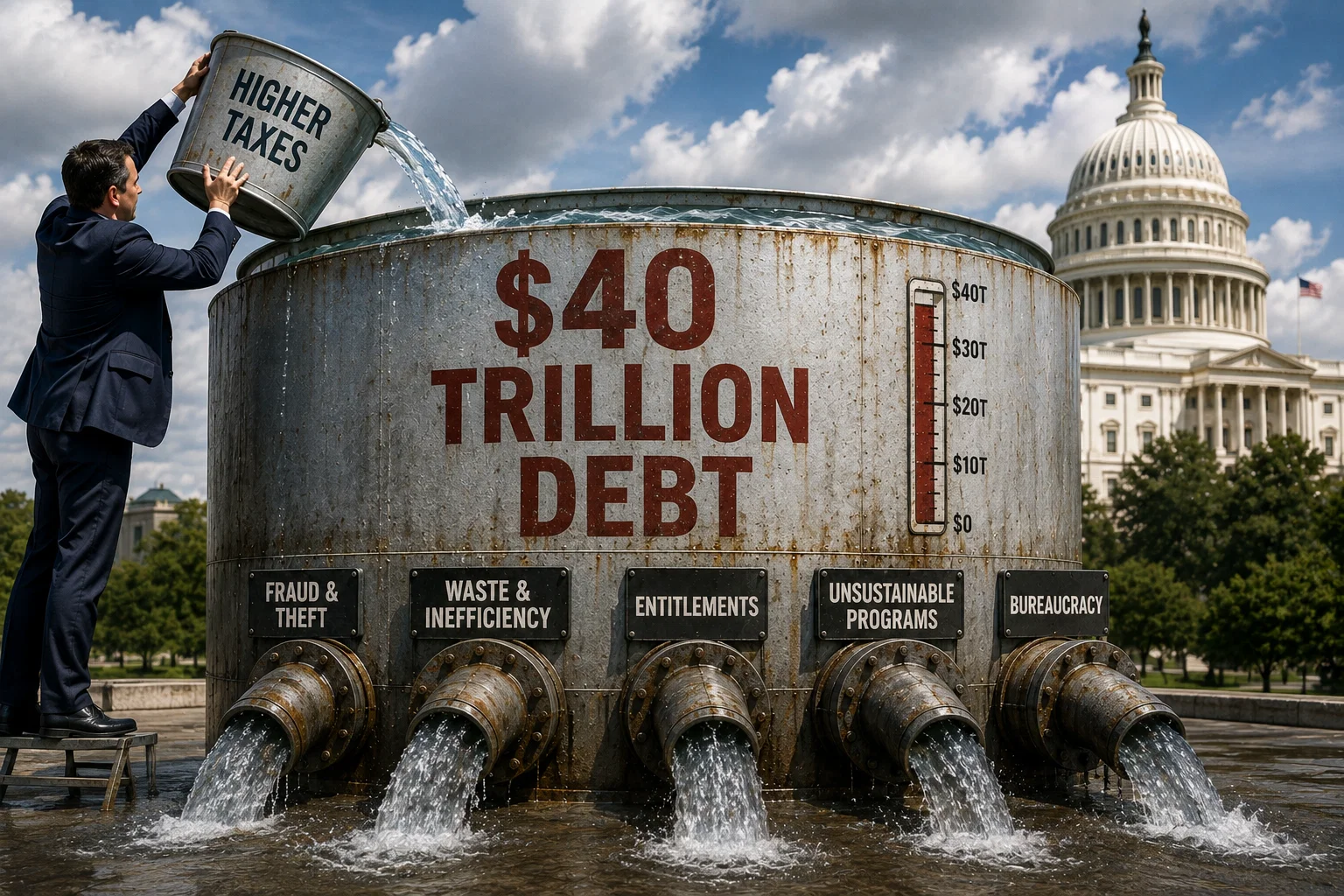
This was the absolute peak of American patriotism and record high tax rates. And yet overall government tax revenue still only came to just 20.5% of GDP.
This matters. In the eight decades since the end of World War II, tax revenue in the United States has averaged between 17% and 18% of GDP... with very little variation.
The low was 14.2% in 1950, coming out of a recession, and the high was 20.0% in 2000, at the peak of the dot-com boom when capital gains tax rates were through the roof.
Yet throughout those eight decades, the overall average has remained quite steady— 17% to 18%... even though corporate and individual tax rates have been all over the board over the same period.
The reason is simple: as tax rates go up and down, people and businesses adjust their behavior. If marginal tax rates skyrocket, people stuff their earnings into tax shelters. Or they defer revenue. Or they come up with any number of ways to legally reduce what they owe.
It's human nature.
You probably heard that the US national debt just crossed $40 trillion yesterday. And on its current trajectory, there is no end in sight to the growth of that debt.
The federal government now routinely posts ~$2 trillion annual deficits... during periods of relative peace and prosperity.
Plenty of people (especially on the left) believe the answer is to tax the rich: sky-high marginal rates, wealth taxes, etc. But the historical data show that higher tax rates cannot and will not solve the problem.
According to IRS data, imposing a tax rate of 90% on people earning $2MM per year or more would theoretically generate $200 to $300 billion in additional tax revenue.
But remember human nature: people would very quickly change their behavior and restructure their affairs, and so the real additional tax revenue would collapse to less than $50 billion per year.
The same goes for a wealth tax. Charging billionaires and centimillionaires a percentage of their unrealized gains sounds like a nice idea to a socialist. But the consequences would offset most (if not all) of the additional revenue.
If Elon Musk were forced to sell 10% of his stock to pay a wealth tax, the share prices of Tesla and SpaceX would plummet.
Sure, the IRS would collect more money from Musk himself. But, nationwide, overall capital gains tax revenue would fall dramatically. So net tax revenue would barely budge.
The point is there are always consequences to raising taxes: less economic activity, slower growth, and higher unemployment. No country in history has ever taxed its way to prosperity.
What’s crazy is that an economy as large and dynamic as America's doesn't even need to run a balanced budget. Even a $1 trillion annual deficit would be OK— and a huge step in the right direction. The national debt would still grow, but as a percentage of GDP, it would shrink.
And it's not hard to get there. The low-hanging fruit is obvious: the Government Accountability Office, the federal government's own watchdog, estimates that hundreds of billions of dollars are lost to outright fraud and theft every single year.
Yet Congress doesn't seem to want to even try to eliminate obvious fraud.
And that's the easy stuff.
The harder part would be streamlining government operations and cutting waste and inefficiency... which could easily generate hundreds of billions in savings.
Harder still would be reforming entitlements, fixing immigration, and taking a chainsaw to the Code of Federal Regulations... all of which could trim spending and/or grow the economy (and hence increase tax revenue).
Again, the national debt is $40 trillion, yet Congress won't even do the easy stuff to fix it. Even worse, the media and the courts actively block and obstruct the people who do try.
We can hope that common sense will one day prevail, and that AI and nuclear power will supercharge the US economy to the point where America grows its way out of debt.
But in the meantime, there are now 40 trillion reasons to have a Plan B.
To your freedom, James Hickman Co-Founder, Schiff Sovereign LLC
The Treasury Just Admitted It... The Bond Market Is Broken: Peter Schiff
The Treasury Just Admitted It... The Bond Market Is Broken
Peter Schiff: 8-20-2026
Peter Schiff breaks down the Treasury's panic move to rescue the bond market, the $40 trillion debt milestone, and gold's $185 reversal day.
The Treasury just doubled its bond buybacks. Peter Schiff says that's the government admitting the bond market is broken.
On the same day the national debt topped $40 trillion, the Treasury announced it is doubling its long-term bond buybacks from $2 billion to $4 billion... buying the bonds everybody else is selling, and funding it by issuing more short-term debt.
The Treasury Just Admitted It... The Bond Market Is Broken
Peter Schiff: 8-20-2026
Peter Schiff breaks down the Treasury's panic move to rescue the bond market, the $40 trillion debt milestone, and gold's $185 reversal day.
The Treasury just doubled its bond buybacks. Peter Schiff says that's the government admitting the bond market is broken.
On the same day the national debt topped $40 trillion, the Treasury announced it is doubling its long-term bond buybacks from $2 billion to $4 billion... buying the bonds everybody else is selling, and funding it by issuing more short-term debt.
Peter calls it what it is: a panic move, a Hail Mary to suppress rising yields after the 30-year hit 5.3%, its highest in over 19 years. Refinancing debt locked in at a 3.44% average coupon with 4% T-bills makes no financial sense, which is exactly why it's happening... the government is scared, not stupid.
The market rendered its verdict immediately. Gold reversed off a $185 rally to close above $4,500, silver cleared $66, and the miners surged 8-12%, while hawkish FOMC minutes were shrugged off entirely.
Peter explains why this Treasury version of Operation Twist forces the Fed to follow with real QE... a program that will have to dwarf 2008's... why Bitcoin's pop above $70,000 is built on hope, and why the housing data shows the panic is justified.
Chapters:
00:00 Treasury Panic Move
01:05 Bond Yields Hit New Highs
02:58 Debt Explosion Politics
07:00 Treasury Buyback Twist
10:23 QE Next And Fed Cornered
16:04 Hawkish Minutes Gold Surge
24:03 Markets React Unevenly
24:20 Dollar Drops Oil Jumps
25:08 Fed Inflation Bind
26:30 Debt Era Comparison
27:40 Jobs Data Media Spin
29:17 Bitcoin Versus Metals
31:19 Housing Slump Mortgages
33:59 Tariffs Canada Trade
37:50 Buybacks Won't Work
42:26 QE Addiction Ahead
44:34 Boat Update Farewell
Ariel: This Needs to be Said on Record (and more)
Ariel: This Needs to be Said on Record
8-20-2026
When You Run Across Those Who Are Unsure (Show Them This)
You’re holding a piece of paper that was called worthless by the same international banking structure that called the Iraqi Dinar “speculative” and the Vietnamese Dong “non-investment-grade.” The same structure that told everyone their mortgages were secure in 2007. The same structure that said the petrodollar was eternal.
Ariel: This Needs to be Said on Record
8-20-2026
When You Run Across Those Who Are Unsure (Show Them This)
You’re holding a piece of paper that was called worthless by the same international banking structure that called the Iraqi Dinar “speculative” and the Vietnamese Dong “non-investment-grade.” The same structure that told everyone their mortgages were secure in 2007. The same structure that said the petrodollar was eternal.
The ZIM notes represent a sovereign debt instrument from a nation sitting on trillions in untapped mineral wealth that was demonetized at a suppressed conversion rate to keep the population economically immobilized while international extraction interests looted the resources.
The GCR doesn’t just “revalue a currency.” It recalculates the entire relationship between sovereign wealth and currency issuance and when it does, those ZIM notes become what they were always supposed to be: a claim against real, tangible, in-the-ground mineral wealth valued at current market prices instead of 2009’s suppressed figures.
Jlynn: What are your thoughts on the Agro Cheques?! I don’t see as much chatter on those.
I Do Not Know Why People Even Entertained These:
Many people keep asking about these. Personally I do not own none of them. And I will explain briefly below. Because it’s not even neccessary to own these particular notes.
Most Agro Cheque holders are sitting on instruments with questionable inclusion in the GCR settlement window.
The legal framework that preserved the currency notes’ claim on mineral reserves does not automatically extend to bearer checks issued under an agricultural financing rubric.
If the settlement architecture treats them as a separate instrument class which the structural evidence suggests it does they would either redeem at a separate, lower tier or be excluded from the primary window entirely.
So they are really a toss-up. You can bring them if you want. But not sure why people bought them.
Because Agro Cheques circulated at the same denominations as the currency notes billions, trillions and because some dealers sold them interchangeably without explaining the distinction.
Holders bought them assuming parity with the currency notes. That assumption may not survive the redemption window.
Source(s):
• https://x.com/Prolotario1/status/2090198279162134552
• https://x.com/Prolotario1/status/2090262480983306355
https://dinarchronicles.com/2026/08/20/prolotario-this-needs-to-be-said-on-record/
************
Ariel: The Overall Hoopla and Doopla of the Zim-Zam-Sham
8-20-2026
The Overall Hoopla & Doopla Of The Zim-Zam-Sham (Peer 2 Peer)
[Financial Reset Briefing Room — Classified Channel — August 19, 2026 — 18:52 EST]
You Are Going To Love This Upload
[Contents]:
• The Zimbabwe Sovereign Debt Instrument: A Reclamation Dossier
• Part Two — The Charlatan Parade: A Roll Call
• The Dinar Pump-and-Dumpers
• The YouTube Prophets
• The Dismissal Artists
• Part 3 — The Honest Voices: Who Got It Right
• The Structured Settlement Community
• The Sovereign Wealth Analysts
• Part 4 — The Mineral Math
• Total Conservative Sovereign Mineral Wealth Estimate: $4.5–8 trillion.
• Part 5 — The Petrodollar Context
• Part 6 — What The Gurus Never Told You
The institutions telling you those ZIM notes are worthless are the same ones who rated subprime mortgage-backed securities as AAA investment grade six months before they vaporized the global economy. Moody’s. Standard & Poor’s. Fitch.
These three rating agencies the Holy Trinity of Financial Fraud stamped their seals of approval on trillions of dollars of garbage collateralized debt obligations that were, in reality, packages of defaulted loans wrapped in math so deliberately opaque that the people selling them didn’t understand what was inside.
Now. The currency that was demonetized in 2009 was issued against this wealth. The 2008-2009 Series AA and AB trillion-dollar notes the ones in your possession are denominated instruments tied to a sovereign balance sheet that includes the above mineral inventory.
They were “demonetized” at a conversion rate so suppressed that it essentially transferred the sovereign claim to international interests at pennies on the dollar.
The GCR recalculates this. It revalues the sovereign balance sheet at current market pricing. And when it does, the notes the bonds that were issued against that balance sheet become claims against the *recalculated* wealth, not the 2009 suppressed figure.
This is not magic. This is accounting. B****l, geopolitical, structurally enforced accounting that has been suppressed for two decades by the same system that told you mortgage-backed securities were safe.
Read Full Article:
https://www.patreon.com/Prolotario1/posts/overall-hoopla-2-167148163
https://dinarchronicles.com/2026/08/20/prolotario-the-overall-hoopla-and-doopla-of-the-zim-zam-sham/