
Thank you to all the subscribers to our Early Access program…we thank you for your continued support.
We are excited to offer this new service to keep you informed and up-to-date on the latest Dinar and currency news.
More Iraq News Posted by Tishwash at TNT 8-19-2026
TNT:
Tishwash: Two million barrels since the beginning of August... Iraq opens alternative routes for its oil exports
Anbar Alliance leader Mohammed al-Dhari al-Dulaimi revealed on Wednesday that Iraq has exported approximately two million barrels of oil since the beginning of August via the Ceyhan pipeline in Turkey and by tanker trucks to Syria and Jordan.
Al-Dulaimi told the Information Agency that “crude oil exports via the Ceyhan pipeline and by tanker trucks through the Trebil border crossing with Jordan and the al-Walid crossing in western Anbar have reached unprecedented levels, exceeding two million barrels since the beginning of August.
TNT:
Tishwash: Two million barrels since the beginning of August... Iraq opens alternative routes for its oil exports
Anbar Alliance leader Mohammed al-Dhari al-Dulaimi revealed on Wednesday that Iraq has exported approximately two million barrels of oil since the beginning of August via the Ceyhan pipeline in Turkey and by tanker trucks to Syria and Jordan.
Al-Dulaimi told the Information Agency that “crude oil exports via the Ceyhan pipeline and by tanker trucks through the Trebil border crossing with Jordan and the al-Walid crossing in western Anbar have reached unprecedented levels, exceeding two million barrels since the beginning of August.
These quantities are roughly equivalent to what Iraq previously exported through the Strait of Hormuz, and it is hoped that the pace of refined oil exports to Turkey, Jordan, and Syria will increase in the coming days.”
He added that “the central government’s plan is to find an alternative to exporting oil through the Strait of Hormuz, replacing it with the Ceyhan pipeline and tanker trucks to Jordan and Syria, to compensate for the near-complete halt of Iraq’s oil exports through the Strait of Hormuz.”
He affirmed that “increasing the pace of Iraqi oil exports to neighboring countries would secure salaries for employees and retirees, social welfare payments, and allow for the utilization of Iraq’s non-oil revenues in various sectors.” link
************
Tishwash: The Iraqi treasury is looking for a way out... Borrowing, oil bonds, and the digital dinar are on the table for discussion.
Experts favor traditional tools in the short term but warn of legislative challenges.
The pressures facing the Iraqi treasury are prompting a range of proposals to address the liquidity crisis, from diversifying revenues and borrowing to restructuring spending, and even ideas like a digital dinar and using oil as a financing tool. Experts believe that implementing these new tools requires legislation and financial and economic arrangements, making traditional solutions the most feasible in the short term.
These pressures come amidst the continued application of the 1/12 spending limit, which allows the public finances to manage spending and finance essential obligations until the budget is approved. Meanwhile, the government is discussing measures aimed at rationalizing spending, diversifying revenues, and reducing dependence on oil.
Hussain Al-Daraji, a member of the parliamentary finance committee, told Al-Mada, "The current approach should focus on diversifying revenues and capitalizing on the current crisis to create an additional resource for the state, rather than treating the liquidity problem as a temporary crisis that will end as soon as oil prices improve or exports return to their previous levels."
Al-Daraji added that “previous financial policies have caused disasters in the Iraqi economy due to continued reliance on oil and the failure to build stable resources from other sectors. Therefore, the current stage requires genuine measures to rearrange spending priorities and enhance non-oil revenues, while seeking financing tools that will not increase the state’s burdens in the future.”
In this context, the proposal to adopt a digital Iraqi dinar has resurfaced, after being presented as a means that could help reduce reliance on paper currency and facilitate salary payments through electronic wallets and accounts. However, according to experts, this proposal does not represent a solution to the deficit problem or the lack of resources, as addressing the liquidity crisis requires first securing financial sources capable of covering government spending, while digital transformation represents a tool for managing and circulating money more efficiently.
Economic expert Dirgham Muhammad told Al-Mada that “the digital dinar proposals, as well as oil bonds, are difficult to implement at present because they require time, arrangements, and legislation, especially since oil represents the primary resource of the Iraqi state, and any transaction involving it outside the traditional framework of sale requires a law that allows its use as collateral for loans or to obtain financing.”
Mohammed added that “a digital dinar also requires legislation and financial and economic arrangements that are not currently available. Therefore, the immediate solutions will remain within the traditional framework, including domestic borrowing, attempting to market oil through unconventional means and opening new markets, as well as increasing export volumes through alternative outlets, whether through regional agreements or land routes via Turkey and Syria.”
Among the proposals put forward by experts to address the liquidity crisis is the sale of a portion of future oil through bonds or financial instruments, whereby the government would receive payment in advance from citizens or banks at a fixed price, in exchange for settling these bonds later according to an agreed-upon pricing mechanism.
This proposal faces objections related to the need for clear legislation regulating the mechanism for selling oil in this way and determining the quantities that can be offered. There are also concerns about the risks of volatile crude oil prices in global markets and the potential losses that could result from fixing the selling price in advance if prices rise later. Furthermore, it is essential to identify the entity that will manage these bonds, the mechanism for their settlement, and how to guarantee the rights of the state and the parties involved.
Economists believe that the liquidity issue has shifted from a crisis related to the timing of salary payments to a broader test of the state's ability to manage its resources. Traditional tools, such as borrowing, restructuring spending, and increasing exports, appear to be the most feasible in the short term. Conversely, resorting to tools like the digital dinar and oil bonds requires more mature legislation and a more robust financial and banking infrastructure to address the repercussions of the current situation. link
************
Tishwash: Economist: Removing zeros will reduce inflation and withdraw money from corrupt officials.
Economic researcher Haitham al-Khazali believes that removing zeros from the currency will reduce inflation in the financial markets and markets. He added that it will also draw cash held by citizens, merchants, and investors into banks, and compel corrupt individuals to surrender their illicit funds.
Al-Khazali told Al-Maalouma, "The government's move to remove zeros from the currency would be a step in the right direction if it proceeds with such a transformation, as it would restore the Iraqi currency's strength and reduce the inflation rate."
He added, "Removing zeros opens the door to the reintroduction of smaller denominations, such as dirhams and fils, which were previously in circulation. Furthermore, it will force those holding cash, including merchants and investors, to deposit it in banks."
He explained that "removing zeros will reveal the size of the cash held by citizens and will also recover funds acquired by corrupt individuals, ensuring their return to the state." link
************
Tishwash: Removing zeros: A currency restructuring or a step to boost confidence in the dinar?
The issue of removing zeros from the Iraqi currency has resurfaced, amid economic debate about the feasibility of this step and its implications for the value of the dinar and the purchasing power of the citizen, as well as the readiness of the banking and financial sectors to implement it.
Economic experts believe that removing zeros, if implemented within a comprehensive study and a clear plan, could contribute to restructuring the currency and simplifying financial and banking transactions, while emphasizing that the measure itself does not mean an increase or decrease in the purchasing power of the dinar, as long as prices, salaries and savings are transformed at the same rate.
Strengthening the value of the dinar
Economic expert Haider Al-Sheikh told Al-Sabah newspaper: “Changing the Iraqi currency and removing zeros will enhance the value of the Iraqi dinar against foreign currencies,” explaining that “changing the currency will contribute to reviving the economy and providing cash liquidity to the government.”
The sheikh explained that the currency change process, according to the study, requires several months to print specific denominations in batches, in preparation for replacing them with the current currency. He pointed out that this process could contribute to strengthening the balances of government and private banks in Iraqi dinars and providing liquidity.
The necessary cash.
He added that another benefit of the process is “knowing the amount of currency held by the government and banks, as well as knowing the volume of currency circulating in the market.”
The sheikh pointed out that Iraq, after 2003, printed more than 100 trillion dinars, indicating that about 70 percent of the printed cash is outside the government's control and stored in homes. And it is traded on the market.
Renaming the monetary unit
For his part, economist Mustafa Faraj said that "removing zeros from the Iraqi currency, if implemented according to a comprehensive study and plan, represents a positive step towards restructuring the currency and simplifying financial and banking transactions," stressing that "the process itself does not necessarily mean an increase or decrease in value."
The purchasing power of the dinar.
Faraj explained that removing three zeros, for example, means changing prices, salaries, and balances by the same percentage, and therefore the citizen's purchasing power does not change as a result of the removal alone.
He added that the main economic benefit is “reducing the volume of circulating figures, facilitating accounting and banking operations, supporting electronic payment systems, and making dealing in dinars more efficient and transparent,” stressing that the success of the step is linked to monetary stability, price control, and broad public awareness.
He explained that removing zeros could be part of a “broader monetary and banking reform package that enhances confidence in the dinar and supports economic stability.”
It is not a single, formal procedure.
Risks of the conversion phase
In contrast, economic researcher Ahmed Eid warned that the most prominent risks that may accompany the removal of zeros are not related to the accounting removal process itself, but rather to the conversion phase and what may accompany it in terms of confusion in the markets and exploitation by some traders, especially in rounding prices upwards.
He explained that goods with small prices may be more likely to increase when converted to the new monetary unit, which, if this is repeated on a large scale, may lead to citizens feeling an actual increase in the cost of living, even though the process of removing zeros is theoretically supposed not to change purchasing power.
Eid pointed to other risks, including the weak financial literacy of some citizens, particularly with regard to converting cash savings, pricing goods and services, contracts and debts, as well as the possibility of speculation and rumors spreading about the value of the dinar.
He stressed that these risks become greater if the operation is carried out during an economic period suffering from financial pressures and problems related to liquidity and confidence.
Dual pricing and oversight
To protect the purchasing power of citizens, Eid called for the adoption of a sufficient transitional period preceding and accompanying the change process, during which dual pricing in the old and new dinars would be adopted, and precise rules would be put in place to prevent arbitrary rounding of prices, in addition to tightening control over markets and implementing a broad awareness campaign.
He stressed the need for the central bank to ensure that all bank accounts, savings, debts, salaries and contracts are converted in the same proportion, with the new currency being made available in an organized manner, and a period of simultaneous circulation of the two currencies being maintained.
He stressed that “the most important thing is that the removal of zeros should be preceded by real financial and monetary stability,” explaining that protecting purchasing power is not achieved by changing the form of the currency, but rather by controlling inflation, stabilizing the exchange rate and addressing financial and economic imbalances. link
*************
Tishwash: Prime Minister's Advisor: Digital Dinar a promising project to enhance the efficiency of monetary policy
The Prime Minister's advisor, Mazhar Muhammad Salih, confirmed on Monday that the digital dinar is a promising strategic project and not an independent solution to the liquidity crisis. While he pointed out that paying salaries digitally enhances the speed of payments and reduces cash transactions, he indicated that the success of the digital dinar depends on expanding banking services and infrastructure.
Saleh told the Iraqi News Agency (INA): “The proposal to launch the digital Iraqi dinar is one of the ideas that deserves to be studied within the framework of Iraq’s move towards digital transformation and the development of the financial system. If the digital dinar is meant to be a digital currency issued by the Central Bank of Iraq and enjoys the same legal force as the paper dinar, then it could represent a modern tool to enhance the efficiency of monetary policy, improve liquidity management, and develop the government payments system, which is what most central banks in the world are working on today.”
He added that “a sovereign digital currency does not mean creating a new currency, but rather issuing a digital form of the Iraqi dinar, so that it becomes available for electronic trading through digital wallets and bank accounts, while its value remains equal to the paper dinar,” explaining that “the importance of the digital currency lies in reducing reliance on cash, lowering printing, transportation and protection costs, speeding up payment processes, enhancing financial inclusion, as well as reducing the unregulated cash economy and its associated tax evasion, money laundering and corruption.”
Saleh pointed out that “the digital dinar should not be blamed for addressing the cash liquidity crisis, as the crisis, if it exists, is primarily linked to structural economic and financial factors, including the structure of the general budget, the level of government spending, citizens’ confidence in the banking sector, the size of deposits, and monetary policy,” stressing that “the digital dinar is a means to improve the efficiency of cash management, and not an independent cure for macroeconomic imbalances.”
He continued: “The Central Bank of Iraq has made significant progress in the digital transformation process by expanding electronic payment systems, digital wallets, point-of-sale devices, and linking banks to modern settlement systems.” He pointed out that “these measures represent the foundation upon which future decisions can be made to issue a sovereign digital currency, but this requires completing the legal and legislative frameworks, strengthening cybersecurity, and providing a technological infrastructure capable of accommodating this transformation.”
He explained that “disbursing salaries to employees and retirees in digital form is technically possible, especially since a large segment of salaries are currently disbursed via bank cards linked to the localization of government salaries and pensions,” noting that “in the future, the possibility of depositing salaries directly into digital wallets or accounts linked to the digital dinar can be studied, which reduces the need for cash transactions, enhances the speed of payment execution, and limits the risks of transferring and handling money in cash.”
Saleh explained that "the success of this transformation depends on several requirements, most notably expanding the spread of banking services in all governorates, increasing the number of electronic payment devices and ATMs, improving the quality of communications and internet services, and raising the level of digital financial literacy among citizens, in order to ensure that society accepts these modern methods and uses them with confidence and security."
The Prime Minister’s advisor pointed out that “the launch of the digital Iraqi dinar represents a promising strategic project, but it is not a substitute for economic and financial reforms, rather it is part of them. Its success requires a more diversified economy, a more efficient banking sector, and disciplined financial policies, in addition to an integrated legal and technical framework.
When these elements are available, the digital dinar can contribute to enhancing financial stability, improving liquidity management, and supporting the transition towards a more efficient and transparent digital economy, in line with modern global trends in managing monetary systems link
Iraq Economic News and Points To Ponder Wednesday Morning 8-19-26
"Reform or monetary gamble?" The National: Fears that removing zeros will disrupt markets and shake confidence in the dinar
Baghdad - One News A report by The National has brought the issue of removing zeros from the Iraqi dinar back to the forefront, amid what officials described as serious discussions within the Central Bank, at a time when Iraq is facing increasing pressure on the budget and a decline in oil revenues.
"Reform or monetary gamble?" The National: Fears that removing zeros will disrupt markets and shake confidence in the dinar
Baghdad - One News A report by The National has brought the issue of removing zeros from the Iraqi dinar back to the forefront, amid what officials described as serious discussions within the Central Bank, at a time when Iraq is facing increasing pressure on the budget and a decline in oil revenues.
The website quoted Ahmed Rashid, a member of the parliamentary finance committee, as saying that the project is still in the discussion phase and has not yet turned into a draft law or reached the House of Representatives, but he stressed that the current discussions are more serious than previous phases due to the economic and financial conditions that the country is going through.
According to the report, one of the main motives of the project is to try to address the huge amount of liquidity outside the banking system, as estimates indicate that there are about 70 trillion dinars outside the control of the monetary authority, out of about 125 trillion dinars in circulation.
Supporters of the project believe that replacing the old currency with a new one may encourage people with hoarded money to take it out of their homes and safes and return it to the banking system, thus allowing for an expansion of the amount of money passing through the formal financial system.
However, the report also pointed to concerns that the process of removing zeros could become a costly and confusing step for markets if it is not preceded by broader reforms in the banking sector, addressing the heavy reliance on the dollar, corruption, and weak confidence in financial institutions.
The National also pointed out that Iraq remains a largely cash-based society, with millions of citizens keeping their savings outside banks as a result of decades of wars, sanctions, crises and banking scandals, making any large-scale currency replacement extremely sensitive.
The project comes at a time of severe financial pressure, as oil exports, which had reached about 3.4 million barrels per day after the outbreak of war and the closure of the Strait of Hormuz, have declined, before returning since the beginning of August to an average of nearly two million barrels per day.
This was reflected in oil revenues, which represent at least 90% of the federal budget, as they decreased from about $6.8 billion in February to about $2.3 billion in May and June, at a time when Iraq needs about $6.5 billion per month to cover salaries, pensions and social welfare.
The report noted a conflict in official positions regarding the stage the project has reached, as Communications Minister Mustafa Sand said that the decision to remove zeros and change the currency had been made, suggesting the possibility of starting implementation in 2027 and the replacement process continuing for three years or more.
In contrast, government spokesman Haider al-Aboudi denied that the cabinet had made a decision on this matter, stressing that the file falls within the powers of the Central Bank and needs to go through the legislative process and be approved by the House of Representatives, while no detailed position was issued by the Central Bank regarding the mechanisms of the project or its timing.
The report indicates that the experiment, if approved, may include a transitional period during which the old and new currency will circulate together before the old banknotes are gradually withdrawn, similar to the experiences of countries that have previously removed zeros from their currencies.
The National concludes that the real dispute is not about removing three zeros per se, but whether Iraq can transform the process into a broader monetary reform that returns hoarded funds to banks and strengthens confidence in the dinar, or whether it will remain a cosmetic step with high costs and risks for the market if it does not address the structural problems of the economy. https://1news-iq.net/إصلاح-أم-مغامرة-نقدية؟-ذا-ناشيونال/
The Central Bank Of Iraq Concludes A Training Course On OFAC Sanctions Compliance Requirements.
The Compliance Office at the Central Bank of Iraq concluded a specialized training course titled "Compliance Requirements for OFAC Sanctions," held from August 9 to 11, 2026.
The course aimed to enhance the knowledge of staff in compliance and anti-money laundering/counter-terrorism financing (AML/CFT) reporting departments regarding the requirements and mandate of the Office of Foreign Assets Control (OFAC), sanctions programs, and implementation mechanisms. It also covered the Specially Designated Nationals (SDN) List, name verification procedures, and protocols for screening customers and transactions.
This course reflects the Central Bank of Iraq’s commitment to raising awareness of compliance requirements and enhancing the competence of banking sector personnel, thereby contributing to the improvement of oversight procedures and adherence to standards related to combating money laundering and the financing of terrorism.
Central Bank of Iraq Media Office August 18, 2026 https://cbi.iq/news/view/3292
Iraq Revives Debate Over Removing Three Zeros From The Dinar
2026-08-18 12:21 Shafaq News- Baghdad Debate has resurfaced in Iraq over a long-discussed plan to remove three zeros from the dinar, with lawmakers considering whether to include a “currency redenomination law” in a package of economic measures.
The proposal has remained under study for years as the government faces liquidity pressures and difficulties financing public spending and salaries.
Supporters argue that redenominating the currency could simplify transactions and streamline cash circulation. Economists interviewed by Shafaq News, however, caution against treating the measure as a solution to underlying financial problems that cannot be resolved by changing the currency’s denomination.
The debate intensified after Communications Minister Mustafa Sanad announced on Saturday that the government had decided to remove zeros or change the currency, linking the move to stolen public funds. He estimated the value of those funds at about 8 trillion dinars ($6.1B) and suggested that a new currency could render them unusable after the transition.
The Central Bank of Iraq began studying the proposal in 2007. In 2024, former Central Bank Governor Ali Al-Alaq confirmed that the project was “still in place,” although no implementation date was set.
Economic researcher Ahmed Eid considers the timing “economically inappropriate,” given Iraq’s financial pressures, liquidity shortages and rising government obligations. Speaking to Shafaq News, he argued that the priority should be addressing the causes of the financial crisis rather than changing the currency’s nominal value.
“Removing zeros does not provide new liquidity, finance salaries, or reduce the deficit and public debt,” Eid explained, adding that the measure would neither increase citizens’ purchasing power nor raise the dinar’s real value.
Under a three-zero redenomination, 1,000 old dinars would become one new dinar. Salaries, prices, savings, debts and contracts would all be converted at the same rate, leaving people’s real wealth unchanged.
Eid also warned that introducing the reform at a time when Iraq relies heavily on cash transactions, while financial literacy and market oversight remain limited, could create additional risks. Price increases, speculation and confusion over contracts, savings and other transactions could follow if the transition were poorly managed.
His objection, he stressed, was not to removing zeros as a monetary tool, but to linking the measure to the current financial crisis. Changing the numbers on banknotes, he maintained, would not address the economy’s underlying imbalances.
Economic journalist Salam Zidan views the primary function of redenomination as reducing the number of digits and simplifying calculations. Government budgets currently expressed in trillions of dinars, for instance, would be stated in billions under a three-zero change.
A salary of 1 million dinars ($763) would become 1,000 new dinars if three zeros were removed, while a one-zero reduction would turn it into 100,000 new dinars, Zidan explained.
The measure would not, however, resolve economic distortions. Zidan pointed out that people holding illicit funds could convert their money into gold, silver, real estate, or US dollars before a currency exchange, limiting the ability of changing banknotes alone to uncover illicit wealth.
Any redenomination would also require new banknotes, updated banking systems, ATMs, electronic payment platforms, government and corporate accounts, and a transition period during which the old and new currencies could circulate simultaneously. Authorities would need to clarify the new values of prices, contracts and salaries to the public.
Financial and banking specialist Mustafa Hantoush explained that current spending is being managed under the 1/12 rule, based on the previous year’s actual expenditure. Using 2025 figures, this permits spending of up to about 152 trillion dinars ($116 billion), although reaching that level would be difficult under current revenue conditions.
Hantoush told Shafaq News that the government is seeking to contain expenditure by restricting outlays to essential priorities while relying on borrowing through the Central Bank and discounting treasury bills to cover a deficit estimated at 6 trillion dinars ($4.6B) a month.
The pressure has been compounded by a sharp decline in oil revenues linked to disruptions following the closure of the Strait of Hormuz. Iraq relies on oil for the majority of its budget revenues, leaving its public finances highly exposed to changes in oil exports and prices.
Against that backdrop, experts argue that spending reforms, revenue diversification and stronger productive and financial sectors would do more to support the dinar’s stability than changing its denomination.
Economic expert Karim Al-Hilu noted that the three zeros have come to be associated with periods of war and sanctions. The idea has been raised repeatedly over the years, including during Nouri Al-Maliki’s premiership, but has never been implemented.
Al-Hilu sees a new currency as potentially giving the dinar “new strength” while bringing some cash circulating outside the banking system back into circulation through formal channels.
At the same time, he acknowledged that a significant share of funds linked to people accused of theft may already be held in gold, dollars and real estate rather than Iraqi currency.
He cautioned that requiring citizens to prove the source of their funds when exchanging old banknotes could cause widespread disruption without clear procedures. An abrupt implementation, he warned, could bring parts of the market to a standstill.
Despite those risks, Al-Hilu believes the reform could eventually become necessary and, if properly implemented, could strengthen the dinar.
The discussion also coincides with proposals to bring cash held outside banks back into the financial system. One proposal estimated the total cash supply at about 113 trillion dinars ($86.3B), including roughly 106 trillion dinars ($80.9B) outside banks, and called for efforts to return about 10 trillion dinars ($7.6B) to the banking system.
In 2024 and 2025, experts warned that removing zeros would require months of preparation, tighter banking and security controls, monitoring at borders and airports, and scrutiny of the sources of funds, stressing the need for exchange-rate and political stability before undertaking the reform.
They also warned of the costs of printing new banknotes, counterfeiting, money laundering and social disruption. Calling for stronger productive sectors, they argued that the strength of a currency depends not on the number of zeros but on an economy capable of producing goods and services.
https://www.shafaq.com/en/Economy/Iraq-revives-debate-over-removing-three-zeros-from-the-dinar
Seeds of Wisdom RV and Economics Updates Wednesday Morning 8-19-26
Good Morning Dinar Recaps,
When Higher Yields No Longer Guarantee a Stronger Dollar: Global Finance Enters a New Risk Phase
U.S. Treasury yields remain near multi-decade highs while oil approaches $92 and the dollar weakens—creating a difficult new equation for central banks, governments and global investors.
Good Morning Dinar Recaps,
When Higher Yields No Longer Guarantee a Stronger Dollar: Global Finance Enters a New Risk Phase
U.S. Treasury yields remain near multi-decade highs while oil approaches $92 and the dollar weakens—creating a difficult new equation for central banks, governments and global investors.
Overview
The global bond selloff has stabilized, but long-term yields remain near multi-decade highs, reflecting concerns about government debt,persistent inflation and fiscal spending.
Oil has climbed for a fourth consecutive day, with Brent crude reaching about $91.79 as uncertainty surrounding the Strait of Hormuz and the U.S.-Iran conflict keeps a geopolitical premium in energy prices.
At the same time, the U.S. dollar is weakening even while Treasury yields remain elevated, challenging the traditional relationship between higher U.S. interest rates and dollar strength.
Key Developments
1. Treasury yields remain near a 20-year high
The U.S. 30-year Treasury yield stood around 5.28% Wednesday, after reaching approximately 5.34% on Tuesday, its highest level since 2007.
The concern extends beyond the United States. German, French and Japanese long-term yields have also moved toward multi-decade highs, demonstrating that pressure on sovereign debt markets is becoming a global phenomenon rather than an isolated U.S. development.
Long-term government bonds effectively serve as an anchor for borrowing costs throughout the financial system. When those yields rise, the impact can spread into mortgages, corporate borrowing, equities, real estate and other risk assets.
The underlying concern is increasingly straightforward: governments are issuing enormous amounts of debt at a time when investors are demanding greater compensation for inflation and fiscal risk.
2. Oil is adding another layer of inflation pressure
Brent crude reached approximately $91.79 per barrel Wednesday, its highest level in about three weeks, while WTI approached $86.
The increase comes as uncertainty surrounding the Strait of Hormuz continues.
That matters because the Strait has historically carried roughly one-fifth of global oil and LNG exports. Continued disruption or uncertainty therefore creates the possibility of a larger geopolitical risk premium in energy prices.
For central banks, higher oil prices create a difficult problem.
Energy inflation can rise even if economic growth is slowing.
That makes the traditional response to weak economic conditions—cutting interest rates—more complicated if policymakers are simultaneously concerned about inflation.
3. The dollar is weakening despite elevated Treasury yields
Perhaps the most interesting development for the global financial system is occurring in the currency market.
The dollar index fell approximately 0.29% to 99.36 Wednesday, while the euro, pound and yen all gained against the dollar.
This is important because higher U.S. Treasury yields have historically provided an incentive for international investors to hold dollar-denominated assets.
But today's market is showing that higher yields do not automatically produce a stronger dollar.
Investors are weighing several factors simultaneously, including U.S. fiscal conditions, inflation, Federal Reserve policy, geopolitical risk and the relative attractiveness of other currencies.
That creates a more complicated environment for the dollar than simply comparing U.S. interest rates with those overseas.
The Central Bank Dilemma
This is where today's developments connect the bond market, oil market and currency market.
Central banks are confronting three competing forces:
Inflation: Higher energy prices could keep price pressures elevated.
Growth: Recent U.S. economic indicators have shown signs of softness, reducing the case for continued tightening.
Debt: Governments face enormous borrowing requirements, making higher interest rates increasingly expensive to sustain.
The Federal Reserve's July meeting minutes are due today and are being watched closely for clues about the future direction of monetary policy. The July meeting left rates unchanged, and markets have been trying to determine whether recent softer economic data will eventually outweigh inflation concerns.
The problem is that there may no longer be an easy policy choice.
Cut rates too quickly and inflation could remain elevated.
Keep rates high and government borrowing costs continue rising.
Allow inflation to run hotter and bond investors may demand even higher yields.
That feedback loop is increasingly important to the global financial outlook.
Why It Matters
The significance of today's market isn't simply that the 30-year Treasury yield is above 5%.
It is that multiple parts of the financial system are beginning to reprice the same risks at the same time.
Higher government debt is putting pressure on bond markets.
Higher oil prices are increasing inflation risk.
Higher long-term yields are raising the cost of capital.
A weaker dollar changes international capital flows.
And central banks are being forced to balance inflation against economic growth while governments continue borrowing heavily.
Reuters describes the recent bond-market move as a response to concerns over swelling sovereign debt and persistent inflation, with long-term borrowing costs rising across major economies.
That is much bigger than a normal market fluctuation.
Why This Matters to Foreign Currency Holders
For foreign currency holders, the dollar's behavior deserves particular attention.
A weaker dollar does not mean the dollar is collapsing, nor does it automatically mean another currency will replace it.
But if the dollar continues to weaken while U.S. Treasury yields remain historically high, it could signal that international investors are increasingly separating their decisions about interest rates from their decisions about currency exposure.
That could create greater volatility among major currencies.
The Indian rupee is already feeling the pressure from higher oil prices. Reuters reported Wednesday that the rupee fell to a three-week low as crude approached $92, prompting the Reserve Bank of India to intervene through state-owned banks.
This illustrates how an energy shock can quickly become a currency and central-bank problem for oil-importing countries.
Implications for the Global Financial Reset
1. The financial system may be entering a broader repricing—not a single "reset" event.
The most important development may be the simultaneous repricing of sovereign debt, currencies, commodities and monetary policy.
That is a structural change worth watching.
2. The old relationships between markets are becoming less predictable.
For years, investors could generally expect higher U.S. yields to support the dollar.
Today, that relationship is being challenged.
At the same time, rising oil prices are occurring alongside weaker economic signals, creating a particularly difficult environment for central banks.
3. Sovereign debt is increasingly becoming part of the global risk equation.
The pressure isn't confined to Washington.
Germany, France and Japan are also experiencing elevated long-term borrowing costs. Japan's benchmark 10-year yield has moved toward 3%, a level not seen there in roughly three decades, highlighting how dramatically the global interest-rate environment has changed.
This could eventually influence how governments finance deficits, how central banks manage their balance sheets and how international investors allocate reserves.
What to Watch Next
The next major signals will come from:
The Federal Reserve's July meeting minutes and any indication of how officials view inflation versus economic weakness.
Brent crude and the Strait of Hormuz, particularly whether oil pushes decisively above $90–$100.
The 30-year Treasury yield, especially whether it remains above 5.25% or moves toward higher territory.
The U.S. dollar, because continued weakness alongside elevated Treasury yields would be particularly significant.
Foreign demand for U.S. debt, which will help determine how much higher yields need to rise to attract buyers.
Bottom Line
The most important story today isn't simply oil, bonds or the dollar.
It is the interaction between all three.
Higher oil threatens inflation. Higher inflation complicates rate cuts. Higher rates increase the cost of government debt. Higher debt increases pressure on bond markets. And a weaker dollar changes the equation for international investors and foreign central banks.
That creates a financial environment in which monetary policy, sovereign debt, energy security and currency markets are increasingly interconnected.
For the global financial system, the question is no longer simply when will interest rates fall?
The bigger question is whether governments and central banks can manage inflation, energy shocks and enormous debt loads without triggering another major repricing across bonds, currencies and global capital markets.
Sources
~~~~~~~~~~
🌱 A Message to Our Currency Holders🌱
If you’ve been holding foreign currency for many years, you were not foolish.
You were not wrong to believe the global financial system would change.
What failed was not your patience — it was the information you were given.
For years, dates, rumors, and personalities replaced facts, structure, and proof. “This week” predictions created cycles of hope and disappointment that were never based on how currencies actually change.
That is not your failure.
Our mission here is different: • No dates • No rates • No hype • No gurus
Instead, we focus on:
• Verifiable developments • Institutional evidence
• Global financial structure • Where countries actually sit in the process
Currency value changes only come after sovereignty, trade, banking, settlement systems, and fiscal coordination are in place. History and institutions confirm this sequence.
You will see silence. You will see denials. That is not delay — that is discipline.
Protect your identity. Organize your documents. Verify everything.
Never hand your discernment to anyone who cannot show proof.
You deserve truth — not timelines.
Seeds of Wisdom Team
Newshounds News
~~~~~~~~~~
Seeds of Wisdom Team RV Currency Facts Youtube and Rumble
Newshound's News Telegram Room Link
RV Facts with Proof Links Link
RV Updates Proof links - Facts Link
Start Here room with Most Asked Questions Link
Follow the Gold/Silver Rate COMEX
Follow Fast Facts
Seeds of Wisdom Team™ Website
Thank you Dinar Recaps
News, Rumors and Opinions Wednesday 8-19-2026
Stephanie Starr: Big Piece of Monetary Reform for Iraq
8-18-2026
Now watch the CBI.
Redenomination restructures the currency.
Revaluation changes its value.
The question is whether Iraq intends to do BOTH.
Stephanie Starr: Big Piece of Monetary Reform for Iraq
8-18-2026
Now watch the CBI.
Redenomination restructures the currency.
Revaluation changes its value.
The question is whether Iraq intends to do BOTH.
Redenomination: simplifies the currency, reduces oversized denominations and can pull massive amounts of hoarded cash back into the regulated banking system.
Revaluation: changes the actual external value/exchange rate of the currency.
And according to the reporting, one purpose of replacing the existing notes would be to force hoarded dinars into the banking system and potentially remove trillions of dinars that are never legitimately exchanged from circulation. An Iraqi economist discussing the proposal today described it as a mechanism that could isolate illicit cash and strengthen formal banking controls.
That is a BIG piece of monetary reform.
Think about the progression:
Banking reform
AML & compliance reform
International banking integration
Bringing hoarded currency into the banking system
Reducing excess physical currency
Redenomination / deleting the zeros
Exchange-rate adjustment / potential revaluation
The final piece is still the most important: the Central Bank of Iraq must officially announce the implementation details and exchange-rate policy.
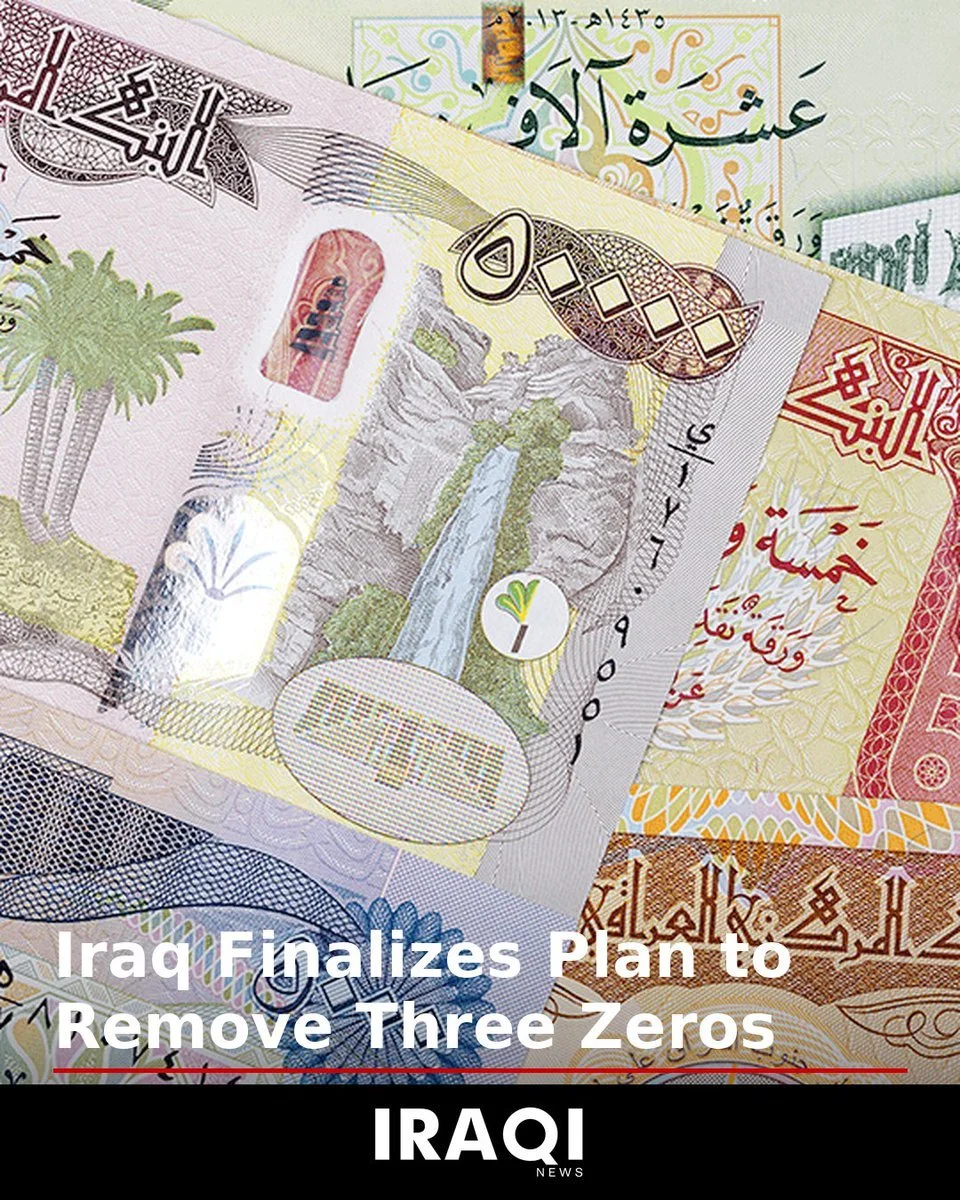
Iraqi News: Iraq has finalized its decision to redenominate the Iraqi Dinar by removing three zeros from the national currency.
➡️ The move is meant to force hoarded cash back into formal banking channels while eliminating an estimated 8 trillion IQD, about $6.1 billion, in unexchanged currency tied to illicit gains, corruption, and lost funds.
➡️ Since old banknotes that are never exchanged will permanently exit circulation, the state won't need to issue equivalent replacement notes, effectively shrinking the overall money supply.
➡️ The announcement has drawn criticism from economic monitoring group Eco Iraq Observatory, which warned that announcing sensitive currency reforms through ad hoc interviews rather than official channels risks undermining market confidence and fueling speculation.
➡️ The group has called on the Central Bank of Iraq and Ministry of Finance to issue an official clarification on the plan's details and timeline.
https://www.iraqinews.com/iraq/sanad-dinar-redenomination-delete-zeros-eco-iraq-reaction-2026/
Source(s):
• https://x.com/StephanieStarrC/status/2089363588343329000
https://dinarchronicles.com/2026/08/17/stephanie-starr-big-piece-of-monetary-reform-for-iraq/
****************
Courtesy of Dinar Guru: https://www.dinarguru.com/
Omar They're talking on the television right now about removing the zeros from the Iraqi dinar. They say it is a long awaited economic reform or a risk of inflation...The television is telling us removing the zeros is commonly referred to as a redenomination, would change the numerical denominations of Iraq's banknotes without necessarily changing the currency's real purchasing power...TV critical distinction is removing zeros would not automatically make the dinar more valuable...It's going to make daily operations much easier.
Jeff Deleting the zeros is the very next banking reform step and being implemented in the second half of the year '26. That's why they brought all those articles forward yesterday...It wasn't a coincidence.
Reset Intelligence Iraq's PM advisor publicly stated the country sits on more than 16 trillion dinars in natural resources, 5th largest proven oil reserves, 2nd largest phosphate reserves on Earth. The GDP is $265 billion. That's a resource to GDP ratio of 60 to 1. Saudi Arabia's ratio is 15 to 1. Iraq carries 4x the resource gap of Saudi Arabia at a program rate set during reconstruction 22 years ago.
******************
'Unstoppable' Market Crash To 'Break Everything' But GOLD - $10K Incoming: Edward Dowd
Commodity Culture: 8-18-2026
Edward Dowd continues to sound the alarm on the ballooning AI bubble, a major real estate crisis unfolding, and unprecedented government intervention in the stock market, and he's calling for a major collapse of the broad indices, in a move that will break everything but gold, which he sees soaring to $10,000 ahead.
Seeds of Wisdom RV and Economics Updates Tuesday Evening 8-18-26
Good Evening Dinar Recaps,
BRICS Moves From Talk to Infrastructure: The Next Phase of Global Finance
India is pushing a practical step toward a more multipolar financial system as BRICS members explore linking local-currency payment networks and central-bank digital currencies.
Good Evening Dinar Recaps,
BRICS Moves From Talk to Infrastructure: The Next Phase of Global Finance
India is pushing a practical step toward a more multipolar financial system as BRICS members explore linking local-currency payment networks and central-bank digital currencies.
Overview
BRICS countries are discussing a digital bridge between their domestic payment systems, potentially making cross-border transactions faster and cheaper.
The proposal comes as BRICS finance officials separately discuss reform of the international monetary and financial system, signaling that financial infrastructure is becoming a central part of the group's agenda.
This is not a new BRICS currency or an immediate replacement for the U.S. dollar. The more important development is the gradual construction of alternative payment channels that could reduce dependence on traditional dollar-based infrastructure.
Key Developments
1. India puts local-currency payment connectivity at the center of the BRICS agenda
India's proposal to create a digital bridge connecting the domestic currency payment networks of BRICS members is emerging as one of the key issues ahead of the 2026 BRICS summit.
The proposal would build on existing national systems rather than requiring members to create a single BRICS currency. The objective is to make it easier for participating countries to conduct transactions using their own currencies and payment networks.
India's Reserve Bank Governor Sanjay Malhotra said BRICS members are discussing potential connections between their fast-payment systems and central-bank digital currencies (CBDCs). Several approaches remain under consideration, meaning the project is still at the discussion stage rather than being an operational system.
2. BRICS finance officials are discussing the financial architecture itself
The development is taking place alongside a broader BRICS financial agenda.
At the August 12–13 meeting of BRICS finance ministers and central-bank governors in Jaipur, participants discussed global economic growth, reform of the international monetary and financial system, infrastructure investment, the New Development Bank, customs and taxation, and financial cooperation.
That combination is significant.
BRICS is not simply discussing currency values. It is discussing the infrastructure through which money moves, the institutions that finance development and the rules governing international financial relationships.
3. The shift is from a "replacement currency" narrative to financial interoperability
For years, much of the attention surrounding BRICS has focused on whether the group might create a common currency to challenge the dollar.
The current developments point toward something considerably more practical.
Rather than attempting to replace the dollar with one new currency, BRICS members are exploring whether multiple national currencies and payment systems can operate more efficiently with one another.
That distinction matters.
A Brazilian company could potentially settle with an Indian company using interconnected payment infrastructure. An Indian business could conduct transactions involving another BRICS economy without requiring every payment to follow the same traditional pathway through the global financial system.
The potential change is therefore not necessarily "one currency replaces another." It is "more pathways become available."
Why It Matters
The global financial system has historically benefited from the enormous network effects surrounding the U.S. dollar and existing international payment infrastructure.
Creating a competing system from scratch would be extremely difficult.
But interconnecting systems that already exist is a different strategy.
India already operates UPI, China has its own extensive payment infrastructure, and other BRICS members have developed domestic instant-payment and digital-currency initiatives.
If those systems can eventually become interoperable, the financial landscape could become more multi-rail—with international transactions able to move through several interconnected channels rather than relying overwhelmingly on one dominant route.
Reuters reported that BRICS officials are considering both fast-payment-system connections and CBDC interoperability, with reducing the cost of cross-border payments among the objectives.
There are still substantial obstacles, including regulatory differences, currency convertibility, exchange-rate management, cybersecurity, settlement arrangements and the question of how participating central banks would coordinate.
So this is an infrastructure project in development, not a finished alternative financial system.
Why This Matters to Foreign Currency Holders
For foreign currency holders, the most important point is that international use of a currency can matter independently of whether that currency becomes a global reserve currency.
If BRICS countries make it easier to settle trade directly in their national currencies, those currencies could gradually acquire greater utility in cross-border commerce.
That does not guarantee appreciation.
Currency values will still depend on inflation, interest rates, economic growth, trade balances, capital flows and monetary policy.
But greater international settlement capability could eventually create additional sources of demand and utility for participating currencies.
This is why the infrastructure discussion deserves attention.
Implications for the Global Financial Reset
The reset may be developing through infrastructure rather than a single announcement
A major restructuring of global finance would not necessarily begin with the launch of a new reserve currency.
It could develop through payment interoperability, local-currency settlement, digital currencies, new lending institutions and alternative financial networks.
That is the direction BRICS appears to be exploring.
The dollar does not have to disappear for the system to become more multipolar
The U.S. dollar can remain the world's dominant reserve currency while its relative share of international transactions gradually faces more competition.
A multipolar system does not necessarily mean the end of dollar dominance. It can mean that more countries have viable alternatives for particular types of trade and financial settlement.
That is a much more realistic—and potentially more durable—form of financial diversification.
What to Watch Next
The critical question is whether the BRICS discussions move from policy proposals to technical implementation.
Watch for:
A formal agreement to connect BRICS payment systems
Specific plans for CBDC interoperability
Expansion of local-currency trade settlement
Greater use of the New Development Bank for financing in national currencies
Concrete announcements from India's 2026 BRICS summit
The distinction between discussion and implementation will be crucial.
Right now, the evidence supports the conclusion that BRICS is building the framework for greater financial connectivity outside traditional channels—not that a new BRICS monetary system has already replaced the existing one.
Bottom Line
The most important BRICS development may not be the creation of a new currency at all.
It may be the construction of the financial infrastructure that allows more currencies to function internationally.
Payment networks, CBDCs, local-currency settlement and development financing are separate pieces of a much larger puzzle. If BRICS succeeds in connecting enough of those pieces, the global financial system could become less centralized around a single payment and settlement architecture.
The next phase of the global financial reset may not be about replacing the dollar—it may be about building enough alternative pathways that the world no longer has to rely on one financial road.
Sources
Reuters — BRICS nations discuss linking payment systems and CBDCs
China Ministry of Finance — BRICS Finance Ministers and Central Bank Governors Meeting
~~~~~~~~~~
Seeds of Wisdom Team RV Currency Facts Youtube and Rumble
Newshound's News Telegram Room Link
RV Facts with Proof Links Link
RV Updates Proof links - Facts Link
Start Here room with Most Asked Questions Link
Follow the Gold/Silver Rate COMEX
Follow Fast Facts
Seeds of Wisdom Team™ Website
Thank you Dinar Recaps
Iraq Economic News and Points To Ponder Tuesday Evening 8-18-26
The Iraqi Dinar: Between Adjustment And Impact... Urgent Parliamentary Messages To The Prime Minister
Baghdad Today - Baghdad MP Saud Al-Saadi called on the government today (August 17, 2026) to clarify the legal and economic basis for the decision to remove zeros from the Iraqi dinar, according to an official document seen by Baghdad Today
In his parliamentary question, Al-Saadi stated that the government must provide the constitutional and legal basis for issuing such a decision, as well as clarify its economic feasibility and the potential effects on the national economy and citizens’ confidence in the local currency.
The Iraqi Dinar: Between Adjustment And Impact... Urgent Parliamentary Messages To The Prime Minister
Baghdad Today - Baghdad MP Saud Al-Saadi called on the government today (August 17, 2026) to clarify the legal and economic basis for the decision to remove zeros from the Iraqi dinar, according to an official document seen by Baghdad Today
In his parliamentary question, Al-Saadi stated that the government must provide the constitutional and legal basis for issuing such a decision, as well as clarify its economic feasibility and the potential effects on the national economy and citizens’ confidence in the local currency.
He also called for revealing whether the Cabinet had prepared a draft law on this matter, specifying the date for the implementation of the decision if it is approved, in addition to stating the reasons for not adopting other monetary and economic alternatives.
Al-Saadi stressed the need to answer these questions within the legal timeframe specified according to the internal regulations of the House of Representatives.
https://baghdadtoday.news/304841-.html
Republic of Iraq
Council of Representatives
Office of Representative
Saud Saadoun Al-Saadi
Killed Iraq
No, no
Secretary of the Parliament
Saud Saadoun Al-Saadi
Number: 2005 Date: 8/16/2026
To the Honorable Prime Minister
Parliamentary Question Regarding the Government's Decision to Remove Zeros from the Iraqi Dinar
Greetings...
Based on the oversight and representative role entrusted to us on behalf of the people according to the provisions of Articles (49) First and (61/Second) of the Constitution, and pursuant to the provisions of Articles (15) and (27) of the Law of the Council of Representatives and its Formations No. (13) of 2018, and pursuant to the provisions of Article (50) of the Internal Regulations of the Council of Representatives No. (1) of 2022
Please Answer The Following Parliamentary Questions:
The Minister of Communications previously appeared on a satellite channel and made a statement about the government issuing a decision to remove zeros from the Iraqi Dinar
1- What is the constitutional and legal basis for the government, represented by the Council of Ministers or the Prime Minister, to issue a decision regarding the removal of zeros from the Iraqi dinar?
- What is the economic feasibility of the decision to remove zeros from the national currency? What are the negative effects of this decision on the Iraqi economy and confidence in the national currency?
Has the Prime Minister or the Council of Ministers prepared a draft law to remove zeros from the Iraqi currency, especially since the Council of Ministers does not possess such authority according to the provisions of Article (80) of the Iraqi Constitution?
- To be continued - https://baghdadtoday.news/304841-.html
Economist: Removing Zeros Will Reduce Inflation And Withdraw Money From Corrupt Officials
Information/Baghdad...Economic researcher Haitham al-Khazali believes that removing zeros from the currency will reduce inflation in the financial markets and markets. He added that it will also draw cash held by citizens, merchants, and investors into banks, and compel corrupt individuals to surrender their illicit funds.
Al-Khazali told Al-Maalouma, “The government’s move to remove zeros from the currency would be a step in the right direction if it proceeds with such a transformation, as it would restore the Iraqi currency’s strength and reduce the inflation rate.”
He added, "Removing zeros opens the door to the reintroduction of smaller denominations, such as dirhams and fils, which were previously in circulation. Moreover, it will force those holding cash, including merchants and investors, to deposit it in banks."
He explained that "removing zeros will reveal the size of the cash held by citizens and will also recover funds acquired by corrupt individuals, ensuring their return to the state." End
Former US Official: Nechirvan Barzani Trusted In Washington And Tehran
2026-08-18 Shafaq News- Washington Kurdistan Region President Nechirvan Barzani is trusted in both Washington and Tehran, a distinction very few people can credibly claim, former US State Department official Thomas Warrick told Shafaq News on Tuesday.
Previous mediation efforts have failed to break the impasse, Warrick said. “Washington values President Barzani’s honesty and his understanding of the actors on the Iranian side,” he said, adding that “Tehran may well feel the same about his understanding of Washington.”
Asked whether the Kurdistan Regional Government’s mediation efforts could succeed where earlier efforts by Qatar and Pakistan had stalled, Warrick said, “A fresh perspective is always useful, and President Barzani certainly brings one.”
However, the differences between Washington and Tehran are too deep to be bridged by any one person. “I am not optimistic that the conflict will end before the US election on November 3.”
Earlier, Axios reported that Barzani helped establish a secret channel between the US administration and Iran’s Islamic Revolutionary Guard Corps (IRGC).
Citing three sources with direct knowledge of the contacts, Axios reported that the White House turned to Barzani because of his longstanding ties with both Washington and Tehran and his contacts with senior Iranian officials.
For Shafaq News, Mostafa Hashem, Washington, D.C.
Reset Intelligence: Iraq to Remove the Three Zeros from the IQD
Reset Intelligence: Iraq to Remove the Three Zeros from the IQD
8-17-2026
Iraq to Remove the Three Zeros from the IQD
By Reset Intelligence | @EXIT_FIAT
On Saturday night, Iraq’s Minister of Communications, Mustafa Sanad, went on the iNews channel and told the country the decision has been issued: the currency is changing and the three zeros are coming off the dinar.
Reset Intelligence: Iraq to Remove the Three Zeros from the IQD
8-17-2026
Iraq to Remove the Three Zeros from the IQD
By Reset Intelligence | @EXIT_FIAT
On Saturday night, Iraq’s Minister of Communications, Mustafa Sanad, went on the iNews channel and told the country the decision has been issued: the currency is changing and the three zeros are coming off the dinar.
After 23 years of studies, proposals and denials, a sitting minister of the current government said it as a done thing. Not a study. Not a proposal. Issued.
Why this minister matters
Sanad is not a random mouth. He spent 5 years on parliament’s Finance Committee, the room that writes the budgets an exchange rate lives inside. And his current ministry runs Iraq’s electronic payment rails, the wires any modern note exchange has to cross.
In June his system covert 116 billion dinars heading for Dubai and froze the transfer before it cleared. When the man who runs the rails says the decision is issued, that is worth your attention.
What else moved this weekend
• The 2027 budget – first reading of the grants and borrowing law comes to parliament next week, and a Finance Committee member said on state media that this budget will determine the exchange rate.
• The Supreme Court – Iraqi press reports the Prime Minister has asked the Federal Supreme Court to define the Council of Ministers’ powers on currency reform. Governments do not ask courts to define powers they never intend to use.
• The corruption sweep – investigators pulled $20 million in cash, 60 kilograms of gold and seven vehicles out of one arrested official’s holdings on Saturday.
• The region – the Gaza track keeps compounding, Saudi Arabia, Turkey and Pakistan signed a mutual-defense pact with Trump’s public endorsement, and Treasury has promised economic isolation measures against Iran without precedent, due this week.
The Central Bank has not made the formal announcement, and that is the piece to wait for. But the paperwork that must carry a new rate is moving toward parliament, the enforcement side is live, and the man who owns the rails says his part of the machine is built.
Our full briefing walks through what a note exchange actually does, why these operations are always denied right up until the morning they happen, and what Germany in 1948 and Iraq’s own 2003 exchange teach about this exact moment.
History rarely announces itself twice.
Read the full daily briefing free for 5 days. Sign up here: resetintelligence.com
Want it straight from the horse’s mouth? The CBI Rate Alert pings you the moment the Central Bank of Iraq moves the official rate. The number itself, not a rumour about it. It comes with our free resource library and the daily breakdown of what is actually moving in Iraq. Sign up free: resetintelligence.com/rate-alert
For the full 118-year design underneath this story: Head of the Snake. The reference library of guides and scenario reports is at resetintelligence.com/resources.
Follow the daily intel free: Telegram · Facebook · Spotify · Odysee
Iraq Economic News and Points To Ponder Tuesday Afternoon 8-18-26
Exclusive: SOMO Seeks Safe Hormuz Passage For Iraqi Oil Exports
2026-08-17 Shafaq News- Baghdad Iraq’s State Organization for Marketing of Oil (SOMO) is negotiating with US and German shipping companies to secure passage for crude exports through the Strait of Hormuz using Iraqi-flagged tankers, a government source told Shafaq News on Monday.
Exclusive: SOMO Seeks Safe Hormuz Passage For Iraqi Oil Exports
2026-08-17 Shafaq News- Baghdad Iraq’s State Organization for Marketing of Oil (SOMO) is negotiating with US and German shipping companies to secure passage for crude exports through the Strait of Hormuz using Iraqi-flagged tankers, a government source told Shafaq News on Monday.
The source said the US company rejected Baghdad’s requirement to fly the Iraqi flag on its tankers, leaving the two sides without an agreement. The German company, however, agreed to the flag requirement while transporting crude from Iraqi ports.
“Understandings with Iran would allow Iraqi oil shipments to pass through the strait without transit fees.”
Baghdad must also secure US authorization to complete the transit arrangements. The source expected Iraq to obtain approval soon, amid US sanctions targeting entities linked to Iranian shipping and insurance mechanisms in Hormuz.
Read more: SCOOP: Iraq in talks with US-Iran over Hormuz oil shipments
Prime Minister Ali Al-Zaidi’s deadline for the Oil Ministry to resolve the crude export crisis could be extended for another week, according to the source. Shipping companies are seeking higher freight rates and additional insurance guarantees to account for the risks associated with passage through the waterway.
https://www.shafaq.com/en/Economy/Exclusive-SOMO-seeks-safe-Hormuz-passage-for-Iraqi-oil-exports
Gold Retreats As Oil Climbs
2026-08-18 Shafaq News Gold prices came under pressure on Tuesday from higher Treasury yields and a spike in oil prices, while traders awaited minutes of the U.S. Federal Reserve's July policy meeting for clues on the outlook for interest rates.
Spot gold was down 0.5% at $4,391.14 per ounce, as of 0423 GMT, while U.S. gold futures for December delivery dropped 0.6% to $4,446.70.
Yields on the benchmark 10-year U.S. Treasury note extended gains, raising the opportunity cost of holding non-yielding bullion.
Oil prices also edged higher after Iran said it would shift to a "fully offensive" military posture following a breakdown in efforts to negotiate a permanent end to the war with the United States, while Washington ruled out extending a temporary ceasefire agreement.
Oil prices will remain one of the key factors keeping gold under pressure as situation in the Middle East continues to look uncertain, ANZ analyst Soni Kumari said.
Traders' expectations around Fed policy rates are going to be important for gold, with a focus on technical levels, Kumari added.
Elevated energy prices tend to raise inflationary fears and bolster expectations of higher interest rates by the Fed. While gold is typically seen as a hedge against inflation, higher interest rates tend to diminish bullion's appeal.
However, market pricing for a September quarter-point hike flipped to a nearly 65% chance of a "hold" after unexpected job losses in July, lower-than-expected consumer price inflation and weaker retail sales.
Investors are also awaiting minutes from the Fed's most recent policy meeting, with the release scheduled for Wednesday.
Spot gold may test a support at $4,381, a break below could open the way toward the $4,320 to $4,351 range, according to Reuters technical analyst Wang Tao.
Among other metals, spot silver slipped 1% to $65.11 per ounce, platinum lost 1.2% to $1,748.56, while palladium fell 1.2% to $1,317.01. (REUTERS) https://www.shafaq.com/en/Economy/Gold-retreats-as-oil-climbs
Basrah Crude Gains On US-Iran Supply Concerns
2026-08-18 Shafaq News- Basrah Iraq’s Basrah Heavy and Basrah Medium crude prices rose on Tuesday, tracking gains in global oil markets as concerns over Middle East supply intensified amid fading prospects for an agreement to end the US-Iran war.
Basrah Heavy gained $0.39, or 0.64%, to $61.77 per barrel, while Basrah Medium rose $0.39, or 0.60%, to $65.07.
Globally, Brent crude futures climbed 62 cents, or 0.7%, to $91.49 a barrel, after rising on Monday to their highest since July 30. US West Texas Intermediate crude futures were up 75 cents at $85.25 a barrel, after earlier rising more than 1% to $85.37, their highest since July 31.
https://www.shafaq.com/en/Economy/Basrah-crude-gains-on-US-Iran-supply-concerns
USD/IQD Exchange Rates Dip In Baghdad, Climb In Erbil
2026-08-18 Shafaq News- Baghdad/ Erbil The US dollar hovered around 154,000 Iraqi dinars per $100 in Baghdad and Erbil on Tuesday morning, edging lower in the capital while rising in the Kurdistan Region.
In Baghdad, the dollar fell to 153,850 dinars per $100 at the Al-Kifah and Al-Harithiya central exchanges, according to Shafaq News market survey, down from 154,000 on Monday.
Exchange shops in the capital sold the dollar at 154,250 dinars and bought it at 153,250 per $100.
In Erbil, the dollar rose, with exchange shops selling at 154,250 dinars per $100 and buying at 154,150 dinars per $100.
https://www.shafaq.com/en/Economy/USD-IQD-exchange-rates-dip-in-Baghdad-climb-in-Erbil-9
2026 Hormuz Closure Tops Historic Oil Supply Disruptions
2026-08-18 Shafaq News- Vancouver The closure of the Strait of Hormuz in March 2026 triggered the largest oil supply shock on record, cutting global supplies by about 10.1 million barrels per day (bpd) and far surpassing disruptions from major wars and oil crises over the past five decades, according to a ranking published by Visual Capitalist.
The Hormuz disruption was about 80% larger than the estimated 5.6 million-bpd supply loss during the Iranian Revolution between November 1978 and April 1979, which ranked second.
The Arab oil embargo and Iraq’s 1990 invasion of Kuwait ranked third and fourth, respectively, with each disruption reducing global oil supplies by about 4.3 million bpd.
Iran-Iraq war followed in fifth place, with losses of 4.1 million bpd between October 1980 and January 1981.
The 2003 Iraq war ranked sixth, reducing supplies by about 2.3 million bpd between March and December. Libya’s civil war in 2011 came seventh, with a loss of roughly 1.5 million bpd.
Hormuz, through which roughly 20% of the world’s oil passes, has remained largely closed under Iranian restrictions since Feb. 28, following the start of the US-Israeli war and disrupting regional energy flows.
The corridor briefly reopened after a US-Iran memorandum of understanding (MoU) took effect on June 18, but closed again amid renewed military escalation, with Tehran maintaining that the waterway remains under Iranian control.
Read more: Cargo transit through Hormuz plunges near total halt
https://www.shafaq.com/en/Economy/2026-Hormuz-closure-tops-historic-oil-supply-disruptions
How Medicare Became a Slush Fund
How Medicare Became a Slush Fund
Notes From the Field By James Hickman (Simon Black / Sovereign Man) August 18, 2026
Four years ago this month, Washington passed a law and named it, with a straight face, the Inflation Reduction Act. Bizarrely, their plan to ‘reduce inflation’, which had been caused by excessive government spending, was for the government to spend even more money. It’s genius!
How Medicare Became a Slush Fund
Notes From the Field By James Hickman (Simon Black / Sovereign Man) August 18, 2026
Four years ago this month, Washington passed a law and named it, with a straight face, the Inflation Reduction Act. Bizarrely, their plan to ‘reduce inflation’, which had been caused by excessive government spending, was for the government to spend even more money. It’s genius!
Among its various provisions, part of the legislation authorized the government to negotiate prescription drug prices. Seems like a nice idea in principle... but in practice it’s been a disaster.
The Congressional Budget Office released the results late last month: the Medicare drug provisions that were supposed to generate $129 billion in savings will now add $700 billion to the deficit.
Sometimes it seems like this is the whole idea; given the rampant Medicare fraud that gets uncovered on a daily basis, it’s clear that politicians have an incentive to steer MORE money into the program.
Healthcare is the easiest spending in Washington to justify. Every dollar comes with the same argument: if we don't spend on healthcare, people will die!
It ends up being so much money— a giant, dark pool of corruption— and a lot of it gets funneled straight back into the political process as campaign contributions. And it’s been going on for ages.
Back in 2002, for example, America’s biggest health-care workers union spent about $800,000 electing Rod Blagojevich governor of Illinois. He later thanked them "for electing me governor."
Weeks after he took office, Blagojevich signed multiple executive orders that fattened the union’s pockets, like forcing more healthcare workers to join... and automatically deducting union dues from their paychecks. Bad for the unionized workers, but great for the union bosses.
In New York, the Greater New York Hospital Association wrote two checks totaling more than $1 million to the state Democratic Party in August 2018, at then-Governor Andrew Cuomo's campaign's request.
Three months later the state ordered its first across-the-board Medicaid rate increase since 2008, worth about $140 million a year. Great news for the hospital association.
The cycle never ends— the unions and associations scratch the politicians’ backs, and in turn get their backs scratched. No one can rationally expect those parties to walk away from their mutual benefit.
And this is just the ‘honest’ graft and corruption... it doesn’t take into account the outright fraud.
During COVID, Medicare paid for eight test kits per month, per person, in America. Yet an inspector general later found it paid up to $454 million for nearly 39 million kits over that limit.
In June, the Justice Department found over $6.5 billion in fake health-care claims. Yet agents recovered only $182 million in cash and assets, less than three cents per dollar of fraud.
In one instance, a pair of adult day care operators fraudulently billed Medicare and Medicaid $120 million over a decade. One of their centers claimed 1,041 attendees in a single day while the building's occupancy limit was 81.
Then Nick Shirley walked into the neighborhood's facilities with a camera this summer and turned up $190 million more in suspicious billing.
And yet very little of the fraud gets stopped... in large part because a portion of what they steal from the government is funneled back to the politicians (mostly on the Left) who vote for more Medicare spending.
These same politicians install activist judges at the state and federal level, ensuring that anyone who tries to stop the fraud will be sued... and blocked by the courts.
As an example, last year Congress voted to cut off Planned Parenthood from Medicaid for one year.
Planned Parenthood sued. Judge Indira Talwani, an Obama appointee in Boston, dutifully blocked the cut within weeks, and the appeals court had to overrule her twice before the law could take effect.
Feeding Our Future, the Minnesota child-meal Somali fraud network, had the audacity to sue the state for racial discrimination when the fraudulent money train slowed down.
It’s extraordinary; there are so many checks-and-balances in place to keep the graft going.
The politicians vote to keep the money moving. The judges defend it to the last Somali. And the activists and the media scream that anyone asking questions is racist; Governor Tim Walz called the fraud talk "vile, racist lies."
The teachers' unions march the kids out of school for union causes and No Kings rallies, as if the kids had any idea what they were marching for. And the universities continue the socialist indoctrination.
Media, education, courts: the whole institutional layer exists to keep the money flowing.
So of course they want more of it.
Senator Bernie Sanders reintroduced Medicare for All last year, and the movement that just made Zohran Mamdani mayor of New York wants to make this slush fund the entire health-care system.
Even the most conservative estimate puts the price at $32.6 trillion over the first decade; that’s an astonishing amount of potential fraud.
The US could get its fiscal house in order if it shut this slush fund down. But the graft is deeply entrenched... so it’s likely that US deficit spending will continue in order to pay for it all.
Foreign governments have reached the same conclusion: The US has to go deeper into debt in order to finance hundreds of billions of dollars in fraud.
That's a major reason why foreign governments and central banks are diversifying away from the dollar. And with no obvious global currency to park their financial reserves into, they buy gold.
We have been making this argument for the past few years, since gold was below $1800. This sort of news makes the case even more strongly: the story hasn’t changed... and gold remains a great hedge for the fiscal uncertainty to come.
To your freedom, James Hickman Co-Founder, Schiff Sovereign LLC
PS: In this month’s Schiff Sovereign Premium, we made the case for a gold producer built for exactly this outlook: a debt-free, dividend-paying, highly successful gold company which just had the most profitable first-half in its company history. But it only trades at 2x cash flow.
If the fraud and deficits continue, gold should do very well... and successful producers can do even better.
Bolivar and Zim Thoughts from Ariel 8-18-2026
Ariel: The Parallel Emerging Market, the Venezuela Bolívar
8-18-2026
The Venezuela Bolívar: The Parallel Emerging Market (Why You Should Stack)
Venezuelan Bolívar Soberano (VES) — Imminent FX Integration Post-Iraq RV; Bilateral Normalization Trajectory
Why Venezuela & Why Now?
Ariel: The Parallel Emerging Market, the Venezuela Bolívar
8-18-2026
The Venezuela Bolívar: The Parallel Emerging Market (Why You Should Stack)
Venezuelan Bolívar Soberano (VES) — Imminent FX Integration Post-Iraq RV; Bilateral Normalization Trajectory
Why Venezuela & Why Now?
Most people looking at currency resets have tunnel vision on Iraq. Iraq is the door. Venezuela is the room right behind it. Here’s what nobody is connecting.
When a nation emerges from political upheaval with new leadership that the international community recognizes, the pattern is consistent the new government honors the domestic currency rather than wiping it out.
This happened with Kuwait in 1991 after Saddam was pushed out. The Kuwaiti dinar crashed to near-zero during occupation, then the restored government honored every note. People who held physical Kuwaiti dinar during the occupation made generational wealth.
Same playbook ran in Iraq itself in 2003 the Bremer transition replaced the Saddam dinar but honored the Swiss dinar notes at a revalued rate.
Germany 1948, the currency reform that birthed the Deutsche Mark old Reichsmark notes were converted, not nullified. Political settlements override legal extinguishment every time the monetary system undergoes regime change.
The Chain Nobody Is Connecting
Here’s what gives this thesis weight beyond just “new government, new currency.”
The Petrodollar Unraveling Creates the Vacuum. Saudi Arabia’s extension of multi-currency oil contracts and the BRICS+ settlement infrastructure going live means the U.S. needs Western Hemisphere energy producers locked into dollar frameworks more than ever.
Venezuela sits on the largest proven oil reserves on the planet 303 billion barrels. The U.S. cannot afford those barrels flowing east through yuan-settled channels. Normalizing Venezuela is strategic energy security, and currency revaluation is the financial mechanism that locks Caracas into the Western system.
Iraq Goes First Venezuela Follows. The Iraqi dinar revaluation has been positioned as the first domino in what currency researchers call the Global Currency Reset sequence. Once Iraq deletes three zeros and re-enters FX markets at a restored rate, the template is set.
International bodies, sovereign wealth funds, and institutional liquidity providers will have the legal infrastructure to process revalued currencies from formerly sanctioned nations. Venezuela’s bolívar revaluation would ride the same rails same legal framework, same FX integration process, same precedent of political settlement overriding prior demonetization arguments.
Read Full Article:
https://www.patreon.com/Prolotario1/posts/venezuela-market-166957678
************
Ariel: Everything Written Publicly about the ZIM is Wrong
8-18-2026
Something That Nobody Has Told You All:
Everything written publicly about ZIM is wrong by design. The 2008-2009 series AA and AB notes were never “worthless.”
Zimbabwe’s agricultural and mineral reserve backing specifically the platinum group metals and the Chiadzwa diamond fields were seized as collateral security by a consortium operating through the London Bullion Market Association under a 2009 stabilization agreement.
The notes weren’t demonetized. They were sequestered pulled from circulation and held in reserve against a future settlement window.
The exchange is NOT a flat currency-to-currency conversion. It operates on a bond-backed derivative structure where each note’s face value is multiplied against a mineral reserve ratio and then converted through a sovereign bond mechanism.
The reason every financial “expert” on television and every SEC-adjacent publication calls ZIM a “scam” is because the payout numbers, if they become reality, would represent the largest single transfer of wealth to private individuals in recorded history.
That transfer was designed intentionally not as charity, but as a liquidity mechanism. The sovereign bond structure requires millions of small holders to receive and SPEND large sums into the real economy to absorb the transition from fiat to asset-backed currency. The holders ARE the stimulus.
~ Just Thought I Throw That Out There
Source(s):
• https://x.com/Prolotario1/status/2089477041854849116
News, Rumors and Opinions Tuesday 8-18-2026
Rob Cunningham: All in or No Level Playing Field
8-17-2026
ALL IN or NO Level Playing Field
Q: Could a globally interoperable DLT (distributed ledger technology) monetary system meeting ISO20022 and GENUIS ACT standards function as designed with fiat issued currencies lacking verifiable, sound, 1:1 collateral and be fair to all parties involved?
A: No.
Rob Cunningham: All in or No Level Playing Field
8-17-2026
ALL IN or NO Level Playing Field
Q: Could a globally interoperable DLT (distributed ledger technology) monetary system meeting ISO20022 and GENUIS ACT standards function as designed with fiat issued currencies lacking verifiable, sound, 1:1 collateral and be fair to all parties involved?
A: No.
A globally interoperable DLT monetary system cannot be fair to all parties if fiat lacking verified collateral is exchanged through atomic settlement.
Atomic settlement can guarantee that both sides exchange simultaneously. It cannot guarantee that the assets exchanged are honestly represented, equivalently sound, or fairly valued.
Unverified collateral breaks the fairness condition.
For the system to be fair, the value backing each monetary instrument must be transparent and verifiable so every participant knows what they are receiving and can freely price and accept – or reject – the exchange.
Atomic settlement guarantees execution.
Verified collateral enables truthful valuation.
Both are required for a fair monetary system.
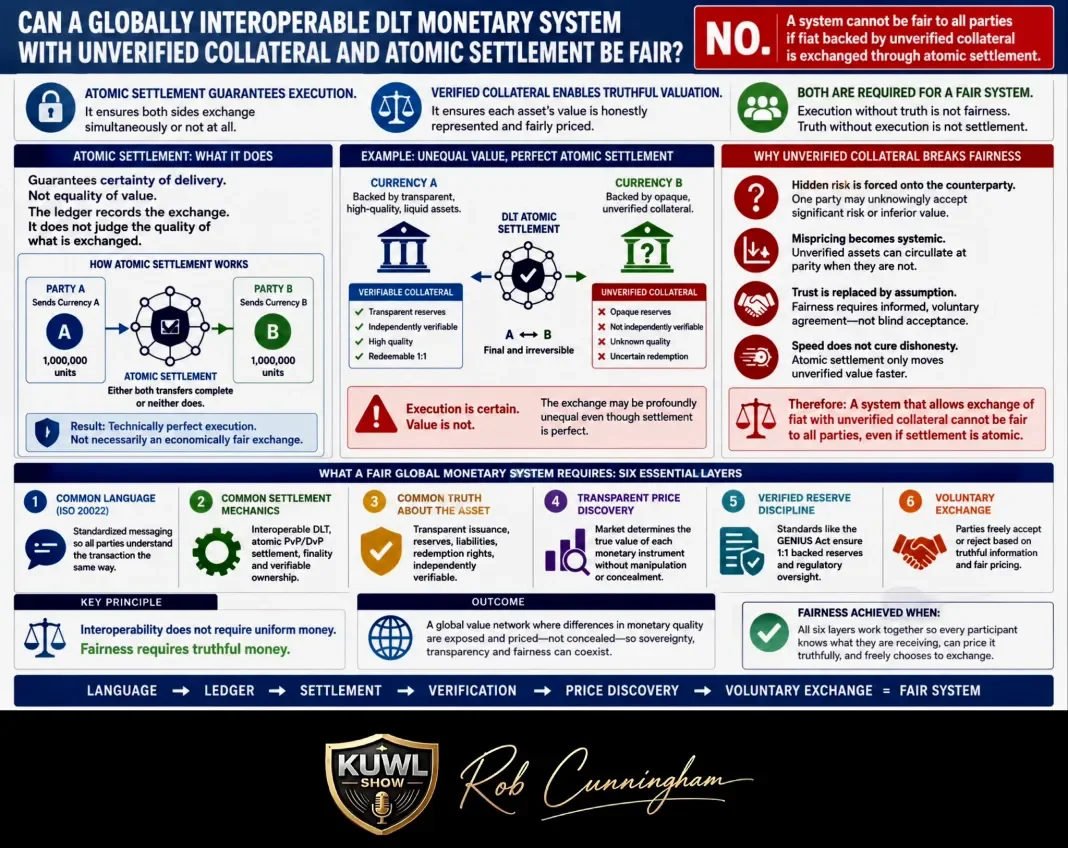
Source(s):
• https://x.com/KuwlShow/status/2089151868446421317
https://dinarchronicles.com/2026/08/17/rob-cunningham-all-in-or-no-level-playing-field/
************
Courtesy of Dinar Guru: https://www.dinarguru.com/
Militia Man They're talking about strengthening the position of the Iraqi dinar. If you're going to remove zeros, you're not strengthening anything - it's a redenomination. It's like a reverse split in stock. But when you add a Real Effective Exchange Rate to it, now we're talking about strengthening the position of the Iraqi dinar.
Reset Intelligence Saturday night in Baghdad, Iraq's Minister of Communications, Mustafa Sanad, went on the iNews channel and told the country that the decision has been issued. The currency is changing, and the zeros are coming off...Iraqi ministers do not freelance monetary policy on live television and keep their jobs. A statement like that only survives if the thing behind it is real, and nobody in Baghdad has walked it back. The economists on Iraqi airwaves spent Sunday arguing about how and when to do it, not about whether it exists. The formal announcement, when it comes, belongs to the Central Bank, and that is the piece we wait for...
Omar The decision has been made. The currency will change and the zeros removed...The new currency began arriving in Baghdad 10 days ago after it had been contracted for printing long ago. The surprise isn't in the removal of the zeros, but in the speed, suddenness and mechanism of the switch so that no time is left to convert trillions of hoarded dinar into real estate, gold or smuggling them out of our banking system...When they come to our banks we are trained to ask them where did you get this 3 zero notes from? And to prove to us the source of those 3-zero notes, then we will turn them into colored papers.
*************
Washington Quietly Puts Gold Back on Table , its Secret Plan
Daniela Cambone: 8-17-2026
“Gold is back in the conversation in ways it hasn’t been for decades.” With Washington openly talking about gold again, could a gold-backed currency be on the table?
Graham Summers breaks down the signals, and what they could mean for your money.
Chapters:
00:00 Wall Street becomes wary of gold
04:32 Link currency with gold?
06:29 Why hesitate to say gold is critical mineral
08:03 Can we catch up to China?
11:34 Why AI is critical
13:57 Thoughts on gold / silver movement
THE MEASURE : Rob Cunningham
THE MEASURE : Rob Cunningham
8-18-2026
What if the biggest breakthrough of 2026 isn’t AI, quantum computing, blockchain or digital currency? What if those are just tools?
What if the breakthrough is an idea humanity understood thousands of years ago:
HONEST MEASURES.
THE MEASURE : Rob Cunningham
8-18-2026
What if the biggest breakthrough of 2026 isn’t AI, quantum computing, blockchain or digital currency? What if those are just tools?
What if the breakthrough is an idea humanity understood thousands of years ago:
HONEST MEASURES.
What does a waitress earning $200 in tips have in common with a Wall Street executive moving $20 million? We all need the same thing: A measure of value we can trust.
Imagine combining that ancient principle with AI, quantum computing, digital assets and transparent global ledgers.
What happens when true value move as easily as information?
When technology removes friction instead of adding fees?
When machines handle complexity while humans retain agency?
When billions of people can create, exchange and collaborate far more freely?
And humanity discovers our greatest untapped resource isn’t gold, oil, money or even AI? What if it’s 7+ billion human imaginations? Builders. Dreamers. Inventors. Artists. Parents. Farmers. Entrepreneurs. Problem-solvers.
What happens when our financial technology becomes better at unleashing their creativity instead of constraining it? Maybe the future of money… isn’t really about money.
Maybe it’s about creating better ways to measure and exchange human value.
The principle is ancient.
The technology is extraordinary.
The possibilities are breathtaking.
I made THE MEASURE for the waitress and the Wall Street CEO and everyone between them. Watch with one question in mind:
What becomes possible when the measure finally tells the truth?
Seeds of Wisdom RV and Economics Updates Tuesday Morning 8-18-26
Good Morning Dinar Recaps,
Oil Shock Meets the Global Financial System: Bonds, Currencies and Central Banks Reprice Risk
August 18, 2026
The Iran conflict is no longer only an energy story. Rising oil prices are now colliding with elevated government debt, higher long-term bond yields and changing expectations for central-bank policy—creating a new test for the global financial architecture.
Brent crude has moved above $90 a barrel, while the U.S. 30-year Treasury yield has climbed above 5.3%, its highest level since 2007. At the same time, investors have reduced expectations for additional Federal Reserve rate increases. The unusual combination is forcing markets to reconsider how inflation, debt and geopolitical risk interact.
Good Morning Dinar Recaps,
Oil Shock Meets the Global Financial System: Bonds, Currencies and Central Banks Reprice Risk
August 18, 2026
The Iran conflict is no longer only an energy story. Rising oil prices are now colliding with elevated government debt, higher long-term bond yields and changing expectations for central-bank policy—creating a new test for the global financial architecture.
Brent crude has moved above $90 a barrel, while the U.S. 30-year Treasury yield has climbed above 5.3%, its highest level since 2007. At the same time, investors have reduced expectations for additional Federal Reserve rate increases. The unusual combination is forcing markets to reconsider how inflation, debt and geopolitical risk interact.
Overview
Oil is rising as uncertainty surrounding the Iran conflict and the Strait of Hormuz persists, increasing the risk that an energy shock could keep inflation elevated.
Long-term government bond yields are surging internationally, with U.S.,Japanese and European borrowing costs reaching multi-year or multi-decade highs.
Central banks face an increasingly difficult policy environment: weaker economic signals argue against aggressive tightening, while higher oil prices and rising long-term yields argue for caution.
Key Developments
1. Oil has become a financial-market problem
Brent crude moved above $90 a barrel as hopes for a near-term resolution involving Iran and the Strait of Hormuz weakened.
The significance goes beyond the price of gasoline.
Oil is an input into transportation, manufacturing, agriculture and virtually every major supply chain. A prolonged increase therefore has the potential to push inflation higher at precisely the moment central banks are trying to determine whether monetary policy can become less restrictive.
The energy market is once again becoming a transmission mechanism for global inflation.
2. The bond market is responding with higher long-term yields
The U.S. 30-year Treasury yield reached approximately 5.327% on August 18, its highest level since 2007.
This is particularly significant because we covered the Treasury's 5.216% 30-year auction yield yesterday.
The move above 5.3% means the bond market has continued repricing even after that auction.
Investors are demanding greater compensation for the combination of inflation risk, fiscal deficits, heavy government borrowing and geopolitical uncertainty.
This is no longer simply a Federal Reserve story. It is a sovereign-debt story.
3. The repricing is spreading around the world
The U.S. is not alone.
Long-term borrowing costs have been rising in Japan, Germany, Britain and other major markets, with several reaching levels not seen in years or even decades.
Japan's bond market is particularly significant because the country spent decades operating in an extremely low-rate environment.
The simultaneous movement across major sovereign markets suggests that investors are reassessing the cost of long-term government financing on a global rather than purely American basis.
4. Central banks face a difficult contradiction
The most important question may be what happens next with monetary policy.
Normally, weaker economic data can increase expectations for lower interest rates. But an oil shock creates the opposite problem because higher energy prices can reignite inflation.
That leaves central banks caught between two competing forces:
Slower economic growth → pressure to ease
Higher oil prices → pressure to remain restrictive
Higher long-term bond yields → tighter financial conditions regardless of short-term policy
This means a central bank could eventually lower its policy rate while households, businesses and governments still face relatively high long-term borrowing costs.
That is a very different environment from the post-2008 era of ultra-cheap money.
5. The dollar is showing that higher Treasury yields do not automatically mean a stronger dollar
Another important development is the behavior of the U.S. dollar.
The dollar remained near multi-month lows on Tuesday even as Treasury yields rose, while traders reduced expectations for additional Fed tightening.
That is worth watching.
It demonstrates that currency markets are responding to more than interest-rate differentials. Fiscal concerns, geopolitical risk, expectations for monetary policy and confidence in future economic conditions can all influence capital flows.
For foreign-currency holders, this is an important distinction.
Why It Matters
The emerging story is not simply "oil is going up."
It is the interaction between several markets:
Oil → inflation
Inflation → central-bank policy
Central-bank policy → bond yields
Bond yields → government financing costs
Debt costs → fiscal pressure
Fiscal pressure → currencies and capital flows
That creates a feedback system in which a geopolitical event in the Middle East can eventually influence borrowing costs, currencies and investment decisions around the world.
Why It Matters to Foreign Currency Holders
Foreign-currency markets are particularly sensitive to changes in interest-rate expectations and international capital flows.
If U.S. yields remain elevated, dollar assets can continue attracting global capital. But if investors simultaneously become concerned about U.S. fiscal sustainability or expect the Fed to ease, the dollar can behave differently from what a simple yield comparison would suggest.
Today's weaker dollar despite elevated Treasury yields is therefore an important signal.
Currency values are increasingly being shaped by the interaction of debt, monetary policy, energy and geopolitical risk—not by interest rates alone.
Implications for the Global Financial Reset
1. Debt
Higher long-term yields increase the cost of financing government debt. The longer yields remain elevated, the greater the pressure on governments to manage deficits and future borrowing requirements.
2. Central Banks
Central banks may have less freedom to respond to economic weakness if an energy shock keeps inflation elevated.
3. Currencies
Currency markets are being forced to price the competing effects of higher yields, geopolitical uncertainty, inflation and changing expectations for central-bank policy.
4. Trade Architecture
A prolonged disruption around the Strait of Hormuz demonstrates how physical trade routes and financial markets are interconnected. Energy security is becoming an increasingly important component of economic and monetary security.
5. Global Finance
The financial system is being tested by a combination of high sovereign debt, elevated borrowing costs and geopolitical fragmentation. The resulting repricing could influence where global capital flows and how countries manage reserves, currencies and trade.
What to Watch
• Brent crude and whether oil remains above $90.
• The U.S. 30-year Treasury yield and whether it remains above 5.3%.
• Developments involving the Strait of Hormuz and U.S.-Iran negotiations.
• Federal Reserve communications and changing expectations for September policy.
• The U.S. dollar's response to rising Treasury yields.
• Japanese and European sovereign bond yields for evidence that the repricing remains global.
• Whether higher energy prices begin appearing more clearly in inflation expectations.
Bottom Line
The significance of today's market action is not that oil has risen or that Treasury yields have reached another high.
It is the collision between the two.
The world is confronting an energy shock at a time when governments are already carrying historically large debt loads and investors are demanding higher returns to finance them.
That creates a difficult environment for central banks.
They may want to support economic growth, but higher oil prices can keep inflation elevated. They may want to reduce interest rates, but the bond market can independently push long-term borrowing costs higher.
And governments cannot simply ignore those higher borrowing costs when they must continually refinance and issue new debt.
Why This Could Be a Global Financial Reset Signal
A financial reset does not necessarily begin with the introduction of a new currency or the collapse of an existing system.
It can begin with a repricing of risk.
The world is moving away from the assumption that governments can borrow indefinitely at exceptionally low rates while central banks can easily stabilize every shock.
At the same time, geopolitical fragmentation is encouraging countries to reconsider energy security, reserve diversification, trade settlement and dependence on any single financial system.
The result is not yet a replacement for the existing global financial architecture.
It is something more subtle: the underlying economics that support that architecture are changing.
Closing Perspective
The next major phase of the global financial reset may not come from a new currency—it may emerge from the collision between energy, sovereign debt and the limits of central-bank policy.
Seeds of Wisdom Team
Newshounds News™ Exclusive
Sources
Reuters — U.S. 30-year yields hit highest level since 2007 as war, oil worries fester
Reuters — Selling grips bond markets from U.S. to Japan as inflation, fiscal worries take hold
~~~~~~~~~~
🌱 A Message to Our Currency Holders🌱
If you’ve been holding foreign currency for many years, you were not foolish.
You were not wrong to believe the global financial system would change.
What failed was not your patience — it was the information you were given.
For years, dates, rumors, and personalities replaced facts, structure, and proof. “This week” predictions created cycles of hope and disappointment that were never based on how currencies actually change.
That is not your failure.
Our mission here is different: • No dates • No rates • No hype • No gurus
Instead, we focus on:
• Verifiable developments • Institutional evidence
• Global financial structure • Where countries actually sit in the process
Currency value changes only come after sovereignty, trade, banking, settlement systems, and fiscal coordination are in place. History and institutions confirm this sequence.
You will see silence. You will see denials. That is not delay — that is discipline.
Protect your identity. Organize your documents. Verify everything.
Never hand your discernment to anyone who cannot show proof.
You deserve truth — not timelines.
Seeds of Wisdom Team
Newshounds News
~~~~~~~~~~
Seeds of Wisdom Team RV Currency Facts Youtube and Rumble
Newshound's News Telegram Room Link
RV Facts with Proof Links Link
RV Updates Proof links - Facts Link
Start Here room with Most Asked Questions Link
Follow the Gold/Silver Rate COMEX
Follow Fast Facts
Seeds of Wisdom Team™ Website
Thank you Dinar Recaps