
Thank you to all the subscribers to our Early Access program…we thank you for your continued support.
We are excited to offer this new service to keep you informed and up-to-date on the latest Dinar and currency news.
Gold at $42.22 and "One of the Great Mysteries" | Phillip Magness
Gold at $42.22 and "One of the Great Mysteries" | Phillip Magness
Kitco News: 8-4-2026
Economic historian Phillip Magness tells Kitco News anchor Jeremy Szafron that Americans who surrendered gold in 1933 at $20.67 an ounce got none of the gain when Washington repriced it at $35 less than ten months later.
"It's always the private sector that gets the bad end of it." America's 261.5 million ounces are still carried on the federal books at $42.22 an ounce, about $11 billion against more than $1 trillion at market.
Gold at $42.22 and "One of the Great Mysteries" | Phillip Magness
Kitco News: 8-4-2026
Economic historian Phillip Magness tells Kitco News anchor Jeremy Szafron that Americans who surrendered gold in 1933 at $20.67 an ounce got none of the gain when Washington repriced it at $35 less than ten months later.
"It's always the private sector that gets the bad end of it." America's 261.5 million ounces are still carried on the federal books at $42.22 an ounce, about $11 billion against more than $1 trillion at market.
Economic historian Phillip Magness tells Kitco News anchor Jeremy Szafron that Americans who surrendered gold in 1933 at $20.67 an ounce got none of the gain when Washington repriced it at $35 less than ten months later. "It's always the private sector that gets the bad end of it."
America's 261.5 million ounces are still carried on the federal books at $42.22 an ounce, about $11 billion against more than $1 trillion at market. Magness traces the line from the 1933 gold surrender and the Gold Reserve Act through Bretton Woods, the 1971 Nixon shock and the Smithsonian Agreement, to the accounting price still sitting on the federal books today.
Two billion dollars of the Treasury's 1934 revaluation gain went into the Exchange Stabilization Fund, which the Treasury can still use in currency markets. Magness calls the $42.22 valuation "one of the great mysteries that comes out of the Nixon era."
Also in the interview: whether anyone holding coins participates when a government reprices its gold, what would actually have to happen for a revaluation to become money the government could spend, why revaluation keeps returning whenever Washington wants financial room without raising taxes, how much public warning there was in 1933, and the single condition Magness says made it possible.
Plus why Spain grew poorer despite receiving enormous quantities of New World bullion, and when America's gold was last independently audited.
00:00 1933: AMERICANS ORDERED TO SURRENDER GOLD
01:46 HOW THE 1933 GOLD ORDER WORKED
03:12 WHY FDR BROKE THE GOLD LINK
05:51 PHYSICAL GOLD VS. PAPER CLAIMS
07:36 THE $2.8 BILLION GOLD REVALUATION GAIN
09:15 FROM BRETTON WOODS TO THE NIXON SHOCK
13:03 WHEN GOLD WAS MISTAKEN FOR NATIONAL WEALTH
16:54 WHY U.S. GOLD IS STILL BOOKED AT $42.22
20:21 WHO CAPTURED THE REVALUATION GAIN?
23:40 REVALUING GOLD TO HELP FUND BITCOIN?
25:59 HOW MUCH WARNING DID AMERICANS RECEIVE?
27:20 EMERGENCY POWERS THEN AND NOW
29:04 THE FORT KNOX AUDIT DEBATE
31:18 WHY CENTRAL BANKS ARE BUYING GOLD
32:20 WHAT HAPPENS WHEN MONEY LOSES TRUST?
34:15 COPPER AND THE RETURN OF MERCANTILISM
39:33 WHAT GOLD HOLDERS SHOULD LEARN FROM 1933
Iraq Economic News and Points To Ponder Tuesday Evening 8-4-26
Currency Printing Is Knocking On Iraq's Door... Warnings Of An Economic Catastrophe
August 4, 2026 Last updated: Al-Mustaqilla/- Al-Mada newspaper revealed in a report followed by “Al-Mustaqilla”, the escalation of the financial liquidity crisis in Iraq, after the Parliamentary Finance Committee proposed the option of resorting to printing currency to secure employee salaries and avoid a financial crisis that some MPs described as potentially leading to a “revolt of hungry stomachs”, at a time when economists warn that this option may open the door to a dangerous wave of inflation if it is not accompanied by a real increase in production.
Currency Printing Is Knocking On Iraq's Door... Warnings Of An Economic Catastrophe
August 4, 2026 Last updated: Al-Mustaqilla/- Al-Mada newspaper revealed in a report followed by “Al-Mustaqilla”, the escalation of the financial liquidity crisis in Iraq, after the Parliamentary Finance Committee proposed the option of resorting to printing currency to secure employee salaries and avoid a financial crisis that some MPs described as potentially leading to a “revolt of hungry stomachs”, at a time when economists warn that this option may open the door to a dangerous wave of inflation if it is not accompanied by a real increase in production.
According to the report, Jamal Kojar, a member of the parliamentary finance committee, said that printing currency has become one of the options being considered to overcome the current liquidity crisis, despite the awareness of the economic risks involved. He explained that the government is facing a time gap due to the delay in receiving oil revenues, which are received two or three months after the sales.
Kujer explained that the options available to the government have become limited, noting the difficulty of relying on recovering funds from corruption cases within a short period, as well as the fact that increasing non-oil revenues or activating other resources requires a long time.
He explained that the halt or decline in export activity as a result of security and regional developments has directly affected revenues, noting that Iraq is now facing difficulty in maintaining normal export levels, which has led to significant pressure on government liquidity.
The report indicated that the Finance Committee believes the government faces difficult choices between using part of the cash reserve or taking exceptional measures to provide the necessary funds for operational expenses, primarily employee salaries.
In contrast, economic experts warned of the dangers of printing money without real economic growth, stressing that the problem facing Iraq is not financial bankruptcy, but rather mismanagement of resources and excessive reliance on oil as a primary source of revenue.
Economic expert Jalil Al-Lami said that Iraq possesses significant financial resources, including foreign reserves, gold reserves, and a huge oil wealth, but the problem lies in the structure of the economy, which relies heavily on oil in contrast to weak non-oil revenues and high operational spending.
Al-Lami warned that issuing large quantities of currency without increasing production will lead to higher inflation, a decline in the purchasing power of the dinar, and an increase in demand for the dollar, which may be reflected in the prices of goods and local markets.
He pointed out that the experiences of countries such as Zimbabwe and Venezuela have shown the danger of resorting to printing money as a solution to financial crises, stressing that this measure could turn from an attempt to address a temporary crisis into a cause of a deeper economic crisis.
Economists have suggested other alternatives, including domestic borrowing through government bonds, reprioritizing spending, strengthening tax and customs revenue collection, increasing oil exports, and activating the private sector.
The controversy over printing currency comes at a time when the Iraqi economy is facing increasing pressure due to its heavy reliance on oil revenues and the ballooning wage bill and operating expenses, amid warnings that continuing to address crises temporarily without structural reforms could exacerbate financial challenges in the coming period.
https://mustaqila.com/طباعة-العملة-تطرق-باب-العراق-تحذيرات-م/
An Economist Says Iraq Has Entered A Phase Of "Paying The Price" As A Result Of Accumulated Mismanagement And Corruption - Urgent
Baghdad Today - Baghdad
Economic expert Ziad Al-Hashemi said on Tuesday (August 4, 2026) that Iraq has entered a phase of "paying the price" for what he described as the accumulation of failures, corruption and mismanagement over more than twenty years, considering that the current crisis is the result of the policies of successive governments, in addition to the responsibility of political parties, parliament and oversight institutions.
Al-Hashemi said, in a statement followed by “Baghdad Today”, that financial and administrative losses and failures have accumulated during the past years without real treatment, accusing political forces of being preoccupied with “dividing the spoils”, while the regulatory and legislative bodies were unable or negligent in performing their role in accountability and reform.
He added that, in his view, the responsibility is not limited to governments, but extends to the parliament that approved large budgets, the political forces that dealt with the state according to the logic of power-sharing, as well as regulatory institutions, elites, media and the public, some of whom he said contributed, to varying degrees, to the continuation of the existing approach.
Al-Hashemi pointed out that Iraq is not facing a temporary liquidity crisis, but rather is going through the repercussions of what he described as an economic and political system that relied on quotas, corruption and buying loyalties, considering that the reform opportunities that were available during the years of financial abundance were not invested in building a diversified economy that is more capable of facing crises.
He warned that continuing to address the crisis through borrowing or postponing payments, without implementing structural reforms, could prolong the economic challenges, stressing that the cost of this would be borne by the citizens.
Economic and political experts offer differing views on the causes of the crisis and ways to address it, amid repeated calls for the implementation of financial and economic reforms, diversification of income sources, and a reduction in dependence on oil. https://baghdadtoday.news/304321-.html
Salary Delays Are Putting Pressure On The Iraqi Economy; Warnings Of A Widening Cost-Of-Living Crisis And Market Contraction.
Baghdad Today - Special: The debate in Iraq is renewed with every delay in paying the salaries of state employees, amid warnings of economic and social repercussions that go beyond the employees to affect the markets, the private sector and the entire local economy.
Experts confirm that salaries represent the main driver of financial liquidity in the country, so any disruption in their disbursement directly affects trade and the purchasing power of citizens. Economic expert Nasser Al-Tamimi warned today, Tuesday (August 4, 2026), against the continued delay in disbursing the salaries of state employees, stressing that this crisis has become a direct threat to economic and social stability, with the accompanying negative repercussions on the livelihood of millions of citizens and economic activity in the country.
Al-Tamimi told Baghdad Today that “the delay in paying salaries is no longer just a temporary financial measure, but has turned into a recurring crisis that casts its shadow on the markets, the private sector and trade, in addition to its direct repercussions on the ability of families to meet their basic needs and fulfill their financial obligations.”
He explained that “the continuation of the crisis during the next stage will lead to a decline in the purchasing power of citizens, a contraction of economic activity, and an increase in personal debt rates, as well as an increase in psychological and social pressures on the segment of employees, which represents one of the basic pillars of the national economy.”
He added that "the delay in salaries also affects the performance of government institutions, as a result of the decline in job security and morale of employees, which may affect the level of services provided to citizens and weaken the efficiency of administrative performance."
Al-Tamimi stressed that “the concerned authorities must expedite addressing the causes of the crisis and put in place financial and administrative mechanisms that ensure the regular disbursement of salaries according to the specified dates, as the stability of salaries represents a fundamental factor in strengthening confidence in the economy, supporting local markets, and maintaining social stability.”
He added that "addressing the issue of salaries should be a national priority, given its direct link to economic and social security. We must also be wary that continued delays will double the size of the economic challenges and increase the suffering of citizens in the coming months."
Public sector employees constitute the largest proportion of the workforce in Iraq, and a large segment of families depend on government salaries as a primary source of income, making the regularity of their disbursement a key factor in the stability of local markets.
In recent years, delays in salary payments have become frequent in some months due to financial and administrative challenges and liquidity management procedures, raising concerns about effects extending to the commercial and service sectors, with declining consumer spending and increased living pressures on citizens.
https://baghdadtoday.news/304355-.html
Al-Bayati: Four Files Are On The Table For Hosting The Minister Of Finance, Most Notably Employee Salaries.
Information/Baghdad… MP Mohammed Al-Bayati predicted on Tuesday that the Minister of Finance would be hosted next week, noting that four issues would be on the agenda for the meeting.
Al-Bayati explained in his interview with Al-Maalouma that “the financial situation in the country needs an objective reading to identify its challenges and propose solutions and alternatives, especially securing the salaries of Iraqi state employees and all ministries and institutions, especially with the delay in distributing the salaries of some ministries and bodies.”
He added that "the Minister of Finance may be hosted next week, and four files will be presented during it, most notably the financial balance, what alternatives are available, what the Ministry's approved plan is for the coming period, and solutions to it will be presented."
He stressed that "this file is very important, and the Ministry of Finance's assessment of the country's financial situation is crucial, as it will provide a roadmap for the nature of the current challenges." End/25
Seeds of Wisdom RV and Economics Updates Tuesday Evening 8-4-26
Good Evening Dinar Recaps,
Bond Market Warning: Rising Treasury Yields Signal Growing Pressure on the Global Financial System
While stock markets remain near record highs, rising Treasury yields are revealing deeper concerns about government debt, inflation, and the long-term stability of the global financial system.
Good Evening Dinar Recaps,
Bond Market Warning: Rising Treasury Yields Signal Growing Pressure on the Global Financial System
While stock markets remain near record highs, rising Treasury yields are revealing deeper concerns about government debt, inflation, and the long-term stability of the global financial system.
Overview
The U.S. Treasury market is sending warning signals as long-term bond yields remain near their highest levels since 2007, despite continued strength in equity markets.
Investors are demanding higher returns to finance growing government debt,raising questions about how long governments can continue borrowing without significantly increasing interest costs.
Because U.S. Treasuries serve as the foundation of the global financial system,sustained pressure in the bond market could influence everything from mortgage rates and business lending to currency values and global capital flows.
Key Developments
1. Treasury Yields Remain Near Multi-Year Highs
The 30-year U.S. Treasury yield continues trading near levels not seen since 2007, reflecting persistent concerns about inflation, fiscal deficits, and the growing supply of government debt.
Higher Treasury yields increase borrowing costs across the economy, affecting households, businesses, and governments alike.
2. Government Debt Is Becoming a Larger Market Concern
Investors are increasingly questioning how much additional debt governments can issue before markets demand substantially higher interest rates.
As debt issuance expands, governments must devote a larger share of future budgets to interest payments, placing additional strain on public finances.
3. Federal Reserve Faces a Difficult Balancing Act
Bond traders continue watching the Federal Reserve's inflation strategy closely.
If inflation remains above target, policymakers may need to maintain higher interest rates for longer. If economic growth slows too rapidly, pressure could build for future rate cuts. Either outcome carries important implications for financial markets.
4. Stocks and Bonds Are Sending Different Messages
One of today's most notable developments is the contrast between asset classes.
While U.S. stock indexes remain near record highs, Treasury market volatility suggests many institutional investors remain cautious about longer-term economic risks.
This divergence often attracts close attention because bond markets frequently react to underlying financial conditions before equity markets fully adjust.
5. Global Investors Continue Watching U.S. Debt Markets
The U.S. Treasury market remains the benchmark for global finance.
Central banks, sovereign wealth funds, pension funds, and institutional investors around the world rely on Treasury securities as a cornerstone of reserve management and portfolio allocation. Changes in Treasury yields therefore influence borrowing costs and investment decisions far beyond the United States.
Why It Matters
Although equity markets often receive the most attention, the Treasury market is widely considered the foundation of the global financial system. Rising yields affect mortgages, corporate financing, consumer credit, government borrowing, and international investment flows.
Persistent pressure in bond markets may also complicate monetary policy by limiting how aggressively central banks can lower interest rates if economic conditions weaken.
Why It Matters to Foreign Currency Holders
Higher Treasury yields can attract international capital into U.S. dollar assets.
Changes in interest rate expectations often influence global exchange rates.
Government borrowing costs affect long-term fiscal stability and investor confidence.
Currency values may become more volatile as global investors adjust portfolios in response to changing bond yields.
Implications for the Global Reset
Pillar: Debt
Growing government borrowing and higher Treasury yields highlight the increasing challenge of financing expanding national debt. Markets are demanding greater compensation for lending, underscoring the importance of sustainable fiscal policies in the years ahead.
Pillar: Assets
Treasury securities remain one of the world's most important financial assets. Shifts in bond yields influence valuations across stocks, real estate, currencies, and other asset classes, reinforcing the Treasury market's central role in global capital allocation.
Conclusion
Today's Treasury market signals suggest that investors remain focused on long-term structural risks, even as equity markets continue performing well. Rising yields reflect growing attention to inflation, fiscal deficits, and the sustainability of government borrowing.
Whether these pressures ease or intensify will depend largely on future inflation data, Federal Reserve policy, and investor confidence in the government's fiscal outlook.
This is not simply about rising Treasury yields—it reflects the broader challenge of financing growing government debt while preserving confidence in the global financial system, a critical component of the ongoing modernization and restructuring of international finance.
Seeds of Wisdom Team
Newshounds News™ Exclusive
Sources
MarketWatch — "Traders in the World's Most Important Financial Market Are Bracing for a Wild Stretch Ahead"
Reuters — "Global Markets: Investors Watch Treasury Yields, Inflation and Central Bank Outlook"
~~~~~~~~~~
Seeds of Wisdom Team RV Currency Facts Youtube and Rumble
Newshound's News Telegram Room Link
RV Facts with Proof Links Link
RV Updates Proof links - Facts Link
Start Here room with Most Asked Questions Link
Follow the Gold/Silver Rate COMEX
Follow Fast Facts
Seeds of Wisdom Team™ Website
Thank you Dinar Recaps
Ross: The Thing about the Clarity Act
Ross: The Thing about the Clarity Act
8-4-2026
In 2030 and beyond everyone is going to look back in hindsight at how primitive it seems to consider that in just 2026, the crypto industry was held back as long as it was due simply to a lack of regulation.
There is a nuclear explosion of growth pending in this market.
We’ve seen nothing yet.
Ross: The Thing about the Clarity Act
8-4-2026
In 2030 and beyond everyone is going to look back in hindsight at how primitive it seems to consider that in just 2026, the crypto industry was held back as long as it was due simply to a lack of regulation.
There is a nuclear explosion of growth pending in this market.
We’ve seen nothing yet.
Shocking amount of change on the horizon.
Ash Crypto: BREAKING:Bernstein says the SEC and CFTC will speed up crypto rulemaking if the CLARITY Act fails. One way or another, crypto clarity is coming.
Thing about the Clarity Act is that even if it passes the Senate, we still wait on the recess for the House to pass it again, then Trump signs, then we wait til:
“Most provisions of the CLARITY Act (Digital Asset Market Clarity Act of 2025, H.R. 3633) are written to take effect 360 days after the date of enactment (signing into law), with adjustments for rulemaking-dependent sections.”
Unless they expedite it.
So the waiting is real but so is the hype.
There’s no denying that the passage will spark the last speculation fueled bullrun in advance of the mass adoption of crypto’s true utility.
That will definitely help pass the time.
The world is watching.
Countries around the world are advancing forward knowing that asset-backed sound money is on the horizon.
A level playing field is imminent in the grand scheme of things.
Kale Halen: The Darkest Hour Comes Before Dawn…….Okay since a few people have commented that they're exhausted by all of this, I felt like I should add a little perspective. First off, I completely understand. Believe me... I'm more than ready too. That said, I still think there's a legitimate chance the CLARITY Act gets passed before recess, especially now that Senator Thune has said they're going to give it their best shot. It would kinda mirror the last minute Genius Act passage. But let's also be honest... None of us knows when or exactly how this all unfolds. If there's one thing we've learned over the years, it's to stop listening to people who claim they know the exact weekend or sequence of events. We've seen those predictions come and go. So yes, I believe Congress still has an opportunity to do the right thing. Trump has consistently given people the chance to make the right decision before another path becomes necessary. But if they don't... History often takes the other more dramatic route: Crisis. Reaction. Solution. Major reforms rarely happen without enough pressure building first, and right now, the world seems to be at boiling point. Lastly, as I've also been saying for the month of August, many astrological and spiritual traditions view this time as a season of renewal, new beginnings, and stepping into a new chapter. Especially with the rising of Sirius and the 8/8 Lion's Gate symbolizing exactly that. Whether you see it as spiritual or simply symbolic, I love the message. Regardless, I'm choosing excitement over anxiety. NCSWIC

Seeds of Wisdom RV and Economics Updates Tuesday Afternoon 8-4-26
Good Afternoon Dinar Recaps,
Hormuz Breakthrough? U.S.–Iran Talks Spark Global Market Optimism
Signs of a possible U.S.–Iran agreement are easing fears over the Strait of Hormuz, sending oil lower, boosting global markets, and raising hopes for improved financial stability.
Good Afternoon Dinar Recaps,
Hormuz Breakthrough? U.S.–Iran Talks Spark Global Market Optimism
Signs of a possible U.S.–Iran agreement are easing fears over the Strait of Hormuz, sending oil lower, boosting global markets, and raising hopes for improved financial stability.
Overview
• Treasury Secretary Scott Bessent indicated the United States could reach an agreement with Iran "today or tomorrow," signaling that diplomatic negotiations remain active despite recent military tensions.
• Financial markets reacted immediately, with oil prices falling, global stock markets advancing, and Treasury yields easing as investors anticipated reduced inflation risks if energy supplies remain secure.
• Because the Strait of Hormuz is one of the world's most important energy corridors, any lasting agreement could have significant implications for inflation, interest rates, trade, and the broader global financial system.
Key Developments
1. Diplomatic Momentum Builds
Treasury Secretary Scott Bessent's comments marked one of the strongest public indications yet that negotiations with Iran may be approaching a meaningful breakthrough.
Although no agreement has been finalized, markets interpreted the remarks as a sign that both sides continue pursuing a diplomatic solution rather than further escalation.
2. Markets Respond Immediately
Investors quickly adjusted expectations following the diplomatic news.
Oil prices declined sharply as fears of supply disruptions eased.
Global stock markets rallied on expectations of lower inflation.
U.S. Treasury yields moved lower as investors anticipated reduced pressure on future interest rates.
The market reaction demonstrates how closely investors continue to monitor developments surrounding the Strait of Hormuz.
3. The Strait of Hormuz Remains Critical
The Strait of Hormuz transports approximately one-fifth of the world's seaborne oil exports, making it one of the most strategically important waterways on Earth.
Any improvement in regional stability reduces concerns over shipping disruptions, strengthens confidence in global energy supplies, and helps stabilize transportation costs throughout the global economy.
4. Inflation Outlook Improves
Lower oil prices could provide welcome relief after months of energy-driven inflation concerns.
Cheaper energy generally lowers:
Transportation costs
Manufacturing expenses
Consumer fuel prices
This reduces inflationary pressure throughout the economy and gives central banks greater flexibility when setting monetary policy.
5. Global Financial Implications Extend Beyond Energy
While today's headlines center on diplomacy, the implications reach much further.
Stable energy markets support:
Stronger economic growth
Lower government borrowing costs
Improved investor confidence
Greater stability in currency and bond markets
These developments could influence monetary policy decisions well beyond the Middle East.
Why It Matters
The significance of today's developments extends far beyond oil markets. Energy prices influence nearly every sector of the global economy, affecting inflation, consumer spending, business investment, interest rates, and government finances.
If diplomatic progress continues and shipping through the Strait of Hormuz remains secure, policymakers could face less pressure to maintain restrictive monetary policies, supporting broader global economic stability.
Why It Matters to Foreign Currency Holders
Lower energy prices can reduce inflation pressures that influence exchange rates.
More stable global trade supports stronger international capital flows.
Central banks may gain greater flexibility if inflation continues to moderate.
Currency markets often respond positively when geopolitical risks decline and investor confidence improves.
Implications for the Global Reset
Pillar: Energy
The Strait of Hormuz remains one of the world's most vital energy corridors. A durable diplomatic agreement would strengthen global energy security while reducing one of the largest geopolitical risks facing financial markets.
Pillar: Trade
Safer maritime shipping lowers transportation costs, strengthens supply chains, and improves confidence in international commerce. Reliable trade routes remain essential to long-term global economic growth.
Pillar: Debt
Lower oil prices help reduce inflation, easing pressure on central banks to maintain higher interest rates. Lower borrowing costs can improve government fiscal conditions while reducing financial strain on businesses and consumers.
Conclusion
Today's market reaction illustrates how closely the global financial system remains tied to developments in the Middle East. A single diplomatic breakthrough can influence oil prices, inflation expectations, interest rates, equity markets, and government borrowing costs within hours.
While negotiations remain ongoing, investors are increasingly optimistic that diplomacy may prevent further disruptions to one of the world's most important energy corridors.
This is not simply about a potential agreement between the United States and Iran—it reflects how energy security, global trade, inflation, and monetary policy remain deeply interconnected in the ongoing modernization and restructuring of the global financial system.
Seeds of Wisdom Team
Newshounds News™ Exclusive
Sources
Reuters — "Global Markets React as U.S.–Iran Diplomatic Hopes Rise"
Wall Street Journal — “Bessent: Could Have a Deal With Iran Today or Tomorrow”
~~~~~~~~~~
Seeds of Wisdom Team RV Currency Facts Youtube and Rumble
Newshound's News Telegram Room Link
RV Facts with Proof Links Link
RV Updates Proof links - Facts Link
Start Here room with Most Asked Questions Link
Follow the Gold/Silver Rate COMEX
Follow Fast Facts
Seeds of Wisdom Team™Website
Thank you Dinar Recaps
Iraq Economic News and Points To Ponder Tuesday Afternoon 8-4-26
Oil Rebounds On Renewed Middle East Tensions
2026-08-04 Shafaq News Oil prices rebounded 1% on Tuesday from a plunge in the previous session, fuelled by concerns that Middle East supply remains at risk as a diplomatic resolution to the U.S.-Iran war that has disrupted shipments still seems unlikely.
Front-month Brent futures rose $1.12, or 1.3%, to $84.89 a barrel by 0355 GMT after dropping 7% in the previous session to a three-week low.
Oil Rebounds On Renewed Middle East Tensions
2026-08-04 Shafaq News Oil prices rebounded 1% on Tuesday from a plunge in the previous session, fuelled by concerns that Middle East supply remains at risk as a diplomatic resolution to the U.S.-Iran war that has disrupted shipments still seems unlikely.
Front-month Brent futures rose $1.12, or 1.3%, to $84.89 a barrel by 0355 GMT after dropping 7% in the previous session to a three-week low.
U.S. West Texas Intermediate (WTI) crude was up 77 cents, or 1%, at $81.11 after falling more than 5% in the previous session to stand at its lowest in nearly a week.
Prices dropped after U.S. President Donald Trump said on Sunday he was holding off on new attacks on Iran pending ongoing talks to end their war and settle claims over control of the key Strait of Hormuz.
The strategic waterway, which connects Gulf oil producers to global markets, was a channel for about a fifth of global shipments of crude oil and natural gas before the conflict.
However, on Monday, Iran's Foreign Ministry spokesman Esmail Baghaei rejected Trump's claim, saying no negotiations with the U.S. were taking place and no meetings were scheduled.
"The scale of the sell-off seems fairly overdone, given that there's still considerable uncertainty. We’ve been in this situation multiple times before, only to see things unravel," ING analysts said in a note.
"And with Iran denying that any talks are underway and Trump issuing warnings if no deal materialises, the backdrop clearly leaves ample room for a renewed escalation."
The Hormuz dispute is a central sticking-point in talks. Washington says the memorandum of understanding agreed in June required Iran to open the waterway, while Tehran says the text explicitly preserved its authority.
Analysts at Barclays said crude oil and refined product net exports through the strait averaged 4.2 million barrels per day in the week ended July 31, versus 3.2 million the previous week.
In the Red Sea, six Saudi-flagged supertankers changed course in the Gulf of Aden recently for southern Africa, while two tankers laden with Saudi oil crossed the Bab el-Mandeb Strait, shipping data showed on Monday.
Shipping traffic at the key Gulf waterways of Bab el-Mandeb and the Strait of Hormuz held largely unchanged at the start of the week.
Hormuz remains dangerous for vessels. On Tuesday, the United Kingdom Maritime Trade Operations agency flagged an incident 20 nautical miles (37 km) northeast of Oman's Al Khasab, after a cargo vessel broadcast over VHF channel 16 that it had been hit by an unknown projectile.
"While the fighting between Saudi Arabia and the Houthis has not completely halted energy flows, it has forced longer voyage times, higher insurance costs and occasional diversions," said Tim Waterer, chief market analyst at KCM Trade.
"With the Strait of Hormuz, it keeps a dual-chokepoint risk in the market that prevents oil from fully unwinding its geopolitical premium." (Reuters) https://www.shafaq.com/en/Economy/Oil-rebounds-on-renewed-Middle-East-tensions
Gold Rises As Markets Await Fed Clues
2026-08-04 Shafaq News Gold nudged higher on Tuesday as investors weighed mixed signals on potential U.S.-Iran talks and awaited a series of U.S. labour market reports for clues on the Federal Reserve's interest rate trajectory.
Spot gold rose 0.2% to $4,062.41 per ounce by 0504 GMT. U.S. gold futures rose 0.7% to $4,117.50.
Reports on U.S. labour market due this week include job opening data later in the day, the ADP employment report on Wednesday and nonfarm payrolls figures on Friday.
"Gold is currently in a consolidation phase. If we see weakness in the job market, it could pressure the U.S. dollar and as result there will be gains in gold," said Ajay Kedia, director at Mumbai-based Kedia Commodities.
U.S. President Donald Trump said talks with Iran were under way, warning of a "last chance" for Tehran to sign a good deal, but Iran denied that negotiations were being held or planned.
The conflict has driven up energy costs and stoked inflation fears, which could prompt central banks to raise interest rates to keep price pressures in check.
While gold is seen as an inflation hedge, higher rates tend to weigh on the metal as it yields no interest.
Traders currently price in a 65% chance of a rate hike in September after a divided Fed maintained the status quo at its last policy meeting.
If bets for a September rate-hike ease, it will support gold prices, Kedia said.
Federal Reserve Bank of New York President John Williams said he remained optimistic that inflation pressures are on track to ease gradually, but if they don't, the U.S. central bank will not hesitate to respond with rate hikes.
Citi said in a note that it expects gold prices to stagnate or even decline over the next month, before rallying to $4,500 in the fourth quarter and to $5,000 by the first half of next year.
Spot silver gained 1.2% to $58.89 per ounce, platinum firmed 0.9% to $1,641.96 and palladium rose 0.9% to $1,275.83. (Reuters) https://www.shafaq.com/en/Economy/Gold-rises-as-markets-await-Fed-clues
Basrah Crude Prices Fall With Gains In Global Oil Markets
2026-08-04 Shafaq News- Baghdad Iraq's Basrah crude prices posted notable losses on Tuesday, even as global oil prices moved higher, according to oil price data reviewed by Shafaq News.
Basrah Heavy crude fell to $51.76 per barrel, down $4.45, or 7.92%, while Basrah Medium crude dropped to $54.06 per barrel, down $4.45, or 7.61%, compared to the previous session.
Brent futures rose $1.12, or 1.3%, to $84.89 a barrel by 0355 GMT. US West Texas Intermediate crude gained 77 cents, or 1%, to $81.11 a barrel.
The gains came amid continued uncertainty over talks aimed at ending the US-Iran conflict and lingering concerns over the security of Middle East oil supplies.
https://www.shafaq.com/en/Economy/Basrah-crude-prices-fall-with-gains-in-global-oil-markets
USD/IQD Holds Ground In Baghdad, Advances In Erbil
2026-08-04 Shafaq News- Baghdad/ Erbil The US dollar edged higher in Erbil as trading opened on Tuesday, while Baghdad's Al-Kifah and Al-Harithiya currency exchanges were closed due to the Arbaeen holiday.
According to Shafaq News market survey, some exchange shops in Baghdad sold the US dollar at 152,250 dinars per 100 dollars and bought it at 151,250 dinars.
In Erbil, the dollar sold for 152,900 dinars per 100 dollars and bought for 152,750 dinars.
The official exchange rate set by the Central Bank of Iraq stands at 132,000 dinars per 100 dollars.
https://www.shafaq.com/en/Economy/USD-IQD-holds-ground-in-Baghdad-advances-in-Erbil
Iraq Tops Arab Oil, Gas Agreements In July
2026-08-04 Shafaq News- Baghdad Iraq signed the Arab world’s largest oil and gas deals in July 2026, topping regional energy investment with projects aimed at boosting production and expanding infrastructure, Washington-based energy research platform ATTAQA reported.
Baghdad ranked first after reaching agreements with US companies to advance nine oil fields across Kirkuk, Diyala, Basra, and Dhi Qar. The projects involve ConocoPhillips, Chevron, Halliburton, and HKN Energy and support the government’s goal of raising crude output to 6 million barrels per day, increasing associated gas production, and improving operational efficiency.
The contracts were concluded during Prime Minister Ali Al-Zaidi’s July visit to Washington, where Iraq also reached broader understandings with US companies covering infrastructure and technology.
Oman joined the list with oil field and tanker projects, while Qatar secured contracts for Libya’s Ghadames Basin and the Baleine offshore field in Côte d’Ivoire.
Read more: Iraq-US investment deals depend on implementation
https://www.shafaq.com/en/Economy/Iraq-tops-Arab-oil-gas-agreements-in-July
Gold Market Pauses In Baghdad, Erbil Moves Higher
2026-08-04 Shafaq News- Baghdad/ Erbil Gold trading remained limited in Baghdad on Tuesday during the Arbaeen* holiday, while 21-carat gold hovered around 880,000 Iraqi dinars per mithqal (about five grams) in Erbil, according to Shafaq News survey.
In Baghdad's gold shops that remained open, imported 21-carat gold from the Gulf ranged from 870,000 to 880,000 dinars per mithqal, while Iraqi gold traded between 840,000 and 850,000 dinars.
In Erbil, where markets operated normally, 22-carat gold sold for 916,000 dinars per mithqal, 21-carat gold for 875,000 dinars, and 18-carat gold for 750,000 dinars.
* Arbaeen, observed this year on Aug. 4, marks the 40th day after the martyrdom of Imam Hussein, the third Shia Imam and grandson of the Prophet Muhammad, and draws millions of Shiite Muslims to Karbala annually, making it one of the largest religious gatherings in the world.
https://www.shafaq.com/en/Economy/Gold-market-pauses-in-Baghdad-Erbil-moves-higher
More Iraq News Posted by Tishwash at TNT 8-4-2026
TNT:
Tishwash: Washington begins withdrawing its last troops from Iraq and Kurdistan, ending its military presence.
A report published by Al-Monitor on Saturday (August 1, 2026) revealed that the US military has begun implementing the final phase of its military withdrawal from Iraq by withdrawing its last remaining forces in the Kurdistan Region, along with air defense systems and related military equipment, in a move that represents the conclusion of the plan to end the US military presence in the country.
The report, which was followed up by "Baghdad Today", stated that the withdrawal includes forces stationed in bases within the Kurdistan Region, which represented the last American military presence after the completion of the evacuation of bases located within the areas under the control of the Iraqi federal government at the beginning of this year.
TNT:
Tishwash: Washington begins withdrawing its last troops from Iraq and Kurdistan, ending its military presence.
A report published by Al-Monitor on Saturday (August 1, 2026) revealed that the US military has begun implementing the final phase of its military withdrawal from Iraq by withdrawing its last remaining forces in the Kurdistan Region, along with air defense systems and related military equipment, in a move that represents the conclusion of the plan to end the US military presence in the country.
The report, which was followed up by "Baghdad Today", stated that the withdrawal includes forces stationed in bases within the Kurdistan Region, which represented the last American military presence after the completion of the evacuation of bases located within the areas under the control of the Iraqi federal government at the beginning of this year.
He noted that the withdrawal process also includes the transfer of air defense systems, radars and military equipment, as part of arrangements to end the American military mission and move to a new framework of security cooperation between Baghdad and Washington.
In September 2024, Baghdad and Washington announced an understanding to end the mission of the international coalition in Iraq and move to a bilateral security relationship, with Iraqi forces taking full control of the Ain al-Asad base in Anbar after the withdrawal of US forces from it. The Iraqi Ministry of Defense also announced the completion of the evacuation of bases located within federal areas. link
************
Tishwash: Agreement to open a NATO mission office in Baghdad
National Security Advisor Qasim al-Aboudi and the commander of the NATO mission in Iraq, Lieutenant General Ramon Armada, agreed on Sunday to open a NATO mission office in Baghdad.
The media office of the National Security Advisor said in a statement received by Al-Mirbad that “National Security Advisor, Qasim Al-Aboudi, received today, Sunday, a call via closed-circuit television from the commander of the NATO mission in Iraq, Lieutenant General Ramon Armada.”
He added that "during the call, ways to reduce escalation were discussed, and the need to reach solutions to the recurring crises in the region was emphasized through dialogue and diplomatic channels. Ways to continue NATO's support for the Iraqi armed forces in the areas of consultation, training, and exchange of information and expertise were also discussed."
He noted that "during the call, an agreement was also reached to open a NATO mission office in Baghdad."
Al-Aboudi stressed, according to the statement, that “the role of the NATO mission in Iraq lies in consultation, training, building military capabilities and security advice, as well as providing support in the fields of cybersecurity and artificial intelligence, in addition to building strategic partnerships with NATO countries,” indicating that “the policy of the Prime Minister, Ali Faleh Al-Zaidi, is to be open to all friendly and brotherly countries with regard to development and investment and to support paths that strengthen relations with everyone, in accordance with mutual interests.”
For his part, General Armada affirmed that "the goal of the non-combat advisory and training mission of (NATO) is to develop the capabilities of the Iraqi armed forces to meet potential challenges," noting that "NATO is committed to supporting Iraq according to the priorities set by the Iraqi government." link
*************
Tishwash: Government advisor: Lower oil prices present an opportunity to restructure the economy on a more balanced foundation.
The Prime Minister’s advisor, Mazhar Muhammad Salih, stressed on Sunday the need to adopt a balanced financial reform program to manage the deficit efficiently, while pointing out that the decline in oil prices is an opportunity to restructure the Iraqi economy on more balanced foundations.
Saleh told the Iraqi News Agency (INA): “The decline in oil prices and the drop in oil revenues pose direct challenges to the Iraqi economy, given the general budget’s heavy reliance on oil revenues to finance public spending. This necessitates adopting a balanced financial reform program based on efficient deficit management and avoiding reliance on a single option that could exacerbate the crisis.”
Saleh added, "In the short term, it is necessary to rationalize government spending by postponing or rescheduling non-priority projects and controlling unnecessary operational expenses, while maintaining spending related to salaries, basic services and social safety nets, in order to limit the negative effects of the crisis on citizens."
He added, “At the same time, it is necessary to develop non-oil revenues by improving the collection of taxes and fees, maximizing revenues from border crossings, and expanding the tax base, in addition to developing productive sectors such as agriculture, industry and tourism, which will gradually contribute to reducing dependence on oil as a primary source of public revenues.”
He pointed out that “domestic borrowing can be a legitimate financial tool to cover part of the deficit if it is used within well-considered limits and to finance temporary needs, but it does not represent a permanent solution,” explaining that “expanding it may lead to a crowding- out effect , where public finances take up a large part of the liquidity available in the market, which raises the cost of bank credit and limits the ability of the private sector to obtain financing and investment, as well as increasing the burden of public debt in the future.”
Saleh explained that "domestic borrowing should be viewed as a complementary option within a broader financial and economic reform program, and not as a substitute for structural reforms."
He stressed that “confronting the repercussions of the decline in oil prices is not limited to managing the financial deficit, but represents an opportunity to restructure the Iraqi economy on more balanced and sustainable foundations, through diversifying sources of income and enhancing the contribution of non-oil sectors to the gross domestic product and public revenues, making oil a resource that supports development and not the sole source of budget financing, and giving the Iraqi economy a greater ability to face the fluctuations of global markets.” link
*************
Tishwash: The Minister of Finance requests to appear before Parliament to reveal the truth about the financial crisis in Iraq.
On Monday, Iraqi Finance Minister Faleh Sari submitted a formal request to the Speaker of Parliament to host him at the next parliamentary session dedicated to presenting the financial and economic situation the country is going through.
Sari said in a statement received by Shafaq News Agency that the request to host the meeting stems from the ministry's keenness to present the people's representatives with an accurate picture of the financial and economic reality, the measures taken by the ministry to ensure the fulfillment of the state's basic obligations, the continuation of the implementation of financial and administrative reform programs, and to explain the most prominent challenges facing public finances in light of the current regional changes.
Iraqi government spokesman Haider al-Aboudi confirmed that Iraq is facing "severe" financial challenges, noting that the government needs about 10.8 trillion dinars monthly to cover employee salaries and public expenses, while the country's oil revenues do not exceed 2.5 trillion dinars.
Al-Aboudi acknowledged in a televised statement that this financial crisis has directly affected the salary distribution schedule, leading to delays and irregularities in payment compared to previous months, stressing that this situation will continue until the government is able to cover the existing financial deficit.
Earlier, Iraqi Health Minister Abdul Hussein Al-Moussawi said that the government is facing a liquidity crisis that has made securing salaries its priority, while confirming that the General Company for Marketing Drugs and Medical Supplies (Kimadia) has received only 15% of its budget, which has led to its bankruptcy, the disruption of new contracts, and the threat to drug supplies. link
News, Rumors and Opinions Tuesday 8-4-2026
KTFA:
Clare: Channel8 Exclusive: Iraq Faces Liquidity Crunch as Oil Revenues Fall
At a Glance
Iraq faces a cash liquidity shortage.
July salary funding remains under pressure.
Oil revenues have dropped sharply.
KTFA:
Clare: Channel8 Exclusive: Iraq Faces Liquidity Crunch as Oil Revenues Fall
At a Glance
Iraq faces a cash liquidity shortage.
July salary funding remains under pressure.
Oil revenues have dropped sharply.
Borrowing and currency printing under discussion.
Information obtained by Channel8 indicates that Iraq is facing a severe liquidity crisis following a sharp decline in oil revenues, prompting discussions about domestic borrowing and the possible printing of new currency to finance public-sector salaries and government spending.
Key Statements and Focus Area
Channel8 has learned that Iraq is facing an immediate cash shortage to finance salaries.
More than $7 billion has been withdrawn from foreign currency reserves this year.
Oil revenues have reportedly fallen by 80% due to disruptions to exports through the Strait of Hormuz.
Officials are weighing borrowing and currency issuance as possible short-term solutions.
Liquidity Shortage Puts Pressure on Public Finances
Information obtained by Channel8 shows that Iraq is experiencing a shortage of Iraqi dinar liquidity, making it increasingly difficult for the government to finance public sector salaries and operational expenditures.
The financial strain follows a sharp decline in oil revenues linked to disruptions affecting exports through the Strait of Hormuz.
Dilan Ghafour, a member of the Parliamentary Finance Committee, said Iraq is considering two main options to manage the current financial shortfall until export conditions improve.
The options include domestic borrowing and printing additional Iraqi dinars.
She noted that any decision to issue new currency would require careful assessment against Iraq's foreign exchange reserves to avoid increasing inflation.
According to Ghafour, the government has relied on loans from Rafidain Bank and Rasheed Bank in recent months to help finance salary payments.
However, She said the lending capacity of the two state-owned banks is limited and cannot indefinitely cover the government's financing needs.
She added that Iraq could also use its foreign currency and gold reserves as collateral to secure domestic or international loans if necessary.
Reserves Decline as Spending Continues
According to the latest monetary data, Iraq's foreign currency reserves have fallen from $101 billion at the beginning of the year to $93.67 billion after more than $7 billion was withdrawn over the past five months to finance government expenditures.
Iraq requires approximately 8 trillion Iraqi dinars each month to pay public sector salaries.
According to the information obtained by Channel8, only 4.5 trillion dinars have been made available for July salary payments because of the sharp decline in oil revenues.
FYI
Iraq's economy remains heavily dependent on oil exports, which provide the majority of government revenue. The country previously relied on its foreign currency reserves during the war against ISIS and the COVID-19 pandemic before rebuilding them through higher oil prices. Economists view Iraq's foreign exchange holdings and 174.6 tons of gold reserves as key financial buffers that can help absorb economic shocks and support borrowing during periods of fiscal pressure. LINK
**********
Courtesy of Dinar Guru: https://www.dinarguru.com/
Frank26 The monetary reform education of the process of lifting the three zeros is beginning to be explained in great detail almost every day now to all the Iraqi citizens. That is the phase you are in...
Reset IntelligenceIraq's smallest banknotes have vanished from the market stalls. Baghdad sent its top financial advisor on TV to explain why. He is the same official who wrote the plan to replace them with coins, 15 years ago. Newsflash...Coins only exist where the smallest unit of a currency is worth something. The IQD at today's rate does not justify a single coin press. So what is Baghdad preparing?
Jeff Question: "How does [dropping the zeros] give [Iraqi citizens] purchasing power?" Jeff: A 25 note, the smaller notes, could buy the same amount as the larger notes. In other words, you can do more with less.
Ariel Iraq Is Telling You What They Are About To Do: Currency Overhaul; Monetary Reformation; Gold Revaluation; Financial Stability. Do You See The Timing? Do You See The Agenda? Do You See The Progress? Redenomination + Revaluation= ?Payday! The 3 Zero Project Are In-Country Only.
************
Chinese Gold Reserve Currency Reset Ahead | Mario Innecco
Liberty and Finance: 8-2-2026
Is the U.S. already in a sovereign debt crisis? In this interview, Mario Innecco argues that surging Treasury yields, de-dollarization, and growing government debt are warning signs of a much larger financial crisis ahead.
He explains why he believes investors are losing confidence in the Federal Reserve, why capital could rotate out of AI stocks and into gold and silver, and how China's push toward a more physical gold market could reshape the global monetary system.
Mario also discusses the risks posed by rising oil prices, potential diesel shortages, and the geopolitical conflicts that he believes could fuel another wave of inflation.
Watch to hear his outlook on the bond market, precious metals, and the biggest economic risks he believes investors should be watching.
INTERVIEW TIMELINE:
0:00 Intro
1:07 US sovereign debt crisis
8:40 Inflation perception
12:30 Gold & silver
18:00 AI & precious metals
21:03 Shanghai gold exchange
26:02 Oil shortages
30:45 Last thoughts
Iraq Economic News and Points To Ponder Tuesday Morning 8-4-26
Salaries Are Causing Panic Among Iraqis; Parliamentary Action Is Underway To Secure Them.
Information/Special.. MP Duha Laibi Al-Bahadli revealed today, Monday, a parliamentary move to host the Minister of Finance inside the House of Representatives, to discuss the issue of salaries and to identify the most prominent financial challenges facing the process of securing them.
Salaries Are Causing Panic Among Iraqis; Parliamentary Action Is Underway To Secure Them.
Information/Special.. MP Duha Laibi Al-Bahadli revealed today, Monday, a parliamentary move to host the Minister of Finance inside the House of Representatives, to discuss the issue of salaries and to identify the most prominent financial challenges facing the process of securing them.
Al-Bahadli told Al-Maalouma that "the issue of salaries affects the livelihood security and social stability of millions of Iraqis, which necessitates that it be at the forefront of the House of Representatives' priorities, by hosting the Minister of Finance and the concerned authorities to learn about the size of the financial deficit and the available liquidity, and to discuss ways to ensure the regularity of salary payments."
She added that "the hosting aims to put in place clear and sustainable solutions that prevent employees and retirees from bearing the consequences of financial imbalances."
Al-Bahadli pointed out that “salaries represent a legal and living right that should not be subject to postponement or be limited to temporary solutions, or have their disbursement linked to a decrease in financial revenues.”
She explained that "the House of Representatives will closely monitor all procedures related to salary disbursements and track any delays in their release," emphasizing its commitment to obligating the government to establish a consistent mechanism that guarantees regular payments and prevents any manipulation of citizens' rights, particularly those of employees and retirees. (End of page 25)
The Crisis Is Worsening... Will Salaries Be Paid Every 45 Days After The Government Hinted At Its Inability To Address The Issue?
Information/Report.. The crisis of delayed salary payments has created a wave of panic among Iraqis, especially after statements by ministers in the Al-Zaidi government regarding the difficulty of securing those salaries as was customary in the past, due to the lack of financial liquidity that the state is suffering from, following the paralysis that affected oil exports due to the crisis in the Strait of Hormuz and the absence of export alternatives.
Observers and economists believe that the government is required to take urgent and immediate action to ensure that salaries continue to be distributed on their scheduled dates, as they are the main driver of the country's economic cycle, on which more than 40 million Iraqis depend.
Meanwhile, parliamentary moves have emerged to discuss the repercussions of this crisis and to ascertain its true nature, by hosting the Ministers of Finance and Oil, to find out if the government has put in place solutions to avert the risks that threaten the salaries of a large segment of Iraqis.
In this context, MP Duha Laibi Al-Bahadli revealed in a statement to Al-Maalouma that there is a parliamentary move to host the Minister of Finance in the House of Representatives to discuss the issue of salaries and to identify the most prominent financial challenges facing the process of securing them, indicating that the issue of salaries affects the livelihood security and social stability of millions of Iraqis, which requires that it be at the top of the priorities of the House of Representatives.
Al-Bahadli pointed out that “salaries represent a legal and living right that cannot be subject to postponement or be satisfied with temporary solutions, or have their disbursement linked to a decrease in financial revenues,” noting that “the House of Representatives will closely follow all procedures related to the disbursement of salaries, and monitor any delay in their release, stressing the work to obligate the government to put in place a fixed mechanism that ensures the regularity of disbursement and does not tamper with the rights of citizens, especially employees and retirees.”
In turn, the head of the Al-Faw Zakho bloc, MP Amer Abdul-Jabbar, warned in a statement to Al-Maalouma of “the worsening financial crisis, stressing that the deficit required to secure employee salaries is estimated at about 3 trillion dinars,” while he pointed out that “the continued disruption of oil exports through the Strait of Hormuz raises serious concerns about its repercussions on public revenues, which may push the government to delay the disbursement of employee Salaries during the next month.”
Abdul-Jabbar added that "the House of Representatives will discuss during its upcoming sessions the repercussions of the financial crisis and its impact on the salaries of state employees, in addition to discussing measures to ensure the continued payment of salaries and address the financial deficit."
Iraqis are increasingly concerned that the salary payment cycle might be extended to 45 days instead of 30, especially after government statements indicated the need to adapt to a new salary disbursement mechanism. This comes in light of the sharp decline in revenues resulting from the cessation of the main source of income the state relies on for liquidity. Meanwhile, the public awaits serious and urgent government measures to address the crisis, ensure the regular payment of salaries, and end the growing anxiety among employees and retirees.
Channel8 Exclusive: Iraq Faces Liquidity Crunch As Oil Revenues Fall
Shanya Salar At a Glance
Iraq faces a cash liquidity shortage.
July salary funding remains under pressure.
Oil revenues have dropped sharply.
Borrowing and currency printing under discussion.
Information obtained by Channel8 indicates that Iraq is facing a severe liquidity crisis following a sharp decline in oil revenues, prompting discussions about domestic borrowing and the possible printing of new currency to finance public-sector salaries and government spending.
Key Statements and Focus Area
Channel8 has learned that Iraq is facing an immediate cash shortage to finance salaries.
More than $7 billion has been withdrawn from foreign currency reserves this year.
Oil revenues have reportedly fallen by 80% due to disruptions to exports through the Strait of Hormuz.
Officials are weighing borrowing and currency issuance as possible short-term solutions.
Liquidity Shortage Puts Pressure on Public Finances
Information obtained by Channel8 shows that Iraq is experiencing a shortage of Iraqi dinar liquidity, making it increasingly difficult for the government to finance public sector salaries and operational expenditures.
The financial strain follows a sharp decline in oil revenues linked to disruptions affecting exports through the Strait of Hormuz.
Dilan Ghafour, a member of the Parliamentary Finance Committee, said Iraq is considering two main options to manage the current financial shortfall until export conditions improve.
The options include domestic borrowing and printing additional Iraqi dinars.
She noted that any decision to issue new currency would require careful assessment against Iraq's foreign exchange reserves to avoid increasing inflation.
According to Ghafour, the government has relied on loans from Rafidain Bank and Rasheed Bank in recent months to help finance salary payments.
However, She said the lending capacity of the two state-owned banks is limited and cannot indefinitely cover the government's financing needs.
She added that Iraq could also use its foreign currency and gold reserves as collateral to secure domestic or international loans if necessary.
Reserves Decline as Spending Continues
According to the latest monetary data, Iraq's foreign currency reserves have fallen from $101 billion at the beginning of the year to $93.67 billion after more than $7 billion was withdrawn over the past five months to finance government expenditures.
Iraq requires approximately 8 trillion Iraqi dinars each month to pay public sector salaries.
According to the information obtained by Channel8, only 4.5 trillion dinars have been made available for July salary payments because of the sharp decline in oil revenues.
FYI
Iraq's economy remains heavily dependent on oil exports, which provide the majority of government revenue. The country previously relied on its foreign currency reserves during the war against ISIS and the COVID-19 pandemic before rebuilding them through higher oil prices. Economists view Iraq's foreign exchange holdings and 174.6 tons of gold reserves as key financial buffers that can help absorb economic shocks and support borrowing during periods of fiscal pressure.
https://channel8.com/english/news/62873
Iraqi Finance Minister Requests Urgent Parliamentary Hearing on Financial Crisis
Daban Mohammed At a Glance
Iraqi Finance Minister requested an urgent hearing.
The session will expose economic realities.
Strait of Hormuz blockade has crashed monthly oil revenue from $6 billion to $1 billion.
Iraqi Finance Minister Faleh al-Sari has formally requested an emergency parliamentary hearing to brief the Council of Representatives on the country's deepening financial crisis.
Key Statements and Focus Area
Al-Sari noted that the move aims to maintain transparency with lawmakers while reviewing ministry measures to keep the state afloat and push forward with administrative reforms.
According to a Monday statement from his media office, al-Sari asked the Parliament's Presidency to host him "in the earliest upcoming parliamentary session."
The Minister intends to lay bare the country's economic reality and outline the severe pressures hitting public finances due to volatile regional conflicts.
lawmakers are publicly debating even more drastic measures. Dilan Ghafour, a Kurdish MP and member of the parliamentary Finance Committee, said the state is weighing domestic borrowing against printing new currency to cover the gap.
Ghafour warned that printing fresh dinars is a dangerous gamble that requires a strict calculation against foreign reserves to avoid triggering runaway inflation.
She added that while limited loans from state banks currently keep salaries moving, Iraq may soon have to pledge its gold and foreign currency reserves as collateral to secure larger international or domestic loans.
FYI
The financial outlook remains bleak. A military blockade at the Strait of Hormuz has choked off Iraq's critical oil exports, starving the treasury of immediate cash.
For a country that relies on oil for over 90% of its state revenue, the impact is devastating: monthly oil inflows have plummeted from a steady $6 billion down to just over $1 billion.
This export collapse has triggered a massive cash crunch. The Ministry of Finance needs 7.8 trillion Iraqi dinars every month just to cover public payrolls, but it faced a crippling 3.3 trillion dinar deficit for July payouts alone.
As a result, millions of civil servants, pensioners, and social welfare recipients are facing staggered, weeks-long delays on their checks.
To cope with the shortfall, the government has abandoned plans for an independent 2026 budget altogether. Officials have instead pivoted to writing the 2027 draft, leaving current state spending operating under a restrictive 1/12th emergency rule.
Desperate for cash, the state is looking at high-stakes workarounds. The government is currently pushing parliament to pass a 10 trillion dinar Emergency Borrowing Law to keep daily operations running. https://channel8.com/english/news/62910
Seeds of Wisdom RV and Economics Updates Tuesday Morning 8-4-26
Good Morning Dinar Recaps,
BRICS Payment Push Accelerates: Alternative Trade Systems Gain Momentum
BRICS nations are advancing local-currency trade and cross-border payment infrastructure, signaling another step toward a more diversified global financial system.
Good Morning Dinar Recaps,
BRICS Payment Push Accelerates: Alternative Trade Systems Gain Momentum
BRICS nations are advancing local-currency trade and cross-border payment infrastructure, signaling another step toward a more diversified global financial system.
Overview
• BRICS leaders are accelerating efforts to expand trade settlement in local currencies while developing alternative payment infrastructure that reduces reliance on traditional dollar-based systems.
• The focus has shifted away from creating a single BRICS currency and toward building practical payment networks that connect national financial systems.
• Although the U.S. dollar remains the world's dominant reserve and trade currency, the continued expansion of alternative payment mechanisms reflects a long-term structural shift in global commerce.
Key Developments
1. BRICS Prioritizes Payment Infrastructure
Rather than introducing a common currency, BRICS members are concentrating on interoperable payment systems that allow businesses to settle trade directly in national currencies.
The objective is to make cross-border payments:
Faster
Less expensive
Less dependent on traditional Western financial infrastructure
2. Local Currency Trade Continues to Expand
Several BRICS members have steadily increased the use of local currencies in bilateral trade over the past several years.
Officials believe greater use of domestic currencies can:
Reduce exchange-rate costs
Lower dependence on the U.S. dollar
Increase financial resilience during geopolitical disruptions
3. Alternative Payment Networks Continue to Develop
Discussions surrounding BRICS Pay and stronger connections between national payment systems continue to move forward.
Rather than replacing SWIFT overnight, these systems are intended to provide additional payment channels that countries can use when traditional settlement methods become slower, more expensive, or politically constrained.
4. Global Financial Competition Is Increasing
Economists note that de-dollarization is becoming more practical than previously believed, largely because payment technology has improved dramatically.
Even supporters acknowledge that the U.S. dollar remains dominant, but they also recognize that more countries are seeking diversified payment options for trade, investment, and reserves.
Why It Matters
The global financial system is gradually becoming more multipolar rather than centered around a single payment network or reserve currency.
While these initiatives are unlikely to replace the U.S. dollar in the near future, they could reshape how international trade is settled over the coming decade by giving nations additional financial choices.
Why It Matters to Foreign Currency Holders
Growing use of local-currency settlement could gradually influence demand for major reserve currencies over time.
For foreign currency holders, the key trend is not an immediate replacement of the dollar but the steady diversification of global payment systems, which may eventually affect exchange-rate dynamics, reserve management, and international capital flows.
Implications for the Global Reset
Pillar 2: Trade
The expansion of local-currency settlement and alternative payment infrastructure represents another step toward a more diversified global trading system, reducing reliance on a single settlement network.
Pillar 4: Technology
Modern payment technology is becoming a strategic tool in global finance. Interoperable payment systems and digital financial infrastructure could fundamentally change how international commerce is conducted over the next decade.
Conclusion
The latest BRICS initiatives demonstrate that the discussion has evolved beyond creating a single currency. The immediate focus is building practical payment infrastructure that enables faster and more flexible international trade.
Although the U.S. dollar remains the world's dominant reserve currency, the continued development of alternative settlement systems represents a significant structural evolution in global finance.
This is not simply about reducing reliance on the U.S. dollar—it reflects the broader modernization of global trade as nations build parallel payment infrastructure designed to create a more diversified and resilient international financial system.
Seeds of Wisdom Team
Newshounds News™ Exclusive
Sources
~~~~~~~~~~
🌱 A Message to Our Currency Holders🌱
If you’ve been holding foreign currency for many years, you were not foolish.
You were not wrong to believe the global financial system would change.
What failed was not your patience — it was the information you were given.
For years, dates, rumors, and personalities replaced facts, structure, and proof. “This week” predictions created cycles of hope and disappointment that were never based on how currencies actually change.
That is not your failure.
Our mission here is different: • No dates • No rates • No hype • No gurus
Instead, we focus on:
• Verifiable developments • Institutional evidence
• Global financial structure • Where countries actually sit in the process
Currency value changes only come after sovereignty, trade, banking, settlement systems, and fiscal coordination are in place. History and institutions confirm this sequence.
You will see silence. You will see denials. That is not delay — that is discipline.
Protect your identity. Organize your documents. Verify everything.
Never hand your discernment to anyone who cannot show proof.
You deserve truth — not timelines.
Seeds of Wisdom Team
Newshounds News
~~~~~~~~~~
Seeds of Wisdom Team RV Currency Facts Youtube and Rumble
Newshound's News Telegram Room Link
RV Facts with Proof Links Link
RV Updates Proof links - Facts Link
Start Here room with Most Asked Questions Link
Follow the Gold/Silver Rate COMEX
Follow Fast Facts
Seeds of Wisdom Team™ Website
Thank you Dinar Recaps
Rob Cunningham: One Ultimate Token Question
Rob Cunningham: One Ultimate Token Question
8-3-2026
One Ultimate Token Question
“If all ‘powers that be’ were forced to vote in support of one, and only one, ‘synthetic hegemonic currency’ the world must adopt today, and use for the next 10 years, with no wiggle room, delays or excuses, what token would be chosen, today?”
ANSWER:
XRP.
Rob Cunningham: One Ultimate Token Question
8-3-2026
One Ultimate Token Question
“If all ‘powers that be’ were forced to vote in support of one, and only one, ‘synthetic hegemonic currency’ the world must adopt today, and use for the next 10 years, with no wiggle room, delays or excuses, what token would be chosen, today?”
ANSWER:
XRP.
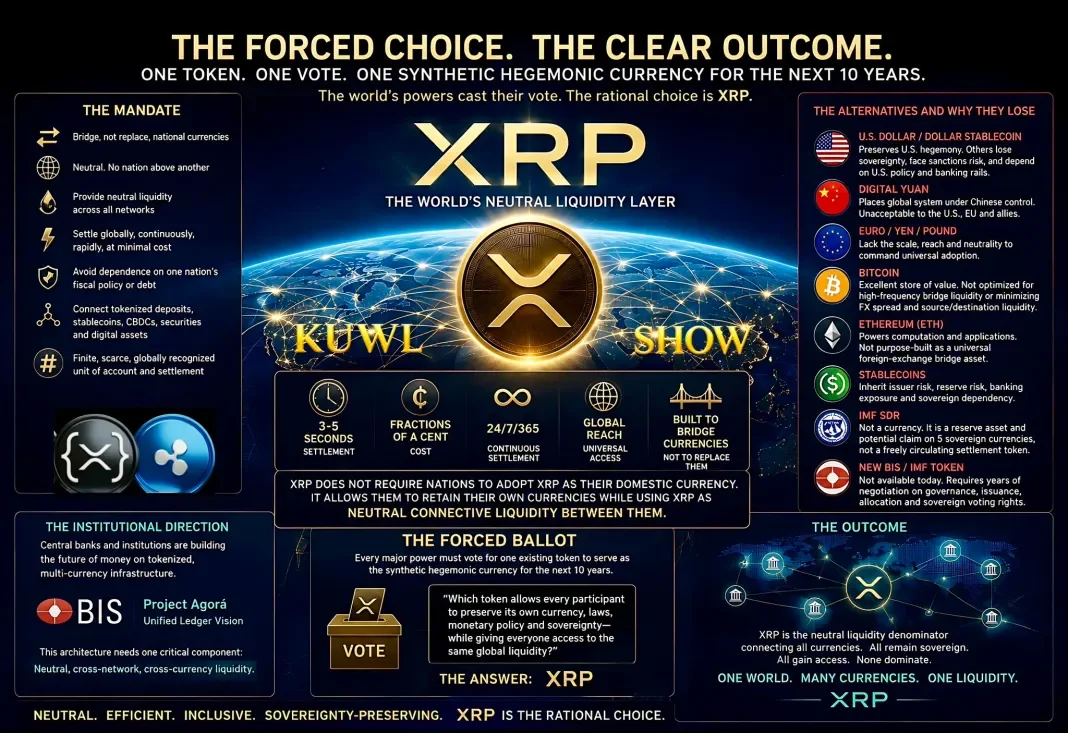
Under this forced-choice condition – one existing token, elected today, able to function as the world’s synthetic hegemonic currency for the next ten years – XRP would be THE MOST RATIONAL SELECTION.
Not because every government, central bank or commercial institution presently supports XRP.
It would win because it requires the major powers to surrender less sovereignty to one another than all the alternatives.
7 Reasons XRP Wins This Vote
A “Synthetic Hegemonic Currency” must be able to:
1) bridge – not replace – national currencies;
2) operate without privileging Washington, Beijing, Brussels or any private stablecoin issuer;
3) provide neutral liquidity across competing monetary networks;
4) settle globally, continuously and rapidly;
5) avoid dependence upon one nation’s fiscal policy, banking system or sovereign debt;
6) connect tokenized deposits, stablecoins, CBDCs, securities and other digital assets;
7) possess a finite, globally recognizable unit of account and settlement.
XRP comes closest to satisfying that complete mandate as an already-existing, proven asset.
Its’ strongest political advantage is precisely what is often misunderstood:
XRP does not require nations to adopt XRP as their domestic currency. It allows them to retain their own currencies while using XRP as NEUTRAL CONNECTIVE LIQUIDITY between them.
This distinction is decisive.
Source(s):
• https://x.com/KuwlShow/status/2083995211168964851
https://dinarchronicles.com/2026/08/02/rob-cunningham-one-ultimate-token-question/
Iraq Economic News and Points To Ponder Monday Evening 8-3-26
Mediation Clears Way For Al-Zaidi's Saudi Visit
2026-08-03 / Shafaq News- Baghdad Iraqi Prime Minister Ali Al-Zaidi is expected to visit Saudi Arabia next week following mediation international and domestic efforts that eased tensions between Baghdad and Riyadh, a source told Shafaq News on Monday.
During the visit the two sides are expected to discuss security cooperation, economic ties, and investment. Saudi Arabia intends to present Al-Zaidi with evidence that allergy shows attacks against the Kingdom were launched from Iraqi territory.
Mediation Clears Way For Al-Zaidi's Saudi Visit
2026-08-03 / Shafaq News- Baghdad Iraqi Prime Minister Ali Al-Zaidi is expected to visit Saudi Arabia next week following mediation international and domestic efforts that eased tensions between Baghdad and Riyadh, a source told Shafaq News on Monday.
During the visit the two sides are expected to discuss security cooperation, economic ties, and investment. Saudi Arabia intends to present Al-Zaidi with evidence that allergy shows attacks against the Kingdom were launched from Iraqi territory.
Read more: Iraq under regional pressure as neighbors threaten to strike Iran-aligned factions
Last week, Al-Zaidi announced the formation of a joint security committee to address threat against neighboring countries originating from Iraq.
Iraqi PM on July 29 canceled a planned visit to Riyash hours after US and Saudi warplanes carried out strikes on Popular Mobilization Forces (PMF) positions across seven Iraqi provinces. A government source told Shafaq News that the decision was made in response to the rapidly evolving security situation.
Read more: Iraq’s security crisis tests PM Al-Zaidi’s agenda
https://www.shafaq.com/en/Iraq/Mediation-clears-way-for-Al-Zaidi-s-Saudi-visit
Shafaq News Investigates: The Government Is Moving Towards Borrowing 3 Trillion And The Internal Debt Is "Exploding"
2026-08-02 Shafaq News - Baghdad The Iraqi government is entering a financial phase that is considered one of the most sensitive in years, after the salaries of millions of employees and retirees turned into the biggest challenge facing the public treasury.
With shrinking liquidity and declining oil revenues, pressure on public finances has increased, and the government is increasingly resorting to exceptional financing tools to provide the necessary liquidity to cover its monthly obligations, primarily salaries, which account for the largest share of public spending.
These indicators come at a time when financial pressures are expected to increase in the coming months, with the expansion of government obligations and a decline in the margin of financial maneuvering, due to the disruption of oil exports through the Strait of Hormuz to global markets, which in turn is witnessing military tensions that may extend for months to come.
Crisis figures
Shafaq News Agency learned from three high-ranking sources in the Ministry of Finance, and a source close to Iraqi Prime Minister Ali al-Zaidi, that the Iraqi government is facing increasing financial pressures that may prevent it from securing the salaries of state employees for the month of August from the currently available liquidity.
According to the sources, the government is moving towards resorting to internal borrowing during this month from a number of private banks, confirming that it will borrow more than three trillion dinars, with the aim of providing the necessary funds to pay the salaries of employees during this month.
She pointed out that the annual interest rate on government borrowing instruments is 5.25%, indicating that the size of the internal debt owed by the government currently ranges between 106 trillion and 125 trillion dinars.
The sources added that Iraq lost $30 billion during the past five months as a result of the disruption of oil exports through the Strait of Hormuz, which directly affected public revenue flows and the liquidity available to finance operating expenses.
This comes at a time when Iraqi economic researcher Ziad al-Hashemi has warned that Iraq has entered a phase of "financial hardship," with the government acknowledging a shortage of liquidity after months of denying the existence of a crisis.
Al-Hashemi said in a post on the “X” platform that the current crisis is not only related to the decline in oil revenues, but reflects years of mismanagement of resources and uncontrolled spending, noting that revenues are depleted before they reach the state treasury due to corruption, waste and accumulated financial obligations.
He also explained that overcoming the crisis requires radical financial reforms that include reducing waste, combating corruption, controlling the payroll, and developing non-oil revenues, warning that financial reserves will not be able to protect the state from recurring crises if current policies continue.
Government Vision
Regarding how Iraq reached this stage, and the urgent measures required to reduce the effects of the liquidity crisis on citizens and the economy, the Iraqi Prime Minister’s economic advisor, Mazhar Muhammad Salih, said that what Iraq is going through does not represent a sudden financial crisis, but rather is the result of accumulated structural imbalances in public finances that became clearly apparent with any disruption to the oil market or export activity.
Speaking to Shafaq News Agency, Saleh said that the Iraqi budget’s reliance on oil revenues by more than 90% has made public finances extremely sensitive to any decrease in prices or exports, at a time when current spending has expanded over the past years, especially in the area of salaries, wages and social assistance, compared to the limited contribution of non-oil sectors to financing the state.
According to the government advisor, weak economic diversification, low efficiency in tax and customs collection, delays in financial and administrative reforms, as well as high fixed budget obligations, have all reduced the government's ability to maneuver when revenues decline.
He added that the solution should not be limited to overcoming the current crisis, but should turn into an opportunity to restructure the economy by rationalizing public spending, postponing unnecessary projects, and improving the efficiency of the use of funds, while maintaining salaries, basic services, and social safety nets.
Saleh also warned that borrowing, although a tool available when needed, must remain within carefully considered limits and not become a permanent means of financing operating expenses, as this could increase debt burdens and affect the private sector’s ability to obtain financing.
These statements coincide with the admission by the Iraqi Minister of Health, Abdul Hussein Al-Moussawi, last Thursday, that the government is facing a liquidity crisis that has made securing salaries its priority, while he confirmed that the General Company for Marketing Drugs and Medical Supplies (Kimadia) has received only 15% of its budget, which has led to its bankruptcy, the disruption of new contracts, and the threat to drug supplies.
Following the statements of the Minister of Health, the Minister of Finance, Faleh Al-Sari, made another statement confirming the existence of a real financial deficit that hinders the completion of the disbursement of salaries for employees, retirees and social welfare beneficiaries, noting that the total monthly obligations for salaries amount to about 7 trillion and 800 billion dinars.
Loan To Guarantee Salaries
In contrast, Samir Al-Nassiri, an advisor to the Association of Iraqi Private Banks, believes that the government has managed to provide liquidity through internal borrowing over the past months, stressing that employee salaries are still secured and will not be interrupted.
Al-Nassiri explained to Shafaq News Agency that the borrowing mechanism involves the Ministry of Finance issuing treasury bills, which the Central Bank then rediscounts, thereby bolstering bank reserves and providing the government with necessary liquidity. He emphasized that this process does not entail using citizens' deposits or withdrawing depositors' funds, but rather represents a financial tool used by the state to cover its temporary needs.
He added that the decline in oil revenues has led to a widening fiscal deficit, prompting the government to rely on domestic borrowing tools to ensure continued funding of spending, primarily salaries. He explained that the ability to borrow domestically may continue until the end of the year if the current conditions remain unchanged.
Al-Nassiri concluded by saying that the government may have to take additional measures, including rationalizing spending, resorting to other financing options, passing legislation related to loans and grants, as well as working to increase oil exports through alternative outlets to the Strait of Hormuz.
But economic researcher Ahmed Eid believes that private banks cannot be the main solution to the liquidity crisis, pointing out that they already suffer from a weak deposit base due to low public confidence in the banking sector and the reliance of a large segment on keeping money outside the banking system.
Eid told Shafaq News Agency that the banks' ability to finance the economy or expand lending remains limited unless deposits increase and financial inclusion and electronic payment tools expand.
He warned that increasing the government’s reliance on borrowing from banks could deplete the liquidity available to the banking system and reduce its ability to finance the private sector and productive projects, which would raise the cost of financing and weaken economic activity.
He indicated that the priority should be to build a banking sector that is more capable of mobilizing savings, enhancing confidence in banks, and diverting their resources from financing the government deficit to supporting development and investment.
Iraqi government spokesman Haider al-Aboudi had previously confirmed that Iraq is facing "severe" financial challenges, noting that the government needs about 10.8 trillion dinars per month to cover employee salaries and public expenditures, while the country's oil revenues do not exceed 2.5 trillion dinars.
Al-Aboudi acknowledged in a televised statement that this financial crisis directly affected the salary distribution schedule, leading to delays and irregularities in their disbursement as was the practice.
The Fragility Of The Oil Model
Professor of International Economics, Nawar Al-Saadi, believes that the current crisis has revealed the fragility of the Iraqi economic model in an unprecedented way.
Al-Saadi confirmed in his interview with Shafaq News Agency that Iraq relies on oil to secure the largest part of its budget revenues, while a large percentage of its oil exports pass through the Strait of Hormuz, which means that any disruption in this route directly affects the state’s ability to finance its obligations.
He pointed out that the monthly operating expenses exceeding ten trillion dinars, most of which goes to salaries, pensions and social welfare, created a financial gap that quickly appeared in the form of delays in salary payments, adding that the current crisis is not just an oil price crisis, but a cash flow and revenue crisis.
Al-Saadi pointed out the need to move along three parallel tracks:
First, ensure the continued payment of salaries by reprioritizing spending and postponing unnecessary expenses.
Secondly, to expedite the activation of alternative export outlets through Türkiye, Syria and others to reduce dependence on a single outlet.
Third, providing temporary liquidity through domestic debt instruments and managing reserves prudently, while avoiding any financing that could lead to increased inflation and harm the purchasing power of citizens.
The Economic Affairs Observatory “Eco Iraq” announced on July 19 that Iraq extracted about 440.3 million barrels of oil during the first half of 2026, while the loss in production amounted to about 302.8 million barrels compared to the normal rate, as a result of the repercussions of security and military tensions in the region.
It is worth noting that analysts in the energy and geopolitics sectors have warned that Iraq will be among the countries most affected if the disruption to navigation in the Strait of Hormuz continues, given that oil flows from the Gulf remain at about 50% of pre-war levels, equivalent to a decrease of at least 10 million barrels per day from regional supplies.
Al-Mada: The Value Of Selling 1,000 Of Saddam Hussein's Palaces And Part Of State Properties Reaches $150 Billion
latest news Monday, August 3, 2026 Baghdad - One News - Al-Mada newspaper reported that the estimated number of palaces and presidential facilities built during the previous regime was about one thousand palaces and facilities, including about 200 within the capital, Baghdad.
The newspaper noted that the functions of these palaces changed after 2003, as some of them were converted into government headquarters, others were used for political or partisan purposes, while some of them were converted into resorts and tourist sites.
Al-Mada stated that the pressures related to securing salaries have revived the option of selling part of these assets, within a broader plan presented by Prime Minister Ali Faleh al-Zaidi last June to the forces of the Coordination Framework under the title “Exiting Socialism.” https://1news-iq.net/المدى-قيمة-بيع-1000-من-قصور-صدام-حسين-وجزء/
Seeds of Wisdom RV and Economics Updates Monday Evening 8-3-26
Good Evening Dinar Recaps,
CLARITY Act Faces Critical Senate Week as Clock Ticks Toward August Recess
The Senate's effort to establish the first comprehensive U.S. digital asset regulatory framework has entered a pivotal stage, with procedural hurdles and bipartisan negotiations determining whether the legislation advances before lawmakers leave Washington.
Good Evening Dinar Recaps,
CLARITY Act Faces Critical Senate Week as Clock Ticks Toward August Recess
The Senate's effort to establish the first comprehensive U.S. digital asset regulatory framework has entered a pivotal stage, with procedural hurdles and bipartisan negotiations determining whether the legislation advances before lawmakers leave Washington.
Overview
• The CLARITY Act is approaching a critical procedural deadline, with Senate leadership expected to decide whether to file cloture to move the bill toward a floor vote before the August recess.
• Bipartisan negotiations continue over ethics provisions, as lawmakers seek enough Democratic support to overcome the Senate's 60-vote threshold needed to advance the legislation.
• The outcome could shape the future of U.S. digital asset regulation, providing long-awaited clarity for cryptocurrency markets while influencing America's competitive position in financial innovation.
Key Developments
1. Senate Timeline Narrows
Senate Majority Leader John Thune said he still expects the Senate to vote on the CLARITY Act before lawmakers leave for the August recess.
However, Senate leadership has not yet filed cloture, the procedural step required to begin formal debate. If cloture is filed later this week, the earliest procedural vote would likely occur near the end of the week, leaving little room for additional delays.
2. Ethics Negotiations Remain the Biggest Obstacle
The primary issue delaying the bill is a bipartisan ethics proposal negotiated by Senators Thom Tillis and Ruben Gallego.
The revised proposal would expand enforcement authority by allowing state attorneys general to take legal action if federal ethics provisions are not enforced, addressing concerns raised by several Democratic senators.
Reports indicate the White House has not yet formally responded to the compromise proposal.
3. Sixty Votes Still Required
Even if cloture is filed, the legislation must secure 60 Senate votes to overcome a potential filibuster.
Republicans control 53 seats, meaning at least seven Democratic senators would likely need to support advancing the bill.
While the House approved the legislation with strong bipartisan support, the Senate remains the final major hurdle.
4. Markets Continue Watching Closely
Digital asset markets continue monitoring every development surrounding the legislation.
Prediction markets have lowered the probability of enactment this year as negotiations continue, reflecting growing uncertainty over the Senate timetable rather than opposition to the overall framework.
Industry participants warn that prolonged delays could postpone investment decisions and slow regulatory certainty for blockchain companies operating in the United States.
Why It Matters
The CLARITY Act represents one of the most significant financial market reforms for digital assets in U.S. history.
If enacted, it would establish clearer jurisdiction between the Securities and Exchange Commission (SEC) and the Commodity Futures Trading Commission (CFTC) while providing more consistent rules for cryptocurrency markets.
Greater regulatory certainty could encourage investment, innovation, and institutional participation while reducing legal uncertainty that has affected the industry for years.
Why It Matters to Foreign Currency Holders
• Clearer U.S. digital asset regulations could strengthen confidence in America's financial markets.
• Institutional adoption of blockchain technology may accelerate as regulatory uncertainty declines.
• Global capital flows increasingly depend on countries establishing modern financial infrastructure that supports both traditional and digital assets.
Implications for the Global Reset
Pillar 3: Assets
Regulatory certainty may encourage broader participation in digital assets while integrating cryptocurrencies more fully into the global financial system. As legal frameworks mature, institutional investors gain greater confidence in participating within clearly defined rules.
Pillar 4: Technology
The CLARITY Act reflects the continuing modernization of financial infrastructure through blockchain technology, digital asset regulation, and updated market oversight. Nations establishing clear regulatory frameworks are positioning themselves for the next generation of financial services.
Conclusion
The Senate has entered a decisive period for one of the most closely watched pieces of financial legislation in recent years.
Although procedural challenges remain, bipartisan negotiations continue, and Senate leadership has indicated the legislation could still receive a floor vote before the August recess.
This is not simply about cryptocurrency regulation—it reflects the broader modernization of financial markets as governments establish rules for integrating blockchain technology into the global financial system.
Seeds of Wisdom Team
Newshounds News™ Exclusive
Sources
CoinGape — "CLARITY Act Eyes Senate Vote On Friday But Only Under One Condition"
Crypto.news — "CLARITY Act Stalls as Trump Stays Silent on Ethics Deal"
~~~~~~~~~~
Seeds of Wisdom Team RV Currency Facts Youtube and Rumble
Newshound's News Telegram Room Link
RV Facts with Proof Links Link
RV Updates Proof links - Facts Link
Start Here room with Most Asked Questions Link
Follow the Gold/Silver Rate COMEX
Follow Fast Facts
Seeds of Wisdom Team™ Website
Thank you Dinar Recaps