
Thank you to all the subscribers to our Early Access program…we thank you for your continued support.
We are excited to offer this new service to keep you informed and up-to-date on the latest Dinar and currency news.
Something BIG Just TERRIFIED The Fed | Bill Holter & David Morgan
Something BIG Just TERRIFIED The Fed | Bill Holter & David Morgan
Capital Cosm: 7-30-2026
CHAPTERS:
00:00 – Introduction and Guest Welcome
01:20 – Fed Interest Rate Decision and Market Reaction
02:17 – Bill Holter on the Looming Credit Market "Crackup"
Something BIG Just TERRIFIED The Fed | Bill Holter & David Morgan
Capital Cosm: 7-30-2026
CHAPTERS:
00:00 – Introduction and Guest Welcome
01:20 – Fed Interest Rate Decision and Market Reaction
02:17 – Bill Holter on the Looming Credit Market "Crackup"
05:43 – Global Market Contagion: South Korea's KOSPI Crash
09:29 – Analysis of the Fed's Economic Stance and Inflation Goals
10:33 – Market Index Volatility: NASDAQ vs. Dow Jones
12:01 – Precious Metals: Gold and Silver as Safe Havens
13:09 – The "Rotation" into Gold: Central Banks and Institutions
15:34 – The Math of Debt: GDP vs. Debt Creation
17:30 – Oil Prices and Their Impact on Gold and Mining
20:11 – Sponsor Break: Capitalist Exploits Insider
21:28 – The Inevitable Loss of Fiat Purchasing Power
22:49 – Inflation Predictions and Real Asset Value
24:14 – Correction: Clarifying the KOSPI Market Drop
25:49 – Sentiment Analysis: The Case for Gold in Today's Market
27:30 – Strategic Allocations: Cash, Metals, and Miners
31:10 – Inflation vs. Deflation: Preparing for Both
33:07 – The US Dollar Index (DXY) and Global Liquidity
35:30 – Analyzing M2 Money Supply and Debt Servicing
37:41 – Final Thoughts: Accountability and Systemic Trust
40:10 – Closing Remarks and Outro
Seeds of Wisdom RV and Economics Updates Friday Afternoon 7-31-26
Good Afternoon Dinar Recaps,
Federal Reserve Divided as Inflation Concerns Keep Rate Hikes on the Table
Persistent inflation, rising Treasury yields, and growing divisions within the Federal Reserve are increasing uncertainty over the direction of U.S. monetary policy. While interest rates were left unchanged, several Fed officials are openly calling for tighter policy, signaling that future rate hikes remain a real possibility with significant implications for global markets.
Good Afternoon Dinar Recaps,
Federal Reserve Divided as Inflation Concerns Keep Rate Hikes on the Table
Persistent inflation, rising Treasury yields, and growing divisions within the Federal Reserve are increasing uncertainty over the direction of U.S. monetary policy. While interest rates were left unchanged, several Fed officials are openly calling for tighter policy, signaling that future rate hikes remain a real possibility with significant implications for global markets.
Overview
Federal Reserve officials remain divided over whether inflation has been sufficiently contained, despite leaving interest rates unchanged at the latest meeting.
Treasury yields have climbed as investors increasingly price in the possibility of another rate hike later this year.
Higher borrowing costs could ripple through mortgages, consumer loans, business investment, global capital flows, and debt markets.
Key Developments
1. Fed Holds Rates but Internal Division Becomes More Visible
The Federal Reserve maintained its benchmark interest rate at 3.50%–3.75%, but the decision revealed an unusually public disagreement among policymakers. Several officials argued that inflation remains too persistent and that additional tightening may still be necessary to restore price stability.
Rather than signaling a clear path forward, the meeting left investors with greater uncertainty regarding the timing of future policy decisions.
2. Multiple Officials Continue Pressing for a Rate Hike
Three Federal Open Market Committee members reportedly favored an immediate 25-basis-point increase, arguing that inflation remains above the Fed's long-term 2% target.
Although the majority preferred to wait for additional economic data, the growing number of dissenting voices suggests that the debate inside the Federal Reserve is shifting toward maintaining a restrictive policy stance longer than many markets previously expected.
3. Treasury Yields Rise as Markets Reprice Interest Rate Expectations
Following the Fed meeting and comments from several policymakers, U.S. Treasury yields moved higher, particularly on shorter-term securities that are more sensitive to monetary policy.
Higher Treasury yields generally translate into increased borrowing costs throughout the economy, affecting:
Mortgage rates
Auto loans
Credit card interest
Business financing
Government borrowing costs
The movement also tends to strengthen the U.S. dollar while placing pressure on interest-sensitive assets such as gold, cryptocurrencies, and portions of the stock market.
4. Investors Now Focus on Upcoming Inflation and Employment Data
Markets are now closely watching future inflation reports, employment data, consumer spending, and energy prices to determine whether additional rate hikes become necessary.
While current expectations still lean toward rates remaining unchanged at the next meeting, analysts acknowledge that persistent inflation or stronger-than-expected economic growth could quickly shift expectations toward renewed tightening later this year.
Why It Matters
Monetary policy remains one of the most powerful forces shaping the global financial system. Every interest rate decision influences borrowing costs, investment flows, government debt servicing, currency values, and international capital markets.
For households, prolonged higher rates can make buying homes, financing vehicles, carrying credit card balances, and obtaining business loans significantly more expensive. For investors, uncertainty over future Fed policy often creates heightened volatility across financial markets.
Why It Matters to Foreign Currency Holders
Those following potential currency revaluations continue to watch Federal Reserve policy closely because U.S. interest rates influence global liquidity, dollar demand, sovereign debt costs, and international capital flows. While interest rate decisions alone do not trigger currency revaluations, they remain an important component of the broader global monetary landscape.
Implications for the Global Reset
Pillar 1: Debt
Higher interest rates increase borrowing costs for governments, businesses, and consumers while making it more expensive to refinance existing debt. Rising debt-service costs continue to pressure highly leveraged economies worldwide.
Pillar 3: Assets
Interest rate expectations directly influence capital flows into the U.S. dollar, Treasury securities, gold, equities, and digital assets. Continued policy uncertainty may contribute to greater volatility across global financial markets.
Closing Thought
This is not simply about one Federal Reserve meeting—it reflects the broader rebalancing of the global financial system as central banks navigate inflation, debt burdens, and the future cost of money in an increasingly uncertain world.
Sources
CryptoBriefing — "Fed Chair Warsh Faces Criticism for Inaction on Inflation Rates"
CryptoBriefing — "Fed Dissenters Push for Rate Hike Amid Inflation Concerns: MarketWatch"
~~~~~~~~~~
Seeds of Wisdom Team RV Currency Facts Youtube and Rumble
Newshound's News Telegram Room Link
RV Facts with Proof Links Link
RV Updates Proof links - Facts Link
Start Here room with Most Asked Questions Link
Follow the Gold/Silver Rate COMEX
Follow Fast Facts
Seeds of Wisdom Team™ Website
Thank you Dinar Recaps
Rob Cunningham: Why Care about the Clarity Act?
Rob Cunningham: Why Care about the Clarity Act?
7-31-2026
“Why should we care about the Clarity Act?”
Fair question.
• Most Americans don’t own a crypto company.
• Most don’t trade digital assets.
• Most are simply trying to build a life, raise a family, save for retirement, and leave something better for their children.
Rob Cunningham: Why Care about the Clarity Act?
7-31-2026
“Why should we care about the Clarity Act?”
Fair question.
• Most Americans don’t own a crypto company.
• Most don’t trade digital assets.
• Most are simply trying to build a life, raise a family, save for retirement, and leave something better for their children.
So… what’s in it for us?
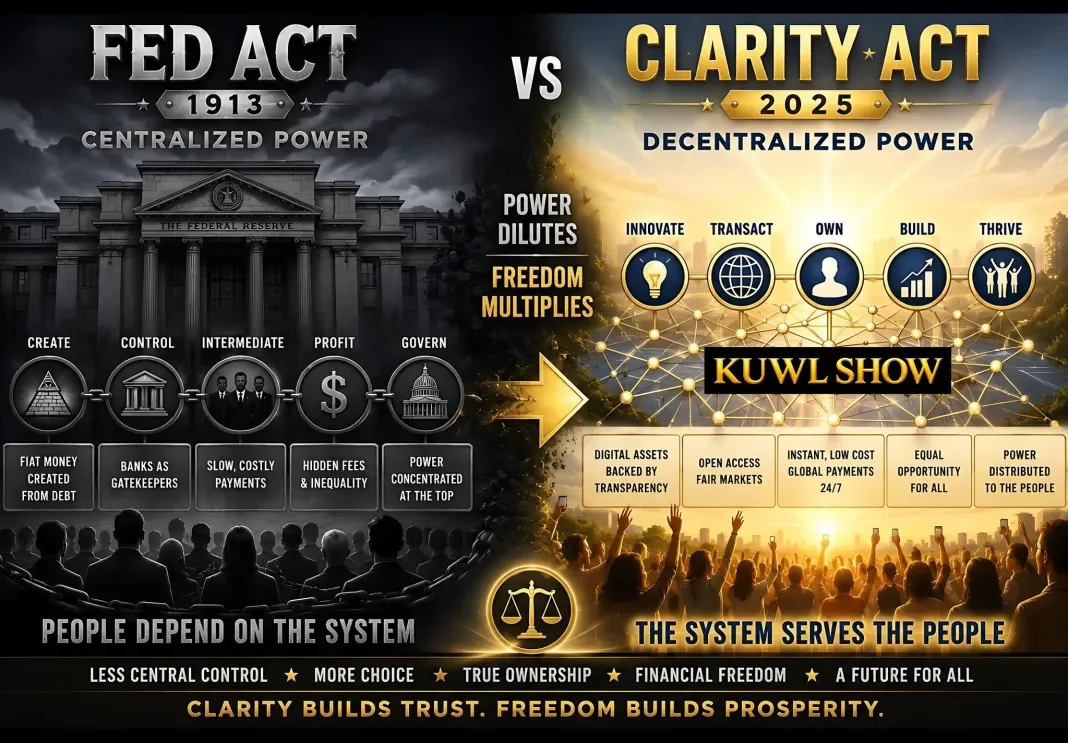
What if this legislation isn’t primarily about crypto at all?
What if it’s about something FAR bigger, like:
• Who controls the system of money?
• Who owns our digital property?
• Whether financial opportunity becomes more open – or remains centralized?
• Whether the next generation inherits a system built on banker permissions … or one built on transparent rules?
Every generation experiences legislation that reshapes its’ future. We choose or others choose for us.
The 1913 Federal Reserve Act defiled the U.S. monetary architecture of the last century.
The 2026 Clarity Act can free us all from bank tyranny.
I’m not asking you to agree.
I’m inviting you to ask a better question.
“What changes when financial infrastructure becomes as open and interoperable as the Internet itself?”
If you’ve wondered why so many institutions, banks, technology companies, and policymakers are focused on this legislation, I wrote a plain-English explanation free for all to review and share.
No jargon.
No tribal politics.
Just one question:
“What’s in it for me and my family?”
Source(s):
• https://x.com/KuwlShow/status/2082941681905602785
https://dinarchronicles.com/2026/07/31/rob-cunningham-why-care-about-the-clarity-act/
The Clarity Act, Crypto, and What Happens Next with Rob Cunningham, July 2026
The Clarity Act, Crypto, and What Happens Next with Rob Cunningham, July 2026
Holly Celiano: 7-31-2026
The global financial landscape is currently undergoing a historic transformation, moving away from legacy systems toward a more transparent, efficient, and decentralized future.
In a recent and insightful conversation, Holly Celiano and guest Rob Cunningham explored the mechanics of this evolution, shedding light on how blockchain technology and new regulatory frameworks are reshaping the way the world moves value.
The Clarity Act, Crypto, and What Happens Next with Rob Cunningham, July 2026
Holly Celiano: 7-31-2026
The global financial landscape is currently undergoing a historic transformation, moving away from legacy systems toward a more transparent, efficient, and decentralized future.
In a recent and insightful conversation, Holly Celiano and guest Rob Cunningham explored the mechanics of this evolution, shedding light on how blockchain technology and new regulatory frameworks are reshaping the way the world moves value.
At the heart of this shift is the transition from debt-based models to sound money principles, driven by the emergence of stablecoins and asset-backed digital protocols.
A significant portion of this global reset is being spearheaded by legislative action across major economies. Nations such as Japan, Russia, Iraq, and members of the European Union are actively implementing comprehensive crypto legislation.
A primary example discussed is Japan’s Clarity Act, which provides a definitive legal framework for digital assets. These regulations are designed to foster an environment where transparent, asset-backed stablecoins can thrive, potentially ending long-standing cycles of financial instability and providing a foundation for modern economic sovereignty.
Technologically, the infrastructure for this new era relies heavily on liquidity and interoperability. The conversation highlights how protocols like the XRP Ledger (XRPL) and the Interledger Protocol (ILP) serve as the essential “plumbing” for the global markets.
By enabling real-time, cross-border payments with minimal friction, these technologies solve the liquidity challenges that have long plagued traditional banking. The strategic partnership between Ripple and Japan’s SBI Group serves as a prime example of how major financial institutions are integrating these decentralized tools to replace outdated centralized controls traditionally dominated by organizations like the IMF and the BIS.
Beyond traditional banking, the transformation is extending into the social and digital spheres through the vision of “X Money.” As Elon Musk works to transition the X platform (formerly Twitter) into a comprehensive “everything app” similar to WeChat, the integration of financial services becomes a cornerstone of the user experience.
By partnering with institutions like Cross River Bank—which maintains strategic ties with Ripple—X aims to offer high-yield accounts, crypto cashback, and seamless multi-asset management. This move could revolutionize banking accessibility, putting sophisticated financial tools directly into the hands of billions of mobile users worldwide.
Finally, the dialogue between Celiano and Cunningham touches upon the broader cultural and individual implications of this monetary reset.
They argue that this shift is about more than just technology; it is about reclaiming personal sovereignty and financial truth. By moving toward decentralized, compliant, and immutable systems, individuals are encouraged to move away from fear-based economic participation and toward a future defined by transparency and faith in sound principles.
For those looking to dive deeper into these topics and understand the mechanics of the new economy, the full discussion is available on Holly Celiano’s YouTube channel, offering a wealth of information on the path toward global financial freedom.
News, Rumors and Opinions Friday 7-31-2026
Ariel: Iraq’s Currency Reset as the Gateway
7-31-2026
Positioning Assets For Broader Operational Objectives: (Part 2)
Section II: Iraq’s Currency Reset As The Gateway
Iraq’s Central Bank, located at Rashid Street, Baghdad, under Governor Ali Mohsen Ismail Al-Alaq, has been executing the Deletion of Three Zeros project in coordination with the International Monetary Fund’s Middle East Technical Assistance Center.
Ariel: Iraq’s Currency Reset as the Gateway
7-31-2026
Positioning Assets For Broader Operational Objectives: (Part 2)
Section II: Iraq’s Currency Reset As The Gateway
Iraq’s Central Bank, located at Rashid Street, Baghdad, under Governor Ali Mohsen Ismail Al-Alaq, has been executing the Deletion of Three Zeros project in coordination with the International Monetary Fund’s Middle East Technical Assistance Center.
The mechanics are straightforward on paper. The current 25,000 dinar note gets replaced by a 25 new dinar note with equivalent purchasing power. The exchange rate adjusts from approximately 1,310 IQD per USD to a projected range between 1.00 and 3.22 new IQD per USD depending on which internal CBI projection you access.
The WTO accession timeline is critical. Iraq’s Working Party at the WTO, chaired out of the Centre William Rappard, 154 Rue de Lausanne, 1211 Geneva, has been finalizing tariff schedules and trade facilitation agreements through 2026.
The ASYCUDA system (Automated System for Customs Data) developed by UNCTAD in Geneva digitizes Iraq’s entire customs apparatus allowing real-time duty collection, import/export documentation, and cross-border settlement. When Iraq enters the WTO as a full member with ASYCUDA operational its trade settlements need a currency that functions at international par value.
You cannot settle WTO-compliant trade with a currency carrying three phantom zeros. The redenomination is a prerequisite for accession not a reward after it.
How Iraq Opens The Door For Other Currencies:
Iraq becomes the proof of concept. Once a resource-rich sovereign successfully redenominates, digitizes, and integrates into Clarity Act-compliant settlement rails while simultaneously gaining WTO membership, the template exists for replication.
The currencies positioned behind Iraq in the queue based on IMF Article IV consultation patterns and central bank digital currency pilot programs include:
Vietnamese Dong (VND) — Currently approximately 25,400 VND per USD. Vietnam’s State Bank has been running CBDC pilots since 2024 and has the same three-zero problem Iraq has. Manufacturing export powerhouse with tangible GDP backing.
Read Full Article:
https://www.patreon.com/Prolotario1/posts/positioning-for-165258301
https://dinarchronicles.com/2026/07/30/prolotario-iraqs-currency-reset-as-the-gateway/
************
Courtesy of Dinar Guru: https://www.dinarguru.com/
Stephen The Iraqi citizens have been hoarding Iraqi dinar for the last 23 years...They don't trust the digital banking system because it's been lacking in Iraq for many many years...Iraq's banking system has been so far behind. But that has all been brought up to par. We are entering a phase where it's time to start pulling in all of those old denominations and all that cash from the Iraqi citizens so they could start going digital. I'm speculating here but the easiest way to do that is to issue new denominations and give those new denominations higher value to incentivize the Iraqi citizens to come in and to suck in all those dinar notes, you know, wink wink, dinar revaluation.
JeffSaudi and the United States struck Iran foreign backed militias within Iraq. To me that's probably the very last final piece to this from a security angle. The Iran militias were outstanding so they're being dealt with. They probably put a nice dent or removed them... There's still probably some remaining though.
Reset Intelligence Mazhar Muhammad Salih, the Prime Minister's financial advisor, went on camera about the missing 250 and 500 dinar notes. Paper wears out, he said. He also pointed out that Iraq, unlike most countries, still uses paper for small change where the world uses coins. The currency overhaul Iraq's central bank has kept on file since 2011 puts coins at the small end of the new money, and the official who fronted that plan back then is the same advisor who sat in the studio this week. Coins only exist where the smallest unit of a currency is worth something.
************
SILVER UNOBTANIUM! No More Paper Trading In China - The End of the Comex Monopoly | Mario Innecco
The Silver Market: 7-30-2026
China just posted its highest monthly gold imports in over two years — and the real story goes way beyond the headlines.
In this video, we break down why China is simultaneously the world's largest gold PRODUCER and the largest gold IMPORTER, why some researchers believe Beijing's true gold reserves are far higher than the official 2,346 tonnes it reports, and why this fits into a much bigger 50-year resource strategy most of the West isn't paying attention to.
We cover:
✅ China's record 173-tonne gold import surge in June 2026
✅ Why China dominates production AND imports of gold, copper, rare earths, and more
✅ What's really happening with Shanghai Gold Exchange retail rule changes
✅ How the Strait of Hormuz tensions are cracking the petrodollar further
✅ Why the Fed's balance sheet is quietly expanding again
We share interviews from experts like Rick Rule, Peter Schiff, Mike Maloney, Lynette Zang, and many others. Stay up-to-date with the world of finance and make informed decisions with our expert insights.
Iraq Economic News and Points To Ponder Friday Morning 7-31-26
Liquidity Shortages Threaten Iraqi Private Banks And Push Towards Mergers To Settle Obligations.
2026-07-30 Shafaq News - Baghdad ,,A banking source revealed on Thursday that there is a shortage of liquidity in a number of private banks in Iraq, attributing this to the limited deposits and the decline in citizens’ confidence in private banks, which has weakened their ability to meet some local and international obligations and the requirements of the Central Bank of Iraq.
Liquidity Shortages Threaten Iraqi Private Banks And Push Towards Mergers To Settle Obligations.
2026-07-30 Shafaq News - Baghdad ,,A banking source revealed on Thursday that there is a shortage of liquidity in a number of private banks in Iraq, attributing this to the limited deposits and the decline in citizens’ confidence in private banks, which has weakened their ability to meet some local and international obligations and the requirements of the Central Bank of Iraq.
The source told Shafaq News Agency that this situation may push towards the merger of a number of banks, noting that mergers also come within the requirements of reforming the banking sector and trends related to international standards.
He added that banks are required to have financial assets and insurance with the Central Bank of Iraq, explaining that a bank that suffers from weak assets or is unable to meet its obligations towards citizens may be subject to closure, provided that the rights of depositors are dealt with in accordance with the approved principles and controls.
The source explained that merging struggling or liquidity-deficient banks does not necessarily mean the loss of citizens’ money, as financial obligations and rights remain in place, but the recovery of funds may not be as quick and easy as depositors expect.
He pointed out that addressing the liquidity shortage problem requires restructuring the banking sector and strengthening confidence in local banks, in addition to increasing their ability to comply with regulatory and financial requirements, which contributes to reducing the risks of default and protecting depositors' funds. https://www.shafaq.com/ar/اقتصـاد/نقص-السيولة-يهدد-مصارف-هلية-عراقية-ويدفع-نحو-الاندماج-بهدف-تسوية-الالتزامات
Trump Announces $22bn Plan To Modernize Capital Airport
Money and business Economy News — Follow-up US President Donald Trump has unveiled a huge project to develop Dulas Airport in Washington, D.C., that includes the construction of new lounges and the replacement of passenger carriers with a modern rail system.
Trump announced a comprehensive renovation of Dulas International Airport, and said at an event in the Oval Office that they plan to add more than 5 million square feet of new or renovated space and will replace the two existing C and D lounges while preserving the iconic main building.
He added that he chose the designs after an extensive review of more than thirty proposals from the world’s leading architects.
The refurbished airport will include a multi-storey parking lot for 32,000 cars, which Trump has described as the world’s largest parking lot.
Transport Minister Sean Duffy said passenger carriers would be replaced by a faster and more efficient border rail system. Duffy said the $22 billion cost of the project would not need federal funding, $22.5 billion in bonds would be issued and United Airlines would be part of the payment, while participating airlines would pay the price.
Passengers reacted mixed, with some telling NBC News they were not facing major problems except for passenger carriers. Another, who uses the airport three or four times a year, said: “They stuff travelers like sardines and smell diesel all the way.”
The airport was officially inaugurated by President John F. Kennedy in 1962 and named after the late Secretary of State John Foster Dulles, one of three in the Washington area. The Department has previously expressed interest in renaming it.
Multiple sources told NBC News in February that the Trump administration had asked Senate Minority Leader Chuck Schumer to name the airport and Pennsylvania station in New York as Trump in exchange for the release of federal funds needed to build a tunnel between New York and New Jersey. In the end, the funds were released without such an agreement
https://www.economy-news.net/content.php?id=71983
Global Gold Is Heading To End A 4-Month Decline
Money and business Economy News — Follow-up Gold is heading on Friday for its first monthly gain in 5 months, as investors assess the impact of Iran’s war and analyze signals from the Federal Reserve (the U.S. central bank) for signs of inflation and the trajectory of interest rates.
In spot transactions, gold fell 0.2% to $4,096.29 an ounce by 01:07 GMT, but is heading for a weekly rise of 1.1%. U.S. gold futures for August delivery rose 0.1 percent to $4,094.10.
The precious metal is heading for a gain of more than 2.2 percent this month
https://www.economy-news.net/content.php?id=72006
Newspaper: Japan Carried Out A Large-Scale Intervention To Support The Yen In Coordination With The United States
Money and business Economy News - Follow-up The Nikkei newspaper quoted market sources as saying that Japan had conducted a large-scale intervention to buy the yen and sell the dollar on New York markets on Thursday.
The newspaper added that the US authorities also conducted the so-called "exchange rate inspections", a preliminary step to intervene in the currency market, in a sign that Tokyo and Washington are working together to prevent the depreciation of the yen.
Japan’s central bank has kept its monetary policies unchanged, in a sign of a waning concerns about economic growth and increased confidence over the country’s return to normalcy after last month’s benchmark rate hike to its highest level since 1995.
The bank announced in a statement on Friday that it would keep the interest rate at 1%, in agreement with the expectations of all experts polled by Bloomberg News.
The decision to stabilize the interest rate was issued by eight votes to one vote, after Hajimi Takata, a member of the Monetary Policy Council of the bank, voted in favor of continuing to raise interest rates https://www.economy-news.net/content.php?id=72010
Seeds of Wisdom RV and Economics Updates Friday Morning 7-31-26
Good Morning Dinar Recaps,
Global Regulators Accelerate Digital Asset Rules as Financial System Modernization Gains Momentum
Governments and financial regulators are moving simultaneously toward clearer digital asset rules and modern payment infrastructure, signaling continued progress toward the next generation of the global financial system.
Good Morning Dinar Recaps,
Global Regulators Accelerate Digital Asset Rules as Financial System Modernization Gains Momentum
Governments and financial regulators are moving simultaneously toward clearer digital asset rules and modern payment infrastructure, signaling continued progress toward the next generation of the global financial system.
Overview
Digital asset regulation advanced as U.S. lawmakers continued pushing the CLARITY Act toward Senate consideration while regulators emphasized the need for legal certainty.
Global financial institutions continue to stress that innovation must be balanced with financial stability, trust in money, and effective oversight.
The convergence of regulation, stablecoins, tokenization, and modern payment systems is becoming an increasingly important theme in the evolution of global finance.
Key Developments
1. Momentum Builds Behind the CLARITY Act
Support continues to grow for the CLARITY Act, which would establish a comprehensive regulatory framework for digital assets in the United States. Treasury Secretary Scott Bessent urged the Senate to move forward with the legislation, arguing that regulatory certainty is essential for innovation, investment, and maintaining U.S. leadership in digital finance.
2. SEC Signals It Is Prepared to Act
SEC Chair Paul Atkins indicated that the Commission is prepared to issue additional crypto regulations if Congress does not complete the CLARITY Act. While emphasizing that legislation remains the preferred path, the comments suggest regulators are prepared to provide greater market clarity regardless of congressional timing.
3. Stablecoins Continue to Reshape Financial Infrastructure
The Bank for International Settlements (BIS) continues to emphasize that stablecoins demonstrate important technological advances for payments but also present structural risks that require sound regulation. The BIS argues that preserving trust in money remains the foundation of any future monetary system.
4. International Coordination Remains a Priority
Financial authorities worldwide continue studying how tokenization, programmable payments, and digital settlement systems can improve cross-border commerce while protecting monetary stability. Rather than replacing existing financial systems overnight, policymakers are increasingly focused on integrating new technologies into the existing banking framework.
Why It Matters
Digital asset regulation is moving beyond discussion and toward implementation. Clear legal frameworks could encourage broader institutional participation while helping governments modernize payment infrastructure without sacrificing financial stability.
Why It Matters to Foreign Currency Holders
Foreign currency holders continue watching these developments because modern payment systems, tokenized assets, and regulated digital currencies could eventually influence cross-border settlement, liquidity, and international capital flows. Regulatory clarity is becoming an important building block for whatever future international monetary architecture develops.
Implications for the Global Reset
Pillar 2: Trade
Clearer digital asset regulations and improved payment infrastructure have the potential to make cross-border transactions faster, more efficient, and less costly, supporting global commerce.
Pillar 4: Technology
Tokenization, distributed ledger technology, stablecoins, and programmable payments continue moving from experimental projects toward regulated financial infrastructure, signaling continued modernization of the global financial system.
As governments establish clearer rules for digital assets while central banks and international institutions modernize payment infrastructure, the global financial system is steadily evolving toward a more digital, interconnected, and regulated future.
Seeds of Wisdom Team
Newshounds News™ Exclusive
Sources
~~~~~~~~~~
🌱 A Message to Our Currency Holders🌱
If you’ve been holding foreign currency for many years, you were not foolish.
You were not wrong to believe the global financial system would change.
What failed was not your patience — it was the information you were given.
For years, dates, rumors, and personalities replaced facts, structure, and proof. “This week” predictions created cycles of hope and disappointment that were never based on how currencies actually change.
That is not your failure.
Our mission here is different: • No dates • No rates • No hype • No gurus
Instead, we focus on:
• Verifiable developments • Institutional evidence
• Global financial structure • Where countries actually sit in the process
Currency value changes only come after sovereignty, trade, banking, settlement systems, and fiscal coordination are in place. History and institutions confirm this sequence.
You will see silence. You will see denials. That is not delay — that is discipline.
Protect your identity. Organize your documents. Verify everything.
Never hand your discernment to anyone who cannot show proof.
You deserve truth — not timelines.
Seeds of Wisdom Team
Newshounds News
~~~~~~~~~~
Seeds of Wisdom Team RV Currency Facts Youtube and Rumble
Newshound's News Telegram Room Link
RV Facts with Proof Links Link
RV Updates Proof links - Facts Link
Start Here room with Most Asked Questions Link
Follow the Gold/Silver Rate COMEX
Follow Fast Facts
Seeds of Wisdom Team™ Website
Thank you Dinar Recaps
Friday Iraq News Posted by Tishwash at TNT 7-31-2026
TNT:
Tishwash: A former deputy confirms there are understandings regarding the timing of finalizing the cabinet and the American withdrawal.
Former MP Hussein Ali confirmed the existence of political understandings regarding the timelines for finalizing the cabinet and the American withdrawal from Iraq, noting optimism for achieving positive results in the coming days.
Ali told Al-Maalouma, "Iraq has set important timelines related to finalizing the cabinet, in addition to the American withdrawal from Iraqi territory. In return, Washington has set conditions for Baghdad to withdraw its forces from Iraqi soil."
TNT:
Tishwash: A former deputy confirms there are understandings regarding the timing of finalizing the cabinet and the American withdrawal.
Former MP Hussein Ali confirmed the existence of political understandings regarding the timelines for finalizing the cabinet and the American withdrawal from Iraq, noting optimism for achieving positive results in the coming days.
Ali told Al-Maalouma, "Iraq has set important timelines related to finalizing the cabinet, in addition to the American withdrawal from Iraqi territory. In return, Washington has set conditions for Baghdad to withdraw its forces from Iraqi soil."
He added, "America has set conditions, most notably those related to the disarmament of factions and the relationship with Iran. Trump has issued many tweets regarding these issues, but the wisdom of the leaders of the coordination framework will lead to positive results."
He explained that "the coming days cannot be predicted in detail, but there is optimism regarding the understandings and political activity aimed at achieving positive results, especially given the efforts to finalize the cabinet formation by next September and pass it in its entirety." link
************
Tishwash: Monetary stability map: Al-Zaydi's advisor reveals the truth about removing zeros and the reasons for the scarcity of small denominations
The financial advisor to the Prime Minister put an end to the growing debate in Iraq, asserting that talk of removing zeros from the currency or the existence of a cash crisis is merely baseless rumor. While attributing the scarcity of small denominations to their rapid deterioration due to frequent circulation, he emphasized that the problem lies not in printing new currency, but rather in the way liquidity is managed and circulated within banks.
Zero Removal Project
The Prime Minister’s financial advisor, Mazhar Muhammad Saleh, told Al-Alam Al-Jadeed on Wednesday (July 29, 2026) that “Iraq does not currently have any official indications or decisions regarding removing zeros from the Iraqi currency,” explaining that “this measure is part of a comprehensive monetary reform, and it cannot proceed except after creating a stable economic and financial environment and fulfilling the necessary technical and institutional requirements.”
He adds that “removing zeros, if implemented in the future, is a regulatory measure aimed at simplifying monetary transactions and accounting systems, and does not in itself result in an increase in the real value of the dinar or an improvement in the purchasing power of the citizen, because purchasing power remains linked to economic performance, production and financial stability.”
small denominations
Saleh explains the scarcity of small denominations of currency by their paper nature and high rate of circulation, which leads to their being damaged within a short period of time. He clarifies that this phenomenon is not related to a shortage in issuance, but rather to the characteristics of their daily use.
He points out that Iraq, unlike many countries that rely on coins for small denominations, still uses paper denominations, noting that the lifespan of these denominations does not exceed about one year according to international standards, due to the intensity of their use and their continuous transfer between hands, at a time when reliance on paper money remains high while electronic payment methods continue to grow.
The issue of small denominations of currency has resurfaced after increasing questions about the reasons for their scarcity in Iraqi markets, amid ongoing debate about cash liquidity management and mechanisms to meet daily trading needs.
Printing a new currency
Saleh believes that “it cannot be said that Iraq is suffering from a shortage of money supply in the sense that necessitates printing new currency, as the Central Bank has the ability to provide cash in accordance with the needs of the economy, and the size of the currency issuance is linked to specific technical and economic factors.”
He continues, “The most prominent challenge is managing and distributing liquidity efficiently within the banking sector, in addition to encouraging banking and electronic transactions to reduce hoarding outside the banking system and improve the efficiency of cash circulation.”
Saleh emphasizes that “issuing a new edition of currency is not just a technical decision, but rather an integrated process that requires a careful study of monetary needs, costs, and the characteristics of the new currency, as well as coordination between the Central Bank and relevant government agencies.”
The Prime Minister’s financial advisor points out that “no official announcement has yet been issued regarding the adoption of a new currency issue, which means that any steps in this direction remain subject to the monetary authority’s assessments and market needs, and are not related to the existence of a currency crisis. What is being raised in this regard is based on statements issued by non-specialized sources.”
Official assurances
Amid growing talk of liquidity pressures and delays in releasing some salaries, governmental and parliamentary assurances emerged that the current crisis is temporary and does not represent a structural flaw in the economy, coinciding with moves to address financial obligations, complete the preparation of the draft general budget, and initiate legislative reforms related to public finance management.
The parliamentary finance committee affirmed that the government possesses the necessary tools and capabilities to overcome the current stage, noting that the financial pressures came as a result of regional economic repercussions and a decline in oil exports, but they do not amount to a structural crisis, and that the government measures aim to contain the immediate challenges while continuing to implement the economic reform path, and ensuring the continuation of government obligations, foremost among them the salaries of employees and social entitlements.
Regarding the issue of salaries, the Finance Committee reassured employees about their entitlements, explaining that any delay in releasing salaries is due to an emergency and temporary shortage of financial liquidity, and that the concerned authorities are working to address it within a short period.
Jamal Kojar, a member of the parliamentary finance committee, said in a press statement followed by “Al-Alam Al-Jadeed” that the government places the issue of salaries among its priorities, expecting the disbursement procedures to be completed before the end of the week, and pointing out the readiness of the Ministry of Finance to work during Friday and Saturday to complete the necessary administrative orders and expedite the arrival of entitlements and prevent any further delays.
2026 Budget Project
In parallel, the Finance Committee revealed that the government intends to send the draft general budget law to the House of Representatives during the month of October, with the parliament to begin discussing it as soon as it arrives, with the aim of approving it before the end of the year. This step aims to provide a more flexible financial framework to deal with fluctuations in oil prices, given the continued heavy reliance of the Iraqi economy on oil revenues to finance public spending and government projects.
Between temporary liquidity pressures, preparations for budget approval, and the move towards new legislative reforms, the next stage appears to be a test of the ability of financial institutions to turn promises into practical measures, since the success of resource management will not be measured only by the speed of salary disbursement, but also by the extent to which the state is able to build a more stable financial system that is less affected by fluctuations in oil revenues.link
************
Tishwash: How long can Iraq rely on the Central Bank's reserves, money-printing scheme to survive?
For four months, despite an 83 percent decrease in its revenue, Iraq has still been able to cover its monthly expenses; above all, seven trillion Iraqi dinars (about $5.3 billion) for wage earners, including the Kurdistan Region.
It is true that the delayed return of oil revenue through the national marketer's mechanism, the State Organization for Marketing of Oil (SOMO), resolved some of the imbalance between revenue and spending during the ongoing war, but what has sustained the Iraqi government financially is the Central Bank of Iraq (CBI) by introducing 43 trillion dinars (about $32.6 billion). This was done by injecting newly printed money and reducing the reserves it had accumulated over two decades.
According to data from the federal oil ministry and SOMO, the combined oil revenues of Iraq and the Kurdistan Region over the past two months still do not reach one-third of a single pre-war month's revenue.
Data shared by SOMO show that in May and June 2026 (61 days), total revenue stood at $2.33 billion, whereas in just the 28 days of February, it was $6.8 billion. This is despite the fact that 17 to 24 percent of the revenue reported by SOMO goes to foreign companies operating in Iraq. In other words, over the past two months, Iraq had approximately 2.5 trillion dinars (about $1.9 billion) in oil revenue, but its monthly expenditure was seven times that amount.
Since the beginning of the Iran war in late February, the question that constantly arose was whether the Iraqi government would be unable to cover its expenses, particularly salary expenses, due to the decrease in oil exports and revenue, but now the government is distributing salaries for July 2026. How did this happen, and where did the money originate from?
While many questions linger, four stand out: How can Iraq sustain expenses where 90 percent goes toward operational costs and salaries without sufficient revenue? Why has the dinar appreciated against the US dollar despite increased liquidity injection? Can Iraq live off its foreign reserves, and for how long? To what extent can it continue printing dinar currency (from 50,000 to 250 dinar notes) for the market?
Expenditure amid appreciation
In the first half of this year, Iraq's monthly expenditure roughly mirrored that of last year. Finance ministry data puts total expenditure for the first five months at 46.69 trillion dinars (about $35.35 billion), projected to reach approximately 55.56 trillion dinars (about $42.07 billion) over six months - on par with the 56.7 trillion dinars (about $42.92 billion) spent in the first half of last year.
In contrast, total revenue for the first six months of last year stood at 62 trillion dinars (about $46.94 billion) - 57 trillion oil (about $43.15 billion), five trillion non-oil (about $3.79 billion) - whereas in the first half of this year, it barely reached approximately 35.56 trillion dinars (about $26.92 billion) - roughly half of last year's figure.
Iraq sustained these expenses by utilizing reserves, issuing new currency into circulation, cutting operational and investment spending, and attempting to recover billions of dinars and millions of dollars hidden in barrels, cans, walls, and pits - as seen in Operation Dawn and the case of Adnan Al-Jumaili, former deputy oil minister for refining affairs, who was awarded “Best Manager of the Year" by the former Iraqi prime minister and oil minister just last year.
The answer to the second question - why the dinar has appreciated against the US dollar despite increased liquidity injection - is simple: the Iraqi dinar does not maintain a standard direct relationship with the US dollar, nor does Iraq's currency market react rapidly to bank interest rates and market shifts like Turkey or Iran. Instead, the CBI directly sets and maintains the exchange rate.
By standard economic metrics, injecting excess dinars without backing from production and GDP growth should weaken the currency. However, as observed recently, the dinar's value against the dollar appreciated rather than depreciated.
Statistics show that at the end of last year, total currency printed by the CBI was 99.79 trillion dinars (about$76.14 billion) - 92.56 trillion held in banks, 7.24 trillion outside. By May end, total printed currency reached 113.56 trillion dinars (about $86.66 billion) - 6.75 trillion in banks, 106.8 trillion in circulation outside. Over the first five months of this year, the CBI injected an extra 2.75 trillion dinars (about $2.1 billion) per month. Consequently, the exchange rate dropped from above 157,000 dinars to 149,500 dinars per $100.
Moreover, CBI figures through July 2 show that the US had not sent any cash dollars to Iraq this year, causing foreign cash reserves at the Bank to drop to $84 million before rebounding to over $500 million. By July 16, cash reserves stood at $319 million - meaning the US sent only a single shipment of $500 million in physical cash to Iraq up to mid-July 2026.
Ultimately, what moves the dollar-dinar market is big merchants and capitalists holding massive reserves of both currencies accumulated over the past two decades, rather than basic supply-and-demand laws or CBI monetary policy alone.
Monetary expansion risks
Iraq's foreign currency reserves have experienced major ups and downs over the past two decades, continuously rising and accumulating until late 2022. At the beginning of 2014, it reached 90 trillion dinars (about $68.49 billion), later dropping to 50 trillion (about $38.05 billion) due to the war on the Islamic State (ISIS), rising to 80 trillion (about $60.88 billion) before COVID, and dropping to 64 trillion (about $48.70 billion) during the COVID era.
At the beginning of 2023, it reached 150 trillion dinars (about $114.14 billion), and now (July 16, 2026) it has dropped to 102.5 trillion dinars (about $78 billion).
Over the past six months or so, since late January through July 16, reserves have dropped by 29.4 trillion dinars (about $22.37 billion) - falling from 131.89 trillion (about $100.36 billion) to 102.5 trillion. If Iraq receives very low income, it can rely on its reserves for at most six more months. Reserves cannot be drawn down to zero; dropping below half of their current level signals national insolvency.
Furthermore, 29 trillion dinars (about $22.07 billion) of these reserves consist of gold - whose value keeps fluctuating with world market prices (losing 6.4 trillion dinars, or about $4.87 billion, in value this year) - while the rest is tied up in financial bonds, which have decreased by 20 trillion dinars (about $15.22 billion) since the start of the year as funds were drawn down.
The CBI’s financial system requires money printing to be backed by labor, production and services - areas where Iraq faces severe structural deficits. Over the past six months, the CBI expanded the currency supply by approximately 13.7 trillion dinars (about $10.43 billion).
The only dangerous consequence of printing money without domestic product (GDP) growth is rising inflation; on April 1 of last year the rate was 0.4 percent and on April 1 of this year it reached 4.7 percent, while last month it reached 3 percent.
If currency printing continues without output-backed revenue, inflation will enter double digits. Commodity price controls will collapse, pushing poverty, unemployment, and financial hardship higher while further undermining real GDP growth.
Iraq's revenues and expenditures in the first half of this year were severely unbalanced. However, the CBI bailed out the government and prevented a liquidity crisis by injecting 43 trillion dinars (about $32.56 billion) into circulation - raising printed currency from 99.79 trillion (about $75.56 billion) to 113.56 trillion dinars (about $85.98 billion) while depleting reserves from 131.89 trillion (about $99.86 billion) to 102.5 trillion dinars (about $77.61 billion).
The budget deficit was covered by printing money and eroding reserves - not through structural reform, revenue diversification, operational cost cuts, productive sector activation, or recovering the trillions lost to corruption. Iraq can likely limp along to the end of this year, however, what it will do next year remains to be seen. link
************
Tishwash: Al-Zaydi tells Iraqis: Salaries will be delayed... the country is going through a real financial crisis.
Iraqi government spokesman Haider al-Aboudi acknowledged on Thursday (July 30, 2026) that the country is experiencing a real financial crisis, stressing that the recent statements made by Health Minister Abdul-Hussein al-Moussawi regarding the financial situation are accurate and realistic.
Al-Aboudi explained that Iraq's monthly requirements are very large, noting that the mechanism for disbursing salaries will not be as before, as distribution is delayed until the Ministry of Finance has sufficient liquidity, especially with the continued repercussions of the closure of the Strait of Hormuz on revenue exports.
Al-Aboudi confirmed during an interview with journalist Mona Sami, which was followed by 964 Network , that “the crisis we are going through and the issue mentioned by the Minister of Health is true,” indicating that “Iraq’s monthly requirements are large and salaries are not as they were in the past.”
He explained that “there will be a delay in salaries until the funds are completed and distributed in the manner overseen by the Ministry of Finance. Are we in a crisis? Yes, we are in a crisis.”
Health Minister Abdul Hussein Al-Moussawi had previously revealed a severe financial crisis plaguing the health sector, stressing that “there is no money” and that the government’s main concern from the beginning to the end of the month is to secure salaries amounting to about 11 trillion dinars, at a time when the total of Iraq’s oil exports during 4 months did not exceed 2 trillion dinars.
Al-Moussawi explained that the hospitals' infrastructure is "in poor condition," and that the "Kimadia" company stopped supplying the medicines contracted with Iraq due to accumulated financial dues.
In light of this reality, the minister stressed his refusal to surrender by sitting idly by, emphasizing that he is personally concerned with putting pressure on the government, the Ministry of Finance, and health personnel to find solutions out of thin air.
At the same time, he pointed out the disparity in the performance of the administrations, as some of them succeeded in running the hospitals with an amount of 45 million dinars due to the clean hands of their administrations, in contrast to other hospitals that have more than two billion, yet everything in them seems miserable.
Adnan al-Danbous, a leader in the Reconstruction and Development Coalition, held what he called “accidental leaders” who ruled Iraq after 2003 responsible for the country’s current financial hardship and difficulty in securing salaries as a result of the closure of the Strait of Hormuz. Al-Danbous believes that these “accidental leaders” did not consider diversifying Iraq’s non-oil revenues and relied on oil as the primary source of income.
In his interview with journalist Sajjad al-Jubouri, which was followed by 964 Network , al-Danbous also expressed his strong resentment towards “neighboring Iran” for not allowing Iraqi oil to pass through the Strait of Hormuz and for contributing to “economically strangling Iraq,” noting that Iraq has suffered for centuries due to its geographical location. link
Seeds of Wisdom RV and Economics Updates Thursday Evening 7-30-26
Good Evening Dinar Recaps,
U.S.–Iran Conflict Widens as Maritime Security, Sanctions, and Diplomacy Shape Global Markets
Despite renewed diplomatic contacts, military operations, expanded sanctions, and threats to key global shipping lanes continue to keep energy markets and the broader financial system on edge.
Good Evening Dinar Recaps,
U.S.–Iran Conflict Widens as Maritime Security, Sanctions, and Diplomacy Shape Global Markets
Despite renewed diplomatic contacts, military operations, expanded sanctions, and threats to key global shipping lanes continue to keep energy markets and the broader financial system on edge.
Overview
Military activity intensified across the Middle East as attacks, counterstrikes, and expanded maritime operations increased pressure on regional security.
Diplomatic channels remain open, with reports of ongoing mediation efforts even as both sides continue exchanging military actions.
Global energy markets remain highly sensitive as developments surrounding the Strait of Hormuz and Bab el-Mandeb continue to influence oil prices, shipping costs, and investor sentiment.
Key Developments
1. Military Operations Expand Across the Region
Regional tensions escalated after reports of Houthi-linked attacks originating from Iraqi territory prompted joint U.S.–Saudi airstrikes against sites allegedly connected to the attacks. At the same time, U.S. Central Command reported expanded maritime security operations involving commercial vessels near the Bab el-Mandeb Strait, underscoring growing concerns over shipping security throughout the region.
2. Strait of Hormuz Remains the World's Most Critical Flashpoint
Attention continues to focus on the Strait of Hormuz, through which roughly one-fifth of the world's seaborne oil normally passes. Reports indicated that discussions involving a possible agreement could eventually ease sanctions and reduce naval tensions, while separate reports suggested Iran continues efforts to maintain leverage over maritime traffic through the strategic waterway. The competing developments illustrate how fragile the situation remains.
3. Diplomacy Continues Despite Active Conflict
Even as military operations continue, mediators reported that U.S.–Iran discussions remain active. Pakistan stated that indirect negotiations continue, offering a potential pathway toward de-escalation even while military exchanges persist. This dual-track approach—combining diplomacy with military pressure—has become a defining feature of the current conflict.
4. Treasury Expands Financial Pressure on Iran
The financial dimension of the conflict also intensified. Treasury Secretary Scott Bessent announced additional sanctions targeting individuals and entities in Iran, China, India, and Russia accused of supporting the IRGC and Iran's Mahan Air network. The move demonstrates that economic pressure remains a central component of U.S. strategy alongside military operations.
Why It Matters
The conflict is no longer defined solely by military exchanges. It now encompasses energy security, maritime trade, international sanctions, and global financial stability. Every development affecting the Strait of Hormuz or Bab el-Mandeb has immediate implications for oil markets, shipping costs, inflation expectations, and investor confidence.
Why It Matters to Foreign Currency Holders
Foreign currency holders continue watching developments closely because persistent geopolitical instability often accelerates changes in reserve management, international trade flows, and monetary policy decisions. Rising geopolitical risk can influence commodity prices, sovereign debt markets, and central bank strategies that ultimately affect global currency valuations.
Implications for the Global Reset
Pillar 2: Trade
Continued uncertainty surrounding the Strait of Hormuz and Bab el-Mandeb highlights how vulnerable global trade remains to disruptions in critical maritime chokepoints. Sustained instability encourages nations and businesses to diversify supply chains and payment routes.
Pillar 3: Assets
Heightened geopolitical tensions typically increase demand for gold, energy assets, and other traditional safe havens, while creating additional volatility across equities, bonds, and digital assets.
Pillar 5: Energy
Control of major energy shipping corridors continues to influence global oil supplies, inflation expectations, and economic growth, reinforcing energy security as a key driver of international financial stability.
As military operations, sanctions, and diplomacy unfold simultaneously, the conflict is becoming more than a regional security issue—it is increasingly shaping global trade routes, energy markets, financial sanctions, and the evolution of the international monetary system.
Seeds of Wisdom Team
Newshounds News™ Exclusive
Sources
CryptoBriefing — "Potential US-Iran Agreement May Ease Strait of Hormuz Tensions: Al Jazeera"
CryptoBriefing — "Houthis Attack Saudi Arabia from Iraq, Prompting US-Saudi Airstrikes"
~~~~~~~~~~
Seeds of Wisdom Team RV Currency Facts Youtube and Rumble
Newshound's News Telegram Room Link
RV Facts with Proof Links Link
RV Updates Proof links - Facts Link
Start Here room with Most Asked Questions Link
Follow the Gold/Silver Rate COMEX
Follow Fast Facts
Seeds of Wisdom Team™ Website
Thank you Dinar Recaps
Iraq Economic News and Points To Ponder Thursday Afternoon 7-30-26
Iraqi Banks Accelerate US Compliance Measures
2026-07-30 Shafaq News- Baghdad Iraqi private banks have begun implementing urgent compliance measures tied to lifting restrictions on several lenders, banking sources told Shafaq News on Thursday.
The Central Bank of Iraq (CBI) instructions require stronger anti-money laundering and counter-terrorist financing controls, tighter governance, closer monitoring of dollar movements, and measures to prevent smuggling and illicit transfers, the sources explained, adding that banks were given deadlines to complete the procedures, with failure potentially limiting access to international banking services.
Iraqi Banks Accelerate US Compliance Measures
2026-07-30 Shafaq News- Baghdad Iraqi private banks have begun implementing urgent compliance measures tied to lifting restrictions on several lenders, banking sources told Shafaq News on Thursday.
The Central Bank of Iraq (CBI) instructions require stronger anti-money laundering and counter-terrorist financing controls, tighter governance, closer monitoring of dollar movements, and measures to prevent smuggling and illicit transfers, the sources explained, adding that banks were given deadlines to complete the procedures, with failure potentially limiting access to international banking services.
Employees at several private lenders separately told Shafaq News that management had intensified work, with some staff working about 12 hours daily and reporting severe exhaustion and fainting cases.
On July 18, Prime Minister Ali Al-Zaidi’s Media Office said CBI Governor Nizar Nasser Hussein held high-level meetings with US Treasury officials that produced an understanding to return restricted Iraqi banks to foreign correspondent channels in currencies other than the US dollar.
Read more: Iraq’s PM al-Zaidi offers Tehran and Washington a corridor, not a battlefield
Hussein said seven banks are currently eligible to resume non-dollar correspondent banking and may later qualify for dollar transactions after completing further compliance and governance requirements.
https://www.shafaq.com/en/Economy/Iraqi-banks-accelerate-US-compliance-measures
Parliamentary Finance Committee Warns Of The Risks Of Borrowing On The Iraqi Economy
Today Information/Baghdad... Member of the Parliamentary Finance Committee, Basim al-Gharabi, warned on Saturday of a potential economic crisis facing Iraq in the coming period, calling on the government to take urgent measures to address financial challenges and seek genuine alternatives to boost public revenues.
Al-Gharabi told the Information Agency that "continued reliance on oil revenues makes the Iraqi economy vulnerable to fluctuations and crises, which necessitates accelerating the diversification of national income sources and maximizing non-oil revenues."
He added that "resorting to internal and external borrowing to address the economic crisis carries significant risks and may increase the financial burdens on the state in the coming years, requiring the adoption of sustainable economic solutions instead of resorting to debt."
He emphasized that "the current stage requires genuine economic reforms, support for productive sectors, encouragement of investment, and revitalization of industry and agriculture, which will contribute to reducing dependence on oil as the primary source of budget revenues."
Al-Gharabi called on the government to "develop long-term economic plans that ensure the diversification of income sources, enhance the Iraqi economy's ability to confront financial crises, and achieve economic stability, independent of fluctuations in global oil markets." End/25
https://almaalomah.me/news/139765/economy/المالية-النيابية-تحذر-من-مخاطر-الاقتراض-على-اقتصاد-العراق
The Ministry Of Finance Breaks Its Silence And Explains The Reasons For The Delay In Disbursing Salaries To Employees And Retirees.
Baghdad Today - Baghdad: MP Haider Mohammed Kazem Al-Mutairi revealed today, Thursday (July 30, 2026), details of a meeting he had with Finance Minister Faleh Al-Sari, which addressed a number of financial and administrative issues, most notably the crisis of delayed salary payments for employees, the entitlements of holders of higher degrees and top graduates, in addition to files on appointments, taxes, and electronic automation.
Al-Mutairi said in a statement received by “Baghdad Today” that he “went to the Ministry of Finance after finishing his work at the Administrative Court, wishing Finance Minister Falih Al-Sari success in performing his duties to serve the country,” indicating that “the meeting included a discussion of a number of important files.”
He explained that "the Minister of Finance confirmed the existence of a real deficit in funds," noting that "the total monthly salaries for employees, retirees and social welfare beneficiaries amount to 7 trillion and 800 billion dinars."
He added, “The ministry paid 3 trillion dinars to some ministries a few days ago, while 1.5 trillion dinars are currently available at the Ministry of Finance, with work continuing to raise the amount to 1.65 trillion dinars for the purpose of paying the salaries of retirees, before seeking to provide the necessary funds to pay the salaries of the rest of the ministries and institutions,” noting that “the current deficit is estimated at about 3.3 trillion dinars.”
Al-Mutairi noted that "the meeting addressed the situation of the holders of higher degrees and the top students in the Ministry of Education who have not received their salaries for ten months," stressing that "the Minister of Finance directed the competent authority to resolve this issue."
He noted that he "discussed extensively with the minister a number of proposals related to absorbing graduates and providing job opportunities for them, especially graduates of the medical group, holders of higher degrees, top graduates and the rest of the graduates, through investing state resources in public clinics, universities and government hospitals, as well as holding private universities, colleges and hospitals accountable for completing their educational, health and functional staff with official contracts that guarantee the rights of the workers in them."
He explained that "the meeting also addressed the issue of the entitlements of scholarship students and their suspended salaries while they are outside the country, in addition to the need for the Ministry of Finance to audit the unpaid advances mentioned in the report of the Financial Control Bureau."
Al-Mutairi stressed that he “also raised the importance of collecting taxes owed by foreign companies, and working to recover the amounts included and referred to in the State Audit Bureau’s report, as well as discussing the issue of selling scrap iron and the need to cancel Cabinet Resolution No. 174 of 2025.”
He concluded by noting that "the meeting also addressed the electronic automation project," stressing "the importance of moving forward with it to prevent job duplication and preserve the rights of employees." https://baghdadtoday.news/304139-.html
Al-Rafidain Bank Directs Continued Operation On Friday And Saturday To Complete Salary Payments.
Baghdad Today - Baghdad Rafidain Bank directed on Wednesday (July 30, 2026) that official working hours continue in a number of its branches and departments responsible for settling salaries during the coming Friday and Saturday, in order to complete the procedures for raising and disbursing employee salaries within the scheduled times.
The bank stated in a statement received by "Baghdad Today" that "this directive comes within the framework of ensuring the smooth disbursement of salaries and harnessing human and technical capabilities to ensure speed of completion and enhance the readiness of branches to accommodate the volume of work."
He added that "banking staff will continue to work during the official holiday to complete all procedures related to raising and disbursing salaries according to the highest standards of efficiency, speed and accuracy, in order to reduce the pressure on branches and provide the best level of service to citizens."
The bank affirmed its commitment to strengthening its role in supporting the stability of the financial system and providing reliable banking services that contribute to facilitating the lives of employees. https://baghdadtoday.news/304144-.html
Multi-Million Dollar Fraud Probe Nets Dozens In Al-Diwaniyah
026-07-30 / Shafaq News- Baghdad Iraq’s Federal Commission of Integrity (CoI) on Thursday launched a major anti-corruption operation in Al-Diwaniyah, issuing nearly 30 arrest and search warrants for officials, employees, and contractors accused of embezzlement, bribery, and misuse of public funds.
The suspects include the current director of Al-Diwaniyah Municipality, five former directors, accounting and auditing officials, and other employees.
The investigation uncovered alleged financial violations tied to public contracts and procurement, including claims that some suppliers submitted inflated invoices and documentation for projects authorities described as “fictitious.”
Authorities also seized payment records worth more than 9 billion Iraqi dinars ($6.9M), along with official stamps belonging to auditing staff. Luxury vehicles and cash were confiscated.
The Commission filed the case under Articles 315, 319, and 340 of Iraq’s Penal Code, as well as amended Resolution 160 of 1983, before referring it to specialized integrity judges.
Last week, personnel from Al-Suqoor (Falcons) Intelligence Cell, accompanied by a team from the Federal Commission of Integrity, detained three Al-Diwaniyah Municipality officials as part of an expanding investigation into an alleged forgery network accused of fraudulently obtaining land, loans, and public funds.
Read more: Iraqi authorities detain 31 in weekly corruption cases
Rob Cunningham: The $7+ Trillion Fidelity Forecast
Rob Cunningham: The $7+ Trillion Fidelity Forecast
7-20-2026
The $7+ Trillion Fidelity Forecast
The most useful way to categorize blockchain networks is by the primary economic function they perform in a programmable financial system. Most mature blockchains can serve multiple roles, but each tends to have a dominant comparative advantage.
Rob Cunningham: The $7+ Trillion Fidelity Forecast
7-20-2026
The $7+ Trillion Fidelity Forecast
The most useful way to categorize blockchain networks is by the primary economic function they perform in a programmable financial system. Most mature blockchains can serve multiple roles, but each tends to have a dominant comparative advantage.
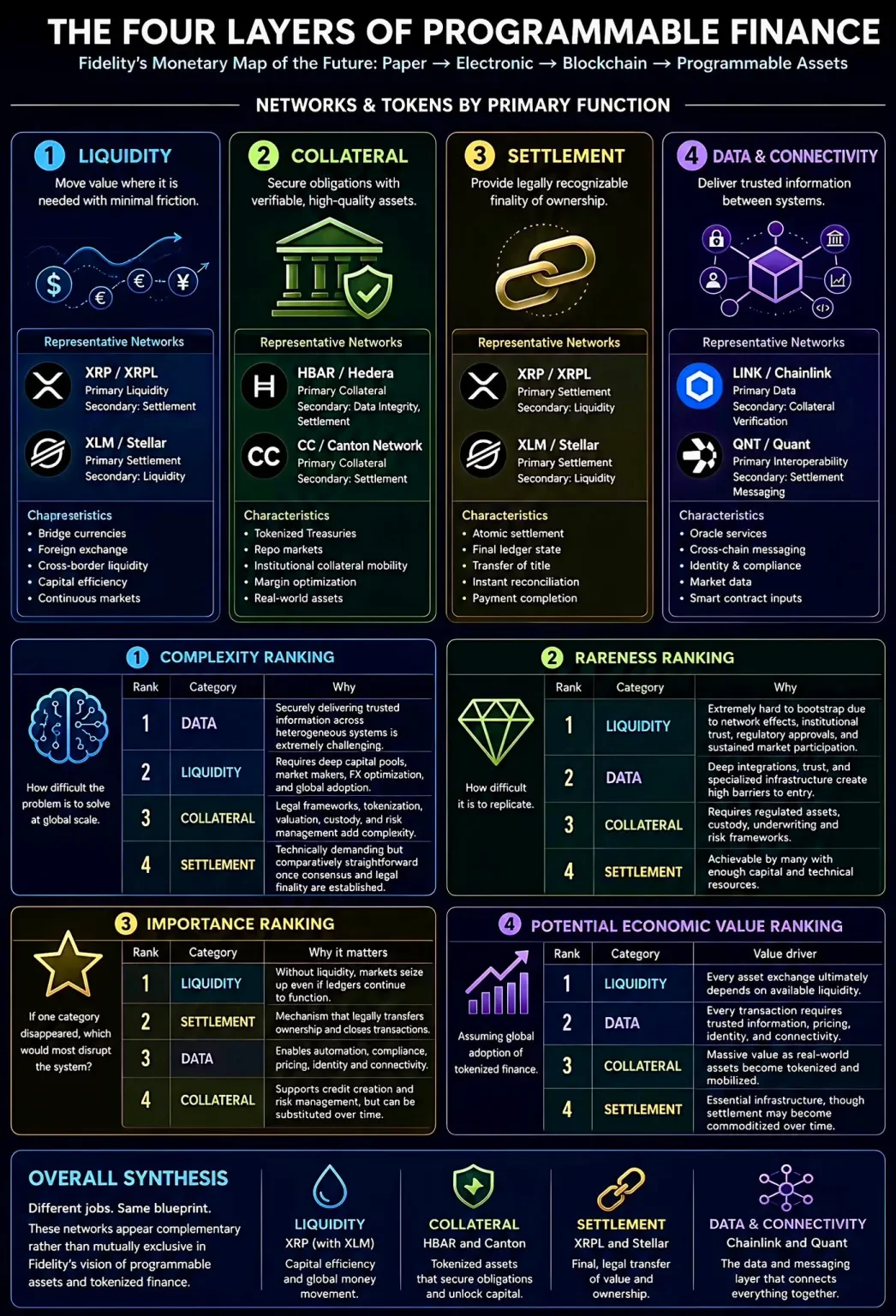
The Four Buckets
Liquidity
Purpose: Move value where it is needed with minimal friction.
Representative Networks:
XRP
XLM
Characteristics:
Bridge currencies
Foreign exchange
Cross-border liquidity
Capital efficiency
Continuous markets
Collateral
Purpose: Secure obligations with verifiable, high-quality assets.
Representative Networks:
Hedera (HBAR)
Canton Network
Characteristics:
Tokenized Treasuries
Repo markets
Institutional collateral mobility
Margin optimization
Real-world assets
Settlement
Purpose: Provide legally recognizable finality of ownership.
Representative Networks:
XRP Ledger
Stellar
Characteristics:
Atomic settlement
Final ledger state
Transfer of title
Instant reconciliation
Payment completion
Data
Purpose: Deliver trusted information between systems.
Representative Networks:
Chainlink
Quant
Characteristics:
Oracle services
Cross-chain messaging
Identity
Compliance
Market data
Smart contract inputs
Overall Synthesis
If Fidelity’s framework evolves as envisioned, these networks appear complementary rather than mutually exclusive:
Liquidity: XRP (with XLM also serving liquidity in some contexts)
Collateral: HBAR and Canton
Settlement: XRPL and Stellar
Data & Connectivity: Chainlink and Quant
A useful mental model is to compare the new monetary system to a modern economy:
Liquidity is what keeps capital circulating.
Collateral is the balance sheet that enables credit and confidence.
Settlement is the legal transfer of ownership that closes transactions.
Data is the nervous system coordinating information, compliance, identity, and communication.
Ranking by Importance
If one category disappeared, which would most disrupt the system?
Without liquidity, markets seize up even if ledgers continue to function. Settlement is the mechanism that legally transfers ownership. Data enables automation, while collateral supports credit and risk management.
Liquidity is exceptionally difficult to bootstrap because it depends on network effects, institutional trust, regulatory approvals, and sustained market participation.
Every asset exchange ultimately depends on available liquidity.
Liquidity for the win!
Source(s):
• https://x.com/KuwlShow/status/2082596373393002673
https://dinarchronicles.com/2026/07/30/rob-cunningham-the-7-trillion-fidelity-forecast/
China Lights Fort Knox Gold Revaluation Fuse!
China Lights Fort Knox Gold Revaluation Fuse!
Kinesis Money: 7-30-2026
In this week's Live from the Vault, Andrew Maguire explores reports on how gold has overtaken US Treasuries as the world's top reserve asset, as central banks lose trust in dollar-based systems and accelerate repatriation of their sovereign assets.
With Fort Knox back under scrutiny following the launch of the Hong Kong SGE gold link, the precious metals expert reveals why a full audit of US gold reserves is imminent, while the gold revaluation process has already begun.
China Lights Fort Knox Gold Revaluation Fuse!
Kinesis Money: 7-30-2026
In this week's Live from the Vault, Andrew Maguire explores reports on how gold has overtaken US Treasuries as the world's top reserve asset, as central banks lose trust in dollar-based systems and accelerate repatriation of their sovereign assets.
With Fort Knox back under scrutiny following the launch of the Hong Kong SGE gold link, the precious metals expert reveals why a full audit of US gold reserves is imminent, while the gold revaluation process has already begun.
Timestamps:
00:00 Start
03:40 Hong Kong-SGE launch puts Fort Knox back under scrutiny
10:53 Gold overtakes Treasuries as the world's top reserve asset
14:44 How China quietly accumulated 40,000+ tons of Western physical gold
18:25 Why Hong Kong marks a structural reset, not just another gold venue
28:17 Reading the charts: why the short squeeze is coming
36:10 Laos adopts the SGE price standard as de-dollarisation spreads
41:16 CME's desperate 24-hour futures gambit to stay relevant
Seeds of Wisdom RV and Economics Updates Thursday Afternoon 7-30-26
Good Afternoon Dinar Recaps,
Global Digital Asset Rules Advance as Senate Nears Critical CLARITY Act Vote
Momentum is building behind U.S. digital asset legislation as lawmakers race to complete the CLARITY Act before the August recess, while regulators signal they are prepared to move forward even if Congress fails to act.
Good Afternoon Dinar Recaps,
Global Digital Asset Rules Advance as Senate Nears Critical CLARITY Act Vote
Momentum is building behind U.S. digital asset legislation as lawmakers race to complete the CLARITY Act before the August recess, while regulators signal they are prepared to move forward even if Congress fails to act.
Overview
The Senate is facing increased pressure to bring the CLARITY Act to a vote before lawmakers leave for the August recess.
Treasury Secretary Scott Bessent has urged Congress to pass the legislation, arguing that regulatory clarity is essential for maintaining U.S. leadership in digital finance.
SEC Chairman Paul Atkins stated the Commission is prepared to issue additional crypto regulations if Congress is unable to enact the legislation.
Key Developments
1. Senate Push Intensifies Before August Recess
Congressional leaders continue working toward a Senate vote on the CLARITY Act, which would establish a comprehensive regulatory framework for digital assets by clearly defining the roles of the Securities and Exchange Commission (SEC) and the Commodity Futures Trading Commission (CFTC).
Supporters argue that the legislation would reduce regulatory uncertainty, improve investor confidence, and encourage innovation while maintaining consumer protections. With only a limited legislative window remaining, lawmakers are attempting to finalize negotiations before the Senate adjourns.
2. Treasury Secretary Bessent Calls for Immediate Action
Treasury Secretary Scott Bessent publicly urged senators to move the legislation forward, emphasizing that clear rules are necessary for the United States to remain competitive in the rapidly evolving global digital asset market.
Bessent also pushed back against criticism surrounding portions of the bill, arguing that concerns over certain provisions should not delay broader regulatory reform. His comments reinforce growing support within parts of the administration for establishing a modern legal framework governing digital assets.
3. SEC Signals It Will Act Regardless
SEC Chairman Paul Atkins stated that the Commission is prepared to move forward with additional regulatory guidance even if Congress does not pass the CLARITY Act.
His remarks indicate that regulators are no longer waiting indefinitely for legislation and are prepared to use existing authority where possible. However, Atkins also acknowledged that congressional action would provide significantly greater legal certainty than piecemeal regulatory decisions.
4. Regulatory Clarity Could Accelerate Institutional Adoption
Financial institutions, investment firms, and blockchain developers have consistently argued that regulatory uncertainty remains one of the largest barriers to broader institutional participation.
A unified federal framework could encourage greater investment in tokenized assets, blockchain infrastructure, and regulated digital financial products while reducing legal uncertainty for businesses operating within the United States.
Why It Matters
The CLARITY Act represents more than cryptocurrency legislation—it is part of a broader modernization of the U.S. financial system. Clear rules governing digital assets could strengthen confidence in emerging financial technologies while helping position the United States as a leader in the next generation of global finance.
Why It Matters to Foreign Currency Holders
Many observers following international monetary developments view digital asset regulation as one component of the evolving global financial architecture. While the CLARITY Act does not affect foreign currency values or trigger any currency revaluation, it supports the development of regulated digital financial infrastructure that may increasingly interact with traditional banking and international payment systems.
Implications for the Global Reset
Pillar 2: Trade
Modern digital asset regulations could improve cross-border financial transactions by providing greater legal certainty for blockchain-based payments and international settlement.
Pillar 4: Technology
The CLARITY Act supports the continued development of tokenization, digital ledgers, and blockchain infrastructure that are becoming foundational technologies for the future financial system.
Closing Thought
This is not simply about regulating cryptocurrency—it reflects the broader transformation of the global financial system as governments work to modernize financial markets, establish trusted digital infrastructure, and prepare for the next generation of cross-border commerce and payments.
Seeds of Wisdom Team
Newshounds News™ Exclusive
Sources
CoinGape — "Scott Bessent Urges Senate to Vote on CLARITY Act Now, Pushes Back on BRCA Criticism"
~~~~~~~~~~
Seeds of Wisdom Team RV Currency Facts Youtube and Rumble
Newshound's News Telegram Room Link
RV Facts with Proof Links Link
RV Updates Proof links - Facts Link
Start Here room with Most Asked Questions Link
Follow the Gold/Silver Rate COMEX
Follow Fast Facts
Seeds of Wisdom Team™Website
Thank you Dinar Recaps