
Thank you to all the subscribers to our Early Access program…we thank you for your continued support.
We are excited to offer this new service to keep you informed and up-to-date on the latest Dinar and currency news.
Iraq Economic News and Points To Ponder Thursday Morning 7-9-26
IMF Expects Severe Contraction In Iraq’s Economy In 2026
Baghdad (IraqiNews.com) – The International Monetary Fund (IMF) projected on Thursday that Iraq’s economy will be the most hit by oil and transportation disruptions in the Middle East and Central Asia in 2026.
The IMF also predicted a robust economic rebound in 2027, when energy market conditions improve and commerce resume, local news outlet Shafaq News reported.
IMF Expects Severe Contraction In Iraq’s Economy In 2026
Baghdad (IraqiNews.com) – The International Monetary Fund (IMF) projected on Thursday that Iraq’s economy will be the most hit by oil and transportation disruptions in the Middle East and Central Asia in 2026.
The IMF also predicted a robust economic rebound in 2027, when energy market conditions improve and commerce resume, local news outlet Shafaq News reported.
In its recent World Economic Outlook report, the IMF projected that Middle Eastern and Central Asian countries will see a sharp drop in growth to 0.7 percent in 2026, before rebounding to 6.5 percent in 2027. These forecasts assume that energy interruptions will last longer than previously predicted.
The economies of Iraq, Kuwait, and Qatar, which are heavily reliant on commodities, will experience significant impacts from disruptions in energy production and transportation. These nations are expected to face an economic downturn in 2026, followed by growth rates exceeding ten percent in 2027.
The anticipated fall in 2026 will mainly result from the disruption in oil production and distribution, especially by those nations that depend heavily on energy exports, but the recovery in 2027 will be brought about by a reduction of these shocks and resumption of business activities.
The IMF’s latest prediction reduces the region’s growth forecast for 2026 by 1.2 percent from the April report, while the 2027 forecast is lifted by about 1.9 percent, suggesting expectations of a stronger rebound.
The IMF, on the other hand, expects Saudi Arabia to remain largely unaffected due to its more diverse export channels, with an economic growth of 1.7 percent in 2026 and 5.5 percent in 2027.
https://www.iraqinews.com/iraq/imf-expects-severe-contraction-in-iraqs-economy-in-2026/
Iraq Tightens Iran Dollar Controls As US Restarts Shipments
Iraq IraqiNews July 9, 2026 Baghdad (IraqiNews.com) — The United States has restarted supplies of U.S. dollar banknotes to Iraq after Baghdad agreed to take further steps to stop American cash from reaching Iran and Iran-backed armed organizations, The Wall Street Journal reported, citing Iraqi and United States officials.
The outbreak of the Iran war in late February froze shipments of physical dollars from Iraq’s oil revenues held at the Federal Reserve Bank of New York, enforced by the U.S. Treasury Department, and shipments were suspended for some four months, putting pressure on Baghdad’s cash-based economy.
Under the deal, Iraq promised to tighten its financial system, including stricter regulation of currency exchange firms and efforts to prevent U.S. cash from reaching Iran or Iran-backed militias via salaries and other financial channels.
Iraq agreed to put in place extra protections to prevent armed organizations from abusing its banking system, a U.S. Treasury official told the newspaper, and shipments resumed. Iraqi authorities said dollar payments had resumed but did not disclose the new terms publicly.
During the delay, the Treasury Department canceled at least two cash shipments, including one for around $500 million, before delivery resumed late last month, The Wall Street Journal said.
The deal comes as Prime Minister Ali Falih Al-Zaidi aims to boost economic ties with Washington while pushing domestic banking reforms.
Al-Zaidi is set to go to the United States later this month to have meetings with President Donald Trump, the newspaper added.
The report also mentioned that the Trump administration has pushed Baghdad to limit the role of Iran-backed militias, including steps to tighten monitoring of cash flows and increase official control over armed organizations.
Analysts told The Wall Street Journal that there are big political obstacles to enacting such regulations, given the entrenched role of militia groups in Iraq’s political and security scene.
Since 2003, Iraq has depended on supplies of U.S. dollar banknotes since most of its economy is still cash-based.
Access to actual dollars is a key source of liquidity for Iraq’s banking sector since oil profits are kept at the Federal Reserve Bank of New York before being released to Iraq.
The new deal is part of a wider push by Washington to tighten financial controls in Iraq while reducing the ability to evade sanctions and move dollars illegally across borders, as Baghdad grapples with balancing its strong economic links with the United States and neighboring Iran. https://www.iraqinews.com/iraq/iraq-tightens-iran-dollar-controls-as-us-restarts-shipments/
After the Decline... A New Rise In Dollar Prices In Iraq Today
Published Sumerian News, the exchange rates of the dollar against the dinar in the Iraqi local markets on Thursday, July 9, 2026. The sale price is 154500 dinars for 100 dollars.
The purchase price is 153650 dinars for 100 dollars. It was Cabinet On February 7, 2022, it was announced that the dollar exchange rate would be adjusted to 1320 dinars to the dollar. LINK
Between High And Low.. The Latest Update Of Gold Prices In Iraq
Alsumaria News – Economy Published Sumerian News Foreign and Iraqi gold prices in the local markets in the capital Baghdad Today is Thursday, July 9, 2026.
The sale price of Iraqi gold karat 21 amounted to 857 thousand dinars, compared to 853 thousand dinars for purchase.
In the jewelers' shops, the selling price of the gold weight of the Gulf karat 21 ranged between 890 thousand and 900 thousand dinars.
Global gold prices continue to rise in record highs, with investors increasingly confident that the US Federal Reserve will cut interest rates in September, as well as rising economic and geopolitical uncertainty, along with expectations of a reduction in US interest rates. LINK
Globally. Oil Prices Continue To Rise In Early Trading
Sumerian News - Economy Oil prices rose on Thursday after United States New strikes against Iran To diminish hopes of ending the war and reopening Strait of Hormuz Completely.
By 00:54 GMT, crude futures had risen.Brent" at 1% to $78.8 per barrel. The futures contracts for West crude increased. Texas The US broker is 1.01% to $74.26.
Before that, the two benchmarks at the settlement reached their highest levels in more than two weeks after the US president threatened Donald Trump Bombing Iran Last night.
He said U S Army He carried out new strikes on Iran in order to keep Strait of Hormuz vitality is open to navigation, hours after saying Trump The interim agreement to end the war is “over.” LINK
Iraq Economic News and Points To Ponder Late Wednesday Evening 7-8-26
Al-Mustaqilla Reveals: 3 Key Issues In Al-Zaidi's Visit To Washington
July 8, 2026Last updated: July 8, 2026 Al-Mustaqilla - As attention turns to Iraqi Prime Minister Ali al-Zubaidi's visit to Washington on July 15, information obtained by Al-Mustaqilla reveals that the economic agenda will be at the forefront of the talks, with an American focus on financial files related to Iran, while the file of combating corruption is absent from the visit's agenda.
According to an informed source, the talks will focus on three main axes,
Al-Mustaqilla Reveals: 3 Key Issues In Al-Zaidi's Visit To Washington
July 8, 2026Last updated: July 8, 2026 Al-Mustaqilla - As attention turns to Iraqi Prime Minister Ali al-Zubaidi's visit to Washington on July 15, information obtained by Al-Mustaqilla reveals that the economic agenda will be at the forefront of the talks, with an American focus on financial files related to Iran, while the file of combating corruption is absent from the visit's agenda.
According to an informed source, the talks will focus on three main axes,
The first of which is the issue of weapons and restricting them to the state, while the second
and third axes will be purely economic, relating to monitoring the movement of the dollar and Iranian economic interests inside Iraq.
The source indicates that Washington will discuss with the Iraqi side mechanisms to curb dollar smuggling to Iran and tighten oversight of the Iraqi financial system to prevent hard currency from reaching entities subject to US sanctions. This comes amid continued US pressure on Baghdad to reform the banking sector and strengthen financial compliance.
The third axis relates to Iranian economic influence within Iraq, whether through companies or trade and financial transfer networks. This is an issue that the United States believes is directly linked to the effectiveness of the sanctions imposed on Tehran and to the stability of the Iraqi financial system.
According to the source, the visit's agenda does not include any item related to combating corruption or opening major corruption files, despite the campaign announced by the government during the past period. This raises questions about the priorities of the talks with the American administration, which seem to be focused on financial security, the movement of the dollar, and economic relations with Iran more than on internal reform files.
Observers believe that the nature of these files reflects Washington’s interest in securing the Iraqi financial system and preventing its use as a loophole to circumvent sanctions, at a time when Baghdad is seeking to maintain the stability of the dinar’s exchange rate and ensure the continued flow of dollars through official channels, amid escalating financial and regional challenges. https://mustaqila.com/المستقلة-تكشف-3-ملفات-رئيسية-بزيارة-الز/
Zaidi In Front Of The "Big Whales" Test .. Washington Is Waiting To Prove Seriousness In The Files Of Corruption And Weapons Nearly $300 Billion Has Fled Out Of Iraq
Baghdad / Tamim al-Hassan Before Prime Minister Ali al-Zaidi landed in Washington in mid-July, Baghdad seems to have found itself in front of a sensitive political test, entitled the funeral of former Iranian leader Ayatollah Ali Khamenei and a number of his family members in Iraq.
The event, which is supposed to fall within the framework of religious ceremonies, quickly turned into a political file where the calculations of Baghdad, Tehran and Washington intersect, to become one of the first decades before the upcoming meeting between Zaidi and US President Donald Trump.
Although the visit to the White House comes amid signs of improved relations between Baghdad and Washington, it still faces serious questions about Zaidi’s ability to implement the commitments contained in the understandings concluded between the two sides in what has become known as the “June settlement.”
On the other hand, observers believe that the prime minister has made significant progress over the past week towards the US administration, after launching a wide campaign to prosecute officials accused of corruption, in a move seen as an attempt to prove the seriousness of the implementation of the pledges made to Washington.
Iranian Pressure. Iraqi Hesitation
A political source familiar with the agreement to hold the funeral of Khamenei in Iraq on Wednesday was not an easy decision within the government, but was preceded by hesitant discussions, before tilting the scales under Iranian pressure, supported by positions of forces in the coordination framework and armed factions.
The source, a deputy in one of the large Shiite parties, told Al-Mada, on condition of anonymity, that “Zaidi is aware that this file may put him in an embarrassing position in front of Trump during his upcoming visit to Washington.”
According to information circulating in the political circles, the funeral program has witnessed a remarkable amendment, as Baghdad was excluded from the schedule of the ceremony, after it was scheduled to hold a ceremony in the city of Al-Kadhimiya, to limit the visit to Najaf and Karbala, with the possibility of receiving the body of the guide at Najaf airport.
It is estimated that a large funeral ceremony in the capital may have turned into anti-American demonstrations, punctuated by chants and slogans targeting the US president, similar to the scenes that accompanied the funeral ceremony inside Iran.
US President Donald Trump has shown a clear interest in the funeral ceremony that began over the weekend in Iran.
Trump said in a press statement, commenting on the scenes that showed thousands of participants crying during the ceremony, that he was surprised by the size of the popular interaction, before adding: "Maybe those are fake tears."
Iranian Foreign Minister Abbas Araqchi arrived in Baghdad, in his first visit since the end of the last war in the region, in conjunction with the launch of what has become known as the "Dawn Campaign", which targeted deputies and officials accused of corruption last week.
According to the leak after the visit, Araqchi discussed with Iraqi officials the details of the funeral ceremony, while preliminary information indicated that Baghdad will be one of the main stations of the event.
But the Iraqi committee to organize the visit later quickly denied that information, before the features of the new program, which was limited to Najaf and Karbala, were later clarified.
Religious Rituals. No Political Calculations
On the other hand, former diplomat Ghazi Faisal provides a different reading of the file, as he believes that Washington, including President Trump, realizes that the funeral of the former Iranian leader does not fall within the official work of the Iraqi government, but falls within the framework of religious and sectarian rituals.
Faisal told Al-Mada that "Zaidi is concerned with running the government, while Khamenei's funeral is part of the religious traditions," adding that Baghdad's approval of the funeral ceremony in Najaf and Karbala "does not exceed being a response to religious traditions followed with religious or official figures or even ordinary citizens."
Faisal pointed out that Trump himself announced that Iran was given a week to complete the funeral ceremony, out of respect for this occasion, without exerting pressure related to negotiations between the two parties.
He believes that what happened represents a "temporary truce" to allow for the end of the ceremony, before the resumption of the negotiating track between Washington and Tehran.
The former diplomat concludes that the United States, as a multi-religious and multicultural country, usually respectfully views religious and sectarian diversity and associated rituals, making it unlikely that the funeral ceremony, in itself, will turn into a crisis in official relations between Baghdad and Washington, unless it is accompanied by messages or political positions beyond its religious dimension.
How Is Zaidi Being Seen In Washington Now?
On the image of Zaidi in the United States, the researcher on the American issue, Kato Saadullah, believes that Washington still gives Zaidi an important political opportunity, but at the same time links the continuation of this support to the extent of its ability to implement real reforms.
Saadullah told Al-Mada that the Prime Minister's visit comes at the invitation of US President Donald Trump, and coincides with the celebrations of the 250th anniversary of the founding of the United States, adding that Trump will be before that at the NATO conference in Ankara, to meet Zaidi after his return to Washington.
He points out that Trump has already announced his support for Zaidi and the current government, a position that has given Baghdad an important political margin, but this support, according to Saad Allah, will not be open or unconditional.
He adds that the US president, through his envoy Tom Barrack, informed the Iraqi government of a set of priorities that should be worked on if Baghdad wants to preserve the American cover.
Three American Priorities
Saadullah puts these priorities in three main files.
First, to end the phenomenon of weapons outside the framework of the state, and to dissolve militias and armed factions, thus restoring the state’s monopoly on force.
The second file is to fight corruption, which, according to the researcher, is the issue that Trump focuses on more than any other file, based on the conviction that corruption represents the gateway from which the rest of the Iraqi crises branch out.
The third file is the cessation of the smuggling of hard currency, and the closure of channels that drain the Iraqi financial reserves and feed financial networks linked abroad.
Is the Dawn Campaign enough?
Saadullah believes that the recent campaign launched by Zaidi against a number of those accused of corruption is an important step, but it still needs more evidence.
Will this campaign be enough paper that Zaidi carries to Washington to convince the US administration, Congress, and American institutions that he has already started the battle against corruption, or will it be read as late measures that do not live up to the challenges?
He believes that the answer to this question will largely determine the nature of the US position on the Iraqi government during the next phase.
Congress Calls Zaidi’s Actions A “Smug”!
Despite the initial U.S. welcome of recent moves, Saadullah points to the presence of powerful voices in Congress that continue to view with skepticism what is going on in Baghdad.
He cites the position of Congressman Joe Wilson, who criticized the Zaidi campaign, calling it a “joke” and considering it not a real confrontation with the system of corruption.
Saadullah recalls that Wilson went further when he published the names of prominent political figures, saying that any serious campaign should start from "big whales", and mentioned in his tweet Nouri al-Maliki, Hadi al-Amiri, and Qais al-Khazali.
Washington Exam
Saadullah believes that the task awaiting Zaidi in Washington will not be easy.
If he only presents the measures taken over the past week, he will likely not get a full American conviction.
If he succeeds in convincing the US administration that he will return to Baghdad to complete a broad campaign targeting senior corruption suspects, in parallel with practical steps to limit arms to the state, the chances of continued US support will increase significantly.
He added that the visit comes at a very sensitive economic time, as Iraq is facing a financial crisis as a result of the suspension of oil exports during the recent war with Iran, which made Baghdad more in need of loans and international financial support.
He stressed that obtaining funding from the World Bank or major financial institutions would be more difficult without US political cover, which gives the visit more importance than its diplomatic dimension.
Is the Syrian experience a repeat?
Saadullah argues that the nature of U.S. support will become clearer after the visit, questioning whether Trump will deal with Zaidi in the same way he treated Syrian President Ahmed al-Sharaa by linking support to a series of conditions and procedures.
He adds that if US support is already conditional, Baghdad will be required to show more decisive steps in the files of anti-corruption and disarmament, because these two files will remain the basic criterion for judging the performance of the government.
Observers view the visit as the culmination of the understandings reached by Zaidi with US envoy Tom Barrack during his visit to Baghdad last month, which became politically known as the "June settlement", which includes besieging Iranian influence and creating a wider environment for US investment inside Iraq.
The battle of corruption. Figures follow Zaidi to Washington
On the other hand, the former diplomat and head of the Iraqi Center for Strategic Studies, Ghazi Faisal, believes that the real battle facing the government of Ali al-Zaidi is the fight against corruption, stressing that the government has begun to pursue money laundering, smuggling and corruption networks, especially in the oil and electricity sectors, in addition to tracking financial networks in neighboring countries and Europe, including more than 264 defendants and their money.
Faisal pointed out that the World Bank has already talked about smuggling more than $ 300 billion out of Iraq, considering that dismantling these networks and recovering funds may take seven years or more, because of their association with banks and external companies and the merger of part of the money in the economies of other countries.
Faisal calls for a comprehensive audit of state institutions through international audit companies.
Faisal concludes that Washington is aware of the complexities of confronting corruption in Iraq, but it will look at any real progress in this file as the most important card that Zaidi can carry to the White House, because the success of the government will be measured by its actual results in combating corruption and recovering money, not just by launching campaigns https://almadapaper.net/442372/
Iraq Economic News and Points To Ponder Wednesday Evening 7-8-26
Government Advisor: No Change In The Dinar Exchange Rate Against The Dollar
Published on: July 9, 2026 at 12:19 AM Baghdad / Al-Mada - The financial advisor to the Iraqi Prime Minister, Mazhar Muhammad Salih, denied the existence of any plan or program by the Iraqi government to change the exchange rate of the dinar against the dollar, stressing that this matter has not been discussed in any way.
Salih said yesterday, Wednesday, in a press statement, that "the issue of the currency's value has not been discussed in any way," in response to rumors circulating about the possibility of changing the official exchange rate of the dinar against the dollar.
Government Advisor: No Change In The Dinar Exchange Rate Against The Dollar
Published on: July 9, 2026 at 12:19 AM Baghdad / Al-Mada - The financial advisor to the Iraqi Prime Minister, Mazhar Muhammad Salih, denied the existence of any plan or program by the Iraqi government to change the exchange rate of the dinar against the dollar, stressing that this matter has not been discussed in any way.
Salih said yesterday, Wednesday, in a press statement, that "the issue of the currency's value has not been discussed in any way," in response to rumors circulating about the possibility of changing the official exchange rate of the dinar against the dollar.
The Iraqi Prime Minister's advisor, Ali al-Zidi, pointed out that "recently, several official statements and declarations have been issued denying all claims about any discussion or intention to change the current exchange rate of the dinar."
These statements come at a time when rumors about changing the official exchange rate of the dinar against the dollar resurface periodically in the markets of Iraq and the Kurdistan Region.
The exchange rate of 100 US dollars was fixed at 130,000 Iraqi dinars in Iraq's three-year budget law for the years 2023, 2024, and 2025. https://almadapaper.net/442717/
Iraq Resumes Cash Dollar Shipments... But Experts Downplay Their Impact On The Market!
7/8/2026 Baghdad/Ahmed Kawkab The Prime Minister's financial advisor, Mazhar Muhammad Salih, confirmed on Tuesday that Iraq has resumed receiving shipments of US dollars in cash, with each shipment amounting to approximately $500 million.
He explained that the regularity of these shipments strengthens the stability of the parallel market, affirms Baghdad's commitment to international compliance standards, and contributes to narrowing the gap with the official exchange rate, following a period of anxiety that accompanied regional developments.
However, some experts believe that these shipments do not significantly impact the exchange rate, and that their previous suspension was more related to air transport issues than to any financial or political disputes.
Salih told Al-Mada newspaper, "These cash dollar shipments do not represent new funds, but rather are drawn from the Central Bank of Iraq's reserves deposited with the Federal Reserve Bank of New York, and are allocated to cover travelers' needs." He added, "The percentage of cash dollars does not exceed about 10% of total foreign transfers, and each shipment amounts to approximately $500 million, which is sufficient to meet normal demand."
He explained that “the regularity of these shipments is linked to Iraq’s full commitment to international compliance standards,” noting that “the Central Bank of Iraq is among the most cooperative institutions with the US Federal Reserve and the US Treasury Department in matters related to combating money laundering and terrorist financing.” He denied the validity of rumors about violations or exceptional restrictions imposed on Iraq.
Saleh revealed that “transporting cash dollars to Iraq is one of the most complex logistical operations, as it is carried out via private aircraft and under strict security and safety measures.” He explained that “these operations are executed according to precise arrangements that ensure the safety of the shipments until they reach the Central Bank.”
He pointed out that “the continued arrival of cash dollar shipments sends a positive signal to the parallel market and dispels rumors that disrupt exchange rates.”
He considered that “increasing the level of certainty among traders gradually leads to a narrowing of the gap between the official rate of 1,320 dinars per dollar and the parallel market rate, because the sustainability of compliance and the regularity of shipments are among the most important factors for the stability of the exchange market in Iraq.”
Saleh explained that “the dollar, despite being part of Iraq’s reserves, remains subject to US monetary policy and laws as it is the currency of another country.” He clarified that “the United States stipulates that its currency not be used in a manner that contradicts its foreign policy or national security, which requires countries dealing in dollars to adhere to international compliance standards.”
He added that “the decline in demand for cash dollars during the past period coincided with the security conditions in the region, as questions were raised in the United States about the continued need for shipments given the decline in travel, before supply operations returned to normal as Iraq continued to comply with international regulations.”
Saleh pointed out that “the purchase of cash dollars by travelers is currently subject to a comprehensive monitoring system through the FTR platform, which tracks international financial transfers and transactions. The data of each beneficiary is recorded accurately, including personal information and fingerprints, to prevent duplicate purchases or misuse of cash dollars.” He explained that “each traveler receives $3,000 per month for each trip through Iraqi airports.”
He added that “electronic financial transfers are already subject to strict international oversight through global banking systems, but cash dollars require additional procedures due to the sensitivity of their circulation.”
He explained that this “led to the adoption of advanced tracking systems that give Iraq a positive image before international institutions concerned with combating money laundering and the financing of terrorism.”
Saleh believes that “the development of economic relations between Baghdad and Washington, especially the Prime Minister’s upcoming visit to the United States, will positively impact the level of trust between the two sides and contribute to the stability of financial transactions.” He considers that “an improved financial climate directly impacts the stability of the local market.”
In a related context, specialists believe that linking these shipments to exchange rate fluctuations, or interpreting their suspension as a crisis with the United States, is not based on realistic data, but rather is related to air transport conditions and the security developments witnessed in the region.
Economic expert Duraid al-Anzi told Al-Mada that "the cash dollars shipped from the United States have no bearing on the Iraqi market, neither influencing the dollar's price nor its daily transactions. They do not enter the local market directly or indirectly because the incoming funds remain within the state's financial cycle and do not act as a tool to influence supply and demand within the markets."
He pointed out that "the claims made recently about a problem between Baghdad and Washington due to the halt in shipments were not supported by any official indicators," expressing surprise at "the talk of a crisis without any statement or position from either the US or Iraq confirming its existence." He considered the "suspension of civilian air traffic in the region during the war to be the natural reason behind the delay in the arrival of the shipments."
Al-Anzi added that "the resumption of dollar shipments coincided with the end of military operations and the resumption of air traffic," asking, "Were there any new meetings, understandings, secret communications, or political pressures?
We haven't heard of anything of the sort." He concluded that "interpreting the resumption of shipments as a result of a political breakthrough with the United States is an inaccurate reading of reality."
He explained that “the funds arriving in Iraq are part of its oil revenues and reserves deposited with the US Federal Reserve, and are transferred according to financial mechanisms that have been in place for years.” He clarified that “the shipping process is subject to continuous auditing and monitoring procedures and does not represent a new or exceptional financial resource.”
Al-Anzi believes that “the recent increases in the dollar exchange rate are due to increased demand from entities seeking to smuggle funds, which has created an artificial supply and demand crisis within the parallel market.” He emphasized that “this crisis is fabricated and is not related to the suspension of cash dollar shipments,” noting that “regional tensions, including talk of closing the Strait of Hormuz, were not sufficient on their own to cause these jumps in the exchange rate.”
He pointed out that “discussions about the value of the shipments should be understood within the context of government needs, and that the funds are transported by private planes in periodic installments as requested, with the cost of transportation being one million dollars, while transportation and insurance operations are subject to precise financial and logistical procedures.” He affirmed that “there is no fundamental change in the mechanism for supplying Iraq with dollars.”
He added that “the incoming funds are deposited into the accounts of the Central Bank and the government, and are included in the general budget,” while simultaneously warning that “a portion of these funds was previously subject to smuggling or misuse, which prompted the financial authorities to tighten control and tracking procedures.” He considered that “confronting this phenomenon represents the real challenge, not the regularity of dollar shipments themselves.”
Al-Anzi explained that “the stability of the Iraqi market will not be achieved simply by the arrival of dollar shipments, but rather requires addressing the internal imbalances that fuel the parallel market, tightening control over the movement of funds, and combating corruption and smuggling networks.”
He emphasized that “cash dollars are more closely linked to the budget and its allocations than to the activity of the local market, and that what happened during the past period was essentially a result of the suspension of civil aviation, not a result of political or financial disputes with the United States.” https://almadapaper.net/442545/
Minister Of Finance: We Are Continuing To Prepare The Draft 2027 Budget Law In Preparation For Submitting It To The Cabinet.
Baghdad ( NINA ) – Finance Minister Faleh al-Sari confirmed on Tuesday that the ministry is continuing to prepare the draft federal budget law for 2027, in preparation for submitting it to the Council of Ministers and then referring it to the Council of Representatives in the coming period.
A ministry statement indicated that "the Parliamentary Finance Committee, chaired by MP Uday Awad and attended by its members and a number of members of other parliamentary committees, hosted Finance Minister Faleh al-Sari and senior ministry officials today to discuss the financial and economic situation and the mechanisms for preparing the draft federal budget for 2027."
The statement added that "at the beginning of the meeting, the committee chairman welcomed the Finance Minister and senior officials, emphasizing the importance of strengthening cooperation and coordination between the legislative and executive branches to ensure the integration of roles in legislation and oversight, and to contribute to improving institutional performance."
The head of the Finance Committee affirmed, according to the statement, that "the committee is committed to supporting and enacting laws that contribute to addressing financial challenges, developing non-oil resources, and enhancing the state's financial sustainability.
" The statement continued, "During a meeting held at its headquarters, the Finance Committee listened to a detailed explanation of the country's financial and economic situation, with an emphasis on implementing appropriate solutions through legislation that ensures economic stability."
The Minister of Finance praised the Finance Committee's role in preparing the general budgets and exercising its oversight function, as well as its contribution to enacting laws related to financial and economic affairs.
He explained that "the ministry has set a number of priorities, foremost among them the automation of the ministry's operations, the establishment of a specialized body, and the adoption of a gradual transition from line-item budgeting to program-based budgeting."
Al-Sari indicated that "the 2027 budget proposal includes a phased plan for implementing program and performance-based budgeting, starting with a number of governorates as a pilot program, to be gradually expanded to include all of Iraq's governorates."
He reviewed the ministry's plan to repay public debt by reorganizing dealings with banks affiliated with the ministry, which will contribute to reducing the debt burden, enhancing financial stability, and supporting
The statement continued, "The meeting discussed mechanisms for maximizing public revenues and activating the ASYCUDA system, which contributes to raising the efficiency of customs administration and increasing state resources. It also explored the possibility of amending several related laws and working to establish a development fund and an energy fund to boost revenues and support the public treasury." The
meeting concluded with extensive discussions among committee members regarding financial and economic matters, emphasizing the importance of adopting solutions and procedures that achieve the public interest and enhance financial and economic stability in the country, in addition to finding appropriate solutions for the issue of contracts and daily wages. /End 8. https://ninanews.com/website/News/Details?key=1304720
Seeds of Wisdom RV and Economics Updates Wednesday Evening 7-8-26
Good Evening Dinar Recaps,
Fed Minutes Reveal Deep Policy Divide as Middle East Tensions Add New Inflation Risks
Newly released Federal Reserve meeting minutes show policymakers are increasingly divided over the path of interest rates, while renewed Middle East tensions and rising oil prices add fresh uncertainty to the global economic outlook.
Good Evening Dinar Recaps,
Fed Minutes Reveal Deep Policy Divide as Middle East Tensions Add New Inflation Risks
Newly released Federal Reserve meeting minutes show policymakers are increasingly divided over the path of interest rates, while renewed Middle East tensions and rising oil prices add fresh uncertainty to the global economic outlook.
Overview
Federal Reserve officials remain divided over whether inflation is easing enough to justify future rate cuts, according to minutes released today.
Renewed U.S.-Iran tensions pushed oil prices sharply higher, increasing concerns that inflationary pressures could persist.
Global investors are reassessing monetary policy expectations, as higher energy costs could delay interest-rate reductions and influence financial markets worldwide.
Key Developments
1. Fed Officials Split on Inflation Outlook
Minutes from the Federal Reserve's latest policy meeting reveal a clear divide among policymakers. Some officials believe inflation will continue moderating, while others expect persistent price pressures that could require higher interest rates for longer.
2. Oil Prices Complicate the Inflation Picture
Markets reacted quickly after renewed tensions between the United States and Iran drove oil prices significantly higher. Rising energy costs could feed into transportation, manufacturing, and consumer prices, making the Fed's inflation challenge more difficult.
3. Markets Reprice Interest-Rate Expectations
Global stocks weakened while bond yields and the U.S. dollar strengthened as investors adjusted expectations for future monetary policy. Markets now anticipate that any decline in interest rates may occur more slowly if inflation remains elevated.
4. Energy Security Remains a Global Financial Risk
The renewed instability surrounding the Strait of Hormuz has reminded investors how quickly geopolitical events can affect global energy supplies, inflation, and economic growth. Although markets are not yet pricing in a prolonged disruption, uncertainty remains elevated.
5. Global Reset Themes Continue to Converge
Today's developments illustrate how central bank policy, geopolitical risk, inflation, and energy markets continue to interact. Financial markets are increasingly responding to these interconnected forces rather than to isolated economic data alone.
Why It Matters
Interest-rate policy remains one of the most powerful drivers of the global financial system. If inflation remains elevated because of higher energy costs or geopolitical instability, central banks could delay easing monetary policy, affecting borrowing costs, investment, and economic growth worldwide.
Why It Matters to Foreign Currency Holders
Currency values are heavily influenced by interest-rate expectations and inflation. Any delay in future rate cuts or renewed market volatility could affect exchange rates, capital flows, and the timing of broader monetary and financial reforms.
Implications for the Global Reset
Pillar 1 – Debt
Higher-for-longer interest rates would increase borrowing costs for governments, businesses, and consumers, adding further pressure to already elevated global debt levels.
Pillar 5 – Energy
Renewed uncertainty in the Middle East demonstrates how energy markets continue to influence inflation, monetary policy, and global financial stability, making energy security a critical factor in the evolving financial landscape.
This is not just about today's Federal Reserve meeting minutes—it highlights how central bank policy, geopolitical developments, and energy markets are increasingly shaping the transition toward a new global financial environment.
Seeds of Wisdom Team
Newshounds News™ Exclusive
Sources
Reuters – Stocks, bonds retreat after Trump says Iran MOU "is over"
Associated Press – Fed minutes show officials deeply divided over future path of U.S. inflation
~~~~~~~~~~
Seeds of Wisdom Team RV Currency Facts Youtube and Rumble
Newshound's News Telegram Room Link
RV Facts with Proof Links Link
RV Updates Proof links - Facts Link
Start Here room with Most Asked Questions Link
Follow the Gold/Silver Rate COMEX
Follow Fast Facts
Seeds of Wisdom Team™ Website
Thank you Dinar Recaps
RATE HIKE SHOCK: This Triggers The 60% Market Crash | Todd "Bubba" Horwitz
RATE HIKE SHOCK: This Triggers The 60% Market Crash | Todd "Bubba" Horwitz
Liberty and Finance: 7-7-2026
Todd "Bubba" Horwitz explains why he believes gold and silver have already formed an important bottom and why long-term investors may want to start accumulating physical precious metals now.
He also breaks down the AI-fueled stock market surge and warns that rising interest rates could be the catalyst for a sharp correction in equities.
The conversation covers the Federal Reserve, inflation, and the housing market, along with why higher Treasury yields may ultimately strengthen the long-term case for gold.
RATE HIKE SHOCK: This Triggers The 60% Market Crash | Todd "Bubba" Horwitz
Liberty and Finance: 7-7-2026
Todd "Bubba" Horwitz explains why he believes gold and silver have already formed an important bottom and why long-term investors may want to start accumulating physical precious metals now.
He also breaks down the AI-fueled stock market surge and warns that rising interest rates could be the catalyst for a sharp correction in equities.
The conversation covers the Federal Reserve, inflation, and the housing market, along with why higher Treasury yields may ultimately strengthen the long-term case for gold.
Todd also shares the key economic signals he is watching in the weeks ahead and what could matter most as markets face growing uncertainty. This interview offers a timely look at the forces shaping precious metals, stocks, and the broader economy.
INTERVIEW TIMELINE:
0:00 Intro
1:00 Gold & silver bottom?
9:44 Kevin Warsh & rates
Rob Cunningham: Gold, Silver, Mathematics, and XRP Share a Defining Characteristics
Rob Cunningham: Gold, Silver, Mathematics, and XRP Share a Defining Characteristics
7-8-2026
Honest Weights.
Honest Measures.
Honest Civilization.
Gold, silver, mathematics, and XRP share a defining characteristic: they carry no inherent counterparty risk. Their underlying properties exist independent of opinion or authority.
Rob Cunningham: Gold, Silver, Mathematics, and XRP Share a Defining Characteristics
7-8-2026
Honest Weights.
Honest Measures.
Honest Civilization.
Gold, silver, mathematics, and XRP share a defining characteristic: they carry no inherent counterparty risk. Their underlying properties exist independent of opinion or authority.
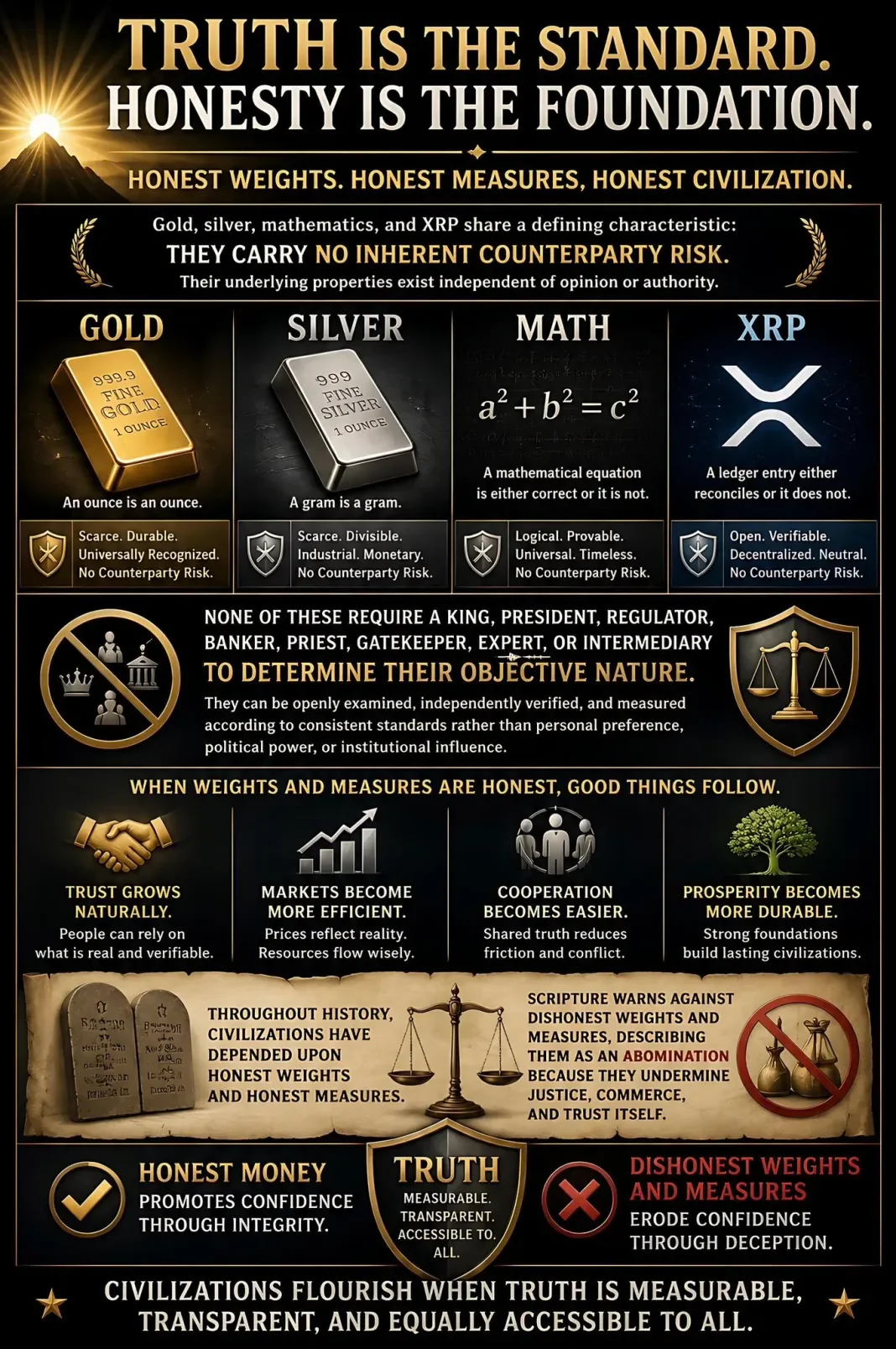
Truth is truth.
An ounce is an ounce.
A gram is a gram.
A mathematical equation is either correct or it is not.
A ledger entry either reconciles or it does not.
None of these require a king, president, regulator, banker, priest, gatekeeper, expert, or intermediary to determine their objective nature. They can be openly examined, independently verified, and measured according to consistent standards rather than personal preference, political power, or institutional influence.
When weights and measures are honest, trust grows naturally. Markets become more efficient. Cooperation becomes easier. Prosperity becomes more durable because participants share a common reference point grounded in transparent standards rather than subjective interpretation.
Throughout history, civilizations have depended upon honest weights and honest measures. Scripture likewise warns against dishonest weights and measures, describing them as an abomination because they undermine justice, commerce, and trust itself.
Honest money promotes confidence through integrity.
Dishonest weights and measures erode confidence through deception.
Civilizations flourish when truth is measurable, transparent, and equally accessible to all.
Source(s):
• https://x.com/KuwlShow/status/2074529146466623551
Seeds of Wisdom RV and Economics Updates Wednesday Afternoon 7-8-26
Good Afternoon Dinar Recaps,
Trump Ends Iran Ceasefire Framework as Markets Brace for Oil Shock
Renewed tensions in the Middle East are rippling through global markets after President Donald Trump declared the U.S.-Iran memorandum of understanding "over," sending oil prices higher and increasing concerns about inflation, monetary policy, and global growth.
Good Afternoon Dinar Recaps,
Trump Ends Iran Ceasefire Framework as Markets Brace for Oil Shock
Renewed tensions in the Middle East are rippling through global markets after President Donald Trump declared the U.S.-Iran memorandum of understanding "over," sending oil prices higher and increasing concerns about inflation, monetary policy, and global growth.
Overview
President Trump announced that the U.S.-Iran memorandum of understanding has ended, reigniting uncertainty over Middle East stability.
Oil prices surged more than 5%, while global stock markets declined as investors shifted toward safer assets.
Investors are now watching Federal Reserve policy closely, as rising energy prices could complicate inflation and future interest-rate decisions.
Key Developments
1. Trump Declares Iran Agreement Over
President Trump announced that the memorandum of understanding that had provided the framework for ending hostilities with Iran was no longer in effect. The statement immediately increased geopolitical uncertainty and raised concerns about renewed conflict in the Gulf.
2. Oil Prices Jump on Supply Concerns
Brent crude oil climbed more than 5% as traders reacted to fears that renewed tensions could disrupt energy supplies moving through the Strait of Hormuz, one of the world's most important oil shipping routes.
3. Global Markets Turn Risk-Off
Equity markets weakened while investors moved toward traditional safe-haven assets. Higher energy prices renewed concerns that inflation could remain elevated longer than previously expected.
4. Federal Reserve Outlook Becomes More Complicated
Markets are awaiting the release of the Federal Reserve's meeting minutes for clues about future monetary policy. Rising oil prices could make it more difficult for policymakers to ease interest rates if inflation begins accelerating again.
5. IMF Warns Central Bank Communication Is Becoming More Important
Separately, the International Monetary Fund said it plans to engage with central banks regarding changes to monetary policy communication and forward guidance, emphasizing that clear communication becomes increasingly important during periods of geopolitical and economic uncertainty.
Why It Matters
Geopolitical instability can rapidly affect energy prices, inflation, financial markets, and central bank policy. Today's developments demonstrate how closely global finance remains tied to events in the Middle East and why investors continue monitoring both geopolitical risks and monetary policy.
Why It Matters to Foreign Currency Holders
Foreign currency investors should watch oil prices and central bank decisions carefully. Rising energy costs can strengthen inflation, influence interest-rate policy, increase currency volatility, and affect capital flows across global financial markets.
Implications for the Global Reset
Pillar 1 – Debt
Higher oil prices may delay interest-rate reductions, increasing borrowing costs for governments, businesses, and consumers while adding pressure to already elevated sovereign debt levels.
Pillar 5 – Energy
Renewed uncertainty surrounding the Strait of Hormuz highlights how energy security remains a critical driver of inflation, financial stability, and global economic growth.
This is not just about renewed Middle East tensions—it demonstrates how geopolitical events, energy markets, and central bank policy remain deeply interconnected in shaping the evolving global financial system.
Seeds of Wisdom Team
Newshounds News™ Exclusive
Sources
Reuters – Wall Street jittery and oil up as Trump says interim Iran deal "over"
Reuters – IMF says hopes to engage on central banks' changes to forward guidance
~~~~~~~~~~
Seeds of Wisdom Team RV Currency Facts Youtube and Rumble
Newshound's News Telegram Room Link
RV Facts with Proof Links Link
RV Updates Proof links - Facts Link
Start Here room with Most Asked Questions Link
Follow the Gold/Silver Rate COMEX
Follow Fast Facts
Seeds of Wisdom Team™ Website
Thank you Dinar Recaps
Hong Kong Just Launched a Gold System That Could REPRICE Gold
Hong Kong Just Launched a Gold System That Could REPRICE Gold
Taylor Kenny: 7-7-2026
Hong Kong just launched a new gold clearing and settlement system — and it could change the way gold and silver are priced around the world.
CHAPTERS:
00:00 Hong Kong Launches a Gold System That Could Reprice Gold
Hong Kong Just Launched a Gold System That Could REPRICE Gold
Taylor Kenny: 7-7-2026
Hong Kong just launched a new gold clearing and settlement system — and it could change the way gold and silver are priced around the world.
CHAPTERS:
00:00 Hong Kong Launches a Gold System That Could Reprice Gold
00:59 The West’s Paper Gold Pricing Monopoly
01:27 How Rehypothecation Suppresses Gold and Silver Prices
02:56 Banks, Spoofing, and Overnight Price Raids
04:22 Currency Resets, Inflation, and the Dollar’s Decline
05:19 Central Banks Know What’s Coming
06:43 Gold Infrastructure and the Return to Real Money
07:41 BRICS, Gold Corridors, and Oil Settlement
News, Rumors and Opinions Wednesday 7-8-2026
Ariel: Operation Sandman is Not a Theory
7-8-2026
Operation Sandman is not a theory, a rumor, or a vague financial reset fantasy.
It is the active, multi-year special access program designed as the final economic decapitation strike against the fiat dollar system, the Federal Reserve’s debt-based stranglehold, and the entire Western central banking architecture that has funded every black project, every war, and every bloodline control grid for over a century.
Ariel: Operation Sandman is Not a Theory
7-8-2026
Operation Sandman is not a theory, a rumor, or a vague financial reset fantasy.
It is the active, multi-year special access program designed as the final economic decapitation strike against the fiat dollar system, the Federal Reserve’s debt-based stranglehold, and the entire Western central banking architecture that has funded every black project, every war, and every bloodline control grid for over a century.
This is the mechanism by which the old financial overlords are being forced into irrelevance while a new asset-backed, gold-and-commodity-weighted system is slammed into place. It is surgical, ruthless, and already in motion at levels that will make 2008 look like a dress rehearsal. You are watching a long play that has been in the works for years. And we are finally seeing what has long been foretold by many insiders.
We are heading towards a gold back economy. And Central Banks are preparing for it. This is why the audit of Fort Knox is so paramount. This will basically get the ball rolling on the whole debt based system.
As of right now, the operation has moved from planning into active execution.
Saudi Arabia has already begun accepting non-dollar payments for oil in key bilateral deals.
China and Russia have accelerated dedollarization through their expanded BRICS payment platforms and massive gold purchases.
Multiple nations are dumping U.S. Treasuries in calculated tranches to avoid immediate market panic while steadily draining liquidity.
U.S. internal White Hat factions within the Treasury and military are running interference to manage the collapse in a controlled manner protecting key infrastructure while letting the parasitic layers burn.
This will trigger massive wealth transfer. The middle class in dollar-dependent nations gets hammered first through inflation, bank runs, and asset devaluation.
Elites who are not positioned in the new system (physical assets, gold, sovereign-aligned cryptocurrencies, or BRICS instruments) will be wiped out.
Bloodline banking families tied to the old Federal Reserve system lose their primary lever of control. This is why you see frantic attempts to provoke new wars or distractions to delay or redirect the economic reckoning.
Source(s):
• https://x.com/Prolotario1/status/2074609867059266017
https://dinarchronicles.com/2026/07/08/prolotario-operation-sandman-is-not-a-theory/
************
Courtesy of Dinar Guru: https://www.dinarguru.com/
Frank26 It is highly possible [PM Zaidi] will still be able to see Trump on the 15th but it depends on how quickly things are done that are demanded by Trump...Many things will be visible, will be shown to you, between now and whenever Z finally goes to see Trump. I hope it's still the 15th...
Reset Intelligence On July 10, 3 days out, the ASYCUDA customs system goes mandatory at every border and the paper trail dies. Egypt closed its own currency gap the same way in 2016. In roughly 8 days, Prime Minister al-Zaidi flies to Washington with a delegation of Iraqi business owners, carrying an IMF-shaped 2027 budget and a fresh American energy deal.
Stephen An interesting article came out on Saturday. What it said was Iraqi citizens are now exchanging their US dollars for Iraqi dinar because the dinar is strengthening. If you've been involved in this investment for many years like I have, this has never happened. The Iraqi citizens always want US dollars, preferred over Iraqi dinar because the Iraq dinar never had as much value as the US dollar...The fact they are now exchanging their US dollars for Iraqi dinar is a very telling sign. It means there is an organic and grassroots event happening in the country of Iraq. To me it looks like it is a precursor to some type of other major significant event happening, that we are all hoping and waiting for.
************
REVEALED: China's SECRET PLAN for Gold Was JUST Leaked-Global Gold Backed Currency
Steven Van Metre: 7-7-2026
China has a secret plan for Gold—to move toward a fully gold-backed global currency—and the PBOC just executed their biggest buy since 2023.
In today's video, I reveal why China is intentionally crashing the price of Gold just so they can buy it all up on the cheap to back a new Yuan.
We are witnessing the final days of the dollar as the global reserve, and I have one specific chart that every gold bull needs to see before this shift hits your portfolio.
Iraq Economic News and Points To Ponder Wednesday Morning 7-8-26
Oil Prices Pressure Iraq’s Foreign Reserves, Experts Warn
2026-07-07 19:36 Shafaq News- Baghdad Iraq's foreign currency reserves have fallen 12 percent in two years and remain at risk of further decline if oil prices drop below $60 per barrel, according to experts who spoke to Shafaq News on Tuesday. The reserves stood at $97.8 billion in late April 2026, down from $111.7 billion at the end of 2023, driven by the government's heavy dependence on oil revenues rather than diversified income streams.
Political science professor Najm Abdul Tarish warned that if oil prices remain between $55 and $60 per barrel, while government spending stays elevated, Iraq's foreign reserves could come under pressure.
Oil Prices Pressure Iraq’s Foreign Reserves, Experts Warn
2026-07-07 19:36 Shafaq News- Baghdad Iraq's foreign currency reserves have fallen 12 percent in two years and remain at risk of further decline if oil prices drop below $60 per barrel, according to experts who spoke to Shafaq News on Tuesday. The reserves stood at $97.8 billion in late April 2026, down from $111.7 billion at the end of 2023, driven by the government's heavy dependence on oil revenues rather than diversified income streams.
Political science professor Najm Abdul Tarish warned that if oil prices remain between $55 and $60 per barrel, while government spending stays elevated, Iraq's foreign reserves could come under pressure.
“Funds are unlikely to decline sharply in the near term but could gradually erode if oil income continues to fall without meaningful economic reforms,” he told Shafaq News, suggesting that protecting them requires diversifying the economy, increasing non-oil returns, and encouraging investment and domestic production rather than relying solely on oil, Tarish argued.
According to former CBI Director General Mahmoud Dagher, the impact of foreign currency reserves on ordinary Iraqis is indirect, and most felt when speculation drives up demand for US dollars or confidence in the market weakens.
He said rumors about the economy or Iraq's oil exports often prompt citizens and traders to buy dollars, increasing demand and pushing up exchange rates on the parallel market. Because Iraq relies heavily on imports, any rise in the dollar's value ultimately increases the cost of imported goods and weakens the purchasing power of the dinar.
Speaking to Shafaq News, expert Mohammed Al-Hassani noted that the Central Bank of Iraq (CBI) does not use its holdings to finance the state budget. Instead, the funds are used to maintain monetary stability, support the Iraqi dinar's exchange rate, secure US dollars for imports, and strengthen investor confidence in the country's economy. He added that part of the reserves is invested in safe, highly liquid financial instruments held by international institutions to preserve their value and ensure they remain readily available when needed.
Despite the concerns, the Prime Minister's Financial Adviser, Mudhir Mohammed Saleh, told Shafaq News that the CBI's foreign currency reserves remain within safe levels under international standards, covering about 12 months of Iraq's imports compared with the global benchmark of three months. “The reserves give the Central Bank significant room to intervene in the foreign exchange market and support the dinar, while noting that exchange rate stability also depends on oil prices, government revenues, the efficiency of the banking sector, and confidence in the economy.
Read more: Iraqi experts divided on reviving the oil-reliant economy
https://www.shafaq.com/en/Economy/Oil-prices-pressure-Iraq-s-foreign-reserves-experts-warn
Oil Jumps Nearly 2% After US Strikes On Iran
2026-07-07 23:42 Shafaq News Oil prices climbed nearly 2% on Wednesday after the U.S. military launched airstrikes against Iran and reimposed crude sales sanctions, raising fears their fragile truce was unravelling and Middle East supplies could be disrupted again.
The U.S. airstrikes were in response to Iranian attacks on three commercial vessels that were transiting the Strait of Hormuz, U.S. Central Command said on Tuesday. The strait is a key waterway for the transport of Middle Eastern oil shipments to wider markets.
Brent crude futures gained $1.38, or 1.9%, to $75.54 a barrel, and U.S. West Texas Intermediate crude climbed to $71.81 a barrel, up $1.37, or 1.9% at 0128 GMT.
Both benchmarks rose about 3% on Tuesday after the U.S. revoked the general licence authorising the sale of Iranian crude following the Iranian attacks.
"The current conflagration is a reminder to the market of how fragile passage through the Strait still is," said Saul Kavonic, head of research at MST Marquee.
"This presents a contrary indicator to the prevailing sentiment that the market could be flooded into oversupply, which may scare some of the record short positioning to cover," he said, adding that if tensions persist and traffic through the waterway remains below 50% of pre-war levels, the resulting supply constraints could support higher oil prices.
After the U.S. and Iran signed their truce agreement last month, oil prices tumbled back to pre-war levels and traders amassed large short positions in oil futures, or bets that prices would fall further.
Expectations of a wave of pent-up Middle East supply coming onto the market caused the price declines.
Iran did not take responsibility for the vessel attacks but Qatar blamed Iran for them, including one on a Qatari liquefied natural gas tanker, which reported being struck by a drone that caused a fire in its engine room.
A Saudi-flagged crude oil tanker, believed to be the supertanker Wedyan, was also damaged off Oman, maritime security sources said. The cause was not immediately clear.
The attacks renewed concerns about tanker traffic through the Strait of Hormuz, which carried cargoes equal to about one-fifth of global energy supply before the war began in February.
Iran is asserting its control of the Strait and has ordered ships to use a route closer to its coast rather than one nearer to Oman, which also borders the waterway. The U.S. insists the waterway must remain free to all as it was before the conflict started.
Since the war started, nations have drawn down their inventories to make up for the supply shortfall. U.S. crude oil inventories fell again last week, market sources said on Tuesday, citing data from the American Petroleum Institute. Analysts polled by Reuters had expected crude stockpiles to decline by about 2.4 million barrels in the week ended July 3.
(REUTERS) https://www.shafaq.com/en/Economy/Oil-jumps-nearly-2-after-US-strikes-on-Iran
Basrah Crudes Plunge Despite Global Futures Rally
2026-07-08 02:30 Shafaq News- Basrah Iraq's Basrah crude led losses among OPEC grades on Wednesday, plunging more than 25%, even as major global benchmarks moved higher.
Basrah Heavy crude dropped to $45.37 per barrel, losing $15.39, or 25.33%, while Basrah Medium crude fell to $47.47 per barrel, down $10.39, or 17.96%.
Brent crude futures gained $1.92, or 2.6%, to $76.08 a barrel at 0400 GMT, while US West Texas Intermediate crude climbed $1.82, or 2.6%, to $72.26 a barrel.
UAE's Murban crude advanced 3.39% to $71.31 per barrel, while Saudi Arabia's Arab Light crude tumbled 13.70% to $65.31, and Kuwait Export Blend dropped 13.13% to $69.01. OPEC's basket data showed a wider divergence between futures contracts and physical crude grades tied to pricing differentials across crude types.
https://www.shafaq.com/en/Economy/Basrah-crudes-plunge-despite-global-futures-rally
EIA: Iraq's Crude Oil Exports To US Fall In June
2026-07-08 06:46 Shafaq News- Washington Iraq's crude oil exports to the United States fell to 1.35 million barrels in June, down from 1.625 million barrels in May, according to the US Energy Information Administration (EIA).
EIA reported that Iraq exported an average of 107,000 barrels per day during the first week of June, exports fell to zero in the second week, recovered to an average of 71,000 barrels per day in the third week, and returned to zero in the fourth week.
The volatile pattern reflects ongoing disruptions to Iraqi crude shipments amid regional instability. Iraq ranked eighth globally among countries exporting crude to the United States in June, behind Canada, Venezuela, Mexico, Colombia, Ecuador, Brazil, and Saudi Arabia.
Among Arab oil exporters to the US, Iraq held second place. Saudi Arabia led with 2.04 million barrels for the month, while Libya ranked third among Arab nations with 1.11 million barrels.
https://www.shafaq.com/en/Economy/EIA-Iraq-s-crude-oil-exports-to-US-fall-in-June
USD/IQD Exchange Rates Climbs In Baghdad, Erbil
2026-07-08 04:05 Shafaq News- Baghdad/ Erbil The US dollar rose in Baghdad and Erbil on Wednesday, trading around 153,500 Iraqi dinars per $100.
According to a Shafaq News market survey, the dollar traded at 153,650 dinars per $100 at Baghdad's Al-Kifah and Al-Harithiya central exchanges, up from 153,000 dinars on Tuesday's trading.
In the Iraqi capital, exchange shops sold the dollar at 154,000 dinars and bought it at 153,000 dinars.
In Erbil, the dollar traded higher, with selling prices reaching 153,700 dinars per $100 and buying prices at 153,600 dinars.
https://www.shafaq.com/en/Economy/USD-IQD-exchange-rates-climbs-in-Baghdad-Erbil-7
Seeds of Wisdom RV and Economics Updates Wednesday Morning 7-8-26
Good Morning Dinar Recaps,
Trump Orders Halt to U.S. Trade With Spain at NATO Summit
Growing tensions over NATO defense spending and Spain's position during the Iran conflict have escalated into a major trade dispute, raising new questions about alliance unity and transatlantic economic relations.
Good Morning Dinar Recaps,
Trump Orders Halt to U.S. Trade With Spain at NATO Summit
Growing tensions over NATO defense spending and Spain's position during the Iran conflict have escalated into a major trade dispute, raising new questions about alliance unity and transatlantic economic relations.
Overview
President Donald Trump announced he ordered Treasury Secretary Scott Bessent to halt U.S. trade with Spain following disagreements over NATO defense commitments.
Spain has refused to adopt NATO's new 5% defense spending target and declined to support certain U.S. military operations during the Iran conflict.
The dispute highlights growing divisions within NATO at a time when the alliance is attempting to strengthen collective security amid rising global geopolitical risks.
Key Developments
1. Trump Announces Trade Action Against Spain
President Trump stated during the NATO Summit in Ankara that he had instructed Treasury Secretary Scott Bessent to stop trade with Spain, calling the country a "terrible partner." The remarks marked one of the strongest public criticisms of a NATO ally during the summit.
2. Defense Spending Dispute Reaches New Level
Spain continues to reject NATO's new goal of spending 5% of GDP on defense and related security investments, maintaining that its existing military contributions adequately fulfill alliance obligations. Washington argues that all allies must increase spending to strengthen collective deterrence.
3. Iran Conflict Deepened Political Differences
Relations deteriorated further after Spain reportedly declined to allow U.S. forces to use certain Spanish military facilities and airspace during operations connected to the Iran conflict. The disagreement intensified longstanding debates over burden-sharing within the alliance.
4. Strategic Military Cooperation Faces New Questions
Despite the political dispute, Spain remains home to critical U.S. military installations, including Naval Station Rota and Morón Air Base, both of which support NATO operations throughout Europe, the Mediterranean, and the Middle East. No immediate military changes have been announced.
5. Markets Watch for Policy Follow-Through
While Trump's announcement immediately attracted global attention, investors are now watching whether formal trade restrictions will actually be implemented. Any significant disruption in U.S.-Spain trade could affect broader European economic sentiment and alliance cooperation.
Why It Matters
Trade disputes between major allies can influence global markets, supply chains, and geopolitical stability. If tensions between Washington and Madrid escalate further, the disagreement could extend beyond defense policy into broader economic and diplomatic relations across Europe.
Why It Matters to Foreign Currency Holders
Foreign currency investors closely monitor geopolitical tensions because they can influence currency values, trade flows, investor confidence, and central bank policy. Increased uncertainty among major Western allies may contribute to market volatility while reinforcing demand for safe-haven assets such as the U.S. dollar and gold.
Implications for the Global Reset
Pillar 2 – Trade
Growing trade tensions between the United States and Spain highlight how geopolitical disagreements can influence international commerce, supply chains, and cross-border investment.
Pillar 5 – Energy
Spain's strategic military and geographic position within NATO affects broader European security and energy logistics, making alliance cooperation increasingly important for regional stability.
This is not just about a dispute between allies—it reflects how defense commitments, trade policy, and geopolitical strategy are becoming increasingly interconnected in shaping the future global economic and security landscape.
Seeds of Wisdom Team
Newshounds News™ Exclusive
Sources
Reuters – NATO Summit coverage and U.S.-Spain defense spending dispute
Modern Diplomacy – Trump Orders Halt to US Trade With Spain at NATO Summit
~~~~~~~~~~
🌱 A Message to Our Currency Holders🌱
If you’ve been holding foreign currency for many years, you were not foolish.
You were not wrong to believe the global financial system would change.
What failed was not your patience — it was the information you were given.
For years, dates, rumors, and personalities replaced facts, structure, and proof. “This week” predictions created cycles of hope and disappointment that were never based on how currencies actually change.
That is not your failure.
Our mission here is different: • No dates • No rates • No hype • No gurus
Instead, we focus on:
• Verifiable developments • Institutional evidence
• Global financial structure • Where countries actually sit in the process
Currency value changes only come after sovereignty, trade, banking, settlement systems, and fiscal coordination are in place. History and institutions confirm this sequence.
You will see silence. You will see denials. That is not delay — that is discipline.
Protect your identity. Organize your documents. Verify everything.
Never hand your discernment to anyone who cannot show proof.
You deserve truth — not timelines.
Seeds of Wisdom Team
Newshounds News
~~~~~~~~~~
Seeds of Wisdom Team RV Currency Facts Youtube and Rumble
Newshound's News Telegram Room Link
RV Facts with Proof Links Link
RV Updates Proof links - Facts Link
Start Here room with Most Asked Questions Link
Follow the Gold/Silver Rate COMEX
Follow Fast Facts
Seeds of Wisdom Team™ Website
Thank you Dinar Recaps
Wednesday Iraq News Posted by Tishwash at TNT 7-8-2026
TNT:
Tishwash: The World Bank commends Iraq's steps in modernizing its public budget preparation tools.
On Tuesday, Deputy Minister of Finance Ali Karim met with a World Bank delegation headed by Samer Mata to discuss modernizing public financial management.
The Ministry of Finance stated in a press release received by the Video News Agency that the meeting reviewed the Ministry's progress in transitioning from line-item budgeting to program and performance-based budgeting.
TNT:
Tishwash: The World Bank commends Iraq's steps in modernizing its public budget preparation tools.
On Tuesday, Deputy Minister of Finance Ali Karim met with a World Bank delegation headed by Samer Mata to discuss modernizing public financial management.
The Ministry of Finance stated in a press release received by the Video News Agency that the meeting reviewed the Ministry's progress in transitioning from line-item budgeting to program and performance-based budgeting.
This included preparing implementation documents and templates, and identifying requirements for developing systems, schedules, and electronic displays in the Budget and Accounting Departments. These improvements aim to support digital transformation and enhance oversight, governance, and the efficiency of public spending.
The statement added that the Ministry emphasizes the importance of the technical support provided by the World Bank in this process. It also stressed the need to form a specialized national team from within the Ministry to oversee implementation, train spending units, and ensure a gradual and effective transition to program and performance-based budgeting.
For its part, the World Bank delegation commended the Ministry of Finance's steps in modernizing budget preparation tools and developing financial management systems. The delegation affirmed its readiness to provide the necessary technical expertise to support the project and establish more efficient and transparent modern financial practices. link
******************
Tishwash: Parliamentary move to resolve the cabinet formation issue during upcoming sessions
MP Abbas Al-Maliki stressed on Wednesday that the delay in completing the cabinet does not serve the political process, calling on political blocs to expedite the resolution of this issue and send the names of the remaining ministers to the House of Representatives for a vote.
Al-Maliki told Al-Maalomah News Agency that “the delay in completing the cabinet does not serve the political process and affects the government’s work and the implementation of its program,” indicating that “the House of Representatives informed the political blocs of the need to reach an agreement and send the names of the remaining ministers in preparation for voting on them.”
He added that "political activity is still ongoing among political forces in order to reach understandings regarding the vacant ministries."
Al-Maliki indicated that "there is a move to resolve the issue of completing the cabinet during the upcoming sessions of the Council of Representatives, which will contribute to finalizing the government formation and closing this file." link
****************
Tishwash: Visit to Washington: An economic gamble to boost investment
All eyes are on the upcoming visit of Prime Minister Ali al-Zubaidi to the American capital, Washington, amid expectations that it will be an important step in strengthening economic relations between Iraq and the United States, and opening new horizons for foreign investments, especially in vital sectors that are relied upon to diversify the national economy and reduce dependence on oil revenues.
The visit also represents an important milestone in the course of Iraqi-American relations, as it holds opportunities to enhance political, economic, and security cooperation, in addition to raising national and humanitarian issues of concern to the various components of the Iraqi people. This is confirmed by MP Khalid Sido, a member of the Parliamentary Security and Defense Committee, in an interview with Al-Sabah newspaper, where he indicated that Al-Zidi's anticipated visit to Washington represents an important opportunity to strengthen relations between Iraq and the United States, expressing his hope that its results will reflect positively on stability and economic development in Iraq.
Sido stressed the importance of the visit carrying a humanitarian message that confirms the state’s concern for all its components, emphasizing the need to address outstanding humanitarian issues.
He pointed out that the success of the visit should be measured by the gains it achieves for Iraq through the establishment of a genuine partnership based on respect for Iraqi sovereignty and non-interference in internal affairs, while preserving the independence of national decision-making. Sido indicated that Iraq possesses an important geographical location and great wealth that qualifies it to be an economic and strategic center in the region, expressing his hope that the visit will contribute to supporting security and stability and opening up broader horizons for economic and investment cooperation, which will reflect positively on the citizens and the Iraqi economy.
Furthermore, economic experts believe that the success of the visit will not be measured solely by the number of agreements that may be signed, but rather by Iraq's ability to convey a clear message to American investors and decision-makers that the country now possesses a more receptive environment for investments, and that it is moving towards building long-term economic partnerships that achieve common interests.
Professor of International Economics, Dr. Nawwar Al-Saadi, affirms that the most prominent economic message that the Iraqi delegation should carry is that Iraq is no longer looking for relations based on aid, but rather seeks sustainable investment partnerships based on mutual benefit.
Al-Saadi points out that Iraq has promising opportunities in the energy, gas, petrochemical, infrastructure, digital transformation, agriculture and manufacturing sectors, which are areas capable of generating rewarding returns for investors.
Al-Saadi adds to “Al-Sabah” that enhancing investor confidence requires providing clear messages regarding the continuation of economic reforms, improving the business environment, simplifying administrative procedures, enhancing governance and transparency, as well as protecting investments and continuing efforts to combat corruption, stressing that capital seeks first stability and legal guarantees before seeking profits.
The spokesperson added that it is also necessary to highlight Iraq’s orientations towards diversifying sources of income and expanding the role of the private sector, which would allow American companies the opportunity to enter as a partner in the development process, and not just as an implementer of projects. He pointed out that presenting a clear investment map supported by implementation mechanisms and legal guarantees will enhance the international community’s confidence in the Iraqi economy and open the door to quality investments that contribute to technology transfer, job creation, and economic growth.
For his part, economic researcher Ahmed Al-Ansari affirms that the Prime Minister’s visit to Washington represents an important opportunity to strengthen the economic partnership between Iraq and the United States, explaining that its success may contribute to attracting American and foreign investments to the energy, electricity, industry, infrastructure and technology sectors.
Al-Ansari adds that reaching economic understandings and agreements and sending reassuring messages to investors will enhance confidence in the Iraqi economy and encourage international companies to enter the local market, but he stressed at the same time that achieving these gains remains dependent on Iraq’s ability to improve the investment environment, consolidate stability, and accelerate economic and administrative reforms, in order to ensure that agreements are transformed into real productive projects that support economic diversification and provide new job opportunities.
Experts agree that the upcoming visit represents an opportunity to enhance Iraq’s economic standing regionally and internationally. However, its success requires following up on the implementation of any understandings and agreements that may result from it, and transforming them into tangible projects that contribute to achieving economic development, raise the level of confidence in the national economy, and support the government’s direction towards building a more diversified and stable economy. link
*******************
Tishwash: More than just protocol: Radical shifts drive Al-Zaidi's visit to Washington this month!
Introduction: Iraq stands at a new crossroads in the corridors of international diplomacy.
Visits by heads of state are often dismissed as routine protocol procedures filled with forced smiles, but Iraqi Prime Minister Ali Zaidi's visit to Washington in mid-July breaks this mold. In the aftermath of the "Iran 2026 War" and the fragility of the "Islamabad Memorandum," Zaidi carries not merely investment requests, but a "sovereignty first" doctrine. It is a bold attempt to transform Iraq from a regional arena of attrition into a "vital hub" that neither Washington nor the global economy can ignore.
First: Hunting the “Big Fish” – When bullets and money speak, al-Zaidi’s journey didn’t begin in Washington, but rather in the streets of Baghdad on the still night of the 28th of last month. That night, counterterrorism forces shattered the status quo with swift raids targeting bastions of nepotism. This wasn’t a political “show,” but the first wave of the “50 Whales” list identified by the Supreme Sovereign Council for Integrity.
The operation resulted in the arrest of 47 high-ranking officials, including parliamentarians and governors, and the seizure of large sums of cash hidden in private safes. For al-Zaydi, this move was domestic “political suicide,” but in Washington, it was a strategic “credit card”; it was the only message capable of persuading the US Treasury to lift restrictions on Iraqi banks and translate promises of integrity into concrete reality.
“Al-Zaidi’s categorical refusal of a $200 million bribe from an oil tycoon has become the ‘founding statement’ of his administration, and the moral cornerstone with which he confronts skeptics in the White House, declaring the end of the era of ‘money for silence’.”
Second: The “OPEC Surprise” – Iraq brandishes its surplus weapon in a high-stakes geopolitical poker game. Al-Zaidi holds a card that could redraw the global energy map: the threat to suspend Iraq’s membership in OPEC. This is not merely a threat to increase production; it is a carefully crafted pressure tactic to extract US recognition of the “Joint Energy and Development Fund.”
By threatening to pump 7 million barrels per day, al-Zaidi presents Washington with two equally unpalatable options: either engage in supporting the Iraqi infrastructure fund on favorable terms, or face an oil flood that could destabilize energy prices and traditional oil alliances. Al-Zaidi is not asking for aid; he is trading the stability of the global market for funding for the “new Iraq.”
Third: “Securing the Future” – Iraq as a Global Reserve Hub. After the 2026 war exposed the vulnerability of the Strait of Hormuz, al-Zaidi proposes Iraq as a “global reserve hub” for energy, representing a geopolitical “insurance policy” for the West. The race here is not only economic but also a race against time, as Turkey is pushing for a new agreement for the Nord Stream pipeline by a deadline this month.
Through the “Development Road” and the Nord Stream pipelines, al-Zaidi seeks to create a reliable overland alternative, offering the United States three strategic advantages:
Neutralizing the Strait’s vulnerability: ensuring the flow of oil away from regional maritime threats.
The return of the giants: providing security and political guarantees for American energy companies to return to work within a unified legal framework between Baghdad and Erbil.
Lasting stability: transforming Iraq from a “corridor of wars” into a “lifeline” connecting the Gulf to Europe by land.
Fourth: The Technological Fortress – Sovereignty via Starlink and Blockchain.
Al-Zaidi understands that digitally compromised sovereignty is illusory. Therefore, his visit to Washington transcends traditional arms deals, reaching into the realm of “digital sovereignty.” The move towards Starlink and American cloud providers is not merely a technological luxury, but an attempt to decouple from regional fiber optic networks vulnerable to hacking and political blackmail.
In this context, the KBR-Nebras agreements stand out as a cornerstone for building a “technological fortress.” By combining KBR’s infrastructure expertise with a blockchain-based “government contract gateway,” al-Zaidi aims to render corruption technologically impossible. Here, technology not only combats corruption through legal means, but also makes data and contract manipulation a matter of pure programming imagination.
Fifth: The “Hard Stop” Date – The Moment of Truth on September 30.
The date of September 30 remains the shadow over all discussions; it is the date of the “Hard Stop” for all armed activities outside the authority of the state. Al-Zaidi is going to Washington to forge a unique bilateral security agreement: advanced air and intelligence support, without an “army on the ground.”
This gamble represents a “moment of confrontation” with the militias. Without effective American intelligence cover, the withdrawal could be interpreted as a “retreat” that opens the door for the rearming of the factions. Al-Zaidi seeks to secure a technical and security commitment that guarantees the state remains the only force permitted to bear arms, transforming military support from a “combat presence” into a smart “intelligence partnership.”
Conclusion: Can technology outpace inertia?
Ali al-Zaidi’s trip to Washington is the most ambitious attempt yet to transform the Islamabad Memorandum from a fragile, war-imposed truce into a lasting geopolitical and economic reality. Al-Zaidi is betting that individual integrity, bolstered by digital immunity, can break the deadlock of past decades.
As he sits in the Oval Office, the philosophical question facing Iraq’s future remains: Can technology and sovereign vigilance outpace the inertia of a long history of corruption and weapons, or will the powerful find a way to circumvent even blockchain technology? Iraq’s next decade is being written now in Washington, in ink of oil, digital sovereignty, and unwavering resolve. link
Ariel: The Yen Tsunami that’s about to Crash the Old Money Game
Ariel: The Yen Tsunami that’s about to Crash the Old Money Game
7-8-2026
Operation Sand Man: The Castle On The Shoreline (What You Need To Know)
The Yen Tsunami That’s About to Crash the Old Money Game – And Why Your Grocery Bill, Gas Tank, and Retirement Dreams Are All in the Crosshairs
But Before We Begin Let’s Start Off With What Operation Sandman Is
Ariel: The Yen Tsunami that’s about to Crash the Old Money Game
7-8-2026
Operation Sand Man: The Castle On The Shoreline (What You Need To Know)
The Yen Tsunami That’s About to Crash the Old Money Game – And Why Your Grocery Bill, Gas Tank, and Retirement Dreams Are All in the Crosshairs
But Before We Begin Let’s Start Off With What Operation Sandman Is
The operation traces its roots to post-2008 financial crisis planning inside military and intelligence factions that watched the derivatives collapse nearly bring down the entire house of cards.
The trigger mechanism is coordinated BRICS+ and Global South nations simultaneously dumping U.S. dollar reserves and U.S. Treasuries in orchestrated waves. This creates a cascading liquidity crisis that forces the Federal Reserve into hyperinflationary d***h spirals or total loss of reserve currency status.
Parallel to this is the rollout of new trade settlement currencies backed by physical gold, oil, rare earths, and agricultural commodities. Russia, China, India, Saudi Arabia, and Brazil have been quietly building the infrastructure for years new clearing systems, gold vaults, and digital ledgers that bypass SWIFT entirely.
Now Moving On To The Main Story At Hand
For years, big players borrowed yen for peanuts, flipped it into US Treasuries, stocks, or whatever yielded more, and laughed all the way to the vault. Now? Japan’s yields are climbing like they’re late for a bullet train, making home cooking look tasty again. Institutions start repatriating that capital selling off Uncle Sam’s paper to buy their own. That’s not a gentle unwind; it’s a pressure valve popping that forces the dollar to face its weaknesses head-on.
Everyday Americans feel this in higher borrowing costs, shaky markets, and the slow erosion of purchasing power that’s already got folks stretching every paycheck. Your mortgage rate? Your kid’s student loans? They don’t exist in a vacuum this global liquidity shift tightens the screws on everything.
Let’s Connect The Dots Nobody’s Drawing In The Group Chats
Iraq gearing up for real trade with America isn’t polite diplomacy. It’s survival math. Their new PM Zaidi heading to Washington mid-July? That’s not a photo op. It’s the handshake sealing alignment on customs digitization, hydrocarbon laws, budget restructuring, and the kind of stability that lets a currency breathe without constant dollar crutches.
Citizens already ditching greenbacks for dinar on the streets? That’s grassroots voting with wallets for a system that works. A stronger, revalued dinar fits perfectly new exchange rate reflecting actual economic muscle instead of auction games.
Washington meeting locks in the US side of the deal: investment flows, tech transfers, security umbrellas. No more Iranian militia headaches derailing the vision.
Read Full Article:
https://www.patreon.com/Prolotario1/posts/operation-sand-163186688