
Thank you to all the subscribers to our Early Access program…we thank you for your continued support.
We are excited to offer this new service to keep you informed and up-to-date on the latest Dinar and currency news.
Kuwait did this Right Before their Dinar Revalued
Kuwait did this Right Before their Dinar Revalued
The Dinar Den: 7-3-2026
A recent insightful analysis from The Dinar Den offers a compelling comparison between Iraq’s current economic and currency landscape and Kuwait’s experience after the Gulf War in 1991.
The video, presented by Stephen, an investor who has closely followed the Iraqi dinar for over a decade, delves into historical precedents, economic indicators, and recent global developments, suggesting strong parallels that could point towards a significant financial event for the Iraqi dinar.
Kuwait did this Right Before their Dinar Revalued
The Dinar Den: 7-3-2026
A recent insightful analysis from The Dinar Den offers a compelling comparison between Iraq’s current economic and currency landscape and Kuwait’s experience after the Gulf War in 1991.
The video, presented by Stephen, an investor who has closely followed the Iraqi dinar for over a decade, delves into historical precedents, economic indicators, and recent global developments, suggesting strong parallels that could point towards a significant financial event for the Iraqi dinar.
The discussion highlights that Kuwait, following its recovery, didn’t merely revalue its dinar but effectively reinstated its currency to its robust pre-war standing.
This powerful recovery was underpinned by vast sovereign assets, extensive oil reserves, and strategic international corporate partnerships, which collectively solidified the Kuwaiti dinar as one of the world’s strongest currencies.
The video posits that Iraq, too, possesses immense oil and natural gas reserves and is currently engaged in multi-billion-dollar international trade and infrastructure agreements. A notable example cited is a monumental $400 billion U.S.-Iraq energy fund, specifically designed to significantly boost oil production, signaling a foundational shift in Iraq’s economic trajectory.
These substantial developments, the analysis suggests, indicate that Iraq’s current dinar rate, which has largely remained around 1310 dinar per US dollar for more than twenty years, might soon be adjusted to better reflect the nation’s burgeoning economic strength.
Stephen emphasizes a core principle: a nation’s currency value is intrinsically linked to its sovereign assets and its geopolitical relationships.
The video details Iraq’s active steps toward modernizing its banking and financial systems, digitizing its economy, and integrating significant international investments. These initiatives bear a resemblance to the strategic reforms Kuwait undertook prior to its currency reinstatement.
Furthermore, the analysis points to Iraq’s efforts in restructuring its currency notes, including the reported deletion of zeros, which could be interpreted as preparatory groundwork for a revaluation or reinstatement of the dinar.
The presentation further reinforces Iraq’s economic fundamentals by noting its strong central bank reserves. These include nearly $98 billion in foreign currency reserves and approximately $26 billion in gold, providing substantial backing for its currency.
While acknowledging Iraq’s sizable money supply, estimated around $170 billion equivalent, the video underscores how new trade agreements and investments, particularly those involving American and Gulf corporations, are perceived to create a robust foundation for a potentially higher-valued dinar.
Strategic infrastructure projects and geopolitical maneuvers, such as a new pipeline agreement designed to bypass the critical Strait of Hormuz, are also highlighted as key efforts by Iraq to secure uninterrupted revenue flows and enhance economic stability.
The video concludes with an optimistic outlook, suggesting that Iraq appears to be following a similar economic and financial trajectory as Kuwait, implying that a currency reinstatement or revaluation could be a near-future event.
Stephen encourages interested parties to remain well-informed and mentions upcoming community discussions with experts who personally witnessed Kuwait’s currency reinstatement. While the video explicitly offers no financial advice, the presenter conveys a strong personal belief that the Iraqi dinar will experience a significant financial adjustment, presenting what many observers consider an extraordinary potential development.
America Turns 250 At 125, It Looked Like the End
America Turns 250 At 125, It Looked Like the End
Notes From the Field By James Hickman (Simon Black / Sovereign Man) July 3, 2026
On the afternoon of September 6, 1901, President William McKinley stood in a receiving line at the Pan-American Exposition in Buffalo, New York, shaking hands with a crowd of well-wishers.
One of the people in the crowd was a young man named Leon Czolgosz... who was patiently waiting with a revolver wrapped in a handkerchief. When he reached the front, he fired twice into the president's abdomen.
America Turns 250 At 125, It Looked Like the End
Notes From the Field By James Hickman (Simon Black / Sovereign Man) July 3, 2026
On the afternoon of September 6, 1901, President William McKinley stood in a receiving line at the Pan-American Exposition in Buffalo, New York, shaking hands with a crowd of well-wishers.
One of the people in the crowd was a young man named Leon Czolgosz... who was patiently waiting with a revolver wrapped in a handkerchief. When he reached the front, he fired twice into the president's abdomen.
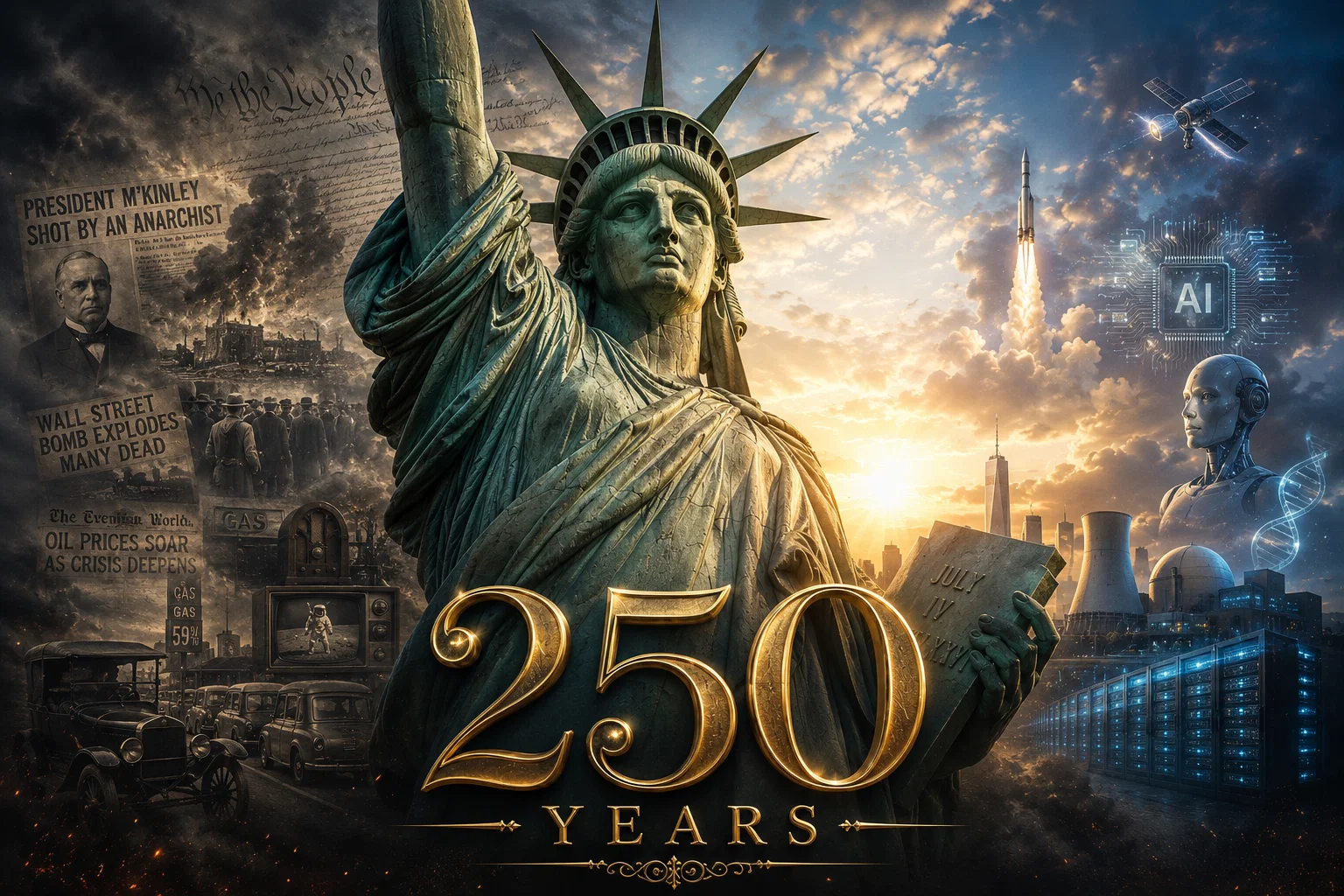
McKinley died eight days later, and, Czolgosz, an unemployed factory worker, went to the electric chair without a trace of remorse. He insisted it was his duty to strike down a symbol of oppression.
Czolgosz wasn’t a crazed madman, but rather a product of his time. The America of 1901 was 125 years into its history— the exact midpoint between the Declaration of Independence and today.
And despite the US economy already being the largest in the world at that point, the year 1901 did not feel like a nation striding confidently into the American Century.
The US financial system lurched from panic to panic, and to a great many observers, the young republic looked less like a rising power and more like a country unraveling.
The rich versus poor divide was growing, and violent socialist movements spread. Political assassinations, terrorism, and bombings became a recurring feature of public life.
The political violence did not end with McKinley’s assassination, either. Followers of the Italian anarchist Luigi Galleani waged a years-long bombing campaign against judges, politicians, and businessmen.
It peaked at noon on September 16, 1920, when a horse-drawn wagon packed with explosives detonated in front of the headquarters of J.P. Morgan on Wall Street, killing thirty people and wounding hundreds more. The case was never solved.
Many of these anarcho-socialists were immigrants, which poured gasoline on the raging blaze of backlash against widespread immigration.
In 1907 alone, more than a million people passed through Ellis Island. Immigrants were arriving faster than anyone knew how to absorb them, and people were getting tired of it.
Congress passed legislation that imposed a literacy test on immigrants, then banned entire countries. At first, people from Asia and the Middle East were shut out. Subsequent legislation set strict quotas, slamming the door on the southern and eastern Europeans who were considered undesirable.
Yet the instability continued... as did the government’s push to consolidate power.
After the Panic of 1907 nearly brought down the financial system, Congress used the scare to establish the Federal Reserve in 1913. This was the first step toward money that could be printed at will.
Also in 1913, the Constitution was amended, giving Congress the power to tax income.
The income tax (16th Amendment) was sold to the American people as a tax on the very rich that would only affect the top 2% of US households. Idiotic socialists at the time believed the lie and supported the amendment; after all, the rich should pay their fair share.
Within decades, three quarters of Americans were paying income tax.
With a new central bank and tax power in place, Washington then raced to join World War I (despite being an ocean away), and borrowed on an unimaginable scale to do it.
Frankly it all looked pretty bleak.
And yet, while all the bad news and turmoil was ongoing, America was simultaneously producing miracles.
Henry Ford put the country on wheels with the Model T and the moving assembly line. Motion pictures went from novelty to industry. Radio turned from a tinkerer's hobby into a machine that could broadcast to every home in the nation.
These were American breakthroughs that rewired the entire global economy and powered better times ahead.
Seventy-five years later, America's 200th birthday looked little better. In 1976, the economy was mired in stagflation that “experts” had previously sworn was impossible.
Oil shocks had humiliated the country at the gas pump. American dominance looked spent in the wreckage of Vietnam, and the nation had watched President Richard Nixon resign in disgrace.
Terrorism was back. Plane hijackings were somewhat commonplace. Crime rampaged across the cities.
And yet what followed was the personal computer, the Internet, the longest peacetime expansion in the country's history, and a comeback almost nobody standing in a gas line in 1976 would have believed.
Which brings us to the 250th birthday, today.
Political violence is back in American life. Immigration is once again a major issue. Fraud and corruption are rampant (and hardly anyone pays the price). And Washington's finances are in worse shape than at any point in the country's history, with the national debt larger than the entire economy.
Yet at the same time, American companies are building artificial intelligence, next-generation nuclear power, robotics, and biotech breakthroughs that could rewire the global economy even more than the assembly line and the Internet did. Chaos and invention have always lived side by side in the US, and they still do.
America was born out of revolution, and it has endured a civil war, two world wars, a depression, a decade of stagflation, and repeated financial panics.
Every one of those episodes brought years of real pain, but every time, the country that looked terminally ill came back stronger than ever.
There is an old saying in politics (usually credited to Winston Churchill, though apparently first quipped by an Israeli diplomat): Americans will always do the right thing... after exhausting all the alternatives.
Apocryphal or not, that is the pattern: the right thing comes eventually, but the pain comes first.
America is not just a country; it is an idea, and it may be the most extraordinary idea human beings have ever assembled. It stands on the shoulders of giants— Greek thought, Roman law, Judeo-Christian values, and free-market capitalism, fused with a conviction about individual liberty balanced by personal responsibility.
Betting against that idea has been the worst trade of the past 250 years.
To be clear, having a Plan B is not a bet against America either. The concept is not to hide in a bunker with canned food and guns because the end is near.
The point of a Plan B is to be honest about the road between here and the recovery: more inflation, higher taxes, and a stretch of instability, and to make sure you have the options available to come at it from a position of strength.
At 250 years, I truly believe the best days are still ahead. But there will be some rough ones in between.
To your freedom, James Hickman Co-Founder, Schiff Sovereign LLC
Seeds of Wisdom RV and Economics Updates Friday Afternoon 7-3-26
Good Afternoon Dinar Recaps,
CLARITY Act Advances as U.S. Senate Prepares Final Bill Text, Boosting Momentum for Crypto Regulation
Senate leaders are expected to release the final CLARITY Act text this week as bipartisan negotiations continue, strengthening expectations that the United States is moving closer to establishing a comprehensive regulatory framework for digital assets.
Good Afternoon Dinar Recaps,
CLARITY Act Advances as U.S. Senate Prepares Final Bill Text, Boosting Momentum for Crypto Regulation
Senate leaders are expected to release the final CLARITY Act text this week as bipartisan negotiations continue, strengthening expectations that the United States is moving closer to establishing a comprehensive regulatory framework for digital assets.
Overview
The U.S. Senate is expected to release the final CLARITY Act legislative text this week, marking another major step toward crypto regulatory clarity.
Growing bipartisan support, along with endorsements from industry and law enforcement organizations, has improved confidence that the legislation could advance later this summer.
If enacted, the CLARITY Act would establish clearer rules for digital assets, helping reduce regulatory uncertainty while encouraging innovation and investor protection.
Key Developments
1. Senate Finalizing Legislative Text
The U.S. Senate is reportedly preparing to release the final version of the CLARITY Act, giving lawmakers, industry participants, and investors their clearest view yet of the proposed digital asset regulatory framework before a Senate vote.
2. Bipartisan Support Continues to Build
Although the legislation still requires 60 Senate votes to advance, recent committee support from several Democratic senators has improved prospects for bipartisan cooperation when Congress returns from its July recess.
3. Law Enforcement Backs the Bill
The National Organization of Black Law Enforcement Executives (NOBLE) has become the first major law enforcement organization to endorse portions of the legislation, arguing that regulatory clarity can strengthen compliance, consumer protection, and public safety.
4. Market Optimism Increases
Analysts report that expectations for passage have improved, with investors viewing the legislation as one of the most significant crypto regulatory proposals ever considered by Congress. Markets are closely watching the release of the final bill for additional details.
Why It Matters
The CLARITY Act represents one of the most significant efforts to establish a comprehensive federal regulatory framework for digital assets in the United States. Clear legislation could reduce years of uncertainty surrounding cryptocurrencies while encouraging institutional investment, innovation, and responsible market growth.
Why It Matters to Foreign Currency Holders
Greater regulatory certainty for digital assets could accelerate institutional adoption of blockchain technology, tokenized assets, and digital payment infrastructure. While the legislation does not directly affect foreign currencies, it reflects the continued modernization of global financial systems that many currency holders are closely monitoring.
Implications for the Global Reset
Pillar 4 – Technology
The CLARITY Act could accelerate the integration of blockchain technology into regulated financial markets by providing clearer legal standards for digital assets, tokenization, and emerging financial infrastructure.
Future Outlook
The Senate is expected to publish the final legislative text shortly before lawmakers return from recess. Debate and amendments are likely to follow before a Senate floor vote, with bipartisan support remaining the key factor determining whether the bill becomes law. If approved, the CLARITY Act could reshape the U.S. digital asset industry by providing long-awaited regulatory certainty for businesses, investors, and financial institutions.
This is not just about cryptocurrency—it reflects the United States' broader effort to modernize financial regulation, support technological innovation, and position itself as a global leader in the rapidly evolving digital economy.
Seeds of Wisdom Team
Newshounds News™ Exclusive
Sources
CoinGape – CLARITY Act Advances as US Senate Eyes Final Text Release This Week
Galaxy Research – CLARITY Act: Lowering Our Odds to 60% as the Senate Calendar Tightens
~~~~~~~~~~
Seeds of Wisdom Team RV Currency Facts Youtube and Rumble
Newshound's News Telegram Room Link
RV Facts with Proof Links Link
RV Updates Proof links - Facts Link
Start Here room with Most Asked Questions Link
Follow the Gold/Silver Rate COMEX
Follow Fast Facts
Seeds of Wisdom Team™ Website
Thank you Dinar Recaps
The Death of the Dollar Just Died
The Death of the Dollar Just Died
Heresy Financial: 7-2-2026
TIMECODES
0:00 The dollar's "death" was greatly exaggerated
0:52 What a stronger dollar means for your portfolio
1:28 Bretton Woods: how the dollar took over (1944)
The Death of the Dollar Just Died
Heresy Financial: 7-2-2026
TIMECODES
0:00 The dollar's "death" was greatly exaggerated
0:52 What a stronger dollar means for your portfolio
1:28 Bretton Woods: how the dollar took over (1944)
2:41 1971: Nixon ends the gold standard
3:37 The petrodollar — and why it's breaking down
4:39 The 2026 war playbook & its 4 pillars
5:31 Chaos, rebuilding & the engineered dollar shortage
6:44 Control the money, control everything
7:50 Wall Street agrees: is de-dollarization over?
Reset Intelligence: Iraq’s Central Bank Joins the $2 trillion Hunt
Reset Intelligence: Iraq’s Central Bank Joins the $2 trillion Hunt
7-3-2026
The CBI Joins the Hunt
By Reset Intelligence | @EXIT_FIAT
Iraq’s central bank just stopped watching the corruption sweep and joined it. On July 2 the CBI governor and the head of the Federal Integrity Commission agreed to a joint team with real-time data exchange, built to choke off money smuggling out of Iraq’s banking system.
Reset Intelligence: Iraq’s Central Bank Joins the $2 trillion Hunt
7-3-2026
The CBI Joins the Hunt
By Reset Intelligence | @EXIT_FIAT
Iraq’s central bank just stopped watching the corruption sweep and joined it. On July 2 the CBI governor and the head of the Federal Integrity Commission agreed to a joint team with real-time data exchange, built to choke off money smuggling out of Iraq’s banking system.
The same day, the prime minister’s senior legal advisor put the number on the record: more than $2 trillion stolen since 2003. The trials will be public. The cabinet vote that fills the last 9 chairs is this Sunday.
The Bank Becomes an Investigator
Nizar Nasser Hussein ran the CBI’s anti-money-laundering office before he took the governorship in mid-June. That office holds the file on every suspicious transaction that has moved through Iraq’s banking system. Connecting that data stream directly to the corruption prosecutors gives Baghdad a forensic channel it has never had. This was his second institutional move in 48 hours – the day before, he and the speaker of parliament put protection of the national currency into a joint public statement.
The Week in Numbers
• $2 trillion – stolen public funds since 2003, per PM legal advisor Munir Haddad, on the record July 2. The old official benchmark was $320 billion. Trials to be held in public.
• $106 million and counting – cash seized so far, plus 70 properties, vehicles and gold.
• July 5 – parliament votes to seat the last 9 ministers, interior and defence included. The PUK and New Generation Movement signed an alliance July 2, consolidating Kurdish support before the ballot.
• Mid-July – the White House has confirmed it will host PM al-Zaidi. On the table per regional press: a joint energy fund projected to generate up to $400 billion over 3 decades.
• 58 million barrels – Iranian crude floating with no confirmed buyer, while China cut its Iranian imports roughly in half in June. Tehran begins 6 days of funeral ceremonies for Khamenei, crossing into Najaf and Karbala on July 8.
• July 4 weekend – the CLARITY Act compromise text drops in Washington, with new Iran sanctions written into Section 303 and a Senate return on July 13.
Why It Matters
Every institution that could have blocked this campaign is now inside it – the judiciary, the speaker, the street, and as of this week the central bank itself. A currency is priced on trust, and trust is built exactly the way Baghdad is building it right now: in the open, with the numbers published and the courts working. That is the short version. The full daily briefing connects what this sequence sets up for the dinar, the historical precedent it follows, and what to watch through Sunday’s vote.
The cleanup and the reprice were never 2 separate stories.Reset Intelligence: Iraq’s Central Bank Joins the $2 trillion Hunt
Read the full daily briefing free for 5 days. Sign up here: resetintelligence.com
The Documentation
Reset Intelligence published the source-level documentation behind this story in Head of the Snake. 1,000+ hours of independent research. DOJ filings, Federal Register executive orders, CBI statements, FinCEN advisories, central bank records.
25% off all formats with code 25XOFF through Sunday: resetintelligence.com/head-of-the-snake. Free guides and the full resource library: resetintelligence.com/resources
https://dinarchronicles.com/2026/07/03/reset-intelligence-the-cbi-joins-the-hunt/
News, Rumors and Opinions Friday 7-3-2026
Note: All intel should be considered as "Rumors" until we receive official announcements ...and “Rates and Dates” could change anytime until we get to the banks/redemption centers.
Majeed KSA: Preparing for the Revaluation
7-2-2026
I just received this news from Iraq.
“I stopped by some currency exchange shops in Baghdad and overheard them saying the dollar has been fluctuating up and down for about a week. I also saw the exchange rates on their display constantly changing, so it seems the market is still unstable and there may be a change coming for the rate.”
Note: All intel should be considered as "Rumors" until we receive official announcements ...and “Rates and Dates” could change anytime until we get to the banks/redemption centers.
Majeed KSA: Preparing for the Revaluation
7-2-2026
I just received this news from Iraq.
“I stopped by some currency exchange shops in Baghdad and overheard them saying the dollar has been fluctuating up and down for about a week. I also saw the exchange rates on their display constantly changing, so it seems the market is still unstable and there may be a change coming for the rate.”
My theory based on this message.
The fluctuation is because of the amount of money being confiscated and returned back to the system and the actual cash got burnt, and the value of it was sent to that account issued by the Prime Minister for the confiscated money.
Preparing for reevaluation.
The fluctuation has high indication of changing the rate.
Source(s):
• https://x.com/majeed66224499/status/2072311399796150469
https://dinarchronicles.com/2026/07/02/majeed-ksa-preparing-for-the-revaluation/
************
Courtesy of Dinar Guru: https://www.dinarguru.com/
Frank26 What is Iraq's banking reform? ...do you think it's to introduce new coins? Do you think it's to introduce a new exchange rate? I think the banking reform is to add value to their currency before they can do anything else. Why come out with coins, why come out with lower notes, when you don't have a new rate for them? Why come out with propaganda information, knowledge about monetary reform of many other countries around them?
Militia Man Article: "ADVISOR MUNIR HADDAD : THE FUNDS LOOTED SINCE 2003 EXCEED TWO TRILLION DOLLARS, AND THE TRIALS OF THE CORRUPT WILL BE PUBLIC" ...There is no doubt this is a wowzer!! This is flat out a huge escalation in the anti-corruption push — both in scale and visibility. Putting an official $2+ trillion figure on the stolen money, promising public trials, and vowing no red lines or timelines shows real seriousness from the top. This builds enormous momentum and credibility right ahead of the Washington visit on the 17th...Amazing!
Mnt Goat ...The basic plan to get to the reinstatement comes directly from a 2011 conference held during Dr Shabibi’s time as the director of the CBI with the US treasury, the World Bank and the IMF. We already have witnessed many pieces to the plan executed, so hang in a bit longer you won’t regret it. Yes, the plan has changed a bit, but Iraq must adapt as this is taking so long and technology changes over time.
Jeff It cannot be more than a tight narrow managed float...It won't float when the rate changes because their budgets are calculated off the currency value. If it had a significant float and the currency has a significant value change, that means the budget is completely miscalculated. So every time the rate changes, they would have to redraft and amend the budget's figures. They're not going to do that. That's why it's a narrow managed float in a tight window.
************
China Just Shut Down Gold Trading
The Financial Edge: 6-30-2026
China just shut down gold trading—but what does that really mean for investors, central banks, and the global economy?
In this in-depth financial documentary, we investigate the real story behind China's latest actions and explore the potential impact on gold prices, silver markets, inflation, currency stability, and global capital flows.
As geopolitical tensions rise and central banks continue accumulating gold reserves, many investors are asking whether this is a temporary regulatory move or part of a much larger strategic shift.
Could China's decision signal concerns about market stability, liquidity, or future monetary risks? And what might this mean for gold investors, silver holders, and anyone watching the global financial system?
We'll examine the institutional perspective, analyze historical parallels, uncover hidden incentives, and explore what sophisticated investors may already be seeing beneath the headlines.
From central bank policy to commodity markets and global economic trends, this documentary breaks down the evidence and separates facts from speculation.
Iraq Economic News and Points To Ponder Friday Morning 7-03-26
Advisor To Prime Minister Saleh Mahoud: Iraq Succeeds In Securing The First International Funding With A Sovereign Guarantee To Support The Private Sector
Money and business Economy News – Baghdad Dr. Saleh Mahoud Salman, Advisor to the Prime Minister, announced the completion of the first international funding process for a project belonging to the Iraqi private sector with an Iraqi sovereign guarantee, in cooperation with the German Foundation AKA Ausfuhrkredit-Gesellschaft mbH, and in partnership with the German Commerzbank, in an important step within the government's efforts to support economic reform and enhance the confidence of international financial institutions in the Iraqi economy.
Advisor To Prime Minister Saleh Mahoud: Iraq Succeeds In Securing The First International Funding With A Sovereign Guarantee To Support The Private Sector
Money and business Economy News – Baghdad Dr. Saleh Mahoud Salman, Advisor to the Prime Minister, announced the completion of the first international funding process for a project belonging to the Iraqi private sector with an Iraqi sovereign guarantee, in cooperation with the German Foundation AKA Ausfuhrkredit-Gesellschaft mbH, and in partnership with the German Commerzbank, in an important step within the government's efforts to support economic reform and enhance the confidence of international financial institutions in the Iraqi economy.
He explained that this process represents the beginning of a new stage in the use of sovereign guarantees to attract international finance, technology and investments, which contributes to enabling the private sector to implement development and production projects with direct economic impact, and reflects the success of building partnerships with leading international banking institutions, foremost of which is Commerz bank, one of the most prominent European banks.
He added that this achievement is the first of a series of development finance projects that are expected to be implemented during the next phase, in order to support the diversification of the national economy, promote local industry, provide job opportunities, and establish partnerships with international financial institutions.
Dr. Saleh Mahoud Salman stressed that the success of this process is the result of coordination and cooperation between the Iraqi government agencies (the Ministry of Finance and the Iraqi Bank for Trade) and international partners, expressing his appreciation to all Iraqi and international parties that contributed to this achievement, which represents a practical step towards expanding financing and investment opportunities in Iraq, and enhancing the presence of banks and international financial institutions in financing Iraqi private sector projects https://www.economy-news.net/content.php?id=70931
Dollar Heads For Biggest Weekly Decline In Nearly 3 Months
Money and business Economy News - Follow-up The dollar is heading for its biggest weekly decline in nearly three months on Friday after a weak job report for June narrowed market expectations for the Federal Reserve’s interest rate hike, which in turn provided an outlet for the yen, which is under pressure.
The dollar continued to fall at the start of Asian trading, and the euro remained hovering near a two-week high of $1.1442. The pound held steady at $1.3361 and is heading for a 1.2 percent weekly gain in its best performance in nearly three months.
The risk-sensitive Australian dollar stood at $0.6935 and is heading to end a four-week losing streak. The New Zealand dollar traded at $0.5702 and rose 1.2 percent during the week.
The dollar index, which measures the performance of the U.S. currency against a basket of currencies, including the yen and the euro, fell 0.2 percent to 100.77 after falling 0.5 percent on Thursday. Since the beginning of the week, it has fallen 0.58 percent, the biggest weekly decline since early April.
U.S. job growth slowed sharply in June if the number of non-farm payrolls rose 57,000 in June, well below expectations of a rise of 110,000. The labor force participation rate fell to 61.5 percent, its lowest level in more than five years.
The data prompted traders to lower their expectations for the central bank’s rate hikes in the near term. According to C.I.'s FedWatch tool. M. E.C., markets expect ‘52 percent to raise interest rates at the September meeting, up from 64 percent in the previous session.
* Breathable for Lin
The Japanese yen in the latest trading reached 161.01 against the dollar after rising about 1 percent in the previous session, which kept the currency from its lowest level in several decades as the dollar fluctuated.
Investors remained on the verge of possible intervention by the authorities to support the yen
https://www.economy-news.net/content.php?id=70929
Every Day A New Billionaire Is Born. $20 Trillion In The Hands Of Only 3302 People
Reconstruction and construction Economy News - Follow-up The number of billionaires around the world has reached a new record high, rising to 3302 billionaires, the highest ever recorded, driven by strong rises in asset and business markets, according to the latest report issued by UBS.
According to Bloomberg, the number of billionaires rose by about 13 percent in one year, at a time when their combined wealth jumped by 25%, a rate that far exceeds the pace of global wealth growth during the same period.
America and Asia are driving the boom.
Both the United States and Asia have led the recent growth in the wealth of the wealthy, capitalizing on the strong performance of equity markets and the continued prosperity in the technology and artificial intelligence sectors.
The report showed that the number of large wealth holders continues to rise, as there are currently 19 billionaires, each with more than $100 billion, and another 18 billionaires with wealth ranging from $50 billion to $100 billion.
A million new millionaires
The boom was not limited to billionaires, as the world also saw the addition of about 1 million new millionaires in 2025, in a sign of continued growth of private wealth in many economies.
Widening wealth gap
Despite this jump in the number of wealthy people, the report points to another less positive aspect, as the wealth levels of the average citizen have declined in many countries, reflecting the widening gap between the large wealth and the rest of the population.
The report argues that the world is not only seeing an increase in the number of billionaires, but also an increment in wealth distribution, as financial asset-holders continue to benefit from the faster-than-growing market incomes in many economies.
Artificial intelligence and markets are paying wealth
Analysts link this historic leap to the continued gains of global stock markets, especially in technology and artificial intelligence companies, along with the rise in the values of private companies and investment assets, which strengthened the wealth of major investors and entrepreneurs during the past year.
As the number of billionaires continues to record unprecedented levels, the report highlights a growing economic challenge of widening the wealth gap, which has become one of the most prominent issues for policymakers and major economies
https://www.economy-news.net/content.php?id=70936
Artificial Intelligence Widens The Gap Between America And Europe In The List Of The Top 100 Global Companies
Arab and International Economy News - Follow-up The artificial intelligence boom has boosted the dominance of U.S. companies among the world’s largest listed companies by market capitalization, while Europe continues to lose its standing as investors’ investment flows into tech stocks, according to a study by consulting firm Ernst & Young.
The study showed that US companies accounted for 56 of the top 100 listed companies in the world by market capitalization by the end of the first half of the year, ahead of China, which came with 12 companies, and then the United Kingdom and Japan with five companies each.
Germany had only one company in the list of the top 100 companies, after it had three companies at the beginning of the year, with Siemens in 72nd place, while SAP and Allianz fell to 114th and 115th place.
Nvidia, which specializes in the manufacture of electronic chips, topped the ranking with a market value of about $4.8 trillion as of June 30, followed by Alphabet, Apple and Microsoft.
Eight of the world’s top 10 companies by market capitalization were U.S., while Taiwan’s TSMC and Saudi Aramco were the only two companies from outside the United States in the top 10.
“We are currently witnessing a historic shift in the balance of power in the global equity markets,” said Henrik Alrs, managing partner at Ernst & Young in Germany, adding that companies that investors see as playing a leading role in the AI value chain, including chipmakers, cloud service providers, platform operators and data center companies, are gaining sharp rises in their market assessments.
Allers pointed out that Europe faces the risk of structural underdevelopment in one of the most important technologies in the world, due to the fragmentation of capital markets and the weakness of the venture capital system.
Ernst & Young said Germany’s representation among the world’s top 100 companies by market capitalization fell from seven in 2007 to just one now, in reference to the challenges facing Europe’s largest economy.
Allers said Europe still had strength in industrial engineering, but that equity markets were now rewarding technological leadership above all else.
However, some companies have improved their rankings, with Siemens Energy and Infinion making significant progress in their rankings https://www.economy-news.net/content.php?id=70935
Seeds of Wisdom RV and Economics Updates Friday Morning 7-3-26
Good Morning Dinar Recaps,
ECB Unveils Three-Pillar Digital Euro Roadmap, First Issuance Possible by 2029
The European Central Bank (ECB) has outlined a comprehensive three-pillar strategy to modernize Europe's financial system through a digital euro, tokenized settlement infrastructure, and faster cross-border payments. If approved, the initiative could pave the way for the first issuance of a digital euro by 2029, marking one of the world's most significant central bank digital currency (CBDC) projects.
Good Morning Dinar Recaps,
ECB Unveils Three-Pillar Digital Euro Roadmap, First Issuance Possible by 2029
The European Central Bank (ECB) has outlined a comprehensive three-pillar strategy to modernize Europe's financial system through a digital euro, tokenized settlement infrastructure, and faster cross-border payments. If approved, the initiative could pave the way for the first issuance of a digital euro by 2029, marking one of the world's most significant central bank digital currency (CBDC) projects.
Overview
The ECB has released a three-pillar roadmap for launching the digital euro and modernizing Europe's payment infrastructure.
Regulatory approval is targeted for 2026, with pilot transactions expected in 2027 and a potential public rollout by 2029.
The initiative aims to strengthen European payment sovereignty while supporting tokenized financial markets and reducing dependence on private stablecoins.
Key Developments
1. ECB Sets Timeline for the Digital Euro
ECB Executive Board member Piero Cipollone outlined a roadmap that targets regulatory approval in 2026, institutional pilot programs beginning in 2027, and the potential issuance of the digital euro by 2029. The retail digital euro is intended to complement physical cash while providing consumers with a secure, central bank-backed digital payment option.
2. Three-Pillar Strategy Modernizes Financial Infrastructure
The ECB's strategy focuses on three key initiatives:
A retail digital euro for consumers with legal tender status.
Wholesale settlement using tokenized central bank money for institutional transactions beginning in 2026.
Interconnected fast-payment systems to improve cross-border payment efficiency throughout Europe.
Together, these initiatives are designed to create a modern payment ecosystem capable of supporting both traditional finance and tokenized assets.
3. Tokenized Settlement Gains Institutional Support
Beginning in September 2026, the ECB plans to allow institutions using distributed ledger technology (DLT) to settle transactions with tokenized central bank money rather than relying on private stablecoins. This move further integrates blockchain technology into regulated financial markets.
4. Europe Seeks Greater Payment Sovereignty
The ECB emphasized reducing Europe's dependence on foreign payment providers and privately issued stablecoins. Standardization agreements have already been signed with major European payment organizations to help ensure broad acceptance of the digital euro across retail payment networks.
Why It Matters
The ECB's roadmap represents one of the most advanced central bank digital currency initiatives among major global economies. Beyond introducing a digital euro, the strategy seeks to modernize payment infrastructure, strengthen financial sovereignty, and integrate tokenized finance into Europe's regulated financial system.
Why It Matters to Foreign Currency Holders
The continued development of the digital euro demonstrates that major central banks are actively modernizing payment systems through tokenization and digital currencies. Investors following global monetary reform may view these developments as another significant milestone in the evolution of next-generation financial infrastructure.
Implications for the Global Reset
Pillar 2 – Trade
A digital euro and faster cross-border payment systems could improve international settlement efficiency, lower transaction costs, and strengthen Europe's role in global commerce.
Pillar 4 – Technology
The ECB's roadmap accelerates the adoption of tokenized finance, distributed ledger technology, and central bank digital currency infrastructure, helping modernize Europe's financial architecture.
Future Outlook
The next major milestone will be the European Union's regulatory approval process in 2026. If approved on schedule, pilot programs will begin in 2027 before a possible public launch in 2029, positioning Europe among the first major economies to deploy a large-scale central bank digital currency integrated with tokenized financial markets.
This is not just about launching a digital euro—it reflects Europe's broader strategy to modernize financial infrastructure, strengthen payment sovereignty, and prepare its economy for the next generation of digital finance.
Seeds of Wisdom Team
Newshounds News™ Exclusive
Sources
~~~~~~~~~~
🌱 A Message to Our Currency Holders🌱
If you’ve been holding foreign currency for many years, you were not foolish.
You were not wrong to believe the global financial system would change.
What failed was not your patience — it was the information you were given.
For years, dates, rumors, and personalities replaced facts, structure, and proof. “This week” predictions created cycles of hope and disappointment that were never based on how currencies actually change.
That is not your failure.
Our mission here is different: • No dates • No rates • No hype • No gurus
Instead, we focus on:
• Verifiable developments • Institutional evidence
• Global financial structure • Where countries actually sit in the process
Currency value changes only come after sovereignty, trade, banking, settlement systems, and fiscal coordination are in place. History and institutions confirm this sequence.
You will see silence. You will see denials. That is not delay — that is discipline.
Protect your identity. Organize your documents. Verify everything.
Never hand your discernment to anyone who cannot show proof.
You deserve truth — not timelines.
Seeds of Wisdom Team
Newshounds News
~~~~~~~~~~
Seeds of Wisdom Team RV Currency Facts Youtube and Rumble
Newshound's News Telegram Room Link
RV Facts with Proof Links Link
RV Updates Proof links - Facts Link
Start Here room with Most Asked Questions Link
Follow the Gold/Silver Rate COMEX
Follow Fast Facts
Seeds of Wisdom Team™ Website
Thank you Dinar Recaps
Friday Iraq News Posted by Tishwash at TNT 7-3-2026
TNT:
Tishwash: The US Treasury is tracking $300 billion outside the Iraqi banking system.
Informed sources revealed to Al-Mustaqilla information described as serious, indicating that the US Treasury informed the government of Ali al-Zaidi of the existence of sums of money estimated at about $300,000,000,000 believed to have left the official banking system.
According to the source, these funds are suspected to still be outside banking channels, specifically with certain political figures, away from direct financial oversight.
TNT:
Tishwash: The US Treasury is tracking $300 billion outside the Iraqi banking system.
Informed sources revealed to Al-Mustaqilla information described as serious, indicating that the US Treasury informed the government of Ali al-Zaidi of the existence of sums of money estimated at about $300,000,000,000 believed to have left the official banking system.
According to the source, these funds are suspected to still be outside banking channels, specifically with certain political figures, away from direct financial oversight.
The source also pointed to what he described as “precise sequences of dollar movement allocated to Iraq,” where the path of funds is tracked and transfer and distribution operations are analyzed, in an attempt to uncover the whereabouts of large sums believed to be inside the country or outside the official financial system.
The information added that ongoing tracking operations reveal – according to the source – a complex financial network linked to dollar flows inside and outside Iraq, which raises questions about the size of undeclared funds and their true paths. link
************
Tishwash: The European Union hands over to the Ministry of Finance the assets of a project to develop public financial management in Iraq.
The European Union handed over, on Wednesday (July 1, 2026), the assets resulting from the "Strengthening Public Finances and Financial Markets" project to the Iraqi Ministry of Finance, in a move aimed at supporting public financial management and enhancing joint cooperation in the fields of macroeconomics and investment.
The EU said in a statement received by Baghdad Today that “today, EU-funded assets were officially handed over to the Iraqi Ministry of Finance, in an important step that reflects our shared commitment to strengthening public financial management.”
He added, “During the handover ceremony, both the Director General of the Administration Department at the Ministry of Finance, Sadiq Huwaidi Abbas, and the Head of the New Cooperation Section at the European Union Mission, Wim Rippma, spoke about the depth of the partnership and its outstanding results between the European Union and Iraq in the fields of economy and investment.”
The statement indicated that “the transfer of assets resulting from the ‘Strengthening Public Finances and Financial Markets’ project, funded by Germany and implemented by GIZ, reflects the sustainable impact of this cooperation and paves the way for continued joint work to establish transparent, effective and sustainable public financial management in Iraq,” adding that “together we look forward to a new chapter in our partnership.” link
************
Tishwash: Enhancing the investment environment tops the agenda of Al-Zaidy's meeting with businessmen, along with broader support for the private sector.
Prime Minister Ali Faleh al-Zaidi discussed with a group of Iraqi businessmen ways to develop the investment environment and expand the contribution of the private sector to the economic development process.
The Prime Minister’s Media Office stated in a statement that “Prime Minister Ali Faleh Al-Zaidi received a group of Iraqi businessmen in various commercial, industrial and financial sectors.”
According to the statement, the Prime Minister affirmed “the government’s commitment to providing a safe investment environment and supporting all legislation and laws that contribute to achieving the requirements for investment, commercial and industrial success.”
He pointed out that “the private sector is an important partner in development and service projects in Iraq.”
He pointed out that “the government will support his active presence within the framework of its plan included in the ministerial program, which focuses on freeing the economy from the single-system model and employing all capabilities to diversify sources of income and maximize resources. link
************
Tishwash: The Central Bank and the Integrity Commission are taking action to close "money laundering channels" – statement
The Governor of the Central Bank of Iraq, Nizar Nasser Hussein, and the Head of the Federal Integrity Commission, Mohammed Ali Al-Lami, agreed today, Thursday (July 2, 2026), to put in place rapid coordination mechanisms to dry up the avenues for smuggling money by activating proactive monitoring and exchanging immediate data.
The meeting, which took place at the bank's headquarters and was attended by both sides on the occasion of the new governor assuming his position, witnessed an in-depth discussion of the files of protecting public funds, where it was decided to form a joint coordination working group to close the legal and procedural gaps, and to pursue illegal proceeds to recover them in accordance with the legal frameworks.
The Governor of the Central Bank of Iraq, Mr. Nizar Nasser Hussein, received at the bank’s headquarters the Head of the Federal Integrity Commission, Dr. Muhammad Ali Al-Lami, who offered his congratulations and blessings to His Excellency on the occasion of his assuming his new position, wishing him success in managing the country’s monetary policy.
The meeting witnessed an in-depth discussion of a number of vital files of common interest, where both sides stressed the importance of institutional integration between the Central Bank and regulatory bodies to protect public funds and enhance the environment of integrity and transparency in all state institutions.
In a strategic move to enhance financial security, the head of the Integrity Commission and the governor of the Central Bank agreed to strengthen joint coordination mechanisms with the aim of drying up avenues for money smuggling and combating the challenges facing the financial system, through activating proactive oversight and exchanging real-time data, which represents a fundamental pillar in pursuing corruption crimes, and tracking smuggled funds and illicit proceeds to recover them in accordance with legal frameworks.
At the conclusion of the meeting, both parties emphasized the need for the swift implementation of the joint agreements and the formation of a coordinating working group to ensure that any legal and procedural loopholes that could be exploited in financial transactions are addressed. link
************
Tishwash: Diversifying the Iraqi economy: A historic opportunity or a project that clashes with old obstacles?
Economic reform is one of the most prominent challenges facing Iraq, given the continued heavy reliance on oil revenues and the direct impact of fluctuations in global energy prices.
Conversely, there are increasing calls to adopt economic policies based on diversifying income sources, encouraging investment, and strengthening the role of the private sector, which would contribute to building a more stable economy capable of facing crises.
With the current government adopting a package of economic plans and reforms, a question arises about its ability to translate this vision into tangible results that reflect on the lives of citizens and the national economy.
Economic expert Abbas Al-Shatri confirmed today, Thursday (July 2, 2026), that the current government adopts an economic vision different from the previous government, based on diversifying income sources and reducing dependence on oil revenues, in addition to stimulating investment and developing the economic infrastructure.
Al-Shatri told Baghdad Today that “Iraq is working genuinely to save the Iraqi economy from the accumulated challenges, based on an economic vision that focuses on structural reforms rather than temporary solutions, which distinguishes its approach from many previous governments.”
He explained that "the success of this vision remains contingent on the continued implementation of reforms, the provision of a supportive legislative and administrative environment, as well as combating corruption and strengthening partnership with the private sector, which will positively impact growth rates and job opportunities."
He added that "Iraq possesses great economic potential that qualifies it to achieve a qualitative leap in the coming years if reform policies continue and development projects are implemented according to clear timetables, and the current stage represents an opportunity to lay the foundations for a more diversified and sustainable economy."
For many years, the Iraqi economy has relied mainly on oil revenues, which represent the largest share of the general budget revenues, making it vulnerable to the fluctuations of global markets.
Over the past years, many government programs have been proposed for economic reform and diversification of income sources, but challenges such as corruption, bureaucracy, a weak investment environment, and delays in project implementation have limited the achievement of broad results. link
Iraq Economic News and Points To Ponder Thursday Evening 7-02-26
The Dollar Records A New Decline Against The Iraqi Dinar In The Local Markets
Last Updated: July 1, 2026 The exchange rates of the US dollar, on Wednesday, a new decline against the Iraqi dinar in the local markets, amid slight changes in the movement of supply and demand within the market.
According to market data, the selling price of the dollar recorded 155,500 dinars per 100 dollars, while the purchase price reached 154,500 dinars per 100 dollars, in an indication of the continued volatility in exchange rates during the recent period.
The Dollar Records A New Decline Against The Iraqi Dinar In The Local Markets
Last Updated: July 1, 2026 The exchange rates of the US dollar, on Wednesday, a new decline against the Iraqi dinar in the local markets, amid slight changes in the movement of supply and demand within the market.
According to market data, the selling price of the dollar recorded 155,500 dinars per 100 dollars, while the purchase price reached 154,500 dinars per 100 dollars, in an indication of the continued volatility in exchange rates during the recent period.
This new decline comes at a time when local markets are following the developments of monetary policy and regulatory measures related to the exchange market, which aim to achieve greater stability in the price of the currency.
Traders in the market are waiting for more indicators in the coming days, to see if this decline will be the beginning of a continuous downtrend or just a temporary correction within the usual fluctuation range.
Exchange rates in Iraq remain subject to multiple factors, including the movement of demand for the dollar, control procedures, and internal and external economic developments. LINK
US Treasury Tracks $300 Billion Out Of Iraq’s Banking System
Last Updated: July 1, 2026 Independent sources revealed to the «independent» information described as dangerous, indicating that the US Treasury informed the government of Ali al-Zaidi of the existence of amounts estimated at $ 300,000,000,000 believed to have left the official banking system.
According to the source, these funds are suspected of being still outside banking channels, specifically by some political figures, away from direct financial supervision.
The source also pointed to the existence of what he described as "accurate sequences of the movement of the dollar allocated to Iraq," where the trajectory of funds is tracked and analysis of transfers and distribution, in an attempt to reveal the whereabouts of large sums believed to be inside the country or outside the official financial system.
According to the source, the ongoing tracking operations reveal a complex financial network linked to dollar flows inside and outside Iraq, opening the door to questions about the size of undeclared funds and their real trajectories. LINK
Public Funds Stolen In Iraq Surpass $2 Trillion Since 2003
Iraq Amr Salem July 2, 2026 Baghdad (IraqiNews.com) – The Iraqi Prime Minister’s legal advisor, Munir Haddad, revealed that more than $2 trillion have been stolen from Iraq since 2003.
According to the Iraqi News Agency, Haddad stated that the number of suspects continues to increase as investigations with the arrested ones are ongoing.
The Iraqi government launched a countrywide anti-corruption campaign on Sunday known as “Operation Dawn.” Prime Minister Ali al-Zaidi ordered the crackdown, which has resulted in the arrests of several lawmakers and senior officials, as well as the recovery of millions of dollars, gold, luxurious cars, and real estate.
Iraqi security forces began the massive campaign following judicial orders, targeting dozens of current and former government officials.
The step, which included lifting parliamentary immunity and overnight raids in Baghdad’s Green Zone, is based on confessions and investigations into the major arrest of Adnan al-Jumaili, a deputy oil minister accused of corruption.
Primary suspects have delivered extensive confessions, prompting security and judicial officials to arrest more individuals, according to Haddad.
The Iraqi official clarified that some of the suspects attempted to leave the country or seek a safe haven in Iraqi Kurdistan, but Kurdish authorities have shown cooperation and handed over eight suspects so far.
The offenses being investigated include both typical embezzlement and money laundering.
According to Haddad, the sums seized by the authorities are incredible. For example, the wife of one of the defendants purchased a home worth $5 million. Furthermore, some of the accused hold over 50 properties registered in their own or family members’ names.
The campaign will cover several Iraqi provinces. “The investigations and arrests are ongoing and will not adhere to a specific timeline,” Haddad said. They are being conducted in complete secrecy to prevent any individuals who are wanted from fleeing.
https://www.iraqinews.com/iraq/public-funds-stolen-in-iraq-surpass-2-trillion-since-2003/
Iraq Seeks To Raise Oil Output Ahead Of Global Energy Transition
Iraq Amr Salem July 2, 2026 Baghdad (IraqiNews.com) – Iraq seeks to boost oil production and optimize its reserves for revenue generation before a global energy transition potentially reduces oil demand.
Iraq is adopting an approach that delaying the development of oil reserves may be less cost-effective than increasing output at the present time, according to Reuters.
Oil constitutes approximately 90 percent of the revenue for the Iraqi government. The recent conflict and the resulting turmoil forced Baghdad to cut its daily output from over 4.2 million barrels to under 1.5 million barrels in May. This situation underscores the urgent need to increase production to recover the lost revenue.
New investments worth billions of dollars from businesses such as British Petroleum (BP), TotalEnergies, and ExxonMobil have raised hopes that Iraq would be able to transform its massive oil reserves into long-term financial benefits. However, this approach raises concerns about a potential significant decline in global oil consumption in the years ahead.
The main concern involves the potential for increased supplies from various producing countries, which could lead to a supply glut and a decline in oil prices. This is particularly relevant as global output is projected to rise by nearly eight million barrels per day by 2027, while the growth in demand is expected to be slower.
The Iraqi strategy is based on the timing factor due to the uncertainties over when global oil demand will decline and whether producers can profit from their reserves prior to that time.
https://www.iraqinews.com/iraq/iraq-seeks-to-raise-oil-output-ahead-of-global-energy-transition/
8 million barrels of Iraqi crude oil still trapped on tankers
Iraq Amr Salem July 2, 2026 Baghdad (IraqiNews.com) – Over eight million barrels of Iraqi crude oil are still trapped aboard ships, but over 100 million barrels of crude oil and petroleum products that had accumulated in the Gulf have begun to slowly flow back to international markets, offering a temporary relief from supply constraints, Shafaq News said on Thursday, citing a report issued by S&P Global Commodity Insights.
Iraq, along with Oman, has been identified as one of the Middle East’s top countries to reactivate oil output, while key refineries in Saudi Arabia, Bahrain, and Kuwait would take months to restore operations, according to the report.
The total amount of crude oil in the Arabian Gulf reached around 90.5 million barrels, with the remainder divided among other petroleum products. More than 90 million barrels of crude oil were aboard vessels ready to be transported.
According to estimates, Iraq has around 8.3 million barrels of oil stuck on tankers, following only Iran with 31.7 million barrels, Saudi Arabia with 18.7 million barrels, and the UAE with 17 million barrels. Kuwait recorded 8.1 million barrels, Qatar had 4 million, and Oman had 2.2 million barrels.
Most Gulf oil exports are bound for East Asian markets. This demonstrates that the resumption of these supplies may have an impact on the global supply-demand balance, affecting oil prices and producing nations’ income.
International banks anticipate that exports will return to pre-war levels in July, but there is still concern that the effects of such quantities will be temporary until actual production in the region improves.
https://www.iraqinews.com/iraq/8-million-barrels-of-iraqi-crude-oil-still-trapped-on-tankers/
Seeds of Wisdom RV and Economics Updates Thursday Evening 7-2-26
Good Evening Dinar Recaps,
SEC Launches ‘Project Crypto’ to Bring Traditional Finance On-Chain
The U.S. Securities and Exchange Commission has unveiled Project Crypto, a sweeping initiative designed to modernize securities regulations for blockchain-based financial markets. The proposal aims to create clearer rules for tokenized assets, digital securities, and cryptocurrency markets while supporting innovation under a regulated framework.
Good Evening Dinar Recaps,
SEC Launches ‘Project Crypto’ to Bring Traditional Finance On-Chain
The U.S. Securities and Exchange Commission has unveiled Project Crypto, a sweeping initiative designed to modernize securities regulations for blockchain-based financial markets. The proposal aims to create clearer rules for tokenized assets, digital securities, and cryptocurrency markets while supporting innovation under a regulated framework.
Overview
The SEC has launched Project Crypto to modernize U.S. securities regulations for blockchain-based financial markets.
Most digital assets may no longer be classified as securities, potentially reducing legal uncertainty for much of the crypto industry.
The initiative supports tokenized financial markets while coordinating regulatory oversight with the CFTC.
Key Developments
1. SEC Introduces Project Crypto
SEC Chairman Paul Atkins announced Project Crypto, a comprehensive initiative designed to update securities regulations so traditional financial assets—including stocks, bonds, and other securities—can operate efficiently on blockchain infrastructure. The effort aligns with recommendations from the President's Working Group on Digital Assets and supports the broader adoption of tokenized finance.
2. Most Digital Assets Could Avoid Securities Classification
One of the proposal's most significant changes is the SEC's position that the majority of digital assets should not automatically be treated as securities. If adopted, many blockchain projects could operate under clearer regulatory guidelines rather than facing ongoing uncertainty over securities laws.
3. SEC and CFTC Plan Joint Regulatory Framework
The SEC and the Commodity Futures Trading Commission (CFTC) are expected to establish a Memorandum of Understanding to better define regulatory responsibilities for digital assets that fall outside traditional securities laws. This coordinated approach aims to reduce overlapping oversight and improve regulatory clarity.
4. New Rules Planned for Tokenized Markets
The SEC's Crypto Task Force, led by Commissioner Hester Peirce, will develop proposals covering:
Digital asset custody
Tokenized securities trading
Market structure modernization
Decentralized finance (DeFi) integration
Distribution standards for digital assets
The agency expects updated market structure rules to be introduced during 2026.
Why It Matters
Project Crypto represents one of the strongest indications yet that U.S. regulators are preparing for a financial system where traditional assets and blockchain technology operate together. Clearer regulations could encourage greater institutional participation, accelerate tokenization, and reduce legal uncertainty that has slowed innovation across the digital asset industry.
Why It Matters to Foreign Currency Holders
A more defined regulatory framework for tokenized financial assets could accelerate the development of tokenized currencies, stablecoins, and blockchain-based payment systems. As global financial infrastructure continues to modernize, investors following currency reform and digital asset adoption may view these regulatory developments as an important step toward faster and more efficient financial markets.
Implications for the Global Reset
Pillar 2 – Trade
Clearer rules for blockchain-based financial markets could support faster cross-border payments, tokenized settlements, and more efficient global financial transactions, reducing friction in international commerce.
Pillar 4 – Technology
Project Crypto advances the modernization of U.S. financial infrastructure by creating a regulatory framework that supports tokenization, blockchain networks, and digital asset innovation within regulated markets.
Future Outlook
The SEC plans to continue developing Project Crypto through 2026 alongside the CFTC and industry participants. If implemented successfully, the initiative could position the United States as a leading jurisdiction for regulated digital assets while encouraging broader adoption of tokenized securities and blockchain-based financial services.
This is not just about cryptocurrency—it reflects a broader transformation of financial markets as regulators build the legal framework for tokenized assets, digital infrastructure, and the next generation of global finance.
Seeds of Wisdom Team
Newshounds News™ Exclusive
Sources
Crypto Briefing – SEC launches ‘Project Crypto’ to bring traditional finance on-chain
U.S. Securities and Exchange Commission – SEC Crypto Task Force
~~~~~~~~~~
Seeds of Wisdom Team RV Currency Facts Youtube and Rumble
Newshound's News Telegram Room Link
RV Facts with Proof Links Link
RV Updates Proof links - Facts Link
Start Here room with Most Asked Questions Link
Follow the Gold/Silver Rate COMEX
Follow Fast Facts
Seeds of Wisdom Team™ Website
Thank you Dinar Recaps
Reset Intelligence: The Price of Admission
Reset Intelligence: The Price of Admission
7-2-2026
The Price of Admission
By Reset Intelligence | @EXIT_FIAT
Iraq’s parliament returned from recess today, and Prime Minister Ali al-Zaidi now has about 14 days to finish building his government and finish cleaning it out before he lands in Washington.
Reset Intelligence: The Price of Admission
7-2-2026
The Price of Admission
By Reset Intelligence | @EXIT_FIAT
Iraq’s parliament returned from recess today, and Prime Minister Ali al-Zaidi now has about 14 days to finish building his government and finish cleaning it out before he lands in Washington.
The arrests that locked down Baghdad’s Green Zone are the opening move. The deadline behind them is the real story.
The recovery keeps climbing
The money coming back keeps rising with every arrest. This is not a single raid. It is an audit of an entire political class.
• Oil-ministry case – over $107 million recovered, plus 70 properties, vehicles and gold.
• The walls – $14 million pulled from inside the home of one deputy oil minister.
• Iraqi Airways case – a separate 19 billion dinars recovered.
• Under investigation – close to 1,000 officials, and the list grows with every interrogation.
Two doors, one lock
This month Iraq was added to the FATF grey list, the global watchdog’s register of countries with dirty-money problems. That matters, because a currency is only worth what a foreign bank will clear, and for years Iraq’s banks had lost the correspondent lines that let money move at all.
• July 5 – special session to seat the final 9 ministers, interior and defence among them.
• Mid-July – al-Zaidi flies to Washington, with a reported $400 billion energy fund on the table.
Clean the house, and the banks open the door. That is the order, and Iraq is finally running it.
The part the headlines miss
Everyone is asking whether the dinar goes up. The real question is whether Iraq can prove it is clean enough for the money to come home at all. There is a country that ran this exact play and won, and there is a reason the arrests come before the reprice, not after. That is the connection we walk through in today’s full briefing.
Read the full daily briefing free for 5 days. Sign up here: resetintelligence.com
https://dinarchronicles.com/2026/07/01/reset-intelligence-the-price-of-admission/
Rob Cunningham: The Magnitude of Any Resulting Price Move
Rob Cunningham: The Magnitude of Any Resulting Price Move
7-2-2026
If most of the developments I’ve listed below materialize over a relatively compressed time frame, they would represent a convergence of regulatory, technological, macroeconomic, and geopolitical factors.
Such a convergence should plausibly strengthen institutional demand for digital assets generally and XRP specifically.
Rob Cunningham: The Magnitude of Any Resulting Price Move
7-2-2026
If most of the developments I’ve listed below materialize over a relatively compressed time frame, they would represent a convergence of regulatory, technological, macroeconomic, and geopolitical factors.
Such a convergence should plausibly strengthen institutional demand for digital assets generally and XRP specifically.
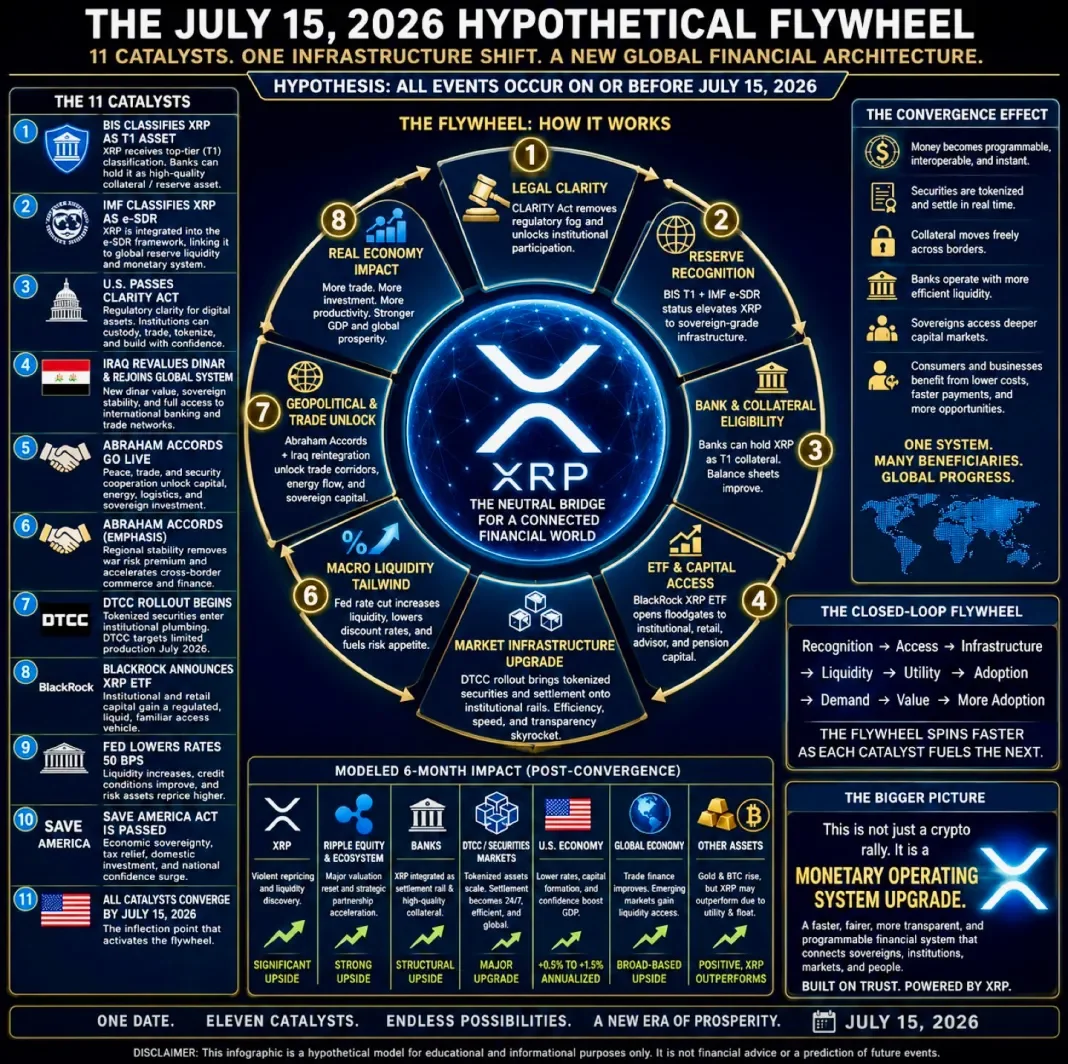
The magnitude of any resulting price move will depend on synergistic factors such as adoption, liquidity, positioning, valuation, and broader market sentiment.
The Big Variables
140 Conglomerates engage OUSD
EU MiCa Adoption July 1
Extreme U.S. Clarity Act Push
DTCC SEC “No Action” Letter
DTCC July 14 System Test
DTCC Oct ‘26 $144 Trillion Onchain Move
Iraq Normalization Efforts
Iran MOU & Peace Deal
Abraham Accords Full Approval
Oil below $68/Barrel
XRP at lowest RSI in history
Potential Fed Rate Cut in July
The flywheel
The important observation is that these are not all the same catalyst.
They operate on different layers simultaneously:
Legal certainty
MiCA
CLARITY Act
↓
Institutional infrastructure
DTCC
Tokenization
Stablecoins
↓
Macroeconomic liquidity
Lower oil
Lower inflation
Potential Fed easing
↓
Geopolitical stability
Middle East normalization
Trade expansion
↓
Technical positioning
Depressed RSI
Existing market pessimism
When multiple independent layers align, markets can experience nonlinear repricing, because investors begin to update expectations at the same time rather than sequentially.
Why XRP could be especially sensitive
XRP’s investment thesis has long depended less on consumer adoption and more on:
regulated cross-border settlement,
liquidity between tokenized assets,
institutional interoperability,
payment infrastructure.
If legal clarity improves while tokenization expands and monetary conditions become more accommodative, investors who previously stayed on the sidelines may reassess the probability that XRP’s intended use cases gain wider adoption. That could increase demand independently of retail speculation. The CLARITY Act, if enacted, would further clarify regulatory treatment for many digital assets and could reduce uncertainty that has weighed on the sector.
Source(s):
• https://x.com/KuwlShow/status/2072525771264979181
https://dinarchronicles.com/2026/07/02/rob-cunningham-the-magnitude-of-any-resulting-price-move/