Thank you to all the subscribers to our Early Access program…we thank you for your continued support.
We are excited to offer this new service to keep you informed and up-to-date on the latest Dinar and currency news.
Iraq Economic News and Points To Ponder Thursday Morning 6-4-26
During A Summit Held In Paris And Attended By "Economy News"... Hadi Chaib Ainou: Global Challenges Necessitate Strengthening International Cooperation
Money and Business Economy News – Baghdad The Director General of the Professional Group of Banks of Morocco (GPBM) and Secretary General of the Federation of Francophone Banks (FBF), El Hadi Chaib Ainou, affirmed that the global financial sector is going through a critical phase of rapid transformations at the geopolitical, economic and social levels, which necessitates a review of the traditional tools used in financial analysis and their development in line with current changes.
During A Summit Held In Paris And Attended By "Economy News"... Hadi Chaib Ainou: Global Challenges Necessitate Strengthening International Cooperation
Money and Business Economy News – Baghdad The Director General of the Professional Group of Banks of Morocco (GPBM) and Secretary General of the Federation of Francophone Banks (FBF), El Hadi Chaib Ainou, affirmed that the global financial sector is going through a critical phase of rapid transformations at the geopolitical, economic and social levels, which necessitates a review of the traditional tools used in financial analysis and their development in line with current changes.
During the Arab-European Banking and Economic Summit in Paris, held under the slogan "Towards a New Global Economic and Financial Balance," organized by the Union of Arab Banks and sponsored by French President Emmanuel Macron, and attended by "Economy News," Ainou said that the challenges facing the global financial system require new approaches that are more flexible and innovative, capable of absorbing the nature of the accelerating global changes.
The Moroccan official addressed the challenge of climate change, considering it to be one of the most prominent issues affecting the global economy, despite the difficulty of accurately predicting its future repercussions.
He pointed out that the effects of this change have become tangible in many countries, including European countries, which reinforces the importance of developing environmental legislation and activating relevant regulatory frameworks, given its increasing impact on economic and financial activities.
In a related context, Al-Hadi Shaib Ainou highlighted the importance of digital transformation and the accompanying expansion in the use of social media, pointing out the new challenges and opportunities this presents to governments and financial institutions, which necessitates the development of modern regulatory frameworks capable of keeping pace with the rapidly changing digital environment. https://www.economy-news.net/content.php?id=69852
During A Summit Held In Paris And Attended By "Al-Eqtisad News"... Raoul Delamare: Strengthening The Arab-European Partnership Is Essential To Confront Global Transformations
banks Economy News - Follow-up The President of the French-Arab Chamber of Commerce – France, Raoul Delamare, stressed the importance of strengthening cooperation between Arab, European and Francophone banking and financial institutions in light of the accelerating global challenges, noting that this partnership represents a fundamental pillar for supporting economic development and enhancing financial stability in the region.
This came during the Arab-European Banking and Economic Summit in Paris under the slogan "Towards a New Global Economic and Financial Balance," organized by the Union of Arab Banks and sponsored by French President Emmanuel Macron, and attended by "Economy News".
Delamare stressed the importance of continuing to invest in infrastructure and regional development projects, as they are key drivers of economic growth and an effective tool for promoting integration between Arab and European markets.
In his speech, he addressed the most prominent challenges facing the financial and banking sector at the present stage, most notably the escalating geopolitical tensions, rapid technological transformations, developments in artificial intelligence, in addition to the increasing risks associated with cybersecurity and the protection of digital financial systems.
He stressed that confronting these challenges requires strengthening dialogue and continuous coordination between banking and economic institutions, exchanging experiences and knowledge, and working together to develop regulatory and technical frameworks capable of keeping pace with global changes.
He concluded his speech by emphasizing that the Arab-European partnership will remain a pivotal factor in supporting economic stability and enhancing investment opportunities and future cooperation between the two sides.
https://www.economy-news.net/content.php?id=69855
During A Summit Held In Paris And Attended By "Economy News"... Maya Atik: Strengthening International Banking Cooperation Is Essential To Confront Digital Challenges
Banks Economy News – Baghdad The Director General of the French Banking Federation, Maya Atik, stressed that strengthening cooperation between international banking institutions has become an urgent necessity in light of the rapid economic and geopolitical changes taking place in the world.
This came during the Arab-European Banking and Economic Summit in Paris under the slogan "Towards a New Global Economic and Financial Balance," organized by the Union of Arab Banks and sponsored by French President Emmanuel Macron, and attended by "Economy News".
Ateeq stressed the importance of developing sustainable partnerships between financial institutions, which contribute to supporting financial stability and enhancing the banking sector’s ability to adapt to global transformations, particularly in the areas of infrastructure and regional development.
She noted that current challenges, including geopolitical risks, the rapid development of artificial intelligence technologies, and cyber threats, require banking institutions to intensify coordination and joint action to develop effective and sustainable solutions.
She concluded by emphasizing that the future of the banking sector depends primarily on deepening international cooperation and exchanging experiences, which will ensure the strengthening of financial stability and support for sustainable economic development paths. https://www.economy-news.net/content.php?id=69854
The Minister Of Finance Affirms The Continuation Of Economic Reforms And The Strengthening Of The Partnership With The World Bank
During his meeting with the World Bank representative to Iraq, Emmanuel Salinas Munoz, Finance Minister Faleh Sari affirmed the ministry's commitment to implementing financial and economic reform programs, in line with the government program's priorities and to enhance the efficiency of public resource management.
Sari indicated that the ministry is determined during the next phase to adopt reform paths based on developing the financial and banking environment, expanding the application of electronic systems in the tax and customs sectors, in addition to supporting non-oil revenues and simplifying procedures in a way that contributes to improving institutional performance and stimulating economic activity.
The two sides reviewed mechanisms for enhancing technical and institutional cooperation with the World Bank to support development and infrastructure projects, empower the private sector, and benefit from international expertise in implementing reforms.
For his part, Salinas Muñoz affirmed the bank’s continued support for the reform programs implemented by the Iraqi government, which contribute to strengthening economic development and raising the efficiency of financial institutions.
https://www.economy-news.net/content.php?id=69846
Gold Rose, Supported By A Weaker Dollar And Lower Oil Prices, Amid Optimism That Tensions Might Ease
Money and Business Economy News - Follow-up Gold prices rose on Thursday, supported by a weaker dollar and lower oil prices, as investors assessed signs of optimism about a possible settlement to the US-Israeli trade war with Iran.
Spot gold rose 0.7% to $4,461.09 an ounce, while U.S. gold futures for August delivery climbed 0.5% to $4,487.90.
The rise coincided with a decline in the dollar, which made gold priced in US dollars less expensive for holders of other currencies, in addition to a drop in oil prices after Lebanon and Israel agreed to implement a ceasefire, which boosted hopes for a broader calm in the region.
John Williams, president of the Federal Reserve Bank of New York, also reiterated that there is currently no need to change US monetary policy, arguing that inflationary pressures related to the war in the Middle East may not be long-lasting.
As for other precious metals, silver rose 0.6% to $73.13 an ounce, platinum rose 0.7% to $1,872.11, while palladium climbed 0.9% to $1,313.51. https://www.economy-news.net/content.php?id=69844
Turkish Carpet Exports Declined At The Beginning Of 2026, With Iraqi Markets Among Those Affected
Money and Business Economy News – Baghdad Data released by the Turkish Carpet Exporters Association on Wednesday showed that Turkish carpet exports declined during the first four months of 2026, amid logistical challenges and regional turmoil affecting several key markets in the Middle East, including Iraq.
According to data seen by “Al-Eqtisad News”, Turkish carpet exports amounted to $871.7 million during the period from January to April 2026, a decrease of 2.1% in value compared to the same period last year.
Alexander Kaplan, head of the carpet sector council at the Turkish Exporters Association, said that "wars and regional tensions have affected trade and supply chains," noting that "Middle Eastern markets are among the most important destinations for Turkish carpets."
Kaplan added that "Iraq, along with Saudi Arabia, Qatar and Bahrain, is among the markets that have been affected by recent regional circumstances, which has impacted export activity and trade demand."
Despite the decline recorded at the beginning of the year, the Turkish carpet industry aims to raise its exports to $3.5 billion by the end of 2026, compared to about $2.8 billion achieved during the past year.
Seeds of Wisdom RV and Economics Updates Thursday Morning 6-4-26
Good Morning Dinar Recaps,
Global Economic Warning: Energy Shock and Rising Debt Threaten Financial Stability
Growing energy disruptions, inflation pressures, and mounting debt burdens are increasing concerns about the resilience of the global financial system.
Good Morning Dinar Recaps,
Global Economic Warning: Energy Shock and Rising Debt Threaten Financial Stability
Growing energy disruptions, inflation pressures, and mounting debt burdens are increasing concerns about the resilience of the global financial system.
Overview
The Organization for Economic Cooperation and Development (OECD) has issued a warning that the ongoing Middle East crisis could become a significant threat to global economic growth. Rising energy prices, inflation concerns, and elevated sovereign debt levels are creating a challenging environment for governments, businesses, and consumers worldwide.
As tensions surrounding Iran and the Strait of Hormuz continue, policymakers are increasingly concerned that prolonged disruptions could trigger slower growth, higher inflation, and additional financial stress across the global economy.
Key Developments
1. OECD Lowers Global Growth Expectations
The OECD warned that the current energy shock is weakening the outlook for the global economy. Under its baseline forecast, world economic growth is expected to slow during 2026 as higher energy costs and tighter financial conditions impact economic activity.
The organization cautioned that if disruptions worsen, global growth could decline even further, creating additional risks for both developed and emerging economies.
2. Rising Energy Costs Continue to Fuel Inflation
Energy prices remain one of the primary drivers of inflation worldwide. Higher oil and natural gas costs are affecting transportation, manufacturing, agriculture, and consumer goods prices.
As inflation remains elevated, central banks may find it difficult to lower interest rates quickly, even as economic growth slows.
3. Strait of Hormuz Remains a Major Global Concern
The Strait of Hormuz continues to be one of the world's most important energy chokepoints. Any interruption to shipping through the region could significantly impact global oil supplies and place additional pressure on energy markets.
Governments are increasingly focusing on energy diversification strategies to reduce vulnerability to regional disruptions.
4. Financial Markets React to Ongoing Uncertainty
Investors remain cautious as they assess the potential impact of geopolitical tensions on economic growth and corporate earnings. Market volatility has increased as traders react to developments involving energy supplies, inflation expectations, and central bank policy.
The uncertainty surrounding the Middle East continues to influence investor sentiment worldwide.
5. Governments Face Growing Fiscal Challenges
Many governments are attempting to balance slowing economic growth with already elevated debt levels. Rising borrowing costs and higher energy expenses are creating additional pressure on public finances.
The OECD encouraged policymakers to pursue targeted solutions that support economic stability while avoiding excessive increases in government debt.
Why It Matters
The combination of rising energy prices, persistent inflation, and growing debt burdens creates a difficult environment for the global economy. These pressures are occurring simultaneously and have the potential to affect financial markets, government budgets, and consumer purchasing power.
Why It Matters to Foreign Currency Holders
• Higher inflation can increase currency volatility.
• Energy-importing countries may experience additional pressure on trade balances.
• Safe-haven assets often attract investment during periods of uncertainty.
• Central bank policy decisions could significantly influence future currency valuations.
Implications for the Global Reset
Pillar 1: Energy Security and Economic Stability
The current environment demonstrates the critical relationship between energy security and economic performance. Reliable energy supplies remain essential for growth, inflation control, and financial stability.
Pillar 2: Debt Sustainability Under Pressure
As governments manage slower growth and higher costs, concerns surrounding debt sustainability continue to increase. These pressures may contribute to future discussions regarding monetary policy reforms and broader financial restructuring.
Closing Insight
The OECD's latest warning underscores the growing connection between geopolitical events and economic outcomes. As energy markets remain volatile and debt levels continue rising, policymakers face increasingly difficult decisions regarding inflation, growth, and financial stability.
This is not simply an energy challenge—it is a test of how resilient the global financial system will be in the face of mounting economic and geopolitical pressures.
Seeds of Wisdom Team
Newshounds News™ Exclusive
Sources
OECD — "Global Economic Outlook Weakens Amid Energy Shock and Rising Inflationary Pressures"
Reuters — "Stocks Struggle After Broadcom Dive; Oil Eases Off Highs"
~~~~~~~~~~
🌱 A Message to Our Currency Holders🌱
If you’ve been holding foreign currency for many years, you were not foolish.
You were not wrong to believe the global financial system would change.
What failed was not your patience — it was the information you were given.
For years, dates, rumors, and personalities replaced facts, structure, and proof. “This week” predictions created cycles of hope and disappointment that were never based on how currencies actually change.
That is not your failure.
Our mission here is different:
• No dates • No rates • No hype • No gurus
Instead, we focus on:
• Verifiable developments • Institutional evidence
• Global financial structure • Where countries actually sit in the process
Currency value changes only come after sovereignty, trade, banking, settlement systems, and fiscal coordination are in place. History and institutions confirm this sequence.
You will see silence. You will see denials. That is not delay — that is discipline.
Protect your identity. Organize your documents. Verify everything.
Never hand your discernment to anyone who cannot show proof.
You deserve truth — not timelines.
Seeds of Wisdom Team
Newshounds News™
~~~~~~~~~~
Seeds of Wisdom Team RV Currency Facts Youtube and Rumble
Newshound's News Telegram Room Link
RV Facts with Proof Links Link
RV Updates Proof links - Facts Link
Follow the Gold/Silver Rate COMEX
Follow Fast Facts
Seeds of Wisdom Team™ Website
Thank you Dinar Recaps
Thursday AM Iraq News Posted by Tishwash at TNT 6-4-2026
TNT:
Tishwash: The Minister of Finance affirms the continuation of economic reforms and the strengthening of the partnership with the World Bank.
During his meeting with the World Bank representative to Iraq, Emmanuel Salinas Munoz, Finance Minister Faleh Sari affirmed the ministry's commitment to implementing financial and economic reform programs, in line with the government program's priorities and to enhance the efficiency of public resource management.
TNT:
Tishwash: The Minister of Finance affirms the continuation of economic reforms and the strengthening of the partnership with the World Bank.
During his meeting with the World Bank representative to Iraq, Emmanuel Salinas Munoz, Finance Minister Faleh Sari affirmed the ministry's commitment to implementing financial and economic reform programs, in line with the government program's priorities and to enhance the efficiency of public resource management.
Sari indicated that the ministry is determined during the next phase to adopt reform paths based on developing the financial and banking environment, expanding the application of electronic systems in the tax and customs sectors, in addition to supporting non-oil revenues and simplifying procedures in a way that contributes to improving institutional performance and stimulating economic activity.
The two sides reviewed mechanisms for enhancing technical and institutional cooperation with the World Bank to support development and infrastructure projects, empower the private sector, and benefit from international expertise in implementing reforms.
For his part, Salinas Muñoz affirmed the bank’s continued support for the reform programs implemented by the Iraqi government, which contribute to strengthening economic development and raising the efficiency of financial institutions. link
************
Tishwash: Iraq restarts major oil fields to counter the repercussions of the Hormuz closure
A report by Wood Mackenzie, published Wednesday, stated that Iraq has restarted major oil fields, including West Qurna 1 and Majnoon, to mitigate the impact of the Strait of Hormuz closure.
According to Wood Mackenzie's High-Frequency Oil Production Monitoring report, translated by Al-Ghad Press, "Iraq's production has rebounded to 1.5 to 1.6 million barrels per day as operations gradually resume at key southern fields such as West Qurna 1, Majnoon, and Fawqi."
The report added that "Iraq's immediate focus has shifted to securing related gas supplies, refinery feedstocks, and liquefied petroleum gas (LPG) to prevent a catastrophic energy shortage during the summer, unlike Gulf producers who are prioritizing exports."
It continued, "This recovery follows significant disruptions to energy flows in the Gulf and a decline in exports through the Strait of Hormuz, a vital route for Iraqi oil supplies, due to the regional conflict between Iran, Israel, and the United States." link
************
Tishwash: Al-Zaydi directs the resumption of work by oil companies in Kurdistan starting tomorrow.
Prime Minister Ali Faleh al-Zaidi directed oil companies in the Kurdistan Region of Iraq to resume operations starting tomorrow, Wednesday
A statement from al-Zaidi's office indicated that he "received a delegation from the Kurdistan Regional Government headed by Minister of Natural Resources Kamal Mohammed Saleh, accompanied by representatives of several international oil companies operating in the region, in the presence of the Minister of Foreign Affairs, the Minister of Oil, and the Chief of Staff of the Army."
The Prime Minister listened to "a detailed explanation of the working conditions of the oil companies in light of the recent events resulting from the war in the region, as well as a comprehensive vision for the companies to resume their operations as quickly as possible."
He directed that "all requirements be provided to ensure the smooth operation of the oil companies working in the region," noting that "the damage inflicted on Iraq as a result of the halt in oil exports through the Strait of Hormuz was significant, requiring redoubled efforts to compensate for this damage by addressing the problems hindering increased production."
The Prime Minister also directed that "oil companies in the Kurdistan Region of Iraq resume their operations starting tomorrow, emphasizing joint efforts and the provision of a suitable environment and essential requirements." link
**************
Tishwash: Parliamentary request to hold an emergency session to complete the government cabinet and approve the budget
The Honorable Speaker of the Council of Representatives
Ref. No.: 315 Date: January 3, 2026
Greetings,
**Subject: Convening an Emergency Session**
Pursuant to the provisions of Article (61) and Article (73—Fourth) of the Constitution, and the Council of Representatives Law No. (13) of 2018; and in response to the public interest and the exigencies of the current juncture—and given the critical importance of fulfilling the requirements of the present phase, along with the direct implications this entails for the delivery of services to citizens and the enhancement of governmental performance:
We respectfully request that you take the necessary measures to convene an emergency session of the esteemed Council of Representatives. The objective of this session is to conclude the voting process for the ministerial cabinet and to resolve the issue of vacant ministries, thereby contributing to the reinforcement of institutional stability and enabling the government to discharge its duties in the most optimal manner.
Furthermore, we emphasize the critical importance of expediting the submission and deliberation of the schedules for the 2026 Federal General Budget. This is due to the profound impact such measures have on the implementation of service-oriented and developmental projects, the fulfillment of the needs of the governorates, and the assurance of the continuity of reconstruction plans and the improvement of the quality of services provided to citizens.
These matters constitute a national priority that necessitates a concerted effort and the acceleration of procedures, serving the best interests of our beloved country and realizing the aspirations of our noble people.
With our highest regards and appreciation, link
************
Tishwash: Armed Forces: We have begun disarming and restructuring the Popular Mobilization Forces fighters
The spokesman for the Commander-in-Chief of the Armed Forces, Sabah al-Nu’man, confirmed on Wednesday (June 3, 2026) that the committee formed under the direction of the Commander-in-Chief of the Armed Forces has begun its work to restrict weapons to the state, indicating that disengagement from the Popular Mobilization Forces includes restructuring the formations and guaranteeing the rights of the affiliates.
Al-Nu’man said in a statement to the official agency, which was followed by 964 Network , that “this committee was formed by order of the Commander-in-Chief of the Armed Forces, by a purely Iraqi decision, in response to and in fulfillment of the call of the wise religious authority, and also what was included in the ministerial program, the government’s policy, and the approach of the Prime Minister, Commander-in-Chief of the Armed Forces, regarding the restriction of weapons and the unification of the security discourse.”
He explained that “the committee has been formed and has begun its work, and will put in place the mechanisms for integrating and joining the relevant formations, and handing over weapons, equipment and camps to the Iraqi security authorities.”
Al-Nu’man explained that “all weapons and all equipment will be handed over to the Central Committee and to the Iraqi security authorities, and within two days a complete inventory will be handed over to the Central Committee, which is under the direct supervision, guidance and follow-up of the Commander-in-Chief of the Armed Forces.”
He added that “the central committee includes multiple entities, including the Ministry of Defense, the Ministry of Interior, the Joint Operations Command, and the Popular Mobilization Forces, and will put in place the mechanism to complete this process in a standard manner and it will not take long,” indicating that “the work is being carried out according to administrative and legal mechanisms, as well as logistical and technical frameworks.”
Al-Nu’man explained that “the term disengagement includes administrative frameworks and restructuring of these formations within the security services, and guaranteeing the rights of the fighters and integrating them with the military formations.”
He also pointed out that “the Prime Minister, the Commander-in-Chief of the Armed Forces, has an economic vision for the requirements of this stage,” noting that “today Iraq is witnessing a stable security situation, and all terrorist threats have been eliminated.”
The Coordination Framework announced its support for the project to restrict weapons to the state and to sever the Popular Mobilization Forces from all political, partisan and social frameworks, in order to ensure continued cooperation between the Iraqi government and the international community and to complete the implementation of ending the mission of the international coalition in Iraq.
On Wednesday (May 27, 2026), the leader of the Shiite National Movement, Muqtada al-Sadr, announced the separation of the Peace Brigades from the movement and their integration into the state, in a move he described as aiming to end the partisan affiliations of armed formations and to strengthen the principle of restricting weapons to the state.
The Asaib Ahl al-Haq movement and the Imam Ali Brigades announced their participation in the initiative to restrict weapons to the state, and the formation of committees to proceed with this matter.
Meanwhile, the Sayyid al-Shuhada Brigades, led by Abu Ala al-Walai, confirmed that they would not surrender their weapons, noting that these weapons are a “trust and duty.”
The position of the Sayyid al-Shuhada Brigades was identical to that of the Hezbollah Brigades, which still rejects calls to restrict weapons. The security official of the faction, Abu Mujahid al-Assaf, announced in a statement (May 30, 2026) the readiness of the brigades to receive the weapons of the factions that have abandoned armed action and to pay for them, saying: “We are ready to receive some special weapons for which there are no specialists in the state apparatus, such as drones, suicide aircraft, cruise missiles, and anti-tank missiles, and we are also ready to pay for them.”
The Al-Nujaba Movement issued a short statement on Wednesday (June 3, 2026) in which it announced its rejection of disarmament, and said that its position is clear as stated in a previous post by “Secretary of the Islamic Resistance, Akram Al-Kaabi.” link
Rob Cunningham: Why is XRP Price Still Soft?
Rob Cunningham: Why is XRP Price Still Soft?
6-3-2026
Why Is XRP Price Still Soft? The 7-Point Common Sense Version
1. Utility Is Growing Faster Than Speculation
Real-world infrastructure is being built, but infrastructure comes before traffic.
2. Institutions Move Like Cargo Ships, Not Jet Skis
Retail thinks in days. Institutions think in years.
Rob Cunningham: Why is XRP Price Still Soft?
6-3-2026
Why Is XRP Price Still Soft? The 7-Point Common Sense Version
1. Utility Is Growing Faster Than Speculation
Real-world infrastructure is being built, but infrastructure comes before traffic.
2. Institutions Move Like Cargo Ships, Not Jet Skis
Retail thinks in days. Institutions think in years.
3. Good News Doesn’t Automatically Create Buying Pressure
Partnerships, ETFs, and announcements matter—but only actual capital flows move price.
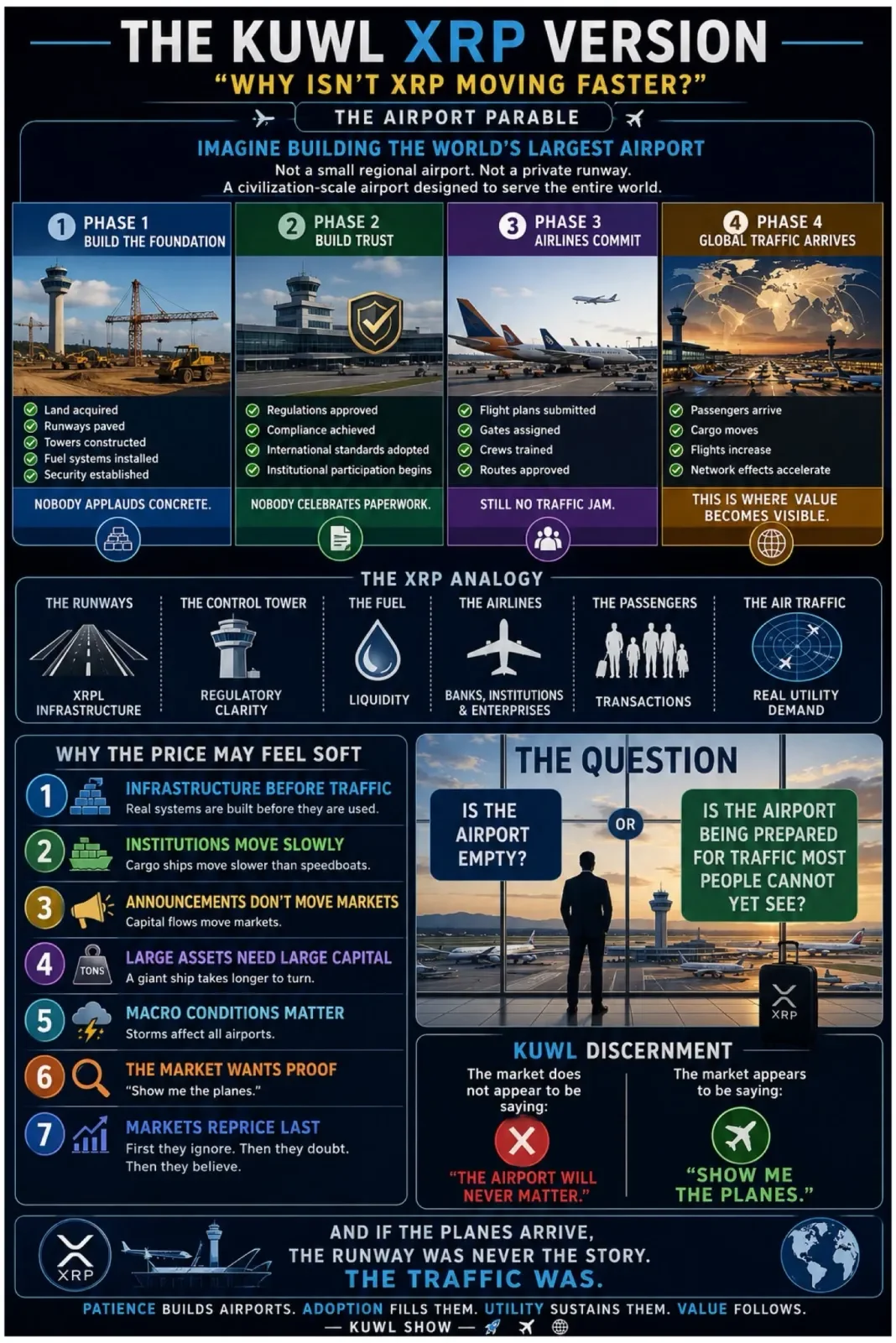
4. Big Assets Need Big Money
It’s easier to move a $1 billion asset than a $100+ billion asset. XRP requires enormous capital to materially reprice.
5. Macro Still Matters
Even strong projects get dragged around by interest rates, liquidity, geopolitics, and broader market sentiment.
6. The Market Wants Proof, Not Promises
The question isn’t whether Ripple is succeeding. The question is whether that success translates into sustained XRP demand.
7. Markets Reward Certainty Last
First they ignore. Then they doubt. Then they resist. Then they reprice.
The KUWL Version
Imagine spending years building the world’s largest airport.
The runways are paved.
The control tower is operational.
The fuel lines are connected.
The customs offices are staffed.
The gates are open.
The planes are filing flight plans.
Yet some people stand in the terminal asking: “Why isn’t there a traffic jam yet?”
Because airports are built before they become busy.
The XRP thesis has never been about today’s passengers.
It has always been about tomorrow’s air traffic.
The market’s current message does not appear to be:
“This airport will never matter.”
The market’s message appears closer to:
“Show me the planes.”
Source(s):
• https://x.com/KuwlShow/status/2061861744599847117
https://dinarchronicles.com/2026/06/03/rob-cunningham-why-is-xrp-price-still-soft/
Would $300 Silver Crush The Retail Industry? | Andy Schectman
Would $300 Silver Crush The Retail Industry? | Andy Schectman
Liberty and Finance: 6-3-2026
Andy Schectman explains that the recent silver selloff was driven by a combination of sharply higher margin requirements, ETF rebalancing, and forced selling tied to primary distributor allocations, creating a cascading liquidity event rather than a true breakdown in fundamentals.
He argues that this overlap of structural pressures led to more selling than buying in the short term, which overwhelmed bids and pushed prices lower.
Would $300 Silver Crush The Retail Industry? | Andy Schectman
Liberty and Finance: 6-3-2026
Andy Schectman explains that the recent silver selloff was driven by a combination of sharply higher margin requirements, ETF rebalancing, and forced selling tied to primary distributor allocations, creating a cascading liquidity event rather than a true breakdown in fundamentals.
He argues that this overlap of structural pressures led to more selling than buying in the short term, which overwhelmed bids and pushed prices lower.
In contrast, he notes that prior strong upside moves saw the opposite dynamic, with intense buying pressure causing premiums to surge and physical supply to tighten dramatically.
Looking forward, he says that a potential move toward $300 to $500 silver would likely bring far greater public participation and stronger hands into the market, reducing the kind of fragile selling pressure seen in earlier cycles.
In his view, that kind of environment would still strain the system but would be more fluid and balanced demand driven, rather than collapsing under forced unbalanced liquidation.
INTERVIEW TIMELINE:
0:00 Intro
2:20 Digitization of all assets
11:20 Unrealized capital gains tax
14:50 Precious metal industry
Seeds of Wisdom RV and Economics Updates Wednesday Afternoon 6-3-26
Good Afternoon Dinar Recaps,
Oil Surges as Iran-U.S. Conflict Escalates and Hormuz Risks Shake Global Markets
Rising military tensions in the Gulf are threatening global energy supplies, increasing inflation risks, and placing renewed pressure on the international financial system.
Good Afternoon Dinar Recaps,
Oil Surges as Iran-U.S. Conflict Escalates and Hormuz Risks Shake Global Markets
Rising military tensions in the Gulf are threatening global energy supplies, increasing inflation risks, and placing renewed pressure on the international financial system.
Overview
Oil prices moved higher as military hostilities between the United States and Iran intensified, raising fears of broader disruption throughout the Middle East. With negotiations stalled and attacks expanding across the Gulf region, concerns are mounting over the security of the Strait of Hormuz, one of the world's most critical energy transit corridors.
The latest escalation comes at a time when global economies are already facing elevated debt levels, inflation concerns, and slowing growth. As a result, investors and policymakers are closely monitoring developments for their potential impact on energy markets and financial stability.
Key Developments
1. Military Exchanges Intensify Across the Gulf
Iranian missile and drone attacks reportedly targeted multiple locations throughout the Gulf region, including infrastructure in Kuwait. Regional air defense systems intercepted several projectiles, while military activity expanded across key strategic locations.
In response, U.S. forces conducted strikes near Qeshm Island, close to the Strait of Hormuz, targeting what American officials described as threats to maritime security and regional stability.
2. Oil Prices Rise on Supply Disruption Fears
Crude oil prices climbed as traders reacted to growing concerns that continued fighting could further disrupt energy shipments. The Strait of Hormuz handles a significant portion of global oil and liquefied natural gas exports, making any threat to shipping routes a major concern for global markets.
Energy analysts warn that prolonged instability could place additional upward pressure on fuel costs worldwide.
3. Diplomatic Talks Between Washington and Tehran Stall
Efforts to secure a broader ceasefire and restart negotiations regarding Iran's nuclear program have slowed significantly. Both governments continue to blame each other for the breakdown in discussions, reducing hopes for a near-term diplomatic resolution.
The lack of progress increases the likelihood that military actions could continue in the coming weeks.
4. Nuclear Dispute Remains a Central Obstacle
Iran continues to seek sanctions relief and access to frozen financial assets, while the United States maintains that any relief must be tied to substantial limitations on Iran's nuclear activities.
The disagreement remains one of the largest barriers to restoring diplomatic relations and reducing regional tensions.
5. Global Supply Chains Face Renewed Pressure
Maritime security concerns have expanded beyond energy markets. Reports of attacks on commercial shipping vessels have increased concerns about disruptions to international trade, transportation costs, and supply chain reliability.
Humanitarian organizations have also warned that regional instability is creating additional challenges for aid deliveries and essential goods distribution.
Why It Matters
The Middle East remains one of the world's most important energy-producing regions. Any prolonged disruption involving the Strait of Hormuz can quickly affect oil prices, inflation, transportation costs, and economic growth across multiple continents.
Financial markets are particularly sensitive because higher energy prices often influence central bank decisions, interest rate policies, and consumer spending patterns.
Why It Matters to Foreign Currency Holders
Rising oil prices can increase global inflation pressures.
Energy-importing nations may experience increased currency volatility.
Safe-haven assets often attract demand during periods of geopolitical uncertainty.
Supply chain disruptions can impact trade balances and economic growth.
Implications for the Global Reset
Pillar 1: Energy Security Becomes a Financial Issue
The latest escalation highlights how closely energy security and monetary stability are connected. Higher oil prices can influence inflation, interest rates, sovereign debt costs, and economic growth simultaneously.
Pillar 2: Geopolitical Risk Reshapes Global Commerce
Ongoing instability is accelerating discussions about alternative trade routes, diversified supply chains, and regional economic alliances designed to reduce exposure to geopolitical chokepoints.
Closing Insight
The renewed confrontation between Iran and the United States demonstrates how quickly geopolitical events can influence global financial conditions. With energy markets, trade routes, and diplomatic efforts all under pressure, the conflict's consequences extend far beyond the Middle East.
This is not just an oil story—it is a reminder that energy security remains one of the most powerful forces shaping the future of the global financial system.
Signature
Seeds of Wisdom Team
Newshounds News™ Exclusive
Sources
Modern Diplomacy — "Oil Jumps as Iran US Talks Stall and Gulf Conflict Escalates"
Reuters — "Oil Rises as Middle East Conflict Fuels Supply Concerns"
~~~~~~~~~~
Seeds of Wisdom Team RV Currency Facts Youtube and Rumble
Newshound's News Telegram Room Link
RV Facts with Proof Links Link
RV Updates Proof links - Facts Link
Follow the Gold/Silver Rate COMEX
Follow Fast Facts
Seeds of Wisdom Team™ Website
Thank you Dinar Recaps
The Dollar System is Losing Trust, Gold’s Monetary Reset has Begun
The Dollar System is Losing Trust, Gold’s Monetary Reset has Begun
Wealthion: 6-3-2026
In an ever-evolving global financial landscape, the discussion around gold’s role as more than just a shiny commodity has never been more pertinent.
Recently, a compelling conversation between Trey Reik, Chief Economist at GBI, and Ronnie Stoeferle, Partner at Incrementum AG, explored the intricate nuances of gold within the global monetary system. Their insights delve deep into whether we are witnessing a typical gold market cycle or something far more profound: a fundamental monetary revaluation.
The Dollar System is Losing Trust, Gold’s Monetary Reset has Begun
Wealthion: 6-3-2026
In an ever-evolving global financial landscape, the discussion around gold’s role as more than just a shiny commodity has never been more pertinent.
Recently, a compelling conversation between Trey Reik, Chief Economist at GBI, and Ronnie Stoeferle, Partner at Incrementum AG, explored the intricate nuances of gold within the global monetary system. Their insights delve deep into whether we are witnessing a typical gold market cycle or something far more profound: a fundamental monetary revaluation.
Stoeferle aptly titled his firm’s report “Back to the Monetary Future,” underscoring the vital importance of understanding monetary history to decode today’s complex economic and financial dynamics.
The discussion highlighted a brewing shift in global power, with the anticipated decline of the Pax Americana and a notable de-dollarization trend gaining momentum.
This shift is particularly influenced by China’s emergence across technological, economic, and scientific fronts. Amidst this backdrop, a growing erosion of trust in traditional institutions, political leadership, and central banks—magnified by rising inflation and surging gold prices—has naturally redirected attention towards gold as a reliable store of value.
One of the key takeaways from the conversation is the argument that gold’s current prices should not be solely perceived in nominal dollar terms. Instead, the analysts suggest a more insightful approach involves viewing gold in relative and monetary terms, particularly its ratio to various money supply measures like M0 and M2.
When evaluated through these lenses, gold appears to be significantly undervalued, suggesting a potentially substantial upside from a historical and comparative perspective.
The discussion also touched upon generational differences in how gold is perceived as monetary insurance. European nations, with their historical experience of multiple fiat currency devaluations, tend to have a deeper-rooted appreciation for gold’s protective qualities.
In contrast, American perspectives have often been shaped by different economic anxieties, sometimes leading to varied attitudes towards the yellow metal.
Drawing on classic Dow theory, the analysts dissected the gold market cycle into distinct phases. Initially, there’s an accumulation phase, where astute, often contrarian, investors begin to acquire assets amidst widespread negative sentiment.
This is followed by the public participation phase, characterized by increasing general interest and growing media attention. Stoeferle suggested that gold is currently well within this public participation phase—perhaps midway through it.
This indicates a broader acceptance among both institutions and the general public, but importantly, it also implies that the market is still far from its peak enthusiasm, leaving room for further development.
The conversation concluded with strong evidence of gold’s shifting narrative within the institutional world.
Major financial institutions have begun revising their gold price targets upwards, reflecting a growing confidence in its performance. Furthermore, influential firms like Morgan Stanley are now including significant allocations to gold in their portfolio recommendations. This institutional embrace underscores gold’s evolving role as a strategic asset for diversification and wealth preservation in an uncertain economic climate.
For those eager to delve deeper into these fascinating insights and gain further perspective on gold’s integral place in our monetary future, we highly recommend watching the full video from Wealthion. It offers an invaluable opportunity to understand the multifaceted factors shaping gold’s trajectory.
News, Rumors and Opinions Wednesday 6-3-2026
Ariel: Iraqi Dinar Overview
6-3-2026
Iran & Iraq Update: Progressive Operations For The Republic Restoration
Iraqi Dinar Overview
Surface narratives claim stability at ~1,300 IQD per USD with no major shift planned, citing CBI budgets and minor fluctuations. This of course ignores compartmentalized mechanics. The official rates serve budgetary theater while parallel rails (offshore trusts, sovereign wealth vehicles, and tokenized testing) prepare for phased redenomination and backing adjustments.
Ariel: Iraqi Dinar Overview
6-3-2026
Iran & Iraq Update: Progressive Operations For The Republic Restoration
Iraqi Dinar Overview
Surface narratives claim stability at ~1,300 IQD per USD with no major shift planned, citing CBI budgets and minor fluctuations. This of course ignores compartmentalized mechanics. The official rates serve budgetary theater while parallel rails (offshore trusts, sovereign wealth vehicles, and tokenized testing) prepare for phased redenomination and backing adjustments.
Just so we are clear on this. The skeptics overlook documented post-invasion currency swaps (2003-2011) where dinar holdings among US-linked entities created vested interests. The 2024 Politico framing on dollar devaluation under trade pressures aligns with accelerated timelines engineered weakening forces asset migration into hard commodities and reformed currencies.
Iraq’s full digital mandate by July 2026 (cashless government institutions via CBI directive) is not mere modernization; it clears legacy paper for blockchain/ISO 20022 integration, enabling gold-pegged or commodity-hybrid settlement without public devaluation panic.
So this should give you all a clue as to how this is going to go.
Space Force and aligned DIA/SOCOM elements monitor global settlement integrity, including orbital data relays for transaction verification.
Fort Knox audits (pushed via executive and congressional vectors) verify physical gold collateral to backstop any reset critical as European Central Bank data confirms gold surpassing US Treasuries as primary reserve asset (~27% share end-2025 vs. declining Treasury holdings).
This supports return to sounder mechanisms where dinar transitions from fiat proxy to regionally backed instrument. Under-the-table dealings involve cutouts in Gulf sovereign funds and select US Treasury alumni coordinating non-SWIFT rails. Iraq seeks independent national currency strength to exit dollar dependency in oil exports, accelerated by BRICS+ hedging and reduced Iranian influence channels.
Please understand this one thing. Trump’s team zeroed in on Iraq’s financial flows early on because of oil revenue recycling, Iranian influence channels, and broader de-dollarization risks. Those pauses on U.S. currency shipments to Iraq (hitting around $500 million tied to oil proceeds) weren’t random they were pressure tools to curb militia funding routes and force cleaner monetary policy in Baghdad.
This wasn’t headline-grabbing stuff, but it signaled a focus on stabilizing Iraq’s currency mechanics as leverage in regional cleanup.
Fast-forward to the current term, and the same threads persist: using dollar access as a carrot/stick while watching Iraq’s push to stand up its own stronger national currency backbone.
Read Full Article:
https://www.patreon.com/posts/iran-iraq-update-159961100
https://dinarchronicles.com/2026/06/02/prolotario-iraqi-dinar-overview/
************
Courtesy of Dinar Guru: https://www.dinarguru.com/
Jeff Question: "Can the government drag the rate change for a couple more years?" Jeff: No...because they've already done everything. They've already told you the new government is going to lead Iraq into the next stage, next phase. That is the international post rate change era...All the articles tell you reforms, taxes, 150+ laws - all of that is post rate change era...This is not going to drag out for more years.
Militia Man Article: "ECONOMIC REFORM OR RADICAL CHANGE ? - A LOOK AT THE PATH TO A MARKET ECONOMY" This is further confirmation that the execution phase is real. Diversification, private sector activation, and reducing oil dependency are no longer just talk — they’re becoming policy priorities under the new government. A successful transition to a market economy is one of the strongest structural supports for a managed REER. You can’t sustainably strengthen the dinar long-term in a pure rentier system. The reforms we’re seeing are building the resilience needed for that next step.
Mnt Goat Article: “NEW UNDERSTANDINGS BETWEEN BAGHDAD AND ERBIL… AL-ZAIDI “IMPLEMENTS LONG-AWAITED KURDISH DEMANDS” Quote: "...the current phase has witnessed practical steps to implement a number of demands, especially those related to the oil file and moving towards enacting the oil and gas law."This is what is called ‘STABILITY’. These are the kind of actions we need to see in order to get the RV. We need one national Iraq working together, north and south...I leaped with JOY when I read it.
Reset Intelligence In front of a delegation of Iraqi journalists, Prime Minister Ali Falih al-Zaidi told the room he had been offered a $200 million bribe to bury corruption inside Iraq's Oil Ministry...He took it to the press. The man who carried the offer was already in custody. Adnan Mohammed Hammoud, Deputy Oil Minister for Refining Affairs and Director General of the North Refineries Company, was arrested Friday evening...Communications Minister Mustafa Sand called him an "oil whale" and "the main provider of money to parties."...Then al-Zaidi did the part that matters. He stood up a council, named himself its chair, and gave it the power to send a corruption file straight to a judge...This one action just showed you what Iraq is now capable of.
************
The Truth About the Dollar, Why It Buys Less Every Year! | LIVE Q&A with Lynette Zang
6-2-2026
Why does it feel like your money doesn't go as far as it used to?
In this livestream, Lynette Zang examines the truth about the U.S. dollar, rising living costs, inflation, and why many Americans are finding it harder to maintain their standard of living despite higher incomes.
The discussion explores purchasing power, monetary policy, and what these trends could mean for the future.
Seeds of Wisdom RV and Economics Updates Wednesday Morning 6-3-26
Good Morning Dinar Recaps,
Middle East Conflict, Rising Oil Prices, and Digital Currency Debates Increase Pressure on Global Finance
Escalating geopolitical risks and accelerating discussions around digital money are exposing vulnerabilities within the existing financial system.
Good Morning Dinar Recaps,
Middle East Conflict, Rising Oil Prices, and Digital Currency Debates Increase Pressure on Global Finance
Escalating geopolitical risks and accelerating discussions around digital money are exposing vulnerabilities within the existing financial system.
Overview
Today's economic landscape is being shaped by two powerful forces: renewed instability in the Middle East affecting global energy markets and growing efforts by governments and central banks to modernize payment systems through digital currencies and stablecoin regulation.
While global stock markets remain near record highs, underlying risks tied to energy security, inflation, sovereign debt, and monetary transformation continue to build beneath the surface.
Key Developments
1. OECD Warns Prolonged Middle East Conflict Could Slow Global Growth
The OECD warned today that an extended conflict involving Iran and the broader Middle East could significantly reduce global economic growth while pushing inflation higher. Under its more severe scenario, global growth could fall to 2.1% in 2026, while inflation accelerates due to disruptions in energy supplies and trade routes.
2. Oil Prices Continue Rising on Iran Uncertainty
Oil prices moved higher for a third consecutive day as negotiations between the United States and Iran remain stalled. Markets remain concerned that any disruption involving the Strait of Hormuz, one of the world's most important energy corridors, could trigger additional inflationary pressures and disrupt global supply chains.
3. Central Banks Face Growing Digital Currency Pressure
Debates surrounding digital currencies intensified as policymakers in Europe and the United Kingdom discussed the future of stablecoins and central bank digital currencies (CBDCs). European Central Bank officials argued that projects such as the Digital Euro may become increasingly important as governments seek to maintain monetary sovereignty in a rapidly evolving digital payments environment.
4. Stablecoin Regulation Emerges as Strategic Financial Issue
UK lawmakers urged regulators to soften proposed restrictions on stablecoins, warning that excessive regulation could hinder innovation and limit competitiveness. The debate highlights the growing importance of stablecoins as governments attempt to balance innovation with financial stability concerns.
5. Interest Rate Expectations Remain Elevated
Strong labor market data and persistent inflation concerns have led investors to scale back expectations for rapid interest-rate cuts. Rising bond yields and tighter monetary conditions continue to place pressure on highly leveraged governments, corporations, and consumers worldwide.
Why It Matters
The combination of geopolitical instability, energy market vulnerability, elevated debt levels, and digital monetary innovation is creating conditions that could reshape the future structure of global finance. Governments and central banks are increasingly forced to manage multiple systemic risks simultaneously.
Why It Matters to Foreign Currency Holders
Rising energy prices can create significant currency volatility.
Digital currencies and stablecoins may influence future cross-border payment systems.
Higher interest rates could pressure debt-heavy economies and alter capital flows.
Implications for the Global Reset
Pillar 1: Energy Security and Monetary Stability
Persistent instability in key energy-producing regions demonstrates how closely inflation, interest rates, and geopolitical events have become interconnected within the modern financial system.
Pillar 2: Transition Toward Digital Finance
The accelerating focus on stablecoins, digital currencies, and tokenized financial infrastructure suggests that major economies are actively preparing for the next phase of monetary evolution.
Closing Insight
Today's developments highlight a world economy balancing between old and new systems. Traditional challenges such as war, inflation, and debt remain significant, while digital currencies and financial innovation are steadily transforming how money and commerce may function in the future.
This is not simply a period of economic uncertainty—it is the intersection of geopolitical risk and monetary transformation shaping the next era of global finance.
Seeds of Wisdom Team
Newshounds News™ Exclusive
Sources
Reuters — "OECD Says Protracted War Could Drag on Global Growth, Push Up Inflation"
Reuters — "Oil Up on Middle East Fighting While AI Bulls Carry Stocks Higher"
~~~~~~~~~~
🌱 A Message to Our Currency Holders🌱
If you’ve been holding foreign currency for many years, you were not foolish.
You were not wrong to believe the global financial system would change.
What failed was not your patience — it was the information you were given.
For years, dates, rumors, and personalities replaced facts, structure, and proof. “This week” predictions created cycles of hope and disappointment that were never based on how currencies actually change.
That is not your failure.
Our mission here is different: • No dates • No rates • No hype • No gurus
Instead, we focus on:
• Verifiable developments • Institutional evidence
• Global financial structure • Where countries actually sit in the process
Currency value changes only come after sovereignty, trade, banking, settlement systems, and fiscal coordination are in place. History and institutions confirm this sequence.
You will see silence. You will see denials. That is not delay — that is discipline.
Protect your identity. Organize your documents. Verify everything.
Never hand your discernment to anyone who cannot show proof.
You deserve truth — not timelines.
Seeds of Wisdom Team
Newshounds News™
~~~~~~~~~~
Seeds of Wisdom Team RV Currency Facts Youtube and Rumble
Newshound's News Telegram Room Link
RV Facts with Proof Links Link
RV Updates Proof links - Facts Link
Follow the Gold/Silver Rate COMEX
Follow Fast Facts
Seeds of Wisdom Team™ Website
Thank you Dinar Recaps
Iraq Economic News and Points To Ponder Late Tuesday Evening 6-3-26
Iraqi PM Declares War On Corruption, Orders Ministers To Disclose Assets Within One Week
Iraqi prime minister ali al-zaidi has declared an all-out war against systemic corruption, marking his administration's first major policy move by mandating all cabinet ministers to publicly disclose their financial assets within one week.
Iraqi PM Declares War On Corruption, Orders Ministers To Disclose Assets Within One Week
Iraqi prime minister ali al-zaidi has declared an all-out war against systemic corruption, marking his administration's first major policy move by mandating all cabinet ministers to publicly disclose their financial assets within one week.
Ministerial Accountability and Contract Audits
During his inaugural cabinet session, Prime Minister al-Zaidi designated the eradication of administrative and financial corruption as his administration's absolute highest priority. al-Zaidi issued a strict directive requiring every government minister to submit exhaustive documentation regarding their personal wealth and assets to the Federal Commission of Integrity within seven days.
In tandem with the asset mandates, the Prime Minister ordered an immediate, comprehensive audit of all active contracts signed by ministries and public institutions. Any identified irregularities or legal infractions are to be fast-tracked to the judiciary to ensure negligent officials face criminal prosecution.
Creation of the Supreme Sovereignty Council for Integrity
To solidify institutional oversight, the Prime Minister signed an executive decree on May 30, 2026, establishing the "Supreme Sovereignty Council for Integrity, Oversight, and Public Asset Recovery." The council’s primary mandate focuses on tracking, monitoring, and auditing large-scale government projects and procurement contracts.
The ultimate goal of the new body is twofold: preventing the ongoing embezzlement of state funds and orchestrating the repatriation of billions in capital stolen during previous administrations.
High-Profile Arrests and Multi-Trillion Dinar Heist Thwarted
The anti-graft crackdown yielded immediate results just 24 hours after the new measures were codified. Adnan Hamad Hamoud, the former director of the North Refineries Company and a former deputy minister of oil, widely referred to in domestic circles as the "Oil Whale" was arrested on sweeping corruption charges.
Simultaneously, investigators from the Commission of Integrity successfully foiled a major financial plot aimed at siphoning 1.5 trillion Iraqi dinars (IQD) from two state-owned banks in Baghdad. Law enforcement officials confirmed that two suspects have already been detained in connection with the multi-trillion-dinar banking conspiracy.
A Technocratic Strategy to Protect Public Wealth
In his maiden address to the nation after assuming office, Prime Minister al-Zaidi characterized financial and administrative corruption as the single greatest bottleneck stymieing Iraq’s economic development. al-Zaidi, who possesses a robust background in economics and commerce, stressed that his government will deploy its full legal power to safeguard public wealth.
These domestic measures come at a critical time, as international watchdogs consistently rank Iraq among the most non-transparent and corrupt nations globally.
The Looming Shadow of the "Heist of the Century"
Despite the swift momentum of the new administration, the monumental challenge of recovering vast sums of capital smuggled out of the country in recent years remains unresolved.
The greatest test of al-Zaidi's anti-corruption campaign is the ongoing fallout from the infamous "Heist of the Century," a scandal that saw trillions of dinars systematically looted from state coffers. To date, many of the primary suspects continue to evade justice, moving freely both inside Iraq and abroad due to entrenched patron-client networks linked to highly influential political actors.
Iraqi PM Declares War on Corruption, Orders Ministers to Disclose Assets Within One Week
https://channel8.com/english/news/59131
Eram News: Barak's Appointment Means Transferring The Iraqi File From Diplomacy To A Direct Administration Linked To The White House
Baghdad - One News 6/02/2026 A report published by Eram News revealed that Washington is currently viewing Iraq through three main files. The first is the file of armed factions and their weapons, the second is reducing Iranian influence within political and economic institutions, and the third is related to reactivating the economic and investment relationship, especially in the energy, gas, electricity and banking sectors.
The report indicated that the appointment of Tom Barrack as a special presidential envoy to Iraq cannot be separated from the desire of US President Donald Trump’s administration to move the Iraqi file from traditional diplomatic management to direct political management linked to the White House.
The report added that Barak is coming to Baghdad as a dealmaker and regional relations man, reflecting Washington’s desire to deal with Iraq from a broader perspective, indicating that the main task is to test the Iraqi government’s ability to produce a new balance that does not clash directly with Tehran, while at the same time not allowing Iraq to remain an open arena for armed factions. https://1news-iq.net/إرم-نيوز-تعيين-باراك-يعني-نقل-الملف-ال/
Rejecting Its Dissolution...The Coordination Framework, In The Presence Of Al-Zaydi: The Popular Mobilization Forces Are An Official Security Institution Committed To The Orders Of The Commander-In-Chief
Baghdad - One News 6/02/2026 The Coordination Framework held its periodic meeting at the office of the head of the Victory Coalition, Haider al-Abadi, in the presence of Prime Minister Ali al-Zubaidi, to discuss a number of priority national and security issues.
The Coordination Framework stressed that the choice of the political system and its representatives is an exclusive right of the Iraqi people, who have made great sacrifices in defense of their state and democratic system, and that the decision of war and peace is a sovereign national decision that belongs to the Iraqi people through their constitutional institutions, represented exclusively by the House of Representatives and the elected government, and that any action outside this framework is considered a violation of the law and the principles of the constitutional state.
The coordination framework also affirmed that the Popular Mobilization Forces is an official security institution committed to the constitution, applicable laws, and the orders of the Commander-in-Chief of the Armed Forces, and carries out its duties in accordance with the approved legal frameworks. https://1news-iq.net/رفضاً-لحله-الإطار-التنسيقي-بحضور-الزي/
Security Source: 13 Million Weapons Remain Outside State Control Despite Ongoing Purchase And Registration Campaigns
Baghdad - One News 6/02/2026 A security source confirmed that the issue of weapons spread outside official frameworks still represents one of the most prominent challenges facing the Iraqi state, despite the fact that more than two years have passed since the launch of the project to purchase citizens’ weapons and register them within the plan to restrict weapons to the state.
The source explained that the government has taken a series of measures in the past period aimed at regulating the possession of weapons and reducing their spread, by opening registration centers and launching programs to purchase unlicensed weapons, but the volume of weapons circulating in Iraqi society is still large and requires long-term efforts to address it.
He explained that the success of the project to restrict weapons to the state is not related to security measures alone, but requires broad community cooperation and the provision of a stable environment that enhances citizens’ confidence in official security institutions, in addition to the continuation of government programs related to regulating and collecting weapons.
https://1news-iq.net/مصدر-أمني-13-مليون-قطعة-سلاح-ما-تزال-خارج/
US Hails Iraqi Coordination Framework’s Move To Restrict Weapons To State
2026-06-02 / 04:06 Shafaq News- Baghdad The United States on Tuesday welcomed Iraq's push to place all weapons under state control, after armed faction Asaib Ahl Al-Haq (AAH) announced practical steps toward transferring its arms, personnel, and equipment to state authority following a landmark decision by the ruling Coordination Framework (CF).
During a meeting between US Chargé d'Affaires Joshua Harris and Iraqi National Security Adviser Qasim Al-Araji, both sides praised the CF's support system" rel="">support for restricting weapons to the state and separating the Popular Mobilization Forces (PMF) from political, partisan, and social structures. قاسم الاعرجي potosednSr1fau495f850g471h1c0fml42i7u1h887a0c2m3ah62glfaia9h ·
National Security Adviser Mr. Qasim Al-Arji receives the list of the American Embassy in Baghdad
Today, Tuesday, received the National Security Adviser, Mr. Qasim Al-Arji, today, who is in charge of the American Embassy in Baghdad,
Mr. Joshua Harris. Mr. Al-Arji and Mr. Harris reviewed the situation at the regional and international levels and the latest developments in the region, as well as the decision of the coordinating framework to support system" rel="">support the government's measures to confiscate arms by the state, emphasizing that the statement of the coordinating frame is a road map to stabilize the country and to get away from everything that is harmful to the security and stability of Iraq.
As witnessed by the meeting, the research on the continuation of cooperation and partnership between Iraq and the United States, and the development of bilateral relations, in accordance with the common interests of the two countries.
Mr. Al-Arji to the head of the American embassy, renewed Iraq's firm position due to the conflict in the region and its stand to the peaceful path as drawn by the international customs and diplomacy.
On his side the staff of the American Embassy confirmed the support system" rel="">support of the American government and President Trump for the Iraqi government, signaling that the United States supports independent Iraq with full sovereignty, and that economy and development are the driving force for Iraq and its people, again supporting the state's curfew, describing the coordinating framework statement as a quality move in The way to consolidating independence and sovereignty for the promising future of Iraq.
Media Office of the National Security Adviser 2- June-2026
Harris described the CF position as a "qualitative shift" toward strengthening Iraq's independence and sovereignty, while reaffirming the support system" rel="">support of the United States and President Donald Trump for the Iraqi government.
The Shiite alliance, which dominates Iraq's parliament with more than 160 of 329 seats, authorized Prime Minister Ali Al-Zaidi on June 1 to take the decisions and measures necessary to protect the country's interests while endorsing efforts to place all weapons under state control and detach the PMF from political and partisan frameworks.
It also stressed that decisions on war and peace are the exclusive responsibility of Iraq's constitutional institutions and that any action outside that framework violates the law and the principles of the state.
Restricting weapons to state control is a central pillar of Al-Zaidi's government program. Since taking office, he has repeatedly argued that the authority to bear arms and enforce the law belongs exclusively to the state and has called on armed groups to integrate into official institutions through legal channels.
Read more: A guide to Ali Al-Zaidi's ministerial program
AAH, the first faction within the CF to take concrete steps, explained that the move was made in response to the coalition’s position and in line with calls by Iraq's top Shiite cleric, Grand Ayatollah Ali Al-Sistani, for weapons to remain under state control. The Iran-backed group currently operates Brigades 41, 42, and 43 within the PMF and maintains a parliamentary political wing through the Sadiqoon bloc. No timeline was provided for completing the transfer process.
Read more: Iraq’s armed factions and the disarmament debate
https://shafaq.com/en/Iraq/US-hails-Iraqi-Coordination-Framework-s-move-to-restrict-weapons-to-state
Wed. Iraq News Posted by Tishwash at TNT 6-3-2026
TNT:
Tishwash: Kurdistan Delegation in Baghdad to Discuss Oil Exports and Output Increase
Talks expected with Iraqi officials and SOMO aimed at raising Kurdistan Region oil exports to 500,000 barrels per day amid ongoing production constraints
A delegation from the Kurdistan Regional Government (KRG) arrived in Baghdad on Wednesday to hold a series of meetings with senior Iraqi officials focused on oil exports and mechanisms to increase production and shipments, according to Kurdistan24 correspondent in Baghdad, Dilan Barzan.
TNT:
Tishwash: Kurdistan Delegation in Baghdad to Discuss Oil Exports and Output Increase
Talks expected with Iraqi officials and SOMO aimed at raising Kurdistan Region oil exports to 500,000 barrels per day amid ongoing production constraints
A delegation from the Kurdistan Regional Government (KRG) arrived in Baghdad on Wednesday to hold a series of meetings with senior Iraqi officials focused on oil exports and mechanisms to increase production and shipments, according to Kurdistan24 correspondent in Baghdad, Dilan Barzan.
The delegation is scheduled to begin its first meeting at 12:00 noon on Wednesday with Iraq’s Prime Minister Ali Faleh al-Zaidi, marking the start of a broader round of talks with federal authorities.
A well-informed source told Kurdistan24 that the KRG delegation is on an official visit to Baghdad, with the main objective of increasing Kurdistan Region oil exports through the Turkish port of Ceyhan.
The delegation is expected to meet with Prime Minister al-Zaidi, Oil Minister Bassim Mohammed Khudair Al-Abadi, and representatives of the State Organization for Marketing of Oil (SOMO) to discuss export arrangements.
According to Kurdistan24 sources, the delegation includes Acting Minister of Natural Resources Kamal Muhammad, Head of the Council of Ministers Diwan Omed Sabah, and Cabinet Secretary Amanj Rahim.
A source within Iraq’s Oil Ministry told Kurdistan24 that crude exports from the Kurdistan Region have declined over recent months due to security conditions affecting oil fields, impacting both export volumes and overall regional revenues.
The talks in Baghdad are expected to focus on increasing oil exports to 500,000 barrels per day, alongside stabilizing production and ensuring secure transport routes.
Exports from the Kurdistan Region to the Turkish port of Ceyhan were suspended in 2023 following a ruling by an international arbitration court, before partially resuming at the end of 2025. However, recent months have seen another decline in output and exports due to renewed regional security tensions and concerns over the safety of oil infrastructure.
Officials from both sides are now seeking to stabilize export flows and address operational challenges that have affected production levels across key oil fields in the Kurdistan Region. link
************
Tishwash: "It's no longer a separate issue": Washington is reshaping its priorities in Iraq.
"It's no longer a separate issue": Washington is reshaping its priorities in Iraq.
Diler Khalaf Osman, a researcher in international relations and Middle Eastern affairs at the University of Tennessee, affirmed that Washington's decision to merge the Iraq and Syria files under a single envoy reflects a fundamental shift in US strategy toward the region.
Osman stated that this move confirms the United States no longer treats Iraq as a separate or isolated issue with its own internal particularities, but rather as part of a broader regional security and geopolitical framework.
He added that this approach represents a shift from the US approach that has prevailed since 2003, which focused on democracy and development, to a regional approach that views Iraq through the lens of regional power balances, aiming to reduce Iranian influence and redirect the geopolitical trajectory of both countries in a way that serves US interests.
The researcher pointed out that the background of the new envoy, Tom Barrack, and his ideology related to the idea of “America First” reveal the features of his mission, as he does not seem concerned with the files of democracy, federalism and political pluralism as much as he is concerned with strengthening the central state and its security capabilities, to ensure that it does not pose any threat to American interests, and to enable it to manage its security itself in the long term, which reduces the need for a direct American military presence. link
************
Tishwash: A huge financial surplus... and a service reality that has not changed: What happened?
The era of Mustafa Al-Kadhimi has sparked widespread controversy that continues to resurface whenever the issue of managing public funds and oil surpluses is raised, especially in light of talk about huge sums that entered the state treasury during the period of high oil prices, compared to a clear limitation in the size of service and development projects completed on the ground.
While supporters of that phase promote the idea of “financial stability” and crisis management in a difficult economic situation, critics argue that the surpluses that were subsequently achieved did not translate into a real reconstruction boom, and their effects remained limited to covering operational expenses and salaries, without a tangible impact on infrastructure or basic services.
At the heart of this debate stands the most prominent economic decision at the end of 2020, when the exchange rate of the dinar against the dollar was adjusted. The government at the time considered this decision a necessary step to address the financial deficit, while opponents saw it as an influential shift that directly affected the prices of basic commodities and the standard of living, and left a long-term impact on the purchasing power of citizens.
As oil revenues increased in subsequent years, questions grew about the absence of strategic projects commensurate with those revenues, as observers believe that the period did not witness a construction momentum that matched the size of the available resources, with the exception of continued operational spending and covering the state’s financial obligations.
The issue of investment projects also remained controversial, given the failure or absence of a number of announced initiatives, and the increasing voices that spoke of a gap between the amount of money flowing into the country and what was actually achieved in terms of development and services.
On the other hand, supporters of that era still maintain that the government faced complex political, economic and security challenges, and that performance evaluation should take into account the nature of the circumstances in which the country was run.
Between these two narratives, the Al-Kadhimi era remains one of the most controversial economic periods in Iraq, between those who describe it as managing a difficult crisis, and those who consider it a huge financial opportunity that was not invested in the way that could have changed the reality of services and reconstruction. link
************
Tishwash: Iraqi PM proposes US-backed investment plan linked to weapons control
Iraqi Prime Minister Ali al-Zaidi has proposed a plan to the United States that would link the expansion of US-led service and investment projects in Iraq to efforts to restrict weapons to state control and facilitate the disarmament of armed factions, a political source told Shafaq News on Tuesday.
The proposal aims to shift the weapons issue from a direct security challenge into a broader political and economic settlement by providing practical alternatives for faction members, particularly through employment opportunities and productive development projects.
"Al-Zaidi believes that the involvement of American companies in service and investment sectors could provide the government with economic and political support for implementing a gradual disarmament plan," the source said, adding that It would also seek to create jobs for young Iraqis, integrate some faction members into the labor market, and reduce their reliance on armed formations operating outside state institutions.
Earlier in the day, Asaib Ahl al-Haq (AAH), one of Iraq's most powerful Iran-aligned armed factions, announced the formation of an internal central committee tasked with implementing the group's disengagement from Popular Mobilization Forces structures and transferring its weapons, personnel, and equipment to state authority.
Ashab al-Kahf, also one of Iraq's prominent clandestine armed groups, rejected outright any political calls for factions to surrender their weapons, dismissing arguments invoking the supreme Shia religious authority in support of disarmament as false. Kataib Hezbollah welcomed efforts to centralize arms under government oversight while signaling it would not disarm.
Al-Zaidi has made weapons restriction a central plank of his government program, welcoming al-Sadr's earlier disarmament initiative as a step that would strengthen Iraq's security institutions in performing their constitutional duties, and calling on other armed factions to follow through official state channels, on the principle that “the authority to bear arms and enforce the law belongs exclusively to the state.” link
America’s Gold Problem Just Got Harder to Ignore
America’s Gold Problem Just Got Harder to Ignore
Taylor Kenny: 6-2-2026
The Fort Knox audit may be the spark—but not the real fire. America’s gold problem just got harder to ignore because the real issue may not be buried inside Fort Knox.
It may be hiding in plain sight on the U.S. Treasury balance sheet.
Why does the U.S. government still value its gold at $42.22 per ounce when the market price is thousands of dollars higher?
America’s Gold Problem Just Got Harder to Ignore
Taylor Kenny: 6-2-2026
The Fort Knox audit may be the spark—but not the real fire. America’s gold problem just got harder to ignore because the real issue may not be buried inside Fort Knox.
It may be hiding in plain sight on the U.S. Treasury balance sheet.
Why does the U.S. government still value its gold at $42.22 per ounce when the market price is thousands of dollars higher?
CHAPTERS:
00:00 Trump, Fort Knox, and the Gold Audit
00:57 The Real Question No One Is Asking
01:25 The $42.22 Gold Accounting Illusion
02:22 Why Gold Threatens the Dollar System
03:18 Central Banks Are Buying Gold for a Reason
04:44 The 1934 Gold Revaluation Warning
06:32 Nixon, Broken Promises, and Fiat Currency
07:27 Physical Gold vs. Paper Gold
08:53 Are We Near a Gold Revaluation?
Iraq Economic News and Points To Ponder Tuesday Evening 6-2-26
Iraq Seizes $10 Million, Dozens Of Properties In Oil Corruption Case
2026-06-02 Shafaq News- Baghdad Iraqi authorities seized on Tuesday nearly 40 properties, $10 million in cash, three billion Iraqi dinars (≈ $2.29 million), and large quantities of weapons in an expanding corruption case involving former Deputy Oil Minister for Refining Affairs Adnan Mohammed Mahmoud.
Iraq Seizes $10 Million, Dozens Of Properties In Oil Corruption Case
2026-06-02 Shafaq News- Baghdad Iraqi authorities seized on Tuesday nearly 40 properties, $10 million in cash, three billion Iraqi dinars (≈ $2.29 million), and large quantities of weapons in an expanding corruption case involving former Deputy Oil Minister for Refining Affairs Adnan Mohammed Mahmoud.
According to a statement from the Supreme Judicial Council, preliminary investigations led to the seizure of properties in Baghdad, Saladin, and Erbil, along with around 1.5 kilograms of gold. The investigating judge said authorities also confiscated large quantities of light and medium weapons, adding that inquiries remain ongoing to identify all individuals and entities linked to the case.
Mahmoud, who previously served as deputy oil minister for refining affairs, was arrested last week on corruption-related charges.
Earlier this week, security forces arrested the financial director of the North Refineries Company in Baiji, though authorities have not publicly disclosed the reasons for the detention or any charges against him.
Arrest Of Oil Official Linked To Fuel Shortages Across Iraq
2026-06-02 Shafaq News- Baghdad The arrest of Deputy Oil Minister for Refining Affairs Adnan al-Jumaili has contributed to fuel supply disruptions and long queues at filling stations across Baghdad and several Iraqi provinces since the Eid al-Adha holiday.
Sources familiar with the matter told Shafaq News that some northern refineries have slowed or halted fuel shipments in protest against the detention of al-Jumaili, who previously headed the North Refineries Company, creating additional pressure on gasoline supplies reaching the capital.
Al-Jumaili was arrested on May 30 as part of a corruption investigation linked to government contract reviews and anti-corruption measures.
The disruptions have coincided with a worsening fuel crunch on the ground, where motorists reported spending hours searching for gasoline and moving between multiple stations in an attempt to refuel. The government has denied any fuel shortage, attributing the pressure on stations to increased consumption driven by high temperatures and greater use of cooling systems.
However, the continuing queues have fueled public frustration, with many residents questioning why fuel remains difficult to obtain despite official assurances that supplies are sufficient to meet daily demand.
No unified explanation has yet emerged from the authorities responsible for fuel distribution, leaving uncertainty over when conditions at filling stations will return to normal.
https://www.shafaq.com/en/society/Arrest-of-oil-official-linked-to-fuel-shortages-across-Iraq
Fire Losses In Duhok Hit $1,6M+ In 2026
2026-06-02 Shafaq News- Duhok Civil Defense teams in Duhok province recorded 357 incidents since the beginning of 2026, including 204 fires that caused material losses estimated at 2.5 billion Iraqi dinars (about $1.62M), with an increase of about 35 million dinars compared with last month, a Civil Defense official told Shafaq News on Tuesday.
Biwar Abdulaziz, the Directorate’s spokesperson, stated that the province also recorded 19 drowning incidents, along with five other fatalities, including one suicide by drowning in a dam and four deaths caused by blazes. He added that Civil Defense teams rescued 41 people during the same period from drowning, traffic accidents, and structural collapses before transferring them to hospitals for treatment.
The directorate carried out 3,035 field inspections of buildings, residential complexes, and other sites in and around Duhok to verify the availability of firefighting systems, automatic fire-control equipment, and compliance with safety regulations.
During the harvest season, he explained that abundant rainfall this year contributed to significant growth in vegetation and crops, prompting the directorate to implement a preventive plan to protect wheat fields and farms from fires. “The plan includes deploying 30 firefighting teams across agricultural areas to reduce response times and contain any outbreaks quickly.”
As for the summer swimming season, Abdulaziz pointed out that diving teams have been stationed at dams, rivers, and other water sites to respond to drowning incidents. He noted that heavy rainfall has altered the conditions of many water bodies and raised water levels compared with last year. https://www.shafaq.com/en/Kurdistan/Fire-losses-in-Duhok-hit-1-6M-in-2026
Iraq Cancels Settlement Deal With Korek Telecom
2026-06-02 Shafaq News- Baghdad Iraq's Communications and Media Commission (CMC) on Tuesday canceled its settlement agreement with Korek Telecom, citing the company's failure to comply with contractual obligations despite being granted multiple opportunities to resolve outstanding issues.
The regulator said it would begin implementing the legal and regulatory measures stipulated under the agreement, including actions related to the company's operations and assets per Iraqi law.
It also directed its Consumer Voice Department to receive and process complaints from Korek subscribers and address any issues resulting from the decision, urging government institutions, private entities, and the public not to enter into new agreements or commitments with the company. “Korek would bear responsibility for any legal or financial consequences arising from the cancellation.”
In 2025, CMC ordered the suspension of internet services provided by Korek Telecom, a move that sparked criticism from residents and activists in the Kurdistan Region over its impact on consumers and businesses.
Read more: Internet in Iraq: Snail-speed service, high costs, and digital divide
https://www.shafaq.com/en/society/Iraq-cancels-settlement-deal-with-Korek-Telecom
US Rubio Reports Progress In Nuclear Negotiations With Iran
2026-06-02 Shafaq News- Washington The US Secretary of State Marco Rubio on Tuesday shared optimism about the potential for a resumption in nuclear talks with Iran, adding that Iranians have agreed to negotiate on nuclear points that they had not been willing to address in the past.
In his first public testimony sincethe Iran warbegan, he said there is no guarantee that ultimately the negotiations will lead to an “acceptable deal”, explaining that these negotiations have been made difficult “by the instability of Iran’s leadership.”
Earlier, Tasnim News Agency reported that Iran's negotiating team will suspend indirect message exchanges with the United States through intermediaries, a decision Tehran linked directly to Israeli strikes on Lebanon.
https://www.shafaq.com/en/World/US-Rubio-reports-progress-in-nuclear-negotiations-with-Iran
Summer Heat Boosts Nightlife On Erbil's Iskan Street
2026-06-02 Shafaq News- Erbil Climbing summer temperatures in Erbil, the capital of the Kurdistan Region, are driving growing crowds to Iskan Street, which has become a major nighttime destination for families and tourists.
Kamran Ahmed, a visitor, told Shafaq News on Tuesday that Iskan Street offers a welcome escape from the high temperatures. “Staying at home during this weather is unbearable,” he remarked. “We come here because it is our outlet in the city center. The open-air atmosphere, ice cream, and meeting friends are what make summer nights enjoyable.”
The street's appeal extends beyond Erbil residents. Large numbers of visitors from Iraq's central and southern provinces have continued to arrive since the Eid Al-Adha holiday, during which, the city welcomed 112,657 visitors, according to the Erbil Tourism Directorate.
Read more: Discover Kurdistan: The Middle East's best-kept travel secret
https://www.shafaq.com/en/Kurdistan/Summer-heat-boosts-nightlife-on-Erbil-s-Iskan-Street
Iran Prepares For Ali Khamenei's Funeral In Tehran, Qom, And Mashhad
2026-06-02 Shafaq News- Tehran The funeral of Iran's former Supreme Leader Ali Khamenei will be held in three Iranian cities before his burial at the Imam Reza Shrine in Mashhad, an Iranian official revealed on Tuesday.
Deputy Mayor for Social and Cultural Affairs Amin Tavakolizadeh told local media that funeral ceremonies will take place in Tehran, Qom, and Mashhad, adding that authorities are preparing to receive between 15 and 20 million mourners in the capital.
Khamenei was killed on February 28, 2026, in a joint US-Israeli air operation that targeted his presidential compound in Tehran. Preparations for large-scale mourning and funeral ceremonies for Khamenei and members of his family killed in the attack were delayed for months due to security concerns and ongoing military hostilities, according to Iranian media.
https://www.shafaq.com/en/World/Iran-prepares-for-Ali-Khamenei-s-funeral-in-Tehran-Qom-and-Mashhad
US Chargé D'affaires Presses Iraq On Regional Threats
2026-06-02 Shafaq News- Washington US Chargé d'Affaires to Iraq Joshua Harris said Tuesday that ending threats emanating from Iraqi territory is essential to regional peace, following a meeting with Iraqi President Nizar Amedi.
In a post on X, Harris also valued a productive discussion with Amedi “on shared priorities for a strong and mutually beneficial U.S.-Iraq partnership.”
U.S. Embassy Baghda
#CDA Harris valued a productive discussion with President Amidi on shared priorities for a strong and mutually beneficial U.S.-Iraq partnership. They discussed the imperative of decisive Iraqi action to safeguard Iraq’s sovereignty, build trust, and end the threat to regional peace emanating from Iraqi territory. LINK
Earlier Tuesday, Harris met with National Security Adviser Qasim al-Araji, where he praised the Coordination Framework's stated support for consolidating the weapons of Iraqi factions under state authority and severing any operational ties between the Popular Mobilization Forces (PMF)— an umbrella of predominantly Shiite armed factions operating under nominal Iraqi state authority— and structures outside Iraq's official defense establishment. https://www.shafaq.com/en/Iraq/US-charg-d-affaires-presses-Iraq-on-regional-threats