Thank you to all the subscribers to our Early Access program…we thank you for your continued support.
We are excited to offer this new service to keep you informed and up-to-date on the latest Dinar and currency news.
Seeds of Wisdom RV and Economics Updates Tuesday Evening 5-19-2026
Good Evening Dinar Recaps,
Bond Markets, Oil Shocks, and Global Debt Fears Signal Mounting Pressure on the Financial System
Rising Treasury yields, volatile energy markets, and geopolitical instability are forcing governments and central banks into a new phase of financial stress management.
Good Evening Dinar Recaps,
Bond Markets, Oil Shocks, and Global Debt Fears Signal Mounting Pressure on the Financial System
Rising Treasury yields, volatile energy markets, and geopolitical instability are forcing governments and central banks into a new phase of financial stress management.
Overview
Global markets are showing signs of deepening structural strain as bond yields surge, oil prices remain elevated, and investors increasingly question the long-term stability of sovereign debt markets.
Today’s developments point toward a growing convergence of risks involving energy security, inflation, government borrowing costs, and geopolitical fragmentation — all of which are key themes tied to discussions surrounding a potential long-term global financial reset.
The latest catalyst comes from the ongoing tensions surrounding Iran and the Strait of Hormuz, which continue disrupting energy flows and shaking confidence across financial markets.
Key Developments
1. Global Bond Markets Are Flashing Warning Signals
Bond yields across major economies climbed sharply today, with the U.S. 30-year Treasury yield reaching levels not seen since before the 2008 financial crisis.
Investors are increasingly worried that persistent inflation — fueled by higher energy costs and geopolitical instability — could force central banks to maintain higher interest rates for much longer than expected.
The bond selloff is now affecting markets globally, from the United States to Japan and Europe, increasing borrowing costs for governments already carrying historically high debt loads.
Analysts also warned that the arrival of incoming Federal Reserve Chair Kevin Warsh could reduce expectations of future emergency stimulus programs or quantitative easing support.
2. Oil Prices and Hormuz Tensions Continue Reshaping Markets
Oil prices remained elevated near $110 per barrel as uncertainty surrounding Iran and the Strait of Hormuz continues to disrupt shipping and energy supply expectations.
Even temporary disruptions in Hormuz carry major implications because the corridor handles roughly one-fifth of global oil and LNG shipments.
Markets reacted sharply to reports that President Trump delayed a planned strike on Iran while negotiations continue, creating volatility across commodities, currencies, and equities.
The situation highlights how modern financial markets are becoming increasingly tied to geopolitical chokepoints and strategic energy corridors.
3. Inflation Fears Are Reigniting Across the Global Economy
Higher oil prices are now feeding renewed concerns over global inflation just as many economies were hoping price pressures would stabilize.
Rising energy costs threaten transportation, manufacturing, agriculture, and consumer pricing worldwide. Investors are increasingly pricing in the possibility of additional interest rate hikes instead of future cuts.
This dynamic is particularly dangerous because governments are already struggling under enormous debt burdens, making higher borrowing costs difficult to sustain long term.
Several analysts warned that markets are beginning to fear a possible stagflationary environment — where inflation remains elevated while economic growth weakens.
4. Financial Fragmentation and the Shift Toward Multipolar Systems Continue
Today’s market turmoil also reflects broader global realignment trends.
Countries are increasingly reassessing dependence on traditional Western financial systems as geopolitical tensions intensify. Rising commodity nationalism, energy competition, BRICS expansion efforts, and alternative trade settlement discussions all continue accelerating behind the scenes.
The combination of debt instability, geopolitical conflict, supply chain restructuring, and monetary uncertainty is reinforcing discussions about the future architecture of the global financial system.
Why It Matters
The current environment is no longer just about isolated market volatility. It reflects a much broader transition involving:
Record sovereign debt levels
Higher-for-longer interest rates
Geopolitical fragmentation
Energy market weaponization
Pressure on fiat currencies
Growing distrust in centralized financial systems
These pressures are forcing governments, central banks, and multinational alliances to reconsider how global trade, debt, reserves, and monetary systems will function in the future.
Why It Matters to Foreign Currency Holders
For foreign currency holders and global reset watchers, today’s developments reinforce several long-term trends:
Debt-based financial systems are under increasing stress
Oil and energy remain central to monetary power
Bond markets are becoming less stable
Multipolar financial structures continue gaining momentum
Central banks may face shrinking flexibility moving forward
As borrowing costs rise globally, nations may increasingly seek alternative settlement systems, commodity-backed arrangements, regional alliances, and reserve diversification strategies.
Implications for the Global Reset
Pillar 1: Debt System Stress
The surge in bond yields signals growing concern about whether governments can sustainably finance massive debt obligations in a high-rate environment.
Pillar 2: Energy and Geopolitical Realignment
The Strait of Hormuz crisis demonstrates how energy supply chains are becoming directly tied to global monetary and financial stability.
Pillar 3: Multipolar Financial Transition
Ongoing geopolitical fragmentation continues accelerating discussions around de-dollarization, alternative payment systems, and regional financial blocs.
Pillar 4: Central Bank Credibility
Markets are increasingly testing whether central banks can contain inflation without destabilizing debt markets or triggering broader economic slowdowns.
This is not just another market correction — it is a stress test for the entire global financial architecture.
Seeds of Wisdom Team
Newshounds News™ Exclusive
Sources
Reuters — "Stocks fall as US bond yields rise, oil eases after latest Iran war headlines"
Reuters — "Warsh's arrival leaves long bonds without a safety net"
~~~~~~~~~~
Seeds of Wisdom Team RV Currency Facts Youtube and Rumble
Newshound's News Telegram Room Link
RV Facts with Proof Links Link
RV Updates Proof links - Facts Link
Follow the Gold/Silver Rate COMEX
Follow Fast Facts
Seeds of Wisdom Team™ Website
Thank you Dinar Recaps
How To Lose Billions Of Dollars: Trust The US Government
How To Lose Billions Of Dollars: Trust The US Government
Notes From the Field By James Hickman (Simon Black / Sovereign Man) May 19, 2026
America was at the top of the world in 1955. World War II had been over for ten years. Soldiers had come home to GI Bill mortgages in brand-new suburbs. Detroit was building cars faster than anywhere else on the planet.
And the economy was booming— in fact that year a milkshake-machine salesman named Ray Kroc had just franchised his first McDonald's on a roadside in Illinois.
How To Lose Billions Of Dollars: Trust The US Government
Notes From the Field By James Hickman (Simon Black / Sovereign Man) May 19, 2026
America was at the top of the world in 1955. World War II had been over for ten years. Soldiers had come home to GI Bill mortgages in brand-new suburbs. Detroit was building cars faster than anywhere else on the planet.
And the economy was booming— in fact that year a milkshake-machine salesman named Ray Kroc had just franchised his first McDonald's on a roadside in Illinois.
Half a world away, in a country still rebuilding from the rubble of that war, a scrappy little Japanese company called Honda was selling cheap motorcycles to people who couldn't afford cars.
That year, 1955, was the last year that Honda lost money. Starting in 1956, and for seven decades after that, the company became one of the most consistently profitable carmakers on the planet.
Until now.
A few days ago, Honda announced billions in losses for the first time since Eisenhower was President. And the reason isn't because of a major scandal, financial crisis, or moonshot bet on flying cars.
Honda's executives had simply made a sensible business decision to believe the US government.
When Joe Biden promised that America was going all-electric, Honda took him at his word. That promise has now cost the company roughly $10 billion in write downs and impairments and pushed Honda into its first annual loss in decades.
Biden's plan was carrot-and-stick. The carrot was part of the poorly named Inflation Reduction Act in the form of a $7,500 federal tax credit on every new EV sold.
The stick came from sweeping new regulations requiring roughly two-thirds of new vehicles sold in the US to be electric by 2032. Either automakers built EVs, or they got regulated out of the American market.
In the background, Biden squeezed the oil supply to make driving a gasoline car more expensive.
He canceled the Keystone XL pipeline on his first day in office, paused new federal oil and gas leases a week later, and in his final days withdrew more than 625 million acres of US offshore waters from any future drilling.
To automakers, this EV push looked like a once-in-a-generation opportunity; Washington was writing checks, mandating the switch, and selling the whole thing as permanent. So, Honda, along with Ford, GM, and Stellantis, built the EV factories.
Consumers didn't cooperate. Less than 10% of new cars sold in America were electric.
Then the rules changed.
When Trump took office, his administration’s EPA sensibly rolled back the emissions rule. Congress (rightly) killed the $7,500 tax credit. And automakers’ EV math collapsed overnight.
Ford swallowed a $17.4 billion hit on its EV business. Over at Stellantis, the parent of Jeep, Ram, and Chrysler, a $29.7 billion writedown produced the first annual loss in the company's history.
GM has chalked up another $7 billion of EV-related losses. Add it up and you get roughly $64 billion of real capital that was incinerated in less than a year.
Automakers weren't designing cars for customers; they were designing cars for subsidies and regulations. When the subsidies and regulations went away, the profits went with them.
And it isn't Honda's fault either. They made the call on the best information available, which was supposedly a "permanent" change in how the US government rewarded and punished automakers.
It's sad, really. Biden cooked up a stupid policy, Trump reversed it, and the companies lost billions.
What it teaches every CEO in Tokyo, Seoul, Munich, and Detroit is to think twice before trusting Washington again. That's the exact wrong message for a country that desperately needs continued capital investment from abroad.
Reagan saw all of this coming forty years ago. "Government's view of the economy," he said in 1986, "could be summed up in a few short phrases: if it moves, tax it. If it keeps moving, regulate it. And if it stops moving, subsidize it."
Four decades later, that's still the entire playbook.
There's only one path out of America's debt trap, and it's less government. Cut the rules, cut the spending, and let markets— not Senate committee chairs and EPA administrators— decide where capital flows.
GDP has to grow faster than the borrowing, and that won't happen if Washington keeps torching $60 billion of industrial capital every time it changes its mind about which industry to bless.
They never learn. Which is exactly why it makes so much sense to have a Plan B.
To your freedom, James Hickman Co-Founder, Schiff Sovereign LLC
How to lose billions of dollars: trust the US government | Schiff Sovereign
Rob Cunningham: The New Financial Order
Rob Cunningham: The New Financial Order
5-19-2026
They mocked the internet before it became civilization’s nervous system.
They mocked Bitcoin before it became digital scarcity.
They mock XRP because they still think money is the product.
Rob Cunningham: The New Financial Order
5-19-2026
They mocked the internet before it became civilization’s nervous system.
They mocked Bitcoin before it became digital scarcity.
They mock XRP because they still think money is the product.
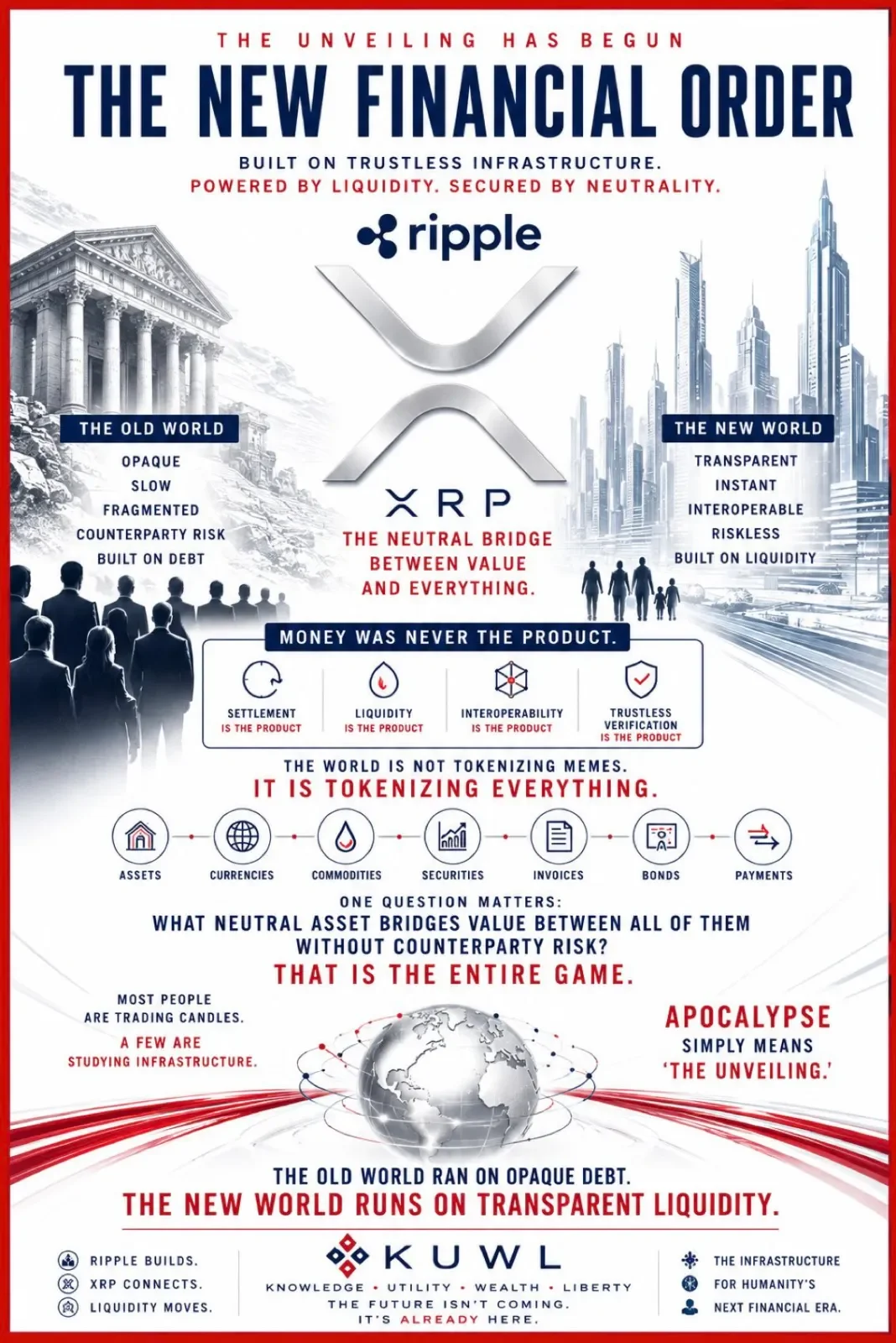
Money was never the product.
• Settlement is the product.
• Liquidity is the product.
• Interoperability is the product.
• Trustless verification is the product.
The world is not tokenizing memes.
It is tokenizing EVERYTHING.
And when every asset, currency, commodity, security, invoice, bond and payment moves across interoperable XRPL rails in real time, one question matters:
What neutral asset bridges value between all of them without counterparty risk?
That is the entire game.
Most people are trading candles.
A few are studying infrastructure.
Apocalypse simply means ‘the unveiling.’
And the unveiling is this:
The old world ran on opaque debt.
The new world runs on transparent liquidity.
XRP for “all the money.”
Source(s):
• https://x.com/KuwlShow/status/2056418002136899599
https://dinarchronicles.com/2026/05/19/rob-cunningham-the-new-financial-order/
Seeds of Wisdom RV and Economics Updates Tuesday Afternoon 5-19-2026
Good Afternoon Dinar Recaps,
Global Financial Reset Watch: Debt Stress, Energy Realignment, and BRICS Expansion Accelerate Systemic Shifts
Growing sovereign debt concerns, energy market restructuring, and expanding multipolar alliances are reshaping the global financial landscape as governments prepare for a more fragmented economic order.
Good Afternoon Dinar Recaps,
Global Financial Reset Watch: Debt Stress, Energy Realignment, and BRICS Expansion Accelerate Systemic Shifts
Growing sovereign debt concerns, energy market restructuring, and expanding multipolar alliances are reshaping the global financial landscape as governments prepare for a more fragmented economic order.
Overview
Today’s global financial environment continues to show signs of deep structural transition. While markets remain functional, underlying pressures involving sovereign debt, energy security, de-dollarization, and geopolitical realignment are intensifying simultaneously.
The combination of higher bond yields, persistent inflation concerns, and the expansion of alternative economic blocs such as BRICS is forcing nations to rethink reserve management, trade settlements, and long-term financial dependencies.
At the same time, global leaders are increasingly tying economic policy to national security and supply chain resilience, signaling that the world economy is moving away from the hyper-globalized model that dominated previous decades.
Key Developments
1. Global Bond Markets Face Renewed Pressure
Finance ministers and central bank officials from the G7 gathered in Paris today to discuss growing instability in sovereign debt markets as rising energy costs and inflation concerns continue pressuring bond yields worldwide.
Officials warned that higher oil and shipping costs linked to ongoing Middle East tensions may prevent central banks from cutting interest rates aggressively. This creates added strain for heavily indebted economies already managing elevated borrowing costs.
Countries such as Japan and several European economies are especially vulnerable as debt servicing expenses continue climbing.
2. Structural Global Imbalances Are Becoming Harder to Ignore
G7 officials also focused heavily on what they described as “structural imbalances” in the global economy.
Concerns include:
Excessive debt accumulation
Uneven global consumption patterns
Weak industrial investment in Western economies
Persistent trade asymmetries
Fragile supply chains
These imbalances are increasingly viewed as long-term systemic risks rather than temporary market distortions.
The discussions reflect growing awareness that the existing financial system may require major restructuring over the coming decade.
3. Energy Markets Continue Moving Toward a Multipolar Framework
Simultaneously, Gulf energy dynamics are undergoing major transformation as producers increasingly prioritize long-term regional alignment over traditional Western-centric supply models.
Analysts note that global gas and LNG markets are becoming more rigid due to:
Infrastructure limitations
Long-term contracts
Geopolitical fragmentation
Domestic energy demand pressures
Strategic competition between the United States, Qatar, Russia, and China
This “new Gulf gas order” suggests future energy flows may become increasingly tied to political blocs and strategic partnerships rather than open-market flexibility.
4. BRICS and Alternative Financial Systems Continue Expanding
As Western economies wrestle with debt and inflation pressures, BRICS nations continue accelerating efforts to reduce reliance on the U.S. dollar.
Countries are increasingly:
Expanding local currency settlement systems
Increasing gold reserves
Diversifying trade mechanisms
Developing alternative payment frameworks
Building regional energy partnerships outside traditional Western systems
These developments do not yet replace the dollar-based system, but they continue laying the groundwork for a more multipolar financial architecture.
Why It Matters
The world economy is no longer dealing with isolated financial shocks. Instead, multiple structural changes are unfolding simultaneously across:
Debt markets
Energy systems
Trade routes
Currency reserves
Payment infrastructure
Supply chains
This convergence is one reason discussions surrounding a potential global financial reset continue gaining attention among economists, investors, and geopolitical analysts.
The transition appears gradual rather than sudden, but the direction increasingly points toward a more fragmented and regionally aligned economic order.
Why It Matters to Foreign Currency Holders
For foreign currency holders and precious metals investors, today’s developments reinforce several key trends:
Gold accumulation by central banks continues rising
Nations are reducing overdependence on the U.S. dollar
Energy trade is becoming more politically aligned
Alternative settlement systems are expanding
Sovereign debt risks remain elevated globally
These trends could eventually influence reserve currency dynamics, commodity pricing, and long-term purchasing power across multiple fiat currencies.
Implications for the Global Reset
Pillar 1: Sovereign Debt Pressure
Rising borrowing costs and unstable bond markets are increasing pressure on governments already carrying historically high debt levels.
Pillar 2: Multipolar Economic Transition
The expansion of BRICS, regional trade systems, and alternative payment mechanisms signals continued movement away from a singular Western-led financial order.
Pillar 3: Energy as Strategic Currency
Control over energy infrastructure, LNG flows, and shipping routes is becoming increasingly central to geopolitical and financial power.
Pillar 4: Reserve Diversification
Central banks are steadily diversifying reserves into gold and non-dollar assets as protection against geopolitical and fiscal uncertainty.
Conclusion
Today’s developments highlight a world economy entering a period of managed transformation rather than outright collapse. Governments and financial institutions are increasingly adapting to a future where economic power is more distributed, supply chains are more regionalized, and financial systems are more politically driven.
The emerging environment suggests the next decade may be defined not by a single financial event, but by a series of interconnected shifts that gradually reshape the global monetary order.
This is not just economics — it is the restructuring of global financial power happening in real time.
Seeds of Wisdom Team
Newshounds News™ Exclusive
Sources
Modern Diplomacy – G7 Finance Chiefs Confront Bond Market Turmoil and Global Economic Imbalances
Modern Diplomacy – Rigid Margins, Rising Pressures: The New Gulf Gas Order
Seeds of Wisdom Team
Newshounds News™ Exclusive
~~~~~~~~~~
Seeds of Wisdom Team RV Currency Facts Youtube and Rumble
Newshound's News Telegram Room Link
RV Facts with Proof Links Link
RV Updates Proof links - Facts Link
Follow the Gold/Silver Rate COMEX
Follow Fast Facts
Seeds of Wisdom Team™ Website
Thank you Dinar Recaps
Iraq Economic News and Points To Ponder Tuesday Afternoon 5-19-26
Iraq’s new government faces constitutional challenge over confidence vote
2026-05-19 Shafaq News- Erbil/ Baghdad Iraq’s newly approved government is facing a constitutional challenge after nominees from the Kurdistan Democratic Party (KDP) and the State of Law Coalition (SLC) filed complaints contesting last week’s parliamentary confidence session, KDP parliamentary bloc head Shakhawan Abdullah said on Tuesday.
Iraq’s new government faces constitutional challenge over confidence vote
2026-05-19 Shafaq News- Erbil/ Baghdad Iraq’s newly approved government is facing a constitutional challenge after nominees from the Kurdistan Democratic Party (KDP) and the State of Law Coalition (SLC) filed complaints contesting last week’s parliamentary confidence session, KDP parliamentary bloc head Shakhawan Abdullah said on Tuesday.
Speaking to reporters in Erbil, Abdullah clarified that the complaints concern the mechanism through which parliament rejected several ministerial nominees, adding that documents and recordings showed “procedural violations” during the voting process. The objections argue that the session violated Article 76 of Iraq’s constitution and breached parliament’s internal bylaws due to what Abdullah called a failure to manage proceedings “with complete neutrality.”
“The final decision now rests with the Federal Supreme Court, and we are waiting for its ruling.”
Iraq’s parliament voted on May 14 to approve Prime Minister Ali Al-Zaidi’s government program and 14 cabinet ministers, while delaying a vote on the remaining nine portfolios until after the Islamic holiday Eid Al-Adha amid continuing disputes over cabinet allocations.
Earlier negotiations over ministerial nominations and portfolio distribution saw blocs, including SLC, accuse rivals of obstructing nominees, while factions aligned with former Prime Minister Mohammed Shia Al-Sudani criticized “unfair” cabinet allocations.
Read more: Ali Al-Zaidi sworn in as Iraq's prime minister with a program already failed
USD/IQD slips at close in Baghdad and Erbil
2026-05-19 Shafaq News- Baghdad/ Erbil The US dollar closed Tuesday’s trading lower in Iraq, hovering around 154,000 dinars per 100 dollars.
According to Shafaq News market survey, the dollar traded in Baghdad's Al-Kifah and Al-Harithiya exchanges at 153,650 dinars per 100 dollars, down from the morning session’s 153,850 dinars.
In the Iraqi capital, exchange shops sold the dollar at 154,000 dinars and bought it at 153,000 dinars, while in Erbil, selling prices stood at 153,450 dinars and buying prices at 153,350 dinars.
https://www.shafaq.com/en/Economy/USD-IQD-slips-at-close-in-Baghdad-and-Erbil
Monte Carlo: A Saudi Message Reached The Iraqi Foreign Ministry Containing A Threat To Sever Diplomatic Relations Between The Two Countries
latest news Tuesday, May 19, 2026 Baghdad – One News Monte Carlo International reported that in the first serious challenge to the new Iraqi Prime Minister Ali al-Zaidi, Iranian-backed factions threatened to attack Saudi Arabia if it launched raids inside Iraqi territory.
She indicated that a Saudi message had reached the Iraqi Foreign Ministry that included a threat to sever diplomatic relations between the two countries, in response to what the Saudi message described as terrorist attacks coming from Iraq targeting Saudi infrastructure.
She added that, as an indication of the impact of the political tension between Baghdad and Riyadh, Saudi Crown Prince Mohammed bin Salman made a phone call to the new Iraqi Prime Minister, merely offering congratulations, but al-Zaidi sent assurances to the Saudi authorities that he would not allow attacks against Saudi Arabia to be launched from Iraqi territory. https://1news-iq.net/مونت-كارلو-رسالة-سعودية-وصلت-للخارجية/
Iraqi Basrah Crude Outperforms Global Market With 2.6% Gain
2026-05-19 / Shafaq News- Basrah Iraq’s Basrah crude rose more than 2.6% on Tuesday, bucking declines in global oil markets driven by volatility linked to geopolitical tensions and shifting energy demand expectations.
Basrah Medium crude rose to $111.10 per barrel, up 2.61%, while Basrah Heavy crude climbed to $109.00 per barrel, gaining 2.67%.
Brent crude futures fell $2.21, or 1.97%, to $109.89 per barrel, while US West Texas Intermediate declined $1.30, or 1.20%, to $107.36.
Among other Arab benchmarks, Saudi Arabia’s Arab Light crude rose 2.49% to $119.10 per barrel, while Kuwait Export crude reached $124.63 per barrel. https://shafaq.com/en/Economy/Iraqi-Basrah-crude-outperforms-global-market-with-2-6-gain
A Leader In The Coordination Committee: Leaders Of Political Blocs Are Aware Of The Importance Of Dealing Flexibly With Washington's Pressure To Avoid Sanctions
latest news Tuesday, May 19, 2026 Baghdad – One News A leader in the "Coordination Framework" said that "the leaders of the Shiite political forces are aware of the importance of dealing flexibly with American pressures in order to spare Iraq the risks of economic and financial sanctions."
He explained that Iraq would not be able to withstand the American sanctions, so the steps taken by the Al-Zaidi government regarding the issue of factions and restricting weapons to the state must be supported.
He added that Al-Zaidi pledged in his first speech after his government was granted confidence to reform the security system by restricting weapons to the state, enhancing the capabilities of the security forces, and consolidating the citizen’s confidence in democracy. https://1news-iq.net/قيادي-بالتنسيقي-قادة-الكتل-السياسية-م/
Middle East Forum: Al-Zaidi Succeeded In Postponing The Confrontation With The Factions, But He Has Not Proven That He Fulfilled His Promises To Washington
Baghdad – One News 5/19/2026 The Middle East Forum reported that many Iraqis were expecting a change in US President Donald Trump’s policy towards pro-Iranian factions, given the escalating US pressure on Baghdad in recent times.
The forum pointed out that placing the Popular Mobilization Forces at the heart of the government program reflects the continued Iranian influence within Iraqi state institutions, despite talk of reforms and restructuring the security file.
He added that Prime Minister Ali al-Zaidi has so far succeeded in postponing the confrontation with the armed factions, but he has not yet proven his ability to implement the pledges he reportedly made to Washington regarding reducing the influence of armed groups and resetting the security file.
The forum also believed that the US administration was required to demonstrate real leverage to force Baghdad to fulfill its promises, if it wanted to bring about a real change in the balance of power within Iraq.
https://1news-iq.net/منتدى-الشرق-الأوسط-الزيدي-نجح-في-تأجيل/
********************************************
Baghdad: Institutions Ready To Cooperate Over Saudi Drone Incident
2026-05-19 Shafaq News- Baghdad The Iraqi government condemned on Tuesday drone attacks targeting Saudi Arabia, while affirming that Iraqi military authorities had found no evidence that Iraqi airspace was used in the alleged operation last week.
Spokesperson Bassem Al-Awadi stated that Iraq remains committed to supporting efforts aimed at reducing tensions and preventing such incidents regardless of their source, adding that Iraqi institutions are prepared to cooperate and verify relevant details.
On May 18, Iraq’s Foreign Ministry announced an investigation into how the aircraft crossed Iraqi territory undetected after Saudi Arabia said it had intercepted and destroyed three drones that entered the Kingdom’s airspace.
Saudi Arabia also summoned Iraq’s ambassador on April 12 to protest attacks allegedly launched from Iraqi territory.
Since the start of the US-Israeli war on Iran, several Iraqi armed factions have claimed responsibility for drone and missile attacks targeting sites inside and outside Iraq, including military facilities and strategic locations linked to US and Israeli interests. https://www.shafaq.com/en/Iraq/Baghdad-Institutions-ready-to-cooperate-over-Saudi-drone-incident
Tehran Warns It Is Ready To Confront Any US Strike
2026-05-19 Shafaq News- Tehran Tehran is “fully prepared” to confront any US military attack, after President Donald Trump temporarily delayed a planned strike on Iran, a senior Iranian official said on Tuesday.
Deputy Foreign Minister Kazem Gharibabadi said that the US was simultaneously speaking about diplomacy while threatening military action at any moment, arguing that Washington was presenting threats as “an opportunity for peace.”
On May 18, Trump announced the postponement of a strike on Iran following requests from the leaders of Qatar, Saudi Arabia, and the UAE, adding that “serious negotiations” were underway with Tehran. However, he instructed the US military “to be prepared to go forward with a full, large-scale assault of Iran, on a moment’s notice, in the event that an acceptable Deal is not reached.”
Meanwhile, Israel’s Channel 12 reported that Israeli assessments indicate Trump has decided to attack Iran and that implementation is “only a matter of time.”
https://www.shafaq.com/en/Middle-East/Tehran-warns-it-is-ready-to-confront-any-US-strike
Iraq News Posted by Tishwash at TNT 5-19-2026
TNT:
Tishwash: Political consensus paves the way for the passage of the oil and gas law.
The Iraqi Parliament is preparing to introduce the draft oil and gas law in the coming period, amid indications of a political consensus among most blocs to pass it. MP Adel al-Mahalawi, from the Progress Bloc, told Al-Sabah newspaper that the law will be presented to Parliament soon after political understandings are reached.
He explained that Prime Minister Ali al-Zubaidi has expressed his willingness to cooperate in finalizing legislation with an economic dimension. He clarified that the law is considered one of the most anticipated pieces of legislation, as it regulates the relationship between the federal government and the oil-producing provinces and contributes to supporting the budget and boosting revenues.
TNT:
Tishwash: Political consensus paves the way for the passage of the oil and gas law.
The Iraqi Parliament is preparing to introduce the draft oil and gas law in the coming period, amid indications of a political consensus among most blocs to pass it. MP Adel al-Mahalawi, from the Progress Bloc, told Al-Sabah newspaper that the law will be presented to Parliament soon after political understandings are reached.
He explained that Prime Minister Ali al-Zubaidi has expressed his willingness to cooperate in finalizing legislation with an economic dimension. He clarified that the law is considered one of the most anticipated pieces of legislation, as it regulates the relationship between the federal government and the oil-producing provinces and contributes to supporting the budget and boosting revenues.
Al-Mahalawi added that some technical and political disagreements still exist, but they are resolvable through national consensus. He also noted Parliament's intention to introduce a set of service and economic laws in the coming period in coordination with the government. link
****************
Tishwash: Al-Jurani told Al-Mirbad: The oil and gas law is at the top of the priorities for the next stage, and preserving Basra's rights is essential.
Member of Parliament’s Oil and Gas Committee, MP Qaisar Al-Jurani, confirmed in a statement to Al-Mirbad that enacting the Oil and Gas Law will be among the top priorities of the next stage, after years of delay and political disputes.
Al-Jurani told Al-Mirbad that the law represents the cornerstone for regulating the relationship between the federal government and the producing governorates, in addition to guaranteeing the rights of the Iraqi people to manage their national wealth.
He added that the committee is working to pass the law in a way that achieves justice for all parties and preserves the rights of Basra, as it is the largest oil-producing governorate in Iraq. link
***************
Tishwash: Coordination framework: Agreement to finalize the remaining cabinet positions after the holiday
On Monday, Uday Abdul-Hadi, a member of the Coordination Framework, revealed that an agreement has been reached to finalize the remaining ministerial appointments in Ali al-Zaidi's government immediately after the Eid al-Adha holiday. He noted that changes to some of the ministerial nominees are possible.
Speaking to Al-Maalouma, Abdul-Hadi said, "There are meetings and discussions taking place between the Coordination Framework and other political forces, both Sunni and Kurdish, to reach an understanding regarding the post-Eid al-Adha period, specifically regarding the vote on the remaining ministerial positions in al-Zaidi's government."
He added, "There is an agreement to hold a decisive session on this matter," explaining that "changing some of the ministerial nominees is possible, but the final decision rests with the political blocs whose appointments remain pending, awaiting the post-Eid al-Adha session, whether for the Interior, Culture, Planning, or other ministries."
He pointed out that “understandings are what determine all paths between the political forces,” stressing that “everyone agrees on the necessity of resolving the cabinet formation issue, because this will give the government greater flexibility in carrying out its duties, especially in light of the financial and economic challenges and the nature of developments in the region.” link
***************
Tishwash: Nasif calls on Al-Zaidi to request an increase in Iraq's OPEC quota and to resolve the issue of its oil through the Strait of Hormuz.
MP Alia Nassif called on Prime Minister Ali al-Zubaidi on Tuesday (May 19, 2026) to request an increase in Iraq’s share in OPEC and to find understandings with America and Iran to resolve the issue of oil passing through the Strait of Hormuz, which is closed due to the war, during his visit to Washington at the invitation of US President Donald Trump.
Trump had invited al-Zaidi to visit Washington after he formed his government, during a phone call that included congratulations on his appointment and an invitation to visit the White House.
We hope that during the upcoming visit of Prime Minister Ali al-Zaidi to the United States of America at the invitation of Trump, Mr. al-Zaidi will ask the American administration to increase Iraq’s share in OPEC, and to find common ground between the Islamic Republic of Iran and Iraq to secure Iraqi oil exports through the Strait of Hormuz, because the issue of the Iraqi economy is an existential issue in the current circumstances, and all positions must be united to support our government and our economy. link
**************
Tishwash: Amidi discusses with the Economic Council ways to enhance investment opportunities and support projects in the country
President Nizar Amidi received Ibrahim al-Masoudi al-Baghdadi, head of the Iraqi Economic Council, and his accompanying delegation at the Peace Palace in Baghdad on Monday, on the occasion of his assumption of the presidency.
The Presidential Media Office stated in a press release received by the Video News Agency that the visiting delegation offered their congratulations to the President. During the meeting, they discussed the general economic situation in the country and ways to enhance investment opportunities and develop infrastructure.
The statement added that the President emphasized the need to support major development projects to contribute to strengthening economic stability and improving the living conditions and services for all citizens in the various governorates.
Amidi stressed the importance of diversifying national income sources and not relying solely on oil revenues, as well as supporting the private sector and creating a suitable environment for investment and sustainable development by providing the necessary facilities for business and coordinating efforts among official institutions to advance the economy. link
A New Era - Kevin Warsh Fed Chair
A New Era - Kevin Warsh Fed Chair
Heresy Financial: 5-18-2026
The Federal Reserve is currently standing at a significant crossroads. After a period of unprecedented monetary intervention and economic volatility, a leadership transition is underway that could redefine the American financial landscape. As Jerome Powell prepares to step down as Chairman, handing the reins to Kevin Warsh, investors and economists alike are analyzing what this shift means for inflation, interest rates, and the broader economy.
Jerome Powell’s tenure, which began in 2018, will likely be remembered for its duality. On one hand, the markets saw significant growth during his leadership.
A New Era - Kevin Warsh Fed Chair
Heresy Financial: 5-18-2026
The Federal Reserve is currently standing at a significant crossroads. After a period of unprecedented monetary intervention and economic volatility, a leadership transition is underway that could redefine the American financial landscape. As Jerome Powell prepares to step down as Chairman, handing the reins to Kevin Warsh, investors and economists alike are analyzing what this shift means for inflation, interest rates, and the broader economy.
Jerome Powell’s tenure, which began in 2018, will likely be remembered for its duality. On one hand, the markets saw significant growth during his leadership.
On the other, his term was defined by the massive expansion of the Fed’s balance sheet. Especially in the wake of the 2020 pandemic, the implementation of aggressive quantitative easing (QE) and “money printing” led to a surge in liquidity.
While these measures were intended to stabilize the financial system, they came with a cost. Despite efforts to tighten policy and shrink the balance sheet between 2022 and 2025, inflation remained persistently above the Fed’s 2% target. Critics often point out that while Powell successfully prioritized the stability of the financial system, the “Main Street” economy—the everyday consumer and small business owner—often bore the brunt of rising costs and market meltdowns.
The nomination of Kevin Warsh signals a sharp pivot in strategy. Warsh is expected to move away from the Fed’s direct market interventions, focusing instead on a more deregulated banking sector. The core of the “Warsh doctrine” involves encouraging banks to take a more active role in the economy by buying more Treasuries and increasing private-sector lending.
By reducing the regulatory burden on banks, Warsh aims to lower long-term interest rates through market mechanisms rather than just administrative decrees. This approach seeks to stimulate “productive” lending, fueling economic expansion while attempting to keep inflation in check through increased private-sector efficiency. The goal is a delicate balance: achieving growth without the heavy-handed balance sheet expansion that characterized the previous era.
In an unusual break from a 75-year tradition, Jerome Powell is not expected to resign from the Fed Board of Governors after his term as Chairman ends. Typically, outgoing Chairs leave the board entirely to allow the new leader a fresh start. Powell’s decision to stay on as a voting member—amidst an ongoing investigation into Fed building renovations—introduces a unique layer of complexity.
His continued presence could create a “two-captain” dynamic, potentially leading to friction within the Federal Open Market Committee (FOMC). For Warsh, navigating his new policy direction while a former Chairman remains on the board will be a significant diplomatic and professional challenge.
The market’s initial reaction to the Warsh nomination has been largely positive. Investors are anticipating a period of easier borrowing and a focus on growth-oriented policies. However, seasoned analysts offer a word of caution. While deregulation and lower rates can spark significant economic “booms,” history shows that these cycles often precede “busts” if not managed with extreme care.
As we move into this new era of the Federal Reserve, the focus will be on whether Warsh can successfully transition the U.S. economy from a state of central bank reliance to one of private-sector-led growth.
TIMECODES
00:00 Powell Is Out. Kevin Warsh Is the New Fed Chair.
00:19 The Powell Era: 177% Market, Permanent Inflation
01:05 The 25% Money Supply Spike Powell Could Never Undo
02:24 Every Inflation Excuse Was "Transitory"
02:55 The One Thing Powell Got Right
04:14 The Federal Reserve's Real Mission: Rescue Wall Street First
05:10 Stephen Moran Just Resigned to Make Room for Warsh
06:07 The First Fed Chair in 75 Years Who Won't Resign
06:30 What to Expect From Warsh: Lower Rates, Less QE
06:48 Why Lowering the Fed Funds Rate Could Backfire
07:51 The Trick to Lower Long Term Rates Without QE
08:41 Bank Deregulation Is the Plan Hiding in Plain Sight
09:08 Banks Are Forced to Buy Treasuries. Then Punished for It.
09:45 Why This Time They're Betting on Banks, Not the Fed
11:23 The Gamble: Print Money, But Only Into Production
12:34 Why Powell Is Staying. The Real Reason.
13:05 The Criminal Investigation Was Always About Interest Rates
14:07 How Much Influence Will Powell Really Keep?
14:47 Why Trump Will Quietly Drop the Charges
15:08 The Market Already Knows What's Coming
15:47 What Always Follows a Boom
News, Rumors and Opinions Tuesday 5-19-2026
Ross: The Stage is Set for the Financial Reset
5-19-2026
You should be grateful.
You’re one of the tiny handful of blessed souls on Earth who’s actually going to enjoy the utter chaos that’s about to unfold.
The world is going to panic.
You?
Ross: The Stage is Set for the Financial Reset
5-19-2026
You should be grateful.
You’re one of the tiny handful of blessed souls on Earth who’s actually going to enjoy the utter chaos that’s about to unfold.
The world is going to panic.
You?
You’ve been waiting for this moment for years.
We’ve finally reached the turning point.
Cherish it.
Enjoy the show.
One day you’ll look back on this chapter and wish you’d been a little less stressed… and a lot more present.
Haven’t you noticed how everything you worry about always turns out nowhere near your worst fears — even in the most mind-crushing moments?
Everything will work out.
Remember, chaos is the catalyst.
Fascinating convergence that markets are sliding into chaos with cash positions swelling, catalyzed by the unwinding of Japan’s massive yen carry trade as interest rate differentials shift and liquidity tightens.
This initial shock arrives at the exact moment long-awaited crypto regulations are poised to unlock trillions sitting on the sidelines — perfectly timed with the DTCC launching tokenization in July and the SEC preparing to greenlight tokenized stock trading.
Japan’s situation isn’t just background pressure. It may be the first domino. As leveraged yen-funded positions unwind, institutions are increasingly turning to efficient, real-world settlement rails.
With deep infrastructure already in place through SBI and Ripple’s long-standing partnership, this liquidity event could accelerate XRP mass adoption as the bridge asset of choice for cross-border flows amid the turbulence.
The stage is set for the financial reset.
You should be on the edge of your seat with excitement.
It’s finally time.
Source(s):
• https://x.com/Ross_ptm/status/2056241642487910526
https://dinarchronicles.com/2026/05/19/ross-the-stage-is-set-for-the-financial-reset/
************
Courtesy of Dinar Guru: https://www.dinarguru.com/
Frank26 [Iraq boots-on-the-ground report] OMAR: Television is saying that the 14 members that were voted on and elected by parliament...they have been approved and they are clear of any Iranian influence or backing. It's a fresh start for your government... FRANK: If we're talking about a fresh start for the government without any Iranian influence, then we have security and stability for the new exchange rate, for the monetary reform purchasing power.
Militia Man Look at all the countries that have completely broadcasted the support for this new prime minister. Why? Because it's a clean government...Now you see these convergences over the last week have been amazing...This is a powerful window...We're seeing the pieces of the puzzle come together...
Jeff This new prime minister is a lot more aggressive than his predecessors...Can the new prime minister move an inch without changing the rate at this point? Where does the rate change fit in with their next steps? ...The new government cannot go another inch forward now until the rate changes...The first day in office the prime minister went straight to the economy...financial matters...reforms, everything that requires the rate to change...The rate change has got to be the next move for him to do everything they're talking about...
*************
Michael Hudson WARNS: IMMINENT Economic Catastrophe - War, Oil Crisis & Bond Market Panic
Lena Petrova: 5-18-2026
Seeds of Wisdom RV and Economics Updates Tuesday Morning 5-19-26
Good Morning Dinar Recaps,
Power of Siberia 2 Could Redraw the Global Energy Map as Russia Turns Fully Toward China
Russia’s proposed mega pipeline to China signals a historic geopolitical shift as Moscow accelerates its break from Europe and deepens long-term energy ties with Beijing.
Good Morning Dinar Recaps,
Power of Siberia 2 Could Redraw the Global Energy Map as Russia Turns Fully Toward China
Russia’s proposed mega pipeline to China signals a historic geopolitical shift as Moscow accelerates its break from Europe and deepens long-term energy ties with Beijing.
Overview
Russia and China are once again moving closer to discussions surrounding the massive Power of Siberia 2 natural gas pipeline, one of the largest planned energy infrastructure projects in the world. Russian President Vladimir Putin is expected to raise the issue directly with Chinese President Xi Jinping during high-level meetings in Beijing.
The proposed pipeline would transport enormous volumes of Russian natural gas from Arctic fields into China, further strengthening the strategic partnership between the two nations at a time when global energy markets are rapidly fragmenting.
The project has taken on much greater importance since Western sanctions and the collapse of Russia’s European gas business forced Moscow to aggressively pivot toward Asia.
If completed, the pipeline could permanently reshape Eurasian energy flows and accelerate the transition toward a more multipolar global economic system.
Key Developments
1. Russia Pushes Massive New Energy Corridor Into China
The proposed Power of Siberia 2 pipeline would stretch approximately 2,600 kilometers and transport up to 50 billion cubic meters of gas annually from Russia’s Yamal region to China through Mongolia.
The project would complement the already operational Power of Siberia 1 pipeline, which delivered roughly 38 billion cubic meters of gas to China last year.
Russia’s state-controlled energy giant Gazprom is expected to oversee the development, which could become one of the most strategically important energy corridors in Eurasia.
2. Western Sanctions Accelerate Russia’s Pivot Away From Europe
Before the Ukraine conflict and resulting sanctions, Europe represented one of Russia’s most profitable energy markets.
However, restrictions on Russian energy exports dramatically reduced European purchases, forcing Moscow to search for long-term replacement buyers.
China now represents one of the few economies large enough to absorb Russia’s massive energy output.
The pipeline would help Russia:
Replace lost European gas revenues
Expand influence across Asian energy markets
Reduce vulnerability to Western sanctions
Strengthen economic alignment with China
This reflects Russia’s broader geopolitical shift toward Asia as relations with the West continue deteriorating.
3. China Maintains Strong Negotiating Leverage
Although China supports expanded energy cooperation with Russia, Beijing has approached the project carefully and strategically.
Chinese officials reportedly remain focused on securing favorable long-term pricing agreements while avoiding excessive dependence on any single supplier.
China already imports natural gas through several major routes, including:
Central Asian pipeline systems
Myanmar-China energy corridors
Existing Russian pipelines
Planned Sakhalin energy routes
Because China maintains diversified energy sources, Beijing enters negotiations from a position of relative strength compared to Moscow’s growing urgency.
4. Pricing Disputes Continue Slowing Final Agreement
One of the largest obstacles remains disagreement over gas pricing formulas.
Russia reportedly prefers pricing models similar to previous European export systems, while China is seeking lower long-term rates.
These negotiations are critical because the project would lock both countries into decades of energy cooperation and require enormous financial investment.
Analysts estimate the pipeline could take eight to ten years to fully complete once construction begins.
Why It Matters
Power of Siberia 2 is far more than an energy project.
It represents a major structural shift in the global economy as Russia increasingly abandons Western markets and integrates more deeply with China and Asia.
The project also demonstrates how global trade systems are fragmenting into regional economic blocs shaped by geopolitics, sanctions, and energy security concerns.
As Europe distances itself from Russian energy, Asia is emerging as the center of Moscow’s long-term economic survival strategy.
Why It Matters to Foreign Currency Holders
For those following the global reset narrative, this pipeline carries several major implications:
Russia and China are deepening economic integration outside Western systems
Energy trade is increasingly shifting toward Asia
Long-term de-dollarization pressures may grow through regional trade agreements
Global commodity flows are being permanently restructured
Strategic infrastructure is becoming central to geopolitical power
Large-scale energy corridors like Power of Siberia 2 may eventually support alternative settlement systems and regional trade mechanisms that reduce dependence on Western financial institutions.
Implications for the Global Reset
Pillar 1: Eurasian Economic Integration Accelerates
The pipeline strengthens the emerging Eurasian economic corridor linking Russia, China, and broader Asian markets.
This could gradually weaken the dominance of traditional Western-centered trade networks.
Pillar 2: Energy Becomes the Foundation of Multipolar Finance
Control over energy supply routes increasingly shapes geopolitical alliances and financial influence.
Long-term gas agreements between Russia and China could support future regional payment systems, currency diversification, and non-dollar settlement mechanisms.
Closing Thought
Power of Siberia 2 is not simply a pipeline — it is a symbol of the accelerating shift toward a new geopolitical and financial order centered increasingly around Eurasia and strategic resource control.
Seeds of Wisdom Team
Newshounds News™ Exclusive
Sources
~~~~~~~~~~
🌱A Message to Our Currency Holders🌱
If you’ve been holding foreign currency for many years, you were not foolish.
You were not wrong to believe the global financial system would change.
What failed was not your patience — it was the information you were given.
For years, dates, rumors, and personalities replaced facts, structure, and proof. “This week” predictions created cycles of hope and disappointment that were never based on how currencies actually change.
That is not your failure.
Our mission here is different: • No dates • No rates • No hype • No gurus
Instead, we focus on:
• Verifiable developments • Institutional evidence
• Global financial structure • Where countries actually sit in the process
Currency value changes only come after sovereignty, trade, banking, settlement systems, and fiscal coordination are in place. History and institutions confirm this sequence.
You will see silence. You will see denials. That is not delay — that is discipline.
Protect your identity. Organize your documents. Verify everything.
Never hand your discernment to anyone who cannot show proof.
You deserve truth — not timelines.
Seeds of Wisdom Team
Newshounds News™
~~~~~~~~~~
Seeds of Wisdom Team RV Currency Facts Youtube and Rumble
Newshound's News Telegram Room Link
RV Facts with Proof Links Link
RV Updates Proof links - Facts Link
Follow the Gold/Silver Rate COMEX
Follow Fast Facts
Seeds of Wisdom Team™Website
Thank you Dinar Recaps
Iraq Economic News and Points To Ponder Tuesday Morning 5-19-26
Parliamentary Integrity: Investigations Into The "Theft Of The Century" Revealed That The Value Of Embezzled Funds Has Risen To Approximately 8 Trillion Dinars.
Money and Business Economy News – Baghdad The Parliamentary Integrity Committee reported on Tuesday that investigations into the "theft of the century" case revealed that the value of embezzled funds had risen to about 8 trillion dinars. According to the official newspaper, committee member Talib al-Baydani said that "recovering the looted funds is one of the basic duties undertaken by the Federal Integrity Commission in cooperation with the Parliamentary Integrity Committee," stressing that "the committee is continuing to follow up on this file continuously in order to recover Iraq's funds and hold those involved accountable."
Parliamentary Integrity: Investigations Into The "Theft Of The Century" Revealed That The Value Of Embezzled Funds Has Risen To Approximately 8 Trillion Dinars.
Money and Business Economy News – Baghdad The Parliamentary Integrity Committee reported on Tuesday that investigations into the "theft of the century" case revealed that the value of embezzled funds had risen to about 8 trillion dinars. According to the official newspaper, committee member Talib al-Baydani said that "recovering the looted funds is one of the basic duties undertaken by the Federal Integrity Commission in cooperation with the Parliamentary Integrity Committee," stressing that "the committee is continuing to follow up on this file continuously in order to recover Iraq's funds and hold those involved accountable."
Al-Baydani explained that “part of the stolen funds has already been recovered, while other funds are still outside the country and require legal and diplomatic action to recover them,” indicating that “this file needs high-level support and coordination between regulatory and executive bodies, in addition to cooperation with the Prime Minister’s office, which in turn has emphasized the importance of this file as a national priority.”
He pointed out that “the funds that were seized through illegal means must be returned to the state treasury,” stressing that “recovering them represents a real step towards protecting public funds and restoring the rights of Iraqis, as well as holding all those involved in embezzlement or suspicious deals accountable.”
Al-Baydani explained that “the initial estimates for the ‘Theft of the Century’ case indicated the embezzlement of about two and a half trillion dinars, but the investigations conducted by the Integrity Commission revealed the existence of larger sums, raising the value of the embezzled funds to about eight trillion dinars.”
Regarding Iraqi funds and real estate located outside the country, Al-Baydani called on the Ministry of Foreign Affairs to "intensify its efforts, based on international agreements signed with a number of countries, in order to recover the real estate and assets belonging to the former regime."https://www.economy-news.net/content.php?id=69258
The General Authority Of Customs Announces An Increase In Its Revenues To 1.351 Trillion Dinars
Money and Business The General Authority of Customs announced today, Monday, that customs revenues have increased to 1 trillion and 351 billion dinars.
The Director General of the Customs Authority, Thamer Qasim Dawood, said in a statement that "Customs revenues have increased to 1 trillion and 351 billion dinars as of 5/17/2026." https://www.economy-news.net/content.php?id=69247
Foreign Governments Are Abandoning US Treasury Bonds, With China At Its Lowest Holding In 18 Years.
Arabic and international Economy News - Follow-up Foreign governments significantly reduced their holdings of US Treasury bonds during March, amid geopolitical turmoil in the Middle East that prompted central banks to sell their dollar reserves to defend their local currencies, following a shock in energy markets that led to a sharp decline in exchange rates.
This decline comes at a time when escalating conflict between the United States and Iran has led to a sharp jump in crude oil prices, causing significant pressure on global currencies, particularly in Asia.
China at its lowest level since 2008
Data from the US Treasury Department showed that China's holdings of Treasury bonds fell to $652.3 billion in March, down nearly 6% from February, marking the lowest level since September 2008, according to a report published by the US network CNBC.
Relative calm in US bond sales amid anticipation of a jump in 30-year yields
This trend reflects the continuation of China’s policy of reducing its direct exposure to US debt since its peak in 2013, despite the continuation of what is known as “indirect holdings” through custody centers in other countries.
Japan reduces its holdings of its largest foreign reserve currency
In the same context, Japan, the largest foreign holder of US Treasury bonds, reduced its holdings by about $47 billion to $1.191 trillion.
Overall, total foreign holdings of U.S. debt fell to $9.25 trillion in March, compared with about $9.49 trillion in February.
This decline coincided with widespread turmoil in currency markets, as the conflict in the Middle East and rising oil prices led to a sharp drop in the Japanese yen and several other Asian currencies.
Energy pressures drive selling of dollar assets
The rise in energy prices has forced economies dependent on importing Gulf oil, most notably Japan, to intervene in currency markets, prompting some central banks to sell part of their dollar-denominated assets, including US Treasury bonds.
Frederic Neumann, chief Asia economist at HSBC, said that increased financial volatility since the start of the Gulf War and exchange rate pressures, particularly in Asia, make it natural for central banks' holdings of US bonds to decline.
He added that foreign exchange market interventions to support local currencies led to the sale of part of these holdings, along with the rebalancing of investment portfolios during periods of tension.
Rating losses and pressure on bonds
Treasury bonds came under additional pressure as yields rose, amid inflation fears stemming from the Middle East crisis, prompting investors to demand higher returns in exchange for holding U.S. debt.
Foreign holdings also suffered significant valuation losses, amounting to $142.1 billion in March alone as a result of the decline in long-term bond prices.
In contrast, Britain bucked the general trend, increasing its holdings by about $29.6 billion to reach $926.9 billion.
China's "indirect holdings"
Despite the decline in China’s direct holdings, analysts believe that official figures may not reflect the true extent of Beijing’s exposure to the US market, as it is believed that some of the investments pass through custody centers such as Belgium and Luxembourg.
According to experts, these "indirect holdings" appear relatively stable, with Belgium holding $454 billion and Luxembourg holding approximately $439.4 billion in US Treasury bonds.
Becky Liu, executive director of global research at Fidelity International, said that China’s total holdings of US bonds remain relatively stable, noting that short-term volatility is the main factor behind recent movements.
Japan and political pressures
In Japan, policymakers in Washington are closely watching the possibility that Tokyo might resort to selling more bonds to finance interventions in the currency market to support the yen.
The Bank of Japan had intervened in the foreign exchange markets in late March and early April after the yen fell to politically sensitive levels near 160 yen to the dollar, amid concerns that the current account deficit would worsen as a result of rising energy import costs.
Vikas Birshad, portfolio manager at M&G Investments, said the message from U.S. policymakers is clear: "The preferred option is not to sell Treasury bonds," noting that Washington sees alternatives such as trade deals in critical metals, technology, and defense to ease pressure on foreign reserves. https://www.economy-news.net/content.php?id=69272
Cyprus Plans To Export Natural Gas To Europe Via Egypt By 2028
Arabic and international Economy News - Follow-up Cypriot President Nicos Christodoulides announced on Tuesday, ahead of a cabinet meeting, that his country aims to sell its first shipment of natural gas to European markets via Egypt in 2028, according to Bloomberg News.
In a statement issued by the official press office, Christodoulides explained that the Cabinet would today approve the development and production plan for the Kronos gas field, as well as agreements relating to the basic terms of the sale of Cypriot natural gas.
The Cypriot president also indicated that further announcements would be made very soon, in cooperation with ExxonMobil, saying: "Consultations are now at an advanced stage, and we will very soon be in a position to announce the next steps in detail."
He noted that Cyprus and Egypt had previously signed a framework agreement for cooperation in the field of natural gas to link and develop Cypriot offshore fields with Egyptian infrastructure in preparation for liquefying and re-exporting it.
The Italian company Eni also signed a deal with Egypt and Cyprus to develop and export gas discovered in Cypriot waters. https://www.economy-news.net/content.php?id=69273
Al-Zaydi And Amidi Stress The Need For Continued Coordination Between The Four Presidencies To Preserve Stability.
Localities Economy News – Baghdad Prime Minister Ali Faleh al-Zaidi and President Nizar Amidi stressed on Tuesday the need for continued coordination and cooperation between the four presidencies in order to preserve stability.
The Prime Minister’s Media Office stated in a statement received by “Al-Eqtisad News” that “the Prime Minister received President Nizar Amidi, who offered his congratulations on the new government gaining the confidence of the House of Representatives.”
The statement added that "the meeting discussed the overall situation in Iraq, and the importance of supporting the government in implementing its governmental program and development plans in a way that contributes to improving the service and economic situation and meeting the needs of citizens."
He added that "both sides stressed the need for continued coordination and cooperation between the four presidencies, in order to preserve stability and enhance joint efforts to serve the country." https://www.economy-news.net/content.php?id=69271
The Decade That Made Secession Seem Normal
The Decade That Made Secession Seem Normal
Notes From the Field By James Hickman (Simon Black / Sovereign Man) May 18, 2026
Almost ten years ago to the day, I woke up in my hotel room in Bangkok and flipped on the TV; it was late, late in the evening in the UK, and the BBC News was broadcasting live coverage of the Brexit vote.
As the results slowly trickled in and it became clear that Brexit would prevail, the news anchors could not hide their shock and horror; the idea that British voters would actually choose to leave the European Union was, to them, incomprehensible.
The Decade That Made Secession Seem Normal
Notes From the Field By James Hickman (Simon Black / Sovereign Man) May 18, 2026
Almost ten years ago to the day, I woke up in my hotel room in Bangkok and flipped on the TV; it was late, late in the evening in the UK, and the BBC News was broadcasting live coverage of the Brexit vote.
As the results slowly trickled in and it became clear that Brexit would prevail, the news anchors could not hide their shock and horror; the idea that British voters would actually choose to leave the European Union was, to them, incomprehensible.
A decade later, things like that which once seemed incomprehensible are now becoming mainstream. Britain is just the tip of the iceberg— it’s happening all across the west.
Earlier this month in Wales, voters elected the ‘Plaid Cymru’ party to its first majority ever; this is the party that has campaigned for decades to secede from the United Kingdom and make Wales independent.
The same dynamic is now playing out in Canada.
A decade under Justin Trudeau-Castro’s policies, which sacrificed the Canadian economy on the twin altars of climate religion and identity politics, has produced a country measurably poorer than the United States across the border.
In 2014 the per-capita GDP gap between Canada and the US was around 24%. Today it has grown to 43%.
And the OECD now projects Canada will rank dead last among developed economies for real GDP per capita growth through 2060.
So, on May 2, organizers in the province of Alberta handed-in over 300,000 signatures, more than 10% of Alberta’s registered voters, demanding a referendum on independence.
People have a breaking point. And when they reach it, they vote with with their ballots... with their wallets... and with their feet.
Take corporate America. For as long as anyone can remember, the standard practice for any serious American company was to incorporate in Delaware. And for more than two centuries, any serious financial firm was based almost entirely on Wall Street.
But in January 2024, the Delaware Court of Chancery rescinded Elon Musk's $56 billion Tesla compensation package— a single ruling that told every public company in America that corporate law could be relitigated on a whim.
Tesla and SpaceX reincorporated in Texas. Coinbase followed them. Dropbox decamped to Nevada. Dell is redomiciling to Texas. One company after another is leaving Delaware for good.
It’s the same with Wall Street.
Jamie Dimon, CEO of JPMorgan Chase, was blunt about the changing dynamic in his April shareholder letter: "Individuals vote with their feet. You can already see a fairly large exodus of people and jobs out of some states with high taxes and high expenses."
In his own estimate, JPMorgan now employs 32,000 people in Texas, up from 26,000 a decade ago. Its New York headcount over the same period fell from 30,000 to 24,000.
The IRS migration data tells the same story one household at a time. Between 2019 and 2023, California's cumulative net outflow amounted to $91.4 billion in Adjustable Gross Income; that’s a huge loss of their tax base.
Meanwhile, Florida's cumulative net inflow came to $137 billion.
Hollywood is also instrumental.
One, the audience has voted with its wallets, hence the string of box office bombs. People don't go to the movies to be lectured on social justice. They want to be entertained.
But for the past decade, Hollywood decided audiences needed to hear about racial injustice, gender identity, and climate change instead. Studios have racked up enormous losses as a result.
Second, no one wants to make films in Hollywood anymore because of the insane costs and regulations of doing business in California.
Instead, Atlanta wins because Georgia offers an uncapped 30% tax credit. Plenty of foreign countries offer far more. Plus production companies filming outside of California don’t have to deal with unions, taxes, or political hostility.
Consumers have been delivering the same lesson for years.
Bud Light decided in 2023 that its core demographic was, apparently, trans activists. American beer drinkers knocked the brand from #1 to #3 in the country and stripped more than $1 billion in lost sales out of its parent company.
Gillette tried it during #metoo, with a 2019 ad lecturing its male customers about how to be "the best men they can be." P&G took an $8 billion write-down on the brand the same year.
Personally I have never bought a Gillette product since.
But think about the trend: a decade ago, almost none of this was thinkable.
Brexit was treated as a national psychotic break. A large voting bloc interested in their province seceding from Canada was ludicrous. And why on earth would a serious company leave Delaware, any serious banker leave Wall Street, or any red-blooded American stop buying Bud Light?
And yet it’s all happened.
Frankly it’s a cause for optimism. The people running these institutions are finding out the hard way that everyone has a vote— at the ballot box, with their feet, and with their wallets.
Just imagine what another 10 years of this trend will look like.
To your freedom, James Hickman Co-Founder, Schiff Sovereign LLC
The decade that made secession seem normal | Schiff Sovereign
Seeds of Wisdom RV and Economics Updates Monday Evening 5-18-26
Good Evening Dinar Recaps,
Bitcoin Shockwave Signals How Geopolitics Is Reshaping the Future of Global Finance
Escalating Iran tensions, collapsing crypto prices, and the growing use of stablecoins by sanctioned states are exposing how deeply digital assets are now tied to the emerging multipolar financial system.
Good Evening Dinar Recaps,
Bitcoin Shockwave Signals How Geopolitics Is Reshaping the Future of Global Finance
Escalating Iran tensions, collapsing crypto prices, and the growing use of stablecoins by sanctioned states are exposing how deeply digital assets are now tied to the emerging multipolar financial system.
Overview
Bitcoin and the broader cryptocurrency market suffered a sharp selloff after renewed geopolitical tensions between the United States, Israel, and Iran triggered fears of military escalation and further disruption in global energy markets. At the same time, new intelligence reports revealed that Iran’s Islamic Revolutionary Guard Corps (IRGC) has dramatically expanded its use of cryptocurrencies — especially stablecoins — to operate around sanctions and support cross-border trade.
Together, these developments highlight a major shift in global finance. Cryptocurrency is no longer just a speculative asset class. It is increasingly becoming part of geopolitical strategy, sanctions evasion, energy trade, and the broader movement toward a fragmented financial system outside traditional Western banking networks.
Key Developments
1. Bitcoin Drops Sharply as Iran Conflict Escalates
Bitcoin plunged from above $82,000 to nearly $76,000 after reports surfaced that the United States and Israel were considering expanded military operations against Iran.
The selloff erased more than $40 billion in crypto market capitalization within hours as investors fled risk assets amid rising fears of broader conflict in the Middle East.
Oil prices simultaneously surged above $105 per barrel, increasing inflation concerns and strengthening expectations that central banks may keep interest rates elevated longer than expected.
Analysts warned that continued instability around the Strait of Hormuz could trigger even greater volatility across global markets, including crypto.
2. Massive Liquidations Reveal Fragility of Crypto Markets
The market decline triggered a wave of forced liquidations across leveraged crypto positions.
Nearly $700 million in derivative positions were wiped out in 24 hours, including more than $600 million in bullish long trades.
This event demonstrated how tightly connected cryptocurrency markets have become to global macroeconomic and geopolitical developments. Rather than acting as a safe haven, Bitcoin traded more like a high-risk speculative asset during the crisis.
Several analysts now warn that if geopolitical tensions worsen further, Bitcoin could retest support levels near $65,000.
3. Iran Expands Use of Stablecoins and Crypto Infrastructure
While Bitcoin prices were collapsing globally, new research from blockchain intelligence firm Chainalysis revealed that the IRGC now controls a significant share of Iran’s domestic crypto economy.
According to the report, IRGC-linked wallets processed more than $3 billion in crypto activity during 2025, accounting for nearly half of Iran’s crypto transaction volume in late 2025.
More importantly, analysts noted that Iran increasingly favors stablecoins over Bitcoin for trade and sanctions avoidance because stablecoins allow faster settlement and maintain dollar-linked value.
This development is highly significant because it demonstrates how sanctioned nations are building parallel financial systems that operate outside traditional banking structures.
4. Strait of Hormuz Crisis Raises Global Financial Risks
The conflict surrounding the Strait of Hormuz continues to drive uncertainty across global energy and financial markets.
Because nearly one-fifth of global oil and LNG shipments move through the strait, any disruption creates immediate ripple effects across inflation, currencies, shipping costs, and commodity prices.
The combination of rising oil prices, crypto instability, sanctions pressure, and growing adoption of alternative payment rails is accelerating conversations around de-dollarization and financial decentralization worldwide.
Why It Matters
The recent Bitcoin collapse is about far more than cryptocurrency volatility.
It reflects how the global financial system is becoming increasingly tied to geopolitical fragmentation, sanctions warfare, energy security, and digital finance infrastructure.
At the same time, Iran’s expanding use of stablecoins highlights a broader trend where countries facing sanctions are turning to blockchain systems to bypass traditional Western-controlled financial channels.
This shift has major implications for the future role of the US dollar, international banking networks, and the structure of global reserve systems.
Why It Matters to Foreign Currency Holders
For those watching the global reset narrative, this situation demonstrates several important trends:
Digital assets are becoming geopolitical tools
Stablecoins may play a future role in cross-border trade systems
Energy disruptions continue driving inflation and monetary instability
Confidence in centralized financial systems is weakening
Alternative settlement mechanisms are expanding globally
The growing overlap between crypto markets, energy trade, and sanctions policy suggests the next phase of global finance may involve a hybrid system combining traditional currencies, commodities, and digital settlement rails.
Implications for the Global Reset
Pillar 1: Fragmentation of the Dollar-Based System
Iran’s growing use of crypto and stablecoins illustrates how nations are increasingly seeking alternatives to the traditional US dollar banking system.
While the dollar remains dominant globally, parallel financial ecosystems are slowly emerging beneath the surface.
Pillar 2: Digital Finance and Commodity Control Converge
The Strait of Hormuz crisis demonstrates how energy control, digital finance, and geopolitical power are becoming interconnected.
Future global trade systems may increasingly rely on digital settlement tools tied to commodities, regional blocs, or alternative reserve structures.
Closing Thought
This is no longer simply a crypto story — it is a warning sign that global finance, energy security, and geopolitical conflict are rapidly converging into a new financial era.
Seeds of Wisdom Team
Newshounds News™ Exclusive
Sources
BeInCrypto — “Bitcoin Gets the Headlines, But Iran’s IRGC Runs on Something Else: Chainalysis”
Cointelegraph — “Bitcoin Falls to $76K After Trump Says ‘Clock Is Ticking’ for Iran”
~~~~~~~~~~
Seeds of Wisdom Team RV Currency Facts Youtube and Rumble
Newshound's News Telegram Room Link
RV Facts with Proof Links Link
RV Updates Proof links - Facts Link
Follow the Gold/Silver Rate COMEX
Follow Fast Facts
Seeds of Wisdom Team™ Website
Thank you Dinar Recaps
U.S. Has Reached ‘Choose Your Poison’ Moment: Save the Dollar or Save Treasuries
U.S. Has Reached ‘Choose Your Poison’ Moment: Save the Dollar or Save Treasuries | Gromen & Makori
Miles Franklin Media: 5-18-2026
Michelle Makori, President & Editor-in-Chief of Miles Franklin Media, sits down with Luke Gromen, Founder & President of FFTT LLC, for a deep-dive into what he believes is becoming an unavoidable monetary breaking point for the United States.
Gromen warns that the U.S. may soon face a historic “choose your poison” moment: save the dollar or save the Treasury market.
As the Iran conflict, rising oil prices, inflation pressures, and sovereign debt stress converge, he argues policymakers may ultimately be forced to inject liquidity into an inflation spike – weakening the dollar to keep the financial system functioning. In this episode of The Real Story with Michelle Makori:
U.S. Has Reached ‘Choose Your Poison’ Moment: Save the Dollar or Save Treasuries | Gromen & Makori
Miles Franklin Media: 5-18-2026
Michelle Makori, President & Editor-in-Chief of Miles Franklin Media, sits down with Luke Gromen, Founder & President of FFTT LLC, for a deep-dive into what he believes is becoming an unavoidable monetary breaking point for the United States.
Gromen warns that the U.S. may soon face a historic “choose your poison” moment: save the dollar or save the Treasury market.
As the Iran conflict, rising oil prices, inflation pressures, and sovereign debt stress converge, he argues policymakers may ultimately be forced to inject liquidity into an inflation spike – weakening the dollar to keep the financial system functioning. In this episode of The Real Story with Michelle Makori:
Why the U.S. may have to choose between saving the dollar or Treasuries
The Iran war’s impact on inflation, oil, and sovereign debt markets
Why Luke Gromen says “the release valve becomes the dollar”
Gold’s growing role as a neutral reserve asset
Why Gromen believes gold could rise 5X-10X
The possibility of gold being revalued against oil
Why central banks continue aggressively buying gold
Trump’s China negotiations and the future of the dollar system
Bitcoin’s role in the coming monetary reset
00:00 – Coming Up
02:27 – Introduction
06:25 – The Debt Spiral
08:08 – Is the Fed Already Injecting Liquidity?
10:26 – How Governments Will “Save” the Treasury Market
14:22 – The Real Tradeoff: Weak Dollar or Inflation Spike
16:35 – What This Means for Investors and Markets
24:15 – Trump’s China Trip and the Real Power Shift
31:25 – Did the U.S. Miscalculate Iran?
37:46 – “It’s a Giant Mexican Standoff”
40:22 – The Most Likely Endgame for the Iran Conflict
51:19 – Why the Dollar Still Dominates Global Payments
54:39 – Gold as the New Neutral Reserve Asset
58:08 – China’s Message to America: “Let Gold Rise”
1:05:02 – Trump & Fort Knox
1:09:27 – Is the U.S. Quietly Settling Trade Deficits in Gold?
1:12:25 – Gold Could Reach $15K-$22K This Cycle
1:14:22 – Gromen’s Base Case
1:15:33 – Gold vs. Bitcoin in the New Monetary System
1:20:23 – Why Gromen Prices Everything in Gold
1:23:41 – Portfolio Positioning
1:27:08 – Are We Already Entering a “Crack-Up Boom”?