
Thank you to all the subscribers to our Early Access program…we thank you for your continued support.
We are excited to offer this new service to keep you informed and up-to-date on the latest Dinar and currency news.
$9 Trillion of the National Debt Must be Paid Back in 2026
$9 Trillion of the National Debt Must be Paid Back in 2026
Heresy Financial: 12-15-2025
The United States is on the cusp of a significant financial event: rolling over a staggering $9 trillion of national debt in 2026. This amount represents over a quarter of the country’s total debt load of $38 trillion.
At first glance, the figure may seem alarming, sparking concerns about a potential liquidity crisis or default. However, a closer examination of the facts reveals that the situation is more manageable than it initially appears.
$9 Trillion of the National Debt Must be Paid Back in 2026
Heresy Financial: 12-15-2025
The United States is on the cusp of a significant financial event: rolling over a staggering $9 trillion of national debt in 2026. This amount represents over a quarter of the country’s total debt load of $38 trillion.
At first glance, the figure may seem alarming, sparking concerns about a potential liquidity crisis or default. However, a closer examination of the facts reveals that the situation is more manageable than it initially appears.
The debt rollover involves paying back maturing debt while simultaneously borrowing new funds to replace it. Much of this debt consists of short-term Treasury bills (T-bills) with maturities within a year, as well as longer-term notes and bonds.
While the sheer size of the rollover is substantial, the government’s ability to refinance the debt is supported by the fact that most of the maturing debt is held by investors who already have cash parked in money market funds and other financial instruments heavily invested in Treasury securities.
The Federal Reserve’s recent actions have provided additional support for rolling over the debt at manageable costs. By lowering short-term interest rates and restarting quantitative easing (QE), the Fed has helped to create a favorable environment for debt refinancing.
Although current interest rates for new debt issuance are higher than the average rates on existing debt, particularly for longer-term bonds, most of the rollover is expected to be in short-term debt. This means that rates could remain stable or even decline if the Fed cuts rates further.
The government has taken a strategic approach to managing its debt by concentrating much of it at the short end of the maturity curve. This allows for greater flexibility in refinancing debt at potentially lower rates when the Fed reduces short-term borrowing costs, rather than locking in higher rates on longer-term bonds.
By doing so, the government is able to take advantage of more favorable interest rates, reducing the overall cost of borrowing.
One common misconception about debt rollover is that it involves money leaving the financial system. However, the reality is that funds simply move between accounts, often cycling through Treasury securities.
This process does not drain liquidity from the system but rather redistributes it. As a result, the risk of a liquidity crisis or default is minimal.
While the $9 trillion debt rollover is undoubtedly a significant event, it is unlikely to cause a default or sharp rise in borrowing costs.
Instead, debt maturities will continue to cluster at the short end of the curve until economic or policy changes, such as lower long-term interest rates, enable more long-term refinancing. By understanding the facts surrounding the debt rollover and the government’s strategic approach to debt management, investors and policymakers can better navigate this significant financial event.
For further insights and information, be sure to watch the full video from Heresy Financial, which provides a more in-depth analysis of the $9 trillion debt rollover and its implications for the US economy.
What Breaks Next is Not the System you Think, the Shift is Underway
Paul Gold Eagle: What Breaks Next is Not the System you Think, the Shift is Underway
12-15-2025
Paul White Gold Eagle @PaulGoldEagle
WHAT BREAKS NEXT IS NOT THE SYSTEM YOU THINK
The first cracks are not appearing where the public is looking. They are forming deeper, inside the invisible layers that once kept everything moving without question.
Paul Gold Eagle: What Breaks Next is Not the System you Think, the Shift is Underway
12-15-2025
Paul White Gold Eagle @PaulGoldEagle
WHAT BREAKS NEXT IS NOT THE SYSTEM YOU THINK
The first cracks are not appearing where the public is looking. They are forming deeper, inside the invisible layers that once kept everything moving without question.
What breaks next are not banks.
What breaks next are not currencies.
What breaks next are not governments.
What breaks next is assumed authority.
Systems built on repetition instead of legitimacy are already failing stress tests. Accounts that moved for decades without resistance are suddenly slowing down. Approvals that once required no human confirmation are looping, stalling, or being silently rerouted.
This is not a crash.
This is disqualification.
The next layer to fail is delegated control. Power handed down through titles, roles, and institutional positioning is losing priority to direct validation. If a system cannot identify a real holder behind an action, that action no longer completes.
This is why:
Automated approvals are being revoked
Long standing privileges are expiring without notice
“Trusted” intermediaries are losing routing access
Legacy credentials are no longer sufficient
From the outside, it looks like disorder.
Inside the system, it is a cleanup.
What breaks next are the buffers that protected non ownership. Shell structures, proxy authority, and abstract control mechanisms are being stripped of function. They are not being attacked. They are being ignored.
Once a system stops recognizing you, there is nothing to fight.
This phase is irreversible because it does not rely on enforcement. It relies on alignment. And alignment cannot be faked.
Those who understood early are already positioned.
Those who relied on inherited access are discovering silence.
Those waiting for announcements will miss the moment entirely.
THE SHIFT IS UNDERWAY
The Quantum Financial System is now operational and anchored to real assets. The era of debt-based control is ending as legacy financial structures lose relevance and a new, transparent framework takes hold.
NESARA / GESARA represents the correction phase. Decades of imbalance are being addressed through debt relief mechanisms tied to lawful and humanitarian restructuring. Mortgages, consumer debt, and long-term financial burdens are entering resolution pathways designed to reset households and communities, not extract from them.
Humanitarian funding channels are opening next. These resources are intended for rebuilding, restoration, and local prosperity projects — agriculture, water access, infrastructure, and small businesses long suppressed by predatory systems. This is restitution, not charity.
Parallel to the financial shift, a new medical framework is being prepared. Advanced healing technologies are positioned for phased release, prioritizing those most harmed by past systems. The focus moves away from dependency and toward regeneration and long-term wellness.
As this transition unfolds, expect periods of silence and reduced information flow. This is not collapse — it is insulation. The old noise fades so the new structure can stabilize.
NESARA / GESARA is not a single announcement.
It is a process.
And that process has begun.
Stay calm. Stay aware. Stay grounded.
Source(s):
https://x.com/PaulGoldEagle/status/2000760418030248375
https://x.com/PaulGoldEagle/status/2000760750055546976
Seeds of Wisdom RV and Economics Updates Tuesday Afternoon 12-16-25
U.S. Suspends UK Tech Deal as Critical Minerals Shift Trade Leverage
Technology cooperation stalls amid trade disputes, while rare earth discovery strengthens U.S. strategic position
Overview
• U.S. halts technology cooperation with the UK over unresolved non-tariff trade disputes tied to regulation and market access.
• Agreement covered AI, quantum computing, and civil nuclear energy, sectors critical to long-term economic and security planning.
• Rare earth mineral discovery in Utah boosts U.S. leverage in clean energy and advanced technology supply chains.
• Trade, technology, and energy policy increasingly intertwined as strategic competition intensifies.
Good Afternoon Dinar Recaps,
U.S. Suspends UK Tech Deal as Critical Minerals Shift Trade Leverage
Technology cooperation stalls amid trade disputes, while rare earth discovery strengthens U.S. strategic position
Overview
• U.S. halts technology cooperation with the UK over unresolved non-tariff trade disputes tied to regulation and market access.
• Agreement covered AI, quantum computing, and civil nuclear energy, sectors critical to long-term economic and security planning.
• Rare earth mineral discovery in Utah boosts U.S. leverage in clean energy and advanced technology supply chains.
• Trade, technology, and energy policy increasingly intertwined as strategic competition intensifies.
Key Developments
U.S. suspends technology agreement with Britain
The United States has suspended a bilateral technology cooperation deal with the UK that focused on artificial intelligence, quantum computing, and civil nuclear collaboration. According to Reuters, the move stems from disputes over non-tariff trade barriers, including food standards and industrial goods regulation, rather than the technology sectors themselves.
Non-tariff trade tensions spill into strategic sectors
While not framed as a political break, the suspension highlights how regulatory disagreements are increasingly impacting strategic cooperation. Technology and energy initiatives are now directly affected by broader trade negotiations, signaling reduced tolerance for unresolved market frictions.
Rare earth discovery strengthens U.S. trade position
Separately, a Utah-based mining company announced the discovery of a significant critical mineral deposit. Rare earth elements are essential for clean energy technologies, defense systems, electric vehicles, and advanced electronics — areas where global supply chains are currently dominated by China.
Critical minerals reshape leverage in global trade rivalries
The discovery could reduce U.S. reliance on foreign suppliers and enhance bargaining power in trade negotiations, particularly as access to strategic resources becomes a central feature of economic diplomacy.
Why It Matters
The suspension of the U.S.–UK tech deal underscores how trade disputes are no longer confined to tariffs and quotas but are now influencing cooperation in high-value strategic industries. At the same time, strengthening domestic access to critical minerals provides the U.S. with new leverage in global negotiations, reinforcing the link between resource security, technology leadership, and geopolitical power.
Why It Matters to Foreign Currency Holders
The suspension of the U.S.–UK technology agreement and the domestic rare earth discovery both reinforce the U.S. dollar’s central role in strategic finance and trade leverage. Foreign currency holders are directly affected because access to critical technologies and materials increasingly aligns with U.S.-dominated supply chains and payment networks. As America consolidates control over high-value resources and technology exports, non-dollar economies may face higher transaction costs, limited access to cutting-edge industrial inputs, and greater dependence on U.S.-regulated trade channels. This shift strengthens the dollar’s influence in global finance, cross-border payments, and reserve management, marking another step in the ongoing global monetary and strategic realignment.
Implications for the Global Reset
Pillar 1: Strategic Decoupling Through Regulation
Trade rules and regulatory alignment are becoming tools of economic statecraft, reshaping alliances and limiting cooperation even among close partners.
Pillar 2: Resource Control Equals Financial Power
Securing domestic rare earth supplies strengthens national resilience, supports energy transition goals, and reduces exposure to geopolitical pressure points.
This is not just politics — it’s global finance restructuring before our eyes.
Seeds of Wisdom Team
Newshounds News™ Exclusive
Sources
Reuters – U.S. suspends technology cooperation deal with UK amid trade disputes
OilPrice.com – New critical mineral discovery offers U.S. counterweight in trade war
Reuters – Global trade tensions increasingly impact strategic technology sectors
~~~~~~~~~~
PAYPAL MOVES TOWARD BANK STATUS, BLURRING LINES BETWEEN PAYMENTS AND BANKING
Fintech giant seeks U.S. bank charter, accelerating the convergence of digital payments and traditional finance
Overview
• PayPal files for a U.S. bank charter, signaling a major shift from payments platform to regulated financial institution.
• Move would allow PayPal to hold insured deposits and expand lending activities.
• Fintechs continue migrating into core banking functions, challenging legacy institutions.
• Payments infrastructure increasingly merges with credit creation and liquidity control.
Key Developments
PayPal applies for bank charter
PayPal has filed an application to establish a U.S. bank, seeking regulatory approval to operate under a banking charter. The move would allow the payments firm to accept insured deposits and directly expand its lending operations.
Expansion beyond payments into lending
By pursuing bank status, PayPal positions itself to deepen its role in consumer and merchant credit, moving beyond transaction processing into balance-sheet driven financial services.
Regulatory normalization of fintech banking
The filing reflects a broader trend of regulators allowing large fintech firms to integrate into the traditional banking system rather than operate at its edges. This reduces regulatory arbitrage while reshaping competitive dynamics.
Pressure on traditional banks intensifies
Legacy banks face growing competition as payments companies leverage massive user bases, real-time transaction data, and digital infrastructure to offer banking-like services with lower overhead.
Why It Matters
Payments platforms evolving into banks represent a structural shift in how money flows through the financial system. Control over deposits, lending, and payments increasingly consolidates within technology-driven institutions, altering credit allocation, liquidity management, and systemic risk dynamics.
Why It Matters to Foreign Currency Holders
As major payment platforms move into regulated banking, control over dollar-based transaction flows and credit creation becomes increasingly centralized within U.S.-regulated institutions. For foreign currency holders, this reinforces the dominance of the U.S. dollar in cross-border payments, settlement, and liquidity access. Countries and individuals operating outside the dollar system may face higher transaction friction, greater reliance on U.S. financial infrastructure, and increased exposure to U.S. regulatory and policy decisions. The consolidation of payments, deposits, and lending under U.S. oversight strengthens America’s leverage over global financial rails — a key dynamic in the ongoing global monetary reset.
Implications for the Global Reset
Pillar 1: Payments Become the New Banking Core
Transaction networks are transforming into financial hubs, redefining how deposits, credit, and liquidity circulate globally.
Pillar 2: Regulatory Absorption, Not Suppression
Rather than restricting fintech, regulators are integrating it into the banking framework — reshaping the financial system from within.
This is not just politics — it’s global finance restructuring before our eyes.
Seeds of Wisdom Team
Newshounds News™ Exclusive
Sources
~~~~~~~~~~
Energy Stocks Lag as Oil Slides, Pressuring Wall Street
Falling crude prices and weak demand signals weigh on markets
Overview
• Energy and healthcare stocks underperform, contributing to flat-to-weak performance on Wall Street.
• Oil prices tumble amid oversupply concerns, with global benchmarks hitting multi-month lows.
• U.S. gasoline prices slide toward multi-year lows, easing consumers but signaling demand softness.
• Investor caution grows around macro outlook, energy demand, and earnings visibility.
Key Developments
Energy sector drags broader markets
Recent trading sessions have seen energy stocks lag the broader market, alongside weakness in healthcare shares. Reuters reports that the underperformance has weighed on major Wall Street indices as investors reassess growth expectations and sector leadership.
Oil prices sink on oversupply and weak demand
Crude prices have fallen sharply, with Brent dropping below $60 a barrel and U.S. crude trading near $55. Rising global supply, elevated U.S. production, and softer demand signals from key economies have intensified downside pressure.
Gasoline prices fall toward multi-year lows
According to Barron’s, U.S. gasoline prices are trending toward their lowest levels in years. While this provides near-term relief for consumers, it also reflects slowing fuel demand and broader economic caution.
Markets reassess energy’s role in inflation and growth
Lower energy prices reduce headline inflation pressures but raise concerns about weakening industrial activity and global consumption trends, complicating the outlook for central banks and equity markets.
Why It Matters
Energy has been a key driver of inflation, profits, and geopolitical leverage in recent years. Sustained weakness in oil prices and energy equities signals a potential shift toward slower global growth, changing market leadership, and recalibrated expectations for earnings, inflation, and monetary policy.
Why It Matters to Foreign Currency Holders
Weakness in energy stocks and falling oil prices affect foreign currency holders through exposure to commodity-linked currencies (like CAD, NOK, and AUD) and global trade settlements tied to energy flows. Lower oil revenues can reduce FX inflows for exporting nations, potentially weakening their currencies and influencing central bank interventions. For holders of non-U.S. currencies, this also signals greater dependence on the U.S. dollar as a stable store of value, particularly as energy-driven capital rotations and demand shocks recalibrate global financial flows and reserve strategies.
Implications for the Global Reset
Pillar 1: Demand Signals Replace Supply Shock
Markets are transitioning from supply-driven energy shocks to demand-driven pricing, reshaping inflation forecasts and investment flows.
Pillar 2: Energy No Longer the Market Anchor
As energy stocks lose momentum, capital rotation highlights a broader rebalancing within global equity markets and commodity cycles.
This is not just politics — it’s global finance restructuring before our eyes.
Seeds of Wisdom Team
Newshounds News™ Exclusive
Sources
Reuters – “Wall Street futures slip as investors brace for key U.S. jobs report”
Barron’s – “Oil prices tumble as oversupply grows; U.S. gasoline nears multi-year lows”
~~~~~~~~~~
GOLD OUTLOOK SHIFTS AS METALS SIGNAL MACRO REALIGNMENT
Precious metals reflect changing inflation expectations, policy outlooks, and reserve strategies
Overview
• Gold prices react to shifting macro signals, including interest-rate expectations and geopolitical developments.
• Major banks project continued strength, though with slower gains as monetary conditions evolve.
• Silver and industrial metals show diverging dynamics, reflecting both safe-haven demand and real-economy signals.
• Metals markets increasingly act as indicators of currency confidence and systemic risk.
Key Developments
Gold responds to macro and geopolitical cues
Gold prices have fluctuated as markets weigh softer dollar movements, bond yields, and developments surrounding geopolitical negotiations. Investors continue to use gold as a hedge against uncertainty, even as expectations for future rate cuts remain fluid.
Bank forecasts highlight structural demand
According to Reuters, major financial institutions expect gold to remain elevated into 2026, supported by central bank buying, geopolitical risk, and portfolio diversification — though the pace of gains may slow as inflation pressures ease.
Silver diverges from gold narrative
While gold remains driven by monetary and reserve considerations, silver pricing reflects its dual role as both a precious and industrial metal. Demand tied to manufacturing, energy transition technologies, and electronics continues to influence price behavior.
Metals reflect broader asset reallocation
Movements in precious metals are increasingly tied to reassessments of equities, bonds, and currencies, signaling a broader recalibration of global asset allocation rather than isolated commodity speculation.
Why It Matters
Precious metals continue to function as a barometer of confidence in monetary policy, sovereign debt sustainability, and geopolitical stability. As investors reassess inflation risks and long-term growth prospects, gold and silver prices provide early signals of stress or confidence within the global financial system.
Why It Matters to Foreign Currency Holders
Gold’s resilience reinforces its role as a neutral reserve asset outside any single currency system. For foreign currency holders, sustained central bank and institutional demand for gold signals hedging against dollar exposure and fiat currency debasement. As metals retain value amid policy uncertainty, they highlight growing diversification away from traditional reserve currencies and underscore shifting confidence in global monetary arrangements.
Implications for the Global Reset
Pillar 1: Metals as Monetary Anchors
Gold’s continued relevance reflects declining trust in purely debt-based monetary systems and renewed emphasis on hard assets.
Pillar 2: Reserve Diversification Accelerates
Central banks and sovereign funds increasingly balance currency holdings with tangible assets, reshaping global reserve composition.
This is not just politics — it’s global finance restructuring before our eyes.
Seeds of Wisdom Team
Newshounds News™ Exclusive
Sources
Reuters – “Gold rises as softer dollar, yields offset geopolitical optimism”
Wall Street Journal – “Gold Is the Real Rival to the Dollar’s Reserve Status”
~~~~~~~~~~
EU Moves to Expand Carbon Border Levy as Climate-Trade Pressure Builds
Draft proposal widens CBAM scope, tightening cost pressures on global manufacturers
Overview
• EU plans to broaden its Carbon Border Adjustment Mechanism (CBAM) to include more industrial and energy-intensive products.
• Expansion would raise import costs for foreign producers with higher carbon footprints.
• Measure links climate policy directly to trade enforcement, reshaping global supply chains.
• Energy, steel, cement, chemicals, and manufacturing sectors face higher compliance pressure.
Key Developments
EU drafts expansion of carbon border levy
The European Union has released a draft proposal to widen its Carbon Border Adjustment Mechanism beyond its current scope. The expansion would apply carbon pricing to additional imported goods, particularly those tied to energy-intensive production, as part of the bloc’s climate strategy.
CBAM enforces climate policy at the border
CBAM requires importers to pay a levy reflecting the carbon emissions embedded in goods produced outside the EU. The goal is to prevent “carbon leakage,” where production shifts to countries with weaker environmental rules, undermining EU climate targets.
Trade competitiveness comes into focus
Industries in countries without comparable carbon pricing systems could face higher costs when exporting to Europe. This raises concerns among global trade partners that CBAM functions as a de-facto tariff, potentially triggering trade disputes.
Energy and industrial supply chains impacted
Energy-heavy sectors — including steel, aluminum, fertilizers, cement, and chemicals — are most exposed. The proposal could force producers worldwide to either decarbonize faster or lose access to one of the world’s largest consumer markets.
Why It Matters
The expansion of CBAM signals a structural shift where climate policy becomes a permanent feature of trade enforcement. As energy costs, emissions standards, and carbon pricing converge, global manufacturers must adapt or absorb higher costs — accelerating realignment of trade flows and industrial investment.
Why It Matters to Foreign Currency Holders
The expansion of the EU’s CBAM directly impacts foreign currency holders who trade with Europe, especially in energy-intensive industries. Higher import levies increase costs for exporters outside the eurozone, potentially reducing foreign currency inflows and affecting FX liquidity. Countries with high-carbon production may see weakened currency demand as exports become less competitive, while nations with low-carbon energy and manufacturing gain leverage. For global investors, CBAM adds a layer of currency risk and trade sensitivity, tying climate compliance to cross-border payments, hedging strategies, and reserve management in the evolving global financial landscape.
Implications for the Global Reset
Pillar 1: Climate Policy as Trade Weapon
Carbon pricing is no longer just environmental regulation — it is now a competitive trade mechanism influencing where goods are produced and sold.
Pillar 2: Energy Costs Reshape Global Manufacturing
Countries with cheaper energy but higher emissions risk losing market access, while low-carbon energy producers gain strategic advantage.
This is not just politics — it’s global finance restructuring before our eyes.
Seeds of Wisdom Team
Newshounds News™ Exclusive
Sources
Reuters – EU plans to expand carbon border levy under draft proposal
Financial Times – Carbon border taxes raise global trade tension concerns
Europe to Bolster Carbon Border Levy Criticized by US and China
~~~~~~~~~~
Australia Pushes Emergency Gas Powers as Supply Risks Rise
Energy security concerns intensify amid domestic shortages and regional pressure
Overview
• Australia’s energy market operator seeks emergency gas purchasing powers to manage forecasted domestic supply shortfalls.
• Proposal faces resistance from Queensland, a key gas-producing state.
• Move highlights growing energy security concerns across Asia-Pacific markets.
• Governments increasingly intervene in energy markets as supply reliability becomes a strategic priority.
Key Developments
Emergency gas authority under consideration
Australia’s energy market operator has urged the federal government to grant it temporary emergency powers to procure gas directly if shortages threaten domestic supply. The proposal is aimed at preventing disruptions to electricity generation and industrial activity.
Queensland opposition underscores political friction
Queensland, which hosts significant gas production and export infrastructure, has pushed back against the proposal. State officials argue that additional federal intervention could distort markets and undermine existing commercial arrangements.
Energy security overtakes free-market principles
The push reflects a broader trend in which governments are prioritizing energy security over strict market discipline. Similar emergency measures have emerged globally as nations reassess vulnerabilities exposed by geopolitical shocks and volatile demand.
Asia-Pacific implications extend beyond Australia
Australia is a major LNG supplier to Asia-Pacific economies. Any domestic intervention that restricts supply or redirects gas inward could ripple across regional energy markets, affecting prices and contract stability.
Why It Matters
Energy reliability has become a cornerstone of economic stability and national security. Australia’s consideration of emergency gas procurement powers signals that even energy-rich nations are preparing for tighter conditions, reinforcing a global shift toward state involvement in strategic energy assets.
Why It Matters to Foreign Currency Holders
Energy market interventions in Australia have direct implications for foreign currency holders, especially those exposed to the Australian dollar (AUD) and commodity-linked currencies. Emergency gas procurement powers can tighten domestic supply, influence LNG exports, and affect regional energy pricing, which in turn impacts cross-border trade settlements and currency flows. For foreign investors and reserve managers, shifts in energy policy signal potential volatility in the AUD, higher transaction risk for energy-dependent economies, and the growing influence of state-directed energy policies on global capital and currency markets.
Implications for the Global Reset
Pillar 1: Energy Security Overrides Market Orthodoxy
Governments are increasingly willing to intervene directly in energy markets to protect domestic supply and economic continuity.
Pillar 2: Regional Energy Flows Under Pressure
As exporting nations prioritize internal needs, global LNG trade and pricing structures face long-term recalibration.
This is not just politics — it’s global finance restructuring before our eyes.
Seeds of Wisdom Team
Newshounds News™ Exclusive
Sources
The Australian – “Emergency gas power push accelerates despite Queensland’s objection”
The Courier Mail -- "Energy civil war threatens to erupt as other states muscle in on gas"
~~~~~~~~~~
CANADIAN MARKETS SLIDE AS U.S. JOBS DATA SHIFTS RISK SENTIMENT
TSX underperforms as investors reassess growth, rates, and commodity demand
Overview
• Canadian equity markets weaken ahead of key U.S. jobs data, reflecting cautious global risk sentiment.
• Commodity-linked sectors lead losses, pressuring the TSX.
• Investors reassess interest-rate expectations, with U.S. labor data central to outlooks.
• Market hesitation highlights dependence on U.S. macro signals.
Key Developments
TSX futures decline ahead of U.S. employment report
Canadian market futures moved lower as investors positioned cautiously before the release of U.S. jobs data. The TSX, heavily weighted toward commodities and financials, reflected broader uncertainty around growth momentum and monetary policy direction.
Commodity weakness amplifies downside pressure
Energy and metals prices softened, weighing on Canadian equities. As a resource-driven market, the TSX remains highly sensitive to shifts in global demand expectations and pricing trends.
U.S. data dominates global positioning
Investors across North America reduced risk exposure as they awaited U.S. labor figures, which could influence Federal Reserve policy timing. Strong employment data may delay rate cuts, while weakness could accelerate policy easing.
Markets recalibrate growth and rate assumptions
The pullback underscores how tightly global equity markets remain linked to U.S. economic indicators, especially during periods of uncertain inflation and slowing global growth.
Why It Matters
Canada’s market performance highlights the fragility of risk appetite in a data-dependent environment. With commodities under pressure and monetary policy still restrictive, investors are increasingly selective, reinforcing volatility and reinforcing the dominance of U.S. economic signals in global capital flows.
Why It Matters to Foreign Currency Holders
Movements in Canadian markets reflect broader shifts in U.S. dollar liquidity and interest-rate expectations. For foreign currency holders, stronger U.S. labor data can reinforce dollar strength, tighten global financial conditions, and pressure non-U.S. currencies — particularly commodity-linked ones like the Canadian dollar. These dynamics influence cross-border capital flows, reserve strategies, and currency stability, making U.S. macro data a key driver in the evolving global monetary reset.
Implications for the Global Reset
Pillar 1: U.S. Data Drives Global Capital Allocation
Despite diversification efforts, global markets remain anchored to U.S. economic indicators and Federal Reserve policy signals.
Pillar 2: Commodity Economies Face Structural Sensitivity
Resource-heavy markets are increasingly vulnerable to demand slowdowns and tighter financial conditions, accelerating realignment in global investment patterns.
This is not just politics — it’s global finance restructuring before our eyes.
Seeds of Wisdom Team
Newshounds News™ Exclusive
Sources
• Reuters – “TSX futures fall as U.S. jobs data looms”
• Reuters – “Wall Street futures slip as investors brace for key U.S. jobs report”
~~~~~~~~~~
Seeds of Wisdom Team RV Currency Facts Youtube and Rumble
Newshound's News Telegram Room Link
RV Facts with Proof Links Link
RV Updates Proof links - Facts Link
Follow the Gold/Silver Rate COMEX
Follow Fast Facts
Seeds of Wisdom Team™ Website
Thank you Dinar Recaps
Not What you Think- CBI Meeting
Not What you Think CBI Meeting
Edu Matrix: 12-15-2025
In a landmark move, the Central Bank of Iraq (CBI) recently convened the inaugural session of the Supreme National Committee for Virtual Assets Regulation, marking a significant milestone in the country’s journey towards embracing and regulating the rapidly evolving landscape of digital assets.
Chaired by CBI Governor Ali Mosen Alak, this multidisciplinary committee brings together senior representatives from various sectors, including regulatory, legal, financial, supervisory, scientific, technical, and communications bodies.
Not What you Think- CBI Meeting
Edu Matrix: 12-15-2025
In a landmark move, the Central Bank of Iraq (CBI) recently convened the inaugural session of the Supreme National Committee for Virtual Assets Regulation, marking a significant milestone in the country’s journey towards embracing and regulating the rapidly evolving landscape of digital assets.
Chaired by CBI Governor Ali Mosen Alak, this multidisciplinary committee brings together senior representatives from various sectors, including regulatory, legal, financial, supervisory, scientific, technical, and communications bodies.
During the meeting, the committee took a thorough approach to understanding the global trends in digital assets and benchmarking international regulatory models. The focus was on striking a balance between fostering financial innovation and ensuring monetary and financial stability. Key areas of discussion included:
Compliance with Anti-Money Laundering (AML) and Combating Financing (CTF) standards: Ensuring that digital assets are not used for illicit activities.
Cyber risk management: Protecting consumers and financial institutions from cyber threats.
Consumer protection: Safeguarding the interests of individuals investing in digital assets.
Clear definitions and classifications of digital assets: Establishing a clear understanding of the digital asset landscape.
The committee emphasized a gradual and flexible regulatory approach, aiming to enhance transparency, improve service efficiency, and create a secure licensing environment that encourages innovation.
This initiative is part of Iraq’s broader government strategy, led by the Central Bank, to build a modern, safe, and sustainable digital financial ecosystem. The goals are multifaceted:
Preparing Iraq’s financial system for rapid technological advances: Ensuring the country’s financial infrastructure is equipped to handle the changing landscape.
Harmonizing with international financial standards: Aligning Iraq’s financial regulations with global best practices.
Promoting financial inclusion: Expanding access to financial services for all citizens.
Bolstering confidence in the banking sector: Strengthening trust in the financial system.
Safeguarding Iraq’s monetary sovereignty: Protecting the country’s financial independence in the face of a growing global digital economy.
The inaugural session of the Supreme National Committee for Virtual Assets Regulation represents a significant step forward in Iraq’s efforts to responsibly regulate the evolving landscape of virtual assets. By taking a comprehensive and multidisciplinary approach, Iraq is poised to create a secure and innovative financial ecosystem that promotes financial inclusion and safeguards the country’s monetary sovereignty.
As the world continues to navigate the complexities of digital assets, Iraq’s proactive approach serves as a model for other countries to follow.
As Iraq embarks on this new journey, it is clear that the country is committed to harnessing the potential of digital assets while minimizing the associated risks.
With a clear regulatory framework and a multidisciplinary approach, Iraq is well-positioned to become a leader in the region’s digital economy. As we watch this space, it will be interesting to see how Iraq’s regulatory framework evolves and how it impacts the country’s financial landscape.
“Tidbits From TNT” Tuesday 12-16-2025
TNT:
Tishwash: Iraq and the United States discuss strengthening political, security, and economic cooperation.
Iraqi Foreign Minister Fuad Hussein discussed on Monday with the US Chargé d'Affaires in Baghdad, Ambassador Joshua Harris, ways to enhance cooperation in various political, economic and security fields.
A statement from the ministry, received by “Dijlah News”, stated that “Deputy Prime Minister and Minister of Foreign Affairs, Fuad Hussein, received on Monday, December 15, 2025, the Chargé d’Affaires of the US Embassy in Baghdad, Ambassador Joshua Harris.”
He added that “the meeting discussed bilateral relations between Iraq and the United States, and ways to strengthen them in a manner that serves the common interests of the two countries and enhances cooperation in various political, economic and security fields.”
TNT:
Tishwash: Iraq and the United States discuss strengthening political, security, and economic cooperation.
Iraqi Foreign Minister Fuad Hussein discussed on Monday with the US Chargé d'Affaires in Baghdad, Ambassador Joshua Harris, ways to enhance cooperation in various political, economic and security fields.
A statement from the ministry, received by “Dijlah News”, stated that “Deputy Prime Minister and Minister of Foreign Affairs, Fuad Hussein, received on Monday, December 15, 2025, the Chargé d’Affaires of the US Embassy in Baghdad, Ambassador Joshua Harris.”
He added that “the meeting discussed bilateral relations between Iraq and the United States, and ways to strengthen them in a manner that serves the common interests of the two countries and enhances cooperation in various political, economic and security fields.”
According to the statement, the minister pointed to the ongoing political movement in Iraq and the constructive discussions between the political blocs to form the new government, stressing “the importance of consolidating political stability and strengthening national understanding in a way that positively impacts the course of the democratic process.”
He explained that “the two sides discussed regional and international developments, and exchanged views on issues of common interest, stressing the importance of coordination and consultation regarding current challenges.”
He noted that “both sides stressed the need for calm in the region and to work to reduce tensions in a way that contributes to supporting regional security and stability.” link
*************
Tishwash: Al-Rafidain: 2,495 savings accounts, 136 current accounts, and 27 deposits opened for customers last month
Al-Rafidain Bank announced on Sunday that it had opened 2,495 savings accounts, 136 current accounts, and 27 deposits for customers during the past month.
A statement received by Al-Rabaa said: "In a clear sign of growing public confidence and an accelerated shift towards international standards, Rafidain Bank recorded remarkable banking activity during November, culminating in the opening of thousands of new accounts in its branches across Baghdad and the provinces."
It added that "the number of savings accounts opened for citizens reached 2,495 in local and foreign currencies, in addition to 136 current accounts and 27 deposits, directly reflecting the diversity of banking products offered by the bank and its ability to meet the needs of different segments of customers."
He emphasized that "this advanced performance confirms the position of Al-Rafidain Bank as a leading national banking institution, combining geographical reach, quality of services, and commitment to international professional standards, with a focus on providing a secure and flexible banking experience that meets the expectations of individuals and institutions alike."
The bank noted that it "continues to develop account opening and deposit services in accordance with sound regulatory controls, thereby promoting a culture of savings and investment and supporting financial inclusion and economic development in Iraq, calling on citizens to visit its branches to learn about the details of the banking services and benefits available."
He added that "this activity is part of Al-Rafidain Bank's vision to consolidate its role as a state bank with international standards, leading the banking transformation, embodying trust, and placing the customer at the heart of the banking process." link
************
Tishwash: Iraq begins the countdown... 90 complex days to form the three branches of government
Following the ratification by the Supreme Federal Court, the highest judicial authority in Iraq, of the final results of the parliamentary elections for the sixth session, the Iraqi political scene has entered a new and sensitive phase, representing the official transition from the electoral process to the formation of the three constitutional authorities: the legislative, the executive, and the presidency of the republic.
Observers confirm that the Federal Court’s ratification yesterday, Sunday, is not merely a formal or procedural step, but rather the decisive constitutional condition that makes the election results effective and binding, and practically announces the readiness to launch a new parliamentary session with all its political entitlements, potential conflicts, and hopes for a different administration than the previous sessions, which were marked by delay and deadlock.
Constitutional legitimacy
Legal expert Nawfal Al-Hayani affirms that the Federal Supreme Court’s ratification of the final election results represents the full constitutional legitimacy of those results, based on the text of Article (93/Seventh) of the Constitution of the Republic of Iraq for the year 2005.
Al-Hayani explains in an interview with Shafaq News Agency that the House of Representatives is not considered constitutionally valid and the parliamentary session does not come into effect except from the date of this ratification, stressing that any parliamentary procedure that precedes the ratification is considered to have no constitutional effect by virtue of the constitution, as it is the highest and supreme law in the country.
According to Al-Hayani, the next step immediately after ratification is for the President of the Republic to invite the members of the House of Representatives to convene for their first session, in accordance with the provisions of Article (54) of the Constitution.
If the President of the Republic does not make this invitation, the Council shall automatically convene on the sixteenth day from the date of ratification, and the session shall be chaired by the oldest member.
The first session of the House of Representatives constitutes the cornerstone in building constitutional authorities, as its agenda is constitutionally limited to taking the constitutional oath and electing the Speaker of the House of Representatives and his two deputies.
Al-Hayani points out that completing this step means completing the formation of the legislative authority, and then moving on to the second entitlement, which is the election of the President of the Republic within a period not exceeding thirty days from the date of holding the first session, in accordance with the provisions of Article (70) of the Constitution.
legal deadlines
For his part, legal expert Abbas Al-Aqabi explains that the Iraqi constitution drew a clear timeline for the formation of authorities, starting with Article (54), which obligated the current president of the republic to call the new parliament to convene within 15 days of the date of ratification.
Al-Aqabi confirms to Shafaq News Agency that the first session, which is held at the invitation of the President of the Republic, witnesses the election of the Speaker of Parliament, the First Deputy Speaker and the Second Deputy Speaker, after which the door is opened for nomination to elect the President of the Republic, as the House of Representatives is obligated to elect him within 30 days from the date of the first session, by a two-thirds majority (i.e., 220 deputies) out of a total of 329.
Al-Aqabi adds that the election of the President of the Republic opens the door to the most important stage, which is the appointment of the Prime Minister, as the President of the Republic, within 15 days, appoints the candidate of the largest parliamentary bloc to form the government.
As for the designated candidate, he has a deadline of 30 days to present the ministerial cabinet and the ministerial program to the House of Representatives to obtain confidence by an absolute majority, (half plus one), i.e., 165 deputies or more.
Al-Aqabi concludes that the sum of these periods constitutes a maximum time ceiling of 90 days, which – theoretically – can be reduced but cannot be increased, because the constitutional text explicitly defined them.
Constitution and reality
Despite the clarity of these timelines, the Iraqi political experience since 2003 reveals a significant gap between the constitutional text and practical application. The issue of delaying the formation of governments and the election of presidencies has become a recurring phenomenon, due to political disputes and sectarian and ethnic balances.
After the March 2010 elections, it took about seven months and 18 days to form a government, due to the dispute over the largest bloc and the right to nominate the prime minister.
In 2020, Mohammed Tawfiq Allawi was tasked with forming the government following the resignation of Adel Abdul Mahdi, but he later apologized for the task, in a clear example that obstruction can occur even after the official assignment.
After the October 2021 elections, Iraq entered one of its longest periods of political vacuum, with the formation of the government delayed for more than nine months, and was not resolved until October 2022, with the formation of the government of Mohammed Shia al-Sudani.
The three presidencies
Therefore, Ghazi Faisal, head of the Iraqi Center for Strategic Studies, believes that the Federal Court’s ratification and the parliament’s approval of the sixth session represents a pivotal step, but it does not mean the end of the complications.
Faisal explains to Shafaq News Agency that, according to the constitution, the President of the Republic will call on Parliament to convene within 15 days to elect the oldest member and manage the first session, then elect the Speaker of Parliament and his two deputies, and thus the legislative authority will be formed.
Then the parliament moves to the second stage, which is the election of the president of the republic, a stage that is often the most complicated, especially in light of the disputes within the Kurdish house.
According to Faisal, the presidency, according to previous political norms, goes to the Patriotic Union of Kurdistan, but the Kurdistan Democratic Party believes that it has the right to compete for the position.
If both parties nominate two people, one from the Union and the other from the Democrats, the decision will be made through a vote in the House of Representatives. However, the two-thirds quorum requirement opens the door to what is known as the "blocking third," which may lead to prolonging the sessions to elect the president, as happened in the 2021 session.
Faisal points out that the election of the president will not be completed politically until there is agreement within the coordinating framework (which brings together the ruling Shiite political forces in the country) on the personality of the prime minister, under the system of political and sectarian power-sharing.
After the candidate is appointed, the stage of distributing ministerial portfolios begins according to the points system and the parliamentary weight of the parties, a stage that is no less complex than its predecessors, and often witnesses objections and difficult negotiations before granting confidence.
Sunni choice
On the Sunni component, Nawaf al-Ghurairi, a leader in the Sovereignty Party headed by Khamis al-Khanjar, affirms that the formation of the government is governed by constitutional timelines that cannot be exceeded, calling on all blocs and representatives to adhere to them in order to form the government as quickly as possible.
Al-Ghurairi reveals to Shafaq News Agency that the choice of the Speaker of Parliament "has been decided within the Sunni component to be Muhammad al-Halbousi," but this proposal is not without objections.
Meanwhile, former MP Bassem Khashan continues to raise the possibility of excluding the head of the "Progress" party, Mohammed al-Halbousi, based on a previous decision by the Federal Court to dismiss him from the presidency of Parliament, and accusations related to the forgery of official documents, which he describes as a "crime of dishonor."
In contrast, the Sunni arena is witnessing intense activity within the National Political Council (which includes the Sunni forces that won the elections), which held an expanded meeting in the capital, Baghdad, on Sunday evening, to discuss the names of candidates for the presidency of Parliament.
According to various sources in the council who spoke to Shaq News Agency, the number of candidates for the presidency of parliament has decreased from six to three, with talk of a "near consensus" on Muthanna al-Samarrai, in addition to the continued inclusion of the names of al-Halbousi and Thabit al-Abbasi.
Coordination framework
In parallel, the leaders of the Coordination Framework held their meeting last Monday, which witnessed an important discussion about choosing a candidate for the premiership. According to sources from Shafaq News Agency, specific dates were agreed upon to resolve the entitlements, with three prominent names being discussed, including outgoing Prime Minister Mohammed Shia al-Sudani, former Prime Minister Haider al-Abadi, and a third "surprise" figure.
The Coordination Framework had previously set conditions and criteria that must be met by candidates for the position of head of the new government, most notably that he should not be the leader of a political bloc, then it softened them, which opened the door for most of the forces within the framework to submit their candidates for the position, according to what a political source told Shafaq News Agency earlier.
Imran al-Karkoushi, a member of the State of Law Coalition led by Nouri al-Maliki, confirms that completing the election of the three presidencies according to their constitutional timetable depends mainly on political agreements between the different blocs.
Al-Karkoushi, speaking to Shafaq News Agency, indicated that this session is expected to proceed in an organized manner and without exceeding the specified legal deadlines, unlike what happened in previous sessions, which witnessed long delays due to political disputes.
Kurdish commitment
For his part, Wafaa Muhammad Karim, a leader in the Kurdistan Democratic Party, believes that the constitutional deadlines were not respected in previous sessions, especially in the election of the president and the formation of the government.
Karim, speaking to Shaq News Agency, points out that an agreement between the two Kurdish parties (the Union and the Democratic) on a single candidate for the presidency could speed up the process, while going with two candidates would mean entering into alliances with other forces and prolonging the entitlement.
According to the political balance that emerged after 2003, the distribution of sovereign positions in Iraq became influenced by sectarian and political quotas; where political custom dictates that the position of Prime Minister is allocated to the Shiite component, while the position of President of the Republic is allocated to the Kurdish component, while the Sunni component assumes the presidency of the House of Representatives link
**************
Mot: One of the best Christmas Commercials. Chevy really did an awesome job!
Seeds of Wisdom RV and Economics Updates Tuesday Morning 12-16-25
Good Morning Dinar Recaps,
🌱 A Message to Our Currency Holders🌱
If you’ve been holding foreign currency for many years, you were not foolish.
You were not wrong to believe the global financial system would change.
What failed was not your patience — it was the information you were given.
For years, dates, rumors, and personalities replaced facts, structure, and proof. “This week” predictions created cycles of hope and disappointment that were never based on how currencies actually change. That is not your failure.
Good Morning Dinar Recaps,
🌱 A Message to Our Currency Holders🌱
If you’ve been holding foreign currency for many years, you were not foolish.
You were not wrong to believe the global financial system would change.
What failed was not your patience — it was the information you were given.
For years, dates, rumors, and personalities replaced facts, structure, and proof. “This week” predictions created cycles of hope and disappointment that were never based on how currencies actually change. That is not your failure.
Our mission here is different:
• No dates • No rates • No hype • No gurus
Instead, we focus on:
• Verifiable developments • Institutional evidence
• Global financial structure • Where countries actually sit in the process
Currency value changes only come after sovereignty, trade, banking, settlement systems, and fiscal coordination are in place. History and institutions confirm this sequence.
You will see silence. You will see denials. That is not delay — that is discipline.
Protect your identity. Organize your documents. Verify everything.
Never hand your discernment to anyone who cannot show proof.
You deserve truth — not timelines.
Seeds of Wisdom Team
Newshounds News
~~~~~~~~~~
U.S. Presses Ukraine on Donetsk Withdrawal as Peace Talks Signal Strategic Shift
Reported U.S. proposal introduces territorial concessions into negotiations to end the war with Russia.
Overview
U.S. peace envoys reportedly told Ukraine it must withdraw from Donetsk as part of any negotiated settlement with Russia.
Proposal represents a major departure from prior U.S. backing of Ukraine’s territorial claims, according to reports.
Kyiv has signaled willingness to abandon NATO membership ambitions in exchange for binding Western security guarantees.
Ukrainian public opinion remains strongly opposed to territorial concessions, complicating negotiations.
Key Developments
U.S.-led peace talks held in Berlin with Ukrainian and European leaders
American negotiators, including envoy Steve Witkoff and Jared Kushner, met with President Volodymyr Zelenskyy and European officials to explore pathways toward ending the conflict.Withdrawal from Donetsk reportedly framed as a condition for peace
U.S. representatives allegedly stated that Ukraine would need to pull its forces from the Donetsk region, which Russia claims to have annexed, marking a significant shift in negotiating posture.Ukraine signals flexibility on NATO membership
Kyiv indicated a willingness to drop its NATO bid in exchange for firm Western security guarantees, aligning with Moscow’s long-standing demand that Ukraine remain outside the alliance.Russia reiterates red lines as Europe weighs financial support
The Kremlin reaffirmed that blocking NATO expansion remains non-negotiable, while EU leaders simultaneously debate using frozen Russian assets to sustain Ukraine financially.
Why It Matters
The reported U.S. position introduces territorial compromise into peace talks at the highest level, challenging Ukraine’s stated objective of reclaiming all occupied land. The shift reflects mounting pressure to end the conflict but risks domestic backlash in Ukraine and fractures within the Western alliance over sovereignty and precedent.
Why This Matters to Foreign Currency Holders
Any peace settlement involving territorial concessions could trigger significant currency realignments, particularly across Eastern Europe and emerging markets. A negotiated end to the conflict may strengthen the euro and regional currencies while influencing reserve strategies tied to energy pricing, reconstruction funding, and frozen asset releases. For foreign currency holders, this signals potential revaluation pressures, volatility shifts, and recalibration of sovereign risk tied to post-war financial restructuring.
Implications for the Global Reset
Pillar 1: Redefinition of Post-War Borders
Territorial concessions negotiated under pressure could reshape norms around sovereignty, conflict resolution, and future geopolitical risk pricing.
Pillar 2: Security Guarantees Replace Alliances
Moving from NATO membership to bilateral or multilateral guarantees signals a structural shift in how security frameworks — and the currencies backing them — may be constructed.
This is not just politics — it’s global finance restructuring before our eyes.
Seeds of Wisdom Team
Newshounds News™ Exclusive
Sources
Modern Diplomacy – “US Reportedly Pushes Ukraine to Withdraw from Donetsk in Peace Talks”
Reuters – U.S. and allies explore peace options as Ukraine war pressures mount
~~~~~~~~~~
FBI Disrupts Domestic Terror Cell Planning New Year’s Eve Bombings
Federal agents thwart coordinated bomb plot targeting government and corporate sites in California.
Overview
FBI disrupted a domestic terror plot targeting multiple locations in California, including U.S. companies, ICE agents, and government vehicles.
The group allegedly planned to launch attacks beginning on New Year’s Eve, a symbolic high-risk date.
Four suspects have been charged with conspiracy and possession of an unregistered destructive device.
Authorities intervened before a fully functional explosive could be assembled, preventing potential mass casualties.
Key Developments
Far-left group accused of plotting coordinated bomb attacks
The suspects allegedly belonged to a group calling itself the “Turtle Island Liberation Front,” described by investigators as motivated by anti-government, anti-capitalist, and pro-Palestinian ideology.Targets included federal agents and government vehicles
According to court filings, ICE personnel and government assets were among the intended targets, elevating the threat to federal law enforcement and public infrastructure.Plot detailed in handwritten operational plan
An eight-page document titled “Operation Midnight Sun” allegedly outlined the bombing strategy. Investigators say the group conducted a test explosion in the Mojave Desert on December 12.FBI intervention prevented device completion
Agents moved in before the suspects could finalize or deploy an operational explosive, underscoring the role of surveillance and proactive counterterrorism measures.
Why It Matters
The foiled plot highlights the persistent threat of domestic extremism within the United States, particularly from ideologically driven groups influenced by global conflicts. It also reinforces concerns over lone-cell radicalization and the targeting of law enforcement and government institutions during high-profile calendar events.
Why This Matters to Foreign Currency Holders
Domestic security threats can influence currency stability, capital flows, and investor confidence, particularly when incidents involve federal targets or raise concerns about internal stability. Heightened security risks often lead to safe-haven demand for the U.S. dollar, while also affecting budget priorities, insurance markets, and sovereign risk assessments tied to geopolitical and internal security conditions.
Implications for the Global Reset
Pillar 1: Internal Security as Financial Risk
Domestic stability is increasingly tied to economic confidence, credit ratings, and currency strength in an interconnected global system.
Pillar 2: Expanding Surveillance and State Authority
Counterterrorism efforts may accelerate surveillance frameworks and enforcement powers, reshaping the balance between civil liberties, security, and financial oversight.
This is not just politics — it’s global finance restructuring before our eyes.
Seeds of Wisdom Team
Newshounds News™ Exclusive
Sources
Modern Diplomacy – “FBI Disrupts Domestic Terror Cell Planning New Year’s Eve Bombings”
Reuters – FBI thwarts domestic bombing plot targeting U.S. government interests
~~~~~~~~~~
TRUMP ESCALATES DRUG WAR, DECLARES FENTANYL A “WEAPON OF MASS DESTRUCTION”
Executive order reframes fentanyl crisis as a national security threat, expanding military and intelligence powers.
Overview
President Trump formally designates fentanyl as a “weapon of mass destruction”, marking the first time a narcotic has received such classification.
Executive order dramatically expands federal authority, enabling military and intelligence involvement typically reserved for WMD threats.
Move reframes fentanyl from a public health crisis to a national security emergency.
Decision aligns with Trump’s broader law-and-order and hemispheric dominance agenda.
Key Developments
Executive order grants expanded enforcement and intelligence powers
By classifying fentanyl as a WMD, the order allows the Pentagon to assist domestic law enforcement and authorizes intelligence agencies to deploy tools normally used against nuclear, chemical, or biological threats.Trump equates fentanyl to a chemical weapon
The order states that “illicit fentanyl is closer to a chemical weapon than a narcotic,” reflecting the scale of overdose deaths and framing traffickers as hostile actors rather than criminal enterprises.Military action against cartels already underway
The move builds on Trump’s earlier designation of major drug cartels as foreign terrorist organizations. Since early September, the administration has conducted more than 20 strikes on suspected drug-smuggling vessels, resulting in over 80 deaths.Legal and public backlash intensifies
Legal experts question the legality of lethal strikes without publicly disclosed evidence, while a Reuters/Ipsos poll shows most Americans oppose deadly military action against suspected smuggling boats.
Why It Matters
The designation marks a fundamental escalation in U.S. drug policy, blurring the line between law enforcement and warfare. By treating fentanyl as a WMD, the administration is redefining narcotics trafficking as a national security battlefield, with implications for civil liberties, international law, and U.S. foreign relations — particularly with Mexico, China, and Latin America.
Why This Matters to Foreign Currency Holders
Militarizing the drug war introduces new geopolitical risk premiums across North America and key emerging markets. Expanded military operations, border enforcement, and diplomatic strain can influence currency volatility, trade flows, and sovereign risk assessments, particularly for currencies tied to Mexico, Latin America, and global shipping routes. For foreign currency holders, this signals heightened risk sensitivity tied to security policy rather than purely economic fundamentals.
Implications for the Global Reset
Pillar 1: National Security Redefines Policy Boundaries
Public health, crime, and foreign policy are increasingly merged under security frameworks, reshaping legal norms and state authority.
Pillar 2: Militarization of Non-Traditional Threats
Drugs, migration, and economic warfare are being treated as strategic threats, accelerating a global shift toward hard-power solutions.
This is not just politics — it’s global finance restructuring before our eyes.
Seeds of Wisdom Team
Newshounds News™ Exclusive
Sources
Modern Diplomacy – “Trump Escalates Drug War, Declares Fentanyl a ‘Weapon of Mass Destruction’”
Reuters – Trump expands military role in fentanyl crackdown, raises legal concerns
~~~~~~~~~~
Seeds of Wisdom Team RV Currency Facts Youtube and Rumble
Newshound's News Telegram Room Link
RV Facts with Proof Links Link
RV Updates Proof links - Facts Link
Follow the Gold/Silver Rate COMEX
Follow Fast Facts
Seeds of Wisdom Team™ Website
Thank you Dinar Recaps
Seeds of Wisdom RV and Economics Updates Monday Evening 12-15-25
Good Evening Dinar Recaps,
U.S. SENATE COMMITTEE PROPOSES CRYPTO REGULATORY FRAMEWORK
Draft legislation aims to clarify digital asset jurisdiction and empower the CFTC over digital commodities
Good Evening Dinar Recaps,
U.S. SENATE COMMITTEE PROPOSES CRYPTO REGULATORY FRAMEWORK
Draft legislation aims to clarify digital asset jurisdiction and empower the CFTC over digital commodities
Overview
Senate Agriculture Committee unveils draft framework for regulating digital assets, targeting clearer jurisdictional authority.
CFTC designated as primary regulator for “digital commodities”, including cryptocurrencies like Bitcoin and Ether.
Framework seeks to reduce ambiguity between SEC and CFTC oversight, easing uncertainty for market participants.
Lawmakers emphasize investor protection and systemic risk mitigation while allowing innovation to continue.
Key Developments
Draft legislation clarifies authority over digital assets
The proposal designates the CFTC as the lead regulator for commodity-like digital assets, removing overlap with securities regulators for most tokens.Consumer protection central to the initiative
Rules aim to ensure proper disclosures, transparency, and enforcement mechanisms to prevent fraud and market manipulation.Framework encourages innovation with guardrails
While protective, the draft allows for regulated trading, custody, and DeFi experimentation under defined parameters.Congressional push reflects broader regulatory momentum
The proposal follows ongoing U.S. discussions to integrate crypto into traditional oversight structures without stifling market growth.
Why It Matters
The draft framework represents a major step toward defining U.S. digital asset regulation. By clarifying jurisdiction and enforcement responsibilities, it aims to reduce uncertainty that has previously hampered institutional participation and innovation.
Implications for the Global Reset
Pillar 1: Institutionalization of Digital Assets
Clear U.S. jurisdiction signals that cryptocurrencies are becoming formal components of the regulated financial system.
Pillar 2: Risk Management Embedded in Policy
Regulatory clarity provides safeguards that may prevent systemic shocks as digital asset adoption increases across capital markets.
This is not just politics — it’s global finance restructuring before our eyes.
Seeds of Wisdom Team
Newshounds News™ Exclusive
Sources
~~~~~~~~~~
BITGET INTEGRATES TRADITIONAL FINANCE WITH CRYPTO VIA CFDs PLATFORM
Crypto exchange launches hybrid trading platform bridging digital assets and conventional derivatives
Overview
Bitget launches a private beta allowing crypto users to trade FX, metals, commodities, indices, and stock CFDs using USDT, merging crypto with traditional derivatives markets.
Platform integrates tokenized U.S. stocks and ETFs, broadening investment options for digital asset users.
Initiative positions Bitget at the intersection of crypto and conventional finance, attracting both retail and institutional traders.
Move reflects broader trend of blending DeFi capabilities with established financial products.
Key Developments
Hybrid trading environment connects crypto and conventional markets
Users can now trade CFDs with USDT collateral, allowing exposure to traditional assets without leaving the crypto ecosystem.Tokenized stocks and ETFs expand portfolio options
Integration of tokenized equities and ETFs enables 24/7 market access and simplifies cross-market trading for digital asset holders.Platform aims to attract institutional participation
By combining regulatory-compliant derivatives with crypto liquidity, Bitget seeks to appeal to professional traders and funds.Private beta signals careful phased rollout
Initial testing allows feedback on platform stability, risk management, and user experience before a full public launch.
Why It Matters
Bitget’s move exemplifies how digital asset platforms are bridging the gap between crypto and traditional finance. By providing access to conventional derivatives using crypto collateral, it reduces barriers to adoption, enhances liquidity, and fosters hybrid market ecosystems.
Implications for the Global Reset
Pillar 1: Convergence of Digital and Traditional Finance
The blending of crypto and conventional derivatives markets signals an emerging unified financial infrastructure.
Pillar 2: Expanded Access and Market Liquidity
Hybrid platforms enhance global participation, offering new channels for capital flows and risk diversification.
This is not just politics — it’s global finance restructuring before our eyes.
Seeds of Wisdom Team
Newshounds News™ Exclusive
Sources
Finance Magnates – Bitget Brings CFDs and Crypto Together Following Tokenized US Stocks and ETFs
Cointelegraph – Bitget Expands Into TradFi With Crypto Collateral
~~~~~~~~~~
A Message to Our Seeds of Wisdom & Newshounds News™ Readers
For more than a decade, many of you have held foreign currencies with the hope that one day a global financial reset and revaluation would change your family’s future. You have remained patient, faithful, and committed — even as week after week, year after year, “RV gurus” declared this is finally the week, only for nothing to happen.
You deserve better than recycled predictions.
You deserve truth, clarity, and real evidence — not hype.
At Seeds of Wisdom and Newshounds News™, our mission is simple:
To give you facts, not fantasies.
To give you hope, not hype.
To give you understanding, not confusion.
The World Is Changing
A global reset is not a myth — it is unfolding in real time through international finance, monetary restructuring, gold accumulation by central banks, new settlement systems, geopolitical realignment, and the slow erosion of dollar-centric frameworks.
But revaluation will not happen because a guru said it will.
It will happen when:
Global monetary architecture shifts,
New settlement systems are activated,
Liquidity and sovereign-debt frameworks are reset,
And nations restructure how value moves across borders.
These are the signals we track every day — not rumors, but verifiable developments happening across the world’s financial system.
🌱You have waited a long time.🌱
Our commitment is to walk this part of the journey with you honestly, respectfully, and transparently. We will continue bringing you real news, structured analysis, and the global indicators that truly matter for foreign currency holders.
We honor your patience. We honor your hope.
And we promise to protect that hope from the noise that has misled this community for far too long.
A reset is coming —
But this time, you will see it with clear eyes, grounded understanding, and the truth you deserve.
Seeds of Wisdom Team
Newshounds News™
Trusted. Grounded. Focused on truth in a world of noise.
But this time, you will see it with clear eyes, grounded understanding, and the truth you deserve.
Seeds of Wisdom Team
Newshounds News™
Trusted. Grounded. Focused on truth in a world of noise.
~~~~~~~~~~
Seeds of Wisdom Team RV Currency Facts Youtube and Rumble
Newshound's News Telegram Room Link
RV Facts with Proof Links Link
RV Updates Proof links - Facts Link
Follow the Gold/Silver Rate COMEX
Follow Fast Facts
Seeds of Wisdom Team™ Website
Thank you Dinar Recaps
Wealthy Americans Are Moving Cash Out Of Checking And Savings Accounts
Wealthy Americans Are Moving Cash Out Of Checking And Savings Accounts
Here’s what they’re doing with it Sun, December 14, 2025 Moneywise
Moneywise and Yahoo Finance LLC may earn commission or revenue through links in the content below.
Consumer confidence dropped sharply in November, falling to its lowest point since April, when concern over President Trump’s tariffs was driving economic anxiety (1).
Wealthy Americans Are Moving Cash Out Of Checking And Savings Accounts
Here’s what they’re doing with it Sun, December 14, 2025 Moneywise
Moneywise and Yahoo Finance LLC may earn commission or revenue through links in the content below.
Consumer confidence dropped sharply in November, falling to its lowest point since April, when concern over President Trump’s tariffs was driving economic anxiety (1).
Possibly as a result, Americans have pulled back on spending. A delayed report from the Department of Commerce shows that while consumer spending rose 0.02% from the previous month, sales are sluggish compared to the 0.6% increase recorded in July and August and 1% increase in June (2).
What are they doing with their money instead? New research from JPMorgan Chase's Institute of Financial Health and Wealth Creation found that after accounting for inflation, savings and checking balances have essentially been stagnant for nearly two years .
When it comes to high-income households, bank balances have even been shrinking, landing at negative 2% in October 2025 (3).
Where did the money go?
The report notes that higher-income households are instead moving cash out of regular bank accounts and into higher-yield options, such as money market funds, brokerage accounts and certificates of deposit (CDs) (3).
With inflation hovering around 3.0% — well above the 2% target — it seems traditional accounts just aren’t cutting it (4).
With incomes barely improving and everyday costs still high, many consumers now have “just enough to spend but not enough to splurge,” which explains why spending is falling.
Where are Americans putting their money?
Rather than spending more, many households are turning to investment-style options with higher returns for their cash. If you're thinking about doing the same, here are some of the most popular alternatives:
High-yield cash accounts
These function like regular savings accounts but offer much higher interest rates. For example, a SoFi checking and savings account can help you build your wealth base through a combination of high-interest rates, zero fees and ease of access.
A SoFi account can provide a base 3.60% APY, but new clients can get a 0.70% boost for up to 6 months for a total APY of 4.30%. That’s over ten times the national deposit savings rate, according to the FDIC’s November report.
With no account fees and no-fee overdraft coverage, you keep more of your money in your pocket. Plus, SoFi account balances of up to $3 million are insured by the FDIC through program banks.
To help jumpstart your savings, you can get up to $300 when you sign up with SoFi and set up a direct deposit.
For other savings options offering a range of new customer bonus options, check out the Moneywise list of top savings accounts of 2025.
Certificates of deposit (CDs)
With the Fed cutting interest rates recently, many savers are already seeing those yields drop. That makes locked-in returns more valuable than ever — and that’s where a certificate of deposit (CD) shines.
With a CD, you lock in a guaranteed rate upfront, so your earnings stay steady for a set term, even if rates slip further. It’s predictable, reliable growth, which is something you don’t always get with traditional accounts.
Raisin makes that even easier by giving you access to high-yield and no-penalty CDs from top U.S. banks, all with no fees and minimums as low as $1.
TO READ MORE: https://finance.yahoo.com/news/wealthy-americans-moving-cash-checking-124500548.html
A Powerful, Beautiful, and Visionary Future for Everyone of us: Rob Cunningham
A Powerful, Beautiful, and Visionary Future for Everyone of us: Rob Cunningham
12-15-2025
Rob Cunningham | KUWL.show @KuwlShow
1. The Core Vision: Democratized Private Equity in the Age of Transparency
At its heart, the Linqto 3.0 Plan is more than a bankruptcy recovery strategy – it is a monetary realignment strategy.
It recognizes a simple, world-changing truth:
The next global financial system will be transparent, digitally native, ledger-based, and designed to serve people – not gatekeepers.
A Powerful, Beautiful, and Visionary Future for Everyone of us: Rob Cunningham
12-15-2025
Rob Cunningham | KUWL.show @KuwlShow
1. The Core Vision: Democratized Private Equity in the Age of Transparency
At its heart, the Linqto 3.0 Plan is more than a bankruptcy recovery strategy – it is a monetary realignment strategy.
It recognizes a simple, world-changing truth:
The next global financial system will be transparent, digitally native, ledger-based, and designed to serve people – not gatekeepers.
Linqto began six years ago with a radical idea:
Give everyday accredited investors lawful access to private markets once reserved for institutions.
Linqto 3.0 completes that idea by aligning it with:
Distributed Ledger Technology (DLT)
Stablecoins and atomic settlement
Immutable ownership records
Regulatory clarity instead of regulatory theater
Full respect for property rights
Rather than liquidating trust, opacity, and fear, this plan proposes restoration, continuity, and growth.
2. The Economic Architecture: Solvent, Scalable, and Abundance-Oriented
This plan outline provides something extraordinarily rare in restructuring:
Everyone wins without financial alchemy.
Key pillars
100% return of SPV assets to rightful owners (no haircut, no confiscation)
$20M in new growth capital
$20M in near-term liquidity
Immediate retirement of DIP financing
100% payment of all legitimate creditors
Fully funded operations going forward
This is not debt-driven survival.
It is equity-driven renewal.
3. The Platform Evolution: From SPVs to a Global Private Markets Ledger
The partnership with InvestX is the masterstroke.
Together, Linqto + InvestX become:
A retail + institutional hybrid
A regulated private-markets exchange layer
A future-ready bridge between:
Tokenized real-world assets
Pre-IPO equities
Post-IPO distribution
DLT-based ownership proof
With
Real-time price discovery
Electronic secondary liquidity
Reg D / Reg A+ compliance
KYC/AML baked into architecture
This is the “NASDAQ moment” for private equity, but designed for the common investor.
4. The Moral Innovation: Customers as Owners, Not Creditors
Perhaps the most beautiful and disruptive element:
SPV unitholders are treated as equity owners – not creditors.
That single decision realigns the entire system with:
Property rights
Common law
Moral clarity
Investor trust
No fees during holding periods.
No carried interest extraction.
1:1 distribution of shares post-IPO.
This is financial stewardship, not financial engineering.
II. Why This Reimagined Leadership Team Can Scale Linqto Into a Global Icon
This is not speculative leadership.
This is battle-tested, category-creating leadership.
Arkadi Kuhlmann – Chairman
Built ING Direct from zero to $88B in deposits
Served 8 million customers
Democratized banking before “fintech” was a word
Successfully navigated multiple Chapter 11 restructurings
He understands:
Scale
Trust
Regulation
Simplicity for the end user
Marcus New – CEO, Linqto Capital
Founder of InvestX
Pioneer in pre-IPO markets
100+ SPVs, 41 portfolio companies, 20 exits
Knows how to build liquidity where none existed
Sadhana Akella Mishra – Chief Compliance Officer
Deutsche Bank
Finxact (Fiserv)
Deep fintech + blockchain compliance expertise
Brings regulation as an enabler, not a weapon
Thomas Hugh — Chief Financial Officer
ING Direct
Zenbanx
Led regulatory relationships with OCC, FDIC, OSFI
Proven operator at scale
Together, this team is uniquely capable of:
Rebuilding trust
Scaling globally
Aligning with regulators
Preparing Linqto for the tokenized future of private markets
Chapter 7 or 11, keep 95% or 65%, are NOT our only options. They are however, the options that benefit an “elite” group.
A “No” vote preserves 100% of our Equity & Rights.
It’s uncanny how history repeats itself, long term debt captures the cash flow of nations across endless generations. and mankind becomes enslaved by bankers, lawyers, money and drug cartels who do the outsourced bidding of weak politicians.
For those who worship money, they believe their ends justify their means. By always following the money, the roads always lead to the truth.
Watch interview on X here: https://twitter.com/i/status/2000335230582833510 and here https://twitter.com/i/status/2000371604782465158
Source(s): https://x.com/KuwlShow/status/2000335230582833510
America’s Credit Downgrade TRIGGERS a Financial Earthquake — The Collapse Has Started
America’s Credit Downgrade TRIGGERS a Financial Earthquake — The Collapse Has Started
Lena Petrova: 12-14-2025
America got hit with multiple credit downgrades — and while that might sound like a boring financial headline, it’s actually one of the most important economic warnings of our generation.
In this video, we break down what a credit downgrade really means, why agencies like Moody’s, Fitch, S&P, and Scope Ratings are sounding the alarm, and how this crisis is already affecting interest rates, mortgages, banks, and the entire global financial system.
America’s Credit Downgrade TRIGGERS a Financial Earthquake — The Collapse Has Started
Lena Petrova: 12-14-2025
America got hit with multiple credit downgrades — and while that might sound like a boring financial headline, it’s actually one of the most important economic warnings of our generation.
In this video, we break down what a credit downgrade really means, why agencies like Moody’s, Fitch, S&P, and Scope Ratings are sounding the alarm, and how this crisis is already affecting interest rates, mortgages, banks, and the entire global financial system.
You’ll learn:
✔️ Why the U.S. has been downgraded repeatedly since 2011
✔️ How interest payments exploded from $514B in 2020 to $1.114T in 2025
✔️ Why banks like JPMorgan, Wells Fargo, and Bank of America were downgraded too
✔️ How rising Treasury yields hit mortgages, credit cards, and business loans
✔️ Why global investors still treat U.S. debt as “risk-free”… but with growing doubts
✔️ Why America’s rising debt, deficits, and political gridlock are pushing ratings lower
✔️ What happens when interest payments eat 34% of all tax revenue
✔️ And the big question: How long can the world trust U.S. fiscal stability?
This isn’t fear-mongering — it’s the financial reality no one wants to talk about.
When the U.S. gets downgraded, the shockwaves hit every part of the economy. And if policymakers don’t act soon, the slow-motion warning we’re seeing today could become a full-blown crisis tomorrow.
If you want to understand the real risks behind America’s debt explosion — and what it means for your wallet — this video is a must-watch.
Timestamps:
00:00 – Why the credit downgrade matters
01:12 – What a sovereign credit rating really is
03:05 – The $38 trillion debt problem
05:40 – Why Moody’s downgraded U.S. banks
07:25 – How rising yields hit households
09:45 – Political gridlock & fiscal dysfunction
12:30 – The future of U.S. creditworthiness
14:00 – What could happen next
Seeds of Wisdom RV and Economics Updates Monday Afternoon 12-15-25
Good Afternoon Dinar Recaps,
UK Treasury Sets 2027 Start Date for Comprehensive Crypto Regulation
Britain moves to formally integrate digital assets into its traditional financial regulatory framework.
Good Afternoon Dinar Recaps,
UK Treasury Sets 2027 Start Date for Comprehensive Crypto Regulation
Britain moves to formally integrate digital assets into its traditional financial regulatory framework.
Overview
UK Treasury confirms cryptoassets will fall under formal regulation starting October 2027, ending years of interim oversight.
Framework will align crypto rules with traditional financial services, covering exchanges, custody, and stablecoins.
Consumer protection and market integrity cited as primary goals of the regulatory shift.
Move signals regulatory certainty rather than restriction, providing long-term clarity for institutions.
Key Developments
Treasury outlines full regulatory perimeter for cryptoassets
The UK finance ministry announced that digital assets will be regulated similarly to banks and investment firms, bringing crypto exchanges, custodians, and issuers under consistent supervisory standards.Stablecoins explicitly included in future oversight
Authorities confirmed that fiat-backed stablecoins used for payments will be regulated, reinforcing their role as part of the formal payments ecosystem rather than fringe instruments.Extended timeline allows industry preparation
The 2027 implementation date gives firms time to adapt compliance systems, capital requirements, and governance structures before enforcement begins.UK positions itself between innovation and control
Officials emphasized balancing innovation with safeguards, aiming to keep Britain competitive while reducing consumer and systemic risks.
Why It Matters
The UK’s move reflects a broader global shift away from ad hoc crypto supervision toward full integration into legacy financial rulebooks. By choosing regulation over prohibition, Britain is signaling that digital assets are becoming a permanent feature of the financial system — not a temporary experiment.
Implications for the Global Reset
Pillar 1: Crypto Normalization Into Legacy Finance
Cryptoassets are being absorbed into existing regulatory systems, blurring the line between digital finance and traditional banking.
Pillar 2: Regulatory Certainty as Capital Magnet
Clear rules favor institutional adoption, encouraging long-term capital flows while sidelining unregulated market actors.
This is not just politics — it’s global finance restructuring before our eyes.
Seeds of Wisdom Team
Newshounds News™ Exclusive
Sources
Reuters – “UK regulation of cryptoassets to start in October 2027, finance ministry says”
Financial Times – “UK to bring crypto firms under full financial regulation”
~~~~~~~~~~
SILVER SURGES +110% AS PRECIOUS METALS MARKET DYNAMICS SHIFT
Silver’s breakout performance highlights structural forces reshaping metals investing and safe-haven flows
Overview
Silver prices have climbed roughly 110% year-to-date, dramatically outpacing gold and conventional expectations.
Market structure and demand shifts are being cited as primary drivers, including hedge positioning and investor inflows.
Safe-haven interest and supply constraints contribute to upward pressure across industrial and monetary metals sectors.
Price action is prompting renewed focus on metals allocations in diversified portfolios.
Key Developments
Silver’s YTD gains reflect a rare outperformance relative to gold
While precious metals are traditionally correlated, silver’s sharp rise underscores unique demand catalysts, including industrial and investment buying.Structural market factors exposed amid volatility
Analysts point to changes in futures positioning, ETF inflows, and supply limitations as contributing forces that amplify price moves in silver versus gold.Safe-haven demand rises amid macro uncertainty
Inflation concerns, weakened risk assets, and geopolitical tensions have boosted interest in real assets, especially metals with dual industrial and store-of-value characteristics.Investor repositioning reshapes metals narratives
Portfolio managers are reassessing allocations, with silver gaining attention not just as an industrial metal but as a strategic hedge alongside gold.
Why It Matters
Silver’s remarkable climb illustrates how real assets can break traditional correlations and reflect deeper structural forces in financial markets. The surge also shows the interplay between monetary hedging and industrial demand — a dual-use dynamic that can reshape asset allocation strategy beyond conventional commodity investing.
Implications for the Global Reset
Pillar 1: Real Assets in a Fragmented Financial System
As confidence in paper assets wavers, real assets like silver become tactical pivots in portfolios, shifting capital away from traditional equities and bonds.
Pillar 2: Hidden Market Structures Amplifying Volatility
Structural dislocations in metals markets reveal fracturing liquidity and the need for diversified risk frameworks across financial ecosystems.
This is not just politics — it’s global finance restructuring before our eyes.
Seeds of Wisdom Team
Newshounds News™ Exclusive
Sources
Binance – Silver’s 110% Surge Exposes Structural Cracks in the Precious Metals Market
Kitco News – Silver Outperforms Gold as Investors Seek Safe Haven Assets
~~~~~~~~~~
BANKS MOVE TOWARD CRYPTO PAYMENTS AS FED AND OCC SIGNAL INTEGRATION SHIFT
U.S. regulators open the door to linking digital assets with core banking and payment infrastructure
Overview
Federal Reserve officials signal openness to crypto firms accessing payment rails, marking a potential turning point in financial integration.
OCC guidance reframes crypto services as permissible banking activity, including custody, settlement, and brokerage.
Regulatory tone shifts from restriction to supervision, reducing uncertainty for banks and fintechs.
Moves suggest crypto is transitioning from fringe to infrastructure within the U.S. financial system.
Key Developments
Fed proposal explores limited access to central bank payment systems
A Federal Reserve governor suggested allowing certain crypto and fintech firms controlled access to Fed payment infrastructure, a step that would embed digital assets directly into the U.S. payments backbone.OCC clarifies banks can offer crypto services under existing authority
The Office of the Comptroller of the Currency confirmed that national banks may custody digital assets, facilitate settlements, and engage in crypto-related brokerage without new legislation.Bank–crypto integration accelerates after years of debanking pressure
The guidance reverses the chilling effect created by prior supervisory uncertainty, signaling that crypto activity is no longer automatically viewed as unsafe or unsound.Payments modernization becomes the focal point
Direct or indirect access to payment rails would reduce reliance on intermediaries, improve settlement speed, and tighten the connection between digital assets and fiat liquidity.
Why It Matters
These regulatory signals mark a structural shift in how digital assets interact with the banking system. By normalizing crypto activity and exploring payment rail access, U.S. regulators are laying groundwork for a financial system where blockchain-based assets coexist with — rather than operate outside — traditional finance.
Implications for the Global Reset
Pillar 1: Crypto Becomes Financial Infrastructure
Digital assets are moving from speculative markets into the operational core of banking and payments.
Pillar 2: End of Informal Debanking
Regulatory clarity reduces discretionary exclusion, reshaping how capital and liquidity flow through the system.
This is not just politics — it’s global finance restructuring before our eyes.
Seeds of Wisdom Team
Newshounds News™ Exclusive
Sources
~~~~~~~~~~
G20 WATCHDOG WARNS GLOBAL CRYPTO RULES ARE FRAGMENTED AND INCOMPLETE
Regulatory gaps threaten financial stability as digital assets expand across borders
Overview
The Financial Stability Board warns of significant gaps in global crypto regulation, citing inconsistent oversight across jurisdictions.
Fragmented rules increase risks to financial stability, particularly as crypto markets grow more interconnected with traditional finance.
Cross-border coordination remains uneven, limiting regulators’ ability to manage systemic threats.
Stablecoins and DeFi identified as areas of heightened concern due to scale and speed of adoption.
Key Developments
FSB highlights uneven implementation of crypto standards
The G20’s risk watchdog noted that while high-level frameworks exist, many countries have yet to fully implement or enforce agreed crypto regulations.Regulatory fragmentation increases systemic exposure
Inconsistent rules allow activity to migrate to lightly regulated jurisdictions, amplifying contagion risks during periods of market stress.Stablecoins flagged as a global vulnerability
The FSB emphasized that large stablecoins could transmit shocks across borders if not subject to consistent reserve, governance, and redemption standards.Traditional finance increasingly exposed to crypto risks
As banks, funds, and payment providers expand crypto involvement, regulatory gaps raise the risk of spillovers into the broader financial system.
Why It Matters
The warning underscores a critical tension in global finance: crypto markets are borderless, but regulation remains national. Without coordination, regulatory arbitrage could undermine financial stability just as digital assets become more embedded in payments, banking, and capital markets.
Implications for the Global Reset
Pillar 1: Fragmentation Forces Regulatory Realignment
Disjointed oversight accelerates pressure for global standards governing digital assets.
Pillar 2: Stablecoins as Systemic Instruments
Once peripheral, stablecoins are emerging as potential transmission channels for financial shocks.
This is not just politics — it’s global finance restructuring before our eyes.
Seeds of Wisdom Team
Newshounds News™ Exclusive
Sources
Investing.com – G20 Risk Watchdog Warns of Significant Gaps in Global Crypto Rules
Financial Stability Board – Global Regulatory Framework for Crypto-Asset Activities
~~~~~~~~~~
Seeds of Wisdom Team RV Currency Facts Youtube and Rumble
Newshound's News Telegram Room Link
RV Facts with Proof Links Link
RV Updates Proof links - Facts Link
Follow the Gold/Silver Rate COMEX
Follow Fast Facts
Seeds of Wisdom Team™ Website
Thank you Dinar Recaps
A Quick History Lesson on Kuwait and New Notes: Swisher1776
A Quick History Lesson on Kuwait and New Notes: Swisher1776
12-15-2025
Swisher1776 @swisher1776
A QUICK HISTORY LESSON: KUWAIT & NEW NOTES
Many people ask: “Why do we keep hearing about new notes but never see proof?”
Kuwait already answered this in 1991.
A Quick History Lesson on Kuwait and New Notes: Swisher1776
12-15-2025
Swisher1776 @swisher1776
A QUICK HISTORY LESSON: KUWAIT & NEW NOTES
Many people ask: “Why do we keep hearing about new notes but never see proof?”
Kuwait already answered this in 1991.
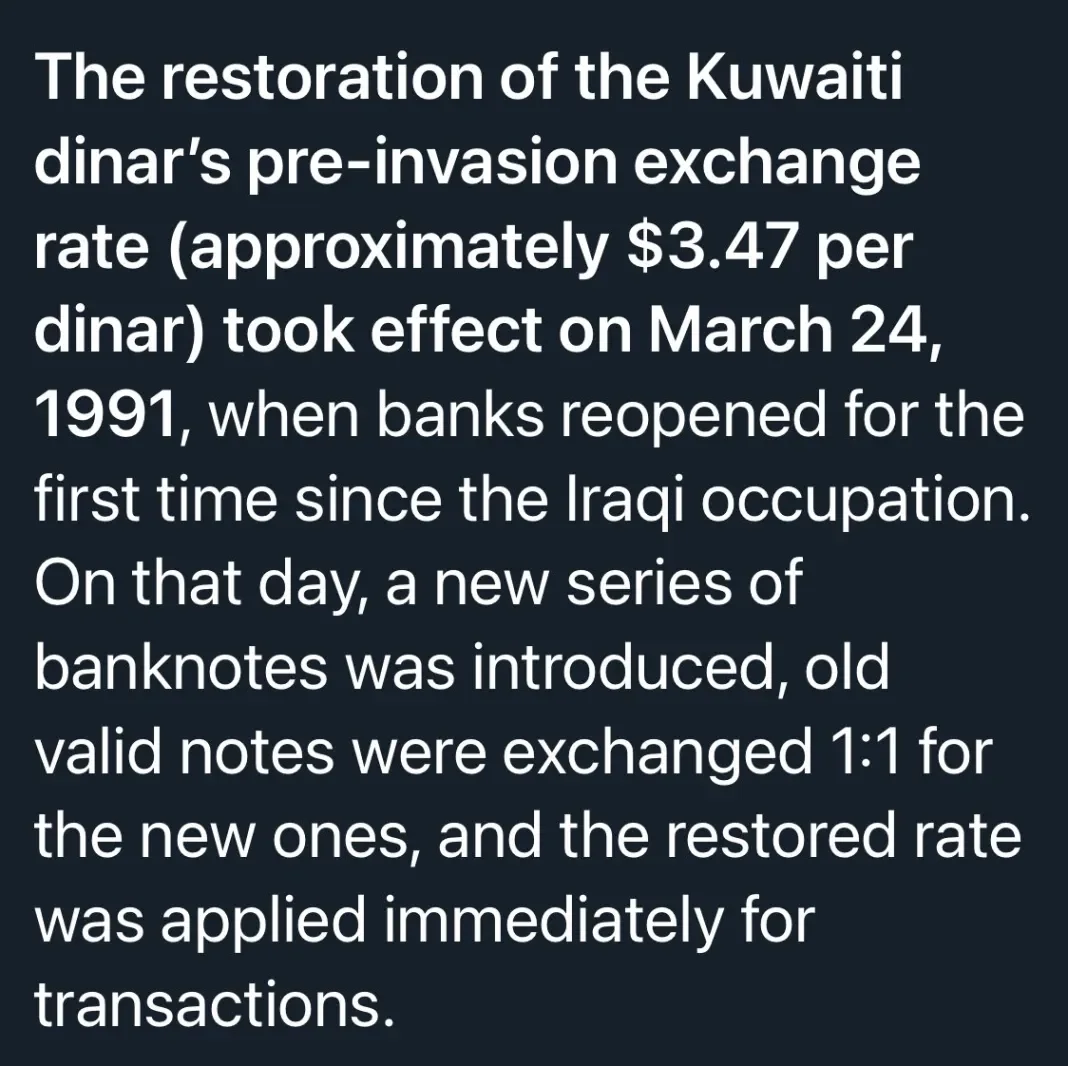
When Kuwait was liberated:
Banks reopened on March 24, 1991
The pre-invasion exchange rate was restored immediately
A new series of banknotes was introduced the same day
Old valid notes were exchanged 1:1
Invalid or counterfeit notes were rejected
Here’s the key part.
The public did NOT see the new notes in advance.
There was:
no preview
no leaks
no countdown
no announced hour
The proof only appeared when the banking system went live.
This is how central banks protect:
monetary stability
public confidence
and the currency itself
Preparation happens quietly. Execution happens all at once.
History shows us that new notes are never the signal, they are the result.
Hope this helps bring clarity and peace.
Source(s):https://x.com/swisher1776/status/2000382157324259711
https://dinarchronicles.com/2025/12/15/swisher1776-a-quick-history-lesson-on-kuwait-and-new-notes/
News, Rumors and Opinions Monday 12-15-2025
Swisher1776: IQD RV, Iraq Officially Ratifies Election Results
12-15-2025
Today, Iraq’s Federal Supreme Court officially ratified the 2025 parliamentary election results.
What this means:
The elections are now legally and constitutionally finalized
All appeals and disputes are closed
Swisher1776: IQD RV, Iraq Officially Ratifies Election Results
12-15-2025
Today, Iraq’s Federal Supreme Court officially ratified the 2025 parliamentary election results.
What this means:
The elections are now legally and constitutionally finalized
All appeals and disputes are closed
Iraq officially moves from elections → governance
What happens next?
The President must call the first session of the new Parliament within 15 days
Parliament will begin forming leadership and advancing national priorities
This is a major stability milestone — the kind of step that brings:
political certainty
institutional continuity
confidence for reform and rebuilding
Quiet progress.
Orderly process.
Forward motion.
Praying for wisdom, unity, and peace as Iraq enters its next chapter.
Source(s): http://x.com/swisher1776/status/2000385275113910372
https://dinarchronicles.com/2025/12/15/swisher1776-iqd-rv-iraq-officially-ratifies-election-results/
************
Courtesy of Dinar Guru: https://www.dinarguru.com/
Frank26 IMO the Iraqi dinar is advancing in ways that we've only dreamed about...I see the governor of the Central Bank of Iraq explaining every day to the Iraqi citizens the monetary reform process. Based on what the governor of the central bank and also on what Oliver Wyman said...and what December 15th requires...my opinion is on January 1, 2026 that has to be something to replace 1310/1320. There has to be...They're setting it up that way. They are the ones building up the anticipation, the drama, titillation, teasing, however you want to describe it. Every freaking day they come out and they tell the Iraqi citizens, this is what's happening.
Jeff Today was a very critical day within this investment because very critical news from...the United Nations that put Chapter VII sanctions on Iraq. They no longer have Chapter 7 sanction. Those have all been lifted regarding the financial aspect of Iraq that would prevent them from being able to revalue the currency. Iraq is now sovereign, eligible to revalue the currency. That's not in the way anymore. Those have all been lifted... Article: 'The United Nations will be exiting Iraq, ending their UNAMI missions at the end of 2025' The UN's work within Iraq official ends on December 31, 2025. But there's another piece to this puzzle... [Post 1 of 2....stay tuned]
Jeff They needed to have that 'congratulatory ceremony' which they did today. Sudani came forward thanking the United Nations for their 22 years of efforts and service helping restore and turn the country of Iraq around and achieve stability. In return, Antonio, the head honcho of the UN, congratulated Iraq on achieving stability. I want you to think about something. With the UN's missions ending at the very end of this year, December 31, 2025, why did they have and hold this congratulatory meeting/ ceremony this weekend? My opinion...this ceremony needed to happen before the rate is going to change and before Iraq gets back on the international world stage. [Post 2 of 2]
************
Investing in Vietnam the Easy Way VND/USD Exchange Rate
Edu Matrix: 12-15-2025
Vietnam is quickly becoming one of the most talked-about emerging markets in the world—and investors are paying attention. In this video, we break down how investing in Vietnam’s economy works, why global investors are turning their focus to Southeast Asia, and the smartest ways to gain exposure to Vietnam’s long-term growth.
From manufacturing and exports to a rising middle class and foreign direct investment, Vietnam’s economic transformation is creating new opportunities across multiple sectors.
You’ll learn the different ways foreigners can invest in Vietnam, including the Vietnam stock market, Vietnam-focused ETFs, and real estate opportunities in major cities like Ho Chi Minh City and Hanoi.
We also discuss the pros and cons of each investment approach, what beginners should consider first, and why many investors choose indirect options like ETFs to simplify access while managing risk.
If you’re interested in emerging markets, diversification outside the U.S., or long-term global investment strategies, this video will help you understand where Vietnam fits into the bigger financial picture.
Whether you’re a retiree, expat, or long-term investor, Vietnam’s growing economy offers insight into how global capital is shifting and where future growth may come from.