
Thank you to all the subscribers to our Early Access program…we thank you for your continued support.
We are excited to offer this new service to keep you informed and up-to-date on the latest Dinar and currency news.
“Tidbits From TNT” Monday Morning 9-30-2024
TNT:
Tishwash: Central Bank Governor meets Spanish Ambassador to Iraq
His Excellency the Governor of the Central Bank, Mr. Ali Mohsen Al-Alaq, met with the Spanish Ambassador to Iraq, Mrs. Alicia Ricoperez del Bulgari, to discuss developing relations between the Iraqi and Spanish financial sectors.
The two parties discussed opening channels of communication between the Central Bank of Iraq and the Spanish Bank in a step aimed at enhancing cooperation with the Spanish side in all economic fields, most notably cooperation in the banking sector.
Central Bank of Iraq
Media Office
September 30, 2024 link
TNT:
Tishwash: Central Bank Governor meets Spanish Ambassador to Iraq
His Excellency the Governor of the Central Bank, Mr. Ali Mohsen Al-Alaq, met with the Spanish Ambassador to Iraq, Mrs. Alicia Ricoperez del Bulgari, to discuss developing relations between the Iraqi and Spanish financial sectors.
The two parties discussed opening channels of communication between the Central Bank of Iraq and the Spanish Bank in a step aimed at enhancing cooperation with the Spanish side in all economic fields, most notably cooperation in the banking sector.
Central Bank of Iraq
Media Office
September 30, 2024 link
************
Tishwash: Al-Sudani decides to postpone his official visit to the United Kingdom
Prime Minister Mohammed Shia Al-Sudani decided to postpone his official visit to the United Kingdom scheduled for early October to a later time.
A statement from his office, a copy of which was received by {Euphrates News}, stated: “Prime Minister Mohammed Shia al-Sudani decided to postpone his official visit to the United Kingdom scheduled for early next October, to a later time; as a result of developments in current events on the regional and international arenas.”
He added, "Also, as a result of the developments of current events on the regional and international arenas." link
************
Tishwash: Market Forces Committee recommends holding an Iraqi-Turkish forum in Baghdad
The Market Forces Committee, formed by Prime Minister Mohammed Shia al-Sudani, recommended holding a joint Iraqi-Turkish forum in the capital, Baghdad.
The committee said in a press statement received by Shafak News Agency that the Market Forces Committee held its meeting today, and hosted the financial advisor to the Prime Minister, Mazhar Muhammad Salih.
The committee, which was formed by the Prime Minister by a Diwani order, consists of the Association of Private Banks, the Federation of Chambers of Commerce, the Iraqi-Turkish Business Council, and the Iraqi Contractors Union.
The statement added that the committee recommended developing economic relations with Turkey, by holding a joint Iraqi-Turkish forum under the auspices of the Prime Minister in Baghdad on the sidelines of the visit of the Turkish Minister of Trade to Baghdad scheduled for next November.
The committee focused on working to support the establishment of the international development road, which would contribute to achieving a qualitative leap in international transportation, industry, and private sector contribution, and making Iraq a strategic corridor between the countries of Asia and Europe.
The committee pointed out the importance of solving the problems of the Iraqi and Turkish private sectors, which relate to financial transfers, customs, entry visas, and others, in a way that contributes to developing economic relations, stressing the committee’s openness to all forces of the Iraqi and Turkish market. link
************
Tishwash: An expert reveals the reason for the fragility of the Iraqi market: Countries want imports to remain
Today, Monday (September 30, 2024), economic expert Nasser Al-Kanani revealed the reason for the fragility of the Iraqi local market and its inability to confront any external problems.
Al-Kanani said in an interview with Baghdad Today, "The Iraqi local market is fragile and cannot face any external problems, as it depends only on foreign imports, and does not depend on local national production, and therefore the market is greatly affected by any external problems, and cannot face any of those problems, and therefore the Iraqi government must work seriously to restore local production so that the local market is strong and not affected by any regional or international problems and crises."
He added, "The Iraqi local market is considered one of the most important markets for many countries in the region and the world, to sell their materials in it, and it is not unlikely that there are countries working to keep the Iraqi market fragile and dependent on imports, instead of national production, and for this reason, throughout the past years, we have not seen any control of local products over the market."
Last March, the Central Bank of Iraq announced that “there is no return to the previous price of the dollar, and the price will not be reduced under any circumstances,” stressing that there is no intention to raise the price above 145,000 for every 100 dollars, which is the official Iraqi exchange rate.
The prices of basic foodstuffs doubled after the government devalued the dinar, and prices increased again, before rising again due to the rise in the price of the dollar .
The prices of some food items in Iraq have increased by between 25 and 75 percent, as the price of one kilogram of sugar rose from 1,000 dinars to 1,300 dinars in retail markets, a bottle of cooking oil from 1,500 to 3,000, and grains from 500-750 to 1,000-1,500 dinars link
************
Mot: .. how does ole ""Earl"" do it ....

Mot: .. the logic of the Internet!!!!

Seeds of Wisdom RV and Economic Updates Sunday Afternoon 9-29-24
Good Afternoon Dinar Recaps,
XRP VS. TRADITIONAL BANKING SOLUTIONS: WHY BANKS ARE TAKING NOTICE OF RIPPLE
▪️The role of XRP as a bridge currency in global finance is gaining traction.
▪️Top Analyst uncovers key factors that can drive XRP’s adoption.
XRP, the cryptocurrency associated with Ripple Labs Inc., is often described as a bridge currency that can be integrated with the traditional banking sector. At the moment, there are heightened discussions on why banks should use XRP for payments.
Good Afternoon Dinar Recaps,
XRP VS. TRADITIONAL BANKING SOLUTIONS: WHY BANKS ARE TAKING NOTICE OF RIPPLE
▪️The role of XRP as a bridge currency in global finance is gaining traction.
▪️Top Analyst uncovers key factors that can drive XRP’s adoption.
XRP, the cryptocurrency associated with Ripple Labs Inc., is often described as a bridge currency that can be integrated with the traditional banking sector. At the moment, there are heightened discussions on why banks should use XRP for payments.
Why Banks Are Taking Notice of Ripple
In an X post, crypto investor and analyst CryptoTank highlighted several reasons banks would use XRP instead of other digital tokens or a Central Bank Digital Currency (CBDC).
First, the analyst pointed out that the traditional banking sector is competitive. He noted that smaller banks compete with larger banks like JPMorgan for market share and customers.
Therefore, he claims banks will be uninterested in accepting each other’s digital token or CBDC since doing so will give bigger rivals a competitive advantage. The analyst added that the smaller banks’ agreement could give bigger banks total control of how the tokens will be issued and used.
Essentially, the analyst opined that the bigger banks could eventually exert tough conditions that might put smaller ones out of business.
J.P. Morgan or B of A, or any other competitor. If they agreed to that the the Big bank could set the terms and control how that token is issued, used, etc to the smaller banks. Essentially able to put them out of business if they wanted to. Which of course they do…
— CryptoTank (@Tank2033js) September 24, 2024
CryptoTank’s second point hinges on liquidity. He emphasized how banks are desperate to get liquidity that is easily accessible, cheap, and with low to zero friction. He noted that the SWIFT network, developed as a payment solution for financial institutions, is still far behind in technology. The analyst stated that the network is slow, costly, and has friction, thus limiting its use by traditional banks.
CryptoTank highlighted that the fundamental idea behind the new financial system and the digital age is the seamless transfer of value. He added that the BRICS alliance was created by countries seeking freedom from the traditional banking system. According to the analyst, the United States and the United Kingdom have had authority over sanctions, which often caused financial harm to them.
Documents from the BIS, IMF, and WEF claim a neutral bridge currency is needed to provide a seamless transfer of value globally. This would avoid friction and failed transactions and allow banks to free up Nostro Vostro accounts.
Comparing XRP to XLM as a Solution to Financial Freedom
Many think Stellar’s XLM could be used for seamless value transfer instead of XRP. CryptoTank, however, pointed out that XLM was created for peer-to-peer smaller transactions and banking the unbanked globally and not as a bridge currency.
On the other hand, he noted that XRP is not a utility token. The analyst describes XRP as a token created specifically for transferring huge amounts of value at a low cost, high speed, and without friction.
The analyst highlighted how Ripple uses XRP as a bridge asset to move value for its On-Demand Liquidity (ODL). As noted in an earlier CNF post, wealth advisor Mickle claims demand for XRP among market makers will increase as global ODL transactions expand.
CryptoTank highlights Ripple’s partnership with the BIS, IMF, WEF, and central banks, further strengthening XRP’s case as the appropriate bridge currency.
“Sitting at the head tables with the Global leaders of Finance and Banking. Crafting the rules, regulations, and how the new system will work…It doesn’t take a genius to see where this is going,” CryptoTank emphasized.
@ Newshounds News™
Source: Crypto News Flash
~~~~~~~~~
GOLDMAN SACHS FORECASTS WEAKER DOLLAR AS FED BEGINS INTEREST RATE REVERSAL: REPORT
Banking giant Goldman Sachs is forecasting a weaker US dollar following the interest rate reversal from the Federal Reserve.
In a new note to investors covered by Bloomberg, Goldman strategists say a gradual weakening of the greenback is expected now that lower rates have lessened the dollar’s appeal.
The bank said the Fed’s recent cut of 50 basis points (bps) showed a willingness to respond aggressively to a potential economic downturn, justifying expectations of relative weakness for the dollar against other major currencies including the euro, pound and yen.
Goldman is now predicting upward moves in the euro and the pound against the dollar, predicting $1.15 for EUR/USD, a 2.67% boost, and $1.40 for GBP/USD, a 4.47% rally from current prices.
Says the Goldman strategists,
“This balance should entail a weaker dollar over time, but we still expect that to be a gradual and uneven process. We also still believe the dollar’s high valuation will not be eroded quickly or easily, but the bar has been lowered a bit…
Support for sterling is coming both from its risk beta as well as solid growth momentum and a patient BOE. Markets have priced out US recession risk, benefiting risky assets and pro-cyclical currencies like sterling.”
Goldman’s call for a weaker dollar differs from the forecast from German banking titan Deutsche Bank, who believes that a potential Donald Trump presidency will ultimately boost the dollar relative to other currencies.
“We think pricing for the Fed is too dovish and that the market is underpricing the dollar positive risks around a Trump victory, so we like buying the USD.”
@ Newshounds News™
Source: DailyHodl
~~~~~~~~~
XRP RECOGNIZED BY SWIFT AS A BRIDGE CURRENCY FOR 11,000+ BANKS
▪️XRP was recognised as a bridge currency by SWIFT, an interbank messaging platform that connects over 11,000 banks globally and facilitates $150 trillion in transfers annually.
▪️While the two were initially viewed as rivals, they work even better together, with SWIFT bringing legacy finance connections while XRP provides the tech.
Years ago, XRP was viewed as the ultimate solution that would wipe off traditional cross-border rails, with SWIFT being put on notice. However, crypto has matured since then, and its enthusiasts have recognized that it’s easier to integrate with established players than to fight them, Now, XRP is seen as complementary to SWIFT rather than a whole new solution.
SWIFT has also warmed up to XRP, and in a partnership with blockchain consortium R3 that extends back over five years, the interbank messaging platform mentioned XRP as one of the options for a bridge currency between its participants.
SWIFT is the world’s most popular interbank messaging protocol, connecting over 11,000 global banks, ranging from multinational behemoths like JPMorgan and Bank of China to local union banks. In its most recent published figures, it revealed that it was recording 45 million transfers daily, resulting in $150 trillion worth of value transfers facilitated annually.
As XRP enthusiasts noted on social media, this recognition is important for XRP.
XRP for Global Fund Transfers
Today, sending an email or a chat message is instant and cheap. However, sending a financial message remains cumbersome, very costly and extremely slow. Most banks take three to five working days to deliver the funds, leading to the joke that it’s easier to take a flight and deliver the cash in hand rather than send it via SWIFT.
Since crypto launched, this has been one of the sectors it’s targeted. XRP has been one of the leaders in this revolution owing to its very low fees and fast transactions. While it has seen some traction, including integrating with several banks globally, it has yet to land its key moment.
Despite the integrations, Ripple is still pushing to completely overhaul the system. As we reported, CEO Brad Garlinghouse revealed recently he’s still focused on “trying to let value move the way information moves today.”
However, it doesn’t happen overnight, he noted. Being a payment network that handles people’s money, XRP and the interlinked systems are moving systematically slowly to ensure they are compliant with every financial regulation and avoid the walls caving in on the leaders as they have for former kingpins like Binance founder Changpeng Zhao and FTX founder Sam Bankman-Fried, who prioritised speed over compliance.
@ Newshounds News™
Source: Crypto News Flash
~~~~~~~~~
THE SILVER PRICE NARRATIVE HAS BEGUN...
💰 Silver, dubbed the "money of the people," is projected for 50% gains in 2024, potentially reaching $1 per ounce due to its diverse uses beyond gold.
📈 In the past 11 months, silver has outperformed gold by 61%, with analysts predicting a potential surge to $50 an ounce within 100 days if it breaks above $32.
🗓 2024 has been officially named the "year of the metals" by GSC commodity intelligence, marking the beginning of the "silver narrative" expected to continue into 2025.
💎 The Economic Ninja encourages everyone to own at least 2 ounces of silver, calling it the "investment of the century" due to anticipated truth revelations.
🚀 Predictions suggest silver prices will reach all-time highs in 2025, with some analysts offering even more bullish forecasts for the precious metal's future value.
@ Newshounds News™
Source: The Economic Ninja
~~~~~~~~
XRP NEWS: TOP RIPPLE EXECUTIVES TO ATTEND FEDERAL RESERVE BANK’S 8TH ANNUAL FINTECH CONFERENCE
▪️Ripple’s Brad Garlinghouse and Chris Larsen have been reported to appear at the upcoming annual Fintech conference hosted by the Federal Reserve Bank of Philadelphia.
▪️Before this, Ripple’s flagship event – the Swell conference, would be hosted with several industry key players expected to discuss the future of the crypto industry.
The price of XRP surged 4% daily after reports emerged that Ripple executives Brad Garlinghouse and Chris Larsen would make a groundbreaking appearance at the annual fintech conference.
According to details, the upcoming event would be the eighth edition hosted by the Federal Reserve Bank of Philadelphia from October 22 to October 23. Based on the information available on the host’s website, this year’s conference would feature notable fintech professionals and researchers speaking on various topics, including real-world asset tokenization, banking-as-a-service, tokenized deposits, and the potential role of fintech in shaping the future of finance.
In addition to the Ripple executives, the list of expected speakers at the event includes Coinbase lawyer Paul Grewal, and the head of the Crypto Council for Innovation Sheila Warren.
The Swell Conference by Ripple
From October 15-16, Ripple will also host its annual flagship event, the Swell Conference. According to the blockchain company, this event will be attended by more than 40 countries, over 600 attendees, and more than 50 speakers.
Based on the document we have, some of the featured speakers would include Ripple’s Brad Garlinghouse, superintendent at the New York State Department of Financial Services Adrienne Harris, former chair of the FDIC and founding chair of the Systemic Risk Council Sheila Bair, global head of blockchain and digital assets at BBVA Francisco Maroto, and Chief Security Officer at Coinbase Philip Martin.
According to reports, the conference would discuss several topics to reveal how financial institutions and businesses leverage crypto in blockchain technology.
Court Case Still Hanging
Currently, the entire crypto industry is waiting for the appeal decision by the US Securities and Exchange Commission (SEC) as the October 7 deadline is fast approaching. According to a former SEC lawyer, the Commission would likely appeal the ruling on the programmatic sales of XRP by Judge Analisa Torres as we reported. However, Ripple’s Chief Legal Officer Stuart Alderoty believes that the conflict has ended.
Attorney Jeremy Hogan commented on this and advised the Commission to consider its “mandate of investors’ protection” in its decision-making.
Of course, they think the opinion is wrong – they were on the losing side. What the SEC should be thinking of right now is whether an appeal furthers its mandate of investor protection and capital formation. Why isn’t that top of mind? More evidence the SEC has lost the plot.
@ Newshounds News™
Source: Crypto News Flash
~~~~~~~~~
🌍 7 CONFUSING CRYPTO TERMS (ALMOST) NOBODY UNDERSTANDS | Youtube
@ Newshounds News™
Source: Seeds of Wisdom Team RV Currency Facts
~~~~~~~~~
Seeds of Wisdom Team RV Currency Facts Youtube and Rumble
Newshound's Podcast Link
Newshound's News Telegram Room Link
Q & A Classroom Link
Follow the Roadmap
Follow the Timeline
Seeds of Wisdom Team™ Website
Subscribe to Newsletter
Thank you Dinar Recaps
Economist’s “News and Views” Sunday 9-29-2024
Major US Banks Start Dumping EVERYTHING!
Atlantis Report: 9-29-2024
The financial situation in the United States is experiencing a significant change as major banks are selling off assets at an unprecedented rate.
This move is caused by the imminent commercial real estate crisis, bad loans, and high interest rates.
This situation is not just a financial maneuver but a response to deep-seated issues affecting the stability of the banking sector.
Major US Banks Start Dumping EVERYTHING!
Atlantis Report: 9-29-2024
The financial situation in the United States is experiencing a significant change as major banks are selling off assets at an unprecedented rate.
This move is caused by the imminent commercial real estate crisis, bad loans, and high interest rates.
This situation is not just a financial maneuver but a response to deep-seated issues affecting the stability of the banking sector.
As banks hurry to get rid of assets, the consequences are widespread, affecting everything from the availability of credit to confidence in the financial system itself.
BRICS 2024 Announces Major Global Changes to US Dollar!
Cyrus Janssen: 9-29-2024
BRICS will hold its annual President's Meeting in Russia and it will specifically target the future of the US Dollar.
This meeting is important as BRICS will officially announce its plan for launching a new trading network that will not use the US dollar but instead use a basket of local currency.
This new trading network could potentially be backed by gold and also use blockchain technology. Let's break down all the updates on BRICS and the future of the US dollar in today's video!
Michael Pento : They Have Destroyed The Middle Class
Lynette Zang: 9-29-2024
Today's video is an interview with an amazing mind, Michael Pento. We discuss the Fed's recent rate drop, consumer confidence, the value of the dollar and so much more!
Seeds of Wisdom RV and Economic Updates Sunday Morning 9-29-24
Good Morning Dinar Recaps,
SEC TAKES STEPS TO APPEAL JUDGE TORRES’ RULING ON XRP
▪️The SEC is preparing to appeal Judge Torres' ruling on XRP.
▪️Experts share mixed views on the outcome of the potential appeal.
▪️XRP's price is trending upward, reflecting increased investor interest.
The U.S. Securities and Exchange Commission (SEC) is moving to appeal Judge Torres’ summary judgment on XRP in the Ripple case. Pro-XRP attorney John Deaton and other legal experts are assessing the likelihood of the SEC’s appeal and its potential ramifications.
Good Morning Dinar Recaps,
SEC TAKES STEPS TO APPEAL JUDGE TORRES’ RULING ON XRP
▪️The SEC is preparing to appeal Judge Torres' ruling on XRP.
▪️Experts share mixed views on the outcome of the potential appeal.
▪️XRP's price is trending upward, reflecting increased investor interest.
The U.S. Securities and Exchange Commission (SEC) is moving to appeal Judge Torres’ summary judgment on XRP in the Ripple case. Pro-XRP attorney John Deaton and other legal experts are assessing the likelihood of the SEC’s appeal and its potential ramifications.
Intent to Appeal by the SEC
Recently, the possibility of the SEC filing an appeal has increased. A former SEC attorney stated to Fox Business journalist Eleanor Terrett that the agency would likely challenge Judge Analisa Torres’ July 2023 ruling.
Legal Critiques and Expert Opinions
John Deaton, working pro bono for 75,000 XRP holders, noted that judges have criticized the SEC’s adherence to the law. He pointed out that under Gary Gensler’s leadership, the SEC might still pursue an appeal, which could waste taxpayer money.
“I don’t believe an appeals court will rule that Judge Torres erred in applying the third criterion. Judge Torres’ decision was based on very specific facts. The SEC did not rely on any expert testimony regarding XRP holders (which was ultimately excluded), but the judge did.”
Deaton added that even if the Second Circuit judges determined that Judge Torres erred in applying the third criterion, the case would return to her, where the SEC would likely lose again, as the district court would conclude that the SEC failed to establish a ‘joint venture.’
The Only Way to Win the Case
Fred Rispoli agreed with Deaton, stating that it would be very challenging for the SEC to alter Torres’ ruling. Rispoli expressed that the SEC’s chances of winning depend on the preferences of three randomly selected judges reviewing the case.
“If the SEC selects three SEC-friendly judges (rare but possible), it could win.”
Rispoli and other attorneys anticipate a last-minute appeal from the SEC. If the SEC does not appeal, it would be a significant victory for Ripple and the XRP community, allowing them to argue that all secondary sales do not constitute an investment contract.
There is a rising trend in XRP’s price, which has seen a 2% increase in the last 24 hours, currently trading at $0.602. The recorded low and high levels are $0.585 and $0.610, respectively. Additionally, trading volume has surged by 21% in the last day, indicating growing investor interest. XRP price analysis suggests a target price of $2.
These developments in the legal process could significantly impact the future of XRP in the cryptocurrency market and the SEC’s regulatory role. Investors and market observers are closely monitoring how court decisions and potential appeals might affect the value of cryptocurrency assets.
@ Newshounds News™
Source: CoinTurk
~~~~~~~~~
CARDANO TURNS 7: A LOOK BACK AT KEY MILESTONES AND THE ROAD AHEAD
On Friday, the Cardano blockchain marked its seventh anniversary, solidifying its position as one of the most recognized protocols in the cryptocurrency market. Currently, Cardano’s native token, ADA, ranks eleventh among cryptocurrencies, boasting a market capitalization of approximately $14 billion.
Input Output Global (IOG), the development company behind Cardano, celebrated this milestone on social media, highlighting significant achievements since its inception by co-founder Charles Hoskinson, who also played a key role in the creation of the Ethereum blockchain.
Cardano’s Architectural Evolution Over Seven Years
In a commemorative video, IOG shared notable statistics reflecting Cardano’s growth and development. The blockchain has facilitated over 95 million transactions, showcasing its usage and adoption through the years.
Additionally, more than 74,000 Plutus scripts have been executed, which are essential for the effective deployment of smart contracts on the platform.
Cardano has also witnessed significant community engagement, with the creation of 1.3 million delegated wallets and the publication of 226 research papers. Furthermore, approximately 1,373 projects have been launched on the blockchain, also showcasing the community usage.
The Catalyst funding program, which has undergone 12 funding rounds, has played a crucial role in advancing the Cardano ecosystem. This initiative has supported over 1,800 funded ideas, fostering upgrades and further developments within the protocol.
However, the last seven years have also seen significant transformations in Cardano’s architecture. The transition from the Shelley era to the Alonzo hard fork marked a pivotal shift.
Moves Toward Decentralized Decision-Making
The Shelley era, which began in 2020, focused on decentralization and enhancing network security through the introduction of the Ouroboros upgrades. These upgrades improved stake pool operations and ADA delegation, encouraging staking rewards for users.
The Alonzo hard fork, implemented in 2021, enabled smart contract functionalities on Cardano, significantly increasing the block size and enhancing script memory unit parameters. This advancement allowed developers to create decentralized applications (dApps) that leverage Cardano’s capabilities.
Further enhancements came with the Vasil and Chang upgrades, the latter being the first hard fork of the Voltaire era, the protocol’s final era. The Vasil upgrade, released in 2022, introduced new features, including Plutus script upgrades to reduce transaction costs and the implementation of diffusion pipelining for faster block propagation.
The recent Chang upgrade is being rolled out in two phases, introducing on-chain governance to the network. The first phase, which implements governance features through CIP-1694, sets the foundation for decentralized voting and governance actions.
The second phase will introduce additional governance functionalities, including delegated representative participation and treasury withdrawals, further empowering the community.
Next Steps In The Voltaire Era
Looking ahead, the second part of the Voltaire era will replace the initial genesis keys, which have been key in managing the network since its inception, with ongoing support from stake pool operators (SPOs) and increased involvement from delegated representatives (DReps) and the Constitutional Committee (CC).
The next steps toward achieving decentralized governance involve ensuring that stake pool nodes meet the required thresholds for operation and that decentralized applications (DApps) are nearing completion.
The final transition to the Voltaire era will occur with the last use of the Genesis keys, which will trigger a hard fork and cement Cardano’s status as a self-sustaining blockchain. However, further announcements of subsequent upgrades and their respective dates remain undisclosed.
@ Newshounds News™
Source: Bitcoinist
~~~~~~~~~
7 CONFUSING CRYPTO TERMS (ALMOST) NOBODY UNDERSTANDS
The crypto world is full of technical terms, some of which are so difficult that almost no one understands them.
Getting to grips with cryptocurrency isn’t easy. Even after you’ve got your head around Bitcoin and Ethereum and the difference between proof-of-work and proof-of-stake, there’s still a whole new world of terminology to learn and understand.
But even among fairly hardened cryptonians, there are still terms that are difficult to understand. Here are the seven terms that almost nobody in blockchain understands as fully or as deeply as they’d like.
Blobs
In the 1958 movie starring Steve McQueen, and its 1988 remake, The Blob is an amoeba-like jello monster that terrorizes the inhabitants of a small town, growing larger and redder as it consumes them.
In crypto, most especially Ethereum, blobs (Binary Large Objects) are substantial chunks of data not required by Ethereum’s electronic virtual machine (EVM). Blob data is held onchain for around 20-90 days and then deleted.
The result is a more cost-effective and scalable blockchain. As part of Ethereum’s Dencum update, blobs are often discussed in parallel to the next term on this list.
Blobs may also refer to chunks of data held on decentralized storage systems such as IPFS or Filecoin. These blobs are encrypted and stored across multiple nodes.
Finally, blobs can also refer to transaction blobs on Monero, which is the binary data of a transaction before it is broadcast to the network. Being that Monero is a privacy chain these blobs are structured in a way to maintain anonymity.
And that’s a whole lot of blobs.
Rollups
Rollups are a way of processing transactions on layer-2 protocols, freeing up valuable space on the base layer. A rollup folds transaction upon transaction on the layer-2 level, sometimes dozens of times over, then rolls them together before sending the data back to layer-1.
There are two main types of rollups, optimistic and zero-knowledge (ZK) proofs.
Optimistic rollups is a fairly clear term. It means the rollup operates on an “optimistic” approach, assuming a transaction is valid unless proven wrong by a validator. They only check the validity of a transaction if there’s a dispute.
ZK rollups prove a transaction without revealing any of the transaction data. Hence, “zero-knowledge.”
ZK-rollups offer instant finality because the cryptographic proof guarantees the data is valid.
In many ways a rollup is to your standard blockchain transaction what a Calzone is to a regular pizza slice. By rolling it over, you can fit more in.
Byzantine Fault Tolerance
It’s one of the classic blockchain terms and a key feature of the technology, but for most people, it’s something they spend absolutely no time thinking about.
The Byzantine Generals problem was a theoretical exercise that describes the difficulty of decentralized parties arriving at a consensus without a trusted centralized entity. Namely, it grappled with the possibility for bad actors to produce false information to produce a poor outcome in a given scenario.
Specifically, generals with no direct communication must attack Byzantium simultaneously to be victorious. If one of the generals retreats, or signals they will attack but then retreats, the battle will be a rout; worse than a coordinated retreat between all generals.
Satoshi Nakamoto solved the Byzantine Generals problem for Bitcoin by using a proof-of-work consensus mechanism. The significant amount of time and effort in creating a block is costly for the creator, thus giving them the incentive to produce accurate information.
A Byzantine fault is an error in a decentralized computing system that would show a different error or result to different actors, as in the Byzantine Generals problem.
Therefore, Byzantine fault tolerance is the resilience of that computing system to producing such a fault.
We hope this wasn't too Byzantine an explanation.
Proto-danksharding
Sharding is a means of partitioning a ledger into smaller pieces called shards.
But proto-danksharding is one of the most opaque terms to enter the lexicon of the crypto world. The term just isn’t particularly instructive. Is proto short for prototype? Is this the same dank of your favorite meme folder? Both may be fairly reasonable assumptions, but both are wrong.
First proposed by Protolambda and Dankrad Feist, the creators who lent their names to the idea, proto-danksharding is a transaction type that accepts the aforementioned blobs. The blob-utilizing solution is designed to overcome Ethereum’s longstanding issues with high gas fees and low transaction throughput.
The blobs are used by layer-2 rollups to bundle transactions and submit them to the Ethereum base layer without overwhelming it.
But if proto-danksharding seems like a confusing and mysterious turn of phrase, you can instead choose to use the far more instructive name for the process; EIP-4844.
On second thoughts, the term proto-danksharding isn’t all that bad.
DVT — Distributed validator technology
Most people in cryptocurrency are already familiar with the validators that approve transactions in proof-of-stake consensus models.
DVT takes that concept and decentralizes the process across multiple validators. As described by Lido, DVT “functions as a system that operates similarly to a multisignature (multisig) setup for running a validator.”
This they call “simple DVT” though what’s simple about it remains a mystery.
Ultimately, DVT utilizes multiple operators instead of depending on a single operator, enhancing resilience and mitigating single points of failure.
Dynamic resharding
Dynamic resharding is not your grandmother’s old shards. Dynamic resharding is a relatively new term that Near Protocol’s marketing team has dubbed “the holy grail of sharding,” but it also creates a new lexicon that isn’t immediately understandable.
Building upon the concept of blockchain shards, resharding occurs when the network adjusts the number of shards depending on the load.
An overloaded shard can become two shards, while two underutilized shards can become one.
Nonce
Nonce is one of those terms most people come across during their early days of cryptocurrency discovery and then completely forget about, like the individual names of a large group of people you’ve just met at a party.
In the Bitcoin blockchain, the nonce is the number used in the block header, which is then cryptographically hashed. It is the number guessed through trial and error to decide which miner produces the next blockchain.
Nonce generation makes the mining process more fair and transparent. It takes lots of computation power and energy to do and in some cases, miners may have to adjust the nonce multiple times before solving a block.
@ Newshounds News™
Source: CoinTelegraph
~~~~~~~~~
China pressed to speed up crypto policy as US takes Bitcoin ETF lead
▪️Former Finance Minister urges China to rethink crypto policy.
▪️China's allowance of Hong Kong ETF investments signals cautious steps toward crypto.
At a 2024 economic forum in Beijing, former Finance Minister Zhu Guangyao urged China to rethink its crypto approach amid accelerating US policies.
He acknowledged the risks but stressed the importance of staying updated on global shifts, stating, “We must fully recognise its risks and the harm it poses to capital markets, but we must study the latest international changes and policy adjustments because it is a crucial aspect of digital economy development.”
Zhu noted that the US has made significant policy changes this year, including the approval of 11 Bitcoin ETFs.
He even quoted former President Donald Trump, who has been advocating for embracing crypto to prevent China from taking the lead in the sector.
Trump’s opponent, Kamala Harris, has also recently adopted a stance on clear-cut and progressive crypto regulations.
This call for a policy shift echoes comments from Tron founder Justin Sun, who urged China to reconsider its stance on crypto following Trump’s endorsement of Bitcoin.
Sun tweeted in July, “China also needs to step up... US policies have warmed. China should make further progress.”
While China maintains a cautious stance, it has taken small steps towards becoming more open to crypto.
Chinese investors can still purchase crypto through Hong Kong-based firms, and in April, three Bitcoin ETFs were launched in Hong Kong.
@ Newshounds News™
Source: DI News
~~~~~~~~~
🌍 Old System Plows to New QFS Drones Planting Good Seeds. | Youtube
@ Newshounds News™
Source: Seeds of Wisdom Team RV Currency Facts
~~~~~~~~~
Seeds of Wisdom Team RV Currency Facts Youtube and Rumble
Newshound's Podcast Link
Newshound's News Telegram Room Link
Q & A Classroom Link
Follow the Roadmap
Follow the Timeline
Seeds of Wisdom Team™ Website
Subscribe to Newsletter
Thank you Dinar Recaps
More News, Rumors and Opinions Sunday Afternoon 9-29-2024
Ariel (@Prolotario1): Prime Indicator for the Reinstatement of the Iraqi Dinar
9-29-2024
This may be the prime indicator as to when we may expect the reinstatement of the Iraqi Dinar. Because I have touched on SOFR many times. Right now I am looking for the HCL in parliament now that Al-Sudani is back.
This is a constitutional requirement for citizens. I will see where they are at with this today. Because time is winding down on when this needs to be activated.
Ariel (@Prolotario1): Prime Indicator for the Reinstatement of the Iraqi Dinar
9-29-2024
This may be the prime indicator as to when we may expect the reinstatement of the Iraqi Dinar. Because I have touched on SOFR many times. Right now I am looking for the HCL in parliament now that Al-Sudani is back.
This is a constitutional requirement for citizens. I will see where they are at with this today. Because time is winding down on when this needs to be activated.

More…
Final SOFR Announcement:
SOFR is a broad measure of the cost of borrowing cash overnight, collateralized by U.S. Treasury securities in the repurchase agreement (repo) market.
This shift in overnight loans will now come from the US Treasury Securities to banks, markets, and more.
SOFR, or Secured Overnight Financing Rate, is a benchmark interest rate that measures the cost of borrowing cash overnight. It’s used by financial institutions to set interest rates for other businesses and borrowers.
Globally, all banks and all trading systems will now be synchronized through a Secured Overnight Financing Rate on October 1st, 2024.
While this is taking place, several shipping ports on the East Coast and Gulf Coast areas are expected to go on strike the same day.
This will provide an opportunity for our shipping ports to switch the system over from Libor to SOFR overnight repo rates. IT WILL SWITCH 80% OF OUR TRADES PLUS OVER TO THE US TREASURY LENDING SERVICES.
Yes, interest rates, including the Secured Overnight Financing Rate (SOFR), can affect exchange rates:
Interest rate differentials
When interest rates in one country are higher than another, investors may be more likely to invest in that country’s currency.
Economic growth
Low interest rates can stimulate economic growth by encouraging people and businesses to spend and invest. High interest rates can slow economic growth by making borrowing more expensive.
Asset prices
Interest rates can affect the price of financial assets like real estate, stocks, and bonds. When interest rates are low, investors may be more willing to invest in these assets.
SOFR is a benchmark interest rate that financial institutions use to price loans and set rates for currency swaps and other financial products. The Alternative Reference Rates Committee (ARRC) selected SOFR as a replacement for USD LIBOR after the UK Financial Conduct Authority announced that it would no longer require banks to submit cost of funds quotes for LIBOR.
WATCH THE WATER.
© Goldilocks
https://insightplus.bakermckenzie.com/bm/banking-finance_1/international-cessation-of-usd-libor…
https://supplychaindive.com/news/east-gulf-coast-port-contingency-plans-if-ila-usmx-strike/727979/
Source(s):
https://x.com/Prolotario1/status/1840021231971524951
https://x.com/Prolotario1/status/1840031812942258666
************
Courtesy of Dinar Guru: https://www.dinarguru.com/
Frank26 [Iraq boots-on-the-ground report] FIREFLY:
There are TV commercials advertising that the Kuwait dinar is at $3.58. They are talking about our new border agreement with Kuwait. The fact they bring up this rate tells me they want to talk about our new rate against it. FRANK: They are talking to you about Kuwait because they need an example to show you what is about to happen to your currency, your purchasing power, to show you what is going to happen to your exchange rate. There will be a change coming.
Militia Man They will need to have an international IMF Article XIV and Article VIII compliant currency. One that the Central Banks can defend and likely in a very fast and efficient manner with the most advance systems in the world. The focus in the future is going to be instantaneous cross border payments 365/24/7 and no blackouts with little cost. It is now the time to be paying attention...
************
MARKETS A LOOK AHEAD: "TERMINAL PHASE." CRITICAL UPDATES. E(CON)OMY And The Markets...
Greg Mannarino: 9-29-2024
BRICS Just Launched New Intra-Bank System
BRICS Just Launched New Intra-Bank System
Tech Beat: 9-29-2024
In a move that could reshape the global financial landscape, BRICS—an alliance that includes Brazil, Russia, India, China, and South Africa—has recently unveiled a new intra-bank system aimed at revolutionizing international banking.
This audacious initiative is poised to challenge the long-standing dominance of established Western-led financial institutions, including the U.S. dollar, which has long been regarded as the world’s reserve currency. With this development, the global balance of power in financial services may shift more rapidly than many anticipated.
The BRICS nations have taken a significant step by launching this new intra-bank payment system, designed to facilitate smoother and faster transactions between member countries.
BRICS Just Launched New Intra-Bank System
Tech Beat: 9-29-2024
In a move that could reshape the global financial landscape, BRICS—an alliance that includes Brazil, Russia, India, China, and South Africa—has recently unveiled a new intra-bank system aimed at revolutionizing international banking.
This audacious initiative is poised to challenge the long-standing dominance of established Western-led financial institutions, including the U.S. dollar, which has long been regarded as the world’s reserve currency. With this development, the global balance of power in financial services may shift more rapidly than many anticipated.
The BRICS nations have taken a significant step by launching this new intra-bank payment system, designed to facilitate smoother and faster transactions between member countries. This system aims to reduce dependency on traditional banking routes and circumvent the challenges posed by Western financial institutions, which have often exerted influence over international transactions through regulations and sanctions.
The new system is expected to allow member states to conduct transactions in their local currencies, thereby promoting trade and investment without the need to convert into U.S. dollars. This facilitates direct exchanges and could lead to increased economic cooperation among BRICS nations.
Historically, the U.S. dollar has served as a safe haven and the primary medium for international trade. Various factors shielded the dollar from competition, including the size of the U.S. economy, its political stability, and the extensive network of dollar-denominated assets worldwide. However, BRICS’ initiative could signify the beginning of a gradual erosion of this supremacy.
Imagine a world where countries no longer have to rely on the U.S. dollar for major transactions. The implications for the U.S. economy, especially regarding its trade balance, inflation rates, and global standing, could be profound. If countries increasingly opt for local currencies, it could diminish demand for the dollar, potentially leading to depreciation and economic instability.
The audacious nature of BRICS’ initiative will likely provoke responses from other economic superpowers. The United States and European countries may respond in various ways, ranging from diplomatic maneuvers to adjustments in foreign policy aimed at reasserting the dollar’s status. Economic sanctions, leverage in global financial regulation, or new trade agreements could all be on the table.
Moreover, these established powers might invest more resources into developing alternatives to the system introduced by BRICS. This could involve reinforcing existing frameworks or creating new alliances that emphasize cooperation and dollar transactions.
While the BRICS system might primarily benefit the five founding nations, its implications will extend to developing countries, which often find themselves at the mercy of international financial systems led by Western powers. With new platforms for transactions emerging, these nations potentially could have greater agency in their economic dealings.
Developing countries may leverage this shift, using local currencies in trade, thereby fostering stronger economic ties within their regions, reducing transaction costs, and shielding themselves from fluctuating currencies and economic sanctions.
The unveiling of BRICS’ intra-bank system represents a critical juncture in global finance. As the world becomes increasingly multipolar, the dynamics of banking and currency dominance are set to change dramatically. While the full ramifications of this development remain to be seen, it certainly sends a clear message: the financial landscape is evolving, and the BRICS nations are positioning themselves as formidable players on the global stage.
As we watch this situation unfold, it is crucial for businesses and policy-makers alike to remain agile and informed. The coming years could reveal whether this marks the beginning of the end for the dominance of the U.S. dollar or simply a new chapter in the ongoing saga of international finance. The stakes are high, and the financial world is undoubtedly in for an intriguing ride.
Watch the video below from Tech Beat for more information.
News, Rumors and Opinions Sunday 9-29-2024
Note: All intel should be considered as "Rumors" until we receive official announcements ...and “Rates and Dates” could change anytime until we get to the banks/redemption centers.
RV Excerpts from the Restored Republic via a GCR: Update as of Sun. 29 Sept. 2024
Compiled Sun. 29 Sept. 2024 12:01 am EST by Judy Byington
Timing: (Opinions/Rumors)
On Tues. 1 Oct. 2024 the gold-backed Chinese Yen will (allegedly) replace the fiat US Dollar to determine the price of oil on the Forex for international trading and thus the fiat US Dollar will cease to exist because it has no value and cannot be used for international trade.
Note: All intel should be considered as "Rumors" until we receive official announcements ...and “Rates and Dates” could change anytime until we get to the banks/redemption centers.
RV Excerpts from the Restored Republic via a GCR: Update as of Sun. 29 Sept. 2024
Compiled Sun. 29 Sept. 2024 12:01 am EST by Judy Byington
Timing: (Opinions/Rumors)
On Tues. 1 Oct. 2024 the gold-backed Chinese Yen will (allegedly) replace the fiat US Dollar to determine the price of oil on the Forex for international trading and thus the fiat US Dollar will cease to exist because it has no value and cannot be used for international trade.
On Tues. 1 Oct. the US Inc. Corp. fiscal year ends; has not (allegedly) been funded by Congress for the next fiscal year and thus will be forced to close down, ending the fiat monetary system.
On Tues. 1 Oct. all banks worldwide not Basel III Compliant (have gold backed currency) (allegedly) will be closed.
On Tues. 1 Oct. the Quantum Financial System Global Currency Reset activates with at least 144 countries currencies (allegedly) being gold/asset-backed and trading at a 1:1 with each other, which means that NESARA/ GESARA also activates across the World.
On Tues. 1 Oct. LIBOR is slated to be replaced by SOFR, marking a significant change in financial benchmarks.
On Tues. 1 Oct. the new United States of America Republic will(allegedly) start its new fiscal year under a gold-backed US Note as part of the Global Currency Reset.
On Tues. 1 Oct. 2024 workers at major ports on the East and West Coasts plus in Canada will go on strike, severely disrupting the supply chain. Stock up on goods.
~~~~~~~~~~
Global Currency Reset: (Opinions/Rumors)
Fri. 27 Sept. 2024 TNT Tony:
On Thurs. 26 Sept. Bank managers received memos stating that the currency event has finally been finished. Finished, done, over with it. It went from the director level down to bank managers that got memos. Now we are just waiting to go. This should not happen until after 5pm.
Some think it will be Saturday morning. Just remember that Iraq wants it by the 30th and the UN wants it on the 1st. Tony doesn’t know who won. They told us that it is done, it is fixed, they told their people it is finalized, and once we see the rates we will be going to the bank. Somewhere starting after 5 this afternoon and no later than Tuesday morning will see it live and be going to the bank.
They are supposedly ready, staffed, have their schedules worked out, and they are just waiting to go when the numbers come up on the screen. It makes sense for us to see this Monday night, it satisfies what everyone wants, and we would be at the banks Tuesday morning. Everyone is kind of excited again.
We are in our last 48 to 72 hours. It is sitting at the bank level. There is no more waiting for Iraq, IMF, or UST because it is done. They have given the banks the green light. The systems are now fixed or supposedly will be fixed. The only thing they are waiting on is the 800 number and Tony won’t get the 800 hundred numbers until the rates come back up.
There really isn’t anything bad but Iran could do something s****d to flare up the middle eastern. If it happens before we do our part, then it is up in the air. The good thing is it is done, there is money, and it could happen for us. Be ready.
Strategic Financial Reforms and Technology Upgrades: Financial systems worldwide are undergoing covert overhauls to accommodate the new QFS (Quantum Financial System), which promises transparent and instantaneous financial transactions globally.
This system is rumored to include advanced blockchain technology with quantum resistance, ensuring that financial assets are protected from both c********n and technological threats. In parallel, central banks are reportedly recalibrating their reserves to align with new standards that will support the redistribution mandates under GESARA.
Massive Military Coordination for Asset Protection: Concurrently, there is a significant uptick in military activity across key strategic locations globally. The United States, in collaboration with NATO allies, has initiated movements near major financial centers and critical infrastructure locations.
The purpose of these deployments is dual: to safeguard the physical and digital assets that will soon be redistributed to the public and to deter any attempts by the old guard to obstruct the wealth transfer process.
~~~~~~~~~~
Global Financial Crisis:
Sat. 28 Sept. 2024 Basel III Endgame: The Final Push for Banking Stability …Army Girl on Telegram
The Federal Reserve just dropped some serious news: Starting October 1, large banks must meet new individual capital requirements. These requirements are all about making sure banks have enough liquidity to weather financial storms. But there’s more to the story, and it’s all tied to Basel III and the Bank for International Settlements (BIS).
Basel III Endgame is a global regulatory framework that aims to strengthen bank capital requirements, ensuring banks have enough high-quality capital (like cash and government bonds) to cover potential losses. The BIS, the central bank of central banks, has been guiding this framework, making sure banks worldwide meet minimum liquidity standards. Why? To prevent another 2008 financial crisis.
But here’s the kicker: if banks fall short of these capital requirements, they face automatic restrictions on dividends and bonus payments, and worse—could trigger a loss of confidence leading to a potential bank run.
The Fed’s latest move is part of this broader push to ensure stability. Each bank’s capital requirement is based on rigorous stress tests, considering everything from economic downturns to operational risks. But what happens if a bank doesn’t have enough liquidity? We could see panic, withdrawals, and potentially a domino effect that hits the entire financial system.
As we edge closer to the Basel III Endgame, the stakes are higher than ever. Understanding these changes isn’t just for bankers—it’s crucial for anyone invested in the financial future.
Read full post here: https://dinarchronicles.com/2024/09/29/restored-republic-via-a-gcr-update-as-of-september-29-2024/
************
Courtesy of Dinar Guru: https://www.dinarguru.com/
Frank26 Sudani went all around the world visiting many countries and their banks inviting them to invest in Iraq. In that time the dinar went international. He showed it to them. That's why there is so much financial structure pouring into [Iraq]...Economic reform is about to explode even more than it already has...
MarkZ and Militia Man [via PDK] Militia Man: ...Iraq has done so much work and we all know Al Sudani was just in New York again at the US assembly. He also had sideline meetings and had his speech and returned home yesterday...With Sudani back now…why couldn’t it happen at any time? To me there is no reason it could not happen at any time. MarkZ: I agree. He’s done the victory tours, he has told the world they are restored and fully international. …Time to see the fruit of his labors. I wouldn’t be surprised to see my phone blowing up this weekend with the news that it has happened.
************
Currency Talk COP / IQD / BRL / USD Rates and News
Edu Matrix: 9-29-2024
Currency Talk COP / IQD / BRL / USD Rates and News- What Makes These Currencies Unique?
No Pressure, But If You Stop Spending, the Economy Might Collapse
Taylor Kenny: 9-29-2924
With U.S. consumers maxed out on credit and savings at an all-time low, Taylor Kenney breaks down the alarming trends in the economy and why it's crucial to prepare now. Learn how inflation, debt, and government spending are impacting your financial future.
“Tidbits From TNT” Sunday Morning
TNT:
Tishwash: The expected path of the Iraqi economy
Yasser Metwally
The expectations of economists and those interested in economic affairs, including me, are based on the indicators that appear on the ground.
In order to build our expectations about the path of the Iraqi economy, we must read and analyze the indicators to complete the picture of the future of the Iraqi economy.
The broad and long-term package of decisions and measures that the government has taken and is still taking in the context of the path of economic reform attempts are the indicators that we rely on in reading and forecasting the future.
TNT:
Tishwash: The expected path of the Iraqi economy
Yasser Metwally
The expectations of economists and those interested in economic affairs, including me, are based on the indicators that appear on the ground.
In order to build our expectations about the path of the Iraqi economy, we must read and analyze the indicators to complete the picture of the future of the Iraqi economy.
The broad and long-term package of decisions and measures that the government has taken and is still taking in the context of the path of economic reform attempts are the indicators that we rely on in reading and forecasting the future.
The size of the accumulated distortions in the structure of the Iraqi economy requires a huge amount of measures to correct the course, and this is what Al-Sudani’s government has adopted during its short life, and certainly the results need some time for the citizen to see them.
Perhaps this package of decisions and procedures contains many advantages, but it is not without disadvantages, based on the principle that no work can be 100% complete, as it may contain some errors, and this is clearly evident in implementation.
How can we weigh the advantages over the disadvantages? Achieving this principle depends on the quality and volume of follow-up and sustainable monitoring of implementation processes.
In the midst of this amount of measures, which are absolutely required due to our delay in correcting the course of the economy, some mistakes will appear and some will address them without focusing on the positives and the results achieved, and this is a strange culture among some short-sighted people.
According to this perspective, the expected path of the Iraqi economy bodes well and is a relief, if these measures and decisions are implemented well. It is noted that the government is serious about achieving the goals set out in its program.
Perhaps the optimism indicator for our expectations lies in the unity of objectives for most corrective decisions and measures and their interconnectedness.
To give an example of this trend, the decisions to reform the banking sector, in parallel with supporting the Iraqi private sector and involving it in implementing some important projects, while considering correcting the tax policy, draw before you a picture of the encouraging path to achieve development based on the unity and interconnectedness of the sectors concerned with achieving it through a package of decisions and procedures.
If we add to it, in the other corner, the activation of the services sector, especially in attempts to resolve congestion and provide the time required for the speed of work and achievement, then the interconnection between the path of the sectors at a parallel pace establishes a correct and clear path confirmed by the percentage of achievement in the investment budget that is being achieved for the first time in two decades, in which the percentages of achievement of the planned investment projects match the implemented investment projects.
We do not forget that such a great achievement may not be without obstacles and requires sufficient time to achieve the goal of the decisions and procedures.
The most important indicator, in my opinion, is that despite all the attempts to put obstacles in the way of economic development, intentionally or unintentionally, the government is moving forward with its program, leaving all attempts at obstruction in its wake, and this is one of the secrets of success and the key to hope.
As an observer of economic affairs, I sense citizens’ satisfaction and comfort, whether in public meetings and private conversations or in their comments on social media platforms regarding new trends and their sense of the reality and importance of ongoing measures.
We hope for the best, God willing link
************
Tishwsh: Iraq declares 3 days of public mourning
Prime Minister Mohammed Shia al-Sudani directed, on Saturday, to declare a three-day public mourning throughout Iraq.
Al-Sudani's office said in a statement, seen by "Al-Eqtisad News", that "Prime Minister Mohammed Shia Al-Sudani directed the declaration of a general mourning throughout Iraq for three days."
He added that this came "in mourning for the martyrdom of Hezbollah Secretary-General Sayyed Hassan Nasrallah and his companions, in the sinful Zionist aggression."
Today, Saturday, the Lebanese Hezbollah mourned its Secretary-General, Sayyed Hassan Nasrallah, who was martyred in a Zionist aggression on the southern suburb last night, in what was described as the "great martyr." link
************
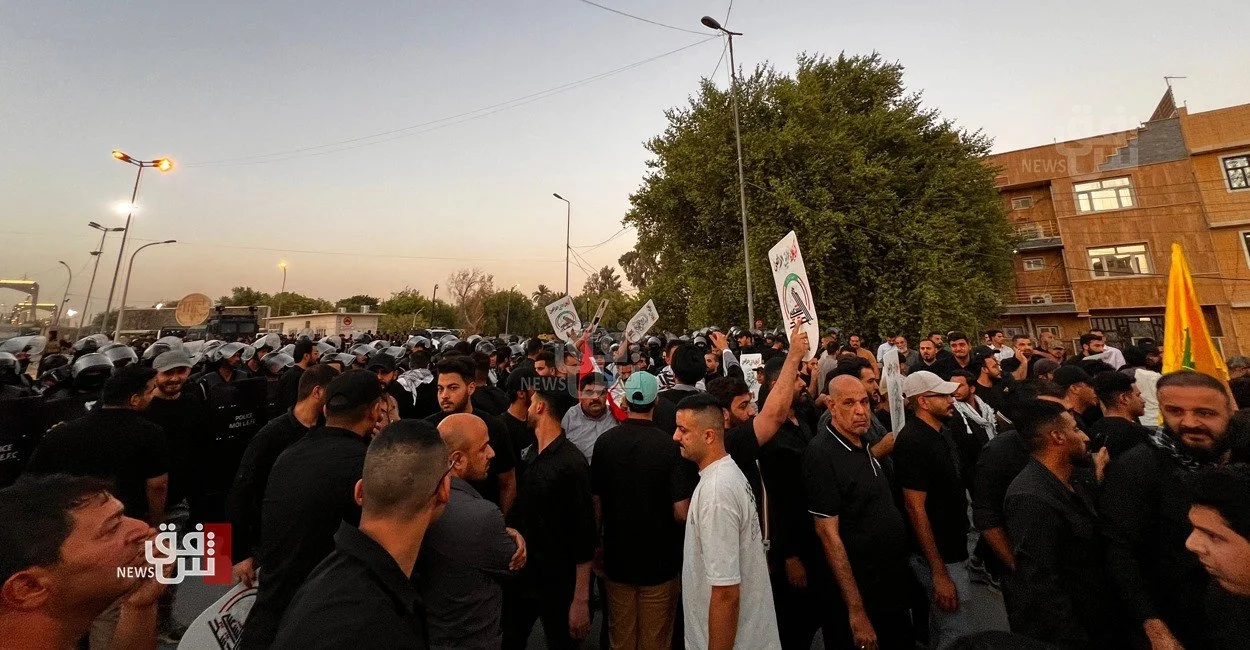
Tishwash: Supporters of Shiite factions attempt to storm the US embassy in Baghdad
Hundreds of supporters of the Shiite factions gathered, on Saturday, near the gate of the fortified Green Zone from the side of the suspension bridge.
Shafaq News Agency correspondent said that the demonstrators are trying to storm the Green Zone and enter the US embassy, expressing their anger over the assassination of Hezbollah Secretary-General Hassan Nasrallah.
A security source told Shafaq News Agency, "The security forces closed the roads leading to the suspension bridge amidst a heavy deployment of law enforcement forces." link
Tishwash: Why does the US still control every penny of Iraqi oil revenues?
Washington has maintained control over Iraq’s oil revenues since its illegal 2003 invasion – a financial and economic subjugation that undermines Iraqi sovereignty and denies it access to its own national treasure.
In July, the Iraqi Central Bank halted all foreign transactions in Chinese Yuan, succumbing to intense pressure from the US Federal Reserve to do so. The shutdown followed a brief period during which Baghdad had allowed merchants to trade in Yuan, an initiative intended to mitigate excessive US restrictions on Iraq’s access to US dollars.
While this Yuan-based trade excluded Iraq’s oil exports, which remained in US dollars, Washington viewed it as a threat to its financial dominance over the Persian Gulf state. But how has the US managed to exert such total control over Iraqi financial policies?
The answer lies in 2003, with mechanisms established following the illegal US-led invasion of Iraq.
A legacy of ‘Operation Iraqi Freedom’
Since the signing of Executive Order 13303 (EO13303) by President George W Bush on 22 May 2003, all revenues from Iraq’s oil sales have been funneled directly into an account at the Federal Reserve Bank of New York.
EO13303, titled “Protection of the Development Fund for Iraq and Other Property in Which Iraq Has an Interest,” has been renewed annually by every US president, including Joe Biden in 2024. This executive order essentially places control over Iraq’s oil revenues under the discretion of the US President, leaving Baghdad with limited control over its resources and earnings.
The roots of Iraq’s financial dependence on the US stretch back to the 1990s. Following Iraq’s invasion of Kuwait in 1990, UN Security Council Resolution 661 imposed severe economic sanctions to isolate Iraq from international trade. These sanctions, exacerbated by former president Saddam Hussein’s refusal to comply with withdrawal demands, crippled the Iraqi economy.
Control over Iraq’s finances
UNSC Resolution 687, passed in 1991 after the Persian Gulf War, extended these sanctions while introducing the controversial “Oil for Food” program. Although it allowed Iraq to sell oil in exchange for humanitarian goods like food and medicine, the sanctions resulted in immense human suffering, with over one million Iraqis, half of them children, dying during this period. Then-US secretary of state Madeleine Albright infamously defended the sanctions in a 1996 interview, stating that the deaths were “worth the price.”
Following the invasion of Iraq, the US occupation of the country became a reality after the collapse of Saddam’s government. Faced with a fait accompli, the UN Security Council had to accept the new status quo.
According to International Humanitarian Law, occupation forces – in this case, the US and UK – become responsible for the well-being of the populations they occupy. So, UNSC Resolution 1483 was issued on 22 May 2003 to establish the US-led Coalition Provisional Authority (CPA) as Iraq’s administrator and create the Development Fund for Iraq (DFI) to manage Iraqi oil revenues.
Note that Resolution 1483 did not mention the US Federal Reserve as the depositary of Iraqi funds, nor did it assign a location for the DFI headquarters or account. In fact, the resolution specifically states directed that the DFI should “be held by the Central Bank of Iraq.” It was the CPA, led by Paul Bremer, that decided unilaterally to house the account at the Federal Reserve Bank of New York.
This decision allowed the US government to maintain tight control over Iraq’s oil revenues. From that point until today, the Iraqi Ministry of Finance has had to submit requests for funds to the US Treasury, which then approves or denies these requests based on its own criteria.
This monthly transfer of US dollars – which are literally flown into Baghdad in pallets of hard cash – determines Iraq and its 40-million-population’s ability to pay for basic needs like salaries, food, and medicine.
Blackmailing Iraq
Whenever Washington feels that Iraq is not compliant with US regional goals, these fund transfers can be delayed or reduced. In January 2020, for instance, after the Iraqi Parliament voted to expel US troops following the assassination of Iranian Quds Force General Qasem Soleimani and Iraqi Popular Mobilization Units (PMU) Deputy Commander Abu Mahdi al-Muhandis, the Trump administration threatened to freeze Iraq’s access to its oil revenues.
Today, Iraq’s financial situation remains dire. Despite having oil revenues piling up in the Federal Reserve Bank of New York – estimated today at around $120 billion – Iraq is burdened with a growing debt that matches this amount.
The country’s inability to control its own funds has prevented long-term reconstruction and development, forcing it to rely on international loans. Ironically, Iraq has also become one of the largest holders of US Treasury bills, with investments totaling $41 billion in 2023.
In addition to its economic challenges, Iraq has been drawn into the escalating regional conflict amid the ongoing Gaza war and the intensification of Israel’s aggression against Lebanon. Iraqi resistance forces have actively participated in military strikes against Israeli targets in solidarity with both Palestinian factions and Hezbollah.
The involvement of Iraq in this conflict is not isolated. Iraqi factions have routinely targeted US military bases in Iraq and Syria – viewed as illegal foreign forces subjugating Iraq’s sovereignty – contributing to a broader escalation that has drawn in actors from across West Asia.
These troops have vowed to continue their campaign against both US and Israeli targets, aligning their actions with the region’s Axis of Resistance.
The UN shutters DFI, but the US refuses to comply
Iraq ceased to be under occupation, at least formally, when it signed the “Strategic Cooperation Framework” agreement with the US in 2008, which says that American forces are present in Iraq only at the request of the Iraqi government.
Attempts by the UN to restore Iraq’s control over its finances have largely failed. In 2010, UNSC Resolution 1956 demanded the closure of the DFI by no later than 30 June 2011 and the transfer of all proceeds to the Iraqi government.
Despite these clear legal directives, the DFI account remains under US control at the Federal Reserve Bank of New York in defiance of the UN Security Council resolution. Worse yet, enduring US dominance over Iraq’s financial resources has deeply exacerbated the corruption and dysfunction plaguing the country.
Ending the work of the UN International Advisory and Monitoring Board of the DFI was one way of obscuring the massive corruption and theft of resources by American and Iraqi actors.
The unprecedented corruption that was spread throughout Iraq and its institutions can be laid at the doorstep of this policy. The gargantuan amounts of hard cash that are flown into the country monthly, the unaccounted-for astronomical sums that disappear from various ministries, and the dollar exchange shops (banks) set up by political groups that thrived alongside the US occupation forces have turned Iraq into one of the most corrupt countries in the world.
Iraq’s dependence on the US for access to its own oil revenues, combined with its growing debt has significant impacts on its sovereignty, while its involvement in the regional war also will have implications on its relations with the US.
While Iraq may no longer be under formal occupation, the mechanisms of financial control established after the 2003 invasion persist. These controls not only limit Iraq’s economic development but also entangle it in broader geopolitical struggles.
Today, both the US Administration of Joe Biden and the Iraqi government led by Mohammad Shia al-Sudani – which has not taken steps to free Iraq’s sovereign funds – can be considered in violation of United Nations Resolution 1956 issued in 2010. link
************
Mot: When Asked - Always Tell the Truth

Mot:.... Tips on Raising the ""Wee Folks"" -- Good Luck – LOL

Exponential Debt Cycle is Past the Point of no Return
Steve St. Angelo: Exponential Debt Cycle is Past the Point of no Return
Palisades Gold Radio: 9-27-2024
Tom welcomes back Steve St. Angelo of the SRSrocco Report for a discussion on the record-high prices of gold and silver.
St. Angelo suggests these levels for silver could be a new floor as they've historically returned to production costs following price spikes. The average cost of primary silver production is around $26 an ounce, taking taxes and developmental costs into account.
St. Angelo stresses the importance of distinguishing investment demand from industrial demand when analyzing the silver market dynamics.
Steve St. Angelo: Exponential Debt Cycle is Past the Point of no Return
Palisades Gold Radio: 9-27-2024
Tom welcomes back Steve St. Angelo of the SRSrocco Report for a discussion on the record-high prices of gold and silver.
St. Angelo suggests these levels for silver could be a new floor as they've historically returned to production costs following price spikes. The average cost of primary silver production is around $26 an ounce, taking taxes and developmental costs into account.
St. Angelo stresses the importance of distinguishing investment demand from industrial demand when analyzing the silver market dynamics.
A decade ago, there was a significant silver surplus due to decreased industrial demand which has since reversed with increased investment demand. Industrial demand is expected to consume all available supply, making additional investment demand potentially price-volatile.
Steve explores the impact of energy scarcity and continued money printing on production costs, driving up gold and silver prices due to inflationary pressures.
They discuss the possibility of a market correction offering the last chance to buy silver at present rates.
Steve and Tom delve into the relationship between expanding money supply, debt, federal funds rate, and silver price. Looking towards the period leading up to 2025, a market correction is anticipated due to increasing unemployment and possible employment data revisions.
Economic weakness could lead to reduced interest rates and more money printing, instigating inflation and purchasing power reduction. However, Commitment of Traders reports may not accurately reflect demand.
The global silver mine supply and output have been declining since 2015, necessitating existing inventories to bridge the deficit. This imbalance could lead to a substantial correction when prices significantly surpass production costs.
Concerns about marginal silver supply include transparent and non-transparent inventories, solar industry demand, and copper prices as indicators of industrial demand and potential recession. Steve discusses the shift from LBMA to ETF silver inventories.
Pre-pandemic, there was significant physical buying leading to expanded ETF inventories. However, in 2022, overall LBMA inventories decreased due to Indian purchasing and ETF withdrawals. Finally, Steve discusses the merits of assets such as Bitcoin, gold, and silver.
While some view Bitcoin as a digital counterpart to gold, Steve contends that saving in Bitcoin is not the same as saving in precious metals. This is due to Bitcoin mining causing considerable share dilution and due to the energy costs.
Steve advocates understanding asset worth based on economic progress versus past activity, emphasizing energy's role in asset value, and preparing for future energy realities.
Talking Points From This Episode
- Silver's new floor could be around average production cost ($26/oz).
- Industrial demand vs investment demand crucial in analyzing silver market dynamics.
- Economic instability, the energy cliff, inflation, and supply concerns may lead to significant price volatility.
Time Stamp References:
0:00 – Introduction
1:22 - New Silver Price Floor
3:30 - Miners & All-In Costs
5:55 - Energy & Money Supply
8:44 - Types of Metal Demand
11:35 - Money Printing & Silver
15:13 - Purchasing Power & Rates
17:06 - Fed Cuts & Corrections
21:37 - Utility of COT Reports
23:52 - Mine Supply & Output
28:44 - Silver & Manufacturing
31:54 - Grid Stability & Solar
34:40 - LBMA Silver Trends
37:06 - Miner Production & Shares
40:35 - Dedollarization & Gold
47:50 - Dr. Copper & Economy
51:34 - Energy & Volatile Mkts.
54:13 - Energy, GDP, & Debt
55:20 - Federal Deficits Chart
57:10 - Trends & Collapse
1:00:48 - U.S. Spending & Budget
1:02:50 - Bitcoin & Precious Metals
1:06:10 - Energy Store of Value
1:09:25 - Wrap Up
News, Rumors and Opinions Saturday PM 9-28-2024
KTFA:
Clare: The Central Bank of Iraq decides to close the Babylon Bank 9/25/2024
Baghdad The Central Bank of Iraq decided to close the Babylon Bank. According to a document issued by the Central Bank of Iraq, addressed to the Babylon Bank, and received by "Al-Eqtisad News", it decided to "refer the bank to forced liquidation based on the provisions of Article No. 69 of Banking Law No. 94 of 2004.
He added: "Appointing Ahmed Abdul Mahdi Nehme as liquidator of your bank." Below is the document LINK
KTFA:
Clare: The Central Bank of Iraq decides to close the Babylon Bank 9/25/2024
Baghdad The Central Bank of Iraq decided to close the Babylon Bank. According to a document issued by the Central Bank of Iraq, addressed to the Babylon Bank, and received by "Al-Eqtisad News", it decided to "refer the bank to forced liquidation based on the provisions of Article No. 69 of Banking Law No. 94 of 2004.
He added: "Appointing Ahmed Abdul Mahdi Nehme as liquidator of your bank." Below is the document LINK
************
Clare: KDP links Kirkuk census to implementation of Article 140 to “return displaced Kurds”
9/28/2024
The head of the Kurdistan Democratic Party bloc in Kirkuk Provincial Council, Hassan Majeed, confirmed on Saturday the implementation of Article 140 of the Iraqi Constitution according to its legal paragraphs, which will contribute to solving many of the pending problems before conducting the population census in the province, noting that the bloc's attendance at the provincial council meetings is linked to a decision by the Federal Court.
Majeed told Shafaq News Agency, "Article 140 of the Iraqi Constitution is an article that was included in the constitution to find solutions for the disputed areas according to stages, which are compensation, normalization, and census, as there are hundreds of deportees to this day who have not received their financial compensation, and this means that there are matters that have not been fully implemented in Kirkuk and the rest of the areas in which demographic changes took place by the Baath government."
He stressed that "Kirkuk has matters that must be taken into consideration by the federal government, as the Kurds were displaced from it by previous governments and more than 4,500 Kurdish villages were destroyed in Kirkuk, its outskirts and the rest of the regions. This means that there are residents who left Kirkuk, and they must be returned to Kirkuk to become part of it, as they are its original inhabitants, for the purpose of including them in the census."
He added, "The population census is important for any country, including Iraq, because it provides a comprehensive information base for youth, women and children according to their ages, and determines poverty rates and the regions' need for services and projects. Through it, we know the numbers of residents, buildings and other matters, and this matter is important for everyone."
Regarding attending Kirkuk Provincial Council sessions, Majeed said, “The issue of our attendance at Kirkuk Provincial Council sessions is linked to a decision by the Federal Court, which is the final arbiter of the decision. There is a team representing the participants in the Kirkuk administration who say that the formation and contracting of the local government was legal, and there is a team in contrast who say that it is illegal, and the court’s decision is what will decide this matter.”
He stressed that "the members of the Democratic Bloc in the provincial council are committed to attending their work in the council and participating in receiving its clients, but they do not participate in the council sessions until the issue is resolved by the Federal Court."
The head of the third branch of the Kurdistan Democratic Party in Kirkuk, Mohammed Kamal, had demanded last Monday to postpone the population census in the province until Article 140 of the Iraqi Constitution is implemented.
Kamal said in a press conference attended by Shafaq News Agency, "Preparations for conducting the population census are necessary, but the situation in Kirkuk is different and the governorate is not prepared to conduct it. There are displaced people from Kirkuk in the cities of the Kurdistan Region, and in 1988 the Baathist regime demolished 4,500 Kurdish villages and deported their residents to the governorates of the Kurdistan Region."
Iraq conducted its last population census in 1987, in which all governorates participated, followed by the 1997 census, which was conducted without the participation of the governorates of the Kurdistan Region.
Over the past years, the country has relied on approximate statistical figures issued by unofficial institutions and research centers concerned with this matter, before the Ministry of Planning issued estimates in 2022 that the population of Iraq had reached more than 42 million people.
The census has been delayed over fears of politicization, and has been opposed by ethnic groups in disputed areas such as the Kurdish, Arab and Turkmen-populated city of Kirkuk, which is home to major oil fields, because it could reveal demographics that could undermine their political ambitions. LINK
************
Courtesy of Dinar Guru: https://www.dinarguru.com/
Frank26 [Iraq boots-on-the-ground report] FIREFLY:
We have heard for the last five days all on the news about the deletion of the three zeros. That's all they talk to us about... FRANK: You say you've been hearing about lifting the three zeros in the last five days? In all honesty you have been hearing this for the last five months. It's just that it's very concentrated on a daily basis now...
Mnt Goat ...my CBI contact told us the committee was planning to begin the roll out of the currency swap out in November... You will not see the US Treasury leave the CBI until this is done and the Project to Delete the Zeros (swap out) is completed.
************
FINAL Warning: 3 Market Bubbles Nearing Collapse!
Jay Martin: 9-28-2024
In this episode, Jay is joined by Michael Pento. Michael discusses the three major bubbles in the American economy: real estate, equities, and private credit.
He explains how these bubbles are interconnected, meaning that if one sector collapses, it could trigger a domino effect across the others.
He touches on the challenges that policymakers face in preventing a collapse due to the systemic risks and the broader impact on the economy.
The conversation also covers inflation, deflation risks, and the long-term implications for commodities like gold.
Throughout, Pento emphasizes the difficulty in predicting the exact timing of a market correction but warns of significant financial instability ahead.
0:00 - Intro
1:03 - The Three Economic Bubbles Threatening the U.S.
9:04 - The Looming Cross-Contamination in Real Estate and Equities
12:39 - Recession, Depression, or Collapse: What Comes Next?
22:12 - Preventing a 2008-Style Market Meltdown
23:40 - The New Era of Monetary Expansion
32:43 - Commodities in a Crash: A Lifeboat Strategy
37:16 - How the Smart Money Stays Ahead of Crises
42:34 - Are We Voting for Inflation?
46:08 - Navigating Geopolitical Events in Investment Strategies
Seeds of Wisdom RV and Economic Updates Saturday Afternoon 9-28-24
Good Afternoon Dinar Recaps,
RIPPLE ADVANCES STABLECOIN INITIATIVE, ISSUES ANOTHER 350K RLUSD
Ripple mints 350,000 RLUSD to enhance testing on XRP Ledger and Ethereum, aiming for regulatory approval and improved ecosystem integration.
▪️Ripple mints 350,000 RLUSD stablecoins in 24 hours on XRPL and Ethereum.
▪️RLUSD stablecoin undergoes private beta testing for security and efficiency.
▪️XRP Ledger enhancements improve RLUSD's security and efficiency in beta testing.
Good Afternoon Dinar Recaps,
RIPPLE ADVANCES STABLECOIN INITIATIVE, ISSUES ANOTHER 350K RLUSD
Ripple mints 350,000 RLUSD to enhance testing on XRP Ledger and Ethereum, aiming for regulatory approval and improved ecosystem integration.
▪️Ripple mints 350,000 RLUSD stablecoins in 24 hours on XRPL and Ethereum.
▪️RLUSD stablecoin undergoes private beta testing for security and efficiency.
▪️XRP Ledger enhancements improve RLUSD's security and efficiency in beta testing.
Ripple has expanded its stablecoin operations by minting an additional 350,000 units of its RLUSD stablecoin within a span of 24 hours. This activity was carried out in two separate transactions, one consisting of 300,000 RLUSD and the other 50,000 RLUSD. The process was monitored by the Ripple stablecoin tracker, a community-driven XRP Ledger account that tracks the issuance and redemption of these stablecoins.
Ripple Sets Pace with Massive 350K RLUSD Stablecoin Mint
According to the Ripple stablecoin tracker, the recent minting marks a significant step in the testing phase for RLUSD. The issuance occurred through two separate transactions, one for 300,000 RLUSD and another for 50,000 RLUSD. This testing phase is crucial for ensuring the RLUSD meets the highest standards of security, efficiency, and reliability before its full-scale launch.
The minting demonstrates Ripple’s commitment to advancing its stablecoin offerings and enhances the liquidity and functionality of the RLUSD. Most recently, the XRP company reported issuing a record 485 RLUSD stablecoins, its largest single batch yet.
The private beta testing of the RLUSD aims to streamline the integration process across different blockchain platforms. This phase is vital for gaining regulatory approvals and for ensuring that the RLUSD can operate across various blockchain environments.
XRPL Upgrades Enhance Stablecoin Efficacy
The recent enhancements in the XRP Ledger are also pivotal to the optimal functioning of the RLUSD. Two major amendments, fixEmptyDID and fixPreviousTxnID, were activated on the XRPL mainnet, improving the ledger’s efficiency.
These updates will boost the stability and reliability of Ripple’s stablecoin operations. Concurrently, these will impact RLUSD’s performance and its integration within the broader ecosystem.
These technical upgrades facilitate a more robust framework for Ripple’s stablecoin initiatives. This will make the infrastructure supporting RLUSD align with the latest blockchain innovations.
In addition, the legal environment surrounding digital currencies remains a significant aspect of Ripple’s operational strategy. Recent developments in the Ripple vs. SEC case have brought to light the challenges faced by blockchain enterprises.
Insights from legal experts suggest that the SEC’s potential appeal against a favorable ruling for Ripple in the XRP lawsuit may have limited success.
XRP price reacted positively to the recent mint of RLUSD, surging to $0.622. The increase reflects a 5.44% gain over the last 24 hours, accompanied by a 60% rise in trading volume. However, recent CoinGape analysis have hinted at a potential 25% crash on on XRP price if SEC appeals before the October 7 deadline.
@ Newshounds News™
Source: CoinGape
~~~~~~~~~
NEW HOME SALES DECLINE IN AUGUST, YET YEAR-OVER-YEAR GROWTH REMAINS STRONG
▪️U.S. new home sales hit 716,000 in August 2024, exceeding the forecast of 699,000 but marking a 4.7% drop from July's figures.
▪️Year-over-year, new home sales jumped 9.8% compared to August 2023, signaling sustained housing market strength.
▪️August inventory climbed to 467,000 units, representing a 7.8-month supply, hinting at potential downward pressure on prices.
▪️Despite year-over-year gains, rising inventory and slower sales indicate a slightly bearish short-term housing outlook.
New Home Sales Fall in August, But Year-Over-Year Growth Persists
New residential home sales in the U.S. declined in August 2024, coming in below both the previous month’s figures and market expectations. However, despite this monthly dip, year-over-year data reveals a significant rise in activity.
Sales of New Homes Exceed Expectations in August
New single-family home sales in August 2024 came in at a seasonally adjusted annual rate of 716,000 units. This is a 4.7% decrease from the revised July figure of 751,000.
However, it exceeded economists’ forecast of 699,000 units, suggesting demand remains robust despite the monthly drop. Additionally, August 2024 sales showed a significant 9.8% increase compared to August 2023’s 652,000 units, highlighting continued year-over-year growth.
Home Prices Show Mixed Trends
The data also revealed mixed signals in home prices. The median sales price for new homes in August was $420,600. While this figure suggests the majority of home sales were occurring at relatively high price points, the average sales price jumped significantly higher, reaching $492,700. The gap between median and average prices highlights that a portion of the market consists of high-end sales, skewing the average price upward.
Inventory and Supply
At the end of August 2024, there were approximately 467,000 new homes on the market, representing a 7.8-month supply at the current sales pace. This indicates a relatively balanced market in terms of supply and demand, as a six-month supply is generally considered healthy. However, with sales slowing from the prior month, it suggests a potential buildup of inventory that could pressure future pricing if demand doesn’t rebound.
Market Forecast: Slightly Bearish Outlook
Given the month-over-month decline and higher-than-expected inventory levels, the outlook for the new home sales market leans bearish in the short term. The 4.7% drop from July, coupled with the rising inventory, suggests some cooling off in demand, which could impact pricing and sales volume in the coming months. However, the solid year-over-year growth hints that the market’s longer-term trend remains positive.
@ Newshounds News™
Source: FX Empire
~~~~~~~~~
$1,100,000,000,000 POURS INTO US BANKS AMID HIGH INTEREST RATES AS JPMORGAN CHASE, BANK OF AMERICA PAY PITTANCE TO DEPOSITORS: REPORT
US banks have reportedly raked in more than $1 trillion after two and a half years of the Fed’s “higher for longer” interest rate policy.
Data from the Federal Deposit Insurance Corporation (FDIC) shows the high interest rate regime allowed thousands of US banks to reap higher yields on their deposits at the Fed, reports the Financial Times.
And although a number of analysts and market observers thought the banks would pass on a significant portion of the higher interest rates to their customers, that didn’t happen.
In the second quarter of 2024 when the Fed was paying banks 5.5% in interest on deposits, savers were getting an average annual rate of 2.2%, according to regulatory data that includes accounts that do not pay any interest.
At JPMorgan Chase, savers received an annual interest rate of just 1.5% while Bank of America depositors collected 1.7% in interest per year.
With low interest for depositors, banks gained $1.1 trillion in additional revenue, about 66.67% of what the Fed paid in interest during the last two and a half years. Meanwhile, savers received only $600 billion.
When the Fed lowered interest rates this month, some banking giants were quick to further reduce the interest paid to wealthy depositors, with JPMorgan and Citi announcing 50 bps cuts in line with the Fed’s own actions.
@ Newshounds News™
Source: DailyHodl
~~~~~~~~~
ETHENA ANNOUNCES USTB STABLECOIN BACKED BY BLACKROCK'S BUIDL
Reserves for UStb will be invested in BUIDL, which in turn holds U.S. dollars, U.S. Treasury bills, and repurchase agreements.
▪️Ethena has announced a new stablecoin that invests its reserves in Blackrock's real-world asset fund called BUIDL.
▪️The team said UStb can support its synthetic stablecoin USDe during tough market conditions by allowing Ethena’s governance to close USDe hedging positions and reallocate assets to UStb.
Ethena announced today that it's developing a new stablecoin called UStb, which invests its reserves in BlackRock’s USD Institutional Digital Liquidity Fund (BUIDL).
Its the second stablecoin from Ethena, as earlier this year it launched USDe, a synthetic stablecoin that derives its value from the cash-and-carry trade, an arbitrage strategy between an asset and its derivative to maintain its $1 peg.
In a blog post, the team explained that UStb will be a "wholly independent product" with a different risk profile compared to USDe.
The team also wrote that UStb helps USDe manage risk during tough markets by allowing Ethena's governance to reallocate backing assets to UStb when needed.
USDe has brought about some concern from industry stakeholders who say that while the trade is safe, volatility in the markets – which crypto is known for – can quickly cause it to unwind.
In a thread on X, the team addressed some of these concerns, pointing out that while USDe has remained stable despite recent bearish conditions, it can dynamically adjust its backing between basis positions and liquid stable products and may incorporate UStb during periods of weak funding rates if needed.
Ethena said in the post that UStb will be listed on centralized exchanges like Bybit, Bitget, and any future exchanges that Ethena partners with, where USDe is already used as margin collateral.
More details on UStb will be available in the coming weeks, Ethena said.
@ Newshounds News™
Source: CoinDesk
~~~~~~~~~
🌍 JIM SAID WHAT? ROCKS IN HEAD OR FACTS? | Youtube
Jim discusses historical information on our Constitution and rights and how we got to where we are today. Must hear this information.
@ Newshounds News™
Source: Seeds of Wisdom Team RV Currency Facts
~~~~~~~~~
Seeds of Wisdom Team RV Currency Facts Youtube and Rumble
Newshound's Podcast Link
Newshound's News Telegram Room Link
Q & A Classroom Link
Follow the Roadmap
Follow the Timeline
Seeds of Wisdom Team™ Website
Subscribe to Newsletter
Thank you Dinar Recaps
Economist’s “News and Views” Saturday 9-28-2024
Commodity Culture: BRICS Gold-Backed Currency to be Serious Rival to the Dollar within 2 Years
Friday, 27 September 2024, 22:04 PM
In an enlightening discussion with Commodity Culture, Simon Hunt painted a vivid picture of a world on the brink of significant geopolitical upheaval. As he delves into the complexities of modern power dynamics, he posits that the BRICS nations — Brazil, Russia, India, China, and South Africa — are poised to turn the tables on what has long been considered Western hegemony.
This change, he suggests, won’t just be economic; it will be accompanied by kinetic conflicts in the Middle East and Europe, presenting a multifaceted challenge to the existing world order.
Commodity Culture: BRICS Gold-Backed Currency to be Serious Rival to the Dollar within 2 Years
Friday, 27 September 2024, 22:04 PM
In an enlightening discussion with Commodity Culture, Simon Hunt painted a vivid picture of a world on the brink of significant geopolitical upheaval. As he delves into the complexities of modern power dynamics, he posits that the BRICS nations — Brazil, Russia, India, China, and South Africa — are poised to turn the tables on what has long been considered Western hegemony.
This change, he suggests, won’t just be economic; it will be accompanied by kinetic conflicts in the Middle East and Europe, presenting a multifaceted challenge to the existing world order.
As the dollar faces threats from rival currencies and growing inflationary pressures mount, investors may increasingly turn to gold not merely as an investment but as a protection against potential currency collapse. The perception of gold as a timeless store of value may experience a renaissance, prompting individuals and nations alike to stockpile the precious metal to buffer against future uncertainties.
Simon Hunt’s discussion with Commodity Culture serves as a clarion call to recognize the dynamic changes underway in global politics and economics. With the rise of BRICS, potential currency wars, and the specter of World War 3, we must prepare for a radically different world.
Investors, policymakers, and everyday individuals need to stay informed about these developments, understand the implications of shifting power dynamics, and take proactive steps to protect their economic interests.
As we look to the future, commodities, particularly gold, will likely form the bedrock of a resilient strategy to navigate the choppy waters ahead. It’s an urgent reminder: in a world marked by conflict and uncertainty, preparedness is the key to survival.
A 1930s Economic Crisis is Here: “I’m Going to Be Screaming to Buy Gold”
Daniela Cambone: 9-27-2024
Join Daniela Cambone for an electrifying episode of The Daniela Cambone Show! Today’s guest, Joel Litman of Altimetry, warns us of a potential return to economic conditions similar to the 1930s and 1970s.
With five key policies being discussed in Washington—including raised taxes, capital gains hikes, and price controls—we could be on the brink of significant market shifts.
Joel shares why, for the first time in his career, he believes gold could outperform the S&P 500, and he explains the critical factors investors should be watching now.
Could these economic headwinds signal a gold rush? Or will the stock market prevail?
Tune in as Joel dives into how government policies, potential tax changes, and economic history could impact your investments.
CHAPTERS:
00:00 5 things in economy to watch out
3:50 Harris and Biden’s economic plans
5:52 Gold performance
6:46 Stock market
8:30 Fed rate cuts
10:01 Debt crisis
11:42 Trump’s tariff protection policy
18:42 Joel’s conference
US Economy on Brink of Collapse: Japan ditch US Dollar!
Fastepo: 9-27-2024
Foreign governments heavily invest in U.S. Treasury securities, facing significant risks. Rising U.S. interest rates can decrease the market value of Treasuries, leading to potential losses during sudden rate hikes often triggered by inflation.
Additionally, a weakening U.S. dollar diminishes the value of these investments when converted to other currencies, presenting a risk particularly for nations with volatile or strengthening currencies.
Threats of inflation can also reduce the real returns on U.S. Treasuries if the inflation rate exceeds the yields, which erodes the purchasing power of foreign reserves.
Political and geopolitical tensions, such as U.S. debt ceiling debates, may disrupt market confidence and financial market access, increasing investment risk.
Furthermore, liquidity risks during financial crises can force large holders to sell at lower prices, negatively impacting market values. Countries with substantial holdings, like China and Japan, face concentration risks that could result in significant losses if the U.S. financial system struggles or if the dollar sharply declines, complicating their market exit strategies.
As of September 2024, Japan is the top international investor in U.S. government bonds, despite experiencing noticeable fluctuations in its investment levels over the year. In March 2024, Japan held U.S. Treasuries worth approximately $1.87 trillion.
However, by May, this figure had reduced to about $1.128 trillion following cumulative sales of $59.5 billion, including a significant reduction of $22 billion in May after a $37.5 billion decrease in April.
“Tidbits From TNT” Saturday 9-28-2024
TNT:
Tishwash: Setting a date to launch 102 investment opportunities in Iraq
Today, Friday, the Chairman of the National Investment Commission, Haider Makiya, set the date for launching 102 investment opportunities in various sectors.
Makiya said, "The Investment Commission is preparing, during the Iraqi Investment Forum conference that will be held on the second of next October, to launch 102 investment opportunities that have completed sectoral approvals," noting that "these projects that will be announced will include various sectors, and will benefit the citizen and the state."
TNT:
Tishwash: Setting a date to launch 102 investment opportunities in Iraq
Today, Friday, the Chairman of the National Investment Commission, Haider Makiya, set the date for launching 102 investment opportunities in various sectors.
Makiya said, "The Investment Commission is preparing, during the Iraqi Investment Forum conference that will be held on the second of next October, to launch 102 investment opportunities that have completed sectoral approvals," noting that "these projects that will be announced will include various sectors, and will benefit the citizen and the state."
He pointed out that "these projects were the result of numerous discussions within the operations room within the authority, with the membership of the Iraqi Economic Council, as well as the Prime Minister's Office, and a map was drawn up for the projects that are expected to be implemented by the beginning of November."
Regarding environmental sustainability projects, Makiya confirmed that “the Authority is working with Iraqi banks to set goals, plans and applications for banks to finance climate and environmental change projects,” indicating that “the Authority has projects and a round of discussions with the International Finance Organization that will be announced soon.” link
************
Tishwash: Foreign Minister invites his Venezuelan counterpart to visit Baghdad
Deputy Prime Minister and Minister of Foreign Affairs Fuad Hussein extended an official invitation to Venezuelan Foreign Minister Ivan Gil Pinto to visit Baghdad.
The Ministry of Foreign Affairs stated in a statement received by Al-Maalouma Agency, that “the Minister of Foreign Affairs met with his Venezuelan counterpart, on the sidelines of the 79th session of the United Nations General Assembly in New York, and discussed with him relations between Iraq and Venezuela and the importance of strengthening them after 75 years of its establishment.
The common denominators in the fields of oil production and gas reserves were also discussed, stressing the need for continuous coordination in these important areas.”
International issues of common interest were also discussed, most notably the Palestinian issue. Fuad Hussein thanked Venezuela for its honorable and supportive stances towards the Palestinian cause.
Within the framework of strengthening bilateral relations, the available opportunities for developing cooperation in the fields of agriculture and oil expertise were discussed.
The two ministers focused on the importance of exchanging expertise in exploiting associated gas and enhancing cooperation in this field.
It was emphasized to follow up on the work of the joint committee between the two countries, activate the signed memoranda of understanding, and move forward in completing the procedures for signing the memoranda that are still under completion.
At the end of the meeting, Fuad Hussein extended an invitation to his Venezuelan counterpart to visit Baghdad, to strengthen bilateral relations between the two countries. link
***********
Tishwash: Kurdistan Finance announces the results of its delegation's recent visit to Baghdad
The Ministry of Finance in the Kurdistan Regional Government announced the results of its delegation's visit to the capital, Baghdad, regarding the issue of financing the salaries of employees in the region.
A statement by the ministry said, "During the past few days, a delegation from the Ministry of Finance in the Kurdistan Regional Government visited the capital, Baghdad, and met with the federal Ministry of Finance on the issue of financing employees' salaries," noting that "the two sides reached a number of understandings."
The statement pointed out that "the Kurdistan Ministry of Finance has submitted the list of employees' salaries for the months of August and September, as requested by the Federal Ministry of Finance last time."
He added, "In order to cover the deficit in August salaries, which is estimated at 243 billion dinars, the Federal Ministry of Finance decided to disburse the suspended payments from February to August, and it is scheduled to begin distributing salaries at the beginning of next week with the arrival of supplementary funding from Baghdad." link
************
Tishwsh: Al-Asadi: We call on citizens to invest in the retirement and social security law
During his visit to Najaf Governorate today, Saturday, September 24, 2024, the Minister of Labor and Social Affairs, Mr. Ahmed Al-Asadi, called on citizens to invest in the Retirement and Social Security Law and expedite registration for optional insurance.
Al-Asadi announced the completion of the procedures for issuing smart cards to more than 17,074 new families during the opening of schools designated for people with special needs.
During the visit, he explained a number of measures regarding what the ministry has accomplished:
* Issuing smart cards to 13,498 people with disabilities and special needs.
* Completion of the smart card for children with diabetes, amounting to 3496.
* Completion of the smart card for 80 orphans, and they will receive the cash assistance next Tuesday, corresponding to 10-1-2024.
* The number of those included in Najaf Governorate reached more than 110,594 families.
* 2,433 new families from Najaf Governorate were included, and smart cards were issued to more than 1,226 families in Najaf, and they will receive the aid next Tuesday.
* We have completed the transfer of more than 12,000 social protection beneficiaries to the Ministry of Interior, including 998 beneficiaries from Najaf Governorate.
* Today we opened Elia Elementary School for Special Education in Najaf Governorate.
* Today we opened the main reception hall for beneficiaries in the Women's Social Protection Department.
* Today we opened the safe environment hall for raising children in the Women's Social Protection Department.
* We opened electronic inquiries and a central computer room for the Social Protection Department for Men.
* We announce that all individuals at Elia School are included in the social protection allowance and the full-time assistant.
* We have directed to take rapid measures to facilitate the granting of loans.
* We directed the Disability Rights Commission to open more than one new medical committee in the governorate.
* We directed to focus on opening new sub-committees for social protection in the governorate. link
************
Mot: ... Issues I Can Get Behind

Mot: Have a wonderful day everyone.
