
Why You Should Financially Imagineer Your Life
Why You Should Financially Imagineer Your Life
19. October 2017 Financial Imaginer
Back in Kindergarten my father once asked me: “Son, what would you like to do once you’re a grown up?” – of course I was dreaming all sort of things, most prominently wanting to become a bus driver, a pilot or an astronaut. These more ordinary dreams for boys of that age came to an abrupt halt only shortly afterwards as I unveiled the ultimate profession: Inventor.
Imagineering = a combination between “Imagination” and “Engineering”
Imagination: The creative ability to form images, ideas and sensations in the mind without any immediate input of the senses. Imagination helps make knowledge applicable in solving problems and is fundamental to integrating experience and the learning process.
Why You Should Financially Imagineer Your Life
19. October 2017 Financial Imaginer
Back in Kindergarten my father once asked me: “Son, what would you like to do once you’re a grown up?” – of course I was dreaming all sort of things, most prominently wanting to become a bus driver, a pilot or an astronaut. These more ordinary dreams for boys of that age came to an abrupt halt only shortly afterwards as I unveiled the ultimate profession: Inventor.
Imagineering = a combination between “Imagination” and “Engineering”
Imagination: The creative ability to form images, ideas and sensations in the mind without any immediate input of the senses. Imagination helps make knowledge applicable in solving problems and is fundamental to integrating experience and the learning process.
Engineering: The application of mathematics, science, economics as well as social and practical knowledge to invent, innovate, design, build, maintain, research and improve structures, machines, tools, systems, components, materials, processes, solutions and organizations. The term engineering is derived from the Latin word ingenium, meaning “cleverness” and ingeniare meaning “to contrive, devise”.
Back in the days – and still today – my fascination for Disney comics was tremendous. Immersing myself in these fantastic stories and associating myself with the lives of all these marvellous characters was such an enriching experience. Eventually I picked a favorite. You might now think, since I’m writing about personal finance my hero and role-model would be Scrooge McDuck. Well: wrong! The ever-lucky fellow Gustav Goose? Wrong again!
My absolute role-model was Gyro Gearloose! The inventor!!!
Scrooge McDuck: “What did you do??”
Gyro Gearloose: “Well, you did say to make it as real as it can be, so I did!”
He literally blew my mind. Whatever he imagined, he found a way to make it happen: his outrageous creativity and productivity was pure genius. Once, he ran out of ideas and solved the problem by inventing a thinking-cap which empowered him to have more and better ideas! If he didn’t have his cap with him, he stroke himself on the head with a big hammer! His job was to make fantasy a reality despite all odds.
Gyro Gearloose’s main ambition was not so much to get rich and famous but rather helping the people of Duckburg to improve their lives. He is also known as being good-natured towards others. In one of his stories he actually persuaded Duckburg citizens to rebuild their whole city into a futuristic utopia which somehow worked out too well: Donald Duck only worked 1 hour a day and spent 23 hours sleeping which left him more bad-tempered than normal.
At the other end, Uncle Scrooge McDuck suddenly controlled an army of robots which collected way too much money for him – filling up his money bin to the point where good old McDuck couldn’t even jump and dive into his coins anymore as it was too full.
Only when Gyro’s robot invented another robot to replace Gyro himself as an inventor he decided Duckburg must be turned back to its old self. Wow! Elements of early retirement and artificial intelligence in a 1980’s comic book!
That was it: Duckburg’s [most famous] inventor became my role-model. I wanted to become nothing less than an inventor myself! Helping the world become a better place with new ideas. A few years later, my aspiration to pursue a career as inventor became even stronger after having been exposed to the crazy scientist Dr. Emmett “Doc” Brown who managed to convert a fancy De-Lorean into a time machine. Marty McFly travelled back and forth in time and changed lives of others as well as his own to the better and worse!
That movie opened my eyes to how much you can affect your own future [with or without time machine]. Your future self will be the compound result of many small steps and decisions in life. If you take controlled, well directed steps towards an ambitious goal, you can get anywhere and change your faith. Little did I know about the miraculous power of compound interest back then, but this was about to change soon.
To continue reading, please go to the original article here:
https://www.financial-imagineer.com/why-you-should-financially-imagineer-your-life/
6 Tips To Protect Your Financial Future
Planning To Remarry After A Divorce? 6 Tips To Protect Your Financial Future
Sharon Klein Fri, February 10, 2023
Make relationships easier to navigate and better protect your financial future.
As the calendar turned to 2023, many of us took a moment to think about resolutions. I want to lose 10 pounds. I want to read things that aren’t just about work. I want to learn how to play pickleball.
Or maybe this year I’ll give a relationship another shot. Maybe I’ll even remarry. Many of us think about this idea with an understandable degree of trepidation. Your last relationship ended badly. Maybe you got divorced. But this year, as you look ahead with renewed optimism, there are six steps that you can take that might make relationships easier to navigate, leave you better protected for your financial future, and make you happier.
Planning To Remarry After A Divorce? 6 Tips To Protect Your Financial Future
Sharon Klein Fri, February 10, 2023
Make relationships easier to navigate and better protect your financial future.
As the calendar turned to 2023, many of us took a moment to think about resolutions. I want to lose 10 pounds. I want to read things that aren’t just about work. I want to learn how to play pickleball.
Or maybe this year I’ll give a relationship another shot. Maybe I’ll even remarry. Many of us think about this idea with an understandable degree of trepidation. Your last relationship ended badly. Maybe you got divorced. But this year, as you look ahead with renewed optimism, there are six steps that you can take that might make relationships easier to navigate, leave you better protected for your financial future, and make you happier.
Now, admittedly, not all these ideas create conversations that are the easiest to initiate. Some carry with them some difficult presuppositions. Because of this, you may want to get some outside help. Hiring a skilled adviser can make all of this go down a little easier.
1) Get that prenup
Oh, start with the toughest one. No one wants to think about divorce when planning their wedding. But a better way to think of a prenuptial is that it’s not about the end, it’s about the start. A prenuptial agreement actually allows marriage to start on a stronger footing based on mutual understanding and honesty.
A prenuptial agreement lets a couple enter marriage with full financial clarity, spells out financial expectations during a marriage, and specifies clearly what will occur in the event of…well, you know the “D-word.” A prenuptial agreement can be particularly important in situations when each partner brings their own significant assets to a new union.
2) Trust…but verify
Planning is key to ensure your assets pass as you wish. A revocable living trust, which is set up during your lifetime and can be changed (or “revoked”) at any time, can be used as your main dispositive document instead of a will. Unlike a will, the provisions of a revocable trust kick in not just in the event of death, but also in the event of incapacity (think Alzheimer’s disease, a major stroke, or some other such disabling condition).
To continue reading, please go to the original article here:
6 Life-Winning-Lessons From a “Who Wants to Be A Millionaire” Contestant
Who Wouldn’t Want to Be a Millionaire: 6 Life-Winning-Lessons From a “Who Wants to Be A Millionaire” Contestant
By Financial Imaginer
What would you do if you received a $ 1 million jackpot? How does it actually feel to receive a windfall? What to do with it and how could it impact your life in the short, medium and long run?
Let’s first think about what you could possibly do with a large financial windfall?
Who Wouldn’t Want to Be a Millionaire: 6 Life-Winning-Lessons From a “Who Wants to Be A Millionaire” Contestant
By Financial Imaginer
What would you do if you received a $ 1 million jackpot? How does it actually feel to receive a windfall? What to do with it and how could it impact your life in the short, medium and long run?
Let’s first think about what you could possibly do with a large financial windfall?
– splurge (Sir? The Lamborghini in same gold as the Maybach?)
– take a sabbatical and travel to exotic locations, sipping martinis all day long
– travel to Vegas (all or nothing)
– re-invest in lottery tickets
– buy a house and/or pay-off your mortgage
– invest all into Vanguard ETFs and draw an annual $40,000 forever (Trinity study, 4% withdrawal rate)
– keep calm and carry on
Here’s what a Financial Imagineer would do with a $ 1 million windfall:
Keep calm and carry on!
Keep calm and carry on!
You find this hard to believe?
Looking through all the above options, this clearly appears to be the most boring choice. But hey, I’ve got a rather personal story for you guys today. Let me explain.
Once upon a time, I won a windfall myself.
I wanted to be a Millionaire.
We write the year 2001, my most crazy side-hustling days: During daytime, I was usually studying business administration and economics. Frequently, after sundown, you’d find me baking up to 200 pizzas each night at the first pizza home delivery franchise in my hometown. Saturdays, you’d find me advising clients at a bank counter and Sundays I’d be running the local polling station in our village.
Some wondered if I’d ever catch some sleep.
One evening, I was sitting on our couch watching the Swiss edition of “Who wants to be a Millionaire” on TV3. Somehow, none of the contestants ever seemed to make it past the first 10 questions. It got boring and frustrating. It quickly became painful for me to keep watching. I knew and appreciated the show from abroad and generally liked it because you usually learnt something while watching – infotainment. The entertainment value of the local version was rock-bottom. This tickled a nerve.
Instead of applying the ordinary way, I sent a feedback letter asking them to invite more suitable candidates in order to improve the infotainment value of their show. Little did I know that my written rant would be read and acted upon. Before I knew it, we – my then girlfriend and myself – got invited to participate as contestants at the TV show “Who Wants to Be a Millionaire”.
Turn sound on, click “play” and listen as you read on! https://www.youtube.com/watch?v=OYVAxLJE1ww
To continue reading, please go to the original article here:
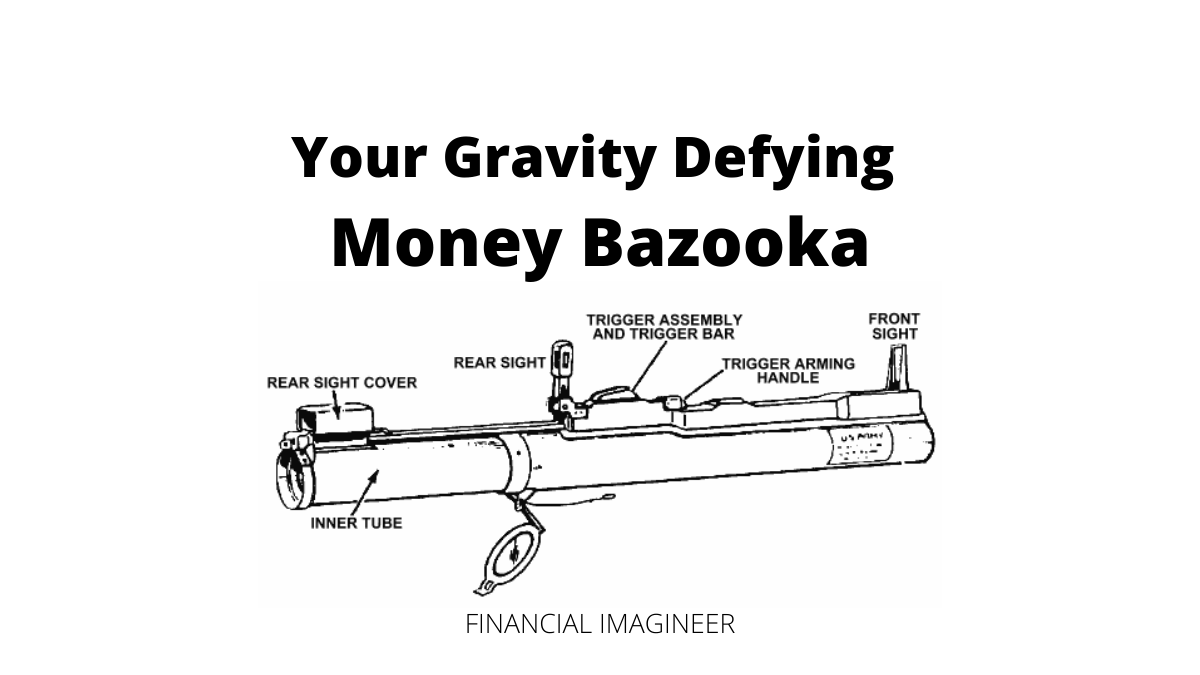
Your Gravity Defying Money Bazooka
Your Gravity Defying Money Bazooka
By Financial Imaginer
What if there was a financial super weapon which can be used to multiply the firepower and reach of your money in ways you’ve never thought possible before? What if such a weapon is widely available already and unlocking it only takes a few well directed steps? What if you’d like to learn more about this? Read on.
Spoiler alert: Having been working in Wealth Management for most of my professional life, your gravity defying money bazooka and most powerful tool to build and multiply your wealth is: Credit!
Your Gravity Defying Money Bazooka
By Financial Imaginer
What if there was a financial super weapon which can be used to multiply the firepower and reach of your money in ways you’ve never thought possible before? What if such a weapon is widely available already and unlocking it only takes a few well directed steps? What if you’d like to learn more about this? Read on.
Spoiler alert: Having been working in Wealth Management for most of my professional life, your gravity defying money bazooka and most powerful tool to build and multiply your wealth is: Credit!
Recently Jay Z rapped about how crucial he believes credit is for financial freedom.
from 2:29
“You wanna know what’s more important than throwin’ away money at a strip club? Credit
You ever wonder why Jewish people own all the property in America?
This how they did it
Financial freedom my only hope
livin’ rich and dyin’ broke
I bought some artwork for one million
Two years later, it worth two million
Few years later, it worth eight million
I can’t wait to give this to my children”
In this post we will first discover how money is made and multiplied in our world. In the second part of the post we will explore how to apply this knowledge for your own investments and pursuit of wealth.
Part 1: The Money Multiplier
Do you have cash in your pocket right now? Chances are, the answer is yes. Money, we all use it, want it and think about it. But did you ever reflect in more detail about where your money actually came from and how it’s being released into the system? Instead of arranging a field trip to the money factory, let’s explore further here.
Step 1: Central banks add [virtual] money in the form of credits to the balance sheets of the various commercial banks.
Step 2: The commercial banks will then release it to the end users in the economic system, be it in the form of account balances or in cash.
The fascinating outcome of this money game is that after a while, the final amount of money in the system will DIFFER from the original amount of money issued by the central bank as in step 1. In fact, it will be a multiple of the original amount!
Surprising? How come?
Well, commercial banks engage in two distinct types of activities. One on each side of their balance sheet: Deposit-taking and lending. Are they allowed to lend out the same amount as customers have deposited? No! Banks have to withhold a certain percentage of all deposits as a safety requirement. How much is defined by the so called “reserve ratio”. The reserve ratio or withholding rate can only be amended by the central bank.
How does that work in real life?
To continue reading, please go to the original article here:
https://www.financial-imagineer.com/your-gravity-defying-money-bazooka/
Time Bandits
Time Bandits
By Financial Imaginer
Time is the most valuable asset you got. Do not let anything or anyone steal or ruin it. In our modern world, we’re surrounded by time bandits. Identify them. Sort them out. Live life by design. No matter if you’re a beggar or a billionaire, we each got the same 24 hours per day. The difference between moving ahead or staying back is simply in how we make use of and invest our time.
Time Bandits – the Monty Python movie. Time bandits didn’t make history – they stole it!
Make sure you keep them at a safe distance so they don’t steal your potential, to make history.
What are time bandits?
Time Bandits
By Financial Imaginer
Time is the most valuable asset you got. Do not let anything or anyone steal or ruin it. In our modern world, we’re surrounded by time bandits. Identify them. Sort them out. Live life by design. No matter if you’re a beggar or a billionaire, we each got the same 24 hours per day. The difference between moving ahead or staying back is simply in how we make use of and invest our time.
Time Bandits – the Monty Python movie. Time bandits didn’t make history – they stole it!
Make sure you keep them at a safe distance so they don’t steal your potential, to make history.
What are time bandits?

They are those things, activities or people that drain you of your energy and time to leave you back less productive, less focused, and in the end; less happy. For many, time bandits may be what holds us back from going out there and chasing our dreams.
Time bandits come in different forms. Some of them are hard to spot. Others have already taken over your habits. That’s why this post will go in details and attempts to show some ways to dispose of your time bandits in order to increase YOUR chance to financially Imagineering your dream life!
Media
Ever heard the word “media-junkie”? Well, these are people that are hooked up with their media outlets permanently and have trouble letting go. They’ve become addicted to consuming ever more content. Whether or not they do something with the things learned is the big question here.
Media time bandits could be:
Watching TV/ Netflix
Watching the news
Social Media
Youtube
Video Games
Don’t get me wrong, these things are all good and fun at times.
The problem comes with unintentional overconsumption. Rather than just letting your precious time float away while engaging in any of the above, use media with intention. Watch a certain show with a purpose or target. The goal can be to simply have fun. Engage on social media for staying in touch with people you care about. Watch Youtube to get inspired, entertained or learn something. Play video games to train (not drain) your brain.
To continue reading, please go to the original article here:
Living Through a Recession is Difficult
Living Through a Recession is Difficult
By Financial Pilgrimage
One of my biggest worries with the historic bull run during the past ten years is people have forgotten what it’s like to live through a recession. While this technically isn’t a recession yet, we’re most likely headed in that direction since a recession requires two consecutive quarters of negative gross domestic product (GDP) growth.
Suppose the current situation with COVID-19 turns into a more prolonged recession. In that case, we will all know someone who loses a job, files for bankruptcy forecloses on a home, or severs a relationship due to financial reasons. If predictions are accurate, we may know someone who falls victim to the virus.
Living Through a Recession is Difficult
By Financial Pilgrimage
One of my biggest worries with the historic bull run during the past ten years is people have forgotten what it’s like to live through a recession. While this technically isn’t a recession yet, we’re most likely headed in that direction since a recession requires two consecutive quarters of negative gross domestic product (GDP) growth.
Suppose the current situation with COVID-19 turns into a more prolonged recession. In that case, we will all know someone who loses a job, files for bankruptcy forecloses on a home, or severs a relationship due to financial reasons. If predictions are accurate, we may know someone who falls victim to the virus.
What stood out most during the Great Recession was the number of individuals who were not just unemployed but underemployed. Time after time, I would meet individuals working jobs that paid significantly less than their previous roles. I remember my co-worker whose husband lost his job in his mid-50s. It took him nearly five years to find a new job comparable to the former.
They were struggling to make their house payment and almost lost their home at one point. Then there was the former human resources executive who worked the register in my work cafeteria. He was just grateful to have a job and eventually was hired on in a different role more in line with his background.
It’s tough to describe what living through a recession is like when you’ve never done it before. For several years people have been talking about missing the run-up in the market that started back in 2009. It’s easy to sit here today and look at the massive gains over the past years and wonder how anyone could have gotten out of the market back in 2009.
Living through a recession is a much different story. The media coverage and end-of-world scenarios were just as prevalent in 2008-2009 as in the past few weeks. Eventually, if you don’t turn off the news, you start to believe it. While it’s essential to stay informed, it’s equally important to know when to step away and focus on what you can control (this advice is primarily for me).
Stick to Your Long-Term Plan
Going through a recession as an investor is like going through a bad break-up. The first time it happens, you are completely miserable and wonder if you will ever shake the depression. After the second or third time, it’s still miserable at first, but you come to understand that the pain will go away with time, and you’ll become a stronger person on the other side.
A large percentage of the workforce will be going through a significant downturn for the first time. Most everyone under the age of 30 has never gone through this while in the workforce. It’s easy to say “stocks are on sale” when a 5-10% correction is erased in a couple of months. It’s much more difficult when the market drops 35% in a few weeks and the uncertainty becomes overwhelming.
To continue reading, please go to the original article here:
https://financialpilgrimage.com/lessons-learned-great-recession/
A Guide to Raising Financially Savvy Kids
Money Matters: A Guide to Raising Financially Savvy Kids
February 8, 2023 Financial Pilgrimage
There are many important aspects to raising a family; one of the most critical is financial literacy. Unfortunately, money matters can often be confusing and overwhelming – especially for those who are just starting. But it’s essential to equip our children with the knowledge and skills they need to navigate the financial world successfully.
That’s why we’ve put together this helpful guide on how to raise financially savvy families. From teaching kids about budgeting and saving to helping them understand credit and investment strategies, we’ll cover everything you need to know to set your loved ones up for success. So let’s get started!
Money Matters: A Guide to Raising Financially Savvy Kids
February 8, 2023 Financial Pilgrimage
There are many important aspects to raising a family; one of the most critical is financial literacy. Unfortunately, money matters can often be confusing and overwhelming – especially for those who are just starting. But it’s essential to equip our children with the knowledge and skills they need to navigate the financial world successfully.
That’s why we’ve put together this helpful guide on how to raise financially savvy families. From teaching kids about budgeting and saving to helping them understand credit and investment strategies, we’ll cover everything you need to know to set your loved ones up for success. So let’s get started!
The Importance of Teaching Financial Literacy to Children
Financial literacy is a skill that is valuable for all individuals, especially children. It has been found that teaching financial management to young people can have a profound long-term effect on their future success. Instilling sound money habits at an early age equips youth with the knowledge and skills they need to succeed. These foundational principles provide applicable solutions such as budgeting, saving, and investing, which will continue to benefit them even into adulthood.
Integrating financial education into children’s lives will benefit them financially, emotionally, and mentally since families who practice healthy money together report increased levels of trust and communication within the home. Teaching financial literacy can create a happier family environment and help ensure a successful financial future for everyone in the household – now and in the years ahead.
How to Instill Good Money Habits in Kids from an Early Age
Developing good money habits in children from a young age is one of the most powerful gifts parents can give their families. Having the knowledge and tools to make informed financial decisions helps kids build confidence, manage unexpected expenses, and grow into financially independent adults. Establishing these good money habits early on is key to ensuring long-term financial success.
To do this, parents can try creating an allowance system as soon as their kids are old enough to understand it, teaching them about spending and saving priorities, or even including them in family budget meetings. By encouraging thoughtful decision-making around finances from a young age, parents are laying the foundation for a secure financial future for their entire family.
The Benefits of Involving Kids in Family Finances
Financial literacy is an important life skill that, when learned at a young age, can help set kids up for success as they grow older. Giving children the tools to understand and take control of their financial futures is a great way to help them become financially independent. Teaching kids about family finances and instilling smart money habits in them early on can have long-term effects on their futures by enabling them to be more secure with their finances as adults.
To continue reading, please go to the original article here:
https://financialpilgrimage.com/raising-financially-savvy-kids/
Paper Chase - Savings Bonds & Redeeming
Paper Chase - Savings Bonds & Redeeming
Marjorie Kondrack | Feb 8, 2023
I BEGAN BUYING Series I savings bonds in 1999. At the time, you could purchase them at a local bank and receive paper bonds. Amid 2022’s spike in inflation, those early bonds that I bought were—for a six-month stretch last year—yielding an annualized 13.08%. Not bad for a low-risk investment.
One drawback to buying savings bonds: the limit on how much a person can purchase each year. When I began buying Series I savings bonds, the maximum was $30,000 per person per year. The current annual limit on I bond purchases is now $10,000 per person, plus $5,000 more if you buy I bonds using a tax refund.
Paper Chase - Savings Bonds & Redeeming
Marjorie Kondrack | Feb 8, 2023
I BEGAN BUYING Series I savings bonds in 1999. At the time, you could purchase them at a local bank and receive paper bonds. Amid 2022’s spike in inflation, those early bonds that I bought were—for a six-month stretch last year—yielding an annualized 13.08%. Not bad for a low-risk investment.
One drawback to buying savings bonds: the limit on how much a person can purchase each year. When I began buying Series I savings bonds, the maximum was $30,000 per person per year. The current annual limit on I bond purchases is now $10,000 per person, plus $5,000 more if you buy I bonds using a tax refund.
While paper savings bonds were once easy to buy, redeeming them is another story. Many banks have stopped cashing them, and the ones that still do have stringent requirements. You typically need to have an account at the bank and to have been a customer for more than a year. In my experience, most banks won’t cash more than $1,000 in bonds at any one time.
I recently visited my local bank to cash a few EE bonds that had reached their final maturity. The bank’s staff told me they no longer cashed savings bonds. Fortunately, I have an account at another major bank and was able to redeem them there.
When I went to that bank recently to cash a bond, I encountered a new teller. After a series of mistakes, she assured me that everything was okay. Then she handed me my deposit slip. It only showed the amount of a check I deposited—but not the proceeds from the bond. The bank manager then straightened everything out. Still, the whole experience was a little unsettling.
To continue reading, please go to the original article here:
How to Store Time
How to Store Time
By Financial Imaginer
This is the first post of a series called “financial excursions” where we will explore how to understand the world better while learning about money and your life. In my view, “financial excursions” are the best way to teach your kids about money. This summer we took our kids for a trip to see one of the largest dams with hydroelectric plant in Switzerland.
We marveled at the large wall, enjoyed the views from its top, learned about its functions and of course I grabbed the opportunity to explain how building a dam is similar to capturing your income streams and save money and therefore time for later usage in life.
Let’s explore our discoveries together.
How to Store Time
By Financial Imaginer
This is the first post of a series called “financial excursions” where we will explore how to understand the world better while learning about money and your life. In my view, “financial excursions” are the best way to teach your kids about money. This summer we took our kids for a trip to see one of the largest dams with hydroelectric plant in Switzerland.
We marveled at the large wall, enjoyed the views from its top, learned about its functions and of course I grabbed the opportunity to explain how building a dam is similar to capturing your income streams and save money and therefore time for later usage in life.
Let’s explore our discoveries together.
Lac Mauvoisin
This summer, we went to see the Mauvoisin dam. In Switzerland we are very proud to have the bulk of our electricity production generated by hydropower (59.9%), nuclear power comes in second (33.5%) and conventional thermal power plants (2.3%, non-renewable) conclude the electricity mix.
Switzerland has currently 638 hydroelectric power plants. The largest dam in Switzerland is the 285 metre-high Grande-Dixence dam (canton of Valais), the second largest is the Mauvoisin dam standing at 250 metres (820 ft) tall, it’s the eight-tallest in the world.
The impounded water behind the Mauvoisin dam forms the 5 kilometres (3 miles) long lake with a capacity of 211.5 million m3 and captures the water from an area as large as 167 square kilometres.
The impressive statistics about this dam include of course its capacity to produce energy. Water released from the Mauvoisin dam into several hydroelectric power stations lower in the valley are boosting the Swiss energy grid with 943 million KWh annually!
The dam was also chosen as perfect location of the world-record highest [successful] basketball shot. In 2016 the 28-year-old Australian Derek Herron launched a basketball from the top of the dam, where it fell 180 metres directly into a net placed on the ground below. LINK
Water And Gravity
My last post about waterfalls covered the topic how to build an abundant waterfall of income streams where we have learned how to diversify “getting paid”.
Fact is: The average millionaire has seven flows of income!
It’s good to have the income flows, but what do you do once the “water” comes flowing your way? If you don’t do anything particular, “water” will follow gravity and disappear in the endless oceans where it originally came from again. LINK

Looking at the wild mountain range the kids could see how the mountains are still nicely covered in snow – even in summer. From there, the sun melts the snow into water and as it comes down, energy is set free. This energy, released from water flowing downwards, has been harnessed by humans for millennia. Over two thousand years ago, people in Greece used flowing water already to turn wheels of their mills to ground wheat into flour. Today, we convert this kinetic energy into electricity.
This sounds all magnificent. However, there’s one big problem here: As the water keeps flowing, you must keep using and consuming the energy right on the spot. Hence, how about if you would like to delay consumption? How to prevent money simply from flowing through your life I asked my kids standing on that magnificent dam?
If you are planning for a year, sow rice; if you are planning for a decade, plant trees; if you are planning for a lifetime, educate people. Chinese saying
To continue reading, please go to the original article here:
A Balanced Budget is Now “Irresponsible”
A Balanced Budget is Now “Irresponsible”
February 7, 2023 Simon Black Sovereign Research & Advisory
“Irresponsible.”
That’s the word that some politicians in the United States Congress have been using this week to describe their opponents’ demands to balance the federal budget.
Just imagine what that says about the state of US public finances: that even the mere thought of having a balanced budget... of living within your means... is “irresponsible”.
A Balanced Budget is Now “Irresponsible”
February 7, 2023 Simon Black Sovereign Research & Advisory
“Irresponsible.”
That’s the word that some politicians in the United States Congress have been using this week to describe their opponents’ demands to balance the federal budget.
Just imagine what that says about the state of US public finances: that even the mere thought of having a balanced budget... of living within your means... is “irresponsible”.
What’s really sad, though, is that even the politicians who want to balance the budget don’t seem to have a firm grasp of the facts.
Consider that, in fiscal year 2022, the federal government brought in $4.9 trillion dollars of tax revenue.
That is an insane, record amount of money. With nearly $5 trillion in tax revenue, you should be able to do anything you want and still have plenty of money left over.
In fact even as recently as 2019, $5 trillion in tax revenue would have easily covered the entire federal budget, with about half a trillion dollars left over to start paying down the debt.
So if the government had just kept the budget steady, last year it could have paid off $500 billion of its $31.5 trillion national debt.
Instead, last year the government opted to ADD $1.375 trillion to the debt by spending $6.27 trillion in FY2022.
Now politicians insist on raising the debt ceiling, so that the government can once again borrow to overspend its revenue by more than a trillion dollars.
The obvious solution is to slash spending. But this is a lot more complicated than most people realize.
In FY2022, for example, the government spent $706 billion just to pay the interest on the national debt. In other words, they had to borrow money just to pay interest on money they have already borrowed.
And if rates keep rising, the government’s annual interest bill will quickly reach $1 trillion or more.
Then there’s the obvious problem of entitlements, like Social Security... and the spending that is considered ‘sacrosanct’, like defense spending.
These components of federal spending are so vast, in fact, that if you take Defense, Veterans Affairs, Social Security, and Medicare off the table for cuts, you would have to cut 85% of all other federal spending in order to balance the budget.
National parks. The electric bill at the White House. John Kerry’s private jet travel to Davos. Highway spending. Thousands of federal agencies that most of us have never heard of, like the Office of Human Research Protection.
85% of all of that would need to be eliminated in order to balance the budget... and few politicians have the courage to make such deep cuts.
Compounding the problem is that tax revenue could easily fall if there is a recession.
During recessions, consumer spending slows, company profits shrink, unemployment increases, and incomes contract. That means the government will not collect as much money from corporate taxes, income taxes, and capital gains taxes.
A recession probably also means more federal stimulus, i.e. higher spending. So the deficit would increase even more.
Another major issue, of course, is that Social Security is set to run out of money in the early 2030s. And this is not some wild conspiracy theory.
As I’ve pointed out on many occasions, the Social Security Administration admits every year in its annual report that Social Security will be insolvent within a decade or so.
This is most certainly going to require a multi-trillion dollar bailout... which is going to put even more extreme pressure on public finances.
It also practically guarantees higher taxes, especially payroll taxes.
In the United States, federal payroll taxes currently take 15.3% of each paycheck when you add up both the employer and employee contributions to Social Security and Medicare.
15.3% is actually quite low when compared to other countries internationally. For example, after recent increases, the combined employee and employer payroll taxes in the UK have reached 28.3% of each paycheck (with certain exclusions).
Even Estonia, which is generally considered a low-tax country because of its flat 20% corporate income tax rate, charges a 33% payroll tax.
So the US has a LONG WAY up on its payroll tax before getting anywhere close to international averages.
And there are already calls for higher individual income tax rates, wealth taxes, higher capital gains taxes, and more.
Most likely this is going to be part of the “solution”, i.e. the grand bargain that politicians will finally be forced to make a few years down the road.
On one hand, they will agree to deep cuts to countless government programs.
They’ll also likely roll back the retirement age on Social Security, which essentially constitutes a default on the promises they’ve made to millions of Americans.
So instead of retiring at 62 or 65, it will be increased to more like 72 or 75.
But in exchange, politicians will also agree to radically increase taxes...
Naturally, the guy who shakes hands with thin air won’t say any of this in his State of the Disunion address tonight. But realistically it’s the only path forward over the next few years.
There are a few key implications here:
One, don’t rely on Social Security to fund your retirement.
Two, take steps now to reduce your tax rate.
You can actually do both of these things in one step by using tax advantaged retirement accounts.
For example, if you contribute an extra $5,000 per year to your 401(k), that reduces your current taxable income by the same amount...
PLUS that $5,000 invested through your retirement account will grow tax free.
If you do that every year, and it compounds at a rate of 9%, you are talking about an extra $461,000 saved for retirement after 25 years.
Meanwhile, you contributed $125,000 that you didn’t have to pay taxes on.
Sure, you’ll have to pay taxes when you collect distributions. But FIRST it will grow tax free for 25 years.
And that makes a huge difference. (You’d earn about $111,000 LESS over 25 years if you first paid a 24% tax on each $5,000 BEFORE investing it.)
This is just one example to highlight the fact that while these problems are unlikely to to be solved by the government, you can make sure that they don’t destroy your retirement.
And you can make sure you don’t get left holding the bag by paying higher tax rates than necessary.
That’s the whole point of a Plan B — to take control of your own circumstances, so your future is not a gamble left up to politicians.
Simon Black, Founder Sovereign Research & Advisory
https://www.sovereignman.com/trends/a-balanced-budget-is-now-irresponsible-145741/
House in Order
House in Order
Michael Flack Humble Dollar Feb 6, 2023
“I WOULD SAY TO the House, as I said to those who have joined this government: I have nothing to offer but blood, toil, tears and sweat. We have before us an ordeal of the most grievous kind. We have before us many, many long months of struggle and of suffering…. You ask, what is our aim? I can answer in one word: victory. Victory at all costs—victory in spite of all terror—victory, however long and hard the road may be, for without victory there is no survival.”
What Winston Churchill said to his House during Great Britain’s darkest hour, I would say about selling yours. Selling a house shouldn’t be easy. If you sold one and it was, you didn’t do it right.
House in Order
Michael Flack Humble Dollar Feb 6, 2023
“I WOULD SAY TO the House, as I said to those who have joined this government: I have nothing to offer but blood, toil, tears and sweat. We have before us an ordeal of the most grievous kind. We have before us many, many long months of struggle and of suffering…. You ask, what is our aim? I can answer in one word: victory. Victory at all costs—victory in spite of all terror—victory, however long and hard the road may be, for without victory there is no survival.”
What Winston Churchill said to his House during Great Britain’s darkest hour, I would say about selling yours. Selling a house shouldn’t be easy. If you sold one and it was, you didn’t do it right.
It’s likely the biggest financial transaction of your life, so I don’t think it’s too much to ask that you put in a little effort.
The non-comprehensive checklist below is based on a lifetime of experience. I haven’t always followed it, though when I didn’t, I paid for it.
Know your home’s value. When you meet with your agent, you need to have an idea of what your home is worth. If you don’t, how can you be sure the sales price your agent suggests is the correct one?
Find the right agent. Using the agent that sold you your home may be the easiest route, but it may not be the most profitable one. It may take a while, but you need to spend the time to find the best agent to sell your home. Remember, they all cost the same, so you might as well hire the right one.
News flash: You need to interview more than one agent. And maybe, just maybe the best agent may be… you, via a “for sale by owner” or discount broker.
Listen to your agent. You spent some time and effort hiring her, so now listen to what she says. If she doesn’t dig the lime green paint in the living room, the 10-foot-by-10-foot bridal portrait over the fireplace or the trampoline room, then maybe some changes are in order.
Don’t take her constructive criticism personally. In the words of the world’s greatest businessman, “It’s not personal, it’s strictly business.”
Stage the place and clean it so prospective buyers fall in love at first sight. Think curb and entry way appeal. The house I recently purchased has a stunning three-floor modern staircase that was highlighted with lights and artwork. When my wife first walked in the door, she wanted it—bad. It also needs to be clean, and I mean clean clean. Think Martha Stewart and Felix Unger had a love child clean.
Decluttering can help, as it makes every home look bigger, better and cleaner. I realize you and your family still need to live there, but you need to make it appear as though no one actually does.
Spend some money. If, like most people, you delayed some work on your home due to frugality or procrastination, the time is now. Not too much, but enough to put a nice shine on the place.
To continue reading, please go to the original article here: