
6 Smart Hiding Spots for Your Emergency Cash
6 Smart Hiding Spots for Your Emergency Cash
Life savings ready to to be buried in the back yard.
Those who keep extra money, like an emergency fund, in their homes may be curious about some of the best spaces to store it. Since traditional savings vehicles like high-yield savings accounts are not applicable in this situation, those in possession of excess funds need to get creative with where they keep this money.
Consider stashing your emergency cash into some of these clever spots.
6 Smart Hiding Spots for Your Emergency Cash
Life savings ready to to be buried in the back yard.
Those who keep extra money, like an emergency fund, in their homes may be curious about some of the best spaces to store it. Since traditional savings vehicles like high-yield savings accounts are not applicable in this situation, those in possession of excess funds need to get creative with where they keep this money.
Consider stashing your emergency cash into some of these clever spots.
Fake Personal Items
This is a helpful tip for those traveling overseas as well as those seeking hacks for keeping their money safe at home. Consider fake personal items, like the following, to discreetly store any emergency funds:
A hairbrush. Use a round hairbrush with a hollowed-out middle and store cash inside the brush.
Empty lip balm tubes. Do you need to tuck a tiny bit of cash somewhere safe? Store it inside an empty lip balm tube. Try a sunscreen lotion tube or an empty shaving can if you need a larger container for your savings. Always make sure the tubes are cleaned out before use!
Feminine napkins. Carefully open a sanitary napkin and hide folded money inside it. Then, fold it all back up and re-stick the sticker in place. These items are seldom, if ever, suspected for hiding excessive amounts of cash.
Remember, though: When storing emergency cash in fake personal items, keep the items tucked away in places you won’t forget.
The Bathroom
When it comes to hiding emergency cash, there are a number of hidden spaces inside your bathroom where the money can be easily stashed.
One of the most common is the toilet’s water tank. Seal your emergency cash into a jar or another watertight container to ensure it doesn’t get wet and store it carefully inside. A toilet’s water tank also makes for a great place to store other valuable items beyond emergency cash, like jewelry or stock certificates. (Again, we can’t stress enough the importance of storing these items into watertight containers.)
Where else in the bathroom can you hide emergency cash? Have you tried using your toilet spring bar? The spring bar is what holds your toilet paper roll in place. Carefully take it apart, roll up extra money, put it inside and reassemble into place.
Fake Electrical Outlets
It’s becoming much more popular for homeowners to construct fake infrastructure in their homes where you can hide emergency cash inside.
To continue reading, please go to the original article here:
https://www.gobankingrates.com/money/financial-planning/hidden-places-to-stash-your-emergency-cash/
10 Genius Things Warren Buffett Says To Do With Your Money
10 Genius Things Warren Buffett Says To Do With Your Money
Elyssa Kirkham Sun, January 15, 2023
Warren Buffett is arguably the best-known, most-respected investor of all time. Buffett is also known for his folksy charm and his memorable quotes about the art of investing.
When you're aiming to reach the top of the mountain, it's usually wise to closely follow the footprints of those who have successfully made the climb before you. Your odds of investing success can increase exponentially if you learn and apply Buffett's best investing tips.
10 Genius Things Warren Buffett Says To Do With Your Money
Elyssa Kirkham Sun, January 15, 2023
Warren Buffett is arguably the best-known, most-respected investor of all time. Buffett is also known for his folksy charm and his memorable quotes about the art of investing.
When you're aiming to reach the top of the mountain, it's usually wise to closely follow the footprints of those who have successfully made the climb before you. Your odds of investing success can increase exponentially if you learn and apply Buffett's best investing tips.
1. Never Lose Money
One of the most popular pieces of Buffett advice is as follows: "Rule No. 1: Never lose money. Rule No. 2: Never forget rule No. 1." If you're working from a loss, it's that much harder to get back to where you started, let alone to earn gains.
2. Get High Value at a Low Price
In the 2008 Berkshire Hathaway shareholder letter, Buffett shared another key principle: "Price is what you pay; value is what you get." Losing money can happen when you pay a price that doesn't match the value you get -- such as when you pay high interest on credit card debt or spend on items you'll rarely use.
Instead, live modestly like Buffett by looking for opportunities to get more value at a lower price. "Whether we're talking about socks or stocks, I like buying quality merchandise when it is marked down," Buffett wrote.
3. Form Healthy Money Habits
In a 2007 address at the University of Florida, Buffett said, "Most behavior is habitual, and they say that the chains of habit are too light to be felt until they are too heavy to be broken." Work on building positive money habits, and breaking those that hurt your wallet.
4. Avoid Debt, Especially Credit Card Debt
Buffett built his wealth by getting interest to work for him -- instead of working to pay interest, as many Americans do. "I've seen more people fail because of liquor and leverage -- leverage being borrowed money," Buffett said in a 1991 speech at the University of Notre Dame. "You really don't need leverage in this world much. If you're smart, you're going to make a lot of money without borrowing."
To continue reading, please go to the original article here:
https://finance.yahoo.com/news/10-genius-things-warren-buffett-190031207.html
How To Pass On Your Wealth, According to Experts
How To Pass On Your Wealth, According to Experts
Andrew Lisa Thu, January 12, 2023
It’s hard to imagine that anyone looks forward to planning how their stuff will be divvied up after they die. But taking the time to ensure a smooth transfer of wealth could be your final act of selflessness — and your posterity will certainly be grateful for your efforts.
“Having a well-thought-out plan prepared in writing by an estate planning attorney is essential,” said estate planning and wealth transfer attorney Robert E. Kabacy of Kell, Alterman & Runstein, L.L.P. “Without a plan, even though statutes define how an estate is handled, heirs are sometimes left with questions.”
How To Pass On Your Wealth, According to Experts
Andrew Lisa Thu, January 12, 2023
It’s hard to imagine that anyone looks forward to planning how their stuff will be divvied up after they die. But taking the time to ensure a smooth transfer of wealth could be your final act of selflessness — and your posterity will certainly be grateful for your efforts.
“Having a well-thought-out plan prepared in writing by an estate planning attorney is essential,” said estate planning and wealth transfer attorney Robert E. Kabacy of Kell, Alterman & Runstein, L.L.P. “Without a plan, even though statutes define how an estate is handled, heirs are sometimes left with questions.”
Questions are just the start of what can go wrong if you neglect to make arrangements.
A poorly planned transfer of wealth can saddle your beneficiaries with high fees, unnecessary tax obligations and, worst of all, foster infighting, resentment and prolonged legal battles among your heirs.
The good news is that a little bit of planning can prevent all of those unfortunate outcomes and enshrine your legacy for generations to come.
If Nothing Else, Write a Will
The most basic tool in the wealth-transfer process is a will, which provides a record of your wishes. Without one, the state — and your heirs — are left guessing.
“A will is used to designate how you want your assets distributed to your surviving loved ones upon your death,” said estate planning attorney Tim Hurban of Hurban Law. “If you die without a will, state law governs how your assets are distributed, which may or may not be in line with your wishes.”
Create a Written Inventory of Your Assets
Every will is only as good as the chronicling of assets that goes with it.
“The single most important thing you can do to insure that your wealth is passed onto your loved ones is to keep an inventory of your assets somewhere,” said Tim Hewson, CEO and co-founder of U.S. Legal Wills. “In your will, you typically refer to ‘my estate,’ and it is the responsibility of your executor to gather up that estate and distribute it to your beneficiaries according to the instructions in the will.”
The problem, according to Hewson, is that executors often have no idea what or where your assets are. That’s why it’s crucial to create a detailed record that includes the information, account numbers, logons and passwords needed to access them.
“A generation ago, our parents may have had two bank accounts and a monthly statement sent to them in the mail,” Hewson said. “Today our assets are distributed all over the place, including in online accounts.”
Consider a Trust To Add Clarity and Reduce Cost
To continue reading, please go to the original article here:
The Art and Science of Spending Money
The Art and Science of Spending Money
Jan 12, 2023 by Morgan Housel@morganhousel
Former General Electric CEO Jack Welch once nearly died of a heart attack. Years later he was asked what went through his mind while he was being rushed to the hospital in what could have been his last moments alive.
“Damn it, I didn’t spend enough money,” was Welch’s response. The interviewer, Stuart Varney, was puzzled, and asked why in the world that would go through his mind.
“We all are products of our background,” Welch said. “I didn’t have two nickels to rub together [when I was young], so I’m relatively cheap. I always bought cheap wine.”
After the heart attack Welch said he “swore to God I’d never buy a bottle of wine for less than a hundred dollars. That was absolutely one of the takeaways from that experience.”
“Is that it?” Varney asks, stunned.
“That’s about it,” says Welch.
The Art and Science of Spending Money
Jan 12, 2023 by Morgan Housel@morganhousel
Former General Electric CEO Jack Welch once nearly died of a heart attack. Years later he was asked what went through his mind while he was being rushed to the hospital in what could have been his last moments alive.
“Damn it, I didn’t spend enough money,” was Welch’s response. The interviewer, Stuart Varney, was puzzled, and asked why in the world that would go through his mind.
“We all are products of our background,” Welch said. “I didn’t have two nickels to rub together [when I was young], so I’m relatively cheap. I always bought cheap wine.”
After the heart attack Welch said he “swore to God I’d never buy a bottle of wine for less than a hundred dollars. That was absolutely one of the takeaways from that experience.”
“Is that it?” Varney asks, stunned.
“That’s about it,” says Welch.
Money is so complicated. There’s a human element that can defy logic – it’s personal, it’s messy, it’s emotional.
Behavioral finance is now well documented. But most of the attention goes to how people invest. Welch’s story shows how much deeper the psychology of money can go. How you spend money can reveal an existential struggle of what you find valuable in life, who you want to spend time with, why you chose your career, and the kind of attention you want from other people.
There is a science to spending money – how to find a bargain, how to make a budget, things like that.
But there’s also an art to spending. A part that can’t be quantified and varies person to person.
In my book I called money “the greatest show on earth” because of its ability to reveal things about people’s character and values. How people invest their money tends to be hidden from view. But how they spend is far more visible, so what it shows about who you are can be even more insightful.
Everyone’s different, which is part of what makes this topic fascinating. There are no black-and-white rules. But here are a few things I’ve noticed about the art of spending money.
1. Your family background and past experiences heavily influences your spending preferences.
I love this Washington Post headline from June, 1927 – the Roaring ‘20s, the last hurrah before the Great Depression:
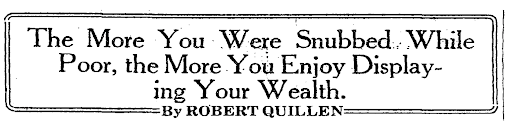
This is timeless, and explains so much.
After Covid lockdowns there was the concept of “revenge spending” – a furious blast of conspicuous consumption, letting out everything that had been pent up and held back in 2020.
Revenge spending happens at a broad level, too. The most stunning examples I’ve seen of this are wealthy adults who grew up poor – and were heckled, bullied, and teased for being poor as kids. Their revenge spending mentality can become permanent.
If you dig into it, I think you’ll see that a disproportionate share of those with the biggest homes, the fastest cars, and the shiniest jewelry, grew up “snubbed” in some way. Part of their current spending isn’t about getting value out of flashy material goods; it’s about healing a social wound inflicted when they were younger.
To continue reading, please go to the original article here: Long but well worth the time
https://collabfund.com/blog/the-art-and-science-of-spending-money/
These Historical Parallels Are Really Spooky
These Historical Parallels Are Really Spooky
Simon Black, Founder Sovereign Research & Advisory January 13, 2023
By the third century AD, it was hard to imagine Rome being in worse condition. Historians literally refer to this period in Roman history as the Crisis of the Third Century. And it was brutal.
Roman citizens couldn’t believe what they were experiencing... it was incomprehensible to them that their fatherland had become so weakened.
Inflation was running rampant. The Empire was stuck in a quagmire of foreign wars and had suffered some humiliating defeats.
These Historical Parallels Are Really Spooky
Simon Black, Founder Sovereign Research & Advisory January 13, 2023
By the third century AD, it was hard to imagine Rome being in worse condition. Historians literally refer to this period in Roman history as the Crisis of the Third Century. And it was brutal.
Roman citizens couldn’t believe what they were experiencing... it was incomprehensible to them that their fatherland had become so weakened.
Inflation was running rampant. The Empire was stuck in a quagmire of foreign wars and had suffered some humiliating defeats.

Rome experienced multiple bad pandemics, coupled with even worse government response.
Foreign invaders were flooding across their borders on a daily basis. Trade broke down, causing shortages in many vital goods.
And terrible social strife dominated people’s daily lives. Ordinary Roman citizens were at each other’s throats, and it was a time of disunity and outrage.
One contemporary writer of the era named Cyprian described the situation as follows:
“The World itself... testifies to its own declines by giving manifold concrete evidence of the process of decay... There is a decrease and deficiency in the field, of sailors on the sea, of soldiers in the barracks, of honesty in the marketplace, of justice in court, of concord in friendship, of skill in technique...”
Cyprian wasn’t just describing Rome’s obvious decline. Rather, his summary is an indictment of Rome’s inability to stop its decline.
Everyone in the imperial government knew what was happening in Rome. They simply lacked the ability to do anything about it.
Historian Arnold Toynbee called this the “Challenge and Response” effect... and it’s an interesting idea.
The concept is that every society has to deal with certain challenges; if the challenges are too great, the society will not survive... i.e. the desert is too harsh, the tundra is too frozen, etc.
But sometimes a society becomes so decadent, so prosperous, that it loses its ability to address challenges. It no longer has the social capital necessary— unity of purpose, the ability to compromise, the capacity to engage in rational debate.
That is the position where Rome found itself in the 3rd century AD. And I believe the West is quickly heading in this direction.
This is the subject of today’s podcast.
We start out talking about Rome’s mortal enemy... and how, after more than a century, Rome emerged victorious as the lone superpower in the Mediterrannean.
Everything was great, and peace and prosperity reigned for more than 200 years.
But over that time, the decadence set in. Wheras once Romans had valued hard work, freedom, and unity of purpose, their entire value system changed.
People expected, then demanded, to be taken care of by the state. Corruption became commonplace. The bureaucracy multiplied. Social conflict soared.
And eventually Rome lost the ability to meet its challenges.
I make a lot of historical parallels to our modern world, including some specific examples of absurdities which occurred just in the last couple of days.
But I also discuss why, in the end, these conditions actually create unique opportunity for creative, hard working, talented people.
You can listen to the podcast here.
To your freedom, Simon Black, Founder Sovereign Research & Advisory
https://www.sovereignman.com/podcast/challenge-and-response-145150/
7 Mistakes People Make When Choosing a Financial Advisor
7 Mistakes People Make When Choosing a Financial Advisor
Helping people make smart financial decisions
SmartAsset -- January 2023
Choosing a financial advisor is a major life decision that can determine your financial trajectory for years to come.
A 2020 Northwestern Mutual study found that 71% of U.S. adults admit their financial planning needs improvement. However, only 29% of Americans work with a financial advisor.1
The value of working with a financial advisor varies by person and advisors are legally prohibited from promising returns, but research suggests people who work with a financial advisor feel more at ease about their finances and could end up with about 15% more money to spend in retirement.2
7 Mistakes People Make When Choosing a Financial Advisor
Helping people make smart financial decisions
SmartAsset -- January 2023
Choosing a financial advisor is a major life decision that can determine your financial trajectory for years to come.
A 2020 Northwestern Mutual study found that 71% of U.S. adults admit their financial planning needs improvement. However, only 29% of Americans work with a financial advisor.1
The value of working with a financial advisor varies by person and advisors are legally prohibited from promising returns, but research suggests people who work with a financial advisor feel more at ease about their finances and could end up with about 15% more money to spend in retirement.2
Consider this example: A recent Vanguard study found that, on average, a hypothetical $500K investment would grow to over $3.4 million under the care of an advisor over 25 years, whereas the expected value from self-management would be $1.69 million, or 50% less. In other words, an advisor-managed portfolio would average 8% annualized growth over a 25-year period, compared to 5% from a self-managed portfolio.3
Being aware of these seven common blunders when choosing an advisor can help you find peace of mind, and potentially avoid years of stress.
1. Hiring an Advisor Who Is Not a Fiduciary
By definition, a fiduciary is an individual who is ethically bound to act in another person’s best interest. Fiduciary financial advisors must avoid conflicts of interest and disclose any potential conflicts of interest to clients.
All of the financial advisors on SmartAsset’s matching platform are registered fiduciaries. If your advisor is not a fiduciary and constantly pushes investment products on you, use this no-cost tool to find an advisor who has your best interest in mind.
2. Hiring the First Advisor You Meet
While it’s tempting to hire the advisor closest to home or the first advisor in the yellow pages, this decision requires more time. Take the time to interview at least a few advisors before picking the best match for you.
3. Choosing an Advisor with the Wrong Specialty
To continue reading, please go to the original article here:
How Do I Know If I'm Rich?
How Do I Know If I'm Rich?
Ashley Kilroy January 11, 2023
Openly discussing the topic can be uncomfortable. But you’ve probably wondered who can be considered truly rich and whether you fit that definition (or ever will). According to Schwab’s 2022 Modern Wealth Survey, the average American thinks being rich means having a net worth of $2.2 million. However, wealth has no universal definition. Just as beauty is in the eye of the beholder, being rich depends on your personal definition and circumstances. Here’s what you need to keep in mind when determining whether you are rich and what most people consider to be rich.
How Do I Know If I'm Rich?
Ashley Kilroy January 11, 2023
Openly discussing the topic can be uncomfortable. But you’ve probably wondered who can be considered truly rich and whether you fit that definition (or ever will). According to Schwab’s 2022 Modern Wealth Survey, the average American thinks being rich means having a net worth of $2.2 million. However, wealth has no universal definition. Just as beauty is in the eye of the beholder, being rich depends on your personal definition and circumstances. Here’s what you need to keep in mind when determining whether you are rich and what most people consider to be rich.
A financial advisor can help you create a financial plan to grow your savings and investments.
What’s the Amount of Money You Must Have to Be Considered Rich?
Schwab’s survey showed Americans’ conception of being rich means having a net worth of $2.2 million. This number represents a $300,000 increase from the survey’s results last year.
Additionally, statistics show that the top 2% of the United States population has a net worth of about $2.4 million. On the other hand, the top 5% wealthiest Americans have a net worth of just over $1 million. Therefore, about 2% of the population possesses enough wealth to meet the current definition of being rich.
That said, Americans’ feelings about wealth go beyond dollar figures. For instance, the survey indicated that over half the country’s workforce would take lower pay for employment with a company aligning with their values. Additionally, almost 90% of employees want fulfillment from their work and orient their careers around their beliefs.
As a result, while Americans have a defined dollar number for being rich, they prioritize their principles as highly in the workplace, going so far as to take a pay cut to work for a company that resonates with their ideals.
And because being wealthy is subjective, some Americans might also believe that being financially comfortable is identical to being wealthy. Specifically, participants in Schwab’s survey reported that a net worth of $774,000 or more means being comfortable. Therefore, you might have a lower target for what it means to become wealthy – it depends on your lifestyle and financial priorities.
Factors That Determine If You’re Rich
Since the dollar amount regarding wealth is subjective, you can analyze your financial situation in multiple ways to determine if you’re rich. Different facets of beliefs about wealth include the following:
You’re Able to Save
To continue reading, please go to the original article here:
https://smartasset.com/financial-advisor/how-do-you-know-if-you-are-rich
How I Set Up My Will — And What I Wish I’d Done Differently
How I Set Up My Will — And What I Wish I’d Done Differently
By Jessica Sillers — Jan 10, 2023
Misconceptions About Making a Will
How We Set Up Our Will
As a freelance finance writer, I’ve published hundreds of articles full of tips for families to make informed choices about managing money. I’ve covered realistic budget plans and ideas to make the most of credit cards. I’ve written extensively about planning financially for the future, including buying life insurance, saving for retirement and preparing a will. I say all this not to brag, but so you know why I feel self-conscious admitting this next part.
How I Set Up My Will — And What I Wish I’d Done Differently
By Jessica Sillers — Jan 10, 2023
Misconceptions About Making a Will
How We Set Up Our Will
As a freelance finance writer, I’ve published hundreds of articles full of tips for families to make informed choices about managing money. I’ve covered realistic budget plans and ideas to make the most of credit cards. I’ve written extensively about planning financially for the future, including buying life insurance, saving for retirement and preparing a will. I say all this not to brag, but so you know why I feel self-conscious admitting this next part.
It took me a long time to make a will. Like, a really long time. My husband and I were expecting baby number 3 before we actually got a will in place.
It wasn’t that I didn’t know a will was important, but my own fears and misconceptions still got in the way. Here are the top reasons I felt nervous about making a will, and how it went when I actually did it.
Misconceptions About Making a Will
The main reason I put off making a will was because it seemed like such a daunting process. Some nights, tackling a will felt way too complicated. Other times, I tried to convince myself it would be simple to carry out my wishes anyway, even without a will. The truth is it’s much simpler to create your own will than leave loved ones to figure it out when they can’t ask for your input anymore. There were several common misconceptions I had to “unlearn” about wills.
1. Simple Estates Don’t Need A Will
Following the instructions in a will is only one part of handling a person’s estate, and it can sometimes seem like you might not need a will if your wishes are straightforward. Here’s how it works, and why a will matters.
Not all of your property may have to go through a will execution or probate process when you pass away. “Payable on death” accounts or “transfer on death” property can go directly to a beneficiary. If you add your chosen beneficiary to a bank account or life insurance policy (or have shared assets, like a joint account or home in both your and your partner’s name), that money or property doesn’t need to go through probate.
The rest of your estate needs to go through probate to be handled and distributed properly. If you die without a will in place, your state follows “intestate” laws for executing an estate without a will. Intestate laws involve deciding who will inherit your property. Generally, a spouse or children would be top of the list to inherit, then close family members like parents or siblings, then more distant relatives.
To continue reading, please go to the original article here:
https://meetfabric.com/blog/how-i-set-up-my-will-and-what-i-wish-id-done-differently
The Million-Dollar Question
The Million-Dollar Question
By Amy Legate-Wolfe Jan. 09, 2023
Dave Ramsey says 79% of US millionaires didn't receive inheritance from their family — so how did they make the big bucks? Riches don’t so much lie in getting a big gift but rather applying one’s career gifts.
Want to know what it takes to be a millionaire? Well, Ramsey Solutions went straight to the source and surveyed 10,000 of them. And some of the findings were surprising. Like: eight out of 10 invested in their company’s 401(k) plan.
The Million-Dollar Question
By Amy Legate-Wolfe Jan. 09, 2023
Dave Ramsey says 79% of US millionaires didn't receive inheritance from their family — so how did they make the big bucks? Riches don’t so much lie in getting a big gift but rather applying one’s career gifts.
Want to know what it takes to be a millionaire? Well, Ramsey Solutions went straight to the source and surveyed 10,000 of them. And some of the findings were surprising. Like: eight out of 10 invested in their company’s 401(k) plan.
But wait. Aren’t millionaires supposed to live off Mumsy’s trust fund and coddle the family cash pile in their Martha’s Vineyard seaside homes? Not exactly — in fact, not even close. Dave Ramsey, personal finance expert and founder of Ramsey Solutions, says this myth of primarily inherited riches is “flat wrong.”
When Ramsey’s National Study of Millionaires asked where the riches came from, they found that a whopping 79% didn’t receive any inheritance from parents or other family members. Not one cent. Unpaid bills perhaps (though the study didn’t ask). But coffers of jewels and blue chip stocks? Nope.
So how did they achieve millionaire status, and what can you do to replicate their success?
Choose the Right Career
The Ramsey study found that five careers produced the most millionaires: engineers, accountants, management, attorneys and teachers.
While these careers strongly correlate millionaire status to a higher education, that didn’t require attending a swank school. In fact, only 8% of those in the study attended “prestigious private schools,” with 62% attending state schools.
And one crucial detail to note: Millionaire status doesn’t equal sky-high salary.
“Only 31% averaged $100,000 a year over the course of their career,” the study found, “and one-third never made six figures in any single working year of their career.”
On top of that, the millionaires in the Ramsey survey didn’t necessarily hold senior leadership roles: Only 15% belonged to that category. By contrast, more than nine in 10 (93%) said they got wealthy because they “worked hard.”
Where Hard Work Meets Smart Finance
To continue reading, please go to the original article here: LINK
Experts Say This Is A Key Sign You Have An Unhealthy Relationship With Money
Experts Say This Is A Key Sign You Have An Unhealthy Relationship With Money
By Natalia Lusinski Sep. 17, 2022
When it comes to money and budgeting, it’s often easier said than done. You may have the best of intentions — you’ll eat out less this month and put the money into your savings account instead. But then life happens. Just like working through any other life, fitness, or wellness issue, a little introspection is often the ticket. If you want to get your finances back in order, a financial psychologist or money mindset coach can help. It all starts with getting your head in the right place.
Experts Say This Is A Key Sign You Have An Unhealthy Relationship With Money
By Natalia Lusinski Sep. 17, 2022
When it comes to money and budgeting, it’s often easier said than done. You may have the best of intentions — you’ll eat out less this month and put the money into your savings account instead. But then life happens. Just like working through any other life, fitness, or wellness issue, a little introspection is often the ticket. If you want to get your finances back in order, a financial psychologist or money mindset coach can help. It all starts with getting your head in the right place.
“Whenever things are in order, it brings us a sense of peace,” Severine Bryan, DBA, financial empowerment educator and coach, and founder of Sev Talks Money, tells TZR in an email.
“Having our finances in order doesn't necessarily mean we are debt-free, but it allows us to have a clear picture of where we are at. It is very important to know what is coming in and what is going out so we are not flying blind.”
She says she likes to think of organizing finances like taking a trip to New York City. “I can leave Georgia and end up in California if I don't know the details of the trip and if I don’t put specific plans in place,” she explains. “When I have a plan, I will go directly to NYC. And even if I take a detour, I will know how to get back on track to get there.” Ahead, Bryan and two other financial coaches explain how they help clients get back on track — and why it’s never too late to do so.
What A Financial Coach Does
Whether you consult a financial psychologist, money mindset coach, or similar type of financial expert, they all do variations of the same thing — help you figure out your relationship to money and how your past (upbringing) affects your present spending and saving habits.
“Part of what we're doing in financial therapy is to be able to really look with clarity at our circumstances — and how those circumstances change from moment to moment,” Financial Therapist Amanda Clayman tells TZR. She aims to help clients learn how to use certain strategies to get a money routine or practice in place.
Bryan adds that a financial coach can also help clients set financial goals, create a plan to achieve those goals, and provide accountability to help them follow the plan. “We also help the client dig deep to find what motivates them to achieve certain goals,” she explains.
“Because, many times, the goal is not money, but the things that money provides, such as freedom to make choices.” This can mean anything from wanting to eat out to buying a particular car or taking a certain vacation. “I think of a financial coach similarly to a football coach,” she adds. “The football coach gives the plays during training, but on game day, the quarterback is the one that has to make the calls.”
Finances can be a very difficult topic to discuss, Taryn Bushrod, money mindset coach and founder of Taryn’s World, tells TZR in an email. “Doing so exposes people’s vulnerabilities, and that can be extremely uncomfortable,” she says. “The first thing I do with a new client is build a relationship, so they are comfortable enough to start sharing pertinent information I need in order to help them start seeing results.” She then focuses on behavioral factors that impact spending.
“In doing so, you can identify the root cause of your actions and redirect your spending habits, which, in turn, could result in redirecting your funds.”
To continue reading, please go to the original article here:
You Have “Enough” Money When You Can Afford 2 Needs
You Have “Enough” Money When You Can Afford 2 Needs
By Darius Foroux
Do you have “enough” money? A study found that the ideal income for a typical American family to have “emotional well-being” is around $60,000 to $75,000 annually.1
In an interview, Warren Buffett said he would be “very happy” with $100,000 a year, despite his billionaire net worth.2 Meanwhile, John Bogle, the pioneer of modern index investing and founder of the Vanguard Index Fund, says “enough” is “one dollar more than you need.” Which I think is also a good definition. The truth is that “enough” depends on our personal circumstances.
You Have “Enough” Money When You Can Afford 2 Needs
By Darius Foroux
Do you have “enough” money? A study found that the ideal income for a typical American family to have “emotional well-being” is around $60,000 to $75,000 annually.1
In an interview, Warren Buffett said he would be “very happy” with $100,000 a year, despite his billionaire net worth.2 Meanwhile, John Bogle, the pioneer of modern index investing and founder of the Vanguard Index Fund, says “enough” is “one dollar more than you need.” Which I think is also a good definition. The truth is that “enough” depends on our personal circumstances.
Money is an emotional subject, not a rational one. A multi-six-figure earner can feel they’re overwhelmed with material desires. While someone earning a fraction of that can feel perfectly satisfied with their life.
It’s all about what we think we need.
Here’s a thought experiment for you: Categorize all your needs.
That will help you to improve your relationship with money. There are several ways you can do this. Here’s an example:
Security — Having an emergency fund, a nest egg, and being financially free.
Loved ones — After establishing one’s own financial freedom, some people choose to take financial obligations for their family, sometimes including those in their extended family.
Exploration — traveling to other countries, having new experiences, living a non-traditional lifestyle, and so forth.
Hobbies — Cycling, training for endurance sports, collecting sports cars/luxury watches/ “big person” toys, beauty and fashion, etc. Depending on a person’s immersion in the hobby, these things can cost thousands or millions!
Creative outlet — painting, writing a book, making music, etc. Sometimes, your creative outlet is your full-time career. Other times, it’s a purely artistic endeavor that generates little to no income. Both are fine, depending on you.
You can define these categories any way you like. Then, ask yourself: What are my Top 2 needs?
The reason for choosing only two is that it forces you to think about whether you really want something over another. For most of us, security is always among the top 2.
But that may not be the case for others. Some people come from backgrounds that are financially well-off, for example. Or even if they don’t, they’d rather spend their time exploring and being fully immersed in their creative outlets. So security may not be a priority.
To continue reading, please go to the original article here: