
Some “Iraq News” Posted by Clare at KTFA 8-1-2024
KTFA:
Clare: Mazhar Saleh: A trend towards reforming the government banking sector
8/1/2024
Baghdad: Imad Al-Emara
The financial advisor to the Prime Minister, Dr. Mazhar Mohammed Salih, considered the reform of the banking system as one of the most prominent priorities of the government program, due to its positive effects on all aspects of the economy.
KTFA:
Clare: Mazhar Saleh: A trend towards reforming the government banking sector
8/1/2024
Baghdad: Imad Al-Emara
The financial advisor to the Prime Minister, Dr. Mazhar Mohammed Salih, considered the reform of the banking system as one of the most prominent priorities of the government program, due to its positive effects on all aspects of the economy.
Salih explained to Al-Sabah that "the government's vision for economic reform focused to a large extent on banking reform, which is one of the priorities of the government program, and the first steps began through Rafidain Bank," noting that "the government banking sector currently dominates more than 85 percent of the banking system's assets, and its banking operations and activities account for almost the same percentage of total deposits and bank credit." LINK
Clare: Prime Minister's Advisor: We are moving towards reforming the government banking sector
8/1/2024 Baghdad: The pillar of the emirate
The financial advisor to the Prime Minister, Dr. Mazhar Mohammed Salih, stated that reforming the banking system is one of the most prominent priorities of the government program, due to its positive impact on all aspects of the economy, indicating that the first steps of this reform began through the government banking sector, which currently dominates more than 85 percent of the banking system's assets, and its banking operations and activities account for almost the same percentage of total deposits and credit.
Earlier, Prime Minister Mohammed Shia al-Sudani chaired a special meeting to develop the work of government banks, and directed the finalization of procedures for developing the work of Rafidain Bank.
The Prime Minister's media office said that during the meeting, which was attended by representatives of Ernst & Young for auditing and financial consulting, Al-Sudani was briefed on the technical and administrative procedures for the Rafidain Bank development project, which were taken during the period following the signing of the contract with the company specialized in structuring and developing work in the banking sector.
It is noteworthy that the Rafidain Bank development plan includes a comprehensive review and evaluation of the bank's work, and structural administrative reforms, aiming to provide a package of integrated banking services to citizens and companies, relying on advanced electronic programs, modern technology in all banking transactions, optimal use of human and technical resources, and transitioning to automated work, which helps the bank's ability to meet
global banking requirements.
Advisor Saleh told Al-Sabah: "The government's vision for economic reform focused largely on banking reform, which is one of the priorities of the government's program, and the first steps began through Rafidain Bank," noting that "the reform principles established by the government program, which was approved by the House of Representatives, are based on regular executive priorities, foremost of which is reforming the banking sector, as the Prime Minister's vision for economic reform focused on reforming the government banking sector, which currently dominates more than 85 percent of the banking system's assets, and its banking operations and activities account for almost the same percentage of total deposits and bank credit."
Saleh pointed out that this beginning came because these banks are large and important, but they are burdened with the legacy left by the conflicts of the past half century and their repercussions on the efficiency of this large banking system, whose capital base still constitutes only a low percentage not exceeding 22 percent of the total capital of the banking system
Indicating that "in light of this banking dominance burdened by inherited problems, our country suffers from limited growth in the activity of the banking market and its division between private banks, the number of which exceeds 50 banks, but they are limited in activity in deposits and credit, but they do not have a unified and homogeneous competitive banking market with government banks, as government banks monopolize market shares and banking activity and they are suffering greatly and their activity lives on sovereign banking liquidity as they are banks of a purely rentier nature that deal with large government deposits that affect their liquidity."
The government advisor explained that "in order to advance the Iraqi banking market, the first steps of reform have inevitably begun with government banks, especially major commercial banks such as Rafidain Bank. Based on the above, and with the aim of making government banks operate according to capital efficiency standards and lead the financing and development activity in the country on competitive foundations that provide financial inclusion at the same time, the study being prepared by the global auditing and accounting firm Ernst Young is based on the principle of creating a highly efficient government commercial banking sector that takes the initiative with the rest of the banking market in financing market activity on digital foundations and financial and accounting technologies in accordance with modern financial engineering.
He pointed out that this leads to the birth of a government bank specialized in managing government banking operations exclusively and is a fundamental pillar in organizing the treasury account and stabilizing government cash flow budgets, i.e. at the same time being the arm of public finance in government banking organization."
Saleh believes that these steps can achieve the goals that lead to “the birth of a homogeneous banking market that operates according to competitive principles and can integrate with the local and international financial and banking system with high credit and banking efficiency required by the goals of sustainable development and the requirements of the availability of market institutions and their integration between financing services on the one hand and real investment and production growth on the other hand.” LINK
************
Clare: One of the most prominent defendants in the tax deposit theft case was extradited
8/1/2024 Baghdad
The head of the Integrity Commission, Judge Haider Hanoun, announced the extradition of one of the most prominent defendants in the tax deposit theft case.
Hanoun said in a press conference attended by "Al-Eqtisad News", "The issue of the theft of the century will not die no matter how much the corrupt try to hide it from the oversight agencies and the people's eyes," indicating that "fighting corruption is one of the government's priorities."
Hanoun added, "Qasim Mohammed was recovered from the Kurdistan Region and the managing director of the Humpbacked Whale Company after he had fled to Turkey. He is one of the major defendants in the case of stealing tax deposits and the theft recorded against the defendant is 988 billion Iraqi dinars, which are not final numbers," noting that "Nour Zuhair is a defendant who is on bail and will be tried."
He stressed that "the Prime Minister is following up on the issue of tax deposits on a daily basis," stressing that "another accused person, Mohammed Falah Al-Janabi, the managing director of Al-Qant Company, has been arrested. He is accused of stealing more than a trillion dinars through 79 forged checks." LINK
Clare: By names and addresses.. Details of the arrest of 8 main suspects in the theft case of the century
8/1/2024
The Federal Integrity Commission announced, today, Thursday, an official list of the details of the arrest of 8 main defendants in the case of theft of tax deposits "the theft of the century". They are:
1- Qasim Muhammad Muhammad
was arrested.
Position / Managing Director of Al-Hut Al-Haddab Company
Charge / Receiving 55 checks and 11 eleven appearances
Total stolen amounts
nine hundred and eighty-two billion dinars from the tax deposit account
2- The fugitive accused Abdul Mahdi Tawfiq Mahdi
Location Lebanon
Stolen amounts two trillion two hundred and eighty-three billion Iraqi dinars
Receiving 155 checks for an amount from the tax deposit account
3- The accused Muhammad Falah Abdullah Al-Janabi
Location / United Arab Emirates
Position Managing Director of Al-Qant Company
Receiving 79 checks for
stolen funds / one trillion one hundred and eighty-five billion two hundred and twenty million
4- The fugitive accused Hussein Kawa Abdul Qader Abdul Aziz
Location / Erbil
Position / Managing Director of Baghdad Winds Company
Stolen funds / six hundred and seven billion Iraqi dinars by receiving 40 checks
5- The fugitive accused Abdul Rahman Muhammad Ibrahim
Location / Erbil
Position Managing Director of Badia Al-Masaa Company
Stolen funds / six hundred Twenty-four billion Iraqi dinars through 37 checks
6- The fugitive accused Alaa Khalaf Maran Al-Omar
Location: Lebanon
Position: Office of the former Prime Minister
Stolen funds: Four hundred and ninety-seven billion Iraqi dinars
7- The fugitive accused Abdul Amir Hassoun Ali Taha
Location: State of Kuwait
Position: Managing Director of Al-Fawaris Company
Stolen funds: Receiving an amount of one hundred and twenty-four million US dollars in exchange for facilitating procedures at the Ministry of Finance
8- The fugitive accused Muhammad Hassoun Ali Taha
Location: State of Kuwait Position
: Deputy Managing Director of Al-Fawaris Company.LINK

Clare: Judge Hanoun: The final amount of the theft of tax deposits exceeds what is announced
8/1/2024
Judge Haider Hanoun, head of the Integrity Commission, confirmed: "The final amount of the theft of tax deposits exceeds what is announced, because the Tax Authority has not yet informed us of the actual amount of stolen money.
Hanoun called on the Ministry of Finance and the Tax Authority to provide the Integrity Commission with the names and accounts of the companies from which those funds were stolen and have now become Iraqi money owned by the people. Otherwise, after 15 days, the head of the Tax Authority will be asked to hand over those documents or proceed with all legal measures.
He pointed out: "The amount offered today belongs to the former Director General of the Railway Directorate, which is more than two million dollars and another amount in Iraqi dinars in addition to 9 properties, 5 of which are worth more than 8 billion Iraqi dinars."
He continued: "We are coordinating with the State of Kuwait to extradite two other accused, who are two brothers who were working with the main accused, Nour Zuhair. LINK
FRANK26….7-31-24……REACHING OUT
KTFA
Wednesday Night conference Call
FRANK26….7-31-24……REACHING OUT
This video is in Frank’s and his team’s opinion only
Frank’s team is Walkingstick, Eddie in Iraq and guests
Playback Number: 605-313-5163 PIN: 156996#
What Frank’s suit color’s mean…. FRANKS SUIT COLORS FOR CC'S..... WHITE = NEW INFO…. SILVER = INTEL FROZEN…. RED= HIGH ALERT… PURPLE=GUEST WITH US…. BLUE = AIR FORCE…. BLACK = GROUND/FF’S…. GREEN= MR OR FAB 4 ... GOLD = CHANGE
KTFA
Wednesday Night conference Call
FRANK26….7-31-24……REACHING OUT
This video is in Frank’s and his team’s opinion only
Frank’s team is Walkingstick, Eddie in Iraq and guests
Playback Number: 605-313-5163 PIN: 156996#
What Frank’s suit color’s mean…. FRANKS SUIT COLORS FOR CC'S..... WHITE = NEW INFO…. SILVER = INTEL FROZEN…. RED= HIGH ALERT… PURPLE=GUEST WITH US…. BLUE = AIR FORCE…. BLACK = GROUND/FF’S…. GREEN= MR OR FAB 4 ... GOLD = CHANGE
FRANK26…..7-29-24…….CATCH UP
KTFA
Monday Night Conference Call
FRANK26…..7-29-24…….CATCH UP
This video is in Frank’s and his team’s opinion only
Frank’s team is Walkingstick, Eddie in Iraq and guests
Playback Number: 605-313-5163 PIN: 156996#
What Frank’s suit color’s mean…. FRANKS SUIT COLORS FOR CC'S..... WHITE = NEW INFO…. SILVER = INTEL FROZEN…. RED= HIGH ALERT… PURPLE=GUEST WITH US…. BLUE = AIR FORCE…. BLACK = GROUND/FF’S…. GREEN= MR OR FAB 4 ... GOLD = CHANGE
KTFA
Monday Night Conference Call
FRANK26…..7-29-24…….CATCH UP
This video is in Frank’s and his team’s opinion only
Frank’s team is Walkingstick, Eddie in Iraq and guests
Playback Number: 605-313-5163 PIN: 156996#
What Frank’s suit color’s mean…. FRANKS SUIT COLORS FOR CC'S..... WHITE = NEW INFO…. SILVER = INTEL FROZEN…. RED= HIGH ALERT… PURPLE=GUEST WITH US…. BLUE = AIR FORCE…. BLACK = GROUND/FF’S…. GREEN= MR OR FAB 4 ... GOLD = CHANGE
Some “Iraq News” Posted by Clare at KTFA 7-28-2024
KTFA:
Clare: Financial inclusion indicators
July 28, 2024
In order for this bank to prepare a database for financial inclusion indicators, which will be the basic foundation for measuring the percentage of financial inclusion in Iraq, we attach to all electronic payment service providers a database for financial inclusion statistics for individuals and companies in an electronic form (Excel file) that will be sent to your institutions’ email . For more, click here.
https://cbi.iq/news/view/2629
KTFA:
Clare: Financial inclusion indicators
July 28, 2024
In order for this bank to prepare a database for financial inclusion indicators, which will be the basic foundation for measuring the percentage of financial inclusion in Iraq, we attach to all electronic payment service providers a database for financial inclusion statistics for individuals and companies in an electronic form (Excel file) that will be sent to your institutions’ email . For more, click here.
Clare: Kurdistan government brings good news to employees under Article 140
7/28/2024
The Kurdistan Regional Government announced on Sunday its intention to distribute plots of land to employees under Article 140.
The Department of Media and Information said in a statement received by Shafaq News Agency, "In implementation of the decision of the Prime Minister of the Region, the distribution of plots of land to employees will begin within Article 140 of the Constitution in the Kurdish regions outside the administration of the region."
The regional government had previously announced the distribution of land to all employees, as it began the land survey process. LINK
************
Clare: The Kurdish government resolved crises with “wisdom”.. A former member of the Kurdistan Parliament: Baghdad has no excuse left
7/28/2024 Erbil
Former member of the Kurdistan Regional Parliament, Rebwar Babaki, confirmed today, Sunday (July 28, 2024), that the current regional government headed by Masrour Barzani was able to resolve the crises.
Babaki said in an interview with “Baghdad Today” that “the wise policy of the current regional government enabled it to resolve the complex disputes with Baghdad, especially in the field of salaries and budget.”
He added, "The financial crisis and delayed salary payments were resolved wisely and diplomatically, even though some Iraqi political parties wanted to put obstacles to ending the dispute and wanted the crisis to continue."
Babaki pointed out that "the regional government did not leave any excuse for Baghdad, and therefore the salary crisis was resolved with wisdom and patience, and other crises were dismantled."
On Thursday (May 30, 2024), the Prime Minister of the Kurdistan Regional Government, Masrour Barzani, visited the capital, Baghdad, to hold discussions with Prime Minister Muhammad Shia al-Sudani and a number of senior officials in the federal government, in In addition to meetings with leaders and leaders of political forces.
According to a statement issued by the regional government, Masrour Barzani's meetings during his visit dealt with the latest developments on the political and security arenas in Iraq, and the emphasis on resolving the outstanding issues between the Kurdistan region and the federal government, especially securing the Salaries of the citizens of the Kurdistan region and guaranteeing their financial rights and entitlements.
According to the statement, the discussions also dealt with enhancing cooperation and joint coordination, to ensure security and stability for Iraq and the Kurdistan region.
In this regard, Masrour Barzani wrote on the “X-Twitter” platform, “Today I am in Baghdad to affirm the rights of the people of Kurdistan and resolve differences through dialogue and on the basis of the constitution,” adding that “stability and A strong economy should be our priorities.” LINK
************
Clare: He is 19 years old and the most important of 150 suspended laws.. Will the powers give up the "golden paper" in oil and gas legislation?
7/28/2024 Politics
The Parliamentary Oil and Gas Committee expressed, today, Sunday, its "optimism" about the imminent approval of the Oil and Gas Law, which has been suspended for 19 years, noting that its delay came because it is a political pressure card used throughout the past years in forming successive governments.
Committee member Nazim Al-Shabli told Sumaria News that the oil and gas law is the most important suspended law, noting that it was “used as a political pressure card in forming governments.”
However, Al-Shabli expected that “the most serious government in this file is the Al-Sudani government,” noting that “clear committees have been formed between Baghdad and the Kurdistan Regional Government, but until now the government has not sent the final version to the House of Representatives or the Oil Committee.”
Al-Shabli expressed the hope of the Oil Committee that "the relevant committees will resolve the issue and send it to Parliament, as the law has benefits in regulating oil exports and stopping smuggling or selling oil outside SOMO," believing that "this issue will be resolved in the coming days."
He stressed that "the delay in the law came because it is a political card, especially since the region wants the law and considers it to be in its interest, in addition to the fact that it has old obligations and contracts with foreign companies, in addition to the continuation of smuggling."
About a year has passed since the formation of the committee to draft the oil and gas law, after a 19-year delay in the law that regulates the relationship between Baghdad and Erbil regarding the management of oil in Kurdistan and the rest of the provinces," while the law is considered one of the most important laws that have been suspended for years, amounting to more than 150 laws. LINK
Clare: The Ministry of Commerce discusses with World Bank representatives a strategy to support entrepreneurship and establish local companies.
7/28/2024
The Private Sector Development Department at the Ministry of Trade held a meeting (remotely) with representatives of the World Bank to discuss a strategy to support entrepreneurship, owners of small and medium enterprises and start-ups to advance the local economic reality.
The ministry stated in a statement that "the meeting discussed the basic pillars of the entrepreneurship system that will be evaluated by World Bank experts through surveys and the application of laws specific to these projects, in addition to holding discussion sessions with project owners and presenting recommendations on policies for each pillar."
The statement explained that "the meeting came out with several recommendations aimed at developing the Iraqi private sector to advance the local economic reality," referring to "the pioneering role of the Private Sector Development Department in providing support to owners of small and medium enterprises, which is part of its tasks."
On the other hand, the Investment Committee of the General Company for Central Markets at the Ministry of Trade held its periodic meeting to discuss its investment projects plan, and the circulars received by the company related to investment projects in Baghdad and the governorates, including the recommendations of the Ministerial Council for Social Services regarding the Iraqi Construction Council, as well as the mechanism for compensating contractors.
The statement added that "the meeting urged the follow-up committees to complete the tasks assigned to them and prepare reports and correspondence to the relevant sectoral authorities to ensure the speedy completion and opening of these projects and set a time frame for their completion and submit periodic reports on the completed work." LINK
************
Clare: Renewing its commitment to the truce... Al-Kataeb: A mysterious faction targeting Americans in Iraq
7/28/2024
The Sayyid al-Shuhada Brigades, one of the factions that form the "Islamic Resistance in Iraq", said on Sunday that it does not know who is carrying out the targeting of the American forces stationed at the Ain al-Assad base in Anbar Governorate, and the forces stationed in the Syrian bases.
A prominent leader in the brigades told Shafaq News Agency, "The Islamic Resistance Group in Iraq, as well as the Resistance Coordination Committee, do not know which party or group is bombing and targeting the American forces, disclaiming responsibility for those operations."
The leader, who asked not to be named, added that the "Sayyid al-Shuhada Brigades" are committed to the calm so far, and perhaps there is a faction working on these operations individually as a means of pressure, but without knowledge from that party.
Iraqi Prime Minister Mohammed Shia al-Sudani is seeking to pressure pro-Iranian armed factions to stop their escalation against American interests and targets in Iraq, according to informed sources.
Fearing American reactions that might escalate and confuse the security situation inside Iraq, Al-Sudani contacted Iranian figures in order to pressure those factions to stop escalating their operations, and to give him a new opportunity to end the American presence in Iraq through dialogue and negotiation, but the factions still reject these pressures, according to the sources. LINK
FRANK26….7-24-24….COMMERCIALS
KTFA
Wednesday Night Conference Call
FRANK26….7-24-24….COMMERCIALS
This video is in Frank’s and his team’s opinion only
Frank’s team is Walkingstick, Eddie in Iraq and guests
Playback Number: 605-313-5163 PIN: 156996#
KTFA
Wednesday Night Conference Call
FRANK26….7-24-24….COMMERCIALS
This video is in Frank’s and his team’s opinion only
Frank’s team is Walkingstick, Eddie in Iraq and guests
Playback Number: 605-313-5163 PIN: 156996#
The Youtube video was removed. But you can still listen to this call at this link: https://fccdl.in/cgrTnpj5XG
FRANK26……7-22-24…..LET’S HAVE DINNER
KTFA
Monday Night Conference Call
FRANK26……7-22-24…..LET’S HAVE DINNER
This video is in Frank’s and his team’s opinion only
Frank’s team is Walkingstick, Eddie in Iraq and guests
Playback Number: 605-313-5163 PIN: 156996#
What Frank’s suit color’s mean…. FRANKS SUIT COLORS FOR CC'S..... WHITE = NEW INFO…. SILVER = INTEL FROZEN…. RED= HIGH ALERT… PURPLE=GUEST WITH US…. BLUE = AIR FORCE…. BLACK = GROUND/FF’S…. GREEN= MR OR FAB 4 ... GOLD = CHANGE
KTFA
Monday Night Conference Call
FRANK26……7-22-24…..LET’S HAVE DINNER
This video is in Frank’s and his team’s opinion only
Frank’s team is Walkingstick, Eddie in Iraq and guests
Playback Number: 605-313-5163 PIN: 156996#
What Frank’s suit color’s mean…. FRANKS SUIT COLORS FOR CC'S..... WHITE = NEW INFO…. SILVER = INTEL FROZEN…. RED= HIGH ALERT… PURPLE=GUEST WITH US…. BLUE = AIR FORCE…. BLACK = GROUND/FF’S…. GREEN= MR OR FAB 4 ... GOLD = CHANGE
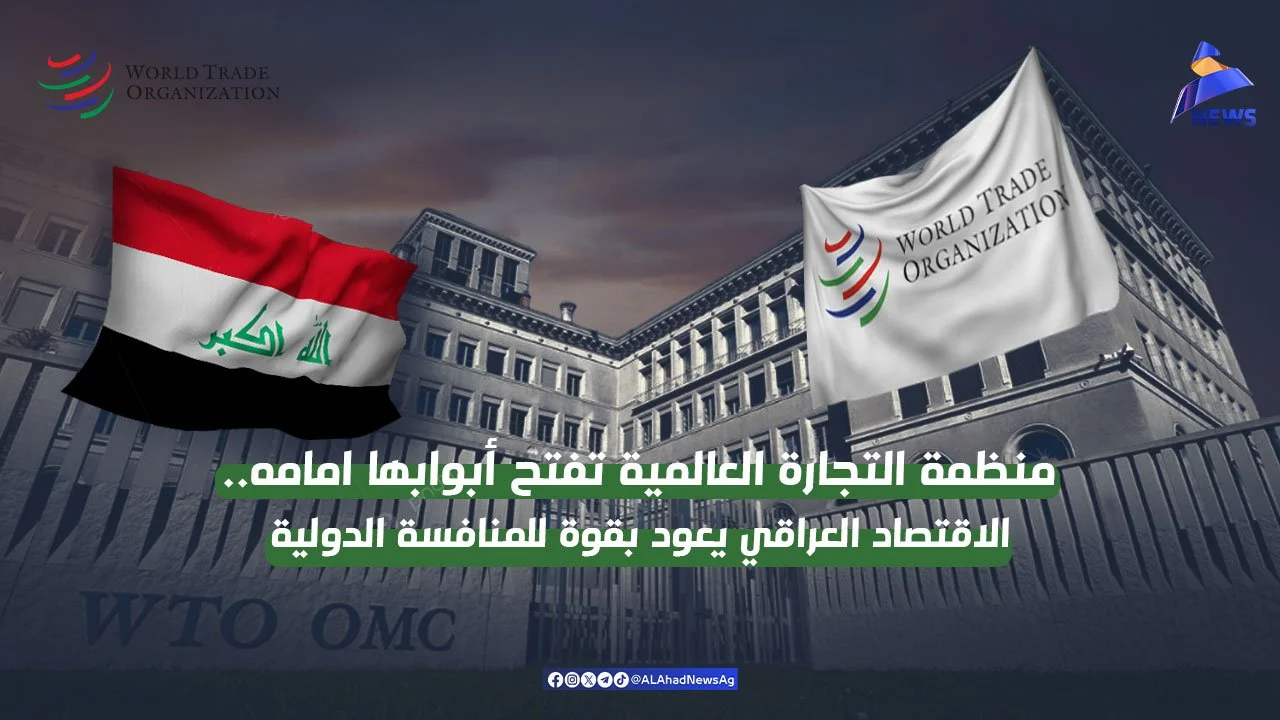
The World Trade Organization opens its doors to it.. The Iraqi economy returns strongly to international competition
Clare: The World Trade Organization opens its doors to it.. The Iraqi economy returns strongly to international competition
7/22/2024
The World Trade Organization has accelerated Iraq's steps to join it, following the resumption of negotiations that had been suspended for more than 16 years. The Iraqi delegation is preparing for the next round of negotiations that are expected to resolve this issue, which will open up global trade horizons for Iraq and return it to strong economic competition, in the region and the world, under a multilateral economic system.
According to official officials, the government of Mohammed Shia al-Sudani has only addressed all the previous obstacles that prevented Iraq from joining the international organization, as for the first time the import program was voted on, which includes setting controls for chaos and identifying real traders, in addition to other details related to customs tariffs as well as the necessary legislation for it.
KTFA:
Clare: The World Trade Organization opens its doors to it.. The Iraqi economy returns strongly to international competition
7/22/2024
The World Trade Organization has accelerated Iraq's steps to join it, following the resumption of negotiations that had been suspended for more than 16 years. The Iraqi delegation is preparing for the next round of negotiations that are expected to resolve this issue, which will open up global trade horizons for Iraq and return it to strong economic competition, in the region and the world, under a multilateral economic system.
According to official officials, the government of Mohammed Shia al-Sudani has only addressed all the previous obstacles that prevented Iraq from joining the international organization, as for the first time the import program was voted on, which includes setting controls for chaos and identifying real traders, in addition to other details related to customs tariffs as well as the necessary legislation for it.
Economic reform and exchange rate adjustment
Economic expert Naji Al-Obaidi, in an interview with Al-Ahd News, believes that Iraq’s accession to the World Trade Organization will have positive effects, attributing this to the fact that “it will increase pressure on the government to initiate the long-awaited economic reforms.”
Al-Obaidi added that "the World Trade Organization usually intervenes in the exchange rate policy when the concerned country deliberately keeps the value of its local currency low in order to improve the competitiveness of local production and encourage exports at the expense of foreign goods," indicating that "this does not apply to Iraq, where previous governments resorted to raising the exchange rate of the dinar in an artificial and arbitrary manner with the aim of gaining political and popular support."
He pointed out that joining the international organization would contribute to controlling this file.
Customs restrictions and agricultural support
In this regard, the financial advisor to the Prime Minister, Mazhar Mohammed Salih, stated in an interview with “Al-Ahd News” that Iraq has adopted broad open policies towards the world since 2003 and has sought to establish important economic and legislative rules that operate according to the mechanisms of the market system
Most of which have helped improve Iraq’s foreign trade, after an economic blockade that lasted for more than a decade and led to Iraq’s marginalization on the map of the global economic system and deprived it of investment opportunities, progress, development and technological knowledge that should have helped it confront the rapid developments and changes that international markets have witnessed and whose competitive capabilities have changed
dramatically over the past two decades at least.
Saleh pointed out that "the World Organization imposes on the new members of the developing countries group to work under conditions, the first of which is to reduce customs restrictions by 24% and cancel non-customs restrictions for a period of 6 years from the date of joining, and the second is to reduce agricultural support by 13.3% over a period of ten years from joining."
Saleh explained that "these regulatory conditions of the World Trade Organization clash with the conditions and situations of the agricultural market and the global food stock exchange itself. If we look at the agricultural monopolies in the world in light of the deterioration of agricultural development in Iraq, we find a real threat to national food security that restricts the country in the event of joining the organization unless it is preceded by starting or following an agricultural program for self-sufficiency immediately.
We will really need a green revolution similar to what Mexico and many Latin American countries have done, especially if we know that there are between 3 and 6 major monopolistic companies in the world that control 80 to 90% of agricultural crop trade and control prices and quantities such as wheat, sugar, tea, coffee, cotton and jute, at a time when ten multinational companies still dominate a third of the production and trade of seeds and pesticides in the world."
Breaking international isolation
Saleh pointed out that "despite the above, Iraq's entry and integration into the global economic space through the World Trade Organization and its dealings with international groups on terms that apply to everyone from a formal standpoint at a time when the world is still divided between the countries of the North and the South or the countries of the advanced industrial center and the developing periphery, Iraq has no choice but to leave its international isolation that it inherited since the siege and placing Iraq under the burden of Chapter Seven, the effects of which still provide a negative economic environment hostile to development and perhaps obstructing natural integration into the global market."
Accelerate joining steps
For his part, Minister of Trade Athir Dawood Al-Ghariri confirmed the resumption of negotiations for Iraq’s accession to the World Trade Organization and the acceleration of its steps, which is a qualitative event and a confirmation of what the government promised through its program to reform the economic situation, considering the private sector an essential part and the backbone of the Iraqi economy.
Al-Ghariri said in a statement followed by "Al-Ahd News" that the fourth round of negotiations will be held during the first quarter of next year, stressing that this acceleration means that the negotiations are proceeding very quickly towards Iraq's accession to the World Trade Organization, considering Iraq an important economic bloc and all countries keen for Iraq to return as an economic player in a multilateral system.
For his part, the Saudi Ambassador to the World Trade Organization, Saqr Abdullah Al-Muqbil, said that there is a positive view that we will find Iraq joining the multilateral trading system as it is one of the largest economies outside this organization, and Al-Muqbil confirmed that "the Kingdom of Saudi Arabia has a priority that Iraq's desires to join the organization be fulfilled. LINK
Addressing the problems of the Iraqi financial system
KTFA:
Clare: Addressing the problems of the Iraqi financial system
7/20/2024 Written by: Zahraa Haider Abdul Jabbar Al-Batat
The financial system in Iraq consists of a group of institutions and structures that manage the financial and economic affairs of the country. Here are the components of this system in detail:
1. Central Bank of Iraq:
- Role: It is considered the body responsible for implementing monetary policy, issuing currency, and managing cash reserves.
- Objectives: price stability, exchange rate stability, and encouraging economic growth.
KTFA:
Clare: Addressing the problems of the Iraqi financial system
7/20/2024 Written by: Zahraa Haider Abdul Jabbar Al-Batat
The financial system in Iraq consists of a group of institutions and structures that manage the financial and economic affairs of the country. Here are the components of this system in detail:
1. Central Bank of Iraq:
- Role: It is considered the body responsible for implementing monetary policy, issuing currency, and managing cash reserves.
- Objectives: price stability, exchange rate stability, and encouraging economic growth.

2. Commercial banks:
- Its types: include government banks such as Rafidain Bank and Rashid Bank, in addition to local and foreign private banks.
- Services: Providing loans, opening accounts, making money transfers, and financing projects.
3. Specialized banks:
Examples: Real Estate Bank, Agricultural Bank.
- Focus: Providing financial services to specific sectors such as agriculture and real estate.
4. Stock market:
- Iraq Stock Exchange (ISX): is the place where stocks and bonds are traded.
- Objective: To promote investment and develop financial markets.
5. Ministry of Finance:
- Role: Preparing and implementing the state’s financial policy, managing government revenues and expenditures.
- Responsibilities: Preparing the general budget, managing public debt.
6. Securities Commission:
- Function: Regulating and monitoring the stock market, ensuring compliance with financial laws and standards.
- Objectives: Protect investors, ensure market transparency.
7. Investment companies:
- Role: Investment management, providing financial advisory services, managing investment portfolios.
- Objectives: Achieving investment returns for clients, enhancing local and foreign investments.
Main challenges:
1. Corruption: It hinders economic development and affects confidence in the financial system.
2. Political and security unrest: harm investments and hinder financial operations.
3. Rentier economy: It depends heavily on oil, which makes it vulnerable to oil price fluctuations.
4. Bureaucracy: It hinders efficiency and increases administrative complexities.
5. Weakness of the banking system: Lack of efficiency and development affects performance.
6. Inflation: affects purchasing power and financial stability.
7. Weak financial infrastructure: Lack of technological development affects efficiency.
8. Laws and regulations: may be insufficient or outdated.
9. The informal sector: It poses a challenge in collecting taxes and organizing the economy.
These challenges require structural reforms and policy development to enhance financial stability and economic growth in Iraq.
Reforming the financial system in Iraq according to the following mechanism:
Applying the following mechanism to the Iraqi financial system requires adapting policies and procedures to the economic, social and political conditions specific to Iraq.
Here are some possible steps to achieve this:
1. Updating financial institutions:
- Strengthening the role of the Ministry of Finance and the Central Bank of Iraq in managing financial and monetary policies.
- Developing the financial infrastructure to increase efficiency and transparency.
2. Reforming the tax system:
- Improve tax collection and reduce tax evasion.
- Simplify the tax system to make it more transparent and fair.
3. Strengthening monetary policies:
- Strengthening the independence of the Central Bank to ensure price stability and control inflation.
- Using monetary tools such as setting interest rates and regulating the money supply effectively.
4. Public debt management:
- Develop strategies to manage public debt and reduce dependence on external loans.
- Issuing local government bonds to attract domestic investment.
5. Strengthening control and regulation:
- Improving the control systems over banks and financial institutions to ensure the stability of the financial system.
- Enhancing financial laws and regulations to comply with international standards.
6. Encouraging investment:
- Creating an attractive investment environment by improving infrastructure and reducing bureaucracy.
- Providing incentives to foreign and local investors.
7. Enhancing transparency and accountability:
- Ensuring transparency of financial operations by publishing financial reports regularly.
- Strengthening accountability and combating corruption at all levels of financial management.
By implementing these steps, the Iraqi financial system can benefit from global financial experiences, taking into account the fundamental differences between systems.
Also, to implement these reforms effectively, close cooperation is required between the Iraqi government, international financial institutions, and the private sector to achieve financial stability and sustainable development in Iraq.
Implementing each paragraph requires specific, practical steps, including:
1. Updating financial institutions:
- Strengthening the role of the Ministry of Finance and the Central Bank.
- Training and professional development: Providing intensive training programs for employees to improve their competencies and knowledge of modern financial policies.
- Digital transformation: adopting advanced technological systems to improve the efficiency of financial and administrative operations.
- International cooperation: Benefiting from international expertise through partnerships and cooperation with global financial institutions.
2. Reforming the tax system:
- Improving tax collection:
- Develop technological systems for collecting and analyzing data to increase the effectiveness of tax collection.
- Increase control and inspection of economic activities to reduce tax evasion.
- Simplifying the tax system:
- Restructuring tax brackets to be clearer and fairer.
- Providing facilities to taxpayers such as electronic services.
3. Strengthening monetary policies:
- Strengthening the independence of the Central Bank:
- Issuing laws that guarantee the independence of the Central Bank from political influences.
- Use effective monetary tools:
- Determining interest rates based on economic conditions.
- Managing the money supply through open market operations and reserve policies.
4. Public debt management:
- Developing debt management strategies:
- Analyze the debt structure and determine repayment priorities.
- Developing the bond market to attract local investors.
- Reducing dependence on external loans:
- Encouraging domestic investment and developing the financial infrastructure to attract local capital.
5. Strengthening control and regulation:
- Improving control systems:
- Develop technology-based control mechanisms to improve monitoring of financial operations.
- Enhancing transparency in financial reporting.
- Strengthening laws and regulations:
- Updating financial laws to comply with international standards.
- Activating penalties for financial violations.
6. Encouraging investment:
- Creating an attractive investment environment:
- Improving infrastructure including roads, bridges, electricity and communications.
- Reducing bureaucracy by simplifying government procedures.
- Providing incentives to investors:
- Tax exemptions for investment projects.
- Credit facilities to finance projects.
7. Enhancing transparency and accountability:
- Ensuring transparency of financial operations:
- Publish financial reports periodically and in detail.
- Application of international standards in preparing financial reports.
- Promoting accountability and combating corruption:
- Establishing independent oversight bodies to combat corruption.
- Encouraging reporting of corruption by providing protection for whistleblowers.
Implementing these steps requires strong government commitment and cooperation between the public and private sectors to achieve a stable and effective financial system. LINK
Some “Iraq News” Posted by Clare at KTFA 7-20-2024
KTFA:
Clare: Inclusion of commercial centers and private stores in the electronic payment system in Iraq
7/20/2024 Baghdad
The government media team announced, today, Saturday, ongoing directives and government follow-ups to include all shopping centers, pharmacies, medical clinics, shops and private stores in the electronic payment system.
The team's spokesman, Haider Majeed, said, "The official institutions continue to implement the decisions of the Council of Ministers and the directives of Prime Minister Mohammed Shia al-Sudani regarding the digital transformation process in the electronic payment file, which is one of the most important priorities of the government program."
KTFA:
Clare: Inclusion of commercial centers and private stores in the electronic payment system in Iraq
7/20/2024 Baghdad
The government media team announced, today, Saturday, ongoing directives and government follow-ups to include all shopping centers, pharmacies, medical clinics, shops and private stores in the electronic payment system.
The team's spokesman, Haider Majeed, said, "The official institutions continue to implement the decisions of the Council of Ministers and the directives of Prime Minister Mohammed Shia al-Sudani regarding the digital transformation process in the electronic payment file, which is one of the most important priorities of the government program."
He added, "The electronic payment process began in 10 government fuel stations in the capital, Baghdad, distributed between Karkh and Rusafa, and then the work expanded to all fuel filling stations in the governorates of Iraq, after which it included all private fuel filling stations."
Regarding official institutions, Majeed confirmed that “most of the institutions that provide services and have direct contact with citizens operate with the electronic payment system, starting with the Directorate of Passports, Nationality and Civil Status, followed by the Ministry of Health institutions, public clinics, and then the rest of the operating institutions in succession.”
He pointed out that "there are ongoing directives from the government and follow-ups between the Central Bank of Iraq, the Ministry of Finance, and the rest of the official institutions, to include private stores, pharmacies, medical clinics, shops, and markets in malls in the electronic payment file," stressing that "work is continuing in this regard." LINK
Clare: Iraq participates in UNCTAD technical meetings.. What is its relationship to international trade?
7/20/2024 Baghdad
The Ministry of Commerce announced today, Saturday, its participation in the technical meetings of the UNCTAD regarding the accession of Arab countries to the World Trade Organization in Istanbul.
The ministry stated, in a statement received by "Al-Eqtisad News", that it "participated today in the technical meetings organized by UNCTAD in Istanbul, which will last for two days, to discuss the experiences of Arab countries in joining the World Trade Organization."
Director General of the Department of Foreign Economic Relations, Riyadh Fakher Al-Hashemi, who represented the Ministry of Trade in these meetings, said, according to the statement, that "the meetings discussed the outcomes of the 13th Ministerial Conference of the World Trade Organization, the process of Arab countries joining the organization, and how Iraq can benefit from these experiences in its process of joining. The importance of trade in services in supporting the economies of Arab countries and enhancing their growth was also reviewed."
Al-Hashemi stressed that "Iraq's participation in these technical meetings enhances the experience of the Iraqi negotiating team and pushes it to move forward quickly towards achieving full accession to the World Trade Organization, as the exchange of knowledge and experiences gained from these meetings will have a significant positive impact on improving Iraq's negotiating capabilities and achieving its economic goals."
The statement indicated that "this participation is part of the ongoing efforts made by the Ministry of Trade to enhance Iraq's international economic relations, and to take advantage of the available opportunities to enhance economic and commercial development in the country." LINK
************
Clare: Members welcome Iraq’s return to WTO accession talks after 16 years
18 JULY 2024
ACCESSIONS
At the third meeting of the Working Party on the Accession of Iraq on 18 July, WTO members welcomed the formal resumption of the country’s accession process after a 16-year hiatus, commending Iraq for its renewed political commitment and engagement in the accession process.
Iraq reaffirmed its pledge to join the WTO, highlighting significant economic and legislative reforms.
Mr. Atheer Dawood Salman Al Ghrairi, Iraq's Minister of Trade, led a high-level delegation from Baghdad at the third meeting of the Working Party. Ambassador Saqr Almoqbel of the Kingdom of Saudi Arabia, who chaired the Working Party for the first time since his appointment last year, welcomed Iraq's return to Geneva after many years, highlighting the significance of the formal resumption of Iraq's accession process. “The Minister's presence here, the first since 2008, sends a clear signal that Iraq's accession process is now back on track,” he remarked. The Working Party held its second meeting in April 2008 and an informal meeting in November 2017.
The Chair acknowledged “the tremendous efforts by everyone, of course, starting with Iraq, but also members and partners, as well as former Chair Ambassador Omar Hilale of Morocco, to make today's meeting a reality”. He also referred to his visit to Baghdad in January 2024, where he met with senior Iraqi government officials, including President Abdul Latif Rashid.
Minister Al Ghrairi noted the importance of the meeting, which “represents a distinctive step for the Government and the people of Iraq towards becoming a full-fledged member of the WTO, a target we seek to achieve as a means to enhance our national economic strategy and integration in the global economy”. He further stated that despite ongoing security, political, and regional challenges, “the Government of Iraq remains steadfast in its commitment to pursue a reform agenda in terms of enhancing trade policies, boosting the business environment, and creating favourable conditions for foreign investment.”
Minister Al Ghrairi highlighted the special importance attached by the Government to aligning its trade policies and regulatory frameworks with international rules and standards and strengthening institutional capacities to meet WTO requirements. “The National Committee on Iraq's Accession has intensified efforts and made substantial progress in fulfilling the accession requirements,” he said. Ahead of the third Working Party meeting, Iraq submitted key negotiating documents, including its initial market access offers on goods and services.
WTO Deputy Director-General Xiangchen Zhang stressed the significance of this meeting not only for Iraq but also for the Arab region, which still has a large number of accessions under way. “As the largest region outside the multilateral trading system, this moment signifies a renewed opportunity for progress and collaboration towards accession for Iraq and hopefully other Arab nations aspiring to join the WTO, enhancing regional and global trade dynamics.” He also emphasized the importance of technical assistance and capacity building in the region, especially for Iraq in view of its status as a post-conflict country.
Members highlighted the significance of Iraq's accession for the multilateral trading system. Many Arab members emphasized that Iraq's accession would contribute to regional integration efforts in support of peace and security. Other participants in the meeting included observer governments and international organizations.
Iraq provided an update on its initial contacts with members regarding bilateral market access negotiations, noting that initial offers on goods and services were submitted in early May. The Iraqi delegation expressed readiness to further engage with WTO members.
The Working Party discussed various aspects of Iraq's foreign trade regime based on its revised Memorandum of the Foreign Trade Regime (MFTR) and other supporting documentation. Iraq provided a report on legislative developments, highlighting its latest efforts to conform with WTO-related rules.
Next steps
The Chair invited Iraq and WTO members to intensify bilateral negotiations on market access, building on the recent contacts.
The Chair invited members to submit specific questions in writing by 15 August. He also asked Iraq to provide replies to members' questions and to submit other requested accession documents. The Chair asked the WTO Secretariat to work with Iraq to revise its MFTR, which will serve as the basis for continuing the examination of Iraq's foreign trade regime at the next meeting of the Working Party.
In addition, the Chair asked Iraq to revise its Legislative Action Plan and submit copies of WTO-related legislation to provide an up-to-date picture of ongoing reforms.
The importance of technical assistance was emphasized, with several members and international organizations offering support. The Secretariat plans to organize a Round Table to discuss Iraq's technical assistance needs to further facilitate its accession process.
The Chair suggested that the fourth Working Party meeting could be scheduled for the first quarter of 2025, contingent on the progress of the outlined steps.
Clare: Parliament's agenda for tomorrow
7/20/2024
The Media Department of the House of Representatives announced today, Saturday, the Parliament's agenda for tomorrow, Sunday.
TRANSLATION:
Republic of Iraq House of Representatives
The fifth electoral session, the third legislative year, the second legislative term
In the name of God, the most gracious, the most merciful
Republic of Iraq House of Representatives
Reading) verses from the Holy Quran, I hate pain
First: First reading! Economy and Industry for the draft law reforming economic laws. (Committee on Commerce, Committee on Investment and Development, Committee on Legal, Committee on Finance), (16 articles). One
Agenda for Session No. (2), Sunday, July 21, 2024
Second: The first reading of the proposed law on the first amendment to the Law of the National Authority for Nuclear, Radiological, Chemical and Biological Control No. (1) of 2024. Health and Environment Committee (2 articles). F
Third: The first reading of the draft Islamic investment sukuk law, the Finance Committee, the Legal Committee, the Investment and Development Committee (19 articles).
Fourth, report and discuss the second reading of the draft law on compensation for the properties of those affected by the former regime.
Paradise for martyrs, victims and political prisoners).
No Najoma Ni Novineh Ran
The session begins at eleven in the morning LINK
************
Clare: $27.5 billion is the volume of trade exchange between Iraq and China in the first half of 2024
7/20/2024 Baghdad
An economic institution announced that the volume of trade exchange between Iraq and China during the first half of this year amounted to $27.5 billion.
The head of the Iraq Future Economic Foundation, Munar Al-Obaidi, said that "Chinese exports to Iraq grew in the first half of this year by 16.17% compared to the first half of 2023, and by 12.17% compared to the second half of 2023."
He added that "the total value of Chinese exports to Iraq amounted to $8.15 billion in the first half of this year compared to $7 billion in the first half of 2023 and $7.3 billion in the second half of 2023."
Al-Obaidi continued: "Chinese exports to Iraq during 2024 are expected to exceed $16 billion, which is the highest historical value."
He explained that "China's exports of electrical appliances, which mainly include air conditioners, amounted to 23% of China's total exports, followed by exports of electronic devices represented by mobile phones, televisions and the like By 13%, and Chinese cars ranked third with 6% of the total value of Chinese exports to Iraq.
He explained that "China's exports of iron-based materials declined, and China's exports of car fuel decreased by 95%, in addition to a decrease in exports of clothing accessories."
He pointed out that "in contrast, China's exports of fruit-based products increased by 62%, ranking 14th among the most exported goods to Iraq."
He stressed that "the volume of trade exchange between Iraq and China amounted to $27.5 billion in the first half of this year, up by 14.38% compared to the first half of 2023 and 7.24% compared to the second half of 2023, and it is expected that trade exchange with China will reach more than $55 billion by the end of this year, making it Iraq's largest trading partner." LINK
FRANK26….7-19-24….I LIKE THINGS IN 3’s
KTFA
Friday Night Conference Call
FRANK26….7-19-24….I LIKE THINGS IN 3’s
This video is in Frank’s and his team’s opinion only
Frank’s team is Walkingstick, Eddie in Iraq and guests
Playback Number: 605-313-5163 PIN: 156996#
https://www.youtube.com/watch?v=Zklt0-M85ro
KTFA
Friday Night Conference Call
FRANK26….7-19-24….I LIKE THINGS IN 3’s
This video is in Frank’s and his team’s opinion only
Frank’s team is Walkingstick, Eddie in Iraq and guests
Playback Number: 605-313-5163 PIN: 156996#
“Iraq News” Posted by Clare at KTFA 7-19-2024
KTFA:
Clare: Iraq announces the imminent offering of 100 investment opportunities to international companies
7/19/2024 Baghdad - WAA - Chairman of the National Investment Commission, Haider Makiya, announced today, Friday, that 100 investment opportunities will soon be offered to international companies in all Iraqi governorates.
Makiya said in a statement received by the Iraqi News Agency (INA): "The National Investment Commission and the Iraqi Economic Council have completed all preparations to hold a major investment forum in which about 100 investment opportunities will be presented in all Iraqi governorates."LINK
KTFA:
Clare: Iraq announces the imminent offering of 100 investment opportunities to international companies
7/19/2024 Baghdad - WAA
- Chairman of the National Investment Commission, Haider Makiya, announced today, Friday, that 100 investment opportunities will soon be offered to international companies in all Iraqi governorates.
Makiya said in a statement received by the Iraqi News Agency (INA): "The National Investment Commission and the Iraqi Economic Council have completed all preparations to hold a major investment forum in which about 100 investment opportunities will be presented in all Iraqi governorates."LINK
Clare: Minister of Trade: All countries are keen on Iraq's return as a global economic player
7/19/2024 Baghdad - WAA -
Minister of Trade Athir Dawood Al-Ghariri confirmed today, Friday, that negotiations for Iraq's accession to the World Trade Organization are proceeding at a rapid pace, while indicating that all countries are keen on Iraq's return as a global economic player.
Al-Ghariri told the Iraqi News Agency (INA): "The resumption of negotiations for Iraq's accession to the World Trade Organization is a qualitative event and a testament to what the government promised through its program to reform the economic situation, considering the private sector as an essential part and the backbone of the Iraqi economy."
He expressed his "aspiration for the fourth round of negotiations to be held during the first quarter of next year," stressing that "this acceleration means that the negotiations are proceeding very quickly towards Iraq's accession to the World Trade Organization, considering Iraq an important economic bloc and all countries are keen for Iraq to return as an economic player in a multilateral system."
For his part, the Saudi Ambassador to the World Trade Organization, Saqr Abdullah Al-Muqbil, told the Iraqi News Agency (INA): "There is a positive view that we will find Iraq joining a multilateral trade system as it is one of the largest economies outside this organization."
Al-Muqbil stressed that "the Kingdom of Saudi Arabia has a priority to achieve Iraq's desire to join the organization."
In turn, the official responsible for Iraq's accession to the World Trade Organization said: "The member states were happy with the Iraqi delegation, and we hope that the Iraqi delegation has completed this long journey."
She added: "We seek to see Iraq become a member of the World Trade Organization."
The Minister of Trade and head of the Iraqi team concerned with joining the World Trade Organization, Athir Dawood Al-Ghariri, announced last Monday the resumption of negotiations to join the World Trade Organization, after a hiatus that lasted more than 16 years.LINK
************
Clare: Removing Zeros from the Iraqi Currency: Talk Returns and Possibility of Implementation
Sadiq Al-Azraqi7/19/2024
Removing zeros from a currency is a procedure undertaken by some countries in order to revalue the national currency and simplify financial transactions. This is done by removing a specific number of zeros from the nominal value of the currency, making it appear less inflationary and more stable.
For example, if the currency is the “dinar” and its value is equal to 1,000 dinars, after removing three zeros, its value will become one new dinar.
One of the possible reasons for deleting zeros is to combat inflation. When a currency suffers from high inflation, the nominal values can become very high and impractical to be offered in large quantities in daily transactions. Deleting zeros can contribute to enhancing confidence in the national currency, facilitating accounting operations and financial transactions; this may contribute to improving the country's image before investors and the international community.
Potential challenges of deleting zeros include printing new currency, modifying accounting systems, and training on how to use the new currency. It may initially cause some confusion among residents and consumers, and if the deletion process is not implemented well, it may lead to economic disruptions. As a result, deleting zeros is not a solution to all economic problems, but rather a procedure that requires good planning and careful implementation to ensure that the desired goals are achieved, according to experts.
Examples of countries that have taken this action include Turkey in 2005 when it removed six zeros from its currency, Brazil on several occasions in the 1980s and 1990s, Zimbabwe, which removed twelve zeros from its currency in 2009, and Venezuela, which removed five zeros in 2018. The number of cases in the world in which currency zeros were removed is estimated at 70 cases witnessed by the world since 1960.
In a renewed statement by the Governor of the Central Bank of Iraq, Ali Al-Alaq, he said that “the project to remove zeros from the currency is still ongoing,” meaning removing three zeros from the Iraqi dinar. For example, the value of the 1,000-dinar banknote will be replaced with a one-dinar note from the new currency, five thousand with five dinars, ten thousand with ten dinars, and so on.
According to experts, the actual value of the money people own does not change after deleting the zeros, but this step contributes to simplifying the buying and selling processes for individuals and companies, and makes the financial amounts simpler and more understandable. Instead of dealing with huge numbers such as a trillion or a million (1,000,000 Iraqi dinars), they can be converted to just one thousand 1,000 dinars after deleting three zeros.
Removing zeros helps in issuing small currencies such as coins, enables the re-pricing of small goods at lower prices, facilitates their circulation and their survival in the markets, and gives a positive psychological boost to the population with the fact that the Iraqi dinar can now buy more goods and services.
Therefore, countries aim to remove zeros to restore confidence in the local currency among residents and investors, to increase demand for it, and for the local currency to become more competitive with foreign currencies and to be less replaced by other currencies.
The policy of deleting zeros is often linked to broader economic reforms, such as raising interest rates on bank deposits, to encourage people to save in banks and benefit from high interest rates on their bank deposits, in an attempt to withdraw liquidity from the market, reduce consumption and lower prices.
This also entails exploiting this liquidity to expand productive projects, attract local and foreign investments within the country and create many job opportunities so that the local economy can ultimately recover.
But on the other hand, deleting zeros may cost Iraq money to print new banknotes. For example, after deleting 3 zeros from the Iraqi dinar, when we talk about a 200-dinar banknote, it is actually equivalent to 200,000 dinars. As a result, it may be necessary to print 4 more 50-dinar banknotes instead of the 50,000-dinar banknote.
However, according to the available results, this may not have a clear impact on improving the local economy if it is not part of a package of economic reforms that help reduce the amount of money circulating among people and stimulate the economy, especially since Iraq's economy is an oil economy that needs to stimulate other productive sectors to drive the local economy.
Could removing zeros from the Iraqi dinar be a real start to stimulating the Iraqi economy, after it became clear that all plans were unable to rescue the dinar from its declining value?
In a statement by the financial advisor to the Iraqi government, Mazhar Muhammad Salih, he said that “the phenomenon of multiplying zeros in the monetary unit or adding zeros usually comes as a result of economies being exposed to rampant waves of inflation or sharp increases in the price level that continue for years due to wars, blockades and conflicts that lead to financing the deficit of government budgets through the issuance of money,” noting that the continuous rise in prices without stopping leads to the erosion of the value of the monetary unit, which necessitates the issuance of larger denominations of money due to the lack of value of smaller denominations of money and the disappearance of their ability to cover high-value transactions and exchanges in the market, according to his description.
Former member of the Parliamentary Finance Committee, Ahmed Hama Rashid, believes that “Iraq is not prepared for the project of deleting zeros,” and explains, “We always hear the Central Bank’s statements about implementing a project, only to then back down from implementation for undisclosed reasons.”
Regarding the implementation of the project to remove zeros from the Iraqi currency, banking consultant Abdul Rahman Al-Shaikhli recalls that the printing of the Iraqi dinar in the nineties of the last century was done by poor printing presses and that “the first factor that stood in the way of the project was the discrepancy between the official exchange rate (now 1332 dinars per dollar) and the parallel market exchange rate (now rising above 1500 dinars) and it constituted an obstacle to the implementation of the project.”
He points out that "the project will be successful if an exchange rate of one thousand dinars for every one dollar is reached. At that time, deleting the three zeros will achieve its economic feasibility, as the exchange rate will be transformed into one dinar for every one dollar, and this is what the late former governor of the Central Bank, Sinan Al-Shabibi, aspired to," he said.
Al-Shaikhli added that the other factor that affected the project to remove zeros from the Iraqi currency was the call made by the government of former Prime Minister Nouri al-Maliki for the years 2006-2014, to legislate the infrastructure law, which was opposed by a number of political blocs in parliament at the time, as it leads to an increase in investments in Iraq through deferred payment, which limits the value of the monetary project, he said. LINK
************
Clare: THE WTO FULL ACCESSION HAS NEVER BEEN A REQUIREMENT FOR A RATE CHANGE.
DON'T LOSE SIGHT OF THE VIDEO THAT WAS RELEASED IN IRAQ & ARAB NATIONS EXPLAINING ALAQ'S COMMENT ABOUT THE DELETION OF THE ZEROS.... THAT WAS HUGE!!!
THIS IS WHAT WE WANT THE DELETION OF THE ZEROS!!!! COME ON CBI...LOL
THE SLEW OF ARTICLES LIKE WS & FRANK TOLD US HAVE STARTED!!! IMO
STAY TEMPERED AND SMART!
Clare: Mikati visits Iraq at Al-Sudani's invitation
7/19/2024
Lebanese Prime Minister Najib Mikati is scheduled to visit Iraq in the coming hours, responding to an invitation from Prime Minister Mohammed Shia al-Sudani.
The Lebanese newspaper "Al-Jumhuriya" quoted government sources in the country as saying that Mikati will be accompanied on his visit by a ministerial delegation that includes: Minister of Energy Walid Fayyad, Minister of Economy Amin Salam, Minister of Agriculture Abbas Hajj Hassan, and Minister of Industry George Bouchikian, in addition to a number of advisors.
The Iraqi government agreed in July to unload the fuel shipment despite Beirut not paying the financial dues it owes to Baghdad.
This comes after a call made by Lebanese Prime Minister Najib Mikati to his Iraqi counterpart, Mohammed Shia al-Sudani, and after Minister Fayyad had made several calls to his counterpart, Iraqi Oil Minister Hayan Abdul Ghani, the Iraqi Prime Minister’s Office, and the Iraqi Embassy in Lebanon, to address the fuel dues crisis and spare Lebanon total darkness.
The Lebanese Minister had previously announced that the Iraqi Oil Marketing Company (SOMO) had stopped unloading fuel oil tankers exported to Lebanon due to non-payment of the due funds for the second year in a row.
Fayyad said, "For the fifth consecutive month, the Central Bank of Lebanon has not transferred the price of fuel shipments to the Iraqi government's account, and thus Lebanon becomes financially exposed to Iraq, as the due funds have not been transferred for the second consecutive year," according to the Lebanese newspaper Al-Akhbar. LINK
************
Clare: Government advisor reveals Iraq's gold reserves have risen to 150 tons... and the reason for its high price
7/18/2024
The economic advisor to the Prime Minister, Mazhar Muhammad Salih, revealed today, Thursday, that Iraq’s gold reserves have risen to 150 tons, while noting the reason for its high price.
Saleh told {Euphrates News} that: "Gold is one of the most important safe investment havens in the world, which is resorted to by the investment portfolios of central banks and various investors through international financial markets, including the Central Bank of Iraq, which currently holds less than 150 tons of cash gold within Iraq's international reserves, relying on a standard rule for optimal diversification of the investment portfolio of Iraq's international reserves."
He added, "It is a rule adopted globally by multilateral international financial organizations such as the International Monetary Fund, the World Bank and others, within the principle of ensuring the liquidity of investment portfolios and protecting them from various financial and economic risks and various fluctuations affecting the value of financial assets, by resorting to safe and optimal diversification of investment portfolios."
Saleh pointed out that "there is an inverse correlation between gold and oil on the one hand and the value of the dollar on the other hand. Whenever the value of the US currency declines or investment returns in the US currency decline, such as the returns on dollar-denominated bonds or interest on dollar deposits, investors go towards the safe haven, which is gold, which is stable in value and guaranteed purchasing power."
"Gold is a rare asset whose (asset cycle) is long and stable, mostly without serious fluctuations, which encourages this stability by investing in the market value of gold and within the standard limits required by investment portfolios in terms of growth and stability in the value of its components in a balanced manner without incurring {unrealized} losses, as they are called in accounting,"
Saleh continued, "noting that countries can issue gold-backed bonds (gold bonds) in order to borrow from the financial market, as the gold guarantee is one of the basic attractive and desirable guarantees in global financial markets."
He continuedby saying, "We cannot fail to mention that 17% of the world's gold is currently stored in the vaults of central banks in countries, and that 77% of the world's gold wealth has been extracted," noting that "50% of that wealth has been manufactured for various purposes, such as woven goods, industrial or craft materials, and other jewelry."
Saleh concluded by saying, “The value of gold in the world is currently estimated at about 15 trillion dollars, which represents a percentage of the annual global gross product of about 14% only, while the quantities of gold discovered from the depths of the earth {currently in circulation and stored} are estimated at about 187 thousand tons distributed in various parts of the world.”
Raghad LINK