
4 Recession-Proof Money Habits for 2025 and Beyond
4 Recession-Proof Money Habits for 2025 and Beyond
John Csiszar Tue, August 12, 2025 GOBankingRates
No matter what the state of the economy is, it seems there’s always talk of a looming recession ahead. And recessions are indeed a normal part of the business cycle, and it’s highly unlikely they’ll ever go away.
But in reality, recessions normally occur many years apart, with the economy often growing a decade or more between contractions. According to data from the National Bureau of Economic Research, for example, there have only been six recessions since 1980, a span of 45 years.
4 Recession-Proof Money Habits for 2025 and Beyond
John Csiszar Tue, August 12, 2025 GOBankingRates
No matter what the state of the economy is, it seems there’s always talk of a looming recession ahead. And recessions are indeed a normal part of the business cycle, and it’s highly unlikely they’ll ever go away.
But in reality, recessions normally occur many years apart, with the economy often growing a decade or more between contractions. According to data from the National Bureau of Economic Research, for example, there have only been six recessions since 1980, a span of 45 years.
That being said, there hasn’t been a major recession in 16 years, not counting the shortest recession on record that occurred at the onset of the coronavirus pandemic. With high interest rates, markets at peak valuations and prices on everything from groceries to cars remaining elevated, it could be a good time to implement some recession-proof money habits in 2025.
Best of all, these sound financial practices will also help you preserve and grow your wealth even if a recession never comes.
Build Your Life Around Having Excess Cash
When it comes to staying out of trouble financially, cash flow is king. No matter how much money you earn, if you spend all of it, you’ll never be financially secure.
This is why financial advisors always caution about lifestyle creep. If your income jumps from $50,000 to $60,000 per year, for example, it’s extremely common for your spending to increase by $10,000 per year also. Resist the temptation to spend every last dollar you earn or else you’ll always live paycheck to paycheck.
What are some ways to accomplish this? Setting aside money for savings and investments before you even pay your bills is a great way to build long-term wealth while learning to live beneath your means. Paying off high-interest credit card debt — or never getting into debt in the first place — is a great way to get a handle on your finances and free up your cash flow.
Stock Your Emergency Fund
TO READ MORE: https://www.yahoo.com/finance/news/4-recession-proof-money-habits-125816895.html
How Airlines Will Use AI To Charge You More — and 8 Ways To Outsmart Them
How Airlines Will Use AI To Charge You More — and 8 Ways To Outsmart Them
Seychelle Thomas Tue, August 12, 2025 GOBankingRates
You’ve been using AI for your shopping list, vacation itinerary or to create cartoon versions of yourself. Major airlines, however, are using AI to rake in more profits. Airlines like Delta are beginning to use generative AI to analyze your search habits and set a price based on what it thinks you’ll be willing to pay.
Even though AI could make your next trip more expensive, there are still a few ways to outsmart the system and get a fairer price.
How Airlines Will Use AI To Charge You More — and 8 Ways To Outsmart Them
Seychelle Thomas Tue, August 12, 2025 GOBankingRates
You’ve been using AI for your shopping list, vacation itinerary or to create cartoon versions of yourself. Major airlines, however, are using AI to rake in more profits. Airlines like Delta are beginning to use generative AI to analyze your search habits and set a price based on what it thinks you’ll be willing to pay.
Even though AI could make your next trip more expensive, there are still a few ways to outsmart the system and get a fairer price.
Delta Leads the AI Charge
During the Q&A portion of an earnings call, Delta Airlines president Glen William Hauenstein, shared that Delta is continuing to experiment and roll out dynamic AI pricing for flights using an AI startup, Fetcherr. Currently, 3% of domestic Delta flights have their prices set using generative AI. By the end of 2025, Delta plans to increase that to 20% of all domestic flights. “We’re in a heavy testing phase. We like what we see. We like it a lot and we’re continuing to roll it out,” Hauenstein said.
Will AI Make Traveling More Expensive?
For consumers, that means airlines like Delta and potentially others are using your personal data to determine how much you’ll pay for your next flight. That could include your login status, social media activity, previous booking history, search frequency, financial status and IP location, according to the FTC. It also means that you could see drastically different prices based on each individual’s online habits.
In response to news of Delta’s AI individualized pricing, three senators released a public letter voicing their criticism and concerns regarding this practice. Senators Ruben Gallego, Mark Warner and Richard Blumenthal penned a letter to the CEO of Delta Air Lines in July, chastising the use of surveillance-based pricing models and demanding answers on how the AI system is being trained and what personal data is being used.
“Prices could be dictated not by supply and demand, but by individual need,” the senators wrote in the letter. So if you needed a flight to see a sick family member and the airline’s AI was fed that information, you may see higher prices when searching for tickets. Or if the AI is fed your income data and knows you make above a certain amount, you could regularly be charged more than others are paying.
“While Delta has stated that the airline will ‘maintain strict safeguards to ensure compliance with federal law,’ your company has not shared what those safeguards are or how you plan to protect American families against pricing discrimination in the evolving AI landscape,” the senators wrote.
How To Outsmart AI Pricing
TO READ MORE: https://www.yahoo.com/lifestyle/articles/airlines-ai-charge-more-8-192003158.html
3 Tools the Wealthiest Americans Use To Safeguard Their Generational Wealth
3 Tools the Wealthiest Americans Use To Safeguard Their Generational Wealth
Laura Bogart Tue, August 12, 2025 GOBankingRates
When you imagine the wealthiest people you know — whether in real life or on the covers of magazines — you know that hard work or good luck (or a combination of both) likely played a role in building their fortunes. But keeping that wealth intact for decades — and ensuring it benefits future generations — takes deliberate planning and the right financial tools.
And because you’re putting nose to the grindstone to grow and protect your own wealth, you know that building a legacy of financial security also involves a lot of effort. Still, you might not be sure exactly how the wealthy safeguard what they have worked so hard to build.
3 Tools the Wealthiest Americans Use To Safeguard Their Generational Wealth
Laura Bogart Tue, August 12, 2025 GOBankingRates
When you imagine the wealthiest people you know — whether in real life or on the covers of magazines — you know that hard work or good luck (or a combination of both) likely played a role in building their fortunes. But keeping that wealth intact for decades — and ensuring it benefits future generations — takes deliberate planning and the right financial tools.
And because you’re putting nose to the grindstone to grow and protect your own wealth, you know that building a legacy of financial security also involves a lot of effort. Still, you might not be sure exactly how the wealthy safeguard what they have worked so hard to build.
To preserve what they have built and ensure it is available for future generations, high-net-worth individuals turn to a variety of tools, products and strategies — many of which could also help everyday people like you grow and protect your own wealth.
As you see what the experts GOBankingRates spoke with shared, you will realize that the resources you need to reach these goals aren’t so challenging to find.
Diversification
For Lukendric A. Washington, JD, LLM, CFP, RICP, CEO of Manifest Wealth Management, the question of how wealthy people safeguard their wealth has one very clear answer — diversification. He wants clients to make sure their wealth isn’t bottled up in one kind of asset, because if that asset performs poorly, well, the bottle can break, and with it, their nest egg.
“In their investment portfolios they likely have a mixture of several, if not all, asset classes,” he said. “Beyond the typical investment options, there are private equity options, which can be riskier and less liquid, but can also reduce the risk that one event or one bad investment will destroy their entire portfolio.”
The wealthy and wise spread their assets across different categories to mitigate the risks that can come with having too much exposure to a single investment. Smart diversification can happen across industries (for example, having a portfolio with investments in different sectors) or by including alternative investments such as precious metals, real estate or even fine art.
Life Insurance
TO READ MORE: https://www.yahoo.com/finance/news/3-tools-wealthiest-americans-safeguard-141809253.html
The Debt Problem Was Actually Scarier In The 90’s Here’s How They Solved It Podcast
The Debt Problem Was Actually Scarier In The 90s. Here’s How They Solved It. Podcast
Notes From the Field By James Hickman (Simon Black ) August 12, 2025
I was still just a kid as the US headed into the 1992 US Presidential election, but I remember the excitement around my home town as Ross Perot entered the race as an independent candidate.
Perot was from Dallas, where I grew up. And he was one of the first tech billionaires, long before the dot-com boom. Like Elon today, Perot knew that America was heading down a dangerous fiscal path. At the time, the US government was spending about 28% of its annual tax revenue just to pay interest on the national debt.
The Debt Problem Was Actually Scarier In The 90s. Here’s How They Solved It. Podcast
Notes From the Field By James Hickman (Simon Black ) August 12, 2025
I was still just a kid as the US headed into the 1992 US Presidential election, but I remember the excitement around my home town as Ross Perot entered the race as an independent candidate.
Perot was from Dallas, where I grew up. And he was one of the first tech billionaires, long before the dot-com boom. Like Elon today, Perot knew that America was heading down a dangerous fiscal path. At the time, the US government was spending about 28% of its annual tax revenue just to pay interest on the national debt.

It wasn't because the debt was so vast. Actually back then it was just a fraction of today's debt.
The real problem was that sky-high interest rates from the 1980s (15%+) had pushed the government's borrowing costs and annual interest bill to the moon.
So Ross Perot decided to run for President under a promise to fix the deficit.
Few people understood anything about the deficit back then. So Perot used his vast fortune to buy TV time where he would explain the problem in hour-long presentations. I remember learning things from him that I'd never even heard about before-- Treasury markets, bond yields, government accounting, mandatory spending, and more.
Perot single-handedly dragged America's deficit issue to the front page and started a national conversation; so even though Bill Clinton ultimately won the election, Perot succeeded in making deficit reduction a top priority.
It was interesting times politically. Clinton was rocked by scandals, impeached, and deeply hated by the other party... quite similar to the situation today. They didn't have social media back then, but 'talk radio' pundits raged 24/7 with the same ferocity of today's Twitter mob.
Yet even with such conflict and division, Congress and the White House managed to work it out. And over the next decade, interest costs fell from 28% of tax revenue down to 18%. And by the end of the 1990s the government was posting strong budget surpluses.
How did they do it? It wasn't rocket science or black magic. They simply took a common sense approach to spending-- they held spending increases to minimal levels, all while tax revenue soared thanks to a tech-fueled economic bonanza.
Over the ten-year period between 1991 and 2000, government expenditures only rose by 35%. Adjusted for inflation that's just 5.5% over the entire decade.
Meanwhile tax revenue nearly doubled over the same period. Poof. Problem solved. And America stormed into the 21st century with a record budget surplus, and its interest costs and national debt under control.
Could this happen today? Maybe. There are a lot of similarities. The US government currently pays roughly 22% of tax revenue just to cover the annual interest bill on the national debt, and this amount is growing rapidly. Not to mention, interest costs plus mandatory entitlements (like Social Security and Medicare) already consume 100% of tax revenue.
If they don't solve this problem, America is going to be looking at a major fiscal crisis in the coming years.
Unfortunately few people in power seem to be taking this seriously. The White House is far more focused on tariffs and trade rather than the obvious problem-- excessive spending. And when it comes to deficit reduction, their approach is to seize control of the Fed to push through interest rate cuts.
Congress, meanwhile, seems completely oblivious to the problem.
One of my major concerns is that American voters tend to oscillate from one side to another. So if the guys in power now don't solve this problem now, voters could swing hard to the Left in 2028, quite possibly to a card-carrying socialist.
There are certainly a lot of socialists emerging in American politics. And they all see deficits as a "revenue problem" and believe that higher taxes will fix every challenge.
Well, we did the math in today's podcast: "taxing the rich" won't make a dent in the deficit problem. Neither will wealth taxes, or any of the other idiotic proposals that socialists come up with.
The only way to fix this is to cut spending... and to spend the money much more responsibly.
Fingers crossed that they see the light. And soon. But I wouldn't hold my breath just yet on major fiscal reform... which is why it's so critical to have a Plan B.
Listen in to today's podcast, in which we cover:
The 70% tax rate fantasy – Even taxing every dollar over $10 million at 70% doesn’t cover a single year’s interest on the debt.
Why huge new taxes barely move the needle – A wealth tax might grab $200–250B upfront, then $60–100B/year. Yet the debt is growing by trillions annually.
Behavior matters – People restructure income, delay gains, and move capital. The socialists' 'wealth tax' projections will never match reality.
Their entire philosophy is to treat the private sector like an ATM while refusing to cut a cent of waste.
The problem with the socialists who want to "seize the means of production" is that they've never produced anything!
The spending problem – The top 2% already paid ~$1 trillion in taxes in 2021 (28% effective rate on $3.5T income).
Since July 4th, the US has added nearly $800 billion to the debt— about $500B of it brand-new spending.
The real “third side” of the coin – It’s not just a revenue problem or a spending problem—it’s decades of baked-in waste, fraud, and mismanagement in federal budgets.
Zero-base budgeting: A common-sense approach where agencies start at zero and justify every dollar… something almost no one in Washington is willing to consider.
Bond market reality check – The Fed can nudge short-term rates, but long-term rates are set by the bond market—
This means that political control of the Fed may not deliver the rate cuts they expect.
Socialist footholds in major cities – from NYC to Chicago to Seattle, socialists are winning local races and pushing radical tax-and-spend agendas.
The bottom line:
Confiscating more from the productive economy doesn’t fix the problem; it fuels it. The only real solution starts with cutting waste and ending the government’s addiction to spending.
Until that happens, individuals need their own Plan B—whether it’s hedging against inflation with real assets, diversifying internationally, or building networks with like-minded people who see what’s coming.
That’s exactly why we built our Total Access community. Over the years, it’s become more than just an exclusive group—it’s sparked friendships, partnerships, and a global network of people who are prepared, connected, and two steps ahead. After 15+ years in this business, it’s the thing I’m most proud of.
Listen to the full breakdown here.
For the audio-only version, check out our online post here.
Finally, you can find the podcast transcript for your convenience, here.
To your freedom James Hickman Co-Founder, Schiff Sovereign LLC
37 Trillion Reasons To Have A Plan B
37 Trillion Reasons To Have A Plan B
Notes From the Field By James Hickman (Simon Black) August 11, 2025
On Friday afternoon last week, the US national debt hit another ignominious milestone: $37 trillion. And there’s absolutely no end in sight.
Perhaps the wildest part is how quickly the debt is rising. Just before the One Big Beautiful Bill was passed on July 4th-- barely a month ago-- the national debt was ‘only’ $36.2 trillion. So, the debt increased a whopping $800 billion in a mere 36 days.
37 Trillion Reasons To Have A Plan B
Notes From the Field By James Hickman (Simon Black) August 11, 2025
On Friday afternoon last week, the US national debt hit another ignominious milestone: $37 trillion. And there’s absolutely no end in sight.
Perhaps the wildest part is how quickly the debt is rising. Just before the One Big Beautiful Bill was passed on July 4th-- barely a month ago-- the national debt was ‘only’ $36.2 trillion. So, the debt increased a whopping $800 billion in a mere 36 days.
To be fair, about $300 billion worth of that amount was ‘pent up’ debt that couldn’t be reflected on the national balance sheet until they increased the debt ceiling last month.
But there’s still roughly half a trillion dollars in fresh spending that went out the door over a five-week period. That is an insane pace of outflows.
The other big problem, of course, is that the debt is becoming a lot more expensive-- in other words, the average rate of interest that the US government pays on the national debt is steadily rising.
As of July 31st, 2025, Uncle Sam is paying an average 3.352% on the entire national debt.
That sounds pretty low… until you look back a couple of years and see the average interest rate was just 1.5% in early 2022.
This means that interest rates have doubled in just 2 1/2 years. Combined with the rapid increase in the national debt, America’s annual interest bill is quickly spiraling out of control.
Back in Fiscal Year 2021, the US government spent around 13% of its tax revenue to pay interest on the debt. This Fiscal year 2025, it will take around 22% of tax revenue to pay interest on the national debt.
That’s an extraordinary increase in just four years. And it’s quite likely this trend will continue, i.e. interest will eat up a larger and larger portion of the annual budget.
Why? Because the debt keeps rising… plus interest rates are MUCH higher than they were a few years ago.
Think about it: over the next twelve months alone, nearly $9 trillion of US government debt will mature; that’s nearly 25% of the entire US national debt maturing over the next YEAR.
Obviously, the government doesn’t have $9 trillion lying around to repay this debt. So instead, they’ll simply issue new debt (i.e. government bonds) to repay the old debt.
The key problem is that the new bonds they’ll have to issue will carry a significantly higher interest rate than the old bonds from a few years ago. And this will continue to push up the government’s average interest rate.
Our analysis-- with a lot of help from Grok-- is that it will take more than 40% of tax revenue, just to pay interest, by the year 2033 (which happens to be the same year that Social Security’s major trust funds are set to run out of money).
So, it’s not hard to see why the White House is so adamant about bringing interest rates down… and why the President is pushing the Fed Chairman to cut rates.
The President may very well get his way. Last week, a key Fed official who was a member of their interest rate committee (called the FOMC) suddenly and inexplicably resigned. She literally quit with no explanation and with almost immediate effect.
The White House responded quickly by appointing none other than Stephen Miran to fill the post; Miran, as you are probably aware, is one of the key architects behind Trump’s entire economic agenda-- everything from the tariff bonanza to the so-called “Mar-a-Lago Accords”.
Not to mention, Miran has publicly called for a weak dollar… which is clear conflict given that one of the Federal Reserve’s key mandates is to maintain a stable currency.
I imagine it will be pretty hard for Miran to maintain a stable currency when he’s working so hard (and successfully) to weaken it.
Point is, Miran will almost certainly be a strong advocate on the Fed to dramatically lower interest rates-- and to ‘print’ money-- in order to weaken the dollar and bail out the Treasury Department.
The White House will also appoint a new Fed Chairman next year once Jerome Powell’s term expires in the spring.
It’s not a sure thing, but the Trump administration is clearly doing everything it can to take control of the Fed and steer US monetary policy towards lower rates.
If they’re successful and manage to hijack the Fed, the end result will likely be a new round of Quantitative Easing (i.e. ‘printing money’), leading to a nasty bout of inflation.
But if they’re not successful, the government’s annual interest bill will probably continue to spiral out of control, eventually leading to… a nasty bout of inflation.
This isn’t exactly controversial; in fact, throughout human history, inflation has almost always been the consequence of governments’ financial mismanagement.
The good news is that America has been in this position before. As recently as the 1990s, the US government was spending well more than 20% of tax revenue just to pay interest on the national debt.
Congress and the White House both acknowledged the problem, and they worked together to address it-- primarily by reigning in spending.
Could the same thing happen over the next decade? Of course. But at the moment there seems to be zero appetite for cooperation… or to restrain spending.
So, again, the current trajectory almost certainly leads to inflation.
Now, this doesn’t mean the world is coming to an end. Civilization as we know it is not on the brink of collapse. Future inflation is a very solvable problem. But it requires taking sensible, proactive precautions now… all part of a rational Plan B.
James Hickman Co-Founder, Schiff Sovereign LLC To your freedom,
3 Biggest Mistakes You Can Make as an Investor
Suze Orman: These Are the 3 Biggest Mistakes You Can Make as an Investor
Peter Burns Fri, August 8, 2025 GOBankingRates
Most people know this investing advice: Buy low, sell high. And while that sounds simple, it’s actually very difficult to do. Many invest with the best intentions, hoping their money will make money without them lifting a finger. However, many end up losing money instead.
Suze Orman: These Are the 3 Biggest Mistakes You Can Make as an Investor
Peter Burns Fri, August 8, 2025 GOBankingRates
Most people know this investing advice: Buy low, sell high. And while that sounds simple, it’s actually very difficult to do. Many invest with the best intentions, hoping their money will make money without them lifting a finger. However, many end up losing money instead.
Personal finance expert and New York Times bestselling author, Suze Orman addressed the challenges of being an investor on her podcast. In an episode called “Suze School: The Biggest Mistakes You Make as an Investor,” Orman shared some advice to help you get your investments in order.
Giving In to Fear
Investing can be scary, especially if you’re putting a lot of money into a stock.
Consider this: Maybe you do research and find an outstanding stock. You consider buying some shares, but because of the risk, you decide not to invest. A short time later, the stock takes off just as you’d predicted, and you’re left kicking yourself because you missed your chance.
Orman says the biggest investing mistake you can make is making decisions based on fear. During her time as a stockbroker, she found that her clients fit into two categories: those that invest and hold no matter what happens, and others that invest and sell at the slightest dip in price.
Investors who give in to fear suffer from what’s known as myopic loss aversion (MLA). MLA is also known as an investor’s tendency to focus more on the short-term outcomes of a stock rather than the long-term benefit. As Orman observed, MLA often leads to selling investments too soon and losing out on potential profits.
DALBAR’s Quantitative Analysis of Investor Behavior (QAIB) found that investors with $100,000 who bought and held S&P 500 throughout 2023 would earn $26,288 and have a total of $126,288 at the year’s end.
But to do this, investors must hold their investment through multiple dips. Orman found that her clients who held the stocks because they were confident in their selections made much more money on average than those who sold due to fear.
One way to avoid giving in to fear is by reframing risk. Try viewing risk as a potentially rewarding part of your journey instead of a potential loss. Recognizing and transforming your fear can help you hold your investments and gain more profits in the long run.
Focusing on What You Had
TO READ MORE: https://finance.yahoo.com/news/suze-orman-3-biggest-mistakes-130019892.html
Foreigners Own Less US Government Debt—Is That a Good Thing? [Podcast]
Foreigners Own Less US Government Debt—Is That a Good Thing? [Podcast]
Notes From the Field By James Hickman (Simon black) July 23, 2025
The US owes a LOT less money to China today than it did a few years ago. As recently as three years ago, for example, China held $1.3 trillion worth of US government bonds. Today they’re down to around $750 billion.
In other words, China’s government has decided to cut back on its US dollar Treasury holdings by more than 40% over the past three years.
Foreigners Own Less US Government Debt—Is That a Good Thing? [Podcast]
Notes From the Field By James Hickman (Simon black) July 23, 2025
The US owes a LOT less money to China today than it did a few years ago. As recently as three years ago, for example, China held $1.3 trillion worth of US government bonds. Today they’re down to around $750 billion.
In other words, China’s government has decided to cut back on its US dollar Treasury holdings by more than 40% over the past three years.
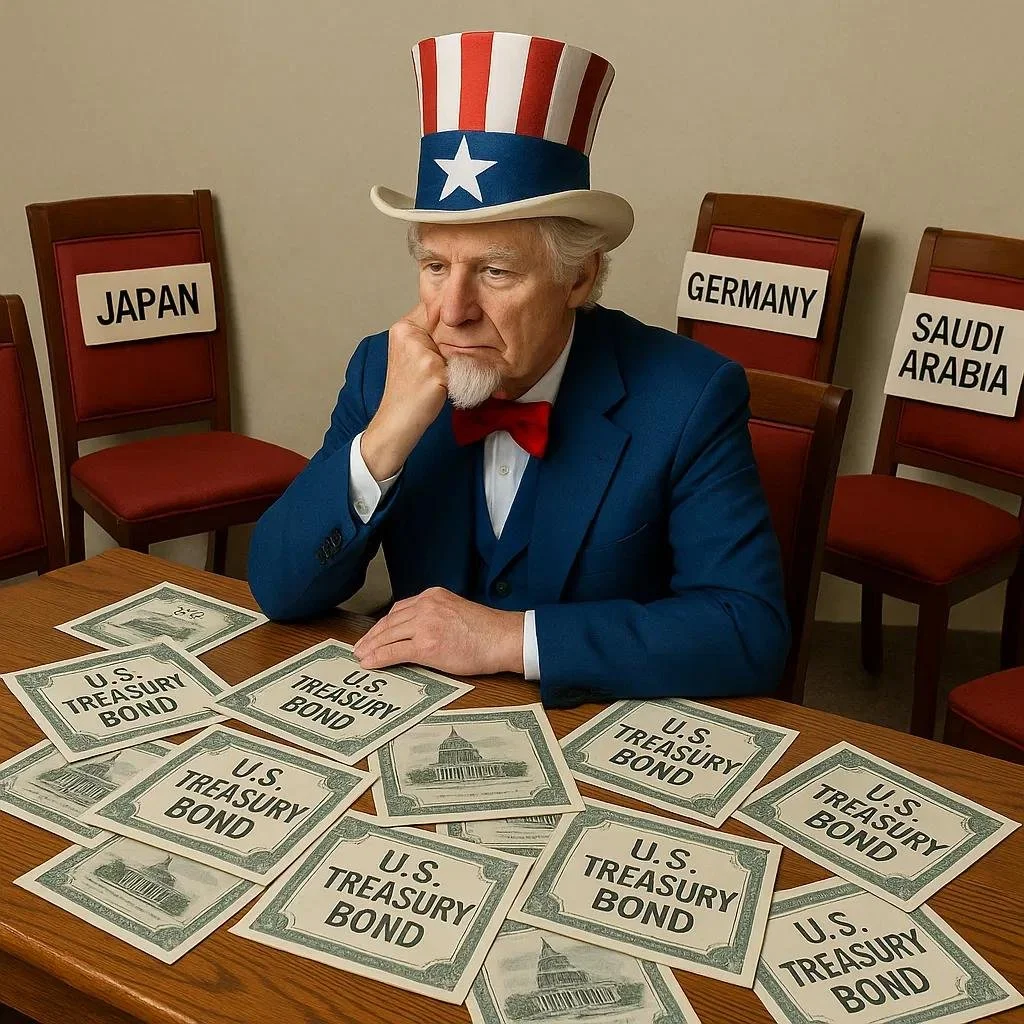
And at first, that might sound like a good thing— HOORAY! More independence from foreign creditors! America is better off without that Chinese money! Right?
But in reality this is a huge problem. Because it’s not just China.
Going back to the years before Covid, roughly a third of US debt was owned by foreigner governments and foreign central banks.
But then federal debt skyrocketed during the pandemic, and US government credibility plummeted. Even the government’s credit rating has been slashed.
As a result, foreigners across the board began stepping back from Treasury securities.
Today foreign ownership of US debt is less than 25%, and falling. This is a significant drop in just a few years.
Why it matters:
The US Treasury relies heavily on foreign capital to fund the federal government’s gargantuan (~$2 trillion) deficits. So if foreigners’ appetite to buy US government debt is waning— at a time when federal deficits are exploding higher— where will the Treasury Department come up with the money?
There are essentially two answers. Either (1) the Federal Reserve will “print” the money, or (2) domestic investors within the US economy will buy government bonds and fund the deficit.
But both of those options come at a significant cost.
Consequences of the Fed funding US government deficits:
In order for the Federal Reserve to buy US government bonds (and essentially fund the government’s annual budget deficit), the Fed must first expand the money supply.
We often refer to this as “printing money” even though it all happens electronically. The Fed calls it “quantitative easing”, or QE, but it’s all the same thing.
The consequence of QE is inflation. Serious, serious inflation.
Think about it— during the pandemic, the Fed’s QE created roughly $5 trillion in new money... resulting in 9% inflation.
Creating enough money to fund federal budget deficits over the next decade could result in the Fed having to print $15+ trillion. So most likely that’s going to be a LOT of inflation.
Consequences of the US economy funding government deficits:
American investors, i.e. banks, funds, corporate treasury departments, etc. could also buy more US government bonds in order to offset waning foreign demand.
But this capital comes at a big opportunity cost
Any private capital that goes in to the Treasury market means less money available to buy stocks, fund venture capital, or finance real estate mortgages
The net result is lower stock prices, higher mortgage rates, and slower innovation.
Why China is first to ditch US government bonds:
After sanctions on Russia, which included freezing their Treasury holdings, other countries got spooked — especially China.
China probably fears becoming the next target of US financial weaponization.
This may also be an indication that they will eventually invade Taiwan
So China is hedging: they’re selling their US government bonds and buying literal metric tons of physical gold— driving gold prices to record highs.
The bottom line:
The shrinking foreign appetite for US debt is a glaring red flag. It signals waning confidence in US fiscal credibility and could lead to a capital squeeze at home — or nasty inflation spiral if the Fed fills the gap.
Many Americans might cheer the idea of being less reliant on Chinese or other foreign money. But in reality, foreign investment in government debt is the closest thing to a ‘free lunch’ in economics.
It means that foreigners are financing federal deficits, meaning less inflation at home, and allowing private capital to invest directly in the US economy.
Losing this benefit is a bad thing for America.
You can listen to my full thoughts on the matter in this brief Podcast.
For the audio-only version, check out our online post here.
Finally, you can find the podcast transcript for your convenience, here.
To your freedom, James Hickman Co-Founder, Schiff Sovereign LLC
It’s Not Glamorous, but This Is How Most Americans Actually Become Millionaires
It’s Not Glamorous, but This Is How Most Americans Actually Become Millionaires
John Csiszar Sat, August 9, 2025 GOBankingRates
You may be surprised to find out that about 18% of Americans are millionaires, translating to roughly 25 million individuals, according to a report by Wealth Management USA. And while there are plenty of ways to accumulate a seven-digit net worth, some avenues are more common than others.
Many millionaires start their own business or invest in real estate to earn their riches, while others imply inherit the money. But the number one way that Americans become millionaires is actually within reach of average workers, provided they start early and stick to their plan.
It’s Not Glamorous, but This Is How Most Americans Actually Become Millionaires
John Csiszar Sat, August 9, 2025 GOBankingRates
You may be surprised to find out that about 18% of Americans are millionaires, translating to roughly 25 million individuals, according to a report by Wealth Management USA. And while there are plenty of ways to accumulate a seven-digit net worth, some avenues are more common than others.
Many millionaires start their own business or invest in real estate to earn their riches, while others imply inherit the money. But the number one way that Americans become millionaires is actually within reach of average workers, provided they start early and stick to their plan.
Here’s the “boring” path to riches that doesn’t involve starting a business, investing in real estate or inheriting the money.
Consistent Investing
Want the “easy” way to a million dollars? Continually invest on a regular basis.
According to a report from Morningstar, investors who have $1 million or more in their Fidelity 401(k) accounts consistently invest, typically every two weeks or every month. They don’t trade in and out of aggressive investments, like leveraged ETFs, but instead simply sock away their money on a regular basis into their “boring” investments.
What’s the Secret?
There are a number of reasons why consistent investing is the “easy” path to $1 million. First, regularly adding money to your investments regardless of the market environment ensures that you’ll get an average price. You’ll be buying more stock when prices are low and less when prices are high. You won’t be putting all your money in either at the absolute bottom or at the peak — but since the long-term trend of the market is up, getting that “average” price provides a significant return.
Second, by consistently investing in “boring” options like mutual funds, 401(k) funds or high-quality stocks, you won’t be taking on excess risk. With automated contributions coming out of your paycheck or bank account, you won’t get tempted to chase the latest investment fad, a mistake that costs many novice investors their entire bankroll.
As preservation of capital is half the battle when it comes to building wealth, automatically contributing to relatively “boring” investments can help protect your bankroll over the long run.
The third reason why consistent investing works is a simple one. If you continually add money to your account, you’ll have more money in it.
TO READ MORE: https://www.yahoo.com/finance/news/no-1-way-americans-become-150405344.html
How To Prevent a Rocky Economy From Derailing Your Financial Goals
How To Prevent a Rocky Economy From Derailing Your Financial Goals
Cindy Lamothe Wed, August 6, 2025 GOBankingRates
When the economy starts acting up — think rising prices, stock market swings or constant chatter about a possible recession — it’s totally normal to feel anxious.
One survey by Equitable Holdings revealed that only 42% of Americans feel prepared to navigate shifting financial challenges, including potentially higher costs from tariffs, market volatility and lingering recession concerns. When those challenges hit, suddenly, the financial goals you’ve been working toward can feel like they’re slipping out of reach.
How To Prevent a Rocky Economy From Derailing Your Financial Goals
Cindy Lamothe Wed, August 6, 2025 GOBankingRates
When the economy starts acting up — think rising prices, stock market swings or constant chatter about a possible recession — it’s totally normal to feel anxious.
One survey by Equitable Holdings revealed that only 42% of Americans feel prepared to navigate shifting financial challenges, including potentially higher costs from tariffs, market volatility and lingering recession concerns. When those challenges hit, suddenly, the financial goals you’ve been working toward can feel like they’re slipping out of reach.
But here’s the truth: A rocky economy doesn’t have to derail your progress. With a few grounded strategies and a little flexibility, you can keep moving forward — even when the economic forecast looks a little stormy.
Rethink Inflexible Goals
According to Kevin Huffman, finance specialist, owner and senior contributor at Kriminil Trading, Americans need to focus on flexibility as much as ambition
“The trick is to create a financial plan resilient enough to bend without breaking,” he said.
To get there, he suggested starting by rethinking inflexible goals into more flexible targets like working toward a certain savings threshold by a particular year rather than dwelling on a retirement age. Then, section those goals out in 90-day checkpoints to make course corrections for the unexpected without interrupting your momentum.
Automate Your Good Habits
TO READ MORE: https://www.yahoo.com/finance/news/prevent-rocky-economy-derailing-financial-102838605.html
13 Ways To Save Money Right Now, According to George Kamel
13 Ways To Save Money Right Now, According to George Kamel
Ashley Donohoe Thu, August 7, 2025 GOBankingRates
A May 2025 McKinsey & Company survey found that inflation and tariffs topped the list of concerns for Americans, with 32% of respondents having changed their spending and another 31% planning to.
Whether you need to save money out of necessity or just want to progress more quickly toward a goal, you can do so without giving up the essentials or living an extremely frugal life.
13 Ways To Save Money Right Now, According to George Kamel
Ashley Donohoe Thu, August 7, 2025 GOBankingRates
A May 2025 McKinsey & Company survey found that inflation and tariffs topped the list of concerns for Americans, with 32% of respondents having changed their spending and another 31% planning to.
Whether you need to save money out of necessity or just want to progress more quickly toward a goal, you can do so without giving up the essentials or living an extremely frugal life.
In a recent YouTube video, money expert George Kamel discussed many creative and simple ways to cut costs. Think about which of these strategies might work for you.
Find a Roommate
While you could move to a cheaper place, finding a roommate is an easier cost-saving option. Between splitting the rent and utilities, you could save several thousand dollars each year, with the catch being that you give up some privacy.
Kamel suggested carefully vetting your potential roommate to find a responsible match.
Get Rid of Private Mortgage Insurance
If you bought your house with a conventional mortgage with a low down payment and now have at least 20% equity, you can contact your lender to see if you can stop paying for private mortgage insurance (PMI).
Fannie Mae noted that the typical cost is around 0.58% to 1.86% of your loan amount each year, so you could see significant savings in your mortgage payment.
Bundle Your Utilities
Kamel suggested bundling services through one provider for potential savings. For example, major cable TV companies like Xfinity and Spectrum offer internet, home phone and cellular services in packages. It’s also worth shopping around with a competitor if you already have a bundle that has become more expensive after your promo period expired.
Set Up Automatic Payments
Not only does using autopay help you avoid the costs of late payments, but your provider might even offer a small discount. You’ll often find this perk available for insurance premiums, utility bills and certain loan payments. Just make sure to have the funds available when the payment is due.
Be More Energy-Efficient
TO READ MORE: https://www.yahoo.com/lifestyle/articles/13-ways-save-money-now-143834993.html
Travel Experts: Don’t Keep Your Money in These 6 Places While Traveling
Travel Experts: Don’t Keep Your Money in These 6 Places While Traveling
Caitlyn Moorhead Mon, August 4, 2025 GOBankingRates
Though paper money has gone the way of the dodo in many respects, sometimes when you travel you just want some cold hard cash at hand to make life easier. While many people don’t carry cash at all, others have go-to methods of storing their money.
Whether you’re a frequent or casual traveler, it’s important to know where to keep your money so that it doesn’t get lost or stolen while you’re on your trip. Here are six places you should never keep your cash when traveling.
Travel Experts: Don’t Keep Your Money in These 6 Places While Traveling
Caitlyn Moorhead Mon, August 4, 2025 GOBankingRates
Though paper money has gone the way of the dodo in many respects, sometimes when you travel you just want some cold hard cash at hand to make life easier. While many people don’t carry cash at all, others have go-to methods of storing their money.
Whether you’re a frequent or casual traveler, it’s important to know where to keep your money so that it doesn’t get lost or stolen while you’re on your trip. Here are six places you should never keep your cash when traveling.
Outer Pockets of Backpacks or Luggage
You should be aware that when it comes to specific areas of storage on your bag or luggage, some are safer than others. For example, the back or outer pockets of your backpacks or luggage compartments are not the best place to keep your money while traveling. Not only do these places lack security, but they’re also easily accessible to pickpockets.
Unattended Hotel Room
Your hotel room might not be as secure as you think. Even if it’s highly rated and in a safe area, you still shouldn’t leave your money out in the open in your room. For instance, try not to leave your card on the side table of your hotel room when you go sightseeing or out for the day. You never want to leave your information or money vulnerable to being easily stolen.
Alternatively, if you want to leave something in your room, opt for hotel room safes, as they are the best go-to choice for locking away passports, cash and valuables. One of the best investments you can make when traveling is in your peace of mind.
In One Place
Unfortunately, savvy thieves know how to spot tourists who can become targets if they know they have money and are ready to use any opportunity to steal it. Be careful when travelling abroad and try to distribute your money across several locations rather than keeping it all in one place.