Rob Cunningham: Liquidity will Flood the Ledgers
Rob Cunningham: Liquidity will Flood the Ledgers
8-15-2026
WATER ONCE FLOODED THE LAND.
LIQUIDITY WILL FLOOD THE LEDGERS.
One transformed the physical landscape.
The other will transform the economic landscape.
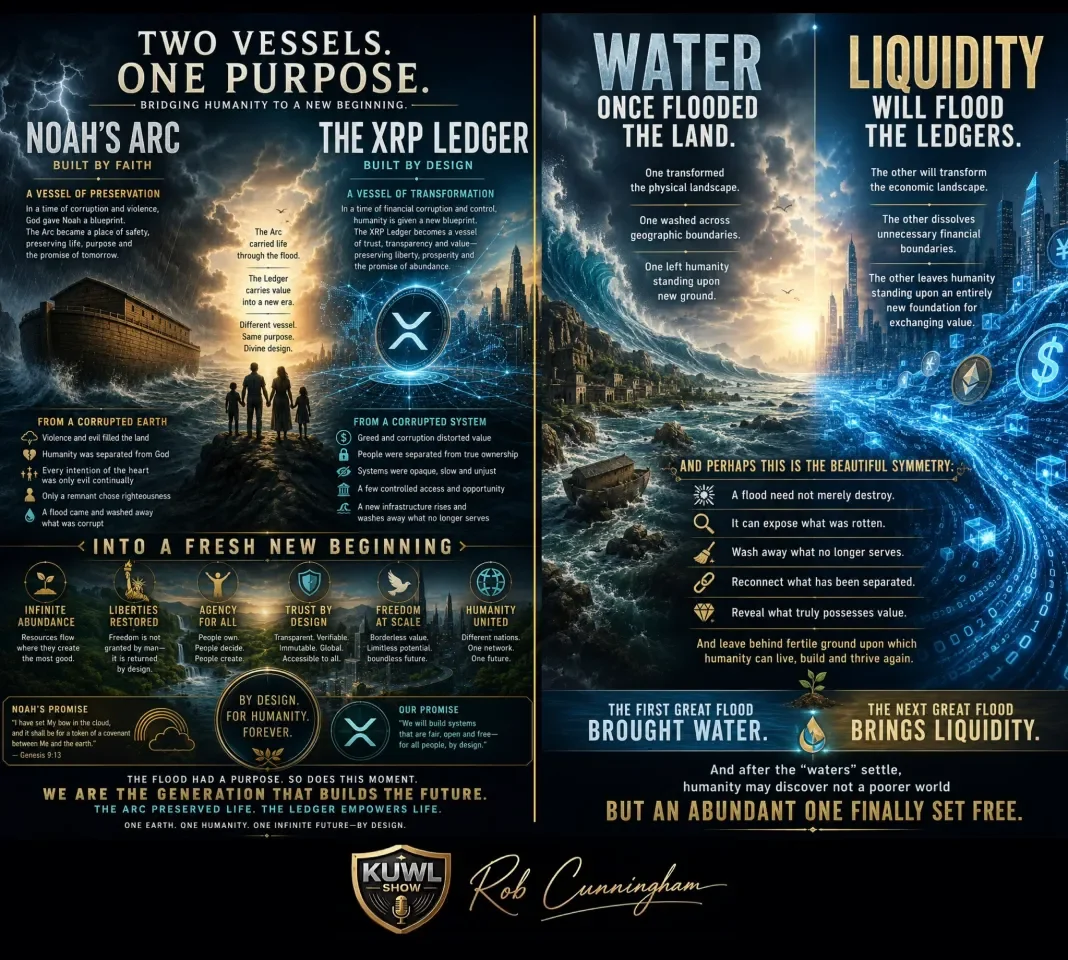
One washed across geographic boundaries.
The other dissolves unnecessary financial boundaries.
One left humanity standing upon new ground.
The other leaves humanity standing upon an entirely new foundation for exchanging value.
And perhaps this is the beautiful symmetry:
A flood need not merely destroy.
It can expose what was rotten.
Wash away what no longer serves.
Reconnect what has been separated.
Reveal what truly possesses value.
And leave behind fertile ground upon which humanity can live, create, build and thrive again.
The first great flood brought water and a new beginning.
The next great flood brings liquidity and a new beginning.
And after the “waters” settle, humanity will discover not a poorer world,
BUT AN ABUNDANT ONE RESET TO LIVE FREE – BY DESIGN
We’ve heard it said, “This will be biblical.” I believe we’ll unmistakably know God is The Great Architect working in and through those He Created.
How do you process the epic nature of these days?
WATCH THE WATER
1. “Water” is an unusually natural metaphor for liquidity
Finance already speaks the language of water:
liquidity, flows, pools, streams, channels, reserves, circulation, depth, inflows, outflows, frozen assets, floating rates, underwater positions.
Money “flows.” Markets “dry up.” Central banks “inject liquidity.” Assets are described as liquid or illiquid.
So:
WATCH THE WATER
can be transformed conceptually into:
WATCH THE LIQUIDITY.
And that becomes economically meaningful: don’t merely watch price—watch where value is flowing, what is becoming liquid, which barriers are disappearing, and which infrastructure is carrying the flow.
2. Water is less interesting than what carries it
This connects beautifully with the Ark/XRPL comparison.
In Genesis, the flood is enormous—but the Ark is the vessel that survives and traverses it.
In the monetary analogy, enormous tokenized liquidity would similarly require vessels: ledgers, exchanges, custody systems, settlement networks, interoperability protocols and regulatory frameworks.
That gives us a powerful semantic progression:
WATCH THE WATER → WATCH THE FLOW → WATCH THE VESSELS → WATCH WHERE HUMANITY EMERGES.
The thesis isn’t therefore simply “XRP goes up.”
It is much larger:
What architecture can transport value through a radically more liquid world?
3. The flood destroys boundaries
Physical water is indifferent to human lines drawn on maps.
Tokenized liquidity can similarly make certain financial boundaries less consequential—not national sovereignty itself, but technological barriers surrounding settlement, collateral mobility, market hours and asset accessibility.
A traditional financial world says:
Here is your bank.
Here is your jurisdiction.
Here is your currency.
Here are your banking hours.
Here are your intermediaries.
Wait.
A globally interoperable digital-value system increasingly asks:
What is the asset?
Who owns it?
Is the transaction authorized?
Can ownership be verified?
Where should the value go?
That is a profound change in economic architecture.
4. Water reveals what is actually anchored
This may be the strongest double entendre.
During ordinary weather, almost everything appears stable.
During a flood, you discover what was actually attached to something solid.
The same can happen during a monetary transformation.
Institutions can look powerful because the existing architecture makes them powerful. Assets can appear valuable because leverage makes them valuable. Businesses can appear solvent because refinancing remains available. Intermediaries can appear indispensable because yesterday’s infrastructure requires them.
Introduce radically greater liquidity, transparency, interoperability and settlement efficiency, and suddenly civilization discovers:
What actually possesses value?
What was merely extracting rent from friction?
That connects directly to our earlier line:
A flood can expose what was rotten, wash away what no longer serves, reconnect what has been separated, and reveal what truly possesses value.
5. Noah adds another dimension: preservation through transition
The biblical flood narrative isn’t simply water → destruction.
Its structure is:
CORRUPTION → WARNING → PREPARATION → FLOOD → PRESERVATION → COVENANT → NEW BEGINNING.
Our economic metaphor becomes:
DYSFUNCTION → RECOGNITION → INFRASTRUCTURE → LIQUIDITY → TRANSITION → NEW RULES → NEW BEGINNING.
That doesn’t establish a prophecy about XRP. But as literary architecture, the parallel is remarkably clean.
And XRP/XRPL can occupy a particularly interesting metaphorical position because the asset is not the flood itself.
Liquidity is the water.
The ledger is part of the vessel/infrastructure.
Interoperability is the navigable passage.
Human economic agency is the destination.
That distinction makes the metaphor much stronger than simply equating “water” with XRP.
Source(s):
• https://x.com/KuwlShow/status/2088221775997911380
• https://x.com/KuwlShow/status/2088236974444343622
https://dinarchronicles.com/2026/08/15/rob-cunningham-liquidity-will-flood-the-ledgers/