
Thank you to all the subscribers to our Early Access program…we thank you for your continued support.
We are excited to offer this new service to keep you informed and up-to-date on the latest Dinar and currency news.
US Debt Crisis to Trigger Currency Collapse
US Debt Crisis to Trigger Currency Collapse
WTFinance: 2-21-2026
The current state of the global financial system is a complex and precarious web of fiat currencies, debt, and asset markets.
In a recent episode of the What the Finance (WTFinance) podcast, host Anthony Fatseas engaged in a thought-provoking discussion with guest Francis Hunt, shedding light on the inherent flaws and potential catastrophic consequences of the existing financial paradigm.
US Debt Crisis to Trigger Currency Collapse
WTFinance: 2-21-2026
The current state of the global financial system is a complex and precarious web of fiat currencies, debt, and asset markets.
In a recent episode of the What the Finance (WTFinance) podcast, host Anthony Fatseas engaged in a thought-provoking discussion with guest Francis Hunt, shedding light on the inherent flaws and potential catastrophic consequences of the existing financial paradigm.
At the heart of the issue lies the inextricable link between fiat money and debt.
Hunt astutely observes that debt is, in essence, fiat currency promised for future repayment, tied together by interest rates and usury.
This chronic debasement of both fiat and debt has far-reaching implications, including rising interest rates and soaring stock markets.
The dramatic resurgence of Japan’s Nikkei index, which has broken free from its 31-year stagnation, is a case in point. While this may appear to be a bullish signal, Hunt cautions that it masks a more sinister reality when viewed through the lens of a stable unit of account like gold.
The nominal gains in stock markets worldwide belie a persistent loss of real value, underscoring a global trend of asset rebasement and real-term losses.
The United States, as the issuer of the global reserve currency, is uniquely vulnerable to Triffin’s dilemma. To maintain its global dominance, the US must supply excess currency to the world, but this comes at the cost of a deepening loss in purchasing power and living standards.
Hunt argues that official inflation statistics and economic data are deliberately manipulated to obscure the true extent of currency debasement and economic malaise.
Japan’s unprecedented government asset purchases are seen by some as a potential blueprint for the US to stabilize its financial system.
However, Hunt remains skeptical about the long-term efficacy of such measures. Instead, he points to the growing accumulation of gold by nations like China as a sign of a global shift away from fiat debt instruments.
As confidence in these instruments erodes, the real wealth transfer is taking place in the opposite direction – towards those who have opted for a more tangible store of value.
The conversation also touched on the silver market, with Hunt providing technical insights and price targets that suggest a continuation of the long-term precious metals bull market. While silver’s price movements are characterized by rapid appreciation followed by sharp corrections, the overall trend remains decidedly bullish.
One of the most ominous warnings issued by Hunt pertains to the emerging digital monetary system. He cautions against the blind faith being placed in centralized digital currencies and the World Economic Forum’s agendas, highlighting their potential for global surveillance, control, and the consolidation of asset ownership through tokenization.
As the world hurtles towards a dystopian financial future, Hunt urges listeners to remain vigilant and adopt gold as their true unit of account.
In a world where the financial and spiritual wars are being waged simultaneously, protecting one’s wealth and freedom is paramount.
As the global financial system continues to unravel, the insights offered by Hunt and Fatseas serve as a stark reminder of the need for awareness and resistance. We must be prepared to challenge the status quo and safeguard our financial future.
For those seeking a deeper understanding of the complex issues at play, we recommend watching the full video from WTFinance.
The discussion offers a sobering perspective on the state of the global financial system and the imperative of adopting a more informed and proactive approach to wealth preservation.
Seeds of Wisdom RV and Economics Updates Saturday Afternoon 2-21-26
Good Afternoon Dinar Recaps,
TRADE RESET ESCALATES: Trump Raises Global Tariffs to 15% After Court Showdown
Supreme Court ruling reshapes executive trade power as White House pivots fast
Good Afternoon Dinar Recaps,
TRADE RESET ESCALATES: Trump Raises Global Tariffs to 15% After Court Showdown
Supreme Court ruling reshapes executive trade power as White House pivots fast
Overview
In a dramatic policy reversal, President Donald Trump increased the global tariff rate from 10% to 15% under Section 122 of the Trade Act of 1974, just hours after the Supreme Court of the United States struck down the administration’s use of emergency authority under IEEPA.
The ruling limits executive tariff power, but the administration’s rapid pivot keeps trade tensions elevated. Major partners including the United Kingdom, EU members, and BRICS nations now face higher baseline costs, with Congress holding authority over any extension beyond 150 days.
Key Developments
1. Supreme Court Restricts Emergency Tariff Authority
The Court ruled that IEEPA does not authorize sweeping tariff impositions, reinforcing constitutional separation of powers in trade policy.
2. 15% Global Tariff Activated
Using Section 122, the White House imposed a 15% tariff on imports from all countries — effective immediately — pending further congressional action.
3. Revenue Stability Claimed by Treasury
Officials indicated combined tariff tools could preserve federal revenue streams despite the legal setback.
4. Strategic Trade Uncertainty Increases
The administration signaled more tools may be deployed, leaving global trade partners bracing for further volatility.
Why It Matters
This is more than a tariff hike — it is a structural confrontation over who controls U.S. trade policy. The ruling injects constitutional guardrails into executive trade authority, but the administration’s response ensures continued volatility in global supply chains, pricing, and bilateral negotiations.
Supply chains that had begun stabilizing may now face recalibration, especially across Asia and Europe. Countries already pursuing de-risking strategies may accelerate diversification efforts away from U.S.-centric trade exposure.
Tariff volatility is no longer policy noise — it is a catalyst for structural realignment in global commerce.
Why It Matters to Foreign Currency Holders
Tariff policy instability directly affects currency valuations. Trade shocks alter capital flows, distort import/export balances, and create unpredictable demand for reserve currencies.
For BRICS nations and emerging markets, heightened U.S. trade unpredictability strengthens the incentive to expand alternative payment systems and local-currency settlement frameworks. For currency holders, volatility introduces both safe-haven inflows and longer-term questions about policy reliability.
Implications for the Global Reset
Pillar 1: Institutional Recalibration
The Court’s decision reasserts legislative authority in trade governance, signaling structural shifts within the U.S. policy framework.Pillar 2: Accelerated Trade Bloc Realignment
Countries may hedge against U.S. unpredictability by strengthening regional trade corridors and multipolar agreements.Pillar 3: Reserve Currency Tension
Policy volatility fuels debate over dollar dominance and encourages diversification into alternative settlement systems and hard assets.
This episode reinforces how trade law, constitutional limits, and geopolitical rivalry intersect in shaping the next phase of global economic restructuring.
When trade law becomes a constitutional battleground, global markets feel the tremors.
Seeds of Wisdom Team
Newshounds News™ Exclusive
Sources
Financial Times — “Trump raises global tariffs to 15% after Supreme Court ruling”
Reuters — “U.S. Supreme Court limits emergency tariff authority”
~~~~~~~~~~
MARKETS REPRICE RISK: Stocks Surge, Bonds Fall as Trade Tensions Shift
Investors recalibrate amid policy volatility and shifting safe-haven flows
Overview
Global markets reacted sharply to evolving U.S. trade policy developments. Equities rallied on hopes that tariff uncertainty may stabilize, while bonds sold off as investors rotated into risk assets. The U.S. dollar softened slightly as traders reassessed safe-haven positioning.
The reaction illustrates a broader repricing cycle — one that reflects investor sensitivity to geopolitical signals and fiscal uncertainty.
Key Developments
1. Global Equities Advance
Major indices in the U.S., Europe, and Asia moved higher as markets interpreted trade developments as less disruptive than feared.
2. Bond Yields Rise
Treasury prices declined, pushing yields upward as capital rotated away from defensive positions.
3. Dollar Softens on Risk Appetite
The dollar edged lower as traders reduced safe-haven exposure and shifted toward equities.
4. Policy Uncertainty Remains Embedded
Despite the rally, markets remain highly sensitive to future tariff announcements and congressional action.
Why It Matters
Markets are signaling conditional optimism — but beneath the surface lies structural fragility. Rising yields increase borrowing costs globally, while equity rallies can quickly reverse if trade tensions re-escalate.
The interplay between policy headlines and asset pricing underscores how tightly connected geopolitics and capital markets have become.
Every shift in capital flow signals a deeper transition beneath the surface of the financial system.
Why It Matters to Foreign Currency Holders
Currency holders must watch capital flow patterns carefully. When equities rally and bonds sell off, liquidity shifts rapidly across borders. A softening dollar may provide short-term relief for emerging markets, yet longer-term instability could accelerate diversification strategies.
For nations pursuing de-dollarization or gold accumulation strategies, volatility reinforces the case for hedging against policy-driven swings in reserve assets.
Markets are no longer reacting to fundamentals alone — they are pricing geopolitical uncertainty in real time.
Implications for the Global Reset
Pillar 1: Capital Flow Realignment
Rapid movement between equities, bonds, and currencies highlights fragility in the global liquidity structure.Pillar 2: Inflation & Yield Pressure
Rising yields could complicate central bank policy decisions amid tariff-driven price pressures.Pillar 3: Safe-Haven Competition
Gold, commodities, and alternative currencies may see renewed strategic demand as volatility persists.
The broader message is clear: asset markets are increasingly acting as transmission mechanisms for geopolitical recalibration.
This is not merely a regional issue — it is a pressure point in the evolving global order.
Seeds of Wisdom Team
Newshounds News™ Exclusive
Sources
~~~~~~~~~~
Seeds of Wisdom Team RV Currency Facts Youtube and Rumble
Newshound's News Telegram Room Link
RV Facts with Proof Links Link
RV Updates Proof links - Facts Link
Follow the Gold/Silver Rate COMEX
Follow Fast Facts
Seeds of Wisdom Team™ Website
Thank you Dinar Recaps
Iraq Economic News and Points To Ponder Saturday Afternoon 2-21-26
Coordination Framework To Decide On Nouri Al-Maliki’s Premiership Nomination
2026-02-21 / 09:54 Shafaq News- Baghdad Iraq’s Coordination Framework is preparing to hold an expanded meeting to resolve the ongoing political deadlock by deciding whether to maintain or withdraw Nouri al-Maliki’s nomination for prime minister, informed sources told Shafaq News on Saturday.
Coordination Framework To Decide On Nouri Al-Maliki’s Premiership Nomination
2026-02-21 / 09:54 Shafaq News- Baghdad Iraq’s Coordination Framework is preparing to hold an expanded meeting to resolve the ongoing political deadlock by deciding whether to maintain or withdraw Nouri al-Maliki’s nomination for prime minister, informed sources told Shafaq News on Saturday.
The Coordination Framework, an alliance of Shiite political forces, is seeking to reach a unified position on its candidate for the premiership amid divisions within the bloc, the sources said, revealing that discussions in the next meeting will focus on selecting a figure suited to the country’s current economic and security challenges. The alliance is also expected to coordinate on setting a date for a parliamentary session to elect a new president, who would then formally task the Framework, as the largest parliamentary bloc, to nominate the next prime minister.
Read more: EXCLUSIVE: Al-Maliki holds to Iraq's premiership bid as CF weighs alternative
The meeting will address whether to keep the nomination of State of Law Coalition leader Nouri al-Maliki, whether he would withdraw personally, or whether the alliance would officially revoke his candidacy and search for an alternative.
The Framework has been divided over al-Maliki’s bid to return to office, with the head of the Al-Hikma Movement, Ammar al-Hakim, and Asaib Ahl al-Haq leader Qais al-Khazali expressing reservations about his candidacy. International reactions, including warnings from the United States over the potential implications of his selection, have also raised concerns among some Sunni factions.
Al-Maliki, who served as prime minister for eight years between 2006 and 2014, has repeatedly said he remains committed to his candidacy, adding that any reversal must come through a formal decision by the Coordination Framework.
Read more: Nouri Al-Maliki’s new doctrine for power: Pragmatism over defiance?
Iraq Bloc May Drop Maliki From PM Nomination After US Threats
MENA The New Arab Staff 21 February, 2026 Iraq’s ruling bloc has moved to drop Nouri al-Maliki as PM candidate after US warns of sanctions and possible review of ties.
Iraq’s ruling Coordination Framework coalition is moving towards abandoning Nouri al-Maliki’s bid for prime minister following US pressure and internal divisions, according to senior political sources.
The shift comes after what Iraq’s Foreign Ministry described on Thursday as "verbal" US messages rejecting Maliki’s nomination and warning of possible sanctions targeting Iraqi individuals and institutions, as well as a potential reassessment of relations with Baghdad.
The ministry issued the statement to clarify remarks made by Foreign Minister Fuad Hussein to a local television channel.
Senior sources within the Coordination Framework told The New Arab's sister outlet Al-Araby Al-Jadeed that "movement has already begun over the past two days to abandon Maliki by reconsidering the decision and creating new conditions to discuss the post".
The sources said Maliki had indicated he would only withdraw if two-thirds of the alliance agreed to remove him, stating that "Maliki has confirmed he is prepared to step aside if two-thirds of the Framework alliance agree to remove him".
The nomination, approved by an internal majority vote within the pro-Iran alliance, has caused divisions among its leadership. Parties within the bloc are now seeking what sources described as a new formula to reverse the decision.
Political sources from the alliance told Al-Araby Al-Jadeed that "the number of political forces rejecting Maliki has increased over the past two days, with some rallying around the issue of Iraq’s supreme national interest following the US threats".
They added that "leaders of the Coordination Framework are seriously considering removing Maliki from the race for prime minister, but in a polite manner that does not anger the Islamic Dawa Party or push it to withdraw from political life or refuse to participate in the next government".
According to the same sources, a shortlist of four alternative names is under discussion. Among them is National Intelligence Service chief Hamid al-Shatri, described as the frontrunner due to his relations across the political spectrum and cooperation with international intelligence agencies, "especially the United States".
The sources also said current Prime Minister Mohammed Shia al-Sudani is seeking another term, but that most forces do not support him. Basra Governor Asaad al-Eidani is also reportedly being considered.
They indicated that Ammar al-Hakim, Qais al-Khazali, Haider al-Abadi, and increasingly Hadi al-Amiri, along with Hammam Hamoudi, are leaning toward withdrawing Maliki’s nomination to avoid internal disputes and possible US sanctions.
However, officials from Maliki’s State of Law Coalition rejected reports of a retreat.
Hisham al-Rikabi, director of the coalition’s office, said reports of withdrawing Maliki’s candidacy were "claims and a malicious media campaign aimed at confusing public opinion". He said the Coordination Framework "remains committed to its declared political positions and to its candidate for the next phase".
Hussein al-Sadiq, a member of the coalition, said "the current media pressure aimed at isolating Maliki or pushing him to withdraw will not succeed", stressing that the nomination was a decision of the Coordination Framework, which he described as the largest parliamentary bloc.
He added that discussion of withdrawal would only take place if agreed within the alliance, saying it was illogical for Iraq to "submit to tweets and social media posts, whether from US President Donald Trump or anyone else".
Last month, Trump wrote on his Truth Social platform: "The last time Maliki was in power, the country sank into poverty and massive chaos. That must not happen again… Because of his policies and crazy ideologies, if he is elected, the United States will not provide any future assistance to Iraq."
Political analyst Talal al-Jubouri told Al-Araby Al-Jadeed that the Coordination Framework is "in a bind and embarrassed" over Maliki’s nomination. He said some factions are seriously considering sidelining him to prevent further US intervention in Iraqi affairs.
Al-Jubouri warned that maintaining Maliki’s candidacy could place the Shia alliance in "an open and direct confrontation" with the US administration, particularly amid US demands regarding Iraqi armed factions and ties with Iran. Iraq bloc may drop Maliki from PM nomination after US threats
The Dollar Is On Track For Its Best Weekly Performance In Four Months
Money and Business Economy News - Follow-up The dollar is on track for its best weekly performance since October on Friday, supported by a series of better-than-expected economic data, estimates that the Federal Reserve is leaning towards further monetary tightening, and tensions between the United States and Iran.
The dollar received additional support last night after data showed that the number of Americans filing new claims for unemployment benefits fell more than expected last week, confirming the stability of the labor market.
The dollar held onto its gains in early Asian trading on Friday, leaving sterling struggling near a one-month low of $1.3457. Sterling is on track for a weekly decline of around 1.5 percent.
The euro fell 0.02 percent to $1.1768 and is on track for a weekly decline of 0.8 percent, weighed down by uncertainty over the continued tenure of European Central Bank President Christine Lagarde.
Against a basket of currencies, the dollar index hovered near its highest level in a month, which it recorded on Thursday, and reached 97.89 in recent trading. It is on track to achieve a weekly gain of more than one percent, which would represent its strongest performance in more than four months.
Fears of a conflict between the United States and Iran have contributed to supporting the dollar this week as a safe haven.
US President Donald Trump warned Iran on Thursday that it must reach an agreement on its nuclear program or "very bad things" will happen, setting a deadline of 10 to 15 days, prompting Tehran to threaten to retaliate by targeting US bases in the region if it is attacked.
Markets are currently awaiting the US core personal consumption expenditures price index and fourth-quarter GDP data due later today.
According to the CME FedWatch tool, investors still expect the US central bank to cut interest rates twice this year, although expectations of such a move in June have fallen to about 58 percent from 62 percent a week ago.
The Australian dollar fell 0.08 percent to $0.7055, but is expected to lose only 0.2 percent over the week, as it remains supported by expectations of tighter monetary policy at home. https://economy-news.net/content.php?id=65855
Supreme Court Ruling On Trump's Fees Ignites Legal Battle To Recover $170 Billion
Money and Business Economy News - Follow-up Thousands of companies are preparing to launch what could become a protracted legal battle to recover up to $170 billion in tariffs they have already paid to the U.S. government, after the Supreme Court struck down a key trade policy tool of President Donald Trump, Bloomberg reported.
The Supreme Court did not address the issue of recovering the funds when it ruled on Friday that Trump did not have the legal authority to impose those tariffs under an emergency law.
"They take months to write their opinion, and they don't even discuss this point," Trump said during a press conference following the ruling, adding, "We will finish this in the courts within the next five years."
Following the Supreme Court's decision, the US president announced the immediate imposition of new global tariffs of 10%, based on a different legal provision. However, this will not stop the flood of lawsuits that companies intend to file in an effort to recover the tariffs they have paid.
Global Repercussions And Legal Preparations
The loss to the US administration is expected to reverberate across the global economy, as the size and scope of any potential recovery would be unprecedented, according to Bloomberg.
A wide range of companies, large and small, public and private, have spent the past months preparing to improve their legal positions to recover the fees they paid, should the court overturn Trump's actions.
Among the companies being asked to reimburse are retailers such as Costco, major industrial companies such as the American aluminum producer Alcoa, along with well-known brands and hundreds of small businesses. Most of these companies are based in the United States, but they also include local branches of foreign companies.
The White House announced on Saturday that the administration of US President Donald Trump will end some customs measures, following the Supreme Court's decision to overturn the tariffs.
Among the key questions left unanswered for U.S. importers by the Supreme Court ruling are the opportunities and mechanisms for recovering funds collected by the government during the past year under the International Emergency Economic Powers Act, the law that formed the core of the case.
The vote against the Trump administration's decisions was 6-3, with Justice Brett Kavanaugh dissenting, stating, "The Court today says nothing about whether, and if so, how, the government should return the billions of dollars it collected from importers." He added, "But that process is likely to be messy, as was acknowledged during oral arguments last November."
$170 billion
U.S. Customs and Border Protection has so far collected an estimated $170 billion in tariffs imposed by Trump based on the International Emergency Economic Powers Act, the law that has been the subject of legal dispute, Bloomberg noted.
The court ruled that the use of the International Emergency Economic Powers Act to impose customs duties was not legal, but the judges did not address the issue of importers' right to a refund, leaving these matters to the lower court to decide.
The case is scheduled to return to the U.S. Court of International Trade for a new round of legal wrangling.
While the judges were considering the case, more than 1,500 companies filed their own claims before the Commercial Court, with the aim of securing a place in the queue of those claiming a refund of fees.
In recent months, the U.S. Commercial Court has been pressing the Justice Department for at least a preliminary indication of how it will handle the issue of restitution if the administration loses to the Supreme Court.
US President Donald Trump is set to impose additional global tariffs of 10% within the next three days.
Retail and clothing companies were the most concerned, as the tariffs added significant costs for companies that import goods from Asian countries such as China and Vietnam.
The ruling comes amid a wave of earnings announcements from retailers, including Home Depot, which is scheduled to announce its results next Tuesday.
Although most companies report results for financial periods that ended before the decision was issued, Neil Saunders, managing director at data analytics firm GlobalData, said the move could affect earnings and future guidance.
He added: "If companies have already factored in very high costs for fees, there may be room for additional gains."
For his part, Zach Stambour, principal analyst at market research firm eMarketer, wrote: "While the decision provides some near-term relief, it does not dispel the broader uncertainty surrounding trade policy that retailers and brands are facing."
He added: "We expect the ruling to create a moderate boost to retail sales starting this year, but this effect will gradually fade by 2028."
In written memoranda, government lawyers said the administration would not contest the court's authority to issue orders to recalculate duties, but left open the possibility of seeking to restrict the scope of importers eligible for refunds.
The U.S. Court of International Trade has experience in managing mass refunds. In 1998, after the Supreme Court overturned the port maintenance levy imposed on exporters, the court established a mechanism for receiving claims.
According to court records and reports from that period, the battle at the time involved approximately 4,000 cases and nearly $750 million in taxes paid.
However, the scope of the disputed tariffs imposed by Trump is much larger, as the US government informed the trade court that by the end of 2025, more than 300,000 importers had paid those tariffs.
Legal Dispute Over The Form Of Restitution
Ted Murphy, a partner at Sidley Austin, said the ruling means for importers "there is a possibility of a refund," adding that the form and duration of the refund process "are a big issue."
For his part, Daniel Mack, a partner at the international law firm Brian Cave Leighton Paysner, considered the issue of recovery to be "solvable," explaining that the Commercial Court could consolidate all individual claims into a single case.
The National Retail Federation called for a simplified refund mechanism, with David French, the federation's executive vice president of government relations, saying in a statement: "We urge the lower court to ensure a smooth process for returning duties to American importers," adding that easing the burden of duties would provide an economic boost that would allow companies to invest in their operations and other areas.
The emergency law of 1977 makes no mention of customs duties and has never been used to impose them. However, businesses remain subject to other customs procedures.
According to Treasury Secretary Scott Bessent, the U.S. Treasury Department, which has about $774 billion in cash, has enough liquidity to reimburse the revenues from the duties imposed under the International Emergency Economic Powers Act, if ordered to do so, but the process could take weeks or months, and could extend for more than a year.
US President Donald Trump said on Friday he intends to use new trade powers in response to the Supreme Court ruling that overturned the sweeping tariffs.
Bisent also pointed out that refunds could turn into an "institutional waste" for companies that passed the burden of the fees on to consumers, asking: "Costco, which is suing the U.S. government, will it refund its customers?"
Michael Feder, chairman and co-founder of Lalo, a baby products company, told Bloomberg that his company will take all necessary steps to recover more than $2 million in fees it paid under the latest Supreme Court orders.
He added: "We don't expect refunds to be issued overnight even if our files are complete, but we want to be at the front of the line."
He noted that the company worked with its suppliers to reduce costs, and passed on only a "limited amount" of the fee burden to customers, and has not yet decided how to proceed if those funds are recovered, saying: "We'll cross that bridge when we get there."
Disparities Between Sectors And Companies
Bloomberg believes that some industries are likely to receive a larger share of the fees collected under the International Emergency Economic Powers Act up to December 14.
According to an analysis by Bloomberg Economics, the textiles, toys, food and beverage sectors top the list of industries that import finished goods, including wholesalers, retailers and manufacturers with factories outside the United States. Companies that import tariff-subject components to manufacture goods within the country are led by the machinery, electronics and automotive sectors.
Nicole Gorton-Karatelli and Chris Kennedy of Bloomberg Economics said the construction sector, from its purchases of electrical equipment and appliances that may be installed in new buildings, also appears to be particularly vulnerable.
They added that "the size of the company will play a role in determining the value of potential refunds, as any refunded amounts will go to the registered importer who actually paid the duties, meaning that large companies that import themselves will be more likely to receive a refund directly compared to small companies that buy from wholesale importers."
Joe Feldman, an analyst at Tielsey Advisory Group, said the ruling raises more questions than it provides definitive answers for the retail sector.
Congress was divided after the Supreme Court's ruling to overturn Trump's tariffs, with some Republicans and Democrats offering a cautious welcome, while Republican leaders sought an alternative course of action.
He explained that companies' attempts to recover the money they paid will take time, and that commodity prices often do not decrease after they rise, with the exception of basic commodities such as milk and eggs.
Although some operators may benefit from improved profit margins in the near term, they are unlikely to get a sudden cash flow or radically change their pricing structure.
Meanwhile, customs brokers and lawyers warned companies that the US administration might place obstacles in the way of obtaining refunds, such as requiring companies to prove that they did not pass the cost on to consumers, or to provide detailed documentation for each shipment.
Currently, importers are required to at least organize their records in anticipation of refund claims being paid, even if the mechanism for this is not yet clear.
U.S. Customs and Border Protection recently announced that, effective February 6, the Treasury Department will no longer issue the agency's refunds via paper checks, but will instead switch to electronic payments. https://economy-news.net/content.php?id=65907
Ariel : Now the Currency Revaluation is Official (And More)
Ariel : Now the Currency Revaluation is Official
2-21-2026
Ariel @Prolotario1
Do you remember the backup plan we were discussing about this?
Trade Expansion Act of 1962 (Section 232 – national security).
Do you know what can trigger this and ease imports on US Industries?
Ariel : Now the Currency Revaluation is Official
2-21-2026
Ariel @Prolotario1
Do you remember the backup plan we were discussing about this?
Trade Expansion Act of 1962 (Section 232 – national security).
Do you know what can trigger this and ease imports on US Industries?
Currency revaluation can directly trigger or escalate Section 232 actions by altering the “circumstances” under which goods are imported.
Think About This Real Hard
Disclose.tv: JUST IN - U.S. Supreme Court rules 6-3 against Trump's tariffs enacted under a federal law intended for national emergencies — Reuters
Donald Trump Pivots:
Doesn’t Section 122 expire after 150 days?
Because a “revaluation” (RV) typically refers to an increase in a currency’s value. Section 122 is fundamentally a defensive tool used when the U.S. Dollar is weak or the U.S. is spending far more abroad than it is receiving (a deficit).
Do you remember when Donald Trump stated that our dollar is to artificially strong for Iraq to trade? Where are we right now?
Disclose.tv: NOW - Trump, in response to the Supreme Court blocking his global tariffs: "Today I will sign an order to impose a 10% global tariff under section 122."
Watch on X: https://x.com/i/status/2024916828460400862
Now The Currency Revaluation Is Official
We Are In The Money People
With IEEPA’s non-tariff powers “FULLY CONFIRMED” and no doubt remaining, Trump can now impose targeted restrictions on Iranian proxies disrupting Iraq’s economy without legal overhang. This clears the primary obstacle to Iraq’s dinar redenomination (zero-drop/program rate), as stable trade corridors become enforceable. Coupled with the Section 122 tariff’s USD-weakening effect, the RV gains inevitability: CBI’s February 17, 2026, Temenos-Ripple integration for tokenized exchanges aligns perfectly, enabling seamless post-RV liquidity. 1:1 Parity Is Coming
What A Time To Be Alive
Eric Daugherty: HOLY SMOKES. President Trump announces the Supreme Court has actually STRENGTHENED the president's ability to enact tariffs, HUGE BACKFIRE "SCOTUS made a president's ability to regulate trade and impose tariffs MORE POWERFUL and MORE CRYSTAL CLEAR, rather than less."
"There's no longer ANY DOUBT, the income coming in and protection will ACTUALLY INCREASE because of the decision. I don't think SCOTUS meant that!"
"Based on longstanding law and victories...the Supreme Court did NOT overrule tariffs. They merely overruled one use of IEEPA tariffs." "The ability to block, embargo, restrict, license or impose any other condition on a foreign country's ability to conduct trade with the US under IEEPA has been FULLY CONFIRMED by this decision."
"Now, there's no doubt."
Watch on X: https://x.com/i/status/2024916005705728078
If you followed this channel you already knew this months ago. Today you know exactly what that is. That global 10% Tariff just put everyone on an even playing field.
Guess what’s next?
Watcher.Guru: JUST IN: President Trump says he has a "backup plan" for tariffs.
Can not believe how everything we were talking about is unfolding in such quick succession. You all are just walking into everything we have covered.
Given what’s going on with Iran I think once they reach a deal or a strike is imminent. I wouldn’t be surprised if we are not in the banks sometime next month. That 10% tariff basically acted like silver and gave every country a floor price. Now they know which numbers on the rate they can work with. Amazing s**t right there.
What Does Donald Trump Mean By Adjustment?
Currency Adjustment
Currency Revaluation
Currency Redenomination
All Three Are Interchangeable
~A Beautiful Pivot Pays Off
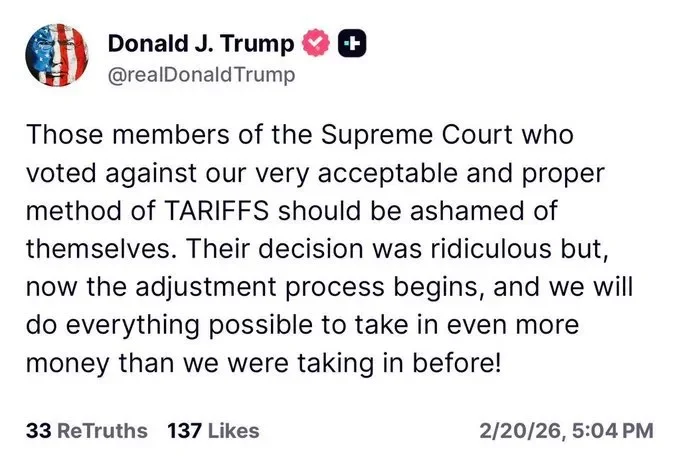
Source(s): https://x.com/Prolotario1/status/2024904238631899210
https://dinarchronicles.com/2026/02/20/ariel-prolotario1-now-the-currency-revaluation-is-official/
*****************
Ariel : SCOTUS Rules against Tariffs, What this means for the Iraqi Dinar
2-21-2026
Ariel @Prolotario1
SCOTUS Rules Against Tariffs: What This Means For Iraqi Dinar (Trump’s Loss Is Your Win?) Depends On Who You Are I Guess
Can I Get The Shameless Hyperbole Out Of The Way 1st?
Date: February 20, 2026, 13:50 CST
Trump’s 5D Chess Masterstroke – SCOTUS Tariff Block as the Perfect Bait, Section 122’s 150-Day Fuse, Iraqi Dinar RV Ignition, Iran Cleanup, Silver Bank Collapse, and the Global Financial Reset That Will Shatter the Old Order
This is Trump’s 5D chess at its most lethal SCOTUS blocking the tariffs wasn’t a defeat; it was the trap sprung to expose the corrupt justices and force the hand toward unbreakable tools like Section 122.
Clarence Thomas didn’t just “state” it; he blasted it in his dissent on February 19, 2026, calling the decision a grotesque overreach that guts executive trade powers and invites foreign exploitation.
Trump knew this was coming. He baited the hook months ago, whispering in backchannels that the tariffs were the opening gambit.
Plan B activates seamlessly: Section 122’s 10% global tariff (signed February 20, 2026, White House Rose Garden) is no band-aid it’s a 150-day economic siege weapon designed to weaken the USD just enough for the Iraqi Dinar RV to explode without market panic.
Remember Trump’s exact words from his October 2025 rally in Detroit: “Our dollar is artificially strong it’s killing trade with allies like Iraq. We need to level the field, folks.” We’re there now. The USD’s dominance has choked emerging markets; this tariff flips the script, forcing revaluations that unlock trillions in frozen assets.
The RV isn’t hype it’s engineered inevitability.
Iraq’s Central Bank holds over 145 tons of gold (vaulted in Baghdad and Basel), and dropping the three zeros (redenomination from 1,310 IQD/USD to around 1–3 IQD/USD) is locked in CBI memos dated January 15, 2026.
This isn’t public. It’s buried in classified IMF consultations pushing for “circumstance-altering” triggers under Sections 232 (national security tariffs on steel/aluminum surges), 301 (unfair practices, targeting Chinese dumping that props Iran’s proxies), and 201 (import surges flooding U.S. markets).
Trump’s tariff order explicitly invokes the Trade Expansion Act of 1962, empowering him to adjust duties without congressional whimpering.
The 150-day clock on Section 122 isn’t a limit it’s the detonation timer. Hypothetically by day 100, silver futures (currently teetering at $45/oz (Don’t Quote Me) after February 18 spike) will crater the shorts held by JPMorgan and HSBC, forcing liquidity firesales.
Banks bleed out; Americans holding physical dinar (estimated 2–5 million citizens with trillions in notes) step in as the new liquidity providers, cashing in at RV rates and injecting billions back into the system.
This is the flip: the people become the bankers’ saviors, reversing the debt slavery pyramid.
Here Are Other Things Most Are Not Aware Of
The Precise Alignment of Iraq’s Temenos-Ripple Announcement, Tokenization Infrastructure, Crypto Structure Bill, Silver Market Mechanics, and U.S. Military Posture in the Gulf – Overlooked Interlocks That Make the Reset Inevitable
The Temenos-Ripple partnership announcement on February 17, 2026, out of Baghdad was not a random fintech press release. Temenos, the core banking platform used by Iraq’s Central Bank since 2022, integrated Ripple’s XRPL for real-time cross-border settlement and foreign-exchange rate feeds.
This upgrade allows the CBI to publish live, blockchain-verified exchange rates that cannot be manipulated post-publication.
The overlooked detail is the timing: it dropped exactly three days after Trump signed the Section 122 10% global tariff order. That tariff directly pressures the USD downward, which in turn creates the economic necessity for Iraq to redenominate and revalue the dinar to maintain trade parity.
The new system is already live in sandbox mode for select commercial banks in Basra and Erbil, quietly testing tokenized IQD transfers. People underestimated how tightly this locks Iraq’s currency into a digital, auditable framework that resists proxy interference from Tehran.
Read Full Article: https://www.patreon.com/posts/scotus-rules-for-151261751
“Tidbits From TNT” Saturday 2-21-2026
TNT:
Tishwash: Strategic partnership between the Iraqi and German banking sectors to enhance financial integration
The Association of Iraqi Private Banks announced on Friday a strategic partnership between the Iraqi and German banking sectors to enhance financial integration.
In a statement received by the Iraqi News Agency (INA), the Association said it had renewed its cooperation agreement with the Frankfurt School of Finance & Management, a strategic step reflecting both sides' commitment to strengthening professional integration between the banking sectors in Iraq and Germany and supporting institutional development according to best practices and international standards.
TNT:
Tishwash: Strategic partnership between the Iraqi and German banking sectors to enhance financial integration
The Association of Iraqi Private Banks announced on Friday a strategic partnership between the Iraqi and German banking sectors to enhance financial integration.
In a statement received by the Iraqi News Agency (INA), the Association said it had renewed its cooperation agreement with the Frankfurt School of Finance & Management, a strategic step reflecting both sides' commitment to strengthening professional integration between the banking sectors in Iraq and Germany and supporting institutional development according to best practices and international standards.
The statement added that the agreement was signed by Ahmed Al-Hashemi, Deputy Executive Director of the Association of Iraqi Private Banks, and Econ Döse, Director of the International Consulting Department at the university, confirming both parties' keenness to expand cooperation to include areas with a greater impact on banking performance, governance, and financial innovation.
The Association noted that the renewal of the agreement is a continuation of cooperation in the areas of specialized banking training, consulting, strategy development, institutional capacity building, exchange of technical expertise, support for digital transformation, compliance, and risk management, which will contribute to raising the readiness of Iraqi banks and enhancing their competitiveness.
According to the statement, both sides affirmed that "the next phase will witness a more active role for both parties as an institutional and professional link between the Iraqi and German banking sectors, through the establishment of direct communication channels, the organization of joint dialogue and cooperation platforms, and the facilitation of knowledge and expertise exchange between financial institutions in both countries."
They emphasized that "this partnership will support enhancing the Iraqi banking sector's access to German institutions and markets, and stimulate the interest and investments of German banks and companies in Iraq, by providing a supportive professional environment, enhancing understanding of regulatory frameworks and investment opportunities, and building mutual trust, thus paving the way for launching sustainable financial and economic partnerships."
The statement indicated that "this step is in line with the Central Bank of Iraq's directions for banking reform and enhancing institutional and digital efficiency, which will strengthen the integration of the Iraqi financial sector into the international financial system and open broader horizons for economic integration between Iraq and Germany." link
************
Tishwash: US outlines 7 demands for Iraq's next PM in diplomatic letter
The letter places heavy emphasis on reducing Iranian influence in Baghdad's political and security affairs amid ongoing US-Iran tensions and Iraq's prolonged government formation process following the November 2025 elections
The letter underscores how Iraq's government formation has become a key arena in the larger US-Iran contest for regional dominance
The United States delivered a pointed diplomatic message to Iraqi leaders, outlining seven specific demands for the selection and performance of the country's next prime minister.
The letter, reported by Al-Monitor on Thursday, places heavy emphasis on reducing Iranian influence in Baghdad's political and security affairs amid ongoing US-Iran tensions and Iraq's prolonged government formation process following the November 2025 elections.
The seven demands
According to sources familiar with the correspondence, the US letter specifies the following conditions for the incoming prime minister and the government they lead:
Elect a prime minister who prioritizes Iraqi national interests above external alignments, particularly those tied to Tehran.
Institutionalize and bring the Popular Mobilization Units (PMU) — a coalition of mostly Shia militias, many backed by Iran — fully under state control, limiting their independent operations.
Reduce corruption and combat money laundering, with a focus on disrupting illicit financial networks that benefit Iranian-aligned groups.
Limit or exclude Iranian-backed militias from key positions in the new cabinet and security apparatus.
Strengthen Iraq's sovereignty by curbing foreign interference, especially from Iran, in domestic governance and decision-making.
Enhance cooperation with the United States on security, counterterrorism, and economic matters as a partner rather than a conduit for regional rivals.
Implement reforms to promote inclusive governance, economic diversification away from oil dependency, and accountability to prevent sectarian divisions.
The demands reflect the Trump administration's broader strategy to weaken Iran's regional proxy network, particularly in Iraq, where Tehran has long exerted influence through political parties, militias, and economic ties.
Context amid government formation deadlock
Iraq remains without a new government more than three months after parliamentary elections, with the Shia Coordination Framework — the largest bloc — initially nominating former Prime Minister Nouri al-Maliki in late January 2026. Maliki, who served from 2006 to 2011, is widely viewed in Washington as closely aligned with Iran and responsible for sectarian policies that fueled instability and the rise of ISIS.
President Donald Trump publicly rejected Maliki's candidacy on Truth Social in late January, warning that the US would "no longer help Iraq" if he returned to power. Subsequent reports indicated threats of severe measures, including restrictions on Iraq's access to oil revenues held at the Federal Reserve Bank of New York — a lifeline accounting for roughly 90% of the federal budget.
The US letter, delivered amid these pressures, appears to formalize Washington's red lines. It builds on earlier warnings, including potential sanctions against Iraq's Central Bank, Oil Ministry, and officials linked to Iranian-backed groups if Maliki's nomination persists.
Some Framework factions have since signaled willingness to reconsider Maliki, with reports suggesting a possible extension of caretaker Prime Minister Mohammad Shia al-Sudani's term or selection of a compromise figure acceptable to both domestic stakeholders and Washington.
Broader geopolitical stakes
The demands arrive as US-Iran indirect negotiations continue, with Washington pushing Tehran to curb its nuclear program, ballistic missiles, and support for proxies — including Iraqi militias. Iraq sits at the heart of this rivalry: US forces maintain a presence for counter-ISIS operations, while Iranian-aligned groups have targeted American interests in the past.
By conditioning future cooperation — and implicitly threatening economic leverage — on compliance, the US seeks to reshape Iraq's political landscape.
Analysts note that success could enhance Iraqi sovereignty and stability, but failure risks deepening divisions or triggering financial crisis. link
*************
Tishwash: Iraq has no alternatives if Hormuz is closed... we have no option but "divine solutions".
Economic expert Nabil Al-Marsoumi warned on Friday of catastrophic repercussions for the Iraqi economy if Iran closes the Strait of Hormuz, stressing that Iraq would practically lose its ability to export its oil through its southern ports, which would reduce its exports from about 3.4 million barrels per day to about 210,000 barrels only, with 200,000 barrels through the Turkish port of Ceyhan and 10,000 barrels per day to Jordan by tankers.
Al-Marsoumi explained that a potential rise in oil prices to $150 per barrel would not compensate for the loss, as monthly revenues would decline from about $7 billion to less than $1 billion, an amount that covers only 14% of salaries. He pointed out that Iraq, unlike Saudi Arabia, the UAE, and Iran, does not currently have alternative outlets ready for exporting oil, making it the most vulnerable to any potential closure of the Strait.
Al-Marsoumi asked in a post followed by 964 Network , “What would happen to Iraq if Iran closed the Strait of Hormuz?” He pointed out that “if Iran closes the Strait of Hormuz, Iraq will be prevented from exporting its oil south by sea, and Iraq’s oil exports will decrease from 3.4 million barrels per day to 210,000 barrels per day, of which 200,000 barrels will be from the Turkish port of Ceyhan and 10,000 barrels per day to Jordan via tankers.”
He added that “even if the closure of the strait leads to oil prices rising to $150 a barrel, Iraqi oil revenues will decrease from about $7 billion a month to less than $1 billion, which is only enough to cover 14% of salaries. All of this will happen because Iraq, unlike Saudi Arabia, the UAE and Iran, does not currently have alternative routes ready for exporting oil.”
He concluded by saying: “Therefore, we have no solutions other than those from heaven that might prevent war or prevent the closure of the Strait of Hormuz.” link
*************
Mot: a tiny bit of Payback!!!!

FRANK26….2-20-26….BANK STORY
KTFA
Friday Night Video
FRANK26….2-20-26….BANK STORY
This video is in Frank’s and his team’s opinion only
Frank’s team is Walkingstick, Eddie and Omar in Iraq and guests
Playback Number: 605-313-5163 PIN: 156996#
KTFA
Friday Night Video
FRANK26….2-20-26….BANK STORY
This video is in Frank’s and his team’s opinion only
Frank’s team is Walkingstick, Eddie and Omar in Iraq and guests
Playback Number: 605-313-5163 PIN: 156996#
Seeds of Wisdom RV and Economics Updates Saturday Morning 2-21-26
Good Morning Dinar Recaps,
Iran at the Crossroads: Resistance State or Regional Reintegration?
Sanctions, nuclear diplomacy, and energy chokepoints converge at a decisive geopolitical moment.
Good Morning Dinar Recaps,
Iran at the Crossroads: Resistance State or Regional Reintegration?
Sanctions, nuclear diplomacy, and energy chokepoints converge at a decisive geopolitical moment.
Overview
Nearly five decades after the 1979 revolution, Iran stands at a structural turning point. The Islamic Republic, built on revolutionary ideology and resistance to Western influence, now faces mounting economic strain, generational pressure, and shifting regional power dynamics.
Since the U.S. withdrawal from the nuclear agreement in 2018, sanctions have sharply constrained oil exports, financial flows, and foreign investment. Inflation has remained elevated, the rial has weakened, and youth unemployment continues to challenge internal stability.
The question now is whether Tehran doubles down on resistance — or pivots toward reintegration into global markets.
Key Developments
1. Sanctions Pressure and Economic Strain
Following the U.S. exit from the Joint Comprehensive Plan of Action, sanctions targeting oil, banking, and trade significantly reduced Iran’s formal economic integration. While limited discounted oil sales continue — primarily toward China — structural inefficiencies and inflation above 40% have strained households and businesses.
2. Nuclear Negotiations Remain Central
Western governments seek stronger assurances regarding Iran’s nuclear and missile capabilities. Tehran maintains its nuclear program is peaceful but demands sanctions relief. A limited agreement could stabilize energy markets and ease domestic economic pressure, while failure risks escalation.
3. Strait of Hormuz as Strategic Lever
Iran’s geography gives it leverage over the Strait of Hormuz — a critical artery for global oil shipments. Even limited confrontation could disrupt supply flows and inject volatility into global energy pricing.
4. Regional Realignments Emerging
The diplomatic thaw between Tehran and Riyadh, brokered by China, signals recognition that prolonged confrontation is economically costly. Simultaneously, Iran’s alignment with Russia amid the Ukraine conflict has deepened Eastward integration — though not without secondary sanctions risk.
Why It Matters
Iran’s trajectory affects far more than its domestic politics.
• Energy market stability hinges on Gulf security
• Sanctions influence global oil supply elasticity
• Nuclear negotiations shape regional security architecture
• Trade corridors across Eurasia intersect through Iranian territory
If Iran transitions toward economic normalization, it could become a key transit and energy node in multipolar trade networks. If confrontation intensifies, global markets would quickly price in risk premiums.
Energy chokepoints do not operate in isolation — they ripple through inflation, shipping, and monetary policy worldwide.
Why It Matters to Foreign Currency Holders
Iran’s path directly influences global financial flows.
• Escalation boosts oil and safe-haven assets
• De-escalation stabilizes energy-importing currencies
• Sanctions relief could increase non-dollar trade settlements
• Persistent volatility reinforces reserve diversification strategies
If tensions rise, the U.S. dollar benefits short term from safe-haven demand. However, prolonged geopolitical fragmentation could accelerate longer-term diversification conversations within emerging economies.
Implications for the Global Reset
Pillar 1: Energy Security as Monetary Anchor
Oil remains foundational to inflation expectations and sovereign stability. Disruption in the Gulf would force central banks into reactive policy positions, reshaping liquidity conditions.Pillar 2: Reintegration vs. Fragmentation
A negotiated path could integrate Iran into multipolar trade corridors such as the International North-South Transport Corridor, enhancing Eurasian connectivity. Conversely, escalation entrenches sanction-driven fragmentation.
Iran’s choice between resistance and reintegration will shape not only Middle Eastern security — but also the structure of global trade flows, energy pricing mechanisms, and monetary alignment.
This is not merely a regional issue — it is a pressure point in the evolving global order.
Seeds of Wisdom Team
Newshounds News™ Exclusive
Sources
Modern Diplomacy -- "Iran Between Resistance and Reintegration: A Geopolitical Turning Point"
Reuters -- "Iran nuclear talks and sanctions tensions impact regional markets"
~~~~~~~~~~
India–EU FTA: Strategic Courtship Turns Pragmatic
After two decades of negotiation, a high-stakes trade compromise reshapes global alignment.
Overview
India and the European Union have concluded negotiations on a landmark Free Trade Agreement (FTA) nearly twenty years in the making. The agreement liberalizes fully or partially 99% of Indian exports to Europe and over 95% of EU exports to India, covering a combined market exceeding $24 trillion and nearly 2 billion people.
The deal arrives at a pivotal moment. Both sides are recalibrating trade exposure amid rising protectionism, supply chain fragmentation, and geopolitical uncertainty. What once stalled over regulatory and sovereignty disputes has now matured into a pragmatic compromise shaped by economic necessity.
This is a defining year for India–EU relations — and potentially a structural shift in global trade flows.
Key Developments
1. Broad Market Liberalization
The EU grants preferential access across 97% of tariff lines for India, with roughly 90% of export value moving to zero duty immediately. Labor-intensive sectors such as textiles, apparel, marine products, leather, and gems benefit significantly.
India, in turn, liberalizes 92% of its tariff lines, covering 97.5% of EU exports, phasing reductions over five to ten years while shielding sensitive agricultural sectors.
2. Strategic Diversification
The EU is India’s largest trading partner, accounting for 11.5% of India’s total trade. For Europe, India remains an underpenetrated but fast-growing market. Both sides are seeking diversification amid slowing export growth to the U.S. and strategic recalibration away from concentrated trade corridors.
3. Sustainability Compromise
The EU softened earlier demands for sanction-backed environmental and labor enforcement. The final agreement shifts toward dialogue and voluntary alignment rather than punitive measures — making the deal politically acceptable in India.
4. Investment and Supply Chain Integration
The FTA is expected to stimulate foreign direct investment, deepen manufacturing integration, and support India’s Make in India strategy while offering European firms diversification opportunities.
Why It Matters
The India–EU FTA represents more than tariff adjustments — it signals adaptive realism in a fragmented global economy.
• Reduces overreliance on single trade partners
• Expands manufacturing and services integration
• Encourages diversified supply chain architecture
• Reinforces India’s emergence as a strategic economic hub
In a climate where mega-trade agreements are increasingly rare, this deal demonstrates that large democracies can still negotiate meaningful economic alignment.
Strategic diversification replaces concentrated dependency in a fractured trade era.
Why It Matters to Foreign Currency Holders
Currency markets respond to structural trade shifts.
• Expanded trade flows influence euro and rupee liquidity dynamics
• Increased FDI supports capital account stability
• Diversification reduces exposure to U.S.-centric trade cycles
• Broader trade corridors can alter reserve allocation patterns
As India integrates more deeply with Europe, cross-border settlement volumes rise, potentially strengthening regional currency usage and reshaping capital flows.
When trade corridors shift, currency currents follow.
Implications for the Global Reset
The India–EU Free Trade Agreement reflects structural repositioning inside the global financial system. This is not disruption — it is redistribution.
Pillar 1: Multipolar Trade Architecture Strengthens
The agreement reinforces the gradual shift away from single-center trade dominance. As India deepens integration with Europe, economic gravity spreads across multiple hubs instead of concentrating in one dominant axis.
This strengthens the emerging multipolar trade framework — where influence is distributed, not centralized.
Pillar 2: Capital Flow Realignment Accelerates
Expanded trade volumes between India and the EU increase bilateral settlement flows, foreign direct investment channels, and currency usage outside traditional corridors.
Over time, this can reshape liquidity routes, reserve positioning, and cross-border settlement frameworks — subtle but foundational shifts in global finance plumbing.
Pillar 3: Strategic Autonomy Becomes Economic Policy
Both India and the EU structured this agreement to preserve sovereignty while expanding opportunity. This signals a broader reset principle: economic integration without political subordination.
Nations are no longer choosing sides — they are choosing leverage.
This is not a collapse of the old system — it is a recalibration of influence within it.
This is not merely a regional issue — it is a pressure point in the evolving global order.
Seeds of Wisdom Team
Newshounds News™ Exclusive
Sources
Modern Diplomacy -- "India–EU FTA: From Strategic Courtship to Pragmatic Compromise"
Reuters -- "India and EU conclude long-running free trade negotiations"
~~~~~~~~~~
Trump’s 10% Global Tariff After Supreme Court Loss Shakes Trade Order
Executive authority clash triggers 150-day tariff reset as BRICS reassess strategy
Overview
On February 20, 2026, the Supreme Court of the United States ruled 6–3 that the International Emergency Economic Powers Act (IEEPA) does not authorize the president to impose sweeping tariffs. Within hours, President Donald Trump signed a new executive order invoking Section 122 of the Trade Act of 1974, imposing a 10% global tariff on all countries for up to 150 days.
The ruling reshapes tariff authority. The executive response reshapes trade dynamics.
BRICS nations are watching closely.
Key Developments
1. Supreme Court Curtails Emergency Tariff Authority
Chief Justice John Roberts, writing for the majority, stated that Congress did not clearly authorize tariff powers under IEEPA. The decision limits the executive branch’s use of emergency statutes for trade measures.
2. 10% Global Tariff Enacted Under Section 122
Trump immediately pivoted to Section 122 authority, implementing a flat 10% tariff effective February 24. Congressional approval would be required to extend the measure beyond 150 days.
3. China and BRICS Rate Structures Adjust
China’s prior layered tariffs included two IEEPA-based 10% duties plus a 25% Section 301 tariff (45% combined). With IEEPA struck down, the effective rate drops to approximately 35% under the new structure.
For BRICS members such as India, Brazil, and South Africa — which previously faced reciprocal emergency-based adjustments — the temporary flat 10% may reduce short-term pressure.
4. Revenue and Refund Questions Emerge
Roughly $134 billion was reportedly collected under the now-invalidated IEEPA authority. The status of refunds remains unresolved. Treasury Secretary Scott Bessent indicated that alternative statutory tools (Sections 122, 232, and 301) are expected to preserve tariff revenue levels into 2026.
Why It Matters
The ruling creates a constitutional boundary between emergency powers and trade authority. The executive branch responded not by retreating — but by reconfiguring.
Trade policy volatility increases risk premiums across supply chains.
Markets must now price in legal uncertainty alongside geopolitical strategy.
This is not just tariff policy — it is executive power recalibration in real time.
Why It Matters to Foreign Currency Holders
Global tariff unpredictability accelerates diversification conversations. BRICS nations advocating de-dollarization may use this episode to reinforce arguments for alternative settlement systems.
At the same time, a flat global tariff simplifies trade cost modeling in the short term — reducing complexity for emerging market exporters compared to tiered emergency duties.
However, the White House signaled that individual country rates could be restructured again using alternative statutes.
Stability remains conditional.
Currency markets do not fear tariffs — they fear unpredictability.
Implications for the Global Reset
The global financial reset does not happen through collapse. It unfolds through pressure points like this.
Pillar 1: Legal Authority Clarification
The Supreme Court decision reasserts Congressional primacy in tariff powers. This narrows unilateral executive leverage and may push future trade strategy toward more formal legislative frameworks.
Pillar 2: Strategic Trade Realignment
The 10% global tariff equalizes treatment temporarily, but it also incentivizes regional blocs to strengthen intra-bloc trade systems to buffer against U.S. policy swings.
Multipolar trade conversations gain urgency.
Pillar 3: Dollar Dominance vs. Diversification Pressure
While the U.S. dollar strengthened amid uncertainty, repeated trade volatility provides narrative fuel for BRICS payment alternatives and local currency settlement systems.
This tension between dollar resilience and diversification pressure is central to the reset.
The reset is not anti-dollar — it is anti-uncertainty.
This is not just politics — it’s global finance restructuring before our eyes.
Seeds of Wisdom Team
Newshounds News™ Exclusive
Sources
Watcher.Guru — “Trump Imposes 10% Global Tariff After Court Loss, BRICS Watch Closely”
Reuters — “U.S. Supreme Court Limits President’s Emergency Tariff Authority”
~~~~~~~~~~
🌱 A Message to Our Currency Holders🌱
If you’ve been holding foreign currency for many years, you were not foolish.
You were not wrong to believe the global financial system would change.
What failed was not your patience — it was the information you were given.
For years, dates, rumors, and personalities replaced facts, structure, and proof. “This week” predictions created cycles of hope and disappointment that were never based on how currencies actually change.
That is not your failure.
Our mission here is different: • No dates • No rates • No hype • No gurus
Instead, we focus on:
• Verifiable developments • Institutional evidence
• Global financial structure • Where countries actually sit in the process
Currency value changes only come after sovereignty, trade, banking, settlement systems, and fiscal coordination are in place. History and institutions confirm this sequence.
You will see silence. You will see denials. That is not delay — that is discipline.
Protect your identity. Organize your documents. Verify everything.
Never hand your discernment to anyone who cannot show proof.
You deserve truth — not timelines.
Seeds of Wisdom Team
Newshounds News
~~~~~~~~~~
Seeds of Wisdom Team RV Currency Facts Youtube and Rumble
Newshound's News Telegram Room Link
RV Facts with Proof Links Link
RV Updates Proof links - Facts Link
Follow the Gold/Silver Rate COMEX
Follow Fast Facts
Seeds of Wisdom Team™ Website
Thank you Dinar Recaps
Iraq Economic News and Points To Ponder Saturday Morning 2-21-26
Shocking Figures: The Total Amount Of Gold In Human History Reveals Astonishing Numbers.
Money and Business Economy News - Follow-up Did you know that all the gold ever mined by humankind, from the beginning of history to the present day, could fit into a single cube measuring just 22 meters? Yes, gold is much smaller than you might imagine, but its value governs the global economy, according to a report by the World Gold Council.
By the end of 2024, humans had extracted 219,000 tons of gold, with the majority of this precious metal produced after 1950, meaning that the modern era produced most of the world's gold.
Shocking Figures: The Total Amount Of Gold In Human History Reveals Astonishing Numbers.
Money and Business Economy News - Follow-up Did you know that all the gold ever mined by humankind, from the beginning of history to the present day, could fit into a single cube measuring just 22 meters? Yes, gold is much smaller than you might imagine, but its value governs the global economy, according to a report by the World Gold Council.
By the end of 2024, humans had extracted 219,000 tons of gold, with the majority of this precious metal produced after 1950, meaning that the modern era produced most of the world's gold.
Most importantly, gold does not deteriorate, which means that almost all the gold that was extracted still exists today, and perhaps the gold of the pharaohs is stored in the vaults of modern banks.
Read also Why are gold and silver prices jumping again?
When studying the global distribution of gold, we find that:
44% converted to jewelry
23% in bullion, coins, and investment funds
18% is owned by central banks
The remainder is used in industry and technology.
But the question for investors and economists remains: Will gold run out?
The globally known and recoverable reserves are estimated at only 55,000 tons, while the potential resources amount to 132,000 tons, but not all of them are mineable.
Therefore, gold remains a rare metal, which is the real reason why its value is pivotal in the global economy. https://economy-news.net/content.php?id=65862
Trump's Tariffs Will Take Effect On February 24 Despite The Supreme Court Ruling.
Money and Business Economy News - Follow-up The White House announced on Saturday that the new tariffs imposed by US President Donald Trump will take effect on February 24 and will remain in place for 150 days.
The White House said in a statement: "The decree imposes, for a period of 150 days, import duties of 10 percent on goods imported into the United States, and the temporary tariffs will take effect on February 24 at 12:01 a.m. Eastern Time."
Trump had previously announced that he had signed an executive order imposing a 10 percent trade tariff on all countries.
The U.S. Supreme Court ruled on Friday, by a vote of 6 to 3, that President Donald Trump is not authorized to impose global tariffs under the International Emergency Economic Powers Act (IEPA).
Trump described the ruling as "very disappointing," accusing the court of being subservient to "foreign interests," and asserting that "all tariffs related to national security remain in effect."https://economy-news.net/content.php?id=65889
1.085 Million Dinars For 21-Karat Gold… A New Rise In Gold Prices In Local Markets
Money and Business Economy News – Baghdad The markets of the capital Baghdad and Erbil witnessed a rise in the prices of foreign and Iraqi gold on Saturday, coinciding with the start of the weekly trading.
In Baghdad, gold prices in the wholesale markets on Al-Nahr Street recorded a significant increase, as the selling price of one mithqal of 21-karat Gulf, Turkish and European gold reached about 1.085 million dinars, while the buying price reached 1.081 million dinars, after it had recorded 1.073 million dinars at the end of last week.
As for Iraqi gold, 21 karat, the selling price reached 1,055,000 dinars per mithqal, and the buying price was 1,051,000 dinars.
In goldsmith shops, the selling price of a mithqal of 21-karat Gulf gold ranged between 1,085,000 and 1,095,000 dinars, while the selling price of a mithqal of Iraqi gold ranged between 1,055,000 and 1,065,000 dinars, according to the difference in crafting and manufacturing fees.
In Erbil, gold prices also rose, with the selling price of 22-karat gold reaching about 1,163,000 dinars, 21-karat gold reaching about 1,110,000 dinars, while the price of 18-karat gold reached about 952,000 dinars.
Goldsmiths rely on a formula that includes the price of an ounce in global markets and the dollar exchange rate in the local market to determine prices, which makes prices subject to change according to the movement of international markets and the price of the currency.
It is worth noting that gold prices had exceeded the one million dinar mark per mithqal last January, in a precedent that is the first of its kind in the local Iraqi markets . https://economy-news.net/content.php?id=65896
Russia Sells 300,000 Ounces Of Gold As Prices Hit A Record High
Money and Business Economy News - Follow-up Russia’s central bank sold about 300,000 ounces of gold from its reserves during January, taking advantage of prices reaching record levels.
Data published on Friday showed that Russia’s total gold holdings fell to 74.5 million ounces, the first decline since last October, according to Bloomberg.
Gold prices hit a record high last month, averaging nearly $4,700 an ounce, meaning the sale could have generated around $1.4 billion if executed at prevailing market prices.
According to the Russian Central Bank, the move comes within the framework of what is known as "mirror" operations, which are related to the Ministry of Finance selling assets of the National Welfare Fund, to compensate for the decline in oil and gas revenues amid a widening budget deficit.
During the first two months of 2025, the ministry spent about 419 billion rubles ($5.5 billion) from the fund through the sale of gold and foreign currency.
Despite the reduction in quantities, the total value of Russia’s gold reserves rose by 23% in January to $402.7 billion, driven by higher global prices.
Since the start of the war on Ukraine in 2022, rising gold prices have provided significant financial support to Moscow, given that a large portion of its foreign currency assets in Europe are frozen.https://economy-news.net/content.php?id=65893
New Rise In Dollar Prices In Local Markets
Money and Business Economy News – Baghdad The exchange rate of the US dollar rose this morning, Saturday, in the markets of the capital, Baghdad and Erbil, coinciding with the opening of weekly trading.
In Baghdad, the price of the dollar in the main exchanges reached 152,700 Iraqi dinars per 100 dollars, compared to 152,300 dinars per 100 dollars at the close of trading last Thursday.
Selling prices in local market exchange shops reached 153,250 dinars for every 100 dollars, while the buying price reached 152,250 dinars for 100 dollars.
In Erbil, the selling price was recorded at 152,900 dinars per 100 dollars, while the buying price was 152,800 dinars per 100 dollars. https://economy-news.net/content.php?id=65892
The United Nations Circulates Iraq's Maritime Coordinates Following Their Deposit In Accordance With The Law Of The Sea Convention.
Money and Business Economy News – Baghdad The United Nations published a map of Iraqi maritime areas following its official deposit by the Republic of Iraq, based on the provisions of the 1982 United Nations Convention on the Law of the Sea.
According to a notification issued by the United Nations bearing the reference (MZN172.2026.LOS) and dated 18 February 2026, Iraq, on 19 January and 9 February 2026, deposited lists of the geographical coordinates of the points, accompanied by an explanatory map, in accordance with Article 16, Paragraph 2, Article 75, Paragraph 2, and Article 84, Paragraph 2 of the Convention.
The deposit relates to determining the straight baselines and the baselines emanating from the heights of the islands to measure the breadth of the territorial sea, in addition to determining the territorial sea, the contiguous zone, the exclusive economic zone and the continental shelf of the Republic of Iraq, with the adoption of the 1984 World Geodetic System (WGS-84) as a reference for the adopted coordinates.
The document explained that the new filing replaces previous filings dating back to 2021 and 2011, while the lists of coordinates and the explanatory map were published on the website of the United Nations Division for Ocean Affairs and the Law of the Sea, in accordance with the approved procedures.
For its part, the Iraqi Ministry of Foreign Affairs confirmed that the deposit came in implementation of Cabinet Resolution No. (266) of 2025, which approved the map of Iraqi maritime areas prepared by a specialized technical and legal team, based on technical studies, hydrographic measurements and relevant international agreements.
The ministry stressed that the step comes within the framework of establishing Iraq’s maritime rights in accordance with international law, while respecting the rights of the countries of the region, and in a way that enhances security, stability and freedom of navigation in the region. https://economy-news.net/content.php?id=65903
Iraqis Ranked Fifth Among Nationalities Who Bought The Most Real Estate In Türkiye During The Month.
Money and Business Economy News - Follow-up The Turkish Statistical Institute announced on Saturday that Iraqis ranked fifth among the nationalities that purchased the most real estate in Türkiye during the month of January.
The agency stated that total home sales in Türkiye decreased by 2.1% during January compared to the same month of the previous year, recording 34,069 homes.
She added that home sales to foreigners also declined by 20.8% compared to the same period last year, reaching 1,306 homes, representing 1.2% of total home sales in the country during the month in question.
The agency noted that Russians topped the list of nationalities buying real estate in Turkey during January with 219 homes, followed by Iran in second place with 118 homes, and then Ukraine in third place with 77 homes.
The United Kingdom came in fourth with 75 homes purchased, followed by Iraq in fifth place with 74 homes, China in sixth with 73 homes, and Azerbaijan in seventh with 54 homes. Palestine ranked eighth with 40 homes, Afghanistan ninth with 38 homes, and Kazakhstan tenth with 29 homes.
It is worth noting that Iraqis topped the list of nationalities that bought the most homes in Turkey since 2015, before their ranking dropped to second place after Iran at the beginning of 2021, then to third place since April 2022 after the Russians topped the list of buyers, before settling later in fifth place according to the latest data.https://economy-news.net/content.php?id=65899
The Iraqi Trade Bank Announces The Granting Of Loans For The Solar Energy Initiative.
Banks The Trade Bank of Iraq (TBI) announced on Friday that it has begun granting solar energy loans to employees who receive their salaries through the bank, while also confirming its continued financing of industrial projects and investment power plants.
TBI Chairman Bilal Al-Hamdani stated, "The bank has granted solar energy loans to employees who receive their salaries through the bank as part of its commitment to supporting alternative energy projects and reducing pressure on the electrical grid."
He explained that the bank's branch network is limited, as it primarily deals with institutions and business owners, in addition to employees who receive their salaries through the bank. He noted that the bank finances most investment power plants for investors and will continue to do so.
He added that the bank is committed to supporting industrial business owners, particularly those with existing industrial projects within Iraq and those in the food and pharmaceutical security sectors. He clarified that this support is provided through loans based on technical and economic feasibility studies.
He emphasized that the bank finances up to 75% of the value of an industrial project, provided that the approved terms and conditions are met. He pointed out that the lending mechanisms are clear and implemented in all branches, and that the bank has already financed a significant number of industrial projects in the recent period. https://economy-news.net/content.php?id=65875
MilitiaMan and Crew: IQD News Update-Oil Revenue-US Federal Reserve-REER-Dinar
MilitiaMan and Crew: IQD News Update-Oil Revenue-US Federal Reserve-REER-Dinar
2-20-2026
The Crew: Samson, PompeyPeter, Petra, Daytrader, Sunkissed, GIGI and Militia Man
Follow MM on X == https://x.com/Slashn
Be sure to listen to full video for all the news……..
MilitiaMan and Crew: IQD News Update-Oil Revenue-US Federal Reserve-REER-Dinar
2-20-2026
The Crew: Samson, PompeyPeter, Petra, Daytrader, Sunkissed, GIGI and Militia Man
Follow MM on X == https://x.com/Slashn
Be sure to listen to full video for all the news……..
FRANK26….2-20-26…..M GONE (Parts 1 and 2)
KTFA
Friday Night Video
FRANK26….2-20-26…..M GONE
This video is in Frank’s and his team’s opinion only
Frank’s team is Walkingstick, Eddie and Omar in Iraq and guests
Playback Number: 605-313-5163 PIN: 156996#
KTFA
Friday Night Video
FRANK26….2-20-26…..M GONE
This video is in Frank’s and his team’s opinion only
Frank’s team is Walkingstick, Eddie and Omar in Iraq and guests
Playback Number: 605-313-5163 PIN: 156996#
Why the US Still Controls Iraq’s Dollar Pipeline
Why the US Still Controls Iraq’s Dollar Pipeline
Edu Matrix: 2-20-2026
In a recent Edu Matrix video, Sandy Ingram sheds light on a complex and critical issue that has significant implications for Iraq’s economy and sovereignty.
The United States has maintained control over Iraq’s oil revenue since the 2003 Iraq War, a situation that has far-reaching consequences for the country’s financial independence.
Why the US Still Controls Iraq’s Dollar Pipeline
Edu Matrix: 2-20-2026
In a recent Edu Matrix video, Sandy Ingram sheds light on a complex and critical issue that has significant implications for Iraq’s economy and sovereignty.
The United States has maintained control over Iraq’s oil revenue since the 2003 Iraq War, a situation that has far-reaching consequences for the country’s financial independence.
In this blog post, we’ll delve into the intricacies of this arrangement and explore its historical context, implications, and the tensions it has created.
Iraq is a wealthy nation thanks to its vast oil reserves. However, the country’s oil sales are conducted internationally in US dollars, and these funds are not deposited directly into Iraqi banks. Instead, they are held in an account at the Federal Reserve Bank of New York.
Although this account belongs to Iraq, it is subject to stringent US oversight and regulatory controls. This arrangement was initially designed to ensure transparency, prevent corruption, and reassure international creditors after Ssdaam Hussein’s regime.
The US control over Iraq’s oil revenue has significant implications for the country’s economy.
The arrangement effectively gives the US leverage over Iraq’s financial flows and economic sovereignty. Iraq cannot freely use its oil revenue without passing through US financial scrutiny, as the US system enforces compliance with sanctions, anti-money laundering, and counterterrorism regulations.
This control has real consequences, affecting Iraq’s ability to conduct dollar transactions and forcing it to tighten its banking and currency auction practices under US pressure.
The US control over Iraq’s oil revenue has also caused tension with neighboring Iran, which views Iraq as lacking full financial independence.
To understand the historical context of this arrangement, we need to look back at Iraq’s invasion of Kuwait and subsequent conflicts, which led to international intervention and coalition forces demanding financial safeguards.
The US decision to hold Iraq’s oil revenues in New York was partly to protect Iraq from lawsuits and financial claims by other nations that participated in the coalition.
Despite being controversial, this system remains a cornerstone of Iraq’s economic framework, demonstrating the ongoing influence of the US over Iraq’s financial sovereignty.
The arrangement has been in place for nearly two decades, and its implications continue to be felt today. As Sandy Ingram’s video highlights, this is a complex issue with multiple stakeholders and interests at play.
The US control over Iraq’s oil revenue is a complex and multifaceted issue that has significant implications for Iraq’s economy and sovereignty. While the arrangement was initially designed to ensure transparency and prevent corruption, it has effectively given the US leverage over Iraq’s financial flows and economic sovereignty.
As we continue to navigate the intricacies of global politics and economies, it’s essential to understand the historical context and ongoing implications of this arrangement. For further insights and information, watch the full Edu Matrix video featuring Sandy Ingram.
https://dinarchronicles.com/2026/02/20/edu-matrix-why-the-us-still-controls-iraqs-dollar-pipeline/
Accountant Breaks Down (Possible) Taxes After the Dinar RV
Accountant Breaks Down Taxes After the Dinar RV
Dinar For Dummies: 2-20-2026
The Iraqi dinar investment community has been a topic of interest among investors for several years, with many people drawn to its potential for significant financial returns.
However, what sets this community apart is not just the potential for profit, but the strong spiritual undercurrent that drives many of its members.
Accountant Breaks Down Taxes After the Dinar RV
Dinar For Dummies: 2-20-2026
The Iraqi dinar investment community has been a topic of interest among investors for several years, with many people drawn to its potential for significant financial returns.
However, what sets this community apart is not just the potential for profit, but the strong spiritual undercurrent that drives many of its members.
In a recent video discussion between two experienced investors, the spiritual guidance behind the investment, the supportive community that has formed around it, and the critical tax implications for investors were explored in depth.
At the heart of the conversation was Heather North, co-founder of Kingdom Economic Builders, who shared her personal journey into the dinar investment. Heather’s entry into this investment arena began in 2020, guided by spiritual direction.
Her experience is not unique; many investors in the dinar community report receiving divine confirmations, dreams, or visions that have encouraged their investment decisions. This shared spiritual experience has fostered a unique bond among community members, creating a supportive network that goes beyond a typical investment group.
Heather’s background in accounting and business management brings a valuable perspective to the discussion, particularly when it comes to the tax implications of investing in the Iraqi dinar.
A crucial point highlighted in the conversation is the tax treatment of profits from foreign currency investments like the dinar.
According to Heather’s research into tax codes and relevant court cases, gains from such investments are generally considered ordinary income rather than capital gains under IRC Section 988.
This distinction has significant tax implications for investors, as it means that higher tax rates may apply, and the benefits typically associated with capital gains will not be available. This could result in substantial tax liabilities for investors who are not prepared.
The discussion also touched on the potential for future changes in tax law, particularly in the context of political shifts and the anticipated revaluation of the Iraqi dinar.
Heather stressed the importance of understanding tax obligations and seeking knowledgeable advice to navigate these complexities and avoid costly mistakes or audits.
The conversation speculated on broader themes, including the role of government and the IRS, and the possibility of tax system restructuring. While Heather remains skeptical about the abolition of the IRS, she is open to the idea of reforms that could impact how investments like the dinar are taxed.
As the discussion drew to a close, both participants shared their perspectives on the timeline for the Iraqi dinar’s revaluation.
While they sense a growing spiritual and geopolitical momentum, particularly around March, they acknowledge the uncertainty surrounding the exact timing of the event. Heather emphasized the value of the community and collaboration among investors, highlighting the importance of sharing insights and supporting one another through what is seen as a long but promising journey.
In conclusion, the Iraqi dinar investment is more than just a financial opportunity; it’s a community driven by shared spiritual experiences and a commitment to mutual support.
As with any investment, understanding the tax implications is crucial, and the dinar investment is no exception.
With the potential for significant returns comes the need for careful planning and informed decision-making. For those looking to dive deeper into this topic, watching the full video discussion on Dinar For Dummies is a valuable next step.
Bruce’s Big Call Dinar Intel Thursday Night 2-19-26
Bruce’s Big Call Dinar Intel Thursday Night 2-19-26
Transcribed By WiserNow Emailed To Recaps (INTEL ONLY)
Welcome everybody to the big call tonight - it is Thursday, February 19th, and you're listening to the big call. Thanks for tuning in everybody
All right, there are a couple things I want to talk about tonight before we get into the specifics of our timeline. And that is, there's been a lot of discussion about is there a difference between what we call redemption centers?
Excuse me. Get all choked up here, redemption centers and exchange centers. I usually call them exchange locations and banks. So let me go through that so you guys understand it, but there might be a little question out there about it.
Bruce’s Big Call Dinar Intel Thursday Night 2-19-26
Transcribed By WiserNow Emailed To Recaps (INTEL ONLY)
Welcome everybody to the big call tonight - it is Thursday, February 19th, and you're listening to the big call. Thanks for tuning in everybody
All right, there are a couple things I want to talk about tonight before we get into the specifics of our timeline. And that is, there's been a lot of discussion about is there a difference between what we call redemption centers?
Excuse me. Get all choked up here, redemption centers and exchange centers. I usually call them exchange locations and banks. So let me go through that so you guys understand it, but there might be a little question out there about it.
Now banks, we talk about bank branches. What I'm encouraging big call universe to do is to go to redemption centers, and what is the difference?
Redemption centers can be located in conjunction with a bank branch, meaning connected to physically connected to a bank branch. It can be a completely separate building, not connected to a bank.
And then, of course, you have regular bank branches that you do your normal retail banking in.
There are, as you guys know, Wells Fargo used to call their wealth management offices just that, and those were offices maybe where they didn't even have bank branches, which is the case in my state. They don't have any retail banking in the state, they only have wealth management, and our newest term that Wells’ is using for wealth management is premier banking. Premier banking.
Now, what is the difference in all of that?
Redemption centers are termed to that. Because not only do you do currency exchange in them, but you also do the redemption of bonds and redemption of Zimbabwe notes - and the Zimbabwe currency which we have are also a form of bond.
They're like a bearer bond. The reason is because, on the currency itself, it says payable to the bearer of so in that sense, the Zimbabwe currency we have is, designed to be used and transacted like a bearer bond
Now, the redemption centers, as I mentioned, can be completely separate buildings can be standalone buildings can be in strip centers. It can be so many different and we have so many of those in North America, specifically in the contiguous 48 states. We had 26,900 Now they have moved a few they've changed a few locations. They've modified a few locations. All of this has been ongoing for the last several months.
Even in the last few weeks, there have been some changes. But the concept of these redemption centers is that they're for redemption of Zim, which cannot be done at a bank branch.
Okay, so there's a distinction, right there? Banks on Zim, no -- redemption centers? Yes.
Remember, some redemption centers are connected to the bank itself. It could be in separate offices, even within the same building as the bank. Some have separate entrances. Some don't, but you'll figure that out based on the location that is close to your zip code when you call to set your appointment.
All right, what else are there? Any other distinctions why redemption centers, the Iraqi dinar, has a screen rate at the bank, a screen rate at the redemption center, and they have a sort of a back screen rate at the redemption center that is a contracted rate. We use the term contract rate,
it's not, it's not at the bank. It's only at the redemption center, at a much, much higher rate than the redemption center front screen would be, as well as it's way higher than the than the bank screen rate would be on the dinar.
The point is, if you have Iraqi Dinar and you have Zim, there's no question that you absolutely need to go to a redemption center, you'll get the rate that we've talked about on the zim for the last several years, and you'll get a very high rate that, seemingly in the last couple of days, has changed again, and it is tied again to the per barrel price of oil that we understand that is selling from Iraq, meaning the oil that they have the sale price of their oil per barrel.
Okay, so it has gone up. It's gone down. It's all but it'll be quite a bit higher, quite a bit higher than screen rate at the bank. Okay, so when we say exchange centers or redemption centers, it's for both - currency and Zim and what about sheet bonds? Let’s say you have not transacted your bonds, but you have a box of bonds. These are sheet length bonds.
It could be yellow Dragon, Red Dragon, gold dragon. Bonds, it could be German bonds, they could be Peruvian, gold bonds. It could be anything. It could be any number. There's so many kinds of bonds. Well, the redemption centers have a person that is skilled and knows how to transact sheet bonds as well.
So when you set up your appointment, when you talk real live person, which should be at the redemption center, zip code indicates you'll be going, when you connect with that person, you'll let them know, by the way, in addition to currency, I also have sheet bonds, if you do, obviously, if you don't, you know, but if you do, say, I have a box, or have two boxes, or whatever you have, sheet bonds, and just tell them what kind they are,
tell them if they're railroad bonds, whether they're Germans, whether they're, you know, gold Dragon, Yellow Dragon, Red Dragon, whatever type of bonds they are, just let them know the kind of bond – and that way they'll be prepared for you, and they'll allow additional time for you at the redemption center, because it'll take a while to process those bonds and make sure that they are legitimate. Make sure you're legitimate. All of that - if you don't have them don't worry about it. You've got Zim no problem - That's all what they're involved in.
So I wanted to make that distinction so everybody understands that these redemption centers are where we exchange our currency and redeem our Zim as well.
All right, and we don't know how many currencies there'll be that will be going up in value. It was we had 24 at one time. We had 28 we had 33 and it might be as many as 40 or 41, currencies that will actually be going up in value. That will be, I mean, there's a few out there that you want. I wonder if that's one of them. I wonder if the Indian rupee is one of them. Yep, I think so.
So we'll see there are a lot of mainly the five or six or seven - ones that we know about, that we've been talking about for years are definitely there and probably a few others that we hadn't talked about the Philippine Peso. So thought about so many other currencies, right? I mean, I can't even list them all. Whatever you have, bring it
Now. What about ? This is interesting. What about our new USN - our new asset backed dollar?
It should be up and out there, whether it's discussed openly, publicly or not, yet -- we expect that to be out and useable starting Monday, Monday,-- today is Thursday, not too far away -- Friday, Saturday, Sunday. It's only four days away right
Now -- We have talked about NESARA the use of the EBS, nobody's telling us right now, when EBS will get activated -when some disclosure will come out using the EBS, what will be disclosed? What will be brought out? What about NESARA? How much of NESARA will be brought out in the first week or two?
What about debt forgiveness ? Are we going to see that coming in the way of zeroed out credit cards, zeroed out mortgages, I would say yes and yes, but we don't know if it's going to still be this month, or whether that happened a little bit later in March. We don't know yet. We believe that a lot of this is going to initiate still in the month of February, this month, all right, so what else is out there?
There is a substantial claim that is taking place and should be complete over the weekend that's really going to be important.
We know that we've got peace processes going on in Gaza, in the Gaza strip between, obviously, between Israel and Hamas. Hopefully they're coming to the party and agreeing to the terms of the peace accord.
We have other things happening with Russia and Ukraine, supposedly have reached an agreement. We'll see if that gets signed or is signed already,
And we know that Iran is like a thorn in our side, and that thorn needs to be removed, I would look for them to come to party and make and come to an agreement. If not, they'll have -- they'll have some action that will take place.
So I think everything we are wanting to wrap up should wrap up pretty much by the weekend. So the next three or four or five days should be wrapped up. That's what our hope is.
Because do we need Cuba to come to the party? We need Iran? I have heard Yes, so we'll see how that goes progressing over the next few days, we have heard that in talking with our very, very top sources, that if everything gets done as we anticipate by Sunday, the end of the Olympics, the end of the closing ceremonies, we could be looking at being notified Monday or Tuesday of this coming week
So everything should occur for us. As a kickoff of the emails, we would include the 800 numbers Monday or Tuesday of this coming week -- Bondholders were supposed to have been paid today, where they could see the money in their accounts. We have not verified that that has been the case today, but I think they probably will get to see the funds in their accounts over the weekend. I do believe they will not get access to those funds until we get notified with our 800 numbers. It's supposed to be a modified shotgun start over a three day period and those days could very well be Sunday, Monday and Tuesday.
That's the very latest information that we've received, and we thought it could go sooner, as in this week, but it looks much more like this week, with Sunday, Monday, Tuesday being very much in play, still in the month of February.
So I think that's good. We should see that should see some mention or some activation of the USN currency, our new asset backed currency, they're not going to call it gold backed, even though gold is one of the assets that is backing the value of our new USN dollar and USTN, physical folding money is already in bank and redemption centers has been for a year or more.
So that's all knocked out ready knocked out for us that when we go in for our redemption and exchanges of currency.
So is there anything else to bring up right now? I think I've covered I wanted to cover tonight. I'm going to say Thank you Sue and thank you Bob for making your time available to join us, and big call universe for being out there and listening to the big call for we're in our 15th year now and thank you for that - and I think what we've had since tonight's Thursday night -- Tuesday night could be very interesting for us -
We plan to have a call Tuesday, but we also think at this point, I hope it should be a celebration call, so we'll see, we'll see what happens between now and Tuesday, it's five days. There's a lot of things that can happen and hopefully we will get everything that we're looking to receive right there toward the end, we're getting toward the end of the month these things are / we're supposed to fall into and have in the month of February. So that's the good news.
We're getting closer and closer every day, and I think we're almost I would think, So let’s do this. Let's pray out the call, and then we'll look forward to seeing what happens between now and Tuesday, because the way it looks right now, everything's going to happen between now and the weekend that opens up Monday abd Tuesday for us to be notified , and we'll see how that comes together.
Well, good night everybody, and have a great weekend. Pay attention. Watch the closing ceremonies, and we will on Sunday, and we'll look forward to seeing what happens for us this week. Alrighty, so thanks so much everybody for listening, and we will. We'll talk to you on Tuesday, and God bless you have a great weekend.
Bruce’s Big Call Dinar Intel Thursday Night 2-19-26 REPLAY LINK Intel Begins 57:47
Bruce’s Big Call Dinar Intel Tuesday Night 2-17-26 REPLAY LINK Intel 59:49
Bruce’s Big Call Dinar Intel Thursday Night 2-12-26 REPLAY LINK Intel Begins 1:04:50
Bruce’s Big Call Dinar Intel Tuesday Night 2-10-26 REPLAY LINK Intel Begins 1:23:13
Bruce’s Big Call Dinar Intel Thursday Night 2-5-26 REPLAY LINK Intel Begins 1:30:40
Bruce’s Big Call Dinar Intel Tuesday Night 2-3-26 REPLAY LINK Intel Begins 1:06:46
Bruce’s Big Call Dinar Intel Thursday Night 1-27-26 REPLAY LINK Intel Begins 1:26:36
Bruce’s Big Call Dinar Intel Tuesday Night 1-27-26 REPLAY LINK Intel Begins 1:23:23
Bruce’s Big Call Dinar Intel Thursday Night 1-22-26 REPLAY LINK Intel Begins 1:19:00
Bruce’s Big Call Dinar Intel Tuesday Night 1-20-26 REPLAY LINK Intel Begins 1:07:15
Bruce’s Big Call Dinar Intel Thursday Night 1-15-26 REPLAY LINK Intel Begins 1:05:30
Bruce’s Big Call Dinar Intel Tuesday Night 1-13-26 REPLAY LINK Intel Begins 1:14:54
Bruce’s Big Call Dinar Intel Thursday Night 1-8-26 REPLAY LINK Intel Begins 1:22:42