
Thank you to all the subscribers to our Early Access program…we thank you for your continued support.
We are excited to offer this new service to keep you informed and up-to-date on the latest Dinar and currency news.
Some “Iraq News” Posted by Tishwash at TNT 4-22-2026
TNT:
Tishwash: The New York Times: The Trump administration is demanding the nomination of a new prime minister for Iraq.
The newspaper revealed New York Times, that The administration of US President Donald Trump She called for the nomination of a new prime minister in Iraq.
The newspaper quoted an official,Trump administration .It calls for the nomination of a new prime minister for Iraq,” adding, “America has halted security cooperation with Iraq This includes training and financial support.
The official added,Washington It suspended its support and funding for Iraqi security forces.
TNT:
Tishwash: The New York Times: The Trump administration is demanding the nomination of a new prime minister for Iraq.
The newspaper revealed New York Times, that The administration of US President Donald Trump She called for the nomination of a new prime minister in Iraq.
The newspaper quoted an official,Trump administration .It calls for the nomination of a new prime minister for Iraq,” adding, “America has halted security cooperation with Iraq This includes training and financial support.
The official added,Washington It suspended its support and funding for Iraqi security forces.
The coordination framework held a meeting yesterday, Monday, in Office of the President National Wisdom Movement Mr. Ammar Al-Hakim . The decision on the prime minister candidate has been postponed until tomorrow, Wednesday. link
************
Tishwash: MP: There is no draft budget law for 2026... Finance Ministry focuses on controlling spending
MP Ahmed Haji Rashid confirmed on Monday that there is no draft budget law for 2026 at present, indicating that the legal procedures for its preparation will begin in the middle of next year.
Rashid told the Information Agency, "The preparation of the 2026 budget is not underway now; rather, its outlines and preparation are scheduled to begin in May 2025," explaining that "what is being circulated now is merely speculation."
He added that "there are accurate financial statements issued by the Ministry of Finance and submitted to the Federal Board of Supreme Audit to regulate the current expenditure mechanism," noting that "these procedures aim to ensure transparency in spending while awaiting the legal deadlines for preparing future budgets." link
************
Tishwash: An economist reveals the mechanism for distributing Iraqi oil dollars at the US Federal Reserve.
Economic expert Ziad Al-Hashemi revealed on Monday the distribution map of Iraqi oil dollars deposited with the US Federal Reserve, confirming that the hard currency is distributed among 3 main channels: “Iraq 1”, “Iraq 2”, and airborne shipments .
Al-Hashemi said in a post on the “X” platform, which was followed by the “Al-Sa’a” network, that “the funds entering the (Iraq 1) account are used through 3 main channels. The first, which is the largest, is to finance Iraqi commercial transfers related to imports and government and private letters of guarantee, where these transfers are released from the Federal account (Iraq 1) to multiple accounts .”
He added that "the most prominent of these accounts is the JPMorgan account (correspondent bank), which in turn transfers the funds via the SWIFT system to the final beneficiary, which means that the funds remain within the United States and are not received by any Iraqi party within Iraq ."
He added that "the second track relates to delivering limited quantities of cash dollars to the Central Bank of Iraq, to be used for specific purposes such as travel, medical treatment and study, through monitored channels that are subject to multiple audits to ensure their accurate arrival. These funds arrive by air in the form of shipments spaced out over time, with an average of between 250 and 500 million dollars per shipment ."
He pointed out that "the third path is to transfer the surplus achieved, after completing all Iraqi financial obligations, from account (Iraq 1) to account (Iraq 2), to strengthen the Iraqi monetary reserve, protect the value of the dinar and create a financial buffer that supports the economy ."
He explained that “the Federal Reserve’s halt in sending dollars to Iraq only relates to cash shipments, which constitute only about 7% of Iraq’s total dollar holdings resulting from oil sales, while the dollar transfer system for financing trade and imports continues normally and without obstacles .”
He added that "these remittances are subject to strict scrutiny by multiple parties, which makes it extremely difficult for them to reach entities sanctioned by the US," noting that "if the arrival of dollar cash to the Central Bank were to stop, it would have specific effects on travel, treatment and study, but the Central Bank is able to deal with it, but this may be directly reflected in the dollar exchange rate in the parallel market link
**************
Tishwash: Purchasing power: A widening gap between income and the cost of living
The gap between monthly income and the cost of living is widening, leading to a sharp decline in purchasing power across all segments of society. This gap is no longer solely linked to prices, but is also intertwined with factors such as market volatility, weak oversight, and the absence of stable economic policies.
At the beginning of each month, the equation for living seems clear to Iraqi families: a fixed salary met with increasing expenses. But as the days pass, this equation quickly becomes unbalanced, turning into an unequal race between limited income and fluctuating prices, leaving many families with only one option: to continually compromise on some of their needs.
A radical change in spending behavior
This shift is no longer just a general impression, but is described by economic researcher Ahmed Eid as a radical change in spending behavior, as he says that “the erosion of the purchasing power of the monthly salary has pushed the Iraqi family to radically change its spending behavior, as the focus has become on necessities only after the decline in the ability to cover the needs of the month.”
With this decline , priorities are no longer the same, as Eid tells “Al-Tareeq Al-Shaab” that “families have turned to reducing luxuries, reducing food quantities, and buying cheaper goods, while postponing many basic expenses,” in a clear attempt to adapt to limited income.
In contrast, the market continues to move at a different pace, as he explains that “rising prices, stagnant wages and weak market oversight have contributed to deepening the income and expenditure gap,” noting that the monthly salary “no longer covers more than a few days,” in the absence of effective measures to control the market and prevent exploitation.
This reality has led many families to rely on temporary solutions, but these carry long-term risks. Eid confirms that “small debts and deferred purchases have become part of the daily economy of the Iraqi family, from shop debts to installments and small loans,” creating a state of social fragility that may worsen with any financial setback.
Regarding solutions, he stresses that alleviating the burden requires “urgent policies that include controlling the prices of basic commodities, activating market oversight, and reconsidering the salary scale in line with the price level,” in addition to “expanding social protection networks and providing productive job opportunities that guarantee a stable income.”
Purchasing power is gradually collapsing
For his part, the head of the Iraqi Center for Human Rights, Ali Al-Abadi, said that the current economic scene is witnessing an increasing and dangerous gap between fixed salary levels and escalating living costs, considering that the wars and tensions witnessed in the region represent the main driver of this decline in purchasing power, given that buying and selling operations internally are linked to the dollar exchange rate, which in turn is subject to international policies, especially those of the United States, which indicates the absence of real sovereignty for the Iraqi economy and its direct impact on external shocks.
Al-Abadi stressed that this reality places the state before its legal responsibilities, as the Iraqi constitution, in its second chapter related to rights and freedoms, obliges the concerned authorities to provide the appropriate environment to ensure a decent income for the citizen, in addition to the moral obligations imposed by the Universal Declaration of Human Rights in its twenty-fifth article, which obliges member states, including Iraq, to secure the basic living requirements of food, medicine and housing for all members of society without exception.
In his reading of the social effects, Al-Abadi explained that the segment of people with special needs and retirees of all kinds, in addition to the laborers, are the groups most affected by the absence of the oversight role, which has not reached the required level, noting that the past hours have witnessed large jumps in the prices of food commodities as a result of the security deterioration and the attack on some outlets, which reflects a close link between security stability and the daily living situation of citizens.
Al-Abadi concluded by calling for the urgent implementation of a package of government measures, accompanied by close monitoring from members of the House of Representatives and provincial councils, and the activation of the role of security agencies specializing in combating economic crime, in order to support those with limited income and low salaries and ensure overcoming the current crisis with the least possible losses at the level of living.
vulnerable groups on the front
Economic observer Abdul Salam Hassan believes that the poor, destitute, and unemployed citizen is “the first loser in the equation of living.”
Hassan confirms that relying on relatives has become an essential means of survival for many , while unemployment and poverty rates remain at high levels approaching thirty percent.
Abdul Salam pointed to the clear contradiction between the living reality and the statements of some politicians, as some continue to deny the existence of poverty in Iraq.
He believes that salaries need to be stabilized and adjusted, noting that some citizens receive low amounts ranging between 120,000 and 170,000 dinars only, even though the Iraqi constitution stipulated raising the standard of living since 2005.
He emphasizes that any disruption to salaries directly impacts the country's stability, as the lack of income leads to the cessation of basic services, such as electricity, forcing citizens to pay for it twice, once to the state and once to their families, as he describes it.
As for the price increases, Abdel Salam describes the phenomenon as an “economic crisis,” where the greatest burden is borne by poor consumer families, without taking into account the impact of wars, taxes and fees on purchasing power.
The researcher suggests practical solutions to support the citizen, such as pricing the seven basic commodities through government outlets designated for the poor, with quotas distributed monthly or every two months, to avoid any disruption in distribution and reduce corruption.
He also emphasizes the importance of supporting the private sector and enabling citizens to open small businesses at nominal rental prices, in order to provide job opportunities for graduates and reduce unemployment.
Abdul Salam concludes by saying: “Iraq is full of resources, and there is no need for the poor to be victims of the current economic system. Solutions exist, but they require a genuine political will to implement them.” link
Iraq Economic News And Points To Ponder Tuesday Evening 4-21-26
US Halts Dollar Shipments, Restricts Transfers To Iraq: Sources
Apr. 21, 2026 ERBIL, Kurdistan Region of Iraq – The United States has imposed two major economic sanctions on Iraq, halting dollar cash shipments linked to oil revenues and suspending dollar transfers to and from the country, informed officials said on Tuesday. Two senior officials from the Kurdistan Region and the Iraqi government, in exclusive remarks to The New Region, said that Washington has recently imposed two new sanctions on Baghdad.
US Halts Dollar Shipments, Restricts Transfers To Iraq: Sources
Apr. 21, 2026 ERBIL, Kurdistan Region of Iraq – The United States has imposed two major economic sanctions on Iraq, halting dollar cash shipments linked to oil revenues and suspending dollar transfers to and from the country, informed officials said on Tuesday. Two senior officials from the Kurdistan Region and the Iraqi government, in exclusive remarks to The New Region, said that Washington has recently imposed two new sanctions on Baghdad.
The first sanction involves halting formal cash shipments of dollars and oil revenues to the country, a decision that went into effect “immediately.”
Meanwhile, the second sanction, which concerns the suspension of dollar transfers to and from the country, has not yet been implemented.
However, the Central Bank of Iraq (CBI) denied the reports, asserting that dollar shipments from the US Federal Reserve to Iraq are ongoing.
The New Region reached out to the US Department of State, which advised contacting the Treasury Department and attached a previous statement attributed to Tommy Pigott, the State Department’s Principal Deputy Spokesperson.
The statement highlighted Baghdad’s “failure” to prevent attacks on US interests inside Iraqi territory, while claiming that “some elements associated with the Iraqi government” provide political and financial support to militias carrying out the attacks.
“The United States will not tolerate attacks on US interests and expects the Iraqi government to immediately take all measures to dismantle the Iran-aligned militia groups in Iraq,” the statement added.
The New Region also contacted the Treasury Department, but they were not immediately available.
On Friday, the US Treasury Department announced sanctions targeting seven pro-Iran Iraqi militia commanders “responsible for planning, directing, and executing attacks” against US personnel and interests in the country.
Earlier this month, the US summoned Iraq’s ambassador to Washington to condemn the attacks by the pro-Iran militias, warning that the ongoing violence is negatively affecting relations between Washington and Baghdad.
In October, CBI issued a new set of measures to tackle the prevalence of foreign currency smuggling and money laundering, which were set to take effect starting in November and included forcing business people to submit detailed receipts of purchases made abroad before the transfer of money outside of Iraq.
The measures come after the US Department of the Treasury announced the imposition of sanctions on three Iraqi bank executives in October, accusing them of laundering money for Iran's Islamic Revolutionary Guard Corps (IRGC) and Iran-backed armed groups in Iraq. https://thenewregion.com/posts/5157
News: The United States Halts Dollar Shipments To Iraq
Published on: April 20, 2026, Follow-up/Al-Mada Informed sources revealed today that the United States has halted dollar shipments to Iraq and linked their resumption to the formation of the new government, in a move that reflects escalating political and security pressures between the two sides.
Sources reported that Washington also decided to suspend security coordination meetings until the parties involved in targeting the US embassy and the logistics support base at Baghdad International Airport are identified.
She added that the US administration also froze funding for a number of Iraqi security institutions, as part of escalating measures related to the security situation.
These developments come after a series of attacks targeting American diplomatic sites, including the embassy in Baghdad, the consulate in Erbil, and the Diplomatic support Center, with those attacks attributed to armed factions loyal to Iran, some of which are within the Popular Mobilization Forces.
These attacks have escalated since the outbreak of the confrontation between the United States and Israel on one side, and Iran on the other, in late February, further complicating the security situation in Iraq. https://almadapaper.net/432658/
Breaking | Washington Has Halted Dollar Shipments To Iraq Until A New Iraqi Government Is Formed
Capitals/ Iraq Observer Follow-up Saudi Arabia’s Al-Hadath TV quoted American sources as saying that Washington has decided to halt dollar shipments to Iraq until a new Iraqi government is formed.
Iraq periodically receives shipments of its oil sales proceeds in dollars from the US Federal Reserve, to which these funds are transferred every two months, as part of an Iraqi-American agreement to protect Iraqi funds from claims by international creditors.
Washington is pressing hard to prevent the formation of an Iraqi government loyal to Iran, and US President Donald Trump has officially announced his opposition to the nomination of former Iraqi Prime Minister Nouri al-Maliki.
Iranian Quds Force commander Esmail Qaani publicly visited Iraq just two days before a planned meeting tonight of the coordination framework to nominate the name of the new prime minister.
https://observeriraq.net/عاجل-واشنطن-أوقفت-شحنات-الدولار-للعرا/
Iraqi Central Bank Denies Reports Of US Dollar Shipment Suspension Amid Rising Tensions
The denial followed reports by the broadcaster Al-Hadath on Monday, which claimed that Washington had suspended all currency transfers and formal security coordination with Iraq following a series of aggressive diplomatic and legal moves by the U.S. State Department.
2026-04-20 15:30 The Central Bank of Iraq (CBI) issued a statement on Monday rejecting reports that the United States has halted shipments of physical U.S. dollars to Baghdad, pushing back against claims of a financial freeze circulating in regional media.
The denial followed reports by the broadcaster Al-Hadath on Monday, which claimed that Washington had suspended all currency transfers and formal security coordination with Iraq following a series of aggressive diplomatic and legal moves by the U.S. State Department.
The conflicting reports emerge during a period of high-stakes political horse-trading in Baghdad.
While the CBI maintains that the flow of currency from the Federal Reserve Bank of New York remains uninterrupted, the rumors of a "dollar crunch" have already rippled through Iraqi markets.
These developments follow a Friday announcement from the U.S. State Department sanctioning seven senior commanders of Iran-aligned militias, a move that analysts suggest is part of a broader American effort to pressure Iraqi political leaders into excluding paramilitary figures from the next government and implementing a comprehensive disarmament plan.
The friction between media reports of a financial halt and the Iraqi government’s official denial underscores the precarious nature of Iraq’s economic sovereignty.
Even if shipments continue, the mere suggestion of their suspension serves as a potent tool of political signaling. In a country where the daily dollar auction at the Central Bank dictates the price of bread and fuel, the threat of currency withholding represents the ultimate "nuclear option" for Washington.
By linking the availability of cash to the exclusion of sanctioned militia leaders from the executive branch, the U.S. is testing the structural limits of the Iraqi state’s dependence on the American financial system.
According to the reports from Al-Hadath on Monday, the alleged suspension of dollar shipments and security ties was intended as a direct response to the continued presence and influence of "terrorist militias" within the Iraqi state apparatus.
The broadcaster cited sources stating that Washington’s cooperation is now contingent upon the formation of a government that provides a transparent account of those involved in recent attacks against U.S. facilities.
However, the Central Bank’s rebuttal was explicit: it characterized these reports as inaccurate and insisted that the institutional mechanisms for currency transfer remain operational and aligned with international standards.
The underlying tension was codified on April 17, when Thomas "Tommy" Pigott, the Principal Deputy Spokesperson for the U.S. State Department, announced sanctions against seven commanders of what he termed "reprehensible Iran-backed terror groups."
These groups include Kata’ib Hizballah, Kata’ib Sayyid Al-Shuhada, Harakat Al-Nujaba, and Asa’ib Ahl al-Haqq (AAH). Pigott stated that these commanders "exploit [Iraq’s] resources to fund terrorism" and called on Iraqi authorities to "take immediate steps to dismantle these groups."
This institutional pressure is not happening in a vacuum.
According to The Financial Times, U.S. officials have been warning Iraqi leaders for weeks that the inclusion of militia-aligned figures in the government—specifically citing the election of AAH political leader Adnan Fayhan as first deputy speaker of parliament—is "incompatible" with the U.S.-Iraq partnership.
Washington’s grievances center on the "Coordination Framework," the dominant Shiite political alliance currently tasked with forming the next government.
The alliance includes several factions that the U.S. maintains have direct ties to the Iranian regime.
The institutional context of this dispute is rooted in a post-2003 arrangement where Iraq’s oil revenues are deposited at the New York Fed.
To facilitate domestic liquidity, the U.S. Treasury facilitates the delivery of physical dollar pallets to Baghdad. If this supply were truly halted, as Al-Hadath reported, the Central Bank would be unable to sustain the currency auctions that prevent the Iraqi Dinar from entering a hyper-inflationary spiral.
A similar temporary halt in 2015, triggered by concerns over cash flowing to ISIS and sanctioned entities in Iran, led to immediate market instability.
While the CBI denies a current halt, the threat remains a central component of the diplomatic landscape.
The security dimension is equally strained.
On Monday, the U.S. Embassy in Baghdad issued a Level 4 Security Alert, maintaining its "Do Not Travel" advisory.
The embassy warned that militias continue to plan attacks against U.S. targets across the country. Despite the reopening of Iraqi airspace for commercial travel, the mission warned of the ongoing risk of drones and projectiles.
"Iran-aligned Iraqi terrorist militias continue to plan additional attacks against U.S. citizens and U.S.-linked targets throughout Iraq, including the Iraqi Kurdistan Region. Some entities associated with the Iraqi government continue to actively provide political, financial, and operational cover for these terrorist militias," the statement read.
The reported suspension of security coordination—if confirmed despite the government’s pushback—would leave Iraqi forces without critical intelligence-sharing channels at a moment of heightened regional volatility.
"Iraqi airspace has been reopened, and limited commercial flights have resumed. U.S. citizens considering air travel through Iraq should be aware of the ongoing risks of missiles, drones, and projectiles in Iraqi airspace," the statement added.
The U.S. Mission in Iraq stressed on "its operations despite the Ordered Departure status, in order to assist U.S. citizens in Iraq. Do not attempt to travel to the Embassy in Baghdad or the Consulate General in Erbil due to significant security risks."
Stakeholders in Baghdad are currently navigating these contradictory signals with extreme caution.
The Coordination Framework has reportedly discussed the possibility of replacing Adnan Fayhan in his parliamentary post to appease Washington.
However, the demand for immediate disarmament remains a significant impasse. The militias argue that they are a legitimate part of the state security apparatus under the Popular Mobilization Forces (PMF), a legal entity created by the Iraqi parliament.
The structural implication of this standoff is a deepening crisis of governance. Washington appears to be using its control over the dollar supply to force a decoupling of the Iraqi state from the paramilitary groups that helped it survive the war against ISIS.
This policy treats the Iraqi financial system not merely as a partner, but as a lever for regional containment. For the Iraqi government, the challenge is to maintain the CBI's credibility and the flow of dollars while managing a domestic political coalition that relies on the very groups Washington is seeking to dismantle.
As of Monday evening, the market value of the Dinar showed signs of volatility despite the Central Bank's denial, reflecting the public's anxiety over the conflicting reports.
The next steps for the Iraqi political class involve a delicate balancing act: providing enough concessions on government appointments and militia disarmament to satisfy the U.S. Treasury, while avoiding a domestic security crisis with the PMF. For now, the pallets of cash may still be arriving, but the conditions attached to them have never been more stringent.
Seeds of Wisdom RV and Economics Updates Tuesday Evening 4-21-26
Good Evening Dinar Recaps,
BRICS Payment Shift: India Pushes Digital System to Bypass Dollar
India’s proposal for a BRICS-wide payment network signals accelerating efforts to reduce reliance on the U.S. dollar in global trade
Good Evening Dinar Recaps,
BRICS Payment Shift: India Pushes Digital System to Bypass Dollar
India’s proposal for a BRICS-wide payment network signals accelerating efforts to reduce reliance on the U.S. dollar in global trade
OVERVIEW (KEY POINTS)
India is preparing to propose a BRICS cross-border payment system modeled after Brazil’s PIX, aiming to enable real-time transactions between member nations without relying on the U.S. dollar. The initiative focuses on connecting central bank digital currencies (CBDCs) across the bloc.
This is happening now as BRICS nations continue efforts toward de-dollarization, seeking greater control over trade settlements and financial infrastructure. Rising geopolitical tensions and sanctions risk have accelerated interest in alternative payment systems.
Key players include India, Brazil, China, Russia, and other BRICS members, along with central banks exploring digital currency integration. The proposal is expected to be a central topic at the upcoming BRICS summit in New Delhi.
The broader implication is significant: a successful BRICS payment system could reshape global transaction flows, reducing dependence on Western-controlled financial networks.
KEY DEVELOPMENTS
1. India Proposes BRICS Payment System Modeled on PIX
India plans to introduce a real-time payment framework for BRICS nations.
Inspired by Brazil’s PIX system, known for instant transfers
Designed to enable direct central bank-to-central bank settlement
2. Focus on CBDC Interoperability
The system would connect national digital currencies.
Built on interoperable central bank digital currencies (CBDCs)
Aims to streamline cross-border trade and financial flows
3. Dollar Bypass Strategy Gains Momentum
The initiative supports ongoing de-dollarization efforts.
Reduces reliance on the U.S. dollar for settlements
Encourages use of local currencies in trade agreements
4. BRICS Summit to Address Financial Integration
The proposal will be discussed at the upcoming 2026 summit.
India’s chairmanship places it at the center of policy direction
Financial cooperation is a key agenda priority
5. Western Response and Market Implications
The move is drawing attention from global markets.
Concerns over fragmentation of global payment systems
Potential impact on currency dominance and trade flows
WHY IT MATTERS
This development reflects a strategic shift in global financial infrastructure. Payment systems are foundational to trade, and changing how transactions are settled can alter currency demand and global liquidity flows.
Markets may respond to the possibility of reduced dollar usage, particularly if large economies adopt alternative systems at scale. This could influence exchange rates, capital allocation, and reserve strategies.
For policymakers, the emergence of parallel systems introduces complexity. Coordination becomes more difficult as multiple financial networks operate simultaneously.
At the system level, this signals movement toward a multi-network global economy, where financial power is more distributed.
WHY IT MATTERS TO FOREIGN CURRENCY HOLDERS
Currency demand may shift as trade moves away from the dollar
Exchange rates could become more volatile during transition
Purchasing power may fluctuate based on currency usage in trade
Capital flows may diversify across multiple financial systems
IMPLICATIONS FOR THE GLOBAL RESET
Pillar 1: Payment System Decentralization
The development of a BRICS payment network reflects a move toward decentralized transaction infrastructure, reducing reliance on traditional global systems and increasing financial independence.
Pillar 2: Digital Currency Integration
Linking CBDCs across nations represents a technological shift in monetary systems, enabling faster, direct settlement and reshaping how cross-border finance operates.
CONCLUSION
India’s proposal marks a significant step in the evolution of global payment systems. By focusing on speed, efficiency, and independence, BRICS nations are positioning themselves to reshape how international trade is conducted.
This is not just about technology—it is about control over financial flows and strategic autonomy. As more countries explore similar systems, the global financial landscape may become increasingly fragmented.
The outcome of the BRICS summit will be closely watched, as it could define the next phase of cross-border financial integration and competition.
When payment systems change, the structure of global finance changes with them.
Seeds of Wisdom Team
Newshounds News™ Exclusive
Sources
Watcher.Guru — "India to Pitch BRICS Payment System Similar to Brazilian PIX"
Asia Times — "BRICS explores CBDC-based payment system for cross-border trade"
~~~~~~~~~~
Seeds of Wisdom Team RV Currency Facts Youtube and Rumble
Newshound's News Telegram Room Link
RV Facts with Proof Links Link
RV Updates Proof links - Facts Link
Follow the Gold/Silver Rate COMEX
Follow Fast Facts
Seeds of Wisdom Team™ Website
Thank you Dinar Recaps
Seeds of Wisdom RV and Economics Updates Tuesday Afternoon 4-21-26
Good Afternoon Dinar Recaps,
Oil Shock Intensifies: Strait Disruption Pushes Global System Toward Instability
Escalating geopolitical tensions and energy supply disruptions are driving inflation risks, market volatility, and structural financial pressure
Good Afternoon Dinar Recaps,
Oil Shock Intensifies: Strait Disruption Pushes Global System Toward Instability
Escalating geopolitical tensions and energy supply disruptions are driving inflation risks, market volatility, and structural financial pressure
OVERVIEW (KEY POINTS)
A renewed escalation in the Middle East has triggered fresh disruptions in the Strait of Hormuz, sending oil prices sharply higher and increasing uncertainty across global markets. This chokepoint handles a significant share of global energy supply, making any disruption immediately impactful.
This is happening now because ceasefire negotiations are deteriorating, with shipping activity slowing and supply flows tightening. The result is a rapid repricing of energy risk, with oil climbing back toward $95–$100 per barrel in a matter of days.
Key players include the United States, Iran, global energy markets, and central banks monitoring inflation and growth risks. Their responses are shaping expectations around interest rates, liquidity, and economic stability.
The broader implication is clear: energy-driven shocks are once again testing the resilience of the global financial system, increasing the likelihood of systemic strain and policy shifts.
KEY DEVELOPMENTS
1. Strait of Hormuz Disruption Tightens Global Supply
Oil transit through a critical global chokepoint has been significantly impacted.
Shipping activity has slowed as tensions escalate
A major portion of global oil flow is now at risk of interruption
2. Oil Prices Surge on Escalation Fears
Energy markets reacted immediately to renewed uncertainty.
Brent crude climbed toward $95–$100 per barrel
Daily price spikes reached 5–7%, reflecting supply concerns
3. Global Markets Show Rising Volatility
Financial markets are adjusting to increased geopolitical risk.
Equity markets declined while safe-haven demand increased
Investor sentiment weakened amid uncertainty over conflict outcomes
4. Central Bank Policy Pressure Intensifies
Monetary authorities face growing constraints.
Rising energy prices threaten higher inflation expectations
Political pressure is increasing for rate cuts despite inflation risk
WHY IT MATTERS
This development highlights how quickly energy shocks can ripple through the entire financial system. Oil price increases directly impact inflation, production costs, and consumer spending, amplifying economic instability.
Markets are becoming more reactive to geopolitical developments, creating heightened volatility across commodities, equities, and currencies. This reduces predictability and complicates investment decisions.
For policymakers, the situation creates a difficult balancing act. Efforts to control inflation may conflict with the need to support economic growth, increasing the risk of policy missteps.
At the system level, this reinforces a growing trend: external shocks are driving financial conditions more than internal policy decisions.
WHY IT MATTERS TO FOREIGN CURRENCY HOLDERS
Currencies of energy-importing nations may weaken under rising costs
Purchasing power declines as fuel-driven inflation increases
Capital flows shift toward stable or resource-backed economies
Exchange rate volatility rises, reducing predictability
IMPLICATIONS FOR THE GLOBAL RESET
Pillar 1: Energy-Driven Inflation Regime
Persistent supply disruptions are reinforcing a system where inflation is driven by external shocks, limiting central bank control and increasing systemic stress.
Pillar 2: Strategic Supply Vulnerability
Dependence on critical trade routes like the Strait of Hormuz exposes the system to single-point failure risks, accelerating the need for diversification and structural realignment.
CONCLUSION
The latest escalation confirms that the global economy remains highly sensitive to energy and geopolitical disruptions. A single chokepoint event has once again triggered widespread financial consequences.
As markets react to rising uncertainty, policymakers are being forced into increasingly complex decisions with fewer effective tools. This environment heightens the risk of instability across multiple sectors.
The combination of energy volatility, policy pressure, and geopolitical uncertainty is creating conditions that historically precede major financial shifts.
When energy supply becomes unstable, the entire financial system is forced to adjust—and that pressure is building.
Seeds of Wisdom Team
Newshounds News™ Exclusive
Sources
Reuters — "Oil prices surge as ceasefire tensions rise and Hormuz disruption deepens"
MarketWatch — "Oil futures climb after Strait of Hormuz closed again"
~~~~~~~~~~
Seeds of Wisdom Team RV Currency Facts Youtube and Rumble
Newshound's News Telegram Room Link
RV Facts with Proof Links Link
RV Updates Proof links - Facts Link
Follow the Gold/Silver Rate COMEX
Follow Fast Facts
Seeds of Wisdom Team™ Website
Thank you Dinar Recaps
Iraq Economic News And Points To Ponder Tuesday Afternoon 4-21-26
Oil retreats from Monday surge on optimism over Hormuz Strait reopening
2026-04-21 Shafaq News il prices fell on Tuesday, reversing gains in the previous session, on expectations peace talks between the U.S. and Iran will take place this week and allow more supply to flow from the key Middle East producing region. Brent crude futures declined 54 cents, or 0.6%, at $94.94 a barrel at 0300 GMT. U.S. West Texas Intermediate (WTI) for May fell $1.11, or 1.2%, to $88.50. The May contract expires on Tuesday and the more-active June contract was down 76 cents, or 0.9%, at $86.66.
Oil retreats from Monday surge on optimism over Hormuz Strait reopening
2026-04-21 Shafaq News il prices fell on Tuesday, reversing gains in the previous session, on expectations peace talks between the U.S. and Iran will take place this week and allow more supply to flow from the key Middle East producing region. Brent crude futures declined 54 cents, or 0.6%, at $94.94 a barrel at 0300 GMT. U.S. West Texas Intermediate (WTI) for May fell $1.11, or 1.2%, to $88.50. The May contract expires on Tuesday and the more-active June contract was down 76 cents, or 0.9%, at $86.66.
Both benchmarks surged on Monday, with Brent up 5.6% and WTI up 6.9%, after Iran again shut the Strait of Hormuz, closing the key oil transport artery, and the U.S. seized an Iranian cargo ship as part of its blockade of the country's ports.
Still, investors are focusing on the likelihood talks this week will result in the extension of the existing ceasefire or a final agreement, though the chance of further conflict and disruptions to oil flows remains.
"While energy markets popped higher yesterday following Iran's decision to reverse its opening of the Strait of Hormuz, they're still trading in a manner which suggests optimism over U.S.-Iran talks," said ING analysts in a note.
"But we believe markets are under pricing the ongoing supply disruption. Optimism appears to be clouding the reality of the supply shock."
Iran is weighing participation in peace talks in Pakistan, a senior Iranian official told Reuters on Monday, following Islamabad's efforts to end the U.S. blockade.
The blockade has posed a major hurdle to Tehran rejoining peace efforts, with the current two-week ceasefire set to expire this week.
"We continue to lean toward an MOU being signed and/or the ceasefire being extended this week, potentially evolving into a broader agreement," Citi analysts said in a note. "That said, we remain prepared to pivot toward a more protracted disruption scenario should negotiations falter this week."
Underscoring the uncertainty around the talks, the Iranian official stressed that no decision has been made to attend, as Iranian Foreign Minister Abbas Araqchi said "continued violations of the ceasefire" by the U.S. is a hindrance to further negotiations.
Separately, Iran's top negotiator and Speaker of Parliament Mohammad Baqer Qalibaf reiterated that Tehran would not negotiate under threats.
Shipping activity through the Strait of Hormuz, a corridor for about one-fifth of the world's oil supply, remained limited on Monday.
If disruptions to the strait persist for another month, total losses could rise to about 1.3 billion barrels, with prices likely near $110 a barrel in the second quarter of 2026, Citi said.
Kuwait declared force majeure on oil shipments due to the strait's blockade, Bloomberg News reported.
The higher prices caused by the closure of the strait have cut oil demand by about 3% so far,analysts at Societe Generale said in a client note.
The risk is "skewed toward larger losses the longer normalization is delayed," it said, adding it expects "full normalization" to supply only by late 2026. (Reuters) https://www.shafaq.com/en/Economy/Oil-retreats-from-Monday-surge-on-optimism-over-Hormuz-Strait-reopening
Iraqi Oil Prices Drop More Than 2%, Tracking Global Energy Retreat
2026-04-21 Shafaq News- Baghdad Iraqi crude prices fell more than 2% on Tuesday, tracking a broader decline in global energy markets as expectations of renewed US-Iran peace talks weighed on oil sentiment.
Market data showed Basrah Heavy crude losing $2.96 to settle at $113.63 per barrel, while Basrah Medium fell 2.49% to $115.73 per barrel.
Prices retreated from gains recorded in the previous session after reports emerged that US-Iran negotiations could take place this week, a development that raised the prospect of additional Iranian crude entering global supply from one of the Middle East's key production zones.
Iraq prices its crude differently by destination —bench marked against Dubai/Oman for Asia, Brent for Europe, and WTI for the United States. https://www.shafaq.com/en/Economy/Iraqi-oil-prices-drop-more-than-2-tracking-global-energy-retreat
Oil Majors Shift Investment Away From Middle East Amid Rising Risks
2026-04-20 Shafaq News- Middle East Global oil companies are redirecting investments toward Africa and South America as repeated instability in the Middle East, most recently the war involving US, Israel, and Iran, raises risks to profitability, according to CNBC Arabia.
US firms ExxonMobil and Chevron, along with Britain’s BP and France’s TotalEnergies, are investing billions of dollars in new exploration projects outside the region to reduce exposure to conflict and capitalize on higher oil prices.
ExxonMobil is considering a $24 billion investment in deepwater oil fields in Nigeria, while Chevron has expanded its presence in Venezuela through asset swap deals. BP has acquired stakes in offshore fields in Namibia, and TotalEnergies has signed an exploration agreement with Turkiye. Consultancy Wood Mackenzie estimates these projects could generate up to $120 billion in value in the coming years.
Recent attacks on energy infrastructure and disruptions in the Strait of Hormuz have led to billions of dollars in losses for Western companies. ExxonMobil said its global production fell 6% in the first quarter, with potential annual losses of up to $5 billion linked to damage to gas facilities in Qatar.
Companies are increasingly targeting Africa, South America, and the eastern Mediterranean to offset risks, as the industry seeks to add around 300 billion barrels to global reserves by 2050 to meet demand.
Chevron is also preparing exploration projects in Egypt, Greece, and Libya, while strengthening its position in the Gulf of Mexico and securing additional stakes in heavy oil projects in Venezuela.
USD/IQD Exchange Rates Climb In Baghdad And Erbil
2026-04-21 Shafaq News- Baghdad/ Erbil The US dollar opened Tuesday’s trading higher in Iraq, hovering around 154,000 dinars per 100 dollars.
According to Shafaq News market survey, the dollar traded in Baghdad's Al-Kifah and Al-Harithiya exchanges at 154,100 dinars per 100 dollars, up from the previous session’s 153,100 dinars.
In the Iraqi capital, exchange shops sold the dollar at 154,500 dinars and bought it at 153,500 dinars, while in Erbil, selling prices stood at 154,050 dinars and buying prices at 153,950 dinars.
https://www.shafaq.com/en/Economy/USD-IQD-exchange-rates-climb-in-Baghdad-and-Erbil-2
Gold Prices Edged Higher In Baghdad, Erbil
2026-04-21 Shafaq News- Baghdad/ Erbil On Tuesday, gold prices hovered around 1.05 million IQD per mithqal in Baghdad and Erbil markets, according to a survey by Shafaq News Agency.
Gold prices on Baghdad's Al-Nahr Street recorded a selling price of 1.047 million IQD per mithqal (equivalent to five grams) for 21-carat gold, including Gulf, Turkish, and European varieties, with a buying price of 1.043 million IQD.
The selling price for 21-carat Iraqi gold stood at 1.017 IQD, while the buying price reached 1.013 IQD.
In jewelry stores, the selling price per mithqal of 21-carat Gulf gold ranged between 1.050 million and 1.060 million IQD, while Iraqi gold sold for between 1.020 and 1.030 million IQD.
In Erbil, 22-carat gold was sold at 1.078 million IQD per mithqal, 21-carat gold at 1.030 million IQD, and 18-carat gold at 883,000 IQD. https://www.shafaq.com/en/Economy/Gold-prices-edged-higher-in-Baghdad-Erbil
Dollar Rises In Baghdad And Erbil
2026-04-21 Shafaq News- Baghdad/ Erbil The US dollar closed Tuesday’s trading higher in Iraq, hovering around 155,000 dinars per 100 dollars.
According to a Shafaq News market survey, the dollar traded in Baghdad's Al-Kifah and Al-Harithiya exchanges at 154,700 dinars per 100 dollars, up from the morning session’s 154,100 dinars.
In the Iraqi capital, exchange shops sold the dollar at 155,250 dinars and bought it at 154,250 dinars, while in Erbil, selling prices stood at 154,700 dinars and buying prices at 154,550 dinars.
https://www.shafaq.com/en/Economy/Dollar-rises-in-Baghdad-and-Erbil-9-9
News Posted by Tishwash at TNT Tuesday 4-21-2026
TNT:
Tishwash: Venezuela Replaces Central Bank President Days After Sanctions Lifted
Key Points
—Acting President Delcy Rodríguez announced Thursday that Laura Guerra Angulo — a Maduro family relative who had led the BCV since April 2025 — resigned and was replaced by Vice President Luis Pérez, a career central bank technocrat
—The leadership change came just two days after OFAC General License 57 lifted sanctions on the BCV and three state banks, unlocking approximately US$1 billion in frozen oil revenue and reconnecting Venezuela to the SWIFT international payments system
TNT:
Tishwash: Venezuela Replaces Central Bank President Days After Sanctions Lifted
Key Points
—Acting President Delcy Rodríguez announced Thursday that Laura Guerra Angulo — a Maduro family relative who had led the BCV since April 2025 — resigned and was replaced by Vice President Luis Pérez, a career central bank technocrat
—The leadership change came just two days after OFAC General License 57 lifted sanctions on the BCV and three state banks, unlocking approximately US$1 billion in frozen oil revenue and reconnecting Venezuela to the SWIFT international payments system
—Multiple analysts had flagged the governance overhaul as a precondition for IMF reintegration, which Treasury Secretary Scott Bessent publicly endorsed at the IMF Spring Meetings this week link
************
Tishwash: Washington has halted dollar shipments to Iraq until a new Iraqi government is formed
Saudi Arabia’s Al-Hadath TV quoted American sources as saying that Washington has decided to halt dollar shipments to Iraq until a new Iraqi government is formed.
Iraq periodically receives shipments of its oil sales proceeds in dollars from the US Federal Reserve, to which these funds are transferred every two months, as part of an Iraqi-American agreement to protect Iraqi funds from claims by international creditors.
Washington is pressing hard to prevent the formation of an Iraqi government loyal to Iran, and US President Donald Trump has officially announced his opposition to the nomination of former Iraqi Prime Minister Nouri al-Maliki.
Iranian Quds Force commander Esmail Qaani publicly visited Iraq just two days before a planned meeting tonight of the coordination framework to nominate the name of the new prime minister. link
************
Tishwash: Parliament preempts the decision on the prime ministerial candidate... Rashid: There will be no budget for the current year, 2026.
The Iraqi Parliament has settled the debate regarding the fate of the draft federal budget law for the current year, 2026, amidst the ongoing crisis surrounding the nomination of a candidate for the position of Prime Minister, a matter on which political and parliamentary circles are still awaiting a resolution.
MP Ahmed Hama Rashid stated to the Iraqi National News Agency ( NINA ), "There is no budget for the current year, 2026, because the draft budget law must be prepared by mid-May 2025. Therefore, there will be no budget law for the current year."
He explained, "Financial statements will be issued by the Ministry of Finance and sent to the Federal Board of Supreme Audit, and then approved by Parliament later."
He added, "The amended Federal Financial Management Law No. 6 of 2019 addresses this situation to facilitate the annual budget by disbursing expenditures at a rate of 1/12 of all expenditures included in the previous budget. This is a legal procedure that is in practice and adopted by Iraqi state institutions."
Regarding the approval of the final accounts, Rashid explained that "these accounts will be based on official financial statements sent to the Federal Board of Supreme Audit, for preparation, auditing, and reconciliation." link
************
Tishwash: The need to restore Iraq's political and economic independence by settling oil revenues in currencies other than the dollar.
Karim Al-Araj, expert and consultant in international economics
Since 2004, due to US sanctions, Iraq has been unable to independently benefit from its oil revenues. With the start of the war between Iran and the United States, the closure of the Strait of Hormuz, and the imposition of restrictions on oil exports, Iraq can regain its political and economic independence by breaking out of the petrodollar cycle and selling its oil in currencies other than the dollar, for example, settling it in yuan.
Iraq is among the world's largest producers and exporters of crude oil. It possesses over 145 billion barrels of proven oil reserves, ranking fifth after Venezuela, Saudi Arabia, Canada, and Iran.
In addition, it produces approximately 4.4 million barrels of oil per day, ranking sixth among crude oil producers, and with exports of 3.6 million barrels, it ranks fifth among the world's exporters of this product. Annual revenue from these oil exports is estimated at around $110 billion; however, this revenue is indirectly transferred through the Federal Reserve to the Iraqi government and people.
Following Iraq's invasion of Kuwait in 1990, the UN Security Council imposed sanctions on the country and, in Resolution 986, established the Oil-for-Food Program for Iraq. Under this resolution, Iraq was permitted to export its petroleum products, but the proceeds were deposited into an account at the United States Federal Reserve to be used for importing food and medicine.
Following the occupation of Iraq in 2003 and the formation of the Coalition Provisional Government led by the United States within the framework of the multinational forces in that country, the United States effectively assumed, based on Security Council Resolution 1483 of May of the same year, the executive, legislative and judicial responsibilities of the Iraqi government until June 28, 2004. According to Resolution 1483, the Coalition Provisional Government was responsible for managing the Development Fund for Iraq, which in turn replaced the United Nations Oil-for-Food Programme.
Among the tasks of this fund were financing reconstruction, meeting the food and medical needs of the Iraqi people, providing equipment for the security forces, paying the salaries of civilian employees, and covering the expenses of various ministries in the country. However, after the drafting of the constitution and the formation of the Iraqi government in 2007, the United States continued to monitor the fund's revenue sources under various pretexts, such as combating insurgency, al-Qaeda, and terrorism financing.
Based on this, since 2003, the United States has used this tool to control Iraqi oil revenues through its central bank, charging the Iraqi government for this service. This has resulted in the US government effectively controlling Iraq's political and economic independence, forcing the country to spend its oil revenues on imports instead of directing them toward development. Last month, on February 26, 2026, a war broke out between Iran and the United States in the West Asia region (the Middle East). This attack, imposed on Iran under the pretext of combating nuclear weapons, led to Iran's strategic closure of the Strait of Hormuz, through which more than 20 percent of the world's oil depends, thus depriving Iraq of its ability to export its oil. Although this event represents a significant loss for the Iraqi government, given that 90 percent of its revenues depend on this source, it also presents a historic opportunity for the Iraqi government and people to sell their oil in currencies other than the dollar, such as the yuan, thereby ending US political and economic hegemony over Iraq and restoring its political and economic independence.
Based on this, the Iraqi government can take advantage of this opportunity by moving out of the cycle of selling oil in dollars and converting it to other currencies, for example, the yuan, and thus take an important step towards developing Iraq and restoring its political and economic independence. link
************
Tishwash: Abu Dhabi hints at using the yuan if the dollar becomes scarce due to the regional crisis.
The Wall Street Journal reported that the United Arab Emirates has begun talks with the United States about obtaining a financial safety net in case a war with Iran leads to a deeper liquidity crisis in the oil-rich Gulf state, according to US officials.
The newspaper quoted officials as saying that "Khaled Mohammed Balama, the governor of the UAE Central Bank, raised the idea of establishing a currency swap line with US Treasury Secretary Scott Bisent and officials from the Treasury Department and the Federal Reserve during meetings held in Washington last week."
The officials added that "the Emirati side stressed during the talks that it has so far avoided the worst economic effects of the conflict, but it may need financial support if the situation worsens."
The newspaper said, "These talks showed the UAE's concern that the war would cause significant damage to its economy and its status as a global financial center, by depleting its foreign reserves and raising concerns among investors who considered it a stable and safe destination for their money."
She added that "the conflict has damaged the UAE's infrastructure in the oil and gas sectors, and disrupted its ability to sell oil using tankers crossing the Strait of Hormuz, depriving it of a major source of dollar revenues."
According to officials, "UAE officials have not submitted a formal request to establish a currency swap line, an arrangement that would allow the UAE Central Bank to access dollars at a low cost to support the currency or boost its foreign exchange reserves in the event of a liquidity crisis."
US officials explained that "the Emiratis presented the idea during recent talks as a preliminary and precautionary proposal."
Some officials added that "the Emirati side argued that Trump's decision to attack Iran had plunged his country into a devastating conflict whose effects may not yet be over."
They said that "Emirati officials informed their American counterparts that if the UAE faced a shortage of dollars, it might have to use the Chinese yuan or other currencies in oil sales and other transactions link
Seeds of Wisdom RV and Economics Updates Tuesday Morning 4-21-26
Good Morning Dinar Recaps,
European Markets Slide as Middle East Tensions Shake Global Stability
Geopolitical risk surges again as US–Iran conflict fears ripple through energy and financial markets
Good Morning Dinar Recaps,
European Markets Slide as Middle East Tensions Shake Global Stability
Geopolitical risk surges again as US–Iran conflict fears ripple through energy and financial markets
Overview
European markets moved lower as renewed tensions between the United States and Iran disrupted investor confidence and reignited fears of a broader geopolitical escalation. With a fragile ceasefire nearing expiration and diplomatic efforts stalling, markets are now pricing in higher risk across energy, trade routes, and global stability.
Key Points:
European equities declined amid rising geopolitical uncertainty
Oil prices surged sharply, signaling supply disruption fears
Strait of Hormuz risks returned to the forefront of global trade concerns
Safe-haven sentiment increased as investors pulled back from risk assets
Key Developments
1. European Markets React to Rising Tensions
The pan-European STOXX 600 fell 0.8%, while major indices like Germany’s DAX dropped 1% and France’s CAC 40 declined 0.9%. The pullback reflects growing investor concern over escalating geopolitical instability, particularly tied to the Middle East.
2. Sector-Specific Selloff Intensifies
Losses were concentrated in travel, banking, and automotive sectors, which are highly sensitive to economic uncertainty and global trade disruption. Meanwhile, energy stocks surged, benefiting from rising oil prices and supply concerns.
3. Oil Prices Spike on Supply Fears
Brent crude jumped more than 5%, nearing $95 per barrel, as fears mounted over potential disruptions in the Strait of Hormuz, a critical artery for global oil shipments. This signals tightening energy conditions that could ripple through inflation and global growth.
4. Diplomatic Breakdown Raises Escalation Risk
Iran’s rejection of new peace talks, combined with U.S. military action and Tehran’s retaliation threats, has significantly reduced hopes for de-escalation. With ceasefire conditions deteriorating, markets are bracing for prolonged instability.
Why It Matters
This situation highlights how quickly geopolitical shocks can destabilize global financial markets. Energy price spikes feed directly into inflation, while uncertainty disrupts trade and investment flows. The Strait of Hormuz remains one of the most strategically critical chokepoints in the global economy, making any disruption there a systemic risk.
Why It Matters to Foreign Currency Holders
For currency holders, this signals increased volatility in fiat systems tied to oil dependency and geopolitical stability. Rising oil prices often strengthen commodity-linked currencies while pressuring import-heavy economies and weakening purchasing power. This environment can accelerate shifts toward alternative stores of value and reserve diversification.
Implications for the Global Reset
Pillar 1: Power Shifting Through Energy Control
Control over energy routes like the Strait of Hormuz reinforces how resource dominance influences global financial power structures. Nations less dependent on these chokepoints may gain strategic advantage.
Pillar 2: Market Instability Driving Systemic Change
Repeated geopolitical shocks contribute to erosion of confidence in traditional financial systems, increasing momentum toward multipolar currency systems and asset-backed alternatives.
This is not just politics — it’s global finance restructuring before our eyes.
Sources
Modern Diplomacy — "European Markets Fall as US–Iran Tensions Reignite and Peace Hopes Fade"
Reuters — "Oil Jumps and Stocks Slip as Middle East Tensions Escalate"
~~~~~~~~~~
A Message to Our Currency Holders
If you’ve been holding foreign currency for many years, you were not foolish.
You were not wrong to believe the global financial system would change.
What failed was not your patience — it was the information you were given.
For years, dates, rumors, and personalities replaced facts, structure, and proof. “This week” predictions created cycles of hope and disappointment that were never based on how currencies actually change.
That is not your failure.
Our mission here is different:
• No dates • No rates • No hype • No gurus
Instead, we focus on:
• Verifiable developments • Institutional evidence
• Global financial structure • Where countries actually sit in the process
Currency value changes only come after sovereignty, trade, banking, settlement systems, and fiscal coordination are in place. History and institutions confirm this sequence.
You will see silence. You will see denials. That is not delay — that is discipline.
Protect your identity. Organize your documents. Verify everything.
Never hand your discernment to anyone who cannot show proof.
You deserve truth — not timelines.
Seeds of Wisdom Team
Newshounds News™
~~~~~~~~~~
Seeds of Wisdom Team RV Currency Facts Youtube and Rumble
Newshound's News Telegram Room Link
RV Facts with Proof Links Link
RV Updates Proof links - Facts Link
Follow the Gold/Silver Rate COMEX
Follow Fast Facts
Seeds of Wisdom Team™ Website
Thank you Dinar Recaps
The Explosion Of U.S. Debt Is Wiping Out The ‘Safety Premium’ Of Treasury Bonds
The Explosion Of U.S. Debt Is Wiping Out The ‘Safety Premium’ Of Treasury Bonds, And Time Is Running Out For An Orderly Fiscal Solution, IMF Warns
Jason Ma Updated Sun, April 19, 2026
Soaring U.S. debt is causing Treasury bonds to lose their risk advantage over other securities, making it more expensive to borrow money, the International Monetary Fund warned.
Treasuries have long enjoyed the status as the world’s top safe haven asset. But annual budget deficits are now at $2 trillion, rapidly piling on to the $39 trillion national debt total with interest costs alone reaching $1 trillion a year.
The Explosion Of U.S. Debt Is Wiping Out The ‘Safety Premium’ Of Treasury Bonds, And Time Is Running Out For An Orderly Fiscal Solution, IMF Warns
Jason Ma Updated Sun, April 19, 2026
Soaring U.S. debt is causing Treasury bonds to lose their risk advantage over other securities, making it more expensive to borrow money, the International Monetary Fund warned.
Treasuries have long enjoyed the status as the world’s top safe haven asset. But annual budget deficits are now at $2 trillion, rapidly piling on to the $39 trillion national debt total with interest costs alone reaching $1 trillion a year.
That means the Treasury Department must issue more and more fresh debt, testing the appetites of bond investors who have already shown signs of waning demand. The result has been higher yields, with the Iran war and higher defense spending expected to worsen the debt outlook further.
“The increase in the U.S. Treasury security supply is compressing the safety premium that U.S. Treasuries have traditionally commanded—an erosion that pushes up borrowing costs globally,” the IMF said in a report issued this past week.
The emergency lender pointed out that the spread between AAA-rated corporate bond yields and Treasury yields has compressed.
In fact, U.S. debt is competing against a record supply of corporate debt, especially from so-called AI hyperscalers spending hundreds of billions a year, pushing Treasury yields higher.
The IMF also said the international “convenience yield” of Treasuries—meaning their safety and liquidity premium—has actually turned negative recently.
“In other words, Treasuries now offer a higher yield than the synthetic-dollar equivalents for hedged G10 sovereign bonds,” the report said.
The erosion of U.S. debt’s risk advantage can also be seen in other areas of the bond market. While investors have balked at Treasuries recently, demand has surged for debt issued by sovereign, supranational, and agencies (SSA) like the World Bank and the European Investment Bank.
This past week, a $4 billion auction for three-year European Investment Bank bonds drew more than $33 billion of orders, according to the Financial Times. The result was a yield of 3.82%, just 0.04 percentage points above comparable Treasuries.
And in the secondary market, SSA dollar bond yield spreads versus Treasuries have also fallen to a few hundredths of a percentage point recently.
At the same time that the supply of U.S. debt has exploded, demand has also shifted, with global central banks becoming less prominent buyers while hedge funds have taken on bigger roles.
On top of that, the Treasury Department has increasingly relied on short-term debt that needs to be rolled over more frequently, exposing it to sudden changes in market conditions.
“Hedge funds own a record-high 8% of U.S. Treasuries, and with combined repo and prime brokerage borrowing exceeding $6 trillion, any forced unwind of these leveraged positions could send shockwaves through global fixed-income markets,” Apollo chief economist Torsten Slok said in a note on Friday.
In the IMF’s view, the U.S. faces “inescapable” arithmetic and urged Washington to stabilize its debt trajectory by taking action on both its revenue as well as expenditures, including entitlement programs.
U.S. debt is already 100% of GDP and will top 150% by 2055 as Social Security and Medicare outlays jump, according to the Congressional Budget Office.
“The window for orderly fiscal adjustment is narrowing,” the IMF said. “Advanced economies with large debt loads need concrete, well-sequenced consolidation measures, not aspirational medium-term targets.”
This story was originally featured on Fortune.com
https://www.yahoo.com/finance/economy/policy/articles/explosion-u-debt-wiping-safety-192424920.html
MilitiaMan and Crew: IRAQ DINAR UPDATE -Iraq Success - Data Supports - Investment in Iraq is Real - No Dollar Cut off
MilitiaMan and Crew: IRAQ DINAR UPDATE -Iraq Success - Data Supports - Investment in Iraq is Real - No Dollar Cut off
4-20-2026
The Crew: Samson, PompeyPeter, Petra, Daytrader, Sunkissed, GIGI and Militia Man
No drama. No intrigue. No songs and dances. Just straight, factual news that I read and interpret to the best of my ability after being an avid Dinar investor and insanely obsessed Dinarian for over 15 years.
Follow MM on X == https://x.com/Slashn
MilitiaMan and Crew: IRAQ DINAR UPDATE -Iraq Success - Data Supports - Investment in Iraq is Real - No Dollar Cut off
4-20-2026
The Crew: Samson, PompeyPeter, Petra, Daytrader, Sunkissed, GIGI and Militia Man
No drama. No intrigue. No songs and dances. Just straight, factual news that I read and interpret to the best of my ability after being an avid Dinar investor and insanely obsessed Dinarian for over 15 years.
Follow MM on X == https://x.com/Slashn
Be sure to listen to full video for all the news……..
Seeds of Wisdom RV and Economics Updates Monday Evening 4-20-26
Good Evening Dinar Recaps,
Gold Accumulation Surge: BRICS Strategy Signals Reserve System Shift
Rising gold purchases and a new trade-backed unit highlight accelerating movement away from traditional reserve structures
Good Evening Dinar Recaps,
Gold Accumulation Surge: BRICS Strategy Signals Reserve System Shift
Rising gold purchases and a new trade-backed unit highlight accelerating movement away from traditional reserve structures
OVERVIEW (KEY POINTS)
Gold prices approaching $4,850 per ounce are being driven in part by aggressive accumulation from BRICS nations, which are rapidly increasing their share of global reserves. Their holdings have risen to 17.4% of global gold reserves, up significantly from just a few years ago.
This shift is happening now as countries respond to geopolitical risk, sanctions exposure, and declining confidence in traditional reserve assets. Gold is being viewed as a neutral, sovereign-controlled store of value in an increasingly uncertain financial environment.
Key players include China, Russia, India, and other BRICS+ members, along with central banks globally that are reassessing reserve strategies. Their actions reflect a broader trend toward diversification and reduced reliance on the U.S. dollar.
The bigger implication is clear: gold is re-emerging as a strategic monetary asset, not just a hedge, signaling deeper structural changes in how global reserves are managed.
KEY DEVELOPMENTS
1. BRICS Gold Reserves Expand Rapidly
BRICS nations are increasing their share of global gold holdings.
Combined reserves grew from 11.2% (2019) to 17.4% (2026)
Central banks within the bloc accounted for over 50% of global gold purchases in recent years
2. Record Central Bank Buying Accelerates
Gold demand from central banks has surged post-2022.
Annual purchases jumped from ~500 tonnes to over 1,000 tonnes
Reflects growing concern over reserve security and accessibility
3. Sanctions Drive Shift Toward Hard Assets
The freezing of sovereign reserves reshaped global strategy.
Roughly $300 billion in reserves were immobilized in 2022
Gold held domestically remained fully accessible and protected
4. BRICS Develop Gold-Backed Trade Instrument
A new system is being tested for cross-border settlement.
The “Unit” pilot combines 40% gold and 60% local currencies
Designed for trade settlement outside traditional financial systems
5. Dollar Dominance Faces Gradual Decline
Global reserve preferences are shifting.
U.S. dollar share has declined to around 57%, down from 71% historically
73% of central banks expect further decline in coming years
WHY IT MATTERS
This trend represents a fundamental shift in reserve management strategy. Gold is no longer just a defensive asset—it is becoming a core component of monetary positioning.
Markets are responding to sustained central bank demand, which supports higher gold prices and reduced reliance on fiat-based reserves. This has implications for currency stability and capital allocation.
For policymakers, the shift introduces new challenges. Traditional tools tied to fiat systems may become less effective as alternative reserve frameworks gain traction.
At the global level, this signals a move toward a more diversified and less centralized financial system, with multiple reserve assets playing a role.
WHY IT MATTERS TO FOREIGN CURRENCY HOLDERS
Currency values may weaken relative to hard assets like gold
Purchasing power could erode if fiat currencies decline in reserve status
Capital flows may shift toward gold-backed or resource-backed systems
Exchange rate dynamics may become less predictable
IMPLICATIONS FOR THE GLOBAL RESET
Pillar 1: Hard Asset Reserve Transition
The increasing role of gold reflects a shift toward tangible, sovereign-controlled reserves. This reduces dependence on external financial systems and supports long-term structural change in reserve composition.
Pillar 2: Parallel Financial Architecture Development
The introduction of a gold-linked trade instrument signals the emergence of alternative settlement systems. These frameworks operate alongside existing systems, contributing to gradual financial decentralization.
CONCLUSION
The continued accumulation of gold by BRICS nations marks a clear and sustained shift in global financial strategy. Rising prices have not slowed demand—instead, they reinforce gold’s role as a strategic asset in uncertain times.
This movement is not isolated. It reflects broader concerns about currency stability, reserve security, and geopolitical risk. As these pressures persist, gold’s importance is likely to grow further.
The development of gold-linked trade mechanisms adds another layer, pointing toward long-term structural evolution in global finance.
Gold is no longer just a hedge—it is becoming a foundation for the next phase of the global financial system.
Seeds of Wisdom Team
Newshounds News™ Exclusive
Sources
Watcher.Guru — "Why BRICS Nations Keep Buying Gold as Prices Hit $4,850"
World Gold Council — "Central Bank Gold Reserves Survey 2025"
~~~~~~~~~~
Seeds of Wisdom Team RV Currency Facts Youtube and Rumble
Newshound's News Telegram Room Link
RV Facts with Proof Links Link
RV Updates Proof links - Facts Link
Follow the Gold/Silver Rate COMEX
Follow Fast Facts
Seeds of Wisdom Team™ Website
Thank you Dinar Recaps
Argentina Got This Warning Before Its Collapse. America Just Got It Last Week.
Argentina Got This Warning Before Its Collapse. America Just Got It Last Week.
Notes From the Field By James Hickman (Simon Black / Sovereign Man) April 20, 2026
In early December 2001, ‘normal’ life very suddenly ceased to exist in Argentina— anything that remotely resembled a functional society came to an abrupt end. And that is by no means an exaggeration. The banking system collapsed. Financial transactions ground to a halt. Desperate people looted supermarkets for food, and then grocery shelves emptied. Energy ran short. Riots broke out in the streets, and police were shooting citizens in the face.
Argentina Got This Warning Before Its Collapse. America Just Got It Last Week.
Notes From the Field By James Hickman (Simon Black / Sovereign Man) April 20, 2026
In early December 2001, ‘normal’ life very suddenly ceased to exist in Argentina— anything that remotely resembled a functional society came to an abrupt end. And that is by no means an exaggeration. The banking system collapsed. Financial transactions ground to a halt. Desperate people looted supermarkets for food, and then grocery shelves emptied. Energy ran short. Riots broke out in the streets, and police were shooting citizens in the face.
The crisis raged so much that the President of Argentina fled the country by helicopter. Five presidents rotated through the office in two weeks. Then the country defaulted on $93 billion in sovereign debt— the largest default in history at the time.
Argentina was left in such a deep constitutional crisis that it didn't even have the money or the legal framework to hold an immediate election.
This wasn’t exactly a surprise.
For years leading up to the crisis, Argentina had been struggling. The country was in the midst of a major economic depression. Unemployment was high. GDP was shrinking. Inflation was increasing. Crime was rising.
And yet, even with all of that negativity, life was at least in the ballpark of normal.
Basic services still functioned. Grocery stores had food. Banks were open and had money. And, even though unemployment was high, the vast majority of people still had jobs.
But it all collapsed in the span of three weeks. Poof. All because of too much debt.
To its credit, one of the groups that saw this coming was the IMF, which had warned the Argentine government multiple times about a looming crisis.
Even in early 2001, the same year as the crisis, IMF reports flagged Argentina’s soaring debt-to-GDP ratio, citing its "sharp deterioration in the public finances," and deficits running well above the targets Buenos Aires had agreed to.
Well, the United States just received the same warning from the IMF last week. Even the language in the report is eerily similar.
In its 2026 Article IV consultation on the United States of America, the IMF warned that America's “persistently high fiscal deficits [and] the continued rise in debt‑GDP ratio” creates a "growing financial stability tail risk" for both the US and the global economy.
They stressed "the pressing need to address the US's longstanding fiscal imbalances through a frontloaded fiscal adjustment."
That last part means that Congress must make critical spending cuts NOW. Not later. Time is running out.
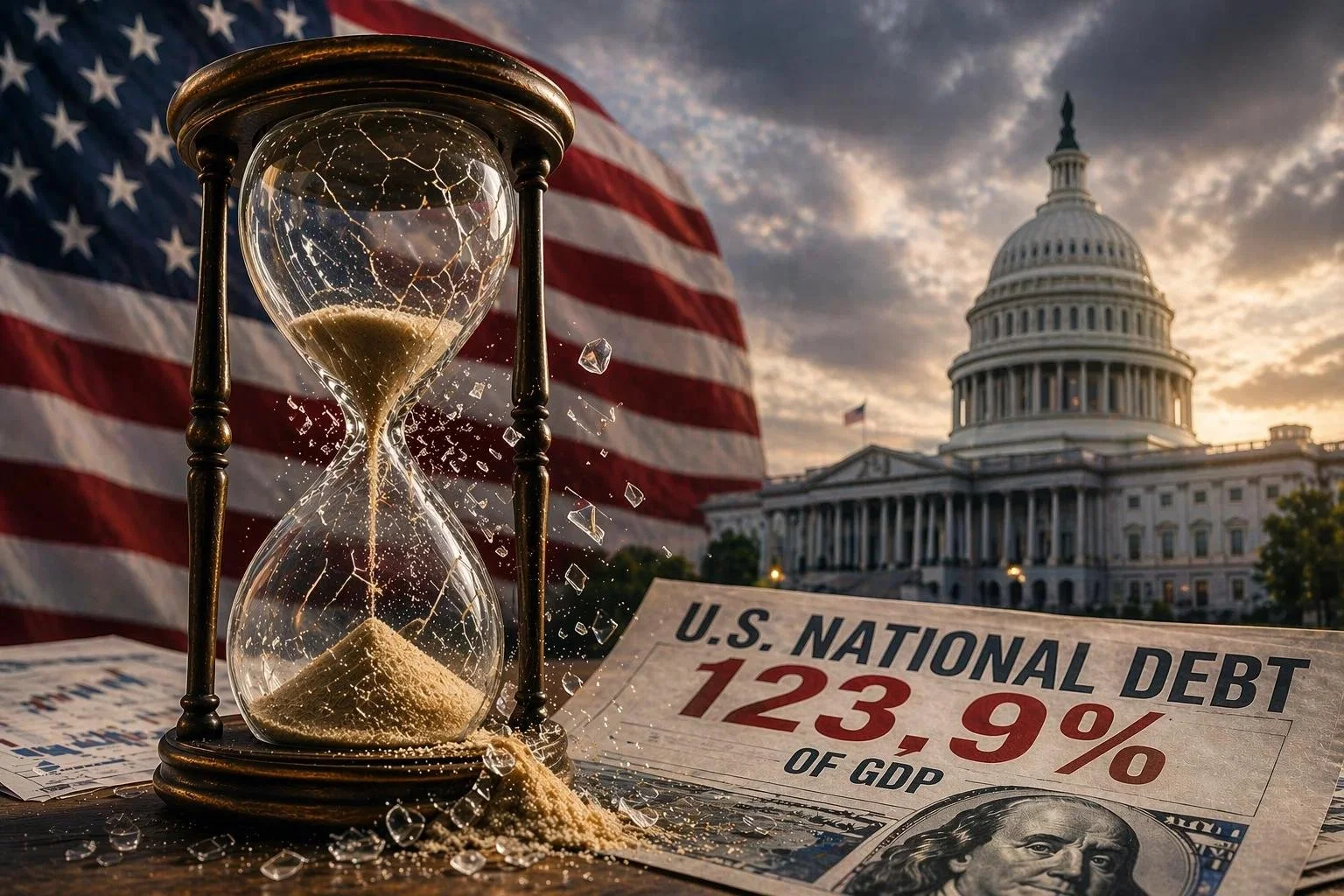
The IMF cites US government debt reaching 123.9% of GDP and deficits equal to 7.5% of GDP. More importantly, they point out that the US government has no credible plan to reduce them.
To be fair, America is not Argentina, and the US boasts major advantages— including one of the world's most innovative economies and the deepest capital markets on earth.
But it’s nearly impossible to argue that the US isn’t heading towards a major debt crisis. The rest of the world has already figured this out— and the data prove it.
For example, in the first quarter of 2026, the share of global foreign exchange reserves denominated in US dollars fell by 2.3 percentage points, down to 56.1%.
That’s an unprecedented move in global reserves. To put that quarterly decline in perspective, the US dollar's reserve share declined by roughly 10 percentage points over the previous decade...
... which means that roughly a quarter of that 10-year decline happened in the past 90 days! That’s evidence of a significant acceleration in the world’s loss of confidence in America.
The SWIFT international payments network tells the same story. The dollar's share of international payments dropped substantially in Q1. In the Middle East, for instance, non-dollar transactions jumped from 18% to 31% in three months. In Asia, from 35% to 42%.
Another data point: the world's central banks now hold more gold than US Treasury securities for the first time since 1996.
This comes as no surprise to our readers. We've been writing about this for the past 17 years.
Back in 2009, we were laughed at for suggesting that the United States could one day face a debt crisis. Today even the IMF is saying it.
We often cite that line from Hemingway's The Sun Also Rises — "How did you go bankrupt?" "Two ways. Gradually, then suddenly." The de-dollarization data suggests we're entering the "suddenly" phase.
To your freedom, James Hickman Co-Founder, Schiff Sovereign LLC
P.S. We've been warning about the US fiscal trajectory for years, long before it was fashionable. For most of that time, these concerns were dismissed as alarmist.
Now it's a mainstream view. And the rest of the world is repositioning.
The sensible course of action is to do the same. International diversification, real assets, a second residency, an offshore bank account — these aren't doomsday preparations. They're rational responses to a fiscal trajectory that is a risk to the global economy.
That is exactly what we cover each month in Plan B Confidential — specific, legal, practical steps to diversify across borders, from second residencies and offshore banking to tax optimization and real asset strategies that make sense regardless of how this plays out
Iraq has been Ready for 20 Years
Iraq has been Ready for 20 Years
4-20-2026
Twenty Years. That’s How Long Iraq Has Been Ready For The Reset.
By David E. Atterton | Reset Intelligence | @EXIT_FIAT
The infrastructure has been live since 2018. The constitutional framework was signed in 2005. Every technical component for a dinar that reflects Iraq’s actual economy has existed for close to two decades.
The rate didn’t move for one reason. And it is documented in $17.7 billion of signed court records.
Iraq has been Ready for 20 Years
4-20-2026
Twenty Years. That’s How Long Iraq Has Been Ready For The Reset.
By David E. Atterton | Reset Intelligence | @EXIT_FIAT
The infrastructure has been live since 2018. The constitutional framework was signed in 2005. Every technical component for a dinar that reflects Iraq’s actual economy has existed for close to two decades.
The rate didn’t move for one reason. And it is documented in $17.7 billion of signed court records.
If you have been in dinarland for any length of time, you have heard the same question asked ten thousand times. Why is it taking so long?
The answer is not incompetence. Not instability. Not “Iraq isn’t ready.”
Iraq’s banking system was running the largest sanctions evasion and money laundering network in the Middle East on behalf of Iran. You do not move the exchange rate of a currency that is the pipeline for billions of dollars in sanctioned flow. You shut the pipeline down first, then you move the rate.
That shutdown is now on the record. Public. Documented. Finished.
The $17.7 Billion Paper Trail
Between 2009 and 2023, seventeen Western banks paid $17.7 billion in US government fines for processing Iranian money through the dollar system. Not a---------s. Fines paid. Consent orders signed. Statements of Facts admitting specific wire transfers, specific dates, specific Iranian counterparties.
• BNP Paribas – $8.9 billion (2014) – $8.8 billion in sanctioned Iranian, Sudanese, and Cuban transactions over seven years
• HSBC – $1.9 billion (2012) – Iranian and Mexican cartel laundering
• Standard Chartered – $1.1 billion across two settlements – Iranian transactions cleared through New York
• Commerzbank – $1.45 billion (2015) – Iran and Sudan violations
• Société Générale – $1.34 billion (2018) – Iran and Libya sanctions breaches
Every one of those settlements traces back to Iranian counterparties. And a significant portion of those counterparties cleared through Iraqi correspondent accounts at institutions like Trade Bank of Iraq, Al-Bilad, Al-Taif, and Warka Bank.
Iraq’s banking sector was not a bystander. It was the Middle East node of the Iranian dollar workaround. That is why the rate was locked.
Why The IMF Wouldn’t Let It Move
The International Monetary Fund conducts what is called an Article IV consultation with every member country. It is a compliance review. For Iraq, Article IV reviews between 2015 and 2022 consistently flagged the same thing: money laundering and t-------m financing risk tied to the informal banking sector and private bank correspondent relationships.
Stated position of the IMF, repeated in every consultation: Iraq must complete banking sector reform before monetary policy normalization.
Monetary policy normalization. That is the technical term for the thing dinarland has been calling “the RV” for twenty years.
What Got Done
The reform is on paper and in the record:
• Approximately 400 currency exchange houses running hawala for Iranian entities were shut down between 2023 and 2025
• Iraq’s private banking sector was consolidated from 40-plus institutions down to a supervised core
• Electronic payment infrastructure was rolled out to make shadow transactions traceable
• US Treasury and the Central Bank of Iraq signed joint statements in 2023, 2024, and 2025 transitioning from “compliance remediation” to “monetary policy coordination”
• The 2024 IMF Article IV consultation removed the money-laundering-risk language that had been in every prior review since 2015
Each of those is a public document. Each has a date. Each is searchable.
The Signal
Iraq sits on approximately $16 trillion in proven natural resources. Fifth-largest oil reserves on Earth. Second-largest phosphate deposits globally. Gold reserves past $21 billion. Its current exchange rate of 1,310 dinars to the dollar was set by an occupying authority in 2003 and was never designed to be permanent.
What changed in 2024 is not Iraq’s wealth. Iraq’s wealth has been there the entire time. What changed is the sanctioned-money plumbing that required the rate to stay artificial. That plumbing is gone.
When Central Bank of Iraq Governor Ali Al-Alaq and US Treasury officials sit down in the same room in 2025 and talk about “monetary policy coordination,” that is not a throwaway phrase. It is the language that historically precedes an official realignment.
What The Book Walks You Through
Head of the Snake: The Hidden Architecture of Iran, Wealth Extraction, and Global Control is the full sequence. 118 years. Every claim sourced to a public document. No anonymous insiders. No analyst speculation. The receipts themselves, in chronological order.
If you have been tracking the reset through the intel community, this is the documented layer underneath the rumors. The “it’s coming” you have been hearing for twenty years has a documented explanation for why it had to wait, and a documented explanation for why the wait is ending.
Follow the daily analysis at x.com/EXIT_FIAT.
David E. Atterton is the author of Head of the Snake and the founder of Reset Intelligence. Compiled from 1,000+ hours of independent research. Father of two. No agency, no publisher, no financial industry ties.
https://dinarchronicles.com/2026/04/20/david-e-atterton-iraq-has-been-ready-for-20-years/
The First Crack in the System: Collateral Doom Loop (Part 1)
The First Crack in the System: Collateral Doom Loop (Part 1)
Lynette Zang: 4-20-2026
A financial crisis doesn’t start with a crash—it starts with a crack.
In Part 1 of this Financial Doom Loop series, Lynette breaks down the Collateral Doom Loop—the hidden mechanism behind every major market collapse.
When collateral values fall, margin calls hit. That triggers forced selling… which pushes prices even lower.
Once this loop begins, the system starts pulling itself apart from the inside.
The First Crack in the System: Collateral Doom Loop (Part 1)
Lynette Zang: 4-20-2026
A financial crisis doesn’t start with a crash—it starts with a crack.
In Part 1 of this Financial Doom Loop series, Lynette breaks down the Collateral Doom Loop—the hidden mechanism behind every major market collapse.
When collateral values fall, margin calls hit. That triggers forced selling… which pushes prices even lower.
Once this loop begins, the system starts pulling itself apart from the inside.
From 1987 to 2008 to today, the same pattern keeps repeating—but with bigger consequences each time.
Chapters:
00:00 The Financial System Crack Begins
01:02 Introduction to the Collateral Doom Loop
01:28 How Collateral Collapse Triggers Crisis
02:06 From Gold Standard to a Debt-Based System
03:01 The Engine of Modern Financial Crises
03:39 Black Monday & The First Algorithmic Crash
04:56 1998 Crisis & Derivative Collateral Failure
06:00 2008 Financial Crisis & Frozen Collateral
07:00 Money Markets Break & Capital Lockups
08:04 Margin Calls, Forced Selling & Domino Effect
09:01 Sovereign Debt Crisis & The Rise of Bail-Ins
10:12 Cyprus Bail-Ins & Insider Exits
11:10 2022 Bond Crisis & Pension Fund Collapse Risk
13:06 Market Signals: Stocks, Bitcoin & Liquidations
15:02 Confidence Collapse & Economic Warning Signs
15:39 Silver as the Early Warning “Fuse”
17:35 Gold as the Ultimate Collateral Anchor
19:04 Gold Revaluation & System Reset
21:37 The Repeating Pattern of Every Crisis
22:13 The Final Collapse & System Reset Explained