
Thank you to all the subscribers to our Early Access program…we thank you for your continued support.
We are excited to offer this new service to keep you informed and up-to-date on the latest Dinar and currency news.
UBS Shocking Warning, European Bank on the Verge of Collapse
UBS Shocking Warning, European Bank on the Verge of Collapse
Steven Van Metre: 1-4-2025Top of Form
A recent analysis by UBS has sent shockwaves through the financial world, revealing that Deutsche Bank, one of the globe’s largest banks, has a staggering 30% of its portfolio tied to high-risk, unregulated private credit loans.
This is a far cry from the 8% average seen in Europe’s other major banks, and it’s a red flag that can’t be ignored. As we edge closer to a potential global financial crisis, it’s essential to understand the warning signs and take proactive steps to protect and grow your wealth.
UBS Shocking Warning, European Bank on the Verge of Collapse
Steven Van Metre: 1-4-2025Top of Form
A recent analysis by UBS has sent shockwaves through the financial world, revealing that Deutsche Bank, one of the globe’s largest banks, has a staggering 30% of its portfolio tied to high-risk, unregulated private credit loans.
This is a far cry from the 8% average seen in Europe’s other major banks, and it’s a red flag that can’t be ignored. As we edge closer to a potential global financial crisis, it’s essential to understand the warning signs and take proactive steps to protect and grow your wealth.
The situation is dire. A global manufacturing slowdown, unseen since the 2008 financial crisis, is wreaking havoc on key economies, including France, Germany, the UK, Canada, and the US.
As manufacturing demand contracts, companies are left with rising inventories financed by private credit, leading to increasing delinquencies. This, in turn, forces banks to tighten lending standards, creating a vicious cycle of defaults, layoffs, and economic downturn.
Deutsche Bank’s exposure to private credit loans is a ticking time bomb. With over 30% of its portfolio at risk, the bank’s fragility could have far-reaching consequences for the global economy. If Deutsche Bank were to fail, it could trigger a catastrophic collapse of the financial system, echoing the 2008 crisis.
While the impending crisis is unsettling, it also presents opportunities for savvy investors. Diversification is key.
It’s time to rethink your portfolio and shift away from tech and cyclical stocks into more defensive sectors like utilities and healthcare. These industries tend to be more resilient during economic downturns, providing a safer haven for your investments.
For high-risk tolerant investors, tactical short positions in big tech could be profitable as the AI bubble bursts. However, it’s crucial to exercise caution and avoid jumping into gold or silver prematurely.
A more prudent approach would be to hold a significant portion of your portfolio in cash or liquid instruments like short-term treasuries, monitoring interest rate trends as rates are expected to fall amid the credit bust.
To navigate this treacherous landscape, you’ll need a reliable trading system that can capitalize on market moves before machine-driven buying or selling occurs. A well-designed trading system can provide you with daily optimized trade alerts, risk management tools, and market insights to make informed decisions.
The writing is on the wall: a global financial crisis is on the horizon, triggered by the fragility of some of the world’s largest banks, particularly Deutsche Bank.
While the situation is dire, it’s not without opportunities. By diversifying your portfolio, staying informed, and leveraging the right tools, you can weather the storm and come out stronger on the other side.
“Special Announcement” It is time to retire Bondlady's Corner !!!
Iraq Economic News and Points To Ponder Sunday Afternoon 1-4-26
“Special Announcement” It is time to retire Bondlady's Corner !!!
It is with a heavy heart that I announce it is time to retire Bondlady's Corner !!! Over the next several days this site will transition over to a "read only" site, meaning that any further comments or posts will stop. The archived posts will still be here.
Iraq Economic News and Points To Ponder Sunday Afternoon 1-4-26
“Special Announcement” It is time to retire Bondlady's Corner !!!
It is with a heavy heart that I announce it is time to retire Bondlady's Corner !!! Over the next several days this site will transition over to a "read only" site, meaning that any further comments or posts will stop. The archived posts will still be here.
What a ride this has been. We lost our beloved Bondlady on August 25th of 2016. She was the most dedicated person I knew and she was always here for us. I'd like to think that she would be proud that we kept her site running for nearly 10 years now.
None of this would have been possible without ALL of you, her dedicated members !! There have been over 12,000 registered members along the way and over 280,000 posts !!! So many of you have come and gone but some of you remain in my heart.
Too many to mention personally but a few stand out in my memory ...first and foremost BondLady, Miskebam, Shredd, Dogznova, Bubbies and Oggie, Dealerdean, crazydonk64,UNEEK, gaffi, Tobyboy, Mikey and a special thank you to IKEA (thanks Ike for being here). I am sure I have left out so many but please know that you are appreciated !
I have so many wonderful memories and I am sure you will agree. The "chat room" was a blast and I have missed that. I became a member of BLC on January 1st of 2012 and the first time I logged into the chatroom Bondlady said welcome "Timmy", my chat name was tlm724 but she thought it was "tim" and the name stuck ! From that moment on I was called Timmy.

I had the pleasure of helping Bondlady with many things but the most important thing that I did was facilitate the radio interview with Ambassador Paul Bremer. I had the distinct honor of meeting the Ambassador at his home in Vermont and help put together that historic interview. He was gracious and informative and spent several hours with me. I will include a picture of us at his home.
It truly has been my honor and privilege to be a member here at BLC. I still believe in our investment, it sure is taking a long time though
All my best wishes to each and every one of you ... Timmy Tlm724
For current and reliable Iraqi news please visit: https://www.bondladyscorner.com
Seeds of Wisdom RV and Economics Updates Sunday Afternoon 1-4-26
Good Morning Dinar Recaps,
Markets Send Mixed Signals as 2026 Opens With Thin Liquidity
Equity optimism masks structural fragility beneath the surface
Good Afternoon Dinar Recaps,
Markets Send Mixed Signals as 2026 Opens With Thin Liquidity
Equity optimism masks structural fragility beneath the surface
Overview
Global equity markets opened 2026 with modest gains
Precious metals and commodities continued to outperform
Liquidity remains thin following year-end positioning
Valuations remain elevated despite macro uncertainty
Risk buffers across markets are increasingly compressed
Key Developments
Major stock indices posted early gains, extending momentum from late 2025
Precious metals advanced simultaneously, signaling hedging demand alongside equity exposure
Trading volumes remain light, amplifying volatility risk
Investors remain positioned for soft-landing scenarios, leaving limited margin for disappointment
Geopolitical and fiscal risks remain underpriced relative to historical cycles
Why It Matters
Markets are not signaling stress through falling prices — they are signaling stress through divergence. When equities rise while metals strengthen and liquidity thins, it suggests confidence is conditional, not secure.
This pattern historically appears during late-cycle and transition periods, where optimism persists until an external catalyst forces repricing across assets.
Why It Matters to Foreign Currency Holders
Thin liquidity magnifies FX volatility
Risk-on positioning can reverse quickly
Capital flows become disorderly during sentiment shifts
Currencies price disappointment faster than equities
For currency holders, divergence across asset classes is a warning that stability is fragile, not durable.
Implications for the Global Reset
Pillar: Asset Divergence Signals Transition Phases
Confidence splits before systems reorganize.Pillar: Liquidity Is the Silent Risk
When buffers vanish, repricing accelerates.
This is not just politics — it’s global finance restructuring before our eyes.
Seeds of Wisdom Team
Newshounds News™ Exclusive
Sources
Investing.com – “Stocks make upbeat start to 2026 as metals extend rally”
Reuters – “Global markets open year cautiously amid thin trading”
~~~~~~~~~~
Khamenei Stands Firm as Protests Simmer and U.S. Issues Threats
Currency collapse and external pressure test Iran’s political and monetary resilience
Overview
Iran is facing renewed nationwide unrest driven by inflation and currency collapse
Supreme Leader Ayatollah Ali Khamenei has rejected compromise and called for firm control
The Iranian rial’s sharp decline has intensified public anger
U.S. President Donald Trump has warned of possible action
Iranian authorities are struggling to contain unrest without escalating instability
Key Developments
Protests erupted after the rial plunged, compounding inflation pressures already fueled by sanctions
Rights groups report more than 10 deaths and widespread arrests during demonstrations
Khamenei publicly dismissed engagement with protesters, labeling them “rioters” and calling for firm control
Security forces used tear gas and crowd control measures, particularly in western Iranian cities
President Trump stated the U.S. was “locked and loaded,” escalating external pressure without specifying action
Iranian officials acknowledged economic grievances, even as state media blamed unrest on outside infiltration
Why It Matters
Iran’s unrest represents more than social discontent — it is a monetary legitimacy crisis. The collapse of the rial has exposed the limits of Iran’s economic resilience under sanctions, while leadership rigidity narrows policy options.
When governments respond to currency-driven protests with force rather than reform, confidence erodes faster than inflation statistics suggest. External threats amplify the pressure, raising the risk of escalation both domestically and regionally.
Why It Matters to Foreign Currency Holders
Currency collapse accelerates political instability
Sanctions magnify inflation and settlement risk
State credibility weakens when monetary tools fail
FX volatility rises sharply during legitimacy crises
For currency holders, Iran illustrates how monetary failure precedes political fracture, even when regimes remain formally intact.
Implications for the Global Reset
Pillar: Currency Credibility Equals Political Stability
When money fails, authority is challenged.Pillar: Sanctions Compress Policy Space
External pressure accelerates internal fracture points.
This is not just politics — it’s global finance restructuring before our eyes.
Seeds of Wisdom Team
Newshounds News™ Exclusive
Sources
Modern Diplomacy – “Khamenei Stands Firm as Protests Simmer and U.S. Issues Threats”
Reuters – “Iran faces renewed protests as currency slide deepens under sanctions pressure”
~~~~~~~~~~
Strategic Metals Beyond Gold Signal Structural Repricing Ahead
Copper and industrial metals reflect real-economy reset pressures
Overview
Industrial metals are strengthening alongside precious metals
Copper demand is rising due to electrification and AI infrastructure
Supply constraints are colliding with long-term structural demand
Metals tied to the real economy are being repriced
Commodity markets are signaling more than speculative interest
Key Developments
Copper prices remain elevated, supported by demand from EVs, renewable energy, and data centers
Supply growth lags demand, due to underinvestment, permitting delays, and geopolitical risk
Mining output constraints persist, limiting near-term production increases
Investors increasingly view copper and strategic metals as infrastructure assets, not cyclical trades
Other industrial metals are showing correlated strength, reinforcing the structural trend
Why It Matters
Unlike gold, which reflects confidence and monetary risk, industrial metals reflect the real economy. Sustained strength in copper and related metals suggests that the global system is repricing physical infrastructure needs, not just financial hedges.
This points to a reset dynamic driven by energy transition, digitization, and supply fragmentation, where physical inputs regain pricing power.
Why It Matters to Foreign Currency Holders
Resource-linked currencies gain relative strength
Import-dependent economies face cost pressure
Trade balances shift with metal access
FX markets price real-economy constraints early
For currency holders, industrial metal trends offer insight into which currencies are structurally supported versus exposed.
Implications for the Global Reset
Pillar: Real Assets Anchor the Next System
Infrastructure demand reshapes monetary relationships.Pillar: Supply Constraints Drive Repricing Cycles
Physical scarcity matters more than financial abundance.
This is not just politics — it’s global finance restructuring before our eyes.
Seeds of Wisdom Team
Newshounds News™ Exclusive
Sources
Seeking Alpha – “What’s the Best Metals Play Besides Gold and Silver?”
Reuters – “Copper demand surges as energy transition accelerates”
~~~~~~~~~~
BRICS Gold-Backed Currency Unit Faces Structural Hurdles Ahead of Global Launch
Ambitious de-dollarization plan collides with coordination and credibility limits
Overview
BRICS’ proposed gold-backed Unit faces mounting implementation challenges
Member nations remain divided on structure, purpose, and timing
Technical infrastructure and verification remain unproven
Economic divergence inside BRICS complicates monetary unity
Full rollout before 2030 appears increasingly unlikely
Key Developments
Member disagreement persists
Russia signaled in late 2024 that it was not abandoning the dollar, reversing earlier momentum. India has opposed a shared currency outright, citing trade retaliation risks. China has not publicly committed, despite holding the bloc’s largest gold reserves. Brazil expressed early enthusiasm but offered limited concrete support.Pilot credibility questions remain
A limited BRICS Unit pilot launched in October 2025 with just 100 Units issued. Documentation gaps, incomplete technical specifications, and lack of confirmation from major BRICS central banks have raised concerns over operational readiness.Gold logistics are unresolved
Backing the Unit with more than 6,000 metric tons of gold would require massive secure storage, verification, and auditing systems. Estimated annual maintenance costs approach $1 billion — yet no unified framework has been publicly disclosed.Divergent economic models complicate coordination
BRICS members operate under vastly different systems: China’s capital controls, India’s democratic market structure, Russia’s sanction-constrained economy, Brazil’s currency volatility, and South Africa’s structural unemployment all limit policy alignment.
Why It Matters
The BRICS Unit highlights a critical truth of the global reset: alternative monetary systems are harder to implement than to announce. While dissatisfaction with dollar dominance is real, building a trusted, scalable replacement requires coordination, transparency, and political alignment that BRICS has not yet achieved.
This does not invalidate de-dollarization — but it shows that fragmentation will likely advance through trade settlement, bilateral currency use, and payment rails before any shared reserve instrument emerges.
Why It Matters to Foreign Currency Holders
Announcements ≠ implementation: Markets price execution, not intent
Gold backing requires trust, verification, and access
Fragmented blocs create uneven FX repricing
De-dollarization will be gradual, not sudden
For currency holders, the BRICS Unit is a long-term signal, not a near-term switch.
Implications for the Global Reset
Pillar: De-Dollarization Is Incremental, Not Binary
The dollar weakens through alternatives, not replacements.Pillar: Trust Infrastructure Matters More Than Reserves
Gold alone does not create credibility.
This is not just politics — it’s global finance restructuring before our eyes.
Seeds of Wisdom Team
Newshounds News™ Exclusive
Sources
Watcher.Guru – “BRICS Gold-Backed Currency Unit Faces Challenges Before Global Launch”
Reuters – “BRICS debate common currency as members clash over dollar alternatives”
~~~~~~~~~~
🌱 A Message to Our Currency Holders🌱
If you’ve been holding foreign currency for many years, you were not foolish.
You were not wrong to believe the global financial system would change.
What failed was not your patience — it was the information you were given.
For years, dates, rumors, and personalities replaced facts, structure, and proof. “This week” predictions created cycles of hope and disappointment that were never based on how currencies actually change.
That is not your failure.
Our mission here is different: • No dates • No rates • No hype • No gurus
Instead, we focus on:
• Verifiable developments • Institutional evidence
• Global financial structure • Where countries actually sit in the process
Currency value changes only come after sovereignty, trade, banking, settlement systems, and fiscal coordination are in place. History and institutions confirm this sequence.
You will see silence. You will see denials. That is not delay — that is discipline.
Protect your identity. Organize your documents. Verify everything.
Never hand your discernment to anyone who cannot show proof.
You deserve truth — not timelines.
Seeds of Wisdom Team
Newshounds News
~~~~~~~~~~
Seeds of Wisdom Team RV Currency Facts Youtube and Rumble
Newshound's News Telegram Room Link
RV Facts with Proof Links Link
RV Updates Proof links - Facts Link
Follow the Gold/Silver Rate COMEX
Follow Fast Facts
Seeds of Wisdom Team™ Website
Thank you Dinar Recaps
“Tidbits From TNT” Sunday 1-4-2025
TNT:
Tishwash: The House of Representatives publishes the agenda for its second session and moves towards voting on its internal regulations.
The media department of the Iraqi parliament published today, Saturday, the agenda for the second session of the sixth electoral cycle, for the first legislative year, first chapter.
The department stated that the session is scheduled to be held next Monday, January 5, 2026, at 10:00 AM, indicating that the agenda is limited to three main items.
TNT:
Tishwash: The House of Representatives publishes the agenda for its second session and moves towards voting on its internal regulations.
The media department of the Iraqi parliament published today, Saturday, the agenda for the second session of the sixth electoral cycle, for the first legislative year, first chapter.
The department stated that the session is scheduled to be held next Monday, January 5, 2026, at 10:00 AM, indicating that the agenda is limited to three main items.
She added that the first paragraph includes voting on the internal regulations of the House of Representatives, while the second paragraph stipulates the formation of a committee that will select members of parliamentary committees in accordance with the provisions of the internal regulations, and the third paragraph is to be dedicated to conducting general discussions.
The Iraqi parliament held its first session of its new term on December 29, during which it voted to elect Hebat al-Halbousi as Speaker of the House, Adnan Faihan as First Deputy Speaker, and Farhad al-Atroushi as Second Deputy Speaker. link
************
Tishwash: Foreign Ministry: Iraq has taken over all sites of the UN mission "UNAMI".
The Ministry of Foreign Affairs announced on Saturday the handover of all UNAMI sites across the country, in accordance with Security Council Resolution 2732 (2024) mandating the termination of the mission's mandate.
In a statement received by the Video News Agency, the Ministry said, "In line with the government's decision to end the work of the United Nations Assistance Mission for Iraq (UNAMI), and pursuant to Security Council Resolution 2732 (2024)
Mandating the termination of the mission by December 31, 2025, the Undersecretary of the Ministry of Foreign Affairs and Head of the Committee for the Handover of UNAMI Sites throughout the Country, Ambassador Mohammed Hussein Bahr Al-Uloom, and the Deputy Special Representative of the Secretary-General of the United Nations, Claudio Cordone, signed the handover report for the UN Integrated Compound in Baghdad."
She added that "the signing ceremony included a tour of the complex and its facilities, during which Ambassador Bahr Al-Uloom commended the efforts exerted by UNAMI over the past two decades and the level of cooperation and fruitful partnership with Iraq, which has actively contributed to supporting stability and development in various sectors, particularly consolidating democracy and promoting human rights, women's rights, and social justice."
According to the statement, Ambassador Bahr Al-Uloom also recalled "the sacrifices of UNAMI, especially the mission members who lost their lives while performing their duties in 2003, most notably the first head of the mission, the late Sergio Vieira de Mello," expressing "Iraq's gratitude and appreciation to all the Special Representatives of the Secretary-General who have led the mission, up to the current Special Representative, Ambassador Mohammed Al-Hassan."
Both sides affirmed that "the conclusion of UNAMI's work does not represent the end of cooperation between Iraq and the United Nations, but rather the beginning of a new phase of development partnership, led by the UN Country Team, in line with national priorities and building upon the successes achieved." link
************
Tishwash: The Iraqi government allocates "high" capital to the newly revamped Rafidain Bank.
On Saturday, Mazhar Mohammed Saleh, the financial advisor to the outgoing Prime Minister, revealed that the new Rafidain Bank will have highly efficient capital, with the possibility of bringing in an international strategic banking partner.
Mazhar told Shafaq News Agency that "the study prepared by one of the major financial companies specializing in banking and financial reform does not go for the option of privatizing Rafidain Bank before starting its structural reform through institutional specialization."
He explained that "this study proposes redefining Rafidain Bank as the sovereign bank of the government, so that its role is limited to managing government financial operations, primarily managing the unified treasury account, and its operational link with more than a thousand government disbursement and spending units."
Saleh also pointed out that “this sovereign bank is entrusted with an organic link to the center of finance and policy in the financial authority, in order to ensure the organization of state finances through precise coordination between revenues and expenditures, and linking this to the cash budget (the government’s cash flow budget), with the aim of achieving the highest levels of efficiency in financial management, discipline, governance, and transparency.”
The government financial advisor added that "the study proposes the establishment of another bank called (Al-Rafidain - One), which operates as a mixed public-private joint-stock company, and follows the principles of the modern banking market."
“This bank is supposed to have highly efficient capital and operate in accordance with Basel (3) regulations, which will enhance the strength of the banking system and deepen the national banking market,” according to Saleh.
He pointed out that “this bank’s business model is based on high compliance levels and low risks, and its main activity is to grant bank credit to natural and legal persons, in accordance with the latest modern banking practices, while employing advanced financial information technology (FinTech) in a way that achieves digital financial inclusion, and contributes to integrating the national banking market and transforming it into a unified and effective force.”
Saleh concluded by saying that “Rafidain Bank – One undertakes the practice of financing foreign trade, with the possibility of bringing in an international strategic banking partner, which will raise its operational and technical capabilities, and gradually elevate it to the ranks of regional banks with high credit ratings, and make it a real lever for modernizing the Iraqi banking sector and supporting sustainable economic development.”
In 2021, the Iraqi Ministry of Finance approved a package of reform measures related to the restructuring of Al-Rafidain Bank, in accordance with the "White Paper" on economic reform in the country.
At the end of 2024, Ernst & Young, a professional services firm, confirmed that the restructuring of Rafidain Bank had reached 74%. Firas Kilani, an expert on the restructuring project from the British company, said that "the bank's restructuring project has progressed very significantly since it began in September 2024."
At the beginning of 2025, outgoing Iraqi Prime Minister Mohammed Shia al-Sudani announced that the project to restructure Rafidain Bank had reached its final stages.
Rafidain Bank was established under Law No. (33) of 1941 and commenced its operations on 5/19/1941 with a paid-up capital of (50) fifty thousand dinars. The bank currently has (164) branches inside Iraq in addition to (7) branches abroad, namely: Cairo, Beirut, Abu Dhabi, Bahrain, Sana’a, Amman, Jabal Amman.
Despite the Iraqi government's attempts to improve the performance of Rafidain Bank and restructure it, the bank's branch in Abu Dhabi committed financial and administrative violations, in addition to monitoring indicators of mismanagement that prompted the UAE Central Bank to impose "large financial" fines on the branch, amid warnings that these measures may end with the complete closure of the branch, according to informed sources who spoke to Shafaq News Agency at the end of 2025.
The Yemeni Minister of Information, Culture and Tourism, Muammar Al-Iryani, announced at the beginning of October 2025 the closure of the Iraqi state-owned Rafidain Bank branches in Sana'a.
Al-Iryani said in a post on the “X” website that “the decision by the Iraqi Rafidain Bank to close its branch in Sana’a and end its financial and banking activity is a step in the right direction, and a direct result of international efforts aimed at drying up the sources of funding for the Houthi group.”
He pointed out that this measure "reflects a positive response to governmental warnings and American and international pressure, and sends a clear message to the rest of the regional and international financial institutions, about the need to review their activities, and to ensure that they do not fall into the circle of exploitation or employment to serve the agendas of the Iranian regime and its terrorist arms in the region."
Al-Iryani stressed that "the Houthis have turned the financial and banking institutions operating in the areas under their control into tools for plundering the money of Yemenis and financing their cross-border terrorist activities."
Last August, US Congressman Joe Wilson accused the state-owned Rafidain Bank of conducting financial transactions with the Houthi group in Yemen, threatening to cut off US funding to Iraq as a result.
Wilson wrote in a post on the “X-formerly Twitter” platform that “the Iraqi state-owned Rafidain Bank is conducting financial transactions on behalf of the Houthis, a terrorist organization,” adding, “We have a name for these countries: state sponsors of terrorism.”
He added, "I will work to cut off funding to Iraq during the next appropriations bill" in the US budget. Wilson also urged the US Treasury Department to "sanction" Rafidain Bank. link
************
Mot: The New Year Already!- at Me Gym!!!!

Mot: Where to Begin!!!! - siigghhhhhh!!!!

Seeds of Wisdom RV and Economics Updates Sunday Morning 1-4-26
Good Morning Dinar Recaps,
Precious Metals Extend Rally as Confidence in Fiat Systems Frays
Gold and silver strength signals hedging against structural risk
Good Morning Dinar Recaps,
Precious Metals Extend Rally as Confidence in Fiat Systems Frays
Gold and silver strength signals hedging against structural risk
Overview
Gold and silver continue to outperform as 2026 begins
Investor demand reflects rising concern over debt and policy limits
Safe-haven flows persist despite stable equity markets
Metals are increasingly treated as monetary hedges
Confidence divergence is emerging across asset classes
Key Developments
Gold prices remain near record levels, supported by geopolitical tension and debt concerns
Silver prices advanced alongside gold, benefiting from both industrial demand and safe-haven flows
Platinum and other strategic metals showed renewed strength, reflecting broader commodity repricing
Markets continue to price potential rate cuts, but credibility constraints limit central bank flexibility
Investor allocations increasingly favor hard assets over long-duration financial instruments
Why It Matters
Precious metals historically rise during periods when confidence in monetary authorities weakens, not merely during inflation spikes. The persistence of this rally — even as equities remain elevated — suggests markets are hedging structural rather than cyclical risk.
This divergence often appears during transition phases, when the existing system continues functioning but belief in its long-term stability erodes.
Why It Matters to Foreign Currency Holders
Metals signal declining confidence in fiat stability
Rising bullion demand reflects FX hedging behavior
Reserve diversification pressures increase
Currencies without asset backing face repricing risk
For currency holders, sustained metal strength acts as a leading indicator of monetary stress, not a reaction to headlines.
Implications for the Global Reset
Pillar: Confidence Shifts Precede Structural Change
Markets hedge before systems reset.Pillar: Hard Assets Reassert Monetary Relevance
Metals function as trust anchors in uncertain cycles.
This is not just politics — it’s global finance restructuring before our eyes.
Seeds of Wisdom Team
Newshounds News™ Exclusive
Sources
The Nation Thailand – “Gold, silver extend gains as markets hedge global risk”
Reuters – “Gold steadies near record highs as investors assess rate outlook and risk”
~~~~~~~~~~
Central Bank Bond Support Shows Limits as Yields Stay Elevated
Policy intervention no longer guarantees market stability
Overview
Central bank bond purchases are failing to calm markets
Government yields remain elevated despite liquidity injections
Investor demand for sovereign debt is weakening
Currency pressure is rising alongside bond stress
Policy credibility constraints are becoming visible
Key Developments
India’s central bank executed record bond-buying operations, injecting liquidity into markets
Despite intervention, long-term yields remained elevated, signaling investor caution
Foreign participation in bond markets stayed limited, reflecting confidence concerns
The domestic currency weakened, highlighting spillover from bond stress into FX markets
Similar dynamics are emerging globally, as debt issuance collides with tighter policy limits
Why It Matters
Bond markets are the load-bearing wall of the financial system. When central bank intervention no longer suppresses yields, it signals a loss of policy control. This does not mean immediate crisis — but it does mean credibility is being tested.
Once markets begin responding more to fiscal math than forward guidance, systemic reset dynamics accelerate.
Why It Matters to Foreign Currency Holders
Rising yields can signal stress, not strength
Debt sustainability concerns weaken currencies
Capital outflows accelerate when intervention fails
FX markets react faster than policymakers
For currency holders, bond instability is often the earliest transmission mechanism of broader reset events.
Implications for the Global Reset
Pillar: Central Banks Are No Longer Omnipotent
Inflation and debt cap rescue capacity.Pillar: Bond Markets Trigger Repricing Cycles
They move slowly — then all at once.
This is not just politics — it’s global finance restructuring before our eyes.
Seeds of Wisdom Team
Newshounds News™ Exclusive
Sources
Reuters – “Record central bank intervention buys bonds but offers limited relief”
Bank for International Settlements – Annual Economic Report: Bond Market Stress and Policy Limits
~~~~~~~~~~
China Tightens Control Over Silver Exports, Raising Global Supply Risks
Strategic metals emerge as leverage in trade and monetary realignment
Overview
China has imposed new licensing requirements on silver exports
The move affects a majority of global refined silver supply
Silver is critical for solar, EVs, electronics, and data infrastructure
Western dependence on Chinese metals is exposed
Commodity control is increasingly used as geopolitical leverage
Key Developments
China implemented export approval requirements for silver shipments beginning January 2026
The country controls an estimated 60–70% of global refined silver output, giving Beijing outsized influence
Silver is a key input for clean energy, semiconductors, and defense technologies
Traders reported early price sensitivity and supply uncertainty
The move follows earlier Chinese restrictions on gallium, germanium, and rare earths
Why It Matters
Silver sits at the intersection of energy transition, technology infrastructure, and monetary hedging. By tightening control over exports, China is signaling that critical materials are no longer purely commercial goods — they are strategic assets.
This development reinforces a broader shift away from open commodity markets toward state-managed resource leverage, particularly in industries central to future growth.
Why It Matters to Foreign Currency Holders
Commodity leverage reshapes trade balances
Supply controls increase inflation pressure
Resource-dependent currencies face volatility
Hard assets gain relevance in hedging strategies
For currency holders, metal supply constraints translate into pricing power, trade realignment, and FX repricing.
Implications for the Global Reset
Pillar: Resource Control Equals Financial Influence
Strategic materials now function as economic leverage.Pillar: Trade Fragmentation Accelerates Through Commodities
Export controls reshape settlement and supply chains.
This is not just politics — it’s global finance restructuring before our eyes.
Seeds of Wisdom Team
Newshounds News™ Exclusive
Sources
MarketWatch – “China launches its silver export controls, tightening global supply”
Reuters – “China expands export controls on strategic metals”
~~~~~~~~~~
As Yemen Crisis Escalates, UAE Urges Immediate Restraint
Gulf power rivalry resurfaces as coalition fractures deepen
Overview
Fighting in Yemen has intensified following territorial reversals
Saudi-backed forces retook areas previously held by UAE-backed southern separatists
The rift between Saudi Arabia and the UAE has widened
Southern separatists are pressing forward with independence plans
Yemen’s strategic location heightens regional and global stakes
Key Developments
Saudi-backed forces regained control of key areas in Hadramout province, including reported entry into the capital, Mukalla
The UAE-backed Southern Transitional Council (STC) lost territory captured just weeks earlier
The UAE publicly urged restraint and dialogue, warning against further destabilization
The STC announced plans to hold an independence referendum within two years
Saudi Arabia demanded remaining UAE forces withdraw, and reportedly struck an STC-linked base
Coalition unity against Iran-backed Houthis has visibly fractured
Why It Matters
The escalation in Yemen exposes deep structural fractures among Gulf allies. While Saudi Arabia and the UAE once presented a unified front, competing visions for Yemen’s future now drive open confrontation.
Yemen’s location near the Bab al-Mandeb strait, a critical global shipping corridor, elevates this conflict beyond regional politics. Disruption risks extend to trade flows, energy shipments, and maritime security at a time when global supply chains remain fragile.
Why It Matters to Foreign Currency Holders
Regional conflict raises geopolitical risk premiums
Disruption near key trade corridors threatens settlement stability
Fractured alliances undermine policy predictability
Capital flows react quickly to Middle East escalation
For currency holders, instability near strategic choke points translates into volatility across energy-linked and regional currencies.
Implications for the Global Reset
Pillar: Alliance Fragmentation Accelerates Systemic Stress
Political splits weaken coordinated crisis response.Pillar: Control of Trade Routes Equals Monetary Influence
Maritime security underpins currency confidence.
This is not just politics — it’s global finance restructuring before our eyes.
Seeds of Wisdom Team
Newshounds News™ Exclusive
Sources
Modern Diplomacy – “As Yemen Crisis Escalates, UAE Urges Immediate Restraint”
Reuters – “Saudi-backed forces retake territory from UAE-backed separatists in Yemen”
~~~~~~~~~~
Seeds of Wisdom Team RV Currency Facts Youtube and Rumble
Newshound's News Telegram Room Link
RV Facts with Proof Links Link
RV Updates Proof links - Facts Link
Follow the Gold/Silver Rate COMEX
Follow Fast Facts
Seeds of Wisdom Team™ Website
Thank you Dinar Recaps
Iraq Economic News and Points To Ponder Sunday Morning 1-4-26
Iraqis Welcome Their New Year With Hopes For The Formation Of A Government That Meets Their Aspirations.
January 3, 2026 Baghdad – Qusay Munther
Iraqis bid farewell to 2025, a year fraught with challenges, and welcomed the new year with hopes for security and stability, and for the swift formation of a government capable of meeting citizens' needs and fulfilling their aspirations, free from political infighting. Citizens expressed their hopes for the new year, stating, "Our wish is for a government that meets the needs of the people and achieves our ambitions, one that is free from conflict and political maneuvering." They also emphasized the importance of strengthening the rule of law and ensuring development and essential services for all provinces.
Iraqis Welcome Their New Year With Hopes For The Formation Of A Government That Meets Their Aspirations.
January 3, 2026 Baghdad – Qusay Munther
Iraqis bid farewell to 2025, a year fraught with challenges, and welcomed the new year with hopes for security and stability, and for the swift formation of a government capable of meeting citizens' needs and fulfilling their aspirations, free from political infighting. Citizens expressed their hopes for the new year, stating, "Our wish is for a government that meets the needs of the people and achieves our ambitions, one that is free from conflict and political maneuvering." They also emphasized the importance of strengthening the rule of law and ensuring development and essential services for all provinces.
Decent Life
They emphasized the necessity of providing a dignified and secure life for all Iraqis. President Abdul Latif Jamal Rashid expressed his hope that the new year would be filled with national achievements. In a post on the X platform yesterday, Rashid said, "On the occasion of the new year, we extend our sincerest congratulations to our people, wishing everyone greater security, stability, and progress."
He added, "We hope this year will be full of national achievements, continued progress on the path of construction and reform, strengthening the rule of law, and fulfilling the people's aspirations for a dignified and secure life, one characterized by peace and prosperity." For his part, caretaker Prime Minister Mohammed Shia' al-Sudani also congratulated the people on the new year.
In a statement yesterday, Al-Sudani said, “As we welcome a new year, I am pleased to extend my best wishes to all segments of our brotherly nation, that the new year will be a year of continued sincere work for the well-being and progress of our people, praying to God Almighty to protect Iraq and its people, a country as vast as the history of humanity, and a source of civilizations and contributions that have enriched humanity with its knowledge, sciences, and heritage.”
He added, “In the new year, we renew our determination to reaffirm to our people our commitment to serving our people everywhere, continuing our efforts in development, services, and reconstruction, and dedicating ourselves to providing all the aspirations of citizens and the requirements for their dignified lives.”
Consolidating Stability
Speaker of Parliament Haibat al-Halbousi also offered his congratulations on the New Year. In a post on the X platform yesterday, al-Halbousi said, “Our national responsibility compels us to work towards consolidating stability, strengthening confidence in constitutional institutions, and moving forward in a way that serves the Iraqi people and fulfills their hopes and aspirations.
May Iraq grow stronger each year through the unity of its people.” For his part, Deputy Speaker of Parliament Adnan Faihan expressed his hope that the New Year would bring tidings of goodness, progress, and stability.
In a statement yesterday, Faihan affirmed that “this occasion represents a unifying human milestone, transcending borders, geography, nationalities, and sects, and reinforcing the values of coexistence and tolerance among all peoples.
” He pointed out that “Iraq, with its rich civilizational and human history, is steadily moving towards consolidating stability and building a state of institutions,” calling for the New Year to be “an opportunity to strengthen national unity and support the paths of reform and development.”
Values Of Tolerance
Deputy Speaker of Parliament Farhad al-Atroushi also extended his New Year's greetings to the Iraqi people. In a statement yesterday, al-Atroushi said, "This occasion represents an opportunity to strengthen the values of tolerance, peaceful coexistence, and national unity," emphasizing "the importance of continuing efforts and joint cooperation to build a state of institutions and achieve the aspirations of citizens for security, prosperity, and social justice."
Meanwhile, Nouri al-Maliki, head of the State of Law Coalition, wished that the New Year would bring all goodness, peace, and stability.
In a statement yesterday, al-Maliki said, "We hope that peace will prevail in the world, alleviating the pain, fear, and poverty of our citizens, and opening doors of hope for our people, and for our Iraq, greater tranquility and prosperity." He added, "May the Iraqi people and their national forces continue to embrace and support the political, security, and economic processes until a prosperous and well-being-oriented Iraq is achieved." LINK
Iraq Takes Over UNAMI Sites Across The Country
Baratha News Agency1912026-01-03 The Ministry of Foreign Affairs announced on Saturday that it had taken over the sites of the UN mission "UNAMI" throughout the country after the end of its mission.
The ministry stated in a statement that “within the framework of the government’s decision to end the work of the United Nations Assistance Mission for Iraq (UNAMI), and based on Security Council Resolution No. 2732 (2024) stipulating the termination of the mission’s work on 12/31/2025, the Undersecretary of the Ministry of Foreign Affairs and Chairman of the Committee concerned with receiving the sites of the UN mission throughout the country, Mohammed Hussein Bahr Al-Uloom, signed with the Deputy Special Representative of the Secretary-General of the United Nations, Claudio Cordone, the minutes of the handover of the integrated United Nations compound in Baghdad.”
She added that "the signing ceremony included an inspection tour of the complex and its facilities, where Ambassador Bahr Al-Uloom praised the efforts made by the UNAMI mission over the past two decades, and the level of cooperation and fruitful partnership with Iraq, which has contributed effectively to supporting stability and development in various sectors, especially consolidating democracy and promoting human rights, women's rights and social justice."
Ambassador Bahr Al-Uloom recalled the sacrifices of the UNAMI mission, especially the mission members who lost their lives while performing their duties in 2003, most notably the first head of the mission, the late Sergio de Mello, expressing “Iraq’s thanks and appreciation to all the Special Representatives of the Secretary-General who have led the mission, up to the current Special Representative, Mohammed Al-Hassan.”
Both sides affirmed that “the termination of UNAMI’s mission does not represent the end of cooperation between Iraq and the United Nations, but rather constitutes the beginning of a new phase of development partnership, led by the United Nations Country Team in line with national priorities and enhancing the successes achieved.”
https://burathanews.com/arabic/news/469564
Government Advisor: The Complexities Of Oil And Gold Are Having Silent Repercussions On Iraq's Economy.
Time: 2026/01/03 16:16:43 Reading: 60 times {Economic: Al-Furat News} The economic advisor to the Prime Minister, Mazhar Muhammad Saleh, described the relationship between oil and gold as "complex," stressing that its repercussions are often silent but influential on the Iraqi economy.
Saleh told Al-Furat News Agency that “expectations of a decline in gold and silver gains with rising oil prices are not a fixed rule,” noting that “it is only true if the rise in oil prices is due to strong global demand and tight monetary policy, especially on the part of the US Federal Reserve.”
He added that "the picture is different if the rise in oil prices is driven by geopolitical tensions or supply-side shocks, in which case oil and gold could rise together as hedging tools in global markets."
Regarding the impact of these changes on Iraq, Saleh explained that "the direct impact remains limited; however, the indirect impact is significant," indicating that "the rise in oil prices in the absence of a general budget temporarily improves liquidity; but on the other hand, it exacerbates the limitations of spending planning and fuels imported inflationary pressures."
He pointed out that "the weakness of global gold prices may lead to additional pressure on the exchange rate due to its connection with the components of Iraq's foreign reserves, which currently constitute about 29% of total international reserves."
Saleh concluded by saying that "the rise in oil prices, even in the absence of a clear budgetary framework, transforms temporary gains into limited and short-term positive financial effects, regardless of the trends in gold and silver in global markets." LINK
Oil Prices Fluctuated In The First Days Of 2026 Due To Concerns About Oversupply And Political Tensions
Energy Economy News — Follow-up Oil prices fluctuated on the first trading day of 2026, as expectations of a supply surplus offset the impact of geopolitical risks on production in a number of OPEC+ member countries.
Brent crude futures settled below $61 a barrel in a relatively thin trading session, while West Texas Intermediate settled at $57. Middle Eastern markets, including derivatives such as the regional benchmark Dubai crude, stumbled amid heavy selling pressure during a key Asian trading window, according to traders familiar with the matter.
Amid a seasonal decline in consumption, OPEC is inclined to be cautious. Key members of the Saudi-led OPEC+ alliance are scheduled to hold an online meeting on January 4, where they are expected to confirm a decision to halt supply increases during the first quarter.
Selling pressure on oil amid expectations of a supply glut
Oil prices fell in 2025 as OPEC+ and other competitors, such as the United States and Guyana, increased production at a time when demand growth slowed. The International Energy Agency predicted a surplus of about 3.8 million barrels per day during the year.
Amid these expectations, advisors increased their short positions on Brent crude to 91% on Friday, up from 82%, according to data from Bridgeton Research Group, which was acquired by Kpler in December. Short positions on West Texas Intermediate crude stood at 73%. Expectations of a supply surplus act as a buffer against a range of potential supply disruptions.
Political Tensions
One such scenario could unfold in Iran, where US President Donald Trump has hinted that the United States is prepared to assist protesters if authorities intensify their crackdown on unrest, prompting a senior Iranian official to threaten retaliation against US forces in the region. Tehran and other cities have witnessed a wave of demonstrations following the collapse of the local currency to a record low. Iran was the world's ninth-largest producer of crude oil in 2023, according to the International Energy Agency.
Another threat is emerging in Venezuela, where the Trump administration has escalated its campaign against the country's oil exports by imposing a naval blockade and sanctions on companies in Hong Kong and mainland China, as well as on ships accused of circumventing restrictions. These measures are part of an effort to increase pressure on the regime of Nicolás Maduro.
Meanwhile, Russia’s war in Ukraine continues despite peace efforts by Europe and the United States. Moscow and Kyiv exchanged attacks on Black Sea ports during the New Year period, damaging oil infrastructure, including a refinery. The conflict has also affected energy flows from Kazakhstan, another member of the OPEC+ alliance. https://economy-news.net/content.php?id=64119
Precious Metals Enter 2026 On A High Note
Time: 2026/01/02 10:09:32 Reading: 150 times {Economic: Al-Furat News} Precious metals started the new year on a high note on Friday, with gold rising slightly from its lowest level in two weeks, which it reached in the previous session, while other metals recovered some of the losses they incurred during the week.
Gold rose 0.8% in spot trading to $4,346.69 an ounce by 0019 GMT, after hitting a record high of $4,549.71 on December 26. It had fallen to its lowest level in two weeks last Wednesday.
U.S. gold futures for February delivery rose 0.5% to $4,360.60 an ounce.
The precious metal achieved a huge rise during 2025, ending the year with annual gains of 64%, the largest since 1979.
Silver rose 2.1% in spot trading to $72.75 an ounce, after hitting an all-time high of $83.62 last Monday, and ended the year up 147%, significantly outperforming gold, making 2025 its best year ever.
Platinum rose 0.2% in spot trading to $2,057.74 an ounce, after hitting an all-time high of $2,478.50 on Monday, and posting its biggest ever annual gain after climbing 127%.
Palladium rose 2.4% to $1,642.90 an ounce, ending last year up 76%, its best performance in 15 years. LINK
Iraq Ranks Third In The Arab World In Foreign Currency Reserves With $112 Billion
Banks Economy News – Baghdad With the acceleration of economic crises and trade tensions globally, questions arise about financial resilience and a country's ability to withstand the volatility of global markets. One of the safety valves and first lines of defense is the foreign exchange reserves a country holds. World Bank data even measures these reserves by the number of months of import coverage.
Countries’ policies on building or relying on reserves vary to a degree that is related to their exposure to different risks, population size, imports, international relations, and the international standing of their currency.
What If Egypt Paid Off All Its Debts? An unprecedented scenario for a debt-free economy.
In the Arab world, the picture begins in Riyadh, where Saudi Arabia tops the list with a massive reserve of nearly $463 billion. This figure is not merely a financial indicator, but a reflection of a strong oil-based economy and a strategic vision that seeks to diversify income sources through mega-projects within the framework of "Vision 2030."
The UAE occupies second place, amid rapid growth and strong reserve coverage of up to about 7 months with a balanced asset management policy between return and risk.
Iraq pulls off a surprise
In October 2025, reserves reached $256.9 billion (AED 991.6 billion), according to central bank data.
The surprise comes from Baghdad. Despite years of turmoil, the Iraqi central bank has reserves of up to $112 billion, thanks to oil exports which remain the backbone of its economy.
In November 2025, Iraq's foreign currency reserves stood at approximately $112 billion, according to data from the Central Bank of Iraq. These reserves represent one of the highest levels in the region after Saudi Arabia and the UAE, covering more than 15 months of imports and providing Iraq with a significant safety net despite internal political and economic challenges.
Libya ranks fourth in the Arab world with large foreign currency reserves.
From the Gulf to the heart of Africa, despite political divisions, Libya maintains its fourth position in the Arab world with foreign currency reserves approaching $99 billion, covering about four years of imports.
Oil and gas exports define the features of economic power, as Arab countries' finances seize their windfall by increasing reserves and managing liquidity during periods of recession.
Qatar’s central bank’s foreign exchange reserves rose to $71.7 billion last November, covering 11 months of imports.
Egypt's Substantial Reserves Exceeded $50.2 Billion.
In Cairo, the most populous Arab country, foreign currency reserves stand at approximately $50.2 billion, a significant figure for supporting the Egyptian pound amidst import pressures and debt repayments. These reserves are now sufficient to cover more than six months of imports.
The figures at the Central Bank of Egypt improved during a year that witnessed an improvement in most indicators, and a rise in dollar revenues from exports, tourism and remittances from Egyptians abroad to more than $100 billion combined.
Reserves in Morocco and Algeria
Both Morocco and Algeria maintain similar levels of foreign exchange reserves, ranging between $39 billion and $41 billion.
These figures are not just data in central bank reports, but rather indicators of the strength of countries and their ability to withstand fluctuations in oil prices, the challenges of inflation, and to ensure the stability of local currencies.
The world's largest foreign exchange reserves
Globally, China has the largest foreign exchange reserves, exceeding $3.2 trillion, followed by Japan, which exceeds $1 trillion.
Ultimately, whoever holds the reserves holds the initiative, and in a world full of fluctuations, these treasuries are the first line of defense for the stability of Arab economies. https://economy-news.net/content.php?id=64092
For current and reliable Iraqi news please visit: https://www.bondladyscorner.com
The ‘Flight From the Dollar’ Is Real – Here’s What Comes Next
The ‘Flight From the Dollar’ Is Real – Here’s What Comes Next | Arthur Laffer & Michelle Makori
1-2-2025
Michelle Makori, President & Editor-in-Chief, Miles Franklin Media, is joined by legendary economist Arthur Laffer, founder of Laffer Associates and former economic advisor to Presidents Ronald Reagan and Donald Trump, to examine the accelerating global shift away from the U.S. dollar.
Laffer explains why the “flight from the dollar” has moved from theory into real-world action – as central banks buy more gold than U.S. Treasuries, BRICS nations experiment with gold-anchored settlement systems, and countries build alternative payment rails outside the dollar-centric system.
The ‘Flight From the Dollar’ Is Real – Here’s What Comes Next | Arthur Laffer & Michelle Makori
1-2-2025
Michelle Makori, President & Editor-in-Chief, Miles Franklin Media, is joined by legendary economist Arthur Laffer, founder of Laffer Associates and former economic advisor to Presidents Ronald Reagan and Donald Trump, to examine the accelerating global shift away from the U.S. dollar.
Laffer explains why the “flight from the dollar” has moved from theory into real-world action – as central banks buy more gold than U.S. Treasuries, BRICS nations experiment with gold-anchored settlement systems, and countries build alternative payment rails outside the dollar-centric system.
He breaks down why fiat currencies lose credibility, why gold is re-emerging as a neutral reserve asset, and how inflation, Fed policy, and balance-sheet expansion have weakened trust in the dollar.
This focused conversation also explores the growing role of gold, crypto, and stablecoins, whether the U.S. risks losing reserve-currency status, and what must change if the dollar is going to remain credible in a rapidly shifting global monetary order.
In this Quick Cut:
The global “flight from the dollar”
Central banks buying gold over Treasuries
BRICS and gold-anchored settlement experiments
Alternatives to SWIFT and dollar-based payments
Inflation, Fed balance-sheet policy, and credibility
Can the dollar still be stabilized?
Ready for a deep dive? Watch the full episode for the complete conversation on sound money, gold, and the future of the global monetary system:
00:00 The Decline of the US Dollar
00:31 Global Shift Away from the Dollar
02:19 Challenges & Criticisms of US Monetary Policy
04:33 The Role of Interest Rates & Inflation
05:57 Historical Perspectives on Monetary Policy
10:36 The Case for Commodity-Backed Currency
17:35 Gold's Reemergence in the Global Economy
21:30 The Bretton Woods System & Its Legacy
23:24 Conclusion: The Future of the US Dollar
Seeds of Wisdom RV and Economics Updates Saturday Afternoon 1-3-26
Good Afternoon Dinar Recaps,
Venezuela Enters Power Vacuum as Maduro’s Rule Collapses
Leadership uncertainty becomes the new economic risk
Good Afternoon Dinar Recaps,
Venezuela Enters Power Vacuum as Maduro’s Rule Collapses
Leadership uncertainty becomes the new economic risk
Overview
Nicolás Maduro’s removal has triggered a sudden power vacuum
Multiple factions are positioning to claim legitimacy
International recognition now outweighs internal control
Economic recovery hinges on leadership clarity
Sanctions policy is directly tied to succession outcomes
Key Developments
U.S. officials confirmed Maduro was removed from power
Opposition figure Edmundo González remains internationally recognized
María Corina Machado retains broad popular support
Vice President Delcy Rodríguez has emerged as a regime continuity option
Security forces and state institutions remain fragmented
Why It Matters
Venezuela’s crisis has moved beyond protest and repression into a leadership legitimacy collapse. Control of ministries means little without international recognition, especially where sanctions, trade access, and reserves are concerned.
History shows that currency recovery follows legitimacy, not ideology. The next leadership decision will determine whether Venezuela re-enters the global system or remains isolated.
Why It Matters to Foreign Currency Holders
Leadership recognition unlocks settlement access
Sanctions relief drives currency stabilization
Unclear succession prolongs volatility
Political legitimacy precedes monetary reform
For currency holders, who governs matters more than who controls the streets.
Implications for the Global Reset
Pillar: Legitimacy Is the New Reserve Asset
Pillar: Political Transitions Reprice National Currencies
This is not just politics — it’s global finance restructuring before our eyes.
Seeds of Wisdom Team
Newshounds News™ Exclusive
Sources
Newsweek – “Who Could Replace Nicolás Maduro as Venezuela’s Leader”
Reuters – “EU says Maduro lacks legitimacy, urges restraint”
~~~~~~~~~~
Trump Signals U.S. Control Pivot Toward Venezuela’s Oil Sector
Energy reconstruction replaces sanctions stalemate
Overview
President Trump signaled deep U.S. involvement in Venezuela’s oil industry
American oil giants are positioned to invest billions
Sanctions enforcement shifts toward managed reintegration
Oil infrastructure collapse becomes a strategic opportunity
Energy access ties directly to post-Maduro governance
Key Developments
Trump stated the U.S. would be “strongly involved” in oil operations
Chevron remains the only active U.S. producer
ExxonMobil and ConocoPhillips retain historical claims
Oilfield service companies await regulatory clarity
Infrastructure decay requires long-term capital commitments
Why It Matters
Venezuela holds the largest proven oil reserves on Earth, yet years of mismanagement turned abundance into scarcity. U.S. involvement signals a shift from pressure to structured reconstruction.
Oil access is not just about energy — it determines currency inflows, reserve rebuilding, and trade normalization.
Why It Matters to Foreign Currency Holders
Oil exports underpin currency recovery
Foreign investment restores balance-of-payments
Energy contracts rebuild sovereign credibility
Commodity-backed inflows stabilize exchange rates
For reset watchers, oil is Venezuela’s monetary reset lever.
Implications for the Global Reset
Pillar: Energy Access Drives Monetary Recovery
Pillar: Reconstruction Replaces Sanctions as Control Tool
This is not just politics — it’s global finance restructuring before our eyes.
Seeds of Wisdom Team
Newshounds News™ Exclusive
Sources
Newsweek – “Trump Says US To Be ‘Strongly Involved’ in Venezuela Oil Industry”
Reuters – “Venezuela’s Oil Paradox: Richest Reserves, Crumbling Industry”
~~~~~~~~~~
From Narco-State to Reconstruction: Venezuela’s Strategic Reframe
U.S. intervention recasts collapse as criminal-state failure
Overview
Venezuela is increasingly framed as a criminalized state
Drug trafficking allegations redefine intervention logic
Humanitarian language replaces regime-change framing
Law enforcement rationale reshapes sanctions architecture
Reconstruction narratives gain traction
Key Developments
Maduro was indicted on narcotics-related charges
U.S. military presence increased in the Caribbean
Oil embargo enforcement intensified
European leaders questioned Maduro’s legitimacy
Talks now center on transition and stabilization
Why It Matters
Labeling Venezuela as a narco-state shifts the legal foundation for intervention. Criminal-state framing enables asset seizures, financial restructuring, and supervised recovery without traditional war declarations.
This model mirrors future reset playbooks for failed states with strategic assets.
Why It Matters to Foreign Currency Holders
Criminal designations crush currencies fastest
Asset freezes precede redenomination
Reconstruction phases introduce new monetary systems
Legality determines settlement access
Currency holders should watch legal status changes before exchange-rate announcements.
Implications for the Global Reset
Pillar: Criminal-State Designation Enables Financial Reset
Pillar: Reconstruction Becomes a Monetary Event
This is not just politics — it’s global finance restructuring before our eyes.
Seeds of Wisdom Team
Newshounds News™ Exclusive
Sources
~~~~~~~~~~
Seeds of Wisdom Team RV Currency Facts Youtube and Rumble
Newshound's News Telegram Room Link
RV Facts with Proof Links Link
RV Updates Proof links - Facts Link
Follow the Gold/Silver Rate COMEX
Follow Fast Facts
Seeds of Wisdom Team™ Website
Thank you Dinar Recaps
Seeds of Wisdom RV and Economics Updates Saturday Morning 1-3-26
Good Morning Dinar Recaps,
U.S. Strikes Venezuela as Trump Claims Maduro Captured
Direct military action escalates regime-change risk and global fallout
Good Morning Dinar Recaps,
U.S. Strikes Venezuela as Trump Claims Maduro Captured
Direct military action escalates regime-change risk and global fallout
Overview
U.S. President Donald Trump announced a large-scale U.S. military strike on Venezuela
Trump claimed Venezuelan President Nicolás Maduro and his wife were captured and removed from the country
Multiple explosions were reported across Caracas, including military and aviation sites
U.S. officials confirmed Maduro has been indicted on narco-terrorism charges
Russia, Iran, and regional actors condemned the operation as armed aggression
Key Developments
U.S. forces reportedly targeted major Venezuelan military installations, including airbases, ports, and command centers
Trump stated the operation was conducted with U.S. law enforcement, with a press conference scheduled to provide details
U.S. Attorney General confirmed Maduro and Cilia Flores were indicted in the Southern District of New York
Flight tracking transponders were disabled, obscuring U.S. military aircraft movements
Russia and Iran called for emergency clarification, warning of escalation and sovereignty violations
Colombia deployed forces to its border, citing regional security concerns
Why It Matters
This marks a dramatic escalation in U.S.–Venezuela relations, shifting from sanctions and pressure to direct kinetic action. The removal of a sitting head of state by force represents a rare and destabilizing precedent in modern geopolitics.
Venezuela sits atop some of the world’s largest oil reserves. Any disruption to governance, energy infrastructure, or regional stability has direct implications for energy markets, sanctions frameworks, and geopolitical alignment.
The operation also raises serious questions about international law, sovereignty, and retaliation risk, particularly given condemnation from major powers.
Why It Matters to Foreign Currency Holders
For foreign currency holders, this event highlights acute reset risks:
Regime removal events trigger immediate FX and capital flow shocks
Sanctions, asset freezes, and payment restrictions escalate rapidly
Energy-linked currencies face heightened volatility
Political legitimacy directly impacts monetary credibility
In reset terms, forceful regime change accelerates currency repricing and settlement fragmentation.
Implications for the Global Reset
Pillar: Geopolitics Now Overrides Monetary Stability
Military action can instantly invalidate financial assumptions.Pillar: Energy and Currency Risk Are Interlinked
Resource control remains central to financial power.
This is not just politics — it’s global finance restructuring before our eyes.
Seeds of Wisdom Team
Newshounds News™ Exclusive
Sources
Newsweek – “Trump Says Maduro Captured as U.S. Attacks Venezuela: Live Updates”
Reuters – “Russia and Iran condemn U.S. strikes on Venezuela, call for de-escalation”
~~~~~~~~~~
Contenders Emerge to Replace Nicolás Maduro as Venezuela’s Leader
Power vacuum opens amid claims of regime removal
Overview
U.S. President Donald Trump announced that Nicolás Maduro had been captured and removed from Venezuela
The announcement has created an immediate political power vacuum
Opposition figures long sidelined by Caracas are now emerging as potential successors
The situation remains fluid, with competing claims and high uncertainty
Leadership transition carries major implications for sanctions, energy markets, and currency stability
Key Developments
Trump stated the operation was conducted with U.S. law enforcement, asserting Maduro and his wife were flown out of the country
Edmundo González, recognized by the U.S. as the winner of the disputed 2024 election, is viewed as a leading contender
González fled to Spain after an arrest warrant was issued, following the Supreme Court’s validation of Maduro’s re-election
María Corina Machado, head of Vente Venezuela, is widely regarded as the true opposition leader
Machado won the 2023 opposition primary but was barred from running by the Supreme Tribunal of Justice
She has remained in exile after escaping Venezuela and received the 2025 Nobel Peace Prize
Why It Matters
The removal of Maduro — if confirmed — represents a historic rupture in Venezuelan politics. Leadership transitions following external intervention are inherently unstable, particularly in a country facing economic collapse, sanctions, and institutional erosion.
Who governs next will determine whether Venezuela moves toward reintegration with global markets or descends into prolonged instability. Competing claims to legitimacy, fractured institutions, and external influence raise the risk of prolonged uncertainty.
Why It Matters to Foreign Currency Holders
For foreign currency holders, leadership uncertainty in Venezuela highlights critical reset dynamics:
Political legitimacy directly affects sanctions relief and settlement access
Regime change events trigger rapid FX repricing
Energy-linked currencies and regional trade flows face elevated volatility
Confidence, not reserves, drives currency stabilization in transition periods
In reset terms, currency value depends on governance credibility and access to global systems.
Implications for the Global Reset
Pillar: Political Transitions Drive Monetary Repricing
Leadership legitimacy shapes currency access and trust.Pillar: Sanctions Relief Hinges on Governance Outcomes
Reset pathways open or close based on political alignment.
This is not just politics — it’s global finance restructuring before our eyes.
Seeds of Wisdom Team
Newshounds News™ Exclusive
Sources
Newsweek – “Contenders to Replace Nicolás Maduro as Venezuela’s Leader”
Reuters – “Venezuela opposition figures re-emerge as power vacuum opens after Maduro removal claims”
~~~~~~~~~~
BRICS Shapes a New Global Economy as Canada Weighs Strategic Alignment
Commodity power and multipolar finance redraw global trade pathways
Overview
The BRICS bloc is reshaping global trade through commodity concentration and alternative financial infrastructure
BRICS members now control roughly 44% of global grain production and nearly half of the world’s population
Canada’s position as a major commodity exporter places it at a strategic crossroads
Multipolar settlement systems are expanding alongside traditional markets
Middle powers are gaining leverage by navigating between economic blocs
Key Developments
BRICS has expanded to ten full members, significantly increasing control over agricultural output and strategic resources
Plans for a BRICS grain exchange aim to establish independent pricing mechanisms, reducing reliance on Western benchmarks
Local-currency settlement frameworks are advancing, offering alternatives to dollar-denominated trade
Canada remains the world’s third-largest wheat exporter, accounting for roughly 15% of global trade
Rising U.S. tariff pressure and trade uncertainty are accelerating diversification discussions in Canada
Why It Matters
The BRICS initiative reflects a structural shift in how trade and pricing power are organized. Rather than replacing the existing system outright, BRICS is building parallel channels that allow commodity exporters and importers to operate with greater flexibility.
For countries like Canada, this moment is pivotal. Access to alternative markets representing a substantial share of global demand offers resilience, especially as traditional trade relationships face rising political and tariff risk.
This is not ideological realignment — it is strategic optionality.
Why It Matters to Foreign Currency Holders
For foreign currency holders, these developments highlight key reset dynamics:
Commodity-backed trade strengthens currency credibility
Settlement optionality reduces single-currency dependency
Bloc-based pricing alters FX demand patterns
Middle-power currencies gain leverage through access, not dominance
In reset terms, currencies tied to real assets and diversified trade routes gain strategic value.
Implications for the Global Reset
Pillar: Commodity Control Shapes Monetary Influence
Pricing power follows production and access.Pillar: Multipolar Settlement Expands Currency Choice
Optionality replaces dependence.
This is not just politics — it’s global finance restructuring before our eyes.
Seeds of Wisdom Team
Newshounds News™ Exclusive
Sources
Watcher.Guru – “BRICS Shapes a New Global Economy as Canada Prepares to Lead”
Reuters – “BRICS expansion boosts commodity influence and local-currency trade”
~~~~~~~~~~
Seeds of Wisdom Team RV Currency Facts Youtube and Rumble
Newshound's News Telegram Room Link
RV Facts with Proof Links Link
RV Updates Proof links - Facts Link
Follow the Gold/Silver Rate COMEX
Follow Fast Facts
Seeds of Wisdom Team™ Website
Thank you Dinar Recaps
Iraq Economic News and Points To Ponder Friday Afternoon 1-2-26
The First American Convoy To Leave Ain Al-Asad Base In Anbar In 2026... Indications Of A Partial Withdrawal
Baratha News Agency1682026-01-01 An informed source revealed on Thursday (January 1, 2026) that the first convoy moved from Ain al-Assad base west of Anbar, in an indication of the beginning of a partial withdrawal of US forces from Iraq.
The source said, “Dozens of large trucks moved this morning from Ain al-Assad base towards the highway, amid tight security measures and escort by more than one Apache helicopter,” noting that “the exact destination of the convoy is unknown, whether it is towards Harir base in Erbil or one of the crossings with Syria towards its bases in Hasakah.”
The First American Convoy To Leave Ain Al-Asad Base In Anbar In 2026... Indications Of A Partial Withdrawal
Baratha News Agency1682026-01-01 An informed source revealed on Thursday (January 1, 2026) that the first convoy moved from Ain al-Assad base west of Anbar, in an indication of the beginning of a partial withdrawal of US forces from Iraq.
The source said, “Dozens of large trucks moved this morning from Ain al-Assad base towards the highway, amid tight security measures and escort by more than one Apache helicopter,” noting that “the exact destination of the convoy is unknown, whether it is towards Harir base in Erbil or one of the crossings with Syria towards its bases in Hasakah.”
The source indicated that "this convoy is the first during 2026, and may constitute a new indication of a partial withdrawal of US forces, which are expected to end their presence at this base in the coming months."
This development comes within the framework of the agreement between Baghdad and Washington to end the mission of the international coalition in Iraq, which was established through the work of the “Higher Military Committee” and the joint statement issued in September 2024, where the two sides agreed to set a timetable for reducing the military presence of the coalition and turning it into a bilateral security partnership, with a gradual reduction of the number of forces and the redeployment of some of them in the Kurdistan Region, and the handover of military sites, including the Ain al-Asad base, to the Iraqi authorities during the years 2025 and 2026. https://burathanews.com/arabic/news/469463
.An Economist Identifies Possible Government Strategies To Reduce Waste And Financial Corruption.
Time: 2025/12/27 21:19:46 Readings: 105 times {Economic: Al-Furat News} Economic expert, Salah Nouri, confirmed that the government has the ability to take a number of practical measures to reduce waste and financial corruption, noting that the success of these steps depends on political will and commitment to actual implementation.
The most concise and informative news can be found on the Al-Furat News Telegram channel. To subscribe, click here.
Nouri told Al-Furat News Agency that: “The Central Bank of Iraq had previously implemented an initiative to support small and medium enterprises by providing funds for lending,” indicating that “the initiative achieved modest success, while the Ministry of Finance is currently unable to support this sector due to the financial difficulties and shortage of cash liquidity it is suffering from.”
Regarding measures to reduce waste and financial corruption, Nouri pointed out that "the most prominent of these is full compliance with the decision of the Supreme Federal Court No. 89/Federal/2019, which canceled Legislative Decision No. 44 of 2008, especially paragraph six related to political quotas in filling special grades from director general and below," stressing that "failure to comply with this decision has contributed to the continuation of administrative failures."
He added that “supporting the Integrity Commission and the Federal Board of Supreme Audit with competent, honest, and politically independent staff is a fundamental step in combating corruption,” noting that “the retirement law that suddenly reduced the legal age has led to the depletion of a large number of advanced and highly competent experts in the two institutions.”
The expert explained that “the Prime Minister’s adoption of periodic evaluations of the performance of central ministries and local governments throughout the year will enable the government to identify shortcomings and obstacles and take the necessary administrative and legal measures to correct implementation paths and improve overall performance.” Raghid LINK
Iraq Ranks High Among The Largest Oil Exporters For 2025
December 31, 2025 Baghdad/Iraq Observer Iraq ranked fourth globally in oil exports for 2025, despite recording a relative decline in exports of about 190,005 barrels per day.
Oil trade in 2025 was affected by geopolitical turmoil and changes in shipping routes for the second year in a row, and traded volumes saw notable changes among major exporters and importers.
The world’s largest oil exporters boosted their shipments to markets as production increased, and this was met with a smaller increase in global imports, amid weak economic activity and slowing demand growth, particularly in Asia and Europe, according to data from the 2025 Annual Harvest File issued by the Washington-based Energy Research Unit.
This, along with Western sanctions on Russian and Iranian oil and changes in shipping routes, led to a rise in floating oil stockpiles, curbing the increase in oil trade in 2025 to approximately 4% (1.8 million barrels per day).
Trade was also affected by geopolitical turmoil throughout the year; from US-China tensions over the Panama Canal, to concerns about the closure of the Strait of Hormuz – through which 21 million barrels of oil pass daily – during the Israel-Iran war, to the continued impact on traffic in the Red Sea, despite a relative improvement over 2024 . LINK
Oil Announces Its Annual Liquefied Gas Production
January 1, 2026 Baghdad/Iraq Observer The Ministry of Oil revealed on Thursday that annual production of liquefied gas in Iraq will reach three million tons during 2025, stressing that this achievement will boost oil revenues, with a plan to expand and develop production to seven million tons.
The Undersecretary of the Ministry for Gas Affairs, Izzat Saber Ismail, said in a press statement seen by the “Iraq Observer” agency that “the current production capacity of liquefied gas has reached three million tons per year of gas” (LPG), noting that “the Basra Gas Company contributes two million tons, about one million of which are allocated for export, while the remaining quantity is directed to cover local consumption.”
He added that “the North and South Gas Companies have a plan aimed at raising total production in Iraq to more than four million tons during the next year.”
He pointed out that “the ministry’s plans include reaching a production capacity of seven million tons, which will enhance Iraq’s position in regional markets and generate additional economic returns for the public treasury.”
https://observeriraq.net/النفط-تعلن-انتاجها-السنوي-من-الغاز-الم/
Al-Lami: Iraq Is Nearing Self-Sufficiency In Gas.
Economy January 1, 11:39 Information/Baghdad... MP Ali Al-Lami confirmed on Thursday that the timeframe for Iraq to reach self-sufficiency in gas has been reduced by 20%, expecting this to be achieved during the first quarter of 2027.
Al-Lami told Al-Maalouma that “the file of achieving self-sufficiency in gas and ending the flaring of associated gas in oil fields has reached advanced stages, with the time period specified for achieving this goal being reduced by up to 20%,” predicting that it will be officially announced in the first quarter of 2027.
He added that “ending the flaring of associated gas has multiple positive dimensions, most notably reducing the negative impacts on the environment and public health, as well as investing large quantities of gas in generating electricity and supporting national industries.”
He pointed out that “the introduction of other projects to develop gas fields will contribute to increasing production capacity nationwide, leading to a reduction in reliance on imports and achieving self-sufficiency in this vital resource.” https://almaalomah.me/news/119662/economy/اللامي:-العراق-يقترب-من-الاكتفاء-الذاتي-من-الغاز
For current and reliable Iraqi news please visit: https://www.bondladyscorner.com
Seeds of Wisdom RV and Economics Updates Friday Afternoon 1-2-26
Good Afternoon Dinar Recaps,
Global Government Debt and Bond Stress Re-Emerge as 2026 Begins
Rising yields expose the limits of fiscal and monetary support
Good Afternoon Dinar Recaps,
Global Government Debt and Bond Stress Re-Emerge as 2026 Begins
Rising yields expose the limits of fiscal and monetary support
Overview
Global sovereign debt levels remain at historic highs, pressuring government finances worldwide
Bond market volatility is resurfacing, particularly in long-dated government debt
Higher-for-longer interest rates are colliding with massive refinancing needs
Central banks are constrained, unable to stabilize bond markets without risking inflation credibility
Bond stress is increasingly viewed as a leading reset trigger
Key Developments
Governments face trillions in debt rollovers over the next two years, raising refinancing risk
Rising yields are increasing debt-service costs, squeezing fiscal budgets
Bond markets are no longer acting as shock absorbers, amplifying volatility instead
Foreign demand for sovereign debt is weakening, especially where fiscal discipline is questioned
Central banks continue balance-sheet reduction, removing a major source of artificial bond demand
Why It Matters
Debt markets form the foundation of the modern financial system. When confidence in sovereign bonds weakens, currencies, equities, credit, and trade financing all reprice.
Unlike banking crises, which can be addressed with liquidity, bond crises are credibility crises. Once investors question a government’s ability to service debt without inflation or monetization, stabilization becomes far more difficult.
Historically, systemic resets follow bond market stress — not equity selloffs.
Why It Matters to Foreign Currency Holders
For foreign currency holders, bond instability creates asymmetric risk:
Debt-heavy currencies weaken first, regardless of reserve status
Rising yields can signal distress rather than strength
Capital flows shift rapidly when fiscal sustainability is questioned
Settlement confidence erodes when monetization becomes the backstop
In reset terms, currency value increasingly reflects debt credibility, not political power.
Implications for the Global Reset
Pillar: Debt Sustainability Defines Monetary Credibility
Currencies fail when debt cannot be credibly serviced.Pillar: Bond Markets Trigger Repricing Cycles
They move slowly — then all at once.
This is not just politics — it’s global finance restructuring before our eyes.
Seeds of Wisdom Team
Newshounds News™ Exclusive
Sources
Reuters – “Why investors will learn to love government bonds again — after volatility”
Bank for International Settlements – Annual Economic Report: Global Debt and Financial Stability
~~~~~~~~~~
Iran Unrest Escalates as Inflation and Currency Collapse Fuel Instability
Domestic pressure collides with external escalation risk
Overview
Nationwide protests have erupted across Iran, driven by soaring inflation and currency collapse
The unrest represents Iran’s most serious internal challenge in three years
Security forces have reportedly used force against demonstrators, resulting in deaths and arrests
U.S. warnings of possible intervention have heightened geopolitical risk
Economic stress and external pressure are converging at a critical moment
Key Developments
Protests began over rising prices and cost-of-living pressures, then spread across multiple cities
The Iranian rial has plunged to historic lows, intensifying public anger and instability
President Masoud Pezeshkian acknowledged government failures, while warning unrest would not be tolerated
U.S. President Donald Trump warned Washington could act if protesters are fired upon, escalating tensions
Iran continues to face sanctions pressure and regional confrontation, limiting policy flexibility
Why It Matters
Iran’s unrest reflects a classic reset pattern: currency failure precedes political instability. Inflation, sanctions, and isolation have eroded purchasing power and public trust, leaving the government with narrowing options.
What makes this episode particularly dangerous is timing. Domestic unrest is unfolding amid heightened regional tension involving the United States and Israel, increasing the risk that internal instability spills outward into broader conflict.
Why It Matters to Foreign Currency Holders
For foreign currency holders, Iran’s situation highlights systemic warning signals:
Currency collapse accelerates social unrest and political fracture
Sanctions magnify FX volatility and settlement risk
Escalation risk drives capital flight and safe-haven demand
Access to global payment systems matters more than reserves
In reset terms, currencies fail first at home — then in global markets.
Implications for the Global Reset
Pillar: Currency Credibility Equals Political Stability
When money fails, legitimacy erodes.Pillar: Sanctions Expose Structural Weaknesses
Isolation accelerates internal fracture points.
This is not just politics — it’s global finance restructuring before our eyes.
Seeds of Wisdom Team
Newshounds News™ Exclusive
Sources
Reuters – “Trump warns Iran as protests rage over inflation and currency collapse”
Financial Times – “Iran unrest tests leadership as economic pressure mounts”
~~~~~~~~~~
Eurozone Expands as Bulgaria Moves Closer to Adoption
Currency bloc growth signals deeper monetary realignment
Overview
Bulgaria has moved closer to joining the euro area, advancing deeper European monetary integration
The expansion comes amid global currency volatility and geopolitical fragmentation
Eurozone growth strengthens bloc cohesion but also raises policy complexity
Monetary alignment increasingly reflects access and stability, not just growth metrics
Currency blocs are becoming more relevant in the reset phase
Key Developments
European institutions approved Bulgaria’s progress toward euro adoption, citing fiscal and inflation benchmarks
The move expands the euro’s geographic and financial footprint
Concerns over disinformation and political influence accompanied the process, underscoring strategic sensitivity
Eurozone policymakers face rising internal divergence, even as membership expands
Bloc expansion reinforces the euro’s role as an alternative settlement anchor
Why It Matters
Eurozone expansion reflects a broader reset trend: currencies are consolidating into trusted networks. As global trade and finance fragment, nations are seeking protection through larger, rules-based monetary blocs.
While expansion strengthens the euro’s reach, it also increases internal complexity. More members mean greater strain on shared fiscal discipline and monetary coordination, especially during periods of stress.
This is less about optimism — and more about positioning for stability in a fractured global system.
Why It Matters to Foreign Currency Holders
For foreign currency holders, eurozone expansion signals:
Bloc-aligned currencies gain settlement credibility
FX stability increasingly depends on network inclusion
Peripheral currencies outside blocs face repricing risk
Monetary policy becomes more political and structural
In reset terms, access to trusted currency systems matters more than independence.
Implications for the Global Reset
Pillar: Currency Blocs Replace Global Uniformity
Monetary order is reorganizing around trusted networks.Pillar: Access Defines Currency Value
Inclusion matters more than scale alone.
This is not just politics — it’s global finance restructuring before our eyes.
Seeds of Wisdom Team
Newshounds News™ Exclusive
Sources
Financial Times – “Bulgaria moves closer to joining the eurozone despite disinformation concerns”
Reuters – “Bulgaria clears hurdles toward euro adoption as bloc expands”
~~~~~~~~~~
BRICS De-Dollarization Agenda for 2026 Enters Implementation Phase
From planning to parallel financial systems
Overview
BRICS has shifted from de-dollarization rhetoric to real-world execution
India’s 2026 BRICS presidency is accelerating alternative financial infrastructure
Payment systems, gold-backed settlement, and CBDC interoperability are now operational
Dollar use in intra-BRICS trade is already sharply reduced
This marks a structural change in global settlement architecture
Key Developments
India formally assumed the BRICS presidency, with the 18th BRICS Summit expected in New Delhi later this year
BRICS Pay is expanding as a decentralized payment network, linking national systems such as CIPS, SPFS, and UPI
Intra-BRICS trade has reduced U.S. dollar usage by roughly two-thirds, according to bloc-linked estimates
CBDC interoperability frameworks are under active development, connecting the digital yuan, ruble, and rupee
The BRICS Unit, a gold-backed settlement instrument, is scheduled for launch in 2026, following a 2025 pilot backed by gold and member currencies
The New Development Bank continues expanding local currency lending, reducing reliance on dollar-based debt
Why It Matters
The BRICS agenda has entered what analysts describe as “De-dollarization 2.0” — not the abandonment of the dollar, but the construction of parallel systems that make the dollar optional.
Rather than challenging the dollar directly, BRICS members are routing around it, building payment rails, settlement units, and financing mechanisms that operate independently of Western-controlled systems.
This is not a sudden break — it is a gradual rebalancing of monetary power.
Why It Matters to Foreign Currency Holders
For foreign currency holders, the implications are clear:
Settlement optionality weakens single-currency dominance
Gold-linked and asset-backed instruments regain relevance
Currencies tied to alternative payment rails gain strategic value
Dollar-based leverage tools lose exclusivity
In reset terms, currency power now flows through infrastructure, not headlines.
Implications for the Global Reset
Pillar: Parallel Financial Systems Are Now Live
De-dollarization is operational, not theoretical.Pillar: Gold Re-enters the Settlement Layer
Asset backing restores trust outside fiat-only systems.
This is not just politics — it’s global finance restructuring before our eyes.
Seeds of Wisdom Team
Newshounds News™ Exclusive
Sources
Watcher.Guru – “BRICS De-Dollarization Agenda for 2026 Advances With Global Launch”
Reuters – “BRICS nations expand local currency trade and payment systems amid sanctions pressure”
~~~~~~~~~~
Seeds of Wisdom Team RV Currency Facts Youtube and Rumble
Newshound's News Telegram Room Link
RV Facts with Proof Links Link
RV Updates Proof links - Facts Link
Follow the Gold/Silver Rate COMEX
Follow Fast Facts
Seeds of Wisdom Team™ Website
Thank you Dinar Recaps
Seeds of Wisdom RV and Economics Updates Friday Morning 1-2-26
Trade Fragmentation: The Downstream Consequence of Systemic Stress
How fractured commerce and payment systems reveal deeper global economic realignments
Overview
Global trade networks are increasingly splitting into regional and strategic blocs as geopolitical tensions, sanctions regimes, and financial fragmentation intensify.
Trade fragmentation is not the initial trigger of systemic crisis — it is a downstream consequence of deeper monetary and financial stress.
As payment system access becomes weaponized and currency volatility rises, nations are realigning trade corridors based on trust, interoperability, and financial access rather than comparative advantage.
Trade Fragmentation: The Downstream Consequence of Systemic Stress
How fractured commerce and payment systems reveal deeper global economic realignments
Overview
Global trade networks are increasingly splitting into regional and strategic blocs as geopolitical tensions, sanctions regimes, and financial fragmentation intensify.
Trade fragmentation is not the initial trigger of systemic crisis — it is a downstream consequence of deeper monetary and financial stress.
As payment system access becomes weaponized and currency volatility rises, nations are realigning trade corridors based on trust, interoperability, and financial access rather than comparative advantage.
Key Developments
Sanctions and counter-sanctions have constrained access to traditional trade settlement systems, prompting several nations to explore alternative payment rails and bilateral settlement arrangements.
Major economies and trading blocs are increasingly negotiating currency swap lines, local currency trade agreements, and digital payment linkages to bypass dominance by any single system.
Supply chains are being reshaped — not just for efficiency, but for redundancy and security, with firms and governments diversifying sourcing to reduce exposure to any one currency or financial network.
Emerging markets with limited access to major payment systems face higher financing costs, greater FX volatility, and reduced foreign demand for sovereign debt — accelerating trade realignment.
Regional trade groupings — both economic and geopolitical — are prioritizing internal trade facilitation over integration with traditional global chains, reflecting trust over optimal economic logic.
Why It Matters
Trade fragmentation is significant because it reveals a shift in the underlying architecture of global commerce. Traditional trade theory assumes frictionless movement of goods and capital underpinned by trusted settlement systems and credible currencies. But as financial stress rises and central banks’ policy space narrows, trade is no longer just about comparative advantage — it’s about access and survivability.
When settlement systems become perceived as weaponizable, and when financing costs vary sharply across currency regimes, countries begin to reroute trade flows based on financial trustworthiness and system access. This isn’t a temporary distortion — it is a structural change in how cross-border commerce operates.
Why It Matters to Foreign Currency Holders
For foreign currency holders, trade fragmentation introduces complex new dynamics:
Settlement Access Becomes a Currency Driver: Access to major payment networks becomes as important as reserve status in determining currency demand.
Regional Bloc Currencies Strengthen Internally: Currencies within tightly integrated trade blocs may gain relative stability even if they lack traditional reserve status.
FX Volatility Increases Along New Trade Routes: As trade flows reroute, demand and liquidity for certain currencies can surge or collapse based on access rather than economic fundamentals.
Hedging Costs and Financial Risk Rise: Fragmented trade pathways elevate hedging costs and complicate risk management for multinational enterprises and investors.
Reserve Strategy Shifts: Portfolio and reserve allocations begin to tilt toward currencies that facilitate diversified trade network access, not just those with high liquidity.
Implications for the Global Reset
Pillar 1 — Fragmentation Reflects Deeper Financial Stress:
Trade fragmentation is not causal — it is a structural signal that financial and monetary stress has exceeded thresholds where traditional settlement systems can function smoothly.
Pillar 2 — Systemic Realignment Around Trust and Access:
New trade corridors, settlement mechanisms, and financial interoperability standards are emerging based on trust networks and risk exposure, not purely import/export balances.
Pillar 3 — Currency Utility Reprices with Trade Role:
As trade networks reorganize, currency utility increasingly depends on system access and settlement integration, altering long-term valuation models.
This is not just politics — it’s global finance restructuring before our eyes.
Seeds of Wisdom Team
Newshounds News™ Exclusive
Sources
Reuters — Global trade fragmentation and output losses warning
Reuters — WTO sees signs of fragmented trade (but no de-globalization)
World Bank — Trade policy and fragmentation visualization tools
World Economic Forum — Mitigating impacts of global financial system fragmentation
~~~~~~~~~~
Maduro Signals Willingness for Talks With U.S., Offers Cooperation on Oil and Drugs
Venezuela shifts tone as sanctions pressure and energy geopolitics converge
Overview
Venezuelan President Nicolás Maduro signaled openness to renewed dialogue with the United States, proposing cooperation on drug trafficking and offering U.S. companies access to Venezuela’s oil sector
The remarks mark a notable shift from months of hostile rhetoric and confrontation
Maduro framed Venezuela as a “brother country” to the U.S., emphasizing willingness to engage President Donald Trump directly
The outreach comes amid heightened U.S. military activity in the Caribbean and ongoing sanctions pressure
Energy access and geopolitical stability are central to the subtext of the overture
Key Developments
Maduro referenced a prior conversation in which Trump addressed him as “Mr. President,” portraying it as recognition of his authority
The interview aired on state television and was staged in militarized areas of Caracas, projecting strength and control
Maduro offered cooperation on drug trafficking and openness to U.S. oil companies, including expanded access to Venezuela’s reserves
U.S. officials have accused Maduro of leading a “narco-state,” a charge Caracas denies
Chevron and other U.S. firms already maintain limited operations under sanctions exemptions
Why It Matters
Maduro’s conciliatory tone reflects mounting economic pressure and a search for legitimacy amid years of sanctions, inflation, and capital flight. For Washington, any engagement carries implications for energy security, regional stability, and sanctions enforcement.
This is not merely diplomatic theater. Energy access, sanctions relief, and political recognition are deeply intertwined, especially as global oil markets remain sensitive to supply disruptions and geopolitical shocks.
Why It Matters to Foreign Currency Holders
For foreign currency holders, Venezuela’s outreach highlights several critical dynamics:
Sanctions relief directly impacts currency stabilization prospects
Energy access influences hard-currency inflows and balance-of-payments pressure
Political recognition can unlock settlement channels and foreign investment
Currencies under sanctions reprice rapidly when access conditions change
In reset terms, currency value increasingly depends on access, legitimacy, and settlement pathways — not just reserves.
Implications for the Global Reset
Pillar: Energy Access Shapes Monetary Breathing Room
Oil revenue remains a decisive lever for sanctioned states.Pillar: Sanctions Are Negotiation Tools, Not Permanent States
Reset dynamics favor conditional reintegration over isolation.
This is not just politics — it’s global finance restructuring before our eyes.
Seeds of Wisdom Team
Newshounds News™ Exclusive
Sources
~~~~~~~~~~
Trump Threatens Action Over Deadly Protests in Iran
Inflation-driven unrest collides with geopolitical escalation risks
Overview
U.S. President Donald Trump warned that Washington could intervene if Iranian security forces fire on protesters
Nationwide protests over soaring inflation and currency collapse have entered their fourth day
Several deaths have been reported, marking Iran’s most serious unrest in three years
Trump’s comments follow recent U.S. and Israeli strikes on Iranian nuclear facilities
The situation raises the risk of escalation between Washington and Tehran
Key Developments
Trump stated the United States was “locked and loaded” in response to reported violence against protesters
Demonstrations erupted across multiple regions, driven by inflation, unemployment, and economic hardship
Iranian officials condemned Trump’s remarks as foreign interference
Security forces reportedly used force against demonstrators, prompting international concern
President Masoud Pezeshkian acknowledged government failures, while warning unrest would not be tolerated
Why It Matters
Iran’s unrest represents a convergence of economic collapse and geopolitical pressure. Inflation above 36%, a rapidly weakening rial, and years of sanctions have eroded public trust. Trump’s warning injects an external escalation risk into what is already a fragile domestic crisis.
This moment is especially volatile because economic legitimacy, internal stability, and external deterrence are all under strain simultaneously. Any miscalculation could rapidly widen the conflict beyond Iran’s borders.
Why It Matters to Foreign Currency Holders
For foreign currency holders, Iran’s situation highlights critical reset dynamics:
Currency collapse accelerates social unrest and political instability
Sanctions and isolation magnify FX volatility and settlement risk
Escalation risk drives capital flight and safe-haven demand
Access to global payment systems matters more than nominal reserves
In reset terms, currency credibility fails first at home — then abroad.
Implications for the Global Reset
Pillar: Currency Failure Precedes Political Instability
Inflation and FX collapse undermine state legitimacy.Pillar: Sanctions Amplify Internal Fracture Points
Prolonged isolation accelerates systemic stress.
This is not just politics — it’s global finance restructuring before our eyes.
Seeds of Wisdom Team
Newshounds News™ Exclusive
Sources
Modern Diplomacy – “Trump Threatens Action Over Deadly Protests in Iran”
Reuters – “Trump warns Iran as protests rage over inflation and currency collapse”
~~~~~~~~~~
Seeds of Wisdom Team RV Currency Facts Youtube and Rumble
Newshound's News Telegram Room Link
RV Facts with Proof Links Link
RV Updates Proof links - Facts Link
Follow the Gold/Silver Rate COMEX
Follow Fast Facts
Seeds of Wisdom Team™ Website
Thank you Dinar Recaps
“Tidbits From TNT” Friday Morning 1-2-2026
TNT:
Tishwash: Hassan Ali Al-Daghari: Expanding banking services is the focus of the next phase.
Financial expert Hassan Ali Al-Daghari stressed that expanding banking services is an urgent need for the Iraqi economy at the present stage, in light of growing commercial activity and increasing demands of the local market.
Al-Daghari said that Iraqi banks have begun to take clear steps towards developing their financial tools and expanding the scope of their services in line with the ongoing economic transformations.
Al-Daghari explained that expanding modern banking services, such as electronic payment, facilitating account opening procedures, and expanding the branch network, contributes to enhancing citizens' confidence in the banking sector and encourages official transactions instead of relying on cash.
TNT:
Tishwash: Hassan Ali Al-Daghari: Expanding banking services is the focus of the next phase.
Financial expert Hassan Ali Al-Daghari stressed that expanding banking services is an urgent need for the Iraqi economy at the present stage, in light of growing commercial activity and increasing demands of the local market.
Al-Daghari said that Iraqi banks have begun to take clear steps towards developing their financial tools and expanding the scope of their services in line with the ongoing economic transformations.
Al-Daghari explained that expanding modern banking services, such as electronic payment, facilitating account opening procedures, and expanding the branch network, contributes to enhancing citizens' confidence in the banking sector and encourages official transactions instead of relying on cash.
He pointed out that this expansion not only benefits banks, but also supports market activity and provides a better environment for investment. link
************
Tishwash: Trump's envoy begins 2026 with a strong message to those who "wrought havoc in Iraq": Your time is up. He outlined a list of 18 objectives.
Mark Savaya, US President Donald Trump’s envoy to Iraq, sent a congratulatory message to the Iraqi people on the occasion of welcoming the year 2026, in which he expressed his wishes for peace, unity and renewed hope.
In his message, which he published in Arabic and English via his account on the X platform, Savaya said: “To the people of Iraq, as we welcome the year 2026, I extend to you my sincerest wishes for peace, unity, and renewed hope. Your strength and resilience are an inspiration to the world,” adding that “the new year will bring better opportunities, stability, and a brighter future for all Iraqis.”
The US envoy affirmed that work will continue with the government of the Republic of Iraq within the framework of the Iraqi constitution and law, in order to secure a bright future for Iraq and its people, expressing his hope that 2026 will be the year of the end of instability, the plundering of the country’s wealth, poor services, uncontrolled weapons, smuggling, unemployment, militias, money laundering, corruption, poverty, foreign interference, and all other manifestations of injustice and circumvention of the law.
He added that this message is directed “to those who have spread corruption in the land of Iraq,” stressing that “your time is over and the time of Iraq and the Iraqis has begun,” and emphasizing that Iraq will remain a flag raised high and a source of pride for all its people.
Savaya concluded his message by saying, “We are still at the beginning link
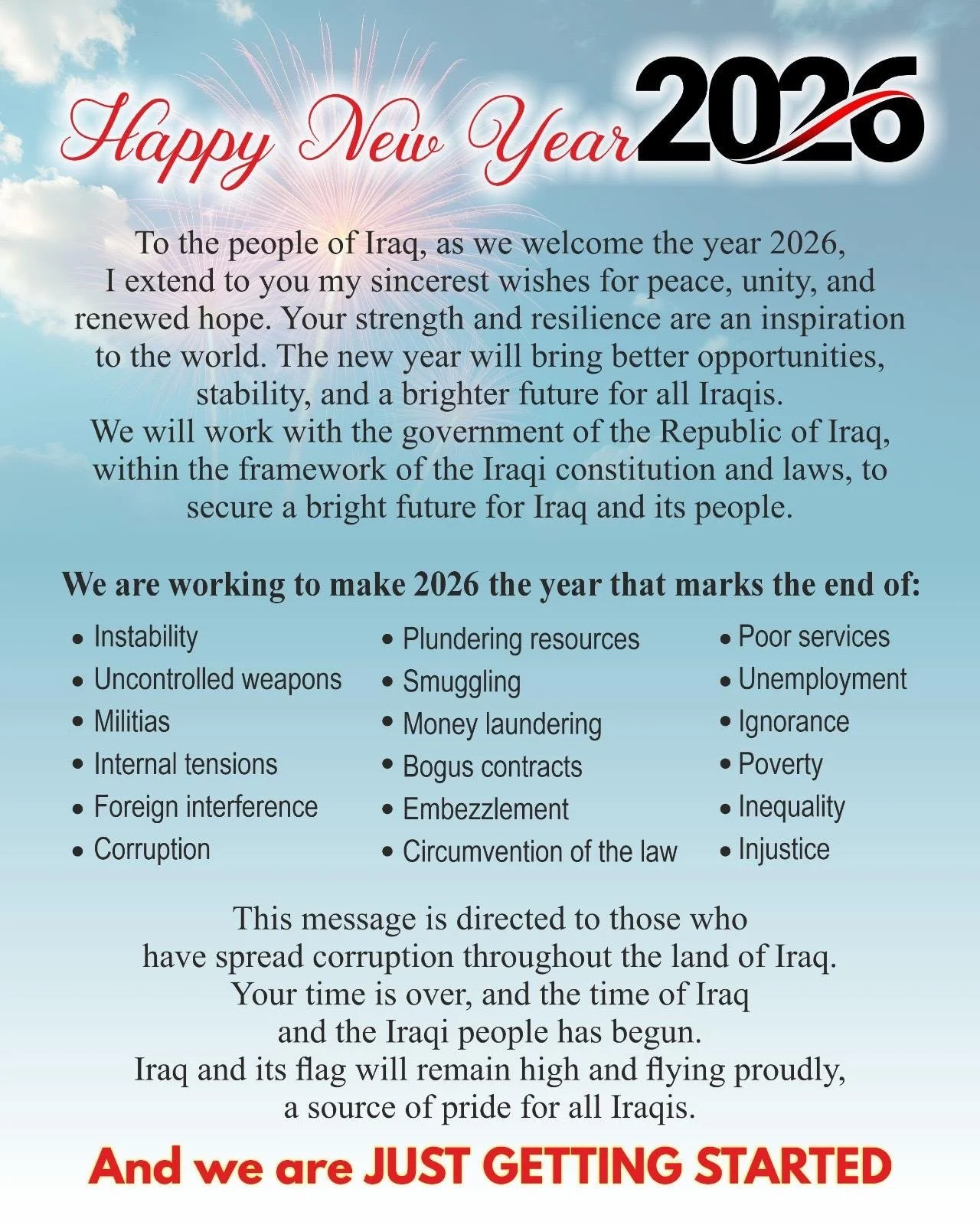
Tishwash: Sudani congratulates Halbousi and his deputies: Political stability depends on prioritizing Iraq's interests.
Prime Minister Mohammed Shia al-Sudani stressed on Wednesday the need to work towards achieving the country's higher interests.
A statement from his office, received by (Al-Mada), said that “Prime Minister Mohammed Shia Al-Sudani met with the new Speaker of Parliament, Hebat Hamad Al-Halbousi.”
Al-Sudani congratulated Al-Halbousi and his two deputies, Adnan Faihan Al-Dulaimi and Farhad Amin Atroushi, on their election and gaining the confidence of the representatives, praising this step that enhances the political stability of our democratic system.
He also pointed out the need to work towards achieving the country's higher interests.
The Prime Minister stressed "the need to complete the remaining constitutional requirements in order to continue providing public services to citizens in various fields." link
************
Mot: Goal fir da New Year and am working on it Already!!!

Mot: . Winter - in ""2 stages""