
Thank you to all the subscribers to our Early Access program…we thank you for your continued support.
We are excited to offer this new service to keep you informed and up-to-date on the latest Dinar and currency news.
Harry Dent: Prepare for the Biggest Crash of ALL TIME
Harry Dent: Prepare for the Biggest Crash of ALL TIME
VRIC Media: 10-27-2025
Economist and bestselling author Harry Dent joins Darrell Thomas to break down why he believes we’re living through the first 100% artificial asset bubble in history and why the next crash could be far deeper than investors expect.
Dent explains his demographic models, the dangers of prolonged stimulus, why even gold won’t escape the downturn, and how everyday investors can protect their wealth and be positioned to capitalize when markets reset around 2028.
Harry Dent: Prepare for the Biggest Crash of ALL TIME
VRIC Media: 10-27-2025
Economist and bestselling author Harry Dent joins Darrell Thomas to break down why he believes we’re living through the first 100% artificial asset bubble in history and why the next crash could be far deeper than investors expect.
Dent explains his demographic models, the dangers of prolonged stimulus, why even gold won’t escape the downturn, and how everyday investors can protect their wealth and be positioned to capitalize when markets reset around 2028.
00:00 – Intro
01:14 – Demographics & The Artificial Post-2008 Expansion
06:05 – Why Recessions Are Healthy (and Skipping Them Isn’t)
08:44 – Why Diversification Won’t Save You This Time
10:39 – When Does the Crash Arrive?
11:27 – Detoxing the Economy: How Long Will It Take?
14:31 – India Will Lead the Next Global Boom
18:04 – Strategy: Cash, Treasuries & Why Shorts Work First
19:20 – Main Street vs Wall Street: Who Gets Hurt Most?
22:51 – Can the Fed Print Its Way Out Again?
28:18 – Inflation: Was That It? What Comes Next?
32:00 – Gold vs Stocks: What Holds Up Better?
37:28 – Will Mining Benefit from Resource Nationalism?
39:28 – Oil Outlook Through a Recessionary Lens
41:12 – The Great Reset = A Massive Opportunity
“Tidbits From TNT” Tuesday 10-28-2025
TNT:
Tishwash: A US delegation hosted by the Minister of Oil to discuss energy cooperation.
Today, Monday, Oil Minister Hayan Abdul-Ghani discussed with US Under Secretary of Energy James Danley and Chargé d'Affaires Joshua Harris joint cooperation between the two countries in the oil, gas, and energy sectors.
Today, Monday, Deputy Prime Minister for Energy Affairs and Minister of Oil, Eng. Hayan Abdul-Ghani Al-Sawad, received the US Under Secretary of Energy, Mr. James P. Danly, and the Chargé d'Affaires of the US Embassy, Mr. Josh Harris.
During the meeting, prospects for joint cooperation between the two countries in the fields of oil, gas, and energy were discussed.
TNT:
Tishwash: A US delegation hosted by the Minister of Oil to discuss energy cooperation.
Today, Monday, Oil Minister Hayan Abdul-Ghani discussed with US Under Secretary of Energy James Danley and Chargé d'Affaires Joshua Harris joint cooperation between the two countries in the oil, gas, and energy sectors.
Today, Monday, Deputy Prime Minister for Energy Affairs and Minister of Oil, Eng. Hayan Abdul-Ghani Al-Sawad, received the US Under Secretary of Energy, Mr. James P. Danly, and the Chargé d'Affaires of the US Embassy, Mr. Josh Harris.
During the meeting, prospects for joint cooperation between the two countries in the fields of oil, gas, and energy were discussed.
The meeting was attended by the Undersecretary of the Ministry for Gas Affairs, Mr. Ezzat Saber Ismail, and the Director General of the Technical Department, Mr. Hassanein Abdel Latif. link
************
Tishwash: Al-Karawi: WTO membership will grant Iraq broad economic and trade privileges.
The Director General of the General Company for Grain Trade at the Ministry of Trade, Haider Nouri Al-Karawi, confirmed on Sunday that Iraq has completed the vast majority of its World Trade Organization accession files and is close to completing the remaining files after nearly twenty years of efforts.
He pointed out that membership will grant the country extensive economic and trade privileges, contribute to reducing customs duties, and attract international companies to invest in the Iraqi market.
Al-Karawi told Al-Iraqiya News, as reported by the Iraqi News Agency (INA), that “the process of joining the World Trade Organization requires a long period of time, and Iraq began working on this file in 2003 under the direct supervision of the Department of Foreign Economic Relations and the Minister of Trade.”
He added, "Iraq has completed the vast majority of the required files and is currently completing the final stages in preparation for formal membership in the organization," noting that "some countries have taken more than twenty years to complete this process, so the period of time required by Iraq is no exception."
Al-Karawi explained that "Iraq's accession to the organization will grant it significant economic and trade privileges, most notably the protection of the rights of domestic and imported products, and the provision of joint mechanisms to facilitate trade, tax, and customs exchange with member states, which will positively impact the reduction of customs duties and the facilitation of import and export operations."
He pointed out that "membership will help attract international companies by ensuring the protection of their products from counterfeiting and encouraging them to invest in the Iraqi market. It will also have a positive impact on lowering prices for consumers by strengthening legitimate competition and regulating markets."
Al-Karawi explained that "Iraq is committed to implementing more than fifteen technical and legislative files as part of the accession requirements, including the file on product protection and global trademarks, which ensures that no party will imitate or market products similar to those of international companies."
He added, "Completing these commitments gives foreign companies confidence in entering the Iraqi market link
***********
Tishwash: The oil and gas law returns to the forefront, and Parliament faces a test of political will.
As the fifth legislative session draws to a close and the country enters the electoral phase, the federal oil and gas law returns to the forefront of the political scene in Iraq as one of the most sensitive pieces of legislation postponed since 2007, amid warnings that its continued obstruction will deepen the economic crisis and keep the country hostage to political disputes.
The oil and gas law is one of the most contentious issues between the federal government, the Kurdistan Regional Government, and the oil-producing provinces, as it stands at a crucial crossroads that determines the future of oil wealth management, which constitutes more than 90 percent of state revenues.
Amid repeated calls from the presidency and parliament to pass it before the end of the current session, fears are growing that its continued obstruction will disrupt the investment environment and weaken the unity of oil decision-making.
Energy expert Mohammed Hawrami believes that the continued absence of the law represents an economic and legislative failure that has had direct repercussions on oil wealth management and the general budget, as well as declining attractiveness for foreign investment in the energy sector.
Hawrami explained that postponing the approval of the law during this session means postponing the decision to a new session, along with the accompanying new tensions over powers and revenue sharing, making any further disruption costly to the national economy.
He added that the absence of a legal framework has created a state of administrative and financial chaos between the central government, the region, and the producing provinces, and has deprived Iraq of the ability to formulate a unified production and investment policy. This has negatively impacted the confidence of foreign companies awaiting stable legislation that guarantees the sustainability of their operations.
He pointed out that Iraq needs annual investments exceeding $15 billion to develop the oil and energy sector and improve refining and export capacities. However, the absence of legal regulation of contracts and financial distribution makes the investment environment risky and limits the entry of major companies into the market.
Emphasized that the current parliament's window of opportunity is almost running out, requiring urgent action to adopt the law before the end of the session, as continued disruption means postponing any real economic transformation towards diversification and sustainable development.
For his part, Bassem Nughmish, a member of the Parliamentary Oil and Gas Committee, emphasized that the continued suspension of the law keeps the Iraqi economy mired in a cycle of rents and limits its ability to achieve balanced development
Naghamish explained that the absence of the law means the absence of a regulatory framework for managing national wealth, which confuses financial planning, leads to disparities in the distribution of revenues between the center and producing provinces, and limits the state's ability
to implement a stable fiscal policy.
He pointed out that political disputes over powers and revenue-sharing mechanisms hinder the implementation of vital projects in the oil and energy sector and create an unstable environment for foreign investors seeking clear and stable legislation.
Naghamish added that delaying the enactment of the law deprives Iraq of billions of dollars in investment opportunities annually and weakens the state's ability to transfer oil revenues into productive and development projects in the provinces. He stressed the need for the law to include clear mechanisms for financial governance, management of joint fields, and the establishment of a national fund for the development of producing provinces.
Naghamish concluded by saying that the next phase requires a comprehensive political and economic settlement that removes the oil issue from tensions and ensures a unified law that balances the powers of the central government and the rights of the regions, transforming oil wealth from a source of contention into a lever for development and stability. link
*************
Mot: Things That Suddenly Make Cents!!!

Mot: Seeeeee - They Even Season!!!!

Seeds of Wisdom RV and Economics Updates Tuesday Morning 10-28-25
Good Morning Dinar Recaps,
Dollar Softens Ahead of Global Central Bank Decisions
Markets brace for dovish signals as investors rotate toward risk assets.
The U.S. dollar weakened today as traders positioned ahead of a wave of major central bank meetings and a potential Trump–Xi summit that could reshape trade and monetary expectations. The U.S. Dollar Index (DXY) slipped modestly, reflecting a softening stance across markets anticipating looser policy conditions.
Good Morning Dinar Recaps,
Dollar Softens Ahead of Global Central Bank Decisions
Markets brace for dovish signals as investors rotate toward risk assets.
The U.S. dollar weakened today as traders positioned ahead of a wave of major central bank meetings and a potential Trump–Xi summit that could reshape trade and monetary expectations. The U.S. Dollar Index (DXY) slipped modestly, reflecting a softening stance across markets anticipating looser policy conditions.
The move underscores a cautious but notable rotation into risk assets, with equities and commodities both strengthening as the dollar retreats. This trend comes amid growing consensus that global policymakers may adopt synchronized easing measures before year-end.
Central Banks in Focus
Investors are now watching closely for guidance from the Federal Reserve, European Central Bank, and Bank of Japan, each facing the same challenge: how to sustain slowing economies without reigniting inflation.
The Fed is expected to lean dovish, with futures pricing in nearly a 70% probability of another rate cut by December.
The ECB may emphasize continued liquidity support, while Japan could signal readiness to adjust yield-curve control settings.
The dollar’s decline reflects not just policy expectations, but also a broader shift in global capital flow — one favoring risk assets, emerging markets, and commodities.
Market Implications
Gold and oil prices typically strengthen when the dollar weakens, as investors hedge against currency dilution.
Emerging-market currencies are likely to benefit, drawing short-term inflows as yield differentials narrow.
Equities could see additional upside if dovish signals are confirmed — though the risk of overshoot grows with each rally.
For now, the market appears confident that monetary policy will remain accommodative. Yet the dollar’s softness also signals something deeper — a recognition that global growth is uneven and liquidity remains the main stabilizing force.
This is not just politics — it’s global finance restructuring before our eyes.
Seeds of Wisdom Team
Newshounds News™ Exclusive
Sources:
Reuters — Dollar soft as traders brace for Trump–Xi, central bank meetings
FXStreet — EUR/USD picks up on risk appetite with central bank decisions looming
~~~~~~~~~
Volatility Beneath the Calm Surface
Record equity highs hide $100 billion daily swings as liquidity thins.
While U.S. equities continue to print new records, analysts warn that the calm appearance of the market may be deceptive. Beneath the surface, extreme volatility in major technology stocks and subtle liquidity cracks are emerging — conditions reminiscent of late-cycle instability.
According to The Financial Times, several mega-cap stocks have experienced single-day market-cap swings exceeding $100 billion — despite the major indices showing minimal net movement. The pattern suggests concentrated risk and heightened sensitivity to small shifts in sentiment or liquidity.
Hidden Fragility in a Bullish Market
Market indices mask the degree of turbulence occurring beneath them.
Tech giants dominate capitalization weightings, magnifying their impact on perceived stability.
Volatility metrics such as the VIX remain subdued, indicating complacency even as intraday price ranges expand.
Liquidity depth is thinner than in prior cycles, making sharp revaluations more likely when institutional flows reverse.
This divergence between visible calm and underlying instability is becoming a defining feature of the current bull market. Analysts describe it as “calm on the surface, chaotic underneath.”
What It Means for Investors
Portfolio diversification becomes essential when volatility hides beneath headline strength.
Options and volatility instruments may be underpriced relative to actual market risk.
Institutional hedging is quietly increasing, even as public sentiment remains bullish.
Such conditions often precede regime shifts — either toward sharper corrections or renewed monetary stimulus to maintain balance. The outcome will depend on central bank signaling and the sustainability of liquidity-driven rallies.
Broader Takeaway
Today’s markets operate on confidence and credit — not fundamentals alone. The surface calm of record highs belies the real state of global finance: one where volatility and liquidity risk have become the invisible twin pillars supporting valuations.
If left unchecked, even a minor policy misstep could expose just how thin that support has become.
This is not just politics — it’s global finance restructuring before our eyes.
Seeds of Wisdom Team
Newshounds News™ Exclusive
Sources:
Financial Times — $100bn stock swings expose fragility beneath Wall Street rally
MarketWatch — Stock-market bulls set up markets for a big move
~~~~~~~~~
Seeds of Wisdom Team RV Currency Facts Youtube and Rumble
Newshound's News Telegram Room Link
Follow the Gold/Silver Rate COMEX
Follow Fast Facts
Seeds of Wisdom Team™ Website
Thank you Dinar Recaps
Iraq Economic News and Points To Ponder Tuesday Morning 10-28-25
Learn About Iraq's Ranking Among The Richest Countries In The Arab World And Globally
2025-10-26 Iraq ranked eighth in the Arab world and 116th globally among the richest countries in 2026, according to forecasts by the American magazine CEOWorld.
The magazine said in a report that the International Monetary Fund believes that prosperity today depends on structure, not size. Countries that prioritize policy consistency, intellectual capital, and long-term investment will continue to dominate the wealth landscape, and per capita GDP is often considered the best measure of average living standards.
Learn About Iraq's Ranking Among The Richest Countries In The Arab World And Globally
2025-10-26 Iraq ranked eighth in the Arab world and 116th globally among the richest countries in 2026, according to forecasts by the American magazine CEOWorld.
The magazine said in a report that the International Monetary Fund believes that prosperity today depends on structure, not size. Countries that prioritize policy consistency, intellectual capital, and long-term investment will continue to dominate the wealth landscape, and per capita GDP is often considered the best measure of average living standards.
She added that Iraq is expected to rank eighth among the Arab countries and 116th out of 197 richest countries in 2026 in terms of per capita GDP, with a GDP of 5,873.
According to the magazine, Qatar is expected to rank first with a per capita GDP of $76,534, followed by the UAE in second place with $53,842, Saudi Arabia in third place with $35,839, Kuwait in fourth place with $31,242, and Bahrain in fifth place with $29,778.
He added that Libya came in sixth place with $6,972, followed by Algeria in seventh place with $5,956, Iraq in eighth place, Lebanon in ninth place with $5,285, and Morocco in tenth place with $5,154.
Globally, Monaco tops the global wealth pyramid, with a projected per capita GDP of $256,667 in 2026. Liechtenstein is second with $201,162, Luxembourg with $154,115, Ireland with $135,247, and Switzerland with $118,173. LINK
Al-Sudani: Our Plan Will Save Nearly $10 Billion By Halting The Import Of Gasoline And Petroleum Products
2025-10-26 by sotaliraq Prime Minister Mohammed Shia al-Sudani announced that his government has developed a plan to free up nearly $10 billion for the state treasury by halting the import of gasoline and petroleum products after achieving self-sufficiency in their production within Iraq.
This came in a speech he delivered during the inauguration of the strategic FCC/Factor Catalyst Cracking Unit project at the Shuaiba refinery in Basra Governorate, with a capacity of 107,000 barrels per day.
In his speech, Al-Sudani said that the project, upon its entry into service, represents a pivotal event in the history of the Iraqi oil industry, and everyone has every right to be proud of its accomplishment.
He added that the government's program has allocated significant space to expanding Iraq's capacity to refine crude oil and produce and export petroleum derivatives.
Al-Sudani also affirmed that "we have set a stated goal of converting 40% of the oil quantities exported by Iraq into high-value products by 2030. We have achieved 35% of the goal."
He continued, saying, "Our plan will save $4 billion, which was allocated for gas imports, and 6 trillion dinars, which was spent on importing petroleum derivatives." He pointed out that for two decades, successive governments have failed to pay attention to or plan scientifically and responsibly to advance the petroleum refining sector.
Al-Sudani noted that the project is the result of Iraqi cooperation with Hyundai and the Japanese International Cooperation Agency (JICA), and that the 300,000 barrel-per-day Al-Faw investment refinery will be operational very soon.
The Prime Minister pointed out that this project was implemented according to the latest environmentally friendly technology and Euro 5 specifications. LINK
The Oil Ministry Announces The Final Statistics On Oil Exports And Revenues For Last September.
Sunday, October 26, 2025, 10:47 AM | Economics Number of reads: 380 Baghdad / NINA / The Ministry of Oil announced the final statistics of oil exports and revenues achieved for last September.
The ministry said in a statement: "According to the final statistics issued by the State Oil Marketing Organization (SOMO), the quantity of crude oil exports, including condensates, amounted to (102) million, (150) thousand, and (362) barrels (one hundred and two million, one hundred and fifty thousand, three hundred and sixty-two barrels),
( 102,150,362, ) with revenues amounting to more than (6) billion, (962) million, and (124) thousand dollars (six billion, nine hundred and sixty-two million, one hundred and twenty-four thousand dollars). ( 6,962,124,000 )
The statistics indicated that the total quantities of crude oil exported for last September from the oil fields in central and southern Iraq amounted to (102) million, (150) thousand, and (362) barrels. /End `
https://ninanews.com/Website/News/Details?key=1258802
Iraq Bans Imports Of 40 Agricultural Products To Achieve Self-Sufficiency.
October 26, 2025 Baghdad/Iraq Observer The Ministry of Agriculture announced on Sunday a ban on the import of more than 40 agricultural products to achieve self-sufficiency. The ministry confirmed that it is monitoring agricultural commodity prices daily and will import them immediately if they rise.
It also indicated that dates will be exported to Asian and European countries.
The Ministry's Undersecretary, Mahdi Sahar Al-Jubouri, said, "The Ministry of Agriculture, through the Veterinary Department, is monitoring the outbreak of avian influenza or any infections affecting animals, especially poultry, through the World Organization for Animal Health's website."
He noted that "the World Organization for Animal Health is constantly updating lists of countries where avian influenza cases have been detected, or where the ban has been lifted," according to the official agency.
He explained that "the Ministry, in cooperation with security and official authorities, prohibits the import of meat and all poultry products from any country where this infection has been detected.
When the World Organization for Animal Health confirms that a country is free of the disease, the ban will be lifted, to protect human health and livestock."
He pointed out that "there are precautionary measures in Iraq of a preventative nature, as the Veterinary Department and veterinary hospitals and clinics spread throughout the governorates are monitoring cases to limit the spread of any bird flu infection, and implementing the department's instructions in areas where epidemics may appear, to limit their spread to nearby areas."
Regarding the Ministry of Agriculture’s measures to support the agricultural sector, the spokesman confirmed that
“the Ministry is continuing to prevent the import of more than (40) agricultural products currently, with the aim of achieving self-sufficiency in Iraq, including tomato and potato crops and others.”
He explained that “Iraq is working to export dates to countries such as India, China, Turkey, Jordan, and the Gulf states, while packaged and packed dates are exported directly from Iraq to European Union countries, to gain a share of global markets.
” He added that “most countries in the world rely on marketing dates packaged using modern methods, instead of exporting raw dates, which are cheaper than packaged dates.”
In a separate context, the spokesman confirmed that "the ministry is continuously monitoring the prices of agricultural commodities in local markets, in cooperation with security agencies, to limit price increases."
He continued: "If the prices of any commodity or agricultural product rise, the door is opened to importing those products.
This achieves the primary goal of supporting agricultural producers on the one hand, and stabilizing prices in local markets on the other, ensuring they reach consumers at reasonable prices."
https://observeriraq.net/العراق-يمنع-استيراد-40-منتجاً-زراعياً-لت/
For current and reliable Iraqi news please visit: https://www.bondladyscorner.com
MilitiaMan and Crew: IQD News Update-Iraq's Yellow Brick Road-CBI Paved It
MilitiaMan and Crew: IQD News Update-Iraq's Yellow Brick Road-CBI Paved It
10-27-2025
The Crew: Samson, PompeyPeter, Petra, Daytrader, Sunkissed, GIGI and Militia Man
Follow MM on X == https://x.com/Slashn
Be sure to listen to full video for all the news……..
MilitiaMan and Crew: IQD News Update-Iraq's Yellow Brick Road-CBI Paved It
10-27-2025
The Crew: Samson, PompeyPeter, Petra, Daytrader, Sunkissed, GIGI and Militia Man
Follow MM on X == https://x.com/Slashn
Be sure to listen to full video for all the news……..
Seeds of Wisdom RV and Economics Updates Monday Evening 10-27-25
Good Evening Dinar Recaps,
Gyeongju APEC Summit: South Korea Bridges East and West
Diplomacy meets economics as Seoul positions itself between Washington, Beijing, and ASEAN
As the APEC Summit convenes this week in Gyeongju, South Korea, the host nation is advancing a policy of “bridge diplomacy” — a balancing act between the United States, China, Japan, and ASEAN nations. President Lee Jae-myung’s administration aims to transform South Korea into a neutral mediator linking advanced economies with the developing Asia-Pacific bloc.
Good Evening Dinar Recaps,
Gyeongju APEC Summit: South Korea Bridges East and West
Diplomacy meets economics as Seoul positions itself between Washington, Beijing, and ASEAN
As the APEC Summit convenes this week in Gyeongju, South Korea, the host nation is advancing a policy of “bridge diplomacy” — a balancing act between the United States, China, Japan, and ASEAN nations. President Lee Jae-myung’s administration aims to transform South Korea into a neutral mediator linking advanced economies with the developing Asia-Pacific bloc.
The Core Themes
Economic coordination: APEC’s agenda includes digital trade frameworks, clean-energy transition, and investment in resilient supply chains.
Security meets commerce: Behind the scenes, the summit is expected to feature quiet talks between U.S. and Chinese delegates — a prelude to more formal trade normalization efforts.
ASEAN alignment: The APEC initiative directly supports ASEAN 2025, aimed at integrating Southeast Asia’s supply chains with broader Pacific trade systems.
Why It Matters
Diplomatic repositioning: Seoul’s bridge role reflects a shift toward multipolar diplomacy, reducing binary East-West confrontation.
Financial ripple effect: Integration across APEC and ASEAN could redirect capital flows from Western debt markets into infrastructure, logistics, and digital finance projects spanning Asia and Oceania.
The Strategic Link to the Financial Reset
As APEC and ASEAN deepen coordination, a new financial framework is emerging — one that may complement BRICS initiatives while offering an alternate venue for global investment.
South Korea’s diplomatic balancing act could lay the groundwork for a dual-system world, where the Western-led monetary order coexists with a new Asia-centric trade-finance nexus.
This is not just politics — it’s global finance restructuring before our eyes.
Seeds of Wisdom Team
Newshounds News™ Exclusive
Sources:
East Asia Forum – South Korea’s bridge diplomacy faces its APEC test
The Korea Times – Korea’s 5-dimensional diplomacy at APEC summit
Reuters – Asia-Pacific economies coordinate trade and clean-energy frameworks ahead of APEC
~~~~~~~~~
BRICS Grain Power Move: Russia’s Pilot Exchange Challenges U.S. Commodity Dominance
How a 2026 pilot could rewrite global food pricing and accelerate financial realignment.
Overview
Russia is preparing a pilot launch for the BRICS Grain Exchange by 2026 — a bold initiative aimed at breaking the Chicago Mercantile Exchange’s (CME) monopoly over global grain pricing. The project, endorsed at the 2024 BRICS Summit in Kazan, has broad support from member states including India, Brazil, and China, with full implementation targeted for 2027.
The move aligns with BRICS’ broader strategy to create independent market infrastructure — reducing reliance on Western financial systems and aligning food security with de-dollarization.
Key Developments
Putin’s Endorsement: At the Kazan summit, President Vladimir Putin emphasized that BRICS nations produce nearly half of global grain and should therefore determine their own benchmark prices.
“The exchange will contribute to fair and predictable price indicators… and protect national markets from artificial shortages,” said Putin.
Strategic Scale:
The expanded BRICS bloc now accounts for roughly 44% of global grain production and consumption.
The exchange’s projected trading volume could exceed $1 trillion, according to Eduard Zernin, head of the Russian Union of Grain Exporters.
Technical Framework:
The platform will use a digital marketplace model rather than a traditional exchange format.
Discussions are underway to finalize settlement mechanisms — possibly using a BRICS digital currency or a gold-linked unit of account.
India’s Role:
India supports the initiative as part of its drive toward food sovereignty and reduced dependence on Western commodity benchmarks. It also views the exchange as a regional export and pricing hub for farmers.
Why It Matters
Eroding Western Pricing Control:
The CME and Euronext currently set nearly all global grain benchmarks — even for commodities they produce little of. This system gives the U.S. and EU indirect control over food security and inflation trends worldwide.Financial Realignment:
The BRICS Grain Exchange would represent one of the first non-Western commodity markets of scale, potentially denominated outside the dollar system.
🌱 If successful, it could set a precedent for similar energy, metals, and digital-asset exchanges — forming the backbone of a new “BRICS Financial Architecture.”De-dollarization through Commodities:
Food and energy are the pillars of global trade. Pricing either outside the U.S. dollar would undermine the petrodollar structure and strengthen multipolar trade settlements.Strategic Leverage:
Controlling agricultural benchmarks gives BRICS new leverage in negotiating sanctions, tariffs, and trade routes — shifting power from financial centers like Chicago and London to new hubs in Kazan, Mumbai, and São Paulo.
Geopolitical Context
The timing coincides with U.S. tariff hikes and rising food insecurity in developing nations — both accelerating the BRICS rollout.
The exchange is part of a broader sovereign resilience strategy, mirroring the BRICS Pay system, New Development Bank, and the Cross-Border Settlement Platform.
Analysts note that this may tighten South-South trade corridors and integrate agricultural policy into the same multipolar structure reshaping global finance.
Implications for the Global Financial Reset
A functioning BRICS Grain Exchange could reshape commodity-derived currency reserves, as nations peg their reserves to a new grain-based or gold-linked benchmark.
This could catalyze the next phase of the financial reset — where value is defined by production and real assets, not speculative capital flows.
It signals a systemic decoupling of East-South trade from the dollar system — the cornerstone of post-WWII financial order.
This is not just politics — it’s global finance restructuring before our eyes.
Seeds of Wisdom Team
Newshounds News™ Exclusive
Sources
Watcher Guru – Historic BRICS Grain Exchange Pilot by Russia Targets US CME Monopoly
Council on Foreign Relations --“Why Expanded BRICS Is Backing a Russia-Initiated Grain Exchange”
Reuters -- “Russia’s proposed grain exchange for BRICS countries may take years to launch”
All About Feed -- “BRICS grain exchange plan is almost ready”
~~~~~~~~~
Seeds of Wisdom Team RV Currency Facts Youtube and Rumble
Newshound's News Telegram Room Link
Follow the Gold/Silver Rate COMEX
Follow Fast Facts
Seeds of Wisdom Team™ Website
Thank you Dinar Recaps
Iraq Economic News and Points To Ponder Monday Afternoon 10-27-25
MP: The Parallel Market Is Behind The Rise In The Dollar Exchange Rate.
Economy | 10/27/2025 Mawazine News - Baghdad - MP Moeen Al-Kadhimi confirmed that the rise in the dollar exchange rate is mainly due to the trend of most traders toward the parallel market (black market) to purchase hard currency to finance import operations.
MP: The Parallel Market Is Behind The Rise In The Dollar Exchange Rate.
Economy | 10/27/2025 Mawazine News - Baghdad - MP Moeen Al-Kadhimi confirmed that the rise in the dollar exchange rate is mainly due to the trend of most traders toward the parallel market (black market) to purchase hard currency to finance import operations.
Al-Kadhimi said, "Most traders resort to the parallel market to obtain dollars," indicating that "this trend has led to an increase in demand for the dollar on the black market, which has caused a significant rise in the exchange rate."
He added, "The solution requires the Central Bank and the Ministry of Finance to facilitate banking procedures for real traders and control the movement of funds through the official banking system to reduce the need for the parallel market," noting that "the continuation of this situation will lead to increased economic pressures and higher prices in local markets."
Al-Kadhimi concluded his remarks by stressing that "the Parliamentary Finance Committee is closely monitoring this issue and will work to find urgent solutions that ensure the stability of the exchange rate and protect consumers from the repercussions of the dollar's rise." https://www.mawazin.net/Details.aspx?jimare=269199
Trade: Iraq Seeks To Open Up To The Global Economy By Joining The WTO.
Economy | 01:46 - 10/26/2025 Mawazine News - Baghdad - The official spokesperson for the Ministry of Trade, Mohammed Hanoun, confirmed that the Iraqi government continues to implement its reform program aimed at completing the requirements for the Republic of Iraq's accession to the World Trade Organization (WTO), in line with the state's orientations towards openness to the global economy and strengthening Iraq's position within the multilateral trading system.
Hanoun explained in a statement received by Mawazine News that "the ministry, through the National Committee for Iraq's Accession to the Organization, was able, during the years 2023 and 2024, to make tangible progress in completing the basic negotiating documents and updating the required technical files, reflecting Iraq's commitment to international standards and implementing the principles of transparency and economic openness."
He pointed out that "Iraq officially resumed the accession negotiations process after a hiatus of more than 16 years. In July 2024, the third meeting of the working group concerned with Iraq's accession was held at the organization's headquarters in Geneva, headed by the Minister of Trade, who gave a comprehensive presentation on the ongoing economic and legislative reforms. This presentation was widely welcomed by member states, which praised Iraq's commitment to the requirements of full membership."
He added, "The Ministry, in cooperation with relevant government agencies, has completed the update of the customs tariff system to HS2022, in addition to preparing and amending a package of commercial laws and legislation, including intellectual property rights laws, commercial arbitration, technical standards, and regulations related to foreign trade. The Ministry of Finance is also working to complete the stages of approving the new customs system within the national legal framework."
The official spokesman explained that "Iraq participated for the first time in twenty years as an observer" in the 13th Ministerial Conference of the World Trade Organization (MC13), held in Abu Dhabi, stressing that this participation reflects the strong political support for the accession process and the government's will to accelerate structural economic reforms in line with the organization's requirements.
He added that "the National Committee and its subcommittees, after the last meeting, began updating the memorandum on the foreign trade system and submitting detailed answers to 175 questions" submitted by member states, in preparation for holding the fourth meeting of the working group during the next phase."
Hanoun concluded his statement by emphasizing that "the Ministry of Trade, under the direct guidance of the Prime Minister, is proceeding to complete all technical and legal requirements in cooperation with relevant ministries and agencies, with the goal of achieving Iraq's full membership in the World Trade Organization in the coming period, which will contribute to enhancing the competitiveness of the national economy and attracting foreign investment."https://www.mawazin.net/Details.aspx?jimare=269143
A Slight Decrease In The Dollar Price In Local Markets.
Monday, October 27, 2025, 11:35 AM | Economics Number of reads: 233 Baghdad / NINA / The exchange rate of the dollar against the dinar decreased slightly in the markets of the capital, Baghdad, with the opening of the stock exchanges today, Monday.
The selling price of the dollar in the Al-Kifah and Al-Harithiya stock exchanges was recorded at 140,400 dinars for every 100 dollars.
The selling price in exchange shops in the local markets in Baghdad reached 141,500 dinars for every 100 dollars, while the purchase price reached 140,500 dinars.
In Erbil, the dollar also decreased, as the selling price reached 141,250 dinars for every 100 dollars, and the purchase price was 140,250 dinars for every 100 dollars. /End https://ninanews.com/Website/News/Details?key=1259009
Oil: Iraq Continues Its Vision To Develop Its Resources And Maximize The Economy.
Energy Economy News – Baghdad Oil Minister Hayan Abdul-Ghani said on Monday that Iraq continues to work with confidence and a clear vision to develop its oil and gas resources and maximize their economic value.
A statement from the ministry, received by Al-Eqtisad News, stated that "the Minister of Oil, Hayan Abdul-Ghani Al-Sawad, affirmed during the opening of the first edition of the Iraq Oil Industry Workshop (IPIW 2025), organized by the Ministry of Oil, that the global oil industry is undergoing a period of fundamental transformations in light of the diversity of energy sources and the development of production and consumption technologies."
He pointed out that "the transformations have imposed new challenges related to sustainable growth, securing supplies, and achieving a balance between economic abundance and environmental responsibility."
He explained, "In light of this reality, Iraq continues to work with confidence and a clear vision to develop its oil and gas resources and maximize their economic value in a way that serves its national interests." He noted that "the ministry has taken a series of strategic measures to keep pace with these transformations, including developing major oil fields, increasing production efficiency using the latest operational and administrative technologies, accelerating associated gas investment programs to meet the needs of power plants, and reducing reliance on imports."
He stressed that "Iraq possesses one of the largest oil reserves in the world and continues to work to optimally exploit this national resource through integrated investment plans that ensure sustainable production, diversify partners, and expand the technical and administrative base of national companies."
He explained that "the Ministry pays special attention to the issue of technology transfer and knowledge localization through strategic partnerships with international companies, by transferring operational and administrative expertise and employing it to build national capabilities and train Iraqi personnel in the latest technical applications in the fields of drilling, production, processing, and transportation." https://economy-news.net/content.php?id=61652
Iraqi Oil Prices Rise In Global Markets
Economy | 10/27/2025 Mawazine News – Baghdad Iraqi oil prices rose during weekly trading in the global market. According to specialized data, Basra Medium crude rose to $65.85 per barrel, while Basra Heavy crude recorded $64.70 per barrel, with a change rate of +0.76 for both.
Regarding global oil prices, British Brent crude recorded $66.41 per barrel, while US West Texas Intermediate crude recorded $61.93 per barrel, with changes rates of +0.43 and +0.47, respectively.
https://www.mawazin.net/Details.aspx?jimare=269190
Gold Declines As The Dollar Rises Amid Easing US-China Tensions.
Economy | 09:28 - 10/27/2025 Mawazine News - Follow-up: Gold prices fell, affected by the strengthening US dollar and signs of easing trade tensions between the United States and China, at a time when investors are awaiting meetings of major central banks this week for signals on monetary policy.
Spot gold fell 0.7% to $4,082.77 per ounce by 01:58 GMT, while US gold futures for December delivery fell 1% to $4,095.80.
The US dollar rose to its highest level in more than two weeks against the yen, making gold more expensive for holders of other currencies.
Top US and Chinese economic officials agreed on Sunday on the framework for a trade deal, which President Donald Trump and his Chinese counterpart Xi Jinping are scheduled to discuss later this week.
The Federal Reserve is widely expected to cut interest rates by a quarter percentage point at its meeting next Wednesday, buoyed by last Friday's weaker-than-expected inflation report, which typically boosts the appeal of non-yielding assets like gold.
Among other precious metals, spot silver fell 0.3% to $48.42 an ounce, while platinum rose 0.1% to $1,607.24, and palladium fell 0.2% to $1,426.06. https://www.mawazin.net/Details.aspx?jimare=269184
For current and reliable Iraqi news please visit: https://www.bondladyscorner.com
Seeds of Wisdom RV and Economics Updates Monday Afternoon 10-27-25
Good Afternoon Dinar Recaps,
Markets Poised for Structural Realignment
Trade detente and cooling inflation signal the dawn of a new financial order
Good Afternoon Dinar Recaps,
Markets Poised for Structural Realignment
Trade detente and cooling inflation signal the dawn of a new financial order
Global markets are entering what analysts increasingly describe as a structural turning point. Two developments — a U.S.–China trade thaw and the steady easing of inflation worldwide — are creating the conditions for a major financial realignment.
Together, they suggest that the turbulence of recent years may be giving way to a re-anchored global system built on pragmatic cooperation, diversified reserves, and new capital flows.
The Convergence: Trade + Inflation Reset
Trade optimism returns: Renewed diplomatic and economic talks between Washington and Beijing have reduced tariff fears and revived industrial demand.
Inflation cooling globally: Data from the U.S., Eurozone, and Asia show steady disinflation, giving policymakers room to pivot from restrictive to supportive stances.
Commodities and currencies reprice: Copper, oil, and industrial metals are firming; the yuan and other Asian currencies have strengthened on confidence in regional growth.
Investor behavior shifts: Portfolio flows are turning back toward equities and emerging markets after years of defensive positioning.
Why It Matters
Systemic implications: The simultaneous easing of inflation and trade tension could reset how capital moves across borders, challenging the dollar-centric dominance that defined the post-2008 era.
Corporate recalibration: Firms are beginning to rebuild global supply networks, reducing fragility and diversifying manufacturing bases — a structural change, not a short-term reaction.
Policy coordination: For the first time in years, major economies may find common ground between fiscal expansion and monetary flexibility.
In essence:
“This is not just politics — it’s global finance restructuring before our eyes.”
Emerging Signals of a New Order
Resurgent BRICS trade corridors gaining institutional depth through gold- and commodity-based settlements.
G7 central banks signaling gradual rate normalization while exploring multi-currency liquidity lines.
Digital asset integration accelerating as cross-border payment infrastructure modernizes.
These shifts suggest the world may be edging toward a blended system — one where legacy Western financial institutions coexist with new frameworks emerging from Asia and the Global South.
The Strategic Outlook
The months ahead will test whether optimism translates into sustained global rebalancing.
If trade détente endures and inflation stabilizes, the world could move toward a more multipolar but integrated financial landscape — one less dependent on unilateral policy, and more driven by pragmatic collaboration.
This is not just politics — it’s global finance restructuring before our eyes.
Seeds of Wisdom Team
Newshounds News™ Exclusive
Sources:
Financial Times – Global stocks rally on US-China trade optimism
Reuters – Stocks rally, safe-havens retreat on trade deal optimism
The Australian – Markets to finish 2025 strongly amid US-China trade breakthrough, inflation beat
Bloomberg Economics – Inflation trajectory and central-bank signaling
~~~~~~~~~
Riyadh Hosts Global Alliance for Palestinian Two-State Solution
Middle East diplomacy regains momentum as Saudi Arabia steps into a leadership role
Riyadh this week hosted a Global Alliance coordination summit aimed at reviving the long-stalled Palestinian–Israeli two-state framework. Co-chaired by Saudi Arabia, Norway, and the European Union, the meeting brought together over 40 diplomatic envoys to discuss humanitarian support, reconstruction, and governance planning for a potential future Palestinian state.
Diplomatic Turning Point
Regional leadership shift: Saudi Arabia is asserting itself as a primary diplomatic hub, reshaping the balance once dominated by Western mediators.
Institutional framework: The alliance proposes a standing secretariat to manage aid, infrastructure, and economic development within Palestinian territories.
Peace through economics: Economic stabilization is seen as a prerequisite for security — a model already tested through the Abraham Accords and Gulf diversification strategies.
Why It Matters
Restructuring of alliances: The Riyadh meeting signals a multipolar approach to Middle East peace, blending Western, Arab, and European participation under a shared umbrella.
Financial architecture in motion: A two-state economic plan would require new financing channels — likely through BRICS-linked development banks or Gulf sovereign funds — bypassing older IMF/World Bank structures.
Strategic Implications
If the alliance holds, the economic underpinning of peace could integrate the Middle East into a broader Eurasian trade corridor — connecting Gulf capital, Asian infrastructure, and European technology.
This could realign financial flows toward energy-neutral development, a key element of the emerging post-dollar financial reset.
This is not just politics — it’s global finance restructuring before our eyes.
Seeds of Wisdom Team
Newshounds News™ Exclusive
Sources:
~~~~~~~~~
Seeds of Wisdom Team RV Currency Facts Youtube and Rumble
Newshound's News Telegram Room Link
Follow the Gold/Silver Rate COMEX
Follow Fast Facts
Seeds of Wisdom Team™ Website
Thank you Dinar Recaps
“Tidbits From TNT” Monday 10-27-2025
TNT:
Tishwash: Expert: Iraqi banks are required to keep pace with cross-border payments
A banking expert confirmed that the recent development in international payment systems using the digital renminbi represents a strategic turning point in global trade, and opens new horizons for import, export and foreign loan settlements.
Expert Faiq Al-Obaidi told (Al-Zaman) yesterday that (this development requires Iraqi banking administrations to quickly keep pace with the new system and provide intensive training on its working mechanisms, to ensure the banks' ability to deal efficiently with cross-border digital payments
TNT:
Tishwash: Expert: Iraqi banks are required to keep pace with cross-border payments
A banking expert confirmed that the recent development in international payment systems using the digital renminbi represents a strategic turning point in global trade, and opens new horizons for import, export and foreign loan settlements.
Expert Faiq Al-Obaidi told (Al-Zaman) yesterday that (this development requires Iraqi banking administrations to quickly keep pace with the new system and provide intensive training on its working mechanisms, to ensure the banks' ability to deal efficiently with cross-border digital payments
Al-Obaidi explained that (the monetary authority is required to issue clear instructions and controls, and grant approvals to banks participating in the new system, especially since most Iraqi banks have taken the initiative to open accounts in Chinese currency Which prepares the financial infrastructure to benefit from this digital revolution).
The People's Bank of China announced that the digital renminbi (Chinese yuan) cross-border settlement system will be fully linked with the ten member states of the Association of Southeast Asian Nations and six countries in the Middle East.Observers believed yesterday that (38 percent of the volume of global trade will exceed the SWIFT system, which is dominated by the United States, and the system will enter directly into what they described as the digital renminbi moment).
For its part, The Economist magazine said yesterday that (this step constitutes a battle for the front bulwark of the Bretton Woods 2.0 system), adding that (blockchain-based technology is rewriting the basic code of the global economy, while increasing settlement speed and reducing costs in an unprecedented way), and explained that (the traditional SWIFT system suffers from a delay of 3 to 5 days in cross-border payments, While the Chinese digital bridge reduced the settlement time to only 7 seconds).
In the first test between Hong Kong and Abu Dhabi, a company paid a supplier in the Middle East using the digital renminbi, and the money did not pass through six intermediary banks, but was received directly through a distributed ledger, reducing processing fees by 98 percent.
In a two-country, two-park project between China and Indonesia, an industrial bank used digital renminbi to complete the first cross-border payment, and the process took just 8 seconds from order confirmation to funds arriving, 100 times faster than traditional methods.
This technical superiority prompted 23 central banks around the world to join the digital bridge test, with energy traders in the Middle East reducing settlement costs by 75 percent.
Experts confirmed yesterday that (this technical superiority made the traditional settlement system dominated by the dollar appear immediately backward, and that the technology not only allows immediate tracking, but also automatically applies anti-money laundering rules), and they pointed out that (China is gradually building its financial sovereignty), and they added (when the United States tried to impose sanctions on Iran through the SWIFT system, China had already established a closed loop of renminbi payments in Southeast Asia.
The volume of cross-border settlement in renminbi in ASEAN countries amounted to more than 5.8 trillion yuan in 2024, an increase of 120 percent compared to 2021, while ix countries, including Malaysia and Singapore, included the renminbi in their foreign currency reserves, and Thailand completed its first oil deal using the digital renminbi.
According to the circulated data, (the wave of eliminating the dominance of the dollar prompted the Bank for International Settlements to say that China is redefining the rules of the game in the era of digital currencies), and the data pointed out that (the digital renminbi is not just a payment tool, but rather carries the Chinese Belt and Road strategy), stressing that (in projects such as the China-Laos Railway and the Jakarta-Bandung Railway, the digital renminbi has been integrated with the navigation system),
Emphasizing that (European car companies use the digital renminbi to settle shipping via the polar route, while China increases trade efficiency by 400 percent), and pointing out that (this strategy makes the dominance of the US dollar systematically threatened for the first time), the data stressed that (87 percent of the world's countries have completed adapting their systems to the digital renminbi, and the volume of cross-border payments has exceeded 1.$2 trillion, and China has built a digital payments network covering 200 countries, concluding that this silent financial revolution is not just monetary sovereignty, but determines who controls the lifeblood of the global economy in the future. link
************
Tishwash: Al-Sudani issues directives to financial and banking institutions
Prime Minister Mohammed Shia al-Sudani directed, on Sunday (October 26, 2025), government and private financial and banking institutions to enhance cooperation with Arab and foreign investors, in a manner that serves Iraq's interests and supports the building of a strong, diversified, and sustainable economy.
Al-Sudani's media office stated in a statement received by "Baghdad Today" that "this came during his attendance at the opening ceremony of the Arab Bank –Iraq, in which Iraqi, Arab and foreign capital contributes," stressing that "the opening of this bank represents an embodiment of investors' confidence in the Iraqi economy and the attractive business environment that has been established during the past period." Pointing out that the bank's presence represents a strategic addition to the national banking sector and a model for modern financial institutions capable of providing advanced services and financing sustainable development projects.
The Prime Minister explained that "the success of this project requires cooperation between Arab Bank–Iraq, national banks, government agencies, and the private sector, in order to employ financial capabilities and banking expertise to support the government's development programs and projects."
He stressed that "the government is continuing to reform the financial and banking system and transform from a single rentier economy to a diversified and sustainable economy that depends on investing in natural resources".
He explained that "these reforms were implemented despite their great social and political costs, and contributed to raising the level of reliability with international financial institutions and creating a safe and attractive financial environment for investment."
He added, "Iraq is witnessing a phase of real development and broad investment opportunities in various sectors, stressing the need for modern digital banking services that meet the needs of individuals and institutions and keep pace with global development in banking".
Al-Sudani concluded by stressing that integration between Iraqi financial institutions and Arab and foreign investors represents a fundamental step towards enhancing economic growth and consolidating financial stability in the country. link
************
Tishwah: Rafidain Bank: Partnership with the Central Bank and the Payments Council is a Successful Model for Managing Financial Transformation
Rafidain Bank announced on Sunday that its partnership with the Central Bank and the Payments Council represents a successful model for managing financial transformation, while indicating its commitment to moving towards an integrated digital financial system.
The bank stated in a statement received by Al-Rabia News Agency: "The bank's Director General, Ali Karim Hussein Al-Fatlawi, participated in the regular meeting of the Iraqi National Payments Council, which was held at the headquarters of the Central Bank of Iraq, headed by the Governor of the Central Bank, Ali Mohsen Al-Allaq, and attended by representatives of ministries, government institutions, and the financial and banking sectors."
According to the statement, Al-Fatlawi said, "The bank is proceeding with confident strides in its strategic partnership with the Central Bank and the National Payments Council to develop the digital payments infrastructure and consolidate the transition towards a national economy based on financial inclusion and technological innovation."
He emphasized that "the bank is working to strengthen its role as a key driver of the digital transformation of the Iraqi banking sector by investing in modern financial technologies and expanding the electronic payment services network, in line with the national vision led by the Central Bank and the Payments Council to build a more efficient and transparent financial system."
He explained that "the bank attaches great importance to developing the technological infrastructure of its banking systems, enhancing cybersecurity and data protection, and spreading the culture of financial awareness among citizens, especially youth and students, as they are the targeted generation for the transition to digital banking services."
He pointed out that "the close partnership between the Central Bank, the Payments Council, and Rafidain Bank represents a successful model of institutional integration in managing financial and digital transformation in Iraq," stressing that "the bank will continue to play its leading role in empowering the national banking sector and expanding the base of financial inclusion, thus enhancing economic stability and serving sustainable development." link
************
Mot: Things That Make Ya Go -- Hmmmmmmm!!!
Mot: Getting Closer I Is!!!!

Seeds of Wisdom RV and Economics Updates Monday Morning 10-27-25
Good Morning Dinar Recaps,
Global Equities Surge on U.S.–China Trade Optimism
Markets rally worldwide as investors sense a thaw in global tensions
Global markets opened the week with strong momentum as optimism grew over renewed trade cooperation between the United States and China. Hints of a potential trade framework — coupled with encouraging inflation data — have pushed investors back into equities and risk assets.
Good Morning Dinar Recaps,
Global Equities Surge on U.S.–China Trade Optimism
Markets rally worldwide as investors sense a thaw in global tensions
Global markets opened the week with strong momentum as optimism grew over renewed trade cooperation between the United States and China. Hints of a potential trade framework — coupled with encouraging inflation data — have pushed investors back into equities and risk assets.
Key Market Movements
Asia leads the charge: Japan’s Nikkei 225 surged over 2.5%, and South Korea’s KOSPI rose nearly 3%, buoyed by tech-sector strength.
European indexes followed suit, with the FTSE 100 and DAX climbing as investors rotated out of defensive positions.
Gold and bonds declined, signaling a return of risk appetite.
Currencies shifted: the Chinese yuan strengthened, while the U.S. dollar was mixed across major pairs.
Commodities such as copper rose on expectations of increased industrial demand.
Why It Matters
Trade thaw = global growth pulse: Reducing U.S.–China trade risk restores confidence in supply chains, manufacturing, and corporate investment.
Capital flow rotation: Investors are moving from safe havens into growth assets — a structural signal of shifting global sentiment.
Global Financial Reset connection: The emerging trade détente is more than diplomacy — it’s part of a restructuring of the global financial architecture:
“This is not just politics — it’s global finance restructuring before our eyes.”
The Bigger Picture
If sustained, trade normalization could help rebuild global capital flows, re-anchor commodity pricing, and boost confidence in emerging markets. But the rally’s durability hinges on whether promises translate into formal agreements and continued inflation moderation.
This is not just politics — it’s global finance restructuring before our eyes.
Seeds of Wisdom Team
Newshounds News™ Exclusive
Sources:
Financial Times – Global stocks rally on US-China trade optimism
Reuters – Stocks rally, safe-havens retreat on trade deal optimism
Bloomberg Market Wrap – Asia leads risk rally on trade thaw and inflation relief
~~~~~~~~~
Year-End Outlook Brightens: Inflation Eases, Trade Progress Lifts Confidence
Analysts forecast a strong finish to 2025 as twin headwinds subside
After months of uncertainty, two major drivers — softening inflation and trade détente — are reshaping the global outlook. Market sentiment has shifted decisively toward optimism as investors anticipate policy easing and stronger earnings growth heading into year-end.
Key Indicators Supporting the Rally
Inflation cools: U.S. CPI and European inflation prints both came in below forecasts, reinforcing expectations of central bank rate cuts.
Trade relief: U.S.–China negotiations appear to be advancing, calming fears of tariff escalation and supply bottlenecks.
Corporate outlook improves: Multinationals are revising forward guidance upward as input costs decline.
Emerging-market capital inflows are accelerating, reflecting renewed confidence in cross-border growth.
Why It Matters
Policy flexibility returns: Lower inflation gives central banks space to pivot toward growth-supportive stances.
Stronger global linkages: Fewer trade barriers encourage capital mobility and resource reallocation — a hallmark of systemic realignment.
RESET connection: Together, inflation moderation and trade cooperation mark a shift in the monetary order, supporting your consistent theme:
“This is not just politics — it’s global finance restructuring before our eyes.”
Risks to Watch
Persistent services inflation could stall policy easing.
Trade deals may face political delays or reversals ahead of election cycles.
Market optimism may be overextended if corporate earnings fail to justify valuations.
Strategic View
The alignment of easing inflation and improved trade conditions suggests a foundation for a more balanced, multipolar financial system. For investors, it signals a likely shift from defensive strategies toward innovation, infrastructure, and resource assets that benefit from global reintegration.
This is not just politics — it’s global finance restructuring before our eyes.
Seeds of Wisdom Team
Newshounds News™ Exclusive
Sources:
The Australian – Markets to finish 2025 strongly amid US-China trade breakthrough, inflation beat
Reuters – Global markets wrap: Inflation easing boosts risk sentiment
Bloomberg Economics – Inflation trajectory and central-bank signaling
~~~~~~~~~
Seeds of Wisdom Team RV Currency Facts Youtube and Rumble
Newshound's News Telegram Room Link
Follow the Gold/Silver Rate COMEX
Follow Fast Facts
Seeds of Wisdom Team™ Website
Thank you Dinar Recaps
Iraq Economic News and Points To Ponder Monday Morning 10-27-25
The Prime Minister Directs Financial And Banking Institutions To Cooperate With Arab And Foreign Investors.
Yesterday, 22:48 Baghdad – INA Prime Minister Mohammed Shia al-Sudani directed financial and banking institutions, on Sunday, to cooperate with Arab and foreign investors to serve Iraq and support the economy.
The Prime Minister's media office stated in a statement received by the Iraqi News Agency (INA), that "Prime Minister Mohammed Shia al-Sudani attended the opening of the Arab Bank-Iraq, which is contributed by Iraqi, Arab and foreign capital."
The Prime Minister Directs Financial And Banking Institutions To Cooperate With Arab And Foreign Investors.
Yesterday, 22:48 Baghdad – INA Prime Minister Mohammed Shia al-Sudani directed financial and banking institutions, on Sunday, to cooperate with Arab and foreign investors to serve Iraq and support the economy.
The Prime Minister's media office stated in a statement received by the Iraqi News Agency (INA), that "Prime Minister Mohammed Shia al-Sudani attended the opening of the Arab Bank-Iraq, which is contributed by Iraqi, Arab and foreign capital."
Al-Sudani stressed, according to the statement, that "the opening of this bank, with the contribution of an elite group of Arab and foreign investors, both individuals and institutions, represents a clear affirmation of confidence in the Iraqi economy, the work accomplished during the past period, and the business environment that is attractive to investment."
He explained that "the presence of the Arab Bank of Iraq represents a strategic addition to the national banking sector, and is a model for the modern, effective banking institutions we aspire to, capable of providing advanced services that contribute to financing sustainable development."
He emphasized the "need to stimulate the financing of diverse investment projects and opportunities, in light of the presence of a bold and capable Iraqi private sector that understands the intricacies of the investment environment."
Al-Sudani pointed out that "it is important for there to be cooperation between the Arab Bank-Iraq, national banking institutions, government agencies, the private sector, and Arab and foreign investors, in order to utilize existing financial capabilities and banking expertise to support government programs and development projects." https://ina.iq/ar/economie/246554-.html
Rafidain: Partnership With The Central Bank And The Payments Council Is A Successful Model For Managing Financial Transformation.
Yesterday, 20:35 Baghdad – INA Rafidain Bank announced on Sunday that its partnership with the Central Bank and the Payments Council is a successful model for managing financial transformation, while indicating a move toward an integrated digital financial system.
The bank said in a statement received by the Iraqi News Agency (INA), "The bank's general manager, Ali Karim Hussein Al-Fatlawi, participated in the regular meeting of the Iraqi National Payments Council, which was held at the headquarters of the Central Bank of Iraq, headed by the Central Bank Governor, Ali Mohsen Al-Allaq, and attended by representatives of ministries, government institutions, and the financial and banking sectors."
Al-Fatlawi said, according to the statement, that "the bank is proceeding with confidence in its strategic partnership with the Central Bank and the National Payments Council to develop the digital payments infrastructure and consolidate the transition to a national economy based on financial inclusion and technological innovation.
" He stressed that "the bank is working to strengthen its role as a key driver of the digital transformation of the Iraqi banking sector by investing in modern financial technologies and expanding the electronic payment services network, in line with the national vision led by the Central Bank and the Payments Council to build a more efficient and transparent financial system.
" He explained that "the bank attaches great importance to developing the technological infrastructure of its banking systems, enhancing cybersecurity and data protection, and spreading the culture of financial awareness among citizens, especially youth and students, as they are the targeted generation in the transition to digital banking services."
He pointed out that "the close partnership between the Central Bank, the Payments Council, and Rafidain Bank represents a successful model of institutional integration in managing financial and digital transformation in Iraq," stressing that "the bank will continue to play its leading role in empowering the national banking sector and expanding the base of financial inclusion, enhancing economic stability and serving sustainable development." https://ina.iq/ar/economie/246545-.html
The Governor Of The Central Bank Of Iraq Meets With The Director Of GIZ In Iraq
October 26, 2025 His Excellency the Governor of the Central Bank of Iraq, Mr. Ali Mohsen Al-Alaq, received in Baghdad the Country Executive Director of the German Agency for International Cooperation (GIZ) in Iraq, Mr. Axel Klaphak.
The meeting discussed the agency's projects in the fields of finance, entrepreneurship, skills development, and financial infrastructure.
His Excellency the Governor began by discussing the "Strengthening Public Finance and Financial Markets (FFM)" projects.
Project Manager Tobias Langa and FFM Project Advisor Hussein Al-Maamouri provided a comprehensive explanation of
how to increase financing and borrowing for small and medium-sized entrepreneurial projects and facilitate procedures.
Executive Director Mr. Kalbhaka expressed his deep gratitude to His Excellency the Governor of the Central Bank
for his essential and effective role in supporting small and medium-sized enterprises in Iraq by providing financing and facilitating procedures. Central Bank of Iraq Media Office https://cbi.iq/news/view/3027
The Governor Of The Central Bank Receives The CEO Of Al Baraka Bank Bahrain.
October 26, 2025 His Excellency the Governor of the Central Bank of Iraq, Mr. Ali Mohsen Al-Alaq, received in Baghdad the General Manager and CEO of Al Baraka Bank Bahrain, Dr. Adel Salem, and his accompanying delegation.
His Excellency discussed the recent reforms in the Iraqi banking sector and their impact on enhancing confidence in the banking environment and financial transactions.
Mr. Salem discussed opportunities for expansion in the Iraqi market and ways to enhance joint banking cooperation with Gulf banks, with the possibility of opening doors to cooperation with the bank through training and qualification for Iraqi bank employees to gain successful experiences between the two parties. Central Bank of Iraq Media Office https://cbi.iq/news/view/3028
The Governor Of The Central Bank Of Iraq Chairs The Regular Meeting Of The Iraqi National Payments Council.
October 26, 2025 His Excellency the Governor of the Central Bank of Iraq and Chairman of the Iraqi Payments Council, Mr. Ali Mohsen Al-Alaq, chaired the regular meeting of the Iraqi National Payments Council.
The meeting was held at the headquarters of the Central Bank of Iraq and attended by council members, including central bank officials, representatives of ministries and government agencies, and the private sector, in addition to representatives of financial and banking institutions, such as public and private banks and electronic payment service providers.
During the meeting, several important topics were discussed, most notably the Central Bank of Iraq's initiatives to develop the technical, legislative, and regulatory infrastructure for payment systems and financial technologies.
Discussions focused on ways to expand the adoption of electronic payment tools and channels in ministries, government institutions, and the private sector, in line with the government's strategic vision in this regard.
Council members emphasized the importance of supporting efforts aimed at spreading financial and banking awareness and culture among all segments of society, as well as the importance of protecting society from cyber risks and raising awareness of the dangers of financial and digital fraud.
The Chairman and members of the Council discussed the level of development of the digital infrastructure and financial services provided by government banks, as they are among the fundamental pillars of digital transformation and the development of financial services.
The recommendations focused on expanding the use of payment and financial technology in the education sectors, ways to support students and youth, and supporting financial and banking awareness initiatives directed at them.
It is noteworthy that the Iraqi Payments Council aims to coordinate efforts and achieve cooperation in the areas of national payments and electronic payments between legislative and regulatory authorities, executive institutions in the public and private sectors, and financial and banking sector institutions. Central Bank of Iraq Media office https://cbi.iq/news/view/3026
Al-Sudani Issues Directives To Financial And Banking Institutions.
Baghdad Today - Baghdad Prime Minister Mohammed Shia al-Sudani directed, on Sunday (October 26, 2025), governmental and private financial and banking institutions to enhance cooperation with Arab and foreign investors, in a way that serves the interests of Iraq and supports the building of a strong, diversified, and sustainable economy.
Al-Sudani's media office stated in a statement received by Baghdad Today that "this came during his attendance at the opening ceremony of the Arab Bank - Iraq, in which Iraqi, Arab and foreign capital contributes," stressing that "the opening of this bank represents an embodiment of investor confidence in the Iraqi economy and the attractive business environment that has been established during the past period, pointing out that
the presence of the bank is a strategic addition to the national banking sector and a model for modern financial institutions capable of providing advanced services and financing sustainable development projects."
The Prime Minister explained that "the success of this project requires cooperation between the Arab Bank of Iraq, national banks, government agencies, and the private sector, in order to leverage financial capabilities and banking expertise to support government programs and development projects."
He stressed that "the government is proceeding with reforming the financial and banking system and transforming it from a single-source rentier economy to a diversified and sustainable economy based on natural resource investment.
He explained that "these reforms were implemented despite their significant social and political costs, and contributed to raising the level of credibility with international financial institutions and creating a safe and attractive financial environment for investment.
" He added, "Iraq is witnessing a phase of real development and vast investment opportunities across various sectors, emphasizing the need for modern digital banking services that meet the needs of individuals and institutions and keep pace with global developments in banking."
Al-Sudani concluded by emphasizing that integration between Iraqi financial institutions and Arab and foreign investors represents a fundamental step toward enhancing economic growth and consolidating financial stability in the country. https://baghdadtoday.news/285990-.html
For current and reliable Iraqi news please visit: https://www.bondladyscorner.com
“Vietnam News” Posted by Henig at KTFA 10-26-2025
KTFA:
Henig: Việt Nam, US issue joint statement on reciprocal trade agreement
October 26, 2025 - 19:09
According to the joint statement, Việt Nam will provide preferential market access for substantially all US industrial and agricultural exports to Việt Nam.
HÀ NỘI — Việt Nam and the US on Sunday issued a joint statement outlining a framework for an agreement on reciprocal, fair and balanced trade.
KTFA:
Henig: Việt Nam, US issue joint statement on reciprocal trade agreement
October 26, 2025 - 19:09
According to the joint statement, Việt Nam will provide preferential market access for substantially all US industrial and agricultural exports to Việt Nam.
HÀ NỘI — Việt Nam and the US on Sunday issued a joint statement outlining a framework for an agreement on reciprocal, fair and balanced trade.
Prime Minister Phạm Minh Chính met with US President Donald Trump at the 13th ASEAN-US Summit in Kuala Lumpur on Sunday. VNA/VNS Photo
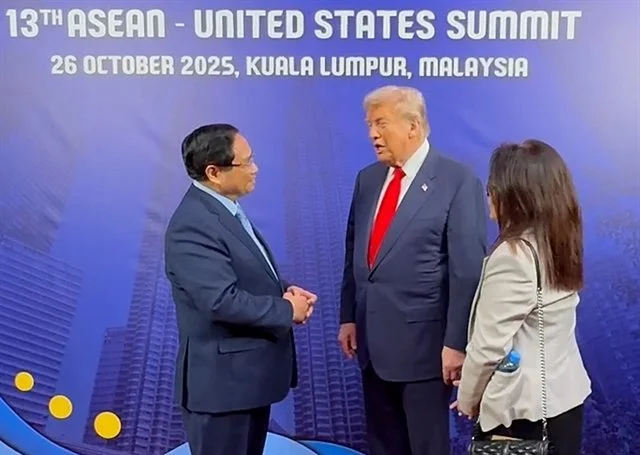
The statement was released on the occasion of US President Donald Trump and Prime Minister Phạm Minh Chính attending the 47th ASEAN Summit in Kuala Lumpur, Malaysia. The agreement on reciprocal, fair and balanced trade will build upon the longstanding economic relationship between the two countries, including the US-Việt Nam Bilateral Trade Agreement signed in 2000, which entered into force in 2001.
According to the joint statement, Việt Nam will provide preferential market access for substantially all US industrial and agricultural exports to Việt Nam. The US will maintain at 20 per cent the reciprocal tariffs, as outlined in Executive Order 14257 of April 2, 2025, as amended, on originating goods of Việt Nam, and will also identify products from the list set out in Annex III to Executive Order 14346 of September 5, 2025, Potential Tariff Adjustments for Aligned Partners, to receive a zero per cent reciprocal tariff rate.
The US and Việt Nam will work constructively to address both countries’ interests in non-tariff barriers affecting bilateral trade in priority areas. Việt Nam has agreed to address many such barriers, including accepting vehicles built to US motor vehicle safety and emissions standards, addressing import licences for US medical devices, streamlining regulatory requirements and approvals for US pharmaceutical products, fully implementing Việt Nam’s obligations under certain international intellectual property treaties to which it is a party, and addressing US concerns with conformity assessment procedures. The US and Việt Nam have also committed to address and prevent barriers to US agricultural products in the Vietnamese market, including with regard to US regulatory oversight and acceptance of currently agreed certificates issued by US regulatory authorities.
Under the agreement, Vietnam Airlines has agreed to purchase 50 aircraft from Boeing, worth more than US$8 billion.
Vietnamese companies have signed 20 memorandums of understanding with US companies to purchase US agricultural commodities, with a total estimated value of over US$2.9 billion.
In the coming weeks, the US and Việt Nam will work to finalise the agreement, prepare it for signature and undertake domestic formalities in advance of it entering into force. — VNS
************
Henig: Prime Minister Phạm Minh Chính meets US President Donald Trump on sidelines of 47th ASEAN Summit
October 26, 2025 - 20:19
During the meeting, the two leaders agreed to advance the Comprehensive Strategic Partnership for peace, cooperation and sustainable development between Việt Nam and the United States in a deeper, more substantive and effective manner.
Prime Minister Phạm Minh Chính (left) held a brief meeting with US President Donald Trump on the sidelines of the 13th ASEAN–US Summit
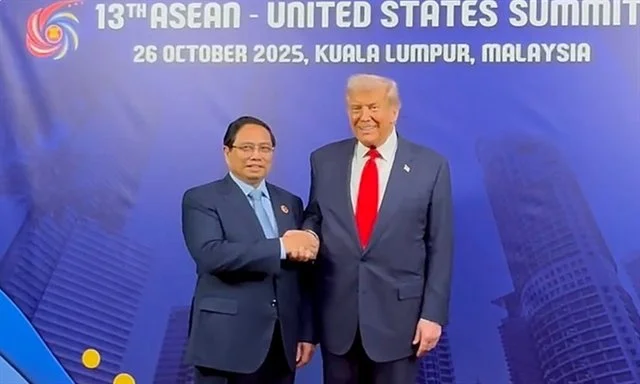
KUALA LUMPUR — Prime Minister Phạm Minh Chính held a brief meeting with US President Donald Trump on the sidelines of the 13th ASEAN–US Summit during his attendance at the 47th ASEAN Summit and related meetings in Kuala Lumpur, Malaysia, on Sunday.
During the meeting, the two leaders agreed to advance the Comprehensive Strategic Partnership for peace, cooperation and sustainable development between Việt Nam and the United States in a deeper, more substantive and effective manner.
Both sides expressed a shared commitment to soon conclude a Reciprocal Trade Agreement, ensuring fairness and equality while encouraging greater US investment in Việt Nam.
Following Prime Minister Chính’s proposal, President Trump gave a positive response and took note of Việt Nam’s request for recognition as a market economy, as well as for removal from the US strategic export control lists D1 and D3. President Trump directed senior American officials present at the summit, including the Treasury Secretary and the US Trade Representative, to promptly provide feedback on these matters.
PM Chính commended President Trump’s role in promoting the peaceful settlement of global conflicts in recent times.
The brief ASEAN–US sidelines meeting demonstrated mutual understanding, respect and a shared resolve to further strengthen the Comprehensive Strategic Partnership between the two countries.
On this occasion, PM Chính conveyed an invitation from Party General Secretary Tô Lâm and other senior Vietnamese leaders for President Trump to visit Việt Nam. President Trump warmly accepted, saying he looked forward to and would make time for a visit to Việt Nam in the near future.
PM Chính also proposed that the United States arrange a visit to Washington by Party General Secretary Tô Lâm under the framework of the two countries’ Comprehensive Strategic Partnership. President Trump welcomed the idea, asking that Việt Nam inform the US side at an appropriate time, and also expressed a desire for PM Chính to visit the United States when convenient for both sides.
13th ASEAN–US Summit On Sunday afternoon, PM Chính joined ASEAN leaders and US President Donald Trump at the 13th ASEAN–US Summit, held at the Kuala Lumpur Convention Centre.
In his address, Chính congratulated President Trump on the United States’ recent achievements and praised his diplomatic efforts in promoting dialogue and peaceful conflict resolution worldwide. He particularly acknowledged the President’s cooperation with Malaysia, this year’s ASEAN Chair, and other ASEAN members in facilitating talks between Cambodia and Thailand, leading to the signing of a Joint Declaration of Peace between the two neighbours.
Recognising the US as one of ASEAN’s most comprehensive strategic partners, Chính proposed four major orientations to deepen ASEAN-US cooperation more practically and effectively.
The orientations consist of enhancing economic, trade and investment connectivity towards a balanced, harmonious and sustainable relationship; promoting cooperation in digital transformation, innovation and energy security, including energy infrastructure connectivity and peaceful nuclear energy collaboration; strengthening cybersecurity and the fight against transnational crime, building on US initiatives against online fraud and Việt Nam’s initiative on improving the pursuit of wanted criminals; and maintaining peace, security and stability across the region.
Chính reaffirmed that ASEAN and the US shared common interests and responsibilities in maintaining peace, stability, security and development in the region, including the East Sea (internationally known as the South China Sea). He reiterated ASEAN’s principled position of resolving disputes peacefully and in accordance with international law, particularly the 1982 United Nations Convention on the Law of the Sea (UNCLOS).
For his part, President Trump affirmed that Southeast Asia occupied a central place in the US Indo-Pacific policy, and that the United States remained a steadfast partner and friend to the region.
Washington, he said, would seek to deepen its partnership with ASEAN not only in economics, trade, energy, technology and AI but also in the pursuit of peace, stability and prosperity for all nations and future generations.
The President underscored that the US would be ready to work closely with and support ASEAN in addressing shared challenges, with full respect for ASEAN’s centrality and the legitimate interests of its member states. At the close of the summit, ASEAN and US leaders adopted the 'Joint Vision Statement on a Stronger, Safer and More Prosperous ASEAN-US Partnership,' setting the strategic direction for the next phase of cooperation.
ASEAN leaders commended the United States for its active and constructive contributions to regional cooperation through ASEAN-led mechanisms, particularly in promoting dialogue and confidence-building for peace and stability.
They also highly appreciated President Trump’s personal commitment and role in fostering regional dialogue, including his support for negotiations that helped ease tensions and achieve the Peace Declaration between Thailand and Cambodia in Kuala Lumpur on Sunday.
The leaders noted that ASEAN-US relations continue to grow robustly, comprehensively and effectively across multiple sectors.
The two sides reaffirmed their commitment to effectively implementing existing initiatives and to deepening the ASEAN-US Comprehensive Strategic Partnership, focusing on high-quality trade and investment, finance, infrastructure connectivity, the digital economy, energy and cybersecurity resilience, all aimed at building a peaceful, secure, stable and prosperous region. —VNS
Seeds of Wisdom RV and Economics Updates Sunday Afternoon 10-26-25
Good Afternoon Dinar Recaps,
ASEAN 2025: Malaysia Summit Marks a Turning Point for Global Order
When Southeast Asia convenes, the future of trade, diplomacy and monetary flows is being rewritten../,
Good Afternoon Dinar Recaps,
ASEAN 2025: Malaysia Summit Marks a Turning Point for Global Order
When Southeast Asia convenes, the future of trade, diplomacy and monetary flows is being rewritten../,
Leaders, Expansion & a Crowded Agenda
The Association of Southeast Asian Nations (ASEAN) summit in Kuala Lumpur from October 26–28, 2025 will bring together heavy-weight global figures: Donald Trump (USA), Li Qiang (China), Sanae Takaichi (Japan), Lee Jae‑myung (South Korea), Luiz Inácio Lula da Silva (Brazil) plus others from South Africa, Canada, Australia and New Zealand.
Notably, Timor‑Leste will officially become the bloc’s 11th full member — the first expansion since the 1990s.
The agenda is packed: economic integration, the Myanmar crisis, South China Sea disputes, U.S.–China rivalry, Gaza’s fallout, and a booming online-scam industry.
Why This Matters
● Regional economic architecture in flux – With membership expansion and global leaders present, ASEAN is evolving from a regional forum into a strategic geopolitical player.
● Trade & settlement pathways shifting – As Asia becomes more central, monetary flows and digital-settlement frameworks will increasingly bypass traditional Western hubs.
● Global financial reset underway – The summit’s scale and diversity of issues reflect a transition toward multipolar financial systems, where power is not rooted solely in the West or the dollar.
● Symbolism becoming structure – Timor-Leste’s accession and the presence of global heads signal that the infrastructure of global finance (trade routes, digital rails, reserve assets) is being reconfigured.
The Bigger Picture: Out with the Old, In with the New
The ASEAN 2025 summit isn’t just a diplomatic gathering — it’s a marker of how global economics and finance are morphing:
Legacy settlement systems built around Western-led currency and payment rails face competition from Asia-driven arrangements and digital alternatives.
The inclusion of new members and agendas beyond “just trade” show that alignment is shifting — politics, finance and technology are converging.
Institutions, treaties, and digital platforms being discussed now will underpin tomorrow’s liquidity networks, reserve architectures and financial flows.
This is not just politics — it’s global finance restructuring before our eyes.
Seeds of Wisdom Team
Newshounds News™ Exclusive
Sources
Reuters – “What to expect from Southeast Asian leaders’ summit as Trump attends”
Reuters – “East Timor officially becomes ASEAN’s 11th member”
The Diplomat – “What to Expect From the Upcoming ASEAN Summit in Malaysia”
~~~~~~~~~
BRICS Payment Surge: Yuan-Rails Rewrite the Monetary Map
How the Cross‑Border Interbank Payment System (CIPS) and yuan-lending boom are reshaping global finance.
The Transformation in Motion
The BRICS bloc and China in particular are quietly building a parallel payment and monetary system:
● China’s CIPS now connects 1,700+ banks in over 100 countries, clearing approximately ¥175 trillion (~US $24 trillion) in 2024 — up ~43 % year-on-year.
● China’s overseas renminbi (RMB) lending, deposits and bond investments have surged to over RMB 3.4 trillion (~US $480 billion) in five years — a clear step in de-dollarising trade and financing.
● The Bank for International Settlements (BIS) and others have flagged this trend as a structural shift in global liquidity rather than a transient event.
Why It Matters
• Redesigning the Reserve Architecture:
• The dominance of the U.S. dollar and Western-led rails (e.g., SWIFT) is being challenged by a system that routes value directly through yuan-cleared networks.
• Liquidity Flows Redefined:
• Institutional, trade and sovereign flows are now beginning to respond to networks centred on the yuan and CIPS — not just the dollar-centric system.
• Toward a Global Financial Reset:
• This is more than currency diversification. It’s the creation of an alternative global monetary plumbing, enabling a multipolar value-transfer architecture beyond legacy systems.
• Analogy:
• Just as the internet replaced postal letters, CIPS + yuan-finance may replace correspondent-bank wires — faster, global, programmable.
Key Implications
● Trade-finance realignment: China is settling increasing volumes in yuan — including LNG imports, soybeans and loans in commodity-rich countries — reducing dollar dependency.
● Banking infrastructure on the move: Major global banks (e.g., HSBC Hong Kong) have joined CIPS, signalling institutional support for this rail.
● Emerging-market leverage: BRICS and partner nations see this rail as a way to sidestep sanctions risk and gain greater financial sovereignty.
● Systemic resilience: A diversified global settlement system weakens single-point dependency on the dollar and creates alternatives when geopolitical pressures intensify.
The Bigger Picture: Out with the Old, In with the New
The contours of a new global financial system are emerging:
A shift from fiat-centric, dollar-settlement pipelines toward multi-currency rails under sovereign and institutional control.
Payment networks built on programmable rails, where value moves as instantly and reliably as data.
While the dollar remains dominant for now, the architecture behind it is changing — and these developments mark the inflection point of the global reset.
This is not just politics — it’s global finance restructuring before our eyes.
Seeds of Wisdom Team
Newshounds News™ Exclusive
Sources
Watcher.Guru – “BRICS Grows as 1,700 Banks Process 175 Trillion Chinese Yuan Payments”
FT.com – “Overseas renminbi lending surges as China steps up campaign to de-dollarise”
Reuters – “China central bank urges state-owned businesses to prioritise yuan in overseas expansion”
Reuters – “China talks up digital yuan in push for multi-polar currency system”
~~~~~~~~~
Seeds of Wisdom Team RV Currency Facts Youtube and Rumble
Newshound's News Telegram Room Link
Follow the Gold/Silver Rate COMEX
Follow Fast Facts
Seeds of Wisdom Team™ Website
Thank you Dinar Recaps