
Thank you to all the subscribers to our Early Access program…we thank you for your continued support.
We are excited to offer this new service to keep you informed and up-to-date on the latest Dinar and currency news.
Iraq Economic News and Points To Ponder Monday Morning 10-27-25
The Prime Minister Directs Financial And Banking Institutions To Cooperate With Arab And Foreign Investors.
Yesterday, 22:48 Baghdad – INA Prime Minister Mohammed Shia al-Sudani directed financial and banking institutions, on Sunday, to cooperate with Arab and foreign investors to serve Iraq and support the economy.
The Prime Minister's media office stated in a statement received by the Iraqi News Agency (INA), that "Prime Minister Mohammed Shia al-Sudani attended the opening of the Arab Bank-Iraq, which is contributed by Iraqi, Arab and foreign capital."
The Prime Minister Directs Financial And Banking Institutions To Cooperate With Arab And Foreign Investors.
Yesterday, 22:48 Baghdad – INA Prime Minister Mohammed Shia al-Sudani directed financial and banking institutions, on Sunday, to cooperate with Arab and foreign investors to serve Iraq and support the economy.
The Prime Minister's media office stated in a statement received by the Iraqi News Agency (INA), that "Prime Minister Mohammed Shia al-Sudani attended the opening of the Arab Bank-Iraq, which is contributed by Iraqi, Arab and foreign capital."
Al-Sudani stressed, according to the statement, that "the opening of this bank, with the contribution of an elite group of Arab and foreign investors, both individuals and institutions, represents a clear affirmation of confidence in the Iraqi economy, the work accomplished during the past period, and the business environment that is attractive to investment."
He explained that "the presence of the Arab Bank of Iraq represents a strategic addition to the national banking sector, and is a model for the modern, effective banking institutions we aspire to, capable of providing advanced services that contribute to financing sustainable development."
He emphasized the "need to stimulate the financing of diverse investment projects and opportunities, in light of the presence of a bold and capable Iraqi private sector that understands the intricacies of the investment environment."
Al-Sudani pointed out that "it is important for there to be cooperation between the Arab Bank-Iraq, national banking institutions, government agencies, the private sector, and Arab and foreign investors, in order to utilize existing financial capabilities and banking expertise to support government programs and development projects." https://ina.iq/ar/economie/246554-.html
Rafidain: Partnership With The Central Bank And The Payments Council Is A Successful Model For Managing Financial Transformation.
Yesterday, 20:35 Baghdad – INA Rafidain Bank announced on Sunday that its partnership with the Central Bank and the Payments Council is a successful model for managing financial transformation, while indicating a move toward an integrated digital financial system.
The bank said in a statement received by the Iraqi News Agency (INA), "The bank's general manager, Ali Karim Hussein Al-Fatlawi, participated in the regular meeting of the Iraqi National Payments Council, which was held at the headquarters of the Central Bank of Iraq, headed by the Central Bank Governor, Ali Mohsen Al-Allaq, and attended by representatives of ministries, government institutions, and the financial and banking sectors."
Al-Fatlawi said, according to the statement, that "the bank is proceeding with confidence in its strategic partnership with the Central Bank and the National Payments Council to develop the digital payments infrastructure and consolidate the transition to a national economy based on financial inclusion and technological innovation.
" He stressed that "the bank is working to strengthen its role as a key driver of the digital transformation of the Iraqi banking sector by investing in modern financial technologies and expanding the electronic payment services network, in line with the national vision led by the Central Bank and the Payments Council to build a more efficient and transparent financial system.
" He explained that "the bank attaches great importance to developing the technological infrastructure of its banking systems, enhancing cybersecurity and data protection, and spreading the culture of financial awareness among citizens, especially youth and students, as they are the targeted generation in the transition to digital banking services."
He pointed out that "the close partnership between the Central Bank, the Payments Council, and Rafidain Bank represents a successful model of institutional integration in managing financial and digital transformation in Iraq," stressing that "the bank will continue to play its leading role in empowering the national banking sector and expanding the base of financial inclusion, enhancing economic stability and serving sustainable development." https://ina.iq/ar/economie/246545-.html
The Governor Of The Central Bank Of Iraq Meets With The Director Of GIZ In Iraq
October 26, 2025 His Excellency the Governor of the Central Bank of Iraq, Mr. Ali Mohsen Al-Alaq, received in Baghdad the Country Executive Director of the German Agency for International Cooperation (GIZ) in Iraq, Mr. Axel Klaphak.
The meeting discussed the agency's projects in the fields of finance, entrepreneurship, skills development, and financial infrastructure.
His Excellency the Governor began by discussing the "Strengthening Public Finance and Financial Markets (FFM)" projects.
Project Manager Tobias Langa and FFM Project Advisor Hussein Al-Maamouri provided a comprehensive explanation of
how to increase financing and borrowing for small and medium-sized entrepreneurial projects and facilitate procedures.
Executive Director Mr. Kalbhaka expressed his deep gratitude to His Excellency the Governor of the Central Bank
for his essential and effective role in supporting small and medium-sized enterprises in Iraq by providing financing and facilitating procedures. Central Bank of Iraq Media Office https://cbi.iq/news/view/3027
The Governor Of The Central Bank Receives The CEO Of Al Baraka Bank Bahrain.
October 26, 2025 His Excellency the Governor of the Central Bank of Iraq, Mr. Ali Mohsen Al-Alaq, received in Baghdad the General Manager and CEO of Al Baraka Bank Bahrain, Dr. Adel Salem, and his accompanying delegation.
His Excellency discussed the recent reforms in the Iraqi banking sector and their impact on enhancing confidence in the banking environment and financial transactions.
Mr. Salem discussed opportunities for expansion in the Iraqi market and ways to enhance joint banking cooperation with Gulf banks, with the possibility of opening doors to cooperation with the bank through training and qualification for Iraqi bank employees to gain successful experiences between the two parties. Central Bank of Iraq Media Office https://cbi.iq/news/view/3028
The Governor Of The Central Bank Of Iraq Chairs The Regular Meeting Of The Iraqi National Payments Council.
October 26, 2025 His Excellency the Governor of the Central Bank of Iraq and Chairman of the Iraqi Payments Council, Mr. Ali Mohsen Al-Alaq, chaired the regular meeting of the Iraqi National Payments Council.
The meeting was held at the headquarters of the Central Bank of Iraq and attended by council members, including central bank officials, representatives of ministries and government agencies, and the private sector, in addition to representatives of financial and banking institutions, such as public and private banks and electronic payment service providers.
During the meeting, several important topics were discussed, most notably the Central Bank of Iraq's initiatives to develop the technical, legislative, and regulatory infrastructure for payment systems and financial technologies.
Discussions focused on ways to expand the adoption of electronic payment tools and channels in ministries, government institutions, and the private sector, in line with the government's strategic vision in this regard.
Council members emphasized the importance of supporting efforts aimed at spreading financial and banking awareness and culture among all segments of society, as well as the importance of protecting society from cyber risks and raising awareness of the dangers of financial and digital fraud.
The Chairman and members of the Council discussed the level of development of the digital infrastructure and financial services provided by government banks, as they are among the fundamental pillars of digital transformation and the development of financial services.
The recommendations focused on expanding the use of payment and financial technology in the education sectors, ways to support students and youth, and supporting financial and banking awareness initiatives directed at them.
It is noteworthy that the Iraqi Payments Council aims to coordinate efforts and achieve cooperation in the areas of national payments and electronic payments between legislative and regulatory authorities, executive institutions in the public and private sectors, and financial and banking sector institutions. Central Bank of Iraq Media office https://cbi.iq/news/view/3026
Al-Sudani Issues Directives To Financial And Banking Institutions.
Baghdad Today - Baghdad Prime Minister Mohammed Shia al-Sudani directed, on Sunday (October 26, 2025), governmental and private financial and banking institutions to enhance cooperation with Arab and foreign investors, in a way that serves the interests of Iraq and supports the building of a strong, diversified, and sustainable economy.
Al-Sudani's media office stated in a statement received by Baghdad Today that "this came during his attendance at the opening ceremony of the Arab Bank - Iraq, in which Iraqi, Arab and foreign capital contributes," stressing that "the opening of this bank represents an embodiment of investor confidence in the Iraqi economy and the attractive business environment that has been established during the past period, pointing out that
the presence of the bank is a strategic addition to the national banking sector and a model for modern financial institutions capable of providing advanced services and financing sustainable development projects."
The Prime Minister explained that "the success of this project requires cooperation between the Arab Bank of Iraq, national banks, government agencies, and the private sector, in order to leverage financial capabilities and banking expertise to support government programs and development projects."
He stressed that "the government is proceeding with reforming the financial and banking system and transforming it from a single-source rentier economy to a diversified and sustainable economy based on natural resource investment.
He explained that "these reforms were implemented despite their significant social and political costs, and contributed to raising the level of credibility with international financial institutions and creating a safe and attractive financial environment for investment.
" He added, "Iraq is witnessing a phase of real development and vast investment opportunities across various sectors, emphasizing the need for modern digital banking services that meet the needs of individuals and institutions and keep pace with global developments in banking."
Al-Sudani concluded by emphasizing that integration between Iraqi financial institutions and Arab and foreign investors represents a fundamental step toward enhancing economic growth and consolidating financial stability in the country. https://baghdadtoday.news/285990-.html
For current and reliable Iraqi news please visit: https://www.bondladyscorner.com
“Vietnam News” Posted by Henig at KTFA 10-26-2025
KTFA:
Henig: Việt Nam, US issue joint statement on reciprocal trade agreement
October 26, 2025 - 19:09
According to the joint statement, Việt Nam will provide preferential market access for substantially all US industrial and agricultural exports to Việt Nam.
HÀ NỘI — Việt Nam and the US on Sunday issued a joint statement outlining a framework for an agreement on reciprocal, fair and balanced trade.
KTFA:
Henig: Việt Nam, US issue joint statement on reciprocal trade agreement
October 26, 2025 - 19:09
According to the joint statement, Việt Nam will provide preferential market access for substantially all US industrial and agricultural exports to Việt Nam.
HÀ NỘI — Việt Nam and the US on Sunday issued a joint statement outlining a framework for an agreement on reciprocal, fair and balanced trade.
Prime Minister Phạm Minh Chính met with US President Donald Trump at the 13th ASEAN-US Summit in Kuala Lumpur on Sunday. VNA/VNS Photo
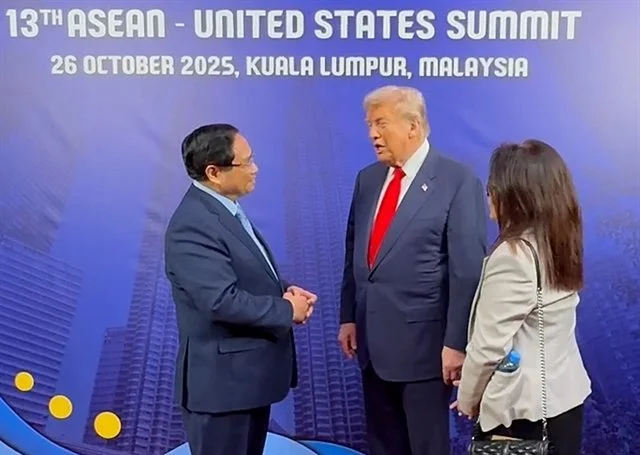
The statement was released on the occasion of US President Donald Trump and Prime Minister Phạm Minh Chính attending the 47th ASEAN Summit in Kuala Lumpur, Malaysia. The agreement on reciprocal, fair and balanced trade will build upon the longstanding economic relationship between the two countries, including the US-Việt Nam Bilateral Trade Agreement signed in 2000, which entered into force in 2001.
According to the joint statement, Việt Nam will provide preferential market access for substantially all US industrial and agricultural exports to Việt Nam. The US will maintain at 20 per cent the reciprocal tariffs, as outlined in Executive Order 14257 of April 2, 2025, as amended, on originating goods of Việt Nam, and will also identify products from the list set out in Annex III to Executive Order 14346 of September 5, 2025, Potential Tariff Adjustments for Aligned Partners, to receive a zero per cent reciprocal tariff rate.
The US and Việt Nam will work constructively to address both countries’ interests in non-tariff barriers affecting bilateral trade in priority areas. Việt Nam has agreed to address many such barriers, including accepting vehicles built to US motor vehicle safety and emissions standards, addressing import licences for US medical devices, streamlining regulatory requirements and approvals for US pharmaceutical products, fully implementing Việt Nam’s obligations under certain international intellectual property treaties to which it is a party, and addressing US concerns with conformity assessment procedures. The US and Việt Nam have also committed to address and prevent barriers to US agricultural products in the Vietnamese market, including with regard to US regulatory oversight and acceptance of currently agreed certificates issued by US regulatory authorities.
Under the agreement, Vietnam Airlines has agreed to purchase 50 aircraft from Boeing, worth more than US$8 billion.
Vietnamese companies have signed 20 memorandums of understanding with US companies to purchase US agricultural commodities, with a total estimated value of over US$2.9 billion.
In the coming weeks, the US and Việt Nam will work to finalise the agreement, prepare it for signature and undertake domestic formalities in advance of it entering into force. — VNS
************
Henig: Prime Minister Phạm Minh Chính meets US President Donald Trump on sidelines of 47th ASEAN Summit
October 26, 2025 - 20:19
During the meeting, the two leaders agreed to advance the Comprehensive Strategic Partnership for peace, cooperation and sustainable development between Việt Nam and the United States in a deeper, more substantive and effective manner.
Prime Minister Phạm Minh Chính (left) held a brief meeting with US President Donald Trump on the sidelines of the 13th ASEAN–US Summit
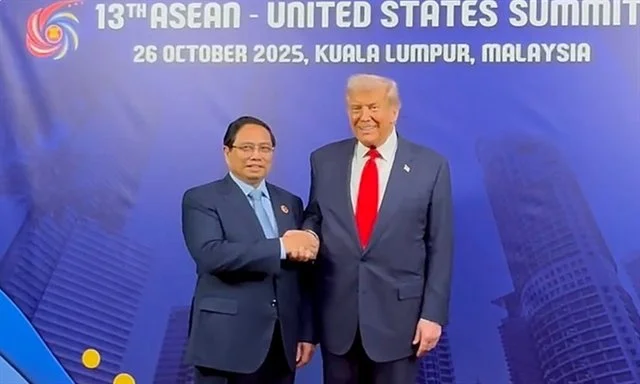
KUALA LUMPUR — Prime Minister Phạm Minh Chính held a brief meeting with US President Donald Trump on the sidelines of the 13th ASEAN–US Summit during his attendance at the 47th ASEAN Summit and related meetings in Kuala Lumpur, Malaysia, on Sunday.
During the meeting, the two leaders agreed to advance the Comprehensive Strategic Partnership for peace, cooperation and sustainable development between Việt Nam and the United States in a deeper, more substantive and effective manner.
Both sides expressed a shared commitment to soon conclude a Reciprocal Trade Agreement, ensuring fairness and equality while encouraging greater US investment in Việt Nam.
Following Prime Minister Chính’s proposal, President Trump gave a positive response and took note of Việt Nam’s request for recognition as a market economy, as well as for removal from the US strategic export control lists D1 and D3. President Trump directed senior American officials present at the summit, including the Treasury Secretary and the US Trade Representative, to promptly provide feedback on these matters.
PM Chính commended President Trump’s role in promoting the peaceful settlement of global conflicts in recent times.
The brief ASEAN–US sidelines meeting demonstrated mutual understanding, respect and a shared resolve to further strengthen the Comprehensive Strategic Partnership between the two countries.
On this occasion, PM Chính conveyed an invitation from Party General Secretary Tô Lâm and other senior Vietnamese leaders for President Trump to visit Việt Nam. President Trump warmly accepted, saying he looked forward to and would make time for a visit to Việt Nam in the near future.
PM Chính also proposed that the United States arrange a visit to Washington by Party General Secretary Tô Lâm under the framework of the two countries’ Comprehensive Strategic Partnership. President Trump welcomed the idea, asking that Việt Nam inform the US side at an appropriate time, and also expressed a desire for PM Chính to visit the United States when convenient for both sides.
13th ASEAN–US Summit On Sunday afternoon, PM Chính joined ASEAN leaders and US President Donald Trump at the 13th ASEAN–US Summit, held at the Kuala Lumpur Convention Centre.
In his address, Chính congratulated President Trump on the United States’ recent achievements and praised his diplomatic efforts in promoting dialogue and peaceful conflict resolution worldwide. He particularly acknowledged the President’s cooperation with Malaysia, this year’s ASEAN Chair, and other ASEAN members in facilitating talks between Cambodia and Thailand, leading to the signing of a Joint Declaration of Peace between the two neighbours.
Recognising the US as one of ASEAN’s most comprehensive strategic partners, Chính proposed four major orientations to deepen ASEAN-US cooperation more practically and effectively.
The orientations consist of enhancing economic, trade and investment connectivity towards a balanced, harmonious and sustainable relationship; promoting cooperation in digital transformation, innovation and energy security, including energy infrastructure connectivity and peaceful nuclear energy collaboration; strengthening cybersecurity and the fight against transnational crime, building on US initiatives against online fraud and Việt Nam’s initiative on improving the pursuit of wanted criminals; and maintaining peace, security and stability across the region.
Chính reaffirmed that ASEAN and the US shared common interests and responsibilities in maintaining peace, stability, security and development in the region, including the East Sea (internationally known as the South China Sea). He reiterated ASEAN’s principled position of resolving disputes peacefully and in accordance with international law, particularly the 1982 United Nations Convention on the Law of the Sea (UNCLOS).
For his part, President Trump affirmed that Southeast Asia occupied a central place in the US Indo-Pacific policy, and that the United States remained a steadfast partner and friend to the region.
Washington, he said, would seek to deepen its partnership with ASEAN not only in economics, trade, energy, technology and AI but also in the pursuit of peace, stability and prosperity for all nations and future generations.
The President underscored that the US would be ready to work closely with and support ASEAN in addressing shared challenges, with full respect for ASEAN’s centrality and the legitimate interests of its member states. At the close of the summit, ASEAN and US leaders adopted the 'Joint Vision Statement on a Stronger, Safer and More Prosperous ASEAN-US Partnership,' setting the strategic direction for the next phase of cooperation.
ASEAN leaders commended the United States for its active and constructive contributions to regional cooperation through ASEAN-led mechanisms, particularly in promoting dialogue and confidence-building for peace and stability.
They also highly appreciated President Trump’s personal commitment and role in fostering regional dialogue, including his support for negotiations that helped ease tensions and achieve the Peace Declaration between Thailand and Cambodia in Kuala Lumpur on Sunday.
The leaders noted that ASEAN-US relations continue to grow robustly, comprehensively and effectively across multiple sectors.
The two sides reaffirmed their commitment to effectively implementing existing initiatives and to deepening the ASEAN-US Comprehensive Strategic Partnership, focusing on high-quality trade and investment, finance, infrastructure connectivity, the digital economy, energy and cybersecurity resilience, all aimed at building a peaceful, secure, stable and prosperous region. —VNS
Seeds of Wisdom RV and Economics Updates Sunday Afternoon 10-26-25
Good Afternoon Dinar Recaps,
ASEAN 2025: Malaysia Summit Marks a Turning Point for Global Order
When Southeast Asia convenes, the future of trade, diplomacy and monetary flows is being rewritten../,
Good Afternoon Dinar Recaps,
ASEAN 2025: Malaysia Summit Marks a Turning Point for Global Order
When Southeast Asia convenes, the future of trade, diplomacy and monetary flows is being rewritten../,
Leaders, Expansion & a Crowded Agenda
The Association of Southeast Asian Nations (ASEAN) summit in Kuala Lumpur from October 26–28, 2025 will bring together heavy-weight global figures: Donald Trump (USA), Li Qiang (China), Sanae Takaichi (Japan), Lee Jae‑myung (South Korea), Luiz Inácio Lula da Silva (Brazil) plus others from South Africa, Canada, Australia and New Zealand.
Notably, Timor‑Leste will officially become the bloc’s 11th full member — the first expansion since the 1990s.
The agenda is packed: economic integration, the Myanmar crisis, South China Sea disputes, U.S.–China rivalry, Gaza’s fallout, and a booming online-scam industry.
Why This Matters
● Regional economic architecture in flux – With membership expansion and global leaders present, ASEAN is evolving from a regional forum into a strategic geopolitical player.
● Trade & settlement pathways shifting – As Asia becomes more central, monetary flows and digital-settlement frameworks will increasingly bypass traditional Western hubs.
● Global financial reset underway – The summit’s scale and diversity of issues reflect a transition toward multipolar financial systems, where power is not rooted solely in the West or the dollar.
● Symbolism becoming structure – Timor-Leste’s accession and the presence of global heads signal that the infrastructure of global finance (trade routes, digital rails, reserve assets) is being reconfigured.
The Bigger Picture: Out with the Old, In with the New
The ASEAN 2025 summit isn’t just a diplomatic gathering — it’s a marker of how global economics and finance are morphing:
Legacy settlement systems built around Western-led currency and payment rails face competition from Asia-driven arrangements and digital alternatives.
The inclusion of new members and agendas beyond “just trade” show that alignment is shifting — politics, finance and technology are converging.
Institutions, treaties, and digital platforms being discussed now will underpin tomorrow’s liquidity networks, reserve architectures and financial flows.
This is not just politics — it’s global finance restructuring before our eyes.
Seeds of Wisdom Team
Newshounds News™ Exclusive
Sources
Reuters – “What to expect from Southeast Asian leaders’ summit as Trump attends”
Reuters – “East Timor officially becomes ASEAN’s 11th member”
The Diplomat – “What to Expect From the Upcoming ASEAN Summit in Malaysia”
~~~~~~~~~
BRICS Payment Surge: Yuan-Rails Rewrite the Monetary Map
How the Cross‑Border Interbank Payment System (CIPS) and yuan-lending boom are reshaping global finance.
The Transformation in Motion
The BRICS bloc and China in particular are quietly building a parallel payment and monetary system:
● China’s CIPS now connects 1,700+ banks in over 100 countries, clearing approximately ¥175 trillion (~US $24 trillion) in 2024 — up ~43 % year-on-year.
● China’s overseas renminbi (RMB) lending, deposits and bond investments have surged to over RMB 3.4 trillion (~US $480 billion) in five years — a clear step in de-dollarising trade and financing.
● The Bank for International Settlements (BIS) and others have flagged this trend as a structural shift in global liquidity rather than a transient event.
Why It Matters
• Redesigning the Reserve Architecture:
• The dominance of the U.S. dollar and Western-led rails (e.g., SWIFT) is being challenged by a system that routes value directly through yuan-cleared networks.
• Liquidity Flows Redefined:
• Institutional, trade and sovereign flows are now beginning to respond to networks centred on the yuan and CIPS — not just the dollar-centric system.
• Toward a Global Financial Reset:
• This is more than currency diversification. It’s the creation of an alternative global monetary plumbing, enabling a multipolar value-transfer architecture beyond legacy systems.
• Analogy:
• Just as the internet replaced postal letters, CIPS + yuan-finance may replace correspondent-bank wires — faster, global, programmable.
Key Implications
● Trade-finance realignment: China is settling increasing volumes in yuan — including LNG imports, soybeans and loans in commodity-rich countries — reducing dollar dependency.
● Banking infrastructure on the move: Major global banks (e.g., HSBC Hong Kong) have joined CIPS, signalling institutional support for this rail.
● Emerging-market leverage: BRICS and partner nations see this rail as a way to sidestep sanctions risk and gain greater financial sovereignty.
● Systemic resilience: A diversified global settlement system weakens single-point dependency on the dollar and creates alternatives when geopolitical pressures intensify.
The Bigger Picture: Out with the Old, In with the New
The contours of a new global financial system are emerging:
A shift from fiat-centric, dollar-settlement pipelines toward multi-currency rails under sovereign and institutional control.
Payment networks built on programmable rails, where value moves as instantly and reliably as data.
While the dollar remains dominant for now, the architecture behind it is changing — and these developments mark the inflection point of the global reset.
This is not just politics — it’s global finance restructuring before our eyes.
Seeds of Wisdom Team
Newshounds News™ Exclusive
Sources
Watcher.Guru – “BRICS Grows as 1,700 Banks Process 175 Trillion Chinese Yuan Payments”
FT.com – “Overseas renminbi lending surges as China steps up campaign to de-dollarise”
Reuters – “China central bank urges state-owned businesses to prioritise yuan in overseas expansion”
Reuters – “China talks up digital yuan in push for multi-polar currency system”
~~~~~~~~~
Seeds of Wisdom Team RV Currency Facts Youtube and Rumble
Newshound's News Telegram Room Link
Follow the Gold/Silver Rate COMEX
Follow Fast Facts
Seeds of Wisdom Team™ Website
Thank you Dinar Recaps
“Tidbits From TNT” Sunday 10-26-2025
TNT:
Tishwash: US envoy: Iraq is improving day by day and there are no limits to its capabilities
US President Mark Savaya's envoy sent a message to Iraq.
"I want to make Iraq great again," Savaya told the Chaldean Press.
He pointed out that he would like to "achieve peace and stability in the country by building strong bridges with the United States", explaining that "Iraq is improving day by day, without limits to its capabilities".
TNT:
Tishwash: US envoy: Iraq is improving day by day and there are no limits to its capabilities
US President Mark Savaya's envoy sent a message to Iraq.
"I want to make Iraq great again," Savaya told the Chaldean Press.
He pointed out that he would like to "achieve peace and stability in the country by building strong bridges with the United States", explaining that "Iraq is improving day by day, without limits to its capabilities". link
************
Tishwash: Masrour Barzani: Article 140 of the Constitution must be implemented as it is after the elections
#Article 140
The Prime Minister of the Kurdistan Regional Government, Masrour Barzani, confirmed that the Kurdistan Democratic Party is preparing to implement several goals following the parliamentary elections scheduled in Iraq, noting work to implement Article 140 of the Constitution.
Masrour Barzani said in a speech during his participation in an election carnival dedicated by the Kurdistan Democratic Party to candidates from the Kirkuk and Garmian regions, today, Saturday, October 25, 2025, that "Article 140 of the Constitution must be implemented as it is, and the constitutional provisions and articles must be applied as they are," adding: "We will no longer accept injustice." This time we will go to Baghdad to fight for our constitutional rights.
Masrour Barzani stated that "Kirkuk is the heart of Kurdistan", and "we are ready to sacrifice our blood and souls to return them to the embrace of Kurdistan", noting that "the people of Kirkuk must know that the one who sacrificed himself for Kirkuk throughout history is the Kurdistan Democratic Party".
The Prime Minister of the Kurdistan Regional Government and Vice President of the Kurdistan Democratic Party continued, "The injustice practiced against the Kurdistan Region is also practiced against Kirkuk, because Kirkuk is part of Kurdistan", stressing: "Kirkuk must return, and Khanaqin must return, as well as Makhmouz Zammar and Sinjar" to the embrace of Kurdistan.
Masrour Barzani recalled the statement of the President of the Kurdistan Region, Nechirvan Barzani, that "the party will win a million votes in these elections", saying: "We are able to obtain a million votes, and we are able to regain Kirkuk and win as the largest political party in Iraq".
The Prime Minister of the Kurdistan Regional Government touched on the situation in Kirkuk, and the level of services and life there, stressing that "if Kirkuk is run by the Parti, it will become a model of peaceful coexistence on the global level", and "whoever is loyal to Kirkuk must be characterized by actions and not just carrying slogans." He called on the people of the governorate to go to the polls and vote for his party, which bears the symbol 275, in the upcoming elections.
Masrour Barzani stressed that Iraq's stability and development are reflected in Kurdistan, saying: "If security and stability are available in Iraq and its people are able to live in prosperity, Kurdistan will certainly achieve greater progress," stressing that "we will not allow Iraq to return to centralization and dictatorship," and "we must head to Baghdad to stand up to the plans being hatched against the Kurdistan Region." link
************
Tishwash: Iran Declares Major Private Bank Bankrupt Amid Deepening Financial Strain
The collapse of Ayandeh Bank exposes deep cracks in Iran’s financial system, with experts warning more failures could follow amid sanctions and weak oversight.
Iran has declared on Saturday one of its largest private banks, Ayandeh Bank, bankrupt, with its assets absorbed by the state-owned Melli Bank, marking one of the most dramatic collapses in the country’s modern banking history.
The move comes as Tehran grapples with renewed international sanctions and mounting economic instability.
Founded in 2012, Ayandeh Bank once operated 270 branches nationwide—150 of them in Tehran—but had recently been crippled by mounting debt.
According to Iran’s ISNA news agency, the bank’s accumulated losses had reached the equivalent of $5.2 billion, with debts of roughly $2.9 billion.
On Saturday, long lines of anxious depositors formed outside the bank’s shuttered branches in Tehran, with police deployed to maintain order.
State television quoted Melli Bank director Abolfazl Najarzadeh confirming that “the transfer from Ayandeh Bank to Melli Bank is now complete,” assuring customers their deposits would be protected.
Iranian Economy Minister Ali Madanizadeh attempted to calm public fears on Thursday, saying customers “had nothing to worry about.” However, Central Bank officials blamed “bad debts” and risky self-financing projects for the collapse.
Central Bank representative Hamidreza Ghaniabadi told the IRNA news agency that over 90 percent of Ayandeh Bank’s funds were lent to affiliated entities or bank-managed projects that failed to generate returns.
Among its most extravagant ventures was the Iran Mall—one of the world’s largest shopping centers—complete with cinemas, luxury stores, and an ice rink.
The failure of Ayandeh Bank underscores the fragility of Iran’s financial system, heavily burdened by mismanagement, corruption, and years of sanctions that have isolated the country from international markets.
Several other private and semi-state banks—including Sarmayeh, Day, Sepah, Iran Zamin, and Melal—are reportedly facing severe liquidity challenges.
The crisis unfolds against the backdrop of renewed United Nations sanctions, reimposed in September after months of fruitless diplomacy aimed at reviving the 2015 nuclear agreement.
Those sanctions—referred to as a “snapback” mechanism—were reinstated following Israeli and U.S. strikes on Iranian nuclear sites in June, further tightening the economic noose around Tehran.
Economists say the banking sector’s instability reflects broader structural weaknesses in Iran’s economy, where inflation exceeds 40 percent and the national currency continues to plummet against the US dollar.
Observers from the industry warn that more bank failures could follow unless authorities enforce stricter financial oversight and attract foreign investment—both unlikely amid current geopolitical tensions. link
************
Tishwash: Sum Times I Can't Help Meself - I –

Tishwash: . Ripley!!! -- ooooooh Ripley!! -- ""Bath Time""

Seeds of Wisdom RV and Economics Updates Sunday Morning 10-26-25
Good Morning Dinar Recaps,
Ripple Prime: The Quiet Revolution in Global Finance -- The Digital Wall Street Is Here
How Ripple’s strategic acquisition is reshaping cross-border settlements and unlocking digital liquidity.
Good Morning Dinar Recaps,
Ripple Prime: The Quiet Revolution in Global Finance -- The Digital Wall Street Is Here
How Ripple’s strategic acquisition is reshaping cross-border settlements and unlocking digital liquidity.
The Strategic Move
● Ripple Labs, the blockchain giant behind XRP, has officially launched Ripple Prime—a professional-grade liquidity and settlement platform designed for institutional clients. The development follows Ripple’s acquisition of Hidden Road Partners, a global brokerage and prime services firm specializing in digital assets.
● According to reports from Reuters, Coindesk, and The Block, the move gives Ripple direct access to deep institutional liquidity pools, bridging traditional finance and blockchain markets under a single unified settlement rail.
● Garlinghouse’s vision: Ripple CEO Brad Garlinghouse emphasized that Ripple Prime will “unlock enterprise-grade liquidity for tokenized assets and payments”, positioning the firm as a cornerstone of future global finance infrastructure.
Why It Matters
● Institutional On-Ramp to Blockchain Finance
Ripple Prime’s integration with Hidden Road opens the door for major financial institutions to access on-demand liquidity (ODL) directly, without relying on legacy correspondent banking systems.
🌱 This transition signals the gradual migration of settlement infrastructure from centralized banks to blockchain networks.
● Accelerating Tokenized Asset Settlement
The partnership enables near-instant cross-border settlements in any fiat or crypto pair, dramatically reducing the friction and cost of moving value globally.
🌱 This is a critical pillar of the financial reset — instant, trustless settlement across asset classes.
● Bridging Old and New Systems
Ripple’s network now sits at the intersection of central bank digital currency (CBDC) infrastructure and private liquidity platforms.
🌱 Such hybrid models are essential for building a multi-polar financial order that no longer depends solely on the U.S. dollar.
The Bigger Picture: A New Financial Architecture
Ripple Prime’s debut aligns with a broader structural shift:
BRICS nations are advancing gold- and commodity-backed digital trade systems.
The IMF is exploring new settlement architectures using tokenized assets.
Western fintech firms like Ripple are positioning to mediate the convergence between traditional banks, CBDCs, and decentralized networks.
In essence: Ripple Prime represents not just another crypto product — but a core building block of a borderless liquidity layer, paving the way for a new global financial framework.
Ripple Prime is not just a rebrand — it’s a blueprint for a new economic structure.
This is not just politics or crypto hype — it’s global finance restructuring before our eyes.
Seeds of Wisdom Team
Newshounds News™ Exclusive
Sources
Reuters – Ripple launches institutional trading platform Ripple Prime
Coindesk – Ripple Expands Institutional Liquidity with Hidden Road Deal
The Block – Ripple’s Next Phase: Ripple Prime and the Institutional Bridge
FX Empire -- XRP News Today: Ripple Prime Launch Ignites XRP Demand Outlook
~~~~~~~~~
Zelle’s Next Leap: Stablecoins Bring Banking Into the Blockchain Era
America’s biggest bank-owned payment network takes its first step toward a borderless digital money system.
The Announcement
Early Warning Services (EWS) — the consortium behind Zelle, jointly owned by major U.S. banks like JPMorgan, Wells Fargo, and Bank of America — announced on October 24, 2025, that it will begin using stablecoins to power international payments.
The goal: bring Zelle’s hallmark speed and convenience in domestic transfers to cross-border money movement, connecting 2,500 financial institutions worldwide under one digital payment rail.
Key Details
● Leveraging stablecoins: EWS will utilize stablecoins to enable instant global transactions, taking advantage of new regulatory clarity provided by the GENIUS Act (July 2025).
● Goal: Build a faster, safer, and cheaper alternative for international remittances, reducing reliance on traditional correspondent banks.
● Network reach: The rollout will cover all 2,500 financial institutions already using the Zelle network.
● Unconfirmed details: It’s still unclear whether EWS will issue its own stablecoin or adopt a regulated third-party token such as USDC or PayPal USD.
● Market disruption: The move positions Zelle to directly compete with Western Union, MoneyGram, and PayPal, potentially redefining the remittance industry.
Industry Implications
This marks a pivotal moment: legacy banks are entering blockchain finance through one of their most successful payment systems.
Analysts note that by integrating stablecoins, Zelle is effectively bridging traditional bank infrastructure with digital settlement networks — the very mechanism driving the new financial architecture envisioned by Ripple, the IMF, and BRICS-aligned systems.
“This is not just about payments — it’s about interoperability between old money and programmable digital cash,” one fintech strategist told Forklog.
Why This Matters
● Out with the Old: Traditional SWIFT-based transfers may soon be replaced by tokenized, instant settlements built on distributed ledger systems.
● In with the New: Stablecoin integration by a U.S. bank consortium shows how regulated digital assets are now being woven into mainstream finance.
● Toward a Financial Reset: When institutions like Zelle’s banking network adopt blockchain rails, it signals the migration of global liquidity into a transparent, programmable system — a key step toward a global financial reset built on digital settlement layers rather than fiat intermediaries.
● Analogy: Much like the telegraph gave way to the internet, this shift represents the “Internet of Value” — money moving at the speed of information.
This is not just politics — it’s global finance restructuring before our eyes.
Seeds of Wisdom Team
Newshounds News™ Exclusive
Sources
Ledger Insights – Bank-owned Zelle to launch stablecoin-based cross-border payments
Forklog – Zelle Payment Network Integrates Stablecoins for Cross-Border Transfers
Payments Journal – Zelle’s Stablecoin Could Mark Its Entry to Cross-Border Payments
~~~~~~~~~
Seeds of Wisdom Team RV Currency Facts Youtube and Rumble
Newshound's News Telegram Room Link
Follow the Gold/Silver Rate COMEX
Follow Fast Facts
Seeds of Wisdom Team™ Website
Thank you Dinar Recaps
Iraq Economic News and Points To Ponder Sunday Morning 10-26-25
The Most Notable Achievement In 2025
Economic 10/26/2025 Yasser Al-Mutawali In an evaluative look at the most prominent achievements of the year 2025, in my estimation as someone interested in and observing economic affairs, is the launch of Iraq's Vision 2050, as a pioneering step, albeit theoretically, on the path to sound construction and development.
The Most Notable Achievement In 2025
Economic 10/26/2025 Yasser Al-Mutawali In an evaluative look at the most prominent achievements of the year 2025, in my estimation as someone interested in and observing economic affairs, is the launch of Iraq's Vision 2050, as a pioneering step, albeit theoretically, on the path to sound construction and development.
This step comes as Iraq is experiencing difficult times due to numerous economic, political and social challenges,
in addition to international variables that require the mobilization of all capabilities to deal with them decisively.
To clarify, it is necessary to point out the following approach, where the vision in the free liberal system is parallel to the long-term plan in the totalitarian system, especially with an equal time period or at least the approximation between them from 20 years and up.
The difference lies in the means of implementation.
The vision is defined by the state and implemented through a collaborative effort between the state and the private sector, with the private sector bearing the lion's share of implementation.
Meanwhile, the plan is developed by the state and implemented solely by its institutions.
Here, you can observe the differences in the results and objectives.
We leave that to your interpretation.
Perhaps ambition motivates us to ensure that the state proceeds with implementing the vision’s programs and objectives, while providing the requirements, controls, foundations, and entities for implementation, rather than remaining a temporary slogan or within the concept of burning stages.
This assessment comes as we are now in the last quarter of 2025, and the remaining period includes the upcoming elections, which will inevitably establish a new government and a new parliament.
Herein lies the reservation regarding the possibility of the vision being implemented, as we are accustomed to any future government erasing any trace of its predecessor.
Therefore, I said we hope that the vision will not be a temporary slogan.
We indicated in our previous article that Iraq Vision 2050 is a vision for building Iraq and is not limited to a specific governmental phase.
Therefore, it requires that any future government proceed with its implementation.
We find it necessary to clarify important aspects that contribute to the contents and objectives of the vision.
This is achieved by focusing on extremely important aspects, foremost among which is the priority given to infrastructure to successfully implement the Vision's projects.
This is followed by focusing on attracting foreign investments to implement the Vision's programs by offering the necessary facilities and incentives, and not being stubborn about the wealth we possess to enrich it.
Here I point out that the Saudi Vision 2030 experience, despite its potential and wealth, has focused on attracting global investments to boost the Kingdom's imports.
It is useful to benefit from the experiences of our Arab and regional brothers and friends, as well as from global experiences in building their countries.
Therefore, Iraq Vision 2050 has been considered the most prominent achievement of the year 2025.
We call for supporting the momentum of this vision's success to build a new Iraq that lives up to its reputation, status, and potential to create prosperity and bring happiness to its people. https://alsabaah.iq/122683-.html
Antitrust Conference Outlines Fair Market Economy
Economic 10/26/2025 Baghdad: Hussein Thaghab The second annual conference of the Competition and Anti-Monopoly Council, which kicked off last Thursday in Baghdad, provided a high-level dialogue platform bringing together decision-makers, researchers, and experts to discuss ways to develop a fair competitive environment that contributes to strengthening the national economy and consolidating the principles of transparency and sustainability.
The conference, sponsored by Prime Minister Mohammed Shia al-Sudani and organized by the Council in cooperation with the Ministry of Higher Education and Scientific Research, witnessed broad participation from representatives of ministries, government agencies, professional unions and syndicates, and the private sector, in addition to a group of academics and international organizations.
Competition Affairs Specialist.
Economic transition
In his speech at the conference, the Prime Minister's representative, Counselor Dr. Abdul Hussein Al-Anbaky, said:
"The government attaches great importance to the issue of competition and the prevention of monopoly, and has implemented the relevant law, which has resonated greatly, given its importance in the economy's transition to a significant new phase."
Al-Anbaky added that monopoly leads to declining performance and negatively impacts market development, noting that competition reduces costs, and the more we move toward general competition, the more we will achieve realistic price levels based on supply and demand.
Strengthening the reality of reform
Chairman of the Competition and Anti-Monopoly Council, Dr. Ahmed Younis Qasim, explained that the government's implementation of Law No. 14 of 2010 in 2023 has achieved a shift within the local market, particularly as it is part of the government's program, which enhances the reality of economic reform and creates an ideal environment within the local labor market.
He pointed out that the transition to a free economy requires sound policies at a time when the economic system is linked to oversight and competition.
He explained that implementing the law contributes to supporting production, strengthening the national labor market,
and aligns with the government's efforts to achieve sustainable economic development.
It also supports small and medium-sized enterprises.
Addressing monopoly problems
Younis pointed out that the council is working to combat any monopolistic behavior and is cooperating with public and private institutions to address monopoly issues.
He noted that the council is working to open branches in several governorates to expand its scope of activity in supporting the national economy.
Younis emphasized that Iraq has an active presence in Arab and international competition and antitrust councils, and that we are working to exchange expertise in cooperation with global competition bodies.
Promoting a culture of competition
For his part, Deputy Secretary-General of the Council of Ministers, Farhad Nimatullah Hussein, called for strengthening institutional coordination between government agencies and the private sector to foster a transparent and open economic environment. He noted that fostering a culture of competition contributes to supporting investment, developing markets, and achieving sustainable development.
Hussein added that the government recognizes that competition is a driver of the economy and supports efforts to create a suitable business environment. He noted that the government has worked to enact laws that activate the local market and prevent competition and monopoly.
Justice in opportunities
In this context, economic expert Hisham Khaled Abbas considered promoting competition and preventing monopolies an important step adopted by the government over the past two years, as it provides the labor market with true stability and prevents monopolies to ensure fair distribution of opportunities within the national labor market.
Abbas added that the national economy is entering a new phase, which will require those seeking to work in the growing Iraqi labor market to prove their worth.
The Iraqi labor market is considered one of the most important markets in the world, with its unique features that make it virtually unique among international markets.
Competition between actors
For her part, Natalie Khaled, ESCWA Competition and Consumer Protection Project Coordinator, commended Iraq's efforts to build a modern institutional system that contributes to developing the legal and regulatory frameworks for competition.
Khaled stated that competition among actors strengthens competitive systems and limits hegemonic practices, emphasizing that the Arab region is witnessing a widespread anti-monopoly culture, which plays a role in creating a favorable environment for work and investment.
Khaled expressed her support for the directives and legislation that prevent monopolies, especially in light of the existence of a common Arab vision that prohibits such practices and enhances competition in Arab countries.
Goods quality
Meanwhile, Dr. Saba Talib, a competition and monopoly expert, explained that since 2003, the political system has transformed from a dictatorial to a democratic pluralist system, accompanied by a shift in the economic system from a planned (socialist) to a (capitalist) system.
This transformation was not carried out in scientifically calculated steps, which negatively affected the economy and led to a state of turmoil and chaos and the creation of a group of economic blocs that began to control the economy and the general level of prices and affected the general atmosphere of competition in the country.
This led to some businessmen controlling basic economic joints and controlling the quality of goods as well as the origins of those goods.
The first to be affected was the citizen (the consumer), as this situation led to the entry of low-quality goods at high prices. The main reason is the failure to separate the economic sector from the political influences of parties. And political blocs.
market economic policy
She pointed out that the conference focused on discussing market issues and how to achieve fair competition within it, activating the Competition and Anti-Monopoly Council Law No. 14 of 2010, confronting the challenges facing the Iraqi market, proposing appropriate solutions to enforce the aforementioned law, and implementing a market economic policy that makes competition fair to attract investment.
It was emphasized that dialogue and cooperation between the relevant parties should continue to keep pace with modern economic and technological transformations, ensuring the establishment of a fair and prosperous market environment in Iraq.
Fair competition employment
For his part, Dr. Maitham Adham Al-Zubaidi, Vice Chairman of the Competition and Anti-Monopoly Council, considered the conference a milestone in Iraq's economic reform process, not only because it brought together local and international officials and experts under one roof, but also because it refocused attention on a fundamental issue that is often overlooked: the use of fair competition as a lever for sustainable development. Al-Zubaidi added that
Building a balanced market
the conference represents a shift from traditional discourse on reform to a more in-depth discussion on how to build a balanced market governed by efficiency, not monopoly, and transparency, not self-interest.
He explained that its focus on the role of Competition and Anti-Monopoly Law No. 14 of 2010, pro-competition policies, and competitive neutrality between the public and private sectors reflects a growing awareness that the economy is not built solely on administrative orders and theorizing, but rather on a regulatory and procedural environment that unleashes legitimate competition, stimulates innovation, and prevents economic centralization.
He explained that the inclusion of topics on digital transformation and artificial intelligence in the dialogue sessions indicates a true awareness of the future challenges facing markets in e-commerce and digital marketing platforms, and the need to align legislation with the knowledge economy.
He stressed that the conference strengthened institutional dialogue between the government and the private sector, in a direction that places competition at the heart of economic justice policies through the participation of conference sessions with pharmaceutical office suppliers, insurance services companies, and interaction. With audience questions. https://alsabaah.iq/122682-.html
For current and reliable Iraqi news please visit: https://www.bondladyscorner.com
MilitiaMan and Crew: IQD News Update-Dinar Coin-Exchange Rate-Stability
MilitiaMan and Crew: IQD News Update-Dinar Coin-Exchange Rate-Stability
19-25-2025
The Crew: Samson, PompeyPeter, Petra, Daytrader, Sunkissed, GIGI and Militia Man
Follow MM on X == https://x.com/Slashn
Be sure to listen to full video for all the news……..
MilitiaMan and Crew: IQD News Update-Dinar Coin-Exchange Rate-Stability
19-25-2025
The Crew: Samson, PompeyPeter, Petra, Daytrader, Sunkissed, GIGI and Militia Man
Follow MM on X == https://x.com/Slashn
Be sure to listen to full video for all the news……..
Iraq Economic News and Points To Ponder Saturday Afternoon 10-25-25
Foreign Banks Are Violating The Law By Controlling Iraqi Banks.
October 23, 2025 Last updated: October 23, 2025 Al-Mustaqilla/- Economic sources revealed, in an investigation conducted by the Independent Press Agency, high foreign bank shareholdings in private Iraqi banks.
This raises questions about the extent to which these banks comply with Iraqi laws governing banking sector ownership.
Foreign Banks Are Violating The Law By Controlling Iraqi Banks.
October 23, 2025 Last updated: October 23, 2025 Al-Mustaqilla/- Economic sources revealed, in an investigation conducted by the Independent Press Agency, high foreign bank shareholdings in private Iraqi banks.
This raises questions about the extent to which these banks comply with Iraqi laws governing banking sector ownership.
Official data shows that some foreign banks hold stakes in Iraqi banks that exceed the legal limits, indicating potential violations. Prominent examples include:
• National Bank of Iraq: Jordan Capital Bank owns 62% of its shares, along with Cairo Amman Bank with 9.9%, and the Palestinian Arcadia Investment Fund with 5%.
• Al-Mansour Iraqi Bank: Qatar National Bank owns a 54% stake in the bank.
• Bank of Baghdad: The Kuwait Jordan Bank owns 52% of its shares.
• Arab Bank of Iraq: Arab Bank of Jordan controls 63.77% of the bank’s shares.
• Iraqi Credit Bank: The National Bank of Kuwait owns 92% of the bank’s shares, which raises significant controversy over foreign control of the banking sector.
• Iraqi Commercial Islamic Bank: Kuwait Finance House Bank S.A.E. owns 85% of the bank’s shares.
These high ratios indicate that foreign banks have almost complete control over a number of Iraqi banks, which contravenes Iraqi law, which restricts foreign bank ownership of local banks and limits their influence.
The Iraqi banking sector is considered a vital sector for the national economy, contributing significantly to project and investment financing and reflecting the stability of the financial market.
However, foreign banks' holdings of ratios exceeding legal limits pose risks to economic sovereignty and threaten Iraqi banks' ability to make independent decisions without external interference.
Economic observers stress the need to review banking laws and regulations and establish strict oversight mechanisms to ensure a balance between foreign investment and the preservation of national financial sovereignty, especially in light of the continued expansion of foreign banks in the Iraqi market.
https://mustaqila.com/البنوك-الأجنبية-تتجاوز-القانون-في-الس/
Central Bank Governor From Duhok University: Financial Inclusion Is A Key Pillar Of Sustainable Development
October 23, 2025 His Excellency the Governor of the Central Bank of Iraq, Mr. Ali Mohsen Al-Alaq, emphasized that financial inclusion represents a fundamental pillar for achieving sustainable economic and social development. He pointed out that enabling citizens to access formal financial services contributes to promoting social justice and building trust with financial institutions.
This came during His Excellency's speech at the Financial Inclusion Conference, organized by the University of Duhok, College of Administration and Economics, under the theme
"Towards a Sustainable and Promising Financial Environment Through Empowering and Adopting Modern Electronic Payment Technologies and Promoting Financial Inclusion."
His Excellency explained that the Central Bank is working within the framework of the National Financial Inclusion Strategy 2025–2029 to expand the base of beneficiaries of financial services, empower women and youth, and promote the transition to electronic payments.
He emphasized the Central Bank's continued development of the digital payments infrastructure, support for financial innovation, and promote financial literacy in cooperation with universities and educational institutions.
The conference featured a large exhibition featuring numerous banking and non-banking financial institutions.
It also included an extensive discussion session on financial inclusion and its impact on monetary and fiscal policy, as well as the government's role in raising financial inclusion indicators and enhancing economic stability. Central Bank of Iraq Media Office https://cbi.iq/news/view/3022
British Report: Modernizing Iraq's Underdeveloped Banking System Is A Priority.
Energy and Business Iraq breaking banking system 2025-10-23 Shafaq News - Baghdad The British magazine "Global Finance" revealed on Thursday that economic diversification in Iraq is limited, considering that modernizing the "backward" banking system is a priority for the country.
In a report on the performance of central banks in the Middle East, seen by Shafaq News Agency, the magazine said,
"Iraq's GDP growth is expected to recover in 2025 after two consecutive years of recession, driven primarily by a recovery in oil production.]
" It noted that "the economy remains heavily dependent on hydrocarbons, which constitute 95% of government revenues making it vulnerable to fluctuations in global oil prices."
She added, "Although economic diversification has long been on the agenda, real progress has been limited.
In response, the Central Bank of Iraq is promoting what it describes as'developmental central banking,'focusing on directing credit toward strategic sectors, such as agriculture and industry, to expand the country's economic base." The report explained that "modernizing Iraq's underdeveloped banking system is another priority.
Reforms are underway in state-owned banks, along with initiatives aimed at reducing the use of cash."
In May 2024, new regulations were issued for digital banks and electronic payment companies, prompting several new players to enter the market.
According to the report, "Despite efforts to combat money laundering and terrorist financing, the Central Bank still faces severe compliance challenges, and many Iraqi banks remain restricted from dollar transactions due to concerns about illicit financial flows to sanctioned entities."
The magazine noted in its report that "in early 2025, authorities uncovered a new scheme involving prepaid Visa and Mastercard products used to transfer funds to Iranian-backed militias.
In response, the Central Bank of Iraq set a monthly cross-border transfer cap of $300 million and capped individual cardholder transactions at $5,000." https://shafaq.com/ar/اقتصـاد/تقرير-بريطاني-تحديث-النظام-المصرفي-المتخلف-بالعراق-يعد-ولوية
The Center For Banking Studies Organizes A Training Workshop On National And Sectoral Assessment Procedures.
October 23, 2025 The Center for Banking Studies at the Central Bank of Iraq organized a specialized training workshop on Thursday titled"National and Sectoral Assessment Procedures," with theparticipation of a number of employees from banks and financial institutions.
The workshop aimed to enhance participants' capabilities in understanding national risk assessment mechanisms and analyzing sectoral aspects related to banking operations, thus contributing to improving the performance of financial institutions in accordance with international standards for combating money laundering and terrorist financing.
This workshop is part of the Center for Banking Studies' annual training program, which seeks to develop the human resources working in the banking sector and enhance their readiness to keep pace with technological and regulatory developments in the financial sector.
The Center emphasized that organizing such workshops reflects theCentral Bank of Iraq's commitment to promoting a professional banking culture and consolidating institutional work practices based on efficiency and professionalism. https://cbi.iq/news/view/3023
For current and reliable Iraqi news please visit: https://www.bondladyscorner.com
Seeds of Wisdom RV and Economics Updates Saturday Afternoon 10-25-25
Good Afternoon Dinar Recaps,
BRICS Gold Revolution: China and India’s Record Discoveries Redefine Monetary Power
Massive new gold finds in China and India mark a pivotal shift in BRICS’ challenge to dollar dominance.
A Historic Surge in BRICS Gold Reserves
BRICS nations are rewriting the global gold narrative. With China and India uncovering record-breaking reserves, the bloc’s combined gold holdings now account for roughly 20% of total global reserves, signaling a strategic transformation in international finance.
Good Afternoon Dinar Recaps,
BRICS Gold Revolution: China and India’s Record Discoveries Redefine Monetary Power
Massive new gold finds in China and India mark a pivotal shift in BRICS’ challenge to dollar dominance.
A Historic Surge in BRICS Gold Reserves
BRICS nations are rewriting the global gold narrative. With China and India uncovering record-breaking reserves, the bloc’s combined gold holdings now account for roughly 20% of total global reserves, signaling a strategic transformation in international finance.
China’s Hunan Province Discovery — Geological surveys confirm 1,100 tonnes of gold, valued at nearly $83 billion, potentially surpassing South Africa’s famed South Deep mine.
India’s New Deposits — Though precise figures remain undisclosed, experts note that India’s timing alongside China amplifies BRICS’ united momentum in commodity-backed finance.
Gold prices surged above $2,700 per ounce following the announcements, reflecting global confidence in tangible, asset-based stability.
Central Banks Signal a Shift in Strategy
Global economists note that this is less about gold becoming more valuable — and more about the dollar becoming less so. As Professor Adrian Saville of the Gordon Institute explains:
“It’s not that gold is worth more; it’s that the dollar is worth less.”
This sentiment echoes across central banks increasingly diversifying away from fiat currencies toward physical reserves. The People’s Bank of China and Reserve Bank of India are reportedly increasing their bullion allocations in step with BRICS-led reserve diversification.
Why It Matters
Reshaping the Reserve Standard: Physical gold accumulation by BRICS members weakens dollar hegemony and strengthens commodity-backed monetary trust.
Parallel Settlement Systems: By anchoring value to tangible reserves, BRICS can build a multi-currency settlement framework independent of Western-controlled systems like SWIFT.
Foundation for a Financial Reset: This coordinated gold strategy represents an early stage of the global financial reset — a multipolar model built on assets, not debt.
Toward a New Global Financial System
China’s discovery alone could dramatically reduce its gold import dependence, altering international trade flows. When coupled with India’s find, this creates a foundation for BRICS’ gold-backed trade architecture, reducing reliance on volatile dollar-based settlements.
As these reserves enter circulation, BRICS nations are effectively backing their currencies with tangible assets, setting the stage for a parallel monetary system — one less vulnerable to inflationary debt cycles and geopolitical sanctions.
This is not just politics — it’s global finance restructuring before our eyes.
Seeds of Wisdom Team
Newshounds News™ Exclusive
Sources
Watcher.Guru – BRICS Historic Gold Surge as India & China Just Found Record Mines
Bloomberg – Gold Prices Surge on Chinese and Indian Discoveries
IMF – Global Financial Stability Report 2025: Shifting Ground Beneath the Calm
~~~~~~~~~
Seeds of Wisdom Team RV Currency Facts Youtube and Rumble
Newshound's News Telegram Room Link
Follow the Gold/Silver Rate COMEX
Follow Fast Facts
Seeds of Wisdom Team™ Website
Thank you Dinar Recaps
Iraq Economic News and Points To Ponder Saturday Morning 10-25-25
Expert: Iraq Needs A US Envoy To Address Current Circumstances And Regional Crises
Time: 10/24/2025 11:22:44 Reading: 135 times {Security: Al Furat News} Security expert Fadel Abu Raghif confirmed on Friday that Iraq needs an American envoy, similar to other countries that send their own envoys.
Abu Raghif added in a statement to Al Furat News Agency that "the United States has great influence in the region and holds the primary role in changing the balance of power in the Middle East."
Expert: Iraq Needs A US Envoy To Address Current Circumstances And Regional Crises
Time: 10/24/2025 11:22:44 Reading: 135 times {Security: Al Furat News} Security expert Fadel Abu Raghif confirmed on Friday that Iraq needs an American envoy, similar to other countries that send their own envoys.
Abu Raghif added in a statement to Al Furat News Agency that "the United States has great influence in the region and holds the primary role in changing the balance of power in the Middle East."
He explained that Iraq is currently going through dire circumstances, including the holding of elections and their results, political transformation, and democratic transition.
He also pointed out that "the expected war on Iran and the worsening situation in Syria, Gaza, and Iran are all factors that make the presence of an American representative necessary and important for the purpose of managing dealing with matters."
The security expert pointed out that among these issues that need to be discussed are the economic aspect that has affected Iraqi banks and the placement of Iraqi figures on the terrorist list. He expressed his belief that this envoy may understand some of the problems and reconsider them again.
US President Donald Trump's appointment of the 40-year-old Iraqi businessman, Mark Savaya, as a special envoy to Iraq represents an exciting turning point in the bilateral relationship.
This decision has sparked widespread discussion in Iraqi political and security circles, as it is viewed as an indication of a new American trend towards directly dealing with the Iraqi issue, away from the usual diplomatic channels. Observers believe that Savaya's business background, political allegiance, and Iraqi roots provide him with a flexible approach to the complex Iraqi landscape.
Envoy Savaya, a Chaldean Christian businessman and CEO of medical cannabis companies, has been praised by Trump for his role in his campaign and his understanding of bilateral relations. LINK
Undersecretary of the Ministry of Oil from Doha: Iraq plays a pivotal role in the oil, gas, and energy sectors at the regional and global levels.
Friday, October 24, 2025, 15:59 | Politics Number of readings: 140 Baghdad / NINA / The Ministry of Oil confirmed, on Friday, that Iraq has very large oil and gas resources.
The Ministry of Oil stated in a statement that "Undersecretary of the Ministry of Oil for Gas Affairs, Izzat Sabir Ismail, headed the Iraqi delegation participating in the 27th Ministerial Meeting of the Gas Exporting Countries Forum (GECF), which was held in the Qatari capital, Doha, on Thursday, October 23, 2025," noting that "the conference witnessed the election of Philippe Mshlabila from Nigeria as the new Secretary-General of the Forum, succeeding Algerian Mohamed Hamel, who has held the position since 2022. It was also agreed to hold the next ministerial meeting in Russia in 2026."
During his speech at the conference, according to the statement, the Undersecretary stressed "Iraq's keenness to enhance cooperation and communication with the member states of the Forum, which contributes to the stability of the global gas market," noting that "Iraq plays a pivotal role in the oil, gas and energy sectors at the regional and global levels."
He explained that "Iraq possesses very large oil and gas resources that qualify it to be one of the main players in the international energy market," stressing "the Iraqi government's ongoing efforts to develop free gas fields and invest in gas associated with oil production through major strategic projects aimed at expanding liquefaction, storage and export capabilities, and transforming Iraq into a regional energy hub."
The Undersecretary pointed out that "Iraq is working to develop complementary industries to the gas sector, including petrochemicals, fertilizers and electricity generation, with the aim of maximizing the added value of national wealth and achieving sustainable economic development," adding that "Iraq is moving steadily towards more sustainable paths, by adopting modern technologies to reduce emissions and expanding investment in renewable energy projects such as solar and wind energy." /End https://ninanews.com/Website/News/Details?key=1258543
Iraq Unveils Roadmap In Cooperation With US Company To Manage And Finance Development Roadmap
Local Nasser Al-Asadi, Advisor to the Prime Minister for Transport Affairs, confirmed on Friday that the Iraqi government, in cooperation with the global company Oliver Wyman, has developed a comprehensive roadmap for managing and financing the Development Road Project.
He explained that the project is based on a dual financing system that combines direct government funding and foreign investment. He also pointed out that the volume of expected investments is very large and that international confidence in the project reflects Iraq's position as a new hub for regional development.
Al-Asadi said, "The Iraqi government, in cooperation with the global company Oliver Wyman, has developed a comprehensive roadmap for managing and financing the Development Road project, with the aim of enhancing economic sustainability and attracting major international investments." He noted that "the project is based on a dual financing system that combines direct government funding and foreign investment in its various phases."
He added, "The volume of investment expected in the Development Road project is very large. Looking at the map of investment opportunities, we find that these opportunities have multiple specializations.
Therefore, we have enlisted the help of specialists in managing and sustaining these opportunities, utilizing global technology and international expertise, and adopting a new culture that will introduce a modern concept to investment management in the Iraqi private sector."
He added, "The economic and strategic consultant, Oliver Wyman, has developed a comprehensive roadmap to analyze investment opportunities and present them in a way that makes them the focus of attention of global investors, through accurate studies that reveal the elements of implementation within Iraq or along the path of development in general."
He explained, "This professional framework has attracted significant global interest because the project name has now become a global trademark associated with promising investment opportunities in transportation, services, and the logistics economy."
He explained that "the government did not leave the planning task to any non-specialized entity, but rather contracted with an international consultant to ensure alignment of visions with the international financial and economic sectors and to enhance the local economy's ability to integrate with the global economy, making the development path a starting point for a new, more diversified and sustainable Iraqi economy."
Regarding financing mechanisms, Al-Asadi pointed out that "our financing is based on two axes: the underground infrastructure axis, and the above-ground infrastructure axis that moves on it."
He explained that "the infrastructure is owned by the Iraqi government, and therefore investment in it will be entirely government-owned. A special budget has already been allocated for the project over five years to cover the work on this axis."
He added, "Investment in the components above the infrastructure represents the most important pillar of financing, and includes moving units (trains), the road, and the industrial and economic cities located along the route, in addition to operations and accompanying services."
He explained that "the actual partners in the project currently are Iraq and three regional countries, while the Sultanate of Oman has submitted an official request to join the development path, and other countries are currently being negotiated with to join this path," noting that "this reflects international confidence in the project and in Iraq as a new hub for regional development." https://economy-news.net/content.php?id=61534
Gold Prices Rise Due To Escalating Trade Tensions Between The US And China.
Economy | 09:17 - 10/24/2025 Mawazine News - Follow-up Gold prices rose on Friday, supported by ongoing geopolitical concerns and trade tensions between the United States and China, as investors awaited key US inflation data due later in the day for further clues on the path of interest rates.
Spot gold rose 0.3 percent to $4,138.52 per ounce by 0120 GMT.
However, the precious metal is on track for its worst week since May, having fallen about 2.7 percent so far this week.
US gold futures for December delivery rose 0.2 percent to $4,152.30 per ounce, according to Reuters.
US President Donald Trump imposed Ukraine-related sanctions on Russian oil companies Lukoil and Rosneft, the toughest measures Washington has taken against Russian businesses during the conflict with Ukraine.
The White House said Trump will meet Chinese President Xi Jinping next week as part of a tour of Asia.
Investors are almost entirely expecting a 25 basis point interest rate cut at the Federal Reserve's meeting next week.
Gold typically rises when interest rates are low because they reduce the opportunity cost of holding the non-yielding precious metal.
Among other precious metals, spot silver fell 0.3 percent to $48.76 an ounce, platinum rose 0.6 percent to $1,635.59, and palladium fell 0.3 percent to $1,453.16. https://www.mawazin.net/Details.aspx?jimare=269010
Oil Prices Fell Marginally Amid US Sanctions On Russia
Economy | 09:22 - 10/24/2025 Mawazine News - Follow-up: Oil prices fell in early trading on Friday, paring some of the previous session's significant gains, but were still on track for solid weekly gains amid growing supply concerns after the United States imposed new sanctions on two leading Russian oil companies over the war in Ukraine.
Brent crude futures were down 17 cents, or 0.3%, at $65.82 a barrel by 00:24 GMT, while U.S. West Texas Intermediate (WTI) crude futures were down 17 cents, or 0.3%, at $61.62 a barrel.
Both benchmarks jumped more than 5% on Thursday and were on track for weekly gains of nearly 7%, their largest since mid-June, buoyed by concerns about shrinking Russian supplies and continued geopolitical tensions affecting global energy markets. https://www.mawazin.net/Details.aspx?jimare=269011
For current and reliable Iraqi news please visit: https://www.bondladyscorner.com
Seeds of Wisdom RV and Economics Updates Saturday Morning 10-25-25
Good Morning Dinar Recaps,
XRP in the Spot Light — Building the Bridge to a New Global Financial System
How XRP and Evernorth Holdings Inc. are shaping interoperable liquidity rails for the next era of money.
Good Morning Dinar Recaps,
XRP in the Spot Light — Building the Bridge to a New Global Financial System
How XRP and Evernorth Holdings Inc. are shaping interoperable liquidity rails for the next era of money.
What’s Happening
Evernorth, backed by Ripple Labs Inc. and other major investors, plans to raise over US $1 billion in a U.S. market listing to build the world’s largest publicly-traded XRP treasury.
Evernorth’s stated strategy: actively purchase XRP on the open market, deploy it into business-lending, DeFi, liquidity-provision and validator-operations—rather than passively track price.
Meanwhile, the International Monetary Fund (IMF) and other global institutions are recognising blockchain-based settlement systems and tokenised value models — including XRP’s role as a bridge asset in cross-border flows.
Why It Matters
Bridge and liquidity model: XRP is increasingly viewed not just as a speculative token but as the neutral asset (a “currency C”) that enables value to move between different currencies, asset classes and networks without pre-funded accounts.
Supply tightness meets institutional demand: With a limited float and major institutional vehicles building positions, the mechanics of forthcoming liquidity flows may trigger structural shifts in how value is moved globally.
Foundation for a new monetary infrastructure: As DeFi, tokenised real-world assets, and central-bank digital currencies (CBDCs) proliferate, systems like XRP + Evernorth represent one of the first material stacks that span trad-fi, digital assets and network-infrastructure.
Global finance in transition: The alignment of capital markets, infrastructure providers and regulatory recognition indicates that we are moving beyond isolated use-cases into the architecture of the next financial system.
Implications
For banks & corporates: Access to near-real-time, cross-border liquidity could reduce capital-lock-up and streamline settlement, aligning with frameworks outlined by the IMF for tokenised money.
For asset markets: Tokenised securities, real-world asset platforms and DeFi flows may increasingly require interoperable rails—XRP-ecosystem participants such as Evernorth could occupy that layer.
For investors: The shift from speculative token-plays to infrastructure-plays means assessing projects not just on price action but on utility, regulatory clarity and network effect.
For monetary architecture: If bridge-assets like XRP become widely adopted by institutions and central banks, we may see the gradual erosion of legacy currency-settlement models and the emergence of a programmable, token-first system of global finance.
This is not just crypto hype — it’s a window into how global finance is being re-engineered around digital liquidity rails.
This is not just politics — it’s global finance restructuring before our eyes.
Seeds of Wisdom Team
Newshounds News™ Exclusive
Sources
Reuters: “Ripple-backed Evernorth set to raise over USD 1 billion …” 🔗 https://www.reuters.com/business/ripple-backed-evernorth-set-raise-over-1-billion-us-listing-hoard-xrp-token-2025-10-20/
Blockworks: “Ripple-backed Evernorth aims to raise over USD 1 B for XRP treasury” 🔗 https://blockworks.co/news/ripple-evernorth-raise-xrp
IMF: Trust Bridges and Money Flows (Fintech Notes) — tokenisation of money & cross-border flows. 🔗 https://www.imf.org/-/media/Files/Publications/FTN063/2023/English/FTNEA2023001.ashx
U.Today / TradingView: “261,819,198 XRP now held by Evernorth…” 🔗 https://www.tradingview.com/news/u_today%3A93d180a32094b%3A0-261-819-198-xrp-now-held-by-evernorth-in-push-to-build-largest-treasury/
~~~~~~~~~
Global Equity Inflows Surge as U.S.–China Trade Tensions Ease
Markets signal cautious optimism as liquidity and trust begin to realign.
The Rebalancing Begins
Global equity markets saw a sharp return of capital this week, with total inflows surpassing US $11 billion — the strongest in nearly a month, according to Reuters.
U.S. equity funds led the rebound, attracting ≈ US $9.65 billion in fresh capital.
Asian markets, notably China and Hong Kong, followed with ≈ US $2.81 billion in inflows as investors responded to renewed diplomatic signals between Washington and Beijing.
The easing of trade tensions between Donald Trump’s administration and China’s Xi Jinping has sparked tentative optimism among global investors. Both sides have reportedly reopened limited channels of dialogue on tariffs, semiconductor policy, and bilateral supply-chain stability.
The Underlying Shifts
Behind this short-term rally lies a deeper transformation: the gradual reconfiguration of global capital flows.
The redirection of liquidity toward Asian markets indicates that institutional investors are beginning to price in a multi-polar economic environment, one less dependent on U.S. interest-rate policy and dollar-denominated returns.
Barron’s described this as an “inflation relief rally,” but analysts caution it could represent more than market sentiment — it may signal the early stages of capital realignment as nations diversify away from single-currency dependencies.
Why It Matters
Liquidity migration — Capital inflows into Asia suggest that global liquidity is no longer U.S.-centric, marking the start of a new era in transnational capital mobility.
Trade diplomacy as monetary signal — Each thaw in U.S.–China relations now carries currency-market implications, influencing cross-border settlements and digital reserve planning.
BRICS alignment and diversification — Renewed investor confidence in Asian and emerging markets complements the rise of commodity-backed trade frameworks, reducing reliance on the dollar for settlement.
Path toward a global financial reset — As liquidity diversifies and investment trust decentralizes, the structure of global finance is evolving from a single-hub model to a distributed system of regional financial poles — a necessary step toward the coming global monetary realignment.
Implications
The surge in equity inflows may appear cyclical, but in the broader context of global monetary transition, it represents something structural:
A shift in global liquidity architecture, as capital begins to recognize new centers of growth and influence.
The emergence of regional trade currencies and digital settlement systems, quietly reshaping how reserves and equities interact across borders.
The early signs of a decentralized global order, where trust in economic performance, not just monetary policy, drives value flows.
This is not just markets recovering — it’s the first pulse of a rebalanced world economy.
This is not just politics — it’s global finance restructuring before our eyes.
Seeds of Wisdom Team
Newshounds News™ Exclusive
Sources
Reuters – Global equity fund inflows surge as U.S.–China trade tensions ease
The Guardian – Markets hit record highs amid easing inflation and trade optimism
~~~~~~~~~
Seeds of Wisdom Team RV Currency Facts Youtube and Rumble
Newshound's News Telegram Room Link
Follow the Gold/Silver Rate COMEX
Follow Fast Facts
Seeds of Wisdom Team™ Website
Thank you Dinar Recaps
“Tidbits From TNT” Saturday 10-25-2025
TNT:
Tishwash: FAT Brands to Open 10 New Stores in Iraq
FAT (Fresh. Authentic. Tasty.) Brands Inc., parent company of Great American Cookies and Marble Slab Creamery, has announced a development agreement to open ten co-branded stores across Iraq over the next five years. The partnership is with Eric Wilson, a 27-year U.S. military veteran who previously served in Iraq.
Taylor Wiederhorn, Chief Development Officer of FAT Brands, said the company continues to build its presence in Iraq, where it already operates seven locations. He expressed confidence that the launch of Great American Cookies and Marble Slab Creamery will succeed given the growing demand for American brands and Wilson's commitment as a local operator.
TNT:
Tishwash: FAT Brands to Open 10 New Stores in Iraq
FAT (Fresh. Authentic. Tasty.) Brands Inc., parent company of Great American Cookies and Marble Slab Creamery, has announced a development agreement to open ten co-branded stores across Iraq over the next five years. The partnership is with Eric Wilson, a 27-year U.S. military veteran who previously served in Iraq.
Taylor Wiederhorn, Chief Development Officer of FAT Brands, said the company continues to build its presence in Iraq, where it already operates seven locations. He expressed confidence that the launch of Great American Cookies and Marble Slab Creamery will succeed given the growing demand for American brands and Wilson's commitment as a local operator.
Founded in 1977, Great American Cookies is known as the creator of the Original Cookie Cake and for its signature chocolate chip cookie recipe, along with brownies and Double Doozies™ - icing-filled cookie sandwiches. Marble Slab Creamery, a pioneer in the ice cream industry for over 40 years, introduced the frozen slab technique and offers homemade, small-batch ice cream with free mix-ins, shakes, and ice cream cakes. link
************
Tishwash: Exclusive: The US State Department outlines Trump's strategy toward Iraq.
The US State Department outlined the Trump administration's strategy toward Iraq on Friday, emphasizing that the United States prioritizes "trade over conflict."
The ministry's clarification came in an exclusive comment to Shafaq News Agency regarding how the US administration interpreted the letter of thanks recently sent by President Donald Trump to the President of the Kurdistan Region, Nechirvan Barzani, in which he praised his efforts in supporting "peacebuilding" and "ending regional conflicts."
Last Wednesday, US President Donald Trump expressed his thanks and appreciation to Kurdistan Region President Nechirvan Barzani for his efforts to promote peace and peaceful coexistence, and his endeavors to end conflicts in the Middle East.
In this regard, a State Department spokesperson told Shafaq News Agency, "President Trump has prioritized trade over conflict," noting that Washington "actively supports the growing interest of American companies in the Iraqi market."
According to the spokesperson, these companies "will bring advanced technology, increased revenue, and improved customer service to Iraq," as Iraq focuses on improving internal security and transparency. He reiterated the United States' commitment to "partners across Iraq working to build a truly sovereign, stable, and prosperous state."
He emphasized that the bilateral partnership aims to "protect Iraq's sovereignty, enhance regional stability, and strengthen economic relations," adding that this is "in line with the Strategic Framework Agreement between the United States and Iraq."
The spokesman concluded by saying that this agreement includes cooperation on key issues such as "Iraq's energy independence from Iran, the commercial investment climate, private sector and banking reforms, in addition to cultural preservation, educational opportunities, security, and defense."
In his letter to Nechirvan Barzani, President Trump emphasized the importance of "overcoming old rivalries" for "a shared future of peace, success, and progress." link
************
Tishwash: Details of the largest oil deals in Iraq.. Baghdad seeks to produce 8 million barrels per day
Iraq's largest oil deals achieved a qualitative leap during the first nine months of 2025, after signing a series of strategic agreements and deals with major international companies to boost production and develop the oil sector's infrastructure.
According to a recent economic survey, these moves were directly reflected in Baghdad's plans to increase its export capacity and achieve an advanced position in global markets.
Iraq has concluded a series of huge contracts with British, American and Chinese companies, including the development of giant fields, investments in petrochemicals, pipeline projects, in addition to artificial intelligence and robotics technologies.
The largest oil deals in Iraq in 9 months indicate that Baghdad sets the goal of reaching production exceeding 8 million barrels per day in the coming years, as part of an integrated strategy aimed at diversifying sources of income and enhancing foreign direct investments.
Through these agreements, Iraq has consolidated its position on the list of the largest oil deals in the region and the world, proving that Baghdad is on a clear path towards regaining its position as a major player in global energy markets.
Developing oil reserves - January 2025
At the forefront of the largest oil deals in Iraq in January 2025 came a deal with the British company BP to develop reserves estimated at more than 9 billion barrels, with the aim of raising Iraq's production to 8 million barrels per day within 3 years.
Under the agreement, the Iraqi Ministry of Oil is working with BP to redevelop the Kirkuk field and neighboring fields, as part of a preliminary agreement dating back to August 2024, which represents a major step among the largest oil deals in Iraq in the recent period.
The project also aims to refer the rehabilitation and development operations of 4 fields belonging to the North Oil Company to the British company, while adopting the latest technical methods, to reach the best production rates of oil and gas.
Two agreements with two American companies - February 2025
The list of the largest oil deals in Iraq was strengthened by the signing of two agreements with the American company Halliburton in February to develop the Nahr Bin Omar and Sinbad fields in Basra, in a move aimed at increasing production and achieving greater efficiency in investing national resources.
Under the agreements, Halliburton will begin field and evaluation studies of the two fields, while developing production plans that will raise the Nahr Bin Omar field from 45,000 barrels per day to 300,000 barrels per day, consolidating its role among the largest oil deals in Iraq.
The plans also include investing in associated gas and employing the latest technical and economic models to develop production, which enhances oil revenues and supports Iraq's economic growth, according to what was reviewed by the specialized energy platform.
Artificial Intelligence Support - February 2025
Artificial intelligence was the hero of one of the largest oil deals in Iraq during February 2025, through an agreement to apply it in the East Baghdad field, with the Chinese company SBS, to develop monitoring technologies and improve the efficiency of oil extraction.
The deal aims to use advanced systems to monitor wells and reduce response time to faults, which enhances the operational performance of the field and reflects Iraq's trend towards innovation, according to what was followed by the specialized energy platform.
The new system allows data to be integrated and analyzed directly via smartphones, making it easier for engineers to make immediate decisions, and making the East Baghdad field a model for modern technologies in the oil sector.
Development of 4 oil fields - March 2025
Baghdad continued to support the largest oil deals in Iraq, through a contract with the British oil company BP, to develop 4 fields in Kirkuk, adding 150,000 barrels per day to the country's production capacity.
Under the deal, BP will invest about $25 billion in projects including oil, gas and water, making it one of the largest foreign investments, and dedicating this deal among the largest oil deals in Iraq for the year 2025.
This agreement returns the British company to Iraq after an absence since 2019, constituting a pivotal step in developing giant reserves and increasing production in the long term.
Technology for exploiting robots - March 2025
Baghdad witnessed a prominent deal among the largest oil deals in Iraq, which was the introduction of robots to detect oil pipeline malfunctions, in cooperation with the Chinese company "EBS", which operates the southern eastern Baghdad field.
According to a statement from the Iraqi Ministry of Oil, the new technology allows for the detection and treatment of rust and leaks, which contributes to extending the life of the pipeline and increasing operating efficiency, making this deal a technical example among the largest oil deals in Iraq.
The plan includes the use of high-quality insulating coatings and the development of comprehensive maintenance programs, which will enhance the level of safety in crude oil transportation operations.
A pipeline to transport Iraqi oil - April 2025
An agreement between the Iraqi Ministry of Oil, the Italian Micobre coalition, and the Turkish Esta to build a pipeline with a design capacity of up to 2.4 million barrels per day came at the forefront of the largest oil deals in Iraq.
Under the contract, the pipeline will be built to increase the flexibility of oil export operations through the ports of Basra, Khor Al-Amaya and the floating platform, as the project is a fundamental pillar of Baghdad's future plans to enhance the stability of its supplies and increase its oil revenues through modern infrastructure.
Iraq-China deal - May 2025
An important agreement with China occupied a prominent position among Iraq's largest oil deals, which included a comprehensive agreement to develop the Touba field, establish a refinery and petrochemical plant, and thermal and solar power plants.
The deal aims to raise the field's production to 100,000 barrels per day, in addition to establishing a refinery with a capacity of 200,000 barrels, along with petrochemical and fertilizer projects, to enhance industrial and economic integration, while supporting the country's electricity sector.
Hamrin Field Development - July 2025
An agreement with the American company HKN to develop the Hamrin field entered the list of the largest oil deals in Iraq during the first 9 months of this year.
The deal, the details of which were reviewed by the specialized energy platform, aimed to increase the production of the Iraqi Hamrin field to 60,000 barrels per day, in addition to investing in associated gas.
Through this deal, Baghdad seeks to enhance its current production, amounting to 20 to 25 thousand barrels per day, so that the Hamrin field becomes an important pillar in the plans for the largest oil deals in Iraq.
The agreement also aims to support the local electricity sector through gas exploitation, enhancing integration between the oil and energy sectors.
Increased production of 7 fields - September 2025
Baghdad concluded the list of the largest oil deals in Iraq during the first 9 months of 2025, with a contract to secure the seawater network to support reservoir pressure and increase the production of 7 giant fields.
Under the deal, which Basra Oil Company signed with China's CBB, a 950-kilometre network is scheduled to be built, making it one of the largest strategic projects among the largest oil deals in Iraq.
The plan aims to sustain the production of giant fields such as Rumaila, Zubair, West Qurna and Majnoon, in addition to supporting the Maysan and Dhi Qar fields, thus consolidating Iraq's position in energy markets. link
************
Mot: .. I Said to Meself!!!!!

Mot: . I Gots NO Points -- How bout YOU!~!!!
Seeds of Wisdom RV and Economics Updates Friday Afternoon 10-24-25
Good Afternoon Dinar Recaps,
The DeFi Spine of the Global Reset: How Flare, Ripple, and BRICS Gold Systems Are Converging
From tokenized liquidity to gold-backed trade, a two-tier financial system quietly takes shape.
A quiet but monumental transformation is underway across global finance — one not defined by central banks alone, but by the convergence of decentralized and sovereign digital systems.
Good Afternoon Dinar Recaps,
The DeFi Spine of the Global Reset: How Flare, Ripple, and BRICS Gold Systems Are Converging
From tokenized liquidity to gold-backed trade, a two-tier financial system quietly takes shape.
A quiet but monumental transformation is underway across global finance — one not defined by central banks alone, but by the convergence of decentralized and sovereign digital systems.
The Flare Network’s 40 million XRP bridge, the Ripple cross-border payment infrastructure, and the BRICS gold-backed digital currency initiatives are no longer separate experiments — they are interlocking components of what analysts are now calling a “dual-layer financial architecture.”
At the first layer, sovereign digital currencies — including BRICS’ proposed settlement coin and China’s digital yuan — form the backbone of state-backed value exchange. These systems are increasingly commodity-anchored, with Russia, China, and Saudi Arabia linking trade settlements to gold and energy units.
At the second layer, interoperable DeFi platforms like Flare and Ripple enable real-time liquidity movement across private and public networks. Through wrapped assets like FXRP, tokenized gold, and programmable stablecoins, these systems are demonstrating how digital collateral can flow globally without central clearing intermediaries.
The BIS Innovation Hub has acknowledged that such interoperability “could redefine the infrastructure of reserve mobility.” Ripple’s distributed ledger for banks and Flare’s cross-chain DeFi mechanics effectively create a “financial Internet”—a programmable liquidity grid connecting sovereign and private markets.
Why It Matters
This hybrid model—state-backed reserves supported by decentralized liquidity rails—forms the technological foundation of the global financial reset.
It represents the end of static reserves and the rise of programmable value, where gold, oil, and digital assets circulate within a unified, tokenized framework.
As BRICS nations shift trade settlements into this dual system, and Western institutions quietly pilot similar models through the IMF’s Digital Money Reports and BIS cross-border trials, the stage is set for the first programmable global monetary order in history.
This is not just politics — it’s global finance restructuring before our eyes.
Seeds of Wisdom Team
Newshounds News™ Exclusive
Sources:
Watcher.Guru – Flare Bridges 40 Million XRP as CEO Says It’s Only the Beginning
BIS Innovation Hub – Unified Ledger and Cross-Border Tokenization Framework
BRICS Secretariat – Working Paper on Commodity-Backed Settlement Unit (2025)
Ripple Insights – Institutional Liquidity and Cross-Border Payment Rail Study
~~~~~~~~~
BRICS Accelerates Dollar Offload as China’s Currency Intervention Hits $51.8 Billion
IMF and BIS analysts warn of deepening liquidity divergence as Beijing leads a new wave of de-dollarization.
BRICS member China is intensifying its push away from the U.S. dollar.
According to Bloomberg and Watcher.Guru, Chinese banks helped clients offload $51.8 billion in foreign currencies in September — the largest single-month sell-off since 2020. The wave of conversions, primarily by exporters and institutional investors, marks a sharp turn toward yuan internationalization amid growing U.S. trade tensions.
The People’s Bank of China (PBOC) has been actively supporting the yuan’s value, setting its daily reference rate at its strongest level in a month. These moves come shortly after U.S. President Donald Trump’s tariff escalation on Chinese imports, prompting Beijing and other BRICS nations to tighten coordination and support local-currency settlements.
The BIS has recently cautioned that “sustained dollar offloading by systemically important economies could fragment liquidity channels.” Meanwhile, the IMF notes that “multi-currency reserve diversification now poses measurable risk to dollar-based clearing systems.”
$51.8 billion in FX offloads marks the largest coordinated move since 2020.
Yuan confidence surges as exporters settle trade in domestic currency.
BRICS coordination deepens, signaling an active transition toward a commodity-anchored, multipolar financial order.
Why It Matters
This accelerated dollar liquidation by BRICS members, led by China, represents more than a trade maneuver — it’s a monetary shift. Each sale of dollar reserves and foreign assets weakens the U.S.-centric liquidity network that underpins global trade. As alternative settlement systems expand and BRICS currency integration advances, the groundwork for a parallel financial architecture emerges — the very foundation of a global financial reset built on multipolar balance, digital assets, and sovereign control.
This is not just politics — it’s global finance restructuring before our eyes.
Seeds of Wisdom Team
Newshounds News™ Exclusive
Sources:
Watcher.Guru – BRICS Speeds Up Dollar Selling, Chinese Firms Offload $51.8 Billion
IMF Global Financial Stability Report – “Shifting Ground Beneath the Calm”
~~~~~~~~~
Seeds of Wisdom Team RV Currency Facts Youtube and Rumble
Newshound's News Telegram Room Link
Follow the Gold/Silver Rate COMEX
Follow Fast Facts
Seeds of Wisdom Team™ Website
Thank you Dinar Recaps