
Thank you to all the subscribers to our Early Access program…we thank you for your continued support.
We are excited to offer this new service to keep you informed and up-to-date on the latest Dinar and currency news.
Seeds of Wisdom RV and Economics Updates Thursday Evening 10-23-25
Good Evening Dinar Recaps,
Peace as Policy: Diplomacy and the Economics of a Global Reset
Cease-fires and summits are not just geopolitical optics — they are economic infrastructure for a new monetary order.
A series of diplomatic signals this week underscore how geopolitical stabilization is aligning with the financial restructuring now underway.
Good Evening Dinar Recaps,
Peace as Policy: Diplomacy and the Economics of a Global Reset
Cease-fires and summits are not just geopolitical optics — they are economic infrastructure for a new monetary order.
A series of diplomatic signals this week underscore how geopolitical stabilization is aligning with the financial restructuring now underway.
U.S. and BRICS nations are quietly building peace corridors — diplomatic frameworks that reduce risk and unlock capital flows for the next global financial phase.
Trump’s Budapest Summit Initiative—now slated for early November—will include envoys from Russia, Turkey, and Saudi Arabia, focusing on energy coordination and trade stabilization.
Turkey’s mediation in Gaza and India’s proposal for a neutral BRICS peace commission both aim to normalize regional trade channels.
At the same time, the IMF and BIS are promoting “cross-border liquidity frameworks” that could operate seamlessly once geopolitical tensions ease — suggesting policy synchronization between peace and finance.
Each diplomatic thaw creates the stability required for interoperable digital currencies, tokenized reserves, and commodity-backed settlement networks to function globally.
Peace, in this context, becomes a precondition for the financial reset — not its byproduct.
Implications:
The world’s emerging alliances appear less ideological and more infrastructural — geoeconomic partnerships designed to enable a new trade and currency architecture beyond the old dollarized order.
Diplomacy has become the operating system upgrade for global finance.
This is not just politics — it’s global finance restructuring before our eyes.
Seeds of Wisdom Team
Newshounds News™ Exclusive
Sources:
~~~~~~~~~
India at the Crossroads: BRICS, Quad, and the Architecture of a Dual Financial Order
As global alliances fracture and converge, India’s decision may determine which system defines the next world economy.
India stands today at the geopolitical and financial crossroads of the emerging global order.
At this week’s ASEAN Summit in Kuala Lumpur (October 26–28), Prime Minister Narendra Modi faces the delicate task of navigating between two rival economic frameworks — BRICS and the Quad.
Each represents a competing vision for the future of finance:
BRICS is advancing a gold- and commodity-backed digital payments network aimed at reducing dependence on the dollar.
The Quad, led by the U.S., Japan, and Australia, is reinforcing a tokenized, dollar-based architecture aligned with IMF and BIS digital standards.
Reports from Watcher.Guru and Reuters suggest that India’s participation in both systems is increasingly difficult as U.S. trade tariffs, BRICS currency plans, and Iran’s inclusion test New Delhi’s neutrality. If India tilts toward BRICS, it could accelerate the formation of a parallel financial network centered on resource-backed trade. If it sides with the Quad, it strengthens the digitally centralized Western framework built around tokenized dollars and allied liquidity corridors.
Implications:
India’s balancing act is more than diplomatic — it’s structural. The outcome could determine whether the next global reset takes form as a divided multipolar system or an interoperable hybrid order linking East and West through digital and asset-backed mechanisms.
This is not just politics — it’s global finance restructuring before our eyes.
Seeds of Wisdom Team
Newshounds News™ Exclusive
Sources:
~~~~~~~~~
Seeds of Wisdom Team RV Currency Facts Youtube and Rumble
Newshound's News Telegram Room Link
Follow the Gold/Silver Rate COMEX
Follow Fast Facts
Seeds of Wisdom Team™ Website
Thank you Dinar Recaps
Iraq Economic News and Points To Ponder Thursday Afternoon 10-23-25
The Dollar Price Stabilized In Local Markets With The Closing Of The Stock Exchange.
Thursday, October 23, 2025, 5:01 PM | Economics Number of readings: 138 Baghdad / NINA / The exchange rates of the dollar stabilized against the dinar, Thursday afternoon, in Baghdad markets, with the closing of the stock exchange.
The dollar prices witnessed stability in the Al-Kifah and Al-Harithiya stock exchanges, recording 141,400 dinars for $100, the same prices recorded this morning.
The Dollar Price Stabilized In Local Markets With The Closing Of The Stock Exchange.
Thursday, October 23, 2025, 5:01 PM | Economics Number of readings: 138 Baghdad / NINA / The exchange rates of the dollar stabilized against the dinar, Thursday afternoon, in Baghdad markets, with the closing of the stock exchange.
The dollar prices witnessed stability in the Al-Kifah and Al-Harithiya stock exchanges, recording 141,400 dinars for $100, the same prices recorded this morning.
The selling prices in exchange shops and local markets stabilized in Baghdad, where the selling price reached 142,500 dinars for $100, while the purchase price reached 140,500 dinars for $100.
In Erbil, the dollar also stabilized, where the selling price reached 141,200 dinars for every $100, and the purchase price reached 141,075 dinars for $100. /End https://ninanews.com/Website/News/Details?key=1258437
Al-Nusairi: Strengthening And Continuing The Implementation Of The Economic Reform Methodology Is A Central Goal After The Elections.
Banks Economy News – Baghdad Economic and banking advisor Samir Al-Nusairi explained on Thursday that in light of the current circumstances, amid the democratic movement, preparations for the upcoming elections, and the economic challenges facing our beloved country, it is necessary to develop a methodology for post-election economic reform that reinforces and continues the economic reform process initiated by successive previous governments, particularly what the current government has undertaken since 2023 in all economic sectors, with a focus on financial and banking reform in cooperation with the Central Bank and international consulting firms.
Al-Nusairi said in an interview with Al-Eqtisad News that the Iraqi economy, through study, analysis, capabilities, and available factors, can overcome imbalances and deviations in the economic structure and achieve balanced and diversified economic and structural reforms for the economy, while insisting on overcoming the objective and subjective economic conditions that the country is experiencing after the elections. Al-Nusairi promised to stimulate, encourage, and support the private sector in accordance with the vision of the Private Sector Development Strategy (2014-2030), which is based on Article 25 of the Constitution, which stipulates (the development of a vital and prosperous national private sector that is locally proactive, regionally competitive, and globally integrated) with the aim of achieving economic diversification, sustainable development, and job creation with the necessary and appropriate steps.
He pointed out the necessity of abandoning the rentier economy, which relies on 93% of oil revenues and constitutes 60% of the gross domestic product, and developing and revolutionizing other vital economic sectors, including agriculture, industry, and tourism, through restructuring state-owned industries, a gradual shift towards the private sector, and encouraging partnerships with local and foreign investors, in addition to reviewing the legislative environment for industrial operations and providing the infrastructure to secure the requirements of the work environment, and expanding the establishment of industrial zones.
He added that improving agricultural production and livestock, providing effective supplies and treatments for fields and farms, maintaining irrigation and drainage projects, supporting agricultural products for export, improving seed quality, and ensuring state prices, as well as supporting entrepreneurship, providing support for small and medium-sized enterprises, and granting soft loans, are all essential components for economic resilience and recovery.
He stressed the need to address the ongoing delay in preparing the general budget and commit to submitting it to the House of Representatives by the date specified in the Financial Management Law, approving it, and issuing its law by early 2026, while emphasizing the completion of the final accounts for previous years and submitting them to the new House of Representatives.
He explained that the country possesses the elements of resilience and economic progress, represented by its possession of the fourth-largest oil reserves in the world, exceeding 150 billion barrels, vast arable agricultural areas, young human resources capable of working, and experts in economics and finance with academic and executive experience, which can lead Iraq to recovery by providing a suitable work environment and securing an investment climate that encourages private capital and contributes to economic development, and stimulating and encouraging the real sector.
Al-Nusairi concluded his speech by pointing to the shortcomings of the legislative environment for managing the economy and the laws regulating economic activity, which were issued in 2004, which calls for reconsideration and making fundamental amendments to them in line with the new situation of managing the economy, international economic changes and their negative impact on the economic reality. https://economy-news.net/content.php?id=61487
Oil Prices Rose 3% After US Sanctions On Russian Companies.
economy | 10/23/2025 Mawazine News – Economy Oil prices jumped about 2.5% on Thursday, extending gains from the previous session amid renewed supply concerns after the United States imposed sanctions on major Russian oil companies Rosneft and Lukoil over the conflict in Ukraine.
Brent crude futures rose $1.56, or 2.49%, to $64.15 by 03:03 GMT. U.S. West Texas Intermediate (WTI) crude futures rose $1.53, or 2.62%, to $60.03.
The United States expressed its readiness to take further action and urged Moscow to immediately agree to a ceasefire in the Russian war in Ukraine. U.S. President Donald Trump has resisted pressure from members of Congress to impose energy sanctions for months, hoping Russia would agree to end the fighting in Ukraine.
But with no end in sight, he said he felt the time had come. Britain imposed sanctions on Rosneft and Lukoil last week. Separately, European Union countries agreed on the 19th package of sanctions against Russia over the war, which includes a ban on imports of Russian liquefied natural gas.
“President Trump’s new sanctions on Russia’s largest oil companies are aimed at choking off the revenues the Kremlin is funding the war, a move that could lead to a reduction in the actual flow of Russian barrels,” said Priyanka Sachdeva, market analyst at Philip Nova.
Immediately after the US sanctions were announced, Brent and WTI crude futures rose by more than $2 a barrel, also supported by a surprise drop in US inventories. But market skepticism about whether the US sanctions would actually lead to a fundamental shift in supply limited oil’s gains. https://www.mawazin.net/Details.aspx?jimare=268954
Gold Prices Rebound Amid Rising Geopolitical Tensions And Anticipation Of US Inflation Data.
Thursday, October 23, 2025, 4:04 PM | Economics Number of reads: 183
Baghdad/ NINA / Gold prices rebounded after declining in the previous session, driven by rising geopolitical risks amid US sanctions on Russia and the possibility of additional restrictions on Chinese exports, while investors are awaiting US inflation data for fresh clues on the path of interest rates.
Spot gold rose 0.7 percent to $4,123.39 per ounce.
US gold futures for December delivery rose 1.8 percent to $4,138.10 per ounce.
Gold prices have risen about 57 percent so far this year, reaching an all-time high of $4,381.21 last Monday, benefiting from geopolitical and economic uncertainty, bets on interest rate cuts, and continued buying by central banks.
As for other precious metals, spot silver rose 1.2 percent to $49.10 an ounce, platinum fell 1.1 percent to $1,603.70, and palladium fell 0.9 percent to $1,445.43. /End https://ninanews.com/Website/News/Details?key=1258424
For current and reliable Iraqi news please visit: https://www.bondladyscorner.com
Seeds of Wisdom RV and Economics Updates Thursday Afternoon 10-23-25
Good Afternoon Dinar Recaps,
Central Banks Turn to Gold as Trust in Paper Fades
Soaring bullion demand reveals growing unease with dollar liquidity and debt saturation.
Global markets are witnessing a decisive flight toward tangible value. The World Gold Council’s Q3 report shows an 18% surge in central bank gold purchases, led by China, Turkey, and India—nations central to the shifting axis of monetary power.
Good Afternoon Dinar Recaps,
Central Banks Turn to Gold as Trust in Paper Fades
Soaring bullion demand reveals growing unease with dollar liquidity and debt saturation.
Global markets are witnessing a decisive flight toward tangible value. The World Gold Council’s Q3 report shows an 18% surge in central bank gold purchases, led by China, Turkey, and India—nations central to the shifting axis of monetary power.
China’s official holdings now exceed 2,280 tonnes, while several BRICS-aligned states are quietly accumulating through sovereign funds and strategic reserves.
Silver and copper prices have also spiked amid supply disruptions and war-driven risk premiums, signaling stress across key industrial metals.
Analysts view this as more than hedging—it’s a confidence migration away from paper-based debt instruments toward hard collateral systems.
The pattern mirrors historic monetary transitions where nations move to anchor currencies in real assets ahead of systemic change. As liquidity pressures deepen, metal accumulation becomes both insurance and infrastructure—preparing for potential asset-backed settlements under new monetary frameworks.
Implications:
Gold’s re-emergence as a central monetary asset highlights waning trust in fiat solvency and the return of commodity-based credibility in international finance. This accumulation phase may serve as the bridge to a hybrid financial order, where digital systems meet physical anchors—the defining feature of a modernized gold-linked reset.
This is not just politics — it’s global finance restructuring before our eyes.
Seeds of Wisdom Team
Newshounds News™ Exclusive
Sources:
~~~~~~~~~
IMF, BIS, and the Return of Real Value: Gold as the Digital Anchor
New reports hint that the foundations of the next monetary system may be tangible once again.
A quiet but significant policy pivot is underway at the International Monetary Fund (IMF) and the Bank for International Settlements (BIS).
Recent internal discussions and BIS briefings indicate growing support for “multi-asset reserve models” — systems that blend digital currency frameworks with physical asset collateral, particularly gold.
The IMF’s 2025 Digital Reserve Study highlights that a gold-linked digital settlement unit could “enhance confidence and liquidity during global restructuring phases.”
Meanwhile, the BIS Innovation Hub’s Project Aurum has begun simulations using tokenized gold as a reserve instrument for cross-border payments.
Several BRICS and G20 nations are reportedly exploring hybrid frameworks where tokenized fiat is partially backed by sovereign gold reserves, a model that merges old-world security with digital speed.
These initiatives suggest that the next monetary architecture may not abandon hard assets but re-anchor global liquidity in verifiable value.
Such a system would reduce fiat dependency and create a bridge between Western CBDCs and Eastern gold-backed payment rails — the foundation of a new, interoperable financial order.
Implications:
If successful, this shift could mark the first asset-based digital standard since 1971, restoring trust to global money and formalizing the structure of the post-dollar financial reset.
This is not just politics — it’s global finance restructuring before our eyes.
Seeds of Wisdom Team
Newshounds News™ Exclusive
Sources:
~~~~~~~~~
Seeds of Wisdom Team RV Currency Facts Youtube and Rumble
Newshound's News Telegram Room Link
Follow the Gold/Silver Rate COMEX
Follow Fast Facts
Seeds of Wisdom Team™ Website
Thank you Dinar Recaps
“Tidbits From TNT” Thursday 10-23-2025
TNT:
Tishwash: Central Bank: The project to remove zeros from the dinar is still ongoing and is being planned.
Central Bank Governor Ali Al-Alaq confirmed that the three-year budget "included very large expenditures and a high deficit," noting that the issue of removing zeros from the dinar may witness developments in the coming period.
On the sidelines of Al-Alaq's participation in the Duhok Conference on Economic and Financial Problems in Iraq and the Kurdistan Region, Al-Alaq said, "The budget for the three years included very large expenditures, which is why the deficit was high. However, there is ongoing coordination between the Central Bank and the Ministry of Finance to achieve a high degree of financial stability."
TNT:
Tishwash: Central Bank: The project to remove zeros from the dinar is still ongoing and is being planned.
Central Bank Governor Ali Al-Alaq confirmed that the three-year budget "included very large expenditures and a high deficit," noting that the issue of removing zeros from the dinar may witness developments in the coming period.
On the sidelines of Al-Alaq's participation in the Duhok Conference on Economic and Financial Problems in Iraq and the Kurdistan Region, Al-Alaq said, "The budget for the three years included very large expenditures, which is why the deficit was high. However, there is ongoing coordination between the Central Bank and the Ministry of Finance to achieve a high degree of financial stability."
He added, "The issue of removing zeros from the Iraqi currency is an ongoing project that is being planned, and we may hear developments regarding it in the coming period."
He pointed out that, "With the renewed proposal for the zero-removal project, which is currently being prepared, the currency denominations will be restructured in general, including the 20,000 denomination." link
************
Tishwash: No obstacles in way of withdrawing oil revenues from US banks: Iraq
The governor of the Central Bank of Iraq (CBI) said Wednesday there are no obstacles in the way of withdrawing oil revenues from US banks, amid recent reports that Washington has sanctioned tens of Iraqi banks due to alleged violations involving illegal dollar transactions.
"There are no obstacles or barriers," Ali Alaq told Rudaw on the sidelines of the second scientific conference of the College of Administration and Economics at the University of Duhok. "We receive... US dollars daily and convert it directly to Iraqi dinars to meet the needs of the Ministry of Finance and pay those who are entitled to dollars in exchange for dinars."
Iraq's oil revenues are deposited in US banks, namely the Federal Reserve, for the purpose of stabilizing Iraqi dinar, management of inflation, and several other critical reasons. The practice originated after the 2003 invasion under UN and US oversight.
In August, Iraq Observatory reported that 35 of the 72 banks currently operating in Iraq have been sanctioned by the US due to alleged violations of illegal US dollar transactions.
Oil revenue is Iraq’s main source of income, and the federal government relies on oil sales to cover its costs and pay the salaries of its civil servants.
Iraq has generated an estimated revenue of $7.1 billion in August oil exports, reported the country's oil ministry.
Issues around budget deficiencies
In June 2023, Iraq passed a three-year budget that included a record $152 billion in spending, allocating 12.6 percent to the Kurdistan Region.
"The three-year budget contains significant expenditures, which is why the deficit has increased," Alaq warned, adding there is, however, "coordination between the Ministry of Finance and the Central Bank to ensure greater financial stability."
He added there are "plans being implemented in coordination between the government and the Central Bank to establish a foundation for financial sustainability that will not face shortages and problems.
"The programs that the government and Central Bank are working on include increasing non-oil revenues to protect against the shocks that hit Iraq's economy.
"I believe there will be significant progress on this matter in the future. Financial sustainability is an important and fundamental goal that we are all working on."
Under Iraq's three-year budget plan for 2023-2025, it was decided that the federal government’s revenues and expenditures would follow a set framework, with the finance ministry preparing an updated revenue and expenditure table each year for parliamentary approval.
However, the 2025 budget table has yet to be submitted to Parliament. In practice, even when such tables are prepared, the figures often differ significantly from actual revenues and expenditures, as seen over the past two years.
Removing zeros from currency
Last week, the CBI announced plans to remove zeros from dinar, as part of efforts to strengthen the national currency.
"The matter of removing zeros from the Iraqi currency is a project that still exists and is ongoing. We are planning for it, and in the future we will see progress on this matter," Alaq said.
Iraq’s national currency, the dinar, has recently demonstrated strong signs of recovery, with the market rate steadily approaching the official exchange rate of 1,320 IQD to the US dollar. After a turbulent period of volatility and speculation link
************
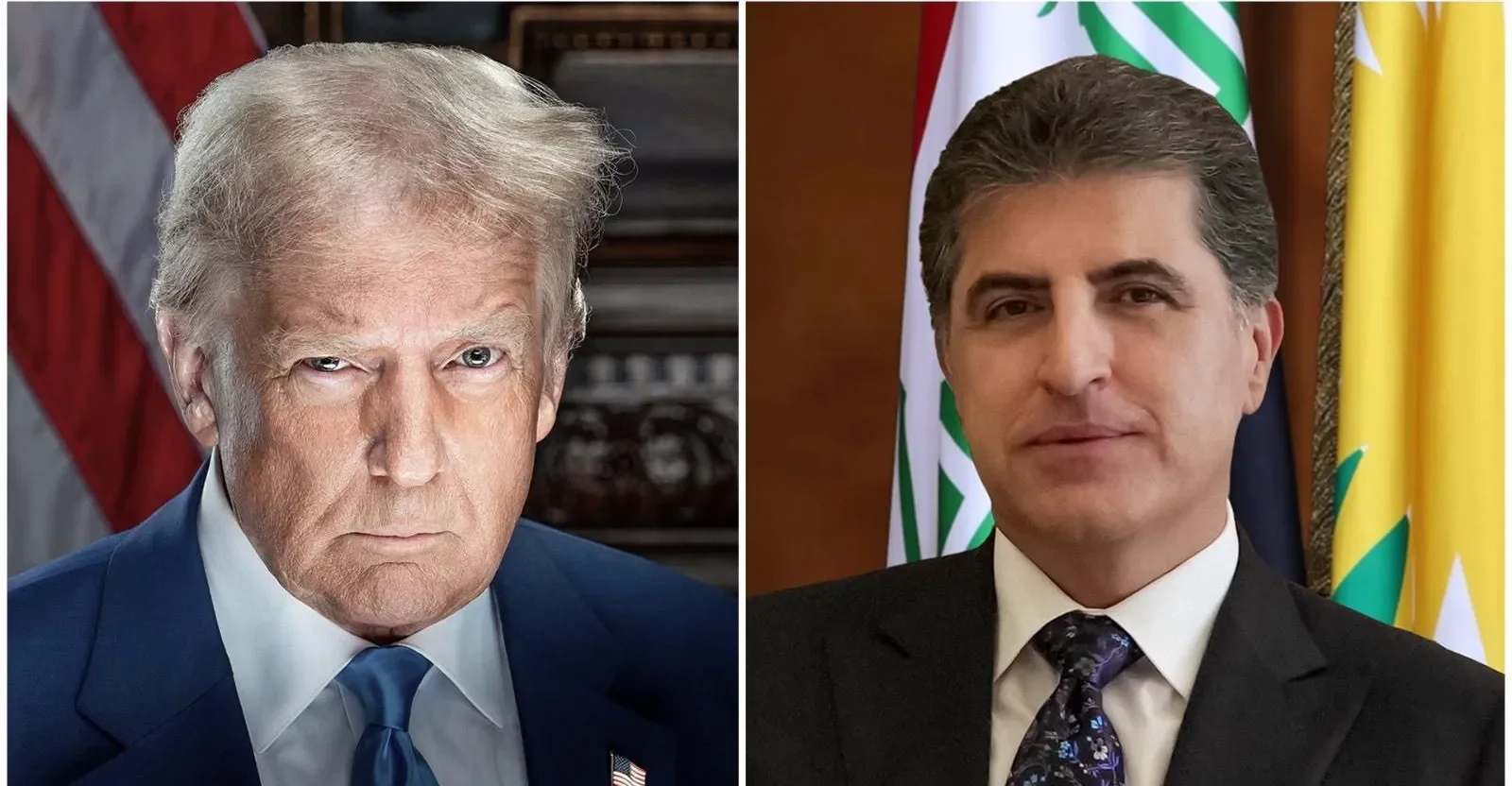
Tishwash: Nechirvan Barzani receives a message from Trump
US President Donald Trump expressed his thanks and appreciation to Kurdistan Region President Nechirvan Barzani for his efforts to promote peace and peaceful coexistence, and his endeavors to end conflicts in the Middle East.
The Kurdistan Region Presidency stated in a statement received by Shafaq News Agency on Wednesday evening that Barzani received a letter from the US President on Tuesday evening, thanking him for his efforts and endeavors to achieve peace. He also stressed the importance of ending disputes and tensions in the Middle East.
In his message, Trump emphasized that the nations of the world are capable of overcoming old differences and moving toward a shared future of peace, success, and progress.
The US President expressed his personal commitment and that of his administration to supporting efforts to achieve sustainable peace and end conflicts and violence in the region and the world.
He concluded his message by conveying his greetings and best wishes to the President of the Kurdistan Region, Nechirvan Barzani, and his family. link
Mot: Looking fir a New Trainer - any suggestions – siiiggghhhhh

Mot: Warning!! - Never Turn Your Head!!!

Iraq Economic News and Points To Ponder Thursday Morning 10-23-25
Deposit Growth Declines And Cash Credit Rises In Iraq
Energy and Business 2025-10-22 Shafaq News – Baghdad The Central Bank of Iraq reported on Wednesday a decline in bank deposit growth, while credit growth increased during July.
A bank statistic reviewed by Shafaq News Agency showed that total deposits at banks operating in Iraq decreased by 1% in July, reaching 116.265 trillion dinars, compared to their value in June, which amounted to 117.439 trillion dinars.
Deposit Growth Declines And Cash Credit Rises In Iraq
Energy and Business 2025-10-22 Shafaq News – Baghdad The Central Bank of Iraq reported on Wednesday a decline in bank deposit growth, while credit growth increased during July.
A bank statistic reviewed by Shafaq News Agency showed that total deposits at banks operating in Iraq decreased by 1% in July, reaching 116.265 trillion dinars, compared to their value in June, which amounted to 117.439 trillion dinars.
The bank added that central government deposits amounted to 36.22 trillion dinars, while public institution deposits amounted to 25.442 trillion dinars, and private sector deposits amounted to 54.595 trillion dinars.
The statistics indicated that credit growth increased by 2% in July, reaching 73.027 trillion dinars, compared to June, when credit growth reached 71.483 trillion dinars.
The bank explained that credit provided to the central government amounted to 25.77 trillion dinars,
while credit provided to public institutions amounted to 2.43 trillion dinars, and credit provided to the private sector amounted to 44.827 trillion dinars. https://shafaq.com/ar/اقتصـاد/تراجع-نمو-الودا-ع-وارتفاع-الا-تمان-النقدي-في-العراق
Al-Ghariri: Iraq's negotiations to join the World Trade Organization are ongoing.
Yesterday, 18:47 Baghdad – INA Minister of Trade Athir Dawood Al-Ghariri confirmed on Monday that Iraq's negotiations to join the World Trade Organization are ongoing, while stating that regional cooperation and integration are the path to achieving peace, stability, and sustainable development.
A statement by the Ministry of Trade received by the Iraqi News Agency (INA) stated:
"Minister of Trade Athir Dawood Al-Ghariri participated in the sixteenth session of the United Nations Conference on Trade and Development (UNCTAD), held in Geneva with broad participation from representatives of countries and international and regional organizations."
According to the statement, the minister affirmed that "collective action and regional integration represent a fundamental pillar for building a more stable and equitable economic system in light of the transformations and challenges facing the world," emphasizing that "open regional agreements can support the multilateral trading systemand promote sustainable development."
Al-Ghariri pointed out that "Iraq, which is continuing its negotiations to join the World Trade Organization, views regional initiatives as an opportunity to enhance its institutional readiness and align its legislative and investment frameworks, enabling it to effectively integrate into the global economy."
He explained that "regional integration represents a pillar for development and reconstruction, and that cooperation in the areas of infrastructure, simplifying customs procedures, encouraging investment, energy, agriculture, and services contributes to enhancing competitiveness and diversifying the national economy."
At the end of his speech, the Minister praised UNCTAD's significant role in supporting Iraq during its accession to the World Trade Organization, stressing that "regional cooperation and integration are the path to achieving peace, stability, and sustainable development." https://ina.iq/ar/economie/246099-.html
An Economist Explains: Iraq Can Write Off 90% Of Its "Odious" Debt.
October 21, 2025 Baghdad/Iraq Observer Today, economic expert Nabil Al-Marsoumi revealed new details regarding Iraq's foreign debt,asserting that Iraq has the legal right to write off approximately 90% of these debts, which he considered "odious."
Al-Marsoumi explained, in a post on his official Facebook page, that Iraq's total external debt amounts to $54 billion, of which $13.5 billion is active debt, on which the government is paying interest, and $40.5 billion is inactive debt owed to Gulf states, frozen without interest payments and unsettled since the 1990s.
He pointed out that the total amount of these debts does not exceed $18 billion, of which $12 billion is owed to Saudi Arabia and $6 billion to Kuwait, while the remaining claims represent a mixture of several components:
1. Exporting oil to Iraq through the neutral zone between Saudi Arabia and Kuwait, at a quantity of 1.3 million barrels per day.
2. Paying off Iraq's debts to others or guaranteeing loans, as Saudi Arabia helped the previous government to boost its creditworthiness.
3. Equipping Iraq with civilian and military means to serve the war effort, which were considered support rather than official loans.
4. Providing facilities at Saudi and Kuwaiti ports and exemptions from transit fees and customs clearance, including the construction of a pipeline to transport Iraqi oil through Saudi territory.
Al-Marsoumi emphasized that these components do not constitute legal debts unless there is a written agreement, and that the legal principle of odious debt allows for the cancellation of obligations that are not used to serve the public.
He pointed out that the optimal solution to these debts lies in establishing an international arbitration court to separate legal debts from odious debts, which would enable Iraq to pay only about 10% of the legal debts, and cancel the remainder, thus freeing the country from its large external debts. https://observeriraq.net/خبير-اقتصادي-يوضح-بإمكان-العراق-إسقاط-9/
Economist: Domestic Debt Is A Tragedy, And External Debt Is The Most Dangerous.
Economy October 18, 19:09 Information / Special.. Economist Ahmed Abd Rabbuh confirmed on Saturday that Iraq's internal and external debts have reached alarming levels that threaten the country's financial and economic stability.
He warned that continued borrowing without genuine financial reforms will lead to a crisis of confidence between citizens and banking institutions.
In a statement to Al-Maalouma News Agency, Abdel Rabbo said, "Domestic debts represent a true economic tragedy because they are financed by the local banking system, which weakens citizens' confidence in banks and raises fears that their balances or savings will be affected if the crisis worsens."
He explained that "external debts are the most dangerous because they subject the country to external political and economic conditions that limit its financial sovereignty."
He added that "the continued accumulation of domestic debt without regulating government expenditures or a clear plan to direct them toward productive development projects poses a direct threat to the national economy," noting that "the continued delay in approving budgets has exposed weak government performance and the failure to hold accountable those who have exceeded constitutional deadlines for the general budget."
Abdul Rabbo pointed out that "it is unlikely that a new budget or financial schedules will be approved for the current year in light of the lack of real accountability and the decline in oil prices, which will lead to the disruption of investment projects and a slowdown in economic growth."
This warning comes at a time when the government is facing a stifling financial crisis resulting from mounting debt and declining oil revenues, while economic experts are calling for a comprehensive reform of fiscal policy and enhanced oversight of public spending before the country slides into a deeper economic crisis.
https://almaalomah.me/news/113187/economy/اقتصادي:-الديون-الداخلية-مأساة-والخارجية-الأخطر
For current and reliable Iraqi news please visit: https://www.bondladyscorner.com
Seeds of Wisdom RV and Economics Updates Thursday Morning 10-23-25
Good Morning Dinar Recaps,
Don’t be fearful of control by federal reserve because we are going to a gold backed system which takes away their power of debt. They will just go away as we return to our Republic and gold. The base and rails of the system are being laid and there is more info on how this will lead to our new global financial system and reset. Our currency will be digital called Stablecoins, backed by gold. No more debt system so no more Fed control. Our system will be based on gold as our anchor and collateral. That is the direction the world is going and daily we see it happening with record gold purchases and regulations world wide on digital use of currency in the form of stablecoins. Stablecoins will be backed by gold — not fiat treasury bills or bonds like they are now. Seeds of Wisdom Team
IMF and BIS Confront Hidden Fault Lines in Global Private Credit
Regulators quietly move to map shadow lending risks as unregulated markets surpass $2.1 trillion.
Good Morning Dinar Recaps,
Don’t be fearful of control by federal reserve because we are going to a gold backed system which takes away their power of debt. They will just go away as we return to our Republic and gold. The base and rails of the system are being laid and there is more info on how this will lead to our new global financial system and reset. Our currency will be digital called Stablecoins, backed by gold. No more debt system so no more Fed control. Our system will be based on gold as our anchor and collateral. That is the direction the world is going and daily we see it happening with record gold purchases and regulations world wide on digital use of currency in the form of stablecoins. Stablecoins will be backed by gold — not fiat treasury bills or bonds like they are now. Seeds of Wisdom Team
IMF and BIS Confront Hidden Fault Lines in Global Private Credit
Regulators quietly move to map shadow lending risks as unregulated markets surpass $2.1 trillion.
A new phase of global financial oversight is emerging as the IMF and Bank for International Settlements (BIS) intensify cooperation on systemic risk mapping across private credit markets. These unregulated lending pools—now estimated above $2.1 trillion globally—have become the largest blind spot in modern finance.
The IMF’s October Financial Stability Report warns that nonbank lenders could trigger “cross-border liquidity fractures” if defaults rise.
The BIS is coordinating data collection and digital transparency protocols among major central banks to identify risk concentration channels.
Industry insiders suggest the next step could involve tokenized credit reporting systems—an early precursor to a digitally unified financial oversight framework.
This move represents more than regulatory caution; it signals the first visible layer of a transition toward centralized digital control mechanisms capable of absorbing shocks from private markets.
Implications:
The growing dependence on opaque private credit reveals deep structural fragility in the global system. As the IMF and BIS step in to “map” the risks, they are effectively laying the digital scaffolding for a future in which liquidity management and credit issuance converge under programmable central bank oversight—a core feature of the unfolding global financial reset.
This is not just politics — it’s global finance restructuring before our eyes.
Seeds of Wisdom Team
Newshounds News™ Exclusive
Sources:
~~~~~~~~~
The Dollar Defends Its Final Fronts: Currency Interventions Signal a Shifting Order
Joint U.S.–Japan market action underscores the dollar’s fragility as China quietly rewires reserve holdings.
Global currency markets are showing the early signs of a strategic realignment. For the second time this quarter, the U.S. Treasury and Japan’s Finance Ministry intervened jointly to defend the yen from record depreciation—an effort to preserve stability in a system increasingly strained by diverging interests.
The coordinated move reflects heightened concern over global FX volatility, particularly as China continues reducing its U.S. Treasury holdings, reallocating into euros and gold reserves for the seventh straight month.
Analysts note that Beijing’s shift is not a short-term hedge, but a gradual decoupling from the dollar-centric architecture that has dominated since the 1970s.
Meanwhile, several Asian and Middle Eastern economies are experimenting with local currency trade settlements, further diluting the dollar’s central role in regional transactions.
The interventions reveal a paradox: the defense of the old system confirms the rise of the new. As Washington fights to preserve dollar liquidity, emerging powers are designing multilateral currency corridors and gold-linked trade mechanisms that could redefine global exchange.
Implications:
Each round of intervention buys time, not stability. The pattern reflects the controlled unwinding of dollar dependency, signaling the gradual emergence of regional monetary blocs that may form the foundation of a post-dollar settlement regime—a core component of the global financial reset.
This is not just politics — it’s global finance restructuring before our eyes.
Seeds of Wisdom Team
Newshounds News™ Exclusive
Sources:
~~~~~~~~~
Seeds of Wisdom Team RV Currency Facts Youtube and Rumble
Newshound's News Telegram Room Link
Follow the Gold/Silver Rate COMEX
Follow Fast Facts
Seeds of Wisdom Team™ Website
Thank you Dinar Recaps
MilitiaMan and Crew: IQD News Update-CBI -Remove Zeros Project is Ongoing!
MilitiaMan and Crew: IQD News Update-CBI -Remove Zeros Project is Ongoing!
10-22-2025
The Crew: Samson, PompeyPeter, Petra, Daytrader, Sunkissed, GIGI and Militia Man
Follow MM on X == https://x.com/Slashn
Be sure to listen to full video for all the news……..
MilitiaMan and Crew: IQD News Update-CBI -Remove Zeros Project is Ongoing!
10-22-2025
The Crew: Samson, PompeyPeter, Petra, Daytrader, Sunkissed, GIGI and Militia Man
Follow MM on X == https://x.com/Slashn
Be sure to listen to full video for all the news……..
Iraq Economic News and Points To Ponder Wednesday Evening 10-22-25
Central Bank Of Iraq: The Project To Remove Zeros From The Dinar Is Still Ongoing And Is Being Planned.
Local The Governor of the Central Bank of Iraq, Ali Al-Alaq,confirmed that the third budget"included very large expenditures and a high deficit," noting that the issue of removing zeros from the dinar may witness developments in the coming period.
On the sidelines of Al-Alaq's participation in the Duhok Conference on Economic and Financial Problems in Iraq and the Kurdistan Region, Al-Alaq said, "The budget for the three years included very large expenditures, and therefore the deficit was high.
Central Bank Of Iraq: The Project To Remove Zeros From The Dinar Is Still Ongoing And Is Being Planned.
Local The Governor of the Central Bank of Iraq, Ali Al-Alaq,confirmed that the third budget"included very large expenditures and a high deficit," noting that the issue of removing zeros from the dinar may witness developments in the coming period.
On the sidelines of Al-Alaq's participation in the Duhok Conference on Economic and Financial Problems in Iraq and the Kurdistan Region, Al-Alaq said, "The budget for the three years included very large expenditures, and therefore the deficit was high.
However, there is ongoing coordination between the Central Bank and the Ministry of Finance to achieve a high degree of financial stability."
He added, "The issue of removing zeros from the Iraqi currency is a project that is still ongoing and being planned, and we may hear developments regarding it in the coming period."
He pointed out that,"With the renewed proposal for the zero-removal project, which is currently being prepared, the currency denominations will be restructured in general, including the 20,000 denomination."
https://economy-news.net/content.php?id=61468
What did the IMF report say about the economic situation in Iraq?
Economy | 10/22/2025 Mawazine News - Follow-up:
The International Monetary Fund (IMF) revealed, on Wednesday, its expectations for economic growth in Iraq to increase and inflation to decrease.
The IMF stated in a report followed by Mawazine News, "After reviewing the latest report on the World Economic Outlook, the Fund expected economic growth in Iraq to increase, and inflation to decrease."
The report's data came as follows:
Gross Domestic Product (GDP) Growth:
Iraq's real GDP is expected to grow by 0.5% this year, after it was expected in April to record a contraction of 0.2%. In 2026, growth is expected to rise to 3.6%, after previous estimates indicated growth of only 1.4%.
Inflation:
Inflation estimates for 2025 were lowered from 2.5% to 1.5%, and those for 2026 were lowered from 2.7% to 2.5%.
These revisions reflect increased optimism about the recovery of the Iraqi economy and price stability compared to previous estimates. https://www.mawazin.net/Details.aspx?jimare=268915
Does Public Debt Pose A Real Threat To The National Economy? An Economist Explains
E+conomy | 10:07 - 10/22/2025 Mawazine News – Baghdad Economic expert, Munir Al-Obaidi, clarified the extent of the danger of internal and external debt to the Iraqi economy, indicating that the danger of the internal debt does not lie in its absolute value, but rather in its ratio to the gross domestic product. This is according to data from the Central Agency for Statistics.
Al-Obaidi said in a post reviewed by Mawazine News that “during the past few days, which witnessed widespread media coverage of the internal debt and its amount, this raised legitimate questions about whether this debt poses an actual danger to the national economy, and what is the nature of this danger, if any.
In order to understand the picture accurately, the issue must be analyzed from several interconnected angles, the first of which is the size of the debt relative to the gross domestic product.”
He added, "Iraq's GDP is around 230 trillion dinars, which makes the ratio of domestic debt to GDP around 39%, which is lower than the critical ratio of 50% set by many countries.
" He pointed out that "the concern here stems from the composition of the GDP itself, as more than 65% of it depends on the oil sector. If oil prices decline, the GDP will shrink, raising the debt-to-GDP ratio even if the debt level remains constant, which exacerbates the risk."
He continued, "One of the most prominent challenges is the high interest rates on domestic debt instruments.
Recent bonds were issued with an annual interest rate of nearly 10%, a high rate that could burden the general budget with additional expenditures, especially if oil revenues decline. Over time, the government may find itself facing a financing burden that will be difficult to sustain."
Regarding the deflationary impact on economic activity, Al-Obaidi pointed out that "government bonds represent a tool of deflationary policy. When the state resorts to borrowing from banks at high interest rates, these banks' appetite for financing productive projects decreases.
This means that the private sector will be negatively affected by the shrinking financing opportunities, limiting its ability to contribute to economic growth."
From another perspective, the economic expert explained that "the absence of investment investment opportunities for domestic debt is not a problem in and of itself if it is directed towards strategic and service projects that create added value and job opportunities.
However, when used solely to cover the operating deficit, it becomes a burden that hinders the state's ability to increase its investment spending, thus weakening the growth of the non-oil sectors that the economy needs to achieve diversification."
He concluded by saying, "Government debt has a significant impact on the banking system, as government debt rose by 116% over the course of a year, reaching 13% of total banking system assets, up from just 6% in 2024.
This rapid expansion poses risks to the soundness and sustainability of the banking system, as it increases its exposure to sovereign risks and limits its flexibility in financing other economic activities. Concerns about domestic debt are not only related to its size, but also to the nature of its use, structure, cost, and impact on the overall economic environment.
Therefore, managing domestic debt requires a comprehensive vision that takes these factors into account before embarking on any new expansion." https://www.mawazin.net/Details.aspx?jimare=268908
After Weeks Of Rising Prices, Gold Prices In Baghdad Have Fallen
Economy | 10/22/2025 Mawazine News - Baghdad: Foreign and Iraqi gold prices witnessed a noticeable decline in the local markets in the capital, Baghdad.
The prices of Gulf, Turkish and European gold in the wholesale markets on Al-Nahr Street in Baghdad, this morning, recorded a selling price of one Mithqal of 21 karat, reaching 816 thousand dinars, and a purchase price of 812 thousand dinars, after it was 848 thousand dinars yesterday, Tuesday.
The selling price of one Mithqal of 21 karat Iraqi gold was recorded at 786 thousand dinars, and the purchase price reached 782 thousand.
As for gold prices in individual goldsmiths, the selling price of one Mithqal of 21 karat Gulf gold ranged between 815 thousand and 825 thousand, while the selling price of one Mithqal of Iraqi gold ranged between 785 thousand and 795 thousand dinars. https://www.mawazin.net/Details.aspx?jimare=268914
Basra Crude Prices Rise In Line With The Global Oil Price Rally.
Economy | 10/22/2025 Mawazine News - Baghdad - Basra Heavy and Basra Medium crude prices rose as global oil prices rose.
Basra Heavy crude prices rose 36 cents, or 0.60%, to $59.98, while Basra Medium crude prices rose 36 cents, or 0.59%, to $61.13.
Oil prices rose on supply risks related to sanctions and hopes for a US-China trade deal, while investors digested news that Washington was seeking to buy quantities of oil to store in its strategic reserves.
https://www.mawazin.net/Details.aspx?jimare=268905
The Dollar Continues To Decline With The Closing In Baghdad
Economy | 04:22 - 10/22/2025 Mawazine News - Baghdad - The US dollar exchange rate fell in Baghdad's markets with the closing of the stock exchange.
The dollar price fell on the Al-Kifah and Al-Harithiya stock exchanges to 141,400 Iraqi dinars for every $100, after it was 141,550 dinars this morning.
Selling prices stabilized in exchange shops in Baghdad's local markets, with the selling price reaching 142,500 Iraqi dinars for every $100, while the buying price reached 140,500 dinars. https://www.mawazin.net/Details.aspx?jimare=268925
For current and reliable Iraqi news please visit: https://www.bondladyscorner.com
Seeds of Wisdom RV and Economics Updates Wednesday Evening 10-22-25
Good Evening Dinar Recaps,
Digital Gold Standard: Could the Next Global System Be Constitutional Money?
Rising gold reserves, blockchain innovation, and America’s founding law may converge in the next era of finance.
The Constitutional Foundation
The U.S. Constitution clearly defines lawful money. Article I, Section 10 states that no state shall “make any Thing but gold and silver Coin a Tender in Payment of Debts.” That provision enshrined a hard-money system meant to prevent inflationary credit creation.
Good Evening Dinar Recaps,
Digital Gold Standard: Could the Next Global System Be Constitutional Money?
Rising gold reserves, blockchain innovation, and America’s founding law may converge in the next era of finance.
The Constitutional Foundation
The U.S. Constitution clearly defines lawful money. Article I, Section 10 states that no state shall “make any Thing but gold and silver Coin a Tender in Payment of Debts.” That provision enshrined a hard-money system meant to prevent inflationary credit creation.
Yet over the past century, the U.S. has shifted from asset-backed to debt-backed currency — first through the Federal Reserve Act of 1913, then the Nixon shock of 1971, which severed the dollar’s convertibility to gold. The result is today’s fiat system, in which value rests on government credit rather than tangible assets.
If a future system were to emerge where digital dollars were backed by gold and issued through the U.S. Treasury rather than private central banks, it could technically comply with constitutional money principles — even in tokenized form.
A Quiet Return to Gold
Central banks worldwide have been steadily accumulating gold.
China, India, Russia, and Turkey all expanded their holdings dramatically in recent years.
BRICS nations have discussed a gold-linked settlement system to replace dollar-based trade.
Even European countries such as Germany and France have increased their reserves or repatriated physical bullion.
This accumulation pattern signals preparation for an era in which gold reclaims its monetary role — not as physical coins, but as digital collateral anchoring value.
The Technological Bridge
Projects by Ripple (RLUSD), the Bank for International Settlements’ Project Aurum, and the IMF’s digital asset pilots all explore tokenized reserves — digital representations of real assets such as gold, commodities, or U.S. Treasuries.
For the first time in history, gold can serve as both a store of value and medium of exchange simultaneously — with instant, borderless transfer and full auditability. Tokenization resolves the logistical barriers that once made the classical gold standard impractical in a global, digital economy.
The Emerging Architecture
Recent policy and institutional signals point to an evolving framework:
The IMF (2024) began referencing “multi-asset reserve systems.”
The BIS advocates “interoperable CBDC and stablecoin systems” backed by tangible assets.
Ripple and JPMorgan are developing cross-border payment rails built for tokenized assets.
The World Gold Council reports record-high central bank purchases through 2024–2025.
These are not isolated events. Together, they form a structural foundation for a digitally collateralized global monetary system — and potentially a constitutional return to hard money in modern form.
Why It Matters
A digital, gold-backed system would shift global finance from debt-based value to asset-based value, transforming the foundations of monetary sovereignty. It could also restore public trust in money’s integrity — the very principle embedded in the U.S. Constitution.
Whether led by governments or private networks like Ripple, this architecture suggests the next monetary reset may not dismantle the system but re-anchor it in real value.
This is not just politics — it’s global finance restructuring before our eyes.
Seeds of Wisdom Team
Newshounds News™ Exclusive
Sources:
~~~~~~~~~
Seeds of Wisdom Team RV Currency Facts Youtube and Rumble
Newshound's News Telegram Room Link
Follow the Gold/Silver Rate COMEX
Follow Fast Facts
Seeds of Wisdom Team™ Website
Thank you Dinar Recaps
Update VND Stablizing Aginst the USD
Update VND Stablizing Aginst the USD
Edu Matrix: 10-21-2025
Summary of the VND during the last 30 days. Hold on to your VND things are changing slowly.
The global economic landscape is constantly shifting, but occasionally, a country hits a growth streak so powerful it demands attention. This week, Sandy Ingram of Edu Matrix delivered vital insight into one such nation: Vietnam.
Beyond the standard market chatter, Ingram detailed the core dynamics driving Vietnam’s economy forward, resulting in a notable strengthening of the Vietnamese Dong (VND). But first, the Edu Matrix channel offered two critical announcements reflecting the complex environment in which financial reporting operates.
Update VND Stablizing Aginst the USD
Edu Matrix: 10-21-2025
Summary of the VND during the last 30 days. Hold on to your VND things are changing slowly.
The global economic landscape is constantly shifting, but occasionally, a country hits a growth streak so powerful it demands attention. This week, Sandy Ingram of Edu Matrix delivered vital insight into one such nation: Vietnam.
Beyond the standard market chatter, Ingram detailed the core dynamics driving Vietnam’s economy forward, resulting in a notable strengthening of the Vietnamese Dong (VND). But first, the Edu Matrix channel offered two critical announcements reflecting the complex environment in which financial reporting operates.
Here is a breakdown of the key takeaways from the latest Edu Matrix video, covering both crucial channel decisions and the explosive growth fueling Vietnam’s economy.
Financial reporting requires stability and political prudence. Sandy Ingram opened the video with two crucial operational updates:
Ingram announced that Edu Matrix has temporarily paused its coverage and reporting on Iraq. This deliberate decision stems from the violent unrest surrounding the nation’s upcoming elections.
To ensure the channel maintains absolute impartiality and avoids any perception of attempting to influence a fragile political process, Edu Matrix will step back until stability returns. This move reinforces the channel’s commitment to providing objective financial information, separate from political maneuvering.
Viewers are also warned about potential short-term disruptions to video uploads. With volatile weather patterns intensifying in the Caribbean, the threat of hurricanes causing power outages is significant. Ingram emphasized that while the team strives for consistent uploads, temporary delays due to acts of nature may occur.
With the necessary housekeeping complete, the spotlight immediately shifted to Vietnam, where the confluence of strong economic indicators is creating a powerful upward trend for the currency.
For those tracking the Vietnamese Dong (VND) against the US Dollar, the direction of travel has historically been volatile or steadily weakening. That is no longer the case. The VND is showing distinct signs of strengthening, driven by a powerful trifecta of factors:
Vietnam is operating at peak performance. The nation reported a staggering 8.2% GDP increase in Quarter 3 of 2025. This level of growth places Vietnam at the forefront of emerging markets, suggesting robust industrial output, high consumer confidence, and significant foreign investment flowing into the manufacturing sectors.
Strong domestic output combined with thriving international trade has resulted in a hefty $16.8 billion trade surplus in 2025. A sustained trade surplus means Vietnam is earning significantly more foreign currency from its exports than it is spending on imports. This surplus increases the demand for the local currency (the Dong) on the global market, naturally pushing its value higher.
Overseas Vietnamese communities continue to show strong support for their homeland. In the first nine months of the year, remittance inflows reached nearly $8 billion. These funds—sent home by workers and families abroad—inject foreign currency directly into the Vietnamese economy, supporting the domestic currency’s stability and appreciation.
While the economic fundamentals are sound, the role of the State Bank of Vietnam (SBV) cannot be overstated.
Ingram noted that the SBV has been instrumental in managing this transition. By employing a flexible monetary policy, the central bank actively manages its foreign exchange reserves and intervenes in the forex market to prevent excessive weakening or volatility.
The recent move by the central bank to slightly lower its daily reference rate indicates a measured acceptance of the Dong’s weak appreciation. Commercial banks have adjusted their trading rates accordingly, confirming the shift.
Investor Takeaway: Sandy Ingram strongly encouraged viewers to consider holding onto the VND, emphasizing that it is a tradable asset on the global forex market, providing an opportunity for those looking to diversify their currency holdings.
Vietnam offers a compelling case study in focused, high-speed economic development. The combination of trade success, strong domestic production, and prudent central bank management signals a sustained period of stability and potential appreciation for the Dong.
Beyond reviewing geopolitical and economic hotspots, the Edu Matrix channel maintains a focus on accessible wealth building. For long-term investors, Ingram promoted the channel’s membership program, designed to offer affordable guidance on leveraging small, consistent monthly investments.
The core philosophy remains one of patience: harnessing the power of compound interest to grow wealth gradually and reliably over time.
For deeper analysis of Vietnam’s currency movements and the full context of these announcements, be sure to watch the full video from Edu Matrix.
Seeds of Wisdom RV and Economics Updates Wednesday Afternoon 10-22-25
Good Afternoon Dinar Recaps,
Global Reset Watch: Fault Lines Emerge in Banking, Currency, and Metals Markets
Private credit risks, currency interventions, and liquidity strains hint at a slow-motion restructuring of global finance.
Good Afternoon Dinar Recaps,
Global Reset Watch: Fault Lines Emerge in Banking, Currency, and Metals Markets
Private credit risks, currency interventions, and liquidity strains hint at a slow-motion restructuring of global finance.
The Warning Signs Are Converging
Today’s financial headlines reveal a deeper shift beneath the surface of markets — one that signals not panic, but pre-reset recalibration.
Across credit, currency, and commodities, new structural imbalances are aligning to challenge the post-1971 U.S. dollar order.
1. Bank of England Flags Private Credit as Systemic Risk
Bank of England Governor Andrew Bailey warned that the fast-growing $2.1 trillion private-credit market poses “echoes of 2008.”
These private funds lend outside regulated banks, often with high leverage and limited transparency.
A cascade of defaults in this sector could force central banks back into emergency interventions — reigniting questions about fiat stability and monetary independence.
2. Washington’s Currency Maneuver in Argentina
Reports indicate the U.S. Treasury purchased Argentine pesos to support Buenos Aires amid crisis talks.
The move marks an unusual level of direct foreign-exchange intervention by the United States.
Using currency policy as a geopolitical instrument risks fragmenting global FX markets and hastening the rise of bilateral or commodity-backed systems (notably within BRICS nations).
3. Metals Selloff Signals Liquidity Stress
Gold and silver fell sharply, down 5–9 percent, despite geopolitical risk.
Institutional traders appear to be raising cash or unwinding leverage, a sign of tightening global liquidity.
Historically, such safe-haven selloffs precede credit tightening or rate shocks — the early tremors of systemic transition.
Why This Matters
Each of these developments reflects erosion of confidence in the current financial architecture:
Credit fragility → unsupervised leverage expansion.
Currency interventionism → politicized markets.
Liquidity compression → retreat from real assets.
Together, they form a pattern — a slow-motion reset of global finance where regional blocs pursue sovereign, commodity-linked frameworks to protect their monetary autonomy.
This is not just politics — it’s global finance restructuring before our eyes.
Seeds of Wisdom Team
Newshounds News™ Exclusive
Sources
Reuters – “BoE warns of systemic risk from $2 trillion private-credit boom”
Bloomberg – “U.S. Treasury steps in to support Argentine peso amid funding talks”
Financial Times – “Gold, silver tumble as traders unwind leveraged positions”
~~~~~~~~~
The Tokenized Trap: How the “New Dollar” Could Spark a Global Financial Reset
From digital debt to controlled liquidity — the architecture of a new monetary order is already being built.
A System Hiding in Plain Sight
A quiet revolution is underway — not through central banks or parliaments, but through code and corporate balance sheets.
The emergence of tokenized U.S. dollars — digital assets like USDT (Tether), USDC, and PayPal USD — is reshaping global finance faster than regulation can respond.
Promoted as tools for “fast, borderless payments,” these tokens are in fact private conduits for dollar demand, each one backed (theoretically) by short-term Treasuries and cash reserves. Every transaction, therefore, supports U.S. debt markets, creating a self-reinforcing cycle between digital liquidity and sovereign borrowing.
1. Stablecoins: The Invisible Bond Market
Tether and Circle now collectively hold over $150 billion in U.S. Treasury bills, rivaling the foreign reserves of mid-sized nations.
Each new token minted equals a new buyer of American debt — privatized quantitative easing without a central bank vote.
For emerging economies, this deepens dependency: the digital dollar becomes both payment rail and debt anchor.
2. Tokenization as Control Mechanism
Unlike cash, tokenized currencies are programmable — enabling regulators, platforms, or issuers to freeze, track, or even reverse transactions.
In a liquidity crisis, such control could instantly “bail-in” users, converting deposits or tokens into sovereign assets — a digital replay of 2013 Cyprus or 1933 gold confiscation.
This represents the architecture of a controlled financial reset:
Convert global liquidity into tokenized “digital Treasuries.”
Centralize control under payment networks and regulated issuers.
Gradually phase out traditional fiat and foreign reserves.
3. The Gold Hedge Paradox
Ironically, while these issuers expand their Treasury holdings, their parent firms and executives are buying gold — quietly hedging against the very system they’re constructing.
This duality — digital dollars for the public, hard assets for the insiders — mirrors late-stage fiat cycles before revaluation events.
Why This Matters
A global financial reset doesn’t require a crash — only a change in the unit of trust.
When physical dollars vanish and only tokenized ones remain, monetary sovereignty shifts to those who control the ledgers.
This could pave the way for a new hybrid monetary regime — part digital, part commodity-backed, and ultimately transnationally governed.
The scaffolding for this system isn’t theoretical; it’s operational. The only question is whether it evolves into a decentralized upgrade or a digital enclosure.
This is not just politics — it’s global finance restructuring before our eyes.
Sources
ZeroHedge – “The New Dollar Is Here: Controlled, Tokenized, Inescapable”
Bloomberg – “Tether Becomes One of World’s Largest Buyers of US Treasuries”
IMF Fintech Report (2025) – “Tokenization and the Future of Cross-Border Settlements”
CoinDesk – “Stablecoins Now Finance U.S. Debt More Than China Does”
~~~~~~~~~
Private Stablecoins, Public Power: Who Controls the Future of Money?
Ripple, RLUSD, and the Quiet Redesign of Global Finance
The rapid rise of private stablecoins like Ripple’s RLUSD marks a profound shift in how money may soon function. Unlike traditional currencies issued by central banks, stablecoins are digitally backed tokens—often pegged to the U.S. dollar—issued by private corporations rather than governments.
The Decentralization Illusion
While stablecoins appear to promise decentralization, most are actually highly centralized within corporate ecosystems. Ripple, Tether, and Circle (issuer of USDC) each maintain custodial reserves, often parked in short-term U.S. Treasuries. This means that rather than escaping the current system, stablecoins extend it — just through different hands.
If Ripple succeeds in becoming a federally chartered bank, it would merge crypto-finance and traditional banking — creating a hybrid model where digital currencies circulate globally while remaining tied to U.S. debt markets.
🌱 In essence, the “new dollar” could be private, programmable, and global — but still fundamentally a U.S.-backed instrument.
If Governments Lose Monetary Control
If stablecoins or tokenized currencies became the primary medium of exchange:
Fiscal policy power (like money creation, interest control) could shift from central banks to corporate issuers.
Regulation and taxation would become harder to enforce unless governments integrate themselves into the new system.
A global ledger run by a few major fintechs could replace national money systems — a true financial reset.
This wouldn’t be decentralized finance (DeFi) in the original sense; it would be corporate-controlled digital finance — a privatized version of monetary governance.
The Path Toward a Reset
Ripple’s banking ambitions and tokenization projects by JPMorgan, BIS, and the IMF all signal a new global architecture where real-world assets, Treasuries, and currencies exist on interoperable ledgers.
Once major economies adopt tokenized fiat, they can reprice — or “reset” — global value without a crash, simply through revaluation of digital instruments.
The “reset” would be a software upgrade, not a collapse.
Why This Matters
The future may not be “decentralized” in the libertarian sense — but digitally centralized under private-public partnerships.
The reset is already under construction — not by central banks alone, but by those who build the rails that money runs on.
This is not just politics — it’s global finance restructuring before our eyes.
Seeds of Wisdom Team
Newshounds News™ Exclusive
Sources:
~~~~~~~~~
Seeds of Wisdom Team RV Currency Facts Youtube and Rumble
Newshound's News Telegram Room Link
Follow the Gold/Silver Rate COMEX
Follow Fast Facts
Seeds of Wisdom Team™ Website
Thank you Dinar Recaps
“Tidbits From TNT” Wednesday Morning 10-22-2025
TNT:
Tishwash: Al-Sudani and the US Secretary of State discuss completing US trade deals in Iraq
US Secretary of State Marco Rubio said on Tuesday that armed factions must be disarmed.
The US State Department said, "Secretary Rubio discussed, in contact with the Prime Minister of Iraq, efforts to complete US trade deals in Iraq".
According to the US State Department, Secretary Rubio stressed "the need to disarm the Iranian-backed factions that undermine Iraq's sovereignty."
TNT:
Tishwash: Al-Sudani and the US Secretary of State discuss completing US trade deals in Iraq
US Secretary of State Marco Rubio said on Tuesday that armed factions must be disarmed.
The US State Department said, "Secretary Rubio discussed, in contact with the Prime Minister of Iraq, efforts to complete US trade deals in Iraq".
According to the US State Department, Secretary Rubio stressed "the need to disarm the Iranian-backed factions that undermine Iraq's sovereignty."
He continued, "The armed factions supported by Iran in Iraq threaten the lives and businesses of Americans and Iraqis".
He added, "The Iraqi factions are plundering Iraqi resources for the benefit of Iran".
Minister Rubio stressed "Washington's commitment to working closely with the Iraqis to promote common interests". link
************
Tishwash: Securities: Approval of membership requirements for the "Tabadul" platform between the Iraqi and Abu Dhabi markets
The Securities Commission announced today, Tuesday, the approval of the requirements for trading membership via the "Tabadul" platform between the Iraqi and Abu Dhabi Securities Markets.
A statement by the Authority stated: "The Securities Commission announced its approval of the membership requirements for Iraqi brokerage companies to enter trading via the "Tadawul" platform in the Abu Dhabi Securities Market, as well as the membership for foreign brokerage companies to enter trading via the platform in the Iraqi Securities Market, within the framework of the strategic linkage project between the two markets."
The Chairman of the Securities Commission, Faisal Al-Haimas, stressed - according to the statement - that "this step represents a new stage in the path of developing Iraqi financial markets and enhancing their regional integration," noting that "the "Tabadul" platform will contribute to expanding investment opportunities, increasing liquidity, raising trading efficiency, and attracting foreign investments to the Iraqi market."
He added, "The Authority is continuing to implement its vision to modernize the financial market environment and strengthen partnerships with Arab and global markets, in line with the government's goals of supporting the national economy and diversifying sources of growth".
He pointed out that "this approval comes within a series of strategic steps that enhance the position of the Iraqi Stock Exchange as a promising investment destination". link
************
Tishwash: The Prime Minister stresses the importance of resorting to the constitution to achieve development
Prime Minister Mohammed Shia Al-Sudani stressed, on Monday, the importance of adhering to the constitution to achieve development and consolidate traditions of citizenship and transparency in public service.
The Prime Minister's Media Office said in a statement received by the Iraqi News Agency (INA), "Prime Minister Mohammed Shia al-Sudani participated today, Monday, in the celebration held in the capital, Baghdad, on the occasion of the centenary of the issuance of the 1925 Constitution, in the presence of the President of the Republic, the Speaker of the House of Representatives, the Speaker of the Supreme Judicial Council, and a number of political and national leaders and officials."
He pointed out, in a speech during the ceremony, that "remembrance of the centenary of the first constitution of the modern Iraqi state comes as an affirmation of the challenges that our people have faced in order to manage their own destiny and choose their national approach. The Iraqis have emerged from these challenges strong and united, united by the superiority of the homeland over them, reaching the permanent constitution of 2005, which was written by the will and choice of the Iraqis."
The Prime Minister said during the ceremony: "The 1925 Constitution represented the first attempt to determine the reality of our people's existence, with its diversity and spectrums, and with its history and long experience with the occupations," noting that "our permanent constitution of 2005 was born to be a social contract that affirms citizenship and links it to the necessities of the state and society, which were represented by the principles of justice, protection of freedoms, and equality."
He added: "We all trust in resorting to the constitution to achieve development, overcome any political dispute, and continue the peaceful transfer of power", adding: "We are proud of our constitution, which prevents the recurrence of the mischief of those who dream of Statement No. 1 and military coups".
He continued: "Today we are proceeding according to a constitutional approach that enhances the existence of a strong state, with its national armed forces, its developing economy, and democracy that ends up in the ballot box", noting: "Today, traditions of citizenship, resorting to the judiciary, and transparency in work and public service are entrenched in Iraq." "
Ben, "Today we are moving towards a second constitutional centenary, in which we are working to make it a centenary of true citizenship, the rule of law, prosperity and development".
He concluded by saying: "Mercy and elevation to all the nation's martyrs, whose sacrifices were a way to reach this moment of which we are proud". link
************
Tishwash: WAIT!!! - Just Realized!!! -- Summers Over!!! -- Where Did It Go??

Mot: Suttle!!! -- LOL !!!

Iraq Economic News and Points To Ponder Wednesday Morning 10-22-25
The Minister Of Trade Discusses With The Director-General Of The World Trade Organization The Steps For Iraq's Accession To The Organization.
Tuesday, October 21, 2025 13:21 | Economic Number of readings: 622 Baghdad / NINA / Minister of Trade Athir Dawood Al-Ghariri discussed, in Geneva today, Tuesday,with the Director-General of the World Trade Organization, Ngozi Okonjo-Iweala, the latest developments in the file of Iraq's accession to the organization.
The Minister Of Trade Discusses With The Director-General Of The World Trade Organization The Steps For Iraq's Accession To The Organization.
Tuesday, October 21, 2025 13:21 | Economic Number of readings: 622 Baghdad / NINA / Minister of Trade Athir Dawood Al-Ghariri discussed, in Geneva today, Tuesday,with the Director-General of the World Trade Organization, Ngozi Okonjo-Iweala, the latest developments in the file of Iraq's accession to the organization.
They reviewed the stages reached by this process in light of the completion of the work of the National Committee for Accession, headed by the Minister of Trade, in addition to the technical subcommittees tasked with preparing the required documents and reports in preparation for holding the fourth meeting on Iraq.
During the meeting, Minister Al-Ghariri stressed the importance of enhancing cooperation and coordination with the World Trade Organization and member states to facilitate the technical and administrative procedures related to the accession process.
He noted the Iraqi government's commitment to completing all technical and legislative requirements to ensure full membership in the organization.
For her part, Ngozi Okonjo-Iweala commended Iraq's commitment and continued efforts to complete its accession requirements and integrate into the global trading system, stressing that Iraq's accession will provide added value given its economic potential and strategic location,which enhances the integration of the international trading system.
It is noteworthy that this movement is the first of its kind in about sixteen years, as part of Iraq's efforts to resume the steps to join the World Trade Organization. /End 3 https://ninanews.com/Website/News/Details?key=1258088
Iraqi Banks And Exchange Companies Fined 91 Billion Dinars Over Nine Months.
Energy and Business 2025-10-20 01:26 Shafaq News – Baghdad The Central Bank of Iraq announced on Monday the imposition of fines on banks and institutions. Non-banking "exchange companies" with more than 91 billion Iraqi dinars in 9 months Current year 2025.
A bank statistic, seen by Shafaq News Agency, showed that the fines Imposed on banks and financial companies during the past 9 months, starting from January Second, until the end of last September, it amounted to 91 billion, 921 million, and 130 thousand. Dinar, indicating that "the fines also included 98 administrative penalties for these banks and institutions."
Non-banking, distributed between warning, alert and grace period. According to the bank,"these fines decreased compared to the same period last year."
The past amounted to 199 billion, 889 million, and 755 thousand dinars, while the penalties amounted to 221 distributed between warning, caution and respite.
The bank did not mention the names of the banks on which it imposed fines or penalties. Administrative.
It is mentioned The number of private banks is about 51 banks, including 23 private commercial banks and 28 Private Islamic bank. https://www.shafaq.com/ar/اقتصـاد/تغريم-مصارف-وشركات-صرافة-عراقية-91-مليار-دينار-خلال-9-شهر
The Securities Authority Announces The Approval Of The Membership Requirements For The "Tabadul" Platform Between The Iraqi And Abu Dhabi Stock Exchanges.
Yesterday, 17:58 Baghdad - INA The Securities and Exchange Commission announced today, Tuesday, its approval of the requirements for membership in the "Tabadul" trading platform between the Iraq and Abu Dhabi Securities Exchanges.
A statement by the Commission received by the Iraqi News Agency (INA) stated:
"The Securities Commission announced its approval of themembership requirements for Iraqi brokerage firms to trade via the"Tabadul" platform in the Abu Dhabi Securities Exchange,as well as the membership requirements for foreign brokerage firmsto trade via the platform in the Iraq Stock Exchange, within the framework of the strategic linkage project between the two markets."
According to the statement, Faisal Al-Haimus,Chairman of the Securities Commission, affirmed that
"this step represents a new phase in the development of Iraqi financial markets and strengthening their regional integration," noting that "the Tabadul platform will contribute to expanding investment opportunities, increasing liquidity, enhancing trading efficiency, and attracting foreign investment to the Iraqi market."
He added, "The Authority is proceeding with implementing its vision to modernize the financial market environment and strengthen partnerships with Arab and international markets, in line with the government's goals of supporting the national economy and diversifying sources of growth."
He pointed out that "this approval comes as part of a series of strategic steps that strengthen the position of the Iraq Stock Exchange as a promising investment destination." https://ina.iq/ar/economie/246171-.html
Al-Sudani Stresses To The US Secretary Of State The Need To Avoid Any Unilateral Steps Outside The Framework Of Communication And Consultation.
Wednesday, October 22, 2025, | Politics Number of reads: 406 Baghdad / NINA / Prime Minister Mohammed Shia al-Sudani stressed: "The friendly relations between Baghdad and Washington are based on constructive dialogue," stressing the need to avoid any unilateral steps outside the framework of communication and consultation.
A statement by the Prime Minister's Office said: "Al-Sudani received a phone call from US Secretary of State Marco Rubio, during which they discussed ways to enhance bilateral relations between Iraq and the United States of America, and continue joint efforts aimed at consolidating the deep and multidimensional partnership between the two countries, in the political, economic, cultural, security and military fields."
The Prime Minister reiterated the Iraqi government's keenness to continue the momentum of bilateral cooperation, and move forward in implementing the agreements and understandings reached during the past months, stressing the need to avoid any unilateral steps outside the framework of communication and consultation.
He also stressed the government's keenness to strengthen the democratic process in a way that consolidates political stability and sustainable development in Iraq. / https://ninanews.com/Website/News/Details?key=1258155
For current and reliable Iraqi news please visit: https://www.bondladyscorner.com