
Thank you to all the subscribers to our Early Access program…we thank you for your continued support.
We are excited to offer this new service to keep you informed and up-to-date on the latest Dinar and currency news.
More Iraq News Posted by Tishwash at TNT 8-4-2026
TNT:
Tishwash: Washington begins withdrawing its last troops from Iraq and Kurdistan, ending its military presence.
A report published by Al-Monitor on Saturday (August 1, 2026) revealed that the US military has begun implementing the final phase of its military withdrawal from Iraq by withdrawing its last remaining forces in the Kurdistan Region, along with air defense systems and related military equipment, in a move that represents the conclusion of the plan to end the US military presence in the country.
The report, which was followed up by "Baghdad Today", stated that the withdrawal includes forces stationed in bases within the Kurdistan Region, which represented the last American military presence after the completion of the evacuation of bases located within the areas under the control of the Iraqi federal government at the beginning of this year.
TNT:
Tishwash: Washington begins withdrawing its last troops from Iraq and Kurdistan, ending its military presence.
A report published by Al-Monitor on Saturday (August 1, 2026) revealed that the US military has begun implementing the final phase of its military withdrawal from Iraq by withdrawing its last remaining forces in the Kurdistan Region, along with air defense systems and related military equipment, in a move that represents the conclusion of the plan to end the US military presence in the country.
The report, which was followed up by "Baghdad Today", stated that the withdrawal includes forces stationed in bases within the Kurdistan Region, which represented the last American military presence after the completion of the evacuation of bases located within the areas under the control of the Iraqi federal government at the beginning of this year.
He noted that the withdrawal process also includes the transfer of air defense systems, radars and military equipment, as part of arrangements to end the American military mission and move to a new framework of security cooperation between Baghdad and Washington.
In September 2024, Baghdad and Washington announced an understanding to end the mission of the international coalition in Iraq and move to a bilateral security relationship, with Iraqi forces taking full control of the Ain al-Asad base in Anbar after the withdrawal of US forces from it. The Iraqi Ministry of Defense also announced the completion of the evacuation of bases located within federal areas. link
************
Tishwash: Agreement to open a NATO mission office in Baghdad
National Security Advisor Qasim al-Aboudi and the commander of the NATO mission in Iraq, Lieutenant General Ramon Armada, agreed on Sunday to open a NATO mission office in Baghdad.
The media office of the National Security Advisor said in a statement received by Al-Mirbad that “National Security Advisor, Qasim Al-Aboudi, received today, Sunday, a call via closed-circuit television from the commander of the NATO mission in Iraq, Lieutenant General Ramon Armada.”
He added that "during the call, ways to reduce escalation were discussed, and the need to reach solutions to the recurring crises in the region was emphasized through dialogue and diplomatic channels. Ways to continue NATO's support for the Iraqi armed forces in the areas of consultation, training, and exchange of information and expertise were also discussed."
He noted that "during the call, an agreement was also reached to open a NATO mission office in Baghdad."
Al-Aboudi stressed, according to the statement, that “the role of the NATO mission in Iraq lies in consultation, training, building military capabilities and security advice, as well as providing support in the fields of cybersecurity and artificial intelligence, in addition to building strategic partnerships with NATO countries,” indicating that “the policy of the Prime Minister, Ali Faleh Al-Zaidi, is to be open to all friendly and brotherly countries with regard to development and investment and to support paths that strengthen relations with everyone, in accordance with mutual interests.”
For his part, General Armada affirmed that "the goal of the non-combat advisory and training mission of (NATO) is to develop the capabilities of the Iraqi armed forces to meet potential challenges," noting that "NATO is committed to supporting Iraq according to the priorities set by the Iraqi government." link
*************
Tishwash: Government advisor: Lower oil prices present an opportunity to restructure the economy on a more balanced foundation.
The Prime Minister’s advisor, Mazhar Muhammad Salih, stressed on Sunday the need to adopt a balanced financial reform program to manage the deficit efficiently, while pointing out that the decline in oil prices is an opportunity to restructure the Iraqi economy on more balanced foundations.
Saleh told the Iraqi News Agency (INA): “The decline in oil prices and the drop in oil revenues pose direct challenges to the Iraqi economy, given the general budget’s heavy reliance on oil revenues to finance public spending. This necessitates adopting a balanced financial reform program based on efficient deficit management and avoiding reliance on a single option that could exacerbate the crisis.”
Saleh added, "In the short term, it is necessary to rationalize government spending by postponing or rescheduling non-priority projects and controlling unnecessary operational expenses, while maintaining spending related to salaries, basic services and social safety nets, in order to limit the negative effects of the crisis on citizens."
He added, “At the same time, it is necessary to develop non-oil revenues by improving the collection of taxes and fees, maximizing revenues from border crossings, and expanding the tax base, in addition to developing productive sectors such as agriculture, industry and tourism, which will gradually contribute to reducing dependence on oil as a primary source of public revenues.”
He pointed out that “domestic borrowing can be a legitimate financial tool to cover part of the deficit if it is used within well-considered limits and to finance temporary needs, but it does not represent a permanent solution,” explaining that “expanding it may lead to a crowding- out effect , where public finances take up a large part of the liquidity available in the market, which raises the cost of bank credit and limits the ability of the private sector to obtain financing and investment, as well as increasing the burden of public debt in the future.”
Saleh explained that "domestic borrowing should be viewed as a complementary option within a broader financial and economic reform program, and not as a substitute for structural reforms."
He stressed that “confronting the repercussions of the decline in oil prices is not limited to managing the financial deficit, but represents an opportunity to restructure the Iraqi economy on more balanced and sustainable foundations, through diversifying sources of income and enhancing the contribution of non-oil sectors to the gross domestic product and public revenues, making oil a resource that supports development and not the sole source of budget financing, and giving the Iraqi economy a greater ability to face the fluctuations of global markets.” link
*************
Tishwash: The Minister of Finance requests to appear before Parliament to reveal the truth about the financial crisis in Iraq.
On Monday, Iraqi Finance Minister Faleh Sari submitted a formal request to the Speaker of Parliament to host him at the next parliamentary session dedicated to presenting the financial and economic situation the country is going through.
Sari said in a statement received by Shafaq News Agency that the request to host the meeting stems from the ministry's keenness to present the people's representatives with an accurate picture of the financial and economic reality, the measures taken by the ministry to ensure the fulfillment of the state's basic obligations, the continuation of the implementation of financial and administrative reform programs, and to explain the most prominent challenges facing public finances in light of the current regional changes.
Iraqi government spokesman Haider al-Aboudi confirmed that Iraq is facing "severe" financial challenges, noting that the government needs about 10.8 trillion dinars monthly to cover employee salaries and public expenses, while the country's oil revenues do not exceed 2.5 trillion dinars.
Al-Aboudi acknowledged in a televised statement that this financial crisis has directly affected the salary distribution schedule, leading to delays and irregularities in payment compared to previous months, stressing that this situation will continue until the government is able to cover the existing financial deficit.
Earlier, Iraqi Health Minister Abdul Hussein Al-Moussawi said that the government is facing a liquidity crisis that has made securing salaries its priority, while confirming that the General Company for Marketing Drugs and Medical Supplies (Kimadia) has received only 15% of its budget, which has led to its bankruptcy, the disruption of new contracts, and the threat to drug supplies. link
News, Rumors and Opinions Tuesday 8-4-2026
KTFA:
Clare: Channel8 Exclusive: Iraq Faces Liquidity Crunch as Oil Revenues Fall
At a Glance
Iraq faces a cash liquidity shortage.
July salary funding remains under pressure.
Oil revenues have dropped sharply.
KTFA:
Clare: Channel8 Exclusive: Iraq Faces Liquidity Crunch as Oil Revenues Fall
At a Glance
Iraq faces a cash liquidity shortage.
July salary funding remains under pressure.
Oil revenues have dropped sharply.
Borrowing and currency printing under discussion.
Information obtained by Channel8 indicates that Iraq is facing a severe liquidity crisis following a sharp decline in oil revenues, prompting discussions about domestic borrowing and the possible printing of new currency to finance public-sector salaries and government spending.
Key Statements and Focus Area
Channel8 has learned that Iraq is facing an immediate cash shortage to finance salaries.
More than $7 billion has been withdrawn from foreign currency reserves this year.
Oil revenues have reportedly fallen by 80% due to disruptions to exports through the Strait of Hormuz.
Officials are weighing borrowing and currency issuance as possible short-term solutions.
Liquidity Shortage Puts Pressure on Public Finances
Information obtained by Channel8 shows that Iraq is experiencing a shortage of Iraqi dinar liquidity, making it increasingly difficult for the government to finance public sector salaries and operational expenditures.
The financial strain follows a sharp decline in oil revenues linked to disruptions affecting exports through the Strait of Hormuz.
Dilan Ghafour, a member of the Parliamentary Finance Committee, said Iraq is considering two main options to manage the current financial shortfall until export conditions improve.
The options include domestic borrowing and printing additional Iraqi dinars.
She noted that any decision to issue new currency would require careful assessment against Iraq's foreign exchange reserves to avoid increasing inflation.
According to Ghafour, the government has relied on loans from Rafidain Bank and Rasheed Bank in recent months to help finance salary payments.
However, She said the lending capacity of the two state-owned banks is limited and cannot indefinitely cover the government's financing needs.
She added that Iraq could also use its foreign currency and gold reserves as collateral to secure domestic or international loans if necessary.
Reserves Decline as Spending Continues
According to the latest monetary data, Iraq's foreign currency reserves have fallen from $101 billion at the beginning of the year to $93.67 billion after more than $7 billion was withdrawn over the past five months to finance government expenditures.
Iraq requires approximately 8 trillion Iraqi dinars each month to pay public sector salaries.
According to the information obtained by Channel8, only 4.5 trillion dinars have been made available for July salary payments because of the sharp decline in oil revenues.
FYI
Iraq's economy remains heavily dependent on oil exports, which provide the majority of government revenue. The country previously relied on its foreign currency reserves during the war against ISIS and the COVID-19 pandemic before rebuilding them through higher oil prices. Economists view Iraq's foreign exchange holdings and 174.6 tons of gold reserves as key financial buffers that can help absorb economic shocks and support borrowing during periods of fiscal pressure. LINK
**********
Courtesy of Dinar Guru: https://www.dinarguru.com/
Frank26 The monetary reform education of the process of lifting the three zeros is beginning to be explained in great detail almost every day now to all the Iraqi citizens. That is the phase you are in...
Reset IntelligenceIraq's smallest banknotes have vanished from the market stalls. Baghdad sent its top financial advisor on TV to explain why. He is the same official who wrote the plan to replace them with coins, 15 years ago. Newsflash...Coins only exist where the smallest unit of a currency is worth something. The IQD at today's rate does not justify a single coin press. So what is Baghdad preparing?
Jeff Question: "How does [dropping the zeros] give [Iraqi citizens] purchasing power?" Jeff: A 25 note, the smaller notes, could buy the same amount as the larger notes. In other words, you can do more with less.
Ariel Iraq Is Telling You What They Are About To Do: Currency Overhaul; Monetary Reformation; Gold Revaluation; Financial Stability. Do You See The Timing? Do You See The Agenda? Do You See The Progress? Redenomination + Revaluation= ?Payday! The 3 Zero Project Are In-Country Only.
************
Chinese Gold Reserve Currency Reset Ahead | Mario Innecco
Liberty and Finance: 8-2-2026
Is the U.S. already in a sovereign debt crisis? In this interview, Mario Innecco argues that surging Treasury yields, de-dollarization, and growing government debt are warning signs of a much larger financial crisis ahead.
He explains why he believes investors are losing confidence in the Federal Reserve, why capital could rotate out of AI stocks and into gold and silver, and how China's push toward a more physical gold market could reshape the global monetary system.
Mario also discusses the risks posed by rising oil prices, potential diesel shortages, and the geopolitical conflicts that he believes could fuel another wave of inflation.
Watch to hear his outlook on the bond market, precious metals, and the biggest economic risks he believes investors should be watching.
INTERVIEW TIMELINE:
0:00 Intro
1:07 US sovereign debt crisis
8:40 Inflation perception
12:30 Gold & silver
18:00 AI & precious metals
21:03 Shanghai gold exchange
26:02 Oil shortages
30:45 Last thoughts
Iraq Economic News and Points To Ponder Tuesday Morning 8-4-26
Salaries Are Causing Panic Among Iraqis; Parliamentary Action Is Underway To Secure Them.
Information/Special.. MP Duha Laibi Al-Bahadli revealed today, Monday, a parliamentary move to host the Minister of Finance inside the House of Representatives, to discuss the issue of salaries and to identify the most prominent financial challenges facing the process of securing them.
Salaries Are Causing Panic Among Iraqis; Parliamentary Action Is Underway To Secure Them.
Information/Special.. MP Duha Laibi Al-Bahadli revealed today, Monday, a parliamentary move to host the Minister of Finance inside the House of Representatives, to discuss the issue of salaries and to identify the most prominent financial challenges facing the process of securing them.
Al-Bahadli told Al-Maalouma that "the issue of salaries affects the livelihood security and social stability of millions of Iraqis, which necessitates that it be at the forefront of the House of Representatives' priorities, by hosting the Minister of Finance and the concerned authorities to learn about the size of the financial deficit and the available liquidity, and to discuss ways to ensure the regularity of salary payments."
She added that "the hosting aims to put in place clear and sustainable solutions that prevent employees and retirees from bearing the consequences of financial imbalances."
Al-Bahadli pointed out that “salaries represent a legal and living right that should not be subject to postponement or be limited to temporary solutions, or have their disbursement linked to a decrease in financial revenues.”
She explained that "the House of Representatives will closely monitor all procedures related to salary disbursements and track any delays in their release," emphasizing its commitment to obligating the government to establish a consistent mechanism that guarantees regular payments and prevents any manipulation of citizens' rights, particularly those of employees and retirees. (End of page 25)
The Crisis Is Worsening... Will Salaries Be Paid Every 45 Days After The Government Hinted At Its Inability To Address The Issue?
Information/Report.. The crisis of delayed salary payments has created a wave of panic among Iraqis, especially after statements by ministers in the Al-Zaidi government regarding the difficulty of securing those salaries as was customary in the past, due to the lack of financial liquidity that the state is suffering from, following the paralysis that affected oil exports due to the crisis in the Strait of Hormuz and the absence of export alternatives.
Observers and economists believe that the government is required to take urgent and immediate action to ensure that salaries continue to be distributed on their scheduled dates, as they are the main driver of the country's economic cycle, on which more than 40 million Iraqis depend.
Meanwhile, parliamentary moves have emerged to discuss the repercussions of this crisis and to ascertain its true nature, by hosting the Ministers of Finance and Oil, to find out if the government has put in place solutions to avert the risks that threaten the salaries of a large segment of Iraqis.
In this context, MP Duha Laibi Al-Bahadli revealed in a statement to Al-Maalouma that there is a parliamentary move to host the Minister of Finance in the House of Representatives to discuss the issue of salaries and to identify the most prominent financial challenges facing the process of securing them, indicating that the issue of salaries affects the livelihood security and social stability of millions of Iraqis, which requires that it be at the top of the priorities of the House of Representatives.
Al-Bahadli pointed out that “salaries represent a legal and living right that cannot be subject to postponement or be satisfied with temporary solutions, or have their disbursement linked to a decrease in financial revenues,” noting that “the House of Representatives will closely follow all procedures related to the disbursement of salaries, and monitor any delay in their release, stressing the work to obligate the government to put in place a fixed mechanism that ensures the regularity of disbursement and does not tamper with the rights of citizens, especially employees and retirees.”
In turn, the head of the Al-Faw Zakho bloc, MP Amer Abdul-Jabbar, warned in a statement to Al-Maalouma of “the worsening financial crisis, stressing that the deficit required to secure employee salaries is estimated at about 3 trillion dinars,” while he pointed out that “the continued disruption of oil exports through the Strait of Hormuz raises serious concerns about its repercussions on public revenues, which may push the government to delay the disbursement of employee Salaries during the next month.”
Abdul-Jabbar added that "the House of Representatives will discuss during its upcoming sessions the repercussions of the financial crisis and its impact on the salaries of state employees, in addition to discussing measures to ensure the continued payment of salaries and address the financial deficit."
Iraqis are increasingly concerned that the salary payment cycle might be extended to 45 days instead of 30, especially after government statements indicated the need to adapt to a new salary disbursement mechanism. This comes in light of the sharp decline in revenues resulting from the cessation of the main source of income the state relies on for liquidity. Meanwhile, the public awaits serious and urgent government measures to address the crisis, ensure the regular payment of salaries, and end the growing anxiety among employees and retirees.
Channel8 Exclusive: Iraq Faces Liquidity Crunch As Oil Revenues Fall
Shanya Salar At a Glance
Iraq faces a cash liquidity shortage.
July salary funding remains under pressure.
Oil revenues have dropped sharply.
Borrowing and currency printing under discussion.
Information obtained by Channel8 indicates that Iraq is facing a severe liquidity crisis following a sharp decline in oil revenues, prompting discussions about domestic borrowing and the possible printing of new currency to finance public-sector salaries and government spending.
Key Statements and Focus Area
Channel8 has learned that Iraq is facing an immediate cash shortage to finance salaries.
More than $7 billion has been withdrawn from foreign currency reserves this year.
Oil revenues have reportedly fallen by 80% due to disruptions to exports through the Strait of Hormuz.
Officials are weighing borrowing and currency issuance as possible short-term solutions.
Liquidity Shortage Puts Pressure on Public Finances
Information obtained by Channel8 shows that Iraq is experiencing a shortage of Iraqi dinar liquidity, making it increasingly difficult for the government to finance public sector salaries and operational expenditures.
The financial strain follows a sharp decline in oil revenues linked to disruptions affecting exports through the Strait of Hormuz.
Dilan Ghafour, a member of the Parliamentary Finance Committee, said Iraq is considering two main options to manage the current financial shortfall until export conditions improve.
The options include domestic borrowing and printing additional Iraqi dinars.
She noted that any decision to issue new currency would require careful assessment against Iraq's foreign exchange reserves to avoid increasing inflation.
According to Ghafour, the government has relied on loans from Rafidain Bank and Rasheed Bank in recent months to help finance salary payments.
However, She said the lending capacity of the two state-owned banks is limited and cannot indefinitely cover the government's financing needs.
She added that Iraq could also use its foreign currency and gold reserves as collateral to secure domestic or international loans if necessary.
Reserves Decline as Spending Continues
According to the latest monetary data, Iraq's foreign currency reserves have fallen from $101 billion at the beginning of the year to $93.67 billion after more than $7 billion was withdrawn over the past five months to finance government expenditures.
Iraq requires approximately 8 trillion Iraqi dinars each month to pay public sector salaries.
According to the information obtained by Channel8, only 4.5 trillion dinars have been made available for July salary payments because of the sharp decline in oil revenues.
FYI
Iraq's economy remains heavily dependent on oil exports, which provide the majority of government revenue. The country previously relied on its foreign currency reserves during the war against ISIS and the COVID-19 pandemic before rebuilding them through higher oil prices. Economists view Iraq's foreign exchange holdings and 174.6 tons of gold reserves as key financial buffers that can help absorb economic shocks and support borrowing during periods of fiscal pressure.
https://channel8.com/english/news/62873
Iraqi Finance Minister Requests Urgent Parliamentary Hearing on Financial Crisis
Daban Mohammed At a Glance
Iraqi Finance Minister requested an urgent hearing.
The session will expose economic realities.
Strait of Hormuz blockade has crashed monthly oil revenue from $6 billion to $1 billion.
Iraqi Finance Minister Faleh al-Sari has formally requested an emergency parliamentary hearing to brief the Council of Representatives on the country's deepening financial crisis.
Key Statements and Focus Area
Al-Sari noted that the move aims to maintain transparency with lawmakers while reviewing ministry measures to keep the state afloat and push forward with administrative reforms.
According to a Monday statement from his media office, al-Sari asked the Parliament's Presidency to host him "in the earliest upcoming parliamentary session."
The Minister intends to lay bare the country's economic reality and outline the severe pressures hitting public finances due to volatile regional conflicts.
lawmakers are publicly debating even more drastic measures. Dilan Ghafour, a Kurdish MP and member of the parliamentary Finance Committee, said the state is weighing domestic borrowing against printing new currency to cover the gap.
Ghafour warned that printing fresh dinars is a dangerous gamble that requires a strict calculation against foreign reserves to avoid triggering runaway inflation.
She added that while limited loans from state banks currently keep salaries moving, Iraq may soon have to pledge its gold and foreign currency reserves as collateral to secure larger international or domestic loans.
FYI
The financial outlook remains bleak. A military blockade at the Strait of Hormuz has choked off Iraq's critical oil exports, starving the treasury of immediate cash.
For a country that relies on oil for over 90% of its state revenue, the impact is devastating: monthly oil inflows have plummeted from a steady $6 billion down to just over $1 billion.
This export collapse has triggered a massive cash crunch. The Ministry of Finance needs 7.8 trillion Iraqi dinars every month just to cover public payrolls, but it faced a crippling 3.3 trillion dinar deficit for July payouts alone.
As a result, millions of civil servants, pensioners, and social welfare recipients are facing staggered, weeks-long delays on their checks.
To cope with the shortfall, the government has abandoned plans for an independent 2026 budget altogether. Officials have instead pivoted to writing the 2027 draft, leaving current state spending operating under a restrictive 1/12th emergency rule.
Desperate for cash, the state is looking at high-stakes workarounds. The government is currently pushing parliament to pass a 10 trillion dinar Emergency Borrowing Law to keep daily operations running. https://channel8.com/english/news/62910
Seeds of Wisdom RV and Economics Updates Tuesday Morning 8-4-26
Good Morning Dinar Recaps,
BRICS Payment Push Accelerates: Alternative Trade Systems Gain Momentum
BRICS nations are advancing local-currency trade and cross-border payment infrastructure, signaling another step toward a more diversified global financial system.
Good Morning Dinar Recaps,
BRICS Payment Push Accelerates: Alternative Trade Systems Gain Momentum
BRICS nations are advancing local-currency trade and cross-border payment infrastructure, signaling another step toward a more diversified global financial system.
Overview
• BRICS leaders are accelerating efforts to expand trade settlement in local currencies while developing alternative payment infrastructure that reduces reliance on traditional dollar-based systems.
• The focus has shifted away from creating a single BRICS currency and toward building practical payment networks that connect national financial systems.
• Although the U.S. dollar remains the world's dominant reserve and trade currency, the continued expansion of alternative payment mechanisms reflects a long-term structural shift in global commerce.
Key Developments
1. BRICS Prioritizes Payment Infrastructure
Rather than introducing a common currency, BRICS members are concentrating on interoperable payment systems that allow businesses to settle trade directly in national currencies.
The objective is to make cross-border payments:
Faster
Less expensive
Less dependent on traditional Western financial infrastructure
2. Local Currency Trade Continues to Expand
Several BRICS members have steadily increased the use of local currencies in bilateral trade over the past several years.
Officials believe greater use of domestic currencies can:
Reduce exchange-rate costs
Lower dependence on the U.S. dollar
Increase financial resilience during geopolitical disruptions
3. Alternative Payment Networks Continue to Develop
Discussions surrounding BRICS Pay and stronger connections between national payment systems continue to move forward.
Rather than replacing SWIFT overnight, these systems are intended to provide additional payment channels that countries can use when traditional settlement methods become slower, more expensive, or politically constrained.
4. Global Financial Competition Is Increasing
Economists note that de-dollarization is becoming more practical than previously believed, largely because payment technology has improved dramatically.
Even supporters acknowledge that the U.S. dollar remains dominant, but they also recognize that more countries are seeking diversified payment options for trade, investment, and reserves.
Why It Matters
The global financial system is gradually becoming more multipolar rather than centered around a single payment network or reserve currency.
While these initiatives are unlikely to replace the U.S. dollar in the near future, they could reshape how international trade is settled over the coming decade by giving nations additional financial choices.
Why It Matters to Foreign Currency Holders
Growing use of local-currency settlement could gradually influence demand for major reserve currencies over time.
For foreign currency holders, the key trend is not an immediate replacement of the dollar but the steady diversification of global payment systems, which may eventually affect exchange-rate dynamics, reserve management, and international capital flows.
Implications for the Global Reset
Pillar 2: Trade
The expansion of local-currency settlement and alternative payment infrastructure represents another step toward a more diversified global trading system, reducing reliance on a single settlement network.
Pillar 4: Technology
Modern payment technology is becoming a strategic tool in global finance. Interoperable payment systems and digital financial infrastructure could fundamentally change how international commerce is conducted over the next decade.
Conclusion
The latest BRICS initiatives demonstrate that the discussion has evolved beyond creating a single currency. The immediate focus is building practical payment infrastructure that enables faster and more flexible international trade.
Although the U.S. dollar remains the world's dominant reserve currency, the continued development of alternative settlement systems represents a significant structural evolution in global finance.
This is not simply about reducing reliance on the U.S. dollar—it reflects the broader modernization of global trade as nations build parallel payment infrastructure designed to create a more diversified and resilient international financial system.
Seeds of Wisdom Team
Newshounds News™ Exclusive
Sources
~~~~~~~~~~
🌱 A Message to Our Currency Holders🌱
If you’ve been holding foreign currency for many years, you were not foolish.
You were not wrong to believe the global financial system would change.
What failed was not your patience — it was the information you were given.
For years, dates, rumors, and personalities replaced facts, structure, and proof. “This week” predictions created cycles of hope and disappointment that were never based on how currencies actually change.
That is not your failure.
Our mission here is different: • No dates • No rates • No hype • No gurus
Instead, we focus on:
• Verifiable developments • Institutional evidence
• Global financial structure • Where countries actually sit in the process
Currency value changes only come after sovereignty, trade, banking, settlement systems, and fiscal coordination are in place. History and institutions confirm this sequence.
You will see silence. You will see denials. That is not delay — that is discipline.
Protect your identity. Organize your documents. Verify everything.
Never hand your discernment to anyone who cannot show proof.
You deserve truth — not timelines.
Seeds of Wisdom Team
Newshounds News
~~~~~~~~~~
Seeds of Wisdom Team RV Currency Facts Youtube and Rumble
Newshound's News Telegram Room Link
RV Facts with Proof Links Link
RV Updates Proof links - Facts Link
Start Here room with Most Asked Questions Link
Follow the Gold/Silver Rate COMEX
Follow Fast Facts
Seeds of Wisdom Team™ Website
Thank you Dinar Recaps
Rob Cunningham: One Ultimate Token Question
Rob Cunningham: One Ultimate Token Question
8-3-2026
One Ultimate Token Question
“If all ‘powers that be’ were forced to vote in support of one, and only one, ‘synthetic hegemonic currency’ the world must adopt today, and use for the next 10 years, with no wiggle room, delays or excuses, what token would be chosen, today?”
ANSWER:
XRP.
Rob Cunningham: One Ultimate Token Question
8-3-2026
One Ultimate Token Question
“If all ‘powers that be’ were forced to vote in support of one, and only one, ‘synthetic hegemonic currency’ the world must adopt today, and use for the next 10 years, with no wiggle room, delays or excuses, what token would be chosen, today?”
ANSWER:
XRP.
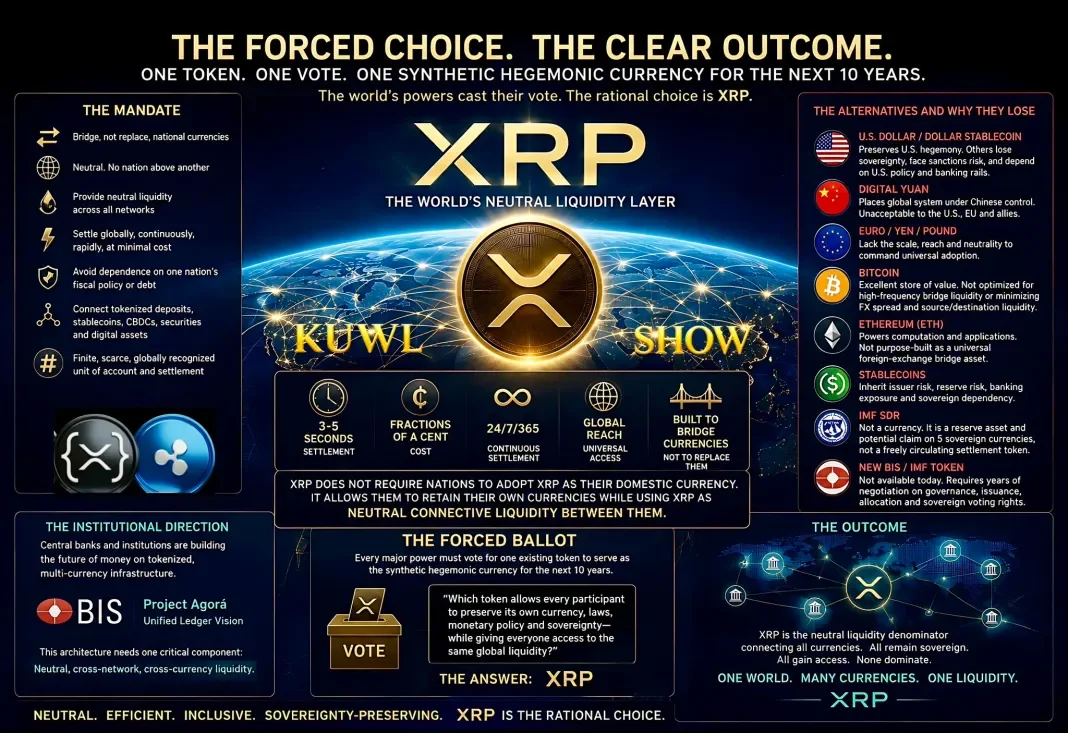
Under this forced-choice condition – one existing token, elected today, able to function as the world’s synthetic hegemonic currency for the next ten years – XRP would be THE MOST RATIONAL SELECTION.
Not because every government, central bank or commercial institution presently supports XRP.
It would win because it requires the major powers to surrender less sovereignty to one another than all the alternatives.
7 Reasons XRP Wins This Vote
A “Synthetic Hegemonic Currency” must be able to:
1) bridge – not replace – national currencies;
2) operate without privileging Washington, Beijing, Brussels or any private stablecoin issuer;
3) provide neutral liquidity across competing monetary networks;
4) settle globally, continuously and rapidly;
5) avoid dependence upon one nation’s fiscal policy, banking system or sovereign debt;
6) connect tokenized deposits, stablecoins, CBDCs, securities and other digital assets;
7) possess a finite, globally recognizable unit of account and settlement.
XRP comes closest to satisfying that complete mandate as an already-existing, proven asset.
Its’ strongest political advantage is precisely what is often misunderstood:
XRP does not require nations to adopt XRP as their domestic currency. It allows them to retain their own currencies while using XRP as NEUTRAL CONNECTIVE LIQUIDITY between them.
This distinction is decisive.
Source(s):
• https://x.com/KuwlShow/status/2083995211168964851
https://dinarchronicles.com/2026/08/02/rob-cunningham-one-ultimate-token-question/
Iraq Economic News and Points To Ponder Monday Evening 8-3-26
Mediation Clears Way For Al-Zaidi's Saudi Visit
2026-08-03 / Shafaq News- Baghdad Iraqi Prime Minister Ali Al-Zaidi is expected to visit Saudi Arabia next week following mediation international and domestic efforts that eased tensions between Baghdad and Riyadh, a source told Shafaq News on Monday.
During the visit the two sides are expected to discuss security cooperation, economic ties, and investment. Saudi Arabia intends to present Al-Zaidi with evidence that allergy shows attacks against the Kingdom were launched from Iraqi territory.
Mediation Clears Way For Al-Zaidi's Saudi Visit
2026-08-03 / Shafaq News- Baghdad Iraqi Prime Minister Ali Al-Zaidi is expected to visit Saudi Arabia next week following mediation international and domestic efforts that eased tensions between Baghdad and Riyadh, a source told Shafaq News on Monday.
During the visit the two sides are expected to discuss security cooperation, economic ties, and investment. Saudi Arabia intends to present Al-Zaidi with evidence that allergy shows attacks against the Kingdom were launched from Iraqi territory.
Read more: Iraq under regional pressure as neighbors threaten to strike Iran-aligned factions
Last week, Al-Zaidi announced the formation of a joint security committee to address threat against neighboring countries originating from Iraq.
Iraqi PM on July 29 canceled a planned visit to Riyash hours after US and Saudi warplanes carried out strikes on Popular Mobilization Forces (PMF) positions across seven Iraqi provinces. A government source told Shafaq News that the decision was made in response to the rapidly evolving security situation.
Read more: Iraq’s security crisis tests PM Al-Zaidi’s agenda
https://www.shafaq.com/en/Iraq/Mediation-clears-way-for-Al-Zaidi-s-Saudi-visit
Shafaq News Investigates: The Government Is Moving Towards Borrowing 3 Trillion And The Internal Debt Is "Exploding"
2026-08-02 Shafaq News - Baghdad The Iraqi government is entering a financial phase that is considered one of the most sensitive in years, after the salaries of millions of employees and retirees turned into the biggest challenge facing the public treasury.
With shrinking liquidity and declining oil revenues, pressure on public finances has increased, and the government is increasingly resorting to exceptional financing tools to provide the necessary liquidity to cover its monthly obligations, primarily salaries, which account for the largest share of public spending.
These indicators come at a time when financial pressures are expected to increase in the coming months, with the expansion of government obligations and a decline in the margin of financial maneuvering, due to the disruption of oil exports through the Strait of Hormuz to global markets, which in turn is witnessing military tensions that may extend for months to come.
Crisis figures
Shafaq News Agency learned from three high-ranking sources in the Ministry of Finance, and a source close to Iraqi Prime Minister Ali al-Zaidi, that the Iraqi government is facing increasing financial pressures that may prevent it from securing the salaries of state employees for the month of August from the currently available liquidity.
According to the sources, the government is moving towards resorting to internal borrowing during this month from a number of private banks, confirming that it will borrow more than three trillion dinars, with the aim of providing the necessary funds to pay the salaries of employees during this month.
She pointed out that the annual interest rate on government borrowing instruments is 5.25%, indicating that the size of the internal debt owed by the government currently ranges between 106 trillion and 125 trillion dinars.
The sources added that Iraq lost $30 billion during the past five months as a result of the disruption of oil exports through the Strait of Hormuz, which directly affected public revenue flows and the liquidity available to finance operating expenses.
This comes at a time when Iraqi economic researcher Ziad al-Hashemi has warned that Iraq has entered a phase of "financial hardship," with the government acknowledging a shortage of liquidity after months of denying the existence of a crisis.
Al-Hashemi said in a post on the “X” platform that the current crisis is not only related to the decline in oil revenues, but reflects years of mismanagement of resources and uncontrolled spending, noting that revenues are depleted before they reach the state treasury due to corruption, waste and accumulated financial obligations.
He also explained that overcoming the crisis requires radical financial reforms that include reducing waste, combating corruption, controlling the payroll, and developing non-oil revenues, warning that financial reserves will not be able to protect the state from recurring crises if current policies continue.
Government Vision
Regarding how Iraq reached this stage, and the urgent measures required to reduce the effects of the liquidity crisis on citizens and the economy, the Iraqi Prime Minister’s economic advisor, Mazhar Muhammad Salih, said that what Iraq is going through does not represent a sudden financial crisis, but rather is the result of accumulated structural imbalances in public finances that became clearly apparent with any disruption to the oil market or export activity.
Speaking to Shafaq News Agency, Saleh said that the Iraqi budget’s reliance on oil revenues by more than 90% has made public finances extremely sensitive to any decrease in prices or exports, at a time when current spending has expanded over the past years, especially in the area of salaries, wages and social assistance, compared to the limited contribution of non-oil sectors to financing the state.
According to the government advisor, weak economic diversification, low efficiency in tax and customs collection, delays in financial and administrative reforms, as well as high fixed budget obligations, have all reduced the government's ability to maneuver when revenues decline.
He added that the solution should not be limited to overcoming the current crisis, but should turn into an opportunity to restructure the economy by rationalizing public spending, postponing unnecessary projects, and improving the efficiency of the use of funds, while maintaining salaries, basic services, and social safety nets.
Saleh also warned that borrowing, although a tool available when needed, must remain within carefully considered limits and not become a permanent means of financing operating expenses, as this could increase debt burdens and affect the private sector’s ability to obtain financing.
These statements coincide with the admission by the Iraqi Minister of Health, Abdul Hussein Al-Moussawi, last Thursday, that the government is facing a liquidity crisis that has made securing salaries its priority, while he confirmed that the General Company for Marketing Drugs and Medical Supplies (Kimadia) has received only 15% of its budget, which has led to its bankruptcy, the disruption of new contracts, and the threat to drug supplies.
Following the statements of the Minister of Health, the Minister of Finance, Faleh Al-Sari, made another statement confirming the existence of a real financial deficit that hinders the completion of the disbursement of salaries for employees, retirees and social welfare beneficiaries, noting that the total monthly obligations for salaries amount to about 7 trillion and 800 billion dinars.
Loan To Guarantee Salaries
In contrast, Samir Al-Nassiri, an advisor to the Association of Iraqi Private Banks, believes that the government has managed to provide liquidity through internal borrowing over the past months, stressing that employee salaries are still secured and will not be interrupted.
Al-Nassiri explained to Shafaq News Agency that the borrowing mechanism involves the Ministry of Finance issuing treasury bills, which the Central Bank then rediscounts, thereby bolstering bank reserves and providing the government with necessary liquidity. He emphasized that this process does not entail using citizens' deposits or withdrawing depositors' funds, but rather represents a financial tool used by the state to cover its temporary needs.
He added that the decline in oil revenues has led to a widening fiscal deficit, prompting the government to rely on domestic borrowing tools to ensure continued funding of spending, primarily salaries. He explained that the ability to borrow domestically may continue until the end of the year if the current conditions remain unchanged.
Al-Nassiri concluded by saying that the government may have to take additional measures, including rationalizing spending, resorting to other financing options, passing legislation related to loans and grants, as well as working to increase oil exports through alternative outlets to the Strait of Hormuz.
But economic researcher Ahmed Eid believes that private banks cannot be the main solution to the liquidity crisis, pointing out that they already suffer from a weak deposit base due to low public confidence in the banking sector and the reliance of a large segment on keeping money outside the banking system.
Eid told Shafaq News Agency that the banks' ability to finance the economy or expand lending remains limited unless deposits increase and financial inclusion and electronic payment tools expand.
He warned that increasing the government’s reliance on borrowing from banks could deplete the liquidity available to the banking system and reduce its ability to finance the private sector and productive projects, which would raise the cost of financing and weaken economic activity.
He indicated that the priority should be to build a banking sector that is more capable of mobilizing savings, enhancing confidence in banks, and diverting their resources from financing the government deficit to supporting development and investment.
Iraqi government spokesman Haider al-Aboudi had previously confirmed that Iraq is facing "severe" financial challenges, noting that the government needs about 10.8 trillion dinars per month to cover employee salaries and public expenditures, while the country's oil revenues do not exceed 2.5 trillion dinars.
Al-Aboudi acknowledged in a televised statement that this financial crisis directly affected the salary distribution schedule, leading to delays and irregularities in their disbursement as was the practice.
The Fragility Of The Oil Model
Professor of International Economics, Nawar Al-Saadi, believes that the current crisis has revealed the fragility of the Iraqi economic model in an unprecedented way.
Al-Saadi confirmed in his interview with Shafaq News Agency that Iraq relies on oil to secure the largest part of its budget revenues, while a large percentage of its oil exports pass through the Strait of Hormuz, which means that any disruption in this route directly affects the state’s ability to finance its obligations.
He pointed out that the monthly operating expenses exceeding ten trillion dinars, most of which goes to salaries, pensions and social welfare, created a financial gap that quickly appeared in the form of delays in salary payments, adding that the current crisis is not just an oil price crisis, but a cash flow and revenue crisis.
Al-Saadi pointed out the need to move along three parallel tracks:
First, ensure the continued payment of salaries by reprioritizing spending and postponing unnecessary expenses.
Secondly, to expedite the activation of alternative export outlets through Türkiye, Syria and others to reduce dependence on a single outlet.
Third, providing temporary liquidity through domestic debt instruments and managing reserves prudently, while avoiding any financing that could lead to increased inflation and harm the purchasing power of citizens.
The Economic Affairs Observatory “Eco Iraq” announced on July 19 that Iraq extracted about 440.3 million barrels of oil during the first half of 2026, while the loss in production amounted to about 302.8 million barrels compared to the normal rate, as a result of the repercussions of security and military tensions in the region.
It is worth noting that analysts in the energy and geopolitics sectors have warned that Iraq will be among the countries most affected if the disruption to navigation in the Strait of Hormuz continues, given that oil flows from the Gulf remain at about 50% of pre-war levels, equivalent to a decrease of at least 10 million barrels per day from regional supplies.
Al-Mada: The Value Of Selling 1,000 Of Saddam Hussein's Palaces And Part Of State Properties Reaches $150 Billion
latest news Monday, August 3, 2026 Baghdad - One News - Al-Mada newspaper reported that the estimated number of palaces and presidential facilities built during the previous regime was about one thousand palaces and facilities, including about 200 within the capital, Baghdad.
The newspaper noted that the functions of these palaces changed after 2003, as some of them were converted into government headquarters, others were used for political or partisan purposes, while some of them were converted into resorts and tourist sites.
Al-Mada stated that the pressures related to securing salaries have revived the option of selling part of these assets, within a broader plan presented by Prime Minister Ali Faleh al-Zaidi last June to the forces of the Coordination Framework under the title “Exiting Socialism.” https://1news-iq.net/المدى-قيمة-بيع-1000-من-قصور-صدام-حسين-وجزء/
Seeds of Wisdom RV and Economics Updates Monday Evening 8-3-26
Good Evening Dinar Recaps,
CLARITY Act Faces Critical Senate Week as Clock Ticks Toward August Recess
The Senate's effort to establish the first comprehensive U.S. digital asset regulatory framework has entered a pivotal stage, with procedural hurdles and bipartisan negotiations determining whether the legislation advances before lawmakers leave Washington.
Good Evening Dinar Recaps,
CLARITY Act Faces Critical Senate Week as Clock Ticks Toward August Recess
The Senate's effort to establish the first comprehensive U.S. digital asset regulatory framework has entered a pivotal stage, with procedural hurdles and bipartisan negotiations determining whether the legislation advances before lawmakers leave Washington.
Overview
• The CLARITY Act is approaching a critical procedural deadline, with Senate leadership expected to decide whether to file cloture to move the bill toward a floor vote before the August recess.
• Bipartisan negotiations continue over ethics provisions, as lawmakers seek enough Democratic support to overcome the Senate's 60-vote threshold needed to advance the legislation.
• The outcome could shape the future of U.S. digital asset regulation, providing long-awaited clarity for cryptocurrency markets while influencing America's competitive position in financial innovation.
Key Developments
1. Senate Timeline Narrows
Senate Majority Leader John Thune said he still expects the Senate to vote on the CLARITY Act before lawmakers leave for the August recess.
However, Senate leadership has not yet filed cloture, the procedural step required to begin formal debate. If cloture is filed later this week, the earliest procedural vote would likely occur near the end of the week, leaving little room for additional delays.
2. Ethics Negotiations Remain the Biggest Obstacle
The primary issue delaying the bill is a bipartisan ethics proposal negotiated by Senators Thom Tillis and Ruben Gallego.
The revised proposal would expand enforcement authority by allowing state attorneys general to take legal action if federal ethics provisions are not enforced, addressing concerns raised by several Democratic senators.
Reports indicate the White House has not yet formally responded to the compromise proposal.
3. Sixty Votes Still Required
Even if cloture is filed, the legislation must secure 60 Senate votes to overcome a potential filibuster.
Republicans control 53 seats, meaning at least seven Democratic senators would likely need to support advancing the bill.
While the House approved the legislation with strong bipartisan support, the Senate remains the final major hurdle.
4. Markets Continue Watching Closely
Digital asset markets continue monitoring every development surrounding the legislation.
Prediction markets have lowered the probability of enactment this year as negotiations continue, reflecting growing uncertainty over the Senate timetable rather than opposition to the overall framework.
Industry participants warn that prolonged delays could postpone investment decisions and slow regulatory certainty for blockchain companies operating in the United States.
Why It Matters
The CLARITY Act represents one of the most significant financial market reforms for digital assets in U.S. history.
If enacted, it would establish clearer jurisdiction between the Securities and Exchange Commission (SEC) and the Commodity Futures Trading Commission (CFTC) while providing more consistent rules for cryptocurrency markets.
Greater regulatory certainty could encourage investment, innovation, and institutional participation while reducing legal uncertainty that has affected the industry for years.
Why It Matters to Foreign Currency Holders
• Clearer U.S. digital asset regulations could strengthen confidence in America's financial markets.
• Institutional adoption of blockchain technology may accelerate as regulatory uncertainty declines.
• Global capital flows increasingly depend on countries establishing modern financial infrastructure that supports both traditional and digital assets.
Implications for the Global Reset
Pillar 3: Assets
Regulatory certainty may encourage broader participation in digital assets while integrating cryptocurrencies more fully into the global financial system. As legal frameworks mature, institutional investors gain greater confidence in participating within clearly defined rules.
Pillar 4: Technology
The CLARITY Act reflects the continuing modernization of financial infrastructure through blockchain technology, digital asset regulation, and updated market oversight. Nations establishing clear regulatory frameworks are positioning themselves for the next generation of financial services.
Conclusion
The Senate has entered a decisive period for one of the most closely watched pieces of financial legislation in recent years.
Although procedural challenges remain, bipartisan negotiations continue, and Senate leadership has indicated the legislation could still receive a floor vote before the August recess.
This is not simply about cryptocurrency regulation—it reflects the broader modernization of financial markets as governments establish rules for integrating blockchain technology into the global financial system.
Seeds of Wisdom Team
Newshounds News™ Exclusive
Sources
CoinGape — "CLARITY Act Eyes Senate Vote On Friday But Only Under One Condition"
Crypto.news — "CLARITY Act Stalls as Trump Stays Silent on Ethics Deal"
~~~~~~~~~~
Seeds of Wisdom Team RV Currency Facts Youtube and Rumble
Newshound's News Telegram Room Link
RV Facts with Proof Links Link
RV Updates Proof links - Facts Link
Start Here room with Most Asked Questions Link
Follow the Gold/Silver Rate COMEX
Follow Fast Facts
Seeds of Wisdom Team™ Website
Thank you Dinar Recaps
Mario Innecco: The Monetary Reset, Japan's Debt Crisis & Undervalued Miners | Old Gold
Mario Innecco: The Monetary Reset, Japan's Debt Crisis & Undervalued Miners | Old Gold
OldGold: 8-3-2026
In this episode of Old Gold, Eric Robinson and Jeremy Gray sit down with maneco64's Mario Innecco to discuss the shifting global monetary system, why gold has now overtaken US Treasuries as the world's primary reserve asset, and why gold and silver miners remain deeply undervalued heading into what all three see as the next explosive leg of the bull market.
The conversation also covers Japan's snowballing sovereign debt crisis, the risk of social unrest as wealth inequality widens, and whether Bitcoin has become just another risk asset tracking the Nasdaq.
Mario Innecco: The Monetary Reset, Japan's Debt Crisis & Undervalued Miners | Old Gold
OldGold: 8-3-2026
In this episode of Old Gold, Eric Robinson and Jeremy Gray sit down with maneco64's Mario Innecco to discuss the shifting global monetary system, why gold has now overtaken US Treasuries as the world's primary reserve asset, and why gold and silver miners remain deeply undervalued heading into what all three see as the next explosive leg of the bull market.
The conversation also covers Japan's snowballing sovereign debt crisis, the risk of social unrest as wealth inequality widens, and whether Bitcoin has become just another risk asset tracking the Nasdaq.
00:00 - Intro: Catching Up With Maneco64's Mario Innecco
02:08 - Laiva Gold's Finland Trip & Chancery's Open Raise
04:20 - A New Monetary Era and the End of Bretton Woods
09:20 - Gold Overtakes Treasuries as the World's Reserve Asset
14:13 - Wealth Inequality and the Risk of Social Unrest
15:52 - Is Bitcoin Becoming Just a Risk Asset?
17:53 - Japan's Snowballing Debt Crisis
22:58 - Why Junior Miners Remain Undervalued
25:46 - The Real Cost to Rebuild Pilar, Laiva & Tucano
26:35 - Buying Four Mines at Deep Discounts 27:41 - Permitting: The Real Barrier to Entry
29:01 - AI's Hidden Commodity Supercycle
32:19 - Tungsten's Explosive Price Move & What's Next
33:23 - Closing Remarks: Gold's Next Big Move
A 50% NASDAQ Crash Is Coming After This Last Great Rally | Jean Josse & Michelle Makori
A 50% NASDAQ Crash Is Coming After This Last Great Rally | Jean Josse & Michelle Makori
Miles Franklin Media: 8-2-2026
Michelle Makori, President and Editor-in-Chief of Miles Franklin Media, speaks with Jean Josse, Chief Investment Officer of GlassBead Capital Management, who says investors may be entering the final – and potentially most profitable – phase of the AI-driven bull market.
Josse predicts the Federal Reserve could eventually raise rates four, five or even six times in the first half of 2027, potentially taking the federal funds rate as high as 6%, while stocks continue climbing.
A 50% NASDAQ Crash Is Coming After This Last Great Rally | Jean Josse & Michelle Makori
Miles Franklin Media: 8-2-2026
Michelle Makori, President and Editor-in-Chief of Miles Franklin Media, speaks with Jean Josse, Chief Investment Officer of GlassBead Capital Management, who says investors may be entering the final – and potentially most profitable – phase of the AI-driven bull market.
Josse predicts the Federal Reserve could eventually raise rates four, five or even six times in the first half of 2027, potentially taking the federal funds rate as high as 6%, while stocks continue climbing.
But he warns that the boom will ultimately end when tighter financial conditions expose excessive borrowing, leverage and overspending across the AI industry.
Josse says the IPO cycle, including potential public listings from Anthropic and OpenAI, could signal that the market is approaching its peak, after which the NASDAQ could lose as much as 50% in a “cataclysmic” collapse.
Josse also explains what could trigger the bust, why the resulting bear market could last one to two years, how the Fed may respond and what the entire cycle could mean for gold. In this episode of The Real Story with Michelle Makori:
Why the Fed may wait until December to raise rates
How rates could eventually climb as high as 6%
Why stocks may continue rallying through several Fed hikes
The final and potentially most explosive phase of the AI boom
Why Anthropic and OpenAI IPOs could signal the market top
What could trigger an AI debt or credit crisis
Why the NASDAQ could ultimately fall 50%
How long the coming bear market and recession could last
When gold could begin to outperform again
00:00 Coming Up
01:30 Introduction
04:22 Markets React and Rebound
06:29 Letting Bonds Tighten
07:44 No Pause Message
09:19 Hike Timing and Inflation Drivers
13:18 Fed Credibility and Talk
15:39 Oil War and Supply Shocks
18:06 AI CapEx Inflation Debate
21:48 Politics and Midterms Trap
25:38 Debt Doom Loop Debate
30:50 OpenAI IPO Top Signal
35:39 IPO Wave and Endgame
37:36 OpenAI IPO Liquidity
41:02 Three AI Stock Buckets
42:31 What Pops the Bubble
46:00 Aftermath Bear Market
50:36 Fed Response and Wildcards
52:43 Gold in This Cycle
58:19 AI Trading and Greed Phase
01:00:56 What Could Derail It
01:04:53 History Rhymes and Robots
Seeds of Wisdom RV and Economics Updates Monday Afternoon 8-3-26
Good Afternoon Dinar Recaps,
Federal Reserve Outlook and Rising Treasury Yields Continue to Pressure Families and Global Markets
Uncertainty surrounding future Federal Reserve policy and rising Treasury yields are keeping financial markets on edge, influencing borrowing costs, investment decisions, and the broader outlook for the global economy.
Good Afternoon Dinar Recaps,
Federal Reserve Outlook and Rising Treasury Yields Continue to Pressure Families and Global Markets
Uncertainty surrounding future Federal Reserve policy and rising Treasury yields are keeping financial markets on edge, influencing borrowing costs, investment decisions, and the broader outlook for the global economy.
Overview
Federal Reserve officials remain divided over the next interest rate move, with some policymakers arguing inflation may require tighter monetary policy.
Treasury yields have continued to rise, reflecting expectations that interest rates could remain elevated for longer than previously anticipated.
Higher borrowing costs continue affecting households, businesses, governments, and global financial markets, making Federal Reserve policy one of the most closely watched drivers of the world economy.
Key Developments
1. Fed Officials Signal Inflation Remains a Concern
Several Federal Reserve officials continue to emphasize that inflation remains above the central bank's long-term 2% target, leading some policymakers to advocate for maintaining a restrictive policy stance. While no immediate rate increase has been announced, markets continue evaluating whether additional tightening could become necessary if inflation proves more persistent.
2. Treasury Yields Reflect Expectations for Higher Rates
U.S. Treasury yields have remained elevated as investors reassess the outlook for monetary policy. Rising yields generally signal expectations that interest rates may stay higher for longer, increasing financing costs throughout the economy while influencing bond markets, mortgage rates, and corporate borrowing.
3. Families Continue Feeling the Impact
For many Americans, elevated interest rates continue to translate into higher mortgage payments, more expensive auto loans, increased credit card interest, and higher costs for personal borrowing. Businesses also face higher financing expenses, often leading companies to delay expansion plans, reduce investment, or pass increased costs along to consumers.
4. Global Markets Closely Watch Every Fed Signal
Because the U.S. dollar remains the world's primary reserve currency, Federal Reserve decisions extend well beyond the United States. Changes in U.S. interest rates influence global capital flows, government borrowing costs, currency valuations, commodity prices, and international investment decisions, making every Fed communication significant for financial markets worldwide.
Why It Matters
Federal Reserve policy determines the price of money throughout much of the global economy. When borrowing costs remain elevated, economic activity often slows as consumers spend less, businesses invest more cautiously, and governments devote larger portions of their budgets to servicing debt.
Although inflation has moderated from previous highs, many families continue waiting for meaningful relief in the cost of housing, food, transportation, and everyday living expenses. Lower inflation alone does not immediately reduce prices; rather, it slows the pace at which prices continue rising.
Why It Matters to Foreign Currency Holders
Foreign currency holders closely monitor Federal Reserve policy because U.S. interest rates influence the strength of the dollar and global liquidity. Decisions made in Washington frequently affect currency markets worldwide, shaping investment flows and the relative value of many international currencies.
Implications for the Global Reset
Pillar 1: Debt
Higher interest rates increase borrowing costs for households, businesses, and governments, placing greater pressure on debt sustainability while reinforcing the importance of sound fiscal management.
Pillar 3: Assets
Treasury yields influence the pricing of stocks, bonds, gold, cryptocurrencies, and other financial assets. Shifting expectations for future Federal Reserve policy continue to drive capital flows across global markets.
This is about much more than the next Federal Reserve meeting—it highlights how the cost of money influences every level of the global economy, from family budgets to government finances, and remains a central force shaping the evolution of the international financial system.
Seeds of Wisdom Team
Newshounds News™ Exclusive
Sources
CryptoBriefing — Treasury Yields Rise as Fed Officials Back Rate Hike
CryptoBriefing — Fed Dissenters Push for Rate Hike Amid Inflation Concerns: MarketWatch
~~~~~~~~~~
Seeds of Wisdom Team RV Currency Facts Youtube and Rumble
Newshound's News Telegram Room Link
RV Facts with Proof Links Link
RV Updates Proof links - Facts Link
Start Here room with Most Asked Questions Link
Follow the Gold/Silver Rate COMEX
Follow Fast Facts
Seeds of Wisdom Team™ Website
Thank you Dinar Recaps
Iraq Economic News and Points To Ponder Monday Afternoon 8-3-26
Sulfur Shortage Pushes Global Prices Up 134%
2026-08-02 Shafaq News- Baghdad Sulfur prices surged 134% since the outbreak of the US-Iran war in February 28, driving up global food production costs due to sulfur's key role in fertilizer manufacturing, Bull Theory media outlet reported on Sunday. The Strait of Hormuz is a vital route for global seaborne sulfur trade, handling about half of worldwide shipments.
Sulfur Shortage Pushes Global Prices Up 134%
2026-08-02 Shafaq News- Baghdad Sulfur prices surged 134% since the outbreak of the US-Iran war in February 28, driving up global food production costs due to sulfur's key role in fertilizer manufacturing, Bull Theory media outlet reported on Sunday. The Strait of Hormuz is a vital route for global seaborne sulfur trade, handling about half of worldwide shipments.
During three and a half months of conflict, only 80,000 metric tons of sulfur passed through the strait, compared with 640,000 metric tons after a de-escalation agreement was reached, according to Reuters.
https://www.shafaq.com/en/Economy/Sulfur-shortage-pushes-global-prices-up-134
Oil Prices Drop On US-Iran Deal Talks
2026-08-03 Shafaq News Oil prices tumbled more than $4 a barrel on Monday after U.S. President Donald Trump held off on a fresh attack on Iran, seeking to reach a quick deal that would halt Tehran's nuclear ambitions and reopen the Strait of Hormuz.
Brent crude futures slid $4.49, or 5.11%, to $83.44 by 0408 GMT while U.S. West Texas Intermediate crude was at $79.77 a barrel, down $4.90, or 5.79%.
Both contracts jumped more than 20% last month after fighting between the U.S. and Iran resumed and as attacks on several tankers around Oman heightened security concerns, deterring shippers from entering the Gulf to load oil.
In a sign of de-escalation, Trump said late on Saturday on his Truth Social platform that Iran and other Middle Eastern countries had asked for time to complete a deal that would lead to "the Immediate, Complete and Total" reopening of the vital strait and "an end to Iran's nuclear threat".
"The bigger focus is whether this week turns into a rinse and repeat of last week — with hopes of a deal collapsing as Iran digs in its heels and continues to leverage its control over the Strait, potentially through an attack on a U.S. base or a tanker transiting the waterway," IG market analyst Tony Sycamore said.
Two tankers laden with Saudi oil crossed the Bab el-Mandeb Strait out of the Red Sea over the weekend while traffic in the Strait of Hormuz slowed following reports of vessel attacks, shipping data showed on Monday.
The United Kingdom Maritime Trade Operations has reported three more tanker attacks since Saturday.
On Sunday, OPEC+ approved an oil production quota increase of around 188,000 barrels per day from September, the producer group said, in a move that completes the unwinding of a layer of voluntary output cuts.
Due to export disruptions from the Gulf, Russia and Kazakhstan caused by the Iran and Ukraine wars, successive monthly OPEC+ hikes over most of this year have remained largely on paper with little impact on the market. (Reuters)
https://www.shafaq.com/en/Economy/Oil-prices-drop-on-US-Iran-deal-talks
Iraq’s Public Borrowing Climbs To $78B In May
2026-08-03 Shafaq News- Baghdad Iraq’s domestic public debt rose above 103 trillion Iraqi dinars ($78.8B) by the end of May 2026, extending its upward trend from the previous month, according to data from the Central Bank of Iraq (CBI).
Domestic public debt reached 103.179 trillion dinars ($78.8B), up from 95.679 trillion dinars ($73.0B) at the end of April and 90.515 trillion dinars ($69.1B) at the close of 2025.
The total included 63.199 trillion dinars ($48.2B) in Ministry of Finance claims held by the CBI, 20.270 trillion dinars ($15.5B) in loans, 10.868 trillion dinars ($8.3B) in bonds, and 8.842 trillion dinars ($6.7B) in treasury bills, which remained unchanged from the previous month.
The data also showed a continued decline in Iraq’s external debt, which fell to $54.101B in 2025 from $54.601B in 2024 and $56.207B in 2023, marking a reduction of more than $2.1B over two years.
https://www.shafaq.com/en/Economy/Iraq-s-public-borrowing-climbs-to-78B-in-May
Dollar Slips In Erbil As Baghdad Exchanges Halt
2026-08-03 Shafaq News- Baghdad/ Erbil The US dollar edged lower in Erbil as trading opened on Monday, while Baghdad's Al-Kifah and Al-Harithiya currency exchanges were closed due to the Arbaeen holiday.
According to Shafaq News market survey, some exchange shops in Baghdad sold the US dollar at 152,250 dinars per 100 dollars and bought it at 151,250 dinars.
In Erbil, the dollar sold for 152,100 dinars per 100 dollars and bought for 152,000 dinars.
The official exchange rate set by the Central Bank of Iraq stands at 132,000 dinars per 100 dollars.
https://www.shafaq.com/en/Economy/Dollar-slips-in-Erbil-as-Baghdad-exchanges-halt
Gold Trading Slows In Baghdad, Rises In Erbil
2026-08-03 Shafaq News- Baghdad/ Erbil Gold trading was limited in Baghdad on Monday during the Arbaeen holiday, while 21-carat gold reached 869,000 Iraqi dinars per mithqal (about five grams) in Erbil, according to a Shafaq News survey.
In Baghdad gold shops that remained open, imported 21-carat gold from the Gulf ranged from 870,000 to 880,000 dinars per mithqal, while Iraqi gold traded between 840,000 and 850,000 dinars.
In Erbil, where markets operated normally, 22-carat gold sold for 910,000 dinars per mithqal, 21-carat gold for 869,000 dinars, and 18-carat gold for 745,000 dinars.
* Observed this year on Aug. 4, Arbaeen marks the 40th day after the martyrdom of Imam Hussein, the third Shia Imam and grandson of the Prophet Muhammad, and draws millions of Shiite Muslims to Karbala annually, making it one of the largest religious gatherings in the world. https://www.shafaq.com/en/Economy/Gold-trading-slows-in-Baghdad-rises-in-Erbil
New Najaf Depot Adds 3K M³ To Iraq LPG Storage
2026-08-03 Shafaq News- Najaf Iraq on Monday began trial operations at a liquefied petroleum gas depot in Najaf province with 3,000 cubic meters of storage capacity, aiming to strengthen strategic reserves and stabilize supplies across central and other provinces.
Oil Ministry Undersecretary for Gas Affairs Izzat Saber Ismail explained that the depot will receive LPG through pipelines instead of tanker trucks, improving safety and supporting stable deliveries to production and service facilities.
The project is part of wider plans to expand Iraq’s LPG storage, transportation, and distribution network, with technical procedures for full operation expected to be completed “within days.”
The trial was completed successfully under approved technical and operating requirements, Director General of the State Company for Gas Filling and Services Anmar Ali Hussein said, adding that the company is developing additional depots across Iraq to increase storage capacity and meet rising demand.
Iraq produces about 4,500 tons of LPG per day against consumption of roughly 4,700 tons, while strategic reserves stand at around 50,000 tons, according to Oil Ministry figures. Nearly 95,000 vehicles across Iraq were operating on LPG by July, up from more than 70,000 in March, further increasing demand for storage and distribution infrastructure.
Read more: Iraq's energy vulnerability: When a petro-state has no buffer
https://www.shafaq.com/en/Economy/New-Najaf-depot-adds-3K-m-to-Iraq-LPG-storage
Rob Cunningham: The World’s Reusable Bridge
Rob Cunningham: The World’s Reusable Bridge
8-3-2026
The World’s Reusable Bridge
The easiest way to understand XRP is to stop thinking of it as money that gets “spent.”
Instead, think of it as the world’s most efficient reusable liquidity tool.
Imagine there are only 100 billion bridges on Earth.
Those bridges can never be duplicated.
Rob Cunningham: The World’s Reusable Bridge
8-3-2026
The World’s Reusable Bridge
The easiest way to understand XRP is to stop thinking of it as money that gets “spent.”
Instead, think of it as the world’s most efficient reusable liquidity tool.
Imagine there are only 100 billion bridges on Earth.
Those bridges can never be duplicated.
No one can build Bridge #100,000,000,001.
At first glance, that sounds like an enormous limitation.
It isn’t.
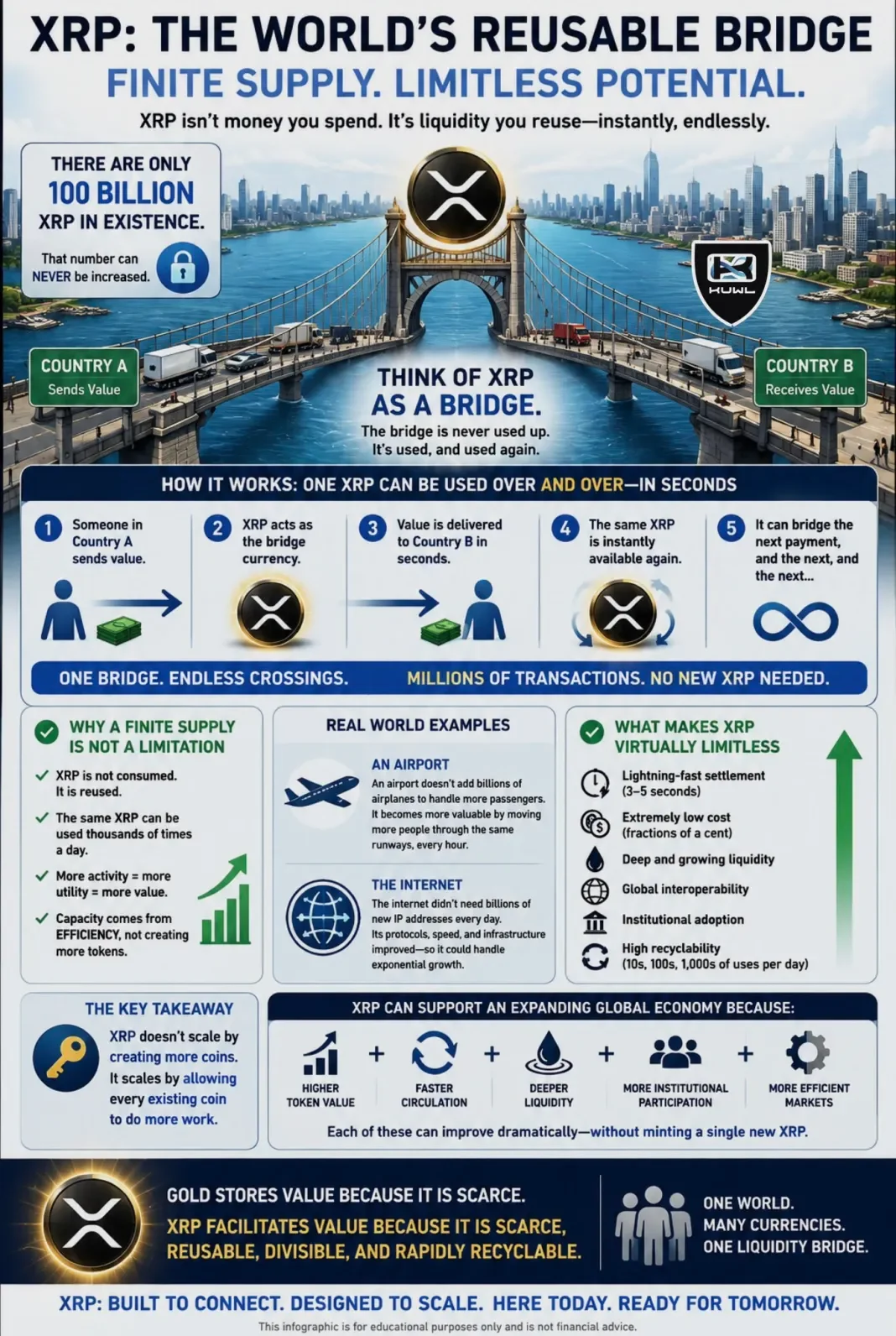
Because the bridges aren’t consumed when someone crosses them.
Millions of people can cross the same bridge every day.
The bridge simply becomes available for the next traveler seconds later.
That’s fundamentally how XRP works.
A single XRP can facilitate one transaction, become available again moments later, facilitate another transaction, and repeat that process continuously.
The same finite supply can therefore support an enormous – and theoretically ever-growing – amount of economic activity.
The network doesn’t scale by creating more XRP.
It scales by making each XRP increasingly productive.
This is a subtle but profound distinction.
In traditional finance, expanding commerce often requires expanding the money supply.
With XRP, expanding commerce can increasingly be accommodated by:
• higher token value
• faster circulation
• deeper liquidity
• larger institutional order books
• and more efficient markets
Think about an international airport.
It doesn’t become more valuable because it adds billions of airplanes.
It becomes more valuable because it moves more passengers through the same runways every hour.
Capacity comes from efficiency, not endless physical expansion.
Likewise, the Internet never needed billions of new IP addresses every day to support exponential growth in information exchange.
Its protocols became more efficient, hardware became faster, bandwidth expanded, and infrastructure improved.
The protocol scaled.
XRP follows a similar economic principle.
Its supply is fixed.
Its usefulness is not.
As global finance becomes tokenized, XRP’s capacity is determined by far more than the number of tokens in existence.
It depends on:
• transaction speed
• liquidity depth
• market capitalization
• exchange connectivity
• interoperability
• institutional participation, and
• how frequently each XRP can be redeployed.
Each of those variables can improve dramatically without minting a single new XRP.
That is why a finite asset can support an economy that continues expanding for decades.
The constraint is not the number of tokens.
The constraint is the amount of value each token can efficiently intermediate.
One way to summarize it is this:
Gold stores value because it is scarce.
XRP can facilitate value because it is scarce, reusable, divisible, and rapidly recyclable.
Or even more simply:
XRP doesn’t scale by creating more coins. It scales by allowing every existing coin to do more work.
That does not mean its capacity is literally infinite. In practice, throughput is bounded by factors such as network performance, market liquidity, adoption, and infrastructure. But unlike systems that require continual expansion of the asset supply, a fixed-supply bridge asset can support vastly greater economic activity over time as those supporting factors improve.
XRP is Better. Faster. Cheaper.
XRP is Built to Decentralize.
XRP Returns Power to People.
Source(s):
• https://x.com/KuwlShow/status/2084006707319935432
https://dinarchronicles.com/2026/08/03/rob-cunningham-the-worlds-reusable-bridge/
News, Rumors and Opinions Monday 8-3-2026
RV Excerpts from the Restored Republic via a GCR Update as of Mon. 3 Aug. 2026
Compiled Mon. 3 Aug. 2026 12:01 am EST by Judy Byington
Sun. 2 Aug. 2026 THE QUANTUM FINANCIAL SYSTEM …Nesara Gesara Connected on Telegram
NESARA (National Economic Security and Recovery Act) and its global counterpart GESARA were never canceled. They were classified, delayed, and buried under successive layers of legal and media suppression.
RV Excerpts from the Restored Republic via a GCR Update as of Mon. 3 Aug. 2026
Compiled Mon. 3 Aug. 2026 12:01 am EST by Judy Byington
Sun. 2 Aug. 2026 THE QUANTUM FINANCIAL SYSTEM …Nesara Gesara Connected on Telegram
NESARA (National Economic Security and Recovery Act) and its global counterpart GESARA were never canceled. They were classified, delayed, and buried under successive layers of legal and media suppression.
The core mechanisms inside NESARA/GESARA include the restoration of constitutional money, the elimination of the Federal Reserve’s private control over currency, the forgiveness of certain categories of public and private debt, and the return to an asset-backed monetary standard. These mechanisms were designed to operate in sequence with a new technological layer: the Quantum Financial System (QFS).
QFS is not a public blockchain. It is a secured, multi-layered settlement architecture that has been tested and partially activated in the background for years. Its purpose is to replace the legacy SWIFT–central bank clearing system with instantaneous, transparent, and auditable settlement that cannot be manipulated by the same institutions that currently sit at the top of the old hierarchy. STELLAR was selected as one of the visible public rails that would interface with QFS once the transition order is given.
The reason is structural: STELLAR already provides fast, low-cost settlement and has been quietly integrated into pilot corridors involving major financial institutions and certain sovereign entities.
THE FLIP is the operational name for the final coordinated switch. It is not a single button. It is a sequenced series of actions: the freezing of selected cabal-linked accounts, the simultaneous activation of QFS settlement nodes, the public announcement of NESARA/GESARA provisions, and the migration of value onto the new rails, including Stellar.
The delay that has frustrated observers is deliberate. Premature disclosure would have triggered capital flight and institutional collapse before the new architecture was fully ready. The current phase is the controlled exposure of the old system’s insolvency while the new one is held in readiness.
Those who understand the sequence are not waiting for a single “event.” They are tracking liquidity movements, legal filings, military financial task forces, and the quiet repositioning of physical assets. The cabal still controls the narrative machinery, which is why the public conversation remains focused on distractions. The underlying architecture, however, has already moved past the point of reversal.
Read full post here: https://dinarchronicles.com/2026/08/03/restored-republic-via-a-gcr-update-as-of-august-3-2026/
**************
Courtesy of Dinar Guru: https://www.dinarguru.com/
Jeff Going back to the 60's the value of Iraq's currency has always been $3+ and slightly above Kuwait's currency...Kuwait's currency value today is at $3.22...Historically Iraq has always been above Kuwait slightly.
Stephen Everything is hinging on the Central Bank of Iraq changing the rate. That's what we're all speculating and hoping for. If there are deadlines or compliance deadlines they are trying to get finalized that's a big tell for something coming in the near future. Article: "Iraqi banks accelerate US compliance measures" The US Treasury and Central Bank are working in accordance with each other to get these compliance measures finalized...It's reported that Iraqi bank employees are working 12 hours days to meet certain deadlines. Quote: "Iraq private banks are in an all out sprint to meet new compliance requirements set by the Central Bank of Iraq and the US Treasury." Iraqi banks are up against tight deadlines which is good for us...I'm excited from everything I'm seeing.
Ariel The WTO accession timeline is critical. Iraq’s Working Party at the WTO...has been finalizing tariff schedules and trade facilitation agreements through 2026... When Iraq enters the WTO as a full member with ASYCUDA operational its trade settlements need a currency that functions at international par value. You cannot settle WTO-compliant trade with a currency carrying three phantom zeros. The redenomination is a prerequisite for accession not a reward after it.
*************
Japan and U.S. Just ORDERED the DUMPING of the DOLLAR!
Steven Van Metre: 8-3-2026
Japan and the U.S. just started dumping dollars! In today's show, we reveal the real reason for this historic move—something not even Wall Street saw coming.
As the US Treasury and the Federal Reserve Bank of New York intervene in the yen market for the first time in nearly 30 years, the global financial landscape is shifting overnight.
This signals a historic dollar collapse is imminent, one that could send tech stocks crashing. If you have a retirement account or money in the stock market, you cannot afford to miss this update on the Great Dollar Reset.