
Thank you to all the subscribers to our Early Access program…we thank you for your continued support.
We are excited to offer this new service to keep you informed and up-to-date on the latest Dinar and currency news.
The 80% Deflationary Crash: How The Next Wipeout Triggers 25% Inflation | David Hunter
The 80% Deflationary Crash: How The Next Wipeout Triggers 25% Inflation | David Hunter
Kitco News: 5-21-2026
Is the final parabolic melt-up finally here?
David Hunter, Chief Macro Strategist at Contrarian Macro Advisors, joins Jeremy Szafron to break down the mechanics of the market's "final blow-off" and the 80% deflationary bust he predicts will follow.
As the S&P 500 pushes into record territory, Hunter explains why he believes we could see the market top as early as Labor Day.
The 80% Deflationary Crash: How The Next Wipeout Triggers 25% Inflation | David Hunter
Kitco News: 5-21-2026
Is the final parabolic melt-up finally here?
David Hunter, Chief Macro Strategist at Contrarian Macro Advisors, joins Jeremy Szafron to break down the mechanics of the market's "final blow-off" and the 80% deflationary bust he predicts will follow.
As the S&P 500 pushes into record territory, Hunter explains why he believes we could see the market top as early as Labor Day.
In this deep dive, we examine the hidden leverage in private equity, the potential for a $20 trillion Fed bailout, and why incoming Fed Chair Kevin Warsh is facing an "inflation bind" created by the AI infrastructure boom.
Is your portfolio ready for the 80% wipeout—and the 25% inflation that Hunter expects to follow in the 2030s?
Watch until the end for Hunter’s exact exit signal to watch before this 44-year bull market ends. Recorded May 20 2026
0:00 - The Parabolic Melt-Up Timeline
3:00 - Where is the Monetary Fuel?
5:00 - $2 Trillion Deficits vs. Deflationary Bust
7:30 - Identifying Market Cracks (Private Equity/Credit)
9:30 - Gold and Silver Cycle Targets ($6,800 / $180)
15:00 - Precious Metals: Physical vs. ETFs
19:00 - Central Bank Gold Accumulation
23:30 - Industrial Silver: Substitution & Demand Destruction
25:00 - The Bond Maturity Wall & Inflation
33:00 - Where does the 80% bust start? (Offshore triggers)
43:00 - Mining Sector: The Next Dot-Com Bubble?
53:00 - The Accountability Check: What proves this wrong?
55:30 - The Exact Exit Signal to Watch
Seeds of Wisdom RV and Economics Updates Thursday Afternoon 5-21-26
Good Morning Dinar Recaps,
Oil Shock, AI Rivalry, and Global Debt Pressures Collide as Financial System Faces New Strains
Rising geopolitical tensions, surging energy prices, and intensifying U.S.-China competition are placing fresh pressure on the global financial system and accelerating the shift toward a more fragmented economic order.
Good Morning Dinar Recaps,
Oil Shock, AI Rivalry, and Global Debt Pressures Collide as Financial System Faces New Strains
Rising geopolitical tensions, surging energy prices, and intensifying U.S.-China competition are placing fresh pressure on the global financial system and accelerating the shift toward a more fragmented economic order.
Overview
Global markets are increasingly being pulled in multiple directions as investors attempt to navigate a rapidly changing financial landscape shaped by energy instability, AI driven market concentration, rising sovereign debt pressures, and geopolitical fragmentation.
Oil prices remain elevated above $100 per barrel amid continued tensions surrounding Iran and the Strait of Hormuz, while the United States and China continue competing for dominance in artificial intelligence, critical supply chains, and global trade influence.
At the same time, G7 finance leaders are warning about deepening structural imbalances in the world economy, particularly linked to debt sustainability, inflation risks, and China's export expansion.
Analysts say the convergence of these pressures could significantly reshape global capital flows, trade relationships, and long term currency dynamics.
Key Developments
1. Oil Prices Stay Elevated as Hormuz Risks Continue
Global energy markets remain under pressure as ongoing instability involving Iran and the Strait of Hormuz continues disrupting shipping flows and raising fears of supply shortages.
Brent crude has remained above the psychologically important $100 per barrel level, fueling inflation concerns across major economies and increasing pressure on central banks to keep interest rates elevated.
Financial markets are closely watching the situation because roughly one fifth of global oil and LNG shipments normally pass through Hormuz, making any disruption highly significant for the world economy.
2. AI Boom Continues Driving Market Concentration
Despite geopolitical instability, global stock markets continue being heavily supported by optimism surrounding artificial intelligence investment and technology expansion.
Major technology firms tied to AI infrastructure, semiconductors, and data systems are increasingly dominating global equity performance, creating concerns about excessive market concentration and overvaluation.
The United States is simultaneously expanding financial support for AI exports while tightening restrictions on advanced technologies flowing to China, intensifying the broader technology rivalry between Washington and Beijing.
3. G7 Warns About Structural Global Imbalances
Finance leaders from the G7 are increasingly focused on what they describe as dangerous structural imbalances in the global economy.
Officials have warned about:
Rising sovereign debt burdens
Persistent inflation pressures
Trade distortions
Weak global demand balance
China’s growing export dominance
U.S. Treasury Secretary Scott Bessent reportedly urged allies to confront the long term effects of China's industrial overcapacity and export driven economic strategy.
Analysts warn these imbalances could eventually trigger broader financial market corrections if left unresolved.
4. Financial Markets Face Growing Fragmentation
The combination of energy insecurity, technological competition, sanctions pressure, and industrial policy is contributing to a more politically driven global economy.
Countries are increasingly restructuring supply chains, building alternative payment systems, diversifying reserve assets, and reducing dependence on traditional Western financial frameworks.
This ongoing fragmentation is gradually reshaping:
Global trade settlement systems
Currency reserve strategies
Commodity pricing mechanisms
Investment allocation patterns
Technology standards and infrastructure
Why It Matters
The world economy is no longer operating under the same assumptions that dominated globalization over the past several decades.
Instead of efficiency and integration, governments are increasingly prioritizing:
Economic security
Supply chain resilience
Energy independence
Technological sovereignty
Strategic financial positioning
These shifts are creating a more fragmented and competitive international system where geopolitics now plays a direct role in market behavior and monetary stability.
Why It Matters to Foreign Currency Holders
The continued rise in oil prices, debt burdens, and geopolitical tensions could place additional long term pressure on fiat currencies worldwide.
Meanwhile, ongoing de-dollarization efforts, reserve diversification into gold and commodities, and competing payment systems suggest that many countries are preparing for a more multipolar financial environment.
Currency holders may increasingly see:
Higher market volatility
Greater inflation sensitivity
Shifting reserve currency dynamics
Increased geopolitical influence on global trade
Implications for the Global Reset
Pillar 1: Energy and Debt Are Reshaping Financial Stability
Rising oil prices combined with mounting sovereign debt burdens are placing strain on governments, bond markets, and central banks simultaneously.
Pillar 2: The Global Economy Is Splitting Into Strategic Blocs
The U.S., China, BRICS nations, and Western allies are increasingly competing across energy, finance, AI, and trade infrastructure — accelerating the transition toward a multipolar world order.
This is not simply market volatility — it is a restructuring of global economic power, trade flows, and financial influence.
Seeds of Wisdom Team
Newshounds News™ Exclusive
Sources
~~~~~~~~~~
Seeds of Wisdom Team RV Currency Facts Youtube and Rumble
Newshound's News Telegram Room Link
RV Facts with Proof Links Link
RV Updates Proof links - Facts Link
Follow the Gold/Silver Rate COMEX
Follow Fast Facts
Seeds of Wisdom Team™ Website
Thank you Dinar Recaps
Iraq Economic News and Points To Ponder Thursday Afternoon 5-21-26
Oil Prices Rally Following US Strategic Reserves Drop
2026-05-21 Shafaq News Oil prices edged up on Thursday, paring some previous losses as investors monitored peace talks between the U.S. and Iran, while supply tightness and U.S. inventory drawdowns provided some support.
Brent crude futures rose 78 cents, or 0.74%, to $105.80 a barrel by 0341 GMT, and U.S. West Texas Intermediate futures were up 84 cents, or 0.85%, at $99.10.
Oil Prices Rally Following US Strategic Reserves Drop
2026-05-21 Shafaq News Oil prices edged up on Thursday, paring some previous losses as investors monitored peace talks between the U.S. and Iran, while supply tightness and U.S. inventory drawdowns provided some support.
Brent crude futures rose 78 cents, or 0.74%, to $105.80 a barrel by 0341 GMT, and U.S. West Texas Intermediate futures were up 84 cents, or 0.85%, at $99.10.
Both benchmarks dropped more than 5.6% on Wednesday to an over one-week low after U.S. President Donald Trump said negotiations with Iran were in the final stages, but also threatened further attacks if Tehran did not agree to a peace deal.
"The oil market remains overly sensitive to Iran-related headlines, with participants continuing to pin considerable hope on reports that talks between the U.S. and Iran are progressing," ING analysts said in a note on Thursday.
"We’ve been in this situation multiple times before, which ultimately led to disappointment," they added, forecasting the Brent price would average $104 per barrel in the current quarter.
Iran warned against further attacks and announced steps entrenching its control of the crucial Strait of Hormuz, which before the war carried oil and liquefied natural gas shipments equal to about 20% of global consumption but has been mostly closed.
On Wednesday, Iran announced a new "Persian Gulf Strait Authority," saying there would be a "controlled maritime zone" in the Strait of Hormuz.
Iran effectively closed the strait in response to the U.S. and Israeli attacks that started the war on February 28. Most of the fighting has stopped since an April ceasefire, but while Iran is limiting traffic through Hormuz, the U.S. has blockaded its coastline.
The supply losses from the key Middle Eastern region because of the war have forced countries to pull from their commercial and strategic inventories at a rapid rate, raising concerns about draining them.
The U.S. Energy Information Administration said on Wednesday the country withdrew nearly 10 million barrels of oil from its Strategic Petroleum Reserve last week, the biggest drawdown on record.
Underlining the impact of the supply disruptions in the Middle East was EIA data showing a bigger-than-expected decline in U.S. crude oil inventories last week.
"The drawdown in oil inventories will make it difficult for oil prices to remain low," said Mingyu Gao, chief researcher for energy and chemicals at China Futures.
"With the Strait of Hormuz blocked, global refined-product and onshore crude inventories are expected to fall below their lowest levels for this time of year in the past five years by late May and late June," Gao said.
(Reuters) https://www.shafaq.com/en/Economy/Oil-prices-rally-following-US-strategic-reserves-drop
Basrah Crude Drops Despite Global Oil Rise
2026-05-21 Shafaq News- Basrah Basrah crude slipped by less than 1% on Thursday, diverging from broader gains in global oil markets.
Basrah Heavy crude lost 76 cents, or 0.71%, to $106.85 per barrel, while Basrah Medium crude declined 0.69% to $108.95 per barrel.
Despite the drop, Iraqi crude prices remained above several Gulf benchmarks. Dubai crude stood at $105.34 per barrel, Oman crude at $106.36, Qatar Marine at $105.60, and UAE Das crude at $105.85. However, some Gulf grades traded at higher levels, with Kuwaiti crude standing at $123.62 per barrel, Saudi Arab Light registering at $116.96, and Arab Medium recording at $115.21.
Globally, Brent crude gained 0.74%, adding 78 cents to reach $105.80 a barrel. US West Texas Intermediate (WTI) rose 0.85%, reaching $99.10. https://www.shafaq.com/en/Economy/Basrah-crude-drops-despite-global-oil-rise
Gold Losses Capped By US-Iran De-Escalation Hopes
2026-05-21 Shafaq News Gold edged lower on Thursday as higher Treasury yields and a firm dollar weighed on the metal, while hopes of a resolution to the U.S.-Iran conflict limited losses.
Spot gold was down 0.3% at $4,528.03 per ounce, as of 0611 GMT. Bullion had gained more than 1% on Wednesday after falling to its lowest level since March 30 earlier in the day.
U.S. gold futures for June delivery fell 0.1% at $4,528.90.
The dollar rose 0.1%, making greenback-priced bullion expensive for other currency holders.
"Inflation expectation, rising yields, and stronger dollar are the headwinds keeping gold prices under pressure. And these factors will continue to remain in place until we get clarity on how long the conflict is going to persist," said ANZ analyst Soni Kumari.
Gold has fallen more than 14% since the war began in late February, as the non-yielding metal tends to decline on expectations of higher interest rates.
Iran said it was reviewing Washington's latest position on ending the war after U.S. President Donald Trump suggested he was prepared to wait a few days to "get the right answers" from Tehran.
The yield on the U.S. 10-year Treasury bond was up 1 basis point at 4.578%, resuming its climb after snapping a three-day streak of declines.
Markets are increasingly pricing in possibilities of the Federal Reserve tightening monetary policy this year, with a 39% chance of a 25 basis-point hike expected in December, per CME Group's FedWatch tool.
"The overall trend of 10-year U.S. Treasury yield, since the start of early March, is still in a medium-term uptrend phase. Hence, gold bulls may not be so aggressive in beating up prices at this juncture," said Kelvin Wong, a senior market analyst at OANDA.
Minutes of the Fed's April meeting showed a majority of policymakers felt "some policy firming would likely become appropriate" if inflation stays persistently above the central bank's 2% target.
Gold is expected to remain weak in the upcoming sessions, with resistance seen at $4,645 levels and support at $4,456 levels, said Wong.
Spot silver was down 1.1% at $75.19 per ounce, platinum lost 0.9% to $1,933.13, and palladium fell 0.8% to $1,359.20.
(Reuters) https://www.shafaq.com/en/Economy/Gold-losses-capped-by-US-Iran-de-escalation-hopes
Dollar Stabilizes In Baghdad, Rises In Erbil
2026-05-21 Shafaq News- Baghdad/ Erbil The US dollar opened Thursday’s trading mixed in Iraq, hovering around 154,000 dinars per 100 dollars.
According to Shafaq News market survey, the dollar traded in Baghdad's Al-Kifah and Al-Harithiya exchanges at 153,600 dinars per 100 dollars, unchanged from the previous session.
In the Iraqi capital, exchange shops sold the dollar at 154,000 dinars and bought it at 153,000 dinars, while in Erbil, selling prices stood at 153,500 dinars and buying prices at 153,400 dinars.
https://www.shafaq.com/en/Economy/Dollar-stabilizes-in-Baghdad-rises-in-Erbil-1
Chinese exports to Iraq plummet to $285M in April 2026
2026-05-21 Shafaq News- Baghdad Iraq imported $285 million worth of Chinese goods in April 2026, down from $1.7 billion in the same month last year, the Iraq Future Foundation for Economic Studies and Consultations reported on Thursday.
According to Manar al-Obaidi, head of the Foundation, the decline marks a notable shift following a period of strong expansion in bilateral trade.
Figures from China’s General Administration of Customs previously showed that Chinese exports to Iraq exceeded $17 billion in 2025, marking a 57% increase compared with 2020, when total exports stood at around $10 billion.
https://www.shafaq.com/en/Economy/Chinese-exports-to-Iraq-plummet-to-285M-in-April-2026
Iraq Remains Below Top Tier Of US Treasury Investors
2026-05-21 Shafaq News- Washington Iraq has been absent from the rankings of major foreign holders of US Treasury securities for three consecutive years, a drop from the $23 to $39 billion range it maintained annually before 2023.
The country had previously appeared on the Treasury International Capital (TIC) system's major holders list between 2012 and 2019, before dropping off in 2020 and 2021, briefly returning, then falling out again.
Total foreign holdings of US Treasuries reached $9.348 trillion by the end of March 2026, up from $9.001 trillion a year earlier. Japan led all foreign holders with $1.191 trillion, followed by the United Kingdom at $926.9 billion and China at $652.3 billion.
https://www.shafaq.com/en/Economy/Iraq-remains-below-top-tier-of-US-Treasury-investors
First Iraq-Bound Cargo Crosses Syria Since 2011
2026-05-21 Shafaq News- Damascus Syria’s port of Tartus on Thursday received an Iraq-bound timber shipment from Romania, marking the first international transit convoy to cross Syrian territory toward Iraq in over 14 years.
Mazen Alloush, director of public relations at Syria’s General Authority for Borders and Customs, told state news agency SANA that unloading operations had begun at the Mediterranean port before the cargo continues overland to Iraq.
The development comes amid renewed efforts by Baghdad and Damascus to revive cross-border trade and transport links disrupted by years of conflict and ISIS activity along the frontier.
Last month, Iraq reopened the Rabia border crossing with Syria for the first time in more than a decade to facilitate trade and overland fuel exports through Syrian territory, while the Al-Qaim crossing resumed commercial and passenger traffic in 2025. https://www.shafaq.com/en/Economy/First-Iraq-bound-cargo-crosses-Syria-since-2011
Ross: The Convergence Window, IQD and XRP
Ross: The Convergence Window, IQD and XRP
5-21-2026
Why would the CBI make a statement saying the exchange rate of IQD will remain the same?
Keep in mind, same day the CBI announced plans to meet with the Fed / US Treasury.
Strange.
Ross: The Convergence Window, IQD and XRP
5-21-2026
Why would the CBI make a statement saying the exchange rate of IQD will remain the same?
Keep in mind, same day the CBI announced plans to meet with the Fed / US Treasury.
Strange.

Channel 8 English: Al-Alaq: “There is no plan or need at present to adjust or change the value of the Iraqi dinar against the US dollar.” Read More: https://channel8.com/english/news/58334
New PM Ali al-Zaidi has now put enacting HCL directly in his official government program.
Parliament is preparing to advance it on the agenda, and a new Oil Minister is in place.
This is the most credible momentum we’ve seen on this file in years.
Zaidi has both the incentive and the political window to move it — though it will still require tough KRG negotiations.
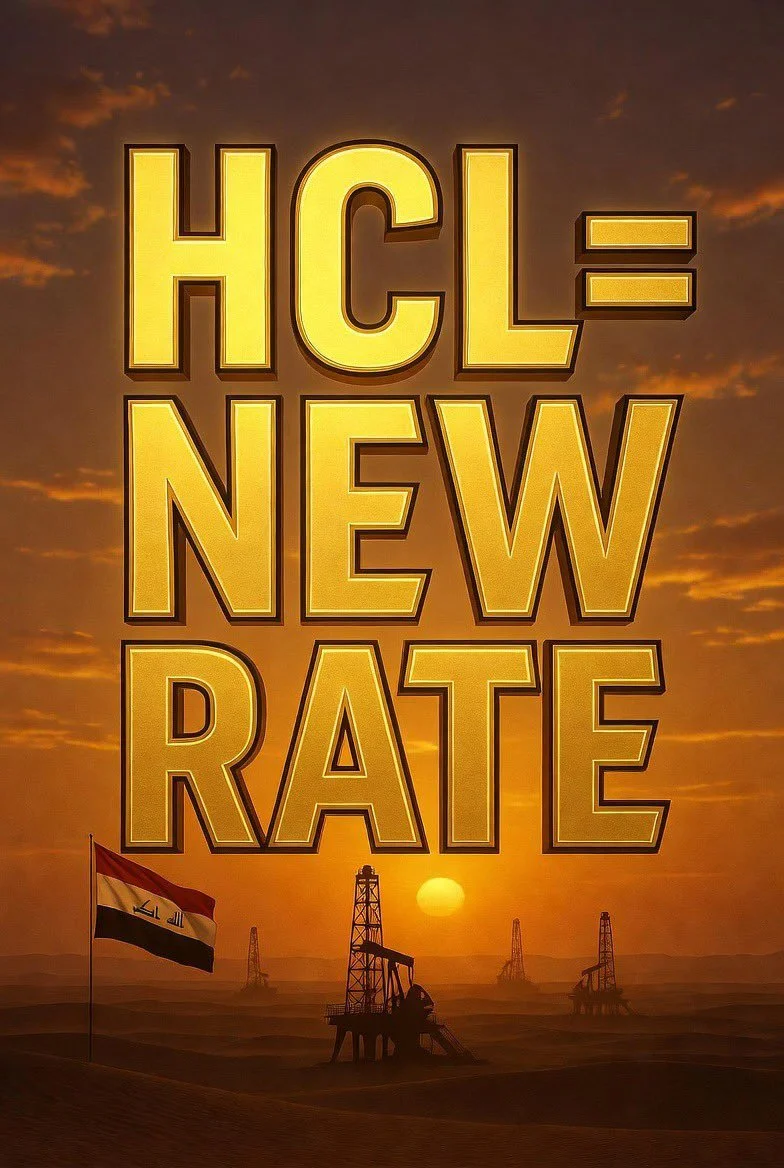
Why HCL = New IQD Rate?
I’ve attached my previous post below.
Channel 8 English: The 2007 Draft Oil and Gas Law outlines the foundational principles for establishing a Federal Council to govern Iraq's energy sector and distribute management powers between central and regional authorities. However, the comprehensive framework has never been formally enacted due to a 19-year political deadlock over revenue-sharing and the legislative control of lucrative oil fields. Read more: https://channel8.com/english/news/58343
HCL = New Rate
Ross: Why HCL = New IQD Rate
HCL literally cannot function without a revalued Dinar. The law unlocks massive new oil contracts, FDI, and revenue splits between federal gov + Kurdistan. Those deals are priced in billions of dollars.
At 1,300 IQD per $1, everything is absurdly expensive and unstable for investors and local partners. Trillions of dinars for billion-dollar contracts = accounting nightmares and operational hassle. A stronger rate + redenomination) makes the math work, restores confidence, and lets Iraq price oil domestically in a credible currency. It’s all tied together:
New government (Zaidi incoming) + 2026 budget + HCL = the exact window CBI has been waiting for to execute monetary reform.
When HCL passes, the new rate goes live because the law requires the stable, internationally viable dinar to be enforceable. HCL passing is the trigger event that forces the CBI’s hand on rate reform.
By the way, the meeting with the Fed and Treasury to advance Iraq’s banking reforms (immediately after Trump backed Al-Zaidi formed a new government) is scheduled in days — not weeks.
The days of IQD RV delays are OVER!
The Convergence Window: IQD & XRP
CBI set to meet with US Treasury / Fed within days.
HCL (Hydrocarbon Law) advancement under new government — strong momentum now.
First basket currencies (IQD, VND, VES) advancing in lockstep.
RCT set to unwind in the coming weeks/months.
Russell 2000 breakout in April 2026 historically precedes liquidity-driven risk-on moves — pattern suggests potential strength later in 2026.
Japan legalizing foreign stablecoins June 1st.
USD bills with Trump’s signature begin printing in June.
Kevin Warsh’s first FOMC meeting June 16-17 under new pro-crypto Fed Chair.
Iraq cashless deadline for all state institutions: July 2026.
DTCC tokenized securities pilots begin in July.
America’s 250th Anniversary major convergence window — Clarity Act + all catalysts aligning: July 4, 2026.
Trump Accounts launch July 4-5 injecting $1.2B into U.S. equities.
Ripple Fed Master Account fast-track window: July–September 2026.
100-day deadline for Al-Zaidi to clean up corruption: ~August 27, 2026.
Kim Clement banking miracle window: August–October 2026.
US military withdrawal from Kurdistan complete: September 2026. “Otherwise we’ll stay there.”
Ripple Fed Master Account outer deadline: December 2026 (~210 days).
Clarity Act laws effective January 2027.
Source(s):
• https://x.com/Ross_ptm/status/2057123556828536982
Read full post here: https://dinarchronicles.com/2026/05/21/ross-the-convergence-window-iqd-and-xrp/
News, Rumors and Opinions Thursday 5-21-2026
Majeed KSA: Whoever is Ready Should Go First
5-21-2026
Good afternoon to you all.
Here’s my personal opinion.
Maybe not all countries RVing have to go at the same time.
Maybe whoever is ready should go first.
Majeed KSA: Whoever is Ready Should Go First
5-21-2026
Good afternoon to you all.
Here’s my personal opinion.
Maybe not all countries RVing have to go at the same time.
Maybe whoever is ready should go first.
IF this is the case, then Venezuela could go first based on how fast and hungry they are for changing the exchange rate and fixing the economy and reducing the inflation.
Plus, Venezuela is Trump’s baby and that’s why it could go first.
(take care of your child before you take care of other’s children).
Maybe.
MajeedKSA: Based on the news we had today about Iraq You don’t have to believe it I might be right and I might be wrong But I’m still insisting Venezuela bolivar is the dark horse in this RV investment
Read until the end.
On May 19, 2026, Donald Trump signed an executive order directing U.S. regulators to modernize the financial system by integrating fintech and crypto innovation into mainstream banking and payment infrastructure, including studying broader access to Federal Reserve payment systems for digital-asset firms. The order sets timelines of 90 days for regulatory reviews, 120 days for the Federal Reserve report, and 180 days for agencies to begin implementing reforms — but some changes and market reactions could begin before those deadlines.
Watcher.Guru: JUST IN: President Trump orders US government to update regulations to integrate crypto into traditional finance and payment systems.
Source(s):
• https://x.com/majeed66224499/status/2057141197034987881
• https://x.com/majeed66224499/status/2057153960771731916
https://dinarchronicles.com/2026/05/21/majeed-ksa-whoever-is-ready-should-go-first/
*************
Courtesy of Dinar Guru: https://www.dinarguru.com/
Jeff They will never be able to go international or get the US sanctions lifted off them if they keep the value of the currency below a penny. In order for them to get sanctions lifted and removed, the value of the dinar has to increase above a penny.
Militia Man To me the CBI has completed the first evaluation phase of its comprehensive banking reform strategy. It now moving into the second phase with international partners like Oliver Wyman to bring banks up to global standards for full integration. I can't reiterate this enough, this didn't just start yesterday. They've been working on this for a long time...They won't come out and talk openly about a dinar revaluation...If you think that you're getting misguided...
Reset Intelligence Governor al-Alaq went on television Tuesday with the clean public denial. No change in the exchange rate. Foreign reserves strong. The CBI is not, in his words, studying the question. It is the 5th time he has said this in 6 months: November, February 12, February 25, April 16, May 19...The repetition is the signal...Al-Alaq confirmed a meeting "in the coming days" bringing the CBI together with the US Federal Reserve, US Treasury, and Oliver Wyman, framed as the path to "transition to dealing in other foreign currencies for banks that have completed all the required requirements." Read it as multi-currency-settlement readiness...Al-Alaq's 5th public dinar revaluation denial in 6 months runs interference until Treasury says go...
************
The Truth About the Vietnamese Dong and the BRICS Expansion
Edu Matrix: 5-21-2026
The Truth About the Vietnamese Dong and the BRICS Expansion In this video, we examine the growing connection between the Vietnamese Dong (VND), BRICS nations, Iran, cryptocurrency, and the global financial system.
Many investors may not realize that Vietnam is already a BRICS Partner nation, while Iran is a full BRICS member actively bypassing the SWIFT banking system using cryptocurrency transactions.
We also discuss how the Strait of Hormuz crisis, BRICS trade agreements, digital payments, oil transactions, and alternative financial systems could impact global currencies, including the Iraqi Dinar (IQD) and the Vietnamese Dong (VND).
This video focuses on verified economic and geopolitical developments involving BRICS, Iran, crypto payments, SWIFT alternatives, global trade, GDP comparisons, and the future of international finance.
Iraq Economic News and Points To Ponder Thursday Morning 5-21-26
Al-Zaydi Discloses His Financial Assets And Submits Them To The Head Of The Integrity Commission.
Money and Business Economy News – Baghdad Prime Minister Ali Faleh al-Zaidi submitted his financial disclosure statement to the head of the Integrity Commission on Thursday.
A statement issued by the commission and received by “Al-Eqtisad News” stated that “this measure comes within the framework of enshrining the principle of transparency, as Al-Zidi was the first to comply with the obligations set by the Integrity and Illicit Gains Commission Law No. (30 of 2011 amended), within his ministerial cabinet, and pledged to remove all conflicts set by the law within the time limits and legal periods in force that regulate conflict of interest and holding public office.”
Al-Zaydi Discloses His Financial Assets And Submits Them To The Head Of The Integrity Commission.
Money and Business Economy News – Baghdad Prime Minister Ali Faleh al-Zaidi submitted his financial disclosure statement to the head of the Integrity Commission on Thursday.
A statement issued by the commission and received by “Al-Eqtisad News” stated that “this measure comes within the framework of enshrining the principle of transparency, as Al-Zidi was the first to comply with the obligations set by the Integrity and Illicit Gains Commission Law No. (30 of 2011 amended), within his ministerial cabinet, and pledged to remove all conflicts set by the law within the time limits and legal periods in force that regulate conflict of interest and holding public office.”
The Prime Minister had instructed the members of the ministerial team to expedite the disclosure of their financial assets within a period not exceeding one week from the date of assuming responsibility.https://www.economy-news.net/content.php?id=69360
Iraq Tops Importers Of Sri Lankan Tea Despite A Decline In Exports In March
Money and Business Economy News – Baghdad Sri Lanka's tea industry is facing increasing economic pressure due to the fallout from the conflict in the Middle East, which has impacted exports and raised energy and shipping costs, according to a Reuters report.
Sri Lanka’s tea sector is heavily dependent on Middle Eastern markets, which account for about half of Ceylon tea exports, making it one of the sectors most affected by transport disruptions and rising fuel prices.
Data from the Sri Lanka Export Development Board showed that tea export revenues during March 2026 decreased by 17.3% year-on-year to reach $114.75 million.
Data for March also showed a 38% decline in tea exports to Iraq, the largest importer of Sri Lankan tea, while shipments to the UAE fell by 93%.
Iran imports between 8 and 10 million kilograms of premium Sri Lankan tea annually, amid concerns that regional tensions will continue to affect trade and shipping.
Sri Lankan tea companies confirmed that rising fuel and logistics costs have prompted them to expand into alternative markets such as Canada, the United States and South America.
The tea sector is one of the most important economic sectors in Sri Lanka, with a value of about $1.5 billion and providing employment for about 2.4 million people, at a time when farm workers are facing increasing living pressures due to inflation and rising prices. https://www.economy-news.net/content.php?id=69358
A Government Advisor Emphasizes The Importance Of Activating The Market Development Council And Investing In Five Million Dunams.
Money and Business Economy News – Baghdad The Prime Minister’s financial advisor, Mazhar Muhammad Saleh, stressed on Thursday the importance of activating the Market Development Council to support the modern economy in Iraq, while emphasizing the need to invest in five million dunams of agricultural land that have been damaged by desertification.
Saleh told the Iraqi News Agency, as reported by "Economy News": "The government program aims at institutional reform and defining institutions, their mechanisms, and their performance, as Iraq has a large number of institutions, and they are also weak." He explained that rebuilding Iraqi institutions is a very important matter, because the large capacity without oversight has drained the Iraqi state.
He added that "government institutions have become bloated and large and constitute a burden on the national economy, so that they have become market-based, meaning that market institutions are being stifled by heavy state institutions."
He pointed out that "economic reform begins with reforming old institutions and their laws and facilitating procedures," explaining that "many administrative complexities have become inherited and are not based on a legal basis."
He added that "young leaders are important in the economic reform process, as they possess a mindset of development, openness and change."
Regarding building a diversified national economy, he stated that "coexisting with a rentier oil economy and relying on the budget is one of the fundamental problems," calling for "turning towards all available non-oil resources."
He pointed out that "Iraq has natural resources that have not been invested in, and the private sector has not been allowed to partner and invest in them," noting that "our mission today is for the national and international private sector to partner with the government, using the latest technologies, to re-engage all of Iraq's resources."
He explained that "the agricultural sector represents the first starting point through the agricultural sovereignty and agricultural licensing project," indicating that "Iraq owns five million dunams of land affected by desertification, and a joint governmental-private holding company can be established on it, in cooperation with international companies, such as agricultural licensing rounds."
He added that "this step will lead to a green revolution starting with four or five million dunams that will secure Iraqi food security."
He continued, "The digital economy is a key focus in the reform process, through the creation of a strong institutional entity that oversees the digital cloud, cybersecurity, and attracting modern technology."
He pointed out that "the Market Development Council represents the link between the state and the private sector," stressing "the importance of redefining the council and activating it to support the birth of the modern economy in Iraq."
https://www.economy-news.net/content.php?id=69354
Transportation: Commencement Of The Second Phase Of The Trade Exchange Area
Money and Business Economy News – Baghdad The Ministry of Transport has begun implementing the second phase of the trade exchange yard project located in the Al-Taji area at the entrance to Baghdad-Salah Al-Din, as part of its plans to develop logistical infrastructure and enhance trade exchange between governorates and border crossings.
The Director of the General Company for Land Transport affiliated with the Ministry, Murtadha Karim Al-Shahmani, said in an interview with the official newspaper, which was followed by “Al-Eqtisad News”, that the engineering and technical staff affiliated with the Ministry have actually started the work of the second phase of the project, which extends over an area of (387) dunams, indicating that the work is taking place in parallel with the completion of the contracting procedures for the commercial exchange square project at the entrance to Baghdad - Al-Kut, which has an area of about (210) dunams.
He added that the trade exchange yards projects are witnessing remarkable progress in completion rates, especially the projects surrounding the city of Baghdad, which are known as “retail” projects, noting that these projects represent an important step to support the land transport sector and regulate loading and unloading operations, as well as their role in reducing congestion within the capital and enhancing the efficiency of logistical services.
Al-Shahmani explained that the ministry is preparing to begin work on the Baghdad-Kirkuk trade exchange yard project, which covers an area of (350) dunams, after obtaining official approvals and no objection from the relevant government agencies to allocate the land and implement the project, noting that this project will constitute an important addition to the commercial transport network in the country.
He pointed out that the project for the trade exchange yard at the entrance to Baghdad - Anbar - Babylon has reached very advanced stages of implementation, especially after the start of work to connect the yard with the international road, which will contribute to facilitating the movement of trucks and goods, and achieving greater smoothness in transportation and trade exchange operations between the governorates.
Regarding the trade exchange yards projects at the border crossings, Al-Shahmani affirmed that the Ministry continues to follow up on the procedures related to the Shalamja, Al-Shaib, Arar and Trebil yards projects, while working to study the technical and administrative obstacles that may face the implementation phases, and finding appropriate solutions to ensure the completion of these projects according to the specified time plans, in order to enhance the role of the border crossings in supporting the national economy and stimulating regional trade. https://www.economy-news.net/content.php?id=69350
Seeds of Wisdom RV and Economics Updates Thursday Morning 5-21-26
Good Morning Dinar Recaps,
Trump Expands U.S. AI Export Strategy as Global Tech Competition Accelerates
Washington moves to finance global adoption of American artificial intelligence systems while deepening the technological rivalry with China.
Good Morning Dinar Recaps,
Trump Expands U.S. AI Export Strategy as Global Tech Competition Accelerates
Washington moves to finance global adoption of American artificial intelligence systems while deepening the technological rivalry with China.
Overview
The United States is moving aggressively to strengthen its dominance in artificial intelligence through a new export financing initiative led by the Export Import Bank of the United States (EXIM). The proposal would provide loans, guarantees, and insurance support to foreign governments and businesses purchasing American AI technologies.
The initiative arrives during a period of intensifying geopolitical and economic competition between the United States and China, where control over AI infrastructure, semiconductor supply chains, and digital ecosystems is increasingly viewed as central to future global power.
Analysts say the move could reshape global technology alliances while accelerating the fragmentation of the international financial and technological order.
Key Developments
1. U.S. Launches Financial Push to Expand Global AI Dominance
The Trump administration is preparing a major financing framework designed to boost international purchases of American artificial intelligence systems and infrastructure.
Under the plan, EXIM would support overseas buyers through loan guarantees, export insurance, and long term financing packages, lowering barriers for countries seeking access to advanced U.S. AI technologies.
The strategy represents a significant shift toward state backed industrial policy, where financial tools are used to expand America’s technological footprint globally.
2. AI Becomes the New Strategic Battleground
The initiative highlights how artificial intelligence is rapidly becoming one of the most important geopolitical battlegrounds in the world economy.
The United States is attempting to strengthen adoption of its AI ecosystem while simultaneously restricting China’s access to advanced semiconductors and high performance computing technologies.
Meanwhile, Chinese firms continue advancing their own AI capabilities, including open source models and domestic chip production through companies such as Huawei.
This growing divide is creating what analysts describe as a two track global technology system increasingly separated into competing economic blocs.
3. Export Controls and Financing Are Now Working Together
Washington’s strategy no longer relies solely on sanctions and export restrictions.
Instead, the U.S. is pairing export controls with aggressive financing incentives to encourage allies and emerging economies to build around American standards, software, and infrastructure.
Sensitive technologies, including advanced chips produced by NVIDIA, would still require regulatory approval before financing support could proceed.
The policy reflects broader efforts to ensure that future digital infrastructure remains closely tied to U.S. technology platforms.
4. Global Supply Chains May Become More Politicized
The expansion of AI financing could deepen global economic realignment already underway across energy, trade, and manufacturing sectors.
Countries may increasingly face pressure to align with either American or Chinese technology ecosystems, especially in sectors tied to defense, telecommunications, banking, and data infrastructure.
Analysts warn this could accelerate the development of parallel financial and technological systems, similar to trends already emerging in global trade settlement and de-dollarization efforts.
Why It Matters
Artificial intelligence is no longer simply a technology race. It is becoming a foundation for future economic influence, military capability, financial systems, and geopolitical power.
The United States is now leveraging its financial system to secure long term AI influence worldwide, while China continues building alternative supply chains and domestic technological independence.
This competition could reshape:
Global investment flows
Semiconductor supply chains
International trade relationships
Digital currencies and payment systems
Future financial infrastructure
Why It Matters to Foreign Currency Holders
The growing AI rivalry between the United States and China adds another layer to the broader transition toward a multipolar global economy.
As nations compete over technology standards, digital infrastructure, and strategic supply chains, global financial fragmentation may accelerate. This could impact:
Currency stability
International trade settlement systems
Commodity pricing mechanisms
Capital allocation between East and West
The battle over AI leadership is increasingly tied to the future architecture of the global financial system itself.
Implications for the Global Reset
Pillar 1: Technology Is Becoming Financial Power
Artificial intelligence is emerging as a strategic asset similar to oil, rare earth minerals, or reserve currencies. Countries that dominate AI infrastructure could gain enormous leverage over global commerce and financial systems.
Pillar 2: Competing Economic Blocs Continue Forming
The United States and China are increasingly building separate ecosystems in technology, finance, trade, and supply chains. This fragmentation supports the broader shift toward a more divided and multipolar global order.
This is not just a technology race — it is the restructuring of global economic power in real time.
Seeds of Wisdom Team
Newshounds News™ Exclusive
Sources
Reuters — “Trump Administration Plans AI Export Financing Push Through EXIM”
Modern Diplomacy — “Trump boosts US AI exports with EXIM financing plan”
~~~~~~~~~~
🌱 A Message to Our Currency Holders🌱
If you’ve been holding foreign currency for many years, you were not foolish.
You were not wrong to believe the global financial system would change.
What failed was not your patience — it was the information you were given.
For years, dates, rumors, and personalities replaced facts, structure, and proof. “This week” predictions created cycles of hope and disappointment that were never based on how currencies actually change.
That is not your failure.
Our mission here is different: • No dates • No rates • No hype • No gurus
Instead, we focus on:
• Verifiable developments • Institutional evidence
• Global financial structure • Where countries actually sit in the process
Currency value changes only come after sovereignty, trade, banking, settlement systems, and fiscal coordination are in place. History and institutions confirm this sequence.
You will see silence. You will see denials. That is not delay — that is discipline.
Protect your identity. Organize your documents. Verify everything.
Never hand your discernment to anyone who cannot show proof.
You deserve truth — not timelines.
Seeds of Wisdom Team
Newshounds News™
~~~~~~~~~~
Seeds of Wisdom Team RV Currency Facts Youtube and Rumble
Newshound's News Telegram Room Link
RV Facts with Proof Links Link
RV Updates Proof links - Facts Link
Follow the Gold/Silver Rate COMEX
Follow Fast Facts
Seeds of Wisdom Team™ Website
Thank you Dinar Recaps
Iraq Economic News and Points To Ponder Late Wednesday Evening 5-20-26
Qaani Informed The Leaders Of The Coordination Committee And Factions That Any Disarmament Or Restructuring Of The Popular Mobilization Forces Is A "Red Line" For Tehran
Baghdad – One News 5/20/2026 Political sources revealed that Iranian General Qaani informed leaders in the coordination framework and armed factions during recent meetings he held in Baghdad that any step aimed at disarming the factions or restructuring the Popular Mobilization Forces represents a “red line” for the axis of resistance.
Qaani Informed The Leaders Of The Coordination Committee And Factions That Any Disarmament Or Restructuring Of The Popular Mobilization Forces Is A "Red Line" For Tehran
Baghdad – One News 5/20/2026 Political sources revealed that Iranian General Qaani informed leaders in the coordination framework and armed factions during recent meetings he held in Baghdad that any step aimed at disarming the factions or restructuring the Popular Mobilization Forces represents a “red line” for the axis of resistance.
The sources said that Qaani stressed during those meetings the need to preserve the structure of the armed factions and not allow any measures that would diminish their influence within Iraq.
In the same context, the sources indicated that US support for Iraqi Prime Minister Al-Zaidi came within a conditional approach aimed at reducing the influence of factions close to Iran, tightening control over their financial and economic networks, and imposing broader controls on their funding and activities within the country. https://1news-iq.net/مصادر-قاآني-أبلغ-قيادات-التنسيقي-والف/
Al-Zaydi Chairs The First National Security Meeting And Affirms Zero Tolerance For Any Threat To The Countries Of The Region
Baghdad – One News 5/20/2026 Prime Minister and Commander-in-Chief of the Armed Forces Ali Faleh al-Zaidi chaired the first meeting of the National Security Ministerial Council on Wednesday, and stressed the continued efforts to raise the level of readiness and capabilities of all security agencies.
The council stated, according to the Iraqi News Agency, that it renews its condemnation of the recent attacks targeting Saudi Arabia and the UAE, stressing the government’s rejection of the use of Iraqi territory or passage through its airspace to attack Arab and regional countries.
The council decided to form a special committee to approach Saudi Arabia and the UAE and cooperate in the investigation regarding the recent attacks, while the Commander-in-Chief directed that all measures be taken against those involved if it is proven that Iraqi territory was used as a launching point for attacks on the two countries. (They already know it was the IRI factions who admitted the strikes)
Al-Zaydi stressed that the government will not tolerate any individual or group that seeks to threaten the security of Iraq or the security of its brothers and countries in the region, stressing the government’s commitment to taking the necessary measures to protect the country’s stability and preserve its sovereignty.
The National Security Council also stressed Iraq’s keenness to build the best relations with the countries of the region and the international community, and that the new government should be a partner in stabilizing the region and extending the rule of law, while committing to protecting diplomatic missions and foreign companies operating in the country, and restricting weapons to the state. https://1news-iq.net/الزيدي-يترأس-أول-اجتماع-للأمن-الوطني-و/
Iraq Investigates Attacks On Gulf States Allegedly Launched From Its Territory
2026-05-20 / Shafaq News- Baghdad Iraq’s Ministerial Council for National Security on Wednesday ordered an investigation into attacks targeting Saudi Arabia and the United Arab Emirates allegedly launched from Iraqi territory, warning of legal action against those involved if the claims are confirmed.
During the council’s first meeting chaired by Prime Minister Ali al-Zaidi, members condemned the recent attacks and reaffirmed Baghdad’s rejection of using Iraqi territory or airspace to target neighboring Arab and regional states, according to a statement from the prime minister’s office.
Iraqi Prime Minister Media Office
Sondoetrpsl6h7a6hl35g8f0fhii3acf9411mug6g4f8fffh4iitl8943gt7 ·
Official Statement ….. Prime Minister and Commander-in-Chief of the Armed Forces Ali Faleh Al-Zaidi chaired the first meeting of the Ministerial Council for National Security.
The meeting reviewed developments in the overall security situation across the country, with the Prime Minister affirming the government’s commitment to continually raising the readiness and capabilities of all security agencies and strengthening coordination among them to sustain security and stability.
The meeting renewed its condemnation of the recent attacks that targeted the Kingdom of Saudi Arabia and the United Arab Emirates, reaffirming the government’s rejection of the use of Iraqi territory or airspace to launch attacks against brotherly Arab states and friendly regional countries, and stressing that the government will respond firmly in this regard.
The meeting further addressed the ongoing investigations into the attacks that targeted the Kingdom of Saudi Arabia and the United Arab Emirates. A special committee was formed to liaise with the relevant authorities in both countries, and the Prime Minister directed that all necessary measures be taken against those found responsible should Iraqi territory be confirmed as a launch point for those attacks, reaffirming Iraq’s commitment to full cooperation with brotherly countries on this matter.
The Prime Minister stressed that the government will not tolerate any individual or group seeking to threaten Iraq’s security or that of its brotherly neighbors and regional partners, reaffirming its resolve to take all measures necessary to protect the country’s stability and preserve its sovereignty.
The meeting also affirmed Iraq’s commitment to building the strongest possible relations with regional and international partners, as well as the new government’s commitment to serving as a partner in regional stability, upholding the rule of law, protecting diplomatic missions and foreign companies operating in the country, and restricting the bearing of arms to the state — all of which constitute core government priorities in enhancing security and stability.
Sabah Al-Numan Official Spokesperson For The Commander-In-Chief Of The Armed Forces
May 20, 2026 A special committee was formed to coordinate with Saudi and Emirati authorities as investigations continue, while al-Zaidi directed security agencies to take all necessary measures against any individual or group found responsible.
The council also stressed the need to maintain high security readiness and coordination among Iraqi security forces to preserve internal stability.
Al-Zaidi reaffirmed Iraq’s commitment to strengthening relations with regional and international partners, protecting diplomatic missions and foreign companies operating in the country, and limiting weapons to state control as part of the government’s broader security priorities.
On Sunday, Saudi Arabia reported the interception and destruction of three drones after they entered its airspace from Iraqi territory. https://shafaq.com/en/Iraq/Iraq-investigates-attacks-on-Gulf-states-allegedly-launched-from-its-territory
Iraq Reviews Security Ministries, Examines Gulf Drone Allegations
2026-05-20 / 15:31 Shafaq News- Baghdad Iraq’s ruling Coordination Framework (CF) discussed efforts to fill unresolved security ministries while examining Saudi and Emirati allegations that drones launched from Iraqi territory targeted the two Gulf states, a CF source told Shafaq News on Thursday.
The discussions took place during a meeting held on Wednesday night attended by Prime Minister Ali Al-Zaidi, with discussions focusing on the Interior and Defense ministries alongside regional security accusations involving Saudi Arabia and the United Arab Emirates.
Iraq’s parliament granted confidence to Al-Zaidi’s government on May 14, approving 14 ministers out of 23 while delaying nine portfolios, including Interior and Defense, amid continuing disputes over cabinet allocations. CF leaders agreed to authorize Al-Zaidi to select candidates for the Interior and Defense Ministries from lists of 10 nominees submitted by supporting political groups and parties affiliated with the candidates, provided they possess proven military and security experience.
Read more: What does Iraq's new government promise? A guide to Ali Al-Zaidi's ministerial program
Al-Zaidi will choose the final nominees for the two ministries from those lists, the source added, noting that names currently circulating for the posts were inaccurate. Leaders at the meeting also agreed to reassess the distribution of sovereign ministries based on the “official cost formula” approved by the team overseeing negotiations under Al-Zaidi’s supervision, adding that the cabinet allocation map could witness further changes.
On the regional security file, the meeting discussed allegations by Saudi Arabia and the UAE that drones launched from Iraq had targeted the two countries. Leaders agreed to form a committee including security specialists and representatives from the Interior, Defense, National Security, and Foreign Ministries.
One team will visit Saudi Arabia and the UAE to review evidence related to the alleged drone flights, particularly radar and early-warning data, in an effort to determine launch points and flight paths and identify the responsible party, while a second team will conduct investigations inside Iraq and gather information related to allegations that drones targeting Saudi Arabia and the UAE originated from Iraqi territory.
“The committee’s work will focus on obtaining evidence before adopting any final position,” the source said, adding that conclusions would depend on technical and security findings presented by the relevant authorities.
Saudi Arabia and the UAE earlier alleged that drones entered their airspace from Iraq, including an attack Abu Dhabi said targeted the Barakah nuclear power plant, while Riyadh announced intercepting drones approaching from the Iraqi direction. Iraq later condemned the attacks and announced technical and security coordination with Saudi Arabia and the UAE to review available evidence.
https://shafaq.com/en/Iraq/Iraq-reviews-security-ministries-examines-Gulf-drone-allegations
Iraq Parliament Demands Emergency Air Defense Budget After Gulf Drone Accusations
2026-05-20 Shafaq News- Baghdad Iraq’s parliamentary Security and Defense Committee called on Wednesday for an “emergency budget” to strengthen the country’s air defenses following Gulf accusations that drone attacks against Saudi Arabia and the UAE originated from Iraqi territory.
Committee member Yasser Watout told Shafaq News that the governments of Saudi Arabia and the UAE should provide “concrete evidence” supporting their recent accusations.
“The protection of Iraqi airspace is the responsibility of the Global Coalition,” Watout pointed out.
He also questioned how such operations could occur without being detected, noting that Iraqi skies is monitored by US and Israeli aircraft as well as advanced surveillance systems and satellites, urging both countries to clarify whether the drones were launched from southern, central, or northern Iraq.
He suggested that a “third party” could be behind the attacks in an attempt to fuel tensions between Iraq and Gulf countries.
Earlier today, Iraq’s Ministerial Council for National Security ordered an investigation into the alleged drone attacks and warned of legal action against those responsible if the accusations are confirmed. The council also formed a special committee to coordinate with Saudi and Emirati authorities, while Commander-in-Chief of the Armed Forces Ali Al-Zaidi instructed security agencies to take all necessary measures against any individuals or groups involved.
Read more: How the Iran–US–Israel war exposes Iraq’s defense paralysis
On May 17, Saudi Arabia’s Defense Ministry announced that it had intercepted and destroyed three drones after they entered the kingdom’s airspace from Iraq, warning that Riyadh would take the necessary operational measures “at the appropriate time and place.”
Later, the UAE Defense Ministry also revealed that it had intercepted six drones originating from Iraq over 48 hours targeting the Barakah Nuclear Plant.
Iraq’s armed forces have relied on foreign defense procurement since the early 2000s, with recent efforts focused on rebuilding deterrence amid regional instability and increasing pressure to assert airspace sovereignty —particularly following repeated breaches during the 12-day war between Iran and Israel in 2025.
Read more: Iraq's air defense void: How US vetoes, and Russian limits leave Baghdad exposed
Some “Iraq News” Posted by Tishwash at TNT 5-21-2026
TNT:
Tishwash: A meeting at the Central Bank confirms the institution's neutrality and its role in supporting the budget.
The Central Bank of Iraq held an expanded meeting on Tuesday (May 19, 2026) with representatives from several Iraqi media outlets, in the presence of the bank's governor, Ali Al-Alaq, to discuss a range of financial and monetary issues related to the bank's role in supporting market stability and strengthening compliance and banking oversight procedures.
The meeting was attended by Saif Al-Hashemi, director of the Baghdad Today news agency, along with a number of other media colleagues.
TNT:
Tishwash: A meeting at the Central Bank confirms the institution's neutrality and its role in supporting the budget.
The Central Bank of Iraq held an expanded meeting on Tuesday (May 19, 2026) with representatives from several Iraqi media outlets, in the presence of the bank's governor, Ali Al-Alaq, to discuss a range of financial and monetary issues related to the bank's role in supporting market stability and strengthening compliance and banking oversight procedures.
The meeting was attended by Saif Al-Hashemi, director of the Baghdad Today news agency, along with a number of other media colleagues.
Al-Allaq said during the meeting, which was attended by “Baghdad Today”, that the Central Bank is exercising its role with complete neutrality with regard to the general budget,” stressing that the bank’s responsibility is focused on controlling monetary policy and maintaining the stability of the exchange rate, in addition to managing foreign transactions and supervising banks, without interfering in the form of the budget or its political or economic options.
The governor explained that the central bank is working to create a balance between the planned deficit and the actual deficit through monetary policy tools, noting that the bank’s role in this regard depends on measuring liquidity, the size of issuances, and the level of monetary stability required to support the budget without putting pressure on the market.
Al-Allaq also reviewed the ongoing banking reform phases, which include strengthening compliance, developing payment systems, and improving oversight procedures for the banking sector, stressing that these steps are essential to prevent any practices that harm the market or affect the value of the currency locally.
Regarding financial stability, the Central Bank reassured attendees that the country's economic situation is "stable and under control," and that the measures taken during the past months have contributed to reducing volatility and strengthening confidence in the financial system.
The attendees raised a number of questions about the bank’s relationship with the budget and its role in managing the exchange rate, in addition to mechanisms for reducing speculation in the market, while the Central Bank affirmed its continued communication with the media to ensure clarity of information and avoid inaccurate reporting on financial matters.
This meeting comes amid escalating discussions about the budget deficit and the growing need for an effective monetary policy to mitigate the effects of regional and economic tensions, particularly given the Iraqi markets' vulnerability to the repercussions of the ongoing conflict between Iran, Israel, and the United States, and its impact on local market activity.
The Central Bank also aims to clarify its media strategy to ensure that accurate information about monetary policy reaches citizens and those interested in economic affairs. link
************
Tishwash: Al-Awadi: Iraq is not an open arena for conflicts, and the government will take all measures to maintain the stability of the region.
Government spokesman Bassem al-Awadi affirmed that "Iraq is not an open arena for conflicts...and the government will take all necessary measures to maintain the stability of the region."
In a televised statement, al-Awadi said, "The region is witnessing escalating tensions extending from Palestine, Lebanon, and Syria to the Gulf states," noting that "Iraq, as an Arab country and a neighbor to the countries of the region, is keen to listen to the concerns of its brothers."
He added, "The Iraqi government is working continuously to achieve positive results that contribute to calming the situation," clarifying that "Iraq is not an open arena, and some of the information circulating regarding security developments may contain inaccuracies or misinformation."
The spokesperson explained: "The Commander-in-Chief of the Armed Forces, Ali al-Zaidi, is personally overseeing this matter and following up on the file directly. He is in contact with our brothers in the Arab countries and the Gulf states.
He has directed the formation of committees at the Ministry of Defense, Joint Operations Command, and military units deployed along the borders to communicate with our brothers to provide appropriate information for verification. If it is proven that any attack originated from within Iraq, the government will take all appropriate measures to preserve the sovereignty of Iraq, its neighbors, and the region." link
************
Tishwash: An unprecedented financial crisis hits Iraq: A $5 billion gap threatens salaries.
Financial and banking expert Mahmoud Dagher confirmed on Tuesday (May 19, 2026) that Iraq is currently experiencing its biggest financial and economic crisis since 2003, due to the severe deficit in oil revenues, which did not exceed one billion dollars this month, compared to an actual need of more than 6 billion dollars (equivalent to 8 trillion dinars) to cover the salaries of employees and retirees monthly.
Dagher confirmed, in an interview with journalist Ahmed Mulla Talal, which was followed by 964 Network , that there is no solution to the current crisis except resorting to “discounted transfers” to increase the internal debt by printing new money from the Central Bank and lending it to the Ministry of Finance.
This is a necessary measure that will lead to raising the internal debt from 100 trillion to nearly 140 trillion dinars. He warned that this path will inevitably lead to direct pressure on the foreign currency reserve and reduce it, expecting that the dollar exchange rate will take an upward trend in the local markets.
Internal "money creation": No withdrawals from reserves, but printing and borrowing
Dagher refuted the rumors circulating about the state resorting to direct withdrawals from foreign currency reserves, stressing that the mechanism currently in place is “issuing new money” from the central bank and lending it to the Ministry of Finance through debiting remittances via banks.
The banking expert explained that this measure, which was previously used during the era of former Prime Minister Haider al-Abadi, represents a process of creating local money, revealing that discounted transfers started steadily from 3 trillion and then jumped to 4 trillion, and are likely to rise to compensate for the absence of live oil revenues and to secure funds for citizens in the markets.
Indirect depletion... How will foreign currency reserves be affected?
Dagher warned that the real danger to the central bank’s reserves comes indirectly through the movement of liquidity in the market. When a citizen receives his salary in “printed” dinars, he goes to buy, and the merchant returns and asks the central bank for dollars, exchanging them for dinars.
He pointed out that the previous equation was based on the Ministry of Finance handing over dollars to the Central Bank to secure dinars, but now the Ministry of Finance does not have dollars, which puts full pressure on the foreign reserves and threatens to reduce them, recalling how this mechanism previously caused the reserves to drop from 60 billion to 35 billion dollars during previous crises.
The triad of “Al-Zaydi, Finance, and the Central Bank”: The desperate have no choice
The financial expert confirmed that this critical situation was on the decision table from the first day of the appointment of Prime Minister Ali al-Zaidi, who rushed to hold an urgent meeting with the Minister of Finance and the Governor of the Central Bank to develop solutions.
Dagher asserted that there is no alternative solution on the horizon for financing the state other than relying on Central Bank transfers to the Ministry of Finance to increase internal debt, considering that this measure is not an editorial error but rather the option of extreme necessity for which no economic expert in Iraq has a realistic alternative at the present time.
The dollar will rise and domestic debt will jump to nearly 140 trillion.
Dagher predicted that the dollar exchange rate would take an upward turn in the local markets during the coming period, noting that the rise would not be rapid or crazy because the central bank has sufficient reserves and a high adequacy ratio, but this balance is threatened with collapse if the war and its repercussions continue for another year at the same current pace.
Dagher concluded his economic vision by pointing out that Iraq’s internal debt, which previously stood at 94 trillion and has now reached 100 trillion, is strongly heading towards a threshold of between 130 and 140 trillion dinars, which puts the country’s fiscal policy in the eye of the storm.
The Ministry of Oil announced on Monday (May 18, 2026) the total of Iraqi oil exports during the month of April, saying that it amounted to 9 million and 884 thousand barrels, with revenues amounting to about one billion dollars, while Iraq’s oil exports before the US-Iran war and the closure of the Strait of Hormuz amounted to about 100 million barrels with revenues of up to 7 billion dollars, which means a loss of 6 billion dollars during last April. link
Seeds of Wisdom RV and Economics Updates Wednesday Evening 5-20-26
Good Evening Dinar Recaps,
Xi and Putin Deepen Strategic Alliance as Global Power Blocs Continue Realigning
China and Russia moved closer on energy, trade, and geopolitical coordination during high-level summit talks in Beijing, reinforcing the accelerating shift toward a multipolar world order.
Good Evening Dinar Recaps,
Xi and Putin Deepen Strategic Alliance as Global Power Blocs Continue Realigning
China and Russia moved closer on energy, trade, and geopolitical coordination during high-level summit talks in Beijing, reinforcing the accelerating shift toward a multipolar world order.
Overview
Chinese President Xi Jinping and Russian President Vladimir Putin held major summit talks in Beijing today centered on expanding long-term cooperation in energy, trade, and strategic coordination.
The meeting comes at a pivotal moment for the global economy as nations increasingly reposition themselves amid rising geopolitical fragmentation, sanctions pressure, supply chain realignment, and growing instability in energy markets.
The summit also carried major symbolic importance because it followed closely after President Donald Trump’s recent visit to Beijing, highlighting China’s emerging role as a central diplomatic and economic power capable of engaging multiple rival blocs simultaneously.
Key Developments
1. China and Russia Reaffirm Strategic Partnership
Xi and Putin both emphasized the strength of the China-Russia relationship, describing their partnership as a stabilizing force in an increasingly fragmented global system.
Xi called for a more balanced international order and greater cooperation outside traditional Western-led structures, while Putin praised the growing political trust between Moscow and Beijing.
The summit reinforced that both nations continue strengthening ties in response to ongoing tensions with the United States and broader Western alliances.
The relationship increasingly extends beyond diplomacy into finance, energy security, industrial cooperation, and long-term geopolitical coordination.
2. Energy Cooperation and Power of Siberia 2 Move to the Forefront
One of the most important topics discussed was the proposed Power of Siberia 2 pipeline, which would dramatically expand Russian natural gas exports to China.
The project is viewed as strategically critical for Moscow as Russia continues redirecting energy exports away from Europe following years of sanctions and political confrontation tied to the Ukraine conflict.
If completed, the pipeline could transport up to 50 billion cubic meters of natural gas annually from Russia’s Arctic gas fields into China through Mongolia.
Energy cooperation between both countries is becoming increasingly important as instability in the Middle East and Strait of Hormuz continues disrupting global energy markets.
3. China Expands Its Influence as a Global Power Broker
The diplomatic optics surrounding the summit were closely watched internationally.
By hosting both Trump and Putin within days of each other, Beijing demonstrated its growing ability to position itself at the center of global diplomacy during a period of rising geopolitical fragmentation.
Chinese media portrayed the meetings as evidence of China’s growing leadership role in shaping the future global order.
Analysts noted that Beijing increasingly seeks to balance relationships with rival powers while simultaneously strengthening its own long-term strategic leverage.
4. Trade and Financial Realignment Continue Accelerating
China and Russia also discussed expanding bilateral trade, investment cooperation, and long-term economic integration.
Although trade growth slowed last year, both countries are now seeking to deepen partnerships across:
energy,
infrastructure,
manufacturing,
financial systems,
and strategic commodities.
The broader trend reflects accelerating efforts among major powers to reduce vulnerability to Western sanctions, diversify trade systems, and strengthen regional economic alliances.
Many analysts view the China-Russia partnership as one of the central pillars of the emerging multipolar economic system.
Why It Matters
Today’s summit highlights how global power structures continue evolving away from the highly centralized Western-led economic system that dominated previous decades.
The world is increasingly shifting toward competing regional alliances built around:
energy security,
trade corridors,
strategic resources,
industrial policy,
and financial independence.
China and Russia are positioning themselves as long-term partners within that transition.
Why It Matters to Foreign Currency Holders
For foreign currency holders and global reset observers, the summit reinforces several major trends:
the rise of multipolar economic structures,
expanding non-Western trade cooperation,
growing efforts to reduce exposure to sanctions,
and increasing alignment between major commodity-producing nations.
The deepening China-Russia relationship also supports ongoing discussions surrounding alternative payment systems, reserve diversification, and reduced dependence on traditional Western financial channels.
Implications for the Global Reset
Pillar 1: Multipolar Economic Realignment
China and Russia continue building deeper economic structures outside traditional Western-centered systems.
Pillar 2: Energy-Based Strategic Alliances
Long-term energy agreements are becoming foundational to geopolitical influence and financial stability.
Pillar 3: Sanctions Resistance and Trade Diversification
Nations facing Western pressure are increasingly creating parallel trade and financial relationships to reduce vulnerability.
Pillar 4: Global Governance Transition
China is increasingly positioning itself as a central diplomatic and economic mediator in the evolving international order.
The Beijing summit reflects a broader transformation where energy, trade, and geopolitics are converging into a new global power structure.
Seeds of Wisdom Team
Newshounds News™ Exclusive
Sources
Reuters — "Putin, Xi deepen ties as Russia seeks China support amid Western pressure"
Modern Diplomacy — "Xi and Putin Strengthen China Russia Partnership With Energy and Trade in Focus"
~~~~~~~~~~
Seeds of Wisdom Team RV Currency Facts Youtube and Rumble
Newshound's News Telegram Room Link
RV Facts with Proof Links Link
RV Updates Proof links - Facts Link
Follow the Gold/Silver Rate COMEX
Follow Fast Facts
Seeds of Wisdom Team™ Website
Thank you Dinar Recaps
Ross: This is the Reset of the World Economy
Ross: This is the Reset of the World Economy
5-20-2026
The fact that CBI is bullposting their cooperation with the US government is MEGA bullish for your IQD notes sitting in your safe.
This is how every IQD investor reads this.
Iraqi Central Bank Governor Ali Al-Alan said Tuesday that there are plans to revalue the Iraqi dinar against the US dollar, stressing that Iraqi funds are not subject to US sanctions. Al-Alan also announced upcoming talks with the US Federal Reserve and the Treasury Department, notating that both institutions have praised the role and performance of the Central Bank of Iraq (CBI).
Ross: This is the Reset of the World Economy
5-20-2026
The fact that CBI is bullposting their cooperation with the US government is MEGA bullish for your IQD notes sitting in your safe.
This is how every IQD investor reads this.
Iraqi Central Bank Governor Ali Al-Alan said Tuesday that there are plans to revalue the Iraqi dinar against the US dollar, stressing that Iraqi funds are not subject to US sanctions. Al-Alan also announced upcoming talks with the US Federal Reserve and the Treasury Department, notating that both institutions have praised the role and performance of the Central Bank of Iraq (CBI).
All jokes aside…
Ok ok don’t start FUDing my replies just yet.
No devalue = stability locked
No sanctions on funds = clean money confirmed
Fed & Treasury talks = direct US engagement
US praise for CBI = institutional greenlight
ZERO RED FLAGS since Iraq’s newly formed government was approved.
New PM Ali al-Zaidi sworn in days ago.
100-day corruption cleanup clock just started.
This CBI drop lands right on top of it.
While Zaidi handles the political housecleaning…
CBI just reinforced the monetary foundation.
Clear runway.
Rocket fuel into summer with endless convergence toward America’s 250th and beyond.
Your 100-day corruption cleanup window lands ~Aug 27.
US troops finish leaving Kurdistan in September.
Kim Clement window: Aug / Sept / Oct for the banking miracle.
Convergence is absolutely spooky at this point, there are no coincidences.
Zoom News: Iraqi Central Bank Governor Ali Al-Alaq said Tuesday that there are no plans to devalue the Iraqi dinar against the US dollar, stressing that Iraqi funds are not subject to any US sanctions. Al-Alaq also announced upcoming talks with the US Federal Reserve and the Treasury Department, noting that both institutions have praised the role and performance of the Central Bank of Iraq (CBI).
More on the 100 day deadline corruption cleanup.
Ross: “Otherwise we’ll stay there.” September: Last US military stationed in Kurdistan leaves Iraq for good. New Iraqi PM Ali al-Zaidi has a 100-day window to dismantle US-blacklisted factions and open major corruption files. 100 days from now lands on: August 27, 2026. Kim Clement prophesied to look toward August, September, and October for a miracle in banking & the markets — watch the oil (where America ultimately becomes independent from Middle East oil). Convergence is an understatement. IQD RV lore is literally going haywire right now.
Watch on X: https://twitter.com/i/status/2056869992097014223
Why is the CBI suddenly announcing meetings with the Federal Reserve and US Treasury right now???
IQD is going to revalue and to be honest I’m shocked the CBI is giving such a huge signal about it.
Kevin Warsh was confirmed as the new Fed Chair on May 13.
Powell’s term ended May 15.
This CBI announcement drops days later.
Meanwhile the Iran War kicked off Feb 28… and suddenly we get a new reform-focused Iraqi PM, a 100-day corruption cleanup mandate, CBI saying “no devalue” + “no sanctions on funds,” public US praise, and scheduled high-level meetings with the new Fed team + Treasury.
Funny the Iran War coincidentally creates this level of rapid progress and positive signaling from Iraq’s new government and central bank.
These meetings are about real technical work: banking reforms, reserve management, dollar liquidity, and deeper financial integration.
And here’s the kicker — Iraq’s cashless deadline for all state institutions is July 2026. That lines up almost perfectly with the Clarity Act timeline, which sits roughly 17 weeks from when the Iran War started.
At this point the amount of times I’m repeating myself on these different factors is comical… but I can’t help it when unlimited amounts of new convergences keep showing up.
New Fed Chair.
New Iraqi government.
Cashless push.
Crypto clarity legislation.
Iraq suddenly in direct talks with the Fed & Treasury.
All moving in the same window heading into America’s 250th.
The CBI is meeting with the Fed and Treasury because they’re locking in alignment, stability, and technical readiness while the region forces everyone to pick sides and clean house.
This is how you build the runway for the revaluation of IQD.
Basing this on Treasury Vault’s current prices:
If you buy $1,000 USD in IQD right now, that gets you ≈ 1,036,269 IQD.
This is based on their sale price of $965 per million (mixed denomination notes, on sale from $985). Some circulated bundles are running around $940 per million.
No one can predict the future exchange rate of IQD vs USD.
We look to what happened in Kuwait.
We look at Iraq’s true wealth as a country based on their oil.
We look to the future of a Level Playing Field.
A Golden Age is coming.
XRP ignites the GCR.
Hyperinflated currencies will sink or swim once the Bank of London is starved and the Fed defaults on their debt.
I cannot throw out an exact rate.
I just know 1300 per USD is BS.
Read full post here: https://dinarchronicles.com/2026/05/20/ross-this-is-the-reset-of-the-world-economy/
Currency Reset Update, Parts 1 and 2
Currency Reset Update, Part 1
Liberty Crusade Official: 5-20-20265-
The global financial landscape is currently navigating a period of profound transformation. Recent discussions within the economic and geopolitical spheres suggest that we are moving toward a significant “reset” of the international monetary system.
For decades, the world has operated primarily under a fiat-based structure, but emerging trends indicate a decisive shift toward de-globalization and de-dollarization. This transition reflects a growing interest in returning to an economic framework grounded in intrinsic value—specifically one backed by commodities such as gold, silver, natural resources, and essential agricultural products.
Currency Reset Update, Part 1
Liberty Crusade Official: 5-20-20265-
The global financial landscape is currently navigating a period of profound transformation. Recent discussions within the economic and geopolitical spheres suggest that we are moving toward a significant “reset” of the international monetary system.
For decades, the world has operated primarily under a fiat-based structure, but emerging trends indicate a decisive shift toward de-globalization and de-dollarization. This transition reflects a growing interest in returning to an economic framework grounded in intrinsic value—specifically one backed by commodities such as gold, silver, natural resources, and essential agricultural products.
A central component of this evolving narrative is the potential revaluation of specific national currencies, with a particular focus on nations like Iraq and Vietnam.
Analysts pointing to these regions highlight their abundant natural resources, strengthening manufacturing sectors, and increasing political sovereignty as key indicators of their readiness for a larger role in the global market.
As these nations stabilize their internal governance and expand their international trade agreements, they are positioned as prime examples of how localized economic strength can lead to a more balanced and integrated global financial system.
Beyond individual currencies, the broader geopolitical climate is undergoing a strategic realignment. There is a visible push toward prioritizing national sovereignty and renegotiating long-standing trade agreements to better reflect modern economic realities. This includes efforts to bolster leadership within the Western Hemisphere while navigating the complexities of influence from major Eastern powers. Proponents of this shift argue that a return to principled diplomacy and a focus on regional stability—particularly in the Middle East—is essential for creating a secure environment where new economic systems can flourish.
The transition also highlights the changing role of precious metals and digital assets. Silver, in particular, is gaining attention due to massive projected investments in global manufacturing, which could significantly drive demand and value.
Simultaneously, the integration of digital assets like XRP and Bitcoin into the financial fabric suggests a future where technology and tangible commodities work in tandem to replace traditional debt-based models. This “new economy” aims to prioritize transparency, intrinsic value, and decentralized stability over the volatility of the old fiat system.
Ultimately, navigating these complex changes requires a commitment to education and personal responsibility. Understanding the historical, spiritual, and economic foundations of these shifts is vital for anyone looking to participate in the emerging order.
By staying informed through dedicated research and analysis, individuals can better align themselves with a world that is increasingly moving toward the restoration of traditional values and economic sovereignty.
For those seeking a deeper dive into these transformative events, the Liberty Crusade Official YouTube channel offers comprehensive insights into the future of global finance.
Currency Reset Update Part 2.
Seeds of Wisdom RV and Economics Updates Wednesday Afternoon 5-20-26
Good Afternoon Dinar Recaps,
China Tightens Grip on Rare Earths as U.S. Supply Chain Vulnerabilities Deepen
Beijing’s defense of rare earth export controls is intensifying concerns over global supply chains, industrial security, and the future balance of economic power.
Good Afternoon Dinar Recaps,
China Tightens Grip on Rare Earths as U.S. Supply Chain Vulnerabilities Deepen
Beijing’s defense of rare earth export controls is intensifying concerns over global supply chains, industrial security, and the future balance of economic power.
Overview
China has reaffirmed that its rare earth and critical mineral export controls are both legal and necessary, while signaling limited willingness to cooperate with the United States on supply chain concerns.
The announcement comes as global industries increasingly struggle with shortages and uncertainty surrounding access to strategic minerals essential for defense systems, semiconductors, electric vehicles, aerospace manufacturing, and advanced energy technologies.
The issue is becoming far more than a trade dispute. It now reflects the broader geopolitical struggle between the world’s two largest economies over industrial dominance, technological leadership, and long-term control of critical supply chains.
Key Developments
1. China Defends Rare Earth Export Restrictions
China’s Ministry of Commerce stated today that the country’s export controls on rare earth materials are fully consistent with Chinese law and are intended to safeguard national security and economic interests.
The restrictions, first expanded during escalating trade tensions with Washington, remain in effect despite recent diplomatic discussions between both nations.
Chinese officials emphasized that exports for approved civilian purposes may still be reviewed and authorized, but Beijing made clear the controls themselves are not being removed.
The announcement reinforces China’s growing willingness to use critical minerals as a strategic economic lever in global negotiations.
2. The United States Faces Growing Supply Chain Pressure
U.S. officials continue expressing concern over restricted access to rare earth materials such as yttrium, scandium, dysprosium, and terbium, all of which are essential for advanced manufacturing and military applications.
These materials are critical for:
jet engines,
missile guidance systems,
electric vehicles,
wind turbines,
AI infrastructure,
semiconductors,
and power generation technologies.
American manufacturers have warned that prolonged supply disruptions could increase production costs, delay industrial projects, and weaken competitiveness in key strategic industries.
The situation highlights a growing vulnerability within Western supply chains that remain heavily dependent on Chinese mineral processing capacity.
3. Rare Earths Are Emerging as a New Economic Weapon
China currently dominates much of the global rare earth refining and processing market, giving Beijing enormous influence over industries tied to modern technology and energy systems.
Analysts increasingly view rare earth access as comparable to oil leverage during previous geopolitical eras.
Rather than using tariffs alone, countries are now competing through:
export controls,
industrial policy,
technology restrictions,
and supply chain realignment.
This marks a major transition away from the highly globalized economic environment that dominated previous decades.
4. Managed Cooperation Masks Deeper Strategic Competition
Despite the tensions, both Washington and Beijing signaled interest in maintaining dialogue to avoid a full-scale supply chain breakdown.
Recent trade discussions suggest both sides recognize the risks of uncontrolled escalation, especially given how interconnected the global economy remains.
However, behind the diplomacy, both nations continue accelerating long-term strategies designed to reduce dependence on one another.
The United States is investing heavily in domestic mining and alternative supply chains, while China continues strengthening control over critical resources and industrial infrastructure.
Why It Matters
The rare earth dispute reflects a much larger transformation underway in the global economy.
The world is moving away from an era driven primarily by low-cost globalization and toward one increasingly shaped by:
strategic resource competition,
national security priorities,
industrial self-sufficiency,
and geopolitical economic blocs.
Critical minerals are now becoming central to economic power in much the same way oil shaped global influence throughout the twentieth century.
Why It Matters to Foreign Currency Holders
For foreign currency holders and global reset observers, today’s developments reinforce several major trends:
nations are increasingly weaponizing trade and resources,
global supply chains are fragmenting,
industrial policy is replacing pure free-market globalization,
and strategic commodities are becoming more politically controlled.
As nations compete for control over energy, minerals, and technology infrastructure, the global financial system may continue shifting toward a more fragmented and multipolar structure.
Implications for the Global Reset
Pillar 1: Strategic Commodity Control
Rare earth minerals are becoming a foundational pillar of geopolitical and economic leverage in the modern era.
Pillar 2: De-Globalization Accelerates
Supply chain fragmentation is accelerating as nations prioritize security and self-sufficiency over maximum efficiency.
Pillar 3: Industrial Realignment
Countries are increasingly redesigning industrial systems around domestic resilience and trusted alliances rather than global interdependence.
Pillar 4: Multipolar Economic Competition
The U.S.-China rivalry is accelerating the transition toward competing economic spheres with separate supply chains, financial networks, and strategic priorities.
Control over critical resources is rapidly becoming one of the defining power struggles of the emerging global financial order.
Seeds of Wisdom Team
Newshounds News™ Exclusive
Sources
~~~~~~~~~~
Seeds of Wisdom Team RV Currency Facts Youtube and Rumble
Newshound's News Telegram Room Link
RV Facts with Proof Links Link
RV Updates Proof links - Facts Link
Follow the Gold/Silver Rate COMEX
Follow Fast Facts
Seeds of Wisdom Team™ Website
Thank you Dinar Recaps